The Appeal
Saturday, June 3, 1905
St. Paul, Minnesota
Page text (machine-generated)
THE APPEAL KEeps IN FRONT
BECAUSE:
1-It aims to publish all the news possible.
2-It does so impartially, wasting no words.
8- Its correspondents are able and energetic.
Manners School for Rich
Elands for the Plains
Aztecs and Africans Allied?
Development of the Legs
Development of the Legs
Says the Amateur Farmer
VOL. 21. NO. 22.
Manners Sch
Those who had little have much and those who have much have little—that is the condition which the rapid transition of circumstances has developed in England, says a London special cable to the New York World. It is an important moment in the history of the race, for the English are changing manners.
The men who have been taught to special money are being replaced by those who have been taught to make money, and it is one of the most cruel circumstances of the situation that many of the former are earning their livelihood by teaching the latter to live in luxury. These thoughts have been suggested by the following letter in a London newspaper.
"Sir: I enclose my card, but not for publication. You will see by it that I am a younger son of Lord — who inherited a large estate in the midland counties, which has been in the possession of the family for several centuries. The extravagance of my father, agricultural depression, mismanagement and a large family needy, for him to sell the estate, together with all the contents of the house. The money he obtained through the sale was comparatively little, for the property was disposed
The introduction of elands into the United States is likely to be attempted before long, the department of agriculture having given its approval to the idea. All that is needed is money, which congress will be asked to give. The animals, which are the largest of all antelopes, would be very valuable in the desert regions of the southwest as a source of meat supply. They require almost no water, are accustomed to forage for themselves and are quite tractable. The eland is nearly six feet high at the shoulders when full grown and weighs 1,600 pounds. It is not particularly swift, unlike most of its competitors, and it can overtake it by running. Its flesh is considered a delicacy. Commonly, it browses in herds in the waterless deserts of south Africa, to which it is native, its ability to get along for months together without water being a mystery. To some extent doublest it depends upon moisture derived from succulent plants such as wild watermelon. It has the two varieties of eland, one being redish in color and the
Were the men who built the prehistoric structures at Zimbabwe in Africa of the same race as the Ateses and other native races that have left pyramids and monuments of various kinds throughout Central and South America? This speculation takes its rise from the uncovering at Umtail in Africa of an "arrarest" stone. An arrarest is a rude apparatus used in Mexico and in some parts of the United States for grinding, and, at the same time, amalgamating ores containing free gold and silver. It consists of a vertical axis with horizontal arms attached. To power huge masses of rock are fastened by chains and dragged over the ore, which is placed on a bed of flat stones, within a circular inclosure usually about twelve feet in diameter. The arrarest stone at Umtail was discovered by mining engineers in the region of the prehistoric gold mines. It is believed that the people who built the old temples and courts at Zimbabwe must have been the same as those who ground and amalgamated the metallic ores with those crude implements.
It was one of the merits of the fecal system that it developed the legs of Princes and people alike. The Baron always set his castles on the summit of a hill, so that the capture by an enemy would be a difficult task. His retainers—ironically so called for the reason that he never allowed them to retain anything of value—built their huts on the slope of a hill outside of the castle walls, where they could hope for the protection their lord. The medicians were therefore a town that planted more or less abruptly, and its inhabitants continued going up or down hill, to the great development of their calves. We sometimes wonder how knights in the feudal period could have borne the weight of their error. It was manifestly because of
I do not know, but yet I yet if I was a parrot now.
I'd hitch the dud mule. I would. And play and plow and plow.
And turn the turn, dark burrows straight and plan a way to do.
That way plow my dawn as a thinking man when the season's work was through.
I'd易 off part of the land for corn and part of it for cane
and part of it to wheat and oats. Then to eggs and pork and beef and such, just things. Knots would sell
What the basket not bought did and whether it rose or fell.
There always a market for pork and beef and eggs and chickens too. And the turkey's a dollar bill when Christmas comes in. And corn is good, an cabbage, to put stuff in pigs' neck.
And as long as Boston is on the map there'll be a sale for beans.
of at an unfavorable moment, and the sum I received at the death of my father only produces an income of some six hundred a year.
"I have been carefully educated, first at Eton and afterwards at Oxford; I belong to several of the most important clubs in London, I know all the prominent men and women in society," and I am known to all the best tradesmen in the west end, for I have always dealt with them and paid them.
"It has occurred to me to start a school for backward millionaires. My wife and I are prepared to teach them how to dress, how to behave, how to pronounce words and names, how to amuse themselves intelligently and whom to know and to avoid. We shall teach them, as far as it can be, difference between good and bad taste; we would train them to discriminate between good and bad cooking, wines and cigars; we will make them understand the qualities a horse should have and tell them how their carriages should be turned out and how to manage their servants. In other words, we will convey to them a fee of a thousand a year much of the information which we have acquired by education and experience."
other, known as the Livingstonland, striped. It is one of about 200 species of antelope found in south Africa, where animals of this genus seem to have undergone the most extraordinary differentiation. Some of them are the swiftest runners of all animals and certain birds of this genus can not possibly get within gunshot of them unless by the help of what is known as an artificial ostrich, a Hottentot contrivance consisting of the skin of an ostrich arranged to disguise a man, who holds the head of the supposed bird alotb by means of a stick thrust through the neck. Blunders are coming scarce, in seas. Though they seem to be the most desirable species for importation into the United States, there are others which might be valuable—notably the springbok, which is a graceful creature less than three feet in height, of a beautiful fawn color, a prolific breeder and suited to the conditions, climatic and otherwise, of the arid regions of Arizona, New Mexico and regions of Arizona, New Mexico, California.—Saturday Evening Post.
"A marvileous field of speculative archaeology is opened up," says a writer. "It has been demonstrated by Herodotus that the Phoenicians, who went very nearly everywhere, paid a visit to South Africa in the Rhodesia have been ascribed by more than one authority to these hardy, enterprising people of the old world. It has been contended, also, that the natives of South Africa, other than those of Spanish stock, derived their origin from a Phoenician immigration. The word 'Phoenician', in Greek, means a 'red man.' The builders of Tyre were a mixed race. Semitic and Mongolian. Does it mean facial characteristics peculiar to those two nations? "A well-known mining engineer says: "I have been much struck with the great similarity between these ancient ruins and those of the Aztec Indians in Colorado and New Mexico. It would be a sharp coincidence if, with the aid of the arraestre stone, a relationship were traced between the early gold diggers in South Africa to the Columbian miners of South America."
their constant practice of climbing their mitte side streets, and thus developing and hardening their muscles. These reflections inevitably occur to the visitors to Subiaco. The town is built on the sides of a steep hill that rises abruptly from the middle of the valley. The hill is crowned by the usual castle. Many of the streets are simply stairways, and most of the others are as steep as coal chutes. Walk anywhere in Subiaco and you see above you the continual passing of people, and the condition is nearly as hard to descend the streets as it is to climb them. You need not wonder that the typical Subiaco leg is deeply developed, and much affected by artists desiring model legs for pictures of Samson—Harper's Magazine.
And I'd raise stuff for my family—to
And I wouldn't be chained to cotton bales
when summer turned to fall.
But I would be chained to cotton bales
and in my smokhouse, too.
That whether cotton was high or low
like keepe and see me through.
I wouldn't be a crop-one. I'd be a
thinking one.
I'd hear the grunt of the plaid pig at the
and hear the call of the chantleric at
breaking of the day.
And I would be the keygobler call to
the hen across the would; and
never a chance I'd slight.
To diversify and rotate crops and be a
and who chained himself to a single crop
would 'rouse my soul to mirth.
A single chant would 'away anything on earth!
THE APPEAL.
ST. PAUL AND MINNEAPOLIS, MINN., SATURDAY, JUNE 3, 1905.
WITH STANLEY ON THE CONGO
WITH STANLEY ON THE CONGO
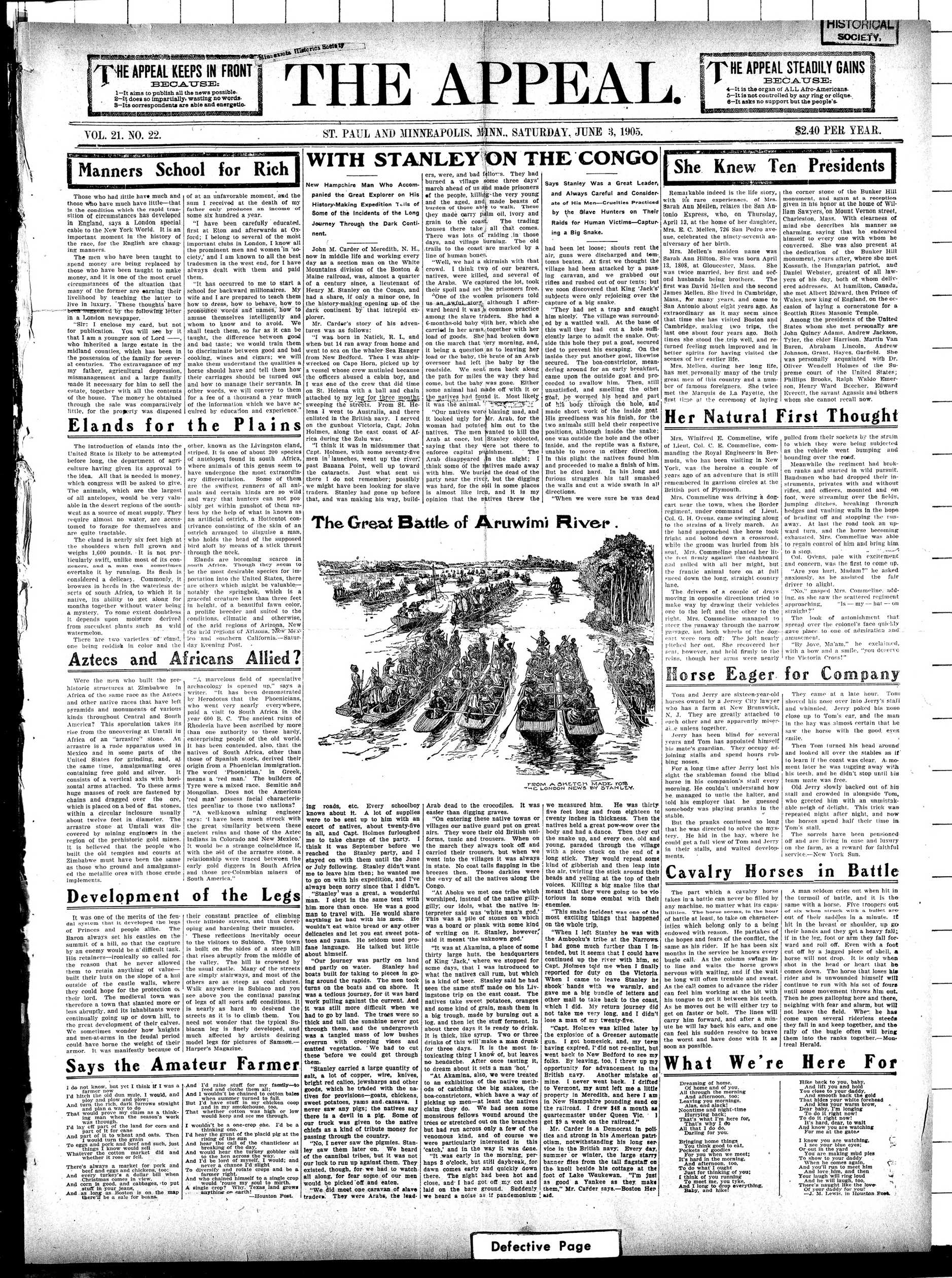
The Great Battle of Aruwimi River.
New Hamphire Man Who Accompanied the Great Explorer on His History-Making Expedition Tells of Some of the Incidents of the Long Journey Through the Dark Continent.
John M. Carder of Meredith, N. H., now in middle life and working every day as a section man on the White Mountains division of the Boston & Maine railroad, was almost a quarter of a century since, a lieutenant of Henry M. Stanley on the Congo, and had a share, if only a minor one, in the history-making opening up of the continent by that intrepid explorer.
Mr. Carder's story of his adventures was as follows:
"I was born in Natick, R. L. and when but 14 ran away from home and went to sea on the whaler Sea Ranger from New Bedford. Then I was shipwrecked on Cape Horn, picked up by a vessel whose crew mutinied because the officers abused a cabin boy, and I was one of the crew that did time on St. Helena with a ball and chain attached to my leg for three months. When I was sent to Australia, I went to Australia, and there enlisted in the British navy. I served on the gunboat Victoria, Capt. John Holmes, along the east coast of Africa during the Zulu war.
"I think it was in midsummer that Capt. Holmes, with some seventy-five men in launches, went up the river, past banana Point, well up toward the cataracts. Just what sent us there I do not remember; possibly the one that was the first traders. Stanley had gone up before that, and was making his way, build-
The Great B
ing roads, etc. Every schoolboy knows about it. A lot of supplies were to be sent up to him with an escort of natives, about twenty-five in all, and Capt. Holmes furloughed me to take charge of the party. I think it was September before we reached the Stanley party, and stayed on with them, June 12 following it. The Stanley didn't want me to leave him then; he wanted me to go on with his expedition, and I always been sorry since that I didn't. "Stanley was a great, a wonderful man. I slept in the same tent with him more than once. He was a good man to travel with. He would share anything he had with his men. He wouldn't eat white bread or any other delicacies and let you eat sweet potatoes and yams. He seldom used profane language. He talked little but enthusiastic. Our journey was partly on land and partly on water. Stanley had boats built for taking to pieces in going around the rapids. The men took turns on the boats and on shore. It was a tedious journey, for it was hard work pulling against the current. And it was still more difficult when we had to go by land. The traps were so thick and tall the sunshine never got through them, and the undergrowth was a tangled mass of low bushes overruned with weeds and vegetation. We had to cut these before we could get through them.
"Stanley carried a large quantity of salt, a lot of copper, wire, knives, bright red calico, jewsharp and other goods, which he traded with the natives for provisions—goats, chickens, sweet potatoes, yams and cassava. I never saw any pigs; the natives say there is a devil in a pig. Some of our truck was given to the native chiefs a kind of tribute money for passing through the country.
"No. I never saw the pigmies. Stanley was later on. We heard of the cannibal tribals, but it was not our luck to run up against them. They existed, though, for we had to watch all along, for fear some of our men would be picked off and eaten.
"We did meet one caravan of slave traders. They were Arabs, the lead-
ers, were, and bad fellows. They had burned a village some three days' march ahead of us and made prisoners of the people, killing the very young and the aged, and made beasts of burden of those able to walk. These they made carry palm oil, ivory and grain to the coast. The trading houses there take all that comes. There was lots of raiding in those days, and village burning. The old trails to the coast are marked by a line of human bones.
"Well, we had a skirmish with that crowd. I think two of our bearers, natives, were killed, and several of the Arabs. We captured the lot, took their spoil and set the prisoners free.
"One of the women prisoners told us an awful story, although I afterward heard it was a common sentence among the shaves. She had a child with her, which she carried in her arms, together with her load of goods. She had broken down on the march that very morning, and, it being a question as to leaving her load or the baby, the brute of an Arab overseer had left the baby by the roadside. We sent men back along the path for miles the way they had come, but the baby was gone. Either some animal had made off with it or the natives had found it. Most likely it was the animal.
"Our natives were blazing mad, and it looked ugly for Mr. Arab, for the woman had pointed him out to the natives. The men wanted to kill the Arab at once, but Stanley objected, saying that they were not there to enforce capital punishment. The Arab disappeared on the night; I think some of the natives made away with him. We buried the dead of the party near the river, but the digging was hard, for the soil in some places is almost like iron, and it is my opinion that the natives threw the
Attle of Aruwim
Arab dead to the crocodiles. It was easier than digging graves.
"On entering these native towns or villages our native guard put on great airs. They were their old British uniforms, tunic and trousers. When on the march they always took off and carried their trousers, but when we went into the villages it was always in state. No coat tails flapping in the breezes then. Those darkies were the envy of all the natives along the coast.
"At Abuku we met one tribe which worshipped, instead of the native gilly-gilly, our idols, what the native interpreter said was 'white man's god'. This was a pile of stones on which was a board or plank with some kind of writing on it. Stanley, however, said it meant 'the unknown god'.
"It was at Akamina, a place of some thirty large huts, the headquarters of King Jack," where we stopped for some days, that I was introduced to what the natives call rum, but which is a kind of beer. Stanley said he had seen the same stuff made on his Livingstone trip on the east coast. The natives take sweet potatoes, oranges and some kind of grain, mash them in a big trough, made by burning out a log, and then let it stuff ferment in about three hours of like syrup. Two or three drinks of this will make a man drunk for three days. It is the most intoxicating thing I know of, but leaves no headache. After once testing it, to dream about it sets a man 'hot'.
"At Akamina, also, we were treated to an exhibition of the native methods of catching the big snakes, the boa-constrictors, which have a way of picking up men—at least the natives claim they do. We had seen some monstrous fellows wound around the trees or stretched out on the branches but had run across only a few of the venomous kind, and of course we were particularly interested in this 'catch', and in the way it was done. "It was early in the morning, perhaps 3 o'clock, but still daybreak, for down comes early and quickly down there. The night had been hot and close, and I had got off my cot and laid on the bare ground. Suddenly we heard a noise as if pandemonium
Defective Page
Says Stanley Was a Great Leader and Always Careful and Considerate of His Men-Cruelties Practiced by the Slave Hunters on Their Raids for Human Victims-Capturing a Big Snake.
had been let loose; shouts rent the air, guns were discharged and temoms beaten. At first we thought the village had been attacked by a passing caravan, and we grabbed our rifles and rushed out of our tents; but we soon discovered that King Jack's subjects were only rejoicing over the capture of a big snake. "They had set a trap and caught him nicely. The village was surrounded by a wattled wall. At the base of this wall they put a hole in sufficiently large to add a hole sufficiently large to put the pet a goat, secured tied to prevent his escaping. On the inside they put another goat, likewise secured. The bo-conconstrictor, meandering around for an early breakfast, came upon the outside goat and proceeded to swallow him. Then, still unsatisfied, and smelling the other goat, wormed his head and part of his body through the hole, and made short work of the inside goat. His greediness was his finish, for the two animals still held their respective positions, although inside the snake; one was outside the hole and the other inside, and the reptile was a fixture, unable to move in either direction. In this plight the natives found him and proceeded to make a long and furious struggle with his long and furious struggles his tail smashed the walls and cut a wide swish in all directions. "When we were sure he was dead
vimi River.
FROM A SKETCH HARD JOB
THE LONDON NEWS BY STANLEY.
we measured him. He was thirty five feet long and from eighteen to twenty inches in thickness. Then the natives held a great pow-wow over the body and had a dance. Then they cut the snake up, and every one, old and young, paraded through the village with a piece stuck on the end of a long stick. They would repeat some kind of gibberish and then leap into the air, twirling the stick around their heads and yelling at the top of their voices. Killing a big snake like that meant that they were going to be victorious in some combat with their enemies.
A snake insulted was one of the most exciting things that happened on the whole trip.
"When I left, Stanley he was with the Ambooku's tribe at the Narrowes. I had gone much further than I intended, but it seems that I could have continued up the river with him, so Capt. Holmes told me when I finally reported for duty on the Victoria When I came to leave Stanley he shook hands with me warmly, and gave me a big bundle of letters and other mail to take back to the coast, which I did. My return journey did not take me very long, and I didn't lose a man of my twenty-five.
Drink,
three
drunk
inst
leaves
ag it,
l'teated
meth
native
some
d the
inches
of the
we
this
done,
per-
k for
down
and
idently
nium
"Capt. Holmes was killed later by the explosion of a Greener automatic gun. I got homesick, and, my term having expired, I did not re-entil, but went back to New Bedford to see my folks. By leaving, too, I threw up my opportunity for advancement in the British navy. Another mistake of mine, I never went back. I drifted to Vermont my sunt like my little property in Meredith, and here I am in New Hampshire pounding sand on the railroad. I drew $4 a month as quartermaster under Queen Vic. I get $2 a week on the railroad."
Mr. Carder is a Democrat in politics and strong in his American patriotism, notwithstanding his long ser vice in the British navy. Every day, summer or winter, the large starry banner files from the tail flagstaff on the knoll beside his cottage at the foot of Lake Waukewan. "I'm just as good a Yankee as they make them." Mr. Carder says.—Boston Herald.
THE APPEAL STEADILY GAINS
RECAUSE:
4- It is the organ of ALL Afro-Americans.
5- It is not controlled by any ring or olique.
6- It asks no support but the people's.
She. Knew Ten Presidents
Her Natural First Thought
Horse Eager for Company
Cavalry Horses in Battle
What We're Here For
What We're Here For
Remarkable indeed is the life story, with its rare experiences, of Mrs. Sarah Ann Mellen, relates the San Antonio Express, who, on Thursday, April 13, at the home of her daughter, Mrs. E. C. Mellen, 726 San Pedro avenue, celebrated the ninety-seventh anniversary of her birth.
Mrs. Mellen's maiden name was Sarah Ann Hilton. She was born April 13, 1808, at Gloucester, Mass. She was twice married, her first and second husbands being brothers. The first was David Mellen and the second James Mellen. She lived in Cambridge, Mass. for many years, and came to San Antonio about eight years ago. As extraordinary as it may seem since that time she has visited Boston and Cambridge, making two trips, the last one about four years ago. Both times she stood the trip well, and returned feeling much improved and in better spirits for having visited the scenes of her earlier life. Her long life, has met many of the truly great men of this country and a number of famous foreigners. She twice met the Marquis de la Fayette, the first time at the ceremony of laying
Mrs. Wilinfred E. Commeline, wife of Lieut. Col. C. E. Commeline, commanding the Royal Engineers in Bermuda, who has been visiting in New York, was the heroine a couple of years ago of an adventure that is still remembered in garrison circles at the British port of Plymouth.
Mrs. Commeline was driving a dogcart near the town, when the Border regiment, under command of Lieut. Col. G. H. Ovens, commenced a marched march. As the hand approached the horse took fright and bolted down a crossroad, while the groom was hurled from his seat. Mrs. Commeline planted her little feet against the dashboard and pulled with all her might, but the frantic animal tore on at full speed down the long, straight country lane.
The drivers of a couple of drays moving in opposite directions tried to make way by drawing their vehicles one to the left and the other to the right. Mrs. Commeline managed to steer the runaway through the narrow passage, but both wheels of the dog were hit and the latter pitched her out. She recovered her seat, however, and held firmly to the reins, though her arms were nearly
Tom and Jerry are sixteen-year-old horses owned by a Jersey City lawyer who has a farm at New Brunswick, N. J. They are greatly attached to each other and are apparently miserable unless together.
Jerry has been blind for several years and Tom has appointed himself his mate's guardian. They occupy adjoining stalls and spend hours rubbing noses.
For a long time after Jerry lost his sight the stableman found the blind horse in his companion's stall every morning. He couldn't understand how he managed to untie the hatter, and told his employer that he guessed somebody was playing pranks in the stall.
But the pranks continued so long that he was directed to solve the mystery. He hid in the hay, where he could get a full view of Tom and Jerry in their stalls, and waited developments.
The part which a cavalry horse takes in a battle can never be filled by any machine, no matter what its capabilities. The horse seems, in the hour of battle at least, to take on characteristics which belong only to a being endowed with reason. He partakes of the hopes and fears of the conflict, the same as his rider does, but a month later the service he knows every call. As the column swings into line and waits the horse grows nervous with waiting, and if the wait be long will often tremble and sweat. As the call comes to advance the rider can feel him working at the bit with his tongue to get it between his teeth. As he moves out he will either try to get on faster or bolt. The lines will carry him forward, and the horse takes his ears, and one can feel his sudden resolve to brave the worst and have done with it as soon as possible.
Dreaming of home.
Home and me, to eat.
All that is the morning.
And afternoon, too:
Lunchtime, my wristings,
Alas, and alack!
Noontime and night-time
I back it.
That's what I'm here for,
That's why I do
That I do I do do.
Darling for you.
Bringing home things
You think good to eat.
Please go good.
For you when we meet;
It's hard in the morning.
A second. A morning.
To do what I ought
To you;
I think of you running
To meet me, you tyke.
And I think of everything,
Baby, and baby!
$2.40 PER YEAR.
en Presidents
the corner stone of the Bunker Hill monument, and again at a reception given in his honor at the home of William Sawyers, on Mount Vernon street, Charleston, Mass. With clearness of mind she describes his manner as charming, saying that he endeared himself to every one with whom he conversed. She was also present at the dedication of the Bunker Hill monument, years after, where she met Kossuth, the Hungarian patriot, and Daniel Webster, greatest of all lawyers of his day, both of whom delivered addresses. At Hamilton, Canada, she met Albert Edward, then Prince of Wales, now king of England, on the occasion of laying a cornerstone for a Scottish Rites Masonic Temple.
Among the presidents of the United States whom she met personally are John Quincy Adams, Andrew Jackson, Tyler, the elder Harrison, Martin Van Buren, Abraham Lincoln, Andrew Johnson, Grant, Hayes, Cardwell. She was personally acquainted with Dr. Oliver Wendell Holmes of the Supreme court of the United States; Phillips Brooks, Ralph Waldo Emerson, Henry Ward Beecher, Edward Everett, the savant Agassiz and others whom she cannot recall now.
pulled from their sockets by the strain to which they were being subjected as the vehicle went bumping and bounding over the road.
Meanwhile the regiment had broken ranks and started in wild pursuit. Bandsmen who had dropped their instruments, privates with and without rifles, and officers, mounted and on foot, were streaming over the fields, jumping ditches, breaking through hedges and vaulting walls in the hope of heading off the road the truck took an upward turn, and the horse becoming exhausted. Mrs. Commelne was able to regain control of him and bring him to a stop.
Col. Ovens, pale with excitement and concern, was the first to come up.
"Are you hurt, Madam?" he asked anxiously, as he assisted the fair driver to alight.
"No," gasped Mrs. Commelne, adding, as she saw the scattered segment approaching, "Is — my — hat — on straight?"
The book of astonishment that spread over the colonel's face quickly gave place to one of admiratica and amusement.
"Do you Madam," he exclaimed, with a bow and a smile, "you deserve the Victoria Cross!"
They came at a late hour. Tom shoved his nose over into Jerry's staff and whimmed. Jerry poked his nose close up to Tom's ear, and the man in the bay was almost certain that he saw the horse with the good eyes smile.
Then Tom turned his head around and looked all over the stables as if to learn if the coast was clear. A moment later he was tugging away with his teeth, and he didn't stop until his team mate was free.
Old Jerry slowly backed out of his stall and crowded in alongside Tom, who greeted him with an unmistakable neigh of delight. His night was repaired night after night, and now horses spend half their time in Tom's stall.
The sorrels have been pensioned off and are living in ease and luxury on the farm, as a reward for faithful service—New York Sun.
A man seldom cries out when hit in the turmoil of battle, and it is the same with a horse. Five troopers out of six when struck with a bullet are out of their saddles in a minute. If hit in the breast or shoulder, up go their hands and they get a heavy fall; if in the leg, foot or arm they fall forwards by roll and kick out off by gripped piece of shell or horse will not drop. It is only when shot in the head or heart that he comes down. The horse that loses his rider and is unwounded himself will continue to run with his set of fours until some movement throws him out. Then he goes galloping here and there, neighing with fear and alarm, but will not leave the field. Whee he has come upon several riderless steeds they fall in and keep together, and the bugle often will bring them into the ranks together. -Monteur Herald.
Hike back to you, baby,
And life will hold hold
You close to your daddy,
And smooth back the gold
That hides you white groomed
And kiss your warm brow,
Dear baby, I'm longing
To do it right now!
To do it right now!
I am sure, soon, to wait
And know you are watching
For me at the gate.
I know you are watching,
I see your shin eyes;
Of the yard
You are making mud pies
To do it right now
When he comes again,
And you run to him, him
And love him, and then
Your laugh will ring loud
And he laugh, too,
There is caught in the love
Of your dad for you
— J. M. Lewis, in Houston Post.
HAVE YOU READ
THE APPEAL?
ADAMS BROS. EDITORS AND PUBLISHERS
49 E. 4th St., St. Paul, Ninei
ST. PAUL OFFICE,
No. 110 Union Blk. 4th & Cedar,
J. O. ADAMS, Manager.
MINNEAPOLIS OFFICE,
Sparsity Loan Bldg. Room 1020
HARVEY B. BURK, Manager.
CHICAGO OFFICE,
323-5 Dearborn St., Suite 310,
C. F. ADAMS, Manager.
VERMAS STRICTLY IN ADVANCE:
**WINE COPY, ONE YEAR** . $2.00
**COPIES, COPY, MIX MONTHS** . 1.10
**COPIES, TREE MONTHS** . 60
When subscriptions are by any means allowed
to be sent to me for each 12 weeks and 5 cents for
each week, or at the rate of $2.40 per
equivalent.
Contributions should be made by Express
Money transfer. Post Office Money Order
receipts will be received the same as cash for
each week, or at the rate of $2.40 per
equivalent.
Gifts should never be sent through the mail,
but should always be sent a bounce through
it. Persons who send silver to us in letters
on their own account will receive 10 lines or less.
Each addition 1 line 10 cents. Payment
at all times. All orders to be news.
Advertising rate. 15 cents per agate line each
advertising rate. There are fourteen agate lines
agate line each. No single advertisement less
than the discount allowed must account
pany all orders from parties unto us.
Reading rates 25 cents per line each, in addition.
No discounts for time or space. Reading
rates to the line. All headlines count.
To send on the address label shows when
the subscription is received. Receipts should be
made two weeks prior to expiration, so that
no payment may be missed, as the paper stops
from being used.
occasionally happens that papers sent to us do not receive any number when we send them by postal card at the expiration of five days from the date of receipt. We also have a duplicate of the missing number.
Communications to receive attention must be neat, upon important subjects, plainly written only upon one set of correspondence, written not later than Wednesday, and bear the signature of the author. No manuscript report is required. We do not hold ourselves responsible for the views of our correspondents.
Solliciting agents wanted everywhere. Write to us at the following address:
In every letter that you write us never fail to give your full name and address, plainly written. In every letter that you write us never letters of all kinds must be written on separate sheets from letters containing news or information.
SATURDAY, JUNE 3, 1905.
A CALIFORNIA COLORLINE.
That the colorline is cutting a wonderful figure in this country can be inferred from the single fact that German and his cohorts propose to Afro-American disfranchisement the only issue in the impending campaign. But Maryland, my Maryland, is not the only section which is agitated by this troublesome question. California is stirred up by the same trouble to a frightened extent. A great number of people recently held in San Francisco, at which many able addresses were made. The sentiment of the convention may readily be inferred from a few extracts from these addresses which are given herewith. One fact which which involves a needed sensation was the statement that the laborer would do all of the work of building a house, which involves the employment of thirty-four different trades, employing only Japanese for, for a much less price than white laborers did the same; while the laborer did the work of the wages paid to white men. The chairman, in his meeting address paid his respects to members of our citizens who are invited to admire the Japanese on account of their military valor, and others who were carried away into a life process of illogical reasoning termed the universal brotherhood of man." Another speaker declared that "we will have to continue this fight until it is decided whether the Japanese or the Mongolian are to be the cities of the earth. A third declared that someone cannot come and mix with us, become blood of our blood and bone of our bone must be kept out." A fourth advocated the exclusion of Mongolian children from the schools of the state. A Jew who was present with the Japanese are not an important group. They, they can invent, but they ought to be kept out."
It can readily be seen that this phase of the color-line trouble involves considerations not heretofore connected with it. It is an international matter that the importor has already called to the fact that China, indignant at our exclusion act, proposes to reallocate by boycotting American products. The loss of the Chinese markets for our cotton products would at once ban the Southern market; the factor; for China is by far our best customer. If to China, Japan be added, their retaliatory measures would be cataritous to the United States. As the white brother is already lamenting over the weight of his burdens, it is better not be rash in adding to it.
MASSES MUST HAVE THE BALLOT.
The Chicago Tribune is responsible for this:
"There was a time when Americans looked on the ballot as a panacas for men to whom it was given had been in dense political ignorance they would suddenly become enlightened and would use the ballot intelligently." There have been experiences in this country which have taken popular belief in that theory."
In the last sentence there is an evident allusion to the legislation of the reconstruction period; but what is implied is flatly contradicted by the history of those times. That legislation was not based upon any law that was forced by the exigencies of the situation. The emancipation proclamation rendered absolutely necessary the enactment of the Thirteenth Amendment; as Mr. Lincoln asserted, the country could not remain half slave and half free. But the Southern states, soon after the Thirteenth Amendment, once established a system of peonage, actually more atrocious than the preexistent system of slavery, whose regulations were devised by an ingenuity that was little less than internal. That fact rendered necessary the enactment of the Fifteenth Amendment. The Fifteenth Amendment rendered it possible to restore the states to their proper relations to the Federal government and prevented a resort to much harsher measures. This purpose, the Fifteenth Amendment, was the means of carrying out the pancasae for all lilies, but all history teaches that the masses must cast the ballot or the classes will establish a bureaucracy.
The Charleston News and Courier reprints the address of Judge Brawley, on Memorial day, at Chester, S. C. it is an eloquent presentation of the sentiment which the South is endeavoring to impress as to the causes of slavery, and which the South fonds the right of secession and argues that the war was not fought for slavery, on the part of the North, nor against it upon the part of the North. But it seems to be a fact that the very authorities for this proposition quoted by the judge, prove the very contrary. One of these proofs is a quotation from the "Present Lincoln, as follows": "Have no intention, directly or indirectly to interfere with slavery in the states where it exists." Mr. Lincoln evidently supposed that slavery was the stumbling block, and Judge Brawley himself refers to the agitation in regard to slavery, and Judge Brawley does not if its actual cause. But the real cause of the war escaped the notice of the judge. By the adoption of the Constitution of the United States two elements as antagonistic as heat and cold, or fire and water, were yoked together. These were free labor and slavery. These were free labor and slavery, able that they did not do so earlier, was due to the talent and energy of many men of the highest order. But even these men could only delay the fifth act. It was bound to come.
In the South, there are many planters who never suffer from scarcity of labor. They can get all the labor they need, without the least trouble. There is another class, much larger, which is always short and filling the newspaper. This class has the liability of Afro-American labor. Why is this? The reasons are purely personal. The planters of the first class treat their laborers decently, recognizing that they have some rights which a white man is bound to respect; the second class is the very opposite, and it is always short and always howling. The Afro-Americans have the second class spotted and will not work for
Rabbi Messing, of Montgomery, Ala., recently made an address to the graduates of an Afro-American college, and got off the following tommy-rot under the head of wholesome advice: "Do not mix too much with the government; do not seek for snaps from the government; do not seek for snaps from the staff Tillman, Vardaman and other 'best friends' give out. In a republic every good citizen should take an active part in the government which is 'of, for and by the people.' Possibly the rabbi's reference to 'snaps' may have been inspired by the fear that the Afro-American might rake in the Jews had a chance to graft them.
During the past year, 4,392 white and 5,393 Afro-Americans were granted license to teach in Mississippi. The fact is interesting as showing how much attention Mississippi pays to Gov. Vardaman's nonsense, and is thus a demonstration of the amount of influence he wields in his own state. The attempt to destroy the educational advantages of the Afro-American population, failed in Mississippi as it did in Arkansas, and thus a demonstration of the wastes of that effort. The states are not represented by such men as Jeff Davis and Vardaman.
"From the union of the wretched lad of our towns with a tawdy slur," says Dr. Butler Hogan, "spring children who are bold, pert and dirty as a London sparrow, who are precocious in all the smart vices of a new century, in the old-fashioned virtues of truth, courtesy and reverence." If such be the outcome of the much vaunted western civilization among our brethren of the "superior" race, it may be doubted if much harm would be done by sweeping some of it
They are having a high old time at Howard University, Washington, D. C., all on account of the color prejudices of President Rev. (?) John Gordon. He ought to resign or be removed, but should or not that of institution, or any other for that matter, if what is charged is true.
---
That, "the devil takes care of his own" was again verified last week when old Ben Tillman was driven over an embankment and sustained a fracture. He would have been pleased to write an obituary, but must wait a little longer, we suppose.
It is said that the Northern and Southern Baptists are to "get together. That, of course, means that they will with dark faces will be kicked out
THE BOOK WORLD
A POLITICAL HISTORY OF SLAVERY.
A Political History of Slavery. By William L. Latham, with an account by Whitewalt Red. Two volumes. $v. Net. $1.50. By mail. $5.00. New York: G. H. Hawkins & Son.
"A Political History of Slavery," by Wm. Henry Smith, is an account of the slavery question, from the early days of the 18th century, to the reconstruction period in the United States.
There is an introduction by Whitewalt Red, with well-written care and which gives quite an extended criticism of these two very instructive vol-
strategists Von Mokke.
In reading certain chapters of this book on the basis of this very recent ingruces of the Revolution being enacted in Paris and elsewhere the events which led up to the white germany are thus described by author:
"Bismack prepared the war, Napoléon II created it the greatest beggery on himself with a grimness. He sawn his thinned the country. They might have stopped it by its earliest gesture. M. Thiers contend and which gives quite an extended criticism of these two very instructive vol-
Mr. Roid says: "This Political History comes from the inside as they occurred, from among familiar citizens, from the subjects, and from access to much unpublished information and Governor Brough, in the records of the state office held during a critical period, and in constant personal communication by a few people engaged in matters by a free people enlarged the bounds of freedom, to communities and Anglo-Saxon institutions—to Horace Chase and Seward, Stanton and Welles, first among legislators and cabinet ministers, superior of them all, and certainly the political of the list, Abram Linneau.
In Chapter I, the author says: "If there is one thing clearly established in the men that formed the Constitution; who, recognizing that such an institution was inconsistent with the great principles of civil liberty for which the colonies had contended, was a public, refrained from inserting in that great charter a name so repulsive to free-perpetualism that we were moment of that day. There was no state government of that day. There was no state feeling that was injurious to society was in no sense dependent upon sectional lines, its ultimate extinction was gone. It was to be the rule. This came early north of Maryland, and it is not unreasonable that the protection of the African slave trade, emancipation would have followed in Delaware, Maryland, North Carolina, Kentucky and
Opposition to the institution of slavery arose from religious convictions as to its sinfulness or from economic and social policies. The resistance of those who with Mr. Jefferson condemned it because of its destructive influence became as impotent as his, or succumbed to the violence of political forces; while that having its source in religious feelings played an important part in the creation of a third party. The Society of Friends led all other denominations in the employment the public prints as to whether Wm. Lloyd Garrison, Benjamin Lundy or Chas. of moral influence for the eradication of slavery, though there were not wanting outspoken utterances in the P.esbyterian, Baptist and Methodist churches at an early day, especially in Ohio. Kentucky and Tennessee.
"Some years ago one who had been conspicuous among endeavors to the anti-slavery faithfulness of current history in dealing with the slave trade, and thereon a controversy sprang up in Osborne was entitled to be styled the first slave trader, but the writer who challenged "the truth of Osborne to be mentioned before either Lundy or Carrison, but strangely overlooked the claims of another whose career was Osborne, a friend, who was born in New York, to the life and career, exceedingly interested in the count of his early life and career, exceedingly interested in the history of 28 years of age he visited North Carolina, where he met the Negroes, who held and wrote an essay entitled "Considerations on the Keeping of Negroes, which was published, a wide circulation, which was published, a wide circulation, the work of emancipation. He traveled from colony to colony, preaching remonstration. The author discusses with painstaking detail the Negroes' Bill, the Respel of Missouri Compromise, "The Nomination of Lincoln, and in their discussion exhibits a knowledge, which could only result from the leading men of those stirring times."
Vol. II opens with a chapter on "The Invasion of the United States," "In the history of nations wacky wriers are treated with scant respect. They become oppression; they imperial governments and invite orders to enter in; they are the Mr. Buchanan was brought face to face with the Union and overthrow the government, he construed the fundamental law to be executive. Imagine Andrew Jackson, the executive head of the government in the age of seige; in the work of disunion have been they have bullied him
CIVIL WAR TIMES
Civil War Times. By Daniel Walt Howe, author of the Puritan Republic, 8 vo. pp. 421. $1.50. Indianapolis: Dobsmerrill Co.
The war of '61-5 will never cease—at least in the present generation, to be a perennial and never failing topic of absorbing interest. This is so, because it was a war of giants; because many of those giants still survive its vicissitudes; its "hair breadth escapes, and the imminent deadly breach"; its long and dreadful marches; its Gettysburg and Chickamaugas; because the finale of that conflict profoundly influenced the civilizations of the world; because its echoes still reverberate in all the various activities of American life.
Because of these things the author's volume is interesting. It can be read with profit by any one and many incidents of the great strife which has hitherto remained unwritten, is brought forth by Mr. Howe.
One of the most interesting chapters in the volume is one dealing with the region of the Commuion of the world of the group of Soldier. The author tells us, that nearly every important Confederate commander has a list of the most important black soldiers; that the matter is finally bated in the Confederate Senate, and the bill authorizing the enlistment of Negro members is the only list on which that of Senator Hunter. By that when the desperate circumstances of the Confederacy became so visible that the leaders were not in the field of the party, "cause," a draft order was issued to force the black soldier to fight under the Confidentiality flag, but that before it could be transferred to the Fischer in which he was held the flight of Jefferson Davis was at hand. This chapter is especially interesting at under its banner.
The Commuion of the Commuion of 1871, interesting chapters in the book, "The Style is clear, uninvolved and natural," and the author has written instructively.
HISTORY OF THE COMMUION OF THE HISTORY OF THE COMMUNE OF 1871.
Translated from the French of Lissagaray by the author, the New York International Publishing Co.
"History of the Commune of 1871," translated from the French of Lissagaray by the author, and published with one of those political convulsions which have no frequently shook France.
The translator has performed the difficult art of preserving the peculiar epigrammatic and pointed style of all French.
The author, which Lissagaray appears to be a master.
The descriptive art of the author never lags from the opening to the closing of this book of extraordinary happenings. The Commune of 1871 was th. culmination of the revolt of 1871, the culmination of a criminal torpor that rested upon those in authority, and which followed swiftly upon the heels of the revolt. The author was under 90 armies under that erode of military
strategists Von Moltke
In reading certain chapters of this book one might easily imagine that the revivalation were again being enacted in Paris and elsewhere throughout the country.
The events which led up to the war war Germany are thus described by the author. "Bismark prepared the war, Napoleon II, wanted it, the great bourgeois looked at it, the great Napoleon hopped on the earnest gesture. At the end, the content himself with a grimace. He saw in this war our certain rule: the war our treasure, the war our bible; he united the Left, the tiers-part, the journalists have made palpable to them the strength of opinion, have said to the Tullerles, to Paris if needs be, "War is impossible; we shall combat it as trea-
"Poor France! will save thee? the humane, poor France! will save thee with the Empire." While the upper classes sell the nation for a few hours of rest, and the liberals demand that they be freed from the empire, a handful of men, without arms, unprotected, rise up against the still all-powerful men who form the bourgeois have gone men who form the bourgeois have gone men to the people, faithful children of the Revolution; on the other hand workmen unite for the study and conquest of the rights of labor. In vain the emperor, with their forces, to seduce the workmen."
The author then follows up with a description of the terrific political struggle that has taken place in theinally burst forth is all the horrors of the Paris. Marselles, Toulouse and Narbonne, human slaughter houses, in this fictitious struggle which for mundness and unfortunate reasons, and counterparts in the history of the human family. Many new events—that is events which have been witnessed by many of that period are brought forward by the author, in his work which considered the history of the point is an achievement of no inconsiderable merit.
MONEY, BANKING, AND FINANCE
Bollen's Money, Banking and Finance. Author of "Practical Banking," "Bank Officers," etc., and Lecturer in the University College, Cloth, 12mo. 336 pages. Price, New York, Cincinnati, and Chicago.
This volume, while designed especially for the text-book, is Committed to High Schools and the Committing to College Colleges, is equally suited for the general use of the Committing to Banking Colleges. It is equally suited for the general use of the Theory of Money, the Practices Usages of Banking and the Principles the best banking practice of the day, and the author's own experiences with the topics taken up. This is the first volume of the series, and the treatments on methods of bank bookkeeping and works on the theory and history of banking, and the authority on the subject, and presents a concise manner. This book will appeal alike to those who intend to devote themselves to the history and practice of banking.
HENRY WARD REECHER
Henry Ward Beecher. By Lyman Abbott. 51st. Boston. and New York. 1912.
Dr. Abbott made the acquaintance of Dr. Abbott and gave him the mate friend of his from that time forward. He attended Dr. Beacher's church in New York and gave an outline of the character of the great preacher in a history book of the life of the preacher, a history book of the life of the character as he appeared to Dr. Abbott.
The career of Beecher as an anti-slavery reformer, before and during the civil war period, was called to the public. Of the 1960s, the capital matter of the utmost value. Mr. Beecher's anti-slavery campaign in England and the United States, in London, was the first of that year from a season on the continent. His intention being to rest before sailing for New York. But fate ordered otherwise. The people who have been so well-planned in the aristocratic and moneyed class-in-law, overwhelmingly in favor of the country. In the fall of 1960, the American cause "was sure to invite every species of insult and indiginity. This sympathy for the South and the North was not as much as he had ever had, and he assumed all the living proportions, and rumors are afloat to the effect that the British government, in all probability would be forced by public interest, and the law of the country, as the other going forward in America in behalf of the South. Such was the state of feeling when the people reached England. The people of the United States were not as much as of course greatly alarmed over such a prospect. And after much trouble, per seuded Dr. Beecher to make a lecturing of the people who were in the state of the Federal cause. By this they hoped to counteract the work of agents of the Confederacy who were then seduously fan-like in the service of the people who were in the species and publications. Any other innovation would be weakened, but having pro-moteable, a courageous step of the mass blood-red. Insults of things and all the other annoyances which the British public consider perfectly legitimate to prevent an unpopular speaker's friend's proseute the campaign from being hegird.
ANTISEMITISM
*Bernard Demlem* by Bernard Lazarez.
*Transformation* by John W. New York: International Publishers.
Recent events in Russia have given us a new translation from the French, and its pages must have been written many times. The most painful interest to the Jewish question. The author is himself a Hebrew, and his pages are plied in the title to his book, but this circumstance does not seem to have hindered his ability to make opinions. The case is certainly stated in the book, and the author is attributed with fairness. The fault is found to be not all on the part of the Gentile author, who is charged with having brought trouble to his people by manifest short-trouble to his people by manifest short-trouble.
The treatment given the subject is his histories between Jews and Gentiles are traced from the earliest times. Perhaps his histories between Jews and Gentiles learn how much of proselytising has been carried on reciprocally between the Hezekiah and the Israelites has resulted a greater race of race adult. The author does not believe racial distinctions whether these be founded upon the color of the skin. So long, however, as the opinion prevails that races are distinct part and inferiority on the other part and inferiority on the same part and Gentile as well as between black and white. There are too many illustrative histories of this country, and this book can be read with profit by many who are called upon to decide questions daily arising
FORMS OF ENGLISH POETRY
Johnson's Forms of English Poetry.
By Charles F. Johnson, L. H. D., Professor of English Literature in Trinity College, Hartford, Cloth, 12 mo., 363 pages. Price, $1. American Book Company, New York, Cincinnati and Chicago.
Equally suitable for young people and for general readers, this volume contains the essential principles of the construction of English verse, and its main divisions both by forms and by subject matter. The historical development of eight of these divisions is sketched and briefly illustrated by examples, but the true character of poetry as an art and as a social force is always kept in evidence. The book will cultivate an appreciation and a love of poetic literature, and will arouse in the student a love of poetry.
Knowles Building. Boys' Hall. Stone Hall. Girls' Hall. Model Home.
ATLANTA UNIVERSITY, Atlanta, Ga.
An unsectarian Christian Institution, devoted especially to advanced education. College, New
Nearal, College Preparatory and English High School courses, with Industrial Training. Superior
advance in Music and Printing. Athletic for boys. Physical culture for girls. Home
and training. Add given to needy and deserving students. Korn begins the first Wednesday
in October. For catalog and information, address
President HORACE BUMSTEAD, D.B.
Virginia Normal Collegiate
Institute.
PETERSBURG, VA.
Departments- Normal and Collegiate; Special attention to Vocal and
Musical Instruction; Theological Agriculture, Sewing and Cooking.
Health Location: heated by steam,
litigated by electricity, rooms, booth
tuition, light amenities.
For Catalog and Participation,
write to J. H. JOHNSTON.
President
write to J. H. JOHNSTON.
President
Agricultural, Mechanical, Normal and Common
Medical School. Six-five Dollars a Year
high, and finished room, dormitory, home
wife boys from 6 to 15 years. Term b plus last
to President of Knoxville College, Knoxville
GAMMON THEOLOGICAL SEMINARY
ATLANTA, GEORGIA
Knoxville College. Classical, Scientific, Agricultural, M.
School courses, together with Theatrical, Music, Math,
will cover all aspects of board tuition, feel, light and
and matva for little girls and another for little boys from
Monday in September. Send 10r catalogue to President of
Teen.
Knoxville College. Classical, Scientific, Agricultural, Mechanical, Normal and Common School Courses, together with Theological, and Medical Schools. Fifty-five Dollars a Year will cover all expenses of board tuition, fees, and materials. Students must be a citizen of the United States and matron for little girls and another for little boys from 6 to 15 years. Term begins last Monday in September. Send 20 catalogue to President of Knoxville College, Knoxville
The aim of this school is to do practical courses in the imprinting the ministry. Its course of study is broad and practical: its ideas are high; its students are well prepared; and are fresh, systematic and clear.
**COURSE OF STUDY**
The regular course of study occupies three years, and covers the lines of work in the field of imprinting. Instruction usually pursued in the leading theological seminaries of the country.
**EXPENSES AND AID**
Tutoring room required. The apartments for room rent are plainly furnished. Good board can be had for accommodation per month. Buildings heated by steam.
Aid from loans without interest, and grants from the government. Students who do their dutest in the line of self-help. No young man with a degree in the arts. Some of the advantages now opened to him in this Seminary. For further particulars
REV. MARSHALL R. GAINES, A.M.
PRESIDENT.
A CHRISTIAN SCHOOL Experienced Faculty Progressive in all departments, best Methods of Instruction looked after Students taught to do manual labor as well as think to the president. R. S. LOVINGGOOD, AUSTIN, TEXAS- BRAINERD INSTITUTE A central and industrial school with a graded course of study, designed to give a thorough, symmetrical and complete education for success and usefulness in every vocation of life Board and boarding hall
New England
CONSERVATORY
OF MUSIC
BOSTON, Mass.
GEORGE W. CHADWICK, Musical Director.
All particular and year book will be sold on application.
BALTIMORE & OHIO
CHICAGO
CLEVELAND
PATTSBURG
COLUMBUS
CHEVYLAND
ST. LOUIS
LOUISVILLE
ALL TRAINS VIA WA
TEN DAY STOPOVER
ALLOWED
WASHINGTON
BALTIMORE
PHILADELPHIA
DEPOSIT TICKETS
IN ADDITIONAL ON
ARRIVAL AT
EITHER CITY
OHIO R. R.
NEW YORK
PITTSBURG
PHILADELPHIA
CANTONORE
LA WASHINGTON
BALTIMORE & OHIO R. R.
ALL TRAINS VIA WASHINGTON
TEN DAY
STOPPER
ALLOWED
WASHINGTON
BALTIMORE
PHILADELPHIA
DEPOSIT TICKETS
IMMEDIATELY ON
ARRIVAL AT
EITHER CITY
Defective Page
TUSKEGEE Normal and Industrial Institute TUSKEGEE ALABAMA.
(INCORPORATED)
Permanent July 4, 1989, by the State Legislature as The 89th Normal School Exempt from taxation.
BOOKSTONE INSTITUTION, Principal.
WARREN LOGAN, Treasurer.
LOCATION
In the Black Belt of Alabama where the
blacks outnumber the whites three to one.
ENROLLMENT AND FACULTY
that has taught all males, 88,
females, 84. Average attendance, 1,085.
Instructors, 88.
COURSE OF STUDY
English education combined with industrial
training. All courses are nationally
VALUE OF PROPERTY
Property consisting of 2.26 acres of land, in which the land is owned by the landlord, is valued at $350,000, and no mortgage.
Besides the work done by graduates as class
members, the students have reached through the Tekkigeen Noger Co-
ference. Tekkigeen is 40 miles east of Montgomery and
east of Alabama, cast on the Western Railroad
; Alabama. It is a local place for study. The cli-
cine town, and is an ideal place for study. The cli-
cine town makes the place an excellent winter resort.
SCOTIA SEMINARY
CONCORD, N. C.
This well known school, established for the first term October 1, will be for the next term October 1. Every effort will be made to provide for the comfort of the students. Expense for board, light, fuel, washing. $15, for term of eight months. Address. Rev. D. J. B. Datterie, D. D., C.
A Practical, Literary and Industrial
Trades School for Afro-American Boys and
Girls. Unusual advantages for Girls and
Boys. Joseph D. MARONYI, Principal.
Joseph D. MARONYI, Principal.
Pa.
Fourteen teachers. Elegant and commodious. College Preparatory Normal, English, Music, Shorthorn. Typewriting and FIFITY DOLLARS in ADVANCE Will pay for board, room, light, fuel, tuition $250.00 per room; tuition $250.00 per room; tuition $250.00 per room. Send for circles to the president. REV. JUDSON S. HILL, D. D.,
The all advantages of the heart and most completely the mind are the ability to comprehend the maple of a recognized center of Art and Music and to work with the center in the Profession are obtained through work in all departments of music. Through work in all departments of music, the heart and mind are developed.
President HORACE BUMSTEAD, D.B.
Departments - Normal and College; Special attention to Vocal and Musical Articulture, Sewing and cooking. Healthy Location; heated by steams lighted by electricity; room, boon, tuition, and parties. Postal and Particarp.
AIMS AND METHODS
L. G. ADKINSON, D. D., Pres. Gammon Theological Semi ATLANTA, GEORGIA.
TILLOTSON COLLEGE.
AUSTIN, TEXAS,
The Oldest and Best School in Texas for
Colored Students. Faculty mostly graduates of well known colleges in the north.
Participate in a part of the regular course. Music a special feature of the school. Special advantages for earnest students seeking to help themselves. Send for catalogo and
SAMUEL HUSTON COLLEGE.
R. S. LOVINGGOOD, AUSTIN, TEXAS
BISHOP COLLEGE.
BISHOP COLLEGE.
MARSHALL, TEXAS,
OFFERS EVERY ADVANTAGE
TO STUDENTS.
For beauty of situation, commodiousness of buildings and completeness of education, offered by any school for colored people west of the city. Special LARGE AND EXPERIENCED FACULTY. Five FACULTIES. A new brick dining hall, laundry. A new brick dining hall, physical, physical, biological. Aboriginal. Courses in carpentry, printing, blackboard, cooking, nursing. COLLEGE keeping, cooking, nursing. PERMANENT CERTIFICATES. Students can make part of expenses by work. For particulars and catalogue addresses.
ARTHUR B. CHAFFEZ. President
10
GARLAND
STOVES
AND
RANGES
The World's Best
Often Imitated
Never Equaled
Sold by First Class
Stove Merchants
Everywhere
Put it down in
Black and White
the
MONON ROUTE
IS THE DIRECT LINE
BETWEEN
CHICAGO,
INDIANAPOLIS,
CINCINNATI
AND
LOUISVILLE
CITY OFFICE 232 CLARK ST.
ALSO CHICAGO.
WE EAT Malta-Vita THE PERFECT FOOD
For Brain and Muscle
MALTA-VITA contains more nutrition, more tissue-building qualities, more nerve stimulant than any other food.
Rice, Malta is popular among Millions are eating MALTA-VITA. It gives health, strength, and happiness.
MALTA-VITA PURE FOOD CO.
Battle Creek, Mich. Toronto, Canada
BURNISHINE
Makes Metal Shine
The highest possible polish attainable upon metal surfaces as imparted by Mercury makes it a brilliant lustre on brass, copper, tin, zinc, nickel, silver and all metals. A few rubs, and presto—the dingiest metal shines like gold.
CHEW
Beeman's
The Original
Pepsin Gum
Cures Indigestion and Sea-sickness.
PHOTOGRAPHS
OF WORKS OF ART
$2.00 interest with
MARSHALL PHOTOGRAPH,
18 cents.
CARBON AND PLATINUM
Prints from American Painting
and Old Masters.
More illustrated than a crab.
Lantern Slides
Framed Pictures
SOULE ART CO.
3rd Washington Street
BOSTON, MASS.
The why some shop-keepers do not sell
President Suspenders
is they make more money on imitations 50 cents and a dollar. Ask at favorite shop,
superior specials.
C. A. Edgarton Mfg. Co.
Box215, Shirley, Mass.
Read 8 rpts for catalogue.
4 WEEK'S RECORD IN MINNESOTA TA'S CAPITAL.
"Saintly City" and Saintly City
Polks—Neway Items of Social, Religious and general Matters Among
the People.
SATURDAY, JUNE 3, 1905.
If it's Hamm's, it's all right.
Nice furnished rooms for two gentlemen at 307 E. Seventh street.
THE ELK EXPRESS CO. now has its office corner Ninth and St. Peter streets.
"I haven't paid $5.00 for a hat since I began wearing the Gordon, and I buy the best."
Have you seen the new magazine.
"THE VOICE OF THE NEGRO?" See notice elsewhere in this issue.
Mrs. J. N. Littlejohn, 226 Farrington, fashionable dressmaker. The ladies are invited to call and leave orders. Satisfaction guaranteed.
When you wish a fine shine call at Walter Porter's up-to-date shoe shining parlors No. 114 E. Fourth street. Shines 5 cents. First-class work.
Shoes resolved in 15 minutes at S. T. Sorensen's 153 East Seventh street. Sewed soils 75 cts. nailed soles 50 cts. New shoes, latest styles, $2.50.
George Mahan, charged with killing his wife, was brought into court last Saturday, and had his case continued to June term of court, which begins Monday.
The L. H. A. C. club has issued invitations for a dancing party to be given at Wagner hall, corner Western avenue and Charles street. Tuesday evening, June 6th.
Is your hair straight? If not, send 50 cents to Ozonized Gx Marrow Co. 76 Wabash avenue, Chicago, Ill., for a bottle of Ozonized Ox Marrow and you can easily straighten it.
The Appeal has purchased the press and outfit of the Richardson Printing Company and added the same to the plant. Bring in your job printing. Best work at lowest prices.
Gentlemen wishing nice furnished rooms, withif all conveniences, by the week or month, at reasonable rates, should apply at the Benton House, 228 West Third street, up stairs.
THE NAGEL UNDERTAKING CO., Wm. E. Nagel Manager, 208 West Third street, Telephone, Main 1504. Latest equipments in every line. Lady assistant when desired.
Mrs. Ella Smith has handsomely refted, newly papered and painted her refining room and is furnishing most excellent meals. Call to see her when hungry. No. 352 Cedar street.
James Lee, who works at the shoe shining stand in the German American Bank building, was suddenly taken sick Thursday and removed to the hospital in the police ambulance.
Shoes mended while you wait, at Jarvis, $8 East Fourth street. Half sales, 50 and 75 cents. Prices reasonable for all kinds of repairing. He can do it on short notice. Jarvis, $3 E. 4th street.
There was a splendid crowd at the Colonade Dancing school last Wednesday evening and all enjoyed the new feature which has been inaugurated by Principal Winstead of dancing quadrilles without prompting.
The State Savings Bank, corner Fourth and Minnesota streets, is open Monday evenings from 6 to 8. Accounts can be started with $1. A little amount saved every week may some day stand between you and want.
Shoes you ought to buy. Every pair of Sorenson $2.50 shoes is guaranteed to be equal in every respect to shoes other dealers ask $3.50 for. Once a customer always a customer, S. T. Sorenson, 153 East Seventh.
ELK EXPRESS CO., G. J. Charleston, manager, corner St. Peter and Ninth streets. Packing, shipping and storing of furniture and household goods. Piano moving a specialty. House renting, real estate handled. Madam H. Hart has opened a very neat millinery store at No. 266 Rice street where the ladies may find all the new and up-to-date styles in hats and millinery goods. An invitation is extended to the ladies to call and inspect the stock. Those of our patrons who desire to have matter published must get the same in this office not later than Thursday afternoon, otherwise it may be crowded out. No notice will be taken of any communication that is not signed by the author.
Jarvis, the healer and saver of soles, at 83 E. Fourth street, says, in one of his street car signs: "I can mend shoes better than I can write," and, if the sign is a fair specimen of his work as a writer, he's right, as he can mend shoes all right if he cannot write all right.
There was a corker of a crowd at the Colonade Dancing school last. Wednesday evening, fully eighty persons being present. Principal Winstead says he will continue his classes during the summer season as long as the crowds continue to come.
STATE SAVINGS BANK
Germania Life Bldg.,
Fourth and Minnesota Sts.
A Safety Depository
For the Savings of
the Wage Earner.
The only institution in St. Paul doing
business strictly according to the
savings bank law of the state as
tender to the bank. In all cases
the dangers of commercial banking
and trust business. Accounts opened
of $1 and upward. Bank open daily
from 10 a.m. to 9 p.m. except Satur-
days, from 9 a.m. to 12:30.
Trustees. C. G. Lawrence, John. B. Seymour, Ferdinand Willius, Kenneth Jartt, John D. Ludlow, Thomas Fitzpatrick, Harris Richardson, Gustavus Willius, John D. O'Brien, William Constana, W. E. Dean.
IF YOU SEE IT IN OUR AD. IT'S SO!
BUCKS SHORES & RANKS
MOVING VAN FOR HIRE
If You Have Moved you have certainly found that new housefurnishings are needed. It always happens that way. It may be new carpets or rugs, new mattings or other floor coverings, new curtains, new furniture—but, whatever it may be, we would like you to remember this store and that anything and everything you may need to brighten up your new home is here. The treatment is always courteous, the stock is the newest and best, and we save you something on everything you buy. If you've never traded with us, try us NOW. You'll find it both pleasant and profitable to trade here.
This beautiful couch is extra large size, measuring 32x84 inches. The frame is quartered oak and the legs are richly carved. Covered in new and beautiful veronas. Plain or tufted, Winslow & Ruff offer it for
```markdown
```
Here's a bargain in a Bookcase, exactly like illustration. Selected quartered oak, highly finished. It is 34 inches wide by 5 feet 9 inches high. Winslow & Ruff offer it for
If you wish a good shave, hair cut, shampoo, or anything in the torsional line, call at Richard Coussy's neat barber shop. No. 3741¾ Minnesota street. First class workmen only. Satisfaction guaranteed. Music for dances and all occasions furnished on short notice.
William A. Robison, concert violinist. Teacher of violin, cornet and mandolin. Studio 322 Bradley building. Fifth, between Wabasha and Cedar streets. Hours: 8:30 to 11:30 a.m.; 2:30 to 6 p.m. Latest music, mandolin and piano, furnished for receptions and parties.
You ought to see the "Knapp Shade Adjusters," advertised in this issue, they "fill a long felt want" and when you see them you'll want 'em. Have Mr. Wm. J. Work to call and show them to you. A postal card sent him to P. O. Box 132, White Bear Lake, Minn., will bring him.
FIRST CLASS MEALS, like mother used to cook may be had at Mrs. Ella Smith's. No. 352 Cedar street. Breakfast from 7 to 11 a.m.; lunch from 12 to 2:30 p. m.; dinner from 5 to 8 p. m. Meals to order when desired. Sunday dinners a specialty. Regular meals 25 cents.
Hamm's New Beer. This beer is so decidedly superior to any draught beer ever before brewed, that within the few days it has been on sale it has already attained a fixed place in public favor. Call for it. Hamm's New Brew. 100,000 barrels in stock. On draught from now on.
HOWELL & DAVIS. No. 156 E Sixth street, fashionable tailors. Gentlemen wishing suits or overcoats of the latest cuts and patterns should call on them. _adies_ work also done. Clothing cleaned, repaired, sponged and pressed on short notice. Moderate prices. Goods called for and delivered.
Anyone wishing anything done about their houses, such as brick work, stone work, plastering, calcimining, house cleaning, etc., at reasonable rates would do well to call on St. Paul Job Workers, C. Beckwith, manager, 172 East Eighth street. Estimates furnished. Tel. N. W. Main 2893-L.
Mrs. Ella Smith is prepared to furnish ice cream and cake of her own make, also strawberry shortcake and other light refreshments. Open evenings until 11:30. After church Sunday evening or any evening the gentlemen may bring their sweethearts or their wives, and enjoy themselves.
SAFE DEPOSIT AND STORAGE VAULTS.—We invite your inspection. It costs little to place your papers, cash securities and valuables in absolute safety. Boxes in our vaults can be had for $4 per year. Store your boxes, trunks, etc., with us. Northwestern Trust Co., 138 Endicott Arcade.
Anything the matter with your stove, range or furnace? If there is, just call at the St. Paul Stove Repair Works, 126 West Seventh street, between Fifth and Exchange streets, and they can make the repairs on short notice. Any part of any make of stove or range supplied. Telephone, N. W. 1206 L 1; T. C. 242.
The recital by Mr. Frank D. Glenn, tenor robusto, a graduate from the Oberlin Conservatory of Music, for the benefit of St. Peter Claver church, on June 19th, will be given at Odeon hall, Sixth and St. Peter streets, opposite the Grand opera house.
The Colonade Dancing School had its usual good crowd present last Wednesday evening. The usual good time
Here is a great value in a 3" piece Parlor Suite. It is carefully made of selected birch throughout, finished in mahogany. Beautifully designed damask upholstery in an assortment of colorings. Winslow & Ruff offer it for
Never mind the cash-use your credit.
MAMMOTH
PAYMENT
HOUSE
NORTH STAR
HOUSE
FURNISHING CO
434-436 WABASHA ST. ST. PAUL.
BUCKS
MARK & MARKET
Mr. T. H. Ayles was suddenly taken ill last Wednesday at the residence of Mrs. Ella Smith, where he had gone for dinner. She took care of him as best she could, but he did not get better. He was finally taken to his home where he has since remained, but has somewhat improved, and looks forward to a speedy recovery. Kidney trouble was the cause.
The Colonnade Dancing Academy had a splendid crowd on last Wednesday evening and all enjoyed themselves. The splendid music by Prof. Lafayette Mason and Armant's orchestra gave the usual satisfaction Armant's orchestra will be present at all the assemblies of the Colonnade Dancing Academy, corner of University and Farrington Aves. Be sure to attend next Wednesday evening. Arthur Winstead, principal.
The Colonnade Dancing Academy seems to be pleasing the public immensely as the number of patrons is constantly on the increase. The hall is a very nice one, has a fine floor and everything is as snug as can be. Despite all counter attractions, every Wednesday night the large and very pleased crowd is present. Principal Winstead is constantly on the lookout to please his patrons and especial attention is paid to beginners.
Don't forget the "Caucasian Concert" at Pilgrim Baptist church next Tuesday evening. This will be a good
may be counted on for next Wednesday evening. Come early and stay late. Arthur Winstead, principal, Colonade Hall, N. W. corner University and Farrington Aves. Entrance on Farrington. Lessons 25 cents.
Frederick Raymond, charged by his mother-in-law, Mrs. Narcissus Miller, with assault and battery, signed a peace bond and promised to accept banishment from the Miller home last Saturday. His wife is at present living with her mother, at 602 Wabasha street, and divorce proceedings are pending between the Raymonds.
Ladies who wish a beautiful complexion will use Mrs. Howard's Royal delicacy for softening and healing roughness, pimples, tan and freckles; also a perfect vegetative disease. Good to have and follows in cheeks, throat and neck. Manufactured only by Mrs. R. C. Howard, 662 W. Central avenue, St. Paul, Minn. Phone, Dale 918-J-2.
St. Paul Chapter, No. 29, Order of Eastern Star, will hold Esther Day services at Pilgrim Baptist church on Sunday evening, June 4th, at 8 o'clock. Special sermon will be preached by Rev. W. D. Carter, recitation by Miss Lulu Mills, paper on the Order by Miss Lulu Howard. Special music by the choir. Public cordially invited.
Rev. J. C. Reid, formerly of Minneapolis, but now of Fort Madison, Ia., gave THE APPEAL! a very pleasant call Thursday afternoon. Rev. Reid was enroute to his new charge. He had been to Minneapolis for the purpose of shipping some of his personal property to his new home, where he has been installed as pastor of the First Baptist church.
The members of North Star Lodge No. 138 U. B. F. and Corinthian Temple No. 132 S. M. T. are preparing for a great time at their annual Thanksgiving service which will be held at St. James A. M. E. church on Sunday evening, May 28 at 8 o'clock. There will be a full turn out of all the branches of the order 'and an interesting program will be rendered. Rev. R. Seymour will preach the sermon.
```markdown
```
This very substantial hard wood
Chiffonier measures
19 x 30 inches across the top and is 5 feet high.
All drawers are carefully
thing; don't miss it. Miss Hattie Hobbs, who has the management of the affair, has a way of getting up unique things. Among those who will take part in the program are: Rev. F. Frazier, Miss Hermer Gregory, Mrs. R. Chapman, Miss Mariana Sproot, Mr. R. Richardson, Miss Minnie Duncan, Miss M. Teasdale. Tickets, 25 cents, children, 10 cents. Proceeds for benefit of church. Everybody invited.
The beautiful Minnesota building, which was at the St. Louis Exposition is being reconstructed on the state fair grounds at Hamill, and will be used as headquarters for the publisher of the weekly newspapers of the state, which it is believed will add to the enjoyment and comfort of editors while visitors at the fair. As one of the attractions in this building, a newspaper exhibit will be arranged, consisting of a file of all the weekly newspapers in the state for at least three months previous to the state fair. The fair begins September 4th and continues to September 9th.
Rev. W. D. Carter will deliver an address at the Men's Union Club tomorrow afternoon at St. James A. M. e. church. His subject will be: "The Necessity of a Reading Room." The program on last Sunday. Ladies' Day, under the direction of Mrs. T. E. Franklin, was very interesting, and pleased the large crowd present very much, it was as follows: Opening song, Mrs. S. J. Belleson's Sunday School class; remarks, Mrs. T. E. Franklin; recitation, "Our Count"; Miss Adina Adams; versus, Mrs. Eva Bell; paper, written by Miss Eva Bell; who being unable to appear, was read by Mrs. O. C. Hall; piano solo, Prof. W. A. Weir; remarks, Rev. R. Seymour; remarks, Mrs. J. R. White, representing the Ladies of the G. A. R. A collection was raised by Biddle Circle L. G. A. R., and presented to the club.
The Thanksgiving services of the U. B. F. and S. M. T. lodges at St. James A. M. E. church attracted the most magnificent crowd that has been seen at the church in many moons, in fact, many could not get into the house. The lodges made an excellent appearance, the ladies looking especially fine. The exercises were very pleasing in every particular. Mr. J. Q. Adams was the master of ceremonies, and performed his part very satisfactorily. The exercises consisted of singing "All Sing of Jesus Name" by the congregation; prayer by the pastor of the church; and solo, "Not Ashamed of Jesus"; Miss Helen Anderson; Grand Master's Proclamation, Mr. J. Q. Adams; Scripture reading in concert, master of ceremonies and members of the order; special prayer, W. M. J. R. White; anthem, "Come Thou Fount of Every Blessing," chair; historical sketch by Mrs. J. H. Charleston, S. M. T.; remarks, Miss Elmore Boxdale, juveniles; Master Freddie Parker, juveniles; historical sketch, Mr. E. O. Robinson, U. B. F.; violin solo, "Traumleri," by Schumur, W. Rob. A. Woblin; sermon, Rev. R. Seymour; collection; benediction. There were two tables for the offerings, one for the pastor in charge of Mrs. J. R. White and the church son, and the other for the church trustee, and Mrs. Anna Moffitt and Mr. Frank Falks. The sum raised for the pastor was $15, presented in a neat little speech by Dr. F. C. Nelson. The sum of $2.55, donated to the trustees, was presented with a speech by Mrs. Anna Moffitt. The decorations in purple and white, cut flowers and blooming plants and evergreens were made under the direction
THE KNAPP SHADE ADJUSTERS
W. J. WORK, SALES AGENT
P. O. BOX 132 WHITE BEAR LAKE, MINN.
Have your old shades rehung by the new meth od, and by which you obtain better ventilation, control the amount of light and secure privacy when desired.
ORDERS LEFT AT THIS OFEICE WILL RECEIVE PROMPT ATTENTION
Rocking Chair
This Beautiful Mission Rocker
Exactly Like Picture, Finished in
Weathered Oak
$3.95
We have bought 100 of these rockers—50 each for our two stores—and they go on sale tomorrow. They are upholstered in Chase's Substitute Spanish leather and have full spring seats. It's a wonderful value at Winslow & Ruff's price of $3.95—cash or credit.
of Mrs. T. E. Franklin, and were appropriate, elaborated and beautiful. The committee of arrangements comprised MESdames J. E. Murphy, Joseph Adams, W. L. Wheeldin. Numerous compliments were paid to the members of the order on account of their excellent appearance and services.
N. B. MARSHALL,
Carpenter and Builder, 554 Aurora Avenue.
We have in our midst a first class carpenter and builder in the person of Mr. N. B. Marshall of 554 Aurora Ave. He will also give prompt attention to jobbing and general repairing, painting and decorating. Estimates furnished upon application. Telephone N. W. Dale 581 J.2. He has 50 lots on University avenue for sale on a cash payment of $25, and a monthly payment of $10. Will build houses on these lots to suit purchasers on monthly payments. DON'T MISS THIS OPPORTUNITY.
Most of us believe that fasting fat-tens—the other fellow.
VENTILATION
LIGHT
KNAPP
SUNLIGHTS
THE BOSTON EDITOR
BUY YOUR
COAL AND
FLOUR, FEE
—FR
C. W. ST
Everything at the right price.
DOINGS IN. AND ABOUT THE
GREAT 'FLOUR CITY.'
Matters Social, Religious and General
Which Have Happened and Are to
Happen Among the People of the
City.
Miss Alice Hendricks of Chicago, is
visiting Mrs. C. J. Trivan for several
weeks.
The annual sermon of the Eastern
Star Chapter will occur at St. Peters
church Sunday evening.
Have you seen the new magazine,
"THE VOICE OF THE NEGRO"? See
notice elsewhere in this issue.
Shoes resolved in 15 minutes at S.
T. Sorensen's, 312 Nicollet avenue.
Sewed soles 75 cts., nailed soles 50
cts. New up-to-date shoes; all styles,
$2.50.
Quite a large crowd attended the
closing series of the Autumn Leaf
Dancing school last Monday evening.
Mrs. Hale closed a very successful
season.
St. Thomas' Mission, Fifth avenue and Ninth street south, Rev. Geo. H. Thomas, rector in charge. Services every Sunday afternoon at 4 o'clock. All cordially invited.
Mrs. Wm. Smith sang for the offertory last Sunday at St. Thomas Mission. "The Choir Invisible." Mrs. Smith was at her best and rendered the solo in a most excellent manner.
Mr. William Leonidas Ricks graduated from the College of Law at the State University last Thursday, taking the degree of Bachelor of Law. There were 530 graduates in all. Articles on graduates in next issue.
When in St. Paul and you wish to get FIRST CLASS MEALS, like you used to get at home call on Mrs. Ella Smith, No. 352 Cedar street. Breakfast from 7 to 11 a. m.; lunch from 12 m. to 2:30 p. m.; dinner from 5 to 8 p. m. Meals to order when desired. Sunday dinners a speciality. Regular meals 25 cents.
On Friday evening, June 9th, at 8 o'clock, Bishop Edsal of the diocese of Minnesota will hold confirmation services and preach at St. Thomas Mission. As the bishop has not been at the mission for two years and a large class is to be confirmed, a very large congregation will undoubtedly greet him.
An informal reception was given Tuesday evening at the home of Mr. and Mrs. Z. A. Pope in honor of Mrs. G. W. Nelson, who left Wednesday afternoon for Portland, Or., her future home. The evening was pleasantly spent in music and speeches. About sixty guests were present. Light refreshments were served. Little Babe Nelson presided at the frape bowl.
While the amiable wife of the general head waiter of the Commercial club, Mr. C. M. Dwyer, was in St. Paul last Wednesday night attending the social functions and shaking hands with her many friends, the waiters of the Commercial club took charge of her cozy home, 1825th avenue South, and proceeded to give vent to their feeling by making a hitherto orderly home a disordered place. The occasion was a stage party, given by Mr. Henry Harris, who left Thursday for Chicago and points in the South. Mr. Harris was a model waiter and carries with him the best wishes of the head and side waiters with whom he has been connected for nearly two years.
Barber Wanted.
A good, steady, sober barber, young married man preferred, may obtain a good situation, wages $12.00 per week also half over $20.00. Apply at once to
R. E. Anderson,
Marshall, Minn.
Notice.
St Peter Glaver church is preparing for a grand recital by Mr. Frank D. Glenn (Tenor Robusto) of the Oberlin Conservatory of Music at an early date. Watch for future announcements.
HAPP SHADE ADJUSTERS
M. J. WORK, SALES AGENT
392 WHITE BEAR LAKE, MINN.
For old shades rehung by the new meth-
by which you obtain better ventil-
control the amount of light and
secure privacy when desired.
LEFT AT THIS OFEICE WILL RECEIVE
PROMPT ATTENTION
CLIFFORD S. SMITH
The New and Successful
TAILOR
Has a Large and Exclusive Line
of WOLLENS for
SPRING AND SUMMER
OF THE
LATEST DESIGNS
Has Pleased Others, Can Please You.
Your Patronage Solicited.
Style, Fit and Quality Guaranteed.
Repairing.
412 Bradley Building,
5th st., between Wabaha and Cedar sts.
ST. PAUL, MINN.
AND WOOD
FED AND HAY
FROM
TAEHLE.
Rice, Carroll and Igtehart Sts.
HOWARD'S
HOUSEWARE
Shoe Polishes
NEW YORK A.C. HOWARD, CHILAC.
W. EVANS, GEN'L AGT.
337½ Wabasha St., St. Paul,
and also on sale at the
Golden Rule.
$2.50
Union
Medica
Shoe 63
The Popular Price,
The Popular Shoe,
The Latest Styles,
The Sorensen Shoe.
Same as other dealers
ask $5.50 for
S. T. SORENSEN
153 E. 7th st. St. Paul
312 Nicolet av. Mpls.
SHOES
THAT
SMILE
STANLEY SHOE CO.
421 ROBERT ST.
IN REACH OF ALL
Lamb Lumber Co. WEST 5TH AND 7TH STREETS.
COLLARS and CUFFS 1¢
SHIRTS 10¢ UNDERWEAR 8¢
STATE STEAM LAUNDRY
292 W. 7TH ST. BOTH-PHONES.
H. MOSLEY, Man.
VISIT THE Jesamine Club POOL AND BILLIARDS
REAR 245 NICOLLEV AVE.
TEL. 2429-J 1 MAIN.
TOWLE'S
Log Cabin Maple Syrup
TONLE'S LOG CABIN MAPLE SYRUP
Was awarded the GOLD MEDAL at the World's Fair, St. Louis, 1904, for absolute purity and richness of flavor.
The Approval of Millions of People Confirmed by the World's Greatest Exposition.
Don't throw away your OLD SHOES BEFORE AFTER Have them made new while you wait. JARVIE, 85 E. 10th St. Both Phones.
DR. W. J. HURD
91 E. SEVENTH ST.
Painless Extracting, Filling,
Plates, Crownes and Bridges
SATIRE ACTION GUARANTEED.
P. E. REID. J. J. HIRESHFIELD.
Wines, Liquors
and Ligars - -
40 East Third St., ST. PAUL
Telephone 911-71-1
AMERICA'S GREAT CITY VIEWED BY THE APPEAL MAN.
A Compilation of a Number of Happenings, Social and Otherwise, Among the Afro-Americans of the Second City of This Glorious Union.
A little help is worth a lot of holler.
To receive the false is to reject the true.
An inspiration is greater than an example.
All great reforms start where charity begins.
True patriotism never thinks of premiums.
No man ever stays long in the suburbs of sin.
There is no protection in the life that is all policy.
If you wish everybody to see it, put it in THE APPEAL.
Every time you think of another a million angels think of you.
Edward H. Wright, lawyer, 2963 Wabash avenue, Telephone Douglass 3003.
J. Gray Lucas, the attorney, may be found at 59 Dearborn street, Suite 412.
The Appeal is on sale at Faulkner's Afro-American news stand, 3104 State street.
There is something wrong with a man when all his nerves are in his pocket.
Ice cream, soda water and soft drinks at Mrs. Lettie Easton's, 2619 State street.
The man who is trying to reform the world generally keeps a dog that barks all night.
You need THE APPEAL every week.
Send your order to the office, 323-325 Dearborn street.
THE APPEAL is without question the best advertising medium through which to reach the Afro-Americans of Chicago.
"Ozonized ox marrow" is the best preparation for the hair. Sold by all druggists. Depot, 76 Wabash avenue, Chicago.
Cole's Carbolisive cures catarrh. Insert a small quantity in the nostrils at night on retiring. 25 and 50 cents. All druggists.
GERTRUDE IMOGENE PALMER, violinist. Concerts, musicals, instruction. Room 86 Auditorium, and 680 Austin Ave.
You ought to have THE APPEAL every week. Send a postal card order to the office, 323-325 Dearborn street, and it will come.
Subscribers for THE APPEAL, who wish to discontinue the paper must send written notice to the office, properly dated and signed.
Mr. Ben D. Bagby, of THE APPEAL in Chicago, may be found at the office, 323-325 Dearborn street from 12 to 1 o'clock every business day.
WANTED—Agent to take charge of THE APPEAL, Chicago. Answer by mail only, stating qualifications. Address THE APPEAL, 325 Dearborn street.
If you wish a loan on household furniture, horse, wagon, diamonds, jewelry or real estate, and are holding a limited position, call Mr. John Q. Grant & Co., room 311, No. 36, South Clark street.
The Six Little Tailors are now occupying their new and spacious western headquarters at 124 Dearborn street, and would be pleased to have their many friends and patrons call and see them.
Furnished Rooms for Gentlemen. All modern improvements, furnace heat, hot and cold water throughout in connection with bath rooms. Convenient to car lines. Call 3149 Forest Avenue. Terms reasonable.
Persons having money to invest on chattails, diamonds, etc., call on John Q. Grant & Co., suite 311, 36 South Clark street. They will give two per cent per month on all money left with them to be loaned on above securities.
NO COLOR LINE
Says Mayor Dunne to Complaints of Strikers.
Mayor Dunne wrote himself down as a firm foe of the color line, and declared that so long as he was mayor of Chicago no man should be barred from the service of the city on account of his being an Afro-American. This came in response to complaints that Chief of Police O'Neill was swearing in as special policemen dozens of Afro-Americans in striking contrast to Sheriff Barrett's refusal to recognize Afro-Americans who applied for work as special deputy sheriffs.
"We already have fifty or more on the police force," said Mayor Dunne when his attention was called to the policy of the chief who, at the time was administering the oath of office and distributing swabs and clubs to a security officer Afro-American men.
If Afro-American men are good enough to be regular policemen, having passed the civil-service commission examination," continued the mayor, "they are good enough to serve as special officers now. We need them, too."
SEEN AND HEARD IN MANY PLACES.
Terrible tales were told not long ago about public and private wickedness in St. Louis, and it is not generally known that the condition of the city as there revealed by the magazines and newspapers—with some incidental help from various Missouri courts—has since changed vastly for the better. Such, however, is the case and now St. Louis and people who have been so extremely good that the difference between perfection and the state to which they have attained is almost too small to measure. We make this statement confidently, not because we have received any direct information to that effect, but because we notice that an association, composed of eighteen St. Louis clergymen, said to be "the best known ministers in town," have been moved to make a united attack upon the "at homes" which several well known families are accustomed to hold on Sunday evening. Now of course, if St. Louis were not in a state of almost excessive sanitation, if its officials were not all disinterested patrons and its citizens not
As the Public Learn to Know Us Our Business Grows.
There is nothing that deserves more thought and care in selecting than your Furniture, Carpets, Stoves and many other things that go to make a home beautiful. The important item is: Are You Buying It Right? You don't know unless you investigate. Why we advise this: Because if you do we will get more business. Our prices are lower, our terms are easier, our treatment more liberal. $100 worth of furniture for $8.00 down; a year's time to pay balance. You pay while you are able to pay----when sick or out of work, we wait.
A year's time to pay. This same outfit cannot be duplicated for less than $135 elsewhere for spot cash. Learn to know us—We save you money.
Do You Want to Save Money?
WE FURISH THE WAY.
C
free from sizable faults and vices, this estimable band of eminent parsons would have something else to do before they tackled the Sunday evening receptions. Mind we are not defending their choice of a night for these functions. Whatever opinion we may have on that question, unless it happens to coincide with that of the St. Louis ministers, is probably worth less than theirs, except for our own private uses, but admitting for the sake of argument, that Sunday evening receptions are in some degree reprehensible, obviously they are not as reprehensible as any one of a dozen or more transgressions against law and morals that were until recently, according to common report, the commonplaces of St. Louis life, and naturally, if all those graver sins had not been abolished the ministers would now be fighting those long departures frmo rectitude, and not a short one, the atm of a scribe as well as a character—gatherings of friends for quiet conversation, with no other means of entertainment, provided. Fortunate indeed, is the city where the expert moralist can find nothing worse than this to战 against, and more fortunate the clergy that can win public attention for a "movement" for remedying an evil from which the public suffering and loss are as small as from this one. They have the milenium in plain sight. As I write I remember that my morning paper chronicled the fact that a band of Philadelphia ministers marched in body to the city hall to protest against the selling of the gas works to a lot of boodlers, and to ask the mayor to veto the work of the city council. Truly our ministers are a progressive lot, and the next procession of the gentlemen of the cloth will no doubt be headed by a brass band.
ST PAUL.
The Voice of the Negro.
Mr. S. D. Kemp has been appointed ascent for "The Voice of the Negro," a monthly magazine published in Atlanta, Ga., and the only magazine now being edited and published by Afro-Americans in this country. Messrs. J. W. E. Bowen and J. Max Barber are editors. Among those who have pledged their support to the magazine as contributors are: Prof. W. E. B. Du Bois, Prof. Kelley, Miller, Dr. Booker T. Washington, Mrs. Mary Church Terrill, Mrs. Fannie Barrier Williams and a score of others prominent among the leading writers. The price of the magazine is only $1 per year. Persons desiring to subscribe should send their subscriptions to S. D. Kemp, Cosmopolitan barber shop, 74 East Fifth street, or Army building, foot of Robert street, St. Paul.
MILLS' LUNCH AND SANDWICH ROOM.
J. S. Mills, proprietor, 444 Robert street, between Seventh and Eighth streets. Open from 6:00 a.m. to 2:30 a.m. Delivery 5 cents extra. Telephone. N. W. Main 3082 L. This is the place to get your favorite sandwich or a good lunch. The best grade of coffee is used and the cook knows how to prepare it, therefore, you are sure of excellent coffee. An epicure will find all of the delicacies of the season here. Soup and stews are always kept on hand and such sandwiches as the New York, Pork Tenderloin, Chicken, St. Paul, Hamburger, Egg, Denver, Cheese, Sardine, etc., can be served at any time. If you try this place once you will be satisfied with the quality, service and price and you will be sure to call again.
THE ELK EXPRESS CO.
Has Moved to Larger and Better Quarters.
The Elk Express Co. is growing and spreading out now that spring is here. The company has leased the building on the corner of St. Peter and Ninth streets, No. 467 St. Peter for its office and storage. There has also been added to the present equipment, including small ones. The company is now prepared to move any one as quickly as any other firm in the business and at low rates. Only competent men are employed to handle the goods.
WAGNER HALL FOR RENT.
Persons desiring to rent Wagner hall, corner Charles and Western avenues for lodge meetings, parties, dances, meetings or for any occasion may obtain the same at reasonable rates upon application to J. W. Wynne, 558 University or Judge Johnston, 352 Cedar street.
Have you seen the new magazine, "THE VOICE OF THE NEGRO?" See notice elsewhere in this issue.
What is nicer than a pretty picture for a gift to a friend? You can get all sorts of pictures and frames at the Lowe Picture Frame Co. 475 Wabasha street. Full line of framed and unframed pictures; special prices for the holiday trade. Also make a specialty of oil portraits at moderate prices. Pictures framed to order.
CARDOZO'S
BROOKLYN, NY
11201
CARDIOZO'S
BROOKLYN, NY
11201
The Public Learn to Know Our Business Grows.
What that deserves more thought than your Furniture, Carpets, things that go to make a home, an item is: Are You Buying It Right unless you investigate. Why we do we will get more business, our terms are easier, our treat 0.00 worth of furniture for $8.00 to pay balance. You pay while you en sick or out of work, we wait.
8.00 Furnishes Rooms Come to pay. This same outfit cannot be $135 elsewhere for spot cash. Learn money.
McKibb has
None Better Made—Rivalls of Any
The name McKibbbin value"—there is no other standard.
McKibb
learn to Know Us
less Grows.
less more thought and care in
furniture, Carpets, Stoves and
to make a home beautiful.
If You Buying It Right? You
mitigate. Why we advise this:
let more business. Our prices
easier, our treatment more
furniture for $8.00 down; a
You pay while you are able
work, we wait.
Turnishes Four
Rooms Complete
one outfit cannot be duplicated
or spot cash. Learn to know us—
McKibbin
hals
The Better Made—None Better Kn
Rivals of Any Five Dollar Hats.
The McKibbin means "standa
there is no other "just as g
standard.
McKibbin
McKibbin hals
None Better Made—None Better Known.
Rivals of Any Five Dollar Hats.
```markdown
```
The name McKibbin means "standard of hat value"—there is no other "just as good" as the standard.
Best dealers everywhere.
A
THE MUSEUM OF THE WORLD
J.S. MILLS' LUNCH SANDWICH ROOM.
No. 444 Robert Street,
Telephone N. W. Main 3062-L
Between Seventh and Eighth.
Open from 6:00 a.m. to 2:30 a.m.
TELEPHONE ORDERS DELIVERED FREE.
Gas, Electric and Combination Fixtures,
Nos. 56-60 East Sixth Street, St. Paul, Minn
Satisfying Customers Is How We Built Up Our Trade
ibbin
als
None Better Known.
ve Dollar Hats.
means "standard of hat
er "just as good" as
bin $3
```markdown
```
```markdown
```
```markdown
```
"We, a jury composed of men who know cigar values, find that the plaintiff, the Judge flarlan Cigar, is entitled to recover 10 cents from every smoker."
Judge Harlan 5¢ Cigar
HART & MURPHY, MAKERS, ST. PAUL, MINN.
A
CALL
ALL FOR IT
May & Co.'s
Place to Get Your
FLOWERS...
with Street. St. Paul.
THE TIME
to put in
full lin
ME BRAND
NED GOODS.
BUY." "SATISFACTORY TO US
to ask for HOME BRAND.
R & CO.. - - ST. PAU
WHAT SAVES YOU MONEY
is a dollar well spent. Why? Because
the goods that suit the home, at prices so l
RANGES
Getting a new
range this
spring? Let us
show you the
merits of
Steal Coral
and
Acorn
Ranges
The world's
best We are
sole St. Paul
angents.
Real. More than that—they are easy!
every $250 Housekeeping Outfit we will pres
ce of a handsome Duffet or Brass Bed.
BLBLOM FURNITURE AND
CARPET CO.
7 JACKSON STREET.
L. L. Mason
Is the Place
... FLO
64 East Sixth Street
NOW IS THE
HOME
CANNED
ECONOMICAL TO BUY."
Be sure to ask for
BRIGGS, COOPER & CO.
THE HOUSE THAT S
Every collar spent with us is a dollar
have the goods of quality, the goods th
that we have no compa-
tition.
We carry a full line of
the
Old Reliable
Seth Thomas
Clocks
and sell them at a frac-
tion of the price your
jeweler would charge
for the same article.
RANGES
Getting a n
range th
spring? Let
show you t
merits of
Steel Co
and
Acorn Ranges
The world
best We a
sole St. Pa
agents.
Terms are liberal. More tha
During April and May with every $250
you free your choice of a hand
THE WALLBLO
409-417 JACKS
Is the Place to Get Your
... FLOWERS ...
64 East Sixth Street. St. Paul.
NOW IS THE TIME
To put in a
full line of
"ECONOMICAL TO BUY." "SATISFACTORY TO USE." Be sure to ask for HOME BRAND.
Every collar spent with us is a dollar well spent. Why? Because we have the goods of quality, the goods that suit the home, at prices so low that we have no competition.
During April and May with every $250 Housekeeping Outfit we will present you free your choice of a handsome Buffet or Brass Bed.
Defective Page
BREWERY
We have every facility for making and do make the Best Beer on the market. Case or draught.
MOST WORSHIPFUL GRAND LODGE
MINNESOTA, A. F. AND A. M.
W. R. MORRIS, GRAND MASTER,
1029 Guaranty Loan Bldg., Minneapolis,
Minn.
B. R. DURANT, GRAND SECRETARY,
831 Payne Ave., St. Paul, Minn.
PIONER LODGE NO. I, A. F. and A.
M. meets first and third Mondays of each
month at Masonic Hall, No. 319 Wabasca
street at 8:00 p. m. D. E. Beasley, W. M. J.
D. De Lyons, Secy., 560 Temperance
street.
PERFECT ASHILAR LODGE NO. 40, A. F. and A. M. meets second and fourth Tuesday at 8:00 a.m. No. 319 Washodaw, St. at 8:00 a.m. M. P. H. 23 Washodaw, W. M. 542 Farrington Ave.; J. E. Porter, Sec. Bradley Bldg.
OOD FELLOWS
MAUS LODGE, NO. 2202, MEETS SECOND and fourth Wednesday in each month at instruction at Odd Fellows Hall, 253 E. Seventh street. Daniel Roy, N. G.; Thos. R. Hickman, P. S., 422 St. Anthony Ave.
PAST GRAND MASTERS COUNCIL, MAINS LODGE, No. 2202, meets second and fourth Friday in each month at Labor Temple building. Minneapolis. All visiting P. G. in good standing cordially invited. M. P. G. in Thomas R. Hickman, G. S. No. 422 St. Anthony avenue. St. Paul.
ST. PAUL PATRIARCHY NO. 114 meets the second Monday in April. All Patriarchs in good standing are invited to attend. Thos. R. Hickman, (acting) R. V. P.; W. R. Morris, P. M. V. Geo. D. Lowe, W. P. R. 1782 Wabasha.
HOUSEHOLD OF RUTH, No. 553 G.
F. O. of O. F. meet second and fourth
Monday in each month at Odd Fellows
Hall. N. W. Cor. University and Faring-
ness. M. W. Cor. University and
Alice Franklin. M. N. G. Miss. J.
M. Johnson. W. R. No. 314 Marston St.
UNITED BROTHERS OF FRIENDSHUR
NORTH STAR LODGE NO. 138, U. B.
E. meets first and third Tuesday in each
Brothers in good standing always welcome.
J. R. White W. M. J. Q. Adams,
W. See'y, 49 E. Fourth street.
BIDDLE CIRCLE, LADIES OF G. A.
R. meets first and third Tuesdays of each
month in Supreme Court room, old capa-
l building. Mrs. M. J. Leavitt, Press.
Mr. J. R. White, See'y, Phoenix Blug.
ST. JAMES' A. M. E. CHURCH, COR.
1100 a.m., 7:30 p. m. Wednesday prayer
meeting, 8:00 p. m. Pastor visits on Monday
and Tuesday; at home Wednesday and
Saturday, 8:00 p. m. Wednesday skid
attended a notice. Rev. R. Seymour.
Fostor, Parsonage. Cor. Jay and Fuller.
PLIGRIM BAPTIST CHURCH. Cor.
12th and Cedar. Sunday services: Church
meeting at 12:30 o'clock. Sunday school at
12:30 o'clock. Wednesday evening
general prayer meeting. Friday evening
study Sunday school lesson. Funeral
service. Sunday school. Rev. W. D.
W. D. Carter, Pastor, 559 Efell St. Rev. W.
ST. PHILIP'S EMPCOPAL, MISSOURI
corner Avenue avenue and Mackubi street
Sunday services: Early celebration of Holi
Eucharist, 7:30 a.m. m. High celebration of
Christmas, 11:00 a.m. m. Matins, second and fourth
Sundays, 11:50 a.m. m. Sundays, 12:30
p. m. Brotherhood of St. Andrew, 6:30 p.
m. Brotherhood of St. Andrew, 6:30 p.
m. Weekdays, confirmation class, 8:00 p. m.
m. Fridays, evening prayer, 8:00 p. m. Sat
days, evening prayer, P. A. M. Rev. Everland
Barnet, Rector
OSWALD WEIS,
GROCER
SPECIALTIES: Teas, Coffees, Fruits and Vegetables. Full line of Canned Goods and Fancy Groceries. 440 University Ave.
50 YEARS' EXPERIENCE
PATENTS
TRADE MARKS
REQUESTS COPYRIGHTS & C.
Anyone sending a sketch and description may
invent a new invention. Old agency for securing patents,
invention is probably patentable. Communications
strictly confidential. HANDBOOK on Patents
suit free. Old agency for securing patents.
Patents taken through Munn & Co. receive
special notice, without charge, in the
Scientific American.
A handsomely illustrated weekly. Largest circulated
calculator. Includes four months, $1. Sold by new dealers,
MUNN & Co. 361 Broadway, New York
Branch Office, 655 F St., Washington, D. C.
WONDERFUL DISCOVERY
Curly Hair Made Straight By
FROM THE BEFORE AND AFTER TREATMENT.
FORD'S ORIGINAL OZONIZED OX MARROW
(Copyrighted).
This wonderful hair pomade is the only safe preparation in the world that makes kinky or curly hair straight as shown above. It nourishes the scalp, prevents the hair from falling on the hairing off, cures dandruff and makes it a�s and astringing. It is a good time for the hair grow and the thousands Warranted harmless. It was the first preparation ever sold for straightening kinky hair. Because of unlimited member that Ford's Original Ozonized O x Marrowo is the only size, made only in Chicago and by us. See that Ozonized O x Marrow Co., Chicago, U. S.A., is printed on the package. Do not be used to make any other item. We must as good-but always insist upon getting the genuine, as it never fails to keep the hair straight, soft and beautiful, giving it that healthy life-like appearance so much desired. A better necessity is the gentlemen and children. Elegantly perfumed. Owing to its superior and lasting qualities it is the best and most economical. It is not possible for anybody to produce a proper condition of health. It is very important to every bottle. Only 50 cents. Sold by drugists and dealers, or send us 50 cents for one bottle, postpaid, or $1.40 for three bottles, express. It is the best and most express charges. Send postal or email every order. Please mention name of this paper when ordering. Write your name and address plainly to OZONIZED O x MARROW CO.