The Appeal
Saturday, November 11, 1905
St. Paul, Minnesota
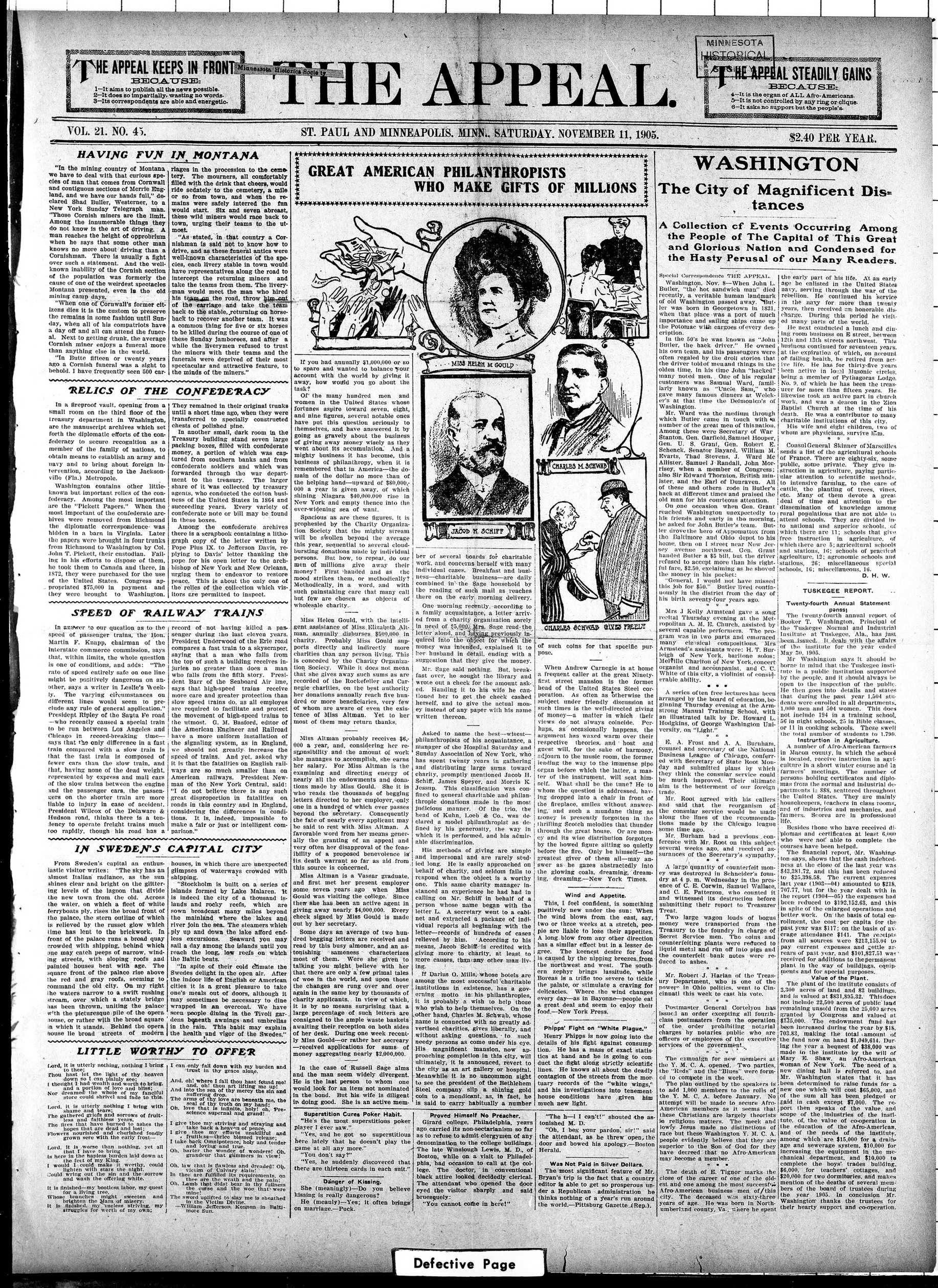
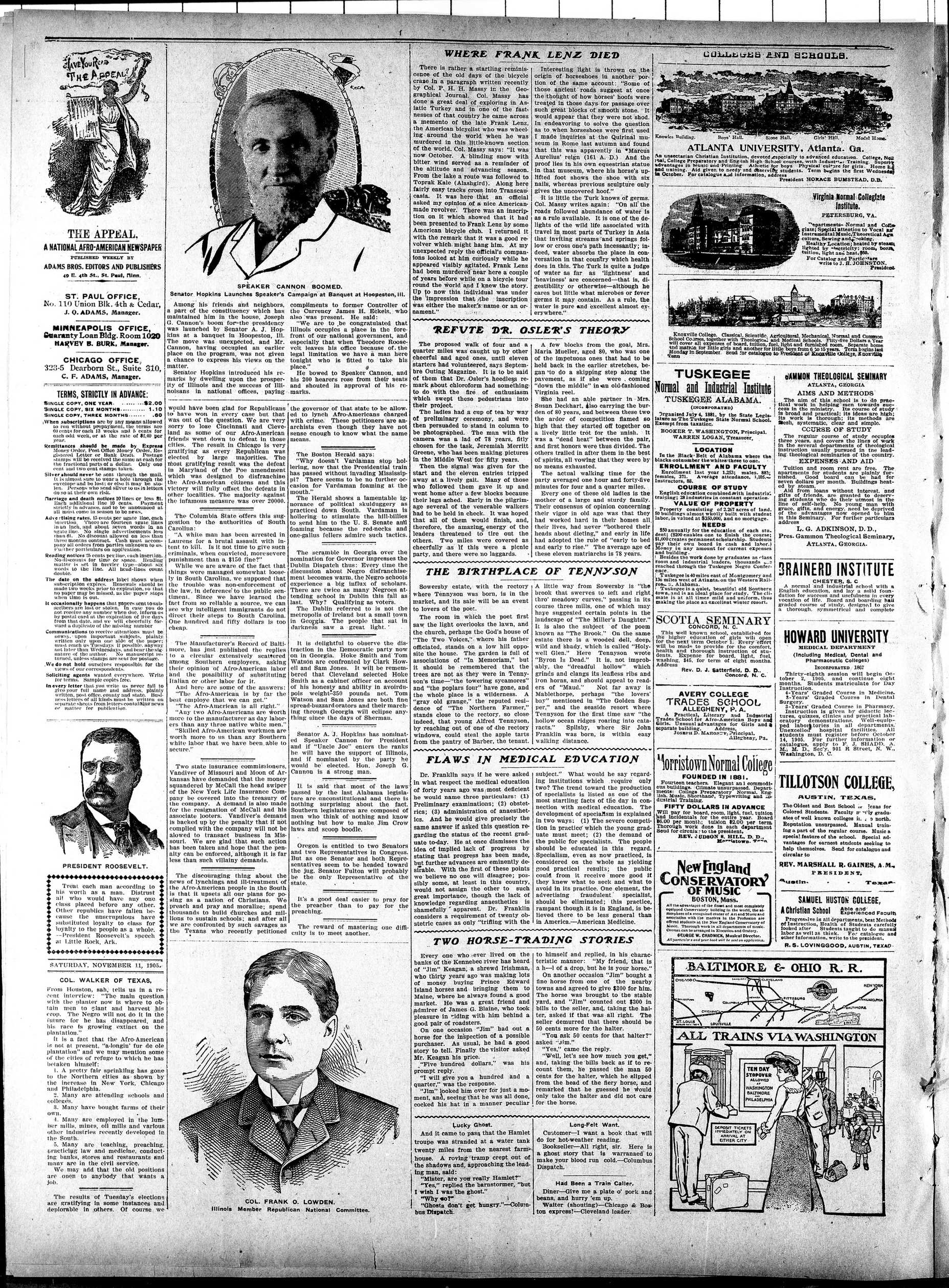
Page text (machine-generated)
THE APPEAL KEEPS IN FRONT Minneapolis Historica Society BECAUSE: 1-It aims to publish all the news possible. 2-It does so impartially, wasting no words. 3-Its correspondents are able and energetic.
HAVING FUN IN MONTANA
RELICS OF THE CONFEDERACY
---
SPEED OF RAILWAY TRAINS
IN SWEDEN'S CAPITAL CITY
LITTLE WORTHY TO OFFER
VOL. 21. NO. 45.
"In the mining country of Montana we have to deal with that curious species of man that comes from Cornwall and contiguous sections of Merrie England, and we have our hands full," declared Shad Buller, Westerster, to a New York Sunday Telegraph man. "Those Cornish miners are the limit. Among the innumerable things they do not know is the art of driving. A man reaches the height of opprobrium when he says that some other man knows no more about driving than a Cornishman. There is usually a fight in the street and the argument. And the well-known inability of the Cornish section of the population was formerly the cause of one of the weirdest spectacles Montana presented, even in the old mining camp days.
"When one of Cornwall's former citizens dies it is the custom to preserve the remains in some fashion until Sunday, when all of his compatriots have a day off and all can attend the funeral. Next to getting drunk, the average Cornish miner enjoys a funeral more than anything else in the world.
"In Butte fifteen or twenty years ago a Cornish funeral was a sight to behold. I have frequently seen 500 car-
In a fireproof vault, opening from a small room on the third floor of the treasury department in Washington, are the manuscript archives which set forth the diplomatic efforts of the confederacy to secure recognition as a member of the family of nations, to obtain means to establish an army and navy and to bring about foreign intervention, according to the Jacksonville (Fla.) Metropole.
Washington contains other little-known but important roles of the confederacy. Among the most important are the "Pickett Papers." When the most important of the confederate archives were removed from Richmond the diplomatic correspondence was hidden in a barn in Virginia. Later the papers were brought in four trunks from Richmond to Washington by Col. John T. Pickett, their custodian. Failing in his efforts to dispose of them, he took them to Canada and there, in 1872, they were purchased for the use of the United States. Congress appropriated $75,000 in payment and they were brought to Washington.
In answer to our question as to the speed of passenger trains, the Hon. Martin F. Knapp, chairman of the Interstate commerce commission, says that, within limits, the whole question is one of conditions, and adds: "The rate of speed entirely safe on one line might be positively dangerous on another, says a writer in Leslie's Weekly. The varying circumstances on different lines would seem to preclude any rule of general application." President Rhipley of the Sauta Fe road—who recently caused a special train to be run between Los Angeles and Chicago in record-breaking time—says that the only difference in a fast train is that the fast train is much fewer cars than the slow train, and that, having none of the dead weight, represented by express and mail cars of the slow trains between the engine and the passenger cars, the passengers on the shorter train are more liable to injury in case of accident. President Wilcox of the Delaware and Hudson road, thinks there is a tendency to operate freight trains much too rapidly, though his road has a
From Sweden's capital an enthusiastic visitor writes: "The sky has an almost Italian radiance, as the sun shines clear and bright on the glittering levels of the lagoon that divide the new town from the old. Across the water, on which a fleet of white ferryboats ply, rises the broad front of the palace, the stern outline of which is relieved by the russet glow which time has lent to the brickwork. In front of the palace runs a broad quay crowded with shipping, behind which one may catch peeps of narrow, winding streets, with sloping roofs and painted houses bent with age. The square front of the palace rise above the red and white walls, seeming to belong to the old city. On my right the waters narrow to a swift rushing stream, over which a stately bridge has been thrown, uniting the palace with the picturesque pile of the opera house, or rather with the broad square in which it stands. Behind the opera house lie broad streets of modern
LITTLE WORT
Lord, it is utterly nothing, nothing I bring to thee;
Thou hast let the light of thy heaven
I thought I had wealth and worth to bring,
and a portion of love and bliss;
Nor dreamed the whole of my beautiful store could shrivel and fade to this.
Lord, it is utterly nothing I bring with shame and tears;
The gathered griefs and sorrows of fruit-
less and faithless years,
the hopes that are dead and foot; the flowers that are dead and foot; the dawn seen with the early frost; Lord, it is worse than nothing, yet all is here; the hapless burden laid at down is here.
it is finished—my bootless labor, my quest
for a living tree.
Whose branches might sweeten and
brighten the Marm of misery.
it is finished, my useless striving, my
struggles for worth of my own;
riages in the procession to the cemetery. The mourners, all comfortably filled with the drink that cheers, would ride sedately to the cemetery, a mile or so from town, and when the remains were safely interred the fun would start. Six and seven abreast, these wild miners would race back to town, urging their teams to the utmost.
"As stated, in that country a Cornishman is said not to know how to drive, and as these funeral antics were well-known characteristics of the species, each livery stable in town would have representatives along the road to intercept the returning miners and take the teams from them. The livery-man would meet the man who hired his team on the road, throw him on the ground, and take the team back to the stable, return it back to recover another team. It was a common thing for five or six horses to be killed during the course of one of these Sunday jamborees, and after a while the liverymen refused to trust the miners with their teams and the funerals were deprived of their most spectacular and attractive feature, to the minds of the miners."
They remained in their original trunks until a short time ago, when they were transferred to specially constructed chests of polished pine. In another small, dark room in the Treasury building stand seven large packing boxes, filled with confederate money, a portion of which was captured from southern banks and from confederate soldiers and which was forwarded through the war department to the treasury. The larger share of it was collected by treasury agents, who conducted the cotton business of the United States in 1864 and succeeding years. Every variety of confederate note or bill may be found in the archives. Among the confederate archives there is a scrapbook containing a lithograph copy of the letter written by Pope Pius IX to Jefferson Davis, replying to Davis' letter thanking the pope for his open letter to the archbishop of New York and New Orleans, urging them to endeavor to restore peace. This is about the only one of the relics of the collection which visitors are permitted to inspect.
record of not having killed a passenger during the last eleven years. President Underwood of the Erie road compares a fast train to a skyscraper, saying that a man who falls from the top of such a building receives injuries no greater than does a man who falls from the fifth story. President Barr of the Seaboard Air lime, says that high-speed trains receive more care and greater protection than slow train trains do, as all employees are required to facilitate and protect the movement of high-speed trains to the utmost. G. M. Basford, editor of the American Engineer and Railroad have a more uniform installation of the signaling system, as in England, we should not greatly increase the speed of trains. And yet, asked why it is that the fatalities on English railways are so much smaller than on American railways. President Newman of the New York Center said: "I do not believe there is any such great disproportion in fatalities on roads in this country and in England, considering the differences in conditions. It is, indeed, impossible to make a fair or just or intelligent comparison."
houses, in which there are unexpected glimpses of waterways crowded with shipping.
"Stockholm is built on a series of islands formed by Lake Malaren. It is indeed the city of a thousand islands and rocky reefs, which are sown broadcast many miles beyond the mainland where the lakes and river join the sea. The steamers which ply up and down the lake afford endless excursions. Seaward you may sail a day among the islands until you reach the long, low reefs on which the Baltic beats.
"In spite of their cold climate the Swedes delight in the open air. After the indoor life of English or American cities it is a great pleasure to take one's meals out of doors, although it may sometimes be dine wrapped in an overcoat. We have seen people dining in the Tivoli gardens beneath awnings and umbrellas in the rain. This habit may explain the health and vigor of the Swedes."
I can only fall down with my burden and trust in thy grace alone.
trust in thy grace alone.
And, oh! where I fall thou hast found me and, oh! thou art lifting me up!
And into the sea of thy mercy the sin and
The arms of thy love are beneath me, the seal of thy truth on my hand;
Oh, he that is bound by the Presence supernal and grand.
I give thee my striving and straying and take back a heaven of peace;
I give thee my efforts unskillful and misused release;
I take back Omnipotence, the tender and loving and true.
Oh, barter the wonder of wonders! Oh, grander that glimmers in view.
Oh, law that is flawless and dreaded! Oh,
In thee are fulfilled its requirements, on thee are the wrath and the pain;
Oh, law that is fulfilled its requirements, on thee are the wrath and the pain;
The word uplifted to slay me is sheathed in the Victim Divine.
—William Jefferson Kannon in Baltimore Sun.
ST. PAUL AND MINNEAPOLIS, MINN., SATURDAY, NOVEMBER 11, 1905.
If you had annually $1,000,000 or so to spare and wanted to balance your account with the world by giving it away, how would you go about the task?
Of the many hundred men and women in the United States whose fortunes aspire toward seven, eight, and nine figures, several notable ones have put this question seriously to themselves, and have answered it by going as gravely about the business of giving away money wisely as they went about its accumulation. And a mighty business it has become, this business of philanthropy, when it is remembered that in America—the domain of the dollar not more than of the helping hand—nward of $80,000 a year is given away, of which shining Niagara $40,000,000 rise in New York and empty thence into the ever-widening sea of want.
Spacious as are these figures, it is prophesied by the Charity Organization Society that the mighty stream will be swollen beyond the average this year, sequential to several cloudburst donations made by individual persons. But how, to repeat, do our men of millions give away their money? First handed and as the mood strikes them, or methodically? Methodically, in a word, and with such painstaking care that many call but few are chosen as objects of wholesale charity.
Miss Helen Gould, with the intelligent assistance of Miss Elizabeth Altman, annually disburses $600,000 in charity. Probably Miss Gould supports more charities than any person living. This is conceded by the Charity Organization Society. While it does not mean that she gives away such sums as are recorded of the Rockefeller and Carnegie charities, on the best authority her donations annually reach five hundred or more beneficiaries, very few of whom are aware of even the existence of Miss Altman. Yet to her most of them may return thanks.
Miss Altman probably receives $6,000 a year, and, considering her responsibility and the amount of work she manages to accomplish, she earns her salary. For Miss Altman is the directing and directing energy of nearly all the endowments and donations made by Miss Gould. She it is who reads the thousands of begging letters directed to her employer, only one in a hundred of which ever passes beyond the secretary. Consequently the fate of nearly every applicant may be said to rest with Miss Altman. A favorable word from her means generally the granting of an appeal and very often her disapproval of the feasibility of a proposed benevolence is its death warrant so far as aid from this source is concerned.
Miss Altman is a Vassar graduate, and first met her present employer some seven years ago when Miss Gould was visiting the college. Since then she has been an active agent in giving away nearly $4,000,000. Every check signed by Miss Gould is made out by her secretary.
Some days an average of two hundred begging letters are received and read by this busy almoner, and an astonishing *sameness* characterizes most of them. Were she given to talking you might believe with her that there are only a few primal tales of woe in the world, and upon those the changes are rung over and over again in the same key by thousands of of which it is by no means surprising that large percentage of such letters are consigned to the ample waste baskets awaiting their reception on both sides of her desk. During one week recently Miss Gould—or rather her secretary—received applications for sums of money aggregating nearly $2,000,000.
In the case of Russell Sage alms and the man seem widely divergent. He is the last person to whom one would look for an item not nominated in the bond. But his wife is diligent in doing good. She is an active mem-
*Superstition Cures Poker Habit.* "He's the most superstitious poker player I ever saw."
MISS HELEN M COULD
JAOOD M. SCHIFF
number of several boards for charitable work, and concerns herself with many individual cases. Breakfast and business—charitable business—are daily combined in the Sage household by the reading of such mail as reaches there on the early morning delivery.
One morning recently, according to a family acquaintance, a letter arrived from a charity organization sorely in need of $3,000 Mrs. Sage read the letter aloud, and laying apologetically in required into the object for which the money was intended, explained it to her husband in detail, ending with a suggestion that they give the money.
Mr. Sage said nothing. But, breakfast over, he sought the library and wrote out a check for the amount asked. Handling it to his wife he cautioned her to get the check cashed herself, and to give the actual money instead of any paper with his name written thereon.
Asked to name the best—wisest—philanthropists of his acquaintance, a manager of the Hospital Saturday and Sunday Association of New York, who has spent twenty years in gathering and distributing large sums toward charity,promptly mentioned Jacob H. Schiff, James Speyer, and Morris K. Jossup. This classification was confined to general charitable and philanthropic donations made in the most judicious manner. At the head of Kuhn, Loeb & Co., was declared a model philanthropist as defined by his generosity, the way in which it is performed, and his admirable discrimination.
His methods of giving are simple and impersonal and are rarely studied long. He is easily approached on behalf of charity, and seldom falls to respond when the object is a worthy one. This same charity manager instanced an experience he had had in calling on Mr. Schiff in behalf of a person whose name began with the letter L. A secretary went to a cabinet and extracted a package of individual reports all beginning with the records of hundreds of cases relieved of the burden. According to his means, Jacob Schiff is credited with giving more to charity, at least to more causes, than any other man living.
If Darius O. Mills, whose hotels are among the most successful charitable institutions in existence, has a governing motto in his philanthropies, it is probably a wish to help those who wish to help themselves. On the other hand, Charles M. Schwab, whose name is connected with no greatly advertised charities, gives liberally, and without asking questions, to such highly persons as come under his eye. His work, in approaching completion in this city, will ultimately, it is announced, revert to the city as an art gallery or hospital. Meanwhile it is no uncommon sight to see the president of the Bethlehem Steel company shiny a shining gold coin to a mendicant, as, in fact, he is said to carry habitually a number
Proved Himself No Preacher.
Girard college, Philadelphia, years ago carried its non-sectarianism so far as to refuse to admit clergymen of any denomination. The late Winslow Lowell M. D., Boston, whon on a visit to Philadelphia, had occasion to call at the college. The doctor, in conventional black attire looked decidedly clerical. The attendant who opened the door eyed the visitor sharply and said brusquely:
Defective Page
K
CHARLES M. SCHWAD
CHARLES SCHWAD GIVES FREEZY
of such coins for that specific purse.
When Andrew Carnegie is at home a frequent caller at the great Nineety-first street mansion is the former head of the United States Steel corporation. As often as otherwise the subject under friendly discussion at such times is the well-directed giving of money—a matter in which views do not always coincide. Per haps, as occasionally happens, the argument has waxed warm over their worries, and host and guest will, for the sake of adjourn to the music room, the former leading the way to the immense pipe organ before which the latter, a master of the instrument, will seat himself. What shall be the time? He to whom the question is addressed, having dropped into a chair in front of the fireplace, smiles without answering, and such a mundane thing as money is presently forgotten in the thrilling Scotch melodies that thunder through the great house. Or are monies for the firehouse forgotten by the bowed fireline before the fire himself—the greatest giver of them all—may answer as he gazes abstractedly into the glowing coals, dreaming, dreaming—New York Times.
Wind and Appetite.
This, I feel confident, is something positively new under the sun: When the wind blows from the east, say, two or three weeks at a stretch, people are liable to lose their appetites. A long blow from any other direction has a similar effect but in a lesser degree. The keenest desire for food is caused by the nipping breezes from the northwest and west. The southern zephyr brings lassitude, while the northwest tends to weaken the palate or stimulate delicacies. Where the wind changes every day—as in Bayonne—people eat a great deal and seem to enjoy their food.—New York Press.
Phipps' Fight on "White Plague."
Henry Phipps is now going into the details of his fight against consumption. He has a mass of exact statistics at hand and he is going to conduct the fight along strictly scientific lines. He knows all about the deadly contagion of the streets from the mortuary records of the "white wings," and his investigations into tenement house conditions have given him much new light.
"The h—I can't!" shouted the aslished M. D.
"Oh, I beg your pardon, sir!" said the attendant, as he threw open, the door and bowed his apology—Boston Herald.
Was Not Paid in Silver Dollars. The most significant feature of Mr. Bryan's trip is the fact that a country editor is able to get so prosperous under a Republican administration he thinks nothing of a year's run around the world—Pittsburg Gazette (Rep.)
MINNESOTA
HISTORICAL
THE APPEAL STEADILY GAINS
BECAUSE:
4-It is the organ of ALL Afro-Americans.
5-It is not controlled by any ring or clique.
6-It asks no support but the people's.
WASHINGTON
A Collection cf Events Occurring Among the People of The Capital of This Great and Glorious Nation and Condensed for the Hasty Perusal of our Many Readers.
Special Correspondence THE APPEAL.
Washington, Nov. 8—When John L. Butler, "the hot sandwich man" died recently, a veritable human landmark of old Washington passed away. Butler was born in Georgetown in 1831, the son of a prominent importance and sailing ships came up the Potomac with cargoes of every description.
In the 50's he was known as "John Butler, the hack driver." He owned a team, and his passages were often referred to as "the driver to tell me things in the old time, in his time John "hacked" many noted men. One of his regular customers was Samuel Ward, familiar known as "Uncle Sam," who was among famous at Weller's at that time the Deimoncer's of Washington. Mr. Ward was the medium through which Butler came in touch with a number of the great men of this nation. Among these were Secretary of War General George W. G. S. Grant, Gen. Robert E. Schenck, Senator Bayard, William M. Evarts, Thad Stevens, J. Ward McAllister, a member of a member of the General, also Sir Edward Thornton, British minister, of these and others rode in Butler's hack at different times and praised the old man for his courteous attention.
On one occasion when Gen. Grant reached Washington unexpectedly to his friends and early in the morning, he drove the hero of Appomattox from the Baltimore and Ohio depart to his home, then on I street near New Jersey avenue northwest. Gen. Grant handed Butler a $5 bill, but the driver refused to accept more than his right to ride. He was shoved the money in his pocket.
"General, I would not have missed this job for $50." Butler lived continuously in the district from the day of his birth seventy-four years ago.
Mrs J Kelly Armstead gave a song recital Thursday evening at the Metropolitan A. M. E. Church, assisted by several capable performers. The pro-player parts and emulated many classical works. Armstead's assistant were: H. T. Burleigh of New York, barbillon soles; Mellel Charlton of New York, concert organist and accompanist, and C. C. Cohen of the city, a violinist of considerable ability.
---
A series of ten free lectures has been arranged by the board of education, beginning Thursday evening at the Armstrong Manual Training School, with the staff of the bank by Dr. Howard L. Hodgkins, of George Washington University, on "Light."
E. A. Frost and A. A. Burkham, counsel and secretary of the National Business League of Chicago, confer with Secretary of State Root Monday that they think the consultative service be much improved. Their ultimate aim is the betterment of our foreign trade.
Mr. Root agreed with his callers and that the reorganism of the consultative service along the lines of the recommendations made by the Chicago league some time ago.
Mr. Burham had a previous conference with Mr. Root on this subject several weeks ago, and received assurances of the Secretary's sympathy.
A large quantity of counterfeit money was destroyed in Schneider's foundation at 4 p.m. Wednesday in the presence of C. E. Corwain, Samuel Wallace, and Patterson, who counted it and witnessed its destruction before submitting their report to Treasurer Treat.
Two large loadages of bogus money were transported from the Treasury to the foundry in charge of Secret Service men. The coins and counterfeiting plants were reduced to the minimum of into pigs and the counterfeit bank notes were reduced to ashes.
Mr. Robert J. Harlan of the Treasury Department, who is one of the powers in Ohio politics, went to Cincinnati this week to cast his vote.
Postmaster General Cortelyon has issued an order excluding all four-class postmaster offices of the order prohibiting notarial charges by notaries public who are officers or employees of the executive services of the government.
The campaign for new members at the Y. M. C. A. opened. Two parties, the "backs" and the "blues" were formed to oppose the plan. The plan outlined by the speakers is to add 1,000 members to the rolls of the Y. M. C. A. before January. No attempt will be made to secure Afro-American members as it seems that these Christians are largely theorists in religious matters. The meek and the strong are not race but these Washington Y. M. C. A. people evidently believe that they are superior to the Son of God for they have decreed that no Afro-American may become a member.
The death of E. Tignor marks the close of the career of one of the oldest and one among the most successfull Afro-American business men of this city. The deceased was sixty-three years of age. He was born in Northumberland county, Va. where he spent
$2.40 PER YEAR.
the early part of his life. At an early age he enlisted in the United States navy, serving through the war of the rebellion. He continued his service in the navy for more than twenty years, then received an honorable discharge. During this period he visited many parts of the world. He was a patron and dining room business on E Street, between 12th and 13th streets northwest. This business continued for seventeen years at the expiration of which, on account of falling health, he retired from active life. He has for thirty-five years been active in local Masonic circles, being a member of Pipinagoras Lodge, a fellow of the Society, been the treasurer for more than fifteen years, likewise took an active part in church work, and was a deacon in the Zion Baptist Church at the time of his death. He was a contributor to many charitable institutions of this city.
His wife and eight children, two of whom are physicians, survive him. ConsultGeneral Skinner of Marsiloff sends a list of the agricultural schools of France. There are eighty-six, some public, some private. They give instruction in agriculture, paying particular attention to scientific methods, such as the cultivation of cattle, the planting of trees, vines, etc. Many of them devote a great deal of time and attention to the dissemination of knowledge among rural populations that are not able to attend national and superior schools, of which there are 11; schools that give free instruction in agriculture, of which there are 5; agricultural schools and stations, 16; schools of practical training, 16; schools of special stations, 26; miscellaneous special schools, 16; miscellaneous, 16.
TUSKEGEE REPORT.
Twenty-fourth Annual Statement
n20681
The twenty-fourth annual report of Booker T. Washington, Principal of the Tuskegee Normal and Industrial Institute at Tuskegee, Ala., has just been issued. It deals with the affairs of the institute for the year ended May 31, 2014. Mr. Washington says it should be borne in mind that the Tuskegee institute is a public institution supported by the people, and it should always be open to the inspection of the public. He then goes into details and states that during the past year 1,504 students were enrolled in all departments, 1,000 men and 504 women. This does not mean that all students of 56 in night schools, 25 in Bible classes, or 11 in cooking schools. These swell the total number of students to 1,790. Instruction in Agriculture. A number of Afro-American farmers in Macon county, in which the school is located, receive instruction in agriculture in a short winter course and in farmers' meetings. The number of students from the normal and industrial departments is 885, scattered throughout the United States. They are mainly housekeepers, teachers in classrooms, and of industries and mechanics, and farmers. Scores are in professional life. Besides those who have received diplomas and certificates at least 6,000 who were not able to complete the courses have been helped.
The financial report, Mr. Washington-says, shows that the cash indebness at the close of the last year was $43,381.72, and this has been reduced to $25,398.58. The current expenses were $707.77, but for the year deal with in the report (1904-05) the expenses had been reduced to $192,152.63, and in this spite of the enlarged operations and better work. On the basis of total enrollment, the cost per capita for the past year was $117; on the basis of average attendance $141. The receipts pay current expenses and settle areears of past year, and $101,827.51 was received for additions to the permanent plant in the way of buildings, equipments and for special purposes.
Value of the Plant
The plant of the institute consists of 2,300 acres of land and 83 buildings, and is valued at $31,853.32. This does not include 2,250 acres of public land remaining unsold from the 25,000 acres granted by Congress and valued at $10,000. The amount that has been increased during the year by $18,703.83, making the total amount of the fund now on hand $1,949.614. During the year a bequest of $38,000 was made to the institute by the will of Mary E. Shaw an Afro-American woman of Yonkers. A new dining hall is referred to, and Mr. Washington states that it has been determined to raise funds for a new one which will cost $65,000, and of the sum all has been pledged or paid in cash except $7,000. The result of this effort is the scope of the industries of the institute, of the value of co-operation by the education of the Afro-American and of the needs of the institute, among which are $15,000 for a drainage and sewerage system, $10,000 for a laboratory, $10,000 for a technical department, and $10,000 to complete the boys' trades building $6,000, for teachers' cottages, and $20,000 for two dormitories, and makes mention of the deaths of several members of the board of trustees during the year. Washington thanks the trustees for their hearty support and cooperation.
HAVE YOUR READ
THE APPEAL?
THE APPEAL.
A NATIONAL AFRO-AMERICAN NEWSPAPER
PUBLISHED WEEKLY BY
ADAMS BROS. EDITORS AND PUBLISHERS
49 E. 4th St., St. Paul, Minn.
THE APPEAL,
A NATIONAL AFRD-AMERICAN NEWSPAPER
PUBLISHED WEEKLY BY
ADAMS BROS. EDITORS AND PUBLISHERS
40 E. 4th St., St. Paul, Minn.
ST. PAUL OFFICE,
No. 110 Union Blk. 4th & Cedar,
J. O. ADAMS, Manager.
MINNEAPOLIS OFFICE,
Guaranty Loan Bldg. Room 1020
HARVEY B. BURK, Manager.
CHICAGO OFFICE,
323-5 Dearborn St., Suite 310,
C. F. ADAMS, Manager.
TERMS STRICTLY IN ADVANCE:
SINGLE COPY, ONE YEAR ..... $2.00
SINGLE COPY, SIX MONTHS ..... 1.10
SINGLE COPY, THREE MONTHS ..... 60
When subscriptions are by any means allowed
Remittances should be made by Express
Globe Letter or Bank Draft. Postage
stamps will be received the same as cash for
the fractional parts of a dollar. Only one com-
munity should send Silver should never be sent through the mail.
The envelope and back or else it may be lost.
Persons who send silver to us in letters
do so in their own risk.
Silver should be sent to 10 lines or less 81.
Each additional line 10 cents. Payment
at all must be in season to be news.
Advertising rates, 15 cents per minute line, each
insure. There are fourteen lines in
advertising rates. No single advertisement less
than the amount allowed. Less than the
amount allowed. All pay all orders from parties unknown to us.
or other partners on application.
Reading matter is set in preter type about six
to the line. All headlines count
double.
The date on the address label shows when
remittance is set in preter type about six
to the line. All headlines count
double.
It occasionally happens that papers sent to
sellers are lost or stolen. In case you do
not receive the papers by postal mail or by
postal mail the expiration of five days
from that date and we will cheerfully for-
ward you.
Communications to receive attention must be news, upon important subjects, plainly stated. In the case of a letter, most reach us Tuesday; if possible, any news not letter than Wednesdays, and bear the same date. In the case of a letter turned, unless stamps are sent for postage. We do not hold ourselves responsible for the views of our correspondents. Write to us here. Write for terms. Sample copies free. In every letter that you write us never fall to our hands. In every letter, post, letter, office, county and state. Business letters of all kinds must be written on separate sheets from letters containing news and information.
PRESIDENT ROOSEVELT.
Trent each man according to his worth as a man. Distrust all who would have any one class placed before any other. Other republics have fallen because the unscrupulous have substituted loyalty to class for loyalty to people as a whole. —President Roosevelt's speech at Little Rock, Ark.
SATURDAY, NOVEMBER 11, 1905.
COL. WALKER OF TEXAS,
From Houston, sah, tells us in a recent interview: "The main question with the planter now is where to obey the crop. The Negro will not do it in the future for he has disappeared, and his race is growing extinct on the plantation."
It is a fact that the Afro-American is not at present, "alongin' fur de ole plantation, and may mention some of their wars to which he has taken himself,
1. A pretty fair sprinkling has gone to the Northern cities as shown by the increase in New York, Chicago and Philadelphia.
2. Many are attending schools and colleges.
3. Many have bought farms of their own.
4. Many are employed in the lumber mills, mines, oil mills and various other industries recently developed in the state.
5. Many are teaching, preaching, practicing law and medicine, conducting banks, stores and restaurants and many are in the civil service.
We may add that the old positions are open to anybody that wants a job.
The results of Tuesday's elections are graftifying in some instances and deplorable in others. Of course we
KACA
Senator Hopkins Launches Speaker's Campaign at Banguet at Hoopeston, III.
COL. FRANK O. LOWDEN.
Illinois Member, Republican, National Committee
COL. FRANK O. LOWDEN.
Illinois Member Republican National Committee.
Among his friends and neighbors, a part of the confluence which has maintained him in the house, Joseph Hopkins, a former poem for the presidency was launched by Senator A. J. Hopkins at a banquet in Hoopeston, Ill. The move was unexpected, and Mr. Cannon, having occupied an earlier position in the Senate, had a chance express his views on the matter.
Senator Hopkins introduced his remarks by dwelling upon the prosperity of the poets in national offices, paying
would have been glad for Republicans to have won in every case but that was out of the question. We are very sorry to lose Cincinnati and Cleveland as some of our Afro-American cities down to downtown elsewhere. The result in Chicago is very gratifying as every Republican was elected by large majorities. The most gratifying result was the defeat in Maryland of the Poe amendment which was designed to disfranchise African-Americans, and the victory will fully offset the defeats in other localities. The majority against the infamous measure was over 20000.
The Columbia State offers this suggestion to the authorities of South Carolina:
"A white man has been arrested in Laurens for a brutal assault with inculpation in not him. Give these criminals, when convicted, more severe punishment than a $150 fine."
While we are aware of the fact that things were managed somewhat loosely in South Carolina, we supposed that the trouble was non-enforcement of the law, in deference to the public sentiment. Since we have learned the fact from so reliable a source, we can assume that the police are direct their steps to South Carolina. One hundred and fifty dollars is too cheap.
---
The Manufacturer's Record of Baltimore, has just published the replies to a circular extensively scattered among Southern employers, asking their opinion of Afro-American labor and the possibility of substituting white labor. And here are some of the answers: "The Afro-American is by far the best employee that we can get." "The Afro-American is all right." "Any two Afro-Americans are worth more to the manufacturer as day laborers than any three native white men." "Skilled Afro-American workmen are more to us than any Southern white labor that we have been able to secure."
---
Two state insurance commissioners, Vandiver of Missouri and Moon of Arkansas have demanded that the money squandered by McCall the head swiper of the New York Life Insurance Company he covered into the treasury of the state, for the resignation of McCall and his associate looters. Vandiver's demand is backed up by the penalty that if not compiled with the company will not be allowed to transact business in Missouri. We are glad that such action has been taken and hope that the penalty will be alleviated, although it is far less than such villainy demands.
The discouraging thing about the news of typhnings and ill-treatment of the Afro-American people in the South is that it upsets all our plans for posing as a nation of Christians. We preach and pray moralize; spend thousands to build churches and milieus; we call all we are confronted by such savages as the Texans who recently petitioned
compliments to former Controller of the Currency James H. Eckels, who also was present. He said: "He represented that Illinois occupies a place in the forefront of our national government, and especially that when the Doreothe Roosevelt leaves his office because of the legal limitation we have a man here tonight who is fitted to take his place." He bowed to Speaker Cannon, and his 200 hearers rose from their seats and shouted in approval of his remarks.
The governor of that state to be allowed to lynch Afro-Americans charged with crime. These petitioners are anarchists even though they have not enough to know what the name means.
The Boston Herald says: "Why doesn't Vardaman stop holering, now that the Presidential train has passed without invading Mississippi? There seems to be no further occupation for Vardaman foaming at the mouth."
The Herald shows a lamentable ignorance of political skulduggery as practiced down South. Vardaman is hollowing to stimulate the hill-billows to send him to the U. S. Senate and foaming because the red-necks and one-gallus fellers admire such tactics.
The scramble in Georgia over the nomination for Governor impresses the Dublin Dispatch thus: Every time the discussion about Negro disfranchisement becomes warm, the Negro schools experience a big influx of scholars. There are twice as many Negro entrances as fall as last. Why? Qualifying as voters.
The Dublin referred to is not the metropolis of Ireland but a small town in Georgia. The people that sat in darkness saw a great light.
It is delightful to observe the distraction in the Democratic party now on in Georgia. Hoke Smith and Tom Watson are confronted by Clark Howell and Sam Jones. It will be remembered that Cleveland selected Hoke Smith as a cabinet officer on account of his honesty and ability in avirudu-pois weight-350 pounds net. Tom Watson joined Jones and their spread-buzzed armies and their main fire through Georgia will eclipse anything since the days of Sherman.
---
Senator A. J. Hopkins has nominated Speaker Cannon for President and if "Uncle Joe" enters the ranks he will have the support of Illinois, and if nominated by the party he would be elected. Hon. Joseph G. Cannon is a strong man.
It is said that most of the laws passed by the last Alabama legislature are unconstitutional and there is nothing surprising about the fact. Southern legislatures are composed of men who think of nothing and know nothing but how to make Jim Crow laws and scoop boodle.
Oregon is entitled to two Senators and two Representatives in Congress. But as one Senator and both Reporter are to be blocked toward the jug, Senator Fulton will probably be the only Representative of the state.
It's a good deal easier to pray for the preacher than to pay for the preaching.
The reward of mastering one difficulty is to meet another.
THE BIRTHPLACE OF TENNYSON
FLAWS IN MEDICAL EDUCATION
TWO HORSE-TRADING STORIES
There is rather a startling reminiscence of the old days of the bicycle craze in a paragraph written recently by Col. P. H. H. Massy in the Geographical Journal. Col. Massy has done a great deal of exploring in Aslatic Turkey and in one of the fastnesses of that country he came across a memento of the late Frank Lenz, the American bicyclist who was wheeling around the world when he was murdered in this little-known section of the world. Col. Massy says: "It was now October. A blinding snow with bitter wind served as a reminder of the altitude and advancing season. From the lake a route was followed to Kale (Alasghir). Along here fairly many tracks cross into Transcancasia. It was here that an official asked my opinion of American-made revolver. There was a revolver on it which showed that it had been presented to Frank Lenz by some American bicycle club. I returned it with the remark that it was a good revolver which might hang. At my unexpected reply the official's companions looked at him curiously while he appeared visibly agitated. Frank Lenz had been murdered near here a couple of years before while on a bicycle tour the world and I knew the story. Up to now this individual was under the impression that the inscription was either the maker's name or an ornament."
The proposed walk of four and a quarter miles was caught up by other cheerful and aged ones, until eleven starters had volunteered, says September Outing Magazine. It is to be said of them that Dr. Osler's heedless rebellion against the fire to do with the fire of enthusiasm which swept these pedestrians into their project.
The ladies had a cup of tea by way of preliminary ceremony, and were then persuaded to stand in column to be photographed. The man with the camera was chosen for the task, Jeremiah Merritt Greene, who has been making pictures in the Middle West for fifty years.
Then the signal was given for the start and the eleven entries tripped away at a lively gait. Many of those who followed them gave it up and went home after a few blocks because their legs ached. Early in the pilgrimage several of the venerable walkers had to be held in check. It was hoped that all of them would finish, and, therefore, the amazing energy of the leaders threatened to tire out the others. Two miles were covered as cheerfully as if this were a picnic party, and there were no laggards.
Sowersby estate, with the rectory where Tennyson was born, is in the market, and its sale will be an event to lovers of the poet.
The room in which the poet first saw the light overlooks the lawn, and the church, perhaps the God's house of "The Two Voices," where his father officiated, stands on a low hill opposite the house. The garden is full of associations of "In Memoriam," but it should be remembered that the trees are not as they were in Tennyson's time—"the towering sycamores" and "the poplars four" have gone, and the whole place is a wilderness.
"A gray old grange," the reputed residence of "The Northern Farmer," stands close to the rectory, so close indeed, that young Alfred Tennyson, by reaching out of one of the rectory windows, could steal the apple tarts from the pantry of Barber, the tenant.
Dr. Franklin says if he were asked in what respect the medical education of forty years ago was most deficient he would name three particulars: (1) Preliminary examinations; (2) obstetrics; (3) administration of anaesthetics. And he would give precisely the same answer if asked this question regarding the status of the recent graduate to-day. He at once dismisses the idea of implied lack of progress by stating that progress has been made, but further advances are eminently desirable. With the first of these points we believe no one will disagree; possibly some, at least in this country, would not assign the other to such great importance, though the lack of knowledge regarding anaesthetics is shamefully apparent. Dr. Franklin considers a requirement of twenty obstructive cases as only "trifling with the
Every one who ever lived on the banks of the Kennebec river has heard of "Jim" Keagan, a shrewd Irishman, who thirty years ago was making lots of money buying Prince Edward Island horses and bringing them to Maine, where he always found a good market. He was a great friend and admirer of James G. Blaire, who took pleasure in riding with him behind a good pair of roadsters.
On one occasion "Jim" had out a horse for the inspection of a possible purchaser. As usual, he had a good story to tell. Finally the visitor asked Mr. Keagan his price.
"Five hundred dollars," was his prompt reply.
"I will give you a hundred and a quarter," was the response. "Jim" poked him over. "Just a monster," was the all done, cocked his hat in a manner peculiar.
And it came to pass that the Hamlet troupe was stranded at a water tank twenty miles from the nearest farmhouse. A roving tramp crept out of the shadows and, approaching the leading man, said: "Mister, are you really Hamlet?" "Yes," relied the barnstormer, "but I wish you the ghost." "Why so?" "Ghosts don't get hungry."-Columbus Dispatch.
Interesting light is thrown on the origin of horseshoes in another portion of the same account: "Some of those ancient roads suggest at once the thought of how horses' hoofs were treated in those days for passage over such great blocks of smooth stone. It would appear that they were not shod. In endeavoring to solve the question as to when horseshoes were first used I made inquiries at the Quirinal museum in Rome last autumn and found that it was apparently in *Marcus Aurelius*'s Arculium the proof lies in his own equestrian statue in that museum, where his horse's uplifted foot shows the shoe with six nails, whereas previous sculpture only gives the uncovered hoof."
It is little the Turk knows of germs. Col. Massy writes again: "On all the roads followed abundance of water is as a rule available. It is one of the delights of the wild life associated with travel in most parts of Turkey in Asia that inviting streams' and springs follow or cross one's path incessantly; indeed, water absorbs the place in conversation in that country which health does in this. The Turk is quite a judge of water as far as 'lightness' and 'heaviness' are concerned—that is, digestibility or otherwise—although he cares but little microbes or fewer germs it may contain. As a rule, the water is pure and excellent almost everywhere."
A few blocks from the goal, Mrs. Maria Mueller, aged 80, who was one of the impetuous ones that had to be hold back in the earlier stretches, began 'to do a skipping step along the pavement, as if she were . . . coming "down the middle" in an old-fashioned Virginia reel. An able partner in Mrs. Susan Deckhart, also carrying the burden of 80 years, and between these two the arder of competition flamed so high that they started off together on a lively trot for the mish. It was a "dead heat" between the pair, and first honors were thus divided. The others trailed in after them in the best of spirits, all rowing that they were by, and the actual walking time for the party averaged one hour and forty-five minutes for four and a quarter miles.
Every one of these old ladies is the mother of a large and sturdy family. Their consensus of opinion concerning their vigor in old age was that they worked hard in their homes all their lives, had never "bothered their heads about dieting," and early in life had adopted the rule of "early to bed and early to rise." The average age of these eleven matriarchs is 78 years.
A little way from Sowersby is "the brook that swerves to left and right thro' meadowy curves," passing in its course three mills, one of which may have suggested certain points in the landscape of "The Miller's Daughter." It is also the subject of the poem known as "The Brook." On the same page is "The Wild Glen," a wild and shady, which is called "Holy-Glen Wilen." Here Tennyson wrote "Byron Is Dead." It is, not improbably, the "dreadful hollow" which grinds and clings its leafless ribs and iron horns, and should appeal to readers of "Maud." Not far away is Mablethorpe, perhaps the "lovers' bay" mentioned in "The Golden Supper," and the seaside resort where Tennyson for the first time saw "the roaring roaring ractes." Splishy is within Sir John Franklin was born, is within easy walking distance.
subject." What would he say regarding institutions which require only two? The trend toward the production of specialists is listed as one of the most startling facts of the day in connection with medical education. The development of specialism is explained in two ways: (1) The severe competition in practice which the young graduate must meet; (2) the demand of the public for specialists. The people should be educated in this regard. Specialism, even as now practiced, is considered on the whole as yielding good practical results; the public could from it receive more good if they were not so willing to avoid in its practice. One element, the advertising 'fraudulent' specialist, should be eliminated; this practice, rampant though it is in England, is believed there to be less general than in America.—American Medicine.
to himself and replied, in his characteristic manner: "My friend, that is a h—] of a drop, but he is his owner. On another occasion "Jim" bought a one horse from one of the nearby towns and agreed to give $300 for him. The horse was brought to the stable yard, and "Jim" counted out $300 in gold, and, taking the halter, asked if that was all right. The seller denounced that there should be 50 cents more for the halter. "You ask 50 cents for that halter?" asked "Jim." "Yes" came the reply.
"Well, let's see how much you get," and, taking the bills back as if to recount them, he passed the man 50 cents for the halter, which he slipped from the head of the fiery horse, and remarked that he guessed he would only take the halter and did not care for the horse.
Customer-I want a book that will do for hot-weather reading.
Bookseller-All right, sir. Here is a ghost story that is warranted to make your blood run cold.-Columbus Dispatch.
Had Been a Train Caller.
Diner-Give me a plate o' pork and beans, and hurry 'em up.
Watter (shooting)—Chicago & Boston express!—Cleveland leader.
Kramler Building
An unsectarian Christian Institution, devoted especially to advanced education. College, New
Anselm College Preparatory and English High School courses, with Industrial Training. Supervise
students in physical education boys. Physical culture for girls. Home and
uniting. Aid given to needy and observant students. Term begins the first Wednesday
in October. For catalogue add information, address
Knoxville College. Classical, Scientific, Agricultural, Mechanical, Normal and Common
School. Campus, apts. with theological and Medical Schools. Fifty-five Dollars a Year
will cover all expenses of board tuition, debt justified, furnished, educated and
matric for little girls and another for little boys from 6 to 15 years. Term begins last
Monday in September. Send for catalogue to President of Knoxville College, Knoxville
Township.
Knoxville College, Classical, Scientific, Agricultural, Mechanical, Normal and Common
Knoxville College, Theological and Medical Schools. Fifty-five Dollars a Year
will cover all expenses of the school. Students will cover all expenses of the school.
and matten for little girls and another for little boys from 5 to 18 years. Term begins
last day in September. Send for catalogue to President of Knoxville College, Knoxville
BALTIMORE & OHIO R. R.
ALL TRAINS VIA WASHINGTON
TEN DAY
STOPOVER
ALLOWED
AT
WASHINGTON
BALTIMORE
PHILADELPHIA
DEPOSIT TICKETS
IMMEDIATELY ON
ANIMAL IN
EITHER CITY
Knoxville College. Classical, Scientific, Agricultural
School College, together with Theological, and Medical
will cover all expenses of board tuition, that light an
and mation for little girls and another for little boys
Monday in September. Send for catalogue to President
Tom.
TUSKEGEE Normal and Industrial Institute
(INCORPORATED)
Organized In July by the State Logo
inlaid The Logo by the Normal School
Exempt from taxation
INCORPORATED LOGON, Principal.
WARREN LOGAN, Treasurer.
LOCATION
In the Black Belt of Alabama where the
blacks outnumber the whites three to one.
FACULTY
Enrollment last year 1,235 students, 882
females, 371. Average attendance, 1,056.
Instructors, 88.
COURSE OF STUDY
Engagement combined with industrial
training; 24 industry-related.
VALUE OF PROPERTY
VALUE OF HERITAGE
Property management of $30,000 of land,
50 buildings almost wholly built with student
labor, is valued at $350,000, and no mortgage.
$100 annually for each of the six student;
$200 enables one to finish the course;
$300 allows you to pay your own bank in cash and labor;
Money in any amount for current expenses
Besides the work done by graduates as class
room and industrial leaders, thousands of
students are employed in the job.
Education is 40 miles east of Montgomery and
135 miles west of Atlanta, on the Western Rail-
way. Alabama, beautiful old Southern
town, and is an ideal place for study. The clich-
ing makes the place an excellent winter resort.
SCOTIA SEMINARY
CONCORD N. C.
This well known school, established for 1905, is located in the city for the next term October 1. Every effort is made to provide health and thorough instruction, fuel, durals. Expense for board light, fuel, durals. $4k, for term of eight months. Address
Rev. D. V. Jones, D. Concord, N. C.
A Practical, Literary and Industrial
School for Girls and
Girls. Unusual advantage of Girl
and separate building. Address.
JOSHEN D. MAYNON, Municipal,
Allegheny, Pa.
Morristown Normal College
Fourteen teachers. Elegant and a commod-
tive. College Preparatory Normal, Eng-
gineering, College Preparatory, Typewriting and
Industrial Training.
FIFTY DOLLARS IN ADVANCE
Will pay for board, room, light, fuel, tuil-
tion, tuition $6.00 per term
$6.00 per term; tuition $2.00 per term
Through work done in internship and department
REV. JUDSON H. HILL, D. D.
New England CONSERVATORY OF MUSIC BOSTON, Mass.
All the advantages of the finest and most completely equipped Conservatory building in the world, the all-inclusive accommodations of Art and Music and affiliation with the master in the Profession are offered indoors on the New York Central Quarterly of Music. Through work in all departments of music. Coursework in Music, W. C. W. Music, and Oratory. GUGE W. CHAMBERS, Musical Director. All particular and year book will be sent an application.
BALTIMORE & O
CHICAGO
CLEVELAND
CLEVELAND
PITTSBURG
ST. LOUIS
LOUISVILLE
ALL TRAINS VIA
Virginia Normal College
Institute.
PETERSBURG, VA.
Departments- Normal and Coffee
Garden and Public School. Volunteer
Instrumental Music, Theoretical Agr
culture, Sewing and Cooking.
Health Location: heated by steam,
lighted by electricity, room, boon,
tition, light and seat, $60.
For Catalog and Parts are
wrote to J. H. JOHNSTON.
President
Agricultural, Mechanical, Normal and Common
and Medical. Separate light and furnished room. Separate home
for boys from 6 to 15 years. Term bursar last
to 90 Presidents of Lawrence College, Norville
GAMMON THEOLOGICAL SEMINARY
TEXAS UNIVERSITY
**CCURSE OF STUDY**
The regular course of study occupies the first semester in the several departments of theological instruction usually pursued in the leading theological university in the country.
**EXPENSES AND AID**
Tuition and room rent are free. The apartments for students are platinum furnished, and students receive seven dollars per month. Buildings heat up. Aid from loans without interest, and gifts of friends are granted to deserving students. Energy need be deprived in line of self-help. No young man with grace, gifts and energy need be deprived in line of self-help. For further particulars in this Seminary. For further particulars in this Seminary.
**L. G. ADKINSON, D. D.**
Pres. Gammon Theological Seminary, ATLANTA, GEORGIA.
BRAINERD INSTITUTE
CHESTER, S. C
A normal school with a
A English education, and lay a solid
foundation of success and
vocation of a teacher and boarding
hair course of study, designed to give
given students the ability to
HOWARD UNIVERSITY
INCORPORATED 1867
Thirty-eighth session will begin October 2, nineteenth month. Students matriculate for Day School.
4-Years' Graded Course in Medicine.
3-Years' Graded Course in Dental Surgery.
3-Years' Graded Course in Pharmacy.
3-Years' Graded Course in laboratory demonstrations. Well-equipped unexcelled hospital facilities.
All students must register before October 1. Students must apply to F. J. SHADP, A catalogue apply to F. J. SHADP, N. W. Washington, D. E. 101 R Street, N. W.
TILLOTSON COLLEGE.
AUSTIN, TEXAS.
The Oldest and Best School is Texas for Colored Students. Faculty preyly graduates of well known colleges in . n. north. Regional unassured, annual training a part of the regular course. Made a special feature of the school. Special advantages for earnest students seeking to help themselves. Send for catalogue and circular to REV. MARSHALL R. GAINES, A.M. PRESIDENT.
Austin, Texas
Experienced Faculty
Preserved in all departments, best Methods
of Instruction, Health of Students carefully
looked after
Students taught to do manual
labor as well as think. For catalogue and
other information, write to the president.
R.S. LOVINGGOOD, AUBSTIN, TEXAS-
OHIO R.R.
PITTSBURG
NEW YORK
PHILADELPHIA
BATHURST
TLA WASHINGTON
A WEEK'S RECORD IN MINNESOTA'S CAPITAL.
The "Saintly City" and Saintly City Folks—Newsy Items of Social, Religious and General Matters Among the People.
Mrs. W. Liggins is seriously ill.
Mrs. W. Liggins is seriously ill.
Mr. T. H. Lyles is again very seriously ill.
Mrs. N. B. Marshall has moved to 642 Jackson street.
Have you seen the new magazine, "THE VOICE OF THE NEGRO?" See notice elsewhere in this issue.
The Robison—Welr orchestra will give its first concert early in November as a testimonial for Prof. J. W. Lucen.
The F. B. F's held their regular social session Wednesday evening at their winter palace, later they will entertain.
Mr. William A. Robison will act as musical reporter for THE APPEAL in the future and keep its readers informed on important musical events.
Mrs. John Carter on last Friday presented her husband a beautiful baby girl of which both papa and mamma are very proud.
Will the person who picked up a gold heart set with diamonds at HolcomHall last Tuesday evening please return to White, 1201 Third Avenue, Sioux Falls, Minnesota.
Is your hair straight? If not, send 60 cents to Ozonized Ox Marrow Co., 76 Wabash avenue, Chicago, Ill., for a bottle of Ozonized Ox Marrow and you can easily straighten it.
The Appeal has purchased the press and outfit of the Richardson Printing Company and added the same to the plant. Bring in your job printing. Best work at lowest prices.
Mrs. Ella Smith has handsomely reitted, newly papered and painted her dining room and is forming most of the kitchen. Call to see her when hungry. No. 352 Cedar street.
Shoes resolved in 15 minutes at S. T. Sorenson's 153 East Seventh street. Sewed shoes 75 cts, nailed shoes 50 cts. Now shoes, latest styles. $2.50. S. T. Sorenson's 153 East Seventh.
BOARDING HOUSE. MRS. Ella Smith, prop. 532 Codar street. Breakfast, 6:30 to 9:00 m. A. regular dinner, 12:00 m. to 2:30 p. m. Meals to order. Regular dinner 25 cents.
The Men's Union Club will meet every Sunday at 3:30 o'clock instead of at 4 o'clock at St. James A. M. E. church. You are carnely invited to be present. Come early if you would be benefited.
Shoes mended while you wait. at Jarvis', 3 East Fourth street. Hall, 50s and 75 cents. Prices reasonable for all kinds of repairing. He can do it in short notice. Jarvis', 3 E. street.
THE PEOPLES SHINING PARLORS. Waltorter Prop. No. 95/16, 4th and 127 E. 5th streets. When you wish a good shine give him a call. Jarvis' 5 cents. First class work. Special chairs for ladies.
The State Savings Bank, Corner Fourth and Minnesota streets, is open Monday evenings from 6 to 8. Accounts can be started with $1. A little amount saved every week may some day stand between you and want.
Ladies you should not fall to visit Madam Hart's Millinery Parlors No. 266 Rice street where you will find comfortable soffice and sonable prices. Children's school hats from 75 cents up, neatly trimmed.
BLK EXPRESS CO., G. J. Charleson, manager, corner St. Peter and Ninth streets. Packing, shipping and storing of furniture and household goods. Plano moving a specialty. House renting, real estate handled.
Madam Hart's $6.00 and $7.00 hats are now going for $3.00 and $4.00. These include the very best makes and material. Misses and children's hats will sell at prices ranging from 75 cents up. Call and inspect the bargains.
Mr. George Nichols has started in the business of commercial photography and is prepared to take extiors, interiors, groups and views. All orders will receive prompt and careful attention if left at 319 Wabash street, second flat.
Those of our patrons who desire to have matter published must get the same in this office not later than Thursday afternoon, otherwise it may be crowded out. No notice will be taken of any communication that is not signed by the author.
Persons desiring to rent Wagner hall, corner Charles and Western avenues for lodge meetings, parties, dances, meetings or for any occasion may obtain the same at reasonable rates upon application to J. H. Charleson, 632 University avenue. Jarvis, the heeler and saver of soils.
STATE SAVINGS BANK
at 83 E. Fourth street, says, in one of the street car signs: "I can mend shoes better than I can write," and, if the sign is a fair specimen of his work as a writer, he's right, as he can mend shoes all right if he cannot write all right.
If you wish a good shave, hair cut, shampoo, or anything in the tonsorial one, call Richard Coussy's neat house street. 374 McMinnville street. First class wormigen only. Satisfaction guaranteed. Music for dances and all occasions furnished on short notice.
William A. Robison, concert violinist. Teacher of violin, cornet and mandolin. Studio 322 Bradley building, Fifth, between Wabasha and Cedar streets. Hours: 8:30 to 11:30 a.m. 2:30 to 6 p. M. latest music, mandolin and piano, furnished for receptions and parties.
FIRST CLASS CLASS like, mother of Ella Smith he had at Mrs. Ella Smith's. No. 323 Cedar street, breakfast from 7 to 11 a.m. lunch from 12 to 2:30 p. m.; dinner from 5 to 8 p. M. meals to order when desired. Sunday dinners a special. Regular meals 25 cents.
Hamm's New Beer. This beer is so decidedly superior to any draught ever ever brewed, that within the few days it has been on sale it has already attained a fixed place in the market. Hamm's New Brew. 100,000 barrels in stock. On draught from now on.
---
Preferred by many to hard coal for furnaces, ranges and stoves; lasts nearly as long. Costs only half
```markdown
```
SAFE DEPOSIT AND STORAGE VAULTS—We invite your inspection. It costs little to place your napers, cash securities and valuables in absolute safety. Boxes in our vaults can be had for $4 per year. Store your trunks, trunks, etc., with us. Northwestern Trust Co., 135 Endicott Arcade.
Mr. Charles A. Miller is now prepared to do expert work in the repairing of fireplaces. Send a postal card to him at 903 Globe building and he will call for your work and deliver the same when completed. If you have any such work to do give him an order.
What is nicer than a pretty picture for a gift to a friend? You can get all sorts of pictures and frames at the Lowe Picture Frame Co., 475 Wabasha street. Full line of frames and unlined frames are available for holiday trade. Also make a specialty of oil portraits at moderate prices. Pictures framed to order.
Anything the matter with your souse, range or furnace? If there is, just call at the St. Paul Stove Repair Works, 126 West Seventh street, between Fifth and Exchange streets, and they can make the repairs on short notice. You can also order a nice or range supplied. Telephone, N. W.ished. T. N. W.herd 283L-2.
```markdown
```
Owing to the expiration of the lease of Twining Hall Mrs. Hale will not hold her usual Monday night class. She has secured Richards Hall which is her first condition and will announce as soon as possible when her opening will occur.
```markdown
```
The reason why you should buy your Coal, Wood, Flour, Feed, Hay, etc. from C. W. STAHEL, Rice and Carrol streets, is because you can get prompt delivery, best goods, full measure. Fuel of all kinds, and saved and carried or small quantities. Everything at the right prices. Phone telephone 14463. The Colonade Dancing School had its usual good crowd present last Wednesday evening. The usual good time may be counted on for next Wednesday evening. Come early and stay late. Arthur Winstead, principal, Colonade Hall, N. W. corner University and Farrington Aves. Entrance on Farrington. Lessons 25 cents. The Valet Tailoring Co. Owen Howell manager, has taken the place of the Valet Sixth street. They have a new delivery wagon and have inaugurated a monthly scheme in which they agree to keep your clothes sponged and pressed and in good order for $1.00 per month. Go see them. Go see them. Ladies who wish a beautiful complex will use Mrs. Howard's Rxing delicacy for softening and healing roughness, pimples, tan and freckles; also a perfect vegetable in cheeks throat and neck by Mrs. R. C. Howard, 662 W. Central avenue, St. Paul, Minn. Phone, Dale 918-J 2.
Mr. R. C. Howard has braphed out in a new business and has organized the Howard Tea and Coffee Co. He takes orders either personally or by 'phone for Tea, Coffee, Hams, Bacon, Coffee, and Coffee packages which he personally package. His goods are first class in every particular and will be delivered on short notice. Call him up by 'phone Dale 1918J.
The Colonade Dancing Academy seems to be pleasing the public immensely as the number of patrons is constantly on the increase. The hall is a very nice one, has a fine floor and everything is as sung as can be. Be Wednesday night the usual hour and nightly pleased crowd is present. Principal Winstead is constantly on the lookout to please his patrons and especial attention is paid to beginners.
Did it ever occur to you—that this is the time of the year to put your stoves and ranges in repair for winter? THE ST. PAUL, STOVE REAR WINDOW, THE SEVEN STREET, Has the best workmen. Seventh street, equipment in the city, and can furnish any part of any stove or range at any time and any place. A card will bring us, or you may 'phone N. W., Malen 1208, or T. C. 242. Bear in mind that we can do your work in the cold weather sets in, and we are rushed with orders. Time is short so DO IT NOW.
The Howell Bullets.
A number of young men of the city have organized a foot ball team under the above name. The players and coaches are Fred, Richard, Whitie, full back; Fred, Richard, high
$1 per year. Persons desiring to subscribe should send their subscriptions to S. D. Kemp, Cosmopolitan barber shop, 74 East, Fifth street, or Army building, foot of Robert street, St. Paul.
MILLS' LUNCH AND SANDWICH ROOM.
J. S. Mills, proprietor, 444 Robert street, between Seventh and Eighth streets. Open from 6:30 a.m. to 2:30 a.m. m. Tel orders delivered free. Telephone, N. W. Main 3082 L. This is the place to get your favorite sandwich or a good hunch. The best grade knows how to prepare it, therefore sure of excellent coffee. An epicure will find all of the delicacies of the season here. Soup and stews are always kept on hand and such sandwiches as the New York, Pork Ternholm, Chicken St. Paul, Hamburger, Eggplant, etc. can be served at any time. If you try this place once you will be satisfied with the quality, service and price and you will be sure to call again.
The only bank in St. Paul exclusively for savings receives deposits in sums of $1 and upwards, and compounds interest semi-annually. Open Monday evenings from 6 to 8.
THE VALET TAILORING CO. O. HOWELL, MGR.
Renovating, cleaning and repairing.
Will call for and deliver free of charge. Month contracts, $1.00 per month.
Suits provided by the company.
Your patronage solicited. All work guaranteed. Tel. N. W. Main 2769 L 156, East 6th street.
A Belgian statistician has amused himself by calculating the cost to the country of parliamentary oratory, and that of noise, and even of silence in parliament, for, according to him, each second of a sitting costs the same amount, and silence is paid for, during the sitings, as dearly as speech, he says the Philadelphia Lodge. He calculates that each hour of the sitings of the Belgian chamber costs 7,286 franc, each minute 12.143 franc and each second something more than 2 francs. Starting from this basis he calculates that the words of the presidention "Gentlemen, the sitting has commenced" costs about 5 franc. A laugh for which, when uttered in his presence, he could find no reason, was timed by him to cost 6 francs 10 centimes. "Marks of approval on many benches" cost as much as £2 or £3; a suitably "prolonged movement" cannot be produced at less than 18 or 25 francs, "Ironical cheers at the left" are exceedingly costly, while "loud approval at the right" runs to a price beyond all reason. He notes that a few days ago the applause from the government benches at the end of a speech of the railway minister does exactly as a sitting of three hours, which was occupied by three indifferent speakers, cost £2679.50 franc; or close on to £1,000. Patti could be heard in Brussels' for a sum, he declares; or grand opera, claque and all, be had for less!
The tourist from Cincinnati rolled back his copious girth in the tiny stool of the Tokio tea house, while through the carven latticework the tinkle of a samisen came in alluring cadence over an expanse of stunted pearls. "This is all to the Pierre Lotti" he mused. "And yonder comes a dalty geisha girl to take my order. I will speak to her in the poetry of the land.
"Oh. fudge!" said the geisha girl in limpid English. "I just graduated from Barnard college, and I prefer the Pallasades or the Catskills." Then to the kitchen she ordered. "Draw one!"
"Who was he?" asked the Jap madem, with polite interest. "Seems to me I've heard of him, but I'm reading Huxley and Emerson just now." Listening again, the tourist discovers that the tinkle of the samisen was only the sound from the shuttles of a cotton mill.
Wheeler, at that time the advance agent of a minstrel company, had returned to New York before the close of the theatrical season, and a friend, meeting him on Broadway, asked him how he had found business.
Defective Page
half; Fred Wheeldin, manager and left half; Will Hilray, right guard; Lloyd Hickman, left guard; A. Cotton, right end; W. Kennedy, left end; Sylvester Bellenes, right tackle; F. Wright, left tackle; Perkins, center; Cliff Harris, captain, center; K. Ebell and H. Brown substitutes.
Mr. Owen Howell the propitator of the team is very proud of the boys as they have won both of the games played since their organization, they having defeated the Stinners by a score of 10 and 0 and the Carlts by a score of 11 and 0. They are ready to meet all comers.
The U. B. F. Entertainment
The musicale and soiree which was given by North Star Lodge No. 138 U. B. F. at Holcomb Hall Minnesota Tuesday night was a decided success in every way and was declared by the Minnesota people who were present the largest entertainment ever given in that hall. The ladies were in the hall and when the grand march was led by Judge Johnson and partner there was a most beautiful sight with over seventy-five couples in line.
The early part of the evening was devoted to a musicale of which the program was as follows: Overture, Robison-Welch Orchestra; Address, W. W. McCarthy; Less Elegance," Adina and Margaret Ambass; bass solo," In the Heart of the Mighty Deep," Mr. Edgar J. Murphy; piano solo," Rustles of Spring," Mrs. Blissmark "Archer; soprano solo," My Dream of Love," Mrs. Arthur McDonnell; piano solo," The Shepherd King," Mr. Leon L. Diggs; quartette," Under the Anheuser Bush," The Adams Quartette; finale, Robison-Welch Orchestra.
Much interest was evinced in the Robison-Welch orchestra this week, when each of it is but faint praise to say the fullest expectations were realized. The members are all first class musicians and scored a decided success.
Every performer on the program "made each one was warmly and conservatively applauded.
Both St. Paul and Minnesota turned out in a very satisfactory manner.
Everything moved as smoothly as if oiled for the occasion and every one was loud in praise of the pleasant affair.
The refreshments were served in a very nice way by the ladies of the S. M. T. but they were a little handicapped by not getting into the refreshment room soon enough as it was being used by a lodge.
Taken to the theater it was a fine affair by the members of the Order and of the arrangements committee may congratulate themselves upon their success.
MASONIC ENTERTAINMENT
The Trustees of Pioneer and Perfect Ashtrust Lodges A. F. and A. M. assisted by a committee of Ladies of St. Paul Chapter No. 29 O. E. S. will give a Grand Social Sorlie at Masonic Hall Cor. Charles and Western Ave. Friday evening Nov. 21 1985, with a shaking invitation. Friends are requested to send in their lists to the committee 632 University before Nov. 3.
J. H. Charleston
Chairman
Beautiful hand made rugs may be made out of your old carpet, no matter how dirty or worn out it may be. Rugs made any size desired and out of any sort of old carpet which will be cleaned and disinfected free of charge. Just call up the Simonet Rug Company, N. W. 'phone main 1772 L. 1 or 1772 R. 1802, and will call for a phone Rates reasonable. Office 90 West Seventh street where the beautiful rugs may be seen.
THE VIRGINIA RESTAURANT.
And lunch room. No. 449 Jackson St.,
Tel. N. W. Main 3466 L.,
G. H. Evans, Prop.
Regular meals 15 cents, served from 5:00 to 7:30 a.m.; 11:30 to 2:00 p.m.; 12:00 to 4:00 p.m. served at all times. Hot bread served for all regular meals. All kinds of sandwiches served at lunch counter. We bake our sandwich rolls every day. Oysters served in all styles. Stewed oysters put up in tin boxes to be taken out. We take them out. Shout be taken out. Special 5 cents and 10 cents meals served at lunch counter. If there is anything special wanted call us up by 'phone and if it's in the market we will be pleased to fill your order if given us before six o'clock, a speciality of cooking Sunday dinners and after-theatre suppers. Bread and rolls baked to order for family use. Pies, crullers and coffee rolls baked every day. Tables reserved for ladies. Open to 1:00 a.m. to 1:00 a.m. meals good for 21 meals worth $1.15 for $2.50. To see us.
To Whom This May Concern.
Should this reach the notice of anyone who knows any relative of W. A. Spears such person will confer a favor by notifying Pride of Montana Lodge and giving it to the lodge holds a policy for $300 and would like to hear from Spears's sister.
Jas. H. Howard, K. of R. and S. 1003 Ninth Ave., Helena, Mont
N. B. MARSHALL.
Carpenter and Builder, 554 Aurora Avenue.
We have in our midst a first class carpenter and builder in the person of Mr. N. B. Marshall 642 Jackson st. N. B. Marshall 642 Jackson st. jobbing and general repair, painting and decorating. Estimates furnished upon application. Telephone N. W. Dale 581 J-2. He has 50 lots on University avenue for sale on a cash payment of $25. and a monthly payment of $10. Will build houses on university purchasers on monthly payments. DON'T MISS THIS OPPORTUNITY.
The Voice of the Negro.
Mr. S. D. Kemp has been appointed agent for "The Voice of The Negro," a monthly magazine published in Atlanta, Ga., and the only magazine now being edited and published by Afro-Americans in this country. Messrs. B. E. B. Du Bois, and the other editors are editors. Among those who pledged their support to the magazine as contributors are: Prof. W. E. B. Du Bois, Prof. Kelley, Miller, Dr. Booker T. Washington, Mrs. Mary Church Terrill, Mrs. Fannie Barrier Williams and a score of others promulc anew amount of leading writers.
THE STATE SAVINGS BANK
ORATORY HAS TO BE PAID FOR.
The Money Value of Noise and Silence in Parliament.
The New Japan.
"Ah, O Mimoza San, I swear by the mountain Fujiyama that you love that."
"Ah," said the tourist, in a hurt tone of voice, "I thought you were one of the poetic creatures made famous by Lafcadio Hearn."
Why the Tones Was Fined
The late Judge "Biff" Hall of Chicago took great delight in telling the following story of "Punch" Wheeler.
"Very bad," said "Punch;" "so bad that the only way we could pay the members of the troupe was to fine them. It worked splendidly, too; and by the time we reached Texas the manager had squared up with the whole company excepting the chap that there was no chance to find fault with his actions. At Galveston Mr. Tenor sang for his solo The Lighthouse by the Sea; and for an encore responded with "Over the Hills to the Poorhouse." That gave the boss the opportunity he was looking for and he levied on the singers' part of the song for telling the business we were playing route to the show."—Judge.
Feminine Logic
After the tea things had been cleared away the young wife came over and sat on hubby's knee, put her plump arms about his neck and kissed him a dozen times. "Well, I need you," he queried. "Well, a dress, dear," she answered. "But don't you know that times are awfully hard just at present?" he queried. "Of course I do," she replied. "That's why I want to give the poor dress something to do."-Chicago News.
DOINGS IN AND ABOUT THE GREAT "FLOUR CITY"
Matters Social, Religious and General Which Have Happened and Are to Happen Among the People of the City.
Masonic Social Soiree,
The Event of the Season,
At Wagner Hall Tuesday, Nov. 21.
Mrs. J. V. Kemp is reported as being very low.
Mrs. A. E. Napier has moved to 3244 Humboldt Ave. So.
The Pastor's Aid Society will give a musical at the residence of Mrs. J. L. Neal, Nov. 15—1905.
Mrs. R. R. Coulter has recovered from her operation at the Hospital and is back at home again.
Shoes resolved in 15 minutes at S. T. Sorensen's 312 Nicole avenue. Sewed soled 75 tiles, nails soles 50 stes. New up-to-date shoes, all styles, $2.50.
Will the person who picked up a gold heart set with diamonds at Holcomb Hall last Tuesday evening please return it to Mrs. A. White, 1201 Third Ave. So. Minneapolis.
Miss Cora Neal won first prize in the ticket selling contest for the entertainment given at St. Peters last Wednesday evening by disposing of $1.00 worth of tickets, Mr. Branch won 2nd, and Mrs. R. De. Leo 3rd prize.
The papers around the circuit say that Bobby Marshall, in the game against Wis. last Saturday played the best game in his position ever seen in the game, at Girardon, and it places him in line for a member of the all star Western team.
When in St. Paul and you wish to get FIRST CLASS MEALS, like you used to get at home call on Mrs. Ellis Smith, No. 352 Cedar street. Breakfast from to 11 a. m.; lunch from 2:30 p.m.; dinner from 8 p.m. Meals to order when to Sunday dinners a speciality. Regular meals 25 cenfs.
How strange, that the Afro-American are taking no part in the evangelical meetings that are now being held over this city everywhere. Meetings are being held in most all the churches except the Afro-American churches. Is it possible that the masses are the people are so sano tified that they are asking for question, "where are you going to spend eternity," impressed upon them?
---
Owing to the expiration of the lease of Twining Hall Mrs. Hale will not hold her usual Monday night class. She has secured Richards Hall which is bound to provide these condition and will announce as soon as possible when her opening will occur.
```markdown
```
A number of young folks met at the home of Mrs. Henry Roberts Thursday day evening Nov. 2nd and organized a young people's club named, "The Nonoriel Club." The object of the club is the theme that girls to become interested in church work. They have a membership at the present time of fifteen. The officers are President, Mursa Bertha Wilkins; Vice President, Mr. Ezekiel Harper; Secretary, Mr. Harry Lee; Assistant Secretary, Miss May Curry; Treasurer, Miss Isa Lewis.
The "Tribe of Reuben," Mr. M. A. Johnson captain, will give a "Japanese Social" and tea party at St. James A. M. E. church Friday evening Nov. 11. Members of the Tribe of Reuben will give a Thanksgiving trice Wade, Myrtle Taylor, Genetta Thornton, Carsin Cunningham, Cassie Williams, Katie Jeffrey, Ethel Robinson. There are twelve tribes, each having a captain that are giving a Thanksgiving rally to the aid of the church. Don't fail to attend the Japanese social and tea party.
JAPANESE CONCERT.
By Tribe of Reuben at St. James
Church Minneapolis, Thursday
Don't fail to attend the Japanese Social and Concert to be given at St. James Church next Thursday evening to be given by the Tribe of Reuken, H. Wade, director; Mme. Shireen, Capt.; Mrs. G. Hade, director; Mme. Shireen, musical director; Admission 25 cents. Come out and witness a grand musical and vocal entertainment beginning at 8:15 P. M. sharp.
The program consists of solos by Mme. Shireen ade and Madam De Leo, Minnesota's J. Clairborne, J. Clairborne, baritone. The Reuken Quartette, a violin solo by Prof. Potts, piano solo, Miss Essie Mason; Mr. Nelson Porter will render some selections from Shakespeare. Also the Tribe of Reuken in their Japanese Musical, Mme. Shireen, Magee Katie Jeffrey, Mayme Thompson, Cuningham, Beatrice Wade, Geneva Thornton, Myrtle Taylor, Eagle Williams, Mabel Henderson, Cassie Taylor, Bertha Robinson.
Chorus.
Baroness Shoo-ki-ota, Miss Geneva Thornton.
Baroness Mortaka, Miss Cassie Taylor,
Princess Sakal, Miss Ethel Williams.
Countess Sendal, Miss Beatrice Wade,
Countess Daka-ota, Miss Mabel Helen
Princess He-Loves-mi, Miss Maje
Thornton.
Empress O'dal-sai, Miss Katie Jeffrey.
Princess O'me-O'mi, Miss Myrtle Tayr
Whole Counties Without a Resident of Foreign Birth.
“There are counties in Kentucky where there is not a single resident of foreign birth,” declared R. B. Baker of Louisville, according to the Milwaukee Sentinel. “The residents are the descendants of the old families who came to Kentucky when that state was landed and bloody ground” and who fought to make the state what it is to-day. They have no land to sell to foreigners, they have
no uniness to do with them, therefore the foreign population settles elsewhere. I presume the same condition of affairs will be found in these same counties fifty years from now.
"Not anywhere else in this country can there be found a settlement which is more truly. American. When you stop to consider the number of nationalities one meets gathered together in almost every part of the country, the way these Kentuckians have managed to keep to themselves is little less than any other state in the union, anyway. In two counties there they have never held a coroner's inquest. They have a coroner in each county, but they contend that it is not necessary to hold an inquest over the remains of a man who is killed if you know how he was killed. They always know how the dead ones are killed. In these same counties I do not believe they have ever held court without a company or assassin, but they have not been accustomed to settling their own troubles with the rifle and the shotgun that they cannot accustom themselves to the vengeance of the law in place of that of the individual."
A New Definition.
Former Mayor Patrick Collins of Boston told this one as the Irish cab driver had narrated it to him in Dublin. Cabby took "a fare" out into the country one night. The gentleman paid him well, and told him to "look under the seat."
There cabby found a quart bottle of pure Irish whisky, and he sampled it immediately. He also gave some to the horse, who seemed to like it. Telling the story cabby said:
"Afther I'd been givin' av th' baste on' your foe or fove shrinks he got gay; he dled. Th' first thing Oi knew Oi wor in th' shafts pullin' th' keb, an' th' baste up in th' sate lashn' me wid th' whip, malkin me pull harnd an' dance."
"Well, what was the result?" inquired Mr. Collins.
"Ol've niveg give th' baste another drop fry'm that day till this."
"What was the result that night? You niveg gave of course."
"Ol wor not drunk, at all at all."
"Were you entirely sober."
"No, Ol'll not lie about it. Oi wor not intoitely sober."
"If neither drunk nor sober, what was your condition?"
"Oi wor on th' defensive"—Pitts-
burg Dispatch.
Environment for Scientists
Environment for Scientists.
Generally speaking, it may be safely put that mastership in any of the sciences is usually used by whom we need an environment in every way conducive to the development of a scientific career. Seldom is it that a genius, with neither ancestry nor training to favor him, springs up to startle the world with a scientific discovery, as in Literature or in other arts more closely allied to science.
Recipe for a World
Take one man, a woman and a garden. Add an apple and a good fresh snake. Stir gently until the pot begins to boil, then drain off the apple and keep adding children. Simmer on a slow fire, then put on ice. Alternate between the two extremes, giving the whole a good, sound basting when needed, turning slowly in a proper space. Keep adding time until the mass is of the consistency of a mud plee covered with ants. Multiply the inhabitants and garnish with villages, towns, cities and empires. Now introduce a little theology and enough devil sauce to spice. Keen adding battle, murder, sudden death and a good layer of cant. Put plenty of salt in the water and sprinkle with bad society. When your yorld is finished throw it in the fire and begin all over again—Leesburg Buckeye.
Nothing blinds the soul quicker than winking in the fire and begin all over again—Leesburg Buckeye.
C. A. MILLER
EXPERT
REPAIRER OF Watches, Clocks and Jewelry
903 GLOBE BLD
St. Paul
C.A.MILLER
EXPERT REPAIRER OF Watches, Clocks and Jewelry
SEND A POSTAL CARD AND HE
WILL CALL FOR AND DE-
LIVER GOODS.
Prices Reasonable and all Work
Guaranteed.
TEL. N. W. MAIN 2130-J
VIRGINIA RESTAURANT
AND
LUNCH ROOM
All Pastry, Bread and Rolls Home-made.
Oysters and Sandwiches, Specialties
Open from 6 a. m. to 12 p. m.
G. H. EVANS, PROPRIETOR.
449 Jackson St. ST. PAUL, MINN.
Tel. N. W. Main, 3466-L
THE MANSION HOUSE
Cor. 8th and Minnesota.
ANDERSON CRUMP, PROP'R.
BOARDING LODGING
Everything First Class and up-to-date.
Dinner 11:30 to 1. Supper 5:30 to 7:30
MEALS 15 AND 25 CENTS.
Have you seen the new magazine, "THE VOICE OF THE NEGRO?" See notice elsewhere in this issue.
His Face On Every Box!
HOWARD'S
FASHION
Shoe Polishes
NEW YORK A.C.HOWARD, CHICAGO
W. EVANS, GEN'L AGT.
337} Wabasha St., St. Paul,
and also on sale at the
Golden Rule.
$2.50
Golden
Made
Shoes
The Popular Price,
The Popular Shoe,
The Latest Styles,
The Sorensen Shoe.
Same as other dealers
ask $3.50 for
S. T. SORENSEN
153 E. 18th, st. St. Paul.
312 Nicolet av., Mpls.
IN REACH OF ALL
Lamb Lumber Co.
WEST 5TH AND 7TH STREETS.
SHOES
THAT
SMILE
STANLEY SHOE CO.
421 ROBERT ST.
COLLARS and CUFFS 1£
SHIRTS 10£ UNDERWEAR 8£
STATE STEAM LAUNDRY
222 W. 7TH ST. BOTH PHONES.
H. MOSLEY,' Man.
VISIT THE
POOL AND BILLIARDS
REAR 245 NICOLLEV AVE.
TEL. 2428 J 1 MAIN.
TOWLE'S
Log Cabin
Maple Syrup
TOWLE'S LOG CABIN MAPLE SHOP
Was awarded the GOLD MEDAL at the World's Fair, St. Louis, 1904, for absolute purity and richness of flavor.
The Approval of Millions of People Confirmed by the World's Greatest Exposition.
Don't throw away your OLD SHOES
BEFORE AFTER
D.
DR. W. J. HURD.
91 E. SEVENTH ST.
Paintea Extracting, Filling,
Paintea, Crown and Bridges
a Specialty
SATISFACTION GUARANTEED.
P. E. REID. J. J. HIRSHPIELD.
Wines, Liquors
and Cigars ...
40 East Third St... ST. PAUL
Telephone 106-7-1
Bh
FOUND IT DIDN'T PAY
FARMER HAD REVENGE, BUT IT
WAS TOO COSTLY.
Sight of Wrecked Aistomobile and O¢-
cupants Flying Through the Air
Hardly Werth the Money—Cireus
for. Him ‘tn the: Future:
“Out In the country 1s where the au-
tomobilist lets her go,” said the old
farmer, as the talk changed to that
subject. “You folks in town can take
the law on 'em if they are humping
along beyond a certain gait, but out
there they think they own the earth.
‘They don’t care what they scare or
who they run down. You see one com-
Ing a mile away, and before you ean
draw a long breath the machine ts
past you,
“I stood it for a couple of years, and
then decided to get even. They hat
seared my horses, run over my hogs
and killed my chickens, and not one
of them had ever stopped to say he
was sorry, let alone offering to pay
damages. One day a feller hit one of
amy cows as she stood in the road and
Knocked her down and broke her leg.
U yelled at him, but he never even
turned hig head. I felt sure he'd come
back that way in the-evening, as‘ it
was the best road, and so I got out a
rope and stretched it across the road
as soon as it grew dark. I stood by,
ready to lower away for a team, and
along about. 8 o'clock I heard that. old
anto coming back.
“The machine was on the hump, and
there were four men in it this time. J
couldn’t say it wouldn't kill ‘em all,
but I tightened up on the rope and
climbed over the fence. She came
along up and struck. The next min-
ute the machine was in the air and the
men falling ont every which way. Al!
of em had broken legs or arms, and
the machine was damaged $500 worth,
T got the rope down before anyone
saw it, and to this day none of the fel:
Jers know just what happened.”
“And so you got even?” was asked.
“Wall, it looked that way for a few
days, but I guess on the whole it
didn’t pay me. The four men were
carried to the house to be doctored,
and the last one didn’t get away for
six weeks. I had to feed the doctors
and their horses and a lot of folks who
came out to inquire. T hauled the ma-
chine eight miles with my horses, and
the four fellers got away without. pay-
ing me a cent. [ figure that the whole
thing cost me about $200, and that
Vm just so much out of pocket. It's
quite a sight to sce an auto take a
skate skywards, and four men spread
ont in the air like so many frogs, but
when the cost is $200 [ ean’t help but
feel that I'd better lose a day's time
and pay 50 conts to see a regular cir
cus."~-Cleveland Plain Dealer
T ever haa” eared tor" the huttorcome
1 never had wished » more glorious fate:
Since you [have met, Pegsy Bligh.
a marriage 1 beginning of
suites = i
Since'you £ have’ met, Peggy Blelsh.
“Utigomet In News Fork Sti.
A Violinist’s Old Aae.
Men still middle aged can remenr
ber the fame as a violinist of Segis-
mond Sicard, the youthful protigy en-
couraged by Wagner and Gounod, and
patronized by nearly over crowned
head in Europe. in July, 1879, Steard,
whoso adult powers had confirmed the
promise of his boyhood, was staying
in Brussels after a successful _tonr
in America, and during a walk with
his friend, Wienlawski, was struck by
lightning while sheltering under a
treo against a thunderstorm. Wien-
Jawski sustained a shock, from which
he died in the following year, and Si-
card, paralyzed in the left side, only
recovered after ten years, to fall into
hopeless relapse under the shock of
his daughter's death in 1892. _ Bex.
wared, forgotten, and reduced to
mental mediocrity, though able to
walk, poor Sicard Is today eking out
tho last dregs of a miserable existence
as a street hawker in Liege—London
Globe.
Wrong Man,
Fair Visitor—“Here, my poor man,
are some roses for you. What can 1
do to make you comfortable?”
Prisoner—"Guess you're makin’ a
mistake, lady.”
Fair Visitor—“Mistake—how?”
Prisoner—I’m only here fer porch
climbin’, Yer'll find that guy” that
killed his wife in th’ nex’ cell.”
WE ROPE ee ea: ietene ener ene,
Dr. J. H. White, United States Ma-
xine Hospital surgeon, in charge at
New Orleans, has announced that. the
new mosquito exterminator known as
“culicide,” discovered by Mr. Mims,
chemist for the Board of Health ot
that city, will be adopted by the gov-
ernment. ‘
Submarine Signaling. ‘
Submarine signaling has been tried
successfully In the Mersey. The Lu-
cania heard the bell at a distance of
nine and a half knots while she was
under full speed.
Slinica’s Balinen Obkoiith
Alaska’s canned salmon output is
estimated this year ut $10,000,000.
VALUABLE FOR FIRE FIGHTERS.
vention of Much. Merit,
Im Europe a respiratory and lfe-
saving apparatus has been used with
considerable success by miners, fire-
men and others, who are required to
penetrate mines or apartments that,
are filled with smoke or unbreathable
gases, especially after accidents such
as explosions. With this apparatus
sufficient alr and oxygen are carried
to support respiration for two hours,
even while the individual is working.
‘The apparatus consists of a masl: or
helmet, which completely covers the
face, but exposes the ears, so. that
while the eyes of the wearer are pro-
tected from the smoke he can @hear
distinetly,
‘There are connected with the mask
two rubber bags—one for the exhaled
air and the other connected with the
oxygen and the regenerated air. The
former is contained in steel cylinders,
and by means of proper reducing
valves acts on the air after the car
bonie acid which has been exhaled is
absorbed by granulated potash. The
instrument weighs about twenty-elght
pounds, but is sure in.its action, and
has been used successfully by tne
Paris fire department, where, in ad-
dition, portable electric lights with
flexible cables form a part of the
equipment, and thus allow firemen to
penetrate dark and smoky rooms: and
cellars to save life or cut off gas or
electricity, or perform some other use-
fal duties. In mines the apparatus
is valuable In case of accidents due to
fire-damp or explosion, and it is com
ing into extensive use for this pur-
pose—Montreal Herald.
KOREAN A MUCH DRESSED MAN.
Arrayed at All Times So as to Be Seen
and Admired,
Says the North China Herald: “The
Korean is above everything else a nan
of the drawing room and all his in-
stincts move along the leisurely ways
of life. Anything like haste or ‘en
pressement’ Is unknown to the eteral
laws that govern him. ‘This character-
istic of his is evident in all his actions
at all Umes and under all conceivable
circumstances. Being a drawing room
gentleman, dress is the great ambi
tion of his life. From the shoes of his
feet to the topknot on the top of his
head he is ordered so as to be seen
and admired of men,
“His shoes, during this year of
mourning, must. be spotlessly white.
No atom of dust or fly speck shall mar
them. His socks, beautifully puffed,
are stitched to perfection, his panta:
loons, big enough for a Brobdinguag,
are padded, quilted and ironed until
they come forth looking like some
mysterious fabrie of polished marble,
his Jacket likewise and his overcoat
and_wristlets. \
“Not only has he a headband, a top:
knot and a hat on his head, but he
buys a pair of spectacles and adds
them to his already over-charged head-
gear, and thus rigged, with a ring on
his finger and a fan in his hand, he
goes forth to make his way through
this troubled world.”
‘Naitia abred tenuseiiete:
Sacred, manuscripts, written on kid
Teather, and which had been used
repair, and shoes in the time shortly
atter Christ came on earth, have been
unearthed in Asia, says the Philadel
phia North, American.
Publicity Was given to the discovery
here to-day, when the announcement
was made by Prof. Maurice Bloom
fleld, of the Johns Hopkins univer
sity, who has just returned from the
Oriental congress, which met at AL
siers.
German scientists, while delving in
the ruins of a city in Turkestan, came
across the old shoes. Upon opening
up the footwear, which were twenty
centuries old, layers of the sacred
mauuseripts fell out.
They were written in Syrian char
acters and were of the mixed religion
ot Christianity and Porstan found in
the east.
Prof. Bloomfield states that the find
throws the first light ou how Christi
anity spread through Persia and ‘Tur
key and how the legends and tacts
of the Bible became part of the re
ligions of the far east.
hers Waa lan. Auldation:
When the little man with two watch
chains had ascertained that the othe
man was from Powderville he asked:
“dxeuge me, but I want to ask after
a man whom [ think Ijves In you
town, His name is Barclay.”
“Joe Barclay?” Hi
“Yes, that’s the one. I used to know
him In Indiana. Is he in polities?”
“I believe so.”
“What party does he belong to?”
“He's an agitator.”
“Do you mean a labor agitator?”
“{ wouldn't exactly say that, but 1
know he’s an agitator.”
“But I don’t exactly understand.” >
“Well, he was my opponent for the
oMce of mayor last. fall, and he agi
tated things around so that I was
snowed under by oyer 400 votes, and
have been agitated half to death bs
his crowing ever since.”—Exchange,
ae
PAS ap, Ae come “Bud her Saas axa
white,
she's Yrvtghed with health and peace
She rides on the sea of pure delignt,
‘Whiero” the ‘sky bends "gold "and. blue
And rippled of gladness ‘round her play,
Ae‘she tele het snowy salle’ ocdage >
J looked for her oft and waited long,
But mists hung heavy "and dark bo
Sometimes T thought I could hear the
ot ine seraph band, or caught the
From athe crowns of lght, but doubts
Omcotlt a Beautn ship for years
But she's here at last, my: Ship, my ship,
My beautiful “ship of health ‘and love
sites "moored: 1o'the. “Rock of ages!
SNES eae
And’ Calvary's banner floats above,
Since the’ Gay my benutieal shh ealled
ince the da tif ship safle tn,
~Philadetphla Press.
Feathers from the Ostrich.
Apropos of the vexed question ot
wearing feathers plucked fron living
birds in hats, it is comforting to know
that the wearer of long ostrich feath-
ers need haye no qualms on the sub-
ject: ‘The larger And more valuable
feathers, which are in the wings and
tall of the bird, are carefully cut off
with colssors:and the ends are left in
Yhe skin till they drop out.
rv A
LT A |\modern
= %
of aes,
fe cee BIG
Bele a!
Ci —_) Renee es.
Q S_4 BQH ing and do make
WN SS. the Best Beer
for Sap on the market.
Sy fA rm ‘
7 a
, CALL FOR IT
THE KNAPP SHADE ADJUSTERS
'W. J. WORK, SALES AGENT
PO.goxts2 WHITE BEAR LAKE, MINN.
Have your old shades rehung by the new meth
od, and by which you obtain better ventil-
lotion, control the amount “of light and
_ Secure privacy when desiced.
ORDERS LEFT AT THIS OFEICE: WILL “RECEIVE
PROMPT ATTENTION
= |
SHADE ARISTERS
een Us
oe ay
je?”
77 &
Ee ar ern pp Sy
Ph ee
a Se) eee / as
os
Ll ie ith 4 9 PENA A)
Peano ae as ter ile
ad an ie = | Hl if
re Reed el i) a
_ A a eee a
| “We, ,a jury’ composed ‘of! men: who hriow
| kage “Rartan Cigar onl is eke
10 Cents; from severys smokers” aa gl
| : oe
BIT EWE
Sad Oo
© 5S¢ Cigar
STA Pe 10132 ob OM UNREAL
Fon
RAIA
eR
7 Moore's
Always
\ Please
Ua LD
Be
a
i an haa
4 | Ta:
PIN hee
ho Se
THE SANITARY WAY
—NO SMOKE, NO'SMELL
A slight puil on the chain lifts the
’ top, forming a hood which draws all
smoke, or odors, from broiling, back’
into the range, thus preventing their
escape into the roo.
This is Moore’s patent and Is to
ne tong on Moore’s Ranges
bate
Call. Top,
the Mead eee ne
makes baking a sure thing; the
Controller Damper, and atherhiandy
devices to be found only on Moore's
Ranges.
Johnson Furniture, ¢
7 andCarpetCo. W
419-421 Jackson Street
SUEIEZETY DIRELTORY.
f | F : p
o ie Jay are a
es ee F
Lae Hn F
ome g- H , F
=
a 7
Bi ail
5 ade |
ae ara
MASONIC
DEAN C
eos
rg Mg
WA Po
Mas a
ied SS -NeA
‘ie Zar §', |
| ae
We
a 4 od
Most WORSHIPFUL GRAND LooGE
MINNESOTA, AUF. AND A M.
ug) BROWN, GRAND atAgrE,
1 Geno UNe. Linea maee Mes
ih, DURANT. GRAND. SECRETARY,
A ;DURANT. GRAND SECRET.
: Ie
dS, MILLS’ LUNCH 2x6 SANDWICH ROOM.
J8. van SANDWICH ROOM.
| TELEPHONE ORDERS .DELIVERED FREE.
¢ SANDWICH BILL. .
Benver. Sandwich esc cece 2502 aR. Wibnetnctee bana@ich e020 3
TAONEER LODGE No.1, A. F. aud A.
‘ML, meets frst and third Monduys’ of each
‘month at Wagner Hall, cor. Charles street
and Western avenue, at $:00 p.m. FL.
Phelps, W. ML: 1. De Lyons, Secy., 560
‘Temperance street.
PERFECT ASHLAR LODGE NO. 4. A,
Ey and A.M. "meets second and fourdy
‘uesdays at Wagner Hall, Cor. Charles
Street and Westem, sive., al § p.m. Wi.
BT Chandier, W. Mt, it. tah St.
‘BL Marshall, Seey., 364 Aurora ave.
MARS LODGE, No, 2202, MEETS
second and fourth "Tuesday in each month
At Odd Fellows: Hall, 221 West University,
Gomme Facrington genus." pntrance. oh
Farrington. “Dantel Roy, NG. thos Fe,
Hickman, 'P. 3, 492.St. Anthony ave!
PAST GRAND MASTER'S CoUNCIL,
No. 125, G. U. 0, of O, F. meets the see.
‘ond and fourth ieviaay in each month at
Oda Fellows’ “Hall, "221" W.. University.
corner Farrington.” "Entrance on Farring:
ton, Wm, Re Morris, W..G. Mut Thos, i,
Hickman, 'G. s., No. 422 St.” Anthony ave!
ST. PAUL PATRIARCHY No. us,
meets second Monday in each month at
Oda “Fellows? “Hall, "221" W. University,
corner Farrington.” Entrance on Tar:
yington avenue. ‘Thos. R. Hickman
(acting) RV. Psy W. R, Mortis, P.M ¥.
Pu; Geo. B. Lowe, W. P. R., 178i Wave
asha, ‘
| HOUSEHOLD OF RUTH, No. 559 6.
UL. of 0. B meets second and fourth
Monday in’ egeh month at Odd. Fellows
Hall, 'N. W. Gor. University and Farring=
ton ‘Aves. ‘ntranee on Farrington. Mrs,
Alice Franklin, MN. Ga Mrs, ida” MM:
Johnson, W. R., No. 916 Marion Se
TT) ome
Pe OR gras
CS) CO a>
Cw Jdust\ a /
ae fSAsses\ Gm
EYE DEFECTS AND SYMPTOMS.
Eye defects are few—symptoms many.
‘There can be but two defects in the human eye. ue
Theeye may be too long in whole. ‘Then we have the
Myopic eye. :
Or too short in whole—the Hyperopic eye.
Combine the two in one eye and we have Astigmatism.
Properly adjusted glasses will correct these defects.
Medicines or waiting, never.
Symptoms that spring from these two simple eye mal-
ormations are manifold; such as eye and headaches, Indi-
gestion, Dyspepsia, Nervous Debility, Chorea, Epilepsy and
other ailments having their origin in lack of nerve force.
We correct all Defects of the human eye that glasses
will remedy. Charges reasonable. Satisfaction guaranteed,
HARMS OCULO CURES SORE EYES 25¢ PER BOTTLE.
OPTICIANS,
109 East Seventh Street. ST. PAUL, MINN,
UNITED BROTHERS OF FRIEND-
BIDDLE CIRCL, LADIES OF G. A.
R. meets fest and third Tuesdayy of each
month in Supreme Court room old eat.
et building: "Mew, Nt eaviuee pres,
Mi SUR White, Sees, Enocnix ian,
ST. JAMES" AM 8, CHURCH, Com
Fuller and Jay siveets.” Sunday services,
1200 a. me: E80 p.m, Weanesday: raver
meeting? 800 py in. "Pastor. visits on Mon
Say and Tuesdiveat home Wednesday apa
‘Thursday Weddings, "tuners “and the
sick attended on notice, Hev. R. Seymour,
Pastor. Parsonage, Cor. Jaye and: Fuller
PILGIIN BAPTIST CHURCH, cur
y2th land Cedar." Sunday. Services: ‘Presch
fig? at" Gem. and 735"m. tm Sunday
feloal at Bt olive, “Weaeeany ven
jog geueral prayer mectiag Friday vey.
Inge Stndy: Stay" school. feasone Buverate
And wedatoge peomndg attended. Iek. We
Biecartens PaSton, 999 Bitele St,
Si. PHILIP'S EPISCOPAL MiSSI0™
gouge Aurore aveune and Mackubla strom
Stnday serves.” Baviy celebration of Holy
Etchatist, 120 a, sm “High celebration ee
Holy uchasise arse au tiied, Susdassy,
00 "tn Mating, “second and” foueth
Bandar i a Sutcy oo, 293
D. mi. Brotherhood of St Andrew, 640° p.
Vespers, 730 p. a.” Weel Serviced:
Wegacat chubetl, cy 8:0".
Eridiys, evening prayer, 8:00 p. ine, Sate
dave: Holy’ chats 9A: M. Hey. Everard
Daniel Rect
CLIFFORD A. SMITH
am [TAILOR]
a aR aST RECN e
FALL AND WINTER
Pee WOOLENS
a Suits and Overcoats
Fe AE errno
OSWALD WEIS,
GROCER
SPECIALTIES: Teas, Coffees,
Fruits and Vegetables.
Full line of Canned Goods and
Fancy Groceries.
440 University Ave.
ST. PAUL, - MINN.
Far 3 50 YEARS’
EXPERIENCE
AES
‘Trave Marks
eee
ofgymnsmate amauta gectaties
Sess GRasaee RAGS on Pa
Siig ie tin Ua pea,
eee
Scientific American,
ulation of any sctonting ioereat, Ferme
ition cuaee
381roadey
MUNA &o, 20cm York
Eee SHAROOD’S
fs | 2 | v
a ee
ool The Ideal Comfort Shoe
TheSharood ShoeCorporation
The Largest Exclusive Manufacturers
; “of High-Grade Foqtwear in: the West.
Sharood Shoes Are Made for the Whole Family |
: se
os FOURTH AND BROADWAY, ST. PAUL, MINN.
Reishee anceaag
WONDERFUL?
3
3
DISCOVERY ;
Curly Hair Made Straight By :
: a E.. ee 3
|. > ;
yet
= @ 3
; FORD'S ORIGINAL. $
OZONIZED OX MARROW
coon ng)
repeat tha agBamaas 1 thao ate
SE Suaeaa (A eae ented er
Prearisand sued by “hounaute, Warranted
Sold dor aucaigheentne Sane Deeperation ever &
Beat Subdeet Be neat tends Orig. g
god or ase ene size, zanteoty tn Clea 5
Gert Mite beat dace eae $
aaa aula tad caf
SRR teateht, tol aba "Heaatarae
Heasbo ladheanSt atte deere
EE He Eater hs
fenioaie abide tacthect eaten, &
Bond Meant poriage ied erprens oars 3
Walia tie adie Stayt =
t OzoNIznD Ox MARROW CO, ;
Cnc ean oilheer oe
Charkss Ferd. But 3%
76 Wabash Ave., Chicago, Iilinois. 2
‘ent wales orien g