The Appeal
Saturday, January 27, 1906
St. Paul, Minnesota
Page text (machine-generated)
THE APPEAL KEEPS IN FRONT
BECAUSE
1-It aims to publish all the news possible.
2-It does so impartially, wasting no words.
3-Its correspondents are able and energetic.
FINE ORATION BY INDIAN
WONDERFUL CROSS IN SKY
PAINT FROM ROYAL HEARTS
WEIGHED IN THE BALANCE
VOL. 22. NO. 4.
In the twilight of the tribal life of the American aborigines stands the chief of the Creeks, says the Muskogee L. T.) Times. He is heard to utter the following oration. It will be read in the reading books of the youth of other centuries. The oration is dignified, tranquil, eloquent. There is hope in the heart of the chief whose people dared and forebore so long in the unspoken cut of the forest. Gen. Pleasant Porter said: "The vitality of our race still persists. We have not lived for naught. We are the original discoverers of this continent and the conquerors of from the animal kingdom, and from the first taught the art of peace and war, and first planted the institutions of virtue, truth and liberty. The European nations found us here and were mere aware that it was possible for men to exist and subsist here. We have been to European people on this continent our thought forces. The best blood of our ancestors have been intermingled their best statesmen and leading citizens. We have ourselves an indestructible element in their natural history. We have shown what they believe to be arid and desert places were habitable and capable of sustaining millions of people. We have led the vanguard of civilization in our conflict with them for tribal existence from ocean to ocean. The race that has rendered this service to the other
Perfectly formed, exquisitely colored and standing out in bold relief from a cloudy sky, a wonderful cross was observed here this afternoon. Five minutes after the sun had disappeared, its rays, piercing a low bank of clouds along the horizon, were thrown upon a higher bank of dark gray clouds in the form of a perfect cross, blood red in color, which was visible without a perceptible change in form for fully ten minutes. In form for fully ten people rushed from their homes into the street to watch the awe-inspiring spectacle, which many superstitious ones regard as pertaining some wonderful event in their community. Frightened negroes fell upon their knees in the streets, believing the Judgment at hand. Passengers on trains from Philadelphia had their attention called to the brilliant coloring of the western heavens, and windows and vestibules were filled with faces. To these the flaming cross was visible several minutes. One thus graphically describes the scene: "Passengers had been watching the
A correspondent of the Paris Temps describes the discovery of an affidavit in the national archives signed Philippe Henri Schunck, a citizen of Paris of about the year 1819, who is certified as having been a good royalist of unimpeachable character.
His statement is to the effect that he made the acquaintance of an artist named St. Martin, a friend of a revolutionary official who superintended the opening of monuments in the Jesuits' church. St. Martin related that he and another painter named Martin Droling were present on the occasion of the opening of the monument, their object being to utilize the royal dust as mummy, a valuable dark brown pigment which was then usually obtained from mummy cases and ancient tombs.
St. Martin actually converted part of the heart of Louis XIV, to this use, but handed over the rest with the
"So I hear you are going to part with the new minister, the one that came here from Brownsville?" "Jest so; he didn't suit our folks at all," responded Uncle Jesse Putnam promptly.
"Well, you folks must be getting hard to please, all of a sudden. Now you like that old-fashioned man, Dr. Patterson—"
"Nice, easy sort of feller; read his sermons in a ca'm, unconcerned kind of way," interrupted Uncle Jesse, by way of comment.
"Yes, and you took to young Mr. Banks—I thought you'd object to him, after Dr. Patterson! Why, young Banks was a regular firebrand, full of him and an empire—delivered his sheer in a loud, excited voice. When he, too, fitted into things in Sheville, I concluded young folks would take to any one that came along."
Both the octopus and the cuttlefish have arms that are clothed with a formidable piece of suckers which are wonderful pieces of mechanism. When the sucker comes into contact with an object, the central piston, having previously been raised so as to completely fill the cavity of the sucker, is at once withdrawn and a perfect vacuum produced explaining the great tenacity with which the suckers cling. They number upward of 100 pairs to each arm of the octopus, and once they obtain a grip on the victim, unless the arm is actually torn away from the body of the octopus it is practically impossible for its prey to disentangle itself.
In addition to these suckers the octopus has a powerful pair of faws, shaped like the beak of a parrot, behind which is a formidable arm-plat
nations of mankind can not perish utterly.
Though our tribal organization is fading away, we will be transformed as a potent factor, an element within the body of Christian civilization. The philosophy of the history of the future shall trace many of the principles of government and institutions so dear to them to those they found among us.
Now that we have demonstrated that we have the ability to make for ourselves and our children homes, and having sanction of every law, let us make for ourselves this firm resolution: Let our every act speak forth; let the elements of forces of nature carry our resolutions to our fellow men the world over; let them in their senses know and feel it and enter upon the performance of our high mission.
Many of you have accomplished it already; many have begun it; begin at once and devote all your energies of soul, mind and body to the task set before us, even if it takes years—yes, a lifetime, to carry it out.
When we have thus resolved to make for ourselves and our children homes, we will have indited in and upon ourselves a law for our guidance which divine and human law will protect and sustain us in its maintenance. No statutory law will ever annul it, and we shall then have risen to the place of our high destiny.
magnificence of the sky's colorings from the time our train crossed the Delaware River bridge.
"As the sun sank below the horizon three immense bars of golden light shot upward nearly to the zenith. As if by magic, two disappeared, and the remaining one seemed to become as dazzling as the orb that had just disappeared.
"With the same suddenness, a bright bar of light fell across this perpendicular one, forming a cross that was geometrically perfect. Its height was about 15 degrees, and at first it was a bright orange color, but gradually changed into a gorgeous red. At last it was the form of a cross the clouds were dark greenish gray, while beyond they presented almost every color and印刻 imaginable in marvelous arrangement.
"The cross disappeared as it came, the horizontal bar going first, and the upright slowly fading away, after which the sky again became a bright orange color, which gradually faded as darkness fell."-Atlantic City Cor. Phila, North American.
heart of Louis XII, intact to Schunk, through whom they reached their present resting place at St. Denis. St. Martin made this surrender during his last illness when he could hardly have been in the mood to perpetrate a practical joke on posterity. As to Droling, Schunck learned from St. Martin that the two painters also witnessed the opening of other monuments and that Droling bought eleven hearts, including those. Anne of Austria, Maria Theresa, Gustav I, Maris, the Regent and Mme. Henriet, the bride was immortalized by Bosseu's funeral cask, and made them into mummy. A picture Droling "Interieur de Cuisine" is in the Louvre and it is quite possible that its dark ints owe their richness to minute parts of defunct Bourbons. Anne of Austria's heart mixed with oil and spread on an artist's canvas! What a concise, eloquent sermon on the vanity of human greatness.
"That's just where you got fooled," remarked Uncle Jesse. "Now, they's a lot of us old fellers—fact is, us old fellers about run this Shelbyville church. Old Dr. Patterson, cam and soothin' like, he suited us. Then that young feller, Banks—I tell you, he set up and listened, and us old fellers set up and listened, and we mustl Time church was over we were pretty well stirred up—hungry for dinner and had a good afternoon nap.
"But this new man, from over to Brownville"—Uncle Jesse shook his head—"Wy, he couldn't hollier up loud enough to keep a man good n' awake; but that pesky voice of his'n, wy, it was jest loud enough and jumplime so's to keep me from gettin' a nice voice of his'n, wy, it was get when old Dr. Patterson preached.
"The trouble with this new feller is that he ain't neither one thing nor other!"—New York Times.
ed tongue used as a rasping organ.
The octopus will attack and kill crabs
lobsters of considerable size, ripping
open the body by means of its powerful jaws and devouring the contents.
In spite of being a creature of such awe-inspiring looks, the octopus has several enemies in various species of whales, sharks and conger eels, in fact, the latter are particularly fond of devouring the smaller octopuses.
Conger eels hunt for the octopus and when found, proceed to browse on its limbs. The actopus tries to hug the slipper, slimy conger tight, but in vain, bringing its limbs growing less, discharging the face of the foe and under cover of water heats a hasty retreat. It is escape the too-pressuring attention of its foes that the octopus possesses the power of changing its color to correspond with that of its surroundings.
THE APPEAL.
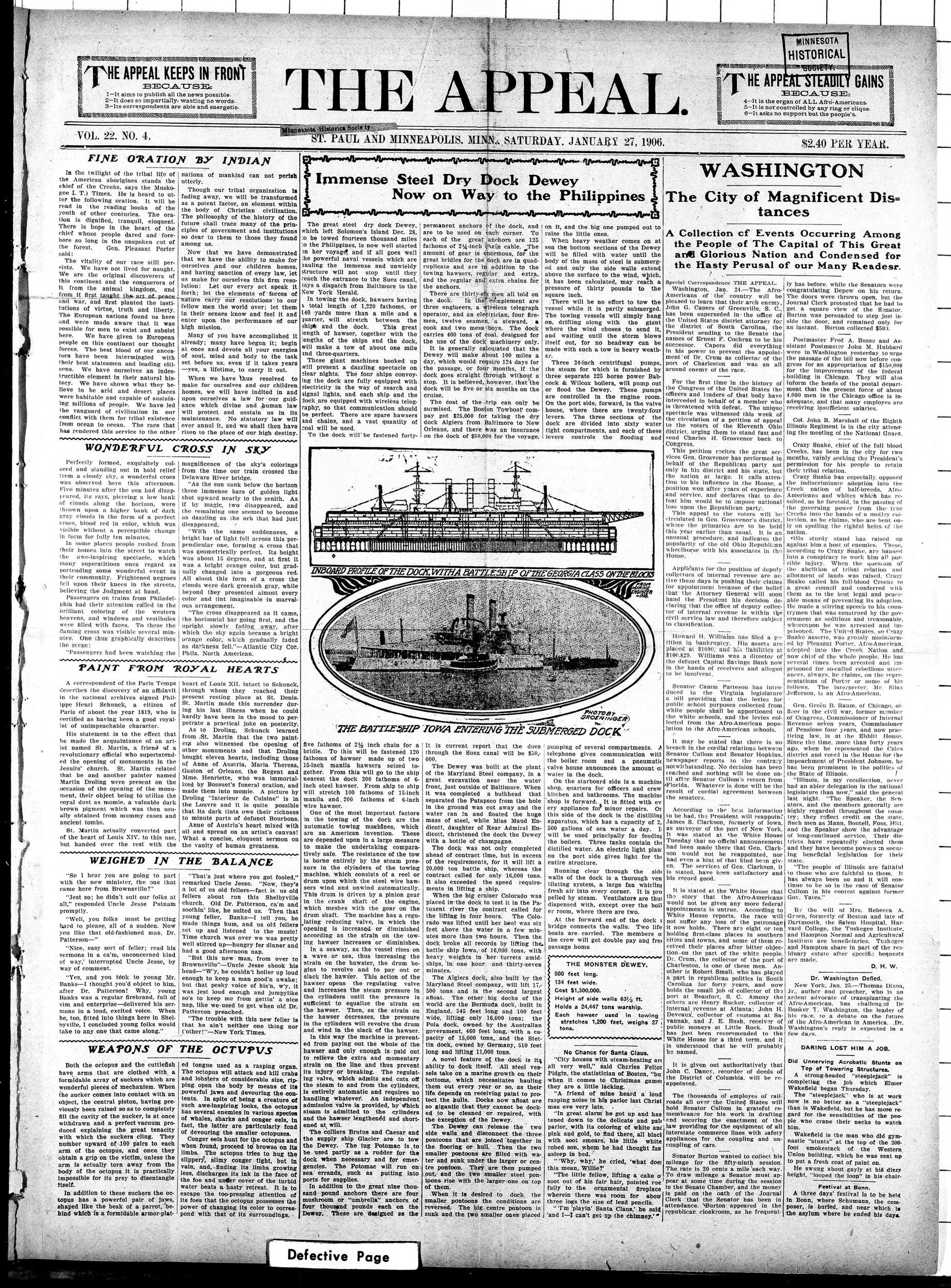
Immense Steel Dry Dock Dewey Now on Way to the Philippines
---
INBOARD PROFILE OF THE DOCK, WITH A BATTLESHIP OF THE GEORGIA CLASS ON THE BLOCKS
PHOTO BY GROENINGER
THE BATTLESHIP IOWA ENTERING THE SURMERGER DOCK
THE BATTLESHIP IOWA ENTERING THE SUBMERGED DOCK
The great steel dry dock Dewey, which left Solomon's Island Dec. 28, to be towed fourteen thousand miles to the Philippines, is now well started on her voyage, and if all goes well the powerful naval vessels which are hauling the immense and unwieldy structure will not stop until they reach the entrance to the Suez canal, a dispatch from Baltimore to the New York harbor. In towing the dock, hawers having a total length of 1,220 fathoms, or 140 yards more than a mile and a quarter, will stretch between the ships and the dock. This great length of hawser, together with the lengths of the ships and the dock, will make a tow of about one mile and three-quarters. These giant machines hooked up will present a dazzling spectacle on clear nights. The four ships convoying the dock are fully equipped with electricity in the way of search and signal lights, and each ship and the telephone, so that communication should be perfect. There are spare hawers and chains, and a vast quantity of coal will be used. To the dock will be fastened forty-
INBOARD PROFILE OF THE DOU
THE BATTLESHIP
five hathors of $2\frac{1}{2}$ inch chain for a bridle. To this will be fastened 120 fathors of hawser made up of two 15-inch manila hawseres seized together. From this will go to the ship nearest the dock 200 fathors of 6-inch steel hawser. From ship to ship will stretch 100 fathors of 15-inch manila and 200 fathors of 6-inch wire hawser. The most important factors in the towing of the dock are the automatic towing machines, which are an American invention. These are depended upon in a large measure to make the undertaking comparatively safe. The resistance of the tow is borne entirely by the steam pressure in the cylinders of the towing machine, which consists of a reel or drum upon which the steel wire hawser wind and unwind automatically. This drum is driven by a pinion gear in the crank shaft of the engine, which drives the drum shaft. The machine has a regulating reducing valve, in which the opening is increased or diminished according as the strain on the towing hawser increases or diminishes. In a seaway, as the vessel rises on a wave or sea, thus increasing the strain on the hawser, the drum begins to revolve and to pay out or slack the hawser. This action of the hawser opens the regulating valve and increases the steam pressure in the cylinders and the pressure in sufficient equalize on the hawser. Then, as the strain on the hawser decreases, the pressure in the cylinders will revolve the drum and wind in the slack of the hawser.
In this way the machine is prevented from paying out the whole of the hawser and only enough is paid out to relieve the extra and momentary strain on the line and thus prevent its injury or breaking. The regulating valve, which admits and cuts off the steam to and from the cylinders, is entirely automatic and requires no handling whatever. An independent admission valve is provided, by which steam is admitted to the cylinders and the hawser lengthened and shortened at will. The collars Brutus and Caesar and the thigh ship Glacier are to tow the Dewey. The tug Potomac is to be used partly as audder or the dock when necessary and for emergencies. The Potomac will run on sea ornards, such as putting into ports for supplies. In addition to the great nine thousand pound anchors there are four mushroom or "umbrella" anchors of four thousand pounds on the Dewey. These are designed as the
Defective Page
permanent anchors of the dock, and are to be used on each corner. To each of the great anchors are 125 fathoms of 24-inch chain cable. The amount of gear is charnous, for the great bridges for the dock are in quadruplicate and are in addition to the towing hawkers, regular and extra, and the regular and extra chains for the anchors.
The dock is thirty-seven men all told on the dock. In the complement are three engineers, a wireless telegraph operator, and an electrician, four men, twelve seamen a steward, a cook and two mess boys. The dock carries 400 tons of coal, designed for the use of the dock machinery only.
It is generally calculated that the Dewey will make about 100 miles a day, which would require 124 days for the passage, or four months, if the dock goes straight through without a stop. It is believed, however, that the dock will be five or six months on the cruise.
The cost of the trip can only be surmised. The Boston Towboat company付 $25,000 for taking the dock Algerius from Baltimore to New Orleans, and there was an insurance on the dock of $50,000 for the voyage.
CK WITH A BATTLESHIP OF THE
IOWA ENTERING THE SUD
It is current report that the dues through the Suez canal will be $50,000.
The Dewey was built at the plant of the Maryland Steel company, in a great excavation near the water front, just outside of Baltimore. When it was completed a bulkhead that separated the Patapsco from the hole in the ground was cut away and the huge mass of steel, while also Maundicott, daughter of Rear Admiral Endicott, christened the dock the Dewey with a bottle of champagne.
The dock was not only completed ahead of contract time, but in excess of the requirements, it will lift a 20,000 ton battle ship, whereas the contract called for only 16,000 tons. It also exceeded the speed requirements in lifting a ship.
When the big cruiser Colorado was placed in the dock to test it in the Paxentex river the contract called for the lifting in four hours. The Colorado was lifted until her keel was six minutes more than two hours. Then the dock broke all records by lifting the battle ship low: of 16,000 tons, with heavy weights in her turrets amidships, in one hour and thirty-seven minutes.
The Aligiers dock, also built by the Maryland Steel company, will lift 17,500 tons and is the second largest afloat. The other big docks of the world are the Bermuda dock, built in England, 545 feet long and 100 feet wide, lifting only 16,000 tons; the Pola dock, owned by the Australian government, 600 feet long, with a capacity of 15,000 tons, and the Stetin dock, owned by Germany, 510 feet long and lifting 11,000 tons.
A novel feature of the dock is its ability to dock itself. All steel vessels take on a marine growth on their bottoms, which necessitates hauling them out every year or so, as their life depends on receiving paint to protect the hulls. Docks now afloat are so gigantic that they cannot be docked to be cleaned or repaired, with the exception of the Dewey.
The Dewey can release the two side walls and disconnect the three pontoons that are joined together in the flooring or hull. Then the two smaller pontoons are filled with water and sunk under the larger or centre pontoon. They are then pumped out, and the two smaller steel pontoons rise with the larger one on top of them.
When it is desired to dock the smaller pontoons the conditions are reversed. The big centre pontoon is sunk and the two smaller ones placed
on it, and the big one pumped out to raise the little ones.
When heavy weather comes on at sea the bottom sections of the Dewey will be filled with water until the body of the mass of steel is submerged and only the side walls extend above the surface to the wind, which, it has been calculated, may reach a pressure of thirty pounds to the seashore.
There will be no effort to tow the vessel while it is partly submerged. The towing vessels will simply hang on, drifting along with the giant where the wind chooses to send it, and waiting until the storm blows itself out, for our headway can be made with such a tow in heavy weather.
Three 24-inch centrifugal pumps, the steam for which is furnished by three separate 225 horse power Babcock & Wilcox boilers, will pump out or flood the Dewey. These pumps are controlled in the engine room, the port side, forward, is the valve house, where these are twenty-four levers. The three sections of the dock are divided into sixty water tight compartments, and each of these levers controls the flooding and
THE GEORGIA CLASS 55 ON THE BLOCKS
FROM JAMES ENGINEER
PHOTO BY GROENINGER
MERGED DOCK
pumping of several compartments. A telephone gives communication with the boiler room and a pneumatic valve house announces the amount of water in the dock.
On the starboard side is a machine shop, quarters for officers and crew kitchen and bathrooms. The machine shop is forward. It is fitted with evaporation appliances for minor repairs. On this side the dock is the distilling apparatus, which has a capacity of 2,500 gallons of sea water a day. It will be used principally for feeding the boilers. Three tanks contain the distilled water. An electric light plant on the port side gives light for the entire structure.
Running clear through the side walls of the dock is a thorough ventilating system, a large fan whirling fresh air into every corner. It is propelled by steam. Ventilators are thus dispensed with, except over the boiler room, where there are two.
At the forward end of the dock a bridge connects the walls. Two life boats are carried. The members of the crew will get double pay and free passage home.
THE MONSTER DEWEY.
500 feet long.
134 feet wide.
Cost $1,300,000.
Height of side walls 63½ ft.
Holds a 24,447 tons warship.
Each hawser used in towing stretches 1,200 feet, weighs 27 tons.
No Chance for Santa Claus.
"City houses with steam-heating are all very well," said Charles Feltor Pidgin, the statistician of Boston, "but when it comes to Christmas games they are a little lacking.
"A friend of mine heard a loud rasping noise in his parlor last Christmas mas eve very late.
"In great alarm he got up and has tended down to the delicate and pale parlor, with its coloring of white and pink and gold, to find there, all blah robed son, whom he had thought fass asleep in bed.
"Why, why, he cried, 'what does this mean, Willie?'
"The little fellow, like a cake ooot of his fair hair, pointed ruefully to the ornamental fireplace wherein there was room for above three logs the size of lead pencils.
"I'm playin' Santa Claus, he said."
"I'm playin' Santa Claus,' he said
'and I—I can't get up the chimney.'
MINNESOTA
HISTORICAL
SOCIETY
THE APPEAL STEADILY GAINS
BECAUSE:
4-It is the organ of ALL Afro-Americans.
5-It is not controlled by any ring or clique.
6-It asks no support but the people's.
WASHINGTON
A Collection of Events Occurring Among the People of The Capital of This Great and Glorious Nation and Condensed for the Hasty Perusal of our Many Readers.
Special Correspondence THE APPEAL
Washington, Jan. 24.—The Afro-Americans of the country will be pleased to learn that their arch enemy, John G. Capers of Greenville, S. C., has been superseded in the office of the United States district attorney for the district of South Carolina, the President indicating to the Senator names of Ernest F. Cochran to his successor. Capers did everything in his power to prevent the appointment of Dr. Crum as collector of the port of Charleston and was an all around enemy of the race.
For the first time in the history of the Congress of the United States the officers and leaders of that body have interceded in behalf of a member who is threatened with defeat. The unique spectacle was witnessed this week of the circulation of a petition of appeal to the voters of the Eleventh Ohio urging them to stand fast and send Charles H. Grosvenor back to Congress.
This petition recites the great services Gen. Grosvenor has performed in behalf of the Republican party not only in his district and his state, but the nation at large. It calls attention to his influence in the House, a position won after years of experience that devalues that to defeat him would impace national loss upon the Republican party.
ly has before, while the Senators were congratulating Dewep on his return. The doors were thrown open, but the Journal Clerk protested that he had to get a square view of the Senator. Burton was persuaded to step just inside the door, and remained only for an instant. Burton collected $500.
Postmaster Fred A. Busse and Assistant Postmaster John M. Hubbard were in Washington yesterday to urge the passage of the bill now before congress for an appropriation of $150,000 for the improvement of the federal building in Chicago. They will also form the heads of the postal department that has about 4,000 men in the Chicago office is inadequate, and that many employees are receiving insufficient salaries.
Col. John R. Marshall of the Eighth Illinois Regiment is in the city attending the meeting of the National Guard.
Crazy Snake, chief of the full blood Creeks, has been in the city for two months, vainly seeking the President's permission for his people to retain their tribal relation.
Crazy Snake has especially opposed the indiscriminate adoption into the Creek nation of half-breeds. Afro-Americans and whites which has resulted as he foreclosed in the payment of the governing power of our Many Readers.
This appeal to the voters will be circulated in Gen. Groveson's district, where the primaries are to be held earlier than usual. It is an unusual prospect and indicates the popularity of the old Ohio Republican whechore with his associates in the House.
Applicants for the position of deputy collectors of internal revenue are toIVE these days in pushing their claims for appointment because of the belief that the Attorney General will soon hand the President his decision declaring that the office of deputy collector of internal revenue is within the federal law and therefore subject to classification.
Howard H. Williams has filed a petition in bankruptcy. His assets are placed at $1000; and his liabilities at $1400. Williams was a director of the defunct Banc of Savings Bank now in the hands of receivers and alleged to be insolvent.
Senator Camm Patteson has introduced in the Virginia legislature that the levies for public school purposes collected from white people shall be apportioned to the white schools, and the levies collected from the Afro-American population to the Afro-American schools.
It may be said that there is no breach in the cordial relations between Senator Cullom and Senator Hopkins, newspaper reports to the contrary notwithstanding. No decision has been reached and nothing will be done until after Senator Cullom's return from the Senate. It will be done will be the result of cordial agreement between the senators.
According to the best information to be had, the President will reappoint James S. Clarkson, formerly of Iowa, as surveyor of the port of New York. It was stated at the White House Tuesday that no official announcement made there that Gen. Clarkson worked with the American government had even a hint of that kind been given. The services of Gen. Clarkson, it is stated, have been satisfactory and his record good.
It is stated at the White House that the story that the Afro-Americans would not be given any more federal appointments is untrue. White House reports, the race will not suffer any loss of the patronage it now holds. There are eight or ten holding first-class places in southern cities and towns, and some of them received their places after bitter object to the part of the white people, Dr. Cromwell, the collector. Charleston, is one of these men. Another is Robert Smart, who has played a part in republican politics in South Carolina for forty years, and now holds the small job of collector of the port at Beaufort, S. C. Amony the others are Henry Rucker, collector of public monies at Albany, John Deveaux, collector of customs at Savannah, and J. E. Bush, receiver of public monies at Little Rock. Bush has just been recommended to the White House for a third term, and it is understood that he will probably be named.
It is given out authoritatively that John C. Daney, recorder of deeds of the District of Columbia, will be reappointed.
The thousands of employees of railroads all over the over United States will hold Senator Cullom in grateful remembrance for his work in drafting and securing the enactment of the law providing for the equipment of all commerce lines with safety appliances to the coupling and uncoupling of cars.
Senator Burton wanted to collect his mileage for the fifty-ninth session. The rate is 20 cents a mile each way. To draw mileage a Senator must apply for a mileage permit in the Senate Chamber, and the money is paid on the oath of the Journal Clerk that the Senator has been in attendance. Burton appeared in the republican cloakroom, as he frequent-
Crazy Snake, chief of the full blood Creek, has been in the city for two months, vainly seeking the President's permission for his people to retain their tribal relation. Crazy Snake has especially opposed the governor's adoption to a Creek nation of half-breeds. Afro-Americans and whites which has resulted, as he foretold, in the passing of the governing power from the true Creek into the hands of a motley collection, as he claims, who are bent on spying the rightful heirs of the nation. His sturdy stand has raised up against him a host of enemies. These, according to Crazy Snake, are banded into a conspiracy to work him all possible injury. When the question of the abolition of tribal relation and the government as seditious and treasonable, Crazy Snake called his full blood Creek to a great council and conferred with them as to the best legal and peaceable means of preventing its adoption. He made a stirring speech to his countryman that was construed by the government as seditious and treasonable, and poisoned. The United States, so Crazy Snake asserts, was grossly misinformed by Pleasant Creek, Afro-American, adopted into the Creek Nation and now chief of the whole people. He has several times been arrested and imprisoned for so-called rebellions uttered in the form of insultations of Porter or some of his fellows. The interpreter, Mr. Silas Jefferson, is an Afro-American.
Green, G.B. Raum, of Chicago, officer in the civil war, former member of Congress, Commissioner of Internal Revenue seven years, Commissioner of Pensions four years, and now president of the Bidgit Health Foundation. Since the time, more than forty years ago, when he represented the Calo district and voted in the House for the impeachment of President Johnson, he has been prominent in the politics of the State of Illinois. / "Illinois, in my recollection, never had an abler delegation in the national legislature than now" said the general last year. The legislators, and the members generally are highly regarded throughout the country; they reflect credit on the state; Such men as Mann, Boutell, Foss, Hitt, and the Speaker show the advantage of long-continued service. Their dislike have repeatedly elected them and they have been in succession in accepting beneficial legislation for their state. "The people of Illinois are faithful to those who are faithful to them. It always has been so and it will continue to be so in the case of Senator Cullom in his contest against former Gov. Yates." By the will of Mrs. Rebecca A. Green, formerly of Boston and late of Dartmouth, the Salem Hospital, Harvard College, the Tuskegee Institute, and Hampton Normal and Agricultural Institute are beneficiaries. Tuskegee and Hampton share in part of the reevey estate after specifc bequests are made. D. H. W.
Dr. Washington Defied.
New York, Jan. 25.—Thomas Dixon, Jr., author and preacher, who is an ardent advocate of transplanting the Afro-American, has challenged Dr. Booker T. Washington, the leader of his race, to a debate on the future of the American in America. Dr. Washington is reply is expected in a few days.
DARING LOST HIM A JOB.
Did Unnerving Acrobatic Stunts on Top of Towering Structures.
A strong-headed "steeplejack" is completing the job which Elmer Wakefield began Thursday. The "steeplejack" who is at work now is no better as a "steeplejack" than is Wakefield, but he has more regard for the sensibilities of the people who crane their necks to watch him. Wakefield is the man who did gymnastic "stunts" at the top of the 200-foot smokestack of the Western Union building, which he was sent up to put a fresh coat of paint on. He swung about gayly at his dizzy height, "looped the loop" in his chair.
Festival at Bonn.
A three days' festival is to be held in Bonn, where Schumann, the composer, is buried, and near which is the asylum where he ended his days.
HAVE YOUR REAR
THE APPEAL
THE APPEAL,
A NATIONAL AFRO-AMERICAN NEWSPAPER
PUBLISHED WEEKLY BY
ADAMS BROS. EDITORS AND PUBLISHERS
49 E. 4th St., St. Paul, Minn.
ST. PAUL OFFICE,
No. 110 Union Blk. 4th & Cedar;
J. O. ADAMS, Manager.
MINNEAPOLIS OFFICE,
Guaranty Loan Bldg. Room 1020
MAKVEY B. BURK, Manager.
CHICAGO OFFICE,
323-5 Dearborn St., Suite 510,
C. F. ADAMS, Manager.
TERMS, STRICTLY IN ADVANCE
SINGLE COPY, ONE YEAR ..... $2.00
SINGLE COPY, SIX MONTHS ..... 1.10
SINGLE COPY, THREE MONTHS ..... 60
When subscriptions are by any means allowed
to run without prepayment, the terms are
fixed. A subscription for each owl week, or at the rate of $4.40 per
year.
Rewards prices should be made by Express
Order, Post Office Money Order, Registered
letter or Bank Draft. Postage
stamps will be received the same as cash for
the fractional parts of a dollar. Only one
dollar is required.
Silver should never be sent through the mail.
It is almost sure to wear a hole through the
envelope and be lost, or else it may be stolen.
The fractional parts of a dollar deliver to in letters
so do at their own risk.
Marriage and death notices 10 lines or less $1.
Each additional line 10 cents. Payment
strictly in advance, and announced at the
time of delivery to be used.
Advertising rates, 15 cents per agate line, each
insertion. There are fourteen agate lines
in each line, and about seven words in an
agate line. The rate is $1.00 per line, but
$1.00. No discount allowed on less than
three months contract. Cash must accompany
all orders from parties unknown to us.
Reading notices 35 cents per line, each insertion.
No discounts for time or space. Reading
matter is set in brevity type—about six
lines on the line. All head lines count
double.
The date on the address label shows when the reply expires. Renewals should be made in advance, so that no paper may be missed, as the paper stops when time is out.
It occasionally happens that papers sent to us may not be received for storm. In case you do not receive any number when due, inform us by email or the expiration of five days from the date of your return or a duplicate of the missing number.
Communications to receive attentions must be news, upon important information on the side of the computer, and must reach us Tuesday if possible, anyway. If the reply is Wednesday, and bear the signature of the person who returned, unless stamps are sent for postage.
We do not hold ourselves responsible for the views of our correspondents.
The views of our correspondents are free. Write for term termination free.
in every letter that you write, us never fail to give your full name and address, plainly written post office account and date. Business letters of all kinds must be written on separate sheets from letters containing news or matter for publication.
PRESIDENT ROOSEVELT.
Treat each man according to his worth as a man. Distrust all who would have any one class placed before any other. Other republics have fallen because the unscrupulous have substituted loyalty to class for loyalty to the people as a whole. —President Roosevelt's speech at Little Rock, Ark.
SATURDAY, JANUARY, 27, 1906.
THE CAMPAIGN IN GEORGIA.
The southern brethren are looking forward with much apprehension to the time when the Afro-American, on account of his intelligence, shall be a voter, while white men, on account of their illiteracy, shall be deprived of that privilege. This question is entering very largely into the pending guerritorial canvass in Georgia. It seems be admitted that wholesale disfranchisement would be set aside by the Supreme Court, and the point is how to secure by question what cannot be attained by direct means. To illustrate this point and maintain our contention, we present a few extracts from Georgia newspapers. One of them says:
"In a conversation with Ordinary Webb the other day, he, incidentally, remarked that fully one-half of the old confederate soldiers who are drawing pensions are unable to write their names.
If Hoke Smith's proposition to require an educational qualification for all voters should be formulated into a law, these old soldiers, who gave the best years of their lives to the cause of their country, would have to stand by on election days, with no vote on a case a ballot, and witness the educated who Non-Americans exerting a privilege which Mr. Smith has denied to them."
The Meriwether Vindicator s'ates the case even more forcibly, thus:
J. B.
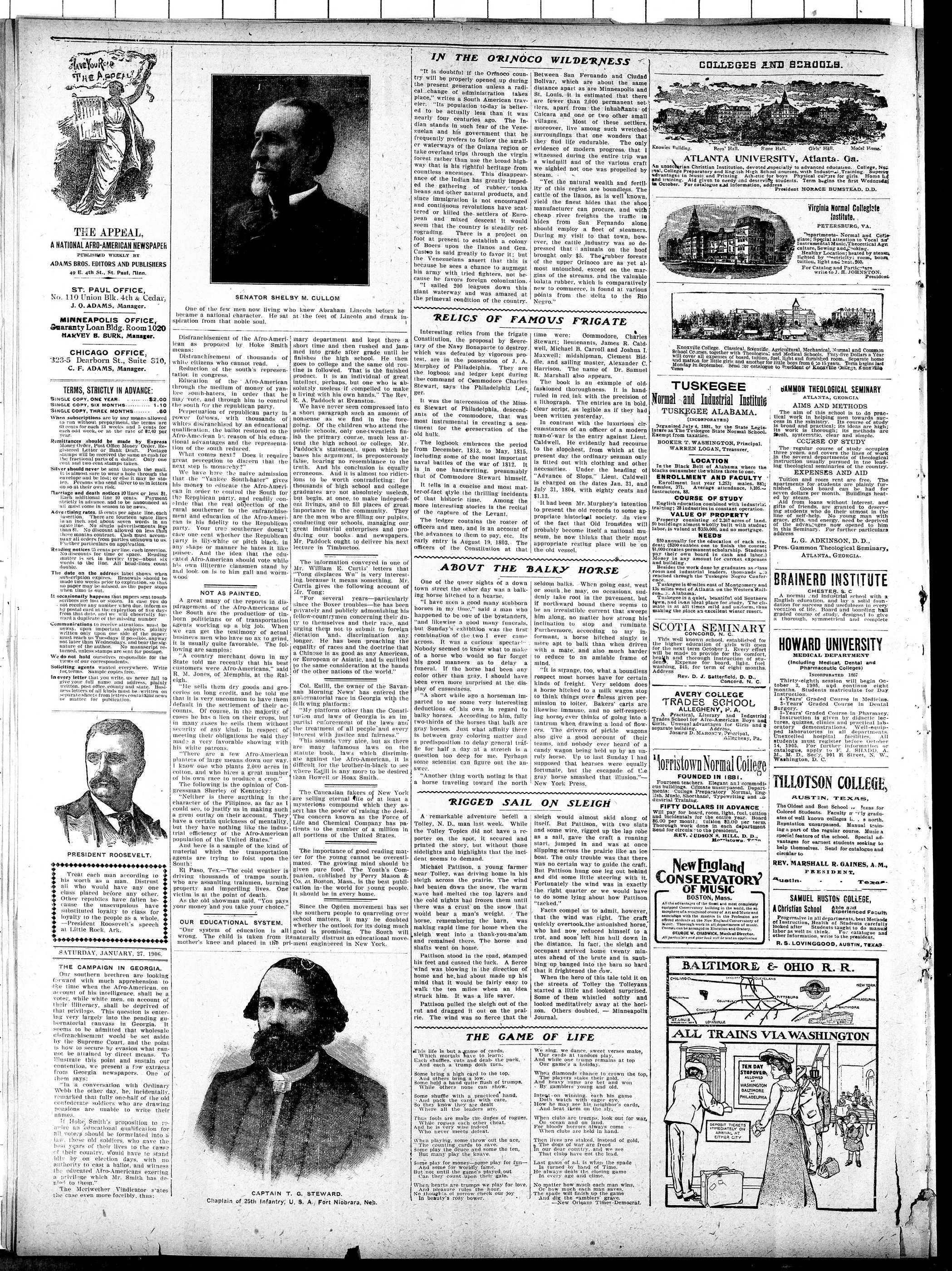
SENATOR SHELBY M. CULLOM
One of the few men now living who knew Abraham Lincoln before he became a national character. He sat at the feet of Lincoln and drank inspiration from that noble soul.
Disfranchisement of the Afro-American as proposed by Hoke Smith means:
Disfranchisement of thousands of white citizens who cannot read.
Reduction of the south's representation in congress.
Education of the Afro-American through the medium of money of yankees-hatchers, in order that he may vote, and through him to control the south for the republican party.
Perpetuation of republican party in power follows, with thousands of whites disfranchised by an educational qualification, the ballot restored to the Afro-American by reason of his educational advantages and the representation of the south reduced.
What comes next? Does it require great perception to discern that the next step is monarchy?
mary department and kept there a short time and then rushed and jammed into grade after grade until he finishes the high school. He then goes to college and the same old routine is followed. That is the finished product. It is an individual of great intellect, perhaps, but one who is solutely useless if compelled to make a living with his own hands." The Rev E. A. Paddock at Evanston.
We have never seen compressed into a short paragraph such an amount of nonsense as we find in the fore going. Of the children who attend the schools, only one twentieth finish the primary course, much less attend the high school or college. Mr Paddock's statement, upon which he bases his argument, is preposterously false, bearing no resemblance to the truth. And his conclusion is equally
We have here the naive admission that the "Yankee Southhater" gives his money to educate the Afro-American in order to control the South for the Republican party, and readily conclude that the real objection of the rural southerner to the enfranchisement and education of the Afro-American is his fidelity to the Republican party. Your true southerner doesn't care one cent whether the Republican party is lily-white or pitch black, in any shape or manner he hates it like poison. And the idea that the educated Afro-American should vote while his own illiterate clansmen stand by and look on is to him gall and worm-wood.
NOT AS PAINTED
A great many of the reports in dispatement of the Afro-Americans of the South are the production of tinnhorn politicians or of transportation agents working up a big job. When we can get the testimony of actual business men who have no ax to grind, it is usually quite favorable. The following are samples:
"A country merchant down in my State told me recently that his best customers were Afro-Americans," said R. M. Jones, of Memphis, at the Raleigh.
"He sells them dry goods and groceries on long credit, and he told me that it is very common to have them default in the settlement of their accounts. Of course, in the majority of cases he has a lien on their crops, but in many cases he sells them without security of any kind. In respect of meeting their obligations he said they made a very favorable showing with his white patrons.
"There are a few Afro-American planters of large means down our way. I know one who plants 2,000 acres in cotton, and who hives a great number of his own race to produce a crop." The following is the opinion of Congressman Sherley of Kentucky: "Neither is there anything in the character of the Filipinos, as far as I could see, to justify us in making such a great outlay on their account. They have a certain quickness of mentality, but they have nothing like the industrial efficiency of the Afro-American population of the United States." And here is a sample of the kind of material which the transportation agents are trying to foist upon the South: El Paso, Tex.—The cold weather is driving thousands of tramps south, who are assaulting trainmen, burning property and imperiling lives. One victim is at the point of death. As the old showman said, "You pays your money and you take your choice."
OUR EDUCATIONAL SYSTEM.
"Our system of education is all wrong. The child is taken from mother's knee and placed in the w
P.
CAPTAIN T. G. STEWARD.
Chaplain of 25th Infantry; U. B., Fort Niobara, Neb.
mary department and kept there a short time and then rushed and jammed into grade after grade until he finishes the high school. He then goes to college and the same old routine is followed. That is the finished it. It is an individual of great intellect and intelligence, solitely useless if compelled to make a living with his own hands." The Rev. E. A. Paddock at Evanston.
We have never seen compressed into a short paragraph such an amount of nonsense as we find in the foregoing. Of the children who attend the public schools, only one twentieth finish the primary course, much less attend the high school or college. Mr. Paddock's statement, upon which he bases his argument, is preposterously false, bearing no resemblance to the truth. And his conclusion is equally erroneous. And it is almost too ridiculous to be worth contradicting; for thousands of high school and college graduates are not absolutely useless, but begin, at once, to make independent livings, and to fill places of great importance in the community. They are the men who are filling our pulpits, conducting our schools, managing our great industrial enterprises and producing our books and newspapers. Mr. Paddock ought to deliver his next lecture in Tintoquebo.
The information conveyed in one of Mr. William E. Curtis' letters that "Tong displaces Wu" is very interesting because it means something. Mr. Curtis gives the following account of Mr. Tong:
"For several years—particularly since the Boxer troubles—he has been privately and publicly admonishing his fellow-countrymen concerning their duty to themselves and their race, and urging them not to submit to foreign dictation, to be discrimination any longer. He has been preaching the equality of races and the doctrine that a Chinese is as good as any American, or European or Asiatic, and is entitled to the same consideration at the hands of the other nations of the world."
Col. Estil, the owner of the Savannah Morning News' has entered the gubernatorial race in Georgia with the following platform:
"My platform other than the Constitution and laws of Georgia is an impartial enforcement of the laws and the treatment of all people and every interest with justice and fairness."
This sounds very nice, but as there are many infamous laws on the statute book, laws which discriminate against the Afro-American, it is difficult for the brother-in-black to see where Estil is any more to be desired than Howell or Hoax Smith.
The Caucasian fakers of New York are selling eternal life or at least a mysterious compound which they assemble has the power of raising the dead. The Society of Life and Chemical Company has patients to the number of a million in all portions of the United States.
The importance of good reading matter for the young cannot be overestimated. The good books should be given pure food. The Youth's Companion, published by Perry Mason & Co. at Boston, Mass., is the best publication in the world for young people. It should be in every home.
Since the Ogden movement has set the southern people to quarrel over school matters, it may be doubted whether the outlook for its doing much good is promising. The South will move toward a more liberal movement engineered in New York.
"It is doubtful if the Ornoco country will be properly opened up during the present generation unless a radical change of administration takes place," writes a South American traveler. "It's population to-day is believed to be actually less than it was nearly four centuries ago. The Indian stands in such fear of the Venezuelan and his government that he frequently prefers to follow the smaller waterways of the Guiana region or take overland trips through the virgin forest rather than use the broad highway that is his rightful heritage from countless ancestors. This disappearance of the Indian has greatly impeded the gathering of rubber, tonka beans and other natural products, and since immigration is not encouraged and continuous revolutions have scattered or killed the settlers of European and mixed descent it would seem that the country is steadily retrograding. There is a project on foot at present to establish a colony of Boers upon the Ilanos and Gen. Castro is said greatly to favor it; but the Venezuelans assert that this is because he sees a chance to augment his army with tried fighters, not because he favors foreign colonization. "I sailed 200 leagues down this giant waterway and was amazed at the primeval condition of the country.
RELICS OF FAMOUS FRIGATE
Interesting relies from the fritigate Constitution, the proposal by Secretary of the Navy Bonaparte to destroy which was defeated by vigorous protest, are in the possession of J. A. Murphey of Philadelphia. They are the logbook and ledger kept during the command of Commodore Charles Stewart, says the Philadelphia Ledger.
It was the intercession of the Misses Stewart of Philadelphia, descendants of the commodore, that was most instrumental in creating a sentiment for the preservation of the old hulk.
The logbook embraces the period from December, 1813, to May, 1815, including some of the most important naval battles of the war of 1812. It is in one handwriting, presumably that of Commodore Stewart himself.
It tells in a concise and most master-of-fact style the thrilling incidents of that historic time. Among the more interesting stories is the recital of the capture of the Levant. The ledger contains the roster of officers and men, and is an account of the advances to them to pay, etc. Its early entry is August 19, 1803. The officers of the Constitution at that
ABOUT THE BALKY HORSE
One of the queer sights of a down town street the other day was a balking horse hitched to a hearse. "I have seen a good many stubborn horses in my time" said a man who happened to be one of the bystanders, "and likewise a good many funerals, but Sunday's exhibition was the first combination of the two I ever came across. It was a curious spectacle." Nobody seemed to know what to make of a horse who would so far forget his good manners as to delay a funeral. If the horse had been any color other than gray, I should have been even more surprised at the display of cussness.
"A short while ago a horseman imparted to me some very interesting deductions of his own in regard to balty horses. According to him, fully two-thirds of the horses that balk are gray horses. Just what affinity there is between gray coloring matter and a predisposition to delay general traffic for half a day at a stretch is a question too deep for me. Perhaps some scientist can figure out the answer.
"Another thing worth noting is that a horse traveling toward the north
RIGGED SAIL ON SLEIGH
A remarkable adventure befell a Tolley, N. D., man last week. While the Tolley Topics did not have a reporter on the spot, it secured and printed the story, but without those sidelights and highlights that the incident seems to demand.
Michael Pattison, a young farmer near Tolley, was driving home in his sleigh across the prairie. The wind had beaten down the snow, the warm wave had melted the top layers and the cold nights had frozen them until there was a crust on the snow that would bear a man's weight. The horse, remembering the barn, was making rapid time for home when the sleigh went into a thank-you-ma'am and remained there. The horse and shafts went on home.
Pattison stood in the road, stamped his feet and cussed the luck. A fierce wind was blowing in the direction of home and he, he had about made up his mind that it would be fairly easy to walk the ten miles when an idea struck him. It was a life saver. Pattison pulled the sleight out of the rut and dragged it out on the prairie. The wind was so fierce that the
THE GAME OF LIFE
this life is but a game of cards,
Which mortals have to learn;
Eclectic players have the pack,
And each a trump doth turn.
Some bring a high card to the top,
And others bring a low.
Some hold a hand quite flush of trumps.
While others none can show.
Some shuffle with a practiced hand,
And pack the cards with care.
Shuffle the deck with care.
Where all the leaders are.
Thus fools are made the dupes of rogues
While rogues each other cheat,
And he is very wise indeed
Who never meets defeat.
When playing, some throw out the ace,
The counting cards to save.
Some shuffle the deck with the ten,
But many play the knave.
Some play for money—some play for fun—
And some for worldly fame.
But not until the game's played out
Can they count upon their gain.
When hearts are trumps we play for love,
And pleasure rules the hour.
Nor should we check out joy
In beauty's roys bower.
Between San Fernando and Chudad Bolivar, which are about the same distance apart as are Minneapolis and St. Louis, it is estimated that there are fewer than 2,000 permanent settlers, apart from the inhabitants of Calcara and one or two other small villages. Most of these settlers, moreover, live among such wretched surroundings that one wonders that they find life endurable. The only evidence of modern progress, that I witnessed during the entire trip was a windmill and of the various craft we sighted not one was propelled by steam.
"Yet the natural wealth and fertility of this region are boundless. The cattle of the Ilanos, as is well known, yield the finest hides that the shoe manufacturer can procure, and with cheap river freights the traffic in hides from San Fernando alone should employ a fleet of steamers. During my visit to that town, however, the cattle industry was so depressed that animals on the hoof brought only $5. The rubber forests of the upper Orinoco are as yet almost untouched, except on the margins of the streams, and the valuable bulata rubber, which is comparatively new to commerce, is found at various points from the delta to the Rio Negro."
time were: Gommodore, Charles Stewart; lieutenants, James R. Caldwell, Michael B. Carroll and Joshua L. Maxwell; midshipman, Clement Biddle, and sailing master, Alexander C. Harrison. The name of Dr. Samuel R. Marshall also appears.
The book is an example of old-fashioned thoroughness. It is hand-ruled in red ink with the precision of a lithograph. The entries are in bold, clear script, as legible as if they had been written yesterday.
In contrast with the luxurious circumstances of an officer of a modern man-o-war is the entry against Lieut. Caldwell. He evidently had recourse to the slopchest, from which at the present day the ordinary seaman only is fitted out with clothing and other necessities. Under the heading of "Advance of Slops." Lieut. Caldwell is charged on the dates Jan. 31, and July 31, 1804, with eighty cents and $1.13.
It had been Mr. Murphey's intention to present the old records to some appropriate historical society. In view of the fact that Old Ironids will probably become itself a national museum, he now thinks that their most appropriate resting place will be on the old vessel.
seldom balks. When going east, west or south he may, on occasions, suddenly take root in the pavement, but if northward bound there seems to be an irresistible current that sweeps him along, no matter how strong his inclination to stop and ruminate. Furthermore, according to my informant, a horse hifched singly is more apt to balk than when driven with a mate, and also much harder to reduce to an amiable frame of mind.
"It is strange, too, what a boundless respect most horses have for certain kinds of freight. Very seldom does a horse hitched to a milk wagon stop to think things over unless given permission to loiter. Bakers' carts are likewise immune, and no self-respecting horse, ever thinks of going into a tantrum when drawing a load of flowers. The drivers of pickle wagons also give a good account of their teams, and nobody ever heard of a candy wagon being held up by an unruly horse. Up to last Sunday I had supposed that hearses were equally fortunate, but the escapade of the gray horse smashed that illusion."—New York Press.
sleigh would almost skid along of itself. But Pattison, with two slats and some wire, rigged up the lap robe as a sail, gave the craft a running start. jumped in and was at once slipping across the prairie like an ice boat. The only trouble was that there was no certain way to guide the craft. But Pattison hung one leg out behind and did some little steering with it. Fortunately the wind was in exactly the right quarter or we would have to do some lying about how Pattison "tacked."
Facts compel us to admit, however, that the wind was right. The craft quickly overtook the astonished horse, who had now, reduced himself to a trot, and soon left him hull down in the distance. In fact, the sleigh and occupant arrived home twenty minutes ahead of the brute and in snubbing up banged into the barn so hard that it frightened the cow.
When the hero of this tale told it on the streets of Tolley the Tolleyans started a little and looked surprised. Some of them whistled softly and looked meditatively away at the horizon. Others doubted. — Minneapolis Journal.
We sing, we dance, sweet verses make,
And tandem play,
And while on our knees mains at top
Our game's a holiday.
When diamonds chance to crown the top,
The players stake their gold.
And heavy sums are bet and won
By gamblers young and old.
Inteat on winning, each his game
How he may see his neighbor's cards,
And beat them on the sky.
When clubs are trumps, look out for war,
On ocean and on land.
For bloody horrors always come
When clubs are held in hand.
Then lives are staked, instead of gold,
Dogs of war are free
In our town, and we see
That clubs have got the lead.
Last game of al, is when the spade
Is turned by hand of Time.
He always deals the closing game
In every age and climate.
No matter how much each man wins,
The spade will finish up the game
And dig the 'gamblers' grave.
Knowies Building. Boys' Hall. Some Hall. Girls' Hall. Model Home.
ATLANTA UNIVERSITY, Atlanta. Ga.
An unaccentrian Christian Institution, devoted especially to advanced education. College, National, College Preparatory and English High School courses, with Industrial Training. Supervised by the Main Street Planning Association for boys. Physical culture for girls. Home life and training. Aid given to needy and deserving students. Term begins the first Wednesday in October. For catalogue and information, address
THE HOTEL
Knoxville College. Classical, Scientific, Agriculture
School Coarses, together with Theological, and Medi-
cal with a view of expenses of board, tuition, fuel, light
and matron for little girls and another for little boy.
Monday in September. Send or catalogue to Preston
Tenn
Knoxville College. Classical, Scientific, Agricultural, Mechanical, Normal and Common School Courses, together with Theological, and Medical Schools. Fifty-five Dollars a Year will cover all expenses of life in the school. Light and furnished room. Separate home and matron for little girls and another for little boys. Home on Monday in September. Send 30 catalogue to President of Knoxville College, knoxville town
Joseph D. MARONY, Principal
Allegheny, Pa.
Unexcel
student
14th
catalog
M. M.
Washin
1 Morristown Normal College
BALTIMORE & OI
CHICANO
SANDYVILLE
CLEVELAND
DETROIT
COLUMBUS
NEW YORK
PITTSBURG
CHICANO
ST. LOUIS
MONTREAL
LOUISVILLE
ALL TRAINS VIA
BALTIMORE & OHIO R. R.
ALL TRAINS VIA WASHINGTON
TEN DAY STOPOVER
ALLOWED
IN
WASHINGTON
BALTIMORE
PHILADELPHIA
DEPOSIT TICKETS
IMPREDITED ON
ARRIVAL AT
EITHER CITY
TUSKEGEE Normal and Industrial Institute
TUSKEGEE ALABAMA.
(INCORPORATED)
Organized July 4, 1881, by the State Legislature as The Tuskegee State Normal School.
Exempt from taxation.
BOOKER T. WASHINGTON, Principal.
WARREN LOGAN, Treasurer.
LOCATION
In the Black Belt of Alabama where the blacks outnumber the whites three to one.
ENROLLMENT AND FACULTY
Enrollment last year 1,253; males. 883; females. A average attendance, 1,105.
Instructions. 88.
COURSE OF STUDY
English education combined with industrial training; 28 industries in constant operation.
VALUE OF PROPERTY
Property consisting of 2,267 acres of land, 50 buildings almost wholly built with student labor, is valued at $350,000, and no mortgage.
NEEDS
$50 annually for each of each student; $200 enables one to finish the course; $200 creates permanent scholarship. Students pay $200 for each case and about $100 in any amount for extra expenses and building.
Work done by graduate as class room and industrial leaders, thousands are received through the Tuskegee Negro Conference. Tuskegee is 40 miles east of Montgomery and is located on the Western Railway in Alabama.
Tuskegee is a quiet, beautiful old Southern town, and is an ideal place for study. The climate is at all times mild and uniform, thus making the place an excellent winter resort.
SCOTIA SEMINARY
CONCORD, N. C.
This well known school, established for the high education for girls will open for the next term October 1. Every student will be made to provide for the comfort, health and thorough instruction of students. Expense for board, light, fuel washing, $16, for term of eight months. Address
Rev. D. J. Gatterfield, D. D.
Concord, N. C.
AVERY COLLEGE
TRADES SCHOOL
ALLEGHENY, P. A.
A Practical, Literary and Industrial Trades School for Afro-American Boys and Girls, with advantages for Girls and a separate school for boys.
FOUNDED IN 1881.
Fourteen teachers. Elegant and commodious buildings. College Preparatory. Normal, jazz music. Shorthand, Typewriting and administrative.
FIFTY DOLLARS IN ADVANCE
Will pay for board, room, light, fuel, tuition and incidentials for the entire year. Board per month. Per term. Thorough work done in each department.
Send for circulation to the president.
REV. JUDSON S. HILL, D. D.
New England CONSERVATORY OF MUSIC
All the advantages of the final and most completely comprehensive course in the history of the atmosphere of a recognized course of Art and Music association with the masters in the Profession are combined at the New England Conservatory of Music. The course is designed for Music Courts can be arranged in Education and Oratory. The course is offered by the Director, Music Director, All participles and year book will be
Departments: Normal and Collegiate; Special attention to Vocal and Instrumental Music; Theological Agriculture, Sewing and Cooking.
Healthy Location; heated by steam, litated by Natural light, board tuition, light and seat. $90.
For Catalog and Particulars write to J. H. JOHNSTON, President.
Agricultural, Mechanical, Normal and Common and Medical Schools. Fifty-five Dollars a Year, final light, and equipped for little boys from 6 to 15 years. Term begins laste to President of Knoxville College, Knoxville
JAMMON THEOLOGICAL SEMINARY
JAMMON THEOLOGICAL SEMINARY
AIMS AND METHODS
METHODS
The aim of this school is to do practical work in helping success in the ministry. Its course of study is broad and practical; its ideas are high its work is thorough; its methods are fresh, systematic, clear and simple.
CCURSE OF STUDY
The regular course of study occupies the time in the several departments of theological instruction usually pursued in the leading theological seminaries of the country.
EXPENSES AND AID
Tuition费 are free. The apartments for students are usually furnished. Good board can be had for up to ten per month. Buildings heated by steam.
Aid from loans without interest, and grants from the university. Students who do their utmost in the line of self-help. No young man with a degree in theology is deprived of the advan. ages now opened to him in this Seminary. For further particular address
L. G. ADKINSON, D. D.
BRAINERD INSTITUTE
CHESTER S C
A normal and industrial school with a English education, and lay a solid foundation in the vocabulary of life. Board and boarding hall graded course of study. designed to give students the ability to
HOWARD UNIVERSITY
INCORPORATED 1867
Thirty-eighth session will begin October 2, 1905, and continue eight months. Students matriculate for Day Instruction.
4-Years' Graded Course in Medicine.
3-Years' Graded Course in Dental Surgery.
3-Years' Graded Course in Pharmacy. Instruction is given by didactic lectures, quizzes, clinics and practical laboratory demonstrations. Well-equipped laboratories in all departments. Unexcelled hospital facilities. All students must register before October 14, 1905. For further information or catalogue, apply to F. J. SHADD, A. M., M. D. Sec'y. 901 R Street, N. W. Washington, D. C.
TILLOTSON COLLEGE
AUSTIN, TEXAS.
The Oldest and Best School. Texas for Colored Students. Faculty primarily graduates of well known colleges in. a north. Reputation unsurpassed. Manual training a part of the regular course. Music a special feature of the school. Special advantages for earnest students seeking to help themselves. Send for catalogue and circular to
REV. MARSHALL R. GAINES, A.M. PRESIDENT.
Austin. Texas.
PROGRESSIVE in all departments, best Methods of Instruction, Health of Students carefully looked after. Students taught to do manual labor as well as think. For catalogue and other information, write to the president,
R.S. LOVINGGOOD, AUSTIN, TEXAS.
OHIO R. R.
NEW YORK
PITTSBURG
PHILADELPHIA
WASHINGTON
BALTIMORE
IA WASHINGTON
A WEEK'S RECORD IN MINNESOTA'S CAPITAL.
The "Saintly City" and Saintly City Folks—Newey Items of Social, Religious and Cineral Matters Among the People.
SATURDAY, JANUARY, 27, 1906.
If it's Hamm's, it's all right.
Mr. Ed. De Bartiste, Jr., still continues very sick.
THE ELK EXPRESS CO, now has its office corner Ninth and St. Peter streets.
Have you seen the new magazine, "THE VOICE OF THE NEGRO?" See notice elsewhere in this issue.
Nice room to rent very cheap to gentleman or man and wife at 1047 Charles street. Telephone Dale 475-1.
Miss Marie Armstrong has returned from St. Louis, where she went with the remains of her father, the late William Armstrong.
Bishop C. T. Shaffer, of Chicago, was in the city this week, the guest of Rev. R. Seymour. He returned to Chicago Tuesday.
The marriage engagement is announced of Miss Jennette Combs and the wedding will take place in February.
Mrs. Samuel Hatcher, who has been absent for several months in attendance at the bedside of a sick sister in Kentucky, has returned home.
The Men's Sunday Club, H. B. Howard, president, meets at Pilgrim Baptist Church every Sunday afternoon at 4 o'clock. Public cordially invited.
The Appeal has purchased the press and outfit of the Richardson Printing Company and added the same to the plant. Bring in your job printing. Best work at lowest prices.
Gentlemen wishing nice furnished rooms, with all conveniences, by two windows, a reasonable rate, should apply at the Benton House, 228 West Third street, up stairs.
THE NAGEL UNDERTAKING CO.,
Wm. E. Nagel Manager, 208 West Third street, Telephone, Main 1504.
Latest equipments in every line.
Lady assistant when desired.
William A. Robison concert violinist and teacher. Studio 322 Bradley building, Fifth street opposite Court House. Robison-Weir orchestra for concerts, musicals and receptions.
Universal Spiritual Mission will hold regular meetings every Sunday at 7:30 p.m. at G.A. R. hall, now known as Central Annex 116 W. Sixth Street. Everybody cordially invited.
BOARDING HOUSE. Mrs. Ella Smith, prop., 552 Cedar street, Breakfast, 6:30 to 9:00 a.m. Regular dinner, 12:00 m. to 2:30 p.m. Meals at other hours to order. Regular dinner 25 cents.
The Men's Union Club will meet every Sunday at 3:30 o'clock instead of at 4 o'clock at St. James A. M. E. church. You are earnestly invited to be present. Come early if you would be benefited.
Shoes menued while you walt, at Jarvis', 83 East Fourth street. Half soles, 50 and 75 cents. Prices reasonable for all kinds of repair. He can do it on short notice. Jarvis, 83 E. 4th street.
THE PROPELS SHARPING PARLIAMENT Poster, Prop. No. 95% E. 4th and 137 E. 5th streets. When you wish a good shine give him a call. Shines 5 cents. First class work, Special chairs for ladies.
The State Savings Bank, corner Fourth and Minnesota streets, is open Monday evenings from 6 to 8. Accounts can be started with $1. A little amount saved every week may some day stand between you and want.
On last Monday Lawyer and Mrs. J. P. Anderson, 272 St. Anthony ave. entertained at luncheon, Bishop C. T. Shaffer and Presiding Elder H. H. Thompson of Chicago, Rev. Wilson of Minnesota and Rev. R. Seymour.
Ladies you should not visit to Madam Hurt's Millinery Parlor No. 10. Up-to-date fail and winter hats at reasonable prices. Children school hats from 75 cents up, neatly trimmed.
ELK EXPRESS CO., G. J. Charleson, manager, corner St. Peter and Ninth streets. Packing, shipping and storing of furniture and household goods. Plano moving a specialty. House renting, real estate handled.
Madam Hart's $6.00 and $7.00 hats are now going for $3.00 and $4.00. These include the very best makes and material. Misses and children's hats will sell at prices ranging from 75 cents up. Call and inspect the bargains.
Frank Bruce, aged 18, was fined $50 in police court Thursday for stealing a revolver from F. Schmidt, who formerly worked at the Justice Judge Finehout suspended the sentence and placed him in charge of the probation officer.
Those of our patrons who desire to have master published must get the same in this office not later than Thursday afternoon, otherwise it may be crowded! otherwise it may be taken of any communication that is not signed by the author.
Persons desiring to rent Wagner hall, corner Charles and West ave
STATE
SAVINGS
BANK
FOURTH AND MINNESOTA STREETS
ST. PAUL MINN.
THE ONLY BANK IN ST PAUL
EXCLUSIVELY FOR SAVINGS.
Deposits received in sums of $1. and
upwards.
Interest Compounded Semi-annually.
DEPOSITS OVER $2,375,000.00
SURPLUS FUND 50,000.00.
TRUSTEES:
Charles P. Noyes,
John D. Ludden,
Kenneth Clark,
John D. O'Brien,
William Constans,
Joe M. Hanaford
Wm. B. Dean,
Ferdinand Wilius,
Gustav Willius,
Thomas Fitzpatrick,
Harris Richardson,
Chas G. Lawrence.
BUY COAL NOW!
DON'T WAIT FOR HIGHER PRICES
Egg
Stove
Nut $8.75 Cargo
Pea $6.75
S. W. VANDERWARKER
45 E. Fourth St. ST. PAUL
$1.00 AND A PROMISE
IS ALL THAT IS NECESSARY TO SECURE AN
Edison Phonograph or a
Victor Talking Machine
WRITE FOR PARTICULARS
W. J. DYER & BRO. 21-23-25-27
WEST 5TH ST ST. PAUL, MINN.
nues for lodge meetings, parties, dances, meetings or for any occasion may obtain the same at reasonable rates upon application to J. H. Charleston, 632 University avenue. JARVIS, the healer and saver of soles, at Fourth street, says, in one of his street can be found; "I can mend shoes better than I can write," and, if the sign is a fair specimen of his work as a writer, he's right, as he can mend shoes all right if he cannot write all right. If you wish a good shave, hair cut, shampoo, or anything in the torsional line, call at Richard Coussy's neat barber shop. No. 374% Minnesota Satisfaction guaranteed. Music for dances and all occasions furnished on short notice. Mr. Charles A. Miller is now prepared to do expert work in the repairing of watches, clocks, Jewelry etc. Send a postal card to him at 903 Globe building and he will call for your work and deliver the same when com-
---
Preferred by many to hard coal for furnaces, ranges and stoves; lasts nearly as long. Costs only half
---
FIRST CLASS MEALS, like mother used to cook may be had at Mrs. Ella Smith's, No. 352 Cedar street. Breakfast from 7 to 11 a.m.; lunch from 12 to 2:30 p.m.; dinner from 5 to 7 a.m. When order when deserved. Sunday dinners a special. Regular meals 25 cents.
Mr. Walter Porter, the enterprising proprietor of the People's Shining Parlor, No. 114 E. 4th street, got a chance to sell his lease for a good round sum and has now opened two shining parors, one at No. 95½ E. 4th street, and the other at 127 E. 5th street.
You ought to see the "Knapp Shade Adjusters," advertised in this issue, they "fill a long felt want," and when you see them in store, Have RV. Work to call and them to you. A postal card sent him to P. O. Box 132, White Bear Lake, Minn., will bring him.
Hamm's New Beer. This beer is so decidedly superior to any draught ever after brewed, that within the few days it has been on sale it has already attained a fixed place in the market. It ifm. New Brew, 100,000 barrels it stock. On draught from now on.
SAFE DEPOSIT AND STORAGE VAULTS.—We invite your inspection. It costs little to place your papers, cash securities and valuables in absolute safety. Boxes in our vaults can be locked, and we can boxes, trunks, etc., with us. Northwestern Trust Co., 138 Endicott Arcade.
What is nicer than a pretty picture for a gift to a friend? You can get all sorts of pictures and frames at the Lowe Picture Frame Co., 475 Wabasha street. Full line of framed and unframed pictures; special prices for the large ones. We own a speciality of oil portraits at moderate prices. Pictures framed to order.
The Colonade Dancing School had its usual good crowd present last Wednesday evening. The usual good time may be counted on for next Wednesday evening. Come early and stay in the United States, instead, Colonade Hall, N. Washington, University and Farrington Aves. Entrance on Farrington, Lessons 25 cents.
Anything the matter with your stove, range or furnace? If there is, just call at the St. Paul Stove Repair Works, 126 West Seventh street, between Fifth and Exchange streets, and they can make the repairs on short notice. They can also make any of your range supplied. Telephone, N. W. nished. Tel. N. W. Main 283L-3. The Valet Tailoring Co. Owen Hewell, manager, has taken the place of Howell & Davis, tailors, at 156 East Sixth street. They have a new delivery wagon and have inaugurated a monthly scheme in which they agree to keep your clothes sponged and pressed and in good order for $1.00 per month. Go see them at the real estate Co. is now doing what might be called a "land of fice" business. They have 28 houses and lots on their list for sale, and 17 vacant lots in various parts of the city. Anyone who desires to invest in real estate can visit the office and look over their list. A number of houses for rent. No. 475 Wabasha Street.
The Valet Tailoring Co. Mr. Owen Howell manager, has made quite a lot of improvements, having put in another pressing table, making three with patent gas ovens. The floor has been covered with linoleum and new floor has been put in, making the place the most comfortable. Give them a call when you wish anything in their line.
Mesdames McGlone and Hart have opened a new enterprise at 266 Rice street called the Kentucky Bakery and Confectionary. They have home-made bread, ries, cakes, French candies and confectionery. They also furnish cold lunches when desired or do baking for the family. They a call or telephone an order. N. W. Main order. N. W. Main 3556-J.
North Star Lodge No. 138 U. B. F. has been granted a dispensation and will take in a class of new members at one half the usual rate for initiation or $10. Already about 15 have joined the club and if any others desire to get into this desirable Order and Lodge, they should apply to the Master, J. R. White, Phoenix Bldg., or Secretary J. Q. Adams, Union Block. Do it now.
The Cootonnade Dancing Academy had a splendid crowd on last Wednesday evening and all enjoyed themselfs in the music. Lafayette Mason and Armand's orchestra gave the usual satisfaction Armand's orchestra will be present at all the assemblies of the Colonade Dancing Academy, corner of University Avenue. Be sure to attend next Wednesday evening. Arthur Winstein, principal.
*Picture to be Framed?* If you have and are waiting for a “convenient time,” let us frame them now. Its convenient for us at any time but a little more so now than usual. Before chance there is for the picture to be damaged. We can give your work special attention now—Picture frames and mouldings, art materials—Lobble Picture Frame Co... 475 Wabasa St. Telephone N. W. Main 219 J-2. Beautiful hand made rugs may be made out of your old carpet, no matter how dirty or worn it may be. We can make it out of any sort of old carpet which will be cleaned and disinfected free of charge. Just call up the Simonet Rug Company, N. W. ‘phone main 1772 L. 1, or T. C. ‘phone’ 1802, and will call for your old carpet. We can make it out of West Seventh street where the beautiful rug may be seen.
The Colonade Dancing Academy seems to be pleasing the public immensely as the number of patrons is constantly on the increase. The hall is a very nice one, has a fine floor and everything is as snug as can be. Despite all counter attractions every Wednesday night the usual large and beautiful principal Winstead is constantly on the lookout to please his patrons and especial attention is paid to beginners.
The Colonade Dancing Academy made quite an improvement for their patrons. They have built a skylight twelve feet long, six feet wide and eight feet deep. Mr. Loeffelhohl, proprietor of the building, said that Mr. Winstead has the finest crowd of soicable people he ever saw. The Colonade Dancing School is a regular summer resort for dancing. All patrons are welcome to attend each Wednesday in the week.
Did it ever occur to you--that this is the time of the year to put your stoves and ranges in repair for winter? THE ST. PAUL STOVE RE-WORKS. 125 W. Seventh street, Las Lomas. You can equip in the city, and can furnish any part of any stove or range at any time and any place. A card will bring us, or you may 'phone N. W., Main 120-16L, or T. C. 242. Bear in mind that we can do your work when we need it, when the cold weather sets in, and we are rushed with orders. Time is short so DO IT NOW.
THE VIRGINIA RESTAURANT.
And lunch room. No. 449 Jackson St.,
Tel. N. W. Main 3466 L.,
G. H. Evans, Prop.
Regular meals 15 cents, served from
5:00 to 7:30 a.m.; 11:30 to 2:00 p.m.
at 7:30 a.m. served at all times. Hot bread served for
all regular meals. All kinds of sandwiches served at lunch counter. We bake our sandwich rolls every day.
Oysters served in all styles. Stewed oysters put in tin boxes to be taken out. Oysters to be taken out. Special 5 cents and 10 cents meals served at lunch counter. If there is anything special called us up by 'phone and if it's in the market we will be pleased to fill your basket. We will be pleased to market close at that hour. We make a speciality of cooking Sunday dinners and after-theatre suppers. Bread and rolls baked to order for family use. Ples, crullers and coffee rolls baked every day. Tables reserved for ladies. Tables reserved for ladies. Tickets good for 21 meals. Worth $3.15 for $2.50. Call to see us.
St. Philips Church.
Services as follows: Holy communion 8:00 a.m. m. every Sunday and at 11:00 a.m. m. every first Sunday in the month.
Moving Prayer and Sermon at 11:30 a.m. Sunday School at 12:30.
Evening Prayer and Address at 8:00 p.m.
Rev, Father A. H. Lealtade.
Priest in charge.
Would Rather Have Debt Stand.
A Welshman sued a fellow countryman some time since for a certain amount of money owing to him. The debtor repeatedly offered to work off the debt, but this offer did not satisfy him. He asked the creditor. At last the judge asked the plaintiff the reason for his unwillingness to accept the debtor's offer to "work off the debt." His reply was: "Well, you see, your honor, the man's an undertaker!" -London Tit-Bits.
Defective Page
Sears-Dodd Wedding
In the list of presents of the Sears-Dodd wedding as published last week some presents were inadvertently overlooked, and presents have been received since the wedding as follows: Mr. and Mrs. Louis Liverpool, bed spindle; Mr. and Mrs. Branson, engraved silver salad fork.
Mrs. J. B. Turner, salad bowl.
Rev. and Mrs. Glasgow, Glasgow, Ky., silver salt and pepper.
Mr. and Mrs. P. Porter, indianapolis, cousin of groom, ornamented clock.
Mr. and Mrs. Thompson, silver pin tray.
Mrs. M. E. Pope, fancy pin cushion.
Mr. and Mrs. Geo. Charleston, Sr. hematitched towels.
Mr. and Mrs. S. Wright, silk stock collar.
Mr. and Mrs. A. A. Calton, hematitched towels.
The Misses Calton, fancy pillow.
Mrs. Sude Trimble, Mrs. Anne Nichol and Willa Nichol, Nashville, Tennessee, cousins of the bridge, large chrysanthemum jar.
Mr. and Mrs. Blair, hematitched towels.
Mesdames S. King and Matilda Brooks, Chicago, statuary.
Mrs. Eva Solomon, Galesburg, Ill., bread and butter plates.
Mr. and Mrs. Charles Brown, bride's gloves.
The Tea Rooms.
The managers of the "Tea Rooms" are making special efforts to please the public in the matter of Sunday tomorrow they present the following:
Cranberry Sauce Mashed Potatoes
Stewed Corn Creamed Peas
Apple Pie
Ice Cream Cake
Tea Coffee
Dinner Sunday 35 cents, during the
week 25 cents. Dinner ready at 12
o'clock.
F. Sears & E. Taylor, Props.
To Whom It May Concern.
On February 10th, I will publish a full compendium of the trouble between R. S. Reese and some of the people of St. JAMES' A. M. E. Church, of this city in the Chicago and St. Paul editions of THE APPEAL, showing the nature of the trouble and with Rev. H. H. Thompson, Presiding elder; also why they could not be filed with the stewards, the action of the Presiding Elder from the time he arrived in the city until the Bishop arrived, which will include the stewards, the action held, the Bishop's action before the congregation on Sunday, Jan. 21st and Monday night, Jan. 22nd, including his decisions. I will also show that the trustees, as a board, never had any of the people with the Bishop or the Presiding Elder, every charge was filed by individuals.
I shall show how easy it is, under the Bishop ruling of a technicality of the discipline, that a preacher in the A. M. E. Church, though his character is good, is not able to keep up homes, collect money and refuse to report for the same, may publish slanderous and false statements concerning his members, make false and still go scot tree. All of which facts I shall give for the benefit of justice and law. J. H. Dillingham, St. Paul, Minn. Jan. 26, 1906.
MILLS' LUNCH AND SANDWICH
BOOM
J. S. Mills, proprietor, 444 Robert street, between Seventh and Eighth streets. Open from 6:00 a.m. to 2:30 a.m. Tel. orders delivered free. Telephone, N. W. Main 3082 L. This is the place to get your favorite sandwich or a good lunch. The best grade to have is to prepare how to prepare it. therefore, you are sure of excellent coffee. An epicure will find all of the delicacies of the season here. Soup and stews are always kept on hand and such sandwiches as the New York, Pork Tenderloin, Chicken. St. Paul, Hamburger, can be served at any time. If you try this place once you will be satisfied with the quality, service and price and you will be sure to call again.
N. B. MARSHALL
Carpenter and Builder, 554 Aurora Avenue.
We have in our midst a first class carpenter and builder in the person of Mr. N. B. Marshall 642 Jackson st. He will also give prompt attention to the general repairing, painting and accounting of the finished upon application. Telephone W. N. Dale 381 J2. He has 50 lots on University avenue for sale on a cash payment of $25, and a monthly payment of $10. Will build houses on these lots to suit purchasers on month basis. DON'T MISS THIS OPPORTUNITY!
THE ELK EXPRESS CO.
Has Moved to Larger and Better Quarters.
The Elk Express, Co. is growing and spreading out now that spring is here. The company has leased the building on the corner of St. Peter and St. John, and has set up its office and storage. There has also been added to the present equipment one large stake wagon and two small ones. The company is now prepared to move any one as quickly as possible and at any low rates. Only competent men are employed to handle the goods. G. J. Charleson, Manager.
Mr. S. D. Kemp has been appointed agent for "The Voice of the Negro," a monthly magazine published in Atlanta, Ga., and the only magazine now being edited and published by Afro-Americans in this country. Messrs. E. Bowen and J. Max Barber are编辑 and J. Max Barber pledged their support to the magazine as contributors are: Prof. W. E. B. D'Bu Bois, Prof. Kelley, Miller, Dr. Booker T. Washington, Mrs. Mary Church Terrill, Mrs. Fannie Barrier Williams and a score of others prominent among the leading writers of the magazine only $1 per year. Personnel need to scribe should send their subscriptions to S. D. Kemp. Army Building foot of Robert Street, St. Paul
Renovating, cleaning and repairing
Will call for and deliver free of charge.
Monthly contracts $1.00 per month.
Suits pressed while you wait, 50c.
Patronal selections. All work
patronal selections. N, N, W. Main 2769-
L 156, East 6th床
THE STATE SAVINGS BANK.
Total Deposits, $2,400,000.00.
The only bank in St. Paul exclusively for savings; receives deposits in sums of $1 and upwards, and compounds interest semi-annually. Open Monday evenings from 6 to 8.
ANCIENT BEDS TOO SUMPTUOUS
Beautiful and Imposing They Were
But Not Comfortable
In old times beds were very sumptuous articles of furniture, and the gift of one in a will represented in many cases a large sum of money, the bedstead with its fittings frequently having cost several hundred pounds. In Elizabeth's time and earlier, bedsteads were imposing collections of oak, richly carved in all manner of quaint device, with, perhaps, a grinning satyr peering from behind a pillar, sufficiently grotesque to murder the slumers of the most sommelian. Those were the days, too, of heavy silken hangings, valances and quilts, all richly embroidered in silk and old silver thread with heavy bullets, fringes to add weight and majesty. Such beds may be seen in some of the valuable collections at the museums and at English country seats, such as Warwick castle and other notable old places. To modern eyes they compare very unfavorably, despite their intrinsic value, with the simple, dainty beds of modern times.
DREW ADMIRATION OF RUSKIN.
Alpine Bird Compelled Thought of
Writer and Philosopher.
While among the dark, pine preciences of the Chartreuse hills, one day, the famous John Ruskin saw for the third time what he thought the most wonderful of all Alpine birds—a gray, fluttering, stealthy creature, about the size of a sparrow, but of colder gray and more graceful, which haunts the sides of the fiercest torrents. He wrote: "There is something more strange in it than in the sea-gull—that seems a powerful creature, and the power of the sea not of a kind so strong, so hopelessly destructive. But this small creature, silent, tender and light, like a moth in its low and irregular flight, almost touching with its wings of waves that would overthrow the granite wall, and haunting the hollows of the black, cold, herbless rocks that are continually shaken by their spray, has perhaps the nearest approach to the look of a spiritual existence I know in animal life."
The Humming Bird
Scientifically humming birds are "trochilidae," and those who make a special study of them are "trochilidae"—although the birds are not identical with the old Greek "trochilus" or "runner" bird, which, according to Herodotus, entered the laws of ancient crocodile and obliged its big friend by plucking lice from his throat. The Spanish name for the humming bird is "tominejo"—meaning a third of a dram, and referring, of course, to the bird's minutesness. But the prettiest names are those, such as the French "froutrou," which refer to the humming noise sometimes produced by the almost incredibly rapid vibration of the wings. "Purring with the wings," Thomas Morton (1632), the first English writer to mention the humming bird.
Arctic Expedition Amusements
In the British arcite expedition of 1875 one of the chaplains had a file of the London Times twenty years old containing the Crinean war reports. One copy was given out to each ship daily; the officers had it first, then it went to the forecastle, and soon every one was as keen about the news as if the war had been proceeding. The clergyman in control of the press was besought to issue an evening edition, and when Sebastopol was about to be taken excitement ran so high that the newspaper office, a locker, was almost stormed. The editor, however, was firm, and continued with his daily issue, the interest was kept up to the end of the expedition.
American Safety Devices
In spite of the fact that the United States lead the world in the invention of safety devices it has been shown that we stand first in the record of accidents. The proportion of miners killed here is nearly three times as great as in France and about double that in other European countries. For every five men killed by accident in this country there are only three in all the nations of Europe combined. It is claimed that with all our quickness we can prevent accidents for safety we are slow to adopt them and that many American inventions of this kind find their first recognition in Europe—Hartford, Conn. Times.
Mistakes of Authors
"I do wish," said the Omnivorous Reader, "that these fiction producers would be a little more careful in their descriptions of people. I have become hardened to a girl with eyes like violet lips like cherries and hair like spun gold; though such a one must be a creature fit only for a dime museum. But here is Ponson de Terail, my favorite French feuilletonist, who says, "The man's hands were cold and clammy, like those of a serpent, and 'The count walked up and down the garden reading the newspaper with his hands behind his back.' Now, wouldn't that jar you?"
Would Kill What He Could
Would Kill What He Could.
The following anecdote is told concerning Edward Sharpe, a shoemaker by his father, a water, Mass. At the outbreak of the civil war he was called upon to defend his country in the army. At the time of enlistment and examination he was asked if he preferred the infantry, "Well, he replied, 'I hate much of a man,' but I'll go and kill what I can.
DOINGS IN AND ABOUT THE GREAT "FLOUR CITY."
Matters Social, Religious and General Which Have Happened and Are to Happen Among the People of the City.
Mr. Zack. Johnson is able to be out again.
It is rumored that V. H. and G. B. will soon be as one.
Miss Luhu Blair is seriously ill at her home, 1123 3rd Ave. So.
Miss Thadd Stepps is still confined to her home with acute Bronchitis.
You cannot escape your taxes here by talking about your citizenship there.
Mrs. R. C. Covington of St. Paul has been the guest of Mrs. James Cunningham for the past week.
The Parliamentary law class met at the residence of Mrs. Wm. Smith, on Garfield Ave. last Wednesday.
"Have you seen the new magazine, 'THE VOICE OF THE NEGRO?' See notice elsewhere in this issue.
The ladies of the St. Thomas Guild are arranging for a grand entertainment before Lent in Holcomb's hall.
The Canadian Jubilee Singers and Orchestra will give a concert at St. Peter's church the evening of Jan. 30.
The Pastor's Aid Society will meet the residence of Mrs. Chas Roberts, 2011 Nie. Ave. next Wednesday evening.
Mrs. Mary Vader is suing the Fuller Laundry Co. in damages for the death of her husband caused by being kicked by an unwieldy by the Laundry Co.
Mr. J. W. Wyer, head at Commercial Club has gone with a special party to Florida Mr. Henry Harris, former second waiter, is acting as head waiter.
The St. Thomas guild met at the residence of Mrs. Z. A. Pope. The following officers were elected: Mrs. Z. A. Pope, pres, W. L. Jeffrey, vice pres, Napier, sec. Mrs. L. Harper, sec.
Harvey Moss graduated from the grades, with a very large class, into the Central High School last week. His class gave a sleight ride party, after they enjoyed refreshments at the honee of one of the members of the class.
& 5th Ave. So. Services every Sun St. Thomas Mission located at 9th St. day afternoon at 4 o'clock—Sunday School at three. Rev. Geo. H. T. Thomas rector in charge. All welcome.
When In St. Paul and you wish to get FIRST CLASS MEALS, like you need to get at home on call on Mrs. Ella O'Connor. On call, Breakfast from 7 to 11 a.m.; lunch from 12 m. to 2:30 p.m.; dinner from 5 to 8 p.m. Meals to order when desired. Sunday dinners a speciality. Regular meals 25 cents.
He cannot have right thoughts of God who refuses to take thought of men.
Surely Not in Boston
Henry James, the novelist, narrated at a Boston dinner party a conversation that he had overheard at afternoon noon. "It was a conversation," said Mr. James, "between a young book clerk and an older one. It occurred in a book shop devoted to the sale of the most popular and newest fiction.
"The younger clerk approached the older anxiously.
"Say, he whispered, 'there's a woman here wants Spencer's poems:'
"Is it Herbert Spencer's poems?' the more experienced clerk asked me.
"Yes, said the other. 'What shall I tell her?'
"Tell her we haven't 'cm,' said the older clerk."
Modernized.
"They've taken it down and put up a sign, 'Accommodation to Man and Automobile.' The hoster who used to come out with a can of oats?" "Oh, he comes out now with a can of gasoline."
In Her Dreams
Miss Ascum—Just back from Palm Beach, eh?
Miss Bragg—Yes, and oh, you'd never dream all/the proposals I had there.
Miss Ascum—No; but I suppose that's the way they came to you.—Philadelphia Press.
HAS HUMAN ADVERTISING CARD
Chicagoan Has Found Novel Way to Increase Business
A young and energetic coal merchant of the northwest side has invented a new way to advertise his business. It is probably the most modern one of its kind, and to say the least, it is attractive to the eye—especially to those of the masculine persuasion. A petition is a petite brunette of nineteen summers, as pretty as a fairy queen, and the only fear of the coal merchant is that some of his cushions, will marry her and take her away before he can amass a fortune at the coal business by having her in the office as a drawing card.
This young man is the employer of the "human advertising card" and the owner of the fuel store said that he concluded previous to buying the place that the only thing that would draw trade would be a beautiful young girl in the office whose sole duties were to show the know and look happy. But her orders started at her new appointment were these: "Do not flirt; sit and look wise."
This is all the young woman has to do all day, as the energetic young coal merchant attends to all the office duties. Of course, there is no danger of the employer becoming infatuated with his help. Several sign painters have called at the place demanding that she join their union, alleging for a reason that her presence in the office does away with the necessity of lettering, the windows. —Chicago Chronicle
$2. Down AND
$1. Per Mo.
WILL BRING
$40.00
PER MONTH
WHEN YOU NEED THE
MONEY
You NEED Money When
You Are Sick or Disabled
THAT IS WHEN WE PAY
The Cosmopolitan Mutual Casualty Company 421-2 Bradley Bldg., St. Paul, Minn.
Hustling Agent Wanted
THE
M. A.
HANNA
Agents
for the
Celebrated
"Scott"
Anthracite
Coal
Minors,
Shippers,
Retailers
of
High Grade
Bituminous
Coal
Minara,
Shippera,
Retailers
High Graded
Bituminous
Coal
COMPANY
104% EAST FOURTH STREET
BOTH PHONES
ST. PAUL, MINN.
VIRGINIA RESTAURANT
All Pastry, Bread and Rolls Home-made
Oysters and Sandwiches, Specialties
G. H. EVANS, PROPRIETOR.
449 Jackson St. ST, PAUL, MINN.
Tel. N. W. Nail, 3466-L
M. B. B.
C.A. MILLER
EXPERT
REPAIRER OF
Watches, Clocks
and Jewelry
903 GLOBE BLD
St. Paul
SEND A POSTAL CARD AND HE
WILL CALL FOR AND DE-
LIVER GOODS.
Prices Reasonable and all Work
Guaranteed.
TEL. N. W. MAIN 2130-J
SHOES
THAT
SMILE
STANLEY SHOE CO.
421 ROBERT ST.
TOWLE'S
Log Cabin
Maple Syrup
TONLE'S LOG CABIN
MAPLE SYRUP
Was awarded the GOLD
MEDAL at the World's Fair,
St. Louis, 1904, for absolute purity and richness of flavor.
The Approval of Millions of
People Confirmed by the
World's Greatest Exposition.
ANCIENT LEGAL TOME
VIRGINIA CLAIMS OLDEST LAW BOOK IN AMERICA.
Brought to America 272 Years Ago by the Rev. John Cotton, its History Is Clearly Traced as it Has Passed From Father to Son.
The oldest law book in all America, brought to this continent by the man who named the city of Boston, is turning yellow with each added year of age on a library shelf in the home of a distant son of its original owner here.
The book, which must be handled with caution now, lest its leaves crumble, was brought to America 272 years ago this fall. It came because Rev. John Cotton was too porunlific in his tastes to suit the authorities of the Church of England.
As vicar of St Botolph's church, Boston, Lincolnshire, he was summoned to appear before Archbishop Laud. Rather than appear, he fled to America. Among his other books was this old "Collection of the Statutes from the Time of the Magna Charta unto the Yere of Our Lord 1574." It has been handed down from son to grandson until it has reached the fifth generation, and it is now held by Col. Samuel Stors Cotton of this city, a man more than 85 years of age. The book at its last birthday was 331 years of age.
Nearly three centuries ago John Cotton was pastor of the largest church in Great Britain. When he came to America the party of colonists with him who landed at Boston resolved to name the new town for him in honor of his old home town. The American encyclopedia tells of this incident, under the head of "Boston." Cotton was a prominent antagonist of Roger Williams.
En route to the new world a son was born to John Cotton and his wife. The son was named "Seabearne," in honor of the voyage. This book became Seabearne's property at manhood, and at his death it went to his son, John. Thomas was the son of John, who got the valuable volume, and Simon received it at his father's (Thomas death. It is Simon's name which is scrawled across the title page:) "Simon Cotton, His Book, 1774."
Joseph Cotton, another New Englander, became the possessor of the book after his father, Simon, and Joseph's son grew up to seek a fortune in the new west. He came to Nebraska when houses were unknown. And with him he brought his old book. This was Samuel Storrs Cotton, later Col. Cotton.
Traced back beyond John Cotton, the family tree extends directly to the famous Robert Bruce. Four generations are now living in Norfolk—Col. Cotton; his daughter, Mrs. Mary Mathewson; her son, J. Storrs Mathewson, and his little daughter. One of the facts justifying the statement that this is the oldest law book in America is that Col. Cotton has searched in libraries all over the country, both personally and by letter, and has practically established the fact that this is the oldest in the land—Norfolk, Va., special in New York World.
Pete Boulin's Own Note
A thrifty Frenchman named Poulin, who owned a small farm near Carthou, Me., occasionally would borrow small sums from a leading merchant in town, always giving his note without indorsement, always paying it promptly, and always being obliged to pay a good interest charge for the accommodation.
In the spring of 1905 Mr. Poulin heard of a cow he thought was a good one that he could buy for $30, but he did not have the cash, so he applied to the merchant for the amount, but stipulated that he should write the note himself, instead of letting the merchant write it, as had been the custom. This was agreed to, and the following is what he wrote:
"For value received I promise to pay thirty dollar in thirty day. The man no come no money he bring the note no good not a dam thing. Pete Poulin."
Music Hath Charms.
Neighbor with the planla
You have a planla with the rubble
To have thought that ancient rock—a
Lovely thing—The Blue Danube'.
Don't you know the war is done with—
You who play "The Boys in Blue"?
How can you have any fun with
A cornet? Confound it! YOU!
When you keep your windows open
I'll have a safe pen.
If I have a rather slow pen,
Curses on the Danube waltz!
Don't you know the fourth commandment?
Heavy Losses Through Riot.
The naphtha companies of the Russian Baku district, not satisfied with the government report as to their losses during the recent riots, have issued a supplementary report of their own. In this they show the actual cost of restoring the industry to its former condition will be at least 40,000,000 rubles—over twice the figure given by the government experts as the total loss.
War Office Alds Theater
Lord Roberts has opened at Woolwich, a theater, toward the erection of which the British War office, following the example of the admiralty, has contributed. It is to be called the Royal Artillery Theater. It holds 1,200 soldiers and can be converted into a ballroom.
Pigeon Finds Way Home.
A homing pigeon, five months old, released on the Isle of Man, with others in August, 1903, did not return to Liverpool with the others and was given up as lost. Recently it returned
TOWN THAT REALLY IS TOUGH.
It's in Wyoming and Whiskey is $10 a Drink
Persons arriving from Torrington, a settlement on the North Platte river near the Wyoming-Nebraska line, report that it has become the toughest place in Wyoming, says the Pittsburg Chronicle.
A large number of graders is employed in the vicinity of Torrington in the construction of a fifty-mile section of the Pathfinder irrigation project and they make the settlement their headquarters.
"Tinhorn" gamblers, sharpers and thugs have flocked to the town and are reaping a harvest from the laborers. Two saloons are doing a relatively enormous business, one having returned its proprietor $10,000 clear profit within three months.
In this place, it is said, laborers are drugged, slugged and robbed with little effort at concealment.
Laborers will be made stupid with drink, and then will be charged $10 for a single drink.
One man secured three drinks for $30, and then was kicked out of the place because he had no more money. Later, in an outburst of philanthropy, the proprietor gave him 35 cents with which to secure a meal. Some of the ditch constructors are understood to stand in with the saloonkeepers and thugs, and to encourage them in robbing the laborers, because the sooner the men go broke the sooner they will return to work.
Music Box Something of a Nuisance to Patriotic Englishman.
An American doctor built an elegant home; his bathroom was exceptionally beautiful, being of white marble with silver hardware; a music box was concealed in the room. After completion of the home an Englishman came to visit the doctor. Now, the English always show great respect for their sovereign and their country, and this one was no exception.
After showing his home to the Englishman, the doctor remembered the fondness English people have for the bath, and escorted his guest to the bathroom, and while there turned on the music box, wishing to give his guest a pleasant surprise as he bathed. Then he left his friend in the bathroom.
About an hour later the Englishman joined his host in the drawing room. The doctor immediately asked what his guest thought of the bathroom. The Englishman replied: "It is beautiful, beautiful." "Well," said the doctor, "how did you like my music box?" Said his guest with great disgust in his tones: "Bah! That music box! The darned old thing played 'God Save the King', and I had to stand up the whole time I was trying to bathe."—San Francisco Chronicle.
Lobster's Bad Character.
The Scotch fishery board in its twenty-third annual report gives the following as the characteristics of the lobster. It is an essentially surly, suspicious and unsociable fish, and regards anything that comes near it as its foe. The main motive of its activity is defense, and in defending itself it manifests a blind and unrelenting vengeance. It procures a hole in which to wait for its prey, and to which to retire after a fight, and it is then unsafe for any animal to approach it.
Its keenness of attack and retentive hold when once it has gripped its antagonist are due to its want of sight. The eye of the lobster is so sensitive that strong light blinds it. Although it possesses keen sight when first hatched, the lobster is practically blind later in life. It sees nothing properly, but simply has the sensation of light and shadow. It tests a shadow with its antennae, and sometimes when a strong shadow is cast on it, the lobster will leap at it on the off-chance that it is a foe.
The fighting tendency makes it difficult to keep lobsters in confinement. When once they have settled down, however, they will live at peace with one another, but it is only an armed neutrality, and if one of the fish ever loses its fighting power it is at once attacked by the others.—American Shipping.
For the Rhymer's Sake.
For the Rhymes' Sake.
(Being the lesson on the advantage of having a big capacity for water,) Once, a kind old dromedary Lived in eastern lands. Wrote about a dromedary Trips across the sands. Carrying reticulated Sike and garments rich, Spices and orbizantoid Jewelry and slick.
He would drink. on Monday morning, Quite enough to last Till the following Saturday, scorning Wrote that he allieded. But when he allieded Then his thirst, he'd take No small sips abbreviated— He would drink a lake!
Well he had no opposition, Still he lapped once evolved a proposition For a railroad train; As a river he raised the station, When perfected, made On the whole a revolution In the desert trade.
But our friend, the clever camel, Still continued on The water there were never mammal, Save himself, had gone; And the engine sort o' caught her Bumps on the trial spin. When she ran plum short of water, And he best her I—Cleveland Leader.
He Erred.
Ex-Ambassador Choate was discussing an awkward error that had been committed by a senator.
"The man reminded me," he said,
"of a Sunapee farm hand at a Christmas feast.
"The leading farmer at Sunapee gave a grand Christmas dinner to his forty helpers.
"There was roast turkey, roast goose, cranberries, pumpkin and mince pies, hot doughnuts with hot maple sugar, plum pudding—a feast.
"And before a certain tall and strong farm hand a platter containing two ducks was set for carving.
"The farm hand looked at the ducks. Then he took one up on a fork and extended it to the man next to him.
"Here," he said "you take this. One's all I can manage!"
A
CALL
"We, a jury composed
cigar values, find that
Judge Harlan Cigar,
10 cents from every
Judge
5¢ C
HART & MURPHY,
"We, a jury composed of men who know cigar values, find that the plaintiff, the Judge Harlan Cigar, is entitled to recover 10 cents from every smoker."
FLOUR, FEED AND HAY FROM C. W. STAEHLE Everything at the right price. Rice, Carroll a
Moore's Stoves
Always
Please
A slight pull on the chain lifts the top, forming a hood which draws all smoke, or odors, from broiling, back into the range, thus preventing their escape into the room.
This is Moore's patent and is to be found on Moore's Ranges only.
Call and see the Hinged Top, the Oven Thermometer, which makes baking a sure thing; the Controller Damper, and other handy devices to be found only on Moore's Ranges.
Johnson Furniture and Carpet Co.
419-421 Jackson Street
BUY YOUR
modern brewery
in every respect is the BIG Hamm
We have every facility for making and do make the Best Beer on the market. Case or draught.
of men who know
at the plaintiff, the
is entitled to recover
smoker."
Harlan
cigar
MAKERS, ST. PAUL, MINN.
D WOOD
Rice, Carroll and Iglehart Sts.
[Name not provided]
The Shar
The Larg
of High-
Sharood Sho
Sharood Shoes Are Made for the Whole Family
The Largest Exclusive Manufacturers of High-Grade Footwear in the West
FOURTH AND BROADWAY, ST. PAUL, MINN.
J.S. MILLS' LUNCH SANDWICH ROOM.
No. 444 Robert Street,
Between Seventh and Eighth.
Telephone N. W. Main 3082-L
Open from 6:00 a.m. m. to 2:30 a.m.
This is the place where you can get your favorite sandwich, good hot coffee,
cocoa, lunch or meal.
It also provides and all the delicacies of the season here, with cooks who
know how to prepare them.
Toothsome sandwiches may be procured here that cannot be gotten in any
other place in the Twin Cities.
All of the principal street cars stop hear my place. While waiting for a car, I notice that we keep the griddle hot by getting your favorite dish. I find this a delightful place to come to as everything is neat and clean, and they may eat at screened or unscreened tables and be treated with the greatest courtesy.
SANDWICH BILL
Hamburger Steak Sandwich
Pork Tenderloin Sandwich.
Sausage Sandwich.
Roast Veal Sandwich.
Roast Beef Sandwich.
Faln Sandwich.
Roast Chicken.
Pork Chop Sandwich.
Sardine Sandwich.
Tongue Sandwich.
Olive Sandwich.
Ham Sandwich.
Egg Sandwich.
SANDWICH 5
Coffee, 5c. Tea, 5c. Milk, 5c. Cocoa, 5c.
EEN CENTS.
ARM
ASSES
AND. SYMPTOMS.
HARM
GLASSES
EYE DEFECTS AND. SYMPT
HARM
GLASSES
EYE DEFECTS AND SYMPTOMS.
EYE DEFECTS AND SYMPTOMS.
Eye defects are few—symptoms many.
There can be but two defects in the human
Theeye may be too long in whole. The
Myopic eye.
Or too short in whole—the Hypercopic eye.
Combine the two in one eye and we have
Properly adjusted glasses will correct the
Medicines or waiting, never.
Symptoms that spring from these two s
ormations are manifold; such as eye and h
gestion, Dyspepsia, Nervous Debility, Chore
other ailments having their origin in lack of
We correct all Defects of the human e
will remedy. Charges reasonable. Satisfact
HARMS OCULO CURES SORE EYES 25c PERF
F. H. HARM & I
OPTICIANS,
effects in the human eye.
in whole. Then we have the
the Hyperopic eye.
eye and we have Astigmatism.
es will correct these defects.
ever.
from these two simple eye mal-
ch as eye and headaches, Indis-
Debility, Chorea, Epilepsy and
origin in lack of nerve force.
of the human eye that glasses
enable. Satisfaction guaranteed.
FORE EYES 25c PER BOTTLE.
RM & BRO.
CIANS,
Theeye may be too long in whole. Then we have the Myopic eye.
Or too short in whole—the Hyperopic eye.
Combine the two in one eye and we have Astigmatism.
Properly adjusted glasses will correct these defects.
Medicines or waiting, never.
Symptoms that spring from these two simple eye malformations are manifold; such as eye and headaches, Indigestion, Dyspepsia, Nervous Debility, Chorea, Epilepsy and other ailments having their origin in lack of nerve force.
We correct all Defects of the human eye that glasses will remedy. Charges reasonable. Satisfaction guaranteed.
CLIFFORD A. SMITH
TAILOR
HAS JUST RECEIVED HIS
FALL AND WINTER
LINE OF
WOOLENS
FOR
Suits and Overcoats
Call and See Them
Style, Fit and Quality Guaranteed.
Pressing and Repairing.
N, W. Tel, Main 3488-L
412 Bradley Building,
5th st. between Wabasha and Cedar sts.
ST. PAUL, MINN.
SHAROOD'S
OOD'S
Pneumatic Soles.
Epicurean Sandwich
Club Sandwich
Moalaio Sandwich
Criterion Sandwich
Russian Sandwich
Dandelion Sandwich
Welsh Rarebit Sandwich
New York Sandwich
Otterkin Sandwich
Harlequin Sandwich
Ham and Egg Sandwich
Olive Sandwich
Denver Sandwich
Rabbit Sandwich
Saltwater Sandwich
109 East Seventh Street.
M. B. S.
ST. PAUL. MINN.
SOCIETY DIRECTORY.
ST. PAUL.
MASONIC
MOST WORSHIPFUL GRAND LODGE OF
MINNESOTA, A. J. AND A M.
R. S. BROWN, GRAND MASTER,
405 Century Blvd., Minneapolis, Minn.
B. R. DURANT, GRAND SECRETARY,
$31 Payne Ave., St. Paul, Minn.
PIONEER LODGE No. 1, A. F. and A.
M. meets first and third Mondays of each
month at Wagner Hall, cor. Charles street
and Western avenue, at 8:00 p. m. F. L.
Phelps, W. M., L. F. De Lyons, Secy., 560
Temperance street.
PERFECT ASHLAR LODGE NO. A. 4, A. F, and A. M. meets second and fourth streets and Western ave. at 8 p. m., Wm. F, T. Chandler, W. M., 144 E. 13th St. N. B. Marshall, Secy. 554 Aurora ave.
MARS LODGE NO. 2202, MEETS and FORGETS for Toward West University, corner Farrington avenue. Entrance on Farrington. Daniel Roy, N. G.; Thos R. Hickman, P. S., 422 St. Anthony avenue.
PAST GRAND MASTER'S COUNCH. No. 123, G. U. of O. F, meets the second and fourth Friday in each month at Odd Fellows' Hall, 221 W. University, corner Farrington. Entrance on Farrington. Odd Fellows' Hall, 221 W. University, corner Farrington. Entrance on Farrington avenue.
ST. PAUL PATRIARCHY NO. 114, meets second and fourth month at Odd Fellows' Hall, 221 W. University, corner Farrington. Entrance on Farrington avenue. Thos. R. 'Hickman (getting) R. V. P.; W. R. Morris, P. M. V. 1360. B. Lowe, W. P. W., 178% Wabasha.
HOUSEHOLD OF RUTH. No. 553 G.
U. O. of O. F. meets second and fourth
month in each month at Odd Fellows
Hall. N. O. identity and Farrington
Aves. Entrance Fellows Maggie
Beard, M. N. G.; Mrs. Ida M.
Johnson, W. R. No. 916 Marston St.
UNITED BROTHERS OF FRIENDSHIP.
NORTH STAR LODGE NO. 138, U. B.
B. Foster and third Tuesday in each
month at hall M. W., J. Q. Adams,
Brothers in good standing always
welcome. J. R. White M. W., J. Q. Adams,
W. Seyc, 49 E. Fourth street.
BIDDLE CIRCLE, LADIES OF A.
R. A. meets first and third Tuesdays of each
month at hall M. W., J. Q. Adams,
capitol building, Mrs. M. J. Leavitt, Pres.
Mr. J. R. White, Seyc, Phoenix Bldg.
ST. JAMES' A. M. E. CHURCH, COR.
Fuller and Jay streets. Sunday services,
1100 a.m. M. 3:30 p.m. Wednesday prayer
on Monday and Tuesday; at home Wednesday
and Thursday, Weddings, funerals and
the sick attended on notice, R. R. Seymour,
Pastor, Parsonage, Cor. Jay and Fuller.
PILGRIM BAPTIST CHURCH. Cor.
Cedar C. Sunday services: Preaching
at 11:30 o'clock. Wednesday evening
prayer meeting. Friday evening
study session, weddings promptly attended. Rev. W.
D. Carter, Pastor, 559 Efelt St.
ST. PHILIP'S EPISCOPAL MISSION corner Aurora avenue and Mackubin street Sunday services: Early celebration of Holy Sunday; Holy Eucharist first and third Sundays, 11:00 a. m. Matins, second and fourth Sundays, 11:00 a. m. Sunday, $^1$校, $^2$study, 12:30 a. m. Sunday, 12:30 a. m. Sunday, $^3$vespers, 7:30 p. m. Week services: Wednesdays, confirmation class, 8:00 p. m. Wednesdays, prayer, 8:00 p. m. Saturday, Holy Eucharist, 9 A. M. Everard Daniel, Reverend
60 YEARS' EXPERIENCE
PATENTS
TRADE MARKS DESIGNS
COPYRIGHTS & C.
Anyone sending a sketch and description may trade with our opinion free whether an invention is probably patented. Communications strictly confidential. HANDBOK on Patents free. Great agency for securing patents.
Patents gone through. Munn & Co. receive special notice, without charge, in the
Scientific American.
A handsomely illustrated weekly. Largest circulation of any scientific journal. Terms. $3 a year; four months. $1. Sold by all new盐铺.
MUNN & Co. 361 Broadway, New York
Branch Office, 65 F. St. Washington, D.C.
FORD'S
HAIR POMADE
Formerly known as
"OZONIZED OX MARROW"
SO
STRAIGHTENS
KINKY or GULF HAIR that is can be put up in any style desired consistents with its length and width.
Ford's Hair Pomade was formerly known as "OZONIZED OX MARROW" and is the only two preparation known to us that makes khinky or curly hair straight, as shown below. It is made from the most soft-born, harsh, khinky or curly hair soft-pliable, and is easy to com
These results obtained the treatment of the bottles are usually sufficient for a year. The OX MARROW is removed and prevents damage to the hair from falling into the scalp, makes it grow and, by nourishing the roots, is a good way to keep it and the health of the person.
Harmless, it is a lot less perfumed and harmless, it is a little good one for the children.
Ford's Hair Pomade is a well-made and solid combined high quality has been made and sold in the United States.
The Harmless was registered in the United States' most popular name for the long period of time there has never been a boths of the hundreds of thousands we received from the world's HAIL POMADE remnant of the sweet and effective, no matter how long you keep it. The pure of the good and its use makes the hair straight. Some are� PULABLE. Beware of imitations. Remember the OX MARROW is put on only in 50 oz. size, and is made only in Chinese and by us. The genuine has the signature, Charles Family's First, on each package. Refuse all others. Full-distribution of the product is the only way to be sold.
Sold by druggists and dealers. If your drug is not the right one to supply you, he can be required to follow the order of the product. If you are both postpaid, or express paid. We pay postage and express in the form of express money order, and the cost is the cost of your name and address plainly to you.
The Ozonized Ox Marrow Co.
(None genuine without any signature)
Charles Ford Peak
76 Wabash Ave., Chicago, Ill.
Agents wanted everywhere.