The Appeal
Saturday, August 4, 1906
St. Paul, Minnesota
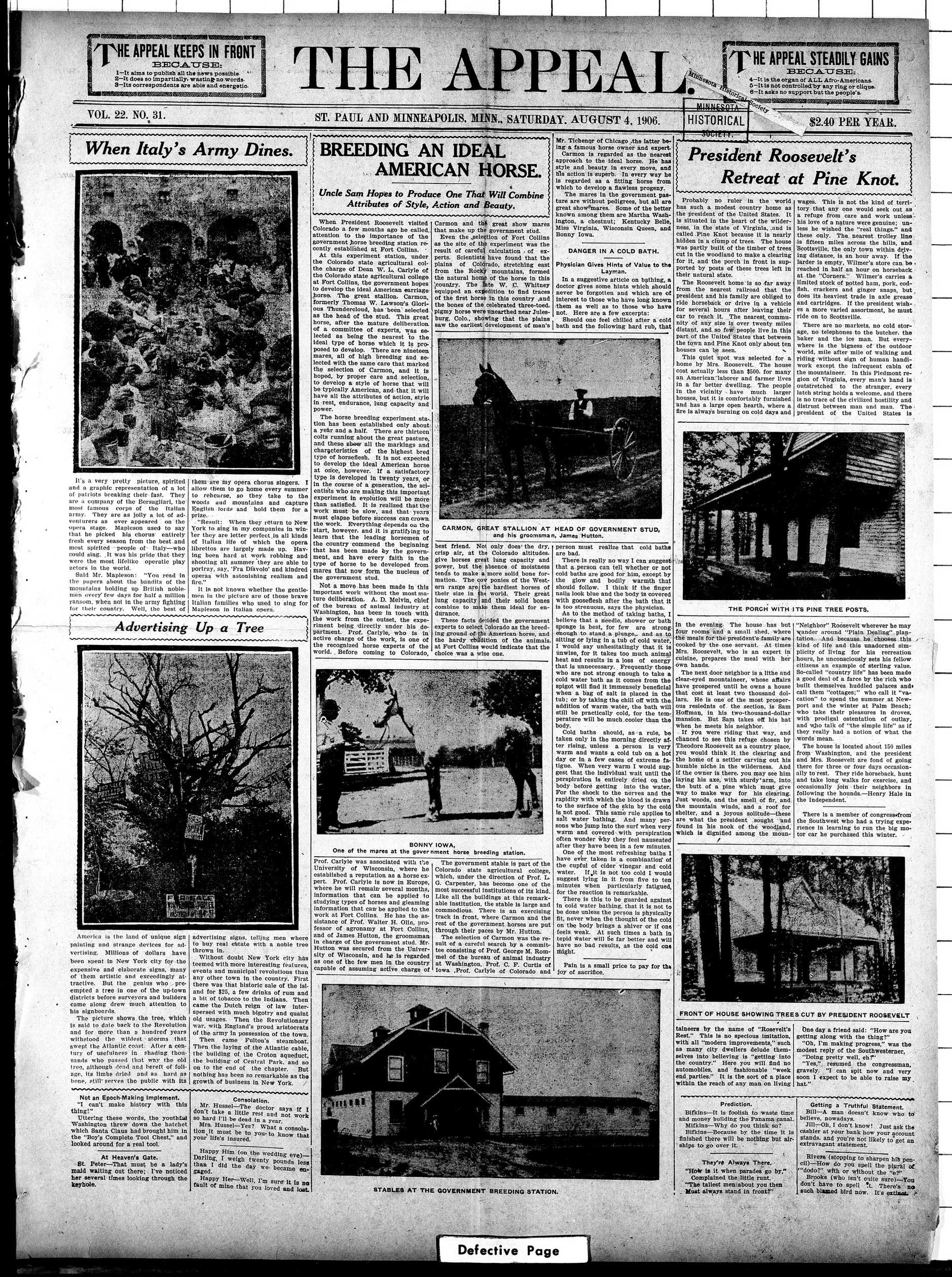
Page text (machine-generated)
THE APPEAL KEeps IN FRONT
BECAUSE:
1-It aims to publish all the news possible.
2-It does so impartially, wasting no words.
3- Its correspondents are able and energetic.
When Italy's Army Dines.
THE MAYOR OF NEW YORK IS IN A MEMORIAL CEREMONY TO MAYOR JOHN M. MAYOR, OF NEW YORK, FOR THE DEATH OF HIS WIFE, MARY MAYOR, OF NEW YORK, AT THE HOME OF THE MAYOR. MAYOR MAYOR, OF NEW YORK, IS IN A MEMORIAL CEREMONY TO MAYOR JOHN M. MAYOR, OF NEW YORK, FOR THE DEATH OF HIS WIFE, MARY MAYOR, OF NEW YORK, AT THE HOME OF THE MAYOR.
FROGLE
PHILLIES
FROGLE
VINYLING SHOP
MASSACHUSETTS
VOL. 22. NO. 31.
When Italy's
It's a very pretty picture, spirited and a graphic representation of a lot of patriots breaking their fast. They are a company of the Borsagliari, the most famous corps of the Italian army. They are as jolly a lot of adventurers as ever appeared on the opera stage. Mapleson used to say that he picked his chorus entirely fresh every season from the best and most spirited people of Italy—who could sing. It was his pride that they were the most lifelike operatic actors in the world.
Said Mr. Mapleson: "You read in the papers about the bands of the mountains holding up British noblemen every few days for half a million ransom, when not in the army fighting for their country. Well, the best of
Advertising
America is the land of unique sign painting and strange devices for advertising. Millions of dollars have been spent in New York city for the expensive and elaborate signs, many of them artistic and exceedingly attractive. But the genius who preempted a tree in one of the up-town districts before surveyors and builders came along drew much attention to his signboards.
The picture shows the tree, which is said to date back to the Revolution and for more than a hundred years withstood the wildest storms that swept the Atlantic coast. After a century of usefulness in shading thousands who passed that way the old tree, although dead and bereft of foliage, its limbs dried and as hard as bone, still serves the public with its
Not an Epoch-Making Implement.
"I can't make history with this thing!"
Uttering these words, the youthful Washington threw down the hatchet which Santa Claus had brought him in the "boy's Complete Tool Chest," and looked around for a real tool.
At Heaven's Gate.
St. Peter—That must be a lady's maid waiting out there; I've noticed her several times looking through the keyhole.
```markdown
```
them are my opera chorus singers. allow them to go home every summer to rehearse, so they take to the woods and mountains and capture English lords and hold them for a prize. "Result: When they return to New York to sing in my companies in winter they are letter perfect, in all kinds of Italian life of which the opera librettos are largely made up. Having been hard at work robbing and shooting all summer they are able to portray, say, 'Fra Divolò' and kindred operas with astonishing realism and fire." It is not known whether the gentlemen in the picture are of those brave Italian families who used to sing for Mapleston in Italian opera.
Up a Tree
advertising signs, telling men where to buy real estate with a noble tree thrown in.
Without doubt New York city has teemed with more interesting features, events and municipal revolutions than any other town in the country. First there was that historic sale of the island for $25, a few drinks of rum and a bit of tobacco to the Indians. Then came the Dutch reign of law interspersed with much biggory and quaint old usages. Then the Revolutionary war, with England's proud aristocrats of the army in possession of the town. Then came Fulton's steamboat. Then the laying of the Atlantic cable, the building of the Croton aqueduct, the building of Central Park, and so on to the end of the chapter. But nothing has been so remarkable as the growth of business in New York.
Mr. Hussel—The doctor says if I don't take a little rest and not work so hard I'll be dead in a year.
Mrs. Hussel—Yes? What a consolation it must be to you to know that your life's insured.
Happy Him (on the wedding eve)—Darling, I weigh twenty pounds less than I did the day we became engaged.
Happy Her—Well, I'm sure it is no fault of mine that you loved and lost.
THE APPEAL. Minnesota
BREEDING AN IDEAL AMERICAN HORSE.
Uncle Sam Hopes to Produce One That Will Combine Attributes of Style, Action and Beauty.
BONNY IOWA,
One of the mares at the government horse breeding station.
STABLES AT THE GOVERNMENT BREEDING STATION.
When President Roosevelt visited Colorado a few months ago he called, attention to the importance of the government horse breeding station recently established at Fort Collins. At this experiment station, under the Colorado state agricultural colle charge of Dean W. L. Carlyle of the Colorado state agricultural college at Fort Collins, the government hopes to develop the ideal American carriage horse. The great stallion, Carmon, formerly Thomas W. Lawson's Glorious Thundercloud, has been selected as the head of the stud. This great horse, after the mature deliberation of a committee of experts, was selected as being the nearest to the type of horse which it is proposed to develop. There are nineteen mares, a high breeding and selected with the care that marked the selection of Carmon, and it is hoped, by proper care, that it will develop a style of horse that will be typically American, and that it will have all the attributes of action, style in rest, endurance, lung capacity and power.
The horse breeding experiment station has been established only about a year and a half. There are thirteen colts running about the great pasture, and these show all the markings and characteristics of the highest breed type of horseshield. It is not expected to develop the ideal American horse at once, however. If a satisfactory breed is developed in twenty years, or in the house of a generation, the scientists who are making this important experiment in horses will be more than satisfied. It is realism that work must be slow, and that years must elapse before success can crown the work. Everything depends on the start, however, and it is gratifying to learn that the leading horsemen of the country commend the beginning that has been made by the government, and have every faith in the type of horse to be developed from mares that now form the nucleus of the government stud.
Not a move has been made in this important work without the most mature deliberation. A. D. Melvin, chief of the bureau of animal industry at the work from the hands in touch with the work from the hands in touch with the experiment being directly under the department. Prof. Carlyle, who is in active charge of the work, is one of the recognized horse experts of the world. Before coming to Colorado.
BONNY
One of the mares at the gover
Prof. Carlyle was associated with the University of Wisconsin, where he established a reputation as a horse expert. Prof. Carlyle is now in Europe, where he will remain several months, information that can be applied to studying types of horses and gleaning information that can be applied to the work at Fort Collins. He has the assistance of Prof. Walter H. Oln, professor of agronomy at Fort Collins, and of James Hutton, the groomsman in charge of the government, and Mr. Hutton was secured from the University of Wisconsin, and he is regarded as one of the few men in the country capable of assuming active charge of
CARMON, GREAT STALLION AT HEAD OF GOVERNMENT STUD, and his groomsman, James Hutton.
Carmon and the great show mares that make up the government. stud.
Even the selection of Fort Collins as the site of the experiment was the result of careful calculation of experts. Scientists have found that the plains of Colorado, stretching east from the Rocky mountains, formed the natural home of the horse in this country. The Intre W. C. Whitney equipped an exertion to find traces of the first horse in this country, and the bones of the celebrated three-toed, pigmy horse were unearthed near Julesburg, Colo., showing that the plains saw the earliest development of man's
CARMON, GREAT STALLION AT H
and his groomsman,
best friend. Not only does the dry,
crisp air, at the Colorado altitudes.
give horses great lung capacity and
power, but the absence of moistness
tends to make a more solid bone for-
mation. The cow ponies of the West-
ern range are the hardest horses of
their size in the world. Their great
lung capacity and their solid bones
combine to make them ideal for end-
urance.
These facts decided the government experts to select Colorado as the breeding ground of the American horse, and the hardy condition of the animals, at Fort Collins would indicate that the choice was a wise one.
IOWA,
iment horse breeding station.
The government stable is part of the Colorado state agricultural college, which, under the direction of Prof. L.G. Carpenter, has become one of the most successful institutions of its kind. Like all the buildings at this remarkable institution, the stable is large and commodious. There is an exercising track in front, where Carmon and the rest of the government horses are put through their paces by Mr. Hutton. The successful Carmon was the result of a careful study of tree creasing of Prof. George R. Mrommel of the bureau of animal industry at Washington, Prof. C. F. Curtis of Iowa, Prof. Carlyle of Colorado, and
E GOVERNMENT BREEDING STATION.
Defective Page
Mr. Tichener of Chicago, the latter being a famous horse owner and expert. Carmon is regarded as the nearest approach to the ideal horse. He has style and beauty in every move, and his action is superb. In every way he is regarded as a fitting horse from which to develop a flawless progeny. Carmon is in the government pasture are without pedigree, but all are great show'mares. Some of the better known among them are Martha Washington, a chestnut; Kentucky Belle, Miss Virginia, Wisconsin Queen, and Bonny Iowa.
DANGER IN A COLD BATH.
Physician Gives Hints of Value to the Layman.
In a suggestive article on bathing, a doctor gives some hints which should never be forgotten and which are of interest to those who have long known them as well as to those who have not. Here are a few excerpts:
Should one feel chilled after a cold bath and the following hard rub, that
HEAD OF GOVERNMENT STUD,
, James Hutton.
person must realize that cold baths are bad.
There is really no way I can suggest that a person can tell whether or not cold baths are good for him, except by the glow and warmth that should follow. I think if the finger nails look blue and the body is covered with gooseflesh after the bath that it is too strenuous, says the physician.
As to the method of taking baths, I believe that a needle, shower or bath sponge is best, for few are strong enough to stand, a plunge, and as to slitting or lying in a tub of cold water, would say unhestiating that it is unnecessary. It takes too much animal heat and results in a loss of energy that is unnecessary, who are not strong enough to take a cold water bath as it comes from the spigot will find it immensely beneficial when a bag of salt is placed in the tub; or by taking the chill off with the addition of warm water, the bath will still be practically cold, for the temperature will be much cooler than the body.
A rule, a bath should, be taken only in the morning directly after rising, unless a person is very warm and wants a cold tub on a hot day or in a few cases of extreme fatigue. When very warm I would suggest that the individual wait until the perspiration is entirely dried on the body before getting into the water, the shock to the nerves and the rapture to the blood is drawn to the surface of the blood the cold is not good. This same rule applies to salt water bathing. And many persons who jump into the surf when very warm and covered with perspiration often wonder why they were nauseated after they have been in a few minutes.
One of the most refreshing baths I have ever taken is a combination of the cupful of cider vinegar and cold water. If it is not too cold I would suggest lying in it from five to ten minutes when particularly fatigued, for the reaction is remarkable.
There is this to be guarded against in cold water bathing, that it is not to be done unless the person is physically fit, never when the thought of the cold on the body brings a shiver or if one feels weak. At such times a bath in tepid water will be far better and will have no bad results, as the cold one might.
Pain is a small price to pay for the joy of sacrifice.
President Roosevelt's Retreat at Pine Knot.
Probably no ruler in the world has such a modest country home as the president of the United States. It is situated in the heart of the wilderness, in the state of Virginia, and is called Pine Knot because it is nearly hidden in a clump of trees. The house was partly built of the timber of trees in the woodland to make a clearing for a farm, and in front in support is supported by posts of these trees left in their natural state. The Roosevelt home is so far away from the nearest railroad that the president and his family are obliged to ride horseback or drive in a vehicle for several hours after leaving their car to reach it. The nearest community of any size is over twenty miles distant, and so few people live in this part of the United States that between the town and Pine Knot only about ten houses can be seen. This quiet spot was selected for a home by Mrs. Roosevelt. The house cost actually less than $500, for many American laborer and farmer lives in a small dwelling. The people in the vicinity are large houses, but it is comfortably furnished and has a large open hearth, where a fire is always burning on cold days and
THE STREET CENTER
THE PORCH WITH ITS PINE TREE POSTS.
In the evening. The house has but four rooms and a small shed, where the meals for the president's family are cooked by the one servant. At times Mrs. Roosevelt, who is an expert in cuisine, prepares the meal with her own hands.
The next door neighbor is a lithe and clear-eyed mountaineer, whose affairs have prospered until he owns a house that cost at least two thousand dollars. He is one of the most prosperous residents of the section, is Sam Hoffman, in his two-thousand-dollar mansion. But Sam takes off his hat when he meets his neighbor.
"Neighbor" Roosevelt wherever he may wander around "Plain Dealing" play station. And because he chooses the kind of life and this unadorned simplicity of living for his recreational hours, he unconsciously sets his fellow citizens an example of sterling value. So-called "country life" has been made a good deal of a farce by the rich who built themselves huddled palaces and call them "cottages," who call it "vacation" to spend the summer at Newport and the winter at Palm Beach who take their pleasures in drove with prodigal ostentation of outlaw and who talk of "the simple life" as
If you were riding that way, and chanced to see this refuge chosen by Theodore Roosevelt as a country place, you would think it the clearing and the home of a settler carving out his humble niche in the wilderness. And if the owner is there, you may see him laying his axe, with sturdy' arm, into the butt of a pine which must give way to make way for his clearing. Just woods, and the smell of fir, and the mountain winds, and a roof for shelter, and a joyous solitude—these are what the president sought 'and found in his neck of the woodland, which is dignified among the moun-
FRONT OF HOUSE SHOWING TREE
FRONT OF HOUSE SHOWING TREES CUT BY PRESIDENT ROOSEVELT
talneers by the name of "Rosevelt's Rest." This is no specious imitation, with all "modern improvements," such as many city dwellers delude themselves into believing is "getting into the country." Here you will find no automobiles, and fashionable "week end parties." It is the sort of a place within the reach of any man on living
One day a friend said: "How are you getting along with the thing?"
"Oh, I'm making progress," was the modest reply of the Southwesterner, "Doing pretty well, eh?"
"Yes," resumed the congressman, gravely, "I can spit now and very soon I expect to be able to raise my hat."
Blifkins—It is foolish to waste time and money building the Panama canal.
Mifkins—Why do you think so?
Blifkins—Because by the time it is finished there will be nothing but airships to go over it.
They're Always There.
"How is it when parades go by."
Complained the little runt.
"The tallest men about you then
Must always stand in front?"
wages. This is not the kind of territory that any one would seek out as a refuge from care and work unless his love of a nature were genuine; unless he wished the "real things," and these only. The nearest trolley line is fifteen miles across the hills, and Scottsville, the only town within driving distance, is an hour away. If the larder is empty, Willy's store can be loaded in half an hour on horseback at the town. Willy's store carries a limited stock of potted ham, codfish, crackers and ginger snaps, but does its heaviest trade in axle grease and cartridges. If the president wishes a more varied assortment, he must ride on to Scottsville.
There are no markets, no stockage, no telephones to the butcher, the baker and the ice man. But everywhere is the bigness of the outdoor world, mile after mile of walking and riding without sign of human handwork except the infrequent cabin of the mountaineer. In this Pledmont region of the mountaineer, in every man's hand is to the stranger, every latch string he has, is no trace of the civilized hostility and distrust between man and man. The president of the United States is
1
"Neighbor" Roosevelt wherever he may wander around "Plain Dealing," plantation. And because he chooses this kind of life and this unadorned simplicity of living for his recreation hours, he unconsciously sets his fellow citizens an example of sterling value. So-called "country life" has been made a good deal of a force by the rich who built themselves huddled palaces and created "fashion." he call it "nationation" to spend the summer at Newport and the winter at Palm Beach; who take their pleasures in droves, with prodigal ostentation of outlay, and who talk of "the simple life" as if they really had a notion of what the words mean. The house is located about 150 miles from Washington, and the president and Mrs. Roosevelt are fond of going there for three or four days occasionally to rest. They ride horseback, hunt and take long walks for exercise, and occasionally join their neighbors in following the hounds.—Henry Hale in the Independent.
There is a member of congress from the Southwest who had a trying experience in learning to run the big motor car he purchased this winter.
S CUT BY PRESIDENT ROOSEVELT
One day a friend said: "How are you getting along with the thing?"
"Oh, I'm making progress," was the modest reply of the Southwesterner, "Doing pretty well, eh?"
"Yes," resumed the congressman, gravely, "I can spit now and very soon I expect to be able to raise my hat."
Getting a Truthful Statement.
Bill—A man doesn't know who to believe, nowadays.
Jill—Oh, I don't know! Just ask the cashier at your bank how your account stands, and you're not likely to get an extravagant statement.
Rivers (stopping to sharpen his pen-cil)—How do you spell the plural of "dodo?" with or without the "o"? Brooks (who isn't quite sure)—You don't have to spell t. There's no such blamed bird now. It's extinct.
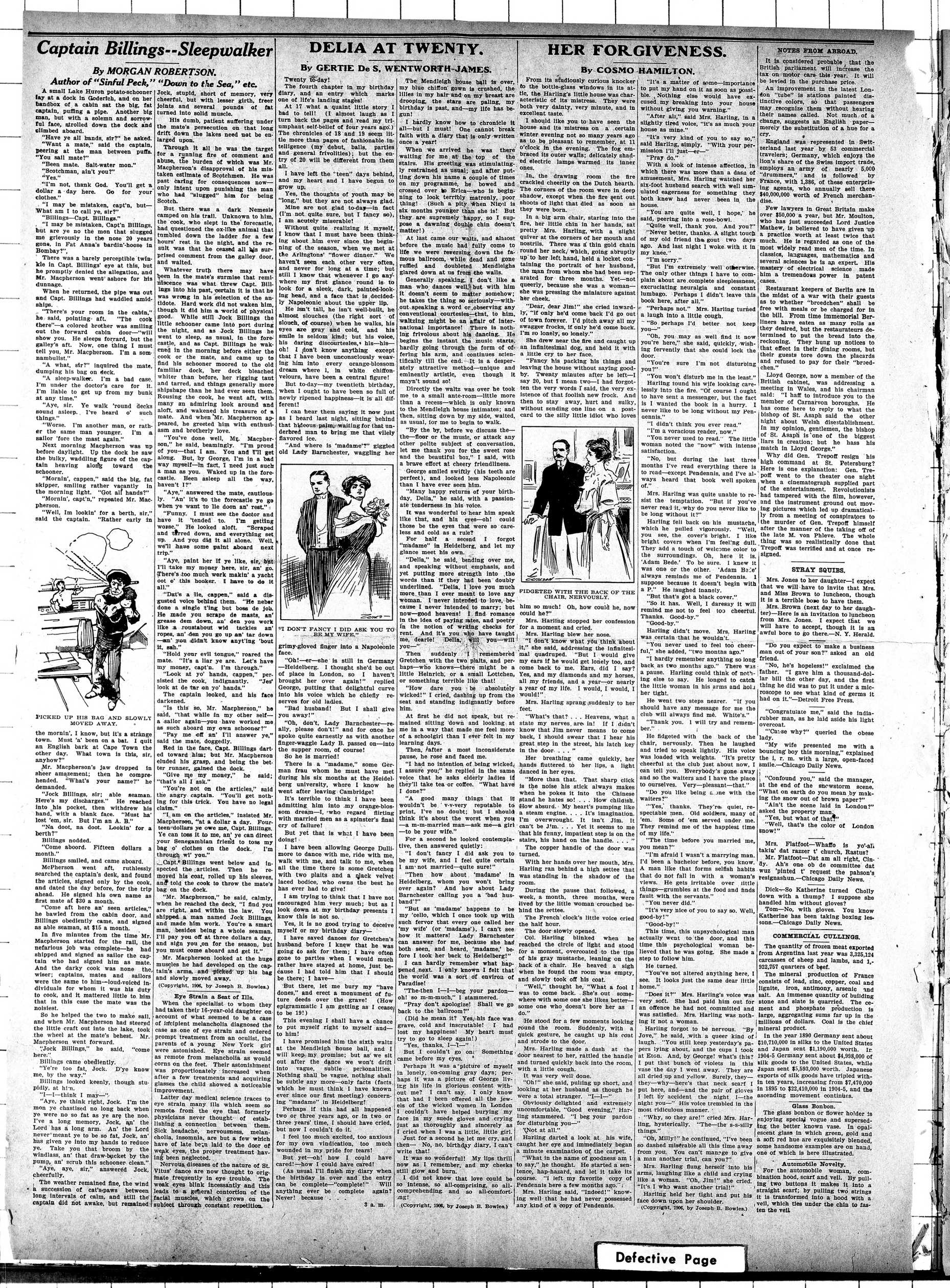
Captain Billings--Sleepwalker
Author of "Sinful Peck," "Down to the Sea," etc
A small Lake Huron potato-schooner lay at a dock in Godicher, and on her bandbox of a cabin sat the big, fat captain, puffing a pipe. Another big man, but with a solemn and sorrowful face, strolled down the dock and climbed aboard.
"Have ye all hands, sir?" he asked.
"Want a mate," said the captain, peering at the man between puffs.
"You sail mate!"
"Been mate. Salt-water mon." "Scotchman, ain't you?" "Yes."
"I'm not, thank God. You'll get a dollar a day here. Go for your clothes."
"I may be mistaken, capt'n, but—What am I to call ye, sir?" "Billings—Capt. Billings."
"I may be mistaken, Capt'n Billings, but are ye no the man that slugged me grievously in the nose 20 years gone, in Fat Anna's bardin-hoose in Bombay."
"There was a barely perceptible twinkle in Billings, eyes at this, but Mr. Machperson went ashore the allegation, and Mr. Machperson went ashore for his dunnage.
When he returned, the pipe was out and Capt. Billings had waddled amidships.
"There's your room in the cabin," he said, pointing aft. "The cook there'a—a colored brother was smiling out the forward cabin door—'will show you. He sleeps forrand, but the man. Now, one thing I must tell you, Mr. Macpherson. I a somnambulist.
"A what, sir?" inquired the mate, dumping his bag on deck.
"A sleep-walker. I'm a bad case, I'm under the doctor's care for it. I'm liable to get up from my bunk at any time."
"Aye, sir. Ye walk 'round decks sound asleep. I've heard 'o such things."
"Worse. I'm another man, or rather the same man younger. I'm a sailor 'fore the mast again."
Next morning Macpherson was up before night. Up the dock he saw the buky, waddling figure of the captain heaving along toward the schooner.
"Mornin', cappen', said the big, fat skipper, smiling rather vacantly in the morning light. "Got all hands?" "Mornin', capt'n', repeated Mr. Macphail. "Well, Im lookin' for a berth, sir.' said the captain. "Rather early, sir."
PICKED UP HIS BAG AND SLOWLY MOVED AWAY.
the morain', I know, but it's a strange town. Must 'a' be on a bat. I quit an English bark at Cape Town the other day. What town is this, sir, anyhow?"
Mr. Macpherson's jaw dropped in sheer amazement; then he comprehended. "What's your name?" he demanded.
"Jock Billings, sir; able seaman. Here's my discharges." He reached into his pocket, then withdrew his hand, with a blank face. "Must 'hast' lost, em, sir. But I'm an A. B."
"Na doot, na doot. Lookin' for a berth?"
Billings nodded.
"Come aboard. Fifteen dollars a month."
Billings smiled, and came aboard.
McPherson went aft, ruthlessly searched the captain's desk, and found the articles, signed only by the cook, and dated the day before, for the trip after which his own name as f mate of $30 a month.
"Come afte' he an' seen articles," he bawled from the cabin door, and Billings obediently came, and signed as able seaman, at $15 a month.
In five minutes from the time Mr. Macpherson started for the rail, the nefarious job was complete—he had shipped and signed as sailor the captain who had signed him as mate. And the darky cook was none the wiser; captains, mates and sailors who had him—loud-voiced individuals for whom it was his duty to cook, and it mattered little to him that in this case the mate was the noisiest.
So he helped the two to make salt and when Mr. Macpherson had steered the little craft out into the lake, took the wheel at the mate's behest. Mr. Macpherson went forward.
"Jock Billings," he said, "come here."
Billings came obediently.
"We're too fat, Jock. D'yo know me, by the way."
Billings looked keenly, though stupidly, at him.
"I—I—think I may—"
"Aye, ye think right, Jock. 'I'm the mon ye chastised no long back when ye were no so fat as ye are the noo. I've a long memory, Jock, an 'lord has a long arm. An 'lord the Lord never'me ye to be so fat, Jock, an has given ye into my hands to reduce ye. Take you that broom by the windlass, an' that draw-bucket by the pump, an' scrub this schoner clean." "Aye, aye, sir," answered Jock, cheerfully.
The weather remained fine, the wind a succession of cat'spaws between long intervals of calm, and still the captain did not awake, but remained
Jock, stupid, short of memory, very cheerful, with less girder, grief joints and several pounds of fat turned into solid muscle.
His dumb, patient suffering under the mate's persecution on that long drift down the lakes need not be enlarged upon.
Through it all he was the target for a running fire of comment and abuse in burden of which was Mr. Macpherson's disapproval but his estimate of Scotchmen. He was past caring for consequences now—only intent upon punishing the man who had "slugged" him for being Scotch.
But there was a dark Nemesis camped on his trail. Unknown to him, the cook, who slept in the forecaste, had questioned the ox-like animal that hours' rest in the height, and the sult was that he ceasled all his surprised comment from the galley door, and waited.
Whatever truth there may have been in the mate's surmise that reminiscence was what threw Capt. Billings into his past, certain it is that he was wrong in his selection of the antidote. Hard work did not waken him, though it did him a world of physical good. While still Jock Billings the little schooner came into port during the night, and as Jock Billings he went to sleep, as usual, in the forecast, and as Capt. Billings he wakened in the morning before either the cook or the mate, and came up to his schooner moored to the old familiar deck he deck bleached whiter than before, he riggled taut and tarred, and things genuinely more shipshape than he had ever seen them. Rousing the cook, he went afft, with many an admiring look around and aloft, and waked his treasure of a mate. And when Mr. Macpherson appeared, he greeted him with enthusiasm and brotherly love.
"You've done well, Mg. Macpherson," he said, beamingly. "I'm proud of you—that I am. You and I'll get along. But, by George, I'm in a bad way myself—in fact, I need just such a man as you. Waked in the forecastle. Been asleep all the way, haven't I!"
"Aye," answered the mate, cautiously. "An' it to the forecastle ye go when ye want to lie doom an' rest."
"Funny. I must see the doctor and have it 'tended to. I' am getting worse." He looked aloft. "Scraped and dried down, and everything set and you did it all alone. Well, well have some paint aboard next trip."
"Aye, paint her if ye like, sir, but I'll take my money here, sir, an' you. There's too much work makein' a yacht oot e' this hooker. I have to do it all."
"Dat's a lie, cappen," said a disgusted voice behind them. "He nebear done a single ting but boss de job. He made you scrape de mats, an' grease dem down, an' den you work like aroustabout wid tackles an' ropes, an' den you go up an' tar down—an' you didn't know anytiny 'bout it, sah. "Hold your evil tongue," roared the mate. "It's a liar ye are. Let's have my money, capt'n. I'm through." "Look at yo' hands, cappen," persisted the cook, indigently. "Jes' look at de tar on yo' hands." The captain looked, and his face darkened. "In his so, Mr. Macpherson," he said, "that while in my other self—a sailor again—you have worked me as such aboard my own schooner?" "Pay me off an' I answer ye," said the mate, doggedly. Red in the face, Capt. Billings darted toward him; but Mr. Macpherson elended his grasp, and being the better runner, gained the dock. "Give me my money," he said; "that's all I ask."
"You're not on the articles," said the angry captain. "You'll get nothing for this trick. You have no legal claim."
"I am on the articles," insisted Mr. Macpherson. "at a dollar a day. Fourteen-dollars you an, me an, Capt. Billings. You can toss it to me, you can direct your Senegambian friend to tow my bag clothes on the dock. I'm intrigued. Capt. Billings went below and inspected the articles. Then he removed his coat, rolled up his sleeves, and told the cook to throw the mate's bag on the dock.
"Mr. Macpherson," he said, calmly, when he reached the deck, "I and you are right, and within the law. You shipped a man named Jock Billings, and made him work. You're a smart man, besides being a whole seaman. I'll pay you off at three dollars a day, and sign you on for the season, but you must come aboard and get it."
Mr. Macpherson looked at the huge muscles he had developed on the captain's arms, and picked up his bag and slowly moved away.
(Copyright, 1966, by Joseph B. Bowles).
Eye Strain a Seat of ILLS.
When the specialist to whom they had taken their 16-year-old daughter on account of what seemed to be a case of infiltrant melancholia diagnosed the case as one of eye strain and ordered prompt treatment from an oculist, the parents of a young New York girl were astonished. Eye strain seemed as remote from melancholia as wounds on the feet. Their astonishment immediately increased when after a few treatments and acquiring glasses the child showed a noticeable improvement.
Latter day medical science traces to eye strain many ills which seem so remote from the eye that formerly physicians never thought of establishing a connection between them. Sick headache, nervousness, melanoma, insomnia, are but a few which have been brought to the door of weak eyes, the proper treatment having been neglected.
Nervous diseases of the nature of St. Vitus' dance are now thought to originate frequently in eye trouble. The weak eyes blink incessantly and this causes a contortion of the facial muscles, which the subject through constant repetition
DELIA AT TWENTY.
BY GERTIE De S. WENTWORTH-JAMES.
Twenty to day!
The fourth chapter in my birthday diary, and an entry which marks one of life's landing stages!
At 11 what a quaint little story I had. I almost laugh at turn back the page and read an imptunant self-belief of four years ago. The chronicles of 18 and 19 seem little more than pages of fashionable intelligence (my debut, balls, parties and general frivolities); but the entry of 20 will be different from them all.
I have left the "teen" days behind, and my heart and I have begun to grow up.
Yes, the thoughts of youth may be "long," but they are not always glad. Mine are not glad to-day—in fact (I'm not quite sure, but I fancy so). I am acutely miserable!
The Mendleigh house ball is my blue chiffon gown is crush lilies in my hair and on my brow drooping, the stars are pals birthday is past, and—my life is gun!
I hardly know how to chorel but I must! One cannot faith with a lair that is only once a year!
When we arrived he was waiting for me at the top stairs. His greeting was stimily restrained as usual; and aftef down his name a couple of on my programme, he bow crossed over to Erica—who is ning to look terribly matronal thing! (Such a pity when I six months younger than she is they are supremely happy, so
Without quite realizing it myself, I know that I must have been thinking about him ever since the beginning of the season, when we met at the Arlingtonts "flower dinner." We haven't seen each other very often, and never for long at a time; but still I know that whenever I go anywhere my first glance round is to look for a sleek, dark, painted-looked head, and a face that is decidedly Napoleonic about the upper lip. He isn't tall, he isn't well-built, he almost slouches (the right sort of slouch, of course) when he walks, his eyes are gray and cold, and his smile is so soft that discourses, his-his—oh! I don't know anything except that I have been unconsciously weaving him into every orange-blossom dream where I, in white chiffon velours, have been a central figure! But to-day—my twentyth birthday when I ought to have been so full of newly ripened happiness—it is all different!
I can hear them saying it now just as I heard last night, sitting behind that hideous palm; waiting for that underbred man to bring me that vilely "and where is 'madame'?" giggled old Lady Banchester, wagging her
"I DON'T FANCY I DID ASK YOU TO BE MY WIFE."
grimy-gloved finger into a Napoleonic face.
"Oht—er—she is still in Germany — Heidelberg. I thought she'd be out of place in London, so I haven't brought her over again!" replied George, putting that delightful curve into his voice which he chiefly feeds to ladies.
"Bad husband. But I shall give you away!"
"Oh, don't Lady Barnchester—really, please don't!" and for once he spoke quite earnestly as with another finger-waggle Lady B. passed on—into the supper room, of course!
So he is married!
There is a "madame," some Ger-
man Frau whom he must have met
during his six months at the Heidel-
berg university, where I know he
went after leaving Cambridge!
It's terrible to think I have been
admitting him into my orange-bloss-
som dream—I, who regard flirting
with married men as a spinster's final
cry of failure!
But yet that is what I have been
doing!
I have been allowing George Dull-
more to dance with me, ride with me,
walk with me, and talk to me, when
all the time there is some Gretchep
with two plaits and a black velvet
laced bodice, who owns the best he
has ever had to give!
I am trying to think that I have not
encouraged him very much; but as
I look down at my birthday presents I
know this is not so.
Yes, it is no good trying to deceive
myself or my birthday diary—
I have saved dances for Gretchen's husband before I knew that he was going to ask for them; I have often gone to parties when I would much rather have stayed at home, just because I had told him that I should be there; I have—
"But there, let me mury her 'have done,' and erect a monument of future deeds over the grave! (How epigrammatic I am getting as I cease to be 19!)
This evening I shall have a chance to put myself right to myself and—to him!
I have promised him the sixth waltz at the Mendleigh house ball, and I will keep my promise; but as we sit out after the dance we won't drift subtle personalities. Nothing shall be a mere nothing shall be subtle any more—only facts (which he must think I have known ever since our first meeting) concerning "madame" in Heidelberg!
Perhaps if this had all happened two or three years ago, or in two or three years' time, I should have cried, but now I couldn't do it.
I feel too much excited, too anxious for my own vindication, too much wounded in my pride for tears!
But yet—how! I could have cared!—how I could have cared! (As usual I’ll finish my diary when the birthday is over and the entry can be complete—"complete!" Will anything ever be complete again? Never! because
The Mendleigh house hall is over, my blue chiffon cowl is crushed, the lilies in my hair and on my breast are drooping, the stars are palling, my birthday is past, and—my life has begun!
I hardly know how to chronicle it all—but I must! One cannot break faith with a diary that is only written once a year!
When we arrived he was there waiting for me at the top of the stairs. His greeting was stimulatingly restrained as usual; and after putting down his name a couple of times on my programme, he bowed and crossed over Erla—who is beginning to look terribly maltown, poor thing! (Such a pity when Nigel is but they are severely happy, so I suppose a dawning double chin doesn't matter!)
At last came our waltz, and almost before the music had fully come to life we were reversing down the famous ballroom, while dead and ruffled and doubled Mendleigh glared down at us from the walls.
Generally speaking. I don't like a man who dances well, but with him it doesn't seem to matter somehow; he takes the thing so seriously—without speaking a word or observing any conventional courtesies that, to him, waltzing might be an affair of international importance! There is nothing frivolous about his dancing. He starts dancing the music start hardly going through the form of offering his arm, and continues scientifically till the end. It is a desperately attractive method—unique and eminently artistic, even though it mayn't sound so! Directly the waltz was over he took me to a small ante-room—little more than a recess—which is only known to the Mendleigh house intimates; and then, sitting down by my side, waited, as usual, for me to begin to walk.
"By the by, before we discuss the—the by the or the music, or attack any other—let me thank you for the sweet rose and the beautiful box," I said, with a brave effort at cheery friendliness.
George smiled swiftly (his teeth are perfect), and looked less Napoleonic than I have ever seen him.
"Many happy returns of your birthday, Delia," he said, with a passionate tenderness in his voice.
It was wonderful to hear him speak like that, and his eyes—oh! could those be the eyes that were so careless and cold as a rule?
For half a second I forgot "madame" in Heidelberg, and let my glance meet his own.
"Delia," he said, bending over me, and speaking without emphasis, and yet putting more strength into the words than if they had been doubly underlined. "Delia, I love you much more than I ever meant to love any woman. I never intended to love, because I never intended to marry; but good enough was chance in the idea of paying rates, and poetry in the notion of writing checks for rent. And it's you who have taught me, dearle! Delia, will you—will you—"
Then suddenly I remembered Gretchen with the two plaits, and perhaps—who knows—there might be a little Hillerich, or a small Lottchen, or something terrible like that!
"How dare you be absolutely wicked!" I cried, dashing up from the seat and standing indigently before him.
At first he did not speak, but remained sitting down and looking at me in a way that made me feel more of a schoolgirl than I ever felt in my learning days.
Then, after a most inconsiderate pause, he rose and faced me.
"I had no intention of being wicked, I assure you," he replied in the same voice that he asks elderly ladies if they'll take tea or coffee. "What have I done?"
"Good many things that it wouldn't be, v-very reputable to print, I've no doubt; but I should think it's about the worst when you—a m-m-married man—ask me—a girl—to be your wife."
For a second he looked contemplative, then answered quietly:
"I don't fancy I did ask you to be my wife, and I feel quite certain I am not married—quite sure!"
"Then how about 'madame' in Heidelberg, whom you won't bring over again? And how about Lady Banchester calling you a 'bad husband'?
"But as 'madame' happens to be my 'cello', which I once took up with such fervor that every one called her 'my wife' (or 'madame'), I can't see how it matters! Lady Banchester can answer for me, because she had both seen, and heard, 'madame', before I took her back to Heidelberg!"
"I can hardly remember what happened next. I only known I felt that the world was a sort of environ of Parameet!"
"When I—I—beg your pardon—oh! so m-much!." I stammered.
"Pray don't apologize! Shall we go back to the ballroom?"
(Did he mean it? Yes, his face was grave, and inscrutable! I had lost my happiness! My heart must try to go to sleep again!)
"Yes, thanks, I—I—"
But I couldn't go on: Something came before my eyes.
Perhaps it was a picture of myself in lonely, on-coming gray days; perplexed by his life in glorious content without me? I can't say. I only know that had I been offered all the jewels of the wicked women in London I couldn't have helped burying my face in my suede gloves and crying just as thoroughly and sincerely as I cried when I was a little, little girl. Just for a second he let me cry, and then—No, no, birthday diary, I can't write that!
It was so wonderful! My lips thrill now as I remember, and my cheeks still glow and burn.
I did not know that love could be so intense, so all-comprising, so all-comprehending and so all-comforting!
(Copyright, 1906, by Joseph B. Bowles.)
HER FORGIVENESS.
By COSMO HAMILTON
From its studiously curious knocker to the bottle-glass windows in its attic, the Harling's little house was characteristic of its mistress. They were both very dainty, very minute, and in excellent taste.
I should like you to have seen the house and its mistress on a certain winter evening not so many years ago as to be pleasant to remember, at 11 o'clock in the evening. The fog embraced its outer walls; delicately shaded electric lamps warmed its inner ones.
In, the drawing room the fire crackled cheerly on the Dutch hearth. The corners of the room were in deep shadow, except when the fire gent out shoots of light that died as soon as they were born.
In a big arm chair, staring into the fire, her little chin in her hands, sat pretty Mrs. Harling, with a slight quiver at the corners of her mouth and nostrils. There was a thin gold chain round her neck, which, going abruptly up to her left hand, held a locket containing the portrait of her husband, the man from whom she had been separated for three months. Yet—not querely, because she was a woman—she was pressing the miniature against her chest. "Dear, dear Jim!" she cried inwardly, "if only he'd come back I'd go out of town forever. I'd pitch away all my swagger frocks, if only he'd come back. I'm so lonely, so lonely." She drew near the fire and caught an infinitesimal dog, and held it with a little cry to her face.
"Fancy his packing his things and leaving the house without saying goodbye. Twenty minutes after he left—I say 20, but I mean two—I had forgotten the very words I said, the very exertion of the foolish new frock. And then to stay a while without sending one line on a postcard to the silly little idiot who loves
FIDGETED WITH THE BACK OF THE
CHAIR, NERVOUSLY.
him so much! Oh, how could he, now
could he?"
Mrs. Harling stopped her confession for a moment and cried.
Mrs. Harling blew her nose.
"I don't know what you think about it," she said, addressing the infinitesimal quadruped. "But I would give my ears if he would get lonely too, and come back to me. Ears, did I say? Yes, and my diamonds and my horses, and my friends, and a year—or nearly a year of my life. I would, I would, I would."
Mrs. Harling sprang suddenly to her feet.
"What's that? . . . Heavens, what a state my nerves are in! If I didn't know that Jim never means to come back, I should swear that I hear his great step in the street, his latch key in the door . . ."
Her breathing came quickly, her hands futtered to her lips, a light danced in her eyes.
"More than that. That sharp click is the noise his stick always makes when he pokes it into the Chinese stand he hates so. . . How childish. How absurd. My heart's pumping like a steam engine. . . It's imagination. I'm overwrought. It isn't Jim. It can't be Jim. . . Yet it seems to me that his funny, impatient step is on the stairs, his hand on the handle. . . " The copper handle of the door was turned. With her hands over her mouth, Mrs. Harling ran behind a high settee that was standing in the shadow of the room. During the pause that followed, a week, a month, three months, were lived by the little woman crouched behind the settee. The French clock's little voice cried the half hour.
Col. Harling blinked when he reached the circle of light and stood for a moment, overcoated to the tips of his gray musket, leaning on the back of a chair. He heaved a sigh when he found the room was empty, and slowly took his coat. "Well," thought he. "What a fool I was to come back. She's out somewhere with some one she likes better—some one who doesn't bore her as I do."
He stood for a few moments looking round the room. Suddenly, with a quick gesture, he caught up his coat and strode to the door.
Mrs. Harling made a dash at the door nearest to her, rattled the handle and turned quickly back into the room, with a little cough.
It was very well done.
"Oh!" she said, pulling up short, and looking at her husband as though he would defend stranger. I—I.
Obviously delighted and extremely uncomfortable, "Good evening," Harling stammered. "I beg your pardon for disturbing you—" "Not at all."
Harling darted a look at his wife, caught her eye and immediately began a minute examination of the carpet. "What in the name of goodness am I to say," he thought. He started a sentence, hap-hazard, and let it take its course. "I left my favorite copy of the book," he said. "Mrs. Harling said, "unbelieved!" knowing well that he had never possessed any kind of a copy of Pendents.
The door slowly opened.
"It's a matter of some-importance to put my hand on it as soon as possible. Nothing else would have excused my breaking into your house without giving you warning." "After al," said Mrs. Harling, in a shiny yellow voice, "it's as much your house as my wife." "It's very kind of you to say so," said Harling, simply. "With your permission I just—er—" "Pray do." With a look of intense affection, in which there was more than a dasa of amusement, Mrs. Harling watched her six-foot husband search with well simulated eagerness for something they both knew had never been in the house. "You are quite well, I hope," he said, peering into a rose-bowl. "Quite well, thank you. And you?" "Never better, thanks. A slight touch of my old friend the gouge two days ago. And last night I woke with it in my knee."
"I'm sorry."
"But I'm extremely well otherwise. The only other things I have to complain about are, complete spleenness, excruciating neuralgia and constant lumbago. Perhaps I didn't leave this book here, after all."
"Perhaps not." Mrs. Harling turned a laugh into a little cough.
"So perhaps I'd better not keep you."
"Oh, you may as well find it now you're here," she said, quickly, wishing fervently that she could lock the door.
"You're sure I'm not disturbing you."
"You won't disturb me in the least."
Harling found his wife looking carelessly into the fire. "Of course I ought to have sent a messenger, but the fact is I wanted the book in a hurry. I never like to be long without my Penecennis."
"I didn't think you ever read."
"I'm a voracious reader, now."
"You never used to read." The little woman noted the "now" with intense satisfaction.
"No, but during the last three months I've read everything there is to read—except Pendennis, and I've always heard that book well spoken of."
Mrs. Harling was quite unable to resist the temptation. "But if you've never read it, why do you never like to be long without it."
Harling fell back on his mustache, which he pulled vigorously. "Well, you see, the cover's bright. I like bright covers when I'm feeling dull. They add a touch of color to the surroundings. Oh, here it is. 'Adam Bede.' To be sure. I knew it was one or the other. 'Adam Bede' also reminds me of Pendennis. I suppose because it isn't begin with a P." He hung himself. "But that's got a black cover."
"So it has. Well, I daresay it will remind me not to feel too cheerful. Thanks. Good-by." "Good-by."
Harling didn't move. Mrs. Harling was certain that he wouldn't.
"You never used to feel too cheerful," she added, "two months ago." "I hardly remember anything so long back as two months ago." There was a pause. Harling could think of nothing else to say. He longed to catch the little woman in his arms and hold her tight.
He went two steps nearer. "If you should have any message for me the club will always find me. White's." "Thank you, I will try and remember."
He fidgeted with the back of the chair, nervously. Then he laughed and tried to speak lightly. His voice was loaded with weights. "It's pretty cheerful at the club just about now, I can tell you. Everybody's gone away and so the waiters and I have the place to ourselves. Very—pleasant—that."
"Do you like being a one with the waiters?"
"Yes, thanks. They're quiet, respectable men. Old soldiers, many of 'em. Some of 'em served under me. They remind me of the happiest time of my life."
"The time before you married me, you mean?"
"I'm afraid I wasn't a marrying man. I'd been a bachelor before, you know. A man like that forms selfish habits that do not fall in with a woman's views. He gets irritable over little things—grumbles at the food and finds fault with the servants."
"You never did."
"It's very nice of you to say so. Well, good-by!"
"Good-by!"
This time, this unpsychological man actually went to the door, and this time this psychological woman beheld that he was going. She made a step to follow him.
He turned.
"You've not altered anything here, I see. It looks just the same dear little home."
"Does it?" Mrs. Harling's voice was very soft. She had paid him out for an offence he had not committed and was satisfied. Mrs. Harling was nothing it not a woman.
Harlong forget to be nervous. "By Jove," he said, with a queer kind of laugh. "You still keep yesterday's papers lying about, and the cups I took at Eton. And, by George! what's this? I put that bunch of violets in this vase the day I went away. They are all dried up and yellow. Surely, they—they—whye—they that neck scar I put here, and—and the pair of gloves I bought the day the night I—the night you—" His voice crumbled in the most ridiculous manner. "Why, so they are!" cried Mrs. Hallow, hysterically. "The—the s-silly things." "Oh, Milly!" he continued. "I've been so dashed miserable all this time away from you. You can't manage to give a man another trial, can you?" Mrs. Hallow fung herself into his arms, laughing like a child and crying like a woman. "Oh, Jim!" she cried. "It's I who want another trial!" Harling held her tight and put his face down upon her shoulder. "Copyright, 1996, by Joseph B. Bowles."
Defective Page
It is considered probable, that the British parliament will increase the tax on motor cars this year. It will be levied in the purchase price.
An improvement in the latest London "tube" is stations painted distinctive colors, so that passengers may recognize them without hearing names called. Not much of a change in the paper merely the substitution of a hue for a cry.
England was represented in Switzerland last year by 53 commercial travelers; Germany, which enjoys the lion's share of the Swiss import trade, employs an army of nearly 5,000 "drummer," and is followed by France, with 1,586 of these enterprise-bearers, who annually sell there $40,000,000 worth of French merchandise.
Few lawyers in Great Britain make over $50,000 a year, but M. Moulton, who has just succeeded Lord Justice Mathew, is believed to have given up a practice worth at least twice that much. He is regarded as one of the most widely read men of the time. In classics, languages, mathematics and several sciences he is an expert. His mastery of electrical science made him a tremendous power in patent cases.
Restaurant keepers of Berlin are in the midst of a war with their guests as to whether "bredchen" shall be free with meals or be charged for in the city. From time immemorial Berliners have eaten as many rolls as they desired, but the restaurateurs determined to put the bread ahead the reckoning. They hung no notices that effect in their dining rooms, but their guests tore down the placards and refused to pay for their "bredchen."
Lloyd George, now a member of the British cabinet, was addressing a meeting in Wales, and his chairman said: "I haff to introduce you to the member of Carnarvon boroughs. He has come here to reply to what the bishop of St. Asaph said the other about Welsh disestablishment. In my opinion, gentlemen, the bishop of St. Asaph is the biggest liaison in creation; but he hass his match in Lloyd George."
Why did Gen. Trepoff resign his high command at St. Petersburg? Here is one explanation: Gen. Trepoff went to the theater one night when a cinematograph supplied part of the entertainment. Revolutionists had tampered with the film, however, and the instrument ground out moving pictures which led up dramatically from a meeting of conspirators to the murder of Gen. Trepoff himself after the taking off of the late M. von Phihr, whose thing was so realistically done that Trepoff was terrified and at once resigned.
STRAY SQUIRS
Mrs. Jones to her daughter—I expect that we will have to invite that Mrs. and Miss Brown to luncheon, though it is a terrible bose to have them.
Mrs. Brown (next day to her daughter) here is an invitation to luncheon from Mrs. Jones. I expect that we will have to accept, though it is an awful bore to go there—N. Y. Herald.
"Do you expect to make a business man out of your son?" asked an old friend.
"He's heepsel!" exclaimed the father. "I gave him a thousand-dollar bill the other day, and the first thing he did was to put it under a microscope to see what kind of germ it had on it."—Detroit Free Press.
"Congratuate me," said the indiaduber man, as he laid aside his light overcoat.
"Cause why?" queried the obese lady.
"My wife presented me with a bouncing boy this morning," explained the i. r. m. with a large, open-faced smile—Chicago Daily News.
"Confound you," said the manager, at the end of the snowstorm scene. "What on earth do you mean by making the snow out of brown paper?" "Ain't the scene laid in London?" asked the property man. "Yes, but what of that?" "Well, that's the color of London snow!"
Mrs. Flatfoot—Whafoe is yo'all takin' dat razzer t' church, Rastus? Mr. Flatfoot—Dat am all right, Clindy. Ah's one dat de committee dat ob wz' pinted t' request the pahson's restignush—Chicago Dally News.
Dick—So Katherine turned Cholly down with a thump? I suppose she handled him without gloves? Tom-No, with gloves. You know Katherine has been taking boxing lessons—Chicago Dally News.
COMMERCIAL CULLINGS
The quantity of frozen meat exported from Argentina last year was 3,325,124 carcasses of sheep and lams, and 1,922,757 quarters of beef.
The mineral production of France consists of lead, zinc, copper, coal and lignite, iron, antimony, arsenic and salt. An immense quantity of building stone and slate is quarried. The cement and phosphate production is large, aggregating sums far up in the millions of dollars. Coal is the chief mineral product.
In the year 1880 Germany sent about 61,070 tons to the United States. Japan sent $1,190,000. In 1904-5 Germany sent about $4,985,000 of silk goods to the United States, while Japan sent $5,930,000 worth. Japanese exports of silk goods have tripled in ten years, increasing from $747,400 in 1895 to $22,410,000 in 1904-5, and the ascending movement continues.
Glass Bonbon.
The glass bonbon or flower holder is enjoying special vogue and superseding the better known vase. In opaline glass in which green, gold and a soft red hue are exquisitely blended, some handsome examples are on hand, one of which is here illustrated.
Automobile Novelty.
For the automobile woman, combination hood, scarf and veil. By pulling two buttons it makes it into a balloon, by twisting two strings it is transformed into a wood with a veil, which ties under the chin to fasten the veil
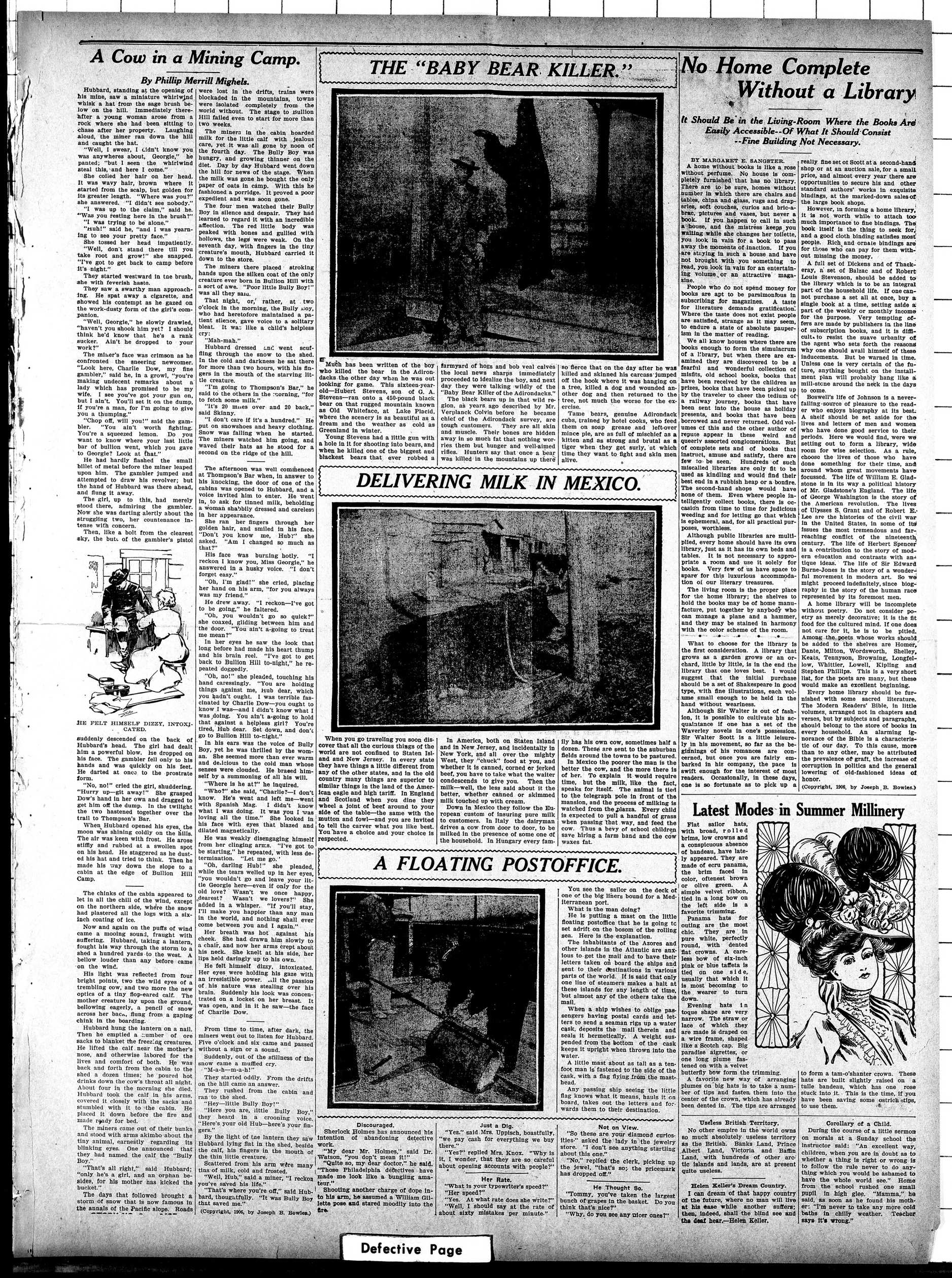
A Cow in a Mining Camp.
By Phillip Merrill Mighels
Hubbard, standing at the opening of his mine, saw a miniature whirlwind whisk a hat from the sage brush below on the hill. Immediately thereafter a young woman arose from a building, chase after her property. Laughing aloud, the miner ran down the hill and caught the hat.
"Well, I swear, I didn't know you were anywheres about, Georgie," he panted; "but I seen the whirlwind steal this, and here I come."
"Well, I swear," he head. It was wavy hair, brown where it started from the scalp, but golden for its greater length. "Where was you?" she answered. "I didn't see nobody."
"I was up to the claim," said he.
"Was you resting in the brush?"
"I was trying to be alone."
"tuh!" said he, "and I was yearning
to see your pretty face."
She tossed her head impatiently.
"You don't stand there till you take
a knee and grow!" she snapped.
"I've got to get back to camp before
it's night."
They started westward in the brush,
she with feverish haste.
They saw a swarthy man approaching.
He spat away a cigarette, and
showed his contempt as he gazed on
the work-dust form of the girl's companion.
"Well, George," he slowly drawled,
"haven't you shook him yet? I should
think he'd know that he's a rank
sucker. Ain't he dropped to your work?"
The mister's face was crimson as he confronted the sneering newcomer, "Look here, Charlie Dow, my fine gambler," said he, in a growl, "you're making undecent remarks about a lady which has promised to be my wife, see you've got your gun on, but I already will not on the dump, if you're a man, for I am going to give you a thumping. "Chop off, will you!" said the gambler, "You aren't worth fighting. You're a squeezed lemon. Do you want to know where your last little bar of bullwant, which you gave to me, and that he had flashed." He had hardly flashed the small billet of metal before the miner leaped upon him. The gambler jumped and attempted to draw his revolver; but the hand of Hubbard was there ahead, and flung it away. The girl, up to this, had merely stood there, admiring the gambler. Now he was darting alertly about the struggling man, countenance Intense with concern. Then, like a bolt from the clearest sky, the butt of the gambler's pistol
HE FELT HIMSELF DIZZY, INTOXI
CATED.
suddenly descended on the back of Hubbard's head. The girl had dealt him a powerful blow. he dropped on his face. The gambler fell only to his hands and was quickly on his feet. He darted at once to the prostrate form. "No, no!" cried the girl, shuddering. "Hurry up—git away!" She grasped Dow's hand in her own and dragged to get him off the dump. In the twilight the two hastened together over the trail to Thompson's Bar.
When Hubbard opened his eyes, the moon was shining coldly on the hills. The air was keen with frost. He arose stiffly and rubbed at a swollen spot on his head. He staggered as he dusted his hat and tried to think. Then he made his vay down the slope to a cabin at the edge of Bullion Hill Camp.
The chinks of the cabin appeared to let in all the chill of the wind, except on the northern side, where the snow had plastered all the logs with a six-inch coating of ice.
Now and again on the puffs of wind came a mooring sound, fraught with suffering. Hubbard, taking a lantern, fought his way through the storm to a shed a hundred yards to the west. A bellow louder than any before came on the wind.
His light was reflected from four bright lights; two the wild eyes of a trembling owl, and towed more the new optics of a tiny flop-tower calf. The mother creature lay upon the ground, bellowing eagerly, a pencil of snow across her bac₄ᴷ flung from a gaping chink in the boarding.
Hubbard hung the lantern on a nail. Then he emptied a number of ore sacks to blanket the freezing creatures. He lifted the calf near the mother's nose, and otherwise labored for the lives and comfort of both. He was back and forth from the cabin to the shed a dozen times; he poured hot drinks down the cow's throat all night. Hubbard took the morning she died. Hubbard took the arms, covered it closely with the sackies, stumbled with it to the cabin. He placed it down before the fire and made ready for bed.
The miners came out of their bunks and stood with arms akimbo about the tiny animal, earnestly regarding its blinking eyes. One announced that they had named the calf the "Bully Bear." "That's all right," said Hubbard; "only he's a girl, and an orphan besides, for his mother has kicked the bucket." The days that followed brought a storm of snow that is now famous in the annals of the Pacific slope. Roads
were lost in the drifts, trains were blockaded in the mountains, towns were isolated completely from the world without. The stage to Bullion Hill failed even to start for more than two weeks.
The miners in the cabin hoarded milk for the little calf with jealous care, and the buller Boy was on the fourth day. The Buller Boy was hungry, and growing thinner on the diet. Day by day Hubbard went down the hill for news of the stage. When the milk was gone he bought the only paper of oats in camp. With this he fashioned a porridge. It proved a poor expedient and was soon gone.
The four men watched their Bully Boy in silence and despair. They had learned to regard it with an incredible affection. The red little body was with the miners and gullied hollows, the legs, on. On the seventh day, with fingers in the tiny creature's mouth, Hubbard carried it down to the store.
The miners placed stroking hands upon the silken coat of the only creature ever born in Bullion Hill with a sort of awe. "Poor little Bully Boy!" was all they sau.
That night, or, rather, at two o'clock in the morning, the Bully boy, who had herofore maintained a patient silence, gave voice to a solitary bleat. It was: a child a child's helpless cry:
"Mah-mah."
Hubbard dressed and went scuffling through the snow to the shed. In the cold and darkness he sat there for more than two hours, with his fingers in the mouth of the starving little creature.
"I'm going to Thompson's Bar," he said to the others in the morning, "for to fetch some milk."
It's 20 times over and 20 back," said Skinny.
"I don't care if it's a hundred." He put on snowshoes and heavy clothing. Snow was falling when he started. The miners watched him going, and waved their hats as he stood for a second on the ridge of the hill.
The afternoon was well commenced at Thompson's Bar when, in answer to his knocking, the door of one of the cabins was opened to Hubbard, and a voice invited him to enter. He went in, to ask for tinned milk, beholding a woman shabby dressed and careless in her appearance.
He asked the lagers through her golden hair, and smiled in his face, "Don't you know me, Huby?" she asked, "Am I changed so much as that?"
His face was burning hotly, "I reckon I know you, Miss George," he answered in a husky voice, "I don't forget easy."
"Oh, I'm glad!" she cried, placing her hand on his arm, "for you always was my friend."
He drew away, "I reckon—I've got to do," he hawked, "couldn't you be so quick?" she coaxed, gliding between him and the door. "You ain't a-going to treat me mean?"
In her eyes he saw the look that long before had made his heart thump and his brain reel. "I've got to get back to Bullion Hill to night," he repeated doggedly. "Oh, no!" she pleaded, touching his hand caressingly. "You are holding things against me, hub dear, which you had ought. I was terrible fascinated by Charlie Dow—you ought to know I was—and I didn't know what I was doing. You aren't—giving to hold that against a helpless girl? You're tred, Hub dear. Set down, and don't get Bullion Hill to night." In his eyes she was the voice of Bully Boy, yet he was thrilled by the woman. She seemed more than ever warm and delicious to the cold man whose senses were clouded. He knew himself by a summoning of all his will. "Where is he at?" he inquired. "Who?" she said, "Charlie?—I don't know. He's went, and left me—went with Spanish Man. I didn't know what I was doing. It was you I loving all the time." She looked in his face with eyes that blazed and dilated magnetically.
He was weakly disengaging himself from her clinging arms. "I've got to be starting," he repeated, with less determination. "Let me go."
"Oh, darling Hub!" she pleaded, while the tears willed up in her eyes, "you won't go and leave your little Georgette here—even if only for the old love? Wasn't we once happy, dearest? Wasn't we lovers? She added in a whisper. "If you'll stay, I'll make you happier than any man in the world, and nothing shall ever come between you and I again."
Her breath was hot against his cheek. She had drawn him slowly to chuckle and now her arms crept about his neck, knelt at his side, his lips held draping up to his own.
He felt himself dizzy, intoxicated. Her eyes were holding his gaze with an irresistible power, the passion of his nature was stealing over his brain. Suddenly his look was concentrated on a locket on her breast. It was open, and in it he saw—the face of Charlie Dow.
From time to time, after dark, the miners went out to listen for Hubbard. Five o'clock and six came and passed without a sign or a sound.
Suddenly, out of the stillness of the snow came a muffled cry.
"Ah, ah, ah!"
They stared oddly. From the drifts on the hill came an answer.
They rushed from the cabin and ran to the shed.
"Hey—little Bully Boy!"
"Here you are, little Bully Boy," they heard in the hub in a crooning voice.
"Here's your old Hub—here's your fingers."
By the light of the lantern they saw Hubbard lying flat in the shed, beside the calf, his fingers in the mouth of the thin little creature.
Scattered from his arm were many tins of milk, cold and frosted.
"Well, Hub," said a miner, "I reckon you've saved his life."
you've saved his life"
"That's where you're off," said Hubbard thoughtfully. "It was Bully Boy that saved me."
(Copyright, 1906, by Joseph B. Bowles.)
THE RAVEN
DELIVERING
DELIVERING MILK IN MEXICO.
THE STREETS OF BROOKLYN
A FLOAT
Discouraged.
A FLOATING POSTOFFICE.
A man is using a hammer to break a log.
Defective Page
Much has been written of the boy who killed the bear in the Adirondacks the other day when he was out looking for game. This sixteen-year-old-Hubert Stevens, son of G. A. Stevens—ran onto a 450-pound black bear on that rugged mountain known as the hiveface, at Lake Placid, where the sinery is as beautiful as a dream and the mother as cold as Greenland in winter. Young Stevens had a little gun with a hole in it for shooting into bears, and when he killed one of the biggest and blackest bears that ever robbed a
When you go traveling you soon discover that all the curious things of the world are not confined to Staten Island and New Jersey. In every state they have things a little different from any of the other states, and in the old country many things are superior to similar things in the land of the American eagle and high tariff. In England and Scotland when you dine they wheel a joint of beet around to your side of the table—the same with the mutton and fowl—and you are invited to tell the carver what you like best. You have a choice and your choice is respected.
Sherlock Holmes has announced his intention of abandoning detective work.
"My dear Mr. Holmes," said Dr. Watson, "you don't mean it!" "Guite so, my dear doctor," he said. "Those Philadelphia detectives have made me look like a bungling amateur." Shooting another charge of dope into his arm, he assumed a William Gillette pose and stared moodly into the fire.
farmyard of hogs and bob veal calves the local news sharps immediately proceeded to idealize the boy, and next day they were talking wildly of the "Baby Bear Killer of the Adirondacks." The black bears up in that wild region, as years ago described by Mr. Verplanck Colvin before he became a tough customer. Adirondack survey, are tough customers. Their bones are all skin and muscle. Their bones are away in so much fat that nothing worries them but hunger and well-aimed rifles. Hunters say that once a bear was killed in the mountains up there
RING MILK IN
In America, both on Staten Island and in New Jersey, and incidentally in New York, and all over the mighty West, they "chuck" food at you, and whether it is canned, corned or jerked beef, you have to take what the waiter condescends to give you. Then the milk—well, the less said about it the better, whether canned or skimmed milk touched up with cream. Down in Mexico they follow the European custom of insuring pure milk to customers. In Italy the dairyman drives a cow from door to door, to be milked in the presence of some one of the household. In Hungary every fam
ATING POSTC
"Yes," said Mrs. Uppisch, boastfully,
"We pay cash for everything we buy
there."
"Yes?" replied Mrs. Knox. "Why is it,
I wonder, that they are so careful
about opening accounts with people?"
Her Rate.
"What is your typewriter's speed?"
"Her speed?"
"Yes. At what rate does she write?"
"Well, I should say at the rate of about sixty mistakes per minute."
Page
so fierce that on the day after he was killed and skinned his carcass jumped off the hook where it was hanging on a tree, killed a dog and wounded another dog and then returned to the tree, not much the worse for the exercise.
Tame bears, genuine Adirondack cats, trained by hotel cooks, who feed them on soap, grease and left-over mine piles, are as tough as the kitten and as strong and brutal as a tiger when they get surly, at which time they want to fight and skin men alive.
MEXICO.
lily has his own cow, sometimes half a
field, and went to the suburban
fields around the town.
In Mexico the poorer the man is the better the cow, and the more there is of her. To explain it would require time, but the milk, like the fact, speaks for itself. The animal is tied to the telegraph pole in front of the mansion, and the process of milking is watched from the plaza. Every child is expected to pull a handful of grass from the field, and feed the cow. Thus a bevy of orchard children save hirping a farm hand and the cow waxes fat.
You see the sailor on the deck of one of the big liners bound for a Mediterranean port.
What is the man doing?
He is putting a mast on the little floating postoffice that he is going to set adrift on the bosom of the rolling sea. Here is the explanation.
The inhabitants of the Azores and other islands in the Atlantic are anxious to get the mail and to have their letters taken on board the ships and sent to their destinations in various parts of the world. If is said that only one line of steamers makes a halt at these islands for any length of time, most of the others take the mail.
When a ship wishes to oblige passengers having postal cards and letters to send a seaman rig up a water cask, deposits the mail therein and seals it hermetically. A weight suspended from the bottom of the cask keeps it upright when thrown into the water.
A little mast about as tall as a ten-foot man is fastened to the side of the cask, with a flag flying from the mast head.
My passing ship seeing the little flag knows what it means, hauls it on board, takes out the letters and towards them to their destination.
"So these are your diamond curiosities." asked the lady in the jewelry store. "I don't see anything startling about this one."
"No," replied the clerk, picking up the jewel, "that's so; the pricemark has dropped off."
He Thought So.
"Tommy, you've taken the largest bunch of grapes in the basket. Do you think that's nice?"
"Why, do you see any nicer ones?"
No Home Complete Without a Library
It Should Be in the Living-Room Where the Books Are Easily Accessible--Of What It Should Consist --Fine Building Not Necessary.
Latest Modes in Summer Millinery
I
BY MARGARET E. SANGETER.
A home without books is like a rose without perfume. No house is completely furnished that has no library. There are to be sure, homes without number in which there are chairs and tables, china and glass, rugs and draperies, soft couches, curtains and bric-a-brac, pictures and vases, but never a book. If you happen to call in such a house, and the mistress keeps you waiting while she changes her toilette, you look in vain for a book to pass away the moments of inaction. If you staying in such a house and have not brought with you something to read, you look in vain for an entertaining volume or an attractive magazine.
People who do not spend money for books are apt to be pardonable in subscribing for magazines. A taste for literature demands gratification. Where the taste does not exist people are satisfied, strange as it may seem, to endure a state of absolute pauperism in the matter of reading.
We all know houses where there are books enough to form the simulacrum of a library, but when there are examined they are discovered to be a fearful and wonderful collection of misfits, old school books, books that have been received by the children as prizes, books that have been picked up by the traveler to cheer the tedium of a railway journey, books that have been sent into the house as holiday presents, and books that have been borrowed and never returned. Odd volumes of this and the other author of repute appear in these weird and queerly assorted conglomerations. But complete sets and of books that have amuse and satisfy, there are few to be seen. Such miscalled libraries are only fit to be used as kindling and would find the best end in a rubish heap or a bonfire. The second-hand shops would have none of them. Even where people intelligently book books, there is occasion from time to time for judicious weeding and for letting go that which is ephemeral, and, for all practical purposes, worthless.
Although public libraries are multiplied, every home should have its own library, just as it has its own beds and tables. It is not necessary to appropriate a room and use it solely for books. Very few of us have space to spare for this luxurious accommodation treasures. The living room is the happiest place for the home library; the shelves to hold the books may be of home manufacture, put together by anybody who can manage a plane and a hammer, and they may be stained in harmony with the color scheme of the room.
What to choose for the library is the first consideration. A library that grows as a garden grows or an orchard, little by little, is in the end the library that one loves best. I would suggest to be the initial purchase be set the Shimai in good type, with fine illustrations, each volume small enough to be held in the hand without weariness.
Although Sir Walter is out of fashion, it is possible to cultivate his acquaintance if one has a set of the Waverley novels in one's possession. Sir Walter Scott is a little leisurely in his movement, so far as the beginnings of his romances are concerned, but once you are fairly embarked in his company, the pace is swift enough for the interest of most readers. Occasionally, in these days, one is so fortunate as to pick up a
Flat sailor hats, with broad, rolled brims, low crowns and a conspicuous absence of bandeau, have later appeared. They are made of ecu panama, the brim faced in color, oftenest brown or olive green. A simple velvet ribbon, tied in a long bow on the left side is a favorite trimming. Panama hats for outing are the most chic. They are in pure white, perfectly round, with dented flat crowns. A careless bow of sixlux pink or light biaffea is used on one side, used that which it is most becoming to the wearer to turn down.
Evening hats in toque shape are very narrow. The straw or lace of which they are made is draped on a wire frame, shaped like a Scotch cap. Big paradise aigrettes, or one long plume fastened on with a velvet butterfly bow form the trimming. A favorite new way of arranging plumes on big hats is to take a number of tips and fasten them into the center of the crown, which has already been dented in. The tips are arranged
No other empire in the world owns so much absolutely useless territory as the British. Banks Land, Prince Albert Land, Victoria and Baffin Land, with hundreds of other arctic islands and lands, are at present quite useless.
Helen Keller's Dream Country.
I can dream of that happy country of the future, where no man will live at his ease while another suffers; then, indeed, shall the blind see and the deaf hear.—Helen Keller.
really fine set of Scott at a second-hand shop or at an auction sale, for a small price, and almost every year there are opportunities to secure his and other standard authors' works in exquisite bindings, at the marked-down sales of the large book shops. However, in forming a home library, it is not worth while to attach too much interest to fine bindings. The book itself is a fine book or, and a good cloth binding satisfies most people. Rich and ornate bindings are for those who can pay for them without missing the money.
A full set of Dickens and of Thackeray, a set of Balzac and of Robert Louis Stevenson, should be added to the library which is to be an integral part of the household life. If one cannot purchase a set all at once, buy a single book at a time, setting aside a day for the monthly income required for the purpose. Very often officers are made by publishers in the line of subscription books, and it is difficult to resist the suave urbanity of the agent who sets forth the reasons why one should avail himself of these inducements. But be warned in time. Unless one is very certain of the future, anything bought on the future will probably hang like a mill-stone around the neck in the days to come.
Bowell's life of Johnson is a never-falling-source of pleasure to the reader who enjoys biography at its best. A shelf should be set aside for the lives and letters of men and women who have done good service to their periods. Here we would find, were we setting out to form a library, wide room for wise selection. As a rule, choose the lives of those who have done something for their time, and around whom great movements have focussed. The life of William E. Gladstone is in its way a political history of Mr. Gladstone's England. The life of George Washington is the story of the American revolution. The lives of Ulysses S. Grant and of Robert E. Lee in the civil war in the United States in the issues the most tremendous and far-reaching conflict of the nineteenth century. The life of Herbert Spencer is a contribution to the story of modern education and contrasts with antique Jones. The life of Sir Edward Burne-Jones is the story of a wonderful movement in modern art. So we might proceed indefinitely, since biography is the story of the human race represented by its foremost men.
A home library will be incomplete without poetry. Do not consider poetry as merely decorative; it is the fit food for the cultured mind. If one does not care for it, he is to be pitted. Among the poets whose works should be added to the shelves are Homer, Shelley, Keats, Tennyson, Browning, Dowlow, Whittier, Lowell, Kipling and Stephen Phillips. This is a very short list, for the poets are many, but these would make an excellent beginning. Every home library should be furnished with some sacred literature. The Modern Readers' Bible, in little volumes, arranged not in chapters and verses, should belong to the store of books in every household. An alarming ignorance of the Bible is a character of our day. To this cause, more than to any other, may be attributed the prevalence of graff, the increase of corruption in politics and the general lowering of old-fashioned ideas of honor. (Copyright, 1906, by Joseph B. Bowles.)
Summer Millinery
to form a tam-o'shanter crown. These hats are built slightly raised on a tulle bandaue, which has one rose stuck into it. This is the time, if you have been saving some ostrich tips, to use them.
Corollary of a Child.
During the course of a little sermon on morals at a Sunday school the instructor said: "An excellent way, children, when you are in doubt as to whether a thing is right or wrong is to follow the rule never to do anything which you would be ashamed to have the whole world see." Home from the school rushed one small pupil in high glee. "Mamma," he said, as soon as he found his mother: "I'm never to take any more cold baths in chilly weather. Teacher says it's wrong."
HAVE YOU READ
THE APPEAL?
THE
A NATIONAL AFRIC
PUBLISHED
ADAMS BROS. ED.
49 E. 4th S
THE APPEAL,
A NATIONAL AFRO-AMERICAN NEWSPAPER
PUBLISHED WEEKLY BY
ADAMS BROS. EDITORS AND PUBLISHERS
49 E. 4th St., St. Paul, Minn.
ST. PAUL OFFICE,
No. 110 Union Blk. 4th & Cedar,
J. O. ADAMS, Manager.
CHICAGO OFFICE,
323-5 Dearborn St., Suite 310,
C. F. ADAMS, Manager.
MINNEAPOLIS OFFICE,
Guaranty Loan Bldg. Room 1020
HARVEY B. BURK, Manager.
TERMS: STRICTLY IN ADVANCE:
SINGLE COPY, ONE YEAR ..... $2.00
SINGLE COPY, SIX MONTHS ..... 1.10
SINGLE COPY, THREE MONTHS ..... 60
When substitutions are needed, should we send 60 cents for each 13 weeks and 5 cents for each old week, or at the rate of $4.00 per cent and 6 cents stamps taken? Postage stamps will be received the same as cash for one cent and two cents stamps taken. Only one cent should never be sent through the mail. Postage stamps should be through the envelope and be lost or destroyed. Persons who send silver to us in letters so in their own risk.
Flatrate rates are 10 lines or less. Each additional line 10 cents. Payment at all times. All must come in season to be news.
Advertising rates, 16 cents per agate line, each insertion. There are fourteen agate lines in the magazine. No single advertisement less than one agate line. No single advertisement less than three months contract. Must cash accompany all orders from parties unknown to us. Further仲事 on application.
Reading rates, 16 cents per agate line, insertion. No discounts for time or space. Reading matter is six per page. Type about six pages per line. Bound copies can double.
The date on the address label shows when substitutions are needed. Renewal expires. Removal must be made two weeks prior to expiration, so that time when is out.
It occasionally happens that papers sent to us do not receive any number when due, inform us by postal card at the expiration of five days or not receive any number forward or a duplicate of the missing number
Communications to receive attention must be newsy, upon important subjects, plainly stated, and not too complex. We must reach us Tuesday if possible, anyway not later than Wednesdays, and bear the signature, unless stamps are sent for postage.
We do not hold ourselves responsible for the correspondents.
So please send us where. Write for terms. Sample copies free.
In every letter that you write us never fail to give your full name and address, plainly written, post office, county and state. Business letters of all kinds must be written on separate sheets from letters containing news or matter for publication.
PRESIDENT ROOSEVELT.
Treat each man according to his worth as a man. Distrust all who would have invade one class placed before any other. Other republics have fallen because the unscrupulous have substituted loyalty to class for loyalty to the people as a whole. —President Roosevelt's speech at Little Rock, Ark.
SATURDAY AUGUST 4. 1906.
The Chicago Tribune finds matter for congratulation in the fact that the number of lynchings seems to be on the decrease. It gives the annexed summary: In half a dozen cases or more there would have been lynchings in southern states during the last week but for the governor in suppressing mobs and fouling the point of the bayonet to let the law take its course. The statistics of lynching for the first half of the year, however, are the best evidences of its gradual decadence. During this period there have been but thirty lynchings, all of them in the south, and all of Negroes but four. That is the smaller number, in any six months for twenty years past. It looks as if the south were calling a halt on lynching.
It is true that several of the southern governors deserve some credit for checking the prevalence of lynching by the mode of prevention, but the country is in a condition to give grounds to conclude that there is much of calling a halt in the matter. The only satisfactory proof of a real intention to call a halt is the punishment of the murderers as murderers, not turning them loose with a trifling punishment. As yet this has not been done either in the south or north, but to this must it come at last.
---
[Picture of a man with a white beard and a dark suit, facing left. The background is a plain black surface.]
SENATOR SHELBY M. CULOM.
A Man Who Has Known Senator Culom for Years, Who Has Studied Him and Knows Him, Says:
"Senator Culom's power lies in his even temper. He never recognizes an enemy. He does not appear to think he has one. He never loses his temper and never scores an opponent. No one knows where he is to strike. He keeps his own counsel. He does not like the limelight and never airs his opinions in the public press. He is absolutely sure before he goes ahead. He will not take the testimony of six men when he can get sixty. He talks very little. He does not mind it and affable with newspaper men, but he does not; tell them his secrets.
"Senator Culom is a politician and he plays the game of politics with a master hand. He outgenerates his enemies. He recognizes no faction in the republican party and never antagonizes any of the different elements that go to make up the party. He is a good general, an upright man, a husband and father and is altogether a man whom the whole state of Illinois should feel proud to have in the senate as a representative of all the people."
PETER H. HARRIS
Virile Junior Senator of Illinois Gives His Views on Disfranchisement of the 'Afro-Americans in the South.
Speaking of disfranchisement Senator Hopkins said in an interview: "Under the operation of State constitutions in this country today, a comparatively few persons at the South are intrusted with power equal to that enjoyed by a great number of persons at the North.
"Take the State of South Carolina for example, where there are 500,000 white persons and 700,000 Afro-Americans are not allowed to vote, and the result is that the 500,000 whites there exercise in the Federal Government, as much power as do 1,200,000 persons in Illinois.
"Now, it is a mere commonplace to state that such a condition is a travesty on representative government. If that order of things continues the time will not be long before the liberties of the people, white as well as black, will be disregarded. Such a government may be administered intelligently but it can never, in any sense, be said to be free. The spirit of unjust disjunction through the warp and woof of it, weaving a political fabric that is oligarchic in scope, and subversive of republican principles and republican institutions.
PRINCIPLES THE PARTY STRENGTH.
The mistake is frequently made of supposing that it is of no use to organize and maintain a party which has no hope of electing its candidates, has no power to run them ridiculed as side shows, which them ridiculed at nothing all. But such parties have been the means of effecting some of the greatest reforms ever inaugurated in this country. The old abolition party was never very strong numerically, and the political forces of the country and overthrew slavery.
The conclusion is that the strength of a political party can not be estimated by the number of its adherents. Among the elements of its strength are the principles it represents, and the political forces it faces. This is shown by the fact that measures which have monopolized the attention of the present Congress are those proposed by the Populists.
Bat Masterson, in the New York Telegraph goes for "fake" southerners in a very amusing style:
The fake southerner after engaging you in conversation for not above two minutes will give you to understand that he is a southern gentleman-sah, and if he meets with no interruption will not be long in informing you that it other丝品 of gentility are rank counterfeited. He will proceed to tell of the great number of slaves owned by his family before Lincoln got to working on the job, and if everything runs smoothly with him he will, with as fine a show of self-importance as you ever saw, ask you to cash his personal check. Bat says that it is these "fake" southerners who go into hysteries whenever Dixie is played.
Fagan, an Afro-American deserter from the 24th inch, is said to be concerned with the following is an account of his doings, according to the dismatches.
Having organized a gang of fifty Negroes, Fagan, as their leader, is conducting a series of depredations on natives, stealing more than 100 head of cattle during the past month in the province of Pangasinan. Officers have learned that the original thieves are Filipinos, but they are supported in their efforts by the renegade Negroes, who dispose of the animals.
THE APPEAL takes the liberty of following the lead given in the foregoing by the word "suppose" and supposes the whole thing a lie.
Our European brether, especially the British are much concerned at the indications that the "fanatical Mahomadans are about to inaugurate a "Holy War." And England do so to resist the holy War. She remembers the *four* forces Hicks Pasih, Sir Samuel White, Lord Wolsely and "Chinese" Gordon were exterminated in the past times and anticipates that a struggle with these "fanatics" would be even more desperate than those of the past. Hatishim "spores of unkind" is getting to be an operation which cost more than it comes to, and seems to indicate that the plundering of feeble nations by "the great powers" is coming to an end, as it certainly ought to.
The Washington Post mentions the following instance of the depravity which lurks under a dark cuticle:
"And now Japan is resolved to hold what she conquered. She has made a tariff wall around Manchuria that excludes all merchandise but Japan, merchandise, and England, Germany, and England. The United States are squawling about it; but it is little the Japs care for that as long as their goods supply the markets of Manchuria and all rivals are kept out."
Caucasian Americans boast that this country's country, and of course not can blame the Japs for thinking that theirs is a brown man's country. It is well.
---
The Chicago Record-Herald says: "Whenever feet that say a 'burl' Negro has been seen, you sure to find a little further on that the police 'hustled' him somewhere."
Hs R-H is laying unhallowed hands upon the American Ark of the Covenant when it sneers at the usefulness of any one of reasonable common sense that, while it is a matter of no moment for a white man to be burly, for an Afro-American to be the sense is an evidence that he is "fit for the task" and in the South, the proper subject for a lynching bee. No unseemly levity should be associated with the word "burly."
Japan is rapidly adopting American customs, as shown by the fact that the Manchurian railway will allow a rebate on a "few" Japanese goods. Of course that move will crowd American products out of the market and deprive the American admiration of the Japanese about fifty per cent.
W. H.
The Immortal Martyred President. T he Resemblance of Senator Culium to the Great Emancipator is almost Startling.
SENATOR CULLOM, WHO STRIK-INGLY REEMBELS THE
Martyred President Relates Reminiscences of His Acquaintance with the Grandest Figure in the World's History—the Immortal Lincoln.
Shelby M. Cullom stood in the doorway of one of the rooms in the Great Northern hotel which is a part of his headquarters. Tall, angular, erect he stood there, and his likeness to Abraham Lincoln was almost startling.
Genocide Cullom has been paragraphed as the "mind who looks like Lincoln" for many years, and there is little wonder. He has the same-large features, the prominent nose, the firm mouth and keen eyes, and even his hair and beard are trimmed not so much in imitation of the martyred president as in the fashion set at that time.
Sitting in the bright afternoon light, Shelby M. Culom presented a striking and dignified figure. His hair and beard are white, but his face is ruddy and has the warm hue of health. He seems to bear his years lightly. His face is spare; but not wrinkled. His hands are long and slim and he uses them sparingly in gesticulation. He is eminently a man of the Lincoln. He is ruddy, conservative and of the old school. Written is written in every feature and poem, in every line. His eyes are keen and they read a man's very soul.
Senator Cullom is an earnest man and yet he has a sense of humor. He is a serious statesman and yet he loves a good anecdote and a pointed story. And he can tell a story, too, in a manner to make it interesting. He uses and simple language, with homely lilies and quiet similes. He impresses by being sober and natural—a man who has been himself at all times from the time he followed the plow in Tazewell county to this day, when he is one of the most conspicuous men in the upper body of the national legislature. My acquaintance with Lincoln began when I was a lad starting out in life," he said, with a far-away look in his eyes.
"It has been said that I look like Lincoln and I count one of the pleasantest compliments of my life that one
ABRAHAM
The Immortal Martyred President. T
the Great Emancipat
paid me by a quaint, elderly quakeress who came to my office once upon a time.
"As we talked over the matter of which she had come to see me about she interrupted me with: Friend, I was in the office. It was after the interview had closed and she was about to depart that she took my hand and, gazing at me intently, remarked earnestly:
"Friend, the very much resembles Mr. Lincoln.
Lincoln, he was my ideal when I was only a dozen years of age. He was 30 then. I remember the first time I was ever in a court room. Lincoln was there, defending a man charged with murder. He was considered a great lawyer even then. He was a master of the law. That was my impression that was irresistible and his hold on the public was overpowering."
The funeral honors paid to Lincoln have seldom been surpassed in grandeur and perhaps never in popular sorrow. There was some talk of having the body buried in the east, but the people of Illinois would not listen to this and Shelby M. Cullom was a member of the committee sent on to plead the case. The people of Niagara nois, and besides him there is but one other man living who went on that eventful journey.
It will be recalled by those who are familiar with the history of those days that the body of the dead president was embalmed and laid in state in the rotunda of the capitol April 20. The following day the funeral train began its wonderful journey to Springfield, and over the same route he had travelled going to Washington. The remains were then going to Albany, Harrisburg, Philadelphia, New York, Albany, Buffalo, Cleveland, Chicago and Springfield and solemn services were held in each place.
Senator Cullom participated in all these great scenes of sorrow and says that the grief expressed everywhere was something so poignant and so pitiful that he can never forget it so long. Crowds gathered at every crossing and a crowd of uncovered heads as the train passed by. Every city was the scene of vast, solemn gatherings as the funeral train pulled through. The sorrow of the people had never been surpassed in the world and perhaps never will be. It was only by taking the body of the beloved president on this last journey that the
people could give vent to their grief and sorrow and the patriotism of the people was stirred as it never had been before. Going home again, the sorrowing men and women determined to stand by the nation at all hazards. His reminiscences of Lincoln. Senator John Kincoln in all the walks of his life. I knew him as a young lawyer making his name here in Illinois. I knew him as a private citizen and as a lawyer. I knew him as a candidate and as a leader him in his home and in the bosom of his family. And now, after all these years and after having met many men and having studied the lives of the greatest men the world has produced, I am inclined to think his the noblest and the greatest figure of all time, the grandest measure of a man on the globe."
CURRENT CULLOM COMMENTS
Senator Cullom will continue to do business at the old stand.
Senator Cullom was speaker of the first Republican legislature in Illinois in 1861.
Senator Cullom has been a 'Republican almost from the very beginning of the party.
Senator Cullom resembles Abraham Lincoln in rugged honesty as well as in personal appearance.
In 1862, Shelby M. Cullom was appointed by President Lincoln, commissioner of army accounts.
Senator Cullom personally secured the appointment of a number of colored officers in the Spanish-American war.
In the early 70s J. J. Byrd, a colored man, was appointed trustee of the state university by then Governor Cullom.
Senator Cullom was the friend of the Afro-American in the dark days before the war and he is the friend of the race now.
Senator Cullom supported the Fourteenth and Fifteenth Amendments to the Constitution and the reconstruction lefglature.
LINCOLN.
the Resemblance of Senator Culliom to
or is almost Startling.
Senator Cullom is a man of common sense, good judgment and absolute integrity; his character was formed before graft became popular.
Senator Cullom is a man of the people and the people will see that he is reelected Senator so that they may continue to have a voice in the affairs of the nation.
Senator Cullom came up from the common people just as Abraham Lincoln did. He was a poor farmer's son and made his way up in the world by his own exertions.
There is nothing experimental about the statesman we ask the people to reevaluate. Cullom has been tried for many years, and he always stood by the people of Illinois.
The early life of Senator Cullom was spent on his father's farm and there he acquired the strong body which has enabled him to give, so much labor to the public service.
Senator Cullom knew Abraham Lincoln before he became a national character and it was his privilege to sit at the feet of the Great Emancipator and drink inspiration from that noble soul.
One reason that Shelby M. Cullom has so many friends is that he is honest in his dealings with his fellowman. In his long political career he has never made a promise he has not fulfilled.
The fact that Senator Cullom is now a poor man is the best proof in the world that he is an honest man. He has had many opportunities for grafting, but he has remained poor and honest.
One reason that Shelby M. Cullom has so many friends is that he is honest in his dealings with his fellowman. In his long political career, he has never made a promise he has not fulfilled.
In the days before the war Shelby M. Cullom was one of the foremost practitioners at the Springfield bar and many of the great lawyers of that day were pitted against him but he made a great record.
COLLEGES AND SCHOOLS
Knowles Building. Boys' Hall. Stone Hall. Girls' Hall. Model Home.
ATLANTA UNIVERSITY, Atlanta, Ga.
An unsectarian Christian Institution, devoted especially to advanced education. College Neighbors, College Preparatory and English High School courses, with Industrial Training. Supervised training in Music and Printing. Athletic for boys. Physical culture for girls. Home life and training. Admitted to needy and deserving students. Term begins the first Wednesday in October. For catalogue and information, address
Thirty-ninth Annual Session will begin October 1, 1906, and continue eight months.
Instruction is given by the diacidiclectures, quizzes, clinics and practical laboratory demonstrations. Wellequipped laboratories in all departments. Unexcelled hospital facilities.
Knoxville College. Classical, Scientific, Agricultural, Mechanical, Normal and Common
School or Courses, together with Theological and Medical Schools. Fifty-five Dollars a Year
will cover all expenses of basic education, light and furnished room. Separate home
and matron for little girls and another for little boys. Sunday in September. Send 20 catalogue 7. President of Knoxville College, Knoxville
Temple.
BALTIMORE & OHIO R. R.
ALL TRAINS VIA WASHINGTON
TEN DAY STOPOVER
ALLOWED
IN
WASHINGTON
BALTIMORE
PHILADELPHIA
DEPOSIT TICKETS
IMMEDIATELY ON
ANIMALS IN
EITHER CITY
Knoxville College. Classical, Scientific, Agricultural
School Courses, together with Theological, and Medical
will cover all classes on board, tuition, fuel, light
and matron for little girls and another for little boys.
Monday in September. Send 30r catalogue #) Pusleda
Town
TUSKEGEE Normal and Industrial Institute
Organized July 4, 1881, by the State Legislature. State Normal School. Exempt from taxation.
BOOKER T. WASHINGTON, Principal.
WARREN LOGAN, Treasurer.
LOCATION
In the Black Belt of Alabama where the blacks counter the white three to one.
MEN AND FACULTY
Enrollment year 1881 to 1883, females 371.
Average attendance, 1105.
COURSE OF STUDY
English education combined with industrial training; 28 industries in constant operation.
Property consisting of 2477 square of land, 50 buildings almost wholly built with student labor, is valued at $330,000, and no mortgage.
NEEDS
$50 annually for each of six students; ($200 enables one to finish the course; $100 enables a student to scholarship. Students pay their own bills. Money in any amount for current expenses.
Besides the work done by graduates as class room and industrial leaders, thousands are trained through the Tuskegee Negro Conference.
Tuskegee is 40 miles east of Montgomery and 10 miles east of Alabama, on the Western Railroad, Alabama.
Tuskegee is a quiet, beautiful old Southern town, and is an ideal place for study. The climate is at all times mild and uniform, thus making the place an excellent winter resort.
TILLOTSON COLLEGE
The Oldest and Best School in Texas
of the Students. Faculty mostly
graduates of the University of
牙. Reputation unsurpassed. Manual
teaching. Special a special course.
Music a special feature. Special
advantages for earnest students.
Special advantages for earnest students.
Send for catalogue and circular
REV. MARSHALL R. GAINES, A. M.
AUSTIN, President.
TEXAS.
A Practical, Literary and Industrial
Trades School for Afro-American Boys
and Girls with special emphasis on
Girls and special building. Address:
Joseph D. M. Mahoney, Principal.
New England CONSERVATORY OF MUSIC
BOSTON, Mass.
All the advantage of the finest and most complete
conservatory building in the world is the
mophorpe of a recumbent center of Art and Music and
association with the masters in the Profession are
Good and good music. Through work in all departments of music,
Countries and in the University of Geneva, George W. CHADWICK, Musical Director.
GEORGE W. CHADWICK, Musical Director.
All particulars and your look will be sent on application
A Chrisf
Program of Instrut
looked at and
other in
BALTIMORE & O
CHICAGO
CLEVELAND
COLUMBUS
PITTSBURG
ST. LOUIS
LOUISVILLE
ALL TRAINS VIA
F. J. Shadd, M. D., Secretary
Departments- Normal and- Coffee
garden to local af-
strumental Music, Theological
culture, Sewing and- Cooking.
Health Location; heated by steam
lighted by electricity room, boar
tition, light and heat, $60.
For Catalog and Parts-tare
write to J. H. JOHNSON,
President
Agricultural, Mechanical, Normal and, Common
and Medical Schools. Fifty-five Dollars a year
light and furnished room. Separate home
bays from 6 to 15 years. Term begins last
Friday. President of Amvilla College, & noville
GAMMON THEOLOGICAL SEMINARY
ATLANTA, GEORGIA
AIMS AND METHODS
The aim of this school is to do practical work in helping men towards success in the ministry; its course of study is broad and includes its work is thorough; its methods are fresh, systematic, clear and simple.
**CURSE OF STUDY**
The school occupies three years, and covers the lines of work in the several departments of theological training, two leading theological seminaries of the country.
**EXPENSES AND AID**
Tuition and room rent are free. The apartments for students are plainly furnished, and covers seven dollars per month. Buildings heated by steam.
The loans without interest, and gifts of friends, are granted to deserving students who do their utmost in the preparation of their degree in grace, gifts, and energy, need be deprived of their advances now opened to him. This Seminary. For further particular address.
L. G. ADKINSON, D. D., Pres. Gammon Theological Seminar
ATLANTA, GEORGIA
BRAINERD INSTITUTE
CHESTER, S. C
A normal student with a
English education and lay a solid
foundation in success and usefulness
in the classroom.
Graduated course of study, designed to give
great knowledge.
Morristown Normal College
Fourteen teachers. Elegant and com-
modious buildings. Climate unsurpassed.
Departments. Music. Music. Sheehan.
Typewriting and 1 Industrial Training.
FIFTY DOLLARS IN ADVANCE will pay for room, board, light, fuel, tuition and board fee. Board $6.00 per month; tuition $2.00 per month. Through work done in each department, Send resume to相应 department.
Rev. Judson S. Hill, D. D. Concord, Tenn.
SCOTIA SEMINARY
CONCORD, N. C.
This well known school, established for the higher education of girls will open in August. Exemption for the tuition will be made to provide for the comfort, health and instruction of students. Washings, $4, for term of eight months.
Adrude$6
Rev. D. J. Batterfield, D. D.
Concord, N. C.
Progressive in all departments, best Method of Instruction, Health of Students carefully needed, Students taught to do manual labor as well as those for catalogues and other information, write to the president,
R. S. LOVINGGOOD, AUSTIN, TEXAS
OHIO R. R.
PITTSBURG
WASHINGTON
NEW YORK
PHILADELPHIA
BALTIMORE
VIA WASHINGTON
SAINT PAUL
A WEEK'S RECORD IN MINNESOTA' TAILS CAPITAL.
The "Saintly City" and Saintly City Folks—Newry Items of Social, Religious and General Matters Among the People.
REPUBLICAN TICKET
Governor.....
A. L. COLE
..Chief Justice
CHARLES M. START
State Treasurer
CLAREN DINEHART
Secretary of State
JULIUS H. SCHMAHI
Attorney General
E. T. YOUNG
State Auditor
S. G. IVERSON
Clerk Supreme Court
C. A. PIDGEON
Railroad Commission
C. F. STAPLES
SATURDAY AUGUST 4, 1906.
THE ELK EXPRESS CO., now has its office at 522 St. Peter street.
The popular Star Theatre opens for the season next Saturday Aug. 11.
It is rumored that Miss Leola Moker of this city was recently married in Chicago.
Oh, say! But won't it be a dream that moonlight Boat excursion Tuesday, Aug. 14. Get you ready.
Mrs. Lulu Wilson of Louisville, Ky., is visiting her relatives Mr. and Mrs. J. H. Jacobs 574 Fuller street.
NOTICE! Mrs. Ella Smith has moved her boarding house from 352 Cedar street to 566 Cedar street. Old and new customers are invited to call.
Prof. Kenneth J. Hamilton the mandolin artist left Monday for Des Moines. He will go to Helena, Ark., this fall to teach in an institution in that city.
The Appeal has purchased the press and outfit of the Richardson Printing Company and added the same to the plant. Bring in your job printing. Best work at lowest prices.
Mr. and Mrs. Monroe Duncan announce the engagement of their daughter Miss Minnetta Ellene to Mr. Arthur Carlton Lowe. The wedding will take place in the early part of next month.
BOARDING HOUSE. Mrs. Ella Smith, prop, 566 Cedar street. Breakfast 7:00 to 11:00 A. M. Regular dinner, 12:00 m. to 2:30 p. m. Meals at other hours to order. Regular dinner 25 cents.
Mrs. F. H. Robinson, the modiste of Duluth was in the city this week the guest of Mrs. Wm. Brown of Cook street. She came specially to dress Miss Minnetta James the bride of Monday night.
Shoes mended while you wait, at Jarvis' 83 East Fourth street. Half goles' for 875 cents. Prices reasonable for all kinds of repairs. He can do it on short notice. Jarvis 354 Minnesota street.
FOR RENT—Fine 10-room flat, see floor of No. 319 Wabasha, all in good order, water and closets, newly painted and papered. References required. Apply to R. M. Newport, Phoner Press Building.
THE PROPELS SHINING PAR DORRE WEBB Prop. No. 95% E. 12th and E. 12th E. 5th streets. When you wish a good shine give him a call. Shines 5 cents. First class-work. Special chairs for ladies.
The State Savings Bank, corner Fourth and Minnesota streets, its open Monday evenings from 6 to 8. Accounts can be started with $1. A little amount saved every week may some day stand between you and want.
ELK EXPRESS CO., G. J. Charleston, manager, corner St. Peter and Ninth streets. Packing, shipping and delivery of goods. Plano moving a specialty. House renting, real estate handled.
JARVIS, the saver and healer of soles, has moved from his old stand on 4th street just around the corner on Minnesota street No. 354 between 4th and 5th. When you need a pair of new shoes or need any mending done call on him.
John Q. Adams, Jr., while investigating the intricacies of the printing press, one of his fingers caught in the cogs and a good sized chunk was cut out. The finger was dressed and he is getting along nicely.
Mr. Walter Porter, the enterprising proprietor of the People's Shining Parlor, No. 114 P. 4th street, got a chance to sell his 1/2 for a good round sum and has now opened two shining parors, one at No. 95½ E. 4th street, and the other at 127 E. 5th street.
FIRST CLASS MEALS, like mother used to cook may be had at Mrs. Ella Smith's, No. 556 Cedar street breakfast, from 12:00 to 2:30 p.m. Meals to order when desired. Regular meals 25 cents. Sunday dinners a speciality.
Persons desiring to rent Wagner hall, corner Charles and Western avenues for lodge meetings, parties, dances, meetings or for any occasion may obtain the same at reasonable rates upon application to J. H.
STATE SAVINGS BANK
FOURTH AND MINNESOTA STREETS.
ST. PAUL MINN.
THE ONLY BANK IN ST PAUL EXCLUSIVELY FOR SAVINGS.
Deposits received in sums of $1. and upwards.
Interest Compounded Semi-annually.
DEPOSITS OVER $2,500,00.00
SURPLUS FUND 50,000.00.
TRUSTEES:
Charles P. Noyes, Wm. B. Dean,
John D. Ludden, Froiland Willus,
kenneth Clark, Gustav Willus,
John D. O'Brien, Thomas Fitzpatrick,
william Constans, Harla Richardson,
ule M. Hannaford, Chas. G. Lawrence.
HOME BRAND
CANNED
"ECONOMICAL TO BUY."
Be sure to ask for
GRIGGS, COOPER & CO
Charleston, 632 University avenue.
Dr. H. I. Williams, a graduate of the Chicago College of Dental Surgery has arrived in the city to locate. He has secured office in the Phoenix Building Cor. 7th and Cedar room 405, where he may be found from 9 to 12 a. m. and 1 to 5 p. m. Tel. N. W. Main 3214.
Jarvis, the heeter and saver of soles, 354 Minnesota street, says in one of his street car signs: "I can mend shoes better than I can write," and, if the sign is a fair specimen of his work as a writer, he's right, as he can mend shoes all right if he cannot write all right.
Prof. Arthur Winstead is preparing to open the Third Season of the Colonade Dancing School at Wagner Hall cor. Western ave. and Charles street, with a grand opening soiree on Thursday Aug. 16. On this occasion refreshment be served free. Admission 25 cents.
If you wish a good shave, hair cut, shampoo, or anything in the conical line, call at Richard Cousby's neat barber shop. No. 2741% Minnesota street. First class workmen only. Satisfaction guaranteed. Music for dances and all occasions furnished on short notice.
Mrs. B. R. Durant of Payne avenue entertained at 5 o'clock tea in honor of Mrs. F. H. Robinson of Duluth. Those present were: Mrs. B. F. Lewis, Mrs. F. H. Simpson, Mrs. W. Brown, Mrs. C. Robinson, Mrs. R. M. Morgan, Mrs. Robinson returned home Monday night.
THE ST. LOUIS KITCHEN, Mrs.
Julia Hinson, proprietor No. 317
Wabasha, up stairs. Meals 25cts. Breakfast from 7:00 to 11:00 a.m., dinner from 12:00 m. to 3:00 p.m.; Supper from 5:00 to 8:00 p.m. All regular meals 25 ct s. All home cooking. Tel.
N. W. Main 2215—L'
```markdown
```
T. H. LYLES W. B. ELLIOTT
Res. 642 Rondo Tel. Dale 419-L. 2.
Tel. Dale 617-1. 2. Res. 411 Univity.
LYLES & ELLIOTT.
Funeral Directors and Embalmers.
322 Wabasha St.
Calls Answered Day or Night in
Twin Cities.
Active Pall Bearers Furnished If
Desired.
Lady Assistant When Necessary.
Mr. George B. Lowe our enterprising picture frame man of 475 Wabasha street, has added a photograph gallery to his place of business and is prepared to do anything in the line of photography. All the up-to-date books we have the latest style photograph taken.
Hamm's New Beer. This beer is so decided that any drough ever over been brewed, that if the few days it has been on sale it has already attained a fixed place in public favor. Call for it. Hamm's New Brew. 100,000 barrels in stock. On draught from now on.
Everybody is preparing for the advent of the G. A. R. Encampment at Minneapolis and St. Paul is going to put on his best gown, girdle and halo that will be natural visit the saintly city. EVEN THE APPEAL is putting on a few extra touches. Did you notice it?
SAFE DEPOSIT AND STORAGE VAULTS.—We invite your inspection. It costs little to place your papers, cash securities and valuables in absolute safety. Boxes in our vaults can be and for 4 per year. Store your cash securities (Cc., with us) northwestern Trust Co., 138 Endicott Arcade.
Mr. Arthur N. McDonald, our enterprising salesman, formerly with M. J. O'Neill, has accepted the manager of the Gas Flight department of the New England Furniture and Carpet Co., Minneapolis.
Mr. and Mrs. McDonald are now stepping with Mr. and Mrs. Z. A. Pope 216-W. 31st St., Minneapolis, Minn.
Mr. F. D. McCraken, clerk to Congressman F. C. Stevens is back from Washington. During the Congressmans fight for renomination, Mr. McCraken will be in full charge of his business office. By devotion to his work, Mr. Stevens' clerk he has made himself valuable to the popular representative of this district.
Fall politics is beginning to be quite interesting and several candidates for the various offices have filed for renomination. Among them are Michael W. Fitzgerald the present very efficient senator, serving his third term. He has proven himself to be the right man for the place and it is probable that he will be very little opposition.
Persons who need to accommodate visitors during the coming G. A. R. acampment, which will be held between Aug. 13th and 20th, either with rooms or rooms and board, will confer a favor by seeing Mrs. J. R. White, Benxix and Moe of McQuaids grocer or Mrs. Borda Senior at the Tea Rooms, $51 Wabasha, with whom arrangements may be made.
Mr. Clifford Smith, our progressive tailor, has found it necessary to enlarge his quarters on account of his constantly increasing business. He is now located in a suite of three rooms in the Bradley Building, entrance at room 411. He has added a lot of furniture and fixtures, as well as a fine stock of goods. Call to see him in his new quarters No. 411 Bradley Building.
Did it ever occur to you—that this is the time of the year to put your stoves and ranges in repair for winter? THE ST. PAUL STOVE REPAIR WORKS, 126 W. Seventh street,
Has the best workmen and the best equipment in the city, and can furnish any part of any stove or range at any time and any place. A card will bring us, or you may 'phone N. W. Main 1208 L16, or T. C. 1224 Bear W. Main 1208 L16, or T. C. 1224 Bear W. new better and cheaper than cold weather sets in and we are rushed with orders. Time is short so DO IT NOW.
THE VALET TAILORING CO. No. 15415. 16 E. Sixth街, Owen Howell, proprietor. The most up-to-date place of its kind in the city. Clothing made your clothes in order for $1.00 per order, renovated, repaired, sponge, pressed etc. They have an elegant new delivery wagon and will call for delivery of the goods in a month. Genis furnishings of latest style always on hand. They have also established a laundry and are prepared to do anything in that line, best service at lowest rates. There is an elegant smoker's parlor attached and all the best brands of cigars and tobacco and articles always on hand. Tel. 3560 L. 1.
M. W. FITZGERALD.
Republican Candidate for Nominator
as Register of Deeds.
Mrs. George James of 401 Marshall Ave, entertained the Taylor-James bridal party at breakfast last Sunday. Mrs. F. L. McGhee of 665 University Ave, entertained them at dinner on Monday, Mrs. O. D. Howard of 447 Carroll street entertained them at dinner.
Mesdames J. B. Turner and J. W. Hackery entertained at dinner Sunday in honor of Mr. and Mrs. T. E. Stepp's thirtieth anniversary. Those present were: Mr. and Mrs. T. E. Stepp, Miss Patricia and Miss Stepp, Miss Jessie Lewis of Montana. Mr. F. D. McCracken of Washington D. C. and Mr. J. W. Hackery.
MATT JENSEN.
Republican Candidate for Nomination as Clerk of Courts. The passport of Matt Jensen to popu lar favor lies in the splendid record he has made in every public station to which he has been called.
[Portrait of a man in a suit with a bow tie, set against a decorative border with geometric patterns.]
He is now seeking the important office of Clerk of Courts, for which he is singularly well qualified, and the people recognizing the past services has rendered a public servant will be asked as to the future conduct of this office. While a young man he was appointed a deputy in the office of the State Treasurer and was serving in that capacity when he was elected by the Common Council of this City to the office. The council at this time was Democratic but party lines were waived in the desire to secure the best man for the office. Mr. Jensen served as City Clerk under both Democratic and republican rule and so faithfully discharged his trust as to earn the appraisal, respect and good will of the members of the council and the natrons of the office.
At the inception of the good roads movement Mr. Jensen, recognizing the importance to the City and County of permanent thoroughfares joined hands with the promoters and worked occasionally in this behalf. Largely as a result of this direction and his fine office work he was elected County Commissioner, receiving one of the largest votes of any man on the republican ticket.
During the two years of his service on the County Board he has always championed good roads, good laws and good schools. His individual efforts have been responsible for the laying of some ten miles of permanent roadway, an improvement which must rebound to the benefit of both City and County. He has also expended the expense of the public moneys and kept an eye single to the side of right.
ST. PAUL
One of the prettiest weddings imaginable was that of Mr. Robert L. Tayler of Chicago and Miss Minnie B. Amani of Chicago were married at St. Philip's church on Monday at o'clock Rev. A. H. Laedoff entertained. The bridal party entered the church in the following order: Virgie Tibbs and Eydetta Adams, ribbon girls, Messrs R. Howard, J. Howard, E. Burton and E. Turner, ushers; Miss Clara Howard bridesmaid; Miss Lillian Vandebeck, St. Louis, bridesmaid; Miss Gertrude James, Mrs. Charles James, brother, and the girl Minetta James. The groom Mr. Robert L. Taylor and his best man Mr. John Oden of Chicago entered from the opposite side of the church and met the bride at the altar. Just prior to the entrance of the bridal party Mr. Claude Jackson sang "Oh Promise Me" and while the bridal party slowly glided up the aisle of wedding Jamelon Smith the wedding was filled with invited guests including several from other cities, the ceremony was quite beautiful and the responses of the high contracting parties were given in clear distinct tones.
After the ceremony a reception was held at the residence of the bride's sister Mrs. W. V. W. Howard 787 Dionstreet the house being specially and beautifully decorated for the occasion. The receiving line were: Mesdam a. A. H. Lealatt, J. Q. Adams, S. Burton, V. D. Turner, W. T. Francis, R. Chapman, R. C. Howard, E. De Baptiste, C. E. James, Mesdames J. H. Loomis and O. D. Howard served, Miss Ruth McGhee presided at the punch bowl. They were the recipients of a large number of beautiful and useful gifts. They left for Chicago amid a shower of shoes and good wishes at 10:30 o'clock. They will make their home in Chicago.
The Fashion Tailoring Co.
The above is the title of a new firm which has just opened a place of business on Jackson street. B. Mr. W. Martin, press manager, B. Rivers formerly of Des Moines, Iowa, where he was engaged in the same business, has charge of the tailoring department. They are prepared to do first class work in all lines of tailoring, renovating, pressing and repairing of men's clothes. They have a monthly contract system for those who desire it. They make a specialty of leather suits for men and deliver. Patronage of the public solicited. Lowest prices for good work. Phone N. W. Main 1889-J.
CHARLES REICHOW.
Republican Candidate for Nomination for Sheriff Ramsey Co.
Mr. Reilchow was born and raised in St. Paul and is thoroughly familiar with the sherif's duties, having been a deputy 15 years also a deputy U. S. marshall under Genl. McLaren and Maj. Denny. He was a candidate for sherif two years ago but was defeated for the nomination by Philip C. Justus.
Charles Reichow.
He made a splendid run, being defeat- but by a small vote.
Mr. Reichow is a believer in the brotherhood of man and giving everybody a square deal and is just the sort of man to make a good sheriff.
ST. JAMES A. M. E. CHURCH
NOTES.
Sunday morning Rev. H. S. Gravys will preach from the popular theme "Not ashamed of the Gospel." Sunday morning there will also be communion and class. A long evening service there will be a general discussion on the needs of the hour. Brother Joseph S. Strong and Lawyer W. T. Francis will give lay sermons. Special music.
Meessers Hubbard and Warren, Prof. J. W. Lucas T. R. Morgan and Prof. W. A. their sermon to organize an orchestra for general improvement.
M. J. H. Jacobs is somewhat improved. He passed his 84th birthday a few days ago.
The social of the Stewardess was a fair success.
The Philamathic picnic at Wildwood was a very successful affair and many attended and did some boating and fishing.
Sister Louise F. Read left Thursday for Wichita, Kansas.
Howell—Chaers.
On last Wednesday morning, Mr. Owen Howell the manager of the Valet Tailoring Co. and Miss Lottie Chears were married at St. Vincent church, Fatha's Cameron officiating. They are bydred by Mr. S. E. Hall and Miss Hailen and Miss Cameron only a few friends present. In the evening a little wedding reception was held at the residence of the newly wed No. 998 Iglehart street which was attended by about fifty of their friends. The diping room and table were most decorated with flowers and the supper was served which was prepared by Mr. Willis Green, the famous chef. Mr. Addison Davis acted as matter of ceremonies. All the guests were in full dress and the occasion was one of the most recheche of a number of handsome wedding presents were displayed in the library. The house which is as cozy as can be is handsomely furnished and the young couple enter upon their matrimonial career with much eacat. The guests retired wishing long life and much happiness to the young couple.
What's the matter with Hotel Dwyer
224 Washington, Ave. S., when you
want a good European hotel to stop at
its all right
THE KNAPP SHADE ADJUSTERS
W. J. WORK, SALES AGENT
P. O. BOX 132 WHITE BEAR LAKE, MINN.
Have your old shades rehung by the new meth
od, and by which you obtain better ventilat
lation, control the amount of light and
secure privacy when desired.
ORDERS LEFT AT THIS OFEICE WILL RECEIVE
PROMPT ATTENTION
VENTILATION LIGHT
THE KNOW
W
P.O. BOX 153
Have your od, and lation,
ORDERS LI
Anything the matter with your stove,
range or furnace? If there is, just call
at the St. Paul Stove Repair Works,
123 West Seventh street, between
Fifth and Exchange streets, and they
can make the repairs on short notice.
Any part of any make of stove or
range supplied. Telephone, N. W.
nished. Tel. N. W. Main 2833-1.
HOTEL DWYER
A Right Step for the Future, the Greatest That Ever Happened.
Hotel Dwyer No. 224 Washington Ave, S. the new and up-to-date hotel has the right man at the head of it. See him or get one of his cards and send them. When the people are in need of help he supplies them. When you are out of work he can place you.
You make no mistake in stopping at Hotel Dwyer: It is up-to-date with large, airy office and reading room, kitchen and bath.
Mine Host Dwyer is the right man in the right place.
POTTGIESER FILES
For His Present Position on County
Board.
Nicholas Pottgieser, a member of
the present board of county commis-
Nicholas Pottgieser.
sioners, has filed for renomination on the republican ticket. He will undoubtedly be nominated and re-elected, as his service on the board has been entirely satisfactory, and he is well known everywhere. He has been insulting commissioner, thoroughly hurting the committee, and as chairman of the committee on printing and stationery supplies, has saved much money to—the county, "Nick" has been careful to the point of conservatism, and such a member is always valuable on a board. None has given more time and attention to county affairs, and his vote has always been registered on the right side.
SEEKS RE-ELECTION
R. H. Seng Candidate for the County Board.
Robert H. Seng has filed with the county auditor a notice of his candidacy for re-election to the board of county commissioners. Mr. Seng is a member of the board of St. Paul, having served as county assessor and is at present a Reuhlb-
M.
R. H. Seng.
can member of the board of county commissioners. He has made an enviable record on the board as a progressive and alert advocate of measures needed for the best interests of the county.
Mr. Seng was one of the original champions of the good roads movement in Ramsey county. He stood for better trade and transportation facilities during the early stages of the war. He was a military officer and has been largely responsible for the inauguration of rational and business methods in caring for the county's highways. The present program of permanent improvement projects, quite with so much general satisfaction, has been one of his net measures.
Beautiful hand made rugs may be made out of your old carpet, no matter how dirty or worn out it may be. Rugs made any size desired and out of any sort of old carpet which will be cleaned and displayed free of charge. Just call up the Simonet Rug Company, N. W. 'phone main 1772 L 1, or T. C. phone 1802, and they will call for your old carpet. Rates reasonable. Office 90 West Seventh street where the beautiful rugs may be seen.
T. C. R. P. L. CLUB.
An invitation is extended to the citizens of the Twin City Cities to visit the rooms of the Twin City Railway Porters' Literary Club. No 426 Hennepin Ave. The rooms are fully up-to-date and are conducted upon strictly club rules. The club is pleasant comfortable place for gentlemen to spend their leisure hours.
J. H. Brown,
MINNEAPOLIS
DOINGS IN AND ABOUT THE GREAT "FLOUR CITY."
Matters Social, Religious and General Which Have Happened and Are to Happen Among the People of the City:
Drink Golden Grain Belt Beer.
Born to Mr. and Mrs. C. Sexton a fine daughter: Mr. Sexton is all smiles.
Miss Edna Grey and her company from Washington are expected to arrive next week.
A marriage license was issued Tuesday to Mr. Frank Crowder and Miss Mamie Samuels.
Don't forget the Grand Opening Soiree of the Colonade Dancing School at Wagner Hall St. Paul, Thursday Aug. 16.
Quite a crowd attended the social given by the charity club at the residence of Mrs. Z. A. Pope last Tuesday evening.
If you are in need of work call up the Goodrich Russell Industrial Home 2408. Seventeenth ave south. Phone South 1499.
Anyone who can furnish accommodation to G. A. R. visitors please notify Mr. Wm. R. Morris, 1020 Guaranty Loan Building.
The Ladies of the Twin City Charity Club will give a Grand Ball about August 15th at Dania Hall, cor. Cedar ave. and 5th st.
Drink Golden Grain Belt Beer.
Mrs. B. F. Pierre has returned to the city after attending the National Federation of Women at Detroit, Mich., and visiting friends in Canada and Chicago.
St. Thomas Sunday School picnicked at Minnehaha Falls Thursday, a large number of the little folks and their parents were out and enjoyed a splendid day's outing.
Those who were fortunate enough to receive invitations to the Taylor—James wedding in St. Paul last Monday evening, witnessed one of the most beautiful weddings and receptions seen in the Northwest for many a day.
DO YOU NEED MONEY? If you do not just now, you may need some sometime; then call upon Messrs. Turner & Morris, Loan Agency, 1721 Fourth Ave. South (in the rear) and your wants may be supplied. Tel. T. C. 10826.
"I am for Men."
HENRY GEORGE CIGAR
Distributors.
Minneapolis
WHEN IN ST. PAUL, go to the St. Louis kitchen, 17 1/2 a.m., upstairs, for your meals. All host rooms. All regular meals 25 breakfast. from 7:00 to 11:00 a.m.; Dinner from 12:00 m. to 3:00 p.m.; Supper from 5:00 to 8:00 p.m. Tel. N. W. Main 2315-L. Mrs. Julia Hulma, Prop.
Drink Golden Grain Belt Beer.
When in St. Paul and you wish to get FIRST CLASS MEALS, like you use to at home call on Mrs. Ella with the phone without a breakfast from 7:00 to 11:00 a.m., dinner from 12:00 to 2:30 p.m. Meals to order when desired. Sunday dinners a specialty. Regular meals 25 cents.
NOTICE—If you can accommodate any of the visitors to the G. A. R. campground please send your full name and address, the number you can accommodate, and whether you can furnish rooms and board, board without addresses or rooms without addresses. C. W. Dwyer, Chairman, Public Affairs Committee, Hotel Dwyer, 224 Washington ave. So.
On the occasion of the Masonic Grand Lodge Meeting at Duluth Aug. 21st, the committee has arranged for a one fare round trip ticket ($4.20). Tickets good from August 20th to Aug. 25th over the Great Northern. No one should miss this opportunity to visit the Zenith City of the Northwest. Be sure to get your certificate when you buy your ticket.
The Grand Masonic Lodge of this state will hold its annual convention in Duluth about Aug. 23rd. The committee on arrangements have announced that they have arranged with the R. R. Co. for a special train, at an low rate, and will offer an inducement to anyone desired to see the Zenith City. Tickets good for two days. There will be boat excursion on Lake Superior and a Grand entertainment given for the visitors in the evening.
The State Federation of Afro-American Women's Clubs which convened in Duluth last week reelected Mrs. Ione Gibbs as its president, and it did well. Mrs. Gibbs is one of the strongest afro-American women in the Northwest, a woman of a solid character, ability, of sound judgment, of strong character, of intellectual attainment, of culture and refinement. The Clubs of this state may well feel proud to be lead by a woman like Mrs. Gibbs. The woman's club movement has a place and has came to stay; it should demand the attention, and the interest of the strongest women of the race. There is a need for just the work that the club women are doing.
Lideen & Co.
THE UP TO DATE
Tailors
104 E. SEVENTH ST. PAUL, MINN.
Suits and Overcoats to
Order $25. to $50.
Pants and Vests $5 to $15
AT
PARKER'S DRUG STORE
You Will Find Everything Needed To
Keep You Healthy And Well.
F. M. PARKER, DRUGGIST
FIFTH AND WABASHA.
C. A. MII
EXPER
REPAIRED
Watches,
and Jew
903 GLOB
St. Pa
903 GLOBE BLD
St. Paul
GEND A POSTAL CARD AND HE
WILL CALL FOR AND DE-
LIVER GOODS.
Prices Reasonable and all Work
Guaranteed.
TEL. N.W. MAIN 2130-J
Beautiful
Sweet Peas
May be had in abundance all sum-
mer by sowing the seeds
early.
May's Imperial Collection
consists of the best named varieties
in the most popular colors.
Pkt. 5c. 7 Pkts. 25c.
Oz. 10c. 7 Ounces 50c
CATALOGUE FREE
L. L. MAY & C.
64 E. SIXTH ST.
ST. PAUL, MINN.
FORD'S
HAIR POMADE
Formerly known as
"OZONIZED OX MARROW"
so
STRAIGHTENS
KINKY or CURLY HAIR-that it can be put up in any style desired consistent with its
The Ozonized Ox Marrow Co.
(None genuine without my signature)
Charles Sord Park
70 Washahue, Chicago, IL.
Agents wanted everywhere.
THIS SPACE IS RESERVED FOR
THE ADVERTISEMENT OF THE AN-
NUAL PICNIC OF ST. PHILIP'S MISSION WHICH WILL OCCUR ON
THURSDAY, AUG. 9. AT SPRING
PARK, LAKE MINNETONKA.
Again St. Philip's Mission invites you and your friends to attend its ANNUAL PICNIC. Everything possible will be done to insure the usual pleasant outing. Good Music and a program of Athletic Sports will be furnished. Refreshments in charge of the Ladies of the Mission.
...Train Service as Follows ...
Leave St. Paul (Union Depot) Leave Minneapolis (Union Depot) 8:00-9:05-10:00 a.m. m. and 1:30-10:00 a.m. 9:35-10:30 a.m. 2:00 p.m.
Returning Leave Spring Park 1:20-6:10-10:30 p.m.
SPECIAL NOTICE.
CONGRESS
FOURTH DISTRICT
PRIMARIES SEPTEMBER 18, 1906.
E. GOTZIAN & CO.
Manufacturers and
Wholesale Dealers in
TS AND SHOES
Proprietors of
minnesota shoe Co.
Rosabel Sts.
242 to 280 inclusive E. 5th St
ST. PAUL, MINN
IN REACH OF ALL
Lamb Lumber Co.
C. GOTZIA
Manufacturer
Wholesale D
BOOTS AND
Propriet
Minnesota
Factory: Cor, Fifth and Rosabel Sts.
Salegrooms and Offices 242 to 280 inclusive
IN REACH
Lamb Lum
Factory: Cor. Fifth and Rosabal Sts. Salesrooms and Offices 242 to 280 inclusive E. 5th St ST. PAUL, MINN
WEST 5TH AND 7TH STREETS
1504.
EL UNDERTAKING GO.
NAGEL UNDEL
208 W. THIRD St., Seven Corners.
Lady assistant when required.
BE P
about
Good beer
both time a
is placed on
of impure t
know to be
that's Ham
ple capital a
the highest
Roth Phones 1446
Good beer means a large expenditure of both time and money. For this reason, there is placed on the market for sale a large amount of impure underaged beer. Drink beer you know to be absolutely pure and perfectly aged that's Hamm's. At the big brewery we have ample capital and every facility for making beer of the highest quality.
PETER H. BURKE
Factory: Cor. Fifth
Sale rooms and Of
TELEPHONE MAIN 1504.
Day or Night.
NAGEL U
[Signature]
```markdown
```
EDWARD G.ROGERS
CANDIDATE FOR REPUBLICAN NOMINATION FOR
High Grade Tailoring
Medium Grade Prices
TOWLE'S
Log Cabin
Maple Syrup
TOWLE'S
Log Cabin
Maple Syrup
TOWLE'S
LOG CABIN
MAPLE SYRUP
Was awarded the GOLD MEDAL at the World's Fair, St. Louis, 1904, for absolute purity and richness of flavor.
The Approval of Millions of People Confirmed by the World's Greatest Exposition.
McKibbin hats
The Better Made—None Better Know.
Rivals of Any Five Dollar Hats.
The McKibbin means "standard there is no other "just as good standard.
McKibbin S
Best dealers everywhere.
of Millions of
armed by the
best Exposition.
ibbin
hats
None Better Known.
Live Dollar Hats.
means "standard of
her "just as good"
bin $3
everywhere.
McKibbin hats
A
The name McKibbin means "standard of hat value"—there is no other "just as good" as the standard.
COSMOPOLITAN
MUTUAL
CASUALTY CO.
BRADLEY BLDG.
ST. PAUL, MINN.
CLAIMS PAID.
OUR BEST AD.
O. D. CHARLESTON ... $10.00
587 W. Central.
WM. CANNON ... 25.00
Vancouver, B. C.
ED. R. SMITH ... 14.00
362 Cedar.
J. S. MILLS, ... 30.00
326 Farrington.
Our Latest Claims Paid.
OWEN DAVIS ... $100.00
R. B. BEARD ... 4.00
Owen Davis had paid in but $7.00.
COSMOPOLITAN MUTUAL CASUALTY CO.
---
---
ED FOR
OF THE
OF THE
RAVEL
TO BE
AY AUG.
THIS SPACE IS RESERVED FOR THE ADVERTISMENT OF THE 12TH ANNUAL SESSION OF THE MOST WORSHIPFUL GRAVEL LODGE, A. F. AND A. M. TO BE HELD AT DULUTH TUESDAY AUG.
Henry A. Castle
REPUBLICAN CANDIDATE FOR NOMINATION
AS CLERK OF THE DISTRICT COURT.
Capt. Castle was postmaster of St. Paul from 1892 to 1896 and for forty years was an active worker for the city of St. Paul and the Republican party. (From the St. Paul Dispatch). "For many, years Captain Castle has been one of our most active and public-spirited citizens. No movement has taken place in which he has not played a foremost part; no labor and no responsibility springing from the obligations of citizenship of which he has not borne his share. His time, money and brains have been given in every direction freely and without thought of compensation for the general good."
ID A PROMISE
IS NECESSARY TO SECURE AN
Edison Phonograph or a
Victor Talking Machine
WRITE FOR PARTICULARS
RO. 21-23-25-27
WEST 8TH ST ST. PAUL, MINN.
AND WOOD
W. J. DYER & BRO. 21-23-25-27 ST.
WEST 8TH ST.
BUY YOUR
C. W. STAEHLE. Everything at the right price. Rice, Carroll and Iglehart Sts.
"You too?"
Everyone smokes the
strictly High Grade
DUKE OF
PARMA
CIGARS
HART & MURPHY,
MNFRS. ST. PAUL, MINN.
Gramophone
104 EAST SEVENTH ST ST, PAUL
the ed. deum
Pabst Blue Ribbon The Beer of Quality. The very life of the malt caught and held in absolute purity for your delectation. Sold everywhere.
---
THE LEADER
251, 253, 255 Nicollet Ave.
Our Millinery Department is showing all the new Mid-
Summer, Early Fall and between season Headwear.
Trimmed White Straw Sailors and Hood Trimmed with
Wings and Chiffon.....$1.98
White Duck Hats.....49c
Dufaud Wine and Liquor Co.
316 Hennepin Ave.
WHOLESALE AND RETAIL
N. W. Phone—Main 2746 J. T. C.—2647.
Smoke the best
EL PATERNO 10 Cent Cigar. W. S. CONRAD, Distributor.
Witt's Meat Market
BUTTER, EGGS,
CHEESE, FRUITS
VEGETABLES
MEATS, POWDER,
GAME, FISH AND OYSTERS
"GOOD ENOUGH
FOR ANYBODY"
"CHEAP ENOUGH
FOR EVERYBODY"
PRIVATE
SMITH
CIGAR
KUHLES & STOCK,
MAKERS,
ST. PAUL, MINN.
IT'S ONLY
5¢
Known the World Over.
---
tatives of the Afro-Americans who will journey to Minneapolis during G. A. R. Encampment and State Fair weeks, we extend a very cordial invitation to make this store your shopping headquarters while in the city.
With a modern establishment comprising some 40 odd completely stocked departments and a reputation for handling modish seasonable merchandise of quality-at most moderate prices; we are in a position to cater to your every want with courtesy, promptness, square-dealing and satisfaction. Your friends and relatives will tell you what manner of people we are. May we not expect a call from you?
Your Lungs With Fresh Air
Feast Your Eyes With Beautiful Scenery!
In cool woods, the fragrant meadow glistening lakes invite you---so do I.
Aboard a Minnetonka Electric Car, enjoy the Finest Electric Trip in America.
A poor man's auto"---"Always goes"---"Takes him the high gear"---"No tire expenses." The trip is desirable Eden for tired workers, pleasure and nature lovers.
In You Reach the Great Lake we offer the Express Boat to every principal lake point. Are the fastest, cleanest, BEST Boats on the One or two hour trips, only 10 cents each with cents round trip.
Fill Your Lungs With Fresh Air!
The cool woods, the fragrant meadows. the glistening lakes invite you---so do we! Get Aboard a Minnetonka Electric Car and Enjoy the Finest Electric Trip in America "The poor man's auto"---"Always goes"---"Takes hills on the high gear"---"No tire expenses." The trip is a veritable Eden for tired workers, pleasure seekers, nature lovers.
When You Reach the Great Lake we offer you an Express Boat to every principal lake point. These are the fastest, cleanest, BEST Boats on the lake. One or two hour trips, only 10 cents each way----20 cents round trip.
"THE ELECTRIC WAY"
Is the Fresh Air Route. The Only Line Without Smoke, Soot, Cinders.
leanest, Most Delightful Way is The Electric
Old Underoof Rye
There are more excellent qualities of stimulation and less reactive ill effects in Old Underoof Rye than in any other good whiskey. These are strong statements, but they are as true as they are strong.
CHAS. DENNEHY & CO., Chicago
THE THOMAS STORE
Known for its Reliability. The best things in
Dress Goods and Silks, Jackets, Suits, Skirts,
Etc., Men's Furnishings, Rugs and Draperies
John W. Thomas & Co.
MINNEAPOLIS.
F. G. WINSTON, JR.
AUTOMOBILES
709 Hennepin Ave., Minneapolis. Both Phones
3590
Do you smoke the SIGHT DRAFT?
If Not? Why Not?
W. S. CONRAD, Distributor.
GOLDEN
GRAIN BELT
BEERS
"A good cigar is a smoke."
Rudyard Kipling
The YELLOW KING 5¢ CIGAR
is a good cigar. The best that can be said of it falls short of the reality.
Smoke the cigar.
At all dealers.
HART & MURPHY, MAKERS.
BANNING ADV. CO.
---
Heid at Duluth July 25-27 at German Methodist Church.
The Second Annual session of the Afro-American Women's Federation of Minnesota was called together Wednesday morning July 25th at 10:30 a.m. by mrs. Ione E. Gibbs of Minneapolis, State President. After the devotional services conducted by the Chapman Mrs. Emma Jeffery, also of Minneapolis, informal greetings were extended by several Duluth ladies, the responses being given by the visiting ladies of Minneapolis and St. Paul. The roll was then called which showed fifty-four delegates present, all seeming full of interest and enthusiasm. The minutes were then read of the Annual and Anniversary meetings, and the Appointments of Committees by the President, after which the meeting adjourned for dinner.
Music, followed by reading of the minutes. Paper "Afro-American ladies of the G. A. R." by Mrs. Irene Wynne, St. Paul, which was very instructive and informed us of many things we did not know concerning that organization. The Report of Clubs was next taken up which showed a marked advancement from every point of view since the last Convention, and, of course, was encouraging to those who tested. The Report of Offices was then taken up and each one felt that she had done her duty to the best of her ability.
Instrumental Solo, Mrs. Eva Solomon St. Paul. The paper entitled "the Club and its influence in the Home" was very ably read by Mrs. Jesse Williams of Duluth which held the audience spell bound during its entire reading. General Discussion opened to all Delegates. Evening Session. Music. Invocation, Rev. Stewart Moore, Duluth.
Address of Welcome in behalf of City, Mayor M. B. Cullom.
Address of Welcome in behalf of City Federation, Mrs. May Merry Merry, Duluth.
Response, Mrs. Lizie Withers, Minneapolis.
Address of Welcome in behalf of Churches, Rev. Stewart Moore.
Instrumental, Mrs. Belle Black, Duluth.
Annual message by State President Mrs. Ione E. Gibbs who in her usual modest and unassuming way gave a brief but interesting description of the years work and her recent visit to the National Convention.
*Soio, Mr. W. B. Richardson, Duluth. Recitation "Afro-American Soldiers," Mrs. Mattie Boyd, Minneapolis.
Instrumental, Mrs. May Mason, St. Paul.
**Thursday Morning Session.**
Devotional, Minutes, Unfinished business, New business, Reports of Committees, Discussion of Constitution and By-Laws, Continuation of Club Reports, Adjourned.
Singing, Minutes, Unfinished business.
Election of Officers which were as follows:
Pres. Mrs. Ione E. Gibbs, Minneapolis.
I Vice Pres, Mrs, Mayme Merry Deuth.
2 Vice Pres. Mrs. Corrine Carter St. Paul.
Sec'y Mrs. Mary L. Joyce Minneapolis.
Asat, Sec'y Mrs, Carrie E. Lindsey,
St Paul.
Cor, Sec'y Mrs, Jessie Williams, Du-
luth.
Treas, Mrs. Mamle Durant, St Paul,
State Organizer Mrs, Laura Hicke
muriel Paul.
Editor Mrs, Mattie R. Wade, Minne-
apolis.
1 Associate Editor Mrs. Lulu Chapman, St. Paul.
2 Associate Editor Mrs. Hattie Robinson, Duluth.
Historian Mrs. Lizzie Withers, Minneapolis.
Chap. Mrs. Emma Jeffry, Minneapolis.
Department Heads.
Literature Mrs. Lenoca Brown, St. Paul.
Arts and Crafts Mrs. Emma Helm, Minneapolis.
Philanthropy Mrs. Lucy McNell, Duluth.
Mothers Mrs. Anna Morris, Minne
apolis
Reciprocity Mrs. Meliss Ogleys
Superior.
Legal Mrs. Lucy Johnson, Duluth.
Legal Mrs. May Mason, St. Paul.
Adjourn.
Thursday Evening Session.
Sinding, Paper, "Club Extension,
Mrs. Mattie R. Wade, Minneapolis.
Paper Mother and Child, Mrs. Emma
Jeffery, Minneapolis
Solo Mrs. May Mason, St. Paul.
Paper "Club Unipt" Mrs. Mattie
Neal, Minneapolis
Paper "Club Uplifting" Mrs. Lulu
Chapman, St. Paul.
Solo Mr. Harry Pittman, Duluth.
Solo Mrs. Lucy Johnson, Duluth.
Reading "Death of Benedict Arnold,"
Mrs. Lucy McNeil, Duluth.
Solo Mrs. Ethel Richardson, Duluth.
Report of State Organizer, Mrs.
Laura D. Hickman, St. Paul.
Address Mrs. W. D. Washburn,
Press, of White Women's Federation of
Minnesota.
Adjournment. Friday Morning Session.
Devotion, Minutes, Reports of Committees, Memorial Services in memory of Megdames, Jennie V. Kemp of Minneapolis and Amelia Benner, of Duluth.
Touching remarks were made on the life of Mrs. Benner by Mrs. Laura Colby and Mrs. Merry of Duluth. Mesdames) Lulu Chapman and Gibbs spoke on the life of Mrs. Kemp.
Solo Mrs. Ethel Richardson.
National Delegates reports.
Adjourn by singing "God be with you till we meet again."
Friday afternoon the visitors and Delegates were royally entertained on a trolly ride over the City by the Men's Sunday Club. Friday by the City. Federation entertained at a full dress reception at the residence of Mrs. Lucy Johnson. Eighty-nine guests called during the evening, the ladies of Duluth on this occasion proved themselves excellent Hostesses.
Saturday morning the Delegates were given a delightful Tally-Ho drive over the Boulevard, Compliments of Mrs. Dawson. Saturday afternoon Mrs. Lydia B. Gross of Superior entertained at a Banquet at Hotel Superior in honor of the visiting delegates. Carriage and Tally-Ho drives were an every day occasion until the last visitor left Dublin, thus proving the Zenith of the city. The credit is due Mrs. Mayma Merry, Pres. of the City Federation and their members for the success of this convention, who with the assistance of others made an everlasting impression on the people of the Twin Cities, no pains
were spared to make every one welcomed. Every one came away happy feeling that, had they been absent from this convention they would have missed a very rare treat, and those who did not attend have much to regret. The next Convention will be held in St. Paul July 1907.
One of the main features of the convention that attracted considerable attention was the exhibit of Arts and Crafts which was displayed at the rear of the church, where very excellent work in embroidery, and lace work, raffla weaving and cooking was shown.
MILLS' LUNCH AND SANDWICH
ROOM
J. S. Mills, proprietor, 444 Robert street, between Seventh and Eighth streets. Open from 6:00 a.m. to 2:30 a.m. m. Tel. orders delivered free. Telephone. N. W. Main 3082 L. This is the place to get your favorite sandwich or a good lunch. The best grade of coffee is used and the cook knows how to prepare it, therefore, you are sure of excellent coffee. An epicure will find all of the delicacies of the season here. Soup and stews are always kept on hand and such sandwiches as the New York. Pork Tenderloin, Chicken. St. Paul. Hamburger Egg, Denver, Cheese, Sardine, etc., can be served at any time. If you try this place once you will be satisfied with the quality, service and price and you will be sure to call again.
Race Designation.
There would be no confusion about the proper race designation of the people of African origin in the United States if the rule governing in the case of others similarly situated had been applied to them. No such confusion exists in the case of any other of the racial elements that constitute our citizenship. Despite the arbitrary classification of all Europeans as racially homogeneous, there is as much dissimilarity in their race traits and tendencies as there is in those of the people of Africa, who are divided for the most part, into tribes instead of nationalities, as in the case of the European peoples. Europeans who have become Americanized are known and proud to be known, however remote the relation in time, as in origin British, French, German and the like. Ask a Continental where he came from, and he will answer, unhesitating Europe; ask him further from what country in Europe, and he will name the country of his birth. Ask an African newly arrived in the United States where he came from and he will unhesitating answer Africa, and he will name its of its geographical subdivisions; if you are still unsatisfied and want to know what race he belongs to, he will tell you to one of the tribal subdivisions, as he has and knows no political subdivisions—a Vey, a Zulu, a Dahomey race. In short he will tell you that he is an African from this or that tribe. It is the same way with the European, the Asiatic and the American as with the African. They all have a geographical and a political relation to the country of their origin, and outside of their country they are referred to by their geographical rather than their political relation. This rule is universally applied to the inhabitants of all the continents except that of Africa. My contention is that it should also apply to them, when they are racially classified, because there is no reason I have advanced why they should not be.
It is by this process of reasoning that I have come to adopt the term "Afro-American" as the only proper race designation of the people of African origin in the United States. The term has found an abiding place in all of the dictionaries and much of the later literature of the United States.
Time, habit and blood mixture have produced a new race in this country, approximating much nearer the American than the African type. We do not need any additional infusion of white blood, although we are getting plenty of it; we need only to intermary the mixed and pure bloods of the race, as we are doing, ultimately to mix the blood of all the people of African origin on the continent. To-day we have Afro-American black and colored people; the time is coming when they have only Afro-American colored and white people; and these ultimately will disappear into the American people, whose race is in process of formation. This is in inevitable, as we have no reinforcement of pure blood from Africa, and are ceaselessly mixing blood with all the white races here with whom we live and a part of whom we are.
It is of the highest importance that we get ourselves straightened out on this question of "Who Are We?" Until we get this race designation properly fixed in the language and literature of the country we shall be kicked and cuffed and sneered at as a common noun, sufficiently and contemptuously characterized by the vulger term "Negro."
The term "Negro" adopted from the Latin, has been used from primitive times, to describe the black people of Africa as they are or have been; and, so used, it has been treated, and quite properly, as a common noun. It is impossible to get the writers in America, Europe or Asia to treat it as a proper noun. They never will do it, because it is not a term definitive of race affinities and unities, but of physical peculiarities of race, of which color is the visible and invariable index.
The term "Negro" has not even a respectable tribe in Africa to dignify it. The tribe so designated is reputed to be one of the most discredited of all the African tribes. An American recently returned from Abyssinia told me that if a person should call an Abyssinian a Negro he would fell him in his tracks. He would take it as a term of reproach—as an insult—T. Thomas Fortune in New York Tribune.
Customers Do Not Kick.
A mule by any other name would kick just as hard as "Maud" does. The same fabric with any other name would wear just as long as Saxony-Cheviot. But you know and we know that when you buy Saxony-Cheviot that it will wear until the proverbial cows come home—that it will never sinne—that it will retain its "press" longer than ordinary fabric—that it is just about the most dressy fabric that could be put into a $30 suit. That's the price we ask for a made-for-you suit of it. Lidteen & Co., Tallors, 104 E. 7th St.
THE NAGEL UNDERTAKING CO.
Wm. E. Nagel Manager. 208 West
Third street. Telephone. Main 1504.
Latest equipments in every line.
Lady assistant when desired.
It takes more than a fence to make
a garden.
"We, a jury composed of men who know cigar values, find that the plaintiff, the Judge Harlan Cigar, is entitled to recover 10 cents from every smoker."
Judge Harlan
5¢ Cigar
HART & MURPHY, MAKERS, ST. PAUL, MINN.
FREE Mending Done. Buttons Sewed On. Standard D
Standard Laun
JAS. NANKIVELL, Jr., Proprietor.
536-538 Wabasha Street,
BOTH TELEPHONES.
L. L. May &
Is the Place to
... FLOWE
L. May & the Place to Get FLOWERS
Is the Place to Get Your . . . FLOWERS...
64 East Sixth Street.
Electro=Therapeutics
A POSITIVE CURSE
Rheumatism, LaGrippie, Paralyx
Apendicitis, Neuralgia and
and Stomach T
METHOD OF TREATMENT
The action of these Blankets is the means of a newly patented arrangement of event in a tortuous course throughout the enpatient in a heavy woven enbundle downward in a pigmented blanket the current suitably controlled by the proper switchboard is applied at the feet. Thus the entire surface of the body and increased operator producing a mild or moderate protrude the inner or first blanket is to absorb this freely comfortable while undergoing treatment off. the patient is removed from the blanket bed with a course towel producing a vigorous conclusion of the external application of portions of the body.
= Therapeutic Hair
A POSITIVE CURE FOR
LaGrippe, Paralysis, Couture,
Neuralgia and all Chronic
and Stomach Troubles.
METHOD OF TREATMENT.
These Blankets is to superinduce a prudent arrangement of electric wire on a course throughout the entire surface of the in a heavy wooled blanket and then in the electrical blanket and reclines it controlled by the proper actuation of the feet. Thus an even condition of the body and increased or decreased a mild or energetic process of sweating is to absorb this sweet, and remain undergoing treatment. When the removed from the blankets, given a bowel, producing a vigorous circulation, the external application of certain medicine.
WHITE 205
A modi brew
in every moth is the BL
Rheumatism, LaCrippe, Paralysis, Cout, Pneumonia, Apendicitis, Neuralgia and all Chronic Spinal and Stomach Troubles.
METHOD OF TREATMENT.
The action of these Blankets is to superinduce a process of sweating by means of a newly patented arrangement of electric wires which carry the current in a tortuous course throughout the entire surface of the blankets. The patient is supined in frame, the blankets placed on his shoulders downward in the electrical blanket and reclines upon the table while the current suitably controlled by the proper actuation of the switches of the switchboard is applied at the feet. Thus an even current is distributed over the entire surface of the body and increased by displacement of the operator, producing a mild or energetic process of sweating. The action of the inner or first blanket is to absorb this sweat, and render the patient perfectly comfortable while undergoing treatment, when the current turned off, the patient is removed from the blankets, given a bath and backy, rubbed with a coarse towel, producing a vigorous circulation and the treatment is concluded by the external application of certain medicines over the affected portions of the body.
PROF. J. WHITE 205 Phoenix Block
A n
A modern brewery
in every respect
is the
BIG
Hamm
BREWERY
We have every
facility for mak-
ing and do make
the Best Beer
on the market.
Case or
draught.
CALL FOR IT
We have facility h ing and the Best on the m Case of draug
Special Prices on Family Washing Give us a Trial. Laundry.
y & Co.'s
e to Get Your
WERS...
Neutic Blanket
CURE FOR
Analysis, Cout, Pneumonia,
and all Chronic Spinal
Troubles.
TREATMENT.
Superinduce a process of sweating by
of electric wires which carry the cur-
ent surface of the blankets. The
blanket and then encased from the
knee and relics upon the body while
super actuation of the switches of the
knee is an even current is distributed over
used or decreased at the will of the
process of sweating. The action of
sweat, and render the patient per-
ment. When the current is turned
blanket and relics both at the body
corrosive circulation and the treatmen-
t of certain medicines over the affected
modern
brewery
in
every respect
is the
BIG
Hamm
BREWERY We have every facility for making and do make the Best Beer on the market. Case or draught.
ST. PAUL. MINN.
St. Paul.
205 Phoenix Block
J.S. MILLS' LUNCH SANDWICH ROOM.
No. 444 Robert Street. Telephone N. W. Main 3082-L
Between Seventh and Eighth. Open from 6:00 a.m. to 2:30 a.m.
BREAD AND BUTTER, POTATOES, COFFEE, TEA OR MILK SERVED
FREE WITH THE FOLLOWING ORDERS:
Hamburger Steak Sandwich 10
Pork Tenderloin Sandwich 10
Plain Steak Sandwich 10
Roast Wheat Sandwich 10
Roast Beef Sandwich 10
Fish Sandwich 10
Roast Chicken 10
Pork Chop Sandwich 10
Savory Sandwich 10
Tongue Sandwich 10
Cheese Sandwich 5
Ham Sandwich 5
Egg Sandwich 5
Waffle Sandwich 5
ffee. E. Tea. Tea. Milk. Kc. Cocoa. E.
MEALS FIFTEEN CENTS.
HARM
GLASSES
EYE DEFECTS AND SYMPTOMS.
HARM
GLASSES
·EYE DEFECTS AND SYMPTOMS.
There can be but two defects in the human eye.
Theeye may be too long in whole. Then we have the Myopic eye.
Or too short in whole—the Hyperopic eye.
Combine the two in one eye and we have Astigmatism.
Properly adjusted glasses will correct these defects.
Medicines or waiting, never.
Symptoms that spring from these two simple eye malformations are manifold; such as eye and headaches, Indigestion, Dyspepsia, Nervous Debility, Chorea, Epilepsy and other ailments having their origin in lack of nerve force.
We-correct all Defects of the human eye that glasses will remedy. Charges reasonable. Satisfaction guaranteed.
HARMS OCULO CURES SORE EYES 25c PER BOTTLE.
F. H. HARM & BRO.
OPTICIANS,
Theeye may be too long in whole. Then we have the Myopic eye.
Or too short in whole—the Hyperopic eye.
Combine the two in one eye and we have Astigmatism.
Properly adjusted glasses will correct these defects.
Medicines or waiting, never.
Symptoms that spring from these two simple eye malformations are manifold; such as eye and headaches, Indigestion, Dyspepsia, Nervous Debility, Chorea, Epilepsy and other ailments having their origin in lack of nerve force.
We-correct all Defects of the human eye that glasses will remedy. Charges reasonable. Satisfaction guaranteed.
ST. PAUL. MINN.
·REMEMBER
IF YOU WISH CLOSE TO NEAT. UP,
TO-DATE IN EVERY RESPECT, HAVE
SHAROOD'S
Pneumatic Soles. The Ideal Comfort Shoe
MADE ONLY BY
TheSharoodShoeC
The Largest Exclusive Ma
of High-Grade Footwear in
Sharood Shoes Are Made for
The Sharood Shoe Corporation The Largest Exclusive Manufacturers of High-Grade Footwear in the West
Sharood Shoes Are Made for the Whole Family
FOURTH AND BROADWAY, ST. PAUL, MINN.
A BIG BREAKFAST FOR 10 CENTS.
A BIG BOILED OR ROAST DINNER FOR 10 CENTS.
A BIG SUPPER FOR 10 CENTS.
Baconand 2 Eggs
Pork Chops
Mutton Chops
Pie and Coffee
SANDWICH BILL.
Epicurean Sandwich 25
Club Sandwich 25
Mosaic Sandwich 25
Criterion Sandwich 15
Vivianian Sandwich 15
Excelser Sandwich 15
Welsh Rarebit Sandwich 15
New York Sandwich 15
Otterian Sandwich 15
Harlequin Sandwich 10
Ham and Egg Sandwich 10
Oyster Sandwich 10
Denver Sandwich 10
Rabbit Sandwich 10
Brownstein Sandwich 0
Eye defects are few—symptoms many.
109 East Seventh Street.
THE BEST OF THE WORLD
[Name]
MOST WORSHIPFUL GRAND LODGE
OF
MINNESOTA, A. F. AND A. M.
R. S. BROWN, GRAND MASTER.
405 Century Bldg., Minneapolis, Minn.
B. R. DURANT, GRAND SECRETARY.
831 Payne Ave, St. Paul, Minn.
PIONEER LODGE No. 1, A. F. and A. M., meets first and third Mondays of each month at Wagner Hall, cor. Charles street and western avenue, at 8:00 p. m. F. L. Phipps, W. M. L. F. De Lyons, Secy., 560 Temperance street.
PERFECT ASHLAR LODGE NO. 4, A. F. and A. M., meets second and fourth Tuesdays at Wagner Hall, Cor. Charles street at Wagner, cor. W. F. T. Chandler, W. M., 144 E. 13th St. N. B. Marshall, Secy., 564 Aurora ave.
MARS LODGE, NO. 2202, MEETS second and fourth Tuesday in each month at Odd Fellows Hall, 221 W. University, Harper College, 222 W. University, Farrington. Daniel R. N. G.; Thos. R. Hickman, P. S., 422 St. Anthony avenue.
PAST GRAND MASTER'S COUNCIL G. D. G. D. F. Meets the second and fourth Farrington. Odd Fellows Hall, 221 W. University corner Farrington. Entrance on Farrington. Wm. R. Morris, W. G. M.; Thos. R. Hickman, G. S. No. 422 St. Anthony avenue.
ST. PAUL PATRIARCHY NO. 114, meets second Monday in each month at Odd Fellows Hall, 221 W. University, Farrington avenue. Thos. R. Hickman (acting) R. V. P.; R. W. Morris; P. M. V.; P. Geo. B. Lowe, W. P. R., 178% Wabatae HOUSEHOLD OF RUTH, No. 553 G. U. O. F. Meets second and fourth Monday in each month at Odd Fellows Hall, N. W. Cor. University and Farrington. Daniel R. N. G.; Thos. R. Hickman, Wm. R. No. 916 Marston I. Johnson, W. M. No. 916 Marston I.
NORTH STAR LODGE NO. 138, U. B.
F. meets first and third Tuesday in each
mouth at hall No. 116 West Sixth street.
Brothers in good standing always welcome.
J. R. B. Adams, Q. Adams,
W. Sec'y, 49 E. Fourth street.
John H. Hayes Lodge No. 6, K. of
P. meets first and third Tuesdays in each month at hall
cor. of University and Farrington
Avenues, at 8:00 P.M. Nightights of
Pythias in good standing
always welcome.
MASSACHUSETTS
UNIVERSITY
R. H. Hay, K. C. C. R. J. Gully, K. of R. and S. 389 Rondo.
PIDDLE CIRCLE, LADIES OF G. A. R. meets first and third Tuesday of each month in Supreme Court room, old capitul building. Mrs. M. J. Leavitt, Press. Mr. J. R. White, Secy. Phoenix Bldg.
ST. JAMES' A. M. E. CHURCH, Cor. Baker and Jay streets. Sunday services, 1100 p.m. Church. Monday services, 8:00 p.m. Pastors visit on Monday and Tuesday; at home Wednesday and Thursday weddings, funerals and the sick attended meetings. Rev. H. S. Graves, Pastor, Parsonage, Cor. Jay and Fuller.
PILGRIM BAPTIST CHURCH, Cor. 12th and Cedar. Sunday services: Praech and school at 12:30 o'clock. Wednesday general prayer meeting. Friday evening at Sunday school lesson. Funeral wishing and school meeting. Rev. W. D. Carter, Pastor, 1000 Iglechart.
ST. PHILIP'S EPISCOPAL MISSION
corner Aurora avenue and Mackubin street,
early 8 a.m. Early 10 a.m.
Episcopal Church, 7:30 a.m. High celebration of
Holy Eucharist first and third Sundays.
11:00 a.m. Mass, worship and care
Sundays, 11:00 a.m. Sunday school, 12:30 p.
m. Brotherhood of St. andrew, 6:30 p.
m. Yale University, week services.
Weedsdays, congratulation class, 8:00 p.
m. Fridays, evening prayer, 8:00 p. m. Satur
days, Holy Eucharist, 9 A. M. Rev. A. H.
Lealtad, 112 Carroll.
PEOPLES TEA AND
COFFEE COMPANY,
J. J. HARTY, Proprietor.
STAPLE AND FANCY
517 University Ave.
ST. PAUL, - MINNESOTA.
Telephone Dale 439-J.
Soles.