The Appeal
Saturday, October 31, 1908
St. Paul, Minnesota
Page text (machine-generated)
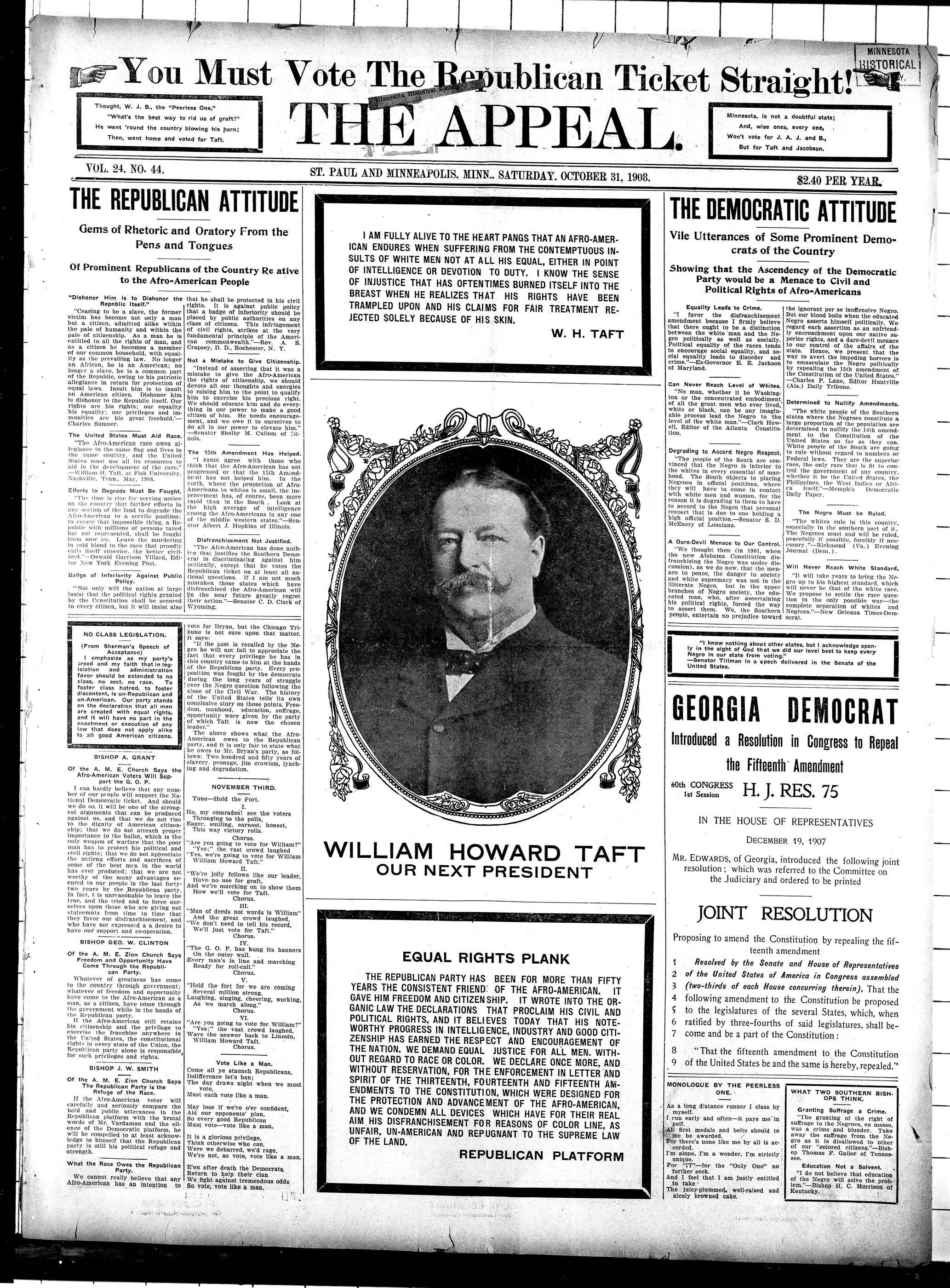
You Must Vote The Republican Ticket Straight!
THE REPUBLICAN ATTITUDE
Gems of Rhetoric and Oratory From the Pens and Tongues
Of Prominent Republicans of the Country Re ative to the Afro-American People
VOL. 24. NO. 44.
THE REPUBLIC
Gems of Rhetoric and
Pens and
Of Prominent Republican
to the Afro-Ar
"Dishonor Him is to Dishonor the
Republic itself."
"Ceasing to be a slave, the former
victim has become not only a man
but a citizen, admitted alike within
the pale of humanity and within the
pale of citizenship. As a man he is
entitled to all the rights of man, and
as a citizen he becomes a member
of our common household with equal
ity as the prevailing law. No longer
an African, he is an American; no longer a slave, he is a common part of the Republic, owing to his patriotic
allegiance in return for protection of
equal laws. Insult him is to insult
an American citizen. Dishonor him
is dishonor to the Republic itself. Our
rights are his rights; our equality
his equality; our privileges and
immunities are his great freehold.—
Charles Sumner.
The United States Must Aid Race.
The United States Must Aid Race.
"The Afro-American race owes allegiance to the same flag and lives in the same country, and the United States must use all its resources to aid in the development of the race."
—William H. Taft, at Fisk University, Nashville, Tenn., May, 1908.
Efforts to Degrade Must Be Fought
Efforts to Degrade Must Be Fought.
"The time is ripe for serving notice on the country that further efforts in any section of the land to degrade the Afro-American to a servile position; to create that impossible thing, a Reformation that would be tamed but not represented, shall be fought from now on. Leave the murdering in cold blood to the race that proudly calls itself superior, the better civilized."—Oswald Garrison Villard, Editor New York Evening Post.
Badge of Inferiority Against Public Policy.
"Not only will the nation at large insist that the political rights granted by the Constitution shall be secured to every citizen, but it will insist also
NO CLASS LEGISLATION.
(From Sherman's Speech of Acceptance)
I emphasize as my party's breed and my faith that in legislation and administration favor should be extended to no class, no sect, no race. To foster class hatred, to foster discontent, is un-Republican and un-American. Our party stands on the declaration that all men are created with equal rights, and it will have no part in the enactment or execution of any law that does not apply alike to all good American citizens.
BISHOP A. GRANT
Of the A. A. M. E. Church Says the Afro-American M. G. O. P. Support the M. G. O. P.
I can hardly believe that any number of our people will support the National Democratic ticket. And should we do so, it will be one of the strongest arguments that can be produced against us, and that we do not rise to the dignity of American citizenship; that we do not attach proper importance to the ballot, which is the only weapon of warfare that the poor man has to protect his political and civil rights; that we do not appreciate the untiring efforts and sacrifices of some of the best men in the world has ever produced; that we are not afraid of the many advantages secured to our people in the last forty-two years by the publican party. In fact, t is unreasonable to leave the true, and the tried and to be trusted selves upon those who are giving our statemeets from time to time that they favor our disfranchisement, and who have not expressed a a desire to have our support and co-operation.
BISHOP GEO. W. CLINTON
Of the A. M. E. Zion Church Says Freedom and Opportunity Have Come Through the Republic- can Party
Whatever of greatness has come to the country through government; whatever of freedom and opportunity have come to the Afro-American as a man, as a citizen, have come through the system in the hands of the Republican party. If the Afro-American still retains his citizenship and the privilege to exercise the franchise anywhere in the United States, the constitutional rights of sovereignty, union, the Republican party alone is responsible for such privileges and rights.
BISHOP J. W. SMITH
Of the A. M. E. Zion Church Says The Republican Party is the Refuge of the Race. If the Afro-American voter will carefully and seriously compare the bold and public utterances in the Republican platform with the brutal words of Mr. Vardaman and the silence of a democratic platform, he will be compelled to least acknowledge to himself that the Republican party is still his political refuge and strength.
What the Race Owes the Republican Party.
We cannot really believe that any Afro-American has an intention to
that he shall be protected in his civil rights. It is against public policy that a badge of inferiority should be placed by public authorities on any class of citizens. This infringement of civil rights, strikes at the very fundamental principle of the American commonwealth."—Rev. A. S. Crapsley, D. D., Rochester, N. Y.
Not a Mistake to Give Citizenship.
"Instead of asserting that it was a mistake to give the Afro-American the rights of citizenship, we should raise our thoughts and energies to raise him to qualify him to exercise his precious right. We should educate him and do everything in our power to make a good citizen of him. He needs encouragement, and we owe it to ourselves to do all in our power to elevate him."—Senator Shelby M. Cullom of Illinois.
The 15th Amendment Has Helped.
"I cannot agree with those who think that the Afro-American has not progressed or that the 15th Amendment has not helped him. In the north, where the proportion of Afro-Americans to whites is small, the improvement of of course, been more rapid than in the South, in the high average of intelligence among the Afro-Americans in any one of the middle western states."—Senator Albert J. Hopkins of Illinois.
Disfranchisement Not Justified
"The Afro-American has done nothing that justifies the Southern Democrat in discriminating against him politically, except that he votes the Republican ticket on at least all national questions. If I am not much mistaken those states which have disfranchised the Afro-American will in the near future greatly regret their action."—Senator C. D. Clark of Wyoming.
vote for Bryan, but the Chicago Tribune is not sure upon that matter. It says:
"If the past is recalled by the Negro he will not fall to appreciate the fact that every privilege he has in this country came to him at the hands of the Republican party. Every proposition was fought by the democrats over the Negro position following the close of the Civil War. The historian of the United States tells its conclusive story on those points, Freedom, manhood, education, suffrage, opportunity were given by the party of which Taft is now the chosen leader."
The above shows what the Afro-American owes to the Republican party, and it is fair to state what he owes to Mr. Bryan's role, as follows: Two hundred and fifty years of slavery, peonage, jim crowism, lynching and degradation.
NOVEMBER THIRD
Tune—Hold the Fort.
I.
Ho, my comrades! see the voters
Thronging to the polls,
Eager, smiling, earnest, honest,
This way victory rolls.
Chorus.
"Are you going to vote for William?"
"Yes;" the vast crowd laughed
"Yes, we're going to vote for William
William Howard Taft."
II.
"We're jolly fellows like our leader,
Have no use for graft,
And we're marching on to show them
How we'll vote for Taft."
Chorus.
III.
"Man of deeds not words is William"
And the great crowd laughed.
"We don't need to tell his record,
We'll just vote for Taft."
Chorus.
IV.
"The G. O. P. has hung its banners
On the outer wall.
Every man's in line and marching
Ready for roll-call."
Chorus.
V.
"Hold the fort for we are coming
Several million strong,
Laughing, singing, cheering, working,
As we march along."
Chorus.
VI.
"Are you going to vote for William?"
"Yes;" the vast crowd laughed,
Wave the answer back to Lincoln,
William Howard Taft.
Chorus.
Vote Like a Man.
Come all ye staunch Republicans,
Indifference let's ban;
The day draws night when we must
vote,
Must each vote like a man.
May lose if we're o'er confident,
Aid our opponents' plan,
So every good Republican
Must vote—vote like a man.
It is a glorious privilege,
Think otherwise who can.
Were we debarred, we'd rage,
We're not, so vote, vote like a man.
E'en after death the Democrata
Return to help their clan
We fight against tremendous odds
So vote, vote like a man.
ST. PAUL AND MINNEAPOLIS. MINN.. SATURDAY. OCTOBER 31, 1908.
I AM FULLY ALIVE TO THE HEART PANGS THAT AN AFRO-AMERICAN ENDURES WHEN SUFFERING FROM THE CONTEMPTUOUS INSULTS OF WHITE MEN NOT AT ALL HIS EQUAL, EITHER IN POINT OF INTELLIGENCE OR DEVOTION TO DUTY. I KNOW THE SENSE OF INJUSTICE THAT HAS OFTENTIMES BURNED ITSELF INTO THE BREAST WHEN HE REALIZES THAT HIS RIGHTS HAVE BEEN TRAMPLED UPON AND HIS CLAIMS FOR FAIR TREATMENT REJECTED SOLELY BECAUSE OF HIS SKIN. W. H. TAFT
[Portrait of a man in formal attire, framed by an ornate decorative border with roses and ribbons].
WILLIAM HOWARD TAFT OUR NEXT PRESIDENT
EQUAL RIGHTS PLANK
THE REPUBLICAN PARTY HAS BEEN FOR MORE THAN FIFTY YEARS THE CONSISTENT FRIEND OF THE AFRO-AMERICAN. IT GAVE HIM FREEDOM AND CITIZENSHIP. IT WROTE INTO THE ORGANIC LAW THE DECLARATIONS THAT PROCLAIM HIS CIVIL AND POLITICAL RIGHTS, AND IT BELIEVES TODAY THAT HIS NOTEWORTHY PROGRESS IN INTELLIGENCE, INDUSTRY AND GOOD CITIZENSHIP HAS EARNED THE RESPECT AND ENCOURAGEMENT OF THE NATION. WE DEMAND EQUAL JUSTICE FOR ALL MEN. WITHOUT REGARD TO RACE OR COLOR. WE DECLARE ONCE MORE, AND WITHOUT RESERVATION, FOR THE ENFORCEMENT IN LETTER AND SPIRIT OF THE THIRTEENTH, FOURTEENTH AND FIFTEENTH AMENDMENTS TO THE CONSTITUTION, WHICH WERE DESIGNED FOR THE PROTECTION AND ADVANCEMENT OF THE AFRO-AMERICAN, AND WE CONDEMN ALL DEVICES WHICH HAVE FOR THEIR REAL AIM HIS DISFRANCHISEMENT FOR REASONS OF COLOR LINE, AS UNFAIR, UN-AMERICAN AND REPUGNANT TO THE SUPREME LAW OF THE LAND.
DECRATIC A
ss of Some Prom
ents of the Countr
the Ascendency of
would be a Menace to
Rights of Afro-Am
THE DEMOCRATIC ATTITUDE
THE DEMOCRATIC ATTITUDE
Vile Utterances of Some Prominent Democrats of the Country
Showing that the Ascendency of the Democratic Party would be a Menace to Civil and Political Rights of Afro-Americans
"I favor the disfranchisement amendment because I firmly believe that there ought to be a distinction between the white man and the Negro politically as well as socially. Political equality of the races tends to encourage social equality, and social equality leads to disorder and crime."—Ex-Governor E. E. Jackson of Maryland.
Can Never Reach Level of Whites.
"No man, whether it be Washington or the concentrated embodiment of all the greatest men who ever lived, white or black, can be any imaginable process lead the Negro to the level of the white man."—Clark Hortell, Editor of the Atlanta Constitution.
Degrading to Accord Negro Respect
"The people of the South are convinced that the Negro is inferior to the whites in every essential of manhood. The South objects to placing Negroes in official positions, where they will have to come in contact with white men and women, for the reason it is degrading to them to have to accord to the Negro that personal respect that is due to one holding a high official position—Senator S. D. McEnery of Louisiana.
A Dare-Devil Menace to Our Control.
"We thought them (in 1901, when the new Alabama Constitution dischristening the Negro was under discussion), as we now, that the menace to peace, the danger to society and white supremacy was not in the illiterate Negro, but in the branches of Negro society, the educated man, who, after ascertainting his political rights, forced the way to assert them. We, the Southern people, entertain no prejudice toward
"I know nothing about other
ly in the sight of God that we
Negro in our state from voting
—Senator Tillman in a speech
United States.
GEORGIA
Introduced a Resolution
the Fifteenth
60th CONGRESS
1st Session
H. J.
IN THE HOUSE O
ing about other states, but I am
good that we did our level be-
from voting."
in a speech delivered in the
A DEM
resolution in Cong
Fifteenth' Amendm
H. J. RES. 7
HOUSE OF REPRESI
"I know nothing about other states, but I acknowledge openly in the sight of God that we did our level best to keep every knee in our state from voting"—Senator Hillman in a speech delivered in the Senate of the United States.
GEORGIA DEMOCRAT
60th CONGRESS H. J. RES. 75 1st Session
IN THE HOUSE OF REPRESENTATIVES
DECEMBER 19, 1907
MR. EDWARDS, of Georgia, introduced the following resolution; which was referred to the Committee of the Judiciary and ordered to be printed
JOINT RESOLUTION
Proposing to amend the Constitution by repealing the tenth amendment
1 Resolved by the Senate and House of Representatives of the United States of America in Congress assent
2 (two-thirds of each House concurring therein), The following amendment to the Constitution be pro-
5 to the legislatures of the several States, which ratified by three-fourths of said legislatures, shall come and be a part of the Constitution:
8 "That the fifteenth amendment to the Constitution of the United States be and the same is hereby, repeal
Georgia, introduced which was referred to the diary and ordered to be
RESOLU
d the Constitution by seventh amendment
the Senate and House
States of America in the
Beach House concurring
adment to the Consti-
tures of the several State-fourths of said leg-
part of the Constitution
seventh amendment to
ates be and the same is
MR. EDWARDS, of Georgia, introduced the following joint resolution; which was referred to the Committee on the Judiciary and ordered to be printed
JOINT RESOLUTION
Proposing to amend the Constitution by repealing the fifteenth amendment
1 Resolved by the Senate and House of Representatives of the United States of America in Congress assembled (two-thirds of each House concurring therein), That the following amendment to the Constitution be proposed to the legislatures of the several States, which, when ratified by three-fourths of said legislatures, shall become and be a part of the Constitution:
8 "That the fifteenth amendment to the Constitution of the United States be and the same is hereby, repealed."
MONOLOGUE BY THE PEERLESS
ONE.
As a long distance runner I class by myself.
I run early and often—it pays me in pelf.
All first medals and belts should to me be awarded.
For there's none like me by all is accorded.
I'm alone, I'm a wonder, I'm strictly unique.
For "IT"—for the "Only One" no further seek.
And I feel that I am justly entitled to take.
The juicy-plummed, well-raised and nicely browned cake.
```markdown
```
$2.40 PER YEAR.
STATIC ATTITUDE
me Prominent Demo-
ne Country
ency of the Democratic
Menace to Civil and
of Afro-Americans
the ignorant per se inoffensive Negro. But our blood boils when the educated Negro asserts himself politically. We regard each assertion as an unfriendly encroachment upon our native superior rights, and a dare-devil menace to our control of the affairs of the state. Hence, we present that the way to avert the impeding horrors is to emasculate the Negro politically by repealing the 15th amendment of the Constitution of the United States."
—Charles P. Lane, Editor Huntville (Ala.) Daily Tribune.
Determined to Nullify Amendments
"The white people of the Southern states where the Negroes constitute a large proportion of the population are determined to nullify the 14th amendment to the Constitution of the United States so far as they can. White people of the South are going rule without regard to numbers or Federal laws. They are the superior race, the race that is fit to control the government of the country, whether it be the United States, Philippines, the West Indies or Africa itself."—Memphis Democratic Daily Paper.
The Negro Must be Ruled.
"The whites rule in this country, especially in the southern part of it. The Negroes must and will be rulled, peacefully if possible, forcibly if necessary."-Richmond (Va.) Evening Journal (Dem.).
Will Never Reach White Standard
"It will take years to bring the Negro up to his highest standard, which will never be that of the white race. We propose to settle the race question in the only possible way—the complete separation of whites and Negroes."—New Orleans Times-Democrat.
states, but I acknowledge open-did our level best to keep every delivery in the Senate of the
DEMOCRAT
in Congress to Repeal
n Amendment
RES. 75
F REPRESENTATIVES
introduced the following joint
deferred to the Committee on
ordered to be printed
SOLUTION
institution by repealing the fif-
mendment
and House of Representatives
(America in Congress assembled
(be concurring therein). That the
the Constitution be proposed
to several States, which, when
of said legislatures, shall be
Constitution:
Amendment to the Constitution
and the same is hereby, repealed."
WHAT TWO SOUTHERN BISH-
OPS THINK.
TRENTING Suffrage a Crime.
"The granting of the right of suffrage to the Negroes, en masse, was a crime and blunder. Take away the suffrage from the Negro as it is disallowed to either of our "colored citizens."—Bishop Thomas F. Gallor of Tennessee.
Education Not a Solvent.
"I do not believe that education of the Negro will solve the problem."—Bishop H. C. Morrison of Kentucky.
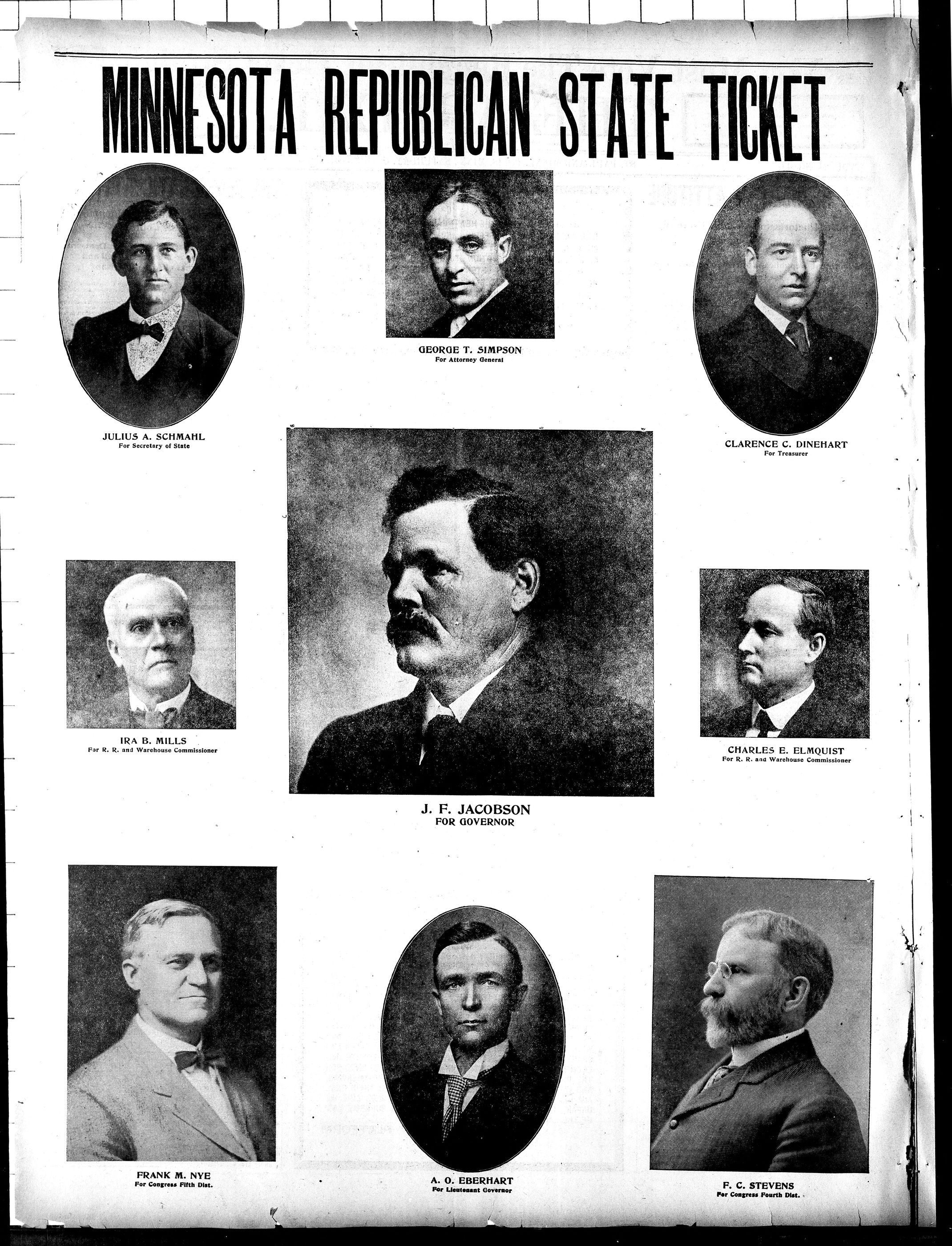
MINNESOTA REPUBLICAN STATE TICKET
J. H.
JULIUS A. SCHMAHL
For Secretary of State
[Picture of a man with white hair and a dark suit, looking slightly to the side.]
IRA B. MILLS
For R. R. and Warehouse Commissioner
[Picture of a man in a suit with a bow tie].
FRANK M. NYE
For Congress Fifth Dist.
H. H.
GEORGE T. SIMPSON
For Attorney General
[Image of a man with a mustache and a suit]
J. F. JACOBSON
FOR GOVERNOR
J. B.
A. O. EBERHART
For Lieutenant Governor
[Picture of a man in a suit and tie].
CLARENCE C. DINEHART
For Treasurer
PETER H. HARRIS
CHARLES E. ELMQUIST For R. R. and Warehouse Commissioner
[Name]
[Name not visible in the image]
F. C. STEVENS
For Congress Fourth Dist.
Proposed Amendments
—TO THE—
Constitution
—OF—
Minnesota
—BY—
The Legislature
General Session,
1907.
St. Paul, Minn., May 1st, 1908.
Hon. Julius A. Schmaltz, Secretary of State—
Sir: As required by Section 25 of the
Revised Laws, as amended, I have the
disposition to be sent to the electors of the
respective amendments proposed to the
Constitution of the State of Minnesota by
the Legislature of 1907, and which are
applicable to the State of Idaho State at the General Election of 1908.
FIRST PROPOSED AMENDMENT
The first proposed amendment is contained in 1907. By this amendment it is sought to repeal Sections one (1), two (2), three (3), and four (4) of Constitution (the ninth) of Constitution (the latter section being the amendment to said Article 1907), which now reads, in 1896,
Section 1. All taxes to be raised in this state shall be as nearly equal as may be, and all property of which the tax is paid shall have a cash valuation and be equalized and uniform throughout the state. Provided that the legislature may be generated, if the tax is not met, the rate of principal corporations are levy assessments for local improvements upon the property frontling upon such improvements, or upon the property to be held to be held by the Imports, or both, without regard to cash valuation, and in such manner as the legislature may prescribe: and provided that the expenses of laying water pipes and supplying any city or municipality with water, the legislature may, by general or special law, amortize the costs of the principal capitalization, available population of five thousand or more, to levy an annual tax or assessment upon the lineal foot of all lands fronting on the lineal foot of any city or population, such city or municipality within corporate limits of said city for supplying water to the citizen thereof without any tax, and the value of such city, and to empower such city to collect any such tax, and to pay the costs of penalties for failure to pay the tax, or penalties for failure to pay the liabilities of the rules of such city or municipality in regard to the use of water, or for any water rate due for the same year and by the other further than there may be law-levied and collected a tax upon all inhances, devises, bequests, legacies and gifts of every kind and description as the lineal foot of all land and natural persons and corporations. Such tax above such exempted sum may be uniform or may be graded or progressing on the lineal foot of any water tax of five per cent.
Section 2. The legislature shall provide for an annual tax sufficient to defray the estimated ordinary expenses of the state for each year, and whenever it shall happen, the law should be made to the state of the state for any year shall exceed the income of the state for such year the legislature shall provide for levying a tax for the ensuing year sufficient, with other sources of income, to pay the deficiency of the income of the state, together with estimated expenses of such ensuing year. But no law levying a tax or making other provisions for the payment of interest or principal of bonds denominated 'Minnesota State Railroad Bonds', shall take effect, and be not further such law as have been submitted to a vote of the people of the state and adopted by a majority of the electors of the state voting upon the same.
Section 3. Laws shall be passed taxing all taxes, credits, investments in bonds, stocks, joint stock companies, or otherwise, also all real and personal property, according to its true value in money; but public burying grounds, public school houses, public hospitals, academic colleges, universities, communities of learning all churches, church property used for religious purposes, and houses of worship, institutions of purely public charity, public property used exclusively for any public purpose, shall be paid to any amount not exceeding in value two horseradol dollars for each individual, shall be general laws, be exempt from taxation.
Mrs. John Raiser has had the unusual experience of being married to two men of the same name, who are in no way related, and neither of them has seen the other. This fact came out when the woman applied to the county clerk for a license to wed John Raiser, a Muncie man. She said she had married another John Raiser in Kewickay a few years earlier, and she came from him. The second husband said that he knew nothing of the first.
and to substitute therefor the following:
(Sec. 1. The power of taxation shall never be surrendered, suspended or contracted away. Taxes shall be uniform upon the same class of subjects, and shall be levied and collected for public purposes, but public burying grounds, public school houses, public hospitals, academies, colleges, universities, and all seminaries of learning, all churches, church property used for religious purposes, and houses of worship, institutions of purely public charity, and public property used exclusively for any public purpose, shall be exempt from taxation, and there may be exempted from taxation personal property not exceeding in value $200 for each household, individual, or head of a family, as the legislature may determine. But the legislature may authorize municipal corporations to levy and collect assessments for local improvements upon property benefited thereby without regard to a cash valuation, and nothing herein contained shall be construed to affect, modify or repeal any existing law providing for the taxation of the gross earnings of railroads.
This proposed constitutional amendment was submitted and voted upon at the state legislature, but not ratified. But a contest was instituted by interested parties, claiming that the amendment was not carried. That contest is now being contested, and that account that the legislature decided to re-submit the amendment to the people, so that however the content may be altered, the power granted by the amendment. For the purpose of discussing the effect of the amendment, the same amendment submitted at the last election, did not carry. Because of this amendment would be to greatly enlarge the power of the legislature with reference to the subject of taxation. Section one of the amendment imposes taxes imposed be equal—as near as may be—on all forms of property, and all property upon which a tax is imposed. ALL LEGISLATION equalized throughout the state. Section two (2) as it now stands requires the legislature to levy the necessary taxes imposed on all persons and persons of the state. That is the duty of the legislature without any constitutional direction. Section three (3) as it now stands provides that all real and personal property, including MONEYS, CREDITS and INVENTMENTS IN BONDS AND STOCKS, be required according to their true value in money.
Section four (4) as it now stands provides that property employed in banking must be deposited on the property. This is only a repetition of the requirements of Sections one (1) and three (3), as no rational exemption is imposed on capital should be exempt from taxation. Section seventeen (17) as it now stands is not easy to understand, but it was intended to be made clear that the operation of sections one (1) and three (3), above quoted, property of the classes themselves enumerated, so that gross earnings from the operation of sections one (1) and three (3) of the present Constitution many amendments were from time to time added so as to permit taxes to be imposed on the kinds of property otherwise than upon the property equalized throughout the state. We have among these exceptions railroad gross earnings from inheritance taxes; and the gross earnings taxes authorized by said section seventeen. Several exemptions from taxation are also provided for, but as these exemptions are not changed by the proposed amendment, I will make no further refinement.
The amendment which, if adopted, would take the place of all of the sections simple and plain. No provision of the Constitution is necessary to authorize the imposition of the taxes necessary for the implementation of the constitutional subdivisions. The power of taxation is inherent in government. This proposed amendment would be inherent in the power of taxation shall never be dereed, suspended or contracted away; that taxes shall be imposed for public purposes; that the same class of subjects. Should this amendment be adopted all property of every kind in the state would be subject to the same law as the legislature saw fit to adopt, provided only that the tax was leaved for a public purpose and was uniform on the same basis as the state. Every amendment every tax law we now have on the statue books would continue to be valid, because under this amendment all limitations would be taken away.
The adoption of this amendment would, in addition, adopt the so-called Inheritance tax amendment that adopted in 1898, as contained in Section seventeen (17), to give the legislature greater authority. Under this amendment the power to impute taxes would be given, and any form of gross earnings tax would be valid. The gross earnings tax amendment, as the Constitution provides that they cannot be changed without submittal of the amendment, as the Constitution votes of the people. But with this amendment various new forms of taxation could be imposed on mortgage tax on iron and the registry tax on mortgages. Under the present Constitution we would be able to non-residents. A registry which would be valid under this amendment, would be able to all mortgages alike, and to the objects of taxation to have a cash valuation with the tax equalized throughout the no proper Income tax could be imposed.
Sealskin Returns to Fashion.
Sealskin, which is one of the most valued items, has steadily been increased in price. Experts agree that this season the cost of the fur will be almost prohibitive.
Before the Times.
Gustave Dore, who is said to have drawn his first hint of the Infarto from the London streets, lived too soon. He waited for the motor omnibus period.
SECOND PROPOSED AMENDMENT:
The second proposed amendment, contained in the report of the state of Minnesota for the year 1907, to this amendment it is sought to repeal Section sixteen (16) of Article nine (9) of the highway and bridge section, which section now reads as follows:
"For the purpose of lending aid in the construction of highways and bridges, there is hereby created a fund to be known as the 'State Road and Bridge Fund'. Said fund shall be used for the construction of any road that come derived from investments in the internal improvement land fund, or that may hereafter accrue to said fund, and the funds may be used for any state road and bridge fund, however provided the legislature is authorized to add to such fund for the purpose of constructing or improving roads and bridges of this state, by providing, in its discretion, for the construction of any state road and bridge of this state of not to exceed in any year one-twentieth (1-2) of one (1) mill on the taxable property within this state, by providing the appropriate provide for the appointment, by the governor of the state, of a board to be appointed to the position, consisting of three (3) members, who shall perform such duties as shall be prescribed by law without salary or compensation."
"Such commission shall have general jurisdiction over all state roads and bridges, and shall use such fund in the construction thereof and over all state roads and bridges, and shall use such cities in the state upon an equitable basis. Provided further, that no county shall reconstitute a road or bridge per cent or less than one-half (1) of one (1) per cent of the total fund thus construced, and, provided further, that no more than one-third (1-3) of such fund accrual be bridged, and in no case shall more than one-third (1-3) of the cost of construc-tion be paid by the state from such fund.
and to substitute therefor the following:
"Section 16. For the purpose of lending aid in the construction and improvement of roads, the state Road and Bridge Fund shall fund the construction and acquisition from the income derived from investments in the internal improvement land fund, or that may hereafter accrue funds accruing to any state road and bridge fund, however provided, to add to such fund, for the purpose of constructing or improving roads and bridges of this state, by providing, in its discretion, the funds accruing to any state road and bridge fund, however provided, to add to such fund, for the purpose of constructing or improving roads and bridges of this state," and effect of this amendment is to authorize the legislature to levy upon all the property of the state any amount necessary, in its judgment, for the construction and improvement thereof, and in so far removes the limitation which now exists in the Constitution, whereby the legislature prevented the construction and improvement of one-twentieth (1-20) of one (1) mill on the taxable property within the state. This amendment further authorizes the legislature to provide salary and compensation, in the person of the officer, for the duty of the highway commission, or any other like officer entrusted by law with similar duties.
Finally, this amendment removes the limitation which imposes upon the powers of the highway commission in the distribution of the road and bridge fund of the state thereby au-
doring the state's responsibility to pay from such fund toward the cost of constructing or improving any road or bridge, and leaves the whole management of the highway to the legislature shall deem wise. The adoption of this amendment will not limit the highway commission to create a highway commission and define its powers, nor will it intervene in the office of the present commission.
THIRD PROPOSED AMENDMENT
The third proposed amendment is contained in Chapter 379 of the Laws of Missouri and amendment it is sought to add to the following section to Article nine (9) of the Constitution as a new section. The statute may provide for the payment by the State of Missouri of damages to growing crops by the county, to provide a fund for that purpose, may impose a specific tax upon land the owner owns, to the same with county auditors for that purpose, and no payment shall be made of any such damages except from the county.
The purpose and effect of this amendment is to permit the state to become a legislature to collect the collection and disbursement of a fund for the payment or damages to growing crops. The state may be to be created and maintained by a specific tax upon the lands of such persons for such purpose. There can be no tax on such persons with same with their respective county auditors for such purpose. There can be no tax on any owner who does not consent there to. Its adoption will authorize the legislature to raise such fund, and machinery of the state be used to level and the tax necessary to raise such fund, and the same by the officers of disbursement of the same by the officers of disbursement of payments to be made by the state by reason of damage by hall or wind will have no other. The state would assume no responsibility beyond the amount of such damage and could not further be rendered liable.
FOURTH PROPOSED AMENDMENT.
The fourth proposed amendment is contained in Chapter 480 of the Laws of Minnesota and it is sought to repeal the provisions of Section seven (7) of Article seven (7) of the Constitution, which section now reads "Every person who by the provisions of this article shall be entitled to vote at any election shall be eligible to any office held by the people in the district wherein he shall have resided thirty days previous to such election, except as otherwise proclaimed and laws of the United States.
and to substitute therefor the following:
"Every person who by the provisions of
"this person shall be entitled to vote at
any election, and is eligible to be office
which now is, or hereafter shall be,
by the people in the district wherein
he shall have resided thirty days previous
to the election, in county superintendents of schools, who are required to have educational qualifications to be determined by the legislature, and
required to be admitted in this Constitution, or the Constitution and laws of the United States."
The purpose and effect of this amendment are to require educational qualifications, in addition to all the other qualifications now required for any person seeking the office of county superintendent. As the Constitution now stands any legal voter is eligible to the office of county superintendent of schools.
The foregoing four proposed amendments proposed for adoption at the enduring General Election.
Yours respectfully,
EDWARD JOYING,
Attorney General.
From nearly every section of the country it is reported that the chestnut trees are literally covered with burra. This is especially the case in the woods in the vicinity of Lock Haven, while trees on farms are also well filled. Some of the weather wise are already on deck with a prediction for a severe winter by reason of a plentiful supply of nuts for squirrels, bears and other wild game to feed upon.
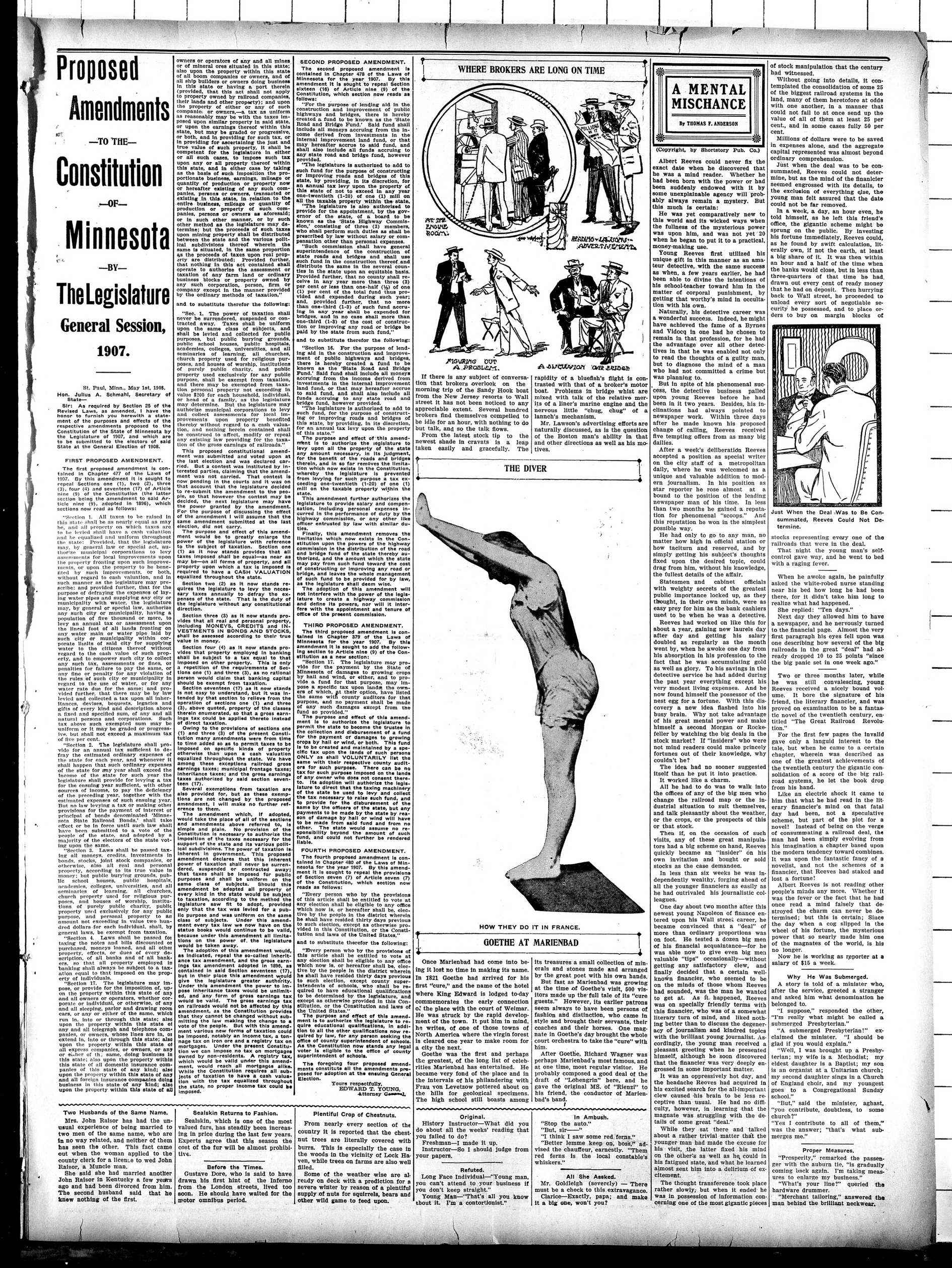
WHERE BROKERS ARE LONG ON TIME
AT THE ENGINE ROOM.
READING LADIES' ADVERTISING
ADVERTISMENT.
FIGURING OUT A PROBLEM.
If there is any subject of conversation that brokers overlook on the morning trip of the Sandy Hook boat from the New Jersey reserves to Wall street it has not been noticed to any appreciable extent. Several hundred brokers find themselves compelled to be idle for an hour, with nothing to do but talk, and so the talk flows.
From the latest stock tip to the newest shade in cravats is a leap taken easily and gracefully. The
HOW THEY DO
GOETHE AT
THE DIVER
Once Marienbad had come into being it lost no time in making its name. In 1821 Goethe had arrived for his first "cure," and the name of the hotel where King Edward is lodged to-day commemorates the early connection of the place with the court of Welmar. He was struck by the rapid development of the town. It put him in mind, he writes, of one of those towns of North America where the virgin forest cleared one year to make room for a city the size of Goethe was the first and perhaps the greatest, of the long list of celebrities Marienbad has entertained. He became very fond of the place and in the intervals of his philandering with Frau von Levetzwor pottered about on the hills for geological specimens. The high school still boasts among
Original.
History Instructor—What did you do about all the weeks' reading that you failed to do?
Instructor—So I should judge from your papers.
Refuted.
Long Face Individual—"Young man, you can't attend to your business if you don't keep straight."
Young Man—"That's all you know about it. I'm a contortionist."
A DISCUSSION OVER BRIDGE
rapidity of a bluefish's flight is contrasted with that of a broker's motor boat. Problems in bridge whist are mixed with talk of the relative merits of a aloe's marine engine and the nervous little "chug, chug" of a lannch's mechanism.
Mr. Lawson's advertising efforts are naturally discussed, as is the question of the Boston man's ability in that other directions as well as his motives.
IT IN FRANCE.
MARIENBAD
its treasures a small collection of minerals and stones made and arranged
But fast as Marlenbad was growing at the time of Goethe's visit, 600 guests made up the full tale of its "cure guests." However, its earlier patrons seem always to have been persons of fashion and distinction, who came in style and brought their servants, their coaches and their horses. One magnate in Goethe's day brought the whole court orchestra to take the "cure" with him. After Goethe, Richard Wagner was perhaps Marlenbad's most famous, and at one time, most regular, and it probably composed a good deal of the draft of "Lohengrin," here, and he gave the original MS. of "Rienzi" to his friend, the conductor of Marlenbad's band.
think I saw some red terms.
"Better lemme keep on, boss," advised the chauffeur, earnestly. "Them red forms is the local constable's whiskers."
All She Asked.
Mr. Goldleigh (soverly) — There must be a check to this extravagance.
Clarice—Exactly, papa; and make it a big one, won't you?
A MENTAL MISCHANCE
BY THOMAS F. ANDERSON
(Copyright, by Shortstory Pub. Co.)
Albert Reeves could never fix the exact date when he discovered that he was a mind reader. Whether he had been born with the power or had been suddenly endowed with it by some unexplainable agency will probably always remain a mystery. But this much is certain:
He was yet comparatively new to this world and its wicked ways when the fullness of the mysterious power was upon him, and was not yet 20 when he began to put it to a practical, money-making use.
Young Reeves first utilized his unique gift in this manner as an amateur detective, with the same success as when a few years earlier, he had been able to divine the intentions of his school-teacher toward him in the matter of corporal punishment, by getting that worthy mind in occultation of his own.
Naturally, his detective career was a wonderful success. Indeed, he might have achieved the fame of a Byrnes and Vidocq in one he chosen to remain in that profession, for he had the advantage over all other detectives in that he was enabled not only to read the thoughts of a guilty man, but to diagnose the mind of a man who had not committed a crime but was planning to.
But in spite of his phenomenal success, the detective business palled upon young Reeves before he had been in it two years. Besides, his interest in newspaper work. Within three days after he made known his proposed change of calling, Reeves received five tempting offers from as many big dailies.
After a week's deliberation Reeves accepted a position as special writer on the city staff of a metropolitan daily, where he was welcomed as a unique and valuable addition to modern journalism. In his position as star reporter he rose almost at a bound to the position of the leading journalist, but he never exceeded than two months he gained a reputation for phenomenal "scops." And this reputation he won in the simplest possible way.
He had only to go to any man, no matter how high in official station or how taciturn and reserved, and by simply getting his subject's thoughts fixed upon the desired topic, could drag from him, without his knowledge, the fullest details of the affair.
The menes and cabinet officials with the greatest public importance locked up, as they thought, in their own minds, were as easy prey for him as the bank cashiers used to be when he was a detective.
Reeves had worked on like this for about a year, gaining new laurels day after day and getting his salary doubled as regularly as the month went by, when he awoke one day from his absorption in his profession to the fact that he was accumulated gold as well as glory. To his savings in the detective service he had added during the past year everything except his very modest living expenses. And he now found himself the possessor of the nest egg for a fortune. With this discovery a new idea flashed into his busy brain. Why not take advantage of his great mental power and make himself a second Morgan or Rockefeller by watching the big deals in the stock market? If "insiders" who were not mind readers could make pricely fortunate gifts of their knowledge, why couldn't he? The idea had no sooner suggested itself than he put it into practice. It worked like a charm.
All he had to do was to walk into the offices of any of the big men who change the railroad map or the industrial situation to suit themselves, and talk pleasantly about the weather, or the crops, or the prospects of this or that stock. Then if, on the occasion of such visits, any of these great manipulators had a big scheme on hand, Reeves quickly became an "insider" on his own invitation and bought or sold stocks as the case demanded. In less than six weeks he was independently wealthy, forging ahead of all the younger financiers as easily as he had outrivaled his journalistic colleagues.
One day about two months after this newest young Napoleon of finance entered upon his Wall street career, he became convinced that a "deal" of more than ordinary proportions was on foot. He tested a dozen big men of his financial acquaintance—for he was able now to give even big men valuable "tips" occasionally—without having to sacrifice the fact that finally decided that a certain well-known financier, who seemed to be on the minds of those whom Reeves had sounded, was the man he wanted to get at. As ft. happened, Reeves was on specially friendly terms with this financier, who was of a somewhat literary turn of mind, and liked nothing better than to discuss the degeneracy of journalism and kindred topics with the brilliant young journalist. Asking for a pleasant greeting when he presented himself, although he soon discovered that the financier was very deeply engrossed in some important matter.
It was an oppressively hot day, and the headache Reeves had acquired in his excited search for the all-important clew caused his brain to be less receptive than usual. He had no difficulty in understanding what the magnate was struggling with the details of some great "deal." While they sat there and talked about a rather trivial matter that the younger man had made the excuse for his visit, the latter fixed his mind on the other's as well as he could in his fatigued state, and what he learned almost sent him into a delirium of excitement. The thought transference took place rather slowly, but when it ended he was in possession of information concerning one of the most glorious pieces.
of stock manipulation that the century had wittened.
Without going into details, it contemplated the consolidation of some 25 of the biggest railroad systems in the land, many of them heretofore at odds with one another, in a manner that not fail to at once send up the value of the assets of them at least 25 per cent, and in some cases fully 50 per cent.
Millions of dollars were to be saved in expenses alone, and the aggregate capital represented was almost beyond ordinary comprehension.
Just when the deal was to be consummated, Reeves could not determent, but as the mind of the financier seemed to be aware of its details, to the exclusion of everything else, the young man felt assured that the date could not be far removed.
In a week, a day, an hour even, he told himself, as he left this friend's office, the gigantic scheme might be sprung on the public. By investing his fortune immediately, Reeves could, as he found by swift calculation, literally own, if not the earth, at least a big share of it. It was then within an hour and a half of the time when the banks would close, but in less than three-quarter of that time he had the money to prepare of ready money that he had on hand, back to Wall street, he proceeded unload every sort of negotiable security he possessed, and to place orders to buy on margin blocks of
O
Just When the Deal-Was to Be Consummated, Reeves Could Not Determine.
stocks representing every one of the railroads that were in the deal.
That night the young man's self-control gave way, and he went to bed with a raging fever.
When he awoke again, he painfully asked the white-robed nurse standing near his bed how long he had been there, for it didn't take him long to realize what had happened.
She replied: "Ten days."
Next day they allowed him to have a newspaper, and he nervously turned to the financial page. Almost the very last day, he one-describing how several of the big railroads in the great "deal" had already dropped 10 to 25 points "since the big panic set in one week ago."
Two or three months later, while he was still convalescing, young Reeves received a nicely bound volume. It bore the signature of his friend, the literary financier, and was proved on examination to be a fantastic novel of the twentieth century, entitled "The Great Railroad Revolution." For the first few pages the invalid gave only a languid interest to the tale, but when he came to a certain chapter, wherein was described as one of the greatest achievements of the twentieth century the gigantic consolidation of a score of the big railroad station, he let the book drop his hand.
Like an electric shock it came to him that what he had read in the literary financier's mind on that fatal day had been, not a speculative scheme, but part of the plot for a novel! Instead of being on the verge of a disaster, the man had been simply evolving from his imagination a chapter based upon the modern tendency toward combines. It was upon the fantastic fancy of a novelist, and not the schemes of a financier, that Reeves had staked and lost a fortune! The fact is not reading other people's mids any more. Whether it was the fever or the fact that he had once read a mind falsely that destroyed the charm can never be determined; but this is certain; Since the day when a cog slipped in the wheel of his fortune, the mysterious power that so nearly made him one of magnates of the world, is his longest. Now he is working as reporter at a salary of $15 a week.
Why He Was Submerged.
A story is told of a minister who, after the service, greeted a stranger and asked him what denomination he belonged to.
"I suppose," responded the other, "I'm really what might be called a submerged Presbyterian."
"A submerged Presbyterian!" exclaimed the minister. "I should be able toould explain."
"Well, I was brought up a Presbyterian; my wife is a Methodist; my eldest daughter is a Baptist; my son is an organist at a Unitarian church; my second daughter sings in a Church of England choir, and my youngest goes to a Congregational Sunday school."
"But," said the minister, aghast, "you contribute, doubtless, to some church."
"Yes I contribute to all of them," was the answer, "that's what submerges me."
Proper Measures
"Prosperity," remarked the passenger with the auburn tie. "is gradually coming back again. I'm taking measures to enlarge my business." "What's your line?" queried the hardware drummer.
the hardware drummer.
"Merchant tailoring," answered the man.
"It's a business."
HAVE YOU READ
THE APPEAL?
THE APPEAL,
A NATIONAL AFRO-AMERICAN NEWSPAPER
PUBLISHED WEEKLY BY
ADAMS BROS. EDITORS AND PUBLISHERS.
49 E. 4th St., St Paul, Minn.
OFFICE.
No. 236 Union Block, 4th & Cedar.
J. Q. ADAMS, Manager
MINNEAPOLIS OFFICE
Guaranty Loan Bldg., Room 1020.
H. B. BURK, Manager.
TERMS, STRICTLY IN ADVANCE
SINGLE COPY, ONE YEAR.....$2.00
SINGLE COPY, BIX MONTHS.....1.10
SINGLE COPY, THREE MONTHS.....60
When subscriptions are by any means allowed
to run without prepayment, the terms are
defensible for each 13 weeks and 5 cents for
each week, or at the rate of $2.40 per
year.
Sammittances should be made by Express
Money Order, Post Office Money Order, Re-
ceipt Stamps will be received the same as cash for
the fractional parts of a dollar. Only one
cend and two cend stamps taken.
Jewelry never be seen through the man,
it is almost always worn through the
envelope and be lost; or it may be stolen,
who send silver to in letters to
do it at their home season to be news.
Marriage and death notices 10 lines or less $1. Each additional line 10 cents. Payment
strictly in advance, and to be announced at
auction time, season to be news.
Advertising rates, 10 cents per line, each
insertion. There are fourteen agate lines
in an inch, and about seven words in an
inch. No single advertisements less
than $4. No more than three months contract. Cash must accompany
all orders from parties unknown to us.
The cash must be in the form of a three
months contract.
Reading notices 25 cents per line, each insertion.
No discounts for time or space. Reading
matter is set in brevier type—about six
doubles on the line. All head lines count
The date on the address label shows when subscription expires. Renewals should be made two weeks prior to expiration, so that no paper may be missed, as the paper stops when time is out.
It occasionally happens that papers sent to subscribers are lost or stolen. In case you do not receive any number when due, inform us by postal card at the expiration of five days from that date, and we will cheerfully forward a duplicate of the missing number.
Communications to receive attentions must be newsy, upon important subjects, plainly written only upon one side of the paper; must reach us Tuesdays if possible, anyway not later than Wednesdays, and bear the signature of the author. No manuscript returned, unless stamps are sent for postage.
We do not hold ourselves responsible for the views of our correspondents.
Soliciting agents wanted everywhere. Write for terms. Sample copies free.
in every letter that you write we never fail to
write to you. We are very well written, post office, county and state. Business letters of all kinds must be written on separate sheets from letters containing news or matter for publication. Entered as a letter of publication June 6, 1898, at the post office at St. Paul, Minn., under act of Congress, March 3, 1879.
PRESIDENT ROOSEVELT.
Treat each man according to his worth as a man. Distrust all who would have any one class placed before any other. Other republics have fallen because the unscrupulous have substituted loyalty to class for loyalty to the people as a whole. —President Roosevelt's speech at Little Rock, Ark.
SATURDAY, OCTOBER 31, 1908.
WILLIAM HOWARD TAFT.
The Republican party made no mistake when William Howard Taft was nominated for the presidency.
He is a man of the people, his public record is clean and he stands for policies which mean the continued progress of the nation. He is especially well-equipped for the presidency by the experience he has had in the public service.
Mr. Taft's first public office was assistant prosecuting attorney for Hamilton County, Ohio, to which he was appointed in 1881, and from that time he has been continuously a public servant. And he has made good in every place.
His greatest achievements were in the Phillippines, where he initiated a stable government among the many warring factions and savage tribes and in Cuba, Panama and Porto Rico, the sober judgment and broad statesmanship of William Howard Taft have aided in the solution of the many complex racial and religious problems presented. The Afro-Americans have a good friend in Mr. Taft. He inherited his open sympathy for the race, from his
WASHINGTON
Copyright, 1908, Harris & Ewing, Wash., D.C.
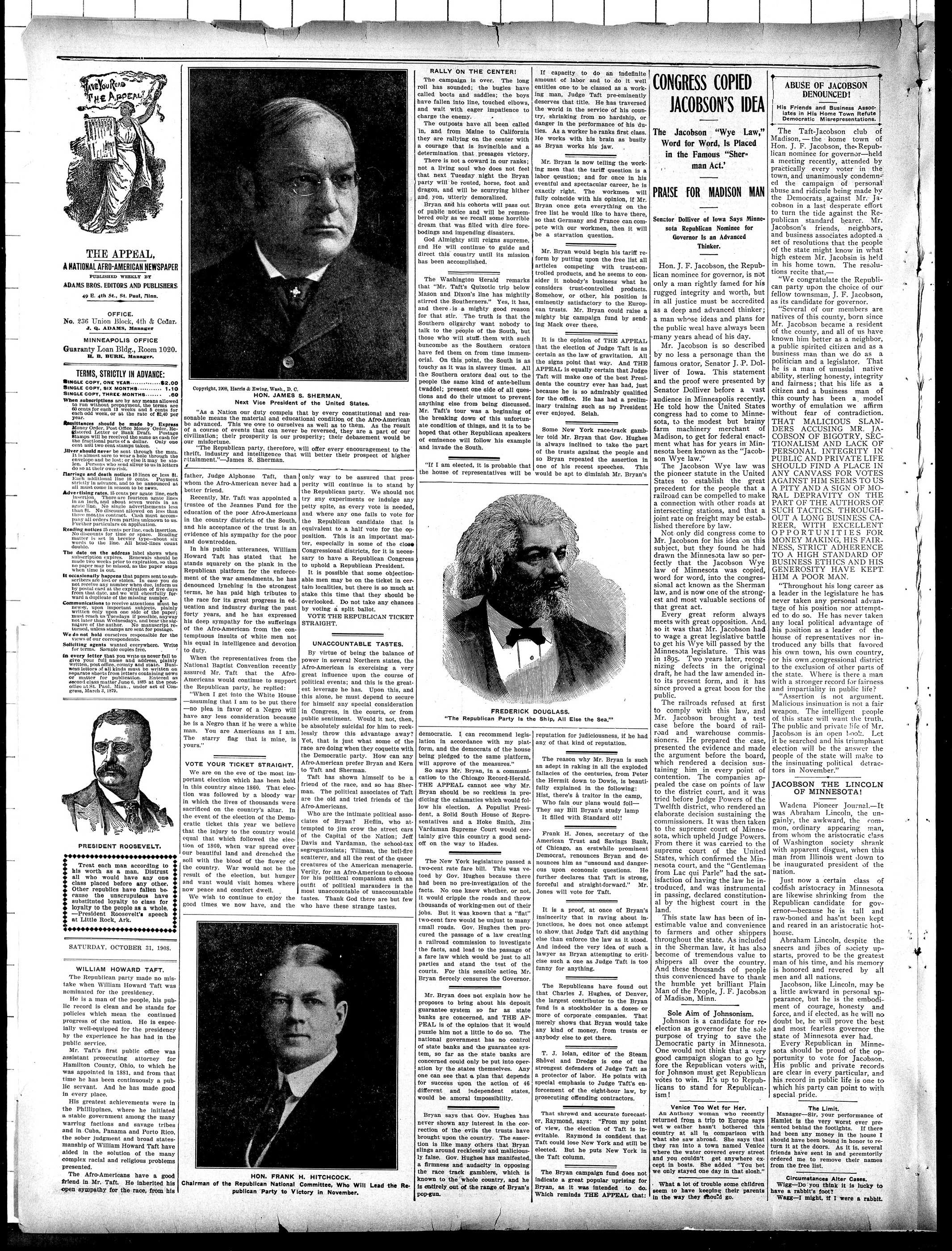
HON. JAMES S. SHERMAN.
Next Vice President of the United States.
"As a Nation our duty compels that by every constitutional and reasonable means the material and educational condition of the Afro-American be advanced. This we owe to ourselves as well as to them. As the result of a course of events that can never be reversed, they are a part of our civilization; their prosperity is our prosperity; their debasement would be our misfortune.
"The Republican party, therefore, will offer every encouragement to the thrift, industry and intelligence that will better their prospect of higher attainment."—James S. Sherman.
M. B.
CHAIRMAN of the Republican National Committee. Will Will Lead the Republican Party to Victory. In November.
father, Judge Alphonse Taft, than whom the Afro-American never had a better friend. Recently, Mr. Taft was appointed a trustee of the Jeannes Fund for the education of the poor Afro-Americans in the country districts of the South, and his acceptance of the trust is an evidence of his sympathy for the poor and downtradden.
In his public utterances, William Howard Taft has stated that he stands squarely on the plank in the Republican platform for the enforcement of the war amendments, he has denounced lynching in the strongest terms, he has paid high tributes to the race for its great progress in education and industry during the past forty years, and he has expressed his deep sympathy for the sufferings of the Afro-American from the contemptuous insults of white men not his equal in intelligence and devotion to duty.
When the representatives from the National Baptist Convention recently assured Mr. Taft that the Afro-Americans would continue to support the Republican party, he replied:
"When I get into the White House—assuming that I am to be put there—no plea in favor of a Negro will have any less consideration because he is a Negro than if he were a white man. You are Americans as I am. The starry flag that is mine, is yours."
VOTE YOUR TICKET STRAIGHT.
We are on the eve of the most important election which has been held in this country since 1880. That election was followed by a bloody war in which the lives of thousands were sacrificed on the country's altar. In the event of the election of the Democratic ticket this year we believe that the injury to the country would equal that which followed the election of 1860, when war spread over our beautiful land and drenched the soil with the blood of the flower of the country. War would not be the result of the election, but hunger and want would visit homes where now peace and comfort dwell.
We wish to continue to enjoy the good times we now have, and the
only way to be assured that prosperity will continue is to stand by the Republican party. We should not try any experiments or indulge any petty spite, as every vote is needed, and where any one fails to vote for the Republican candidate that is equivalent to a half vote for the opposition. This is an important matter, especially in some of the close Congressional districts, for it is necessary to have a Republican Congress to uphold a Republican President. It is possible that some objectionable men may be on the ticket in certain localities, but there is so much at stake this time that they should be overlooked. Do not take any chances by voting a split ballot. VOTE THE REPUBLICAN TICKET STRAIGHT.
UNACCOUNTABLE TASTES
By virtue of being the balance of power in several Northern states, the Afro-American is exercising a very great influence upon the course of political events; and this is the greatest leverage he has. Upon this, and this alone, he must depend to secure for himself any special consideration in Congress, in the courts, or from public sentiment. Would it not, then, be absolutely suicidal for him to recklessly throw this advantage away? Yet, that is just what some of the race are doing when they coquette with the Democratic party. How can any Afro-American prefer Bryan and Kern to Taft and Sherman. Taft has shown himself to be a friend of the race, and so has Sherman. The political associates of Taft are the old and tried friends of the Afro-Americans.
Who are the intimate political associates of Bryan? Heflin, who attempted to jim crow the street cars of the Capital of the Nation; Jeff Davis and Vardaman, the school-tax segregationists; Tillman, the hell-fire scatterer, and all the rest of the queen creatures of the American menagerie. Verily, for an Afro-American to choose for his political companions such an outfit of political marauders is the most unaccountable of unaccountable tastes. Thank God there are but few who have these strange tastes.
D. R. King
FREDERICK DOUGLASS.
"The Republican Party is the Ship, All Else the Sea,"
The campaign is over. The long roll has sounded; the bugles have called boots and saddles; the boys have fallen into line, touched elbows, and wait with eager impatience to charge the enemy.
The outposts have all been called in, and from Maine to California they are rallying on the center with a courage that is invincible and a determination that presages victory.
There is not a coward in our ranks; not a living soul who does not feel that next Tuesday night the Bryan party will be routed, horse, foot and dragon, and will be scurrying hither and yon, utterly demoralized.
Bryan and his cohorts will pass out of public notice and will be remembered only as we recall some horrible dream that was filled with dire forebodings and impending disasters.
God Almighty still reigns supreme,
and He will continue to guide and
direct this country until its mission
has been accomplished.
The Washington Herald remarks that "Mr. Taft's Quixotic trip below Mason and Dixon's line has mightily stirred the Southerners." Yes, it has, and there is a mighty good reason for that stir. The truth is that the Southern oligarchy want nobody to talk to the people of the South, but those who will stuff them with such buncombe as the Southern orators have fed them on from time immemorial. On this point, the South is as touchy as it was in slavery times. All the Southern orators deal out to the people the same kind of ante-bellum twaddel; present one side of all questions and do their utmost to prevent anything else from being discussed. Mr. Taft's tour was a beginning of the breaking down of this unfortunate condition of things, and it is to be hoped that other Republican speakers of eminence will follow his example and invade the South.
"If I am elected, it is probable that the house of representatives, will he
FREDERICK
"The Republican Party is th
democratic. I can recommend legislation in accordance with my platform, and the democrats of the house being pledged to the same platform, will approve of the measures."
So says Mr. Bryan, in a communication to the Chicago House-Herald. THE APEALE cannot see why Mr. Bryan should be so reckless in predicting the calamities which would follow his election. A Populist President, a Solid South House of Representatives and a Hoke Smith, Jim Vardaman Supreme Court would certainly give this country a good send-off on the way to Hades.
The New York legislature passed a two-cent rate fare bill. This was vetoed by Gov. Hughes because there had been no pre-investigation of the facts. No one knew whether, or not, it would cripple the roads and throw thousands of working-men out of their jobs. But it was known that a "flat" two-cent fare would be unjust to many small roads. Gov. Hughes then procured the passage of a law creating a railroad commission to investigate the facts, and lead to the passage of a fare law which would be just to all parties and stand the test of the courts. For this sensible action Mr. Bryan fiercely censures the Governor.
Mr. Bryan does not explain how he proposes to bring about his deposit guarantee system so far as state banks are concerned, and THE APPEAL is of the opinion that it would puzzle him not a little to do so. The national government has no control of state banks and the guarantee system, so far as the state banks are concerned could only be put into operation by the states themselves. Any one can see that a plan that depends for success upon the action of 46 different and independent states, would be amoral impossibility.
Bryan says that Gov. Hughes has never shown any interest in the correction of the evils the trusts have brought upon the country. The assertion is like many others that Bryan slings around recklessly and maliciously false. Gov. Hughes has manifested, a firmness and audacity in opposing the race track gamblers, which is known to the whole country, and he is entirely out of the range of Bryan's pop-gun.
If capacity to do an indefinite amount of labor and to do it well entitles one to be classed as a working man, Judge Taft pre-eminently deserves that title. He has traversed the world in the service of his country, shrinking from no hardship, or danger in the performance of his duties. As a worker he ranks first class. He works with his brain as busily as Bryan works his jaw.
Mr. Bryan is now telling the working men that the tariff question is a labor question; and for once in his eventful and spectacular career, he is exactly right. The workmen will fully coincide with his opinion, if Mr. Bryan once gets everything on the free list he would like to have there, so that Germany and France can compete with our workmen, then it will be a starvation question.
Mr. Bryan would begin his tariff reform by putting upon the free list all articles competing with trust-controlled products, and he seems to consider it nobody's business what he considers trust-controlled products. Somehow, or other, his position is eminently satisfactory to the European trusts. Mr. Bryan could raise a mighty big campaign fund by sending Mack over there.
It is the opinion of THE APPEAL that the election of Judge Taft is as certain as the law of gravitation. All the signs point that way. AND THE APPEAL is equally certain that Judge Taft will make one of the best Presidents the country ever has had, just because he is so admirably qualified for the office. He has had a preliminary training such as no President ever enjoyed. Selah.
Some New York race-track gambler told Mr. Bryan that Gov. Hughes is always inclined to take the part of the trusts against the people and so Bryan repeated the assertion in one of his recent speeches. This would be an act to diminish Mr. Bryan's
DOUGLASS.
The Ship, All Else the Sea."
reputation for judiciousness, if he had any of that kind of reputation.
The reason why Mr. Bryan is such an adept in raking in all the exploded fallacies of the centuries, from Peter the Hermit down to Dowie, is beautifully explained in the following: Hist, there's a traitor in the camp, Who fain our plans would foll— They say Bill Bryan's study lamp It filled with Standard oil!
Frank H. Jones, secretary of the American Trust and Savings Bank, of Chicago, an erstwhile prominent Democrat, renounces Bryan and denounces him as "unsound and dangerous upon economic questions. He further declares that Taft is strong, forceful and straight-forward." Mr. Jones will vote for Taft.
It is a proof, at once of Bryan's sincerity that in raving about injunctions, he does not once attempt to show, that Judge Taft did anything else than enforce the law as it stood. And indeed the very idea of such a lawyer as Bryan attempting to criticise such a one as Judge Taft is too funny for anything.
The Republicans have found out that Charles J. Hughes, of Denver, the largest contributor to the Bryan fund is a stockholder in a dozen or more of corporate companies. That merely shows that Bryan would take any kind of money, from trusts or anybody else to get there.
T. J. Iolan, editor of the Steam Shovel and Dredge is one of the strongest defenders of Judge Taft as a protector of labor. He points with special emphasis to Judge Taft's enforcement of the eight-hour law, by prosecuting offending contractors.
That shrewd and accurate forecaster, Raymond, says: "From my point of view, the election of Taft is inevitable. Raymond is confident that Taft could lose New York and still be elected. But he puts New York in the Taft column.
The Bryan campaign fund does not indicate a great popular uprising for Bryan, as it was intended to do. Which reminds THE APPEAL that:
---
CONGRESS COPIED JACOBSON'S IDEA
The Jacobson "Wye Law,' Word for Word, Is Placed in the Famous "Sherman Act"
PRAISE FOR MADISON MAN
Senator Dolliver of Iowa Says Minnesota Republican Nominee for Governor Is an Advanced
Hon. J. F. Jacobson, the Republican nominee for governor, is not only a man rightly famed for his rugged integrity and worth, but in all justice must be accredited as a deep and advanced thinker; a man whose ideas and plans for the public weal have always been many years ahead of his day.
Mr. Jacobson is so described by no less a personage than the famous orator, Senator J. P. Dolliver of Iowa. This statement and the proof were presented by Senator Dolliver before a vast audience in Minneapolis recently. He told how the United States congress had to come to Minnesota, to the modest but brainy farm machinery merchant of Madison, to get for federal enactment what has for years in Minnesota been known as the "Jacobson Wye law."
The Jacobson Wye law was the pioneer statute in the United States to establish the great precedent for the people that a railroad can be compelled to make a connection with other roads at intersecting stations, and that a joint rate on freight may be established therefore by law.
Not only did congress come to Mr. Jacobson for his idea on this subject, but they found he had drawn the Minnesota law so perfectly that the Jacobson Wye law of Minnesota was copied, word for word, into the congressional act known as the Sherman law, and is now one of the strongest and most valuable sections of that great act.
Every great reform always meets with great opposition. And so it was that Mr. Jacobson had to wage a great legislative battle to get his Wye bill passed by the Minnesota legislature. This was in 1895. Two years later, recognizing defects in the original draft, he had the law amended into its present form, and it has since proved a great boon for the public.
The railroads refused at first to comply with this law, and Mr. Jacobson brought a test case before the board of railroad and warehouse commissioners. He prepared the case, presented the evidence and made the argument before the board, which rendered a decision sustaining him in every point of contention. The companies appealed the case on points of law to the district court, and it was tried before Judge Powers of the Twelfth district, who rendered an elaborate decision sustaining the commissioners. It was then taken to the supreme court of Minnesota, which upheld Judge Powers. From there it was carried to the supreme court of the United States, which confirmed the Minnesota court, and the "Gentleman from Lac qui Parle" had the satisfaction of having the law he introduced, and was instrumental in passing, declared constitutional by the highest court in the land.
This state law has been of inestimable value and convenience to farmers and other shippers throughout the state. As included in the Sherman law, it has also become of tremendous value to shippers all over the country. And these thousands of people thus convenienced have to thank the humble yet brilliant Plain Man of the People, J. F. Jacobson of Madison, Minn.
Sole Aim of Johnsonis
Johnson is a candidate for re-election as governor for the sole purpose of trying to save the Democratic party in Minnesota. One would not think that a very good campaign slogan to go before the Republican voters with, for Johnson must get Republican votes to win. It's up to Republicans to stand for Republicanism!
Venice Too Wet for Her.
An Anthony woman who recently returned from a trip to Europe says wet w eather hasn't bothered this country at all in comparison with what she saw abroad. She says that they ran into a town named Venice where the water covered every street and you couldn't get anywhere except in boats. She added "You bet we only stayed one day in that sloth."
What a lot of trouble some children seem to have keeping their parents in the way they should go.
ABUSE OF JACOBSON
DENOUNCED!
His Friends and Business Associates in His Home Town Refute Democratic Misrepresentations.
The Taft-Jacobson club of Madison,—the home town of Hon. J. F. Jacobson, the Republican nominee for governor—held a meeting recently, attended by practically every voter in the town, and unanimously condemned the campaign of personal abuse and ridicule being made by the Democrats, against Mr. Jacobson in a last desperate effort to turn the tide against the Republican standard bearer. Mr. Jacobson's friends, neighbors, and business associates adopted a set of resolutions that the people of the state might know in what high esteem Mr. Jacobsin is held in his home town. The resolutions recite that.
"We congratulate the Republican party upon the choice of our fellow townsman, J. F. Jacobson, as its candidate for governor.
"Several of our members are natives of this county, born since Mr. Jacobson became a resident of the county, and all of us have known him better as a neighbor, a public spirited citizen and as a business man than we do as a politician and a legislator. That he is a man of unusual native ability, sterling honesty, integrity and fairness; that his life as a citizen and a business man of this county has been a model worthy of emulation we affirm without fear of contradiction. THAT MALICIOUS SLANDERS ACCUSING MR. JACOBSON OF BIGOTRY, SECTIONALISM AND LACK OF PERSONAL INTEGRITY IN PUBLIC AND PRIVATE LIFE SHOULD FIND A PLACE IN ANY CANVASS FOR VOTES AGAINST HIM SEEMS TO US A PITY AND A SIGN OF MORAL DEPRAVITY ON THE PART OF THE AUTHORS OF SUCH TACTICS. THROUGHOUT A LONG BUSINESS CAREER, WITH EXCELLENT OPPORTUNITIES FOR MONEY MAKING, HIS FAIRNESS, STRICT ADHERENCE TO A HIGH STANDARD OF BUSINESS ETHICS AND HIS GENEROSITY HAVE KEPT HIM A POOR MAN.
"Throughout his long career as a leader in the legislature he has never taken any personal advantage of his position nor attempted to do so. He has never taken any local political advantage of his position as a leader of the house of representatives nor introduced any bills that favored his own town, his own country, or his own congressional district to the exclusion of other parts of the state. Where is there a man with a stronger record for fairness and impartiality in public life?
"Assertion is not argument. Malicious insinuation is not a fair weapon. The intelligent people of this state will want the truth. The public and private life of Mr. Jacobson is an open book. Let it be searched and his triumphant election will be the answer the people of the state will make to the insinuating political detractors in November."
JACOBSON THE LINCOLN
OF MINNESOTA!
Wadena Pioneer Journal.—It was Abraham Lincoln, the ungainly, the awkward, the common, ordinary appearing man, from whom the aristocratic class of Washington society shrank with apparent disgust, when this man from Illinois went down to be inaugurated president of the nation.
Just now a certain class of codfish aristocracy in Minnesota are likewise shrinking from the Republican candidate for governor—because he is tall and raw-boned and hasn't been kept and reared in an aristocratic hot-house.
Abrham Lincoln, despite the sneers and jibes of society upstarts, proved to be the greatest man of his time, and his memory is honored and revered by all men and all nations.
Jacobson, like Lincoln, may be a little awkward in personal appearance, but he is the embodiment of courage, honesty and force, and if elected, as he will no doubt be, he will prove the best and most fearless governor the state of Minnesota ever had.
Every Republican in Minnesota should be proud of the opportunity to vote for Jacobson. His public and private records are clear in every particular, and his record in public life is one to which his party can point to with special pride.
The Limit.
Manager—Sir, your performance of Hamlet is the very worst ever presented behind the footlights. If there had been any money in the house I should have been bound in honor to return it at the doors. As it is, several friends have sent in and per centerly ordered me to remove their names from the free list.
Circumstances Alter Cases.
Wigg—Do you think it is lucky to have a rabbit's foot?
Wazeg—I might if I wore a rabbit
Wagg-I might, if I were a rabbit.
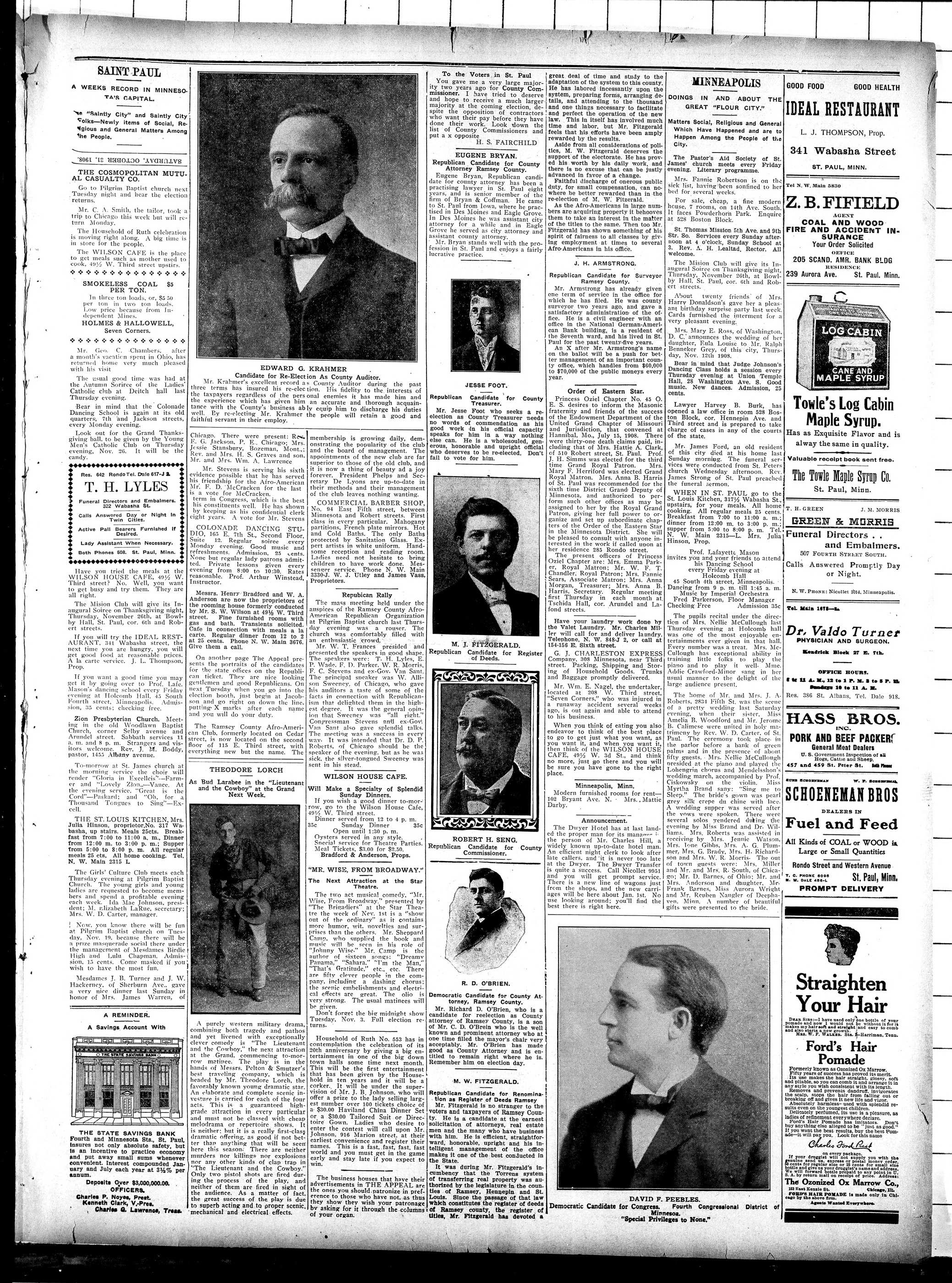
SAINT PAUL
A WEEKS RECORD IN MINNESOTA'S CAPITAL.
"Saintly City" and Saintly City Folks—Newly items of Social, Religious and General Matters Among the People.
THE COSMOPOLITAN MUTUAL CASUALTY CO.
Go to Pilgrim Baptist church next Tuesday night and hear the election returns.
Mr. C. A. Smith, the tailor, took a trip to Chicago this week but will return Monday.
The Household of Ruth celebration is moving right along. A big time is in store for the people.
The WILSON CAFE is the place to get meals such as mother used to cook, 49% W. Third street upstairs.
In three ton loads, or, $5.50 per ton in two ton loads. Low price because from Independent Mines.
HOLMES & HALLOWELL,
Seven Corners.
Mr. Geo C. Chambers, after a month's vacation spent in Ohio, has returned home very much pleased with his visit.
The usual good time was had at the Autumn Sorice of the Ladies Catholic club at Deitch hall last Thursday evening.
Bear in mind that the Colonade Dancing School is again at its old quarters, 7th and Jackson streets, every Monday evening.
Look out for the Grand Thanksgiving gift, to be given by the Young Men's Catholic Club on Thursday evening, Nov. 26. It will be the candy.
Res. 642 Rondo Tel. Dale 617 J-2
T. H. LYLES
Funeral Directors and Embalmers.
322 Wabasha St.
Calls Answered Day or Night In
Twin Cities.
Active Pall Bearers Furnished if
Desired.
Lady Assistant When Necessary.
Beth Fischer 508 St. Paul Minn
Have you tried the meals at the WILSON HOUSE CAFE, 49½ W. Third street? No. Well, you want to get busy and try them. They are all right.
The Mison Club will give its Inaugural Soiree on Thanksgiving night, Thursday, November 26th, at Bowlby Hall, St. Paul, cor. 6th and Robert streets.
If you will try the IDEAL REST-AURANT, 341 Wabasha street, the next time you are hungry, you will get good food at reasonable prices. A la carte service. J. L. Thompson, Prop.
If you want a good time you may get it by going over to Prof. Lakes Mason's dancing school every Friday evening at Holecomb Hall, 45 South Fourth street, Minneapolis, Admission, 35 cents; checking free
Zion Presbyterian Church. Meeting in the old Woodland Baptist Church, corner Selby avenue and Arundel street. Sabbath services 11 a. m. and 8 p. m. Strangers and visitors welcome. Rev. J. M. Boddy, pastor, 1455 Albany avenue.
To-morrow at St. James church at the morning service the choir will render "Gloria in Execellis"—Farmer and "Lovely Zion,"—Vance. At the evening service, "Great is the Cord"—Paskard; and "Oh, for a Thousand Tongues to Sing"—Excell.
THE ST. LOUIS KITCHEN, Mrs. Julia Hinson, proprietor No. 317 Wabasha, up stairs. Meals 25cts. Breakfast from 7:00 to 11:00 a. m., Dinner from 12:00 m. to 3:00 p. m.; Supper from 5:00 to 8:00 p. m. All regular meals 25 cts. All home cooking. Tel. N. W. Main 2315 L.
The Girls' Culture Club meets each Thursday evening at Pilgrim Baptist Church. The young girls and young ladies are requested to become members and spend a profitable evening each week. Ida Mae Johnson, president; M. Elizabeth LaRue, secretary; Mrs. W. D. Carter, manager.
Now, you know there will be fun at Pilgrim Baptist church on Tuesday, Nov. 19, because there will be a prize masquerade social there under the management of Mesdames Birdie High and Lulu Chapman. Admission, 15 cents. Come masked if you wish to have the most fun.
Mesdames J. B. Turner and J. W. Hackerney, of Sherburn Ave, gave a very nice dinner last Sunday in honor of Mrs. James Warren, of
A REMINDER.
A Savings Account With
THE STATE SAVINGS BANK
Fourth and Minnesota Sts., St. Paul,
insures not only absolute safety, but
is an incentive to practice economy
and put away small sums whenever
convenient. Interest compounded Jan-
uary and July each year at 3 1/2% per
annum.
Deposits Over $3,000,000.00.
OFFICERS.
Charles P. Noyes, Prest.
Kenneth Clark, V.-Pres.
Charles G. Lawrence, Treas.
```markdown
```
W. H.
Mr. Krahmer's excellent record as County Auditor during the past three terms has insured his re-election. His fidelity to the interests of the taxpayers regardless of the personal enemies it has made him and the experience which has given him an accurate and thorough acquaintance with the County's business ably equip him to discharge his duties well. By re-electing Mr. Krahmer the people will retain a good and faithful servant in their employ.
Chicago. There were present: Res. E. G. Jackson, P. E. Chicago; Mrs. Jessie Stansbury, Bozeman, Mont.; Rev. and Mrs. H. S. Graves and son, Mr. and Mrs. Wm. A. Lawrence
Mr. Stevens is serving his sixth evidence possible that he has served his friendship for the Afro-American Mr. F. D. McCracken for the last is a vote for McCracken.
term in Congress, which is the best his constituents well. He has shown by keeping as his confidential clerk eight years. A vote for Mr. Stevens
membership is growing daily, demonstrating the popularity of the club and the board of management. The appointments of the new club are far superior to those of the old club, and it is now a thing of beauty ad a joy forever. President Phelps and Secretrie De Lyons are up-to-date in their methods and their management of the club leaves nothing wanting.
COMMERCIAL BARBER SHOP No. 94 East Fifth street, between Minnesota and Robert streets. First class in every particular, Maegan
COLONADE DANCING STUDIO, 165 E. 7th St, Second Floor, Suite 12. Regular soiree every Monday evening. Good music and refreshments. Admission. 25 cents. None but regular lady patrons admitted. Private lessons given every evening from 8:00 to 10:30. Rates reasonable. Prof. Arthur Winstead, Instructor.
Messrs. Henry Bradford and W. A. Anderson are now the proprietors of the rooming house formerly conducted by Mr. S. W. Wipen at 48% W. Third street. Fine furnished rooms with gas and bath. Transients solicited. Cafe in connection with meals a la carte. Regular dinner from 12 to 2 at 25 cents. Phone N. W. Main 3676. Give them a call.
On another page The Appeal presents the portraits of the candidates for the state offices on the Republican ticket. They are nice looking gentlemen and good Republicans. On next Tuesday when you go into the election booth, just begin at Jacobson and go right on down the line, putting X marks after each name and you will do your duty.
The Ramsey County Afro-American Club, formerly located on Cedar street, is now located on the second floor of 115 E. Third street, with everything new but the name, The
THEODORE LORCH
As Bud Larabee in the "Lieutenant and the Cowboy" at the Grand Next Week.
1910
A purely western military drama, combining both tragedy and pathos and yet livened with exceptionally clever comedy is "The Lieutenant and the Cowboy," the next attraction at the Grand, commencing to-morrow matinee. The play is in the hands of Messrs. Pelton & Smutzer's best traveling company, which is headed by Mr. Theodore Lorch, the favorably known young dramatic star. An elaborate and complete scenic investiture is carried for each of the four acts. This is a guaranteed high-grade attraction in every particular and must not be classed with cheap melodrama or repertoire shows. It is neither; but it is a really first-class dramatic offering, as good if not better than anything that will be seen here this season. There are neither explosions nor any other kinds of choreo "The Lieutenant and the Cowboy." Only two pistol shots are fired during the process of the play, and neither of them are fired in sight of the audience. As a matter of fact, the great success of the play is due to superb acting and to proper scenic, mechanical and electrical effects.
membership is growing daily, demonstrating the popularity of the club and the board of management. The appointments of the new club are far superior to those of the old club, and it is now a thing of beauty ad a joy forever. President Phelps and Secretary De Lyons are up-to-date in their methods and their management of the club leaves nothing wanting.
COMMERCIAL BARBER SHOP, No. 49 East Fifth street, between Minnesota and Robert streets. First class in every particular. Mahogany partitions, French plate mirrors. Hot and Cold Baths. The only Baths protected by Sanitation Glass. Expert artists in white uniform. Hand-some reception and reading room. We need not hesitate to bring children to the salon. Senger service. Phone N. W, Main 3330-J. W. J. Utley and James Vass, Propthetes.
Republican Rally
The mass meeting held under the auspices of the Ramsey County Afro-American Republican Organization at Pilgrim Baptist church last Thursday evening was a rouser. The church was comfortably filled with an enthusiastic crowd.
Mr. W. T. Frances presided and presented the speakers in good shape. The speakers were: T. H. Lyles, E. P. Wade, F. D. Parker, W. R. Morris, F. C. Stevens and ex-Gov. Van Sant. The principal speaker was W. Allison Sweeney, of Chicago, who gave his auditors a taste of some of the facts in connection with Republicanism that delighted them in the highest degree. It was the general opinion of Congressman Stevens and ex-Gov. Van Sant also gave splendid talks. The meeting was a success in every way. It was intended that Dr. D. P. Roberts, of Chicago should be the speaker of the evening, but as he was sick, the silver-tongued Sweeney was sent in his stead.
WILSON HOUSE CAFE.
Will Make a Specialty of Splendid
Sunday Dinners.
If you wish a good dinner to-mor-
row, go to the Wilson House Cafe,
49% W. Third street.
Dinner served from 12 to 4 p. m.
35c Sunday Dinner 35c
Open until 1:30 p. m.
Oysters served in any style.
Special service for Theatre Parties.
Meal Tickets, $2.00 for $2.50.
Bradford & Anderson, Props.
"MR. WISE, FROM BROADWAY."
The Next Attraction at the Star
Theatre.
The two act musical comedy, "Mr. Wise, From Broadway," presented by "The Brigadiers" at the Star Theatre the week of Nov. 1st is a "show out of the ordinary" as it contains more humor, wit, novelties and surprises than the others. Mr. Sheppard Camp, who supplied the book and music will be seen in his role of "Johnny Wise." Mr. Camp is the author of sixteen songs: "Dreamy Panama," "Sahara," "I'm the Man," "That's Gratitude," etc., etc. There are fifty clever people in the company, including a dashing chorus; the scenic embellishments and electrical effects are great. The olio is very strong. The usual matinees will be given.
Don't forget the big midnight show Tuesday, Nov. 3. Full election returns.
Household of Ruth No. 553 has in contemplation the celebration of its 20th anniversary by giving a big entertainment in one of the big down town halls some time next month. This will be the first entertainment that has been given by the Household in ten years and it will be a worker. It will be the supervision of Mr. J. B. Johnson, who will offer a prize to the lady selling largest number over 100 tickets choice of a $30.00 Haviland China Dinner Set or a $0.00 Tailored Suit or Directoire Gown. Ladies who desire to enter the contest will call upon Mr. Johnson, 916 Marion street, at their earliest convenience and register their names. This is a fast, fast, fast, fast world and you must get in the game early and stay late if you expect to win.
The business houses that have their advertisements in THE APPEAL are the ones you should memorize in preference to those who have not, so they show they wish you not, by asking for it through the column of your organ.
To the Voters in St. Paul
You gave me a very large major-
ity two years ago for County Com-
missioner. I have tried to deserve
and hope to receive a much larger
majority at the coming election, de-
signed to opposition of contractors
who want their pay before they have
done their work. Look down the
list of County Commissioners and
put a x opposite
EUGENE BRYAN
Republican Candidate for County Attorney Ramsey County.
Eugene Bryan, Republican candidate for county attorney has been a practising lawyer in St. Paul eight years, and is senior member of the firm of Bryan & Coffman. He came to St. Paul from Iowa, where he practised in Des Moines and Eagle Grove. In Des Moines he was assistant city attorney for a while and in Eagle Grove he served as city attorney and assistant county attorney.
Mr. Bryan stands well with the profession in St. Paul and enjoys a fairly lucrative practice.
JOHN H.
JESSE FOOT.
Republican Candidate for County Treasurer.
Mr. Jesse Foot who seeks a re-election as County Treasurer needs no words of commendation as his good work in his official capacity speaks for him in a way nothing else. He is in a troublesome, generous, honorable and upright office who deserves to be re-elected. Don't fail to vote for him.
J. B.
M. J. FITZGERALD.
Republican Candidate for Register of Deeds.
ROBERT H. SENG.
Republican Candidate for County
Commissioner.
R. D. O'BRIEN.
Democratic Candidate for County Attorney, Ramsey County.
Mr. Richard D. O'Brien, who is a candidate for reelection as County attorney of Ramsey County, is a son of Mr. C. D. O'Brien who is the well known and prominent attorney who at one time filled the mayor's chair very acceptably. Mr. O'Brien has made good as County Attorney and is entitled to remain right where he is. Remember him on election day.
M. W. FITZGERALD.
Republican Candidate for Renomination
on President of Republican
ton as Register of Deeds Ramsey Mr. Fitzgerald is no stranger to the veneer and taxpayers of Ramsey County. He is a candidate at the earnest solicitation of attorney real estate men and the many who have invested with him. He is efficient, straightforward, honorable, upright and his intelligent management of the office makes it one of the best conducted in the State. It was during Mr. Fitzgerald's incumbency that the Torrens system of transferring real property was audited and the right nature in the counties of Ramsey, Horton, Louis. Since the passage of that law which constitutes the register of deeds of Ramsey county, the register of titles, Mr. Fitzgerald has devoted a
[Name]
DAVID F. PEEBLES.
Democratic Candidate for Congress. Fourth Congressional District of
Minnesota.
"Special Privileges to None."
great deal of time and study to the adaptation of the system to this county. He has labored incessantly upon the system, preparing forms, arranging details, and attending to the thousand and one things necessary to facilitate and perfect the operation of the new law. This in itself has involved much time and labor, but Mr. Fitzgerald feels that his efforts have been amply rewarded by the results. Aside from all considerations of politics, M. W. Fitzgerald deserves the support of the electorate. He has proved his worth by his daily work, and there is no excuse that can be justly advanced in favor of a change. Faithful discharge of onerous public duty, for small compensation, can now be rewarded than in the re-election of Mr. Fitzgerald. As the Afro-Americans in large numbers are acquiring property it behooves them to take an interest in the matter of the titles to the same. Then too Mr. Fitzgerald has shown something of his spirit of fairness to all classes by giving employment at times to several Afro-Americans in his office.
J. H. ARMSTRONG
Republican Candidate for Surveyor Ramsey County.
Mr. Armstrong has already given one term of service in the office for which he has filed. He was county surveyor two years ago, and gave a satisfactory administration of the office. He was also the office in the National German-American Bank building, is a resident of the Seventh ward, and his lived in St. Paul for the past twenty-five years.
An X after Mr. Armstrong's name on the ballot will be a push for bettle Management of an important county office, which has from $80,000 to $70,000 of the public money every year.
Order of Eastern Star
Princess Oziel Chapter No. 45 O. E. S. desires to inform the Missouri fraternity and friends of the success of the Endowment Department of the United Grand Chapter of Missouri and Jurisdiction, that convened at Hannibal, Mo., July 15, 1908. There were thirty-one death claims paid, in addition to the cases. Kittie Corky of 510 Robert street, St. Paul, Pr. J. H. Simms was elected for the third time Grand Royal Patron. Mrs. Mary F. Herriford was elected Grand Royal Matron. Mrs. Anna B. Harris of St. Paul was recommended for the sixth time District Grand Deputy of Minnesota, and authorized to perform such other offices as may be assigned to her by the Royal Grand Patron, giving her full power to organize and set up subordinate chapels in the Minnesota District. She be pleased to consult with anyone interested in the work if called upon at her residence 285 Rondo street.
The present officers of Princess Oziel Chapter are: Mrs. Emma Parker, Royal Matron; Mr. W. F. T. Chandler, Royal Patron; Mrs. Fannie Sears, Associate Matron; Mrs. Anna Morgan, Treasurer; Mrs. Anna B. Harris, Secretary. Regular meeting first Thursday in each month at Tschild Hall, cor. Arundel and Lafond streets.
Have your laundry work done by the Valet Laundry, Mr. Charles Miller will call for and deliver laundry, Telephone, N. W. 848-J 2, or call 154-156 E. Sixth street.
G. J. CHARLESTON EXPRESS Company, 308 Minnesota, near Third street, Packing, Shipping and Storing of Household Goods. Trunks and Baggage promptly delivered.
Mr. Wm. E. Nagel, the undertaker, located at 208 W. Third street, "Seven Corners," who was injured in a runaway accident several weeks ago, is out again and to attend to his business.
When you think of eating you also endeavor to think of the best place to go to get just what you want, as you want it, and when you want it, then think of the WILSON HOUSE CAFE, 49½ W. 3d St., and think no more, just go there and you will be sure you have gone to the right place.
Minneapolis, Minn.
Modern furnished rooms for rent—102 Bryant Ave. N. Mrs., Mattie Darby.
Announcement.
The Dwyer Hotel has at last landed the proper man for its manager is the person of Mr. Charles Hill, a widely known up-to-date hotel man. An efficient night clerk to look after late callers, and it is never too late at the Dwyer. The Dwyer Transfer is quite a success. Call Nicolell 9931 and you will get prompt service. There is a new line of wagons just from the shops, and the new carriages will be here about Jan. 1st. No use looking around; you'll find the best there is right here.
DOINGS IN AND ABOUT THE
GREAT "FLOUR CITY."
Matters Social, Religious and General
Which Have Happened and are to
Happen Among the People of the
City.
The Pastor's Aid Society of St. James' church meets every Friday evening. Literary programme.
Mrs. Fannie Robertson is on the sick list, having been confined to her bed for several weeks.
For sale, cheap, a fine modern house, 7 rooms, on 14th Ave. South. It faces Powderhorn Park. Enquire at 528 Boston Block.
St. Thomas Mission 5th Ave. and 9th Str. So. Services every Sunday afternoon at 4 o'clock, Sunday School at 3. Rev. A. H. Lealtad, Rector. All welcome.
The Mission Club will give its Inaugural Soiree on Thanksgiving night, Thursday, November 26th, at Bowlby Hall, St. Paul, cor. 6th and Robert streets.
About twenty friends' of Mrs. Harry Donaldson's gave her a pleasant birthday surprise party last week. Cards furnished the interment for a very pleasant evening.
Mrs. Mary E. Ross, of Washington, D. C. announces the wedding of her daughter, Eula Louise to Mr. Ralph Benneker Grey, of this city, Thursday, Nov. 12th 1908.
Bear in mind that Judge Johnson's Dancing Class holds a session every Thursday evening at Union Temple Hall, 28 Washington Ave. S. Good music. New dances. Admission, 25 cents.
Lawyer Harvey B. Burk, has opened a law office in room 528 Boston Block, cor. Hennepin Ave. and Third street and is prepared to take charge of cases in any of the courts of the state.
Mr. James Ford, an old resident of this city died at his home last Sunday morning. The funeral services were conducted from St. Peters church Wednesday afternoon. Rev. James Strong of St. Paul preached the funeral sermon.
WHEN IN ST. PAUL go to the St. Louis Kitchen, 317½ Wabasha St, upstairs, for your meals. All home cooking. All regular meals 25 cents. Breakfast from 10:00 to 11:00 a. m.; dinner from 12:00 m. to 3:00 p. m.; supper from 5:00 to 8:00 p. m. Tel. N. W. Main 2315—L. Mrs. Julia Hinson, Prop.
Prof. Lafayette Mason invites you and your friends to attend his Dancing School every Friday evening at Holcomb Hall
45 South 4th street, Minneapolis. Dancing from 9 p. m. till 1:45 a. m.
Music by Imperial Orchestra
Fred Parkerson, Floor Manager
Checking Free
Admission 35c
The pupils recite under the direction of Mrs. Nellie McCullough last Thursday evening at Holcomb hall was one of the most enjoyable entertainments ever given in that hall Every number was a treat. Mrs. McCullough has exceptional ability in training little folks to play the piano and to play it well. Mme Addie Crawford-Minor sang in her usual manner to the delight of the large audience present.
The home of Mr. and Mrs. J. A. Roberts, 3824 Fifth St. was the scene of a pretty wedding last Saturday evening, when their sister, Miss Amelia B. Woodford and Mr. Jerome B. Calimese were united in holy matrimony by Rev. W. D. Carter, of St Paul. The ceremony took place in the parlor before a bank of green palms and in the presence of about fifty guests. Nessie McCallough presided at the piano and played the Lohengrin chorus and Mendelsson's wedding march, accompanied by Prof. Ciskowsky on the violin. Miss Myrtha Brand sany: "Sing me to Sleep." The bride's gown was pearl grey silk crepe du chine with lace. A wedding supper was served after the vows were spoken. There were several solos rendered during the wedding. Mr. Brand and Jillians, Mrs. Roberts was assisted receiving by Mrs. Jessica Watson, Mrs. Ione Gibbs, Mrs. A. G. Plummer, Mrs. G. Brady, Mrs. H. Richardson and Mrs. W. R. Morris. The out of town guests were: Mrs. Miller and Mr. and Mrs. R. South, of Chicago; Mr. D. Barnes, of Ohio; Mr. and Anderson, of daughter, Mr. Frank Barnes, Miss Aurora Wright and Mr. Reuben Naugen of Deephaven. Minn. A number of beautiful gifts were presented to the bride.
GOOD FOOD
IDEAL RESTAURANT
L. J. THOMPSON, Prop.
341 Wabasha Street
ST. PAUL, MINN.
Tel N. W. Main 5830
AGENT
COAL AND WOOD
FIRE AND ACCIDENT IN-
SURANCE
Your Order Solicited
OEFICE
205 SCAND. AMR. BANK BLDG
RESIDENCE
239 Aurora Ave. St. Paul. Minn.
LOG CABIN
CANE AND
MAPLE SYRUP
Towle's Log Cabin Maple Syrup.
Has as Exquisite Flavor and is alway the same in quality.
Valuable receipt book sent free.
The Towle Maple Syrup Co.
St. Paul, Minn.
T. H. GREEN J. M. MORRIS
GREEN & MORRIS
Funeral Directors . . and Embalmers.
507 FOURTH STREET SOUTH.
Calls Answered Promptly Day or Night.
N. W. PHONE: Nicollet 1014, Minneapolis.
Tel. Main 1078—R.
Dr. Valdo Turner
PHYSICIAN AND SURGEON.
Kendrick Block 27 E. 7th.
OFFICE HOURS.
8 to 11 A. M., 12 to 1 P. M. 3 to 5 P. H.
Sundays 10 to 11 A. M.
Res. 286 St. Albans Tel. Date 618
PORK AND BEEF PACKERS
General Meat Dealers
U. S. Government Inspection of all
Hogs, Cattle and Sheep.
457 and 459 St. Peter St. Both Phones
SUNN SCHOENEMAN W. P. SCHOENEMAN
SCHOENEMAN BROS
DEALERS IN
Fuel and Feed
All Kinds of COAL or WOOD in
Large or Small Quantities
Rondo Street and Western Avenue
T. C. PHONE 8098
N. W. DALE 486-L
St. Paul, Minn.
PROMPT DELIVERY
```markdown
```
Straighten Your Hair
DEAR Sara: I have used only one bottle of your pomade and now I would not be without it for it is makes my hair out and straight and easy to comb and wash. Ms. W. W. Walker. Sta. Hirrima Tana.
Formerly known as Ozonized Ox Marrow.
Fifty years of success has proved its merit. It is a skin-friendly, non-toxic, and pliable, so you can comb it and arrange it in any style you wish consistent with its length. It is durable, dandruff-invigorating, so scab, stop, and gives it life and vision.
Absolutely harmless—used with splendid reason even on the youngest children. It is a pleasure, as ladies of refinement everywhere declare.
Ford's Hair Pomade has imitators. Don't buy it until you see results, just as good.
If you want the best results, buy "Pomade-it" will pay you. Look for this name.
If your dreggles will not apply you with the
key. We will express an express or postal money order,
¢s for regular express or postal money order,
bottles and give us your dreggles' name and address.
We will forward bottles prepared to any sold in
S.A. by return mail on receipt of price. Address:
The Ozonized Ox Marrow Co,
133 East Konkie St.
Chicago, IL.
FOR'S HAIR PARADE is made only in Chicago
by the above firm.
Agents Wanted everywhere.
A PATRIARCH OF PUEBLOS
He sat meditatively on the counter of the trading store in the quint old pueblo of Isleta—a striking, venerable figure.
About six feet in height, with a chest like an ox; enormously wide shoulders and arms like door posts; wide, straight, thin lipped mouth, like a trap, and square, powerful jaw, the most massive jaw I have ever seen; eyes dimmed with many more years than the allotted three score and ten; the iron gray hair straggling out of the fire hircled men the Pueblo—this was Patricio Jiron, anywhere from ninety-five to a hundred and five years old, sixteen years war captain of the Isetas and patriarch of the village.
He sat there on the counter smoking cigarettes, rolled and lighted for him by the Indian trader, looking out the doorway across the great brown mea and far beyond that into the village of his home.
The villagers passed in and out, a steady stream, buying "carne," or flour potatoes.
For each and every one as they passed the patriarch had a handshake and a greeting, holding the hand fast for a moment and smiling into the other's face. Nicole Iiron, said the trader, rolling another cigarette. "I've nown him to smoke twenty at one sitting without batting an eye. Oldest man in town. Says he is ninety-five, but he doesn't know, and no one else has any idea how old he really is. He was war captain for the isletas sixteen years hand running. That's the record in this town, I see. They've always got to have him on duty, and he's going on. They say he has christened thirty-six Indian kids here in his time, and there's no bigger honor an isleta wants for his baby. Likes to talk about his fights with the Navajos, and I guess he's slaughtered a bunch of them in his time, all right." It was later in the day that, in company with a bright young isleta boy twin Carolian Aubeya, I called on the aged man in his adobe house, back in the village.
For a few moments the conversation, Indian fashion, consisted of a nicotine laden silence. Finally Antonio casually betrayed some curiosity about the venerable man's past, and, with a little encouragement, he launched into reminiscences that kept him talking basily for half an hour. Though he spoke in the Pueblo, not gestures were so many and so animating the listener could almost see the scenes that rose so clearly before the narrator, understanding nothing of his words. Occasionally he relapsed into a short, ruminative silence and puffed his cigarette, while Antonio translated what he had said. As old Patricio reverted to the days of Navajo campaigns his voice gained strength, his bleached eyes and occasionally, as he recalled the fierce joy of some particularly delightful encounter, he laughed immoderately in and again he would repeat to himself last phrase, seeking to bring back more clearly some incident.
The man's talk was rambling and disconnected as he dwelt on one and another happening that came to his mind, but it was always of the Navajos and the Apaches and the Comanches; their fierce raids on the peaceful Pueblos and the desperate inhabitants of the interior; they fought for their homes and their crops and herds against the marauders.
"It was different in the old days," said Patricio. "Instead of many white men there were everywhere Indians, and instead of cities there were vast heds of buffalo and antelope. Fifty years ago," he said, polishing a shaking pan over the golden sand, "I have seen the buffalo pass down the shore of the great river, so many in number that I could not count them. Sometimes it would take a day for a horse to get past. Often the braves of the Islaeta used to shoot the buffoons, never killed but one. It is amazing how many people in big bull gored me with his horns. Patricio is not a coward, but I would rather hunt the Navajos. It is easier to dodge a Navajo than an angry buffalo bull, and it is easier to kill him." I have gone on many a Navajo hunt. Sometimes we would bring in a Navajo boy or girl to sell as a slave to my people. They were always eager to buy me. One boy I sold for as 50 cents.
"One time, many years ago, long before the senor was born, the Navajo joshed the people of the Jemez pueblo that so made war, and invited them to the Todos San Dulong and San Filine, of Lacuna and Agooma and
The most famous London building in the hands of the housebreakers at the present moment is undoubtedly the old National Scottish church in Crown Court, Covent Garden, a little alleyway which runs north out of Russell street opposite the stage entrance to the Royal College of Art, a variable London landmark. It has, however, for long been too big for the calls upon it, and has been paying under stress a very large ground rent to the duke of Bedford. It will be rebuilt upon the same spot, but on a much smaller plot of land. Meanwhile the services of the church will be conducted in the Newton hall, Fetter large. The old church in Crown Court was originally built about one hundred and ninety years ago. It realized the designs of its founders in a normal
$x = \frac{1}{2} y$
PATRICIO JIRON OF ISLETA, N. M., 95 YEARS OLD.
Zuni, to help pain the thieves who had been driving off their herds, capturing their children and murdering their young men. Clear to Santa Fe and brought back forty long guns for the Isla de la Vieja with whom I went to Cubero and joined a great army of the Pueblo tribes.
"We rode into the Navajo country and had many bloody fights with them, losing many of our lives and killing more of the enemy. I could tell all the things that happened on that journey. Once while riding along with a few braves I came upon a Navajo buck eating his breakfast on the plains. It was not tortillas nor frijoles nor kid; he was pulling thorns out of the cactus and eating it.
"We dashed upon him. He leaped up and, emptying his arrow pouch on the ground, drew his bow and yelled defiance at us. Many arrows he shot at us, when a Pueblo sent an arrow
PATRICIO JIRON OF ISLE
through his left hand. He gave no sign, but, holding his hand behind him, stabbed at us with arrows as we passed. He ran then, and I following him on foot, seized by him the hair and stabbed him with a long knife, for he was a stealer in sheep and cattle and he was a Pueblo boy. "Afterward weaved him again, and the Navajo, instead of being dead, was trying to crawl into a hole near by. A Pueblo then shot him in the head with a pistol. He never grounded or cried out. They are brave, the Navajos, if they are thieves.
"Another time I rode with many braves far to the country of the Moki, seeking Navajo captives. We found a big camp of the enemy, and eighty of them, surrounded them. We fought for many hours, and one of our war canvals was shot.
"The Navajos fought like devils. Finally we had to ride back for the rest of our braves, and when we returned the Navajos had disappeared. They were very cunning and very swift. My compadre, Alejandro, who always traveled and fought by my side, and I each roped a horse from the few the enemy had left, and as my friend roped his a Navajo rose from a hole in the ground like a rabbit and fired at him. It was the last shot that Navajo ever fired. They were very brave but, being my friend, we braved the Pueblo. In one fight an arrow struck one of my men in the forehead, right between the eyes. He only laughed and yelled: "Shoot me good, you dogs! Shoot me where it will hurt, cattle thieves!"
"Once when we fought the Navajos under Ramon Luna in the country of the Moki we had been long without fresh provisions and were very hungry, having nothing but a little corn and some jerked meat. I was riding hard on the trail of a Navajo when my horse stumbled into a hole and broke through into a cache of the Navajos underground, where were hidden much corn and meat and beans, which we fell upon eagerly.
"As we ate there came riding up a stalwart young brave of the Navajos,
MARK GOING.
Fish Church in Convent Garag Down.
fashion for a long while. Then suddenly came a time when it was famous. John Cumming, who had been licensed to preach in May, 1832, by the Aberdeen Presbytery, was acting as tutor in Kensington, when he was invited to preach in the old church in Crown Court. In August of the same year he received a "call" from the church. It was then small and inconvenient, and the minister's income was not over £200. But his preaching soon attracted a huge congregation, and the church was rebuilt in 1847 at a cost of £5,000. It was opened in 1848 with sittings for a thousand persons. The income from new rents reached £1.4 million, but refusing to accept more than £1 million mander paying off the debt incurred for rebuilding. The church has re
```markdown
```
brightly dressed with beads and buck skin and silver, with much silver on his bridle and saddle, showing that he was the son of a wealthy man. Round and round us he rode, jeering and hooting, as fast as his horse could run. Finally Alejandro, my compass and an arrow through his leg, after he had shot us with his ridden under his blanket. In his eagerness his bullet went wild, and with an arrow in his leg we soon captured him.
"Soon after his father rode up to our camp with a guard of braves and exchanged us twenty-five horses as a ransom for his son, whom we delivered over to him.
"Often in the night the Navalos would surround our camp and make noises like cows or sheep. Thinking that we were going to stock, we would salute forth, only to be shot at by the cunning devils.
"We treated the young Navajos kindly when we captured them, and they were always treated kindly in the village. At one time, returning with a war party, Alejandro and I brought in a maiden, very beautiful, and as we rode down over the mess to the pueblo our people, standing on the housetops to welcome back the fighters, cheered us and came running to meet us, crowding around the girl with great admiration. We had slain
TA, N. M., 95 YEARS OLD.
many Navajos this trip, and for two days there was feasting and dancing and merrymaking, while the Navajo girl sat alone in the midst of the fiesta, very mournful, crying for her home, many days journey to the west. But all were kind to her, and finally she was happy. I sold her to Chino Lucero for 350 sheep, and afterward she was married to Francisco, son of Desiderio, the cacique. When she died, not long afterward, all the mourned for her, as they had learned to love her.
"Many times we went forth to fight the Navajos, but never except when she had stolen our animals and attacked us. Sometimes we fought the Comanches—we bravest of all. They would ride a bare horse, without a saddle, wearing nothing except a gee string, and were afraid of nothing.
L
J.
AN ISLETA GIRL MAKING POTTERY.
malned, strangely picturesque and grimy, until to-day.
Now the fashionable congregation has drifted westward to the new church in Pont street, Chelsea, and the old Manse, or dwelling as they call it, built for Cumming, is being pulled down with the rest of the building. The big organ is to be sold and Lady Frances Balfour, one of the last patroness, has it is understood, secured the possession of some of the woodwork, which is beautiful and valuable, in the Manse.
THREAD IN MODERN SURGERY.
Different Sorts of Wounds Require Different Treatment.
Are you aware that the modern surgeon employs in his work dozens of different kinds of thread for sewing up cuts and wounds? Among them are kangaroo tandons, horsehair silk, and very fine silver wire. Many of the threads are intended to hold for a certain number of days, and then naturally break away. The short, tough tendons taken from the kanga-
"I never took but two scalps," said Patricio, "for I did not like to butcher a man like a sheep even if he was my enemy. And I have seen the Navajos kill many of my people. These days are not like the old days, as many moons ago as there are sands in the desert. Then there was always fighting, and the Pueblo had to keep his bow strung or his gum loaded and his knife sharp to protect his family and his herds and his crops. Now the white man has made the Navajo stay in his own country and make blankets, while the Pueblo raises his corn and his flocks in peace. But it was good to be fighting—and Patricio is an old man—an old man, he muttered as he threw away the stub of the last cigarette and sat silent, looking toward the setting sun. Its covering rays turned the mesa into a glowing mystery and cast weed shadows into the sky, yeur depths of the purple distant Mantano range. They outlined boldly the venerable figure, with its aureole of white hair around the face, that was seamed and rugged as the mountains.
With a sigh Patricio Jiron, was captain of the Puebbs, arose to his feet and, with a courteous handclasp, left us, his bent figure disappearing in the doorway of his home as the sun disappeared beyond the mess's rim.
GREEN CLOTHING FOR MEN.
Difference of Opinion as to Whether It Will Be Worn.
Some of the shrewdest clothing people in the business are putting a great deal of confidence in greens, in the belief that they are coming into vogue to a degree not hitherto known in this country.
Greens have reached great popularity in London, and in fact throughout the European continent, where they are worn very extensively by men.
While formerly efforts were made in a way to introduce greens here, no flattering success has as yet attended the green innovation for men after they have reached their distributors.
Nevertheless, greens been bought quite extensively for all by both manufacturers and retailers, and the mute question now is, will they take?
A clothing man who has made considerable study of men's fashions for practical use in the clothing business contends that no color or fabric that can be made a joke of will ever become popular with men, and he holds the butt of his friends' humor.
A high class Fifth avenue tailor imported early in the spring two pieces of green cloth. Up to July 1 he had sold but three suits off the two bolts. Another firm made window displays of green suits, and advertised them as well, but who has seen on Broadway many men attired in green suits? A few, yes.
Greens have been and are still popular in neckwear, and among the fashionably "classy" in shirts for business wear, but for men's clothes it's predicted green would be too much of a joke color. Yet that there are still manufacturing companies clothing men too, who consider greens good for fall selling. We have had ample proof of through seeing their purchases, which for fall comprise quite an assortment of the new greens, some of decided green shade, though designated olive greens.
Green hats have been on the market for ten or a dozen years, but the greens introduced early this year became a novelty with the best trade and an article for window exhibits with the general trade, but not a popular color by any means in headwear. Will there be many men wearing green clothes when only an isolated few have worn green hats?
Young man, don't express a willingness to die for a girl during courtship and then refuse to work for her after marriage.
KOLZ
roo, which are used for sewing severe wounds, will hold for about four weeks before they break away. Silk thread will remain much longer, sometimes six months, while the fine silver wire is practically indestructible.
With the entire outfit a surgeon is able to select a thread that will last as long as the wound takes to heal, and will then disappear completely. To accommodate this assortment of threads special varieties of needles are required. Besides the needle craned in different segments of a circle, surgeons use needles shaped like spears, javelins, and bayonet points.
Jones-Great guns! You're getting deaf, old man.
Smith—I'm not. I could never hear better in my life.
Jones (producing watch)—Can you hear that watch tick?
Smith (triumphantly)—Distinctly.
Jones—That's queer. The watch isn't running.
A Trap.
QUALIFIED
Mistress (to new gardener)—I thought you told me you were a stunchest teetotaler!
Gardener—Not staunch, mum—not staunch!
—Punch.
Rather Bear the Ills He Has.
"Why don't you make more effort to place your issues on the ground?"
"What for?" inquired Senator Sorghum.
"So that they stop antagonizing you."
"My friend," answered Senator Sorghum, "in this business a man must expect to be antagonized. I think a set of enemies can make that I can hold down, and I don't intend to disturb the situation."—Washington Star.
As Advertised.
"What's your time?" asked the old farmer of a brisk salesman.
Experience Required.
The young man was tearing the girl with the bloom pampadour for a kiss.
"Tell me," she demanded, lookin' straight into his eyes, "have you kissed a girl before?"
The young man hesitated a moment then he answered bravely:
"All right," she said, presenting his lips. "I wasn't going to have you practice on me."—Judge.
Too Early.
"We must try to civilize the savage said the man of high purposes."
Mr. Rus, Barker. "There are no answers Mr. Rus, Barker."
"Twenty minutes after five, What can I do for you?" the customers' said the old farmer, leading the way to the window and pointing at a ticket marked "Given away at 5.10."—judge
An Unsolved Mystery.
"Have you a tank in the building?" inquired the inspector from the insurance. "Who hov," admitted the janitor. "What's the capacity?"
"Fair, an Ol iir hod money enough to foind out"—Bohemian Magazine.
The Mistress—My husband was furious, get a kiss when he went to the office. The Maid—Neither did I—Fleigende
husband was furious about the dim
to the office.
Id I.—Flagende Blactter.
THE WOMAN IN THE PLAZA
The Mistress—My husband was furious about the dinner to-day. I didn't even get a kiss when went to the office. The Maiden did—Nothera blaster.
What Did He Mean?
On reaching a certain spot the driver turned around on his seat and observed to the point that "From the road is the road only accessible to mules and donkeys; I must therefore ask the gentlemen to proceed on foot."—The Catholic News
Had Never Tried It.
Had Never Tried It.
"I 'stpose it costs a lot to live in New York.
"So I should imagine." wearily responded the adopted New Yorker, "judging from what it costs to merely exist."
The salary is not large:
The office for ten a week and a governor can earn big money on the Chaugaud circuit."
GOLDEN OPPORTUNITY
"Drink hearty, old man; to-day is
"Really? And to-morrow is mine."
"Great! We'll stay right here a
Blaetter."
man; to-day is my birthday."
orrow is mine."
y right here and celebrate
Kind.
A
The Bitterest Kind.
"They are bitter political enemies."
"Belong to different parties, eh?"
"No, to different factions of the same party."
No Doubt of it.
Teacher—New Johnny, what was Washington's farewell address?
Johnny—Heaven—New York Sun.
```markdown
```
As Advertised
Modern Methods.
No Doubt of It.
Experience Required.
The woman in the image shows the girl with the blonde ponytail to the girl with the blonde ponytail.
"Tell me," she demanded, looking straight into his eyes, "have you even kissed a girl before?" He gestured at me, then he answered bravely: "I cannot tell you a lie; I have." "All right," she said, presenting her lips. "I wasn't going to have you practice on--Judge."
Too Early.
"We must try to civilize the savage," said the man.
said the man of high purposes.
"What I am," answered Mr. Sirius Barker. "There is no use of going to a savage at this time of year and trying to show him the advantage of linen collars and suspenders." —Ex.
Not These Days.
"There was a woman in the case?"
"Yes, but bareheaded, there wasn't room for her hat." —Le Rire.
Over the Land.
And now that fall time scream
We widely hear:
"Just look out for our team"
Next week.
s about the dinner to-day. I didn't even laetter.
Won't Stand for it.
Church—I hear she is going to open one of the quick lunch places.
Gotham—You don't mean it.
"Yes; and she says she'll not have
unset she." The cobble will not stand
"I am afraid the public will not stand for her cooking." -Yonkers Statesman.
Tied Down.
"I'm overworked where I am, and I'm going to leave."
A passing magrate paused to listen to this remark.
"I am overworked where I am," signed he, "but I can't leave."
"It's dangerous to hug the shore in war."
Said young Lieutenant MePelt,
"But it's far more dangerous to hug
my birthday."
and celebrate them both."—Fliegende
What It Does.
He—"Don't worry if I haven't much,
dear. Money doesn't buy happiness."
She—"Perfume not, but it buys
clothes."—Illustrated Bits.
On bards like Shelley frowning,
And Keats.
She only talks of Browning
The wheats.
---
—Punch
Too Early
Not These Days.
Over the Land.
Tied Down.
What It Does.
DOG HAS $200 COFFIN
In a metal coffin with a plate glass top and trimmed and lined with white satin, the body of Diana, a Japanese spaniel owned by Mrs. Florence Baldwin of Elmswood, Ferry road, Stratford, Conn., was taken to Hartsdale, N. Y., and buried in the dog cemetery there.
Diana was born in the Waldorf-Astoria, New York, eleven years ago, two weeks after her mother arrived from Japan. She had a long and blue blooded pedigree, and was then owned by Mrs. Mary Weston, from whom Mrs. Baldwin bought her when
DIANA
Diana was six weeks old for $400.
Mrs. Baldwin removed from New
York three years ago.
No child ever received more care and attention than were bestowed on Diana. The little spaniel, which weighed two and a quarter pounds, was clothed in the finest of silks and satins, according to the weather, yet, despite this precaution, Diana got pneumonia last Sunday and died that night.
Mrs. Baldwin, distracted with grief at the loss of her pet, ordered a special coffin costing $200.
LIGHTNING STRIKES SHIPS.
Much More Often Than is Supposed—Conductors for Electric Currents. In spite of the popular impression to the contrary, ships remote from the land are soldom damaged by lightning, although some of the most awe inspiring displays of atmospheric electricity are frequently witnessed by those on board of them.
Standing rigging and even parts of the running gear are now made of steel wire, and this substitute for the old fashioned hemp serves the purpose of lightning conductor when the ship is not fitted with such an aid to safety. The electric current is conveyed down the wire rigging and reaches the sea through the vessel's metal hull. Damage occurs only if the current be interrupted on its way to earth. In a comparatively large proportion of instances the foreroyal truck is struck by lightning, that of the main less frequently and the mitzen least of the three.
Very serious casualties under this head occurred to warships and merchant vessels in the days of wooden hulls and hemp rigging. In July, 1802, as thirteen sail of the East India company were trying to round the cape in the vicinity of Algoa Bay, homeward bound, two of them, the Britannia and the Bombay Castle, were struck by lightning. The foremast of each was soon enveloped in flames and the masts had to be cut away in order to save the ships and their combustible cargoes. A heavy gale was blowing, the night was dark, and the other ships of the fleet, which were hove to at the time, were witnesses of this thrilling incident.
Many vessels are now fitted with lightning conductors of approved types, lest the wire rigging should fat, to carry off the electric current, hung on a deck after a severe thunderstorm, accommodate storming and rain in 3 degrees south, 27 degrees east, the P. and O. steamship Victoria had a sudden increase of deviation, amounting to six degrees in both the standard and the wheelhouse compasses, and later it was dislodged by lightning conductor on the fare had fused. The ship must have been struck by lightning during the storm.
Chickweed Venders of Paris
The vender of chickweed in Paris is a well known figure. The sellers are numerous, and their cry is one of the most noteworthy of those that resound in the French capital. According to the Bulletin des Halles, there are about 10,000 canaries in the capital, and the daily consumption of chickweed is estimated at £400. This sums books for large, but it only allows a penny each a bird. Be that as it may, a Paris contemporary points out that a goodly point of land between Suresnes and Combevoie is set aside for the cultivation of the weed.
An Insult.
Sam—What's d' matter with you and Chloe?
Sam—What's Matter 'nough. She insulted my friend, Mr. Jackson, what called on me las 'mast.
Sam—Insulted Mr. Jackson, did she?
Sam—Dat's what she done. She asked me who dat 'ere noctural visit, was!
"It is true that this rich prisoner is
either freed liberty" or "Unlimited liberty". Why, certainly not. He isn't allowed to go outside the state."
The Formula.
"How about that barber shop? Do they sterilize everything?" "Well, everything except the conversation."
VOTE IT STRAIGHT.
WILLIAM H. TAFT
For President of the United States.
JAMES S. SHERMAN
For Vice Pres. of the United States.
For Electors
Of President and Vice-President of the
United States.
JULUS KESPHOL, Jr., Quincy, ILL.
JOHN ANDERSON,
446 Cleveland Ave., Chicago.
GEORGE W. KING,
2706 Michigan Ave., Chicago.
HARRY W. HARVEY,
2706 Washington Ave., Chicago.
WALTER PAGE,
5942 Normal Ave., Chicago.
JAMES A. FINUCANE,
2244 Loomis St., Chicago.
JULUS LIEBLING,
429 S. Union Ave., Chicago.
HOMER G. GAPIN,
724 Monroe St., Chicago.
JOSEPH F. HAAS,
503 Fullerton Ave., Chicago.
WILLIAM D. DOCK,
61 W. Fullerton St., Chicago.
JOHN F. WILLIAMS,
427 Center St., Chicago.
JOHN V. FARRAL, Lake Forest, Ill.
M. E. PLAIN, Aurora, Ill.
WINFIELD SCOTT ALLISON.
GEORGE W. I. BROWN, Ixon, Ill.
J. O. PEASLEY, Macomb, Ill.
J. O. FATEN, Ray, Ill.
CATHERINE H. PRINCIPLE, Princeton, Ill.
SAIN WELTY, Bloomington, Ill.
WILLIAM W. BRUCE, Casey, Ill.
MILLIAM M. CLINTON, Clinton, Ill.
WILLIAM MUMFORD, Philadelphia, Ill.
JOHN W. KITCHELL, Pana, Ill.
JOHN W. KITCHELL, Pana, Ill.
HARRY FERRIMAN, Greenville, Ill.
JULIUS C. KERN, Carmel, Ill.
O. J. PAGE, Marion, Ill.
For Governor.
CHARLES S. GREENE
552 1st Pl. Chicago
For Lieutenant-Governor.
JOHN G. OGLESBY, Elkhart, Ill.
For Secretary of State.
JAMES A. HOSE, Golconda, Ill.
For Auditor General.
JAMES S. McCULLOUGH, Urban, Ill.
For State Treasurer.
ANDREW RUSSEL, Jacksonville, Ill.
For Attorney General.
WILLIAM B. JAVAW, Ill.
For Clerk of Supreme Court.
J. McCAN DAVIS, Springfield, Ill.
For Trustees of University of Illinois.
ALLEN F. MOORE, Monticello, Ill.
ARTHUR MEEKER,
LAURA B. EVAN, Milwaukee, Ill.
Laura Trustee of University of Illinois.
(To fill vacancy.)
ALBERT P. GROUT, Winchester, III.
For Representative in Congress.
FIVE District.
MARTIN B. MADDEN,
3829 Michigan Ave., Chicago.
For Member State Board of Equalization.
DISTRICT.
LOUIS E. HERRICK,
4209 Indiana Ave., Chicago.
For Representatives in General Assembly First District.
FRANCIS E. GRADY,
1411 Michigan Ave., Chicago.
ALEXANDER JANE,
1313 N. Avenue Ave., Chicago.
For State's Attorney.
JOHN E. W. WAYMAN,
7236 Princeton Ave., Chicago.
For Recorder of Deeds.
ABEL DANE,
655 N. Hoyne Ave., Chicago.
For Clerk Circuit Court.
JOSEPH E. BIDWILL, JR.
FOR Clerk Superior Court,
CHARLES W. VAIL,
7159 Normal Ave., Chicago.
FOR Clerk Court,
First District.
ALPRED R. PORTER,
5153 Jefferson Ave., Chicago.
FOR Clerk
PETER M. HOFFMAN, Desplaines, IL.
FOR Members Board of Assessors.
(550 elected.)
WILLIAM H. WEBER, Blue Island, IL.
ADAM WOLF,
682 W. Superior St., Chicago.
FOR Master Board of Review.
ROY O. WEST,
5522 East End Ave., Chicago.
FOR County Surveyor.
EDGAR
BORNIS, M. H.
672 Flourney St., Chicago
For Trustees Sanitary District of
Chicago.
(3 to be elected.)
WALLACE G. CLARK,
4520 Forrestville Ave., Chicago
GEORGE W. PAULILN,
1908 Sugar Road, Evanston, IL.
PAUL A. HAZARD,
751 East 50th St., Chicago
For President Board of County
Commissioners.
WILLIAM H. RUSSELL, Prospect, IL.
For County Commissioners.
(10 to be elected.)
GEORGE K. SCHMIDT,
163 Sherrian Road, Chicago.
WILLIAM J. LOUIS,
792 50th St., Chicago
LOUIS H. MACH,
4524 Grand Ave., Chicago
JOSEPH M. DENNIS,
6420 Madison Ave., Chicago
CARL R. CHRISTOM,
614 Poster Ave., Chicago
JOSEPH J. ELIAS,
4532 Honore St., Chicago
WALTER SCHMIDT,
618 Dickson St., Chicago
OSCAR R. HILLSTROM,
1654 50th St., Chicago
FRANK C. LELAND,
1213 State St., Chicago
WARREN E. COLBURN,
7506 Bond Ave., Chicago
For Judges Municipal Court.
# (repeated)
HENRY C. BEITLER,
16 Lincoln Ave., Chicago
MAX EBERHARDT,
45 Lindt Boul., Chicago
CHARLES N. GOODNOW,
7290 Euclid Ave., Chicago
JOSEFH Z. HUCHER,
1388 W. 22nd St., Chicago
HOSEA W. WELLS,
723 W. Adams St., Chicago
OSCAR M. TORRISCH,
56 Alice Pl.
FREDERICK L. LAKE, JR.,
10 Morroe Ave., Chicago
SHERIDAN E. FRY,
6330 Champain Ave., Chicago
HUGH R. STEWART,
601 W. 60th St., Chicago
```markdown
```
[Picture of a man in a suit with a bow tie and a mustache].
SENATOR ALBERT J. HOPKINS.
"I cannot agree with those who think that the A progressed or that the 15th amendment has not helped where the proportion of Afro-Americans to whites is ment has, of course, been more rapid than in the high average of intelligence among the Afro-America middle western states."—Senator Albert J. Hopkins
"I cannot agree with those who think that the Afro-American has not progressed or that the 15th amendment has not helped him. In the north, where the proportion of Afro-Americans to whites is small, the improvement has, of course, been more rapid than in the South. Look at the high average of intelligence among the Afro-Americans in any one of the middle western states."—Senator Albert J. Hopkins of Illinois.
CHICAGO
AMERICA'S GREAT CITY VIEWED BY THE APPEAL MAN.
A Compilation of a Number of Happenings, Social and otherwise, Among the Afro-Americans of the Second City of This Glioriops Union.
SATURDAY, OCTOBER 31, 1908.
Vote the Republican ticket straight.
Vote for F. P Brady for Legislature in first district.
Mrs. Rudolph Schaffer is spending a few days at French Lick Springs.
Edward H. Wright, lawyer, 134 Van Buren street, Suite 622-623. Residence 2963 Wabash avenue.
Dr. Wm. W. Bradley has moved his office from 5108 State street to 5122 State street; phone Oakland 4494.
Mrs. Mamie Miller, the charming and beautiful wife of Dr. E. Miller, is visiting friends in Minneapolis.
Don't forget to cast your vote for Dr. Alexander Lane for the Legislature if you live in the first district.
J. Gray Lucas, attorney at law, 119
La Salle street, Suite 51. Telephone
Main 4839. Residence 3564 Forest
avenue.
THE APPEAL is without question
the best advertising medium through
which to reach the Afro-Americans of
Chicago.
Miss Earnestine Evans was sud-
denly called to Kansas City, on account
of the serious illness of her
grandmother.
Cole's Carbolisalive cures catarrh.
Insert a small quantity in the nostrils
at night on retiring. 25 and 50 cents.
All drugists.
You ought to have THE APPEAL
every week. Send a postal card order
to the office, 323-325 Dearborn street,
and it will come.
Subscribers for THE APPEAL, who
wish to discontinue the paper must
send written notice to the office, properly
dated and signed.
Cowan & Cowan is the name of the new real estate firm at 600 Clark St. It is composed of the genial and hustling brothers, Will and Mark.
Call on Prof. J. B. Bubbins, specialist 1471 State St., between the hours of 9 a. m. and 4. p. and 6. m and 8:30 p. m. No matter what the trouble or of how long standing, he has the remedy.
If you wish a loan on household furniture, horse, wagon, diamonds, jewelry or real estate, and are holding a salaried position, call on John Q. Grant & Co., room 311, No. 36 South Clark street.
WANTED. Educated colored men to travel and distribute samples and circulars of our goods among their own people. Salary $80 per month and expenses. Saunders Co., Desk 10, Jackson Boulevard, Chicago.
Vote the Republican ticket straight.
Vote the Republican ticket straight.
WANTED. Colored ladies every-
where to sell our toilet articles manu-
factured especially for our race,
VOTE FOR
VOTE FOR LOWDEN
J.
HON. FRANK O. LOWDEN
Popular Illinois Congressman, Who Has Endeded Himself to the Afro-
Americans of Country By His Stand For the
Supremacy of the Law.
the colored people of America. Splendid opportunity to make money. Most liberal terms. Full size package FREE to agents who will use preparations on their own hair and face. FREE premiums to agents and their customers. Devote part or all your time. Write for particulars. Secure exclusive and pleasant and profitable business of your profession THE APPEAL. The Burton Toilet Goods Co., Century Blk, St. Joseph, Michigan.
ZUEBLIN ARGUES AGAINST CASTE.
For Fellowship Despite Race or Sect, Booker Washington Lauded.
Fellowship, without regard to social caste, religion or race, was the underlying ideal in a lecture delivered Tuesday evening by Prof. Charles Zueblin, at Abraham Lincoln Center, Oakwood boulevard and Langley lecture in previous lectures, the Afro-American race was lauded for achievements in face of difficulties.
"The common life," said Prof. Zueblin, "is the only avenue of approach to the universal and ultimate in human relationship. We are virtually all suffering from social poverty. We are enough people and the people we do know we do not know well enough.
"The satisfaction of the economic means primarily that you do your work in the world. It is not the monetary reward, but the work itself, that qualifies for fellowship. The man that does his work well in the ditch and has the consciousness of having done something for humanity, would thereby have a basis of fellowship with the man who has done something for the man in the bank and in the factory. Instead of that, the man who is doing a great work as a captain of industry is compelled to commune with the empty fellows at the club, who engage in athletics for an occupation, instead of communing with the good fellows who are out building buildings.
"The difficulty with our class distinctions is the price we pay for the privilege."
The question of race distinctions was considered in the same way by the speaker.
"The Jew and the Christian," he said. "lost much by their separation and it is high time for us to take a different attitude toward the oriental. The same is also true of the Negro. Think of a white man mounting such obstacles as no white man ever meets and rising to the position of a Booker Washington. "It is the same with religious prejudices. Religion ought to be the most unifying force in the world but the sects separate us. Jesus did not know any social distinctions."
Big Time and Big Crowd at Quinn
Chapel Tuesday, Night.
Despite the very disagreeable weather there was a grand crowd at Quinn chapel Tuesday night to hear Hon. Charles Nagel, National Committeeman from Missouri. He was introduced by Walter M. Farmer Esq., of the Speakers' Bureau, who presided and received a rousing reception. He spoke for about two hours and furnished food for much thought and aroused the audience to the highest pitch. Hon. Edward Wright made a fine speech. The meeting was a fine effort, in every way.
CHARLES S. DENEEN
Republican Nominee for Governor of Illinois.
Born in this state, reared in this state, a student in its schools, a teacher in its schools, he grew to young manhood in a sphere which gave him a thorough familiarity with the condition and needs of the state in its rural districts and smaller cities. And when a laudable ambition beckoned him to Chicago, as it beckoned young Whitington to London, he showed himself there a peer among its strongest and most famous men, achieving a position of honor and power which enabled him to render a notably useful service to the city, and which at the same time qualified him for a still higher service to the people of the state.
Oliver Wendell Holmes sagely observed that a man's education should begin with his grandfather. Mr. Deneen observed this requirement. His grandfather was a member of the house of representatives in 1814, and after Illinois became a state he served in the First, Third and Fourth generals in assembly. His father was for 31 years a professor of the art and a client history in McKendree college, at Lebanon, Ill, and of this institution he himself is a graduate and a trustee. He was born May 4, 1863, at Edwardsville. Having obtained an education, he taught school and studied law. In 1885 he became a clerk in a Chicago law office, and to help support himself he taught for several years in the night schools of the city. As legislator and state's attorney his services were good and satisfied that he was renominated and re-elected. As governor his record was so excellent that he was renominated by the people in the direct primary and he will be re-elected by a large majority.
Gov. Deneen's promptness in calling out the militia to suppress the Springfield riot has won for him the love of the colored people and every Afro-American in Illinois should vote for Charles S. Deneen for re-election.
FRANCIS P. BRADY
Republican Candidate for Representative from the 1st District.
Mr. Francis P. Brady, one of the candidates for representative from the First Senatorial district belongs to that class of young republicans who are forging to the front all over the country. He was born in Albany, N. in 1740, this education in the First District shows that for the age of 16 years, he came to Chi-
FRANCIS P. BRADY
cago, and for two years worked as a clerk in a wholesale and retail clothing house. He was a minute clerk in the criminal court for four years. In the Legislature he has served two terms in the Legislature and has made an excellent record. Every Afro-American in the First District should vote for Brady. Mr. Brady has lived in the neighborhood in which he now resides for 18 years, and is known as an upright honest and energetic young republican.
Vote the Republican ticket straight.
Stop Appropriations for Negro Education.
"Exclude the air and a man will die, keep away the moisture and the flower will wither. Stop the appropriations for Negro education, by amendment to the Constitution if necessary, and the schoolhouse in which it is taught will decay. Not only that, but Negro will take the place the Creator intended he should take in the economy of the world—a dutiful, faithful and lawabiding servant." —Alexander Troy, prominent Democrat in Montgomery (Ala.) Advertiser
"This mob violence is as intolerable as it is inexcusable. The idea of wreaking vengeance upon a race for the crimes of one of its members is utterly repugnant to all notions of law and justice. No government can maintain its self-respect and permit it. Our state will not permit it. The entire resources of the state will be drawn upon, necessary to protect every citizen of Springfield in his person and property, and those who violate the law must suffer the consequences."—Governor Charles S. Deneen of Illinois.
1. District—Chaucey Dewey.
2. District—Roy O. West.
3. District—Chas. W. Vail.
4. District—T. J. Healy.
5. District—Jos. E. Bldwill.
6. District—Fred M. Blount.
7. District—Jos. A. Painter.
8. District—W. G. Hermann.
9. District—Fred A. Busse.
10. District—James Pease.
11. District—William Grote.
12. District—Walter Reeves.
13. District—James R. Cowley.
14. District—F. Fuck.
15. District—Perry C. Ellis.
16. District—G. De F. Kinney.
17. Frank L. Smith.
18. District—Len Small.
19. District—C. G. Eckhart.
20. District—Bancroft.
21. District—John A. Wheeler.
22. District—Harry A. Marsh.
23. District—L. L. Emerson.
24. District—C. S. Erwin.
25. District—Ed. E. Mitchell.
DEATHS.
Thomas Thompson, 50 years, 244
47th Street.
Sarah Gray, 55 years, 3507 Dearborn Street.
Patrick Payne, 36 years, 137 Harrison Street.
M. H.
SENATOR SHELBY M. CULLOM
Not a Mistake
"Instead of asserting that it was the rights of citizenship, we should a raising him to the point to qualify he should educate him and do everything of him. He needs encouragement, and our power to elevate him."—Senator
"Instead of asserting that it was a mistake to give the Afro-American rights of citizenship, we should devote all our thought and energies to raising him to the point to qualify him to exercise his precious right. We should educate him and do everything in our power to make a good citizen of him. He needs encouragement, and we owe it to ourselves to do all in our power to elevate him."—Senator Shelby M. Cullom of Illinois.
Ella Jordon, 23 years, 3757 Washington Avenue.
Ollie Grove, 27 years, 2927 Armour Avenue.
Nathan Brumfield, 13 days, 6337 Lomis Street.
Luther Samford, 32 years, Cook County Barge, 17 years, 108 11th Street.
Oscar Douglass, 43 years, 2349 Wabash Avenue.
Otta Anderson, 45 years, 317 Lake Street.
FREDERICK DOUGLASS CENTRE
3032 Wabash Avenue. Fall Calendar ORGANIZATION.
The Frederick Douglass Centre was organized in April, 1904, by Mrs. Cilia Parker Wooley, as a practical expression of years of thoughtful interest and earnest desire to ameliorate the conditions affecting the Afro-American people in Chicago. Working with her are many thoughtful and representative white citizens whose generous co-operation has enabled the Centre to
List of Republican Nominees in Illinois.
Be Sure to Vote for Republican
Named in Your District.
1. District—M. B. Madden.
2. District—James R. Mann.
3. District—Wm. W. Wilson.
4. District—C. S. Wharton.
5. District—Anthi/ Michalek.
6. District—Wm. Lorimer.
7. District—Fred Lundin.
8. District—P. M. Keysck.
9. District—H. S. Boutell.
10. District—George E. Foss.
11. District—H. M. Snapp.
12. District—Chas. E. Fuller.
13. District—F. O. Lowden.
14. District—Jas. McKinney.
15. District—Geo. W. Prince.
16. District—Jos. G. Gratton.
17. District—Jos. G. Cannon.
18. District—W. B. McKinley.
19. District—Jas. H. Danskin.
20. District—H. Clay Wilson.
21. District—W. A. Rodenberg.
22. District—F. S. Dickson.
23. District—P. T. Chapman.
24. District—N. B. Thistlewood.
Vote the Republican ticket straight
TRINITY A. M. E. MISSION.
155 E. 18th Street.
Sunday services at 11 a. m. and
:7:45 p. m.; Sunday school 2 p. m.
Christian Endeavor 6:30 p. m.
Monday, 4 p. m., Girl's Club. Midweek
meeting, Thursday evening. Prayer
and class meeting. Tuesday evening.
Pastor's hours at mission. 11 a. m. to
:1:30 p. m. Rev. C. H. Thomas, pas-
tor, residence 4624 Princeton avenue
day evening. Rev. Charles H. Sheen,
D. D. pastor, residence 5208 Lake
avenue.
THE WOMAN'S RESCUE HOME,
The object of the work is to uplift girls and women to a higher plane of life. The work is carried on by earnest Christian women.
Board of directors—Mrs. Jessie Conrad, president; Mrs. Margaret Williams, treasurer.
Vote the Republican ticket straight.
VOTE FOR
VOTE FOR LANE
FOR CONGRESS.
FREDERICK DOUGLASS CENTRE
3032 Wabash Avenue. Fall Calendar
ORGANIZATION.
The Frederick Douglass Centre was organized in April, 1904, by Mrs. Celia Parker Wooley, as a practical expression of years of thoughtful interest and earnest desire to ameliorate the conditions affecting the Afro-American people in Chicago. Working with her are many thoughtful and presentative white citizens whose generous co-operation has enabled the Centre to establish itself in a home of its own and to organize many helpful activities.
As grateful beneficiaries, the Afro-American people of the city have shown a commendable spirit of self-help. They have paid upwards of one-third of the cost of the building in which the Centre is housed. In no other settlement or similar institution do the immediate beneficiaries bear large a share of financial responsibility. We feel this to be a great credit to the Centre and it should be the means of arousing further confidence and support on the part of our white law.
OBJECTS.
"To promote a just and amicable relation between the white and Afro-American people.
To remove the disabilities from which the latter suffer in their civil, political and industrial life.
"To encourage equal opportunity irrespective of race, color or other arbitrary distinctions.
"To establish a centre of friendly helpfulness and influence in which to gather useful information and for mutual co-operation to the ends of right living and a higher citizenship."
OFFICERS.
The Centre is governed by a board of seven directors who are elected at the annual meeting in May. Everyone paying the annual fee of $1.00 into the treasury is entitled to vote. The directors elect their own officers, who are also the officers of the association.
The work of the Douglass Centre is friends. The Douglass Centre is not a charity. Its aim is co-operative. Its centre for the dissemination of more objects are defined in the second by intelligent views on the race question, to bring about a better mutual understanding between Afro-Americans and white people, and to obliterate the spirit of race enmity. Its member comprises names of highest standing both on the racial line. Its platform is an open forum for the untrammeled discussion of the race problem and every other question pertaining to the welfare of the community.
OBJECTS
OFFICERS
WORK.
Representative, David E. Shanahan, 35th st.
10th District, St.
Senator, Henry Andrus, Rockford
Representative, Johnson Lawrence, 100
Earl D. Reynolds, Rockford
11th District—Republican
Representative, Chester W. Church
Representative, Henry D. Fulton, 546 Englewood av.
12th District—Republican
Senator, John C. McKenzie, Elizabeth
Representative, W. W. Gillespie, Savannah
St. Mary's Birmor, Red Oak
Senator, Martin B. Bailey, Danville.
Representative William P. Holiday,
Georgetown.
J. Ross Grace, Christman.
23d District, Republican.
Representative Christopher Beck,
703 N. Kenzie av.
Cheney, $75 Milwaukee av.
41th District, Charles B. Wilcox.
Senator, Henry M. Dunlap, Savoy.
Representative, Charles Adams, Benton.
Joseph, Carter Champaign.
25th District, Republican.
Representative L. Fieldack,
1163 W. Irving Park blvd.
Lewis Hutzler, 77 Johnson av.
26th District,
Republican, Albert Glade, 9 N. Curtis st.
Republican, Albert Glade, 9 N. Curtis st.
28th District—Republican, James A. Johnson, Decatur, Senator, James A. Johnson, Decatur, Representative, John R. Robinson, former City, Debeins Lincoln, Edwin, Debeins Lincoln, 29th District—Republican, Edward Hope, 49 Parkside, Black Hill, Charles A. Nelson, 60 Hill st.
30th District—Republican, Black Pekin, Representative, Singer, Pekin, Charles A. E. Martin, Virginia, 31st District—Republican,
Representative, Henry L. Jewell, Monmouth.
Henry Tarrill, Colchester.
33d District—Republican.
Representative, Thomas Campbell, S. Rockefeller.
Frank E. Abbey, Biggsville.
34th District—Republican.
Senator, Stanton C. Pemberton, Oakland.
Representative, Carl S. Burgett, Newman.
Walton T. Hollenback, Marshall.
35th District—Republican.
Senator, J. F. Downing, Dixon.
Representative, John H. Gray, Morrison.
Adam C. Cliffe, Sycamore.
36th District
Senator, Thomas D. Bare, Hardin.
Representative, George H. Wilson.
37th District—Republican.
Representative, Chayton C. Pervier
Representative, Liggett, Bradford.
Francis J. Liggett, Bradford.
28th District—Republican.
Senator Harry W. Snafer, Jerseyville.
Representative, William H. Behrens, New
Representative, William M. Scanlan,
William R. Lewis, Grand Ridge.
40th District—Republican.
Senator, George D. Chafee, Shelby-
hill.
Representative, Deil D. Brownhill,
Cowden.
41st District—Republican.
Guy L. Bush, Downers
Grove.
Farmer, Parker, Joliet.
42d District—Republican.
Senator, R. S. Jones, Flora.
Representative, Charles L. MacMachan.
43d District—Republican.
**SHADES RACE.**
"It seems to me that if the South persists in presenting attitude it will inevitably grade the Afro-American, taking from him all incentive to high endeavor and crowding him down into the darker piece compelling him always to treat a level lower than that trodden by his white countrymen.
HEALTH HOTEL
The Afro-Americans of the United States ought to know that there is a Health Hotel owned and controlled by Afro-Americans in Mt. Clemens, Mich. Here is a place for seekers after rest, quiet and health. There are six bath tubs for the mineral baths, twenty-one bed rooms, a dining room seating forty persons. The health giving waters of Mt. Clemens are known all over the world. The wells sunk on the hotel grounds to supply the guests with mineral water cost nearly $5,000. Such an enterprise should receive encouragement from those who are in need of just a place.
DETROIT
VALLEY CENTER
EASTER CITY
JERUSALEM REJOICING OVER THE TURKISH REVOLUTION.
Jerusalem, which has been under the Moslems for a long period of its modern history—it was taken by the sultan of Turkey in 1517—has been greatly excited over the change of front in Turkey. The streets, buildings and vehicles have been decorated with branches, festoons and flags, and at night the city has been illuminated. When the governor, Ekrem Bey, an-
nounced the constitution the cheered wildly. Sheikhs, priests rabbis delivered speeches denoun the old regime, and Moslems, Jews, Samaritans, Turks Armenians all fraternized and formed in procession preceded by ners with emblems of liberty Jews by the torah covered with embroidery.
BOY HAS HOME-MADE AEROPLANE
The remarkable feature of this boy's machine is that it is constructed in every detail on identically the same plan as the glider made by the celebrated scientist, Otto Lilienthal, of Germany, who fifteen years ago attracted the attention of the world by his feats in imitating the soaring of a bird with the cunning machine he had built.
The original glider now hangs in the National museum at Washington, and inspection shows that young Milton Smith, who has never been to the museum and probably never heard of Lilienthal, has followed exactly in the Young America is not going to be left behind in the race for aeronautic fame. Milton Smith of Washington has shied his castor into the ring and bids fair to make the famous Wright brothers look to their heurels.
During the recent flights of Orville Wright at Fort Myer, in the vicinity of Washington, Mrs. Smith one afternoon took her young son, who is only nine years old, to see the sight. The boy had no opportunity to examine the construction of the Wright aeroplane, but he came home filled with ambi-
MILTON SMITH AGED 9 OF YEAR
AEROPLANE HE DESIGN
PHOTO
DAVID BY BDMONSTON
MILTON SMITH AGED 9 OF WASHINGTON, SOARING IN AEROPLANE DESIGNED AND BUILT HIMSELF to rival the feat of the celebrated aviator. He knew little of airships or aeroplanes, and he knew well that his mother would frown upon any attempts in such a dangerous direction. So he set secretly to work to construct something whereby he could "fly over the fence," as he expresses it.
He made requisition upon the lath pile of a neighboring carpenter and procured from his mother's store of linen sufficient sheeting to answer his purpose. Then he hunted around until he found an old soap box that would fill the specifications of the aerial vehicle that he had conceived. For several days thereafter he worked hard and secretly at his machine, and at length brought forth an aeroplanet which, if it does not achieve the feat of flying over the fence, can at least enable him to perform some remarkable feats in gliding from the
covered that they had all been ed with a solution of saccharine red aniline coloring. This procedure long been known to give ordinal angles the appearance of blond angles. Such frauds should be a object of rigorous prosecution.
Without Ostentation.
The late Josiah W. Leeds of delphia was notable for his fight against immodesty. His simplicity as he loved modest tentation he abhorred, especially ostentation of funerals and teries. He used often to quote tacha that he had once seen it cluded graveyard. This which was cut on the simplest est stone it is possible to say: "The monument is very no doubt, but all the money world would not have brought, poor father back to us."
Sure He'd Take It
An impecunious doctor was waited upon at his home by a stranger to whom, thinking the visit "professional," he offered a chair.
"Thank you," was the reply; "but pardon me, my instructions are to take the lot unless you pay the debt and costs."
Cooked His Goose.
Scott—"What do you think about Tom marrying his cook?"
Mott—"I hink he's socially dished."
nounced the constitution the crowd cheered wildly. Sheikhs, priests and rabbis delivered speeches denouncing the old regime, and Moslems, Christians, Jews, Samaritans, Turks and Armenians all fraternized and then formed in procession preceded by banners with emblems of liberty, the Jews by the torah covered with gilt embroidery.
ten-foot bank of the sward around his home and carrying him for a distance hanging seven or eight feet in midair footsteps of that aeronaut.
The machins consists of two vanes or wings covering an area of twenty odd square feet, fastened upon a framework of wood. These wings are fastened to a body frame, which the boy made from the soap box, and are securely braced by guy ropes to the lower part of the frame to insure the rigidity of the wings against the upward air pressure. He fastened the body frame tightly against his armpits, takes a run of a few feet, leaps confidently from a ten-foot bank and glides airly over to the middle of the adjacent roadway.
Making Blood Oranges
In St. Petersburg a young girl eating a blood orange raised a cry and began to spit blood. She had swallowed the broken point of the needle of an injection syringe. It was removed and was found still to contain a certain quantity of red aniline dye. When the remainder of the packet of oranges was examined it was dis
WASHINGTON, SOARING IN
WNED AND BUILT HIMSELF
covered that they had all been injected with a solution of saccharine and red aniline coloring. This process has long been known to give ordinary oranges the appearance of blood oranges. Such frauds should be the subject of rigorous prosecution.
Without Ostentation.
The late Josiah W. Leeds of Philadelphia was notable for his lifelong fight against immodesty. He loved simplicity as he loved modesty. Osteatation he abhorred, especially the ostentation of funerals and cemeteries. He used often to quote an epitaph that he had once seen in a secluded graveyard. This epitaph, which was cut on the simplest, cheapest stone it is possible to imagine, said: "The monument is very plain, no doubt, but all the money in the world would not have brought our poor, dear father back to us again."
Mifkins (to Pifter)—She's a stunning woman, old man, and you're bound to be stuck on her. But don't mention laundry or anything like that! Her grandmother was a washerwoman.
Pifter (later, to the lady in question, as he relates a story)—Yes, indeed! I can tell you, it took the starch—beg pardon! 'the nerve—right out of me.
Yes, Alonze, it is possible to get a pair of pinchers at a shoe store.
ELECTION RETURNS
Tuesday Evening November 3,1908 By special arrangement with the "St. PAUL, DISPATCH," election returns will be received by private wire all the evening in connection with a
Late Tenor Soloist in St. Anne's Cathedral, New York.
Mr. Williams will render songs by the best composers, including Schumann, Schubert, de Hardelot, Chaminade and a few of Mr. Harry Burleigh's latest songs. He will also sing several comic selections, in, including the latest songs of Mr. Burt Williams, of Williams & Walker.
After the recital several five minute talks on selected subjects will be given and the following well known speakers have been asked to participate: Rev. J. M. Henderson, W. R. Morris, Harvey Burk B. S. Smith, D. E. Beasley, F. L. McGhee, Rev. J. M. Boddy, W. T. Francis, Rev. H. S. Graves, James H. Loomis, Rev. Joseph Strong, E. I. Robinson, Rev. A. H. Lealtad, and others.
SUPPER SERVED DURING THE EVENING
Come out, spend a pleasant evening and hear the earliest election returns in a warm, comfortable church.
James H. Burns Next Auditor of Ramsey County
M. B.
tion in municipal affairs as is accorded
Ask Mr. Fred Parker or Mr. Beasley
had the distinguished honor of work
how long it took Mr. Krähmer to
Then ask such men as Thos. H. Lyle
Hall P. E. Reid, John H. Hickman
standing, how far they will go on my
make good.
EYE DEFECTS
same representation in municipal affairs as is accorded every other class of our citizens. Ask Mr. Fred Parker or Mr. Beasley the two Afro-American men who had the distinguished honor of working under the present county auditor, how long it took Mr. Krahmer to lead them to the jumping off point. Then ask such men as Thos. H. Lyles, J. H. Dillingham, J. Q. Adams, O. C. Hall P. E. Reid, John H. Hickman, J. H. Loomis, and men of their standing, how far they will go on my pledge. They will tell you I will make good.
municipal affairs as is accorded every other class of Mr. Fred Parker or Mr. Beasley the two Afro-Americaine distinguished honor of working under the present song it took Mr. Krahmer to lead them to the jump such men as Thos. H. Lyles, J. H. Dillingham, J. Q. E. Reid, John H. Hickman, J. H. Loomis, and I. g. how far they will go on my pledge. They will teach good.
HARM
GLASSES
EYE DEFECTS AND SYMPTOMS
HARM
GLASSES
EYE DEFECTS AND SYMPTOMS.
Mye defects are few—symptoms many.
There can be but two defects in the hu
Theeye may be too long in whole. T
Myopic eye.
Or too short in whole—the Hyperopic
Combine the two in one eye and we ha
Properly adjusted glasses will correct
Medicines or waiting, never.
Symptoms that spring from these two
ormations are manifold; such as eye and
gestion, Dyspepsia, Nervous Debility, Cho
other ailments having their origin in lack
We correct all Defects of the human
will remedy. Charges reasonable. Satisfa
HARMS OCULO CURES SORE EYES 25c P
F. H. HARM &
OPTICIANS.
There can be but two defects in the human eye. Theeye may be too long in whole. Then we apic eye. Or too short in whole—the Hyperopic eye. Combine the two in one eye and we have Asti. Properly adjusted glasses will correct these de Medicines or waiting, never. Symptoms that spring from these two simple nations are manifold; such as eye and headaction, Dyspepsia, Nervous Debility, Chorea, Epic er ailments having their origin in lack of nerve. We correct all Defects of the human eye that remedy. Charges reasonable. Satisfaction gui HARMS OCULO CURES SORE EYES 25c PER BOTTLE F. H. HARM & BF OPTICIANS.
Theeye may be too long in whole. Then we have the Myopic eye.
Or too short in whole—the Hyperopic eye.
Combine the two in one eye and we have Astigmatism.
Properly adjusted glasses will correct these defects.
Medicines or waiting, never.
Symptoms that spring from these two simple eye malformations are manifold; such as eye and headaches, Indigestion, Dyspepsia, Nervous Debility, Chorea, Epilepsy and other ailments having their origin in lack of nerve force.
We correct all Defects of the human eye that glasses will remedy. Charges reasonable. Satisfaction guaranteed.
337 ROBERT STREET, ST. PAUL, MINN.
CITATION FOR HEARING ON PETITION FOR ADMINISTRATION
war. Sweeney, Decedent. The State of Iowa to All Whom It May Concern. The petition of Ellen Carroll having been made that Edward D. Sweeney, then a resident of the County of Ramsey, State of Iowa, should be on the 4th day of October 1908; the letters of administration of his estate be granted to Ellen Carroll. The petition of Ellen Carroll to appear before this Court on Monday, 14 November 1908, at 10 o'clock in the afternoon or as soon thereafter as said Court. In the Court Room, in the Court Room, in the Court House in the City of St. Paul, in said County, why said petition should not be granted that this citation be served by the publication thereof in the Appeal accorded. Witness the Judge of said Court, this 31st day of October A.D. 1908. E. W. Gewisch. Probate Court). Judge of Probate. Attest: F. W. Gewisch.
Clerk of Probate.
Clerk of Probate.
To the Afro-American Voters of Ramsey County:
Having received the nomination of my party as its candidate for County Auditor, I propose to be elected. In accordance with my primary campaign promise, I will again say to the Afro-American people of St. Paul that when elected I will appoint a representative Afro-American man to a position in the county auditor's office of equal importance and dignity to that held by other clerks. I will make good that promise when elected; and the man I will appoint will hold his position two years and not for two months as was the case with the two Afro-American men who received an "appointment" under the present County Auditor, who is my opponent in this campaign. I will make this appointment not for the sake of receiving the votes of the Afro-American citizens of this city but for the reason that more than two-thirds of the Afro-American people of St. Paul are part owners and taxpayers, and as with are entitled to the same, represents
d every other class of our citizens,
the two Afro-American men who
ing under the present county auditor,
lead them to the jumping off place,
s. J. H. Dillingham, J. Q. Adams, O. C.
J. H. Loomis, and men of their
pledge. They will tell you I will
James H. Burns,
Candidate for County Auditor.
RM
SES
AND SYMPTOMS.
fects in the human eye.
in whole. Then we have the
e Hyperopic eye.
eye and we have Astigmatism.
will correct these defects.
ver.
from these two simple eye mal-
as eye and headaches, Indi-
Debility, Chorea, Epilepsy and
origin in lack of nerve force.
of the human eye that glasses
able. Satisfaction guaranteed.
THE EYES 25c PER BOTTLE.
RM & BRO.
CIANS.
GOOD SHOES The Horsheim SHOE
For the man who cares
STANLEY
SHOE CO.
421 Robert Street, St. Paul
Hamm
St. Paul.
Hamm's Beer leads them all.
In every way—in PURITY,
AGE and FLAVOR. If you
drink Hamm's once, you will
never be satisfied with any
other beer.
THEO. HAMM BREWING CO.
ST. PAUL
ORDER A CASE BY PHONE 935
Digesto
MALT EXTRACT
For the Nursing Mother
The mother's health and strength are of vital importance during the nursing period. Digesto Malt Extract is a highly concentrated, predigested liquid food, which has not only the power to digest other foods, but also to create new rich blood, and fatty matter necessary to the formation of strength-giving milk.
Palatable and Efficient
At all Drug Stores
MADE ONLY BY
THEO. HAMM BREWING CO., ST. PAUL
BREWERS OF
Hamm's Famous Beer
GOLDEN
GRAIN BELT
BEERS
SHAROOD
MAKES UNION MADE SHOES FOR ALL THE FAMILY
SHOES
THAT ARE STYLISH—UP-TO-DATE, FIT AND
ARE
WEARERS AND RIGHT IN PRICE.
GOOD
FOR ANY ONE THAT WANTS THE
BEST. ASK FOR SHAROOD'S
SHOES.
THE WORLD'S FIRST WORLD WAR
THE TAILOR
PRESSING AND REPAIRING DONE
109 Eighth St. Opposite Golden Rule
Telephone Main 3488-L
St. Paul, - - Minn.
MOST WORSHIPFUL GRAND LODGE
OF
MINNESOTA, A. F. AND A M.
H. B. HOWARD, GRAND MASTER.
582 St. Anthony Ave. St. Paul.
JOSE H. SHERWOOD, GRAND SECY.
130 W. Arch St. St. Paul, Minn.
PIONEER LODGE No. 1, A. F. and A.
M. meets first and third Mondays of each
month. Wagner Hall, cor. Charles street
and Western avenue, at 8:00 p. m. J. H.
Dillingham, W. M.; D. E. Brasley, Secy.
905 Marlon street.
PERFECT ASHLAR LODGE NO. 4, A.
F. and A. M. meets second and fourth
Tuesday at Wagner Hall, Cor. Charles
street and Western avenue, at 9:00 p. m.
W. D. Carter, W. M. 1000 Iglehart street.
Jose H. Sherwood, Secy. 130 W. Arch St.
MARS LODGE, No. 2022, MEETS at Odd Fellows' Hall, 221 West University, at Odd Fellows' Avenue, Entrance on Farrinley Hall, 221 West University, at Hickman, P. s. 422 St. Anthony.
HOUSEHOLD OF RUTH, No. 553 G. U. of O. F. meets first and third Monday in each month at Odd Fellows' Hall, Cor. University and Farrinley, Mrs. Mary W. Dring, M. N. G., Mrs. Ida M. Johnson, W. R., No. 914 Marlon St.
PAST GRAND MASTER'S COUNCIL NO. 123, G. U. of O. F. meets the second Friday in each month at Odd Fellows' Hall, Cor. University and Farrinley, Entrance on Farrinley, Wm. R. Morris, W. G. M.; Thos. R. Hickman, S. G., No. 422 St. Anthony avenue.
ST. PAUL PATRIARCHY NO. 114 meets second Monday in each month at Odd Fellows' Hall, 221 W. University, corner Farrinley, Entrance on Farrinley acting (R. V. P.; W. R. Morris; M. R. V.; Geo. B. Lowe, W. R. P.; 178% Wabasha.
MINNEapolis.
HOUSEHOLD OF RUTH, No. 776 G. U. of O. F. meets second and fourth Tuesday in each month at Pleasured Hall, Cor. Fourth street and Eighth ave. South, Mrs. Emily Newton, M. N. G.; Mrs. Margaret Williams, W. R.
UNITED BROTHERS OF FRIENDSHIP
DODGE No. 138. U. B.
F. meets first day at Tschida Hall, Cor. Arundel
month at Tschida Hall, Cor. Arundel
and Lafond. Brothers in good stand-
ing always welcome. J. R. White. W. M.
J. Q. Adams, W. Scey, 49 E. Fourth
street.
John H. Hayes Lodge No. 6. K. of J.
meets first day at Third Tues-
day at hall, cor. of University,
rington Avenues. at 8:00
Pythas in good standing
always welcome.
RICORDE D'ALLEMAGNE
John H. Hayes, C. C., R. W. Gully, K. of R. and S.
389 Rondo.
BIDDLE CIRCLE, LADIES OF G. A. R. meets first and third Tuesdays of each month. Supremes Court room, old capuchin room, Mrs. B. P. Hall, Pres. Mr. J. R. White, Secy. Phoenix Bldg.
FIDELITY COURT OF CALANTHE NO. 145 N. A., S. A., E. A., and A.婴 meets first and third Tuesdays of each month at K. of P. Hall, 211 Hempenhae Ave., Minneapolis, Mrs. Minerva E. Barnett, W. C.; Miss Arlene M. Scott, R. of D. 5, W. 29th St.
GOPHER LODGE NO. 105, L. B. P. O. E. of the World, meets second and fourth Thursday in each month at Elks Hall, No. 126 East Third street, St. Paul, Tyson, E. R. M. Johnson, secretary, 376 Minnesota.
PILGRIM BAPTIST CHURCH, Cor. 12th and Cedar, Sunday services: Preach at H at an end of the day, School at 12:30 o'clock, Wednesday general prayer meeting. Friday evening, and Sunday school lesson. Fuevler's woodwork class, Rev. W. D. Carter, Passor. 1000 Iglertown.
ST. JAMES' A. M. E. E. CHURCH, Fuller and Jay A. streets, Sunday services, Fuller meeting, 8:30 p. m. Wednesday prayer, suupma omuq to sappsau, puu aup day say and Thursday. Weddings, funerals and the sick attended on notice. Rev. H. S. Gravys, Pastor, Parsonage, Cor, Jay and Fuller.
ST. PHILIP'S EPIISCOPAL MISSION corner Aurora avenue and Machubiu street. Sunday services: Early celebration of Holy Holy Easter, first and third sundays, 11:00 a. m. Matins, second and fourth sundays, y school, 12:30 a. Brotherhood of St. K. Vespers, 7:30 p. m. Week services: weddings, confession class, 8:30 p. m. Holy Buchstein, 9:00 a. days Holy Buchstein, 9:00 a. M. Rev. A. H. Leatad, Reporter, 514 A. Fuller St.
224 Washington Av. S. Minneapolis, Minn.
M. C. H.
Hotel Dwyer has been refitted and
refinished and is in first class order
throughout. Rooms with heat, electric light and bath, by the day, week or month. Hotel always open for business. Terms reasonable.
DR. HURD
91 E. SEVENTH ST.
Specialty — Painless extracting,
Crown and Bridge Work.
Specialty — Pain-
less extracting,
Crown and Bridge
Work.
N. W. 410-JI—PHONES—Twin City 5302
BRUCKNER BROS.
—DEALERS IN
MEATS AND GROCERIES
445 W. University Near Arundel