The Appeal
Saturday, January 9, 1909
St. Paul, Minnesota
Page text (machine-generated)
THE APPEAL KEeps IN FRONT
BECAUSE:
1-It aims to publish all the news possible.
2-It does so impartially, wasting no words.
3-It its correspondents are able and energetic.
VOL. 25. NO. 2.
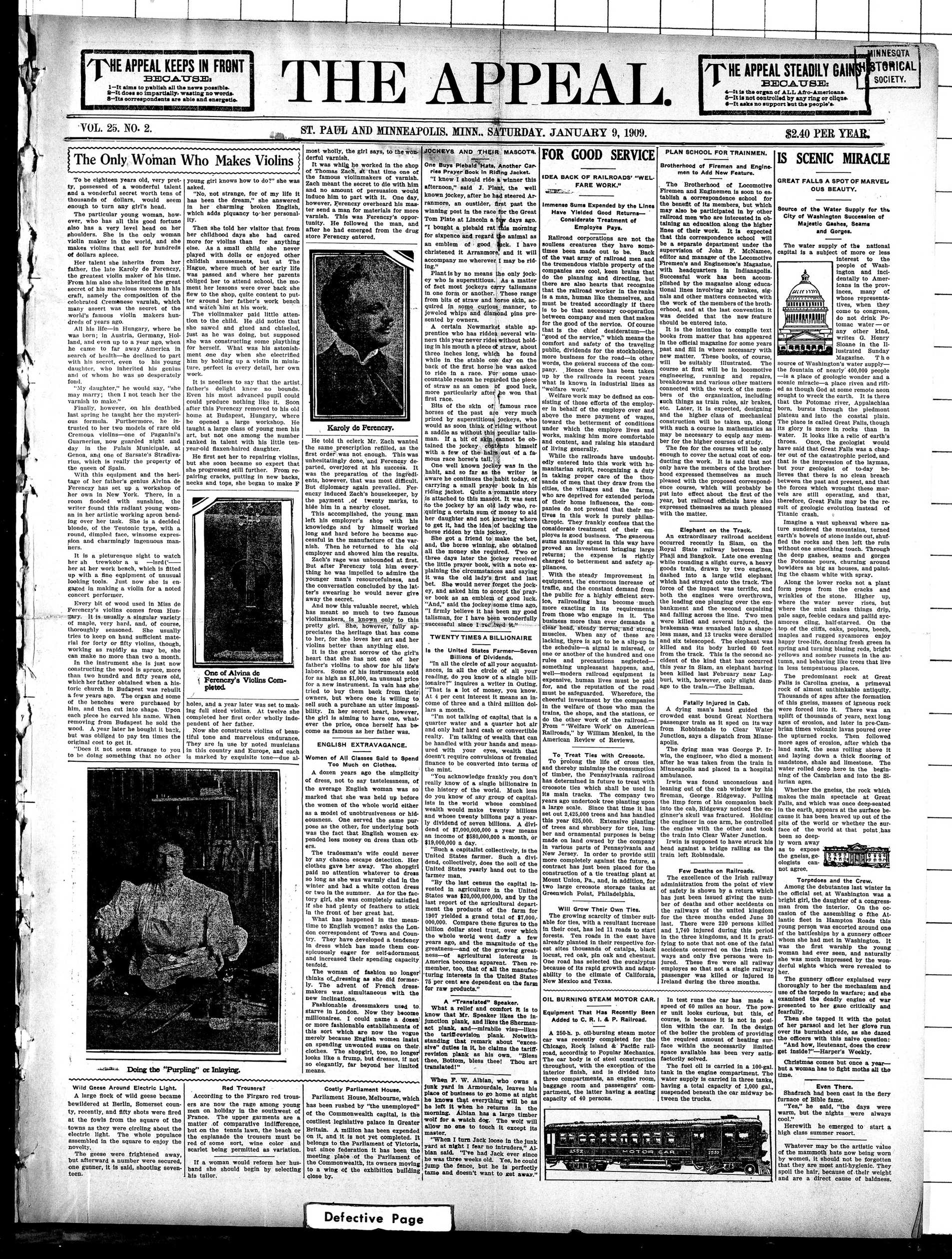
The Only Woman
The Only Woman Who Makes Violins
To be eighteen years old, very pretty, possessed of a wonderful talent and a wonderful secret worth tens of thousands of dollars, would seem enough to turn any girl's head.
The particular young woman, however, who has all this good fortune also has a very level head on her shoulders. She is the only woman violin maker in the world, and she makes violins that sell for hundreds of dollars aplece.
Her talent she inherits from her father, the late Karoly de Ferenchy, the greatest violin maker of his time. From him also she inherited the great secret of his marvelous success in his craft, namely the composition of the celebrated Cremonese varnish, which many assert was the secret of the world famous violin makers hundreds of years ago.
His life—In his war, where he was born; in Austria, Germany, Holland, and even up to a year ago, when he came to far away America in search of health—he declined to part with his secret, even to his young daughter, who inherited his genius and of whom he was so desperately fond.
"My daughter," he would say, "she may marry; then I not teach her the varnish to make."
Finally, however, in his deathbed last spring he taught her the mysterious formula. Furthermore, he intrusted to her two models of Parmigiani violins—one of Parmigiani, now guarded night and day in the Palais Municipal, at Genoa, and one of Sarsate's Stradivarius, which is really the property of the queen of Suila.
With this equipment and the heritage of her father's genius Alvin de Ferenczy has set up a workshop of her own in New York. There, in a room flooded with sunshine, the writer found this radiant young woman in her artistic working apron bending over her task. She is a decided blonde, of the Teutonic type, with a round, dimpled face, winsome expression and charmingly ingenuous manners.
It is a picturesque sight to watch her ah trewkob a u —lsrd(^1) her at her work bench, which is fitted up with a fine equipment of unusual looking tools. Just now she is engaged in making a violin for a noted concert performer.
Every bit of wood used in Miss de Ferenczy's violins comes from Hungary. It is usually a singular variety of maple, very hard, and, of course, thoroughly seasoned. She usually tries to keep on hand sufficient material for forty or fifty violins, though, working as rapidly as may be, she can make no more than two a month. In the instrument she is just now covered with spruce, more than two hundred and years old, which her father obtained when a historic church in Budapest was rebuilt a few years ago. The organ and some of the benches were purchased by him, and then cut into shape. Upon each piece he carved his name. When removing from Budapest he sold the wood. A year later he bought it back, but was obliged to pay ten times the original cost to get it.
"Does it not seem strange to you to be doing something that no other
THE MUSICIAN
Wild Geese Around Electric Light.
A large flock of wild geese became bewildered at Berlin, Somerset county, recently, and fifty shots were fired at the fowls from the square of the towns as they were circling about the electric light. The whole populace assembled in the square to enjoy the novelty.
The geese were frightened away, but afterward a number were secured, one gunner, it is said, shooting seventeen.
Red T
According to the ers are now the men on holiday in France. The upper matter of comp but on the tennis the esplanade the red of some sort scarlet being per
If a woman wow band she should his tailor.
young girl knows how to do?" she was asked.
"No, not strange, for of my life it has been the dream," she answered in her charming broken English, which adds pliancy to her personality.
Then she told her visitor that from her childhood days she had cared more for violins than for anything as a man-child she never played them, and other childish amusements, but at Hague, where much of her early life was passed and where her parents obliged her to attend school, the moment her lessons were over back she flew to the shop, quite content to putter around her father's work bench and watch him at his work.
The violinmaker paid little attention to the child. He did notice that she sawed and glued and chiselled, just as he was doing, but supposed she was constructing some plaything for herself. What was his astonishment one day when she electrified him by holding up a violin in miniature, perfect in every detail, her own work.
It is needless to say that the artist felt his delight knew no bounds. He most advanced pupil could produce nothing like it.
After this Forenecy removed to his old home at Budapest, Hungary, where he opened a large workshop. He taught a large class of young men his art, but not one among the number ranked in talent with his little ten-year-old xenhaired daughter.
He first set her to repairing violins, but she soon became so expert that she progressed still further. From repairing cracks, putting in new backs, necks and tops, she began to make F
One of Alvina de Ferenczy's Violins Completed.
holes, and a year later was set to making full sized violins. At twelve she completed her first order wholly independent of her father.
Now she constructs violins of beautiful tone and marvelous endurance. They are in by used musicians it is marked by exquisite tone—due to
1930
According to the Firgaro red trousers are now the rage among young men on holiday in the southwest of France. The upper garments are a matter of comparative indifference, but on the tennis lawn, the beach or the esplanade the trousers must be red of some sort, wine color and scarlet being permitted as variation. If a woman would reform her husband she should begin by selecting his tailor.
THE APPEAL.
most wholly, the girl says, to the wonderful varnish.
It was whilh he worked in the shop of Thomas Zach, at that time one of the famous violinmakers of varnish. Zach meant the secret to die with him and no amount of persuasion would induce him to part with it. One day, however, Ferenczy overheard his master send a man for materials for more varnish. This was Ferenczy's opportunity. He followed the man, and after he had emerged from the drug store Ferenczy entered.
Karoly de Ferenczy.
He told the celerk Mr. Zach wanted the same prescription reflashed, as the first order was not enough. This was unhesitatingly done, and Ferency departed, overjoyed at his success. It was the preparation of the ingredients, however, that was most difficult. But diplomacy again prevailed. Ferency induced Zach's housekeeper, by the payment, of twenty marks, to hide him in a nearby closet. Ferency left young man left his employer's shop with his knowledge and by himself worked long and hard before he became successful in the manufacture of the varnish. Then he returned to his old employer and showed him the results. Zach's rage was unbound at first. But after Ferency told him everything he was impelled to admire the younger man's resourcefulness, and the conversation concluded by the latter's swearing he would never give away the secret. He was a valuable secret, which has meant so much to two famous violinmakers, is known only to this pretty girl. She, however, fully appreciates the heritage that has come to her, for she loves her art and her violins better than anything else. It is the great sorrow of the girl's heart that she has not one of her father's violins to show for his life's labors. Some of his instruments sold for as high as $1,000, an unusual price for a new instrument. In vain he has bought them back from their owners, but they are willing to sell such a purchase, utter impossibility. In her secret heart, the girl is aiming to have one, whatever the price, once herself has become as famous as her father was.
ENGLISH EXTRAVAGANCE.
Women of All Classes Said to Spend Too Much on Clothes.
A dozen years ago the simplicity of dress, not to say tastelessness, of the average English woman was so marked that she was held up before the women of the whole world either as a model of unobtrusiveness or hideousness. One served the same purpose as the other, for underlying both was the fact that English women expended less money on dress than others.
The tradesman's wife could never by any chance escape detection. Her clothes gave her away. The shopper paid no attention whatever to dress so long as she was warmly clad in the winter and had a white cotton dress or two in the summer. As for the factory girl, she was completely satisfied if she had plenty of feathers to stick in the front of her great hat.
What has happened in the meantime to English women? asks the London correspondent of Town and Country. They have developed a tendency dress which has made them conspicuously eager for self-admortment and increased their spending capacity tenfold.
The woman of fashion no longer thinks of dressing as she did formerly. The advent of French dressmakers was simultaneous with the new inclinations.
Fashionable dressmakers used to starve in London. Now they become millionaires. I could name a dozen or more fashionable establishments of this sort which are now the vogue merely because English women insist on spending unwanted sums on their clothes to shopgirl, no longer looks like a trump, but dresses, if not so elegantly, far beyond her limited means.
Costly Parliament House.
Parliament House, Melbourne, which has been rushed by "the unemployed" of the Commonwealth capital, is the costliest legislative palace in Greater Britain. A million has been expended on it, and it is not yet completed. It belongs to the Parliament of Victoria, since federation it has been the meeting place of the Parliament of the Commonwealth, its owners moving to a wing of the exhibition building close by.
Defective Page
JOCKEYS AND THEIR MASCOTS!
One Buyie Purchase Hates Each
One Buys Pleibald Hats, Another Carries Prayer Book in Riding Jacket.
"I knew I should ride a winner this afternoon," said J. Plant, the well known jockey, after he had steered Aranmore, an outlier, first past the winning post in the race for the Great Tom Plate at Lincoln a few days ago.
"I bought a pleibald rat this morning for sixpeace and regard the animal as an emblem of good luck. I have christened it Arranmore, and it will accompany me wherever I may be riding.
Plant is by no means the only jockey who is superstitious. As a matter of fact most jockeys carry tallmans in one form or another. These range from bits of straw and horse skin, acquired in some curious manner, to jeweled whips and diamond pins presented by owners.
A certain Newmarket stable apprentice who has ridden several winners this year never rides without holding in his mouth a piece of straw, about three inches long, which he found while in the stable one day on the back of the first horse he was asked to be in a race. For some unaccomplished jockeys, the piece of straw as an omen of good luck, more particularly after he won that first race.
Bits of the skin of famous race horses of the past are very much prized by superstition jockeys, who would as soon think of riding without a saddle as without this peculiar tailman. If a bit of skin cannot be obtained the jockey contents himself with a few of the hats out of a famous race horse's tail.
One well known jockey was in the hats and so far as the writer is aware is aware of the bays in a day's carry, carrying a small prayer book in his riding jacket. Quite a romantic story is attached to this mascot. It was sent to the jockey by an old lady who, requiring a certain sum of money to aid her daughter and not knowing where to get it, had the idea of backing the horse ridden by this jockey.
She got a friend to make the bet, and the horse winning, she obtained all the money she required. Two or three days later the jockey received the little prayer book, with a note explaining the circumstances and saying he would bet. She would never forget the jockey, and asked him to accept the prayer book as an emblem of good luck. "And," said the jockey some time ago, "I firmly believe it has been my good tailman, for I have been wonderfully successful since I received it."
TWENTY TIMES A BILLIONAIRE
Is the United States Farmer—Seven Billions of Dividends.
"In all the circle of all your acquaintances, in all the circle of all your reading, do you know of a single billionaire?" inquires a writer in Outing.
"That is a lot of money, you know. At 4 per cent interest it means an income of three and a third million dollars a month.
"I'm not talking of capital, that is a quarter water and a quarter hot air and only half hard cash or convertible realty. I'm talking of wealth that can be handled with your hands and measured with your eyes, wealth that doesn't require convulsions of frenzied finance to be converted into terms of the mint.
You acknowledge frankly you don't really know of a single billionaire in the history of the world. Much less do you know of any group of capitalists in the world whose combined wealth would make twenty billions and whose twenty billions pay a yearly dividend of seven billion. A dividend of $7,000,000,000 a year means an income of $580,000,000 a month, or $19,000,000 a day.
"Such a capitalist collectively, is the United States farmer. Such a dividend, collectively, does the soil of the United States yearly hand out to the farmer man.
"By the last census the capital invested in agriculture in the United States was $20,000,000,000 and by the last report of the agricultural department the products of the farm for 1997 yielded a grand total of $7,000,000,000. Compare these figures to the billion dollar steel trust, over which the whole world went daffy a few years ago, and the magnitude of the growing greatness—of agriculture the interests in America become apparent. A member, too, that of all the manufacturing interests in the United States 75 per cent are dependent on the farm for raw products."
A "Translated" Speaker
What a relief and comfort it is to know that Mr. Speaker likes the injunction plank, and likes the Sherman plank, and –mirable vis—likes the tariff-revision plank. Notwithstanding that remark about “excessive tariff,” he claims the tariff-revision plank as his own. “Bless the, Bottom, bless thee!” Thou art translated!”
When F. W. Albian, who owns a junk yard in Armoundale, leaves his place of business to go home at night he knows that everything will be as he left it when he returns in the morning. Albian has a large timber wolf for a watch dog. The wolf will allow no one to touch it except its mouth.
“When I turn Jack loose in the junk yard at night I fear no intruder.” Albian said. “Tve had Jack ever alone he was three weeks old. Yes, he could jump the fence, but he is perfectly tame and doesn't want to get away.”
---
2552 MOTOR CAR 2552
FOR GOOD SERVICE
IDEA BACK OF RAILROADS "WELFARE WORK."
Immense Sums Expended by the Lines Have Yielded Good Return—Considerate Treatment of Employees Pays.
Railroad corporations are not the soulless creatures they have sometimes been made out to be. Back of the vast army of railroad men and the tremendous visible property of the companies are cool, keen brains that do the planning and directing, but there are also hearts that recognize that railroad workers in the ranks is a man, human like, and must be treated accordingly if there is to be that necessary co-operation between company and men that makes for the good of the service. Of course that is the chief desideratum—the "good of the service," which means the comfort and safety of the traveling public, dividends for the stockholders, more business for the road—in other words, the general success of the company. Hence there has been taken up by the railroads in recent years what is known in industrial lines as "welfare work."
Welfare may be defined as consisting of those efforts of the employer in behalf of the employee over and above the mere payment of wages, toward the betterment of condition under which the employee lives and works, making him more comfortable and content, and raising his standard of living generally.
While the railroads have undoubtedly entered into this work with humanitarian spirit, recognizing a duty in taking proper care of the thousands of men that they draw from the cities, the villages and the farms, who are deprived for extended periods of their home influences, the companies do not pretend that their motives in this work is purely philanthropic. They frankly confess that the considerate treatment of their employees is good business. The generous amount spent in this way have proved an important bigging large returns; the expense is rightly charged to betterment and safety appliances.
With the steady improvement in equipment, the enormous increase of traffic, and the constant demand from the public for a highly efficient service, railroading has become much more exacting in its requirements from those who engage in it. The business more than ever demands a clear head, steady nerves, and strong muscles. When any of these are lacking, there apt is to be a slip up in the schedule—a signal is misread, or one another of the hundred and one rules and precautions neglected—something unpleasant happens, and the railroad equipment is expensive, humiliating, and for, and the reputation of the road must be safeguarded. Wherefore, the cheerful investment by the companies in the welfare of those who man the trains, the shops, and the stations, or do the other work of the railroad—From "Welfare Work" on American Railroads," by William Menkel, in the American Review of Reviews.
To Treat Ties with Creosote
To proclaim the life of crescent,
and thereby minimize the risk of
timber, the Pennsylvania railroad
has determined in future to treat with
crescent ties which shall be used in
its main tracks. The company two
years ago undertook tree planting upon
a large scale. Since that time it has
set out 2,425,000 trees and has handled
its year 625,000. Extensive planting of
trees and shrubbery for ties, lumber
and ornamental purposes is being
made on land owned by the company
in various parts of Pennsylvania and
in order to provide still more
completely the future, a contract
has just been placed for a
construction of a tie treating plant at
Mount Union, Pa., and, in addition,
two large crescent storage tanks at
Greenwich Point, Philadelphia.
WILL Grow Their Own Ties
The growing scarcity of timber suitable for ties, with a resultant increase in their cost, has led 11 roads to start forests. Ten roads in the east have already planted in their respective forest sites thousands of catalpa, black locust, red oak, pine oak and chestnut. One road has selected the eucalyptus because of its rapid growth and adaptability to the climate of California, New Mexico and Texas.
OIL BURNING STEAM MOTOR CAR.
Equipment That Has Recently Been Added to C. R. I. & P. Railroad.
A 250-h. p. oil-burning steam motor car was recently completed for the Chicago, Rock Island & Pacific railroad, according to Popular Mechanics. The car body is of steel construction throughout, with the exception of the interior finish, and is divided into three compartments, an engine room, baggage room and passengers' compartment, the latter having a seating capacity of 40 persons.
THE APPEAL STEADILY GAINS HISTORICAL
BECAUSE:
4- It is the organ of ALL Afro-Americans.
5- It is not controlled by any ring or olique.
6- It asks no support but the people's.
PLAN SCHOOL FOR TRAINMEN.
Brotherhood of Firemen and Engineers to Add New Feature.
The Brotherhood of Locomotive Firemen and Enginemen is soon to establish a correspondence school for the benefit of its members, but which may also be participated in by other railroad men who are interested in obtaining an education along the higher lines of their work. It is expected that this correspondence school will be a separate department under the supervision of John F. McNamee, editor and manager of the Locomotive Firemen's and Enginemen's Magazine, headquarters in Indianapolis, with other matters accomplished by the magazine along educational lines involving air brakes, signals and other matters connected with the work of the members of the brotherhood, and at the last convention it was decided that the new feature should be entered into.
It is the intention to compile text books from matter that has appeared in the official magazine for some years past and fill in where necessary with new matter. These books, of course, will be suitably illustrated. The course at first will be in locomotive engineering, running and repairs, breakdowns and various other matters connected with the work of the members of the organization, including such things as brakes, etc. Later, it is expected, deformed, and the higher class of mechanical construction will be taken up, along with such a course in mathematics as may be necessary to equip any member for the higher courses of study.
The fee for the courses will be only enough to cover the actual cost of conducting the work. It is said that not only have the members of the brotherhood expressed themselves as much pleased with the proposed correspondence, but also that they put into effect about the first of the year, but railroad officials have also expressed themselves as much pleased with the matter.
Elephant on the Track
An extraordinary railroad accident occurred recently in Slam, on the Royal State railway between Ban Phaji and Bangkok. Late one evening while rounding a slight curve, a heavy goods train, drawn by two engines, dashed into a large wild elephant which had strayed onto the track. The force of the impact was terrific, and the leading one plunging over the embankment and the second capizing and falling across the line. Two men were killed and several injured, the brakeman was smashed into a shapeless mass, and 13 trucks were derailed and six telescoped. The elephant was killed and its body hurled 60 feet from the track. This is the second accident this year in Slam, and that has occurred been killed last February near Lapurbi, with, however, only slight damage to the train.—The Bellman.
Fatally Injured in Cab
A dying man's hand guided the crowded east bound Great Northern passenger train as it sped on its way from Robbinsdale to Clear Water Junction, says a dispatch from Minneapolis.
The dying man was George P. Irwin, the engineer, who died a moment after he was taken from the train in Minneapolis and placed in a hospital ambulance.
Irwin was found unconscious and leased out of the cab window by his man, George Ridgeway. Pulling the door of his car back into the cab, Ridgeway noticed the engineer's skull was fractured. Holding the engineer in one arm, he controlled the engine with the other and took the train into Clear Water Junction.
Irwin is supposed to have struck his head against a bridge railing as the train left Robbinsdale.
Few Deaths on Railroads.
The excellence of the Irish railway administration from the point of view of safety is shown by a return which has just been issued giving the number of deaths and other accidents on the railways of the united kingdom for the three months ended June 30 last. There were 220 persons killed and 1,740 injured during this period in the three kingdoms, and it is gratifying to note that not one of the fatal accidents occurred on the Irish railways and only five persons were injured. These five were all railway employees so that not a single railway passenger was killed or injured in Ireland during the three months.
In and only the car has made a speed of 60 miles an hour. The power unit looks curious, but this, of course, is because it is not in position within the car. In the design of the boiler the problem of providing the required amount of heating surface within the necessarily limited space available has been very satisfactorily solved. It is carried in a 100-gal. tank in the engine compartment. The water supply is carried in three tanks having a total capacity of 1,000 gal, suspended beneath the car midway between the trucks.
$2.40 PER YEAR.
SCENIC MIRACLE
GREAT FALLS A SPOT OF MARVEL OUS BEAUTY.
Source of the Water Supply for the City of Washington Succession of Majestic Gashes, Seams and Gorges.
The water supply of the national capital is a subject of more or less interest to the people of Washington and incidentally to Americans in the provinces, many of whose representatives, when they come to congress, do not drink Potomac water—or any other kind, writes G. Henry Sloane in the Illustrated Sunday Magazine. The
people of Washington and incidentally to Americans in the provinces, many of whose representatives, when they do not drink Potomac water — or any other kind, writes G. Henry Sloane in the Illustrated Sunday Magazine. The source of Washington's water supply — the fountain of nearly 400,000 people — is a place of geologic wonder and a geologic miracle, a place river and rifted at some remote aeon sought to wreck the shore to that the Potomac river, Appalachian born, bursts through the pledged plateau and into the coastal plain. The place is called Great Falls, though its glory is more in rocks than in water. It looks like a relic of earth's throes. Once, the geologist would have said that Great Falls was a chapter out of the catastrophic period, and that is the impression of the layman, but your geologist of to-day beheld that there is no clean breach between the river and the present, and that the forces which wrought the vels are still operating, and that, therefore, Great Falls may be the result of geologic evolution instead of Titanic crash.
Imagine a vast upheaval where nature sandered the mountains, turned earth's bowels of stone inside out, shuffled the rocks and then left the ruin without one smoothing touch. Through the deep gaeas, seams and gorges the Potomac pours, churning around bowlers as big as houses, and painting the chasm white with spray.
Along the lower rocks not a plant form peeps from the cracks and wrinkles of the stone. Higher up, where the water never rises, but where the mist makes things pale, pale sage, feed cedars and mould smoores cling, half-starved. On the top of the cliffs, oaks, poplars, beech, maples and rugged sycamores enjoy happy life tree, donning fresh green in spring and turning blazing reds, bright yellows and somber rushes in the autumn, and behaving like trees that live in less tempestuous places.
The predominant rock at Great Falls is Caroline gneiss, a primeval rock of almost unthinkable antiquity. Thousands of ages after the formation of this gneiss, masses of igneous rock were forced into it. There was an uplift of thousands of years, next long ages of erosion, and later in pre-Cambrian times volcanic lavas poured over the upturned rocks. Then followed more ages of erosion, after which the rock became seasalt and it lay down on sandstone, shale and limestone. The water rolled deep here in the beginning of the Cambrian and into the Silurian ages.
Whether the gneiss, the rock which makes the main spectacle at Great Falls, and which was once deep-seated in the earth, appears at the surface because it has been heaved up out of the pits of the world or whether the surface of the world at that point has been so deeply worn away to a degree that the gneiss, geologists cannot agree.
ly worn away as to expose the gneis, geologists cannot agree.
Torpedoes and the Crew.
Among the debatants last winter in the official set at Washington was a bright girl, the daughter of a congressman from the interior. On the occasion of the assembling o fthe Atlantic fleet in Hampton Roads this young person was escorted around one of the battleships by a gunnery officer whom she had met in Washington. It was the first warship the young woman had ever seen, and naturally she was much impressed by the wonderful sights which were revealed to her.
The gunnery officer explained very thoroughly to her the mechanism and use of the torpedo in warfare; and she examined the deadly engine of war presented to her gaze critically and fearfully.
Then she tapped it with the point of her parasol and let her glove run over its burnished side, as she dazed the officers with this naive question: "And how, leutenant, does the crew get inside?"—Harper's Weekly.
Christmas comes but once a year—but a woman has to fight moths all the time.
Even There.
Shadrach had been cast in the fery furnace of Bible fame.
"Yes," he said, "the days were warm, but the nights were always cool."
Herewith he emerged to start a high class summer resort.
Whatever may be the artistic value of the mammoth hats now being worn by women, it should not be forgotten that they are most anti-hygienic. They spoil the hair, because of their weight and are a direct cause of baldness.
HAVE YOU READ
THE APPEAL?
THE APPEAL,
A NATIONAL AFRO-AMERICAN NEWSPAPER
PUBLISHED WEEKLY BY
ADAMS BROS. EDITORS AND PUBLISHERS.
49 E. 4th St., St. Paul, Minn.
ST. PAUL OFFICE
No. 236 Union Block, 4th & Cedar.
J. Q. ADAMS, Manager
MINNEAPOLIS OFFICE
Guaranty Loan Bldg., Room 1020.
H. B. BURK, Manager.
CHICAGO OFFICE
323-5 Dearborn Street. Suite 660.
C. F. ADAMS, Manager.
TERMS, STRICTLY IN ADVANCE:
SINGLE COPY, ONE YEAR ..... $2.00
SINGLE COPY, SIX MONTHS ..... 1.10
SINGLE COPY, THREE MONTHS ..... .60
When subscriptions are by any means allowed
to run without prepayment, the terms are 60 cents for each 13 weeks and 5 cents for each odd week, or at the rate of $2.40 per week.
Remittances should be made by Express Money Order, Post Office Money Order, Postage Stamps will be received as cash for the fractional parts of a dollar. One cent and two cent stamps taken.
Silver should never be sent to the man. It is almost sure to work in a hole that will be broken. Stamps may be stolen. Persons who send silver to an letters店 should own their risk.
First line additional line 10 lines or less. Each additional line 10 cents. Payment strictly in advance, and to be announced at all must come in season to be news.
Advertising rates. 15 cents per line each, each in an inch, and about seven words in an anneate line. No single advertisements in an anneate line. No three mottos in each. Cash must company all orders from parties unknown to us. Further particulars on application.
Reading notices. 25 cents per line each. In insertion. Natter is set in brever type—about six words to the line. All headlines count.
The date on the address label shows when subscription expires. Renewals should be made two weeks prior to expiration, so that no paper may be missed, as the paper stops flowing.
It occasionally happens that papers sent to subscriptions are lost or stolen. In case you do submit a paper by postal card at the expiration of five days from that date, and we will cheerfully forward a duplicate of the missing number.
Communications to subscribers are important, and important to postal writers, plainly written only upon one side of the paper; most reach us on wedays if possible, anyway. Write to us without mentioning the nature of the author. No manuscript returned, unless stamps are sent for postage.
We do not hold ourselves responsible for the views of our correspondents.
We submit our views everywhere. Write for terms. Sample copies free.
In every letter that you write us never fail to give your full name and address, plainly written, post office, county and state. Business letters are separate sheets from letters containing news or matter for publication. Entered as a post office at St. Paul, Mana., under act of Congress, March 3, 1879.
PRESIDENT ROOSEVELT.
Treat each man according to his worth as a man. Distrust all who would have any one class placed before any other. Other republics have fallen because the unscrupulous have substituted loyalty to class for loyalty to the people as a whole. —President Roosevelt's speech at Little Rock, Ark.
SATURDAY, JANUARY 9, 1908.
REPUBLICANISM IN THE SOUTH.
There is no little evidence on file that the Republican party committed a serious error in paying so little attention to the South in the national elections. That evidence shows concisely that by a strong effort upon the part of the party the solid south could have been reduced to a frazzle or completely smashed. We cite from a Republican journal the following facts relative to Georgia. In 1904 Judge Parker had a plurality of nearly 60,000. Judge Taft, cut those figures down to 30,000. The journal quoted says:
"In the Seventh congressional district of the state there are thirteen counties, of which nine gave large pluralities for the Republican ticket. Taft and Sherman ran 1,000 votes ahead of their Democratic opponents in this district.
"In the Ninth Georgia congressional district there are eighteen counties, ten of which in the recent election were carried by the Republicans and eight by the Democrats. The plurality for Taft and Sherman in the district was 949 votes."
Analogous facts could be quoted in
```markdown
```
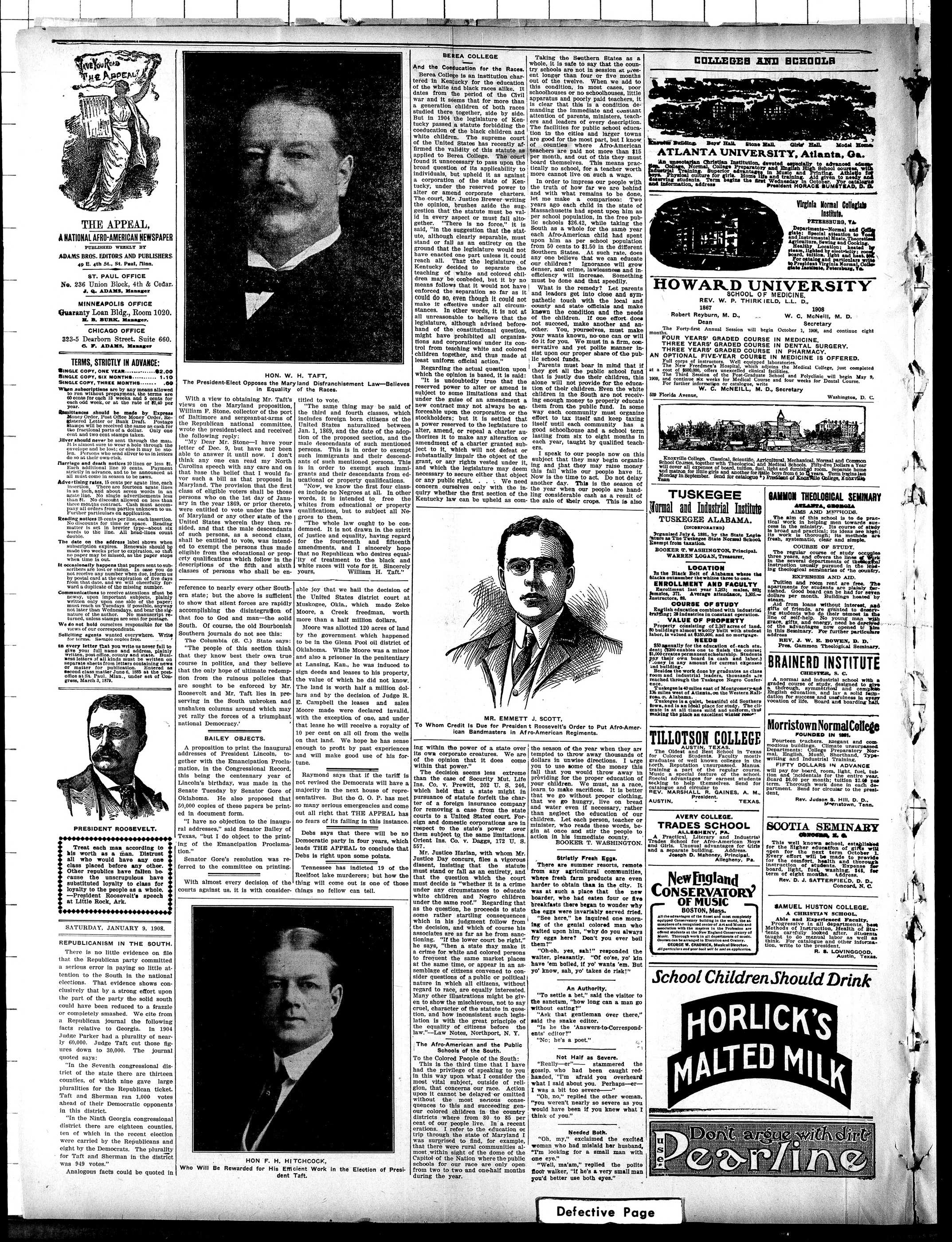
W. H.
[Picture of a man in a suit with a tie].
Who Will Be Rewarded for His Efficient Work in the Election of President Taft.
With a view to obtaining Mr. Taft's views on the Maryland proposition, William F. Stone, collector of the port of Baltimore and sergeant-at-arms of the naval commander in the committee, wrote the president select and received the following reply:
"My Dear Mr. Stone—I have your letter of Dec. 9, but have not been able to answer it until now. I don't think any one can read my North Carolina speech with any care and on that base the belief that I would favor such a bill as that proposed in Maryland. The provision that the first class of eligible voters shall be those persons who on the 1st day of January in the year 1869, or prior thereto, were entitled to vote under the laws of Maryland or any other state of the United States wherein they then resided, and that the male descendants of such persons, as a second class, shall be entitled to vote, was intended to exempt the persons thus made eligible from the educational or property qualifications which follow in the descriptions of the fifth and sixth classes of persons who shall be en-
reference to nearly every other Southern state; but the above is sufficient to show that silent forces are rapidly accomplishing the disintegration of that foo to God and man—the solid South. Of course, the old Bourbonish Southern journals do not see this: The Columbia (S. C.) State says: "The people of this section think that they know best their own true course in politics, and they believe that the only hope of ultimate redemption from the ruinous policies that are sought to be enforced by Mr. Roosevelt and Mr. Taft lies in preserving in the South unbroken and unshaken columns around which may yet rally the forces of a triumphant national Democracy."
BAILEY OBJECTS:
A proposition to print the inaugural addresses of President Lincoln, together with the Emancipation Proclamation, in the Congressional Record, this being the centennial year of Lincoln's birthday, was made in the Senate Tuesday by Senator Gore of Oklahoma. He also proposed that 50,000 copies of these papers be printed in document form.
"I have no objection to the inaugural addresses," said Senator Bailey of Texas, "but I do object to the printing of the Emancipation Proclamation."
Senator Gore's resolution was referred to the committee on printing.
With almost every decision of the courts against us, it is with consider
titled to vote.
"The same thing may be said of the third and fourth classes, which includes foreign born citizens of the United States naturalized between Jan. 1, 1869, and the date of the adoption of the proposed section, and the male descendants of such mentioned persons. This is in order to exempt such immigrants and their descendants of such mentioned persons. This is in order to exempt such immigrants and their descendants from educational or property qualifications.
"Now, we know the first four classes include no Negroes at all. In other words, it is intended to free the whites from educational or property qualifications, but to subject all Negroes to them.
"The whole law ought to be condemned. It is not drawn in the spirit of justice and equality, having regard for the fourteenth and fifteenth amendments, and I sincerely hope that no Republican who desires equality of treatment to the black and white races will vote for it. Sincerely yours, William H. Taft."
able joy that we hail the decision of the United States district court at Muskogee, Okla., which made Zeke Moore, a Creek freedman, worth more than a half million dollars.
Moore was allotted 120 acres of land by the government which happened to be in the Glenn Pool oil district of Oklahoma. While Moore was a minor and also a prisoner in the penitentiary at Lansing, Kan., he was induced to sign deeds and leases to his property, the value of which he did not know. The land is worth half a million dollars and by the decision of Judge R. E. Campbell the leases and sales Moore made were declared invalid, with the exception of one, and under that lease he will receive a royalty of 10 per cent on all oil from the wells on that land. We hope he has sense enough to profit by past experiences and will make good use of his fortune.
Raymond says that if the tariff is not revised the Democrats will have a majority in the next house of representatives. But the G. O. P. has met so many serious emergencies and come out all right that THE APPEAL has no fears of its failing in this instance.
Debs says that there will be no Democratic party in four years, which leads THE APPEAL to conclude that Debs is right upon some points.
Tennessee has indicted 19 of the Reelfoot lake murderers; but how the thing will come out is one of those things no fellow can tell.
Joseph F. H.
To Whom Credit Is Due for President Roosevelt's Order to Put Afro-American Bandmasters in Afro-American Regiments.
And the Coeducation for the Races.
Berea College is an institution chartered in Kentucky for the education of the white and black races alike. It dates from the period of the Civil war and it seems that for more than a century children of both races studied together, side by side. But in 1904 the legislature of Kentucky passed a statute for forbidding the coeducation of the black children and white children. The supreme court of the United States has recently affirmed the validity of this statute as applied to Berea College. The court found it unnecessary to pass upon the broad question of its applicability to individuals, but upheld it as against a corporation of the state of Kentucky, under the reserved power to alter or amend corporate charters. The court, Mr. Justice Brewer writing the opinion, brushes aside the suggestion that the statute must be valid in every aspect or must fail altogether. "There is no force it is said, "in the suggestion that the statute, although clearly separate, must stand or fall as an entirety on the ground that the legislature would not have enacted all part unless it could reach all. That the legislature of Kentucky decided to separate the teaching of white and colored children may be conbed, but it by no means follows that it would not have enforced the separation so far as it could do, even though it could not make it effective under all circumstances. In other words, it is not at all unreasonable to believe that the legislature, although advised before hand of the constitutional question, might have prohibited all organizations and corporations under its control from teaching white and colored children together, and thus made at least uniform official action."
Regarding the actual question upon which the opinion is based, it is raised
which the opinion is based, it is said: "It is undoubtedly true that the reserved power to alter or amend is subject to some limitations and that under the guise of an amendment a new contract may not always be enforceable upon the corporation or the stockholders; but it is settled that a power reserved to the legislature to alter, amend, or repeal a charter authorizes it to make any alteration or amendment of a charter granted subject to it, which will not defeat or substantially impair the object of the grant, or any rights vested under it, and which the legislature may deem necessary to secure either that object or any public right. . . . We need concern ourselves only with the inquiry whether the first section of the Kentucky law can be unheld as com-
MR. EMMETT
To Whom Credit Is Due for President
ican Bandmasters in Af
ing within the power of a state over its own corporate creatures. We are of the opinion that it does come within that power." The decision seems less extreme than the case of Security Mut. Life Ins. Co. v. Prewitt, 202 U. S. S. 246, which held that a state might in pursuance of statute forfeit the charter of a foreign insurance company for removing a case from the state courts to a United States court. For domestic corporations are in respect to them, the state power over them subject to the same limitations. Orient Ins. Co. v. Daggs, 172 U. S. S. 557.
Mr. Justice Harlan, with whom Mr. Justice Day concurs, files a vigorous dissent, insisting that the statute must stand or fall as an entitley, and that the question which the court must decide is "whether it is a crime under any circumstances to educate white children and Negro children under the same roof." Regarding that as the question, he proceeds to state some rather startling consequences which in his judgment follow from the decision, and which of course his associates are as far as he from sanctioning. "If the lower court be right," he says, "then a state may make it a crime for white and colored persons to frequent the same market places at the same time, or appear in an assemblage of citizens convened to consider questions of a public or political nature in which all citizens, without regard to race, are equally interested. Many other illustrations might be given to show the mischievous, not to say cruel, character of the statute in question, and how inconsistent such legislation is with the great principle of the equality of citizens before the law."-Law Notes, Northport, N. Y.
The Afro-American and the Public Schools of the South.
To the Colored People of the South:
This is the third time that I have had the privilege of speaking to you in this way upon what I consider the most vital subject, outside of religion, that concerns our race. Action upon it cannot be delayed or omitted without the most serious consequences to this and succeeding genour colored children in the country districts where from 80 to 85 per cent of our people live. In a recent eruption of violence or trip through the state of Maryland was surprised to find, for example, that there were rural communities almost within sight of the dome of the Capitol of the Nation where the public schools for our race are only open from two to two and one-half months during the year.
---
Taking the Southern States as a whole, it is safe to say that the country schools are not in session at present longer than four or five months out of the twelve. When we add to this condition, in most cases, poor schoolhouses or no schoolhouses, little apparatus and poorly paid teachers, it is clear that this is a condition demanding the immediate and constant attention of parents, ministers, teachers and leaders of every description. The facilities of the school education in the cities and rural areas are good for the most part, but I know of counties where Afro-American teachers are paid not more than $15 per month, and out of this they must board themselves. This means practically no school, for a teacher worth more cannot live on such a wage.
In order to impress our people with the truth of how far we are behind and with what remains to be done, let me make a comparison: Two years ago each child in the state of Massachusetts had spent upon him as per school population, in the free public schools $26.42, while taking the South as a whole for the same year each Afro-American child had spent upon him as per school population from 50 cents to $1.50 in the different Southern States. At such rate, does any one believe that we can educate our children? Ignorance will grow denser, and crime, lawlessness and inefficiency will increase. Something must be done and that speedily.
What is the remedy? Let parents and leaders get into close and sympathetic touch with the local and county and state officials and make known the condition and the needs of the children. If one effort does not succeed, make another and another. You, yourselves, must make you want known, no one can or will do it for it, must in a firm, conservative and yet proper manner insist upon our proper share of the public school funds.
Parents must bear in mind that if they get all the public school fund that is justly due their children, this alone will not provide for the education of their children. Even the white children in the South are not receiving enough money to properly educate them from the public fund. In some way each community must organize itself itself and keep taxing itself until such community has a good schoolhouse and a school term lasting from six to eight months in each year, taught by qualified teachers.
I speak to our people now on this subject that they may begin organizing and that they may raise money this fall while our people have it. Now is the time to act. Do not delay This is the season of the year when we are collecting considerable cash as a result of the sale of their crops. This is also
J. SCOTT,
t Roosevelt's Order to Put Afro-Amer-
tro-American Regiments.
the season of the year when they are tempted to throw away thousands of dollars in unwise directions. I urge you to use some of the money this fall that you would throw away in providing for the proper education of your children. We must, as a race, learn to make sacrifices. It is better that we go without proper clothing, that we go hungry, live on bread and water even if necessary, rather than neglect the education of our children. Let each person, teacher or minister, who reads these words, begin at once and stir the people to action in his immediate county.
BOOKER T. WASHINGTON
Strietly Fresh Eggs
There are summer resorts, remote from any agricultural communities, where fresh farm products are even harder to obtain than in the city. It was at such a place that the new boarder, who had eaten four or five breakfasts there began to wonder why the eggs were invariably served fried. "See here," he inquired one morning of the genial colored man who waited upon him, "why do you always fry eggs here? Don't you ever boil them?" "Oh-h, yes, sah!" responded the waiter, pleasantly. "Of co'se, yo' kin have 'em bolled, if yo' wants 'em. But yo' know, sah, yo' takes de risk!"
An Authority
"To settle a bet," said the visitor to the sanctum, "how long can a man go without eating?"
"Ask that gentleman over there," said the snake editor.
"Is he the 'Answers-to-Correspondents' editor?"
"No, he not a poet."
Not Half as Severe.
"Really-er"—stammered the gossip, who had been caught red-handed, "I'm afraid you overheard what I said about you. Perhaps—er—I was a bit too severe—"
"Oh, no," replied the other woman, "you weren't nearly so severe as you would have been if you knew what I think of you."
Needed Both.
"Oh, my," exclaimed the excited woman who had mislaid her husband, "I'm looking for a small man with one eye." "Well, ma'am," replied the polite floor walker, "if he's a very small man you'd better use both eyes."
Defective Page
Everett Building Boy's Hall Stone Hall Girls' Hall Model Home
ATLANTA UNIVERSITY, Atlanta, Ga.
An unscottian Christian Institution, devoted especially to advanced education. College, Normal, College Preparatory and English High School courses with industrial Training. Superior advantages in Music and Printing. Athletic for physical culture for girls. Home life and training. Aid given to needy and deserving students. Two begins the first Tuesday. Outdoor catalog and information, address
President HORACE RUMATE
HOWARD UNIVERSITY SCHOOL OF MEDICINE
at a cost of $000,000, offers unexcelled clinical facilities. The Third Session of the Post-Graduate School and Polyclinic will begin May 9, 1909, and continue six weeks for Medical Course and four weeks for Dental Course. For further information or catalogue, write
Knoxville College, Classical, Scientific, Agricultural, Mechanical, Normal and Common School. Coord. together with Theological and Medical Schools. Fifty-Dive Dollars a Year will cover all expenses of board, tutoring, fuel, and equipment. A matron for little girls and another for little boys from 6 to 14 years. Form begins Monday in September. Send for catalogue *) President of Knoxville College, Knoxville, Tenn.
HORLICK'S MALTED MILK Don't argue with dirt Pearline
```markdown
```
HOWARD UNIVERSITY
SCHOOL OF MEDICAL
REV. W. P. THIRKIELD,
1867
Robert Reyburn, M. D.,
Dean
The Forty-first Annual Session will begin Oct.
months.
FOUR YEARS' GRADED COURSE IN
THREE YEARS' GRADED COURSE IN
THREE YEARS' GRADED COURSE IN
AN OPTIONAL FIVE-YEAR COURSE IN M.
Full corps of instructors. Well equipped labora-
tory. The New Freedmen's Hospital, which adjoins a
at a cost of $400,000, offers unruncable clinical faili-
ture.
The Third Session of the Post-Graduate School
1900, and continue six weeks for Medical Course and
For further information or catalogue, write
W. C. McNEILL, M. D., Sec.
559 Florida Avenue,
Knoxville College. Classical Scientific, Agricultural,
School Courses, together with Theology and Medical
will cover all expenses of board, tuition, fuel, light and
matron for little girls and another for little boys
Monday in September. Send for catalogue *)
TUSKEGEE
Normal and Industrial Institute
TUSKEGEE ALABAMA.
(INCORPORATED)
GAMES
The tical vices le brog
Organized July 4, 1881, by the State Legislature and the State Normal School Except from taxation.
BOOKER T. WASHINGTON, Principal.
WARREN LOGAN, Treasurer.
LOCATION
In the Black Belt of Alabama where the
blacks outnumber the whites three to one.
ENROLLMENT AND FACULTY
Enrollment last year 1,253; males, 882;
females, 1,161. Average attendance, 1,055;
instructors, 88.
COURSE OF STUDY
English education combined with industrial
training; 28 industries in constant operation.
VALUE OF PROPERTY
Property consisting of 2,267 acres of land, 50 bays of land, and student labor, is valued at $350,000, and no mortgage.
NEEDS
$50 annually for the education of each student, $10,000 for $1,000, $1,000 creates permanent scholarship. Students pay their own board in cash and labor, and any amount for current expenses and building.
Besides the work done by graduates as class room and industrial leaders, thousands are brought through the Tuskegee Negro Conference.
Tuskegee is 40 miles east of Montgomery and 10 miles north of Atlanta, on the Western Railroad, or Alabama.
Tuskegee is a quiet, beautiful old Southern town, and an ideal place for study. The climate is warm and sunny, making the place an excellent winter resort.
TILLOTSON COLLEGE
TILLOTSON COLLEGE
The Oldest and Best School in Texas for Colored Students. Faculty mostly graduates of well known colleges in the north. Reputation unsurpassed. Manual course. Music a special feature of earnest students seeking to help themselves. Send for catalogue and circular to
REV. MARSHALL R. GAINES, A. M.
AUSTIN, President.
TEXAS.
A Practical, Literary and Industrial Trades School for Afro-American Boys and Girls. Unusual advantages for Girls and a separate building. Joseph D. Mahoney, Principal. Allegheny, Pa.
New England CONSERVATORY OF MUSIC
BOSTON, Mass.
All the advantages of a school and most completely equipped Conservatory building in the town, the amphitheatre of a recognized center of Art and Music and the professional are offered at the New England Conservatory of Music. Thorough work in all departments of music. Courses can be arranged in Excursion and Oratory. All particulars and your book will be sent on application.
School Children SH HORLI
Department of Normal and Collegiate
Glass; Special Station to Vocational
Instrumental Music, Theoretical
Architecture, Sewing and Cooking.
With a Chair, located by steam, lighted by electrolux; room
board, tuition, light and heat.
For teaching and participles to President Virginia Normal College
Institute, Petersburg, Va.
UNIVERSITY
OF MEDICINE.
FIELD, L.L. D.
1908
W. C. McNeill, M. D.
Secretary
begin October 1, 1908, and continue eight
USE IN MEDICINE.
USE IN DENTAL SURGERY.
USE IN PHARMACY.
USE IN MEDICINE IS OFFERED.
laboratories.
Medicines at Medical College, just completed
facilities.
School and Polyclinic will begin May 9,
and four weeks for Dental Course.
D., Secretary
Washington, D. C.
Agricultural, Mechanical, Normal and Common
and Medical schools. Five colleges. Light and furnished room. Separate home
stile boys from 6 to 12 years. Term begins last
) President of Knoxville College, Knoxville
GAMMON THEOLOGICAL SEMINARY
The aim of this school is to do practical work in helping men towards success in the ministry. Its course of study is based on the curriculum, and highly its work is thorough; its methods are fresh, systematic, clear and simple.
COURSE OF STUDY.
The regular course of study occupies three years, and covers the lines of work in the departments of theological instruction and theological instruction theological seminaries of the country.
EXPENSES AND AID
Tuition and room rent are free. The apartments for students are plainly far-flung. Good board can be had for seven dollars per month. Buildings heated by steam.
Aid from loans without interest, and gifts of friends, are granted to deserving students, who then usetm in the line of self-help. No gifts, grace, gifts, and energy, need be deprived of the advantages now opened to them in this Seminary. For further particulars address:
REV. J. W. E. BOWEN, D. D. P. Gaeumann, Theological Service
A normal and industrial school with a
many courses. A thorough, symmetrical and complex
English education, and lay a solid foundation
for a vocation of life. Board and boarding
houses.
MorristownNormalCollege FOUNDER IN 1991
Fourteen teachers, elegant and comm-
passioned, campaigned
Departments: College Preparator-
mal, English, Musif, Shorthand, Ty-
writing and Industrial Trainning.
FIFTY FUNDING WILL pay for board, room, light, fuel, fu-
tion and incidentals for the entire year,
paying $2.90 per term. Thorough work done
department. Send for circular to the presi-
dent.
Rev. Judson S. Hill, D. D.
Murray Brown, Tenn-
This well known school, established for the higher education of gifts will open for the equiv. Every effort will be made to provide for the comfort, health and thorough instruction of students. Expense for materials $45, for term of eight months. Address
Rev. D. J. SATTERFIELD, D. D.
Concord, N. C.
$AMUEL HUSTON COLLEGE.
A CHRISTIAN SCHOOL.
Able and Experienced Faculty.
Progressive in all departments, best
Methods of Instruction, Health of Stu-
ents carefully looked after. Students
taught in a manner as well as
think. For catalogue and other
information, write to the president.
R. S. LOVINGGOOD,
Austin, Texas.
n Should Drink
ICK'S
D MILK
SAINT PAUL
WEEKS RECORD IN MINNESOTA'S CAPITAL.
"Saintly City" and Saintly City Folks—Newly items of Social, Religious and General Matters Among the People.
SATURDAY, JANUARY 9, 1908.
At Pilgrim Baptist Church Tuesday Evening, January 14.
Mrs. Laura D. Hickman is quite sick.
Fine weather we are having now-a-days.
Get the habit of smoking Habit Cigars.
Read the ad of the "Magic Shampoo Dryer" on 4th page.
Rev. W. D. Carter left last week for Macon, Mo., to be gone about ten days.
Mr. Charles Miller now has charge of the laundry department of the Valet Tailoring Co.
Habit, the best 5 cent Cigar.
Mr. T. R. Morgan, who has been confined to his house, quite sick, is convalescent.
Rev. H. S. Graves, who went to Chicago last week will fill his pulpit to-morrow as usual.
Wednesday was the coldest day St. Paul has suffered from in five years. It was a pippin and no mistake.
FOR RENT—Six modern rooms on Whitall street, near Payne Ave. Inquire of S. Barnett, 593 Whitall st.
BAGS OF COAL FREE.
Smokeless nut coal, $4.75 per ton, in three-ton loads.
Get a free sample bag at our office before buying if you wish.
Holmes & Hallowell Seven Corners
The watch meeting and New Year's breakfast at Pilgrim Baptist church was as usual well attended and was highly enjoyed in every way.
Mrs. William Bean presented her husband a brand new baby girl last Wednesday, weighing nine pounds. They are as happy as the "Newly-Weds."
Did you who KNOW you are indebted for the paper you are reading make a New Year's resolution to pay what you owe? If so, please live up to your resolution.
Have your laundry work done by the Valet Laundry. Mr. Charles Miller will call for and deliver laundry. Telephone, N. W. 848-J 2, or call at 154-156 E. Sixth street.
If you will try the IDEAL REST-AURANT, 841 Wabasha street, the next time you are hungry, you will get good food at reasonable prices.
La carte service. J. L. Thompson, Trop.
---
T. H. LYLES
Funeral Directors and Embalmers.
322 Wabasha St.
Calls Answered Day or Night in
Twin Cities.
Active Pall Bearers Furnished If
Desired.
Get the habit of smoking Habit Cigars.
Look what's here! The popular Mecca Club bobs up serenely as usual and will treat its patrons to a new and novel entertainment at Bowlby Hall in January. Watch for further particulars.
Go to Holmes & Hollowell's coal office at seven corners and you can get a small bag of coal FREE for the asking. Its a sample of the sort of coal they sell for $4.75 per ton in three ton lots.
Mr. Wm. E. Nagel, the undertaker, located at 208 W. Third street, "Seven Corners," who was injured in a runaway accident several weeks ago, is out again and able to attend to his business.
Shoes mended while you wait, at Jarvis, 354 Minnesota street. Half soles, 50 and 75 cents. Prices reasonable for all kinds of repairing. He can do it on short notice. Jarvis 354 Minnesota Street
KENTS EXPRESS AND STORAGE Co. Office 292 W, Third St. Cor. Pleasant Ave. Competent help and careful handling. Prompt deliveries. Wood and Coal in large or small quantities. Tel. N. W. Main 3669, Twin City 818.
The business houses that have their advertisements in THE APPEAL are the ones you should patronize in preference to those who have not, as thus they show they wish your patronage
A REMINDER
THE STATE SAVINGS BANK
Fourth and Minnesota Sts., St. Paul,
insures not only absolute safety, but
is an incentive to practice economy
and put away small sums whenever
convenient. Interest compounded Jan-
uary and July each year at 3 1/2% per
annum.
Deposits Over $3,000,000.00.
OFFICERS,
Charles P. Noyes, Prest.
Kenneth Clark, V.-Pres.
Charles G. Lawrence, Treas.
---
annual life of the
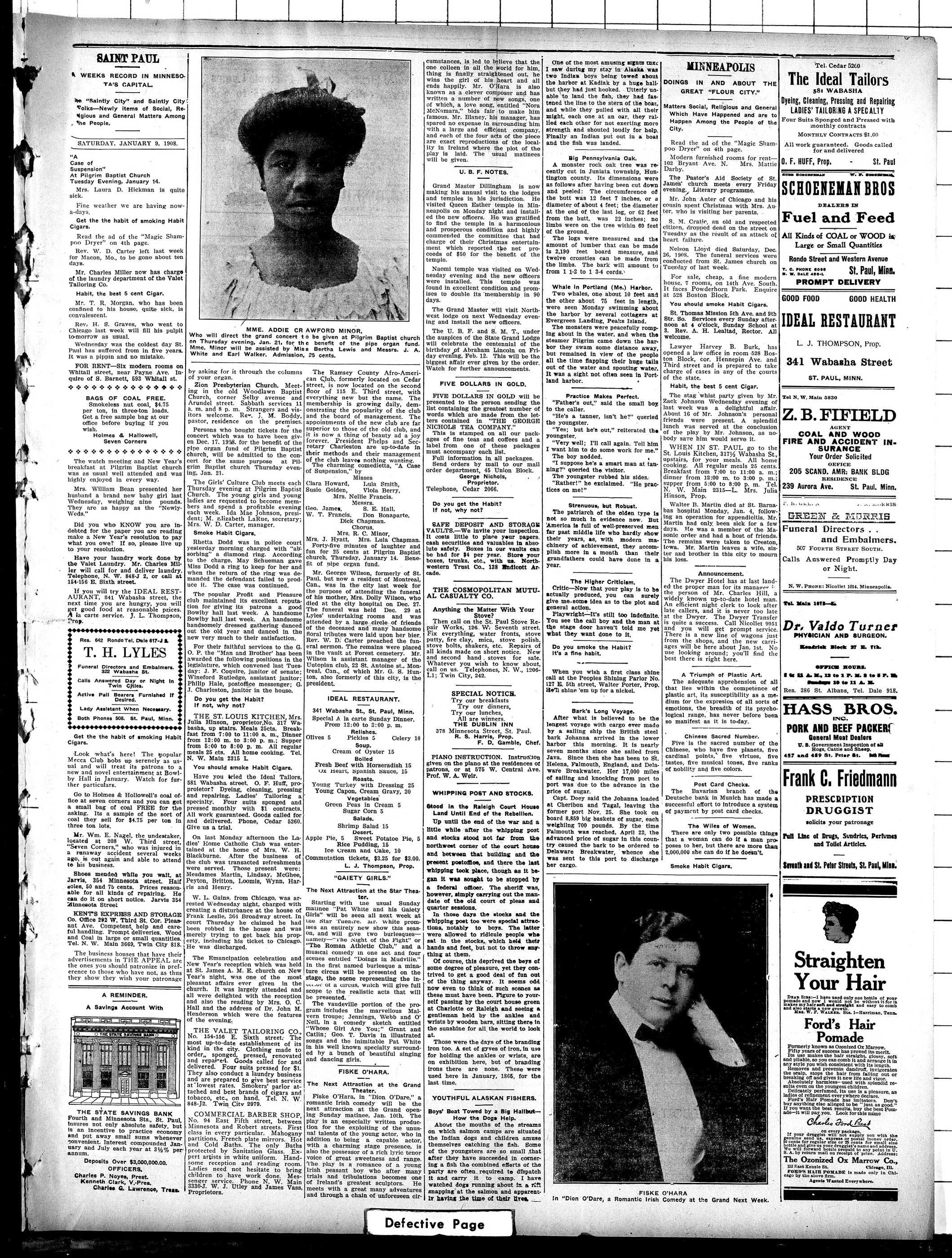
MME. ADDIE CR AWFORD MINOR
Who will direct the grand concert to be given at Pilgrim Baptist church on Thursday evening, Jan. 21, for the benefit of the pipe organ fund. Mmc. Minor will be assisted by Miss Bertha Lewis and Messrs. J. A. White and Earl Walker. Admission, 25 cents.
Who will direct the grand concert to be given at Pilgrim Baptist church on Thursday evening, Jan. 21, for the benefit of the pipe organ fund. Mme. Minor will be assisted by Miss Bertha Lewis and Messers. J. A. White and Earl Walkin. Admission, 25 cents.
by asking for it through the columns of your organ.
Zion Presbyterian Church. Meeting in the old Woodawn Baptist Church corner Selby avenue and Arundel street. Sabbath services 11 a.m. and 8 p.m. Strangers and visitors welcome. Rev. J. M. Boddy, pastor, residence on the premises.
Persons who bought tickets for the concert which was to have been given Dec. 17, 1998, for the benefit of the pipe organ fund of Pilgrim Baptist church, will be admitted to the concert for the same purpose at Pilgrim Baptist church Thursday evening, Jan. 21.
The Ramsey County Afro-American Club, formerly located on Cedar street, is now located on the second floor of 115 E. Third street, with everything new but the name. The membership is growing daily, demonstrating the popularity of the club and the board of management. The appointments of the club are far superior to those of the old club, and it is now a thing of beauty ad a joy forever. President Phelps and Secretary Charleston are up-to-date in their methods and their management of the club leave nothing wanting.
The charming comedietta, "A Case of Suspension," by
The Girls' Culture Club meets each Thursday evening at Pilgrim Baptist Church. The young girls and young ladies are requested to become members and spend a profitable evening each week. Ida Mae Johnson, president; M. Elizabeth LaRue, secretary; Mrs. W. D. Carter, manager.
Smoke Habit Cigars.
Rhetta Dodd was in police court yesterday morning charged with "absorbing" a diamond ring. According to the charge, May Schueman gave Miss Dodd a ring to keep for her and when the return of the ring was demanded the defendant failed to produce it. The case was continued.
The popular Profit and Pleasure club maintained its excellent reputation for giving its patrons a good Bowlby hall last week. A handsome Bowlby hall last week. An handsome handsomely dressed gathering danced out the old year and danced in the new very much to their satisfaction.
For their faithful services to the G. O. P. the "Man and Brother" has been awarded the following positions in the legislature, which convened last Tues. day: J. F. Coquire, janitor of senate; Wineford Rutledge, assistant janitor; Philip Hale, postoffice messenger; G. J. Charleston, janitor in the house.
THE ST.LOUIS KITCHEN, Mrs.
Julia Hinson, proprietor No. 317 W.
Washa, up stairs. Meals 25cts. Break-
fast from 7:00 to 11:00 a. m., Dinner
from 12:00 m. to 3:00 p. m.; Suppen
from 5:00 to 8:00 p. m. All regular
meals 25 cts. All home cooking. Tel.
N. W. Main 2315 L
You should smoke Habit Cigars.
Have you tried the Ideal Tailors, 581 Wabasha street, O. F. Huff, proprotet? Dyeing, cleaning, pressing and repairing. Ladies' Tailoring a specialty. Four suits sponged and pressed monthly with $1 contracts. All work guaranteed. Goods called for and delivered. Phone, Cedar 5260. Give us a trial.
On last Monday afternoon the Ladies' Home Catholic Club was entertained at the home of Mrs. W. H. Blackburne. After the business of the club was transacted refreshments were served. Those present were: Mesdames Martin, Lindsay, McGhee, Peyton, Britton, Loomis, Wynn, Harris and Henry.
W. L. Gains, from Chicago, was arrested Wednesday night, charged with creating a disturbance at the house of Frank Leslie, 364 Broadway street. In court Thursday he claimed he had been robbed in the house and was merely trying to get back his property, including his ticket to Chicago. He was discharged.
The Emmacipation celebration and New Year's reception which was held at St. James A. M. E. church on New Year's night, was one of the most pleasant affairs ever given in the church. It was largely attended and all were delighted with the reception and also the reading by Mrs. O. C. Hall and the address of Dr. John M. Henderson which were the features of the evening.
THE VALET TAILORING CO., No. 154-156 E. Sixth street. The most up-to-date establishment of its kind in the city. Clothing made to order, sponged, pressed, renovated and repaired. Goods called for are delivered. Four suits pressed for. SI. They also conduct a laundry business and are prepared to give best service at lowest rates. Smokers' parlor attached and best brands of cigars and tobacco, etc., on hand. Tel. N. W. 848-J2. Twin City 2079.
COMMERCIAL BARBER SHOP,
No. 94 East Fifth street, between
Minnesota and Robert streets. First
class in every particular. Mahogany
partitions, French plate mirrors, Hot
and Cold Baths. The only Baths
protected by Sanitation Glass. Expert
artists in white uniform. Hand-
some reception and reading room.
Ladies need not hesitate to bring
children to have work done. Mast
messenger service. Phone N. W. Main
3330-J. W. J. Utley and James Vass
Proprietors.
Smoke Habit Cigars.
Do you get the Habit?
If not, why not?
The Ramsey County Afro-American Club, formerly located on Cedar street, is now located on the second floor of 115 E. Third street, with everything new but the name. The membership is growing daily, demonstrating the popularity of the club and the board of management. The appointments of the new club are far superior to those of the old club, and it is now a thing of beauty ad a joy forever. President Phelps and Secretary Charleston are up-to-date in their methods and their management of the club leave nothing wanting. The charming comedietta, "A Case of Suspension," by Misses
Clara Howard, Lula Smith, Susie Golden, Viola Berry, Mrs. Nellie Francis.
Mrs. J. Hyatt, Mrs. Lula Chapman.
Forty-five minutes of laughter and fun for 25 cents at Pilgrim Baptist church, Thursday, January 14. Beneft of pipe organ fund.
Mr. George Wilson, formerly of St. Paul, but now a resident of Montreal, Can., was in the city last week for the purpose of attending the funeral of his mother, Mrs. Dolly Wilson, who died at the city hospital on Dec. 27. The funeral was held Dec. 29 at Lyles' undertaking rooms and was attended by a large circle of friends of the deceased and many handsome floral tributes were laid upon her bier, Rev. W. D. Carter preached the funeral sermon. The remains were placed in the vault at Forest cemetery. Mr. Wilson is assistant manager of the Uutopian club, 22 St. Antoine st., Montreal, Can., of which Mr. G. S. Hunton, also formerly of this city, is the president.
IDEAL RESTAURANT.
341 Wabasha St, St. Paul, Minn.
Special A la carte Sunday Dinner.
From 12:00 to 3:00 p. m.
Relishes.
Olives 5 Pickles 5 Celery 10
Soup.
Cream of Oyster 15
Boiled
Fresh Beef with Horseradish 15
Ox Heart, Spanish Sauce, 15
Roasts.
Young Turkey with Dressing 25
Young Capon, Cream Gravy, 20
Vegetables
Green Peas in Cream 5
Sugar Corn 5
Salads.
Shrimp Salad 15
Desert.
Apple Pie, 5 Sweet Potatoe Pie, 5
Rice Pudding, 15
Ice Cream and Cake, 10
Commutation tickets, $3.25 for $3.00.
"GAIETY GIRLS."
The Next Attraction at the Star Theater.
Starting with the usual Sunday matinee "Pat White and his Galeety Girls" will be seen all next week at the Star Theatre. Air. White promises an entirely new show this season, and will give two burlesques—namely—"The Night of the Fight" or "The Roman Athletic Club," and a musical comedy in one act and four scenes entitled "Doings in Mudville." In the first named burlesque a miniature circus will be presented on the stage, the scene representing the interior of a circus, which will give full scope to the realistic acts that will be presented.
The vaudeville portion of the program includes the marvelous Malvern troupe; Jennings, Webb and O'Neil, in a comedy sketch entitled "Whose Girl Are You;" Grant and Catlin; Geo. T. Davis in illustrated songs and the inimitable Pat White in his well known specialty surrounded by a bunch of beautiful singing and dancing girls.
FISKE O'HARA.
The Next Attraction at the Grand Theater.
Fiske O'Hara, in "Dion O'Dare," a romantic Irish comedy will be the next attraction at the Grand opening Sunday matinee, Jan. 10th. The play is an especially written production for the exploiting of the unusual talents of the young actor, who in addition to being a capable actor, with a charming stage presence, is the possessor of a rich lyric tenor voice the possessor of a young Irish peasant boy, after many trials and tribulations becomes one of Ireland's greatest sculptors. He meets with a great many adventures and through a chain of unforeseen city
Defective Page
constances, is led to believe that the one colleen in all the world for him, thing is finally straightened out, he wins the girl of his heart and all ends happily. Mr. O'Hara is also known as a clever composer and has written a number of new songs, one of which, a love song, entitled "Nora McNamura," blids fair to make him famous. Mr. Blaney, his manager, has spent expence in surrounding him with large and effusive company, and each of the four acts of the are exact reproductions of the locality in Ireland where the plot of the play is laid. The usual matines will be given.
U. B. F. NOTES.
Grand Master Dillingham is now making his annual visit to the lodges and temples in his jurisdiction. He visited Queen Esther temple in Minneapolis on Monday night and installed the new officers. He was gratified to find the temple in a harmonious and prosperous condition and highly commended the committee that had charge of their Christmas entertainment which reported the net proceeds of $50 for the benefit of the temple.
Naomi temple was visited on Wednesday evening and the new officers were installed. This temple was found in excellent condition and promises to double its membership in 90 days.
The Grand Master will visit North-west lodge on next Wednesday evening and install the new officers.
The U. B. F. and S. M. T., under the auspices of the State Grand Lodge will celebrate the centennial of the birthday of Abraham Lincoln on Friday evening, Feb. 12. This will be the biggest affair ever given by the order. Watch for further announcements.
FIVE DOLLARS IN GOLD.
FIVE DOLLARS IN GOLD will be presented to the person sending the list containing the greatest number of words which are made from the letters contained in "THE GEORGE NICHOLS TEA COMPANY."
This is stamped on all our packages of fine teas and coffees and a label from one of these packages must accompany each list.
Full information in all packages.
Send orders by mail to our mail order department, 45 Union Block.
George Nichols,
Proprietor.
Telephone, Cedar 2066.
Do you get the Habit?
If not, why not?
SAFE DEPOSIT AND STORAGE VAULTS.—We invite your inspection. It costs little to place your papers, cash securities and valuables in absolute safety. Boxes in our vaults can be bead for $4 per year. Store your trunks, etc., in northwestern Trust Co., 138 Bendcott Arcade.
THE COSMOPOLITAN MUTU AL CASUALTY CO.
Anything the Matter With Your Stove?
Then call on the St. Paul Stove Repair Works, 126 W. Seventh街. Fix everything, water fronts, stove putty, fire clay, mica, stove polish, stove bolts, shakers, etc. Repairs of all kinds made on short notice. New and second hand stoves for sale. Whatever you wish to know about, call on us. Telephones. N. W., 1206 L1; Twin City, 242.
SPECIAL NOTICE.
Try our breakfasts
Try our dinners,
Try our lunches,
All are winners.
THE DUBLIN INN
378 Minnesota Street, St. Paul.
R. S. Harris, Prop.
F. D. Gamble, Chef.
PIANO INSTRUCTION. Instruction given on the piano at the residences of patrons, or at 575 W. Central Ave.
Prof. W. A. Weir.
WHIPPING POST AND STOCKS.
Good in the Raleigh Court House Land Until End of the Rebellion.
Up until the end of the war and a little while after the whipping post and stocks stood not far from the northwest corner of the court house and between that building and the present postoffice, and there the last whipping took place, though as it began it was sought to be stopped by a federal officer. The sheriff was, however, simply carrying out the mandate of the old court of pleas and quarter sessions.
In those days the stocks and the whipping post too were special attractions, notably to boys. The latter were allowed to ridicule people who sat in the stocks, which held their hands and feet, but not to throw anything at them.
Of course, this deprived the boys of some degree of pleasure, yet they contrived to get a good deal of fun out of the thing anyway. It seems odd now even to think of such scenes as these must have been. Figure to yourself passing by the court house green at Charlotte or Raleigh and seeing a gentleman held by the ankles and wrists by wooden bars, sitting there in the sunshine for all the world to look at.
Those were the days of the branding iron too. A set of gyes of iron, in use for holding the ankles or wrists, are on exhibition here, but of branding irons there are none. These were used here in January, 1865, for the last time.
YOUTHFUL ALASKAN FISHERS.
Boys' Boat Towed by a Big Hallibut-
How the Dogs Help.
About the mouths of the streams on which salmon camps are situated the Indian dogs and children amuse themselves catching the fish. Some of the youngsters are so small that after they have succeeded in cornering a fish the combined efforts of the party are often required to dispatch it and carry it to camp. I have watched dogs running about in a riff snapping at the salmon and apparently having the time of their lives.
THE NEW YORK TIMES
FISKE O'HARA
In "Dion O'Dare, a Romantic Irish Comedy at the Grand Next Week
One of the most amusing signals that I saw during my stay in Alaska was two Indian boys being towed about the harbor at Kadlak by a huge hall but they had just hooked. Utterly unable to land the fish, they had fastened the line to the stern of the boat, and while they pulled with all their might, each one at an oar, they rallied each other for not exerting more strength and shouted loudly for help. Finally an Indian put out in a boat and the fish was landed.
Big Pennsylvania Oak.
A monster rock oak tree was recently cut in Juniata township, Huntington county. Its dimensions were as follows after having been cut down and peeled; The circumference of the butt was 12 feet 7 inches, or a diameter of about 4 feet; the diameter at the end of the last log, or 62 feet from the butt, was 22 inches; no limbs were on the tree within 60 feet of the ground.
The logs were measured and the amount of lumber that can be made is 2,190 feet board measure, and twelve crosses can be made from the limbs. The bark will amount to from 1 1-2 to 1 3-4 cords.
Whale in Portland (Me.) Harbor.
The monsters were peacefully romping about in the water, and when the steamer Pilgrim came down the harbor they swam some distance away, but remained in view of the people all the time flapping their huge tails out of the water and spouting water. It was a sight not often seen in Portland harbor.
"Father's out," said the small boy to the caller.
"He's a tanner, isn't he?" queried the youngster.
"Yes; but he's out," reiterated the youngster.
"Very well; I'll call again. Tell him I want him to do some work for me."
The boy nodded.
"I suppose he's a smart man at tanning?" queried the visitor.
The youngster rubbed his sides.
"Rather!" he exclaimed. "He practices on me!"
Strenuous, but Robust
The patriarch of the olden type is not so much in evidence now. But America is full of well-preserved men far past middle life who hardly show their years, as, with modern machinery of achievement, they accomplish more in a month than their grandfathers could have done in a year.
The Higher Criticism
Critic—Now that your play is to be actually produced, you can surely give me some idea as to the plot and general action.
Playwright—It still too indefinite. You see the call boy and the man at the stage door haven't told me yet what they want done to it.
Do you smoke the Habit?
It's a fine habit.
When you wish a first class shine call at the Peoples Shining Parlor No. 127 E. 5th street, Walter Porter, Prop. Shine 'em up for a nickel.
Bark's Long Voyage.
After what is believed to be the longest voyage with cargo ever made by a sailing ship the British steel bark Johanna arrived in the lower harbor this morning. It is nearly seven months since she sailed from Java. Since then she has been to St. Helena, Falmouth, England, and Delaware Breakwater. Her 17,000 miles of sailing and knocking from port to port was due to the advance in the price of sugar.
Capt. Doey said the Johanna loaded at Cheribon and Tagal, leaving the former port Nov. 25. She took on board 8,859 big baskets of sugar, each weighing 700 pounds. By the time Falmouth was reached, April 22, the advanced price of sugar in this country caused the bark to be ordered to Delaware Breakwater, whence she was sent to this port to discharge her cargo.
10
MINNEAPOLIS
DOINGS IN AND ABOUT THE GREAT "FLOUR CITY."
Matters Social, Religious and General Which Have Happened and are to Happen Among the People of the City.
Read the ad of the "Magic Shampoo Dryer" on 4th page.
Modern furnished rooms for rent—102 Bryant Ave. N. Mrs. Mattie Darby.
The Pastor's Aid Society of St James' church meets every Friday evening, Literary programme.
Mr. John Auter of Chicago and his cousin spent Christmas with Mrs. Auter, who is visiting her parents.
S. M. Cratie, an old and respected citizen, dropped dead on the street on Tuesday as the result of an attack of heart failure.
Nelson Lloyd died Saturday, Dec
26, 1908. The funeral services were
conducted from St. James church on
Tuesday of last week.
For sale, cheap, a fine modern
house, 7 rooms, on 14th Ave. South.
It faces Powderhorn Park. Enquire
at 528 Boston Block.
You should smoke Habit Cigars.
St. Thomas Mission 5th Ave. and 9th St. Str. So. Services every Sunday afternoon at 4 o'clock, Sunday School at 3. Rev. A. H. Lealtad, Rector. All welcome.
Lawyer Harvey B. Burk, has opened a law office in room 528 Boston Block, cor. Hennepin Ave. and Third street and is prepared to take charge of cases in any of the courts of the state.
Habit, the best 5 cent Cigar.
The stag whist party given by Mr. Zack Johnson Wednesday evening of last week was a delightful affair. About 16 of Mr. Johnson's personal friends were present. A splendid lunch was served at the conclusion of the play by Mr. Johnson, as nobody save him would serve it.
WHEN IN ST. PAUL go to the St. Louis Kitchen, 3171½ Wabasha St, upstairs, for your meals. All home cooking. All regular meals 25 cents. Breakfast from 7:00 to 11:00 a. m.; dinner from 12:00 m. to 3:00 p. m.; supper from 5:00 to 8:00 p. m. Tel. N. W. Main 2315—L. Mrs. Julia Hinson, Prop.
Walter B. Martin died at St. Barnabas hospital Monday, Jan. 4, following an operation for appendicitis. Mr. Martin had only been sick for a few days. He was a member of the Masonic order and had a host of friends. The remains were taken to Creston, Iowa. Mr. Martin leaves a wife, sister and brother in this city to mourn his loss.
Announcement.
The Dwyer Hotel has at last landed the proper man for its manager the person of Mr. Charles Hill, a widely known up-to-date hotel man. An efficient night clerk to look after late callers, and it is never too late at the Dwyer. The Dwyer Transfer is quite a success. Call Nicollet 9951 and you will get prompt service. There is a new line of wagons just from the shops, and the new carriages will be here about Jan. 1st. No use looking around; you'll find the best there is right here.
A. Triumph of Plastic Art
The adequate apprehension of all that lies within the competence of plastic art, its susceptibility as a medium for the expression of all sorts of emotions, the breadth of its psychological range, has never before been so manifest as it is to-day.
Chinese Sacred Number.
Five is the sacred number of the Chinese, who have five planets, five cardinal points, five virtues, five tastes, five musical tones, five ranks of nobility and five colors.
Post Card Checks
The Bavarian branch of the Deutsche bank in Munich has made a successful effort to introduce a system of payment by post card checks.
The Wiles of Women.
There are only two possible things that a woman can do if a man proposes to her, but there are more than 2,000,000 she can do if he doesn't.
Smoke Habit Cigars.
Dyeing, Cleaning, Pressing and Repairing
LADIES' TAILORING A SPECIALTY
Four Suits Sponged and Pressed with
monthly contracts
MONTHLY CONTRACTS $1.00
All work guaranteed. Goods called
for and delivered
O. F. HUFF, Prop. - St. Paul
EUNN SCHOENEMAN W. F. SCHOENEMAN
SCHOENEMAN BROS
DEALERS IN
Fuel and Feed
All Kinds of COAL or WOOD in
Large or Small Quantities
Rondo Street and Western Avenue
T. C. PHONE 8098
N. W. DALE 486-L
St. Paul, Minn.
PROMPT DELIVERY
GOOD FOOD GOOD HEALTH
IDEAL RESTAURANT
L. J. THOMPSON, Prop.
341 Wabasha Street
ST. PAUL, MINN.
Tel N. W. Main 5830
AGENT
COAL AND WOOD
FIRE AND ACCIDENT INSURANCE
Your Order Solicited
OEFICE
205 SCAND. AMR; BANK BLDG
RESIDENCE
239 Aurora Ave. St. Paul, Minn.
GREEN & MURRIS
Funeral Directors . . and Embalmers.
507 FOURTH STREET SOUTH.
Calls Answered Promptly Day or Night.
N. W. PHONE: Nicollet 1014. Minneapolis.
Tol. Main 1078—E
Dr. Valdo Turner
PHYSICIAN AND SURGEON.
OFFICE HOURS.
8 at 11 A.M., 12 to 1 P.M. 8 to 5 P.M.
Sundays 10 to 11 A.M.
Res. 386 St. Albans, Tel. Dale 918.
HASS BROS.
INC.
PORK AND BEEF PACKERS
General Meat Dealers
U. B. Government Inspection of all
Hogs, Cattle and Sheep.
457 and 489 St. Peter St. Bath Pier
PRESCRIPTION
DRUGGIST
solicits your patronage
Full Line of Drugs, Sundries, Perfumes
and Toilet Articles.
Seventh and St. Peter Streets. St. Paul, Minn.
Straighten
Your Hair
DEAR SIRS: I have used only one bottle of your
pomade and now it will not be without it for it
makes my hair soft and straight and easy to comb
and also starts a new growth.
MRS. W. P. WALNER. Sta. 1-Harriman, Tenn.
Ford's Hair
Pomade
Formerly known as Ozonized Ox Marrow,
Fifty years of success has proved its merit.
It is a moist, moist, moist, moist,
and plurable, so you can comb it and arrange it in
any style you wish consistent with its length.
It prevents dandruff, invigorates
the scalp, and breaks off and gives it new life and vigor.
Absolutely harmless—used with splendid rejuvenation
Delicately perfumed, its use is a pleasure, as ladies of refinement everywhere declare.
For Hard Pomade has imitators. Don't
bring it on your skin. Don't
If you want the best results, buy the best Pomade—it will pay you. Look for this name
If your dreggler will not supply you with the money for a dress, express or postal money order, 20 cents for a dress size or 5 cents for small size bottle and give your dreggler's name and address. We will forward hotel packages to any point in U.S. A by return mail on receipt of price. Address: The Ozonized Ox Marrow Co., 133 East Kenzie St. Chicago, Ill. FORD'S HAIR POMADE is made only in Chicago by the above firm. Agents Wanted Everywhere.
COLOR MUSEUMS DEMAND.
Beautiful Stuff Being Thrown Away Whose Remnants Will Cost Dear. A novel suggestion was put forward at yesterday's international art congress at the Victoria and Albert Museum by Mr. Alexander Millar, a prominent manufacturer and designer, who urged the need for systematic color training and recommended the establishment of "color museums." This idea he explained, had received sympathetic support from many great artists. In every educational center and in every school there should be collections of objects selected for their beauty of color alone. There should be analytic color sections, showing the color scheme apart from the accidents of form and shadow.
The collection, continued Mr. Millar, need not be very costly. Why should not a beginning be made by making a selection from the beautifully colored textiles which appear from time to time in shop windows? The expense would be very small. Year by year beautiful stuffs were being produced and allowed to drop into oblivion. If such a collect! be not formed now it might be that one hundred years hence our museum authorities would buy at a fancy price a collection of imperfect fragments of the very stuffs which could be now acquired for a nominal sum.
He spoke of what he knew when he said that such a collection would be heartily welcomed by all designers and by every one connected with arts and industries in which color played an important part.
OFF THE SPROCKET.
Little Mishap to an Automobile Wagon
On Easily Set Right.
Not so many things happen to automobiles now as once did, but ever so not all mishaps are as easily and quickly adjusted as was this one.
Going around a corner the drive chain on one side of an automobile delivery wagon came off the rear sprocket, a mishap which the driver almost instantly discovered. When the wagon stopped the man with the driver picked up a pair of gloves and jumped off and ran around to the wheel from which the chain had dropped.
He lifted up the chain and set two or three links of it over as many teeth of the froward part of the sprocket wheel, and holding the chain there he called to the driver;
"Back her."
And the driver backed gently, the man holding the chain, and in a moment the chain clicked back all right on the sprocket wheel.
"That sounds good to muh," said the man, and then he ran around and climbed to his place on the wagon seat again, and the next moment the outfit was again on its way.
Looking for the Twin Sisters.
Supt. W. C. Day of public buildings and grounds is endeavoring to secure for the State of Texas, to be preserved as a relic, two cannon known as the Twin Sisters, which were presented by citizens of Cincinnati to the Texas army in 1835, received by Gen. Sam Houston and used by him in the battle of San Jacinto against the Mexican army under Gen. Santa Anna. The difficulty is that he is unable to locate the guns. They were last heard of at New Orleans, where they were stored in the United States arsenal; with other military supplies and equipment surrendered by Texas when admitted into the Union.
Conan Doyle's Latest.
Conan Doyle has written a book entitled "Through the Magic Door." It is neither about crime nor te detection of criminals, but it merely tells what in literature Sherlock Holmes likes and what he doesn't like. He advises young readers to talk about what they have recently read. Except to personal friends, this sort of talk, while useful to the talker, is ordinarily about as interesting to the hearer as the narration of one's dreams.
Suggestion for Dr. Wiley.
It is no joke, but a serious and sensible proposition, made by a commission of the Russian duma, that the imperial eagle hitherto placed on labels attached to bottles of vodka, which is a state monopoly, be replaced by a skull and bones, indicating its poisonous and dangerous character.
A Previous Engagement.
"Would any of you little girls like to go to heaven?" asked the Sunday school teacher.
"No'm, not this summer. We're going to the seashore," answered Ethel promptly.
Stepping Statistics.
A Swiss has taken the trouble to count all the steps no took during a year. He found the number to be 9,760,000, which gives 25,740 steps a day.
His Holiness Won.
A keen struggle for the possession of an extremely rare coin between the pope and King Victor Emmanuel of Italy, both numismatics, has just ended in favor of the former.
The "masses" and the "classes"
in England differ in this—the former
are to be bought with a drink; the
latter with a dinner.
Nobody likes to be patronized. A sense of superiority seldom goes with superiority of sense.
Minnesota Steam Laundry
314 MINNESOTA ST.
Send Us Your Work
OUR WORK WILL SATISFYY OU
Digesto
MALT EXTRACT
For the Convalescent
Weakness follows sickness.
The cure for weakness is
nourishment. Digesto is
nourishment. It is a highly
concentrated liquid food, pre-
digested, and during the period
of convalescence proves a most
valuable aid to nature in her
work of reconstruction.
Palatable and Efficient
At all Drug Stores
MADE ONLY BY
THEO. HAMM BREWING CO., ST. PAUL
BREWERS OF THE BEER THAT
"Leads Them All"
DEALER IN
Fine
Shoes
859 University, Corner Kent
Repairing
Neatly Done
St. Paul
---
BEES MASTER OF THE ROAD.
Farmer's Mishap That Stopped Travel on a French Highway.
A curious incident is reported from St. Prieure, near Chambery, where two colonies of bees in a state of insurrection have routed everybody from the neighborhood and are still masters of the road.
The cure of a neighboring place, accompanied by a farmer, came to take possession of two beehives, which the farmer loaded on a cart drawn by two oxen. Halfway home one of the hives fell off the cart and was broken up. The bees on being liberated attacked the farmer with fury and stung him so violently that the poor man fainted and fell on the road. The cure came to his rescue, but in his hurry upset the other hive, from which the bees also escaped and attacked him in turn.
Workmen from the fields round about heard the cries and rescued both men, who had to be carried to a house and attended by a doctor. Meanwhile the bees attacked the oxen and stung them so fiercely that the two beasts started on a mad race down the road and were finally stopped by a woman, who in turn was surrounded not only by the bees of the first two hives but apparently by all the bees in the neighborhood, and had herself to be rescued by the villagers.
So savage have the bees become that the highway is still said to be in their possession, and the inhabitants have to be well protected to venture out in the fields.
BREAKING AN OLD CUSTOM.
How a Club's System of Blackballing Was Brought to an End.
An authentic story is told of one famous club in St. James street where a number of ancient members made it a law to themselves to reject every one without exception who had offered himself as a candidate.
This practice of blackballing was long held as an imperative and unbreakable rule, but was at length evaded by a strategem. At one election a number of a newcomer's friends were in attendance, but outside at a distance from the clubhouse. No one appeared in the committee room, and it was generally supposed that there would be no quorum. The malcontents therefore abstained from voting.
But when only a few minutes of the legal time for balloting remained and the servants were at the point of removing the ballot boxes an overwhelming number of the candidate's friends rushed in and elected him before the slightest opposition could be organized. After this the absurd system of blackballing was dropped, and the club to-day is still alive and prosperous.
In Leap Year.
Clara—Did you get on your knees, Marguerite, when you proposed to Fred last night?
Marguerite—Of course not; I was on his knees at the time.
JOHN DORNSEIFF
859 University, Corner Kent
PHONES TWIN CITY 4382
N. W. DALE 8947
J. W. NELSON
DRUGGIST
Fine Cigars, Soda Water and
Toilet Articles
COR, KENT ST, AND UNIVERSITY AVE.
ST. PAUL.
THE BEST OF THE WORLD
GOLD
GRAIN
BEN
Dimes are little you
ly when locked up tog
savings account and p
tion. "Planted" dollar
ings.
THE STATE
93 East
GOLDEN
GRAIN BELT
BEERS
mes are little young dollars. They go
when locked up together. Treat your
savings account and prove it to your own s
“Planted” dollars will add to you
THE STATE SAVINGS B
93 East Fourth Street
GOLDEN
GRAIN BELT
BEERS
Dimes are little young dollars. They grow only when locked up together. Treat yourself to a savings account and prove it to your own satisfaction. "Planted" dollars will add to your earnings. THE STATE SAVINGS BANK 93 East Fourth Street
IF YOU SMOKE, WHY NOT HABIT BEST 5c. CIGAR ON EARTH
EYE DEFECTS
Eye defects are few—sye
There can be but two de
Theeye may be too long
Myopic eye.
Or too short in whole—
Combine the two in one
Properly adjusted glasses
Medicines or waiting, n
Symptoms that spring f
ormations are manifold; sus
gestion, Dyspepsia, Nervou
other ailments having their
We correct all Defects o
will remedy. Charges reason
HARMS OCULO CURES S
F. H. HAR
OPTIM
EYE DEFECTS AND SYMPTOMS
These defects are few—symptoms many.
There can be but two defects in the human eye.
The eye may be too long in whole. Then we have
eye.
Too short in whole—the Hyperopic eye.
Imbine the two in one eye and we have Astigmatism.
Superly adjusted glasses will correct these de-
ticines or waiting, never.
Symptoms that spring from these two simple
lenses are manifold; such as eye and headache,
Dyspepsia, Nervous Debility, Chorea, Epilepsies having their origin in lack of nerve
correct all Defects of the human eye than
medy. Charges reasonable. Satisfaction gui-
n HARMS OCULO CURES SORE EYES 25c PER BOTTLE
H. HARM & BR
OPTICIANS,
HARM
GLASSES
EYE DEFECTS AND SYMPTOMS.
Symptoms that spring from these two simple eye malformations are manifold; such as eye and headaches, Indigestion, Dyspepsia, Nervous Debility, Chorea, Epilepsy and other ailments having their origin in lack of nerve force. We correct all Defects of the human eye that glasses will remedy. Charges reasonable. Satisfaction guaranteed.
337 ROBERT STREET, ST. PAUL, MINN.
---
SMOKE
The Most Proper Line of
FALL WOOLENS
TO BE HAD FOR A
NICE SUIT OR OVERCOAT
IS SHOWN BY
Clifford A. Smith
PRESSING AND REPAIRING DONE
109 Eighth St. Opposite Golden Rule
Telephone Main 3488-L
St. Paul, - - Minn.
GOLDEN
BELT
ERS
ing dollars. They grow on-
ether. Treat yourself to a
love it to your own satisfac-
ers will add to your earn-
SAVINGS BANK
Fourth Street
AND SYMPTOMS.
emptoms many.
defects in the human eye.
in whole. Then we have the
the Hyperopic eye.
eye and we have Astigmatism.
is will correct these defects.
ever.
from these two simple eye mal-
has eye and headaches, Indi-
Debility, Chorea, Epilepsy and
origin in lack of nerve force.
of the human eye that glasses
able. Satisfaction guaranteed.
ORE EYES 25c PER BOTTLE.
RM & BRO.
CIANS.
---
CIGAR
A magnificent assortment of these new and unique lamps, each a distinct creation in itself. Quaint and artistic shapes abound, with shades of exquisite colorings and designs. There are small lamps suitable for the hall or library table, and larger and more elaborate Domes and Lamps for the room room, dining room or library. These lamps, made from exclusive designs, which are not duplicated and will not be found elsewhere.
not be found elsewhere. It is safe to say no more beautiful novelists have ever been offered for sale. We especially recommend them for holiday gifts.
The MAGIC SHAMPOO DRIER HAIR STRAIGHTEN
LADIES everywhere now use this great toilet access being the only perfect device for drying the hair quick wonders in that it WILL SURELY STRAIGHTEN HAIR and give it natural柔顺 and wavy appearance much desired. Its regular use tends to increase the length of the hair in beautiful waves.
The Magic should not be mistaken for some of the poor limitations which are advertised. Look at the picture and see how it works. See how strong and subtentious it is the Aluminum Comb-18 inch thick, 1-8 inches wide, 3-12 inches long. It will retain an even heat, and will not burn the hair or scalp. Look at the heavy steel heating bar-1-8 inches square, and 4-1-2 inches long. It will take a moderate heat and retain it a long time, and will last a lifetime. The clasps for holding the comb are easy of adjustment, easy to keep in order and clean. The handle has a solid steel rod from end and makes some article for every lady's toilet table.
STEEL HEATING BAR
ONLY $1.00
MAGIC SHAMPOO DRIER
SHAMPOO DRIER MFG. MINNEAPOLIS, MINNESOTA
ALUMINUM COAT
AGENTS W
The Magic can be purchased at
You to use
Everyone smells
strictly High
DUKE
PARN
CIGAR
HART & MUN
MNFRS. ST. PA
MAGIC
BAMPOO DRIER AND
STRIGHTENER
Everywhere now use this great toilet necessity. Besides
it is perfect device for drying the hair quickly, it works
that it WILL SURELY STRAIGHTEN CURRY.
It is a natural fuzzy and wavy appearance, so
it even heat, and will not burn
calm. Look at the heavy steel
16 inches square, and 41-3
It will take a moderate
time it abnormally and
time. The claps
the comb are easy
easy to keep
clean. The
solid steel
to end
outcome
stable.
SHAMPOO DRIER MFG. CO.
MINNEAPOLIS, MINN.
ALUMINUM COMB
The
Aluminum
never
The claps
it is placed
turning the hair
like a curling iron
alcohol lamp.
The
aliphed back into place
turned and the "Magic
was not attempted
they would not attempt to
the Magic
guarantee that it will straight
least hair without injury to the
and by keeping the heavy free of
It increases the growth of the hair
It increases the growth of the hair
shampoo by using it fashionably, but
DON'T not be deceived by imitations, buy
get the best sold to fashionable ladies
always satisfied.
AGENTS WANTED IN EVERY
C SHAMPOO DRIER CO., MINN.
can be purchased at Donaldsons Glam
You too?"
everyone smokes the
strictly High Grade
DUKE OF
PARMA
CIGARS
HART & MURPHY
MINNERS. ST. PAUL, MINN.
ads Them A
The MAGIC
SHAMPOO DRIER AND HAIR STRAIGHTENER
LADIES everywhere now use this great toilet necessity. Besides being the only perfect device for drying the hair quickly works wonders in that IT WILL SURELY STRAIGHTEN CURLY HAIR and give it a natural fluffy and wavy appearance, so much desired. It regularly tends to increase the growth of the hair in beautiful waves.
The Magic should not be mistaken for some of the poor imitations which are advertised. Look at the picture and see how it works. See how strong and substantial is the Aluminum Comb-18 inch thick, 1.98 inches wide, 1.1 inches long. It will retain an even heat, and will not burn the hair or scalp. Look at the heavy steel heating bar, 7.16 inches square, and 41.2 inches long. It will take a moderate heat and resist to a long time, and will last a lifetime. The clips for holding the comb are easy of adjustment, easy to keep in order and clean. The handle has a solid steel rod from end to end making a handsome grip for every lady's toilet table.
STEEL HEATING BAR
ONLY $1.00
SHAMPOO DRIER MFG. CO.
MINNEAPOLIS, MINN.
ALUMINUM COMB
HOW TO USE THE MAGIC
The Handome Aluminum Comb is neatly housed, which holds 14 clamps, are released by turning the heavy steel bar is heated (for every minute of alcohol lamp). The comb is attached into place, the handle turned and the head is warmed. Hundreds of ladies write us that they wear it at home and the hair without the Magic. We positively guarantee it is durable, the curve best hair without injury to the hair or gulp, and stopping the head free from dandruff, it increases the growth of the hair. Hair dried and straightened in 30 minutes after shampooed by using the Magic.
Do not be deceived by imitations, buy the genuine, and use fashionable ladies for years, it always gives satisfaction.
AGENTS WANTED IN EVERY TOWN
MAGIC SHAMPOO DRIER CO., MINNEAPOLIS,
The Magic can be purchased at Donaldsons Glass Block
"You too?"
Everyone smokes the
strictly High Grade
DUKE OF
PARMA
CIGARS
HART & MURPHY,
MNFRS. ST. PAUL, MINN.
Hamm's Beer leads them all. In every way-in PURITY, AGE and FLAVOR. If you drink Hamm's once, you will never be satisfied with any other beer.
THEO. HAMM BR
ST. PAUL
ORDER A CASE BY
THEO. HAMM BREWING CO.
ST. PAUL
EDER A CASE BY PHONE 91
THEO. HAMM BREWING CO. ST. PAUL
ORDER A CASE BY PHONE 935
```markdown
```
BREWING CO.
PHONE 935
DR.
91 E. SE.
Specialty
less ex
Crown and
Work.
N. W. 4.
BRUCK
MEAT
MOST WORSHIPFUL GRAND LODGE
OF
MINNESOTA, A F, AND A M.
H. B. HOWARD GRAND MASTER.
582 St. Anthony Ave. St. Paul.
JOSE H. SHERWOOD GRAND SECT.
130 W. Arch St. St. Paul, Minn.
PIONER LODGE No. 1, A F. and A M,
meets first and third Mondays of each month at Wagner Hall, cor. Charges street Dillingham, venue, at 8:00 p.m. j. M. H. Dillingham, D. E. Bessley, Secy.
905 Marlon street.
PERFECT ASHLAR LODGE NO. 4, A F. and A M, meets first and third Tuesdays at Tschidhal Hall, cor. Lafond W. M. Jose, 400 p.m. m. M. A. Bolling, W. M. Jose, H. Sherwood.
Secy. 130 W. Arch St.
MARS LODGE NO. 220 MEETS at Odd Fellows Hall, 221 West University, corner Farrington avenue. Entrance for Farrington. S. E. Hail, N. G.; Thos R. Hickman, S. F. 422 St. Anthony avenue
FOR RUTH, NO. 553 G. M. O. F. OF F. Cor. University and M. N. O. F. of F. Cor. University and M. N. Mrs. J. Mary Dillingham, M. N. G., Mrs. J. Mary Dillingham, M. N.
PAST GRAND MASTER'S COUNCIL
123, G. of O. F. meets the second
month at Odd Fellows Hall, 221 W. F.
corner Farrington. Entrance on Farrington.
Wm. R. Morris, W. G. M.; Thos. R.
avenue, G. S. No. 422 St. Anthony
avenue.
ST. PAUL PATRIARCHY NO. 114,
meets second Monday in each month at
Odd Fellows' Hall, 221 W. University,
corner Farrington. Entrance on Farrington.
R. V. P.; W. R. Morris; M. A. acting.
G. Geo. B. Lowe, W. P. R. 1782 Wabasha-
Minneapolis.
HOUSEHOLDER OF RUTH NO. 778 G.
U. O. F. meets second Tuesday in each month at Labor Temple Hall, Cor. Fourth street and Eighth
Emily Newton, M. N. G.; Mrs. Margaret Williams, W. R.
UNITED BROTHERS OF FRIENDSHIP-
NORTH STAR
meets first and third Tuesday in each
month at Tschida Hall, Cor. Arundel
Mifflin Brothers in good standing
always welcome. O. Howell, W. M.
J. Q. Adams, W. Secy. 49 E. Fourth街
JOHN H. H. MEES, O. K. P. OF
meets first and third Tuesday,
days in each month at hall,
cor. of University and Far-
land. AVENUE A. M. K. OF
'clock P. M. Knights
Pythias in good standing al-
ways welcome.
W. H. Hayes, C. C., R.
W. Gully, K. of R. and S.
659 Rondo.
BIDDLE CIRCLE, LADIES OF A. &
A. meets first and third Tuesdays of each
month in Supreme Court room, old cap-
tul building. Mrs. M. J. Leavitt, Pres.
Mr. J. R. White, Secy., Phoenix Bldg.
FIDELITY COURT OF CALANTEE
NO. 345, N. A. S. A. E. A. A. and A.
each month at K. of P. Hall, 211 Hen-
neau Ave. Minneapolis. Mrs. Minerva
E. Barnett, W. C.; Mrs. Arlene M. Scott,
R. of D., 25 W. 29th St.
GOPHER HOUSE NO. 105, I. L. P. O.
O. of the World, meets second and
fourth Thursday in each month at Blks
B. E. R. E. R. E. street, St. Paul,
T. H. Lyles, E. R. M. John-
son, secretary, 376 Minneapolis.
PILGRIM BAPTIST CHURCH, Cor. 12th and Cedar, Sunday services: Preach at school at 12:30 o'clock, Wednesday evening general prayer meeting. Friday evening study sessions, promptly attended. Rev. W. D. Carter, Pastor, $82 St. Anthony avi-
ST. JAMES' A. M. E. CHURCH, Cor. 12th and Cedar, Sunday services, 11:00 a.m. 7:30 p.m. Wednesday meeting, 8:00 p.m. Pastor visits on sunday, puparu on sunday, puparu on Thursday. Weekend funerals and the sick attended on notice.
ST. PHILIP'S EPISCOPAL MISSION
corner Aurora avenue and Mackublain street.
Sunday, 7:30 a.m. Early celebration of Holy
Eucharist, 7:30 a.m.
Holy Eucharist, first and third Sundays,
1:00 a.m. m. Matins, second and fourth
Sundays, 1:00 a.m. Matins, second and fourth
p. m. Brotherhood of the School, 1:20
p. m. Vespers, 7:30 p. m. Week service:
Wednesdays, confirmation class, 8:00 p. m.
Sundays, confirmation class, 9:00 p. M.
Sundays Holy Eucharist, 9:00 a.m.
A. H. Leatadt, Repository, 5:41 Fuller S.
224 Washington Av. S. Minneapolis, Mina.
W. H. H.
CHAS. W. DWYER, PROP.
Hotel Dwyer has been refitted and
refinished and is in first class order
throughout. Rooms with heat, elec-
tric, dishwasher, refrigerator, week
or month. Hotel always open for
business. Terms reasonable.
N. W. 410-JI - FRONTS - Twin City 5309
BRUCKNER BROS.
- DEALERS IN
MEATS AND GROCERIES
445 W. University Near Arundel
M
Havens Lodge No. 6, K) of
Tuesdays in each month at
cor. of University and Far-
mer University. 8:00
clock Pythias in good standing
always welcome
to visit. C, G, R
Rev. H. S. Graves, Pastor.
Parsonage, Cor. Jay and Fuller.
HOTEL DWYER.