The Appeal
Saturday, April 16, 1910
St. Paul, Minnesota
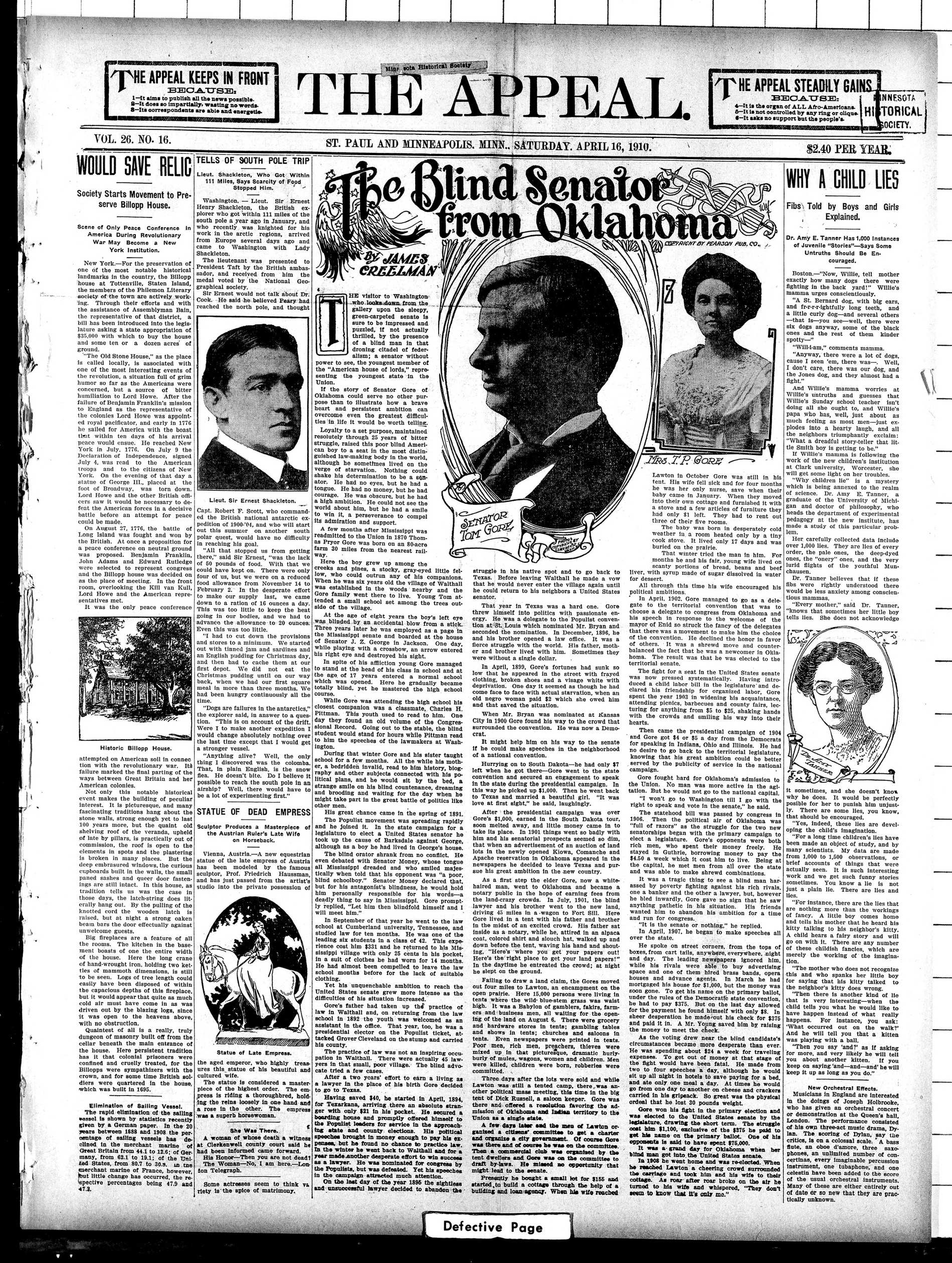
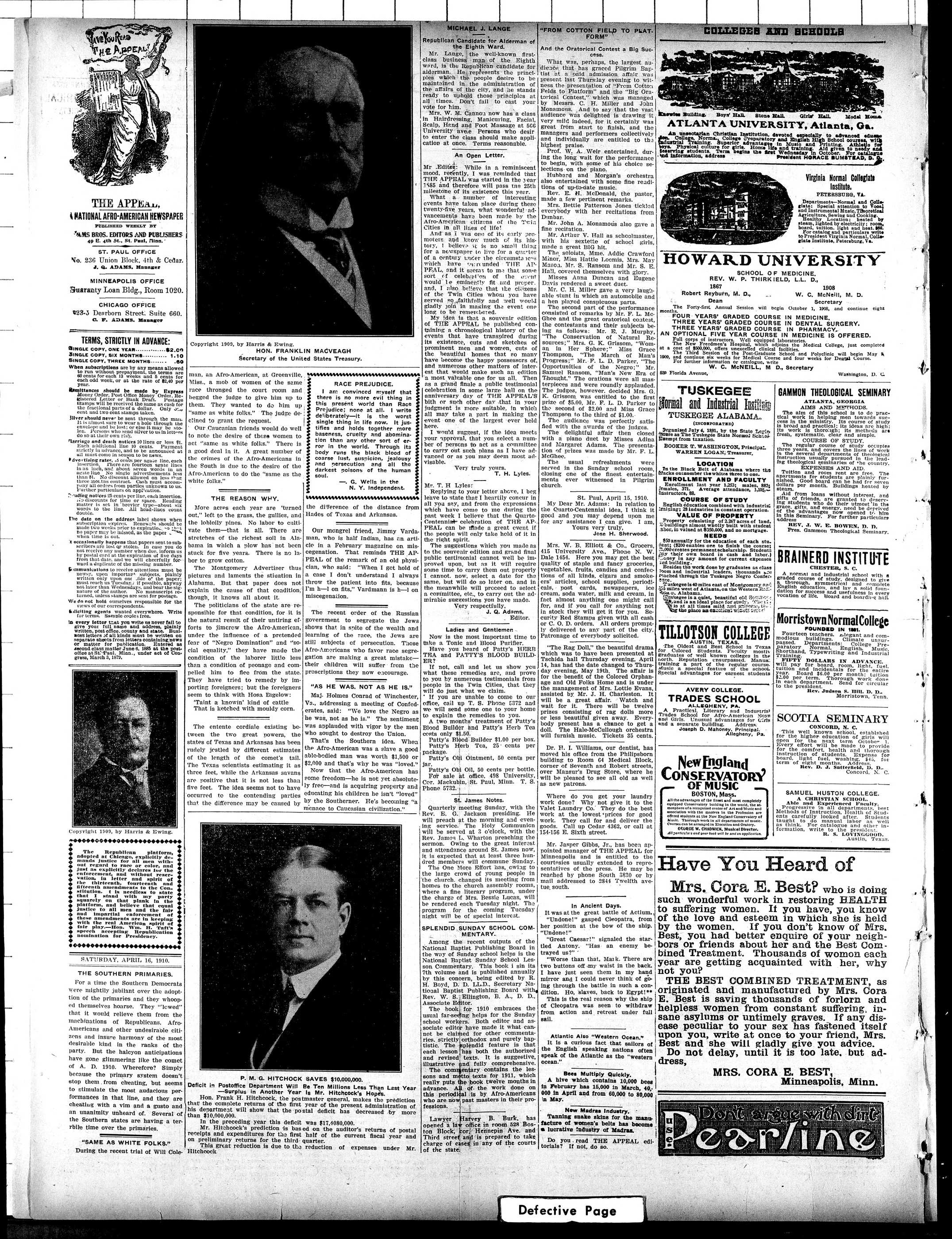
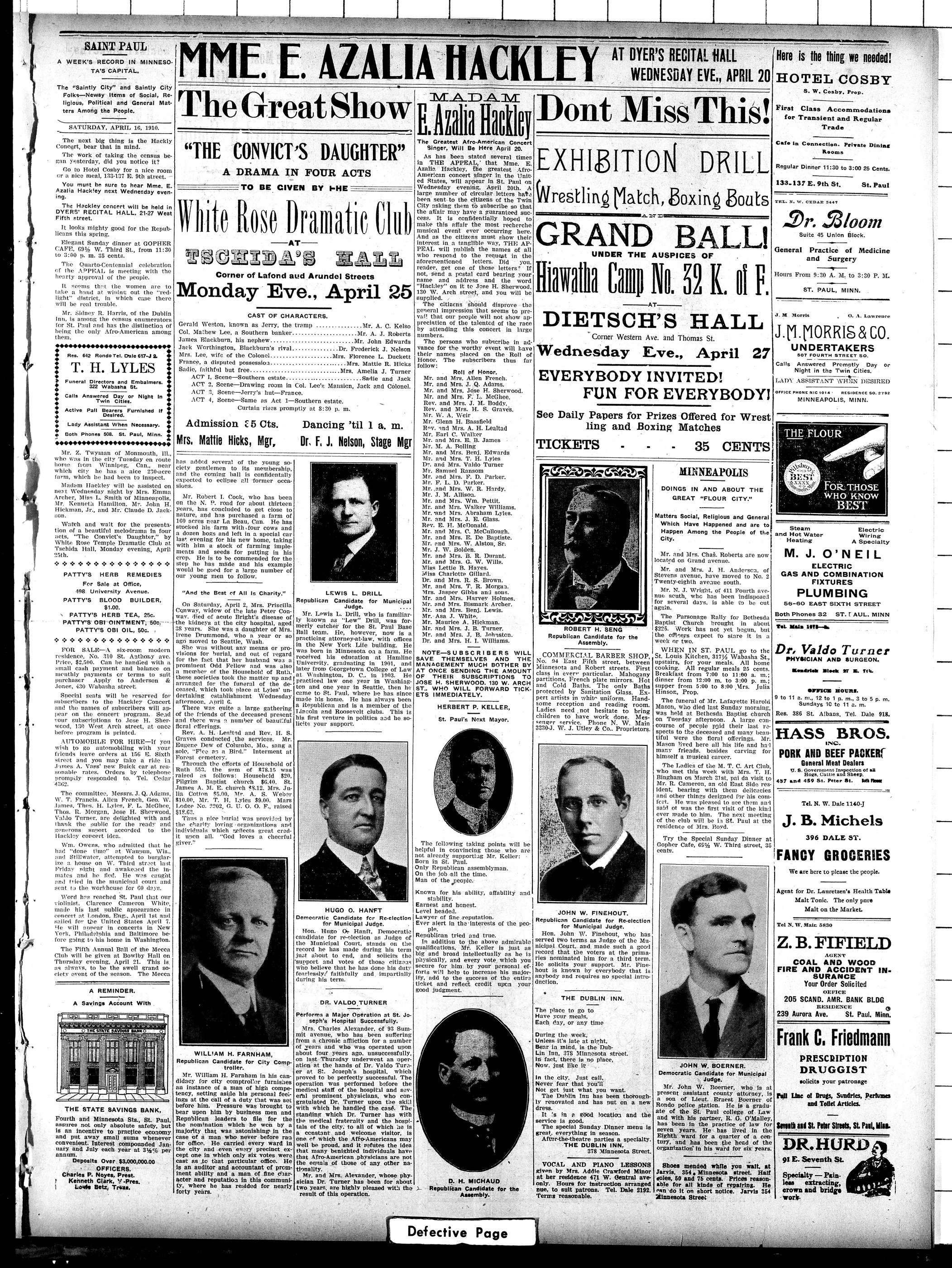
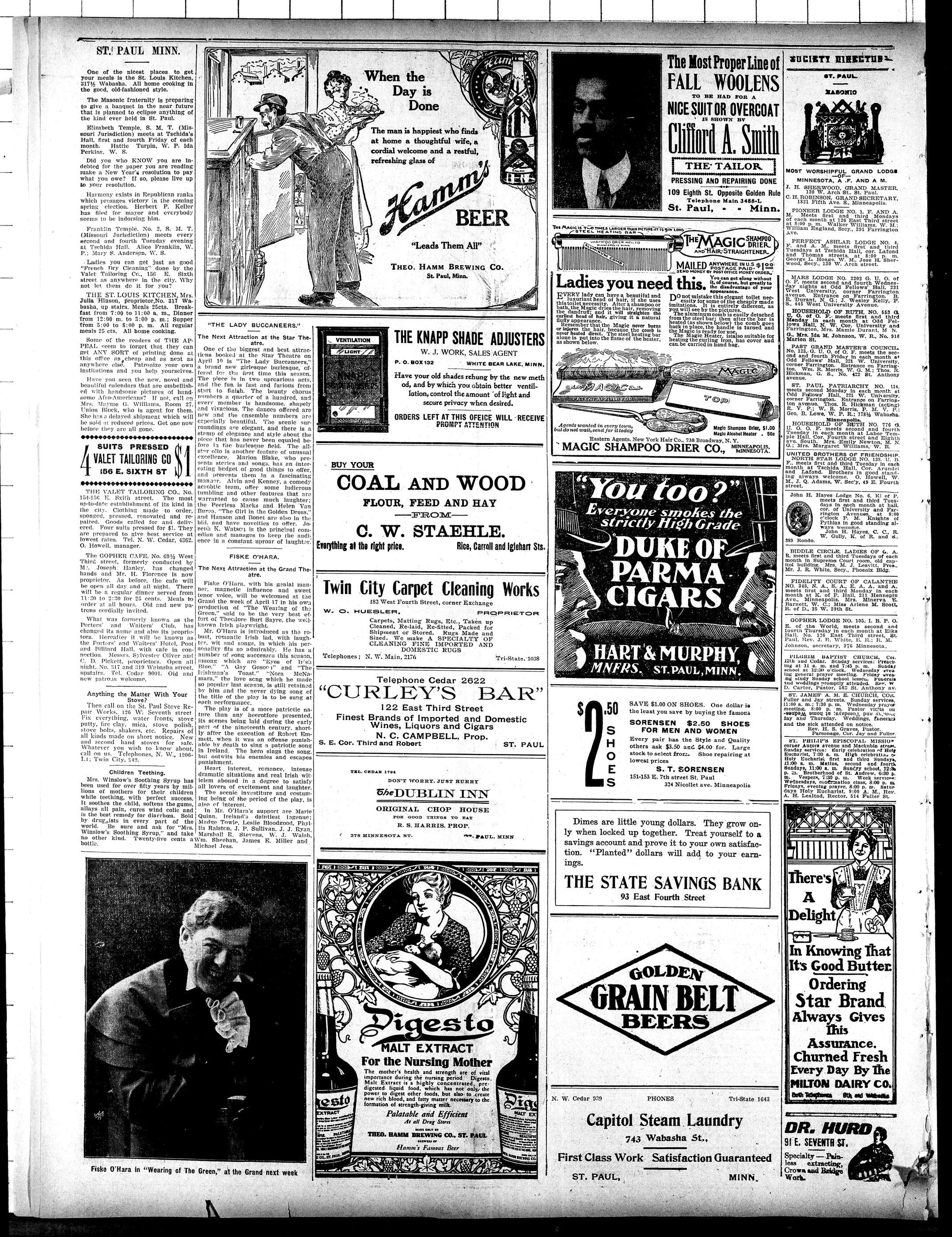
Page text (machine-generated)
THE APPEAL KEEPS IN FRONT
BECAUSE:
1-It aims to publish all the news possible.
2-It does so impartially, wasting no words.
8- Its correspondents are able and energetic.
VOL. 26. NO. 16.
WOULD SAVE RELIC
Society Starts Movement to Preserve Billopp House.
Scene of Only Peace Conference in America During Revolutionary War May Become a New York Institution.
New York.—For the preservation of one of the most notable historical landmarks in the country, the Billopp house at Tottenville, Staten Island, the members of the Philemon Literary society of the town are actively working. Through their efforts and with the assistance of Assemblyman Bain, the representative of that district, a lawmaker, the president of a lawmaking state a state appropriation of $25,000 with which to buy the house and some ten or a dozen acres of ground.
"The Old Stone House," as the place is called locally, is associated with one of the most interesting events of the revolution, a situation full of grim humor so far as the Americans were concerned, but a source of bitter humiliation to Lord Howe. After the failure of Benjamin Franklin's mission the representative of the colonies Lost Land, a royal pacificer, and early in 1776 he sailed for America with the boast that within ten days of his arrival peace would ensue. He reached New York in July, 1776. On July 9 the Declaration of Independence, signed July 4, was read to the American troops and to the citizens of New York. On the evening of that day a statue of George III., placed at the foot of Broadway, was torn down, and the other British officers saw that the American forces in a decisive battle before an attempt for peace could be made.
On August 27, 1776, the battle of Long Island was fought and won by the British. At once a proposition for a peace conference on neutral ground was proposed. Benjamin Franklin, John Adams and Edward Rutledge were selected to represent congress and the Billopp house was decided on as the place of meeting. In the front room, overlooking the Kill van Kull, Lord Howe and the American representatives met.
It was the only peace conference
Historic Billopp House.
attempted on American soil in connection with the revolutionary war. Its failure marked the final parting of the ways between Great Britain and her American colonies.
Not only this notable historical event makes the building of peculiar interest. It is picturesque, and many fascinating traditions hang about the stone walls, strong enough yet to last 100 years more, but the quaint old shelving roof of the veranda, upheld of late by pillars, is practically out of commission, the roof is open to the elements in spots and the plastering is broken in many places. But the deep embossed windows, the curious windows, the walls, the small paned sashes and the fastenings are still intact. In this house, tradition tells us was the case in those days, the latch-string does literally hang out. By the pulling of the knotted cord the wooden latch is raised, but at night a strong oaken beam bars the door effectually against unwelcome guests. Big fireplaces are a feature of all the rooms. The kitchen in the basement boasts of one the entire width of the house. Here the long crane of hand-wrought iron, holding two kettles of mammoth dimensions, is still to be seen. Logs of tree length could easily have been disposed of within the fireplace, of this fireplace, but it would appear as much cold air must have come in driven out by the blazing logs, since it was open to the heavens above, with no obstruction.
Quintestion of all is a really, truly dungeon of masonry built off from the cellar beneath the main entrance of the house. Here persistent tradition has it that colonial prisoners were confined and cruelly treated, for the Billops were sympathizers with the crown, and for some time British soldiers were quartered in the house, which was built in 1695.
Elimination of Sailing Vessel. The rapid elimination of the sailing vessel is shown by statistics recently given by a German paper. In the 20 years between 1888 and 1908 the percentage of sailing vessels has declined in the merchant marine of Great Britain from 44.1 to 12.6; of Germany, from 6.21 to 0.51; of the United States, from 30.7 to 30.5; in one merchant marine of France, however, but little change has occurred, the respective percentages being 47.9 and 47.3.
```markdown
```
TELLS OF SOUTH POLE TRIP
Lieut. Shackleton, Who Got Within 111 Miles, Says Scarcity of Food Stopped Him.
Washington — Lieut. Sir Ernest Henry Shackleton, the British explorer who got within 111 miles of the south pole a year ago in January, and who recently was knighted for his work in the arctic regions, arrived from Europe several days ago and was brought to Washington with Lady Shackleton.
The lieutenant was presented to President Taft by the British ambassador, and received from him the medal voted by the National Geographical society.
Sir Ernest would not talk about Dr. Cook. He said he believed Peary had reached the north pole, and thought
Lieut. Sir Ernest Shackleton.
Capt. Robert F. Scott, who commanded the British national antarctic expedition of 1900-04, and who will start out this summer on another south polar quest, would have no difficulty in reaching his goal.
"All that stopped us from getting there," said Sir Ernest, "was the lack of 50 pounds of food. With that we could have kept on. There were only four of us, but we were on a reduced food allowance from November 14 to February 2. In the desperate effort to make our supply last, we came down to a ration of 16 ounces a day. This was too little to keep the heat and the temperatures, and we had to advance the allowance to 20 ounces. Even this was too little.
"I had to cut down the provisions and stores to a minimum. We started out with tinned jam and sardines and an English pudding for Christmas day, and then had to cache them at our first depot. We did not eat the Christmas pudding until on our way back, when we had our first square meal in more than three months. We had been hungry continuously all the time.
"Dogs are failures in the antarctics," the explorer said, in answer to a question. This is on account of the drift. We make another expedition I would completely nothing over the last time except that I would get a stronger vessel.
"Anything alive? Well, the only thing I discovered was the colombia. That in plain English is the snow flea. He doesn't bite. Do I believe it possible to reach the south pole in an airship? Well, there would have to be a lot of experimenting first."
STATUE OF DEAD EMPRESS
Sculptor Produces a Masterpiece of the Austrian Ruler's Late Wife on Horseback.
Vienna, Austria.—A new equestrian statue of the late empress of Austria has been modeled by the famous sculptor, Prof. Friedrich Haussman, and has just passed from the artist's studio into the private possession of
Statue of Late Empress.
the aged emperor, who highly treasures this statue of his beautiful and cultured wife.
The statue is considered a master piece of the highest order. The empress is riding a thoroughbred, holding the reins loosely in one hand and a rose in the other. The empress was a superb horsewoman.
A woman of whose death a witness at Clerkenwell county court said he had been informed came forward. His Honor—Then you are not dead! The Woman—No, I am here—London Telegraph.
Some actresses seem to think va riety is the spice of matrimony.
THE APPEAL.
ST. PAUL AND MINNEAPOLIS. MINN.. SATURDAY. APRIL 16, 1910.
creeks and pines, a stocky, gray-eyed little fellow, who could outrun any of his companions. When he was six years old the village of Walthall was established in the woods nearby and the Guests came there to live. Young Tom attended a small school set among the trees outside of the village.
creeks and pines, a stocky, gray-eyed little fellow, who could outrun any of his companions. When he was six years old the village of Walthall was established in the woods nearby and the Gore family went there to live. Young Tom at a small school set among the trees outside of the village.
At the age of eight years the boy's left eye was blinded by an accidental blow from a stick. Three years later he was employed as a page in the Mississippi legislature boarded at the house of Senator J. Z. George J. Jackson. One day, while playing with a crossbow he entered his right eye and destroyed his sight.
In spite of his affliction young Gore managed to stand at the head of his class in school and at the age of 17 years entered a normal school which was opened. Here he gradually became totally blind, yet he mastered the high school course.
While Gore was attending the high school his closest companion was a classmate, Charles H. Pittman, his youth used to read to him. One day they found an old volume of the Congressional Record. Gore to the stable, the blind student would stand for hours while Pittman read to him the speeches of the lawmakers at Washington.
During that winter Gore and his sister taught school for a few months. All the while his mother, a bedridden invalid, read to him history, biography and other subjects connected with his political plans, and he would sit by the bed, a strange smile on his blind countenance, dreaming and brooding and waiting for the day when he might take part in the great battle of politics like other men.
His greatest chance came in the spring of 1891. The Populist movement was spreading rapidly and he joined it. The state campaign for a legislature to elect a United States senator he took up the cause of Barkskale against George, although as a boy he had lived in the village.
The blind orator shrank from no conflict. He even debated with Senator Money, whose tongue all Mississippi dreaded and who smiled majestically when told that his opponent was "a poor, blind schoolboy." Senator Money declared that, but for his antagonist's blindness, he would hold him personally responsible for his words—a deadly thing to say in Mississippi. Gore promptly replied, "Let him then blindfold himself and I will meet him."
In September of that year he went to the law school at Cumberland University, Tennessee, and studied law for ten months. He was one of the leading six students in a class of 42. This experience cost him $331 and he returned to his Mississippi village with only 25 cents in his pocket, in a suit of clothes he had worn for 14 months. He had almost been compelled to leave the law school months before for the lack of suitable clothing.
Yet his unquenchable ambition to reach the United States senate grew more intense as the difficulties of his situation increased.
Gore's father had taken up the practice of law in Walthall and, on returning from the law school in 1892 the youth was welcomed as an assistant in the office. That year, too, he was a presidential elector on the Populist ticket, attacked Grover Cleveland on the stump and carried his county.
In September of that year he went to the law school at Cumberland university, Tennessee, and studied law for ten months. He was one of the leading six students in a class of 42. This experience cost him $331 and he returned to his Mississippi village with only 25 cents in his pocket, in a suit of clothes he had worn for 14 months. He had almost been compelled to leave the law school months before for the lack of suitable clothing. Yet his unenchainable ambition to reach the United States senate grew more intense as the difficulties of his situation increased.
Gore's father had taken up the practice of law in Walthall and, on returning from the law school in 1892 the youth was welcomed as an assistant in the office. That year, too, he was presidential elector on the Populist ticket, attacked Grover Cleveland on the stump and carried his county.
The practice of law was not an inspiring occupation in Walthall. There were actually 45 lawyers in that small, poor village. The blind advocate tried a few cases.
After a two years' effort to earn a living as a lawyer in the place of his birth Gore decided to go to Texas.
Having saved $40, he started in April, 1894, for Texarkana, arriving there an absolute stranger with only $21 in his pocket. He secured a being house and promptly offered himself to the Populist state, where in the approaching state and county elections, his political speeches brought in money enough to pay his expenses, but he found no chance to practice law. In the winter he went back to Walthall and for a year made another desperate effort to win success as a lawyer. He was nominated for congress by the Populists, but was defeated. Yet his speeches in the campaign attracted much attention.
On the last day of the year 1896 the sightless and unsuccessful lawyer decided to abandon the
THE B
BY JAMES CREELMAN
HE visitor to Washington who looks down from the gallery upon the sleepy, green-carpeted senate is sure to be impressed and puzzled, if not actually thrilled, by the presence of a blind man in that droning citadel of federalism; a senator without power to see, the youngest member of the "American house of lords," representing the youngest state in the Union.
If the story of Senator Gore of Oklahoma could serve no other purpose than to illustrate how a brave heart and persistent ambition can overcome even the greatest difficulties in life it would be worth telling.
Loyalty to a set purpose, maintained resolutely through 25 years of bitter struggle, raised this poor blind American boy to a seat in the most distinguished law-making body in the world, although he sometimes lived on the verge of starvation. Nothing could shake his determination to be a sgn- man. He had no eyes, but he had a tongue, but had no money, but he had courage. He had courage, but he had a high ambition. He could not see the world about him, but he had a smile to win it, a perseverance to compel its admiration and support.
A few months after Mississippi was readmitted to the Union in 1870 Thomas Prory Gore was born on an 80-acre farm 30 miles from the nearest railway.
Here the boy grew up among the
struggle in his native spot and to go back to Texas. Before leaving Walthall he made a vow that he would never enter the village again until he could return to his neighbors a United States senator. That year in Texas was a hard one. Gore threw himself into politics with passionate energy. He was a delegate to the Populist convention at St. Louis which nominated Mr. Bryan and the second nomination. In December, 1896, he and his brother opened a law office. It was a fierce struggle with the world. His father, mother and brother lived with him. Sometimes they were without a single dollar.
In April, 1899, Gore's fortunes had sunk so low that he appeared in the street with frayed clothing, broken shoes and a visage white with a nose and a newed seemed as though he had come face to face with actual starvation, when an old negro woman paid $2 which she owed him and that saved the situation.
When Mr. Bryan was nominated at Kansas City in 1900 Gore found his way to the crowd that surrounded the convention. He was now a Democrat.
It might help him on his way to the senate if he could make speeches in the neighborhood of a national convention.
Hurrying on to South Dakota—he had only $7 left when he got there—Gore went to the state convention in the engagement to speak in the state during the presidential campaign. In this way he picked up $1,000. Then he went back to Texas and married a beautiful girl. "It was love at first sight," he said, laughingly.
After the presidential campaign was over rapidly, nca for a teacher he George, house, act. He tongue majes-a poor, and that, hold old words—a prompt and I f and the law, tree, and of the misc. pocket, months, the law suitable each as the justice of the law as an a market, at-carried occur, 45 law-advo. After Gore's $1,000, earned in the South Dakota tour, soon melted away, and little money came in to take its place. In 1901 things went so badly with him and his senatorial prospects seemed so dim, that when an advertisement of an auction of land lots in the newly opened Kiowa, Comanche and Apache reservation in Oklahoma appeared in the newspapers he decided to leave Texas and pursue his great ambition in the new country.
As a first step the elder Gore, now a whitehair man, went to Oklahoma and became a notary public in the hope of earning fees from the land-crazy crowds. In July, 1901, the blind driver 45 miles away for Ford. For the Gore lived in a tent with his father and brother in the midst of an excited crowd. His father sat inside as a notary, while he, attired in an alpaca coat, colored shirt and slouch hat, walked up and down before the tent, waving his hand and shouting, "Here's where you get your papers out! Here's the right place to get your paper!" In the daytime he entreated the crowd; at night he slept on the ground.
Failing to draw a land claim, the Gores moved out four miles to Lawton, an encampment on the open prairie. Here 15,000 persons were living in tents where the wild-blue-stem grass was high. It was a Babylon of gamblers, fakirs, farmers and business men, all waiting for the opening of the land on August 6. There were grocery and hardware stores in tents; gambling tables in tents; churches and saloons in tents. In newspapers were printed in texts. Poor men, rich men, pregnant mixed up in that picturequeque, dramatic hustily-burly of mules, wagons, women and children. Men were killed, children were born, robberies were committed.
Failing to draw a land claim, the Gores moved out four miles to Lawton, an encampment on the open prairie. Here 15,000 persons were living in tents where the wild-blue-stem grass was waist high. It was a Babylon of gamblers, fakirs, farmers and business men, all waiting for the opening of the land on August 6. There were grocery and hardware stores in tents; gambling tables and shows in tents; churches and saloons in tents. Even newspapers were printed in tents. Four men were preachers, thieves were mixed up in that district, burials were buried of mules, wagons, women and children. Men were killed, children were born, robberies were committed.
Failing to draw a land claim, the Gores moved out four miles to Lawton, an encampment on the open prairie. Here 15,000 persons were living in tents where the wild-blue-stem grass was waist high. It was a Babylon of gamblers, fakirs, farmers and business men, all waiting for the opening of the land on August 6. There were grocery and store stores in tents; gambling tables and shows in tents; churches and saloons in tents. Even newspapers were printed in tents. Poor men, rich men, preachers, thieves were mixed up in that picturesque, dramatic hurlyburly of mules, wagons, women and children. Men were killed, children were born, robberies were committed.
Three days after the lots were sold and while Lawton was still a tented camp, there was another political mass meeting, this time in the big tent of Dick Russell, a saloon keeper. Gore was there and offered a resolution favoring the ad-hoc protection of Indian territory to the Union as a single state.
A few days later and the men of Lawton organized a citizen's committee to get a charter and organize a city government. Of course Gore was there and of course he was on the committee. Then a commercial club was organised by the tent dwellers and Gore was on the committee to draft by-laws. He missed no opportunity that might lead to the senate.
Presently he bought a small lot for $155 and started to build a cottage through the help of a building and loan agency. When his wife reached
the justice of the law as an asset to an act, carried as occupancy of 454 law-advocated as decided approach-political his ex-ence law. And for a success by success by success
lightless on the
Presently he bought a small lot for $155 and started, to build a cottage through the help of a building and loan agency. When his wife reached
Presently he bought a small lot for $155 and helped of a building and loan accouter. When he wife
Defective Page
THE APPEAL STEADILY GAINS
BECAUSE:
4-It is the organ of ALL Afro-Americans.
5-It is not controlled by any ring or clique.
6-It asks no support but the people's.
MINNESOTA
HISTORICAL
SOCIETY.
Lawton in October Gore was still in his tent. His wife fell sick and for four months he was her only nurse, save when their baby came in January. When they moved into their own cottage and furnished it with a stove and a few articles of furniture they had only $1 left. They had to rent three of their five rooms. The baby was born in desperately cold weather in a room heated only by a tiny cook stove. It lived only 17 days and was buried on the prairie.
That winter tried the man in him. For months he and his fair, young wife lived on scanty portions of bread, beans and beef, with syrup made of sugar dissolved in water dessert. All through this time his wife encouraged his political ambitions. In April, 1902, Gore managed to go as a delegate to the territorial convention that was to choose a delegate to congress from Oklahoma and a speech in response to the welcome of the mayor of Enid so struck the fancy of the delegates at that there was a movement to make him the choice of the convention. He declined the honor in favor of others. It was a shrewd move and counteranced the fact that he was a newcomer in Oklahoma, his result was that he was elected to the territorial senate. The fight for a seat in the United States senate is now pressed systematically. Having introduced a child labor bill in the legislature and desired his friendship for organized labor, Gore sent the year 1903 in widening his acquaintances, ending pencils, barbecues and county fairs, leasing for anything from $5 to $25, shaking hands with the crowds and smiling his way into their arts.
Then came the presidential campaign of 1904 and Gore got $4 or $5 a day from the Democrats speaking in Indiana, Ohio and Illinois. He had desire to go back to the territorial legislature, ending pencils, barbecues and county fairs. "I won't go to Washington till I go with the throat to speak and vote in the senate," he said. The statehood bill was passed by congress in 1906. The political air of Oklahoma was full of razors' as the struggle for the two new partnerships began with the primary campaign to act a legislature. Gore's opponents were both men, who spent their money freely. He lay in Guthrie, borrowing money to pay the 50 a week which it cost him to live. Being at the capital, he met men from all over the state was able to make shrewd combinations.
It was a tragic thing to see a blind man harried in fighting against his rich rivals, a banker and lawyer, but, however inwardly, Gore grew up to see what anything pathetic in his situation. His friends lent him to abandon his ambition for a time and run for congress.
That winter tried the man in him. For months he and his fair, young wife lived on scanty portions of bread, beans and beef liver, and syrup made of sugar dissolved in water for dessert.
All through this time his wife encouraged his political ambitions.
In April, 1902, Gore managed to go as a delegate to the territorial convention that was to choose a delegate to congress from Oklahoma and his speech in response to the welcome of the mayor of Enid so struck the fancy of the delegates that there was a movement to make him the choice of the convention. He declined the honor in favor of others. It was a shrewd move and counterbalance that he was a newcomer in Oklahoma. The result was that he was elected to the territorial senate.
The fight for a seat in the United States senate was now pressed systematically. Having introduced a child labor bill in the legislature and declared his friendship for organized labor, Gore spent the year 1903 in widening his acquaintance, attending picnics, barbecues and county fairs, lecturing for anything from $5 to $25, shaking hands with the crowds and smiling his way into their hearts.
Then came the presidential campaign of 1904 and Gore got $4 or $5 a day from the Democrats for speaking Indiana, Ohio and Illinois. He had no desire to go to the territorial legislature, knowing that his great ambition could be better served by the publicity of service in the national campaign.
Gore fought hard for Oklahoma's admission to the Union. No man was more active in the agitation. But he would not go to the national capital.
"I won't go to Washington till I go with the right to speak and vote in the senate," he said.
The statehood bill was passed by congress in 1806. Then the political air of Oklahoma was "full of razors" as the struggle for the two new senatorships began with the primary campaign to elect a legislature. Gore's opponents were both men, who spent their money freely. He stayed Guerrilla money to pay the $4.50 a week which it cost him, being at the capital, he met men from all over the state and was able to make shrewd combinations.
It was a tragic thing to see a blind man harassed by poverty fighting against his rich rivals, one a banker and the other a lawyer, but, however he bleed inward, Gore gave no sign that he saw anything pathetic in his situation. His friends wanted him to abandon his ambition for a time and run for congress.
"It is the senate or nothing," he replied. In 1807, he began to make speeches all over the state.
He spoke on street corners, from the tops of boxes, from cart tails, anywhere, everywhere, night and day. The leading newspapers ignored while his rivals were able to buy advertising space and one of them hired brass bands, opera houses and advance agents. In March he mortgaged his house for $1,000, but the money was soon gone. To get his name on the primary ballot,
In April, 1907, he began to make speeches all over the state.
He spoke on street corners, from the tops of boxes, from cart tails, anywhere, everywhere, night and day. The leading newspapers ignored him, while his rivals were able to buy advertising space and one of them hired brass bands, opera houses and advance agents. In March he had cases for $1,000, but the money was soon gone. To get his on the primary ballot, under the rules of the Democratic state, he had to pay $375. But on the last day allowed for the payment he found himself with only $8. In sheer desperation he made out his check for $375 and paid it in. A Mr. Young saved him by raising the money to meet the check.
As the voting drew near the blind candidate's circumstances became more desperate than ever. He was spending about $24 a week for traveling expenses. To get out of money at that stage of the fight would have been fatal. He made from two to four speeches a day, although he would stop to pay for the save paying for a bed, and ate only one meal a day. He would go from one day to another on chess and crackers carried in his grippack. So great was the physical ordeal that lost 30 pounds weight.
Gore won his fight in the primary election and was elected to the United States senate by the legislature, drawing the short term. The struggle oocat him $1,100, exclusive of the $75 he paid to get his name on the primary ballot. One of his opponents is said to have spent $75,000.
It was a grand day for Oklahoma when her blind man got into the United States senate. He went home and was re-elected. When he reached the end of the cheering crowd surrounded the carriage and no one came to their cottage. As roar after roar broke on the air he turned to his wife and whispered, "They don't seem to know that it's only me."
$2.40 PER YEAR
WHY A CHILD LIES
Fibs Told by Boys and Girls Explained.
Dr. Amy E. Tanner Has 1,000 Instances of Juvenile "Stories"—Says Some Untruths Should Be Encouraged.
Boston.—"Now, Willie, tell mother exactly how many dogs there were fighting in the back yard!" Willie's mamma怒责 consciously.
"A St. Bernard dog, with big ears, and fr-r-r-rightfully long teeth, and a little curly dog—and several others—that is you—see well, there were six dogs anyway, some of the black ones and the rest of them kinder spotty—"Willi-am," comments mamma.
"Anyway, there were a lot of dogs, cause I seen 'em, there was—Well, I don't care, there was our dog, and the Jones dog, and they almost had a fight."
And Willie's mamma worries at Willie's untruths and guesses that Willie's Sunday school teacher isn't doing all she ought to, and Willie's papa who has, well, just about as feeling as most men—just explodes in a hearty laugh, and all the neighbors triumphantly exclaim: "What a dreadful story-teller that little Smith boy is getting to be."
If Willie's mamma is following the work of the new children's institution at Clark university, Worcester, she will get some light on her troubles.
"Why children lie" is a mystery which is being annexed to the realm of science. Dr. Amy E. Tanner, a graduate of the University of Michigan and doctor of philosophy, who heads the department of experimental pedagogy at the new institute, has made a study of this particular problem.
Her carefully collected data include over 1,000 lies. They are lies of every order, the pale ones, the deep-dyed ones, the "oney" ones, and the very lurid flights of the youthful Munchausen.
Dr. Tanner believes that if these fabs were rightly understood there would be no anxiety among conscientious mammals.
"Every mother," said Dr. Tanner, "knows that sometimes her little boy tells lies. She does not acknowledge
it sometimes, and she doesn't know why he does. It would be perfectly possible for her to punish him unjustly. There are some lies, you know, that should be encouraged.
"Yes, indeed, these lies are developing the child's imagination.
"For a long time children's lies have been made an object of study, and by many scientists. My data are made from 1,000 to 1,500 observations, or brief accounts of things that were actually seen. It is such interesting work and we get such funny stories sometimes. You know a lie is not just a plain lie. There are lies and lies.
"For instance, there are the lies that are nothing more than the workings of fancy. A little boy comes home and tells his mother that he heard his kitty talking to his neighbor's kitty. A child hears a fairy story and will go on with it. There are any number of these childish fancies, which are merely the working of the imagination.
"The mother who does not recognize this and who spans her little boy for saying that his kitty talked to the neighbor's kitty does wrong.
"That is another kind of lie that is very interesting when the child tells you what he would like to have happen instead of what really happens. For instance, you ask: What occurred out on the walk? And he will tell you that a kitten was playing with a ball.
"Then you say 'and' as if asking for more, and very likely he will tell you about another kitten. If you keep on saying 'and—and—and' he will keep it up as long as you do."
New Orchestral Effects
Musicians in England are interested in the doings of Joseph Holbrooke, who has given an orchestral concert or demonstration at the Queen's hall, London. The performance consisted of his own three-act music drama, Dylan. The scoring of Dylan, say the critics, is on a colossal scale. A bass fute, an oboe d'amore, three saxophones, an unlimited number of concertinas, every imaginable percussion one, an ubaphone, and one celestin have been used. The score of the usual orchestral instruments. Many of these are either entirely of date or so new that they are practically unknown.
HAVE YOU READ
THE APPEAL?
THE APPEAL,
NATIONAL AFRO-AMERICAN NEWSPAPER
PUBLISHED WEEKLY BY
JAMS BROS. EDITORS AND PUBLISHERS
49 E. 4th St., St. Paul, Minn.
ST. PAUL OFFICE
No. 236 Union Block, 4th & Cedar.
J. Q. ADAMS. Manager
MINNEAPOLIS OFFICE
Guaranty Loan Bldg., Room 1020.
CHICAGO OFFICE
923-5 Dearborn Street, Suite 660.
C. F. ADAMS. Manager
TERMS. STRICTLY IN ADVANCE:
SINGLE COPY, ONE YEAR.....$2.00
SINGLE COPY, SIX MONTHS.....1.10
SINGLE COPY, THREE MONTHS.....60
When subscriptions are by any means allowed
to run without prepayment, the terms are
60 cents for each 13 weeks and 5 cents for
each odd week, or at the rate of $2.40 per
per week.
Remittances should be made by Express
Money Order, Post Office Money Order,
Registered Letter or Bank Draft. Postage
must be paid in the same as cash for
the fractional parts of the amount. Only
2.00 and two cent stamps taken.
Silver should never be sent through the man. It is almost sure to wear a wole through the envelope and be lost; or else it may be stolen so do it on their own risk.
Marrigues and death notice 10 lines or less $1.
Payment security in advance, and to be announced at all must come in season to be news.
Advertising rates, 10 cents per aquease line, each in an inch, and about seven aquease lines on an aquease line. No single advertisement less than three cents cannot allowed upon all orders. Three notices must accompany all orders from parties unknown to us. Further purportations on application.
Industrial discount 20 discounts for time or space. Reading matter is set in 'brevier type'-about six words to the line. All head-lines count down.
The date on the address label shows when subscription expires. Renewals should be made two weeks prior to expiration. so that the notice is unmissed, as the paper when time is out.
Occasionally happens that papers sent to subscribers are lost or stolen. In case you know the address, by postal card at the expiration of five days from that date, you will cheerfully forward the address.
communications to receive attentions must be news, upon important subjects, plainly stated, must reach us Tuesday. If possible, anyway not later than Wednesday, and bear the sign of your interest, we return, unless stamps are sent for postage.
We do not hold ourselves responsible for the views of our correspondents.
We are here everywhere. Write for terms. Sample code free.
in every letter that you write us never fail to give your full name and address, plainly written, and mess letters of all kinds must be written on your cover; the contents containing news or matter for publication must be written on second class matter June 6, 1888 at the post-commission office, under act of Congress, March 3, 1879.
Copyright 1809, by Harris & Ewing.
The Republican platform, adopted at Chicago, explicitly demands justice for all men with disabilities just as explicitly declares for the enforcement, and without reservation, in letter and spirit of the Constitution, to fifteenth amendments to the Constitution. t is needless to state that I stand with my party and impartial enforcement of these amendments are in keeping with fair play.-Hon. Wm. H. Taft's speech accepting Republican nomination for Presidency.
SATURDAY, APRIL 16, 1910.
THE SOUTHERN PRIMARIES
For a time the Southern Democrats were mightly jubilant over the adoption of the primaries and they whooped themselves hoarse. They "licked" that it would relieve them from the machinations of Republicans, Afro-Americans and other undesirable citizens and insure harmony of the most desirable kind in the ranks of the party. But the halcyon anticipations have gone glimmering like the comet of A. D. 1910. Wherefore? Simply because the primary system doesn't stop them from cheating, but seems to stimulate the most audacious performances in that line, and they are cheating with a vim and a gusto and an unanimity unheard of. Several of the Southern states are having a terribile time over the primaries.
"SAME AS WHITE FOLKS."
During the recent trial of Will Cole
M. H.
man, an Afro-American, at Greenville, Miss., a mob of women of the same race thronged the court room and begged the judge to give him up to them. They wanted to do him up "same as white folks." The judge declined to grant the request.
Our Caucasian friends would do well to note the desire of these women to act "same as white folks." There is a good deal in it. A great number of the crimes of the Afro-Americans in the South is due to the desire of the Afro-American to do the "same as the white folks."
RACE PR
I am convincing that no one present will Prejudice; none deliberately—it single thing in tities and holds baseness, cruelty than in any other body runs the coarse lust, gus and persecution darkest poisons soul.
G. V
THE REASON WHY.
More acres each year are "turned out," left to the grass, the gullies, and the loblolly pines. No labor to cultivate them—that is all. There are stretches of the richest soil in Alabama in which a plow has not been stuck for five years. There is no labor to grow cotton.
The Montgomery Advertiser thus pictures and laments the situation in Alabama. But that paper does not explain the cause of that condition, though, it knows all about it.
The politicians of the state are responsible for that condition, for it is the natural result of their uniring efforts to jincrow the Afro-American, under the influence of a pretended fear of "Negro Domination" and "social equality," they have made the condition of the laborer little less than a condition of peonage and compelled him to flee from the state. They have tried to remedy by importing foreigners; but the foreigners seem to think with Hosa Bigelow: "Taint a known' kind of cattle That is kotched with mostly corn
---
The entente cordiale existing between the two great powers, the states of Texas and Arkansas has been rudely jestled by different estimates of the length of the comet's tail. The Texas scientists estimating it as three feet, while the Arkansas savans are positive that it is not less than five feet. The idea seems not to have occurred to the contending parties that the difference may be caused by
[Name]
M. B.
P. M. G. HITCHOCK SAVES $10,000,000.
Deficit in Postoffice Department Will Be Ten Millions Less
—Surplus in Another Year Is Mr. Hitchock's
Hon. Frank H. Hitchcock, the postmaster general, makes
that the complete returns of the first year of the present
his department will show that the postal deficit has deed
than $10,000,000.
In the preceding year this deficit was $17,408,000.
Mr. Hitchcock's prediction is based on the auditor's
receipts and expenditures for this half of the current
on preliminary returns for the third quarter.
This great reduction is due to the reduction of expen
Hitchcock
Deficit in Postoffice Department Will Be Ten Millions Less Than Last Year —Surplus in Another Year Is Mr. Hitchcock's Hope.
Hon. Frank H. Hitchcock, the postmaster general, makes the prediction that the complete returns of the first year of the present administration of his department will show that the postal deficit has decreased by more than $10,000,000.
In the preceding year this deficit was $17,408,000.
In the preceding year this denitex was $17,408,000.
Mr. Hitchcock's prediction is based on the auditor's returns of postal receipts and expenditures for the first half of the current fiscal year and on preliminary returns for the third quarter.
This great reduction is due to the reduction of expenses under Mr. Hitchcock
RACE PREJUDICE.
I am convinced myself that there is no more evil thing in this present world than Race Prejudice; none at all. I write deliberately—it is the worst single thing in life now. It justifies and holds together more baseness, cruelty and abomination than any other sort of error in the world. Through its body runs the black blood of coarse lust, suspicion, jealousy and persecution and all the darkest poisons of the human soul.
—. G. Wells in the N. Y. Independent.
```markdown
```
the difference of the distance from Hades of Texas and Arkansas.
Our mongrel friend, Jimmy Vardaman, who is half Indian, has an article in a February magazine on miscegenation. That reminds THE APPEAL of the remark of an old physician, who said: "When I get hold of a case I don't understand I always throw the patient into fits, because I'm h— on fits," Vardmann is h— on miscegenation.
The recent order of the Russian government to segregate the Jews shows that in spite of the wealth and learning of the race, the Jews are still subjects of persecution. Those Afro-Americans who favor race segregation are making a great mistake—their children will suffer from the prescriptions they now encourage.
"AS HE WAS, NOT AS HE IS."
Maj. Holmes Conrad of Winchester, Va., addressing a meeting of Confederates, said: "We love the Negro as he was, not as he is." The sentiment was applauded with vigor by the men who sought to destroy the Union. That's the Southern idea. When the Afro-American was a slave a good able-bodied man was worth $1,500 or $2,000 and that's why he was "loved." Now that the Afro-American has some freedom—he is not yet absolutely free—and is acquiring property and educating his children he isn't "loved" by the Southerner. He's becoming "a menace to Caucasian civilization."
1930
Be Ten Millions Less Than Last Year Is Mr. Hitchcock's Hope. tmaster general, makes the prediction year of the present administration of stal deficit has decreased by more was $17,4080,000. ed on the auditor's returns of postal half of the current fiscal year and quarter. reduction of expenses under Mr.
Republican Candidate for Alderman of the Eighth Ward.
Mr. Lange, the well-known first-class business man of the Eighth ward, is the Republican candidate for alderman. He represents the principles which the people desire to be maintained in the administration of the affairs of the city, and he stands ready to uphold those principles at all times. Don't fail to cast your vote for him.
Mrs. W. M. Cannon now has a class in Hairdressing, Manicuring, Facial, Scalp, Hand and Foot Massage at 560 University ave. a. Persons who desire to enter the class should make application at once. Terms reasonable.
An Open Letter.
Mr. Editor: While in a reminiscent mood, recently, I was reminded that THE APPEAL was started in the year 1885 and therefore will pass the 25th milestone of its existence this year.
What a number of interesting events have taken place during these twenty-five years, what wonderful advancements have been made by the Afro-American citizens of the Twin Cities in all lines of life!
And as I was one of its early promoters and know much of its history, I believe it is no small thing for a newspaper to live for a quarter of a century under the circumstances have surrounded THE APPEAL, and so to me that some sort of elephant to the court would be eminently fit and proper, and I also believe that the citizens of the Twin Cities whom you have served so faithfully and well would gladly join in making the event one long to be remembered.
My idea is that a souvenir edition of THE APPEALE be published continuing a chronological history of the events that have transpired during its existence, cuts and sketches of prominent men and women, cuts of the beautiful homes that so many have become the happy possessors of and numerous other matters of interest that would make such an edition a most valuable one for us all. Then as a grand finale a public testimonial celebration in some large hall on the anniversary day of THE APPEALS' bith or such other day that in your judgment is more suitable, in which may take a part in making the event one of the largest ever held here.
I would suggest, if the idea meets your approval, that you select a number of persons to act as a committee to carry out such plans as I have advanced or as you may deem most advisable.
Replying to your letter above, I beg leave to state that I heartily concur in all you say, and from the expressions which have come to me during the past week I believe that the Quarto-Centennial celebration of THE APPEAL can be made a great event if the people will only take hold of it in the right spirit.
The suggestions which you made as to the souvenir edition and grand final public testimonial cannot well be improved upon, but as it will require some time to carry them out properly I cannot. now, select a date for the same, but will do so later on. and in the meanwhile will proceed to select a committee, etc., to carry out the admirabie suggestions you have made.
Very respectfully.
J. Q. Adams,
Editor.
Ladies and Gentlemen
Now is the most important time to take a Tonic and Blood Purifier.
Have you heard of Patty's HERB TEA and PATTY'S BLOOD BUILDER?
If not, call and let us show you what these remedies are, and prove to you by numerous testimonials from people in the Twin Cities, that they will do just what we claim.
If you are unable to come to our office, call up T. S. Phone 5372 and we will send some one to your home to explain the remedies to you.
A two months' treatment of Patty's Blood Builder and Patty's Herb Tea costs only $1.50.
Patty's Blood Builder $1.00 per box.
Patty's Herb Tea, 25 cents per package.
Patty's Oli Ointment, 50 cents per jar.
Patty's Oli Oil, 50 cents per bottle.
For sale at office, 498 University, Corr. Mackubin, St. Paul, Minn. T. S. Phone 5732.
St. James Notes.
Quarterly meeting Sunday, with the Rev. E. G. Jackson presiding. He will preach at the morning and evening service. The Holy Communion will be served at 3 o'clock, with the Rev. James L. Wharton preaching the sermon. Owing to the great interest and attendance around St. James now, it is expected that at least three hundred members will communicate Sunday. The sermon will be the large crowd of young people in the church, changed its meeting from homes to the church assembly rooms, where a fine literary program, under the charge of Mrs. Bessie Lucas, will be rendered each Tuesday night. The program for the coming Tuesday night will be of special interest.
SPLENDID SUNDAY SCHOOL COM-
MENTARY
Among the recent outputs of the National Baptist Publishing Board in the way of Sunday school helps is the National Baptist Sunday School Lesson Commentary. This book is sin its 7th volume and is published annually by this concern, being edited by R. H. Boyd, D. D. LLD., Secretary National Baptist Publishing Board with Rev. W. S. Ellington, B. A., D. D., Associate Editor.
The book for 1910 embraces the usual far-searing helps for the Sunday school workers. Both editor and associate editor have made it what cannot be claimed for other commentaries, strictly orthodox and purely baptistic. The splendid feature is that each lesson has both the authorized and revised texts. It is suggestive, illustrative and fully comprehensive.
The commentary contains the lessons and metto texts for 1911, which really puts the book twelve months in advance. All of the work done on this periodical is by Afro-Americans who are now past masters in their professions.
Lawyer Harvey B. Burk, has opened a law office in room 528 Boston Block, cor. Hennepin Ave. and Third street and is prepared to take charge of cases in any of the courts of the state.
"FROM COTTON FIELD TO PLATFORM"
And the Oratorical Contest a Big Success.
What was, perhaps, the largest audience that has graced Pilgrim Baptist at a paid admission affair was present last Thursday evening to witness the presentation of "From Cotton Felds to Platform" and the "Big Oratorical Contest," which was managed by Messrs. C. H. Miller and John Monamous. And to say that the vast audience was delighted is drawing it very mild indeed, for it certainly was great from start to finish, and the managers and performers collectively individually are entitled to the highest praise.
Prof. W. A. Weir entertained, during the long wait for the performance to begin, with some of his choice selections on the piano.
Hubbard and Morgan's orchestra also entertained with some fine readings of up-to-date music.
Rev. E. H. McDonald, the pastor, made a few pertinent remarks.
Mrs. Bettie Patterson Jones ticked everybody with her recitations from Dunbar.
Mr. John A. Monamous also gave a fine recitation.
Mr. Arthur V. Hall as schoolmaster, with his sextette of school girls, made a great BIG hit.
The solist, Mme. Addie Crawford Minor, Miss Hattie Loomis, Mrs. May Mason, Mr. S. Ransom and Mr. S. E. Hall, covered themselves with glory.
Misses Anna Duncan and Eugene Davis rendered a sweet duet.
Mr. C. H. Miller gave a very laughable stunt in which an automobile and a hen played conspicuous parts.
The second part of the performance consisted of remarks by Mr. F. L. McGhee and the great oratorical coaster, the contestants and their subjects being as follows: Mr. E. J. Murphy, "The Conservation of Natural Resources," Mrs. G. K. Grissom, "Woman in Her Sphere"; Miss Grace Thompson, "The March of Man's Progress"; Mr. F. L. D. Parker, "The Opportunities of the Negro"; Mr. Samuel Ransom, "Man's New Era of Thought." The orations were all masterpieces and were roundly applauded. The judges, however, decided Mrs. G. K. Grissom was entitled to the first prize of $5.00, Mr. F. L. D. Parker to the second of $2.00 and Miss Grace Thompson to the third of $1.00.
The audience was perfectly satisfied with the awards of the judges.
The delightful affair then closed with a piano duet by Misses Adina and Margaret Adams. The presentation of prizes was made by Mr. F. L. McGhee.
The usual refreshments were served in the Sunday school room closing one of the finest entertainments ever witnessed in Pilgrim church.
St. Paul, April 15, 1910.
My Dear Mr. Adams: In relation to the Quarto-Centenial idea, I think it good and you may depend upon me for any assistance I can give. I am Yours very truly,
Jose H. Sherwood.
Mrs. W. B. Elliott & Co., Grocers
415 University Ave, Phone N. W.
Dale 1454. Here you may get the best
quality of staple and fancy groceries,
vegetables, fruits, candies and confections
of all kinds, cigars and smokers'
articles, school supplies, periodicals,
post cards, newspapers, ice
cream, soda water, milk and cream, in
fact almost anything one might call for,
and if you call for anything not
in stock they will get it for you. Security Red Stamps given with all cash
or C. O. D. orders. All orders promptly
delivered to any part of the city.
Patronage of everybody solicited.
"The Rag Doll," the beautiful drama which was to have been presented at Tschida hall Thursday evening, April 14, has had the date changed to Thursday evening, May 19th. The affair is for the benefit of the Colored Orphanage and Old Folks Home and is under the management of Mrs. Lottie Evans, assisted by Mr. J. H. Charleston. It will be a great affair. Watch and wait for it. There will be twelve prizes consisting of rag dolls more or less beautiful given away. Everybody present has a chance to get a doll. The Hale-McCullough orchestra will furnish music. Tickets 35 cents.
Dr. H. I. Williams, our dentist, has moved his office from the Philipson building to Room 64 Medical Block, corner of Seventh and Robert streets, over Mansur's Drug Store, where he will be pleased to see all old as well as new patrons.
Where do you get your laundry work done? Why not give it to the Valet Laundry Co. They do the best work at the lowest prices for good work. They call for and deliver the goods. Call up Cedar 4362, or call at 154-156 E. Sixth street.
Mr. Jasper Gibbs, Jr., has been appointed manager of THE APPEAL for Minneapolis and is entitled to the courtesies usually extended to representatives of the press. He may be reached by phone South 3230 or by mail addressed to 2844 Twelfth avenue south.
In Ancient Days.
It was at the great battle of Actium,
"Undone!" gasped Cleopatra, from her position at the bow of the ship.
"Undone!"
"Great Caesar!" signaled the startled Antony. "Has an enemy betrayed us?"
"Worse than that, Mark. There are two buttons off my waist in the back. I have just seen them in my hand mirror and I could never think of going through the battle in such a condition. Ho, slaves, back to Egypt!**
This is the real reason why the ship of Cleopatra was seen to withdraw from action and retreat under full sail.
Atlantic Also "Western Ocean."
It is a curious fact that sailors of the English speaking nations often speak of the Atlantic as the "western ocean."
A hive which contains 10,000 bees in February has 15,000 in March, 40,000 in April and from 60,000 to 80,000 in May.
New Madras Industry.
Tanning snake skins for the manufacture of women's belts has become lucrative industry of Madras.
Do you read THE APPEAL editorials? If not, do so.
Defective Page
Exercise Building. Boy's Hall. Stone Hall. Girl's Hall. Model Home.
ATLANTA UNIVERSITY, Atlanta, Ga.
An unsectarian Christian Institution, devoted especially to advanced education. College. Norma. College Preparatory and English High School courses. Industrial Training. Superior advantages in Music and Printing. Athletic for physical culture for girls. Home life and training. Aid given to needy and reserving students. Term begins the first Wednesday in October. For information, address. President HORACE BUMSTEAD, D. D.
```markdown
```
HOWARD UNIVERSITY
SCHOOL OF MEDICINE
REV. W. P. THIRKIELD, L.L. D.,
1867
Robert Reyburn, M. D.,
W. C. B.
Dean
S
The Forty-first Annual Session will begin October 1,
months.
FOUR YEARS' GRADED COURSE IN MEDICINE
THREE YEARS' GRADED COURSE IN DENTAL
THREE YEARS' GRADED COURSE IN PHARMACY
AN OPTIONAL FIVE YEAR COURSE IN MEDICINE
corps of instructors. Well equipped laboratories.
The New England Hospital which admits 1,000
Medica at a cost of $800,000, offers unexcelled clinical facilities.
The Third Session of the Post-Graduate School and Pol-
1900, and continue with course and four week
For further information or catalogue, write
W. C. McNEILL, M. D. Secretary
The Forty-first Annual Session will begin October 1, 1908, and continue eight months.
TUSKEGEE Normal and Industrial Institute
Organised July 4, 1881, by the State Legislature State Normal School Except from taxation
BOOKER W. WASHINGTON, Principal
WARREN LOGAN, Treasurer
LOCATION
In the Black Belt of Alabama where that
68th class whites tare to one
ENROLMENT
Enrollment last year 1,253; males, 884;
females, 371. Average attendance, 1,105~
instructors, 88.
COURSE OF STUDY
Engineering combined with industrial
zining; 28 industrial education.
VALUE OF PROPERTY
Property consisting of 2,267 acres of land, 8 buildings almost wholly built with student labor, is valued at $350,000, and no mortgage.
NEEDS
$250 annually for completion of each student; $200 enables one to finish the course; $0.00 creates permanent scholarship. Students pay their own board in cash and labor; and building. The amount for current expenses and building. Besides the work done by graduates as class leader, virtual leaders, thousands are reached through the Alamo Conference $300.
A college is 40 miles cast of Montgomery, and a mile west of Alamo is 20 miles cast of Montgomery.
Paskegee is 40 miles east of Montgomery and is the largest city of Alabama. It is a beautiful old town and is an ideal place for study. Paskegee is also the location of the place on an island where the place is on a peninsula.
TILLOTSON COLLEGE
The Oldest and Best School in Texas for Colleges students. Faculty mostly graduates of what is now the north. Reputation unsurpassed. Manual handling a part of the regular course. Music a special course of the school. Special advantages for certain students.
AVERY COLLEGE.
TRADES SCHOOL
ALLEGHENY, PA.
A. Practical Literary and Industrial Trades School for Allied Girls and Girls. Unusual advantages for Girls and a separate building. Address.
Joseph D. Mahoney. Pennsylvania.
New England CONSERVATORY OF MUSIC
All the advantages of the finest and most completely equipped Conservatory building in the world, the atmosphere is associated center of art and music and association with the masters in the Profession are offered students at the New England Conservatory of Music. Through work in all departments of music, Courses can be arranged in Excitation and Oratory. GEORGE W. CHADWICK, Musical Director. All particulars and your book will be sent on application.
Have You He
Mrs. Cora E. Be such wonderful work in re to suffering women. If you of the love and esteem in by the women. If you d Rest you had better enjoy
Have You Heard of
Mrs. Cora E. Best? who is doing such wonderful work in restoring HEALTH to suffering women. If you have, you know of the love and esteem in which she is held by the women. If you don't know of Mrs. Best, you had better enquire of your neighbors or friends about her and the Best Combined Treatment. Thousands of women each year are getting acquainted with her, why not you? THE BEST COMBINED TREATMENT, as originated and manufactured by Mrs. Cora E. Best is saving thousands of forlorn and helpless women from constant suffering, insane asylums or untimely graves. If any disease peculiar to your sex has fastened itself upon you, write at once to your friend, Mrs. Best and she will gladly give you advice.
Do not delay, until it is too late, but address.
MRS. CORA E. BEST,
Minneapolis, Minn.
Don't argue with dirt
Pearline
539 Florida Avenue,
Departmenta-Normal and Collegea- Special attention to Vocal and Instrumental Music, Theoretical Music, and Health. Location heated by steam, lighted by electricity; room, board, tuition, light and heat. 850. 212-722-2222 to President Virginia Normal, College Institute, Petersburg, Va.
1908
W. C. McNeill, M. D.
Secretary
begin October 1, 1908, and continue eight
SEE IN MEDICINE.
SEE IN DENTAL SURGERY.
SEE IN PHARMACY.
SEE IN MEDICINE IS OFFERED.
Institutes.
joins the Medical College, just completed
facilities.
School and Polyclinic will begin May
and four weeks for Dental Course.
te.
D., Secretary
GAMMON THEOLOGICAL SEMINARY
The aim of this school is to do practical work in helping men towards success in the arts; it is broad and practical; its ideas are high its work is thorough; its methods are fresh, systematic, clear and simple.
COURSE OF STUDY.
The required course occupies three years, and covers the lines of work in the several departments of theological the leading theological seminaries of the country.
EXPENSES AND AID.
Tutrition and room rent are free. The accommodation is furnished. Good board can be had on dollars per month. Buildings heated by aid from loans without interest, and gifts of friends, are granted to deserving students who do their utmost in the preparation of the advantages now open to them in this Seminary. For further particular additions.
REV. J. W. E. BOWEN, D. D. P., Gassman, Theological Services.
BRAINERD INSTITUTE
A normal and industrial school with a large study, designed to give a thorough, sympathetic English education, and lay a solid foundation of success and usefulness in every vocation of life.
Fourteen teachers. Elegant and commodious buildings. Climate. Unsurpassed Departments. College Preparatory. English. Music. Shorthand. Typewriting and Industrial Training.
**DOLLARS IN ADVANCE.** will pay for board room, tuition and incidentals for the entire year. Board $6.00 per month; tuition term. Thorough work done in each department. Send for circular to the president.
This well known school, established for the higher education of girls will provide every effort will be made to provide for the comfort, health and thorough care of students, as well as board, light fuel, washing, $ for term of eight months. Address:
SAMUEL HUSTON COLLEGE.
A CHRISTIAN SCHOOL.
Able and Experienced Faculty.
Progressive in all departments, best
Methods of Instruction. Health of
Students carefully looked after. Students
taught to do manual labor as well
as think. For catalogue and obje-
tion, written to the president.
R S. LOVINGGOOD.
Austin, Texas.
Heard of
Best? who is doing
in restoring HEALTH
if you have, you know
in which she is held
u don't know of Mrs.
Washington, D.
CHESTER, S. C.
Rev. Judson S. Hill, D. D.
Morristown, Tenn.
Concord, N. C.
The "Saintly City" and Saintly City Folks—Newsy Items of Social, Religious, Political and General Matters Among the People.
SATURDAY, APRIL 16, 1910.
The next big thing is the Hackly Concort, bear that in mind.
The work of taking the census began yesterday, did you notice it?
Go to Hotel Cosby for a nice room or a nice meal, 133-137 E. 9th street.
You must be sure to hear Mme. E. Azalia Hackley next Wednesday evening.
The Hackley concert will be held in DYERS' RECITAL HALL, 21-27 West Fifth street.
It looks mighty good for the Republicans this spring.
Elegant Sunday dinner at GOPHER CAFE, 69½ W. Third St, from 11:30 to 3:00 p. m. 35 cents.
The Centennial celebration of the APPEAL is meeting with the hearty approval of the people.
It seems that the women are to take a hand at wiping out the "red-light" district, in which case there will be real trouble.
Mr. Sidney R. Harris, of the Dublin Inn, is among the census enumerators for St. Paul and has the distinction of being the only Afro-American among them.
Res. 642 Rondo Tel. Dale 617-J 2.
T. H. LYLES
Funeral Directors and Embalmers.
322 Wabasha St.
Calls Answered Day or Night In
Twin Cities.
Active Pall Bearers Furnished If
Desired.
Lady Assistant When Necessary.
Both Phones 508. St. Paul, Minn.
Mr. Z. Twynman of Monmouth, Ill,
who was in the city Tuesday en route
home from Winnipeg, Can., near
which city he has a nice 230-acre
farm, which he had been to inspect.
Madam Hackley will be assisted on
next Wednesday night by Mrs. Emma
Archer, Miss L. Smith of Minneapolis,
Mr. Kenneth Hamilton, Mr. John H.
Hickman, Jr., and Mr. Claude D. Jackson.
Watch and wait for the presentation of a beautiful melodrama in fou- acts. "The Convict's Daughter," by White Rose Temple Dramatic Club at Tschida Hall, Monday evening, April 25th.
PATTY'S HERB TEA, 25c.
PATTY'S OBI OINTMENT, 50c.
PATTY'S OBI OIL, 50c.
FOR SALE—A six-room modern residence, No. 310 St. Anthony ave.
Price, $2,500. Can be handed with a small cash payment and balance on monthly payments or terms to suit purchaser Apply to Anderson & Jones, 430 Wabasha street.
Special seats will be reserved for subscribers to the Hackley Concert and the names of subscribers will appear on the concert program. Seed your subscriptions to Jose H. Sherwood, 130 West Arch street, at once before program is printed.
AUTOMOBILE FOR HIRE—If you wish to go automobiling with your friends leave orders at 156 E. Sixth street and you may take a ride in James A. Vass' new Buick car at reasonable rates. Orders by telephone promptly responded to. Tel. Cedar 4362.
The committee, Messrs. J. Q. Adams, W. T. Francis, Allen French, Geo. W. James, Thres. H. Lyles, F. L. McGhee, Thos. R. Moris, Joseh H. Sherwool, Valdo Turner, are delighted with and thank the public for the ready and generous support accorded to the Hackley concert idea.
Wm. Owens, who admitted that he had "done time" at Waupun, Wis. and Stillwater, attempted to burglarize a house on W. Third street last Friday night and awakened the inmates and he fed. He was caught and tried in the municipal court and sent to the workhouse for 50 days.
Word has reached St. Paul that our violinist, Clarence Cameron White, made his last public appearance in concert at London, Eng. April 1st and sailed for the United States April 7. He will appear in concerts in New York, Philadelphia and Baltimore before going to his home in Washington.
The Fifth Annual Ball of the Mecca Club will be given at Bowlby Hall on Thursday evening, April 21. This is as always, to be the swell grand society event of the season. The Mecca
A REMINDER.
THE STATE SAVINGS BANK,
Fourth and Minnesota Sts. St. Paul,
assures not only absolute safety, but
is an incentive to practice economy
and put away small sums whenever
convenient. Interest compounded January
and July each year at 3½% per
annum.
Deposits Over $3,000,000.00
OFFICERS.
Charles P. Noyes, Prest.
Kenneth Clark, V-Pres.
Louis Betz, Treas.
The Great Show
White Rose Dramatic Club
TSCHIDA'S HALL
Gerald Weston, known as Jerry, the trump ..... Mr. A. C. Kelso
Col. Mathew Lee, a Southern banker ..... Mr. A. J. Roberts
James Blackburn, his nephew ..... Mr. John Edwards
Jack Worthington, Blackburn's rival ..... Dr. Frederick J. Nelson
Mrs. Lee, wife of the Colonel ..... Mrs. Florence L. Duckett
France, a disputed possession ..... Mrs. Mattie R. Hicks
Sadie, faithful but free ..... Mrs. Amelia J. Turner
ACT 1, Scene—Southern estate ..... Sadie and Jack
ACT 2, Scene—Drawing room in Col. Lee's Mansion, Jack and Colonel.
ACT 3, Scene—Jerry's hut—France.
ACT 4, Scene—Same as Act 1—Southern estate.
has added several of the young society gentlemen to its membership, and the coming ball is confidently expected to eclipse all former occasions.
Mr. Robert I. Cook, who has been on the N. P. road for about thirteen years, has concluded to get close to nature, and has purchased a farm of 160 acres near La Beau, Can. He has stocked his farm with four cows and a dozen hogs and left in a special car last evening for his new home, taking with him a stock of farming implements and seeds for putting in his crop. He is to be commended for the step he has made and his example would be good for a large number of our young men to follow.
"And the Best of All Is Charity."
On Saturday, April 2, Mrs. Priscilla Conway, widow of the late Peter Conway, died of acute Bright's disease of the kidneys at the city hospital, aged 38 years. She was a daughter of Mrs. Irene Drummond, who a year or so ago moved to Seattle, Wash.
She was without any means or provisions for burial, and out of regard for the fact that her husband was a prominent Odd Fellow and was also a member of the Household of Ruth, these societies took the matter up and arranged for the funeral of the deceased, which took place at Lyles' undertaking establishment Wednesday afternoon, April 6.
There was quite a large gathering of the friends of the deceased present and there was a number of beautiful floral offerings.
Rev. A. H. Lealtad and Rev. H. S. Graves conducted the services, Mr. Eugene Dew of Columbia, Mo., sang a solo, "Free as a Bird." Interment at Forest cemetery.
Through the efforts of Household of Ruth 553, the sum of $78.15 was raised as follows: Household $20, Pilgrim Baptist church $6.40, St. James A. M. E. church $1.12, Mrs. Julia Cotton $0.00, Mr. A. S. Weber $10.00, Mr. T. H. Lyles $3.00, Mars Lodge No. 2202, G. U. O. O. F., raised $18.63.
Thus a nice burial was provided by the charity loving organizations and individuals which reflects great credit upon all. "God loves a cheerful giver."
PETER H. BURKE
WILLIAM H. FARNHAM,
Republican Candidate for City Comptroller.
Mr. William H. Farnham in his candidacy for city comptroller furnishes an instance of a man of high competency, setting aside his personal feelings at the call of a duty that was set before him. Pressure was brought to bear upon him by business men and Republican leaders to file for the nomination which he won by a majority that was astonishing in the case of a man who never before raed for office. He carried every ward in the city and even every prefect except one in which only six votes were cast as to that particular office. He is an auditor and accountant of prominent ability and a man of fine character and reputation in this community, where he has resided for nearly forty years.
PETER H. BURTON
Mr. Lewis L. Drill, who is familiarly known as "Lew" Drill, was formerly catcher for the St. Paul Base Ball team. He, however, now is a practicing attorney-at-law, with offices in the New York Life building. He was born in Minnesota on a farm. He received his education at Hamline University, graduating in 1901, and later from Georgetown college of Law at Washington, D. C., in 1903. He lawed one year in Washington and then in Seattle, then came to St. Paul, where he has since made his home. He has always been a Republican and is a member of the Lincoln and Roosevelt clubs. This is his first venture in politics and he solicits your support.
PETER H. BURKE
Hon. Hugo O. Hanft, Democratic candidate for re-election as Judge of the Municipal Court, stands on the record he has made during his term just about to end, and solicits the citizens who believe that he has done his duty fearlessly, faithfully, and impartially during his term.
DR. VALDO TURNER
Performs a Major Operation at St. Joseph's Hospital Successfully.
Mrs. Charles Alexander, of 93 Summit avenue, who has been suffering from a chronic affliction for a number of years and who was operated upon about four years ago, unsuccessfully, on last Thursday underwent an operation at the hands of Dr. Valdo Turner at St. Joseph's hospital, which proved to be perfectly successful. The operation was performed before the medical staff of the hospital and several prominent physicians, who congratulated Dr. Turner upon the skill with which he handled the case. The standing which Dr. Turner has with the medical fraternity and the hospitals of the city, to all of which he is a constant and welcome visitor, is one of which the Afro-Americans may well be proud, and it refutes the idea that many benighted individuals have that Afro-American physicians are not the equals of those of any other nationality.
Mr. and Mrs. Alexander, whose physician Dr. Turner has been for about two years, are highly pleased with the result of this operation.
MADAM
E.Azalia Hacklev
The Greatest Afro-American Concert Singer. Will Be Here April 20.
As has been stated several times in THE APPEAL, that Mme. E. Azalia Hackley, the greatest Afro-American concert singer in the United States, will appear in St. Paul on Wednesday evening, April 20th. A large number of circular letters have been to the club of the Twin City asking them to subscribe so that the affair may have a guaranteed success. It is confidently hoped to make this affair the most cheerful musical event ever occurring here. And as the citizens must show interest in a tangible way, THE APPEAL will publish the names of all who respond to the request in the aforementioned letters. Did you, reader, get one of those letters? If not, send a postal card bearing your name and address and the word "Hackley" on it to Jose H. Sherwood, 130 W. Arch street, and you will be supplied.
The citizens should disprove the general impression that seems to prevail! that our people will not show appreciation of the talented of the race by attending this concert in large numbers.
The persons who subscribe in advance for the worthy event will have their names placed on the Roll of Honor. The subscribers thus far follow:
Roll of Honor.
Mr. and Mrs. Allen French.
Mr. and Mrs. J. Q. Adams.
Mr. and Mrs. Jose H. Sherwood.
Mr. and Mrs. F. L. McGhee.
Rev. and Mrs. J. M. Boddy.
Rev. and Mrs. H. S. Graves.
Mr. W. A. Weir
Mr. Glenn H. Bassfield
Rev. and Mrs. A. H. Lealtad
Mr. Earl C. Walker
Mr. and Mrs. E. B. James
Mr. M. A. Rolling
Mr. and Mrs. Benj. Edwards
Mr. and Mrs. T. H. Lyles
Dr. and Mrs. Valdo Turner
Mr. Samuel Ransom
Mr. and Mrs. F. D. Parker.
Mr. F. L. D. Parker.
Mr. and Mrs. W. R. Hardy.
Mr. J. M. Allison.
Mr. and Mrs. Wm. Pettit.
Mr. and Mrs. Walker Williams.
Mr. and Mrs. Abraham Lyles.
Mr. and Mrs. J. E. Glass.
Rev. E. H. McDonald.
Mr. and Mrs. C. McCullough.
Mr. and Mrs. E. De Baptiste.
Mr. and Mrs. W. Alston, Sr.
Mr. J. W. Bolden.
Mr. and Mrs. B. R. Durant.
Mr. and Mrs. B. W. Wills.
Miss Lettie B. Hayes.
Miss Charlotte Gillard.
Dr. and Mrs. R. S. Brown.
Mr. and Mrs. T. R. Morgan.
Mr. Jasper Gibbs and sons.
Mr. Jeremy J. Harper.
Mr. and Mrs. Bismark Archer.
Mr. and Mrs. Benj. Lewis.
Mr. Asa J. White.
Mr. Maurice A. Hickman.
Mr. and Mrs. J. B. Turner.
Mr. and Mrs. J. B. Johnston.
Dr. and Mrs. H. I. Williams.
NOTE: SUBSCRIBERS WILL SAVE THEMSELVES AND THE MAGAZINE FOR OTHER DAY ONCE SENDING THE AMOUNT OF THEIR SUBSCRIPTIONS TO JOSEH B. SHERWOOD. 130 W. ARCH ST. WHO WILL FORWARD TICKETS IMMEDIATELY.
The following taking points will be helpful in convincing those who are not already supporting Mr. Keller:
Born in St. Paul.
Only Republican assemblyman.
On the job all the time.
Man of the people:
Known for his ability, affability and stability.
Ever alert in the interests of the peo ple.
Republican tried and true.
In addition to the above admirable qualifications, Mr. Keller is just as big and broad intellectually as he is physically, and every vote which you secure for him by your personal efforts will help to increase his major achievements in success of the entire ticket and reflect credit upon your good judgment.
[Portrait of a man with a mustache and a high collar, wearing a dark suit and a white shirt. The background is a plain, light color.]]
D. H. MICHAUD
Republican Candidate for the
Defective Page
Dont Miss This!
GRAND BALL! UNDER THE AUSPICES OF Hiawatha Camp No. 32 K. of F.
See Daily Papers for Prizes Offered for Wrestling and Boxing Matches
M.
COMMERCIAL BARBER SHOP.
No. 94 East Fifth street, between
Minnesota and Robert streets. First
class in every particular. Mahogany
partitions, French plate mirrors. Hot
and Cold Baths. The only Baths
been by Sanitation Glass. Artist
artists include J. Hamm. Hand-
some reception and reading room.
Ladies need not hesitate to bring
children to have work done. Messenger
service. Phone N. W. Main
3230J. W. J. Utley & Co. Proprietors.
PETER H.
JOHN W. FINEHOUT.
Republican Candidate for Re-election for Municipal Judge.
Hon. John W. Fineout, who has served two terms as Judge of the Municipal Court, and made such a good record that the voters at the primaries nominated him for a third term. He solicits your support. Mr. Fineout is known by everybody that is anybody and requires no special introduction.
The place to go to
Have your meals,
Each day, or any time
During the week,
Unless it's late at night,
Bear in mind, is the Dub-
Lin Inn, 378 Minnesota street.
In fact, there is no place,
Now, just like it
The Dublin Inu has been thoroughly renovated and has put on a new dress. It is in a good location and the service is good.
VOCAL AND PIANO LESSONS given by Mrs. Addio Crawford Minor at her residence 471 W. Central ave. only. Hours for instruction arranged nue, to suit patrons. Tel. Dale 2192. Terms reasonable.
MINNEAPOLIS
DOINGS IN AND ABOUT THE GREAT "FLOUR CITY."
Matters Social, Religious and General Which Have Happened and are to Happen Among the People of the City.
Mr. and Mrs. Chas. Roberts are now located on Grand avenue.
Mr. and Mrs. J. H. Anderson, of Stevens avenue, have moved to No. 2 Twenty-eighth avenue south.
Mr. N. J. Wright, of 411 Fourth avenue south, who has been indisposed for several days, is able to be cut again.
The Parsonage Rally for Bethesda Baptist Church brought in about $225. Work has not yet begun, but the officers expect to stare it in a week or two.
WHEN IN ST. PAUL go to the St. Louis Kitchen, 3171' Wabasha St, upstairs, for your meals. All home cooking. All regular meals 25 cents. Breakfast from 7:00 to 11:00 a.m.; dinner from 12:00 m. to 3:00 p. m.; supper from 5:00 to 8:00. Mrs. Julia Hinson, Prop.
The funeral of Mr. Lafayette Harold Mason, who died last Sunday morning, was held at Bethesda Baptist church on Tuesday afternoon. A large course of people gird their last respects to the deceased and many beautiful were the floral offerings. Mr. Mason lived here all his life and had many friends, besides carving for himself a musical career.
The Ladies of the M. T. C. Art Club, who met this week with Mrs. T. H. Bingham on March 31st, paid da visit to Mr. R. Cameron, an old East Side resident, bearing with them delicacies and other things designed for his comfort. He was pleased to see them and said it was the first visit of the kind ever made to him. The next meeting of the club will be in St. Paul at the residence of Mrs. Bovd.
Try the Special Sunday Dinner at Gopher Cafe, 65½ W. Third street, 35 cents.
PETER H.
Mr. John W. Boerner, who is at present assistant county attorney, is a son of Lieut. Ernest Boerner of Rondo police station. He is a graduate of the St. Paul college of Law and with his partner, R. G. O'Malley has been in the practice of law for seven years. He has lived in the Eighth ward for a quarter of a century, and has been the head of the organization in his ward for six years.
Shoes mended while you wait, at Jarvis, 354 Minnesota street. Half holes, 50 and 75 cents. Prices reasonable for all kinds of repairing. He can do it on short notice. Jarvis 354 Minnesota Street
J.M. MORRIS & CO.
UNDERTAKERS
507 FOURTH STREET SO.
Calls Answered Premptly Day or
Night in the Twin Cities.
LADY ASSISTANT WHEN DESIRED
OFFICE PHONE NIC 10141 RESIDENCE SO. 2792
MINNEAPOLIS, MINN.
THE FLOUR
WILLSBURY'S
BEST
XXXX
www.willsbury.com
FOR THOSE
WHO KNOW
BEST
Steam
and Hot Water
Heating
Electric
Wiring
A Specialty
Steam and Hot Water Heating Electric Wiring A Specialty
M. J. O'NEIL
ELECTRIC
GAS AND COMBINATION
FIXTURES
PLUMBING
56-60 EAST SIXTH STREET
Both Phones 32 ST. I AUL, MINN
Tol. Main 1878—B
Dr. Valdo Turner
PHYSICIAN AND SURGEON.
Kendrick Block 27 E. 716.
OFFICE HOURS.
9 to 11 a. m., 12 to 1 p. m., 3 to 5 p. m.
Sundays 10 to 11 a. m.
Res. 386 St. Albans, Tel. Dale 918.
HASS BROS.
INC.
PORK AND BEEF PACKERS
General Meat Dealers
U.S. Government Inspection of all
Hogs, Cattle and Sheep.
457 and 459 St. Peter St.
Tel. N. W. Dale 1140-J
J. B. Michels
396 DALE ST.
FANCY GROCERIES
We are here to please the people.
Agent for Dr. Lauretzen's Health Table
Malt Tonic. The only pure
Malt on the Market.
Tel N. W. Mair. 5830
AGENT
COAL AND WOOD
FIRE AND ACCIDENT INSURANCE
Your Order Solicited
OFFICE
205 SCAND. AMR. BANK BLDG
RESIDENCE
239 Aurora Ave. St. Paul. Minn.
PRESCRIPTION
DRUGGIST
solicits your patronage
Full Line of Drugs, Sundries, Perfumes
and Toilet Articles.
Seventh and St. Peter Streets, St. Paul, Minn.
DR.HURD
91 E. Seventh St.
Specialty — Pain-
less extracting,
crown and bridge
work.
---
JACKSON
Fiske O'Hara in "Wearing of The Green," at the Grand next week
One of the nicest places to get your meals is the St. Louis Kitchen, 317½ Wabasha. All home cooking in the good, old-fashioned style.
The Masonic fraternity is preparing to give a banquet in the near future that is planned toclipse anything of the kind ever held in St. Paul.
Elizabeth Temple, S. M. T. (Missouri Jurisdiction) meets at Tschida's Hall, first and fourth Friday of each month. Hattie Turpin, W. P. Ida Perkins, W. S.
Did you who KNOW you are indebted for the paper you are reading make a New Year's resolution to pay what you owe? If so, please live up to your resolution.
Harmony exists in Republican ranks which presages victory in the coming spring election. Herbert P. Keller has filed for mayor and everybody seems to be indorsing him.
Franklin Temple, No. 2, S. M. T. (Missouri Jurisdiction) meets every second and fourth Tuesday evening at Tschida Hall. Alice Franklin, W. P.; Mary S. Anderson, W. S.
Ladies you can get just as good "French Dry Cleaning" done by the Tailor Talloring, Cc5, 156 E. Sixth street as anywhere in the city. Why not let them do it for you?
THE ST.LOUIS KITCHEN, Mrs. Jula Hinson, proprietor, No. 317 Washa, up stairs. Meals 25 cts. Breakfast from 7:00 to 11:00 a. m., Dinner from 12:00 m. to 3:00 p. m.; Supper from 5:00 to 8:00 p. m. All regular meals 25 cts. All home cooking.
Some of the readers of THE APPEAL seem to forget that they can get ANY SORT of printing done at this office as cheap and as neat as anywhere else. Patronize your own institutions and you help yourselves.
Have you seen the new, novel and beautiful calendars that are embellished with handsome pictures of handsome Afro-Americans? If not, call on Mrs. Mayme G. Williams, Room 27, Union Block, who is agent for them. She has a delayed shipment which will be sold at reduced prices. Get one now before they are all gone.
4 SUITS PRESSED
VALET TAILORING CO
156 E. SIXTH ST
THE VALET TAILORING CO, No.
154-156 E. Smith Street. The most up-to-date establishment of its kind in the city. Clothing made to order, sponged, pressed, renovated and repaired. Goods called for and delivered. Four suits pressed for $1. They are prepared to give best service at lowest rates. Tel. N. W. Cedar, 4362. O. Howell, manager.
The GOPHER CAFE, No. 69% West Third street, formerly conducted by M.; Joseph Hanley, has changed hands and Mr. H. Florence is now proprietor. As before, the cafe will be open all day and all night. There will be a regular dinner served from 11:30 to 2:30 for 25 cents. Meals to order at all hours. Old and new patrons cordially invited.
What was formerly known as the Porters' and Waiters' Club, has changed its name and also its proprietors. Hereafter it will be known as the Porters' and Waiters' Hotel, Poor and Billiard Hall, with cafe in connection. Messrs. Sylvester Oliver and C. D. Pickett, proprietors. Open all night. No. 317 and 319 Wabash street, upstairs. Tel. Codar 9001. Old and new patrons welcome.
Anything the Matter With Your Stove?
Then call on the St. Paul Steve Repair Works, 126 W. Seventh street. Fix everything, water fronts, stove putty, fire clay, mica, stove polish, stove bolts, shakers, etc. Repairs of all kinds made on short notice. New and second hand stoves for sale. Whatever you wish to know about, call on us. Telephones, N. W., 1206-L; Twin City, 342.
Children Teething.
Mrs. Winslow's Soothing Syrup has been used for over fifty years by millions of mothers for their children while teething, with perfect success. It soothes the child, softens the gums, allays all pain, cures wind colic and is the best remedy for diarrhea. Sold by drugists in every part of the world. Be sure and ask for "Mrs. Winslow's Soothing Syrup," and take no other kind. Twenty-five cents a bottle.
When the
Day is
Done
The man is happiest who finds
at home a thoughtful wife, a
cordial welcome and a restful,
refreshing glass of
Hamm's
BEER
"Leads Them All"
THEO. HAMM BREWING CO.
St. Paul, Minn.
"THE LADY BUCCANEERS."
The Next Attraction at the Star Theatre.
One of the biggest and best attractions booked at the Star Theatre on April 10 is "The Lady Buccaneers," a brand new girls queenburles, offered for the first time this season. The piece is in two uprightic acts, and the fun is fast and furious from start to finish. The beauty chorus numbers a quarter of a hundred, and every member is handsome, shapely and vivacious. The dances offered are new and the ensemble numbers are especially beautiful. The scenic surroundings are elegant, and there is a stomp of elegance and style about the piece that has never been equaled before in the burlesque field. The all-star is another feature of unusual excellence; a marion Blake, who presents stories and plays, has an interesting budget of good in the to offer, and presents them in a fashionable manager. Alvin and Kenney, a comedy acrobatic team, offer some inducible tumbling and other features that are warranted to cause much laughter; the Peerless Macks and Helen Van Burca, "The Girl in the Golden Dress," and Hanson and Bonet are also in the bill, and have novelties to offer. Joseph K. Watson is the principal comedian and manages to keep the audience in a constant uproar of laughter.
FISKE O'HARA
The Next Attraction at the Grand Theatre.
Fiske O'Hara, with his genial manner, magnetic influence and sweet tenor voice, will be welcomed at the Grand the week of April 17 in his own production of "The Wearing of the Green," said to be the very best effort of Theodore Burt Sayre, the well-known Irish playwright.
Mr. O'Hara is introduced as the robust, romantic Irish lad, with laughter, wit and songs, in which his personality fits so admirably. He has a number of song successes this season, which are "Eyes of Irish Blue," "A Day at Gosso," and "The Irishman's Tonst." "Nora McMara," the love song which he made so popular last season, is still retained by him and the never dying song of the title of the play is to be sung at each performance.
The play is of a more patricic nature than any heeroftore presented, its scenes being laid during the early part of the nineteenth century, shortly after the execution of Robert Emmett, when it was an offense punishable by death to sing a patriotic song in Ireland. The hero songs the song, but outwits his enemies and escapes punishment.
Heart interest, romance, intense dramatic situations and real Irish witchism abound in a degree to satisfy all lovers of excitement and laughter. The scenic investiture and costuming being of the period of the play, is also of interest.
In Mr. O'Hara's support are Marie Quinn, Ireland's daintiest lingerie; Madge Towle, Leslie Bloodgood, Phyllis Ralston, J. P. Sullivan, J. R. Jyan, Marshall R. Stevens, W. J. Walsh, Wm. Sheehan, James E. Miller and Michael Jess.
THE KNAPP SHADE ADJUSTERS
Have your old shades rehung by the new meth od, and by which you obtain better ventil- lation, control the amount of light and secure privacy when desired.
ORDERS LEFT AT THIS OFEICE WILL RECEIVE PROMPT ATTENTION
COAL A
FLOUR, F
C. W. S
Everything at the right price.
Twin City Carp
182 West Fourth
W. O. HUESLER,
City Carpet Cleaning
182 West Fourth Street, corner Exchange
ESLER,
PRO
Carpets, Matting Rugs, Etc., Taken up
Cleaned, Re-laid, Re-fitted, Packed for
Shipment or Stored. Rugs Made and
Sized. We make A SPECIALTY OF
CLEANING FINE IMPORTED AND
DOMESTIC RUGS
Telephones; N. W. Main, 2176
Telephone
"CURLEY
122 East
Finest Brands of
Wines, Lic
N. C. CAR
S. E. Cor. Third and Robert
Telephone Cedar 2622
RLEY'S B
122 East Third Street
Brands of Imported and Do
Wines, Liquors and Cigars
N. C. CAMPBELL, Prop.
ird and Robert
EDAR 1704
DON'T WORRY, JUST HURRY
The DUBLIN INN
TEL. CEDAR 1794
ORIGINAL CHOP HOUSE
FOR GOOD THINGS TO EAT
R. S. HARRIS, PROP.
378 MINNESOTA ST.
MINNESOTA ST. PAUL
Digesto
MALT EXTRACT
For the Nursing Mother
The mother's health and strength are of vital importance during the nursing period. Digesto. Malt Extract is a highly concentrated, pre-digested liquid food, which has not only the power to digest other foods, but also to create new rich blood, and fatty matter necessary to the formation of strength-giving milk.
Palatable and Efficient
At all Drug Stores
MADE ONLY BY
THEO. HAMM BREWING CO., ST. PAUL
SERVICES OF
Hamm's Famous Beer
VENTILATION
LIGHT
WNPP
SHOW MARKERS
BUY YOUR
Cleaning Works
Mer Exchange
PROPRIETOR
2622
BAR"
Street
and Domestic
and Cigars
Prop.
ST. PAUL
HURRY
INN
PAUL, MINN
ST. PAUL
THE MAGIC SHAMPOO DRIER AND HAIR-STRAIGHTENER
MAILED ANYWHERE IN U.S. $1.00
POSTAGE PAID
SEND MONEY BY POST OFFICE MONEY ORDER.
Magic Top
Magic Shampoo Drier, $1.00
Magic Alcohol Heater . 50c
New York Hair Co., 738 Broadway, N.Y.
MUMPOO DRIER CO., MINNEAPOLIS, MINNESOTA.
You too?"
one smokes the
actly High Grade
DUKE OF
PARMA
MIGARS
ART & MURPHY,
P.S. ST. PAUL, MINN.
MAGIC
PATENT APPLYDOR
TOP
Agents wanted in every town,
but do not wait, send for it today
Magic Shampoo Drier, $1.00
Magic Alcohol Heater . 50c
Eastern Agents. New York Hair Co., 738 Broadway, N. Y.
MAGIC SHAMPOO DRIER CO.. MINNEAPOLIS, MINNESOTA.
"You too?"
Everyone smokes the
strictly High Grade
DUKE OF
PARMA
CIGARS
HART & MURPHY,
MNFRS. ST. PAUL, MINN.
SAVE $1.00 ON SHOES. One dollar is
the least you save by buying the famota
FOR MEN AND WOMEN
Every pair has the Style and Quality others ask $3.50 and $4.00 for. Large stock to select from. Shoe repairing at lowest prices
S. T. SORENSEN
151-153 E. 7th street St. Paul
324 Nicollet ave. Minneapolis
tle young dollars. They grow on-up together. Treat yourself to a and prove it to your own satisfac-" dollars will add to your earn-
TE SAVINGS BANK
3 East Fourth Street
Dimes are little young dollars. They grow only when locked up together. Treat yourself to a savings account and prove it to your own satisfaction. "Planted" dollars will add to your earnings. THE STATE SAVINGS BANK 93 East Fourth Street
GOLDEN
GRAIN BELT
BEERS
THE BOSTON EDITOR
THE MAGIC IS TWO TIMES LARGER THAN PICTURE IT
STEEL HEATING BAR
WHAT DOOD DRIP MEETS
BURNING BARS IS MAIN
ALUMINUM CORPS
Ladies you nee
EVERY lady can have a beautiful and
a luxurious head of hair, if she uses
this toilet necessity.
bath, the Magic dries the hair, removing
landlust, and it will straighten the
curled head hair, giving it a natural
fluffy appearance.
Remember that the Magic never burns
and heat, because the comb is
never heated direct. The steel heating bar
alone is put into the flame of the heater,
as shown below.
MAGIC
PATENT APPLIFIER
Agents wanted in every town,
but do not wait, send for it today
Eastern Agents. New York
MAGIC SHAMPOO
"You be
Everyone
strictly
DUI
PAP
CIGA
HART & B
MNFRS. S
$2.50
SHOES
Dimes are little young ly when locked up together savings account and prov tion. "Planted" dollars ings.
THE STATE S
93 East F
The Most Proper Line of FALL WOOLENS TO BE HAD FOR A NICE SUIT OR OVERCOAT IS SHOWN BY Clifford A. Smith
PRESSING AND REPAIRING DONE
109 Eighth St. Opposite Golden Rule
Telephone Main 3488-L
St. Paul, - - Minn.
d this
You can get along without it, of course, but greatly to the advantage of your appearance.
DO not mistake this elegant toilet necessity for some of the cheaply made imitations, in different, as you will see by the pictures.
The aluminum comb is easily detached from the steel bar; then after the bar is heated, the handle is turned back in place, the handle is turned, and the Magic is ready for use.
The Magic Heater, isalso suitable for
the outdoor use, as cover and
can be carried in land bag.
MOST WORSHIPFUL GRAND LODGE
OF
MINNESOTA, A. F. AND A M.
J. H. SHERWOOD, GRAND MASTER,
S. H. H. MASTER
130 W. Arch St. St. Pat.
C. H. HOBINSON, GRAND SECRETARY,
1821 Fifth Ave. S. Minneapolis.
PIONEER LODGE NO. 1, F. AND A. M.
Meets first and third Mondays of each month at 126 East Third street
100 p. m. Walker Williams, W. M.
William England, Secy., 391 Farrington Ave.
PERFECT ASHLAR LODGE NO. 4,
F. and A. M. meets first and
tuesdays at Tschilda Hall, cor. Lafond and Thomas streets, at 8:00 p. m.
George L. Hoace, V. M. Jose H. Sherw-
ound, Secy., 130 W. Arch street.
MARS LODGE NO. 2202 G. H. O. of
F. meets second and Wes-
day nights at Odd Fellows Hall, 231 West
University, corner Farrington
Entrance on Farrington. B.
R. Durant, University and
P. 445 West University Avenue.
HOUSEHOLD OF RUTH, NO. 553 G.
U. O. of F. meets first and third
Monday in each month at Odd Fell-
ington. Mrs. Manie Durant, M. N.
G., Mrs. Ida M. Johnson, W. R., No. 916 Marlston St.
PAST GRAND MASTERS COUNCIL No. 123, G. U. of O. F. meets the sec-
tion on Friday in each month at Odd Fellows Hall. Odd Fellows Hall,
corner Farrington. Entrance on Farrington.
Wm. R. Morris, W. G. M.; Thos. R. Kramm, G. S. No. 422 St. Anthony.
ST. PAUL PATRIARCHY No. 114 meets second Monday in each month at
Odd Fellows Hall, 221 W. University.
corner Farrington. Entrance on Farrington.
R. V. P.; W. R. Morris (dickman acting).
G. G. Oe, B. Lowe, W. P. R. 178% Wabusha.
MINNEapolis.
HOUSEHOLD OF RUTH No. 776 G. U. of O. F. meets fourth Tuesday in each month at Lourd
palle Hall. Cor. Fourth street and Eighth
ave. South, Mrs. Emily Newton, M. N. G.
M. Mrs. Margaret Williams, W. R.
UNITED BROTHERS OF FRIENDSHIP
F. meets first and third Tuesday in each
month at Tschida Hall. Cor. Arundel
and Lafond. Brothers in good stand-
ing and welcome. O. Howell, M. W. J. Q. Adams, W. Secy, 49 E. Fourth
street.
Hayes Lodge No. 6, KI of P
meets first and third Tues-
day of the month in the
corr. of University and Farr-
ington Avenues, at 8:00
am. Pythias, G. K. B.
Pythias in good standing al-
ways welcome.
MERCHANTS OF NEW YORK
John H. Hayes, C. C., R.
W. Gully, K. of R. and s.
389 Rondo.
BIDDLE CIRCLE, LADIES OF G. A.
R meets first and third Tuesdays of each month in Supreme Court room, old capita
building. Mrs. M. J. Levitt, Pres.
Mr. J. R. White, Seyc., Phoenix Bldg.
FIDELITY COURT OF CALANTHE
NO. 345, N. A. S. A. E. A. A. and A.
meets first and third Monday in each
meet. Mrs. A. Levitt, Pres.
Ave., Minneapolis. Mrs. Minneva.
E Barnett, W. C.; Miss Arlene M. Scott,
R. of D. 25 W. 29th St.
---
GOPHER LODGE NO. 105. I. B. P. O.
E. of the World, meets second and
fourth Thursday in each month at Elks
Road, 126 E. East third street, St.
Paul, Rochester, N.Y. M. B. M.
Johnson, secretary, 376 Minnesota.
PILGRIM BAPTIST CHURCH, Con.
12th and Cedar. Sunday services: Preach-
tion school at 12:30 p.m. 45. Sunday
school at 12:30 p.m. 45. Wednesday
general prayer meeting. Friday wed-
dings generally held. Sunday wed-
dings promptly attended. Friday
D. Carter, Pastor, 682 St. Anthony av.
ST. JAMES' A. M. E. CHURCH, COK-
Fuller and Jay streets. Sunday services,
11:00 a.m. to 7:30 p.m. Wednesday prayer
and Sunday service. Sunday supo-
sion supo' at 12:30 p.m. Thursday, a-
nd Thursday. Weddings, funerals
and the sick attended on notice.
Farsonage, Coy. Jay and Fuller.
ST. PHILIP'S EPCOPALC MISSION
corner Auxen avenue and Mackubu street.
Sunday services: Early celebration of Holo
Eucunist, 7:30 a.m. High celebration of
Holy Eucunist, first and third Sundays,
6:30 a.m. Sunday schools, 11:00 a.m. Sunday school,
p. m. Brotherhood of St. Andrew, 6:30 p.
m. Vespers, 7:30 p. m. Week services
weekdays, confession class, 8:00 p. m.
Week services, Sunday schools, 9:00 p.
days Holy Eucunist, 9:00 A. M. Rev.
A. H. Leatad, Reporter, 4:30 Fuller St.
There's
A
Delight
In Knowing That
It's Good Butter.
Ordering
Star Brand
Always Gives
This
Assurance.
Churned Fresh
Every Day By The
MILTON DAIRY CO.
Both Telephone 914 and Website
DR. HURD
91 E. SEVENTH ST.
Specialty — Pain-
less extracting,
Crown and Bridge
Work.