The Appeal
Saturday, June 18, 1910
St. Paul, Minnesota
Page text (machine-generated)
FENCING
THE APPEAL KEEPS IN FRONT
BECAUSE:
1-It aims to publish all the news possible.
2-It does so impartially, wasting no words.
3-Its correspondents are able and energetic.
VOL. 26. NO. 25.
Commence
Seas
at West
Photographs Copyrighted by
WALDON FAWCETT
WASHINGTON
A COMMENCIEMENT
WEEK DIVERSION
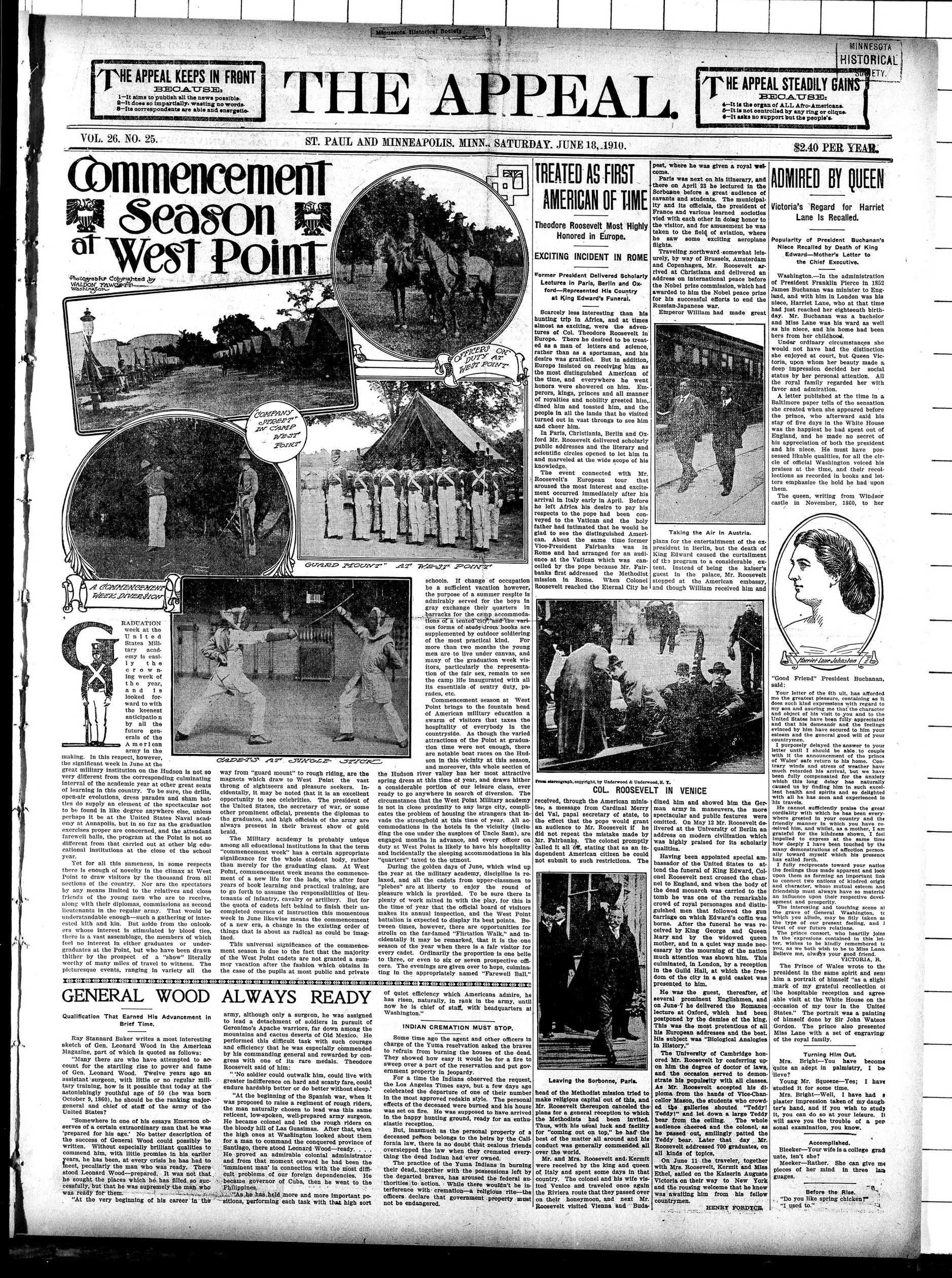
Commencement Season at West Point
RADIATION
week at the
United
States Military
academy is easily
the crowing week of
the year,
and is looked forward to with the keenest anticipation by all the future generals of the American army in the
RADUATION week at the United States Military academy is easily the crowning week of the year, and is looked forward to with the keenest anticipation by all the future generals of the American army in the making. In this respect, however, the significant week in June at the great military institution on the Hudson is not so very different from the corresponding culminating interval of the academic year at other great seats of learning in this country. To be sure, the drills, open-air evolutions, dress parades and sham battles do supply an element of the spectacular not to be found in like degree anywhere else, unless perhaps it be at the United States Naval academy at Amphibius, but in so far as the graduation exercises proper arise the attendant farewell balls, the program at the Point is not so different from that carried out at other big educational institutions at the close of the school year.
great military institution on the Hudson is not so very different from the corresponding culminating interval of the academic year at other great seats of learning in this country. To be sure, the drills, open-air evolutions, dress parades and sham battles do supply an element of the spectacular not to be found in like degree anywhere else, unless private it be at the United States Naval academy at Annapolis, but in so far as the would-exercises proper are concerned, and the attendant farewell balls, the program at the Point is not so different from that carried out at other big educational institutions at the close of the school year. Yet for all this sinemess, in some respects there is enough of novelty in the climax at West Point to draw visitors by the thousand from all sections of the country. Nor are the spectators by any means limited to the relatives and close friends of the young men who are to receive, along with their diplomas, commissions as second prizes, and the students who understandable enough—such a gathering of interested kith and kin. But aside from the onlookers whose interest is stimulated by blood ties, there is a vast assemblage, the members of which feel no interest in either graduates or undergraduates at the Point, but who have been drawn thither by the prospect of a "show" literally worthy of many miles of travel to witness. The picturesque events, ranging in variety all the
way from "guard mount" to rough riding, are the magnets which draw to West Point the vast throng of sightseers and pleasure seekers. Incidentally, it may be noted that it is an excellent opportunity to see celebrities. The president of the United States, the secretary of war, or some other prominent official, presents the diplomas to the graduates, and high officials of the army are always present in their bravest show of gold braid.
Yet for all this sameness, in some respects there is enough of novelty in the climax at West Point to draw visitors by the thousand from all sections of the country. Nor are the spectators by any means limited to the relatives and close friends of the young men who are to receive, along with their diplomas, commissions as second lieutenants in the regular army. That would be understandable enough—such a gathering of interested kith and kin. But aside from the onlookers, the members of the group there is a vast assemblage, the members of which feel no interest in either graduates or undergradates at the Point, but who have been drawn thither by the prospect of a "show" literally worthy of many miles of travel to witness. The picturesque events, ranging in variety all the
GENERAL WOOD ALWAYS READY
Qualification That Earned His Advancement in Brief Time.
Ray Stannard Baker writes a most interesting sketch of Gen. Leonard Wood in the American Magazine, part of which is quoted as follows:
"Many there are who have attempted to account for the startling rise to power and fame of Gen. Leonard Wood. Twelve years ago an assistant surgeon, with little or no regular military training, how is it possible that today at the astonishingly youthful age of 50 (he was born October 9, 1860), he should be the ranking major general and chief of staff of the army of the United States?
"Somewhere in one of his essays Emerson observes of a certain extraordinary man that he was 'prepared for his age.' No better description of the success of General Wood could possibly be compared, especially brilliant qualities to command him, with little promise in his earlier years, he has been, at every crisis he has had to meet, peculiarly the man who was ready. There stood Leonard Wood—prepared. It was not that he sought the places which he has filled so successfully, but that he was supremely the man who was ready for them.
Ray Stannard Baker writes a most interesting sketch of Gen. Leonard Wood in the American Magazine, part of which is quoted as follows:
"Many there are who have attempted to account for the startling rise to power and fame of Gen. Leonard Wood. Twelve years ago an assistant surgeon, with little or no regular military training, how is it possible that today at the autumnishy youthful age of 50 (he was born October 9, 1830), he should be the ranking major-general and chief of staff of the army of the United States?
"Somewhere in one of his essays Emerson observes of a certain extraordinary man that he was 'prepared for his age.' No better description of the success of General Wood could possibly be written. Without especially brilliant qualities to commend him, with little promise in his earlier years, he has been, at every crisis he has had to meet, peculiarly the man who was ready. There stood Leonard Wood—prepared. It was not that he sought the places which he has filled so successfully, but that he was supremely the man who was ready for them.
"At the very beginning of his career in the
THE APPEAL.
GUARD MOUNT" AT WEST POINT
schools. It change of occupation be a sufficient vacation however, the purpose of a summer respite is admirably served for the boys in gray exchange their quarters in barracks for the camp accommodations of a tented city, and the various forms of study from books are supplemented by outdoor soldiering of the most practical kind. For more than two months the young men are to live under canvas, and many of the graduation week visitors, particularly the representation of the fair sex, remain to see the camp life inaugurated with all its essentials of sentry duty, parades, etc.
Commencement season at West Point brings to the fountain head of American military education a swarm of visitors that taxes the hospitality of everybody in the countryside. As though the varied attractions of the Point at graduation time were not enough, there are notable boat races on the Hudson in this vicinity at this season, and moreover, this whole section of
CADETS AT SINGLE STICK.
the Hudson river valley has her most attractive dress up at this time of year, and draws hither a considerable portion of our leisure class, ever ready to go anywhere in search of diversion. The circumstance that the West Point Military academy is not in close proximity to any large city, compilates the problem of housing the strangers that inade the stronghold at this time of year. All accommodations in the hotels in the vicinity (including the one under the auspices of Uncle Sam), are engaged months in advance, and every officer on duty at West Point is likely to have his hospitality and incidentally the sleeping accommodations in his quarters' taxed to the utmost.
During the golden days of June, which wind up the year at the military academy, discipline is relaxed, and all the cadets from upper-classmen to plebees are at liberty to enjoy the round of pleasure which is provided. To be sure there is plenty of work mixed in with the play, for this is the time of year that the official board of visitors manned its annual inspection, and the West Point inspection, display best points. Between times, however, there are opportunities to watch on the farms, for flirtation are opportunities, and incidentally it may be remarked, that it is the one season of the year when there is a fair visitor for every cadet. Ordinarily the proportion is one belle to three, or even to six or seven prospective officers. The evenings are given over to hops, culminating in the famed "fairy" barn.
the Hudson river valley has her most attractive spring dress at this time of year, and draws hither a considerable portion of our leisure class, ever ready to go anywhere in search of diversion. The circumstance that the West Point Military academy demands that students be accommodates the problem of housing the strangers that invade the strengthhold at this time of year. All accommodations in the hotels in the vicinity (including the one under the auspices of Uncle Sam), are engaged months in advance, and every officer on duty at West Point is likely to have his hospitality required in the accommodations in his "nurturers," taxed to the utmost.
The Military academy is probably unique among all educational institutions in that the term "commencement week" has a certain appropriate significance for the whole student body, rather than merely for the graduating class. At West Point, commencement week means the commencement of a new life, and the years of book learning and practical training, so to go forth to assume the responsibilities of lieutenants of infantry, cavalry or artillery. But for the quota of cadets left behind to finish their uncompleted courses of instruction this momentous week in June likewise means the commencement of new era, a change in the existing order of things that is about as radical as could be imagined.
During the golden days of June, which wind up the year at the military academy, discipline is relaxed, and all the cadets from upper-classmen to "plebs" are at liberty to enjoy the round of pleasure which is provided. To be sure there is plenty of work mixed in with the play, for this is the time of year that the official board of visitors makes its annual inspection, and the West Point battalion is expected to display its best points. Between times, however, there are opportunities for the far-famed "Filtration Walk," and incidentally the annual "Fairy Tale" season of the year when there is a fair visitor for every cadet. Ordinarily the proportion is one belle to three, or even to six or seven prospective officers. The evenings are given over to hops, culminating in the appropriately named "Farewell Ball."
This universal significance of the commencement season is due to the fact that the majority of the West Point cadets are not granted a sum of money which obtains in the case of the pupils at college, while
of quiet efficiency which Americans admire, he has risen, naturally, in rank in the army, until now he is chief of staff, with headquarters at Washington."
army, although only a surgeon, he was assigned to lead a detachment of soldiers in pursuit of Geronimo's Apache warriors, far down among the mountains and cactus deserts of Old Mexico. He performed this difficult task with such courage that he was especially commended by his commanding general and rewarded by congress with one of its rare medals. Theodore Roosevelt said of him:
INDIAN CREMATION MUST STOP
Some time ago the agent and other officers in charge of the Yuma reservation asked the braves to refrain from burning the houses of the dead. They showed how easy it would be for a fire to sweep over a part of the reservation and put government property in tenardy.
"No soldier could outwalk him, could live with
her indifference on hard and scanty fare, could
endure."
For a time the Indians observed the request, the Los Angeles Times says, but a few days ago celebrated the departure of one of their number in the most approved redskin style. The personal effects of the deceased were burned and his house was set on fire. He was supposed to have arrived in the happy hunting ground, ready for an enthuastic reception.
"At the beginning of the Spanish war, when it was proposed to raise a regiment of rough riders, the man naturally chosen to lead was this same reticent, low-spoken, well-prepared army surgeon. He became colonel and led the rough riders on the bloody hill of Las Guasimas. After that, when the high ones at Washington looked about them for a man to command the conquered province of San Diego, there stood Leonard Wood—ready. He possessed a valuable colonial administrator and from that moment onward he then the 'imminent man' in connection with the more 'cultic problems of our foreign dependencies. He became governor of Cuba, then he went to the Philippines.
But, inasmuch as the personal property of a deceased person belongs to the heirs by the California law, there is no doubt that zealous friends overstepped the law when they cremated everything the dead Indian had ever owned.
The practice of the Yuma Indians in burning their dead, together with the possessions left by the departed braves, has aroused the federal authorities to action. While there wouldn't be interference with cremation—a religious rite—the officers declare that government property must not be endangered.
But, inasmuch as the personal property of a deceased person belongs to the heirs by the California law, there is no doubt that zealous friends overstepped the law when they cremated everything the dead Indian had ever owned.
The practice of the Yuma Indians in burning their dead, together with the possessions left by the departed braves, has aroused the federal authorities to action. While there wouldn't be interference with cremation—a religious rite—the officers declare that government property must not be endangered.
As he has held more and more important positions, performing each task with that high sort
From stereograph, copyright, by Underwood & Underwood, N. Y.
COL. ROOSEVELT IN VENICE
Theodore Roosevelt Most Highly Honored in Europe.
EXCITING INCIDENT IN ROME
Former President Delivered Scholarly Lectures in Paris, Berlin and Oxford—Represented His Country at King Edward's Funeral.
Scarcely less interesting than his hunting trip in Africa, and at times almost as exciting, were the adventures of Col. Theodore Roosevelt in Europe. There he desired to be treated as a man of letters and science, rather than as a sportsman, and his desire was gratified. But in addition, Europe insisted on receiving him as the most distinguished American of the time, and everywhere he went honors were showered on him. Emperors, kings, princes and all manner of royalties and nobility greeted him, dined him and toasted him, and the people in all the lands that he visited turned out in vast throngs to see him and marveled at the scientific circles opened to let him in and marveled at the wide scope of his knowledge.
The event connected with Mr. Roosevelt's European tour that aroused the most interest and excitement occurred immediately after his arrival in Italy early in April. Before Africa his desire to pay his respects to the Vatican led to a veyed to the Vatican and the holy father had intimated that he would be glad to see the distinguished American. About the same time former Vice-President Fairbanks was in Rome and had arranged for an audiobook of the Vatican which was canceled by the Vatican banks first addressed the Methodist mission in Rome. When Colonel Roosevelt reached the Eternal City he
From stereograph, copyright, by Underwood & Underwood
COL. ROOSEVEI
received, through the American minister, a message from Cardinal Merry del Val, papal secretary of state, to the effect that the pope would grant an audience to Mr. Roosevelt if he did not repeat the militate made by Mr. Fairbanks. The colonel promptly called it all off, stating that as an independent American citizen he could not submit to such restrictions. The
THE PRESIDENT OF THE UNITED STATES WAS IN A TRIP TO THE UNITED STATES FOR A CONFERENCE WITH THE PRESIDENT OF THE UNITED STATES. HE WAS SUCCESSFULLY RECEIVED THE PRESIDENT'S GREETING.
Leaving the Sorbonne, Parla.
head of the Methodist mission tried to make religious capital out of this, and Mr. Roosevelt thereupon canceled the plans for a general reception to which the Methodists had been invited. Thus, with his usual luck and facility for "coming out on top," he had the best of the matter all around and his conduct was generally commended all over the world.
Mr. and Mrs. Roosevelt and Kermit were received by the king and queen of Italy and spent some days in that country. The colonel and his wife visited Venice and traveled once again the Riviera route that they passed over on their honeymoon, and next Mr. Roosevelt visited Vienna and Buda-
past, where he was given a royal welcome.
Paris was next on his itinerary, and there on April 23 he lectured in the Sorbonne before a great audience of savants and students. The municipal officials, the president of France and various leaders of societies vied with each other in dosing the visitor, and for amusement he was taken to the field of aviation, where he saw some exciting aeroplane flights.
Traveling northward somewhat leisurely, by way of Brussels, Amsterdam and Copenhagen, Mr. Roseveit attained Christmas and delivered to address on international peace before the Nobel prize commission, which had awarded to him the Nobel peace prize for his successful efforts to end the Russian-Japanese war.
Emperor William had made great
Taking the Air In Austria.
plans for the entertainment of the ex-president in Berlin, but the death of King Edward caused the curtailment of the program to a considerable extent. Instead of being the kaiser's guest in the palace, Mr. Roosevelt stopped at the American embassy, and though William received him and LT IN VENICE
dined him and showed him the German army in maneuvers, the more spectacular and public features were omitted. On May 12 Mr. Roosevelt delivered at the University of Berlin an address on modern civilization which was highly praised for its scholarly qualities.
Having been appointed special ambassador of the United States to attend the funeral of King Edward, Colonel Roosevelt next crossed the channel to England, and when the body of the dead monarch was carried to the tomb he was one of the remarkable crowd of royal personages and distinguished men that followed the gun carriage on which Edward's coffin was borne. After the funeral he was received by King George and Queen mother, and in a quiet widowed queen necessary by the mourning of the much attention was shown him. This culminated, in London, by a reception in the Guild Hall, at which the freedom of the city in a gold casket was presented to him.
He was the guest, thereafter, of several prominent Englishmen, and on June-7 he delivered the Romanes lecture at Oxford, which had been postponed by the demise of the king. This was the most pretentious of all his European addresses and the best. His subject was "Biological Analogies in History."
The University of Cambridge honored Mr. Roosevelt by conferring upon him the degree of doctor of laws, and the occasion served to demonstrate his popularity with all classes. As Mr. Roosevelt accepted his diploma from the hands of Vice-Chancellor Mason, the students who crowded the galleries shouted "Teddy Teddy!" and let down a large Teddy bear from the ceiling. The whole audience cheered and the colonel, as he passed out, smilingly patted the Teddy bear. Later that day Mr. Roosevelt addressed 700 graduates, on all kinds of topics.
On June 11 the traveler, together with Mrs. Roosevelt, Kermit and Miss Ethel, sailed on the Kaiserin Augusta Victoria on their way to New York and the courting welcome that he knew was awaiting him from his fellow countrymen.
HENRY FORDYCE
$2.40 PER YEAR
Popularity of President Buchanan's Niece Recalled by Death of King Edward—Mother's Letter to the Chief Executive.
Washington—In the administration of President Franklin Pierce in 1852 James Buchanan was minister to England, and with him in London was his niece, Harriet Lane, who at that time had just reached her eighteenth birthday. Mr. Buchanan was a bachelor and Miss Lane was his ward as well as his niece, and his home had been hers from her childhood.
Under ordinary circumstances she would not have had the distinction she enjoyed at Queen Victoria, upon whom her beauty made a deep impression decided her social status by her personal attention. All the royal family regarded her with favor and admiration.
A letter published at the time in a Baltimore paper tells of the sensation she created when she appeared before the prince, who afterward said his stay of five days in the White House was the happiest he had spent out of England, and he made no secret of his appreciation of both the president and his niece. He must have possessed likable qualities, for all the circle of official Washington voiced his feelings about the selections as recorded in books and letters emphasize the hold he had upon them.
The queen, writing from Windsor castle in November, 1860, to her
"Good Friend" President Buchanan, sald:
Your letter to the greatest pleasure, courting, and as it does kind expressions with regard to my son and assuring me that the character and object of his visit to you and to the United States have been fully appreciated and that his demeanor and the feelings evinced by him have secured to him your esteem and the general good will of your country.
I purposefully delayed the answer to your letter until I should be able to couple with it the announcement of the prince or Wales state return to his home. Contrary winds and stress of weather have much retarded his arrival, but we have been fully compensated for the anxiety which this long, delay has naturally caused by finding him in such excellent health and spirits and so delighted with all he has seen and experienced in
He cannot sufficiently praise the great cordiality with which he has been everywhere placed in your country and the lives of the people he loved, and whilst, as a mother, I am grateful for the kindness shown. I feel how deeply I have been touched by the many demonstrations of affection personally toward myself which his presence has so deeply impaired. I fully reciprocate toward your natives the feelings thus made apparent and look upon them as forming an important link between the kindred origins and character, whose mutual friendship must always have so material an influence upon their respective development and prosperity.
The king has touched scene at the grave of General Washington, to which you allude, may be filleted as the king relief our own suffering, and I trust of our future relations.
The prince consort, who heartily joins in the expressions contained in this letter, will be our friend. He will to you, as we both wish to be to Miss Lama, Believe me, always your good friend.
VICTORIA, R.
The prince of Wales wrote to the president in the same spirit and sent him a portrait of himself "as a slight mark of my grateful recollection of my valuable reception and agreeable visit to you." He also occasion of my tour in the United States."
The portrait was a painting of himself done by Sir John Watson Gordon. The prince also presented Miss Lane with a set of engravings of the royal family.
Turning Him Out
Mrs. Bright—You have become quite an adept in palmistry, I be lieve? Young Mr. Squeeze—Yes; I have studied it for some time. Mrs. Bright—Well, I have had a plaster impression taken of my daughter, you have taken it, you can do so at your leisure. It will save you the trouble of a posal examination, you know.
Accomplished.
Bleeker—Your wife is a college grad
unite, isn't she?
Meeker—Rather. She can give me
pieces of her mind in three lan
guagen.
Before the Rise.
"Do you like spring chicken?"
"I used to."
HAVE YOU READ
THE APPEAL?
PUBLISHED WEEKLY BY
AMS BROS. EDITORS AND PUBLISHERS
49 E. 4th St., St. Paul, Minn.
ST. PAUL OFFICE
No. 236 Union Block, 4th & Cedar.
J. G. ADAMS, Manager
MINNEAPOLIS OFFICE
Guaranty Loan Bldg., Room 1020.
CHICAGO OFFICE
323-5 Dearborn Street, Suite 660.
C. F. ADAMS, Manager
TERMS, STRICTLY IN ADVANCE:
SINGLE COPY, ONE YEAR $2.00
SINGLE COPY, BIX MONTHS 1.10
SINGLE COPY, THREE MONTHS 60
Unharmonious
When subscriptions are by any means allowed
they may be presented in programmed terms
of 60 cents for each 18 hours and 5 cents for
each odd week, or at the rate of $2.40 per
year.
Subscriptions should be made by Express
Money Order, Post Office Money Order, Postage
Letter or Bank Draft. Postage should be
paid as cash for the fractional parts of a dollar. Only
one cent and two cent stamps taken.
Silver should never be sent through the man.
It is almost sure to wear a hole through the
silver. Do not leave it unattended. Persons who send silver to us in letters
do so at their own risk.
Marrage and death notices 10 lines or less $1.
It is strictly necessary to have a receipt
strictly in advance, and to be announced at
all must come in season to be news.
Advertising rates, 10 cents per笔 line, each
in an inch, and about seven words in an
agreeable line. No single advertisements less
than three motions discount allowed on less
than three motions. All orders from parties unknown to us.
Further particulars on application.
Sending notices 25 cents per line, each insertion.
The address of the person sending matter is set in brevier type--about six words to the line. All headlines count double.
The address on the address label shows when
subscriptions expire. Renewals should be
made two weeks prior to expiration. so that
no paper may be missed, as the paper
may be lost.
it occasionally happens that papers sent to sub-
servers are lost or stolen. In case you know of a
by post card at the expiration of five days
from that date, and we will cheerfully for-
ward a duplicate of the missing number.
Communications to receive attentions must be
written only upon one side of the paper,
must reach us "tuesday," if possible, anyway
not until the day of the publication of the author, and be sure to script
turned, unless stamps are sent for postage.
We do not hold ourselves responsible for the
views of our correspondents.
We do not hold ourselves responsible for
for terms. Sample couls free.
In every letter that you write us never fail to
give your full name and address, plainly
written, post office, county and state. Busi-
sional information, such as the name of the
separate sheets from letters containing new
or matter for publication. Entered as
second class, for June 6, 1888 at the post-
office, Toulouse, France, under act of Congress,
March 3, 1879.
M.
Copyright 1909, by Harris & Ewing.
The Republican platform, adopted at Chicago, explicitly demands justice for all men without regard to race or color, and just as explicitly declares for the enforcement, and without reservation, in letter and spirit of the thirteenth, fourteenth and fifteenth amendments to the Constitution. It is needless to state that I stand with my party squarely on that plank in the platform, and believe that equal justice to all men and the fair and impartial enforcement of these amendments are in keeping with the real American spirit of fair play.—Hon. Wm. H. Taft's speech accepting Republication nomination for Presidency.
SATURDAY, JUNE 18, 1910.
AMERICAN CHRISTIANITY
Dr. Wilbur Chapman predicts that the whole world is ripe for a revival and that if a hundred influential business men will take the proper active interest in the evangelization movement "the whole world, including China, Japan and Australia, will be rocking with the power of god within five years."
Then that unchristian race prejudiced journal, the Washington Times, says: His message, promising the ultimate conversion of the Mohammedan heathen, the Bhuddist heathen, and the Confucian heathen to the Christian faith ought to move the Christian church to great rejoicing.
THE APPEAL fails to see any reason for such a conclusion and many reasons for discerning its utter absurdity. The trend among nearly all nations is in the direction of war. All of the religion which is alleged to exist in the United States does not pre-
W. H.
vent the newspapers from being filled with their scandalous tales of graft, white slave trade, divorce, stealing, lynching and plain murder.
The colored races of the East would do well to consider carefully before accepting the American brand of Christianity. As Mohammedans, Buddhists or Confucianists they can up their heads and retain their self-respect. Converted to Christianity, they would become "niggers" in the sight of white American Christians and would be "jimcrowed" just as the Afro-Americans have been.
RACE PREJUDICE.
I am convinced myself that there is no more evil thing in this present world than Race Prejudice; none at all. I write deliberately; none at all. I write the worst single thing in life now. It justifies and holds together more basements, cruelty and abomination than any other sort of error in the world. Through its body runs the black blood of coarse lust, suspicion, jealousy and persecution and all the darkest poisons of the human soul.
— G. Wells in the
The liabilities at the time the institution became defunct were $2,939,925, scattered among 61,000 depositors.
President Taft deserves the commendation of the Afro-American people for his refusal to banish the Twenty-fifth Infantry without honor at the suggestion of certain Seattle people. ONE soldier was charged with a crime which he confessed and will be punished therefor. Some hysterical people wished to have the entire regiment punished for one soldier's offense, but the President would not stand for it.
The address of Representative Boutell of Illinois at the recent brewers' convention, in which he declared prohibition to be a failure, has stirred up a lot of interest. Mr. Boutell spake the truth. Prohibition in the South was not for true reform, but for the purpose of preventing Afro-Americans from using liquor. The Southern colonels are so fond of whiskey that they wished to monopolize the drinking of it.
A bill providing for the abolition of the Jewish pale has been introduced in the Russian Duma, but it has no chance of enactment. The bill is a severe arraignment of the Jewish disabilities act. It declares that restricting the residence of the Jews to the pale hampers the economic development of Russia and degrades the Russian people by teaching them to oppress another race.
"Without any uproar the Negro was string up." That's the way the headlines appeared in the daily press. It is so common nowadays that such items are scarcely noticed. In this particular case the victim was not even charged with crime. William Hunter, of Star City, Arkansas, was lynched for being in company with a
90:40:17 BOKY 1012
M.
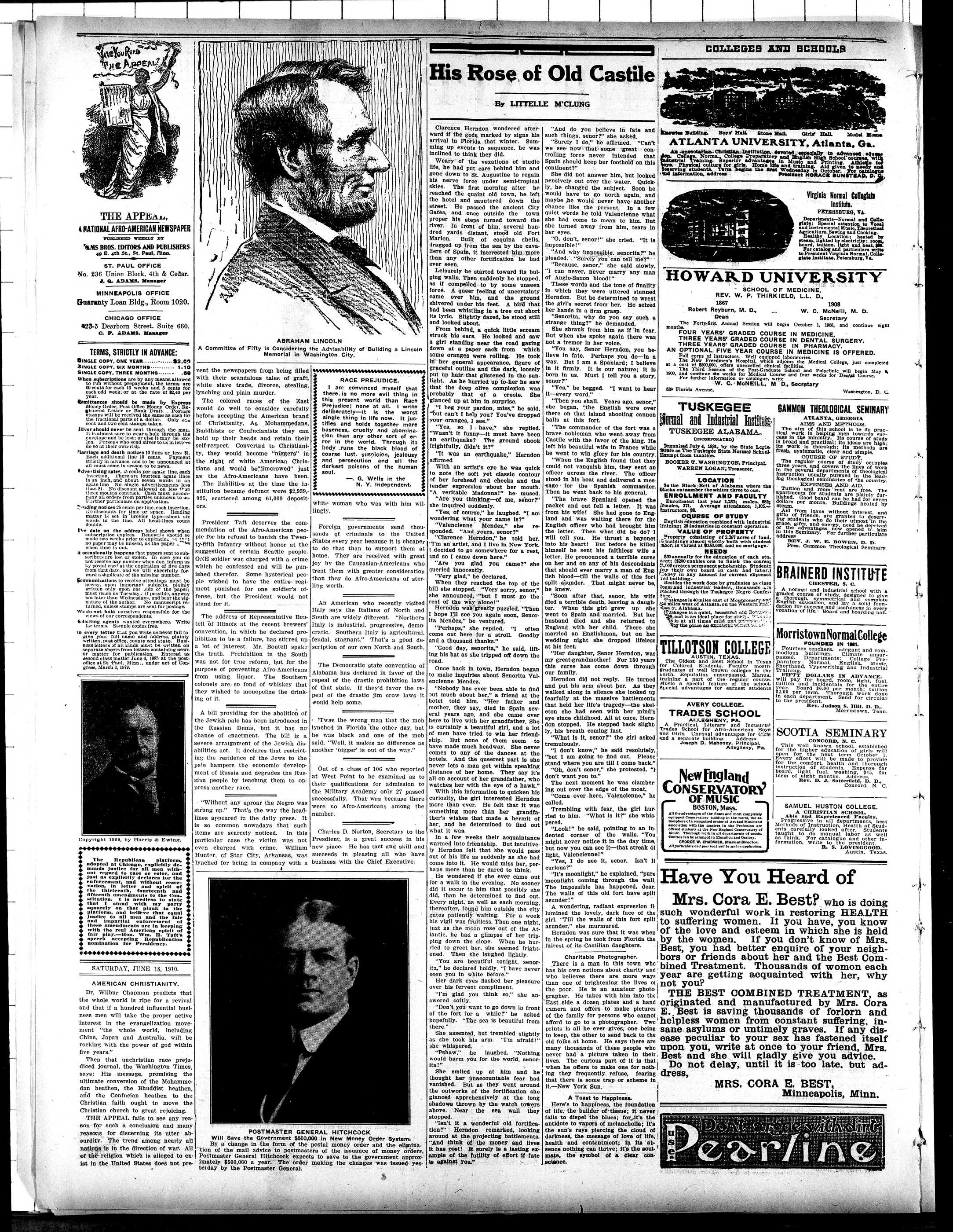
POSTMASTER GENERAL HITCHCOCK
Will Save the Government $500,000 in New Money C
By a change in the form of the postal money order
tion of the mail advice to postmasters of the issuance
Postmaster General Hitchcook expects to save to the go
imately $500,000 a year. The order making the changes
terday by the Postmaster General.
Will Save the Government $500,000 in New Money Order System. By a change in the form of the postal money order and the elimination of the mail advice to postmasters of the issuance of money orders Postmaster General Hitchcock expects to save to the government approximately $500,000 a year. The order making the changes was issued yes day by the Postmaster General.
I am convinced myself that there is no more evil thing in this present world than Race Prejudice; none at all. I write deliberately—it is the worst single thing in life now. It justifies and holds together more baseness, cruelty and abomination than any other sort of error in the world. Through its body runs the black blood of coarse lust, suspicion, jealousy and persecution and all the darkest polsons of the human soul.
一. G. Wells in the N. Y. Independent
white woman who was with him willingly.
Foreign governments send thousands of criminals to the United States every year because it is cheap to do that than to support them at home. They are received with great joy by the Caucasian-Americans who treat them with greater consideration than they do Afro-Americans of sterling worth.
---
An American who recently visited Italy says the Italians of North and South are widely different. "Northern Italy is industrial, progressive, democratic. Southern Italy is agricultural, feudal, stagnant." That's a good description of our own North and South.
The Democratic state convention of Alabama has declared in favor of the repeal of the drastic prohibition laws of that state. If they'd favor the repeal of the drastic jim crow laws it would help some.
"Twas the wrong man that the mob lynched in Florida the other day, but he was black and one of the mob said, "Well, it makes no difference as another 'nigger' is out of the way."
Out of a class of 106 who reported at West Point to be examined as to their qualifications for admission to the Military Academy only 27 passed successfully. That was because there were no Afro-Americans among the number.
Charles D. Norton, Secretary to the Presdiont, is a great success in his new place. He has tacit and skill and succeeds in pleasing all who have business with the Chief Executive.
[Name]
000 in New Money Order System
postal money order and the elimina-
ers of the issuance of money orders,
ts to save to the government approx-
making the changes was issued yes-
His Rose of Old Castile
By LITTELLE M'CLUNG
Clarence Herndon wondered afterward if the gods marked by signs his arrival in Florida that winter. Summing up events in sequence, he was inclined to think they did.
Weary of the vexations of studio life, he had put care behind him and gone down to St. Augustine to regain his nerve force under semi-tropical skies. The first morning after he reached the quaint old town, he left the hotel and sauntered down the street. He passed the ancient City Gates, and once outside the town proper his steps turned toward the river. In front of him, several hundred yards distant, stood old Fort Marion. Built of coquina shells, dragged up from the sea by the cavaliers of Spain, it interested him more than any other fortification he had ever seen.
Lefleursey he started toward its bulging walls. Then suddenly he stopped, as if compelled to by some unseen force. A queer feeling of uncertainty came over him, and the ground shivered under his feet. A bird that had been whistling in a tree cut short its lyric. Slightly dazed, he stood still and looked about.
From behind, a quick little scream struck his ears. He looked and saw a girl standing near the road gazing down at a paper sack from which some oranges were rolling. He took in her general appearance, figure of graceful outline and the dark, loosely put up hair that glistened in the sunlight. As he hurried up to her he saw that the deep olive complexion was probably that of a creole. She glanced up at him in surprise.
"I beg your pardon, miss," he said, "but can't I help you? You've dropped your oranges. I see."
"Yes, so I have," she replied. "Wasn't it funny—it must have been an earthquake? The ground shook frightfully, didn't it?" "It was an earthquake," Herndon affirmed With an artist's eye he was quick to note the soft yet classic contour of her forehead and cheeks and the tender expression about her mouth. "A veritable Madonna!" he mused. "Are you thinking—of me, senor?" she inquired suddenly. "Yes, of course," he laughed. "I am wondering what your name is?"
"Valencienne Mendez," she responded. "And yours, senor!" "Clarence Herndon," he told her. "I'm an artist, and I live in New York. I decided to go somewhere for a rest, and so I came down here." "Are you glad you came?" she queried innocently. "Very glad," he declared. When they reached the top of the hill she stopped. "Very sorry, senor," she announced, "but I must go the rest of the way alone!" Herndon was greatly puzzled. "Then I hope I'll see you again soon, Senorita Mendez," he ventured. "Perhaps," she replied. "I often come out here for a stroll. Goodby and a thousand thanks." "Good day, senorita," he said, lifting his hat as she tripped off down the road. Once back in town, Herndon began to make inquiries about Senorita Valencienne Mendez.
"Nobody has ever been able to find out much about her," a friend at the hotel told him. "Her father and mother, they say, died in Spain several years ago, and she came over here to live with her grandfather. She is certainly a beautiful girl, and a lot of men have tried to win her friendship. But none of them seem to have made much headway. She never comes to any of the dances at the hotels. And the queerest part is she never lets a man get within speaking distance of her home. They say it's all on account of her grandfather, who watches her with the eye of a hawk." With this information to quicken his curiosity, the girl interested Herndon more than ever. He felt that it was something more than her grandfather's wishes that made a hermit of her, and he determined to find out what it was.
In a few weeks their acquaintance warmed into friendship. But intuitively Herdon felt that she would pass out of his life as suddenly as she had come into it. He would miss her, perhaps more than he dared to think.
He wondered if she ever came out for a walk in the evening. No sooner did it occur to him that possibly she did, than he determined to find out. Every night, as well as each morning, thereafter, found him outside the city gates patiently waiting. For a week his vigil was fruitless. Then one night, just as the moon rose out of the Atlantic, he had a glimpse of her tripping down the slope. When he hurried to greet her, she seemed frightened. Then she laughed lightly.
"You are beautiful tonight, senorita," he declared boldly. "I have never seen you in white before."
Her dark eyes flashed her pleasure over his fervent compliment.
"I'm glad you think so," she answered softly.
"Don't you want to go down in front of the fort for a while?" he asked hopefully. "The sea is beautiful from there."
She assented, but trembled slightly as she took his arm. "I'm afraid!" she whispered.
"Pshaw," he laughed. "Nothing would harm you for the world, senor-it!"
She smiled up at him and he thought her unaccountable fear had vanished. But as they went around the outworks of the fortification she glanced apprehensively at the long shadows thrown by the watch towers. Near the sea wall they stopped.
"Isn't it a wonderful old fortification?" Herndon remarked, looking around at the projecting battlements.
"And think of the money and lives it has cost! It surely is a lasting example of the futility of effort if fate is against you."
"Very glad," he declared.
"And do you believe in fate and such things, senor?" she asked.
"Surely I do" he affirmed. "Can't we see now that some great controlling force never intended that Spain should keep her foothold on this continent?"
She did not answer him, but looked pensively out over the water. Quickly, he changed the subject. Soon he would have to go north again, and maybe he would never have another chance like the present. In a few quiet words he told Valencienne what she had come to mean to him. But she turned away from him, tears in her eyes.
"O, don't, senor!" she cried. "It is impossible!"
"And why impossible, senorita?" he pleaded. "Surely you can tell me?" "Because, senor," she said slowly, "I can never, never marry any man of Anglo-Saxon blood!"
These words and the tone of finality in which they were uttered stunned Herndon. But he determined to wrest the girl's secret from her. He seized her hands in a firm grasp. "Senorita, why do you say such a strange thing?" he demanded.
She shrank from him as if in fear. But when she spoke again there was not a tremor in her voice.
"You say, Senior Herndon, you believe in fate. Perhaps you do—in a way. But I am a Spandard; I believe in it firmly. It is our nature; it is born in us. Must I tell you a story, senor?"
"Yes," he begged. "I want to hear it—every word."
"Then you shall. Years ago, senor," she began, "the English were over there on that island shooting cannon balls at this fort.
"The commander of the fort was a brave nobleman who went away from Castle with the favor of the king. He left his beautiful wife in France while he went to win glory for his country.
"When the English found that they could not vanquish him, they sent an officer across the river. The officer stood in his boat and delivered a message for the Spanish commander. Then he went back to his general."
"The brave Spaniard opened the packet and out fell a letter. It was from his wife! She had gone to England and was waiting there for the English officer who had brought him the letter. Then what did he do? I will tell you. He thrust a bayonet into his heart! But before he killed himself he sent his faithless wife a letter. He pronounced a terrible curse on her and on any of his descendants that should ever marry a man of English blood—till the walls of this fort split asunder. That might never be, he knew.
"Soon after that, senor, his wife died a terrible death, leaving a daughter. When this girl grew up she went to Spain and married. But her husband died and she returned to England with her child. There she married an Englishman, but on her wedding night she dropped lifeless at his feet.
"Her daughter, Senor Herndon, was my great-grandmother! For 150 years this curse has come down through our family.
Herndon did not reply. He turned and put his arm about her. As they walked along in silence she looked up fearfully at the massive battlements that held her life's tragedy—the skeleton she had seen with her mind's eye since childhood. All at once, Herndon stopped. He stepped back slightly, his breath coming fast.
"What is it, senor?" the girl asked tremulously.
"I don't know," he said resolutely, "but I am going to find out. Please stand where you are till I come back."
"Oh, don't senor," she protested.
"I don't want you to."
The next moment he was clambering out over the edge of the moat.
"Come over here, Valencienne," he called.
Trembling with fear, the girl hurried to him. "What is it?" she whispered.
"Look! he said, pointing to an indented corner of the walls. "You might never notice it in the day time, but now you can see it—that streak of light, Valencienne!"
"Yes, I do see it, senor. Isn't it curious?"
"It's moonlight," he explained, "pure moonlight coming through the wall. The impossible has happened, dear. The walls of this old fort have split asunder!"
A wondering, radiant expression illumined the lovely, dark face of the girl. "Till the walls of this fort split asunder," she murmured.
Herndon was sure that it was when in the spring he took from Florida the fairest of its Castilian daughters.
Charitable Photographer.
There is a man in this town who has his own notions about charity and who believes there are more ways than one of brightening the lives of the poor. He is an amateur photographer. He takes with him into the East side a dozen plates and a hand camera and offers to make pictures of the family for persons who cannot afford to go to a photographer. Two prints is all he ever gives, one being to keep, the other to send back to the old folks at home. He says there are many thousands of these people who never had a picture taken in their lives. The curious part of it is that when he offers to make one for notching they frequently refuse, fearing that there is some trap or scheme in it.—New York Sun.
A Toast to Happiness
Here's to happiness, the foundation of life, the builder of tissue; it never fails to dispel the blues; for it's the antidote to vapors of melancholia; it's the sun's rays piercing the cloud of darkness, the message of love of life, health and contentment; in its absence nothing can thrive; it's the soulmate, the symbol of a clear conscience.
```markdown
```
An unacademic Christian Institution, devoted especially to advanced adu-
sence and higher education, offers high school courses with
industrial Training. Superior advantages in Music and
crafts. Physical culture for girls. Home life and training. Aid given to needy and
women. Begin the first semester of a two-year program of
information, address
HOWARD UNIVERSITY
The Forty-first Annual Session will begin October 1, 1908, and continue eight months.
at a cost of $80,000, off-campus facilities. The Third Session of the Post-Graduate School and Polyclinic will begin May 1909, and continue six weeks for Medical Course and four weeks for Dental Course. For further information or catalogue, write
Have You Heard of
Mrs. Cora. E. Best?
such wonderful work in restoring HEALTH to suffering women. If you have, you know of the love and esteem in which she is held by the women. If you don't know of Mrs. Best, you had better enquire of your neighbors or friends about her and the Best Combined Treatment. Thousands of women each year are getting acquainted with her, why not you? THE BEST COMBINED TREATMENT, as originated and manufactured by Mrs. Cora E. Best is saving thousands of forlorn and helpless women from constant suffering, insane asylums or untimely graves. If any disease peculiar to your sex has fastened itself upon you, write at once to your friend, Mrs. Best and she will gladly give you advice. Do not delay, until it is too late, but address.
MRS. CORA E. BEST, Minneapolis, Minn.
Don't argue with dirt Pearline
```markdown
```
HOWARD UNI
SCHOOL OF M
REV. W. W. THIRKIELD,
1867
Robert Buryn, M. D.,
Dean
The Forty-first Annual Session will begin
months.
FOUR YEARS' GRADED COURSE IN
THREE YEARS' GRADED COURSE IN
THREE YEARS' GRADED COURSE IN
AN OPTIONAL FIVE YEAR COURSE IN
Full corps of instructors. Well equipped labor.
The New cadets offer special adjoins at a cost of $600,000, offers unsecured clinical facilities.
The Third Session of the Post-Graduate School
1900, and continue six weeks for Medical Course and
For further information, write
W. C. McNEILL, M. D., S.
530 Florida Avenue,
TUSKEGEE Normal and Industrial Institute
Organised July 4, 1881, by the State Lecs. State Normal School Except from taxation.
BOOKER T. WASHINGTON, Principal.
WARREN LOGAN, Treasurer.
LOCATION
In the Black Belt of Alabama where the
blacks outnumber the whites three to one.
ENROLLMENT AND FACULTY
Last year 123,251 males, 882
females, 371 Average attendance, 1,105
instructors, 88.
COURSE OF STUDY
English education combined with industrial
training; 25 industries in constant operation.
Property consisting of 2,267 acres of land
buildings almost entirely built with student
materials.
NEEDS
$200 annually for the education of each student; ($200 enables one to finish the course; ($100 provides an investment in cash and labor); money in any amount for current expenses. Besides the work done by graduates as class room and industrial leaders, thousands are matched through the Tuskegee Negro Conference. Tuskegee is 40 miles east of Montgomery and 50 miles west of Atlanta, on the Western Side. Tuskegee is a quiet, beautiful old school and is an ideal place for study. For the place an enclave would be.
The Oldest and Best School in Texas for Colored Students. Faculty mostly graduates of well known colleges in the region, reputation unsurpassed. Manual training in music. Music a special feature of the school. Special advantages for earnest students
A Practical, Literary and Industrial Trades School for Afro-American Boys and Girls. Unusual advantages for Girls and a separate building. Address:
New England CONSERVATORY OF MUSIC
All the advantages of the finest and most completely subject University training in the work for the thimpson of a recruited center of Art and Music and association with the masters in the Profession are offered students at the New England Conservatory of Music. Through work in all departments of music. Courtes can be arranged in Excursion and Oratory. GEORGE W. CHADNICK, Musical Director. All particulars and your book will be not in application.
Have You He
Mrs. Cora E. Be such wonderful work in re to suffering women. If you of the love and esteem in by the women. If you d
Virginia Normal College
Institute.
PETERSBURG, VA.
PETERSBURG, VA.
Department--Normal and Collegiate; Special attention to Vocal and Instrumental Music, Theological Agriculture, Sewing and Cooking
Healthy Location; heated by water, heated by steam, heated by heat, board, tuition, light and heat 1908
For catalog and particular write to President Virginia Normal, Collegiate Institute, Petersburg, Va.
NIVERSITY
OF MEDICINE,
KIELD, LLL, D.,
1908
W. C. McNell, M. D.
Secretary
begin October 1, 1908, and continue eight
RSE IN MEDICINE.
RSE IN DENTAL SURGERY.
RSE IN PHARMACY.
RSE IN MEDICINE IS OFFERED.
ed laboratories.
adjons the Medical College, just completed
ical facilities.
School and Polyclinic will begin May
course and four weeks for Dental Course.
write
M D. Secretary
Washington, D. C.
GAMMON THEOLOGICAL SEMINARY
The aim of this school is to do practical work in helping men towards success in the ministry. Its course of study is broad and practical; its ideas are high; its work is thorough; its methods are fresh, systematic, clear and simple.
COURSE OF STUDY.
The regular course of study occupies three years, and forms one of work in the several departments of the college instruction usually pursued in the leading theological seminaries of the country.
EXPENSES AND AID.
Tuition and room rent are free. The apartments for students are plainly furnished. Good board can be had for seven dollars per month. Buildings heated by steam.
Aid from loans without interest, and deserving students who do not be granted to deserving students who do not be granted to grace, grace, and energy, need be deprived in this Seminary. Opened to k-12 students in this Seminary. For further particulars address
REV. J. W. E. BOWEN P.C.
REV. Gannon Theological Seminary
BRAINERD INSTITUTE
A normal and industrial school with a graded course of study, designed to give a thorough, symmetrical and complete English education, and lay a solid foundation for success and usefulness in every vocation of life. Board and boarding hall
Fourteen teachers. Elegant and comm
committed. Unsurpassed. Departments: College
paratory Normal, English, Music,
Typewriting and Industrial
Training.
FIFTY DOLLARS IN ADVANCE.
will be on high fuel,
tuition and incidentals for
yea. Board $6.00 per month; tuition
in each department. Send for circle
in each department. Send for circle
to the president.
Rev. Judson S. Hill, D. D.
Morristown, Tenn.
SCOTIA SEMINARY
C003821 L.C.
This well known school, established for the higher education of girls will open every effort will be made to provide for the comfort, health and thorough Expense for board, light fuel, and term of eight months. Address:
Rev. D. J. Satterfield, D. D.
Concord. N. C.
SAMUEL HUSTON COLLEGE.
A CHRISTIAN SCHOOL.
Able and Experienced Faculty,
Progressive in all departments, best
Methods of Instruction, Health of
Gents carefully looked after. Students
taught to do manual labor as well
as think. For catalogue and other
information, write to our residents.
R. S. LOVINGGOOD.
Austin, Texas.
Heard of
Best? who is doing
in restoring HEALTH
If you have, you know
m in which she is held
you don't know of Mrs.
enquire of your neigh-
Of Meeting of State Federation of Afro-American Women's Clubs.
The State Federica of Afro-American Women's Clubs met at St. James A. M. E. church, St. Paul, Minn., Wednesday, June 8, 1910.
Opened at 9:45 a. m. with Mrs. Luh Chapman, second vice-president, presiding.
Singing—"Blest Be the Tie."
Prayer, Mrs. Mary Hatcher.
Roll call.
Singing—"Stand Up for Minnesota," composed by the President, Mrs. Ione E. Gibbs, and adopted as the state song.
Appointments of committees.
Reports of clubs.
Greetings—Mrs. Dora Adams, chairman of local committee; Mrs. Ophelia Rice, chaplain, Minneapolis.
Remarks, Mrs. Luh Chapman, Mrs. Ida Sellers.
Reports of state officers.
Kindergarten collection 71 cents.
Singing, state song.
Afternoon Session
Opened at 2:00 p. m., President
Mrs. Ione E. Gibbs presiding.
Singing, state song.
Recieving of Reports.
Remarks, Rev. H. S. Graves, pastor
St. James church.
Singing.
Address of welcome, Hon. H. P. Keller, mayor of St. Paul.
Remarks. Mr. Wm. M. Smith of Minneapolis.
Singing, state song.
Introduction of Dr. Booker T. Wash-
ingto by W. T. Francis, Esq.
Address, Dr. Booker T. Washington,
Adjourned.
Evening Session.
Opened at 8:30 p. m., President
Gibbs insiding.
Singing state song.
Prayer, Rev. H. S. Graves.
Orange solo, Master Robert Strong.
St. Paul.
Annual message, President Mrs. I.
E. Gibbs.
Sole, Mr. Allen J. French, St. Paul.
Address, Rev. J. L. Wharton, St.
Peter church, Minneapolis.
Collection, $1.77.
Singing, "Praise God, From Whom
All Ressings Flow."
Benediction, Rev. J. L. Wharton.
Morning Session, June 9.
Opened at 10:30 a. m., President
Gibbs in the chair.
Singing, state song.
Prayer, chaplein, Mrs. Ophelia Rice.
Reports of officers.
T.
Expressions from the several clubs along the lines of charity.
Greetings from different states.
Klodinger garden, $1.22.
Adjourned.
Afternoon Session.
Opened at 2:00 p. m., President Gibbs presiding.
Devotional exercises. Mrs. Mary Hatcher.
Reports continued.
Paper, Mrs. Anna Morris, Minneapolis.
Remarks, Mrs. Laura Hickman, St Paul. Subject: "Is This a Christian Nation?"
Discussion, led by Mrs.*L. A. Turner, followed by Meadames Ruffin Watson and Gibbs.
Introduction of Rev. F. H. McDonald, pastor of Pilgrim Baptist churca by M. Lillian Turner.
Remarks, Rev. E. H. McDonald. Kindergarten collection, $210.
Round Table conducted by Mrs. I. E. Gibbs.
Adoption of amendments to Constitution.
Election of officers :
Mrs. Ione) E. Gibbs, Minneapolis president.
Mrs. Lulu Chapman, St. Paul, 1st vice-president.
Mrs. Jessie Williams, Duduth, 2nd vice-president.
Mrs. Mattie Hicks, recording secretary.
Mrs. Jessie L. Bond, St. Paul, assist ant recording secretary.
Mrs. Ida Sellers, Minneapolis, state organizer.
Mrs. Alice Johnson, Duluth, historian.
Mrs. Ophelia Rice, Minneapolis, chaplain.
Mrs. Birdie High, St. Paul, editor.
Mrs. Fannie Pierre, Minneapolis, 1st associate editor.
Mrs. Josie Moberly, Duluth, 2nd associate editor.
Remarks, Mrs. Fannie Sears, St. Paul.
Opened at 8:30 by President Gibbs
Singing and greetings.
Address, Rev. E. H. McDonald,
Piano solo, Miss Marion Jeffreys,
Minneapolis,
Paper, Mrs. L. A. Turner, St. Paul,
Paper, Mrs. Corene Carter, St. Paul,
"W. Y. C. A. Work."
Presentation of vase filled with
flowers to President Gibbs from
different clubs, by Mrs. Luh Chapman.
Response by Mrs. Gibbs.
Organ selection, Master Robert
Strong.
Address, B. S. Smith, Esq., Minneapolis.
Collection, $697.
Departmental appointments were made by the president as follows:
Mrs. Nellie Francis, St. Paul, legal department.
Mrs. L. Heims, Miancapolis, arts and crafts.
Mrs. Mary Hatcher, St. Paul, mothers' department.
Mrs. Katie Smith, Minneapolis, literacy department.
Mrs. Corne Carter, St. Paul, junior department.
Mrs. Alberta Johnson, Duluth, reciproity.
Mrs. Belle Black, Duluth, philanthropic.
Mrs. Katie Smith, in behalf of the Minneapolis city Federation, extended an invitation to meet in the Flour City in 1911, which was duly occurred
Musical contest between Choral Study Club, Minneapolis, and picked choir, St. Paul, Judges; Rev. J. L. Wharton, B. S. Smith, Minneapolis; Prof. W. A. Weir, St. Paul, Decision in favor of Choral Study Club.
Introduction of newly elected officers by Mrs. Hattie Sherwood.
A noticeable feature of the state badge this year was the addition of a little photograph of President Gibbs. Adjourned.
Public reception in the church parlor.
Respectfully submitted,
Harriet B. Sherwood.
Jessie L. Bond.
When the
Day is
Done
The man is happiest who finds
at home a thoughtful wife, a
cordial welcome and a restful,
refreshing glass of
Hamm's
BEER
"Leads Them All"
THEO. HAMM BREWING CO.
St. Paul, Minn.
THE MIDTOWN MUSEUM
BOUTELL BROS.
LARGEST HOUSE FURNISHERS IN THE NORTHWEST
FIRST AVE. SOUTH AND FIFTH ST.
MINNEAPOLIS. - MINNESOTA
Elizabeth Temple, S. M. T. (Missouri Jurisdiction) meets at Tschida's Hall, first and fourth Friday of each month. Hattie Turpin, W. P. Ida Perkins, W. S.
When you wish a first class shine call at the Peoples Shining Parlor No. 127 E. 5th street, Walter Porter, Prop. He'll shine 'em up for a nickel.
If you are receiving THE APPEAL and you have not paid for it remember that you owe for it and must pay for it sooner or later, so why not now?
Ladies and Gentlemen
We must important time to take a Tonic and Blood Purifier.
Have you heard of Patty's HERB TEA and PATTY'S BLOOD BUILDER?
If not, call and let us show you what these remedies are, and prove to you by numerous testimonials from people in the Twin Cities, that they will do just what we claim.
If you are unable to come to our office, call up T. S. Phone 5372 and we will send some one to your home to explain the remedies to you.
A two months' treatment of Patty's Blood Builder and Patty's Herb Tea costs only $1.50.
Patty's Blood Builder $1.00 per box.
Patty's Herb Tea, 25 cents per package.
Patty's Obi Ointment, 50 cents per jar.
Patty's Obi Oil, 50 cents per bottle.
For sale at office, 498 University.
Cor. Mackubin, St. Paul, Minn. T. S. Phone 5732.
Ladies you can get just as good "French Dry Cleaning" done by the Valet Tailoring Cc., 156 E. Sixth street as anywhere in the city. Why not let them do it for you?
Have you seen the new, novel and beautiful calendars that are embellished with handsome pictures of handsome Afro-Americans? If not, call on Mrs. Mayme G. Williams, Room 27, Union Block, who is agent for them. She has a delayed shipment which will be sold at reduced prices. Get one now before they are all gone.
Jarvis, "The Shoe Man," who has the great shoe establishment on Minnesota street between Fourth and Fifth, has opened store No. 2 at 106 E. Fifth street, where he will conduct an exclusive men's shoe business. He carries a stock of shoes that for both style and quality cannot be excelled anywhere.
SAFE DEPOSIT AND STORAGE VAULTS. We invite your inspection. It costs little to place your papers, cash securities and valuables in absolute safety. Boxes in our vaults can be had for $4 per year. Store your boxes, trunks, etc., with us. Northwestern Trust Co., 138 Endicott Arcade.
One feels good when he has had a good meal. If you wish to feel good go to the St. Louis Kitchen, 317% Wahaba street, and get a good, old-fashioned meal and feel good. No flubdubs, just plain home cooking.
You need not go hungry. Just go to the St. Louis Kitchen and get meals like mother used to cook. Good, substantial home-cooked meals at reasonable prices. Regular meals or meals to order.
Get the habit of smoking Habit Cigars.
Anything the Matter With Your Stove? If there is anything the matter with your stove call on the St. Paul Stove Repair Works, 126 W. Seventh street. They fix everything, water fronts, stove putty, fire clay, mica, stove polish, stove bolts, shakers, grates, tops, etc. Repairs of all kinds made on short notice, new and second-hand stoves for sale. Whatever you wish to know about stoves call on us. Telephones N. W. 1206 L-I, Twin City 242.
Make money easy at home corresponding for newspapers; experience unnecessary. Send stamp for particulars. Empire Press Syndicate, Middleport, N. Y.
COAL
FLOUR,
C. W.
Everything at the right price.
Phone Cedar 634
The Lilies
GUST
A LA CARTES
138 E. Third St., u
Telephone
"CURLEY
122 E.
Finest Brands of
Wines, L.
N. C. C.
S. E. Cor. Third and Rob
The Little Savoy Cafe GUS HENRY, PROP.
138 E. Third St., up stairs ST. PAUL, MINN.
ORIGINAL CHOP HOUSE
FOR GOOD THINGS TO EAT
R. S. HARRIS, PROP.
378 MINNESOTA ST. PAU
Digesto
MALT EXTRACT
For the Nursing Mother
The mother's health and strength are of vital importance during the nursing period. Digesto Malt Extract is a highly concentrated, predigested liquid food, which has not only the power to digest other foods, but also to create new rich blood, and fatty matter necessary to the formation of strength-giving milk.
Palatable and Efficient
At all Drug Stores
MADE ONLY BY
THEO. HAMM BREWING CO., ST. PAUL
BREWERS OF
Hamm's Famous Beer
VENTILATION
LIGHT
KNAPP
SIDE ADJUSTERS
BUY YOUR
TEL. CEDAR 1794
THE KNAPP SHADE ADJUSTERS
W. J. WORK, SALES AGENT
P. O. BOX 132 WHITE BEAR LAKE, MINN.
Have your old shades rehung by the new meth od, and by which you obtain better ventilation, control the amount of light and secure privacy when desired.
ORDERS LEFT AT THIS OFEICE WILL RECEIVE PROMPT ATTENTION
Rice, Carroll and Iglehart Sts.
n till 1:30 A. M.
Coy Cafe
TOP.
ALL HOURS
PAUL, MINN.
2622
BAR"
Street
and Domestic
Cigars
Prop.
CURRY
INN
1879. PAUL. MINN
THE VERIBEST
ST. PAUL
THE BOSTON EDITOR
EYE DEFECTS
HARM
CLASSIFIED
EYE DEFECTS AND SYMPTOMS.
CHARM
GLASSES
EYE DEFECTS AND SYMPTOMS.
Mye defects are few—symptoms many.
There can be but two defects in the hue.
Theeye may be too long in whole. THE
Myopic eye.
Or too short in whole—the Hyperopic c
Combine the two in one eye and we have
Properly adjusted glasses will correct the
Medicines or waiting, never.
Symptoms that spring from these two
ormations are manifold; such as eye and
gestion, Dyspepsia, Nervous Debility, Chop
other ailments having their origin in lack.
We correct all Defects of the human
will remedy. Charges reasonable. Satisfac
HARMS OCULO CURES SORE EYES 25c PR
F. H. HARM &
OPTICIANS,
There can be but two defects in the human eye.
The eye may be too long in whole. Then we have theopic eye.
Or too short in whole—the Hyperopic eye.
Combine the two in one eye and we have Astigmatism.
Properly adjusted glasses will correct these defects.
Medicines or waiting, never.
Symptoms that spring from these two simple eye mal- nations are manifold; such as eye and headaches, Indi- tion, Dyspepsia, Nervous Debility, Chorea, Epilepsy and er ailments having their origin in lack of nerve force.
We correct all Defects of the human eye that glasses and remedy. Charges reasonable. Satisfaction guaranteed.
HARMS OCULO CURES SORE EYES 25c PER BOTTLE.
F. H. HARM & BRO.
OPTICIANS,
Theeye may be too long in whole. Then we have the Myopic eye.
Or too short in whole—the Hyperopic eye.
Combine the two in one eye and we have Astigmatism.
Properly adjusted glasses will correct these defects.
Medicines or waiting, never.
Symptoms that spring from these two simple eye malformations are manifold; such as eye and headaches, Indigestion, Dyspepsia, Nervous Debility, Chorea, Epilepsy and other ailments having their origin in lack of nerve force.
We correct all Defects of the human eye that glasses will remedy. Charges reasonable. Satisfaction guaranteed.
297 ROBERT STREET, ST. PAUL, MINN.
"You to
Everyone
strictly
DUI
PAP
CIGA
HART &
MNFRS. S
"You too?"
Everyone smokes the
strictly High Grade
DUKE OF
PARMA
CIGARS
HART & MURPHY,
MNFRS. ST. PAUL, MINN.
"You too?"
Everyone smokes the
strictly High Grade
DUKE OF
PARMA
CIGARS
HART & MURPHY,
MNFRS. ST. PAUL, MINN.
$2.50
SHOES
SAVE $1.00 ON SHOES. One dollar is
the least you save by buying the famioca
Every pair has the Style and Quality others ask $3.50 and $4.00 for. Large stock to select from. Shoe repairing at lowest prices
S. T. SORENSEN
151-153 E. 7th street St. Paul
324 Nicollet ave. Minneapolis
Dimes are little young dollars. They grow on-when locked up together. Treat yourself to a savings account and prove it to your own satisfac-
“Planted” dollars will add to your earn-
THE STATE SAVINGS BANK
Dimes are little young ly when locked up toget savings account and prov tion. "Planted" dollars ings. THE STATE S
Dimes are little young dollars. They grow only when locked up together. Treat yourself to a savings account and prove it to your own satisfaction. "Planted" dollars will add to your earnings.
THE STATE SAVINGS BANK
93 East Fourth Street
GOLD
GRAIN
BEEF
Capitol Ste
GOLDEN
GRAIN BELT
BEERS
PHONES Tri-State 1643
Capitol Steam Laundry
GOLDEN
GRAIN BELT
BEERS
Capitol Steam Laundry
743 Wabasha St.,
First Class Work
ST. PAUL,
First Class Work. Satisfaction Guaranteed
ST. PAUL, MINN.
First Class Work Satisfaction Guaranteed ST. PAUL, MINN.
The Most Proper Line of
FALL WOOLENS
TO BE HAD FOR A
NICE SUIT OR OVERCOAT
IS SHOWN BY
Clifford A. Smith
109 Eighth St. Opposite Golden Rule
Telephone Main 3488-L
St. Paul. - - Minn.
Tri-State 1643
ST. PAUL
JASONIO
MOST WORSHIPFUL GRAND LODGE
OF
MINNESOTA, A. F. AND A. M.
J. H. SHERWOOD, GRAND MASTER,
130 W. Arbh. St. St. Paul.
130 W. Arch St. St. Paul.
C. H. ROBINSON, GRAND SECRETARY,
1821 Fifth Ave. S. Minneapolis.
PIONEER LODGE NO. 1. F. AND A. M.
of each month at 126 East Third street at
8:00 p. m. Walker Williams. W. M.
William England, Secy., 319 Farrington
Ave.
PERFECT ASHLAR LODGE NO. 4
F. and A. M. meets first and third
Tuesdays at Tschida Hall, o. lafond
and m. Thomas streets. at 8:00 p. m.
Rogers University. at Sherwood,
Secy., 319 W. Arch street.
MARS LODGE NO. 2202 G. U. O. of
O. F. meets second and fourth Wednes-
day at Add Fellows Hall, 221
West. University. Entrance on Farrington.
B. Brant, N. G.; J. Wesley Kelly, P.
348 K. U. Fellows Hall, Avenue.
HOUSEHOLD OF RUFFY. 553 G. U.
O. of O. F. meets first and third
Monday in each month at Odd Fel-
lows Hall. Cor. University and
Farrington, Mrs. Mamie Durant, M. N.
G. Mrs. Ida M. Johnson, W. R. No. 91
Marlston St.
PAST GRAND MASTER'S COUNCIL
No. 123, G. U. O. of F. meets the sec-
cure of Odd Fellows' Hall, each month at
Odd Fellows' Hall, 221 W. St. corner Farrington. Entrance on Farrington.
Wm. R. Morris, W. G. M.; Thos. R.
G. S., G. No. 422 St. Anthony avenue.
ST. PAUL PATRIARCHY NO. 114
meets second Monday in each month at
Odd Fellows' Hall, 221 W. University.
corner Farrington. Entrance on Farringo-
tion, 221 W. Dickman's Acting.
R. V. P.; W. R. Morris, M. A. Geo. B. Lowe, W. P. R. 178% Wabasha.
Minneapolis.
HOUSEIER OF RUTH NO. 776 G.
U. O. of F. meets the secure of Tuesday in each month at Labor Temple Hall. Cor. Fourth street and Eighth
South. Mrs. S. Duranger, M. N. G. Miss Naiapar, W. R.
UNITED BROTHERS OF FRIENDSHIP
NORTH. Brothers in good stand-
ing and third and fourth Tuesday in each month at Tschida Hall, Cor. Arundel and Lafond. Brothers in good stand-
ing and third welcome. O. Howell, M. J. M. J. Adams, W. Seey, 49 E. Fourth street.
1
Hayes Lodge No. 6, K. of II
meets first and third Tues-
days of month at hall,
coe of University month at
Rington Avenues, at 8:00
clock P. M. Knights of
Maryland, standing al-
ways welcome.
John H. Hayes, C. C., R.
W. Gully, K. of R. and s.
and third Tuesdays in each month and
cor. of University and Farrington
Avenues, at 8:00 P.M.
Knights of Pythias in good standing
always welcome.
John H. Hayes, C. C., R.
W. Gully, K. of R. and S.
339 Rondo.
BIDDLE CIRCLE, LADIES OF G. A.
meets first and third Tuesdays of each
month at K. P. Hall, 211 Hennepin
capital building, Mrs. M. J. Lovitt,
Mr. J. R. White, Secy., Phycon Bldg.
FIDELITY COURT OF CALANTHE
NO. 345, N. A. E. A. E. A.
meets first and third Monday in each
month at K. P. Hall, 211 Hennepin
capital building, Mrs. M. J. Lovitt,
Mr. J. R. White, Secy., Phycon Bldg.
GOPHER LODGE NO. 15, I. B. P. O.
E. of the World, meets second and
third Thursday in each month at Elks
Hall, 211 Hennepin, 211 Paul,
Rev. J. R. White, E. E. R. R. M.
Johnson, secretary, 276 Minnesota.
PILGRIM BAPTIST CHURCH, Co. 122th and Cedar, Sunday services: Preschool school at 12:30 o'clock, Sunday school at 12:30 o'clock, Wednesday general prayer meeting, Friday evening study Sunday school lesson, Funeral and wreaths promptly attended. Rev. H. S. James, Sunday services, 11:00 a.m.; 7:30 p.m. Wednesday prayer meeting, 8:00 p.m. Pastor visits on -supaM emuP x supaPsa, pre-absaPsa, energize and the sick attended on notice. Rev. H. S. Graves, Pastor, Parsonage, Cor. Jay and Fuller.
ST. PHILIP'S EPISCOPAL MISSION corner Aug 10, 2023
Sunday services: Early celebration of Holy Eucnrist, 7:30 a. m. High celebration, 2:00 a. m.
Holy Eucharist first and third Sundays, 11:00 a. m. Matins, second and fourth Sundays, 11:00 a. m. Sunday school, 12:30 p. m.
Brotherhood of St. Andrew, 6:30 p. m.
Vespers, 7:30 p. m. Week services
Wednesdays, confirmation class, 8:00 p. m.
Fridays, evening prayer, 8:00 p. m. Saturday Holly Eucharist, 9:00 A.M., Rev. A. H. Lealtad, Rector, 514 Fuller St.
50 YEARS'
EXPERIENCE
PATENTS
TRADE MARKS
DESIGNS
COPYRIGHTS & C.
Anyone sending a sketch and description may quickly ascertain that patent is probably patentable. Communication is probably patentable. Handbook on Patents sent free. Offer money for securing patents. Patents taken through Munn & Co. receive special notice, without charge, in six weeks.
Scientific American.
A handsomely illustrated weekly. Largestcircumference patent since 1881. Year; four months. $1. Sold by new salesmen.
MUNN & Co. 3618roadway, New York Branch Office, 625 F St., Washington, D.C.
PHONES
TWIN CITY 4382
N. W. DALE 8947
J. W. NELSON
DRUGGIST
Fine Cigars, Soda Water and
Toilet Articles
COR. KENT ST, AND UNIVERSITY AVE.
ST. PAUL
N. W. 419-J1—PHONES—Twin City 5302
BRUCKNER BROS.
DEALERS IN
MEATS AND GROCERIES
445 W. University Near Arundel
DR. HURD
91 E. SEVENTH ST.
Specialty — Pain-
less extracting,
Crown and Bridge
Work.