The Appeal
Saturday, March 11, 1911
St. Paul, Minnesota
Page text (machine-generated)
THE APPEAL KEEPS IN FRONT
BECAUSE;
1-It aims to publish all the news possible.
2-It does so impartially, wasting no words.
3-Its correspondents are able and energetic.
VOL. 27 .NO. 10.
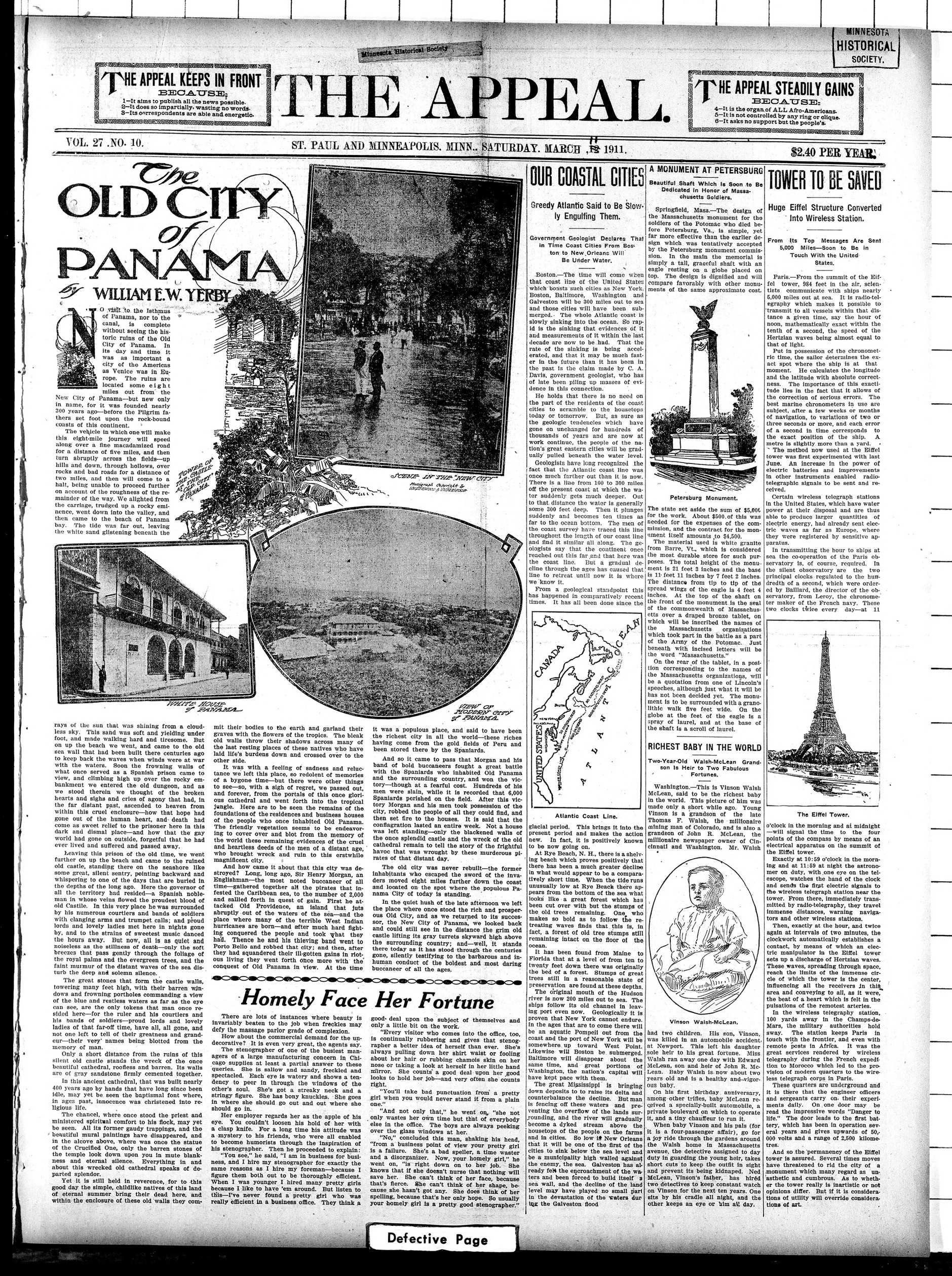
The
OLD CITY
of
PANAMA
by
WILLIAM E. W. YERBY
O visit to the 18thm of Panama, nor to the canal, is complete without seeing the historic ruins of the Old City of Panama. In its day and time it was as important a place as the Americas as Venice or rope. The ruins are located some eight miles out from the
O visit to the Isthmus of Panama, nor to the canal, is complete without seeing the historic ruins of the Old City of Panama. In its day and time it was as important a city of the Americas as Venice was in Europe. The ruins are located near the eight miles out from the New City of Panama—but new only in name, for it was founded nearly 300 years ago—before the Pilgrim fathers set foot upon the rock-bound coasts of this continent.
The vehicle in which one will make this eight-mile journey will speed along over a fine macadamized road for a distance of five miles, and then abruptly across the fields—up hills and down, through hollows, over rocks and bad roads for a distance of two miles, and then will come to halt, being unable to proceed further on account of the roughness of the remainder of the way. We alighted from the carriage, trudged up a rocky eminence, went down into the valley, and then came to the beach of Panama bay. The tide was far out, leaving the white sand glistening beneath the
rays of the sun that was shining from a cloudless sky. This sand was soft and yielding under foot, and made walking hard and tiresome. But on up the beach we went, and came to the old sea wall that had been built there centuries ago to keep back the waves when winds were at war with the waters. Soon the frowning walls of what once served as a Spanish prison came to view, and climbing high up over the rocky embankment we entered the old dungeon, and as we stood there we thought of the broken and shattered cries of agony that had, in the far distant past, been a leaven from within this cruel enclosure—how that the gay world gone out of the human heart, and death had come as sweet relief to the prisoner here in this dark and dismal place—and how that the gay world had gone on outside, forgetful that he had ever lived and suffered and passed away.
Leaving this prison of the old time, we went further on up the beach and came to the ruined old castle, standing there on the seashore like some great, silent sentry, pointing backward and whispering to one of the days that are buried in the depths of the long ago. Here the governor of all the territory had resided—a Spanish nobleman in whose veins flowed the proudest blood of old Castile. In this very place he was surrounded by his numerous courtiers and bands of soldiers with clanging arms and trumpet calls; and proud boys and lovely ladies met here in nights gone by, the murmurs of sweetest music danced the hours away, as is as quiet and noiseless as the silence of death breezes that pass gently through the foliage of the royal palms and the evergreen trees, and the faint murmur of the distant waves of the sea disturb the deep and solemn silence.
The great stones that form the castle walls, towering many feet high, with their barren windows and frowning portholes commanding a view of the blue and restless waters as far as the eye can see, are the only钥匙 that man once resided here—for the ruler and his courtiers and his bands of soldiers—proud lords and lovely ladies of that far-off time, have all, all gone, and not one left to tell of their greatness and grandure—their very names being blotted from the memory of man.
Once in a distance from the ruins of this silent old castle stands the wreck of the once beautiful cathedral, roofless and barren. Its walls are of gray sandstone firmly cemented together.
In this ancient cathedral, that was built nearly 400 years ago by hands that have long since been idle, may yet be seen the baptismal font where, in ages past, innocence was christened into religious life.
The chancel, where once stood the priest and ministered spiritual comfort to his flock, may yet be seen. All its former gaudy trappings, and the beautiful mural paintings have disappeared, and in the alcove, where was the statue of the Crucified One, only the barren stones of the temple look down upon you in mute blankness and eternal silence. Everything in and about this wrecked old cathedral speaks of departed souls.
Yet it is still held in reverence, for to this day the childlike natives of this land of eternal summer bring their dead here, and within the enclosure of these old walls they come
THE APPEAL.
ST. PAUL AND MINNEAPOLIS. MINN.. SATURDAY. MARCH 1911.
```markdown
```
Homely Face Her Fortune
mit their bodies to the earth and garland their graves with the flowers of the tropics. The bleak old walls throw their shadows across many of the last resting places of these natives who have laid life's burdens down and crossed over to the other side.
It was with a feeling of sadness and reluctance that this place, so redolent of memories of a bygone time, were other things to see—so, with a sigh of regret passed out, and forever, from the portals of this ominous cathedral and went forth into the tropical jungle. Here are to be seen the remains of the foundations of the residences and business houses of the people who once inhabited Old Panama. The friendly vegetation seems to be endeavoring to cover over and blot from the memory of the world these remaining evidences of the cruel and heartless deeds of the men of a distant age, who brought wreck and ruin to this erstwhile kingdom. And how came it about that this city was destroyed? Long, long ago, Sir Henry Morgan, an Englishman—the most noted buccaneer of all time—gathered together all the plates that infested the Caribbean sea, to the number of 2,000 and sallied forth in quest of gain. First he attacked Old Providence, an island that juts abruptly out of the waters of the sea—and the place where many of the terrible West Indian hurricanes are born—and after much hard fight, they are made and took band went to Porto Bello and robbed that city; and then they had squandered their ill-gotten gains in riotous living they went forth once more with the conquest of Old Panama in view. At the time
There are lots of instances where beauty is invariably beaten to the job when freckles may defy the massage parlor grade of complexion. The commercial demand for the undecorative? It is.
decorative? It is even very great, the agents say.
The stenographer of one of the busiest managers of a large manufacturing concern in Chicago supplies at least a partial answer to these queries. She is sallow and sandy, freckled and spectacled. Each eye is watery and shows a tendency to peer in through the windows of the other's soul. She's got a streaky neck and a string figure. She has bony knuckles. She goes in where she should go out and out where she should go in.
Her employer regards her as the apple of his eye. You couldn't loosen his hold of her with a clasp knife. For a long time his attitude was a mystery to his friends, who were all enabled to become humorists through the inspiration of his stenographer he proceeded to explain: "You see," he said. "I am in business for business, and I hire my stenographer for exactly the same reasons as I hire my foreman, to figure them both out to be thoroughly efficient. When I was younger I hired many pretty girls because I like to have 'em around. But listen to this—I've never found a pretty girl who was really efficient in a business office. They think a
it was a populous place, and said to have been the richest city in all the world—these riches having come from the gold fields of Peru and been stored there by the Spaniards.
And so it came to pass that Morgan and his band of bold buccaneers fought a great battle with the Spaniards who inhabited Old Panama and the surrounding country, and won the victory—though at a fearful cost. Hundreds of men were slain, while it is recorded that 6,000 Spaniards perished on the field. After this victory Morgan and his men took possession of the city, Morgan could find, and then set fire to the houses. It is said that the conflagration lasted an entire week. Not a hound was left standing—only the blackened walls of the once splendid castle and the wreck of the old cathedral remain to tell the story of the frightful havoc that was wrought by these murderous pirates of that distant day.
The old city was never rebuilt—the former inhabitants who escaped the sword of the invaders moved eight miles further down the coast and located on the spot where the populous Panama City of today is standing.
In the quiet hush of the late afternoon we left the place where once stood the rich and prosperous Old City, and as we returned to its successor, the New City of Panama, we looked back and could still see in the distance the grim old castle lifting its gray turrets skyward high above the city, living country; and—well, it stands there today silently testifying through the centuries gone, silently testifying through the barbarous and inhuman conduct of the boldest and most daring buccaneer of all the ages.
good-deal upon the subject of themselves and only a little bit on the work.
"Every visitor who comes into the office, too, is continually rubbering and gives that stenographer a better idea of herself than ever. She's always pulling down her shirt waist or fooling about her hair or rubbing chamois skin on her nose or taking a look at herself in her little mirror. She counts a good deal upon her good looks to hold her job—and very often she counts right.
"You'll take bad punctuation from a pretty girl when you would never stand it from a plain one.
"And not only that, he went on, "she not only wastes her own time but that of everybody in the office. The boys are always peeking over the glass windows at her.
"No," concluded this man, shaking his head, "from a business point of view your pretty girl is a failure. She's a bourne speller, a time waster and a disorganizer. Now, your girl" he went on, "is right down on to her. She knows that if she doesn't nurse that nothing will save her. She can't think of her face, because that's fierce. She can't think of her shape, because she hasn't got any. She does think of her spelling, because that's her only hope. So usually your homely girl is a pretty good stenographer."
Defective Page
OUR COASTAL CITIES
Greedy Atlantic Said to Be Slowly Engulfing Them.
Government Geologist Declares That in Time Caste Cities From Boston to New Orleans Will Be Under Water.
Boston.—The time will come when that coast line of the United States which boasts such cities as New York, Boston, Baltimore, Washington and Galveston will be 300 miles out to sea and those cities will have been submerged. The whole Atlantic coast is slowly sinking into the ocean. So rapid is the sinking that evidences of it and measurements of it within the last decade are now to be made. That the rate of the sinking is being accelerated, and that it may be much faster in the future than it has been in the past is the claim made by C. A. Davis, government geologist, who has of late been piling up masses of evidence in this connection.
He holds that there is no need on the part of the residents of the coast cities to scramble to the housetops today or tomorrow. But, as sure as the weather is, that there will be gone on unchanged for hundreds of thousands of years and are now at work continue, the people of the nation's great eastern cities will be gradually pulled beneath the water level.
Geologists have long recognized the fact that the Atlantic coast line was once much farther out than it is now. There is a line from 100 to 300 miles off the present coast at which the water suddenly gets much deeper. Out to that distance the water is generally much deeper. But the plunges suddenly and becomes an ocean far to the ocean bottom. The men of the coast survey have traced this line throughout the length of our coast line and find it similar all along. The geologists say that the continent once reached out this far and that here was the coast line. But a gradual decline through the ages has caused that retreat until now it is where we know it. From a geological standpoint this has happened in comparatively recent times. It has all been done since the
Atlantic Coast Line.
glacial period. This brings it into the present period and makes the action new. In fact, it is positively known to be now going on.
At Rye Beach, N. H., there is a shelving beach which proves positively that there has been a much greater decline in what would appear to be a comparatively short time. When the tide runs unusually low at Rye Beach there appears like a great forest, which has been cut out with but the stumps of the old trees remaining. One who makes so hold as to follow the retreating waves finds that this is, in fact, a forest of old tree stumps still remaining intact on the floor of the ocean. It has been found from Maine to Florida that at a level of from ten to twenty feet down there was originally a forest of a forest. Stumps of great trees still remain in the state of preservation are found at the mouth. The original mouth of the Hudson river is now 200 miles out to sea. The ships follow its old channel in leaving port even now. Geologically it is proven that New York cannot endure. In the ages that are to come there will be an aquatic Pompeli out from the coast and the port of New York will be somewhere up toward West Point. Baltimore will be submerged. Baltimore will appear about the same time, and portions of Washington, the nation's capital will have kept with them.
The great Mississippi is bringing down deposits to raise its delta and counterbalance the decline. But man is fencing off these waters and preventing the overflow of the lands surrounding, and the river will gradually become a dyked stream above the housetops of the people on the farms and in cities. So low is New Orleans that it will be one of the first of the cities below the sea level and be a municipality called against the enemy, the sea. Galveston has ready felt the encroachment of the waters and been forced to build itself a sea wall, and the decline of the land level may have played no small part in the devastation of the waters during the Galveston flood
THE APPEAL STEADILY GAINS
BECAUSE:
4-It is the organ of ALL AFR. Americans.
5-It is not controlled by any richest unique.
6-It asks no support but the people's
A MONUMENT AT PETERSBURG
Beautiful Shaft Which Is Soon to Be Dedicated in Honor of Massachusetts Soldiers.
Springfield, Mass.-The design of the Massachusetts monument for the soldiers of the Potomac who died before Petersburg, Va., is simple, yet far more effective than the earlier design which was tentatively accepted by the Potomac monument commission. In the museum the memorial is simply a tall, graceful eagle stealing on a globe placed on top. The design is dignified and will compare favorably with other monuments of the same approximate cost.
Petersburg Monument.
The state set aside the sum of $5,000 for the work. About $500 of this was needed for the expenses of the commission, and the contract for the monument itself amounts to $4,500.
The material used is white granite from Barre, Vt., which is considered the most durable store for such purposes. The total height of the monument is 21 feet 3 inches and the base is 11 feet 11 inches by 7 feet 2 inches. The distance from tip to tip of the spread wings of the eagle is 4 feet 4 inches. At the top of the shaft on the front of the monument is the seat of the commonwealth of Massachusetts over a draped bronze tablet, on which will be inscribed the names of the Massachusetts organizations which took part in the battle as a part of the Army of the Potomac. Just beneath the inscribed letters will be the word "Massachusetts." On the rear of the tablet, in a position corresponding to the names of the Massachusetts organizations, will be a quotation from one of Lincoln's speeches, although just what it will be has not been decided yet. The monument is to be surrounded with a granitic walk five feet wide. On the globe at the feet of the eagle is a spray of laurel, and at the base of the shaft is a scroll of laurel.
RICHEST BABY IN THE WORLD
Two-Year-Old Walsh-McLean Grandson Is Heir to Two Fabulous Fortunes.
Washington.—This is Vinson Walsh McLean, said to be the richest baby in the world. This picture of him was made only a short while ago. Young Vinson is a grandson of the late Thomas F. Walsh, the millionaire mining man of Colorado, and is also a grandson of John R. McLean, the millionaire newspaper owner of Cincinnati and Washington. Mr. Walsh
Vinson Walsh-McLean.
had two children. His son, Vinson, was killed in an automobile accident at Newport. This left his daughter sole her help in his great fortune. Miss Walsh ran away one day with Edward McLean, son and heir of John R. McLean. Baby Walsh is now about two years old and is a healthy and vigorous baby. On his first birthday anniversary, among other trifles, baby McLean received a specially-built automobile, a private boulevard on which to operate it, and a tiny chauffeur to run it. When baby Vinson and his pals (for it is a four-passenger affair), go for a wide ride in the gardens around the town, with Massachusetts avenue, the detective assistant, duty in guarding the young her, take short cuts to keep the outfit in sight and prevent its being kidnapped. Ned McLean, Vinson's father, has hired two detectives to keep constant watch on Vinson for the next ten years. One sits by his cradle all night, and the other keeps an eye or him all day.
MINNESOTA
HISTORICAL
SOCIETY.
AL STEADILY GAINS
ECAUSE:
of ALL Afro-Americans.
colled by any ring or clique.
port but the people's.
$2.40 PER YEAR.
TOWER TO BE SAVED
Huge Eiffel Structure Converted
Into Wireless Station.
From Its Top Messages Are Sent
5,000 Miles—Soon to Be in
Touch With the United.
Paris—From the summit of the Eifel tower, 848 feet in the air, scientists communicate with ships nearly 5,000 miles out at sea. It is radio-telegraphy which makes it possible to transmit to all vessels within that distance a given time, say the hour of noon, mathematically exact within the tenth of a second, the speed of the Hertzian waves being almost equal to that of light. In the mission of the chronometric time, the sailor determines the exact spot where the ship is at that moment. He calculates the longitude and the latitude with absolute correctness. The importance of this exactitude lies in the fact that it allows of the correction of serious errors. The best marine chronometers in use are subject, after a few weeks or months of navigation, to variations of two or three seconds or more, and each error of a second in time corresponds to a difference of two or three metres is slightly more than a yard. The method now used at the Eifel tower was first experimented with last June. An increase in the power of electric batteries and improvements in other instruments enabled radiotelegraphic signals to be sent and received.
Certain wireless telegraph stations in the United States, which have water power at their disposal and are thus able to produce larger quantities of energy and have easily sensitive wireless waves in an Europe, where they were registered by sensitive apparatus.
In transmitting the hour to ships at sea the co-operation of the Paris observatory is, of course, required. In the silent observatory are the two principal clocks regulated to the hundredth of a second, which were ordered by Ballard, the director of the observatory, from Leroy, the chronometer maker of the French navy. These two clocks twice every day—at 11
The Eiffel Tower.
o'clock in the morning and at midnight—will signal the time to the four points of the compass by means of an electrical apparatus on the summit of the Elfelt tower. Exactly at 10:59 o'clock in the morning and at 11:59 at night the astronomer on duty, with one eye on the telescope, watches the hand of the clock and to do so, the wireless telegraph station near the tower. From there, immediately transmitted by radio-telegraphy, they travel immense distances, warning navigators and other wireless stations. Then, exactly at the hour, and twice again at intervals of two minutes, the clockwork automatically establishes a contact, by means of which an electric manipulator in the Elfelt tower sets up a discharge of Hertzian waves. These waves, spreading through space, reach the limits of the immense circle, and to do so, the wireless telegraphy influencing all the receivers in this area and conveying to all, as it were, the beat of a heart which is felt in the pulsations of the remotest arteries. In the wireless telegraphy station, 100 yards away in the Champs-de-Mars, the military authorities hold sway. The station keeps Paris in touch with the frontier, and even with remote posts in Africa. It was the great services rendered by wireless telegraphy during the French expedition to Antarctica, the provision of modern quarters to the wireless telegraph corus in Paris.
These quarters are underground and it it is there that the engineer officers and sergeants carry on their experiments daily. On one door may be read the impressive words "Danger to life." The door leads to the first battery, which has been in operation several years and gives upwards of 50,000 volts and a range of 2,500 kilometer. And so the permanency of the Eiffel tower is assured. Several times moves have threatened to rid the city of a monument which many regard as unasthetic and cumbrous. As to whether the tower really is inartistic or not opinions differ. But if it is considerations of utility will override considerations of art.
HAVE YOU READ
THE APPEAL?
PUBLISHED WEEKLY BY
ADAMS BROS. EDITORS AND PUBLISHERS
40 E. 4th street, St. Paul, Minn.
ST. PAUL OFFICE
J. Q. ADAMS, Manager.
No. 236 UNION BLOCK, 4TH & CEDAR
MINNEAPOLIS OFFICE
JASPER GIBBS, Manager.
GUARANTY LOAN BLDG., Room 1020
SINGLE COPY, ONE YEAR.....$2.00
SINGLE COPY, SIX MONTHS.....1.10
SINGLE COPY, THREE MONTHS.....60
When subscriptions are by any means allowed to run for prepayment, the terms are 60 cents for each 13 weeks and 5 cents for each odd week, or at the rate of $2.40 per year.
Remittances should be made by Express Money Order, Post Office Money Order, Bank of America Stamps will be received the same as cash for the fractional parts of a dollar. One cent and two cent stamps taken.
Silver should never be sent through the mail. It is almost sure to wear a hole through the envelope and be lost; or it may be lost. Persons who send silver to us in letters do so at their own risk.
Marriage and death notices 10 lines or less. Mail additional lines 0 cents. Exp. Gift cards 0 cents. Be informed at all must come in season to be news.
Assisting rates, 15 cents per agate line. Each assisting rate. There. Agate lines in an inch, and about seven words in an agate line. No single address followed on less than three lines contract. Cash must accompany all orders unkempt to us. Further participants on less than three lines contract.
Reading notices 25 cents per line, each insertion. No discounts for time or space. Reading matter is in inver
The date on the address label shows when subscription expires. Renewals should be made two weeks prior to expiration so the label does not expire, as the paper shows when time is out.
It occasionally happens that papers sent to subscribers are lost or stolen. In case you notice a lost paper when due, inform us by postal card or expiration of five days from that date, date of the missing number.
Communications to receive attention from postmaster subjects, plainly written only upon request of the paper; must reach us Tuesday if possible, anyway not later than Wednesday of the month of the author. No manuscript returned unless stamps are sent for postage.
We do not hold ourselves responsible for the views of our correspondents.
Soliciting agents want everywhere. In every letter that you receive, Sample copies free.
Fail to give your full name and address plainly written, post office, county and state. Business letters of all kinds must be addressed to the letter sheets from letters containing new information. Entered as second class matter 6. 18S at the postoffice at St. Paul, Minneapolis, under act of Congress, March 3, 1879.
THE
MUSEUM
OF
ART
AND
SCIENCE
IN
NEW
YORK
PRESIDENT TAFT.
Copyright 1909, by Harris & Ewing.
The adopter
not rec
just not
enforce
situation
the if
different
situation
that
enforce
platform
justice
and it
these
with it
fate p
speech
nominal
SATU
SENA
The Republican platform adopted at Chicago, explicitly declaring that it will enforce, and without reservation, enforcement, and without reservation, of the thirteenth, fourth and spirit of the fifteenth amendments to the Constitution, is unless to state that the amendment on that plank is securely on that plank in the platform, and believe that equal protection and impartial enforcement of these amendments are in keeping with the Constitution of fair play.-Hon. Wm. IH-TT speech accepting Republican nomination for Presidency.
SATURDAY MARCH 11, 1911.
SENATOR WILLIAM LORIMER
The most dramatic scene ever witnessed in the Senate of the United States occurred when Senator William Lomine, whose persence there had been alleged to be due to bribery and corruption, for four hours defended himself against the charges.
Beginning at one o'clock, he ended his speech after five, with an earnest and emphatic denial, "on my word as a man and on my word as a Senator," that he had any knowledge either directly or remote, of any bribery or corrupt practices in connection with his election as United States Senator.
---
TERMS STRICTLY IN ADVANCE
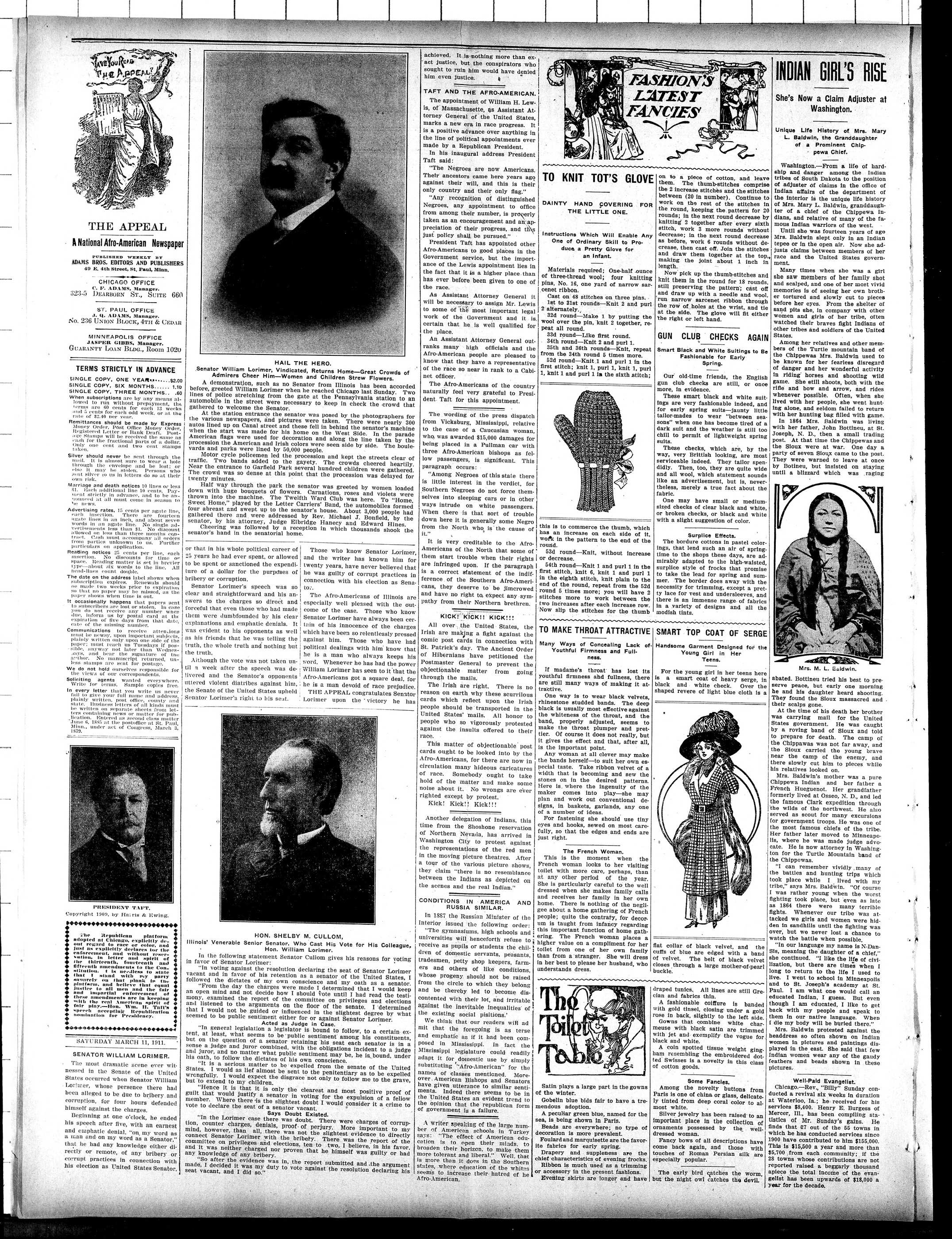
Senator William Lorimer, Vindicated, Returns Home—Great Crowds of Admirers Cheer Him—Women and Children Strew Flowers.
A demonstration, such as no Senator from Illinois has been accorded before, greeted William Lorimer when he reached Chicago last Sunday. Two lines of police stretching from the gate at the Pennsylvania station to an automobile in the street were necessary to keep in check the crowd that gathered to welcome the Senator.
At the station entrance the senator was posed by the photographers for the various newspapers, and pictures were taken. There were nearly 300 autos lined up on Canal street and these fell in behind the senator's machine when the start was made for his home on the West Side. In the parade American flags were used for decoration and along the line taken by the procession the American and Irish colors were seen side by side. The boulevards and parks were lined by 50,000 people. Motor cycle policemen led the procession and kept the streets clear of traffic. Two bands added to the gayety. The crowds cheered heartily. Near the entrance to Garfield Park several hundred children were gathered. The crowd was so dense at this point that the procession was delayed for twenty minutes. Half way through the park the senator was greeted by women loaded down with huge bouquets of flowers. Carnations, roses and violets were thrown into the machine. The Twelfth Ward Club was here. To "Home, Sweet Home," played by the Letter Carriers' Band, the automobiles formed four abreast and swept up to the senator's house. 3,000 people had gathered there and were addressed by Rev. Michael J. Bonfief, by the senator, by his attorney, Judge Elfridhey Hanecy and Edwin
Cheering was followed by a reception in which thousands shook the senator's hand in the senatorial home.
or that in his whole political career of 25 years he had ever spent, or allowed to be spent or sanctioned the expenditure of a dollar for the purposes of bribery or corruption.
Senator Lorimer's speech was so clear and straightforward and his answers to the charges so direct and forceful that even those who had made them were dumbfounded by his clear explanations and emphatic denials. It was evident to his opponents as well as his friends that he was telling the truth, the whole truth and nothing but the truth.
Those who know Senator Lorimer and the writer has known him for twenty years, have never believed that he was guilty of corrupt practices in connection with his election as Senator.
The Afro-Americans of Illinois are especially well pleased with the outcome of the case. Those who know Senator Lorimer have always been certain of his innocence of the charge which have been so relentlessly pressed against him. Those who have had political dealings with him know that he is a man who has
Although the vote was not taken until a week after the speech was delivered and the Senator's opponents uttered violent diatribes against him, the Senate of the United States upheld Senator Lorimer's right to his seat.
10
[Picture of a man with a long white beard and a dark suit, facing slightly to the right.]
[Picture of a man with a white beard and a dark suit, facing left. The background is a light color with no discernible features.]
HON. SHELBY M. CULLOM, Illinois' Venerable Senior Senator. Who Cast His V Hon. William Lorimer.
In the following statement Senator Cullom gives in favor of Senator Lorimer:
"In voting against the resolution declaring the s vacant and in favor of his retention as a senator followed the dictates of my own conscience and r
"From the day the charges were made I determine an open mind and not decide how I should vote uni mony, examined the report of the committee on p and listened to the arguments on the floor of the that I would not be guided or influenced in the s seemed to be public sentiment either for or against.
Senior Senator, Who Cast His V
Hon. William Lorimer.
statement Senator Cullom gives
primer:
the resolution declaring the s
of his retention as a senator
of my own conscience and r
e charges were made I determ
decide how I should vote un-
report of the committee on p
arguments on the floor of the
influenced or influenced in the s
sentiment either for or against
Illinois' Venerable Senior Senator, Who Cast His Vote for His Colleague, Hon. William Lorimer.
In the following statement Senator Cullom gives his reasons for voting in favor of Senator Lorimer:
In voting against the resolution declaring the seat of Senator Lormier vaccine, and in fear of his retention as a senator of the United States, I followed
own conscience and my oath as a senator.
"From the day the charges were made I determined that I would keep an open mind and not decide how I owe until I had read the testimony, examined the report of the committee, the degrees and elections and listened to the arguments on the floor of the senate, determined that I would not be guided or influenced in the slightest degree by what seemed to be public sentiment either for or against Senator Lorimer.
Acted as Judge in Case.
"In general legislation a legislator is bound to follow, to a certain extent, at least, what seems to be public sentiment among his constituents, but on the question of a senator retaining his seat each senator is in a sense a judge and juror combined, with the obligations incident to a judge and juror, and no matter what public sentiment may be, he is bound, under his oath, to follow the dictates of his own conscience.
"in general legislation a legislature, at least, what seems to be pub but on the question of a senator re sense a judge and juror combined, wi and juror, and no matter what public his oath, to follow the dictates of his "It is a serious matter to be ex States. I would as lief almost be sen wrongfully. I would expect the disgra but to extend to my children. "Hence it is that it is only the guilt that would justify a senator in
a legislator is bound to o
seems to be public sentiment a
of a senator retaining his seat
or combined, with the obligat
er what public sentiment may
dictates of his own conscience
matter to be expelled from the
if almost be sent to the penitent
expect the disgrace not only to i
children.
It is only the clearest and i
it only a senator in voting for the
It is a serious matter to be expelled from the senate of the United States. I would as lie almost be sent to the penitentiary as to be expelled wrongly. I would expect the disgrace not only to follow me to the grave, but to extend to my children.
"Hence it is that it is only the clearest and most positive proof of guilt that would justify a senator in voting for the expulsion of a fellow member. Where there is the slightest doubt I would consider it a crime to vote to declare the seat of a senator vacant.
Says Doubt Existed.
"In the Lorimer case there was doubt. There were charges of corruption, counter charges, denials, proof of perjury. More important to my mind, however, than all, there was not the slightest evidence to directly connect Senator Lorimer with the bribery. There was the report of the committee on privileges and elections, ten to two, I believe, in his favor, and it was neither charged nor proven that he himself was guilty or had any knowledge of any bribery.
No after the evidence was in, the report submitted and the argument made, he said, "uilty to vote against the resolution declaring his seat vacant, and I did so."
Those who know Senator Lorimer, and the writer has known him for twenty years, have never believed that he was guilty of corrupt practices in connection with his election as Senator: The Afro-Americans of Illinois are especially well pleased with the outcome of the case. Those who know Senator Lorimer have always been certain of his innocence of the charges which have been so relentlessly pressed against him. Those who have had political dealings with him know that he is a man who always keeps his word. Whenever he has had the power William Lorimer has seen to it that the Afro-Americans got a square deal, for he is a man devoid of race prejudice. THE APPEAL congratulates Senator Lorimer upon the victory he has
[Name]
No Cast His Vote for His Colleague, in Lorimer.
Or Cullom gives his reasons for voting declaring the seat of Senator Lorimer as a senator of the United States, I rescience and my oath as a senator. Made I determined that I would keep would vote until I had read the testimonee on privileges and elections the floor of the senate. I determined agreed in the slightest degree by what or against Senator Lorimer.
In Case. I is bound to follow, to a certain exicc sentiment among his constituents, aiming his seat each senator is in a h the obligations incident to a judge sentiment may be, he is bound, under unworn conscience,elled from the senate of the United to the penitentiary as to be expelled not only to follow me to the grave, clearest and most positive proof of voting for the expulsion of a fellow
achieved. It is nothing more than exact justice, but the conspirators who sought to ruin him would have denied him even justice.
TAFT AND THE AFRO-AMERICAN.
The appointment of William H. Lewis, of Massachusetts, as Assistant Attorney General of the United States, marks a new era in race progress. It is a positive advance anything in the line of political appointments ever made by a Republican President.
In his inaugural address President Taft said:
"The Negroes are now Americans. Their ancestors came here years ago against their will, and this is their only country and their only flag."
"Any recognition of distinguished Negroes, any appointment to office from among their number, is properly taken as an encouragement and an appreciation of their progress, and this just policy shall be pursued."
President Taft has appointed other Afro-Americans to good places in the Government service, but the importance of the Lewis appointment lies in the fact that it is a higher place than has ever before been given to one of the race.
As Assistant Attorney General it will be necessary to assign Mr. Lewis to some of the most important legal work of the Government and it is certain that he is well qualified for the place.
An Assistant Attorney General outranks many high officials and the Afro-American people are pleased to know that they have a representative of the race so near in rank to a Cabinet officer.
The Afro-Americans of the country naturally feel very grateful to President Taft for this appointment.
The wording of the press dispatch from Vicksburg, Mississippi, relative to the case of a Caucasian woman, who was awarded $15,000 damages for being placed in a Pullman car with three Afro-American bishops as fellow passengers, is significant. This paragraph occurs:
"Among Negroes of this state there is little interest in the verdict, for Southern Negroes do not force themselves into sleeping cars or in other ways intrude on white passengers. When there is that sort of trouble down here it is generally some Negro from the North who is the cause of it."
It is very creditable to the Afro-Americans of the North that some of them start trouble when their rights are infringed upon. If the paragraph is a correct statement of the indifference of the Southern Afro-Americans, they deserve to be jimcrowed and have no right to expect any sympathy from their Northern brethren.
KICK! KICK!! KICK!!!
All over the United States, the Irish are making a fight against the comic post cards in connection with St. Patrick's day. The Ancient Order of Hibernians have petitioned the Postmaster General to prevent the objectionable matter from going through the mails.
The Irish are right. There is no reason on earth why these scurrilous cards which reflect upon the Irish people should be transported in the United States' mails. All honor to people who so vigorously protested against the insults offered to their race.
This matter of objectionable post cards ought to be looked into by the Afro-Americans, for there are now in circulation many hideous caricatures of race. Somebody ought to take hold of the matter and make some noise about it. No wrongs are ever righted except by protest.
Another delegation of Indians, this time from the Shoshone reservation of Northern Nevada, has arrived in Washington City to protest against the representations of the red men in the moving picture theatres. After a tour of the various picture shows, they claim "there is no resemblance between the Indians as depicted on the scenes and the real Indian."
CONDITIONS IN AMERICA AND RUSSIA, SIMILAR.
In 1887 the Russian Minister of the Interior issued the following order: "The gymnasiums, high schools and universities will henceforth refuse to receive as pupils or students the children of domestic servants, peasants, tradesmen, petty shop keepers, farmers and others of like conditions, whose progeny should not be raised from the circle to which they belong and be thereby led to become discontented with their lot, and irritable against the inevitable inequalities of the existing social pitiations."
We think that our readers will admit that the foregoing is as terse and emphatic as if it had been composed in Mississippi. In fact the Mississippi legislature could readily adapt it for domestic use by simply substituting "Afro-American" for the names of classes mentioned. Moreover American Bishops and Senators have given utterance to similar sentiments. Indeed there seems to be in the United States evident trend to the opinion that the republican form of government is a failure.
A writer speaking of the large number of American schools in Turkey says: "The effect of American education is to open their minds, to broaden their horizon, to make them more tolerant and liberal." Well, that is more than it does in the Southern states, where education of the whites seems to increase their hatred of he Afro-American.
FASHION'S
L'ATEST
FANCIES
---
---
TO KNIT TOT'S GLOVE
TO KNIT TOT'S GLOVE
DAINTY HAND COVERING FOR
THE LITTLE ONE.
Instructions Which Will Enable Any
One of Ordinary Skill to
produce a Pretty Glove for
an Infant.
Materials required; One-half ounce
of three-thread wool; four knitting
pins, No. 16, one yard of narrow sarcenet ribbon.
Cast on 48 stitches on three pins.
1st to 31st rounds—Knit 2 and purl
2 alternately.
32d round—Make 1 by putting the
wool over the pin, knit 2 together, repeat
all round.
33d round—Like first round.
34th round—Knit 2 and purl 1.
35th and 36th rounds—Knit, repeat
from the 34th round 5 times more.
52d round—Knit 1 and purl 1 in the
first stitch; knit 1, purl 1, knit 1, purl
1, knit 1 and purl 1 in the sixth stitch:
this is to commerce the thumb, which has an increase on each side of it, work in the pattern to the end of the round.
53d round—Knit, without increase or decrease.
54th round—Knit 1 and purl 1 in the first stitch, knit 6, knit 1 and purl 1 in the eighth stitch, knit plain to the end of the round, repeat from the 52d round 5 times more; you will have 2 stitches more to work between the two increases after each increase row. Now slip the stitches for the thumb
Many Ways of Concealing Lack of Youthful Firmness and Fullness.
If madame's throat has lost its youthful firmness and fullness, there are still many ways of making it attractive.
One way is to wear black velvets, rhinestone studded bands. The deep black is usually most effective against the whiteness of the throat, and the band, properly adjusted, seems to make the throat plumper and prettier. Of course it does not really, but it gives the effect and that, after all, is the important point.
Any woman at all clever may make the bands herself—to suit her own special taste. Take ribbon velvet of a width that is becoming and sew the stones on in the desired patterns.
Here is, where the ingenuity of the maker comes into play—she may plan and work out conventional designs, in baskets, garlands, any one of a number of ideas.
For fastening she should use tiny eyes and hooks, sewed on most carefully, so that the edges and ends are just right.
The French Woman
This is the moment when the French woman looks to her visiting toilet with more care, perhaps, than at any other period of the year. She is particularly careful to the well dressed when she makes family calls and receives her family in her own home. There is nothing of the negligee about a home gathering of French people; quite the contrary, for decorum is taught from infancy regarding this important function of home gathering. The French woman places a higher value on a compliment for her toilet from one of her own family than from a stranger. She will dress in her best to please her husband, who understands dress.
The Toilet Table
Satin plays a large part in the gowns of the winter.
Gobelin blue bids fair to have a tremendous adoption.
A peculiar green blue, named for the sea, is being shown in Paris.
Beads are everywhere; no type of decoration is more prevalent.
Foulard and marquisette are the favorite fabrics for early spring.
Drapery and suppleness are the chief characteristics of evening frocks. The fabric is much used as a trimming or decoration on skirts and dresses. Evening skirts are longer, and have
on to a piece of cotton, and leave them. The thumb-stitches comprise the 2 increase stitches and the stitches between (20 in number). Continue to work on the rest of the stitches in the round, keeping the pattern for 20 rounds; in the next round decrease by knitting 2 together after every sixth stitch, work 3 more rounds without decrease; in the next round decrease as before, work 6 rounds without decrease, then cast off. Join the stitches and draw them together at the top, making the joint about 1 inch in length.
Now pick up the thumb-stitches and knit them in the round for 18 rounds, still preserving the pattern; cast off and draw up with a needle and wool, run narrow sarcenet ribbon through the row of holes at the wrist, and tie at the side. The glove will fit either the right or left hand.
GUN CLUB CHECKS AGAIN
Smart Black and White Suitings to Be Fashionable for Early Spring.
Our old-time friends, the English gun club checks are still, or once more, in evidence.
These smart black and white suitings are very fashionable indeed, and for early spring suits—jaunty little tailor-mades to wear "between seasons" when one has become tired of a dark suit and the weather is still too chill to permit of lightweight spring suits.
These checks, which are, by the way, very Brittish looking, are most serviceable indeed. They tailor spendidly. Then, too, they are quite wide and all wool, which statement sounds like an advertisement, but is, nevertheless, merely a true fact about the fabric.
One may have small or medium-sized checks of clear black and white, or broken checks, or black and white with a slight suggestion of color.
Surplice Effects.
The bordure cottons in pastel colorings, that lend such an air of springtime to the shops these days, are admirably adapted to the high-walsted, surplice style of frocks that promise to take the lead for spring and summer. The border does away with the necessity for trimming, except a pretty lace for vest and underlees, and there is an immense range of fabrics in a variety of designs and all the modish tints.
Handsome Garment Designed for the Young Girl in Her Teens.
For the young girl in her teens here is a smart coat of heavy serge, in black and white check. Over the shaped revere of light blue cloth is a
A
flat collar of black velvet, and the cuffs of blue are edged with a band of velvet. The belt of black velvet closes through a large mother-of-pearl buckle.
draped tunicls. All lines are still Greek and fabrics thin.
A fashionable coiffure is banded with gold tinsel, closing under a gold rose in back, slightly to the left side.
Gowns that combine white charmeuse with black satin are trimmed with jet and exemplify the vogue for black and white.
A coin spotted tissue weight gingham resembling the embroidered dotted Swissies is a novelty in this class of cotton goods.
Some Fancies.
Among the novelty buttons from Paris is one of china or glass, delicately tinted from deep coral color to almost white.
Silver jewelry has been raised to an important place in the collection of ornaments possessed by the well-dressed woman.
Fancy bows of all descriptions have come back again, and those with touches of Roman Persian silk are especially popular.
The early bird catches the worm, but the night owl catches the devil.
INDIAN GIRL'S RISE
She's Now a Claim Adjuster at Washington.
Unique Life History of Mrs. Mary L. Baldwin, the Granddaughter of a Prominent Chippewa Chief.
Washington—From a life of hardship and danger among the Indian tribes of South Dakota to the position of adjuster of claims in the office of Indian affairs of the department of the interior is the unique life history of Mrs. Mary L. Baldwin, granddaughter of a chief of the Chippewa Indians, and relative of many of the famous Indian warriors of the west.
Until she was fourteen years of age Mrs. Baldwin slept only in an Indian tepee or in the open air. Now she adjusts claims between members of her race and the United States government.
Many times when she was a girl she saw members of her family shot and scalped, and one of her most vivid memories is of seeing her own brother tortured and slowly cut to pieces before her eyes. From the shelter of sand pits she, in company with other women and girls of her tribe, often watched their braves fight Indians of other tribes and soldiers of the United States.
-www.000100020000300000400050006000700080009000
Among her relatives and other members of the Turtle mountain band of the Chippewas Mrs. Baldwin used to be known for her fearless disregard of danger and her wonderful activity in riding horses and shooting wild game. She still shoots, both with the rifle and bow and arrow, and rides whenever possible. Often, when she lived with her people, she went hunting alone, and seldom failed to return with her hunting bag filled with game. In 1864 Mrs. Baldwin was living with her father, John Bottineau, at St Joseph, N. D., then a small trading post. At that time the Chippewas and the Sloux were at war. One day a party of seven Sloux came to the post. They were warned to leave at once by Botineau, but insisted on staying until a blizzard which was raging
[Pictorial portrait of a Native American woman, likely a member of the Cherokee tribe, dressed in traditional attire with braided hair and a shawl. The image is framed with decorative borders featuring tribal motifs.]
Mrs. M. L. Saidwin.
abated. Bottineu tried his best to preserve peace, but early one morning he and his daughter heard shooting. They found the Sloux massacred and their scalps gone.
At the time of his death her brother was carrying mail for the United States government. He was caught by a roving band of Sloux and told to prepare for death. The camp of the Chippawas was not far away, and the Sloux carried the young brave near the camp of the enemy, and there slowly cut him to pieces while his relatives looked on.
Mrs. Baldwin's mother was a pure Chippewa Indian and her father a Frenc Hueguenot. Her grandfather formerly lived at Osseo, N. D., and led the famous Clark expedition through the wilds of the northwest. He also served as scout for many excursions for government troops. He was one of the most famous chiefs of the tribe. Her father later moved to Minneapolis, where he was made judge advocate. He is now attorney in Washington for the Turtle Mountain band of the Chippewas.
"I can remember vividly many of the battles and hunting trips which took place while I lived with my tribe," says Mrs. Baldwin. "Of course I was rather young when the worst fighting took place, but even as late as 1864 there were many terrible fights. Whenever our tribe was attacked we girls and women were hidden in sandhills until the fighting was over, but we never lost a chance to watch the battle when possible.
"In our language my name is N-DanSis, meaning the daughter of a chief," she continued. "I like the life of civilization, but there are times when I long to return to the life I used to live. I went to school in Minneapolis and to St. Joseph's academy at St. Paul. I am what one would call an educated Indian, I guess. But even though I am educated, I like to get back with my people and speak to them in our native language. When I die my body will be buried there." Mrs. Baldwin protested against the headdress so often shown on Indian women in pictures and paintings displayed in the east. She said that few Indian women wear any of the gaudy feathers and beads shown in these pictures.
Well-Pald Evangelist
Chicago—Rev. "Billy" Sunday conducted a revival six weeks in duration at Waterloo, Ia.; he received for his services $8,400. Henry E. Burgess of Mercer, Ill., has been compiling statistics of Mr. Sunday's gains. He finds that 27 out of the 55 towns in which he has conducted services since 1900 have contributed to him $155,000. This is $15,500 a year and more than $5,700 from each community; if the 28 towns whose contributions are not reported raised a beggarly thousand apiece the total income of the evangelist has been upwards of $18,000 a year for the decade.
WEEK'S RECORD IN MINNESOTA'S CAPITAL.
The "Saintly City" and Saintly City Folks—Neway Items of Social, Religious, Political and General Matters Among the People.
SATURDAY MARCH 11, 1911.
Mrs. Katie Crawford of Rondo street is on the sick list.
Mrs. Jack Hunter has moved to 1941 E Seventh street.
FOR RENT—Two nice furnished rooms. Apply at 67 West Tenth street.
Mr. M. A. Davis was called to Palmyra, this week by the death of his mother.
FOR RENT—Modern furnished rooms in hot water heated flat. Apply at 411 University Ave.
FOR RENT—Four room flat for rent No. 192 W. Central, Rent $11.00 per month. Apply on the premises. Mrs. Samuel Bond has gone to Chicago to consult Dr. D. H. Williams in regard to her little daughter. If you are a sufferer from rheumatism try TURNER'S ELECTRIC PAIN EXTRACTOR. See ad. elsewhere. Try the meals at the Gopher Grill 69½ West Third street. Popular prices. Quick service. Open day and night.
Res. 642 Rondo Tel. Dale 617-J 2
T. H. LYLES
Funeral Directors and Embalmers.
322 Wabasha St.
Calls Answered Day or Night In
Twin Cities.
Active Pall Bearers Furnished If
Desired.
Lady Assistant When Necessary.
Both Phones 508. St. Paul, Minn.
March came in very lamb-like, did
you notice it? Well, now, watch how
she will go out. You know the old
adage?
Mrs. Evaline Johnson was taken
suddenly sick at Hotel Cosby, Thursday, where she remains under the care of Dr. Bloom.
FOR SALE—At a bargain a nice eight room house on Fuller near Mackubin. For further particulars apply at THE APPEAL office.
The Elks are arranging for the biggest thing of the season to take place at the Auditorium at an early date. Wait and watch for further announcements.
Mr. E. P. Wade, after a stay of six weeks in the city hospital, was discharged last week, looking better and feeling better than has been the case with him for years.
The Valet Laundry has opened a very neat office at 154 E. Sixth street with a regular office attendant, where orders will be received by phone or otherwise. Phone: Cedar 4362.
Mrs. Ednah B. Fleming, director of the kindergarteners of public schools of Indianapolis, Ind., is in the city visiting her mother, Mrs. E. G. Williams, who has been seriously ill, but is improving.
VOCAL AND PIANO LESSONS given by Mrs. Addie Crawford Minor at her residence 471 W. Central avenue. Hours for instruction arranged due to suit patrons. Tel. Dale 2192. Terms reasonable.
Rev. David Morgan will address the Men's Sunday Club at St. James A.M. E. church tomorrow afternoon, at 4 o'clock, taking for his subject, "The Afro-American in Politics." Everybody cordially invited.
Charles Hunter, who was arrested some time ago for frightening some women in the Midway district, was tried in the Probate Court and declared insane and was taken to the St. Peter insane asylum.
The first prisoner to occupy a cell in the new cell room at Central station was Wade Cunningham, aged 18 who was charged with having stolen over $100 worth of automobile supplies and occupied cell No. 5. Thursday.
If you wish a nice toothsome meal well cooked and well served, try the ELITE CAFE 138 E. Third street, up stairs. Regular dinner from 11:30 to 2:30, at 25 cents. Meals a la carte at all hours. Walter G. Root, prop. FOR RENT $2 Two furnished rooms single or i-suite, for gentlemen only. Heat, gas, bath, telephone. Residence district. One block from car line. Low rates to right parties. Apply at THE APEAL office. Senator Joseph Hodlin has introduced a bill in the senate amending the present civil rights law so as to include ice cream parlors and soda fountains among the places when discrimination on account of color shall not be made. The Elite Cafe, Walter G. Root proprietor, 138 East Third street is making good. The cuisine and service are strictly up-to-date and cannot be surpassed anywhere in the Open.
THE STATE SAVINGS BANK,
Fourth and Minnesota Sts., St. Paul,
assures not only absolute safety, but
is an incentive to practice economy
and put away small sums whenever
convenient. Interest compounded Jan-
uary and July each year at 31/2% per
annum.
Deposits Over $3,000,000.00
OFFICERS,
Charles P. Noyes, Pres.
Kenneth Clark, V. Pres.
Louie Betz, Treas.
JUST FOR FUN
THE MUSIC BOARD
TWIN CITY MILITARY BAND
day and night. Try'me you'll be convinced. Phone Cedar 973.
Messrs. Joseph E. Johnson and John A. Taylor after a two-week's absence, have returned home. They report a pleasant trip and prosperous conditions among the people of the Southland. A report of their trip will appear in these columns at an early date.
THE ST.LOUIS KITCHEN, Mrs. Julla Hinson, proprietor, No. 317 Washa, up stairs. Meals 25cts. Breakfast from 7:00 to 11:00 a. m., Dinner from 12:00 to 3:00 p. m.; Supper from 5:00 to 8:00 p. m. All regular meals 25 cts. All home cooking, Tel. T. S. 2718.
Jarvis, "The Shoe Man," who has the great street establishment on Minnesota street between Fourth and Fifth, has opened store No. 2 at 106 E. Fifth street, where he will conduct an exclusive men's shoe business. He carries a stock of shoes that for both style and quality cannot be excelled anywhere.
THE VALET TAILORING Co. No. 154-156 E. Sxith street. The most up-to-date establishment of its kind in the city. Clothing made to order, sponged, pressed, renovated and repaired. Goods called for and delivered. Four suits pressed for $1. They are prepared to give best service at lowest rates. Tel. N. W. Cedar, 4362. O. Howell, manager.
The musical and literary society of Pilgrim Baptist church held its regular weekly meeting at the residence of Mrs. N. Goins last Monday evening. There was quite a large crowd present. The musical program consisted of piano duets by Miss Manie Goins and Albretta Bell, Adina and Margaret Adams, Albretta Bell and Genevive Ford and a song by Miss Eunice Glass.
The "Newport Restaurant" is the sign now on the windows of what was formerly the "Dublin Inn," 378 Minnesota street. The new proprietor or Mr. Curtice Raymond. The place has been newly fitted up and furnished and will be first-class in every par
COME
AND HEAR
REV. DAVID MORGAN
DISCUSS
"The Afro-American
in Politics"
AT THE MEETING OF THE
Men's Sunday Club
AT
St. James A. M. E. Church
Jay and Fuller Streets
TO-MORROW
SUNDAY MARCH 12
AT 4 O'CLOCK P.M.
EVERYBODY INVITED
Defective Page
ticular. A regular dinner will be served from 11:30 a.m. to m. 2:30 p.m. for 25 cents. A la carte meals at all hours. Satisfaction guaranteed.
Mrs. Nannie B. Morrow, wife of Mr. Walter Morrow of 294 Rondo street, died Wednesday, following an operation. Mrs. Morrow is a daughter of Mrs. A. C. Lyle. The deceased was only 25 years old and was quite prominent in St. James A. M. E. church. The funeral was held at the family residence yesterday at 2:00 p. m. m. Rev H. P. Jones officiating. The body was taken to Columbia, Mo., for interment. T. H. Liley funeral director.
COMMERCIAL BARBER SHOP.
No. 94 East Fifth street, between
Minnesota and Robert streets. First
class in every particular. Mahogany
partitions, French plate mirrors, Hot
and Cold Baths. The only Baths
protected by Sanitation Glass. Expert
artists in white uniform. Hand-
some reception and reading room.
Ladies need not hesitate to bring
children to have work done. Messenger
service. Phone N. W. Main
3330 J. W. J. Utley & Co. Proprietors
Utley's hair straightener complete $1.50
BRCADWAY GAIETY GIRLS CO."
The Attraction at the Star Next Week.
Beginning tomorrow with the customary matinees, Manager James H. Curtin's "Broadway Galey Girls" Company will appear at the Star Theater. Two real up-to-date musical performances, "The Count and the King" and "Hotel Trouser survey" headed by Frank Carlton, will give. Twenty vivacious, sprightly, dating girls culled from the best Broadway productions will give snap and ginger to the production. They wear stunning gowns, dance and sing. It's a show for the masses as well as the classes. Cannelo's beautiful Parisian models will appear in living pictures including a representation of the sensation of the European art galleries, I Love Amour.
Big special attraction the ten Georgia Campers, the greatest Afro-American on earth.
ME
HEAR
D MORGAN
CUSS
"American
Politics"
METING OF THE
Sunday Club
M. E. Church
Fuller Streets
MORROW
MARCH 12
LOCK P. M.
DY INVITED
WATCH OUT FOR IT.
The Minneapolis Knights of Pythias will give a grand Concert and Ball at the Auditorium, Nicollet and Eleventh, on Wednesday evening, April 19th. The members are making great preparations to make this event a record breaker. The concert program will be under the direction of Mr. C. H. Miller of St. Paul. There will be a drill contest between Mt. Damon Co. No. 2, of St. Paul and Pride of the West, No. 1, of Minneapolis. Admission 50 cents.
TURNER'S ELECTRIC PAIN
EXTRACTOR.
A New Discovery, a Household Remedy, Tried and True.
Not a Patent? Medicine, but a Household Medical Friend, which has the complete mastery over rheumatic pain. Also cures cuts, bruises, burns and soreness of all kinds.
Price 25c and 50c per bottle.
Prepared by the Turner Electric Pain Extractor Co.
1319 High Street,
Agents Wanted
Keokuk, Iowa.
CIGARS AND SMOKERS.
Let us help you to save money. Tampa, Florida, has more cigar factories than any other city in the United States, and we became alive to the fact that Afro-Americans in various parts of the country smoke enough cigars of all grades to keep hundreds of cigar makers at work daily, so we organized in 1906, what is known as the WILLIAMS CIGAR COMPANY, and we have been successful. We have the largest Afro-American cigar factory, known. The members of our race must not only be consumers, but producers. We are at present employing from 15 to more than 100 workers in the factory, and we are desirous of appointing agents in all parts of the country. Our agents can make easily from $10 to $15 daily. Will you help to maintain an institution which may become a great nucleus of good
We have a department in which we are teaching scores of boys and girls to be efficient cigar makers. Some of our graduates are earning from $10 to $25 per week in the larger factories. Will you help us in this great work of employing our youths?
Our prices range from $2.30 per hundred to $6.00 per hundred. We can save you from one cent up on every cigar if you order direct from our factory. The extra amount you are paying our competitors for cigars enables them to employ hundreds of their boys and girls and to build for their palatial homes. We only ask for a portion of your patronage.
We are trying to solve this great problem along the lines of self-help. Give us a trial order. Send for our famous R. L. W. Cigars at $3.70 per hundred.
Williams Cigar Company,
J. Andrew Williams, Mngr.
1109-1111 Scott Street,
Tampa, Fla.
Mention this paper when you order.
NAT TURNER _ODGE NO. 2.
Knights of Pythias of Minneapolis Prepares to Celebrate its 21st Anniversary.
Having reached its majority NAT TURNER LODGE NO. 2, K. P. proposes to celebrate the occasion with a most unique entertainment with a program of high order giving an account of Pythianism from A to Z.
The program will begin promptly at 8:40 P. O. H. and the K. R. S. will call the roll at 9:40 P. T. L. to which all ex-members of Nat Turner Lodge, who can possibly do so, are requested to put in an appearance long enough to answer roll call.
A review of the life and work of the Lodge for the past 21 years will be given by one of its members, and many long forgotten things of interest will be recalled.
A flash light picture will be taken of the members of the Lodge present and all charter members are especially requested to be present and
get into the picture, which may be kept as a souvenir.
The Lodge extends an invitation to all Knights and Calanthes throughout the state to come and be entertained in the good old time way. All are welcome. Close of the program there will be plenty of good music and you may suit yourself for several hours with the chairs pushed back.
This great entertainment will take place on Monday evening, April 10th, at Dana Hall, corner 5th street and Cedar ave. Minneapolis. Light refreshments of excellent quality will be served. Admission 25 cents.
Committee of Arrangements.
CALVIN BUTLER.
J. W. COLLINS.
J. R. COLLINS.
GEO. S. BANKS.
JOS. H. NICHOLS.
RALPH WATSON.
Chairman.
Reception Committee.
J. M. ALLISON, Chairman.
J. R. COLLINS.
J. A. REDMAN.
JOHN HILL.
E. D. BLUDSON.
Program Committee.
W. R. MORRIS, Chairman.
J. M. ALLISON. RALPH WATSON.
"THE CAT AND THE FIDDLE."
Infinite Variety and a Wonderful Dance Exhibition.
"The Cat and the Fiddle", has laughed its way into the affections of the American people, and especially into the love and esteem of the American child, for it is practically the first "American Pantomine". Its scenic splendors are the best that American meseurs-en-scene can turn out; its music is bright and catchy; its fun dominates the whole way through; and behind all is the suggestion of fairy romance so dear to the childish heart. There is a variety in excelsis.
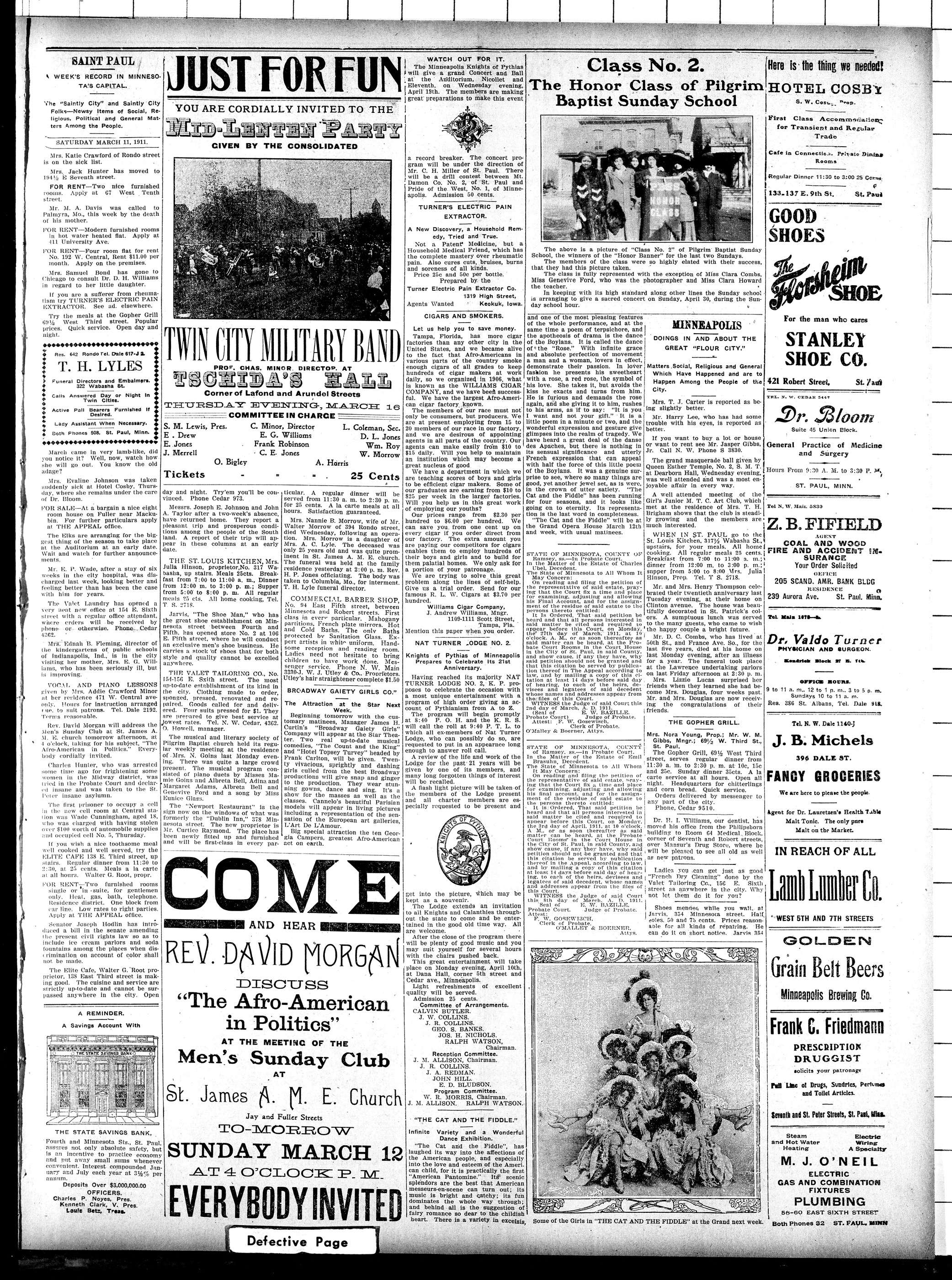
The above is a picture of "Class No. 2" of Pilgrim Baptist Sunday School, the winners of the "Honor Banner" for the last two Sundays.
The members of the class were so highly elated with their success, that they had this picture taken.
The class is fully represented with the exception of Miss Clara Combs, Miss Genevive Ford, who was the photographer and Miss Clara Howard the teacher.
In keeping with its high standard along other lines the Sunday school is also give a sacred concert on Sunday, April 30, during the Sunday school hour.
THE MUSICAL FESTIVAL
and one of the most pleasing features of the whole performance, and at the same time a poem of terpsichore, and the apotheosis of drama is the dance of the Boylanis. It is called the dance of *the "Rose." With infinite grace and absolute perfection of movement a man and a woman, lovers in effect, demonstrate their passion. In lover fashion he presents his sweetheart with a rose, a red rose, the symbol of his love. She takes it, but avoids the kiss he exacts and turns from him. He is furious and demands the rose again, and she giving it to him, rushes to his arms, as if to say "I am you." It is you who gives it to him, "it is you" little poem in a minute or two, and the wonderful expression and gesture give glimpses into the realm of tragedy. We have heard a great deal of the dances Apaches, but there is nothing in its sensual significance and utterly French expression that can appeal with half the force of this little poem of the Boylanis. It was a genuine surprise to see, where so many things are good, yet another jewel set, as is were, in the crown of utter satiety. "The Cat and the Fiddle" has been running for four seasons, and it looks like going on to eternity. Its representation is the last word in completeness. The Cat and the Fiddle" will be at the end of the course March 12th and wreak with wrath.
---
STATE OF MINNESOTA, COUNTY OF Ramsey, ss.—In Probate Court. In the estate of Charles Ubel. Decedent. The State of Minnesota to All Whom It Deserves.
On reading and filing the petition of the representative of said estate, praying that the Court fix a time and place for examining, adjusting and allowing his Final Account, and for the assignment of the residue of said estate to the persons thereto entitled:
It Is Ordered, That said petition be heard and that all persons interested in said matter be cited and required to appear before this Court, on Monday, the 27th day of March, 1911, at 10 o'clock. A. M., or as soon thereafter as said matter can be heard, at the Probate Court Rooms in the Court House in the City of St. Paul, in said County, and show cause, if any they have, why said petition should not be granted and that this citation be served by publication thereof in The Appeal according to law, and by mailing a copy of this citation at least 14 days before said day of hearing, to each of the heirs, devises and legatees of said decedent whose names and addresses appear from the files of this Court.
WITNESS the Judge of said Court this 2nd day of March, A. D. 1911.
(Seal of E. W. BAZILLE.
Probate Court) Judge of Probate.
Attest: F. W. Gosewisch,
Clerk of Probate.
O'Malley & Boerner, Attys.
STATE OF MINNESOTA, COUNTY OF Ramsay, ss. in Probate Court. In the State of Earl Brasuin, Decedent. The State of Minnesota to All Whom
On reading and filing the petition of the representative of said estate, waving that the Court fix a time and place for examining, adjusting and allowing his final account, and for the assignment of the residue of said estate to the persons thereto entitled:
It is Ordered, That said petition be heard and that all persons interested in said matter be cited and required to appear before this Court, on Monday, the 3rd day of April, 1911, at 10 o'clock. A.M. or as soon thereafter as said matter can be heard, at the Probate Court Rooms in the Court House in the City of St. Paul, in said County, and show cause, if any they have, why said petition should not be granted and that this citation be served by publication thereof in the Appeal, according to law, and by mailing a copy of this citation at least 14 days before said day of hearing, to each of the heirs, devisees and legatees of said decedent, whose names and addresses appear from the files of this Court.
WITNESS the Judge of said Court this 8th day of March, A.D. 1911.
Seal of E. W. BAZILE, Probate Court. Judge of Probate. Attest:
F. W. GOSEWISCH,
Clerk of Probate,
O'MALLEY & BOERNER.
Attys.
MINNEAPOLIS
DOINGS IN AND ABOUT THE GREAT "FLOUR CITY."
Matters. Social, Religious and General Which Have Happened and are to Happen Among the People of the City.
Mrs. T. J. Carter is reported as being slightly better.
Mr. Harry Lee, who has had some trouble with his eyes, is reported as better.
If you want to buy a lot or house or want to rent see Mr. Jasper Gibbs, Jr. Call N. W. Phone S 3830.
The grand masquerade ball given by Queen Esther Temple, No. 2, S. M. T. at Dearborn Hall, Wednesday evening, was well attended and was a most enjoyable affair in every way.
A well attended meeting of the Girl's Junior M. T. C. Art Club, which met at the residence of Mrs. T. H. Brigham shows that the club is steadily growing and the members are much interested.
WHEN IN ST. PAUL go to the St. Louis Kitchen, 3171's Wabasha St, upstairs, for your meals. All home cooking. All regular meals 25 cents. Breakfast from 7:00 to 11:00 a. m.; dinner from 12:00 m. to 3:00 p. m.; supper from 5:00 to 8:00 Mrs. Julia Hinson, Prop. Tel. T S. 2718.
Mr. and Mrs. Henry Thompson celebrated their twentieth anniversary last Tuesday evening, at their home on Clinton avenue. The house was beautifully decorated in St. Patrick's colors. A sumptuous lunch was served to the many guests, who came to wish the happy couple a bright future.
Mr. D. C. Combs, who has lived at 50th St., and France Ave. So., for the last five years, died at his home on last Monday evening, after an illness for a year. The funeral took place at the Lawrence undertaking parlor on last Friday afternoon at 2:30 p. m. Mrs. Lizzie Lucas surprised her friends, when she learned she had become Mrs. Douglas, who became Mr. and Mrs. Douglas are now receiving the congratulations of their friends.
THE GOPHER GRILL.
Mrs. Nora Young, Prop.; Mr. W. M. Gibbs, Mngr.; 69½ % W. Third St. St. Paul.
The Gopher Grill, 69½ West Third street, serves regular dinner from 11:30 a.m. to 2:30 p.m. at 10c, 15c and 25c. Sunday dinner 35cts. A la carte service at all hours. Open all night. Headquarters for chitterlings and corn bread. Quick service.
Orders delivered by messenger to any part of the city.
Phone, Cedar 9510.
Dr. H. I. Williams, our dentist, has moved his office from the Philipsons building to Room 64 Medical Block, corner of Seventh and Robert streets, over Mansur's Drug Store, where he will be pleased to see all old as well as new patrons.
Ladies you can get just as good "French Dry Cleaning" done by the Vale Tailoring Cc., 156 E. Sixth street as anywhere in the city. Why not let them do it for you?
Shoes mended, you wait, at Jarvis, 354 Minnesota street. Half soles, 50 and 75 cents. Prices reasonable. Can do it on short notice. Jarvis, 354
GOOD
SHOES
The Horsheim
SHOE
For the man who cares
STANLEY
SHOE CO.
421 Robert Street, St. 7/au
Dr. Bloom
Suite 45 Union Block.
General Practice of Medicine
and Surgery
Hours From 9:30 A. M. to 3:30 P. M.
ST. PAUL, MINN.
Tel N. W. Mair. 5839
AGENT
COAL AND WOOD
FIRE AND ACCIDENT INSURANCE
Your Order Solicited
OEFICE
205 SCAND. AMR. BANK BLDG
RESIDENCE
239 Aurora Ave. St. Paul. Minn.
Dr. Valdo Turner
PHYSICIAN AND SURGEON.
OFFICE HOURS.
9 to 11 a. m., 12 to 1 p. m., 3 to 5 p. m.
Sundays 10 to 11 a. m.
Res. 386 St. Albans, Tel. Dale 918.
Tel. N. W. Dale 1140-J
396 DALE ST.
FANCY GROCERIES
We are here to please the people.
Agent for Dr. Lauretzen's Health Table
Malt Tonic. The only pure
Malt on the Market.
IN REACH OF ALL
Lamb Lumber Co.
* WEST 5TH AND 7TH STREETS
GOLDEN
Grain Belt Beers
Minneapolis Brewing Go.
Frank C. Friedmann
PRESCRIPTION
DRUGGIST
solicits your patronage
Pull Line of Drugs, Sundries, Perfumes
and Toilet Articles.
Seventh and St. Peter Streets, St. Paul, Minn.
Steam and Hot Water Heating Electric Wiring A Specialty
M. J. O'NEIL
ELECTRIC GAS AND COMBINATION FIXTURES
PLUMBING
56-60 EAST SIXTH STREET
Both Phones 32 ST. FAUL, MINI
Negro Picture of Christ
Send 25 cents for one; $1.00 for sk;
or $2.00 for 14, to S. S. F. 1251
and to T. S. F. 1251.
Va. Send stamps, P. O. order or
registered letter. No agents wanted.
Children Teething.
Mrs. Winslow's Soothing Syrup has been used for over fifty years by millions of mothers for their children while teething, with perfect success. It soothes the child, softens the gums, allays all pain, cures wind colic and is the best remedy for diarrhea. Sold by drugists in every part of the world. Be sure and ask for "Mrs. Winslow's Soothing Syrup," and take no other kind. Twenty-five cents a bottle.
Go to Hotel Cosby for a nice room or a nice meal, 133-137 E. 9th street.
PRINTING of all kinds done at THE APPEAL office. Satisfaction guaranteed.
The Twin City Pleasure Club will meet Friday, Feb. 17, 1911, at Miss Inez Allen, 598 Robert St., St. Paul.
PIANO INSTRUCTION. Instruction given on the piano at the residences of patrons, or at 615 W. Central Ave. Prof. W. A. Weir.
If you get THE APPEAL it is a weekly reminder to come and pay what you owe for it. Putting it off only makes the bill larger.
Zion Presbyterian church has moved from Selby ave., to 458 Western ave., where services will be held every Sunday until further notice.
When you wish a first class shine exit at the People's Shining Parlor No. 127 E. 5th street, Walter Porter, Prop. 211 shine 'em on a nickel.
The East End Branch of the Y. W. C. A. 425 will hold 4 o'clock vespers each Sunday to which all young men and women are cordially invited.
Prof. James Johnson is gathering up new pupils quite fast and we will shortly have our city full of embryo Ole Bulls.
PSKIN HOTEL ('European) 456 East Seventh street, Mrs. Jack Hunter, proprietor. Rooms for rent by the day, week or month at reasonable rates.
The total deposits now in the State Savings Bank are $4,100,000.00 and the surplus fund, $120,000.00. This bank pays 3½ per cent interest to depositors.
Madame Hart, the milliner, has moved to 411 University avenue, where she is selling her splendid line of pattern hats at low prices. Tel. Date 1454.
Make money easy at home corresponding for newspapers; experience unnecessary. Send stamp for particulars. Empire Press Syndicate, Middleport, N. Y.
Some folks still send letters to THE AUPEAL, with only a one-cent stamp on them. Every letter should bear at least one two-cent stamp for each ounce in weight.
F. H. HARM & PRO., 387 Robert street, our specialty, watches and diamonds; our policy, a square deal; we examine eyes and make glass to fit; watch repairing.
The building permits for January show an increase of $89,362 over January of 1910. The estimated value of structures for which permits were issued in January is $443,954. St. Paul is going some.
You need not go hungry. Just go to the St. Louis Kitchen and get meals like mother used to cook. Good, substantial home-cooked meals at reasonable prices. Regular meals or meals to order.
Where do you get your laundry work done? Why not give it to the Valet Laundry Co. They do the best work at the lowest prices for good work. They call for and deliver the clothes. Call up Cedar 4362, or call at 154-116 E. Sixth street.
SAFE DEPOSIT AND STORAGE VAULTS.—We invite your inspection. We little to place your papers, cash securities and valuables in absolute safety. Boxes in our vaults can be had for $4 per year. Store your boxes, trunks, etc., with us. Northwestern Trust Co., 138 Endicott Arcade.
In an effort to secure 50 new members, Mars Lodge of Odd Fellows has reduced its initiation fee to $6.00 for a short time and two active committees are engaged in the work under the names of the Reds and the Blues. Much rivalry exists for if the Reds secure the largest number of candidates the Blues must give them a dinner and the Blues are determined that the Reds sall pay for the dinner.
SUITS PRESSED
VALET TAILORING CO
(56 E. SIXTH ST
$1
Nowadays we use penknives principally for sharpening pencils. There was a time, however, when they were used, primarily, for doing something else. They used to be just what their name would indicate. They were "pen-knives." A pen knife used to be just what its name would indicate—a "pen-knife." The ancients used pens made of goose quills, just as our own forefathers did up to about a hundred years ago. The quill pen was made by hand, of course, and whenever the point of one would break or lose its elasticity it was up to the penman to put a new point or "nib" on the quill. This was done with a small knife, and hence we have the word that has outlived the quill pen a hundred years—"pen-knife." In the older times the pen-knife was a necessary accessory of the writing desk. When the clasp-knife came in, the smaller sizes took their name from the little desk knife, while the bigger ones were called "jack-knives"—"jack" signifying anything masculine or big and strong.
Mr. Pierce J. Amos, the Berry Wall of New Jersey, who has made an effort to surpass all records as a society leader confidently acknowledges that he cannot equal his friend from Boston.
Na Reciprocity.
There are indications that the girls are beginning to get tired of hugging teddy bears. They don't hug back.
"BLATZ
Milwaukee's Most Exqu
VAL. BLATZ BREWING
1316 Sixth Street South. WM. L. GOEBEL
Telephone Cedar 9143
"CURLEY'S
122 East Third Street
Finest Brands of Imported and
Wines, Liquors and Cigars
N. C. CAMPBELL, Pro-
S. E. Cor. Third and Robert
If you see furs you
Anywhere else
You'll find them be-
At Albrecht's
ILLE.
Probate.
se's house looked homelike to the long legged bird
fared overheard. Favorably impressed, he softly
on the steps, his wee burden of blessedness.
pleasure at the Stork's thoughtfulness was tempered
its following illness and her inability to provide
for the Blessing.
the precious gift might be taken away.
or saved the day. He said "DIGESTO."
became healthy and rosy and the Blessing
healthy and rosy.
credit mark for DIGESTO. It is a necessity
after the Stork's visit.
For Sale by All Druggists
The Wise's house looked homelike to the long legged bird that hovered overheard. Favorably impressed, he softly deposited on the steps, his wee burden of blessness.
The Wise's pleasure at the Stork's thoughtfulness was tempered by Mrs. Wise's following illness and her inability to provide nourishment for the Blessing.
It looked as tho the precious gift might be taken away.
Wise's doctor saved the day. He said "DIGESTO." Mrs. Wise became healthy and rosy and the Blessing became healthy and rosy.
One more credit mark for DIGESTO. It is a necessity before and after the Stork's visit.
MANUFACTURED BY
THEO. HAMM BREWING CO.
ST. PAUL, MINN.
SEND FOUR DIGESTO BOTTLE CAPS AND 25c
TO COVER MAILING FOR BEAUTIFULLY
ILLUSTRATED BABY RECORD BOOK.
Ed. was Old Wise's brother.
Lived with him ever since he had typhoid—lost his grip after that sickness—always white, always weak, always thin. Just able to hobble round and live on his brother.
Wise's physician, calling on Mrs. Wise and the baby, noticed Uncle H condition—went over his case right and started him on DIGESTO
THE PROBLEM.
A Booklet That Deals With the Afro-American From a Christian View Point.
There has just been issued from the press a booklet of 61 pages which deals with the "vexed problem" from a Christian standpoint. The author is Mr. R. M. Toombs, a graduate of Lincoln University, Chester County, Pa., and Zion City Theological school, Illinois, the book is quite interesting and instructive and will certainly interest any thinking race-loving person. The book sells for 25 cents, postpaid.
Address R. M. Toombs, 1020 Metropolitan Bld., Minneapolis, Minn.
THE STATE SAVINGS BANK
Total Deposits $4,100,000.00—Surplus Fund, $120,000.00.
The trustees have declared the regular semi-annual interest dividend on deposits at the rate of $3\frac{1}{2}$ per cent per annum for period ending December 31, 1910. Interest will be credited on pass books as of January 1st, on or after January 20, 1911. Deposits made now will draw six months' interest July 1st next. 93 E. 4th street.
An obstacle is not a discouragement. It may become one, but only with our own consent. So long as we refuse to be discouraged, we cannot be discouraged.—Maehlerinch.
I know of but fewer greater influences that will keep young people dealt with their friends than to ask them to bring their friends home. Joseph Hocking.
The man worthy of being rich is the whom poverty could not debase, or fortune make proud.—Latena.
"NO CLINKERS."
Selected hard coal at the same price as you pay others for the ordinary run. Holmes & Hallowell, Seven corners.
```markdown
```
STATE OF MINNESOTA, COUNTY GE
WASHINGTON se—In Probate Court.
In the Matter of Oscar
W. Johnson, Decendent.
in Minnesota to All Whom it
May Convict.
On reading and filling the petition of the representative of said estate, praying that the Court fix a time and place his Final Account, and allowing his Final Account, aid for the moment of the residue of said estate to the persons thereto entitled; the petition of the Court be heard and that all persons interested in said matter be cited and required to appear before this Court, on Monday, the 14th of October, in the Court of the clock, A. M., or as soon thereafter as said matter can be heard, at the Pro-Court Rooms in the Court House in the city of New York, and show cause, if any they have, why said petition should not be granted and that this citation be served by publicization to law, and by mailing a copy of this citation at least 14 days before said petition, each of the heirs, devisees and legates, whose names and addresses appear from the files of this Court.
WITNESS the judge of said Court this 24th day of February, A. D. 7911.
Judge of Probate.
(Seal of
Probate Court)
Judge of Probate.
Attest: F. W. Gosewish.
Clerk of Probate.
The Wise's house that hovered over deposited on the st
The Wise's pleasure as by Mrs. Wise's follow nourishment for the Bl
It looked as tho the prec
Wise's doctor saved Mrs. Wise became became healthy and
One more credit may before and after the
For S
Digesto
MALT EXTRACT
Gamm
```markdown
```
E. N. YOUNG & CO.
MERCHANT TAILORS
A Complete Assortment of Woolens for Men Fine Dress Suits a Specialty
"BLATZ"
Milwaukee's Most Exquisite Beer
VAL. BLATZ BREWING CO.
1316 Sixth Street South. WM. L. GOEBEL, Representative
THE KNAPP SHADE ADJUSTERS
Have your old shades rehung by the new meth od, and by which you obtain better ventil- lation, control the amount of light and secure privacy when desired.
ORDERS LEFT AT THIS OFEICE WILL RECEIVE PROMPT ATTENTION
Telephone Cedar 9143
"CURLEY'S BAR"
122 East Third Street
Finest Brands of Imported and Domestic
Wines, Liquors and Cigars
N. C. CAMPBELL, Prop.
S. E. Cor. Third and Robert ST. PAUL
250 Nicollet Avenue,
VENTILATION
LIGHT
KNAPF
SHADE ADJUSTERS
Sixth and Minnesota Streets
How a Little Wisdom Came to the Wises
How Ed. Wise Found the Wise Way
Minneapolis, Minn.
THE BOSTON EDITOR
EYE DEFECTS
HARM
CLASSEN
EYE DEFECTS AND SYMPTOMS
HARM
GLASSER
EYE DEFECTS AND SYMPTOMS.
Bye defects are few—symptoms many.
There can be but two defects in the hui
Theeye may be too long in whole. The
Myopic eye.
Or too short in whole—the Hyperopic c
Combine the two in one eye and we have
Properly adjusted glasses will correct t
Medicines or waiting, never.
Symptoms that spring from these two
ormations are manifold; such as eye and
gestion, Dyspepsia, Nervous Debility, Chor
other ailments having their origin in lack
We correct all Defects of the human
will remedy. Charges reasonable. Satisfa
HARMS OCULO CURES SORE EYES 25c P
F. H. HARM &
OPTICIANS.
There can be but two defects in the human eye. Theeye may be too long in whole. Then weopic eye. Or too short in whole—the Hyperopic eye. Combine the two in one eye and we have Asti Properly adjusted glasses will correct these d Medicines or waiting, never. Symptoms that spring from these two simple nations are manifold; such as eye and headac tion, Dyspepsia, Nervous Debility, Chorea, Eper ailments having their origin in lack of nerv we correct all Defects of the human eye thl 1 remedy. Charges reasonable. Satisfaction g HARMS OCULO CURES SORE EYES 25c PER BOTT F. H. HARM & BF OPTICIANS,
Theeye may be too long in whole. Then we have the Myopic eye. Or too short in whole—the Hyperopic eye. Combine the two in one eye and we have Astigmatism. Properly adjusted glasses will correct these defects. Medicines or waiting, never. Symptoms that spring from these two simple eye malformations are manifold; such as eye and headaches, Indigestion, Dyspepsia, Nervous Debility, Chorea, Epilepsy and other ailments having their origin in lack of nerve force. We correct all Defects of the human eye that glasses will remedy. Charges reasonable. Satisfaction guaranteed.
"You too?" Everyone smokes the strictly High Grade
"You too?" Everyone smokes the strictly High Grade
"You too?"
Everyone smokes the
strictly High Grade
DUKE OF
PARMA
CIGARS
HART & MURPHY,
MNERS. ST. PAUL, MINN.
349 UNIVERSITY AND 501 SELBY AVE.
THE BEST GOODS FOR THE LEAST MONEY
THE WISE ONES DEAL AT CONGER'S
Dimes are little young dollars. They grow only when locked up together. Treat yourself to a savings account and prove it to your own satisfaction. "Planted" dollars will add to your earnings.
GOLDEN
GRAIN BELT
BEERS
Capitol Steam Laundry
743 Wabasha St.,
First Class Work Satisfaction Guaranteed
ST. PAUL. MINN.
The Most Proper Line of FALL WOOLENS TO BE HAD FOR A NICE SUIT OR OVERCOAT IS SHOWN BY Clifford A. Smith
THE TAILOR
PRESSING AND REPAIRING DONE
109 Eighth St. Opposite Golden Rule
Telephone Main 3488-L
St. Paul, - - Minn.
AND SYMPTOMS.
ects in the human eye.
in whole. Then we have the
the Hyperopic eye.
eye and we have Astigmatism.
will correct these defects.
ever.
from these two simple eye mal-
nas eye and headaches, Indi-
Debility, Chorea, Epilepsy and
origin in lack of nerve force.
the human eye that glasses
able. Satisfaction guaranteed.
ORE EYES 25c PER BOTTLE.
RM & BRO.
CIANS,
OO?"
MOST WORSHIPFUL GRAND LODGE
OF
MINNESOTA, A. F. AND A. M.
J. H. SHERWOOD, GRAND MASTER.
C. H. ROBINSON, GRAND SECRETARY.
1821 Fifth Ave. S., Minneapolis.
PIONER LODGE NO. 1, F. AND A. M.
Meets first and third Mondays of each month at Wagner Hall, cor. Western Ave. and Charles street, at 8 p. m. Walker Willmus, W. M.; Wm. England, Sec. 201 Farrington Ave.
PERFECT ASHLAR LODGE NO. 4,
F. AND A. M. meets second and fourth Tuesdays at Wagner Hall, cor. Western Ave. and Charles street at 8 p. m.
George L. Hoage, W. M., Jose H. Sher-
BETHEL CHAPTER NO. 28 R. A. M.
Meets second Tuesday in each month at Wagner Hall, cor. Western Ave. and
Charles Street, at 8:50 P. M. Wm. Stevens, H. P. A. D. Adams, Sec. 411
Charles Street.
MARS LODGE NO. 2202 G. U. O. of
O. F. meets second and fourth Wednesday nights at Odd Fellows Hall, 221
G. U. O. of ODCHIEF P. M. Wm. Stevens avenue. Entrance on Farrington, R. C. Archer, N. G., J. Wesley Kelly, P. G.
950 St. Anthony Ave.
HOUSEHOLD OF RUTH, NO. 553 G. U. O. of ODCHIEF P. M. Wm. Stevens Monday in each month at Odd Fellows Hall, N. W. Cor. University and
Farrington, Mrs. Azzy Stephens, M. N. G.
M. I. M. Johnson, W. R., 916 Marion St.
PAST GRAND MASTER'S COUNCIL
No. 123, G. U. O. of O. F. meets the second
Odd Fellows Hall, 221 W. University
Odd Fellows Hall, 221 W. University
corner Farrington. Entrance on Farrington, Wm. R. Morris, W. G. M.; Thos. R.
W. G. S., No. 422 St. Anthony avenue.
ST. PAUL PATRIARCHY NO. 114
meets second Monday, in each month at
Corners A Fowls Hall, Corners University.
Corner Fowls Hall, Entrance of University
tonage. Thos. R. Hickman (acting)
R. V. P.; W. R. Morris, M. P. V. P.
Geo. B. Love, W. P. R.; 178% Wabasha.
MISSION HOME
HOUSEHOLD OF RUTH NO. 776 U. O. F. meets second and fourth
Tuesday in each month at Labor Tem-
Ave. South, Mrs. S. Daragar, M. N. G.
Miss Cora Napier, W. R.
UNITED BROTHERS OF FRIENDSHIP
NORTH STAR LODGE NO. 138, U. F.
Meets 3d Thursday in each month at
Wagner Hall, cor. Western Ave. and
Charles street. Brothers in good stand-
ing welcome. Mrs. E. Howell, M. J.
Q. Adams, W. W. 49, Howell, S. M.
RAMSEY LODGE NO. 3, U. R. F.
Meets second Friday in each month at
Wagner Hall, cor. Western Ave. and
Charles Street. Brothers in good stand-
ing always welcome. M. A. Davis, W. M. A. D. Adams, W. S., 411 Charles Street.
Hayes Lodge No. 6, K. I of
meets first and third Tuesdays
in each month at hall,
University and Fay-
ington University.
clock P. M. Kuiatsis of
Pythias in good standing al-
ways. John H. Hayes, C. C.,
W. Gully, K. of R, and S.
JOHN 11
THE MUSEUM OF
THE AMERICAN
WAR
389 Rondo.
BIDDLE CIRCLE, LADIES OF O. A. R. H. School, R. H. School, in supreme Court room, old capita building, Mrs. M. J. Leavitt, Pres. Mr. J. R. White, Secy. Phoenix Bldg.
FIDELITY COURT OF CALANTHEA N.Y. School, R. H. School, meets first and third Monday in each month at K. of P. Hall, 211 Hemingway Ave, Minneapolis, Mrs. Minerva E. R. School, Arlene M. Scott, R. D. of D., 25 W. 29th St.
FILIPHUM BAPTIST CHURCH, on 12th and Cedar. Sunday services: Preach at 11 a. m. and 7:45 p. m. Sunday school at 12:30 o'clock. Wednesday area school at 12:30 p. m. Sunday school Sunday school lesson. Emperors and weddings, promptly attended. Rev. H. McDonald, Pastor.
GOPHER LODGE NO. 165, I. B. P. O. E. of the World, meets second and third Thursday in each month at Elks Hall, N. W. 29th St. Paul. Owen Howell, E. R. R. M. Johnson, Sec. 376 Minnesota.
ST. JAMES' A. M. E. CHURCH, COR. Fuller and Jay streets, Sunday services, 11:00 a. m.; 7:30 p. m. Wednesday prayers meeting, 8:00 p. m. Pastor visits on Monday and Tuesdays; at home Wednesday and Thursday, Weddings, Anzins and the sick attended on notice.
Rev. H. P. Jones, Pastor.
Parsonage, Cor. Jay and Fuller
ST. PHILIP'S EPISCOPAL MISSIO corner Aurora avenue and Mackublin street Sunday services: Early celebration of Holy Eucarist, 7:30 a. m. High celebrations, Holy Eucharist, first and thirti Sunday, 11:00 a. m. Matins, second and fourth Sundays, 11:00 a. m. Sunday school, 12:30 p. m. Brotherhood of St. Andrew, 6:30 p. m. Vespers, 7:30 p. m. Week services, Wednesdays, celebration class, 8:00 p. m. Fridays, evening prayer, 8:00 p. m. Saturdays Holy Eucharist, 9:00 A. M. Rev. A. H. Lealtad, Rector, 514 Fuller St.
50 YEARS' EXPERIENCE
PATENTS
TRADE MARKS
DESIGNS
COPYRIGHTS & c.
Anyone sending a sketch and description may quickly obtain patent information. The patent invention is probably patentable. Communications strictly confidential. Handbook on Patents seen free. Direct agency for securing patents. Patents taken through Munn & Co. receive special notice, without charge, in the Patent Office.
PHONES { TWIN CITY 4382
N. W. DALE 9947
Fine Cigars, Soda Water and
Toilet Articles
COR. KENT ST. AND UNIVERSITY AVE.
ST. PAUL.
DR. HURD
91 E. SEVENTH ST.
Specialty — Pain-
less extracting,
Crown and Bridge
Work.
Specialty - Painless
extrating,
Crown and Bridge
Work.