The Appeal
Saturday, August 17, 1912
St. Paul, Minnesota
Page text (machine-generated)
THE APPEAL KEEPS IN FRONT
BECAUSE:
1-It aims to publish all the news possible.
2-It does so impartially, wasting no words.
3-Its correspondents are able and energetic.
VOL. 28. NO. 33.
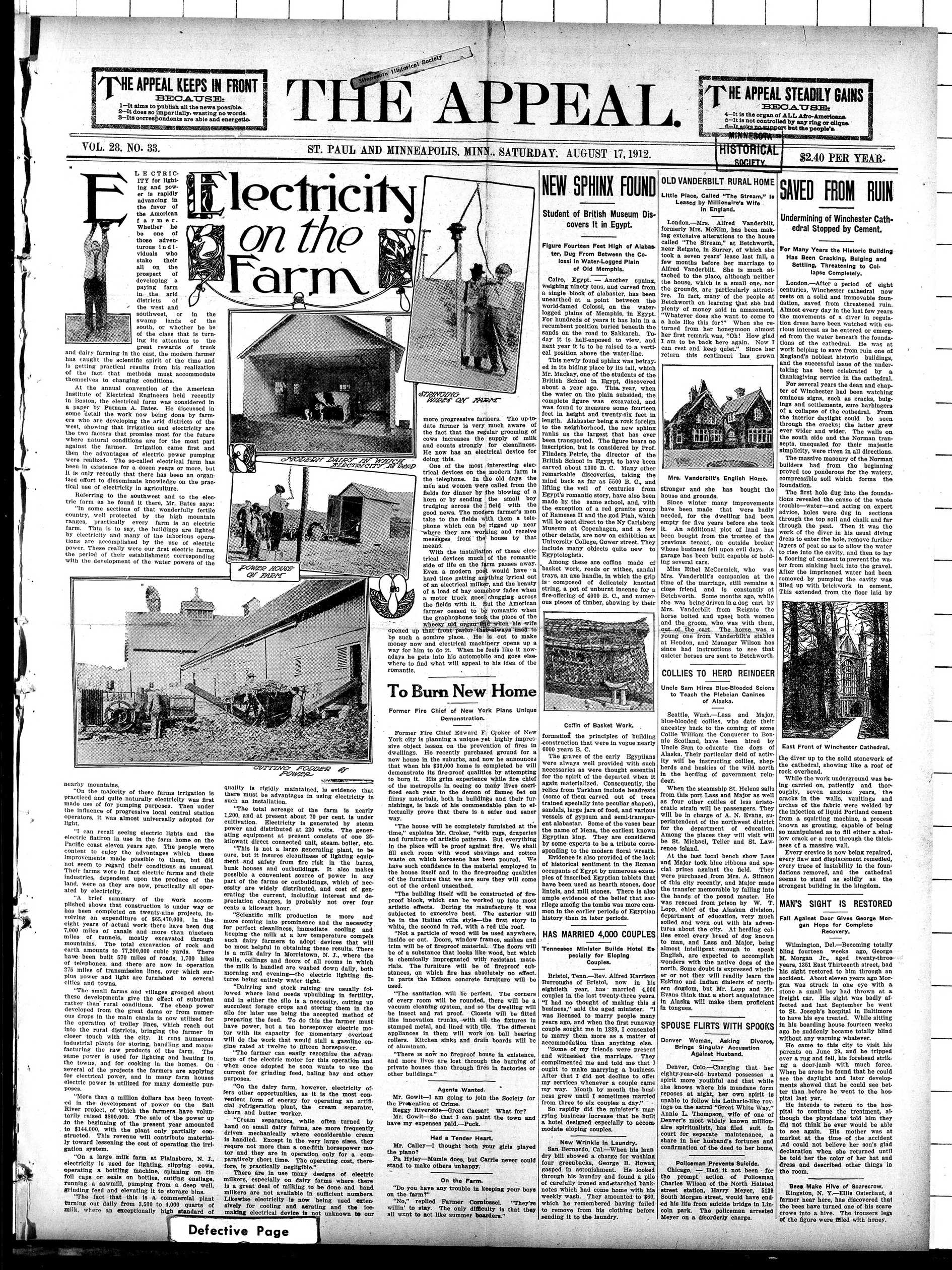
LECTRICITY for lighting and power is rapidly advancing in the favor of the American f a r m e r . Whether he one, one, those adventurous in individuals who stake their all on the prospect of developing a paying farm in the arid districts of the west and
southwest, or in the swamps lands of the south, or whether he be of the class that is turning its attention to the great rewards of truck
and dairy farming in the east, it has caught the scientific spirit is getting practical results from of the fact that methods m themselves to changing condition. At the annual convention Institute of Electrical Engineer in Boston, the electrical farm a paper by Putnam Bates some detail the work now bebers who are developing the art west, showing that irrigation a the two factors that promise where natural conditions are for against the farmer. Irrigation then the advantages of electric were realized. The so-called elemen in existence for a dozen y it is only recently that there hized effort to disseminate know tical use of electricity in agricul Referring to the southwest tric farm as he found it there "In some sections of that country, well protected by the ranges, practically every farm. Ttha is to say, the bulb by electricity and many of the power. These really were for the period of their establishment with the development of the we
and dairy farming in the east, the modern farmer has caught the scientific spirit of the time and is getting practical results from his realization of the need to accommodate themselves to changing conditions.
At the annual convention of the American Institute of Electrical Engineers held recently in Boston, the electrical farm was considered in a paper by Putnam A. Bates. He discussed in some detail the work now being done by farmers who are developing the arid districts of the west, showing that irrigation and electricity are the two factors that promise for the future where natural conditions are for the most part against the farmer. Irrigation came first and the advantages of electric power pumping were realized. The so-called electrical farm has been in existence for a dozen years or more, but it is only recently that there has been an organized effort to disseminate knowledge on the practical use of electricity in agriculture.
Referring to the southwest and to the electric farm as he found it there, Mr. Bates says: "In some situations of that wonderfully fertile country, well protected by the high mountain ranges, practically every farm is an electric farm. Tta is to say, the buildings are lighted by electricity and many of the laborious operations are accomplished by the use of electric power. These really were our first electric farms, the period of their establishment corresponding with the development of the water powers of the
CUTTING FODDER 4c
"On the majority of these fisc practiced and quite naturally elae made use of for pumping purge the influence of progressive loc operators, it was almost univer light.
"I can recall seeing electric electric friction in use in the Pacific coast eleven years ago, content to enjoy the advanta improvements made possible it not seem to regard their condi Their farms were in fact electric industries, dependent upon the
"On the majority of these farms irrigation is practiced and quite naturally electricity was first made use of for pumping purposes. Then under the influence of progressive local central station operators, it was almost universally adopted for light.
"I can recall seeing electric lights and the electric fan in use in the farm home on the Pacific coast eleven years ago. The people were content to enjoy the advantages which these improvements offer possible to them, but did not seem to regard the conditions as unusual. Their farms were in fact electric farms and their industries, dependent upon the produce of the land, were as they are now, practically all operated by electricity.
"A brief summary of the work accomplished shows that construction is under way or has been completed on twenty-nine projects, involving an expenditure of $65,470,000. In the eight years of actual work there have been dug 7,000 miles of canals and more than nineteen miles of tunnels, mostly excavated through the most excavation of rock and earth amounts to 77,000 cubic yards. There have been built 570 miles of roads, 1,700 miles of telephones, and there are now in operation 275 miles of transmission lines, over which surplus power and light are furnished to several cities and towns."
"The small farms and villages grouped about these developments give the effect of suburban rather than rural conditions. The cheap power developed from the great dams or from numerous drops in the main canals is now utilized for the operation of trolley lines, which reach out into the rural districts, bringing the farmer in closer touch with the city. It runs numerous plants for storing, handling and manufacturing the raw products of the farm. The same power is used for lighting in the heating in the towns, and for cooking in the homes. Several of the projects the farmers are applying for electrical power, and in many farm houses electric power is utilized for many domestic purposes.
"More than a million dollars has been invested in the development of power on the Salt River project, of which the farmers have voluntarily raised $800,000. The sale of the power up to the beginning of the present year amounted to $144,000, with the plant only partially constructed. This revenue will contribute materially and basement the cost of operating the irrigation system.
"On a large milk farm at Plainsboro, N. J., electricity is used for lighting, clipping cows, operating a bottling machine, spinning on tin cops or seals on bottles, cutting enclosure, running a sawmill, pumping from a deep well, grinding feed and elevating it to storage hins."
"The fact that this is a commercial plant turning out daily from 3,500 to 4,000 quarts of milk, where an exceptionally high standard of
E
nearby mountains.
Electricity on the Farm
Defective Page
MODERN DAIRY IN WHICH
ELECTRICITY IS DWAL
ELECTRICITY IS USED
POWER HOUSE ON FARM
quality is rigidly maintained, is evidence that there must be advantages in using electricity in such an installation.
"The total acreage of the farm is nearly 1,200, and at present about 70 per cent. is under cultivation. Electricity is generated by steam power and distributed at 220 volts. The generating equipment at present consists of one 25-kilowatt direct connected unit, steam-boller, etc.
"This is not a large generating plant, to be sure, but it insures cleanliness of lighting equipment and safety from fire risk in the barns, bunk houses and outbuildings. It also makes possible a large power of water in any part of the farms or outbuildings, and essity are widely distributed, and cost of generating the current, including interest and depreciation charges, is probably not over four cents a kilowatt hour.
"Scientific milk production is more and more coming into prominence and the necessity for perfect cleanliness, immediate cooling and keeping the milk at a low temperature compels such dairy farmers to adopt devices that will be most helpful in obtaining these results. There walls, cellar doors of all rooms in which the milk is handled down dally, both morning and evening—the electric lighting fixtures being entirely water tight.
"Dairying and stock raising are usually followed where land needs upbuilding in fertility, and in either the silo is a necessity, cutting up succulent forage crops and storing them in the silo for later use being the accepted method of preparing the feed. To do this the farmer must have power, but a ten horsepower electric motor with its capacity for momentary overload will do the work that would stall a gasoline engine needed at twelve to fifteen horsepower.
"The easily recognize the advantage of the electric motor's operation and when once adopted he soon wants to use the current for grinding feed, baling hay and other purposes.
"On the dairy farm, however, electricity offers other opportunities, as it is the most convenient form of energy for operating an artificial refrigeration plant, the cream separator, churn and butter worker.
"Cream separators, while often turned by hand on dairy farms, are more frequently driven mechanically, considerable cream is handled. Except in the case of require not more than a one-fifth horsepower motor and they are in operation only for a comparatively short time. The operating cost, therefore, is practically negligible."
There are in use many designs of electric motors, especially on dairy farms where there is a great deal of milking to be done and hand milkers are equipped with sufficient numbers. Likewise electricity is now available for cooling and aerating and the looming electrical device is not unknown to our
THE APPEAL.
---
STRINGING WIRE ON FARM
more progressive farmers. The up-to-date farmer is very much aware of the fact that the regular grooming of cows increases the supply of milk and counts strongly for cleanliness. He now has an electrical device for doing this.
One of the most interesting electrical devices on the modern farm is the telephone. In the old days the men and women were called from the fields for dinner by the blowing of a horn or by sending the small boy trudging across the field with the good news. The modern farmer's man take to the fields with them a telephone which can be rigged up near where they are working and receive messages from the house by that means.
With the installation of these electrical devices much of the romantic life of the farm passes away. Even a modern post would have a hard time getting anything lyrical out of an electrical milker, and the beauty of a load of hay somehow fades when a motor truck goes chugging across the fields with it. But the American farmer ceased to be romantic when the graphophone took the place of the wheezed old organ and when his wife
opened up that front parlor then always used to be such a sombre place. He is out to make money now and electrical machinery opens up a door and he gets into his automobile and goes elsewhere to find what will appeal to his idea of the romantic.
opened up that front parlor that always used to be such a sombre place. He is out to make money now and electrical machinery opens up a way for him to do it. When he feels like it nowadays he gets into his automobile and goes elsewhere to find what will appeal to his idea of the romantic.
To Burn New Home
To Burn New Home
Former Fire Chief of New York Plans Unique Demonstration.
Fire Chief Edward F. Croker of New York city is planning a unique yet highly impressive object lesson on the prevention of fires in dwellings. He recently purchased ground for a new house in the suburbs, and now he announces that when his $30,000 home is completed he will demonstrate its fire-proof qualities by attempting to burn it. His grim experience while fire chief of the metropolis in seeing so many lives affected by fires during the construction of fire-films materials, both in buildings and their filmsy materials, is back of his commendable plan to effectually prove that there is a safer and safer way.
"The house will be completely furnished at the time," explains Mr. Croker, "with rugs, draperies and furniture of artistic patterns. But everything in the place will be proof against fire. We shall fill each room with wood shavings and cotton waste on which kerosene has been poured. We have such confidence in the material employed in the house itself and in the fire-proofing qualities of the furniture that we are sure they will come out of the ordeal unscathed.
"The building itself will be constructed of fireproof block, which can be worked up into most pristine clean. During its manufacture it was subjected to excessive heat. The exterior will be in the Italian villa style—the first story in white, the second in red, with a red tile roof.
"Not a particle of wood will be used anywhere, inside or out. Doors, window frames, sashes and trim will be of fireproof material. The floors will be of a substance that looks like wood, but which is chemically impregnated with resistant materials. The furniture will be of fireproof substances, on which fire has absolutely no effect. In parts the Edison concrete furniture will be used.
"The sanitation will be perfect. The corners of every room will be rounded, there will be a vacuuming system, and so the exterior will be insect and rat proof. Closets will be fitted like innovation trunks, with all the fixtures in stamped metal, and lined with tile. The different appliances in them will work on ball bearing rollers. Kitchen sinks and drain boards will be of aluminum.
Former Fire Chief Edward F. Croker of New York city is planning a unique yet highly impressive object lesson on the prevention of fires in dwellings. He recently purchased ground for a new house in the suburbs, and now he announces that when his $30,000 home is completed he will demonstrate its fire-proof qualities by attempting to burn it. His grim experience while fire chief lives in the seaside so he may live close to each year to the presence of flame fed on filmsy materials, both in buildings and their furnishings, is back of his commendable plan to effectually prove that there is a safer and safer way.
"The house will be completely furnished at the time," explains Mr. Croker, "with rugs, draperies and furniture of artistic patterns. But everything in the place will be proof against fire. We shall fill each room with wood shavings and cotton waste on which kerosene has been poured. We have such confidence in the material employed in the house itself and in the fire-proofing qualities of the furniture, we sure they will come out of the ordeal unscathed.
"The building itself will be constructed of fireproof block, which can be worked up into most artistic effects. During its manufacture it was subjected to excessive heat. The exterior will be in the Italian villa style—the first story in white, the second in red, with a red tile roof.
"Not a particle of wood will be used anywhere, inside or out. Doors, window frames, sasses and trim will be of fireproof material. The floors will be of a substance that looks like wood, but which is chemically impregnated with resistant materials. The fire-proof substances, on which fire has absolutely no effect. In parts the Edison concrete furniture will be used.
"The sanitation will be perfect. The corners of every room will be rounded, there will be a vacuum cleaning system, and so the dwelling will be insect and rat proof. Closets will be fitted like innovation trunks, with all the fixtures in stamped metal, and lined with tile. The different appliances in them will work on ball bearing machines, chen sinks and drain boards will be of aluminum.
"There is now no fireproof house in existence, and more lives are lost through the burning of private houses than through fires in factories or other buildings."
Agents Wanted.
Mr. Gowit—I am going to join the Society for the Prevention of Crime.
Reggy Riverside—Great Caesar! What for?
Mr. Gowit—So that I can paint the town and have my expenses paid—Puck.
Mr. Gowit- I am going to join the Society for the Prevention of Crime.
we riverside - Great Caesar! What for?
Mr. Gowit- I can paint the town and have my expenses paid - Puck.
Had a Tender Heart
Mr. Calley—I thought both your girls played the piano?
Pa Hyley—Mamle does, but Carrie never could stand to make others unhappy.
On the Farm.
"Do you have any trouble in keeping your boys on the farm?"
"No," replied Farmer Corntossel. "They're willin' to stay. The only difficulty is that they all want to act like summer boarders."
Mr. Calley—I thought both your girls played the piano?
Pa Hyley—Manile does, but Carrie never could stand to make others unhappy.
On the Farm.
"Do you have any trouble in keeping your boys on the farm?" The farmer Combsbell. "They're willin' to stay. The only difficulty is that they all want to act like summer headwrights."
NEW SPHINX FOUND
Student of British Museum Discovers It in Egypt.
Figure Fourteen Feet High of Alabas ter, Dug From Between the Go-lossi in Water-Logged Plain of Old Memphis.
Calro, Egypt. — Another spinxn, weighing ninety tons, and carved from a single block of alabaster, has been unearthed at a point between the world-famed Colossi, on the waterlogged plains of Memphis, in Egypt. For hundreds of years it has lain in a recumbent position buried beneath the sands on the road to Sakharne. Today it is half-exposed to view, and next year it is to be raised to a vertical position above the water-line. This newly found spinxn was betrayed in its hiding place by its tail, which Mr. Ackley, one of the students of the British University in Egypt, discovered about a year and thirty days when the water on the plain subsided and complete figure was excavated, and was found to measure some fourteen feet in height and twenty-six feet in length. Alabaster being a rock foreign to the neighborhood, the new spinxn ranks as the largest that has ever been transported. The figure bears no inscription, but is considered by Prof. Flinders Petit, the director of the British School in Egypt, to have been carved about 1300 B. C. Many other remarkable discoveries, taking the mind back as far as 5500 B. C., and lifting the vell of centuries from Egypt's romantic story, have also been made by the same school, and, with the exception of a red granite group which will be sent direct to the god Pthi, which the Museum at Copenhagen, Bergsberg Museum at Copenhagen, and other details, are now on exhibition at University College, Gower street. They include many objects quite new to Egyptologists.
Among these are coffins made of basket work, reeds or wites, sandal trays, an axe handle, in which the grip is composed of delicately knotted string, a pot of unburnt incense for a fire-offering of 4000 B. C., and numerous pieces of timber, showing by their
Coffin of Basket Work.
formation the principles of building construction that were in vogue nearly 6000 years B. C.
The graves of the early Egyptians were always well provided with such necessaries as were thought essential for the spirit of the departed when it again materialized. Consequently, the relics from Tarkhan include headrests (some of them carried out of treasured specially into peculiar shape), sandals, large jars of food, and various vessels of gypsum and semi-transparent alabastar. Some of the vases bear the name of Mena, the earliest known Egyptian king. They are considered by some experts to be a tribute corresponding to the modern floral wreath.
Evidence is also provided of the lack of historical sentiment in the Roman occupants of Egypt by numerous examples of inscribed Egyptian tablets that have been used as hearth stones, door lintels, and mill stones. There is also ample evidence of the belief that sacrilege amogh the tombs was more common in the earlier periods of Egyptian history than in later periods.
HAS MARRIED 4,000 COUPLES
Bristol, Tenn.—Rev. Alfred Harrison Burroughs of Bristol, now in his eighteenth year, has married 4,000 couples in the last twenty-three years. "I had no thought of making this a business," said the aged minister. "I was licensed to marry people many years ago, and when the first runaway couple sought me in 1889, I consented to marry them more as a matter of accommodation than anything else. "Some of my friends were present and witnessed the marriage. They complimented me and told me that I ought to make marrying a business. After that I did not decline to offer my services whenever a couple came my way. Month by month the business grew until I sometimes married from three to six couples a day." So rapidly did the minister's marrying business increase that he built a hotel designed especially to accommodate eloping couples.
New Wrinkle in Laundry. San Bernardo, Cal.—When his laundry bill showed a charge for washing four greenbacks, George B. Rowan gassed in astonishment. He looked through his laundry and found a pile of carefully ironed and starched banknotes which had come home with his weekly wash. They amounted to $60, which he remembered having failed to remove from his clothing before sending it to the laundry.
THE APPEAL STEADILY GAINS
BECAUSE:
4-It is the organ of ALL Afro-Americans.
5-It is not controlled by any ring or clique.
6-It asks no support but the people's.
OLD VANDERBILT RURAL HOME
little Place, Called "The Stream" is
Leased by the University in
England.
London—Mrs. Alfred Vanderbilt, formerly Mrs. McKim, has been making extensive alterations to the house called "The Stream," at Betchworth, near Reigate, in Surrey, of which she took a seven years' lease last fall, a few months before her marriage to Alfred Vanderbilt. She is much attached to the place, although neither the house, which is a small one, nor the grounds, are particularly attractive. In fact, many of the people at Betchworth on learning that she had plenty of money said in amazement, "Whatever does she want to come to a hole like this for?" When she returned from her honeymoon almost her first remark was "Oh! How glad I am to be back there again. Now I can rest and keep quiet." Since her return this sentiment has grown
stronger and she has bought the house and grounds. Since winter many improvements have been made that were badly needed, for the dwelling had been empty for five years before she took it. An additional plot of land has been bought from the trustee of the previous owner, outside Batch whose business fell upon evil days. A garage has been built capable of holding several cars. Miss Ethel McCormick, who was Mrs. Vanderbilt's companion at the time of the marriage, still remains a close friend and is constantly at Betchworth. Some months ago, while she was being driven in a dog cart by Mrs. Vanderbilt from Religate the horse bolted and upset both women in the street, out of the cart. The horse was a young one from Vanderbilt's stables at Hendon, and Manager Wilson has since had instructions to see that quater horses are sent to Betchworth.
COLLIES TO HERD REINDEER
Uncle Sam Hires Blue-Blooded Sciens to Teach the Plebian Canines of Alaska.
Seattle, Wash.—Lass and Major, blue-blooded collies, who date their ancestry back to the coming of some Collie William the Conqueror to Bonnie Scotland, have been hired by Uncle Sam to educate the dogs of Alaska. Their particular field of activity will be instructing collies, shepherds and huskies of the wild north in the herding of government reindeer.
When the steamship St. Helens sails from this port Lass and Major as well as four other collies of less aristocratic strain will be passengers. They will be in charge of A. N. Evans, superintendent of the northwest district for the department of education. Among the places they will visit will be St. Michael, Teller and St. Lawrence island.
At the last local bench show Lass and Major took blue ribbons and special prizes against the field. They were purchased from Mrs. A. Stinson of this city recently, and Major made the transfer memorable by falling into the hands of the pound master. He rescued from prison by the T. Lopp, a division divider department of education, very much solled and worn out with his adventures about the city. At herding collies excel every breed of dog known to man, and Lass and Major, being almost intelligent enough to speak English, are expected to accomplish wonders with the native dogs of the north. Some doubt is expressed whether they will readily learn the Eskimo and theern dogdom, but Mr. Lopp and Mr. Evans think that a short acquaintance in Alaska will make them proficient in fongues.
SPOUSE FLIRTS WITH SPOOKS
Denver Woman, Asking Divorce,
Brings Singular Accusation
Against Husband.
Denver, Colo.—Charging that her
eighty-year-old husband possesses a
spirit more youthful and that while
she knows where his mundane form
reposes at night, her own spirit is
unable to follow his Lothair-like rovings on the astral "Great White Way."
Amie L. Thompson, wife of one of
Denver's Lothair-like known million-
aire spiritualists, has been in
court for separate maintenance,
a share in her husband's fortunes and
confirmation of the deed to her home.
Policeman Prevents Suicide.
Chicago. — Had it not been for
the prompt action of Policeman
Charles Wilson of the North Halsted
street station, Harry Meyer, 5139
South Morgan street, would have
drew his life from suicide bridge in
Lincoln park. The policeman arrested
Meyer on a disorderly charre.
Undermining of Winchester Cathedral Stopped by Cement.
For Many Years the Historic Building Has Been Cracking, Bulging and Settling, Threatening to Collapse Completely.
London.—After a period of eight centuries, Winchester cathedral now rests on a solid and immovable foundation, saved from threatened ruin. Almost every day in the last few years the movements of a diver in regulation dress have been watched with curious interest as he entered or emerged from the water beneath the foundations of the cathedral. He was at work helping to save from ruin one of England's noblest historic buildings, and the successful issue of the undertaking has been celebrated by a thanksgiving service in the cathedral. For several years the dean and chapter of Winchester had been watching omnious signs, such as cracks, bulgings and settlements, sure harbingers of a collapse of the cathedral. From earlier daylight could be seen through the latter grew ever wider and wider. The buildings on the south side and the Norman transept, unequaled for their majestic simplicity, were riven in all directions. The massive masonry of the Norman builders had from the beginning proved too ponderous for the watery, compressible soil which forms the foundation.
The first hole dug into the foundations revealed the cause of the whole trouble—water—and acting on expert advice, holes were dug in sections through the top soil and chalk and far through the peat. Then it was the work of the diver in his usual diving dress to enter the hole, remove further layers of peat so as to allow the water to rise into the cavity, and then to lay a flooring of cement to prevent the water from sinking back into the gravel. After the imprisoned water had been removed by pumping the cavity was filled up with brickwork in cement. This extended from the floor laid by East Front of Winchester Cathedral. the diver up to the solid stonework of the cathedral, showing like a roof of rock overhead.
While the work underground was being carried on, patiently and thoroughly, seven anxious years, the cracks in the walls, vaultings and arches of the fabric were welded by the injection of liquid Portland cement from a squirting machine, a process known as grouting, capable of being so manipulated to as if filler a shallow crack or a rent through the thickened cement. Every device is now being repaired, every flaw and displacement remedied, every trace of instability in the foundations removed, and the cathedral seems to stand as solidly as the strongest building in the kingdom.
MAN'S SIGHT IS RESTORED
Fall Against Door Gives George Morgan
Mount Holiday complete
Recovery.
Wilmington, Del—Becoming totally blind fourteen weeks ago, George M. Morgan Jr., aged twenty-three years, 1351 East Thirteenth street, had his sight restored to him through an accident. About eleven years ago Morgan was struck in one eye with a stone a small boy had thrown at a freight car. His sight was badly affected and last September he went to St. Joseph's hospital in Baltimore to have his eye treated. While sitting in boarding house he became totally blind without any warning whatever.
He came to this city to visit his parents on June 29, and he tripped over a rug and fell, his forehead striking a door-jamb with much force. When he arose he found that he could see the daylight and later developments showed that he could see better than before he went to the hospital last year.
He intends to return to the hospital to continue the treatment, although the physicians told him they did not think he ever would be able to see again. His mother was at market at the time of the accident and could believe her son's glad declaration when she returned until he told her the color of her hat and dress and described other things in the room.
Bess Make Hive of Scarecrow, Kingston, N. Y., E-Illis Oyster, a farmer near here, has discovered that the bees have turned one of his scarecrows into a hive. The trousers legs of the figure were filled with honey.
HAVE YOU READ
THE APPEAL?
A National Afro-American Newspaper
PUBLISHED WEEKLY BY
ADAMS BROS. EDITORS AND PUBLISHERS
49 E. 4th Street, St. Paul, Minn.
ST. PAUL OFFICE
J. Q. ADAMS, Manager.
No. 236 Union Block, 49 E. 4th St.
MINNEAPOLIS OFFICE
JASPER GIBBS, Manager.
Metropolitan Bldg., Room 1020.
CHICAGO OFFICE
C. F. ADAMS, Manager.
443 S. Dearborn St., Suits 660.
TERMS STRICTLY IN ADVANCE
SINGLE COPY, ONE YEAR.....$2.00
SINGLE COPY, SIX YEARS.....1.10
SINGLE COPY, THREE MONTHS.....60
When subscriptions are by any means allowed to run without prepayment, to allow for each for each 13 weeks and 5 cents for each week, or at the rate of $2.40 per year.
Remittances should be made by Express Money Order, Post Office Money Order, Post Letter or Bank Draw. Postage Stamp should be paid on cash for the fractional parts of a dollar, only one cent and two cent stamp taken.
Mails should never be sent through the mail. It is almost sure to wear a hole through the envelope and be lost; or else it may be stolen. Persons who sent them to us in letters do so at their risk.
Marriage and death notice 10 lines or less $1. Each additional line 10 cents. Payment strictly in advance, and to be an answer to all must come in season to be news.
Advertising rates, 15 cents per agate line, each insertion. There are fourteen agate lines in an inch, and about seven weeks' worth of vertisements less than $1. No discount allowed on less than three months contract. Cash must accompany all orders from us. Further particulars on applause may be
Reading notices 25 cents per line, each insertion. No discounts for time or space. The cover matter is set in brevity space, about six lines in the line. All head-lines count double.
The date on the address label shows when subscription expires. Renewals should be made by mail or by expiration so that no paper may be missed, as the paper shows when time is out.
It occasionally happens that papers sent to subscribers are was lost or stolen. In case paper is lost, the paper due, inform us by postal card at the expiration of five days from that date, or by mailing. Communications to receive attention must be new, upon important subjects, painfully written only upon one side of the paper; must be timely. Tuesdays if possible, must be later. Thursdays if possible, and bear the signature of the author. No manuscript returned, unless stamps are sent for postage.
We do not hold ourselves responsible for the correspondents.
Soliciting agents. Write for them anywhere.
Sample copies free.
In every letter that you write us never fall to give your full name and address, plainly written, post office, county and state, written of all facts must be written on separate forms from others containing news or matter for publication. "Entered as second class matter June 6, 1885 at the postoffice at St. Paul Muni., under act of Congress, March 3 1887."
SOUNDS THE KEYNOTE.
Upon the solid rock of the rights of the individual as granted by the Constitution, the Republican party builds its structure of optimism. The Democratic party, on the other hand, in the opening sentence of its address to the electorate, betrays its recessional quality by denying the right of Congress, a right again and again confirmed by the Supreme Court, to establish protective duties for the benefit of American industries. It declares as false the vital issue of the constitutional liberties of the individual. Such liberties are now assailed by those who advocate the overthrow of the independence of the judiciary. It would leave the individual defenseless in the protection of those rights declared inalienable under the Constitution—Charles D. Hilles, chairman of the Republican national committee.
SATURDAY, AUGUST 18, 1912.
THE MANHOOD IN THE PIT
"A strong man may put me in a pit, and keep me there, if he is strong enough. But I will act so that he will know that there's a man in that pit." It was a Negro who said this. He was speaking of the wrongs of the Negro race.
It has a lesson for every man who feels that he is oppressed. Wrongs we must endure, but the wrong is half undone when he who is in the pit keeps his manhood unscathed.
Does your employment seem beneath you? Are you subject to humiliations? You may not be able to curb the evils from which you outwardly suffer, but you may make respectable, and even noble, the pit in which you are placed—by being a man.
Marcus Aurelius Antoninus said that nothing harms a man which does not make him a worse man. Slavery, pain, poverty, the wrongs of enemies—all these harm the enslaver, because they make him a worse man—harm the inflicter of pain and the creator of poverty and the doers of
W. H.
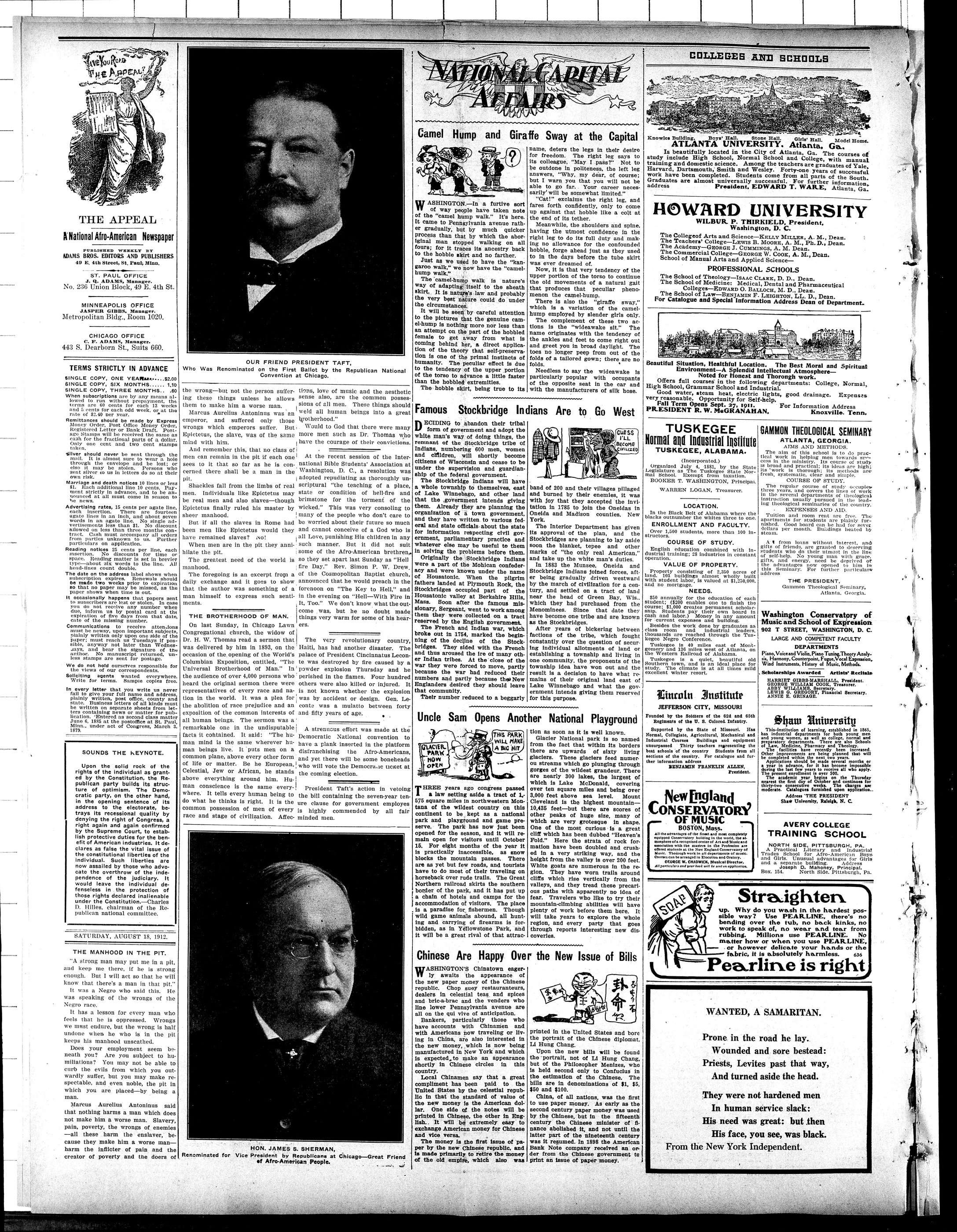
OUR FRIEND PRESIDENT TAFT,
Who Was Renominated on the First Ballot by the Republican National Convention at Chicago.
W. H. H.
HON. JAMES S. SHERMAN,
Renominated for Vice President by Republicans at Chicago—Great Friend of Afro-American People.
HON. JAMES S. SHERMAN,
Renominated for Vice President by Republicans at Chicago—Great Friend of Afro-American People.
the wrong—but not the person suffering these things unless he allows them to make him a worse man.
Marcus Aurelius Antoninus was an emperor, and suffered only those wrongs which emperors suffer. But Epictetus, the slave, was of the same mind with him.
And remember this, that no class of men can remain in the pit if each one sees to it that so far as he is concerned there shall be a man in the pit.
Shackles fall from the limbs of real men. Individuals like Epictetus may be real men and also slaves—though Epictetus finally ruled his master by sheer manhood.
But if all the slaves in Rome had been men like Epictetus would they have remained slaves? No!
When men are in the pit they annihilate the pit.
The greatest need of the world is manhood.
The foregoing is an excerpt from a daily exchange and it goes to show that the author was something of a man himself to express such sentiments.
On last Sunday, in Chicago Lawn Congregational church, the widow of Dr. H. W. Thomas read a sermon that was delivered by him in 1893, on the occasion of the opening of the World's Columbian Exposition, entitled "The Universal Brotherhood of Man." In the audience of over 4,000 persons who heard the original sermon there were representatives of every race and nation in the world. It was a plea for the abolition of race prejudice and an exposition of the common interests of all human beings. The sermon was a remarkable one in the undisputable facts it contained. It said: "The human mind is the same wherever human beings live. It puts men on a common plane, above every other form of life or matter. Be he European, Celestial, Jew or African, he stands above everything around him. Human conscience is the same everywhere. It tells every human being to do what he thinks is right. It is the common possession of men of every race and stage of civilization. Affe-
tions, love of music and the aesthetic sense also, are the common possessions of all men. These things should weld all human beings into a great brotherhood." Would to God that there were many more men such as Dr. Thomas who have the courage of their convictions.
At the recent session of the International Bible Students' Association at Washington, D. C., a resolution was adopted repudiating as thoroughly unscriptural "the teaching of a place, state or condition of hell-fire and brimstone for the torment of the wicked." This was very consoling to many of the people who don't care to be worried about their future so muca and cannot conceive of a God who is all Love, punishing His children in any such manner. But it did not suit some of the Afro-American brethren, so they set apart last Sunday as "Hell fire Day." Rev. Simon P. W. Drew, of the Cosmopolitan Baptist church, announced that he would preach in the forenoon on "The Key to Hell," and in the evening on "Hell—With Fire in It, Too." We don't know what the outcome was, but he no doubt made things very warm for some of his hear-
The very revolutionary country, Haiti, has had another disaster. The palace of President Cincinnatus Leconte was destroyed by fire caused by a powder explosion Thursday and he perished in the flames. Four hundred others were also killed or injured. It is not known whether the explosion was by accident or design. Gen. Leconte was a mulatto between forty and fifty years of age.
A strentuous effort was made at the Democratic National convention to have a plank inserted in the platform disfranchising the Afro-Americans, and yet there will be some boneheads who will vote the Democracie ticket at the coming election.
President Taft's action in vetoting the bill containing the seven-year tenure clause for government employees is highly commended by all fair minded men.
NATIONAL CAPITAL AFFAIRS
Camel Hump and Giraffe Sway at the Capital
Famous Stockbridge Indians Are to Go West
Uncle Sam Opens Another National Playground
Chinese Are Happy Over the New Issue of Bills
WASHINGTON—In a furtive sort of way people have taken note of the "camel hump walk." It's here. It came to Pennsylvania avenue rather gradually, but by much quicker process than that by which the aboriginal man stopped walking on all fours; for it traces its ancestry back to the hobble skirt and no farther. Just as we used to have the "kangaroo walk," we now have the "camel-hump walk."
The camel-hump walk is nature's way of adapting itself to the sheath skirt. It is nature's law and probably the very best nature could do under the circumstances.
It will be seen by careful attention to the pictures that the genuine camel-hump is nothing more nor less than an attempt on the part of the hobbled female to get away from what is coming behind her, a direct application of the theory that self-preservation is one of the primal instincts of humanity. The peculiar effect is due to the tendency of the upper portion of the torso to advance a little faster than the hobbled extremities.
The hobble skirt, being true to its
DECIDING to abandon their tribal form of government and adopt the white man's way of doing things, the remnant of the Stockbridge tribe of Indians, numbering 600 men, women and children, will shortly become citizens of Wisconsin and cease to be under the supervision and guardianship of the federal government. The Stockbridge Indians will have a whole township to themselves, east of Lake Winnebago, and other land that the government intends giving them. Already they are planning the organization of a town government, and they have written to various federal and state officials about the state for information respecting civil government, parliamentary practice and whatever else may be useful to them in solving the problems before them.
Originally the Stockbridge Indians were a part of the Mohican confederacy and were known under the name of Housatonic. When the pilgrim fathers landed at Plymouth Rock, the Stockbridges occupied part of the Houseatonic valley at Berkshire Hills, Mass. Soon after the famous missionary, Sergeant, went to work among them they were collected on a tract reserved by the English government. The French and Indian war, which broke out in 1754, marked the beginning of the decline of the Stockbridges. They sided with the French and thus aroused theire of many other Indian tribes. At the close of the war they were forced to move, partly because the war had reduced their numbers and partly because the New Englanders desired they should leave that community. Their number reduced to a beggarly
GLACIER PARK NOW OPEN THIS PARK WILL MAKE A BIG HIT
THREE years ago congress passed a law setting aside a tract of 1,575 square miles in northwestern Montana of the wildest country on this continent to be kept as a national park and playground and game preserve. The park has now just been opened for the season, and it will remain open for visitors until October 15. For eight months of the year it is practically inaccessible, as snow blocks the mountain passes. There are as yet but few roads, and tourists have to do most of their traveling on horseback over rude trails. The Great Northern railroad skirts the southern border of the park, and it has put up a chain of hotels and camps for the accommodation of visitors. The place is a paradise for fishermen. Though wild game animals abound, all hunting and carrying of firearms is forbidden, as in Yellowstone Park, and it will be a great rival of that attrac-
WASHINGTON'S Chinatown eagerly awaits the appearance of the new paper money of the Chinese republic. Chop suey restauranteurs, dealers in celestial teas and spices and bric-a-brac and the vendors who line lower Pennsylvania avenue are all on the qui vive of anticipation. Bankers, particularly those who have accounts with Chinamen and with Americans now traveling or living in China, are also interested in the new money, which is now being manufactured in New York and which is expected, to make an appearance shortly in Chinese circles in this country. Local Chinamen say that a great compliment has been paid to the United States by the celestial republic in that the standard of value of the new money is the American dollar. One side of the notes will be printed in Chinese, the other in English. It will be extremely easy to exchange American money for Chinese and vice versa.
The money is the first issue of paper by the new Chinese republic, and is made primarily to retire the money of the old empire, which also was
name, deters the legs in their desire for freedom. The right leg says to its colleague, "May I pass?" Not to be outdone in politeness, the left leg answers, "Why, my dear, of course; but I warn you that you will not be able to go far. Your career necessarily will be somewhat limited." "Cat!" exclaims the right leg, and fares forth confidently, only to come up against that hobble like a colt at the end of its tether.
Meanwhile, the shoulders and spine, having the utmost confidence in the right leg to do its full duty and making no allowance for the confounded hobble, forge ahead just as they used in the days before the tube skirt was ever dreamed of.
Now, it is that very tendency of the upper portion of the torso to continue the old movements of a natural gait that produces that peculiar phenomenon the camel-hump.
There is also the "giraffe sway," which is a variation of the camel-hump employed by slender girls only.
The complement of these two actions is the "wideawake sit." The name originates with the tendency of the ankles and feet to come right out and greet you in broad daylight. The toes no longer peep from out of the folds of a tailored gown; there are no folds. Needless to say the wideawake is particularly popular with occupants of the opposite seat in the car and with the manufacturers of silk hose.
band of 200 and their villages pillaged and burned by their enemies, it was with joy that they accepted the invitation in 1785 to join the Oneidas in Onelda and Madison counties, New York. The Interior Department has given its approval of the plan, and the Stockbridges are planning to lay aside soon the blanket, tepee and other marks of "the only real American" and take up the white man's duties.
In 1883 the Munsee, Oneida and Stockbridge Indians joined forces, after being gradually driven westward by the march of civilization for a century, and settled on a tract of land near the head of Green Bay, Wis., which they had purchased from the Menominees. Since that date they have become one tribe and are known as the Stockbridgees.
After years of bickering between factions of the tribe, which fought constantly over the question of securing individual allotments of land or establishing a township and living in one community, the proponents of the township idea have out and the result is a decision to have what remains of their original land east of Lake Winnebago and what the government intends giving them reserved for this purpose.
tion as soon as it is well known. Glacier National park is so named from the fact that within its borders there are upwards of sixty living glaciers. These glaciers feed numerous streams which go plunging through gorges of the wildest grandeur. There are nearly 300 lakes, the largest of which is Lake McDonald, covering over ten square miles and being over 3,000 feet above sea level. Mount Cleveland is the highest mountain—10,435 feet—but there are scores of other peaks of huge size, many of which are very grotesque in shape. One of the most curious is a great cliff which has been dubbed "Heaven's Fold." Here the strata of rock formation have been doubled and crushed in a very striking way, and the height from the valley is over 200 feet. White goats are numerous in the region. They have worn trails around cliffs which rise vertically from the valleys, and they tread these precarious paths with apparently no idea of fear. Travelers who like to try their mountain-climbing abilities will have plenty of work before them here. It will take years to explore the whole region, and every party that goes through reports interesting new discoveries.
printed in the United States and bore the portrait of the Chinese diplomat, Li Hung Chang.
Upon the new bills will be found the portrait, not of Li Hung Chang, but of the Philosopher Menizes, who is held second only to Confucius in the estimation of the Chinese. The bills are in denominations of $1, $5, $50 and $100.
China, of all nations, was the first to use paper money. As early as the second century paper money was used by the Chinese, but in the fifteenth century the Chinese minister of finance abolished it, and not until the latter part of the nineteenth century was it resumed. In 1898 the American Bank Note company received an order from the Chinese government to print an issue of paper money.
Knowles Building. Boys' Hall. Stone Hall. Girls' Hall. Model Home.
ATLANTA UNIVERSITY. Atlanta, Ga.
Is beautifully located in the City of Atlanta, Ga. The courses of study include High School, Normal School and College, with manual training and domestic science. Among the teachers are graduates of Yale, Harvard, Dartsmouth, Smith and Wesley. Forty-one years of successful work have been completed. Students come from all parts of the South. Graduates are almost universally successful. For further information, address
President, EDWARD T. WARE. Atlanta, Ga.
HOWARD UNIVERSITY
The Collegeof Arts and Science—KELLY MILLER, A. M., Dean.
The Teachers' College—Lewis B. MOORE, A. M, Ph.D., Dean.
The Academy, George J. CUMMINGS, A. M. Dean.
The Collegeof College, George C. COOK, A. M., Dean.
School of Manual Arts and Science
PROFESSIONAL SCHOOLS
The School of Theology—ISAAC C
The School of Medicine: Medical
Colleges—EDWARD O. BAY
The School of Law—BENJAMIN E.
For Catalogue and Special Informe
Beautiful Situation, Healthful Location
Environment—A Splendid
Noted for Honest a
Offers full courses in the follow
High School, Grammar School and In
Good water, steam heat, electric
very reasonable. Opportunity for Set
Fall Term Opens Sept. 27, 1911.
PRESIDENT R. W. McGRANAH
The School of Theology—ISAAC CLARK, D. D., Dean.
The School of Medicine: Medical, Dental and Pharmaceutical
Colleges—EDWARD O. BALLOCH, M. D., Dean.
The School of Law—BENJAMIN F. LEIGHTON, LL. D., Dean.
For Catalogue and Special Information Address Dean of Department.
Beautiful Situation, Healthful Location. The Best Moral and Spiritual
Environment—A Splendid Intellectual Atmosphere—
Noted for Honest and Thorongh work.
Offers full courses in the following departments: College, Normal,
High School, Grammar School and Industrial.
Good water, steam heat, electric lights, good drainage. Expenses very reasonable. Opportunity for Self-help.
TUSKEGEE
Normal and Industrial Institute
TUSKEGEE, ALABAMA
(not indicated)
Organized at 4, 1881, by the State Legislature as The Delaware State Normal School. Exempt from taxation.
BOOKER T. WASHINGTON, Principal.
WARREN LOGAN, Treasurer.
LOCATION.
In the Black Belt of Alabama where the blacks outnumber the whites three to one.
ENROLLMENT AND FACULTY.
Over 1,500 students, more than 100 instructors.
COURSE OF STUDY.
English education combined with industrial training; 28 industries in constant operation.
VALUE OF PROPERTY.
Property consisting of 2,350 acres of land. 103 buildings almost wholly built with student labor, is valued at $1,250,000, and no mortgage.
NEEDS.
$50 annually for the education of each student; ($200 enables one to finish the course; $1,000 creates permanent scholarships; $100 buys a board in cash and labor); Money in income for current expenses and building.
Besides the work done by graduates as chief industrial leaders, thousands are reached through the Tuskegee Negro Conference.
Tuskegee is 40 miles east of Montgomery, in the Western Railroad of Alabama.
Tuskegee is a quiet, beautiful old Southern town, and is an ideal place for a summer retreat at all times mild excellent winter resort.
Lincoln Institute
JEFFERSON CITY, MISSOURI
Founded by the Soldiers of the 62d and 65th Regiments of the U. S. Colored Infantry.
Supported by the State of Missouri. Has Normal, Collegiate, Agricultural, Mechanical and Industrial Courses Buildings and equipment unsurpassed Thirty teachers representing the best schools of the country Students from all sections of the country. For catalogue and further information address
BENJAMIN FRANKLIN ALLEN,
President
New England CONSERVATORY
All the advantages of the finest and most completely equipped Conservatory building in the world, the atmosphere of a recocited centre of Art and Music and association with the masters in the Profession are offered students at the New England Conservatory of Music. Traditional work in all departments of music. Courses can be arranged in Elocution and Oratory. GEORGE W. CHADWICK, Musical Director. All particulars and any book will be not at application.
SOAP
St
up. Why do
sible way?
bending over
work to spe
rubbing.
matter how
or howe
fabric, it
Pearl
up. Why do you wash in the hardest possible way? Use PEARLINE, there's no bending over the tub, no back kinks, no work to speak of, no wear and tear from rubbing. Millions use PEARLINE. No matter how or when you use PEARLINE, or however delicate your hands or the fabric, it is absolutely harmless. 636
WANTED, A SAMARITAN.
Prone in the road he lay. Wounded and sore bestead: Priests, Levites past that way, And turned aside the head. They were not hardened men In human service slack: His need was great: but then His face, you see, was black. m the New York Independent.
---
NEEDS.
CLARK, D. D., Dean.
IL, Dental and Pharmaceutical
MLOCH, M. D., Dean.
LEIGHTON, LL. D., Dean.
ation Address Dean of Department.
Con. The Best Moral and Spiritual
Intellectual Atmosphere—
and Thorongh work.
ing departments: College, Normal,
industrial.
lights, good drainage. Expenses
help.
For Information Address
AN, Knoxville, Tenn.
GAMMON THEOLOGICAL SEMINARY
ATLANTA, GEORGIA.
ADMS AND METHODS.
The aim of this school is to do practice in helping men towards success in the library. It is broad and practical; its ideas are high; its work is thorough; its methods are fresh, systematic and simple.
COURSE
SPRING
The regular course of study occupies three years, and covers the lines of work in the several departments of theological instruction, pursuant to the leading theological somewhat of the country.
EXPENSES AND AUD
Tuition and room rent are free. The apartments for students are plainly furnished. Good board can be had for several dollars per month. Buildings heated by steam.
A lot from loans without interest, and gifts of friends, are granted to the living students who do their best in the life of self-help. No young man with grace, gifts, and energy, need be deprived of the advantages now opened to him in secondary. For further particulars address
THE PRESIDENT,
Gammon Theological Seminary,
Atlanta, Georgia.
Washington Conservatory of Music and School of Expression 902 T STREET, WASHINGTON, D. C.
Piano, Voiceole Violin, Piano Tuning, Theory Analysis, Harmony, Counterpoint, Fugue, Vocal Expression, Wind Instruments, History of Music, Methods.
Scholarships Awarded Artists' Recitals
HARRIET GIBBS-MARBHALL, President.
GORGE WILLIAM COOK, Treasurer.
ABBY WILLIAMS, Secretary.
LIMI LIMA, Financial Secretary.
ANNIE E. GRINAK
Shaw University
This-institution of learning, established in 1865, has industrial departments for both young men and young women, as well as college, normal and preparatory departments. There are also Schools of Law, Medicine, Pharmacy and Theology.
The facilities have recently been increased. Other improvements are being planned that will be completed within the next two years.
Applications should be made several months or a year in advance, for it has become impossible during the last few years to receive all who apply. The present enrollment is over 500.
The academic year begins on the Thursday nearest the first day of October and continues for thirty-two consecutive weeks. The charges are moderate. Catalogues furnished upon application.
Address THE PRESIDENT
Shaw University, Raleigh, N. C.
AVERY COLLEGE
TRAINING SCHOOL
NORTH SIDE, PITTSBURGH, PA.
A Practical Literary and Industrial Trade School for African American Girls and Girls. Unusual advantages for Girls and a separate building. Address Joseph D. Mahoney, Principal. Box 164. North Side, Pittsburgh, Pa.
raighten
Do you wash in the hardest pos-
Use PEARLINE, there's no
er the tub, no back kinks, no
ak of, no wear and tear from
Millions use PEARLINE. No
or when you use PEARLINE,
ever delicate your hands or the
is absolutely harmless. 636
line is right
---
* WEEK'S RECORD IN MINNESOTA'S CAPITAL.
The "Saintly City" and Saintly City Folks—Newsy Items of Social, Religious, Political and General Matters Among the People.
SATURDAY, AUGUST 18, 1912.
Mr. James Wynne has gone to Chicago.
Mrs. J. N. Jenkins does not improve.
Mrs. Jasper R. T aylor is very much improved.
Mr. F. L. McGhee returned to the city Thursday.
Rev. Daniel Harding still is in a critical condition.
The Grand Lodge, F. and A. M., will meet in St. Paul Aug. 21 and 22.
Mr. and Mrs. Frank Jones are now living at 532 St. Anthony avenue.
Mr. Harry Holmes, now sick at 572 Kent street, is somewhat improved.
Minnesota State Fair from Sept. 2 to 7, the "Greatest Show on Earth!"
Mrs. H. Hart, the milliner, has moved from 369 to 425 University avenue.
Mr. and Mrs. Thomas Neal arrived in the city Sunday from Manistee, Mich.
The Daily Guide announces that it will celebrate its third anniversary in September.
Mr. and Mrs. C. Jones have moved from Thomas street to 532 St. Anthony avenue.
Mr. W. F. T. Chandler, who went to Lincoln, Neb., Tuesday, is expected home next Wednesday.
Mrs. Elizabeth Bass, of Connorsville, Ind., is visiting her son, Mr. H. Bass, of Fuller street.
Mrs. Margaret Baldwin, of Indianapolis, Ind., is visiting her sister, Mrs. G. W. Moker, of Thomas street.
The Postal Savings Bank is open evenings daily from 9 to 7:30, and on Saturday until 9 o'clock p. m.
Excellent south-facing lot on Rondo between Dale and Kent. Must be sold at once. Price right. Call Cedar 4001 or Tri-State 3694.
Mrs. Evelyn Johnson, who was seriously hurt by falling down stairs last Sunday, has about recovered.
Res. 642 Rondo Fel. Dale 617-1 J. T. H. LYLES
Funeral Directors and Embalmers. 322 Wabasha St.
Calls Answered Day or Night In Twin Cities.
Active Pall Bearers Furnished If Desired.
Lady Assistant When Necessary.
Both Phones 508. St. Paul, Minn.
The Catholic Ladies are preparing to give a shirtwaist party at Bowlby Hall, Thursday evening, Aug. 29.
Mrs. Carrie Mills-Stanton, after a pleasant visit with relatives and friends, has returned to Chicago.
Mrs. W. T. Francis was in Washington this week, the guest of Mr. and Mrs. J. C. Napier, Register of the Treasury.
Mr. and Mrs. M. Reese are rejoicing over the safe arrival of a brand new girl in their family. Mother and child are getting along nicely.
Mr. and Mrs. F. C. Spillers and Mrs. W. A. Hilyard are spending a short vacation at Dr. Valdo Turner's summer home near Pine City.
Mrs. O. D. Howard, 447 Carroll avenue, gave a card party in honor of Miss Elizabeth Levy, of Orangeburg, S. C., last Saturday afternoon.
Mr. J. R. Davis, of the Dellwood Yacht Club, was in the city Wednesday and treated y editor's family to an automobile trip to White Bear, Minn.
SPIRELLA CORSET, Cora E. Anderson corsetter. Any lady wishing to be properly corseted call or address 365 Aurora Ave. Tel. N. W. Dale 1345.
Miss Elizabeth Levy, who has been the guest of Mr. and Mrs. S. L. Maxwell for the past three weeks, left Thursday for her home in Orangeburg, S. C.
Miss Ruth McGhee, who has been visiting in Winnipeg for several weeks, has returned home, accompanied by Miss Amy Pitts, who will be her guest.
Dr. Valdo Turner has moved his office from the second to the fourth floor of the Kendrick block, suite 400, where he has more commodious and desirable offices.
Miss Florence Cotton, 599 Rondo street, on Friday of last week entertained at breakfast in honor of Mrs. Carrie Stanton, of Chicago. Covers were laid for six.
Mr. and Mrs. F. D. McCracken, of Washington, after a trip to Oberlin, Ohio, and Mount Pleasant, Iowa, are in the city, the guests of Lieut, and Mrs. W. R. Godette.
THE STATE SAVINGS BANK
THE STATE SAVINGS BANK.
93 East Fourth Street.
Invites the saving accounts of frugal wage-earners, it is well fitted to take care of them.
Interest rate
3½%
per annum.
DEPOSITS OVER $4,350.00
Charles P. Noyes,
President.
Louis Betz,
Treasurer.
WILDWOOD
Fast Electric Trains from St. Paul to Wildwood Every 15 Minutes on Sunday—Every 30 Minutes on Week Days. Take any Interurban Line from Minneapolis and Transfer to Wildwood Train in St. Paul
WELL-APPOINTED RESTAURANT Special Table d'Hote Dinner on Sundays, 11:30 to 3:00 p. m., 75c
Dancing Every Week Day First-Class 2:30 to 5 and 8 to 10:30 p.m. Orchestra
Bathing Best Beach in Northwest.
Carrousel A Delight for Children.
Roller Coaster Nothing Better for the Blues.
Boating A Fine Fleet of Rowboats.
Fun Factory Plenty of Smiles Here.
Swings For Ladies and Children.
Bowling Alleys Plenty of Alleys.
Photo Gallery Everybody Likes It.
Water Chute A Treat for Bathers
Orchestral Concerts Sunday Afternoon and Evening
Dr. W. F. Watkins will leave next Wednesday to attend the meeting of the Business League at Chicago. This meeting of the League promises to be the best in its history.
Mrs. Catherine Smith of Detroit, arrived in the city Wednesday, to be the guest of her grandmother, Mrs. Clarence L. Smith, 471 W. Central avenue, for several weeks.
Fannie Waldon, alias Cora Thomas, was arrested yesterday by detectives and held for the Chicago authorities. It is alleged that she stole $200 worth of goods in that wicked city.
"The Favorite Shining Parlor," Messrs. Beard & Alexander, proprietors, has been moved to 105 E. 5th street, where first class work is done on short notice at all times.
If you wish a real good dinner tomorrow, go to the St. Louis Kitchen, No. 138 E. Third street, from 12:30 to 3:00 p. m. Roast young duck and peach cobbler, Dinner 35 cents.
On Thursday Mr. and Mrs. A. S. Weber, 410 Edmund street, entertained at breakfast in honor of Misses E. M. Williams and C. A. Surle, of New Orleans. Covers were laid for nin.
Misses Bertha and May Williams, of 415 Charles street, received last Sunday from 4 to 7 p. m., in honor of Misses Mabel Mason, Marguerite Oliver, Elizabeth Levy and Mary Moore.
FOR SALE—Modern nine-room and alcove residence, hot water heat. Large barn in the rear. All in good condition. No. 531 St. Anthony ave. bet. Mackubin and Kent. Apply on the premises.
Mrs. E. W. Lindsay, 126 Arch street, entertained at breakfast Thursday morning, in honor of Miss Henrietta Byno, of Winnipeg, Miss Blanche Stone and Miss A. N. Haines, of Winnemucca, Nev.
Mrs. W. T. Francis, president of the Women's State - Federation, will return from her extended Eastern trip tomorrow or Monday. M. Francis left last night for Chicago and will return with Mrs. Francis.
VOCAL AND PIANO LESSONS given by Mrs. Addie Crawford Minor at her residence, 392 Carroll street only. Hours for instruction arranged due, to suit patrons. Tel. Dale 2192. Terms reasonable.
Miss Lula B. Gregory, a prominent and charming school marm of Detroit, Mich., arrived 'in the city last Sunday to spend her vacation. She is the guest of Mr. and Mrs. E. De Baptiste, 523 Central avenue.
Anyone wishing to purchase a fine Tuxedo suit for a low price is requested to call at THE APPEAL OFFICE for further particulars. Size 42, for a man about 5 feet 6 inches in height. This is a snap.
Mr. Henry Sharp, of Chicago, although called to St. Paul on a sad mission, has been the recipient of so many social courtesies he still lingers among us. He, however, expects to leave for home next Monday or Tuesday.
A SNAP—Don't let this get away from you. A fine, New York make, upright piano that cost $250.00, for sale for $50 down and $50 in instalments. Apply at Minnesota Realty Co., 516 New York Life Bldg. Both phones 1199.
The boat excursion which was given by the Culture Club last week was the biggest and best of the season, there having been $125.50 cleared. The members of the club are very thankful to the public for the generosity displayed.
F. H. Harm & Bro., the popular jewelers and opticians, formerly of 237 Robert street, have moved to larger and better quarters at No. 14 Bristol Street, in Balaasha and Cedar, where they will be to see all old and new patrons.
The place to have your shoe repairing done in the best possible way at the lowest possible price is at JARVIS', 104-106 East Fifth street. He has a complete stock of men's, women's and boys' shoes of the best grades for the money to be found in the city.
Mrs. Jas. A. Lee, 700 Sherburne avenue, gave a progressive whist party in honor of Misses E. M. Williams and C. A. Surle, of New Orleans, on Wednesday evening. The first prizes were won by Mr. and Mrs. M. A. Johnson, the "booby" by Mrs. J. E. Murphy.
The Minor twins, Clinton and Robert, celebrated their 18th birthday anniversary Tuesday afternoon, at the residence of their mother, Mrs. Addie Crawford Minor. A couple of dozen of their little friends were present and enjoyed themselves as only kidlets can.
THE ST. LOUIS KITCHEN, Mrs. Julia Hinson, proprietor, No. 138 E. 3d St., up stairs. Meals 25 cts. Breakfast from 7:00 to 11:00 a.m., dinner from 12:00 m. to 2:00 p. m.; Supper from 5:00 to 8:00 p. m. All regular meals 25 cts. All home cooking. Tel. T S. 2718.
A moonlight launch party was given by the young men under the leadership of Messrs. A. Worden Haynes and A. V. Hall, on the beautiful and commodious launch, "Lookout," last Wednesday evening. There were about twenty couples and they had a very delightful time.
Misses E. M. Williams and C. A. Surles, the charming school marms of New Orleans, La., who have spent several weeks of their vacation in our city, very delightfully, left Thursday evening for their home via Chicago, where they will spend several weeks before proceeding South.
Lieut. W. R. Godette, of Supply Co. No. 5, at the risk of his life, turned off an open valve of a big gasoline tank after the gasoline in the valve had taken fire last Saturday, thereby, probably, saving the lives of many persons who might have been burned had the big tank exploded.
Mr. A. D. Adams, who went to Lincoln, Neb., to attend the conclave of the United Grand Commandery, Knights Templar, under the jurisdiction of Missouri, returned home Thursday. He was re-elected Eminent Grand Junior Warden and District Deputy of the Eleventh District.
One of the swell social functions of the week was the farewell reception given by Mr. and Mrs. J. E. Murphy, 1354 Thomas street, Tuesday evening, in honor of Misses E. M. Williams and C. A. Surle, of New Orleans, who have been their guests for the past six weeks. The parlers were decorated in pink and white. A large wood was present, and the wood had a splendid time. The ladies assisting Mrs. Murphy were: Mesdames J. A. Lee, W. G. Wood, J. A. Cleary, B. C. Archer, G. Hogue. The young ladies left for their homes Thursday, delighted with St. Paul and her people.
Mrs. James A. Vass, who has been East for the past two months visiting friends, arrived at home yesterday. While in New York she was the guest of Dr. and Mrs. Lijette and Dr. Jeanne Waters and was guest of honor of a yachting party given by the doctor in her private yacht. She also had the pleasure of dining with Dr. and Mrs. Booker. T. Washington. In Jersey City she was the guest of Mr. and Mrs. William Williams, who, it will be remembered, visited St. Paul a couple of years ago. In Bath, N. Y., she was the guest of Mrs. H. Johnson, his daughter, Miss White, was the winner of a gold medal. For proficiency in her studies. She also had the pleasure of being the guest of Bishop Scott in an automobile party to Atlantic City. She also visited Corning and Buffalo. N. Y., and several other cities during her trip, yet she says there is no place like home.
Lake's Beautiful Lake Management "Twin City Line's' IDEAL PICNIC St. Paul to Wildwood Every 15 Minutes Take any Interurban Line from Minute to Wildwood Train in St. Paul
Paul New Park Hall, Promenade, Refreshm
APPPOINTED RESTAURANT Dinner on Sundays, 11:30
Every Week Day 2:30 to 5 and 8 to 10:30 p.
things to Do at W
Carrousel A Delight for Children.
Fun Factory Plenty of Smiles Here.
Photo Gallery Everybody Likes It.
Werts Sunday Afternoon
Defective Page
MINNESOTA
STATE FAIR
AND EXPOSITION
SEPT. 2ND TO 7TH
1912
300 ACRES
CROWDED WITH
ENTERTAINMENT, EDUCATION
EMBRACING LIVE STOCK
DAIRY, POLLERY,
GRAIN, FRUIT, VEGETABLE
SEWING & COOKING EXHIBITS
70 ACRES DEVOTED
TO THE DISPLAY OF
MACHINERY, INVENTIONS & ETC.
FARM BOYS ENCAMPMENT
ONE BOY FROM EACH COUNTY
IN THE STATE
ENTERTAINED & INSTRUCTED
FREE
THRILLING AEROPLANE
FLIGHTS
BALLoon, ASCENSIONS
PARACHUTE, DROPS
CHAMPIONSHIP AUTOMOBILE
RACES SATURDAY
OLD MEXICO
HISTORIC PYROTECHNIC
DISPLAY EVERY NIGHT
M.W. SAVAGES
FAMOUS HORSES
WILL MAKE NEW
WORLD'S RECORDS
MONDAY LABOR DAY
EXCITING HORSE
RACING EVERY DAY
$25000 OO IN PURSES
MIDWAY BETWEEN
ST. PAUL &
MINNEAPOLIS
GEO GANG
MINNESOTA STATE AGRICULTURAL COUNTY
1912
MINNOR NEIR
EVERY MINUTE
FILLED
LOTS OF MUSIC
WITH SOMETHING OF
INTEREST TO EVERYONE
Mrs. Henry High, 674 St. Anthony street, entertained with a ladies' whist party last Thursday afternoon, in honor of the lady visitors in the city. Miss E. M. Williams, of New Orleans, won the first prize, Miss C. A. Surle, of the same city, the second, and Mrs. Cora Grissom captured the booby.
Mrs. M. Jones, living in the rear of 544 Rice street, on arriving at home last Thursday evening about 7:30 o'clock, found her husband entertaining another woman. She grabbed up a revolver and fired several shots at her liege lord as he fled around the house, but fortunately did not hit him nor anyone else. He escaped and no arrest was made.
This Cosy Family Home
This attractive home built for you if you own your own lot. Has four rooms finished in polished hardwood, maple floor and cellar. The upstairs is floored but not partitioned. Guaranteed material and workmanship. See me before building.
PETERS CONTRACTOR,
Tel. Center 3692. 335-7 McKnight Bldg., Minneapolis, Minn.
THE DAN PATCH ELECTRIC LINE Thursday, August 22nd, 1912
Dancing from 3 to 9
Dancing Checks 10 Cents
Excursion Train leaves 54th St. and
Nicollet Ave. at 10 A. M. and 1:45 P.
M. Leaving St Paul take Selby Lake
car and change at Nicollet Ave. for
54th St. Station.
RETURNING AT 9:15 P. M.
Tickets sold by committee at station only.
COMMITTEE OF ARRANGEMENTS.
W. C. Jeffrey, Z. A. Pope, Wm. Dos-
ton, Jas. A. Roberts, E. D. Bludsoe,
Jno. M. Allison, Frank Terry, Dr. R. S.
Brown.
DULTS, ROUND TRIP, 75 CENTS
CHILDREN, 35 CENTS
ALBION W. HOLDEN
Painter and Decorator
527 St. Anthony Avenue
ST. PAUL, MINN
STATE FAIR PROGRAM
Beginning Monday, September 2d, and Continuing Until Saturday, September 7th.
The official program for the 53d Minnesota State Fair, Sept. 1-7, has been issued.
Events are scheduled pretty much as in former years. There will be all-day band concerts, judging and exhibiting of cattle all day and an elaborate grandstand performance each afternoon and evening. Races, aeroplane flights and vaudeville acts will be the features of the afternoon grandstand programs, while the principal night attraction will be "Old Mexico. For six firewheels, play." St. Peter's Church, Tuesday, Sept. 3, a special race program, including a 2:13 pace for a $3,000 purse; 2:09 trot, $1,000 purse; 3-year-old and under pace, $1,000, and a 2:09 trot, $1,000, has been arranged.
Friday, Sept. 6, is designated as Minneapolis and Soldiers' day.
Monday, the opening day, is desig nated as Labor day.
MASCNIC GRAND LODGE
Will Convehe in St. Paul Tuesday and Wednesday, August 20-21.
The Masonic Grand Lodge of Minnesota will convene in St. Paul on next Tuesday and Wednesday, August 20 and 21, and a good attendance is expected, as there is much business of importance to be transacted. Owing to the absence of Grand Master Jose H. Sherwood, the sessions will be presided over by Deputy Grand Master H. Phillip H. Dillman. The Lodge will be entertained by Pioneer Lodge and its honor will give a Grand Summer Party at Bowbay Hall on next Wednesday evening, and at the same time and place the Grand Public Installation of the newly elected officers of the Grand Lodge will be held. The invitations were issued this week. It is possible that in the distribution of the invitations some Masons may have been unintentionally overlooked, and as it is the desire of the committee that it be understated that all Masons and the members of their families will be admitted whether they have invitations or not.
On last Sunday morning, after a long illness, Mr. Charles B. Lazenberry passed away, aged 60 years, tuberculosis of the spine being the immediate cause. The deceased was one of our old and highly respected citizens. His funeral was held under the auspices of Pioneer Lodge No. 1, F. and A. M., of which he was a member, Tuesday at 2:00 p. m., from his late residence, 179 Charles street, and at 2:30 from St. James A. M. E. church, 129 Jones, assisted by H. E. ceilid, H. E. M. Auld, conducted the services. There were many floral tributes, Lyles, funeral director; interment at Fores cemetery. The deceased leaves a wif and one small child.
MINNEAPOLIS
DOINGS IN AND ABOUT THE
GREAT "FLOUR CITY."
Matters Social, Religious and General
Which Have Happened and are to
Happen Among the People of the
City.
Send your news to Jasper Gibbs
Jr., 2844 12th Ave. So.
The Minnesota State Fair from Sept.
2d to 7th, the best show on earth.
The Porters' and Waiters' Club, Glover Shull, manager, has moved to 311 Hennepin avenue.
If you want to buy a lot or house or want to rent see Mr. Jasper Gibbs, Jr. Call N. W. Phone S 3830.
If you get THE APPEAL it is a weekly reminder to come and pay what you owe for it. Putting it off only makes the bill larger.
Officer James Roberts will leave next week for a two weeks' visit with his brother Henry, who runs a fine drug store in Indianapolis, Ind.
Don't forget the picnic to be given by the Men's Episcopal Club of Minneapolis, at Antler's Park, next Thursday. For further information see display ad, in this issue.
Keystone Hotel and Buffet, 1313 Washington Avenue South. Rooms and Meals by Day, Week or Month. Rooms $1.50 per month and up. Special rates for theatrical people. Kidd F. Mitchell. Prop.
Rev. M. L. Baldwin, who has been in the Twin Cities for several weeks, working in the interest of the Home for Correction, of Wilmington, N. C., delivered an interesting address at St. Peter A. M. E. church last Sunday night.
Of course everybody who is somebody is going to the Men's Episcopal Club picnic at Antler's Park, Thursday, Aug. 22. The park is on the Dan Patch Electric line. A good time is promised for every one. See display ad. elsewhere for further particulars.
Mr. and Mrs. Herman Simpson, of 17 Melbourne avenue southeast, celebrated their silk and linen, or twelfth, wedding anniversary last Thursday evening. It was such a splendid affair that justice cannot be done to it in this issue, but a full account will appear next week.
WHEN IN ST PAUL go to the St. Louis Kitchen, No. 138 E. Third St. apstairs, for your meals. All home cooking. All regular meals 25 cents. breakfast from 7:00 to 11:00 a. m.; dinner from 12:00 m. to 3:00 p. m.; supper from 5:00 to 8:00 Mrs. Julia Hinson, Prop. Tel. T. S. 2718.
B. M. McDew
610 SYKES BLOCK
Rentals Real Estate Salary Loans
Tel. Nic. 621 Minneapolis
Why not patronize the business houses that invite you to trade with them through their advertisements in THE APPEAL? They are helping to support your paper, show them that you believe in helping those who help you, or your enterprises. Trade with the people who advertise in THE APPEAL.
ALBION W. HOLDEN—Fine house painting, hand oil finishing, varnishing, staining, wall tinting, etc, done on short notice. First class, durable work guaranteed. General repairing and jobbing of all kinds. Send or leave orders at 527 St. Anthony Ave., or telephone Dale 2055. Estimates furnished.
ORDER FOR CREDITORS TO PRESENT CLAIMS, FTC.
State of Minnesota, County of Ramsey, ss.
Probate Court.
In the Matter of the Estate of Anna Slate, Deceased.
Letters of administration with will annexed, on the estate of Anna Slate, deceased, late of the County of Ramapo, in Minnesota, being granted to J. B. Johnson.
It Is Ordered. That six months be and the same is hereby allowed from and all persons having claims or demands against the deceased, are required to be said in the examination Court said County, or be forever barred, allowance, or be forever barred, the first Monday in March, 1913, at 10 o'clock a.m. at a General Term of said Probate Court, to be held at the Court House, be and the same hereby is appointed as the time and place when and where the same and adjust said claims and demands. And It Is Further Ordered. That notice of such hearing be given to all persons having claims in THE APPEAL, a legal newspaper printed in THE APPEAL, a legal newspaper printed and published in said County.
Dated at St. Paul this 8th day of August, 1912.
By the Court:
E. W. BAZILLE.
Judge of Probate.
*Seal of Probate Court.)
W. T. FRANCIS.
If Your Carpets or Rugs need
Renovating
Call up or Call on the
Twin City Carpet Cleaning
WORKS
DEUSER & SPUHLER, Props.
Telephones: N. W. 2176, Tri-State 1038
182 W. 4th ST. ST. PAUL, MINN.
PHONE DALE 2601
Staple and Fancy Groceries, Candies, Confectionery, Cigars, School Supplies, Ete.
Ice Cream Parlor and Cafe, Lunch at all Hours.
REAL ESTATE AND RENTALS HANDLED.
Cort Western and Rondo
ST. PAUL
F. M. PARKER & CO.
Best place in the city for Pure Drugs and Proprietary Medicines.
A complete stock of Druggists' Surrdies, Soaps, Perfumes, Toilet Articles, Pure Candy, Fine Stationery, Kodaks and Supplies, Best Braids of Cigars, etc., etc.
F. M. Parker & Co.
Prescriptions Delivered Open all night
The REXALL Store. Both Phones 315
Phone Cedar 5521 Hours: 9 am to 12 & 1 to 5 pm
DR. W. T. MITCHELL
DENTIST
403 COURT BLK.
24 E. 4TH ST.
ST. PAUL
GOOD
SHOES
The Florsheim SHOE
For the man who cares
STANLEY
SHOE CO.
421 Robert Street, St. Paul
OPEN ALL NIGHT
RESTAURANT
DAIRY LUNCH
GEORGE DAVIS, PROP.
First-Class Meals to Order at All Hours
Dinner From 11:30 A. M. to 3:30 P. M.
25 Cents
SERVICE THE VERY BEST
154 E. Third St., ST. PAUL
Z.B.FIFIELD
AGENT
COAL AND WOOD
FIRE AND ACCIDENT INSURANCE
Your Order Solicited
OEFICE
156 East Sixth Street
RESIDENCE
239 Aurora Ave. St. Paul, Minn.
SUITS PRESSED
VALET TAILORING CO
156 E. SIXTH ST
$1
TRL. N. W. CEDAR 5447
Dr. Bloom
Suite 45 Union Block.
$1
General Practice of Medicine and Surgery
Hours From 9:30 A.M. to 3:30 P.M.
ST. PAUL, MINN.
Tel Main 1978—A.
Dr. Valdo Turner
PHYSICIAN AND SURGEON.
Kendrick Block W. R. 7th.
OPPION HOURS.
9 to 11 a. m., 12 to 1 p. m., 3 to 5 p. m.
Sundays 10 to 11 a. m.
Res. 396 St. Albans Tel. Dale 91k.
SAINT PAUL
SAFE DEPOSIT AND STORAGE
VAULTS.—We invite your inspection.
It costs little to place your papers,
cash securities aid vatuables in abso.
lute safety. Boxes in our vaults ean
be had tor $4 per year. Store your
boxes, trunks. ete, with us. North:
western ‘Trust Co. 128 Endicott Ar.
cade,
It you haven't lately visited George
Davis’ Restaurant and Dairy Lunch,
No. 154 E, Third street, you are miss-
ing something. His cook now is Miss
Sarah Towles, and the toothsome
meals she gets up can’t be beat. Just
so and try the regular dinner once
and you'll go again. Dinner 25 cents.
‘THE BUSY BEE CAFE, 317 Waba-
sha street (up stairs) W. F. T, Chand-
ler, proprietor. Everything new. but
the name. First-class meals will be
served a la carte at all hours. A
splendid regular dinner will be served
from 11:30 a, m, to 3:00 p. m., at 25
cents, Open day and night. ‘Tel, N
W.. Cedar 4525.
MONEY TO LOAN—The J. & M.
J.oan Co, will loan you money on any:
thing of value, or on your plain note,
at rates you can afford to pay. Ali
transactions strictly confidential,
Hours: | 11a. m. to Land 5 to 7p, m.
Roo 28 Union Biock. ‘Tel, Cedar
Saoz. Res. phone Dale 872. J. H,
Dillingham, manager.
De. WW. T. Mitchell, dentist, on last
Mondev opened dental parlors in suite
05 Court Biock, 24 E. Fourth street,
where he is prepared to do any work
in his line at reasonabie rates, Hours:
Ye) nto 12:06 m, and 1:60 p.m,
i S200 vam. He respectfully. solicits
the paivonaze of any needing dental
works done and guarantees satistac-
THR VALET TAILORING CO., No.
Thin 1 Syith “street. "Tha ‘most
uito-cate establishment of its {ind in
the city. Clothing made to order,
sponzed, pressed, ‘renovated and re:
palred, “Goods called for and deliv-
cid. “Pose sults pressed for $1. They
are prepared to give best service at
lowest rates, ‘Tel. N. W. Cedar, 4362.
©. Howell, manager.
‘The Masons are preparing to have
a swell-grand time at Bowlby Hall on
Wednesday evening, Aug. 21, 1912, on
which occasion the Summer Party, in
honor of aud the Public Installation of
the officers of the Grand Lodge F, and
A. M. will be held. ‘The entertain.
ment and promenade will be under the
management of C,H. Miller. MeCul
longi orchestra. “The invitations will
bo issued next week,
br, W.'T, Watkins, the new dentist,
has completed the furnishing and fit:
ting of his new dental parlors, Suite
01-302 Newton building, corner Fifth
and Minnesota, He aas a very nice
reception room with elegant furniture,
while in the operating room he has the
latest up-to-date electric appliances
and is prepared to do any work in the
line of dentisiry.” ‘The jyublic is cor-
dially invited to call and inspeet the
parlors,
One of the largest. as well as the
most delightful receptions of the week
was given by Mr, ond. Mrs. TH.
Lyles, 678 St. Anthony street, ion:
day evening, in hon®r of their’ niece,
Mrs, Pleas Jones, of Chicago; Mrs.
Lucy Harris and daughter, a teacher
in Oklahoma, and the other visitors.
Mvs. Lyles is Known as a charming
hostess and the large number present
enjoyed the occasion hugely.” Mrs,
Jones, who will be remembered as
Miss Blanch Matthews, formerly lived
in Si, Paul, but now is a very comely
matron, She arrived in the city last
Monday and, after spending the week
with her autn, will leave for home
Monday,
MINER'S BOHEMIANS,
The Attraction at the Grand Next
Week.
Two particularly high class aots
Feature ‘the second week's engage.
ment of the advanced vaudeville and
burlesque at the Grand, week com-
meneing matinee tomorrow at 2:30,
With afternoon performances daily.
“Charmion.” better known as “The
Perfect Woman,” who performs the
rare fea: of disrobing in mid-air, is
one of the principal features, “Char-
mion" needs on introduction to the-
atre goers, her numerous tours over
the Orpheum cireuit, as well as her
success in New York and other large
cities, have established for her a repu-
tation of lasting strength,
‘The organization, headed by Andy
.* i
aa
fr org
2 yee
ts Ups
ae rd es
4 238 exiegee
ig ere
a aye
Pa Be
re COSSIE Taye
Gardner as “Pasty Bolivar” and Ida
Nicolia, has the reputation of being
& good show every year, and from
What can be learned in advance, it ap-
pears that this season's aggregation
of performers is the strongest in the
sense of talent that has ever appeared
under the caption “Bohemians.”
Twenty rollicking, jovial show girls,
some of whom have never appeared
with aburlesque show, sre seen with
this popular organization, whose un-
usual singing and dancing abilities
will appeal to all lovers of high class
burlesque and vaudeville.
Two rollicking farces, entitled
“Patsy in the Wild and Woolly” and
“The Botemian Beauty,” are pre-
sented, which gives the high class
company plenty of opportunities to
exhibit their talents. A strong col-
lection of vaudeville specialties are
introduced between the first and sec-
ond acts, the principal feature of
which will bg the ereat Charmion,
who performs the rare feat of disrob-
ing in mid-air,
OUR WANT YOUR
ADVERTISERS BUSINESS
Empire Builder’s ~~ Memorial
Erected on Lion Preserve.
Table Mountain in South Africa te
Where the Structure Is Built— |
Beautiful View Is Obtained |
From Gpet—Made Read.
London.—The memorial erected to
Cecil Rhodes on the slopes of Table
Ts ina is trea dave oe
with Rhodes, who believed that the
Sib ails, whe bated ie
mountain excelled any other prospect
in the world for beauty. He made a
broad road to it and placed a seat
tained of Table Bay in the Atlautic to
the north and of Fake Bay In the In-
tain ranges stretching for a hundred
miles to the east and north.
temple, as he called it, the object of
make a huge enclosure for his lions,
lions, enjoying a large range of liberty
selves and inspire them with lofty
thoughts.
side, the memorial committee decided
that the best form for the monument
would be a temple dedicated to him-
scanning the future for his next
.
ne
= ae eee
Ce
ma
i
fo ee
ie ee
Pee
pt ee Paes eS
Cecil Rhodes Memorial.
Watts especially for Rhodes or his
monument, but was presented asa
gift to South Afriea out of admiration
for the genlus of Cecil Rhodes.
Suggestions were made to place it
elsewhere... But it was Rhodes’ dream
to make the Cape Peninsula the cen-
ter of art and beauty in South Africa.
It seemed natural, therefore, that this
sift of the greatest of English artists
should be placed in Rhodes’ monument
on Table Mountain.
‘The eight lions, four on either side
of the long flight of steps leading up
to the portico, are the work of the
late J. M, Swan, RA.
LOSES BET; TAKE 45 ON TRIP
Oklahoma Farmer's Odd Wheat Wager
With Sons and What Is to
Come of It.
Wichita, Kan.—Col. William Holden
ot Amorita, Okla., his wife, his seven
sons and daughters, their families and
fifteen other relatives, forty-five in
fll, will take a vacation in California
at the expense of Col. Holden, who
lost a bet on his prospective wheat
Yield. The colonel has 23,000 bushels
of wheat on his $00 acres near Amor-
ita. Before it was thrashed he bet
with his sons that it would not go
twenty bushels to the acre. ‘The aver-
age was twenty-cight.
‘The wager was a trip to California
for the whole Holden family if the
wheat went to twenty bushels. ‘The
extra eight bushels to the acre many
times more than pays for the trip,
WOMEN IN 120 MILE PARADE
Suffragettes Have Plan to Boom Suf-
frage in 400 Automobiles in
Mew Jersey,
Newark, N. J. — An automobile
Parade over a route 120 miles long
is to be held in northern New
Jersey under the auspices of the
advocates of woman's suffrage. It
4s expected that 400 machines. will be
in line. ‘The parade will start early in
the morning at New Brunswick and
disband after sundown in Jersey City.
It wil"pass through Plainfield, Eliza-
beth, Newark, Hackensack, Jersey
City, Bayonne and other cities, At
each town there will be brief open air
meetings with addresses by women
leaders.
FINDS MONEY IN DRESSER
Widow Attends Household Goods Sale
and Discovers $3,000 Under
Marble Top.
Memphis, Tenn.—Mrs. C. B. Blake
attended the sale of household goods
at the home of Mrs. Caroline Clothe,
who died several days ago worth half
a million. She bought an old fash-
foned walnut dresser with a marble
top. Recently while cleaning the furni-
ture she removed the top and hidden
under it was three thousand dollars in
‘paper bills. Mrs. Clothe was a widow
and had lved here for years alone
with pet birds and dogs.
THE SIN OF SILENCE
To sin by silence when we should
protest makes cowards out of men.
The human race has climbed on pro-
test. Had no voice been raised against
injustice, ignorance and lust, the in-
quisition yet would serve the law, and
guillotines decide our least disputes.
The few who dare must speak and
speak again to right the wrongs of
many.—Ella Wheeler Wilcox.
eran:
i ROGAN REE ge aed
ee he reac
Je peeraNh (ei ae |
a <a ee
5 2
EYE DEFECTS AND SYMPTOMS,
Bye defects are few—symptoms many,
‘There can be but two defects in the human eye.
Theeye may be too long in whole, Then we have the
Myopic eye.
Or too short in whole—the Hyperopic eye.
Combine the two in one eye and we have Astigmatism.
Properly adjusted glasses will correct these defects.
Medicines or waiting, never.
Symptoms that spring from these two simple eye mal-
ormations are manifold; such as eye and headaches, Indi-
gestion, Dyspepsia, Nervous Debility, Corea, Epilepsy and
other ailments having their origin in lack of nerve force.
We correct all Defects of the human eye that glasses
will remedy. Charges reasonable. Satisfaction guaranteed.
HARMS OCULG CURES SORE EYES 25¢ PER BOTTLE,
BH. HARM & BRO.
OPTICIANS,
44 EAST SIXTH STR
You too?’ \\-
inn; 2 Vvervone' smokes the
nn. Tee ee ie
Pe UE eae
eas
CLIT RS ONT
N,W.90° ‘Telephones T. S. 789
ST. PAUL STEAM LAUNDRY !
“The Sanitary Laundry”
W. B. Webster, Prop.
First Class Work at Right Prices
Called for and Delivered
289-291 Rice Street ST. PAUL
If you see furs you like
Anywhere else
You'll find them better
At Albrecht’s ©
Sixth and Minnesota Streets
Telephone Cedar 9143
“<6 ? ”
CURLEY’S BAR
122 East Third Street
Finest Brands of Imported and Domestic
Wines, Liquors and Cigars
N. C. CAMPBELL, Prop.
S. E. Cor. Third and Robert ST.“ PAUL
SSS
E. N. YOUNG & CQ.
MERCHANT TAILORS
A Complete Assortment of Woolens for Men
Fine Dress Suits a Specialty’
250 Nicollet Avenue, - +. Misneapolis, Minn.
fe fie
——a A >
—— ems RM Ss
‘LEADS THEM ALL
If t Quali
wid Sarviee weer &
S Koo
a JE Beer
x THEO. HAMM BREWING co.
Dimes are little young dollars. They grow on-
ly when locked up together. Treat yourself to a
savings account and prove it to your own satisfac-
tion. ‘‘Planted’’ dollars will add to your earn-
| ings.
THE STATE SAVINGS BANK
93 East Fourth Street |
+
oo ;
i a
‘ by Re
ey
UTLEY’S
94 EAST STH STREET
Shaving, Hair-Cutting, Shampooing, Blec-
tric Head and Face Massage, Manieuring,
Sanitary Baths, Shoes Polished
| HAIR STRALGHTENING A SPECIALTY
Tel Cedar 9282 ST, PAUL, MINK,
MAKE NO MISTAKE, JUST SMOKE
Ar
Sight Draft
e
THE VERIBEST FIVE CENT CIGAR
ase aa
tle Brown:
Eee Let itie Aiead
it ee oe
eee ee are
eee
eee
i cee
: ee
Seer ates
For Your Spring Suitor Overcoat
Cllr A. Smt
THE TAILOR .
i EO) Al
Toe
Ss
Sor Mothers
Digesto_
a:
a as 2
Pied
$.
‘You are always welcome at——
CONCER BROS.
DRUG STORES
349 University Ave. and 501 Selby Ave,
The Best Goods ta8 ths Least Money
‘The Wise Ones Deal at Conger’s,
N.W, Dane 9456 8.0730
Brotchner’s Pharmacy
Rondo & Dale Sts. ST. PAUL
MEET ME AT—
“The Budweiser”
Nic. Hercxs, Prop,
‘CHOICEST WINES, LIQUORS.
AND CIGARS
‘Tri-State Phone 5004
Cor. Dale and University, - ST. PAUL
SUCIZETY MEXETHRS
ea oe a
ey. PAUL
‘™ASONIO
2 ASA I. G7
ARO a
Oe
Nag he ni
is Lab
— 4
MOST WORSHIPFUL GRAND Lopaw
MINNESOTA, AF. AND A M.
|. H. SHERWOOD, GRAND MASTER
2 Bowe arot St. 80 Baul
C.H, ROBINSON, GRAND SECRETARY
set Fitth Ave. S, Minneapolis,
PIONEER LODGE NO, 1, F. AND A.
M. Meets. first and. third Mongayt
of each month at Wagner Hall, cor. Wests
ern Ave. and Charles street, at 8:00 p.m,
Nobie Pryor, W. Ml: J. H. Charleston
Seey., 636 ‘W., University.
PERFECT ASHLAR LODGE No 4,
F. and. A. Af meets second and fourth
Tuesdays at Wagner Hall, cor. Westera
Ave. aud Gharles street at 8D. im,
F\"B.'Simpson, W. At, J.B. Murphy
Secy.. 1354 Thomas street,
BETHEL CHAPTER NO, 28 R.A. Mt
‘Meete second Thursday. in exch month
at Wagner Hall, cor. Western ave.and
Charles street, at 8:00 Pua. W. FT.
Chandler, H. B.. Claude Goodman, Secy?
556 Sibley street,
PILGRIM COMMANDERY NO. 22,
Knights ‘Templar, meets fourth Thurs:
day''in’ each "month at Wagner. Hall,
gpmgh Wester and chasien street,
4 Tradgyece, H, Cs John ‘Sayles, Sec,
it Tondo sirect. v
MARS LODGE No. 2202 G. U. 0. of
Q. F meets second and fourth Weahens
Ray, smlghts at Oda" Rotlows Hall, 31
West" “University,” comer’ Farrington
SO rchion Nee de estes Raiie'b, EE
960 St. Anthony Ave, ee
HQUSEHOLD OF RUTH, No. 553.0
¥, 0. of 0. F, meets first “and. thivd
Monday in’ cath” month at ‘Oda ‘eis
lows ‘Wall, N.. W. Gor. University and
Farrington. Mrs, Zella Reynolds. M-N,
Gu: Mrs. Carrie I, Lindsay Whe 138
PAST GRAND MASTER'S COUNCIL.
No. 128, G. U. 0. of 0, F. meets the see:
ond and fourin ‘Friday tn each month st
Gaa “Fetiows" Hal, “Sal” we University,
gormer Famineten. "entranes,on ‘arrng:
fon, *"Wm. RSorrig. W.G. M7 Thos.
Hickman, G: S.No. 422° 8. Anthony
ST. PAUL PATRIARCHY NO. 114,
meets second Monday, in each, month at
Baa retiows: Hail, “22 W: "University.
quner Batringion.Botrance on Farrnge
ton vee hod. Re iickman, (acUag)
Ro VOB Ww. i Morris, BMY. Bet
Geo, B. Lowe, W. P. R-: 378% Wabasha.
Minnenpelta:
HOUSEHOLD OS RUTH NO, 176 9.
¥.10. 0. moots second and fourth
‘Tuesday’ in each month at Labor Teme
ple Hail, Cor, Fourth street and Eighth
Avo, South. "Mra. S-Darager, M. Ne Get
Miss Cora’ Napter, W. Re
UNITED BRoTHENs oF FRIENDSHIP
NORTH STAR LODGE NO. 198 11 8
RL” Meets $d Thursday in each month at
Wagner Tall, cor, Western Ave, and
Elaeles street, Brothers in good stant
{ing ‘always welcome "Ov Howell, We Sty
Figu Adams, W. 8, 49 Be sa'St
RAMSEY 'LODGE NO. 3, U. BF.
Meets second Friday in each month at
Wagner Hall, cor. Western Ave. and
Charles Street. Brothers in good stand
ing always welcome, M.A. Davis, W.
M.A. D, Adams, W. S, a1 Charles
Street.
—
NH, HAYES LODGE No.0 OFP.
TORN Bee ‘Meets first and third Tues-
day in each month at
Castle "Hail 23" We Unis
Yersity” gor, | Warrington,
Riis of Byultay in wood
standing always “welcome:
James "thomas, ©. C: Jas. A.
Henderson, V. Gi 148" b 9th
Sty, O.'Sames, of Fe
and 8. $21 St Albans street
BIDDLE CIRCLE. LADIES OF 6. A.
we mecta gst and thisd Mucsdass of edb
month in Supreme Court oom, ‘old. sap:
Hor building. Mrs, Mt. J. Leavitt, Pres,
Mr. 3. White, Seey., Phoenix ida.
FIDELITY COURT OF CALANTHE
NO. 35,N. A. 8A, BAW A and a.
meets first_and third Monday” in’ each
month at K. of P. Hall, 211 Hennepin
Ave... Minneapolis, Mrs." Minerva.
Bariett, W. Ci, Miss Arlene Mf. Scot,
Re ot D., 25. W. 29th Si.
PILGRIM BAPTIST CHUKCH, Co.
12th and Cedar. Stnday services: Preach
fng'at "1 a.m. and 730-p. a. Sunday
qelioul at 12:30 o'clock. Weonaduy evew
ing geueral prayer mecting. Friday even
Ing Scudy Sunday school lessen. Raverale
and weddings, promptly actended. Rev.
EH. MeDonald, Pastor.
GOPHER LODGE NO. 105. 1. B. P. 0.
B. of the World, meets second and
fourth Thursday fn each month at Bilew
Hall, "No. 128 Mast ‘Third street. St
Paul, J. R, White E.R, Richara M.
Johnson, Secy., 612 Kent,
ST. JAMES’ A. M. K, CHURCH, COR.
Fuller and Jay ‘streets. Sunday scrvices,
11:00 a.'m.;'7:80 p.m. Wednesday prayer
meeting, 8:00 p.m. Pastor view on
Monday and ‘Tuesdaya: at home Wednee-
day" and- Thursday. Weddings, funeiae
land the sick attended on notes.
‘Rev. HP. Jones, Pastor.
Parsonage, Cor. Jay and Fuller
Si. BBIDIP'S MPISCOPAL MINSIOy
gorugr Aurore avenue and Macknbin strom
Sunday sersiecs: Early celeScation nf Holy
Bucnovist, 7:20 a.m. High celebratia. a
Hole’ Encharig “rat and. thire Sunday,
2:00 a.m. Mating, second ard fourth
Sundays, 11:00 a.m! Sundzy schoot, 12:6
p. D.. Brotherhood of St. Andrew. G80 p.
"Vespers, 7:50 p.m. | Wee. services:
Wetnesdays, cuué=matlon olans, 8:00 p.m
Brlaays, evening prayer, 8:00 p,m Satur
days Holy Encharist, 9:00 \A. M.. Rev,
A. HL Lealtad, Rector. 514 Puller St"
50 YEARS*
Parents itsaie
quitakigrastartutt our opinion feeormhettor s
Uouanerieuly Bonadentcdat Pemawook on Peteaes
wBetaats taker TuseaRN MUae Ce kectve
Scientific American.
Gua Uae hn AP pews
MUNN & Cp, 22tes0r New York
"Branch Ome, 6% F St., Washington, D.C.
> aaa ol
HAAS BROS.
caste
General Meat Dealers
Blue Ribbon Hams and Bacon
9.8 Green npn te Tas
Family, Hotel and Restaurant
Trade a Specialty
457-459 St. Peter Saint Pual
The Real Puzzle.
‘The puzzle is not whether Bacon or
Shakespeare wrote the plays, but that
one perman could get tou al ao
‘varied,