The Appeal
Saturday, September 21, 1912
St. Paul, Minnesota
Page text (machine-generated)
THE APPEAL KEEPS IN FRONT
BECAUSE:
1-It aims to publish all the news possible.
2-It does so impartially, wasting no words.
3-Its correspondents are able and energetic.
VOL. 28. NO. 38.
TAM
HEAD
of
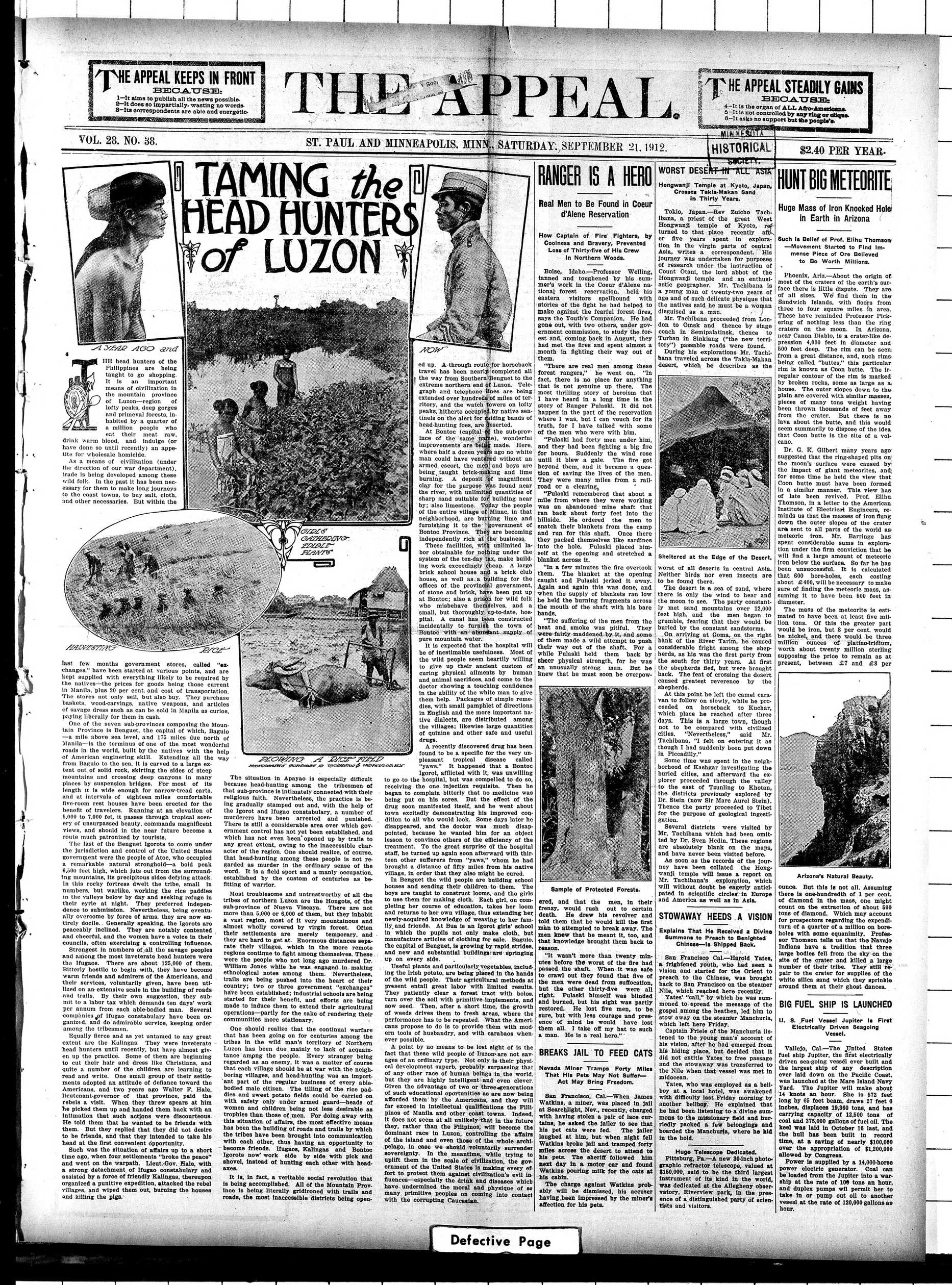
TAMING the HEAD HUNTERS of LUZON
THE WOMEN OF THE WATER CITY
A YEAR AGO and
T
MUSEUM OF ARCHITECTURE
NEW YORK
HE head hunters of the Philippines are being taught to go shopping. It is an important means of civilization in the mountain province of Luzon—region of forty cities, gorges and primeval forests, inhabited by a quarter of a million people who eat their meat raw, drink warm blood, and indulge (or have done so until recently) an appetite for wholesale homicide. As a means of civilization (under the direction of our war department), trade is being developed among these wild folk. In the past it has been necessary for the coast towns, to buy salt, cloth, and other necessaries. But within the
last few months government stores, called "exchanges," have been started at various points, and are kept supplied with everything likely to be required by the natives—the prices for goods being those current in Manila, plus 20 per cent, and cost of transportation. The stores not only sell, but also buy. They purchase baskets, wood-carvings, native weapons, and articles of savage dress such as can be sold in Manila as curios, paying liberally for them in cash.
One of the seven sub-provinces composing the Mountain Province is Benguet, the capital of which, Baguio—a mile above sea level, and 175 miles due north of Manila—is the terminus of one of the most wonderful roads in the world, built by the natives with the help of American engineering skill. Extending all the way from Baguio to the sea, it is carved to a large extent out of solid rock, skirting the sides of steep hills, crossing deep canyons in many places, and suspending a beacon length it is wide enough for narrow-bread carts, the and at intervals of eighteen miles comfortable five-room rest houses have been erected for the benefit of travelers. Running at an elevation of the 5,000 to 7,000 feet, it passes through tropical scene of unsurpassed beauty, commands magnificent views, and should in the near future become a route much naturized by tourists.
The situation in Apayao is especially difficult because head-hunting among the tribesmen of that sub-province is intimately connected with their religious faith. Nevertheless, the practice is being gradually stamped out and, with the help of the Igorot and Ifugao constabulary, a number of murderers have been arrested and punished. There is still a considerable area over which government control has not yet been established, and which has not even been opened up by trails to and from the owing to the inaccessible character of the region. One should realize, of course, that head-hunting among the tribesmen is guarded as murder in the ordinary sense of the word. It is a field sport and a manly occupation, established by the custom of centuries as beffiting of warrior.
The last of the Benguet igorots to come under the jurisdiction and control of the United States government were the people of Atoc, who occupied a remarkable natural stronghold—a bold peak 6,500 feet high, which juts out from the surrounding mountains, its precipitous slides defying attack. They were also the most numerous numbers, but warlike, working the rice paddies in the valleys below by day and seeking refuge in their eylie at night. They preferred independence to submission. Nevertheless, being eventually overcome by force of arms, they are now entirely docile. Generally speaking, the igorots are not particularly aggressive, and cheerful, and the women have a voice in their councils, often exercising a controlling influence
Most troublesome and untrustworthy of all the tribes of northern Luzon are the Hongots, of the sub-province of Nueva Viscaya. There are not more than 5,000 or 6,000 of them, but they inhabit a vast region, most of it very mountainous and most wholly covered by virgin forest. Often they are merely temporary, and they are hard to get. Encouraged to rate their villages, which in the more remote regions continue to fight among themselves. These were the people who not long ago murdered Dr. William Jones while he was engaged in making ethnological notes among them. Nevertheless, trails are being pushed into the heart of their country; two or three government "exchanges" between the industrial schools are being started for their heath; and being made to induce them to extend their agricultural operations—partly for the sake of rendering their communities more stationary.
Strongest in numbers of all the savage peoples and among the most inveterate head hunters were the Ituagas. There are about 125,000 of them. Bitterly hostile to begin with, they have become warm friends and admirers of the Americans, and their services, voluntarily given, have been utilized on an extensive scale in the building of roads and trails. By their own suggestion, they subdue the Ituagas and ban ennies days per annum from each able-bodied and servant companies of Ituagas constabulary have been organized, and of admirable service, keeping order among the tribesmen.
One should realize that the continual warfare that has been going on for centuries among the tribes in the wild man's territory of Northern Luzon has been due mainly to lack of acquaintance amping the people. Every stranger being regarded as an enemy, it was a matter of course that each village should be at war with the neighboring villages and headhunting was an important part of the regular business of every abled-bodied male citizen. The tilling of the rice paddies and sweet potato fields could be carried on with safety only under armed guard—heads of women and children being not less desirable as trophies than those of men. For doing away with this situation of affairs, the most effective means has been the building of roads and trails by which each man has been brought into communication with each other, thus having an opportunity to become friends. It is now common to igorots now work' side by side with pick and shovel, instead of hunting each other with head-axes.
Equally fierce and as yet untamed to any great extent are the Kallingsas. They were inveterate head hunters until recently, but have almost given up the practice. Some of them are beginning to cut their hair and dress like Christians, and quite a number of the children are learning to read and write. One small group of their settlements adopted an attitude of defiance toward the Americans, and two years ago Walter F. Hale, lieutenant-governor of that province, paid the rebels a visit. When they threw spears at him he picked them up and handed them back with an intimation that such actions were discourteous. But that he wanted to be friends with them. But the people did not desire to be friends, and that they intended to take his head at the first convenient opportunity. Such was the situation of affairs up to a short time ago, when four settlements "broke the peace" and went on the warpath. Lieut-Gov. Hale, with a strong detachment of Irugao constabulary and assisted by a force of friendly Kallingsas, thereupon organized a punitive expedition, attacked the rebel villages, and wiped them out, burning the houses and killing the pigs.
It is, in fact, a veritable social revolution that is being accomplished. All of the Mountain Province is being literally gridironed with trails and roads, the most inaccessible districts be open-
THE APPEAL.
ed up. A through route for horseback travel has been nearly completed all the way from Southern Benguet to the extreme northern end of Luzon. Telegraph and telephone lines are being extended over hundreds of miles of territory, and the watch towers on lofty peaks, hitherto occupied by native sentinels on the alert for raiding bands of head-hunting foes, are deserted.
At Bonton (capital of the sub-province of the same name), wonderful improvements are being made. Here, where half a dozen years ago no white man could have ventured without an armed escort, the men and boys are being taught brick-making and lime burning. A deposit of magnificent clay for the purpose was found near the river, with unlimited quantities of sharp sand suitable for building near the river. The village of the entire village of Minac, in that neighborhood, are burning lime and furnishing it to the government of Bonton Province. They are becoming independently rich at the business.
GIRLS
GATHERING
EDIBLE
PLANTS
These facilities, with unlimited labor obtainable for nothing under the system of the ten-day tax, make building work exceedingly cheap. A large brick school house and a brick club house, as well as a building for the offices of the provincial government, of stone and brick, has been put up for sale by a plasterer for wild kings who misbehave themselves, and a small, but thoroughly up-to-date, hospital. A canal has been constructed incidentally to furnish the town of Bontoc with an abundant supply of pure mountain water. It is expected that the hospital will be of inestimable usefulness. Most of the wild people seem heartily willing to give up their ancient custom of curing physical ailments by human contact, and the doctor showing a touching confidence in the ability of the white man to give them help. Packages of simple remedies, with small pamphlet of directions in English and the more important native dialects, are distributed among the villages; likewise large quantities of quinine and other safe and useful drugs.
A recently discovered drug has been found to be a specific for the very unpleasant taste of yaws. It happened that a Bontoc loot, afflicted with it, was unwilling
PLOWING A 'RICF' FIELD
морфологические условия и интенсивность и интенсивность
the hospital, but was compelled to do so, but the one injection requisite. Then he complain bitterly that no medicine was put on his sores. But the effect of the man manifested itself, and he went about critically demonstrating his improved condition who would look. Some days later he hired, and the doctor was much disappear because he wanted him for an object of convince others of the efficiency of the t. To the great surprise of the hospital nurse up again soon afterward with thirst for Bague, is a 'vamp' who he came a distance of fifty miles from his native order that they also might be cured. Suquet the wild people are building school and sending their children to the. The taught to construct looms, and the girls taught for making cloth. Each girl, on compar course of education, takes her loom to her own village, thus extending her required knowledge of weaving to her families. At Bua is an igorot girl's school at the pupils not only make cloth, but the pupils not only make for sale. Baguio, in her own village, growing by rapid strides, and substantial buildings are springing every side. Plants and particularly vegetables, includ. Irish potato, are being placed in the hands of the great agricultural methods at the great adult with limited results. Itently clear a forest tract with bolos, to the soil with primitive implements, and. Then, after a short time, the growth drives them to fresh areas, where theince has to be repeated. What the Ameriplose to be provided with the model of husbandry, and with carabas when it by no means to be lost sight of is the these wild people of Izouon are not ordinary type. Not only is their development superb, probably surpassing that other race of human beings in the world, are highly intelligent and even clever. The advantage of two or three generations educational opportunities as are now being them by the Americans, and they will aid in intellectual qualifications the Fillmania and other coast towns. Indeed, not seem at all unlikely that in the future other than the Filipinos, will become the race in Luzon, controlling the affairs land and even those of the whole archi- culture. In the case of while trying to them in the scale of civilization, the of the United States is making every of protect them against civilization's evil—especially the drink and diseases which determined the moral and physique of so imitative peoples on coming into contact corrupting Caucasian.
to go to the hospital, but was compelled to do so, receiving the one infection requisite. Then he began to complain bitterly that no medicine was being put on his sores. But the effect of the drug soon manifested itself, and he went about town excitedly demonstrating his improved condition to all who would look. Some days later he disappeared, and the doctor was much disappointed, because he wanted him for an object lesson to convince others of the efficiency of the treatment. To the great surprise of the hospital staff, he turned up again soon afterward with thirteen other sufferers from "yaws," whom he had brought a distance of fifty miles from his native village. In contrast that they also might be cured. To instruct the people perennial teachers to house and sending their children to them, the boys are taught to construct looms, and the girls to use them for making cloth. Each girl, on completing her course of education, takes her loom and returns to her own village, thus extending her newly-acquired knowledge of weaving to her family, and friends. At Bua is an Igorot girl's school in which the pupils not only make cloth, but manufacture articles of clothing for sale. Baguio, the capital of Benguet, is growing by rapid strides, and new and substantial buildings are springing up on every side. Useful plants and particularly vegetables, including the Irish potato, are being placed in the hands of the wild people. Their agricultural methods at present entail great labor with limited results. They patiently clear a forest tract with bolos, the flesh with primitive implements, and sow seed. Then after a short time, the growth of weeds drives them to fresh areas of performance has to be repeated. What the Americans propose to do is to provide them with modern tools of husbandry, and with carabasos whenever possible.
A point by no means to be lost sight of is the fact that these wild people of Luzon are not savages of an ordinary type. Not only is their physical development superb, probably surpassing that of any other race of human beings in the world, but they are highly intelligent and even clever. Given the advantage of two or three generations of children as are now being afforded them by the American people, far exceed in intellectual qualifications the Filipinos of Manila and other coast towns. Indeed, it does not seem at all unlikely that in the future they, rather than the Filipinos, will become the dominant race in Luzon, controlling the affairs of the island and even those of the whole archipelago, in case we should voluntarily surrender sovereignty. In the meantime, while trying to uplift them in the scale of civilization, the government of the United States is making every effort to fight against civilization's evil influences—especially the diseases which have undermined the moral and aesthetic of so many primitive peoples on coming into contact with the corrupting Caucasian.
Defective Page
RANGER IS A HERO
Real Men to Be Found in Coeur d'Alene Reservation
How Captain of Fire Fighters, by Cooliness and Bravery, Prevented Loss of Thirty-five of His Crew In Northern Woods.
Boise, Idaho—Professor Welling, tanned and toughened by his summer's work in the Coeur d'Alene national forest reservation, held his eastern visitors spellbound with stories of the fight he had helped to make against the fearful fire fires, says the Youth's Companion. He had gone out, with two others, under government commission, to study the forest and, coming back in August, they had met the fires and spent almost a month in fighting their way out of them.
“There are real men among these forest rangers,” he went on. “In fact, there is no place for anything that is not genuine up there. The most thrilling story of heroism that I have heard in a long time is the story of Ranger Pulaski. It did not happen in the part of the reservation where I was, but I can vouch for its truth, for I have talked with some of the men who were with him.
“Pulaski had forty men under him, and they had been fighting a big fire for hours. Suddenly the wind rose and the fire got beyond them, and it became the saving of the lives of the men. They were many miles from a railroad or a clearing.
"Pulaski remembered that about a mile from where they were working was an abandoned mine shaft that ran back about forty feet into the hillside. He ordered the men to snatch their blankets from the camp and run for this shaft. Once there they packed themselves like sardines and Pulaski placed himself at the opening and stretched a blanket across it at the opening.
"In a few minutes the fire overtook them. The blanket at the opening caught and Pulaski jerked it away. Again and again this was done, and when the supply of blankets ran low he held the burning fragments across the mouth of the shaft with his bare hands.
"The suffering of the men from the heat and smoke was pitiful. They were fairly maddened by it, and some of them made a wild attempt to push the blankets while Pulaski held them back by sheer physical strength, for he was an unusually strong man. But he knew that he must soon be overworn.
Sample of Protected Forests. ered, and that the men, in their frenzy, would rush out to certain death. He drew his revolver and told them that he would kill the first man to attempted to break away. The men knew that he meant it, too, and that knowledge brought them back to reason.
"It wasn't more than twenty minutes before the worst of the fire had passed the shaft. When it was safe to crawl out they found that five of the men were dead from suffocation, but the other thirty-five were all right. Pulaski himself was blinded and he was partly restored. He lost five lives, sure, but with less courage and presence of mind he would have lost them all. I take off my hat to such a man. He is a real hero."
BREAKS JAIL TO FEED CATS
Nevada Miner Trampa Forty Miles
That His Pets May Not Suffer—
Act May Bring Freedom.
San Francisco, Cal—When James
Watkins, a miner, was placed in jail
at Searchlight, Nev., recently, charged
with having stolen a pair of lace
curtains, he asked the jailer to see that
his pet cats were fed. The jailer
laughed at him, but when night fell
Watkins broke and tramped forty
miles across the desert to attend to
the sheriff followed him next day in a motor car and found
Watkins pouring milk for the cats at
his cabin.
The charge against Watkins probably
will be dismissed, his accuser
having been impressed by the miner's
affection for his pets.
THE APPEAL STEADILY GAINS
BECAUSE:
4-It is the organ of ALL Afro-Americans.
5-It is not controlled by any ringleader.
6-It asks no support but the people s.
Hongwanjil Temple at Kyoto, Japan,
Crosses Takla-Makan Sand
in Thirty Years.
Tokio, Japan.—Rev Zuicho Tachibana, a priest of the great West Hongwanjil temple of Kyoto, returned to that place recently after five years spent in exploration in India. He writes a correspondent. His journey was undertaken for purposes of research under the instruction of Count Otani, the lord abbot of the Hongwanjil temple and an enthusiastic geographer. Mr. Tachibana is a young man of twenty-two years of age and of such delicate physique that the natives said he must be a woman disguised as a man.
Mr. Tachibana proceeded from London to Osaka and thence by stage coach in Singapore, thence to Turban in Singapore (the new territory) passable roads were found.
During his explorations Mr. Tachibana traveled across the Takla-Makan desert, which he describes as the
Sheltered at the Edge of the Desert,
worst of all deserts in central Asia.
Neither birds nor even insects are
to be found there.
The desert is a sea of sand, where
there is only the wind to hear and
the moon to see. The party constantly
met sand mountains over 12,000
feet high, and the men began to
grumble, fearing that they would be
buried by the constant sandstorms.
On arriving at Goma, on the right bank of the River Tarim, he caused considerable fright among the shepherds, as his was the first party from the south for thirty years. At first the shepherds fled, but were brought back. The feat of crossing the desert caused greatest reverence by the samurai. At this point he left the camel caravan to follow on slowly, while he proceeded on horseback to Kuchar, which place he reached after three days. This is a large town, though not to be compared with civilized cities. "Nevertheless," said Mr. Tachibana, "I felt on entering it as though I had suddenly been put down in Plecadilly."
Some time was spent in the neighborhood of Kashgar investigating the bourne cities and afterward the explorer proceeded through the valley to the east of Tuzunil to Khotan, the districts previously explored by Dr. Stein (now Sir Marc Aurel Stein). Thence the party proceeded to Tibet for the purpose of geological ingestation.
Several districts were visited by Mr. Tachibana which had been omitted by Dr. Sven Heden. These regions are absolutely blank on the maps, and have never been visited before.
As soon as the records of the journeys have been collated the Hongwang Mr. Tachibana's exploration, which will without doubt be eagerly anticipated in scientific circles in Europe and America as well in Asia.
STOWAWAY HEEDS. A VISION
Explains That He Received a Divine Summons to Preach to Benlighted Chinese—Is Shipped Back.
San Francisco Cal—Harold Yates, a frightened youth, who had seen a vision and started for the Orient to preach to the Chinese, was brought back to San Francisco on the steamer Nile, which reached here recently.
Yates "call," by which he was summoned to spread the message of the googles of the steamer the heathen, led him to stow away the steamer Manchuria, which left here Friday.
Captain Priefe of the Manchuria listened to the young man's account of his vision, after he had emerged from his hiding place, but decided that it did not entitle Yates to free passage and the stowaway was transferred to the Nile when that vessel was met in midocean.
Yates, who was employed as a bellboy at a local hotel, was awakened with difficulty last Friday morning by another bellboy. He explained that he had been listening to a divine summons to the missionary field and hurriedly packed a few belongings and boarded the Manchuria, where he hid in the hold.
Huge Telescope Dedicated.
Pittsburgh, Pa.—A new 20-inch photographic refractor telescope, valued at $150,000, said to be the third largest instrument of its kind in the world, was dedicated at the Allegheny observatory. Riverview park, in the presence of a distinguished party of scientists and visitors.
Huge Mass of Iron Knocked Hole in Earth in Arizona
Such is Belief of Prof. Eilhu Thomson — Movement Started to Find immense Piece of Ore Believed to Be Worth Millions.
Phoenix, Ariz.—About the origin of most of the craters of the earth's surface there is little dispute. They are of all sizes. We find them in the Sandwich Islands, with floors from three to four square miles in area. These have reminded Professor Pickering of nothing less than the ring craters on the moon. In Arizona, near Canon Diablo, is a crater-like depression, 4,000 feet in diameter and 500 feet deep. The rim can be seen from a great distance, and, such rings being called "buttes," this particular rim is known as Coon butte. The irregular contour of the rim is marked by broken rocks, some as large as a house. The outer slopes down to the plate are covered with similar masses, pieces of comany tone weight, having been thrown thousands of feet away from the crater. But there is no lava about the butte, and this would seem summarily to dispose of the idea that Coon butte is the site of a volcano.
Dr. G. K. Gilbert many years ago suggested that the ring-shaped pits on the moon's surface were caused by the impact of giant meteorites, and for some time he held the view that Coon butte must have been formed in a similar manner. This view has been supported by the work of Thomson, in a letter to the American Institute of Electrical Engineers, reminds us that the masses of iron fung down the outer slopes of the crater are sent to all parts of the world as meteorite iron. Mr. Barringe has spent considerable sums in exploration under the firm conviction that he will find a large amount of meteorite in the surface. So far he has been unsuccessful. He is confident that 600 bore-holes, each costing about £400, be necessary to make sure of finding the meteorite mass, assuming it to have been 500 feet in diameter.
The mass of the meteorite is estimated to have been at least five million tons. Of this the greater part would be iron, but 8 per cent, would be nickel, and there would be three hundred million more worth about twenty million sterling supposing the price to remain as at present, between £7 and £8 per
Arizona's Natural Beauty.
ounce. But this is not all. Assuming there is one-hundredth of 1 per cent. of diamond in the mass, one might count on the extraction of about 500 tons of diamond. Which may account for the return of a quarter of a million on boreholes with some equanimity. Professor Thomson tells us that the Navajo Indians have a tradition that three large bodies fell from the sky on the site of the crater and killed a large number of their tribe. They still re-verify that the rocks were white silica sand which they sprinkle around them at their ghost dances.
BIG FUEL SHIP IS LAUNCHED
U. S. Fuel Vessel Jupiter is First Electrically Driven Seagoing Vessel.
Vallejo, Cal.-The United States fuel ship Jupiter, the first electrically driven sea-goaming vessel ever built and the largest ship of any description ever laid down on the Pacific Coast, was launched at the Mare Island Navy Yard. The Jupiter will make about 14 knots an hour. She is 572 feet long by 65 feet beam, draws 27 feet 6 inches, displaces 19,360 tons, and has carrying capacity of 12,500 tons of coal and 375,000 gallons of fuel oil. The keel was laid in October 16 last, and the hull has been built in record time, at a saving of nearly $100,000 over the appropriation of $1,200,000 allowed by Congress.
Power is supplied by a 14,000-horse power electric generator. Coal can be loaded from the Jupiter into a warship at the rate of 106 tons an hour, and duplex pumps will permit her to take in or pump out oil to another vessel at the rate of 120,000 gallons an hour.
HAVE YOUR READ
THE APPEAL?
PUBLISHED WEEKLY BY
ADAMS BROTHERS
49 E. 4th Street, F. St. Paul, Mnp.
ST. PAUL OFFICE
J. Q. ADAMS, Manager.
No. 236 Union Block, 49 E. 4th St
MINNEAPOLIS OFFICE
JASPER GIBBS, Manager.
Metropolitan Bldg., Room 1020.
CHICAGO OFFICE
C. F. ADAMS, Manager.
443 S. Dearborn St., Suits 660.
TERMS STRICTLY IN ADVANCE
SINGLE COPY, ONE YEAR.....$2.00
SINGLE COPY, SIX MONTHS.....1.10
SINGLE COPY, THREE MONTHS.....60
When subscriptions are by any means allowed to run without prepayment, the ten weeks are for each odd week, 13 weeks and 5 cents for each odd week, or at the rate of $2.40 per year.
Remittances should be made by Express Mail. Because Money Order, Registered Letter or Bank Stamp Will be received the same as cash for the fractional parts of a dollar. Only one cent and two cents stamp may be used.
Silver should never be sent through the mail. It is almost sure to wear a hole through the envelope and be lost; or else it may be stolen. Persons who answer to us in letters do so at their own risk.
Marriage and death notice 10 lines or less $1. Each additional line 10 cents. Payment strictly in advance, and to be announced at all must come in season to be news.
Advertising rates, 15 cents per agate line, each insertion. There are fourteen agate lines in an inch, and about seven inches in a foot. Vertements less than $1. No discount allowed on less than three months contract. Cash must accompany all orders from us. Further particulars on application.
Reading notices 25 cents per line, each insertion. No discounts for time or envelope type—about six words to the line. All head-lines count double.
The date on the address label shows when subscription expires. Renewals should be made by mail or by phone so that no paper may be missed, as the paper shows when time is out.
It occasionally happens that papers in case of subscription of other members you do not receive any number when due, inform us by postal card at the office or by mail. That date, date of the missing number.
Communications to receive additions must be new, upon important subjects, please send to us by postal card; must reach us Tuesday if possible, anyway not later than Wednesdays, and bear the signature of the owner, unless stamps are sent for pennies.
We do not hold ourselves responsible for the views of our correspondents.
Soliciting agents, women, wanted everywhere,
in every department, who are free to
in every letter that you write
fail to give your full name and address,
in your name, to the state,
state. Business letters of all kinds must
be written on separate sheets from letter
address. Business letters of all kinds
location. Entered as second class matter
June 6, 1885 at the postoffice at St. Paul,
1878, under act of Congress, March 3,
SOUNDS THE KEYNOTE.
Upon the solid rock of the rights of the individual as granted by the Constitution, the Republican party builds its structure of optimism. The Democratic party, on the other hand, in the opening sentence of its address to the electorate, betrays its recessional quality by denying the right of Congress, a right again and again confirmed by the Supreme Court, to establish protective duties for the benefit of American industries. It declares as false the vital issue of the constitutional liberties of the individual. Such liberties are now assailed by those who advocate the overthrow of the independence of the judiciary. It would leave the individual defenseless in the protection of those rights declared inalienable under the Constitution.—Charles D. Hilles, chairman of the Republican national committee.
SATURDAY, SEPTEMBER 21, 1912.
YE SHALL REAP THAT YE SOW.
It has been a contention of THE APPEAL ever since the Southern pastime, lynching, got to be so fashionable, that when the habit became confirmed that the mob would not always hunt up a black man to practice upon. We also contended that the moral effect would be very bad upon the young people. Both of these contensions have been frequently verified. White men have been lynched time and again within the last decade and the lynchers have gone unpunished; in fact lynching has become so common now-a-day that very little attention is paid to it. One of the latest evidences of the state of mind of the youth of the country comes from Butte, Mont., where last week fifteen boys, ranging from 12 to 15 years of age, confessed that they attempted to lynch Joseph Meyers, a chicken farmer whose life had been made miserable and his family destitute by the depredations of the gang of boys. In this case they set fire to the man's house and when he attempted to put out the flames they overpowered him, put a rope around
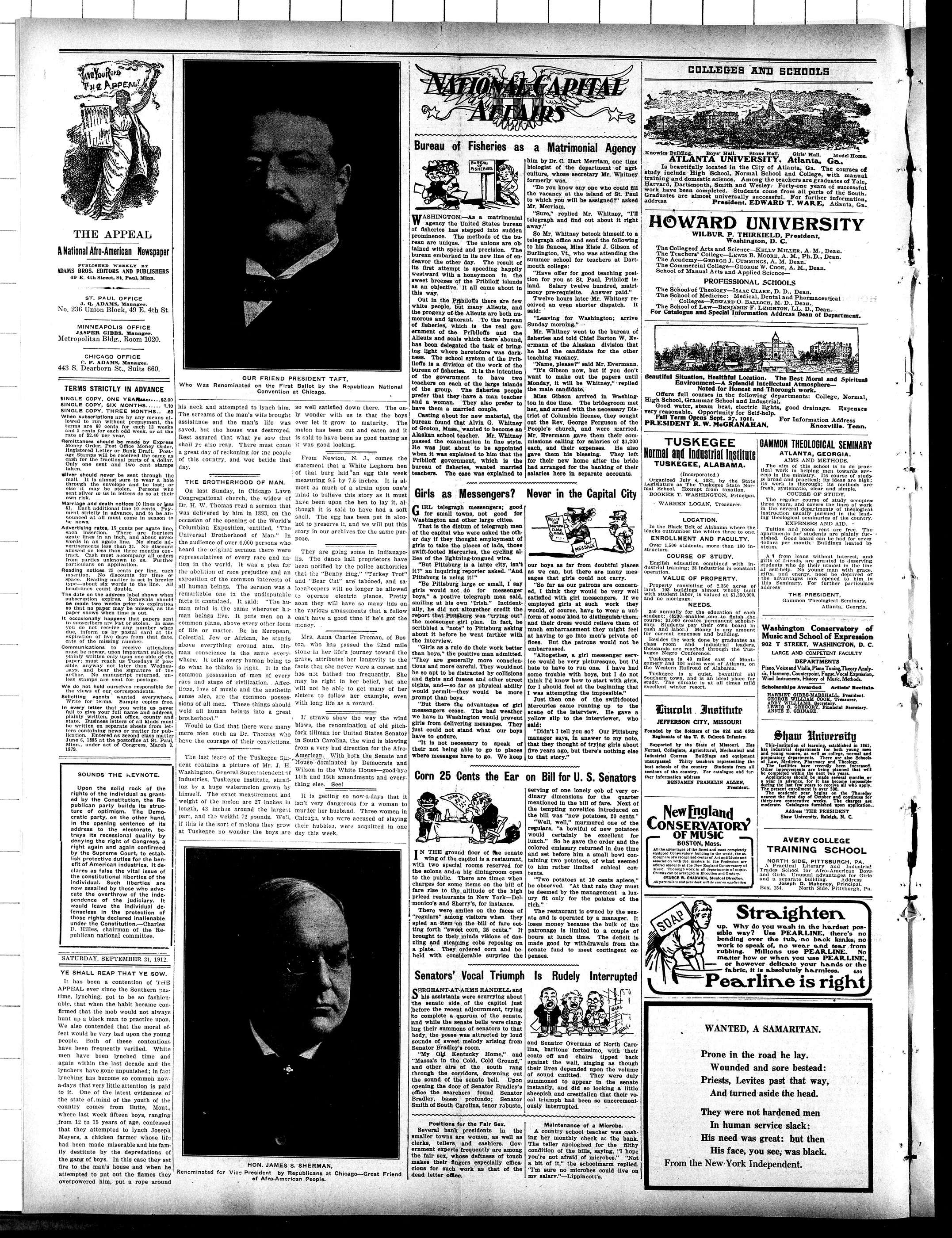
[Picture of a man in a suit with a bow tie].
YAFF,
Who Was Renominated on the First Ballet by the Republican National Convention at Chicago.
Renominated for Vice President by aat Chicago—Great Friend of Afro-American People.
his neck and attempted to lynch him. The screams of the man's wife brought assistance and the man's life was saved, but the house was destroyed. Rest assured that what ye sow that shail ye also reap. There must come a great day of reckoning for the people of this country, and woe betide that day.
THE BROTHERHOOD OF MAN.
On last Sunday, in Chicago Lawn Congregational church, the widow of Dr. H. W. Thomas read a sermon that was delivered by him in 1893, on the occasion of the opening of the World's Columbian Exposition, entitled "The Universal Brotherhood of Man." In the audience of over 4,000 persons who heard the original sermon there were representatives of every race and nation in the world. It was a plea for the abolition of race prejudice and an exposition of the common interests of all human beings. The sermon was a remarkable one in the undisputable facts it contained. It said: "The human mind is the same wherever human beings live. It puts men on a common plane, above every other form of life or matter. Be he European, Celestial, Jew or African, he stands above everything around him. Human conscience is the same everywhere. It tells every human being to do what he thinks is right. It is the common possession of men of every race and stage of civilization. Affections, love of music and the aesthetic sense also, are the common possessions of all men. These things should weld all human beings into a great brotherhood."
Would to God that there were many more men such as Dr. Thomas who have the courage of their convictions.
The last issue of the Tuskegee Student contains a picture of Mr. J. H. Washington. General Superintendent of Industries, Tuskegee Institute, standing by a huge watermelon grown by himself. The exact measurement and weight of the melon are 27 inches in length, 43 inches around the largest part, and the weight 72 pounds. Well, if this is the sort of melons they grow at Tuskegee no wonder the boys are
so well satisfied down there. The only wonder with us is that the boys ever let it grow to maturity. The melon has been cut and eaten and it is said to have been as good tasting as it was good looking.
From Newton, N. J., comes the statement that a White Leghorn hen of that burg laid an egg this week measuring 9.5 by 7.5 inches. It is almost as much of a strain upon one's mind to believe this story as it must have been upon the hen to lay it, although it is said to have had a soft shell. The egg has been put in alcohol to preserve it, and we will put this story in our archives for the same purpose.
They are going some in Indianapolis. The dance hail proprietors have been notified by the police authorities that the "Bunny Hug," "Turkey Trot" and "Bear Cat" are tabooed, and saunookeepers will no longer be allowed to operate electric planos. Pretty soon they will have so many lids on the various amusements that a fellow can't have a good time if he's got the money.
Mrs. Anna Charles Froman, of Boston, who has passed the $2nd mile stone in her life's journey toward the grave, attributes her longevity to the facts that she never wore a corset and has not bathed too frequently. She may be right in her belief, but she will not be able to get many of her sisters to follow her example, even with long life as a reward.
It straws show the way the wind blows, the renomination of old pitchfork tillman for United States Senator in South Carolina, the wind is blowing from a very bad direction for the Afro-American. With both the Senate and House dominated by Democrats and Wilson in the White House—good-bye 14th and 15th amendments and everything else. See!
It is getting so now-a-days that it isn't very dangerous for a woman to murder her husband. Three women in Chicago, who were accused of slaying their husbies, were acquitted in one day this week.
NATIONAL CAPITAL ACTAIRS
Corn 25 Cents the Ear on Bill for U. S. Senators
BURPEAU OF FISHERIES
WASHINGTON.—As a matrimonial agency the United States bureau of fisheries has stepped into sudden prominence. The methods of the bureau are unique. The unions are obtained with speed and precision. The bureau embarked in its new line of endeavor the other day. The result of its first attempt is speeding happily westward with a honeymoon in the sweet breezes of the Pribilof islands as an objective. It all came about in this way.
Out in the Pribilofs there are few white people, but many Alleuts, and the progeny of the Alleuts are both numerous and ignorant. To the bureau of fisheries, which is the real government of the Pribilofs and the Alleuts and seals which there abound, has been delegated the task of bringing light where heretofore was darkness. The school system of the Pribilofs is a division of the work of the bureau of fisheries. It is the intention of the government to have two teachers on each of the large islands of the group. The fisheries people prefer that they have a man teacher and a woman. They also prefer to have them a married couple.
Casting about for new material, the bureau found that Alvin G. Whitney of Groton, Mass., wanted to become an Alaskan school teacher. Mr. Whitney passed the examination in fine style. He was just about to be appointed when it was explained to him that the Pribliff government, which is the bureau of fisheries, wanted married teachers. The case was explained to
GIRL telegraph messengers; good for small towns, not good for Washington and other large cities. That is the dictum of telegraph men of the capital who were asked the other day if they thought employment of girls to take the places of lads, those swift-footed Mercuries, the cycling allies of the lightning-tongued wire. "But Pittsburgh is a large city, isn't it?" an inquiring reporter asked. "And Pittsburgh is using it!" "Be Pittsburgh large or small, I say girls would not do for messenger boys," a positive telegraph man said, smiling at his own "Irish." Incidentally, he did not altogether credit the report that Pittsburgh was "trying out" the messenger girl plan. In fact, he scribbled a "note" to Pittsburgh asking about it before he went farther with the interview.
"Girls as a rule do their work better than boys," the positive man admitted. "They are generally more conscientious and more careful. They would not be so apt to be distracted by collisions and fights and fusses and other street sights, and—so far as physical ability would permit—they would be more prompt than boys.
"But there the advantages of girl messengers cease. The bad weather we have in Washington would prevent girls from delivering messages. They just could not stand what our boys have to endure.
"It is not necessary to speak of their not being able to go to places where messages have to go. We keen
IN THE ground floor of the senate wing of the capitol is a restaurant, with two special rooms reserved for the solons and a big diningroom open to the public. There are times when charges for some items on the bill of fare rise to the altitude of the high priced restaurants in New York—Delmonico's and Sherry's, for instance. There were smiles on the faces of "regulars" among visitors when they spied an item on the bill of fare cutting forth "sweet corn, 25 cents." It brought to their minds visions of dazzling and steaming cobs reposing on a plate. They ordered corn and behead with considerable surprise the
SERGEANT-AT-ARMS RANDELL and his assistants were scurrying about the senate side of the capitol just before the recent adjournment, trying to complete a quorum of the senate, and while the senate bells were clanging their summons of senators to that body, the posse was attracted by loud sounds of sweet melody arising from Senator Bradley's room.
"My Old Kentucky Home," and "Massa's in the Cold, Cold Ground," and other airs of the south rung through the corridors, drowning out the sound of the senate bell. Upon opening the door of Senator Bradley's office the searchers found Senator Bradley, basso profundo; Senator Smith of South Carolina, tenor robust.
Positions for the Fair Sex. Several bank presidents in the smaller towns are women, as well as clerks, tellers, and cashiers. Government experts frequently are among the fair sex, whose defiance of touch makes their fingers especially efficacious for such work as that of the dead letter office.
him by Dr. C. Hart Merrilam, one time biologist of the department of agriculture, whose secretary Mr. Whitney formerly was.
"Do you know any one who could fill the vacancy at the island of St. Paul to which you will be assigned?" asked Mr. Merrilam.
"Sure," replied Mr. Whitney, "Till telegraph and find out about it right away."
So Mr. Whitney betook himself to a telegraph office and sent the following to his fancee, Miss Elsie J. Gibson of Burlington, Vt, who was attending the summer school for teachers at Dartmouth college:
"Have offer for good teaching position for you at St. Paul, Pribilof island. Salary twelve hundred, matrimony pre-requisite. Answer paid."
Twelve hours later Mr. Whitney received an even shorter dispatch. It said:
"Leaving for Washington; arrive Sunday morning."
Mr. Whitney went to the bureau of fisheries and told Chief Barton W. Evermann of the Alaskan division that he had the candidate for the other teaching vacancy.
"Name, please?" said Mr. Evermann.
"It's Gibson now, but if you don't want to make out the papers until Monday, it will be Whitney," replied the male candidate.
Miss Gibson arrived in Washington in due time. The bridegroom met her, and armed with the necessary District of Columbia license, they sought out the Rev. George Ferguson of the People's church, and were married. Mr. Evermann gave them their commissions calling for salaries of $1,200 each, and their expenses. He also gave them his blessing. They left for their new home after the bride had arranged for the banking of their salaries here in separate accounts.
our boys as far from doubtful places as we can, but there are many messages that girls could not carry.
"So far as our patrons are concerned, I think they would be very well satisfied with girl messengers. If we employed girls at such work they would, of course, have to wear a uniform of some kind to distinguish them, and their dress would relieve them of much embarrassment they might feel at having to go into men's private fices. But the patrons would not be embarrassed.
"Altogether, a girl messenger service would be very picturesque, but I'd hate to have to run one. I have had some trouble with boys, but I do not think I'd know how to start with girls, for I should feel at the beginning that I was attempting the impossible."
Just then one of the swift-footed Mercuries came running up to the scene of the interview. He gave a yellow slip to the interviewer, who said:
"Didn't I tell you so? Our Pittsburg manager says, in answer to my note, that they thought of trying girls about five years ago, but there's nothing else to that story."
serving of one lonely cob of very ordinary dimensions for the quarter mentioned in the bill of fare. Next of the tempting novelties introduced on the bill was "new potatoes, 20 cents." "Well, well," murmured one of the reguars, "a bowel of new potatoes would certainly be excellent for lunch." So he gave the order and the colored emissary returned in due time and set before him a small bowl containing two potatoes, of what seemed to him rather limited cubical contents.
"Two potatoes at 10 cents aplece," he observed. "At that rate they must be deemed by the management a luxury fit only for the palates of the rich."
The restaurant is owned by the senate and is operated by a manager. It loses money because the bulk of the patronage is limited to a couple of hours at lunch time. The deficit is made good by withdrawals from the senate fund to meet contingent expenses.
and Senator Overman of North Carolina, baritone fortissimo, with their coats off and chairs tipped back against the wall, singing as though their lives depended upon the volume of sound emitted. They were duly summoned to appear in the senate instantly, and did so looking a little sheepish and crestfallen that their vocal triumph had been so unceremoniously interrupted.
Maintenance of a Microbe.
A country school teacher was cashing her monthly check at the bank. The teller apologized for the filthy condition of the bills, saying, "I hope 'no' to microbes." "Not a bit of it" the柜房marmor replied. "I'm sure no microbes could live on my salary." -Inlulukott'a.
COLLEGES AND SCHOOLS
Knowles Building, Boys' Hall. State ATLANTA UNIVERSITY Is beautifully located in the C study include High School, Normal training and domestic science. Among Harvard, Dartmouth, Smith and W work have been completed. Student Graduates are almost universally s address President, E.
HOWARD U
WILBUR P. THIRD
Washington
The College of Arts and Science—
The Teachers' College—LEWIS B.
The Academy—GEORGE J. CUMMER
The Commercial College—GEORGE
School of Manual Arts and Applied
Boy's Hall. Stone Hall. Girls' Hall.
ATLANTA UNIVERSITY, Atlanta, Ga. The
finitely located in the City of Atlanta, Ga. The
High School, Normal School and College, w
domestic science. Among the teachers are gradu
atmouth, Smith and Wesley. Forty-one years a
been completed. Students come from all parts of
the almost universally successful. For further
President, EDWARD T. WARE,
WARD UNIVERSITY
WILBUR P. THIRKIELD, President,
Washington, D. C.
George of Arts and Science—KELLY MILLER, A. M., D.
Derser' College—LEWIS B. MOORE, A. M., Ph.D., D.
Demy—GEORGE J. CUMMINGS, A. M. Dean.
Marcial College—GEORGE W. COOK, A. M., Dean.
Manual Arts and Applied Science—
Knowles Building. Boys' Hall. Stone Hall. Girls' Hall. Model Home. ATLANTA UNIVERSITY. Atlanta, Ga.
Is beautifully located in the City of Atlanta, Ga. The courses of study include High School, Normal School and College, with manual training and domestic science. Among the teachers are graduates of Yale, Harvard, Dartmouth, Smith and Wesley. Forty-one years of successful work have been completed. Students come from all parts of the South. Graduates are almost universally successful. For further information, address President, EDWARD T. WARE. Atlanta, Ga.
HOWARD UNIVERSITY
The College of Arts and Science—KELLY MILLER, A. M., Dean.
The Teachers' College—LEWIS B. MOORE, A. M, Ph.D., Dean.
The Academy George J. CUMMINGS, A. M. Dean.
The College of Arts and Science—COOK, A. M., Dean.
School of Manual Arts and Art—A. M. Dean.
PROFESSIONAL SCHOOLS
The School of Theology—ISAAC C.
The School of Medicine: Medical
Colleges—EDWARD O. BAL
The School of Law—BENJAMIN F.
For Catalogue and Special Informa
Beautiful Situation, Healthful Location
Environment—A Splendid
Noted for Honest a
Offers full courses in the follow
High School, Grammar School and In
Good water, steam heat, electric
very reasonable. Opportunity for Set
Fall Term Opens Sept. 27, 1911.
PRESIDENT R. W. McGRANAH
School of Theology—ISAAC CLARK, D. D., Dean.
School of Medicine: Medical, Dental and Pharmaceutical
Colleges—EDWARD O. BALLOCH, M. D. Dean.
School of Law—BENJAMIN F. LEIGHTON, LL. D. Dean.
Uqation, Healthful Location. The Best Moral and
Environment—A Splendid Intellectual Atmosphere
Noted for Honest and Thoronong work.
All courses in the following departments: College
Grammar School and Industrial.
er, steam heat, electric lights, good drainage,
le. Opportunity for Self-help.
Opens Sept. 27, 1911.
For Information
T R. W. MeGRANAHAN.
Knoxv
The School of Theology—ISAAC CLARK, D. D., Dean.
The School of Medicine: Medical, Dental and Pharmaceutical
Colleges—EDWARD O. BALLOCH, M. D., Dean.
The School of Law—BENJAMIN F. LEIGHTON, LL. D., Dean.
For Catalogue and Special Information Address Dean of Department.
Beautiful Situation, Healthful Location. The Best Moral and Spiritual
Environment—A Splendid Intellectual Atmosphere—
Noted for Honest and Thorongh work.
Offers full courses in the following departments: College, Normal,
High School, Grammar School and Industrial.
Good water, steam, heat.
Good water, steam heat, electric lights, good drainage. Expenses very reasonable. Opportunity for Self-help.
Fall Term Opens Sept. 27, 1911. For Information Address
PRESIDENT R. W. MGRANAH. Knoxville, Tenn.
TUSKEGEE
Normal and Industrial Institute
TUSKEGEE, ALABAMA
Organized July 4, 1881, by the State Legislature as The Tuskegee State Normal Booker T. WASHINGTON, Principa
WARREN LOGAN, Treasurer
LOCATION.
In the Black Belt of Alabama where the blacks outnumber the whites three to one ENROLLMENT AND FACULTY. Over 1,500 students, more than 100 instructor
COURSE OF STUDY
English education combined with industrial training; 28 industries in constant operation.
VALUE OF PROPERTY.
Property consisting of 2,350 acres of land, 105 buildings almost wholly built with industrial interest, is valued at $1,250,000, and no mortgage.
NEEDS.
$50 annually for the education of each student; ($200 enables one to finish the class room and studies in a school cup. Students pay their own balance in cash and labor.) Money in any amount for current expenses and building.
Besides the work done by graduates as class room and industrial leaders, thousands are reached through the Tuskegee Negro Conference.
Tuskegee is 40 miles east of Montgomery, and 10 miles north of Atlanta, on the Western Railroad of Alabama.
Lincoln Institute
JEFFERSON CITY, MISSOURI
Founded by the Boldiers of the 624 and 658 Regiments of the U. S. Colored Infantry.
Supported by the State of Missouri, Has Normal, Collegiate, Agricultural, Mechanical and Industrial Courses Buildings and equipment unassurped Thirty teachers representing the best schools of the country Students from all sections of the country. For catalogue and further information address
BENAMIN FRANKLIN ALLEN,
President.
New England CONSERVATORY OF MUSIC
BOSTON, Mass.
All the adventures of the finest and most completely equipped Conservatory students in the atmosphere of a recognized center of Art and Music and education with the masters in the Profession are offered tuition in the New England Conservatory of Music. Thorough work in all departments of music.
County, W. Warrington, Indiana.
GEORGE W. WARRINGTON, Musical Director.
All particulars and your book will be sent as application.
SOAP
up. Why do
sible way?
bending over
work to spe
rubbing. I
matter how
or howev
fabric, it
Pearl
WANTED, A
Straighter
up. Why do you wash in the ha-
sible way? Use PEARLINE,
bending over the tub, no back
work to speak of, no wear and
rubbing. Millions use PEARL
matter how or when you use P
or however delicate your ha
fabric, it is absolutely harmle
Pearline is r
WANTED, A SAMARITAN.
Straighten
up. Why do you wash in the hardest possi-
ble way? Use PEARLINE, there's no
bending over the tub, no back kinks, no
work to speak of, no wear and tear from
rubbing. Millions use PEARLINE. No
matter how or when you use PEARLINE,
or however delicate your hands or the
fabric, it is absolutely harmless. 636
Pearline is right
Prone in the road he lay. Wounded and sore bestead: Priests, Levites past that way, And turned aside the head. They were not hardened men In human service slack: His need was great: but then His face, you see, was black. the New York Independent.
---
---
NEEDS.
ONE HALL. GIRLS' HALL. MODEL HOME.
UNIVERSITY, Atlanta, Ga.
City of Atlanta, Ga. The courses of
School and College, with manual
ing the teachers are graduates of Yale,
Lesley. Forty-one years of successful
s come from all parts of the South.
successful. For further information,
DOWARD T. WARE, Atlanta, Ga.
UNIVERSITY
KIELD, President,
Lyon, D. C.
KELLY MILLER, A. M., Dean.
MOORE, A. M., Ph.D., Dean.
NGS, A. M. Dean.
E. W. COOK, A. M., Dean.
d Science—
LARK, D. D., Dean.
Dental and Pharmaceutical
BLOCK, M. D., Dean.
LEWINGTON, LY. D., Dean.
ation Address Dean of Department.
ton. The Best Moral and Spiritual
Intellectual Atmosphere
and Thorongh work.
ing departments: College, Normal,
industrial.
lights, good drainage. Expenses
f-help.
For Information Address
AN. Knoxville. Tenn.
GAMMON THEOLOGICAL SEMINARY
The aim of this school is to do practical work in helping men towards success in the ministry. Its course of study is broad and practical; its ideas are high; its work is thorough; its methods are fresh, systematic, clear and simple.
COURSE OF STUDY
The regular course of study occupies three weeks. The work in the several departments of theological instruction usually pursued in the leading theological seminaries of the country.
EXPENSES AND AID.
Tuition. The cost of the apartments for students are plainly furnished. Good board can be had for several dollars per month. Buildings heated by steam.
A from loans without interest, and gift friends, are granted to deserving students who do well in their self-help. No young man with grace, gifts, and energy, need be deprived of the advantages now opened to him in this primary. For further particular addresses
THE PRESIDENT,
Gannon Theological Seminary,
Atlanta, Georgia.
Washington Conservatory of Music and School of Expression 902 T STREET, WASHINGTON, D. C.
Piano, Voiceole Violin, Piano Tuning Theory Analysis, Harmony, Counterpoint, Fugue, Vocal Expression, Wind Instruments, History of Music, Methods.
Scholarships Awarded Artists' Recitals
HARRIET GIBBS-MARHALL, President.
GEORGE WILLIAM COOK, Treasurer.
ABBY WILLIAMS, Secretary.
ABBY WILLIAMS, Financial Secretary.
ANNIE E. GRIMAGE.
Shaw University
This-institution of learning, established in 1865, is a national institution for both young women, as well as college, normal and preparatory departments. There are also Schools of Nursing and Health. The facilities have recently been increased. Other improvements are being planned that will be made available to students. Applications should be made several months ago, and the students will be during the last few years to receive all who apply. The present enrollment is over 500. The Thursday nearest the first day of October and continues for thirty-two consecutive weeks. The charges are moderate. The institution will apply.
Address THE PRESIDENT
Shaw University, Raleigh, N.C.
AVERY COLLEGE
TRAINING SCHOOL
NORTH SIDE, PITTSBURGH, PA.
A Practical Literary and Industrial Trades School for Afro-American Boys and Girls. Unusual advantages for Girls and a separate building. Address Joseph C. Patterson, Pittsburgh, Box 154, North Side, Pittsburgh, PA.
raighten
Do you wash in the hardest pos-
Use PEARLINE, there's no
over the tub, no back kinks, no
tak of, no wear and tear from
Millions use PEARLINE. No
or when you use PEARLINE,
ever delicate your hands or the
is absolutely harmless. 636
line is right
A SAMARITAN.
---
* WEEK'S RECORD IN MINNESOTA'TA'S CAPITAL.
The "Saintly City" and Saintly City Folks—Newsy Items of Social, Religious, Political and General Matters Among the People.
SATURDAY, SEPTEMBER 21, 1912.
Rev. Daniel Harding is steadily improving.
Miss Margaret Adams is still getting along nicely.
The season on Oxford shoes closes Oct. 1st. High shoes thereafter.
Mrs. H. Hart, the milliner, has moved from 369 to 425 University avenue.
Paul Church, nephew of Mrs. Chas, Saunders, has gone to Chicago to attend school.
Mrs. Pierce Barber and brother, Mr. Chas. Alexander, have gone to Chicago to spend a few weeks.
Mr. John J. Hirshfield, after an extended visit in various portions of Canada, has returned home.
HOUSES FOR SALE
Double house in University avenue d district for sale at a bargain terms if necessary; six rooms each side, city water, sewer gas and toilet. Rents for $30. Walking distance from Court House.
NEWTON R. FROST,
£08 Newton Bldg.
Dr. Dan H. Williams, of Chicago, passed through the city Tuesday enroute to Dakota on a hunting trip.
Mr. Edward Bonner, of Albany, N. Y., is in the city the guest of Mrs. Gibson Owens, 323 Farrington avenue.
Mr. and Mrs. Walter Burton, of Chicago, arrived in the city last Sunday and are the guests of Mrs. W. B. Ellott.
Some bad boys have been "shooting eraps" at Mechanic Arts high school, but drastic measures will be taken to stop it.
Mrs. Q. Hicks left Monday to attend the Conference at Galesburg, Ill. She will visit several cities before returning.
Rev. Geo. W. Camp, the new Presbyterian minister, was dinner guest of Mr. J. Q. Adams at the Busy Bee Cafe Thursday.
Miss Gertrude Howard has been appointed to teach cooking and sewing at Tuckkeege. She left last night for the school.
FOR RENT—Nice five-room flat, bath, gas, etc.; $20. 471 W. Central avenue. Apply on the premises to C. L. Smith.
Mr. Ralph Brown, formerly Mayor Keller's private secretary, will conduct Governor Eberhart's campaign in Ramsey county.
Mrs. Maurice De Baptist and baby left Sunday evening for Wimpipe, where Mr. DeBaptist has a cosy little flat awaiting them.
Miss Martie Brown, of St. Joseph, Mo. has been in the city for the past week visiting friends. She returned home last evening.
Res. 642 Rondo Fel. Dale 617-J 2
T. H. LYLES
Funeral Directors and Embalmer. 322 Wabasha St.
Active Pall Bearers Furnished If Desired.
If the readers and well-wishers of THE APPEAL will send items of social news to this office it will be apreciated and the news will be published.
Mrs. Blanch Charleston, after an absence of about a month from the city visiting in several places, returned home last Sunday, well and hearty.
Wilbur Glenn Voliva, successor of John Alexander Dowie at Zion City, will be in St. Paul Sept. 28 and will speak at the Armory Sunday night, Sept. 29.
FOR RENT—Nice furnished rooms in a modern residence, No. 300 N. H. St. Albans street, one block from Rondo car line. Phone Dale 4888. Mrs. H. I. Williams.
SPREILLA CORSET, Cora E. Anderson corsetet. Any lady wishing to be properly corseted call or address 365 Aurora Ave. Tel. N. W. Dale 1345.
Mrs. Lucy Roberson, who has spent some time in the city the guest of Mrs. W. B. Ellott, left last week for Seattle to visit her daughter, Mrs. Artuva Lee.
BOY WANTED—A good boy, 16 years old, wanted at Globe Furniture Co. 473-75 St. Peter street. A good place for the right boy. See about this at once.
Make no mistake: go to the St.
THE STATE SAVINGS BANK.
93 East Fourth Street.
Invites the saving accounts of frugal wage-earners, it is well fitted to take care of them.
Interest rate
3 1/2 %
per annum.
DEPOSITS OVER $4,350.00
Charles P. Noyes,
President.
Louis Betz,
Treasurer.
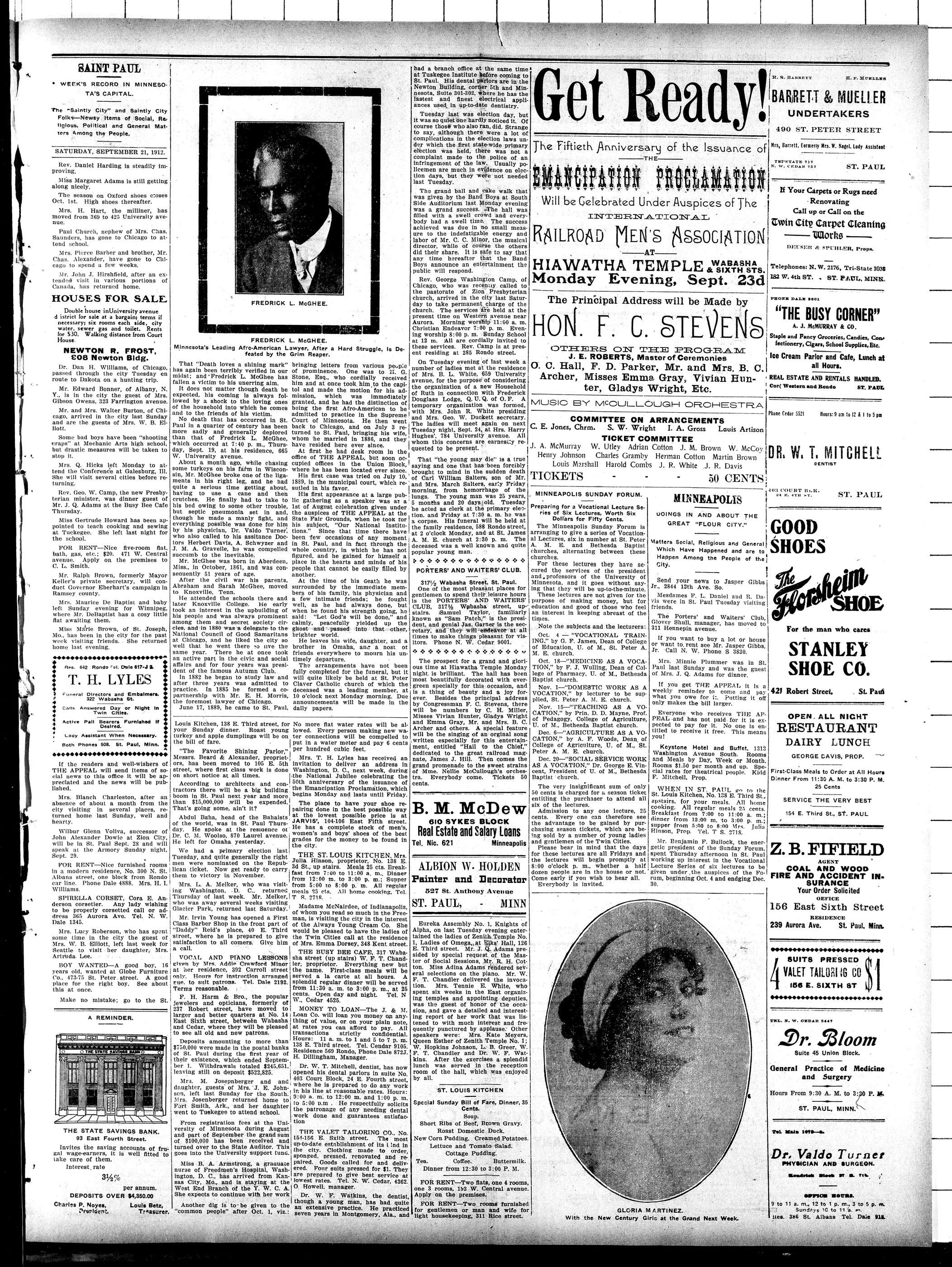
FREDRICK L. McGHEE.
Minnesota's Leading Afro-American Lawyer, After a Hard Struggle, is Defeated by the Grim Reaper.
That "Death loves a shinning mark" bringing letters from various people has again been terribly verified in our prominence. One was to H. G. midst; and Fredrick L. McGhee has Stone, Esq., who cordially received fallen a victim to his unerring aim him and at once took him to the capi. It does not matter though death be to tol and made the motion for his ad expected, his coming is always foll- mission, which was immediately loved by a shock to the loving ones granted, and he had the distinction of o of his husband into which he comes being the first Afro-American to be and to the fraternity of his victim. admitted to practice in the Supreme No death that has occurred in St. Court of Minnesota. He then went Paul in a quarter of century been in Chicago, and on July 3 re more sadly and generally deplored turned to St. Paul bringing his wife than that of Fredrick L. McGhee, whom he married in 1886, and they which occurred at 7:40 p. m. Thurs- have resided here ever since. day, Sept. 19, at his residence, 665 At first he had deak room in the W. University avenue.
About a month ago, while chasing some turkcys on his farm in Wisconsin, Mr. McGhee broke one of the ligaments in his right leg, and he had quite a serious time getting about, having to use a cane and then crutches. He finally had to take to his bed卧 to some other trouble, but septic pneumonia set in and, though he made a manly fight, and everything possible was done for him by his physician, Dr. Valdo Turner, who also called to his assistance Doctors Herbert Davis, A. Schweyer and J. M. A. Gravelle, he was compelled succumb to the inevitable. Mr. McGhee was born in Aberdeen, Miss., in October, 1861, and was consequently 51 years of age. After the civil war his parents, Abraham and Sarah McGhee, moved to Knoxville, Tenn.
He attended the schools there and later Knoxville College. He early took an interest in the upbuilding of his people and was always prominent among them and secret society circles, and in 1880 was a delegate to the National Council of Good Samaritans at Chicago, and he liked the city so well that he went there to live the same year. There he at once took an active part in the civic and social affairs and for four years was president of the famous Autumn Club. In 1882 he began to study law and after three years was admitted to practice. In 1885 he formed a co-partnership with Mr. E. H. Morris, the foremost lawyer of Chicago. June 17, 1889, he came to St. Paul,
Louis Kitchen, 138 E. Third street, for your Sunday dinner. Roast young turkey and apple dumplings will be on the bill of fare.
"The Favorite Shining Parlor," Messrs. Beard & Alexander, proprietors, has been moved to 105 E. 5th street, where first class work is done on short notice at all times.
According to architects and contractors there will be a big building boom in St. Paul next year and more than $15,000,000 will be expended. That's going some, ain't it?
Abdul Baha, head of the Bahais of the world, was in St. Paul Thursday. He spoke at the residence or Dr. C. M. Woolso, 70 Laurel avenue. He left for Omaha yesterday.
We had a primary election last Tuesday, and quite generally the right men were nominated on the Republican ticket. Now get ready to carry them to victory in November.
Mrs. L. A. Melker, who was visiting Washington, D. C., returned Thursday of last week. Mr. Melker, who was away several weeks visiting Glacier Park, returned last Saturday.
Mr. Irvin Young has opened a First Class Barber Shop in the front part of "Daddy" Reid's place, 40 E. Third street, where he is prepared to give satisfaction to all comers. Give him a call.
VOCAL AND PIANO LESSONS given by Mrs. Addie Crawford Minor at her residence, 392 Carroll street only. Hours for instruction arranged due to suit patrons. Tel. Dale 2192. Terms reasonable.
F. H. Harm & Bro., the popular jewelers and opticians, formerly of 237 Robert street, have moved to larger and better quarters at No. 14 East Sixth street, between Wabasha and Cedar, where they will be pleased to see all old and new patrons.
Deposits amounting to more than $750,000 were made in the postal banks of St. Paul during the first year of their existence, which ended September 1. Withdrawals totaled $245,651, leaving still on deposit $522,85.
Mrs. M. Josephberger and and daughter, guests of Mrs. J. E. Johnson, left last Sunday for the South. Mrs. Josephberger returned home to Fort Smith, Ark., and her daughter went to Tuskegee to attend school.
From registration fees at the University of Minnesota during August and part of September the grand sum of $100,000 has been received and turned over to the State Auditor. This goes into the University support fund.
Miss B. A. Armstrong, a graduate nurse of Freedman's Hospital, Washington, D. C., has arrived from Kansas City, Mo., and is staying at the West End Branch of the Y. W. C. A. She expects to continue with her work.
Another dig is to be given to the "common people" after Oct. 1, viz.
bringing letters from various people of prominence. One was to ii. G. Stone, Esq., who cordially received him and at once took him to the capitol and made the motion for his admission, which was immediately granted, and he had the distinction of being the first Afro-American to be admitted to practice in the Supreme Court of Minnesota. He then went back to Chicago, and on July 3 returned to St. Paul, bringing his wife, whom he married in 1888, and they had been here ever since. At first he desk room in the office of THE APPEAL, but soon occupied offices in the Union Block where he has been located ever since. His first case was tried on July 10, 1889, in the municipal court, which resulted in his favor.
His first appearance at a large public gathering as a speaker was as a list of August celebration given under the auspices of THE APPEAL at the State Fair Grounds, when he took for his subject, "Our National Institutions." Since that time there have been few occasions of any moment in St. Paul, and in fact through the whole country, in which he has not figured, and he gained for himself a place in the hearts and minds of his people that cannot be easily filled by another.
At the time of his death he was surrounded by the immediate members of his family, his physician and a few intimate friends; he fought well, as he had always done, but when he found his strength going, he said: "Let God's will be done," and calmly, peacefully yielded up the ghost and passed into that other, brighter world.
He leaves his wife, daughter, and a brother in Omaha, and a nost of friends everywhere to mourn his untimely departure.
The arrangements have not been fully completed for the funeral, but it will quite likely be held at St. Peter Claver Catholic church of which the deceased was a leading member, at 10 o'clock next Monday morning. Due announcements will be made in the daily papers.
No more flat water rates will be allowed. Every person making new water connections will be compelled to put in a water meter and pay 6 cents per hundred cubic feet.
Mrs. T. H. Lyles has received an invitation to deliver an address in Washington, D. C. next week, during the National Jubilee celebrating the 50th anniversary of the issuance of the Emancipation Proclamation, which begins Monday and lasts until Friday.
The place to have your shoe repairing done in the best possible way at the lowest possible price is at JARVIS' 104-106 East Fifth street. He has a complete stock of men's, women's and boys' shoes of the best grades for the money to be found in the city.
THE ST.LOUIS KITCHEN. Mrs. Julia Hinson, proprietor, No. 138 E. 3d St. up stairs. Meals 25 cts. Breakfast from 7:00 to 11:00 a.m. Dinner from 12:00 m. to 3:00 p. m. Supper from 5:00 to 8:00 p. m. All regular meals 25 cts. All home cooking. T. T. S. 2718.
Madame McNairdee, of Indianapolis, of whom you read so much in the Freeman, is visiting the city in the interest of the Always Young Cream Co. She would be pleased to have the ladies of the Twin Cities call at the residence of Mrs. Emma Dorsey, 348 Kent street.
THE BUSY BEE CAFE, 317 Wabash street (up stairs) W. F. T. Chandler, proprietor. Everything new but the name. First-class meals will be served a la carte at all hours. A splendid regular dinner will be served from 11:30 a. m. to 3:00 p. m. at 25 cents. Open day and night. N. W., Cedar 4525.
MONEY TO LOAN—The T. J. & M. Loan Co. will loan you money on anything of value, or on your plain note, at rates you can afford to pay. All transactions strictly confidential. Hours: 11 a. m. to 1 and 5 to 7 p. m. 138 E. Third street. Tel. Cendar 9105. Residence 569 Rondo, Phone Dale 872J. H. Dillingham, Manager.
Dr. W. T. Mitchell, dentist, has now opened his dental parlors in suite No. 403 Court Block, 24 E. Fourth street, where he is prepared to do any work in his line at reasonable rates. Hours: 9:00 a. m. to 12:00 m. and 1:00 p. m. to 5:00 p.m. He respectfully solicits the patronage of any needing dental work done and guarantees satisfaction
THE VALET TAILORING Co. No. 154-156 E. Sixth street. The most up-to-date establishment of its lnd in the city. Clothing made to order, sponged, pressed, renovated and repaired. Goods called for and delivered. Four suits pressed for $1. They are prepared to give best service at lowest rates. Tel. N. W. Cedar, 4362. O. Howell, manager. Dr. W. F. Watkins, the dentist, though a young man, has had quite an extensive practice. He practiced seven years in Montgomery, Al., and
had a branch office at the same time at Tuskegee Institute before coming to St. Paul. His dental patrons are in the Newington Building, corner 5th and Minnesota, Suite 301-302, where he has the lastest and finest electrical appliances used in up-to-date dentistry.
Tuesday last was election day, but it was so quiet one hardly noticed it. Of course those who also ran, did. Strange to say, although there were a lot of complications in the election laws unanimously which the district statewide primary election held there, complaint made to the police of an infringement of the law. Usually policemen are much in evidence on election days, but they were not needed last Tuesday.
The grand ball and cake walk that was given by the Band Boys at South Side Auditorium last Monday evening was a grand success. The hall was filled with a swell crowd and everybody had a swell time. The success achieved was due in no small measure to the indefatigable energy and labor of Mr. C. C. Minor, the musical director, while of course the others did their share. It is safe to say that any time hereafter that the Band Boys announce an entertainment the public will respond.
Rev. George Washington Camp, of Chicago, who was recently called to the pastorate of Zion Presbyterian church, arrived in the city last Saturday to take permanent charge of the church. At the present time the Western avenue near Aurora. Morning worship 11:00 a. m. Christian Endeavor 7:00 p. m. Evening worship 8:00 p. m. Sunday School at 12 m. All are cordially invited to these services. Rev. Camp is at present residing at 285 Rondo street.
On Tuesday evening of last week a number of ladies met at the residence of Mrs. B. L. White, 659 University avenue, for the purpose of considering the organization of a new Household of Ruth in connection with Frederick Douglass Lodge, Q. U. Q. of O.F. A temporary organization was formed, with Mrs. John R. W. presiding with Mrs. G. W. Duckett, the Ladies will meet again on next Tuesday night, Sept. 24, at Hrs. Harry Hughes', 784 University avenue. All whom this concerns are earnestly requested to be present.
That "the young may die" is a true saying and one that has been forcibly brought to mind in the sudden death of Carl William Salters, son of Mr. and Mrs. March Salters, early Friday morning, from hemorrhage of the lungs. The young man was 25 years, 5 months and 20 days old. Tuesday he acted as clerk at the primary election, and Friday at 7:30 a.m. m. he was a corpse. His funeral will be held at the family residence, 588 Wordsworth Street, York and at St. James A. M. E. church at 2:30 p. m. The deceased was a well known and quite popular young man.
PORTERS AND WAITERS CLUB.
317½ Wabasha Street, St. Paul.
One of the most pleasant places for gentlemen to spend their leisure hours is the PORTERS' AND WAITERS' CLUB, 317½ Wabasha street, upstairs. Samuel Taylor, familiarly known as "Sam Patch", is the president, and genial Jas. Garner is the secretary, and they will endeavor at all times to make things pleasant for visitors. Phone N. W. Cedar 9001.
The prospect for a grand and glorious time at Hiawata Temple Monday night is brilliant. The hall has been most beautifully decorated with evergreen speciality for this occasion, and is a thing of beauty and a joy forever. Besides the principal address by Congressman F. C. Stevens, there will be numbers by C. H. Miller, Misses Vivian Hunter, Gladys Wright, Mrs. M. McCullough, Mr. Archer and others. A special feature will be the singing of an original song written especially for this entertainment, entitled "Hail to the Chief," dedicated to the great railroad magnate, James J. Hill. Then comes the grand promenade to the sweet strains of Mme. Nellie McCullough's orchestra. Everybody come. Tickets 50 cents.
B. M. McDew
610 SYKES BLOCK
Real Estate and Salary Loans
Tel. Nic. 621 Minneapolis
ALBION W. HOLDEN
Painter and Decorator
527 St. Anthony Avenue
ST. PAUL, MINN
Eureka Assembly No. 1, Knights of Alpha, on last Tuesday evening entertained the ladies of Zenith Temple No. 1, Ladies of Omega, at Eks Hall, 126 E. Third street. Mr. J. Q. Adams presided by special request of the Master of Social Sessions, Mr. R. H. Cotton. Miss Adina Adams rendered several selections on the piano. Mr. W. F. T. Chandler delivered the invocation. Mrs. Tennie E. White, who spent six weeks in the East organizing temples and appointing deputies, was the guest of honor of the occasion, and gave a detailed and interesting report of her work that was listened to with much interest and frequently punctured by applause. Other speakers were: Mrs. Kate Meyers, Queen Esther of Zenith Temple No. 1; W. Hopkins Johnson, L. B. Greer, W. F. T. Chandler and Dr. W. F. Watkins. After the exercises a splendid lunch was served in the reception room of the hall, which was enjoyed by all.
ST. LOUIS KITCHEN
Special Sunday Bill of Fare, Dinner, 35
Cents.
Soup.
Short Ribs of Beef, Brown Gravy.
Roast Domestic Duck.
New Corn Pudding. Creamed Potatoes.
Lettuce and Tomato Salad.
Cottage Pudding.
Tea. Coffee. Buttermilk.
Dinner from 12:30 to 3:00 P. M.
FOR RENT—Two flats, one 4 rooms,
one 3 rooms, 152 W. Central avenue.
Apply on the premises.
FOR RENT—Two rooms furnished
for gentlemen or man and wife for
light housekeeping, 311 Rice street.
Get Ready!
HIAWATHA TEMPLE WABASHA & SIXTH STS. Monday Evening, Sept. 23d
OTHERS ON THE PROGRAM
J. E. ROBERTS, Master of Ceremonies
O. C. Hall, F. D. Parker, Mr. and Mrs. B. C.
Archer, Misses Emma Gray, Vivian Hunter, Gladys Wright, Etc.
MUSIC BY McCULLOUGH ORCHESTRA
J. A. McMurray W. Utley Adrian Cotton J. M. Brown W. McCoy Henry Johnson Charles Gramby Herman Cotton Martin Brown Louis Marshall Harold Combs J. R. White J. R. Davis
GLORIA MARTINEZ
MINNEAPOLIS SUNDAY FORUM.
Preparing for a Vocational Lecture Series of Six Lectures, Worth Six Dollars for Fifty Cents.
The Minneapolis Sunday Forum is arranging to give a series of Vocational Lectures, six in number at St. Peter A. M. E. and Bethesda Baptist churches, alternating between these churches.
For these lectures they have secured the services of the president and professors of the University of Minnesota, and it goes without saying that they will be up-to-the-minute.
These lectures are not given for the purpose of making money, but for education and good of those who feel an interest in keeping abreast of the times.
Note the subjects and the lecturers:
Oct. 4 — "VOCATIONAL TRAINING." by G. F. James, Dean of College of Education, U. of M., St. Peter A. M. E. church.
Oct. 18—"MEDICINE AS A VOCATION," by F. J. Wulling, Dean of College of Pharmacy, U. of M., Bethesda Baptist church.
Nov. 1—"DOMESTIC WORK AS A VOCATION," by lecturer to be supplied, St. Peter A. M. E. church.
Nov. 15—"TEACHING AS A VOCATION," by Prin. D. D. Mayne, Prof. of Pedagogy, College of Agriculture, U. of M., Bethesda Baptist church.
Dec. 6—"AGRICULTURE AS A VOCATION," by A. F. Woods, Dean of College of Agriculture, U. of M, St. Peter A. M. E. church.
Dec. 20—"SOCIAL SERVICE WORK AS A VOCATION," Dr. George E. Vincent, President of U. of M., Bethesda Baptist church.
The very insignificant sum of only 50 cents is charged for a season ticket entitling the purchaser to attend all six of the lectures.
Admission to any one lecture, 25 cents. Every one can therefore see the advantage to be gained by purchasing season tickets, which are being sold by a number of young ladies and gentlemen of the Twin Cities. Please bear in mind that the days for these lectures are all Fridays and Saturdays, but at 8:00 o'clock p.m. whether a half dozen people are in the house or not. Come early if you wish to hear all. Everybody is invited.
MINNEAPOLIS
DOINGS IN AND ABOUT THE
GREAT "FLOUR CITY."
Matters Social, Religious and General
Which Have Happened and are to
Happen Among the People of the
City.
Send your news to Jasper Gibbs
Jr., 2844 12th Ave. So.
Mesdames F. L. Daniel and R. Davis were in St. Paul Tuesday visiting
friends.
The Porters' and Waiters' Club,
Glover Shull, manager, has moved to
311 Hennepin avenue.
If you want to buy a lot or house
or want to rent see Mr. Jasper Gibbs,
Jr. Call N. W. Phone S 3830.
Mrs. Minnie Plummer was in St.
Paul last Sunday and was the guest
of Mrs. J. Q. Adams for dinner.
If you get THE APPEAL it is a weekly reminder to come and pay what you owe for it. Putting it off only makes the bill larger.
Everyone who receives THE APPEAL and has not paid for it is expected to pay for it. No one is entitled to receive it free. This means you!
Keystone Hotel and Buffet, 1312 Washington Avenue South. Rooms and Meals by Day, Week or Month. Rooms $1.50 per month and up. Special rates for theatrical people. Kidd F. Mitchell, Prop.
WHEN IN ST. PAUL go to the St. Louis Kitchen, No. 138 E. Third St. aparts, for your meals. All home cooking. All regular meals 25 cents. Breakfast from 7:00 to 11:00 a.m.; dinner from 12:00 m. to 3:00 p.m.; supper from 5:00 to 8:00 Mrs. Julia Hinson, Prop. Tel. T. 721. 2718
Mr. Benjamin F. Bullock, the energetic president of the Sunday Forum, spent Thursday afternoon in St. Paul working up interest in the Vocational Lecture Series of six lectures to be given under the auspices of the Forum, beginning Oct. 4 and endging Dec. 30.
490 ST. PETER STREET
Mrs. Barrett, Formerly Mrs. W. Nagel, Lady Assistant
TRESTATE 717
N. W. CEDAR 757
ST. PAUL
If Your Carpets or Rugs need
Renovating
Call up or Call on the
Twin City Carpet Cleaning
Works
DEUSER & SPUHLER, Props.
Telephones: N. W. 2176, Tri-State 1038
182 W. 4th ST. ST. PAUL, MINN.
"THE BUSY CORNER"
Staple and Pancy Groceries, Candies, Confectionery, Cigars, School Supplies, Etc.
Ice Cream Parlor and Cafe, Lunch at all Hours.
REAL ESTATE AND RENTALS HANDLED.
Cor( Western and Rondo
ST. PAUL
Phone Cedar 5521 Hours: 9 am to 12 & 1 to 5 pm
DR. W. T. MITCHELL
DENTIST
403 COURT B.K.
24 E. 4TH ST.
ST. PAUL
GOOD
SHOES
The Horsheim SHOE
For the man who cares STANLEY SHOE CO.
421 Robert Street. St. Paul
OPEN. ALL NIGHT RESTAURANT DAIRY LUNCH
First-Class Meals to Order at All Hours
Dinner From 11:30 A. M. to 3:30 P. M.
25 Cents
SERVICE THE VERY BEST
154 E. Third St., ST. PAUL
Z.B.FIFIELD
AGENT
COAL AND WOOD
FIRE AND ACCIDENT INSURANCE
Your Order Solicited
OEFICE
156 East Sixth Street
RESIDENCE
239 Aurora Ave. St. Paul, Minn.
SUIT8 PRESSED
VALET TAILORING CO
156 E. SIXTH ST
TRL. N. W. CEDAR 5447
Dr. Bloom
Suite 45 Union Block.
General Practice of Medicine
and Surgery
Hours From 9:30 A. M. to 3:30 P. M.
ST. PAUL, MINN.
SAINT PAUL
The Postal Savings Bank is open evenings daily from 9 to 7:30, and on Saturday until 9 o'clock p. m.
Anyone wish any sheet metal work done would do well to call on Ed. Hinderer & Son. See ad elsewhere.
Make money easy at home corresponding for newspapers; experience necessary. Send stamp for particulars. Empire Press Syndicate, Midport, N. Y.
Dr. Valdo Turner has moved his office from the second to the fourth floor of the Kendrick block, suite 400, where he has more commodious and desirable offices.
Anyone wishing to purchase a fine Tuxedo suit for a low price is requested to call at THE APPEAL office for further particulars. Size 42 for a man about 5 feet 6 inches in height. This is a snap.
A SNAP—Don't let this get away from you. A fine, New York make, upright piano that cost $250,00, for sale for $50 down and $50 in installations. Apply at Minnesota Realty Co., 516 New York Life Bldg. Both phones 1199.
PROF. C. S. PATTY'S HERB MEDICINES can be held only at the corner of University avenue and Mackubi street. If you are not feeling well it will certainly be worth your while to learn about these remedies. Tristate Phone 5732
The members of the International Railroad Men's Association are preparing to celebrate the 50th anniversary of the issuance of Lincoln's Emancipation Proclamation at Hiawana Temple, on Monday evening, Sept. 23. Further particulars next week.
If you haven't lately visited George Davis' Restaurant and Dairy Lunch, No. 154 E. Third street, you are missing something. His cook now is Miss Sarah Towles, and the toothsome meals she gets up can't be beat. Just go and try the regular dinner once and you'll go again. Dinner 25 cents.
SAFE DEPOSIT AND STORAGE VANILLS—We invite your inspection it costs little to place your papers cash securities and valuations in safe safety. Boxes in our vans can be had for $4 per year. Store your boxes, trunks, etc., with us. North western Trust Co., 138 Endicott Arcade.
Why not patronize the business houses that invite you to trade with them through their advertisements in THE APPEAL? They are helping to support your paper, show them that you believe in helping those who help you, or your enterprises. Trade with the people who advertise in THE APPEAL.
Dr. W. F. Watkins, the new dentist, has completed the furnishing and fitting of his new dental parlor, Suite 301-302 Newton building, corner Fifth and Minnesota. He has a very nice reception room with elegant furniture, while in the operating room he has the latest up-to-date electric appliances and is prepared to do any work in the line of dentistry. The public is cordially invited to call and inspect the parlor.
BARRETT & MUELLER
Undertakers, 490 St. Peter Street
One of the comparatively new undertaking establishments of St. Paul is that of Barrett & Mueller, No. 490 St. Peter street, as the firm began business only last June, but the members of the firm are experts in the business. Mr. Barrett has been in the profession over seven years and was formerly manager of the well and favorably known Nagel Undertaking Co. Mr. Mueller has been in the business for over nine years and was formerly with the firm of Mueller Bros., on Dayton Bluff. Mrs. Barrett, formerly Mrs. Wm. Nagel, is the lady attendant. The patronage of the readers of THE APPEAL is solicited. We guarantee satisfactory service and prices.
"NEW CENTURY GIRLS."
The Attraction at the Grand Next Week
At the Grand for the week commencing Sunday matinee, September 22, with daily matinees, a genuine novelty in the way of burlesque entertainment, to be presented by a large aggregation styled "The New Century Girls," which, by the way, is claimed to be a gathering of pretty, talented girls and a dozen comedians who by first rate quality of humor invite auditors to frequent laughter during the unraveling of the ludicrous complications that take place in "A Busy Day at a Union Station" and "Lord's Reception," which are the names of the two burlesques arranged and staged by the popular comedian, Ted Burns, who plays the principal comedy role in both. The costumes and scenic investitures throughout are impressives, and better voices could not be demanded from the chorus, which is both young and comely, and who sings with pleasing effect. For the benefit of those who demand a plot there is one in both burlesques, but it is sometimes difficult to keep track of, owing to the frequency of the introduction of pretty musical numbers by the entire company. Among the principals, who are all well known to the patrons of this style of amusement will be found Gloria Martinez, who has won the title of "the handsomest girl in burlesque"; Pearl Reid, "the dainty little singer"; Ribbock Rockway, Chas. Saunders and the Notional City Four.
The Negro Year Book and Annual Encyclopedia.
The Negro Year Book has just been published under the auspices of Tuskegee Institute. Among the subjects treated in the work are:
"A Review of the Negro in 1911."
"The Economic Progress of the Negro."
"The Negro in the Religious Field."
"Negro Education."
"Negro Soldiers and Heroes."
"A Chronological History of the Negro in America."
It contains much valuable information in a concise and systematic form. It is bound in paper and has 229 pages. Price 25 cents, postage 5 cents
Address Negro Year Book Co, Tuskegee Institute, Ala.
ALBION W. HOLDEN—Fine house painting, hand oil finishing, varnishing, staining, wall tinting etc, done on short notice. First class, durable work guaranteed. General repairing and jobbing of all kinds. Send or leave orders at 527 St. Anthony Ave. or telephone Dale 2055. Estimates furnished.
SIMPLY OLD ENGLISH TONGUE
Interesting Account of the Origin of What Is Known as the Irish "Brouge."
Perhaps nothing illustrates better the vicissitudes of pronunciation in English then a study of what is called the "Irish brogue." This lingual mode, for it is scarcely to be called a dialect, is usually presumed to be a deterioration of language due to lack of education and contact with legitimate sources of English. It proves after a little study to be a preservation of the old method of pronouncing English, which has come down to a great degree unchanged in Ireland from Shakespeare's time.
In Elizabeth's time, however, it came to be realized that if there was to be any real affiliation of the two countries, then the Irish language must be supplanted by English, and a definite effort in this direction was made. This change of speech, resented and resisted, was nevertheless successfully accomplished all over the island, except in the west, within a decade after Shakespeare's death. This fact takes on a new significance when we study what we now call the Irish brogue in connection with what is known to have been the pronunciation of English at that time. The two are found to conform in practically every respect. Irishmen pronounce English as their forefathers learned it; and have preserved their pronunciation because they have been away from the main current of English speech variation ever since.—James J. Walsh, LLD., in Harper's Magazine.
PATTERN BY UNITED STATES
Nations of the World All Eager to Copy the American Form of Government.
"Present purposes are accomplished when attention is called to the fact that under our form of government as our fathers gave it to us, and as their sons perfected it, this nation has enjoyed a prosperity that has excited the wonder and the admiration of the world, and that our form of government has become so popular that other nations are striving to follow our example. In consequence, we have republican governments everywhere to the south of us throughout the western hemisphere. France has followed our example closely. Germany has a written constitution, and, in the Reichstag, untrammed parliamentary representation for the people, while such countries as Turkey, Persia and China are all taking steps, as rapidly as they can, to follow our example in providing a form of government under which men has been able to demonstrate his capacity for self-government."—Joseph B. Foraker.
London Stops Piling Up
London, biggest of the world's cities, is growing smaller. That is, fewer people are living within the actual working districts—the congested districts—than lived there ten years ago. The decrease is small, only twenty-nine-one-hundredths per cent, but it marks the turn of the tide.
London is moving to the suburbs, spreading out on the land, where its children may play in the sunshine—thanks to the "tubes," tramways, electric railways and motor buses.
There is a point, then, beyond which population will not be heaped on population; a point where it will began to spread out instead of to pile up. London has reached that point.
This is a new tendency, and a wholesome one, 'in the life of the world.
The Western Taste
A senator who represents a state in the middle west and who is immensely rich was going over the details of a dinner with a Washington steward, says Drury Underwood in the Chicago Post. It was his first formal entertainment and he wanted to be sure that everything was right.
The steward had the menu written in French and was translating it on request.
"What's that?" said the senator, pointing to a headliner.
"Oysters on the half shell," explained the expert.
"Oh, that won't do at all," objected the senator. "Give 'em a stew."
Drinking Water.
During the hot season particularly, one should drink a great, quantity of water—at least one quart a day. The beneficial effect of taking a glass of clear, cold water on arising and before retiring, as well as between meals during the day, will become speedily and happily manifested in a clearer complexion, brighter, new physical, and mental activity and life. Pronounced cases of constipation will be overcome by eating fruit, such as apples, figs, dates and prunes, and by drinking plenty of water.
Classified
"And the law of supply and demand—"
"Tut, tut!" rejoined Mr. Dustin Stax, "that's one of those unwritten laws that are considered only in exceptional cases."
Mutual Distrust.
"That new salesman is giving you quite an argument."
"Yes," replied Senator Sorgbum. "It's the same old story. He thinks we need reformation and we think he needs information."
CHILDREN TEETHING
Mrs. Winslow's Soothing Syrup has been used for over fifty years by millions of mothers for their children while teething, with perfect success. It soothes the child, softens the gums, allays all pain, cures wind colic and is the best remedy for diarrhea. Sold by drugists in every part of the world. Be sure and ask for "Mrs. Winslow's Soothing Syrup" and take no other kind. Twenty-five cents a bottle.
Excellent in south-facing lot on Rondo bibbies and Kent. Must be sold at once. Price is right. Call Cedar 4001 or Tri-State 3694.
THE SIN OF SILENGE
To sin by silence when we should protest makes cowards out of men. The human race has climbed on protest. Had no voice been raised against injustice, ignorance and lust, the inquisition yet would serve the law, and guillotines decide our least disputes. The few who dare must speak and speak again to right the wrongs of many.—Ella Wheeler Wilcox.
HARM
CLASSES
EYE DEFECTS AND SYMPTOMS.
To sin by silence when we should protest makes cowards out of men. The human race has climbed on protest. Had no voice been raised against injustice, ignorance and lust, the inquisition yet would serve the law, and guillotines decide our least disputes. The few who dare must speak and speak again to right the wrongs of many.—Ella Wheeler Wilcox.
HARM
CLASSES
EYE DEFECTS AND SYMPTOMS.
Mya defects are few—symptoms many.
There can be but two defects in the human eye.
The eye may be too long in whole. Then we have theopic eye.
Or too short in whole—the Hyperopic eye.
Combine the two in one eye and we have Astigmatism.
Properly adjusted glasses will correct these defects.
Medicines or waiting, never.
Symptoms that spring from these two simple eye mali-nations are manifold; such as eye and, headaches, Indi-tion, Dyspepsia, Nervous Debility, Chorea, Epilepsy and er ailments having their origin in lack of nerve force.
We correct all Defects of the human eye that glasses remedy. Charges reasonable. Satisfaction guaranteed.
HARMS OCULO CURES SORE EYES 25c PER BOTTLE.
F. H. HARM & BRO.
OPTICIANS.
14 EAST SIXTH STR
"You too?"
Everyone smokes the strictly High Grade
DUKE OF PARMA CIGARS
HART & MURPHY,
MNFRS. ST. PAUL, MINN.
N. W. 940 Telephones T. S. 789
PAUL STEAM LAUNDRY!
"The Sanitary Laundry"
W. B. Webster, Prop.
First Class Work at Right Prices
Called for and Delivered
291 Rice Street ST. PAUL
Theeye may be too long in whole. Then we have the Myopic eye.
Or too short in whole—the Hyperopic eye.
Combine the two in one eye and we have Astigmatism.
Properly adjusted glasses will correct these defects.
Medicines or waiting, never.
Symptoms that spring from these two simple eye malformations are manifold; such as eye and headaches, Indigestion, Dyspepsia, Nervous Debility, Chorea, Epilepsy and other ailments having their origin in lack of nerve force.
We correct all Defects of the human eye that glasses will remedy. Charges reasonable. Satisfaction guaranteed.
HARMS OCULO CURES SORE EYES 25c PER BOTTLE
"You too?"
Everyone smokes the
strictly High Grade
DUKE OF
PARMA
CIGARS
HART & MURPHY,
MNFRS. ST. PAUL, MINN.
ST. PAUL STEAM LAUNDRY!
"The Sanitary Laundry"
W. B. Webster, Prop.
First Class Work at Right Prices
Called for and Delivered
289-291 Rice Street
ST. PAUL
If you see furs you like Anywhere else You'll find them better At Albrecht's Sixth and Minnesota Streets
Telephone Cedar 9143
URLEY'S BAR"
122 East Third Street
finest Brands of Imported and Domestic
Wines, Liquors and Cigars
N. C. CAMPBELL, Prop.
or. Third and Robert
ST. PAUL
N. YOUNG & CO.
ST. PAUL
A Complete Assortment of Woolens for Men Fine Dress Suits a Specialty
All the Year
Hamm's
BEER
"Leads Them All"
EITHER PHONE 935
Dimes are little young dollars. They grow only when locked up together. Treat yourself to a savings account and prove it to your own satisfaction. "Planted" dollars will add to your earnings.
THE BOSTON EDITOR
Dimes are little you
ly when locked up toge
eavings account and pro
tion. "Planted" dollar
ings.
THE STATE S
93 East F
M. B.
FOR FIRST CLASS TONSORIAL WORK
GO TO
Shaving, Hair-Cutting, Shampooing, Electric Head and Face Massage, Manuring, Sanitary Baths, Shoes Polished
KINK-NO-MORE FOR SALE $1.00 PER BOX
HAIR STRAIGHTENING A SPECIALTY
MAKE NO MISTAKE, JUST SMOKE
Sight Draft
THE VERIBEST FIVE CENT CIGAR
CITATION FOR HEARING ON PETITION FOR ADMINSTRATION,
State of Minnesota, County of Ramsey,
use in Public Court,
In the Matters of the Estate of George
Brown, Decedent
The State of Minnesota to All Whom It May Concern:
The petition of Jerusha Brown Dorsey having been filed in this Court, representing that George Brown, then a resident Minnesota, died intestinaly on day of June, 1912, and praying that letters of administration be granted to Matthew It Is Ordered, That said petition be heard and that all persons interested in said letter be and hereby be cited and addressed to the Probate Court, Monday, the 9th day of September, 1912, at 10 o'clock in the forenoon or as soon as Monday, the 9th day of September, 1912, at the Probate Court Room, in the Court House in the City of St. Paul, in said County, and show cause, if any they have been granted and that this citation be served by the publication thereof in the Appeal Court, and if any they have been granted and that this citation at least 14 days before said day of hearing, to each of the heirs and decedent whose names and addresses appear from the file of this court.
Witness the Judge of said Court, this
13th day of August, A.D. 1912
E. W. BAZILLE.
Judge of Probate.
(Seal of Probate Court.)
Attest:
F. W. GOSEWICH.
Clerk of Probate.
W. T. FRANCIS.
Attorney.
C. H. ROBINSON, GRAND MASTER.
3635 Clinton av. Minneapolis.
M. A. BOLLING, GRAND SECRETARY.
892 W. Central Avenue.
PIONEER LODGE NO. 1. F. AND A. M. Meets first and third Monday of each month at Wagner Hall, cor. Western Ave. and Charles street at 8:00 p. m. Noble Pryor. W. M.: J. H. Charleston Secy., 636 W. University.
PERFECT ASHLAR LODGE NO. 4. F. and A. M. Meets second and fourth Wednesday at Wagner Hall, cor. Western Ave. and Charles street at 8 p. m. F. B. Simpson, W. M. J. E. Murphy Secy., 1354 Thomas street.
BETHEL CHAPTER NO. 28 R. A. M. Meets second Thursday in each month at Wagner Hall, corner Western and Charles street. W. T. Joyce, F. C.; John Sayles, Sec. 479 Rondo street.
MARS LODGE NO. 2202 G. U. O. of O. F. meets second and fourth Wednesday nights at a Odd Fellows Hall. 221 West University, North Carolina, P.C. Archer. Entrance of Farrington, B.C. Archer, N.G., J. Wesley Kelly, P. G., 950 St. Anthony Ave.
HOUSEHOLD OF RUTH, NO. 553 G U.S.A. of O. F. meets first and third Monday in each month.
H.S.S. G.U.O. meets the second and fourth Friday in each month.
Odd Fellows Hall. 221 W. University, corner Farrington. Entrance on Farrington, W.M.R. Morris, W.G.M.; Thos. R. Hickman, G. S., No. 422 St. Anthony Avenue.
ST. PAUL PATRIARCHY NO. 114 meets second Monday in each month at Odd Fellows Hall, 221 University, corner Farrington. Entrance on Farrington, W.M.R. Morris, W.G.M. (acting) R.V. P.W. Morris, F.M. W. F.; G.O. B. Lowe, W.P.R. 1784 Wabasha.
MINNEAPOLIS.
HOUSEHOLD OF RUTH NO. 776 G.U.O. meets second and fourth Tuesday in each month at Odd Fellows Hall, Cor. Fourth Street and Eighth Ave. South, Mrs. S. Darager, M. N. G.; Miss Cora. Napier. W. R.
UNITED BROTHERS OF FRIENDSHIP
NORTH STAR LODGE NO. 138. U. R.
Meets first Thursday in each month at
Wagner Hall, on West Ester, oo and
Charles street. Brothers go oo and
standing welcome. O. Howell. W. M.
J. O. Adams, W. S., 49 E. 4th St.
RANDY S. LODGE NO. 3. U. B. F.
Meets and Friday in each month at
Wagner Hall, cor. Western Ave. and
Charles Street. Brothers in good stand-
ing always welcome. M. A. Davis, W.
M. A. D. Adams, W. S., 411 Charles
Street.
JOHN H. HAYES LODGE NO. 6 K. O. F.
Meets first and third Tuesday in each
month at Castle Hall 221 W. Unit
versity cor. Farrington. Farrington in
standing allowance. Pythias in good
standing allowance. James Thomas, C. J.; Asa.
H. Henderson, V. C.; 148 E. 9th
R. J. James, K of R.
and S. 321 St Albans street.
BIDDLE CIRCLE, LADIES OF G. A.
R. meets first and third Tuesdays of each
month. Supply Room, oo and old cap
building. M. M. J. Locusts Pric-
Mr. J. R. White, Secy. Phoenix Bldg.
FIDELITY COURT OF CALANTHEN
No. 345, N. A., S. A., E. A., A. A. and
A. A. and third Monday in each
month at K. A., 25th Ave. Ave.
Ave. Napoleonis. Mrs. Minerva
E. Barnett. W. C.; Miss Arlene M. Scott,
R. of D. 25, W. 29th St.
PLIGHM BAPTIST CHURCH, Cog-
path and Cedar. Sunday services: Presc-
chool at 12:30 o'clock. Friday school
at 12:30 o'clock. Wednesday general prayer meeting. Friday rea-
ning general prayer meeting. Friday rea-
ning and Sunday school meeting. Fun-
eral and wedding ceremony attended. Rev.
E. H. McDonald, Pastor.
For Mothers
Digesto
A
MALT AND HOP TONIC:
"Every drop
a help to
Health"
You are always welcome at—
CONGER BROS.
DRUG STORES
349 University Ave. and 501 Selby Ave.
The Best Goods for the Least Money
The Wise Ones Deal at Conger's.
N. W. DALE 3454 T. S. 5730
Anyone quickly as invention times store sent from Patents special code
Scie
A handson simulation of your MUNN Branch
Rondo & Dale Sts. ST. PAUL
---
MOTHER AND CHILD
#
MAIDONLY BY
THEQ HAMM BREWING CO.
BRIAN HAMM
SOLD BY ALL DRUGGISTS
Brotchner's Pharmacy
MEET ME AT—
CHOICEST WINES, LIQUORS AND CIGARS
Tri-State Phone 5004
Cor. Dale and University, - ST. PAUL
二思
AYES LODGE No. 6 K OF F.
Meets first and third Tues-
castle Hall, W. University
Castle Hall 24, W. University
cor. Cor. Farrington,
standing in good
standing always
James Thomas, C. C.; Jas. A.
Henderson, C. C.; 148 E 9th
K of R St Albans street,
St Albans street,
GOPHER LODGE NO. 105. I. B. P. O.
B. of the Shearland, meets second and
third floor of the Hall.
Hall. No. 128 East Third street. B.
Paul, J. R. White. E. R. Richard M.
Johnson, Seec., 572 Kent.
ST. JAMES' A. M. E. CHURCH, COR-
PULER of the streets. Sunday services,
11:00 a.m.; 1:30 p.m. Meeting, 8:00
meeting, 8:00 p.m. Pastor vide-
on, 8:00 p.m. Pastor vide-
on on Monday, Wednesdays, Wednes-
days and Thursday, Wednesdays, "June
and the skid attended on notice.
Rev. H. P. Jones, Pastor.
Parsonage, Cor. Jay and Fuller
ST. PHILIP'S EPISCOPAL MISSION
corner Aurora avenue and Machubli street
Eumhairy, 7:30 a.m. Early celebration of Holy
Eumhairy, Holy Eumhairy, first and third sundays
1:30 a.m. m. Matins, second and fourth
Sundays, 6:30 a.m. Sunday school, 12:30
a.m. D. Brotherhood of Mary, 6:30 a.m.
Vespers, 7:30 p.m. Wec. services,
wednesdays, congregation class, 5:00 p.m.
Friday, worship prayer, 8:00 p.m. Satur-
days Holy Eumhairy, 8:00 a.m. M. Rev.
A. H. Leathead, Rector, 514 Fuller St.
50 YEARS
EXPERIENCE
DATENTS
TRADE MARKS
DESIGNS
COPYRIGHTS & C.
Anyone sending a sketch or our opinion free whether an
information strictly confidential. Handbook free.
Oldest agency for securing patents.
Inout taken through us. Receive special
notes, without charges, in the
A handsomely illustrated weekly. Largest retaliation of any scientific journal. Terns, $2 a month. MUNN & Co. 631 Broadway. New York Branch Office, Co. 53 F. W. Stashington, D.C.
General Meat Dealers
Blue Ribbon Hams and Bacon
U. S. Government inspection of all Cattle, Hogs
and Sheep
Family, Hotel and Restaurant
Trade a Specialty
457-459 St. Peter
Saint Pual
and the Real Puzzle.
The puzzle is not whether Bacon or Shakespeare wrote the plays, but that one person could get them all accordi-