The Appeal
Saturday, October 5, 1912
St. Paul, Minnesota
Page text (machine-generated)
THE APPEAL KEEPS IN FRONT
BECAUSE:
1-It aims to publish all the news possible.
2-It does so impartially, weaving no words.
3-Its correspondents are able and energetic.
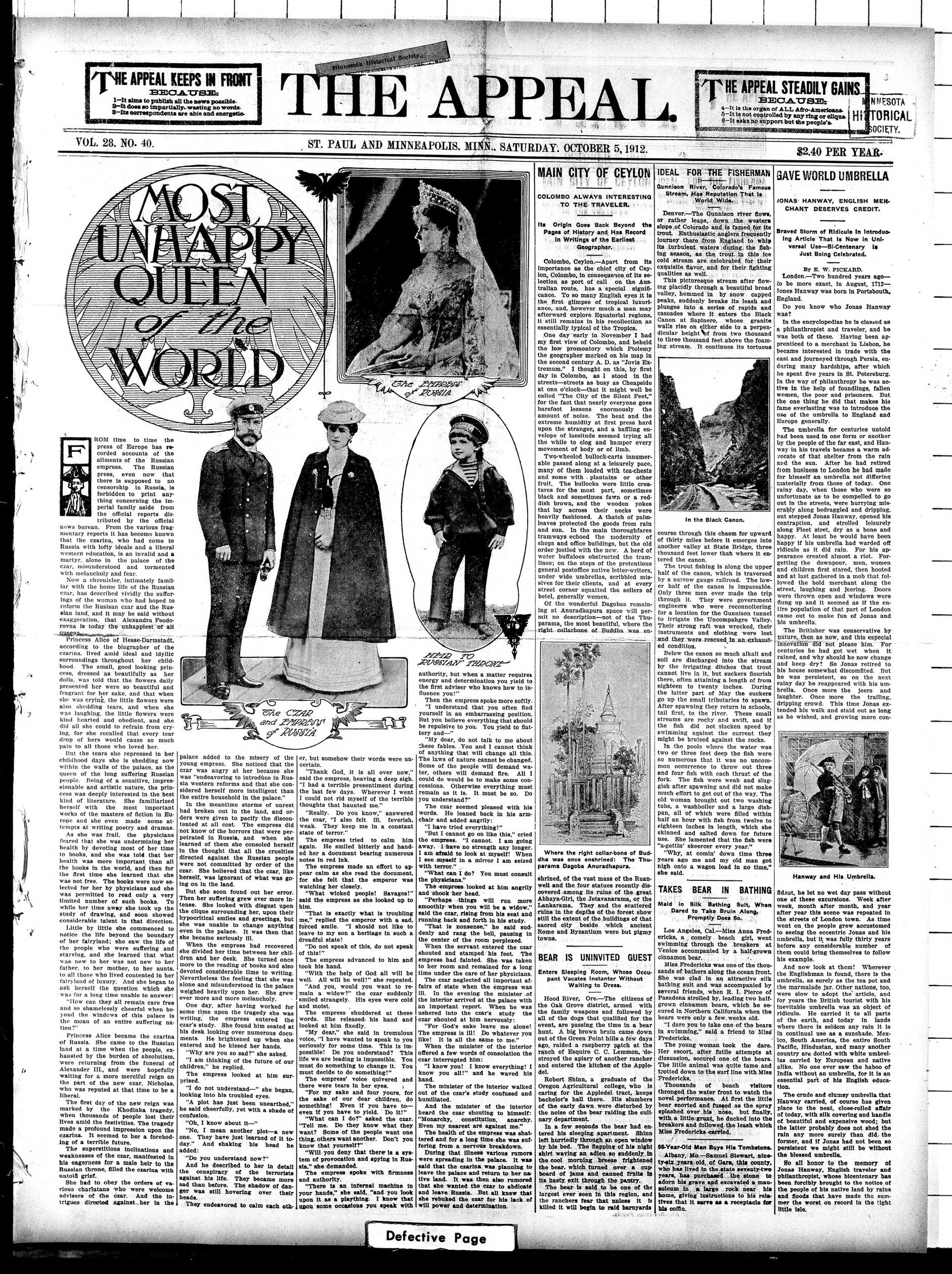
MOST
UNHAPPY
QUEEN
of the
WORLD
The PATRONS
of POROSIA
VOL. 28. NO. 40.
F
ROM time to time the press of Europe has recorded accounts of the alliments of the Russian empress. The Russian press, even now that there is supposed to no censorship in Russia, is forbidden to print anything concerning the imperial family aside from the official reports distributed by news bureau. From the various fragmentary reports it has become known that the czarina, who had come to Russia with lofty ideals and a liberal western education, is an invalid and a martyr, alone in the palace of the czar, misunderstood and tormented with melancholy and fear. Now a chronicler, intimately familiar with the home life of the Russian czar, has described vividly the sufferings of the woman who had hoped to reform the Russian czar and the Russian emperor, and it may be said without exaggeration, that Alexandra Peodrova is the unhappiest of all queens.
Princess Alice of Hesse-Darmstadt, according to the biographer of the earlina, lived amid ideal and idyllic surroundings throughout her childhood. The small, good looking princess, dressed as beautifully as her dolls, was told that the flowers daily presented her were so beautiful and fragrant for her sake, and that when she was crying, the little flowers were drenched, and when she was laughing, the flowers were kind hearted and obedient, and she did all she could to retrain from crying, for she recalled that every tear drop of hers would cause so much pain to all those who loved her. But the tears she repressed in her childhood days she is shedding now within the walls of the palace, as the queen of the long suffering Russian people. Being of a sensitive, impressionable and artistic nature, the princess was deeply interested in the best kind of literature. She familiarized with the many important works of the memoirs of fiction rope and even made some attempts at writing poetry and dramas. As she was frail, the physicians feared that she was undermining her health by devoting most of her time to books, and she was told that her health was more important than all the books in the world, and then for the first time she learned that she was not free. The books were now selected for her by physicians and she was permitted to read only a very limited number of such books. To this day, she is still in the study of drawing, and so shows considerable talent in that direction.
Little by little she commenced to notice the life beyond the boundary of her fairyland; she saw the life of the people who were suffering and starving, and she learned that what was new to her was not new to her father, to her mother, to her aunts, to all those who lived content in her fairyland of luxury. And she began to ask herself the question which she was for a long time unable to answer: "How can they all remain care free and so shamelessly cheerful when beyond the windows of this palace is the mean of an entire suffering nation." Princess Alice became the czarina of Russia. She came to the Russian land at a time when the people exhausted by the burden of absolutism were returning from the funeral of Alexander III, and were hopefully waiting for a more merciful reign on the part of the new czar, Nicholas, who was reputed at that time to be a liberal.
The first day of the new reign was marked by the Khodinka tragedy, when thousands of people lost their lives amid the festivities. The tragedy made a profound impression upon the czarina. It seemed to her a foreboding of a terrible future.
The superstitious inclinations and weaknesses of the czar, manifested in his eagerness for a male heir to the crown, filled the czarina with untold grief.
She had to obey the orders of various charitans who were welcome advisers of the czar. And the intrigues directed against her in the
---
HPD TO
palace added to the misery of the young empress. She noticed that the czar was angry at her because she was "endearable to introduce in Russia western reforms and that she considered herself more intelligent than the entire household in the palace."
In the meantime storms of unrest had broken out in the land, and orders were given to pacify the discontented at all cost. The empress did not know of the horrors that were perpetrated in Russia, and when she found them she consoled herself in the thought of the politician directed against the Russian people were not committed by order of the czar. She believed that the czar, like herself, was ignorant of what was going on in the land.
But she soon found out her error. Then her suffering grew ever more intense. She looked with disgust upon the clique surrounding her, upon their hypocritical smiles and greetings, but she was unable to change anything even in the palace. It was then that she became seriously ill.
When the empress had recovered she divided her time between her children and her desk. She turned once more to the reading of books and also devoted considerable time to writing. Nevertheless the feeling that she was understood in the palace weighed heavily. She grew ever more and more melancholy.
One day, after having worked for some time upon the tragedy she was writing, the empress entered the czar's study. She found him seated at his desk looking over numerous documents. He brightened up when he entered and he kissed her hands.
"Why are you so sad?" she asked. "I am thinking of the future of our children." he replied. The empress looked at him surprised.
"I do not understand—" she began, looking into his troubled eyes.
"A plot has just been unearthed," he said cheerfully, yet with a shade of confusion.
"Oh, I know about it—"
"No, I mean another plot—a new one. They have just learned of it today." And shaking his head he added:
"Do you understand now?"
And he described to her in detail the conspiracy of the terrorists against his life. They became more sad than before. The shadow of danger was still hovering over their heads.
They endeavored to calm each oth-
THE APPEAL.
Defective Page
er, but somehow their words were uncertain.
"Thank God, it is all over now," said the empress, heaving a deep sigh. "I had a terrible presentment during the last few days. Wherever I went I could not rid myself of the terrible thoughts that haunted me."
"Really. Do you know," answered the czar. "I also felt ill, feverish, weary. I keep me in a constant state of terror."
The empress tried to calm him again. He smiled bitterly and handed her a document bearing numerous notes in red ink.
The empress made an effort to appear calm as she read the document, for she felt that the emperor was watching her closely.
"What wicked people! Savages!" said the empress as she looked up to him.
What is exactly what is troubling me," replied the emperor with a sad forced smile. "I should not like to leave to my son a heritage in such a dreadful state!
"Do not speak of this, do not speak of this!"
The empress advanced to him and took his hand.
"With the help of God all will be well. All will be well!" she repeated. "And you, would you want to remain a widow?" the czar suddenly smiled strangely. His eyes were cold and anxious.
The empress shuddered at these words. She released his hand and looked at him fixedly.
"My dear," she said in tremulous voice, "I have wanted to speak to you seriously for some time. This is impossible! Do you understand? This life we are leading is impossible. You must do something to change it. You must decide to do something!" The empress' voice quelled and there were tears in her eyes.
"For my sake and four yours, for the sake of our dear children, do something! Even if you have to—even if you have to yield. Do it!" "What can I do, asked the czar. "That I can know what they want? Some of the people want one thing, others want another. Don't you know that yourself?" "Will you deny that there is a system of provocation and spying in Russia," she demanded.
The empress spoke with firmness and authority.
"There is an internal machine in your hands," she said, "and you look upon it as a plaything. I know that upon some occasions you speak with
authority, but when a matter requires energy and determination you yield to the first adviser who knows how to influence you!"
"Then the empress spoke more softly.
"I understand that you often find yourself in an embarrassing position. But you have everything that should be repulsive to you. You yield to fictory and—"
"My dear, do not talk to me about these fables. You and I cannot think of anything that will change all this. The laws of nature cannot be changed. Some of the people will demand water, others will demand fire. All I could do would be to make some conditionation worse if everything must remain as it is. It must be so. Do you understand?"
"The czar seemed pleased with his words. He leaned back in his armchair and added angrily:
"I have tried everything!"
"But I cannot go on like this," cried the empress. "I cannot. I am going away. I have no strength any longer. I am afraid to look at myself! When I see myself in a mirror I am seized with terror."
"What can I do? You must consult the physicians."
The empress looked at him angrily and knocked her head.
The empress will run more smoothly when you will be a widow," said the czar, rising from his seat and running back and forth in his study.
"That is nonsense," he said suddenly and rang the bell, pausing in the center of the room perplexed.
When the servant entered the czar shouted and stamped his feet. The empress had fainted. She was taken to her room and remained for a long time under the care of her physicians.
The czar neglected all important affairs of state when the empress was in the evening the minister of the czar at the palace with an important report. When she was ushered into the czar's study the czar shouted at him nervously:
"For God's sake leave me alone! The empress is ill! Do whatever you like! It is all the same to me."
When the minister of the interior offered a few words of consolation the czar interrupted him:
"I know you! I know everything! I know you all!" and he waved his hand.
The minister of the interior walked out of the czar's study confused and humiliated.
And the minister of the interior heard the czar shouting to himself: "Monarchy, constitution, anarchy, even my nearest are against me."
The health of the empress was shattered and for a long time she was suffering from a nervous breakdown. During that illness various rumors were spreading in the palace. It was said that the czarina was planning to leave the palace and return to her native land. It was then also rumored that she wanted the czar to abdicate and leave Russia. But all knew that she rebuked the czar for his lack of will power and determination.
MAIN CITY OF CEYLON
TRAIN CITY OF CEYLON
COLOMBO ALWAYS INTERESTING TO THE TRAVELER.
Its Origin Goes Back Beyond the Pages of History and Has Record In Writings of the Earliest Geographer.
Colombo, Ceylon—Apart from its importance as the chief city of Colombo, Colombo, in consequence of its selection as port of call on the Australian route, has a special significance. To so many English eyes it is the first glimpse of tropical luxuriance, and, however much a man may afterward explore Equatorial regions, still remains in his possession as essentially typical of the Tropics.
One day early in November I had my first view of Colombo, and beheld the low promotory which Ptolemy the geographer marked on his map in the second century A. D. as "Jovis Extremum." I thought on this, by first day in Colombo, as I stood in the streets—streets as busy as Cheapeas at one o'clock—that it might well be called "The City of the Silent Foot," for the fact that nearly everyone goes barefoot lessons enormously the amount of time the heat and the humidity at home and upon the stranger, and a baffling envelope of latitude seemed trying all the while to clog and hamper every movement of body or of limb.
Two-wheeled bullock-cars innumerable passed along at a leisurely pace, many of them loaded with tea-tables and some with plantains or other fruit. The bullocks were little creatures for the most part, sometimes black and sometimes fawn or a redish brown, and the wooden yokes that lay across their necks were heavily fashioned. A thatch of palm-leaves protected the goods from rain and sun. In the main thoroughfares tramways echoed the modernity of shops and office buildings, but the old order losted with the new. A herd of water buffaloes obstructed the transects of the general postoffice native letter-boxes under wide umbrellas, scribbled missives for their clients, and at every street corner squatted the sellers of betel, generally women.
Of the wonderful Dagobas remaining at Anuradhapura space will permit no description—not of the Thuparama, the most beautiful, where the right. collarbone of Budha was en
Where the right collar-bone of Buddha was once enshrined: The Thu parama Dagoba Anuradhapura.
Where the right collar-bone of Buddha was once enshrined: The Thuparama Dagoba Anuradhapura.
shrined, of the vast mass of the Ruan well and the four statues recently discovered among its ruins of the great Abhaya-Giri, the Jetavanarama, or the Lankarama. They and the scattered ruins in the depths of the forest show still the extent of the buildings of that sacred city beside which ancient Rome and Byzantium were but pigmy towns.
BEAR IS UNINVITED GUEST
Enters Sleeping Room, Whose Occupant Vacates Instaner Without Waiting to Dress.
Hood River, Ore.—The citizens of the Oak Grove district, armed with the family weapons and followed by all of the dogs that qualified for the event, are passing the time in a bear hunt. big brown brain came down out of the brown pelt a few days ago, raided a raspberry patch at the ranch of R esque C. C. Lemmon, destroyed the apapl of another rancher and entered the kitchen of the Appelde.
Robert Shinn, a graduate of the Oregon Agricultural college, who is caring for the Appelde tract, keeps bachelor's hall there. His slumbers of the early dawn were disturbed by the noise of the bear raiding the culinary department.
In a few seconds the bear had entered his sleeping apartment. Shinn left hurriedly through an open window by his bed. The flapping of his night shirt waving an adieu so suddenly in the cool morning breeze frightened the bear, which board of jams and canned fruits in its hasty exit through the pantry.
The bear is said to be one of the largest ever seen in this region, and the ranchers fear that unless it is killed it will begin to raid barnyards
IDEAL FOR THE FISHERMAN
Gunnison River, Colorado's Famous
Stream, Has Reputation That Is
World. Wide.
Denver—The Gunnison river flows, or rather leaps, down the western slope of Colorado and is famed for its trout. Enthusiastic anglers frequently journey there from England to whil its turbulent waters during the fishing season, as the trout in this ice cold stream are celebrated for their exquisite flavor, and for their fighting qualities as well.
This picturesque stream after flowing placidly through a beautiful broad valley, hemmed in by snow capped peaks, suddenly breaks its leash and plunges into a series of rapids and cascades where it enters the Black Canon at Sapinero, whose granite walls rise on either side to a perpendicular height of from two thousand to three thousand feet above the foaming stream. It continues its tortuous
In the Black Canon.
course through this chasm for upward of thirty miles before it emerges into another valley at State Bridge, three thousand feet lower than where it entered the canon.
The trout fishing is along the upper half of the canon, which is traversed by a narrow gauge railroad. The lower half of the canon is impassable. Only three men ever made the trip through the canon. They were reconnaissance engineers who were reconnaissance for a location for the Gunnison tunnel to irrigate the Uncompaghe Valley. Their strong raft was wrecked, their instruments and clothing were lost and they were rescued in an exhaust condition.
Below the canon so much alkali and soil are discharged into the stream by the irrigating ditches that trout cannot live in it, but suckers flourish there, often attaining a length of from eighteen to twenty inches. During the latter part of May the suckers go up the small tributaries to spawn. After spawning they return in schools, first, to the river. These small streams are rocky and swift, and if the fish did swim they be swimming against the current they might be bruised against the rocks.
In the pools where the water was two or three feet deep the fish were so numerous that it was no uncommon occurrence to throw out three and four fish with each thrust of the fork. The fish were weak and slugish after spawning and did not make much effort to get out of the way. The fish were swashing tubs, a washbottle and a large dish pan, all of which were filled within half an hour with fish from twelve to eighteen inches in length, which she skinned and salted down for future use. She lamented that the fish were "a-guttin' skecerer every year." Why, at comin' down time three years ago me and my old man got nigh to a wagon load in no time," she said.
TAKES BEAR IN BATHING
Maid in Silk Bathing Suit, When Dared to Take Bruin Along, Promptly Does So.
Los Angeles, Cal.-Miss Anna Fredericks, a comely beach girl, went swimming through the breakers at Venice accompanied by a half grown cinnamon bear.
Miss Fredericks was one of the thousands of bathers along the ocean front. She was clad in an attractive silk bathing suit and was accompanied by several friends, when R. I. Pierce of Pasadena strolled by, leading two half-grown cinnamon bears, which he secured in Northern California when the bears were only a few weeks old.
"I dare you to take one of the bears in the morning," a friend to Miss Fredericks.
The young woman took the dare. Her escort, after futile attempts at disuasion, secured one of the bears. The little animal was quite tame and trotted down to the surf line with Miss Fredericks.
Thousands of beach visitors thronged the water front to watch the novel performance. At first the little bear snorted and fused as the spray splashed over his nose, but finally, with a little grunt, he ducked into the breakers and followed the leash which Miss Fredericks carried.
96-Year-Old Man Buys His Tombstone
Albany, Mo.—Samuel Stewart, ninety-six years, old, of Gara, this county, who has lived in the state seventy-two years, has purchased, the stone to adorn his grave and excavated a mausoleum in a large rock near his home, giving instructions to his relatives, it serves as a receptacle for his coffin.
GAVE WORLD UMBRELLA
JONAS HANWAY, ENGLISH MERCHANT DESERVES CREDIT.
Braved Storm of Ridicule In Introducing Article That Is Now in Universal Use—BI-Centenary Just Being Celebrated.
By E. W. PICKARD.
London.—Two hundred years ago—to be more exact, in August, 1712—Jones Hanway was born in Portsbouth, England.
Do you know who Jonas Hanway was?
In the encyclopedias he is classed as a philanthropist and traveler, and he was both of these. Having been apprenticed to a merchant in Lisbon, he became interested in trade with the east and journeyed through Persia, enduring many hardships, after which he spent five years in St. Petersburg.
In the way of philanthropy he was active in the help of foundlings, fallen women, the poor and prisoners.
But the one thing he did that makes his fame everlasting was to introduce the use of the umbrella to England and Europe generally.
The umbrella for centuries untold had been used in one form or another by the people of the far east, and Hanway in his travels became a warm advocate of that shelter from the rain and the sun. After he had retired from business to London he had made for himself an umbrella not differing materially from those of today. One rainy day, when those who were so unfortunate as to be compelled to go out in the streets, were hurrying miscably along bedraggled and dripping, out stepped Jonas Hanway, opened his contraption, and strolled leisurely along Fleet street dry as bone and cloth, least he would have happy if his umbrella had warded off ridicule as it did rain. For his appearance created almost a riot. Forgetting the downpour, men, women and children first stared, then hooted and at last gathered in a mob that followed the bold merchant along the street, laughing and jeering. Doors were thrown open and windows were flung up and it seemed as if the entire population of that part of London came out to make fun of Jonas and his umbrella. The Britishiser was conservative by nature, then as now, and this especial innovation did not please him. For centuries he had got wet when it rained, and why should he now change and keep dry? So Jonas retired to his house somewhat discomfited. But was persistent, so on the next rainy day he went to the umbrella. Once more the jeers and laughter. Once more the trailing, dripping crowd. This time Jonas extended his walk and staid out as long as he wished, and growing more con-
Hanway and His Umbrella.
fidaut, he let no wet day pass without one of these excursions. Week after week, month after month, and year after year this scene was repeated in the streets of London town. As time went on the people grew accustomed to seeing the eccentric Thomas and his umbrella, but it was fully thirty years before any considerable number of them could bring themselves to follow his example.
And now look at them! Wherever the Englishman is found, there is the umbrella, as surely as the tea pot and the marmalade jar. Other nations, too, were slow to adopt the article, and for years the British tourist with his inevitable umbrella was an object of ridicule. He carried it to all parts of the earth, and today in lands where there is seldom any rain it is in continual use as a sunshade. Mexico, South America, the entire South Pacific, Hindust, and many another country are dotted with white umbrellas carried by European and native alikes. No one ever saw the baboo of a woman without an umbrella, for it is an essential part of his English education.
The crude and clumsy umbrella that Hanway carried, of course has given place to the neat, close-roiled affair of today, with silk covering and handle of beautiful and expensive wood; but the latter probably does not shed the rain any more surely than did the former, and if Jonas had not been so persistent we might still be without the blessed umbrella.
So all honor to the memory of Jonas Hanway, English traveler and philanthropist, whose bicentenary has been forly brought to the notice of the people of his native land by rains and floods that have made the summer the worst on record in the tight little isle.
HAVE YOU READ
THE APPEAL?
PUBLISHED WEEKLY BY
ADAMS BROS. EDITORS AND PUBLISHERS
49 E. 4th Street, St. Paul, Minn.
ST. PAUL OFFICE
J. Q. ADAMS, Manager.
No. 236 Union Block, 49 E. 4th St.
MINNEAPOLIS OFFICE
JASPER GIBBS, Manager.
Metropolitan Bldg., Room 1020.
CHICAGO OFFICE
C. F. ADAMS, Manager.
443 S. Dearborn St., Suits 660.
TERMS STRICTLY IN ADVANCE
SINGLE COPY, ONE YEAR.....$2.00
SINGLE COPY, SIX MONTHS.....1.10
SINGLE COPY, THREE MONTHS.....60
When subscriptions are by any means allowed to run without prepayment, the term allows for each 13 weeks and 15 cents for each week, or at the rate of $2.40 per year.
Remittances should be made by Express Money Order, Post Office Money Order, Post Office Stamps will be received the same as cash for the fractional parts of a dollar. Only one cent and two cent stamps remain.
Silver should never be sent through the mail. It is almost sure to wear a hole through the envelope and be lost; or else may be stolen. Persons who see silver do us in letters d5 so at their own risk.
Marriage and death notice 10 lines or less $1. Each additional line 10 cents. Payments in advance, and to be announced at all must come in season to be news.
Advertising rates, 15 cents per agate line, each insertion. There are fourteen words in an agate line. Noting vertisements less than $1. No discount allowed on less than three months contract. Must accompany all orders from parties on application. Further particulars on application.
Reading notices 25 cents per line, each insertion discounts for time or space. Reading notices 5 cents per line, brevity type—about six words to the line. All head-lines count double.
The date on the address label shows when insertions expires. Renewals should be made two weeks before so that no paper may be missed, as the paper shows when time is out.
It contains a postage and a paper sent to suncapers and a post or stolen. In case you do not receive any number when you do receive a postal card at the expiration of five days, that date, cate of the missing number.
Communications to receive attendances must be newsy, upon important subjects, paper; must reach us Tuesday if possible, anyway not later than Wednesday, upon important subjects, the author. No manuscript returned unless stamps are sent for postage.
We do not hold ourselves responsible for the views of our correspondents.
Soliciting agents wanted everywhere
Write for terms. Sample copies free.
In every letter that you write us never
fall to give your full name and address,
plainly written, post office, county and
state. Business letters of all kinds must be
written in a formal, professional
tainers containing news or matter for
publication. Entered as second class matter
6. 1885 at the postoffice at St. Paul
Minn., under act of Congress, March 3,
1887.
SOUNDS THE KEYNOTE
Upon the solid rock of the rights of the individual as granted by the Constitution, the Republican party builds its structure of optimism. The Democratic party, on the other hand, in the opening sentence of its address to the electorate, betrays its recessional quality by denying the right of Congress, a right again and again confirmed by the Supreme Court, to establish protective duties for the benefit of American industries. It declares as false the vital issue of the constitutional liberties of the individual. Such liberties are now assailed by those who advocate the overthrow of the independence of the judiciary. It would leave the individual defenseless in the protection of those rights declared inalienable under the Constitution—Charles D. Hilles, chairman of the Republican national committee.
SATURDAY, OCTOBER 5, 1912.
DANIELS COME TO JUDGMENT.
DANIELS COME TO JUDGMENT.
Things have come to a pretty pass in this country, when a lot of convicts confined in a state prison are allowed to lynch a man just because he happens, by the will of the Creator, to be born black. But this is just what happened at Cheyenne, Wyo., this week, when 300 convicts lynched Frank Wigfall, a black man who was accused of assaulting a white woman 71 years old. Wigfall may have been guilty, doubtless was, but he had been placed in the penitentiary for safe keeping to prevent him from being lynched and the criminals confined there were allowed to murder him. We have no word in extermination for Wigfall, but we do think he should have been protected by the officers of the penitentiary. It strikes us that if those convicts can lynch a man at 8:30 in the morning the management of that prison is very poor. And now we understand they threaten to lynch any one of their number who turns states evidence. THE APPEAL has constantly, for the last twenty years, denounced lynching as much for the
[Name not provided]
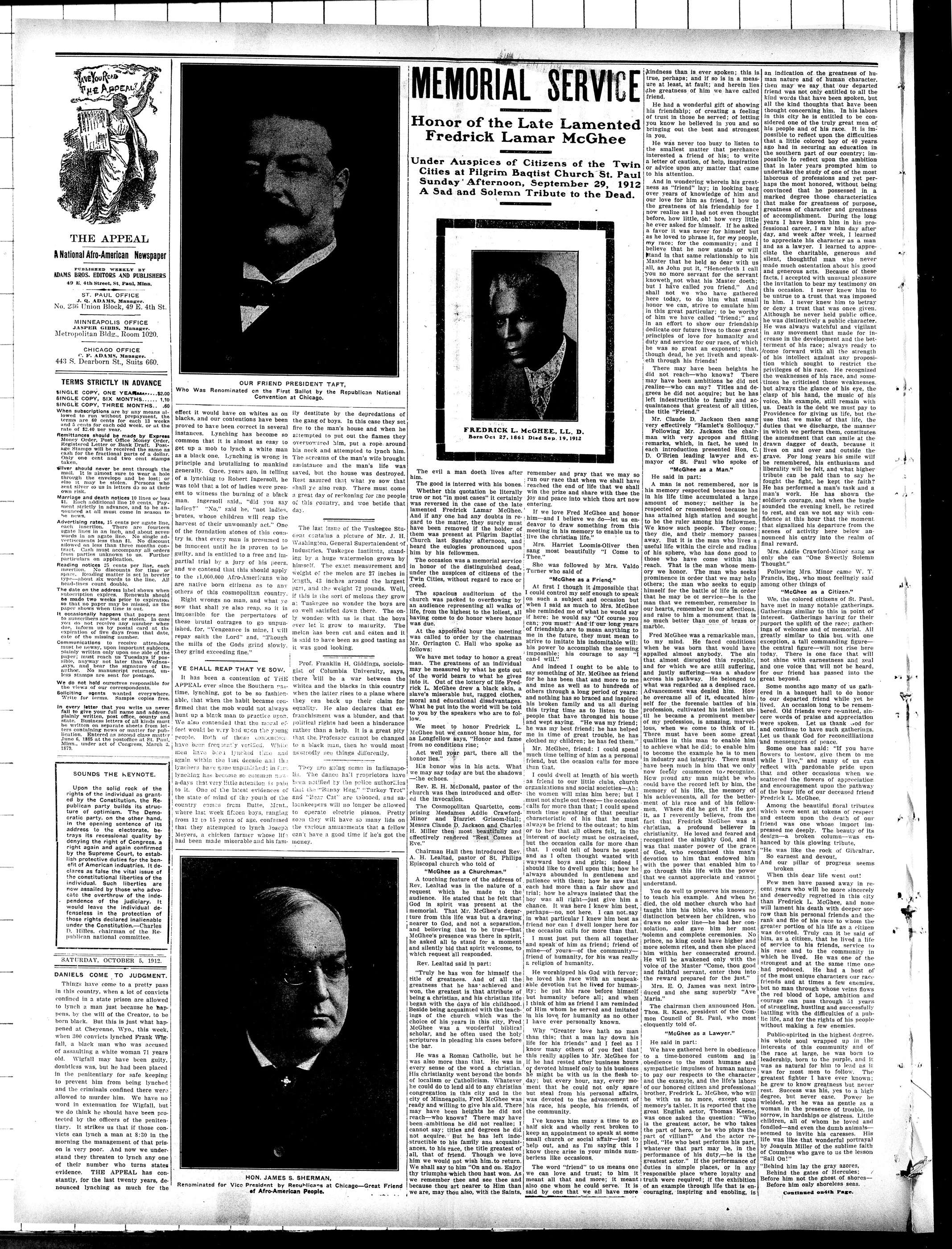
OUR FRIEND PRESIDENT TAFT,
Who Was Renominated on the First Ballot by the Republican National Convention at Chicago.
THE CHRISTIAN CHURCH OF NEW YORK
PON JAMES S. SHERMAN,
Renominated for Vice Presidency at Chicago—Great Friend
of Afro-American People.
effect it would have on whites as on blacks, and our contentions have been proved to have been correct in several instances. Lynching has become so common that it is almost as easy to get up a mob to lynch a white man as a black one. Lynching is wrong in principle and brutalizing to mankind generally. Once, years ago, in telling of a lynching to Robert Ingersoll, he was told that a lot of ladies were present to witness the burning of a black man. Ingersoll said., "did you say ladies?" "No," said he, "not ladies, brutes, whose children will reap the harvest of their unwomanly act." One of the foundation stones of this country is, that every man is presumed to be innocent until he is proven to be guilty, and is entitled to a free and impartial trial by a jury of his peers, and we contend that this should apply to the 11,000,000 Afro-Americans who are native born citizens as to any others of this cosmopolitan country.
Right wrongs no man, and what ye sow that shall ye also reap, so it is impossible for the perperturators of these brutal outrages to go unquainted, for, "Vengeance is mine. I will repay saith the Lord" and, "Though the mills of the Gods grind slowly, they grind exceeding fine."
YE SHALL REAP THAT YE SOW
YE SHALL REAP THAT YE SOW.
It has been a contention of THE APPEAL ever since the Southern pastime, lynching, got to be so fashionable, that when the habit became confirmed that the mob would not always hunt up a black man to practice upon. We also contended that the moral effect would be very bad upon the young people. Both of these contensions have been frequently verified. White men have been lynched time and again within the last decade and the lynchers have gone unpunished; in four lynchings have become so common that very little attention is paid to it. One of the latest evidences of the state of mind of the youth of the country comes from Dutte, Ment, where last week fifteen boys, ranging from 12 to 15 years of age, confessed that they attempted to lynch Joseph Meyers, a chicken farmer whose life had been made miserable and his fam
ily destitute by the depredations of the gang of boys. In this case they set fire to the man's house and when he attempted to put out the flames they overpowered him, put a rope around his neck and attempted to lynch him. The screams of the man's wife brought assistance and the man's life was saved, but the house was destroyed. Rest assured that what ye sow that shall ye also reap. There must come a great day of reckoning for the people of this country, and woe betide that day.
The last issue of the Tuskegee Student contains a picture of Mr. J. H. Washington, General Superintendent of Industries, Tuskegee Institute, standing by a huge watermelon grown by himself. The exact measurement and weight of the melon are 27 inches in length, 43 inches around the largest part, and the weight 72 pounds. Well, if this is the sort of melons they grow at Tuskegee no wonder the boys are so well satisfied down there. The only wonder with us is that the boys ever let it grow to maturity. The melon has been cut and eaten and it is said to have been as good tasting as it was good looking.
```markdown
```
Prof. Franklin H. Giddings, sociologist of Columbia University, says, there will be a war between the whites and the blacks in this country when the latter rises to a plane where they can back up their claim for equality. He also declares that enfranchisement was a blunder, and that political rights had been a hindrance rather than a help. It is a great pity that the Professor cannot be changed to a black man, then he would most assuredly see things differently.
They are going some in Indianapolis. The dance hall proprietors have been notified by the police authorities that the "Bunny Hug," "Turkey Trot" and "Bear Cat" are tabooed, and saunkeepers will no longer be allowed to operate electric pianos. Pretty soon they will have so many lids on the various amusements that a fellow can't have a good time if he's got the money.
MEMORIAL SERVICE
Under Auspices of Citizens of the Twin Cities at Pilgrim Baqtist Church St. Paul Sunday Afternoon, September 29, 1912 A Sad and Solemn Tribute to the Dead.
FREDRICK L. McGHEE, LL. D.
Born Oct 27, 1861 Died Sep. 19, 1912
The evil a man doeth lives after him.
The good is intertwined with his bones. Whether this quotation be literally true or not "in most cases" it certainly was reversed in the case of the late lamented Fredrick Lamar McGhee. And if any one had any doubts in regard to the matter, they surely must have been removed if the holder of them was present at Pilgrim Baptist Church last Sunday afternoon, and heard the eulogies pronounced upon him by his fellowmen.
The occasion was a memorial service in honor of the distinguished dead, under the auspices of citizens of the Twin Cities, without regard to race or creed.
The spacious auditorium of the church was packed to overflowing by an audience representing all walks of life, from the highest to the loliest, all having come to do honor where honor was due.
At the appointed hour the meeting was called to order by the chairman Mr. Orrington C. Hall who spoke as follows:
We have met today to honor a great man. The greatness of an individual may be measured by what he gets out of the world bears to what he gives into it. Out of the lottery of life Fredrick L. McGhee drew a black skin, a slave's miserable hut, ragged clothes, moral and educational disadvantages. What he put into the world will be told to you by the speakers who are to follow.
We meet to honor Fredrick L. McGhee but we cannot honor him, for as Longfellow says, "Honor and fame from no conditions rise;
Act well your part, there all the honor lies."
His honor was in his acts. What we may say today are but the shadows—the echoes.
Rev. E. H. McDonald, pastor of the church was then introduced and offered the invocation.
The Cosmopolitan Quartette, composing Mesdames Addie Crawford-Minor and Harriet Grismon-Hall; Messrs Claude D. Jackson and Charles H. Miller then most beautifully and effectively rendered "Rest Comes at Eve."
Chairman Hall then introduced Rev. A. H. Lealatt, pastor of St. Phillips Episcopal church who told of "McGhee as a Churchman."
A touching feature of the address of Rev. Lealatt was in the nature of a request, which he made to the audience. He stated that he felt that God in spirit was present at the memorial. That Mr. McGhee's departure from this life was but a drawing nearer to God, and not a separation, and believing that to be true—that McGhee's presence was there in spirit, he asked all to stand for a moment and silently bid that spirit welcome, to which request all responded.
Rev. Lealtad said in part
"Truly he has won for himself the title of greatness. And of all the greatness that he has achieved and won, the greatest is that attribute of being a christian, and his christian life began with the days of his childhood. Beside being acquainted with the teachings of the church which was the result of years of study, McGhee was a wonderful biblical scholar, and he often used the holy scriptures in pleading his cases before the bar.
He was a Roman Catholic, but he was also more than that. He was in every sense of the word a christian. His christianity went beyond the bonds of localism or Catholicism. Whatever he could do to lend aid to any christian congregation in this city and in the city of Minneapolis, Fred McGhee was ready and willing to give his aid. There may have been heights he did not reach—who knows? There may have been ambitions he did not realize; I cannot say; titles and degrees he did not acquire. But he has left indestructible to his family and acquaintances, to his race, the title greatest of all, that of friend. Though we love him we would not wish him to return. We shall say to him "On and on. Enjoy thy triumphs which thou hast won. As we remember thee and see thee and because thou art nearer to Him than we are, may thou also, with the Saints,
remember and pray that we may so run our race that when we shall have reached the end of life that we shall win the prize and share with thee the joy and peace into which thou art now entering.
If we love Fred McGhee and honor him—and I believe we do—let us endeavor to draw something from this meeting in his memory to enable us to live the christian life."
Mrs. Harriet Loomis-Oliver then sang most beautifully "I Come to Thee."
She was followed by Mrs. Valdo Turner who said of
"McGhee as a Friend."
At first I though it impossible that I could control my self enough to speak on such a subject and occasion but when I said as much to Mrs. McGhee she reminded me of what he would say if here: he would say "Of course you can; you must! And if our long years of friendship are to mean anything to you, they must mean to strive to imitate his amitable will; his power to accomplish the seeming impossible; his courage to say 'I can I will.'"
And indeed I ought to be able to say something of Mr. McGhee as friend for he has been that and more to me and mine as well as to hundreds of others through a long period of years; and nothing has so braced and inspired his broken family and us all during this trying time as to listen to the people that have thronged his house and wept saying, "He was my friend; he was my best friend; he has helped me in time of great trouble, he has clothed my children; he has fed them." Mr. McGhee, friend: I could spend much time telling of him as a personal friend, but the occasion calls for more than that.
I could dwell at length of his worth as friend to our little clubs, church organizations and social societies—Ah; the women will miss him here; but I must not single out these—the occasion calls for more than that; I could spend much time speaking of that peculiar characteristic of his that he must always be friend to the outcast; to him or to her that all others felt, in the interest of society must be ostracised, but the occasion calls for more than that. I could tell of hours he spent and as I often thought wasted with wayward boys and girls; indeed I should like to dwell upon this; how he always abounded in gentleness and patience with them; how he saw that each had more than a fair show and trial; how he always insisted that the boy was all right—just give him a chance. It was here I knew him best, perhaps—no, not here. I can not say, in what particular I knew him best as friend nor can I dwell longer here for the occasion calls for more than that.
I must just put them all together and speak of him as friend; friend of mine—of yours—of the community—friend of humanity, for his was really a religion of humanity.
He worshipped his God with fervor; he loved his race with an unusable devotion but he lived for humanity; he put his race before himself but humanity before all; and when I think of him as friend I am reminded of Him whom he served and imitated in his love for humanity as no other I have ever personally known.
Why "Greater love hath no man than this; that a man lay down his life for his friends" and I feel as I know many others of you feel that this really applies to Mr. McGhee for if he had rested after business hours or devoted himself only to his business he might be with us in the flesh today; but every hour, nay, every moment that he could not only spare but steal from his personal affairs, was devoted to the advancement of his race, his people, his friends, of the community.
I've known him many a time to go half sick and wholly rest broken to keep an appointment to speak at some small church or social affair—just to help out, and as I'm saying this I know there arise in your minds numberless like occasions.
The word "friend" to us means one we can love and trust; to him it meant all that and more; it meant also one whom he could serve. It is said by one that we all have more
kindness than is ever spoken; this is true, perhaps; and if so is in a measure at least, at fault; and herein lies the greatness of him we have called friend.
He had a wonderful gift of showing his friendship; of creating a feeling of trust in those he served; of letting you know he believed in you and so bringing out the best and strongest in you.
He was never too busy to listen to the smallest matter that perchance interested a friend of his; to write a letter of caution, of help, inspiration or advice upon any matter that came to his attention.
And in wondering wherein his greatness as “friend” lay; in looking bacca over years of knowledge of him and our love for him as friend, I bow to the greatness of his friendship for I now realize as I had not even thought before, how little, oh! how very little he ever asked for himself. If he asked a favor it was never for himself but as he loved to phrase it, for my people, my race; for the community; and I believe that he now stands or will stand in that same relationship to his Master that he held so dear with us, all, John put it, “Henceforth I call you no more servant for the servant knoweth, not what his Master doeth; but I have called you friend.” And shall not we who have gathered here today, to do him what small honor we can, strive to emulate him in this great particular; to be worthy of him we have called “friend,” and in an effort to show our friendship dedicate our future lives to those great principles of love for humanity and duty and service for our race, of which he was so great an exponent; that, though dead, he yet liveth and speaketh through his friends!
There may have been heights he did not reach—who knows? There may have been ambitions he did not realize—who can say? Titles and degrees he did not acquire; but he has left indestructible to family and acquaintances that greatest of all titles, the title "Friend."
Mr. Claude D. Jackson then sang very effectively "Hamlet's Soliloquy." Following Mr. Jackson the chairman with very apropos and fitting remarks, which, in fact, he used in each introduction presented H. C. D. O'Brien leading lawyer and ex-major of St. Paul who spoke of
"McGhee as a Man."
He said in part:
A man is not remembered, nor is his memory respected because he has in his life time accumulated a large amount of money; neither is he respected or remembered because he has attained high station and sought to be the ruler among his fellowmen. We know such people. They come; they die, and their memory passes away. But it is the man who lives a useful life within the circle and radius of his sphere, who has done good to those who have come within his reach. That is the man whose memory we honor. The man who seeks prominence in order that we may help others; the man who seeks to equip himself for the battle of life in order that he may be or service—he is the man that we remember, remember in our hearts, remember in our affections, and raise to him a monument that is so much better than one of brass or marble.
Fred McGee was a remarkable man, to my mind. He faced conditions when he was born that would have appalled almost anybody. The sin that almost disrupted this republic, and for which we are still suffering, and justly suffering—was a shadow across his pathway. He belonged to what was regarded as a despised race. Advancement was denied him. How he overcame all of it, educated himself for the forensic battles of his profession, cultivated his intellect until he became a prominent member of my profession, is amazing, marvelous, when we come to think of it. There must have been some great qualities in this man to enable him to achieve he did; to enable him to become the example he is to men in industry and integrity. There must have been much in him that we only now feelly commence to recognize. How proud any man might be who could have the record left by him, the memory of his life, the memory of his achievements, all for the betrayment of this race and his fellow. What did he get it? He, as I reverently believe, from the fact that Fredrick McGee was a christian, a profound believer in Christianity. He loved and feared and recognized the almighty God, and it was that master power of the grace of God, who recognized this man's devotion to him that endured him with the power that enabled him to go through this life with the power that we cannot appreciate and cannot understand.
You do well to preserve his memory, to teach his example. And when he died, the old mother church who had taught him his bible, who knows no distinction between her children, who draws no color line—he had her consolation, and gave him her most solemn and complete ceremonies. No prince, no king could have higher and more solemn rites, and then she placed him within her consecrated ground. He will be awakened only with the voice of the Master "Come, thou good and faithful servant, enter thou into the reward prepared for the just." Mrs. E. O. James was next introduced and she sang superbly "Ave Maria."
The chairman then announced Hon. Thos. R. Kane, president of the Common Council of St. Paul, who most eloquently told of.
"McGhee as a Lawyer."
He said in part:
We have gathered here in obedience to a time-honored custom and in obedience to the most humane and sympathetic impulses of human nature to pay our respects to the character and the example, and the life's labors of our honored citizen and professional brother, Fredrick L. McGhee, who will be with us no more, except upon memory's tablet. It is reported that the great English actor, Thomas Keane, was once asked the question: "Who is the greatest actor, he who takes the part of hero, or he who plays the part of villian?" And the actor replied, "He who best performs his part, whatever that part may be, in the performance of his duty—he is the greatest actor." If the performance of duties in simple places, or in any responsible place where loyalty and truth were required; if the exhibition of an example through life that is encouraging, inspiring and enabling, is
an indication of the greatness of human man nature and of human character, then may we say that our departed friend was not only entitled to all the kind words that have been spoken, but all the kind thoughts that have been thought concerning him. In his labors in this city he is entitled to be considered one of the truly great men of his people and of his race. It is impossible to reflect upon the difficulties that a little colored boy of 40 years ago had in securing an education in the southern part of our country; impossible to reflect upon the ambition that in later years prompted him to undertake the study of one of the most laborous of professions and yet perhaps the most honored, without being convinced that he possessed in a marked degree those characteristics that make for greatness of purpose, greatness of character and greatness of accomplishment. During the long years I have known him in his professional career, I saw him day after day, and week after week, I learned to appreciate his character as a man and as a lawyer. I learned to appreciate the charitable, generous and silent, thoughtful man who never made much ostentation about his good and generous acts. Because of these facts, I accepted with unusual pleasure the invitation to bear my testimony on this occasion. I never knew him to be untrue to a trust that was imposed by or deny a trust that was once given. Although he never held public office, he was distinctively a public character, and in any movement and attitude he was in movement in the development and the betterment of his development and the betterment of his race. He recognized the weaknesses of his race, and sometimes he criticised of those weaknesses, but always the glance of his eye, the clasp of his hand, the music of his voice, his example, still remain with us. Death is the debt we must pay to Providence for giving us life, but the use that we make of that life, the duties that we discharge, the manner in which we perform them, constitutes the amendment that can smile at the drawn dagger of death, because it lives on and outside the grave. For long years his smile will be remembered, his enthusiasm andism will be felt, and what higher tribute can be paid than to say he fought the fight, he kept the faith? He has performed a man's task and a man's work. He has shown the soldier's courage, and when the bugle sounded the evening knell, he retired to rest, and can we not say with confidence at this hour that the moment that signalized his departure from the scenes of activity here below announced his entry into the realm of final reward.
Mrs. Addie Crawford-Minor sang as only she can "One Sweepy Solem Thought." Following Mrs. Minor came W. T. Francis, Esq., who most feelingly said among other things of
"McGhee as a Citizen."
We the colored citizens of St. Paul have met in many notable gatherings. Gatherings similar to this in point of interest. Gatherings having for their purport the uplift of the race; gatherings of welcome and of memorial. All greatly similar to this but with one exception, a tall commanding figure—the central figure—will not rise here today. There is one face that will not shine with earnestness and zeal and one voice that will not be heard, for our friend has passed into the great beyond.
Some months ago many of us gathered in a banquet hall to do honor to our departed friend while yet he lived. An occasion long to be remembered. Old friends were re-united, sincere words of praise and appreciation were spoken. Let us thank God for and continue to have such gatherings. Let us thank God for reconciliations and messengers of peace.
Some one has said: "If you have flowers to bestow, give them to me while I live," and many of us can reflect with pardonable pride upon that and other occasions when we scattered the flowers of appreciation and encouragement upon the pathway of the busy life of our deceased friend Fredrick L. McGhee.
Among the beautiful floral tributes which were sent at tokens of respect and esteem upon the death of our friend was one whose import impressed me deeply. The beauty of its design—a broken column—was enhanced by this glowing tribute.
"He was like the rock of Gibraltar
"He was like the rock of Gibraltar. So earnest and devout.
And our pillar of progress seems broken
When this dear life went out!
Few men have passed away in recent years who will be more sincerely and deservedly regretted in this city than Fredrick L. McGhee, and none will lament his death with deeper sorrow than his personal friends and the rank and file of his race to whom the greater portion of his life as a citizen was devoted. Truly can it be said of him, as a citizen, that he lived a life of service to his friends, service to his race and to the community in which he lived. He was one of the strongest and at the same time one had produced. He had a host of of the most unique characters our race friends and at times a few enemies, but no man through whose veins flows the red blood of hope, ambition and courage can pass through 50 years of struggling, hustling and successfully battling with the difficulties of a public life, and for the rights of his people without making a few enemies.
Public-spirited in the highest degree, his whole soul wrapped up in the interests of this community and of the race at large, he was born to leadership, born to the purple, and it was as natural for him to lead as it was for most men to follow. The greatest fighter I have ever known; he grew to know greatness but never rest. Success was his, yes to a high degree, but never ease. Power he wielded, yet he was as gentle as a woman in the presence of trouble, in sorrow, in hardships or distress. Little children, all of whom he loved and fondled—and even the dumb animals—seemed to invite his caresses. His life was like that wonderful portrayal by Joaquin Miller of the sublime faith of Coubus who gave to us the lesson "Sail On!" "Behind him lay the gray azores. Behind the gates of Hercules: Before him not the ghost of shores—Before him only shoresless seas.
Continued on4th Page.
* WEEK'S RECORD IN MINNESO
TA'S CAPITAL.
The "Saintly City" and Saintly City
Folks—Newsey items of Social, Religious, Political and General Matters Among the People.
SATURDAY, OCTOBER 5, 1912.
Rev. Daniel Harding is steadily improving.
Miss Margaret Adams is still getting along nicely.
Mr. and Mrs. J. E. Murphy have returned from their trip to Chicago.
Drs. Valdo Turner and W. F. Watkins are out of the city on a hunting trip.
Mrs. J. E. Johnson entertained Rev. and Mrs. Graves at dinner last Tuesday.
Miss Irene Salters has gone to Duth. Minn., for a visit of two or three days.
Don't forget that next Tuesday is Tag Day, get some money ready to pay for tags.
Messers Boston and Cochran, students at Meharry, left Friday evening for the school.
Rev. and Mrs. A. H. Lealtad have moved from 406 Edmund to 395 Thomas street.
Messrs. R. Stanton, Booth and Stevens left Wednesday evening for Meharry college.
Mrs. John N. Jenkins had a stroke of paralysis Wednesday and is in a critical condition.
Messrs. J. Bluford and J. Crawford, enroute to Meharry college left Thursday evening for Chicago.
Mrs. J. W. Milton entertained at berakfast Friday morning, Rev. and Mrs. Graves and Mrs. J. Q. Adams.
Tuesday, October 8, is "Tag Day," be prepared to be tagged to help maintain the Anti-Tuberculosis Society.
Mr. J. C. Black, who was recently appointed on the police force, went on duty for the first time Monday night.
Res. 642 Rondo Fel. Dale 617-2
T. H. LYLES
General Directors and Embalmers. 322 Wabasha St.
Little Answered Day or Night in Twin Cities.
Active Pall Bearers Furnished if Desired.
The total amount received at Harriet Island public baths for the year is 7,168.81 a falling off of 432.75 from last year.
J. Q. Adams, Jr., has been on the sick list with a severe case of tonsillitis for about a week, but is convalescing.
The bank clearings in St. Paul for September amounted to $46,533,577.95 an increase over September, 1911, of $4,550,304.68.
Mr. and Mrs. Jackson, of Chicago, are in the city to reside. They are at present with Mrs. James Thomas of Jessamine street.
The tax collections for September, in Ramsey county, amounted to $48,439.50 compared with $40,594.38 for the same period last year.
As the weather is getting quite cool, the usual stunt of the coal dealers to scare the people is begun by predicting a coal shortage.
FOR RENT—Nice five-room fat, bath, gas, etc.; $20. 471 W. Central avenue. Apply on the premises to C. L. Smith.
Advertisement.
Mrs. Julius Pitts and daughter Miss Amy, who have been the guests of Mrs. Mattie B. McGhee, returned to their home in Winnipeg last Wednesday.
Mrs. Julius N. Avendorph, of Chicago, who has been in the city visiting Mrs. Mattie B. McGhee for the past two weeks will return home today.
Mrs. Nancy E. Johnson, mother of J. E. Johnson, after spending some five weeks in Chicago, returned home last Friday and reports a pleasant trip.
Mrs. Maggie Jenkins of 536 St. Anthony ave., has returned from Chicago, where she has been visiting relatives and friends for the past month.
If the readers and well-wishers of THE APPEAL will send items of social news to this office it will be appreciated and the news will be published.
Miss Elizabeth Johnson, of Duluth, route to Washington, D. C., was in the city this week, the guest of Miss Frances Elliott. She left Thursday evening.
FOR RENT—Nice furnished rooms in a modern residence, No. 300 N. St. Albans street, one block from Rondo
THE STATE SAVINGS BANK.
93 East Fourth Street.
Invites the saving accounts of frugal wage-earners, it is well fitted to take care of them.
DEPOSITS OVER $4,350.00
Charles P. Noyes,
President.
Louis Betz,
Treasurer
car line. Phone Dale 4888. Mrs. H. I.
Williams.
Advertisement.
BOY WANTED—A good boy, 16
years old, wanted at Globe Furniture
Co. 473-75 St. Peter street. A good
place for the right boy. See about
this at once.
Advertisement.
"The Favorite Shining Parlor," Messrs. Beard & Alexander, proprietors, has been moved to 105 E. 5th street, where first class work is done on short notice at all times.
Advertisement.
Messrs. J. A. Henderson and R. S. Britton were dinner guests of Mr. Leon De Bray at George Davis' Restaurant last Friday and all were highly pleased with the service.
Mrs. Julia Hinson, proprietor of the St. Louis Kitchen is suffering from rheumatism, but she will serve that toothsome, home-cooked Sunday dinner tomorrow just the same.
Mr. Leslie Lawrence, a well known young man of this city, was married, about three weeks ago to Miss Ethel McClain, of Spokane, Wash. The couple will make their home here.
Mr. Irvine Young has opened a First Class Barber Shop in the front part of "Daddy" Reid's place, 40 E. Third street, where he is prepared to give satisfaction to all comers. Give him a call.
VOCAL, AND PIANO LESSONS
given by Mrs. Addie Crawford Minor
at her residence, 322 Carroll street
only. Hours for instruction arranged
due, to suit patrons. Tel Dale 2192
Forms reasonable.
Advertisement.
THE APPEAL has received a number
of the campaign books, "The Reby
Cyrus Field Adams, which may be
publican Party and the Afro-American"
had for the asking by calling at this
office.
Rev. H. P. Jones, who has been
returned to the pastorate of St. James
A. M. E. church will make a report
at the church tomorrow morning. St.
James lead the whole district in every-
thing. Go and hear about it.
SHINE 'EM UP! If you wish a good
first class shine or polish, go to the
Peoples' Shining Parlors, 127 E 5th
street, between Robert and Jackson,
W. H. Porter proprietor. Special
chairs for ladies—Advertisement.
Zion Presbyterian church, Western avenue near Aurora. Sunday services, morning 11:00 a. m.; Christian Endeavor, 7:00 p. m.; Evening worship, 8:00 p. m.; Sunday School 12:00 m. Public cordially invited. Rev. G. W Camp, pastor.
Mr. R. M. Johnson was summoned to Chicago to attend a meeting of the executive committee of the National Colored Democratic league on Tuesday. He left for Chicago Monday evening and will probably be away two weeks.
Mrs. H. Hart, the milliner, 425 University avenue, announces her FALL OPENING for next Tuesday afternoon Oct. 8. A splendid showing of the latest creations in ladies head wear. The ladies cordially invited.—Advertisement.
At the meeting the Republican State Central Committee held here at the Capitol Thursday, E. E. Smith, was re-elected chairman, J. A. O. Presu was re-elected secretary and Geo. F. Dix was elected treasurer. The utmost harmony prevailed. F. H. Harm & Bro, the popular jewelers and opticians, formerly of 237 Robert street, have moved to larger and better quarters at No. 14 East Sixth street, between Wabasha and Cedar, where they will be pleased to see all old and new patrons.
Advertisement
The place to have the shoe repair done in the best possible way at the lowest possible price is at JARVIS' 104-106 East Fifth street. He has a complete stock of men's women's and boys' shoes of the best grades for the money to be found in the city.
Advertisement.
THE ST. LOUIS KITCHEN, Mrs Julia Hinson, proprietor, No. 138 E 3d St. up stairs. Meals 25 cts. Break fast from 7:00 to 11:00 a. m. Dinner from 12:00 m. to 3:00 p. m. Suppet from 5:00 to 8:00 p. m. All regular meals 25 cts. All home cooking. Tel T. S. 2718.
Advertisement.
Twenty-five years ago last Monday the South St. Paul stockyards opened for business and the 17 cts received that day brought 363 cattle, hogs and sheep. Last Monday there were 363 cars received that brought 19,000 cattle, hogs and sheep. Some increase eh?
Minnesota is some state when it comes to corralling the cash. During the last fiscal year $60,168 was collected from vehicle tax, which is nearly twice as much as was collected in 1911. During the past year $6,300 was collected from liquor licenses for dining cars.
For the benefit of her friends and acquaintances in St. Paul, Mrs. Lottie Evans, that she now residing in Chicago, wishes that she know that she was married to Mr. Waffle Johnson of Omaha, Aug. 21, 1912. She will leave Chicago Oct. 15th to visit her mother in New Jersey.
THE BUSY BEE CAFE, 317 Wabasha street (up stairs) W. F. T. Chandler, proprietor. Everything new but the name. First-class meals will be laid out, caer at all hours. A splendid regular dinner will be served from 11:30 a. m. to 3:00 p. m. at 25 cents. Open day and night. Tel. N W, Cedar 4525.
Advertisement.
Miss Elizabeth Johnson was in the city for a week, the guest of Miss Frances Elliott. Miss Johnson's home is in Duluth but she is a well known and popular young lady among the young folks here. She is enroute to Washington, D.C., where she holds the position of Dean in the Normal Training School.
In the "Twenty Years Ago Today" column of the Daily News last Tuesday, the following appeared: The Afro-American Republican club was formed with the following officers: Harry Howard, president; R. E. Anderson and John Cunningham vice presidents; E. C. James, secretary; and Harry Shearp, treasurer.
MONKEY TO LOAN—The J. & M. Loan Co. will loan you money on anything of value, or on your plain note at rates you can afford to pay. All transactions strictly confidential.
Hours: 1 a.m. to 1 and 5 to 7 p.m. 138 E. Third street. Tel. Cendar 9105. Residence 569 Rondo. Phone Dale 872JH. Dillingham, Manager.
Advertisement
Dr. W. T. Mitchell, dentist, has now opened his dental parlor in suite No. 403. Court Block, 24 E. Fourth street, where he is prepared to do any work in his line at reasonable rates. Hours: 9:00 a. m. to 12:00 m. and 1:00 p. m. to 5:00 p.m. He respectfully solicits the patronage of any needing dental work done and guarantees satisfaction.
Advertisement.
THE VALET TAILORING CO., No. 154-156 E. Sixth street. The most up-to-date establishment of its lnd in the city. Clothing made to order, snugged, pressed, renovated and repaired. Goods called for and delivered. Four suits pressed for $1. They are prepared to give best service at lowest rates. Tel. N. W. Cedar, 4362. O. Howell, manager.
Advertisement.
Mrs. James Vass gave a musical at her home on Rondo St., on Thursday evening, Oct. 3rd, for the benefit of St. Phillips Church of which she is a very active member. Those on the program were Mrs. M. B. Mason, Miss Malina Fogg, Miss Lillian McCoy, Miss Adina Adams, Miss Cora Cuthbert, Mrs. B. Archer, Mrs. O. C. Hall, Betty Jones. Refreshments were served after the program.
Dr. W. F. Watkins, the dentist, though a young man, has had quite an extensive practice. He practiced seven years in Montgomery, Ala, and had a branch office at the same time at Tuskegee Institute before coming to St. Paul. His dental parlors are in the Newton Building, corner 5th and Minnesota, Suite 301-302, where he has the fastest and finest electrical appliances used in up-to-date dentistry.
Mrs. Q. Hicks, who was in attendance at the A. M. E. conference at Galesburg, Ill., where she had a very enjoyable time has returned home. She also visited many old friends in Peoria, Canton, Knoxville and St. David, Ill., whom she had not seen in nine years. She was the recipient of many social courtesies during her absence. She visited Big Creek coal mine at St. David and went down several hundred feet into the mine. However, she thinks that she would not like to be a miner.
PAID ADVERTISEMENT
This article by H. A. Gullford, by authority of W. J. Bazille, and the amount to be paid therefor, $5.00.
202
On the 5th day of November the voters of Ramsey County will have an opportunity to return to office for another term W. J. Bazille, the present incumbent of the office of Abstract Clerk. Mr. Bazille is now running for re-election, and if honesty and service count for anything he will get the endorsement of the voters. This office is a very important one, as the work includes keeping track of records of all Ramsey County real estate. Since assuming his duties four years ago, Mr. Bazille has revolutionized the work in the office, making it possible to do twice the work that was formerly done, and with the same amount of clerical help. As the real estate records of Ramsey County are changing rapidly on account of subdivisions of real estate, it is necessary to have a man in this office who knows his business, and Mr. Bazille has demonstrated that he can fill the bill.
A very pleasant social function occurred at No. 311 Rice street last Thursday night, it being in the nature of a surprise birthday party given in honor of her husband by Mrs. W. M. Tyman, who recently came here from Washington, D. C. to reside among us. Mrs. Tyman had quite a time keeping her husband in blissful ignorance, but succeeded so that when at about 8:30 p. m. she brought him home where they found about thirty persons awaiting him, he was truly surprised. He at once entered into the spirit of the occasion and proceeded to do what he could to make the occasion enjoyable to all. Rev. H. P. Jones was present and made a few remarks and then a splendid lunch was served. All present had a good time.
Reginald Robinson, white, a student of the University of Wisconsin, made a visit to St. Paul last week looking for a good time. He wandered around Saturday night until he reached Third and Franklin streets and thereabouts he found a good time Afro-American female, Lottie Alexander, who looked so good to him that he laid aside his color prejudice—if he had any—and concluded to indulge in a little social equality—it was after dark, be it remembered, and that makes all the difference in the world, don't you know? Well, shortly after he separated from his inamorata, he discovered that he had 'also separated from his pocket book containing 50 bones. He squealed, of course, and Lottie was soon found and placed in durance vile.
Mrs. George Duckett is back home from Galesburg, Ill., where she was attendance at the meeting of the Chicago Branch Women's Mite Missionary Society held in that city September 17th to 23d. She made a very favorable impression on the A. M. E. Conference in her address on "The Forward Movement," and portions of her paper, with very complimentary comments, were published in the Galesburg Evening Mail and Daily Republican-Register of that city. Mrs. Duckett also enjoyed the honor of being awarded the banner for the highest increase in money reported from any single society, she having reported $150.00. She was elected to
membership on the board of managers of Conference Brancon as well as being re-elected superintendent of the St. Paul district for the fifth time.
Dr. W. F. Watkins, the new dentist, has completed the furnishing and fitting of his new dental parlor, Suite 301-362 Newton building, corner Fifth and Minnesota. He has a very nice reception room with elegant furniture, while in the operating room he has the latest, up-to-date electric appliances and is prepared to do any work in the line of dentistry. The public is cordially invited to call and inspect the parlor.
Advertisement.
SPIRELLA CORSET, Cora E. Anderson cosetier. Any lady wishing to be properly corseted call or address 365 Aurora Ave. Tel. N. W. Dale 1345.
Advertisement.
PAID ADVERTISEMENT
This article by O. C. Hall is published in behalf of and by the authority of Richard D. O'Brien, 1740 Portland avenue, St. Paul, Minn., and the price to be paid therefor is $5.00.
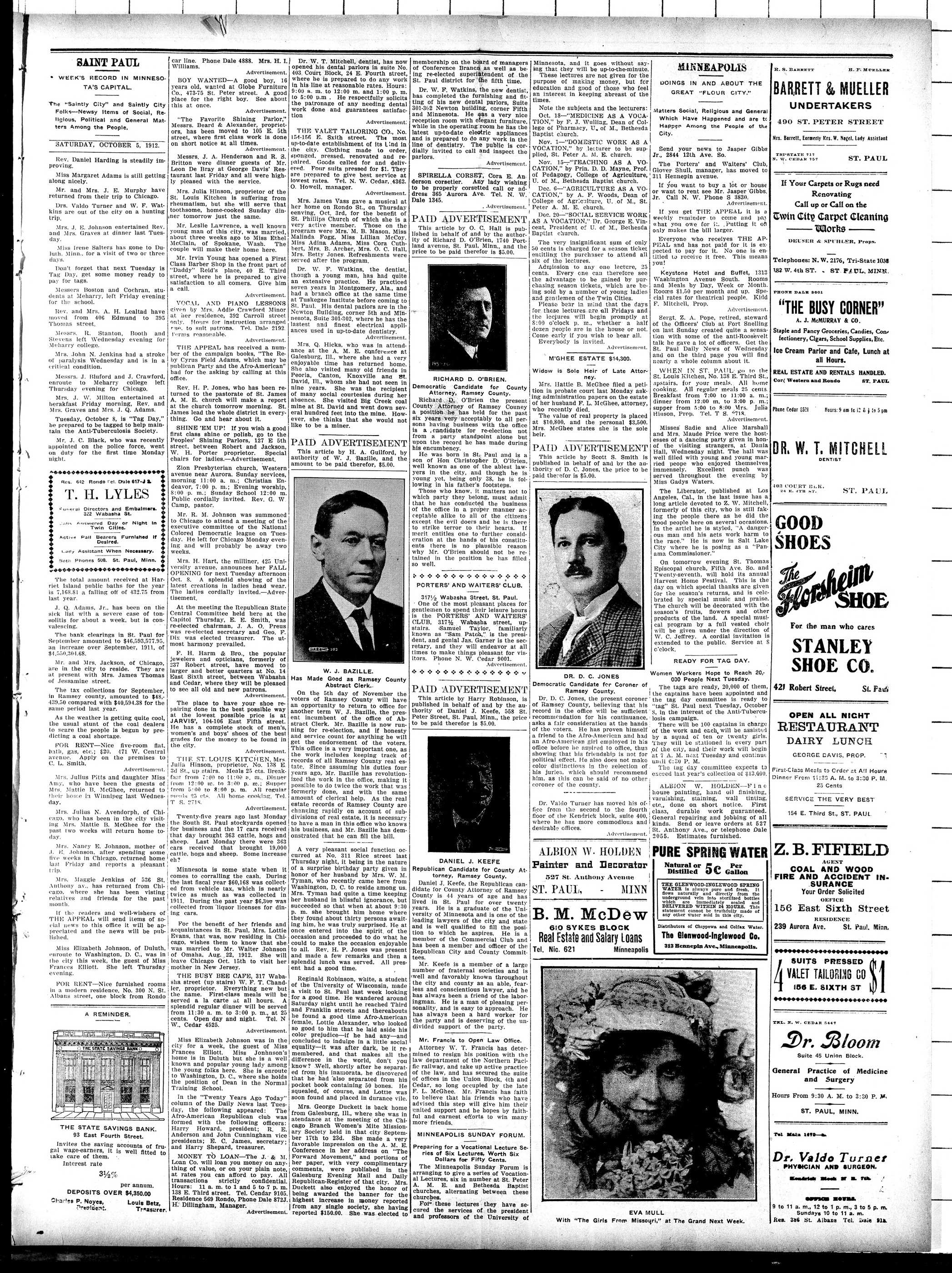
RICHARD D. O'BRIEN.
Democratic Candidate for County Attorney, Ramsey County.
Richard D. O'Brien the present County Attorney of Ramsay Couney a position he has held for the past six years very acceptably to all persons having business with the office a candidate for re-election not from the record standpoint alone but upon the record he has made during his encumbency.
He was born in St. Paul and is a son of Hon Christopher D. O'Brien, well known as one of the ablest lawyers in the city, and though he is young yet, being only 38, he is following in his father's footsteps.
Those who know, it matters not to which party they belong, must admit that he has conducted the business of the office in a proper manner acceptable alike to all of the citizens except the evil doers and he is there to strike terror to their hearts. If merit entitles one to further consideration at the hands of his constituents there is no plausible reason why Mr. O'Brien should not be retained in the position he has filled so well.
PORTERS' AND WAITERS' CLUB.
317½ Wabasha Street, St. Paul.
One of the most pleasant places for gentlemen to spend their leisure hours is the PORTERS' AND WAITERS' CLUB.
317½ Wabasha street, upstairs.
Samuel Taylor, familiar known as "Sam Patch," is the president, and genial Jas. Garner is the secretary, and they will endeavor at all times to make things pleasant for visitors. Phone N. W. Cedar 9001.
Advertisement.
PAID ADVERTISEMENT
This article by Harry Robinson, is published in behalf of and by the authority of Daniel J. Keefe, 558 St. Peter Street, St. Paul, Minn., the price to be paid therefor is $5.00.
DANIEL J. KEEFE
Republican Candidate for County Attorney, Ramsey County.
Daniel J. Keefe, the Republican candidate for County Attorney of Ramsey County is 44 years of age and has lived in St. Louis for over twenty years. He is a graduate of the University of Minnesota and is one of the leading lawyers of the city and state and is well qualified to fill the position to which he aspires. He is a member of the Commercial Club and has been a member and officer of the Republican City and County Committees.
Mr. Keefe is a member of a large number of fraternal societies and is well and favorably known throughout the city and county as an able, fearless and conscientious lawyer, and he has always been a friend of the laboring man. He is a man of pleasing personality, and is easy to approach. He has always been a hard worker for the party and is deserving of the undivided support of the party.
Mr. Francis to Open Law Office.
Attorney W. T. Francis has determined to resign his position with the law department of the Northern Pacific railway, and take up active practice of the law, and has secured the suite of offices in the Union Block, 4th and Cedar, so long occupied by the late F. L. McGhee. Mr. Francis has faith to believe that his friends who have advised this step will give him their united support and he hopes by faithful and earnest efforts to win many more friends.
MINNEAPOLIS SUNDAY FORUM.
Preparing for a Vocational Lecture Series of Six Lectures, Worth Six Dollars for Fifty Cents.
The Minneapolis Sunday Forum is arranging to give a series of Vocational Lectures, six in number at St. Peter A. M. E. and Bethesda Baptist churches, alternating between these churches.
For these lectures they have secured the services of the president and professors of the University of
10
With "The Girls From Missouri," at The Grand Next Week.
Minnesota, and it goes without saying that they will be up-to-the-minute. These lectures are not given for the purpose of making money, but for education and good of those who feel an interest in keeping abreast of the times.
Note the subjects and the lecturers: Oct. 18—"MEDICINE AS A VOCATION," by F. J. Wulling, Dean of College of Pharmacy, $U_4$ of M., Bethesda Baptist church.
Nov. 1—"DOMESTIC WORK AS A VOCATION," by lecturer to be supplied, St. Peter A. M. E. church.
Dec. 6. "AGRICULTURE AS A VOCATION," by A. F. Woods, Dean of College of Agriculture, U. of M., St. Peter A. M. E. church.
Dec. 20. "SOCIAL SERVICE WORK AS A VOCATION," Dr. George E. Vincent, President of U. of M., Bethesda Baptist church.
The very insignificant sum of only 50 cents is charged for a season ticket entitling the purchaser to attend all six of the lectures.
Admission to any one lecture, 25 cents. Every one can therefore see the advantage to be gained by purchasing season tickets, which are being sold by a number of young ladies and gentlemen of the Twin Cities.
Please bear in mind that the days for these lectures are all Fridays and the lectures will begin promptly at 8:00 o'clock p., m., whether a half dozen people are in the house or not. Come early if you wish to hear all.
Widow is Sole Heir of Late Attorney.
Mrs. Hattie B. McGhee filed a petition in probate court last Monday asking administration papers on the estate of her husband F. L. McGhee, attorney, who recently died.
The value of real property is placed at $10,800, and the personal $3,500. Mrs. McGhee states she is the sole heir.
PAID ADVERTISEMENT
This article by Scott S. Smith is published in behalf of and by the authority of D. C. Jones, the price to be paid thee for is $5.00.
M. B. H.
Democratic Candidate for Coroner of Ramsey County.
Dr. D. C. Jones, the present coroner of Ramsey County, believing that his record in the office will be sufficient recommendation for his continuance, asks a fair consideration at the hands of the voters. He has proven himself a friend to the Afro-American and had an Afro-American girl employed in his office before he aspired to office, thus showing that his friendship is not for political effect. He also does not make color distinctions in the selection of his juries, which should recommend him, as this can be said of no other coroner of the county.
Dr. Valdo Turner has moved his office from the second to the fourth floor of the Kendrick block, suite 400, where he has more commodious and desirable offices.
Advertisement.
527 St. Anthony Avenue
ST. PAUL, MINN
B. M. McDew
610 SYKES BLOCK
Real Estate and Salary Loans
Tel. Nic. 621 Minneapolis
1
MINNEAPOLIS
DOINGS IN AND ABOUT THE
GREAT "FLOUR CITY."
Matters Social, Religious and General
Which Have Happened and are to
Happen Among the People of the
City.
Send your news to Jasper Gibbs
Jr., 2844 12th Ave. So.
The Porters' and Walters' Club,
Glover Shull, manager, has moved to
311 Hennepin avenue.
If you want to buy a lot or house
or want to rent see Mr. Jasper Gibbs.
Jr. Call N. W. Phone S 3830.
Advertisement.
If you get THE APPEAL it is a
weekly reminder to come and pay
what you owe for it. Putting it off
only makes the bill larger.
Everyone who receives THE APPEAL and has not paid for it is expected to pay for it. No one is entitled to receive it free. This means you!
Keystone Hotel and Buffet, 1313 Washington Avenue South. Rooms and Meals by Day, Week or Month. Rooms $1.50 per month and up. Special rates for theatrical people. Kidd F. Mitchell, Prop.
Advertisement.
Sergt. Z. A. Pope, retired, steward of the Officers' Club at Fort Snelling on last Sunday created quite a sensation with some of the anti-Roosevelt talk he gave a lot of officers. Get the St. Paul Daily News of Wednesday and on the third page you will find nearly a whole column about it.
WHEN IN ST. PAUL go to the St. Louis Kitchen, No. 133 E Third St., apairs, for your meals. All home cooking. All regular meals 25 cents. Breakfast from 7:00 to 11:00 a. m. dinner from 12:00 to 3:00 p. m.; supper from 5:00 to 8:00 Mrs. Julia Hinson, Prop. Tel. T. S. 718.
Misses Sadie and Alice Marshall and Mrs. Maude Price were the hostesses of a dancing party given in honour of the visiting strangers, at Dania Hall, Wednesday night. The hall was well filled with young and young married people who enjoyed themselves immensely. Excellent punch was served throughout the evening by Miss Gadys Waters.
The Liberator, published at Los Angeles, Cal., in the last issue has a long article devoted to Z. W. Mitchell, formerly of this city, who is still faking the people there as he did the good people here on several occasions. In the article he is styled, "A dangerous man and his acts work harm to the race." He is now in Salt Lake City where he is posing as a "Panama Commissioner."
On tomorrow evening St. Thomas Episcopal church, Fifth Ave. So. and Twenty-seventh, will hold its annual Harvest Home Festival. This is the day on which special thanks are given for the season's returns, and is celebrated by special music and praise. The church will be decorated with the season's fruits, flowers and other products of the land. A special musical program by the full orchestra will be under the direction of W. C. Jeffrey. A cordial invitation is extended to the public. Service at S clock
READY FOR TAG DAY
Women Workers Hope to Reach 20,
000 People Next Tuesday.
The tags are ready, 20,000 of them,
the captains have been appointed and
the tag day committee is ready to
"tag" St. Paul next Tuesday, October
S, in the interest of the Anti-Tuberculosis campaign.
There will be 100 captains in charge of
the work and each will be assisted by a squad of ten or twenty girls.
They will be stationed in every part of the city, and their work will begin at 7 A. M. next Tuesday and continue until 6:30 P. M.
The tag day committee expects to exceed last year's collection of $13,000.
ALBION W. HOLDEN—Fine house painting, hand oil finishing, varnishing, staining, wall tinting, etc., done on short notice. First class, durable work guaranteed. General repairing and jobbing of all kinds. Send or leave orders at 527 St. Anthony Ave., or telephone Dale 2055. Estimates furnished.
PURE SPRING WATER
Natural or 5¢ Per Distilled Gallon
THE GLENWOOD-INGLEWOOD SPRING WATER is always pure and fresh. It always has a silky texture and underground vein into sterilized bottles which are immediately sealed and GLENWOOD-INGLEWOOD MOVES. This statement cannot be made of any other water sold in this city.
Distributors of Chippewa and Colfax Water
The Glenwood-inglewood Co.
313 Hennepin Ave, Minneapolis.
BARRETT & MUELLER
UNDERTAKERS
490 ST. PETER STREET
Nrs. Barrett, Eormerty Nrs. W. Nagel, Lady Assistant
TRI-STATE 717
N. W. CEDAN 757
ST. PAUL
ST. PAUL
If Your Carpets or Rugs need
Renovating
Call up or Call on the
Twin City Carpet Cleaning
Works
DEUSER & SPUHLER, Props.
Telephones: N. W. 2176, Tri-State 1038
182 W. 4th ST. ST. FAUL, MINN.
PHONE DALE 3601
Staple and Fancy Groceries, Candies, Confectionery, Cligars, School Supplies, Etc.
Ice Cream Parlor and Cafe, Lunch at all Hours.
REAL ESTATE AND RENTALS HANDLED.
Corp. Western and Rondo ST. PAUL
Phone Cedar 5521 Hours: 9 am to 12 & j to 5 pm
DR. W. T. MITCHELL
DENTIST
103 COURT BLK.
54 E. 1TH ST.
ST. PAUL
GOOD
SHOES
The
Florsheim
SHOE
For the man who cares STANLEY SHOE CO.
421 Robert Street. St. Paul
OPEN ALL NIGHT RESTAURANT DAIRY LUNCH
First-Class Meals to Order at All Hours
Dinner From 11:30 A. M. to 8:30 P. M.
25 Cents
SERVICE THE VERY BEST
154 E. Third St., ST. PAUL
Z.B.FIFIELD
AGENT
COAL AND WOOD
FIRE AND ACCIDENT IN-
SURANCE
Your Order Solicited
OEFICE
156 East Sixth Street
RESIDENCE
239 Aurora Ave. St. Paul, Minn.
SUITS PRESSED
VALET TAILORING CO
156 E. SIXTH ST
$1
TRL. N. W. CEDAR 5447
Dr. Bloom
Suite 45 Union Block.
General Practice of Medicine
and Surgery
Hours From 9:30 A. M. to 3:30 P. M.
ST. PAUL, MINN.
Tel Main 1679—8.
Dr. Valdo Turner
PHYSICIAN AND SURGEON.
Kendrick Block N. B. 7th.
OFFICE HOURS.
9 to 11 a. m., 12 to 1 p. m., 3 to 5 p. m.
Sundays 10 to 11 a. m.
Res. 386 St. Albans Tel. Dale 91k.
SAINT PAUL
FOR RENT—Two fats, one 4 rooms, one 3 rooms, 12 W. Central avenue. Apply on the premises. Advertisement.
The Postal Savings Bank is open evenings daily from 9 to 7:30, and on Saturday until 9 o'clock p. m.
FOR RENT—Two rooms furnished for gentlemen or man and wife for light housekeeping, 311 Rice street. Advertisement.
Make money easy at home corresponding for newspapers; experience necessary. Send stamp for particulars. Empire Press Syndicate, Middleport, N. Y.
Advertisement.
Anyone wishing to purchase a fine Tuxedo suit for a low price is requested to call at THE APPEAL of office for further particulars. Size 42, for a man about 5 feet 6 inches in height. This is a snap.
Advertisement
A SNAP-Don't let this get away from you. A fine, New York make, upright piano that cost $250.00, for sale for $50 down and $50 in installment. Co. 518 New York Life Bldg. With phone 1199.
Advertisement.
PROC. C. S. PATTY'S HERB MEDICINES can be had only at the corner of University avenue and Mackibin street. If you are not feeling well it will certainly be worth your while to learn about these remedies. TriState Phone 5732
Advertisement
If you haven't lately visited George Davis' Restaurant and Dairy Lunch, No. 134 I. Third street, you are missing something. His cook now is Miss Sarah Towles, and the toothsome needs she gets up can't be beat. Just go and try the regular dinner once and you'll go again. Dinner 25 cents. Advertisement.
SAFE DEPOSIT AND STORAGE VAULTS.—We invite your inspection. It costs little to place your papers, cash securities and valuables in also safety. Boxes in our vaults can be had for $4 per year. Store your boxes, trunks, etc., with us. North western Trust Co. 138 Endicott Arcade.
Advertisement
Why not patronize the business houses that invite you to trade with them through their advertisements in THE APEAL? They are helping to support your paper, show them that you are in helping those who help you or your enterprises. Trade with the people who advertise in THE APEAL.
BARRETT & MUELLER
Undertakers. 490 St. Peter Street.
One of the comparatively new undertaking establishments of St. Paul is that of Barrett & Mueller, No. 490 St. Peter street, as the firm began business only last June, but the members of the firm are experts in the business. Mr. Barrett has been in the profession over seven years and was formerly manager of the well and favorably known Nagel Undertaking Co. Mr. Mueller has been in the business for over nine years and was formerly with the firm of Mueller Bros, on Daytons Bluff, Mrs. Barrett, formerly Wm. Wen, Mrs. the lady attendant. The patronage of the readers of THE APPEAL is solicited. We guarantee satisfactory service and advertisement.
CHILDREN TEETHING
Mrs. Winslow's Soothing Syrup has been used for over fifty years by millions of mothers for their children while teething, with perfect success. It soothes the child, softens the gums allain all pain, cures wind colic and is the best remedy for diarrhea. Sold by drugists in every part of the world. Be sure and ask for "Mrs. Winslow's Soothing Syrup," and take no other kind. Twenty-five cents a bottle.
Advertisement.
"THE GIRLS FROM MISSOURI."
The Attraction at the Grand Next Week.
The only trust that met with favor by the general public has just been organized by a syndicate of merry-makers, who discovered an entirely new method to kill monotony and melancholy. The entire organization will demonstrate their new discovery at The Grand for one week, commencing Sunday Matinee Oct. 6, during which the "Littlest Leading Lady," a two act musical satire, by George Totten Smith, will be introduced to the public. They come under the auspices of "The Girls From Missouri," a combination of humorists, vocalists and all sorts of artists and are escorted by a guard of charming, sweet faced and beautiful young ladies, twenty-five in number, who surely possess enough who surely possess enough magnetism to draw even the dead ones into their presence. To introduce "The Lttttest Leading Lady" in a most proper form, a number of America's principal laugh creators will work the audience into real good, strong and gifted enthusiasm. There is Dainty Eva Mull, the most charming and sprightly little comedienne in burlesque today; Jessie Born, high-voiced prima donna; Lois Berl, funny character comedienne; Fred Russell the Hebrew with the very funny ways; Powers, "Our Irish Friend," with songs and stories; Herbert Terry, the recruit fom musical comedy, as is J. Francis Reynolds; then come the American Trio, who return to burlesque after complete triumphs all over the vaudeville circuits of this country, and Europe as well, and Joe Milton the Beban of Burlesque. Returns from the world's series baseball games will be read from the stage every afternoon the teams play.
Advertisement.
The Negro Year Book and Annual Encyclopedia.
The Negro Year Book has just been published under the auspices of Tuskegee Institute. Among the subjects treated in the work are: "The Review of the Negro in 1911." "The Economic Progress of the Negro."
"The Negro in the Religious Field.
"Negro Education."
"Negro Soldiers and Heroes."
"A Chronological History of the Negro in America.
It contains much valuable information in a concise and systematic form. It is bound in paper and has 229 pages. Price 25 cents, postage 5 cents Address Negro Year Book Co, Tuskegee Institute, Ala.
MEMORIAL SERVICE
MEMORIAL SERVICE
Continued from second page.
The good mate said "Now must we pray,
For lo! the very stars are gone;
Speak Admiral, what shall I say'
'Why say, sail on,' said on; sail on.'
The chairman next introduced Miss Frances Elliott who recited a poem written by Mr. Arthur V. Hall, entitled:
"I Have Fought a Good Fight."
"I have fought a good fight, I have finished the faith.
Death's shackles are light, nor yet do they chafe.
For the battle is o'er and the victory
won."
Aye, Fredrick McGhee, bravely said—
bravely done.
"Twas a hard fight you made and the
foe they were strong.
A fight for the blackman—right against
wrong.
Faith, Hope and Brotherhood, that was
your creed.
Faith, Hope and Brotherhood, of Love
where's the need!
All the sad hearts whose dead burdens
you've lightened—
All the dark days that for some one you've brightened—
Leaving a calm where you'd found war and strife—
All are recorded in God's Book of Life.
So when the angel looked under your name.
Saw your good works, your intentions,
your fame;
"Truly," he said, he has given his best,
Bravely he labored and now he shall
rest."
Swift from God's heaven a messenger
sped;
Straight to the earth, to your home
to your bed.
Placed his kind hand on the heart in your breast;
Calming its throbs 'til it lay still—at rest.
So you left us to follow the footsteps you've made.
The steps of a black man who walked unafraid.
"I have fought a good fight and the victory is won."
Aye, Fredrick McGhee, bravely said—bravely done.
Mr. Robert Strong gave a splendid organ solo entitled, "Communion," from Batiste.
He was followed by B. S. Smith Esq., of Minneapolis who spoke in part of
McGhee as a Race Man."
May I say in conclusion "Good Night, sweet prince, and may the angels guide thee to rest." At the close of the address of Attorney Smith, Mr. George W. James on behalf of the committee in charge of the memorial real the following resolutions:
IN MEMORIAM.
Honorable Fredrick Lamar McGhee Died Thursday, September 19, 1912.
WHEREAS—Our friend and fellow-townman, Frederick Lamar McGhee hath answered the call of our Divine Master, left his labors on earth and hath entered into his heavenly reward, and
WHEREAS—For the past twenty-three years he has dwelt in our midst and labored diligently for all movements in the interests of the community. A tower of strength in his profession, he was ever found defending the weak, and striving to uplift the fallen. As a citizen he was faithful to his obligations to city, state and nation. A broadminded Christian, he was faithful to his own church and zealous in all movements to forward the cause of Christ and uplift of humanity. As husband and father he was loving and devoted, finding his greatest happiness in his home and family.
WHEREAS—He was deeply devoted to the cause of the Negro race and was a fearless champion of its cause, foremost in any effort to protect his brother or advance his people. He gave willingly of his time, money or labor to secure justice and peace to his downtrodden race. Therefore be it
RESOLVED—That we as citizens of this commonwealth do appreciate the life and work of our departed friend and sincerely mourn his loss.
RESOLVED—The Negro race has lost a great friend and leader and as members of that race we loved and respected him and our hearts are bowed in grief over his sudden death.
RESOLVED—That we extend our sympathy to the family of our deceased friend and commend them to our heavenly Father who alone can comfort them in their hour of sorrow.
RESOLVED—That we forward a copy of these resolutions to the press and the family of the deceased.
The resolutions were adopted by a rising vote.
The audience then arose and joined in singing "We Shall Meet Beyond the River." Then followed the benediction by Rev. Horace S. Graves of Evanston, Ill, and this closed one of the most notable occasions in the history of St. Paul.
To sin by silence when we should protest makes cowards out of men. The human race has climbed on protest. Had no voice been raised against injustice, ignorance and lust, the inquisition yet would serve the law, and guillotines decide our least disputes. The few who dare must speak and speak again to right the wrongs of many.—Ella Wheeler Wilcox.
EYE DEFECTS AND SYMPTOMS.
There can be but two defects in the human eye.
The eye may be too long in whole. Then we have theopic eye.
Or too short in whole—the Hyperopic eye.
Combine the two in one eye and we have Astigmatism.
Properly adjusted glasses will correct these defects.
Medicines or waiting, never.
Symptoms that spring from these two simple eye mali-nations are manifold; such as eye and headaches, Indi-tion, Dyspepsia, Nervous Debility, Chorea, Epilepsy and er ailments having their origin in lack of nerve force.
We correct all Defects of the human eye that glasses and remedy. Charges reasonable. Satisfaction guaranteed.
HARMS OCULO CURES SORE EYES 25¢ PER BOTTLE.
F. H. HARM & BRO.
OPTICIANS,
14 EAST SIXTH STR
"You too?"
Everyone smokes the strictly High Grade
DUKE OF
PARMA
CIGARS
HART & MURPHY,
MNFRS. ST. PAUL, MINN.
N. W. 940 Telephones T. S. 789
PAUL STEAM LAUNDRY!
"The Sanitary Laundry"
W. B. Webster, Prop.
First Class Work at Right Prices
Called for and Delivered
-291 Rice Street ST. PAUL
If you see furs you like
Anywhere else
You'll find them better
At Albrecht's
Telephone Cedar 9143
URLEY'S BAR"
122 East Third Street
finest Brands of Imported and Domestic
Wines, Liquors and Cigars
N. C. CAMPBELL, Prop.
Cor. Third and Robert
ST. PAUL
N. YOUNG & CO.
THE SIN OF SILENCE
To sin by silence when we should protest makes cowards out of men. The human race has climbed on protest. Had no voice been raised against injustice, ignorance and lust, the inquisition yet would serve the law, and guillotines decide our least disputes. The few who dare must speak and speak again to right the wrongs of many.—Ella Wheeler Wilcox.
HARO
GLASSES
EYE DEFECTS AND SYMPTOMS.
Mye defects are few—symptoms many.
There can be but two defects in the human eye.
Theeye may be too long in whole. Then we have the Myopic eye.
Symptoms that spring from these two simple eye malformations are manifold; such as eye and headaches, Indigestion, Dyspepsia, Nervous Debility, Chorea, Epilepsy and other ailments having their origin in lack of nerve force.
We correct all Defects of the human eye that glasses will remedy. Charges reasonable. Satisfaction guaranteed.
HARMS OCULO CURES SORE EYES 25c PER BOTTLE.
"You too?"
Everyone smokes the
strictly High Grade
DUKE OF
PARMA
CIGARS
HART & MURPHY,
MNFRS. ST. PAUL, MINN.
ST. PAUL STEAM LAUNDRY!
"The Sanitary Laundry"
W. B. Webster, Prop.
First Class Work at Right Prices
Called for and Delivered
289-291 Rice Street
ST. PAUL
If you see furs you like Anywhere else You'll find them better At Albrecht's Sixth and Minnesota Streets
A Complete Assortment of Woolens for Men Fine Dress Suits a Specialty
All the Year
Hamm's
BEER
"Leads Them All"
EITHER PHONE 935
Dimes are little young dollars. They grow only when locked up together. Treat yourself to a savings account and prove it to your own satisfaction. "Planted" dollars will add to your earnings.
THE STATE SAVINGS BANK 93 East Fourth Street
THE BROOKLYN PRESS
Dimes are little youn-
ly when locked up toge-
s savings account and pro-
tion. "Planted" dollars
ings.
THE STATE S
93 East F
A. B.
FOR FIRST CLASS TONOSIAL WORK
GO TO
Shaving, Hair-Cutting, Shampooing, Electric Head and Face Massage, Maniureuring, Sanitary Baths, Shoes Polished
KINK-NO-MORE FOR SALE B1.00 PER BOX
HAIR STRAIGHTENING A SPECIALTY
LEADING AFRICAN-AMERICAN PAPERS FOR SALE
Tel. Cedar 9282 ST. PAUL, MINN.
MAKE NO MISTAKE, JUST SMOKE
Sight Draft
THE VERIBEST FIVE CENT CIGAR
In the matter of the estate of Wood D Douglass, deceased.
Letters of administration on the estate of Douglass, deceased, late of the County of Missouri and State of Minnesota, being granted by Erwin H. McDonald. That six months ago the same is hereby allowed from and after the date of this Order, in which persons having claims or demands to file the same in the Probate Court of said County, for examination and allotment to file the same in the Probate Court of it. Is Further Ordered. That the first Monday in April, 1913, at 10 o'clock am, at a General Term of said Probate Court, was set aside when and where the City of St. Paul, in said County, be and the same hereby is appointed as counsel and when and where the said Probate Court is案 and adjust said claims and demands. And it is Further Ordered. That no notices are given each week for three successive weeks by forthwith publishing this Ornament, by each week for three successive weeks by forthwith publishing this paper printed and published in said County. At St. Paul, April 1961.
Dated at St. Paul this 26th day of
September, 1912.
By the Court:
( Seal of ) E. W. BAZILLE,
( Probate Court) Judge of Probate.
Oct. 5-12, 1912
Advertisement.
TRY
Clifford A. Smith
THE TAILOR
PRESSING Tel Cedar 3488 REPAIRING
109 E. 8th ST. PAUL
In the Year
inn's BEER
Reads Them All"
EITHER PHONE 935
g dollars. They grow on-her. Treat yourself to a be it to your own satisfac- will add to your earn-
SAVINGS BANK
Fourth Street
MOST WEEKLY
MINNESOTA
C. H. RO-
3536
M. A. BOY-
851
PIONEER
M. Meets of each new town A. Noble Pry-
Secy., 636
PERFECT
F. and A. Tuesdays at Ave. F. B. Sim Secy., 135
BETHE
Meets sec at Wagner Charles st. Chandler, 556 Sibley
PILGRIG
Knights T day in a corner W. W. T. Joy 479 Rondo
MARS
O. F. meet day night Tway Un. avenue.
C. Archer, 550 St. An.
HOUSEI
U. O. of Monday to lows Hall
G. Mrs. Arch street
PAST G. No. 123, G.ond and for Odd Fellow corner Farm, Wm. Hickman, avenue.
ST. PAUSE sec Odd Fellow corner Farm, R. V. P. Geo. B. L.
HOUSEI
U. O. of Tuesday to pple Hall, Ave. South Miss Corr
UNITED NORTH
F. Meets Wagner Charles st. ling always.
J. Q. Ala.
RAMSEE
Meets sec Wagner Charles st. M. A. D. Street.
JOHN H.
and S. 321
BIDDLE
R. meets fi month in
MOST WORSHIPFUL GRAND LODGE
OF
MINNESOTA, A. F. AND A. M.
C. H. ROBINSON, GRAND MASTER
1303 Hopkins.
M. A. BOLLING, GRAND SECRETARY,
892 W. Central Avenue.
PIONER LODGE NO. 1, F. AND A.
M. Meets first and third Mondays
of each month at Wagner Hall, cor. West
8:00 p.m. at Noble Pryor, W. M.; at H. Charleston
Secy., 636 W. University.
PERFECT ASHLAR LODGE NO. 4,
P. and A. M. meets second and fourth
Tuesday at Wagner Hall, cor. Western
8:00 p.m. at Noble Pryor, W. M.; at H. Charleston
Secy., 1354 Thomas street.
BETHEL CHAPTER NO. 28 R. A. M.
Meets second Thursday in each month
at Wagner Hall, cor. Western Ave. and
8:00 p.m. at 300 P. M. W. F. T.
Chandler, H. Haude Goodman, Secy.
556 Sibley street.
PILGRIM COMMANDER NO. 22,
Knights Templar, meets fourth Thursday
in each month at Wagner Hall, cor. Western
8:00 p.m. at John Sayles, Sec.
478 Rong street.
UNITED BROTHERS OF FRIENDSHIP
NORTH STAR LODGE NO. 138. U. B.
E. meets 34th Thursday in each month at
Wagins Ave. and
Charles Street. Brothers are Ave.
and always welcome. O. Howell, W. M.
J. Q. Adams, W. S., 49 E. 4th St.
RAMSEY LODGE NO. 3. U. B. F.
Meets second Friday in each month at
Hawthall Hall, cor. Western Ave.
and Charles Street. Brothers in good standing
welcome. M. A. Davis, W.
M. A. D. Adams, W. S., 411 Charles
Street.
JOHN H. HAYES LODGE NO. 6 K. OF F.
Meets first and third Tuesday in
each month at
Castle Hall. 221 W. U.
university cor. Farrington.
Knights of Pythias in good
condition. James Thomas, G. C.; Jas.
Henderson, V. C. 148 E. 9th
St. E. O. James, K of R.
and S. 321 St. Albans street.
BIDDLE CIRCLE. LADIES OF G. A.
U. meets first and third Tuesdays of each
month. Supreme Court room, old cap-
sure room. Mrs. M. J. Lovett, Pro-
m. Mr. J. R. White, Secy. Phoenix 190d.
FIDELITY COURT OF CALANTHI
NO. 345, N. A. S. A. E. A. A. and A.
meets first and third Monday in each
week. Ave., Minneapolis, Mrs. Minerva
E. Barnett, W. C.; Miss Arlene M. Scott,
R. of D. 25, W. 29th St.
PLIGHAM BAPTIST CHURCH, Con-
12th and Cedar. Sunday services: Pree-
chool at 12:00; Sunday school at
12:30; clock. Wednesday general prayer meeting. Friday evening
study Sunday school lesson. General
general prayer meeting attended. Rev.
E. H. McDonald, President.
Digesto
A
MALT AND HOP TONIC,
"Every drop
a help to
Health"
ST. JAMES' A. M. E. CHURCH, COR
Fuller and Jay Street. Sunday services,
11:30 a.m. : 7:30 p.m. on Wednesday prayer
Monday and Tuesday. Weddings on
MonJay and Tuesdays; at home Wednesday
and Thursday. Weddings, funerals
and the sick attended on notice.
N. W. DALE 3454 T. S. 5730
BOTH PHONES 600
HAAS BROS.
(Incorporated)
General Meat Dealers
Blue Ribbon Hams and Bacon
U. S. Government inspection of all Cattle, Hogs
and Sheep
Family, Hotel and Restaurant
Trade a Specialty
457-459 St. Peter Saint Pual
Rondo & Dale Sts. ST. PAUL
A. B. C. D. E. F. G. H. I. J. K. L. M. N. O. P. Q. R. S. T. U. V. W. X. Y. Z.
---
For Your Spring Suit or Overcoat
For Mothers
```markdown
```
MADE ONLY BY
THEO HAMM INBREWING CO.
92 P.M. N.E.
SOLD BY ALL DRUGGISTS
You are always welcome at—
349 University Ave. and 501 Selby Ave.
The Best Goods for the Least Money
The Wise Ones Deal at Conger's.
Brotchner's Pharmacy
MEET ME AT—
CHOICEST WINES, LIQUORS
AND CIGARS
Tri-State Phone 5004
Cer. Dale and University, - ST. PAUL.
SUN
AYES LODGE No. 6 K. O.F. Meets first and third Tues. Castle Hall 221 W. University cor. Farrington. University cor. Pythias in good standing of Pythias in good standing James Thomas, C. C.; Jas. A. Henderson, V. C.; 148 E 9th K. R of St Albans street.
GOPHER LODGE NO. 105. I. B. P. O.
GOPHER LODGE NO. 105. I. B. P. O.
fourth Thursday in atlanta on Ella
Hall. No. 126 East Third Street St.
M. Richard. Richard M.
Johnson, Seymour. 572 Kent.
PARSONAGE, Cor. Jay and Fuller
ST. PHILIP'S EPSICOPAL MISSION
corner Aurora avenue and Machubli street
Sunday services: Early celebration of Holy
Eucharist, 7:30 a.m. High celebration of
Holy Shabbat, 10:30 a.m. High celebration of
11:00 a.m. Matins, second and fourth
Sundays, 11:00 a.m. Sundry school, 12:30
a.m. Brotherhood of St. Andrew, 6:30 a.m.
Wednesdays, confession class, 8:30 a.m.
Fridays, evening prayer, 8:00 a.m.
Sundays Holy Eucharist, 9:00 a.m. A. M., Rev.
A. H. Leatad, Rector, 514 Fuller St.
50 YEARS' EXPERIENCE
DATENTS
TRADE MARKS
DESIGNS
Copyright Sec.
Anyone sending a sketch and description may
quickly ascertain one opinion from whether an
intervention is appropriate. Handbook on Patents
is sent from best agency for securing patents.
Patents made by the Office, receive
special notice, without charge, in the
A handsomely illustrated weekly. Largest circulation of any scientific Journal. Terns, $3 a month. MUNN & Co. 361 Broadway. New York Branch Office, O'S, F. St. Washington, D.C.
The Real Puzzle.
The puzzle is not whether Bacon or Shakespeare wrote the plays, but that one person could get them all acco