The Appeal
Saturday, May 23, 1914
St. Paul, Minnesota
Page text (machine-generated)
THE APPEAL KEEPS IN FRONT
RECAUSE
1- It is time to publish all the news possible.
2- It does no impugnably waiting no words.
3- Its correspondents are able and courage.
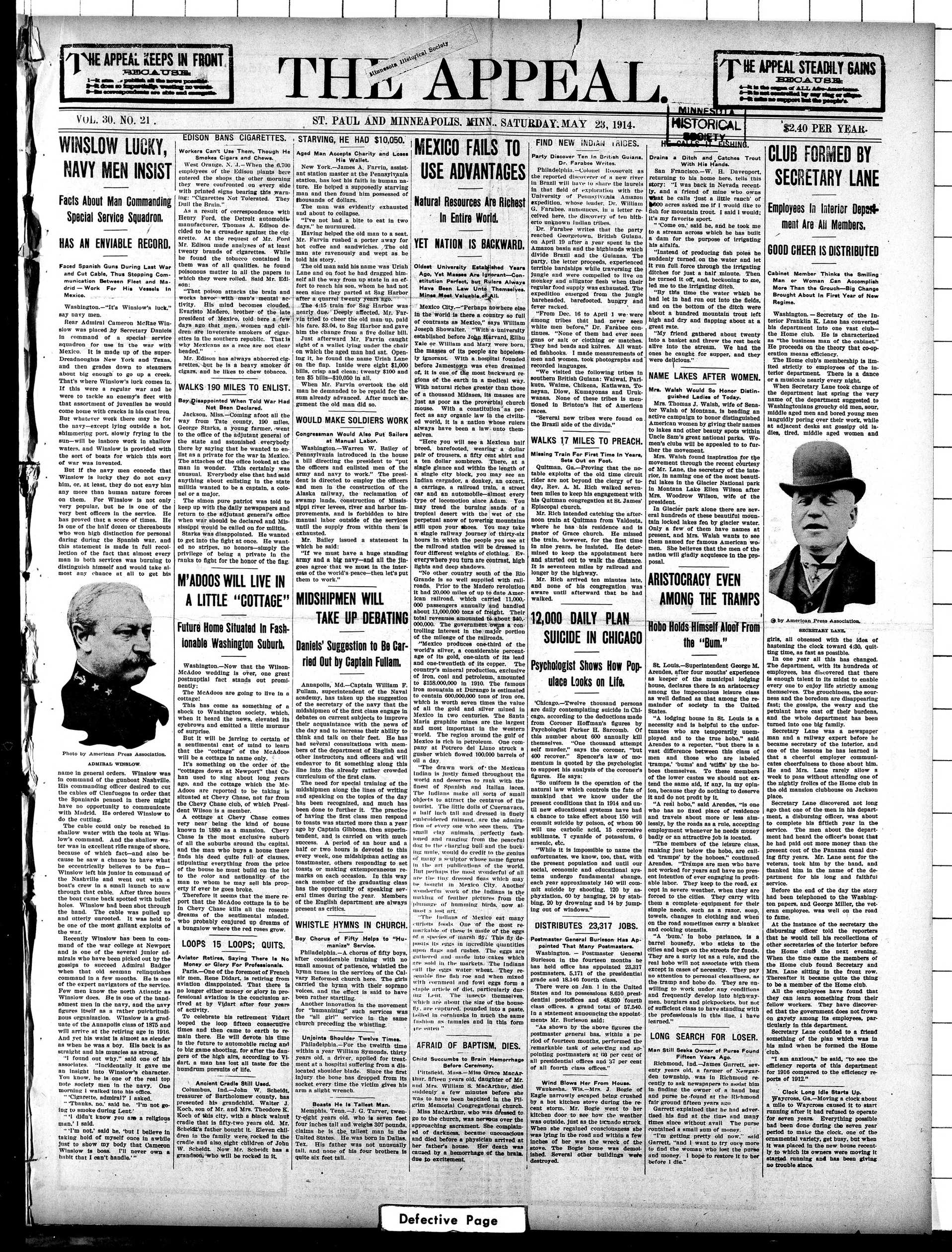
WINSLOW LUCKY,
NAVY MEN INSIST
Facts About Man Commanding Special Service Squadron.
Faced Spanish Guns During Last War and Cut Cable, Thus Stopping Communication Between Fleet and Madrid — Work For His Vessels in Mexico.
Washington.—"It's Winslow's luck," say navy men.
Rear Admiral Cameron McRae Winslow was placed by Secretary Daniels in command of a special service squadron for use in the war with Mexico. It is made up of the super-Dreadnoughts New York and Texas, and then grades down to steamers about big enough to go up a creek. That's where Winslow's luck comes in. If this were a regular war and he were to tackle an enemy's fleet with that assortment of juveniles he would come home with cracks in his cast iron. But whatever work there may be for the navy—except lying outside a hot, shimmering port, slowly frying in the sun—will be inshore work in shallow waters, and Winslow is provided with the sort of boats for which this sort of war was invented.
But if the navy men concede that Winslow is lucky they do not envy him, or, at least, they do not envy him any more than human nature forces on them. For Winslow is not only very popular, but he is one of the very best officers in the service. He has proved that a score of times. He is one of the half dozen or thereabouts who won high distinction for personal daring during the Spanish war, and this statement is made in full recollection of the fact that almost every man in both services was burning to distinguish himself and would take almost any chance at all to get his
Photo by American Press Association.
ADMIRAL WINSLOW.
name in general orders. Winslow was in command of the gunboat Nashville. His commanding officer desired to cut the cables off Clentfuges in order that the Spaniards penned in there might have opportunity to communicate with Madrid. He ordered Winslow to do the cutting. The cable could only be reached in shallow water with the tools at Winslow's command. And the shallow water was in excellent riffle range of shore, because of which fact—and also because he saw a chance to have what he eccentricly believes to be fun—Winslow left his junior in command of the Nashville and went out with a boat's crew in a small launch to saw through that cable. After three hours the boat came back spotted with bullet holes. Winslow been shot through the hand. The cable. The boat and utterly unrooted. It was held to be one of the most gallant exploits of the war.
Recently Winslow has been in command of the war college at Newport and is one of the several junior admirals who have been picked out by the gossips to succeed Admiral Badger when that old seaman relinquished command in a few months. He is one of the expert navigators of the service. Few men know the north Atlantic as Winslow does. He is one of the handlers in the navy, and the navy figures itself as a third-highest organization. Winslow is a graduate of the Annapolis class of 1875 and will arrive at the retiring age in 1916. And yet his waist is almost as slender as when he was a boy. His back is as straight and his muscles as strong. "I found out why," said one of his associates. "Incidentally it gave me an insight into Winslow's character. You know, he is one of the real top note society men in the navy. One morning I walked into his office. "Cigarette, admiral! I asked. "Thanks, no. said he. 'I'm not going smoke during Lent.' "I knew you a religious man," I said. "I'm not, said he. 'But I believe in taking hold of myself once in awhile just to show my body that amateur Winslow is boss. I'll never own a buibt that I can't handle."
```markdown
```
Workers Can't Use Them, Though He
Smokes Cigars, and Chaves
Smokes Cigars and Chews.
West Orange, N. J. - When the 6,700 employees of the Edison plants here entered the shops the other morning they were confronted on every side with printed signs bearing this warning: "Cigarettes Not Tolerated. They Dull the Brain."
As a result of correspondence with Henry Ford, the Detroit automobile manufacturer, Thomas A. Edison decided to be a crusader against the cigarette. At the request of Mr. Ford Mr. Edison made analyses of at least twenty tobacco cigarettes. While he found the tobacco contained in them was of all qualities, he found poisonous matter in all the papers in which they were rolled. Said Mr. Edison: "That poison attacks the brain and works havoc with man's mental activity. His mind becomes clouded. Evaristo Madero, brother of the late president of Mexico, told here a few days ago that men, women and children are invertebrate smokers of cigarettes in the southern republic. That is why Mexicans as a race are not clear headed."
Mr. Edison has always aborbed cigarettes, but he is a heavy smoker of cigars, and he likes to chew tobacco.
WALKS 190 MILES TO ENLIST
Boy Disappointed When Told War Had Not Been Declared.
Jackson. Miss.—Coming afoul all the way from Tate county, 100 miles, George Starks, a young farmer, went to the office of the adjutant general of the state and astonished everybody there by saying that he wanted to enlist as a private for the war in Mexico. The attaches of the office looked at the man in wonder. This certainly was unusual. Everybody else that had said anything about enlisting in the state would be a captain, a colonel or a major.
The simon pure patriot was told to keep up with the daily newspapers and return to the adjutant general's office when war should be declared and Mississippi would be called on for militia.
Starks was disappointed. He wanted to get into the fight at once. He wanted no stripes, no honors—simply the privilege of being a private in the ranks to fight for the honor of the flag.
Future Home Situated In Fashionable Washington Suburb.
Washington.--Now that the Wilson-McAdoo wedding is over, one great postnuptial fact stands out prominently:
The McAdoos are going to live in a cottage!
This has come as something of a shock to Washington society, which, with the board the news, elevated its eyebrows and emitted a little murmur of surprise.
But it will be jarring to certain of a sentimental cast of mind to learn that the "cottage" of the McAdoos will be a cottage in name only.
It's something on the order of the "cottages down at Newport" that Chan used to sing about long years ago, and the cottage which the McAdoos are reported to be taking is situated at Chevy Chase, not far from the city of the suburbs, of which President Wilson is a member.
A cottage at Chevy Chase comes very near being the kind of house known in 1880 as a mansion. Chevy Chase is the most exclusive suburb of all the suburbs around the capital, and the man who buys a house there finds his deed quite full of clauses, stipulating everything from the price of the house he must build on the lot to the color and nationality of the man from whom he may sell his property if ever acquires.
Therefore it seems that the more report that the McAdoo cottage is to be in Chevy Chase kills all the roseate dreams of the sentimental mind, who probably conjured up dreams of a bungalow where the red roses grow.
LOOPS 15 LOOPS; QUITS.
Aviator Retires, Saying There Is No
Money or Glory For Professionals.
Paris—One of the foremost of French air men, Rene Didart, is retiring from aviation disappointed. That there is no longer either money or glory in professional aviation is the conclusion arraised by Vidart after four years of activity.
To celebrate his retirement Vidart looped the loop fifteen consecutive times and then came to earth to remain there. He will devote his time in the future to automobile racing and to big game shooting, for after the dangers of the high airs, according to Vidart, a man has lost all taste for the humdum pursuits of life.
Ancient Cradle Still Used.
Columbus, Ind.-John W. Scheidt, treasurer of Bartholomew county, has presented his grandchild, Walter J. Koch of this city, with a black walnut cradle that is fifty-two years old. Mr. Scheidt's father bought it. Eleven children in the family were rocked in the cradle and also eight children of John W. Scheidt. Now Mr. Scheidt has a grandson who will be rocked in it.
THE APPEAL
ST. PAUL AND MINNEAPOLIS. MINN. SATURDAY. MAY 23, 1914.
STARVING, HE HAD $10,050.
Aged Man Accepts Charity and Loses His Wallet.
New York. James A. Farvin, assistant station master at the Pennsylvania station, has lost his faith in human nature. He helped a supposedly starving man and then found him possessed of thousands of dollars.
The man was evidently exhausted and about to collapse.
"I've not had a bite to eat in two days," he murmured.
Having helped the old man to a seat, Mr. Farvin ruded a porter away for hot coffee and sandwiches. The old man ate ravenously and wept as he told his story.
The old man said his name was Uriah Lane and on foot he had dragged himself all the way up from state in an effort to reach his son, whom he had not seen since they parted at Sag Harbor after a quarrel twenty years ago.
The 4:15 train for Sag Harbor was nearly due. Deeply affected, Mr. Farvin tried to cheer the old man up, paid his fare. $3.04, to Sag Harbor and gave him the change from a five dollar bill.
Afterward Mr. Farvin caught sight of a wallet lying under the chair at the ageed Urial man sat. Opening it, he the aged man sighted $1,000 on the tap. Inside the mame light $1,000 bills, crisp and clean, twenty $100 and ten $5 bills—$10,050 in all.
When Mr. Farvin overtook the old man he demanded to be repaid for the sum already advanced. After much argument the old man did so.
MEXICO FAILS TO USE ADVANTAGES
Natural Resources Are Richest In Entire World.
YET NATION IS BACKWARD.
Oldest University Established Years Ago, Vet Masses Are Igrantant—Constitution Perfect, but Rulers Always Have Been Law Unto Themselves.
Mines Most Valuable of All.
Mexico City. "Perhaps nowhere else in the world is there a country so full of contrasts as Mexico," says William Joseph Showalter. "With a university established before John Harvard, Ellinah Yale or William and Mary were born, the masses of its people are hopelessly ignorant. With a hospital founded before Jamestown was even dreamed of, it is one of the most backward regions of the earth in a medical way. With natural riches greater than those of a thousand Midases, its masses are just as poor as the proverbial church
FIND INDIAN TRIBES
Party Discover Ten in British Guiana.
Dr. Farabe Writes.
Philadelphia. Colonel Rousselv the reported discoverer of a new rite in Brazil will have to share the laurus in that field of exploration with the University of Pennsylvania. Amazing expedition, whose leader, Dr. William G. Farabee, announces, in a letter, of elicited here, the discovery of ten hither unknown Indian tribes.
Dr. Farabee writes that the reached Georgetown, British Guiana, on April 19 after a year spent in the Amazon basin and the highlands divide Brazil and the Guianas. The party, the letter proceeds, experiences terrible harbours while traversing jungle and beware compelled to live monkey and alligator洗肺 when the regular food supply was exhausted. The expedition emerged from the jungle bareheaded, barefooted, hungry and fever racked.
"From Dec. 1 to April 1 we we among tribes that had never white men before." Dr. Farabee cites. "None of them had ever squats or salt or clothing or match. They had beads and knives. All were ed fishhooks. I made measurements men and women, took photographs and read languages."
"We visit the following tribes in southern British Guiana:瓦帕瓦, Pakutu, Walime, Chikena, Katiwan, Teyan, Dlow, Kunaymas and Uranas. None of these tribes is mentioned in Brinton's list of America."
WOULD MAKE SOLDIERS WORK
Congressman Would Also Put Sailors at Manual Labor.
Washington—Warren W. Bailey of Pennsylvania introduced in the house a bill directing the president to "put the officers and enlisted men of the army and navy to work." The president is directed to employ the officers and men in the construction of the Alaska railway, the reclamation of swamp lands, construction of Mississippi river levees, river and harbor improvements, and is forbidden to hire manpower outside of the services until the supply from within them is exhausted.
Mr. Bailey issued a statement in which he said:
"If we must have a huge standing army and a big navy—and all the jigges agree that we must in the interests of the world's peace—then let's put them to work."
Annapolis, Md.-Captain William F. Fullam, superintendent of the Naval academy, has taken up the suggestion of the secretary of the navy that the midshipmen of the first class engage in debates on current subjects to improve their acquaintance with the news of the day and to increase their ability to think and act. He has had several consultations with members of the department of English and other instructors and officers and will endeavor to sit something along this line into the already rather crowded curriculum of the first class.
The need for special training of the midshipmen along the lines of writing and speaking on the topics of the day has been recognized, and much has been done to further it. The practice of having the first class men respond to toasts was started more than a year ago by captain Gibbons, then superintendent, and is carried on with much success. A period of an hour and a half or two hours is devoted to this every week, one midshipman acting as toastmaster, others responding to toasts or making extemporaneous remarks on each occasion. In this way each member of the graduating class has the opportunity of speaking several times during the year. Members of the English department are always present as critics.
WHISTLE HYMNS IN CHURCH
Boy Chorus of Fifty Helps to "Humanize" Service.
Philadelphia.—A chorus of fifty boys, after considerable training with no small amount of patience, whistled the hymn tunes in the services of the Calvary Reformed church here. The girls carried the hymn with their soprano voices, and the effect is said to have been startling.
Another hymn in the movement for "humanizing" such services was the "all girl" service in the same church preceding the whistling.
Unjoints Shoulder Twelve Times.
Philadelphia.—For the twelfth time within a year William Symonds, thirty years old, a driver, applied for treatment at a hospital suffering from a dislocated shoulder blade. Since the first injury the bone has dropped from its socket every time the victim gives his arm a slight wrench.
Boasts He Is Tallest Man.
Memphis. Tenn.—G. T. Carver, twenty-eight years old, who is seven feet four inches tall and weighs 307 pounds, inches tall and weighs 307 pounds, United States. He was born in Dallas Tex. His father was not unusually tall, and none of his four brothers is quite six feet tall.
YET NATION IS BACKWARD.
Oldest University Established Years Ago, Yet Masses are Ignorant—Constitution Perfect, but Rulers Always Have Been Law Unto Themselves. Mines Most Valuable of All.
Mexico City.—"Perhaps nowhere else in the world is there a country so full of contrasts as Mexico," says William Joseph Shoalwater. "With a university established before John Harvard, Elliho Yale or William and Mary were born, the masses of its people are hopelessly ignorant. With a hospital founded before Jamestown was even dreamed of, it is one of the most backward regions of the earth in a medical way. With natural riches greater than those of a thousand Midges, its masses are just as poor as the proverbial church mouse. With a constitution as perfect as any organic law in the civilized world, it is a nation whose rulers always have been a law unto themselves.
"Here you will see a Mexican half breed, barefooted, wearing a dollar pair of trousers, a fifty cent shirt and a ten dollar sombrero. There, at a single glance and within the length of a single city block, you may see an Indian carigator, a donkey, an oxcart, a carriage, a railroad train, a street car and an automobile-almost every type of locomotion since Adam. You may tread the burning sands of a tropical desert with the wet of the perpetual snow of towering mountains still upon your shoes. You may take a single railway journey of thirty-six hours in which the people you see at the railroad station will be dressed in four different weights of clothing. Everywhere you turn are contrast, high lights and deep shadows.
"No other country south of the Río Grande is so well supplied with railroads to the Madero revolution it had 20,000 passengers annually, an iron railroad, which carried 11,000,000 passengers annually and handled their total revenues amounted to about $40,000,000. The government owns a controlling interest in the major portion of the mileage of the railroads.
"Mexico produces one-third of the world's silver, a considerable percentage of its gold, one-ninth of its lead and one-twentieth of its copper. The country's mineral production, exclusive of iron, coal and petroleum, amounted to $158,000,000 in 1910. The famous iron mountain at Durango is estimated to contain 600,000,000 tons of iron ore, which is worth seven times the value of all the gold and silver mined in Mexico in two centuries. The Santa Maria bluest river is the most important in the western world. The region around the Mexico is rich in petroleum. One company at Pottero del Lano struck a gusher which flowed 100,000 barrels of oil a day.
"The drawn work of the Mexican Indian is justly famed throughout the world and deserves to rank with the finest of Spanish and Italian laces. The Indians make all sorts of small objects to attract the centavos of the tourist. The little dolls of Cuernavaca, a half inch tall and dressed in finely embroidered riment, are the admiration of every one who sees them. The small clay animals, perfectly fashioned and ranging from the peaceful dog to the charging bull and the bucking mule, would do credit to the genius of many a sculptor whose name figures in the publications of the world. But perhaps the most wonderful of all are the tiny dressed fishes that are bought in Mexico City. Another wonderful work of the Indians is the making of feather pictures from the plumage of humming birds, now almost a lost art.
"The Indians of Mexico eat many curious foods. One of the most remarkable of these is made of the eggs of a species of marsh fly. This fly deposits its eggs in incredible quantities upon tails and rushes. The eggs are gathered and made into cakes which are sold in the markets. The Indians call the eggs water wheat. They resemble fine fish roe and when mixed with cornmeal and fowl eggs form a staple article of diet, particularly during Lent. The insects themselves, which are about the size of the housefly, are captured, pounded into a paste boiled in cornhusks in much the same fashion as tamales and in this form are eaten."
AFRAID OF BAPTISM. DIES.
Child Succumbs to Brain Hemorrhage Before Ceremony.
"Littsfield, Mass. -Miss Grace MacArthur, fifteen years old, daughter of Mr. and Mrs. William S. MacArthur, died suddenly a few minutes before she was to have been baptized in the Pilgrim Memorial Congregational church. Miss MacArthur, who was dressed to go to the church, was nervous over the approaching sacrament. She complained of darkness, became unconscious and died before a physician arrived at her father's house. Her death was caused by a hemorrhage of the brain, due to excitement.
Defective Page
FIND NEW INDIAN TRIBES.
Party Discover Ten in British Guiana.
Dr. Farabee Writes.
Philadelphia—Colonel Roosevelt as the reported discoverer of a new river in Brazil will have to share the laurels in that field of exploration with the University of Pennsylvania Amazon expedition, whose leader, Dr. William G. Farabee, announces, in a letter received here, the discovery of ten bitherto unknown Indian tribes.
Dr. Farabee writes that the party reached Georgetown, British Guiana, on April 19 after a year spent in the Amazon basin and the highlands which divide Brazil and the Guianas. The letter proceeds, experienced terrible jungles while traversing the jungle hills and were compiled to live on monkey and alligator flesh when on regular food supply was exhausted. The expedition emerged from the jungle bareheaded, barefooted, hungry and fever racked.
From Dec. 16 to April 1 we were among tribes that had never seen white men before. Dr. Farabee continues. "None of them had ever seen guns or salt or clothing or matches. They had beads and knives. All wanted fishhooks. I made measurements of men and women, took photographs and recorded languages. They waited for the following tribes in southern British Guiana; Walwal, Parktun, Walme, Chikena, Katiwan, Toneyan, Kunayonas and Urkwanaas. None of these tribes is mentioned in Brinton's list of American races.
"Several new tribes were found on the Brazil side of the divide."
WALKS 17 MILES TO PREACH
Missing Train For First Time In Years,
Sets Out on Foot.
Quitman, Ga.-Proving that the notable exploits of the old time circuit rider are not beyond the clergy of today, Rev. A. M. Rich walked seven miles to keep his engagement with his Quitman congregation at St James' Episcopal church.
Mr. Rich intended catching the afternoon train at Quitman from Valdosta, where he has his residence and is pastor of Grace church. He missed the train, however, for the first time in nine years, he insisted. He determined to keep the appointment here and out to walk the distance. It is seventeen miles by railroad and longer by the highway.
Mr. Rich arrived ten minutes late, and none of his congregation was aware until afterward that he had walked.
12,000 DAILY PLAN SUICIDE IN CHICAGO Psychologist Shows How Populace Looks on Life.
"Chicago—Twelve thousand persons are daily contemplating suicide in Chicago, according to the deductions made from Coroner Hoffman's figures by Psychologist Parker H. Sarcomb. Of this number about 600 annually kill themselves." "One thousand attempt self murder," says the coroner, "but 400 recover." Spencer's law of mortality is owed by the psychologist in his analysis of the coroner's figures. He says: "So uniform is the operation of the natural law which controls the fate of mankind that we know under the present conditions that in 1914 and until new educational systems have had a chance to take effect about 150 will commit suicide by poison, of whom 90 will use carbolic acid, 15 corrosive sublimate, 7 cyanide of potassium, 6 arsenic, etc."
"While it is impossible to name the undertunes, we know, too, that, with the present population and until our systems undergo fundamental each year approximately 140 will commit suicide by shooting, 120 by asphyxiation, 60 by banging, 24 by stabbing, 20 by drowning and 14 by jumping out of windows."
DISTRIBUTES 23,317 JOBS.
Postmaster General Burleson Haa Ap-
pointed That Many Postmasters
pointed That Many Postmasters.
Washington. - Postmaster General Burleson in the fourteen months he has held office has appointed 23,317 postmasters, 5,171 of the presidential grade and 18,146 fourth class.
There were on Jan. 1 in the United States and its possessions 8,610 presidential postoffices and 48,930 fourth class offices, a grand total of 57,540.
In a statement announcing the appointments Mr. Burleson said:
"As shown by the above figures the postmaster general has, within a period of fourteen months, performed the remarkable task of selecting and appointing postmasters at 60 per cent of all presidential offices and 37 per cent of all fourth class offices."
Wind Blows Her From House.
Waukesha. Ws.—Mrs. J. Bogle of Eagle narrowly escaped being crushed by a hot kitchen stove during the recent storm. Mr. Bogle went to her kitchen door to see how the weather was outside, just as the tremor struck. When she opened consciousness she was lying in the depths within a few inches of her was the door of the stove. The Bogle home was demised. Several other buildings were destroyed.
THE APPEAL STEADILY GAINS
BECAUSE
4- it is the organ of ALL Afro-Americans.
5- it is not controlled by any riot or agitator.
6- it does no support but the people's
Drains a Ditch and Catches Trout With His Hands.
San Francisco.-W. H. Davenport, returning to his home here, tells this story: "I was back in Nevada recently, and a friend of mine who owns what he calls 'just a little ranch' of 600 acres asked me if I would like to fish for mountain trout. I said I would; it's my favorite sport.
"Come on, said he, and he took me to a stream across which he has built a dam for the purpose of irrigating his alfalfa.
"Instead of producing fish poles he suddenly turned on the water and let it run full force through the irrigating ditches for just a half minute. Then off, and, beckoning to me, led me to the irrigating ditch.
"By this time the water which he had let in had run out into the fields, and on the bottom of the ditch were about a hundred mountain trout left high and dry and flapping about at a great rate.
"My friend gathered about twenty into a basket and threw the rest back alive into the stream. We had the ones he caught for supper, and they were delicious."
NAME LAKES AFTER WOMEN.
Mrs. Walsh Would So Honor Distinguished Ladies of Today.
Mrs. Thomas J. Walsh, wife of Senator Walsh of Montana, is beading an active campaign to honor distinguished American women by giving their names to lakes and other beauty spots within Uncle Sam's great national parks. Women's clubs will be appealed to to further the movement.
Mrs. Walsh found inspiration for the movement through the recent courtesy of Mr. Lane, the secretary of the interior, in naming one of the most beautiful lakes in the Glacier National park in Montana Lake Ellen Wilson after Mrs. Woodrow Wilson, wife of the president.
In Glacier park alone there are several hundreds of these beautiful mountain locked lakes fee by glacier water. Only a few of them have names at present, and Mrs. Walsh wants to see them named for famous American women. She believes that the men of the nation will gladly acquiesce in the proposal.
St. Louis.-Superintendent George M. Arendes, after four months' experience as keeper of the municipal lodging house, declares there is an aristocracy among the impeccable leisure class as well defined as that among the remainder of society in the United States.
"A lodging house in St. Louis is a necessity and is helpful to the fortunate who are temporarily unemployed and to the true bob," said Arendes to a reporter, "but there is a vast difference between this class of men and those who are labeled 'tramps', 'bums' and 'stiffs' by the hoboes themselves. To these members of the lower castes we should not extend the same sid, if any, in my opinion, because they do nothing to deserve it and do not profit by it.
"A real bob," said Arendes, "is one who has no fixed place of residence and travels about more or less limping by the roads as a rule, accepting employment or an attractive job is located.
"The members of the leisure class, ranking just below the bob, are called 'tramps' by the hoboes." Arendes' "Tramps are men who have not worked for years and have no present intention of ever engaging in profitable labor. They keep to the road, except in severe weather, when they are forced to the cities. They carry with them a complete equipment for their simple needs, such as a razor, soap, towels, changes in clothing and when on the road sometimes carry a blanket and cookens utensils.
"A 'bum,' in hobo parlance, is a barrel housely, who sticks to the cities and bogs on the streets for funds. They are a surly lot as a rule, and the real hobo will not associate with them except in cases of necessity. They pay no attention to personal cleanliness, as the tramp and hobo do. They are unwilling to work under any conditions and frequently develop into highwaymen, burglaries and pickpockets, but not of sufficient class to have standing with the professionals in this line, I have learned."
LONG SEARCH FOR LOSER.
Man Still Seeks妒 of Purse Found
Fifteen Years Ago.
Richmond, ind.—James Garrett, seventy years old, a farmer of Newgarden township, was in Richmond re-denominated to ask newspapers to assist him to find a job. He hand bag and purse he-found at the Richmond fair ground fifteen years ago.
Garrett explained that he had advertised his find at the time and many times since without avail. The purse contained a small sum of money.
"I'm getting pretty old now," said Garrett. "and I want to try once more to find the woman who loves the purse and money, who hope to restore it to her before I die."
GOOD CHEER IS DISTRIBUTED
Cabinet Member Thinks the Smiling Man or Woman Can Accomplish More Than the Grouch—Big Change Brought About In First Year of New Regime.
Washington — Secretary of the Interior Franklin K. Lane has converted his department into one vast club—the Home club. He is characterized as "the business man of the cabinet." He proceeds on the theory that co-operation means efficiency.
The Home club's membership is limited strictly to employees of the interior department. There is a dance on nearly every night.
When Secretary Lane took charge of the department last spring the very name of the department suggested to Washingtonians grouchy old man, sour, middle aged men and bored young men languled poring over their work, while at adjacent desks sat gossypi old ladies, tired, middle aged men
M. B.
girls, all obsessed with the idea of hastening the clock toward 4:30, quitting time, as fast as possible. In one year all this has changed. The department, with its hundreds of employees, has discovered that there is enough talent in its midst to enable every one to enjoy life strictly among the grouchiness, the sourness and the nausea, the gossips, the weary and the petulant have cast off their burdens, and the whole department has been turned into one big family. Secretary Lane was a newspaper man and a railway expert before he became secretary of the interior, and one of the lessons he has learned is that a cheerful employer communicates cheerfulness to those about him. He asks Mrs. Lane rarely allow a one-hit to a whole班 where one of the nightly frolics of the Home club in the old mansion clubhouse on Jackson place. Secretary Lane discovered not long ago that one of the men in his department, a disburring officer, was about to complete his fifteenth year in the service. The men about the department had heard the officer's boast that he had paid out more money than the present cost of the Panama canal during fifty years. Mr. Lane sent for the veteran, took him by the hand, and thanked him in the name of the department for his long and faithful service. Before the end of the day the story had been telephoned to the Washington papers, and George Miller, the veteran employee, was well on the road to fame.
At the instance of the secretary the disbursing officer told the reporters that he would tell his recollections of other secretaries of the interior before the Home club the next evening. When the time came the members of the Home club found Secretary and Mrs. Lane sitting in the front row. Thereafter it became quite the thing to be a member of the Home club.
All the employees have found that they can learn something from their fellow workers. They have discovered that the government does not frown on gayness among its employees, particularly in this department.
Secretary Lane confided to a friend something of the plan which was in his mind when he formed the Home club.
"I am anxious," he said, "to see the efficiency reports of this department for 1916 compared to the efficiency reports of 1912."
Clock Long Idle Starts Up.
Waycross, Ga.—Moving a clock about a mile to Waycross caused it to start running after it had refused to operate for seven years. Everything possible had been done during the seven year period to make the clock, one of the ornamental variety, get busy, but when it was placed in the new house recently to which its owners were moving it started running and has been giving no trouble since.
HAVE YOU READ
THE APPEAL?
National Afro-American Newspaper
PUBLISHED WEEKLY BY
J. Q. ADAMS, EDITOR AND PUBLISHER
49 E. 4th Street, St. Paul, Minn.
ST. PAUL OFFICE
No. 226 Union Block, 49 E. 4th St.
J. Q. ADAMS, Manager
MINNEAPOLIS OFFICE
Metropolitan Bldg., Room 1020.
JOURNAL "SCHOOL MUSEUM"
TERMS STRICTLY IN ADVANCE
SINGLE COPY, ONE YEAR.....$2.00
SINGLE COPY, SIX MONTHS.....1.10
SINGLE COPY, SIX MONTHS.....1.10
When subscriptions are by any means allowed to run without prepayment, the terms are as follows for each 12 weeks rates for each week or at the rate of $24.00 per year.
Remittances should be made by Express Registered Letter or Bank Draft. Postage Stamps will be received the same as the one sent. They may be stolen. Persons who send silvery coils in letters do so at their own risk.
Marriage and death notes 10 lines or less. Each additional line 10 cents. Payments may be stolen. Persons who send silvery coils in letters do so at their own risk.
Advertising rates, 15 cents per agate line, each insertion. There are fourteen inches in an inch and about seven inches in a cent. Vertices less than $1. No discount allowed on less than three months contracts from parties unknown to us. Further particulars on application.
Reading notes 25 cents per line, each inch. Reading notes for 40 minutes or space. Reading matter is set in brewer. The line. All headlines count double.
The date on the address label shows when the paper should be mode two weeks prior to mailing, so that no paper may be missed, as the paper shows when time is out. It occasionally happens that papers sent when you do not receive any number when due, inform us by postal card at the address, you do not receive that date, note the missing number. communications to receive attention must be new, upon-important subject, paper; must reach us Tuesday if possible, anyway not later than Wednesday, or Thursday. No manuscript returns, unless stamps are sent for postage. We do not hold ourselves responsible for the views of our correspondents. Soliciting agents wanted everywhere, plainly written, post office, county and state, written, or be written on separate sheets from letters containing news or matter for publication. June 6, 1885 at the postoffice at St. Paul, Minn., under act of Congress, March 3.
SATURDAY, MAY 23, 1914.
PLAYING WITH FIRE.
The Afro-Americans in Atlantic City who are bending every energy to get a jimcrow principal for their jimcrow school ought to be in better business. They are making a great mistake. Instead of extending jimcrowism they ought to fight it and have the jimcrow school abolished as it is contrary to the laws of the state of New Jersey. Segregation NEVER plays. Perhaps the children of the men who are agitating this matter will curse them in the days to come and they will be justified in doing so.
Any man who at any time justifies and fights for the segregation of his people from other American citizens is not only an enemy of his race but he is also an enemy of the Republic Caste begets caste. If the Afro-America can people are segregated why not the Jews next? Then perhaps some numerically weak class of citizens of foreign birth. Then perhaps the rich and the poor will be separated in the schools. Who knows?
The jimcrow agitators of Atlanta City are playing with fire.
COMPLIMENTS THE PRESS.
At the splendid meeting which was held by the National Association for the Advancement of Colored People, at Baltimore, May 3, 4, 5, they paid the Afro-American Press the compliment of unanimously, a resolution presented by Mr. Charles T. Hallinan, chairman of the Press Committee viz.:
"The National Association for the Advancement of Colored People recognizes the value of the work which the Negro Press has been doing for years, and that, against great odds for the upbuilding of colored people of this country and the development of race consciousness. In those parts of the country where the white press is in a conspiracy of silence regarding the wrongs suffered by the colored people, the Negro press has been the only agency to voice complaint and appeal for redress of grievances. The Association wishes for the Negro press an increase in prosperity and influence
PROTEST AGAINST WRONG
To submit in silence when we should protest makes cowards out of men.
The human race has cimbed on protest.
Had no voice been raised against injustice, ignorance and lust; the inquisition yet would serve the law, and guillotines decide our last disputes.
The few who dare, must speak and speak again to right the wrongs of many.
Ella Wheeler Wilcox.
Had no voice been raised against injustice, ignorance and lust; the inquisition yet would serve the law, and guillotines decide our last disputes.
The few who dare, must speak and speak again to right the wrongs of many.
for the future and invites its co-operation in the war which is now on."
THERE'LL BE SOMETHING DOING
WE HOPE.
The state of California seems bound to be of some assistance finally in settling the status of the railroad porter in-so-far as tipping has been made a part of his income. The Pullman Company pays the porter $27.50 per month for services and the State of California considers this altogether too small a wage upon which a man can live. Just how much the Pullman Company expects the public to pay per month to each porter to make up the balance of the wage of the porter and just what the company estimates that balance to be, and whether or not the Pullman Company cannot find enough money to pay the porter a living wage out of the enormous "dividends" and "melons," which are cut and distributed almost yearly to the stockholders, are some of the main matters which will be brought to light by the proposed investigation.
To this might be added the query as to how much of the linen of the company is paid for out of the regular monthly deductions for "lost linen" from the porter's "princely" monthly wage?
BEGGARS WHO HARM. . .
Just now the North is overrun by Afro-American beggars, who are collecting contributions for colleges and universities, which are alleged to have been organized for the "uplift" of the race.
The Rev. H. O. T. Hamphat, A. M., D. D. D., Ph. D. of Mussel Creek, Oklahoma; Ketchumman Cheatam, A. M. D., D. D. C. L., of Heavenly View, Mississippi; the Very Reverend A. S. S. Gobbleumup, P. D. Q., of Bear Walbowl, Georgia, and a host of other worties with queer names, weighted down with a string of degrees, conferred by some 2x4 university, hailing from strange towns, are telling of the wonderful work they are doing for their people and incidentally asking for cash to continue their operations.
THE APPEAL does not object to the collection of funds for proper educational purposes but is opposed to some of the methods of these unconscious collectors, who are evidently more interested in providing food and drink and raiment for their own fat and sleek bodies than in uplift work. In order to curry favor with the whites, they make false and disgusting statements in their speeches, praise their Southern oppressors, uphold segregation and laud their own degradation. If the South is so attractive as they picture it, they ought to stay there and not come North to injure their brethren by their jim-crow utterances. They have done incalculable harm in the North and they teach the same stuff in their schools that they talk when on this side of Mason and Dixon's line. God help the students under their control.
THE CLARK ANTI-MARRIAGE BILL.
The Clark Bill prohibiting inter-marriage of the races in the District of Columbia, recently reported favorably by the District Committee of the House, and making the marriage of Afro-Americans and Caucasians a "crime" is one of the most infamous measures ever offered in Congress.
It strikes at the very foundation of Christianity for among Christians of every creed, marriage is regarded as a divine institution.
There is no reason for such legislation. Caucasians usually marry Caucasians and Afro-Americans usually marry Afro-Americans. The number who marry interracially is wholly negligible. The real purpose of the Bill is to place a stigma upon the Afro-American people.
The Clark Bill is really an open invitation to immorality and leaves the
RACE PREJUDICE
I am convinced myself evil thing in this present judice; none at all. I the worst single thing and holds together most abomination than any world. Through its body of coarse lust, suspicion and all the darkest soul.
—H. G.
I am convinced myself that there is no more evil thing in this present world than Race Prejudice; none at all. I write deliberately—it is the worst single thing in life now. It justifies and holds together more baseness, cruelty and abomination than any other sort of error in the world. Through its body runs the black blood of coarse lust, suspicion, jealousy and persecution and all the darkest poisons of the human soul.
—H. G. Wells in N. Y. Independent.
Ella Wheeler Wilcox
Afro-American woman without protection and an easy prey to vicious men of the white race. If there is to be any mixing of the races it ought to be done legitimately in Christian marriage and not in an immoral manner. It is not the proper function of the Government to draw lines of invidious distinction between its various classes of citizens and place on the statute books a law which in effect brands one group of citizens as unfit, classing it with imbeciles, idiots, defectives, degenerates and criminals.
And then there is another point of view. The mixing which has already taken place has not resulted in degenerate specimens of manhood. The first blood spilled in the Revolutionary War was that of a mixed-blood—Crispus Attucks. Frederick Douglass, one of America's greatest orators, a patriot and a statesman was of mixed-blood. Dr. W. E. B. DuBois, the great literate and sociologist, is a mixed-blood. Dr. Booker T. Washington, the great industrial educator, is a mixed-blood. H. Y. Tanner; the great artist whose pictures have been purchased by the French Government and now hang in the Louvre, is a mixed-blood. Dr. Daniel H. Williams, one of the world's greatest surgeons and who was the first man surgeon in all the world to operate successfully on the human heart, is a mixed-blood. THE APPEAL could name thousands of other mixed-bloods of whom America may well be proud.
Every Afro-American in the United States ought to do every thing in his power to prevent the passage of the Clark Bill and all other Jim-crow legislation. Write to your Congressman and ask him to vote against and work against every Jim-crow Bill now in Congress.
IS CASTE BREAKING UP?
Sir George Macapalae says that caste in India is breaking up and that Christianity is doing the work. He gives caste ten years to die and says that when it is dead there will be a great influx from India into the Christian church.
The Hindu who gives up his religion and even his caste to get into the Christian church is a fool—he's jumping out of the frying pan into the fire. The Christian church is really the greatest promoter of caste in the world and if great numbers of Hindus break into the Christian church they will promptly be organized into segregated churches in violation of the alleged basic principle of Christianity.
Organized opposition to the American Telephone & Telegraph Co. (Bell system) in Ohio by consolidation of 15 of the largest independent telephone companies, with a capitalization of $25,000,000 and controlling 2,750 miles of long distance wire, was announced Wednesday.
We will hail with joy their success if they will reduce the exhobitant rate now charged.
On the person of a man who looked like a prize hobo and who was living at a 10-cent lodging house in New York, police found $53,000 in bills and bank notes. We suppose the poor fellow was afraid the high cost of living would brake him if he lived according to his means.
C. W. Post, the Battle Creek, Mich., health food manufacturer who made millions fixing up food that probably saved the lives of many whose stomachs he helped with his food, could do nothing for his own so he committed suicide by shooting himself last Saturday. We believe we have seen a legend something like this: "Physician heat thyself."
Yes. Damphools.
Over at Atlanta City the Negroes having secured a James Crow school, the University Board of Education exhibits some disinclination to give them a James Crow principal. What tools we mortals be. Charlesston, W.Va.) Advocate.
On October 16, 1912, Woodrow Wilson, then the Democratic nominee for President, declared that: "Should I become President of the United States, they (the colored people) may count upon me for absolute fair deal and for everything by which I could advance the interests of their race, the United States." This utterance is complete satisfaction to those leaders of the colored people and the friends of the race who were urging them to break away from their thraldom to the Republican party and to vote for the Governor of New Jersey on the country that country would profit most by the Democratic ticket. Qualified Democrats believe that many more colored men voted the Democratic ticket in 1912 than ever before.
It was with dismay, therefore, that early in the Administration of Mr. Wilson, whose Cabinet is equally Southerners and Northerners, there were in certain quarters a distinct hostility to the colored people. For a long time no appointments of Negroes were made by the President. Then E. Patterson of Oklahoma for the position of the Treasurer, a place long held by colored men. Patterson's nomination was the signal for outbursts from the most violent negrophobes in the Georgia. Wardens like Hoke Smith of Georgia, Wardens like Mississippi, Tillman of South Carolina, and declaring that Patterson should not be confirmed, or any other colored man, for an office which would put an objective view on clerks. With object cowardice Patterson denied the White House and demanded that his name be withdrawn. Unwilling at this time to meet the issue thus raised, Mr. Wilson consented to his removal and Rosevelt, who, under similar circumstances, put the responsibility on the Senate by continuing to nominate the colored candidates for office and by giving them recess appointments when the Senate session instead. Mr. Wilson appointed *Indian King as Register.*
When a group of citizens holds so few Federal offices as do the colored people, each one takes on a significance far beyond any question of the salary or powers that may be attached to it. This is particularly true of the Hayti and San Domingo. Not one of the Southern objections to Negro appointments holds here; these ministers are accredited to colored people where the bogle of social equality cannot be raised. Under Mr. Wilson both of these posts have gone, temporarily, and doubly for reasons satisfactory to the White men. The colored people at large accepted this as notice from the White House that the remaining offices herefore given to colored men were to be taken from them. Alarming as this was, on top of it came the startling fact for the first time in the history of the race prejudice was having full swing in some of the Departments at Washington. What had not been dreamed of under Mr. Cleveland, though begun in one office under Mr. Taft, was being attempted under Mr. Wilson—the segregation of Negro clerks, both men and women, in the retardy of the Treasury had planned to put Patterson at the head of an exclusively colored division upon the plea to use Mr. McAdoo's own words
—"that it would give the Negroes an opportunity of national dimensions, to prove their fitness to run, unauaded by an important bureau of the Department of Interior, the cent undertaking was dropped as soon as it appeared that an Indian and not a colored man was to head the division has not appeared; if it had all the merit claimed for it, the colored people should not have been deprived of the opportunity of collectively demoting them to the individual, has long been known to all familiar with the Government's operations.
good enough to die alongside of white
men in saving the day at San Juan
Hill are now learning to know the
gratitude of Rebublics.
These colored people are that unbranded are not roustabouts, or corner leafers, or worthless laborers, or educated men and women, colleges are educated many of them, from all over the country, their fellows. The readers of the North Carolina their civil service examinations and entered the Government's employ with full faith in its justice, asking merely the right to serve on equal terms with their fellows. The readers will understand the bitter humiliation of the segregation orders if they can imagine themselves set apart as unworthy by brute authority, but they can hardly appreciate the added sense of injustice which comes from the fact that this is not the Government. The colored people have borne as patiently as the children of Israel bore their burdens, the wrongs of disfranchisement, the lynchings and burials of innocent and guilty people, the wrongs of car, the constant personal insults of low whites; these were the acts of individuals or of States lately in rebellion. But that the Federal Government, under whose flag they have fought, every war, under whose arm they have fought, every war, under whose their fathers from their limbs, should now take the side of the oppressors in the year of the fiftieth anniversary of Lincoln's Emancipation Proclamation—this is what hurts and ranks them under that one of the leaders of the rebellion's original renown writes that he has never seen his people so discouraged and so embittered as to-day?
They rightly declare—as must every fair-minded man free from prejudice—that this spells castle. They believe that it is intended to drive the enemy out of the city by rendering it intolerable for Negroes self-respect; they assert that one of the Assistant Secretaries of the Treasury has already held up the promotion of two colored clerks because of their color. Segregation is, beyond doubt, an entering wedge, and here he will be able to let a precedent be established, and shall say what the outcome will be to what lengths despicotic officials will take their way by means of discrimination, intimidation, by aboveboard or underhand methods? Who shall prophesy to what extent this castle should be set apart to come? If colored people can thus be set apart contrary to the spirit of the civil-service law and of the Constitution itself, why not others—Jews, for instance? * * * * * * * * * indeed, it may come to pass that Mr. Wilson will go down to history as the man who set in motion terrible forces that will not adequate conception or provision of the dangers he was inviting.
What he does not see is that if only one coloree man or woman has been segregated it gives the deliberate lie to Mr. Wilson's promise to advance the interests of the race and violates his pledge of absolute fair dealing. The men who are injuring the people of this Government's reputation or honor and of the rights of the colored people, but those subordinates who by their official actions have made abusive the President's word. Wittyly or unwittingly the Wilson Administration has allied itself with the forces of reaction, and purged the people of the power, of every oppressor, of every perpetrator of racial injustice in the South or the North.
But the folly of raising this race issue does not stop there. It differs but very little from the one that rent the Union. The great struggle which convulsed the United States was, in its simplest terms, nothing else than the rent of land and land to create two classes of human beings in this country, the slaves and the free. They were willing to sacrifice the Union and everything else to this end. Those who in this day and generation are seeking to create two classes of human beings, the disfranchised and the disfranchised, to say that there shall be two kinds of Government employees—as does Mr. McAdoo's Cabinet associate—they are on the high road to convulsing anew this land of liberty, which will never know peace and quiet as long as the government maintains its citizens. Upon their heads will be the responsibility of forcing the issue. To oppress any group of human beings, or to deny them full equality, is to court disaster. For each repression there is certain to come a terrible reckoning.
Evidences of Christianity
Jewish Girl Outraged and Crucified By Russians.
Berlin—One of the most revolting crimes in the dark history of Russia was reported here in a special dispatch from St. Petersburg, calling three women having outraged and then crucified the daughter of a poor Jewish fisherman in Stavrapol, on the Volga.
After outraging the young girl, the dispatch declares, the three youths dragged her to a cemetery, where they nailed her to a cross above one of the women having outraged her hands and feet and even through her eyes. The three murderers were arrested, but their friends in the town released them and they escaped, it is asserted.
WHEN IS MIXED BLOOD INDIAN?
Many perplexing questions have propounded to government experts, but they are all mere incidents to the puzzle now before the Supreme Court of the United States. It is: "When is a mixed-blood Indian?" It is the contention of the government that the term mixed-blood can be applied only to those Indians who possess a quantity of white blood amounting to one-half or more. This question arises over the term "mixed-blood" Indians, as employed in the Clapp amendment to the Indian appropriation bill of 1906, removing restrictions as to sale, incumbrance and taxation of the allotments.
The circuit court of appeals for the Eighth circuit held that every Indian who had an admittance of other than Indian blood, however small, is a mixed-blood. In the three cases decided it was stipulated that one of the Indians had one-eighth white blood, another one-sixteenth, and the other one-thirty-second, so the court dismissed the cases. The Department of Justice then appealed the case to the Supreme Court.
By the way, the question: What is a Negro? has never been decided by the Supreme Court and it would probably be as interesting as the Indian case. THE APEALH has always contended that Negro is not a proper racial designation for Americans of African descent. To hear men who are not more than one-thirty-second Negro yellings themselves hoarse about being "Negroes" presumably for the purpose of making themselves popular with black men has always seemed very ludicrous. Afro-American will cover all the various admixtures.
THE REPUBLIC'S SHAME.
For the first time in the history of the United States, the machinery of the government of 90,000,000 people is being used to humiliate and degrade 10,000,000 of its loyal and law-abiding citizens.
In some of the departments of the Federal Government at Washington Afro-American employees have been segregated from their former associates and fellow workers and ordered to use separate retiring rooms. In some instances cages have been built to separate Afro-American and white government clerks. No other class is oblized to bear this badge of degradation.
There is no warrant in law for these orders of subordinate officials. The facts have been brought to the attention of the Department heads and thousands of petitions, memorials and letters have been sent to President Wilson, but up to this writing he has not seen fit to rescind this infamous un-American policy.
The clerks who have been humiliated by the segregation orders are in no sense wards of the government. They have won their places by examinand women and the government which they have so faithfully and efficiently served has no right to place upon them this badge of dishonor. It is not a question of social equality that chimaera which so many Caucasians claim to fear, but of civil equality which is the right of every citizen. Heretofore the attempts to degrade the citizenry have been the work of individual states in the Southern tier; the Federal Government must be held responsible for this new attempt to establish that impossible thing, caste in a Republic.
dent and we believe that he will carefully consider the many protests which have been made and give the word which a Christian Statesman should give, that during his administration there shall be no segregation or discrimination on account of race, creed or color among the servants of the government.
WANTED,
Prone in the
Wounded a
Priests, Levi
And turned
They were no
In human
His need was
His face, y
From the New York In
WANTED, A SAMARITAN.
Prone in the road he lay.
Wounded and sore bestead:
Priests, Levites past that way,
And turned aside the head.
They were not hardened men
In human service slack:
His need was great: but then
His face, you see, was black.
From the New York Independent.
Defective Page
IN CHRISTIAN U. 8.
Afro-American Woman Lynched by Americans.
Muskogee, Okla—Lemuel Peace, a Caucasian, went into the colored section of the city Sunday night and mistreated Marie Scott, an Afro-American woman. To defend herself, she killed him. She was arrested and put into the Wagner county jail for safe keeping. Tuesday she was taken out of the jail by a masked mob and hanged to a telephone pole. The mob got into the jail by strategy. The mob pulled the screaming woman from her cell, tied a rope about her neck and dragged her some distance through the streets before reaching the telephone pole.
Honest Vair minded Americans feel that the fair fame of our country is being trailed in the dust; ueang hang their heads in shame. It is the Nation's shame.
We hold President Wilson responsible because in the final analysis the acts of his subordinate officials are his and he has the power to end this injustice by a word.
ALWAYS RIGHT TO PROTEST.
A number of colored newspaper met recently in Nashville, Tenn., and among other things decided not to protest against segregation "owing to the changing attitude of the Southern whites."
The attitude is undoubtedly changing but it is for the worse. There were more lynchings in 1913 than in 1912; the unjust franchise laws are still in force; segregation in the government service is a matter of fact; ghettoes are being established in many Southern cities; the jimcrow car is still running; discriminating laws are being enacted by "our good friends" in the Southern legislatures. Thousands of wrongs are being done every day.
THE APPEAL believes that the newspapermen have made a very serious mistake in this the greatest crisis since the civil war. We should always protest against wrong. It is not necessary to use violent or abusive language; a protest may be couched in courteous terms.
The principal mission of the colored press is to aid in righting the wrongs of the race. If it fails to do this there is really no excuse for its existence.
AFRO-AMERICAN RIGHT WORD
APRILA MORGAN RIGHT WORD.
We congratulate our up-to-date contemporary the Chicago Defender on its new "make up." It is chock full of news and presents a fine appearance. We are especially pleased that the Defender has adopted the word Afro-American as a racial designation. It is a shame that it is necessary in this alleged land of the free to differentiate between Americans, but it is true.
Who has not been disgusted by the use of the word Negro with a small "n" as is almost invariably the case in the daily newspapers. Although the words Jew, Mexican, Filipino, Chinaman, Japanese are also capiAfrican blood have been described as talized, Americans of more or less "negroes" and "negresses," as if they were wild animals.
In view of the fact that not more than one-third of the Americans of African descent are of pure Negro blood it follows that the word Negro is not correct, while Afro-American would include people of various percentages of admixture and if generally adopted the daily papers would be compelled to capitalize it. The word Afro-American has been used by THE APPEAL for thirty years.
UNJUST JUDGE DENOUNCED
Judge Willis of the criminal department of the Superior Court of Los Angeles, California, sentenced a young colored man to thirty years in the penitentiary for highway robbery, although his only loot was a white girl's kiss. When the fact became generally known that so unjust a sentence had been imposed white women sent in protests, threats of recall and denunciations. Deputations of white women visited the judge to demand that they be sent to Celliby pound man from such severe punishment. Telephone messages informed him that petitions were being prepared for his recall. Other women called in person to say that steps would be taken to procure a pardon from the governor. The action of the women shows the severity of the crime. South. If the "highway robbery" had occurred in Vardaman's state there would have been a lynching.
A SAMARITAN.
road he lay.
and sore bestead:
ses past that way,
aside the head.
at hardened men
service slack:
great: but then
you see, was black.
independent.
Vote for Eberhart and Retain the Primary!
He Stands for Minnesota. Stand for Him!
Supplement to THE APPEAL, St. Paul, Minn., Saturday, May 23, 1914.
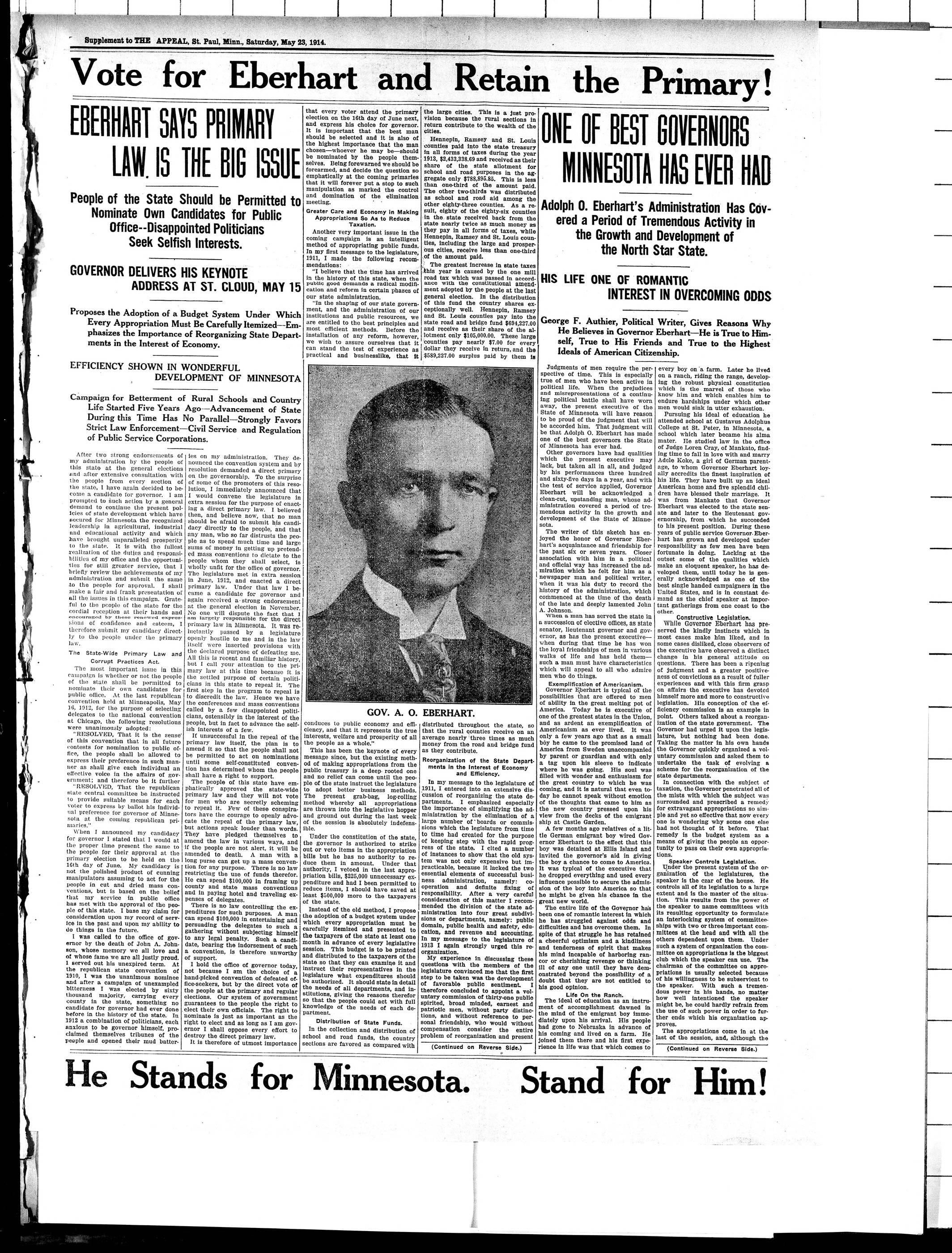
EBERHART SAYS PRIMARY LAW. IS THE BIG ISSUE
People of the State Should be Permitted to Nominate Own Candidates for Public Office--Disappointed Politicians Seek Selfish Interests.
GOVERNOR DELIVERS HIS KEYNOTE ADDRESS AT ST. CLOUD, MAY 15
Proposes the Adoption of a Budget System Under Which Every Appropriation Must Be Carefully Itemized—Emphasizes the Importance of Reorganizing State Departments in the Interest of Economy.
EFFICIENCY SHOWN IN WONDERFUL DEVELOPMENT OF MINNESOTA
Campaign for Betterment of Rural Schools and Country Life Started Five Years Ago—Advancement of State During this Time Has No Parallel—Strongly Favors Strict Law Enforcement—Civil Service and Regulation of Public Service Corporations.
After two strong endorsements of my administration by the people of this state at the general elections and after extensive consultation with the people from every section of the state, I have again decided to become a candidate for governor. I am prompted to such action by a general demand to continue the present policies of state development which have secured for Minnesota the recognized leadership in agricultural, industrial and educational activity and which have brought unparalleled prosperity to the state. It is with the fullest realization of the duties and responsibilities of my office and the opportunities for still greater service, that I briefly review the achievements of my administration and submit the same to the people for approval. I shall make a fair and frank presentation of all the issues in this campaign. Grateful to the people of the state for the cordial reception at their hands and encouraged by these renewed expressions of confidence and esteem. I therefore submit my candidacy directly to the people under the primary law.
The State-Wide Primary Law and Corrupt Practices Act.
The most important issue in this campaign is whether or not the people of the state shall be permitted to nominate their own candidates for public office. At the last republican convention held at Minneapolis, May 16, 1912, for the purpose of selecting delegates to the national convention at Chicago, the following resolutions were unanimously adopted: "RESOLVED, That it is the sense of this convention that in all future contests for nomination to public office, the people shall be allowed to express their preference in such manner as shall give each individual an effective voice in the affairs of government; and therefore be it further "RESOLVED, That the republican state central committee be instructed to provide suitable means for each voter to express by ballot his individual preference for governor of Minnesota at the coming republican primaries."
When I announced my candidacy for governor I stated that I would at the proper time present the same to the people for their approval at the primary election to be held on the 16th day of June. My candidacy is not the polished product of cunning manipulators assuming to act for the people in cut and dried mass conventions, but is based on the belief that my service in public office has met with the approval of the people of this state. I base my claim for consideration upon my record of service in the past and upon my ability to do things in the future.
I was called to the office of governor by the death of John A. Johnson, whose memory we all love and, of whose fame we are all justly proud. I served out his unexpired term. At the republican state convention of 1910, I was the unanimous nominee and after a campaign of unexposed bitterness I was elected by sixty thousand majority, carrying every county in the state, something no candidate for governor had ever done before in the history of the state. In 1912 a combination of politicians, each anxious to be governor himself, proclaimed themselves tribunes of the people and opened their mud batter-
les on my administration. They denounced the convention system and by resolution demanded a direct primary on the governorship. To the surprise of some of the promoters of this resolution, I immediately announced that I would convene the legislature in extra session for the purpose of enacting a direct primary law. I believed then, and believe now, that no man should be afraid to submit his candidacy directly to the people, and that any man, who so far distrusts the people to spend much time and large sums of money in getting up pretended mass conventions to dictate to the people whom they shall select, is wholly unfit for the office of governor. The legislature met in extra session in June, 1912, and enacted a direct primary law. Under that law I became a candidate for governor and again received a strong endorsement at the general election in November. No one will dispute the fact that I am largely responsible for the direct primary law in Minnesota. It was reluctantly passed by a legislature openly hostile to me and in the law itself were inserted provisions with the declared purpose of defeating me. All this is recent and familiar history, but I call your attention to the primary law at this time because it is the settled purpose of certain politicians in this state to repeal it. The first step in the program to repeal is to discredit the law. Hence we have the conferences and mass conventions called by a few disappointed politicians, ostensibly in the interest of the people, but in fact to advance the selfish interests of a few.
If unsuccessful in the repeal of the primary law itself, the plan is to amend it so that the people shall not be permitted to act on nominations until some self-constituted convention has determined whom the people shall have a right to support. The people of this state have emphatically approved the state-wide primary law and they will not vote for men who are secretly scheming to repeal it. Few of these conspirators have the courage to openly advocate the repeal of the primary law, but actions speak louder than words. They have pledged themselves to amend the law in various ways, and if the people are not alert, it will be amended to death. A man with a long purse can get up a mass convention for any purpose. There is no law restricting the use of funds therefor. He can spend $100,000 in framing up county and state mass conventions and in paying hotel and traveling expenses of delegates.
There is no law controlling the expenditures for such purposes. A man can spend $100,000 in entertaining and persuading the delegates to such a gathering without subjecting himself to any legal penalty. Such a candidate, bearing the indorsement of such a convention, is therefore unworthy of support.
I hold the office of governor today, not because I am the choice of a hand-plicked convention of defeated office-seekers, but by the direct vote of the people at the primary and regular elections. Our system of government guarantees to the people the right to elect their own officials. The right to nominate is just as important as the right to elect and as long as I am governor I shall oppose every effort to destroy the direct primary law.
It is therefore of utmost importance
that every voter attend the primary election on the 16th day of June next, and express his choice for governor. It is important that the best man should be selected and it is also of the highest importance that the man chosen—whoever he may be—should be nominated by the people themselves. Being forewarned we should be forearmed, and decide the question so emphatically at the coming primaries that it will forever put a stop to such manipulation as marked the control and domination of the elimination meeting.
Greater Care and Economy in Making Appropriations So As to Reduce Taxation.
Another very important issue in the coming campaign is an intelligent method of appropriating public funds. In my first message to the legislature, 1911, I made the following recommendations:
"I believe that the time has arrived in the history of this state, when the public good demands a radical modification and reform in certain phases of our state administration.
"In the shaping of our state government, and the administration of our institutions and public resources, we are entitled to the best principles and most efficient methods. Before the installation of any reform, however, we wish to assure ourselves that it can stand the test of experience as practical and businesslike, that it
[Image of a man in a suit with a tie].
J. B.
GOV. A. O. EBERHART.
conduces to public economy and efficiency, and that it represents the true interests, welfare and prosperity of all the people as a whole." This has been the keynote of every message since, but the existing method of making appropriations from the public treasury is a deep rooted one and no relief can come until the people of the state instruct the legislature to adopt better business methods. The present grab-bag, log-rolling method whereby all appropriations are thrown into the legislative hopper and ground out during the last week of the session is absolutely indefensible.
Under the constitution of the state, the governor is authorized to strike out or veto items in the appropriation bills but he has no authority to reduce them in amount. Under that authority, I vetoed in the last appropriation bills, $225,000 unnecessary expenditure and had I been permitted to reduce items, I should have saved at least $500,000 more to the taxpayers of the state.
Instead of the old method, I propose the adoption of a budget system under which every appropriation must be carefully itemized and presented to the taxpayers of the state at least one month in advance of every legislative session. This budget is to be printed and distributed to the taxpayers of the state so that they can examine it and instruct their representatives in the legislature what expenditures should be authorized. It should state in detail the needs of all departments, and institutions, giving the reasons thereof so that the people could act with full knowledge of the needs of each department.
Distribution of State Funds.
In the collection and distribution of school and road funds, the country sections are favored as compared with
Minnesot
the large cities. This is a just provision because the rural sections in return contribute to the wealth of the cities.
Hennepin, Ramsey and St. Louis counties paid into the state treasury in all forms of taxes during the year 1913, $2,433,338.69 and received as their share of the state allotment for school and road purposes in the aggregate only $788,955.85. This is less than one-third of the amount paid.
The other two-thirds was distributed as school and road aid among the other eighty-three counties. As a result, eighty of the eighty-six counties in the state received back from the state nearly twice as much money as they pay in all forms of taxes, while Hennepin, Ramsey and St. Louis counties, including the large and prosperous cities, receive less than one-third of the amount paid.
The greatest increase in state taxes this year is caused by the one mill road tax which was passed in accordance with the constitutional amendment adopted by the people at the last general election. In the distribution of this fund the country shares exceptionally well. Hennepin, Ramsey and St. Louis counties pay into the state road and bridge fund $694,227.00 and receive as their share of the allotment only $105,000.00. These large counties pay nearly $7.00 for every dollar they receive in return, and the $59,227.00 surplus paid by them is
THE NEW YORK TIMES
distributed throughout the state, so that the rural counties receive on an average nearly three times as much money from the road and bridge fund as they contribute.
Reorganization of the State Departments in the Interest of Economy and Efficiency.
In my message to the legislature of 1911, I entered into an extensive discussion of reorganizing the state departments. I emphasized especially the importance of simplifying the administration by the elimination of a large number of boards or commissions which the legislature from time to time had created for the purpose of keeping step with the rapid progress of the state. I cited a number of instances to show that the old system was not only expensive but impracticable, because it lacked the two essential elements of successful business administration, namely: cooperation and definite fixing of responsibility. After a very careful consideration of this matter I recommended the division of the state administration into four great subdivisions or departments, namely: public domain, public health and safety, education, and revenue and accounting. In my message to the legislature of 1913 I again strongly urged this reorganization.
My experience in discussing these questions with the members of the legislature convinced me that the first step to be taken was the development of favorable public sentiment. I therefore concluded to appoint a voluntary commission of thirty-one public spirited, broad minded, earnest and patriotic men, without party distinctions, and without reference to personal friendship, who would without compensation consider the entire problem of reorganization and present
(Continued on Reverse Side.)
ota. S
ONE OF BEST GOVERNORS MINNESOTA HAS EVER HAD
Adolph O. Eberhart's Administration Has Covered a Period of Tremendous Activity in the Growth and Development of the North Star State.
HIS LIFE ONE OF ROMANTIC INTEREST IN OVERCOMING ODDS
George F. Authier, Political Writer, Gives Reasons Why He Believes in Governor Eberhart—He is True to Himself, True to His Friends and True to the Highest Ideals of American Citizenship.
Judgments of men require the perspective of time. This is especially true of men who have been active in political life. When the prejudices and misrepresentations of a continuing political battle shall have worn away, the present executive of the State of Minnesota will have reason to be proud of the judgment that will be accorded him. That judgment will be that Adolph O. Eberhart has made one of the best governors the State of Minnesota has ever had.
every boy on a farm. Later he lived on a ranch, riding the range, developing the robust physical constitution which is the marvel of those who know him and which enables him to endure hardships under which other men would sink in utter exhaustion.
Pursuing his ideal of education he attended school at Gustavus Adolphus College at St. Peter, in Minnesota, a school which later became his alma mater. He studied law in the office of Judge Loren Gray of Markafo find
Other governors have had qualities which the present executive may lack, but taken all in all, and judged by his performances three hundred and sixty-five days in a year, and with the test of service applied, Governor Eberhart will be acknowledged a clean-cut, upstanding man, whose administration covered a period of tremendous activity in the growth and development of the State of Minnesota.
The writer of this sketch has enjoyed the honor of Governor Eberhart's acquaintance and friendship for the past six or seven years. Closer association with him in a political and official way has increased the admiration which he felt for him as a newspaper man and political writer, when it was his duty to record the history of the administration, which commenced at the time of the death of the late and deeply lamented John A. Johnson.
When a man has served the state in a succession of elective offices, as state senator, lieutenant governor and governor, as has the present executive—when during that time he has won the loyal friendships of men in various walks of life and has held them—such a man must have characteristics which will appeal to all who admire men who do things.
Exemplification of Americanism. Governor Eberhart is typical of the possibilities that are offered to men of ability in the great melting pot of America. Today he is executive of one of the greatest states in the Union, and as ardent an exemplification of Americanism as ever lived. It was only a few years ago that as a small boy he came to the promised land of America from Sweden unaccompanied by parent or guardian and with only a tag upon his sleeve to indicate where he was going. His soul was filled with wonder and enthusiasm for the great country to which he was coming, and it is natural that even today he cannot speak without emotion of the thoughts that came to him as the new country pressed upon his view from the decks of the emigrant ship at Castle Garden.
A few months ago relatives of a little German emigrant boy wired Governor Eberhart to the effect that this boy was detained at Ellis Island and invited the governor's aid in giving the boy a chance to come to America. It was typical of the executive that he dropped everything and used every influence possible to secure the admission of the boy into America so that he might be given his chance in the great new world. The entire life of the Governor has been one of romantic interest in which he has struggled against odds and difficulties and has overcome them. In spite of that struggle he has retained a cheerful optimism and a kindness and tenderness of spirit that makes his mind incapable of harboring rancor or cherishing revenge or thinking ill of any one until they have demonstrated beyond the possibility of a doubt that they are not entitled to his good opinion.
Life On the Ranch. The ideal of education as an instrument of accomplishment dawned in the mind of the emigrant boy immediately upon his arrival. His people had gone to Nebraska in advance of his coming and lived on a farm. He joined them there and his first experience in life was that which comes to
every boy on a farm. Later he lived on a ranch, riding the range, developing the robust physical constitution which is the marvel of those who know him and which enables him to endure hardships under which other men would sink in utter exhaustion.
Pursuing his ideal of education he attended school at Gustavus Adolphus College at St. Peter, in Minnesota, a school which later became his alma mater. He studied law in the office of Judge Loren Cray, of Mankato, finding time to fall in love with and marry Adole Koke, a girl of German parentage, to whom Governor Eberhart loyalty accredits the finest inspiration of his life. They have built up an ideal American home and five splendid children have blessed their marriage. It was from Mankato that Governor Eberhart was elected to the state senate and later to the leutenant governorship, from which he succeeded to his present position. During these years of public service Governor Eberhart has grown and developed under responsibility as few men have been fortunate in doing. Lacking at the outset some of the qualities which make an eloquent speaker, he has developed them, until today he is generally acknowledged as one of the best single handed campaigners in the United States, and is in constant demand as the chief speaker at important gatherings from one coast to the other.
Constructive Legislation. While Governor Eberhart has preserved the kindly instincts which in most cases make him liked, and in some cases disliked, close observers of the executive have observed a distinct change in his general attitude on questions. There has been a ripening of judgment and a greater positiveness of convictions as a result of fuller experiences and with this firm grasp on affairs the executive has devoted himself more and more to constructive legislation. His conception of the efficiency commission is an example in point. Others talked about a reorganization of the state government. The Governor had urged it upon the legislature, but nothing had been done. Taking the matter in his own hands the Governor quickly organized a voluntary commission and asked them to undertake the task of evolving a scheme for the reorganization of the state departments.
In connection with the subject of taxation, the Governor penetrated all of the mists with which the subject was surrounded and prescribed a remedy for extravagant appropriations so simple and yet so effective that now every one is wondering why some one else had not thought of it before. That remedy is the budget system as a means of giving the people an opportunity to pass on their own appropriations.
Speaker Controls Legislation. Under the present system of the organization of the legislatures, the speaker is the czar of the house. He controls all of its legislation to a large extent and is the master of the situation. This results from the power of the speaker to name committees with its resulting opportunity to formulate an interlocking system of committees with two or three important committees at the head and with all the others dependent upon them. Under such a system of organization the committee on appropriations is the biggest club which the speaker can use. The chairman of the committee on appropriations is usually selected because of his willingness to be subservient to the speaker. With such a tremendous power in his hands, no matter how well intentioned the speaker might be, he could hardly refrain from the use of such power in order to further ends which his organization approves.
The appropriations come in at the last of the session, and, although the
(Continued on Reverse Side.)
```markdown
```
EBERHART SAYS PRIMARY LAW IS THE BIG ISSUE
ciency Commission.
C. P. Craig, Duluth, Chairman.
C. A. Congdon, Duluth.
Theo. Wold, Minneapolis.
W. W. Smith, Sleepy Eye.
F. E. Putnam, Blue Earth City.
Thomas Kneeland, Minneapolis.
Elias Jacobson, Montevideo.
H. H. Dunn, Albert Lea.
Judge J. P. McGee, Minneapolis.
Frank J. Lang, International Falls.
Thomas T. Hudson, Duluth.
George F. Authier, Minneapolis.
B. O. Nelson, Spring Grove.
W. B. Parsons, Winona.
Hugh J. Hughes, Minneapolis.
D. A. Wallace, St. Paul.
Dean A. F. Woods, State Agricultural College.
Prof. John H. Gray, University.
John A. Hartigan, St. Paul.
Frank Lyan, Bemidji.
E. G. Hall, Minneapolis, President
State Federation of Labor.
Alfred Rustad, Wheaton.
Dr. O. J. Hagen, Moorhead.
A. G. Anderson, Fergus Falls.
L. C. Spooner, Morris.
John Mccoon, Waseca.
J. A. Stoneburg, Cambridge.
J. D. Sullivan, St. Cloud.
Jos. Chapman, Jr., Minneapolis.
John H. Hohlmann, Mankato.
E. L. Oglivie, South St. Paul.
The report of the commission is now practically completed and will be published for general distribution. It presents to the people and the legislature in concrete form the results of a careful and complete investigation of the entire reorganization problem. This will furnish a definite basis for action. As outlined in various press dispatches this report will recommend the adoption of every principle advocated in my first message to the legislature. While it has increased the number of departments somewhat, as compared with the number recommended in my 1911 message it has adopted the three most vital principles, namely:
1. Abolishment of unnecessary boards and commissions and the definite fixing of responsibility in a few heads of departments.
2. Strict civil service regulations as to all subordinate officials and employees.
3. A budget system for making appropriations.
State Development and Publicity.
The watchword of my administration has been efficiency. This is fully demonstrated in the wonderful development which the state has attained. I am certain that I can say without contradiction from any one that Minnesota has achieved greater success than any other state in the Union with regard to agricultural and industrial development. I have not been sitting in the executive office waiting for it to come, but have urged the importance thereof before the people of the state on every occasion. No part of this development presents a stronger argument than our rural life betterment exemplified in our industrial schools with their centers of social and civic life.
When I started the campaign for betterment of rural schools and country life in general, five years ago, it was not as popular as it is today. In fact, it was quite generally unpopular, but what is the result? We have today in this state forty-two agricultural high schools, ninety-six other industrial village and city schools and one hundred consolidated rural schools, making in all two hundred thirty-eight schools in which are taught agriculture, home economics and manual training to about fifty thousand boys and girls, who five years ago had no such advantages. These schools are keeping the country boys and girls at home on the farm. Within that period of time the number of first and second class rural schools has more than doubled and training departments for training of rural teachers have increased from ten to eighty. Qualifications of teachers, school buildings and equipment have reached a higher standard. In educational development from an industrial standpoint, the advancement of Minnesota during the last past five years has no parallel.
Cooperative Organizations.
Farmers' cooperative organizations have accomplished great good and should be given the fullest opportunity to reduce the cost of distribution of farm products by bringing producer and consumer more closely together. This extraordinary industrial development has given to Minnesota an investible amount of very valuable publicity. Not only has this state held the greatest gatherings in the interest of conservation and rural life betterment which have attracted the attention of the entire nation, but it has been my fortune to represent the state at the largest gatherings of this kind throughout the whole country. On each occasion I have presented the wonderful resources and opportunities offered by Minnesota. The records on file with the immigration commissioner show that Minnesota has received more actual settlers from Indiana, Ohio, Iowa and Illinois than all the surrounding states put together and has even far outstripped Canada in its success to attract settlers. These records are based on reports received from the railroads showing the transportation of "immigrant movables" and are substantiated also by the reports from nearly all the real estate offices in the state, showing definitely the name of the settler, where he came from and where he settled, as well as the price paid for the land.
The records of the Minnesota Trans-
fer Company for 1913 show that approximately 25,000 actual settlers were located on Minnesota farms. During that year the transfer company handled 2,343 carloads of the "immigrant" movables" destined for Minnesota points, whereas Canada altogether received only 1,453 cars. Montana came next with 807 cars and other states follow with a comparatively small number of cars. However, the records for 1914 far surpass those of 1913. During the first three months of this year about 1,500 cars are registered for Minnesota, a record which far surpasses Canada and all the surrounding states put together. These settlers came prepared to equip and develop our farm lands and have contributed largely to our unprecedented agricultural development. As a result, the unusually large demand for Minnesota lands has caused a great increase in farm values and it is a matter of common knowledge that practically all the agricultural lands of this state have increased in value from fifty to one hundred per cent within that time. The importance of this work to the people of the state cannot be over-estimated and it must not be forgotten that the continuation of this policy is an issue in this campaign.
Dalrying and Stock Raising.
Some time ago I called a meeting of several leading bankers of the state and suggested to them the importance of co-operating with the farmers in securing at a low rate of interest the necessary funds for improving the livestock of the state. This request met with a ready response and the co-operation of the bankers and business men throughout the state with the farmers through the county agricultural agent, has resulted in securing for Minnesota a very large amount of improved farm stock. In some counties there have been shipped in for distribution among the farmers almost a dozen carloids of graded and thoroughbred stock. This movement has emphasized the importance of securing a county agricultural agent for every county in the state, and I shall urge the coming legislature to provide the necessary aid therefor. Upon the recommendation of the agricultural agent the stock is purchased, distributed to the farmers at actual cost, and their notes drawing a low rate of interest taken for the amount. The value of this method of co-operation between the business men and the farmers is inestimable. It has already brought millions in value to the state not only by improving the stock itself, but by adding great values to the farms. Thus the question of rural credits in this state has been at least partly solved by the co-operation between the bankers, merchants and farmers.
Hog Cholera
Last year an epidemic of hog cholera raged throughout the state which resulted in a loss to the farmers of this state, aggregating several millions of dollars. After consulting with a large number of farmers' clubs throughout the state, I concluded to inaugurate a state-wide movement for the purpose of ridding the state of this plague, and appointed the week of April 17th to 25th as a special week during which the numerous farmers' organizations held local meetings and discussed this question, creating a state-wide interest therein. With the aid of the state experts, the agricultural press, as well as the daily and country press, I am satisfied we can protect the farmers against future losses. Our serum plant at the experimental station should be increased, the serum sold to the farmers at actual cost and the treatment should be administered by experts employed by the state.
Strict Law Enforcement
Strict Law Enforcement.
It is entirely proper at this time to express, my sincere appreciation of the co-operation I have received from the various local officers throughout the state in the enforcement of our laws. While violations of law have been committed in the past, and always will be committed in the future, it is a fact, as the records of this office will show, that whenever such violation has been called to my attention, I have immediately taken the matter up with the local law enforcing officer and have always been accorded an earnest as well as effective co-operation in the enforcement of the law. The attorney general has always been ready to give his assistance and Minnesota is one of the few states concerning which it can be said that crime has been reduced and a stricter observance of the law established. Since the abolishment of capital punishment, there has been no increase in crime, but the records show that in cases of murder the percentage of convictions has increased approximately fifty per cent. I am in favor of strict law enforcement. If a law does not work out well it should be repealed, but while it is on the statute books it should be enforced against all, without fear or favor.
County Option.
When the state county option convention was held in St. Paul four years ago I was invited to go before it and explain my views on that question. My position at that time was, and still is, that when the people of this state, in the selection of a legislature or otherwise, have acted upon any question, such action should and would be binding upon me, because I believe in the authority of the people and that any instructions coming directly from them should be supreme. If in the selection of a legislature county option prevailed and the law passed, I should not only approve it, but would see, too, that it was strictly and impartially enforced. That is all any governor could do. A demagogue might promise more in order to secure votes and then conveniently forget his promise. All that he possibly can do
is to approve and execute the law
is to approve and execute the law.
There never was a period in the history of the state during which so much temperance and social welfare legislation was enacted and enforced. I wish to call your attention to the following important laws enacted and enforced during my administration:
1. Prohibiting the drinking of intoxicating liquors on railway trains.
2. Preventing anyone from inducing minors to enter saloons.
3. Authorizing the recovery of damages for injuries by intoxicated persons from those causing such intoxication.
4. Extending local option to cities of the fourth class.
5. Regulating public dance halls and prohibiting the sale of liquor therein.
6. Prohibiting soliciting in dry territory.
7. Providing severe penalties for inducing young girls to enter houses of ill fame.
8. Adoption of the Iowa abatement law, the strongest law ever enacted against the white slave traffic.
9. Establishing the separate industrial school for girls.
10. Establishing a state hospital for the treatment of crippled and deformed children of poor parents.
11. Prescribing hours of labor and meals for women and children in mercantile and manufacturing plants.
12. Controlling and providing for dependent, neglected and delinquent children.
13. Pensions for dependent mothers.
14. Making desertion of wife and family a felony
These and many other laws have been enacted in the interest of social welfare and uplift and all of them have received my active support both in enactment and enforcement.
Civil Service.
The highest and best test of an executive officer is determined by the character of his appointments. No governor before me in the history of this state has had occasion to fill so many important offices of trust and responsibility. I cannot take time to enumerate very many, but it is important to determine the efficiency of an administration from this standpoint. The appointments to the offices of attorney general, supreme and district courts, board of regents and heads of the various departments are sufficient for this purpose. Not even my bitterest enemy has found any fault with them, and it has been the greatest pleasure of my official life to receive so many favorable commendations. The statement of President Vincent that there is not a university in America which can boast of a more efficient board of regents, is a commendation that I prize very high.
I strongly favor civil service, and while only the dairy and food department was under civil service regulations when I became governor, there are now several departments successfully operating under this rule. Appointments and promotions should be based on merit only, and I am willing to submit my case to the people upon the record made.
Regulation of Public Service Corporations
That public service corporations should be regulated so as to secure reasonable rates and adequate service for all is conceded. Nearly all the states of the Union have adopted regulation by the state instead of by the local communities. Senator LaFollette, of Wisconsin, Justice Hughes, of New York, and President Wilson, of New Jersey, succeeded while governors in securing for their respective states such a law as I am trying to secure for Minnesota. If all these states that have adopted state regulation were in error, and if Senator LaFollette, Justice Hughes and President Wilson were the tools of public service corporations in securing the enactment of these laws for their respective states, I am willing to concede that state regulation is wrong. With them I contend that state regulation is the only kind of regulation which has been found successful.
Municipal ownership is not inconsistent with state regulation, and I will not approve any law which does not specifically authorize any municipality to purchase, own and operate any public utility, and when so owned and operated, the municipality should be given absolute control thereof, submitting only to a uniform system of reports and accounting to the state so that the real cost of the service may be easily ascertained.
Protection of Labor.
The adequate protection of labor is one of the important duties of the state. Woman and child labor requires special attention and the latter should be reduced to a minimum. No state can be truly prosperous unless those who work are not only protected against the aggressive seekers of wealth, but also given a fair share of the returns. I take this occasion to acknowledge a most hearty co-operation both from the leaders of labor and capital in the enforcement of labor laws, in the settling of disputes and in creating that friendly co-operation between labor and capital which is so essential to all true progress.
Prevention of Crime and Disease.
The excellent management of all charitable and penal institutions of this state is recognized everywhere. Of this we can very justly be proud, but there is another achievement which entitles Minnesota to still greater recognition. Minnesota is actually doing more and securing better results in preventing crime and disease than any other state in the Union. I have already called attention to our progress in providing industrial training for the children in our public schools and the development of these schools as social and civic centers. This work is without a
parallel anywhere. In the cities, parks, play grounds and wholesome amusements of various kinds are being rapidly provided and effective measures are being taken to safeguard the young folks from error and crime. A Clean and Dignified Campaign. In entering upon my campaign for renomination I am going to conduct the same in a clean and dignified manner. I am confident the coming campaign will determine that personal abuse, slander and vilification will not avail anything and that such methods will be condemned most emphatically by every fair-minded voter of the state.
ONE OF BEST GOVERNORS
MINNESOTA HAS EVER HAD
ONE OF BEST GOVERNORS
MINNESOTA HAS EVER HAD
(Continued from reverse side.)
most important work of the legislature, the adoption of the appropriations bill is usually the most carelessly performed. After making these appropriations, it is naturally customary for the house organization to throw the responsibility upon the governor, notwithstanding the fact that he has little or practically no time to examine the multifarious ramifications of the different appropriation bills, and neither has he the power to reduce the appropriations. It is accordingly customary for clever chairmen of appropriation committees to so frame their bills that the Governor cannot veto them entirely without subjecting himself to criticism, because of the result of that absolute veto, and under the constitutional provision which makes it impossible for him to reduce or cut down an appropriation, his hands are tied.
Voters Study Appropriations.
It was wise statesmanship which prompted Governor Eberhart to recommend the budget system of appropriations so that the preliminary items of appropriations should be published and the voters of the state themselves could have the opportunity to study them and instruct their representatives. Such a course will not only be helpful to the taxpayers, but helpful to the member of the legislature himself. Under the present system he has no opportunity to exercise his own prerogative in the matter as a legislator. He is compelled to vote as he is told to vote on all questions or is threatened with a loss of the appropriation which he may need for his own community. This is especially true of men representing institutional cities, where an appropriation or failure to secure one represents the difference between political life and political extinction. His constituents will ask him why he has not obtained his share of the money that seems to be floating around in the air, and his effectiveness is measured accordingly.
The budget system seems to be the answer, and if Governor Eberhart had done nothing else but urge this important reform for the people of the state, he would be entitled to thanks and the earnest gratitude of every taxpayer of Minnesota.
Throughout all his career Governor Eberhart has lost none of his naturalness and the almost boyish enthusiasm which is the characteristic of a perfect physical equipment. He belongs to the modern school of executives. The old school which was won to constantly attire the executive in a frock coat and owlish dignity has never appealed to him. He is the most accessible governor who ever sat in the executive offices at St. Paul. Realizing that comparatively few of the people could reach the chief executive at the capitol, he has felt it his duty to take the governorship to the people, and today there is scarcely a man in Minnesota who has not had the opportunity to shake his hand or secure his attention for anything in which that man might be interested. Those opposed to him and seeking an opportunity to criticise have questioned this on the ground that he should hold himself more aloof. To this the Governor has always returned the smiling response that in his opinion the people of Minnesota want a man in the governor's office who could be reached by them when they want to see him, and not one who was inaccessible through an assumption of artificial dignity. He has realized that the highest form of dignity is that which comes from naturalness and genuineness.
Minnesota's Advance Agent.
Minnesota's Advance Agent. At the very beginning of his administration Governor Eberhart expressed the opinion that the office he held involved an obligation of service on behalf of the state. He realized that this is essentially an agricultural state and that its prosperity depended to a very large degree upon the development of our agricultural industry. He immediately constituted himself the advance agent of Minnesota development. From one end of the state to the other, he preached intensified farming, better agricultural methods, vocational and agricultural training, and higher development of agricultural communities and farm homes. He places special stress on the matter of education and consolidated rural schools became his hobby. Even today there will be found skeptical ones who little realize the value of the work the Governor has done along these lines. They sometimes scoff at the consolidated rural school, but those who are familiar with the problem of education know the value of the schools and their accomplishment of the purpose of bringing about a higher ideal of education throughout the state. Many of those not so familiar with what has been done along this line will be numbered among those who came to scoff but remained to
Defective Page
pray. The Governor's reply to those criticisms was one of invariable optimism. "The idea is right," he would say, "and accordingly I shall not be deterred because there are those who do not understand the importance of this movement." As a result of the activity of the Minnesota Governor today there are in Minnesota one hundred associated schools, the national school system, the agricultural high schools, and following his agitation for development and conservation there has been a distinct quickening along lines of agricultural development and training throughout the entire state. All of the geographical sections of the state have their development associations. The county agent is at work disseminating newer agricultural ideas and methods among the farmers. Bankers and business men have become interested; farmers are increasing their high grade dairy stock; and today Minnesota is a better and richer state because its executive had the courage of his convictions and was willing to face ridicule because he knew he was right. By no means is the Governor entitled to sole credit for what has been done. His has been the role of agitator. The office which he has held has given him a hearing and he has accordingly been able to awaken a sentiment with which others have been able to accomplish much.
Advertising the State.
It is not only in Minnesota that the Governor has been the advance agent of development for his home state. He has felt it his duty to sing the praises of Minnesota outside of the state as well as within it. It was only a few days ago that an advertising man of national reputation, Mr. Frank Jobs, of Chicago, Illinois, stated in the public press that, as an advertiser of the State of Minnesota Governor Eberhart was worth $100,000 a year to the people of the North Star State. This program has also subject ed him to criticism from some who apparently entertain the idea that the Governor of the state should check in and out of his office by the time clock, and who have professed to believe that the efforts which the Governor has made to advertise the state were pleasurable outings for him. During his administration, Governor Eberhart has addressed something like 200 important gatherings outside of the state. He has reached practically every newspaper reader in the United States. This has been the hardest work which the Governor has done, and any one who thinks this duty has been a pleasant one has little realization of the physical fatigue and inconvenience involved. He has had invitations to go on the Chautauqua platform but has declined them, feeling that his duty for the time being was to the state. In every one of these addresses he has taken occasion to recite the splendid resources of Minnesota and the wonderful opportunities that obtain here.
During the past few years there has been a general trend of sentiment along the line of human welfare legislation. The Governor on this subject, as on others, has been genuinely progressive. He has interested himself in stamping out disease; he has waged war against the scourge of tuberculosis and other forms of preventable disease; he has urged and supported legislation of interest to the men who toil, and today Minnesota has one of the best and most effective labor departments of any state government in the United States. A minimum wage commission is engaged in the work of fixing a minimum wage, whose special object is to see to it that women who toil will not be compelled to suffer because of the meagre living wage offered. He has urged the fight against child labor with special enthusiasm. The mother's pension law was signed by him, and the Governor has been found favorable to every human welfare law that would stand the test of wise and friendly criticism.
Believes in Direct Primary.
Governor Eberhart believes in the direct primary. He believes in the principle of direct nominations and it is characteristic of him that when the opportunity was given him to secure a state-wide primary for the State of Minnesota, he acted promptly and with sureness. In this connection it might be well to recite a little bit of political history, which will explain a good many things in the present campaign. The office of governor is one to which men naturally aspire and there are those whose disposition it is to allow disappointment to cloud their judgment and to destroy their proper perspective on things. From the time Governor Eberhart became chief executive there has been a disposition on the part of some to secure his office and "to put him in a hole." This has been so apparent that "putting the governor in the hole" has become a popular and almost humorous pastime. But in each instance that this has been tried those who dug the pit for him have fallen into it themselves. In the last campaign, men opposed to the Governor secured control of a convention which gathered in Minneapolis and it was determined by men at the head of the committee on resolutions to make one last effort to dig a pit in which the Governor should be buried. The Governor had expressed his opposition to primaries not regulated and controlled by law on the ground that they were susceptible of manipulation, or even more so, than the old convention system itself. Men opposed to him, judging his methods by their own, believed that he was insincere in expressing his belief in a state-wide primary and accordingly passed a resolution asking the Governor to provide for a primary for the selection of a nominee for governor. This was the opportunity for which the executive had been waiting. It placed his opponents on record in favor of a primary and he
promptly called a special session of the legislature for the purpose of enacting such a law for all state officers, together with a stringent corrupt practices act to control and regulate it. There was consternation among those who had insincerely urged the primary upon the Governor. They knew his popularity and feared the result. A second choice feature was attached to the law, but in spite of this and everything else the law was passed and Governor Eberhart signed it. It became a law and the present executive became the first beneficiary of the law giving the people the right to nominate their candidates.
Having been nominated and elected under the primary law it was natural that men who had been loudly for it when they thought they would not secure its enactment have turned against it, and by the use of discarded machine methods, under the guse of conference, etc., have apparently entered into a conspiracy to secure its defeat. The Governor has consistently refused to have anything to do with conferences or other manipulating methods in advancing his candidacy. He stands for the primary and will carry his candidacy directly to the people. He is not only urging his own candidacy, but is urging a fight against the sinister influences that seem to be at work for the purpose of bringing about a revival of the old and discarded convention system.
The writer has no disposition to criticize the judgments of those who disagree with him. The purpose of this article has been to show why he as one individual believes in Governor Eberhart and stands for him. Summarized, these reasons may be grouped as follows:
Authier's Twenty-four Reasons.
Because his life has shown him to be worthy of the opportunities offered by America.
Because as a boy, as a young man, and in his maturer years he has always been true to the highest ideals of American citizenship.
Because as State Senator, Lieutenant Governor and Governor he has always had the best interests of the state at heart.
Because he is true to himself, true to his friends and true to his ideal of public service.
Because his heart remains young and his optimism is that of a man with a healthy body and a clean mind.
Because he has placed Minnesota on the map.
Because he responds to the tendency of the times and is genuinely progressive in all things.
Because he is genuine, sincere and incapable of hypocrisy.
Because he knows where he stands and has the courage to assert it.
Because as a Minnesota, he has given this state its greatest impetus in the line of development and because he has sacrificed his comfort, his time and his limited means to tell the world what we of Minnesota have to offer. Because his agitation for agricultural development and the improvement of rural life and rural educational facilities has placed Minnesota in the forefront of commonwealths interested in the conservation and development of resources and in the training of men and women. Because his heart always responds to appeals for sympathy, because his claspis is hearty and because his eye is clear. Because he is too busy to indulge in hatred, malice, or rancor and because he is never too busy to listen to the appeal of the unfortunate. Because, through his agitation, the entire state has become a school of development.
Because he has had sufficient clearness of vision to detect the hollowness of hypoerisy and to entertain a quiet scorn for those who wear the livery of heaven to do the devil's work.
Because He Is Big Enough.
Because he is big enough and broad enough to interest himself in every line of business or social endeavor within the confines of the state. Because he has given the state an efficient administration and while others have talked, he has performed, and in this connection it might be well to call attention to the fact that through his personal efforts a reorganization of the State Government is being formulated which will eliminate some of the archaic forms of governmental machinery that have grown up chaotically in the progress of fifty years of uncorrelated development. Because his viewpoint is sufficiently big to enable him to think in terms of state rather than of locality and is also large enough to see the state in its relationship to the Union of states. Because he has urged the necessity of the budget system of making appropriations so that the people may have an opportunity to judge in advance of the burdens of taxation that are to be placed upon them.
Because in making appointments, he has chosen men for their merit and is today credited with some of the best appointments ever made in this state. Because he has contributed more than any one else to bring the city and country nearer together. Because he is a human, kindly, sympathetic man, with ability to enter into the lives of other men, to recognize and feel the aspirations of the human heart in whatever walks of life they may be found. Because he stands for a bigger and better Minnesota and has devoted himself with never lessening enthusiasm to the task of making this state what it ought to be, the greatest, the richest and the most progressive state in the Union. Because he has made absolutely good by any tests that may be applied. He stands for Minnesota, stand for him.
A WEEK'S RECORD IN MINNESOTA'TA'S CAPITAL
The "Saintly City" and Iaintly City Folks—Newsey Items of Social, Religious, Political and General Matters Among the People.
SATURDAY, MAY 23, 1914.
Mrs. O. C. Hall, at the hospital, is progressing finely.
Mrs. Earl Walker presented her husband a fine daughter this week.
Mrs. Turner Starks is at the City Hospital.
Detective J. C. Black has returned from his trip to Nashville and Chicago.
Mrs. Laura Pinkney leaves this morning for Winnepeg, Can., to make her future home.
There is an effort being made to organize a new U. B. F. lodge, will a good show of success.
Lawyer D. F. Peebles, formerly in the Globe building, has moved to suite 309. Dispatch building.
For Sale—The Little Diamond Cafe, 476 Robert street. For terms apply to the proprietor, Mrs. M. J. Hicks.
You should get in on the ground floor by buying some shares in the Citizens ice and Fuel Company now.
St. James A. M. E. Church, Sunday
Services in honor of our soldier dead.
FOR RENT—Lower flat of four un furnished rooms for rent, with gas and toilet. Apply to 602 Aurora.—Advertisement, 5-16.
Little Miss Vergilee Jenkins returned last week from Maysville, S. C. where she had been attending boarding school.
Mr. G. W. Moore is now the proprietor of "Utley's New Place," 30 E. 4th street and invites the patronage of all old and new customers.
W. T. FRANCIS
WHO FOR A NUMBER OF YEARS WAS IN THE EMPLOY OF THE LEGAL DEPARTMENT OF THE NORTHERN PACIFIC RAILWAY COMPANY HAS OPENED OFFICES FOR THE GENERAL PRACTICE OF THE LAW AT 88 AND UNION BLOCK, ST. PAUL.
Advertisement.
Dr. J. R. French, the dentist, has moved his offices from the third to the fourth floor of the Kendrick block, suite 494.
FOR RENT—Six-room flat, all modern. Apply to Clarence L. Smith, 788 St. Anthony avenue. Tel. Dale 5413—Advertisement.
The B. Y. P. U. of Pilgrim Baptist Church meets each Sunday at 6:45 P. M. The meetings are very interesting. All are cordially invited.
Corinthian Temple No. 1, S. M. T., will have the annual sermon preached at St. James A. M. E. church, by tev. H. P. Jones, at 3:00 o'clock.
The State Savings Bank has fallen in line with other banks and has raised the rate or interest paid on deposits to FOUR PER CENT.
T. H. LYLES.
Funeral Directors and Embalmers
150 W. Fourth St.
Res. 678 St. Anthony, Tel. Dale 2947
Calls Answered Day or Night Ir
Twin Cities.
Active Pall Bearers Furnished If
Desired.
Lady Assistant When Necessary.
Both Phones 508. St. Paul, Minn
If the readers and well-wishers of
the APPEAL will send items of
social news to this office it will be
appreciated and the news will be
published.
Invitations have been issued for the
"Tango Dance and May Party" of the
Clet Club, at Bowley Hall, on Friday
evening, May 29, at 8:30 sharp,
Tickets, 35 cents.
The St. Louis Kitchen complying with a general demand is again serving regular dinners from 11:30 to 2:30 o'clock at 25 cents. All home cooking. Advertisement.
Gopher Lodge, Elks, has given up its hall at 126 E. Third street and now meets at Wagner Hai, corner Charles and Western Ave, on the second Wednesday in each month.
FOR RENT — Furnished room, steam heat, separate kitchen, for man and wife. Apply to G. W. Maker, 869 Thomas street. Tel. Dale 1369—Advertisement.
VOCAL AND PIANO LESSONS given by Mrs. Addie Crawford-Minor
Vacation Pleasures
Are only for those who have been wise enough to lay aside part of their earnings in winter for use when needed in summer. For this purpose use a large, strong institution.
THE
STATE SAVINGS BANK
93 East Fourth Street.
TICKETS - - - 35 CENTS
THE YOUNG MEN'S PROGRESSIVE CLUB OF MINNEAPOLIS WILL CLOSE ITS DANCING SEASON WITH THE ANNUAL "SHIRT WAIST PARTY;" MONDAY EVENING, JUNE 8, 1914, AT MASONIC HALL, COR. 5TH AVE. AND 24TH STREET. JUST ACCEPT THIS AS YOUR INVITATION AND COME OUT FOR AN IN-EXPENSIVE GOOD TIME. JUST A SIMPLE "SHIRT WAIST PARTY" FOR 35 CENTS.
473-475 St. Peter St.
The leading New and Second Hand
Furniture store of the city
A. B. CHERNISS, Mgr
at her residence 251 Rondo street, only. Hours for instruction arranged to suit patrons. Terms reasonable. Tel. Dale 1597—Advertisement.
Biddle Circle Ladies of the u. A. R. will be guests of honor at 2 p. m. Annual Sermon to the Corinthian Temple S. M. T. at 2 p. m. Sermon.
FOR RENT—Furnished rooms, one large room for man and wife, for light housekeeping. Apply to 425 University ave. Phone Dale 1936—Advertisement, 5-23.
FOR RENT—Nicely furnished front room, suitable for one or two, all modern conveniences. Walking distance, 261 Rondo street. Phone Dale 6147—Advertisement, 5-23.
The May Festival of Corinthian Temple No. I, S. M. T., at Bowly Hall. Wednesday night, was only well attended but was highly enjoyed by those who were there.
BE ON THE QUI VIVE for the entertainment of the young Men's Club at Bowlby Hall, Wednesday evening June 3. McCullough Orchestra. Ticket 35 cents.—Advertisement.
FREE—IF YOU WANT A JOB CALL AT THE FREE EMPLOYMENT BUREAU OF THE ST. PAUL AFRO-AMERICAN LABOR LEAGUE, 468 ROBERT STREET, G. T. WILLIAMS, MNGR.
Wait for the big thing—the First Annual June Rose Concert and Review of St. Paul Musical Talent, at St. James church, Monday evening, June 15th, at 8:30 sharp—Merchandise bonds as prizes for ticket sellers.
Mrs. Birdella Driver has bought out the grocery of Young & Barksdale, 441 Rondo street, corner of Arundel, and contemplates making many improvements, some of which have already begun. The store is now open for business.
FOR SALE—$2,400.00. Six-room stucco dwelling. No. 969 Nondo street near Chatsworth. Hardwood finish, electric lights, gas for cooking. Easy payments. Apply to W. T. Francis, 88-89 Union Block, Fourth and Cedar. —Advertisement.
"SHINE 'EM UP!" When you wish your shoes shined or polished in the most artistic and satisfactory style, go to the PEOPLES' SHINING PARLOR, W. H. Porter, Propr, 349 Minnesota street, between 4th and 5th. —Advertisement.
Manager Roth of the "Gaiety" Theatre, on Wabasha street near Seventh, announces that the moving pictures of the great Old Fellows' parade, Sunday, May 10, will be shown again at the "Gaiety" on Tuesday and Wednesday evenings, May 26 and 27. Go and see them, they are as natural as life.
FOR RENT—Modern duplex house of 4 and 5 rooms for $15 and $20, at 294 Arunel street, Tel. Tri-State 2557. —Advertisement 59.
F. H. Harm & Bro, opticians and jewelers, are now located at 492 Wabasha street in the Shubert Building, where they will welcome old and new customers. If you want honest work and goods at fair prices call on them. The Globe Method.—To sell Furniture that will Satisfy at prices that will Gratify. We give Furniture and Stoves you do want, for Furniture and Stoves you don't want.—GLOBE FURNITURE CO., 473-475 St. Peter Street.—Advertisement.
F. LOUIS KITCHEN, 138 E. Third street, up stairs, Mrs. Julia Hinson, Prop. on the carte meals at all hours. Prop. on the carte meals at all hours. All home cooking. Rem. Ship. dinner from 1 to 3 p. m. 40 cents. El. Phone Cedar 6000.—Advertisement.
Mr. Chester W. Patterson is now acting as agent for the John Brown Cigar Co., is making good.
brands of the company are: "John Brown," "Thin Dime" and "Blue Head." When you wish a cigar just call for one of these. Mr. Patterson is still writing insurance also, don't forget that.
Mr. Richard Stokes, stopping with Mr. and Mrs. J. Q. Adams, had a severe attack of hemorrhage of the bowels last Saturday, and was taken to St. Joe Hospital Sunday, where he is getting along nicely.
The. Colored Business Men's Associatio are preparing to give another of their toothsome suppers at Bowlby Hall on Monday evening, June 1st, at 8:00 o'clock sharp. Tickets 35 cents to be obtained from the secretary J. H. Zedricks. Better than before. Can you beat it! All business men welcome.
THE BUSY BEE CAFE, 317 Wabash street (upstairs), W. F. T. Chandler proprietor. Unexcelled cuisine. First class home cooked meals *u* a carte at all hours. A splendid dinner served from 11:30 a.m. to 3:00 p. m., at 25 cents. Open day and night. Tel. at 25 W. Cedar 4525.—Advertisement.
FOR RENT—Modern nine room house 294 Arundel street. Convenient for two families. $30. Duplex 5 rooms, modern. 194 W. Central. $16. Cottage, 6 rooms, modern. 321 W. Central, $20. Phone Tri-State 2557.—Advertisement 5-23.
For God so loved the world that He gave His only begotten Son that whoever believeth in Him should not perish but have everlasting life. John 3:16. There is a way which seemeth right unto a man, but the end thereof are the ways of death.—Proverbs 14:12.—Selected by E. W. Gilles.
The Social and Literary Club of Pilgrim Baptist Church will mett at the residence of Mrs. W. T. Francis, Monday evening, May 25. The feature of the evening will be a spelling match, Refreshments and a good time for all. Come.
SAFE DEPOSIT AND STORAGE VAULTS—We invite your inspection. It costs little to place your valuable papers, cash, securities and other valuables in a safe, our vaults can be had for $4 per year. Store your boxes, trunks, etc., with us. Northwestern Trust Co., 138 Endicott Arcade—Advertisement.
The annual sermon of Princess Ozell Chapter No. 45, Order of the Eagle, will be held at the Zion Presbyterian church Farrarrington and St. Anthony aves, by Rev. G. W. Camp, Sunday, June 7, at 8:00 p. m. The public cordially invited.
THE VALET TAILORING CO. No. 154-156 E. Sixth street. The most up-to-date establishment of its land in the city. Clothing made to order, sueded, pressed, renovated and repaired. Goods called for and delivered. Four suits pressed for $1. They are prepared to give best service at lowest rates. Tel. N. W. Cedar. 4362. O. Howell, manager—Advertisement.
Mr. Peter Vaughn and Mrs. Josephine Anderson were united in marriage Wednesday evening the 20th inst, at 405 Farrington Ave, the home of the bride, in the presence of a few friends. Rev. H. P. Jones read the marriage ceremony after which refreshments were served.
There is a possibility that the people of St. Paul will shortly have 85 cent gas. The assembly board of Aldermen have passed the bill and Mayor Keller has signed it. Of course, the Gas Co. will make a fight but it will only be a question of time when they will give to give in.
Dr. H. I. Williams, the dentist, 27 E. Seventh street, who has been unable for some time to comfortably accommodate his patients, is now prepared to do so. He has secured the adjoining room, removed the partitions and now has two large operating rooms and a much larger reception room. He has also changed the main entrance of his suite to No. 203, just in front of the elevator. He is now, better than ever, able to take care of his daily increasing clientele. For tooth troubles see Dr. H. I. Williams, second floor Kendrick Block, 27 E. Seventh street—Advertisement. Dr Wallace, of McAllister College will preach at Pilgrim Baptist Church, Sunday morning, and the pulpit will be filled at night by Dr. P. P. Woman.
N'S PROGRESSIVE CLUB OF MINNE-
HOSE ITS DANCING SEASON WITH
SHIRT WAIST PARTY," MONDAY
3, 1914, AT MASONIC HALL, COR.
WITH STREET. JUST ACCEPT THIS
TION AND COME OUT FOR AN IN-
D TIME. JUST A SIMPLE "SHIRT
FOR 35 CENTS.
Defective Page
of Plymouth Congregational Church, Dr. Womera is an active member of the St. Paul Branch of the Association for the Advancement of Colored People and a great friend of our people. He is a very interesting speaker and the church will be filled. Services start at 8 o'clock sharp.
A jury in the criminal branch of the district court Thursday acquitted Charles Graham, on trial for the charge of assault, in the second degree conviction with the charge of John Davis in the foyer of the Orpheum theater, April 5. Graham admitted the stabbing, but pleaded self-defense.
Two old shoes won freedom in police court Monday for William Clarke and John Stewart, charged with vagrancy. Clark was arraigned early in the day, but his case was continued. Later John Stewart was brought before the court. Before he had a chance to plead an excited bailiff whispered to the judge that Stewart had stolen Clarke's shoes while the two were confined in the bull pen. The prisoner denied he had stolen the shoes, and when the court officer, who had come to the court room, the latter told the judge he merely loaned Stewart the shoes to wear while appearing in court, Stewart's hat and shoes having been stolen while sleeping back of a billboard, where he was arrested. Both cases were thereupon dismissed.
The magic and athletic entertainment which was given at St. Phillips guild hall on Friday evening of last week, was a decided success. The house was crowded, standing room being at a premium. The young persons who were on the program did themselves proud and every one present was highly pleased with their performance. The program furnished was as follows: Wrestling bout between the champion and forward Norward Turner, which was won by Wrestling. Boxing bout No. 1, between Geoff Manning and Almerick Barksdale, a draw. Boxing bout No. 2, between Frank Lyons and Theo. Collins, decision in favor of Collins. Piano solo, Miss Cora Cuthbert. The grand finale was the exhibition of magic by the rising young magician Arthur White who is an embro Hermann. Some of the feats were the production of confections from a glass of bran which were distributed among the audience; from a silver vase filled with cotton and vanilla coffee, and numerous feats showing his skill in his chosen profession. Young White has quite a reporter of tricks and he is perfecting more every day. He may be engaged for public or private performances upon application to 727 Thomas street.
TO WHOM IT MAY CONCERN.
At the Special Business Meeting held at Pilgrim Baptist Church, Friday night, May 15, the following resolutions were adopted.
St. Paul, Minn., May 15, 1914.
WHEREAS, The condition of strife and dissention in Pilgrim Baptist Church has reached an acute stage which threatens to disrupt Church and to hamper or destroy its worth in this community, and
WHEREAS, Said condition has been growing and increasing for a long period of time, and
WHEREAS, It appears that the Pastor of said Church has been unable to ostop or check the growth of said condition, and
WHEREAS, Any attempt to go into the matter for the purpose of fixing the responsibility for the fortunate circumstances merely results in the creation of further difficulties by increasing the bittiness of the situation among the members of the Church, as has been demonstrated at the several Church business meetings in the past few months, and
WHEREAS, Undoubtedly it is manifest and apparent to all parties interested (including the Pastor himself), that regardless of where the responsibility for the difficulty lies, the success of the present Pastor in this particular Church has been destroyed.
NOW THEREFORE, BE IT RESOLVED, That on and after today, Friday, May 15, 1914, the pulpit of said Pilgrim Baptist Church be and it hereby is declared vacant, and the services of its Pastor, E. H. McDonald, be dispensed with as of this date.
BE IT FURTHER RESOLVED,
That the Trustees of said Pilgrim
Baptist Church be and they are nerey
authorized to use their good offices
and best judgment in raising immedi-
ately, by note or otherwise, a nd pay
to said E. H. McDonald tonight all
money due him to date as Pastor of
said Pilgrim Baptist Church.
NORTHWESTERN REALTY CO., I. S.
ELAM, MNGR—RENTING, BUYING,
SELLING, MONEY TO LOAN,
INSURANCE, BUSINESS OPPOR-
TUNITIES. LIST YOUR PROPERTY
WITH US, 415 RONDO STREET,
PHONE, DALE 2282.—ADVERTISIEMENT.
WATCH FOR THE OPENING.
Mad. Notah Wilson will on Thursday open a new Beauty Parlor at 563 Charles street, St. Paul, with all the modern conveniences of the down half what is charged down town. She town parlor with rates practically will have the latest electric beauty lights and electric hair straightening and drying. Will also do facial massaging, manicuring and chirpody for ladies and gentlemen. Hair switches made to order. Mad. Frances De Leo, of Minneapolis will deliver a lecture at 2:30 p. m. Everybody is invited to call and see this up-to-the-minute establishment.—Advertisement.
F. M. PARKER & CO.
Bowlpy Hall, Sixth and Robert Street FRIDAY EVENING, MAY 29 AT 8:30 Music by Imperial Orchestra All the Latest Dances Demonstrated by Leading Dancers of the Twin Cities
I positively guarantee to ex-
ABSOLUTELY
Get prices here be-
A Written Guarantee for 20
Dr. Williams,
TEL. C. 6|32
KENDRICK B
I positively guarantee to extract teeth and remove nerves
ABSOLUTELY PAINLESSLY
T. S. 1296 N. W. Cedar 5599
Established 1887
ST. PAUL RUG AND KAG CARPET FACTORY
LUDWIG STOPPEL, Prop.
We make Rugs from Ingrain and
Brussels Carpets, Silk Curtain
and Rag Carpet Weaving.
Cleaning and Refitting.
Orders called for and delivered.
285 W. 7th ST. ST. PAUL, MINN.
YOU CAN HAVE STRAIGHT HAIR
AND
Ladies Your Looks May
be Improved by
USING
Madame Notah Wilson's
GUARANTEED BEAUTIFIXING FORMULAS
Will call at your home, wash and Straighten your Hair
and give 4 scalp treatments for $1.50 per month.
Hair Dressing; Manicuring; Massaging
PHONE DALE 2552
563 Charles St. ST. PAUL
Phone Dale 5092 Prompt Delivery
The Imperial
BIRDELLA DRIVER, PROP.
Confectionery, Ice Cream, Soda and
Sundaes, Cigars
GROCERIES
Fresh Fruits and Vegetables
441 Rondo ST. PAUL
Phone C
John Brow
MAKE
FINE HIGH GRADE CIGARS
SPECIAL BRANDS
JOHN BROWN THIN DIME BLUE HEAD
115 E. THIRD STREET
THIRD FLOOR
ST. PAUL
Northwestern Stamp W
MANUFACTURERS OF
Rubber and Metal STAMPS
Northwestern Stamp Works. MANUFACTURERS OF
COAL AND WOOD FLOUR, FEED AND HAY FROM C. W. STAEHLE.
Don't Miss Them!
Go to see the moving pictures of
ODD FELLOWS' PARADE
of Sunday, May 10, at the
Gaiety Theater
Wabasha bet. 7th and 8th Sts.
TUESDAY AND WEDNESDAY
May 26 and 27
In addition to regular Vaudeville and Moovies
10 CENTS
Any Seat
10 CENTS
FIFTY-FIVE CENTS
Dr.H.I.WILLIAMS Announces his NEW method of PAINLESS DENTISTRY
extract teeth and remove nerves
BY PAINLESSLY
before going elsewhere
10 Years Given With All Work.
27 E. 7th St
BLDG. 2ND FLOOR
ST. PAUL
MINNEAPOLIS
THE DOINGS IN AND ABOUT THE
GREAT "FLOUR CITY."
Matters Social, Religious and General
Which Have Happened and are to
Happen Among the People of the
City.
"Carnation Night" at the Twin City Cafe, 246 Fourth avenue South, Thursday, May 27, on which occasion each Splendid entertainers will be present. lady present will receive a souvenir.
The Cason Bro's Orchestra, T. E. C. Cason, manager, Earl C. Cason, assistant manager, is prepared to furnish music for all occasions at reasonable rates. Phone Hyland 3770. Residence 1210 Sixth ave. N.
WHEN IN ST. PAUL, go to the St. Louis Kitchen, No. 138 E. Third street, upstairs, for your meals. Meals to order from 7:00 a.m. m. to 8:00 p.m. Regular Sunday dinner from 1 to 3 p.m. m. 40 cts. All home cooking. Mrs. Julia Hinson, Prop. Tel. Cedar 6090. —Advertisement.
LITTLE DIAMOND CAFE
First Class Home Cooked Meals
to order at all hours
Daily Dinner 11 to 3 at 25c.
Sunday Dinner 11 to 6 at 30c.
breakfast 6:30 Supper 5 to 8
476 Robert, ST. PAUL
CEDAR 4877
on Cigar Co.
Stamp Works. CTURERS OF
DESCRIPTION
ST. PAUL, MINN.
ND WOOD
ED AND HAY
ROM—
TAEHLE
WALTER MCCOY
J. H. ZEDRICKS
B
DR. JOHN R. FRENCH
DENTIST
DENTIST
804 KENDRICK BLOCK
27 E. SEVENTH ST. ST. PAUL
Office Cedar 1673
Dr, Valdo Turner
PHYSICIAN AND SURGEON
Kendrick Block, 27 E. 7th
OFFICE HOURS
9 to 11 a. m., 12 to 1 p. m., 3 to 5 p. m.
Sundays 10 to 11 a. m.
Res. 386 St. Albans Tel. Dale 912.
Geo.W. Nelson
DRUGGIST
Full Stock of Pure Drugs, Proprietary
Medicines, Druggists' Sundries,
Toilet Articles, Candies,
Soda, Cigars, Etc.
High Brown and High Brown De Luxe
Powder a Specialty.
ORDERS DELIVERED
Cor. Wabasha and Summit, St. PAUL
N. W. PHONE DALE 3676
Mrs. A. Wilson
FASHIONABLE DRESSMAKING
LADIES' TAILORING
491 University Ave. ST. PAUL
PHONE DALE 3601
"THE BUSY CORNER"
A. J. McMURRAY & CO.
Staple and Fancy Groceries, Candies, Connectionery, Cigars, School Supplies, Etc.
Ice Cream Parlor and Cafe, Lunch at all Hours.
REAL ESTAT. AND RENTALS HANDLED.
Corn, General and Rondo
ST. PAUL
VANDER BIE'S
ICE CREAM
IS THE BEST
For Sale Everywhere
J. C. VANDER BIE
496 Partridge
ST. PAUL, MINN
Tel. Dale 7817 City References
MADAME L. A. PORTER.
Shampooing, Hair Dressing, Manuring,
Facial Massage, Scalp Treatment,
Switches Made to Order. Sore Corns,
Innglow Nails, Bunlons Removed.
TRY PORTER'S WONDERFUL HAIR
GROWER.
Grace Ferguson. Mayme Lobbins.
Phone Dale 7417.
HOME BAKERY
DELICATESSEN
FERGUSON & LOBBINS, Props.
Our Bread, Pies, Cakes, Etc., Are Made
from the Best Materials. They "Can't
be Beat."
Dainties for Receptions, Luncheone, Teas
and Old Fashioned Pound Cake (40
cents per pound) Our Specialties.
Orders Delivered.
443 Rondo St. St Paul, Minn.
TEL. CEDAR 441 TRI-STATE 1034
U. S. TRANSFER CO.
LET U.S. HAUL IT
STO
SAINT PAUL
MIDWAY
MINNEAPOLIS
MAIN OFFICE
Cor. Ninth & Jackson
ST. PAUL, MINNESOTA
CENTRAL DRUG CO.
Expert Pharmacists
Corner Stats and Washington Sts.
TEMPERANCE NOTES
(Conducted by the National Woman's Christian Temperance Union.)
CHIEF FACTOR IN NATIONAL DEGENERACY.
A wave of degeneracy is sweepng the land, and its development threatens the physical vitality of the nation. Within a period of 50 years the population of the United States increased 330 per cent., while the number of insane and feeble-minded increased 950 per cent.
What is the cause of this degeneracy? A hundred different intermediate agencies may contribute to the undoing of the race, but back of them all stands alcohol as the chief degenerative factor. Statistics compiled by the leading insurance companies, and presented by Sir T. P. Whitaker in a report to the British parliament, show that out of every 1,000 deaths among the population at large, 440 are due to alcohol. This would mean a mortality from alcohol in the United States of 680,000 a year.
The great burden of drink is not borne by the drinker, but by the drinkers' children. In our studies among school children in New York city we find that 62 per cent. are the children of drinking parents, and that 91 per cent. of these children of drinking parents suffer from some functional or organic disease. If this percentage holds good over the entire country there are 13,000,000 children of school age that are afflicted with functional and organic diseases, and less than two and a half millions of these are free from hereditary alcohol taint, a nation half diseased and half well cannot live, but here we show three-fifths of the rising generation mentally and physically diseased—Dr. L. Alexander MacNicholl.
STRIKES FROM THE SHOULDER.
From an Address of MORRIS SHEP-
PARD, Before the Texas Legislature
After His Election as United States
Senator.
TROUBLE-MAKER
A Pittsburgh paper tells us that "one person out of every 95 in Pennsylvania was behind prison bars in 1911. Out of 707 prisoners receiving penitentiary sentence 80 per cent were drinkers. Out of 10,607 prisoners sentenced to serve time in jails and workhouses over 85 per cent were drinkers. Out of 3,670 persons sentenced to the Allegheny workhouse in 1912, 92 per cent. were drinkers. Father Penn's children who are dependent wholly or in part for support upon the taxpayers outnumber the combined armies of Meade and Lee at Gettysburg in 1863. The vast majority of them are the victims of John Barleycorn. One person out of every 45 in Father Penn's dominion is dependent either as a lunatic, pauper or criminal."
The drink traffic produces criminals, paupers, dependents and undesirables generally. The state pays the bills. The twentieth century taxpayer is waking up to the situation: He—and she—is moving to "put the liquor business out of the government and the government out of the liquor business."
ONE EXCEPTION
Legitimate industries favorably affect each other. The liquor traffic unfavorably affects them all. The more it flourishes, the more they must decline. Its profits are taken from the merchant, and the manufacturers behind him; from the butcher, and the cattle raisers behind him; from the farmer, the miller, the baker, the builder, the shoeemaker, the printer, the teacher, and the preacher. Every honest producer suffers from it. The country suffers from it. More than low tariff, or high tariff, or no tariff at all, it depreciates American industry.—A. A. Hopkins, Ph. D.
ALCOHOL AS ASHES.
In the production of alcoholic drinks the raw material is destroyed. Alcohol is not the outcome of a development or adaptation of food properties; it is the creature of destruction, obtainable only by the destruction of the natural properties of the subject. A log of wood may be developed, altered or adapted so as to produce a table or a case for an organ or plano. Put the log into the fire, and all that will be left of it is ashes. So likewise alcohol is the ashes of the fruit, barley or corn.
MRS. MILLIE ALEXANDER
The Hair Manufacturer and Hair Dresser in St. Paul.
Mrs. Millie Alexander the famous hair artist, well known in many states is now located at 499 Western avenue, St. Paul, manufacturers all kinds of hair goods, transformations, switches, puffs, etc.
Will give four scalp treatments per month for $1.50 and one jar of her woolen groomer free. Office hours from 8:00 a.m. to 9:00 p.m. Phone Dale 4926.
Hair dressing for weddings and parties a speciality.
WANTED—A good managing housekeeper, man or woman, to take charge of a large rooming house. Call at once at 1015 South Fifth street. Tel. Nicollet 951.—Advertisement.
BARBER WANTED
A good first class experienced barber (light complexion), or a young man of two or three years' experience may secure a position at good wages (e.g. once to Israel J. Putnam, Palace Hotel, Hibbing, Minn.—Advertisement.
AGENTS WANTED.
Any proper persons, male or female, who wish to act as agents for the great book "FACTS OF RECONSTRUCTION," by Major John R. Lynch, should write for territory and terms to Major John R. Lynch, 4321 Forestville Ave., Chicago. The book is just from the press and sells at sight. Do it now.-Advertisement
CAPITOL STEAM LAUNDRY.
"The House of Quality and Service."
Besides doing first class laundry work at low rates, also does DRY CLEAN-ING, and for a short time offers these special rates:
Ladies' Suits $1.50
Ladies' Long Coats, full lining 1.50
Ladies' Long Coats, half lining 1.25
Ladies' Long Coats, no lining 1.00
Ladies' Long Gloves .10
Ladies' Short Gloves .05
Men's Suits 1.00
Men's Spring Over Coats 1.00
Try us and you will be convinced.
Our wagons go everywhere.
Phone N. W. Cedar 991 Trial 1040
Phone N. W. Cedar St. TrT-state 1643
743 Wabasha St. St. Paul, Minn.
TO THE PUBLIC
The Colored Citizens' Civic and Commercial League, Incorporated, has removed its charter and belongings from 19 Washington Ave., North, Minneapolis, and is at present without permanent club rooms; temporary headquarters, 1020 Met. Life Bldg., Minneapolis, Minn., at the office of the president, Wm. H. H. Franklin.
The members and directors were and are at whatever cost, to keep implicit faith with the public and themselves, and on behalf of the unlimited license given colored "clubs" by the city authorities, the directors found it impossible to meet the competing bids for the location, No. 19 Wash. Ave. So. It was a question of allowing either the conditions to exist at this address that exist in every other colored dive in Minneapolis, viz., protected vice, or, keeping up our ideals and our faith with the public. We have chosen. We will be connected. in any manner, with said place, hereafter, nor in any wise responsible for what occurs therein or threat.
The Board of Directors,
C. C. C. & C. LEAGUE
SAINT PAUL.
FREE—Big fish siturer at the Acme Club Cafe, 107 E. Third street Monday night and you are invited.
Dr. and Mrs. Geo. W. Nelson have changed their place of residence from St. Anthony avenue to 88 E. Eleventh street.
FOR RENT—To a woman only, a nice furnished room at 636 University avenue. Phone Dale 7724.—Advertisement, 5-2.
If you have anything good to say of THE APPEAL tell it to your friends. If you have anything bad, tell it to "Husling" Morgan, the agent.
SPIRIELLE CORSET, Cora E. Anderson corsetter. Any lady wishing to be properly corsetted call or address 385 Aurora Ave. Tel. N. W. Dale 1345.—Advertisement.
If your wife is alling buy her a GOSSARD CORSET and she will be in better SHAPE than ever before. For sale by Mrs. J. E. Cloak, 292 St. Albans street. 'N. W. Phone, Dale 2076.—Advertisement.
HAIR CULTURE—Scalp Treatment and Hair Culture. Any one wishing the PORO treatment and PORO Hair Grower, should apply to Mrs. G. W. Bell, 1776 W. Minnehaha street, St. Paul, Minn.—Advertisement, 5-2.
The place to have your shoe repairing done in the best possible way at the lowest possible price is at ARVIS) 1140 1140 Street. He has a complete stock of men's, women's and boys' shoes of the best grades for the money to be found in the city.—Advertisement.
THE GRANBERRY TAILORING CO,
N. T. Granberry & F. H. Monroe
Props., have taken over the Walden &
Bodene tailor slip, 30 E. 4th street
and they are prepared to do anything
in the line of up-to-date tailoring. Give
the a call.—Advertisement.
N. W. DALE 3454 I. S. 5730
Brotchner's Pharmacy
Rondo & Dale Sts. ST. PAUL
GOOD
SHOES
The Horsheim SHOE
For the man who cares
STANLEY
SHOE CO.
621 Robert Street. St. Paul
422 Nicollet Ave., Minneapolis.
Hamm's
ST. PAUL
"FOR FORTY NINE YEARS,
THE BEST OF BEERS."
Hamm's
Beer
THEO.HAMM BREWING CO.
ST. PAUL
MOST MODERN BOTTLING PLANT
N.W. BOMONT 1400
TRI-STATE 935
1 EVERY PATRON OF THE RECENT
CELEBRATION OF THE FIFTIETH
ANNIVERSARY OF EMANCIPATION
OBLIGATED HIMSELF TO PAY $2,
THE PRICE OF TWO TICKETS,
WHEATHER HE PERSONALLY ATTENDED THE CELEBRATION OR NOT. HE WAS ALSO UNDER THE
OBLIGATION OF MAKING A REPORT IN REARD TO THE 5
TICKETS WHICH WERE ENTRUSTED TO HIM, BEFORE OR ON
THE NIGHT OF THE CELEBRATION
HERE IS A VERY CONSIDERABLE NUMBER OF THE
PATRONS WHO HAVE Failed TO FILL ONE OR THE OTHER
BOTH OF THESE OBLIGATIONS UP TO THIS TIME. IT IS SINGERELY
HOPED THAT THE PATRONS TO WHOM THIS REFERS WILL NO
LONGER DELAY ABOUT MAKING REPORTS AND FULFILLING THESE
MORAL OBLIGATIONS. THIS APLIES TO EVERY PATRON WHOSE NAME WAS ON THE LIST, THAT
HAS NOT REPORTED. DO IT NOW.
CITATION FOR EXAMINATION OF FINAL ACCOUNT.
STATE OF MICHIGAN UNIVERSITY OF Ramsey--ss. In Probate Court.
In the Matter of the Estate of Annie K. Grant.
The State of Minnesota to All Whom it May Concern:
On reading and filing the petition of the representative of final estate, praying that the Court fix a time and place for examining, adjusting and allowing his judgment, and for the assignment of the residue of and estate to the persons thereto entitled:
It is ordered, that said petition be heard by persons interested in said matter be cited, and required to appear before this Court, on Monday, the day of April, 1914, at 10 o'clock A. M. to the Court House, at the Probate Court can be heard, at the Probate Court the Court House in the City of St. Paul, in said Court, if any they have, why said petition should be granted and that this citation be served from said peal according to law, and by mailing a copy of this citation at least 14 days before deceased whose names and addresses apppear from said Court. Witness the Judge of court this 1st day of April, A. D. 1914. E. W. BAZILLE. Seal of Probate Court. (Seal of Probate Court.) Best: F. W. Gosewisch, Clerk of Probate. J. W. Boerner, Atty. 4-4-14.
TWIN CITY STAG CLUB
J.E. STEWART, Manager
FINEST ESTABLISHMENT OF ITS KIND IN THE UNITED STATES.
Twenty Elegant, Steam Heated, Electric Lighted Rooms for Gentlemen Only. Free Bath. Rates Reasonable.
Lobby, Reading and Lounging Room, Buffet and Grill Room, Billiard Room, Dining Room, Barber Shop and Bath, Private Dining and Reception Room for Ladies.
A LA CARTE MEALS AT ALL HOURS. BEST SERVICE.
RECULAR DINNER
Daily, From 1 to 6 P. M. 25 to 35 Cts.
Sunday, 35 to 50 Cents.
Special Terms for Private Parties,
Banquets, Etc.
MINNEAPOLIS. MINNESOTA.
Phone Nic. 9769.
SMOKE
THE OLD RELIABLE
Sight Draft
CIGAR
The King of Nickel Cigars
W. S. CONRAD CO.
ST. PAUL
4 SUITS PRESSED
VALET TAILORING CO
156 E. SIXTH ST
$1
"FOR FORTY
THE BEST OF
BAGGAGE MAKERS AND MENDERS F. V. GARLAND CO
377 Robert Str et
Residence
1210 Sixth Av. N.
Phone
Hyland 3770
Cason Bro's Orchestra
Music Furnished for All Occasions;
Fine Collection of Standard
and Popular Dance Music.
T. E. CASON.
Manager.
EARL C. CASON.
Asst. Mngr.
MINNEAPOLIS, MINN.
G. W. MOORE
PROPRIETOR
READING ROOM LAUNDRY OFFICE
FOR FIRST CLASS TONSORIAL WORK
GO TO
UTLEY'S
30 EAST FOURTH STREET
Shaving, Hair-Cutting, Shampooing, Electric Head and Face Massage, Manieuring, Sanitary Baths, Shoes Polished
KINK-NO-MORE FOR SALE $1.00 PER BOX
HAIR STRAIGHTENING A SPECIALTY
LEADING AFRO-AMERICAN PAPERS FOR SALE
Tel. Cedar 9282 ST. PAUL, MINN.
Best Service Good Music
"LA FRANCE"
CHOP SUEY CAFE
Mrs. J. M. Mask, Prop. & Mgr.
AMERICAN AND CHINESE
DISHES
Regular Dinner from 11 a. m. to 2 p. m.
OPEN FROM 7 A. M. TO 2 A. M.
255 First Av S.
Minneapolis
Let us show you how to SAVE
MONEY and SPACE in your home
by using the
NORTHWESTERN
REVERSIBLE CONCEALED
WALL BED
For full information call, write or Phone
NORTHWESTERN BEDDING CO.
Bradford and Wycliff Sts., St. Paul.
T. S. Park 6275—N. W. Midway 137
Office Cedar 5552 PHONES Res. Dale 2419
J. S. STRONG
DEALER IN
Real Estate AND Insurance
Handles Farm Lands and City Property; Builds, Buys, Sells or Rents Houses.
Insures your Life, your House, your Household Goods
Insures against damage by Fire. Lightning or Tornado.
See STRONG before closing a deal Elsewhere.
Office 25-26 Union Block
Corner of Fourth and Cedar.
ST. PAUL
MINN.
NINE YEARS.
```markdown
```
Cases and
AGE MAKERS AND MEN
V. GARLAND C
Spring Wollens Are In
TRY
Clifford A. Smith
THE TAILOR
FOR A
Summer Suit or Light Overcoat
He has Pleased Others, He W
Please You!
PRESSING AND REPAIRING DON
09 Eighth St. Opposite Golden N
Telephone Main 3488-L
St. Paul, - - Minn
PHONE ORDAR 3559
F. D. Gar
Seey., 569
PERFE
F. and A.
Tuesdays
Ave. and
W. B. El
Seey., 3171
BETHE
Meets se
R. O. LEE
ATTORNEY AT LAW
PRACTICE IN ALL COURTS
N. W. 940 Telephones T. S. 789
UL STEAM LAUNDRY!
"The Sanitary Laundry"
W. B. Webster, Prop.
Class Work at Right Prices
Called for and Delivered
Rice Street ST. PAUL
N. W. 940
ST. PAUL ST.
"The San
W. B.
First Class W
Called for
289-291 Rice Street
LAW OFFICES OF
J. LOUIS ERVIN
ATTORNEY AT LAW
SUITE 303 COURT BLOCK
252 TWO FIFTY TWO
I, Rich, Satisfying!
5c
Since and You'll Become a 252
"Fan"!
by the Good Dealers
Or Dealer for "the King of Nickel Smokes"
MADE ONLY BY
T & MURPHY
ERS SINCE 1857. SAINT PAUL, U.S.A.
PHONES Tri-State 1643
House of Quality and Service
Potol Steam Laundry
and Dry Cleaning
Not Class work. Satisfaction Guaranteed
Try us and you will be convinced
Our Wagons go Everywhere
St. PAUL, MINN.
TWO
FIFTY
TWO
Mild, Rich, S
50
Try It Once and You'll
"Fan"
Sold by the Good Dealer
Ask any Cigar Dealer for 'the
MADE ONLY
HART & M
SMOKE MAKERS SINCE 1859
L. W. Cedar 939
The House of Q
Capitol Steam
and Dry
First Class work. S
Try us and you
Our Wagons
43 Wabasha Street.
TWO
FIFTY
TWO
252
TWO
FIFTY
TWO
Mild, Rich, Satisfying!
5c
Try It Once and You'll Become a 252
"Fan"
Sold by the Good Dealers
Ask any Cigar Dealer for 'the King of Nickel Smokes'
MADE ONLY BY
HART & MURPHY
SMOKE MAKERS SINCE 1857. SAINT PAUL, U.S.A.
N. W. Cedar 939 PHONES Tri-State 1643
The House of Quality and Service
Capitol Steam Laundry and Dry Cleaning
First Class work. Satisfaction Guaranteed
Try us and you will be convinced
Our Wagons go Everywhere
743 Wabasha Street, ST. PAUL, MINN.
Defective Page
25 UNION BLOCK
4TH AND CEDAR
PHONE CEDAR 9140
SAINT PAUL
ST. PAUL . INN.
THE
MISSING
MAN
ST. PAUL
ST. PAUL
MINNESOTA
MOST WORSHIPFUL GRAND LODGE
OF
MINNESOTA, A. F. AND A. M.
C. H. ROBINSON, GRAND MASTER
3836 Clinton Ave., Minneapolis.
M. A. BOLLING, GRAND SECRETARY
892 W. Central Avenue.
PIONEER LODGE NO. 1. F. AND A.
M. A. Meets second and third Mondays
of each month at Wesner Hall, West
ern Ave. and Charles street, at 8:00 p.
F. D. Gamble, W. M.; J. H. Dillingham,
Secy., 569 Rondo.
PERFECT ASHLOR LODGE NO. 4
F. and A. M. meets second and fourth
Tuesday, Wagner Hall, cor. Wester
Ave. and Charles at 8 p. m.
W. B. Ellott, W. M. W. F. Chandler,
Secy., 317 Wabasha.
BETHEL CHAPTER NO. 28 R. A. M.
Meets second Thursday in each month
at Wagner Hall, cor. Western Ave. and
Charles street, at 8:00 P. M. Arthur D.
Adams, H. P., W. L. Green, Sec'y.
PILGRIM COMMANDERY NO. 223
Knights Templar, meets at Wagner
city in each month at Wagner and
Charles street. W. T. Joyce, E. C.; John Sayles, Sec.
479 Rong street.
MARS LODGE NO. 2202 G. U. O. or
O. H. Lodge second and fourth Wednesdays
day nights at 2:00 P. M. Hall, 221
West University, coyne F. Hall, J. R.
Dillingham, assistance on Farrington, J. R.
Dillingham, Wesley Kelly, W. K.
590 St. Anthony Ave.
HOUSEHOLD OF RUTH, NO. 553 G.
U. O. of O. F. meets in each month at Old
Row at 10:00 P. M. University and
Farrington av., Mrs. Clemanite Shane
N. M. G., Mrs. Carrie E. Lindsay, W. R.
506 Thomas street.
REEDICK DOUGLASS LODGE NO. 9003 U. O. of O. F. meets first and third FREEDICK nights in each month at Odd Fellows' Night of Farrington and University avenues. Clock. All Adds in good standing attendance. A.J. Roberts, N. G.; J. Relyon, R. Lynn, P. S., 375 Carroll avenue.
ST. PAUL PATRIARHY NO. 1 Meets the Monday in each month at Odd Fellows' Night of W. University and Farrington. Entrance on Farrington. George B. Lowe, R. V. P., Augustus Jones, W. P. R.
Minneapolis
HUSEHOLD OF RUTH NO. 776 U. O. F. meets second and fourth U. O. F. meets second and fourth Tuesday at Labor Temple Hall, Cor. Fourth Street and Eighth N. South, Mrs. S. Darager, M. N. G. Miss Cora Napler, W. R.
UNITED BROTHERS OF FRIENDSHIP NORTH SHORE LODGE NO. 138, U. B. F. Meets 3d Thursday in each month at Wagner Hall, cor. Western Ave. and Charles street. Brothers in good standing welcome G. Howell, M. J. Q. Adam, W. S. 4th E. st. RAMSEY LODGE NO. 3, U. B. F. Meets second Friday in each month at Wagner Hall, cor. Western Ave. and Charles Street. Brothers in good standing always welcome. M. A. Davis, W. M. A. D. Adams, W. M. 411 Charles Street.
**SPS LODGE No. 8 K OF**
Mortis and third Tuesday
morning at
Castle Hall 221
Country coy. Farrington
in good ythias in good
standing always C: J. Cas.
James Thomas, C: J. 148 $ B
St; E. O. James K of R
St Albans street
UNITED STATES OF AMERICA
BIDDLE CIRCLE. LADIES OF G. A. R. each first and third Tuesdays of a week, Mrs Court room, old cup building, Mrs Levitt, best prep Mr. J. R. White. Secv. Phoenix Hidg
FIDELITY COURT OF CALANTHO NO. 245. M. A. A. A. E. A. A. and A. a meets first and third Tuesdays on each month at k. of P. Hall, 21 Homeempilos. Mrs. Minerva R. Barnett. C. M.; Miss Arlene M. Scott R. of D, 25 W. 29th St.
PILGRIM BAPTIST CHURCH. On 12th and 13th a.m. Sunday services: Preschool at 11 a.m. and School at 12:30 o'clock. Wednesday: genius prayer meeting. Friday was genius prayer lesson. Fueheral and weddings prominently attended. Rev E. H. McDonald, Pastor, 691 W. Central
GOPHER LODGE NO. 105. I. B. P. O. E. of the World, the second Wednesday night in each month, the corner Western Ave. and Charles St. Paul. B. L. Greer, E. R. Richard M. Johnson, Secv. 572 Kent street.
ST. JAMES A. M. E. CHURCH, COR. Fuller and Jay streets. Sunday services: 11:00 a.m. to 7:30 p.m. Wednesday on Monday and Tuesday, at home Wednesday and Thursday. Weddings, fun-Parsonage 435 Jay street, on notice of the
S. PHILIPS EPISCOPAL MISSION corner Aurora avenue and Mackubbin street. Sunday services: Early celebration of Holy Eucharist, 7:30 a.m. High Corporation of Holy Eucharist first and third Sundays, 11:00 a.m. Matins, second and fourth Sundays, 11:00 a.m. Sunday school, 12:30 p.m. Brotherhood of St. Andrew, 6:30 p.m. Vespers, 7:30 p.m. Week services, Wednesday, confirmation case, 8:00 p.m. Friday, evening prayer, 9:00 p.m. Saturday, Holy Eucharist, 9:00 a.m. Rev. A. H. Lealtad, Rector, 395 Thomas St.
ZION PRESBYTERIAN CHURCH, Cor. Farrington and St. Anthony avenues. Sunday services, preaching, 11:00 A.M. and 8:00 P.M.; Sunday School 12:30 P.M. Young Peoples meeting, 7:00 P.M.; Midweek meeting, Wednesday, 8:00 P.M. Rev. A. E. E. Farrington Ave.