The Appeal
Saturday, June 14, 1919
St. Paul, Minnesota


Page text (machine-generated)
If you have ought that's fit to sell,
Use printer's ink, and use it well.
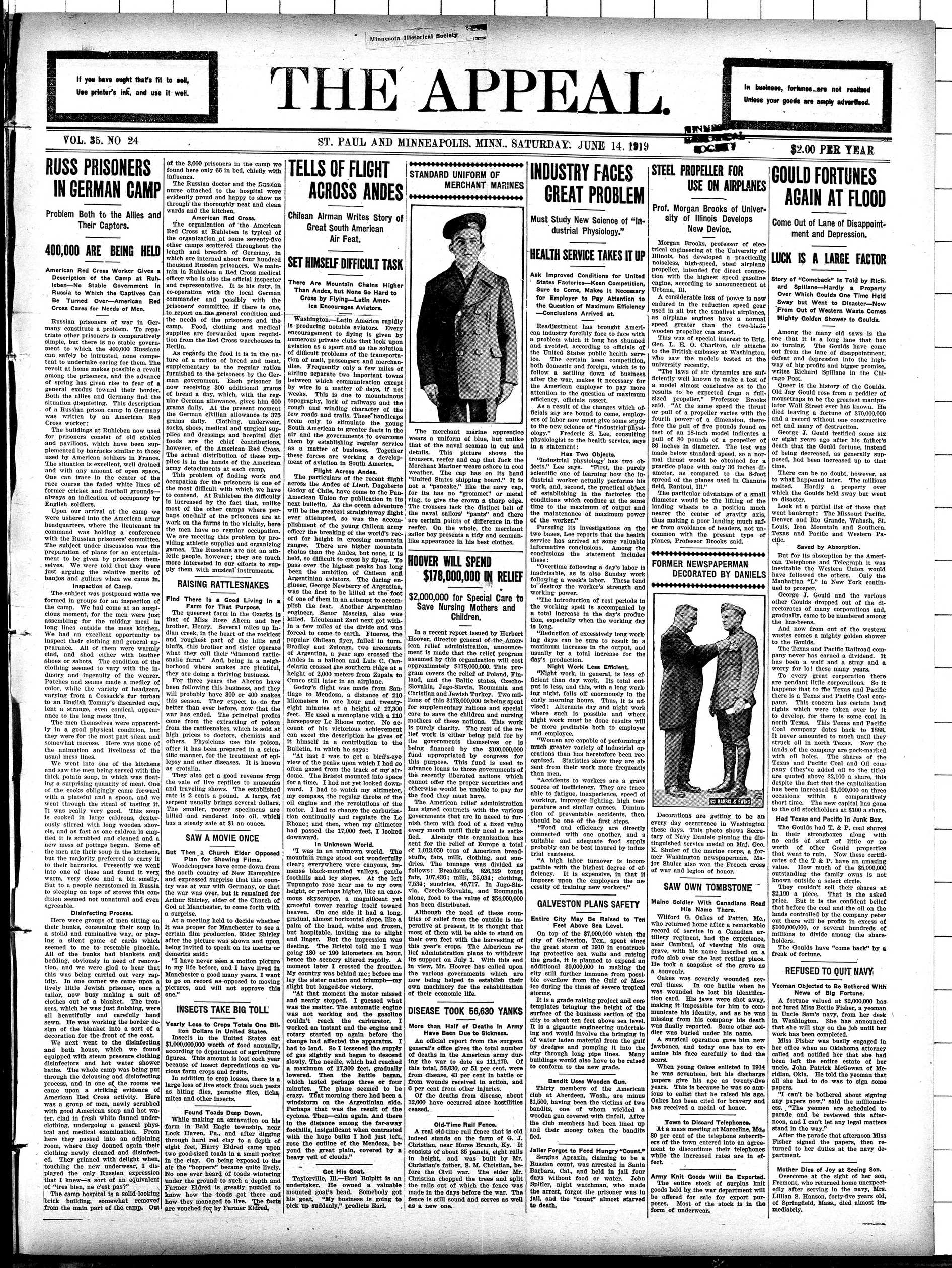
RUSS PRISONERS IN GERMAN CAMP
Problem Both to the Allies and Their Captors.
400,000 ARE BEING HELD
American Red Cross Worker Gives a Description of the Camp at Amitu-lehben—No Stable Government in Russia to Which the Captives Can Be Turned Over—American Red Cross Cares for Needs of Men.
Russian prisoners of war in Germany constitute a problem. To repatriate other prisoners is comparatively simple, but there is no stable government to which the 400,000 Russians can safely be intrusted, none competent to undertake caring for them. The revolt at home makes possible a revolt among the prisoners, and the advance of spring has given rise to fear of a general exodus toward their border. Both the allies and Germany find the situation disquieting. This description of a Russian prison camp in Germany was written by an American Red Cross worker:
The buildings at Ruhleben now use for prisoners consist of old stables and pavilions, which have been supplemented by barricades similar to those by American soldiers in France. The buildings are collapsed, well drained and with any amount of open space. One can trace in the center of the race course the faded white lines of former cricket and football grounds—always an indication of occupancy by English soldiers.
Upon our arrival at the camp we were ushered into the American army headquarters, where the lieutenant in command was holding a conference with the Russian prisoners' committee. The subject under discussion was the preparation of plans for an entertainment given to given by prisoners themselves. We were not arguing the relative merits of banjos and guitars when we came to.
Inspection of Camp.
The subject was postponed while we formed in groups for an inspection of the camp. We had come at an auspicious moment, for the men were just assembling for the midday meal in long lines outside the mess kitchen. We had an excellent opportunity to inspect their clothing and general appearance. All of them were warmly clad, and shod either with leather shoes or sabots. The condition of the clothing seemed to vary with the industry and ingenuity of the wearer. Patches and seams made a medley of color, while the variety of headgear, varying from a Corsack's fur turban to an English Tommy's discarded cap, wearing, even comical, appearance to the most casual in the camp. The men themselves were apparently in a good physical condition, but they were for the most part silent and somewhat morose. Here was none of the animation and liveliness of the usual mess lines.
We went into one of the kitchens and saw the men being served with the thick potato soup, in which was floating a surprising quantity of meat. One of the cooks obligingly came forward with a plateful and a spoon, and we went through the ritual of tasting it. It was really very good. This soup is cooked in large caldrons, dexterously stirred with long wooden shovels, and as fast as one caldron is emptied it is scrubbed and cleaned and a new mess of potage begun. Some of the men ate their soup in the kitchens, but the majority preferred to carry it to their barracks. Presently we went into one of these and found it very warm, very close and a bit smelly. But to a people accustomed in Russia to sleeping on tops of stoves this condition seemed not unnatural and even greasable.
Disinfecting Process.
Here were groups of men sitting on their bunks, consuming their soup in a stolid and ruminative way, or playing a silent game of cards which seemed to me to resemble plonche. All of the bunks had blankets and bedding, obviously in need of renovation, and we were glad to hear that this was being carried out very rapidly. In one corner we came upon a lively little Jewish prisoner, once a tailor, now busy making a suit of clothes out of a blanket. The trousers, which he was just finishing, were all beautifully and carefully hand sewn. He was working the border design of the blanket into a sort of a decoration for the front of the coat. We next went to the disinfecting and bath house, which we found equipped with steam pressure clothing disinfectors and hot water shower baths. The whole camp was being put through the delouising and disinfecting process, and the team came up with a striking evidence of the Red Cross activity. Here was a group of men, newly scrubbed with good American soap and hot water, clad in fresh white flannel underclothing, undergoing a general physical and medical examination. From here they passed into an adjoining room, where they doned again their clothing newly cleaned and disinfected. They grinned with delight when touching the new underwear, I displayed the only Russian expression that I knew—a sort of an equivalent of "tres bien, ne c'est pas?" The camp hospital is a solid looking brick building, somewhat removed from the main part of the camp. Out
of the 3,000 prisoners in the camp we found here only 66 in bed, chiefly with influenza. The Russian doctor and the Russian nurse attached to the hospital were evidently proud and happy to show us through the thoroughly neat and clean wards and the kitchen.
American Red Cross
American Red Cross.
The organization of the American Red Cross at the University is typical of the organization at the university, other camps scattered throughout the length and breadth of Germany, in which are interned about four hundred thousand Russian prisoners. We maintain in Ruhleben a Red Cross medical officer who is also the official inspector and representative. It is his duty, in co-operation with the local German commander and possibly with the prisoners' committee, if there is one, to report on the general condition and the camp. Food, clothing and medical supplies are forwarded from requisition from the Red Cross warehouses in Berlin.
As regards the food it is in the nature of a ration of bread and meat, supplementary to the regular ration furnished to the prisoners by the German government. Each prisoner is now receiving 300 additional grams of bread a day, which, with the regular German allowance, gives him 600 grams daily. At the present moment the German civilian allowance is 375 grams daily. Clothing, underwear, socks, shoes, medical and surgical supplies and dressings and hospital diet foods are the chief contributions, however, of the American Red Cross. The actual distribution of these supplies is in the hands of the American army detachments at each camp. This problem of finding work and occupation for the prisoners is one of the difficulties afflicted with which we have to contend. At thieben the difficulty is increased by the fact that, unlike most of the other amps where perhaps one-half of the prisoners are at work on the farms in vicinity, the men have no regular occupation. We are meeting this problem by providing athletic supplies and organs games. The Russians are not an athletic people, however; they are much more interested in our efforts to supply them with musical instruments.
RAISING RATTLESNAKES
Find There is a Good Living in a Farm for That Purpose.
The queerest farm in the Ozarks is that of Miss Rose Ahern and her brother, Henry. Several miles up Indian creek, in the heart of the rockiest and roughest part of the hills and bluffs, this brother and sister operate what they call their "diamond rattlesnake farm." And, being in a neighborhood where snakes are plentiful, they are often driving business.
For three years alone, they have been following this business, and they will probably have 300 or 400 snakes this season. They expect to do far better than ever before, now that the war has ended. The principal profits come from the extracting of poison from the rattlesnakes, which is sold at high prices to doctors, chemists and others. Physicians use this poison, after it has been prepared in a scientific manner, for the treatment of epilepsy and other diseases. It is known as crotalin.
They also get a good revenue from the sale of live reptiles to museums and the sale of a pound. The established rate is 2 cents a pound. The serpent usually brings several dollars. The smaller, poorer specimens are killed and rendered into oil, which has a steady sale at $1 an ounce.
SAW A MOVIE ONCE
But Then a Church Elder Opposed Plan for Showing Films.
Woodchoppers have come down from the north country of New Hampshire and expressed surprise that this country was at war with Germany, or that the war was over, but it remained for Arthur Shirley, elder of the Church of God at Manchester, to come forth with a surprise.
At a meeting held to decide whether it was proper for Manchester to see a certain film production, Elder Shirley after the picture was shown and upon being invited to speak on its merits or demerts said:
"I have never seen a motion picture in my life before, and I have lived in Manchester a good many years. I want to go on record as opposed to moving pictures, and will not approve this one."
INSECTS TAKE BIG TOLL
Yearly Loss to Crops Totals One Billion Dollars In United States
Insects in the United States eat $1,000,000,000 worth of food annually, according to department of agriculture figures. This amount is lost each year because of insect depredations on various farm crops and fruits. In addition to crop losses, there is a large loss of live stock from such pests as biting flies, parasite flies, ticks, mites and other insects.
Found Toads Deep Down
While making an excavation on his farm in Bald Eagle township, near Lock Haven, Pa., and after digging through hard red clay to a depth of eight feet, Harry Eldred came upon two good-sized toads in a small pocket in the clay. On being exposed to the air the "hoppers" became quite lively. One no one heard of toads wintering under the ground to such a depth and Farmer Eldred is greatly puzzled to know how the toads got there and how they managed to live. The facts are vouchered for by Farmer Eldred.
Minnesota Historical Society
THE APPEAL.
ST. PAUL AND MINNEAPOLIS, MINN.. SATURDAY: JUNE 14, 1919
TELLS OF FLIGHT ACROSS ANDES
TELLS OF FLIGHT ACROSS ANDES
Chilean Airman Writes Story of Great South American Air Feat.
SET HIMSELF DIFFICULT TASK
There Are Mountain Chains Higher
Than Andes, but None So Hard to
Cross by Flying—Latin America
Encourages Aviators.
Washington—Latin America rapidly
is producing notable aviators. Every
encouragement to flying is given by
numerous private clubs that look upon
aviation as a sport and as the solution
of difficult problems of the transportation
of mail, passengers and merchandise. Frequently only a few miles of
airline separate two important towns
between which communication except
by wire is a matter of days, if not
weeks. This is due to mountainous
topography, lack of railways and the
rough and winding character of the
few roads and trails. These handicaps
seem only to stimulate the young
South American to greet feats in the
air and the governments to overcome
them by establishing regulars
as a matter of business. Together
these forces are working a development
of aviation in South America.
The particulars of the recent flight across the Andes of Lieut. Dagobert Godyo of Chile, have come to the Paraguayan Union for publication in the next bulletin. As the ocean adventure will be the greatest straightaway flight ever attempted, so was the accomplishment of the young Chilean army officer the breaking of the world's record for height in crossing mountain ranges. There are higher mountain chains than the Andes, but none, it is held, so difficult to cross by flying. To pass over the highest peaks has long been the ambition of Chilean and Argentinian aviators. The daring engineer, George Newberry of Argentina, was the first to be killed at the foot of one of them in an attempt to accomplish the feat. Another Argentinian engineer, Senor Mascias, also was killed. Lieutenant Zani next got within a few miles of the divide and was forced to come to earth. Fliuros, the popular Chilean flyer, failed in turn. Bradley and Zuloga, two aerials of Argentina, a year ago crossed the Andes and Luls C. Candelaia crossed the southern ridge at a height of 2,000 meters from Zapata to Cunco still later in time. Godyo's flight was made from Santiago to Mendoza, a distance of 210 kilometers in one hour and twenty-eight minutes at a height of 14,700 feet. He used a monoplane with a 110 horsepower Le Rhone motor. No account of his victorious achievement can excel the description he gives of himself in a contribution to the Bulletin, in which he says:
"At last I was to get a bird's-eye view of the peaks upon which I had so often gazed from the track of my airdome. The Bristol mounted into space for a time. I had not yet looked downward. I had to watch my altimeter, my compass, the regular throbs of the oil engine and the revolutions of the motor. I had to change the carburization continually and regulate the Le Rhone; and then, when my altimeter had passed the 17,000 feet, I looked downward.
In Unknown World.
"I was in an unknown world. The mountain range stood out wonderfully clear; everywhere were canyons, immense black-mounted valleys, gentle foothills and ice slopes. At the left Tupungato rose near me to my own height, or perhaps higher, like an enormous skyscraper, a magnificent yet graceful tower rearing itself toward heaven. On one side it had a long, a palm of the horizontal slope, like a palm of the horizontal value and frozen, but hospitable, inviting, to sit and linger. But the impression fleeting. The Bristol told me I was going 180 or 190 kilometers an hour, hence the scenery altered rapidly. A moment later I crossed the frontier. My country was behind me; before me lay the sister nation and triumph—my slight but loned for victory.
"At that moment the motor missed and nearly stopped. I guessed what was the matter. The automatic engine was not working and the gasoline couldn't reach the carburetor. I worked an instant and the engine and rotary started up again before the change had affected the apparatus. I had to land. So I lessened the supply of gas slightly and began to descend slowly. The needle, which had reached a maximum of 17,300 feet, gradually lowered. Then the battle began, which lasted perhaps three or four minutes. The plane seemed to be crazy. That morning there had been a windstorm on the Argentinian side. Perhaps that was the result of the cyclone. Then—calm again. And there in the distance among the far-away foothills, insignificant when contrasted with the huge bulks I had just left, rose the outline of the Mendoza, beyond the great plain, covered by a heavy veil of clouds."
Got His Goat.
Taylorville, Ill—Earl Bulpitt is an undertaker. He owned a valuable mounted goat's head. Somebody got his goat, "My business is going to pick up suddenly," predicts Earl.
Flight Across Andes
In Unknown World
Got His Goat.
APH
INNEAPOLIS, MINN.. SA
STANDARD UNIFORM OF
MERCHANT MARINES
1917
The merchant marine apprentices wears a uniform of blue, but unlike that of the naval seaman in cut and details. This picture shows the trousers, reefer and cap that Jack the Merchant Mariner wears in cool in weather. The cap has on its band "United States shipping board." It is not a "pancake," like the navy cap, but has no "grommet" or metal ring, to protect the cap from sharp edge. The trousers lack the distress stitch of the naval sailors' "pants" and there are certain points of difference in the reefer. On the whole, the merchant sailor boy presents a tidy and seamless appearance in his best clothes.
HOOVER WILL SPEND
$178,000,000 IN RELIEF
$2,000,000 for Special Care to Save Nursing Mothers and Children.
In a recent report issued by Herbert Hoover, director general of the American relief administration, announcement is made that the relief program assumed by this organization will cost approximately $178,000,000. This program cover the relief of Poland, Finland, and the Baltic states, Czech Slovakia, Jugo-Slavia, Rumania and Christian and Jewish Turkey. Two millions of this $178,000,000 is being spent for supplementary rations and special care to save the children and nursing mothers of these nations. This work is purely charity. The rest of the relief work is either being paid for by the governments themselves or is being financed by the $100,000,000 fund appropriated by congress for this purpose. This fund is used to advance loans to those governments of the recently liberated nations which cannot offer the proper securities and otherwise would be unable to pay for the food they must have.
The American relief administration has signed contracts with the various governments that are in need to furnish them with food of a fixed value every month until their need is satisfied. Already this organization has sent for the relief of Europe a total of 1,013,000 tons of American breadstuffs, fats, milk, clothing, and sundries. The tonnage was divided as follows: Breadstuffs, 826,329 tons; fats, 107,438; milk, 25,034; clothing, 7,534; sundries, 46,717. In Jugo-Slava, Czecho-Slovakia, and Romania alone, food to the value of $4,000,000 has been distributed.
Although the need of these countries of relief from the outside is imperative at present, it is thought that most of them will be able to stand on own feet with the harvesting of this year's crop. The American relief administration plans to withdraw its support on July 1. With this end in view, Mr. Hoover has called upon the various governments which are now being helped to establish their own machinery for the rehabilitation of their economic life.
DISEASE TOOK 56,630 YANKS
More than Half of Deaths in Army Have Been Due to Sickness.
An official report from the surgeon general's office gives the total number of deaths in the American army during the war to date as 111,179. Of this total, 56,630, or 51 per cent, were from disease, 43 per cent in battle or attack, 20 per cent in ambulance, and 6 per cent from other injuries.
Of the deaths from disease, about 12,000 have occurred since hostilities ceased.
Old-Time Rail Fence.
A real old-time rail fence that is old indeed stands on the farm of G. J. Christian, near Horse Branch, Ky. It consists of about 35 panels, eight rails in height, and was built by Mr. Christian's father, S. M. Christian, before the Civil war. The elder Mr. Christian chopped the trees and split the rails out of which the fence was made in the days before the war. The fence is still sound and serves as well as a new one.
INDUSTRY FACES GREAT PROBLEM
Must Study New Science of "Industrial Physiology."
HEALTH SERVICE TAKES IT UP
Ask Improved Conditions for United States Factories—Keen Competition, Sure to Come, Makes it Necessary for Employer to Pay Attention to the Question of Maximum Efficiency—Conclusions Arrived at.
Readjustment has brought American industry forcibly face to face with a problem which it long has shunned and avoided, according to officials of the United States public health service, to maintain keen competition, both domestic and foreign, which is to follow a settling down of business after the war, makes it necessary for the American employer to pay more attention to the question of maximum efficiency, officials assert.
As a result of the changes which officials say are bound to come, employers of labor now must give some spud to the new science of "industrial physiology." Frederic S. Lee, consulting physiologist to the health service, says in a statement:
Has Two Objects.
"Industrial physiology has two objects," Lee says. "First, the purely scientific one of learning how the industrial worker actually performs his work, and, second, the practical object of establishing in the factories the conditions which conduce at the same time to the maximum of output and the maintenance of maximum power of the worker."
Pursuing its investigations on the two bases, Lee reports that the health service has arrived at some valuable informative conclusions. Among the discussions the statement includes these:
"Overtime following a day's labor is inadvisable, as is also Sunday work following a week's labor. These tend to destroy the worker's strength and working power.
"The introduction of rest periods in the working spell is accompanied by a total increase in the day's production, especially when the working day is long.
"Reduction of excessively long working days can be sure to result in a maximum increase in the output, and usually by a total increase for the day's production.
Night Work Less Efficient.
"Night work, in general, is less efficient than day work. Its total output is less than this, with a long work night, falls off enormously in the early morning hours.
Vised: Alternate day and night work where such is possible and where night work must be done results will be more profitable both to employer and employee."
"Women are capable of performing a much greater variety of industrial operations than has heretofore been recognized. Statistics show they are absent from their work more frequently than men.
"Accidents to workers are a grave source of inefficiency. They are traceable to fatigue, inexperience, speed of working, improper lighting, high temperature and similar causes. Diminution of preventable accidents, then should be one of the first steps.
"Food and efficiency are directly connected. One another, and a suitable and adequate food supply probably can be best insured by industrial caneens.
"A high labor turnover is incompatible with the highest degree of efficiency. It is expensive, in that if imposes upon the employers the necessity of training new workers."
GALVESTON PLANS SAFETY
Entire City May Be Raised to Ten Feet Above Sea Level. On top of the $7,000,000 which the city of Galveston, Tex., spent since the great storm of 1910 in constructing protective sea walls and raising the grade, it is planned to expand an additional $9,000,000 in making the city still further immune from possible overflow from the Gulf of Mexico during the times of severe tropical storms. It is a grade raising project and contemplates bringing the height of the city of business section of the city to ten feet above sea level. It is a gigantic building undertaking and would involve the construction of water laden material from the gulf by dredges and pumping it into the city through long pipe lines. Many buildings would also have to be raised to conform to the new grade.
Bandit Uses Wooden Gun.
Thirty members of the American club at Aberdeen, Wash., are minus £1,500, having been the victims of two bandits, one of whom wielded a wooden gun covered with tinfoil. After the club members had been lined up and their money taken the bandits fed.
Jailer Forgot to Feed Hungry "Count." Sergius Aprakin, claiming to be a Russian count, was arrested in Santa Barbara, Cal., and held in jail four days without food or water. John Spitler, night watchman, who made the arrest, forgot the prisoner was in jail, and the "count" almost starved to death.
In business, fortunes are not realized Unless your goods are amply advertised.
OCIT
STEEL PROPELLER FOR USE ON AIRPLANES
Prof. Morgan Brooks of University of Illinois Develops New Device.
Morgan Brooks, professor of electrical engineering at the University of Illinois, has developed a practically noiseless, high-speed, steel airplane propeller, intended for direct connection with the highest speed gasoline engine, according to announcement at Urbana, Illinois.
A considerable loss of power is now endured in the reduction speed gear used in all but the smallest airplanes, as airplane engines have a normal speed greater than the two-bladed wooden propeller can stand.
This special interest to Brig. L. E. O. Charlton air attacker to the British embassy at Washington, who saw the models tested at the university recently.
"The laws of air dynamics are sufficiently well known to make a test of a model almost conclusive as to the results to be expected from a full-sized propeller," Professor Brooks said. "At the same speed the thrust or pull of a propeller varies with the fourth power of a dimension, therefore the pull of five pounds found on test of an 18-inch model indicates a pull of 80 pounds of a propeller of 90 inches in diameter. The test was made behind standard speed, so a normal thrust was justified for a practice plane with only 80 inches a diameter, as compared to the 5-foot spread of the planes used in Chanute field, Rantoul, Ill."
The particular advantage of a small diameter would be the lifting of the landing wheels to a position much nearer the center of gravity axis, thus making a poor landing much safer from avoidance of headers, not uncommon with the present type of planes, Professor Brooks said.
Decorations are getting to be an every day occurrence in Washington these days. This photo shows Secretary of Navy Daniels pinning the distinguished service medal on Maj. Geo. K. Shuler of the marine corps, a former Washington newspaperman. Major Shuler also won the French cross of war and legion of honor.
SAW OWN TOMBSTONE
Maine Soldier With Canadians Read His Name There.
Wilford G. Oakes of Patton, Me, who returned home after a remarkable record of service in a Canadian artillery regiment, had the experience, near Cambrai, of viewing his own grave, with his name inscribed on a rude slab over the last resting place. He took a snapshot of the grave as a souvenir.
Oakes was severely wounded several times. In one battle when he was wounded he lost his identification card. His jaws were shot away, making it impossible for him to communicate his identity, and as he was missing from his company his death was finally reported. Other other soldier was buried under his name.
A surgical operation gave him new jawbones, and today one has to exert his face carefully to find the scars.
When young Oakes enlisted in 1914 he was seventeen, but his discharge papers gave his age as twenty-five years. This is because he was so anxious to enlist that he raised his age. Oakes has been cited for bravery and has received a medal of honor.
Town to Discard Telephone
At a mass meeting at Marceline, Mo. 80 per cent of the telephone subscribers of the town entered into an agreement to discontinue their telephones while the increased rates are in effect.
Army Knit Goods Will Be Exported. The entire stock of surplus knit goods held by the Army will be offered for sale for export purposes. Most of the stock is in the form of underwear.
$2.00 PER YEAR
GOULD FORTUNES AGAIN AT FLOOD
Come Out of Lane of Disappointment and Depression.
Story of "Comeback!" Is Told by Richard Spillane—Hardly a Property Over Which Goulds One Time Held Sway but Went to Disaster—Now Out of Western Waste Mighty Golden Shower to Goulds.
Among the many old saws is the one that it is a long lane that has no turning. The Goulds have come out from the loss of disappointment, defeat and depression into the highway of big profits and big promise, writes Richard Spillane in the Chicago Post.
Queer is the history of the Goulds, Old Jay Gould rose from a peddler of moustaches to the greatest manipulator Wall Street ever has known. Died leaving a fortune of $70,000,000 and a record without one constructive act and many of destruction.
George J. Gould testified some six or eight years ago after his father's death that the Gould fortune, instead of being decreased, as generally supposed, had been increased up to that time.
There can be no doubt, however, as to what happened later. The millions melted. Hardly a property over which the Goulds held sway but went to disaster.
Look at a partial list of those that went bankrupt: The Missouri Pacific-Denver and Rio Grande, Wabash, St. Louis, Iron Mountain and Western Texas and Pacific and Western Pacific.
Saved by Absorption.
But for its absorption by the American Telephone and Telegraph it was inevitable the Western Union would have followed the others. Only the Manhattan "L" in New York continued to prosper.
George J. Gould and the various other Goulds dropped out of the directorates of many corporations and, gradually, came to be numbered among the has-beens.
And now from out of the western warehouse a mighty golden shower to the Goulds. The Texas and Pacific Railroad company never has earned a dividend. It has been a waft and a stray and a worry for 101 these many years.
To every great corporation there are pendant little corporations. So it happens that to the Texas and Pacific there is a Texas and Pacific Coal company. This concern has certain land rights which were taken over by it to develop, for there is some coal in north Texas. This Texas and Pacific Coal company dates back to 1888. It never amounted to much until they struck oil in north Texas. Now the lands of the company are pock-marked with oil holes. The shares of the Texas and Pacific Coal and Oil company (they've added oil to the title) are quoted above $2,100 a share, this fact that the capitalization has been increased $100,000 on three occasions within a relatively short time. The new capital has gone to the old stockholders at $100 a share.
The Goulds had T. & P. coal shores in their strongboxes along with no ends of stuff of little or no worth of other Gould properties that went to ruin. Now these certificates of the T & P. have an amazing value. How much of the $5,000,000 outstanding the family owns is not known outside a select circle. They couldn't sell their shares at $2,100 a piece. That is the asked price. But it is the confident belief that before the coal and the oil on the lands controlled by the company peter out there will be profits in excess of $100,000,000, or several hundreds of millions to divide among the shareholders. The Goulds have "come back" by a freak of fortune.
REFUSED TO QUIT NAVY
Yeoman Objected to Be Bothered With News of Big Fortune.
A fortune valued at $2,000,000 has not lured Miss Bettie Fisher, a yeoman in Uncle Sam's navy, from her desk in Washington. She has announced that she will stay on the job until her work has been completed.
Miss Fisher was busily engaged in her office when an Oklahoma attorney called and notified that she had been left the entire estate of her mother, Patrick McGowan of Meridian, Okla. He told the yeoman that all she had to do was to sign some papers.
"I can't be bothered about signing any papers now," said the millionaires.
"The yeoman are scheduled to parade and be reviewed this afternoon, and I can't let any legal matters stand in the way."
After the parade that afternoon Miss Fisher signed the papers, then returned to her duties at the navy department.
Mother Dies of Joy at Seeing Son.
Overcome at the sight of her son, Ferguson, who returned home portedly her serving the navy, Mrs. Lillian S. Hanson, forty-five years old, of Springfield, Mass., died almost immediately.
If you have ought that's fit to sell,
Use printer's ink, and use it well.
VOL. 35. NO 24
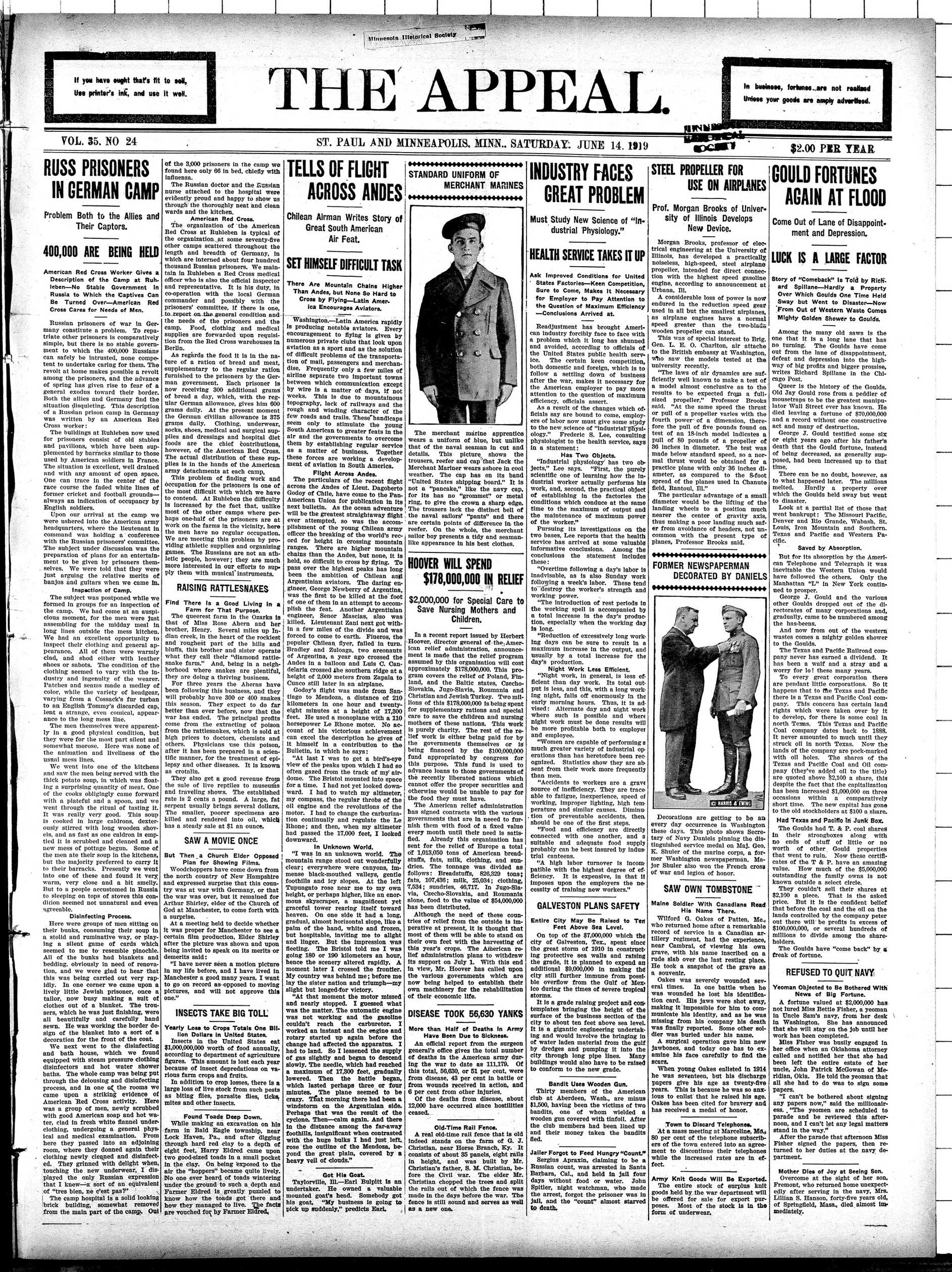
RUSS PRISONERS IN GERMAN CAMP
Problem Both to the Allies and Their Captors.
American Red Cross Worker Gives a Description of the Camp at Kuhleben—No Stable Government in Russia to Which the Captives Can Be Turned Over—American Red Cross Cares for Needs of Men.
Russian prisoners of war in Germany constitute a problem. To repatriate other prisoners is comparatively simple, but there is no stable government to which the 400,000 Russians can safely be intrusted, none competent to undertake caring for them. The revolt at home makes possible a revolt among the prisoners, and the advance of spring has given rise to fear of a general exodus toward their border. Both the allies and Germany find the situation displeasing. This description of a Russian prison camp in Germany was written by an American Red Cross worker:
The buildings at Ruhiebe now used for prisoners consist of old stables and pavilions, which have been supplemented by barracks similar to those used by American soldiers in France. The situation is excellent, well drained and with any amount of open space. One can trace in the center of the race course the faded white lines of former cricket and football grounds—always an indication of occupancy by English soldiers.
Upon our arrival at the camp we ushered into the American army heliport, the lieutenant in command was holding with the Russian prisoners' committee. The subject under discussion was the preparation of plans for an entertainment to be given by prisoners themselves. We were told that they were arguing the relative merits of banjos and guitars when we came in.
Inspection of Camp.
The subject was postponed while we formed in groups for an inspection of the camp. We had come at an auspicious moment, for the men were just assembling for the midday meal in long lines outside the mess kitchen. We had an excellent opportunity to inspect their clothing and general appearance. All of them were warmly clad, and shod either with leather shoes or sabots. The condition of the clothing seemed to vary with the industry and ingenuity of the wearer. Patches and seams made a medley of color, while the variety of headgear, varying from a Cossack's fur turban to an English Tommy's discarded cap, lent a strange, even conical, appearance to the mess line, as suggested by the men themselves were apparently in a good physical condition, but they were for the most part silent and somewhat morose. Here was none of the animation and liveliness of the usual mess lines.
We went into one of the kitchens and saw the men being served with the thick potato soup, in which was floating a surprising quantity of meat. One of the cooks obligingly came forward with a plateful and a spoon, and we went through the ritual of tasting it. It was really very good. This soup is cooked in large caldrons, dexterously stirred with long wooden shovels, and as fast as one caldron is emptied it is scrubbed and cleaned and a new mess of potage begun. Some of the men ate their soup in the kitchens, but the majority preferred to carry it to their barracks. Presently we went into one of these and found it very warm, very close and a bit smelly. But to a people accustomed in Russia to sleeping on tops of stoves this condition seemed not unnatural and even screamable.
Disinfecting Process.
Here were groups of men sitting on their bunks, consuming their soup in a stolid and ruminative way, or playing a silent game of cards which seemed to me to resemble pinchle. All of the bunks had blankets and bedding, obviously in need of renovation, and we were glad to hear that this was being carried out very rapidly. In one corner we came upon a lively little Jewish prisoner, once a tailor, now busy making a suit of clothes out of a blanket. The trousers, which he was just finishing, were all beautifully and carefully hand sewn. He was working the border design of the blanket into a sort of a decoration for the front of the coat.
We next went to the disinfecting and bath house, which we found equipped with steam pressure clothing disinfectors and hot water shower baths. The whole camp was being put through the delouising and disinfecting process, and in one of the rooms we came upon a striking evidence of American Red Cross activity. Here was a group of men, newly scrubbed with good American soap and hot water, clad in fresh white flannel underclothing, undergoing a general physical and medical examination. From here they passed into an adjoining room, where they donned again their clothing newly cleaned and disinfected. They grinned with delight when, touching the new underwear, I displayed the only Russian expression that I knew—a sort of an equivalent of "tres bien, ne c'est pas?"
The camp hospital is a solid looking brick building, somewhat removed from the main part of the camp. Oui
of the 3,000 prisoners in the camp we found here only 66 in bed, chiefly with influenza. The Russian doctor and the Russian nurse attached to the hospital were evidently proud and happy to show us through the thoroughly neat and clean wards and the kitchen.
American Red Cross.
American Red Cross.
The organization of the American Red Cross at Ruhleben is typical of the organization of the seventy-five other camps scattered through the length and breadth of Germany, in which are interned about four hundred thousand Russian prisoners. We maintain in Ruhleben a Red Cross medical officer who is also the official inspector and representative. It is his duty, in co-operation with the local German commander and possibly with the prisoners' committee, if there is one, to report on the general condition and the prisoners and the camp. Food clears and supplies are forwarded upon requisition from the Red Cross warehouses in Berlin.
As regards the food it is in the nature of a ration of bread and meat, supplementary to the regular ration furnished to the prisoners by the German government. Each prisoner is now receiving 300 additional grams of bread a day, which with the regular German allowance, gives him 600 grams daily. At the present moment the German civilian allowance is 375 grams daily. Clothing, underwear, socks, shoes, medical and surgical supplies and dressings and hospital diet foods are the chief contributions, however, of the American Red Cross. The actual distribution of these supplies is in the hands of the American army detachments at each camp.
This problem of finding work and occupation for the prisoners is one of the most difficult with which we have to contend. At Ruhleben the difficulty is increased by the fact that, unlike most of the other camps where perhaps one half of the prisoners are at work on the farms in the vicinity, here the men have no regular occupation, and the problem is by providing athletic training, organizing games. The Russians are no lessletic people, however; they are much more interested in our efforts to supply them with musical instruments.
RAISING RATTLESNAKES
Find There Is a Good Living in a Farm for That Purpose.
The quecreest farm in the Ozarks is that of Miss Rose Ahern and her brother, Henry. Several miles up Indian Creek, in the heart of the rockiest and roughest part of the hills and bluffs, this brother and sister operate what they call their "diamond rattlesnake farm." And, being in a neighborhood, the snakes are plentiful, they are doing a better job. For three years the Ahern have been following this business, and they will probably have 300 or 400 snakes this season. They expect to do far better than ever before, now that the war has ended. The principal profits come from the extracting of poison from the rattlesnakes, which is sold at high prices to doctors, chemists and physicians use this poison, after it is processed in a scientific manner, for the treatment of epilepsy and other diseases. It is known as crotail.
They also get a good revenue from the sale of live reptiles to museums and traveling shows. The established rate is 2 cents a pound. A large, fat serpent usually brings several dollars. The smaller, poorer specimens are killed and rendered into oil, which has a steady sale at $1 an ounce.
SAW A MOVIE ONCE
But Then a Church Elder Opposed Plan for Showing Films
Woodchoppers have come down from the north country of New Hampshire and expressed surprise that this country was at war with Germany, or that the war was over, but it remained for Arthur Shirley, elder of the Church of God at Manchester, to come forth with a surprise.
At a meeting held to decide whether it was proper for Manchester to see a certain film production, Elder Shirley after the picture was shown and upon being invited to speak on its merits or demerts said:
"I have never seen a motion picture in my life before, and I have lived in Manchester a good many years. I want to go on record as opposed to moving pictures, and will not approve this one."
INSECTS TAKE BIG TOLL
Yearly Loss to Crops Totals One Billion Dollars in United States
Others in United States.
Insects, the United States eat $1,000,000 worth of food annually, according to department of agriculture figures. This amount is lost each year because of insect depredations on various farm crops and fruits.
In addition to crop losses, there is a large loss of live stock from such pests as biting flies, parasite flies, tick, mites and other insects.
Found Toads Deep Down
While making an excavation on his farm in Bald Eagle township, near Lock Haven, Pa., and after digging through hard red clay to a depth of eight feet, Harry Eldred came upon two good-sized toads in a small pocket in the clay. On being exposed to the air the "hoppers" became quite lively. No one ever heard of toads wintering under the ground to such a depth and Farmer Eldred is greatly puzzled to know how the toads got there and how they managed to live. The facts are vowed for by Farmer Eldred.
Minnesota Historical Society
THE APPEAL.
ST. PAUL AND MINNEAPOLIS, MINN.. SATURDAY. JUNE 14, 1919
TELLS OF FLIGHT ACROSS ANDES
TELLS OF FLIGHT ACROSS ANDES
Chilean Airman Writes Story of Great South American Air Feat.
SET HIMSELF DIFFICULT TASK
There Are Mountain Chains Higher
Than Andes, but None So Hard to
Cross by Flying—Latin America
encauses Avilators.
Washington—Latin America rapidly
is producing notable aviators. Every
encouragement to flying is given by
numerous private clubs that look upon
aviation as a sport and as the solution
of difficult problems of the transportation
of mail, passengers and merchandise. Frequently only a few miles of
airline separate two important towns
between which communication except
by wire is a matter of days, if not
weeks. This is due to mountainous
topography, lack of railways and the
rough and windy character of the
few roads and trails, these handcaps
seem only to stimulate tourism
South American to greater fears in the
air and the governments to overcome
them by establishing regular service
as a matter of business. Together
these forces are working a development
of aviation in South America.
The particulars of the recent flight across the Andes of Lieut. Dagoberto Godoy of Chile, have come to the Pan-American Union for publication in its next bulletin. As the ocean adventure will be the greatest straightaway flight ever attempted, so was the accomplishment of the young Chilean army officer the breaking of the world's record for height in crossing mountain ranges. There are higher mountain chalns than the Andes, but none, it is held, so difficult to cross by flying. To pass over the highest peaks has long been the ambition of Chilean and Argentinian aviators. The daring engineer, George Newberry of Argentina, was the first to be killed at the foot of one of them in an attempt to accomplish the feat. Another Argentinian engineer, Lienhard Mascias, also was killed. Lienhard Zanlë next got within a few miles of Zanlë and was forced to come to earth. Earthfly popular Chilean flyer, failed in turn, Bradley and Zuloga, two areonauts of Argentina, a year ago crossed the Andes in a balloon and Luts C. Candelaaria crossed the southern ridge at a height of 2,000 meters from Zapala to Cunco still later in an airplane.
Godoy's flight was made from Santiago to Mendoza, a distance of 210 kilometers in one hour and twenty-eight minutes at a height of 17,300 feet. He used a monoplanet with a 110 horsepower Le Rhone motor. No account of his victorious achievement can excel the description he gives of it himself in a contribution to the Bulletin, in which he says:
"At last I was to get a bird's eye view of the peaks upon which I had so often gazed from the track of my airdome. The Bristol mounted into space for a time. I had not yet looked down, and to watch my altimeter, my compass, and the regular throbs of the oil engine and the variations of the motor. I had to change the route continually and regulate the Rhone; and then, when my altimeter had passed the 17,000 feet, I looked downward.
"I was in an unknown world. The mountain range stood out wonderfully clear; everywhere were canyons, immense black-mouthed valleys, gentle foothills and ice slopes. At the left Tupungato rose near me to my own height, or perhaps higher, like an enormous skyscraper, a magnificent yet graceful tower rearing itself toward heaven. On one side it had a long, gradual, almost horizontal slope, like a palm of the hand, white and frozen, but hospitable, inviting me to alight and linger. But the impression was too strong. I was going 180 or 190 kilometers an hour hence the scenery altered rapidly. A moment later I crossed the frontier. My country was behind me; before me lay the sister nation and triumph—my slight but loned-for victory.
"At that moment the motor missed and nearly stopped. I guessed what was the matter. The automatic engine was not working and the gasoline couldn't reach the carburetor. I worked an instant and the engine and rotary started up again before the change had affected the apparatus. I had to land. So I lessened the supply of gas slightly and began to descend slowly. The needle, which had reached a maximum of 17,300 feet, gradually lowered. Then the battle began, which lasted perhaps three or four minutes. The plane seemed to be crazy. That morning there had been a crash. The plane was also perished. Perhaps that was the result of the cyclone. Then—calm again. And there in the distance among the far-away foothills, insignificant when contrasted with the huge bulbs I had just left, rose the outline of the Mendoza, beyond the great plain, covered by a heavy veil of clouds."
Taylorville, Ill.-Earl Bulpitt is an undertaker. He owned a valuable mounted gun that he got from the Gottsang got "my business" is got. You pick up kindness, predicts Earl.
Flight Across Andes
In Unknown World
Got His Goat
APP
INNEAPOLIS, MINN.. SA
STANDARD UNIFORM OF
MERCHANT MARINES
1917
The merchant marine apprentice wears a uniform of blue, but unlike that of the naval seaman in cut and details. This picture shows the trousers, reefer and cap that Jack the Merchant Mariner wears in cool weather. The cap has on its band "United States shipping board." It is not a "pancake," like the navy cap, for it has no "grommet" or metal ring, to give the crown a sharp edge, and to give the belt of the naval sailors "pants" are certain points of difference in the reefer. On the whole, the merchant sailor boy presents a tidy and seamless appearance in his best clothes.
HOOVER WILL SPEND
$178,000,000 IN RELIEF
$2,000,000 for Special Care to Save Nursing Mothers and Children.
In a recent report issued by Herbert Hoover, director general of the American relief administration, announcement is made that the relief program assumed by this organization will cost approximately $178,000,000. This program covers the relief of Poland, Finland, and the Baltic states, Czecho-Slovakia, Jugo-Slavia, Roumania and Christian and Jewish Turkey. Two millions of this $178,000,000 is being spent for supplementary aid and special care to save the children and nursing mothers of these nations. This work is purely charity. The rest of the re-quests are being paid for by the governments themselves. Being financed by the $100,000,000 fund appropriated by congress for this purpose. This fund is used to advance loans to those governments of the recently liberated nations which cannot offer the proper securities and otherwise would be unable to pay for the food they must have.
The American relief administration has signed contracts with the various governments that are in need to furnish them with food of a fixed value every month until their need is satisfied. Already this organization has sent for the relief of Europe a total of 1,013,500 tons of American breadstuffs, fats, milk, clothing, and sundries. The tonnage was divided as follows: Breadstuffs, 626,329 tons; fats, 107,439; milk, 25,034; clothing, 7,534; sundries, 46,717. In Jugo-Slava, Czecho-Slovakia, and Romania alone, food to the value of $44,000,000 has been distributed.
Although the need of these countries relief from the outside is imperative, thought that most of them will be able to their own feet with the harvesting of this year's crops. The American relief administration plans to withdraw its support on July 1. With this end in view, Mr. Hoover has called upon the various governments which are now being helped to establish their own machinery for the rehabilitation of their economic life.
DISEASE TOOK 56,630 YANKS
More than Half of Deaths in Army Have Been Due to Sickness. An official report from the surgeon general's office gives the total number of deaths in the American army during the war to date as 111,179. Of this total, 56,630, or 51 per cent, were from disease, 43 per cent in battle or from wounds received in action, and 6 per cent in hospitalization. Of the deaths from disease, about 12,000 have occurred since hostilities ceased.
Old-Time Rail Fence
A real old-time rail fence that is old indeed stands on the farm of G. J. Christian, near Horse Branch, Ky. It consists of about 35 panels, eight rails in height, and was built by Mr. Christian's father, S. M. Christian, before the Civil war. The elder Mr. Christian chopped the trees and split the rails out of which the fence was made in the days before the war. The fence is still sound and serves as well as a new one.
INDUSTRY FACES GREAT PROBLEM
INDUSTRY FACES GREAT PROBLEM
Must Study New Science of "Industrial Physiology."
HEALTH SERVICE TAKES IT UP
Ask Improved Conditions for United States Factories—Keen Competition, Sure to Come, Makes it Necessary for Employer to Pay Attention to the Question of Maximum Efficiency—Conclusions Arrived at.
Readjustment has brought American industry forcibly face to face with a problem which it long has shunned and avoided, according to officials of the United States public health service. The certain keen competition, both domestic and foreign, which is to follow a setting down of business after the war, is necessary for the American employer to pay more attention to the question of maximum efficiency, officials assert.
As a result of the changes which officials say are bound to come, employers of labor now must give some study to the new science of "industrial physiology." Frederic S. Lee, consulting physiologist to the health service, says in a statement:
Has Two Objects.
"Industrial physiology has two objects," Lee says. "First, the purely scientific one of learning how the industrial worker actually performs his work, and, second, the practical object of establishing in the factories the conditions which conduce at the same time to the maximum of output and the maintenance of maximum power of the worker."
Pursuing its investigations on the two bases, Lee reports that the health service has arrived at some valuable informative conclusions. Among the conclusions the statement includes these:
"Overtime following a day's labor is inadvisable, as is also Sunday work following a week's labor. These tend to destroy the worker's strength and working power.
"The introduction of rest periods in the working spell is accompanied by a total increase in the day's production, especially when the working day is long.
"Reduction of excessively long work days can be sure to result in a maximum increase in the output, and a total increase for the day's production.
Night Work Less Efficient.
"Night work, in general, is less efficient than day work. Its total output is less, and this, with a long work night, falls off enormously in the early morning hours. Thus, it is advised: Alternate day and night work where such is possible and where night work must be done results will be more profitable both to employer and worker. "Women are capable of performing a much greater variety of industrial operations than has heretofore been recognized. Statistics show they are absent from their work more frequently than men. "Accidents to workers are a grave source of inefficiency. They are traceable to fatigue, inexperience, speed of working, improper lighting, high temperature and similar causes. Diminution of preventable accidents, then show be one of the first steps. They are connected with one another, and a suitable and adequate food supply probably can be best insured by industrial canteens.
"A high labor turnover is incompatible with the highest degree of efficiency. It is expensive, in that it unmotivated, untrained and no capacity of training new workers."
GALVESTON PLANS SAFETY
Entire City May Be Raised to Ten Feet Above Sea Level. On top of the $7,000,000 which the city of Galveston, Tex., spent since the great storm of 1910 in constructing protective sea walls and raising the grade, it is planned to expand an additional $9,000,000 in making the city still further immune from possible overflow from the Gulf of Mexico during the times of severe tropical storms. It is a grade raising project and contemplates bringing the height of the surface of the business section of the city to about ten feet above sea level. The building would understake and would involve the bringing of water laden material from the gut by dredges and pumping it into the city through long pipe lines. Many buildings would also have to be raised to conform to the new grade.
Bandit Uses Wooden Gun.
Thirty members of the American club at Aberdeen, Wash., are minus $1,500, having been the victims of two bandits, one of whom wielded a wooden gun covered with tinfoil. After the club members had been lined up and their money taken the bandits fed.
Jailer Forgot to Feed Hungry "Count." Sergius Apxain, claiming to be a Russian count, was arrested in Santa Barbara, Cal., and held in jail four days without food or water. John Spitler, night watchman, who made the arrest, forgot the prisoner was in jail, and the "count" almost starved to death.
In business, fortunes...are not realized Unless your goods are amply advertised.
STEEL PROPELLER FOR USE ON AIRPLANES
Prof. Morgan Brooks of University of Illinois Develops New Device.
Morgan Brooks, professor of electrical engineering at the University of Illinois, has developed a practically noiseless, high-speed, steel airplane propeller, intended for direct connection with the highest speed gasoline engine, according to announcement at Urbana, Ill.
A considerable loss of power is now endured in the reduction speed gear used in all but the smallest airplanes, as airplane engines have a normal speed greater than the two-blade wooden propeller can stand.
This was of special interest to Brig. Gen. L. E. O. Charlton, air attach to the British embassy at Washington, who saw the models tested at the university recently.
"The laws of air dynamics are sufficiently well known to make a test of a model almost conclusive as to the results to be expected from a full-sized propeller. Professor Brooks said. "At the same speed the thrust or pull of a propeller varies with the power of a dimension, therefore the test of the thrust test of an 18-inch model indicates a pull of 80 pounds of a propeller of 36 inches in diameter. The test was made below standard speed, so a normal thrust would be obtained for a practice plane with only 36 inches diameter, as compared to the 8-foot spread of the planes used in Chanute field, Rantoul, Ill."
The particular advantage of a small diameter would be the lifting of the landing wheels to a position much higher than the ground of gravity axis, thus making a poor machine such as from avoidance of headers, not uncommon with the present type of planes, Professor Brooks said.
HARRIS & EWING
Decorations are getting to be an every day occurrence in Washington these days. This photo shows Secretary of Navy Daniels pinning the distinguished service medal on Maj. Gej, the marine corps, a former Washington officer, for Shuler also won the French cross of war and legion of honor.
SAW OWN TOMBSTONE
Maine Soldier With Canadians Read His Name There.
Wilford G. Oakes of Patten, Me, who returned home after a remarkable record of service in a Canadian artillery regiment, had the experience near Cambrai, of viewing his own grave, with his name inscribed on a rude slab over the last resting place. He took a snapshot of the grave as a souvenir.
Oakes was severely wounded several times. In one battle when he was wounded he lost his identification card. His jaws were shot away, making it impossible for him to communicate his identity, and as he was missing from his company his death was finally reported. Some other soldier was buried under his soldier.
A surgical operation gave him new jawbones, and today one has to examine his face carefully to find the scars.
When young Oakes enlisted in 1914 he was seventeen, but his discharge papers gave his age as twenty-five years. This is because he was so anxious. He was also a member of Oakes has been cited for bravery and has received a medal of honor.
Town to Discard Telephones
At a mass meeting at Marceline, Mo. 80 per cent of the telephone subscribers of the town entered into an agreement to discontinue their telephones while the increased rates are in effect.
Army Knit Goods Will Be Exported. The entire stock of surplus knit goods to the war department will be offered for sale to export poses. Most of the stock is in the form of underwear.
$2.00 PER YEAR
GOULD FORTUNES AGAIN AT FLOOD
Come Out of Lane of Disappointment and Depression.
Story of "Comeback" Is Told by Richard Spillane—Hardly a Property Over Which Goulds One Time Held Sway but Went to Disaster—Now From Out of Western Waste Came Mighty Golden Shower to Goulds.
Among the many old saws is the one that it is a long lane that has no turning. The Goulds have come out from the lane of disappointment, defeat and depression into the highway of big profits and bigger promise, writes Richard Spillane in the Chicago Post.
There is the history of the Goulds. Old Jersey could rose from a peddler of monster goods to be the greatest manipulator Wall Street ever has known. Hed died leaving a fortune of $70,000,000 and a record without a constructive act and many of destruction.
George J. Gould testified some six or eight years ago after his father's death that the Gould fortune, instead of being decreased, as generally supposed, had been increased up to that time.
There can be no doubt, however, as to what happened later. The millions melted. Hardly a property over which the Goulds held sway but went to disaster. Look at a partial list of those that went bankrupt: The Missouri Pacific, Dana and R. Grande, Wabash, St. Louis, Iron Mountain and Southern. Texas and Pacific and Western Pacific.
Saved by Absorption.
But for its absorption by the American Telephone and Telegraph it was inevitable the Western Union would have followed the others. Only the Manhattan "L" in New York continued to be used. George J. Gould and the various other Goulds dropped out of the directorates of many corporations and, gradually, came to be numbered among the has-beens.
And now from out of the western wastes come a mighty golden shower to the Goulds. And Pacific Railroad company never has earned a dividend. It has been a walf and a stray and a worry for lo! these many years.
To every great corporation there are pendant little corporations. So it happens that to the Texas and Pacific there is a Texas and Pacific Coal company. This concern has certain land rights which were taken over by it to develop, for there is some coal in the Texas. This Texas and Pacific Coal company it never amounted to much until they struck oil in north Texas. Now the lands of the company are pock-marked with oil holes. The shares of the Texas and Pacific Coal and Oll company (they've added oil to the title) are quoted above $2,100 a share, this despite the fact that the capitalization has been increased $1,000,000 on three occasions within a comparatively short time. The new capital has gone to the old stockholders at $100 a share.
The Goulds had T. & P. coal shares in their strongboxes along with no ends of stuff of little or no worth of other Gould properties that went to ruin. Now these certificates of the T & P. have an amazing value. How much of the $5,000,000 outstanding the family owns is not known outside a select circle. They couldn't sell their shares at $2,100 a piece. That is the asked price. But it is the confident belief that before the coal and the oil on the lands controlled by the company peter out there will be profits in excess of $100,000,000, or several hundreds of millions to divide among the shareholders. The Goulds have "come back" by a freak of fortune.
REFUSED TO QUIT NAVY
Yeoman Objected to Be Bothered With News of Big Fortune.
A fortune valued at $2,000,000 has not lured Miss Bettie Fisher, a yeoman in Uncle Sam's navy, from her desk in Washington. She has announced that she will stay on the job until her work has been completed.
Miss Fisher was busily engaged in her work when an Oklahoma attorney called and notified her that she had been left the entire estate of her uncle, John Patrick McGowan of Meridian, Okla. He told the yeoman that all she had to do was to sign some papers.
"I can't be bothered about signing any papers now," said the millionaire. After when an attorney scheduled to parade and be reviewed this afternoon, and I can't let any legal matters stand in the way.
After while that afternoon Miss Fisher signed the papers, then returned to her duties at the navy department.
Mother Dies of Joy at Seeing Son.
Overcome at the sight of her son,
Fremont, who returned home unexpectedly after serving in the navy, Mrs.
Mary, forty-five years old,
of Springfield, Mass, died almost immediately.
ST. PAUL
‘YEEK’S RECORD OF HAPPENINGS.
IN MINNESOTA'S CAPITOL.
fhe “Saintly City” and Saintly City
rolke—Newsy Items o1 accial, Re
lgious, Political and Genera! Mat
ters Among the People.
PHONE: N. W. CEDAR 6649
SATURDAY, JUNE 14, 1919.
none ne nereaess—seve—
A man may easily mistake his pre.
judice for principle.
Ms. and Mrs. C. W. Wigington have
md to 495 Carroll Ave.
Mr, and Mrs. M. A. Johnson have
moved to 814 Grotto street.
Mr. Isaac Dennie has moved into
his home, 437 Rondo street, which he
recently purchased.
The: pre-war rate of 2 cents for let-
ters ad 1 cent for postal cards will be
effective after July 1.
Mrs. Lillian McKnight, 478 W. Cen-
tral avenue, was hostess to the Adel-
hia Tuesday afternoon.
SR ag ARC! LS ee
LAWYER
aurrm sae
fom, wan Bane m9.
ancsarm acco. $7, PAUL
e
Mr. and Mrs. W. F. Brown, 796 St.
Anthony avenue, are spending a two
weeks’ vacation in New York City.
Mrs. Arthur Adams returned to her
home Friday, after undergoing a very
successful operation at St. Paul hos
Pital.
FOR RENT—Furnished rooms at
839 Payne avenue, Light housekeep-
ing permitted, Tel. Bomont 425, ask
for Green.
Mr. Roy Wilson, of Chicago, IIL,
was a dinner guest Monday at the
residence of Mr. and Mrs. “Clarence
Thompson.
Why Worry?
LAMPREY'S INSECT POWDER
will kill ‘em quick! Bed Bugs,
Roaches, Fleas and Moths exter-
minated under positive guaranteed
contact cor! aoagt cana
Goods sold in 25c, 50c, $1.00 and
$5.00 packages, by all up-to-date
Srugsiste “Wee us direct it your
dealer coat oupely You
Mrs. R. F. Wilson has moved her
rooming house from 607 Rondo
street to 503 Rondo, corner of Mac-
kubin street.
WANTED—A competent woman
to take charge of a restaurant. Ap-
ply to Henry Pryor, 388 Kent St.
Tel. Dale 4963.
Mr. and Mrs. O. C. Hall, 727 St. An-
silty tenes Giisrutaes at anaes
last Sunday Mr-aad Mier, , Sia
of Minneapolis.
Mrs. James A. Lee, 700 Sherburne
avenue, entertained on Wednesday
evening in compliment to Mrs. H, Grif-
cronies tm compl
Omer: Cedar 508 T-8, 31.508
Reet €78 St. Anthony Ave.
‘Pel. Dale 2047
T. H. LYLES
FUNERAL DIRECTOR AND
BMBALMER
‘Twin Olty Calle Answered
Day or Night
Lady Asaiatant When Deatred
ue W. Feerth st. 9 ST. PAUL
Mrs. Jesse Slaughter gave a sur-
prise party in honor of Mrs. Theola
Bailey, who left this week for an in-
definite stay in Chicago.
Mrs. J. C. Anderson and Mrs. Mon-
joy Jones were 6 o'clock dinner
guests Monday at the home of Mr. and
Mrs. J. C. Black, 525 Rondo street.
The Taylor Brothers, of the New
Floros Cafe, 12 W. 6th street, serve
the new Barker System rolls with all
meals. The patrons are much pleased.
FOR SALE—A handsome antique
oak sideboard with large plate glass
mirror. Apply at 527 St, Anthony Ave.
An excellent piece of furniture at a
bargain.
Mrs. M. A, Johnson was hostess of
an automobile. party. on Thursday
evening, which took Mrs. H. Griffin,
of Evanston, sight seeing about the
Twin Cities.
DEBTS. MUST BE PAID
A little extra eff-
ort will secure any
specified sum at a
spcified time.
By depositing $1.
each week foa three
years and adding 4
per cent interest,
you will have the
snug of $185.65
Star Now!
STATE SAVINGS BANK
93 Bast Fourth Street
- BIRST OF THE SEASON”
MOONLIGHT
Excursion
FIRST UNDER AUSPICES OF THE
ST. PAUL HOTEL BOYS
——on—— s
Tuesday Eve. June 17th
Red Wing p pete A and ‘Barge
Steamer ieee 2, Manitou
MUSIC BY J. F. STEVENS’ JAZZ ORCHESTRA
Band Concert At 8:30, Also Entertainers From Chicago and Frisco.
Wei ene fel Aleta eect
Tickets = = 50 cents |
PIONEER LODGE NO. 1, F. AND A.
M. meots first and third Monday in east
month at Union Hall, corner of Aurora
and Kent streets, at §:00 p.m. J, Ht
Dillingham, W,” Mf, “W. "8," Archer,
Sey, 498 Carroll Ave,
Mr. FD, McCracken, traveling
agent U. S. Department of Labor, with
headquarters at Washington,” was
transacting business and visiting his
family here last week. He left Mon-
day night for Duluth.
Mrs, James F. Wilson and two little
children left Tuesday to spend the
summer with her parents in Seattle,
|. Miss Charlotte Gilliard spent the
Week-end as guest of Mrs. B. S. Smith,
3358 Oakland avenue, Minneapolis,
Minn, .
Mrs. Hodge and little daughter are
expected from New Jersey this week
to join Rev. B. H. Hodge, who has re-
cently taken ‘charge of Pilgrim Bap-
tist Church. The family will be lo-
cated for the present at 761 Rondo
street.
Mrs. R. Sagen, 937 St. Anthony ave-
nue, was hostess for a dinner party
given in honor of Mrs. John Griffin,
Jot Evanston, Til, last Tuesday. Cov-
ers were laid for ten. After the din-
ner fhe party was taken for an auto
ride by Mrs. W. M. Walker.
Mr. Barclay McGhee, brother of the
late F. L. MeGhee, connected with the
freight department of the Omaha
road, was in the city several days this
Week in the interest of his company.
He was the guest of Mrs, Mattie Me:
Ghee, 655 University avenue,
‘The Floros Cafe, 12 W. Sixth street
has added another feature to please
its many patrons, in installing a Gable
Automatic Entertainer, or, improved
electric victrola, which not only plays
instrumental selections but also the
latest songs by leading artists.
PUBLIC _ STENOGRAPHER—Miss
Harriet E. Williams, stenographer for
Atty. W. 'T. Francis, suite 329 Metro-
politan Bank Building, corner Cedar
‘and Fifth Street, will do typewriting
for anyone dosiring her services, at
reasonable rates. Tel. Cedar 8948,
Messrs Pryor & Coleman of the
Red, White and Blue Cafe, corner
Kent and St, Anthony have added a
very pleasing attraction to their up-
todate establishment in the form of
an electric piano. Call and enjoy good
muste with the good meals you may
get there.
Miss Hazel R. Wigington, 1020
Rondo street, has been appointed
eashier at Como Park. Miss Wiging-
ton successfully passed the City Civil
Service test and was given the posi-
tion on May 30th. She will work un-
der Commissioner J. M. Clancy's de-
partment. Miss Wigington is the
youngest’ sister of Frank, Clarence
and Paul Wigington.
|The Minnesota State Federation of
Colored Women’s Clubs will hold its
J4th annual session June 25th and
26th at Pilgrim Baptist Church, Cedar
street and Summit avenue, Mrs.
Ethel Howard Maxwell presiding. Ar-
rangements are being made to have
‘this the banner session in the history
of the convention.
Among those who will receive di-
plomas from Central High School are
Misses: Virginia Tibbs and Beatrice
Green, who graduated in February.
The graduates from Mechanic Arts
are Misses Isabelle Cooke and Mil-
dred Sisemore and Mr. Roy Wilkins.
Miss Bella Taylor will graduate from
fa post graduate course of Johnson
High.
The New Floros Cafe, 12 W. Sixth,
is now under somewhat of ‘a new
management. Formerly the pro-
prietors were Messrs. A. A. Coleman
and D. C. Taylor, now Mr. Howard
Taylor has purchased Mr. Coleman's
interest and the deservedly popular
cafe will now be conducted by Tay-
lor Brothers as sole proprietors. Sev-
eral improvements have been made
and new and old patrons are assured
of improved service. Call and see
for yourself.
Gopher Lodge, No. 105, I. B. P. 0. E.
W., at its meeting Wednesday night
elected to membership: Archie
Brown, Isaac Hackman, Oscar Davis,
Laurence Tarver, Leviy Brown, A. L.
Halschett, Wm. McElwain and Rev.
B, H. Hodge. Tho election of of
ficers was held as follows: Frank B.
Simpson, exalted ruler; Chas. H, Mil
ler, esteemed leading Knight; Geo. D.
Green, esteemed loyal knight; Ed
ward Hastman, esteemed lecturing
knight; J. A. Mitchell, treasurer; R.
M. Johnson, secretary; A. J. Todd,-as.
sistant secretary; Don La Fancetti,
Htiler, L, P, Jackson, J. Louis Ervin
and C. W. Wigington were elected as
trustees. Frank B. Simpson and L. B.
Greer were elected as delegates to
‘the grand lodge at Atlantic City, N. J.,
in August. Exalted Ruler Simpson
appointed Hector Hunter, esquire;
Felix Raines, inner guard; Geo, W.
Stewart, master of social sessions,
BIG SNAP FOR SALE.
A modern six-room house, hot water
heat, electric lights, full cemented cel-
lar, hard wood finish throughout, built
in’ sideboard, cut glass doors and
knobs, screened porch front and back,
built in kitchen cupboard, full attic.
Lot 46x120 with fruits and flowers,
Sells for $4,500 Cash or $5,000
with $1,000" down, balance” on
Easy terms. Must be seen to be ap-
preciated. No. 723 Rondo street. Tel,
Summit 146 or call up THE APPEAL
office Cedar 5649.
WILLIAM HENRY PARKER ..
nN ans Ree ten]
Goes to His Reward.
To have lived in this unfriendly
world, for nearly a half century, and
to have had the general good will and
jesteem of one’s fellowmen during that
time, is a very desirable heritage to
leave behind. Such was the record
of the late ‘William Henry Parker,
whose funeral was held at the family
residence, 679 St. Anthony avenue, on
Tuesday afternoon of this week.
‘The deceased had been a victim of
acute nephritis since the first of the
year and was compelled to quit his
Work as a railroad man the latter part
of March, he, however, was a patient
sufferer ‘and bore his pains with
Christian fortitude until the end,
‘The house was packed to overflow-
Jing with friends who knew him in life,
and came to pay their tributes of re-
spect, and the many beautiful floral
offerings gave mute testimony of their
love and sorrow.
On Friday of last week, just before
Mr. Parker passed into the great be-
yond, Rev. Benjamin H. Hodge, pas-
tor of Pilgrim Baptist church, learn-
ing of his nearness to death’s door, al-
‘though never having formally met’ the
family, called in his Christian minis-
terial capacity, and offered prayer and
consolation. “And; as Rev. J. C. An-
derson, pastor of St. James A. M. E.
church, of which Mr. Parker was a
member, was absent from the city, the
family solicited his services for the
funeral and their wishes were grace-
fully complied with.
| The funeral services were as fol-
lows:
Singing, “Asleep in Jesus,”
|, Reading of Scripture Lesson, fol-
lowed with prayer by Rey. Hodge.
Solo, by Mrs. Gladys Brown, “Face
to Face.”
Reading of obituary written by Mr.
J. Q. Adams, by Rev. Hodge:
OBITUARY.
‘William Henry Parker, only son of
Henry and Easter Parker, was born in
Independence, Mo., April’ 2, 1873, and
lived there during ‘the early portion of
his life, Subsequently he lived in
Kansas City, Mo., for some years, and
then moved to Bemidji, Minn., and re-
sided there five years.
In December, 1906, he was married,
in Chicago, to Mrs, Sophia A. Harris,
mother of Earl A. Simon P., Ceasar
and Carrie Harris, all of_whom sur-
vive him.
‘The deceased was a most devoted
husband and seemed to have as the
main interest in life the welfare of his
family. He was as devoted to his
four step children as if they had been
his own and cared for them in such a
way as to'gain their love and devotion
in return.
Earl and Ceasar are overseas doing
their bit as loyal Americans. Simon
is living here with his wife and three
children. His step daughter, Carrie,
became the wife of Richard L. Stokes
in January, 1915, and he and his wife
made their home with them until his
death last Saturday, June 7th, at the
age of 46 years, 1 month and'5 days
Mr. Parker was a man that made
many friends by his lovable and con.
genial disposition, and held them, and
during his illness of six months, these
friends did everything they could con
ceive of for his comfort and pleasure
The deceased had been a Christian
and a church member for many years
and just about a week before his
death he transferred his _membershit
to St: James A. M. E, church.
Mr, Parker has a half brother living
in Independence, Mo, and several
other distant relatives,
‘He held a membership in’ the Inter
national Railway Men's Benevolent
er a ea i re ee lh ate
THE BIG EVENT, THE
PICNIC OF THE SEASON
GIVEN BY THE
MEN’S EPISCOPAL CLUB
OF ST. PAUL AND MINNEAPOLIS ON
’
Se
>
PARKER’S LAKE
° * ° or. *
Daneing Roating Bathing Fishing
Without a doubt, this will be the largest affair of the season; every-
body that is somebody will be there. Come out and meet the
old time friends and also help to make our camp and over-
sea heroes. happy by your presents and good cheer. |
A SPECIAL INVITATION IS EXTENDED TO ALL OUR SOLDIER BOYS:
The committee will see to it that this outing will be conducted in]
the high efficient way that has characterized all of thier past picnics. |
Music BY PROF. STEVENS ORCHESTRA
TO GO TO PARKER'S LAKE FROM ST. PAUL
Leave St. Paul via Interurban cars (University Avenue Line) Forty-
five minutes before train time, given below. Get off car at Second
Avenue North. Walk two blocks to Electric Short Line Depot,
Seventh Street and Second Avenue North. Phone Main 1987.
Extra car service will be provided by the Street Car Co. from St
Paul to Minneapolis between 12:45 p. m. and 1:15 p. m., also ex-
tra sirvice at arrival of last train from the lake.
ELECTRIC TRAIN SCHEDULE.
IMPORTANT NOTICE—Trains will leave promptly as scheduled.
‘Trains Leaving For Lake At:- 9:05a.m. 2:20p.m. 4:05 p.m.
Special Picnic Train Leaves Minneapolis At 2:20 p. m. Sharp
Trains Returning From Lake At 5:05p.m. And 9:30.p.m.
ROUND TRIP TICKETS: ADULTS 60 GENTS, GHILDREN 40 GENTS
COMMITTEE OF ARRANGEMENTS.
ST, PAUL COMMITTEE.
; John M. LaCoste, Chairman
Ira S. Ashe Louis F. Moore Wm, Pettit
Chas.T. Cuthbert F. D. McCracken E, Gough
MINNEAPOLIS COMMITTEE.
Dr. R. S. Brown, Chairman :
F.Tenry E,N. Houston R.A. Van Hook A. White
The management reserves the right to refuse undesirable persons.
HAMMOND TURNER
P i ONE: SUMMIT 80
e T. S. 84.002
- MINNESOTA MILK COMPANY
jand Industrial Association, Local
No. 7.
Solo, “Beautiful Isle of Somewhere,”
Mrs. Gladys Brown.
Sermon, Rev. Benjamin H. Hodge,
who took for his theme, “To Die Is
Gain,” and beautifully ‘and impres-
sively enlarged upon the good qualt-
ties of the deceased as told in the
obituary.
The friends present were then given
an opportunity to view the remains
while the closing hymn, “I. Need
Thee Every Hour’ was sung.
The pall bearers were Messrs. Geo.
W. Stewart, Thos. Neal, Clarence M.
Tibbs, Robt. Willis, James Triplet,
Chas.’ Milam.
‘The funeral was directed by Simp.
son & Wills, interment at Oakland
cemetery.
CARD OF THANKS. #
We desire to express our sinceré
and heartfelt thanks to our many
friends for the kindness and sympathy
shown us during the illness and be
reavement of our husband and father,
William Henry Parker; also for. the
many beautiful floral tributes.
Mrs. William H. Parker,
Mr. and Mrs, Richard L. Stokes,
Mr. and Mrs. Simon P. Harris,
Earl A. Harris,
Jas, A. (Caesar) Harris.
Tel. Dale 2149.
BEAUTY SHOP
FOR LADIES AND GENTLEMEN
Linx1as Haarerom, PRor.
Manicuring. Licensed Chiropo-
dist, various ailments of the feet
treated,
Madam Walker's method of hair
culture and goods for sale.
Hair switches made from comb
ings.
Also, Hamilton’s Hair Grower
and Straightener.
Hamilton’s Antiseptic Foot Pow-
der for sore and perspiring feet.
509 University, ST. PAUL
Mr. Roy Wilkins, who is one of the
graduates from’ Mechanic Arts High
School, has the enviable distinction
‘of being on the Honor Roll, a member
of the Cogwheel Club Quartette, and
last, but by no means least, Editor in
Chiet of “M,” the class book issued by
the graduates each year. Roy is
some boy! I'll say he is.
TEL DALE @731 LEADING BRANDS CIGARS
THE GENTLEMENS' RESORT
BARBER SHOP POOL ROOM
SHINING PARLOR
Sntanrsr” ST,PAUL
CLEANING TIME IS HERE
DO IT ELECTRICALLY WITH A
EUREKA
CALL OR PHONE FOR A DEM-
ONSTRATION IM YOUR HOME.
Payments If You Wish.
ST PAUL ELECTRIC C0,
TEL.cEpaRso70 0 "qui szrvior
oo,
Mew Floros Cate
Original Mexican Chili Con Garne A ‘Speiaity
Exceptional A La Carte Meals And Service
The Most Centrally Located Cafe And Best
12 W. 6TH BT. scuumman a wvine =SAINT PAUL
WHILE You wait
ASTORIA -!- SANITARY -!- SYSTEM
CLEANING a REPAIRING * PRESSING
Dry Cleaning ABASHA |Shoe Repairs
Suits Sponged 366 WA ASHA Dyed & Shined
and Pressed | WECALL AND DELIVER} Laundry
New Collars | w.w. ssckson 2006] Baths
R. H. Anderson Archie Brown
| bay euowes: ses
| Nw. CEDAR ones eA 088 ue 18 YH MAN.
WHEN IN THE TWIN CITIES DON'T FAlL. TO Visir
mon rravis, prom. TF] AX NIN? S “oenavcee non
HOTEL, CAFE AND POOL. ROOM
HEADQUARTERS FOR RAILROAD AND
THEATRICAL FOLK - es
“THANN™
40 E. THIRD ST. ST. PAUL
———
TEL, CEDAR 6050 LAUNDRY SERVICE
NOBLES L. HOUSER, MANAGER
FIRST CLASS NEATLY FURNISHED ROOMS
BY THE DAY, WEEK OR MONTH
STEAM HEATED ELECTRIC LIGHTED
HOT AND COLD BATHS
OVER RKONICR SO ST. PAUL
TEL. SUMMIT 2450
R. J. SOLOMON, PROP.
First Class Staple and Fancy Groceries
Vegetables, Fruits, Confectionery, Ice
Cream Cigars, Tobacco, Cigarettes.
Strictly Cash and Carry System
ose ST.ANTHONY SAINT PAUL
TEL. CEDAR 5061 “FOR THE MAN WHO CARES”
THE PEERLESS
SCHUCK BROTHERS, PROPS.
Introducing the Peerless Kid.
Have You Met Him?
BARBER SHOP
POCKET BILLIARDS
“Fateh en Grom!” CIGARS & CIGARETTES
=i Weekly Newspapers Fer sale ==
A477 St. Peter St. ST. PAUL
—————————
Puonne{TuVerare nese wa OES and DaLIVER
UP-TOWN SANITARY SHOP
suons- REPAIRING - cLorass,
SUITS SPONOED FRENCH DRY
AND PRESSED CLEANING
OENTS SUITS DRY LADIES SUITS DRY
CLEANED $1.25 GLEANED $1.80 & UP
880 WABASHA 87. ST. PAUL, MINN,
WLW, Browel 85 PHONES Tels 7172
VANDER BIE'S
* ICE CREAM
IS THE BEST
For Sale Everywhere
J, C. VANDER BIE
Partridge and Brunson Sts,
ST.PAUL, MINN. “ |
| Tel. N. W. Dale 605
HARRY LIGAN
MERCHANT TAILOR
Men's suits and overcoats made
to order. French dry cleaning
Pressing and repairing of
ladies’ and gent's suits.
Moderate Prices. Prompt Service
Goods: Called For And Delivered.
313 RONDO ST. ST. PAUL
cornice TEL, Res, TEL.
JACKEON 2330 DALE 7016
HOURS: © A. M.TO1 P.M.
AND 270.0 P.M.
SUNDAYS BY APPOINTMENT
DR. C. E. CHEEKS
DENTAL SURGEON
FIRST CLASS GUARANTEED WoRK
IN ALL BRANCHES OF DENTISTRY
“Qakora BLDG.”
Bune soz0e ST. PAUL
—__-—_—
F.B. SIMPSON GEO. W. WILLS
J Tel. Date 1914 Tel, Dale 2541,
© ‘ofice Phones: =
Cedar 1024 ‘Tri-State 24740
Undertakers, Funeral Directors
and Embalmers
Calls Answered Promptly Day or
Night a
Lady Assistant When Desired
ice and Chapel
aus issn Fount sr. ST. PAUL