The Appeal
Saturday, November 29, 1919
St. Paul, Minnesota
Page text (machine-generated)
In business, fortunes are not realized Unless your goods are amply advertised.
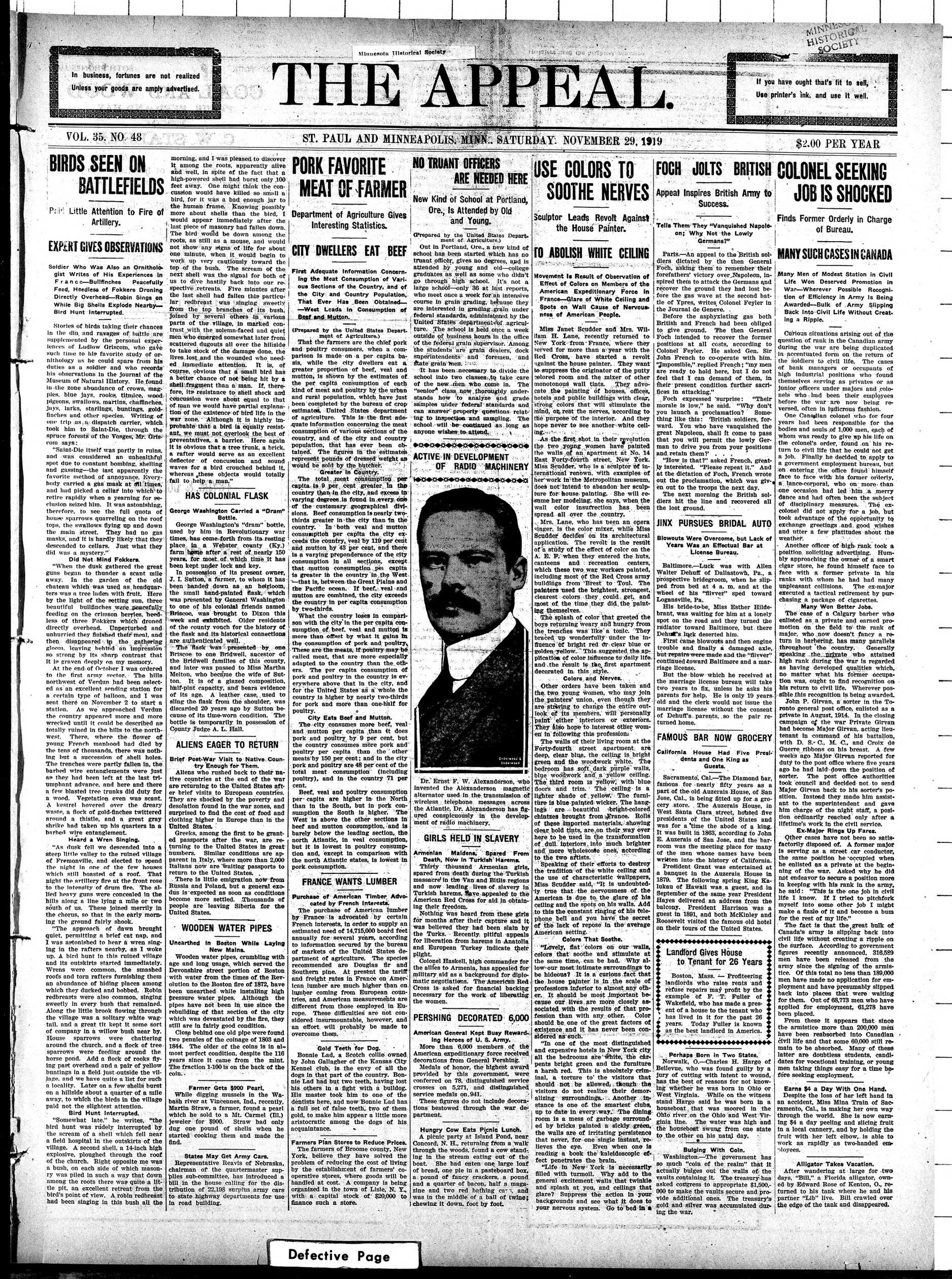
BIRDS SEEN ON BATTLEFIELDS
Paint Little Attention to Fire of Artillery.
EXPERT GIVES OBSERVATIONS
Soldier Who Was Also an Ornithologist Writes of His Experiences in France—Bulfinches Peacefully Feed, Heedless of Fokkers Droning Directly Overhead—Robin Sings on While Big Shells Explode Nearby—Bird Hunt Interrupted.
Stories of birds taking their chances in the din and raygers of battle are supplemented by the personal experiences of Ludlow Griscom, who gave such time to his favorite study of ornithology as he could spare from his duties as a soldier and who records his observations in the journal of the Museum of Natural History. He found in the zone abundance of crows, maggles, blue jays, rooks, tittos, woodpeons, swallows, martins, chaffinches, jays, turtles, starlings, buntings, goldfinches and other species. Writing of one trip as a dispatch carrier, which took him to Salm-Die, through the spruce forests of the Voges, Mr. Griscom says:
"Salmt-Die itself was partly in ruins, and was considered an unhealthful spot due to constant bombing, shelling and gassing—the last apparently the favorite method of annoyance. Everybody carried a gas mask at all times, and had picked a cellar into which to retire rapidly when a yearning for seclusion seized him. It was astonishing, therefore, to see the full quota of house sparrows quarrying on the roof tops, the swallows flying up and down the main street. They had no gas masks, and it is hardly like that they descended to cellars. Just what they did was a mystery."
Did Not Mind Fokkers
"When the dusk gathered the great guns began to thunder a scant mile away. In the garden of the old chateau which was used as headquarters was a tree linden with fruit. Here by the light of the setting sun, three beautiful bulbines were peacefully feeding on the crinon berries, heedless of three Fokkers which droned directly overhead. Unperturbed and unburied they finished their meal, and disappeared the gathering gloom, leaving behind a scant foot so strong by its sharp contrast that it is graven deeply on my memory.
At the end of October I was ordered to the first army sector. The hills northwest of Verdun had been selected as an excellent sending station for a certain type of balloon, and I was sent there on November 2 to start a station. As we approached Verdun the country appeared more and more wrecked until it could be described as totally ruined in the hills to the northwest. There, where the flower of young French manhood had died by the tens of thousands, there was nothing but a succession of shell holes. The trenches were partly fallen in, the trenches were still intact as they had been left at the last trumpet advance, and here and there a few blasted tree trunks did duty for a wood. Vegetation even was scant. A kestrel hovered over the dreary waste, a flock of gold-finches twittered around a whistle, and a great gray shrike had taken up his quarters in a barbed wire entanglement.
Heard a Wren Singing.
"As dusk fell we descended into a steep little valley to the ruined villages of Fremontville, and elected to spend the night in one of the houses which will host a fire of the roof. That night the artillery fire at the front rose to the intensity of drum fire. The allied heavy guns were concealed in the hills along a line lying a mile or two south of us. These joined merrily in the chorus, so that in the early morning the ground fairly shook.
"The approach of dawn brought quiet, permitting a brief cat nap, and I was astonished to hear a wren singing in the rafters nearby, as I woke up. A bird hunt in this ruined village and its outskirts started immediately. Wrens were common, the smashed roofs and torn rafters furnishing them an abundance of hiding places among which they ducked and bobbed. Robin redbreasts were also common, singing sweetly in every bush that remained. Along the little brook flowing through the village was a solitary white wagtail and a great tit kept it some sort of company. The house sparrows were a chattering around the church, and a flock of tree sparrows were feeding around the horse pond. Add a flock of rooks flying past overhead and a pair of yellow buntings in a field just outside the village, and we have quite a list of a locality. Later on a few shells burst on a hillside about a quarter of a mile away, to which the birds in the village paid not the slightest attention.
Bird Hunt Interrupted.
"Somewhat late," he writes, "the bird hunt was ridely interrupted by the scream of a shell which fell near a field hospital in the outskirts of the village. A second shell, a 14-inch high explosive, ploughed through the roof of the church. Right opposite me was a bush, on each side of which masonry was piled in such a way that down among the roots there was quite a little pit, an excellent retreat from the bird's point of view. A robin redbreast had been singing in this bush all the
morning, and I was pleased to discover it among the roots, apparently alive and well, in spite of the fact that a high-powered shell had burst only 100 feet away. One might think the concussion would have killed so small a bird, for it was a bad enough jar to the human frame. Knowing possibly more about shells than the bird, I would appear immediately after the last piece of masonry had fallen down. The bird would be down among the roots, as still as a mouse, and would not show any signs of life for about ten minutes, then it would begin to work up very consistently toward the top of the bush. Then the next shell was the signal for both of us to dive hastily back into our respective retreats. Five minutes after the last shell had fallen this particular redbreast was singing sweetly from the top branches of its bush, joined by several others in various parts of the village, in marked contrast with the solemn-faced and quiet men who emerged somewhat later from scattered dugouts all over the hiliside to take stock of the damage done, the lives lost and the wounded who needed immediate attention. It is, of course, obvious that a small bird has a better chance of not being hit by a shell fragment than a man. If, therefore, its resistance to shell shock and concussion were about equal to that of man, we would be explanation of the existence of bird life war zone. Although it is highly improbable that a bird is equally resistant, we must not overlook the best of preventatives, a barrier. Here again it is obvious that a tree trunk, a brick, a rafter would serve as an excellent deflector of concussion and sound waves for a bird crouched behind it, whereas these objects would totally fail to help a man."
HAS COLONIAL FLASK
George Washington Carried a "Dram" Bottle
George Washington's "dram" bottle, used by him in Revolutionary war times, has come forth from its resting place, in a Webster county (Ky.), farm home after a rest of nearly 150 years, for most of, which time it has been kept under lock and key.
In possession of its present owner, J. I. Sutton, a farmer, to whom it has been handed down as an heirloom, the small hand-painted flask, which was presented by General Washington to one of his colonial friends named Briscoe, was brought to Dixon this week and exhibited. Older residents of the county vouch for the history of the flask and its historical connections are authenticated well.
The flask was presented by one Briscoe, the grandfather, ancestor of the Bridwell families of this county, and later was passed to Miss Martha Melton, who bore the wife of Sutton. It is of a glazed composition, half-pint capacity, and bears evidence of its age. A leather case, used to sling the flask from the shoulder, was discarded 20 years ago by Sutton because of its time-worn condition. The bottle is temporarily in possession of County Judge A. L. Hall.
ALIENS EAGER TO RETURN
Brief Post-War Visit to Native Country Enough for Them
Altenz who rushed back to their native countries at the end of the war are returning to the United States after brief visits to European countries. They are shocked by the poverty and desolation found in the war zones, and surprised to find the cost of food and clothing higher in Europe than in the United States. They first to be granted passports after the war, are returning to the United States in great numbers. Similar conditions are apparent in Italy, where more than 2,000 Italians now are waiting passports to return to the United States. There is little emigration now from Russia and Poland, but a general exodus occurred as soon as conditions become more favorable. Thousands of people are leaving Siberia for the United States.
WOODEN WATER PIPES
Unearthed In Boston While Laying New Maina.
Wooden water pipes, crumbling with age and long usage, which served the Devonshire street portion of Boston with water from the times of the Revolution to the Boston fire of 1872, have been unearthed while installing high pressure water pipes. Although the pipes have not been in use since the rebuilding of that section of the city which was devastated by the fire, they still are in fairly good condition. Close behind one old pipe were found two pennies of the coinage of 1803 and 1844. The older of the coins is in almost perfect condition, despite the 116 years since it came from the mint. The fraction 1-100 is on the back of the coin.
Farmer Gets $900 Pearl.
Farmer Gets $900 Pearl.
While digging mussels in the Wabash river at Vincentnes, Ind., recently, Martin Straw, a farmer, found a pearl which he sold to M. Cruel (M.L.) jeweler for $800. Straw had dug one pound of shells when he started cooking them and made the find.
States May Get Army Cars
Representative Reavis of Nebraska, chairman of the quartermaster supplies sub-committee, has introduced a bill in the house calling for the disbandment of the surplus army cars to state highway departments for use in road building.
PORK FAVORITE MEAT OF FARMER
Department of Agriculture Gives Interesting Statistics.
CITY DWELLERS EAT BEEF
First Adequate Information Concerning the Meat Consumption of Various Sections of the Country, and of the City and Country Population, That Ever Has Been Obtained—West Leads in Consumption of Beef and Mutton. (Prepared by the United States Department of Agriculture.)
That the farmers are the chief pork and poultry consumers, when a comparison is made on a per capita basis, while the city dwellers eat a greater proportion of beef, veal and mutton, is shown by the estimates of the per capita consumption of each kind of meat and poultry by the urban and rural population, which have just been completed by the bureau of crop estimates, United States department of agriculture. This is the first adequate information concerning the meat consumption of various sections of the country, and of the city and country examined. The figures in the estimates represent pounds of dressed weight as would be sold by the butcher.
Greater in Country.
The total meat consumption per capita is 9 per cent greater in the country than in the city, and excess in varying degrees is found in every one of the customary geographical divisions. Beef consumption is nearly two-thirds greater in the city than in the country. In both veal and mutton consumption per capita the city exceeds the country, veal by 119 per cent and mutton by 43 per cent, and there is a varying preponderance of the city consumption in all sections, except that mutton consumption per capita is greater than the country in the east—that is, between the Great Plains and the Pacific ocean. If beef, veal and mutton are combined, the city exceeds the country in per capita consumption by two-thirds.
What the country loses in comparison with the city in the per capita consumption of beef, veal and mutton is more than offset by what it gains in the consumption of pork and poultry. These are the meats, if poultry may be called meat, that are more especially adapted to the country than the others. The per capita consumption of pork and poultry in the country is even higher than in the United States as a whole the country is higher by nearly one-half for pork and more than one-half for poultry.
City Eats Beef and Mutton
The city consumes more beef, veal and mutton per capita, than it does pork and poultry, by 9 per cent, but the country consumes more pork and poultry per capita than the other meats by 150 per cent; and in the city pork and poultry are 48 per cent of the total meat consumption (including poultry), and in the country 71 per cent.
Beef, veal and poultry consumption per capita are higher in the North than in the South, but in pork consumption the South is higher. The West is above the other sections in beef and mutton consumption, and is barely below the leading section, the north Atlantic, in veal consumption, but it is lowest in poultry consumption and, except in comparison with the north Atlantic states, is lowest in pork consumption.
FRANCE WANTS LUMBER
Purchase of American Timber Advocated by French Interests. The purchase of American lumber by France is advocated by certain French interests, in order to supply an estimated need of 14,715,000 board feet annually for several years, according to information secured by the bureau of markets of the United States department of agriculture. The species recommended are Douglas fir and Southern pine. At present the tariff and freight rates in France on American timber are higher than on lumber coming from European countries, and American measurements are different from those employed in Europe. These difficulties are not considered insurmountable, however, and an effort will probably be made to overcome them.
Gold Teeth for Dog.
Bonnie Lad, a Scotch collye collee by John Gallagher of the Kansas City Kennel club is the envy of all the dogs in that part of the country. Bonnie Lad had but two teeth, having lost his others in a fight with a bulldog. His master took him to one of the dentists here, and now Bonnie Lad has a full set of false teeth, two of them gold, to make him appear a little more aristocratic among the dogs of his acquaintance.
Farmers Plan Stores to Reduce Prices. The farmers of Broome county, New York, believe they have solved the problem of reducing the cost of living by increasing the amount of cooperative stores, which will be handled at cost. A company is being organized in the town of Lisle, N. Y., with a capital stock of $20,000 to finance such a store.
Defective Page
(Prepared by the United States Department of Agriculture.)
Out in Portland, Ore., a new kind of school has been started which has no truant officer, gives no degrees, and is attended by young and old-college graduates as well as some who didn't have a college. It's not a large school—only 36 at high school who meet once a week for an intensive course in grain grading, because they are interested in grading grain under federal standards, administered by the United States department of agriculture. The school is held once a week outside of business hours in the office of the federal grain supervisor. Among the students are grain dealers, dock superintendents, and foremen, and state grain men.
It has been necessary to divide the school into two classes, to take care of the new men who come in. The "seasonal" students must stand shows how to analyze and grade samples under federal standards and can answer properly questions relating to inspection and sampling. The school will be continued as long as anyone wishes to attend.
E-TRIMWOOD &
DIESELMUND
Dr. Ernst F. W. Alexanderand, who invented the Alexanderand magnetic alternator used in the transmission of wireless telephone messages across the Atlantic. Dr. Alexanderhas figured conspicuously in the development of radio machinery.
GIRLS HELD IN SLAVERY
Armenian Maldene, Spanned From
Death, Near Tartary, Ukraine
Death, Now in Turkish Harema.
Thirty thousand Armenian girls, spared from death during the Turkish massacre in the Van and Kili regions of Turkey, Turkish harams, have appealed to the American Red Cross for aid in obtaining their freedom.
Nothing was heard from these girls for months after their capture and it was believed they had been slain by the Turks. Recently pitiful appeals for liberation from harams in Anatolia and European Turkey indicate their plight.
Colonel Haskell, high commander for the allies to Armenia, has appealed for military aid as a background for diplomatic negotiations. The American Red Cross is asked for financial backing necessary for the work of liberating the women.
PERSHING DECORATED 6,000
American General Kept Buay Reward-
ing Heroes of U.S. Army
ing Heroes of U. S. Army. More than 6,000 members of the American expeditionary force received decorations from General Pershing. Medals of honor, the highest award provided by this government, were conferred on 78 distinguished service crosses on 5,271, and distinguished cowardice crosses on 1,011. These figures do not include decorations bestowed through the war department.
Hungry Cow Eats Picnic Lunch. A picnic party at Island Pond, near Concord, N. H., returning from a walk through the woods, found a cow standing in the stream eating out of the boat. She had eaten one large loaf of bread, one pie in a pasteboard box, a pound of fancy crackers, a pound and a quarter of bacon, half a magazine and two red hatching carcass, and in the middle of a ball of twing; chewing it down, foot by foot.
USE COLORS TO SOOTHE NERVES
Sculptor Leads Revolt Against the House Painter.
Movement Is Result of Observation of Effect of Color on Members of the American Expeditionary Force in France—Glare of White Ceiling and Spots on Wall Cause of Nervousness of American People.
Miss Janet Scudder and Mrs. William H. Lane, recently returned to New York from France, where they served for more than a year with the Red Cross, have started a revolt against the house painter. They want to suppress the originator of the putty selored room and the mixer of other monotonous wall taints. They advocate the painting of houses, offices, hotels and public buildings with clear, strong colors that will stimulate the mind, or rest the nerves, according to the purpose of the interior. And they hope never to see another white ceiling.
As the first shot in their revolution the two young women have painted the walls of the apartment at No. 14 East Forty-fourth street, New York. Miss Scudder, who is a sculptor of international renown, with examples of her work in the Metropolitan museum, does not intend to abandon her sculpture for house painting. She will resume her modeling, she says, when the wall color insurrection has been spread all over the country.
Mrs. Lane, who has been an opera singer, is the color mixer, while Miss Scudder decides on its architectural application. The revolt is the result of a study of the effect of color on the A. E. P. when they entered the huts, canteens and recreation centers, which these two war workers painted, including most of the Red Cross army buildings from the front. The building, the brightest, most clearest colors they could get, and most of the time they did, the painting themselves.
The splash of color that greeted the boys returning weary and like hungry from the trenches was like a tonic. They braced up wonderfully under the influence of bright red or clear blue or golden yellow. This suggested the application of color influence to daily life and the result is the first apartment decorated in this style.
Colors, and Nerves.
Other orders have been taken and the two young women who join the building, even though they are striving to change the entire outlook of its members, will personally paint either interiors or exteriors. They also hope to interest other women in following this profession.
The walls of their living room at the Forty-fourth street apartment are deep, clear blue, the ceiling is bright green and the woodwork white. The bedroom has soft, dark purple walls, blue woodwork and a yellow ceiling. The third room is yellow, with blue doors and trim. The ceiling is a lighter shade of yellow. The furniture is blue painted wicker. The hangings are beautiful bright-colored chintzes brought from France. Rolls of these imported materials, showing clear hold tints, are on their way over here to be used in the transformation of dull interiors, into much brighter and more wholesome ones, according to the two artists. Their efforts to destroy the tradition of the white ceiling and the use of characteristic wallpapers, Miss Scudder said, "It is undoubtedly true that the nervousness of the American is due to the glare of his ceiling and the spots on his walls. Add to this the constant ringing of his telephone bell and you have the secret of the lack of repose in the average American setting.
Colors That Soothe.
"Lovely, fat' colors on our walls, colors that soothe and stimulate at the same time, can be bad. Why allow our most intimate surroundings to be hideous? It is a curious fact that the house painter is in the scale of professors inferior to almost any other. It should be most important because our lives are more closely associated with the results of that profession than with any other. Color should be one of the great factors of existence and it has never been considered as such.
"In one of the most distinguished and expensive hotels in New York city all the bedrooms are white, the carpets bright green and the furniture a harsh red. This is absolutely criminal, a torture to the visitors that should not be allowed, though the visitors do not realize their demoralizing surroundings. Another instance is one of the smartest clubs, up to date in every way. The dining room is a mess of garbage surrounded by bricks painted a sickly green, the walls are of irritating persistence that never, for one single instant, relieves the eye. Even when one is booked to the kaleidoscopic effect of a fire, life in New York is necessarily filled with turnover. Why add to the general excitement walls that twinkle and splash at you, and ceilings that glare? Suppress the action in your backgrounds and see what it does to your nervous system. Go to bed in
Appeal Inspires British Army to Success.
Tells them They "Vanquished Napoleon; Why Not the Lowly Germans?"
Paris—An appeal to the British soldiers dictated by the then General Foch, asking them to remember their forefathers' victory over Napoleon, inspired them to attack the Germans and recover the ground they had lost before the gas wave at the second battle of Ypres, writes Colonel Feyler in the Journal de Geneve.
Before the Frenchish gas both British and French had been obliged to give ground. The then General Foch intended to recover the former positions at all costs, according to Colonel Feyler. He asked Gen. Sir John French to co-operate with him, "impossible," replied French; "my men are ready to hold here, but I do not feel that I can demand of them, in their present condition further sacrifices in attacking."
Foch expressed surprise: "Their morale is low," he said. "Why you launch a proclamation? Something like this: 'British soldiers, forward. You who have vanquished the great Napoleon, shall it come to pass that you will permit the lowly German to drive you from your positions and attack you.'" "How is that?" asked French, greatly interested. "Please repeat it." And at the dictation of Foch, French wrote out the proclamation, which was given out to the troops the next day.
The next morning the British solider came and recovered all the lost ground.
JINX PURSUES BRIDAL AUTO
Blowouts Were Overcome, but Lack of Years Was an Effectual Bar at License Bureau.
Baltimore—Luck was with Allen Walter Dehuff of Dallastow, Pa., a prospective bridegroom, when he slipped from bed at 4 a. m. and at the "fliver" sped toward Loganville, Pa.
His bride-to-bear, Miss Ethel Hildebrant, was waiting for him at a lonely spot on the road and they turned the radiator toward Baltimore, but there Dehuff's luked deserted him.
First came blowouts and then engine trouble and finally a damaged axle, but repairs were made and the "fliver" continued toward Baltimore and a marriage license.
But the blow which he received at the marriage license bureau will take two, you to fix, unless he asks his parents for help. He is only 19 years old and the clerk would not issue the marriage license without the consent of Dehuff's parents, so the pair returned home.
FAMOUS BAR NOW GROCERY
California House Had Five Presidents and One King as Guests.
Sacramento, Cal.—The Diamond bar, famous for nearly fifty years as a part of the old Auzeras House, of San Jose, Cal., is being fitted up for a grocery store. The Auzeras House, in West Santa Clara street, housed five presidents of the United States and was for a time the abode of a king. It was built in 1883, according to John Auzeras of San Jose, and the barron was the meeting place for many of the men whose names have been written into the history of California. President Grant was entertained at a banquet in the Auzeras House in 1879. The following spring King Kalauk of Hawaii was a guest, and in September of the same year President Hayes delivered an address from the balcony. President Harrison was a guest in 1891, and both McKinley and Roosevelt visited the famous old hotel on their tours of the United States.
```markdown
```
Landford Gives House to Tenant for 26 Years
Boston, Mass. — Profiteering landlords who raise rents and refuse repairs may profit by the example of F. T. Fuller of Wakefield, who has made a present of a house to the tenant who has lived in it for the past 26 years. Today Fuller is known as the best landlord in America.
---
Perhaps Born in Two States.
Norwalk, O.—Charles H. Hargo of Bellevue, who was found guilty by a jury of cutting with intent to wound, was charged with killing whether he was born in Ohio or West Virginia. While on the witness stand Hargold said he was born in a houseboat, that was moored in the Ohio river on the Ohio and West Virginia line. The water was high and the houseboat swung from one state to the other on his natal day.
Bulging With Coln.
Washington.—The government has so much "coin of the realm" that it actually bulges out the walls of the vaults containing it. The treasury has asked congress to appropriate $1,500,000 to make the vaults secure and protect the treasury from enemy gold and silver was accumulated during the war.
$2.00 PER YEAR
Finds Former Orderly in Charge of Bureau.
MANY SUCH CASES IN CANADA
Many Men of Modest Station in Civil Life Won Deserved Promotion in War—Wherever Possible Recognition of Efficiency in Army is Being Awarded—Bulk of Army Slipping Back Into Civil Life Without Creating a Ripple.
Curious situations arising out of the question of rank in the Canadian army during the war are being duplicated in accentuated form on the soldiers to civil life. The cases of bank managers or occupants of high industrial positions who found themselves serving as privates or as junior officers under majors and colonels who had been their employees before the war are now being reversed, often in fashionous fashion.
One Canadian colonel who for four years had been responsible for the bodies and souls of 1,000 men, each of whom was ready to give up his life on the colonel's order, found on his return to civil life that he could not get a job. Finally he decided to apply to a government employment bureau, but on entering the office found himself face to face with his former orderly, dance-corporal, who on more than one occasion, led him a merry dance and had often seen the subject of disciplinary measures. The colonel did not apply for a job, but took advantage of the opportunity to exchange greetings and good wishes and utter a few plattitudes about the weather.
Another officer of high rank took a position, soliciting advertising. Humily approaching the owner of a smart cigar store, he found himself face to face with a former private in his apartment, who was unpleasant collisions. The ex-master executed a tactical retirement by purchasing a package of cigarettes.
Many Won Better Jobs.
The case of a Calgary barber who enlisted as a private and earned promotion on the field to the rank of major, who now doesn't fancy a return in barbering, has many parallels throughout the country. Generally speaking the private who attained high rank during the war is regarded as having developed qualities which, no matter what his former occupation was, ought to find recognition on the battlefield, and this recognition is being awarded. John P. Girvan, a sorter in the Toronto general post office, enlisted as a private in August, 1914. In the closing campaign of the war Private Girvan had become Major Girvan, acting lieutenant in command of his battalion, with D. S. C., M. C., and Croix de Guerre brigades on his breast. a few weeks ago Major Girvan reported for duty to the post office where five years ago he had laid down the position of sorter. The post office authorities ordered him to Major Girvan back to his sorter's position. Instead they made him assistant to the superintendent and gave him charge of the night staff, a position ordinarily reached only after a lifetime's work in the civil service.
EX-major Kings Up Fares.
Other cases have not been so satisfactorily disposed of. A former major is serving as a street car conductor, the same position he occupied when he enlisted as a private at the beginning. Asked why he did not endeavor to secure a position more in keeping with his rank in the army he said: "This is the one job in civil life I know. I I tried to pitchfork myself into some other job I might make a maze of it and become a bum for the rest of my life."
The fact is that the great bulk of Canada's army is slipping back into civil life without creating a ripple on the surface. According to government figures recently announced, 313,599 men have been released from the army since the signing of the armistice. Of this total no less than 189,000 men have made no application for employment and have presumably slipped back into places that were waiting for them. Out of 68,773 men who have applied for employment, 61,278 have been placed.
From these it appears that since the armistice more than 200,000 men have been reabsorbed into Canadian civil life and that some 60,000 still remain to be absorbed. Many of these latter are doubtless students, candidates for vocational training, or young men taking easy for a time before seeking employment.
Earns $4 a Day With One Hand.
Despite the loss of her left hand in an accident, Miss Mina Train of Sacramento, Cal., is making her own way through the world. She is now earning $4 a day peeling and slicing fruit in a local cannery, and by holding the fruit with her left elbow, is able to work as rapidly as two-handed employees.
Alligator Takea Vacation.
After wandering at large for two days, "Bill," a Florida alligator, owned by Edward Rose of Kenton, O, returned to his tank where he and his partner "Lib" live. Bill crawled over the edge of the tank and disappeared.
ae
THE app...
‘AN AMERICAN NEWS® 4»
ISSUED WEERLY
$$
4. Q ADAMS, EDITOR AND PUBLISHER
ee
8T. PAUL OFFICE”
No. 801-2 ( 4th at
3. AD iso, Atamager,
PHONG: N. W. CEDAR 5649,
MINNEAPOLIS OFFICE
Noo 28h) nth A :
ON QUES, Menager
Eetered at the PostoMice im St. Paul,
Mattar June Stine, der
Ret of Conmrens.
Maren S 1878.
TERMS, STRICTLY IN ADVANCE:
SINGLE COPY, three montus...... 50
SINGLE COPY, atx months ...... 1.60
SINGLE COPY, + 1¢ yenr..........92.00
Aon eeey Order Post Ones bioney Orta hee
Ghawted tier or Bank Drake Boats
Seseitie carer tas nee
pet od ir ora
Scie ania
sgrgaid neve, be seat ro sh’ al
Ereplgsnat ego gry eontegr
serogpe agai anit a
Sere wares teases
ees
Mariage of, death metiess 10 lines or less 81.
soem ates ence oy ls
Beiguy atta Sato SE anc
oraciietrenate ses
Aargrtigg rab nba pe apts te, ga
renee tay seem pec nant i
san ee Me seats tere 2
Pees Meas
a seen oee iterate eres
Re sie
aging wets soe prin sec inesin
renee ere ce eae
aren airmen se
: a
rm :
“the deo, the eddees vel wows hea
clrrapt cera arn Te ree
Bropenis Skea a
SESE minions we saree sre
we ites
oops kareena eater
Secreto carageiee Fae tila
Woke av dave, tad 've with sneortaly tor
Sid stapes at ws ieee ee
commuahetieas ip eeortanetions oom
sear none eserca penis Ma 3
Se Se eee ae, mal
Sertrate fe Prasdn Wi fstate teats
Ex uas Wecealoge aes act
Saree Goes ie seers
fond Get ee caer
Wade aol agul omecren Tecan far a
sehen see ae
Hethting equate vaniea everywhere. Writ
ee at tee ae
in agpey testor at you wri ex never Sao
‘ave yeur full name end sddress, mga
Src peat saya Taka MOY
Soar eee
SR ects eres rita, oe
sapacate sheets frow ethers containing
L a
4 pean)
/ ae
At, La
me |
ie a tal
yy
sind
.
“Any prejudice whatover will «
be Inourmeuntable if these who
de not share in It themesives
truehie te It and flatter it and
‘eecept Ht ae a law of nature.”
—vehn Stuart Mill. ‘
SATURDAY, NOVEMBER 29, 1919.
A THANKSGIVING HOMILY.
A peculiar chance brought to our
notice this week a copy of The (New
York) Independent issued on Thanks-
giving Day, Thursday, November 26,
1874. And, under the above caption,
the editor, Henry C. Bowen, wrote
words that are as appropriate today
as they wore when written foity-five
years ago, and express our sentiments
better than we can, so we reproduce
portion and say, “‘Them's our senti-
mente:”
“It {sa good thing to give thanks
unto the. Lord,” sung the minstrel
king, and his song seems to imply
that the occasion of thankegiving is
never wanting. This is a lesson we
do not readily learn.”
Any may who this day has honest
work and reasonable wages may well
eat his turkey with thankfulness and
drink his tirosh with a merry heart,
And not least among the causes of our
gratitude 1s the opportunity afforded
us of dividing our portion with those
who are in need. The poor we have
with us always; and this is not the
greatest of our hardships, but the
choicest of our blessings. . If there
is anything that a Christian man feels
thankful for, it is the privilege of lift-
ing of the load of some of his heavily-
burdened neighbors; of filling homes
that were desolate with the light of
cheerfulness and the warmth of love;
of giving to some sad soul beauty tor
ashes and garments of praise for the
spirit of heaviness. ‘The daintiest
viand in the most tempting feast will
not be half so delicious today as the
remembrance that there are other
habitations where the feast has been
made cheerfer and the day brighter by
a thoughtful charity. We envy no
man his Thanksgiving dinner from
whose table is absent that sweetest of
all condiments, the gratitude of -the
eae. |
SOUTH STILL IN SADDLE.
It is with considerable regret and
chagrin that we note the defeat of
the amendment to the Esch railroad
bill offered by Congressman Madden
of Illinois, designed to do away with
the jim crow accommodations now
supplied to colored people on rail-
roads in the south.
‘The jim crow law never should have
a a OMA
JOHN BROWN.
‘John Brown, an antiglavery agitator, seized Har
per's Ferry on Oct. 16, 1859, in an attempt to tree the
Slaves. He was arrested, tried and hanged on Dec.
2 of the same year.
“States are not great
Except as men may make them;
Men are not great exeept they do and dare.
But States, like men,
Have destinies that take yhem—
That bear them on not Knowing why or where.
All merit comes
From braving the unequal;
All glory comes from daring to begin,
Fame loves the State
That reckless of the sequel,
Fights long and well, whether to lose or win.
From boulevards
O'erlooking by Nyanzas,
That statured bronze shall glitter in the aun,
With rugged lettering:
John Brown of Kansas,
He dared begin. He lost,
But losing won.
, —Ironaulll,
been conceived, much less enacted, as
it is absolutely WRONG and caters to
a prejudice as wrong as itself.
Once, some years ago, it will be
remembered; there were several col-
ored members of Congress elected by
the majority vote in thir several dis-
tricts, just as the members of the
present Congress were ‘but if those
men were living now, they would not
be allowed to travel in the South
without being humiliated and gut-
raged by being forced into jim crow
cars just because they had a visible
admixture of Afritan blood in their
composition. The present Congress
had an opportunity to correct this
great wrong but refused to'do 80, be-
cause the southern members did not
want it,
‘There ie a’majorityot members: in
the present Congress who are mem-
bers of the Republican party, the
party of Lincoln, Sumner, Phillips,
Roosevelt, etc., presumably, advocates
of justice to all men, and the most
faithful allies of that party had good
reason to expect justice at their
hands.
They did not get it and cannot for-
get that fact.
ee
REFUSED TO STAY SENTENCES.
Declaring that he would not be
swayed by outside influences, in regard
to the death sentences passed on the
eleven colored men found, by a preju-
diced jury, guilty of participation in
the recent Philips county race
troubles, Gov. Brough, of Arkansas, de-
cided to ignore the telegrams from
W. M. Trotter, secretary of the Na-
tional Equal Rights League, and Maj,
J. E. Spingarn, of the N. A. A. C. P.,
requesting executive clemency in the
case. He had the power to save'these
men’s lives whose condemning crime
was being black but chose to take
the responsibility upon himself of al-
lowing them to be electrocuted “With
what measure ye mete “it chall be
measured unto you.”
“WE ARE ALL ALIKE.”
In the midst of the base, unjust, un-
American talk about race segregation,
which Southern whites have started
in Chicago, the statement of a mem-
ber of ‘an oppressed race, sounds like
a voice of fairness in the wilderness
of race prejudice. *
A great hullabaloo was raised over
the sale by Rabbi Hirsch of his for.
mer residence at: 4612 Grand Boule.
vard, to a colored man. It was con.
sidered a matter of sufficient impor.
tance to warrant the sending of a re
porter of the Chicago Tribune to in
terviow the seller.
Rabbi Emil G. Hirsch, the famous
Jewish leader, was asked by the re
porter: ¥
“What are your views on rice seg:
regation?”
Rabbi Hirsch replied: *
“From my point of v’ew we are all
alike. Colored people are just as good
as whites. I would tather hrve a good
black neighbor thea a poor white one.”
WILL NOT WAIVE RIGHTS.
‘Venal colored men in Chicago at.
tempted to sell out the colored people
but’ they were promptly rebuked by
the decent self-respecting people.
An organization known as the Ken-
wood and Hyde Park Property Own-
erg Association held a meeting fo pre-
pare plans to segregate the colored
People or at least tovdrive them out
of the Hyde Park section. The color-
ed people were characterized as “un-
desirables,” ‘‘coons,” “darkies,” ete,
by speakers who were. appealing to
the prejudices of the Southerners who
composed about nine-tenths of the
audience,
THE SIN OF SILENCE
To sin by silence when we should
protest makes cowards out of men.
The human race has climbed on pro-
test. Had no voice been raised against
injustice, ignorance and lust, the in-
quisition yet would serve the law, and
guillotines decide our least disputes.
The few who dare must speak and
speak again to right the wrongs of
many.—Ella Wheeler Wilcox.
‘Then another meeting was called
and a few venal jimcrow” Nogroes
were on hand who tried to sell out
their race, The whole plan was an
infamous one. The: colored men whe
were in the plot were the hirelings
ot the Hyde Park whites and hoped
to make a lot of money out of the
scheme, but the community made it so
hot for the would-be traitors that thof
id. not attend the second meeting
with the whites. There were only
six colored men who agreed to segre-
‘gato themselves and they have long
been known ae jimerowists.
|; An attempt was made to buy out
Rev. John F. Thomas, pastor of Eben
exer Baptist Church, whose congrega
tion has purchased a Jewish Temple
4m the Hyde Park district, but he re-
‘fused to be a party to the scheme and
he sayg that his congregation will
move into the Temple when the pay
ments have been completed:
| Bx-Aldorman De Priest, heed of the
People’s Movement, is raising a fund
to take care of the mortgages of those
threatened with foreclosure and will
ls to it that insurance policies are
taken ‘Out for all who are not protected
‘against fre.
| Lending colored citizens, pastors o
all the churches and heads of organ
izations are advising their members tc
stand pat and be not afraid. It is
very evident that the colored people
of Chicago will not waive any of their
‘constitutional rights.
‘THE ONLY SOLUTION.
Recently at the Church of Bugland
Congress at Southampton, sir Sidney
Olivier, who was governor of Jamaica
from 1907 to the end’ of 1918, put for-
ward the claim that no solution of the
American color question was possible
except by a resolute disclaimer of the
color line and the race ditferentiod
theory.
Bir Sidney Olivier certainly knows
what ho is talking about, In the
Island of Jemates, where he was gov.
ernor for five years, there are about
800,000 colored people and only 20,000
whites and yet there ts absolutely no
friction between the races. . Jamaica
{s a British colony and the. govern-
ment is just. Colored men enjoy ev.
ery civil and political right which
white men bave and there ts no color
tine.
Among other things Sir Sidney sald:
“My study and comparison of con.
ditions in the United Btates and the
West Indies,” he sald, “has brought
me to that conclusion. American and
colonial politiclans and public men
are not Exeter Hall abolitionists nor
evangelical Christign missionaries. 1
do not expect them to adopt the meth.
ods of missionaries, nor do I sympa.
thixe with all thelr programmes. But
It cannot be ignored iaat it happened
that the faiths of the mea who laid
the foundations for the pencetal de
velopment of the mixed comimualty in
Jamaica were democratic and human.
ftarian and, above all, uncompromis.
ingly Christian.
* "Were race differentiation held to it
must increase civil'discord. When the
balance of numbers ts as it te in the
South in America it must tend to
foster obscure preparations for clvil
wer and rebellion, If atatesmen and
citizens face in the contrary direction
I do not say that they will attain im-
mediately civil peace, but I am conf
dent that they will be traveling the
only road toward it.
“T do not suggest that race does not
greatly affect faclitties for combine
tion between humans “in healthy
national life, but race difference te
only one of many schismatic agencies,
The solution of the difficulty Involves
discipline for the white man as well
as the black.”
ee ee ee ee eG
INDIANS AGAINST SEGREGATION.
Three ‘hundred members of the
‘Amoritan Society of Indians, in an-
nuab convention “at Minnespolis, voted
for the abolition of the U.S. govera-
ment Indian Bureau.
‘The reasons given by speakers are
that Indians should he regarded the
same as othor American citizens aud
do not weed supervision.
A remarkable thing in connection
with this pronouncement is the fact
that the editor of THE APPEAL, in
a wire to the Prosidetit just before he
Iett for the Peace Conference at Paris,
In December, 1918, suggested the
same idea in reference to the Ameri:
can Indian,
Dr. C. E. Eastman, Amherst, Muss.,
president of the organization, in an
[address sald the Indians were not un-
derstood; and would not be in the
United States, until an Indian is presi-
dent
‘Even the American Indian, who was
robbed of his country by the Cau-
casian, sees the menace of segrega-
tion, to which so many colored men
are Indifferent; and, some, actually
claim desire,
‘Through the influence of certain
Prominent colored men a “negro’
bureau was established in the Depart
ment of Labor, as a war meanire
‘The war is over and it should. be
abolished. Cut out the word “negro’
in the government service. If all citi
zens, regardless: of race or color, are
nat subject to identical conditions be
fore the law, then American democ
racy is a. fake.
REBS TO HONOR K. K. K.
Hesded by the Robert E. Lee camp,
whose membership includes Gen. K.
M. Vanzandt, commander in chiet of
the United Confederate Veterans, a
movément has been launehed by local
veterans in Austin, Texas, for the
erection of a monument to the Ku
Kiux Klan, which flourished in the
south in reconstruction days, for the
purpose of intimidating and murder-
ing colored ‘people to prevent them
from voting or exercising any rights
of citizenship. It will be recalled that
Texas is tho state.in which Secretary
Shillady of the N. A. A. C. P. was
brutally asgaulted about two nionths
ago because he was endeavoring to
ald the colored people.
——
REVIVING WAR INSURANCE.
Soldiers and sailors who have al-
lowed their’ war insurance to lapse
should take note of the new treasury
decision whereby men out of service
eighteen months or more may rein.
state thelr polieies up to Dec. 81, 1919,
on payment of two months’ premiums,
provided they are still insurable phy-
ateally. =
Many of these policyholders have
dropped their ineuratee becuse thoy
are young and without dopendents.
But beyond question most of them
will’ sole day be married and have
dépendents and will need insurance.
Life insurance is regarded today by
our most substantial citizens as the
necousary equipment of every man of
family, and many banks are publicly
advocating it as @ measure of thritt.
‘These boys of the army and navy
ean never again got insurance as
cheaply, as it 1s offered by the govern-
ment, and the terms for reinstatement
are excpedingly liberal. It would be
the part of wisdom for these boys to
get their policies launched now and
at least partly paid for while they are
wnburdened, financially, by a family.
=
DECLINED BECAUSE UNAMERI-
CAN.
‘The Department of Publicity of. the
‘Weatinghouse Blectric and Manutac-
turing Company of Lester, Ponnsyl-
Yani, gave a segregated picnic for
its colored employes. A long account
of the event was sont to THE AP-
PBAL ut we declined to publish be-
cause we felt that the segregation
Was un-American. We reprint here-
with the body of the letter sent to the
Westinghouse Company, which gives
the opinton of THE APPEAL as to
the importance of cultivating the feel-
ing of Americanfim among all Amer-
ican citizens:
“Your matter is respectfully declin-
ed because THE APPEAL, which is
AN AMERICAN NEWSPAPER does
Rot care to give publicity to a story
which on its face appears to be un-
American. We so regard it as it is
the exploitation of the fact that a
segregated pienic was givon for the
“eojored’t employees. That is drawing
the color line.
80 far as we know the Westing-
house Company has not given a sep-
arate plenic for each of the following
groups: German, Irish, French, Brit-
ish, Poltah, Russian, Lithuanian, Aus-
trian, Lettish, Finnish, Bulgarian, Ser-
Dian and the one hundred “and one
other nationalities which are employ-
ed and there is no reason why a picnic:
should be given exclusively for “‘color-
ed” employees.
Poesy toe of the colored em-
ployees desire such a picnic, but that
is because many have come from the
South and know, nothing but segrega-
tlon. Instead ‘of encouraging such a
desire, it should be the aim of an
AMERICAN corporation to encourage
the mingling of all of its employees
of the various racial groups in order
that they may learn more of each
other. Ninety per cent of radical pre-
judice is duo to the fact that one
group. has no real knowledge of the
ather groups.
The meeting of the various racial
groups at a public pfenic does not
carry with it the obligation to con-
nue and enlarge relationships. Each
person must determine for himself to
what extent he wishes to go in his
jocial dealings with his fellows.
bOUTELL’S IN MINNEAPOLIS BOUTELL’S
inn Ineemmeeeeemememmmmmeeeeeeee
BOUTELL’S--The St
— e ore
With Complete Stock
When it comes to furnishing your home, buying dislies or silverware, selecting a rug or
choosing a big, comfortable davenport or an easy chair, You will find Boutell’s the best place
to come,
People are astonished at the splendid assortments they find at Boutell’s because conditions
have been such that it has been difficult in many eases to carry well assorted stocks,
Besides this big store, we have two larg> warehouses well filled, and new goods are-arriv-
ing almost daily. So if it is to be had you'll find it at BOUTELL’S.
MSESISG Seay > Queen Anne Din- A $38,75 Simmons Brass
Re a8 ES ing Tables Bed, in full size, for........ $29.00
1 eee GF Hays_ Tres0 beds are Ia the
Vater! | $68.00 Pare
(i a ae Teese. beautiful ta F no j.ish, with high grade
a erin ‘Seley! AIM fas tne poten,
a er we ss] or in fine American |EPIR _—— q tarnishing. Simmon
ile Bick wait" Rier AEE Wie tess are we as
tive sourioot tops, | AMULI i SUH beds made, this one wi
feet, when opened. $29 Is a big value.
¢ Priced in most stores
v at $85 and $29. aN,
JAPANESE HAND MADE BASKETS. [hs
AND fi y
TEE 79¢ 98c asd) =)
‘\' For Sandwiches, Fru'ts, Nuts, Zee,
Y Flowers, Etc. a
¥ as}
Fy R Ik ted Ji hend ide Bs eng
ba oem lS ae
X es by ‘ariety of shi nd sizes, ar- 2 f
EREPIDR EE meen tee laa Bets Le aces
SELEY ee at 793 and 992 all. thi : =
SSE Boos States ic ie sk ees
baskets in every home oe
See)
i A CASSEROLE, |__ ae 3
ae > FOR ONLY... $2.75 [o Seed
Ce ial Just in time for Thanksgiving \ Kees
t Sane nee splendid 'Ca-seroles ar- ly eae
inne rene Tee, iney will eraco many 2
I he a otc Seu ae
00d value, A CHIFFONIER AT
; Cay ve ereeseeees 207 D ASARGAIVONEY 23,75
100-PIECE SEMI-PORCELAIN SET FOR NOVEMBER Our No. $6246, Imperial Oak, fve
A eomplete 100-piece Dinner Set. in semi-porcelain ware, offered Gessver: Chiftanier with Plate glas
in pleaty of time for | November and at a rare bargain. How Mirror. An exceptionally well made,
about a new set of dishes at cis ume. See the 100- 1 75 well finished piece of furniture at a
H008 tat, £00 aseeeeconsserccnsvssssscscnnesesees DADOTD. low pice
St. Paul ; Use Your
Cars Pass Credit
e
Our It’s Good at
Doors ON THE CORNER—MARQUETTE AT FIFTH. Boutell’s
se. _ |
Fido not doubt the rectitude of your
intentions, but after my exposition of
the case, you may be able to see that
there is an un-American trend which
you yourself had not previously real-
ized.
T trust that next year you will have
an ALL AMERICAN PICNIC, to which
ALL of your employees will be ‘in.
vited, in ordey that racial hatreds
may de curbed and every man, no mat-
ter what his nationality may regard
‘hig fellow workman as an AMERI-
CAN—nothing more—nothing less.”
Should Open the Doors to Opportunity
Se na.
(rom the Christian Register.)
A circular sent out to employers in
a large city, calling attention to the
number and quality of young colored
men trained in the schools of the city,
and asking co-operation and counsel
in making their services available,
brought one reply which though anony-
mous is significant of an opinion still
widely influential’ “Kindly.send them
to Africa, instead of mixing them
with us." As the expression of an in-
dividual desire these two points are of
course admissible, but as practicable
measures it {g curious that any intellf-
gent person should seriously entertain
them. Does any one suppose that the
colored population of the United
States could be sent to Africa, or that
it they were sent they would go? So
long as they are here, and have al-
ready been mixing for more than ‘a
century, and have the rights of citi
zenship, including the right to die with
white men for their country, Is it Any
reckonable menace to respectability
and intrinale leadership to open a few
more industrial doors to their proved
abilities and usefulness? While we
write, a moving-van is unloaded by
two white men and one colored man
‘The colored man is the boss, the
white men take his orders. There {s
Rot the least trouble about it. There
would never be trouble if {t were not
made by people of the temper of the
anonymous objector.
An Apologist.
eth ag Soa ee ee ee
‘_ The Bee, at the time Major Moton
was named by a committee of apolo-
sists, said then that he was a “Hand
Picked Leader.”
The condition of the colored race
tn this country 16 due to these “hand-
picked leaders.” Now, in the first
‘place, Major Moton represents = class
of white men and not the Colored
‘Americans,
He ls not only a “hand-picked
leader” but an apologist who falls to
Fesent an insult. Would any Ameri.
can white man of any nationality at.
tempt to make excuses for an insult
to bis wife by a common carrier.
Has this not been the policy of sll
hand picked leaders? This hand
Picked representative apologizes for
the insult offered his wife while on-
Toute to her home. Will Major Mo-
ton, the’newly installed principal of
Tuskegee, enter a suit for damages?
No, he would offer an apology to those
who had insulted his good wife. The
Boo has always been an admirer of
Major Moton, and thought that he
Possessed manly traits, that would
commend him to the thoughtful: con-
sideration of the American black
Face, but The Bee must confess that
he fa a hand-picked leader and an
apologist.
BUY YOUR BOTH PHONES 1446
COAL AND WOOD
FLOUR, FEED AND HAY
PROM .
C. W. STAEHLE
‘Baggage Transfer Moving Vans
All kinds of hauling
Everything at the right price Rice, Carroll and’ Iglehart Sts.
ee
Styles of the Times Plus Quality, Comfort and Service
STANLEY SS gt te) STANLEY
SHOE GO. | Frmgahrali™ (SHOE co.
bi ad oT bs
421 ROBERT ST. ST. PAUL -
\ TEL. CEDAR 5081 “WOR THE MAN WHO CARES"
THE PEERLESS
~ SCHUCK BROTHERS, PROPS.
Bostuens ts sensative
Goce waere Invited,
Sere where wel Servis
BARBER SHOP
POCKET BILLIARDS
“Walch es Grom!” CIGARS & CIGARETTES
Wis “Wastiy Stewapepere Fer Baie
477 St. Peter St. ‘ST. PAUL
——
sump aa wocnun
3 ‘Tel. Dale 4963
. y
PRYOR. & COLEMANS? CAFE
seo denn dinar
stamens © ST. PAUL
LADIES!
ee
Do You-Know. that it is CHEAPER to send
your family washing to the "Old Reliable“ the
Capitol Steam Laundry
than to pay a “wash lady“ big wages, furnish
meals, soap and fuel--and then'worry all day.
We iron all the flat pieces, and starch all the
rough dry ones.
COURTEOUS DRIVERS. GOOD SERVICE
CAPITOL STEAM LAUNDRY
ae N. W. Cedar 4622 Tri-State 21939
Defective Page
sf. PAUL 2
_ YEEK’S RECORD OF HAPPENINGS.
\N MINNESOTA'S CAPITOL.
‘ne “Gaintly Gity” and Saintly City
rolke—Newsy items 0} acclal, Re
Nigious, ‘Political and General Mat
ters Among the People.
PHONE: N. W. CEDAR 5649
SATURDAY, NOVEMBER 29, 1919.
nee in Mernasse eave —
Mr, B.-Johnson has moved to 541
Kent ‘street.
Mrs, Annie Hennige is ill at the
Crispus Attucks’ Home.
‘Mr. and Mrs. Geo. W. Stewart have
moved to 950 Rondo street.
Do you wish to learn French? For
terms, Tel. Dale 857 of Dale 8246, |
Mrs. J. B. Johnson, 863 Woodbridge
street, spent the week-end visiting
friends in Duluth, Minn,
Mr. and Mrs. J. H. Loomis enter-
tained at a family dinner on Thanks-
giving. Covers were laid for nine.
Revs, J. C. Anderson and N. H. Jelz
were dinner guests of Mr. and Mrs. J.
E. Johnsoh on Tuesday of last week.
Mayor Hodgson will deliver an ad-
dress at St. James A. M. E. church
Sunday, Dec. 7. Don’t fail to hear him.
OFFIGE CEDAR 8048 RES. DALE 1485
W. T. FRANCIS
LAWYEF
aun. waren coo. ST, PAUL
FOR RENT—Furnished room for
couple, use of kitchen and telephone,
on car line. Call Green, Bomont 425.
Last Friday afternoon Mrs. Geo.
Mundell, 453 Mackubin street, enter-
tained the Handicraft Art Club at a
turkey dinner. ©
Mr. Marion Davis, 482 Carroll
street, was taken to the N, P. hos-
pital at Brainerd this week. His, wife
accompanied him.
‘The Thanksgiving dinner served at
Thann’s, 40 E. Third street, was the
finest dinner in the city and was en-
joyed by a large crowd.
“Uncle” Jerry Lee, who had been
“under the weather” for a couple of
weeks, was able to resume his duties
at Thann’s last Monday.
A spirit of Thanksgiving prevailed
everywhere last Thursday and there
are few if any, that did not receive
something to be thanktul for
Mrs. E. J. Taylor, 783 Sherburne
Ave., entertained at Four O'clock Din-
ner Wednesday, Jens J. C. Anderson,
N. H. Jeltz and Dr. C. BE. Cheeks.
When you wish to write a letter
home, you ean get’ paper and. en:
velopes FREE at the "Gentlemen's
Resort,” cor. St. Anthony and Kent,
PIONEER LODGE NO. 1. F. AND A
M. meets frst and third Monday in ence
month at Union Hall, gorner of Aurers
and ‘Kent streste, at 800 p,m. J. Be
Dilinghem Wat, W. "3. archer
Sea ise Gareeds: Pes. Z
OMce: Cedar 508 T.=8. 21.508
Rest @78 St. Anthony Ave.
Tel. Daie 2047
T. H. LYLES
FUNERAL DIRECTOR AND
EMBALMER,
‘Twin City Calle Answered
Day or Night
Lady Auststant When Deaired
150 W. Fourth St. ST, PAUL
‘Miss Edythella B. Adams, younger
daughter of Mr. and Mrs. J. Q.’ Adams,
who has been teaching school in
Northern Minnesota, returned home
‘Thursday.
Mrs, John H. Webb and children of
582 Rondo street, have returned home
after a three weeks’ visit with rela.
tives and friends in Chicago and
Evanston, I.
Lovers of lettuce may obtain the
finest Washington head lettuce fresh
from Seattle every Monday and Fri-
day at Salomon’s grocery, cor. St.
Anthony and Kent.
Mrs. C. E. Lee left last week for
Washington, D. C., very much pleased
with the acquaintances she made and
the social events that were given in
her honor in the Twin Cities.
Don't wait to buy your groceries
on Sunday as you may not be able
to get them. The authorities are ar-
ranging to enforce the law against
selling groceries on Sunday.
For fun galore go to the Hard Times
Party by the L. 8. 8. Club at Union
Hall Thursday evening, Dec. 4th.
Prizes for the tackiest dressed man
and woman. Tickets, 35 cents.
Mr. Thos. Lewis, Mayor Hodgson’s
messenger, is quite sick at his resi
dence, 192 East Seventh street. He
DEC. STH
Deposits made on
or before December
5 in this large mu-
tual Savings Bank
draws July 1 sev-
en months interest.
STATE. SAVINGS BANK
93 East Fourth Street
Deposits $6,400,000
DON’T FAIL TO ATTEND
“THE HARD TIME PARTY AND DANCE, IF YOU
ARE LOOKING FOR A GOOD TIME,
‘TO BE GIVEN BY :
THE L.S.S. CLUB
.AT UNIQN HALL, KENT AND AURORA STS, ON
THURSDAY EVE., DEC. 4
¥RIZES WILL BE AWARDED TO THE TACKIEST
DRESSED MAN ANB WOMAN .
006 Azz MUSIC ADMISSION 35 CENTS
is one of the antlered herd and would
appreciate calls from brother Elks.
Mrs, Julia Billups, M. N. G.; Mra. Car-
He B Lindsay, W. R,, 918 Woodbridge
Mr. Walker Williams, at the
“Gentlemen’s Resort,” cor. St. An-
thony and Kent, will furnish paper
and envelopes FREE for any gentle-
man who wishes to write letters to
friends or foes.
Mr. J. W. Milton accidentally
bumped” against a° side ight globe
Thursday, breaking it off and it fell
upon his hand cutting it severely, but
it was properly cared for and no seri-
ous result will follow.
Ladies, Mrs. Natalie Johnson, 439
Carroll avenue is corsetier for the
STA-RITH CORSET CO., and invites
you to call and have her demonstrate
their corset or she will ‘call on you
if you call Summit 1177 on your
phone.
The Astoria Sanitary System, 368
Wabasha strest, of which Messrs.
R. H. Anderson and Archie Brown
were proprietors, has made a change.
Mr. Anderson has retired’ from the
|firm and Mr. Brown is now sole pro-
prietor. 5
Miss Mabel Smith of Chicago ar-
rived in the city Tuesday and is domi-
ciled with Mr. 0. H. Allen, 527 Aurora
avenue. She is a graduate,from the
Chicago high schools and will enter
the Federal School of Art in Minne-
apolis to take a course.
Sergt, Robert W. Hopkins recently
took the civil service examination and
in a class of 37 passed second on the
list with a percentage of 81.50. He
has been appointed assistant engineer
and will report for duty at McKinley
School next Monday.
| Henry Clifton, a golored man be-
Meved to have some knowledge of the
murder of Moy Lun which occurred at
his laundry on East Seventh street,
Sept. 17th, was arrested by Detective
J. T. Quarles last Wednesday and he
is being held as a witness.
Messrs. Everett and Dick Chapman
were called to Springfield, Ohio, re-
cently on account of the’ iliness of
their afther, who passed away on Nov.
20th. Funeral services occurred trom
the home on Nov. 23. The young
men are expected home this week.
PUBLIC STENOGRAPHER — Mrs.
Harriet E. Williams, stenographer for
Atty. W. 'T. Francis. suite 329 Metro-
politan Bank Building, corner Cedar
and Fitth Street, will ‘do“typewriting
for anyone desiring her services, at
reasonable rates. Tel. Cedar 8948.
At the first meeting of Gopher
Lodge, Elks, this month, the lodge pre-
sented a ton of hard coal to Crispus
Attucks Home. At the meeting
Wednesday night five new members
were initiated. Election of officers
will be held at the next meeting Dec.
sth,
Miss Edythella B. Adams, 527 St.
Anthony Ave,, entertained at Thanks:
giving dinner Thursday, Miss Mabel
Smith of Chicago, Mr. Howard Shep-
herd of Minneapolis and Mr. Peavey
Johnson. Some other young folks
came later and spent the evening trip:
ping the light fantastic toe.
Mr. Geo. C. Shannon left Thursday
night for Washington, D. C., to ap-
pear before the Board of Railway
Wage and Working Conditions on Dec.
2nd, as representative of the G. N.
D. & ©. Car Employees’ Union, of
which organization Mr. Shannon is
chairman. He will be gone two
months,
‘The new location of the Wilson Hair
Manufacturing, Millinery and Beauty
Parlors is quite an improvement on
the old place and is worthy of a visit
just to see how nice and up-to-date it
'is, and must be seen to be appreciated.
‘All the ladies are cordially invited to
‘call and look it over. Remember the
number, 425 University avenue. Phone
Dale 5252.
Dr. H. I. Williams, the well known
dentist who has been resting for sev-
eral months, has again taken up his
profession dhd may be found at his
old location on the second floor of
the Kendrick Block, 27 Hast Seventh
street. He invites old and new pa-
trons to call and receive the same
courteous treatment and good work
as of old. .
The Jolly Bunch Charity and Art
Club met at Mrs. Stewarts, 320 Louts
street, Wednesday afternoon. After
the meeting several of the members
Jladen with good things went to Cris
pus Attucks’ Home and presented the
same. The club meets weekly at the
home of one of its members, Mrs.
Edyth B, Settle, president; ‘Mrs. Mae
L, Graves, secretary.
Elsewhere in this issue may be
found an ‘advertisement of the PER-
FECTION STEAM PRESSURE
COOKER that ought to interest eco-
nomical housewives because it states
facts. The wife of THE APPEAL
man is the happy possessor of one
of these money and food savers and
if any one wishes to know further
about them just ask her.
Mrs. Mattie McGhee, wite of the late
F. L. McGhee, left Wednesday night
to spend. Thanksgiving with Mr. and
Mrs. Julius Avendorf in-Chicago. Mr.
McGhee will spend a week visiting
friends in Chicago, going from there
to Washington, D. C., to join her
daughter who has a position in gov.
ernment service there. They will re.
side permanently in Washington.
On last Saturday evening Mrs. J. H.
‘Williams, 655 St. Anthony avenue,
gave a house party in honor of Sergt
Stephen L. Hopkins, recently pro:
moted to fire prevention inspector.
‘There were about fourteen couples
| present. After dancing until midnight
eee eer eee ae ere eee
Paul L. Caldwell, 1399 Sherburne Ave.
‘The hostess read an instructive paper
on Wisconsin, especially giving infor.
mation aBout the colored people of
the state. Members discussed the
paper, dlso current topics. As a
‘Thanksgivigg offering the club gave
a bushel of potatoes, jellies and
canned goods to the Crispus Attucks
Home. Mrs. Ida G. Smith was a
‘visitor at the club.
THE APPEAL man had many
things to be thankful for last Thurs.
day (Thanksgiving Day) and not the
least among them was the twelve
pound turkey which Rev.” Daniel
Harding, sent to him from Lake City,
Minn. “The Lord loveth a cheerfui
giver,” and as this {s the fourth time
that Rev. Harding has cheerfully sent
a turkey for ye editor’s Thanksgiving
dinner, it is the hope of the Adams
family that the Lord loves him and
will permit him to see many more
Thanksgiving days.
Elsewhere will be found the adver.
tisement of Mr. Willoughby’s Men's
Shoe Store, 400 Robert Street (Ryan
Hotel). Mr. Willoughby, while man:
ager of the Stanley Shoe Store, made
a number of friends among his pat-
rons there, who will doubtless be
(pleased to know where he is now lo
cated, as they know by experience
that he will give them courteous serv-
ice as well as quality goods. He in.
Vites old and new eustomers to call
to see him at the new home of Edwin
Clapp & Sons fine shoes.
Mr. B. L. White was host for a
‘Thanksgiving dinner at the residence
of Mrs. L. P. Cummings, 734 St. An.
‘thony avenue, that was both original
‘and pleasant. ‘There were seven ladies
‘present, each one of whom had a
dainty énevelope laid at her plate and
‘each represented a flower; when called
upon by the host each arose, naméd
her flower and read an appropriate
selection from a beautifully embossed
card. Mrs. Samuel Hatcher,. repre-
sented a sunflower; Mrs. Horace Hen-
derson represented apple blossoms;
Mrs. W. R. Smith represented lilacs;
Mrs. L. P. Cumming represented peach
‘blossoms; Mrs. J. Q. Adams repre-
sented water lillies; Mrs. Frank Boyd
represented daisies. Mrs. Mae B.
Graves represented violets. Each one
of the ladies also expressed herself
in regard to the occasion which was
highly delightful in every way.
CHRISTMAS SEAL SALE.
Will Open Monday With Headquarters
at the Frederic Hotel.
Headquarters for the Ramsey Coun-
ty Red Cross Christmas seal sale will
open Monday morning at ‘the Frederic
hotel. Booths in all stores, libraries,
colleges, hotels, clubs and the Union
Depot will open on that day.
The fifty St. Paul business men who
have formed a speakers’ bureau will
begin to give their talks on the rea-
sons for the seals at all of the down-
town theaters and at meetings on
that date.
‘The seals will be on sale at all hos-
pitals. :
Mrs. W: U. Smith has charge of
organization work, with headquarters
at 303 Wilder building. A committee
of women representing all organiza.
tions will assist in the work.
Gov. J. A.A. Burhquist in special
proclamation yesterday, urges the ob-
servance of Sunday (tomorrow) as
Red Cross Christmas Seal and Health
Sunday in every church of every de-
nomination in the state. Minnesota’s
allotment of the national $6,500,000
Christmas Seal fund is $250,000. This
has been determined as the minimum
amount required to meet the state's
needs in 1920,
MEMORIAL MENTIONINGS.
All hands are helping in our big
rally.
Rev. E. H. Patrick and Déacon R. J.
Solomon are leaders in our Sunday
School Revival.
The Social Literary will feed the
public well at the residence of Mrs.
Grant Bush, 400 Rondo street, Dec. Ist.
A jubilee concert and barbecue will
be given by the Ever-Ready Club at
the church, Thursday, Dec. 4th.
Our Thanksgiving dinner was a
splendid success. The entertainment,
directed by Mrs. A. W. Jordan, was en:
joyed by a large number.
‘Why not give God a part of the
time, the talents, and the things which
you waste.
Preaching tomorrow at 11 a. m. and
7 p.m. §.8. at 10 a.m. B. ¥. B. N.
at 6p. m. It is better to be on time.
ANNUAL MEETING.
And Election of Officers of St. Paul
Branch N. A. A. C. P.
The Annual Meeting of the St. Paul
Branch of the N. A. A. C. P. was held
Friday evening of last week at Pil-
grim-on-the-Hill. The church was filled.
Governor J. A. A. Burnquist, presi-
dent of the Association, made a splen-
did annual address. The officers were
unanimously elected as follows: Gov.
J. A. A. Burnquist, President; Dr. V.
D. Turner, Ch. Board of Directors:
Miss Grace Lealtad, ‘Secretary; 8. E.
Hall, Treasurer.
‘The members of the Board of Direc-
tors were also unanimously elected a8
follows: J. Q. Adams, Press; Rev. A.
H, Lealtad. Education; Rabbi Rypins,
Finance; Julius A. Schmahl, Secy.
State; W. 'T. Francis, Geo. W. James,
Orrington C. Hall, Dr. 0. D. Howard,
Charles Weschcke, John W. Kelly and
Mrs. Ethel Maxwell.
‘There were several short speeches
made, some music and a number
joined the Association—as everyone
should. Membership fee, $1.00. Call
fat room 206 Court Block and leave
your name and money.
Joint Thanksgiving Service.
‘The annual joint Thanksgiving serv-
ice for the benefit of Crispus Attucks
Home, by St’ James A.M. E., Pilgrim
‘and Memorial Baptist churches was.
‘Tel, Dale 5253 . ‘Wholesale ana Retail
Largest and Best Equipped Hair Parlor in N. W.
310,000 Sicck of Halr Goods, .
’. WILSON’S
Hair. Manufacturing, Millinery Co.
and Beauty Parlors
C.F. @N. F, WILSON, PROPS,
DISTRIBUTORS. OF THE FAMOUS KASHMIR, HIGH BROWN
AND BLACK AND WHITE TOILET PREPARATIONS.
NOTAH ANTISCEPTIC MEDICATED POMADE.
Shampoo Cultivating Combs,
35, Special Creole Switches $5.
Our Method of Cultivating Hair Entirely Difterent,
RRICES REASONABLE FOR FIRST CLASS SERVICE
425 UNIVERSITY AVE. SAINT PAUL, MINN.
‘
a SE
HAMMOND TURNER
. OOO \etORNEY AT LAW ‘
: es aaa ST. PAUL, MINN.
pp» Beautiful... |
Chi
cre . d
6 Diamonds
a)
. ph In all sizes, set in new
of and attractive mountings of
| , platinum or gold. Buy with
confidence from a firm you
can trust.
FRANK A. UBLL
Jeweler and Optician
478 Wabasha St.
held: at St. James ,Thursday morning
an@ was enjoyed by an audience that
completely filled the church, +
‘A splendid musical serviee was fur-
nished by the joint choir of the
churches, under the direction of Mr.
C. H. Miller, The sermon was preaeh-
ed ty Rev. B. H. Hodge, the appeal
was made by Rev. J. C. Anderson
which resulted in.$30.00 trom Memo:
rif; $50.08 from Pilgrim and’ $62.00
from St James, @ grand total of
$142.08,
5 MRS. DORA ADAMS.
A Well Knewn and Valuable Church
Worker Gone fo Her Reward.
Mrs. Dora Adams, 511 Charles
street, wife of Mr. Joseph Adams, one
of the most ardent church and fra
ternal society workers, after a seri-
ous illness of several weeks was
called to her eternal rest Sunday,
November 16, aged 62 years.
Mrs. Adams was born in Wright
County, Mo., Nov. 2, 1857, was. mar.
ried to Mr. Joseph’ Adams June 5,
1872, at Buylington, Towa, and came
to St. Paul in Angust, 1887, was con:
verted and joined St. James A. M. E.
chureh in 1888 and was a faithful
member until the ‘time of her death.
She is survived by her son, Mr.
Arthur D. Adams,": two daughters,
Mrs. Laura Goldberg and Mrs. Dovie
Welsh, two grandchildren, Carl and
Oscer Clatborne; © “"
‘The funeral occurred at St. James
A. M. E, church on Thursday, Nov. 20,
under the auspices of the various or.
ganizations of which she was a mem
er. ‘
The church was crowded with
eiends of the deceased and her fam
ily.
Prayer was made by Rev. N. H.
Jeltz.
Scripture tesson read by Rev. T. J.
Carr.
Resolutions from the King's Daugh
ters, of which she was president for
ning years and untiF the time of her
death were read by Miss Jennie Odin.
One of the resolutions made November
16th an annual memorial day in mem-
ory of the deceased.
Resolutions from St. Paul Chapter
No. 29,.0. E. S., of which she was
‘Worthy Matron, ‘were read by Mrs.
Clarence Roper.
Resolutions from Corinthian Temple,
No. 132; 8. M. T., of which she was
Past Princess and'“Present Deputy
were read by Mrs. Ella Jackson.
Resolutions from the Daughters of
Isis, 0. E. 8. of which she was Past
Worthy Matron, were read by Mrs.
Geo. L. Hoage.
Resolutions from Crispus Attucks
Home, of which she was Vice Presi
dent, ‘were read by Mrs. Mattie R.
Hicks.
Resolutions from the Women's State
Feedration were read, by Mrs. Jerry
Lee. :
During the servjce Mrs. Eleanor
BarkedaleSmith sang, “Face to
Face,” and Mr. Charles H. Miller sang,
“Tell Mother I'll be There.”
| Rev. J. C. Anderson preached the
sermon, °
‘The floral tributes were very numer.
ous and beautiful. “
Lyles funeral director.
Interment at Oaktang Cemetery.
CARD OF THANKS.
We wish to tender our heartfelt and
sincere thanks to our. neighbors and
friends for their uniform kindness and
sympathy shown during the illness and
at the death of our beloved wife and
mother, Dora Adams. ‘
Also’ for the many ‘beautiful ‘floral
offerings during her sickness and at
her death,
Respectfully, :
Joseph Adams,
Arthur 'D, Adams,
Laura Goldberg,
Dovie Welsh.
oe HS KR PK SK A Re SK
NOTICE. |
To the Members and Friends of the
PROGRESSIVE ASSOCIATION:
‘We, the undersigned, have arranged
to sve a series of entertainments the
Proceeds ef which are to be used in
Paying the indebtedness of the As-
eociation and we are asking your help.
We ‘have placed 250 admission
tidete at the, business places named
below to be sold at 35 conts each;
and, when the first 250 tickets have |
Deen sold, 50 cents will be charged |
for all tickets sold. So if you are
wise you will endeavor to get oné of
the first lot.
The tlekets will be for sale at:
WALTON & WRIGHT, PANTORIUM,
519 Wabasha.
TWENTIETH CENTURY BARBER
SHOP, 30 E. 4th street.
STAR PRINTING CO., 429 Univer-
sity avenue.
PRYOR’S CAFE, 388 Kent street.
, WILLIAMS’ BARBER SHOP, 556 St.
Anthony.
A. C. LYLIES, corner Rondo and
Farrington.
‘W. J. UTLEY'S BARBER SHOP,
311, Wabasha. street.
‘The first entertainment will be the
BIG BALL AT UNION HALL ON
TUESDAY EVENING, DEC. 2.
COMMITTEE
J. E. Glass, chairman; I, 8. Ashe,
Norman Bradshaw, John Carr, J. H.
Hester.
2a Sa Dae Seat Se oak Sale: ee Se
Chance to Get a Turkey.
Mr. R. J. Solomon of the Cosmo-
politan Grocery, Cor. St. Anthony and
Kent streets, will give, absolutely free,
& 15:pound turkey to ‘the customer of
his sfore that purehases the largest
amount of goods, over $15.00, between
Nov. 16 and Dee. 24. A record will be
Kept of the purchesés of all who wish
to enter this contest for a fine turkey
FREE. Call to see Mr. Solomon and
enter your name.
TWO BEES.
I know a*bee, a “Used to be,”
A very worthy man is he.
But what he's going, now, to be,
Is not apparent, yet, to ‘me.
I know a bee, a “Going to be,”
‘A very worthy man is he,
But what he’s going to do or be,
Is not apparent, yet, to me.
—Elbert W. Gillis.
: OFMCE TEL, ‘RES. TEL.
| JACKSON 2688 DALE 7816
DR, JOHN R. FRENCH
SURGEON DENTIST
oer piles euatiaicco om
it coke eevee wore
suite 2 DeTROIT BLDG. SAINT PAUL
= seeeeees . : Sea
|Bomonmt 2897 PHONES Summit 491
J . . ‘
Taylor's Rapid Service
Express Co,
| “ee
‘Household Moving, Baggage Haul-
jing Etc. At Lowest Possible Rates
ONE TON MOTOR TRUCK
| i eg Sad Weal al tap
832 E. Lawson St. ST. PAUL
hmmm /
Mew Floros Cate
Original Mexican Chili Gon Garne A Speiaity
Exeeptional A La Carte Meals And Service
The Most Centrally Located Cafe And Best
12 W. 6TH ST. acer rane SAINT PAUL
ee
WHILE YOU Wait
ASTORIA -i- SANITARY -i- SYSTEM
CLEANING a REPAIRING + # PRESSING
Dry Cleaning] 368 WABASHA |sh0e Repairs
Suits Sponged) “year rin streot |Dyed & Shined
and Pressed | WECALL AND DELIVER] Laundry
New Collars | x. w. sickson 2096 | Baths
R. H. Anderson Archie Brown
cana sway prone:
See eats
Leas sara nnen
WHEN IN THE TWIN CITIES DON'T FAIL To VISIT ia.
maa THANN’S ae A
HOTEL, CAFE AND POOL ROOM (|iegzaag
HEADQUARTERS FOR RAILROAD AND <F
THEATRICAL FOLK apawinaye
40 E. THIRD sT, ST.PAUL
EL sumutrr 2450 io
COSMOPOLITAN GROCERY ae
R. 3. SOLOMON, PROP. Cae
—— {ae
Firat Class Staple and Fancy Groceries nal
Vegetables, Fruits, Confectionery, Ice ‘ P
Cream Cigars, Tobacco, Cigarettes. ae
Strictly Cash and Carry System pay - z or P
———. ‘Bs iad Le
SS88T.ANTHONY SAINTPAUL [aM Vig
ae al
LOOP PLEASURE PALACE
443 Cedar St., Bet. 7th and 8th Sts., St. Paul
EVERY MONDAY AND THURSDAY EVENING
JAZZ ORCHESTRA FROM 8:30 TO 12:00 P.M.
ADMISGION INCLUDING WAR TAX 95 CENTS
PAY As You ENTER GEORGE L. Lee, MANAGER
———————————————
TEL. CEDAR 7518 reer paTus
PORTERS! AND WAITERS’
INFORMATION BUREAU
GENTLEMEN'S HEADQUARTERS
FINE FURNISHED ROOMS IN CONNECTION
Le COLEMAN, MOR, ST. PAUL
| TEL. DALE 6731
Learn-to Play Poeket Billiards at
THE GENTLEMEN'S RESORT
| Always Clean and Comfortable
5 PERFECT TABLES 5
Open every Evening until 12 o'clock
Barber Shop in Connection, open
"evenings until 8, Saturdays to
12, P.M.
The most Popular Lines of Cigars and
Candies For Sale
ALL KINDS OF SOFT DRINKS ON
Shoe Shining Parlor.
WALKER WILLIAMS, Prop.
Wm. Burley, Attendant.
(554 St. ANTHONY Ave. ST. PAUL
!
2 .
a W. Bowzat % PHONES: 3 ‘Th-Stale T1172
Vanoer Bee's
| * ICE CREAM }
IS THE BEST
For Sale Everywhere
J.C. VANDER BIE
Cae aie
\
2 gle Cen ae
ys —
a Bess. ee
oy sonal ae Bee,
S Cee e
oan Le
EB “A
F.B. SIMPSON GEO. W. WILLS
Tel. Dale 1914 Tel. Dale 2541
Office Phones:
Cedar 1024 ‘Tri-State 24 240
Undertakers, Funeral Directors
and Embalmers
Calls Answered’ Promptly Day or
Night
Lady Assistant When Desired
Office and Chapel
aos Waist pouRTs st. ST, PAUL