The Appeal
Saturday, April 23, 1921
St. Paul, Minnesota


Page text (machine-generated)
If you have ought that's fit to sell,
Use printer's ink, and use it well.
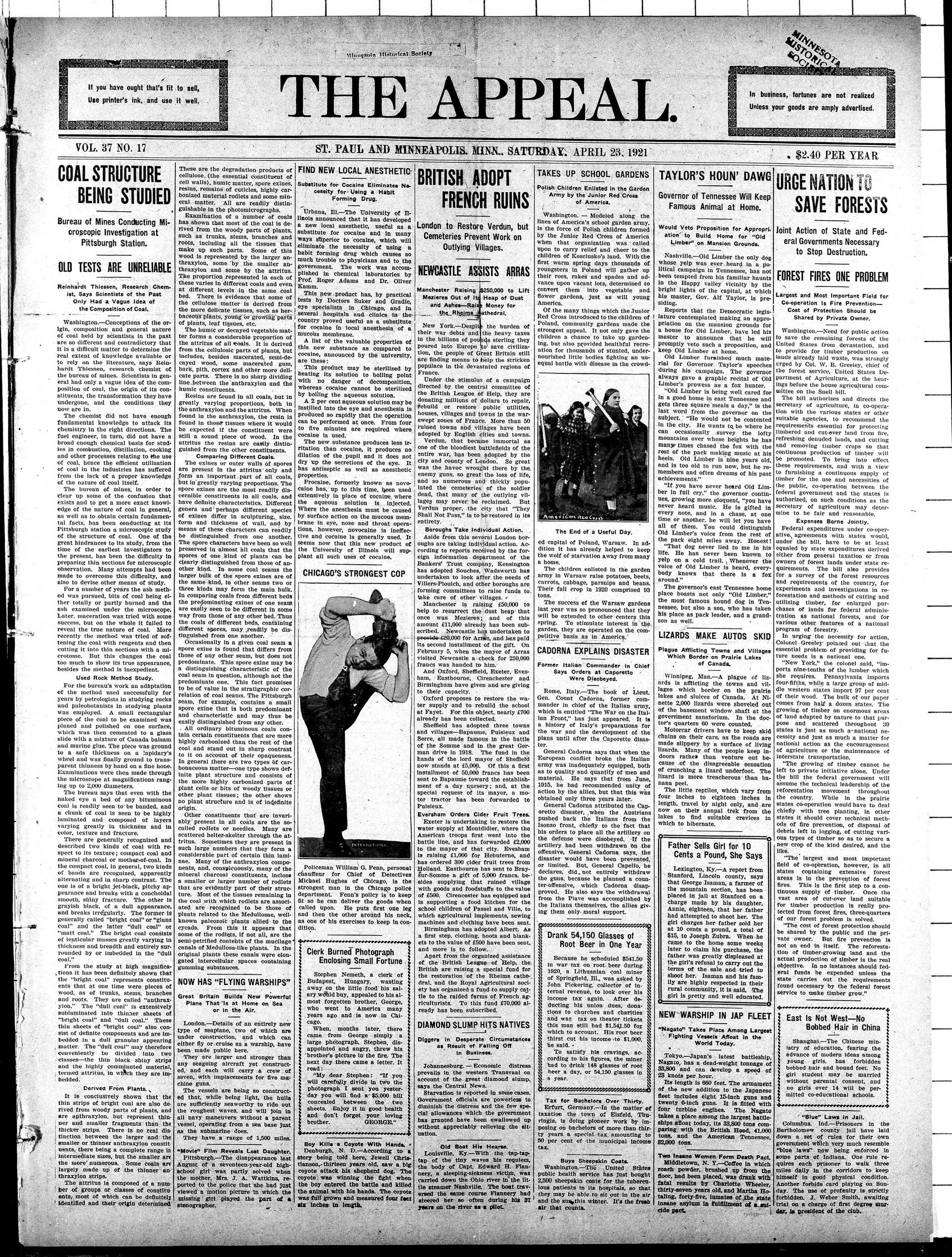
COAL STRUCTURE BEING STUDIED
COAL STRUCTURE BEING STUDIED
Bureau of Mines Conducting Microscopic Investigation at Pittsburgh Station.
OLD TESTS ARE UNRELIABLE
Reinhardt Thiessen, Research Chemist, Says Scientists of the Past Only Had a Vague Idea of the Composition of Coal.
Washington.—Conceptions of the origin, composition and general nature of coal held by scientists in the past are so different and contradictory that it is a difficult matter to determine the real extent of knowledge available or to rely on the literature, says Reinhardt Thiessen, research chemist of the bureau of science. The general had only a vague idea of the composition of coal, the origin of its constituents, the transformation they have undergone, and the conditions they now are in.
The chemist did not have enough fundamental knowledge to attack its chemistry in the right directions. The fuel engineer, in turn, did not have a broad enough chemical basis for studies in combustion, distillation, cooking and other processes relating to the use of coal in the industries has suffered from the lack of a proper knowledge of the nature of coal itself.
The bureau of mines, in order to clear up some of the confusion that exists and to get a more exact knowledge of the nature of coal in general, as well as to obtain certain fundamental facts, has been conducting at its Pittsburgh station a microscopic study of the structure of coal. One of the great hindrances to its study, from the time of the earliest investigators to the present, is that it requires preparing thin sections for microscopic observation. Many attempts had been made to overcome this difficulty, and also to devise other means of study. For a number of years the ash method was pursued, bits of coal being either totally or partly burned and the ash examined under the microscope. Later, maceration was tried with some success, but on the whole it failed to reveal the true nature of coal. More recently the method was tried of softening the coal with reagents and then macerating it under a microscope. But this changes the coal too much to show its true appearance, besides the method is inexpedient.
Used Rock Method Study.
For the bureau's work an adaptation of the method used successfully for years by petrologists in studying rocks and paleobotanists in studying plants was employed. A small rectangular piece of the coal to be examined was plained and polished on one surface, which was then cemented to a glass slide with a mixture of Canada balsam and marine glue. The piece was ground to a safe thickness on a 'lapidary' wheel and was finally ground to transparent thinness by hand on a fine hone. Examinations were then made through the microscope at magnifications ranging to 2,000 diameters. The bureau says even with the naked eye a bed of any bituminous coal is readily seen to be banded, and a chunk of coal is seen to be highly laminated and composed of layers varying greatly in thickness and in color, texture and fracture. There are generally recognized and described two kinds of coal with respect to its texture; compact coal and mineral charcoal or mother-of-coal. In the compact coal, in general, two kinds of bands are recognized, apparently alternating and in sharp contrast. The one is of a bright jet-blot, pitchy appearance and breaks with a conchoidal smooth, shiny fracture. The other is grayish black, of a dull appearance, and breaks irregularly. The former is generally called "bright coal" or "glanz" and is often called "matt coal". The bright coal consists of tenticular masses greatly varying in thickness and breadth and entirely surrounded by or imbedded in the "dull coal".
From the study at high magnifications it has been definitely shown that the "bright coal" represents constituents that at one time were pieces of wood, as of trunks, stems, branches and roots. They are called "anthraxylon." The "dull coal" is extensively sublimated into thinner sheets of "bright coal" and "dull coal." These thin sheets of "bright coal" also consist of definite components and are imbedded in a dull granular appearing matter. The "dull coal" may therefore conveniently be divided into two classes—the thin black shiny strips and the highly comminuted material, termed attritus, in which they are imbedded.
Derived From Plants
It is concisely shown that the thin strips of bright coal are also derived from woody parts of plants, and are anthryxlon, but represent thinner and smaller fragments than the thicker strips. There is no real distinction between the larger and the smaller or thinner anthryxlon constituents, there being a complete range in intermediate sizes, but the smaller are the more numerous. Some coals are the top of the thinner anthryxlon strips. The attritus is composed of a number of groups or classes of constituents, most of which can be definitely identified and their origin determined
These are the degradation products of cellulose, (the essential constituent of cell walls), humic matter, spore exines, resins, remains of cuticles, highly carbonized material rottles and some mineral matter. All are readily distinguishable in the photomicrographs.
Examination of a number of coals has shown that most of the coal is derived from the woody parts of plants, such as trunks, branches and roots, including all the tissues that make up such parts. Some of this wood is represented by the larger anthraxylon, some by the smaller anthraxylon and some by the atritus. The proportion represented in each of these varies in different coals and even at different levels in the same coal bed. There is evidence that some of the cellulose matter is derived from the more delicate tissues, such as herbaceous plants, young or growing parts of plants, leaf tissues, etc.
The humic or decayed vegetable matter forms a considerable proportion of the atritus of all coals. It is derived from the cellulosic parts of plants, but includes, besides macerated, semi-demacerated, some macerated gum, bark, pith, and other more delicate parts. There is no sharp dividing line between the anthraxylon and the humic constituents.
Resins are found in all coals, but in greatly varying proportions, both in the anthraxylon and the atritus. When found in the anthraxylon, the resin is found in those tissues where it would be expected if the constituent were still a sound piece of wood. In the atritus the resins are easily distinguished from the other constituents.
The exines or outer walls of spores are present in the attritus only and form in important part of all coals, but in greatly varying proportions. The spore exines are the most readily discernible constituents in all coals, and have definite characteristics. Different genera and 'perhaps different species of exines differ in sculpturing, size, form and thickness of wall, and by means of these characters can readily be distinguished from one another. The spore characters have been so well preserved in almost all coals that the one kind of plants can be clearly distinguished from the other kind. In some coal seams the larger bulk of the spore exines are of the same-kind, in other seams two or three kinds may form the main bulk. In comparing coals from different beds the predominating exines of one seam are easily seen to be different in some way from those of any other bed. Thus the coals of different beds, containing different spores, may readily be distinguished from one another. Occasionally in a given coal seam a spore exine is found that differs from those of any other seam, but does not predominate. This spore exine may be a distinguishing characteristic of the seam in question, although not the seam in one, the fact promises to be of value to the relationship of coal seams. The Pittsburgh seam, for example, contains a small spore exine that is both predominant and characteristic and may thus be easily distinguished from any other.
All ordinary bituminous coals contain certain constituents that are more highly carbonized than the rest of the coal and stand out in sharp contrast to it on account of their opacness. In general there are two types of carbonaceous matter—one type shows definite plant structure and consists of plant cells or bits of carbonized parts of plant cells or bits of easily other plant tissues; the other shows no plant structure and is of indefinite origin.
Other constituents that are invariably present in all coals are the so-called rodlets or needles. Many are scattered helter-skelter through the atritus. Sometimes they are present in such large numbers that they form a considerable part of certain thin lamina. Many of the anthraxylon compositions, in turn, consist mainly of the mineral charcoal constituent in lignes a smaller or larger number of rodlets that are evidently part of their structure. Most of the tissues remaining in the coal with which rodlets are associated are recognized to be those of plants related to the Medullosace, well-known paleozoic plants allied to the cycads. From this it appears that some of the rodlets, if not all, are the rodlets of the canals of Medullos-like plants. In the original plants these canals were elongated intercellular spaces containing gumming substances.
NOW HAS "FLYING WARSHIPS"
Great Britain Builds New Powerful Plane That 'is at Home on Sea or in the Air.
London—Details of an entirely new type of seaplanet, two of which are under construction, and which can either fly or cruise as a warship, have been made public here.
They are larger and stronger than any seagoing aircraft yet constructed, and each will carry a crew of seamen, improvements for five machine guns.
The vessels are being so constructed that, while being light, the hulls are sufficiently seaworthy to ride out the roughest waves, and will join in all navy maneuvers without a parent vessel, operating from a sea base just as the submarine does.
They have a range of 1,500 miles.
"Movie" Film Reveals Lost Daughter. Pittsburgh—The disappearance last August of a seventeen-year-old high-school girl, Mrs. J. A. Wattkins, reported to the police that she had just traveled a million picture in which the missing girl played the part of a stenographer.
THE APPEAL.
FIND NEW LOCAL ANESTHETIC
Substitute for Cocaine Eliminates Necessity for-Using a Habit Forming Drug.
Urbana, Ill.-The University of Illinois announced that it has developed a new local anesthetic, useful as a substitute for cocaine and in many ways superior to cocaine, which will eliminate the necessity of using a habit forming drug which causes so much trouble to physicians and to the government. The work was accomplished in chemical laboratories by Prof. Roger Adams and Dr. Oliver Kauro.
This new product has, by practical tests by Doctors Suker and Gradle, eye specialists in Chicago, and in several hospitals and clinics in the country proved useful as a substitute for cocaine in local anesthesia of a mucous membrane.
A list of the valuable properties of this new substance as compared to cocaine, announced by the university, are these:
This product may be sterilized by heating its solution to boiling point with no danger of decomposition, whereas cocaine cannot be sterilized by boiling the aqueous solution.
A 2 per cent aqueous solution may be instilled into the eye and anesthesia is produced so rapidly that the operation can be performed at once. From four to six minutes are required where cocaine is used.
The new substance produces less irritation than cocaine, it produces nidilation of the pupil and it does not dry up the secretions of the eye. It has antiseptic as well as anesthetic properties.
Procaine, formerly known as novocaine has, up to this time, been used extensively in place of cocaine where the aqueous solution is injected. Where the anesthesia must be caused by surface action on the mucous membrane in eye, nose and throat operations, however, novocaine is ineffective and cocaine is generally used. It seems now that this new product of the University of Illinois will supplant all such uses of cocaine.
CHICAGO'S STRONGEST COP
INTERNATIONAL
Policeman William G. Fenn, personal chauffeur for Chief of Detectives Michael Hughes of Chicago, is the strongest man in the Chicago police department. Fenn's policy is to keep fit so he can deliver the goods when called upon. He puts first one leg and then the other around his neck, as one of his exercises to keep in condition.
Clerk Burned Photograph Enclosing Small Fortune
Stephen Nemeth, a clerk of Budapest, Hungary, wasting away on the little food his salary would buy, appealed to his almost forgotten brother, George, who went to America many years ago and is now in Chicago.
When, months later, there came from George simply a large photograph, Stephen, disappointed and angry, threw his brother's picture in the fire. The next day there came a letter. It read:
"My dear Stephen: "If you will carefully divide in two the photograph I sent you yesterday you will find a $5,000 bill concealed between the two sheets. Enjoy it in good health and don't forget your loving brother. GEORGE."
Boy Kills a Coyote With Hands. Denbrough, N. D.-According to a stove-bench told here, Jewel Christenson, thirteen years old, his coyote attack his sheepdog the coyote was winning the fight when the boy entered the battle and killed the animal with his hands. The coyote was full grown and measured four feet six inches. in length.
BRITISH ADOPT FRENCH RUINS
BRITISH ADOPT FRENCH RUINS
London to Restore Verdun, but Cemeteries Prevent Work on Outlying Villages.
NEWCASTLE ASSISTS ARRAS
Manchester Raising $250,000 to Lift Miezieres out of 11d Heap of Dust and Ahes—Raise Money for the Rhisman Cathedral.
New York—Despite the burden of their war debts and the heavy taxes in the billions of pounds sterling they poured into Europe to save civilization, the people of Great Britain still are finding means to help the stricken populace in the devastated regions of France.
Under the stimulus of a campaign directed by the central committee of the British League of Help, they are donating millions of dollars to repair, rebuild or restore public utilities, houses, villages and towns in the warwet zones of France. More than 50 ruined towns and villages have been adopted by English cities and towns. Verdun, that became immortal as one of the bloodiest battlefields of the entire war, has been adopted by the city and county of London. So great the havewre wrought there by the enemy so great the loss of life, and so numerous and the thick population the cemeteryes of the soldier dead, that many of the outlying villages may never be reclaimed. But Verdun proper, the city that "Sheil Not Pass" is to be restored in its entirety.
Aside from this several London boroughs are taking individual action. According to reports received by the foreign information department of the Bankers' Trust company, Kensington has adopted Soudas, Waddsworth has undertaken to look after the needs of Villers-Plouich, and other boroughs are forming committees to raise funds to take care of other villages.
Manchester is raising £50,000 to help to resurrect the dust heap that once was Miezières; and of this amount £11,000 already has been subscribed. Newcastle has undertaken to provide £20,000 for Arrows, and has paid its second installment of the gift. On February 5, when the mayor of Arnas visited Newcastle a check for 250,000 francs was handed to him.
And Oxford, Sheffield, Exeter, Evesham, Eastbourne, Crenchester and Birmingham have given and are giving to their capacity.
Other property to restore the water supply and to rebuild the school at Fayet. For this object, nearly £700 already has been collected.
Sheffield has adopted three towns and villages—Bapaume, Puisieux and Serre, all made famous in the battle of the Somme and in the great German drive in 1918. The fund in the hands of the lord mayor of Sheffield now stands at £5,000. Of this a first installment of 50,000 francs has been sent to Bapaume toward the establishment of a day nursery; and, at the special request of its mayor, a motor tractor has been forwarded to Puisieux.
Eversham Orders Cider Fruit Trees.
Exeter is undertaking to restore the water supply at Montdidier, where the American troops first went into the battle line, and has forwarded £2,000 to the mayor of that city. Evesham is raising £1,000 for Hebutere, and has ordered 300 cider fruit trees from Holland. Eastbourne has sent to Brayton an ordered 300 cider supplies supplying that ruined garden with goods and foodstuff to the value of £500. Cincerence has equipped and is supporting a food kitchen for the school children of Passel and Ville, to which agricultural implements, sewing machines and clothing have been sent. Birmingham has adopted Albert; a first step, clothing, boots and blankets to the value of £500 have been sent, and more is to follow.
Apart from the organized help of the British League of Assistance, British area is providing special fund for the restoration of the Rheims cathedral, and the Royal Agricultural society has organized a fund to supply cattle to the raided farms of French agriculturists. To this fund £7,000 already has been subscribed.
DIAMOND SLUMP HITS NATIVES
Diggers in Desperate Circumstances as Result of Falling Off in Business.
Johannesburg. — Economic distress prevails in the western Transvaal on account of the great diamond slump, says the Central News.
Staviation is required in some cases. Government officials are powerless to diminish the distress and the few special allowances which the government has granted have been swallowed up without appreciably relieving the situation.
Old Boat His Hearse.
Louisville, Ky.—With the tap-tap of the tiny waves his requiem, the body of Capt. Edward H. Fannery, a sleek-sleeping victim, was steamed in the river in the lift steamer Nashville. The boat traversed the same course Fannery had steered her so often during his 67 years on the river as a pilot.
TAKES UP SCHOOL GARDENS
Polish Children Enlisted in the Garden Army by the Junior Red Cross of America.
Washington. — Modeled along the lines of America's school garden army, is the force of Polish children formed by the Junior Red Cross of America when that organization was called upon to carry relief and cheer to the children of Koscusko's land. With the first warm spring days thousands of youngsters in Poland will gather up their roes, rakes and spades and advance upon vacant lots, determined to convert them into vegetable and flower gardens, just as will young Americans. Of the many things which the Junior Red Cross introduced to the children of Poland, community gardens made the strongest appeal. It not only gave the children a chance to take up gardening, but also provided healthful recreation for thousands of stunted, under-nourished little bodies fighting an unequal battle with disease in the crowd.
The End of a Useful Day.
ed capital of Poland, Warsaw. In addition it has already helped to keep the wolf of starvation away from many a home.
The children enlisted in the garden army in Warsaw raise potatoes, beets, carrots, cabbage, parsnips and beans. Their fall crop in 1920 comprised 83 tons.
The success of the Warsaw gardens last year was so pronounced that they will be extended to other centers this spring. To stimulate interest in the garden, they are operated on the competitive basis as in America.
CADORNA EXPLAINS DISASTER
Former Italian Commander in Chief Says Orders at Caporetto Were Disobeyed.
Rome, Italy—The book of Leut. Gen. Count Cadora, former commander in chief of the Italian army, which is entitled "The War on the Italian Front," has just appeared. It is a history of Italy's preparations for the war and the development of the plans until after the Caporetto disaster.
General Cadora says that when the European conflict broke the Italian army was inadequately equipped, both as to quality and quantity of men and material. He says that from June, 1915, he had recommended unity of action by the allies, but that this was obtained only three years later.
General Cadora attributed the Caporetto disaster, when the Austrians pushed back the Italians from the Isonzo front, chiefly to the fact that his orders to place all the artillery on the defense were disobeyed. If the artillery had been withdrawn on the offensive, General Cadora says, the disaster had been prevented, or limited. But General Capello, declared, did not entirely withdraw the guns, because he planned a counter-offensive, which Cadora disapproved. He also says the withdrawal from the Piave was accomplished by the Italians themselves, the allies giving them only moral support.
Drank 54,150 Glasses of Root Beer in One Year
Because he scheduled $541.50 in war tax on root beer during 1920, a Lithuanian coal miner of Springfield, III, was asked by John Pickering, collector of internal revenue, to look over his income tax again. After deducting his union dues, donations to churches and charities and war tax on theater tickets this man still had $1,541.50 for which to account. His root beer stock had his income to $1,000; he said. To satisfy his cravings, according to his figures, the miner had to drink 148 glasses of root beer a day, or $4,150 glasses in a year.
6.
Tax for Bachelors Over Thirty.
Erfurt, Germany.—In the matter of taxation the town of Elsfeld, Thuringia, is doing pioneer work by imposing on bachelors of more than thirty years a special tax amounting to 50 per cent of the municipal income tax.
Buys Sheepskin Coats.
Washington.—The United States public health service has just bought 2,500 sheepskin coats for the tuberculous patients in its hospitals, so that they may be able to sit out in the air and the mud this winter. It's the fresh
TAYLOR'S HOUN' DAWG
Governor of Tennessee Will Keep Famous Animal at Home.
Would Veto Proposition for Appropriation to Build Home for "Old Limber" on Mansion Grounds.
Nashville—Old Limber the only dog whose yelp was ever heard in a political campaign in Tennessee, has not been tamed from his familiar haunts in the Happy valley vicinity by the bright lights of the capital, at which his master, Gov. Alf Taylor, is presiding.
Reports that the Democratic legislature outcompeted making an appropriation for the mansion grounds for a house for Old Limber, have led his master to announce that he will prompt veto such a proposition, and keep Old Limber at home.
Old Limber furnished much material for Governor Taylor's speeches during his campaign. The governor always gave a graphic recital of Old Limber's prowess as a fox hunter. "Old Limber is being well cared for in a good home in east Tennessee and gets three square meals a day," is the last word from the governor on the subject. "He would not be contented in the city. He wants to be where he occasionally survey the lofty mountains over whose heights he has many times foxed the fox with the rest of the pack named music at his heels. Old Limber is nimble old, and is too old to run now, but he remembers and often dreams of his past achievements."
"If you have never heard Old Limer in full cry," the governor continues, growing more eloquent, "you have never heard music. He is gifted in every note, and in a chase, at one time or another, he will let you have all of them. You could distinguish Old Limer's voice from the rest of the pack eight miles away. Honest! That dog never lied to me in his life. He has never been known to yelp or told trail. Whenever the voice of Old Limer is heard, everybody knows that there is a fox around."
The governor's east Tennessee home place boasts not only "Old Limer" the most famous hound dog in Tennessee, but also a son, who has taken his place as pack leader, and a grandson as well.
LIZARDS MAKE AUTOS SKID
Plague Afflicting Towns and Villages Which Border on Prairie Lakes of Canada
Winnipeg, Man—A plague of lizards is afflicting the towns and villages which border on the prairie lakes and sluices of Canada. At Ninette 2,000 lizards were shoveled out of the basement window shaft at the government sanatorium. In the doctor's quarters 60 were counted. Motorcar drivers have to keep skid clips on their cars, as the roads are made slippery by a surface of living lizards. Many of the people keep indoors rather than venture out because of the disagreeable sensation of crunching a lizard underfoot. The lizard is more treacherous than banana peel.
The little reptiles, which vary from four inches to eighteen inches in length, travel by night only, and are now on their annual trek from the lakes to find suitable crevices in which to hibernate.
Father Sells Girl for 10 Cents a Pound, She Says
Lexington, Ky.—A report from Stanford, Lincoln county, says that George Isman, a farmer of the mountain section, has been placed in jail at Stanford on a charge made by his daughter, Annie, eighteen, that her father had attempted to shoot her. The girl charges her father sold her at 10 cents a pound, a total of $15, to Joseph Zubra. When he came to the home some weeks later to claim his purchase, the father was greatly displeased at the girl's refusal to carry out the terms of the sale and tried to shoot her. Isman and his family are highly respected in their rural community, it is said. The girl is pretty and well educated.
NEW WARSHIP IN JAP FLEET
"Nagato" Takes Place Among Largest Fighting Vessels Afoot in the World Today.
Tokyo—Japan's latest battleship, Nagato, has a dead-weight tonnage of 28,800 and can develop a speed of 28 knots per hour.
Its length is 600 feet. The armament of the new addition to the Japanese fleet includes eight 15-inch guns and twenty 6-inch guns. It is fitted with four turbine engines. The Nagato takes a place among the largest battleships afloat today, its 38,900 tons comparing with the British Hood, 41,000 tons, and the American Tennessee, 32,000 tons.
Two Insane Women Form Death Pact. Middletown, N. Y.—Coffee in which rook powder, brushed up from the floor, has been placed, was drank with fatal result. The Queen Wheeler, thirty-seven old, and Martha Hotaling, forty-five, inmates of the state insane argyum in fulfillment of a suicide pac
. $2.40 PER YEAR
URGE NATION TO SAVE FORESTS
Joint Action of State and Federal Governments Necessary to Stop Destruction.
Largest and Most Important Field for Co-operation Is Fire Prevention—Cost of Protection Should be Shared by Private Owner.
Washington—Need for public action to save the remaining forests of the United States from devastation, and to provide for timber production on lands already laid waste, was strongly urged by Col. W. B. Greeley, chief of the forest service, United States Department of Agriculture, at the hearings before the house agricultural committee on the Snell bill.
The bill authorizes and directs the secretary of agriculture, in co-operation with the various states or other suitable agencies, to recommend the requirements essential for protecting timber and cut-ever land from fire, refreshing denuded lands, and cutting and removing timber crops so that production of timber will be promoted. To bring into effect these requirements, with a view to furnishing a continuous supply of timber for the use and necessities of the public, co-operation between the federal government and the states is authorized, on such conditions as the secretary of agriculture may determine to be fair and reasonable.
Expenses Borne Jointly
Federal expenditures under co-operative agreements with states would, under the bill, have to be at least equaled by state expenditures derived either from general taxation or from owners of forest lands under state requirements. The bill also provides for a survey of the forest resources and requirements of the country, for experiments and investigations in reforestation and methods of cutting and utilizing timber, for enlarged purchases of lands for federal administration as national forests, and for various other features of a national program of forestry.
In urging the necessity for action, Colonel Greely pointed out that the essential problem of providing for future needs is a national one.
"New York," the colonel said, "imports nine-tenths of the lumber which requires. Pennsylvania imports four-fifths, while a large group of middle eastern states import 97 per cent of their bulk of our paper of our paper comes from half a dozen states. The growing of timber on enormous areas of land adapted by nature that purpose and scattered throughout 90 states is just as much a national necessity and just as much a matter for national action as the encouragement of agriculture or the maintenance of interstate transportation.
"The growing of timber cannot be left to private initiative alone. Under the bill the federal government will assume the technical leadership of the reforestation movement throughout the country. While in the prairie states co-operation would have to deal chiefly with tree planting, in other states it should cover technical methods of fire prevention, of disposal of debris left in logging, of cutting various types of timber so as to secure a new crop of the kind desired, and the like.
"The largest and most important field of co-operation, however, in all states containing extensive forest areas is in the prevention of forest fires. The is the first step to a continuous supply of timber, since the vast area of cut-over land suitable for timber production is really protected from forest fires, three-querrers of our forest problem is solved.
"The cost of forest protection should be shared by the public and the private owner. But fire prevention is not an end in itself. The reforestation of timber-growing land and the actual production of timber is the real objective. In no instances should federal funds be expended unless the state carries out the requirements found necessary by the federal forest service to make timber grow."
East Is Not West—No Bobbed Hair in China
Shanghai—The Chinese ministry of education, fearing the advance of modern ideas among young girls, has forbidden boobed hair and bound feet. No married women may be married without parent consent. No girls over 14 will be permitted co-educational schools.
"Blue" Laws in Jail.
Columbus, Ind.-Prisoners in the
Bartolomew county jail have laid
down a set of rules for their own
government which very much resemble
"blue laws" now being enforced in
some parts of Indiana. One rule re-
lates that inmates must be on their
mails daily in the corridors to keep
himself in good physical condition.
Another forbids card playing on Sunday.
The use of profanity is strictly
forbidden. J. Weber Smith, awaiting
trial on a charge of first degree
murder, is president of the club.
No. 301-2 Court Block, 24 E. 4th st.
J. Q. ADAMS, Manager.
PHONE: N. W. CEDAR 5649.
MINNEAPOLIS OFFICE
No. 2812 Tenth Avenue South
J. N. SENLLERS, Manager.
Entered at the Postoffice in St Paul,
Minnesota, as second-class mail
matter, June 6, 1885, under
Act of Congress,
March 2, 1885.
TERMS, STRICTLY IN ADVANCE:
SINGLE COPY, One Year.....$2.40
SINGLE COPY, Six Months.....1.25
SINGLE COPY, Three Months......65
*Remittances should/ be made by Express Money Order, Post Office Money Order, Request stamps will be received the same as cash for the fractional parts of a dollar. Only one cent and two cents stamps taken.
*Shipping is the same as the mail. It is almost sure to wear a hole through the envelope and be lost; or else it may be stolen. Person who send silver to in letters should not receive it. Marriage and death notices 10 lines or less $1. Each additional line 10 cents. Payment is advance, and to be announced at all times. Person who receives more than $1. No discount allowed on less than three months contract. Cash must accompany orders from parties unknown to us. Reading notices 25 cents per line, each insertion. No discounts for time or space. Reading matter is in brevier type--about six inches to the line. All head-lines count double.
**the date on the address label shows when**
**the date is expire.** Expirees should be
made two weeks before the date. No
paper may be missed, as the paper stops
when time is out.
**the date on the paper that sends to**
**subscribers is lost or stolen.** In case you
do not receive any number when due, inform us
when you receive it. We will send days
from that date, and we will cheerfully
orward a duplicate of the missing number.
**Communications to receive attentions must be**
written only upon one side of the paper;
must reach us Tuesdays if possible, anyway.
We will send a nature of the author. No manuscript
returns unless stamps are sent for postage.
**We do not hold ourselves responsible for the**
**soliciting agents sent everywhere. Write**
**for terms. Sample copies free.**
In every letter that you write us never fail to give your full name and address, plainly written, post office, county and state. Business letters of all kinds must be written on separate sheets from letters containing news or matter for publication.
"Any prejudice whatever will be insurmountable if those who do not share in it themselves truckle to it and flatter it and accept it as a law of nature." —John Stuart Mill.
---
SATURDAY, APRIL 23, 1921.
MINNESOTA'S ANTI-LYNCHING LAW.
The colored people, of Minnesota are much elated over the passage of what is known as the "Anti-Lynching Law," this week; which provides that as much as $7,500 may be recovered by the kin of a person lynched by a mob; and, that the sheriff of any county in which a lynching occurs, may be suspended from office -if he does not fully protect prisoners from mobs.
Thus the great state of Minnesota falls in line with the states of Alabama, Louisiana, Kentucky, South Carolina, Kansas, New York, Ohio, Pennsylvania, California, Maine, New Hampshire, Illinois, New Jersey and Wisconsin, which have laws involving all or a part of the provisions of the Minnesota law. There appears to be no doubt of the constitutionality of the law, as the U. S. Supreme Court in the case of Louisiana vs. New Orleans, 109 U. S. 285, decided that laws of that character are valid. Mrs. W. T. Francis of St. Paul is the author of the law; and, to her indefatigible labors, in its behalf, with the members of the legislature is its successful passage due.
A REAL RELIGION.
The Bahaist Congress is in session in Chicago. The Bahaist faith is different from the larger Christian sects in that it not only believes in, but practices, the brotherhood of man. To Christians, except a few of the smaller sects, a colored man is a "nigger"; to the Bahaists he is a brother in fact.
The Bahaists are building in Willmette, a Chicago suburb, a $1,000,000 temple, called Mashrak el Askar.
CABEL'S GOOD ADVICE
Vote! Cast your vote though taxed for it. Cast your vote though defrauded of it, as many a white man is today. Cast your vote though you die for it. Let no man cry, "Liberty or blood"; leave that for Socialists and Parisian mobs; but when liberty means duty, and death means one's own extinction, the cry of "Liberty or death" is a holy cry, and the man
THE SIN OF SILENCE
To sin by silence protest makes cow The human race has test. Had no voice in injustice, ignorance quisition yet would guillotines decide on The few who dare speak again to right many.—Ella Wheeler
To sin by silence when we should protest makes cowards out of men. The human race has climbed on protest. Had no voice been raised against injustice, ignorance and lust, the inquisition yet would serve the law, and guillotines decide our least disputes. The few who dare must speak and speak again to right the wrongs of many.—Ella Wheeler Wilcox.
who will not make it his own, even in freedom, is not free. Seek not to buy liberty with the blood of either friends or enemies; it is only man's own blood at last that counts in the purchase of liberty. Whatever may have been the true philosophy for more ferocious times, this is true philosophy for ours. Cast your votes, then, even if many of you die for it. Some of you have died, but in comparison how few; 300,000 white men poured out their blood to keep you bound, other 300,000 died to set you free, and still the full measure of American freedom is not yours. A fiftieth as much of your own blood shed in the inoffensive activity of public duty will buy it. Keep your vote alive; better nine free men than ten half-free. In most of the Southern States the colored vote has been diminishing steadily for years, to the profound satisfaction of those white men whose suicidal policy is to keep you in alienism. In the name of the dead, black and white, of the living, and of your children yet unborn, not as one party or another, but as American freemen, vote! Fon in this free land the people who do not vote, do not get and do not deserve their rights.
These words were written many years ago by George W. Cable, famous writer, and friend of the colored people, author of "The Freedman's Case in Equity." It is as good and as true today as it was when he first penned it. And it is quite different from the advice given by certain jim-crow "leaders" and "great negroes" who sneer at "mere voting."
THE RACE QUESTION.
In his first message to Congress, President Harding said:
"Congress ought to wipe the stain of barbaric lynching from the banners of a free and orderly, representative democracy. We face the fact that many millions of people of African descent are numbered among our population and that in a number of the states they constitute a very large proportion of the total population.
"It is unnecessary to recount the difficulties incident to this condition, nor to emphasize the fact that it is a condition which cannot be removed. There has been a suggestion, however, that some of its difficulties might be ameliorated by a humane and enlightened consideration of it, a study of its many aspects and an effort to formulate, if not a policy, at least a national attitude of mind calculated to bring about the most satisfactory possible adjustment of relations between the races, and of each race to the national life.
"One proposal is the creation of a commission embracing representatives of both races, to study and report on the entire subject. The proposal has real merit. I am convinced in mutual tolerance, understanding, charity, recognition of interdependence of the races and the maintenance of the rights of citizenship lies the road to righteous adjustment."
MR. HARDING'S CHANCE.
For eight years one-twelfth of the citizenry of the United States suffered from the humiliation of segregation in the civil service of the country. It was a condition forced by President Wilson, who while delivering his smooth talks about world democracy, used his great power to humiliate and degrade millions of his fellow countrymen.
THE MAN W
I honor the man
entious discharge o
stand alone; the w
intolerant judgmen
the countenances o
I honor the man who in the conscientious discharge of his duty dares to stand alone; the world, with ignorant, intolerant judgment, may condemn, the countenances of relatives may be averted, and the hearts of friends grow cold, but the sense of duty done shall be sweeter than the applause of the world, the countenances of relatives or the hearts of friends.—Charles Sumner.
once when we should
wards out of men.
is climbed on pro-
been raised against
he and lust, the in-
serve the law, and
our least disputes.
he must speak and
right the wrongs of
er Wilcox.
Wilson considered himself a superman, and his ambition was to be the president of a super-government and go down in history as the greatest man who ever lived. Repudiated the ballot box by his countrymen, he is today, according to all accounts a physical wreck. And as he sits in his easy chair, his keen intellect is tortured by the spectres of his defeated ambitions.
Mr. Harding, you have the power to wipe out the President Wilson's great wrong to the colored people. You have stated on many occasions that you believe in equality of citizenship. You have the power to issue an executive order abolishing segregation in the departments at Washington and in the Civil Service of the United States.
Will you do it, Mr. Harding?
THE WOMEN AT CLEVELAND.
The National League of Women Voters at their Cleveland session formulated a plan to work for the "abolition of all sex discrimination that Congress has the power to deal with." Effort will also be made to have all state laws modified where they exist to the discriminatino of women.
This is quite different from the national colored organizations which, without exception, compromise on some fundamental point and while in some cases pretend to be working to abolish segregation, are actually seeking to establish it in one form or another.
The jimcrow colored leaders ought to wash their dirty hands and "come clean," and then join their brothers who are fighting for the removal of all legal hindrances, by asking Congress to pass a blanket bill removing all racial discriminations with which it has the power to deal.
Secretary James W. Johnson, Secretary of the National Association for the Advancement of the Colored People, in a recent conference with President Harding, emphasized the important fact that the national association was not interested in the parceling out of petty jobs, but that its interest was in the enactment of measures to relieve oppressive conditions affecting colored people.
The specific points discussed were:
1. Passage of a federal anti-lynching law by Congress.
2. A wide and thorough investigation of peonage conditions in the Southern states, to be made by the Department of Justice, followed by the punishment of the perpetrators of the peonage system.
3. An investigation of disfranchisement in the South and the right of the Negro to vote under the identical qualifications required of other citizens.
4. The appointment of a National Inter-racial Commission to make a thorough study of race relations.
5. Congressional investigation of both military and civil acts of the American occupation in Haiti.
6. The appointment of colored assistant secretaries in the Departments of Labor and Agriculture.
7. The abolishment by executive order of all race segregation in the Departments at Washington and the United States Civil Service.
Some of the things asked for are good, but others are bad, as we shall endeavor to show editorially in our next issue. We also believe that
WHO DARES
who in the consci- of his duty dares to world, with ignorant, nt, may condemn, of relatives may be
point No. 7 should come first, as it is a matter which can be handled by the President without any discussion or suggestions from either his cabinet or the Congress, and we have it on the authority of William Monroe Trotter and others that the President when a candidate for the office promised that he would issue such an order. That is the fundamental proposition upon which everything else rests. Let segregation by the Federal government cease.
It is said that the Ku Klux Klan has about 7,000 members in Chicago. A Klan has been organized among the white servants of wealthy residents of Lake Forest, a suburb.
The state senate of Illinois has voted approval of Governor Small's planks, the principal of which includes the enforcement of the 15th Amendment. They were rejected by the Republican national convention.
Senator McCormick of Illinois is pushing his bill for a lynch quiz. It would be all right if he'd leave off the inter-racial relations part. There is enough in the lynching quiz, to keep a commission busy for some time.
The St. Paul Pioneer Press says: "The world is making progress when a Georgia jury convicts a white man of murder for killing 11 Negroes, but a recommendation of mercy accompanies the verdict. Which raises the question, how many he would have to kill to be entitled to no mercy?" We would like to know, too.
Capt. Sumner W. Kittelle, U. S. N., has been assigned to duty as governor of the Virgin Islands of the United States, and comandant of the naval base. He succeeds Rear-Admiral J. W. Oman as chief United States official in the new American possession purchased from Denmark. The islands have a population of about 27,000—23,000 colored and 4,000 white.
BISHOP CARTER COMING.
Bishop R. A. Carter, A. B., A. M,
D. D.; of Chicago, Bishop of the
Fifth Episcopal Church, M. D. Dist,
will preach Sunday, April 24th, at Grace
C. M. e. church, cor. Rondo and Kent
E. church. In the afternoon at 3:00 o'clock he
will preach at St. James A. M. E.
church, Fuller and Jay Sts.
Monday night, April 25, at 8 o'clock,
he will lecture at Pilgrim Baptist
Church, Cedar St. and Summit Ave.
Everybody invited to each of these
meetings.
Come and hear one of the greatest
orators and preachers in this country.
J. A. Foster, Pastor.
Grace C. M. E. Church.
THE N. A. A. C. P. BOARD
Donates Dinner to Divines and Develops a Drive for New Members.
The Board of Directors of the St. Paul Branch of the N. A. A. C. P., preparing for the week drive for new members, from April 25 to April 30, invited all the pastors of our churches to a 6:00 o'clock dinner at Wilson Villa, Cor. Rondo and Mackubin streets, last Monday. Revs S. L. Theobald, T. J. Carr, A. H. Lealtad, H. H. Hodge, H. L. P. Jones, J. A. Foster and J. S. Strong were present. Also Dr. I. L. Rypins, Dr. Valdo Turner, Geo. W. James, W. T. Francis, O. C. and S. E. Hall, G. Shannon, J. Q. Adams; Mesdames A. W. Jordan, S. L. Maxwell, Henry High and J. Q. Adams.
The menu consisted of: Fruit cocktail; cream of corn soup; beef tenderloin, larded, aux mushrooms; hot Parker House rolls; mashed potatoes; creamed peas and carrots, combination salad; apple pie a la mode; coffee. All appetizing specimens of the culinary skill of Mrs. R. F. Wilson. After discussing the excellent menu the gentlemen present, each, had something to say along the line of the coming membership drive, all joining and pledging themselves to boast it in a ways possible. The pastors formed a special alliance to advance the cause of the N. A. A. C. P. from which much good is expected. Each of the pastors will have something to say of the N. A. A. C. P. at their services tomorrow.
NORTH CENTRAL AFRICA.
In North Central Africa, we have the great Sahara desert. It is not all desert, however; as there are numerous oases, large and small, where they have water and yevation and people. So we are finding missionary fields in the midst of the great desert. Some railroads are being built along the line of the chief caravan routes, so that some of these interior fields are becoming accessible by railroad, and the camel, the ancient "Ship of the Desert," is not so much used.
Across on the eastern coast of Africa we have Abyssinia, which is the ancient Ethiopia of the Bible. In the 8th chapter of Acts we read that the Ethiopian enuch went up to Jerusalem to worship. He was, obviously, a Jewish worshiper, but not yet a Christian. On his way home, Philip, the Evangelist, fell in with him and got up into his chariot and preached unto him Jesus, and he was happily converted and baptized and went on his way rejoicing; and we traditionally understand that he went home and preached the gospel to his own people; and, so, no doubt, was the first Christian gospel preacher in the great continent of Africa.
We also traditionally understand that the apostle Matthew lived and labored and died in Ethiopia. In the northeastern corner of Africa, we have Egypt. The descendants of the ancient Egyptians are still there. We know them as the Coptic church, and their church is Coptic church. There are Christians in a way, but not a very good way. They have a system of church organization, a system of priesthood and a form of church worship, but not much Bible in it. This always results in weakness whether on the
part of the individual Christian, or the local church, or the denomination, or the Christian world at large. The missionaries are going to these Coptic people with the open Bible, and reading it to them, and teaching and encouraging them to read it for themselves, and they are slowly coming into better things. Mission stations have been established here and there for many miles up and down the Nile river
The Mohammedans are alarmingly active in Northern Africa, and this is one of our missionary problems. Cyrene is in Northern Africa, and as we do not know of any other Cyrene, we are confident that Simon, who carries the cross for Jesus, was from Cyrene. There was much Christian activity in Northern Africa during the apostolic period, and also during the period of the church fathers. Among the great men of the early church in Northern Africa, there was Athanasius, bishop of Alexandria, Cyprian, bishop of Carthage, and Augustine, bishop of Hippo. Northern African has a mixed population, consisting of the native African, the Dutch, the Dutch and people from Asia, which enlarges the missionary problem. But from the missionary viewpoint, we regard problems as opportunities.
Young
—and old alike will find our "handy" bank the best-ever aid to Thrift. Get yours now by opening an account with $1.00 or more. Let us serve you.
NORTHERN
SAVINGS
BANK
Seventh
at
Robert
Saint
Paul
Penthouse Spring Bath
A Bathroom With
A Bathroom With
Seventh at Robert
Saint Paul
Just the thing
for spare dimes,
nickels, quarters, halves,
pennies and currency.
COMMERCIAL
CENTS
NORTHERN SAVINGS BANK
2008
TEL. CEDAR 7995
O. H. AROSIN CO.
JEWELERS AND OPTICIANS
ADJUSTING 'OF FINE WATCHES
A SPECIALTY
414 ROBERT ST. ST. PAUL, MINN.
THRIFT'S PATHWAY
It has been said that there is no royal road to Success but no one can deny that the road to Prosperity will take us the greater part of the way.
The road to Prosperity has many small tributaries—the pathways of Thrift.
A pathway of Thrift is before you—start on the journey to Success today by opening an account of one dollar or more at this bank.
Deposits made on or before April 11th will draw four per cent interest from the first of April.
MERCHANTS TRUST AND SAVINGS BANK Fourth, near Robert Saint Paul, Minnesota
N. W. CEDAR 3037
Chester W. Caswell
OPTICIAN & JEWELER
22 E. FOURTH ST.
SAINT PAUL
ORSHEIM
A NEW Florsheim style--you'll like it if you desire the latest shape--it's a square toe effect (not too pronounced). Florsheim certainly understands how to make shoes that are in good style and in good taste-at a price that will save you money in the long run. We can fit your feet with Florsheims.
STANLEY SHOE CO.
421 ROBERT ST., ST. PAUL
FOR THE MAN
"D"
The Hersheim
SHOE
THE STANDARD FROM OCE
STANDARD FROM OCEAN TO OCE
THE STANDARD FROM OCEAN TO OCEAN
TOWLE'S
LOG CABIN
SYRUP
ALCOHOL, SUGAR, WAX, SUGAR
MANUELLED SUGAR AND WAX, SUGAR
MAKES HOME SWEET HOME
THE LOG CABIN PRODUCT
SAINT PAUL, MINNESOTA
RANK WARE
"SATISFACTORY SERVICE"
AKES HOME SWEET HOME
THE LOG CABIN PRODUCTS CO
SAINT PAUL, MINNESOTA
RE
"SATISFACTORY SERVICE"
MAKES HOME SWEET HOME
THE LOG CABIN PRODUCTS CO.
SAINT PAUL, MINNESOTA
BIG MOON CAFE
AND LUNCH ROOM
WARE BROS., PROPS.
FIRST CLASS MEALS AT ALL HOURS
SPECIAL NOONDAY AND SUNDAY DINNER
TABLES FOR LADIES
P. P. PHILLIPS, CH
27 ST. PETER ST.
FIRST CLASS MEALS AT ALL HOURS
SPECIAL NOONDAY AND SUNDAY DINNER
LES FOR LADIES P. P. PHILLIPS, CH
ER ST. S
SPECIAL NOONDAY AND SUNDAY DINNER
DO YOU KNOW
TMAT FOR SERVICE AT
Capitol Steam
CANNOT BE SUPP
We do French Dry Cleaning, L
Dry Laundering. A trial w
this is the laund
PHONE AND A DRIVE
CEDAR
THAT FOR SERVICE AND QUALITY THE
bitol Steam Laun
CANNOT BE SURPASSED
to French Dry Cleaning, Dyeing and Wet or R
Dry Laundering. A trial will convince you that
We do French Dry Cleaning, Dyeing and Wet or Rough Dry Laundering. A trial will convince you that this is the laundry you want.
743 WABASHA ST. REFRIGEI
REFRIGERATORS
Big Factory Sale Continues
Find out how much you can buy a refrigerator for down town (but be sure not to confuse porcelain with inferior white paint enamel linings), then come out and let us show you how much money we can save you on the purchase of a
BOHN SYPHON REFRIGERATOR
(Seamless Porcelain Lined)
The refrigerator adopted as Standard by the Pullman Company and all Railroads.
BOHN REFRIGERATOR CO.
Take Interurban Car—Get Off at Hamline Ave.
WHO CARES
EAN TO OCEAN
CET HOME
PRODUCTS CO.
NORTH SOTA
J. W. WARD
CEE"
ALL HOURS
SUNDAY DINNER
P. PHILLIPS, CHEF
SAINT PAUL
QUALITY THE
Laundry
PRESSED
ing and Wet or Rough
convince you that
you want.
CALL CALL
ATORS
SAINT PAUL
VEEK'S RECORD OF HAPPENINGS
IN MINNESOTA'S CAPITOL.
The "Saintly City" and Saintly City
Polks—Neway Items or social, Religious, Political and General Matters Among the People.
SATURDAY, APRIL 23, 1921.
All newspapers now-a-days have the type for their reading matter set on typesetting machines. The cost used to be from 75 cents to $1.00 per hour for this work. Now the price has been raised to FOUR DOLLARS per hour. Just think of that when you wish something published as we must pay at that rate for every line set. Bear in mind that all social articles published, occupying more than Four Lines, must be paid for. Telephone this office, Cedar 5649, and arrange for the same.
Mr. M. F. Thompson has moved to 517 Carroll Ave.
Mr. L. Shepard of Madison, Wis. was in the city last Sunday.
Mr. and Mrs. C. W. Wigington have moved to 603 St. Anthony Ave.
Mrs. J. Powell, Rondo street, entertained the Nonpariel Club on last Friday.
Mrs. N. Walter Goins, 696 Carroll Ave., is convalescent after an attack of tonsillitis.
Mr. and Mrs. J. Walter Traction are stopping in Minneapolis at 3535 Fourth Ave. S.
Mrs. Ida Smith, Sherburne Ave., was hostess to the Ideal Club on Wednesday afternoon.
Mrs. Mattie R. Hicks, Probation Officer, went up to Sauk Center Wednesday, on business.
Office: Cedar 0508 Res.: Dale 2947
Res.: 678 St. Anthony Ave.
MRS. T. H. LYLES
Successor to
T. H. LYLE UNDERTAKING CO.
150 W. Fourth St. ST. PAUL
Mr. Francis Odin of Winnipeg, Can., is the guest of his mother, Mrs. M. Odin, 672 St. Anthony Ave.
Mrs. L. Willis, 1460 Sherburne, entertained the Matrons of the Round Table on Tuesday afternoon.
FOR RENT—Nicely furnished rooms for ladies or gentlemen, 270 N. St. Albans street. Tel. Dale 5586.
Mr. W. Alston of Winnipeg is the guest of his parents, Mr. and Mrs. W. J. Alston, 675 Iglehart Ave.
Mr. R. C. Minor and son Walter left this week for a two weeks' trip to Portland and Vancouver, B. C.
FOR RENT—Furnished room, suitable for light housekeeping of couple, 602 Aurora Ave. Tel. Tower 0425.
If you need any painting, paper-hanging, interior decorating or pipe fitting, call C. H. Crane, Dale 9334.
Watch for the financial report of Crispus Attucks Home, which will appear in THE APEAL next issue.
F. B. SIMPSON GEO. W. WILLS
Tel. Dale 1914 Tel. Dale 2541
Office Phones:
Cedar 1024 Tri-State 24 240
SIMPSON & WILLS
Undertakers, Funeral Directors
and Embalmers
Calls Answered Promptly Day or
Night
Lady Assistant When Desired
Office and Chapel
234 WEST FOURTH ST. ST. PAUL
Miss Mae Williams, 415 Charles St.
entertained the Maids and Matrons
Club at a dainty luncheon on Tuesday
afternoon.
Watch and wait for the great Five days' May Fair that will be held at Memorial Baptist Church, beginning Monday, May 23.
HOUSEHOLDERS, who desire repair work of any kind done on their house, will do well to call M. J. Taylor, Elkhurst 4487.
Mrs. D. S. Taylor, 1474 Charles St., returned from a four months' visit in Oakland, Cal. She visited Seattle and Portland enroute home.
Madam L. Peak, 322 E. Thirteenth street, uses the Poro System for scalp and hair treatments. Call in or call up, telephone Cedar 8431.
Readers will, doubtless, notice that Messrs. H. W. and C. A. Schuck have some desirable homes for sale. See their advertisement elsewhere.
DEBT
Is a good thing if you owe it to yourself. Give yourself a note for $100 and pay it to your savings bank account in installments.
State Savings Bank
93 East Fourth Street
When you wish to write a letter home, you can get paper and envelopes FREE at the "Gentlemen's Resort," cor. St. Anthony and Kent.
The wives of the members of the Union Hall Association are preparing to give a dance in the near future, for which invitations will be issued soon.
Arab Patrol of Fezzan Temple No. 26 has organized a Drum Corps of 12 members to take with them when they go to the grand conclave at St. Louis.
Attorney W. T. Francis was appointed Deputy Probation Officer on April 16 for a period of six months, by Judge Grier M. Orr, District Court, Juvenile Division.
Mr. and Mrs. W. A. Ford, Rondo St., gave a matinee and dinner party on Wednesday complimentary to their brother-in-law and sister, Mr. and Mrs. F. S. Gant.
Mrs. William R. Godette, 852 Albermarle St., left last night for Truxun, Va., for a month's visit with her son-in-law and daughter, Mr. and Mrs. F. D. McCracken.
LOST — Blue Oldsmobile belonging to Mr. Charles Quigley, 638 Rondo street. Anyone giving information that leads to its recovery will be amply rewarded. Tel. Dale 9167.
LARGE photographs of the Social Session of Gopher Lodge at Union Hall, Jan. 31, are for sale by Mr. Thomas Mundy at the Garrick Theater, or his residence, 401 Farrington.
HOUSEHOLD OF RUTH NO. 558, G. U. of O. F., meets the third Monday in each month at Union Hall. corner of Aurora and Kent streets at 8:00 P. M. Mrs. Mayo, M. R. N. G. Mrs. E. Lindsay, W. R. N. 918 Woodbridge street.
Ladies who desire anything in the line of hair work, will do well to call on Mrs. Lizzie Talbert Allen. No. 100 Park Place and Summit Ave. Prices reasonable and satisfaction guaranteed.
Mr. P. P. Phillips is now the chef at Ware Bros. Big Moon Cafe, 527 St. Peter street, and is demonstrating his ability as a cook to the satisfaction of the patrons of this popular place.
NOTICE-For Madam C. J. Walker's Method of Hair Culture, for Ladies; also Wavo for men. Apply to Miss Zilda Hightower, Resident Work, 668 St. Anthony Ave., Tel. Dale 3492.
FOR SALE—Ideal six-room house, all modern, brand new furnace, 266 N. St. Albans street; price $3,600; terms $100 down and $40 per month, including interest. Apply to Donald W. Taylor, 48 E. Fourth street.
Have your paper-hanging and decorating done at moderate prices. All work guaranteed. The latest styles in the 1921 catalog shown on request. Kalcimining, tinting and paper cleaning done reasonabe. Tale. Dale, 6796, or call at 683 St. Anthony Ave. CHARLES HALL.
Also agent for Indianapolis Ledger. All news must be sent in not later than Monday.
If your shoes need repairing take them to the SHOE REPAIR SHOP, 347 Farrington, where they will be fixed right. Work called for and delivered. Shoes for sale. Dillard Frazier, Prop. Tel. Forest 7427.
The regular meeting Everywoman Progressive Council at home of Mrs. E. O. James, Kent and Iglehart Ave., Thursday evening, at 8:00 o'clock. Synopsis of the race play, "Rachel," will be given by Mrs. Geo. W. James.
Wholesale prices for woolens have been so reduced lately that K. D. Miller, the tailor, 429 University avenue, has cut his prices to the quick for made-to-order suits and overcoats. Call to see him before placing your order elsewhere.
PUBLIC STENOGRAPHER — Mrs. Harriet E. Williams, stenographer for Atty, W. T. Francis, suite 329 Metro and Broad Street, corner Cedar and Fifth Street, dining room. Call for anyone desiring her services at reasonable rates. Tel. Cedar 8948.
Mr. M. Love, proprietor of the Elk Tailoring Co., 310 Rondo street, has purchased the building next door to his former place of business. No. 306 Rondo street, is better than ever prepared to supply the wants of his daily increasing list of satisfied customers. He invites old and new patrons to call.
Mr. J. H. Lawson, proprietor of the tailor-shop, 321 Jackson street, has been appointed custodian of the Fletcher property, occupying the entire west side of Jackson street, between Third and Fourth streets. He has charge of the rent collections, hiring of employees, management of the property, etc.
The gentlemen of the city, those who have not noticed, are invited to call and inspect the improvements made in the Astoria Sanitary System, 368 Wabasha, H. S. Sawyer, Prop. A special addition is a three-chair barbershop with expert artists to attend to your torsional needs. Call in and give them a trial.
Mr. and Mrs. M. E. Ford, 536 St. Anthony Ave., gave a dinner party Friday, the 15th, in honor of Mr. and Mrs. F. S. Gant, formerly of Omaha, Neb, who stopped over for a week's visit en route East. Covers were laid for 18. The rest of the evening was spent playing whist, and prizes were awarded as follows: First to Mr. J. H. Sherwood and second to Mr. J. D. Nash and Mrs. M. E. Ford.
Just bear in mind that the ARAB PATROL of Fezzan Temple No. 28, at West Allambe Mall at South Side Auditorium, 12th Apt. S. and 3rd St., Minneapolis, next Monday night, April 25th. They will of course have a continuation of their "Oriental Fun Series," including the special feature of, "GUESS WHAT'S IN THE BARREL AND YOULL GET IT." Go over and take a chance, you can't lose as the fun will be there for everybody. SEE BIG AD ON FOURTH PAGE.
Defective Page
Lists, asking for 60 cents subscriptions, are being circulated throughout the city to secure a fund to be used to purchase a silver loving cup to be presented to Mrs. W. T. Francis at a public testimonial to be tendered to her, in the near future, in grateful recognition of her services to us all, in the framing of and securing the passage of the Anti-Lynch Bill by the State Legislature, just adjourned.
The time and place for holding the testimonial will be made known as soon as determined upon by the committee of arrangements that will be selected from the donors to the fund.
Persons who may not be reached by the solicitors, but-who desire to be on the honor roll, may leave their subscriptions at THE APPEAL office, 24 E. 4th street.
The Anti-Lynching Mass Meeting.
The Anti-Lynching Mass Meeting held under the auspices of Everywoman Progressive Council at St. James A. M. E. Church, last Sunday afternoon, was all that its promoter could desire, for a larger or more enthusiastic audience has not been seen lately. At considerable sacrifice the pastors of the Twin Cities' churches called off their services and were present at this meeting.
Mrs. W. T. Francis, president of the Council and conceiver of the bill, presided and made copious_remarks. Atty. W. T. Francis, framer of the bill, spoke and gave special lynching data. Excellent speeches were made by Hons. Theodore Christianson and George Nordlin, members of the legislature. Hon. D. W. Lawler, ex-mayor of St. Paul; Revs. H. L. P. Jones, T. B. Stovall and T. J. Carr. Resolutions by Mesdames E. O. Jones and Horace Henderson, complimentary to Mrs. Francis were presented. Excellent music was furnished by the Junior Choir, under the direction of Mme. L. A. Crafton.
"Oh. Light Eternal" was sung by Dr. Lillian Lewis, with its author, Prof. W. A. Weir as accompanist.
The bill was passed last Thursday, and in addition to Representatives George Nordlin, T. Christianson and J. I. Levin, already mentioned, the following senators sponsored the bill: Senators Geo. W. Sullivan, James Cumming, Chas. W. Gillam, Jas. A. Carley, W. A. Nolan, O. Sageng, A. O. Devold and Arch. Coleman, rendering valuable service.
WINS CASE IN SUPREME COURT
STARTED EIGHTEEN YEARS AGO
The case of Angela Waligori et al., against P. S. Bruski, et al., involving the title to a large farm near Owatonna, in Steele County, Minnesota, and the validity of the decree of the Probate Court entered 18 years ago, was decided in the Supreme Court yesterday. Attorney W. T. Francis represented the defendant, P. S. Bruski. The case was first tried in the District Court of Steele county more than a year ago, and the rendered in favor of the defendant from which the plaintiffs appealed to the Supreme Court. The farm is valued at $18,000.
CARD OF THANKS.
We wish to tender our sincere and heartfelt thanks to our neighbors and friends for their aid and sympathy extended during the illness and at the death of our wife, daughter and sister, Alice Chambers-Henry, who departed this life April 13. Especially do we thank Rev. Father Theobald, the Guild of Mercy of St. Peter Claver Catholic Church, and those who gave the beautiful floral tributes. Richard D. Henry. Mrs. Annie Chambers. Mrs. Estella Wilson.
By E. W. Gilles.
The fresh air cure will help a great deal. This has its application to both in doors and out of doors. The take-off your-coat feeling indicates that your room needs ventilating. Better keep your coat on and open the window. To keep the room cooler, and dress warmer, is better for health.
To take chest expanding exercises so as to increase the breathing capacity, and get out in the fresh air will help a great deal. The sunshine treatment, both in doors and out, supplements the fresh air treatment. The water cure treatment will help a great deal. Water, to a considerable extent, as a substitute for tea and coffee, especially at night, will be a great help.
An optimistic attitude of mind will help a great deal when it comes to nervous and other troubles. "A merry heart doeth good like a medicine." One's attitude of mind is the determining factor in many cases. A cheerful and hopeful attitude is no friend to disease.
Self-assertion will help a great deal. To lay down on the job of life, encourages physical and mental ailments, while to get a mental grip on one's self will help towards both prevention and cure.
Bodily activity will help a great deal. To keep going in the work of life, uses up the stale tissues of the body. An inactive body, like a stagnant pool, becomes a breeding place for disease. Bodily activity, or the want of it, is the turning point in many cases.
Regularity in eating, and drinking, and sleeping, and working will help a great deal. This is really what partly transforms many of our soldier boys from weaklings into athletes.
Eating the plainer foods, rather than too much sweets and pastry and fancy dishes, will help a great deal, and verify the old saying, that: "Prevention is better than cure."
Using medicines sparingly, rather than excessively, will help a great deal. One of the temptations is to use medicine excessively until it becomes a habit of life.
To give nature a chance and let it alone, rather than tinkering at it, will help a great deal. This, in many cases, will be found to be all that is necessary. You assume against one's aliments, rather than for them, will help a great deal. There is quite an extent to which the assumption is father to the fact. You are as old and as sick as you assume yourself to be.
One of the blessings of being poor is that we have to be busy with things other than our own ailments.
LET'S GO!
PRIZE DANCE
WILDLIFE
CASH PRIZES GIVEN Three cash prizes given to those holding the lucky numbers. First prize: $3. Second prize: $2. Third prize $1.
Refreshments of All Kinds will be Served
WATCH AND WAIT FOR OUR BIG MOONLIGHT BOAT EXCURSION
LOOK & WAIT FOR THE FIRST GRAND BALL
GOPHER
LODGE
I.B.P.O.E.
OF THE WORLD
GOPHER 105
CERVUS ALCES
NO. 105
I.B.P.O.E.W.
AT
UNION HALL
Corner Kent St. and Aurora Ave.
MUISC BY PROF. MOORE'S JAZZ BAND
REDUCTION
IN Coal Prices
Our prices on Anthracite Coal have been reduced and for April delivery are as follows:
Egg $17.00 per ton Stove $17.20 per ton
Nut $17.30 per ton Pea $15.40 per ton
The indications are that these prices will advance 10c per ton beginning May 1st.
The C. REISS COAL COMPANY
Garfield 5341 85 E. FOURTH ST. Garfield 5341
Dry Cleaning, Pressing, Dyeing and General Repairing OF EVERYTHING YOU WEAR NO MATTER WHAT IT IS CLOTHES-SHOES-HATS-LAUNDRY OUR AUTO SERVICE COVERS THE CITY
Special Unloading Sale
665 UNIVERSITY AVE.
REAL EST
CLARENCE A. SCHUCK
IF YOU WISH TO BUY OR
BE PLEASED TO RENDER
SERVICE POST
CITY HOMES
CITY LOTS
REAL ESTATE
IF YOU WISH TO BUY OR SELL WE SHALL BE PLEASED TO RENDER YOU WHATEVER SERVICE POSSIBLE
WHILE YOU WAIT
ASTORIA - - SANITA
CLEANING REPAIRING
Dry Cleaning
Suits Sponged
and Pressed
New Collars
368 WABA
Near Fifth St
We Call and I
PHONE
Cedar 174
H. S. SAWYER, PROP.
TEL SUMMIT 2450
ORIA - - SANITARY - - SYS
ING REPAIRING PRE
Cleaning
Sponged
Pressed
Collars
368 WABASHA
Near Fifth Street
We Call and Deliver
PHONE
Cedar 1741
Shoe R
Dyed & J
Laundry
Hats CH
AWYER, PROP.
SAINT
COSMOPOLITAN GROCERY
R. J. SOLOMON, PROP.
First Class Staple and Fancy Grocerie
Vegetables, Fruits, Confectionery, Ice
Cream, Cigars, Tobacco, Cigarettes
R 8081 QUIT
TOWN SANITARY S
KNOWN AS "THANN"
ELECTRICAL
There would be
Associated
Camp, Vacuum Cleaner
ing Electrical
HAVE IT
Make delivery any date
Souta Chandelier Co.
169 Jackson Street
Selling Sale
SHOES
ST. RYAN HOTEL
STALL AND DELIVER
AILER
TAILOR
- AND PRESSING
- SPECIALTY
- ST. PAUL, MINN.
TEL. ELKHURST 2956
TATE
HUGH W. SCHUCK
SELL WE SHALL
OU WHATEVER
BLE
STEEL PLANT LOTS
FARM LANDS
Y-|- SYSTEM
PRESSING
SHA
set
liver
Shoe Repairs
Dyed & Shined
Laundry Agent
Hats Cleaned
SAINT PAUL
JOHN H. HARRIS
QUICK SERVICE
TARY SHOP
MANAGER
ING - CLOTHES
FRENCH DRY
CLEANING
ADIES SUITS DRY
CLEANED
ST. PAUL, MINN.
PETER H. BURKE
Clapp
Shoes
$20 to $22
your choice
at
$14.85