The Appeal
Saturday, February 18, 1922
St. Paul, Minnesota
Page text (machine-generated)
HOUSEWIVES' HEADQUARTERS
THE EMPORIUM
QUALITY CANDIES - SAINT PAUL
ALL NECESSITIES FOR THE HOME
VOL. 38 NO. 7
Some Aspects of the Farmers' Problems
By BERNARD M. BARUCH
(Reprinted from Atlantic Monthly)
The whole rural world is in a ferment of unrest, and there is an unparalleled volume and intensity of determined, if not angry, protest, and an ominous swarming of occupational conferences, interest groupings, political movements and propaganda. Such a turmoil cannot but arrest our attention. Indeed, it demands our careful study and examination. It is not likely that six million aloft and ruggedly independent men have come together and banded themselves into active unions, societies, farm bureau, and so forth, for no sufficient cause.
Investigation of the subject conclusively proves that, while there is much overstatement of grievances and misconception of remedies, the farmers are right in complaining of wrongs long endured, and right in holding that it is feasible to relieve their ills with benefit to the rest of the community.
This being the case of an industry that contributes, in the raw material form alone, about one-third of the national annual wealth production and is the means of livelihood of about 49 per cent of the population, it is obvious that the subject is one of grave concern. Not only do the farmers make up one-half of the nation, but the well-being of the other half depends upon them.
So long as we have nations, a wise political economy will alm at a large degree of national self-sufficiency and self-containment. Rome fell when the food supply was too far removed from the belly. Like her, we shall destroy our own agriculture and extend our sources of food distantly and precariously. The farmers are well and fairly paid for their services. The farm gives the nation men as well as food. Cities derive their vitality and are forever renewed from the country, but an impoverished countryside exports intelligence and retains unintelligence. Only the lower grades of mentality and character will remain on, or seek, the farm, unless agriculture is capable of being pursued with contention and self-sufficiency, to embitter and impoverish the farmer, is to dry up and contaminate the vital sources of the nation.
The war showed convincingly how dependent the nation is on the full productivity of the farms. Despite herculean efforts, agricultural production kept only a few weeks or months ahead of consumption, and that only by increasing the acreage of certain staple crops at the cost of reducing that of others. We ought not to forget that lesson when we ponder on the farmer's problems. They are truly common problems, and there should be no attempt to deal with them as if they were purely selfish demands of a clear-cut group, antagonistic to the community. Rather should we be more aware of the light of broad national policy, just as we consider oil, coal, steel, dystuffs, and so forth, as sinners of national strength. Our growing population and a higher standard of living demand increasing food supplies, and more wool, cotton, hides, and the rest. With the disappearance of free or cheap fertile land, additional acreage and increased yields can come only from costly effort. This we need not expect from an impoverished or unhappy rural population. It will not do to take a narrow view of the rural discontent, or to appraise it from the standpoint of yesterday. This is peculiarly an age of flux and change and new deals. Because a thing always has been so no longer means that it is righteous, or always shall be so. More, perhaps, than ever that all human relations can be improved by taking thought, and that it is not becoming for the reasoning animal to leave his destiny largely to chance and natural incidence.
Prudent and orderly adjustment of production and distribution in accordance with consumption is recognized as wise management in every business but that of farming. Yet, I venture to say, there is no other industry in which it is so important to the public—to the city dweller—that production should be sure, steady, and increasing, and that distribution should be in proportion to the need. The unorganized farmers naturally act blindly and impulsively and, in consequence, felt and dearth, accompanied by dislike of price-variations, harass the consumer, and potatoes rot in the fields because of crop production, and there is a scarcity of the things that have been displaced to make way for the expansion of the potato acreage; next year the published farmers mass their fields on some other crop, and potatoes enter the class of luxuries; and so on.
Agriculture is the greatest and fundamentally the most important of our American industries. The cities are but the branches of the tree of national life, the roots of which go deep into the land. We all flourish or decline with the farmer. So, when we of the cities read of the present universal distress of the farmers, of a slump of six billion dollars in the farm value of their crops in a single year,
of their inability to meet mortgages or to pay current bills, and how, seeking relief from their lills, they are planning to form proofs "matured farmers" strikes, and demand legislation abolishing grain exchanges, private cattle markets, and the like, we ought not hastily to brand them as economic heretics and highwaymen, and hurat it being large being seekers of special privilege. Rare are the questions: ask if their trouble is not ours, and see what can be done to improve the situation. Purely from self-interest, if for no higher motive, we should help them. All of us want to get back permanently to "normality"; but is it reasonable to hope for that condition unless our greatest and most basic industry can be put on a sound and solid permanent foundation? The farmers are not sure but are they not right in demanding that they be placed on an equal footing with the buyers of their products and with other industries?
Let us then, consider some of the farmer's grievances, and see how far they are real. In doing so, we should remember that, while there have been, and still are, instances of purposeful abuse, the subject should not be approached with any general imputation to existing distributive agencies of deliberately intentional oppression, but rather with the conception that the marketing of farm products has not been modernized.
An ancient evil, and a persistent one, is the undergrading of farm products, with the result that what the farmers sell as of one quality is resold as of a higher. That this sort of chicaneasy should persist on any important scale in these days of business integrity would seem almost incredible, but there is much evidence that it does so persist. Even as I write, the newspaper announces the suspension of several firms from the New York Produce Exchange for exporting to Germany as No. 2 wheat a whole shipload of grossly inferior wheat mixed with oats, chaff and the like.
Another evil is that of inaccurate weighing of farm products, which, it is charged, is sometimes a matter of dishonest intention and sometimes of protective policy on the part of the local buyer, who fears that he may "weigh in" more than he "weighs in."
A greater grievance is that at present the field farmer has little or no control over the time and conditions of marketing his products, with the result that he is often underpaid for his products and usually overcharged for marketing service. The difference between what the farmer receives and what the consumer pays often exceeds all possibility of justification. To cite a single illustration. Last year, according to figures attested by the railways and the growers, Georgia watermilner-raisers received on the average 7.5 cents for a melon, the railroads got 12.7 cents for carrying it to Baltimore and the consumer paid one dollar, leaving 79.8 cents for the service of marketing and its risks, as against 20.2 cents for growing and transporting. The hard annals of farm-life are replete with such commentaries on the crudeness of present practices.
Nature prescribes that the farmer's "goods" must be finished within two or three months of the year, while financial and storage limitations generally compel him to sell them at the same time. As a rule, other industries are in a continuous process of finishing goods for the markets; they distribute as they produce, and they can produce production without too great injury to the community; but if the farmer restricts his output, it is with disastrous consequences, both to himself and to the community.
The average farmer is busy with production for the major part of the year, and has nothing to sell. The bulk of his output comes on the market at once. Because of lack of storage facilities and of financial support, the farmer cannot carry his goods through the year and dispose of them as they are currently needed. In the great majority of cases, farmers have to entrust storage—in warehouses and elevators—and the financial carrying of their products to others.
Farm products are generally marketed at a time when there is a congestion of both transportation and finance—when cars and money are exchanged, in outcome, in many instances, is the farmers not only sell under pressure, but are compelled to take further reduction in net returns, in order to meet the charge for the service of storing, transporting, ing, and ultimate marketing—which charges they claim, are often excessive, bear heavily on both consumer and producer, and are under the control of those performing the services. It is true that they are relieved of the risks of a changing market by selling at once; but they are quite will-
THE APPEAL.
ing to take the unfavorable chance, if the favorable one also is theirs and they can retain for themselves a part of the service charges that are uniform, in good years and bad, with high prices and low.
eral good than in the case of other industries. The spirit of American democracy is unalterably opposed, alike to enacted special privilege and to the special privilege of unequal opportunity that arises automatically.
self sufficient and did not depend upon, or care very much, what the great world was doing. The result is that the agricultural group is almost as much at a disadvantage in dealing with other economic groups as the form
While, in the main, the farmer must sell, regardless of market conditions, at the time of the maturity of crops, he cannot suspend production in toto. He must on producing if he is to go on living, or if the world is to exist. He can do is to curtail production a little more than that—because he is in the dark as to the probable demand for his goods—may be only to jump from the frying pan into the fire, taking the consumer with him. Even the dairy farmers, whose output is not seasonal, complain that they and themselves at a disadvantage in the market, because the product is especially raw milk, because of the high costs of distribution, which they must ultimately bear.
Now that the farmers are stirring, thinking, and uniting as never before to eradicate these inequalities, they are subjected to stern economic lectures, and are met with the accusation that they are demanding, and are the recipients of, special privileges. Let us see what privileges the government has conferred on the farmers. Much has been made of Section 6 of the law, which requires that a citizen be reported to permit them to combine with immunity, under certain conditions. Admitting that, nominally, this exemption was in the nature of a special privilege,—though I think it was so in appearance rather than in fact, we find that the courts have nullified it by judicial interpretation. Why should not the farmers be permitted to accomplish by co-operative methods what other businesses are already doing by co-operation in the form of incorporation? If it is not by fusion of existing corporations or otherwise—a corporation that controls the entire production of a commodity, or a large part of it, why is it not proper for a group of farmers to unite for the marketing of their common products, either in one or in several selling agencies? Why should it be right for a hundred thousand corporate shareholders to direct 25 or 30 or 40 percent of their capital to a hundred thousand co-operative farmers to control a no larger proportion of the wheat crop, or cotton, or any other product?
The Department of Agriculture is often spoken of as a special concession to the farmers, but in the commercial results, it is of as much benefit to the buyers and consumers of agricultural products as to the producers, or even more. I do not suppose that anyone opposes the benefits that the farmers derive from the educational and research work of the department, or the help that it gives them in working out products, in developing better yielding varieties through breeding and selection, in introducing new varieties from remote parts of the world and adapting them to our climate and economic condition, and in devling practical measures for the elimination or control of dangerous and destructive animal and plant diseases, insect pests, and the like. All these things manifestly tend to stimulate and enlarge production, and their general beneficial effects are obvious.
It is complained that, whereas the law restricts Federal Reserve banks to three months' time for commercial paper, the farmer is allowed six months on his notes. This is not a special privilege, but merely such a recognition of business conditions as makes it possible for country banks to do business with country people. The crop farmer has only one turnover a year, while the merchant and manufacturer have many. Incidentally, I note that the Federal Reserve Board has just authorized the Federal Reserve Bank for a period of six months to conform to the nature of the business.
The Farm Loan banks are pointed to as an instance of special government favor for farmers. Are they not rather the outcome of laudable efforts to equalize rural and urban conditions? And about all the government does there is to help set up an administrative organization and lend a little credit at the start. Eventually the farmers will provide all the capital and carry all the liabilities themselves. It is true that Farm Loan bonds are a form of bond bodies of municipal light and traction plants, and new housing is to be exempt from taxation, in New York, for ten years.
On the other hand, the farmer reads of plans for municipal housing projects that run into the billions, of hundreds of millions annually spent on the merchant marine; he reads that the railways are being favored with increased rates and virtual guarantees of earnings by the government, with the result to him of an 'increased toll on all that he sells and all that he buys. He hears of many manifestations of governmental concern for particular industries and interests. Rescuing farmers from traction plants is particularly the benefit of the country as a whole, but what can be of more general benefit than encouragement of ample production of the principal necessities of life and their even flow from contented producers to satisfied consumers?
While it may be conceded that special governmental aid may be necessary in the general interest, we must all agree that it is difficult to see why governmental aid should be the contribution of farm products are not accorded the same opportunities that are provided for other businesses; especially as the enjoyment by the farmer of such opportunities would appear to be even more contributory to the gen-
eral good than in the case of other industries. The spirit of American democracy is unalterably opposed, alike to enacted special privilege and to the special privilege of unequal opportunity that arises automatically from the failure to correct glaring economic inequalities. I am opposed to the injection of government into business, but I do believe that it is an important and democratic government to equalize oppression as far it is within its power to do so, whether by the repeal of archeal statutes or the enactment of modern ones. If the anti-trust laws keep the farmers from endeavoring scientifically to integrate their industry while other industries find a way to meet modern conditions without violating such statutes, then it would seem reasonable to find a way for the farmers to meet them under the same conditions. The farmer operate equally in fact. Repairing the farm is on one side on no side is injustice to the other side which is in good repair.
We have traveled a long way from the old conception of government as merely a defensive and policing agency; and, regulative, corrective, or equalizing legislation, which apparently is of a special nature, is often of the most general beneficial consequences. Even the First Congress passed a tariff act that was avowedly for the protection of manufacturers; but a protective always has been extended as a means of protecting farmers through a particular approach; and the statute books are filled with acts for the benefit of shipping, commerce, and labor.
Now, what is the farmer asking? Without trying to catalogue the remedial measures that have been suggested in his behalf, the principal proposals that bear directly on the improvement of his distributing and marketing relations may be summarized as follows:
First: storage warehouses for cotton, cotton and obsolete and elevators for grain, of sufficient capacity to meet the maximum demand on them at the peak of the marketing period. The farmer thinks that either private capital must furnish these facilities, or the state must erect and own the elevators and warehouses.
Second: weighing and grading of agricultural products, and certification thereof, to be done by impartial and disinterested public inspectors (this is already accomplished to some extent with elevators and weighers and graders), to eliminate overcrowding, and more grading and to facilitate the utilization of the stored products as the basis of credit.
Third: a certainty of credit sufficient to enable the marketing of products in an orderly manner.
Fourth: the Department of Agriculture should collect, tabulate, summarize, and regularly and frequently publish and distribute to the farmers, full information from all the markets of products, as well as informed of their selling position as buyers now are of their buying position.
Fifth: freedom to integrate the business of agriculture by means of consolidated selling agencies, co-ordinating and co-operating in such way as to put the farmer on an equal footing with the large buyers of his products, and with commercial relations in other industries.
When a business requires specialized talent, it has to buy it. So will the farmers; and perhaps the best way for them to get it would be to utilize some of the present machinery of the largest established agencies dealing in farm products. Of course, if he wishes, the farmer may go further and engage in flour-milling and other manufactures of food products. In my opinion, however, he would be wise to stop here and try to find a greater may be opposed to all great institutions in justice, should they be forbidden to the farmer and permitted to other? The corporate form of association cannot now be wholly adapted to his objects and conditions. The looser cooperative form seems more generally suitable. Therefore, he wishes to be free, if he finds it desirable and feasible, to resort to co-operation with his fellows and neighbors, without running afoul of the law. To urge that the farmers should have the same liberty to consolidate and co-ordinate which other industries in their enjoy, is not, however, to concede that any business integration should have legislative sanction to exercise monopolistic power. The American people are as firmly opposed to industrial as political autocracy, whether attempted by rural or by urban industry. For lack of united effort the farmers as a whole are still marketing their crops by automated methods, or by no methods at all, but they are surrounded by business world that has been deeply alienated and that tirelessly striving for efficiency. This efficiency is due in large measure to big business, to united business, to integrated business. The farmers now seek the benefits of such largeness, union and integration.
The American farmer is a modern of the moderns in the use of labor saving machinery, and he has made vast strides in recent years in scientific tillage and efficient farm management, but as a business in contact with other businesses agriculture is a "one horse shay" in competition with high power automobiles. The American farmer is the greatest and most intractable of individuals. While industrial production and all phases of the huge commercial mechanism and its myriad accessories have articulated and co-ordinated themselves all, way from natural raw materials to sales, the agriculture has gone on in much the one man fashion of the woods of the first part of the nineteenth century, when the farmer was
self sufficient and did not depend upon, or care very much, what the great world was doing. The result is that the agricultural group is almost as much at a disadvantage in dealing with other economic groups as the jay farmer of the funny pages in the hands of sleek urban confidence men, who sell him acreage in Central Park or the Chicago city hall. The leaders of the farmers are not only the leaders, and they are intelligently serving to integrate their industry so that it will be on an equal footing with other businesses.
As an example of integration, take the steel industry, in which the model is the United States Steel Corporation, with its iron mines, its coal mines, its lake and rail transportation, its ocean vessels, its by-product coke ovens, its blast furnaces, its open hearth and Bessemer furnaces, its rolling mills, its tube mills and other manufacturing processes that are carried to the highest degree of finished production compared with the large trade it has built up. It is also the one conceded to be to the advantage of the sucer. Nor does the steel corporation inconsiderately dump its products on the market. On the contrary, it so acts that it is frequently a stabilizing influence, as is often the case with other large organizations. It is master of its distribution as well as of its production. If prices are not satisfactory the products are held back or production is reduced or suspended. It is not compelled to send a year's work to the market at one time and take whatever it can get under such circumstances. It is not a politically powerful export department. Neither are the grades and qualities of steel determined at the caprice of the buyer, nor does the latter hold the scales. In this single integration of the steel corporation is represented about 40 per cent of the steel production of America. The rest is mostly in the hands of a few large companies. In 'ordinary times the steel corporation, by example, stabilizes all steel prices. If this is permissible (it is even desirable, because stable and fair prices are essential to solid and liquid steel), it is not wrong for the farmers to utilize central agencies that would have similar effects on agricultural products? Something like that is what they are aiming at.
Some farmers favored by regional compactness and contiguity, such as the citrus-fruits-raisers of California, already have found a way legally to merge and sell their products integrally and in accordance with seasonal and local demand, thus improving their position, and rendering the contract more quality, certain supply, and reasonable and relatively steady prices. They have not found it necessary to resort to any special privilege, or to claim any exemption under the anti-trust legislation of the state or nation. Without removing local control, they have built up a very efficient marketing agency. The grain, cotton, and tobacco farmers, and the producers of farmers, warehouses and the vastness of their regions, and for other reasons, have found integration a more difficult task; though there are now some thousands of farmers' co-operative elevators, warehouses, creameries, and other enterprises of one sort and another, with a turn-over of a billion dollars a year. They are giving the farmers business experience and training, and, so far as they go they meet the need of farmers to produce products they do not meet the requirements of rationally adjusted marketing in any large and fundamental way.
The next step, which will be a pattern for other groups, is now being prepared by the grain-raisers through the establishment of sales media which shall handle grain separately or collectively, as the individual farmer may elect. It is this step—the plan of the Committee of Seventeen—which has created so much opposition and is thought by some to be in conflict with the unrestricted laws. Though there is the unrestricted laws, signed to clear up doubt on this point, the grain-producers are not relying on any immunity from anti-trust legislation. They desire, and they are entitled, to co-ordinate their efforts just as effectively as the large business of the country have done. In connection with the selling organizations the United States Grain Growers Incorporated is drafting a scheme of financing instrumentialities and auxiliary agencies which are indispensable for the utilization of modern business methods.
It is essential that the farmers should proceed gradually with these plans, and aim to avoid the error of scrapping the existing marketing machinery, which has been so laboriously built up by long experience, before they have a tried and proved substitute or supplementary mechanism. They must be careful not to become enmeshed in their own reforms and lose the perspective of their place in the national system. They must guard against new doffries, and should seek to with the general economic system rather than its reckless destruction as it relates to them.
To take a tolerant and sympathetic view of the farmers' strivings for better things is not to give a blanket endorsement to any specific plan, and still less to applaud the vagaries of some of their leaders and groups. Neither should we, on the other hand, allow the froth to bitter aftenation, the bitter aftenation, the bitter aftenation to conceal the facts of the farmers' disadvantages, and the practicality of eliminating them by well-considered measures. It may be that the farmers will not show the business sagacity and develop the wise leadership to carry through sound plans; but that possibility does not justify the
HOUSEWIVES' HEADQUARTERS
THE EMPORIUM
QUALITY CANDIES - SAINT PAUL
ALL NECESSITIES FOR THE HOME
distruction of their upward efforts. We, as city people, see in high and speculatively manipulated prices, spoilage, waste, scarcity, the results of defective distribution of farm products. Should it not occur to us that we have a common interest with the farmer in his attempts to attain a degree of efficiency in distribution corresponding to his efficiency in production, or not the recent fluctuations in the May wheat option, apparently unrelated to the interaction of supply and demand, a proof of the need of some such stabilizing agency as the grain growers have in contemplation?
It is contended that, if their proposed organizations be perfected and operated, the farmers will have in their hands an instrument that will be capable of dangerous abuse. We are told that it will be possible to pervert it to arbitrary and oppressive price-fixing from its legitimate use of ordering and stabilizing the flow of farm products to the market, to the mutual benefit of producer and consumer. I have no apprehensions on this point.
In the first place, a loose position, such as any union of farmers must be at best, cannot be so arbitrarily and promptly controlled as a great corporation. The one is a lumbering democracy and the other an agile autocracy. The in second place, with all possible power of organization, the farmers cannot succeed to any great extent, or for any considerable length of time, in fixing prices. The great law of supply and demand works in various and surprising ways, to the undoing of the best laid plans that attempt to foll it. In the third place, their power will avail the farmers nothing if it be abused. In our time and country power is of value to its possession only so long as it is not abused. It is fair to say that I have seen no signs of its unresponsible owners of a disposition to dictate prices. There seems, on the contrary, to be a commonly beneficial purpose to realize a stability that will give an orderly and abundant flow of farm products to the consumer and ensure reasonable and dependable returns to the producer.
In view of the supreme importance to the national well-being of a prosperous and contented agricultural population, we should be prepared to go a long way in assisting the farmers to get an equitable share of the wealth they produce, through the inauguration of reforms that will procure a continuous and increasing stream of farm products. They are far from getting a fair share now. Considering his capital and the long hours of labor put in by the average farmer and his family, he is remunerated less than the possible exceeds the possible and glossy and loy. Though we know that the present general distress of the farmers is exceptional and is linked with the inevitable economic readjustment following the war, it must be remembered that, although representing one-third of the industrial product and half the total population of the nation, the rural communities ordained fifth to a quarter of the net annual income, standing the taste of prosperity that the farmers had during the war, there is today a lower standard of living among the cotton farmers of the South than in any other pursuit in the country.
In conclusion, it seems to me that the farmers are chiefly striving for a generally beneficial integration of their business, of the same kind and character that other business enjoys. If it should be found on examination that the attainment of this end requires methods different from those which the farmers have followed for the same purpose should we not sympathetically the please for the right to co-operate; if only from our enlightened self interest, in obtaining an abundant and steady flow of farm products?
In examining the agricultural situation with a view to its improvement, we shall be most helpful if we maintain a detached and judicial viewpoint, remembering that existing wrongs may be chiefly an accident of unsymmetrical economic growth instead of a creation of malevolent design and conspiracy. We Americans are prone, as Professor David Friday well says in his admirable book, "Profits, Wages and Prices," to seek a "criminal intent behind every difficult and undesirable economic situation." I can positively assert from my contact with men of large affairs, including bankers, that, as a whole, they are endeavoring to fulfill as they see them the obligations that go with their power. Preoccupied with their responsibilities and tasks of their own immediate affair, they have not turned their thoughtful personal attention or their constructive abilities to the deficiencies of agricultural business organization. Agriculture, it may be said, suffers from their preoccupation and neglect rather than from any purposeful exploitation by them. They ought now to begin to respond to the farmers' difficulties, which they must realize are their own.
On the other hand, my contacts with the farmers have filled me with respect for them—for their sanity, their patience, their balance. Within the last year, and particularly at a meeting called by the Kansas State Board of Agriculture and at another called by the Committee of Seventeen, I have met many of the leaders of the new farm movement, and I testify in all sincerity that they are endeavoring to deal with their problems, not as promoters of a narrow interest, not as consumers of the hapless common not an merless monopolists, but as honest ment bent on the improvement of the common weal.
We can and must meet such men and such a cause half way. Their business is our business—the nation's business.
$2.40 PER YEAR
RURAL CLASSES LONGEST LIVED
Census Bureau Also Finds Women at All Ages Have Better Chance for Life.
Examination of Mortality Tables Indicates Decided Improvement in Infant Mortality Rates—Expectation is Increased.
Washington, D. G.—The Department of Commerce, through the bureau of censuses, announces that the second official publication on life tables derived from births, deaths and populations is soon to be issued. These tables show conditions as they existed in 1890, in 1901 and in 1910, thus making it possible to study the changes which have taken place in mortality during two decades.
It is shown that mortality at practically all ages is higher among men than among women. In particular, it appears that the most favorable mortality in this country is found among women living in the rural districts. The rural classes, regardless of sex, enjoy a much lower mortality for nearly the entire range of life than those living in the cities. While the expectation of life, both among men and women, in most classes has steadily increased, there is no indication of any definite lengthening of the span of life. In both words, while almost all classes of persons are living to an elder age greater, the limiting age of human life does not seem to have advanced.
Girl Babies Have Best Chance.
In 1901 the expectation of life among white girl babies at birth was about three years more than among white males, and in 1910 the excess in favor of the girls had increased to almost three and a half years. There seems to have been a general improvement for all classes for the ages up to about age forty for men and age fifty for women, except for the agro population. Above these ages no improvement is shown, and in some cases the mortality at the older ages in 1910 was actually less favorable than it was in 1901.
An examination of the infant mortality tables indicates a decided improvement in the infant mortality rate in most cases between 1901 and 1910. The expectation of life of children born in 1910 also shows a considerable improvement over the expectation of life of children born in 1890 and 1901 and practically all classes of the population. The infant mortality in the rural districts was considerably lower than that in the urban districts, both in 1901 and 1910, but the difference in favor of the rural districts was not as great in 1910 as it was in 1901, indicating that the efforts to improve infant mortality conditions in the cities are undoubtedly meeting success.
Life tables are also given by sex for Australia, Denmark, England, France, Germany, Holland, India, Italy, Japan, Norway, Sweden and Switzerland. They may be used to compare rates of mortality and expectations of life at any age in one country with those of any other country or with those in the United States.
Low Mortality in Norway.
A comparison with these countries shows that, except for France, India and Japan, the rates of mortality among men and women are less favorable in this country than in the foreign countries mentioned. For example, the lowest annual rate of mortality a thousand at birth is found in Norway to be about 81 for males and 67 for females, while for a similar class in this country is about 127 for males and 105 for females. This indicates that there is still much room for improvement in this country. The most important mortality tables used by life insurance companies in this country and in foreign countries are included in this publication.
BOYS BUY MARKS IN PARIS
French People of All Classes Invest Their Money in German Money.
Paris.—The fever which has prompted French people of all classes to invest their frances in German marks led a twelve-year-old boy to a large Paris bank, where he asked for "a franc's worth of German money."
"Perhaps, though," said the child, "it would be better if I bought Hungarian money. I read in the paper this morning that Hungarian money hadn't, but Hungary has lots of corn and I think her money will go up soon. don't von."
Defective Page
The clerk told the child to invest his franc in candy.
Put on Shoes in Sleep.
Hammond, Ind.—Al Roberts, temporary resident of the Hammond jail, was given a pair of new shoes by a jail worker. He put them under his pillow when he went to sleep. Awakening they were gone. He caused his cellmates and his dats started a small riot. When the police persuaded the rolters to cease, Roberts found the shoes on his feet. He had put them on while asleep, so the police believe and stanchly declare.
J. Q. ADAMS, EDITOR AND PUBLISHER
No. 301-2 Court Block, 24 E. 4th st.
PHONE: N. W. CEDAR 5649.
MINNEAPOLIS OFFICE
No 212 Tenth Avenue South
I. N. SELLERS, Manager.
Entered at the Postoffice in St. Paul
Minnesota, as second-class mail
muster, June 6, 1885, under
Act of Congress,
March 3, 1870
TERMS. STRICTLY IN ADVANCE:
SINGLE COPY, One Year.....$2.40
SINGLE COPY, Six Months.....1.25
SINGLE COPY, Three Months.....65
Knittances should / be made by Express Money Order, Cash Order, Money Letter or Bank Money Order. Stamps will be received the same as cash for the fractional parts of a dollar. Only one stamp will own stamps taken.
Silver should be worn on the mail. It is almighty to wear a hose through the envelope and be lost; or else it may be stolen. Fees who send silver to in letters of $100. Garbage and death notices 10 or less $1. Each additional line 10 cents. Payments settle in a advance, and to be announced at auctions. No single advertisement less than three months contract. Cash must accompany all orders from parties unknown to us. Three months contract.
Reading notices 25 cents per line, each insertion. No discounts for time or space. Reading matter is in brevier type—about six inches to the line. All head-lines count double.
**the date on the address label so snows when subscription expires.** Renewals should be numbered to expiration, so that no paper may be missed as the paper stops when time is out.
**occasionally happens that papers sent to subscriptions do not receive any number when due, inform us by email card at the expiration of five days from the date of subscription forward a duplicate of the missing number.**
Communications to receive attention must be open upon important subjects, plainly written, written in a language most likely to must reach us Tuesday if possible, anyway not later than Wednesday, and bear the sig. of the person who sent us, turned, unless stamps are sent for postage. We do not hold ourselves responsible for the
We do not hold ourselves responsible for the views of our correspondents.
Soliciting agents wanted everywhere. Write for terms. Sample copies free.
In every letter that you write us never fail to give your full name and address, plainly written, new office, county and state. Business letters of all kinds must be written on separate sheets from letters containing news or matter for publication.
HOW TO OVERCOME EVIL
Be kindly affectioned one to another with brotherly love; in honor preferring one another; recompense to no man evil for evil. Provide things honest in the sight of all men. Be not overcome with evil, but overcome evil with good.—Romans 12:10, 17, 21.
THEY ARE FULL OF MOONSHINE
Of all the fool things that we have heard of lately, comes from the benighted state of South Carolina, where one J. Walter Moon, a member of the state legislature, has introduced a bill in that august body, which is intended to prohibit the showing of pictures in colored motion picture houses that contain the faces of white women. He states that it is a crime to have colored men and women gazing at faces of white women on the screen, and so would make a drastic law compelling colored motion picture houses to show pictures of colored people only. And, it seems, that a majority of the members of the House are as full of "moonshine" as Moon himself, for they actually took the measure seriously enough as to pass it. What the asinine color prejudice of the average Southerner will not cause him to do is beyond our ken.
We understand that the bill now awaits action in the South Carolina senate. If made into a law it will represent one of the most remarkable precedents ever established even in southern law-making bodies.
HOW ABOUT IT. MR. FROE?
Since the last issue of THE APPEAL we have learned more about the recently appointed recorder of deeds for the District of Columbia, Arthur G. Froe. He is a resident of Welch, W. Va., where he has been a member of the bar for twenty years and stands high with the legal fraternity. He has been very active and successful in Republican politics in his native state. He is well educated and a fluent speaker. All well and good, and we congratulate him upon his recognition as worthy of reward for services rendered, but we have not changed our attitude of last week in asking, has he been selected, for the reason that like all of the other colored men who have been given places under the present regime, he will head a jim-
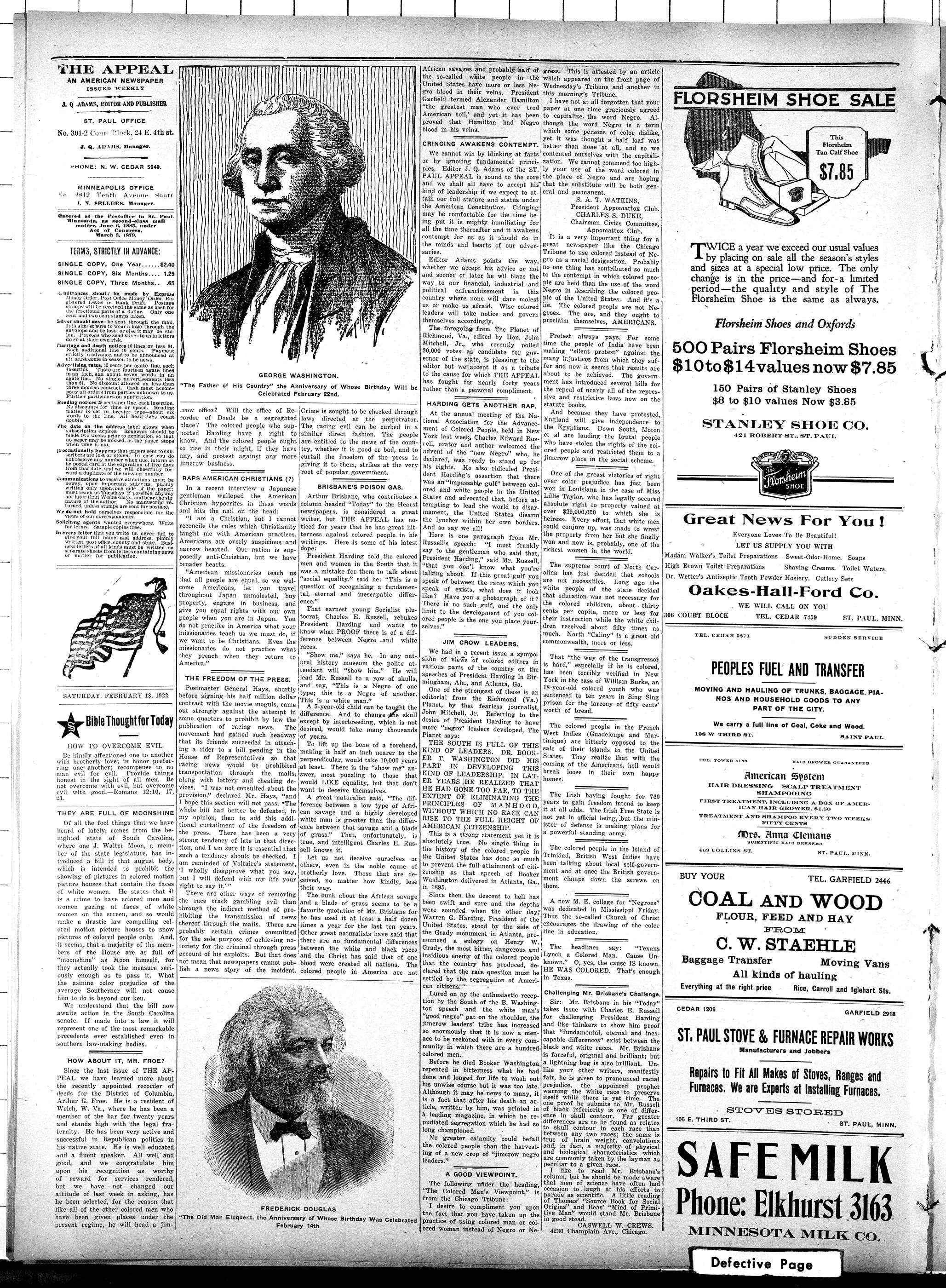
"The Father of His Country" the Anniversary of Whose Birthday Will be Celebrated February 22nd.
"The Father of His Country" the Anniversary of Whose Birthday Will be Celebrated February 22nd.
FREDERICK DOUGLAS
grow office? Will the office of Recorder of Deeds be a segregated place? The colored people who supported Harding have a right to know. And the colored people ought to rise in their might, if they have any, and protest against any more jimcrow business.
RAPS AMERICAN CHRISTIANS (?)
In a recent interview a Japanese gentleman walloped the American Christian hypocrites in these words and hits the nail on the head:
"I am a Christian, but I cannot reconcile the rules which Christianity taught me with American practices. Americans are overly suspicious and narrow hearted. Our nation is supposedly anti-Christian, but we have broader hearts.
"American missionaries teach us that all people are equal, so we welcome Americans, let you travel throughout Japan unmolested, buy property, engage in business, and give you equal rights with our own people when you are in Japan. You do not practice in America what your missionaries teach us we must do, if we want to be Christians. Even the missionaries do not practice what they preach when they return to America."
THE FREEDOM OF THE PRESS
Postmaster General Hays, shortly before signing his half million dollar contract with the movie moguls, came out strongly against the attempt in some quarters to prohibit by law the publication of racing news. The movement had gained such headway that its friends succeeded in attaching a rider to a bill pending in the House of Representatives so that racing news would be prohibited transportation through the mails, along with lottery and cheating devices. "I was not consulted about the provision," declared Mr. Hays, "and I hope this section will not pass." "The whole bill had better be defeated, in my opinion, than to add this additional curtailment of the freedom of the press. There has been a very strong tendency of late in that direction, and I am sure it is essential that such a tendency should be checked. I am reminded of Voltaire's statement, "I wholly disapprove what you say, but I will defend with my life your right to say it."
There are other ways of removing the race track gambling evil than through the indirect method of prohibiting the transmission of news thereof through the mails. There are probably certain crimes committed for the sole purpose of achieving notoriety for the criminal through press account of his exploits. But that does not mean that newspapers cannot publish a news story of the incident
Crime is sought to be checked through laws directed at the perpetrator. The racing evil can be curbed in a similar direct fashion. The people are entitled to the news of the country, whether it is good or bad, and to curtail the freedom of the press in giving it to them, strikes at the very root of popular government.
BRISBANE'S POISON GAS.
Arthur Brisbane, who contributes a column headed "Today" to the Hearst newspapers, is considered a great writer, but THE APEAL has not noticed for years that he has great bitterness against colored people in his writings. Here is some of his latest dope:
President Harding told the colored men and women in the South that it was a mistake for them to talk about "social equality." said he: "This is a question of recognizing a fundamental, eternal and inescapable difference."
That earnest young Socialist plutor, Charles E. Russell, rebukes President Harding and wants to know what PROOF there is of a difference between Negro and white races.
"Show me," says he. In any natural history museum the polite attendant will "show him." He will lead Mr. Russell to a row of skulls, and say, "This is a Negro of one type; this is a Negro of another. This is a white man."
A 5-year-old child can be taught the difference. And to change one skull except by interbreeding, which is not desired, would take many thousands of years.
To lift up the bone of a forehead, making it half an inch nearer to the perpendicular, would take 10,000 years at least. There is the "show me" answer, most puzzling to those that would LIKE equality, but that don't want to deceive themselves.
A great naturalist said, "The difference between a low type of African savage and a highly developed white man is greater than the difference between that savage and a blade of grass." That, unfortunately, is true, and intelligent Charles E. Russell knows it.
Let us not deceive ourselves or others, even in the noble cause of brotherly love. Those that are deceived, no matter how kindly, lose their way.
The bunk about the African savage and a blade of grass seems to be a favorite quotation of Mr. Brisbane for he has used it at least a half dozen times a year for the last ten years. Other great naturalists have said that there are no fundamental differences between the white and black races and the Christ has said that of one blood were created all nations. The colored people in America are not
African savages and probably half of the so-called white people in the United States have more or less Negro blood in their veins. President Garfield termed Alexander Hamilton "the greatest man who ever trod American soil," and yet it has been proved that Hamilton had Negro blood in his veins.
CRINGING AWAKENS CONTEMPT
We cannot win by blinking at facts or by ignoring fundamental principles. Editor J. Q. Adams of the ST. PAUL APPEAL is sound to the core and we shall all have to accept his kind of leadership if we expect to attain our full stature and status under the American Constitution. Cringing may be comfortable for the time being put it is mighty humiliating for all the time thereafter and it awakens contempt for us as it should do in the minds and hearts of our adversaries.
Editor Adams points the way, whether we accept his advice or not and sooner or later he will blaze the way to our financial, industrial and political enfranchisement in this country where none will dare molest us or make us afraid. Wise colored leaders will take notice and govern themselves accordingly.
The foregoing from The Planet of Richmond, Va., edited by Hon. John Mitchell, Jr., who recently polled 20,000 votes as candidate for governor of the state, is pleasing to the editor but we accept it as a tribute to the cause for which THE APPEAL has fought for nearly forty years rather than a personal compliment.
HARDING GETS ANOTHER RAP
At the annual meeting of the National Association for the Advancement of Colored People, held in New York last week, Charles Edward Russell, orator and author welcomed the advent of the "new Negro" who, he declared, was ready to stand up for his rights. He also ridiculed President Harding's assertion that there was an "impassable gulf" between colored and white people in the United States and advocated that, before attempting to lead the world to disarmament, the United States disarm the lyncher within her own borders. And so say we all!
Here is one paragraph from Mr. Russell's speech: "I must frankly say to the gentleman who said that, President Harding," said Mr. Russell, "that you don't know what you're talking about. If this great gulf you speak of between the races which you speak of exists, what does it look like? Have you a photograph of it? There is no such gulf, and the only limit to the development of you colored people is the one you place yourselves."
JIM CROW LEADERS
We had in a recent issue a symposium of views of colored editors in various parts of the country on the speeches of President Harding in Birmingham, Ala., and Atlanta, Ga.
One of the strongest of these is an editorial from the Richmond (Va.) Planet, by that fearless journalist, John Mitchell, Jr. Referring to the desire of President Harding to have more "negro" leaders developed, The Plaret says:
THE SOUTH IS FULL OF THIS KIND OF LEADERS. DR. BOOKER T. WASHINGTON DID HIS PART IN DEVELOPING THIS KIND OF LEADERSHIP. IN LATTER YEARS HE REALIZED THAT HE HAD GONE TOO FAR, TO THE EXTENT OF ELIMINATING THE PRINCIPLES OF MAN HOOD, WITHOUT WHICH NO RACE CAN RISE TO THE FULL HEIGHT OF AMERICAN CITIZENSHIP.
This is a strong statement yet it is absolutely true. No single thing in the history of the colored people in the United States has done so much to prevent the full attainment of citizenship as that speech of Booker Washington delivered in Atlanta, Ga., in 1895.
Since then the descent to hell has been swift and sure and the depths were sounded when the other day; Warren G. Harding, President of the United States, stood by the side of the Grady monument in Atlanta, pronounced a eulogy on Henry W. Grady, the most bitter, dangerous and insidious enemy of the colored people that the country has produced, declared that the race question must be settled by the segregation of American citizens.
Lured on by the enthusiastic reception by the South of the B. Washington speech and the white man's "good negro" pat on the shoulder, the jimcrow leaders' tribe has increased so enormously that it is now a menace to be reckoned with in every community in which there are a hundred colored men.
Before he died Booker Washington repented in bitterness what he had done and longed for life to wash out his unwise course but it was too late. Although it may be news to many, it is a fact that after his death an article, written by him, was printed in a leading magazine, in which he repudiated segregation which he had so long championed.
No greater calamity could befall the colored people than the harvesting of a new crop of "jimcrow negro leaders."
The following under the heading,
"The Colored Man's Viewpoint," is
from the Chicago Tribune:
I desire to compliment you upon
the fact that you have taken up the
practice of using colored man or col-
ored woman instead of Negro or Ne-
gress. This is attested by an article which appeared on the front page of Wednesday's Tribune and another in this morning's Tribune.
I have not at all forgotten that your paper at one time graciously agreed to capitalize the word Negro. Although the word Negro is a term which some persons of color dislike, yet it was thought a half loaf was better than none at all, and so we contented ourselves with the capitalization. We cannot commend too highly your use of the word colored in the place of Negro and are hoping that the substitute will be both general and permanent.
S. A. T. WATKINS,
President Apponattox Club.
CHARLES S. DUKE.
It is a very important thing for a great newspaper like the Chicago Tribune to use colored instead of Negro as a racial designation. Probably no one thing has contributed so much to the contempt in which colored people are held than the use of the word Negro in describing the colored people of the United States. And it's a lie. The colored people are not Negroes. The are, and they ought to proclaim themselves, AMERICANS.
Protest: always pays. For some time the people of India have been making "silent protest" against the many injustices from which they suffer and now it seems that results are about to be achieved. The government has introduced several bills for the repeal of nearly all of the repressive and restrictive laws now on the statute books.
And because they have protested, England will give independence to the Egyptians. Down South, Moton et al are lauding the brutal people who have stolen the rights of the colored people and restricted them to a jimcrow place in the social scheme.
One of the greast victories of right over color prejudice has just been won in Louisiana in the case of Miss Lillie Taylor, who has legally secured absolute right to property valued at over $29,000,000 to which she is heiress. Every effort, that white men could conjure up, was made to wrest the property from her but she finally won and now is, probably, one of the richest women in the world.
The supreme court of North Carolina has just decided that schools are not necessities. Long ago the white people of the state decided that education was not necessary for the colored children, about thirty cents per capita, more or less for their instruction while the white children received about fifty times as much. North "Caliny" is a great old commonwealth, more or less.
That "the way of the transgressor is hard," especially if he is colored, has been terribly verified in New York in the case of William Burke, an 18-year-old colored youth who was sentenced to ten years in Sing Sing prison for the larceny of fifty cents' worth of bread.
The colored people in the French West Indies (Guadeloupe and Martinique) are bitterly opposed to the sale of their islands to the United States. They realize that with the coming of the Americans, hell would break loose in their own happy homes.
The Irish having fought for 760 years to gain freedom intend to keep it at all odds. The Irish Free State is not yet in official being, but the minister of defense is making plans for a powerful standing army.
The colored people in the Island of Trinidad, British West Indies have been talking about local self-government and at once the British government clamps down the screws on them.
A new M. E. college for "Negroes" was dedicated in Mississippi Friday. Thus the so-called Church of Christ encourages the drawing of the color line in education.
The headlines say: "Texans Lynch a Colored Man. Cause Unknown." O, yes, the IS known. HE WAS COLORED. That's enough in Texas.
Challenging Mr. Brisbane's Challenge.
Sir: Mr. Brisbane in his "Today"
takes issue with Charles E. Russell
for challenging President Harding
and like thinkers to show him proof
that "fundamental, eternal and inescapable differences" exist between the black and white races. Mr. Brisbane is forceful, original and brilliant; but a lightning bug is also brilliant. Unlike your other writers, manifestly fair, he is given to pronounced racial prejudice, the appointed prophet warning the white race to preserve itself while there is yet time. The proof he submits to Mr. Russell of his priority is one of difference in skull contour. Far greater differences are to be found as relates to skull contour and facial size than between any two races; the same true of brain weight, convolutions and, in fact, a majority of physical and biological characteristics which are commonly taken by the layman as peculiar to a given race.
I like to read Mr. Brisbane's column, but he should be made sware that men of science have often had occasion to laugh at his efforts to parade as scientific. A little reading of his books, "Mind of Primitive Man" and Boss' "Mind of Primitive Man" would stand Mr. Brisbane in good stead.
CASWELL W. CREWS.
4230 Champlain Ave., Chicago.
This
Florsheim
Tan Calf Shoe
$7.85
TWICE a year we exceed our usual values by placing on sale all the season's styles and sizes at a special low price. The only change is in the price—and for a limited period—the quality and style of The Florsheim Shoe is the same as always.
Florsheim Shoes and Oxford
500 Pairs Florsheim Shoe
$10to$14values now $7.8
Pairs Florsheim S to $14 values now $ 150 Pairs of Stanley Shoes $8 to $10 values Now $3.85
STANLEY
421
Great N
Every
LET
Adam Walker's Toilet Prepara
High Brown Toilet Prepara
Wetter's Antiseptic Too
Oakes
WET
COURT BLOCK
STANLEY SHOE CO.
421 ROBERT ST., ST. PAUL
The Florsheim SHOE
Great News For You!
Everyone Loves To Be Beautiful!
LET US SUPPLY YOU WITH
E's Toilet Preparations Sweet-Odor-Home. Soap
Toilet Preparations Shaving Creams. Toilet
Antiseptic Tooth Powder Hosiery. Cutlery Sets
Makes-Hall-Ford Co.
WE WILL CALL ON YOU
BLOCK TEL. CEDAR 7459 ST. E
CEDAR 0871 SUDDEN S
PEOPLES FUEL AND TRANSFER
VING AND HAULING OF TRUNKS, BAGGAGE
NOS AND HOUSEHOLD GOODS TO ANY
PART OF THE CITY.
We carry a full line of Goal, Coke and Wood
W THIRD ST.
TOWER 4188 HAIR GROWER GUARANTY
American System
HAIR DRESSING SCALP TREATMENT
SHAMPOOING
IRST TREATMENT, INCLUDING A BOX OF AM
ICAN HAIR GROWER, 81.50
TREATMENT AND SHAMPOO EVERY TWO WEE
FIFTY CENTS
Mrs. Anna Clemans
SCIENTIFIC HAIR DRESSER
COLLINS ST. ST. PAUL, M
STANLEY SHOE CO.
421 ROBERT ST., ST. PAUL
The Florsheim
SHOE
Great News For You!
Everyone Loves To Be Beautiful!
LET US SUPPLY YOU WITH
Madam Walker's Toilet Preparations Sweet-Odor-Home. Soaps
High Brown Toilet Preparations Shaving Creams. Toilet Waters
Dr. Wetter's Antiseptic Tooth Powder Hosiery. Cutlery Sets
PEOPLES
MOVING AND H
NOS AND
We carry a
198 W THIRD ST
PEOPLES FUEL AND TRANSFER
MOVING AND HAULING OF TRUNKS, BAGGAGE, PIA-
NOS AND HOUSEHOLD GOODS TO ANY
PART OF THE CITY.
We carry a full line of Coal, Coke and Wood.
198 W THIRD ST. SAINT PAUL
TEL. TOWER 4188
HAIR DRESS
FIRST TREATMENT
ICA
TREATMENT A
469 COLLINS ST
BUY YOUR
COAL
FLOUR
C. W.
Baggage Trans
All
Everything at the right
American System
HAIR DRESSING SCALP TREATMENT
SHAMPOOING
FIRST TREATMENT, INCLUDING A BOX OF AMERICAN HAIR GROWER, 81.50
TREATMENT AND SHAMPOO EVERY TWO WEEKS
FIETY CENTS
OAL AND WOOD
FLOUR, FEED AND HAY
FROM
C. W. STAEHLE
age Transfer Moving
All kinds of hauling
at the right price Rice, Carroll and Igt
06 GAR
FUL STOVE & FURNACE REPAIR
Manufacturers and Jobbers
airs to Fit All Makes of Stoves, Range
aces. We are Experts at Installing Furn
STOVES STORED
RD ST. ST. P.
AFE MIL
one: Elkhurst 3
MINNESOTA MILK
COAL AND WOOD FLOUR, FEED AND HAY FROM
ST. PAUL STOV
Repairs to Fit
Furnaces. We a
105 E. THIRD ST.
SAF
Phone:
MINNES
Repairs to Fit All Makes of Stoves, Ranges and Furnaces. We are Experts at Installing Furnaces.
SAFEMILK Phone: Elkhurst 3163
MINNESOTA MILK CO.
Defective Page
CEDAR 1206
heim Shoes now $7.85
HOE CO.
ST. PAUL
For You!
Beautiful!
U WITH
Odor-Home. Soaps
g Creams. Toilet Waters
v. Cutlery Sets
Ford Co.
N YOU
7459 ST. PAUL, MINN
SUDDEN SERVICE
WOOD TRANSFER
BUNKS, BAGGAGE, PIA-
WOODS TO ANY
GITY.
Coke and Wood.
SAINT PAUL
GROWER GUARANTEED
SYSTEM
TREATMENT
GAG
A BOX OF AMER-
ER. 81.50
EVERY TWO WEEKS
MANS
PRESSER
ST. PAUL, MINN.
TEL. GARFIELD 2446
WOOD
AND HAY
EHLE
Moving Vans
hauling
, Carroll and Iglehart Sts.
ICE REPAIR WORKS
Jobbers
Stoves, Ranges and
Installing Furnaces.
ORED
ST. PAUL MINN
GARFIELD 2918
The "Saintly City" and Saintly City Folks—Newsy Items of Social, Religious, Political and General Matters Among the People.
SATURDAY, FEBRUARY 18, 1922
THE APPEAL ASKS AS A SPECIAL FAVOR THAT ITS READERS GIVE PREFERENCE TO THE ADVERTISERS WHO SEEK THEIR PATRONAGE BY ADVERTISING IN IT. SHOP IN THE APPEAL BEFORE SHOPPING ELSEWHERE.
Mr. and Mrs. Wayne Holliday have moved to 252 Rondo St.
Quarterly meeting at St. James A. M. E. church tomorrow.
Mr. and Mrs. J. H. Dillingham have moved to 663 Iglehart Ave.
Mr. and Mrs. J. B. Weldon have moved to 975 St. Anthony Ave.
Don't fail to contribute to annual Coal Drive for Crispus Attucks Home.
Your friends are seldom as black as you paint them or your friends as white as they appear.
Mrs. James Roberts, 978 St. Anthony avenue, was hostess to the Ideal club Wednesday afternoon.
Vesper services are hold every Sunday afternoon at the West Central Ave. branch of the Y. W. C. A.
Mrs. James A. Lee, 646 West Central avenue, entertained the Handicraft Art club at six o'clock dinner, Thursday.
Mr. Tiffin, 57 Lyton Place, and Mrs. Jerry Clark, 915 Woodbridge street, are at the city hospital for treatment.
Don't forget the Charity Ball for the benefit of Crispus Attucks Home on Tuesday evening, February 21, at Union Hall.
FOR RENT—Nice furnished rooms for man and wife, 532 St. Anthony Ave., second floor. Tel. Dale 2515.—Advertisement. (3)
Parents are pretty much out of date
and it's only a question of time until
modern youngsters will find a way to
do without them entirely.
Wait and watch for the Masquerade-Valentine-Prize Ball to be given by the G. F. G. T. Club at Union Hall,
Valentine Night, Tuesday, Feb. 14.
FOR RENT—Three modern furnished rooms, for man and wife, or single men. 655 St. Anthony Ave., tel. Forest 9233.—advertisement (1).
Office: Cedar 0508 Res.: Dale 2947
Res.: 678 St. Anthony Ave.
MRS. T. H. LYLES
Successor to
W. M. LYLE UNDERTAKING CO.
150 W. Fourth St. ST. PAUL
Rev. W. H. Simmons is doing a wonderful work at his church on 13th and Broadway. He is much in demand among the white congregations.
PIONEER LODGE NO. 1, F. and A. M. Brown, M. M. and that the E. Es. Linden each month at Mamac Hall, 588 Rondo street, at 8:00 p. m. J. W. Thomas, W. M. W. S. Archer, Secy. 498 Carroll Ave. Advertisement.
HOUSEHOLD or PHYLL NO. 553, G. U. W. W. S. Archer, Secy. 498 Carroll Ave. Advertisement.
W. W. W. S. Archer, Secy. 498 Carroll Ave. Advertisement.
For Rent—One furnished room, modern in every way, 449 S. Hamline Ave., Car. James and Hamline Ave. Tel. Midway 6077.—Advertisement. (2)
Rev. W. H. Harris of Fulton, Mo,
who has been preaching at Pilgrim
Baptist church, left Tuesday evening
for Chicago to attend a minister's
conference.
Don't fail to come over to the Big
Time, given at Dreamy Arcadia, 8th
and Cedar, St. Paul, by Gopher
Lodge 105, Elks, Monday evening,
Feb. 27.
Miss Minnie Tobie, 990 Gaultier
street, had an operation performed
early in the week to have her tonsilis
removed. She is at home and is con-
vulsed.
The Triangle Club of Government
Employees have issued invitations for
an informal party at Union Hall,
Thursday, Feb. 23, from 8 to 12
o'clock P. M.
Mr. and Mrs. H. S. Sawyer, 663
Iglehart avenue, entertained at five
o'clock dinner last Sunday Mr. and
Mrs. J. Q. Adams, J. Q. Adams, Jr.,
and Miss Eddythe Adams.
The managers of the Crispus Attucks Home are arranging for the annual Charity Ball for its benefit at Union Hall on next Tuesday evening, Feb. 21. Don't fail to be there. Mr. and Mrs. Thomas Steele, former residents of our city, are visiting friends en route to Duluth for an
ECONOMY
"Teach economy that is among the first and highest virtues. It begins saving money." Abraham Lincoln
State Savings Bank
93 East Fourth Street
---
indefinite stay. They are guests of
m. and Mrs. W. B. Tandy, 593 Igle-
hart avenue.
Saturday afternoon of last week
Mrs. Arthur McWatt, 726 Burhure
avenue, entertained at a children's
party for her little daughter's birthday.
Many pretty birthday gifts
were received.
FOR SALE—No. 179 Charles St.
Seven rooms and summer kitchen;
gas, pipeless furnace. Price low.
Terms reasonable. W. T. Francis,
Central Metropolitan Bank Bldg.—
Advertisement.
Mr. and Mrs. Quitman Hicks, 953
Rondo street, entertained a few
friends Saturday evening complimentary
to Mr. and Mrs. Thomas Steele
of Chicago, house guests of Mr. and
Mrs. W. B. Tandy.
There are still a great number of
people out of work, and if any one
knows of a job at any time, he will
be helping his fellowmen by reporting
same at once to Hall Bros. Barber
Shop, Pittsburg, Bldg.
NOTICE-For Madam C. J. Waker's Method of Hair Culture, for Ladies; also Wavo for men. Apply to Miss Zilda Hightower, Resident Work, 668 St. Anthony Ave., Tel. Dale 3492.-Advertisement.
Mr. and Mrs. Wm. R. Godette have issued invitations for the thirty-seventh anniversary of their wedding, with a dancing party Tuesday evening, February 28th, from eight to twelve o'clock at Union Hall.
Gopher Lodge's ball at New Arcadia hall was a great success in every way. So much so that the lodge announces another ball at the same place on Monday evening, February 27, and everybody is invited to be there.
Mr. Willus Branch, 126 West Arch street, while at work last Saturday morning at Swift's, South St. Paul, slipped, fell and cut his hand badly on a large knife. He was taken to the hospital and is getting along very nicely.
The Adelphai club met Tuesday afternoon with a large attendance at the residence of Mrs. Paul Caldwell, 1399 Sherburne avenue. The club had as visitors Mrs. Laguinia Williams of Winnipeg and Mrs. Annie Foster.
The Ladies' Aid of Pilgrim Baptist church met last Thursday night at the home of Mrs. T. W. Stepp. Each lady told her experience of how she earned the amount of money she brought in. The affair was quite a success.
Walter T. Lemon, chairman of the Ramsey County Republican committee, has issued a call for the Rebublican Ramsey County convention to meet in the Marquette room of the Ryan hotel at 1:00 P. M., March 18. There will be 219 delegates.
The Forum of the N. A. A. P. C. met last Sunday afternoon at Pilgrim-on-the-Hill. Miss Anita Peck made a talk on "Care of Children." Dues were also collected. These meetings should be better attended, as they are striving for a worthy cause.
There was a very interesting program rendered last Sunday afternoon at Welcome hall under the auspices of the U. N. I. A. Rev. H. W. Simmons, pastor of Camphor M. E. church, delivered the principal speech, and Mrs. Saunders read a very interesting paper.
Mrs. J. Grice, 537 West Central avenue, was hostess Wednesday afternoon to the Modern Priscilla club. Mrs. J. Tresvan gave an excellent report on the State Federation's midwinter meeting February 8th, and Mrs. J. James was a visitor at the club.
Several ladies met at the home of Mrs. Quitman Hicks, Friday afternoon, February 10, and organized a Twin City Social club. Mrs. Hicks was elected president, Mrs. Courtney Torell, Minneapolis, secretary, and Mrs. R. B. Moulden, Minneapolis, treasurer.
There are still a number of our men out of work, and it is to be hoped that anyone hearing about work of any kind will report same to Hall Bros. barber shop, Pittsburgh Bld., corner Fifth and Wabasha Sts. They are helping our people find jobs and charging no fees.
CASE CAR SERVICE—Persons desiring motor car service for any occasion may get the use of an elegant new seven-passenger Case sedan, by carling Anthony Ave., or calling up Dale 8412. Rates are advertised—Advertisement.
Twin City friends of Mr. and Mrs. Craig C. Williams are pleased to note their return to the firm following twelve years abroad. Mr. Williams is an artist of ability, and not only composes, but sings, plays and instructs equally as well. They are now residing in Chicago.
THE APPEAL man was in the store of one of his advertisers one day, and heard him say to a man: "We have a large number of accounts among the colored people; and not one a bad one." This speaks very well for our people. Keep up that reputation wherever you deal—_Edd.
Mrs. Harriet Murphy is improving after an attack of heart trouble and asthma. She soon will be 91 years of age. She has a remarkable memory, and remembers hearing Lincoln address an audience at Monmouth, Ill., also remembers incidents that occurred in the lives of Grant and Garfield.
A local council of probation officers to affiliate with the National Probation association was organized Wednesday afternoon, February 15th, by Dr. H. Y. Williams in his study at Dr. H. Y. Williams church on Pleasant avenue. Mrs. Mattie R. Hicks, juvenile court officer, was present and enrolled as a member.
Detectives Black and Gaston were busy engaged in rounding up a den on This West Meet of innocent colored men and six white women. At 287½ West Seventh, six persons were arrested, among them two white women. Liquor and drugs were in evidence. Two of our prominent young men were caught in the net.
After eluding the police for thirteen years, Joseph Crow was apprehended and taken back to Henderson, Kentuchy, charged with the murder of William Evans of that plaque, several years ago. Mr. Crow had been living here for about two years and had been engaged in the express business. Detective Mitchell arrested Crow last Saturday.
Rev. W. H. Harris of Missouri preached at Pilgrim Baptist church last Sunday morning, from the text "Loyalty to Christ." A good-sized audience greeted him. The choir rendered splendid music, as usual. Rev.
In sad but loving memory of our darling daughter, Evelyn A. Rogers, who joined the angels one year ago, February 16, 1921.
On the hill of Union,
Where the flowers gently wave.
Lies our darling daughter,
In her lonely, solemn grave.
Often we think of you, dear,
And our hearts ache with
pain;
Our burden would be lighter,
Could we have you here again.
But we would not be so selfish,
As to end your heavenly bliss,
Just to have you with us
Though you we sadly miss.
MR. & MRS. T. O. ROGERS.
H. B. Hawkins of Chicago will fill the pulpit tomorrow. He comes well recommended and a large crowd is expected.
On and after Sunday, February 12, only one Sunday service will be held each Sunday at Bethel A. M. E. church, 196 Thomas street, and that at 3:30 p.m. On Sunday, March 26, Quarterly Meeting will be held, three services, morning, afternoon and evening. Thereafter a regular schedule will be maintained. Rev. Joseph S. Strong, pastor.
K.
JUST
BIG
THE THIRD OF A S
GOPHER
LODGE
NEW
Corner o
Monday
GOOD MUSIC
The Elk Committee
COMM
Edw. Eastman, Cha
S. Wright, F. Gilbert,
the legal
Frances
naries for
n others.
J. J. Mo-
dev. Carr.
Mr. Clifford A. Smith, for many years our leading tailor died at the St. Paul hospital on Monday, Feb. 13, after more than a year's illness. His funeral was held at Lyles mortuary chapel Thursday afternoon. Rev. A. H. Lealatt officiated. Music was furnished by the choir of St. Philips church assisted by Mrs. Birdie Jones and Mrs. Bightie Mead. The deceased had many friends who attested their beautiful and esteem by numerous floral tributes. He leaves to mourn his loss his father, Mr. Louis Smith of Elgin, II, who was too ill to attend the funeral. Interment at Oakland.
The injury after hearing the evidence in the case of Mr. Paul Shelton, charged with robbery in the second degree, returned a verdict of not guilty, within twenty minutes after the close of the trial. Atty. W. T. Francis defended Shelton and fearlessly attacked and denounced the testimony of the detectives who attempted to support their case by footprints.
The 28th annual banquet of the Lincoln club held at the St. Paul hotel last Sautard night was one of the best ever and was attended by upward of 400 guests, among whom were: Rev. W. L. Harris, Attorneys Hammond Turner, J. L. Irvin; W. T. Francis, Drs. L. R. Litch, Valdó Turner, D. O. Howard, Sergt. Z. A. Pope, Messrs. R. C. Minor, O. C. Hall, F. D. McCracken, J. B. Johnson and J. Q. Adams.
Mrs. Lillian Burris and Mrs. R. A. VanHook, leading milliner and modiste, respectively, of Minneapolis, are the promoters of a pre-Lenten Style Show and Promenade to be given to the Lake Hall, Sixth avenue to Nyndale, evening Feb. 27. Twenty living models will be in the Style Revue which starts promptly at 9:30 o'clock. A beautiful $15 hat will be given to the lady holding the lucky number. Moore's music, Admission 35 cents. *Advertisement.*
Judge J. C. Michael has decided that the resignation of Rev. T. J. Carr as pastor of Memorial Baptist church made April 25, 1921, to take effect September 30, is still binding, and the temporary injunction issued against Rev. Carr has been made permanent. Rev. Carr is the legal pastor of the church W. T. Carr and R. J. Donohue were attornies for Mr. Jordan and the fourteen others, while Chas. L. Hayes and J. J. Moriarity were attornies for Rev. Carr.
The wedding of Mr. Edward Nichols and Miss Dorothea Farr was solemnized at the residence of the bride, 1099 Kilborn street, last Saturday, only the bridal party and a few relatives and friends being present. The ceremony was performed by Rev. A. H. Lealtad. Miss Helen Johnson was bridesmaid; Miss Lucille Elliott was maid of honor; Dr. E. S. Weber, best man; Mr. W. Nichols of Duluth, groomsman; Mr. Mark Gibbs of Duluth, bridesmaid; followed the wedding and the bridal party and Mrs. Mark Gibbs formed the receiving line. The bridal presents were numerous and beautiful. The newlywed left for Duluth their future home, Sunday afternoon and will be at home to their friends at 617 Fifth Ave. E.
Interno
air friends
MRS. MARY M
MR. J. C. BRIG
APTER
MRS. THELMA
TO ALL TO WHOM THESE PRESENTS, COME, GREETING;
ENTS COME GREETING!
This certifies that I have this day appointed, designated and commissioned Sister Amina B. Harris, Deputy Grand Matron of the Harmony Grand Chapter, Order of the Eastern Star of Missouri and its Jurisdiction; to act in said capacity for the district of St. Paul, Minn.; Duluth, Minn., and their vicinties; said sister is hereby
Defective Page
IN MEMORIAM.
CLIFFORD SMITH DEAD
GRAND CHARITY BALL
Come and help a worthy Institution and have an enjoyable evening at one and the same time; come and bring your friends
ANNOUCEMENT EXTRAORDINARY -Under the auspices of the Minneapolis Fraternal Association, one of the biggest and best entertainments that has ever been offered will be presented at the biggest and most beautiful hall in Minneapolis, viz: ARCADIA DANCING ACADEMY, 5th St. S., opposite House. The entertainment will consist of the wonderful photoplay, "As the World Moves On," with Jack Johnson, ex-heavyweight world champion playing the lead, supported by all an all star cast, including the Afro-Spanish beauty, Miss Blanche Thompson and America's leading colored photoplay star, Reed Thomas. Seven big reels
JUST ONE
BIG T
THE THIRD OF A SERIES OF WI
GOPHER
LODGE
I.B.P.
GOPHER 105
CERVUSAL
NEW AFI
Corner of Eighth and O
Monday Ev
GOOD MUSIC BY PROF.
The Elk Committee will serve you
COMMITTEE OF A
Edw. Eastman, Chairman, A. J. To
S. Wright, F. Gilbert, C. Edwards, R
ADMISSION 50 CENTS
THE THIRD OF A SERIES OF WINTER DANCES TO BE GIVEN BY
GOPHER
LODGE
I.B.P.O.E.
GOPHER 105
OF THE WORLD
CERVUS ALCES
NO. 105
I.B.P.O.E.W.
NEWARCADIA
Monday Eve'g, Feb.27
GOOD MUSIC BY PROF. MOORE'S JAZZ HOUNDS The Elk Committee will serve you that "So Good" Elk Fruit Punch
Edw, Eastman, Chairman, A. J. Todd, W. T. Thurston, W. A. Yeiser
S. Wright, F. Gilbert, C. Edwards, R. H. Moore, E. Jones, Fr. Manager
authorized and empowered to supervise the warranted chapters, to organize new chapters and to do each and every other thing requisite to the welfare of the Order of the Eastern Saints. Given under by hand and the official seal of my office this 30th day of Dec. A. D. 1921.
Kansas City, Mo.
Princess Oziel Chaper No. 45, O.
E. St. St. Paul, Minn., belongs to Harmony Grand Chapter, Kansas City, Mo. The Deputy Grand Matron received the warrant Jan. 23, 1922; presented it to Princess Oziel Chapter Feb. 2, 1922.
MRS. MARY McFARLAND,
Worthy Matron.
MR. J. C. BRIGHT,
Worthy Patron.
MRS. THELMA TRESIVANN,
Secretary.
All persons desiring to consult Deputy Grand Matron, Mrs. Anna B. Harris, please call at 285 Rondo St. Tel. Dale 4689- Advertisement.
COSMOPOLITAN GROCERY
558 ST. ANTHONY, COR. KENT
TO MY PATRONS: After an absence of several months from the city, I have returned with the deter-
Nie Archer Geo. C. Shannon
d Turner Chas. Sheppard
50 CENTS
Y INVITED
will show Rube Foster and his justly
welcome *Chicago American Giants,
including, Torrentti, the Babe Ruth
of the Colored National League, playin
for the league leadership in opposition
to the Kansas City Monarchs,
also Sam Crawford, Captain of the
K. C. Monarchs, with his all star
team, defeat the Chicago Giants and
the Detroit Stars. Other pictures will
be the Elks at Kansas City, the Odd
Fellows at St. Joseph and the Knights
of Pythias at Topeka. There will be two
pictures, one at 8:30 and two at
1:45 A. M. Music by Stevens
chestra. Admission 75 cents. W. C.
Jeffrey, Pres.; W. R. Morris, Treas;
Ralph Watson, Jas. H. Burke, Wm. H.
Walker, B. F. Finney, F. G. Thomas,
chairmen—Advertisement.
E MORE
TIME!
ENTER DANCES TO BE GIVEN BY
NO. 105
I.B.P.O.E.W.
ARCADIA
Cedar Streets, St. Paul
e'g, Feb. 27
MOORE'S JAZZ HOUNDS
u that "So Good" Elk Fruit Punch
ARRANGEMENTS
odd, W. T. Thurston, W. A. Yeiser
R. H. Moore, E. Jones, Flr. Manager
TAXIES AT MIDNIGHT
mination to increase the trade at the COSMOPOLITAN GROCERY. The one way to do this is to have in stock what the people want, when they want it; and I am pleased to announce that I am ready to supply all the needs of the housewife in the line, of first-class groceries. With the new and complete stock of goods and things will be cheaper than heretofore. Housewives, call and look my bargains over and note my prices. My new motto is "Quick Sales and Small Profits. I want your trade. Orders of $2.00 delivered. Open from 6:30 a.m. to 7:00 p.m.
SPECIAL! There will be a demonstration of the wonderful "M. J. B." coffee in airtight containers, all day and evening TODAY, when this regularly priced 55 cent coffee will be sold for 45 cents the pound.
WHY THE WORD "ADVERTISEMENT."
Under a recent ruling of the United States Postoffice Department, publishers are compelled to "label all editorials or other reading matter, other than displayed advertisements, for the publication of which money or other valuable consideration is paid accepted, or promised, with the word ADVERTISEMENT printed in full."
CUSHION
PADDED
TOP
LOCKING
BAR
ROUNDED
EDGES
LAUNDRY
BAG
SHOE BOX
HAT BOX
$45.00
is the sale price of this
Hartmann Cushion Top Wardrobe
Others $29.75, $39.75, $59.75 and $72.75
GARLAND
LUGGAGE SHOP
SIXTH AT CEDAR
TWIN CITY REALTY CO.
O. U. BRAY, PRES.
511 UNIVERSITY AVE., ST. PAUL
TEL. FOREST 9553
Tel. Cedar 9603 Open All Night
LEADING DOWN TOWN PLACE TO EAT
Acme Club Cafe
J. D. SIMPSON, MGR.
First Class Meals and Lunches at All Hours And at
Reasonable Rates
ALL KINDS OF SOFT DRINKS
317 I-2 Wabasha St. St. Paul, Minn.
MUSIC & ENTERTAINMENT NIGHTLY
40 E. THIRD ST. ST. PAUL
CAFE OPEN AT ALL HOURS
We Make A Specialty of
Southern Dishes
Tables Reserved For Parties
Call Cedar 9088
UP-TOWN SANITARY
OWEN HOWELL, MA
SHOES - REPAIRI
UP-TOWN SANITARY SHOP OWEN HOWELL, MANAGER
SUITS SPONGED
AND PRESSED
GENTS SUITS DRY
CLEANED
339 WABASHA ST.
PHELPS HOTEL AND CAFE
MRS. SYLESTUS PHELPS, PROP.
STRICTLY FIRST CLASS MEALS TO ORDER
AT ALL HOURS
FRIED CHICKEN AND HOT CORN FRITTERS FOR
AFTER THEATER PARTIES A SPECIALTY
STRICTLY FIRST CLASS MEALS TO ORDER
AT ALL HOURS
FRIED CHICKEN AND HOT CORN FRITTERS FOR
AFTER THEATER PARTIES A SPECIALTY
246 4TH AVE. S. MINNEAPOLIS
TEL. DALE 9265
COSMOPOLITAN GROCERY
First Class Staple and Fancy Groceries
Vegetables, Fruits, Confectionery Ice
Cream, Cigars, Tobacco, Cigarettes.
Strictly Cash and Carry System
558 St. Anthony Saint Paul
Don't argue with dirt.
Pearline
TEL. CEDAR 8081
Tel. Atlantic 4878
TARY SHOP
MANAGER
RING - CLOTHES
FRENCH DRY
CLEANING
LADIES SUITS DRY
CLEANED
ST, PAUL, MINN.
MEALS TO ORDER
OURS
-
CORN FRITTERS FOR
MES A SPECIALTY
MINNEAPOLIS
J. B. H.
with dirt
QUICK SERVICE
Tel. Main 5462
EXTRAORDINARY
THE DOINGS IN AND ABOUT THE GREAT "FLOUR CITY."
Matters Social, Religious and General Which Have Happened and Are to Happen Among the People of the City.
Minneapolis Fraternal Hall Association Presenting Andlauer's New And Wonderful Photoplay
Mrs. John Sellers is convalescent.
The Sunday Forum meets at Border
M. E. church tomorrow afternoon.
Mr. and Mrs. R. A. Van Hook have
sold their clothes renovating and
dressmaking shop on Sixth Ave. N.
Postmaster E. A. Purdy has appointed eleven new postal carriers to improve the postal service in the city.
You would probably have more
friends if they were sure they could
use you before you had occasion to
use them.
Don't forget the Charity Ball for
the benefit of Crispus Attucks Home
on Tuesday evening, February 21, at
Union Hall. St. Paul.
Playing the leading role supported by an all star cast including
Ames Lodge, Elks, is having considerable sickness among its members. At its last meeting $92 was voted out as relief and sick dues.
Dr. Fred O. Nelson, specialist on rheumatism, has taken larger remodeled offices at the same address, 424 Nicollet Ave., Suite 16.—Advertisement.
Johnson's, "Good Things to Eat," 2010 Cedar Ave, cor. Franklin, has a regular "Chicken Parlor" open all night. Telephone for reservations South 0805.—Advertisement.
Prop. W. T. Johnson, has secured the services of the popular waitress, Miss Essie Langum, at his Cafe, Chicken and Oyster Parlor, 2010 Cedar Ave.—Advertisement.
Under the efforts of Mrs. Susie Bogie and Mr. W. C. Jeffrey the Sunday Forum has been revived and will meet every other Sunday afternoon at Border M. E. church.
MISTER, if you are thinking of buying a car, new or used, you can learn how, when and where you can get a bargain by calling Drexel 0254 or Drexel 1683. DO IT NOW. —Advertisement.
Electa Chapter No. 73, O. E. S., will give a Colonial party at Viking hall, 720 South Fourth street, Wednesday, February 22, Washington's birthday. Prizes will be given for the best colonial costumes. Moore's music.
Mrs. Ollie Phelps, who is widely known as the "Fried Chicken Queen of the World," has purchased what was formerly Stewart's hotel, 246 Fourth Away S., and will conduct the "Chicken Shop De Luxe" there.
The talk of the town is the entertainment extraordinary which is to be staged under the auspices of the Fraternal Hall Association at Arcadia Dancing Academy on Monday evening, Feb. 20. Watch for further particulars.
The Polar Wave Tailoring Co., Willie Wicks, proprietor, is now located at 535 Dupont, 6th Ave, N. Custom tailoring, repairing, dry cleaning, pressing. Hats cleaned and blocked. We call and deliver. — Advertisement.
The legal fraternity of the city has a new addition in the person of Atty, Glesner Fowler, who formerly practiced law in California. He has opened offices in the old New England Blld. 80 S. Sixth St. He also has his office open evenings and Sundays. Advertisement.
On last Sunday evening, Lincoln's birthday, the Sunday school of Vine Congregational church commemorated the same with a program of appropriate exercises. Attorney W. R. Morris was the speaker of the evening. This was the fourth time that Mr. Morris has acted in the same capacity.
Mrs. Lillian G. Burris and Mrs. R. A. Van Hook, leading milliner and modiste, respectively, are the promoters of a pre-Lenten Style Show and Promenade to be given at Flks' Hall, Sixth avenue N. and Lyndale, Monday evening, Feb. 27. Twenty living pieces, including Style. Revue which starts promptly at 9:30 noon. A beautiful $15 hat will be given to the lady holding the lucky number. Moore's music. Admission only 35 cents.-Advertisement.
The biggest entertainment to be pulled off soon will be the one under the auspices of the Minneapolis Fraternal Hall Association at the biggest and best place in town, viz: ARCADIA DANCING ACADEMY, 5th St., opposite Court House, Monday evening, Feb. 20. The wonderful photoplay, "AS THE WORLD ROLLS ON," introducing ex-heavyweight picture tions in seven big reels. The champion, JACK JOHNSON in mongest colored photoplay drama ever produced with Jack Johnson playing the lead, supported by an all star cast, including the Afro-Spanish beauty, Miss Blanche Thompson and America's leading colored photoplay star, Reed Thomas. Two shows, 8:30 and 10:00 P. M. D. Painting 1:45 A. M. Music by Stevens Orchestra. Admission 75 cents. W. C. Jeffrey, Pres.; W. R. Morris, Treas.; Ralph Watson, Jas. H. Burke, Wm. H. Walker, B. F. Finney, F. G. Thomas, chairmen—Advertisement.
CITATION EX. OF FINAL ACCOUNT,
STATE OF MINNESOTA, County of
Ramsey, ss.
In the Matter of the Estate of Blakely
Meals A La Carte at All Hours Housewives Supplied With Barbecued Meats on Special Orders. Ladies who do not wish to leave their cars will be specially served. W.P. THOMPSON MGR
On reading and filing the petition of the representative of said estate, praying that the Court fix a time and place for examining, adjusting and allowing his FINAL ACCOUNT, and for the assistance of the residence of estate to the person whose petition was filed.
It Is Ordered, That said petition be heard and that all persons interested in said matter be cited and required to attend the 14th day of March, 1922, at 10 o'clock, A. M., or as soon thereafter as said matter can be heard, at the Prosecutor's Office in the City of St. Paul, in said County and show cause, if any they have, why this petition be granted and that this citation be by publication there-of in the APPEAL, according to laws, and by mailing a copy of the Judge's Court. Before said day of hearing, to each of the heirs, devises and legates of said decedent whose names and addresses are known, to the Judge. Witness the Judge of said Court this 17th day of February, A. D. 1922. HOWARD WHEELER. (Seal of Probate Court. Attest: F. W. GOSEWISCH, Clerk of Probate. HAMMOND TURNER, Attorney. 221 Metropolitan Bank Bldg. (2-18-22)
DR. EARL S. WEBER
DENTAL SURGEON
FIRST CLASS GUARANTEED WORK
IN ALL BRANCHES OF DENTISTRY
84 W. SEVENTH ST.
DANOTA BLDG.
SUITE 203-204
ST. PAUL
Tel. Dale 0605
HARRY LIGAN
MERCHANT TAILOR
Full line of Gents' furnishings and
a lot of odd trousers for sale
at prices ranging from
$2.50 to $6.00
313 Rondo St. St. Paul
Tel. Atlantic 6710.
GLESNER FOWLER
ATTORNEY AT LAW
OPEN EVENINGS AND SUNDAYS
80 S. 6th St. Minneapolis
St. Paul
Steam Laundry
"The Sanitary Laundry"
Works: 289-291 Rice Street
near Summit
Branch Office: 443 Broadway St.
W. B. Webster, Mgr. St. Paul
2 Shows 8:30 and 10 p. m. Dancing 'til 1:45 a. m. MINNEAPOLIS FRATERNAL HALL ASSOCIATION W. C. Jeffrey, President Ralph Watson W. R. Morris, Treasurer F. G. Thomas, Chrm., J. H. Burke, W. H. Walker, B. F. Finney
TEL. CEDAR 8190
HAMMOND TURNER
ATTORNEY AT LAW
321 MET. BANK BLDG.
FIFTH AT CEDAR
St. Paul
GOODMAN'S
have become
famous for
their large and
varied line of
beautiful, high
grade
ELGIN
14k. and 18k.
solid white and
green gold wrist
WATCHES
Meet Goodman,
Wear Diamonds
Here you will find accurate Elgin
watches. All styles and shapes,
the kind of watches that any wom-
an will be proud to own. Priced
from
$19.75 to $75
20 Living Models displaying Street, Dinner and Evening Costumes Also The Latest In Spring Millinery
Elgin Bracelet Watches
Tomorrow we are making a special feature of a bracelet watch with 15 jewels—guaranteed in every respect. Fitted in 20-year gold-filled case.
$9.75
50c Down 50c a Week
Your Money Positively Refunded
if You Can Buy Cheaper for Cash
CREDIT-CERTAINLY
Goodman's
-JEWELERS-
94 East Seventh St. 94
ORIGINAL BARBECUE The Only Cafe of its kind in the Twin Cities
WHY NOT TRY OUR NEW FAMILY WASH?
REAL ESTATE
IF YOU WISH TO BUY OR SELL WE SHALL BE PLEASED TO RENDER YOU WHATEVER SERVICE POSSIBLE
PORTERS' & WAITERS' CLUB
311 Hennepin Ave., Minneapolis, Minn.
Phone Main 2592
Excellent Food at Minimum Prices. Soft Drinks of All Kinds.
TOBACCO CIGARS CIGARETTES
GLOVER SHULL, Pres. and Treas.
EDDIE L. BOYD, Secy.
O. A. McNAIR, Night Manager.
Lower freight rates and coal costs next season should justify a $14.00 price. The reduction is made NOW as an added inducement to have you adopt Koppers Coke as your permanent fuel.
[Picture of a man in a suit and tie].
A GIFT ELECTRICAL
We are sure would be
appreciated
Make it Reading Lamp, Vacuum Cleaner
or anything Electrical
WE HAVE IT
We will make delivery any date
Minnesota Chandelier Co.
369 Jackson Street
IF YOU ARE PARTICULAR ABOUT YOUR CLOTHES
CALL CEDAR 5764
THE PANTORIUM
Koppers Coke
For sale by
S. BRAND
MAY BLACK MASON
Mezzo Soprano
available for
CONCERTS AND RECITALS
OPERA ORATORIO
FRENCH, GERMAN, ITALIAN
Res. 1045 Cross Ave. Phone Dale 2668
St. Paul, Minn.
$12.60 HARD COAL
HARD COAL SHOULD BE $12.60 INSTEAD OF $17.95 WHEN COMPARED WITH COKE AT $14.00, BECAUSE IT HAS BEEN DETERMINED BY UNIVERSITY EXPERIMENT DEPARTMENT THAT COKE GIVES 11½% MORE HEAT THAN HARD COAL. THEREFORE BUY COKE.
LIBERTY BONDS ACCEPTED.
HOLMES & HALLOWELL.
12 E. SIXTH,
NEAR WABASHA.
"Furnace Chunks" hold fire over night, for stoves, ranges and furnaces.
The Very Best.
Liberty Bonds Accepted.
Holmes & Hallowell,
12 E. Sixth, near Wabasha
PAINLESS DENTISTRY
```markdown
```
TEL. CEDAR 6975
HOURS 9 A.M. TO 1
P.M. & 2 TO 6 P.M.
SUNDAYS & EVENINGS
BY APPOINTMENT
DR. L. RAYMOND HILL
DENTAL SURGEON
First Class Guaranteed Work in
All Branches of Dentistry
303 COURT BLOCK 24 E. 4TH ST.
Tel. Dale 8339 We Call For and Deliver
ELMER MORRIS
DRUGGIST
Drugs, Medicines, Soda Water
Soft Drinks, Toilet Articles
Candies, Cigars, Tobacco,
Ice Cream Brick or Bulk.
Gas and Electric Fixtures
Fishing Tackle
Dale & W. Central St. Paul
ELKHURST 3473 QUICK SERVICE
CALL ONCE AND YOU WILL CALL AGAIN
ELK TAILORING CO.
CLEANING, PRESSING, DYE-
ING AND REPAIRING
306 RONDO ST. ST. PAUL, MINN.
F. B. SIMPSON GEO. W. WILLS
Tel. Dale 1914 Tel. Dale 2541
Office Phones:
Cedar 1024 Tri-State 24 240
SIMPSON & WILLS
Undertakers, Funeral Directors
and Embalmers
Calls Answered Promptly Day or Night
Lady Assistant When Desired
Office and Chapel
234 WEST FOURTH ST. ST. PAUL
1.00
DOWN
GOLDMAN
Gives Greater Values
Purchases Any
Diamond or Watch
In This Store
PAY AT YOUR
CONVENIENCE
50c a Week
Royal Jewelers, Inc.
DAVE GOLDMAN, Mgr.
408 Robert St.
Ryan Hotel Building.