The Appeal
Saturday, February 3, 1923
St. Paul, Minnesota
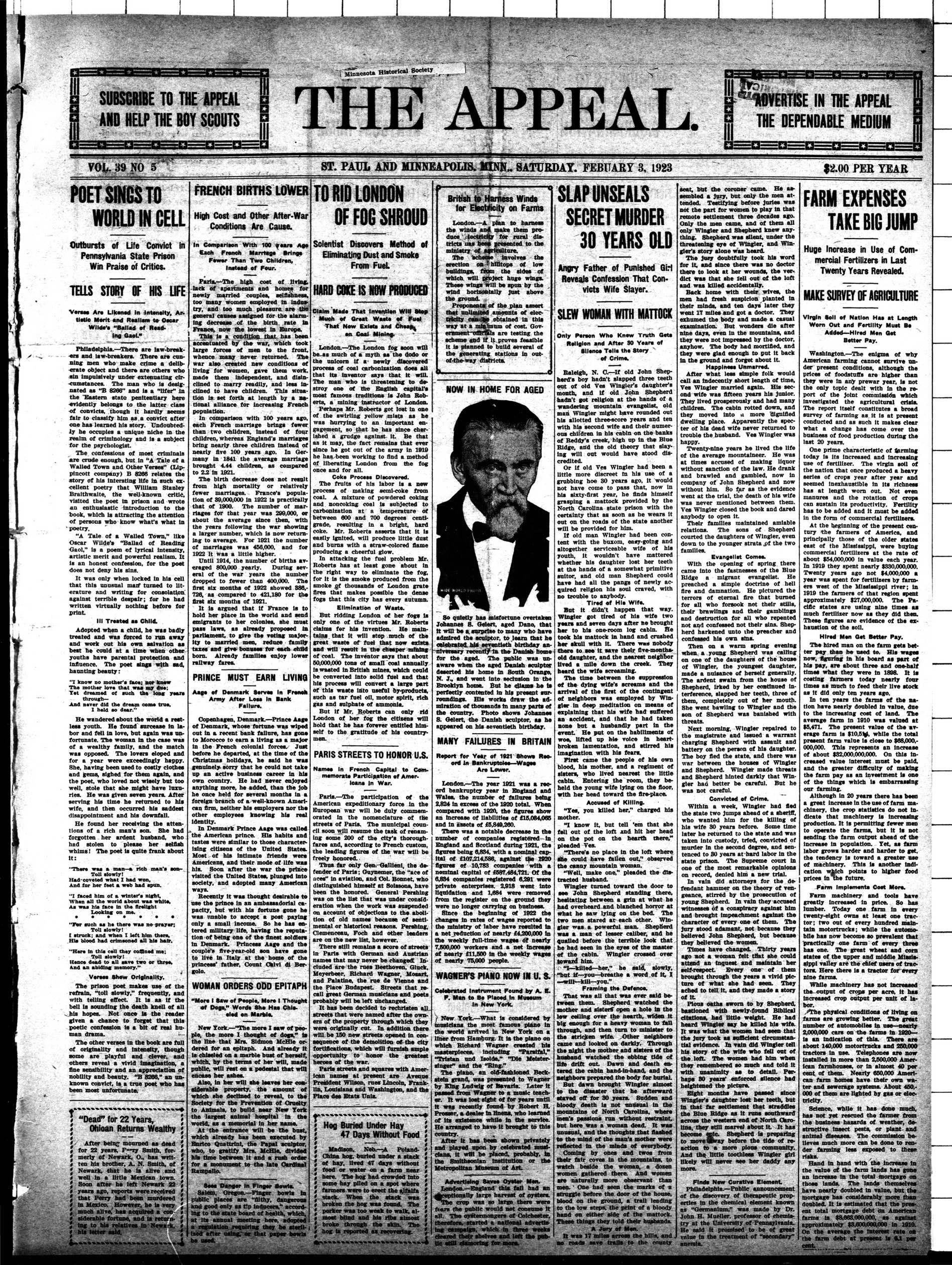
Page text (machine-generated)
SUBSCRIBE TO THE APPEAL
AND HELP THE BOY SCOUTS
VOL. 39 NO 5
POET SINGS TO
WORLD IN CELL
Outbursts of Life Convict in
Pennsylvania State Prison
Win Praise of Critics.
FRENCH B
High Cost and
Condition
In Comparison
Each French
Fewer Than
Inst
Verse Are Likened in intensity, Artistic Merit and Realism to Oscar Wilde's "Ballad of Reading Gaol."
Philadelphia—There are law-breakers and law-breakers. There are cunning men who make crime a deliberate object and there are others who sin impulsuply under extinguishing circumstances. The man who is designated as "B 8266" and is a "liter" in the Eastern state penitentiary here evidently belongs to the latter class of convicts, though it hardly seems fair to classify him as a convict after one has learned his story. Undoubtedly he occupies a unique niche in the realm of criminology and is a subject for the psychologist.
The confessions of most criminals are crude enough, but in "A Tale of a Walled Town and Other Verse" (Lippincott company) B 8268 relates the story of his interesting life in such excellent poetry that William Stanley Braithwaite, the well-known critic, visited the prison and wrote an enthusiastic introduction to the book, which is attracting the attention of persons who know what's what in poetry.
"A Tale of a Walled Town," like Oscar Wilde's "Ballad of Reading Gaol," is a poem of lyrical intensity, artistic merit and powerful realism. It is an honest confession, for the poet does not deny his sins.
It was only when locked in his cell that this unusual mar turped to literature and writing for consolation against terrible despair; for he had written virtually nothing before for print.
III Treated as Child.
Adopted when a child, he was badly treated and was forced to run away and work out his own salvation as best he could at a time when other youths have parental protection and influence. The poet sings with sad, haunting beauty:
"I know no mother's face; not knew
The mother love that was my due;
Yet dreamed of such the long years
through—
And never of the dream come true,
I did so dear."
He wandered about the world a restless youth. He found surcease in labor and fell in love, but again was unfortunate. The woman in the case was a widow, and the match was opposed. The lovers sloped and for a year were exceedingly happy. She, having been used to costly clothes and gems, fitted for them again, and the poet, who loved not wisely but too well, stole that she might have luxuries. He was given seven years. After serving his time he returned to his wife, and then occurred his sadest disappointment and his downfall.
He found her receiving the attentions of a rich man's son. She had forgotten her ardent husband, who had stolen to please her selfish whims. The poet is quite frank about it:
"There was a man—a rich man's son—Toll slowly!
Had coveted what I had wan,
And for her feet a web had spun.
"I faced him of a winter's night,
When all the world about was white,
As was his face in the firelight
"Two such as he there was no prayer;
Toll slowly!
I struck; and when I left him there,
His blood had crimsoned all his hair.
"Here in this cell they confined me;
Toll slowly!
Hance and I have two or three,
And an abiding love."
Verses Show Originality.
The prison poet makes use of the refrain, "toll slowly," frequently, and with telling effect. It is as if the bell is sounding the death knell of all his hopes. Not once is the reader given a chance to forget that this poetic confession is a bit of real human drama.
The other verses in the book are full of originality and intensity, though some are playful and clever, and others reveal a vivid imagination, a fine sensibility and an appreciation of nobility and beauty. "B $266," an unknown convict, is a true poet who has been most unfortunate.
"Dead" for 22 Years, Ohioan Returns Wealthy
After being mourned as dead for 22 years, Perry Smith, formerly of Newark, O., has written his brother, A. N. Smith, of Newark, that he is alive and well in a little Mexican town. Soon after he left Newark 22 years ago, reports were received that Perry had been murdered in Mexico. However, he is very much alive, has acquired a considerable fortune, and is returning to his relatives in Newark, his letter said.
FRENCH BIRTHS LOWER
High Cost and Other After-War Conditions Are Cause
In Comparison With 100 years Age Each French Marriage Brings Fewer Than Two Children, Instead of Four.
Paria—The high cost of living, lack of apartments and homes for newly married couples, selfishness, too many women employed in industry, and too much pleasure are the general causes assigned for the alarming decrease of the birth rate in France, now the lowest in Europe. This is a condition that has been accentuated by the war, which took large forces of men to the front, whence many never returned. The war also created new conditions of living for women, gave them work, made them independent, and disinclined to marry readily, and less inclined to have children. This situation is set forth at length by a national alliance for increasing French population.
In comparison with 100 years ago, each French marriage brings fewer than two children, instead of four children, whereas England's marriages bring nearly three children instead of nearly 100 years ago. In Germany in 1841 the average marriage brought 4.44 children, as compared to 2.2 in 1921.
The birth decrease does not result from high mortality or relatively fewer marriages. France's population of 39,000,000 in 1922 is practically that of 1800. The number of marriages for that year was 299,000, or about the average since then, with the years following the war showing a larger number, which is now returning to average. For 1921 the number of marriages was 458,000, and for 1922 it was a little higher.
Until 1914, the number of births averaged 800,000 yearly. During several of the war years the number dropped to fewer than 400,000. The first six months of 1922 showed 388,726, as compared to 421,180 for the first six months of 1921.
It is argued that if France is to hold her place in the world and send emigrants to her colonies, she must pass laws, as already proposed in parliament, to give the voting majority to married men, reduce family taxes and give bonuses for each child born. Already families enjoy lower railway fares.
PRINCE MUST EARN LIVING
Age of Denmark Serves in French Army After Loss in Bank Failure.
Copenhagen, Denmark—Prince Age of Denmark, whose fortune was wiped out in a recent bank failure, has gone to Morocco to earn a living as a major in the French colonial forces. Just before he departed, at the time of the Christmas holidays, he said he was genuinely sorry that he could not take up an active business career in his country. He had never employed anything more, he added, than the job he once held for several months in a foreign branch of a well-known American firm, neither his employers nor the other employees knowing his real identity.
In Denmark Prince the american prince. His habits and tastes were similar to those characterizing citizens of the United States. Most of his intimate friends were Americans, and their mode of life was his. Soon after the war the prince visited the United States, plunged into society, and adopted many American ways.
Recently it was thought desirable to use the prince in an ambassadorial capacity, but with his fortune gone he was unable to accept a post paying only a small income. So he has entered military life, having the reputation of being one of the finest soldiers in Denmark. Princess Age and the couple's five-year-old son have gone to live in Italy at the home of the princess' father, Count Calvi di Bergolo.
WOMAN ORDERS ODD EPITAPH
"More I Saw of People, More I Thought of Dogs," Word She Has Chiselled on Marble.
New York—"The more I saw of people, the more I thought of dogs," is the line that Mrs. Sidmon McHeile ordered for an epitaph. And already it is chiselled on a marble bust of herself, which, by the terms of her will, made public, will rest on a pedestal that will entail her name.
Also, in her will she leaves her considerable property, the amount of which she declined to reveal, to the Society for the Prevention of Cruelty to Animals, to build near New York the largest animal hospital in the world, as a memorial in her name.
At the entrance will be the bust, which already has been executed by Enrico Quastrint, the Papal sculptor, who, to gratify Mrs. McHeile, divided his time between it and a rush order for a monument to the late Cardinal Rampallo.
Sees Danger in Finger Bowls.
Salem, Oregon—Finger bowls in public places are "filthy, dangerous and good only as tip inducer," according to the state board of health, which at its annual meeting here, adopted unilateral rules to store food after using, or that paper bowls be used.
THE APPEAL.
ST. PAUL AND MINNEAPOLIS, MINN., SATURDAY, FEBUARY 3, 1923
Solentist Discovers Method of Eliminating Dust and Smoke From Fuel.
HARD COKE IS NOW PRODUCED
Claim Made That Invention Will Stop Much of Great Wants of Fuel That New Exists and Chess on Coal Mining.
London—The London fog will be as much of a myth as the doo or the unicorn if a newly discovered process of coal carbonisation does all its inventor says that it will the matter threatening to destroy one of the English capital's most famous traditions is John Roberts, a mining instructor of London. Perhaps Mr. Roberts got lost in one of the swirling yellow mists as he was hurrying to an important engagement, so that he has since charished a grudge against it. Be that as it may, the fact remains that ever since he got out of the army in 1919 he has been working to find a method of liberating London from the fog once and for all.
Coke Process Discovered.
Coke Process Discovered.
The fruits of his labor is a new process of making semi-coke from coal. A mixture of powdered coking and noncoking coal is subjected to carbonization at a temperature of 100 degrees Celsius, resulting in a bright, hard coke. Mr. Roberts asserts that it is easily ignited, will produce little dust and burns with a straw-colored flame producing a cheerful glow.
In attacking the fuel problem Mr. Roberts has at least gone about in the right way to eliminate the fog, for it is the smoke produced from the smoke of thousands of London grate fires that makes possible the dense fogs that this city has every autumn.
Elimination of Waste.
But ridding London of her fogs is only one of the virtues Mr. Roberts claims for his invention. He maintains that it will stop much of the great waste of fuel that now exists and will result in the cheaper mining of coal. The inventor says that about 60,000,000 tons of small coal annually is wasted in British mines, which could be converted into solid fuel and that process will convert a large part of the waste into useful products, such as tar fuel oil, motor spirit, rich gas and sulphate of ammonia.
But if Mr. Roberts can only rid London of her fog the citizens will hold that he has forever entitled himself to the gratitude of his countrymen.
PARIS STREETS TO HONOR U.S.
Names in French Capital to Commemorate Participation of Americans in War.
Paris.—The participation of the American expeditionary force in the European war will be duly commemorated in the nomenclature of the streets of Paris. The municipal council soon will resume the task of renaming some 200 of the city's thoroughfares and, according to French custom, the leading figures of the war will be freely honored.
Thus far only Gen. Gallieni, the defender of Paris; Guynemer, the 'ace of terror' of Col. Bonnet, who distinguished himself so Solvigné have the honored. General Pershing was on the list that was under consideration when the work was suspended on account of objections to the abolition of old names because of sentimental or historical reasons. Pershing, Clementeau, Foch and other leaders are on the new list, however.
There still remains a score of streets in Paris with German and Austrian names that may never be changed. Included are the rues Beethoven, Gluck, Meyerbeer, Richard Wagner, Wosart, and Palatine, the rue de Vienne and the Place Budapest. Streets that recall great German musicians and poets probably will be left unchanged.
It has been decided to rechristen all streets that are named after the owners of the property of the original cut. In addition there will be 150 new streets opened in consequence of the demolition of the city fortifications, which will furnish simple opportunity to honor the greatest heroes of the war.
Park streets and squares with American names at present are Avenue Lincoln, Franklin, Louisiana and Washington, and the Place des Etats Unis.
Madison, Neb.—A Poland-China hog, buried under a stack of hay, lived 47 days without food or water on a farm near here. The hog had crowded into some hay piled on a spot where farmers were to scract the alfalfa stack. When the stack was broken the hog was found. The porker was too weak to walk, almost blind and his ribs almost broke through the skin. The hog is reported as recovering.
British to Harness Winds for Electricity on Farms
London—A plan to harness the winds and make them produces electricity for rural districts has been presented to the ministry of agriculture.
The scheme involves the erection on hilltops of low buildings, from the sides of which will project huge wings. These wings will be spun by the wind horizontally just above the ground.
The purpose of the plan assert that unlimited amounts of electricity can be obtained in this way at a minimum of cost. Government officials are testing the scheme and if it proves feasible it is planned to build several of the generating stations in out-of-the-way districts.
NOW IN HOME FOR AGED
IOE WORLD PHOTO
So quickly has misfortune overtaken Johannes S. Gelert, aged Dane, that it will be a surprise to many who have admired the sculptor, to learn that he celebrated his seventieth birthday an anniversary recently in the Danish home for the aged. The public was unaware when the aged Danish sculptor deserted his home in South Orange, N. 3, and went into seclusion in the house. He was perfectly contented in his present surroundings. His works draw the admiration of thousands in many parts of the country. Photo shows Johannes S. Gelert, the Danish sculptor, as he appeared on his seventieth birthday.
MANY FAILURES IN BRITAIN
Report for Year of 1921 Shows Record in Bankruptcies—Wages Are Lower.
London.—The year 1921 was a record bankruptcy year in England and Wales, the number of failures being 2,824 in excess of the 1920 total. When compared with 1920, the figures show an increase of liabilities of 151,084,046 and in assets of 45,548,230.
There was a notable decrease in the number of companies registered in England and Scotland during 1921, the figures being 6,834, with a nominal capital of £107,214,586, against the 1920 figures of 10,783 companies with a nominal capital of £497,407,121 of 6,848 companies registered 6,921 were private enterprises. 2,918 went into liquidation and 1,684 were removed from the register on the ground they were no longer carrying on business.
Since the beginning of 1922 the changes in rates of wages reported to the ministry of labor have resulted in a net reduction of nearly 4,240,000 in the weekly full-time wages of nearly 7,500,000 workers and a net increase of nearly 11,500 in the weekly wages of nearly 75,000 people.
WAGNER'S PIANO NOW IN U. S.
Celebrated Instrument Found by A. H. F. Man to Be Placed in Museum in New York.
New York—What is considered by musicians the most famous piano in the world arrived in New York on a liner from Hamburg. It is the piano on which Richard Wagner created his masterpieces, including "Parasulf" "Tristan und Isolde," "Die Melstanger" and the "Ring." The piano, an old-fashioned Bockleader, was transferred to Wagner by King Ludwig of Nassau. Later it passed from Wagner to a music teacher. It was lost sight of for years until it was recently found by Robert H. Prosser, a dealer in linen, who learned of its existence while in the service. He arranged to have it brought to this country.
After it has been shown privately and played upon by celebrated musicians, it will be placed, probably, in the Smithsonian institution or the Metropolitan Museum of Art.
Advertising Saves Oyster Man. London—England this fall had an optionally large harvest of oysters, but the public would not consume it. The oystermonger of Colchester, therefore, started a national advertising campaign, which in three weeks cleared their shelves and left the public still damming for more.
SLAP UNSEALS SECRET MURDER 30 YEARS OLD
Angry Father of Punished Girl Reveals Confession That Convicts Wife Stayer.
Only Person Who Knew Truth Gets Religion and After 30 Years of Silence Tells the Story of Crime.
Baleigh, N. G.-If old John Shepherd's boy hadn't slapped three teeth out of old Ves Wingier's daughter's month, and if old John Shepherd hadn't got religion at the hands of a wandering mountain evangelist, old man Wingier might have rounded out his allotted three score years and ten with his second wife and their numerous children in his cabin on the banks of Beddy's creek, high up in the Blue Ridge, and the old theory that slaying will out would have stood discredited.
Or if old Ves Wingler had been a little more discreet in his use of a grubbing hoe 30 years ago, it would not have come to pass that, now in his sixty-first year, he finds himself grasping a mattock provided by the North Carolina state prison with the certainty that as soon as he wears it out on the roads of the state another will be provided for him.
If old man Wingler had been content with the buxom, easy-going and altogether serviceable wife of his youth, it wouldn't have mattered whether his daughter lost her teeth at the hands of a somewhat primitive suitor, and old man Shepherd could have had all the pangs of newly acquired religion his soul craved, with no trouble to anybody.
Tired of His Wife.
But it didn't happen that way. Wingier got tired of his wife two years and seven days after he brought her to his one-house log cabin. He took his mattoon in hand and crushed her skull with it. There was nobody there to see it save their five-month-old daughter, and the nearest neighbor lived a mile down the creek. They heard the wife screening.
The time between the suppression of the dying wife's screams and the arrival of the first of the contingent of neighbors was employed by Wingier in deep meditation on means of explaining that his wife had suffered an accident, and that he had taken none but a husbandly part in the event. He put on the habiliments of love, lifted up his voice in heart-broken lamentation, and stirred his imagination with his fears.
First came the people of his own blood, his mother, and a regiment of sisters, who lived nearest the little cabin. Entering the room, they beheld the young wife lying on the floor, with her head toward the fire-place.
Accused of Killing.
"Yes, you killed her," charged his mother.
"I know it, but tell 'em that she fell out of the loft and hit her head on the pot on the hearth there," pleaded Ves.
"There's no place in the loft where she could have fallen out," observed the canny mountain woman.
"Well, make one," pleaded the distracted husband.
Wingler turned toward the door to see John Shepherd standing there, hesitating between a grin at what he had overheard and blanched on the bed. The two men stared at each other. Wingler was a powerful man. Shepherd was a man of lesser caliber, and he qualified before the terrible look that he had seen in the eyes of the master of the cabin. Wingler crossed over toward him.
"I—killed—her," he said, slowly, "but if—you breathe a word of it, I—will—kill—you."
Framing the Defence.
That was all that was ever said between them. Shepherd watched the mother and sisters open a hole in the low ceiling over the hearth, widen it big enough for a heavy woman to fall through, and then turn to minister to the stricken wife. Other neighbors came and looked on darkly. Through the window, the humid husband watched the ebbing tide of life drift out. Dawn and death entered the cabin hand-in-hand, and the neighbors prepared the body for burial.
But dawn brought Wingler almost to the disaster that he afterward staved off for 30 years. Sudden and bloody death is not unusual in the mountains of North Carolina, where men's passions run without restraint, but here was a woman dead. It was unusual, and the thoughts that fanned to the mind of the man's mother were reflected in the minds of everybody. Coming by ones and twos from their fair coves in the mountains, to watch beside the woman, a dozen women gathered there. And women are naturally more observant than men. One and seen the marks of a bloody hand on the ground, a bloody blood on the ground, a trail leading to the low steps, the print of a bloody hand on either side of the matrock. These things they told their husbands.
A Jury of Men.
It was 12 miles across the hill, and
ADVERTISE IN THE APPEAL
THE DEPENDABLE MEDIUM
seat, but the coroner came. He assembled a jury, but only the men attended. Testifying before juries was not the part for women to play in that remote settlement three decades ago. Only the men came, and of them all only Wingler and Shepherd knew anything. Shepherd was silent, under the threatening eye of Wingler, and Wingler's story alone was heard.
The jury doubtfully took his word for it, and since there was no doctor there to look at her wound, the verdict was that she fell out of the loft and was killed accidentally, while she was killed,erves, the men had fresh suspicion planted in their minds, and ten days later they went 17 miles and got a doctor. They examined the body and made a casual examination. But wonders die after nines days, even in the mountains, and they were not impressed by the doctor, anyhow. The body had mortified, and they were glad enough to put it back in the ground and forget about it.
Happiness Unmarried.
After what less simple folk would call an indecently short length of time, Wingler married again. His second wife was fifteen years his junior. They lived prosperously and had many children. The cabin was dusted down and they lived in a more dignified dwelling place. Apparently the specter of his dead wife never returned to trouble the husband. Ves Wingler was happy.
Twenty-nine years he lived the life of the average mountainer. He was at times accused of making liquor without sanction of the law. He drank and brawled and gambled, now in company of John Shepherd and now without him. So far as the evidence went at the trial, the death of his wife was never mentioned between them. Ves Wingler closed the book and dared anybody to open it.
Their families maintained amiable relations. The sons of Shepherd counted the daughters of Wingler, even down to the younger strata of the two families.
Evangelist Comes.
With the opening of spring there came into the fastnesses of the Blue Ridge a migrant evangelist. He preached a simple doctrine of hell fire and dammation. He pictured the terrors of eternal fire that burned for all who forsook not their stills, their brawlings and their gambilings and destruction for all who repented not and confessed not their sins. Shepherd harkened to the preacher and confessed his own sins.
Then on a warm spring evening when a young Shepherd was calling on one of the daughters of the house of Wingler, the youngest daughter, made a nuisance of herself generally. The ardent swain from the house of Shepherd, irked by her continued interference, slapped her teeth, three of them, completely out of her mouth. She went bawling to Wingler and the son of Shepherd was banished with threats.
Next morning, Wingler repaired to the magistrate and issued a warrant charging Shepherd with assault and battery on the person of his daughter. The boy fled the state, and there was war between the houses of Wingler and Shepherd. Wingler made threats and Shepherd hinted darkly that Wingler had better be careful. But he was not careful.
Convicted of Crime.
Within a week, Wingler had fed the state two jumps ahead of a sheriff, who wanted him for the killing of his wife 80 years before. Some time later he returned to the state and was taken into custody, tried, convicted of murder in the second degree, and sentenced to 80 years at hard labor in the state prison. The Supreme court in one of the most remarkable opinions on record, denied him a new trial. In vain did attorneys for the defendant hammer on the theory of vengeance, attired by the prosecution of young Shepherd, who accused him of a conspiracy against him and brought impeachment against the character of every one of them. The jury stood adamant, not because they believed John Shepherd, but because they believed the women. Times have changed. Thirty years ago not a woman felt that she could attend the years a vivid picture of what she had seen. They ached to tell it, and they made a story of it. Plous oaths sworn to by Shepherd, bastioned with newly-found Biblical citations, had little weight. He had heard Wingler say he killed his wife. It was the women had seen that them had been the final evidence. In vain did Wingler tell his story of the wife who fell out of the loft. The women had him when they remembered so much and told it with unanimity as to detail. Perhaps 80 years' enforced silence had heightened the picture.
Eight months have passed since Wingster's daughter lost her teeth, but in that far settlement that straddles the Blue Ridge as it runs southward across the western end of North Carolina, they still marvel about it. It has become sole. Shepherd is preparing to move away before the tide of reaction to a more plausible community. And the little toothless Wingler girl likely will never see her daddy any more.
Finds New Curative Element
Philadelphia—Public announcement of the discovery of the chemical element known as "Germanium" was made by Dr. John H. Muller, professor of chemistry at the University of Pennsylvania. He said it promised to be of great value in the treatment of "secondary" anemia.
$2.00 PER YEAR
FARM EXPENSES TAKE BIG JUMP
Huge Increase in Use of Commercial Fertilizers in Last Twenty Years Revealed.
Virgin Soil of Nation Has at Length Worn Out and Fertility Must Be Added—Hired Men Get Better Pay.
Washington—The enigma of why American farming cannot survive under present conditions, although the prices of foodstuffs are higher than they were in any present year, is not the only topic dealt with in the report of the joint commission which investigated the agricultural crisis. The report itself constitutes a broad survey of farming as it is at present conducted and as such it makes clear what a change has come over the business of food production during the last 20 years.
One prime characteristic of farming today is its increased and increase use of fertilizer. The virgin soil of the nation that once produced a heavy series of crops year after year and seemed inexhaustible in its richness has at length worn out. Not even manures and the rotation of crops can sustain its productivity. Fertility has to be added and it must be added in the form of commercial fertilizers.
At the beginning of the present century the farmers of America, and principally those of the older states east of the Mississippi, were buying commercial fertilizers at the rate of about $44,000,000 in value each year. In 1919 they spent nearly $380,000,000. Twenty years ago not $4,000,000 a year was spent for fertilizers by farmers west of the Mississippi river; in 1919 the farmers of that region spent approximately $27,000,000. The Pacific states are using nine times as much fertilizer now as they did them. These figures are evidence of the exhaustion of the soil.
Hired Men Get Better Pay.
The hired man on the farm gets better pay than he used to. His wages now, figuring in his board as part of his pay, are about three and one-half times what they were in 1888. It is costing farmers today nearly four times as much to feed their live stock as it did only ten years ago. In ten years the farms of the nation have nearly doubled in value, due to the increasing cost of land. The average farm in 1910 was valued at $4,711. The present value of the average farm is $10,5.95, while the total present farm value is close to $88,000,000. This represents an increase of about $32,000,000,000. On this increased value interest must be paid, and the greater difficulty of making the farm as an investment is one of the things which is embarrassing our farming.
Although in 20 years there has been a great increase in the use of farm machinery, the crop statistics do not indicate that machinery is increasing production. It is permitting fewer men to operate the farms, but it is not sending the farm output ahead of the increase in population. Yet, as farm labor grows harder and harder to get, the tendency is toward a greater use of machinery. This is another indication which points to higher food prices in the future.
Farm Implements Cost More.
Farm machinery and tools have greatly increased in price. So has lumber. Today one farm in every twenty-eight owns at least one tractor; two out of every hundred maintain motortrucks; while the automobile has now become so prevalent that practically one farm of every three has one. The great wheat and corn states of the upper and middle Mississippi valley are the chief users of tractors. Here there is a tractor for every nine farms.
While machinery has not increased the output of crops per acre, it has increased crop output per unit of labor.
The physical conditions of living on farms are growing better. The great number of automobiles in use—nearly 2,000,000 cars on the farms in 1920—is an indication of this. There are more than 250,000 tractors in use. Telephones are installed in more than 2,500,000 American farmhouses, or in almost 40 percent of them. Nearly 650,000 American farm homes have their own water and sewerage systems. About 450,000 of them are lighted by gas or electricity.
Science, while it has done much, has not yet rescued the farmer from the business hazards of weather, destructive insect pests, or plant and animal diseases. The commission believes much more can be done to render farming less exposed to these risks.
Hand in hand with the increase in the value of the farm lands has gone an increase in the total mortgage on those lands. The lands themselves have nearly doubled in value, but the value of the land has doubled. It is estimated that the present total mortgage debt on American farms in $3,683,000,000, as against approximately $3,500,000,000 in 1910. On the average the interest rate on the farm debt at present is 6.1 percent.
A. Q. ADAMS, EDITOR AND PUBLISHER
No. 301-2 Court Block, 24 E. 4th st.
G. O. ADAMS, Manager
PHONE: N. W. CEDAR 5040.
MINNEAPOLIS OFFICE
No. 2612 Tenth Avenue South
J. N. SELLERS, Manager.
Entered at the Postoffice in St. Paul,
Minnesota, as second-class mail
master, June 6, 1885, under
Act of Congress,
March 8, 1879.
TERMS, STRICTLY IN ADVANCE:
SINGLE COPY, One Year.....$2.40
SINGLE COPY, Six Months.....1.25
SINGLE COPY, Three Months......65
SATURDAY, FEBRUARY 8, 1923.
PRICE CUT
Beginning February 1st, the subscription price to THE APPEAL will be reduced from $2.40 to $2.00 per year. This is one of the first steps toward making the paper the largest as well as the oldest and most dependable in the Northwest.
SUITS FOR SCOUTS
This week the Boy Scouts began their canvass for subscriptions to THE APPEAR in order to earn their uniforms. In return for securing a certain number of cash subscriptions the boys will be awarded a Boy Scout merchandise bond good for one uniform.
When the need for uniforms was brought to the attention of THE APPEAL it forthwith decided to give the scouts an opportunity to earn their uniforms by paying them slightly higher commission than ordinary subscription solicitors. This additional amount we gladly offer as our contribution to this splendid movement. It remains for the public to subscribe to the paper and help the scouts to suits.
GIVING CHARITY TO NEWSPAP
ERS
In addition to the good things in the message of Mr. Melvin Chisum at the banquet of the Business League there were some that did not flatter the intelligence of the assembled business men.
He asked them to believe that white business concerns make up the deficits of failing white dailies by contracting for several pages of "charity" advertising, that they think so much of the services of the paper as an advertisement that they virtually subsidize it for the sake of the indirect benefit that they reap. We can imagine this to be true in only two circumstances: where the daily is the only one in the city, or where the publisher has been or can be used to promote the selfish interests of the advertiser. Obviously in these two cases it would be to the advantage of advertisers to subsidize the paper. But to ask the hard-headed business and professional men of the Twin Cities to believe that big business houses, as a general rule, write off the deficit of daily papers in charity advertising is taxing their credulity too greatly.
He followed this assertion with and admonition to the colored business men to do likewise. THE APPEAL is unalterably opposed to such a policy. The colored newspaper is a business, not a charity proposition, with a commodity to sell and a service to render. If colored business men of the twin cities will realize the value of advertising and pay the market rate for space, THE APPEAL will ask nothing more. Just as the manufacturer calculates his coat and sets price on his product that will allow him a reasonable profit, so the newspaper man sets a price on his advertising space that will allow a reasonable return on his business. We want no charity and no support, if by that term is meant the carrying of a newspaper on the shoulders of business men for love's sake. A fair price for a fair service is all the newspaperman asks.
DARK AGES
Some time ago representatives of industrial and agricultural interests in Georgia sought the aid and advice of the secretary of Commerce in Washington to ascertain if some fed-
eral action could not be taken to discourage the exodus of colored people from the state. It was averred that the colored people were leaving in such numbers as seriously to interfere with the labor supply on the plantations and in the mills. Of course the Federal Government is without authority in the premises. The Atlanta Constitution, the leading daily of Georgia, has for some time past been raging at the barbarian which runs riot in the state and which is manifested in a fiendish treatment of the colored man. An instance is cited by the Constitution in a recent editorial: Two men were driving an automobile and the machine became mired. They dragged an aged colored man from his bed, to which he was confined with influenza, to help them out, and becoming enraged at his inability to be of material service, they shot him in the head, sliced his body to pieces and threw them into a pool of slush. This appears to be an example of barbary of frequent occurrence in the state. It is a nice example to set for Mexico, or Turkey, whose inhumanities we have criticized so frequently. If anyone treated a mule like that he would probably at least be fined—even in Georgia—but the perpetrators of this outrage appear to have gone scot free.
The downfall of Spain came about largely because of the inhuman treatment of the Moriscos and the Jews, the former being the agriculturists, the latter the financiers of the Empire. Religious intolerance culminated in their expulsion, when the decline of Spain became swift and certain. Georgia has not attempted to expel the colored man from her confines. On the contrary she is getting pretty nervous because he is leaving voluntarily. He is going North and West. In Georgia he must labor from 11 to 13 hours a day at low wages, he is denied the ballot, although he is counted to swell Congressional representation; he has no standing in the courts when in controversy with the white man; lynch law is his tribunal; and while the state rigidly enforces its game laws it is always, open season for shooting, knifing, or burning him. Georgian interests are very much peeved because northern and western interests are coaxing away the colored people. The North and the West have an answer for them, and the world has its opinion of the State of Georgia, which is uncompilary and which reflects on the entire country.—Exchange.
One of the unfortunate admissions of the main speaker at the Business League banquet Monday night was that the sheriff eventually got most of the newspapers that he ran. Among his auditors was a partner in the second largest damp wash laundry in Minneapolis, a business which has been built up by perseverance and business acumen, the proprietor of a modern drug store in restricted north Minneapolis with an exclusively white trade, a successful undertaker, a doctor and a lawyer more than half of whose clients are white and the proprietor of one of the most complete sanitary shops in the country. Every one of these men, perhaps, with the possible exception of the undertaker, could lose his colored trade tomorrow and still flourish. They are successful in business not because a large colored trade is driven to them by segregation and discrimination in white stores, but because they, by their business ability have set up concerns that have stood the test of competition. To these men, the advice of one who has run nine newspapers to the wall is to be taken with caution, if at all.
"I would stand by the side of the humblest Negro and defend him from mob violence with a rifle." This is not a quotation from Wendell Phillips, dear from him. It emanates from no less a personage than Thomas Dixon, author of the "Clansman" from which the film, "The Birth of a Nation" was made. It does us some slight good to know that Mr. Dixon has experienced a change of heart, that he deplores the activities of the Klan, and that he is willing to defend the colored man from violence. We cannot forget, however, that it is impossible for Mr. Dixon to change the hearts of the millions who have read his book and seen his play. He cannot extract the poison from their minds or the suspicion and hate from their hearts. We shall never forget that we heard a learned and cultured gentleman—a friend of the colored American and a student of his problems say that no white man could see "The Birth of a Nation" and come away without hate for the black man. These are the seeds Mr. Dixon has sown. No amount of grandstand eloquence at this late date can stop the harvest.
The Christianity of white folk is manifest in devious and mysterious ways. The standards of the lowly Nazarene are adhered to as long as they do not conflict with good business principles—and the treatment of colored folk. Comes now Pat Harrison, senator from Mississippi, picturing in an impassioned paragraph the shame that his descendants will feel when they see that prayer was not incorporated in the Journal of the Senate. They may bow their heads in shame but it will be shame at the thought that the Christianity of their ancestors could rise in righteous insistence on a routine prayer and close its eyes to heathen orgies of Mississippi on black folk.
THE NEW APPEAL
TIME brings changes and new ideas new needs to be filled.
FOR nearly forty years THE APPEAL has been in the vanguard of progress in this community, ever motivated by the belief that service to the people is above every other consideration.
NOW the paper is in a state of transition. It is broadening its vision, taking on new life, becoming in truth a new APPEAL.
COME in and tell the new APPEAL how it can serve you better.
COMMUNISTS TO FIGHT ALL COLOR DISCRIMINATION
COMMUNISTS TO FIGHT ALL COLOR DISCRIMINATION
Third Internationale Adopts Thesis on Race Question in United States
FIGHT TO LIFT UNION BAN
American Branch of Party to Act Against Discrimination Here
(Special to the Crusader Service.) Woscow, Feb. 1.—The following excerpts from the thesis on 'Negro' Question unanimously adopted by the Fourth Congress of the Third International which has just closed its sessions here has caused a sensation in the capitalist countries of Europe where considerable fear is expressed that the active advocacy of the 'Negro' Cause by the Communist parties of the world will give courage and inspiration to the growing movement for a free African and universal Negro liberation.
"The sinews, blood and tears of the "freed" Negro helped to build American capitalism, and when, having become a world power, America was inevitably dragged into the world war, the American "Negro" was declared the equal of the white man to kill, and to be killed for "democracies." The thousand coerced workers were rafters to the American army and segregated into "Jim Crow" regiments. Fresh from the terrible sacrifices of war the re-
THE
TIME
new n
FOR new
has been
in this con
belief that
every other
NOW
sition
taking on
new APP
COME
how i
turned Negro soldier was met with race persecutions, lynchings, murders, disfranchisement, discrimination and segregation. He fought back, but for asserting his mankind he paid dearly. Persecution of the Negro became more widespread and intense than before the war, until he had "learned to keep his place." The post-war industrialisation of the "Negro" in the North and the spirit of revolt engendered by post-war persecutions and brutalities a spirit caused which suppressed flames into action when a Tulsa or other inhuman outrage cries aloud-for protest and places the American Negro, especially of the North, in the vanguard of the African struggle against oppression.
Communists Hail New Spirit. "It is with intense pride see the Communist International sees the exploited Negro workers resist the attacks of the explorer, for the enemy of his race and the enemy of the white workers is one of the same—Capitalism and Imperialism. The International struggle of the Negro race is a struggle against Capitalism and Imperialism. It is on the basis of this struggle that the World Negro movement be organized. In America, as the centre of 'Negro' culture and the crystallisation of 'Negro protest; in Africa, the reservoir of human labor for the further development of Capitalism; in Central America, (Costa Rica, Guatemala, Colombia, Nicaragua and other "independent" Republics) where American Imperialism dominates, in Porto Rica; Haiti, Santo Domingo and other islands washed by the waters of the Carribean, where the brutal treatment of our black has aroused the protest of the conscious 'Negro' and the revolutionary white workers everywhere; in South Africa and the Congo, where the growing industrialisation of the 'Negro' population of world caliph is stirring the native populations into an active opposition to imperialism.
International Will Support. "1. The Fourth Congress recognizes the necessity of supporting ev-
ery form of 'Negro' movement which tends to undermine or weaken Capitalism or Imperialism or to impede its further penetration.
"2. The Communist International will fight for race equality of the 'Negro with the white people, for equal wages and political and social rights.
Fight To Lift Union Ban
"3. The Communist International will exert every effort to compel the trade unions to admit Negro workers to membership or, where the nominal right to join exists, to agitate for a special campaign to draw them into the unions; failing in this, it will organize the 'Negro into unions of their own and specially apply the United Front tactic to compel admission.
"4. The Communist International will take immediate steps to hold a general 'Negro' Conference or Congress in Moscow.
United Labor Front.
"Now, comrades, I want merely to add a word on the 'Negro' question. On the clause dealing with the "Negro" workers and the trade unions. In the American Federation of Labor 'Negroes' are nominally admitted to membership in most of the unions. But there is absolutely no effort made except in extremely few cases to draw the 'Negroes' into the trade union. In the United States we have party instruments whereby we can bring pressure to be the American Federation of Labor to admit the 'Negro' workers. We must enter into a definite campaign to accomplish this thing."
Toledo Dailies Agree To Capitalize "Negro"
Activity of the Toledo Branch of the National Association for the Advancement of Colored People has resulted in pledges by the editors of the three white dailies of Toledo, O.,
NEW AP
it brings changes and it needs to be filled.
early forty years THEY been in the vanguard of community, ever motivating service to the people other consideration.
the paper is in a state on. It is broadening in new life, becoming PEAL.
in and tell the new it can serve you better
that the word 'Negro' will be spelled with a capital N; that / the word "Negress" will be discarded; and that orders will be given to mention race only where such mention would be applied to other races. The Toledo Branch of the N. A. A. C. P., worked through a committee consisting of Rev. P. A. Nichols, B. H. Fisher, and Albertus Brown. This committee called on the editors of the Toledo Blade, the Toledo Times, and the Toledo News Bee, leaving with each editor a written memorandum, with suggestions for bettering relations between the races. The suggestions have been adopted by the three dailies.
Co-Operation Greatest Need of Race---Chisum
Melvin Chisum, field secretary of the National 'Negro' Press Association, visited St. Paul for a few days last week on his nation-wide tour. Mr. Chisum came originally as a guest of the Northwestern Bulletin, but during his stay was entertained by the St. Paul Business League. The purpose of his tour is to interest colored business men in the support of the colored press to the end that both may prosper.
Monday night he was the principal speaker at a banquet of business and professional men and women. In his address Mr. Chisum pointed out that colored people all over the country were co-operating as never before. An example of this he cited the work of the Dyer bill lobby at Washington where all factions united willingly under the orders of James Weldon Johnson. Even Dr. Moron dropped his work at Tuskegee and appealed to him in washing at the request of Mr. Johnson. Chisum urged more of this sort of co-operation in all branches of race activity and especially between the business men and the newspapers. He left for the east Tuesday night.
Notable Race Progress in 1922; Better Schools Feature of Program
Governor and Other Officials Co-operate in Work of Commission
Louisville, Ky., Feb. 2—(Special)
—Noteable progress in the betterment of conditions for colored people and in the_improvement of race relations was made in Kentucky last year, according to reports presented at the recent annual meeting in this city of the State Commission on Interracial Cooperation. This Commission is headed by the Governor, and its membership of eighty, half of them colored, is made up of representative leaders in all lines, including the State Superintendent of Educa-tion, the one of its most sympathetic members, all he has been, therefore, that is a most influential body, capable of bringing things to pass. The work is directed by Dr. James Bond, a colored leader of ability and fine spirit, who has had the sympathy and cooperation of the best people in the state.
Secures Schools.
The efforts of the Commission during the past year were largely directed toward better school facilities for negroes. Remarkable results
APPEAL
new ideas;
APPEAL
of progress
rated by the
able is above
ate of tran-
its vision,
in truth a
APPEAL
er.
were attained, including the following:
A $125,000 high school addition, a new school, and the improvement of others, in Louisville; a $100,000 high school in Lexington; enlargement of high school at Richmond; new buildings at Mayfield, Jackson, La Grange and other points; participation in proceeds of school bond issues in Bowling Green, Ownesboro and Middlesboro; and additional teachers and increased salaries in certain places.
The Director was asked by the State Superintendent of Education to outline a program for the betterment of the Negro school system of the State, and suggested the appointment of a colored supervisor, the raising of the State Normal to college grade, and the establishment of a new State Normal. This program was accepted, the first two steps have already been taken, and the third is confidently expected next year.
The Director-was asked to assist also in locating the eight colored summer Normals and was requested to address them all on the subject of interracial cooperation. He has taken the same message to the principal white colleges of the State and has been heard sympathetically everywhere. Some of these great schools have courses in interracial relations and plans are under way to put such courses in others.
Aids Playground.
Better Playground facilities have been secured in Louisville, Mayfield and Jackson and plans are under wav for a municipal swimming pool in Louisville. Legal aid has been extended in certain cases, privilege of membership in the Strawberry Association has been secured for the Negroes of Warren County, a vigorous Health Week campaign was conducted, reaching 80,000 people, and one tense situation which threatened mob violence. In addition to the State Interracial Commission, there are about seventy county committees in Kentucky most of them functioning effectively. The method is that of frank conference and sympathetic cooperation.
THE MAN WHO DARES
I honor the man
entious discharge o
stand alone; the w
intolerant judgmen
the countenances o
averted, and the he
cold, but the senses
be sweeter than the
world, the counten
the hearts of friends
I honor the man who in the conscientious discharge of his duty dares to stand alone; the world, with ignorant, intolerant judgment, may condemn, the countenances of relatives may be averted, and the hearts of friends grow cold, but the sense of duty done shall be sweeter than the applause of the world, the countenances of relatives or the hearts of friends.—Charles Sumner.
PROTEST CLAUSE IN MARRIAGE BILL
Senator Capper Says Bar to Intermarriage Will Be Removed
New York, Feb. 2.—Over the long distance telephone from Washington, Senator Arthur Capper of Kansas, who introduced the Federal Marriage and Divorce bill in the Senate today gave assurance to the National Association for the Advance of Colored People in PITA Agency, New York that the clause prohibiting intermarriage of colored and white people would be removed from the bill. Senator Capper authorized the following statement to be made:
"Senator Capper has stated to the National Association for the Advancement of Colored People that while he is in entire sympathy with the general purposes of the bill he did not draft it and is not responsible for any of its provisions. He said that he introduced the bill at the request of the General Federation of Women's Clubs. Senator Capper said that the bill would main in committee at least a year and gave assurance that when the will endeavor to see that when the bill is reported out, it will contain no provisions that will be objectable to the colored people of the country."
Senator Capper's statement followed telegraphic, telephonic and written protests sent to him immediately upon the publication of the news that the Federal Marriage and Divorce bill contained provisions prohibiting the intermarriage of white and colored people. The grounds of opposition to the anti-intermarriage clause were stated as follows in a telegram sent to the Senator by James Weldon Johnson, Secretary: 'Colored people of America will not hesitate to oppose with all their power the enactment of any such prohibition, not because colored people advocate or desire intermarriage with whites, but because such a law would sweep away the legal recourse and remedy which the colored woman still has against the lust of white men in those states where there are no anti-intermarriage laws.
"To enact this law is not to stop intermixture but to set the stamp of federal approval upon concubinage, bastardy and the deradiation of the colored woman, deprived by its provisions of the protection of the institution of matrimony." Before Senator Capper's assurance was obtained, the Association televiraphed to Miss Hallie Q. Brown President of the National Association of Colored Women, urging her organization to protest at once to Senator Capper against the anti-intermarriage clause of the bill.
COLORED MAGISTRATES
GUILTY OF FELONIES
Atlantic City, N. J., Feb. 2—Two colored City Magistrates were found guilty of felonies at Mays Landing today.
Magistrate Nathaniel Anderson was convicted of atrocious assault and sentenced by Judge William S. Smathers to from one to three years in State prison. Last fall, Anderson, it is alleged, fired three shots at Jack West as West was walking down Arctic Avenue carrying two suitcases. Anderson declared he thought West had stolen them.
Verdict of guilty also was brought against Magistrate Glenn Swann and a former bailiff in his office, Eugene Cooper, both of whom were indicted for conspiracy to bear money, Anna Reingold, colored, against whom a case was to be tried before Swann, is alleged to have tried to bribe Judge Smathers with $10., which she said Swann had instructed her to give to the Judge.
THE SIN OF SILENCE
To sin by silence protest makes cow The human race has test. Had no voice be injustice, ignorance quisition yet would guillotines decide on The few who dare speak again to right many.—Ella Wheeler
To sin by silence when we should protest makes cowards out of men. The human race has climbed on protest. Had no voice been raised against injustice, ignorance and lust, the inquisition yet would serve the law, and guillotines decide our least disputes. The few who dare must speak and speak again to right the wrongs of many.—Ella Wheeler Wilcox.
Defective Page
who in the consci-
of his duty dares to
world, with ignorant,
ant, may condemn,
of relatives may be
parts of friends grow
of duty done shall
the applause of the
ances of relatives or
s.—Charles Sumner.
BOY SCOUTS GET
TENDERFOOT PINS
New Troop 55 Awarded Insignia By Scout Officials Wednesday
Twenty-two boys, members of Troop 55, Boy Scouts of America, were invested with tenderfoot pins Wednesday night at St. James A. M. E. church, corner Fuller and Jay Sts. This was the largest number of boys in this district to receive the tender-foot pins at one time, according to C. B. Randall scout commissioner. The involvement culmination of a month of hard and enthusiastic work on the part of the boys and their leaders. Odell D. Smith is scoutmaster of the troop. John Lawrence and Herbert Foster are assistants. Thomas Neal, J. Wesley Kelly, and Roy Wilkins form the troop committee which will supervise the boy scout activities in the church
Clarence B. Randall, scout commissioner for Ramsey council, was in charge of the investure. Deputy commissioner A. G. Cary awarded the pins and F. R. Neibel, scout executive of Ramsey council, spoke briefly to the boys, complimenting them on their excellent beginning and urged them to work steadily up to second class, and later first class scouts. Demonstrations were put on by troop 43 Garfield school and a first aid squad of troop 1 of Dayton Avenue Presbyterian church.
GEORGES WHITEWASHED
BY FRENCH FEDERATION
Paris, February 2—The white-wash has been thickly lathered over Georges Carpentier, Siki has been handed a black eye and the prestige of the white imperialist nations, Britain, France, Italy, etc., has been artificially bolstered up by the decision just handed in by the French Boxing Federation's Committee of Investigation to the effect that Georges Carpentier did not try to frame his fight with Siki. The report, announced by the Federation today, exonorates Georges and also acquits his manager, Francois Descamps, as well as Maurice Hellers, who was Siki's manager at the time of Carpentier's knockout.
Thus is whitewashed the scandal which Siki provoked when he, rebelling against the color line, declared that he was supposed to take a knockout in the fourth round but changed his mind, and fighting back, won the world light heavyweight championship in such fashion that Georges was confined to his home for several weeks following the bout.
FRATERNITY APPOINTS
DR. HILL TO POST
Dr. L. Raymond Hill, 303 Court Block, has been appointed a representative of the grand basileus of the Amega Psi Phi Fraternity in the central district comprising Ohio, Indiana, Illinois, Kentuck, Michigan, Wisconsin and Minnesota. Dr. Hill's work will consist of general supervision and advice to the chapters of the fraternity in his district into five districts is the result of action at the last grand conclave held in Philadelphia at Christmas time.
S. ED. HALL HEADS DECORATION COMMITTEE
S. Edward Hall, member of the mayor's advisory committee, has been appointed chairman of the Decoration committee in charge of the Auditorium for the celebration of St. Paul's birthday, March 3, according to an announcement from the mayor's office Wednesday. The committee will have entire charge of the decoration of the building's exterior and interior.
so when we should
wards out of men.
is climbed on pre-
oen raised against
and lust, the in-
serve the law, and
our least disputes.
must speak and
ht the wrongs of
r Wilcox.
NEEK'S RECORD OF HAPPENINGS
IN MINNEGOTA'S CAPITAL
The "Saintly City" and Saintly City
Folke—Neway Items of Social, Religious, Political and General Matters Among the People.
THE APPEAL ASKS AS A SPECIAL FAVOR THAT ITS READERSIVE PREFERENCE TO THE ADVERTISERS WHO SEEK THEIR PATRONAGE BY ADVERTISING IN IT. SHOP IN THE APPEAL BEFORE SHOPPING ELSEWHERE.
Mr. L. A. Melker is on the sick list this week.
FOR RENT — Five-room second floor flat. Call Dale 7557.
Mrs. Alice McCoy is convalescing after having been quite ill.
Mrs. F. L. Brown of Grotto street,
who is sick is somewhat better.
Mr. Isaac Dennie of Rondo street,
is out West on a business trip.
Mrs. Louis Terrell, though still
quite sick, is very much improved.
FOR RENT—Five-room flat, modern conveniences, 415 Rondo strete.
FOR RENT—Furnished room, modern conveniences. Tel. Elkhurst 0172.
FOR RENT—Modern 4-room flat at 517 Carroll avenue. Call Elkhurst 4647.
FOR RENT—Nicely furnished room, modern conveniences. Call Dale 7955.
Mrs. Andrew Bell, 531 St. Anthony avenue, who has been very sick this week is improving.
MRS. T. H. LYLES
Succomer to
W. R. LYLE UNDERTAKING CO.
200 W. Fourth St. ST. PAUL
Mr. James Rilley, who has been ill for several months is still sick at his home, 423 Rondo street.
FOR RENT—Nicely furnished room for gentlemen, 373 Jay St. Call Dale 4433 after 4 P. M.
Mrs. Geo. Mundell, 417 Rondo street, entertained the Handicraft Art Club Thursday afternoon.
Mrs. R. Goins of 410 Carroll avenue, is in St. Louis, Mo., taking a course at the Poro college.
PIONEER LODGE NO. 1. F. AND A. M. meets first and third Monday in each month Macon State, W. M. St. 360. F. M.; W. L. Jackson, W. M. St. 360. F. M.; W. L. Secy. 450 Rondo St. Tel. Dale 0872.
Mrs. Geo. Thomas, 995 Iglehart avenue, was given a surprise birthday party last Saturday by her mother, Mrs. J. Thompson.
HOUSEHOLDER OP RUTH NO. 553. G. U. O. of O. F., meets the third Monday in each month at Union Hall, corner of Aurora and Kens街 at 8:00 P. M. Mrs. Jessie Warren, M. Mrs. Carrie E. Lindsay, W. R. 426 Rondo St.
Mr. Walter Minor who graduated from Mechanic Arts high school at the mid-year exercises will matriculate at Macalester College, February 6
INSIST ON GETTING
CLOVER LEAF
BUTTER
TILDEN PRODUCE CO.
CHURNERS
CHURNERS
Mr. and Mrs. C. H. Roper, 977 Fuller avenue, have purchased a Buick car and are looking forward to Minnesota's beautiful driving season.
Mesdames Q. Hicks, and E. W. Lindsay, will entertain twenty guests at a 500 party next Tuesday afternoon at the residence of Mrs. Lindsay, 426 Rondo street.
The Matrons of the Round Table Club gave a very successful and enjoyable card party Tuesday evening at Pioneer Hall for the benefit of Crispus Attucks Home.
Mr. J. Lloyd Stephens, 1031 Park Ave., had his tonsils removed last week. He returned home from the hospital on Wednesday.
The Marching Club of Como Temple No. 128, I. B. P. O. E. W., served a chitterling dinner Wednesday from 5 to 11 P. M. at the residence of Mrs. Geo. Moore, 632 Rondo street.
The funeral of Wm. Alexander who died last week was held at the home of Mrs. T. H. Lyles who conducted
DEPOSITS
Made on or before February 5th will receive 3 months interest on April 1.
THE
STATE SAVINGS BANK
93 E. FOURTH ST.
4% Interest on Savings Compounded quarterly
the funeral. Rev. H. L. P. Jones offi-
cated. Interment at Oakland.
Mr. W. H. Reams who took charge of the Acme Club Cafe the first of the year has opened the Acme Club Cabaret. Music and entertaining every Tuesday, Thursday and Sunday evenings.
Mrs. Beatrice Golphin entertained her husband and a number of friends at a birthday party given in honor of Mr. Golphin at their home, 306 St. Anthony avenue last Tuesday evening. A delightful time was had by all.
CASE CAR SERVICE—Persons desiring motor car service for any occasion may get the use of an elegant new seven-passenger Case sedan, by calling at 528 W. Central avenue or calling up Dale 8412. Rates reasonable.
The funeral of Mrs. Elizabeth Martin who died at the City hospital was held Monday from St. James A. M. E. church. Mrs. Martin was a stewardess in the church. Rev. H. L. P. Jones officiated. Interment at Oakland cemetery. Mrs. T. H. Lyles, funeral director..
The City Federation met at the Y. center last Friday afternoon and had a splendid good meeting. Nineteen clubs of the federation are out on a drive to help pay off the mortgage on Crispus Attucks Home. The drive is to end with a minstrel show April 3.
MRS. CORA-GRISSOM, Pres.
Mrs. C. B. Covington, 712 Rondo street, was hostess Friday of last week at an elaborate 8 o'clock seven-course dinner entertaining twelve guests in honor of her birthday.
The decorations were very prettily done in red and white. Each guest was requested to pull a ribbon attached to the beautiful basket in the center of the table and were surprised with a pleasing souvenir.
Mrs. Covington received a large number of beautiful gifts.
ST. PAUL BAPTIST CHURCH
Rev. T. J. Carr has returned from Nashville, Tenn., where he spent several days working in the interests of education and religion, and reports the outlook bright and encouraging. He speaks in glowing terms of a banquet tendered the executive board of the National Baptist convention by the citizens of a Nashville in the spacious Masonic Hall. The occasion was enlivened by music and oratory. Covers were laid for 200. At the close of the session of the educational commission of the Southern Baptist convention and the National Baptist convention. A tour of the city was made in automobiles furnished by the city. The National Baptist program for the year calls for $300,000. Thrilling accounts of this visit will be given at St. Paul Baptist church Sunday in connection with the services. While away Rev. Carr visited his mother at Springfield, Ill., and other relatives at Chicago.
CUTHBERT FUNERAL
HELD TUESDAY
The funeral of Sidney Cuthbert who died at the Aberdeen hospital Sunday was held at St. Philips Episcopal church Tuesday afternoon. Rev. A. H. Lealtad officiated. The pallbearers were Messrs. Theodore Ruffner, Albert Kennedy, Boyd Crawford, Granville Brown, Louis White and Wm. Bolden. He leaves to mourn his loss two sisters and a mother and father. Interment at Oakland.
PRESS -DEMANDS EASON
KILLING BE PROBED
New Yory, Feb. 2—Press and public throughout the country are thoroughly aroused over the revolting murder of Dr. J. W. H. Eason, who was to have been one of the principal witnesses against. Marcus Garvey in his approaching trial on a charge of using the United States mail to defraud, by two "policemen" of the Garvey organization in New Orleans. Throughout the nation the demand is general and emphatic that the cold-blooded assassination be probed to the limit and that the numerous indications of complicity in the crime on the part of some of the high officials of the U. N. I. A. be investigated.
DULUTH NEWS
The chicken dinner served by the members of the choir of the St. Mark's Mark's A. M. E. church last Friday was a great success. Mrs. Frank Hopkins, who has been ill for a few days, is able to be out again. The Pleasure Seekers' club were entertained Tuesday evening at the home of Miss Hortense Hazell. Mr. and Mrs. H. S. Merry of 714 East Fourth street entertained at a six-course dinner last Sunday afternoon in honor of Mr. and Mrs. George W. Hall, Miss Carrie Simpson and Harold F. Stokes. Presiding Elder T. B. Stovall of Minneapolis and members and friends of the St. Mark's A. M. E. church met the Rev. and his wife, the Rev. and Mrs. C. H. Fountain, of Beloit, Wis. A reception and pound party was given in their honor on the evening of their arrival, which was well attended.
Wellington Glenn was pleasantly surprised on Friday evening by the members of the Pleasure Seekers' club, who gathered at the home of Mr. and Mrs. Fieldon Watts, 819 Fourth avenue, to celebrate his birthday. The evening was spent in playing whist and dancing and a supper was served to 20 guests.
The funeral of Frank Hodges, 58, 5728 Juanita street, pioneer Duluthian, was held Saturday morning from the St. Mark's A. M. E. church. Mr. Hodges died last Thursday morning at the St. Mary's hospital, after several weeks of illness, with double pneumonia. 'He was a resident of the city for more than 30 years and had been employed by the Lake Carrion association office at four foot Fifth Avenue West is january. The Rev. C. H. Fountain, pastor of the St. Mark's A. M. E. church officiated. Burial is in Forest Hill cemetery. Surviving are his widow, two sisters and a brother. The Grant灯箱, No. 3, K of P., had charge of the body.
The Hope of the World
The Boy Scout movement is building a nation of better citizens by training boys in character.
Your boys have formed a Boy Scout troop and need uniforms--
THE APPEAL will award uniforms to the boys in return for their aid in a subscription campaign.
You will help the boys and get THE APPEAL by giving your subscription to a Boy Scout.
For SHOES Try This Pair
It isn't how good a shoe looks when you buy it that counts, but how long will it continue to look good and keep its shape is what you should be vitally interested in. When you get a pair here you can throw all concern to the winds, for only the best quality shoes can be purchased at our store.
Stanley-Reem Shoe Co. 400 Robert Street-Ryan Hotel
The SUNSHINE CHARITY and ART CLUB will raffle their CEDAR CHEST at the UNITY CLUB DANCE at UNION HALL on FRIDAY EVENING, FEBRUARY 9. The proceeds of the raffle will be given to CRISPUS ATTUCKS HOME.
MUSIC & ENTERTAINMENT NIGHTLY
THANN'S
40 E. THIRD ST. ST. PAUL
CAFE OPEN AT ALL HOURS
We Make A Specialty of
Southern Dishes
Tables Reserved For Parties
Call Cedar 9088
SMOKELESS COAL $11.00 TON
Hartford Smokeless Coal—to take the place of hard coal—no soot for hot water plants—8 tons do the work of 11 tons hard coal every home should place single ton order. Already 1,000 St. Paul homes have done this. No discussion or first time order taken over telephone. See sample at office and receive burning instructions.
Holmes & Hallowell Co.
GArfield 1401 12 East Sixth Street, Near Wabasha CE dar 0536
What Suction Won’t Do—
Brush Will
What a Brush Won’t—
Suction Will
$12.50
For Your Old Vacuum Cleaner
For an old vacuum cleaner—any make,
model or year—we allow $12.50 off
the price of The Premier Duplex.
Price without attachments, regularly
$60, becomes $75.50 with the trade-in.
The cleaner with attachments, regularly
$70, is $57.50 by the trade-in.
Terms as Low as
20c a Day
Deferred monthly payments arranged
—as little as 20c a day—brings this
wonderful cleaner to you.
And the Brush Needs Suction
as a Broom Needs
“Elbow Grease”
NOW Comes the
“Two Cleaners in One”
PREMIER Duplex
ELECTRIC VACUUM CLEANER
Powerful suction. And a motor-driven brush.
Two cleaners in one. Brush to loosen the dirt
and sweep it off. Suction to draw it up. Suction
that pulls—strong and powerful. Suction that
draws up deep embedded dirt from the weave
of the rug. And a brush that shakes and vibrates
the carpet—sweeps off every scrap that clings
to the surface.
Every point of the cleaner is marked by the
same efficiency. New and better ways to connect
attachments. Better motor—air cooled. Better
handle grip and better bag.
Do not wait
until it’s too
late—
ACT NOW!
Premier Service Co.
16 East Sixth Street
Phone CE dar 3209
Defective Page
THE DOINGS IN AND ABOUT THE GREAT "FLOUR CITY."
Matters Social, Religious and General Which Have Happened and Are to Happen Among the People of the City.
SATURDAY, FEBRUARY 3, 1923.
Miss Cora G. Neal of Minneapolis and Mr. Harvey B. Saunders of Detroit, Mich., were married in November.
The Anti-lynching Crusaders' headquarters are located at 501 Kasota Bldg., phone Geneva 4484, resident phone Dinsmore 7255. We would appreciate the co-operation of all interested in the passing of the Dyer bill and especially the women of the Twin Cities and vicinity.
Mme. Lottie Sellers Hamilton of Chicago, singer and evangelist, who is visiting at the home of her brother and sister-in-law, Mr. and Mrs. J. N. Sellers, 2742 10th avenue south, will give a vocal selection on the program of the Mid-winter Federation of Co- ored Women, Thursday, February 8, at 8 P. M.
YOUNG SON OF DR.
W. E. BURTON DIES
Ellis Burton, Jr., the first child and only son of Dr. and Mrs. W. E. Burton died of heart trouble Tuesday morning at Maturnity hospital. The funeral was held Thursday morning from the residence of Dr. Burton's mother, Mrs. W. L. Burton, 753 Ashland avenue.
REGIONAL JOB GIVEN
TO WASHINGTON MAN
Shelby J. Davidson, Executive Secretary of the Washington, D. C. Branch of the National Association for the Advance of Colored People, has been appointed regional director for the District of Columbia, it was announced today. This action was taken in consequence of the number of cases occurring in Washington and the necessity of having someone at the National Capital empowered in behalf of the National Office of the N. A. A. C. P. Mr. Davidson has given much time to the Association's work, organized the silent parade of 10,000 in protest against lynching and has been instrumental, in addition to giving his executive services, in obtaining press publicity for the efforts of the Washington Branch. Mr. Davidson in his capacity of regional director will do work among the branches of the N. A. A. C. P. adjacent to Washington.
MIDWINTER SESSION OF CLUBS OPENS THURSDAY
MIDWINTER SESSION OF CLUBS OPENS THURSDAY
Plans are complete for the second annual mid-winter breakfast of the Minnesota Federation of Colored Women's clubs which will take place at 12 o'clock Thursday, February 8, at Elk's Hall, 6th avenue north and Lyndale, on the 18th anniversary of the organization. The afternoon session will begin at 2:30 and will be devoted to business and reports including one by Mrs. Pansy Chavis of the biennial of the N. A. C. W. which she attended at Richmond, Va., last August. Mrs. Lula Maxwell, social service worker, will be the speaker at the breakfast.
Mrs. W. R. Morris will read a paper at the afternoon session. Dinner will be served at 6 o'clock in the evening.
An excellent program has been prepared for the evening session which will begin 8 o'clock. Mme. Lottie Sellers Hamilton, soloist of Chicago, will be on the program and other numbers will be selections by the Mu-So choral chair and the Mu-So choral quartette, a solo by Mrs. Mattie Rhodes, reading by Mrs. Bettie Jones and an instrumental solo by Mrs. Paul Curry.
Reservations for the breakfast should be made at once of Mrs. Ida Sellers, chairman, 2742 11th avenue south, or Mrs. Rebeque Foree, secretary, 3728 Minnehaha avenue. Tel. Drexel 1076.
U. S. Vererans' Bureau Can Furnish Trained Men
The United States Veterans' Bureau can furnish you with trained men. They have been trained at great expense, and are now ready to give you the benefits of their skill. Highly trained in a particular line, matured in judgment, serious in purpose, these men will make the best possible employees. You need these men. They need your employment opportunity. Let the Employment Service of the United States Veterans' Bureau bring you together. It was established expressly to serve you and the men without cost to either one.
Men with the following specialties are now registered for employment: Six auto mechanics, auto electrician; auto electrician and battery man; bookkeeper and stenographer; four bookkeepers; building estimator and superintendent of construction; building estimator; bookkeeper who can operate Elliot-Fisher machine; dentist (mechanical); embalmer; two moving picture operators; painter; steam shoe repairers; steam embalmer; telephone switchboard maintenance; undertaker; undertaker and embalmer; vulcanizer; vulcanizer and battery man; welder.
Upon application, the Veterans' Bureau will furnish a complete confidential statement of each man's training, characteristics, experience and qualifications.
Other trained men in practically every trade, profession or industry can also be furnished, if you will let the Veterans' Bureau serve you. Apply at your nearest office, Minneapolis or St. Paul. Mint. Fargo, N. D.; Sloux Falls, S. D., and Helena, Mont.
For crooked spine, round shoulders, hollow chest, cramped breathing capacity, lay down flat on the floor on your back and work your arms up and down until you feel yourself breathing in every nook and corner of your lungs.
IS COLDEST SPOT IN UNITED STATES
Devils Lake, N. D., Has Zero Temperature or Lower One-Fifth of Days of Year.
Long and Severe Winters in Northern States Contrast With Mild Winters in Southern States.
Washington—Devils Lake, North Dakota, with an average of nearly one-fifth of the days of the year when temperatures are as low as zero or lower and more than one-half of the days of the year when it is freezing or lower, holds the record as the country's coldest place.
Temperature conditions vary greatly in the United States during the winter season, an analysis of records of the weather bureau show. Long and severe winters in the northern states, with North Dakota, Minnesota, northern Michigan and northern Vermont having the most severe weather, contrast sharply with the mild winters of the southern states, but in summer the difference is not nearly so great.
Freezing temperatures have been recorded at all mainland stations of the weather, bureau in winters past, but they have been of infrequent occurrence along the Pacific coast and in the immediate Gulf coast sections, where they average only two to five days during the winter compared with an average of one day along the California coast.
In general, freezing weather occurs more than 100 days of the year north of southern Pennsylvania, the Ohio river and the southern parts of Missouri and Kansas, as well as throughout the mountain and plateau districts of the West. In North Dakota, eastern Montana and Wyoming freezing temperatures may be expected on more than half the days of the year, the annual record of Yellowstone park averaging 211 days. This is in marked contrast with two days at Tampa, Fla., and four days at Galveston, Texas.
As a rule, zero weather does not occur south of the District of Columbia, the western portion of Virginia, the extreme northern parts of Tennessee and Arkansas, and central Oklahoma, although during the cold wave of 1899 the zero line was carried to the east Gulf coast. In the average winter the temperature falls to zero on five days as far south as southern Pennsylvania, central Indiana, Illinois and Missouri and southeastern Kansas. In the central-northern districts between the western upper lake region and the Rocky mountains it occurs with much greater frequency, the average ranging from forty to sixty days or more.
The influence of Lake Michigan in modifying severe temperatures is evident from the fact that Grand Haven, on the eastern side of the lake, shows only three days with zero temperature, while Milwaukee, on the opposite side of the lake and at about the same latitude, has on an average of fourteen days. Extremely low temperatures are comparatively less frequent than moderately cold weather in the Rocky mountain area, when compared with the central-northern states. This is shown by Denver's average with 145 days of freezing weather and only nine days with zero temperatures, while Bismarck, N. D., averages 182 days with freezing and 53 days with zero.
PUT HEADS THROUGH GLASS
Chinese Farmers Become Accustomed to Many Western Ways, But Transparent Windows Puzzle Them.
Peking.—The Chinese have become accustomed to many western ways, but glass windows in trains are still perplexing to them. In the remote districts the natives continue to make their windows of rice paper, following a custom that is centuries old.
Passengers on a railroad between Shanghai and Peking recently were surprised to find black lines painted across the window panes of the cars. The explanation given was that Chinese farmers, being unused to transparent windows, would thrust their heads through the glass.
Psalter by Luther is Found. Berlin.-A German psalter has been discovered by Professor Albrecht of Halle which is believed to have been written by Luther. The book was printed in Wittenburg in 1541 and bound in 1544 in rich leather.
Horse Gets Up on Hearing Policeman Say He'll Shoot
Cleveland, Q.—Frank is a white horse with a naturally meek expression, who hauls a rubbish wagon for the city. The other day Frank fell on the snow-covered street.
St. Paul
Steam Laundry
"The Sanitary Laundry"
Works: 289-291 Rice Street
near Summit
Branch Office: 443 Broadway St
W. B. Webster, Mgr. St. Paul
THE HOME RADIO How to Make and Use It By A. HYATT. VERRILL Copyright by Harper & Brothers
VI. TOOLS AND SUPPLIES REQUIRED
To give an entire or complete list of the various tools and supplies required for making, setting up and using wireless telephones is practically impossible. In the first place, some people can work advantageously with fewer tools than others; some people are naturally "handy" or inventive and can find uses for odds and ends which would appear worthless to others; some people must economize on tools and supplies, others can spend an unlimited amount, while still others prefer to purchase most of their appliances ready-made and merely put them together or set them up. For these reasons, the tools and supplies listed below are only those which will prove most necessary and as their quality, size and number will depend largely upon the work to be done and one's pocketbook, no prices or estimates of their cost have been given.
One large screwdriver.
One brad-awl set of awls, screwdrivers, etc., or small and medium sized screwdrivers.
One gimlet.
One hack saw frame and saws.
Panel or cross-cut saw.
Mitre-saw and mitre-box.
Chisels and gouges.
Three-cornered file.
Round or rat-tall file.
Flat file.
Sandpaper.
BIT-stock with bits and augers.
BIT-stock with hand, geared drill with twist drills.
Cutting pilers (flat-nosed and cutting pilers, combined may be used).
Binder and flux. Binding posts. Terminals. Varnished cambric tubing. Use or rule. Strong twine or string. Sheet brass or brass strips (see w-tapes and dies. Sheet copper. Holders. Adhesive tape.
of the most useful articles one can have. It is useful in wires; in covering wires as an insulator; in attaching wires sheared; in making temporary joints or connections; holding the wires on coils in place; in holding parts of either while they are being glued or nailed; to cover a cut well as for a thousand and one other purposes. But do not grades of tape sold in ten-cent stores and by many bicycle memory dealers. Use a good, strong, rubber-covered tape such it costs more it is worth many times as much more. The close their stickiness upon exposure to air; the thin rubber, ears and leaves only the fabric which is not an insulator; strength, whereas high-grade tapes are exceedingly strong, vily with rubber, they never dry up and they retain their time. Cart tubing, known also as "Spaghetti," is the best material in wires and should be used wherever possible. Advise you never to throw away anything which you have of electrical supplies, wires, screws, nails, etc. One never things may come in handy and may be put to some good and saving time and money.
Carpenter's square.
Tape, yard stick or rule.
Set of small screw-taps and dies.
Compasses or dividers.
The last is one of the most useful wrapping joints of wires; in covering where they cannot be soldered; in me in covering coils or holding the wires cases or boxes together while they are in your finger, as well as for a thousand use the cheap, weak grades of tape so and automobile accessory dealers. Use as Tirro, for while it costs more it is cheap tapes dry up, lose their stickiness if any, soon disappears and leaves on they have no tensile strength, whereas they are coated heavily with rubber, the tenacity for a long time.
Varnished camcibic tubing, known for covering joints in wires and should. Finally, let me advise you never to on hand in the way of electrical supplies knows when such things may come in a useful purpose, thus saving time and n
The last is one of the most useful articles one can have. It is useful in wrapping joints of wires; in covering wires as an insulator; in attaching wires where they cannot be soldered; in making temporary joints or connections; in covering coils or holding the wires on coils in place; in holding parts of cases or boxes together while they are being glued or nailed; to cover a cut in your finger, as well as for a thousand and one other purposes. But do not use the cheap, weak grades of tape sold in ten-cent stores and by many bicycle and automobile accessory dealers. Use a good, strong, rubber-covered tape such as Tirro, for while it costs more it is worth many times as much more. The cheap tapes dry up, lose their stickiness upon exposure to air; the thin rubber, if any, soon disappears and leaves only the fabric which is not an insulator; they have no tensile strength, whereas high-grade tapes are exceedingly strong, they are coated heavily with rubber, they never dry up and they retain their tenacity for a long time.
Varnished cambric tubing, known also as "Spaghetti," is the best material for covering joints in wires and should be used wherever possible.
Finally, let me advise you never to throw away anything which you have on hand in the way of electrical supplies, wires, screws, nails, etc. One never knows when such things may come in handy and may be put to some good and useful purpose, thus saving time and money.
STEIN'S We Deliver
GROCERIES MEATS
Try Our Fresh Meats and Fish
DRESSED POULTRY
Cor. Dale & W. Central Dale 4209
MYM CARTER
Expressing and Light Hauling
COAL—WOOD—KINDLING
Dale 3985 310 Rondo
HOME BU
FREDERICK D
(Recently Government
OFF
Personal Service Ph
REAL ESTATE INVEST
Expert Knowledge Backed
321 METROPOLITAN BANK BL
THE STANDARD FRO
ARTER
Light Hauling
-KINDLING
HAMMOND TURNER
ATTORNEY AT LAW
E BUYERS===
MERICK D. McCRACKEN
(ently Government Expert in Housing)
OFFERS
Personal Service Plus Personal Interest
TE INVESTMENTS INSURANCE
ledge Backed With Practical Experience
TITAN BANK BLDG. PHONE CEDAR 8190
STANDARD FROM OCEAN TO OCEAN
HOME BUYERS---
FREDERICK D. McCRACKEN
(Recently Government Expert in Housing) OFFERS
THE STANDARD FROM OCEAN TO OCEAN
TOWLE'S
LOG CABIN
SYRUP
HANDLIT BY THE WORKERS
THIS IS A MARKETED PRODUCT
MAKES HOME
THE LOG CABIN
SAINT PAUL
The newest
PARAMOUNT AND BLUE
Get the
ES HOME SWEET HOME
LOG CABIN PRODUCTS CO.
SAINT PAUL, MINNESOTA
The newest and latest
INT AND BLACK SWAN RECORDS
Get them from
TOOLS
Smoothing or block-plane.
Small bench (iron) vise.
Wire heels.
Wood screws (flat head), assorted steel or brass.
Wood screws (round head), assorted brass.
Washers for round-head screws.
Small brass bolts and nuts, assorted.
Emery paper.
Wire of various sizes (see directions), copper, plain or bare.
Fiber board or bakelite.
Hard rubber knobs.
Flexible insulated wire cord
Porcelain insulators.
The sell.
N. W. CEDAR 3037
Chester W Cassell
OPTICIAN & JEWELER
22 E. FOURTH ST.
321 MET. BANK BLDG
FIFTH AT CEDAR
DR. JOHN R. FRENCH
SURGEON DENTIST
FIRST CLASS GUARANTEED WORK
IN ALL BRANCHES OF DENTISTRY
SUITE 2 DETROIT BLDG. SAINT
COR. 4TH & WABAHA MINNE
S. BRAND
COAL
RICE & UNIVERSITY
PHONE GARFIELD
7501 - 7502 - 7503
HOUSE: 8:30 A, M TO 1 P, M
AND 2 TO 6 P, M
SUNDAYS BY APPOINTMENT
DENTAL SURGEON
FIRST CLASS GUARANTEED WORK
IN ALL BRANCHES OF DENTISTRY
54 W. SEVENTH ST.
DAKOTA BLDG.
SUITE 203-204
ST. PAU
Semmler's Cash Grocery
FULL LINE OF FRESH VEGE-
TABLES AND FANCY
GROCERIES
Turnips and Mustard Greens, Fresh
from the South
Miss Raechel Vassar
PUBLIC STENOGRAPHER
Expert Typist
Reasonable Prices
Elkhurst 1727 569 Iglehart
Gerbers Department Store
DRY GOODS AND SHOES
FEBRUARY WHITE SALE
STARTS FEBRUARY 10
Red and Green Trading Stamps
Madam Beatrice Golphin
DRESSMAKING & REMODELING
Prices Very Reasonable
Dale 2617 306 St. Anthony
Busy Corner
Rondo and Western
Staple and Fancy Groceries
Cigars, Cigarettes, Tobacco and
Candy
Ice Cream and Soft Drinks
C. M. Smith Meat Market
Home of the
FRESH DRESSED CHICKEN
Full line of fresh and
Salt Meats
Fish in Season
312 Rondo St. Paul
Office Phone
Ga. 6393
Reh. Phone
Ga. 6925
O. W. BARRETT
Plumbing and Heating
CONTRACTOR
REPAIRING REASONABLY
397 Rice St. St. Paul
Vol. Dale 8399 We Call For and Deliver
ELMER MORRIS
DRUGGIST
Drugs, Medicines, Soda Water
Soft Drinks, Toilet Articles
Candles,"Cigars, Tobacco,
Ice Cream Brick or Bulk.
Gas and Electric Fixtures
Fishing Tackle
Dale & W. Gentrai St. Paul
WALKER WILLIAMS, Prop.
554 ST.ANTHONY AVE. ST. PALLI
V. SQUIRE NEAR
FUNERAL DIRECTOR
SUCCESSOR TO
O. A. LAWRENCE
TH ST.
ERS' & WAITERS'
18 S. 3d St., Minneapolis
Phone Main 2592
Good at Minimum Prices. Soft Drinks of
BACCO CIGARS CIGARETTI
LL, Pres. and Treas. EDDIE L.
1170 Sud
ENDO PHARMA
W. SQUIR
FUNERAL
SUCCESS
O. A. LAW
502 EAST 24TH ST.
PORTERS' & W
18 S. 3d St
Phone M
Excellent Food at Minimum Price
TOBACCO CIGA
GLOVER SHULL, Pres. and Treat
W. SQUIRE NEAL
FUNERAL DIRECTOR
SUCCESSOR TO
O. A. LAWRENCE
PORTERS' & WAITERS' CLUB
18 S. 3d St., Minneapolis
Phone Main 2592
Excellent Food at Minimum Prices. Soft Drinks of All Kinds.
TOBACCO CIGARS CIGARETTES
GLOVER SHULL, Pres. and Treas. EDDIE L. BOYD, Secy.
RONDO PHARMACY
R. W. HERDIG, PROPRIETOR
Registered Pharmacist
Always Prompt Always Come
Service with a smile---Phone you
Fast, free, furious deliver
Prescriptions Promptly and Carefully Com-
Try our Lowney's and Allen-Qualley's Care
RONDO AT LOUIS
Prompt Always Come
with a smile---Phone your
fast, free, furious deliver
ations Promptly and Carefully Com-
pete Your Lowney's and Allen-Qualley's Cars
LOUIS S
Always Prompt Always Courteous Service with a smile---Phone your wants Fast, free, furious delivery Prescriptions Promptly and Carefully Compounded Try our Lowney's and Allen-Qualley's Candies RONDÔ AT LOUIS SAINT PAUL
STOP COUGHING!
BROTCHNER'S COUGH SYRUP
WILL STOP COUGHS
AND COLDS
Prescriptions Properly Prepaired
-at.
Brotchner's Pharmacy
Dale & Rondo
Tel. Dale 4354
Madame L, B. Gross
When in need of Face Cream, Hair
Grower or High Grade Toilet Articles,
call Dale 7606.
WORLD'S BEAUTY LABORATORIE
540 University Ave.
Grower or High Grade Toilet Articles, call Dale 7606.
WORLD'S BEAUTY LABORATORIE
540 University Ave.
THE WEE HOUR INN
Open From 12 Noon "Til 7 A. M.
SPECIALIZING IN HOT DOGS,
MEXICAN CHILI AND
CHICKEN SANDWICHES
383 Rondo
L. W. Thompson
Dale 8807
F. A. Thompson
Elkhurst
University E
ELECTRIC
—an
FIXTU
Old House Wiri
439 University
Mrs. Clora Benton
PORO HAIR SPECIALIST
Poro System
Work Guaranteed at Right Prices
Dale 0641 417 Mackubin
Tel. Atlantic 4876 OPEN DAY
PHELPS HOT
MRS. SYLESTUS
STRICTLY FIRST CLASS
AT ALL
FRIED CHICKEN AND B
AFTER THEATER PA
4576 OPEN DAY AND NIGHT TEL
PHELPS HOTEL AND CAFE
MRS. SYLESTUS PHELPS, PROP.
TELLY FIRST CLASS MEALS TO OR
AT ALL HOURS
CHICKEN AND HOT CORN FRITTER
AFTER THEATER PARTIES A SPECIALT
ATH AVE. S. MINNEAPOLIS
PHELPS HOTEL AND CAFE
MRS. SYLESTUS PHELPS, PROP.
STRICTLY FIRST CLASS MEALS TO ORDER
AT ALL HOURS
ST. PAUL STOVE & FURNACE REPAIR WORKS
Repairs to Fit All Makes of Stoves, Ranges and Furnaces. We are Experts at Installing Furnaces.
TEL. SOUTH 7954
Tel. Garfield 1170
M.
RE NEAL
DIRECTOR
SOR TO
EVRENCE
MINNEAPOLIS
WAITERS' CLUB
Minneapolis
Main 2592
ices. Soft Drinks of All Kinds.
CIGARETTES
EDDIE L. BOYD, Secy.
Always Courteous
---Phone your wants
various delivery
and Carefully Compounded
Allen-Qualley's Candies
SAINT PAUL
Dale 2689 Dale 8823
Walter W. Siggelkow
FUNERAL DIRECTOR
EMBALMER
498 W. University Ave., Cor.
Mackubin.
BAIER'S
Drawing and Healing Salve
for cuts, wounds, sores, ulcers, fellons, abscesses, boils, carbuncles, pimples, bites, barbers' itch, ingrown hairs and nails. Exceptionally fine for cattle and hog itch. Price 50 cents. For sale at Baier's Jewelry Store, 507 University Ave.
University Electric Co.
ELECTRIC WIRING
—and
FIXTURES
Old House Wiring a Specialty.
439 University St. Paul
EIDLE WILE CAFE
400 W. 40TH ST.
A la Carte Meals at all Hours
REGULAR DINNER DAILY
35 CENTS
SPECIAL SUNDAY DINNER
50 CENTS
END NIGHT
Tel. Main 5462
EL AND CAFE
PHELPS, PROP.
SS MEALS TO ORDER
HOURS
ESTABLISHED 1905
MINNEAPOLIS
Sudden Service
Dale 8823
Elkhurst 4729.
Tel. Main 5462