The Appeal
Saturday, April 21, 1923
St. Paul, Minnesota
Page text (machine-generated)
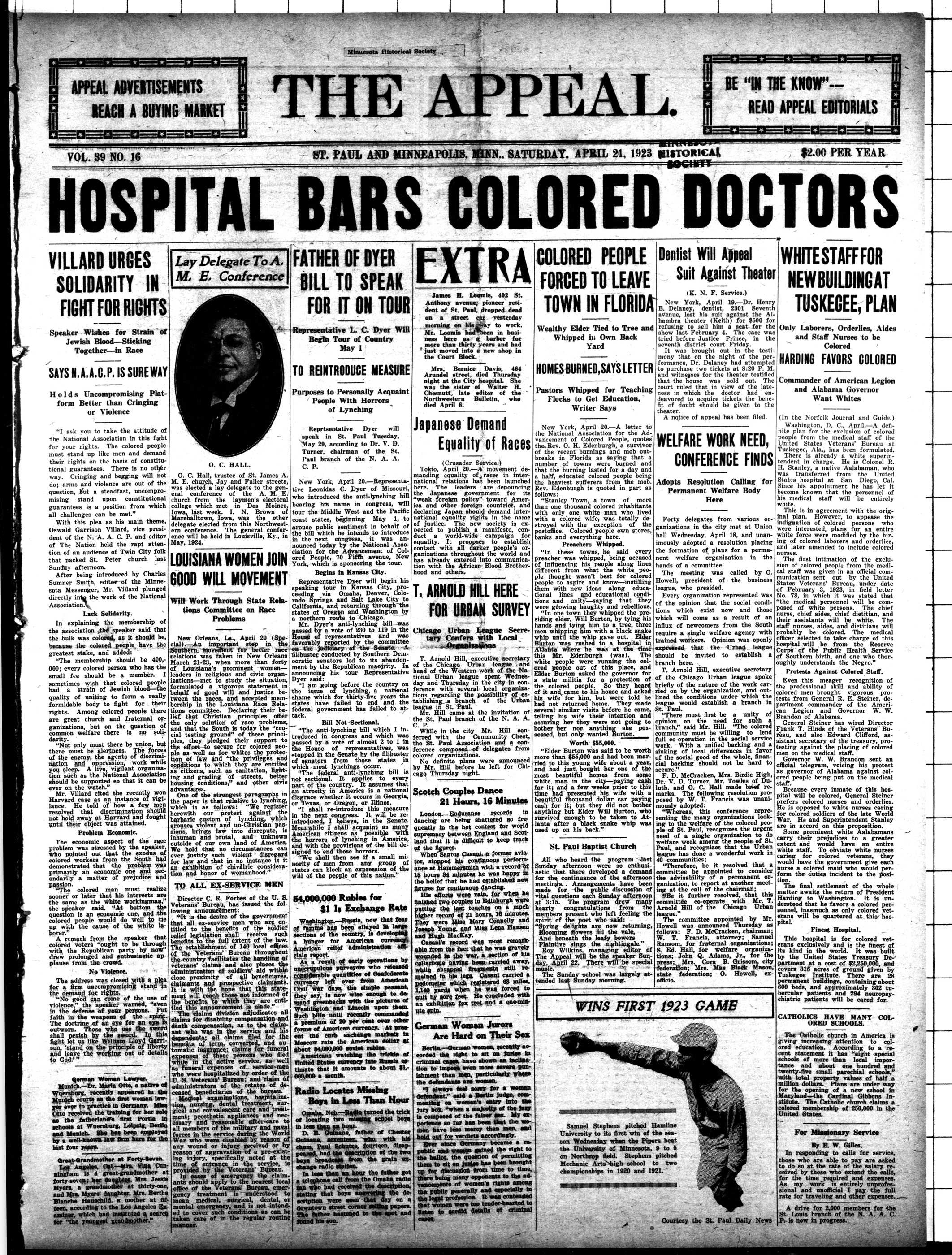
HOSPITAL BARS COLORED DOCTORS
VOL.39 NO.16 HOSP
VILLARD URGES SOLIDARITY IN FIGHT FOR RIGHTS
Speaker Wishes for Strain of Jewish Blood—Sticking Together—in Race
SAYS N.A.A.C.P. IS SURE WAY
Holds Uncompromising Platform Better than Cringing or Violence
"I ask you to take the attitude of the National Association in this fight for your rights. The colored people must stand up like men and demand their rights on the basis of constitutional guarantees. There is no other way. Cringing and begging will not do; arms and violence are out of the question, but a steadfast, uncompromising stand upon constitutional guarantees is a position from which all challenges can be met."
With this plea as his main theme, Oswald Garrison Villard, vice president of the N. A. A. C. P. and editor of The Nation held the rapt attention of an audience of Twin City folk that packed St. Peter church last Sunday afternoon.
After being introduced by Charles Sumner Smith, editor of the Minnesota Messenger, Mr. Villard plunged directly into the work of the National Association.
Lack Solidarity.
In explaining the membership of the association the speaker said that the bulk was colored, as it should be, because the colored people have the greatest stake, and added:
"The membership should be 400, 000; every colored person who has the small fee should be a member. I sometimes wish that colored people had a strain of Jewish blood—the quality of uniting to form a really formidable body to fight for their rights. Among colored people there are great church and fraternal organizations, but on the question of common welfare there is no solidarity.
"Not only must there be union, but there must be alertness. The forces of the enemy, the agents of discrimination and oppression, work while you sleep. A live, vigilant organization such as the National Association should be supported so that it can be ever on the watch."
Mr. Villard cited the recently won Harvard case as an instance of vigilance. He told of how a few men resolved that discrimination should not hold sway at Harvard and fought until their object was attained.
Problem Economic.
The economic aspect of the race problem was stressed by the speaker, who pointed out that the exodus of colored workers from the South had demonstrated that the problem was primarily an economic one and secondarily a matter of prejudice and passion.
"The colored man must realize sooner or later that his interests are the same as the white workingman," the speaker said. "At bottom the question is an economic one, and the colored people would do well to tie up with the cause of the white laborer."
A remark from the speaker that colored voters "ought to be through with the Republican party by now" drew prolonged and enthusiastic applause from the crowd.
No Violence.
The address was closed with a plea for a firm uncompromising stand in the demand for rights.
"No good can come of the use of violence," the speaker warned, "even in the defense of your persons. Put faith in the weapons of the spirit. The doctrine of an eye for an eye is outworn. Those who use the sword shall perish by the sword. In this fight let us like William Lloyd Garrison, 'stand on the principle of liberty and leave the working out of details to God.'"
German Woman Lawyer.
Munich—Dr. Maria Otte, a native of Wuerzburg, recently appeared in the Munich courts as the first woman lawyer ever to practice in Germany. Miss Otto received the training for her role as the fatherland's first Portia in schools at Wuerzburg, Leipzig, Berlin and Munich. She has been employed by a well-known law firm here for the last four years.
Great-Grandmother at Forty-Seven.
Los Angeles, Cal.-Mrs. Vina Cunningham is a great-grandmother at forty-seven; her daughter, Mrs. Jessie Myers, a grandmother at thirty-one, and Mrs. Myers' daughter, Mrs. Bertha Blanche Hauschild, a mother at fifteen, according to the Los Angeles Examiner, which had instituted a search for "the youngest grandmother."
O. C. HALL.
O. C. Hall, trustee of St. James A. M. E. church, Jay and Fuller streets, was elected a lay delegate to the general conference of the A. M. E. church from the laymen's electoral college which met in Des Moines, Iowa, last week. I. N. Brown of Marshalltown, Iowa, was the other delegate elected from this Northwestern conference. The general conference will be held in Louisville, Ky., in May, 1924.
LOUISIANA WOMEN JOIN GOOD WILL MOVEMENT
Will Work Through State Relations Committee on Race Problems
New Orleans, La., April 20 (Special)—An important step in the Southern movement for better race relations was taken in New Orleans March 21-23, when more than forty of Louisiana's prominent women-leaders in religious and civic organizations-faced for study the situation, formed a vigorous statement in behalf of good will and justice between the races, and accepted membership in the Louisiana Race Relations committee. Declaring their belief that Christian principles offer the only solution of race problems, and that the South is today the "crucial testing ground" of these principles, they pledged their support to the effort to secure for colored people as well as for whites the protection of law and "the privileges and conditions to which they are entitled as citizens, such as sanitation, lighting and grading of streets, better housing conditions," and other civic advantages.
One of the strongest paragraphs in the paper is that relative to lynching, which is as follows: "We register herewith our protest against the barbaric custom of lynching, which arouses violent and un-Christian passions, brings law into disrepute, is inhuman and brutal, and unknown outside of our own land of America. We hold that no circumstances can ever justify such violent disregard for law and that in no instance is it an exhibition of chivalric consideration and honor of womanhood."
TO ALL EX-SERVICE MEN
Director C. R. Forbes of the U. S. Veterans' Bureau, has issued the following announcement: "It is the desire of the government that all ex-service men who are entitled to the benefits of the soldier relief legislation shall receive such benefits to the full extent of the law. The establishment of 140 local offices of the Veterans' Bureau throughout the country facilitates the handling of veterans' claims and also places the administration of soldiers' aid within close proximity of all beneficiaries, claimants and prospective claimants. It is with the hope that this statement will reach those not informed of the benefits to which they are entitled this announcement is made." The claims division adjudicates all claims for disability compensation and death compensation, as to the claimant who was the service and his dependents, all claim filed for the benefits of term, converted, and auctioned insurance; claims for funeral expenses of those persons who died while in the active service, as well as funeral expenses of service-men who were hospitalized by order of the U. S. Veterans' Bureau; and claim of administrators of the estates of deceased beneficiaries of the bureau.
Medical examinations, hospitalization, nursing, dental treatment, surgical and convalescent care and treatment; prosthetic appliances and necessary and reasonable attire; all members of the military and naval Warriors who were disabled by reason of any wound or injury received or by reason of agravation of a pre-existing injury, specifically noted at the time of entrance in the service, is provided by the Veterans' Bureau. In cases of emergency the claimants should apply to the nearest local office of the Veterans' Bureau, emergency treatment is understood to mean medical, surgical, dental, or mental emergency, and is not intended to cover such conditions as can be taken care of in the regular routine
THE APPEAL.
FATHER OF DYER BILL TO SPEAK FOR IT ON TOUR
FATHER OF DYER BILL TO SPEAK FOR IT ON TOUR
Representative L. C. Dyer Will Begin Tour of Country May 1
TO REINTRODUCE MEASURE
Purposes to Personally Acquaint People With Horrors of Lynching
Reprtsentative Dyer will speak in St. Paul Tuesday, May 29, according to Dr. V. D. Turner, chairman of the St. Paul branch of the N. A. A. C. P.
New York, April 20.—Representative Leonidas C. Dyer of Missouri, who introduced the anti-lynching bill bearing his name in congress, will tour the Middle West and the Pacific coast states, beginning May 1, to arouse public sentiment in behalf of the bill which he intends to introduce in the next congress, it was announced today by the National Association for the Advancement of Colored People, 70 Fifth avenue, New York, which is sponsoring the tour.
Begins in Kansas City.
Representative Dyer will begin his speaking tour in Kansas City, proceeding via Omaha, Denver, Colorado Springs and Salt Lake City to California, and returning through the states of Oregon and Washington by a northern route to Chicago.
Mr. Dyer's anti-lynching bill was passed by a vote of 230 to 119 in the House of representatives and was favorably reported by the committee on the judiciary of the Senate. A filibuster conducted by Southern Democratic senators led to its abandonment by the Republican maojury. In announcing his tour Representative Dyer said:
"I am going before the country on the issue of lynching, a national shame which for thirty-five years the states have failed to end and the federal government has failed to attack."
Bill Not Sectional.
"The anti-lynching bill which I introduced in congress and which was passed by a vote of almost 2 to 1 in the House of representatives, was stopped in the Senate by the filibuster of senators from those states in which most lynchings occur.
"The federal anti-lynching bill is not sectional. It applies to every part of the country. It assumes that an atrocity in America is a national disgrace whether it occurs in Georgia, or Texas, or Oregon, or Illinois.
"I shall re-introduce this measure in the next congress. It will be re-introduced in the Senate. While I shall acquaint as many American citizens as possible with the horrors of lynching in America, and with the provisions of the bill designed to end those horrors.
"We shall then see if a small minority of men from any group of states can block an expression of the will of the people of this nation."
54.000.000 Rubles for
$1 Is Exchange Rate
Washington.—Russia, now that fear of famine has been allayed in large sections of the country, is developing a hunger for American currency, American relief administration officials report.
As a result of early operations by unscrupulous purveyors who released considerable quantities of Confederate currency left over from American Civil war days, the simple peasant, they say, is now wise enough to demand greenbacks with the pictures of Washington and Lincoln upon them. Spch bills until recently commanded a premium of 20 per cent own other forms of American currency. At present the curb exchange markets in Moscow rate the American dollar as about 54,000,000 soviet rubles.
Americans watching the trickle of United States currency into Russia estimate that it amounts to about $1,000,000 a month.
Radio Locates Missins
Omaha, Neb.-Radio turned the trick of locating two missing school boys in less than an hour.
D. E. Gulhane, father of Chester Gulhane, seventeen, who, with his chum, Paul Schutze, fourteen, disappeared, had the description of the two boys broadcast from the grain exchange radio station. In less than an hour the father got a telephone call from the Omaha radio fan who had received the description, stating that boys answering the description were seen that day on a downtown street corner selling papers. The father hastened to the spot and found his son.
EXTRA
James H. Loomis, 402 St. Anthony avenue, pioneer resident of St. Paul, dropped dead on a street car yesterday morning on his way to work. Mr. Loomis had been in business here as a barber for more than thirty years and had just moved into a new shop in the Court Block. Mrs. Bernice Davis, 464 Arundel street, died Thursday night at the City hospital. She was the sister of Walter H. Chesnut, late editor of the Northwestern Bulletin, who died April 6.
Japanese Demand Equality of Races
(Crusader Service.)
Tokio, April 20. A movement demanding equality of races in international relations has been launched here. The leaders are denouncing Japan's government for its "weak foreign policy" toward America and other foreign countries, and declaring Japan should demand international equality rights in the name of justice. The new society is expected to publish a manifesto, conduct a world-wide campaign for equality. It proposes to establish contact with all darker people's organizations throughout the world and has already entered into communication with the African Blood Brotherhood and others.
T. ARNOLD HILL HERE FOR URBAN SURVEY
Chicago Urban League Secretary Confers with Local Organizations
T. Arnold Hill, executive secretary of the Chicago Urban league and head of the Western work of the National Urban league spent Wednesday and Thursday in the city in conference with several local organizations regarding the possibility of establishing a branch of the Urban league in St. Paul.
Mr. Hill came at the invitation of the St. Paul branch of the N. A. A. C. P.
While in the city Mr. Hill conferred with the Community Chest, the St. Paul Association and a conference composed of delegates from colored organizations.
No definite plans were announced by Mr. Hill before he left for Chicago Thursday night.
Scotch Couples Dance 21 Hours. 16 Minutes
London.—Endurance records in dancing are being shattered so frequently in the hot contest for world supremacy between England and Scotland that it is difficult to keep track of the figures.
When Santos Casani, a former aviator, stopped his continuous performance at Hammersmith with a record of 18 hours 24 minutes he was happy in the belief that he had established new figures for continuous dancing.
His efforts were vain, for when he finished two couples in Edinburgh were putting the last touchs on a much higher record of 21 hours, 16 minutes. They were Miss Mary Cunnelly and Joseph Young, and Miss Lena Hansen and Hugh MacKay.
Casani's record was most remarkable from the fact that he was gravely wounded in the war, a section of his collarbone having been carried away, while shrapnel fragments still remained in his legs. Casani carried a pedometer which registered 68 miles, 1,140 yards when he was forced to quit by sore feet. He concluded with an exhibition fox trot and a one-minute spin.
Berlin—German women, recently accorded the right to sit on juries in criminal cases, have shown an inclination to impose even more severe punishment than men, particularly where the defendants are women.
"I always feel sorry for a woman defendant," said a Berlin judge, commenting on woman's entry into the jury box, "when a majority of the jury is composed of the fairer sex. My experience so far has been that the women have less mercy than men, and hold out for verdicts accordingly.
Ever since Germany became a republic and women gained the right to the ballot, the question of permitting them to sit on juries has been brought up for discussion from time to time, there being many opponents to the advancements of women's rights among the public generally and especially in the legal profession. It was contended that women were too tender-hearted to listen to sordid details of criminal cases.
WINS FIRST 1923 GAME
Samuel Stephens pitched Hamline University to its first win of the season Wednesday when the Pipers beat the University of Minnesota, 9 to 5 on Northrop field. Stephens pitched Mechanic Arts high school to two championships in 1920 and 1921.
Courtesy the St. Paul Daily News
Wealthy Elder Tied to Tree and Whipped in Own Back Yard
HOMES BURNED,SAYS LETTER
Pastors Whipped for Teaching Flocks to Get Education, Writer Says
New York, April 20.—A letter to the National Association for the Advancement of Colored People, quotes the Rev. O. H. Edenburgh, a survivor of the recent burnings and mob outbreaks in Florida as saying that a number of towns were burned and that the burning lasted for a day and a half, educated colored people being the heaviest sufferers from the mob. Rev. Edenburgh is quoted in part as follows:
"Stanley Town, a town of more than one thousand colored inhabitants with only one white man who lived with a colored wife, was totally destroyed with the exception of the postoffice. Colored people own stores, banks and everything here.
Preachers Whipped.
"In these towns, he said every preacher was whipped, being accused of influencing his people along lines different from what the white people thought wasn't best for colored people to aspire and know—instilling them with new ideas along educational lines and educational conditions and unity—saying that they were growing haughty and rebellious. "In one town they whipped the presiding elder, Will Burton, by tying his hands and tying him to a tree, three men whipping him with a black snake whip until the whip gave out. Elder Burton was rushed to a hospital in Atlanta where he was at the time this Mr. Edenburgh (was). The white people were running the colored people out of this place, and Elder Burton asked the governor for a state militia for a protection of the colored people. So they heard of it and came to his house and answered that he had not returned home. They made several similar visits before he came, telling his wife their intention and assuring her they were not going to bother her nor anything she possessed, but only wanted Burton.
Worth $55,000.
"Elder Burton was said to be worth more than $55,000 and had been married to this young wife about a year, and had just bought her one of the most beautiful homes from some white man in the city—paying cash for it; and a few weeks prior to this time had presented his wife with a beautiful thousand dollar car paying cash for it; but they did not bother anything but Elder Will Burton, who survived enough to be taken to Atlanta after a black snake whip was used up on his back."
St. Paul Baptist Church
All who heard the program last Sunday afternoon were so enthusiastic that there developed a demand for the continuance of the afternoon meetings. Arrangements have been made for the public discussion of vital questions each Sunday afternoon at 3:15. The program drew many hearty congratulations from the members present who left feeling the spirit of the poet who said: "Spring delights are now returning,
"Spring delights are now returning, Blooming flowers fill the vale, And beneath the leafy bowers Plaintive sings the nightingale." Roy Wilkins, managing editor of The Appeal will be the speaker Sunday, April 22. There will be special music. The Sunday school was largely attended last Sunday morning.
Dentist Will Appeal Suit Against Theater
(K. N. F. Service.)
New York, April 19—Dr. Henry B. Delaney, dentist, 2301 Seventh avenue, lost his suit against the Alhambra theater (Keith) for $500 for refusing to sell him a seat for the show last February 4. The case was tried before Justice Prince, in the seventh district court Friday.
It was brought out in the testimony that on the night of the performance, Dr. Delaney had attempted to purchase two tickets at 8:20 P. M. and witnesses for the theater testified that the house was sold out. The court ruled that in view of the lateness in which the doctor had endeavored to acquire tickets the benefit of doubt should be given to the theater.
A notice of appeal has been filed.
WELFARE WORK NEED, CONFERENCE FINDS
Adopts Resolution Calling for Permanent Welfare Body Here
Forty delegates from various organizations in the city met at Union hall Wednesday. April 18, and unanimously adopted a resolution placing the formation of plans for a permanent welfare organization in the hands of a committee.
The meeting was called by O. Howell, president of the business league, who presided.
Every organization represented was of the opinion that the social conditions which exist now and those which will come as a result of an influx of newcomers from the South require a single welfare agency with trained workers. Opinion was openly expressed that the Urban league should be invited to establish a branch here.
T. Arnold Hill, executive secretary of the Chicago Urban league spoke briefly of the nature of the work carried on by the organization, and outlined the conditions under which the league would establish a branch in St. Paul.
"There must first be a unity of opinion on the need for such a branch," said Mr. Hill. The colored community must be willing to lend full co-operation to the social service with unified backing and a sinking of local differences in favor of the social good of the whole, financial backing should not be hard to secure."
F. D. McCracken, Mrs. Birdie High, Dr. V. D. Turner, Mr. Towles of Duluth, and O. C. Hall made brief remarks. The following resolution proposed by W. T. Francis was unanimously adopted:
"Whereas, this conference representing the many organizations looking to the welfare of the colored people of St. Paul, recognizes the urgent need of a single organization to do welfare work among the people of St. Paul, and recognizes that the Urban league has done a wonderful work in 40 communities;
"Therefore, be it resolved that a committee be appointed to consider the advisability of a permanent organization, to report at another meeting the call of the chairman;
"Be it further resolved, that this committee co-operate with Mr. T. Arnold Hill of the Chicago Urban league."
The committee appointed by Mr. Howell was announced Thursday as follows: F. D. McCracken, chairman; W. T. Francis, attorney; Samuel Ransom. for fraternal organizations; S. Ed. Hall, for welfare organizations; John Q. Adams, Jr., for the press; Mrs. Cora B. Grissom, city federation; Mrs. Mae Black Mason, state federation; O. Howell, ex-officio.
$2.00 PER YEAR TORS
WHITESTAFFFOR NEWBUILDINGAT TUSKEGEE, PLAN
Only Laborers, Orderlies, Aides and Staff Nurses to be Colored
HARDING FAVORS COLORED
Commander of American Legion and Alabama Governor Want Whites
(In the Norfolk Journal and Guide.)
Washington, D. C., April.—A definite plan for the exclusion of colored people from the medical staff of the United States Veterans' Bureau at Tuskegee, Ala., has been formulated.
There is already a white superintendent in charge. He is Colonel R. H. Stanley, a native Aalabaman, who was transferred from the United States hospital at San Diego, Cal. Since his appointment he has let it become known that the personnel of his medical staff will be entirely white.
This is in agreement with the original plan. However, to appease the indignation of colored persons who were interested, plans for an entire white force were modified by the hiring of colored laborers and orderlies, and later amended to include colored nurses.
The first intimation of the exclusion of colored people from the medical staff was given in an official communication sent out by the United States Veterans' Bureau, under date of February 3, 1923, in field letter No. 78, in which it was stated that "the medical personnel will be composed of white persons. The chief nurse, chief aides, chief dietitian, and their assistants will be white. The staff nurses, aides, and dietitians will probably be colored. The medical officer selected to take charge of this hospital will be from the Reserve Corps of the Public Health Service of Southern birth, and one who thoroughly understands the Negro."
Protests Against Colored Staff.
Even this meager recognition of the professional skill and ability of colored men brought vigorous protests from General R. E. Steiner, department commander of the American Legion and Governor W. W. Brandon of Alabama.
General Steiner has wired Director Frank T. Hinds of the Veterans' Bureau, and also Edward Clifford, assistant secretary of the treasury, protesting against the placing of colored men on the medical staff.
Governor W. W. Brandon sent an official telegram, voicing his protest as governor of Alabama against colored people being put on the medical staff.
Because every inmate of this hospital will be colored, General Steiner prefers colored nurses and orderlies. He is opposed to white nurses caring for colored soldiers of the late World War. He and Superintendent Stanley are in accord on this proposition.
Some prominent white Alabamans carry their prejudices to a greater extent and would have an entire white staff. To obviate white nurses caring for colored veterans, they would have the government give each nurse a colored maid who would perform the duties incident to the position.
The final settlement of the whole matter awaits the return of President Harding to Washington. It is understood that he favors a colored personnel, inasmuch as only colored veterans will be quartered at this hospital.
Finest Hospital
This hospital is for colored veterans exclusively and is the finest of its kind in the world. It was built by the United States Treasury Department at a cost of $2,250,000, and the rest of the ground given by Tuskegee Institute. 92 permanent buildings, containing about 600 beds, and approximately 302 tubercular patients and 294 neuropsychiatric patients will be cared for.
CATHOLICS HAVE MANY COL
ORED SCHOOLS.
The Catholic church in America is giving increasing attention to colored education. According to a recent statement it has "eight special schools of more than local importance and about one hundred and twenty-five small parochial schools" with total property values of half a million dollars. Plans are under way for the opening of a new school in Maryland—the Cardinal Gibbons Institute. The Catholic church claims a colored membership of 250,000 in the United States.
For Missionary Service
In responding to calls for service, those who are able to pay are asked to do so at the rate of the salary received by those who extend the calls, for the time required and expense. As my work is entirely unprofessional and unofficial I pay the full rate for traveling and other expenses.
A drive for 2,000 members for the St. Louis branch of the N. A. A. C. P. is now in progress.
J. Q. Adams ..... Editor-in-Chief
Roy Wilkins ..... Managing Editor
Odell D. Smith ..... Business Manager
Advertising Rates on Application
Entered at the Postoffice in St. Paul, Minnesota, as second-class mail matter. June 6, 1885, under Act of Congress, March 3, 1879.
ABOUT PARTIES
By far the most significant reaction from the Villard meeting was the prolonged and enthusiastic applause which greeted the remark that colored voters ought to be through with the Republican party by now. No other statement drew such hearty approval. This goes to prove that colored voters in the Northwest in common with those in Chicago and Harlem are tired of the repeatedly broken promises of the Republicans and particularly of the weak moves of the Harding administration.
SPOTLIGHT ON DIXIE
"Dixie," the sunny romance-land in song and legend, the habitation of soft-drawling, warm-hearted, hospitable people, the country of cotton, sugarcane and "co'n pone" is fast vanishing from the minds and imagination of the rest of the country. In its stead is rising up a land whose benighted state and eighteenth century civilization seem almost incredible in this enlightened age.
Time was when Northerners and Westerners agreed that the South was all right—it practiced certain methods with the colored man, but perhaps it knew best how to handle its own business.
Mer Rouge jarred the country and revealed Louisiana, at least, as a Kingdom of Fear, where hooded bands and secret orders rule instead of law and order.
And now the whip of a Florida convict boss has laid bare the decayed civilization in that state.
Dixie has become a land made hideous by torture, murder, peonage-slavery and ignorance. Its people stand revealed as beings who have allowed passion and prejudice to divert their minds from the business of living and becoming civilized. Watt Daniels, Richards, and Martin Tabert have scattered to the four winds the illusion that Dixie is all roses and sunshine.
WE NOMINATE
for the Spingarn medal, Professor George W. Carver of Tuskegee Institute, because he has served both black and white farmers through his discoveries of the by-products of the peanut and Alabama soil, and because he has brought honor and distinction to the colored American by becoming an international figure in the world of agricultural science.
THE CRIME IN FLORIDA
(St. Paul Dispatch.)
The martyrdom of Martin Talbert in a leased convict camp of Florida will not have been wholly in vain if it shall result in the complete abolition of a system of peonage stained with all of the horrors of slavery days. Evidences multiply to show, not only the existence of a convict system with every camp boss a Simon Legree, not only a system where the color of law is lent to punishment so ruthless and inhuman that the story goes shuddering over the country, but a situation where corrupt officials league with greedy contractors to coin money out of the extreme of human suffering.
Florida stands today debased and degraded in the eyes of civilization and humanity. Through political influence it has retained in its laws, the sanction of a county system of leasing convicts on contract and condoning, if not authorizing, punishment that falls under the ban of the federal constitution as barbarous and unusual. There is palliation in the Florida mind, but in none other, in the fact that most of the convicts subjected to the torture of the lash and bludgeon are colored men. Florida is not wholly out of the shadow of slavery days and the spirit of its laws animates its other activities. It required the intervention of such an incident as the actual murder of Martin Talbert and the indignation command with Dakota to touch Florida to shame.
It will not be easy as it might be fancied to purge Florida of this horrid crime. High and petty officials—well as consciencele contractors are in the mess of blood and mire, and the police are in the grip of the system. Together they will fight to gloss over the testimony and perpetuate the opportunities. But the conscience of the state has been touched and its real citizenship is not callous to the estimation in what is often called the "murder men." Investigation is inevitable and the truth will force the abolition of the conditions which put the Dark Ages to the blush. What the North Dakota legislature has recorded as its sentiments, which Florida vanily assumes to reclaim, is in the Union if the Florida legislature falters or falls in the duty facing it.
Health Talks
By E. S. WEBER, D. D. S.
In my previous articles I have made manifest the significance in caring for the teeth and adjacent tissues. In this article I will try to give you some facts concerning the development of good, sound teeth and how to keep them sound.
I will begin with the child because to develop the second set of teeth in later years depends, for the most part, on the care given to the temporary teeth and the kind of food the child is given to eat.
The temporary teeth begin to come through the gums between the ages of four and eight months. They come successively in size, the last frequently coming as late as three-years of age. Nature then gives to the child a set of teeth free from all-deposits and decay, she also places them in proper alignment for the temporary teeth in children are rarely uneven or out of position, the tooth so far has not been interfered with and has done her work well. It is at this point that the child should be given care and instruction. The child can keep these teeth just as nature has placed them if constant care is taken. Note well said "constant care." The teeth are carefully cared and cared for just the same as one should take care of his body.
Of course care alone will not render the teeth immune from caries (decay of the teeth) and subsequent loss of the teeth entirely. Diet has a great deal to do with the grade of the enamel and the presence of elements in foods that are necessary to make the teeth hard, strong, and tenacious. I cannot leave out exercise for it is just as necessary to exercise the teeth as it is to exercise any other part of the human anatomy. The body, that are not properly exercised become weak, frail, useless, and susceptible to most any disease producing germ. You might ask, how can one exercise the teeth? The answer is very simple. Eat foods that are nutritious. Eat foods that are long and long. As the force of chewing strengthens the jaws and makes them grow, it also lowers the palate, for as the two bases of an arch are spread it must lower the crown of the arch. As the heel of the jaw is spread likewise must draw in and out, outwardly of the jaw, this prevents protruding or overlapping front teeth.
Poor and irregular teeth are not the only evil of undeveloped jaws. The muscles of mastication, including the tongue need development. The salivary glands also are made to develop by chewing. Then there are the teeth, the lymphatic and the nerves of the mouth, jaws, and teeth. All must be developed completely if the permanent teeth are to be made safe for long, hard usage of a lifetime. Lack of development of all these factors favors early disease of the teeth and is accountable for many ailments in the teeth that are reasonably straight. An ever high and narrow in infants. They are produced by bad feeding habits. Such high palates push up the bony structures of the nose and help to occlude the nostrils. Faulty nostrils favor the growth of adenoids and may be a factor in enlarged tonsils. Such occluded nostrils certainly are susceptible to inflammation, inflame the throat, the nasal sinuses and the middle ear, which causes much deafness.
Savage races generally have good teeth. Civilized races as a rule have poor teeth. The babies of savage races are breast fed while the babies of civilized races are too often bottle of civilized races have continued long after the teeth have been way through the gums. After the children of savage races have been weaned they eat natural foods, the same as do the adults, and it may be said the same is true of the young of the mammalian creatures after weaning. After weaning the children of savage races eat foods that are largely artificial and frequently or less denatured. Such foods as fruits, grains, nuts, roots and all vegetables are natural foods. It can readily be seen that such foods must be chewed before swallowing them. On the other hand, milk, butter, cheese, sugar and its combination in pies, candies, puddings, cakes, pre-made desserts and fondant are examples of artificial foods. White flour products and most cereals used as breakfast foods are examples of denatured foods. As the chewable portions of the grains are removed all of these artificial and denatured foods are largely liquid or soft, and need but little chewing before they are swallowed. Children of civilized people use after weaning.
Teeth come in crooked because the jawbones are too small. They are stunted, they have not grown as they should. They are not long enough to hold all of the permanent teeth. When the jaw is too small there is not room for them, they cannot come through in proper alignment and as a result are forced by growth out of the jaw. Jaws are faint in the individual child and not a free of nature. Jaws are stunted because they have not been used enough in chewing food that is more or less Continued on fourth page.
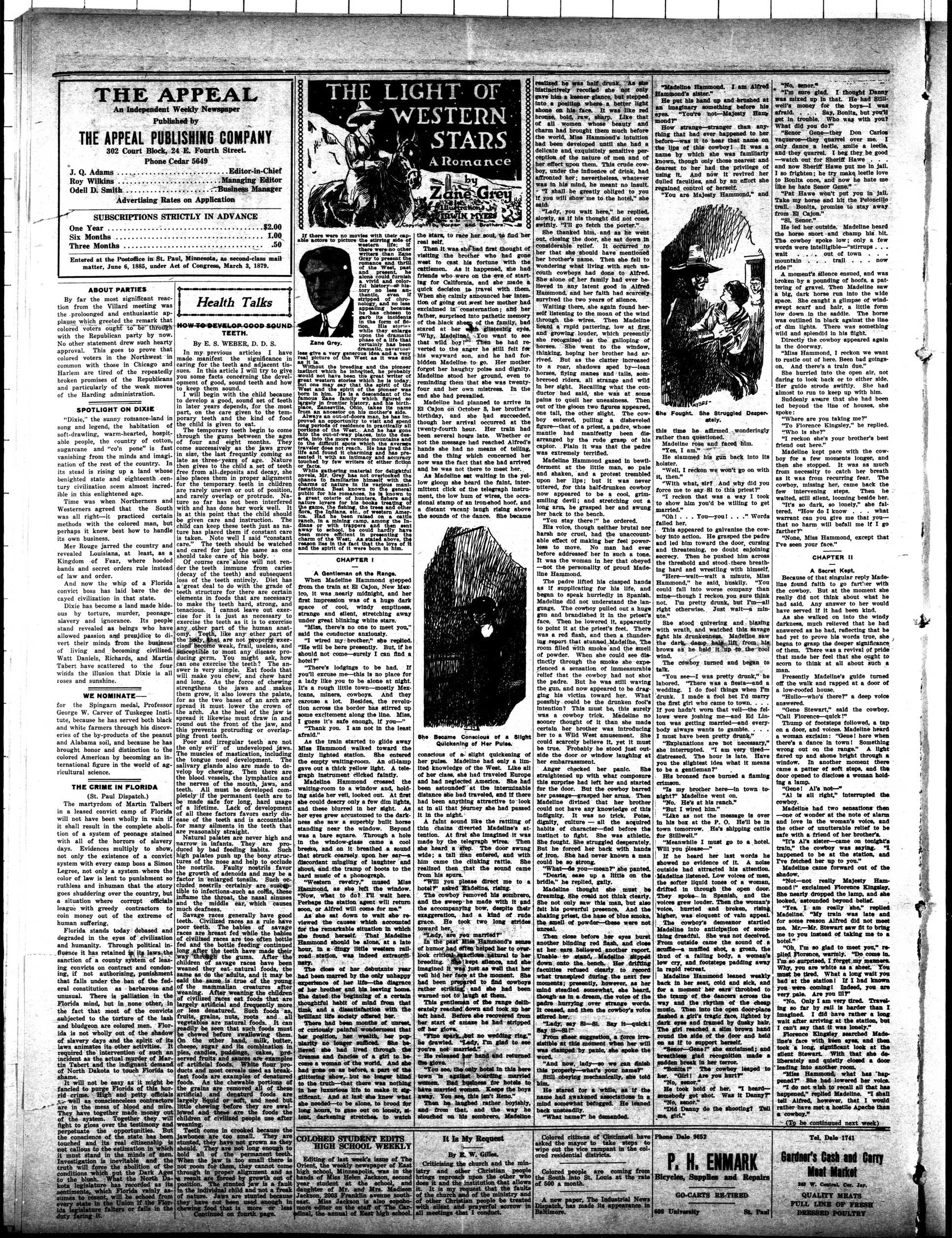
THE LIGHT OF
WESTERN
STARS
A Romance
by
Zane Grey
illustrations by
BRIAN MYER
Copyrights by Harper and Brothers
If there were no movies with their cap-
able actors to picture the stirring side of
the stars, to race her soul, to find h
real coil.
the stirring side of
there were no other
writers than Zane
romance and thrill
and present,
alone could turnish
history -- history
no less autobi-
stripped of chron-
ology, and no less
he has chosen to
garb its incidents
in history.
His stories
while they enlarge
the phase of a life that
certainly has been
there were no other writers than Zane Grey to present romances and thrill of the West, past and present, he alone could form a vivid and colorful history—his history was haunted, even if stripped of chronology and appealing because he has chosen to include it in the form of fiction. His stories make up upon the dramatic phase of a life that certain of them been discovered, never less give a very generous idea and a very real picture of the West as it was and
Without the breeding and the pioneer instinct which he inhighest, he probably never saw great western stories which he is today; but one may say that the spirit of the pioneer was born in him. He is a descendant of the famous Zane family which figured so large in the history of the church and his birth, Zaneville, Ohio. He was from an ancestor on his mother's side. Immediately an out-of-door man, he has impaired vision, and long periods of residence in practically all portions of the West. And he has gone into the mountains and into the more remote mountains and to the difficult spots which the average man life and found it charming and has presented it with an intimacy and accuracy touched by few writers of either fiction
CHAPTER I
A Gentleman of the Range
When Madeline Hammond stepped from the train at El Cajon, New Mexico, it was nearly midnight, and her first impression was of a huge dark space of cool, windy emptiness, strange and silent, stretching away many miles. "Miss, there's no one to meet you," said the conductor anxiously.
"I wired my brother," she replied. "He will be here present. But, if he should not come—surely I can find a hotel!"
"There's lodgings to be had. If you'll excuse me—this is no place for a lady like you to be alone at night. It's a rough little town—mostly Mexicans, miners, cowboys. And they carouse a lot. Besides, the revolution across the border has stirred up some excitement along the line. Miss, I guess it's safe enough, if you—"
"Thank you. I am not in the least afraid."
As the train started to glide away Miss Hammond walked toward the dimly lighted station. She entered the empty waiting-room. An oil-lamp gave out a thick yellow light. A telegraph instrument clicked faintly.
Madeline Hammond crossed the waiting-room to a window and, holding aside her vell, looked out. At first she could desyce only a few dim lights, and these blurred in her sight. As her eyes grew accustomed to the darkness she saw a superbly built horse standing in the window. Beyond a house are square. Through a hole in the window-glass came a cool breve, and on it breathed a sound that struck coarsely upon her ear—a discordant mingling of laughter and shout, the tramp of boots to the hard music of a phonograph.
"Western revelry," mused Miss Hammond, as she left the window. "Now, what to do? I'll wait here. Perhaps the station agent will return soon, or Alfred will come for me."
As she sat down to wait she reviewed the causes which accounted for the remarkable situation in which she found herself. That Madeline Hammond should be alone, at a late hour, in a dingy little western railroad station, was indeed extraordinary.
The close of her debutate year had been marred by the only unhappy experience of her life—the disgrace of her brother and his leaving home. She dated the beginning of a certain thoughtful habit of mind from that time, and a dissatisfaction with the brilliant life society offered her.
There had been months of unrest,
of curiously painful wonderment that
her position, her wealth, her pop-
ularity no longer suffaced. She be-
loved she had lived through the
dreams and fancies of a girl to
become a woman of the world. And she
had gone on as before, a part of the
glittering show, but no longer blind
to the truth—that there was nothing
in her luxurious life to make it
sufficient. And at last she knew what
she needed—to be alone, to brood for
long hours, to gaze out on lonely,
silent, darkening stretches, to watch
COLORED STUDENT EDITS
HIGH SCHOOL WEEKLY
Editing of last week's issue of The Orient, the weekly newspaper of East high school, Minneapolis, was in the hands of Miss Helen Jackson, second year student at the school, and daughter of Mr. and Mrs. Madison Jackson. 2003 Franklin avenue southeast. Miss Jackson is also sopohomore editor on the staff of The Cardinal, the annual of East high school.
the stars, to race her soul, to find her real self.
Then it was she had first thought of visiting the brother who had gone west to cast his fortune with the cattemen. As it happened, she had friends who were on the eve of starting for California, and she made a quick decision to travel with them. When she calmly announced her intention of going out west her mother had exclaimed in consternation; and her father, surprised into pathetic memory of the black sheep of the family, had stared at her with glistening eyes. "Why, Madeline! You want to see that wild boy!" Then he had reverted to the anger he still felt for his wayward son, and he had forbidden Madeline to go. Her mother forgot her haughty poise and dignity. Madeline stood her ground, even to reminding them that she was twenty-four and her own mistress. In the end she had prevailed.
Madeline had planned to arrive in England on October 3 her brother's birthday, and she had succeeded, though her arrival occurred at the twenty-fourth hour. Her train had been several hours late. Whether or not the message had reached Alfred's hands she had no means of telling, and the thing which concerned her now was the fact that she had arrived and he was not there to meet her.
As Madeline sat waiting in the yellow gloom she heard the faint, instrument, the low hum of wires, the occasional stamp of an ironshoe hoof, and a distant vacant laugh rising above the sounds of the dance. She became
She Become Conscious of a Slight Quickening of Her Pulse.
conscious of a slight quickening of her pulse. Madeline had only a limited knowledge of the West. Like all of her class, she had traveled Europe and had neglected America. She had been astounded at the interminable distance she had traveled, and if there had been anything attractive to look at in all that journey she had passed it in the night.
A faint sound like the rattling of thin chains diverted Madeline's attention. At first she imagined it was made by the telegraph wires. Then she heard a step. The door swung wide; a tall man entered, and with him came the clinking rattle. She realized then that the sound came from his spurs.
"Will you please direct me to a hotel?" asked Madeline, rising. The cowboy removed his sombrero, and the sweep he made with it and the accompanying bow, despite their exaggeration, had a kind of rude grace. He took two long strides toward her.
"Hady, are you married?" in the past Mist Hammond's sense of humor had often helped her to overlook critical actions natural to her breeding. She kept silence, and she imagined it was just as well that her vell hid her face at the moment. She had been prepared to find cowboys rather striking, and she had been warned not to laugh at them.
This gentleman of the range deliberately reached down and took up her left hand. Before she recovered from her start of amaze he had stripped off her socks.
"You see, the only hotel in this here town is against boarding married women. We have married women. Keep the boys away. You see, this isn't Reno."
Then he laughed rather boyishly,
and from that, and the way he
slouched on his sombrero, Madeline
Criticizing the church and the ministry and other Christian people brings repressure to the other who does it and the institution that allows it. It is my request that the faults of the church and of the ministry and other Christian people with client and prayerful sorrow in all meetings that I conduct.
realized he was half drunk. As she distinctly recouled she not only gave him a keener glance, but stepped into a position where a better light shone on his face. It was like red bronze, bold, raw, sharp. Like that of all women whose beauty and charm had brought them much before the world, Miss Hammond's intuition had been developed until she had a delicate and exquisitely sensitive perception of the nature of men and of her effect upon them. This crude cowboy, under the influence of drink, had affrontoed her; nevertheless, whatever was in his mind, he meant no insult. "I shall be greatly obliged to you if you will show me to the hotel," she said. "Lady, you wait here," he replied, slowing as if his thought did not come swiftly. "I'll go fetch the porter." She thanked him and as he went out, closing the door, she found in considerable relief. It occurred to her that she should have mentioned her brother's name. Then she fell to wondering what living with such uncut cowbirds had done to Alfred. She alone of her family had ever believed in any latent good in Alfred Hammond, and her faith had scarcely survived the two years of silence.
Waiting there, she again found herself listening to the moon of the wind through the wires. Then Madeline heard a rapid patterning, at low at first and growing louder, which presently she recognized as the galloping of horses. She went to the window, thinking, hoping her brother had arrived. But as the clatter increased to a roar, shadows sped by—lean horses, flying manes and somber riders, all strange and wild in her sight. Recalling what the conductor had said, she was at some pains to quell her uneasiness. Then out of the gloom two figures appeared, one tall, the other slight. The cowboy entered, pulling a disheveled figure—that of a priest, a padre, whose mantle had manifestly been disarranged by the rude grasp of his captor. Plain it was that the padre was extremely terrified.
Madeline Hammond gazed in bewilderment at the little man, so pale and shaken, and a protest trembled; but it was never uttered, for the half-drunken cowboy now appeared to be a cool, grim-smiling devil; and strucking out a long arm, he grasped her and swung her back to the bench.
"You stay there!" he ordered.
His voice, though neither brutal nor harsh nor cruel, had the unaccountable effect of making her powerless to move. No man had ever before addressed her in such a tone. It was the woman in her that obeyed—not the personality of proud Madeline Hammond.
The padre lifted his clasped hands as if supplicating for his life, and began to speak hurriedly in Spanish. Madeline did not understand the language. The cowboy pulled out a huge gun and brandished it in the priest's face. Then he lowered it, apparently to point it at the priest's feet. There was a red flash, and then a thundering report that stunned Madeline. The room filled with smoke and the smell of powder. When she could see distinctly through the smoke she experienced a sensation of immeasurable relief that the cowboy had not shot the padre. But he was still waving the gun, and now appeared to be dragging his victim toward her. What possibly could be the drunken fool's intention? This must be, this surely was a cowboy trick. Madeline no sooner thought of it than she made certain her brother was introducing her to a Wild West amusement. She could scarcely believe it, yet it must be true. He stood he stood out the door or window laughing at her. Angered she carried her panic. She straightened up with what compose this surprise had left her and carried for the door. But the cowboy barred her passage—grasped her arm. Then Madeline divined that her brother could not have any knowledge of this indignity. It was no trick. Poise, dignity, culture—all the acquired habits of character—fled before the instinct to fight. She was athletic. She fought. She struggled desperately. But he forced her back with hands of iron. She had never known a man could be so strong.
"What—do you—mean?" she panted.
"Dearie, cease up a little on the bridle," he replied, gaily.
Madeline thought she must be dreaming. She could not think clearly. She not only saw this man, but also felt his powerful presence. And the shaking priest, the hase of blue smoke, the smell of powder—these were not unreal.
Then close before her eyes burst another blinding red flash, and close at her ears bellowed another report. Unable to stand, Madeline slipped down onto the bench. Her drifting faculties refused clearly to record what trampled during the next few moments; presently, however, as her mind stedled somewhat, she heard, though as in a dream, the voice of the padre hurrying over strange words, and then the cowboy's voice stirred him.
"Lady, say Si—Sl. Say it—quick! Say it—Sl!"
From sheer suggestion a force irresistible at this moment when her will was clamped by panic; she spoke the word.
"And how, lady—so we can finish this property—what's your name?"
Still obeying mechanically, she told him.
He stared for a while, as if the name had awakened associations in a mind somewhat befogged. He leaned back unsteadily. "What name?" he demanded.
Colored citizens of Cincinnati have asked the mayor to take steps to wipe out the vice rampant in the colored residential districts.
"Madeline Hammond. I am Alfred Hammond's sister."
He put his hand up and brushed at an imaginary something before his eyes. "You're not—Majesty Hammond."
How strange—stranger than anything that had ever happened to her before—was it to hear that name on the lips of this cowboy! It was a name by which she was familiarly known, though only those nearest and dearest to her had the privilege of using it. And now it revived her dulled faculties, and by an effort she regained control of herself.
"You are Majesty Hammond," and
She Fought. She Struggled Desper-
ately.
this time he affirmed wonderingly
rather than questioned.
Madeline rose and faced him.
"Yes, I am."
He slammed his gun back into its
holster.
"Well, I reckon we won't go on with
it then."
"With what, sir? And why did you force me to say Si to this priest?"
"I reckon that was a way I took to show him you'd be willing to get married."
"Oh! . . . You—you galvanize the cowboy into action. He grasped the padre and led him toward the door, cursing and threatening, no doubt enjoining secrecy. Then he pushed him across the threshold and stood there breathing hard and wrestling with himself, Miss Hammond." he said, huskily.
"You could fall into worse company than mine—but I reckon you sure think not. I'm pretty drunk, but I'm—all right otherwise. Just wait—a minute."
She stood quivering and blazing with wrath, and watched this savage fight his drunkenness. Madeline saw the dark, damp halls lift from his brows as he held it up to the cool wind.
The cowboy turned and began to talk.
"You see—I was pretty drunk," she labored. "There was a flesta—and a wedding. I do fool things when I'm drunk. I made a fool bet I marry the first girl who came to town. . . If you hadn't worn that vell—the fellows were joshing me—and Ed Linton was getting married—and everybody to gamble. I must have been pretty drunk."
"Explanations are not necessary," she interrupted. "I am very tired—distressed. The hour is late. Have you the slightest idea what it means to be a gentleman."
His bronzed face burned a flaming crimson.
"Is my brother here—in town to night?" Madeline went on.
"No. He's at his ranch."
"But I wired him."
"Like as not the message is over in his box at the P. O. He'll be in town tomorrow. He's shipping cattle for Stillwell."
"Meanwhile I must go to a hotel. Will you please—"
If he heard her last words he showed no evidence of it. A noise outside had attracted his attention. Madeline listened. Low voices of men, the softer liquid tones of a woman, drifted in through the open door. They spoke in Spanish, and the voices grew louder. Then the woman's voice, hurried and broken, rising higher, the warrior's upper appeal made the warrior's demeanor startled Madeline into anticipation of something dreadful. She was not deceived. From outside came the sound of a scuffle—a muffled shot, a green, the thud of a falling body, a woman's low cry, and footsteps padding away in rapid retreat.
Madeline Hammond leaned weakly back in her seat, cold and sick, and for a moment her ears throbbed to the tramp of the dancers across the way and the rhythm of the cheap music. Then into the open door-place flashed a girl's tragic face, lighted by dark eyes and framed by dusky hair. The girl reached a slim brown hand round the side of the door and held on as if to support herself.
"Sensor—Gene!" she exclaimed; and breathless glad recognition made a sound. "Bonita!" The cowboy leaped to her. "Girl! Are you hurt?" "No sensor."
He took hold of her. "I heard—somebody got shot. Was it Danny? "No, sanot."
"Did Danny do the shooting? Tell
me, girl."
Phone Dale 9652
P. H. ENMARK
Bicycles, Supplies and Repairs
GO-CARTS RE-TIRED
608 University St. Paul
"No, senor."
"I'm sure glad. I thought Danny was mixed up in that. He had Still well's money for the boys—I was an old man. So, Bonita, but you'll not in trouble. Who was with you? What did you do?"
"Senor Gene—they Don Carlos vaqueros—the quarrel over me. I only dance a leetle, smile a leetle, and they quarrel. I beg they be good—watch out for Sheriff Hawe . . . and now Sheriff Hawe put me in jail. I so frighten; he try make leetle love to Bonita once, and now he hate me like he hate Senor Gene."
"Pat Hawe won't put you in jail. Take my horse and lift the Pelleoncil trail. Bonita, promise to stay away from El Cajon."
"Sl, Senor."
He led her outside. Madeline heard the horse snort and champ his bit. The cowboy spoke low; only a few words were intelligible—"stirrups . . . wait . . . out of town . . . mountain . . . trail . . . now ride!"
A moment's silence ensued, and was broken by a pounding of hoofs, a patterning of gravel. Then Madeline saw a big, dark horse run into the wide space. She caught a glimpse of wind-swept scarf and hair, a little form low down in the saddle. The horse was outlined in black against the line of wild grass, nothing wild and splendid in his flight.
Directly the cowboy appeared again in the doorway.
"Miss Hammond, I reckon we want to rustle out of here. Been had goings-on. And there's a train due."
She hurried into the open air, not daring to look back or to either side. Her guide strode swiftly. She had almost to run to keep up with him. Suddenly aware that she had been led beyond the line of houses, she spoke:
"Where are you taking me?"
"To Florence Kingsley," he replied.
"Who is she?"
"I reckon she's your brother's best friend out here."
Madeline kept pace with the cowboy for a few moments longer, and then she stopped. It was as much as the cowboy to catch her breath as it was from recurring fear. The cowboy, missing her, came back the few intervening steps. Then he waited, still silent, looming beside her.
"It's so dark, so lonely," she faltered. "How do I know . . . what warrant can you give me that you—that no harm will befall me if I go farther?"
"None, Miss Hammond, except that I've seen your face."
CHAPTER 11
A Secret Kent
Because of that singular reply Madeline found faith to go farther with the cowboy. But at the moment she really did not think about what he had said. Any answer to her would have served if it had been kind.
As she walked on into the windy darkness, much relieved that he had answered as he had, reflecting that he had yet to prove his words true, she began to grasp the deeper significance of them. There was a revival of pride that made her feel that she ought to scorn to think at all about such a man.
Presently Madeline's guide turned off the walk and rapped at a door of a low-roofed house.
"Hullo--who's there?" a deep voice answered.
"Gene Stewart," said the cowboy.
"Call Florence--quick!"
Thump of footsteps followed, a tap on a door, and voices. Madeline heard a woman exclaim: "Gene! here when there's a dance in town! Something wrong out on the range." A light flared up and shone bright through a window. In another moment there came a patter of soft steps, and the door opened to disclose a woman holding a lamp.
"Gene! Al's not—"
"Al is all right," interrupted the cowboy.
Madeline had two sensations then—one of wonder at the note of alarm said to the woman's voice, and the other of unutterable relief to be safe with a friend of her brother's.
"It's Al's sister--came on tonight's train," the cowboy was saying. "I happened to be at the station, and I fetched her up to you."
Madeline came forward out of the shadow.
"Not—not really Majesty Hammond!" exclaimed Florence Kingles. She nearly dropped the lamp, and she looked, astounded beyond belief.
"Yes, I am really she," replied Madeline. "My train was late and for some reason Alfred did not meet me. Mr. Mr. Stewart saw fit to bring you, you instead of taking me to a hotel."
"Oh, I'm so glad to meet you," replied Florence, warmly. "Do come in, I'm so surprised, I forget my mama. Why, you are white as a sheet. You must be tired. What a long wait you had at the station! If I had known you were coming! Indeed, you are very pale. Are you ill?"
"No. Only I am very tired. Traveling so far by rail is harder than I imagined. I did have rather a long wait after arriving at the station, but I can't say that it was lonely."
Florence Kingles searched Madeline's face with keen eyes, and then took a seat. She looked at Stewart. With that she deliberately and quietly closed a door leading into another room.
"Miss Hammond, what has happened?" She had lowered her voice. "I do not wish to recall all that has happened," replied Madeline. "I shall tell Alfred, however, that I would rather have met a hostile Apache than a cowboy."
(To be continued next week)
WEEK'S RECORD OF HAPPENINGS IN MINNESOTA'S CAPITAL.
The "Saintly City" and Saintly City Folks-Neway Items of Social, Religious, Political and General Matters Among the People.
SATURDAY, APRIL, 21, 1921
THE APPEAL ASKS AS A SPECIAL FAVOR THAT ITS READERS GIVE PREFERENCE TO THE ADVERTISERS WHO SEEK THEIR PATRONAGE BY ADVERTISING IN IT. SHOP IN THE APPEAL BEFORE SHOPPING ELSEWHERE.
Mr. and Mrs. C. L. Sharp have returned from Hot Springs, Chicago and Detroit.
Robert H. Moore has submitted the name "Minne-Paul" as the new name for the Henrietta.
The little son of Mr. and Mrs. J. E. Murphy, 1354 Thomas street, is again on the sick list.
Mrs. James Roberts of St. Anthony avenue was hostess Wednesday to the ideal club.
Miss Mildred Sharp of Rondo street, has been taken to the hospital for treatment.
Mrs. Jessie Hendrickson of Pittsburgh, Pa., is visiting her aunt, Mrs. Anna Allen, 226 Sherburne avenue.
Mr. Ralph Allen of Rondo street, who has been a mail carrier for many years, is sick at the hospital.
Miss Kathryn Tandy, 593 Iglehart avenue, left Thursday evening for an extended visit to Chicago.
Office: Cedar 0508 Res.: Dale 2947
Res.: 678 St. Anthony Ave.
MRS. T. H. LYLES
Successor to
T. H. LYLE UNDERTAKING CO.
150 W. Fourth St. ST. PAUL
Mrs. Cornelia Graham has a good position in Chicago and left the city Monday to make her home there.
Miss Ella Ridley was married Monday to Mr. Harry Hughes. In the evening a large number of guests were entertained to celebrate the event.
Mr. and Mrs. A. T. Stanley, who formerly resided in this city, were here a few hours Monday evening en route to New Orleans to visit with relatives.
PIONEER LODGE NO. 1. I. F. AND A. M. meets first and third Monday in each month H. Macon, Hail, 458 Rondo St. at 6:00 P. M. W. L. Jackson, W. M. J. H. Dillingham, Seyc, 569 Rondo St. Tel. Dale 0872.
Mr. Andrew Combs who is in the city on account of the death of his brother, Mr. Roy Combs, is visiting his sister, Mrs. J. W. Kelly, 975 St. Anthony avenue.
HOUSEHOLD OF RUTH NO. 553. G. U. O. of O. F. meets the third Monday in each month at Union Hall, corner of Aurora and Kents streets at 8:00 P. M. Mrs. Jessie Brown, M. N. G. Mrs. Carrie E. Lindsay, W. R., 426 Rondo street.
Invitations have been issued for a dancing party to be given by the Omega Psi Phi fraternity in the Minnesota Union ballroom at the University on Saturday, April 28.
INSIST ON GETTING
CLOVER LEAF
BUTTER
TILDEN PRODUCE CO.
CHURNERS
On Friday evening, April 20, Miss Rachel Gooden, 514 Fuller avenue entertained at a delightful birthday party. Cards and dancing were features of the evening.
Miss Minnie Tobie left Sunday evening and will be a stop-over guest in Chicago en route to Urbana, Ohio, where she will spend several weeks visiting relatives.
The revival that has been in progress at Pilgrim Baptist church under the leadership of Rev. Britt, the evangelist, will be continued indefinitely. Splendid meetings are being held.
"The Awakening," a pageant of missions, will be given by Pilgrim Missionary Circle at Pilgrim Baptist church Sunday evening, April 22, at eight o'clock. Mrs. W. T. Francis, president; Mrs. B. H. Miller, chairman of committee.
COMPOUND
THE
INTEREST
ON
YOUR
LIBERTY
BONDS
BY
DEPOSITING
THE
COUPONS
ON
YOUR
SAVINGS
ACCOUNT
THE
STATE SAVINGS BANK
93 E. FOURTH ST.
4% Interest on Savings Compounded quarterly
Employees of the public library were pleasantly entertained Thursday, April 12, by Atty. George W. Haason, Jr., who read the poems of Paul Laurence Dumbar, and Uncle Remus stories and sang spirituals. The party was held at the Arlington Hills branch of the public library.
The big reception and dance which was to be given by the St. Paul Business League in winding up the Trade Boosters' campaign at Union Hall has been postponed until May. Watch for further particulars later.
Mr. and Mrs. Frank Mason of St. Anthony avenue, entertained thirty-two guests last Friday evening at a progressive whist party. After the game there was a surprise contest in which prizes were won by Mrs. S. J. Mason, Mrs. Mattie Hicks, and Mr. McNair of Minneapolis. Very enjoyable refreshments were served.
Mesdames G. W. Harvey and E. W. Lindsay were visitors at the Minneapolis Tuesday Afternoon Whist club which was entertained Tuesday afternoon by Mrs. Wm. Archer of West Central avenue. Prises were awarded to Mrs. Florence Stewart and Mrs. Elliott of Minneapolis.
OVER $500 RAISED IN MORTGAGE DRIVE
Five hundred twenty dollars and forty-eight cents was raised by the City Federation through the nineteen clubs that compose it by a ladies' minstrel, contributions and a dinner, to be applied on the mortgage of Crispus Attucks Home.
Mrs. Cora Bell Grissom, president of the federation, in behalf of the nineteen clubs that co-operated with
MRS. CORA B. GRISSOM
President of the City Federation
her so energetically, wishes to thank each and everyone who who helped make the drive a marked success, and the many participants including Mrs. Bridie Mead and her orchestra, which so willingly gave its services. Mr. Charles H. Miller, director of the minstrel, is indeed due much praise for the splendid successful way in which he handled the minstrel. His unceasing efforts to make the
PRIEST
Director of the Ladies' Minstrel minstrel a success did not prove unavailing, and to whom we must contribute its success.
The report of the minstrel, clubs and contributions is as follows:
The gross receipts of the minstrel were $225.20.
The net receipts of the dinner given at the home of Mrs. Cora Bell Grissom on March 20 were $27.48.
The general expense was $54.50,
and the net receipts of the minstrel
were $170.70.
It is the report of the clubs,
and contributions:
Sunshine Charity and Art club
$55; Matrons of the Round Table
$52; solicited by Mrs. Bettie Jones
$37; Every Woman's Progressive
Council $11; B. B. S. club $25; Adel-
phal club $22; Ladies' Aid Society
$16.05; Modern Priscilla club $14; D. Y. W. Y. K. $14; Kings Daughters
$10.25; Self Culture club $10; Wednesday Study club $10; Excelsior
club $7; Harriett Tubman League $5; Mr. George Hayman $5; Camphor
Home Missionary Society $2; Amanda
Smith W. C. T. U. $2. Net total
$20.48.
There are three outstanding facts in the first chapter of Genesis. The heavens and the earth were created "in the beginning," there was no passing up over from one species to the other, each was "after its kind," and "man became a living soul."
Mexico has given assurance that a colored reality and development corporation, which is sponsoring a colored colony in Lower California, will have its aid in teaching the colonists farming.
The Howard University players have appeared recently in Baltimore in the "Death Dance" and the "Pagoda Slave" with special scenery designed and made in the student workshop.
Plans to erect a printing plant at Nashville, Tenn., to cost $350,000 have been completed by the National Baptist convention.
HI, LOOKY, LOOKY!
I GOT ONE FOOT
IN THE WINTER, AND
ONE IN THE SPRING.
LOOKOUT YOU
DON'T SLIP
OR YOU'LL
LAND ON THE
EQUINOX—
UNDERA
EQUINOX?
COPYRIGHT
DING
THE GREAT DIVIDE
Uncommon
Sense BY JOHN BLAKE
GUARD YOUR SPEECH
MEN are judged by their talk. They have no other means of impressing those with whom they come into contact.
Business men and prospective employers are not mind readers. They form their opinion of you by the words that come out of your mouth.
If you talk well and intelligently your chance of success is excellent.
If your speech is slovenly, ungrammatical, and above all profane, you will promptly be set down as a mucker.
And nobody wants to transact business with muckers, or to hire muckers to transact business for them.
Profanly instantly stamps those who use it as of inferior intelligence. More than that, it makes the cultivation of correct speech impossible.
Nobody will take the trouble to think of the right word to use if he has the habit of inserting an expletive whenever he is at a loss for the right expression.
And only by searching for the right words to use can correct speech be formed.
You do not swear in the presence of ladies. Unless you are utterly ill-mannered you do not swear in the presence of strangers.
It is easy, therefore, to keep profanity out of your speech.
Important men, it is true, are sometimes addicted to profanity. But they are not important because of their profanity, but in spite of it.
And more and more, intelligent men are abandoning the habit. Lincoln managed to get along without it. So did Washington, although both of them were subjected to vexations such as are utterly unknown to you.
Keep your speech clean and straight-forward. Be vigorous, but don't be profane. Fight hard against the habit if you have it already. If you haven't contracted it, don't. You don't want to be known as a mucker, and you are certain to be, if you substitute oaths and expletives for intelligent English. (© by John Blake.)
MEN YOU MAY MARRY
By E. R. R. PEYSER
Has a Man Like This Proposed to You?
Symptoms: Has an unsatisfied, hungry look. Clothes a little shiny at the edges. He is irritable, nervous, crotchety. He is the typical artist without business and self-selling ability. Knows he'll be successful if you pool your interests with his. Never thinks of your work—only of his. Has missed something all his life because he hasn't met you before—you, his soul mate!
IN FACT
You will be his sole mate as he is always "among the missing" of the good things of life.
Prescription for Bride to Be:
Lead him and feed him by hand. Get some "stick-at" virus, and stick him with it often and late.
DESIGNING SET
Not What We Do How Well
Not What We Do How Well
BY DOUGLAS MALLOCH
LIFE isn't all in big amounts,
Or greatness in a title:
It isn't what we do that counts—
How well we do is vital.
The little tasks and little things
Are what in time will tell;
Not what we do the glory brings,
But if we do it well.
The humble task of humble hands
Has just as much of beauty,
As much efficiency demands,
As any other duty.
The fellow in the shallow trench
Must have a soldier heart;
The fellow standing at the bench
Must do his honest part.
The lowest brick in any wall
Is still the brick that made it;
The edifice will stand or fall
How well or poor we laid it.
And this the dignity divine
Of all we are or do;
Your work requires the best of mine,
Mine needs the best of you.
We work together, you with me,
Whate'er we build or fashion;
Our pride should be our honesty,
And quality our passion.
The little tasks and little things
Are what in time will tell—
Not what we do the glory brings,
But if we do it well.
© by the Wheeler Syndicate, Inc.
Has Anyone Laughed
At You
Because
You Are a Poor Speller? Of course it is "Comme il faut" and convenient and right to spell correctly in your native tongue. Yet few do. It seems to be a chronic disease, Spelling, however, isn't everything—ideas are more! List to a true tale: A student in a college English class asked the prof. why she didn't get A's. "I always answer all the questions that no one else can, you always appeal to me on every question and yet you give me C and occasionally B. Why is it?" He replied "Don't worry—the 'A' students will go out of here without the smell of fire on their garments—you will go out and be somebody. I can't give you perfect marks because you spell too badly and we have to mark considering all these mechanical things."
Your get-away here is:
You have ideas—maybe—even
though you've no spelling,
@ by McClure Newspaper syndicate.
ONCE IS ENOUGH
P. Gough
New York city has rain, on the average, every three days, with a normal annual fall of 44.68 inches.
Dale 2659 Dale 8822
Walter W. Siggelkow
FUNERAL DIRECTOR
EMBALMER
498 W. University Ave., Cor.
Mackubin.
Residence: 424 W. Central
The Ormand
Exclusive Models of Comfort and Elegance
Distinctive of
THE Edwin Clapp
SHOE
Sale St. Paul Agency
The Stanley Reem
Shoe Co.
400 Robert
St. Sixth --- William Allen
LA PLANTE
BICYCLE HOSPITAL
New and Second-hand Bicycles
RIDE A BICYCLE
We Handle the Pierce, Stutz and
Davis Lines
Repairing of all Kinds
123 St. Peter St. St. Paul
We Satisfy
Busy Corner
Rondo and Western
Staple and Fancy Groceries
Cigars, Cigarettes, Tobacco and
Candy
Ice Cream and Soft Drinks
381 Rondo Dale 8807
STOP COUGHING!
BROTCHNER'S COUGH SYRUP
WILL STOP COUGHS
AND COLDS
Prescriptions Properly Prepaired
-at-
Brotchner's Pharmacy
Dale & Rondo
Tel. Dale 3454
Central Cash and Carry Grocery
263 W. Central, Cor. Jay
FULL LINE OF FRESH FRUITS
AND VEGETABLES.
Come and Give Us a Trial
MR. RENTOR!
Rent receipts do not help much towards paying the undertaker or supporing the widow and the orphans after one is dead.
Buying or building one's home on the installment plan often enables one to save where he would not do so otherwise. The fact that he has something at stake, and must make good on it, is a blessing in disguise.
Think It Over and Consult Your Real Estate Dealer
FRED D. McCRACKEN
323 Metropolitan Bank Building.
Tel. Cedar 8190.
THE LEWIS SHOP
"Women's Garments
ON CREDIT
As Cheap As For Cash"
Bring in this coupon, it entitles you to all the privileges of the Lewis Credit System.
B. MYERS
TAILOR SHOP
Formerly Ligan Tailor Shop
Select Your Spring or Summer Suit
Now or Store Our
500 Quality Samples
CALL US FOR THE DRY
CLEANING OR PRESSING JOB
Prices Always Right
Dale 0605 313 Rondo
Elkhurst 4729
University Electric Co.
ELECTRIC WIRING
and
FIXTURES
Old House Wiring a Specialty.
489 University Saint Paul
J. PETRIE
Quality Shoe Rebuilding
Give us a trial and you will come again
```markdown
```
This finer Wheary Wardrobe Is Worthy of Our Claim
T
PARLAND
LUGGAGE SHOP
W. H. MYERS
MALL AND FANCY GROCER
the newest and latest
SWIT AND BLACK SWAN
Get them from
TES FRACT
It and Black Swan Records for
the records played over.
Street ...
YOU KNOW
that there are nearly
0,000 Home
City of Saint Paul and
per cent of them are
occupants.
Mining of a Savings Account
mining of thousands of
Regular deposits in a
made them possible.
It Can Be Done!
With a Savings Account
you can start with $1.
THE
FIRST NATIONAL BANK
OF SAINT PAUL
Big Bank for the Small Depos
Sixth at Cedar.
GARDEN LUGGAGE
W. H. M.
STAPLE AND FAIR
Rondo
The newest
PARAMOUNT AND BLUE
Get the
JAMES FY
Paramount and Black S
in and hear the records pl
311 Wabasha Street
DO YOU
that there
50,000
in the City of Sa
Forty-five per cent
by the occupants.
The opening of a S
the beginning of
homes. Regular de
Account made there
It Can B
Do It With a S
You can sta
FIRST NATION
OF SA
*The Big Bank for
Sixth at Cedar. GARLAND Sixth at Cedar. LUGGAGE SHOP
Paramount and Black Swan Records for sale. Come in and hear the records played over.
DO YOU KNOW—
that there are nearly
50,000 Homes
in the City of Saint Paul and that
Forty-five per cent of them are owned
by the occupants.
The opening of a Savings Account was
the beginning of thousands of these
homes. Regular deposits in a Savings
Account made them possible.
It Can Be Done!
Do It With a Savings Account
You can start with $1.00
THE
FIRST NATIONAL BANK
OF SAINT PAUL
"The Big Bank for the Small Depositor"
Defective Page
Introductory Price
(Like Cut)
$48.50
Others priced at
$39.85 to $115.00.
Come In and see these
finer Wardrobe Trunks.
"America's finest Wardrobe Trunk"
A thorough inspection of these fine trunks will prove to you that they truly are America's finest wardrobes.
Features of Wheary
Bigid tested construction; Wheary deep cushion top; reinforced drawer construction; nickeled steel reinforcement angles; improved hardware—entire box of 3-ply veneer wood.
IRLAND
BAGAGE SHOP
Sixth at Cedar.
M. MYERS
FANCY GROCERIES
Dale 0482
vest and latest
BLACK SWAN RECORDS
them from
FRACTION
Black Swan Records for sale. Come
is played over.
Tel. Cedar 9282
Y KNOW—
here are nearly
00 Homes
Saint Paul and that
count of them are owned
s.
A Savings Account was
of thousands of these
deposits in a Savings
them possible.
Can Be Done!
A Savings Account
start with $1.00
THE
NATIONAL BANK
SAINT PAUL
for the Small Depositor*
Dale 0482
THE DOINGS IN AND ABOUT THE GREAT "FLOUR CITY." Matters Social, Religious and General Which Have Happened and Are to Happen Among the People of the City.
By E. W. Gilles
An important part of a work is its beginning. "Well begun is half done." In beginning a work do not berate your predecessor, but on the contrary treat his faults with silent and prayerful sorrow. In beginning a work, do not talk about what big things you are going to do, but on the contrary quietly study the situation and accept conditions as they are and improve them constructively as fast as you can.
An important part of a work is the work itself throughout, and a man's devotion to it. The best man on the job always has a job and is always wanted on the job, and if by any means he is thrown out of a job there will be other jobs awaiting him.
An important part of a work is its closing. "All is well that ends well." In closing a work, keep mum and keep sweet no matter how hard it may be. If you establish a reputation for closing a work in the midst of disruptionences it will be a hard blow to you. Your reputation, whether good or bad, in these and other matters is like your shadow, it follows you.
HOW TO DEVELOP GOOD SOUND
TEETH
Continued from second page.
solid. Chewing spreads the jaws and elongates the bones.
To make a long story short, my friends, I urge you to look after the little ones. Start them out right, give them foods that will make them chew hard, and see to it that they really chew their food. Watch their teeth just the same as you would their clothes and bodies. Just get after the child about its teeth the same way you do when it says something wrong or when it does something wrong. Do that and in later years that same child will thank you over and over again.
Savannah, Ga., has equipped the police force with gas masks for its protection when "tear gas" is used to break up street riots.
NOTICE OF EXPIRATION OF TIME OF REDEMPTION.
No. 18745.
OFFICE OF COUNTY AUDITOR, COUNTY of Ramsey, State of Minnesota—ss.
(1) You are hereby notified that the following piece. or parcel. of land situated in the County of Ramsey, State of Minnesota, Lot Twelve (12), Block One (1), Lake View Park, Ramsey County, Minnesota, is now assessed in your name. The 12th day of May, 1919, at a sale of land pursuant to the real estate tax judgment duly given and made in and by the District Court in said County, Ramsey County, Minnesota, is now deemed to enforce the payment of taxes delinquent upon real estate for the year 1917, for said County of Ramsey, the 12th day of May, 1919, at a bid in for the state for the sum of Sixty-seven Cents. The said piece. or parcel. of land and all the rights of the State of Minnesota, upon and against said land by virtue of said sale was duly assigned, conveyed and billed to the said land. The seller under Section 2126, G. S. 19, in the 18th day of April, 1923, for the sum of Three Dollars and Seventy-four Cents. The said said piece. or parcel. of land from said tax sale exclusive of the costs to accrue upon this notice in the sum of Three Dollars and Seventy-four Cents. And interest at the rate of 12 per cent per annum on $3.74 thereof from the 18th day of April, 1923, to the day such redemption
(5) That the tax certificate of sale issued to the holder thereof and this notice re-
(6) That the time for the redemption of said piece or parcel of land from said tax sale shall be made by the filing of the notice of this notice, and the filing of proof of such service in my office.
Witness my hand and official seal this 18th day of April, 1923. (Official Seal.) GEO. J. RIES. Auditor Ramsey Count, Minnesota. By Silas E. Foreman, Deputy. STATE OF MINNESOTA, COUNTY OF Ramsey—ss. To N. M. Apostle, notice is hereby given: That default has been made in the terms and condition of the agreement December I, 1919, made by the undersigned Mary M. Linhoff of Shakopee, Minn., to you the said N. M. Apostle, you be asked to the said N. M. Apostle, your heirs and assigns, of the certain tract or parcel of land lying and being in the City of St. Paul, Ramsey County, Minnesota, described as follo
Lot numbered Thirteen (13) in Block numbered One (1), Riverside Addition to the City of St. Paul, according to the City of St. Paul ordinance in the office of the Register of Deeds in and for the County of Ramsey and State of Minnesota.
That the conditions of sale contract in which the seller and buyer make as follows, to-wit: that it was agreed in and by said contract that your the said N. M. Apothese, would pay at least Fifteen Dollars (15.00) per month, every month, besides interest at 6 percent per annum on deferred payments, monthly; and that you would pay all taxes and assessments levied against you, when due, and before any penalty or penalties atthero.
That said default on your part contains a principal and interest due April 1, 1928, amounting to Nineteen Dollars and Thirty-five Cents ($13.85), same being in instalment Fifty-two (52) for the due and the interest on deferred balances from time of previous monthly payment; and your failure to pay the taxes and assessments or to pay the rent for the year 1928 amounting to Fifty-five Dollars and Ninety-seven Cents ($55.97), which amount the undersigned Mary M. Linchoff has paid; and in your failure to pay the rent for the year 1921 amounting to $58.32, which amount the undersigned Mary M. Linchoff has paid. That you are hereby requested to the undersigned Mary M. Linchoff and to comply with all the terms of said contract in other respects during the pendency of this proceeding. That, unless prior thereto you shall comply with the said conditions of said contract and subsequent conditions of this proceeding and pay the costs of the service of this notice upon you, the said contract and all your rights and interests therein will terminate thirty (30) days after the service of this notice upon you.
MARY M. LINHOFF.
MARY M. LINHOFF.
STATE OF MINNESOTA COUNTY OF
Scott's—
seventh day of April, 1923, before
personally appeared Mary M. Linhoff, to me
well known to be the person who made and
advised that she executed the same as her
free set and dead.
Chicago—Cook county is to have a new jail, but not for Cook county prisoners.
The jail, along with a complete chapel and a morgue, is among the municipal buildings to be contained in the miniature city that will be included in Chicago's new union station now under construction.
Most large railway stations have the usual restaurants, drug stores, cigar stores, news stands and barber shops, but the union station will have two restaurants and a cafeteria, and it will be the only station in the world, it is said, to boast a real jail. Two cells, each completely equipped and capable of accommodating several prisoners, will be built in the basement. A reception room, heavily barred, will give access to the cells.
"Hardly a day passes without detectives, police officers and federal officers passing through Chicago with prisoners," said G. A. Allen, superintendent of construction. "Sometimes the officers have to wait nearly 24 hours for their trains, which means they must spend the 24 hours handcuffed to the prisoner. When our jail is completed the officer can receive the cell keys from the custodian, lock his prisoners in the cells and be free until train time."
The chapel will be completely furnished and equipped for funeral services, providing facilities that have long been needed in Chicago.
Canadian Girl Who Is Descendant of Joliet
MRS. B. W. HARRIS
A. LONDON PRESS
Photograph of Mile, Zoe Pinel, of St. Anne de-la Pocatierre, Quebec, whose ancestor, Louis Joliet, discovered the Mississippi river. She claims the right to wear the insignia of the Dorchester and Seigneurial orders, decorations of the old French noblesse of Canada.
Horse Population Is Falling Off in U. S.
Washington.—The horse has decreased in numbers in the world at large about 11 per cent in the last ten years, according to figures made public by the Department of Agriculture, which show a falling off in the total in 85 countries from 116,500,000 to 108,550,000.
The decreases occurred largely in Russia, where the decline was nearly 50 per cent, and in the United States where the total has dropped from 23,145,000 in 1914 to 20,550,000. Russia's total of 34,700,000 has dwindled to 18,507,000.
There was a slight decrease in the number of mules and asses, of which this country's total of 5,828,000 is the largest.
In connection with the figures, however, the department reported a marked tendency in England and Wales to replace farm tractors with horse labor, the retension being attributed to lower prices for horses, reduced upkeep and declining labor costs.
Allen Pays Election Bet Five Years Old
Topeka, Kan—C. W. Miller, pioneer resident of Hayes, Kan, and now register of the United States land office in Topeka, was the recipient of a pair of shoes as a result of an election wager made more than five years ago with former Gov. Henry J. Allen. Miller said that Allen conduced to him his desire to run for governor, but expressed fear he would lose. Miller advised him to run and proposed a wager, by which he would buy Allen a pair of shoes if Allen lost and Allen would buy Miller a pair if Allen won.
It Is Further Ordered. That the first criminal Court Maint a General Term of said Probate Court, to be held at the Court House in the City of New York, where herbery is appointed as the time and the place when and where the Probate Court examines and adjust said claims and arguments.
And It Is Further Ordered. That notice of such hearing be given to all creditors and persons interested in said estate, by forthcoming notice, to the Court for three successive weeks in the Appeal, a legal newspaper printed and published in said county. (B. P. 1000. 1000. 1000.)
Dated at St Paul this 5th day of April, 1808.
By the Court:
(Seal of Probate Court).
HOWARD WHEELER.
Judge of Probate.
LAWLER, KINKEAD & McCONNELLY.
Attorneys.
(4-14-23)
STATEMENT OF THE OWNERSHIP, MANAGEMENT, CIRCULATION, ETC., REQUIRED BY THE ACT OF CONGRESS OF AUGUST 24, 1912.
of the Appeal, published weekly at St. Paul, Minnesota for April 1, 1923. State of Minnesota,.) County of Ramsey,.) County of Ramsey Public in and for the State and county aforesaid, personally appeared John Q. Adams, jr., who having been duly sworn according to the deposes and deposes of the Editor and Editor of the Appeal and that the following is, to the best of his knowledge and belief, a true statement of the ownership management of a daily newspaper of the aforesaid publication for the date shown in the above caption, required by the Act of August 24, 1912, embodied in section 101 of the Act of August 24, 1912, printed on the reverse of this form, to-wit:
1. That the names and addresses of the publisher, editor, managing editor, and business managers are:
- Adams, Adams, Spl. Admx, Estate of John Q. Adams, Decased.
- Editor, John Q. Adams, Jr., 24 E. Fourth St. St. Paul.
- Managing editor, None.
- Business Manager, John Q. Adams, Jr., 24 E. Fourth St. St. Paul.
E. **Youth** SK, S. **St. Paul**
and addresses of individual owners, or, if a corporation, give its name and the names and addresses of stockholders owning or holding per cent or more of the total stock (e.g.) estate of John Q. Adams, Sr. Deceased.
3. That the known bondholders, mortgages or holding one per cent or more of the total amount of bonds, mortgages, or other securities are: (If there are none, so state.)
4. That the two paragraphs next above, giving the names of the owners, stockholders, holders of the company, only the list of stockholders and security holders as they appear upon the books of stockholders and security holders as stockholders and security holders as the books of the company as trustee or in the person or corporation for whom such trustee is acting, is given; also that the said affaint's full knowledge and belief as to the circumstances and conditions under which stockholders and security holders who do not trustees, hold stock and securities in a capacity other than that of a bona fide owner; any other person, association or corporation has any interest direct or indirect in any other securities than as so stated by him.
4% 4%
SAFE DEPOSIT BOXES
Are an Insurance Against
Loss of Valuable Papers
Such as
Bonds Abstracts Stocks
Jewels Your Will Deeds
Receipts Notes Policies
Insurance
Rent a Box Now At The
NORTHERN
SAVINGS
BANK
Seventh at Robert
In the Heart of the Retail District
"For Peace of Mind"
BLEKRE
Tires and Tubes
A TWIN CITY PRODUCT
CONSPICUOUS AMONG THE
BEST
Cords and Fabrics
COST YOU LESS
LAST YOU LONGER
Slip them on your car now and
away go your tire worries
I'M AT YOUR SERVICE—
FILL DELIVER TO YOUR
DOOR
FRED BAKER
SALESMAN
426 St. Anthony Ave.
Phone
Dale 5386 or Nestor 1815
W. SQUIRE NEAL
FUNERAL DIRECTOR
SUCCESSOR TO
O. A. LAWRENCE
PORTERS' & WAITERS' CLUB
MUSIC & ENTERTAINMENT NIGHTLY
THANN'S
40 E. THIRD ST. ST. PAUL
CAFE OPEN AT ALL HOURS
We Make A Specialty of
Southern Dishes
Tables Reserved For Parties
Call Cedar 9088
"Say It With Flowers" OLM & OLSO The Home of Flowers
OWER PRICE
FURNITURE
BOUTELI
LOWER PRICES ON FURNITURE AT BOUTELL'S
MINNEAPOLIS
Besides wonderful opportunities to save big price reductions up to 1/2 off we offer you Liberal Credit Terms. You can get the benefit of the sale prices and pay for your purchases by the month.
WHY HESITATE—This is the time to come to BOUTELL'S and furnish your home—AT A BIG SAVING
Rugs—Draperies—Furniture—Dishes
Kitchen Ware—Cut Glass—Aluminum Ware—Stoves, Heaters, Ranges
all at a saving to you.
PUBLIC SALES.
We have purchased 122,000 pair U. S. Army Munson last shoes, sizes $1/2 to 12 which was the entire surplus stock of one of the largest U. S. Government shoe contractors.
This shoe is guaranteed one hundred per cent solid leather, color dark tan, bellows tongue, dirt and waterproof. The actual value of this shoe is $6.00. Owing to this tremendous buy we can offer same to the public at $2.95.
Send correct size. Pay postman on delivery or send money order. If shoes are not as represented we will cheerfully refund your money promptly upon request.
NATIONAL BAY STATE
SHOE COMPANY.
296 Broadway, New York, N. Y.
U. S. ARMY SHOES.
We have just bought a tremendous stock of Army Munson last shoes to be sold to the public direct. These shoes are 100 per cent solid leather with heavy double soles sewed and nailed. The uppers are of heavy tan chrome leather with bellows tongue, thereby making them waterproof. These shoes are selling very fast and we advise you to order at once to insure your order being filled.
The sizes are 6 to 11 all wirths. Price $2.75. Pay postman on receipt of goods or send money order. Money refunded if shoes are not satisfactory.
THE U. S. STORES CO.
1441 Broadway New York City
381 Fuller Ave. Elk 2364
J.P.Schroeder
MEATS AND PROVISIONS
323 University Dale 2262
S. BRAND
COAL
RICE & UNIVERSITY
PHONE GARFIELD
7501 - 7502 - 7503
A
SAFE Phone: Elk
PETER H.
IT ELECTRICAL
are sure would be
appreciated
Using Lamp, Vacuum Cleaner
anything Electrical
WE HAVE IT
will make delivery any date
Minnesota Chandelier Co.
369 Jackson Street
OFFICE TEL.
CEDAR 4044
RES. TEL.
DALE 7816
HOURS: 9 A. M. TO 1 P. M.
AND 2 TO 6 P. M.
DR. JOHN R. FRENCH
SURGEON DENTIST
FIRST CLASS GUARANTEED WORK IN ALL BRANCHES OF DENTISTRY
SUITE 2 DETROIT BLDG. SAINT PAUL
COR. 4TH & WABASHA 4 MINNESOTA
OFFICE TEL. RES. TEL.
CEDAR 5104 DALE 1454
HOURS: 8:30 A. M. TO 1 P. M.
AND 2 TO 6 P. M.
SUNDAYS BY APPOINTMENT
DR. EARL S. WEBER
DENTAL SURGEON
FIRST CLASS GUARANTEED WORK
IN ALL BRANCHES OF DENTISTRY
84 W. SEVENTH ST.
DAKOTA BLDG.
SUITE 203-204
ST. PAUL
Tel. Elkhurst 4750
HERTZ
Heating and Sheet Metal Works
517 University St. Paul
VANDER BIE'S
ICE CREAM
IS THE BEST
For Sale Everywhere
J. C. VANDER BIE
Partridge and Brunson Sta.
ST. PAUL, MINN.
Tel. Dale $239 We Call Her and Deliver
ELMER MORRIS
DRUGGIST
Drugs, Medicines, Soda Water
Soft Drinks, Toilet Articles
Candies, Cigars, Tobacco,
Ice Cream Brick or Bulk.
Gas and Electric Fixtures
Fishing Tackle
Dale & W. Central St. Paul
New Ideas in
Fixtures
are constantly appearing and they come here first. We want you to share in the pleasure of seeing their new beauty, their increased effectiveness. Come when you can and see how the modern home is lighted and made beautiful by the latest ideas in fixtures.
Let Us Wife Your Home.
Seven Corners Electric Co.
208 W. 3d St. Phone Cedar 3366.
Opposite Wilder Public Baths.
N. E. Anderson G. W. Swanson
MILK
thurst 3163