The Appeal
Saturday, April 28, 1923
St. Paul, Minnesota
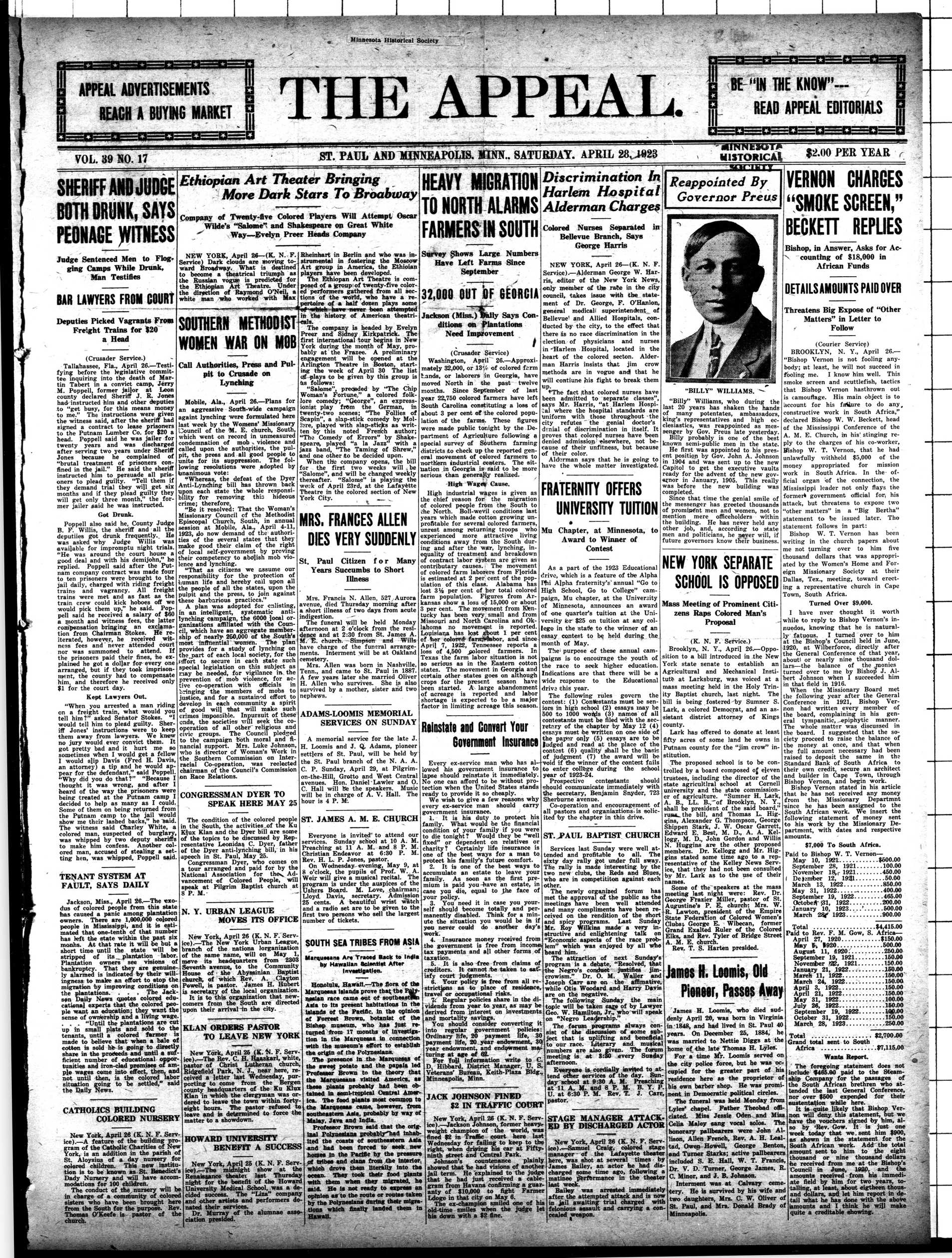
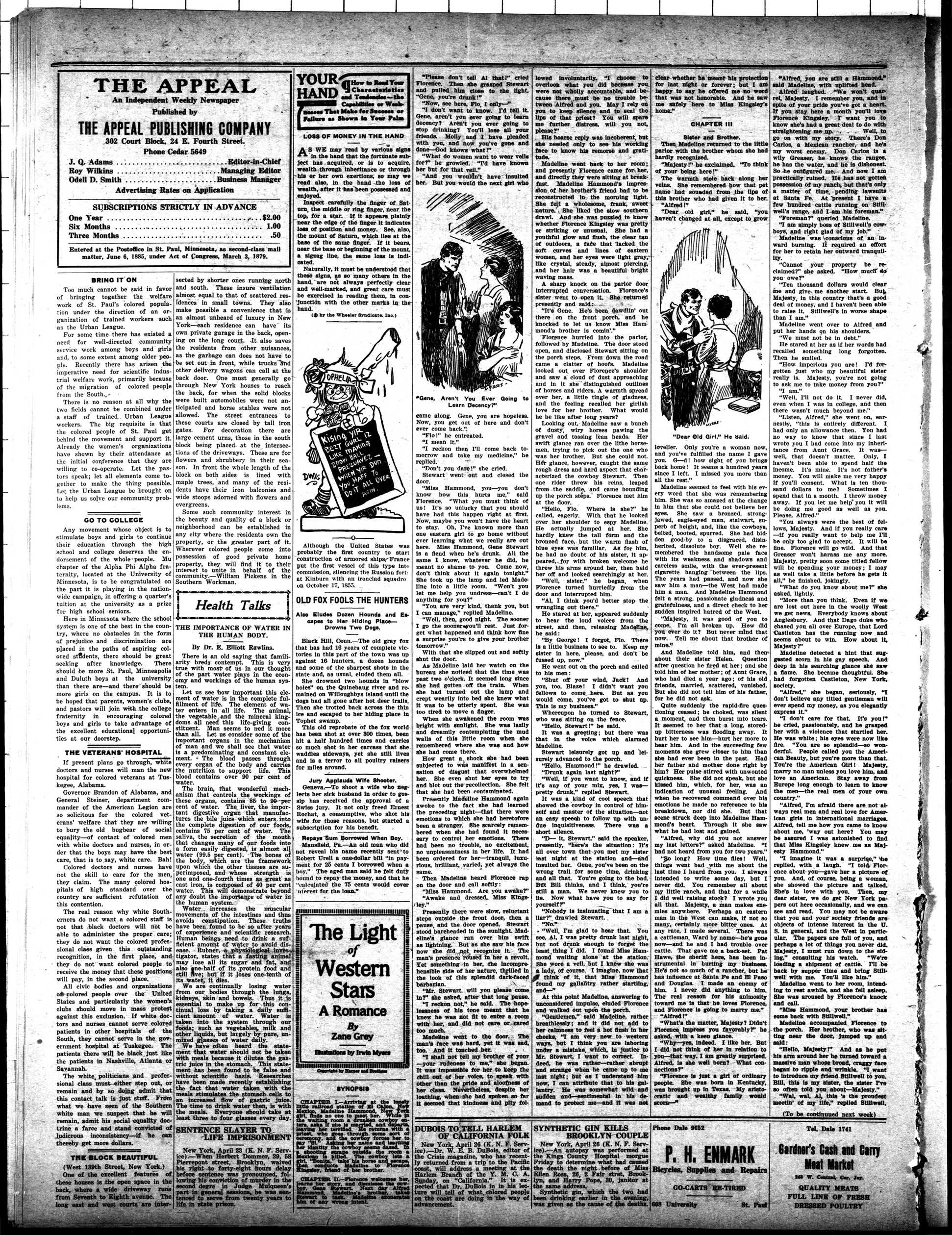
Page text (machine-generated)
APPEAL ADVERTISEMENTS
REACH A BUYING MARKET
VOL. 39 NO. 17
SHERIFF AND JUDGE
BOTH DRUNK, SAYS
PEONAGE WITNESS
Judge Sentenced Men to Flog-
ging Camps While Drunk,
Man Testifies
BAR LAWYERS FROM COURT
Deputies Picked Vagrants From
Freight Trains for $20
a Head
Ethiopian Art
More
Company of Twenty-
Wilde's "Salon
Way—I
NEW YORK, April 24
Service) Dark clouds are
ward Broadway. What
to become a theatrical
the Russian vogue is p
the Ethiopian Art The
the direction of Raymo
white man who worked
SOUTHERN MET
WOMEN WAR C
(Crusader Service.)
Tallahassee, Fla., April 26—Testifying before the legislative committee inquiring into the death of Martin Tabert in a convict camp, Jerry M. Poppell, former jailor at Leon county declared Sheriff J. R. Jones had instructed him and other deputies to "get busy, for this means money to me." The instructions were given to officers who signed a contract to lease prisoners to the Putnam Lumber Co. for $20 a head. Poppell said he was jailer for twenty years and was discharged after serving two years under Sheriff Jones because he complained of "brutal treatment of prisoners confined in the jail." He said the sheriff instructed him to persuade all prisoners to plead guilty. The officers and trial they will get six months and if they plead guilty they will get only three month" the former jailer said he was instructed.
Got Drunk.
Poppell also said he, County Judge B. F. Willis, the sheriff and all the deputies got drunk frequently. He was asked why Judge Willis was available for impromptu night trials, he was asked good deal and with his demijohn," he replied. Poppell said after the Putnam company contract was made four to ten prisoners were brought to the jail daily, charged with riding freight trains and no vagrancy. He was fast as the train crew could kick hoobes off we would pick them up," he said. Poppell said he received a salary of $60 a month and witness fees, the latter compensation bringing an exclamation from the sheriff, and it happened however he received witness fees and never attended court nor was summoned to attend. If the prisoners paid their fines, he explained he got a dollar for every one arranged, but if they took imprisonment he was sent to him, and therefore he received only $1 for the court day.
Kept Lawyers Out.
"When you arrested a man riding on a freight train, what would you tell him?" asked Senator Stokes. "I would tell him to plead guilty. She should keep them away from lawyers. We know no jury would ever convict them. It got pretty bad and it hurt me so sometimes when I would get a fellow I would slip Davis (Fred Davis, the pear for the defendant), would Poppell, "Why did you do you?" "Because I thought it was wrong, and after I heard of the way the prisoners were being treated at the Putnam camp, decide to help them, would the man being returned from the Putnam camp to the jail would show me their lashed backs," he said. The witness said Charley White, a colored man, suspected of burglary was whipped by deputy detective John Conniff. Another colored man, accused of stealing a setting hen, was whipped, Poppell said.
TENANT SYSTEM AT FAULT. SAYS DAILY
Jackson, Miss., April 28.—The exodus of colored people from this state has caused a panic among plantation owners. There are 1,000,000 colored people in Mississippi, and it is estimated that one-tenth of them within the past six months. At that rate it will be but a short time until the state will be stripped of its plantation labor. Plantation owners see visions of bankruptcy. That they are genuinely alarmed is indicated by the short to stop the migration by improving conditions on the plantations. . . . The Jackson Daily News quotes colored educational experts that the colored people want an education; they want the sense of ownership and a living wage. They want up in small plants and sold to the tenants, until a colored farmer is made to believe that when a bale of cotton is sold he is going to directly share in the proceeds and until a sufficient number of educational opportunities and iron-clad promotions are given, then, and not until then, is the colored labor situation going to be settled," said the Daily News.
CATHOLICS BUILDING
COLORED NURSERY
New York, April 26 (K. N. F. Service).—A feature of the building program of the Catholic Charities of New York, is an addition in the parish of New York to the school for colored children. This new institution is to be known as St. Benedict's Dady Nursery and will have accommodations for 100 children. The nursery will be in charge of a community of colored sisters who have been brought here from the South for the purpose. Rev. Thomas O'Keefe is pastor of the
THE APPEAL.
Ethiopian Art Theater Bringing More Dark Stars To Broabway
Company of Twenty-five Colored Players Will Attempt Oscar Wilde's "Salome" and Shakespeare on Great White Way—Evelyn Preer Heads Company
NEW YORK, April 26—(K. N. F. Service) Dark clouds are moving toward Broadway. What is destined to become a theatrical triumph as the Russian vogue is predicted for the Ethiopian Art Theatre. Under the direction of Raymond O'Neil, a white man who worked with Max
Riehainth in Berlin and who was instrumental in fostering the Moscow Art group in America, the Ethiopian players have been developed.
The Ethiopian Art Theatre is composed of a group of twenty-five colored performers gathered from all sections of the world, who have a re-
SOUTHERN METHODIST WOMEN WAR ON MOB
Call Authorities, Press and Pulpit to Crusade on Lynching
Mobile, Ala., April 26—Plans for an aggressive South-wide campaign against lynching were formulated here last week by the Womens' Missionary Council of the M. E. church, South, which went on record in unmeasured condemnation of mob, violence and called upon the authorities, the pulpit, the press and all good people to unite for its suppression. The following resolutions were adopted by "Whereas, the defeat of the Dyer Anti-Lynching bill has thrown back upon each state the whole responsibility for removing this hideous crime; therefore, That the Woman's Missionary Council of the Methodist Episcopal Church, South, in annual session at Mobile, Ala., April 4-11, 1923, do now demand of the authorities of the several states that they make good their claim of the light that they have brought by proving their competency to abolish mob violence and lynching.
"That as citizens we assume our responsibility for the protection of human life and hereby call upon all the people of all lands upon the press, to join against these harboring practices."
A plan was adopted for citing, in an intelligent, systematic antlynching campaign, the 6000 local organizations affiliated with the Council, which have an aggregate membership of nearly 250,000 of the South's most influential women in the community, the part of each local society, for the effort to secure in each state such special legislation on this subject as may be needed, for vigilance in the prevention of mob violence, for active co-operation with officials in bringing the members of mobs to justice, and for a sustained effort to prevent the spirit of good will that will make such crimes impossible. Impursuit of these ends, the societies will seek the cooperation of all other religious and civic groups. The Council pledged to the campaign both moral and financial support. Mrs. Luke Johnson who is director of Women's Work in the South's Commission on Inter-Communication, was reelected chairman of the Council's Commission on Race Relations.
CONGRESSMAN DYER TO
SPEAK HERE MAY 25
The condition of the colored people in the South, the activities of the Ku Klux Klan and the Dyer bill are some of the topics to be discussed by Representative Leonidas C. Dyer, father of the Dyer anti-lynching bill, in his speech in St. Paul, May 25. Congressman Dyer, the comes on a statement paid for by the National association for the Advancement of Colored People, will speak at Pilgrim Baptist church at 8 P. M.
N. Y. URBAN LEAGUE
MOVES ITS OFFICE
New York, April 26 (K.N. F. Service).—The New York Urban League, branch of the nationa lorganization of the same name, will on May 1, move its headquarters from 2303 Seventh avenue, to the Community House of the Abyssinian Baptist church of which it is the largest. James H. Hubert is secretary of the local organization. It is to this organization that newcomers from the South are directed upon their arrival in the city.
KLAN ORDERS PASTOR TO LEAVE NEW YORK
New York, April 25 (K. N. F. Service)—The Rev. C. H. Haasakar, white, pastor of Christ Lutheran church, Ridgefield Park, N. K., near here, reporting to come from the Buckingham county headquarters of the Ku Klux Klan in which the clergyman was ordered to leave the town within two weeks, and whose union was to leave and is determined to force the matter to a showdown.
HOWARD UNIVERSITY
BENEFIT A SUCCESS
New York, April 25 (K. N. F. Service).—The midnight show at the Renaissance theater last Thursday night for the benefit of the Howard University Medical School, "the firm" company and other artists and performers donated their services.
Dr. Murray of the alumnae asso-
Dr. Murray of the alumnae association presided.
Rheinheart in Berlin and who was instrumental in fostering the Moscow Art group in America, the Ethiopian players have been developed.
The Ethiopian Art Theatre is composed of a group of twenty-five colorful paintings of the world, who have a repertoire of a half dozen plays some of which have never been attempted in the history of American theatricals.
The company is headed by Evelyn Pemberton Sidney Kirkpatrick. The first international tour begins in New York during the month of May, probably at the Frazee. A preliminary engagement will be opened at the Arlington Theatre in Boston, starting the week of April 30. The list of plays to be given by this group is "Salome," preceded by "The Chip Woman's Fortune," a colored folklore comedy; "George," an expressionist play from the German, in twenty-two scenes; "The Follies of Scapin," a slap-stick comedy by Molière, in a comedy by Denis Benton by this noted French author; "The Comedy of Errors" by Shakespeare, played "a la Jazz" with a jazz band, "The Taming of Shrew," and one other to be decided upon.
When the company opens, the bill for the first two weeks will be "Salome," two will be added weekly thereafter. "Salome" is playing the week of April 23rd, at the Lafayette Theatre in the colored section of New York City.
MRS. FRANCES ALLEN
DIES VERY SUDDENLY
MRS. FRANCES ALLEN
DIES VERY SUDDENLY
St. Paul Citizen for Many Years Succumbs to Short Illness
Mrs. Francis N. Allen, 527, Aurora avenue, died Thursday morning after a short illness of two days from acute indigestion.
The funeral will be held Monday afternoon at 2 o'clock from the residence and at 2 o'clock from the church at Simpson and Wills have charge of the funeral arrangements. Interment will be at Oakland cemetery.
Mrs. Allen was born in Nashville, Tenn., and came to St. Paul in 1857. A four year survivor. She is also survived by a mother, sister and two nephews.
ADAMS-LOOMIS MEMORIAL
SERVICES ON SUNDAY
A memorial service for the late J. H. Loomis and J. Q. Adams, pioneer settlers of St. Paul, will be held by the St. Paul branch of the N. A. A. C. P. Sunday, April 29, at Pilgrim-on-the-Hill Grotto and West Central H. H. Hall Lawler and Lawler and C. Hall will be the speakers. Music will be in charge of A. V. Hall. The hour is 4 P. M.
ST. JAMES A. M. E. CHURCH
Everyone is invited to attend our services. Sunday school at 10 A. M. Preaching at 11 A. M. and 8 P. M. Christian Endeavor at 6:30 P. M. Rev. H. L. P. Jones, pastor. On Wednesday-evening, May 9, at 8 o'clock, the pupils of Prof. W. Weir will give a musical recital. The program is under the auspices of the Lovee, chairman, Lloyd Davis, secretary. Admission 25 cents. A beautiful wrist watch and a radio set are to be given to the first two persons who sell the largest number of tickets.
SOUTH SEA TRIBES FROM ASIA
Marqueesans Are Traced Back to India by Hawaiian Scientist After Investigation.
Honolulu, Hawaii—The flora of the Marqueesans islands prove that the Polynesian race came out of southeastern Asia to its present habitations in the islands of the Pacific, in the opinion of Forrest Brown, botanist of the Bishop museum, who has just returned from 17 months of investigation in the Marqueesan in connection with the museum's effort to establish the origin of the Polynesians.
The presence in the Marqueesans of the sweet potato of the papaia led the Brown to the theory that the Marqueesans visited America, as these plants probably had been obtained in semi-tropical Central America. The food plants most common to the Marqueesans came, however, from southeastern Asia, probably by way of Malay, Java and India.
Professor Brown said that the original Polynesians probably had inhabited the coasts of southeastern Asia and had been forced to seek new homes in the Pacific by the pressure of tribes and clans from the interior, which drove them literally into the ocean. They took their food plants with them when they migrated he said. He is not ready to express an opinion as to the route or routes taken by the Polynesians during their migrations which finally landed them in Hawaii.
HEAVY MIGRATION TO NORTH ALARMS FARMERS IN SOUTH
Jackson (Miss.) Daily Says Conditions on Plantations Need Improvement
Washington, April 28.—Approximately 22,000, or 13% of colored farm lands, or laborers in Georgia, have moved North in the past twelve months. Since September of last year 22,750 colored farmers have left South Carolina constituting a loss of about 3 per cent of the colored population of the farms. These figures were made public tonight by the Department of Agriculture following a special survey of Southern farming districts to check up the reported general movement of colored farmers to northern industrial centers. The situation in Georgia is said to be more serious than generally realized.
High Wages Cause
High industrial wages is given as the chief reason for the migration of colored people from the South to the North. Boll-weil conditions last years which made cotton growing unprofitable for several colored farmers, unrest among returnees, attraction living conditions away from the South during and after the war, lynching, inequality of treatment and breakdown of contract labor system are given as contributory causes. The movement of colored farm laborers from Florida is estimated at 2 per cent of the population, and the loss of 3% lost 3½ per cent of her total colored farm population. Figures from Arkansas show a loss of 15,000 or about 3 per cent. The movement from Kentucky has been very small and from Missouri and North Carolina and Oklahoma no movement is reported. The loss of 3 per cent of her colored farm laborer, and since April 7, 1922, Tennessee reports a loss of 4,500 colored farmers. In Texas the farm labor situation is not so serious as in the Eastern cotton states. The movement in Georgia and certain other states goes on although the farm laborer has been started. A large abandonment of acreage is reported and labor shortage is expected to be a major factor in limiting acreage this season.
Reinstate and Convert Your Government Insurance
Every ex-service man who has allowed his government insurance to lace should reinstate it immediately. No one can afford to be without protection when the United States stands ready to provide it so cheaply. We wish to present low reasons why every ex-service man should carry government insurance.
1. It is his duty to protect his family. What would be the financial condition of your family if you were to die young? Would you then depend on relatives or charity? Certainly life insurance is one of the best ways for a man to protect his family's future comfort.
2. It is one of the best ways to accumulate an estate to leave your family. As soon as the first premium is paid you have an estate, in case you die, equal to the face of your police. 3. You need it in case you yourself should become totally and permanently disabled. Think for a minute the situation you would be in if you never could do another day's work. Insurance money received from the government is free from income tax payments and all other forms of taxation. 5. It is also free from claims of creditors. It cannot be taken to satisfy court judgments. 6. Your policy is free from all restraints of residence, travel or occupational risks. 7. Regular policies share in the dividends from year to year, as may be derived from interest on investments and mortality savings. You should consider converting it into regular government policies (China, Japan, India, 30 payment life, 20 year endowment, 30 year endowment, and endowment maturing at age of 62).
For full information write to C.
D. Hibbard, District Manager, U. S.
Veterans' Bureau, Keith-Plaza Bldg.
Minneapolis, Minn.
JACK JOHNSON FINED
$2 IN TRAFFIC COURT
New York, April 26 (K. N. F. Service).—Jackson Johnson, former heavy-weight champion of the world, was fined $2 in Traffic court here last Wednesday for failing to keep to the right, when driving his car at Fifty-ninth street and Central Park. Johnson's countenance plainly showed that his division of another He said he had just received the judge that he had just received a cablegram from Havana confirming a guarantee of $10,000 to fight Farmer Lodge in that city on May 6. The ex-champion smiled one of his old-time smiles when the judge let his down with a $2 fine.
Discrimination In Harlem Hospital Alderman Charges
Colored Nurses Separated in Bellevue Branch, Says George Harris
NEW YORK, April 26—(K. N. F. Service)—Alderman George W. Harris, editor of the New York News, only member of the rate in the city council, takes issue with the statement of Dr. George, F. O'Hanlon, general medical superintendent of Bellevue' and Allied Hospitals, conducted by the city, to the effect that there is no race discrimination in the election of physicians and nurses in Harlem Hospital, located in the heart of the colored secton. Alderman Harris insists that jim crow methods are in vogue and that he will continue his fight to break them up.
"The fact that colored nurses have been admitted to separate classes", says Mr. Harris, "at Harlem Hospital where the hospital standards are uniform with those throughout the city refutes the medical doctor's discrimination." It proves that colored nurses have been denied admission elsewhere, not because of their unfitness, but because of their color. Alderman says that he is going to have the whole matter investigated.
FRATERNITY OFFERS UNIVERSITY TUITION
FRATERNITY OFFERS UNIVERSITY TUITION
Mu Chapter, at Minnesota, to Award to Winner of Contest
As a part of the 1923 Educational drive, which is a feature of the Alpha Phi Alpha fraternity's annual "Go to High School, Go to College" campaign, Mu chapter, at the University of Minnesota, announces an award of one quarter's tuition at the University or $25 on tuition at any college in the state to the winner of an essay contest to be held during the month of May.
The purpose of these annual campaigns is to encourage the youth of the race to seek higher education. Indications are that there will be a wide response to the Educational drive this year.
The following rules govern the contest: (1) Contestants must be seniors in high school (2) essays may be submitted by the University of Minnesota (3) contests must be filed with the secretary of the chapter by May 12 (4) essays must be written on one side of the paper only (5) essays are to be judged and read at the place of the contest (6) quality shall be the basis of judgment (7) awards will be given to the winner of the content falls to enter college during the school year of 1923-24.
Prospective contestants should communicate immediately with the secretary, Benjamin Snyder, 723 Sherburne avenue.
Both award and encouragement of all pastors and organizations is solicited by the chapter in this drive.
ST. PAUL BAPTIST CHURCH
Services last Sunday were well attended and profitable to all. The sixty day rally got under full sway. The rally is made interesting by the two new clubs, the Reds and Blues, who are in competition against each other.
The newly organized forum has met the approval of the public as the meetings have been well attended and many compliments have been received on the rendition of the short and spicy programs. Last Sunday Mr. Roy Wilkins made a very instructive and enlightening talk on Economic aspects of the race problem was enjoyed by all who heard him.
The attraction of next Sunday's program is a debate, "Resolved, that the Negro's conduct justifies jim-crowism." Dr. O. M. Waller and Joseph Carr are on the affirmative, while Otis Woodard and Harry Davis are on the negative. The following Sunday the main topic will be taken care of by Lawyer Geo. W. Hamilton, Jr., who will speak on "Negro Leadership."
The forum programs always consist of the discussion of some subject that is uplifting and beneficial to our race. Literary and musical numbers are also given. The forum meeting is at 8:30 every Sunday afternoon.
Everyone is cordially invited to attend the services of the day. Sunday school at 9:30 A. M. Preaching at 11 A. M. and 8 P. M. B. Y. P. U. at 6:30 P. M. Rev. T. J. Carr pastor.
STAGE MANAGER ATTACKED
BY DISCHARGED ACTOR
New York, April 26 (K. N. F. Service)—Samuel Craig, colored stage manager of the Lafayette theater here, was shot at several times by James Bailey, an actor he had discharged some time ago, following a matinee performance in the theater last week.
Bailey was arrested immediately after the attempted attack and is now awaiting trial charged with felonious assault and carrying a concealed weapon.
MINNESOTA
HISTORICAL
SOCIETY
Reappointed By Governor Preus
"BILLY" WILLIAMS.
"Billy" Williams, who during the last 20 years has shaken the hands of many potentates, ambassadors, king's representatives and high ecclesiastics, was reappointed as messenger by Gov. Preus late yesterday. Billy probably is one of the best
punishment in the state. He first punished the position by Gov. John A. Johnson in 1904 and was sent up to the new Capitol to get the executive vaults ready for the advent of the new governor in January, 1905. This reason, the new building was completed.
Since that time the genial smile of the messenger has greeted thousands of prominent men and women, not to mention mere offenceholders within the state, he has never held any other job, and men, women, men and politicians, he never will, if future governors know their business.
NEW YORK SEPARATE SCHOOL IS OPPOSED
NEW YORK SEPARATE SCHOOL IS OPPOSED
Mass Meeting of Prominent Citizens Raps Colored Man's
Proposal
Brooklyn, N. Y., April 26—Opposition to a bill introduced in the New York state senate to establish an Agricultural and Mechanical Institute at Larksburg, was voiced at a mass meeting held in the Holy Trinity Baptist church, last night. The bill is being fostered by Sumner S. Lark, a colored Democrat, and an assistant district attorney of Kings county.
Lark has offered to donate at least fifty acres of some land he owns in Putnam county for the "jim crow" institution.
The proposed school is to be controlled by a board composed of eleven trustees, including the director of the University I. W. O. Cornell university and the state commissioner of agriculture. "Sumner H. Lark, A. B., LL. B., of Brooklyn, N. Y., shall be president of the said board," runs the bill, and Thomas L. Higgins, Alexander G. Thompson, George Applegate I. W. O. Cornell, Edward E. Best, M. D. A. A. Kellogg, M. D. John Gordon and Willis N. Huggins are the other proposed members. Dr. Kellogg and Mr. Higgins stated some time ago to a representative of the Kelley News Service, that they had not been consulted. Lark as to the use of their names.
James H. Loomis, who died suddenly April 20, was born in Virginia in 1848, and had lived in St. Paul 40 years. On December 25, 1884, he was married to Nettie Diggs at the home of the late Thomas H. Lyles. For a time Mr. Loomis served on the city police force, but he was occupied for the greater part of his residence here as the proprietor of his own barber shop. He was prominent in Democratic political circles. The funeral was held Monday from Lyles' chapel. Father Theobad officiated. Miss Jessie Oden and Miss Celia Maley sang vocal solos. The honorary pallbearers were John Allison, Allen French, Rev. A. H. Leal-tad, Owen Howell, George Benton, and Turner Starks; active pallbearers included S. E. Hall, W. T. Francis, Dr. V. D. Turner, George James, R. C. Minor, and J. B. Johnson. Interment was at Calvary cemetery. He is survived by his wife and two daughters, Mrs. C. W. Oliver of St. Paul, and Mrs. Donald Brady of Minneapolis.
$2.00 PER YEAR
VERNON CHARGES "SMOKE SCREEN," BECKETT REPLIES
Bishop, in Answer, Asks for Accounting of $18,000 in African Funds
DETAILS AMOUNTS PAID OVER
Threatens Big Expose of "Other Matters" in Letter to Follow
(Courier Service)
BROOKLYN, N. Y., April 26—"Bishop Vernon is not fooling anybody; at least, he will not succeed in fooling me. I know him well. This smoke screen and scuttlefish, tactics that Bishop Vernon has thrown out is camouflage. His main object is to account for his failure to do any constructive work in South Africa," declared Bishop W. W. Beckett, head of the Mississippi Conference of the A. M. E. Church, in his stinging reply to the charges of his co-worker, Bishop W. T. Vernon, that he had unlawfully withheld $5,000 of the money appropriated for mission work in South Africa. In the official organ of the connection, the Mississippi leader not only flays the former government official for his attack, but threatens to expose two "other matters" in a "Big Bertha" statement to be issued later. The statement follows in part:
Bishop W. T. Vernon has been writing in the church papers about me not turning over to him five thousand dollars that was appropriated by the Women's Home and Foreign Missionary Society at their Dallas, Tex., meeting, toward erecting a representative church in Cape Town, South Africa.
Turned Over $9,000.
I have never thought it worth while to reply to Bishop Vernon's inquired, knowing that he is naturally fatuous. I turned over to him at the Bishop's Council held in June, 1920, at Wilberforce, directly after the General Conference of that year, about or nearly nine thousand dollars—the balance of the money he gave Bishop J. Albert Johnson when succeeded him in that field in 1916.
When the Missionary Board met the following year after the General Conference in 1921, Bishop Vernon sent a letter to Bishop J. Albert Johnson complaining in his general tympanic, epiphytic manner. The whole matter was discussed in the board. I suggested that the society proceed to raise the balance of the money at once, and the council necessary had been raised to deposit the same in the Standard Bank of South Africa to their own credit, secure an architect and builder in Cape Town, through Bishop Vernon, and begin work. The article that he has not received any money from the, Missionary Department since he has been assigned to the South African work. We insert the following statement of money sent to his work by the Missionary Department with dates and respective amounts.
$7,000 To South Africa.
Paid to Bishop W. T. Vernon-
May 10, 1922 $600.00
November 28, 1921 .100.00
November 18, 1921 .450.00
December 12, 1921 .50.00
March 13, 1922 .850.00
May 31, 1922 .400.00
September 19, 1922 .465.00
October 31, 1922 .200.00
January 10, 1923 .500.00
March 28* 1923 .900.00
Total $4,145.00
Paid to Rev. F. M. Gow, S. Africa-
April 27, 1920 $150.00
May 5, 1920 .500.00
August 11, 1920 .250.00
September 10, 1921 .150.00
November 28, 1921 .150.00
January 12, 1922 .150.00
March 11, 1922 .150.00
March 24, 1922 .150.00
April 3, 1922 .150.00
April 31, 1922 .150.00
July 26, 1922 .150.00
September 19, 1922 .100.00
October 31, 1922 .150.00
March 28, 1923 .250.00
Total $2,700.00
Grand total sent to South
Africa $7,115.00
Wants Report.
The foregoing statement does not
include $465.00 paid to the Steam-
ship Company for the passages of
the South African hethet on the
Steamship Conference,
nor over $500 expended for their
ustenuation while here.
It is quite likely that Bishop Vernon will deny this statement, but we have the vouchers signed by him, also by 'Rev. Gow. It is just one week today that we sent him $900, as shown on the statement, and the priest would add the total amount sent to him to the eight thousand and nine thousand dollars the received from me at the Bishop's Council in June, 1920, and the amounts received from his immediate field by him for two years, totalling, at least, about eighteen thousand dollars, to tail what he has done with the above amounts and I think he will make quite a creditable showing.
J. Q. Adams ..... Editor-in-Chief
Roy Wilkins ..... Managing Editor
Odell D. Smith ..... Business Manager
Entered at the Postoffice in St. Paul, Minnesota, as second-class mail matter, June 6, 1885, under Act of Congress, March 3, 1879.
BRING IT ON
Too much cannot be said in favor of bringing together the welfare work of St. Paul's colored population under the direction of an organization of trained workers such as the Urban League. For some time there has existed a need for well-directed community service work among boys and girls and, to some extent among older people. Recently there has arisen the imperative need for scientific industrial welfare work, primarily because of the migration of colored people from the South.
There is no reason at all why the two fields cannot be combined under a staff of trained. Urban League workers. The big requisite is that the colored people of St. Paul get behind the movement and support it. Already the women's organizations have shown by their attendance at the initial conference that they are willing to co-operate. Let the pastors speak; let all elements come together to make the thing possible. Let the Urban League be brought on to help us solve our community problems.
GO TO COLLEGE
Any movement whose object is to stimulate boys and girls to continue their education through the high school and college deserves the endorsement of the whole people. Much chapter of the Alpha Phi Alpha fraternity, located at the University of Minnesota, is to be congratulated on the part it is playing in the nation-wide campaign, in offering a quarter's tuition at the university as a prize for high school seniors.
Here in Minnesota where the school system is one of the best in the country, where no obstacles in the form of prejudice and discrimination are placed in the paths of aspiring colored students, there should be great seeking after knowledge. There should be more St. Paul, Minneapolis and Duluth boys at the university than there are—and there should be more girls on the campus. It is to be hoped that parents, women's clubs, and pastors will join with the college fraternity in encouraging colored boys and girls to take advantage of the excellent educational] opportunities at our doorstep.
THE VETERANS' HOSPITAL
If present plans go through, white doctors and nurses will man the new hospital for colored veterans at Tuskegee, Alabama.
Governor Brandon of Alabama, and General Steiner, department commander of the American Legion are so solicitous for the colored veterans' welfare that they are willing to bury the old bugbear of social equality—of contact of colored men with white doctors and nurses, in order that the boys may have the best care, that is to say, white care. Bahh Colored doctors and nurses have not the skill to care for the men, they claim. The many colored hospitals of high standard over the country are sufficient refutation of this contention.
The real reason why white Southerners do not want a colored staff is not that black doctors will not be able to administer the proper care; they do not want the colored professional class given this outstanding recognition, in the first place, and they do not want colored people to receive the money that these positions will pay, in the second place. All civic bodies and organizations colored people over the United States and particularly the women's clubs should move in mass protest against this exclusion. If white doctors and nurses cannot serve colored patients in other hospitals of the South, they cannot serve in the government hospital at Tuskegee. The patients there will be black just like the patients in Nashville, Atlanta or Savannah.
The white politicians and professional class must either step out, or remain and by so doing admit that this contact talk is just stuff. From what we have seen of the Southern white man we suspect that he will remain, admit his social equality doctrine a force and stand convicted of ludicrous inconsistency—if he can thereby get more dollars.
THE BLOCK BEAUTIFUL
(West 138th Street, New York.)
One of the excellent features of these houses is the open space in the back, where a wide driveway runs from Seventh to Eighth avenue. The long east and west courts are inter-
sected by shorter ones running north and south. These insure ventilation almost equal to that of scattered residences in small towns. They also make possible a convenience that is an almost unheard of luxury in New York—each residence can have its own private garage in the back, opening on the long court. It also saves the residents from other nuisances, as the garbage can does not have to be set out in front, while trucks and other delivery wagons can call at the back door. One must generally go through New York houses to reach the back, for when the solid blocks were built automobiles were not anticipated and horse stables were not allowed. The street entrances to these courts are closed by tall iron gates. For decoration there are large cement urns, those in the south block being placed at the intersections of the driveways. These are for flowers and shrubbery in their season. In front the whole length of the block on both sides is lined with maple trees, and many of the residents have their iron balconies and wide stoops adorned with flowers and evergreens.
Some such community interest in the beauty and quality of a block or neighborhood can be established in any city where the residents own the property, or the greater part of it. Wherever colored people come into possession of good private home property, they will find it to their interest to unite in behalf of the community. William Pickens in the Southern Workman.
Health Talks
THE IMPORTANCE OF WATER IN THE HUMAN BODY.
By Dr. E. Elliott Rawlins.
There is an old saying that familiar breeds contempt. This is very true with most of us in our thought of the part water plays in the economy and workings of the human system.
Let us see how important this element of water is in the complete fulfillment of life. The element of water is the vegetable, the animal, the vegetable and the mineral kingdoms all need this life-giving constituent. Man seems to nid it more than all. Let us consider some of the important organs in the mechanism of man and we shall see that water is a predominating and constant element. The blood passes through every organ of the body and carries the nutrition to support life. This blood contains over 90 per cent of water.
The brain, that wonderful mechanism that controls the workings of these organs, contains 85 to 90 per cent of water. The liver, the important digestive organ that manufactures the bile juice which enters into the complete digestion of our foods, the stomach, the saliva, the secretion of the mouth that changes many of our foods into a form easily digested, is almost all water (99.5 per cent). The bones of the body, which are the framework upon which the other tissues are superimposed, and whose strength is one and one-fourth times as great as cast iron, is composed of 40 per cent of water. Any doubt the importance of water in the human system.
Water increases the muscular movements of the intestines and thus avoids constipation. These truths have been found to be so after years of experience and scientific research thatulum is drilled to sufficient amount of water to avoid disease. Rubner, a physiological investigator, states that a fasting animal may lose all its sugar and fat, and also one-half of its protein food and still live; but if it loses one-tenth of its water we are continually losing water from our bodies through the lungs, kidneys, skin and bowels. Thus it is essential to make up for this continual loss by taking a daily sufficient amount of water. Water is the main food foods, such as vegetables, milk and other liquids, but largely by pure, unmixed glasses of water daily.
We have often heard the statement that water should not be taken with meals because it dilutes the gastric juice in the stomach. This statement has been found to be false and without scientific basis. Researchers have been made recently establishing that meals stimulates the stomach cells to an increased flow of gastric juice. The time to drink water then, is with the meals. Everyone should take at least three to four glasses every day
SENTENCE SLAYER TO
LIFE IMPRISONMENT
New York, April 23 (K. N. F. Service)—When Herbert Dommer, 29, 58 Pierrepont street, Brooklyn, waived before sentence was pronounced, before sentence was pronounced, following his conviction of murder in the second degree in Judge Mulqueen's part in general sessions, he was sentenced to twenty years to life in state prison.
YOUR HAND
How to Read Your Characteristics and Timelessness—the Capabilities or Workness That Make for Success or Failure as Shown in Your Palm
LOSS OF MONEY IN THE HAND
AS WE may read by various signs in the hand that the fortunate subject has acquired, or is to acquire, wealth through inheritance or through his or her own exertions, so may we read also, in the hand the loss of wealth, after it has been possessed and enjoyed.
Inspect carefully the finger of Saturn, the middle or ring finger, near the top, on a star. If it appears plainly the edge of the finger it indicates loss of position and mood. So, the mount of Saturn, which lies at the base of the same finger. If it bears, near the base or beginning of the mount, a zigzag line, the same loss is indicated.
Naturally, it must be understood that these signs, as so many others in the hand, are not always perfectly clear and well-marked, and great care must be exercised in reading them, in conjunction with the other marks in the hand.
(@ by the Wheeler Syndicate, Inc.)
OPHELIA
KISSING VIP
BEST GURL 12
LIKE MAKING
2DOWN BALL
PRECURSE?
WHEN VIP DUN
YOU HAFF TO
DO IT ALL OVER
ARIN.
Although the United States was probably the first country to start construction of armored ships:France put the first vessel of this type into service in 1809 and the Russian fort at Kinkun with an iron squadron on October 17, 1855.
OLD FOX FOOLS THE HUNTERS
Also Eludes Dozen Hounds and Escapes to Her Hiding Place—Drowns Two Dogs.
Black Hill, Conn.—The old gray dog that has had 16 years of complete victories in this part of the town was up against 16 hunters, a dozen hounds and some of the sharpest shots in the state and, as usual, eluded them all.
She drowned two hounds in "blow holes" on the Quinabue river and remained on Willoughby island until the dogs had all gone after hot deer trails. Then she trotted back across the thin ice and escaped to her hiding place in Tophet swamp.
This old reprobate of the fox world has been shot at over 300 times, been hit a half hundred times and carries so much shot in her carcass that she waddles sideways, yet she still lives and is a terror to all poultry raisers for miles around.
Jury Appointed Wife Shoots.
Geneva.—To shoot a wife who neglects her sick husband in order to gossip has received the approval of a Swiss jury. It not only freed Ernest Rochat, a consumptive, who shot his wife for those reasons, but started a subscription for his benefit.
Repay Sum Borrowed When Boy
Sprayfield, Pa—An old man who did not reveal his name recently sent to Robert Urell a one-dollar bill "in payment for 25 cents I borrowed when a boy." The aged man said he felt duty bound to repay the money, and that he "calculated the 75 cents would cover interest for the loan."
The Light
of
Western
Stars
A Romance
By
Zane Grey
Illustrations by Irwin Myers
Copyright by Harger and Bouttana
CHAPTER 1 - Arriving at the lovely little railroad station of El Cajon, New Mexico, Madeline Hammond, New York, where she met the waiting room a drunken cowboy entails, asks if she is married, and departs. The terrifying story of priests who were through a sort of ceremony, and the cowboy forces her to say "Bil." Asking her name and learning a shooting escape outside the room a Mexican is killed. The cowboy lets a girl, "Bonita," take his horse and escape, Kingston, friend of her brother.
"Please don't tell Al that!" cried Florence. Then she sheared Stewart and pulled him close to the light, "Gene, you're drunk!" "Now, see here, Flo, I only—" "I don't want to know. I'd tell it. Gene, aren't you ever going to learn decency? Aren't you ever going to stop drinking? You'll lose all your friends. Molly and I have pleaded with you, and now you've gone and knows what I said." "What do you need to wear vells for?" he growled. "I have known her but for that vell." "And you wouldn't have insulted her. But you would the next girl who
1925
"Gene, Aren't You Ever Going to Learn Decency?"
came along. Gene, you are hopeless.
Now, you get out of here and don't ever come back."
"Flo!" he entreated.
"I mean it."
"I reckon then I'll come back to tomorrow and take my medicine," he replied.
"Don't you dare!" she cried.
Stewart went out and closed the door.
"Miss Hammond, you—you don't know how this hurts me," said Florence. "What you must think of us! It is so unlucky that you should have had this happen right at first. Now, maybe you won't have the heart to stay. Oh, I've known more than one eastern girl to go home without ever learning what we really are out here. Miss Hammond, Gene Stewart is a flend when he's drunk. All the same I know, whatever he did, he meant no shame to you. Come now, don't think about it again tonight." She took up the lamp and led Madeline into a little room. "Won't you let me help you undress—can't I do anything for you?" "You are very kind, thank you, but I can manage, wrap Madeline. When you are good night. The sooner I go the sooner you'll rest. Just forget what happened and think how fine a surprise you're to give your brother tomorrow." With that she slipped out and softly shut the door.
As Madeline laid her watch on the bureau she noticed that the time was past two o'clock. It seemed long since she had gotten off the train. When she had turned out the lamp and creeply into bed she knew what it was to be utterly spent. She was too tired to move a finger. When she awakened the room was bright with sunlight. She was lazily and dreamily contemplating the mud walls of this little room when she remembered where she was and how she had come there. How great a, shock she had been subjected to was manifest in a sensation of disgust that overwhelmed her. She even shut her eyes to try and blot out the recollection. She felt that she had been contaminated.
Presently Madeline Hammond again awoke to the fact she had learned the preceding night—that there were emotions to which she had heretofore been a stranger. She scarcely remembered when she had found it necessary to control her emotions. There had been no trouble, no excitement, no unpleasantness in her life. It had been ordered for her—tranquil, luxurious, brilliant, varied, yet always the same.
Then Madeline heard Florence rap on the door and call softly: "Miss Hammond. Are you awake?" "Awake and dressed, Miss Kingley." Presently there were slow, reluctant steps outside the front door, then a pause, and the door opened. Stewart preheated in the sunlight. Madeline's glance ran over him swift as lightning. But as she saw his face now she did not recognize it. The man's presence resumed in her a revolt. Yet something in her, the incomprehensible side of her nature, thrilled in the look of this splendid dark-faced barbarian.
"Mr. Stewart, will you please come in?" she asked, after that long pause. "I reckon not," he said. The hopelessness of his tone meant that he knew he was not fit to enter a room with her, and did not care or care too much. Madeline went to the door. The man's face was hard, yet it was sad, too. And it touched her. "I shall not tell my brother of your—your rudeness to me," she began. It was impossible for her to keep the chill out of her voice, to speak with other than the pride and aloofness of her class. Nevertheless, despite her loathing, when she had spoken so far it seemed that kindness and pity fol-
DUBOIS TO TELL HARLEM OF CALIFORNIA FOLK New York, April 26 (K. N. F. Service), Dr. W. E. B. DuBois, editor of the Crisis magazine, who has recently returned from a trip to the Pacific coast, will address a meeting at the Harlem Branch of the Y. M. C. A. Sunday, on "California." It is expected that Dr. E. DuBois, editor of the Colored people on the coast are doing in the way of advancement
lowed involuntarily. "I choose to overlook what you did because you were not wholly accountable, and because there, must be no trouble between Alfred and you. May I rely on you to keep silence and to seal the lips of that priest? You will spare me further distress, will you not, please?" His response reply was incoherent, but she needed only to see his working face to know his remorse and gratitude.
Madeline went back to her room; and presently Florence came for her, and directly they were sitting at breakfast. Madeline Hammond's impression of her brother's friend had to be reconstructed in the morning light. She felt a wholesome, frank, sweet nature. She liked the slow southern drawl. And she was puzzled to know whether Florence Kingley was pretty or striking or unusual. She had a youthful glow and flush, the clear tan of outdoors, a face that lacked the soft curves and lines of eastern women, and her eyes were light gray, like crystal, steady, almost piercing, and her hair was a beautiful bright waving mass.
A sharp knock on the parlor door interrupted conversation. Florence's sister went to open it. She returned presently and said:
"It's Gene. He's been dawdlin' on there on the front porch, and he knocked to let us know Miss Hammond's brother is comin'"
Florence hurried into the parlor, followed by Madeline. The door stood open, and disclosed Stewart sitting on the porch steps. From down the road came a clatter of hoofs. Madeline looked out over Florence's shoulder and saw a cloud of dust approaching and in it she distinguished outlines of horses and riders. A warm spread of breath and the feeling recalled her girlish love for her brother. What would he be like after long years? Looking out, Madeline saw a bunch of dust, wry horses pawing the gravel and tossing lean heads. Her swift glance ran over the lthe horsemen, was to pick out the one who was her brother. But she could not. Her glance, however, caught the same rough dress and hard aspect that characterized the cowboy Stewart. Then she came from the saddle, and came bouncing up the porch steps. Florence met him at the door.
"Hello, Flo. Where is she?" he called, eagerly. With that he looked over her shoulder to espy Madeline. He actually jumped at her. She hardly knew the tall form and the bronzed face, but the warm flash of blue eyes was familiar. As for him, he had no doubt of his sister, it appeared, for with broken welcome he had to leave her, then hold her off and looked searchingly at her, "Well, sister," he began, when Florence turned hurriedly from the door and interrupted him.
"Al, I think you'd better stop the wrangling out there."
He stared at her, appeared suddenly to hear the loud voices from the street, and then, releasing Madeline, he said:
"By George! I forgot, Flo. There is little business to see to. Keep my sister in here, please, and don't be fussed up, now."
He went out on the porch and called to his men:
"Shut off your wind, Jack! And you, too, Blaze! I didn't want you fellows to come here. But as you would come, you've got to shut up. This is my business."
Whereupon he turned to Stewart, who was sitting on the fence. "Hello, Stewart!" he said.
It was a greeting; but there was that in the voice which alarmed Madeline.
Stewart lensurely got up and leturely advanced to the porch.
"Hello, Hammond!" he dreaded.
"Drunk again last night?"
"Well, if you want to know, and if it's any of your mix, yes, I was—pretty drunk," replied Stewart.
It was a kind of cool speech that shouted, "I'm the kind of self- and master of the situation—not an easy speech to follow with unde inquisitiveness. There was a short silence.
"—It, Stewart," the speaker, presently, "here's the situation: It's all over town that you met my sister last night at the station and—and insulted her. Gene, you've been on the wrong trail for some time, drinking and all that. You're going to the bad. Bott Bill thinks, and I think, you're still a man. We never knew you to lie. Now what have you to say for yourself"
"Nobody is insinuating that I am an iliar" drawled Stewart.
"No."
"Well I'm glad to hear that. You see, I was pretty drunk last night, but at drunk enough to forget the last thing I did. I found Miss Hammond waiting alone at the station. She wore a well, but I knew she was a lady, of course. I imagine, now that think of it, that Miss Hammond found my gallantry rather startling, and—"
At this point Madeline, answering to unaccompanied impulse, eluded Florence and walked out upon the porch.
"Gentlemen," said Madeline, rather breathlessly; and it did not add to her calmness to feel a hot淋 in her cheeks, "I am very new, to western ways, but I think you are laboring under a mistake, which, in justice to Mr. Stewart, I want to correct. Indeed, he was rather-rather abrupt and strange when he came up to me last night; but as I understand him now, I can attribute to his galantry. He was somewhat wild and sudden and-sentimental in his demand to protect me—and it was not
BROOKLYN COUPLER
New York, April 26 (K. N. F. Service).
An autopsy was performed at the Killen House on Friday to determine what had caused the death the night before of Miss Ellen Ross, 26, 2 Fairstreet, Brooklyn, and Harry Pope, 30, jailor at the same address. Which the two had been drinking earlier in the evening, was given as the cause of the deaths.
clear whether he meant his protection for last night or forever; but I am happy to say he offered me no word that was not honorable. And he saw me safely here to Miss Kingaley's home."
CHAPTER IIII
Sister and Brother.
Then Madeline returned to the little parlor with the brother whom she had hardly recognized. "Majesty!" he exclaimed. "To think of your being here!" The warmth stole back along her veins. She remembered how that pet name had sounded from the lips of this brother who had given it to her. "Alfred!" "Dear old girl" he said, "you haven't changed at all, except to grow
MYERS
"Dear Old Girl!" He Said.
lovelyer. Only you are a woman now, and you've filled the name I gave you. G—d! how sight of you brings back home! It seems a hundred years since I left. I missed you more than all the rest.
Madeline seemed to feel with his every word that she was remembering him. She was so amazed at the change in him that she could not believe her eyes. She saw a bronzed, strong-jawed, eagle-eyed man, stalwart, superb of height, and, like the cowboys, belted, booted, spurred. She had hidden good-by to a disgraced, disinherited, dissolute boy. Well she remembered the handsome pale face with its weakness and shadows and careless smile, with the ever-present hanging between the lips. The The. She saw him a man—the West had made him a man. And Madeline Hammond felt a strong, passionate giddiness and gratefulness, and a direct check to her hidden inspired hatred of the West.
"Majesty, it was good of you to come. I'm all broken up. How did you ever do it? But never mind that now. Tell me about that brother of mine."
And Madeline told him, and then about their sister Helen. Question after question he fired at her; and she told him of her mother; of Aunt Grace, of her brother; of friends, married, scattered, vanished. But she did not tell him of his father, for he did not ask.
Quite suddenly the rapid-fire questioning ceased; he choked, was silent a moment, and then burst into tears. It seemed to her that a long, stored-up bitterness was flooding away. It hurt her to see him—hurt her more to hear him. And in the succeeding few moments she grew closer to him than she had ever been in the past. Had her father and mother done right by him? Her pulse stirred with unwonted quickness. She did not speak, but she kissed him, which, for her, was an indication of unusual feeling. And when he recovered command over his emotions he made no reference to his mother. He scene struck deep into Madeline Hammond's heart. Through it she saw what he had lost and gained.
"Alfred, why did you not answer my last letters?" asked Madeline, "I had not heard from you for two years."
"So long? How time flies! Well, things went bad with me about the last time I heard from you. I always intended to write some day, but I never did. You remember all about my little ranch, and that for a while I did well raising stock? I wrote you all that. Majesty, a man makes enemies anywhere. Perhaps an eastern man in the West can make, if not so many, certainly more bitter ones. At any rate, I made several. There was a cattleman, Ward by name—he's gone now—and he had I trouble over cattle. That gave me a back-set. Pat Hawe, the sheriff here, is not instrumental in hurting my business. He's not so much of a rancher, but he has influence at Santa Fe and El Paso and Douglas. I made an enemy of him. I never did anything to him. The real reason for his animosity toward me is he loves Florence, and Florence is going to marry me." "Alfred!" "What's the matter, Majesty? Didn't Florence impress you favorably" he asked, with a keen glance.
"Why--yes, indeed. I like her. But I did not think of her in relation to you--that way. I am greatly surprised. Alfred, is she well born? What connections?" "Florence is just a girl of ordinary people. She was born in Kentucky, was brought up in Texas. My aristocratic and wealthy family would scorn."
"Alfred, you are still a Hammond," said Madeline, with upright head.
Alfred laughed. "We won't quarrel, Majesty. I remember you, and in spite of your pride you've got a heart. If you stay here a month you'll love Florence Kingsley. I want you to know she's had a great deal to do with straightening me up. . . . Well, to go on with my story. There's Don Carlos, a Mexican rancher, and he's my worst enemy. Don Carlos is a wily Greaser, he knows the ranges, he has the water, and he is dishonest. So he outfured me. And now I am practically ruined. He has not gotten possession of my ranch, but that's only a matter of time, pending lawsuits at Santa Fe. At present I have a few hundred cattle running on Stillwell's range, and I am his foreman." "Foreman" quoted Madeline. "I am simply boss of Stillwell's cowboys, and right glad of my job." Madeline was conscious of an inward burning. It required effort for her to retain her outward tranquility. "Cannot your property be reclaimed?" she asked. "How much do you owe?"
"Ten thousand dollars would clear me and give me another start. But Majesty, in this country that's a good deal of money, and I haven't been able to raise it. Stillwell's in worse shape than I am."
Madeline went over to Alfred and put her hands on his shoulders.
"We must not be in debt."
He stared at her as if her words had recalled something long forgotten. Then he smiled.
"How imperious you are! I'd forgotten just who my beautiful sister really is. Majesty, you're not going to ask me to take money from you?"
"I am."
"Well, I'll not do it. I never did, even when I was in college, and then there wasn't much beyond me."
"Listen, Alfred," she went on, earnestly, "this is entirely different. I had only an allowance then. You had no way to know that since I last wrote you I had come into my inheritance from Aunt Grace. It was—well, that doesn't matter. Only, I haven't been able to spend half the income. It's mine. It's not father's. You're making me very happy if you'll consent. What is ten thousand dollars to me? Sometimes I spend that in a month. I throw money away. If you let me help you it will be doing me good as well as you, Please, Alfred." "You always were the best of fellows, Majesty. And if you really care—if you really want to help me I will be only too glad to accept. It will be fine. Florence will go wild. And that Greaser won't harass me any more. Majesty, pretty soon some titled fellow will take a little longer money; I may as well take a little longer he gets it all," he finished, jokingly.
"What do you know about me?" she asked, lightly.
"More than you think. Even if we are lost out here in the woolly West we get news. Everybody knows about Anglesbury. And that Dago duke who chased you all over Europe, that Lord Castleton has the running now and seems about to win. How about it, Majesty?" Madeline detected a hint that suggested scorn in his gay speech. And deep in his searching glance she saw a flame. She became thoughtful. She had forgotten Castleton, New York, society.
"Alfred," she began, seriously, "I don't believe any titled gentleman will ever spend my money, as you elegantly press it."
"I don't care for that. It's you!" he cried, passionately, and he grasped her with a violence that startled her. He was white; his eyes were now like fire. "You are so splendid—so wonderful. People called you the American Beauty, but you're more than that. You're the American Girl! Majesty, marry no man unless you love him, and love an American. Stay away from Europe long enough to learn to know the men—the real men of your own country." Alfred, I'm afraid there are not always real men and real love for American girls in international marriages. Alfred, tell me how you came to know about me, 'way out here? You may be assured I was astonished to find that Miss Kingsley knew me as Majesty Hammond."
"I imagine it was a surprise," the replied, with a laugh. "I told Florence about you—gave her a picture of you. And, of course, being a woman, she showed the picture and talked. She's in love with you. Then, my dear sister, we do get New York papers out here occasionally, and we can see and read. You may not be aware that you and your society friends are objects of intense interest in the U. S. in general, and the West in particular. The papers are full of you, and perhaps a lot of things you never did, Majesty, I must run down to the sliding," consulting his watch. "We're loading a shipment of cattle. I'll be back by supper time and bring Stillwell with me. You'll like him. Madeline went to her room intending to eat awhile, and she fell asleep. She was aroused by Florence's knock and call.
"Miss Hammond, your brother has come back with Stillwell."
Madeline accompanied Florence to the porch. Her brother, who was sitting near the door, jumped up and said:
"Hello, Majesty!" And as he put his arm around her he turned toward a massive man whose broad, craggy face began to ripple and wrinkle. "I want to introduce my friend Stillwell to you. Bill, this is my sister, the sister Ive so often told you about - Majesty."
"Wal, wal, Al, this 's the proudest meetin' of my life" replied Stillwell, (To be continued next week)
;
aaa
RI I
) ome On ee | Ky
A ee
| ACC Co
Sa | SmiMr,
| Ser AVA ENV A
|
) your VIGTROLA «14
| VICTOR RECORDS.
We. Dyer & Bros.
Pianos i sasankouas! ‘ Sheet Music
HELP US CELEBRATE
Reception And Dance
SL Paul Business League
UNION HALL
PRIDAY EVE'G, MAY 4
= ee
EVERYBODY INVITED
ST. PAUL. .
WEEK'S RECORD OF HAPRENINGS
"IN MINNESOTA'S ‘CAPITAL.
The “Saintly City” and\Saintly City
Folke—Neway Items.of Social, Re-
ligious, Political and.General- Mat-
ters Among the People.
SATURDAY, APRIL 28, 1923,
THE APPEAL ASKS AS. A SPE-
TIAL FAVOR THAP-1TS READERS
+IVE Se, ‘TO ‘THE. AD-
VERTISERS WHO SEEK ‘THEIR
PATRONAGE BY ADVERTISING
IN IT. SHOP IN THE APPEAL
BEFORE SHOPPING ELSEWHERE.
Mr. Hubert Strong left last week
for Towa to enter the garage busi-
ness.
Mrs. Carrie Gilyard of Farrington
avenue is recovering from an attack
of la grippe.
Mr. Chas. Bradley of St. Anthony,
who had a paralytic stroke recently is
much improved.
The 0. N. 7. #00 Club suet. Bsiday
afternoon with Mrs. F. Scott, 325 N.
Chatsworth, street. re
Mr. C, H, Miller was a dinner guest
last Saturday at the home of Mr.
and Mrs, G. Mundell, 417 Rondo St.
The City Federation held an_im-
portant business meting Friday after-
noon at the “Y” center.
Mrs. D. S. Taylor of 1474 Charles
street, who spent the winter’ in Cali-
fornia has returned to the city.
PIONEER LODGE NO. 1, F. AND A.M.
meets first and third Monday” in each month
At Masonic Hall, 658 Ronde St, at 8:00" P.
M.: GW. Le Jackson, W. ML: J. H. Dilling:
ham, Secy., 669 Rondo St, Tel. Dale 0872.
Office: Cedar 0508 Res.: Dale 2947
Res.: 678 St. Anthony Ave,
MRS. T. H. LYLES
— Successor to
T. H. LYLE UNDERTAKING Co.
150 W. Fourth St. ST. PAUL
Mrs. Harriett Hall entertained the
Handicraft Art Club Thursday after-
noon at her residence, 996 Iglehart
avenue.
Mrs. Dovie Welsh, 283 N. St. Al-
bans stret, was hostess Tuesday after-
noon to the Matrons of the Round
Table Club.
Mesdames Mary Thomas and Maria
MeDonald were ‘matinee guests last
Friday of Mrs. EW. Lindsay at the
Capitol theater.
Paul. Covers were laid for sixteen.
Mesdames Mattie Hicks and E. W.
Lindsay were visiting friends in
Minneapolis Sunday.
Dr. Valdo Turner left this week
for Lake Pokagama to open-his sum-
mer home. ‘The house has been re:
modeled and redecorated.
Mrs. Frank Titus of Edmund street
is convalescing at home after an
operation for appendicitis which was
performed at St. Joseph hospital.
Mrs. Dorie Welsh, one of our best
soprano singers, has completed a suc-
cessful concert tour through’ the
South and has returned to the city.
INSIST ON GETTING
CHURNERS
Mrs, Dovie Welsh, one of our best
the city last week and spent several
days here the guests of Mr. and Mrs.
T. E. Franklin of St. Anthony Ave.
Mrs. Mary Pope, 216 W. 81st street,
entertained at dinner Sunday for Mrs.
Grimes of, Minneapolis, Mrs. "Katie
Myres and Miss Ella Stewart of St.
HOUSEHOLD OF RUTH NO. 563, 6. U.
0.'of 0. Fe meets the third Monday’ ia each
month at Union Hall, corner of Aurora and
Kents. streets at 8:00 °P, M. Mre, Jessi
Brown, MN. “G. Mra. Carrie B. ‘Lindsay,
W.'R, 426 Rondo atrest.
‘The dance and reception of the St.
Paul Business League as the windup
of the Trade Boosters campaign whic!
‘was postponed some time ago will be
given at Union Hall on Friday even-
ing, May 4.
Pilgrim Baptist church, Cedar and
Summit avenues, will hold a baptizing
service Sunday, ‘April 29, at 10 A. M.
‘There are 33 candidates’ for baptism,
and 17 to be admitted by letter and
‘experience.
COMPOUND
THE
INTEREST
oN
, YOUR.
LIBERTY
_ BONDS
BY es
DEPOSITING = —
THE
COUPONS
ON
YOUR
SAVINGS
* ~~ ACCOUNT
THE #
STATE SAVINGS BANK
93.8 FOURTH ST.
~ 4% Interest on Savings
Compounded quarterly
no aiewedes Wao &@ at R
‘On Thursday, May 8, at 8 P. M.
Bishop MeBlwain will, edminister the
Fe ry a
Kubin. There are about 18 candi.
dates for, confirmation.
FOR SALE—Eight-room house, 638
St Anthony avenue; hot, water heat
slectricity, sleeping “porch un-
dry. Price $4,500, Can be used for
vo families, Inquire at 707 St. Am
thony avenue. Tel. Dale 1865.
Thirty-two of Mr. C. H. Miller's
friends went to his home, 428, Edmund
street, last evening, _ his
irthday, and gave him an. enjoyable
surprise party. Mr. E. A. Hatton
on bebalf of the $2 friends presented
Mr. Miller with a suitease. He re-
sponded, thanking “them for their
presence and the gift. -
| ‘The Adelphia Club met Tuesday
afternoon at the residence of Mrs.
Henry High, 674 St. Anthony avenue.
Mesdames Earl Harris and B.A.
Stephens and Miss Beaula Stephens
were visitors. An excellent program
was. presented by Mrs. “Harris “whe
sang @ group of songs and a dra-
matic reading by. Miss Stephens
which won her prize in a contest
at the agricultural school.
CARD OF THANKS. _
We wish th thacle owe sang, ttiends
and neighbors for their kindness,
sympathy and floral offerings In. ow
sad hour in the death of our belove:
husband father, James H. Loomis.
Mra, Nettie Loomis,
Mr. & Mrs. CW. Oliver and Son
Mr. & Mrs, Donald Brady and Son
—
The
Ormand fer” ZH
¢
CC oe
Esclanve Modes of Gonfrt nt Haran
SHOE
‘ale At Past Ageoor
Sanloy
‘onem shoe Ce
eee
vor ei tT
LA PLANTE
BICYCLE HOSPITAL
New and Second-hand Bicycles
® . RWE A BICYCLE, -
We Handle the: Pierce, Stutz and
Davis Lines
Repairing of all Kinds. !
128 St. Peter St. St. Paul
This finer Wheary Wardrobe
Is Worthy of Our Claim _
i Ms! = “America’s finest
i r= FF Wardrobe Trunk”
uh rt A thorough inspection
ioe PII of these fine trunks will
Fd tra yl prove to: you that: they
wh ies] Rw | truly are America’s fin-
mmm AQ) es! wardrobes,
Introductory _
a. Features of Wheary
Superior
$ 48 Rigid tested construction; Whea-
__ Fy deep cushion top; reinforced
drawer construction; nickeled
Others priced at steel reinforcement angles; im.
$89.85 to $115.00. proved hardware—entire box of
Come In and see these S-ply veneer wood.
finer Wardrobe Trunks.
Sixth Sixth
LUGGAGE SHOP -
“ ~ that there are nearly ~
-- 50,000 Homes
in the City of Saint Paul .and that
Forty five per cent of them are owned
by the occupants. . - :
The opening g ofa Savi gs Account was
the beginns of ahowisands of these
homes. Regular devote in a Savings
Account made them possible.
. ~ It Can Be Done!
~ Do It With a Savings Account
~ You can start with $1.00
art 5 THE
_ OF SAINT PAUL
“The Big Bank for the Small Depositor”
STOP COUGHING!
BROTCHNER’S COUGH SYRUP
WILL STOP COUGHS
AND COLDS ¥s
Prescriptions Properly Prepaired
ry
Brotchner's Pharmacy
Dale & Rondo Tel. Dale 3454
CK Siz;
“MG
~P : Ww
SS
Lee ond
TRADE MARK
-of-
The Only Records Us-
ing Negro Voices and
Negro Musicians Ex-
clusively.
NEW RECORDS EVERY
MONTH. HEAR THEM
AT YOUR DEALER'S.
Write For Complete Catalog”
Agents Wanted Everywhere
BLACK SWAN PHONO-
GRAPH COMPANY
2289 7th Ave. | New York
THE STANDARD FROM OGEAN TO OCEAN
eto ta
Vea
MAKES HOME SWEET HOME
THE LOG CABIN PRODUCTS Co.
G CABIN PRODU
_= —_
THE KLINKER PHARMACY
Pemetntes, Dense Walter W. Siggelkow
FUNERAL DIRECTOR
FILMS—SODAS—CANDIES EMBALMER
* 498 W. University Ave., Cor.
a Mackubin,
740 Rondo St. Dale 0151} Residence: 424 W. Central
W.H.MYERS
STAPLE AND FANCY GROCERIES
744 Rondo = Dale 0482
Lah apr origtng Seg ge o’ nena Ser
| DIRECT TO C d
| Every Refrigerator ts As an Example
brand new. ‘The simple os we ”
fs tl : 2
fect antaettog ote = BOHN “SANITOR'
; some sizes which are = C3 i ,
very close to other sizes. —_ ff Beis) sschieg! wine ty
Rote rehee (TR aee|| 7 | ean ee aoe
| Models, with too tittle i } ll | .. se se i
g avy, nolld construc-
| ie Gat | tion, selected oak exter:
| —_- i tor, one-piece (seamless)
x | need | round - cornered fused
R Remarkable a = ch steel porcelain lining,
Reductions | } acs} , Roary cralld. brase, ‘com.
ie asad, tals es | | Seen 9 per plated and nickel f-
many manufacturers are SU] 4 OS edema
| advancing prices, a spe- i D euler Uist prlee, 6138
/elal sale of thls kind, | | | aiieiatiinaien™
with prices on first class, ————__| i i] SPECIAL PRICE, $59.92
Reft 4 A d 1, $59.
Sere Ul re
| -markable opportunity to ~ hy py Another Example
| eee ee ee oe a ehined 7” P “ %»
erator atu great Fe. ro Bi
| duction tn price | cs — vs _ BOHN “ICYCO
a $3 «inches wida — 19
; cl
ie ie le inches 4 h
This Special Sale Sianoe deon-—46_ biti
Started Monday, —_ Py 15 tbs.
| April 23rd, 9-4. M. - Hon, “oak “exterior, one.
and will continue only 1 * Pram! “tining, frome *
until our stock of these drain. Hardware solid
discontinued sizes is ex- Lane brass, hichly polished.
hausted, Bring your dt. a j Regular list price $85.14
| mensions with you ; 51%% discount... 33.55
| largest stock of Refrig 5 eae
J geataes nds Fost I Ba “ a s SPECIAL PRICE, $31.61
e country. Refrigera- F
| tors from $2870 Up. ee ee Bale Also Includes
01 ible deposit oom
wwe will hold delivery for * : Bie ap the World Famous
three months, : s ¥
The Refrigerator That Keeps BOHN “SYPHON”
Terms If Desired es most efficient
: Foods Best at Minimum Cost The Re.
In addition to the dis- frigerator ever built.
“continued sizes inoind- Seite tad Saar vuchemeney Sasorping: primate’ pertoos retry
ed in this special sale, eration. : Used by
we have over 100 oth- It keeps foods delightfully fresh and wholesome and overcomes the DINING CARS —
er sizes and styles of mingling of odors, Practically. without
refrigerators — every. ‘The eleven thicknesses of wall construction used In the “Bohn Sy- oxemiion ts. “><
one of them radically phon” keeps the heat out and the cold In, reducing Ice consumption United States.
reduced during: this Se yery poninam ay as ees U. 8. NAVY—Bobn
‘oale, {Wan Ate save '4e (eng, pe sorte coos Sok ly taken ‘are of ‘and spocloasions toes.
find here exactly what most efficent of al roteigerators, a © Sesualgn ortions
for. s
you are looking for. z mavy yards, eto,
Bohn Re frigerator Co
é 1350 University Avenue Saint Paul
Pactory and Soletroom Next Door to Montgomery Ward. Any University Avenue Interurban Street Cor Takes You to. Our
i055. Front Door. Salesroom Open Every Day 9:00 A M. to 5:30 P. M. Including Saturdays, ee
THE DOINGS IN AND ABOUT THE GREAT "FLOUR CITY."
Mattera Social, Religious and General Which Have Happened and Are to Happen Among the People of the City.
SATURDAY, APRIL 28, 1923.
Mr. Billy Combrey is playing at the Gaiety theater of Minneapolis this week, and will be billed there for six weeks with a stock company of that theater.
Mr. and Mrs. David Stratford who played at the Seventh Street theater the past week received many congratulations on their wonderful little musical act of singing and dancing.
Mr. Jean Collins, the champion eccentric dancer of the Northwest, better known as the "flash" played at the Hempenpalt-Orpheum theater this past week with the eight "Seattle Harmony Kings. He was highly entertained by his many friends in the Twin Cities. Mr. Collins will play his last act of the season with the Harmony Kings at the Palace theater in Chicago; he wil start the following season traveling by himself.
NOTICE OF EXPIRATION OF TIME OF
REDEMPTION.
(5) That the tax certificate of sale issued by the holder thereof and this notice reserves the holder thereof and this notice reserves
(6) That the time for the redemption of
sad piece or piece of land from said tax
sale will expire six (6) days after the
sale was made, filing of proof of
such service in my office.
Witness my hand and official seal this 18th day of April, 1923.
STATE OF MINNESOTA, COUNTY OF
Ramsey—ss.
That you are hereby requested and required to pay said several sums to the underwriter M. LINHOFF, and to comply with the terms of said contract to other respects during the pendency of this proceeding.
That, unless prior thereto you shall comply with the said conditions of said contract and subsequent conditions thereof during the period of this binding waiver by Minneapolis in will terminate thirty (80) days after the service of this notice upon you, the contract and all your rights and interests herein will and will terminate thirty (80) days after the service of this notice upon you.
MARY M. LINHOFF,
Shakopee, Minn.
STATE OF MINNESOTA, COUNTY OF Scott—sas.
On this 9th day of April, 1923, before me proclaimed the well known to be the person who made and executed the foregoing notice, and acknowledged that she executed the same as her free act and dead.
(Notarial Seal.)
WM. F. DUFFY,
Notary Public.
Scott County, Minn.
My commission expires May 13, 1928.
T. A. ALEXANDER, attorney for Mary M. Linhoff, 814 Court Block, Mary, Minn.
(4-14-23)
B. MYERS
TAILOR SHOP
Formerly Ligan Tailor Shop
Select Your Spring or Summer Suit
Now from Our Stock of Over
500 Quality Samples
CALL US FOR THE DRY
CLEANING OR PRESSING JOB
Prices Always Right
Dale 0605
313 Rondo
Elkhurst 4729
University Electric Co.
ELECTRIC WIRING
—and
FIXTURES
Old House Wiring a Specialty.
490 University St. Saint Paul
Elbow Men in Scramble for Locations in Oatman District in Arizona.
Soldiers of Fortune, Yeung and Old, Flock from All Sections of the World—Old Mine Resumings in Search for Wealth.
Phoenix, Ariz.—Soldiers of fortune—young and old, both men and women—are still flocking to Oatman, in Mohave county, to prospect for gold, and many of them are finding it. The Oatman gold fields are the most active on the North American continent and the bloom is not yet off the first rush. Weather-beaten adventurers who got the word while digging away in faraway parts of the world like Africa are arriving with all the enthusiasm of their first hunt.
The old Goldroad mine at Oatman has resumed, and to those who know about gold mining that news carries significance. It means a permanent camp in all likelihood and development skim to that of the gold fields of Nevada. The United Eastern Mining company is cutting a drill station on the tenth level (1,300 feet) and at the breast of the 1,000-foot crosscut into the hanging wall. The drill will be pushed down an angle 2,000 feet, be intended to cut the known big vein at a depth of 2,600 or 2,700 feet below the apex. That is one of the biggest operations going on at Oatman, one that may mean millions.
Work on Big Scale.
The Lucky Boy Mining and Milling company has started another hole on its property which is expected to strike a vein at 600 feet. The Lucky Boy is financed in New York and its campaign is on a big scale. The Bonanza Placer company has run across a allerl ledge paying $50 to the ton and work has been begun to take out the profit. The Frisco mine is pushing its drilling, with pay in hand and more in sight.
Other companies, big and little, are scratching and gnawing at the earth in all directions. Not far from Oatman work is going forward evenly at Mineral Park in the turquoise mines, among the largest in America, owned by the Tiffany of New York, which first led adventurers up into the region from Mexico as far back as 1530. It is history that at that date several hundred Spaniards and 14,000 Indians left Mexico City to find the precious treasures of the Seven Cities of Cibola, in the present state of Arizona, and that from 1580 to 1599 Cortez sent four expeditions up from Mexico, one of which he headed himself. Friar Marco de Niza it was who brought back to the Spaniards the wondrous tales of the Cibola villages where "they use vessels of gold and silver, for they have no other metal."
But the present prospectors at Oatman are all of the sort of folk who never look back. They live romance instead of reading it; their lives are filled with the adventure of pioneering, unchanged from the days of Cortes except for modern settings. There's still danger enough to make it attractive, what with dynamite and moonshine whisky and the age-old impulses that follow in the train of sudden wealth.
Named After Early Settler.
Named After Early Settler.
Oatman was named after Royce Oatman, a settler, who came with his family from Missouri in 1851 and located at Oatman Flat. The parents were killed by Indians and two daughters, Mary Ann and Olive, seven and sixteen years old, were carried off as slaves. Mary died after having been traded to several tribes, but Olive survived and was recovered by American troops five years later. She was sent East to be educated and returned to Arizona, where she lived to a ripe old age and was a leader in social affairs. However, she always wore a vell in public, for the Indians had tattooed their tribal insignia on her chin and lower jaw.
Gold was discovered in Oatman by United States soldiers in 1865. Johnny Moss made the first big strike. The gold hunters of California heard of it, and soon George Hearst, father of William Randolph Hearst; and Levi Parsons, Jee Clark and other notable figures came over and started a prospecting syndicate. Many a fortune was taken out of the earth in the years that followed. But the real Oatman boom began with the finding of a fabulously rich ledge by the United Eastern in 1914, which shows no signs of ending.
Responsible Also for Greatly Increased Expenditures for Lighting—Bronchite Leads.
London—The recent fops which have prevailed in and around London are responsible not only for a greatly increased expenditure for lighting, but have caused more than the usual amount of sickness and suffering to the population. This is set forth by medical experts, who quoted statistics to show that for one week the death rate in London was 14.3 per 1,000, against a death rate for the whole of England and Wales of 12.6 per 1,000. Deaths from bronchitis and bronch pneumonia rose to 258 from the previous week's figures of 182.
STATE OF MINNESOTA, COUNTY OF
Ramsey—as. Probate Court.
In the Matter of the Estate of Willard H.
Reynolds. Decased.
Letters of administration on the estate of Willard H. Reynolds, deceased, late of the City of St. Paul in the County of Ranney, being granted to Zelia M. Reynolds.
It Appearing on proper proof by affidavit that there are no debts against the estate of said deceased. And there are no debts against the estate of said deceased. And that three months be and the same is hereby allowed from and after the date of this order, in which all persons are deemed to be liable for the same deceased, if any there be, are required to file the same in Probate Court of said County, for examination and allowance, or be forgeried.
It Is Further Odened. That the first Monday of the year, the General Term of said Probate Court, to be held at the Court House in the City of Berkeley is appointed as the time and the place when and where the said Probate Court will cunning and adjust said claims and judgments.
And It Is Further Ordered. That notice of such hearing be given to all creditors and persons interested in said estate, by forthcoming copies in each week for three successive weeks in the Appeal, a legal newspaper printed and published in said county. Dated at St. Paul this 6th day of April, 1918. By the Court:
Business Manager, John Q. Adams, Jr., 24 E. Fourth St., St. Paul. (Give names and addresses of individual owners, or, if a corporation, give its name and the names and addresses of stockholders owning or holding one or more amounts of stock.) Estate of John Q. Adams, Sr., Deceased. (Give known bondholders, mortgages, and other security holders owning or holding 1 per cent or more of the total amount of bonds, mortgages, or other securities are: (If there are none, so state.) 4. That the two paragraphs next above, giving the names of the owners, stockholders, and other security holders, only the list of stockholders and security holders as they appear upon the books of the company but also, in case where the names of the owners, stockholders, or other security holders are the books of the company as trustee or in any other fiduciary relation, the name of person or corporation for such trustee, so that the such two paragraphs contain statements embracing affiant's full knowledge and belief as to the circumstances and conditions under which stockholders appear upon the books of the company as trustees, hold stock and securities in the company, and this affiant has no reason to believe that any other person, association, or corporation has an interest direct or indirect in the said stock and other securities than as so stated by him.
4% 4%
SAFE DEPOSIT BOXES
Are an Insurance Against
Loss of Valuable Papers
Such as
Bonds Abstracts Stocks
Jewels Your Will Deeds
Receipts Notes Policies
Insurance
Rent a Box Now At The
NORTHERN
SAVINGS
BANK
Seventh at Robert
In the Heart of the Retail District
ANNOUNCES THE OPENING OF THE UP-TO-THE-MINUTE
ICE CREAM PARLOR SUNDAY, APRIL 29
A real cash and carry store with real cash and carry prices
SPECIAL BARGAINS FOR SATURDAY, APRIL 28
Butter, fresh creamery, per lb.
Eggs, new laid, guaranteed, doz.
Kellogg's Corn Flakes, 2 pkgs.
Salmon, Alaska Pink, 1 lb, can, 2 for.
Mrs. Stewart's Bluing, bottle.
Japan Green Tea, per lb.
Karo Syrup, 10 lb. can.
Karo Syrup, white, large, 25c can.
Sea Foam, large, 35c box.
Van Camp's Pork and Beans, regular 15c can.
Sunbrite Cleaner, 7 cans.
Sal Soda Washing Soda, 2 pkgs.
Grated Pineapple, regular 35c can.
Rice, Blue Rose, extra quality, 2 lbs.
Sweet Corn, 3 cans.
Creme Oil Soap, 4 cakes.
Sueprior family soap, 10 bars.
Electric Spark or Galvanic soap, 10 bars.
MUSIC & ENTERTAINMENT NIGHTLY
THANN'S
40 E. THIRD ST. ST. PAUL
CAFE OPEN AT ALL HOURS
We Make A Specialty of
Southern Dishes
Tables Reserved For Parties
Call Cedar 9088
LOWER PRICES ON FURNITURE AT BOUTELL'S
A Great Sale Now Going On All Departments Besides wonderful opportunities to save-big price reductions-up to 1/2 off-we offer you Liberal Credit Terms. You can get the benefit of the sale prices and pay for your purchases by the month. WHY HESITATE-This is the time to come to BOUTELL'S and furnish your home-AT A BIG SAVING
Rugs—Draperies—Furniture—Dishes Kitchen Ware-Cut Glass-Aluminum Ware-Stoves, Heaters, Ranges all at a saving to you.
Instant Service
MINNEAPOLIS
Saint Paul
Merris Blumstein Prop.
Grocery Store
-O-THE-MINUTE
APRIL 29
Three Tables
S
Fancy Groceries
DALE 8807
Grocery
on
and carry prices
APRIL 28
.41
.26
.15
.25
.10
.35
.39
.10
.21
.09
.25
.15
.21
.11
.25
.25
.29
.35
ESTABLISHED 1905
AL
MINNEAPOLIS
'S' CLUB
Make it Reading-Lamp, Vacuum Cleaner or anything Electrical
SAFEMILK Phone: Elkhurst 3163 MINNESOTA MILK CO.
LEARN TO PLAY POCKET
FILLIARDS AT
William's Recroation Parlor
5-PERFECT TABLES-5
Pool Parlor Open Every Evening Until 12 o'Clock
The Most Popular Lines of Cigars, Cigarettes and Candies For Sale.
Barber Shop in Connection, Open Evenings until 8, Saturdays to 12 o'Clock.
All Kinds of Popular Soft Drinks Always on Ice.
WALKER WILLIAMS, Prop.
Always Clean and Comfortable.
554 St. Anthony Ave. St. Paul
A GIFT
We a
Make it Ready or a
WI
We will
PUBLIC SALES.
We have purchased 122,000 pair U. S. Army Munson last shoes, sizes 5½ to 12 which was the entire surplus stock of one of the largest U. S. Government shoe contractors.
This shoe is guaranteed one hundred per cent solid leather, color dark tan, bellows tongue, dirt and waterproof. The actual value of this shoe is $6.00. Owing to this tremendous buy we can offer same to the public at $2.95.
Send correct size. Pay postman on delivery or send money order. If shoes are not as represented we will cheerfully refund your money promptly upon request.
NATIONAL BAY STATE
SHOE COMPANY,
296 Broadway, New York, N. Y.
U. S. ARMY SHOES.
We have just bought a tremendous stock of Army Munson last shoes to be sold to the public direct. These shoes are 100 per cent solid leather with heavy double soles sewed and nailed. The uppers are of heavy tan chrome leather with bellows tongue, thereby making them waterproof. These shoes are selling very fast and we advise you to order at once to insure your order being filled.
The sizes are 6 to 11 all wirths. Price $2.75. Pay postman on receipt of goods or send money order. Money refunded if shoes are not satisfactory.
THE U. S. STORES CO.
1441 Broadway New York City
381 Fuller Ave. Elk 2364
J.P.Schroeder
MEATS AND PROVISIONS
323 University Dale 2262
S. BRAND
COAL
RICE & UNIVERSITY
PHONE GARFIELD
7501 - 7502 - 7503
A
SAFE
Phone: Elk
MINNESOTA
of commu
FT ELECTRICAL
We are sure would be
appreciated
Reading Lamp, Vacuum Cleaner
or anything Electrical
WE HAVE IT
We will make delivery any date
Minnesota Chandelier Co.
369 Jackson Street
OFFICE TEL.
CEDAR 4044
RES. TEL.
DALE 7816
RES. TEL
DALE 7816
OFFICE TEL.
CEDAR 4044
HOURS: 9 A. M. TO 1 P. M.
AND 2 TO 6 P. M.
SURGEON DENTIST
FIRST CLASS QUARANTEED WORK
IN ALL BRANCHES OF DENTISTRY
6.00.
buy public
SUITE 2 DETROIT BLDG.
COR. 4TH & WABASHA
SAINT PAUL
MINNESOTA
OFFICE TEL.
CEDAR 8104
RES. TEL.
DALE 1454
HOURS: 8:30 A. M. TO 1 P. M.
AND 2 TO 6 P. M.
SUNDAYS BY APPOINTMENT
DR. EARL S. WEBER
DENTAL SURGEON
FIRST CLASS GUARANTEED WORK
IN ALL BRANCHES OF DENTISTRY
84 W. SEVENTH ST.
DAKOTA BLDG.
SUITE 203-204
ST. PAUL
Tel. Elkhurst 4750
HERTZ
Heating and Sheet Metal Works
517 University St. Paul
TEL. VAN BUREN 1321
VANDER BIE'S
ICE CREAM
IS THE BEST
For Sale Everywhere
J. C. VANDER BIE
Partridge and Brunson Sta.
ST. PAUL, MINN.
Tel. Dale 8339 We Call For and Deliver
ELMER MORRIS
DRUGGIST
Drugs, Medicines, Soda Water
Soft Drinks, Toilet Articles
Candies, Cigars, Tobacco,
Ice Cream Brick or Bulk.
Gas and Electric Fixtures
Fishing Tackle
Dale & W. Central St. Paul
New Ideas in
are constantly appearing and they come here first. We want you to share in the pleasure of seeing their new beauty, their increased effectiveness. Come when you can and see how the modern home is lighted and made beautiful by the latest ideas in fixtures.
Let Us Wire Your Home.
Seven Corners Electric Co.
208 W. 3d St. Phone Cedar 8395.
Opposite Wilder Public Bath.
G. W. Swanson.
E MILK
lkhurst 3163