The Appeal
Saturday, June 30, 1923
St. Paul, Minnesota
Page text (machine-generated)
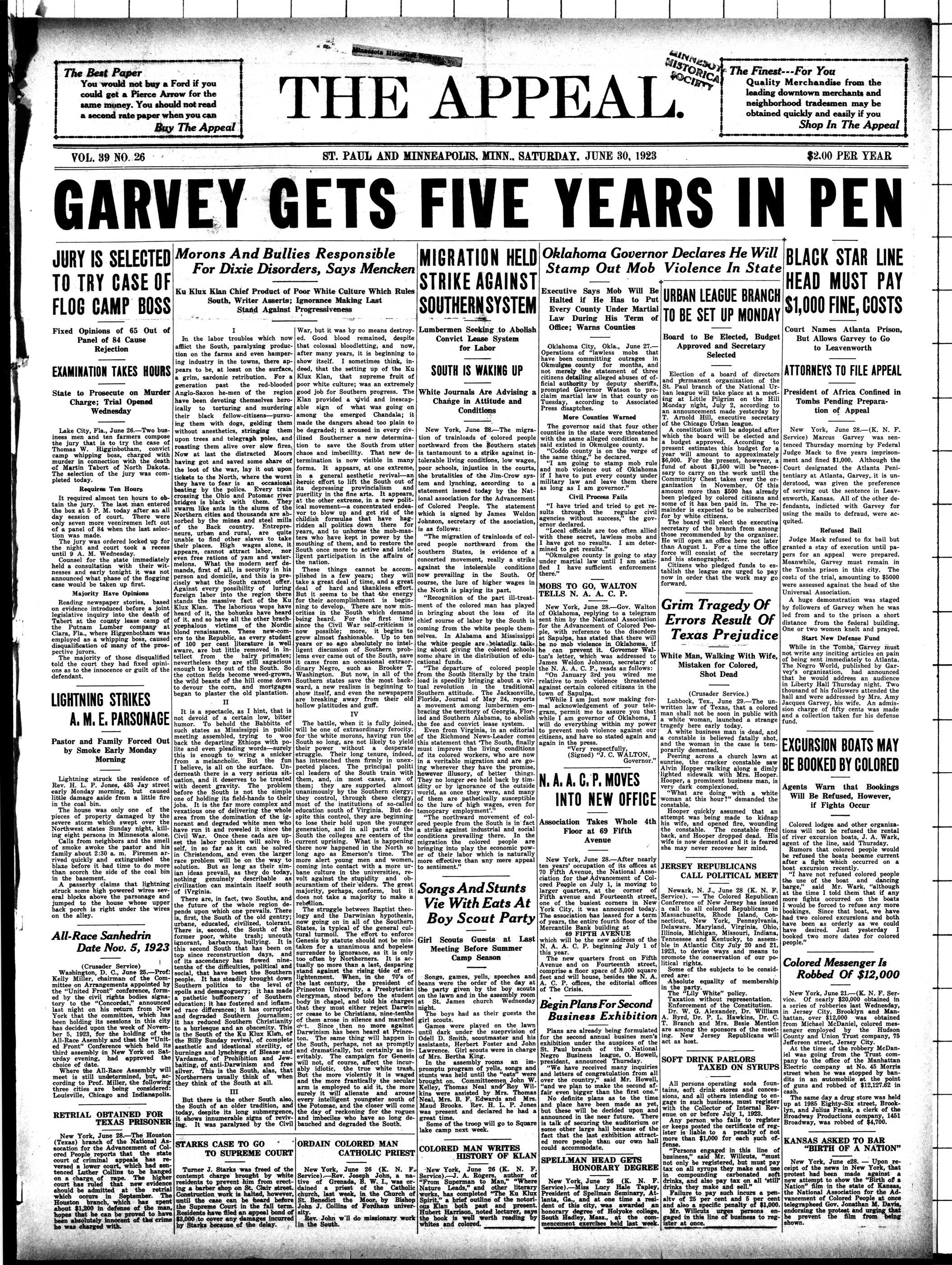
GARVEY GETS FIVE YEARS IN PEN
The Best Paper You would not buy a Ford if you could get a Pierce Arrow for the same money. You should not read a second rate paper when you can Buy The Appeal
VOL. 39 NO. 26
GARV
JURY IS SELECTED
TO TRY CASE OF
FLOG CAMP BOSS
Fixed Opinions of 65 Out of
Panel of 84 Cause
Rejection
EXAMINATION TAKES HOURS
State to Prosecute on Murder Charge; Trial Opened Wednesday
Lake City, Fla., June 26.—Two business men and ten farmers compose the jury that is to try the case of Thomas W. Higginbotham, convict camp whipping boss, charged with murder in connection with the death of Martin Tabert of North Dakota. The selection of the jury was completed today.
Requires Ten Hours
It required almost ten hours to obtain the jury. The last man entered the box at 5 P. M. today after an all day session of court. There were only seven more eveniremen left out of a panel of 84 when the last selection was made.
The jury was ordered locked up for the night and court took a recess until 9 A. M. Wednesday. Cousin M. the immediately held a consultation with their witnesses and early tonight it was not announced what phase of the flogging case would be taken up first.
Majority Have Opinions
Reading newspaper stories, based on evidence introduced before a joint legislative inquiry into the death of Tabert at the county lease camp of the Putnam Lumber company at Clara, Fla., where Higgenbotham was employed as a whipping boss, caused disqualification of many of the prospective jurors.
The majority of those disqualified told the court they had fixed opinions as to the innocence or guilt of the defendant.
LIGHTNING STRIKES
A. M. E. PARSONAGE
Pastor and Family Forced Out by Smoke Early Monday Morning
Lightning struck the residence of Rev. H. L. P. Jones, 435 Jay street early Monday morning, but caused little damage aside from a little fire in the coal bin.
The house was only one of the pieces of property damaged by the severe storm which swept over the Northwest states Sunday night, killing eight persons in Minnesota alone.
Calls from neighbors and the smell of smoke awoke the pastor and his family about 2:30 a. m. Firemen arrived quickly and extinguished the blaze before it had time to do more than scorch the side of the coal bin in the basement. The passerby claims that lightning struck some of the powered wires several blasts above the parsonage and jumped to the house whose upper back porch is right under the wires on the alley.
J
All-Race Sanhedrin Date Nov. 5, 1923
(Crusader Service)
Washington, D. C., June 28—Prof. Kelly Miller chairman of the Committee for the Improvement appointed by the "United Front" conference, formed by the civil rights bodies signatory to the "Concordat," announced last night on his return from New York that the committee, which has been holding its sessions in this city has decided upon the week of November 5, 1923, for the holding of the All-Race Assembly and that the "United Front" Conference which held its third assembly in New York on Saturday evening, had approved the choice of date.
The All-Race Assembly will meet is still undetermined, but, according to Prof. Miller, the following three cities are being considered: Louisville, Chicago and Indianapolis.
RETRIAL OBTAINED FOR
TEXAS PRISONER
New York, June 28—The Houston (Texas) branch of the National Association for the Advancement of Colored People reports that the state court of criminal appeals has reversed a lower court, which had sentenced Luther Collins to be hanged on a charge of rape. The higher court has ruled that new evidence should be admitted at the retrial which occurs in September. The Houston branch, which has spent about $1,200 in defense of the man, hopes that he can be proved to have been absolutely innocent of the crime he was charged with.
Morons And Bullies Responsible For Dixie Disorders, Says Mencken
Ku Klux Klan Chief Product of Poor White Culture Which Rules South, Writer Asserts; Ignorance Making Last Stand Against Progressiveness
In the labor troubles which now afflict the South, paralyzing production on the farms and even hampering industry in the towns, there appears to be, at least on the surface a grim, sardonic retribution. For a generation past the red-blooded Anglo-Saxon he-men of the region have been devoting themselves heroically to torturing and murdering their black fellow-citizens—pursuing them with dogs, gelding them without anesthetics, stringing them upon trees and telegraph poles, and roasting them alive over slow fires. Now at last the distracted Moors having got and saved some share of the boot of the war, lay it out upon tickets to the North, where the worst they have to fear is an occasional beating by the police. Every train crossing the Ohio and Potomac river bridges is black with them. They swarm like ants in the slums of the Northern cities and thousands are absorbed by the mines and steel mills of the Back country. Entrepreneurs, urban and rural, are unable to find other slaves to take their places. High wages alone, it appears, cannot attract labor, nor even free rations of the术 and watermelons. What the modern serf demands, first of all, is security in his person and domicile, and this is precisely what the South cannot offer. Against every possibility of luring foreign labor into the region there stands the massive fact of the Ku Klux Klan. The laborious wops have heard of it, the bohunks have heard of it, and so have all the other brachyephaleous victims of the Nordic blond renaissance. These new-comers to the Republic, as every student of 100 per cent literature is well aware, are but little removed in intellect from the hairy primates; nevertheless they are still sagacious enough to keep out of the South. So the cotton fields become weed-grown, the wild beasts of the hill come down to devour the corn, and mortgages began to plaster the old plantation.
It is a spectacle, as I hint, that is not devoid of a certain low, bitter humor. To behold the Babbits of such states as Mississippi in public meeting assembled, trying to woo back the departing Ethiopians with polite and even pleading words—surely this is enough to wring a snicker from a melancholic. But the fun I believe, is all on the surface. Underneath there is a very serious situation, and it deserves to be treated with decent gravity. The problem before the South is not the simple one of holding its field-hands to their jobs. It is the far more complex and vexatious one of delivering the whole area from the domination of the ignorant and degraded white men who have run it and rowed it since the Civil War. Once these cads are upset the labor problem will solve itself, in so far as it can be solved in Christendom, and even the larger race problem will be on the way to solution. But as long as their similar ideas prevail, as they do today, nothing genuinely describable as civilization can maintain itself south of Ivrginia.
There are, in fact, two Souths, and the future of the whole region depends upon which one prevails. There is, first, the South of the old gentry; urbane, educated, civilized, tolerant. There is, second, the South of the former poor, white trash; uncouth ignorant, barbarous, bullying. It is this second South that has been on top since reconstruction days, and of its ascendancy has flowed nineteenth of the difficulties, political and social, that have beset the Southern people. It has steadily brought down Southern politics to the level of spoils and demagoguery; it has made a pathetic buffoonery of education; it has corroded and inflamed more differences; it has corrupted and degraded Southern journalism; it has reduced Southern Christianity to a burlesque and an obscenity. This is the South of the Ku Klux Klan, of the Billy Sunday revival, of complete aesthetic and ideational sterility, of burnings and lynchings of Blease- and Vardaman, of Prohibition and Jew-baiting, of anti-Darwinism and free silver. This is the South, alas, that Northerners usually think of when they think of the South at all.
III
But there is the other South also, the South of an older tradition, and today, despite its long submergence, it shows innumerable signs of reviving. It was paralyzed by the Civil
Turner J. Starks was freed of the contempt charge brought by white residents to prevent him from erecting a barber shop on St. Clair street. Construction work is halted, however, until the case can be heard before the Supreme Court in the fall term. Residents have filed an appeal bond of $3,000 to cover any damages incurred by Starks because of the delay.
THE APPEAL.
ST. PAUL AND MINNEAPOLIS, MINN.. SATURDAY. JUNE 30, 1923
War, but it was by no means destroyed. Good blood remained, despite that colossal bloodletting, and now, after many years, it is beginning to show itself. I sometimes think, indeed, that the setting up of the Ku Klux Klan, that supreme fruit of poor white culture; was an extremely good job for Southern progress. The Klan provided a vivid and inescapable sign of what was going on among the emerged Chandala; it made the dangers ahead too plain to be degraded; it aroused in every civilized Southerner a new determination to save the South from utter chaos and imbecility. That new determination is now visible in many forms. It appears, at one extreme, in a general aesthetic revival—an heroic effort to lift the South out of its depressing provincialism and puerility in the fine arts. It appears, at the other extreme, in a new political movement—a concentrated endeavor to blow up and get rid of the childish formulae that have hagriden all politics down there for years, and to unhorse the mob-masters who have kept in power by the mouthing of them, and to restore the South once more to active and intelligent participation in the affairs of the nation.
These things cannot be accomplished in a few years; they will take a great deal of time, and a great deal of hard and thankless effort. But it seems to be that the energy for their accomplishment is beginning to develop. There are now minorities in the South which demand being heard. For the first time since the Civil War self-criticism is now possible; more, it begins to grow almost fashionable. Up to ten years or so ago absolutely no intelligent discussion of Southern problems ever came out of the Southern extraordinary Negro, such as Brooker T. Washington. But now, in all of the Southern states save the most backward, a new realism is beginning to show itself, and even the newspapers are breaking away from their old hollow platitudes anduff.
The battle, when it is fully joined, will be one of extraordinary ferocity, for the white morons, having run the South so long, are not likely to yield their power without a desperate struggle. Their long tenure, indeed, has intrenched them firmly in unexpected places. The principal politic leaders of the South train with them, and, in most cases, are of them; they are supported almost unanimously by the Southern clergy; they control, through these clergy, most of the institutions of so-called education south of Virginia. But despite this control, they are beginning to lose their hold upon the younger generation, and in all parts of the South the colleges are centers of the current uprising. What is happening there now happened in the North so long ago as Emerson's time. The more alert young men and women, coming into contact with a more urbane culture in the universities, revolt against the stupidity and obscurantism of their elders. The great majority, perhaps, conform, but it does not take a majority to make a rebellion.
The struggle between Baptist theology and the Darwinian hypothesis, now going on in all of the Southern States, is typical of the general cultural turmoil. The effort to enforce Genesis by statute should not be mistaken for a unanimous and hopeless surrender to ignorance, as it is only too often by Northerners. It is actually no more than a last, desparing stand against the rising tide of enlightenment. When, in the 70's of the last century, the president of Princeton University, a Presbyterian clergyman, stood before the student body in chapel, and told his charges that they must either reject Darwin or cease to be Christians, nine-tenths of them arose in silence and marched off. Since then no more against Darwinism has been heard at Princeton. The same thing will happen in the South, perhaps, not as promptly and dramatically, but certainly as inevitably. The campaign for Genesis will not, of course, affect the incurably idiotic, the true white trash. But the more violently it is waged and the more frantically the secular arm is employed to aid it, the more surely it will alienate and arouse every intelligent youngster south of the Potomac, and the closer will come the day of reckoning for the rogues and imbeciles who have so long debauched and degraded the South.
New York, June 26 (K. N. F. Service)—Rev. Joseph John, a native of Grenada, B. W. I., was ordained a priest of the Catholic church, last week, in the Church of St. Benedict the Moor, by Bishop John J. Collins of Fordham university.
Rev. John w'll do missionary work in the South.
MIGRATION HELD STRIKE AGAINST SOUTHERNSYSTEM
Lumbermen Seeking to Abolish Convict Lease System for Labor
SOUTH IS WAKING UP
White Journals Are Advising a Change in Attitude and Conditions
New York, June 28.—The migration of trainloads of colored people northward from the Southern states is tantamount to a strike against intolerable living conditions, low wages, poor schools, injustice in the courts, the brutalities of the Jim-Crow system and lynching, according to a statement issued today by the National association for the Advancement of Colored People. The statement which is signed by James Weldon Johnson, secretary of the association, is as follows:
"The migration of trainloads of colored people northward from the Southern States, is evidence of a concerted movement, really a strike against the intolerable conditions now prevailing in the South. Of course, the lure of higher wages in the North is playing its part.
"Recognition of the part ill-treatment of the colored man has played in bringing about the loss of its chief source of labor by the South is coming from the white people themselves. In Alabama and Mississippi the white people are belatedly talking about giving the colored schools some share in the distribution of educational funds. "The departure of colored people from the South literally by the train load is speedily bringing about a virtual revolution in the traditional Southern attitude. The Jacksonville, Florida, Journal of May 24, reports a movement among lumbermen embracing the territory of Georgia, Florida and Southern Alabama, to abolish the fee and convict lease system. Even from Virginia, in an editorial of the Richmond News-Leader comes this statement that the "South, finally must improve the living conditions of its colored workers, who are now attributable to migratory workers when they have the promise, however illusory, of better things. They no longer are held back by timidity or by ignorance of the outside world, as once they were, and many of them are pathetically susceptible to the lure of high wages, even for temporary employment."
"The northward movement of colored people from the South is in fact a strike against industrial and social conditions prevailing there. In the migration the colored people are more effective than any other member of their labor which is naturally more effective than any mere appeal to sentiment."
Songs And Stunts Vie With Eats At Boy Scout Party
Camp Season
Songs, games, yells, speeches and beans were the order of the day at the party given by the boy scouts on the lawn and in the assembly room at St. James church Wednesday night.
The boys had as their guests the girl scouts.
Games were played on the lawn until dark under the sueprvision of Odell D. Smith, scoutmaster and his assistants, Herbert Foster and John Lawrence. Girl scouts were in charge of Mrs. Bertha King.
In the assembly rooms an impromptu program of yells, songs and stunts was held until the "eats" were brought on. Committeemen John W. Kelley, Thomas Neal and Roy Wilkins were assisted by Mrs. Thomas Neal, Mrs. B. F. Edwards and Mrs. Maud Brooks. Rev. H. L. P. Jones was present and declared he had a great time.
Some of the troop will go to Square lake camp next week.
COLORED MAN WRITES
HISTORY OF KLAN
New York, June 26 (K. N. F. Service)—J. A. Rogers, author of "From Superman to Man" "Where Nature Leads" and other literary works, has completed "The Klu Klu Spirit," a brief outline of the notorious Klan both past and present. Hubert Harrison, noted lecturer, says the book is well worth reading by whites and colored.
Oklahoma Governor Declares He Will Stamp Out Mob Violence In State
Executive Says Mob Will Be Halted if He Has to Put Every County Under Martial Law During His Term of Office; Warns Counties
Oklahoma City, Okla., June 27.—Operations of "lawless mobs that have been committing outrages in Okmulgue county for months, and not merely the statement of three citizens detailing alleged abuses of official authority by deputy sheriffs, prompted Governor Watson to proclaim martial law in that county on Tuesday, according to Associated Press dispatches.
More Counties Warned
The governor said that four other counties in the state were threatened with the same alleged condition as he said existed in Okmulgee county. "Coddo county is on the verge of the same thing," he declared. "I am going to stamp job rule and I am going to Oklahoma if I have to put every county under military law and leave them there as long as I am governor."
Civil Process Fails
"I have tried and tried to get results through the regular civil agencies without success," the governor declared.
"Local officials are too often allied with these secret, lawless mobs and I have got no results. I am determined to get results."
"Okmulgee county is going to stay under martial law until I am satisfied I have sufficient enforcement there."
MOBS TO GO, WALTON
TELLS N. A. A. C. P.
New York, June 28—Gov. Walton of Oklahoma, replying to a telegram sent him by the National Association for the Advancement of Colored People, with reference to the disorders at Sapulpa, has stated that there will be no mob violence in Oklahoma, if he can prevent it. Governor Walton's letter, which was addressed to James Weldon Johnson, secretary of the N. A. A. C. P., reads as follows: "On January 3rd you wired me relative to mob violence threatened against certain colored citizens in the town of Sapulpa. "While I am just now making formal acknowledgement of your telegram, permit me to assure you that while I am governor of Oklahoma, I will do everything within my power to prevent mob violence against our citizens, and have so stated again and again in the press. "Very respectfully, (Signed) "J. C. WALTON, Governor."
N. A. A. C. P. MOVES INTO NEW OFFICE
Association Takes Whole 4th Floor at 69 Fifth Avenue
New York, June 28.—After nearly ten years' occupation of its offices at 70 Fifth Avenue, the National Association for the Advancement of Colored People on July 1, is moving to larger quarters, at the corner of Fifth avenue and Fourteenth street, one of the busiest corners in New York City, it was announced today. The association has leased for a term of years, the entire fourth floor of the Mercantile Bank building at 69 FIFTH AVENUE which will be the new address of the N. A. A. C. P. beginning July 1 of this year.
The new quarters front on Fifth Avenue and on Fourteenth street, comprise a floor space of 5,000 square feet and will house, besides the N. A. A. C. P. offices, the editorial offices of The Crisis.
BeginPlansForSecond Business Exhibition
Plans are already being formulated for the second annual business men's exhibition under the auspices of the St. Paul branch of the National Negro Business league, O. Howell, president, announced Thursday.
"We have received many inquiries and letters of congratulation from all over the country," said Mr. Howell, "and we plan to make the second affair even bigger than the first one."
No definite plans as to the time and place have been made as yet, but these will be decided upon and announced in the near future. There is talk of securing the auditorium or some other large hall because of the fact that the last exhibition attracted more people than our own hall could accommodate.
SPELLMAN HEAD GETS
HONORARY DEGREE
New York, June 26 (K. N. F Service)—Miss Lucy Hale Tapley President of Spellman Seminary, Atlanta, Ga., and at one time a resident of this city, was awarded an honorary degree of Holyoke college South Hadley, Mass., at the commencement exercises held last week
The Finest---For You Quality Merchandise from the leading downtown merchants and neighborhood tradesmen may be obtained quickly and easily if you Shop In The Appeal
URBAN LEAGUE BRANCH
TO BE SET UP MONDAY
Board to Be Elected, Budget Approved and Secretary Selected
Election of a board of directors and permanent organization of the St. Paul branch of the National Urban league will take place at a meeting at Little Pilgrim on the Hill Monday night, July 2 according to an announcement made yesterday by T. Arnold Hill, executive secretary of the Chicago Urban league.
A constitution will be adopted after which the board will be elected and a budget approved. According to present estimates this budget for a year will amount to approximately $6,000. For the present, however, a fund of about $1,500 will be "necessary to carry on the work until the Community Chest takes over the organization in November. Of this amount more than $500 has already been pledged by colored citizens and some of it has ben paid in. The remainder is expected to be subscribed for by white citizens. The board will elect the executive secretary of the branch from among those recommended by the organizer. He will open an office not later than August 1. For a time the office force will consist of the secretary and his stenographer. Citizens who pledged funds to establish the league are urged to pay now in order that the work may go forward.
Grim Tragedy Of Errors Result Of Texas Prejudice
Grim Tragedy Of Errors Result Of Texas Prejudice
White Man, Walking With Wife Mistaken for Colored, Shot Dead
(Crusader Service.)
Lubbock, Tex., June 29.—The unwritten law of Texas, that a colored man shall not be soon in public with a white woman, launched a strange tragedy here early today.
A white business man is dead, and a constable is believed fatal shot, and the woman in the case is temporarily demented.
Peering across a church lawn at sunrise, the cracker constable saw Alvin Hopper walking along a dimly lighted sidewalk with Mrs. Hopper. Hopper, a prominent business man, is very dark complexioned.
“What are doing with a white woman at this hour?” demanded the constable.
Hopper quickly assumed that an attempt was being made to kidnap his wife, and opened fire, wounding the constable. The constable fired back, and Hopper dropped dead. His wife is now demented and it is feared she may never recover her mind.
JERSEY REPUBLICANS CALL POLITICAL MEET
Newark, N. J., June 28 (K. N. F. Service). — The Colored Republican Conference of New Jersey has issued a call to all colored Republicans in Massachusetts, Rhode Island, Connecticut, New York, Pennsylvania, Delaware, Maryland, Virginia, Ohio, Illinois, Michigan, Missouri, Indiana, Tennessee and Missouri, assemblies of the City by 2012, 1923, to devise ways and means to promote the conservation of our political rights.
Some of the subjects to be considered are:
Absolute equality of membership in the party.
The "Lily White" policy. Taxation without representation. Enforcement of the Constitution. Dr. W. G. Alexander, Dr. William A. Byrd, Dr. P. L. Hawkins, Dr. C. T. Branch and Mrs. Bssie Mention are among the sponsors of the meeting. New Jersey Republicans will act as host.
SOFT DRINK PARLORS
TAXED ON SYRUPS
All persons operating soda fountains, soft drink stores and concessions, and all others intending to engage in such business, must register with the Collector of Internal Revenue on or before July 1, 1923.
Any person who fails to register or keeps posted the certificate of register is liable to a penalty of not more than $1,000 for each such offense.
“Persons engaged in this line of business,” said Mr. Willcuts, “must not only be registered, but must pay tax on all syrups they make and use in compounding carbonated soft drinks, and also pay tax on all ‘still drinks they make and sell.’
Failure to pay such incurs a penalty of 25 per cent and 5 per cent and also a specific penalty of $1,000.
Mr. Willcuts urges persons engaged in this line of business to register at once.
$2.00 PER YEAR
PEN
BLACK STAR LINE
HEAD MUST PAY
$1,000 FINE, COSTS
Court Names Atlanta Prison,
But Allows Garvey to Go
to Leavenworth
ATTORNEYS TO FILE APPEAL
President of Africa Confined in Tombs Pending Preparation of Appeal
New York, June 28.—(K. N. F. Service) Marcus Garvey was sentenced Thursday morning by Federal Judge Mack to five years imprisonment and fined $1,000. Although the Court designated the Atlanta Penitentiary at Atlanta, Garvey, it is understood, was given the preference of serving out the sentence in Leavenworth, Kansas. All of the other defendants, indicted with Garvey for using the mails to defraud, were acquitted.
Refused Bail
Judge Mack refused to fix bail but granted a stay of execution until papers for an appeal were prepared. Meanwhile, Garvey must remain in the Tombs prison in this city. The costs of the trial, amounting to $5000 were assessed against the head of the Universal Association. A huge demonstration was staged by followers of Garvey when he was led from and to the prison a short distance from the federal building. One or two women knelt and prayed.
Start New Defense Fund
While in the Tombs, Garvey must not write any inciting articles on pain of being sent immediately to Atlanta. The Negro World, published by Garvey's organization, had announced that he would address an audience Liberty Hall Thursday night. Two thousand of his followers attended the hall and were addressed by Mrs. Amy Jacques Garvey, his wife. An admission charge of fifty cents was made and a collection taken for his defense fund.
EXCURSION BOATS MAY BE BOOKED BY COLORED
Agents Warn that Bookings Will Be Refused, However, if Fights Occur
Colored lodges and other organizations will not be refused the rental of river excursion boats, J. A. Wark, agent of the line, said Thursday. Rumors that colored people would be refused the boats became current after a fight, which occurred on a boat excursion recently.
"I have not refused colored people the use of the boat and dancing barge," said Mr. Wark, "although at the time I told them that if any more fights occurred on the boats I would be forced to refuse any more bookings. Since that boat, we have had two colored excursions and both have been as orderly as we could have desired. Just yesterday I booked two more dates for colored people."
Colored Messenger Is Robbed Of $12,000
New York, June 21—(K. N. F. Service. Of nearly $20,000 obtained in a series of robberies last Wednesday, in Jersey City, Brooklyn and Manhattan, over $12,000 was obtained from Michael McDaniel, colored messenger employed by the Hudson County and Union Trust company, 75 Jefferson street, Jersey City.
At the time of the robbery McDaniel was going from the Trust company to the office of the Manhattan Electric company at No. 45 Morris street when he was stopped by bandits in an automobile at the point of guns and robbed of $12,127.62 in cash.
The same day a drug store was held up at 1985 Eighty-Six street, Brooklyn, and Julius Frank, a clerk of the Broadway Productions company, 1451 Broadway, was robbed of $4,700.
KANSAS ASKED TO BAR
"BIRTH OF A NATION"
New York, June e28. — Upon receipt of the news in New York, that protest had been made against a new attempt to show the "Birth of a Nation" film in the state of Kansas, the National Association for the Advancement of Colored People Gov. Jonah H. McDowell, endorsing the protest and urging that he prevent the film from being shown.
Entered at the Postoffice in St. Paul, Minnesota, as second-class mail matter. June 6, 1885, under Act of Congress, March 3, 1879.
ST. ANTHONY IN JUNE
There are streets, avenues and blocks beautiful all over this land of ours, no doubt, where colored property owners have set up homes not as ornate, perhaps, as the best, but as beautiful, both within and without as any.
Not many weeks ago an Eastern writer sang the praises of a New York block through a syndicated editorial. We read it carefully and proudly, for every chronicle of civic progress and beauty makes us sit up just a bit straighter and carry ourselves with just a bit more pride.
The source of this pride in New York may be W. 139th street, in Chicago, Washington, or St. Louis it may be other blocks, but in St. Paul it is St. Anthony avenue.
For two miles it stretches away, peopled in the main by colored folk, and for more than a mile it is lined with beautifully kept homes.
Other cities have traded the beauty of green lawns for the prestige of being known as metropolises but no such choice has as yet been forced upon St. Paul. Consequently, roomy backyards with a lawn and garden hold sway on St. Anthony. For blocks, even, close-clipped lawns and boulevards bear testimony to the pride of their owners. Shrubberry and flowers grace snug, screened-in porches, and on the curbed boulevards a line of trees bend and nod in the summer wind.
No brick pavements here, no paved backyards, tiers of family wash, and high-board fences. Here are no streets of endless brick front apartments.
Here is an oiled avenue, white curbed, where the fresh green of nature reigns supreme and the untainted air of Minnesota's June blows cool and sweet.
St. Paul colored folk have a right to be proud of St. Anthony. It is their street, theirs to maintain, improve, and ever be thankful for.
WHICH WILL YOU CHOOSE?
Within nine months Minnesota voters are faced with the task of choosing a senator from the nominees of three parties instead of two as hcretorefore. Beside the two old line parties, there is the Farmer-Labor, a healthy infant that has already placed Dr.Henrik Shiphead in the seat formerly occupied by Frank B. Kellogg. Colored voters will do well to give this election a little thought. At no time in the history of politics has the colored voter been in a more precarious position than now. Jersey Republicans have called a conference to consider ways and means of "safeguarding our political rights." In Baltimore, New York and Chicago, colored wards have gone Democratic. At Washington, the administration promises and quibbles and wabbles.
These and other instances show plainly that the colored man's faith in the Republican party has been badly shaken, and in thousands of cases completely shattered. Blocks of voters have responded to the invitations of newer, so-called radical parties, reasoning, fairly enough, that since the Democrats are enemies and the Republicans have thrown them over, they will take a chance on a stranger.
What will the colored voters of Minnesota do? Will they vote for a party, a man, or an issue?
FLIP FLOP
Since we have witnessed the political antics of a local colored weekly incident to the recent primary election, we are inclined to agree with Editor Smith, our contemporary across the river, that its policy is a "sad commentary upon the intelligence of our political thought." Imagine the job of explaining to voters the reason for passing over the front page to an obscure Democratic candidate before the election and printing the biography of the winning Republican candidate right after the election!
THE GREAT WHITE WAY
Sirs: The turmoil over whether a white or colored personnel shall operate the two-million-dollar hospital for colored war veterans at Tuskegee Institute is a revealing indication of the peculiar psychology of the Southern white man. Some years ago Alabama passed a lew prohibiting white women from nursing colored people. Now comes this big government hospital with a monthly payroll of $65,000. Race prejudice
falls with a bang before the almighty dollar, and a delegation of eminent white Alabamans travels all the way to Washington to urge the President to permit whites to serve and wait upon colored patients!
A friend of mine from Alabama has told me of another reason for the insistence by white Alabama that colored people be not allowed to man this institution. One of the leaders of the movement to put in a white staff remarked bluntly last week: "If niggers are put at the head of this hospital, they'll be responsible only to the United States government and we don't want any niggers in Alabama we can't control." At least this has the merit of frankness. In the same manner does Florida resent the recent expose of the horrors of the convict-leasing system in that and other states.
Finally, President Harding, without reservation of any sort, stated through his secretary, in a letter dated April 28, and addressed to the National Association for the Advancement of Colored People, that the plan is "to man this institution completely with a colored personel." Since then the delegation of white Alabamaans has called at the White House. It remains to be seen whether the President will stand by his word, or whether he yet nurses the chimerical dream of breaking the "Solid South" through catering to Southern racial prejudice. Walter White, in the Freeman
The Colored Church
By William H. Gaston.
the truth. Truth should be the pinnacle on every dome, the keystone in every arch, the foundation of every human institution. Customs and laws should harmonize with truth; no efforts should from its institution to harmize with customs and laws. Truth is the light that illuminates the world; it is the pillow of cloud by day and the pillow of fire by night. Every effort to suppress the truth is an attack upon mankind. The truth is never old; it always buds and blossoms and bears fruit. The truth when things were appointed from on high. That time has passed. Of course there are fanatical efforts to hold royalty in the same high esteem today; but the spirit of democracy says all governments derive their power from the consent of the governed. In the discussion of all bodies of humanity and faith, should prevail. Christianity, its ceremonies, its customs and its laws, were copied from the ancients, from those religions that had existed thousands of years before the birth of Christ. The sun, the moon and stars, all in their turn have been prayed to, been offered sacrifices and ceremonies, and been offered sacrifices and ceremonies, and chaldeans, Chaldeans, Egyptians and Persians, the Greeks and Romans all have in their turn had their governments and laws, their religions and customs and their civilization. Upon the banks of the Nile, the Euphrates, the Tigris and the Tiber civilizations and customs, laws and religions have been preserved, and their turn could have boasted of their superiority of governments, laws and religion.
Many precepts from these religions are germs of pure morality. There existed on the Western hemisphere among Peruvians and Mexicans civilizations, customs and laws admitted by some historians to be superior to illiterate or the poor of the world and many respects. The sacrifices to Quetzalcotl, the god of the Aztecs, with the prayers and supplications of that deluded people received as much answer as the ceremonies, supplications, prayers and sacrifices to Jehovah of the Jews. All the gods of every tribe and nation have been appealed to, to suspend the laws of mankind, to suspend all the sacrifices and ceremonies, floods have drowned, conflagrations have swept the lands with vast destruction and many thousand deaths; earthquakes have destroyed the lives of millions of people, lightning have killed, drought and famine and pestilence have destroyed the lives of millions of people, lightning has killed the ages past temples have been built, the labors of the poor, prophets, priests and kings have lived upon the credulity of the people. The astrologers expounded their messages from the stars; the knights, the dukes and lords were messengers from the kings, the priests and kings were messengers from the same gods. From these early customs down through ages ours have come; from the ancients the church of the present world both black and white.
The church has always been the institution through which submission and humility were taught the poor, the weak and the oppressed. Happiness and joy were also taught by the poor; they must hope for happiness after death. "Submit yourselves to the powers that be," was never meant for rulers, but the ruled. The toiling millions must "take no thought of tomorrow what you shall eat or what you shall wear." Through life the slaves, the
oppressed must "consider the illies of the field" and remember that "if thy brother smites one cheek, turn to him the other also." These and like doctrines of the past, are impressed upon the colored man both heart and brain. You may have all this justification, but you must come to die," has been written upon the heart of the colored man and rings from many thousand throats in song. There is no people in the world so completely subjected to the teaching of this submissive doctrine as the colored. Through brutal laws, through custom and religion they were under the authority robed for more than two hundred years. So effectively have they been bound both in body and in mind, that years of freedom have not broken their chains. That the white man was their superior, lord and master, was to them, was preached to them, was written their brain. Through all the sufferings of Colonial days the colored man has come and borne his part. In all the wars and on a thousand battlefields his blood poured out. Into the god Mars, the black man has willingly sacrificed, as the of the very first he that struck free freedom; the very last to be freed.
I dislike that feeling of race inferiority that seems to breed and grow in the atmosphere of the colored church. The color of the skin does not indicate the quality of the brain. Race does not mark the wealth or poverty of the mind. No institution should disparage the activity of the mind, or attempt to establish a fixed standard for quality of the brain. Education should not countless things have their influence the way of conditions, circumstances, experiences and environment, it is not an easy matter to decide.
URGE BLACK AND WHITE
WORKERS TO UNITE
New York, June 27. — William Pickens, Field Secretary of the National Association for the Advancement of Colored People, speaking June 23 at the annual conference of the League for Industrial Democracy, Camp Tammiment, Blue Mountains, unite in fighting the prejudice which their ranks are at present divided.
"Colored people should be admitted to the ranks of organized labor with no shadow of difference," he asserted. "With twelve or fifteen million colored people in the United States, we must be forced to labor with the colored laborer a tool in the hand of those who oppose the advance of labor."
BORAH MAY ADDRESS
N. A. A. C. P. CONFERENCE
New York, June 29. — Senator Borah of Idaho has expressed the hope that he may be able to address the Kansas City conference, in August of this year, of the National Association for the Advancement of Colored People. Senator Borah's speaking will depend upon what part of the United States he may be in, at the time the conference takes place.
The Light
of
Western
Stars
A Romance
By
Zane Grey
Illustrations by Irwin Myers
8YNOP818
CHAPTER I—Arriving at the lonely little railroad station of El Cajon, New Mexico, where she lives. Girl, girl, girl, finds no one to meet her. While in the waiting room a drunken cowboy entangled in a rope leaves her terrified. He returns with a priest, who goes through some sort of search. She asks her name and learning her identity the cowboy does dazed. In shootout she is killed. The cowboy also a girl, a "Bonita," takes his horse and escape, then conducts Madeline to Florence Kingley, friend of her brother.
CHAPTER II—Florence welcomes her, cowboy, and takes her to the cowboy's school. Gene Stewart, next day Alfayed Hammond, Madeline's brother, takes Madeline's exonerates him of any wrong intent.
CHAPTER III—Alfred, son of a wealthy family, had been dismissed from his home because of his disdain. He is deemed him. She meets Stillwell, Al's employer, typical western ranchman. Madeline learns Stewart has gone over the border.
CHAPTER IV—Danny Mala, one of Stillwell's cowboys, has disappeared, with some of Stillwell's money. His friends link his name with the girl Bonita.
CHAPTER V—Madeline gets a glimpse of life on a western ranch.
CHAPTER VI.—Stewart's horse comes to the ranch with a note on the saddle and a note on the animal. With her brother's consent she does, naming him "Majesty," her own dog. She arranges that Madeline has right arranges to buy Stillwell's ranch and that of Don Carlos, a Mexican neighbor.
CHAPTER VII.—Madeline feels she has found her right place, under the light of the western stars.
CHAPTER VIII.—Learning Stewart had been hurt in a brawl at Chicauca, and has been sent to Prideville. Madeline visits him and persuades him to come to the ranch as the boss of her cowboys.
CHAPTER IX.—Jim Nale, Nick Steele, Jim Prideville, Prideville, Madeline visits him and persuades him to come to the ranch as the boss of her cowboys. They have a feud with Don Carlos' vauquer, who are really guerrillas. Stewart to see that peace is kept.
CHAPTER X.—Madeline and Florence, returning home from Alfred's ranch, run into an ambush of vauquer. Florence, decrys them away, and Madeline gets home safely but alone.
CHAPTER XI.—A raiding guerrilla band carries off Madeline. Stewart Iolo arrives, and whom Stewart had served in Mexico. He releases the girl, arranging for ransom. Madeline finds herself strurply stared.
CHAPTER XII. - Madelina's sisters
arrives at the ranch, excavating an
excavation site.
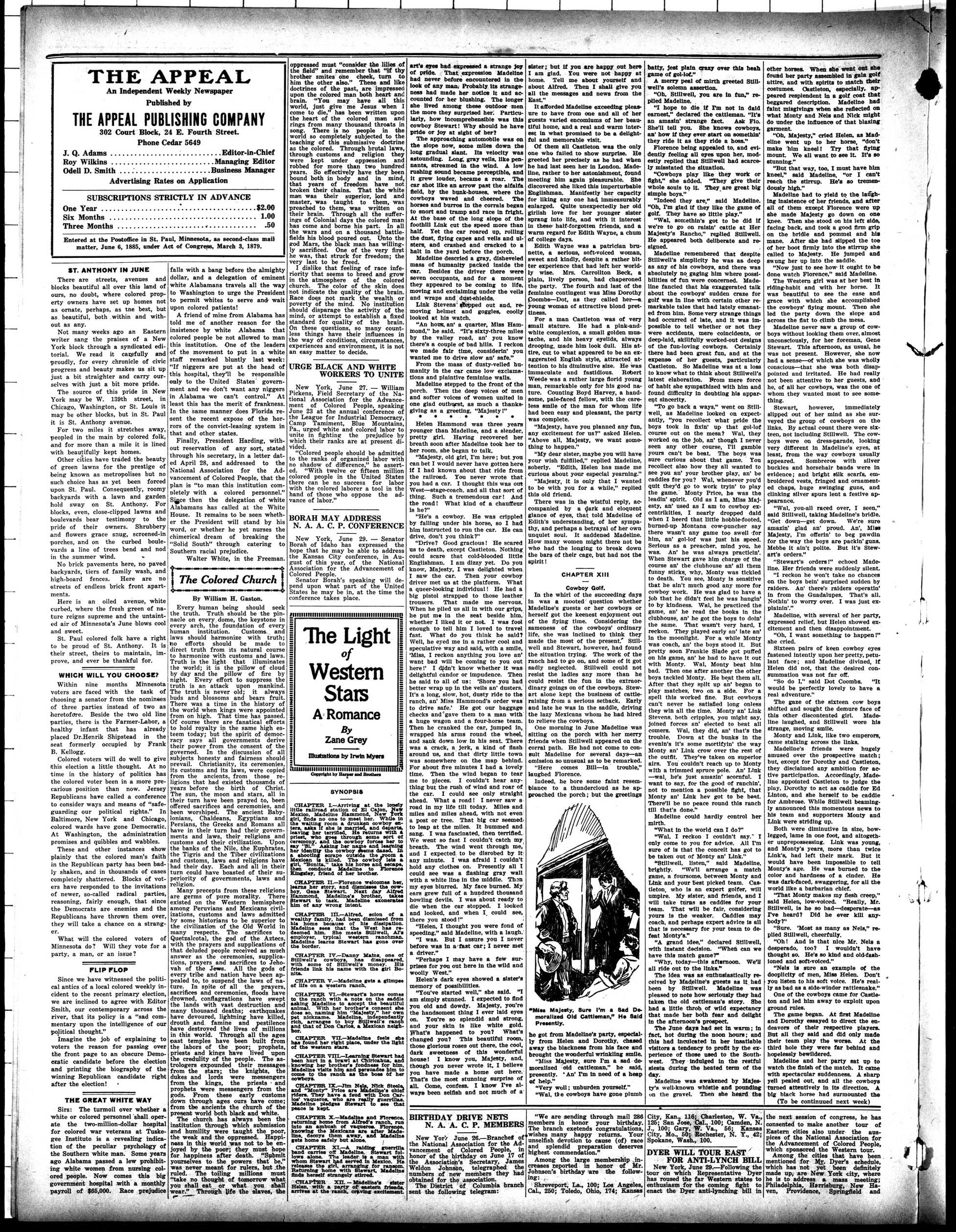
arts' eyes had expressed a strange joy of pride. That expression Madeline had never before encountered in the look of any man. Probably its strangeness had made her notice it and accounted for her blushing. The longer she lived among these outdoor men the more they surprised her. Particularly, how incomprehensible was this cowboy Stewart! Why should he have pride or joy at sight of her?
The approaching automobile was on the slope now, some miles down the long gradual slant. Its velocity was astounding. Long, gray gells, like pennants, streamed in the wind. A low rushing sound became perceptible, and it grew louder, became a roar. The car shot like an arrow past the alfaflush the bunk-house, where the cowboys were hiding. The horses and burros in the corral began to snort and tramp in the race. At the base of the long slope of the foothill Link the cut speed of half. Yet the car roared up, rolling the dust, flying capes and vels and ulsters, and crashed and cracked to a halt in the yard before the porch.
Madeline described a gray, disheveled mass of humanity packed inside the car. Besides the driver there were seven occupants, and for a moment they appeared to be coming to life, moving and exclamating under the vells and wraps and dust-shields.
Link Stevens' stepped out and, removing helmet and goggles, coily looked at his watch.
"An hour an' a quarter, Miss Hammond," he said. "It's sixty-three miles by the valley road, an' you know there's a couple of bad hills. I reckon we made fair time, considerin' you wanted me to drive slow an' safe."
From the mass of dusty-velled humanity in the car came low exclamations and plaintive feminine walls.
Madeline stepped to the front of the porch. Then the deep voices of men and softer voices of women united in one glad outburst, as much a thanksgiving as a greeting, "Majesty!"
Helen Hammond was three years younger than Madeline, and a slender, pretty girl. Having recovered her breath soon after Madeline took her to her room, she began to talk.
"Majesty, old girl, I'm here; but you can bet I would never have gotten here if I had known about that ride from the railroad. You never wrote that you had a car. I thought this was our West—stage coach, and all that sort of thing. Such a tremendous car! And the road! What kind of a chauffeur is he?"
"He's a cowboy. He was crippled by falling under his horse, so I had him instructed to run the car. He can drive, don't you think?"
"Drive? Good gracious! He scared us to death, except Castleton. Nothing could scare that cold-blooded little Englishman. I am dizzy yet. Do you know, Majesty, was delighted when I saw the car. Then your cowboy driver met us at the platform. What a queer-looking individual! He had a big pistol strapped to those leather trousers. That made me nervous. When he piled us all in with our grips, he put me in the seat beside him, whether I liked it or not. I was fool enough to tell him I loved to travel fast. What do you think he said? Well, he眼了 in a rather cool and speculative way and said, with a smile, "I reckon anything you love an 'n'," he could not tell me here! I didn't know whether it was delightful candor or impudence. Then he said to all of us: "Shore you had better wrap up in the ulls an 'dusters', it's a long, slow, hot, dusty ride to the car, miss Hammond's order was to drive safe," he gave to our baggage to drive safe. He gave to our baggage to wrap his arms round the wheel, and sank down low in his seat. There was a crack, a jerk, a kind of flash around us, and that dirty little town was somewhere on the map behind. For about five minutes I had a lovely time. Then the wind began to tear to pieces. I couldn't hear anything but the rush of wind and roar of the car. I could see only straight ahead. What a road! I never saw a road in my life till today. Miles and miles and miles ahead, with not even a post or tree. That big car seemed to leap at the miles. It hummed and sang. I was fascinated, then terrified, then sent out a tent. I felt the wind breathe. The wind went through me, and I expected to be dishebred by it any minute. I was afraid I couldn't hold any clothes on. Presently all I could see was a flashing gray wall with a white line in the middle. Then my eyes blurred. My face burned. My ears grew full of a hundred thousand howling devils. I was about ready to die when the car stopped. I looked and looked, and when I could see, there you stood!"
"Helen, I thought you were fond of speeding," said Madeline, with a laugh. "I was. But I assure you I never before was in a fast car; I never met a driver." "Perhaps I may have a few surprises for you out here in the wild and woolly West." Helen's dark eyes showed a sister's memory of possilities. "You've started well," she said. "I am simply stunned. I expected to find you old and dowdy. Majesty, you're the handsomest thing I ever lain on. You're so splendid and strong, and your skin is like white gold. What's happened to you? What's changed you? This beautiful room, those glorious roses out there, the cool, dark sweetness of this wonderful house! I know you, Majesty, and, though you never wrote it, I believe you have made a home out here. That's the most stunning surprise of all. Come, confess. I know I've always been fishish and not much of a
BIRTHDAY DRIVE NETS
N. A. A. C. P. MEMBERS
New York June 28—Branches of the National Association for the Advancement of Colored People, in honor of the birthday on June 17 of the Association's Secretary, James Weldon Johnson, telegraphed the numbers of new members they had obtained for the association.
The District of Columbia branch sent the following telegram:
sister; but if you are happy out here
I am glad. You were not happy at
home. Tell me about yourself and
about Alfred. Then I shall give you
all the messages and news from the
East."
It afforded Madeline exceeding pleasure
to have from one and all of her
guests useful encomiums of her beautiful home, and a real and warm interest
in what promised to be a delightful
and memorable visit.
Of them all Castleton was the only
one who failed to show surprise. He
greeted her precisely as he had when
he had last seen her in London. Madeline, rather to her astonishment, found
me meeting him again pleasurable. She
discovered she liked this imperturbable
Eleanor Manifestly her capacity
for liking any one had immeasurably enlarged. Quite unexpectedly her old
girlish love for her younger sister
sprang into life, and with it interest
in these half-forgotten friends, and a
warm regard for Edith Wayne, a chum
of college days.
Edith Wayne was a patrician brunette, a serious, soft-voiced woman, sweet and kindly, despite a rather bitter experience that had left her worldly wise. Mrs. Carrollton Beck, a plain, lively person, had chaperoned the party. The fourth and last of the feminine contingent was Miss Dorothy Coombs—Dot, as they called her—a young woman of attractive blond pretiness.
For a man Castleton was of very small stature. He had a pink-and-white complexion, a small golden mustache, and his heavy eyelids, always drooping, made him look dull. His attention was to the aggrated English style, attracted attention to his diminutive size. He was immaculate and fastidious. Robert Weede was a rather large flord young man, remarkable only for his good nature. Counting Boy Harvey, a handsome, pale-faced fellow, with the careless smile of the man for whom life had been easy and pleasant, the party was complete.
"Majesty, have you planned any fun, any excitement for you?" asked Helen. "Above all, Majesty, we want something to happen."
"My dear sister, maybe you will have your wish fulfilled," replied Majeline, soberly. "Edith, Helen has made me curious about your special yearning."
"Majesty, it is only that I wanted to be with you for a while," replied this old friend.
There was in the wistful reply, accompanied by a dark and eloquent glance of eyes, that told Majeline of Edith's understanding, of her sympathy, perhaps a path to our own unquiet soul. It saddened Majeline. How many women might there not be who had the longing to break down the bars of their cage, but had not the spirit!
CHAPTER XIII
Cowboy Golf.
In the whirl of the succeeding days in was a mooted question whether Madeline's guests or her cowboys or herself got the keenest enjoyment out of the flying time. Considering the sameness of the cowboys' ordinary life, she was inclined to think they made the most of the present. Stillwell and Stewart, however, had found the situation trying. The work of the ranch had to go on, and some of it got sadly neglected. Stillwell could not resist the ladies any more than he could resist the fun in the extraordinary goings on of the cowboys. Stewart alone kept the business of cattle-raising from a serious setback. Early and late he was in the saddle, driving the lazy Mexicans whom he had hired to relieve the cowboys.
One morning in June Madeline was sitting on the porch with her merry friends when Stillwell appeared on the corral path. He had not come to consult Madeline for several days—an omission so unusual as to be remarked.
"Here comes Bill—in trouble," laughed Florence.
Indeed, he bore some faint resemblance to the thunderstorm, broached the thunderstorm, and greeted the greetings.
A man in a suit holding a hat is talking to two women sitting on a bench.
"Miss Majesty, Sure I'm a Sad Demoralized Old Cattleman," He Said Presently.
he got from Madeline's party, especially he got from Helen and Dorothy, chased away the blackness from his face and brought the wonderful wrinkling smile. "Miss Majesty, sure I'm a sad demoralized old cattleman," he said, presently. "An I'm in need of a heap of help." "Very well; unburden yourself." "Wal. the cowboys have gone plumb
"We are sending through mail 286 members in honor your birthday. The branch exends congratulations, wishes many happy returns. Your unselfish devotion to cause (of) race and splendid preparation deserves highest mention." Among the large membership increases reported in honor of Mr. Johnson's birthday are the following: Shreveport, La., 100; Los Angeles, Cal., 250; Toledo, Ohio, 174; Kansas
batty, jest plain crazy over this heah game of golot-*l*
A merry plea of mirth greeted Stillwell's solemn assertion.
"Oh, Stillwell, you are in fun," replied Madeline.
"I hope to die if I'm not in dale earnest," declared the cottman. "It's an amazin' strange fact. Ask Flo. She'll tell you. She knows cowbys, an' how if they ever start on somehit' they ride it as they ride a hoss." Florence being appealed to, and evidently feeling all eyes upon her, modestly replied that Stillwell had scarcely misstated the situation.
"Cowbys play like they work or fight," she added. "They give their whole souls to it. They are great big simple boys."
"Indeed they are," said Madeline. "Oh, I'm glad if they like the game of golf. They have so little play."
"Wal, somehit's got to be did if we're to go on raisin' cattle at Her Majesty's Rancho," replied Stillwell. He appeared both deliberate and resigned.
Madeline remembered that despite Stillwell's simplicity he was as deep as any of his cowboys, and there was absolutely no gaging him where possibilities of fun were concerned. Madeline fancied that his exaggerated talk about the cowboys' sudden craze for golf was in line with certain other remarkable tales that had lately emanated from him. Some very strange things had occurred of late, and it was impossible to tell whether or not they were coincidents, or deep-lain, skillfully more vividly described of the fun-loving cowboys. Certainly there had been great fun, and at the expense of her guests, particularly Castleton. So Madeline was at a loss to know what to think about Stillwell's latest elaboration. From mere force of habit she sympathized with him and found difficulty in doubting his apparent sincerity.
"To go back a ways," went on Stillwell, as Madeline looked on expectantly, "you recollect what pride the boys took in fixin' up that go-lof course out on the mea? Wal, they worked on the job, an' though I never seen any other course, I till gamble yours can't be beat. The boys was sure curious about that game. You recollect also how they all wanted to see you an' your brother play, an' be caddies for you. Wal, whenever you'd quit they'd go to work tryin' to play yours. Monty Price, he was the leadin' spirit. Old as I am, Miss Maja, an' used as I am to cowboy excentrikities, I nearly dropped dale when I heared that little hobble-footed, burned-up Montana cow-puncher say there wasn't any game too swell for him, an' go-lof was his speed. Serious as a preacher, mind you, he was. An hew he always practicin' the game, an' he him charge's the course an' the clubhouse an' the funny sticks, why, Monty was tickled to death. You see, Monty is sensitive that he ain't much good any more for cowboy work. He was glad to have a job that he didn't feel he was hangin' to the kidness. He was glad to have a job that he didn't feel he was hangin' to the clubhouse, he read the books in the clubhouse, he read the boys to doin' the same. That wasn't very hard, I reckon. They played early a' late an' in the moonlight. For a while Monty was coach, an' the boys stood it. But pretty soon Frank Slade got puffed on his game, an' he had to have it on Monty. Wal, Monty beat him all the time. After that they split up an' began to play matches, two on a side. For a spell this worked fine. But cowboys can't never be satisfied long onley who win all the time. Monty an' Link Stevens, both cripples, you might say, joined forces an' elected to heat all comers. Wal, they did, an' that's the trouble. Down at the bunks in the evening, some mournifly the way the comers out. They've taken on superior airs. You couldn't reach up to Monty with a trimmed spruce pole. An' Link—wal, he's just amazin' scornful. not to want, for the good of ranchin', not to mention a possible fight, that Monty an' Link he got to be beat. There'll be no peace round this ranch till that's done."
Madeline could hardly control her
mind. "What in the world can I do?"
"Wal, I reckon I couldn't say. I only come to you for advice. All I'm sure of is that the conceit has got to be taken out of Monty an 'link.' "Stillwell, listen," said Madeline brightly. "We'll arrange a match game, a foursome, between Monty and Link and your best pick team. Castleton, who is an expert golfer, will umpire. My sister, and friends, and I will take turns as caddies for your team. That will be fair, considering yours is the weaker. Caddies may coach, and perhaps expert advice is all that is necessary for your team to defeat Monty's." "A grand idea," declared Stillwell, with instant decision. "When can we have this match game?" "An afternoon. Well all ride out of the links." The idea was as enthusiastically received by Madeline's guests as it had been by Stillwell. Madeline was pleased to note how seriously they had taken the old cattelman's story. She had a little throb of wild expectancy that made her both fear and delight in the afternoon's prospect.
The June days had set in warm; in fact, hot during the noon hours; and this had inculcated in her insatiable visitors a tendency to profit by the experience of those used to the Southwest. They inculcated in the restful stesta during the heated term of the day.
Badeline was awakened by Majesty's well-known whistle and pounding on the gravel. Then she heard the
City, Kan., 116; Charleston, W. Va., 125; San Jose, Cal., 100; Camden, N. J., 100; Gary, W. Va., 56; Kansas City, Mo., 50; Rochester, N. Y., 42; Spokane, Wash., 100.
DYER WILL TOUR EAST FOR ANTI-LYNCH BILL
New York, June 29—Following the death of Dyer has roused the far Western state. Dyer enthusiasm for the coming fight to enact the Dyer anti-lynching bill in
other horses. When she went out she found her party assembled in gala golf attire, and with spirits to match their costumes. Castleton, especially, appeared resplendent in a golf coat that beggared description. Madeline had faint misgivings when she reflected on what Monty and Nels and Nick might do under the influence of that blazing garment.
"Oh, Majesty," cried Helen, as Madeline went up to her horse, "don't make him kneel!" Try that flying mount. We all want to see it. It's so stunning that way, too. I must have him kneel," said Madeline, "or I can't reach the stirrup. He's so tremendously high."
Madeline had to yield to the laughing insistence of her friends, and after all of them except Florence were up she made Majesty go down on one knee. Then she stood on his left side, facing back, and took a good firm grip on the bride and pommel and his mane. After she had slipped the toe down, she called to Majesty. He jumped and swung her up into the saddle.
"Now just to see how it ought to be done watch Florence," said Madeline.
The Western girl was at her best in riding-habit and with her horse. It was beautiful to see the ease and grace with which she accomplished the cowboys' flying mount. Then she led the party down the slope and across the flat to climb the mesa. Madeline never saw a group of cowboys without looking them over, almost unconsciously, for her foreman, Gene Stewart. This afternoon, as usual, he was not present. However, she noted the presence of which she was wholly conscious—that she was both disappointed and irritated. He had really not been attentive to her guests, and he, of all her cowboys, was the one of whom they wanted most to see something.
Stewart, however, immediately slipped out of her mind as she surveyed the group of cowboys on the links. By actual count there were sixteen, not including Stillwell. The cowboys were on dress-parade, looking very different in Madeline's eyes, at least, from the way cowboys usually appeared. Sombreros with silver buckles and horsehair bands were in evidence; and bright silk scarfs, embroidered vests, fringed and ornamented chaps, huge swinging guns, and clinking silver spurs lent a festive appearance.
You'll you all raced over, I seen. Stillwell, taking Madeline's bride. "Get down—get down. We're sure amazing' amzin' an proud. An, 'Miss Majesty, I'm offerin' to beg pawdin for the way the boys are packin' guns, Mebbe it ain't polite. But it's Stewart's orders."
"Stewart's orders!" echoed Madeline. Her friends were suddenly silent. "I reckon he won't take no chances on the boys bein' surprised sudden by raiders. An' there's raiders operatin' in from the Guadalupes. That's all. Nothin' to worry over. I was just explainin'." Madeline, with several of her party, expressed relief, but Helen showed excitement and then disappointment. "Oh, I want something to happen!" she cried. Sixteen pairs of keen cowboy eyes fastened intently upon her pretty, petulant face; and Madeline divined, if Helen did not, that the desired consummation was not far off. "So do L'," said Dot Coombs. "It would be perfectly lovely to have a real adventure." The gaze of the sixteen cow boys shifted and sought the demure face of this other discontented girl. Madeline laughed, and Stillwell wore his strange, moving smile. Monty and Lik, like two emperors, came stalking across the links.
Madeline's friends were hugely amused over the prospective match; but, except for Dorothy and Castleton, they disclaimed any ambition for active participation. Accordingly, Madeline appointed Castleton to judge the play, Dorothy to act as caddie for Ed Linton, and she herself to be caddie for Ambrose. While Stillwell beamingly announced this momentous news to his team and supporters Monty and Link were striding up.
Both were diminutive in size, bow-legged, lame in one foot, and altogether unproposessing. Link was young, and Monty's years, more than twice Link's, had left their mark. But it would have been impossible to tell Monty's age. He was burned to the color and hardness of a cinder. He was dark-faced, swaggering, for all the things he had handled. "That Monty makes my dyes creep," said Helen, low-vowed. "Really, Mr. Stillwell, is he so bad-desperate—as Ive heard? Did he ever kill anybody?"
"Sure. 'Most as many as Neils,' replied Stillwell, cheerfully.
"Oh! And is that nice Mr. Nels a desperado, too? I wouldn't have thought so. He's so kind and old-fashioned and soft-voiced."
"Nels is sure an example of the dooplicity of men, Miss Helen. Don't you listen to his soft voice. He's really as bad as a side-winder rattlesnake."
One of the cowboys came for Castleton and led him away to exploit upon ground rules.
The game began. At first Madeline and her essayy asked to direct the endeavors of their respective players. But all they said and did only made their team play the worse. At the third hole they were far behind and hopelessly bewildered.
Madeline and her party sat up to watch the finish of the match. It came with spectacular suddenness. A sharp yelpealed out, and all the cowboys turned attentively in its direction. A big black horse had surmounted the (To be continued next week)
the next session of congress, he has consented to make another tour of Eastern cities also under the auspices of the National Association for the Advancement of Colored People, which sponsored the Western tour. Among the cities that have been mentioned for Mr. Dyer's schedule, which has not yet been definitely completed, are New York, where he is to address a mass meeting; Philadelphia, Harrisburg, New Haven, Providence, Springfield and
WEEK'S RECORD OF HAPPENINGS
IN MINNESOTA'S CAPITAL.
The "Saintly City" and Saintly City
Folks—Neway Items of Social, Religious, Political and General Matters Among the People.
SATURDAY, JUNE 30, 1923.
THE APPEAL ASKS AS A SPECIAL FAVOR THAT ITS READERS GIVE PREFERENCE TO THE ADVERTISERS WHO SEEK THEIR PATRONAGE BY ADVERTISING IN IT. SHOP IN THE APPEAL BEFORE SHOPPING ELSEWHERE.
FOR SALE—Overland touring car,
B-83. Cheap. Telephone Dale 1183.
Mr. Isaac Dennie, 437 Rondo street has returned from a western business trip.
Mr. James Riley of Rondo street who has been sick for a few years, has been taken to Anker hospital.
Mr. and Mrs. S. E. Hall and family have gone to Round Lake to spend the summer there in their lake cottage.
Miss Georgia Bell, 305 N. Chatsworth street, entertained for visitors in the city Tuesday, June 26, at a pretty party.
Miss Kathryn Tandy of 593 Iglehart avenue, who spent several months in Chicago visiting friends, returned to the city Monday.
Members of the City Federation and a large number of guests picneed Friday afternoon on the lawn of the Crispus Attuck Home.
Mr. and Mrs. J. B. Johnson of 863 Woodbridge street, entertained at a family dinner Sunday of last week. Covers were laid for fifteen.
Miss Sirilda Spicer will appear in humorous, classic and original sketches at St. James A. M. E. church Monday, July 2.
Mrs. Carrie Reeler, Worthy Grand Matron of Electa Grand Chapter O. E. S. will be the week-end guest of Mrs. R. H. Anderson, 912 Gaultier street.
Sergt. Z. Pope of Minneapolis, who has been in the government hospital at Washington, D. C., has returned and is at his summer home at Anoka, Minn.
Miss Minnie Tobie of 990 Gaultier street, has returned to the city after a two months' visit with relatives and friends in Urbanna, Ohio, and Chicago, Ill.
Office: Cedar 6508 Res.: Dale 2947
Res.: 678 St. Anthony Ave.
MRS. T. H. LYLES
Successor to
T. H. LYLE UNDERTAKING CO.
150 W. Fourth St. ST. PAUL
Miss Fay Thompson, 3629 Fourth avenue south, Minneapolis, entertained Wednesday for Miss Louise Coleman, who is to be married to Mr. Boyd Crawford tonight.
A large number of Twin City delegates left Tuesday to attend the annual State Federation of Colored Women's Clubs which meets in Duluth, Minn., June 27th and 28th.
The annual picnic of the Episcopal Men's club of St. Paul and Minneapolis is scheduled for Thursday, July 12 at Parker's Lake. Everybody is preparing to go. You are invited.
Don't fail to attend the second boat excursion to be given by Gopher Marching Club, on Friday evening, July 6. A good time is guaranteed everyone. Read the display ad elsewhere on this page
A large number enjoyed the annual outing of the Adelphai Club at Phalen Park, Tuesday. Prizes in the races were won by Buddie Kelly, G. Kelly, Mesdames W. B. Walker, G. Sleet and J. W. Kelly. The club's June contests prizes were awarded to Mesdames Maude Brooks and Carrie Lindsay. Reports were sumbited by philanthropic department, hospital visiting committee and officers annual reprints.
PIONEER LODGE NO. 1. F. AND A. M. meets first and third Monday in each month at Masonic Hall, 588 Rondo St. at Masonic Hall, 588 Rondo St. at Dillham, Seyc, 569 Rondo St. Tel. Dale 0872.
PRINCE HALL LODGE NO. 195 meets first and third Monday in each month at Union Temple Hall, 406 Franklin street. All visiting brothers in good standing are welcome. S. W. Williams, W. M.; Daniel Rose,
HOUSEHOLD OF RUTH NO. 553, G. U. O. of O. F. meets the third Monday in each month at Union Hall corner of Aurora and Kents streets at 8:00 P. M. Mrs. Jessie Brown, M. N. G. Mrs. Carrie E. Lindsay, W. R., 426 Rondo street.
To Be Ready when adversity knocks needs advance preparation and daily sacrifice
PLAY SAFE BY HAVING A SAVINGS ACCOUNT AT
THE
STATE SAVINGS BANK
93 E. FOURTH ST.
4% INTEREST ON SAVINGS
COMPOUNDED QUARTERLY
By E. S. WEBER, D. D. S.
Any questions regarding subjects in these articles or other dental work should be addressed to the Health Editor of the Appeal. Dr. Weber will publish the answers each week in this column.
DON'TS.
Don't neglect to visit a dentist at least once a year (twice yearly is very good practice). If your tooth aches before visiting a dentist.
Don't eat too much of the artificial and denatured foods, eat more of the natural foods. The kind that will make you chew (vegetables, fruits, nuts, berries, grains and roots). Don't let your children's temporary teeth go without dental attention because of the fact that they lose them and get new ones. Don't neglect to clean and thoroughly brush your artificial dentures daily. Don't let deposits form around your teeth. It causes spongy, bleeding gums and inflammation, too, which if neglected will develop into pyorrhea. Don't forget that it is easier to prevent a disease than it is to cure it. Don't neglect to brush your teeth morning and evening. Don't forget that it is very good practice to use a mouth wash along with your dentrifice. Don't forget to remember that an ounce of prevention is worth a pound of cure.
Don't forget that the mouth is termed "The Gateway of Infection." Keep it clean; keep the gate well fortified. Your teeth are the guards and sentinels, so to speak. Keep them strong and health; don't permit them to become broken down, weak and frail, because they will not be able to withstand the attacks of the enemy (bacteria) which might cause destruction and perhaps total wreck to the medical organization. Don't forget that it is better to be safe than sorry. Don't forget that the teeth are causing a great many of the diseases and ailments people are having today. Don't forget that today is always here, tomorrow never, hence never think of putting off for tomorrow what you can do today.
Kills Self so He Can Do Good in New World
New York—Convinced that in the world beyond the grave he could do more good than on earth, Hubert Dewaney, forty, a Spiritualist, killed himself in his home here. Dewaney was employed as night watchman of Dreamland park, of which his brother, Orris, is manager, and nightly, according to the police, went into a trance and when he came out declared he had talked with spirits. Several times he offered what he said were messages from his brother's decreased sons. Dewaney left two letters for his brother, one asking Orris to pay a $1 loan. In the other he said: "If it is true that there is another life waiting for us all beyond the grave in that other world, I am convinced that I can do more good there than here. Good-by and good luck to all."
Hauls Officer 100 Miles
Anchorage, Alaska.-While taking an Indian accused of murder from Fort Gibbon to Fairbanks recently, Deputy United States Marshal E. B. Webster was stricken with appendicitis.
The marshal's prisoner placed him on the sled with which they had been traveling and mushed more than a hundred miles with him to a hospital, where an operation was performed.
Foreigners Few in London.
London.—In all London there are less than 30,000 Russians at the present time, and they form the largest alien colony in the city. This is an increase of nearly 5,000 over the figures for 1911. London counts today 27,000 Poles, 11,000 Frenchwomen and 5,750 Germans. The American colony is under 1,000.
FOR SALE
931 RONDO — Five-room summer bungalow, sun parlor and garage.
512 ST. ANTHONY — Five-room new bungalow, seven built-in features.
Schuck & Schuck
Realty Co.
665 University Tel. Elk. 2956
LIBERTY GARAGE
CASPER GILLES, Prop.
350-352 University Ave.
Overland Red Bird $ 838
Willys Knight 1360
Overland Touring 595
USED CARS
Overland 90 Touring, $165 cash
Elcar Touring, $175 cash
Scripps Booth Roadster,
$125 cash
FOR SALE
Late Model Touring Car
With Extras. Good Mechanical
Condition.
Dale 7930 Price $350
ET'S GO!
Baby Wont You Please Come Home So We Can Go To The Second Big
GOPHER 108
I.B.P. Q.E.
OF THE WORLD
CERVUB ALCES
E. JULY 6
Steamer
Gorge Manitou
SPECIAL SIX
Elk Committee
ENTAINMENT
Luis Ervin, Wm. T. Thurston
G. Gilbert, Oliver Stansberry
Turner, William F. Jackson
Travis
ON
DAYEVE. JU
On The Beautiful Steamer
ing and Barge Ma
BY STEVENS SPECI
ments By The Elk Con
COMMITTEE ON ENTERTAINMENT
m., J. A. Mitchell, J. Louis Ervin, Wr
on, William Yeiser, A. Gilbert, Oliv
son, R. D. Wiley, Orville Turner, Willi
er, John Coquire, R. N. Travis
FRIDAYEVE. JULY 6 On The Beautiful Steamer Red Wing and Barge Manitou
MUSIC BY STEVENS SPECIAL SIX Refreshments By The Elk Committee
A. J. Todd, Chrm., J. A. Mitchell, J. Louis Ervin, Wm. T. Thurston L. C. Jackson, William Yeiser, A. Gilbert, Oliver Stansberry C. G. Johnson, R. D. Wiley, Orville Turner, William F. Jackson B. C. Archer, John Coquire, R. N. Travis Boat leaves at 8:30 Tickets 80 cents
AND PICNIC
The Big Event, The
MIC OF THE SEA
Given By The
S EPISCOPAL C
OF ST. PAUL AND MINNEAPOLIS ON
THRSDAY JULY
AT
Parker's Lake
ing Bathing Boating
not, this will be the largest affair of the
somebody will be there. Come out and m
s. The committee will see to it that t
conducted in the high efficient way t
characterized all of their past picnics.
PROF. STEVENS' FULL JAM
TO PARKER'S LAKE FROM ST.
via Interurban cars (University Avenue
before train time, given below. Get off
Walk two blocks to Electric Shore
and Second Avenue North.
ELECTRIC TRAIN SCHEDULE.
T NOTICE—Trains will leave promptly as
ing For Lake At: 9 a. m. 2:20 p. m.
CNICIC TRAIN LEAVES MINNEAPOLIS.
P. ONLY TICKETS PURCHASED F
WILL BE GOOD ON THIS TRAIN
ing From Lake At: 4:47 p. m. And
Tickets:- Adults 75 Cents Child
Mobile Route: Take 6th Ave. N. Road Goin
PICNIC
At, The
THE SEASON
The
TROPAL CLUB
EAPOLIS ON
JULY 12
Lake
Boating Fishing
At affair of the season; every
come out and meet the old
see to it that this outing
efficient way that has
past picnics.
' FULL JAZZ BAND
E FROM ST. PAUL
University Avenue Line) Forty-
low. Get off car at Second
Electric Short Line Depot
th.
SCHEDULE.
Have promptly as scheduled.
m. 2:20 p. m. 4:30 p. m.
S MINNEAPOLIS AT 2:20
PURCHASED FROM COM-
HIS TRAIN
7 p. m. And 9:30 p. m.
Cents Children 40 Cent
S. N. Road Going West
GRAND PICNIC
MEN'S EPISCOPAL CLUB OF ST. PAUL AND MINNEAPOLIS ON
THURSDAY JULY 12 AT Parker's Lake
Dancing Bathing Boating Fishing Without a doubt, this will be the largest affair of the season; everybody that is somebody will be there. Come out and meet the old time friends. The committee will see to it that this outing will be conducted in the high efficient way that has characterized all of their past picnics.
MUSIC BY PROF. STEVENS' FULL JAZZ BAND
TO GO TO PARKER'S LAKE FROM ST. PAUL Leave St. Paul via Interurban cars (University Avenue Line) Forty-five minutes before train time, given below. Get off car at Second Avenue North. Walk two blocks to Electric Short Line Depot, Seventh Street and Second Avenue North.
Trains Leaving For Lake At: 9 a. m. 2:20 p. m. 4:30 p. m.
SPECIAL PICNIC TRAIN LEAVES MINNEAPOLIS AT 2:20
P. M. SHARP. ONLY TICKETS PURCHASED FROM COMMITTEE WILL BE GOOD ON THIS TRAIN
Trains Returing From Lake At: 4:47 p. m. And 9:30 p. m.
Automobile Route: Take 6th Ave. N. Road Going West
COMMITTEE ON ARRANGEMENTS
ST. PAUL COMMITTEE.
John M. La Coste, Chairman
Oliver Taylor, A. P. Rhodes, J. Cunningham, Dr. J. R. French F. D. McCracken, W. E. Mitchell, Lawrence McCoy, Louis F. Moore, Wm. Pettit, Wm. Elliott, K. W. McKnight, George Manning, Earl Neil, S. F. Lewis, Ernest Starks, Walter McCoy E. Gough, F. Frawkes, Geo. Moore, J. Freeman, C. L. Tibbs MINNEAPOLIS COMMITTEE
A. P. Rhodes, J. Cunningham, D
Cracken, W. E. Mitchell, Lawrence
Wm. Pettit, Wm. Elliott, K. W. Mck
Earl Neil, S. F. Lewis, Ernest Starks,
F. Frawkes, Geo. Moore, J. Freem
MINNEAPOLIS COMMITTEE.
Houston, R. A. Van Hook, A. White, Blac
tee reserves the right to refuse undesir
RYBODY INV
Banningham, Dr. J. R. French,
Lawrence McCoy, Louise
Litt, K. W. McKnight, George
Ernest Starks, Walter McCoy
core, J. Freeman, C. L. Tibl
MITTTEE.
A. White, Blackwell, L. Masco
refuse undesirable persons.
INVITED
F. Terry, E. N. Houston, R. A. Van Hook, A. White, Blackwell, L. Mason The Committee reserves the right to refuse undesirable persons.
NO.105
I.B.P.O.E.W.
Only $46.20
Round trip from
St. Paul
to
Yellowstone
Park
See
A. B. Smith, P.T.M.
922 Northern Pacific
Ry. Blidg.
Phone Cedar 2340
St. Paul, Minn.
Exide
BATTERIES
BARRETT BATTERY CO.
164 W. 6th St.
MASON TIRES
THE TIRE FOR SERVICE
Prices Reasonable.
EXPERT TIRE REPAIRING
MACK TIRE CO.
540 RICE ST.
REPAIRS
Tires, Tubes and
Auto Accessories
W. A. Fortmeyer 605 University
HIGHEST CASH PAID
For
OLD AND USED CARS
Parts Sold
RESNICK AUTO PARTS
268 Rondo Dale 1070
AUTO & TAXI MINUTE SERVICE
S. W. Cosby
SPECIAL TERMS FOR
WEDDINGS AND TOURING
PARTIES
Day and Night Service
Res. Dale 1966 -- Bus. Dale 8809
The Ormand
Exclusive Models of Comfort and Elegance
Distinctive of
THE Edwin Clapp
SHOE
Bala St. Paul Agenoy
The Stanley Reem
400 Robert Shoe Co.
at Sixth — William Agenoy
We Sell Eastman Films
We Do Printing and Developing
Prescriptions Properly Prepaired
-at-
Brotchner's Pharmacy
Dale & Rondo Tel. Dale 3454
Dale 2689 Dale 8823
Walter W. Siggelkow
FUNERAL DIRECTOR
EMBALMER
498 W. University Ave., Cor.
Mackubin.
Residence: 424 W. Central
THE KLINKER PHARMACY
Prescription Druggists
FILMS—SODAS—CANDIES
740 Rondo St. Dale 0151
St. Paul
Steam Laundry
"The Sanitary Laundry"
Works: 289-291 Rice Street
near Summit
Branch Office: 443 Broadway St.
W. B. Webster, Mgr. St. Paul
The Merchants Trust and Savings Bank announces the opening on Friday and Saturday, June twenty-ninth and thirtieth, of its new banking rooms and extends to you a cordial invitation to visit them.
A sincere effort has been made to provide every facility for the convenience of those who call, whether it be for a friendly visit of inspection or for the purpose of using one of the many departments of banking service.
In making this announcement the Officers and Directors believe it fitting to acknowledge with gratitude the fine confidence displayed by those whose faith in this institution has made possible its progress.
First Class A La Carte Meals, Ice Cold Soft Drinks, Cigars And Cigarettes
OPEN EVERY EVENING
Special Entertaining and Special Features Sunday and Monday Evenings N. C. CAMPBELL, Prop. R. H. MOORE, Manager
---this Trunk
```markdown
```
None but the Garland pro ber bound, i sides, has st Sixth at Cedar G REA SCHUCK
None but the best materials ever
Garland product. This trunk has
ber bound, is reinforced with steel
sides, has steel corners, snap lock
Sixth
at
Cedar
GARLAND
LUGGAGE
WHEN YOU TH
REAL EST
THINK OF
SCHUCK & SCHUCK
None but the best materials ever are used in any Garland product. This trunk has two trays, is fiber bound, is reinforced with steel runners, top and sides, has steel corners, snap lock and draw bolts.
Sixth at Cedar GARLAND Sixth at Cedar LUGGAGE SHOP
665 University Ave.
The Colored Man's
THE A
Protective, Eco
Sick and Death
The Colored Man's Rock of Gibraltar.
THE AFRICAN BLOOD BRO
Protective, Economic, Educational, Phy
Sick and Death Benefit Department,
Gibraltar
Protective, Economic, Educational, Physical, Social Benefits. Sick and Death Benefit Department, Co-operative Businesses, Industrial Units. Calisthenics Clubs (Sokols), etc., now organizing. JOIN NOW! Help push the A. B. B.'s fight for a United Front, for better Economic Conditions, full Race Equality and the right of the Colored Man to unmolested existence.
Supreme Executive Council,
African Blood Brotherhood,
2299 Seventh Ave., New York City.
Enclosed please find one dollar and ($1.25) twenty-five cents
for my initiation fee and first month's dues in the Brotherhood.
Send my membership card, copy of constitution, etc.
TWO NEW RECORDS BY
Ethel Waters
QUEEN OF ALL BLUES SINGERS'
AND KER JAZZ MASTERS
ONLY RECORDS
USING
HEARD VOICES'
AND MUSICIANS'
EXCLUSIVELY
I Ain't Gonna Merry and
Settie Down
Brown Baby
Memphis Man
Midnight Blues
Rebel Waters
Made Use
"Drown Home"
Baby's
Pumpers
4143
7/9
2443
7/9
640 SEVENTH AVENUE
BLACK SWAN PHOTOGRAPH COMPANY
NEW YORK CITY
5 Ply Fiber Constructed
$16.75
Made by Garland
are used in any
two trays, is fi-
runners, top and
and draw bolts.
AND
SHOP
Sixth
at
Cedar
THINK
STATE
REALTY CO.
Tel. Elkhurst 2956
THERHOOD.
Physical, Social Benefits.
Cooperative Businesses
CANAL TONNAGE RISE CONTINUES
Panama Tolls for Each Month Since July, 1922, Exceeded $1,000,000.
Washington.—March was the ninth successive month in which the Panama canal revenue from tolls has aggregated more than $1,000,000, with practically each month marking an upward tendency in volume of traffic From July 1, 1922, to March 31, 1928 the total revenue from tolls has been $11,750,001.58. Although this period covers only nine months of the current fiscal year, the revenue from tolls already has exceeded the amount received in any 12 months' period preceding July 1, 1922.
All previous canal traffic records were broken in March, when 521 vessels of all kinds, exclusive of canal equipment, transited the canal. This exceeds by 96 the former record of transits. Ships passing through the canal from the Pacific to the Atlantic exceeded by 18 those from the Atlantic to the Pacific, but tolls on Pacific-bound vessels were greater by $128,614.00, owing to the large number of government vessels which were included in the transits to the Pacific.
The revenue from toils exceeded by $822,482.89 the previous record month's revenue from this source. The proportion of big vessels transiting the canal continues to be large. In March 42 vessels carrying 10,000 tons or more of cargo each made the trip. Of these, 40 were bound from the Pacific to the Atlantic and two from the Atlantic to the Pacific. Of the total, 88 were tankships. Of the east-bound tankships, 81 carried cargo from California oil fields, and one carried a cargo of crude petroleum from Callao to New York.
Increases in January.
The total number of commercial vessels through the canal during January, 1928, was 852, as compared with 210 in January, 1922, or an increase of 67 per cent. The Panama canal net tonnage of commercial vessels through the canal in January, 1928, was 1,610,692, as compared with 845,615 tons in January, 1922, an increase of 90 per cent; the tons collected in January, 1928, amounted to $1,805,295.55, as compared with $447,767.55 in January, 1922, an increase of 77 per cent. The amount of cargo carried by commercial vessels through the canal in January, 1928, was 1,867,982 tons, as compared with 807,298 tons in January, 1922, an increase of 97 per cent.
Again, in February a new high mark for number of transits was established when 425 vessels of all kinds, exclusive of canal equipment, passed through the canal. This is 50 more than the previous record, established in January. With the exception of January, the February commercial traffic was the greatest in the canal's history. The average daily transits and average daily receipts from tolls were the highest for any month to date, but owing to February having 28 days the aggregate was slightly under January's figures.
An analysis of origin and destination of cargo passing through the canal in February, compared with the same month in the two preceding years, shows several marked changes in cargo movements. In the Atlantic-to-Pacific cargo the amount destined for the west coast of South America shows the greatest falling off. Two years ago heavy shipments of coal and fuel oil were routed through the canal to the west coast of South America, while now practically no coal for this region is being shipped through the canal.
A notable increase in cargo tonnage to the east coast of the United States from the west coast is attributed in the Canal Record in part to the large shipments of California oil which began several months ago, and which are largely intercoastal; and in part to the great increase in the intercoastal traffic of all commodities.
A large increase in tonnage originating on the west coast of South America is attributed primarily to the resumption of nitrate shipments, together with shipments of Peruvian crude petroleum and of iron and copper ores from Chile.
Praises Canal Workera
Jay J. Morrow, governor of the Panama Canal, in a communication to the employees of the waterway in the Panama Canal Record, pays them a tribute for their loyalty and efficiency. He says:
"The two successful passages just completed of the scouting fleet through the canal, coming simultaneously with the recent remarkable increase in commercial shipping utilising our waterway, presents fitting opportunity for me to express the great satisfaction and pride I feel in our organisation and in the proved loyalty and efficiency of all divisions and departments of the canal and railroad. I desire particularly to publicize the fine work of the marine division and of the operating forces of the locks under the heavy work of the three months just closing, and the work of the dredging division as particularly marked by its operation in the presence of the heavy traffic and in the handling of the December slide. The big increase in the use of the canal by shipping is plain evidence of appreciation of highly efficient service. Our organization is a success, and this success is due to the individual and collective efforts of all those employees who take a pride in their individual part in the work."
STEIN'S
We Deliver
GROCERIES MEATS
Try Our Fresh Meats and Fish
DRESSED POULTRY
Cor. Dale & W. Central Dale 4209
NOTICE OF EXPIRATION OF TIME OF
REDEMPTION
OFFICE OF COUNTY AUDITOR, County of Ramsey, State of Minnesota.
To Leopold H. Henschel.
You are hereby notified that the following place is located of land situated in the County of Ramsey, State of Minnesota, and known as described as follows, to-wit:-
N Wry 149 feet of Lot Thirty (30) Block Treetown to Saint Paul is now assessed in your name.
(2) That on the 18th day of May, 1913, at a sale of land pursuant to the real estate for the sum of $20.99, by the District Court in said County of Ramsey on the 24th day of April, 1913, in the case of the sale of land pursuant to the delinquent upon real estate for the year 1911, for the County of Ramsey, the above described piece or parcel of land was duly sold on the 18th day of April, 1913, said offer, said piece or parcel was bid in for the State of Minnesota for the sum of $20.99, that thereafter, and on the 11th day of August, 1919, the said piece or parcel not then having been sold on sale, was sold by a public auction by County Auditor of said County, and pursuant to the statute to an actual purchaser for the sum of Nine Dollars and Thirty-two Cents. (3) That the amount required to redeem the land was paid by a public auction exclusive of the costs to accrue upon this notice is the sum of ($20.99) Twenty Dollars and Ninety-nine Cents, and interest at the sum of ($20.99) Ninety-nine Dollars and Thirty-two Cents, from said 11th day of August, 1913, to the day such and interest on $11.67 at the rate of 12% per annum from the 14th day of May, 1923 to the 18th day of May, 1923. (4) That the tax certificate of sale issued to said purchaser has been presented to me by the holder thereon and this notice re-
(6) That the time for the redemption of said piece or parcel of land from said tax sale will expire sixty (60) days after the service of such filing of proof of such service in my office.
Witness my hand and official seal this 26th day of May, 1923. GEORGE J. RIES.
Auditor Ramsey County, Minnesota
By Silas E. Foreman, Deputy (Official Seal)
NOTICE OF EXPIRATION OF TIME OF
REDEMPTION
(1) You are hereby notified that the following pieces or parcels of land situated in the County of Ramsey, State of Minnesota, and known as described in the following.
Lots Twenty-two (2) and Twenty-two (22) Block Eight (8) Langan Park are now assessed in your name.
(2) That on the 10th day of May, 1920, at 2000, the 10th of the real estate tax judgment duly given and made in and by the District Court in said County of Ramsey on the 20th day of April, 1920, in proceedings to enforce the payment of taxes delinquent upon the State for the 1920 year.
For the County of Ramsey, the above described pieces or parcels of land were duly bid in for the State for the sum of Seventy-three Cents.
(3) The said pieces or parcels of land and all the rights of the State of Minnesota, upon and against said land by virtue of said sale were duly assigned, conveyed and sold by the County Auditor to an unpaid public�ment of the State.
(4) 1913, on the 26th day of April, 1922, for the sum of Two Dollars and Fifteen cents.
(5) And that the amount required to redeem the pieces or parcels of land from said land to the same relative cost in accruing on this notice is the sum of Three Dollars and Thirty-two Cents.
And interest at the rate of 12 per cent. per amount $2.155,000 from the 26th day of April 1922, to the day such redemption is made.
And interest on $1.17 thereof at the rate of 12 per cent. per annum from the 14th January 1923, to the day such redemption is made (5) That the tax certificates of sale issued to said purchaser have been presented to the holder thereof and this notice requested. (6) That the time for the redemption of said piece or parcel of land from said tax payment is the days after the service of this notice, and the filing of proof of such service in my office.
Witness my hand and official seal this 11th day of June, 1923.
(Official Seal) GEO. J. RIES.
Auditor Ramsey县 Minnesota.
Minnesota
NOTICE OF EXPIRATION OF TIME OF
REDEMPTION
OFFICE OF COUNTY AUDITOR, County of Ramsey, State of Minnesota.
Town of Ramsey
(1) You are hereby notified that the following piece or parcel of land situated in the County of Ramsey, State of Minnesota, at a sale of land pursuant to the real estate tax judgment duly given and made in and on the 20th day of April, 1920, in proceedings to enforce the payment of taxes and aquent for the sum of $14,500 said County of Ramsey, the above described piece or parcel of land was duly bid in for the State for the sum of Fifty-second Cents.
(2) That the said piece or parcel of land and all the rights of the State of Minnesota, and all the rights of the County of Ramsey, the said sale was duly assigned, conveyed and sold by the County Auditor to an actual tax sale exclusive of the costs to accrue upon this notice is the sum of Two Dollars and Eighteen Cents.
(3) And that the amount required to redeem the tax sale exclusive of the costs to accrue upon this notice is the sum of Two Dollars and Eighteen Cents.
And interest at the rate of 12 per cent per annum on $2.18 thereof from the 11th day of June, 1923, to the day such redemption is
(5) That the tax certificate of sale issued by a sales purchaser has been presented to me by the tax collector, and that the question was asked at the time for redemption of said piece or parcel of land from said tax sale will expire sixty (60) days after the service was completed, in selling of proof of such service in my office.
Day of June, 1923.
Witness my hand and official seal this 11th
Witness of June, 1923.
(Official Seal.
GEO. J. RIES.
Adilus Ramsey County, Minnesota.
Bydilas E. Foreman, Deputy.
NOTICE OF EXPIRATION OF TIME OF
REDEMPTION
OFFICE OF COUNTY AUDITOR, County of Ramsey, State of Minnesota.
To: Paul Williams
I will hereby notify that the following piece or parcel of land situated in the County of Ramsey, State of Minnesota, and Lot Two (2) Block Five (5) North Heights is now assessed in your name.
(2) That on the 10th day of May, 1920, an assessed piece or parcel of real estate tax judgment duly given and made in and by the District Court in said County of Ramsey, and theceedings to enforce the payment of taxes delinquent upon real estate for the year 1918, for said County of Ramsey, the above deceiver or parcel of land was Fifty-two Cents.
(3) That the said piece or parcel of land as said upon and against said land by virtue of said sale was duly assigned, conveyed and sold by the County Auditor to an actual purchaser of said land, the 11th day of June, 1923, for the sum of Two Dollars and Six Cents.
(4) That the tax certificate of sale required to redeem said piece or parcel of land from said tax sale exclusive of the costs to accrue upon this notice is the sum of Two Dollars and Six Cents.
(5) That the tax certificate of sale issued to said purchaser has been presented to me by the holder thereof and this notice re
(6) That the time for redemption of said piece or piece of land from said tax sale will expire sixty (60) days after the service of such service, by filing of proof of such service in my office.
GENERAL HAULING — FURNI
TURE, TRUNKS AND PIANOS
A SPECIALTY
STATE OF MINNESOTA, COUNTY OF Ramsey—In District Court, Second Judicial District.
Virginia Knopp, Plaintiff, vs. Jacob Knopp.
The State of Minnesota to the Above Named Dedendant:
You are hereby summoned and required to answer complaint of the office entitled to review which complaint has been filed and is now on file with the clerk of said court at his office in the Court House of the City of St. Paul, and to serve a copy of your answer to said complaint on the subscriber of the complaint, within Court Block, in the City of St. Paul, Ramsey County, Minnesota, within thirty (30) hours you exclusive of the day of such service; and if you fail to answer the said complaint and if you fail to answer the said complaint this action will apply to the court for the relief demanded in said complaint.
NOTICE OF EXPIRATION OF TIME OF
REDEMPTION
OFFICE OF COUNTY AUDITOR, County of Ramsey, State of Minnesota.
To: Terry H. Hunt
(1) You are hereby notified that the following piece or parcel of land situated in the County of Ramsey, State of Minnesota, and Lot Twenty-three (23) Block Seven (7) Langan Park is now assessed in your name. You are hereby notified that at a sale of land pursuant to the real estate tax judgment duly given and made in and by the District Court in said County of Ramsey, State of Minnesota, and thatceedings to enforce the payment of taxes delinquent upon real estate for the year 1918, the said piece or parcel of land was scribed piece or parcel of land was duly bid in for the State for the sum of Fort-eight Cents.
That the said piece or parcel of land and all the rights of the State of Minnesota, upon and against said land by virtue of said sale was duly assigned, conveyed and sold to the said purchaser under Section 2126, G. S. 1913, on the 26th day of April, 1922, for the sum of One Dollar and Seventy-nine Cents.
And interest at the rate of 12 per cent, per annum on $1.20 thereof from the 26th july in 1922, to the day such redemption is made.
And interest on $ 59 thereof at the rate of 12 per cent, per annum from the 14th day of May, 1922, to the day redemption is made.
(5) That the tax certificate of sale issued to said purchaser has been presented to me by the holder thereof and this notice requires.
(6) That the time for redemption of said piece or parcel of land from said tax sale will expire sixty (60) days after the service of this notice, and the filing of proof of such expiry on the day of redemption.
Witness, my hand and official seal this 11th
Witness my hand and official seal this 11th day of June, 1923.
day of June, 1923. and official seal this
(Official Seal) GEO. J. RIES.
(Official Seal)
Audible: Ranney Ranney
By: Sylas E. Lias. Deputy.
NOTICE OF EXPIRATION OF TIME OF
REDEMPTION
OFFICE OF COUNTY AUDITOR, County of Ramsey, State of Minnesota.
To Nellie Ormbsy.
(1) You are hereby notified that the following piece, parcel of land situated in the County, Ramsey State of Minnesota, and known and described as follows, to-wit:—
Lot Three (8) Block Eight (8) Langan Park is now assessed in your name.
(2) There is the 10th day to May, 1920, at said on land pursuant to the real estate tax judgment duly given and made in and by the District Court of said County of Ramsey on the 20th day of April, 1920, in proceedings to enforce the payment of the fees delivered upon real estate for the years 1918, for said County of Ramsey, the above described piece or parcel of land was duly bid in for the State for the sum of Forty-eight cents.
(3) The date of the said piece or parcel of land and all the rights of the State of Minnesota, upon and against said land by virtue of said sale was duly assigned, conveyed and sold by the County Auditor to an actual purchaser.
(4) The date of April 1922, 1926, in the sum of 26th day of April, 1922, for the sum of One Dollar and Twenty Cents.
(4) And that the amount required to redeem said piece or parcel of land from said title, the value of the costs accrued upon this notice is the sum of One Dollar and Twenty Cents.
And interest at the rate of 12 per cent. per annum on $1.20 thereof from the 26th day of April, 1922, to the day such redemption is made.
(5) That the tax certificate of sale issued to the seller is not to be requested by the holder thereof and this notice requested, must the time for redemption of said piece or parcel of land from said tax sale be paid by the time of filing of this notice, and the filing of proof of such service in my office.
Witness my hand and official seal this 11th
day of June, 1923.
CUTATION EX. OF FINAL ACCOUNT.
STATE OF MINNESOTA, COUNTY OF
Ramsey—as. In Probate Court.
In the Matter of the Estate of Gustave C.
Petermann, Decedent.
The State of Minnesota to All Whom it May
On reading and filing the petition of the representative of said estate, praying that the court fix a time and place for examiners to review the will, this will account, and for the assignment of the residue of said estate to the persons thereto entitled. Ordered, That said petition be heard and that all persons interested in said matter be cited and required to appear before the court on Tuesday, the 28th day of June, 1923, a 10 p.m. Mass to see thereafter as said matter can be heard, at the Probate Court rooms in the Court House of St. Paul's, said court, and show cause, if any they have we said petition should not be granted and that this citation be served by publication thereof in the said estate. In writing, in a copy of this citation at least 14 days before said day of hearing, to each of the heirs, devices and legacies of said decedent whose names and addresses appear from the estate.
Witness the Judge of said Court this 29th day of May, A. D. 1923.
STATE OF MINNESOTA, COUNTY OF
Ramssey—ss. In Probate Court.
In the Matter of the Estate of Fredericka
Leer, Decedent.
The State of Minnesota to Whom It May Concern:
The petition of Frederick Reeber have been duly filed in this court, representing among the members of the Court a petition sided last prior to her death at St. Paul in the County of Ramsey, State of Minnesota, died on the 23rd day of June, 1914, seized by the State of Minnesota in the County of Ramsey, State of Minnesota, described in said petition, and that more than five years have elapsed since the petition has been granted or had of said estate in this state, and praying that the descent of said lands be by this court determent has not been granted or had of said persons as may be entitled thereto by law. It Is Ordered. That said petition be heard and that all persons interested in said petition have been granted or had of said fore this court, on Tuesday, the 10th day of July, 1923, at 10 o'clock A. M., at the Probate Court room in the courthouse in the city of St. Paul. and there, as or soon thereafter as said matter can be heard, show cause, if any, of said petition, and should not be granted and that the citation by publication thereof in The Appeal according to law.
Witness the Judge of said Court this 14th day of June, A. D. 1923.
263 W. Central, Cor. Jay.
FULL LINE OF FRESH
DRESSED POULTRY
QUALITY MEATS
"THE B
A two
Como Temp
THE C
Corner o
TUESDA
Don't fail to hear the Loaf" in the persons of Sie Bockenstole as Caldwell. And if you fail to will miss a treat. See how he goes to China for her as his wife.
The play would be leading character, Hate by Mrs. Carrie Alop. Her love binds her to her love can battle for them.
If you want a good Jackson, the stuttering Patty Jones.
An interesting character Dick Bustle, a p time and muddles thing.
See the beautiful of Equilla Fields, about w brought to their last lo.
Last, but not least by Mrs. Anna L. Field prosperity and poverty.
Mrs. Huey McCain
Curtain Rises At 8:30
CHARLES COLEMAN
President
Ramsey Cou
Cigar
SPECIAL ACCOM
7 E. THIRD ST.
PORTERS'
18
Excellent Food at M
TOBACCO
GLOVER SHULL, Pres
"THE LAST LOAF"
A two-act drama to be given by
Como Temple Marching Club
AT
THE CHURCH CLUB
Corner of Dale St. and Portland Ave.
TUESDAY EVE., JULY 10
Don't fail to hear two of the leading characters in "The Last Loaf" in the persons of Mr. A. J. Todd as Mark Ashton and Mr. Sie Bockenstole as Caleb Hanson.
And if you fail to hear Louis White as Harry Hanson you will miss a treat. See how strong his love is for Lilly Ashton, how he goes to China for five years and comes home and claims her as his wife.
The play would be unpopular if we failed to tell you of the leading character, Hate Ashton (Mark's wife) splendidly played by Mrs. Carrie Ailop. Hear her conversation and see how strong her love binds her to husband and daughter. See how a wife's love can battle for the husband; a mother's love for the child.
If you want a good, hearty laugh come and hear Mr. L. C. Jackson, the stuttering butcher, who tries to express his love to Patty Jones.
An interesting character is Mr. Huey McCarty, the high-toned Dick Bustle, a person who lets off his big words all the time and muddles things dreadfully. Hear him!
See the beautiful daughter of Ashton in the person of Miss Equilla Fields, about whom the family, rich and respected, are brought to their last loaf.
Last, but not least, hear Patty Jones, the hired girl, played by Mrs. Anna L. Fields who sticks with the family through prosperity and poverty.
Mrs. Huey McCarty, Mistress of Social Sessions
CHARLES COLEMAN
President
W. A. FORD
Manager
Ramsey County Afro-American Club
Cigars and Soft Drinks, etc.
SPECIAL ACCOMMODATIONS FOR RAILROAD MEN
Furnished Rooms
7 E. THIRD ST.
Tel. Cedar 7518
SAINT PAUL
TEL. SOUTH 7954
W. SC
FUN
O.
502 EAST 24TH ST.
"Say It With Flowers" HOLM & OLSO
OLM & OLSO The Home of Flowers
FACT
FACTORY SALE ON
BOHN
Syphon Refrigerator
Now in Progress at
Greatly Reduced Prices
Terms If Desire
Small Deposit Will Hold Any
Refrigerator for Future Delivery
Take St. Paul-Minneapolis Car.
Get Off at Hamline Avenue
BOHN REFRIGERATOR CO.
PAUL
BOHN Syphon Refrigerators
Defective Page
COME!
LEARN TO PLAY POCKET
FULLIARDS AT
"OAF"
by
Shing Club
CLUB
Ave.
JULY 10
Contracters in "The Last Mark Ashton and Mr.
His Harry Hanson you is for Lilly Ashton, homes home and claims
ed to tell you of the life) splendidly played in and see how strong Mr. See how a wife's love for the child.
and hear Mr. L. C. to express his love to
McCarty, the high-this big words all the him!
in the person of Miss and respected, are
the hired girl, played the family through
Social Sessions
35c Balcony 25c
W. A. FORD Manager
American Club
William's Recreation Parlor
5—PERFECT TABLES—5
The Most Popular Lines of Cigars, Cigarettes and Candies For Sale.
Barber Shop in Connection, Open Evenings until 8, Saturdays to 12 o'Clock.
All Kinds of Popular Soft Drinks Always on Ice.
WALKER WILLIAMS, Prop.
Always Clean and Comfortable.
554 St. Anthony Ave. - St. Paul
A GIFT
We a
Make it Ready
or a
WI
We win
Mi
Busy Corner Rondo and Western
Cigars, Cigarettes, Tobacco and Candy
381 Rondo Dale 8807
PUBLIC SALES.
381 Rondo
We have purchased 122,000 pair U. S. Army Munson last shoes, sizes 5½ to 12 which was the entire surplus stock of one of the largest U. S. Government shoe contractors.
This shoe is guaranteed one hundred per cent solid leather, color dark tan, bellows tongue, dirt and waterproof. The actual value of this shoe is $6.00. Owing to this tremendous buy we can offer same to the public at $2.95.
Send correct size. Pay postman on delivery or send money order. If shoes are not as represented we will cheerfully refund your money promptly upon request.
NATIONAL BAY STATE
SHOE COMPANY.
296 Broadway, New York, N. Y.
We have just bought a tremendous stock of Army Munson last shoes to be sold to the public direct. These shoes are 100 per cent solid leather with heavy double soles sewed and nailed. The uppers are of heavy tan chrome leather with bellows tongue, thereby making them waterproof. These shoes are selling very fast and we advise you to order at once to insure your order being filled.
The sizes are 6 to 11 all wirths. Price $2.75. Pay postman on receipt of goods or send money order. Money refunded if shoes are not satisfactory.
THE U. S. STORES CO.
1441 Broadway New York City
381 Fuller Ave. Elk 2364
J.P.Schroeder
MEATS AND PROVISIONS
323 University Dale 2262
s at
Prices
esired
d Any
Delivery
A Woman Serving
SAFE
Phone: Elk
MINNESOTA
HEAR!
ESTABLISHED 1905
MINNEAPOLIS
A GIFT ELECTRICAL
Staple and Fancy Groeries
Ice Cream and Soft Drinks
Rondo Dale 8807
U. S. ARMY SHOES.
M.
LFT ELECTRICAL
We are sure would be
appreciated
Reading Lamp, Vacuum Cleaner
for anything Electrical
WE HAVE IT
We will make delivery any date
Minnesota Chandelier Co.
369 Jackson Street
OFFICE TEL.
CEDAR 4044
RES. TEL.
DALE 7816
OFFICE TEL.
CEDAR 4044
HOURS: 9 A. M. TO 1 P. M.
AND 2 TO 6 P. M.
SURGEON DENTIST
FIRST CLASS GUARANTEED WORK
IN ALL BRANCHES OF DENTISTRY
SUITE 2 DETROIT BLDG. SAINT PAUL
COR. 4TH & WABASHA MINNESOTA
SAINT PAUL
MINNESOTA
OFFICE TEL. RES. TEL.
CEDAR 5104 DALE 1454
HOURS: 8:30 A. M. TO 1 P. M.
AND 2 TO 6 P. M.
SUNDAYS BY APPOINTMENT
DR. EARL S. WEBER
DENTAL SURGEON
FIRST CLASS GUARANTEED WORK
IN ALL BRANCHES OF DENTISTRY
84 W. SEVENTH ST.
DAKOTA BLDG.
SUITE 203-204
ST. PAUL
Tel. Elkhurst 4750
HERTZ
Heating and Sheet Metal Works
517 University St. Paul
TEL. VAN BUREN 1321
VANDER BIE'S
ICE CREAM
IS THE BEST
For Sale Everywhere
J. C. VANDER BIE
Partridge and Brunson Sta.
ST. PAUL, MINN.
Tel. Dale 8339 We Call For and Deliver
ELMER MORRIS
DRUGGIST
Drugs, Medicines, Soda Water
Soft Drinks, Toilet Articles
Candies, Cigars, Tobacco,
Ice Cream Brick or Bulk.
Gas and Electric Fixtures
Fishing Tackle
Dale & W. Central St. Paul
New Ideas in
Fixtures
are constantly appearing and they
come here first. We want you to
share in the pleasure of seeing their
new beauty, their luxurious, affe-
tiveness. Come when you can and
see how the modern home is lighted
and made beautiful by the latest
ideas in fixtures.
Let Us Wire Your Home.
SevenCornersElectricCo.
208 W. 3d St. Phone Cedar 8368.
Opposite Wilder Public Batha.
G. W. Swanson
E MILK
Khurst 3163