The Appeal
Saturday, July 21, 1923
St. Paul, Minnesota

Page text (machine-generated)
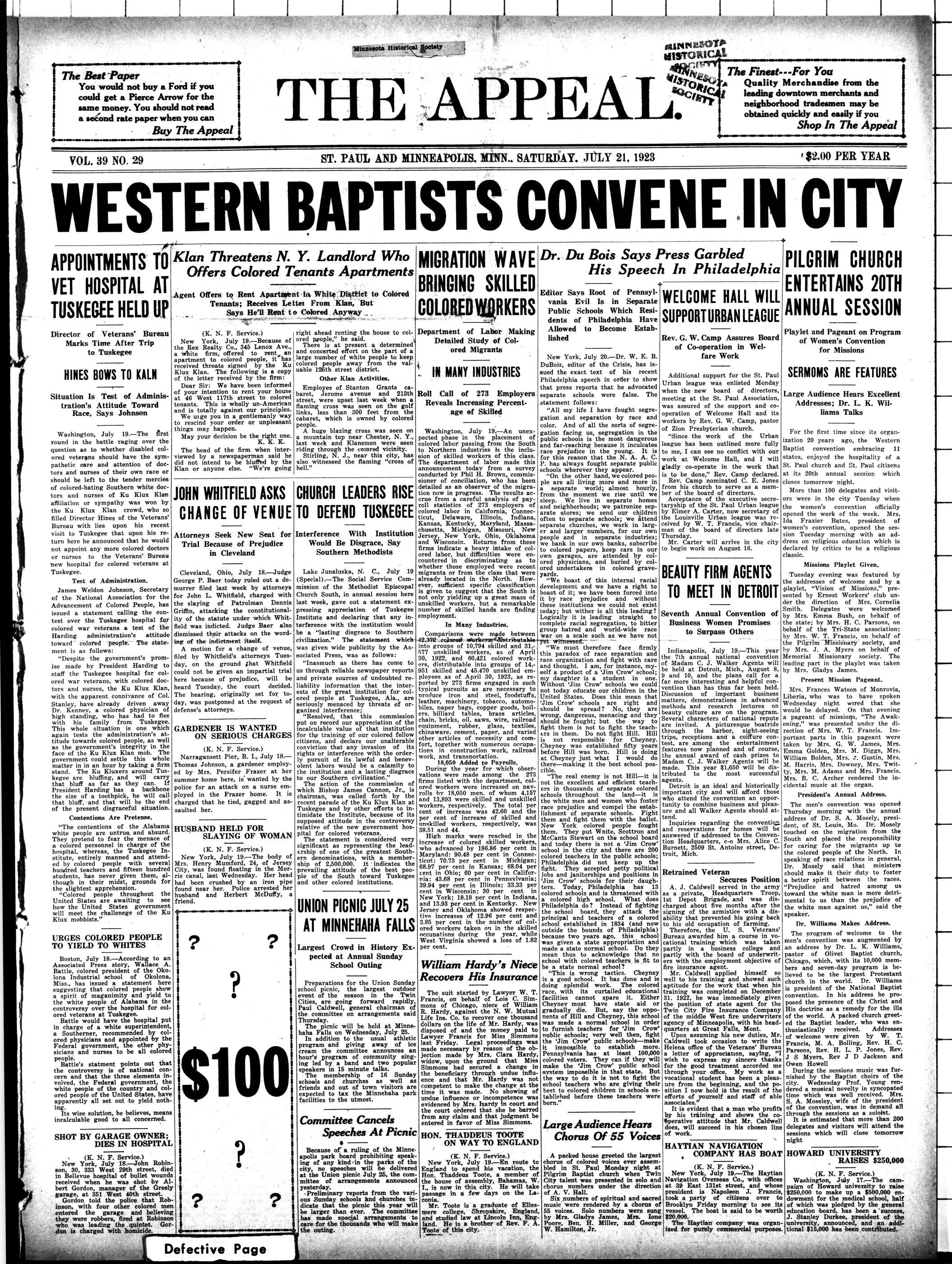
WESTERN BAPTISTS CONVENE IN CITY
The Best Paper You would not buy a Ford if you could get a Pierce Arrow for the same money. You should not read a second rate paper when you can Buy The Appeal
VOL. 39 NO. 29
WEST
APPOINTMENTS TO
VET HOSPITAL AT
TUSKEGEE HELD UP
Director of Veterans' Bureau
Marks Time After Trip
to Tuskegee
HINES BOWS TO KALN
Situation Is Test of Administration's Attitude Toward Race, Says Johnson
Washington, July 19.—The first round in the battle raging over the question as to whether disabled colored veterans should have the sympathetic care and attention of doctors and nurses of their own race or should be left to the tender mercies of colored-hating Southern white doctors and nurses of Ku Klux Klan affiliation or sympathy was won by the Ku Klux Klan crowd, who so filled Director Hines of the Veterans' Bureau with lies upon his recent visit to Tuskegee that upon his return here he announced that he would not appoint any more colored doctors or nurses to the Veterans' Bureau new hospital for colored veterans at Tuskegee.
Test of Administration.
James Weldon Johnson, Secretary of the National Association for the Advancement of Colored People, has issued a statement calling the contest over the Tuskegee hospital for colored war veterans a test of the Harding administration's attitude toward colored people. The statement is as follows:
"Despite the government's promise made by President Harding to staff the Tuskegee hospital for colored war veterans, with colored doctors and nurses, the Ku Klux Klan, with the apparent connivance of Col. Stanley, have already driven away Dr. Kenney, a colored physician of high standing, who has had to flee with his family from Tuskegee. This whole situation is one which again tests the administration's attitude towards colored people, as well as the government's integrity in the face of the Ku Klux Klan mob. The government could settle this whole matter in an hour by taking a firm stand. The Ku Kluxers around Tuskegee are bluffing, and will carry that bluff as far as they can. If President Harding has a backbone the size of a toothpick, he will call that bluff, and that will be the end of the present disgraceful situation.
Contentions Are Pretense.
"The contentions of the Alabama white people are untrue and absurd. They pretend to fear the menace of a colored personnel in charge of the hospital, whereas, the Tuskegee Institute, entirely manned and attended by colored people with several hundred teachers and fifteen hundred students, has never given them, although in their midst, grounds for the slightest apprehension.
"Colored people throughout the United States are awaiting to see how the United States government will meet the challenge of the Ku Klux mobbists."
URGES COLORED PEOPLE
TO YIELD TO WHITES
Boston, July 18.—According to an Associated Press story, Wallace A. Battle, colored president of the Okolona Industrial school of Okolona, Miss., has issued a statement here suggesting that colored people show a spirit of maganimity and yield to the white people of Alabama in the controversy over the hospital for colored veterans at Tuskegee.
Battle would have the hospital put in charge of a white superintendent, a Southerner, recommended by colored physicians and appointed by the Federal government, the other physicians and nurses to be all colored people.
Battle's statement points out that the controversy is of national concern and that the three elements involved, the Federal government, the white people of the country and colored people of the United States, have apparently all set out to yield nothing.
Its wise solution, he believes, means incalculable good to all concerned.
SHOT BY GARAGE OWNER;
DIES IN HOSPITAL
New York, July 18—John Robinson 30, 33 West 29th street, died in Bellevue hospital of bullet wounds received when he was shot by Albert Gordon, manager of the Greely garage, at 351 West 40th street. Gordon told the police that Robinson, with four other colored men entered the garage and believing they were robbers, fired at Robinson who was leading the quintet. Gordon is charged with homicide.
Klan Threatens N. Y. Landlord Who Offers Colored Tenants Apartments
Agent Offers to Rent Apartment in White District to Colored Tenants; Receives Letter From Klan, But Says He'll Rent to Colored Anyway
JOHN WHITFIELD ASKS CHURCH LEADERS RISE CHANGE OF VENUE TO DEFEND TUSKEGEE
(K. N. F. Service.)
New York, July 19.—Because of the Rex Realty Co., 345 Lenox Ave., a white firm, offered to rent an apartment to colorize people, it has received threats signed by the Ku Klux Klan. The following is a copy of the letter received by the firm:
Dear Sir: We have been informed of your intention to rent your house at 46 West 117th street to colored tenants. This is wholly un-American and is totally against our principles. We urge you in a gentlemanly way to rescind your order or unpleasant things may happen.
May your decision be the right one.
K. K. K.
The head of the firm when interviewed by a newspaperman said he did not intend to be bluffed by the Klan or anyone else. "We're going
Attorneys Seek New Seat for Trial Because of Prejudice in Cleveland
Cleveland, Ohio, July 18.—Judge George P. Baer today ruled out a demurrer piled last week by attorneys for John L. Whitfield, charged with the slaying of Patrolman Dennis Griffin, attacking the constitutionality of the statute under which Whitfield was indicted. Judge Baer also dismissed their attacks on the wording of the indictment itself.
A motion for a change of venue, filed by Whitfield's attorneys Tuesday, on the ground that Whitfield could not be given an impartial trial here because of prejudice, will be heard Tuesday, the court decided. The hearing, originally set for today, was postponed at the request of defense's attorneys.
GARDENER IS WANTED
ON SERIOUS CHARGES
(K. N. F. Service.)
Narragansett Pier, R. I., July 18—Thomas Johnson, a gardener employed by Mrs. Persifer Frazer at her summer home here, is wanted by the police for an attack on a nurse employed in the Frazer home. It is charged that he tied, gagged and assaulted her.
HUSBAND HELD FOR
SLAYING OF WOMAN
(K. N. F. Service.)
New York, July 19.—The body of Mrs. Henry Mumford, 24, of Jersey City, was found floating in the Morris canal, last Wednesday. Her head had been crushed by an iron pipe found near her. Police arrested her husband and Herbert McDuffy, a friend.
$100
ST. PAUL AND MINNEAPOLIS, MINN.. SATURDAY. JULY 21, 1923
right ahead renting the house to colored people." he said.
There is at present a determined and concerted effort on the part of a large number of white people to keep the valuable 129th street district.
Other Klan Activities.
Employees of Stanton Grants cabaret, Jerome avenue and 213th street, were upset last week when a flaming cross was seen on the golf links, less than 300 feet from the cabaret, which is owned by colored people.
A huge blazing cross was seen on a mountain top near Chester, N. Y., last week and Klansmen were seen riding through the colored vicinity.
Stirling, N. J., near this city, has also witnessed the flaming "cross of hell."
Interference With Institution Would Be Disgrace, Say Southern Methodists
Lake Junaluska, N. C., July 19 (Special).—The Social Service Commission of the Methodist Episcopal Church South, in annual session here last week, gave out a statement expressing appreciation of Tuskegee Institute and declaring that any interference with the institution would be a "lasting disgrace to Southern civilization." The statement which was given wide publicity by the Associated Press, was as follows:
"Inasmuch as there has come to us through reliable newspaper reports and private sources of undoubted reliability information that the interests of the great institution for colored people at Tuskegee, Ala., are seriously menaced by threats of organized interference;
"Resolved, that this commission put on record our appreciation of the incalculable value of that institution for the training of our colored fellow citizens, and declare our unalterable conviction that any invasion of its rights or interference with the orderly pursuit of its lawful and benevolent labors would be a calamity to the institution and a lasting disgrace to our Southern civilization."
The action of the commission of which Bishop James Cannon, Jr., is chairman, was called forth by the recent parade of the Ku Klux Klan at Tuskegee and by other efforts to intimidate the Institute, because of its supposed attitude in the controversy relative of the new government hospital for colored veterans. The statement underserved very significant as representing the leadership of one of the greatest Southern denominations, with a membership of 2,500,000. It indicates the prevailing attitude of the best people of the South toward Tuskegee and other colored institutions.
UNION PICNIC JULY 25 AT MINNEHAHA FALLS
Largest Crowd in History Expected at Annual Sunday School Outing
Preparations for the Union Sunday school picnic, the largest outdoor event of the season in the Twin Cities, are going forward rapidly, Paul Caldwell, general chairman of the committee on arrangements said Thursday. The picnic will be held at Minneaha Falls on Wednesday, July 25. In addition to the usual athletic program and giving away of ice cream the committee announces an hour's program of community singing led by a band and two popular speakers in 15 minute talks.
The membership of 16 Sunday schools and churches as well as friends and out of town visitors are the Mimehaha park facilities to the utmost.
Committee Cancels Speeches At Picnic
Because of a ruling of the Minneapolis park board prohibiting speaking of any kind in the parks of the city, no speeches will be delivered at the Union picnic July 25, the committee of arrangements announced yesterday.
Preliminary reports from the various Sunday schools and churches indicate that the picnic this year will be larger than ever. The committee has made special arrangements to care for the thousands who will make the outing.
MIGRATION WAVE BRINGING SKILLED COLORED WORKERS Department of Labor Making Detailed Study of Colored Migrants
IN MANY INDUSTRIES
Roll Call of 273 Employers Reveals Increasing Percentage of Skilled
Washington, July 19.—An unexpected phase in the placement of colored labor passing from the South to Northern industries is the inclusion of skilled workers of this class. The department of labor made this announcement today from a survey conducted by Phil H. Brown, commissioner of conciliation, who has been detailed as an observer of the migration now in progress. The results accrue from a careful analysis of payroll statistics of 273 employers of colored labor in California, Connecticut, Delaware, Illinois, Indiana, Kansas, Kentucky, Maryland, Massachusetts, Michigan, Missouri, New Jersey, New York, Ohio, Oklahoma and Wisconsin. Returns from these firms indicate a heavy intake of colored labor, but evidence were countered in discriminating as to whether those employed were recent migrants or from the class that were already located in the North. However, sufficient specific classification is given to suggest that the South is not only yielding up a great mass of unskilled workers, but a remarkable number of skilled hands are finding employment.
In Many Industries.
Comparisons were made between 42,742 colored workers and distributable into groups of 10,794 skilled and 31,577 unskilled workers, as of April 30, 1922, and 60,421 colored workers, distributable into groups of 14,951 skilled and 45,470 unskilled employees as of April 30, 1923, as reported by 273 firms engaged in such typical pursuits as are necessary to produce iron and steel, foodstuffs, leather, machinery, tobacco, automobiles, paper bags, copper goods, boilers, billiard tables, brass articles, chain, bricks, oil, saws, wire, railroad equipment, rubber, glass, textiles, chinaware, cement, paper, and varied other articles of necessity and comfort, together with numerous occupations in construction work, railroad work, and transportation.
18,050 Added to Payrolls.
During the year for which observations were made among the 273 firms listed with the department, colored workers were increased on payrolls by 18,050 men, of whom 4,157 and 13,893 were skilled and unskilled workers, respectively. The total per cent of increase was 42.60 and the per cent of increase of skilled and unskilled workers, respectively, was 38.51 and 44.1.
High marks were reached in the increase of colored skilled workers, who advanced by 186.86 per cent in Maryland; 90.48 per cent in Connecticut; 70.73 per cent in Michigan; 68.97 per cent in Kansas; 68.04 per cent in Ohio; 60 per cent in California; 43.68 per cent in Pennsylvania; 39.94 per cent in Illinois; 33.33 per cent in Wisconsin; 30 per cent in Indiana in York, Illinois; 19.64 per cent and 13.93 per cent in Kentucky. New Jersey and Oklahoma showed respective increases of 12.96 per cent and 3.85 per cent in the number of colored workers taken on in the skilled occupations during the year, while West Virginia showed a loss of 1.82 per cent.
William Hardy's Niece Recovers His Insurance
The suit started by Lawyer W. T. Francis, on behalf of Lois C. Simmons of Chicago, niece of William R. Hardy, against the N. W. Mutual Life Ins. Co. to recover one thousand dollars on the life of Mr. Hardy, was disposed of and the money paid to Lawyer Francis for Miss Simmons last Friday. Legal proceedings was made necessary by reason of the objection made by Mrs. Clara Hardy widow, upon the ground that Miss Simmons had secured a change in the beneficiary through undue influence and that Mr. Hardy was not competent to make the change at the time it was made. No showing of undue influence or incompetence was evidenced by Mrs. Hardy in court and the court ordered that she be barred from any claim and that judgment be entered in favor of Miss Simmons.
HON. THADEUS TOOTE
ON WAY TO ENGLAND
New York, July 19—En route to England to spend his vacation, the Hon. Thaddeus Toote, a member of the house of assembly, Bahamas, WI, is now in this city. He will take passage in a few days on the Laconia.
Mr. Toote is a graduate of Ellesmere college, Shropshire, England and studied law at Lincoln Inn, England. He is a brother of Rev. F. A Toote of this city.
---
Dr. Du Bois Says Press Garbled His Speech In Philadelphia
Editor Says Root of Pennsylvania Evil Is in Separate Public Schools Which Residents of Philadelphia Have Allowed to Become Established
New York, July 20.—Dr. W. E. B. DuBois, editor of the Crisis, has issued the exact text of his recent Philadelphia speech in order to show that press reports that he advocated separate schools were false. The statement follows:
"All my life I have fought segregation and separation by race and color. And of all the sorts of segregation facing us, segregation in the public schools is the most dangerous and far-reaching because it inculcates race prejudice in the young. It is for this reason that the N. A. A. C. P. has always fought separate public schools wherever they appear.
WELCOME HALL WILL SUPPORT URBAN LEAGUE
Rev. G. W. Camp Assures Board of Co-operation in Welfare Work
Additional support for the St. Paul Urban league was enlisted Monday when the new board of directors, meeting at the St. Paul Association, was assured of the support and cooperation of Welcome Hall and its workers by Rev. G. W. Camp, pastor of Zion Presbyterian church.
"Since the work of the Urban league has been outlined more fully to me, I can see no conflict with our work at Welcome Hall, and I will gladly co-operate in the work that
"On the other hand, we colored people are all living more and more in a separate world; almost hourly, from the moment we rise until we sleep. We live in separate homes and neighborhoods; we patronize separate stores; we send our children often to separate schools; we attend separate churches, we work in larger and larger numbers, for our own people and in separate industries; we bank in our own banks, subscribe to colored papers, keep cars in our own garages, are attended by colored physicians, and buried by colored undertakers in colored graveyards.
"We boast of this internal racial development and we have a right to boast of it; we have been forced into it by race prejudice and without these institutions we could not exist today; but wither is all this leading? Logically it is leading straight to complete racial segregation, to bitter group hatred and world-wide race war on a scale such as we have not yet witnessed.
"We must therefore face firmly this paradox of race separation and race organization and fight with care and thought. I am, for instance, myself a product of a 'Jim Crow' school; my daughter is a student in one. Without 'Jim Crow' schools we could not today educate our children in the United States. Does this mean that 'Jim Crow' schools are right and should be spread? No, they are wrong, dangerous, menacing and they should be fought; but the way to fight them is not to fight Hill. Do not fight Hill. Hill is not responsible for Cheyney Cheyney was established fifty years before Hill was born. Hill is doing at Cheyney just what I would do there—making it the best school possible.
"The real enemy is not Hill—it is not the excellent and efficient teachers in thousands of separate colored schools throughout the land—it is the white men and women who foster race prejudice and compel the establishment of separate schools. Fight them and fight them with the ballot. New York colored people fought them. They put White, Scottron and McCants Stewart on the school board and today there is not a 'Jim Crow' school in the city and there are 200 colored teachers in the public schools; Philadelphia did not keep up the fight. They accepted petty political jobs and janitorships and positions in 'Jim Crow' schools for their daughters. Today, Philadelphia has 13 colored schools and is threatened with a colored high school. What does Philadelphia do? Instead of fighting the school board, they attack the principal and teachers of a colored school established in 1834 (and now outside the bounds of Philadelphia) because two years ago, this school was given a state appropriation and made a state normal school. Do they mean thus to acknowledge that no school with colored teachers is fit to be a state normal school?
"This is wrong tactics. Cheyney is a good school. It has done and is doing splendid work. The colored race, with its curtailed educational facilities cannot spare it. Either Cheynev must have state aid or gradually die. But, say the opponents of Hill and Cheyney, this school was made a normal school in order to furnish teachers for 'Jim Crow' public schools; very well then, fight the 'Jim Crow' public schools—make it impossible to establish more Pennsylvania has at least 100,000 colored voters. They can if they will make the 'Jim Crow' public school system impossible in that state. But the way to do it is not to fight the school teachers who are giving their best to colored children in schools established before these teachers were born."
Large Audience Hears Chorus Of 55 Voices
A packed house greeted the largest chorus of colored voices ever assembled in St. Paul Monday night at Pilgrim Baptist church when Twin City talent was presented in solo and chorus numbers under the direction of A. V. Hall. The music was presented of spiritual and sacred music were rendered by a chorus of 55 voices. Solo numbers were sung by Mrs. Gladys James, Mrs. Ione Poore, Ben. H. Miller, and George W. Hamilton, Jr.
The Finest---For You Quality Merchandise from the leading downtown merchants and neighborhood tradesmen may be obtained quickly and easily if you Shop In The Appeal
MINNESOTA
HISTORICAL
SOCIETY
MINNESOTA
HISTORICAL
SOCIETY
The Finest-
Quality
leading de
neighborh
obtained
ENE IN
Press Garbled
h In Philadelphia
WELCOME HALL WILL SUPPORTURBANLEAGUE
Rev. G. W. Camp Assures Board of Co-operation in Welfare Work
Additional support for the St. Paul Urban league was enlisted Monday when the new board of directors, meeting at the St. Paul Association, was assured of the support and cooperation of Welcome Hall and its workers by Rev. G. W. Camp, pastor of Zion Presbyterian church.
"Since the work of the Urban league has been outlined more fully to me, I can see no conflict with our work at Welcome Hall, and I will gladly co-operate in the work that is to be done," Rev. Camp declared. Rev. Camp nominated C. E. Jones from his church to serve as a member of the board of directors. Acceptance of the executive secretaryship of the St. Paul Urban league by Elmer A. Carter, now secretary of the Louisville Urban league was received by W. T. Francis, vice chairman of the board of directors late Thursday.
Mr. Carter will arrive in the city to begin work on August 16.
BEAUTY FIRM AGENTS TO MEET IN DETROIT
Seventh Annual Convention of Business Women Promises to Surpass Others
Indianapolis, July 19.—This year the 7th annual national convention of Madam C. J. Walker Agents will be held at Detroit, Mich., August 8, 9 and 10, and the plans call for a far more interesting and helpful convention than has thus far been held. Discussion of important business matters, demonstrations in advanced methods and research lectures on beauty culture are on the program. Several characters of national repute are invited. A picturesque boatride through the harbor, sight-seeing trips, receptions and a coiffure contest, are among the entertainment features now planned and of course, the annual award of cash prizes to Madam C. J. Walker Agents will be made. This year $1,650 will be distributed to the most successful agents. Detroit is an ideal and historically important city and will afford those who attend the convention an opportunity to combine business and pleasure and all Walker Agents should attend. Inquiries regarding the convention and reservations for homes will be answered if addressed to the Convention Headquarters, c-o Mrs. Alice C. Burnett, 2509 St. Antoine street, Detroit, Mich.
Retrained Veteran
A. J. Caldwell served in the army as a private, Headquarters Troop, 1st Depot Brigade, and was discharged about five months after the signing of the armistice with a disability that prevented his going back to his old occupation of farming. Therefore, the U. S. Veterans' Bureau awarded him a course in vocational training which was taken partly in a business college and partly with the board of underwriters with the employment objective of fire insurance agent. Mr. Caldwell applied himself so well to his training and showed such aptitude for the work that when his training was completed on December 31, 1922, he was immediately given the position of state agent for the Twin City Fire Insurance Company of the middle West fire underwriters agency of Minneapolis, with his headquarters at Great Falls, Mont. Upon assuming his new duties, Mr. Caldwell took occasion to write the Helena office of the Veterans' Bureau a letter of appreciation, saying, "I wish to express my sincere thanks for good treatment accorded me through our office. My work as vocational student has been a pleasure from the beginning, and the position I now hold is the result of the efforts of yourself and staff of able associates." It is evident that a man who profits by his training and shows the cooperative attitude that Mr. Caldwell does, will succeed in his chosen line of work.
HAYTIAN NAVIGATION
COMPANY HAS BOAT
New York, July 19.—The Haytian Navigation Overseas Co., with offices at 39 East 131st street, and whose president is Napoleon J. Francis, took a party of citizens over to Brooklyn Friday morning to see its vessel. The boat is said to be worth $20,000. The Haytian company was organized for purely commercial purposes.
' $2.00 PER YEAR
CITY
PILGRIM CHURCH
ENTERTAINS 20TH
ANNUAL SESSION
Playlet and Pageant on Program
of Women's Convention
for Missions
SERMOMS ARE FEATURES
Large Audience Hears Excellent Addresses; Dr. L. K. Williams Talks
For the first time since its organization 20 years ago, the Western Baptist convention embracing 11 states, enjoyed the hospitality of a St. Paul church and St. Paul citizens at its 20th annual session which closes tomorrow night.
More than 100 delegates and visitors were in the city Tuesday when the women's convention officially opened the work of the week. Mrs. Ida Frazier Bates, president of women's convention, opened the session Tuesday morning with an address on religious education which is declared by critics to be a religious classic.
Missions Playlet Given.
Tuesday evening was featured by the addresses of welcome and by a playlet, "Vision of Missions," presented by Ernest Workers' club under the direction of Mrs. Cornelia Smith. Delegates were welcomed by Mrs. Emma Bush, on behalf of the state; by Mrs. H. C. Parsons, on behalf of the Tri-State association; by Mrs. W. T. Francis, on behalf of the Pilgrim Missionary society, and by Mrs. J. A. Myers on behalf of Memorial Missionary society. The leading part in the playlet was taken by Mrs. Gladys James.
Present Mission Pageant.
Mrs. Frances Watson of Monrovia, Liberia, who was to have spoken Wednesday night wired that she would be delayed. On that evening a pageant of missions, "The Awakening," was presented under the direction of Mrs. W. T. Francis. Important parts in this pageant were taken by Mrs. G. W. James, Mrs. Emma Golden, Mrs. M. Diggs, Mrs. William Bolden, Mrs. J. Gustin, Mrs. M. Harris, Mrs. Downey, Mrs. Twitty, Mrs. M. Adams and Mrs. Francis, Mrs. B. C. Archer rendered the incidental music at the organ.
President's Annual Address.
The men's convention was opened Thursday morning with the annual address of Dr. S. A. Mosely, president, of St. Louis, Mo. Dr. Mosely touched on the migration from the South and placed the responsibility for caring for the migrants up to the colored people of the North. In speaking of race relations in general, Dr. Mosely said that ministers should make it their duty to foster a better spirit between the races. "Prejudice and hatred among us toward the white man is more detrimental to us than the prejudice of the white man against us," said the speaker.
Dr. Williams Makes Address
The program of welcome to the men's convention was augmented by an address by Dr. L. K. Williams, pastor of Olivet Baptist church, Chicago, which, with its 10,000 members and seven-day program is believed to be the largest Protestant church in the world. Dr. Williams is president of the National Baptist convention. In his address he proposed the presence of the Christ and His doctrine as a remedy for the ills of the world. A packed church greeted the Baptist leader, who was enthusiastically received. Addresses of welcome were given by W. T. Francis, M. A. Bolling, Rev. H. C. Parsons, Rev. H. L. P. Jones, Rev J S Myers, Rev J D Jackson and Owen Howell
During the sessions music was furnished by the Baptist choirs of the city. Wednesday Prof. Young rendered a musical novelty in syncopated time which was well received. Mrs. S. A. Moseley, wife of the president of the convention, was in demand all through the sessions as a soloist.
It is estimated that more than 200 delegates and visitors will attend the sessions which will close tomorrow night
HOWARD UNIVERSITY
RAISES $250,000
(A. N. F. Service.)
Washington, July 17—The campaign of Howard university to raise $250,000 to make up a $500,000 endowment for the medical school, half of which was pledged by the general education board, has been a success,
J. Stanley Durkee, president of the university, announced, and an additional $15,000 has been contributed.
J. Q. Adams ..... Editor-in-Chief
Roy Wilkins ..... Managing Editor
Odell D. Smith ..... Business Manager
Advertising Rates on Application
Entered at the Postoffice in St. Paul, Minnesota, as second-class mail matter. June 6, 1885, under Act of Congress, March 3, 1879.
NO COMROMISE
One William Battle has voiced the old doctrine of the "Uncle Tom" type of colored man of the South for application to the Tuskegee tangle. Colored people should "show a magnanimous spirit" and "yield to the whites of Alabama," according to his theory.
Mr. Battle overlooks a great many points that should be considered, not the least of which is that the colored people have for years accepted insult and injury with magnanimity. Now that they have an opportunity to ask for that which is but just, there should be no thought or talk of yielding. More than this, Mr. Battle tacitly asks the United States government to bow to the wishes of the Alabama Ku Klux Klan, for the government has already promised and ordered a completely colored personnel.
There can be no compromise. The Tuskegee institution is a black hospital for black veterans, located in the black belt on the grounds of a black school. The least that the government can do in an effort to save its face for this insulting program of care for colored veterans is to man the hospital with the hundreds of competent colored professional men available. If the government yields now, it will not only be repudiating its word to the colored people of the country, but it will be obeying the orders of the Hooded Kluers. The situation is not the colored man's to yield. It has become a question of the government of the United States or the Klu Klux Klan of Alabama.
WHY THEY MIGRATE
(Rochester (N. Y.) Post-Express.) Representative colored people of Mississippi tell the country why so many of their race are leaving the South. They feel that their life is insecure there and may be taken with impunity at any time upon the slightest pretext. They despair of obtaining their civic rights. They believe that the defeat of the Dyer antilynching bill shows that the South is committed to the perpetuation of lynch law and mob violence. Less than one dollar out of every twenty raised by taxation for school and other purposes benefits the colored man. The tenancy laws are unjust to them. One white man's word is held to outweigh that of several dozen colored men of probity. They are excluded from jury service and all participation in the governments under which they live. The state of Mississippi sent more colored soldiers across the sea than whites, but the returning colored people find themselves utterly without voice in public affairs. These conditions are measurably true throughout the South and must be changed if the colored people are to be kept in the states of their birth.
Health Talks
By E. S. WEBER, D. D. S.
Any questions regarding subjects in these articles or other dental work should be addressed to the Health Editor of the Appeal. Dr. Weber will publish the answers each week in this column.
"SLEEP."
Sleep is a very important phase of health. Some people do not make the proper use of it, while others overdo and abuse it. Sleep should be regulated just the same as any other health-promoting factor, such as diet, exercise, rest, recreation and the like.
The highest medical authorities now agree that the best thing for a man to do when he feels too weak to carry anything through, is to go to bed and sleep as long as he can. This is the only actual recuperation of brain force; because, during sleep, the brain is in a state of rest, in a condition to receive any appropriate particles of nutriment from the blood, which take the place of those which have been consumed by previous labor, since the very last burns up vital particles, as ever of the wheel or screw of the steamer is the result of consumption of fire of the fuel in the furnace. The supply of brain substance which has been consumed can only be restored from the nutritive particles in the blood, which are obtained from the food eaten previously, and then restored to the most best receive and appropriate to itself these nutritive particles during the state of rest or quiet and stillness in sleep. Mere stimulants supply nothing in themselves; they goad the brain and force it to greater consumption of its sub-
stance until it is so exhausted that there is not enough power left to take up a fresh supply. With regard to the amount of sleep people should have, there is a variation. The infant babe sleeps almost all of the time, while a child must have 12 or more hours daily. Adults whose work is, for the most part, manual labor need more sleep than their brothers engaged in mental work. The mental worker needs eight hours while borer or muscle worker should have eight or nine hours' sleep. Elderly people need only six or seven hours' sleep provided he or she does not get much or do much muscular work.
INDIAN MAIDENS HAVE
OWN COMING-OUT PARTY
Ready to Receive Proposal After All-Night Dance.
Washington. "The modern "society" flapper, with her coming-out party, has nothing on the American Indian maiden, whose marriage-announcement party has been among the tribal customs from time immemorial.
Among the Washoe Indians of Nevada there is a dance or ceremony known as "the girl's dance," in honor of the young girl who becomes eligible for marriage. Her white cousin, however, would hardly care to be the star of such a feast, for the guest of honor is allowed to eat nothing at all for four days previous.
On the fourth night the dance starts at about eight o'clock, and sometimes lasts until sunrise the following morning. The Indians form a circle, joining hands, and move by short side steps in a ring, humming a sort of chant without words or meaning.
The girl, accompanied by an elder woman as a sort of chaperon, and carrying a long staff to support her because of the weakness induced by her long fast, weaves in and out of the dance, joining in the step.
As the dance proceeds late into the night, the girl's family give money and other possessions to the dancers to keep them moving and to induce others to join in. The greater the number of dancers the greater the popularity of the family. Shortly after midnight a feast is given by the girl's relatives, and all participate. The ceremony closes at sunrise when the girl is taken to her tepee and attired in bunches of sagebrush in which money is concealed. She appears before the assembled dancers outside and throws the money to them amid a wild scramble. A can of water is then dashed over her head as the concluding ceremony, after which she is ready to receive a proposal of marriage.
Is First Baby to Be
Christened by Radio
Little Winifred Coker and her mother, Mrs. J. B. Coker of Atlanta, Ga. Winifred is the first baby to be christened by radio and the ceremonies took place over WSB, an Atlanta broadcasting station.
War on London's Fog Stirs Old-Timer's Ire
London.—Horrors! They're going to abolish the London fog.
Old citizens are up in arms. "If the fog's been good enough for me, I don't see why the rising generation can't stand it," they moan. But despite this defense of one of London's oldest institutions parliament is "going into it thoroughly." Someone has suggested that Londoners have been "going into it thoroughly for generations, and coming out of it and going into it again, but nothing ever is done about it."
There finally seems to be a serious attempt to end "the London particular" and a committee of technical experts of all British industry are to deal with the problem on national lines.
Many persons who are not experts say there will always be fog in London until the obvious thing is done, prohibit the burning of soft coal.
U. S. Mine Bureau Says Output Is Not Inexhaustible.
Monroe, La.—The United States bureau of mining, having declared that the natural gas in this country is not inexhaustible, and that the supply is dwindling rapidly, persons interested in conservation of Louisiana's natural resources are launching a campaign with the object of either putting an end to the existence of carbon black plants in this state or at least curbing their operations.
The north Louisiana gas field is the largest producing field in the world, and the wells in the Ouachita-Morehouse district now are giving up the enormous total of 1,388,000,000 cubic feet of gas daily for the manufacture of carbon black.
Ninety per cent of this gas is wasted. It is claimed, and the consortium have determined, to something to pay a cap to it, for no other reason than that industries in search of cheap fuel hesitate to locate in or near the field for fear the gas will be exhausted in the near future.
The Texas legislature recently refused to enact a law which would have permitted of the establishment of carbon black plants in the gas fields now being developed in that state, and it is expected the Louisiana legislature at its next session will be called upon to take steps to remedy the situation here.
Carbon black is used for many purposes, the best known of which is in the manufacture of printer's ink. It is nothing more than what is commonly known as soot, and its production is a simple process. The natural gas flame is permitted to burn against a metal plate, across which a mechanical scraper moves. The carbon, or soot, is scraped off, falls into a cone, and is carried to the packing room.
Profts from the business are enormous and any attempt to break it up is certain to meet with stiff opposition, as was the case when the question was considered at the state constitutional convention two years ago.
The cost of drilling and piping a gas well which will produce from 10,000,000 to 20,000,000 feet of gas daily is placed at $20,000. Construction of a carbon plant capable of producing 8,000 pounds of carbon daily requires $100,000. The cost of a gasoline absorption plant, which will produce from the gas, as a by-product, from 1,500 to 2,000 gallons of gasoline daily is $60,000. The total investment represents $170,000.
The Light
of
Western
Stars
A Romance
By
Zane Grey
Illustrations by Irwin Myers
SYNOPSIS
CHAPTER VI- Stewart's horse comes to the ranch with a note on the saddle and a note on the animal. With her brother's consent she does so, naming him "Majesty," her own name, and naming the rich, arranges to buy Stillwell's ranch and that of Don Carlos, a Mexican neighbor.
CHAPTER VII- Madeline feels she has found her right place, under the light of the western stars.
CHAPTER VIII- Learning Stewart had been hurt in a brawl at Chiricau, and knowing her brother's fondness for him, Madeline visits him and persuades him to the ranch as the boss of her cowboys.
CHAPTER IX- Jim Nels, Nick Stele, Madeline, and riders. They have a feud with Don Carlos' vaqueurs, who are really guerrillas. Stewart to see that a scout.
CHAPTER X- Madeline and Florence, returning home from Alfred's trip into an ambush of vaqueurs. Florence, knowing the Mexicans are after Madeline and Madeline gets home safely but alone.
CHAPTER XI- A raiding guerrilla band carries off Madeline. Stewart follows her and whereabouts where whom Stewart had served in Mexico. He releases the girl, arranging for ransom. Madeline finds herself stranded.
CHAPTER XII.—Madelina's sister Helen, with a party of eastern friends, went with exertion. CHAPTER XXII.—The agree to release Stewart, but on their own terms. He is in it be set free. to be rescued and may be shot at any moment. Facing his enemies fearlessly, Stewart or by Madelina. "Malevolent. Your wife."
ahead, he waved to her, sweeping his hand round to what he saw beyond. It was an impressive gesture, and Madeline, never having climbed as high as this, anticipated much.
Majesty surmounted the last few steps and, snorting, halted beside Stewart's black. To Madeline the scene was as if the world had changed. The ridge was a mountain-top. It dropped before her into a black, stone-ridged, shrub-patched, many-canyoned gulf. Massed inky clouds were pilling on the peaks, obscuring the highest ones. A fork of white lightning fashed, and, like the booming of an avalanche, thunder followed.
Madeline glanced at Stewart. He had forgotten her presence. Immovable as stone, he sat his horse, dark-eyed, and, like an Indian unconcerned of the attack and watched. To see him thus, to divine the strange affinity between the soul of this man, become primitive, and the savage environment that had developed him, were powerful helps to Madeline Hammond in her strange desire to understand his nature.
A cracking of iron-shod boots behind her broke the spell. Monty had reached the summit.
"Gene, what it won't all be doin' in a minutum Moses himself couldn't tell." observed Monty.
Then Dorothy climbed to his side and looked.
"Oh, it isn't it just perfectly, lovely!" she exclaimed. "But I wish it wouldn't storm. We'll all get wet."
Once more Stewart faced the ascent, keeping to the slow heave of the ridge as it rose southward toward the looming spires of rock. Soon he was off the ground, grimmed, and Madeline some rods behind him, looked back with concern at her friends. Here the real toll, the real climb began, and a mountain storm was about to burst in all its fury.
The sky grew blacker; the slow-gathering clouds appeared to be suddenly agitated; they piled and rolled and mushroomed and obscured the crags. The air moved heavily and seemed to be laden with sulphurous smoke, and sharp lightning flashes began to play. A distant roar of wind could be heard between the peals of thunder.
Stewart waited for Madeline under the lee of a sheling cliff, where the cowboys had halted the pack-train. Majesty was sensitive to the flashes of lightning. Madeline fitted his neck and softly called to him. The weary cowboy stood the Mexican women covered their heels with their trousers. Stewart untied the slicker at the back of Madeline's saddle and helped her on with it. Then he put on his own. The other cowboys followed suit. Presently Madeline saw Monty and Dorothy rounding the cliff, and hoped the others would come soon.
A blue-white, knotted rope of lightning burned down out of the clouds, and instantly a thunder-clap crashed, seeming to shake the foundations of the earth. This moment of the breaking of the storm, with the strange growing roar of wind, like a mongon monster, was pregnant with a heart-disturbing emotion for Madeline Hammond. Glorious it was to be free, healthy, out in the open, under the shadow of the mountain and cloud, in the teeth of the wind and rain and storm. Undoubtedly, as the ground quaked under her horse's feet, and all the sky grew black and crisscrossed by flaming streaks, and between thunderous ports there was a strange hollow roan sweeping down upon her, she realized how small was her knowledge and experience of the mighty forces of nature.
With blacker gloom and deafening roar came the torrent of rain. It was a cloud-burst. It was like solid water tumbling down. For long Madeline sat her horse, head bent to the pelting rain. When its force lessened and she heard Stewart call for all to follow, she looked up to see that he was starting once more. She turned her horse into his trail.
Rain fell steadily. The fury of the storm, however, had passed, and the roll of thunder diminished in volume. The air had wonderfully cleared and was growing cool. Madeline began to feel uncomfortably cold and wet. Stewart was climbing faster than formerly, and she noted that Monty kept at her heels, pressing her on. Time had been lost, and the camp-site was a long way off. The stag-hounds began to lag and get footsore. The sharp rocks of the trail were cruel to their feet. Then, as Madeline began to tire, she noticed that Monty climbed and climbed, and brush and sharp corners of stone everlastingly pulled and tore at her wet garments. A gray gloom settled down around her. Night was approaching. Stewart's horse was on a jog-troot now, and Madeline left the trail more to Malesty than to her own choosing.
As black night began to envelop her surroundings, she marked that the fir trees had given place to pine forest. Suddenly a pin-point of light pierced the ebony blackness. It grew larger. Black tree-trunks crossed her line of vision. The light was a song and a fire. She heard a cowboy song and the wild chorus of a pack of coyotes. Stewart's tall figure, with sombrero slouched down, was now and then outlined against a growing circle of light. And by the ald of that light she saw him turn every moment or so to look back, probably to assure himself that she was close behind.
With a prospect of fire and warmth, and food and rest, Madeline's enthusiasm revived. What a climb! There was promise, in this wild ride and lonely trail and hidden craggy height, not only in the adventure her friends yearned for, but in some nameless joy and spirit for herself.
World War Veteran
Now Mechanical Dentist
There is now employed in the offices of the New York Dental Company at Grand Forks, N. D., a young dentist who has been a dedicated staff member by the U. S. Veterans' Bureau as a mechanical dentist.
When the war came on he was a farm laborer earning the usual wages and work, which were about $35 a month.
Glad indeed was Madeline to be lifted off her horse beside a roaring fire—to see steaming pots upon red-hot coals. Except about her shoulders, which had been protected by the slicker, she was wringing wet. The Mexican women came quickly to help her change in a tent nearby; but Madeline preferred for the moment to warm her numb feet and hands and to watch the spectacle of her arriving friends. "Warm clothes—hot drinks and grub—warm blankets," rang out Stewart's sharp order.
Then, with Florence helping the Mexican women, it was not long until Madeline and the feminine side of the party were comfortable, except for the weariness and aches that only rest and sleep could alleviate.
Neither fatigue nor pains, however, nor the strangeness of being packed sardinellike under canvas, nor the howls of coyotes, kept Madeline's guests from stretching out with long, grateful sighs, and one by one dropping into deep slumber. Madeline whispered a little to Florence, and laughed with her once or twice, and then the light flickering on the canvas faded and her eyelids closed. Darkness and roar of camp life, low voices of men, thump of horses' hoofs, coyote serenade, the sense of warmth and sweet rest—all drifted away.
When she awakened shadows of swaying branches moved on the sunlit cannons above her. Slow, regular breathing abode to the deep slumbers of her tent comrade. She observed presently that Florence was missing from the number. Madeline rose and peeped out between the flaps.
An exquisitely beautiful scene surprised and enthralled her gaze. Eager to get out where she could enjoy an unrestricted view, she searched for her pack, found it in a corner, and then hurriedly and quietly dressed.
Her favorite stag-hounds, Russ and Tartar, were asleep before the door, where they had been chained. She awakened them and loosened them, thinking the while that it must have been Stewart who had chained them near her. Close at hand also was a cowboy's bed rolled up in a tarpaulin. The cool air, fragrant with pine and spruce and some subtle nameless tang, sweet and tonic, made Madeline stand erect and breathe slowly and deeply. It was like drinking of a magic draught. She felt it in her blood, that it quickened its flow. Turning to look in the other direction, beyond the tent, she saw the remnants of last night's temporary camp, and farther on a grove of beautiful pines from which came the sharp ring of the ax. Wider gaze took in a wonderful park, not only surrounded by lofty crags, but full of crags of lesser height, many lifting their heads from dark green groves of trees. The morning sun, not yet above the eastern elevations, sent its rosy and golden shafts in between the towering rocks to tilt the pines.
Madeline, with the hounds beside her, walked through the nearest grove. The ground was soft and springy and brown with pine-needles. Florence espied her under the trees and came running. She was like a young girl, with life and color and joy. She wore a flannel blouse, corduroy skirt, and moccasins. And her hair was fastened under a band like an Indian's.
"Castleton's gone with a gun, for hours, it seems," said Florence. "Gene just went to hunt him up. The other gentlemen are still asleep. I imagine they sure will sleep up heath in this air." Then, business-like, Florence fail to question Madeline about details of camp arrangement which Stewart, and Florence herself, could hardly see to without suggestion.
As the day advanced the charm of the place grew upon Madeline. Even at noon, with the sun beating down, there was comfortable warmth rather than heat. It was the kind of warmth that Madeline liked to feel in the spring.
Presently a chorus of merry calls attracted her attention, and she turned to, see Helen limping along with Dorothy, and Mrs. Beck and Edith supporting each other. They were all rested, but lame, and delighted with the place, and as hungry as bears awakened from a winter's sleep. Then they had dinner, sitting on the ground after the manner of Indians; and it was a dinner that lacked merriment only because everybody was too busily appeasing appetite. For a few days the prevailing features of camp life for Madeline's guests were sleep and rest. The men more obviously affected by the mountain air than the women. This languorous spell disappeared presently, and then the days were full of life and action. Necessarily, of course, Madeline and her guests were now thrown much in company with the cowboys. And the party grew to be like one big family.
Madeline found the situation one of keen and double interest for her. If before she had cared to study her cowbogs, particularly Stewart, now, with the contrasts afforded by her guests, she felt by turn she was amused and mystified and perplexed and saddened, and then again subtly pleased.
From the thought of Stewart, and the watchfulness growing out of it, she discovered more about him. He was *ng* happy; he often paced up and down the grove at night; he absented himself from camp sometimes during the afternoon when Nels and Nick and Monty were there; he was always watching the trails, as if he expected to see some one come riding up. He alone of the cowbogs did not indulge in the fun and talk around the campfire. He remained occupied and sad,
He served in the army as a private, first class, in Co. M, 26th Infantry, last Division. He was gassed and resuscitated numerous times in his shoulder, which disabilities unfit him to go back to the heavy work he had previously done. The U. S. Veterans' Bureau approved his application for vocational training together with him, upon a course in mechanical dentistry.
and was always looking away into distance. Madeline had a strange sense of his guardianship over her; and, remembering Don Carlos, she imagined he worried a good deal over his charge, and, indeed, over the safety of all the party.
A favorite lounging spot of Madeline's was a shaded niche under the lee of crags facing the east. Here in the shade of afternoon, she and Edith would often lounge under a lowbranched tree. Seldom they talked much, for it was afternoon and dreamy with the strange spell of this mountain fastness. There was smoky haze in the valleys, a fleecy cloud resting over the peaks, a sailing eagle in the blue sky, silence that was the unbroken silence of the wild heights, and a soft wind laden with incense of pine.
One afternoon, however, Edith appeared prone to talk seriously.
"See here, Majesty Hammond, do you
A
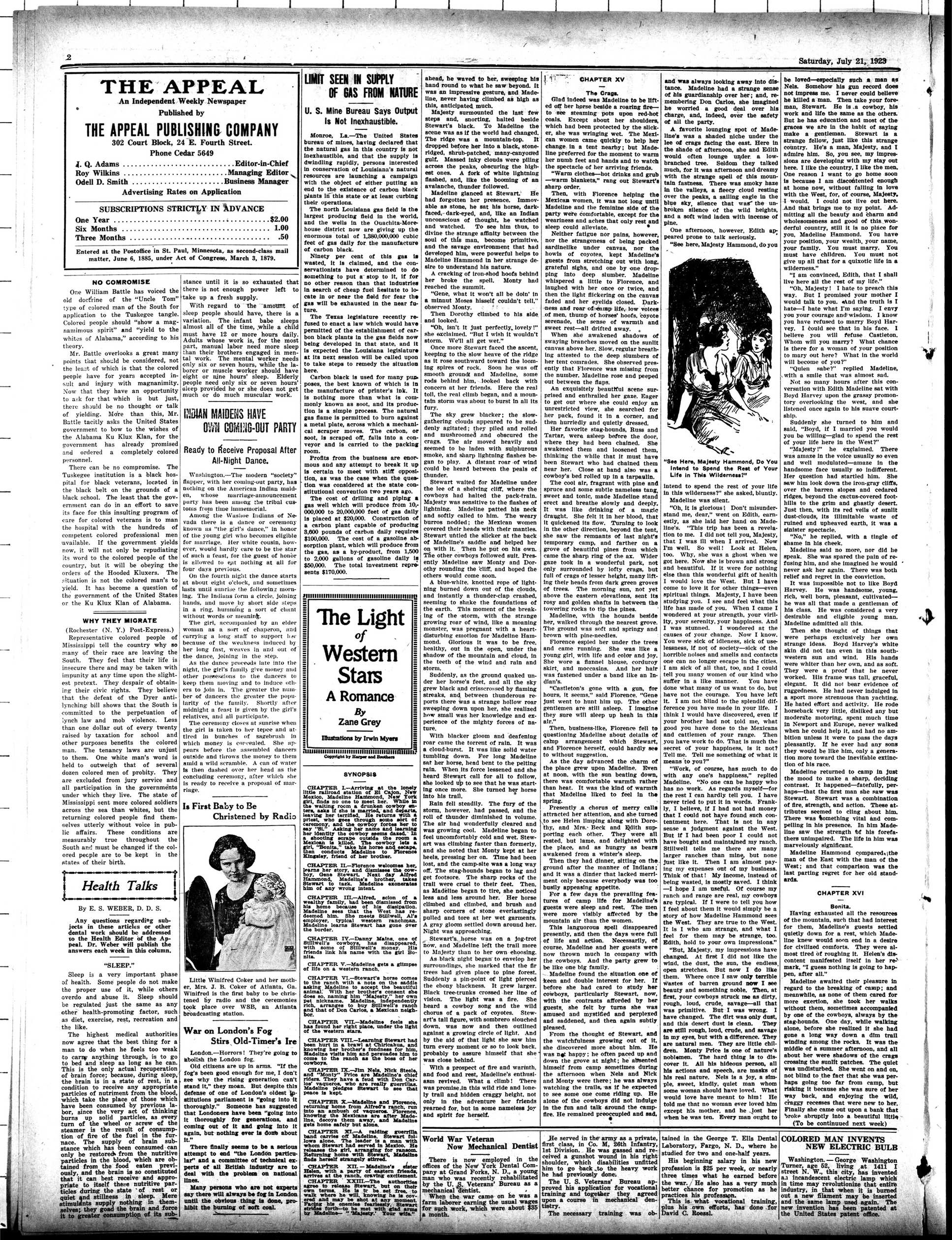
"See Here, Majesty Hammond, Do Your Intend to Spend the Rest of Your Life in This Wilderness?"
intend to spend the rest of your life in this wilderness?" she asked, bluntly. Madeline was silent.
"Oh, it is glorious! Don't misunderstand me, dear," went Eldin, earnestly, as she sald her hand on Madeline's. "This trip has been a revelation to me. I did not tell you, Majesty, that I was ill when I arrived. Now I'm well. So well! Look at Helen, too. Why, she was a ghost when we got here. Now she is brown and strong and beautiful. If it were for nothing else than this wonderful gift of health I would love the West. But I have come to love it for other things—even spiritual things. Majesty, I have been studying you. I see and feel what this life has made of you. When I came I wondered at your strength, your virility, your serenity, your happiness. And I was stunned. I wondered at the causes of your change. Now I know. You were sick of idleness, sick of uselessness, if not of society—sick of the horrible noles and smells and contacts one can no longer escape in the cities, but I know that I would tell you many women of our kind who suffer in a like manner. You have done what many of us want to do, but have not the courage. You have left it. I am not blind to the splendid difference you have made in your life. I think I would have discovered, even if your brother had not told me, what good you have done to the Mexicans and cattelemen of your range. Then you have work to do. That is much the secret of your happiness, is it not? Tell me. Tell me something of what it means to you?"
"Work, of course, has much to do with any one's happiness," replied Madeline. "No one can be happy who has no work. As regards myself—for the rest I can hardly tell you. I have never tried to put it in words. Frankly, I believe, if I had not had money that I could not have found such contentment here. That is not in any sense a judgment against the West. But if I had been poor I could not have bought and maintained my ranch. Stillwell tells me there are many larger ranches than mine, but none just like it. Then I am almost paying my expenses out of my business. I have been doing what I was being wasted, is mostly saved. I think—I hope I am useful. Of course my ranch and range are real, my cowboys are typical. If I were to tell you how I feel about them it would simply be a story of how Madeline Hamm sees the West. They are true to the West. It is I who am strange, and what I feel for them may be strange, too. Edith, hold to your own impressions."
"But, Majesty, my impressions have changed. At first I did not like the wind, the dust, the sun, the endless open stretches. But now I do like them. Where once I saw only terrible wastes of barren ground now I see beauty and something noble. Then, at first, your cowboy struck me as dirty, rough, loud, crude, savage—all that was primitive. But I was wrong. I have changed. The dirt was only dust, and this desert dust is clean. They are still rough, loud, and savage in my eyes, but with a difference. They are natural men. They are little children. Monty Price is one of nature's noblemen. The hard thing is to discover it. All his hideous person, all his actions and speech, are masks of his real nature. Nels is a joy, a simple, sweet, kindly, quiet man whom some woman should have loved. What would love have meant to him! He told me that no woman ever loved him except his mother, and he _lost her when he was ten. Every man ought to
tained in the George T. Ells Dental Laboratory, Fargo, N. D., where he studied for two and one-half years.
This is what vocational training, efforts, has done for David C. Roosevelt.
Saturday, July 21, 1923
be loved—especially such a man as Nela. Some his gun record does not impress me. I never could believe he killed a man. Then take your foreman, Stewart. He is a cowboy, his work and life the same as the others. But he has education and most of the graces we are in the habit of saying make a gentleman. Stewart is a strange fellow, just like this strange country. He's a man, Majesty, and I admire him. So, you see, my impressions are developing with my stay out here. I like the country, I like the men. One reason I want to go home soon is because I am discontented enough at home now, without falling in love with the West, for, of course, Majesty, I would. I could not live out here. And that brings me to my point. Adding to the beauty and good of this wonderful country, still it is no place for you, Madeline Hammond. You have your position, your wealth, your name, your family. You must marry. You must have children. You must not give up all that for a quixotic life in a wilderness."
"I am convinced, Edith, that I shall live here all the rest of my life."
"Oh, Majesty! I hate to preach this way. But I promised my mother I would talk to you. And the truth is I hate—I hate what I'm saying. I envy you your courage and wisdom. I know you have refused to marry Boyd Harvey. I could see that in his face. I believe you will refuse Castleton, Whom will you marry? What chance is there for a woman of your position to mary out here? What in the world will become of you?
"Quien sabe?" replied Madeline, with a smile that was almost sad. Not so many hours after this conversation with Edith Madeline sat with Boyd Harvey upon the grassy promontory overlooking the west, and she listened once again to his suave courtship.
Suddenly she turned to him and said, "Boyd, if I married you would you be willing—glad to spend the rest of your life here in the West?"
"Majesty!" he exclaimed. There was amaze in the voice usually so even and well modulated—amaze in the handsome face usually so indifferent. Her question had startled him. She saw him look down the iron-gray cliffs, over the barren slopes and cedared ridges, beyond the cactus-covered foothills to the grim and ghastly desert. Just then, with its red veils of sunlit dust-clouds, its illimitable waste of ruined and upheaved earth, it was a sinister spectacle.
"No," he replied, with a tingle of shame in his cheek.
Madeline said no more, nor did he speak. She was spared the pain of refusing him, and she imagined he would break her again. There was both relief and anger in the face. It was impossible not to like Boyd Harvey. He was handsome, young, rich, well born, pleasant, cultivated—he was all that made a gentleman of his class. He was considered a very desirable and eligible young man. Madeline admitted all this.
Then she thought of things that were perhaps exclusively her own strange ideas. Boyd Harvey's white skin did not tan even in this southwestern sun and wind. His hands were whiter than her own, and as soft. They were a proof that he never worked. His frame was tall, graceful, elegant. It did not bear evidence of ruggedness. He had never indulged in a sport more strenuous than yachting. He hated effort and activity. He rode horseback very little, disliked any but moderate motorism, spent much time in the sun. He was well-walked when he could help it, and had no ambition unless it were to pass the days pleasantly. If he ever had any sons they would be like him, only a generation more toward the inevitable extinction of his race.
```markdown
```
Madeline returned to camp in just the mood to make a sharp, deeding contrast. It happened—fatefully, perhaps—that the first man she saw was Stewart. Stewart was a combination of fire, strength, and action. These attributes seemed to cling about him. There was something vital and compelling in his presence. In him Madeline saw the strength of his forefait antiquated. The life in him was marvelously significant.
Madeline Hammond compared, the man of the East with the man of the West; and that comparison was the last parting regret for her old standards.
CHAPTER XVI
Having exhausted all the resources of the mountain, such that had interest for them, Madeline's guests settled quietly down for a rest, which Madeline knew would soon end in a desire for civilized comforts. They were almost tired of roughing it. Helen's discontent manifested itself in her remark, "I guess nothing is going to happen, after all."
Madeline awaited their pleasure in regard to the breaking of camp; and meanwhile, as none of them cared for more exertion, she took her walks without them, sometimes accompanied by one of the cowboys, always by the stag-hounds. One day, while walking alone, before she realized it she had gone a long way down a dtm trail winding among the rocks. It was the middle of a summer afternoon, and all about her were shadows of the crags crossing the sunlit patches. The quiet was undisturbed. She went on on, and not blind to the fact that she was perhaps going too far from camp, but risking it because she was sure of her way back, and enjoying the wild, craggies recesses that were new to her. Finally she came up upon a bank that broke abruptly into a beautiful little (To be continued next week)
COLORED MAN INVENTS
NEW ELECTRIC BULB
Washington. — George Washington Turner, age 52, living at 1411 I Street, , this city, has invented a canoeer race in time may revolutionize that entire industry, in that when it is burned out a new filament may be inserted in a lamp used again. The new invention is attached at the United States patent office.
WEEK'S RECORD OF HAPPENINGS
IN MINNESOTA'S CAPITAL.
The "Saintly City" and Saintly City
Folks—Newsy Items of Social, Religious, Political and General Matters Among the People.
THE APPEAL ASKS AS A SPECIAL FAVOR THAT ITS READERS GIVE PREFERENCE TO THE ADVERTISERS WHO SEEK THEIR PATRONAGE BY ADVERTISING IN IT. SHOP IN THE APPEAL BEFORE SHOPPING ELSEWHERE.
Miss Helen Johnson, 1099 Kilburn street, has returned from her vacation.
Mr. W. B. Tandy, 593 Iglehart avenue, has purchased a new Dodge touring car.
Dr. Clarence Smith left the city last week for Washington, D. C., for an indefinite stay.
Mr. J. E. Johnson, 526 St. Anthony avenue, has purchased a new Oldmobile touring car.
The Charity Sewing Circle will meet Monday, July 23, at the home of Mrs. Roland, 531 Aurora avenue.
Mr. and Mrs. James Woods of Des Moines, Iowa, motored to the month and are the guests of Mr. and Mrs. C. H. Miller, 428 Edmund street.
Mrs. George Mundell has organized a kittenball team to meet the Minneapolis team of women at the Union picnic July 25 at Minnehaha Falls.
PRINCE HALL LODGE NO. 195 meets at Union Temple Hall, 406 Franklin street. All visiting brothers in good standing are welcome. S. W. Williams, W. M.; Daniel Rose, IOUSEHOLDER OF RUTH NO. 553, G. U. of O. F. meets the third Monday in each month at Union Hall, corner of Aurora and Kents streets, at 300 P. M. Mrs. Jessie W. K., Mrs. Carrie E. Lindsay, W. R., 426 Rondo street.
Quite a large crowd attended the boat excursion Monday evening given by Ames' Marching club of Minneapolis, and apparently everyone had a good time.
O. C. Hall and family left this morning on a motor trip through the towns of Northern Illinois, the scene of Mr. Hall's boyhood. They will be gone about two weeks.
The Kings Daughters Charity Circle is out to raise $500 for the new church building fund. Of this amount $50 has already been deposited in the Central Metropolitan bank.
Mrs. T. E. Franklin of St. Anthony avenue, left Saturday to spend her vacation visiting friends and relatives in Chicago, Ill., Indianapolis and also in about seven other cities in Indiana.
Office: Cedar 0508 Res.: Dale 2947
Res.: 678 St. Anthony Ave.
MRS. T. H. LYLES
Successor to
T. H. LYLE UNDERTAKING CO.
150 W. Fourth St. ST. PAUL
Mrs. Edgar Llewellyn of Omaha,
Neb., enroute to Duluth, Mnn., to visit
her husband who is in business
there, was a stop-over guest Sunday
at the home of Mrs. James A. Rob-
berts, 978 St. Anthony Ave.
You and your friends are cordially invited to attend the third annual moonlight boat excursion to be given by Pride of the West Company No. 1. Uniform Rank, Knights of Pythias on Monday evening, July 30. A good time is assured everyone. Good music as usual. Tickets 83 cents.
If you are looking for a good time don't fail to join the Acme Club Boys in their all-day picnic down the river on the steamer Red Wing and barge Manitou, Thursday, July 26. The boat will leave the foot of Jackson street at 1 P. M. sharp, and will land down the river at Grey Cloud Island. Music by Stevens Special Six. Tickets: Adults $1, children 50 cents.
Mrs. Amelia Turner, wife of A. J. Turner, who for many years was a resident of St. Paul, passed away Wednesday afternoon at her home 396 N. St. Albans street. Funeral services were held Friday, 2:30 P. M. at St. James A. M. E. church, under the supervision of Household of Ruth, No. 553, and Past Most Noble Governors, Chamber No. 37, G. U. O. of O. F. Interment at Oakland cemetery.
St. Paul Baptist Church.
Visiting ministers will preach at both services next Sunday.
Mrs. Fuller and Mrs. Evans will be baptized in the evening.
Plumbing and other work on the church is steadily progressing.
Preaching at 11 A. M. and 8 P. M. Sunday school at 10 A. M. B. Y. P. U. at 6 P. M.
To Be Ready
when adversity knocks
needs advance preparation and daily sacrifice
PLAY SAFE BY HAVING A SAVINGS ACCOUNT AT
THE
STATE SAVINGS BANK
93 E. FOURTH ST.
4% Interest 4%
Compounded Quarterly
MUSIC BY PROF. STEVENS' FULL JAZZ BAND
Boat Leaves Foot of Jackson St. at 1 P. M. Returning at 9 P. M.
Refreshments, Barbecued Meats and Regular Dinners
Served By The Acme Cafe Caterer, W. H. Reams
Acme Club Committ, R. H. Moore, Chairman, W. F. Jackson, Vice Chairman, Henry Moore, Treas., George Aikins, Secretary Gus Banks, Asst. Sec., Hubert Ttrong, Floor Manager TICKETS: ADULTS $1.00 CHILDREN 50 CENTS
EVERYBODYINVITED
FOR SALE
515 St.Anthony Avenue
in bungalow, new, hardwood through
electricity. Hot water heat, built-in in
machest, medicine chest, linen lock
in cabinet, beautiful fireplace wi
each side, full cement basement, la
at yard and location. Convenient
and Dale car lines. Must be seen to
D. Terms.
BK & SCHUCK REALTY
By Ave.
Save Money
and
Make Sure
Satisfaction
BY BUYING
PIANO
FROM
DYER BRO.
Quality Pianos on EASY TRE
other you wish an upright, grand p
layer piano, you can save money y
sure of satisfaction by writing
old established house before buy
piano on FREE TRIAL anywhere and
if you buy it. Lowest price whether you
terms. Complete descriptive catalog a
of wood free on request.
Catalog and Free Trial Offer
DYER & BRO. ST.PA
DEPT.
STANDARD FROM OCEAN TO
Five-room bungalow, new, hardwood throughout, gas, bath and electricity. Hot water heat, built-in buffet, glass locker, cedar chest, medicine chest, linen locker, laundry chute, kitchen cabinet, beautiful fireplace with built-in bookcase on each side, full cement basement, laundry, cozy attic, excellent yard and location. Convenient to university, Rondo and Dale car lines. Must be seen to be appreciated. $5,000. Terms.
SCHUCK & SCHUCK REALTY CO.
665 University Ave. Saint Paul
Save Money
and
Make Sure of
Satisfaction
BY BUYING YOUR
PIANO
FROM
DYER BROS.
High Quality Pianos on EASY TERMS
Whether you wish an upright, grand piano
or player piano, you can save money and
make sure of satisfaction by writing to
this old established house before buying.
We'll send a piano on FREE TRIAL anywhere and guarantee
satisfaction if you buy it. Lowest price whether you buy for
cash or on terms. Complete descriptive catalog and sample
of wood free on request.
Write for Catalog and Free Trial Offer Today
W. J. DYER & BRO. ST. PAUL, MINN.
DEPT.
THE STANDARD FROM OCEAN TO OCEAN
TOWLE'S
LOG CABIN
SYRUP
KES HOME SWEET H
LOG CABIN PRODUCTS
SAINT PAUL, MINNESOTA
Exide
BATTERIES
BARRETT BATTERY CO.
164 W. 6th St.
The Ormand
Exclusive Models of Comfort and Elegance
Distinctive of
THE Edwin Clapp
SHOE
Sole St. Paul Agency
The Stanley Reem
400 Robert Shoe Co.
of Sixth — William A. Reem
O. E. Z
PRESCRIPTION
Kodaks, Films
O. E. ZANDELL
PRESCRIPTION DRUGGIST
Kodaks, Films and Supplies
879 Rice St., Corner Milford
Walter W. Siggelkow
FUNERAL DIRECTOR
EMBALMER
498 W. University Ave., Cor.
Mackubin.
Residence: 424 W. Central
Fri
```markdown
```
NORTHERN
PACIFIC
YELLOW STONE PARK LINE
No Yellowstone Park
Only $46.20
Round Trip from Saint Pa
C.P. & T.A., N.P. Bldg., Phone Ce
stone Park
$46.20
from Saint Paul
Bldg., Phone Cedar 2340, St. Paul
I personally guarantee every DIAMOND Tire, sold during this sale, to be first grade and fully guaranteed to give the purchaser satisfactory service. MILTON ROSEN.
Other sizes reduced proportionately as low. You can't go wrong buying DIAMOND Tires at these low prices.
CLOVER LEAF BUTTER
Best in the World
FAULTLESS BRAND BUTTER
A close second
TILDEN PRODUCE CO.
CHURNERS
Friends of Yours in Yellowstone Park
Saturday, July 21, 1923
tonic builds up the BLOOD, MUS. CURE MEN'S IT brings OLOR and TOUCH to the COM. PLEXION. It does you so much good; that you WORK and LEEB better; you EAT and DIGEST the food better.
If you doubt me, make me prove it. I will send you the sameotic. I have sent to you sands of others. It is in up to you now—nobody to blame if you don't try to get it right now.
Don't let sickness hang around: don't wait, until you are gone. Take a step away from the grave. It is the sick ones that get it. Prepare your Fight it off! Don't miss this OPPORTUNITY! Rise up! Mail a dollar in paper money or money order and the GENUINE-JOYZONE MEDICINE will be sent to you at once! Write now. Act quick—before you get worse.
(Please write your druggist's address.)
Address
DR.M.P.A.SAKSON
P. O. Box 47
Hamilton Grange Station
New York City
e Bags
$5.00
ARE YOU SICK?
Are you RUN.DOWN, WEAK, TIRED, WORKOUT? Are you SICK due to FALS, POOR BLOOD? Are you suffering with:
RHEUMASTISM ANEMIA
WEAKNESS NEURALGIA
INDIGESTION FEVERS
NEWWORDERS DYESEPSIA
BRONCHITIS COUGHS
NO SLEEP COLDS
ECZEMA CATARRH
DIZZINESS PARALYSIS
Is your Bone Marrow drying up as you do make you lose weight or give you dull Eyes, Pale Lips, Falling Hair, a face full of PIMples? Cheer up! A New York Chemist knows of a medicine that can get you well quickly. The name of this wonderful medicine is JOYZONE RED BLOOD TONIC
Get this tonic and watch yourself become stronger, more powerful, full of Life, Fop, Energy. This tonic builds up the BLOOD, MUS. CLES, NERVEAK. It brings you JOY. OR YOU MOUTH COMPLEXION. It does you so much good that you WORK and SLEEP better you EAT and DIGEST the food better.
If you doubt me, make me prove it. I will send you the same tonic I have sent to thousands of others. It is up to you now—nobody to blame if you don't try to get it right now.
Don't let sickness hang around: don't wait until you are gone. Take a step away from the grave. It is the sick ones that get it. Prepare yourself. Fight it off! Don't miss this OPPORTUNITY: Rise up. Mil a dole in paper money, stampa or money order and the GENUINE- JOYZONE MEDL. Give it be sent to you at once! Write now. Act quick—before you get worse.
(Please write your druggist's address.)
Address
DR.M.P.A.SAKSON
P. O. Box 47
Hamilton Grange Station
New York City
Cobra grain cowhide Traveling Bags, a full cut 18-inch size—3-piece style—a very good bag at this price.
Sixth
at
Cedar
GARLAND
LUGGAGE SHOP
"I'm Through Wor
for Nothing"
AND
E SHOP
Sixth
at
Cedar
In Working
ing"--
So he opened a savings account.
"During the past five years,"
"I've earned about $10,000 and u I haven't saved a dollar. The n years will be different. I'm co often."
years," he said,
000 and until now
ar. The next five
I'm coming in
NATIONAL BANK
Paul
Small Depositor
I THINK
STATE
OF
CK REALTY CO.
"During the past five years," he said, "I've earned about $10,000 and until now I haven't saved a dollar. The next five years will be different. I'm coming in often."
THE FIRST NATIONAL BANK of Saint Paul The Big Bank for the Small Depositor
R.
O BROTHERHOOD.
Social, Physical, Social Benefits.
Department, Co-operative Businesses,
(Sokols), etc., now organizing.
E. B.'s fight for a United Front,
Race Equality and the right of
ence.
N BLANK.
ork City.
and ($1.25) twenty-five cents
both's dues in the Brotherhood.
constitution, etc.
ress ..... .....
ate ..... ....
Protective, Economic, Educational, Physical, Social Benefits. Sick and Death Benefit Department, Co-operative Businesses, Industrial Units. Calisthenics Clubs (Sokols), etc., now organizing. JOIN NOW! Help push the A. B. B.'s fight for a United Front, for better Economic Conditions, full Race Equality and the right of the Colored Man to unmolested existence.
See the New Wheary Wardrobe Trunk—it is America's finest.
Sixth at Cedar
Tel. Elkhurst 2956
Leviathan's New Captain Is Typical Son of the Sea and Won Promotion by Merit.
Doesn't the story of this man
amack of the tales of the old
sea dogs?
Washington.—Capt. Herbert Hart-
ley, the new skipper of the Leviathan,
is a typical son of the sea. He has
spent most of his life on ships, has
seen and served on the old sailing
beauties and remembers the skepti-
cism that greeted new fangled wireless ideas.
He is the sort of a sailorman who
truly pities the "people in the cities"
on wild, stormy nights. Ocean weather
to him is divided into two categ-
ories: It is either "a bit fresh" or
"calm as the palm of your hand." He
seems to have heard or read of hur-
ricanes or gales, but in his tongue
they are no more than "little squalls"
or "kickups."
His associates on the American line—he has been with that company ever since he began his nautical career—say he is lucky; not because he landed the prize post in the American merchant marine but because in all his career he has never had an accident to his ship or any ship on which he has sailed. It is partly because of his reputation that he has advanced through all grades in the American Line to the bridge of the largest ship in the American fleet.
Hunch Fails Him
His worst half hour on the high seas was when during the World war a giant German submarine came to the surface within gun range of his ship, the Loulsville, and opened fire. "It was just after daybreak," he said, "and we were about two days' sail from France when a lookout sighted this sinister black body about a mile away and slightly astern of us. "This object broke one of my real hunches, because I had a distinct feeling on starting the trip that we weren't going to have any trouble, and usually those hunches work out for me. "Hardly had the sailor given the alarm when a column of spray raised by a shell almost showered our port bow. I had four six-inch guns, two in the bow and two in the stern, and I made up my mind right there that the only ones to be used were the stern guns, because I intended to go away from there as fast as I could.
"The Louisville could outstream any submarine that I knew of, but whether she could get out of range before she was mortally hit was the question most vital to all of us just then. I gave every full-speed signal that could help us and turned tall in the direction that would take us away from the menace, which whistled its second shot just about where our how would have been if we hadn't changed our course.
"It took us more than thirty-five minutes to get out of range. During that time the submarine's other shots, which were plentiful, did not come as close as her first two. Ours, I am sorry to say, did her no damage and did not frighten her enough to make her submarine."
Wears Navy Cross.
The Louisville, under Captain Hartley's command, was the first armed ship to leave an American port after President Wilson decided that American vessels should carry their own protection. As the old St. Louis she had served with honor in the Spanish-American war, and, while Captain Hartley doesn't say, so, it is evident that the Leviathan will have a difficult time replacing her in his affections.
Captain Hartley wears the Navy cross for efficient command of his ship during the war, and it is the only honor which he does not seem to take lightly. The cross, he says, is his most treasured possession and he wouldn't trade it for the Leviathan or any other craft afloat.
He is forty-eight years old and is the first cadet of the American line to rise to the position of commander. He took the place of Capt, John C. Jamison as commander of the St. Louis in 1917 when that skipper was taken ill on board, and he brought the ship in and docked her so skillfully that his job as a skipper in his own right was secure. His most recent command has been the big liner Mongolia of the American line.
He began his career twenty-eight years ago as a cadet on the training ship Saratoga with Rea Admiral W. S. Sims, loaned by the navy, as one of his instructors.
Carmarthenshire, Wales.—News has reached here that a ringed swallow which was liberated from Langharne, a neighboring village, has been picked up dead on a farm near Johannesburg, South Africa, 6,000 miles away.
This is the first time actual proof has been obtained of a swallow's flight from Wales to South Africa.
Try Our Fresh Meats and Fish
Men Who Have Died, Legally and Scientifically, Now Alive.
Chicago.—Men who have died—legally and scientifically—several times are now alive and working, due to the use of adrenaline, an extract of the adrenal glands, in a new method of resuscitation, according to reports made at a joint meeting of the Chicago Medical society and the Chicago Society of Anaesthetists.
Dr. Dennis W. Crie of Chicago, who with his uncle, Dr. G. W. Crie of Cleveland, originated the method, read reports of cases in which persons were revived half an hour after they were pronounced dead, died again, and were revived again at intervals, ultimately recovering completely.
"Life can be restored by this method provided the cause of death can be quickly removed," Dr. Crie stated.
"With prompt and fearless treatment the patient may be made to live again."
"So far I have used the treatment only in cases of persons who were pronounced dead, not only by me but also by other surgeons. Hereafter I purpose to employ it upon persons who are dying."
The method as described by Dr. Crile calls for large injections of adrenalin directly into the heart, this organ being pierced with a hypodermic needle. Sometimes manipulation of the heart in the hands of the surgeon is employed as an aid, and respiration is assisted by mechanical reproduction of the processes of breathing.
It finds its greatest utility in operations during which patients die from the anesthetic, the discussion brought out, but can be used "in any situation where the cause of death can be removed quickly."
The first use of it upon the human heart was in Belgium, during the World war, when soldiers terribly mutilated by shells were restored by it and accompanying surgery, according to Dr. Crile. Previously Dr. G. W. Crile had experimented upon dogs, on which the reactions were not so satisfactory. Dr. Crile urged surgeons to make general use of adrenalin and advocated that hospitals be well supplied with it. Dr. Nelson M. Percy added to Dr. Crile's report details of a case of a patient dying under an anesthetic, who was revived, but who passed away six hours later, due, he believed, to her poor physical condition and the severity of the operation. The adrenal glands' secretions, according to medical authorities, control the emotions of courage and fear.
Inventor Is Rewarded by Postal Department
CO MON LIECH
A. E. Wilde of Riverdale, Md., an employee in the mall equipment shops of the Post Office department, Washington, who received one of the two first awards to be made by the department for meritorious suggestions and inventions. Mr. Wilde is shown with the guard for punch presses used for grooming mall bags, which he invented, and which has prevented all but two accidents on these presses since last July when it was adopted. In one year previous to the invention at least 20 operators lost portions of fingers. The award was $100.
Wins $10,000 Bet by
Shooting Big Wolf
Brooklyn, N. Y.—Although he traveled 2,000 miles, 300 of them on snowshoes, lost fifty pounds in weight, froze two fingers, fell over a precipice into a snow bank, lived three days on one muskrat and got lost in a Canadian blizzard, Capt. Frank Doudera, big game hunter, is happy, for he won $10,000 by finally shooting a big timber wolf on a wager.
In a friendly chat Doudera said he thought he could shoot a wolf. City Marshal John Cole, who was read up on wolfing and knew that most of them are killed by traps or poison and seldom by a gun, bet $1,000 that Doudera could not shoot a wolf in five weeks of hunting. Others chipped in until the pot was $10,000.
Doudera trailed wolves for four weeks and saw hundreds of pelts turned in by trappers, but shot none. Just when he was ready to despair a wolf stopped to kill a rabbit and Doudera made his kill. After that it was easy and he shot five others and a bear. The bear's two cubs were sent to the Brooklyn zoo.
192 St. Anthony Avenue..... $6,500.00
198 St. Anthony Avenue..... 4,250.00
198 St. Anthony Avenue..... 3,500.00
183 Carroll Avenue..... 4,800.00
183 Carroll Avenue..... 4,800.00
632 Kirk Street..... 2,500.00
CLASSIFIED
FOR SALE—Overland touring car,
B-83. Cheap. Telephone Dale 1183.
LOST—Forty dollars in a business
envelope addressed to Mrs. Reeler,
June 21, between Union Hall and 418
Charles St. Call Humboldt 1576 or
912 Gaultier street.
WANTED—Colored men to qualify
for sleeping car and train porters.
Experience unnecessary. Transportation furnished. Write T. McCaffrey,
Supt., St. Louis, Mo.
FOR SALE
3 seven-room houses, all in good locations, as low as five hundred dollars down and thirty-five dollars per month plus the interest.
R. F. WILSON
Tel. Elkhurst 1896
CITATION EX. OF FINAL ACCOUNT
State of Minnesota, County of Ramsey, as.
In Probate Court.
The Court for the Estate of Archie
Peters, Decedent.
The State of Minnesota to All Whom it
May Concern:
On reading and filing the petition of the
representative of said estate, praying that
the Court fix a time and place for examining.
adjusting and allowing his FINAL AC-
COUNT, and for the assignment of the resid-
ue of said estate to the persons thereto en-
titled:
The Order, That said petition be heard
and that all persons interested in said mat-
ter be cited and required to appear before
this Court, on Tuesday, the 81st day of
July, 1923, at 10 o'clock A. M., or as soon
thereafter as said matter can be heard, at
the Court. Court seems in the Court
House in the City of St. Paul, in said
County, and show cause, if any they have,
why said petition should not be granted and
that this citation be served by publication
thereby in the Appeal according to law, and
by mailing the copy of this citation at least
14 days before said day of hearing, to each
of the heirs, devisees and legatees of said
decedent whose names and addresses appear
from the files of this Court.
Witness the Judge of said Court this 3rd
day of July, A. D. 1923.
HOWARD WHEELER.
(Seal of Probate Court) Judge of Probate
F. W. Gosewisch,
Clerk of Probate.
W. T. Francis, Attorney.
(7-7-23)
ORDER FOR CREDITORS TO PRESENT
CLAIMS.
State of Minnesota, County of Ramsey, ss.
Probate Court.
In the Matter of the Estate of James H.
Loomis, Deceased.
Letters of Administration on the Estate of James H. Loomis, Deceased, late of the date of his Order, of State, that Minnesota being granted Hattie Oliver. IT IS ORDERED. That six months be and the same is hereby allowed from and after the date of his Order, in which all persons having claims or objections to deceased, are required to file the same in the Probate Court of said County, for examination and warred. IT IS FURTHER ORDERED. That the first Monday in February, 1924, at 10 o'clock A. m., at a General Term of said Probate Court, to be held at the Court House, in the same place, where the same hereby is appointed as the time and place when and where the said Probate Court will examine and adjust claims and objections. AND IT IS FURTHER ORDERED. That notice of such hearing be given to all creditors and persons interested in said Estate, withhold publishing his Order once in each of the street addresses in The Appeal, a legal newspaper printed and published in said County. Dated at St. Paul this 2nd day of July, 1923. By the Court: HOWARD WHEELER. (Seal of Probate Court) Judge of Probate W: T. Francis, Attorney (7-23)
ORDER TO PRESENT CLAIMS WITHIN THREE MONTHS.
State of Minnesota, County of Ramsey, ss. Probate Court.
In the Matter of the Estate of Mary E Lewis. Decessed.
Letters of administration on the Estate of Mary E. Lewis, deceased, late of the City of Winnipeg, in the Province of Manitoba, being granted to W. T. Francis:
It appearing on proper proof by affidavit made to the herein, as provided by law, that there are no debts against the estate of said deceased:
IT IS ORDERED, That three months be and the same is hereby allowed from and as for the date of this order in which persons having claimed, or demands against the said deceased, if any there be, are required to file the same in Probate Court of said County, for examination and allowance, or the borrower harried.
It IS FURTHER ORDERED. That the first Monday in November, 1923, at 10 o'clock A.M., at a General Term of said Probate Court, to be held at the Court House in the City of St. Paul, in said County, the same time and place when and where the said Probate Court will examine and adjust said claims and demands.
AND FURTHER ORDERED. That notice of such having been given to all creditors and persons interested in said Estate, by forthwith publishing this Order once in each week for three successive weeks in The Appeal, a legal newspaper printed and published in said County.
Dated at St. Paul this 2nd day of July.
Dated at St. Paul this 2nd day of July.
Dated at St. Paul this 2nd day of July.
By the Court.
IN WARD WHEELER.
(Seal of Probate Court) Judge of Probate
W. T. Francis, Attorney.
ORDER FOR CRFDITORS TO PRESENT CLAIMS, ETC.
State of Minnesota, County of Ramsey, ss. Probate Court.
In the Order of the Estate of Sylvester J. Bellese, Deceased.
Letters timentary on the estate of Sylvester J. Bellese, deceased, late of the County of Ramsey and State of Minnesota, ss. Probate Court.
being granted to James Vaughn. being granted to James Vaughn. be and the same order hereby allowed from and after the date of this order, in which all persons having claims or demands against the said deceased, are required to file the same in the Court of the County for examination and allowance, or be forever barred. It. Further Ordered. That the first Monday in February, 1924, at 10 o'clock A. M., at a General Term of said Probate Court, to be held at the Court House, in the City of St. Paul, in said county, and the same in the County of St. Paul, in said county, when and where the said Probate Court will examine and adjut said claims and demands. It. It Is Further Ordered. That notice of such hearing be given to all creditors and persons interested in said estate, by forthwith publishing this order once in each Appeal, a legal newspaper printed and published in said county. Dated at St. Paul this 2nd day of July, 1923. By the Court; HOWARD WHEELER. (Seal of Probate Court) Judge of Probate W. T. Francis, Attorney. (283) 212-2222
M. W. Goins N. W. Goins
Tel. Dale 3341
UNIDALE TRANSFER CO.
GENERAL HAULING — FURNI-
TURE, TRUNKS AND PIANOS
A SPECIALTY
"SATISF ACTION GUARANTEED"
872 Lafond St. Saint Paul
TEL. SOUTH 7954
W. S.
FU
W. SQUIRE NEAL
FUNERAL DIRECTOR
SUCCESSOR TO
O. A. LAWRENCE
FACT B Sypho
FACTORY SALE OF
BOHN Syphon Refrigerators
Now in Progress at Greatly Reduced Prices
Term
Terms If Desire
Small Deposit Will Hold Any Refrigerator for Future Delivery
Take St. Paul-Minneapolis Car
Get Off at Hamline Avenue
JOHN REFRIGERATOR CO
PAUL M
WER PRICE
FURNITURE
BOUTELI
Terms If Desired
Small Deposit Will Hold Any Refrigerator for Future Delivery
Take St. Paul-Minneapolis Car. Get Off at Hamline Avenue
BOHN REFRIGERATOR CO.
ST. PAUL MINN.
LOWER PRICES ON FURNITURE AT BOUTELL'S
Great Sale Now Going
—All Departments
wonderful opportunities to save—
bills—up to 1/2 off—we offer you Liber
You can get the benefit of the sale
pay for your purchases by the more
HESITATE—This is the
me to BOUTELL'S and fun
home—AT A BIG SALE
—Draperies—Furniture—I
then Ware—Cut Glass—A
Ware—Stoves, Heaters, R
—all at a saving to you.
A Great Sale Now Going On All Departments Besides wonderful opportunities to save—big price reductions—up to 1/2 off—we offer you Liberal Credit Terms. You can get the benefit of the sale prices—and pay for your purchases by the month. WHY HESITATE—This is the time to come to BOUTELL'S and furnish your home—AT A BIG SAVING
Rugs—Draperies—Furniture—Dishes Kitchen Ware-Cut Glass-Aluminum Ware-Stoves, Heaters, Ranges all at a saving to you.
UTELL BRO
MINNEAPOLIS
MARQUETTE AT FIFTH
Polis and St. Paul Cars Stop at O
?
502 EAST 24TH ST
MINNEAPOLIS
MAKE A TRIP TO
PORTERS' & WAITERS' CLUB
Excellent Food at Minimum Prices. Soft Drinks of All Kinds.
TOBACCO CIGARS CIGARETTES
GLOVER SHULL, Pres. and Treas. EDDIE L. BOYD, Secy.
Busy Corner Kondo and Western
E OF
Cigars, Cigarettes, Tobacco and Candy
381 Rondo
We have purchased 122,000 pair U. S. Army Munson last shoes, sizes $1/2 to 12 which was the entire surplus stock of one of the largest U. S. Government shoe contractors.
This shoe is guaranteed one hundred per cent solid leather, color dark tan, bellows tongue, dirt and waterproof. The actual value of this shoe is $6.00. Owing to this tremendous buy we can offer same to the public at $2.95.
Send correct size. Pay postman on delivery or send money order. If shoes are not as represented we will cheerfully refund your money promptly upon request.
NATIONAL BAY STATE
SHOE COMPANY.
296 Broadway, New York, N. Y.
We have just bought a tremendous stock of Army Munson last shoes to be sold to the public direct. These shoes are 100 per cent solid leather with heavy double soles sewed and nailed. The uppers are of heavy tan chrome leather with bellows tongue, thereby making them waterproof. These shoes are selling very fast and we advise you to order at once to insure your order being filled.
The sizes are 6 to 11 all wirths. Price $2.75. Pay postman on receipt of goods or send money order. Money refunded if shoes are not satisfactory.
THE 1441 Bro
THE U. S. STORES CO.
1441 Broadway New York City
381 Fuller Ave. Elk 2364
J.P.Schroeder
MEATS AND PROVISIONS
323 University Dale 2262
big price
liberal Credit
sale prices
month.
the time
d furnish
SAVING
A Woman
SAFE Phone: Elk
SAFEMILK Phone: Elkhurst 3163
MINNEAPOLIS
A GIFT ELECTRICAL
We are sure would be appreciated Make it Reading Lamp, Vacuum Cleaner or anything Electrical WE HAVE IT
Staple and Fancy Groceries
Ice Cream and Soft Drinks
Dale 8807
PUBLIC SALES.
U. S. ARMY SHOES.
Saturday, July 21, 1923
W. A. FORD
Manager
Afro-American Club
MOTIONS FOR RAILROAD MEN
United Rooms
Cedar 7518
SAINT PAUL
WAITERS' CLUB
St., Minneapolis
Main 2592
Rices. Soft Drinks of All Kinds.
ARS CIGARETTES
as. EDDIE L. BOYD, Secy.
IT ELECTRICAL
are sure would be
appreciated
Using Lamp. Vacuum Cleaner
anything Electrical
WE HAVE IT
will make delivery any date
Minnesota Chandelier Co.
369 Jackson Street
OFFICE TEL.
CEDAR 4044
RES. TEL.
DALE 7816
RES. TEL
DALE 7816
OFFICE TEL.
CEDAR 4044
HOURS: 9 A, M, TO 1 P, M.
AND 2 TO 6 P, M.
SURGEON DENTIST
FIRST CLASS GUARANTEED WORK
IN ALL BRANCHES OF DENTISTRY
SUITE 2 DETROIT BLDG. SAINT
COR. 4TH & WABASHA MINNE
SAINT PAUL
MINNESOTA
RES. TEL.
DALE 1454
HOURS: 8:30 A. M. TO 1 P. M.
AND 2 TO 6 P. M.
SUNDAYS BY APPOINTMENT
DR. EARL S. WEBER
DENTAL SURGEON
FIRST CLASS GUARANTEED WORK
IN ALL BRANCHES OF DENTISTRY
84 W. SEVENTH ST.
DAKOTA BLDG.
SUITE 203-204
ST. PAUL
Tel. Elkhurst 4750
HERTZ
Heating and Sheet Metal Works
517 University St. Paul
TEL. VAN BUREN 1321
VANDER BIE'S
ICE CREAM
IS THE BEST
For Sale Everywhere
J. C. VANDER BIE
Partridge and Brunson Sta.
ST. PAUL, MINN.
Tel. Dale 8339 We Call For and Deliver
ELMER MORRIS
DRUGGIST
Drugs, Medicines, Soda Water
Soft Drinks, Toilet Articles
Candies, Cigars, Tobacco,
Ice Cream Brick or Bulk.
Gas and Electric Fixtures
Fishing Tackle
Dalis & W. Central St. Paul
New Ideas in Fixtures
are constantly appearing and they come here first. We want you to share in the pleasure of seeing their surroundings and their trivialness. Come when you can and see how the modern home is lighted and made beautiful by the latest ideas in fixtures.
Let Us Wire Your Home.
Seven Corners Electric Co.
208 W. 3d St.
Opposite Wilder Public Baths.
G. W. Swanson
MILK
khurst 3163
A MILK CO.