The Appeal
Saturday, November 3, 1923
St. Paul, Minnesota
Page text (machine-generated)
Sell Your Goods by telling the buying public all about them in the most popular column in the paper-the classified ad section In The Appeal
VOL. 39 NO. 44
UNCLE SAM WARS ON OIL FAKERS
Federal Trade Commission Is Trying to Guard Nation's Savings From Sharpers.
Have you ever been nicked by some oil faker? What do you think of the government's efforts to protect the savings of yourself and your neighbor?
Washington.—The federal trade commission is engaged in a war upon the Wallingford of the world. More than 2,000 investigations of oil schemes have been made and each day adds its quota. The schemers comprise all types and the victims are found all over the country.
Yet, although publicity is the only weapon at the command of the commission, the campaign has been successful in large measure. The commission cannot send any man to jail. It cannot even assess a fine. Its authority rests on the construction of a slender clause in the law giving it the nominal power to prevent unfair competition. It proceeds on the theory that the man selling fraudulent stock is competing unfairly, and when it finds that an oil stock promoter is making fraudulent representations it issues an order against him to "cease and desist" from the practice.
The promoter does not have to obey the order. No penalty attaches if he violates it. But in about ninety-nine cases of every hundred he stops his operations. In a majority of cases the proceeding never gets to the stage of issuing an order. More publication of notice that an investigation will be made usually is sufficient to drive a fraudulent operator out of business. He may get in again later under another name or move to greater fields, but the particular fraud that he has been perpetrating comes to an end. The final order, denouncing an individual or company as a fraud, disposes of a class inclined to resist, with the exception of a few old and hardened offenders.
Is Frapile Sword.
It is a fragile sword with which the federal government has gone into battle. Nobody knows better than the commission that it ought to have a stronger weapon, but it uses what it has. "And," said one of the members, "it is an illustration of the queer fact that the weakest things in the world are sometimes the strongest. Who knows that we could do better, or even as well, with a more rigid law?" Of the 2,000 investigations those which went to the final stage of orders to "cease and desist" make only a comfortable handful of manuscript. Every proceeding begins with a complaint from some one who thinks he has been defrauded. The commission makes an investigation. An inspector may be sent to the scene of operations. Four of them give full time to this work, and others are switched to it upon occasion. If the commission has reason to believe the evidence, with even the suspicion of his guilt, the deal has been done and the doer very likely has passed on to fresher pastures. He usually is the sort of man who can change his name upon occasion without doing violence to his conscience. He may bob up again in a distant field, to be routed once more by another complaint.
For those who have the courage to face the matter out, there is a public hearing. The man cited has 40 days in which to answer the complaint. If he does answer, the case goes to trial. Witnesses are examined under oath and the proceeding generally resembles a trial in court. If, at the end of it, the commission is still of its original belief, the order to "cease and desist" is issued.
The defendant may take an appeal to the Circuit Court of Appeals of the United States. If that court confirms the decision it becomes final. Most of them never appeal.
Try Numerous Schemes.
The kinds of fraud practiced are as numerous as the individuals engaged, and these are scattered from the newest oil field at Smackover, Ark., back through all the fields of Louisiana, Texas, Oklahoma and wherever else the oil craze has gone. Most of them are promoters from New York, Chicago and other large cities. They have some competition from the natives of the small towns in which they operate. Now and then one of these novices develops a more alluring line than the veteran fakers. Then there is war. A stockholder protective league or something of the kind is organized, not for the protection of the stockholders at the cost the throat of the rival promoter. Every human emotion is played upon by the promoters, all the way from subtervention to reverence. One of the recently investigated concerns was putting out its advertising over the signature of a man who bears one of the most honored names in America. He was represented as being in complete charge of its affairs. When the inspector of the commission interviewed him he found an old man, far gone in dugage and poverty. "These are mighty good men," he told the inspector. "They know that an old man's misfortunes are not always of his own making and so they pay me $30 a month
just for coming down every day and signing my name to a few papers."
Numerous as the fraudulent schemes are, the commission believes that most of them depend for their success on the operation of the Texas common law trust. In many advertisements the officer appears as "John Smith, Trustee," rarely "William Brown, President." Under this system the trustee is monarch of his company. He makes the by-laws. And stockholders do not vote.
Three persons—in the case of the fraudulent concerns, usually a man and his wife and one other person—go to the office of the county clerk and file a "declaration of trust." That constitutes the "underlying document" for all subsequent transactions. The shareholder may think he has all the stipulations printed on his certificate, but when the test comes he finds that he must go to "the underlying document," and this probably is in Corsicana county, Texas, while the shareholder is in Malne or Oregon.
Trustee Is Whole Works.
**Trustee is Whole Works.**
After the declaration of trust is filed almost anything appears to be possible. "The trustee," said a member of the commission, "may issue $1,000,000 of stock, put $1 in the treasury and the rest in his pocket. He may sell to his new company the assets, including the 'sucker list,' an important company he has been connected with. He may transfer funds from one company to another. He may pay for practically all of the stock with an acre of land 100 miles from an oil field. It is his stock and, when he sells it, the money is his. He never expects to strike oil but, if by some luck chance, he does strike it, he usually can keep the oil.
"In this fraudulent kind of company the trustee makes sure that he is taken care of out of the sale of the stock, and is not dependent at all upon the finding of oil. He usually holds some leases somewhere. He values them high and turns them into the company for stock. He sells the stock and gets the monkey. He may donate a little to the company for the sake of appearances as long as the 'suckers' are at the nibbling stage. When they swallow the hook, the company for which he is trustee is taken off his list of charities. In short the trustee is an absolute dictator."
About the first thing that a fraud-foster trustee seeks to acquire is a list of prospects. Practically every man and every woman in the United States who has shown a disposition to follow the lure of seductive advertisements is on one or more "sucker lists." A particular company or a particular promoter frequently buys names from other companies and other promoters. It also happens, when a company goes out of business, that its only salable asset is this list.
In the oil fields there are a number of newspapers devoted to the oil interests. A lot of honest oil men advertise in them, but so do a lot of the other kind. They are filled with streamers such as these, only the names are different:
"April 12th Dividend Day—Lucky Lankford Pays Off Again."
"Two More Shark Gushers Crash—Four Giant Wells in Ten Days."
"The Iking Flower of Golder Gold Hair—To a Tidal Wave and Those Who Share It Must Act Now."
"Again I Pay—My Next Pay Off May Be 1,000 Per Cent."
"Midway Between the Two Mightiest Gushers on Earth." (But it does not say how far "between.")
"Another Screaming, Howling, Roaring, Liquid Mass of Golden Fortunes for All Who Join Now."
"Walker Won't Walt—Ive Set a Time Limit for Gushers."
"One Hundred Per Cent Cash Is My First Dividend Announcement and You Can Get It If You Act at Once."
The work Works.
There, in that last line, is the keynote. Most oil men, even the honest ones, act on a hurry-up schedule. The honest ones, however, usually are in no great hurry about dividends and the fraudulent ones are. The schemes for making an appearance of paying dividends are as numerous as those for getting names on the list. Frequently dividends are paid to a few stockholders only, those who live in the neighborhood where a stock salesman is operating. Sometimes, when a dividend appears absolutely necessary, part of the money received from stock sales is diverted to the dividend fund and paid out where it will do the most good.
The man who sees the jubilant advertisements and hears that his neighbor has received a fat dividend also is helped in various other ways to make money. Probably he receives a better from some apparently disinterested person—who, however, has been seen by the promoter—advising him to buy stock. He even may be led to believe that the government has underwritten the stock.
Probably he receives the report of a "famous geologist," containing assurance that oil will be struck in great quantities. One of these geologists, the commission found, has spent all of his active life behind a barber's chair.
On the other hand, everything that is said for a property may be absolutely true, and yet the company representing itself as the owner may own no more than a 1 per cent interest. If oil is struck in paying quantity of the proceeds and the numerous stockholders have a 1 per cent dividend among them. Usually it is not worth dividing.—New York Times.
Expert Godfather Quita
London. After 38 years' service, a verger at Isleworth parish church has retired. He has attended 1,117 weddings and has been godfather to 2,000 babies. Absent-minded bridegrooms who forgot the wedding ring have on occasion been provided with his church-door key as a substitute.
THE APPEAL.
URGES BANK ADS IN NEWSPAPERS
URGES BANK ADS IN NEWSPAPERS
Banker Tells National Association They Are Essential Aids to Business Building.
More newspaper advertising by banks as a business builder was strongly urged at the recent convention of the American Bankers Association by W. R. Morehouse of the organization's Savings Bank Division. He backed up his plea with definite action to stimulate advertising by savings banks by calling the attention of the members to a prepared newspaper advertising service developed by the bank. More than half of their requirements for a year's advertising schedule.
"It is my firm conviction that banks can use newspaper advertising with great success," Mr. Morehouse said. "Newspapers go into the homes—by their use as a medium the people of a whole community may be reached in a single day. Because a bank cannot directly trace a large volume of new business to newspaper advertising does not prove that the medium is ineffective as a business builder. The fact that there are certain kind of newspaper which do not produce good results ought not to brand the medium as ineffective, any more than the fact that because a certain booklet or certain business building letter fails to pull would warrant you in branding all booklets and all letters as non-productive mediums.
How to Advertise
"Newspaper advertising must be attractive and easily read if it is to produce good results. If the subject presented is not to the point, is too deeply involved for the average mind to grasp readily, is too full of big and uncommon words, it is only natural that it will not be read. If bank advertising is to accomplish its purpose it must be very simple.
"Discuss only the subjects which will be presented to the public to patronize your bank. Advertise your bank, its financial stability, its officers, directors and stockholders and you will build prestige and strengthen public confidence in your institution.
Enumerate the various kinds of service your bank is prepared to render. It has been my experience that the public is on the lookout for information about banks, banking methods and the kinds of service rendered by banks. For quick results I am a firm believer in sticking to subjects which have a direct bearing on banks, bank operations, and the public has become better informed about banks and the wide variety of services rendered by them.
A New Plan
"If you have not been successful with newspaper advertising try this plan. Confine your advertising within the scope of banking and especially enumerate the various services which your bank is prepared to offer. Boll down every advertisement to one hundred words or less, preferably less. Use headings which arouse interest at a glance. For example, a head IN TEREST FROM DATE' will inspire action on the part of persons with idle funds to deposit because interest starts from the time savings accounts are opened. A heading 'PROTEC TION FOR YOUR VALUABLES' will inspire action on the part of persons in need of protection."
HOW TO CATCH FAKE
STOCK SALESMEN
Some state bankers' associations are distributing an investor's questionnaire with the idea of protecting purchasers of securities from fake stock salesmen.
"Whenever you are solicited to purchase stock or other securities, use this questionnaire before investing any of your funds," says one of these.
"The questionnaire was compiled to protect the small investor and to emphasize the necessity of investigating thoroughly every investment proposition before placing any money therein. When you have been furnished with the information called for in this questionnaire, take it to any one of the banking institutions in your community and get its opinion of the stock offered. If the stock salesman refuses to fill out this questionnaire, have nothing more to do, with his proposition, as a deviant that he fostering a fraudulent promotion."
The questionnaire pins the salesman down to answering the following questions:
Date
Name of company
Name of salesman
Kind of stock offered
Total issue of stock
Stock given for property
Stock given for good-will
Stock given for patents
If so, at what price?
Amount of cash needed
Market price of stock
Has the stock a ready market?
Is it liquid?
In the stock accepted by banks as collateral for loans?
What have accepted it to your knowledge?
What are the present net earnings?
Names of officers
Former occupation
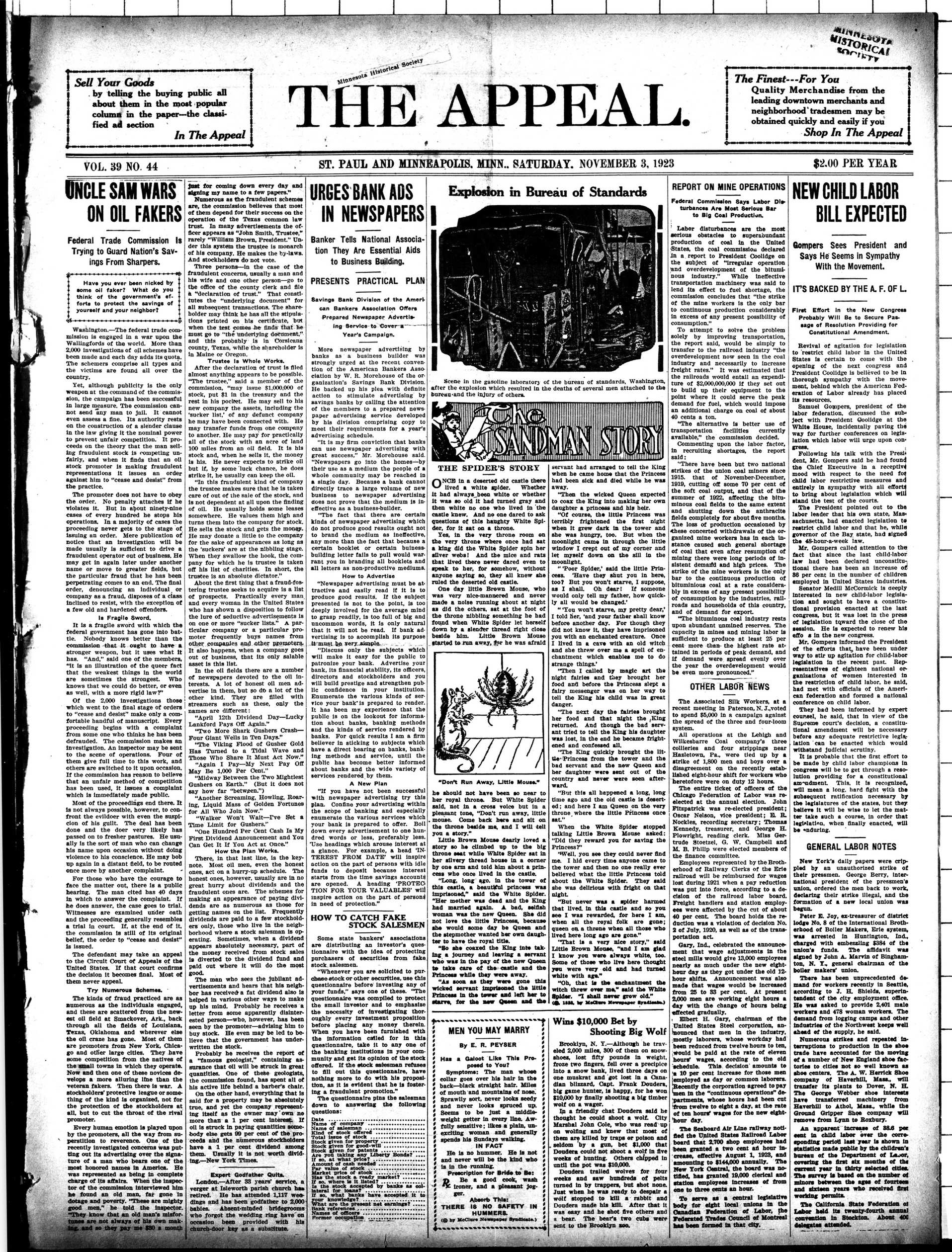
Explosion in Bureau of Standards
Scene in the gasoline laboratory of the bureau of standards, Washington, after the explosion which resulted in the deaths of several men attached to the bureau and the injury of others.
THE SANDMAN STORY
THE SPIDER'S STORY | servant had arranged to tell the King
ONCE in a deserted old castle there lived a white spider. Whether it had always been white or whether it was so old it had turned gray and then white no one who lived in the castle knew. And no one dared to ask questions of this haughty White Spider, for it sat on a throne.
Yes, in the very throne room on the very throne where once had sat a king did the White Spider spin her silver webs! And the mice and rats that lived there never dared even to speak to her, for somehow, without anyone saying so, they all knew she ruled the deserted old castle.
One day little Brown Mouse, who was very nice-mannered and never made a noise running about at night as did the others, sat at the foot of the throne nibbling something he had found when White Spider let herself down by a slender thread right close beside him. Little Brown Mouse started to run away, for he was afraid.
"Don't Run Away, Little Mouse."
he should not have been so near to her royal throne. But White Spider said, not in a cross voice but in a pleasant tone, "Don't run away, little mouse. Come back here and sit on a back me, and I will tell you a story."
Little Brown Mouse dearly loved a story so he climbed up to the big throne seat while White Spider sat in her silvery thread house in a corner by one arm and told him about a princess who once lived in the castle.
"Long, long ago, in the tower of this castle, a beautiful princess was imprisoned," said the White Spider. "Her mother was dead and the King had married again. A bad, selfish woman was the new Queen. She did not love the little Princess, because she would some day be Queen and the stomper wanted her own daughter to have the royal title.
"So she coaxed the King into taking a journey and a servant to the castle of the new Queen to take care of the castle and the Princess while they were away.
"As soon as they were gone this wicked servant imprisoned the little Princess in the tower and left her to starve, for the new Queen and the
By E. R. PEYSER
Has a Galoot Like This Proposed to You?
Symptoms: The man whose collar goes over his hair in the back—black straight hair. Miles of mouth and mountains of nose. Sprawly sort, never looks seedy and never looks spruced up. Seems to be just a middleweight getter in every line. Awfully sensitive; like a plain, unexciting woman and generally spends his Sundays walking.
IN FACT
He is no hummer. He is not and never will be the kind who is in the running.
Prescription for Bride to Be:
Be a good cook, wash ironer, and a pleasant jogger.
Absorb This:
THERE IS NO SAFETY IN HUMMERS.
servant had arranged to tell the King when he came home that the Princess had been sick and died while he was away.
"Then the wicked Queen expected to coax the King into making her own daughter a princess and his heir.
"Of course, the little Princess was terribly frightened the first night when it grew dark in the tower and she was hungry, too. But when the moonlight came in through the little creep out of my corner and let myself down on the sill in the moonlight.
"Poor Spider, said the little Princess, 'Have they shuu you in here, too? But you won't starve, I suppose, as I shall. Oh dear! If someone would only tell my father, how quickly all would be changed."
"You won't starve, my pretty dear, I told her, 'your father shall know before another day. For though they did not know it, they have imprisoned you with an enchanted creature. Once I lived in a cave with an old witch and she threw over me a spell of enchantment which enables me to do strange things."
"Then I called by magic art the night fairies and they brought her food and before the Princess slept a fairy messenger was on her way to tell the King his child was in great danger.
"The next day the fairies brought her food and that night the King returned. And though the bad servant tried to tell the King his daughter was lost, in the end he became frightened and confessed all.
"The King quickly brought the little Princess from the tower and the bad servant and the new Queen and her daughter were sent out of the country and never were seen afterward.
"But this all happened a long, long time ago and the old castle is deserted; and here I am Queen on the very throne, where the little Princess once sat."
When the White Spider stopped talking Little Brown Mouse asked: "What reward you for saving the Princess?"
"Well, you see they could never find me. I hid every time anyone came to the tower and then no one really ever believed what the little Princess told about the White Spider. They said she was delirious with fright on that night.
"But never was a spider harmed that lived in this castle and so you see I was rewarded, for here I am, when all the royal folk are gone; queen on a throne when all those who lived here long ago are gone."
"That is a very nice story," said Little Brown Mouse, "and I am glad I know you were always white, too. Some of those who live here thought you were very old and had turned white with age."
"Oh, that is the enchantment the wise woman once said" said the White Spider.
"I shall never grow old."
1855 by McKenna Gradstein.
Wins $10,000 Bet by
Shooting Big Wolf
Brooklyn, N. Y.—Although he traveled 2,000 miles, 300 of them on snowshoes, lost fifty pounds in weight, froze two fingers, fell over a precipice into a snow bank, lived three days on one muskrat and got lost in a Canadian blizzard, Capt. Frank Doudera, big game hunter, is happy, for he won $10,000 by finally shooting a big timber wolf on a wager.
In a friendly chat Doudera said he thought he could shoot a wolf. City Marshal John Cole, who was read up on wolfing and knew that most of them are killed by traps or poison and seldom by a gun, bet $1,000 that Doudera could not shoot a wolf in five weeks of hunting. Others chipped in until the pot was $10,000.
Doudera trailed wolves for four weeks and saw hundreds of pets turned in by trappers, but shot none. Just when he was ready to despair a wolf stopped to kill a rabbit and Doudera made his kill. After that it was easy and he shot five others and a bear. The bear's two cubs were sent to the Brooklyn zoo.
The Finest---For You Quality Merchandise from the leading downtown merchants and neighborhood tradesmen may be obtained quickly and easily if you Shop In The Appeal
REPORT ON MINE OPERATIONS
Federal Commission Says Labor Disurbances Are Most Serious Bar to Big Coal Production.
Labor disturbances are the most serious obstacles to superabundant production of coal in the United States, the coal commission declared in a report to President Coulidge on the subject of "irregular operation and overdevelopment of the bituminous industry." While ineffective transportation machinery was said to lend its effect to fuel shortage, the commission concludes that "the strike of the mine workers is the only bar to continuous production considerably in excess of any present possibility of consumption."
To attempt to solve the problem solely by improving transportation, the report said, would be simply to transfer to the railroad industry "the overdevelopment now seen in the coal industry and necessarily to increase freight rates." It was estimated that the railroads would entail an expenditure of $2,000,000,000 if they set out build a pit oil equipment to the point where it could serve the peak demand for fuel, which would impose an additional charge on coal of about 40 cents a ton.
"The alternative is better use of transportation facilities currently available," the commission decided.
Commenting upon the labor factor, in recruiting shortages, the report said:
"There have been but two national strikes of the union coal miners since 1915, that of November-December, 1917, cutting off some 70 per cent of the soft coal output, and that of the summer of 1922, affecting the bituminous coal fields to the same extent and shutting down the anthracite fields completely for about five months. In 1922, the mine workers of these concerted withdrawals of the organized mine workers has in each instance caused such general shortage of coal that even resumption of mining there were long periods of insistent demand and high prices. The strike of the mine workers is the only bar to the continuous production of bituminous coal at a rate considerably in excess of any present possibility of consumption by the industries, railroads and households of this country, and of demand for export.
"The bituminous coal industry rests upon abundant unmined reserves. The capacity in mines and mining halls is 25 per cent more than the highest rate attained in periods of peak demand, and if demand were spread evenly over the year the overdevelopment would be even more pronounced."
OTHER LABOR NEWS
The Associated Silk Workers, at a recent meeting in Paterson, N.J. voted to spend $5,000 in a campaign against the spread of the three and four-loom system.
All operations at the Lehigh and Wilkesbarre Coal company's three coileries and four stripsings near Hazeletown, Pa., were tied up by a strike of 1,800 men and boys over a firearm established eight-hour shift for workers who heretofore were on duty 12 hours.
The entire ticket of officers of the Chicago Federation of Labor was reelected at the annual election. John Fitzpatrick was re-elected president; Oscar Nelson, vice president; E. R. Nockles, recording secretary; Thomas Kennedy, treasurer, and George H. Plowright, read clerk. Miss Gertrude Stoetzel, G. W. Campbell and M. B. Philp were elected members of the finance committee.
Employees represented by the Brotherhood of Railway Clerks of the Erie railroad will be reimbursed for wages lost during 1921 when a pay reduction occurred in the decision of the railroad labor board. Freight handlers and station employees were affected by the cut of about 40 per cent. The board holds the reduction was a violation of decision No. 2 of July, 1920, as well as of the transportation act.
Gary, Ind., celebrated the announcement that wage adjustments in the steel mills would give 13,000 employees nearly as much under the new eight-hour day as they got under the old 12-hour shifts. Announcement was also made that wages would be increased from 25 to 33 per cent. At present 2,000 men are working eight hours a day with the change of hours being effected gradually.
Elbert H. Gary, chairman of the United States Steel corporation, announced that men in the industry, mostly laborers, whose workday had been reduced from twelve hours to ten, would be paid at the rate of eleven hours' wages, according to the old schedule. This decision amounts to a 10 per cent increase for those men employed as day or common laborers. Recently the corporation agreed to pay men in the "continuous operations" departments, whose hours had been cut from twelve to eight a day, at the rate of ten hours' wages for the new eight-hour day.
The Seaboard Air Line railway notified the United States Railroad Labor board that 2,700 shop employees had been granted a two cent an hour increase, effective August 1, 1923, and amounting to $144,000 annually. The New York Central, the board was notified, has granted 19,000 clerical and station employees increases of from one to three cents an hour.
To serve as a central legislative body for eight local unions in the Canadian Federation of Labor, the Federated Trades Council of Montreal has been formed in that city.
MINNESOTA
HISTORICAL
SOCIETY
$2.00 PER YEAR
NEW CHILD LABOR BILL EXPECTED
Gompers Sees President and Says He Seems in Sympathy With the Movement.
IT'S BACKED BY THE A. F. OF L.
First Effort in the New Congress Probably Will Be to Secure Passage of Resolution Providing for Constitutional Amendment.
Revival of agitation for legislation to restrict child labor in the United States is certain to come with the opening of the next congress and President Coolidge is believed to be in thorough sympathy with the movement, behind which the American Federation of Labor already has placed its resources.
Samuel Gompers, president of the labor federation, discussed the subject with President Coolidge at the White House, incidentally paving the way for further conferences on legislation which labor will urge upon congress.
Following his talk with the President, Mr. Gompers said he had found the Chief Executive in a receptive mood with respect to the need for child labor restrictive measures and entirely in sympathy with all efforts to bring about legislation which will stand the test of the courts.
The President pointed out to the labor leader that his own state, Massachusetts, had enacted legislation to restrict child labor and that he, while governor of the Bay state, had signed the 48-hour-a-week law. Mr. Gompers called attention to the fact that since the last child-labor law had been declared unconstitutional there has been an increase of 86 per cent in the number of children employed in United States industries. Senator Medill McCormick is deeply interested in new child-labor legislation and sought to have a constitutional provision enacted at the last congress, but it was lost in the press of legislation toward the close of the session. He is expected to renew his effo s in the new congress. Mr. Gompers informed the President of the efforts that have been under way to stir up agitation for child-labor legislation in the recent past. Representatives of eighteen national organizations have been interested in the restriction of child labor, he said, had met with officials of the American federation and formed a national conference on child labor. They had been informed by expert counsel, he said, that in view of the Supreme court's decision, a constitutional amendment will be necessary before any adequate restrictive legislation can be enacted which would withstand judicial scrutiny.
It is probable that the first effort to be made by child labor champions in congress will be to get through a resolution providing for a constitutional amendment. This, it is recognized, will mean a long, hard fight with the subsequent ratification necessary by the legislatures of the states, but they believe it will be wise to let the matter take such a course, in order that legislation, when finally enacted, will be enduring.
GENERAL LABOR NOTES
New York's daily papers were crippled by an unauthorized strike of their pressman. George Berry, international president of the pressman's union, ordered the men back to work, declaring their strike illegal, and the formation of a new local union was begun.
Peter E. Joy, ex-treasurer of district lodge No. 8 of the International Brotherhood of Boiler Makers, Erie system, was arrested in Huntington, Ind, charged with embezzling $384 of the union's funds. The afndavit was signed by John A. Marvin of Binghamton, N. Y., general chairman of the boiler makers' union.
There has been unprecedented demand for workers recently in Seattle, according to J. H. Shields, superintendent of the city employment office. He was asked to provide 2,401 male workers and 478 female workers. The demand from logging camps and other industries of the Northwest keeps well ahead of the supply, he said.
Numerous strikes and repeated interruptions to production in the shoe trade have accounted for the moving of a number of New England shoe factories to the South, where shoe centers. The A. W. Harrick Shoe company of Haverhill, Mass., will transfer its plants to Dover, N. H. The George Webber shoe interests have transferred machinery from Haverhill to Atol, Mass., while the Ground Gripper Shoe company will remove from Lynn to Roxbury.
An apparent increase of 88.6 per cent in child labor over the corresponding period last year is shown in statistics made public by the children's bureau of the Department of Laor, covering the first six months of the current year in thirty selected cities, the number of minors between the ages of fourteen and sixteen years who received first working permit. The California State Federation of Labor had its twenty-fourth annual convention in Stockton. About 400 delegates attended.
GARVEY AND THE KLAN
As head of the Universal Negro Improvement Association, Marcus Garvey has officially stated that that organization is not opposed to the Ku Klux Klan.
Just how the announcement strikes the local branches, we are not able to state at this time. But sufficient to say that this statement by Garvey must be regarded as binding on every member and sympathizer of the Garvey movement throughout this country, unless they repudiate it.
In a signed official statement in the Negro World, the official organ of the Universal Negro Improvement Association, October 27, Garvey has this to say:
"The Unisarvel Negro Improvement Association has never fought the Klan as an organization and does not intend to do so in America."
The above are the exact words of Garvey, not binding himself alone, but the Universal Negro Improvement Association with all its members. We doubt very much whether the members of the U. N. I. A. will back Garvey in such a statement. Because the Ku Klux Klan is the worst enemy the Negro has in this country.
Garvey styles himself as a "fighter." The public will be interested to know how it is that he has so calmly surrendered to the Ku Klux Klan? He says he is not worried about the rights of the Colored people in this Country, yet he is bitterly complaining about a 'glass of soda' which was r.fused him in a white drug store. "Be consistent and the world will have more faith in your sincerity."
He says that it will require from two to five hundred years for his program to become operative. What are we going to do until that time?
Doe Garvey believe in the 'jim-crow' cars? Does he believe in the Klan's program? If he is not opposed to these things, surely he is for them. We wonder if Garvey is really afraid of the Klan? If he is, then he is a coward. If he is not, then he is a hypocrite of the worst sort.
Garvey says we are weak and that it is useless for us to fight for our rights in America. That's the same doctrine that the weaker have always heard. If somebody of our race did not make the fight, Garvey nor his followers would have a place to lay their heads in safety in this Country,
The poet says, "Sure, I must fight if I would reign, increase my courage, Lord." No man or set of men is fit to lead this race of ours, who is afraid to fight the Klan and every form of race predjudice. In this enlightened age, we, as a group, have no time for chasing shadows. This is a day of thought and reason. There is neither logic or reason in Garvey's program and the sooner all the people find it out the better off the race w illbe in the future.
Bed Time Stories on a Pullman Smoker
In purest English of Bostonian inflection, the dining car waiter had announced the "lawst call for dinnah." I drifted back to the smoker, and in doing so passed a vacant section, where the Pullman porter had been resting and reading. His book lay where he had left it. I picked it up and read the title: "Kant's Critique of Pure Reason." Whew! Some classic atmosphere surrounding lowly service, suggested by the waiter's accent and the porter's choice of reading!
A globe trotter, who scours the world looking fqr flax to make linen, had the floor in the smoker. He was of undoubted Jewish caste; in fact, his nose seemed to be describing a circle on the map of Palestine from Joppa to Jericho. But he was kindly, polished, and knew his stuff. His observations were being politely heard by a group of business men who tarried under the cloud of smoke before retiring. There was one exception—the usual Pullman commercial hound, who sells spark plugs and knows Henry Ford intimately (by sight). He laughed wilfully at his own thrice-told tales and wondered why the others were immune to his gay and festive fever.
But the Wandering Jew had the floor and was telling how Soviet Russia produced 90 per cent of the flax woven into the world's linen.
"That is the reason England is trading with wobbly Russians," said
The FLORSHEIM
SHOE
for the man who cares
Florsheim Shoe Stores
16 West Seventh Street 421 Robert Street
The
Florsheim
SHOE
our globe trotter. "England never overlooks the main chance of going to market and she knows that the small product of flax yielded by Ireland will not enable her to take her linens to market."
I knew it was coming; so I lighted my pipe and seated myself in easy expectorative range of a cuspidor, and calmly waited. It wasn't long delayed.
"Cotton is uncertain," our Jewish speaker declared. "With the colored man going and the boll weevel staying, the South cannot supply the spinners. There has never been a labor crisis in the world that equals the desertion of the soil that the colored man is now accomplishing. In some subtle way he seems to associate cotton with lynching, disfranchisement, and the other reprials that have been visited upon him in the South."
"Some people thought that a finer process of manufacture would render the cotton fabric as a serviceable substitute for linen, but unless the South can keep its colored workers and dismiss the boll weevil, the prospect for this development is dismal for sure."
Then the rancous spark-plug dispenser interposed to know why there was not some law or some way to "make the darkies stay South to save cotton."
"Pshaw! That's bunk! Where dye get that stuff?" exclaimed our wanderer, who must have been a descendant of one of the Three Wise Men of the first Christmas. "How does an apparently sensible white man get a fool notion like that in his head? How would you make an American citizen stay where he doesn't want to stay? What do you think this country is—a slave republic? You don't know the colored man, my vivacious friend. He's a ellofasight smarter than you are. Best evidence, there's not going. He's gone! Besides, there is a sphinx in the White House, who isn't talking, but is busy testing and adjusting the scales of national justice so such chaps as you can't cheat with them."
I thought again of the waiter's accent and the porter's book as I staged the scene, which led to my berth, which the porter had informed me was "quite prepared, sir."
TALKED LIKE NORTHERN
MAN: ALMOST LYNCHED
Pin Bluff, Ark., Sept. 27—Having in his possession clippings which showed that he had been delivering lectures in Louisiana and Mississippi, urging colored people to stay in the South is all that saved J. W. White, a colored visitor, from a severe flogging by whites at Crossett, Ark., recently. Five white men had taken White five miles west of Crossess, to either lynch of flog him because he was believed to be a labor agent, and that he had enticed many colored people to go North. White was well dressed and said to have talked NO more than he said, and this why he was mistaken as a labor agent. When his captors became convinced that he was "on their side of the fence" they brought him back to town, loaded him down with good cigars and other refreshments, and sent him on his way rejoicing.
ENTIRE RACE URGED TO SIGN PETITION ASKING PRESIDENT TO PARDON IMPRISONED MEMBERS OF THE 24TH INFANTRY
A movement, fostered by the National Association for the Advancement of Colored People, and receiving the united support of the press, church, secret organizations, women's clubs civic clubs and other race organizations, is on foot to have President Coolidge pardon and restore to citizenship the members of the Twenty-fourth U. S. Infantry, who are serving life terms at the federal prison at Leavenworth, Kan.
The men were convicted following the Houston race riot in 1917. The petition follows:
United States:
citizens of the United States, do respectfully petition
pardon and restore to citizenship the members of
sentences in the Federal Prison at Leavenworth, Kansas, in August, 1917.
of
previous record for discipline, service and soldierly conduct of the 26 of local animosity against these men because of their race and of violence against these colored soldiers wearing the uniform of race to Right.
statement met out to members of the 24th Infantry, of whom six without right of appeal to the Secretary of War or to the President main in prison, having already served nearly six years.
To the President of the United States:
WE, the undersigned citizens of the United States, do respectfully petition that by exercise of the power of Executive Clemency you pardon and restore to citizenship the members of the 24th U.S. Infantry now serving life and long-term sentences in the Federal Prison at Leavenworth, Kansas, convicted in connection with the riots at Houston, Texas, in August, 1917.
We so petition because of
1. The excellent previous record
2. The provocation of local animal threats and acts of violence a to be sent to France to fight
3. The heavy punishment meted summarily and without right four of them remain in prison,
1. The excellent previous record for discipline, serv-
2. The provocation of local animosity against these
threats and acts of violence against these colors
to be sent to France to fight
3. The heavy punishment meted out to members of
summarily and without right of appeal to the Se
four of them remain in prison, having already seen
1. The excellent previous record for discipline, service and soldierly conduct of the 24th Infantry.
2. The provocation of local animosity against men because of their race and color which was manifested in insults, threats and acts of violence against these colored soldiers wearing the uniform of the United States Army and waiting to be sent to France to fight.
3. The heavy punishment meted out to members of the 24th Infantry, of whom nineteen were hanged, thirteen of them summarily and without right of appeal to the Secretary of War or to the President, their Commander-in-Chief. Fifty-four of them remain in prison, having already served nearly six years.
4. The exemplary conduct of the men as prisoners.
Any church club, civic or natures to to the form heir. That all petition to your print 8½ by 14 in.
When filled A. C. P., 69 arranged by clerical work impressive as.
This should will be one year have I restoring the.
Individual with nineteen.
City and S
ADDRESS
INSTRU
City and State
ADDRESS NAME
INSTRUCTIONS
NAME ADDRESS NAME ADDRESS
Any church, lodge or other fraternal organization, woman's club, civic or other club which wishes to aid in gathering signatures to the petition has full permission to print copies of the form here given and have them signed by their members. That all petitions may be uniform we urge you take this form to your printer as a model and have them printed on sheets 8½ by 14 inches in size, leaving out of course, these instructions. When filled by bona fide signatures mail to the N. A. C. P. C., 69 Fifth Avenue, New York City, where they will be arranged by states and in uniform lots, and all other necessary clerical work done that the pleas for pardon may make the most impressive showing when presented to President Coolidge. This should be done promptly. Remember, every signature will be one more ald towards freeing these men who for six years have been unjustly imprisoned. Do your part towards restoring them to their loved ones and to freedom. Individuals may help by clipping the above form, signing it with nineteen others and mailing it to the N. A. A. C. P.
NOTE—When necessary use lin
NOTE—When necessary use line underneath signature for address
NOTE-When necessary use line underneath signature for address
NOTICE OF EXPIRATION OF TIME OF
REDEMPTION
The
The F
The FLOR
PETITION
suant to the statute, to an actual purchaser for the sum of Fifteen Dollars and twenty-two Cents. In the amount required to redeem said piece or parcel of land from sale, exclusive of the costs to accrue upon this notice is the sum of ( $15.22 ) Fifteen Dollars and twenty-two Cents, from said 18th day in 1923, to the dua such redemption is made.
Witness my hand and official seal this
4th day of September, 1923.
N.Y.C. PUSS
Seal
GEO. J. KIES,
Auditor Ramsey Count.; Minnesota
IN PROBATE COURT.
IN PROBATE COURT.
State of Minnesota, County of Ramsey, ss.
The State of Minnesota, the Estate of Arthur Botta, Decendent.
The State of Minnesota to All Whom
the bishopric. Mrs. Hattie Ball having been filed in this Court, representing that Arthur Botts then a resident of Minnesota, died intestate on the 27th day of August 1923, and praying that his estate be granted to George W. Brooks.
INSTRUCTIONS
IT IS ORDERED. That said petition be heard and that all persons interested in said matter be and hereby are cited and required to appear before this Court on Tuesday, the 9th day of October, 2014, at noon or as soon thereafter as said matter can be heard, at the Probate Court Room, in the Court House in the City of New York, to show cause, if any they have why said petition should not be granted and that this citation be served by the publication thereof in the Appeal Court, later than the miling copy of this citation at least 14 days before said day of hearing to each of the heirs of sale decedent, whose names and addresses are known and appear from the files of this Court.
Witness the Judge of said Court, this 10th day of September A. D. 1923.
Howard Wheeler
Attorney, P. W. Hamilton
Clerk of Probate
Geo W. Hamilton, Jr.
Corporal, P. W. Hamilton
TRAVELING
A good custom is better than a law—Burglades.
OUR friends are beginning to travel again.
Now it is more like old times, and if our friends go abroad they go with lighter hearts and with more baggage. Therefore it is quite the thing to give them little gifts and, if they want us to, to see them off. Be sure, though, that you are wanted. Nothing is more embarrassing than to arrive unexpectedly on the deck of a steamer to find the friend you have gone to see off surrounded by an invited party of which you are not a member. So don't go unless you are quite certain that you are wanted, both for your sake and for the sake of the traveler.
As for the gifts you send, be sure that they are really desirable, and not merely something that will fill up the steamer trunk and bags. If you know of some traveling accessory of which your friend stands in need, that is a good choice. A book is never amiss because after it is read it can be left on shipboard if it is in the way. Candy, although it is a conventional present, and one of the few things that a man is supposed to give to a woman, is nevertheless not a very good choice. A great many persons even though they enjoy ocean travel are particularly careful not to indulge in sweets. Flowers, another of the conventional gifts of men to women are always in perfectly good taste. However, they are sometimes in the way in the stateroom. If you know that anyone dislikes flowers on the steamer don't send them.
As in all other cases where gifts are concerned a man may send flowers, candy or books to a woman. Books in this case include magazines, and sometimes half a dozen current magazines are as welcome a gift as anyone could receive. They provide just the kind of reading that some people like on shipboard and can be discarded without a qualm when their reader is through with them.
The Secret of Success
"Lydia contrived to look well dressed, having early in her career discovered that the putting on of clothes is more than half the battle. Wear rags with enough of an air, a style, conviction, and you may boldly take the social field."—From "The Survivors," by Lucas Malet.
Cupid's Feet.
"No," said the woman, emphatically to her London neighbor. "I don't hold with these 'ere therms. When I says gas I mean gas, and I likes to know what I'm payin' for. Therms, indeed! Why can't we 'ave it like we used to 'ave it—by the Cupid's feet?"
Can Read Both Ways to the Middle.
In the ancient city of Bagdad is a religious cult called the "star-worshipers." They turn to the north star to pray, must be baptized every Sunday, and they have a sacred book which they can begin at either end and read toward the middle.
Furniture Polish.
To make furniture polish, dissolve
two ounces of shellac in one pint of
boiled oil; shake well and add two
ounces each of ammonia and chloro-
form. Shake and apply with a soft
brush without rubbing.
Didn't Halt Police
Marlon, O.-Cries of "Tm taking a bath," failed to keep police from breaking through a bathroom door at the home of Mrs. Julia Sneckenberger and seizing her on a charge of bootlegging. They are said to have secured considerable "evidence." C. F. Dombaugh was caught as he was making an exit through a window and will also face a bootlegging charge.
SATURDAY, NOVEMBER 3. 1923.
PENITENT UNCLE
By H. LOUIS RAYBOLD
(© 1923, by McClure Newspaper Syndicate.)
"AND so, after all these years, I am trying to make up for my indifference by this method of reparation. The money is yours to do with as you desire. When you receive it I shall be dead and beyond the reach of thanks.
"Your belatedly penitent great-uncle, "Jonathan Benjamin Cowles."
This was the conclusion of the letter which Jimmy Stiles several days ago had signed with a flourishing signature and then reread with grim satisfaction. How tickled Mary Louise would be! And how unlikely ever to discover the hoax.
Now he sat at his desk and wondered whether Mary Louise had yet cashed the inclosed certificate of deposit.
She had come to visit her aunt, who was matron of the County Home, where Jimmy was one of many lonely, blue-overalled and aproned orphans.
Mary Louise's mother, because of whose illness she had been sent away, died during her absence and she stayed on with her aunt. And when matrimony with a widower of small means and considerable family claimed the estimable matron, Mary Louise still lingered.
Jimmy became her companion in all the playground squabbles, nor did the marvelous piece of luck which befell him when he was fifteen make him forget her.
Jimmy rose rapidly—graduated brilliantly from high school—went into a lawyer's office daytimes and continued study at evening school. Ultimately he entered the bar and became an attorney with a reputation before he was thirty.
Meanwhile Mary Louise had been "bound out" to a lonely farmer's wife. Growing attached to her, the woman had done more than the stipulated clothing and feeding of the child—had taught her what she could of grammar, geography and similar rudiments of learning.
A summer boarder had taken an interest and lent her books, not only during her stay but for many months afterward.
These changes had meant separation for the boy and girl, during which the memory of each grew dim to the other but did not utterly fade. And at Drift Harbor, that wonder spot of ocean beach and vivid sunset and riotous surf, their paths converged once more.
Signing his name in the Drift Harbor house register, Jimmy looked up from the final flourish of his signature—James W. Stiles, Boston—straight into a pair of well-remembered soft blue eyes.
"You! Mary Louise!"
Yes, it was Mary Louise, who sometimes filled in at the hotel, which stood a mile or two from her adopted home, in various capacities from that of clerk to waitress.
"Are you happy, Mary Louise?" he asked one day.
Mary Louise threw him a questioning glance from beneath her curly lashes. "Just now," she said ingenuously. "But winters—oh, Jimmy, it is very lonely. And—and I see no future. If only I could afford to go to the city and have a couple of years at a normal school. Then—oh, just think, I might be able to teach!"
She sighed blissfully, as though teaching were an achievement too heavenly to contemplate. "I dream nights of what I would do with a thousand dollars. That's my favorite air castle in Spain."
That winter Jimmy unexpectedly won a case which netted him an even thousand and the sight of the check brought back to him the words of Mary Louise.
An intense longing surged within him to help her out even as years ago he had been helped by the kindly reporter. But handing over a sum of that amount to an unrelated young lady presented a problem.
Suddenly the idea of creating a fictitious great-uncle occurred to him—a great-uncle who would exist but for a moment on a sheet of paper, but long enough to bequeath to Mary Louise a thousand-dollar legacy.
The letter had been written and sent and now Jimmy sat and dreamed in his office of its reception by a blue-eyed girl in a lonely farmhouse near Drift Harbor.
And as he dreamed the door of his office opened. At sight of a slim figure Jimmy sprang to his feet.
"You fraud!" cried a sweet voice. "My great-uncle Jimmy!" Jimmy swallowed. "How-er—why-er—"
"Well, partly because I read in the papers of your thousand-dollar fee in the Hitchcock case, but mostly because only one person in the world makes the funny 'J's that you do. I had only to compare the 'J of Jonathan with the 'J on the hotel register to have my suspicions confirmed. Of course I couldn't—"
"Mary Louise," interrupted Jimmy firmly, "hand over that certificate!" And when she did so he folded it evenly and slipped it into his pockettbook. "What an idiot I was to give you a chance to go out of my sight again!" And his face wore the expression of one upon whom a great light has broken suddenly. "Come straight into my arms, my darling!"
And Mary Louise came.
SEE NEED OF LOAN COMPANY.
Reports from Cleveland, Ohio, say that city is a splendid field for a aving and loan company properly conducted by our people. There are more than 40,000 colored people there and all are working. Many have bought homes and other are buying them. The demand for homes is greater than in almost any other Northern city, with the possible exception of Detroit, Mich.
Mrs. Horace Henderson will leave for Omaha to visit her sister.
Mr. Samuel Hatcher, 262 Rondo st., has returned home from the hospital.
Mr. and Mrs. W. T. Francis entertained Friday evening in honor of Mr. and Mrs. Eubie Blake and Mr. and Mrs. Noble Sissle.
Dr. H. Pinckney Jones of Pittsburg, Pa., will arrive in the city late in November for a few weeks visit with his family at 779 Carroll ave.
The every Woman Progressive Council will meet with Mrs. O. C. Hall, Thursday, November 8, at 2 p. m. The subject will be "Japan." Mrs. J. S. King, Hamline, will be the speaker. Tea will be served. Mrs. Dudley Smith will render two piano selections.
Dr. E. S. Weber was the victim of an automobile accident while driving on the Riverside drive Friday afternoon. Having been rendered unconscious, he was taken to his home where his injuries were attended to and announcement made that they were not serious.
PRINCE HALL LODGE NO. 105 meets first and third Monday in each month at Union Temple Hall, 406 Franklin street. All taking brothers in good standing come. S. W. Williams, W. M. Daniel Rose, Sec.
NATIONAL EDUCATION
WEEK NOVEMBER 1
Washington, Oct. 13.—President Coolidge has issued a proclamation calling for observance of the week beginning November 18, as National Educational Week. "Every American citizen," the President said, "is entitled to a liberal education. Without this there is no guarantee for the permanence of free institutions, no hope of perpetuating self-government. Despotism finds its chief support in ignorance. Knowledge and reedom go hand in hand." The colored citizens are in hearty accord with the views and purposes of the President, and Education Week will be generally observed by them.
YOUR HAND
How to Read Your Characteristics and Tendencies—the Capabilities or Work success That Make for Success or Failure as Shown in Your Palm
"SHALL I TRAVEL?"
IN SOME rare cases the line of travel (either horizontal or vertical, on the mount of the moon) runs into the line of the head, which is the lower of the two main lines crossing the palm horizontally. We may then foretell, or hold as indicated in the past, some danger to the head, or some other malady, arising from a journey. This is confirmed when the place of joining the two lines is marked by a spot, an island or a break.
When travel is indicated by the little hair lines that leave the line of life (encircling the thumb) and travel with it, the indication is similar to that shown by the line of life. If one branch of the divided line goes on its way around the mount of Venus, the ball of the thumb, while the other proceeds to the base of the mount of Luna, the subject will make a great change from his native land to another. When the line of life divides toward its end and there is a wide space between the branches the subject will most likely end his days in a country other than that which gave him birth.
YOUNGEST IN SYRACUSE
[Image of a young boy with dark hair and a suit and tie].
After having graduated from the high school in Syracuse, N. Y., as valedictorian of his class, Moses Finklein, aged eleven, has matriculated into full standing as a freshman at Syracuse university. He is the youngest, by several years, of any student, past or present, of that university.
START SOMETHING
NEW YORK—The will of Amelia Barge, eighty-five, born in slavery, filed for probate yesterday, disposed of an estate of $5,000. She had been employed for the past twenty-five years as a domestic. The testator left no blood relations, her estate going to step-grandchildren.
ACTRESS SINGER DEAD
Mamade Pauline Dempsey, no less famous as an actress and a singer than as a political and social worker, died from injuries received while rehearsing a movie play, in which Francis X. Bushman is star, at the Bennet film studios, New York city.
THE HOM
How to Make and Use It
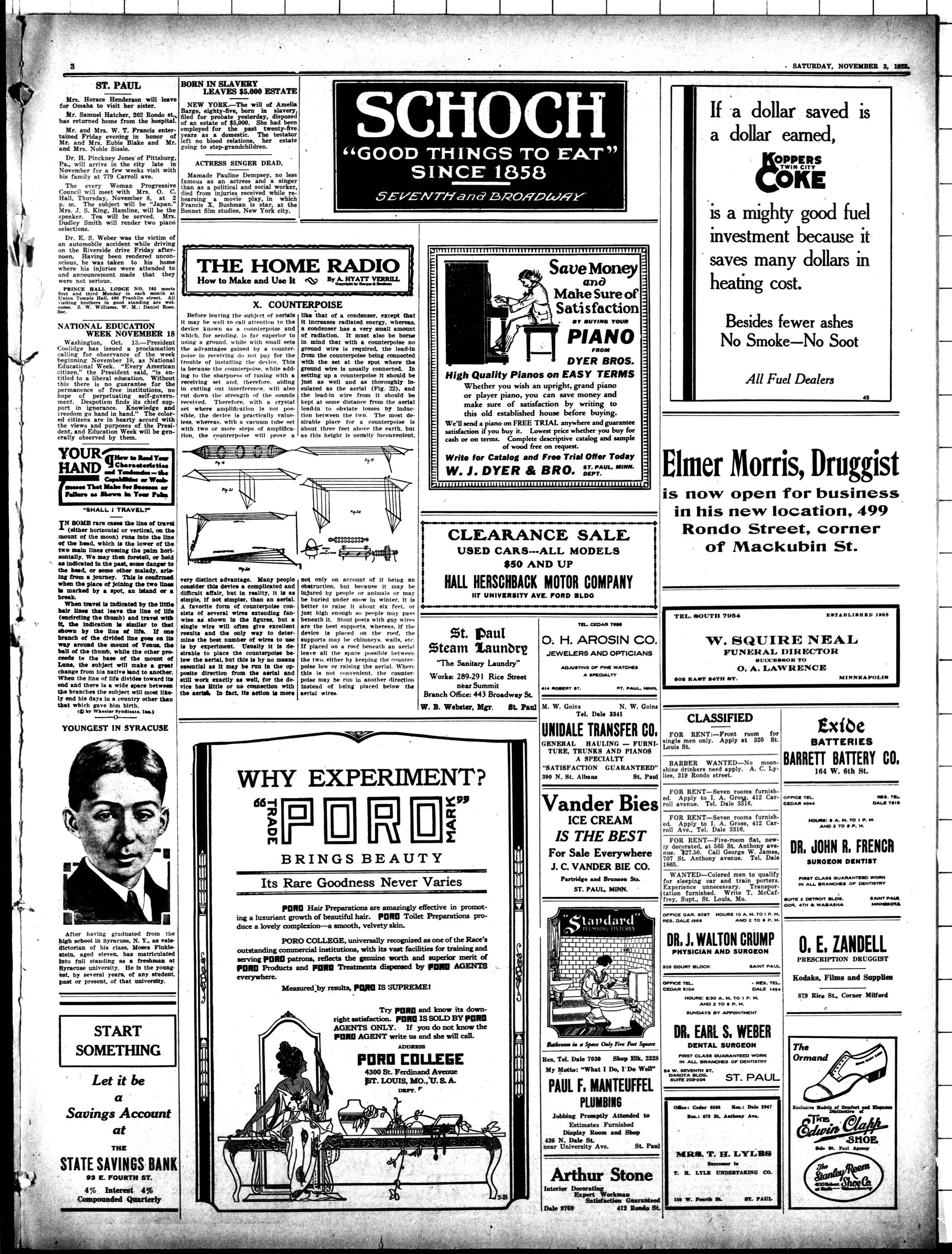
X. COUNTERPOISE
Before leaving the subject of aerials it may be well to call attention to the device known as a counterpoise and which, for sending, is far superior to using a ground, while with small sets the advantages gained by a counterpoise in receiving do not pay for the trouble of installing the device. This is because the counterpoise, while adding to the sharpness of tuning with a receiving set and, therefore, aiding in cutting out interference, will also cut down the strength of the sounds received. Therefore, with a crystal set where amplification is not possible, the device is practically valueless, whereas, with a vacuum tube set with two or more steps of amplification, the counterpoise will prove a
Fig. 16
Fig. 21
Fig. 22
Fig. 10
Fig. 19
Fig. 21
Fig. 20
Fig. 23
very distinct advantage. Many people consider this device a complicated and difficult affair, but in reality, it is as simple, if not simpler, than an aerial. A favorite form of counterpoise consists of several wires extending fanwise as shown in the figures, but a single wire will often give excellent results and the only way to determine the best number of wires to use is by experiment. Usually it is desirable to place the counterpoise below the aerial, but this is by no means essential as it may be run in the opposite direction from the aerial and still work exactly as well, for the device has little or no connection with the aerial. In fact, its action is more
WHY
PORO Hair Preparations are amazingly effective in promoting a luxuriant growth of beautiful hair. PORO Toilet Preparations produce a lovely complexion—a smooth, velvety skin.
PORO COLLEGE, universally recognized as one of the Race's outstanding commercial institutions, with its vast facilities for training and serving PORO patrons, reflects the genuine worth and superior merit of PORO Products and PORO Treatments dispensed by PORO AGENTS everywhere.
like that of a condenser, except that it increases radiated energy, whereas a condenser has a very small amount of radiation. It must also be borne in mind that with a counterpoise no ground wire is required, the lead-in from the counterpoise being connected with the set at the spot where the ground wire is usually connected. In setting up a counterpoise it should be just as well and as thoroughly insulated as the aerial (Fig. 22), and the lead-in wire from it should be kept at some distance from the aerial lead-in to obviate losses by induction between the two. The most desirable place for a counterpoise is about three feet above the earth, but as this height is usually inconvenient,
Fig. 17
Fig. 20
not only on account of it being an obstruction, but because it may be injured by people or animals or may be buried under snow in winter, it is better to raise it about six feet, or just high enough so people may pass beneath it. Stout posts with guy wires are the best supports, whereas, if the device is placed on the roof, the supports may be chinmneys, walls, etc. If placed on a roof beneath an aerial leave all the space possible between the two, either by keeping the counterpoise low or raising the aerial. Where this is not convenient, the counterpoise may be run in another direction instead of being placed below the aerial wires.
---
BRINGS BEAUTY
SCHOCH
"GOOD THINGS TO EAT"
SINCE 1858
SEVENTH and BROADWAY
Try PORO and know its downright satisfaction. PORO IS SOLD BY PORO AGENTS ONLY. If you do not know the PORO AGENT write us and she will call.
ADDRESS
Save Money
and
Make Sure of
Satisfaction
BY BUYING YOUR
PIANO
FROM
DYER BROS.
High Quality Pianos on EASY TERMS
Whether you wish an upright, grand piano
or player piano, you can save money and
make sure of satisfaction by writing to
this old established house before buying.
We'll send a piano on FREE TRIAL anywhere and guarantee
satisfaction if you buy it. Lowest price whether you buy for
cash or on terms. Complete descriptive catalog and sample
of wood free on request.
Write for Catalog and Free Trial Offer Today
W. J. DYER & BRO. ST. PAUL, MINN.
DEPT.
St. Paul
Steam Laundry
"The Sanitary Laundry"
Works: 289-291 Rice Street
near Summit
Branch Office: 443 Broadway St.
W. B. Webster, Mgr. St. Paul
O. H. AROSIN CO.
JEWELERS AND OPTICIANS
ADJUSTING OF FINE WATCHES
A SPECIALTY
414 ROBERT ST. RT. PAUL, MINN.
M. W. Goins N. W. Goins
Tel. Dale 3341
UNIDALE TRANSFER CO.
GENERAL HAULING — FURNITURE, TRUNKS AND PIANOS
A SPECIALTY
Vander Bies
ICE CREAM
IS THE BEST
For Sale Everywhere
J. C. VANDER BIE CO.
Partridge and Brunson Sta.
ST. PAUL, MINN.
"Standard"
PLUMBING FIXTURES
Bathroom in a Space Only Five Feet Square
Res. Tel. Dale 7030 Shop Elk. 2328
My Motto: "What I Do, I Do Well"
PAUL F. MANTEUFFEL
BLUMING
if a dollar saved is dollar earned,
If a dollar saved is a dollar earned,
KOPPERS
TWIN CITY
COKE
is a mighty good fuel investment because it saves many dollars in heating cost.
is a mighty good fuel investment because it saves many dollars in heating cost.
Besides fewer ashes No Smoke-No Soot
All Fuel Dealers
Elmer Morrison is now open in his new loft Rondo Street of Mack
TEL. SOUTH 7954
W. SQUIRRE FUNERAL SUCCESS O. A. LAW
502 EAST 24TH ST.
Morris, Druggist
new open for business
is new location, 499
Do Street, corner
of Mackubin St.
1 7954 ESTABLISHED 1905
V. SQUIRE NEAL
FUNERAL DIRECTOR
SUCCESSOR TO
O. A. LAWRENCE
TH ST.
MINNEAPOLIS
Elmer Morris, Druggist
is now open for business in his new location, 499 Rondo Street, corner of Mackubin St.
W. SQUIRE NEAL
FUNERAL DIRECTOR
SUCCESSOR TO
O. A. LAWRENCE
FOR RENT:—Front room for single men only. Apply at 320 St. Louis St.
BARBER WANTED—No moonshine drinkers need apply. A. C. Lylies, 319 Rondo street.
FOR RENT—Seven rooms furnished. Apply to I. A. Gross, 412 Carroll avenue. Tel. Dale 3316.
FOR RENT—Seven rooms furnished. Apply to I. A. Gross, 412 Carroll Ave., Tel. Dale 3316.
FOR RENT—Five-room flat, newly decorated, at 565 St. Anthony avenue. $27.50, Call George W. James, 707 St. Anthony avenue. Tel. Dale 1865.
WANTED—Colored men to qualify for sleeping car and train porters. Experience unnecessary. Transportation furnished. Write T. McCaffrey, Supt., St. Louis, Mo.
DR. J. WALTON CRUMP
PHYSICIAN AND SURGEON
303 COURT BLOCK SAINT PAUL
OFFICE TEL. • RES. TEL.
CEDAR 8104 DALE 1454
HOURS: 8:30 A. M. TO 1 P. M.
AND 2 TO 6 P. M.
SUNDAYS BY APPOINTMENT
DR. EARL S. WEBER
DENTAL SURGEON
SAINT PAUL
RES. TEL.
DALE 1484
A. M. TO 1 P. M.
TO 6 P. M.
APPOINTMENT
PRESCRIPTION DRUGGIST
Kodaks, Films and Supplies
879 Rice St., Corner Milford
---
CLASSIFIED
. SATURDAY, NOVEMBER 3, 1923.
Exide
BATTERIES
BARRETT BATTERY CO.
164 W. 6th St.
REB, TEL
DALE 7016
OFFICE TEL.
CEDAR 4044
HOURS: 0 A, M. TO 1 P, M.
AND 2 TO 6 P, M.
FIRST CLASS GUARANTEED WORK
IN ALL BRANCHES OF DENTISTRY
SUITE 2 DETROIT BLDG. SAINT
CORN, 4TH & WABASHA MINNE
O. E. ZANDELL
The Ormand
Exclusive Models of Comfort and Elegance
Distinctive of
THE Edwin Clapp
SHOE
Sole St. Paul Agency
The Stanley Reem
Shoe Co.
400 Barking
at North — William A. Burns
4 °
a aan
IMPERIAL ELKS
LAY CORNERSTONE
New York, 27,—(K. N._F.
sone) Teal Eee Enige No.
12, laid the cornerstone for new
clubhouse last Sunday. Grand Master
David W. Parker, officiated at the
cexemnony. Assemblyman Henri
Shields, Former Alderman George W.
Harris and Alderman Smith, were
present, together with many other
Prominent citizens.
IN THE GARDEN
By E. W. Gilles
The problem of the ages began ir
the garden of Eden. Do not think
there is anything new about ther
now except in their incidpental anc
superficial features.
The humanity priblem began in thc
garden of Eden and has continued t:
this day.
‘The theological problem began ir
the garden of Eden and has continue:
to this day.
ONE HEAD
ee oR cae nT
A two-headed anything in nature
is a monstrosity.
A two-headed anything otherwise
is a calamity.
How many institutions I have seen
fail possibly because of having two
gr more equal heads with no one a
tually the head.
One head is» head tw- heads
equal half a head and three heads
equal no head at all.
If you wish your institution to suc-
ceed, give it one head.
Tf’ you wish your institution to at
least partly fail, give it two heads.
Tf you wish your institution to ut-
terly fail, give it three heads.
Howevere many people there may
be in the institution, it should be so
constituted that some one person is
distinctly its head.
LEISURE HOURS
Ry FW. Gilles
‘Whether one’s leisure hours are a
blessing or otherwise depends upon
the man.
‘The leisure hours might be more
killing to the man than his working
hours.
‘The question js, are the leisure
hours depoted to’ self improvement
efforts?
—
WHY THEY JOIN—
Pop that Question to any member
of the Brotherhood and he (or she)
will promptly point out to you the
Benefits derived from the Brother.
hood’s
Co-Operative Enterprises;
Sick & Death Benefit Dept.;
Educational Classes and Forums;
Calisthenie Clubs or Sokols;
Industrial Units;
Negro Workers Protective Work;
Civil Rights Activities.
‘The Brotherhood is the only frater:
nal organization exerting its power
in behalf of the civil rights of Negrc
Americans; and a
the only civil rights organization
fostering business enterprises and de-
veloping the economic and labor pow-
er of the race; and
the only benevolent organization in.
vesting its funds in purely Negrc
business and specializing in the co-
operative form of business enterprise
whereb all of the investors are bene-
fitted rather than just the few big
share holders and the officers as is the
case in capitalist corporation concerns
which merely use the masses as step-
ping stones for self-seeking care.
erists.
GENERAL MEMBERSHIP. $1.00
Monthly Dues .........25 cents.
Only members are eligible to Pro-
tection of Sick and Death Benefit De-
partment.
Send for information today; or send
your dollar initiation fee and get
your card and button. Address:
SUPREME EXECUTIVE COUNCIL,
A.B. Be
P. 0. Box 30, ‘New York City.
Station L.
IN DISTRICT COURT
SECOND JUDICIAL DISTRICT
STATE OF MINNESOTA,
COUNTY OF RAMSEY,
Max Eckl, Plaintiff,
Viola Eckl, Defendant.
SUMMONS.
THE STATE OF MINNESOTA TO THE
ABOVE NAMED DEFENDANT:
‘You are hereby summoned and required to
answer the complaint of the plaintif in this
Action, which has been filed with. the clerk
Of said court at his office in the Court House
of said County in the City of Saint Paal, and
to serve a copy of your answer to the’ said
complaint on. the sulweriber hereto, plaintiff's
aitorney, at his office.rom number $14 Court
Block, in the city of Saint Paul, in the Coun-
ty of’ Ramsey and State of Minnesota, with-
in thirty (80) days after the strvice of this
summons upon ‘you, exclusive of the day of
Such service: and if ‘you fail to answer’ the
said complaint’ within the time aforesaid the
Dlaintit’ in this ‘aetiion will apply to the sald
Court for the relief demanded in said com-
piant.
Dated August 14, 1923.
‘TA, Alexander,
Piaintif’s Attorney,
514 ‘Court Block,
St. Paul, Minnesota,
| “FILIBUSTER” |
(TMB werd, generally coed. a8
@ synonym for “pirate,” has
‘& most interesting history, being
derived in an extremely round-
about manner from the Dutch
vrigbuiter, translated fhonetical-
ly into English as “freebooter”
and, by the nautical section of
the British Isles as “fiyboat.”
“Fiyboat” and “filibuster” do not
appear tohave much in common,
but the original vrijbulter be-
came filibustier in the French
and filibote in the Spanish,
while the pirates and smugglers
who used these craft wore
known as flibusteros, Thus we
have two words derived from
the same source—“freebooter”
which is of unmistakably Dutch
origin and “filibuster” which is
from the Dutch, by way of the
French and Spanish.
In this connection it is also
Interesting to note that the
“buccaneers,” the generic term
for the pirates that menaced the
Spanish Main, were usually di-
‘vided into three classes—the
Doucaniers’ who. hunted their
prey nearby, the filibustiers who
roved abroad in search of it and
‘the habitans who remained at
home and’ attended. to the busi-
Ne ae Ine?
HARTLEY MADE
NAME IN WAR
Leviathan’s New Captain Is Typ-
ical Son of the Sea and Won
Promotion by Merit.
Pleo ao ery to meet
3 ee oe ee ee eee 5
eS Se ’
bannnccnncennnenceenenneed
Washington.—Capt. Herbert Hart-
ley, the new skipper of the Leviathan,
is a typical son of the sea. He has
spent. most of his life on ships, has
seen and served on the old sailing
beauties and remembers the skepti-
cism that greeted new fangled wire-
less ideas.
‘He 1s the sort of a sailorman who
truly pities the “people in the cities”
on wild, stormy nights. Ocean weath-
er to him is divided into two cate
gories: It is either “a bit fresh” or
“calm as the palm of your hand.” He
seems to have heard or read of hur-
ricanes or gales, but in his tongue
they are no more than “little squalls”
or “kickups.”
His associates on the American
Mne—he has been with that company
ever since he begau his nautical
career—say be is lucky; not because
he landed the prize post in the Ameri-
can merchant marine but because in
all his career he has never had an
accident to his ship or any ship on
which he has sailed. It is partly be-
cause of his reputation that he has
advanced through all grades in the
American Line to the bridge of the
largest ship in the American fleet.
Hunch Falls Him, 7
His worst half hour on the high
seas was when during the World war
a giant German submarine came to
the surface within gun range of his
ship, the Louisville, and opened fire.
“It was just after daybreak,” he
said, “and we were about two days’
sail from France when a lookout
sighted this sinister black body about
a mile away and slightly astern of us.
“This object broke one of my real
hunches, because I had a distinct
feeling on starting the trip that we
weren't going to have any trouble,
and usually those hunches work out
for me.
“Hardly had the sailor given the
alarm when a column of spray raised
by a shell almost showered our port
bow. I had four six-inch guns, two in
the bow and two in the stern, and I
made up my mind right there that the
only ones to be used were the stern
guns, because I Intended to go away
from there as fast as I could.
“The Loulsville could outsteam any:
submarine that I knew of, but whether
she could get out of range before she
was mortally hit was the question
most vital to all of us just then. I
gave every full-speed signal that
could help us and turned tail in the
direction that would take us away
from the menace, which whistled its
second shot just about where our bow
‘wotld have been if we hadn’t changed
our course.
“It took us more than thirty-five
minutes to get out of range. During
that time the submarine’s other shots,
which were plentiful, did not come as
close as her first two. Ours, I am
sorry to say, did her no damage and
did not frighten her enough to make
her submerge.” ’
Weare Navy Cross.
‘The Louisville, dnder Oaptain Hart-
ley’s command, was the first armed
ship to leave an American port after
President Wilson decided that Ameri-
can vessels should carry their own
protection. As the old St. Louis she
had served with honor in the Spanish-
American war, and, while Captain
Hartley doesn’t say so, it is evident
that the Leviathan will have a difficult
time replacing her in his affections.
Captain Hartley wears the Navy
cross for efficient command of his ship
during the war, and {t is the only
honor which he does not seem to take
Ughtly. ‘The cross, he says, Is his
most treasured possession and he
wouldn't trade It for the Leviathan or
any other craft afloat.
He is forty-eight years old and is
the first cadet of the American line to
rise to the position of commander. He
took the place of Capt, John OC. Jami-
son as commander of the St. Louis
in 1917 when that skipper was taken
Ml on board, and he brought the ship
In and docked her so skillfully that
his job as a skipper in his own right
wus’ secure. His most recent com-
mand has been ¢he big liner Mongolia
of the American line.
He began his career twenty-eight
years ago as a cadet om the training
ship Saratoga with Rea Admiral W.
S. Sims, loaned by the navy, as one
of his Instructors,
Bird, Freed in Wales,
Is Found in Africa
Carmarthenshire, Wales. —
News has reached here that a
ringed swallow which was lb-
erated from Langharne, a nelgh-
boring village, has been picked
up dead on a farm near Johan-
nesburg, South Africa, 6,000
milés away.
This is the first time actual
proof has been obtained of »
swallow’s flight from Wales te
South Africa.
Ravine Senaites.
Betty had always lived in the city
‘Upon her first visit to the country she
saw and heard a cow lowing. “Oh,
mother,” she said, “Just look at that
cow trying to sing.”
‘Terrible or Ridiculous, >
‘e_anger proceeds. from a great
Se rerpeeae aie ae
cause, it is peevishness; and.20 tt ts
always elther terrible or ridiculous —
Jeremy Taylor.
Wait for the Annual Business
Exhibition at the Auditorium
December 10 and II.
“What'sina Name?”
By MILDRED MARSHALL
‘esi
Danses pe reen
nificance; your heky day, lucky jewel
SSS SESS
EUDORA
BE) SDORA was, Caneplanted.. direc
from ancient Greece where the
word for “happy gift” became a fem
inine proper name and was given much
Vogue among Greek damsels. It
quaint sound, as well as its pleasing
significance, brought it to French ro
mance as Eudore.
But the first Eudora and the one
whom our adoption of the name com
memorates, was one of the Nerelds of
Greek mythology. Like Amphitrite,
‘Thetis and Galatea, she was the best
Imown of the sea nymphs. According
to mythology, the Nereids, fifty or s
hundred in number, were the daugh:
ters of Nereus and Doris, and were
attendants upon Poseldon, god of the
sea. ‘They were represented as hay.
ing entire human form and riding upon
‘sea horses or other sea monsters,
Another form of the name—Budoris
—was much used by Greek empresses
‘and imperial brides who bore a name
unsuited to the Greek ear, assumed if
voluntarily. Through the saints of the
Greek church the name reached Rus
sia as Jevdoksija.
Lapis lazuli is the stone assigned te
Eudora. It will: prove a talisman
‘against depression and is said to pro
tect against fevers. Monday 1s hes
lucky day and 7 her lucky number.
(@ by Wheeler Syndicate, 100.)
eo
a Be ee
“No, boss,” said the clerk, “I do not
think I need a vacation this year, for
the work I have been doing hasn't been
enough to tire me out”—Cincinnati
Enguirer,
Summing It Up.
After the average man has reached
the three score and ten mark he can
sum up his life in these few words,
“What a fool I've been!”
Newspaper Man’s Life Mission.
‘Newspaper men work so hard mak-
ing others famous that they seldom
have time to cop out fame for them
selves.—Washington Post.
For the Salt Shaker.
‘To prevent salt lumping mix it with
cornstarch in the proper proportions of
three teaspoonfuls of cornstarch to one
cupfal of salt,
Teaching Songe of Wild Birds,
In one English school the children
are taught the songs of the various
wild birds by means of phonograph
records.
When a Hen Is Bad. *
It is no gvod hen that cackles in your
house and lays in another’s.—Engilsh
Proverb.
Horses Lost in Bull Fights.
Something like 80,000 horses are
‘killed in bull fights in Spain every
year.
Copper In Locomotive.
About 8,000 pounds af copper are re-
quired to build a railroad iecomotive.
‘mB Maré Situation.
‘There are a few things more embar
rassing than having your grocer drive
‘up while you are paying cash for gaso
Mine. Z
Of the Vikings! Brood.
He—Yes, I suppote the sex must be
tm’ my, blood, ‘You see my granfather
was vice president of a marine insur
ance company.—Harper’s Magazine.
THE AMERICAN LUNCH ROOM
- Open from 5 A. M. to 8 P. M.
We serve the best meals for the price—25 cents and up
‘Try us once, then tell your friends
Geo. Pappas, Chef
25 W. 10th St. “ Saint Paul
Lf; ; AQ .
JY Tem: \\__
y ain ai
= “el a La i
iN a ig
N ana a f
IN i i ;
| ie
IN Oe I
IN . |
h f
i “P?'mThrough Working i
i for Nothing”-- i
IN ; |
F So he opened a savings account. i
dh :
iN « ing the past five years,’ he said, t
, pe teal about $10,000 and until now fl
i The next five | |#
IN I haven’t saved a dollar. : ze oe
IN years will be different. I’m coming |
IN often.” |
IK ;
if He is keeping his word. 1
IN if
| THE FIRSTNATIONALBANK |]
IN of Sated ; 1
IN _ The Big Bank for the Small Depositor li
BR u8- d
a _
tia Visited ns
THE LEISURE HOUR INN
. If Not--- Why Not .
7 First Class Meals At All ee a
SAFE MILK
| Phone: Elkhurst 3163
MINNESOTA MILK CO.
CLOVER LEAF
BUTTER
x. W. CEDAR 2087
Cesta) W
OPTICIANa JEWELER
22 E. FOURTH 8ST.
cater Pact
SATURDAY, NOVEMBER 3, 1923.
NORTHWESTERN
STAMP WORKS
MOE. 3rd St St. Paul, Minn,
EUGENE D. FALES
Pres. and Mgr. -
Phone GA. 7475
‘Wo were established in 1882 right
here in St. Paul, and from a very
small’ beginning have enjoyed a ~
gradual growth, and are now
proud.to say we are one of the
iargest establishments of its kind
in the country.
Marking Devices Are What We Make
4 The
t Fie
o ceiling
Vi cn Ellercent
A eautifu
‘a ey] aint
The Final Touch of Beauty in Every Home
Is Created Through the Lighting
Appointments
See Our Wide and Varied Display of
Home Fixtures
A Fixture for Every Pocketbook
Telephone CE dar 8395 @. W. Swanson, Prop.
Seven Corners Electric Co.
208 W. Third Street St. Paul, Minn. |
9
GARLAND’S FIBRE TRUNK
ie ae a aa ae
ees ee le a $1] 15
Care of : 3
3 A oe ry
Built in Our Own Factory
of Best Materials:--
The entire trunk-box is of 3-
ply veneer lumber, fiber cov-
ered and iron-bound; has
best snap lock, brassed steel
corners and clamps, solid
leather handles, heavy cold-
rolled steel bolts. See it.- |
7 >) A TP IT WI i
| ( CARLA NID
“J LUGGAGE SHOP
SIXTH AT CEDAR
so. 75 MOMEBONN, RAK: | tenis aide Sp the BL00D, 2
wd WrcRPGRET™ TAK | Beis, Manas ve, BOO, ue
Fe a EAE rook oii | He eta ae Se
Hite” his pon maken wits | PEON. 28 de Jon,
RHEUMATION. ANEMIA Setter; you HAY and DIGEST the
PEAT NA ary | Fel Foe
teen, «= Fare
coer, oe sek Geli: cates
Mepvoueemee =| Baseegea | | 2 vou: doubt, me, mate pe
anaee Copeae | EES wae Sit, tad eine
Beeer erie | BE eat Ens ot eee
Failte «=A, | Exec key iacet
your Bene Marrew drying up i?
wo alte toate "you Tass weisis | 4De0t let sickness hang. around:
ee “roe a, en Fale Tipe | S084 tas, waite Jou Ace ove
‘Falling Hair, © face fof of FIM- | i: is ‘the sick ones that ect. it.
Soaps aes ee at of TE | 1 seat doer hat gt i
FRESE, Shits SE's seaiate Tact | SUT OTA gM A ot
Showing Hoere of,» adiaee ‘het | Det mum ihe, oFromremrty:
SEG GE eebaSe cakes | Risem Mall» Gollan ty peor
= Pa ee
ornowm man mioon como | Sin att ec eee wet
pormoacn map mtoum romne, | SR tie asta tt
See State sod eates rocrrat | ret roto
fo of Lite, Pep, Energy. This (Please write your draggist’s address.)
Address.
DR.MP.ASAKSON
= sito P. 0. Box 47
Hamilton Grange
Red Tonic oon Se