St. Paul Echo
Saturday, January 15, 1927
St. Paul, Minnesota
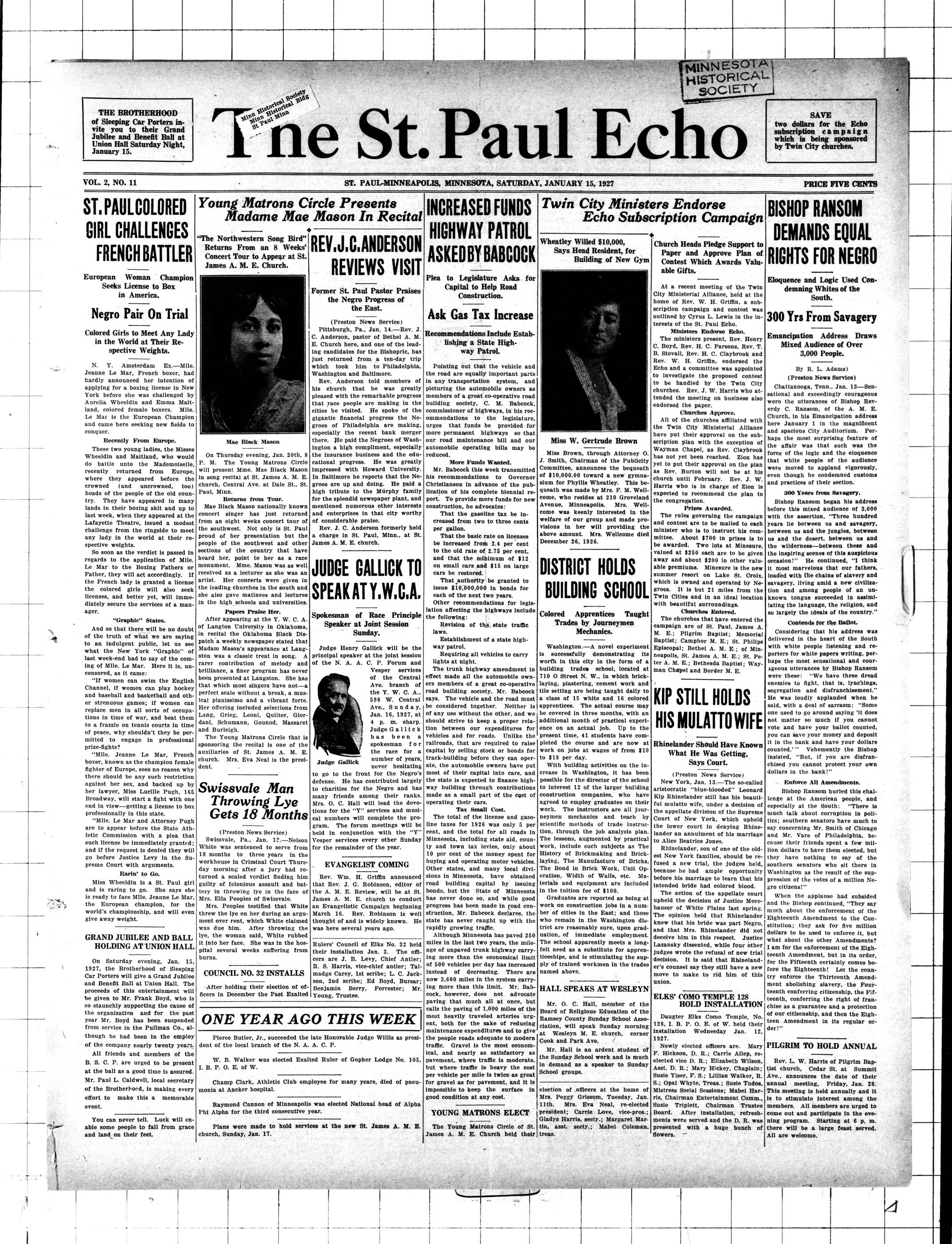
Page text (machine-generated)
THE BROTHERHOOD of Sleeping Car Porters invite you to their Grand Jubilee and Benefit Ball at Union Hall Saturday Night, January 15.
VOL. 2. NO. 11
ST.PAULCOORED GIRL CHALLENGES FRENCH BATTLER
European Woman Champion Seeks License to Box in America.
Negro Pair On Trial
Colored Girls to Meet Any Lady in the World at Their Respective Weights.
N. Y. Amsterdam Ex.-Mlle. Jeanne Le Mar, French boxer, had hardly announced her intention of applying for a boxing license in New York before she was challenged by Aurelia Wheeldin and Emma Maltland, colored female boxers. Mlle. Le Mar is the European Champion and came here seeking new fields to conquer.
Recently From Europe.
These two young ladies, the Misses Wheeldin and Maitland, who would do battle unto the Mademoiselle, recently returned from Europe, where they appeared before the crowned (and uncrowned, too) heads of the people of the old country. They have appeared in many lands in their boxing skit and up to last week, when they appeared at the Lafayette Theatre, issued a modest challenge from the ringside to meet any lady in the world at their respective weights.
So soon as the verdict is passed in regards to the application of Mile. Le Mar to the Boxing Fathers or Father, they will act accordingly. If the French lady is granted a license the colored girls will also seek licenses, and better yet, will immediately secure the services of a manager.
"Graphic" States.
And so that there will be no doubt of the truth of what we are saying to an indulgent public, let us see what the New York "Graphic" of last week-end had to say of the coming of Mile. Le Mar. Here it is, uncensored, as it came:
"If women can swim the English Channel, if women can play hockey and baseball and basketball and other strenuous games; if women can replace men in all sorts of occupations in time of war, and beat them to a frazzle on tennis courts in time of peace, why shouldn't they be permitted to engage in professional prize-fights?
"Mile. Jeanne Le Mar, French boxer, known as the champion female fighter of Europe, sees no reason why there should be any such restriction against her sex, and backed up by her lawyer, Miss Lucille Pugh, 165 Broadway, will start a fight with one end in view—getting a license to box professionally in this state.
"Mile. Le Mar and Attorney Pugh are to appear before the State Athletic Commission with a plea that such license be immediately granted; and if the request is denied they will go before Justice Levy in the Supreme Court with arguments.
Rarin' to Go.
Miss Wheeldin is a St. Paul girl and is raring to go. She says she is ready to face Mlle. Jeanne Le Mar, the European champion, for the world's championship, and will even give away weight.
GRAND JUBILEE AND BALL
HOLDING AT UNION HALL
On Saturday evening, Jan. 15, 1927, the Brotherhood of Sleeping Car Porters will give a Grand Jubilee and Benefit Ball at Union Hall. The proceeds of this entertainment will be given to Mr. Frank Boyd, who is so staunchly supporting the cause of the organization and for the past year Mr. Boyd has been suspended from service in the Pullman Co., although he had been in the employ of the company nearly twenty years. All friends and members of the B. S. C. P. are urged to be present at the ball as a good time is assured. Mr. Paul L. Caldwell, local secretary of the Brotherhood, is making every effort to make this a memorable event.
You can never tell. Luck will enable some people to fall from grace and land on their feet.
Tne St.Paul Echo
Young Matrons Circle Presents Madame Mae Mason In Recital
ONE YEAR AGO THIS WEEK
Pierce Butler, Jr., succeeded the late Honorable Judge Willis as president of the local branch of the N. A. A. C. P.
W. B. Walker was elected Exalted Ruler of Gopher Lodge No. 105, I. B. P. O. E. of W.
Champ Clark, Athletic Club employee for many years, died of pneumonia at Ancker hospital.
Raymond Cannon of Minneapolis was elected National head of Alpha Phi Alpha for the third consecutive year.
Plans were made to hold services at the new St. James A. M. E. church, Sunday, Jan. 17.
"The Northwestern Song Bird" Returns From an 8 Weeks' Concert Tour to Appear at St. James A. M. E. Church.
Mae Black Mason
On Thursday evening, Jan. 20th, 8 P. M. The Young Matrons Circle will present Mme. Mae Black Mason in song recital at St. James A. M. E church, Central Ave. at Dale St., St Paul, Minn.
Returns from Tour.
Returns from Tour
Mae Black Mason nationally known concert singer has just returned from an eight weeks concert tour of the southwest. Not only is St. Paul proud of her presentation but the people of the southwest and other sections of the country that have heard her, point to her as a race monument. Mme. Mason was as well received as a lecturer as she was an artist. Her concerts were given in the leading churches in the south and she also gave matinees and lectures in the high schools and universities.
Papers Praise Her.
After appearing at the Y. W. C. A. of Langton University in Oklahoma, in recital the Oklahoma Black Dispatch a weekly newspaper stated that Madam Mason's appearance at Langton was a classic treat in song. A rarer contribution of melody and brilliance, a finer program has never been presented at Langton. She has that which most singers have not—a perfect scale without a break, a musical planissimo and a vibrant forte. Her offering included selections from Lang, Grieg, Leoni, Quiter, Giordani, Schumann, Gounod, Massaret and Burleigh.
The Young Matrons Circle that is sponsoring the recital is one of the auxiliaries of St. James A. M. E. Church. Mrs. Eva Neal is the president.
Swissvale Man Throwing Lye Gets 18 Months
Swissvale Man Throwing Lye Gets 18 Months
(Preston News Service)
Swissvale, Pa., Jan. 12.—Nelson White was sentenced to serve from 18 months to three years in the workhouse in Criminal Court Thursday morning after a jury had returned a sealed verdict finding him guilty of felonious assault and battery in throwing lye in the face of Mrs. Ella Peoples of Swissvale.
Mrs. Peoples testified that White threw the lye on her during an argument over rent, which White claimed was due him. After throwing the lye, the woman said, White rubbed it into her face. She was in the hospital several weeks suffering from burns.
COUNCIL NO. 32 INSTALLS
After holding their election of officers in December the Past Exalted
ST. PAUL-MINNEAPOLIS, MINNESOTA, SATURDAY, JANUARY 15, 1927
REV.J.C.ANDERSON REVIEWS VISIT
Former St. Paul Pastor Praises the Negro Progress of the East.
(Preston News Service)
Pittsburgh, Pa., Jan. 14 — Rev. J. C. Anderson, pastor of Bethel A. M. E. Church here, and one of the leading candidates for the Bishopric, has just returned from a ten-day trip which took him to Philadelphia, Washington and Baltimore.
Rev. Anderson told members of his church that he was greatly pleased with the remarkable progress that race people are making in the cities he visited. He spoke of the gigantic financial progress the Negroes of Philadelphia are making, especially the recent bank merger there. He paid the Negroes of Washington a high compliment, especially the insurance business and the educational progress. He was greatly impressed with Howard University. In Baltimore he reports that the Negroes are up and doing. He paid a high tribute to the Murphy family for the splendid newspaper plant, and mentioned numerous other interests and enterprises in that city worthy of considerable praise.
Rev. J. C. Anderson formerly held a charge in St. Paul, Minn., at St. James A. M. E. church.
JUDGE GALLICK TO SPEAK AT Y.W.C.A.
Spokesman of Race Principle Speaker at Joint Session Sunday.
Judge Henry Gallick will be the principal speaker at the joint session of the N. A. A. C. P. Forum and Vesper services of the Central Ave. branch of the Y. W. C. A., 598 W. Central Ave., Sunday, Jan. 16, 1927, at 4 p. m. sharp. Judge Gallick has been a spokesman for the race for a number of years, never hesitating.
Judge Gallick
Judge Gallick
to go to the front for the Negro's defense. He has contributed largely to charities for the Negro and has many friends among their ranks Mrs. O. C. Hall will lead the devotions for the "Y" services and musical numbers will complete the program. The forum meetings will be held in conjunction with the "Y" Vesper services every other Sunday for the remainder of the year.
EVANGELIST COMING
Rev. Wm. H. Griffin announced that Rev. J. G. Robinson, editor of the A. M. E. Review, will be at St. James A. M. E. church to conduct an Evangelistic Campaign beginning March 16. Rev. Robinson is well thought of and is widely known. He was here several years ago.
Rulers' Council of Elks No. 32 held their installation Jan. 3. The officers are J. B. Levy, Chief Antier; R. S. Harris, vice-chief antler; Tallmadge Carey, 1st scribe; L. C. Jackson, 2nd scribe; Ed Boyd, Bursar; Benjamin Berry, Forrester; Mr Young, Trustee.
INCREASED FUNDS HIGHWAY PATROL ASKED BY BABCOCK
INCREASED FUNDS HIGHWAY PATROL ASKED BY BABCOCK
Plea to Legislature Asks for Capital to Help Road Construction.
Ask Gas Tax Increase
Recommendations Include Establishing a State Highway Patrol.
Pointing out that the vehicle and the road are equally important parts in any transportation system, and picturing the automobile owners as members of a great co-operative road building society, C. M. Babcock, commissioner of highways, in his recommendations to the legislature, urges that funds be provided for more permanent highways so that our road maintenance bill and our automobile operating bills may be reduced.
More Funds Wanted.
Mr. Babock this week transmitted his recommendations to Governor Christianson in advance of the publication of his complete biennial report. To provide more funds for new construction, he advocates:
That the gasoline tax be increased from two to three cents per gallon.
That the basic rate on licenses be increased from 2.4 per cent to the old rate of 2.75 per cent, and that the minimum of $12 on small cars and $15 on large cars be restored.
That authority be granted to issue $10,000,000 in bonds for each of the next two years.
Other recommendations for legislation affecting the highways include the following:
Revision of the state traffic laws.
Establishment of a state highway patrol. Requiring all vehicles to carry lights at night. The trunk highway amendment in effect made all the automobile owners members of a great co-operative road building society, Mr. Babcock says. The vehicle and the road must be considered together. Neither is of any use without the other, and we should strive to keep a proper relation between our expenditures for vehicles and for roads. Unlike the railroads, that are required to raise capital by selling stock or bonds for track-building before they can operate, the automobile owners have put most of their capital into cars, and the state is expected to finance highway building through contributions made as a small part of the cost of operating their cars.
Tax Small Cost.
The total of the license and gasoline taxes for 1926 was only 5 percent, and the total for all roads in Minnesota, including state aid, county and town tax levies, only about 10 per cent of the money spent for buying and operating motor vehicles. Other states, and many local divisions in Minnesota, have obtained road building capital by issuing bonds, but the State of Minnesota has never done so, and while good progress has been made in road construction, Mr. Babcock declares, the state has never caught up with the rapidly growing traffic.
Although Minnesota has paved 250 miles in the last two years, the mileage of unpaved trunk highway carrying more than the economical limit of 500 vehicles per day has increased instead of decreasing. There are now 3,600 miles in the system carrying more than this limit. Mr. Babcock, however, does not advocate paving that much all at once, but calls the paving of 1,000 miles of the most heavily traveled arteries urgent, both for the sake of reducing maintenance expenditures and to give the people roads adequate to modern traffic. Gravel is the most economical, and nearly as satisfactory as pavement, where traffic is moderate, but where traffic is heavy the cost per vehicle per mile is twice as great for gravel as for pavement, and it is impossible to keep the surface in good condition at any cost.
YOUNG MATRONS ELECT
The Young Matrons Circle of St.
James A. M. E. Church held th.
Twin City Ministers Endorse Echo Subscription Campaign
Wheatley Willed $10,000,
Says Head Resident, for
Building of New Gym
Miss W. Gertrude Brown
Miss Brown, through Attorney O. J. Smith, Chairman of the Publicity Committee, announces the bequeath of $10,000.00 toward a new gymnasium for Phyllis Wheatley. This bequeath was made by Mrs. F. M. Wellcome, who resides at 210 Groveland Avenue, Minneapolis. Mrs. Wellcome was keenly interested in the welfare of our group and made provisions in her will providing the above amount. Mrs. Wellcome died December 26, 1926.
DISTRICT HOLDS BUILDING SCHOOL
DISTRICT HOLDS BUILDING SCHOOL
Colored Apprentices Taught Trades by Journeymen Mechanics.
Washington.—A novel experiment is successfully demonstrating its worth in this city in the form of a building trades school, located at 710 O Street N. W., in which bricklaying, plastering, cement work and tile setting are being taught daily to a class of 15 white and 16 colored apprentices. The actual course may be covered in three months, with an additional month of practical experience on an actual job. Up to the present time, 41 students have completed the course and are now at work on jobs at wages of from $10 to $18 per day.
With building activities on the increase in Washington, it has been possible for the director of the school to interest 12 of the larger building construction companies, who have agreed to employ graduates on their work. The instructors are all journeymen mechanics and teach by scientific methods of trade instruction, through the job analysis plan. The lessons, augmented by practical work, include such subjects as The History of Brickmaking and Bricklaying, The Manufacture of Bricks, The Bond in Brick Work, Unit Operation, Width of Walls, etc. Materials and equipment are included in the tuition fee of $100.
Graduates are reported as being at work on construction jobs in a number of cities in the East; and those who remain in the Washington district are reasonably sure, upon graduation, of immediate employment. The school apparently meets a long-felt need as a substitute for apprenticeships, and is stimulating the supply of trained workmen in the trades named above.
HALL SPEAKS AT WESLEYN
Mr. O. C. Hall, member of the Board of Religious Education of the Ramsey County Sunday School Association, will speak Sunday morning at Wesleyn M. E. church, corner Cook and Park Ave.
Mr. Hall is an ardent student of the Sunday School work and is much in demand as a speaker to Sunday School groups.
election of officers at the home of Mrs. Peggy Grissom, Tuesday, Jan. 11th. Mrs. Eva Neal, re-elected president; Carrie Love, vice-pres.; Gladys Harris, secty.; Margaret Martin, asst. secty.; Mabel Coleman, treas.
MINNESOTA HISTORICAL SOCIETY
ers Endorse
cription Campaign
Church Heads Pledge Support to
Paper and Approve Plan of
Contest Which Awards Valu-
able Gifts.
At a recent meeting of the Twin City Ministerial Alliance, held at the home of Rev. W. H. Griffin, a subscription campaign and contest was outlined by Cyrus L. Lewis in the interests of the St. Paul Echo.
Ministers Endorse Echo.
The ministers present, Rev. Henry C. Boyd, Rev. H. C. Parsons, Rev. T. B. Stovall, Rev. H. C. Claybrook and Rev. W. H. Griffin, endorsed the Echo and a committee was appointed to investigate the proposed contest to be handled by the Twin City churches. Rev. J. W. Harris who attended the meeting on business also endorsed the paper.
Churches Approve.
Churches Approve.
All of the churches affiliated with the Twin City Ministerial Alliance have put their approval on the subscription plan with the exception of Wayman Chapel, as Rev. Claybrook has not yet been reached. Zion has yet to put their approval on the plan as Rev. Burton will not be at his church until February. Rev. J. W. Harris who is in charge of Zion is expected to recommend the plan to the congregation.
Prizes Awarded.
The rules governing the campaign and contest are to be mailed to each minister who is to instruct his committee. About $700 in prizes is to be awarded. Two lots at Minesure, valued at $250 each are to be given away and about $200 in other valuable premiums. Minesure is the new summer resort on Lake St. Crox, which is owned and operated by Negroes. It is but 21 miles from the Twin Cities and in an ideal location with beautiful surroundings.
**Churches Entered.**
The churches that have entered the campaign are to St. Paul, James A. M. E.; Pilgrim Baptist; Memorial Baptist; Camphor M. E.; St. Philips Episcopal; Bethel A. M. E.; of Minneapolis, St. James A. M. E.; St. Peter A. M. E.; Bethesda Baptist; Wayman Chapel and Border M. E.
KIP STILL HOLDS HIS MULATTO WIFE
Rhinelander Should Have Known What He Was Getting, Says Court.
(Preston News Service)
(Preston News Service)
New York, Jan. 13. The so-called aristocratic "blue-blooded" Leonard Kip Rhinelander still has his beautiful mulatto wife, under a decision of the appellate division of the Supreme Court of New York, which upheld the lower court in denying Rhinelander an annulment of his marriage to Alice Beatrice Jones.
Rhinelander, son of one of the oldest New York families, should be refused a new trial, the judges held, because he had ample opportunity before his marriage to learn that his intended bride had colored blood.
The action of the appellate court upheld the decision of Justice Morehauser of White Plains last spring. The opinion held that Rhinelander knew that his bride was part Negro, and that Mrs. Rhinelander did not deceive him in this respect. Justice Lazansky dissented, while four other judges wrote the refusal of new trial decision. It is said that Rhinelander's counsel say they still have a new move to make to rid him of this union.
ELKS' COMO TEMPLE 128
HOLD INSTALLATION
Dauger Elks Como Temple, No. 128, I. B. P. O. E. of W. held their installation Wednesday Jan. 12, 1927.
Newly elected officers are: Mary F. Hickson, D. R.; Carrie Alele, reelected vice D. R.; Elizabeth Wilson, Asst. D. R.; Mary Hickey, Chaplain; Susie Yiser, F. S.; Lillian Walker, R. S.; Opal Whale, Treas.; Susie Tudos, Mistress Social Sessions; Mabel Harris, Chairman Entertainment Comm., Susie Triplett, Chairman Trustee Board. After installation, refreshments were served and the D. R. was presented with a huge bunch of flowers.
---
SAVE two dollars for the Echo subscription campaign which is being sponsored by Twin City churches.
PRICE FIVE CENTS
BISHOP RANSOM DEMANDS EQUAL RIGHTS FOR NEGRO
Eloquence and Logic Used Condemning Whites of the South.
300 Yrs From Savagery
Emancipation Address Draws Mixed Audience of Over 3,000 People.
By R. L. Adams)
(Preston News Service)
Chattanooga, Tenn., Jan. 13—Sensational and exceedingly courageous were the utterances of Bishop Reverdy C. Ransom, of the A. M. E. Church, in his Emancipation address here January 1 in the magnificent and spacious City Auditorium. Perhaps the most surprising feature of the affair was that such was the force of the logic and the eloquence that white people of the audience were moved to applaud vigorously, even though he condemned customs and practices of their section.
300 Years from Savagery.
Bishop Ransom began his address before this mixed audience of 3,000 with the assertion, "Three hundred years lie between us and savagery, between us and the jungles, between us and the desert, between us and the wilderness—between these and the inspiring scenes of this auspicious occasion!" He continued, "I think it most marvelous that our fathers, loaded with the chains of slavery and savagery, living amid a new civilization and among people of an unknown tongue succeeded in assimilating the language, the religion, and so largely the ideals of the country."
Contends for the Ballot.
Considering that his address was delivered in the heart of the South with white people listening and reporters for white papers writing, perhaps the most sensational and courageous utterances by Bishop Ransom were these: "We have three dread enemies to fight, that is, lynchings, segregation and disfranchisement." He was loudly applauded when he said, with a deal of sarcasm: "Some one used to go around saying 'it does not matter so much if you cannot vote and have your ballot counted, you can save your money and deposit it in the bank and have your dollars counted.'" Vehemently the Bishop insisted, "But, if you are disfranchised you cannot protect your own dollars in the bank!"
Enforce All Amendments.
Bishop Ransom hurted this challenge at the American people, and especially at the South: "There is much talk about corruption in politics; southern senators have much to say concerning Mr. Smith of Chicago and Mr. Vare of Philadelphia, because their friends spent a few million dollars to have them elected, but they have nothing to say of the southern senators who sit there in Washington as the result of the suppression of the votes of a million Negro citizens!"
When the applause had subsided and the Bishop continued, "They say much about the enforcement of the Eighteenth Amendment to the Constitution; they ask for five million dollars to be used to enforce it, but what about the other Amendments? I am for the enforcement of the Eighteenth Amendment, but in its order, for the Fifteenth certainly comes before the Eighteenth! Let the country enforce the Thirteenth Amendment abolishing slavery, the Fourteenth conferring citizenship, the Fifteenth, conferring the right of franchise as a guarantee and a protection of our citizenship, and then the Eighteenth Amendment in its regular order!"
PILGRIM TO HOLD ANNUAL
Rev. L. W. Harris of Pilgrim Baptist church, Cedar St. at Summit Ave., announces the date of their annual meeting, Friday, Jan. 28. This meeting is held annually and it is to stimulate interest among the members. All members are urged to come out and participate in the evening program. Starting at 6 p. m. there will be a large feast served. All are welcome.
"Entered as second class matter Nov. 7, 1925, at the post office at St. Paul, Minn., under the act of March 3, 1879"
A message of a certain eastern governor to his state legislature, particularly in his analysis of the relationship which should exist between public utilities and the general public, is ground for recalling, briefly, those particular public utilities, corporations, and instrumentalities for public welfare and comfort created by law for utilization by the public. We mean, by this, the public school, public hospitals and health institutions, clinics, transportation implements, and similar advantages, partially supported by public funds for the benefit of the general public.
Students of judicial history will recall the dissenting opinion of Justice Harlan of the U. S. Supreme Court, when he vigorously stated at the time the Civil Rights bills were rejected, that when public utilities did become strongly clothed with public purposes, the public did acquire a public interest in them, to the extent that they should not exclude any race or differentiate as to the treatment accorded upon the basis of color variations.
It is in the exercise of public functions, from steam railways on down, that the Negro has suffered his hardest blows in striving for freedom and absolute equality. In the allotment of public funds or services, such as hospital treatment, health programs, etc., in states which continue to cling to the virtue of color differences as a just cause for harmful distinctions as between races, the Negro is the constant receiver of but "half a loaf." This is contrary of the public welfare; and, in fact, the struggling Negro because of his difficulties in general needs more sympathy and a wider access to public utilities than does any other group in America.
Those who look askance at Negro mortality would do well to turn their shoulders to the task of seeing that public institutions give a just measure of curatives and comforts to the Negro. The Nation cannot progress whole-heatedly as long as discrimination exists in the availability of public instrumentalities of human preservation. And if, as Governor Smith says, the public should have unhampered control of the utilities which it creates, then, surely, the public should share unreservedly and non-discriminately in the preservatives, stimulants, and comforts which public utilities essay to offer to the public.
Some of Dr. Du Bois' friends think his most lasting work is "Quest of the Silver Fleece."
They feel the enduring qualities of that work are in its prophecy. Its Prophecy? Yes. Read it again. The gripping story of the Negro youth who steps from the life of precept of the college campus to the practical existence of a metropolitan city. Without making a survey to determine the whence of why, the youth saw the old-time Negro politician. Youth questioned the methods employed. He entered the arena. His side won, but the old man secured the plum.
It is 15 years since the book was written. The story has just now begun to come true, at least in part. In all our organizations, lodges, churches, clubs, welfare associations and educational institutions the prophecy is coming true. Youth with more or less learning and much disdain, vivacity and voracity, says he is being misrepresented by the older group.
The danger to be guarded against is that the race shall not suffer while the two schools of leadership adjust their differences. The race needs the experience of the old leaders as well as the education of the younger group. The prayers, the battles, the sacrifices of the older group were not worth while if they have not produced a leadership better equipped than they. And the new leadership is not worthy of a following if it cannot appreciate, "The depths from whence we came," as well as the heights we hope to attain. Truly Dr. Du Bois saw the future.
A year ago, January 17, St. James A. M. E. congregation left its home of many years at Fuller and Jay Streets to occupy the ground floor of their new edifice at Dale and Central. Rich as was the old location in memories of heated debates, new resolutions, conversions, weddings, funerals, consecrations, baptisms, distinguished worshipers, choir singers and pulpiteers, it became a lemon when the congregation moved. Who wants an old church?
Some one saw the youth of our group without adequate facilities for physical development or the enjoyment of indoor sports. The dark mask barred them from the use of any of the many gymnasiums in St. Paul. He looked at the old church, too. It has length, breadth and height, besides a furnace and a hardwood floor—the elements of a gym. A friend was found to "Big Brother" the transformation of the church into a gym, and carry on until forces are organized to conduct the affairs. A number of interested persons met Tuesday night to screen the windows. Troop 55 of the Boy Scouts will meet Saturday to construct benches. Soon whistles will be blowing, calling time for games.
A lemon has been made into lemonade by the co-operation of the Colored churches of the city. It is a community, not a denominational gym. The program is intended to complete, not to be in competition with the excellent work carried forward by Welcome Hall, the Y. W. Branch and other organizations.
PAGE TWO
PUBLIC UTILITIES AND THE NEGRO
DU BOIS A PROPHET
Dr. Du Bois' friends think his most lauded Silver Fleece." And the enduring qualities of that work are aphecy? Yes. Read it again. The grip both who steps from the life of precept or the practical existence of a metropolitan survey to determine the whence of why, the Negro politician. Youth questioned the centered the arena. His side won, butOLUM.
years since the book was written. The day to come true, at least in part. In all ourisches, clubs, welfare associations and eduprophecy is coming true. Youth with a much disdain, vivacity and voracity, presented by the older group.igger to be guarded against is that the the two schools of leadership adjust the ends the experience of the old leaders at the younger group. The prayers, that the older group were not worth while if leadership better equipped than they. not worthy of a following if it cannot from whence we came," as well as thein. Truly Dr. Du Bois saw the future.
MAKING LEMONADE OF A LEMON
ago, January 17, St. James A. M. E. com-
many years at Fuller and Jay Streets
of their new edifice at Dale and Cent
PHYLLIS WHEATLEY NOTES
The `Inter-settlement basketball league begins this week. Phyllis Wheatley House has two girls` and three boys` teams in the league. The teams are entering with the determination of bringing back home at least one of the championships. Don't miss the big card party given by the auxiliary for the benefit of the house Friday, January 21, at 8:30 (playing 15 minutes before changing) at Phyllis Wheatley House. Miss W. R. Banks, Chairman.
The Book Lovers' Club will meet Wednesday afternoon at 2 p.m. Mrs. Alice Gooden will review Carl Van Vecter's "Nigger Heaven." You are cordially invited to attend.
The Committee of Management met Monday afternoon in their regular monthly meeting. Plans were completed for the Annual Dinner Meeting to be held Thursday, Jan. 27, at 7 p. m., at St. James A. M. E. Church. Members and friends are cordially invited to attend. Dinner 50 cents.
The Mothers' Club will meet Friday, Jan. 21, at 2 p. m. An interesting program is being planned. If you are a mother, then come and join this club.
NEED SOME?
ITS a fine thing to know where you can get cash when you need it. Our service is quick and confidential. We have helped your friends for years. Ask them about the
Local Loan Co.
216 Exchange Bank Building
Sixth b Minnesota Sts. Tel. Co 2417
Home Cooked Meals
Salads
Barbecued Ribs
TOASTED SANDWICHES
ALEXANDERS SWEET SHOPPE
Dale and Rondo Streets
Phone Dale 7175
FOR
WEEKLY
NEWS
RELEASES
DEAD LINE
ADVANCED
TO
WEDNESDAY
NOON
For BILIOUSNESS
Use BEECHAM'S PILLS
for the relief of Constipation,
Biliousness, Sick Headache and
for moving the Bowels.
Helps clear the skin.
Contains no Calomel
Buy from your druggist.
25c and 50c the box.
BEECHAM'S
PILLS
---
Out of Reach
There is a darkey in Mobile who has been forever in trouble with his wives. He is now getting a divorce from his third. Not long ago his employer, a bachelor, remarked to a friend: "Why don't i marry and settle down? Well, I'll tell you. I'm in the market but I come high. When I can find a nice, sweet girl with at least $200,000 in her own name, I'm going to grab her." The victim of three matrimonial shipwrecks, who was scrubbing the office floor, straightened up on his knees.
"Mistah Harry," he said, "'cuse me, but it suitingly do look to me lack you is holdin' you'e mighty cheap, for a handsome w'ite gennuman se as yo' is. Two hundred thousand dollars—uhh! Ef I ever gigs out of de mce I'm in wid di heath present nigger woman, I se gwu to be priceless!"
Made Railroad Record
A train called the Nancy Hanks was operated over the Central of Georgia between Atlanta and Savannah in 1893. It covered the distance of 204 miles in each direction in 6 hours and 45 minutes. It was because this running time was such a marked improvement over previous schedules between Atlanta and Savannah that the train was named after the record-breaking race horse, Nancy Hanks. Included in the scheduled running time was a stop of 15 minutes at Macon. The train's equipment consisted of a baggage car, two passenger coaches and a parlor car, the motive power being furnished by three large compound Baldwin engines.
Old New York Churches
According to an enumeration given in "The Stranger's Guide," there were in New York city in 1826, 96 places of worship of one kind or another. They were as follows: Presbyterians, 21 meeting houses; Episcopallians, 18; Baptists, 13 buildings, with two unhoused societies; Dutch Reformed, 13. The Methodist Episcopal churches numbered 7, not counting the Wesleyan seminary on Crosby street and two churches, "for Africans," not officially Methodist. Others were: Roman Catholic, 4 churches and an orphan asylum; Congregational or Unitarian; Lutheran, 3; Universalist, 2; Friends meeting houses, 2; Jewish synagogues, 2, and Moravian, 1.
Almost Knew Them All
"The Oxford manner" has often been criticized, even by Englishmen, as being rather distantly superior. An Oxford man who had been a "Dark Blue" in his day found himself in Canada and was gently chaffed by a native on the fact that some of his colleagues had been found rather exclusive in their ways and had not proved to be good mixers. "That's all rot!" explained the Oxford man. "Why, when I was a rowing man, I knew all the men who rowed with me in the college boat, except one or two, and they were right away up in the bows."
Conserve Energy by
Act of Hibernation
The members of the American Society of Mammologists have been requested to look into the subject of hibernation with the hope that it might be made use of by humans. The suggestion was made by Vernon Bailey of the United States biological survey. Hibernation is something between sleep and death which progresses until the sleeper's body becomes cold and respiration reaches a scarcely perceptible rate. This condition in some mammals might continue for six months; others awake occasionally to feed from food stored nearby. It is said to be practiced by some of the isolated tribes of northern Russia, where food is scarce and where the winters are so severe that they can do little work. They tuck themselves away and arouse only occasionally to take a little food which is placed nearby. Food in very small quantities suffices, as the hibernators are called upon to use such a trifling amount of energy. It is a matter of record that Nansen, the explorer, while isolated many years ago in the Arctic virtually slept through the entire winter months, arousing himself momentarily from day to day only to eat frozen blubber before drowsing off again.
Plants and Light
All plants require some light. Sunlight supplies the energy which causes chemical reactions to take place inside the leaves. These reactions convert the raw food elements into food elements available to the plant, says Nature Magazine. Therefore, such sun-loving plants as geraniums, roses, and abutting, when set away in a dark corner, do not thrive so well as when placed in a sunny window. On the other hand, plants which like a mild amount of sunlight, and this includes palms, aspidistra, ferns, and many of the vines, do not thrive if put in a sunny location.
Too Much Care
The human body is good for only about 70 years anyway. Why keep it too much wrapped up in cotton wool? You won't succeed in living forever. If you are healthy use your health even to the point of wearing it out: that's what it is for. As Bernard Shaw says, "spend all you have before you die." You cannot use your cake and have it, and the worst of all is to let it mold on the shelf. Don't outlive yourself. A master word is work.
Admiral, Lost at Sea.
Makes Ghostly Visits
There are few ghosts now left in London. Even the famous phantom in Berkley square seems to be at rest. So with surprise I learnt, when dining a few nights ago in Eaton place, that the house was a haunted one.
Once it was the home of an admiral and his wife. Now it is split up into flats. It is of the upper part that this strange tale is told. One night, when the admiral was on the high seas, his wife gave a party. All at once one of the guests, a naval man, turned to the hostess and exclaimed, "How well the admiral is looking tonight."
The admiral's wife laughed lightly and said, "But my husband's not here. You've mistaken someone else for him. He's at sea, you know!" But later, other guests, one after another, referred casually to the admiral's presence. She grew puzzled and disconcerted.
Next day she heard by cable that her husband had gone down with his ship.
Not only then, but on many occasions, on the anniversary of his death, the admiral has appeared in what used to be the great drawing room of the house. That, at any rate, is the story I heard at the dinner party. An elderly woman who sat next to me seemed to be a convinced believer in ghosts. "The admiral comes into the room, smiles, walks through it, walks back again, and then is seen no more."—London Sketch.
Emerson Ideal Host
Ralph Waldo Emerson used to open the study in his Concord home to visitors one day of each week during the winter. Chairs for the accommodation of the company would be ranged in a circle, and the farmers and shopkeepers of the neighborhood, as well as the Lowells, Holmeses, Alcotts and Longfellows would occupy them side by side. At the head of the ring would sit Emerson, one leg crossed over the other knee, and such was their length and flexibility that he could twine the one round the other, so that the upper foot caught behind the lower ankle. Then, leaning forward on his elbow, he would smilingly receive questions and make observations. But he did not permit himself monologues, as Alcott could not help dobut, but was concise, courteous and genial, liking better to hear than to speak.-Julian Hawthorne in the Dearborn Independent.
Rings of Sun and Moon
There are two kinds of rings about the sun and moon. Those that are close in—only one to four or five diameters of the moon, say, away—which we will call coronas, are caused by water droplets. The smaller the droplets, the larger the ring. The other rings, the true halos, occurring much farther away, are caused by ice crystals. There are several such rings, but each one always has the same angular size. This size depends on the shape of the crystal (usually, but not always, a short six-sided column with flat ends perpendicular to the sides), the course of the light through the crystal, and the amount of bending this light undergoes as it enters a face of the crystal at a given slope.
Why He Fled
The sorry looking man was charged with burglary and malicious assault. The victim was in the witness box. "You say you called to see Miss Billings and that you were in the sitting room with her at the time the burglary was committed?" asked the judge. "Yes, str." replied the witness.
Yes, sir, replied the witness.
"Then how," continued the judge "did it happen that when the prisoner dashed into the room and assaulted you, you leaped through an open win dow without attempting to defend the young lady or even summon aid?" "I thought it was her father, sir."
Blue Prints for a Home
Newlywed, to the real estate salesman who is trying to sell her a home: Why buy a home? I was born in a hospital ward, reared in a boarding school, educated in a college, courted in an automobile, and married in a church; get my meals at cafeteria, live in an apartment; spend my mornings playing golf, my afternoons playing bridge; in the evening we dance or go to the movies; when I'm sick I go to the hospital, and when I die I shall be buried from an undertaker's. Why should we buy a home, I ask you? All we need is a garage with bedroom.—The Outlook.
His Shattered Romance
He was of the stern, lean variety, but, having reached years of discretion and acquired a substantial bank balance, he fell in love.
She was very beautiful—but a poor scholar.
How eagerly he waited for the first love letter, and with what frenzy of anticipation he tore it on he read.
"My darling angle face," he read.
That was too much for him. Even she made fun of his infirmity! So a promising romance was ended.
Business and Speculation
While it may be true that the man who risks nothing gains nothing, it is also true that gain does not depend on risk alone. In all business there is an element of risk, but in business this element is smaller than it is in speculation.—Grit.
John Wilkes Booth
Gen. Phil Sheridan always believed that at one time in the Civil war he had in his employment as a spy John Wilkes Booth. He had employed a man named Lomas as a spy, but suspected he was dealing with each of the opposing armies. One day Lomas brought a man to Sheridan and introduced him as Mr. Renfrew, who also wished to serve as a spy. Just then Sheridan wished to have some bridges destroyed and sent the two men out on this mission. He secretly assigned a scout to watch them. Their attempt failed, but they had plausible explanations. They were sent out again after Sheridan had taken pains to let them know there was to be a big fox chase on a certain date in which many of the officers were to take part. It was a ruse to throw the Confederates off their guard when the spies should carry the report to them. At the time mentioned Sheridan had planned to strike hard. The men were shadowed and found to have gone to Confederate headquarters. They were arrested on their way back but escaped. When Sheridan saw pictures of Booth after Lincoln's death, he recognized him as the spy Renfrew.—Kansas City Times.
Weed Has High Rank
in Forces of Nature
Weeds are the wound dressers of the soil. Whenever man or nature makes a scar, the vigorous, coarse-fibered weeds find out the spot and straightway mend the injury. Hated and much oblurgated, the weed, of whatever breed, is one of the most useful forces in nature. The farmer regards it as a foe, the gardener as a nulsance. In truth, it is a friend that persists, regardless of ill treatment and attempts at extirpation. Soll, to preserve its strength, must be protected with some sort of nature covering, otherwise the rains leach it, or wash away the precious particles of mold that make it reproductive. Man neglects this factor in his dealings with the earth. Plowed fields are allowed to go uncovered after the crop is harvested. Washouts are left to take care of themselves. So is burned-over land. In all three instances great damage results, and much more would follow but for the energy of the weed family.—Don C. Seltz in the Outlook.
Became Great Industry
The metal workers' industry, introduced in Colonial times, developed to such an extent that as early as 1812 it was said that the silverware manufactured in America was sufficient to supply the demand. Throughout the last century the industry has continued to develop. For a time American craftsmans depended largely on France for designs and patterns, but in recent years there has been a notable advance in the individuality of our national art. The work of designing in precious metals has often been handed down from father to son, remaining in the same family for generations.
Do Not Force Plants
If a plant has been growing thrifty for some time and then begins to go back, it probably needs a rest, and no amount of forcing will do any permanent good. It will, says Nature Magazine of Washington, do a definite harm. During the resting period a plant is better if left entirely alone in a dry, cool cellar. It will of its own accord, and without any attention of any kind, begin to put out new green shoots. When these new shoots show themselves the plant should be given a thorough watering, a repotting if necessary, and brought up into its place in the sun. After it is growing well it may be given fertilizer.
"Overhead" Expenses
Speaking in general terms, by overhead is meant those items of general expense of a manufacturing plant (for instance) which are additional to the cost of the labor and material actually entering into the production of the plant. For example, under overhead it is usual to group salaries of officials and clerical and other employees not directly concerned in producing, office expenses, all indirect labor, traveling expenses of salesmen, interest, insurance, legal expenses, care of plant; depreciation also frequently is included under such head.
Small Brains Best
Big head is not a modern disease, strictly speaking. The largest human skull in the world has just been discovered in South Africa. It measures 8½ inches in length and has a capacity of 122 cubic inches. However, it is quality, not quantity of brain that counts. A small skull may contain a superior brain. In that case, the convolutions are many. For example, an elephant has a large head and an ant a very small one, but the ant is much smarter than the elephant.—Capper's Weekly
Queer Apes and Cats
The ngoloko, a huge unknown ape, and the nunda, a gigantic cat, as big as a donkey, both of which prey on men and cattle, are among undiscovered beasts of Africa, while from Java reports come of a bear-ape-man known as the sedopak, a beast with long hair, walking upright but swinging swiftly from trees by its arms, which also preys on men, but which has not yet been shot or caught, though often tracked.
High-Sounding Names
So long as there are foundlings doubtless there will be the problem: what to name them.
Recently the Lewisham board of guardians, in England, tried a more elaborate device—with rather complicated results, according to newspaper reports. An infant was found abandoned in a motor car, and, striving to find a name that should contain a reference to the history of the case, one member of the board suggested that the baby be called Alice Motor. Another member urged that they choose a "decent name," and then still another objected that as yet they didn't know whether the foundling was a girl or a boy.
The chairman of the board thought it was a girl. But the deputy clerk, "having made inquiries," made the emphatic announcement that the child was a boy. This detail established, the quest of a name was resumed.
"In what part of the High street was the child discovered?" asked a board member, reminding the assembled company that "we had a child discovered in Lewisham park some years ago and called it Park." The clerk said the child had been found near the King's hall. "Call it George King," some one ventured. And since the discovery had been made close to Granville park, another thought the boy should be named George Granville. Compromise ended in the bestowal of a very grand name indeed: George Granville King. And as such it was duly christened by the chaplain.
Lasting Monument to
El Djem, Tunis, contains one of the finest Roman monuments in North Africa, an amphitheater of five stories, the third largest in the world. Situated on a plain near the desert frontier, it can be seen many miles off rising like a mountain of stone, dominating the surrounding landscape, and completely dwarfing the shabby little Arab village at its base. The immense pillars and blocks of stone used in its construction had to be hauled over specially built roads by an army of slaves and teams of oxen from quarries twenty miles away. The Roman occupation ceased at the end of the Third century, but this massive, well-preserved structure still stands, a silent and enduring witness to past glory.
No trace of the luxurious city of Thysdrus remains, which, with its 100,000 inhabitants, once occupied the site of the present-day squailid village of El Djem, nor do the surrounding empty plains, with camels nibbling at cactus bushes, help us to visualize the thickly populated towns and fertile fields of former days.—Christian Science Monitor.
Boy Helped Engineers
Theodore G. Hulett, who supervised the construction of the first suspension bridge across Niagara, relates that a premium of $10 was offered to the first boy who should successfully fly over the gorge his kite string and fasten its ends to a tree on either side. A boy named Homan Walsh, a resident of Lincoln, Neb., was successful. The following day a stronger line was drawn over by the kite string and then a rope of sufficient strength to haul over the iron cable. By means of this rope the iron cable was carried across and its ends secured to the solid rock. It crossed the gorge five miles above Lewiston.
Quotations Garbled
Lord Brooke wrote more than three hundred years ago. "And out of minde as soon as out of sight," which is now reversed in "Out of sight is out of mind." "She and comparisons are odious," wrote Dr. John Donne, and he is variously interpreted. Even Ben Jonson, speaking of Shakespeare's "small Latin and less Greek" has "little" substituted for "small." Milton's "human face divine" gets "form" for face, and "all" is adopted for "neighboring" in the famous "the cynosure of neighboring eyes." "The busy hum of men" in the same poet's "L'Allegro" has "haunts" for "hum."
Peculiar "School"
Describing a Tibetan school, a narrator writes: "Sitting in a sunny spot in a semi-circle can be seen about a dozen Mussulman boys, each with a book before him. The teacher, an ordinary layman, who knows little more than his brothers, acts as mentor. He probably has a shop on the other side of the road, and keeps an eye open for stray customers while listening to his pupils. He reads a phrase and all the boys say it after him. Ask taught or teacher to explain what has been read, and they will acknowledge complete ignorance, and this with absolutely no feeling of shame."
High Offices: No Salaries
Many high offices in England are filled by men who receive no salaries, among which is that of the prime minister. The prime minister, however, usually accepts some other post such as first lord of the treasury, which has a salary of $25,000 a year. Justices of the peace, guardians of the poor and district councillors give their services free. The lord mayor of London, though he receives a salary of $50,000 a year, cannot hope to escape with paying out less than $125,000 a year in the fulfilment of his office, so that it really costs him $75,000 a year to hold the office.
ST. PAUL NOTES
The Birthday club, of which Mrs. Clarence Roland is president, was hostess to their friends at a delightful dancing party at Pioneer Hall during the holidays. A pleasant time was reported by all.
Mrs. J. Nevils of St. Anthony Ave., entertained the Birthday club at a delightful party on Thursday. Prizes were won by Mrs. G. Willis, Mrs. B. Nash and Mrs. D. Dixon. At a late hour the guests departed voting Mrs. Nevils a wonderful hostess.
Mrs. Henrietta Goins, 410 Carroll Ave., has been quite ill this week.
Mr. and Mrs. J. E. Johnson, entertained the members of the Omega Psi Phi Fraternity at a buffet luncheon on Friday night.
Mr. and Mrs. Fenton W. Harsh of Chicago were the honor guests of Mrs. J. E. Johnson, on their visit to St. Paul, at a midnight luncheon.
Mrs. F. Brown, entertained the Shuffle Along 500 club on Saturday evening.
Mrs. Lola Hickman entertained the Pinochle club on Thursday afternoon at her home 294 No. St. Albans.
The Adelphi club met with Mrs. Cora Grissom, Tuesday. Mrs. T. H. Lyles and Mrs. Georgia Bell Morris of Chicago were visitors of the club. Mrs. Lyles rendered an instrumental solo and Mrs. Morris made a few remarks to the club. Mrs. Kelly gave the Current topics, read the poem, "Homecoming" by Earl Wilkins and the poem written by Dave Smith. Lunch was served.
Dr. Lillian Lewis left Sunday night for Los Angeles, Cal., to make her future home. She stopped over in Kansas City to visit her sister Mrs. Wm. Robinson. Dr. Lewis was highly entertained prior to her departure. On Thursday evening of last week she gave a farewell party to her friends at the residence of Mr. and Mrs. Gee Harvey. The Handicraft Art club of which she was a member presented her with a gift. A large number of her friends were at the train to bid her farewell.
Mrs. E. Jackson, 515 W. Central Ave., has been confined to her home for more than two weeks but is now much improved.
The Modern Priscilla Art club Juniors are doing nicely and would like all young mothers to co-operate. Mrs. S. Duke, president. Elk, 3464.
Mrs. T. H. Lyles was the dinner guest on Sunday of Mrs. Cora Grissom, 1022 Rondo St.
Mr. Phillip Thompson of Boston, Mass., broker and real estate man, entertained Mrs. T. H. Lyles at the Capitol Theater, while in the city.
Mrs. Belle Tyler of St. Anthony Ave., was hostess to a Radio Party Ney Year's eve, at which time a McCormack concert was broadcast from New York City. Among the musicians present were Professor Weir and Mrs. T. H. Lyles.
Mr. and Mrs. Stephen Goff, 304 East Jessamine Street, are receiving congratulations on the birth of their son, born Sunday, January 2nd, 1927.
Mr. and Mrs. Claude King, 418 Edmund Street are the proud parents of a baby girl, born Friday, Jan. 7, 1927.
Mrs. E. G. Charleston, 1016 Rondo Street, is continuing to improve.
The Busy Bee Club met at the home of Miss Eula Bell Moore, Rondo Street, Thursday evening. The names of Mr. Benjamin F. Taylor and Mr. Homer Townsend, were added to the membership roll.
Miss Dorothy Newman of Kansas City, Mo., guest of Mr. Raymond Whiting of Minneapolis, was the honored guest at a Midwinter Dansant given by the Cameo Social club. Thursday evening Jan. 6, 1927, at the home of Mr. LeRoy Lazenberry. About sixty members of the Twin Cities younger set were present. Mr. Raymond Whiting introduced the "Black Bottom" which was very enthusiastically received. Music was furnished by Arthur Graham, Pete Robinson and Charley Oden.
The Cameo Social club met last Wednesday at the home of Mr. Artie Boyd, 443 Mackubin. At the close of the business meeting delightful refreshments were served. The club will hold their next regular meeting, Wednesday, evening Jan. 19, at the home of the Misses Martha and Esther Bradley, 934 St. Anthony.
Psi Chapter Kappa Alpha Psi meet in its regular meeting with Bro. Elmer Morris, McKubin and Rondo. All members were present. After business was over a report from the Grand Conclave was given, which was held in Washington, D. C. during the Xmas holidays. Next Grand Conclave will be held at Detroit, Mich. At the close of the meeting Bro. Morris and his good Kappa wife served a most delicious repast. The Brothers departed at a late hour wonderful hosts. Next regular meeting will be with Bro. Warden W. Woodford at his home 978 St. Anthony, Jan. 22, 1927, at 8:30 p.m. Mr. A. J. Lewis, 418 Charles St., an inspector United States Bureau of Animal Industry has been called home by the death of his father, Mr. Jonas Lewis of East St. Louis.
MINNEAPOLIS NOTES
Mrs. Henry Young who underwent a major operation last Tuesday at Eitel Hospital is doing nicely.
Mr. James Burrell is confined to his home with an attack of La Gripe.
Rev. C. B. Burton the pastor of Zion Baptist church is improving nicely at Hot Springs, Ark., from his recent nervous breakdown. His many friends are happy to know his stay in the sunny South is proving beneficial and all are looking forward to his return in the near feature, perfectly restored to health.
Mr. John Carey of 13th Ave. So., who has not been so well for the past week is able to be out and around again.
Mr. J. Rice continues quite ill at his home on 28th Ave. So.
Miss Mary Marshall of 711 East River Road, visited her mother and other relatives in Duluth during the holidays.
The Misses Kathryn and Eleanor Lawrence are now residing at the home of Mrs. S. D. Tucker, 3836 11th Ave. So.
Raymond W. Cannon, was re-elected for a fourth term as National President of Alpha Phi Alpha Fraternity by an overwhelming majority at the nineteenth annual convention at Richmond, Va.
Mrs. G. Waddy, proprietor of Hotel Waddy and the health resort at West Baden, Ind., visited in the Twin Cities during the holidays as the guest of her niece Mrs. Miles O. Cannon, 3541 Clinton Ave., Minneapolis and of her sister-in-law Mrs. Mary J. F. Parke of St. Paul.
Mrs. Kate Hawkins of Indianapolis is visiting her cousin, Mr. Cassius Harper on Clinton Ave.
Mrs. W. H. Richardson on Chicago Ave., and Mrs. J. M. Allison are both on the sick list.
Minneapolis Sunday Forum meets at Phyllis Wheatley House Sunday afternoon at 3:30 o'clock. Come out and enjoy a good program and be a booster for things that stand for race development.
Mr. and Mrs. Albert James of 1714 4th Ave. No., wish to announce the marriage of their daughter Theresa to Mr. Otto Troupe, which was quietly solemnized Wednesday evening Jan. 5th at the home of the bride's parents. Rev. G. W. Thomas officiated.
Mrs. E. Blackwell, 211 11th Ave. So., is leaving shortly for a visit to the East. She will visit in Chicago, Cleveland, Detroit, Buffalo and New York City and return by way of Montreal, Toronto and Winnipeg.
Substantial Basis for
It is a fact proved by actual count that a large number of persons prefer the risk of being run over through having stepped from a sidewalk into the road, than to continue on the curb if by so doing they are compelled to pass under some ladder which has been erected against the side of a building.
This superstition that it is unlucky to pass beneath a ladder dates back to the time when the hanging of wrongdoers was a very common occurrence. The nearest tree was usually chosen, but when towns sprung up and trees were less available, a ladder propped against the wall made the gibbet.
The phrase "not worth a cuss" which is often applied to some person or article, was formerly "not worth a cress," writes Mr. Charles Platt in Popular Superstitions. The expression, he says, related to nasturtiums, which were a nuisance to gardeners because of their habit of scattering seeds all over the place.
The belief that May is an unlucky month for marriage is due, he thinks, to the fact that the Romans dedicated that month to old people, which thereby suggests that young lovers had better take a back seat for a time.
Rest Not Advisable
in Nervous Weakness
Rest cures are going out of fashion and physicians are prescribing work cures instead, says Dr. George J. Wright in Hygiene Magazine. Prolonged nervous weakness is usually considered the result of some other condition, such as a physical defect that reduces the body's reserve strength or impairs the process of repair so that ordinary physical or mental activity is no longer possible. Infections may produce the same effect of nervous weakness.
Emotional disturbances are particularly depressing and exhausting. Various physical illies, such as headaches, stomach distress, a neck pain or a choking feeling are often due to emotional or nervous strain, but not to overwork. Work and worry may be very exhausting, but work by itself is not harmful.
People vary in their inherent mental and nervous strength as they do in physical strength. Persons leading a quiet, tranquil life may never discover that they are weak mentally or nervously. However, sudden crises, such as a war, force them to exert themselves beyond their strength, and a breakdown follows.
The gold and silver trades of America are among its oldest and most picturesque industries and have played a not unimportant part in our history. The earliest settlers brought with them treasures in gold and silverware from their homes in England, France and Holland. Although the Puritans frowned on the vanity of personal adornment they brought large silver buckles to wear on their shoes, and women wore brooches.
At an early period craftsmens skilled in making beautiful things of gold and silver crossed the Atlantic and continued their work in the new land. The first gold and silversmiths in the colonies did all their work by hand, using few and simple tools. In general, each artist knew how to work in all metals. He made a variety of articles—brooches, rings, forks, spoons and the larger pieces of silverware for the table.
One of the best known craftsmen of the early period of our native art was Paul Revere. His father had been a silversmith and Paul inherited the business when nineteen. Like other artists of his time he was extremely versatile and could engrave crests and coats-of-arms, making bookplates and prints, carve wooden frames for portraits, cast bells and design and execute silverware.
Nye's First and Last
J decided to economize in the matter of paper hanging, thinking that I would save the paper hanger's bill and put the money into preferred trotting stock. So I read a household hint, which stated how one should make and apply paste to wall paper, how to apply the paper, and all that. The paste was made by uniting flour, water and glue in such a way as to secure the paper to the wall and yet leave it smooth. First the walls had to be "sized." However, I took a tape measure and sized the walls.
Next I began to cook the paste in a large milk pan. It looked very repulsive, but it looked so much better than it smelled that I did not mind. Then I put about 5 cents' worth of it on one roll of paper and got up on the chair to begin. My idea was to apply it to the wall mostly, but the chair tipped, and so I papered the plano and my wife on the way down. My wife gasped for breath, and then she laughed at me. That is the reason I took another end of the paper and repapered her face. I cannot bear to have anyone laugh at me when I am unhappy.—From "Bill Nye, His Own Life Story," by Frank Wilson Nye.
Hopeless!
An airplane flew over an Irish asy-
tum, much to the consternation of the
lmates. Next day two of the latter
were discussing the strange machine,
One said:
"Do you know, I dreamt last night
I made one of those contrivances and
flew to America in 60 minutes?"
"That's strange," said the other
"for I had a similar dream, only I
went to Melbourne in 60 seconds."
"How did you go?"
"Right through the earth."
"Look here, my friend," said the
other, "you're not a lunatic—you're a
blithering idiot, that what's you are."
Hard to Place Derivation
The derivation of the word "cafeteria" is obscure. It comes from the same root as the French word "cafe," which means "coffee," but is used to mean "restaurant." The Italian word, "cafetiere" is applied to a coffee pot, a coffee shop or the proprietor of such a shop. The form "cafeteria" was first applied to a self-service cafe in Chicago by a man from New Mexico, so it is said, although this form of restaurant originated in Los Angeles in 1905, when Miss Helen S. Mosher made the experiment.
Unclassified Animals
A ferocious undiscovered beast which famous hunters have tried to capture is the Nandi bear, or, as natives call it, the chimiset, a creature half bear, half gorilla, which lurks in the dense forests of Kenya, Africa, prowling native kraals and preying on cattle, goats, women and children. Its weird three-toed footprints belong to no known animal, but such great authorities as the late F. C. Selous and Capt. Blayt Percival, for 25 years game warden in Kenya, have asserted their belief in its existence.
"Wicked Weed"
Hops did not attain their present popularity without a struggle. Their use in beer was actually forbidden by Henry VIII, and in 1649 the city of London petitioned parliament against them on the grounds that "this wicked weed would spoil the drink and endanger the lives of the people." But, in spite of this, hops had come into common use by Elizabeth's reign, some century and a half after their introduction from Flanders.
Combining Melodies
Counterpoint is the art of combining melodies according to the laws of harmony. Composers of anything more elaborate than a song must have a knowledge of counterpoint, and all good song composers possess such knowledge. There is no "flow" in music for more than one voice; unless it has the spirit of counterpoint, it is just a mass of meaningless chords.
The Brotherhood of Sleeping Car Porters Invite You to a
MINNEAPOLIS ADVERTISERS
in Recognized Genius
The annals of literary forgery have no more pathetic instance than the so-called Rowley poems of Thomas Chatterton. When Chatterton, perhaps the most shining example of precocity to be found in literary history, was twelve years old, he conceived the idea of fabricating the literary relics of a monk to whom he gave the name Rowley and whom he ascribed to the Fifteenth century. By the time he was seventeen he had aroused some interest in the poems of Rowley but not enough to satisfy his imagination. So he wrote to Horace Walpole, in closing some pages of manuscript and inferring he had other papers and poems. Walpole wrote, asking to see whatever documents he might have and Chatterton sent so many as to arouse Walpole's suspicion and cause him to call in the poets, Mason and Gray. They pronounced the poems a forgery. Walpole dispatched a letter of admonition to Chatterton. Three months later he returned the manuscripts, which, with the exception of one poem, never saw print until after Chatterton had taken his life in a moment of despair. He was not yet eighteen when he died. So brilliant, so versatile was he that even those contemporaries who condemned him conceded that in many respects he was a greater genius. By some queer quirk of nature he had chosen to act the imposter, where he might with every prospect of renown have produced his work as his own.—Dearborn Independent.
Gestures Tell More
Than Spoken Words
It is one of the most difficult things in the world to act a lie. Gesture is, in fact, far more revealing—and far more truthful than speech. Comparatively few persons possess comparative control of this "language of the body." Neither a golden tongue nor a voice thrilling with passion is any match for a contradicting gesture or glance.
Scientific study of gestures has shown that they fall naturally into two classes—acceptance or rejection. Almost every gesture of which we are capable belongs to one or other of these classes, for, in truth, the language of gesture is much simpler than the language of the lips. Upward movements of the head, hands, arms or eyelids belong to the former class, and downward movements to the latter. There are few exceptions to this, but they only prove the rule. For example, there is a way of raising the eyebrows that expresses a sneer, but then a sneer is deliberate, whereas the gestures that are really tell-tale are always made without deliberation.
Got Name and Victory
Tradition says that the "Langobardi" were originally called "Winnill." Under the leadership of Ibor and Alo, sons of a prophetess called "Gambara," they came into conflict with the Vandals. The leaders of the Vandals prayed to Wodan for victory, while Gambara and her sons invoked Frea. Wodan promised victory to those whom he should see at sunrise. Frea directed Winnill to bring their women with their hair around their faces like beards. He then turned Wodan's couch around so that when he woke at sunrise he first saw the host of the Winnill. He asked "Qui sunt isti Longibarbari?" "Who are these long beards?" Frea replied, "As thou hast given them the name, give them also the victory." They conquered in the ensuing battle and were thenceforth known as "Langobardi."
SAM'S Cosmopolitan CAFE
Regular Meals
Special Attention Given to
Theatrical Parties
Private Dining Rooms
CHICKEN AND CHILE
OPEN DAY AND NIGHT
S. B. WILLIAMS, Proprietor
43 W. Exchange St.
The Brotherhood of
Invite You
Grand Jubilee at
AT UNION HALL
SATURDAY EVENING
Clarence Johnson's Orchestra
MINNEAPOLIS
Phone—South 7954
W. SQUIR
Funeral
502 E. 24th Street
Economy Market
902 6th Ave. No., Minneapolis
GROCERIES
Poultry and Meats
Hyland 9746
McDUFF WOODARD, Prop
Trachoma Blamed on
Fruity Food Habits
Trachoma, that dangerous disease which so often ends in blindness, may be caused by inadequate diet, like scurvy, rickets and similar deficiency diseases, according to a statement from the National Committee for the Prevention of Blindness. While trachoma is spread all over the world, the highest incidence is among people who have faulty food habits.
The apparent contagiousness of trachoma may be due to another eye disease that is associated with it. On Ellis island, where there is always some trachoma and where hundreds of cases of it are handled each year, no doctor, nurse or orderly has ever contracted the disease. Similarly, in long steerage trips from eastern Mediterranean ports, passengers with trachoma never caused outbreaks of this disease during the voyage, although the conditions for the transmission of a contagious disease were most favorable.—Hygela Magazine.
Explaining Military Salute
There have been several ideas advanced as to the origin of the military salute. It was supposed to have been the practice in Rome at the time of Julius Caesar for inferiors to raise the palm of their hand to the front of their caps in order to show that it contained no dagger. This was on account of the fact that assassinations were so common in those days. It has been suggested that time and custom have modified this to the military salute. Another idea suggested was that in the British army during the American Revolution it was customary for inferiors to uncover before superiors and equals in acknowledgment of their presence. On account of the clumsy headgear, this custom degenerated into saluting without removing the cap.
Ski Travel Made History
Ski Travel Made History
Messengers on skis provided a turning point in Sweden's history in the Sixteenth century. When King Gustav Vasa called for men to repel the Danish invaders, the cautious phlegmatic men of Darlecarla, the ancient Swedish province, took counsel and were not sure whether they should respond. Bereft of support, the king started for the Norwegian border, but had not been on his way long till the Darlecarlians decided to throw in their lot with him against the foreigner and messengers raced after him on skis and brought him back. To that event and those men modern Sweden owes her renalissance. To this day an annual ski race is held in winter to commemorate this turning point in the country's history.-London Sphere.
E. N. Martin L. R. Blair
And You Are Next
All the Time
At Our New Location
Saulttary Consortial Parlor
709 RONDO STREET
Manicurist St. Paul, Minn.
Keystone Hotel Barber Shop
We Specialize in
LADIES' 35¢ MEN'S 35¢
& Children's Dobbing
All Work Guaranteed
Pollite Service—Courteous Treatment
A. WYLIE, Prop.
Dale 3601 379 Carroll Ave.
RASKINS
Cut Price Fruit, Grocery and
Meat Markets
Store No. 1—031 University
Store No. 2—397 Dale St.
Phones—Dale 1014—Dale 2465
Sleeping Car Porters
you to a
Fund Benefit Ball
Kent and Aurora
G, JANUARY 15, 1927
Admission 50 Cents
ADVERTISERS
Established 1905
RE NEAL
Director
Minneapolis, Minn.
MILTON SHANKS
General
Contractor and Builder
Will Finance the Construction
of Your Home on Your Lot
Phone—Locust 2449
3712 4th Ave. So.
MINNEAPOLIS, MINN.
ELKS' INSTALLATION OF OFFICERS GRAND AFFAIR
Under the softened glowing rainbow tinted lights of the Eagles auditorium, 8th St. and 5th Ave., Minneapolis on Monday night, January 10th, hundreds of people mingled. The occasion was the installation of officers and grand ball held by the Elks.
The officers installed were, Byron Sholder, Exalted Ruler; W. W. Humhey, E. Leading K; George Johnson, E. Loyal K; Isaac L. Moore, E. Lecturing K; Wirth Jones, Esquire; Valdoster Price, I. G.; Ross Hamilton, Tiber; J. C. Steward, Trustee; Georg M. Bryant, Recording Sect.; E. L. Boyd, Treasurer; Wm. R. Morris, F. S.
The whole affair was wonderful and from the minute Clarence Johnson's Night Hawks played the opening number a feature song, "Tell Me Tonight" until the last "Bye Bye Black Bird" there was no telling where one's mind might be as it all seemed to be a dream.
IN MEMORIAM
In memory of our dear wife, daughter and mother, Lela C. Harris, who departed this life Jan. 17, 1925.
Victor Race Records
Genuine recordings by the finest colored artists, of which the highest priced talent might well be proud. Price 75c.
DANCE RECORDS
20330—P. D. Q. Blues—Fox Trot
Thomas Morris and His Seven Hot Babies
Blues from the Everglades—Fox Trot
Thomas Morris and His Seven Hot Babies
20364—The Mess—Fox Trot
Thomas Morris and His Seven Hot Babies
My Baby Doesn't Squawk—Blues
New Orleans Blue Five
VAUDEVILLE SONGS AND BLUES
20334—When My Wants Run Out—With Guitar and Piano
Elizabeth Smith-Sidney Easton
Talk 'Bout Somethin' That's Gwine to Happen
With Guitar and Piano
Elizabeth Smith-Sidney Easton
20356—Somebody's Been Lovin' My Baby Monette Moore
If You Don't Lake Potatoes Monette Moore
SERMONS WITH SINGING
20332—The Dying Gambler—Sermon with Singing
Rev. J. M. Gates
One Thing I Know—Sermon with Singing
Rev. J. M. Gates
20365—Just as Soon as My Feet Strike Zion, Lord I Won't
Be Troubled No More—Sermon with Singing
Rev. J. M. Gates
Adam and Eve in the Garden—Sermon with Singing
Rev. J. M. Gates
A NOVELTY—JAZZ ON THE PIPE ORGAN
20357—St. Louis Blues—Pipe Organ Thomas Waller
Lenox Avenue Blues—Pipe Organ Thomas Waller
W.J.Dyer&Bro.
21-25 West Fifth St., St. Paul, Minn.
On Drawing a Crowd
On Drawing a Crowd
A committee of three from a large organization was puzzled as to what would be the most economical way of drawing a crowd to one of their coming events... One suggested passing out hand bills, the second said, "Mail out circulars" while the third simply said, "Newspaper."
To say the least the last suggestion is the most logical. When you realize you get the three suggestions combined which is "Triple Service" for the cost of one. When claims of economy in advertising are set forth remember this, in the first place, the one way among many ways to get advertising at a low cost is to use the newspaper that creates and offers "Triple Service."
Your ideas can be portrayed and conveyed to more than 7,000 readers through
THE ST.PAULECHO
614 Court Block—Cedar 1879 THE RACE'S YOUNGEST GREAT NEWSPAPER
BROWN'S BEAUTY SHOP
Be Gritle and Porn Systems
Experienced Operator
PORO GOODS FOR SALE
509 University Dale 2149
White Front Store
CASH and CARRY Prices With
FREE DELIVERY
Quality Meats and Groceries
Fresh Dressed Poultry at All
Times
Elk 1388 559 St. Anthony Av.
& WILLS
Morticians
fairful new mortuary chapel
17 West Exchange Street
ST. PAUL, MINNESOTA
MORIAM
e, daughter and mother, Lela C.
n. 17, 1925.
s have gone by
passed away
you
more each day.
SIMON P. HARRIS,
KITTIE HARRIS,
DOROTHEA HARRIS,
CATHERINE HARRIS,
SHIRLEY HARRIS.
e Records
4
The Clover Leaf Charity club will give a card Party Tuesday evening Jan. 18, at Pioneer Hall, 588 Rondo. Tickets 25 cts. Lunch Free. Prizes.
Let me be your valentine Feb. 14th at St. Paul Chapter No. 1, O. E. S., Minstrel at Union Hall.
DEATHS
Stella Buller-Bert Brown
Stella Buller, 522 St. Anthony Ave., aged 51 years, and Bert Brown, aged 40 years, also of 522 St. Anthony Ave., were found dead of monoxide gas poisoning, Dec. 30, 1926, at the above residence. Death was accidental, due to a leak in a gas heater attached to the hot water tank.
Funeral services were held jointly at McGavock Mortuary Jan. 3, 1927, at 2:30 p. m. Rev. Wm. H. Griffin officiated, assisted by Rev. Jonas Strong.
Mrs. Buller is survived by a cousin, S. R. Burnough, 553 Sherburn Ave., and a cousin, Sam Washington of Winnipeg. Interment was at Oakland cemetery. Mr. Brown is survived by two sisters, one in St. Joseph, Mo., the other in Joplin, Mo., and one brother in Kansas City, Mo. His body was shipped to St. Joseph, Mo., for interment. Owing to their popularity many beautiful floral designs surrounded the biers and an overflowing crowd attended their funerals.
Emma Brown
Emma Brown, old resident of Minneapolis, was found dead in her home at 621 Johnson St. N. E., Jan. 6. It is not known at what time she died. Services were held at Neal Chapel Jan. 10, Rev. Parsons officiating. Burial at Hillside cemetery. W. Squire Neal, funeral director.
Baby Boy Parker
Infant son of Mr. and Mrs. Van Parker, 177 E. Acker St., died at Bethesda Hospital, Jan. 8, 1927. Interment Forest cemetery, Jan. 10, 1927. A. J. McGavock, funeral director.
Mrs. Fanny Parker
Mrs. Fanny Parker, aged 39 years, 177 E. Acker St., died at Bethesda hospital Jan. 10, 1927. Funeral services were held Thursday, Jan. 13, at McGavock Mortuary, at 2:30 p. m. Rev. P. A. Morrow officiated. Besides her husband, Van Parker, she is survived by her daughter, Mrs. Joe Sheridan of Chicago and three daughters and one son of St. Paul. Interment at Forest cemetery.
George H. Monroe
George H. Monroe, 161 W. 5th St., aged 40 years, was shot and killed Jan. 1, 1927, at 296 No. St. Albans St. His remains were prepared and shipped by A. J. McGavock, to his mother in Macon, Ga., Jan. 6, 1927. Arrangements completed by Miss Katherine Allen, niece, 654 Rondo St.
Josephine Landen
Josephine Landen, infant, residing at 325 5th Ave. No., died at Minneapolis General hospital Jan. 9. Burial at Crystal Lake cemetery Jan. 11, 1927. W. Squire Neal, funeral director.
Charles Woods
Charles Woods, former resident of St. Cloud, Minn., died at Omaha, Neb. Jan. 11. Funeral will be at St. Paul. Mrs. T. H. Lyles, undertaker, will have charge of the funeral. Notice of funeral later.
CARD OF THANKS
We take this means of thanking each and every one who aided us in any way at all during the illness and death of our beloved wife and sister, Mrs. Bertha Southall. We are grateful to the members of St. James Church, the Reverend C. R. Waters and Reverend Stovall for their comforting remarks, also the Daughter Elks, for the splendid way in which they conducted their funeral services, and for the beautiful floral offerings.
C. E. SOUTHALL, Husband,
MRS. J. T. MONROE, Sister
Nude Horse
Dorothy and Sally, age five and three, were visiting their grandparents in a -southern Indiana town. One morning they had been out playing when they suddenly burst into the house very much excited and frightened. Being asked the reason for their hurried entrance, Dorothy gasped out: "Oh, there was a horse went running down the street and nobody was with it. And it didn't have a thing on, not even a strap—nothing but just its skin and its tail."—Los Angeles Times.
---
1
Surround Honey Bees
Many women are interesting themselves in the art and business of beekeeping, and with skillful management it can be made a profitable industry. Much ancient lore is associated with the keeping of honey bees. They must be told when there is a death or wedding in the household, and their habits of swarming are omens of good or evil. If they swarm on the ground or on a dead tree someone is going to die, or there will be a famine, or something dreadful will happen. It is astonishing that country people ever kept bees if they believed in superstitions so liable as these to make them uncomfortable. They do not worry the modern keeeper, for, like everything else, the business has been modernized and the old village straw beehive-maker has gone, together with many of the curious observances associated with beekeeping.
Retrospect of Life
In looking backward over life I sometimes see much of sadness, and feel life to be a rather sorrowful thing; but far, far oftener it is the laughter that I hear, and it is smiling faces that look into mine. Even men who are hateful, even the memories of merciless drivers, are softened for the reason that time effaces their evil, bringing out more and more whatever of pleasantness they had in them. There were very, very few indeed who meant the evil. At any rate, time shall give them the benefit of the doubt.
Judgment is a poor thing as from man toward man, isn't it? Though I have known human devils, for whom in my heart I can find no respect or love, jerphas the Almighty can. I do not doubt that such is the case, and to him I will leave the judgments.—Bill Adams in Adventure Magazine.
Famous Oxford College
Oriel college, one of the oldest colleges of Oxford university, was founded 600 years ago by Edward II and Adam de Brome, a priest and chancery lawyer, who held a post at St. Mary's Oxford, now the University church. The parsonage formed, with other buildings, the nucleus of the College of the Blessed Mary in Oxford, commonly known as Oriel, says the Vancouver Province. The origin of the name "Oriel" is lost in antiquity. Richard Ingressone, in a booklet on the "Oxford College Mystery," says "Oriel" is a nickname. There is a possibility that it comes from "orole," for the golden orole, a songbird well known in Spain and France, was a pet of court ladies who came to British shores. The bird was a builder of beautiful nests, and its method was studied by the medieval architects.
Famous Whiskers
Probably the most noted of all whiskers, past and present, were those of the great Chinese philosopher Confucius. It was popularly believed that possession of a hair from his face would impart great wisdom to the holder. So eagerly were his whiskers sought after that it became necessary to pass a law forbidding the plucking, removing or transportation of his whiskers. The history of whiskers and beard reveals that men have worn them to look intellectual, that the weak wore them to look strong, that the old wore them to look young, that the homely wore them to look handsome, and that cowards wore them to look brave.—Pathfinder Magazine.
Odd Mixture of Waters
A strange, three-layer arrangement of water has been revealed by recent hydrographic investigation of the Faroe-Shetland channel, north of Scotland. The layers are so distributed that a swimmer in the channel could take his choice of swimming in Atlantic ocean water at the surface or diving into the Norwegian sea which flows at the bottom, while between top and bottom he could enjoy a mixture of the two kinds of water with a dash of Icelandic Arctic current added to the blend. The observations of the channel have recently been reported to the International Council for the Exploration of the Sea.
Bees on Rampage
A woman in the village of Marbury Cheshire, England, had three hives of bees, and all went mad recently and attacked her, stinging her severely about the head, limbs and body, and then, turning to the poultry run, they stung to death eight hens and a cock eel. They then passed on to an adjacent field where they attacked harvesters, causing them to leave their tools in the field in their flight. When evening came on, the entire colony was destroyed to prevent further serious trouble.
Gassed by Cheese
The steamer Suffolk had reached Liverpool and was being unloaded, but the stewedores came up from the hold complaining of a dreadful odor. The two officers went down into the hold and as, after half an hour, they failed to return, search was made. They were found lying unconscious. One recovered on being brought up on deck, but the other had to be taken to a hospital. They had been gassed by fumes given off by the ship's cargo of cheese.—Chicago Journal.
in Philosophic Mood
On our way to the terrace we instinctively turned back at the door of the studio. Books, books, all over! In between white marble statues looking like pale flowers in a dark forest or white-bodied nymphs under the dense foliage. Rodin remarked that the upper portion of the mantelpiece was like the front of a Renaissance palace. There was a bas-relief on its frieze and in front of it several goblin faunteils. The oak table was covered today with antique statues, torsos, Florentine bronze bells, quills, Renaissance candlesticks, books and manuscripts. Opposite the table Aphrodite, emerging from the dark waves of the curtain, blinded the spectator.
"I thought you would come down," the old housekeeper mumbled morosely. "Hurry up, Marie. Clean up the terrace."
"Stop!" exclaimed Rodin with feigned indignation. "Don't touch the sacred treasures of kings with your lowly broom. That one which you've already touched must have belonged to the great Darius himself."
"There's no trace left of that king," said the maid laughingly. "This thing now belongs to us. A dead king doesn't count, anyway."
"This village girl is quoting Shakespeare," said France, after having sent her away, "although it isn't likely she ever read him. Primitive souls have their own wisdom and they teach us many things."—From "Rambles With Anatole France," by Sandor Kemerl.
Men of Genius Who
Shiea at Martimony
Sir Joshua Reynolds, the portrait painter, lived and died a bachelor, although he had a very trying sister to keep house for him. Yet he was the most companionable of men. He was said to be in love with Angelica Kauffmann, the beautiful Royal Academician, but there is no proof of this.
Turner was another artist bachelor. He had an unfortunate love affair in his early youth which probably embittered his whole life. Yet another bachelor artist was Sir Thomas Lawrence. Many women thought he was in love with them because he was so charming, but he always stopped short of matrimony.
Handel, composer of "The Messiah," remained a bachelor to the end. He had two love affairs. The parents of his first love made the stipulation that he should give up composing music. Handel seems to have preferred music to a bride. A second love affair followed the same course—London Tit-Bits.
Nature Good Physician
A Boston doctor, who has been giving some suggestions to his fellow doctors on the treatment of accidental wounds, says the main thing to do with a wound is to let nature do her best and not interfere too much with her. Nature, he points out, says the Pathfinder Magazine, prevents infection by various methods. Blood washes out the wound, carries away a certain amount of the foreign matter, including bacteria. The blood also contains certain "antl bodies," which act as chemical antiseptics and kill bacteria. Nature, he claims, repairs wounds by bathing the injured tissues with serum which contains cell blood, and with white blood cells, which absorb and digest badly damaged tissue.
Old-Time Guilds
Waldo R. Browne's "What's What In the Labor Movement," says: "Guild or Gld. Historically, an association of craftsmans and merchants, exercising a monopoly over a particular trade or craft in a single town. Guilds of this type practically controlled the industry of medieval Europe. Roughly speaking, they were associations of producers of a particular commodity within a particular area, grouped together to protect their own interests and the interests of the consumer. They fixed prices and wages and in many cases played a prominent part in the social and political activities of their localities."
Novel Club
The members of the "Asparagus club" call themselves a "bunch," but they are hardy that because they are scattered all over the United States and Canada, with a member in London and another in Odenburgh. The members are connected directly or indirectly with the grocery business and it originated among delegates on a train bound for the national convention of the Association of Retail Grocers in May, 1900. It was decided to call it the "Asparagus club," because asparagus is connected with the grocery business and naturally suggests a closely bound "bunch." Then each member was dubbed a "tlp."
Puzzle for Perkins
When Perkins met an old friend in the city who persuaded him to remain in town for the evening, he wired to his wife: "Missed the six-thirty train. Don't keep supper waiting. Shall be home late."
It was very late when he did arrive home, and his wife met him at the door.
"Did you get my message?" he asked.
"Yes," she said, "but I would like you to explain why you sent a message at four-twenty-eight telling me you would the six-thirty train!"
Whaleish as a Shirr
The oldest whaleish in the world stands imbbed in a sea of cement at South Dartmouth, Mass. Several persons combined to purchase the old hulk and to fit it out as a memorial to the old whaling industry. It stands as a shirr with a bronze tablet nearby, giving the highlights of the craft's history and the names of the donors who made the memorial possible. It has been fitted out with a number of interesting relics and is open to visitors.
LONG-FI
The WRAPPING
Keeps it
Clean and
Fresh
Cedar 0508—Phones—Dale 2947
FOUR-ROOM apartment, furnished
or unfurnished; five-room flat,
modern. Call Elk. 2361.
MINNEAPOLIS. 2 nice front rooms
for rent furnished or unfurnished.
Call South 5272 after 10:30 p. m.
or before 10:30 a. m.
WILSON'S RENTALS
570 CENTRAL—5-room flat, garage,
$30.00.
517 CENTRAL—4-room flat, $20.00.
Elkhurst 1896.
It's Long Lasting Qualities
Make It Economical
$15750 WILLIAMS
Hard Coal
ZARK
LIGHT housekeeping rooms for rent.
683 Carroll. Dale 1394.
STATE OF MINNESOTA, COUNTY OF
RAMSEY, DISTRICT COURT, SECOND
JUDICIAL DISTRICT.
Loe Moe, Moose, Sigard O.
Moe Defean, Summons,
The State of Minnesota to the Above
You are hereby summoned and required to answer the complaint of the clerk of the District Court of Ramsey which complaint has been filed with the Clerk of the District Court of Ramsey of your answer upon the subscriber, at his office, Suite 329 Metropolitan Bank streets, in the city of St. Paul, Ramsey County, Minnesota, within thirty (30) day耐品 of the summons upwards, exclusive of your answer to the service, and if you fail to answer said complaint within the time aforesaid, at the service of the Court for the relief demanded in the complaint.
W. T. Francis
Attorney for Plaintiff.
Suite 329 Metropolitan Bank Building.
Minnesota.
(J) 8-15-22
KREGAL & RENCHIN
DRUGGISTS
PROBATE NOTICE
State of Minnesota, County of Ramsay
IN PROBATE COURT.
In the Matter of the Estate of Frank M. Caldwell, Decedent.
The State of Minnesota to All Whom
It May Concern:
Offer to bring the petition of the representative of said estate, praying that the Court fix a time and place for his final meeting and asking his FINAL COUNT.
For the signage of the residue of said state to the persons thereto entitled:
The petition of the petition be heard and that all persons interested in said matter be cited and required to appear before this Court, on Tuesday, the 14th of June, in the courthouse in the City of St. Paul in said county in the show cause, if any they have, why said petition should not be granted and that the petition be received thereof in the St. Paul Echo according to law, and by mailing a copy of this citation at least 14 days before said petition.
Devisees and legates of said decedent whose names and addresses appear from the files of this Court.
F. W. Gosewisch, Clerk of Probate
Douglas, University, Altys.
Dec. 11-18, 20, 1926
es Your Money Go!
Where Does Y
You Can
Help
If you
and do no
him why
race news
Where Does Your Money Go
If you are trading with a merchant and do not see his ad in this paper, ask him why he does not advertise in your race newspaper.
If you are willing to co-operate with the Echo and help build up a newspaper that will fight for the interest of its race in the community in which it is published, use the coupons below. Cut these coupons out and paste them on your bills when paying and on the advertising literature of firms seeking your business.
t. Paul Echo
The St. P
```markdown
```
```markdown
```
Whaleship as a Shrine
WANT ADS Bring Results
Classified Advertising Rates—
All Classified Ads Payable in
Advance. Three cents per word,
minimum charge thirty cents.
WHY NOT ADVERTISE
IN THE ST. PAUL ECHO?
The Only Negro Weekly in the
Northwest
CEDAR 1879
WHY NOT ADVERTISE
IN THE ST. PAUL ECHO?
The Only Negro Weekly in the
Northwest
CEDAR 1879
614 Court Block
LONG-FELLOW BREAD
The WRAPPING Keeps it Clean and Fresh
Zinsmaster
Master of Good Baking
ORGANIZE ASSOCIATION
The colored Hairdressers of the Twin Cities met at the Wilson Hair Shop, Jan. 11th to raise moneys to fight the bill to be presented to the Legislature, fostered by Mrs. Loeslin president of the Minnesota National Hairdressers Association.
This bill does not affect the hair.
Life is a game in which some people simply can't resist the temptation to deal from the bottom of the deck.
No Smoke—No Soot—No Rock
No Slate—Little Ash
Dealers in Koppers Coke, Coal and
Wood of All Kinds and Genuine
Petroleum Carbon.
63 East 4th Street
Dale and University Ave.
Formerly EGBERT PHARMACY
REAL CREAM
AT NO EXTRA COST
CreamTop
The new style milk bottle
SUPPLIED EXCLUSIVELY BY
CONSUMERS MILK CO.
PHONE ELK.1759
WHY NOT ADVERTISE
IN THE ST. PAUL ECHO?
The Only Negro Weekly in the
Northwest
CEDAR 1879
WHY NOT ADVERTISE
IN THE ST. PAUL ECHO?
The Only Negro Weekly in the
Northwest
CEDAR 1879
Phone Cedar 1879
McGAVOCK FUNERAL SERVICE
AARON J. McGAVOCK, Sole Proprietor
PERSONAL ATTENTION GIVEN EVERY DETAIL
Mortuary and Chapel, 550 Rice Street
CALLS ANSWERED ANY TIME, DAY OR NIGHT
ONE WEEK'S SUPPLY
Free Free
BRONZE
BEAUTY
face
powder
STRAIT-TEX CHEMICAL CO.
MITTLEBURG, PA, U.S.A.
BronZE BEAUTY Face Powder is made by a new French process, and is not affected by perspiration. Used satisfactorily on dry or oily skin. Makes the complexion soft and velvety—and stays on until removed. Three tints which blend with any complexion: High Brown, Bronze Glow and Flesh. Fill out and mail the coupon below and we will send you a whole week's supply free.
STRAIT-TEX CHEMICAL CO., 569 Sixth Avenue, Pittsburgh, Pa.
dressers who are practicing beauty culture at this time but the future generation. It is hoped that every colored person in the Twin Cities will feel it their duty to help fight this bill. At the meeting of Jan. 11th the 18 beauty operators decided to organize a colored association and elected the following: Notah F. Wil
YELLOW BREA
Zinsmaster
Master of Good Baking
Residence Phone Elkhurst 1615
McGAVOCK FU
AARON J. McGAV
PERSONAL ATTENTION
Mortuary and Ch
CALLS ANSWERED AN
CA
BLUE &
OUR RATES HAVE
NOT BEEN RAISED
AND ARE THE
LOWEST IN THE
CITY
UNIVERSITY AV
PLUMBING
& HEATING
Phone Dale 2315
GLENWOOD
Hard Coal $15.75
THREE PHONES
Garfield 7501-7502-7508
S. BRAND
Rice and University
STORAGE, REPAIRING
and RECONDITIONED CARS
ONE WEEK
Free
son, president, Gertrude M. Perice, vice; Alice Miller, seety; Ernestine Alsobrook, treas; Geraldine Pickett, publicity agent. Committee appointed, A. L. Jenkins; T. Rogers; G. G. Mundell, H. B. Rowe; Geraldine Pickett, Gertrude M. Perice, Lola Edwards and Edith Pearman. A vote was cast to have Mr. W. T. Francis as attorney for this fight.
Office Phone Garfield 1500
GENERAL SERVICE
VOCK, Sole Proprietor
IN GIVEN EVERY DETAIL
Hapel, 550 Rice Street
ANY TIME, DAY OR NIGHT
ALL
& WHITE
AB CEdar
4004
VE. ADVERTISERS
EPSON
VICE
SFFIE
HARDWARE
PAINTS & CLASS
Paints and Kyanize Varnish
IN SPORTING GOODS
785-787 University Avenue
Phone: Elkhurst 1156
Capital City Auto Electric Co.
ELECTRIC SUPPLIES
Ignition, Generator, Starter,
Motor and Magneto Repairs
BATTERY CHARGING
Eight Hour Service
697 University Ave., St. Paul
Whippet
OVERLAND
European Type Car. Three New Types
see at
Kramer Diethert Co.
315 University Avenue Phone DA1c 8016
K'S SUPPLY
Free
BRONZE
BEAUTY