St. Paul Echo
Saturday, January 29, 1927
St. Paul, Minnesota
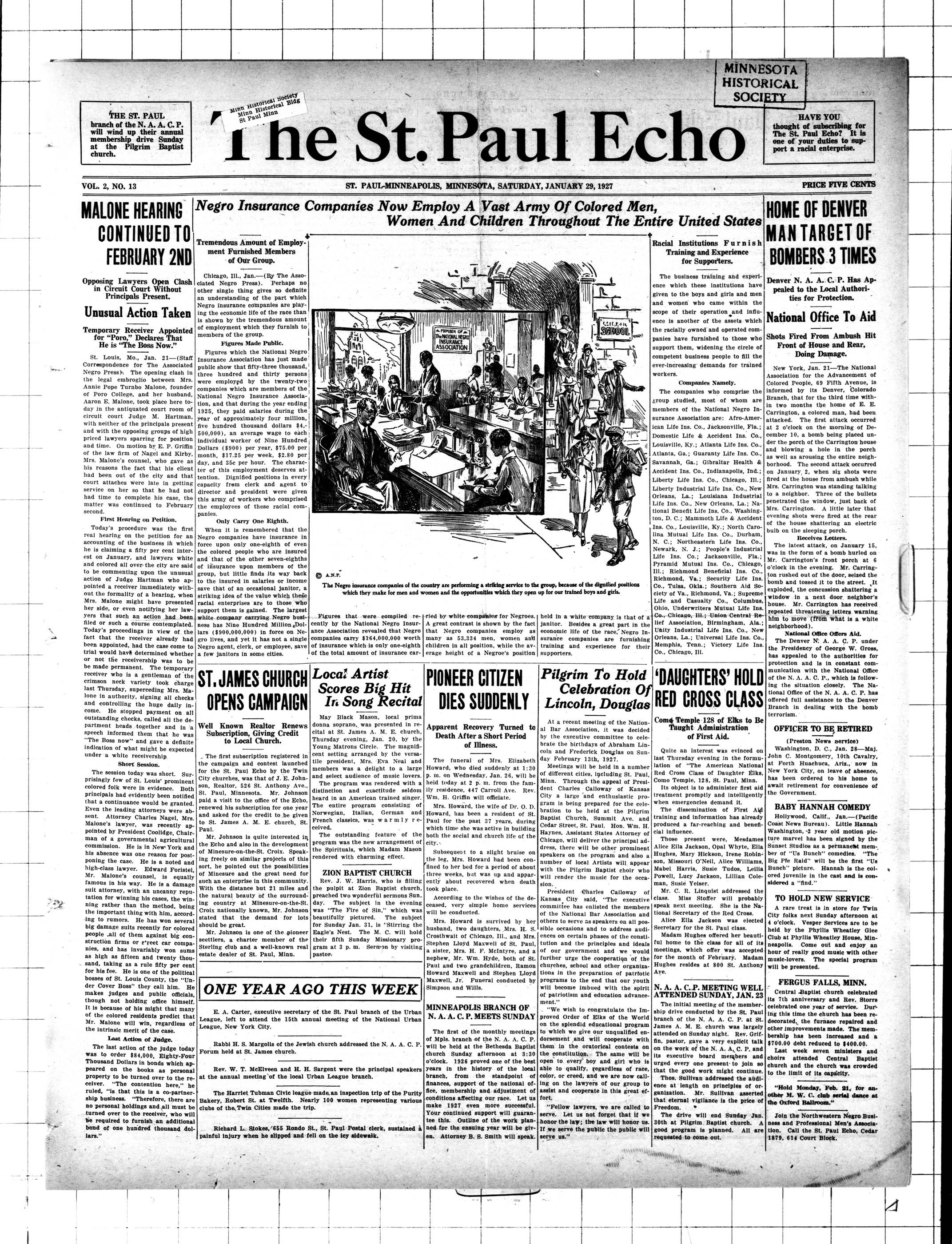
Page text (machine-generated)
THE ST. PAUL branch of the N. A. A. C. P. will wind up their annual membership drive Sunday at the Pilgrim Baptist church.
VOL. 2, NO. 13
MALONE HEARING CONTINUED TO FEBRUARY 2ND
Opposing Lawyers Open Clash in Circuit Court Without Principals Present.
Unusual Action Taken
Temporary Receiver Appointed for "Poro," Declares That He is "The Boss Now."
St. Louis, Mo., Jan. 21—(Staff Correspondence for The Associated Negro Press). The opening clash in the legal embroglio between Mrs. Annie Pope Turnbo Malone, founder of Poro College, and her husband, Aaron E. Malone, took place here today in the antiquated court room of circuit court Judge M. Hartman, with neither of the principals present and with the opposing groups of high priced lawyers sparring for position and time. On motion by E. P. Griffin of the law firm of Nagel and Kirby, Mrs. Malone's counsel, who gave as his reasons the fact that his client had been out of the city and that court attaches were late in getting service on her so that he had not had time to complete his case, the matter was continued to February second.
First Hearing on Petition.
Today's procedure was the first real hearing on the petition for an accounting of the business in which he is claiming a fifty per cent interest on January, and lawyers white and colored all over the city are said to be commenting upon the unusual action of Judge Hartman who appointed a receiver immediately without the formality of a hearing, when Mrs. Malone might have presented her side, or even notifying her lawyers that such an action had been filed or such a course contemplated. Today's proceedings in view of the fact that the receiver already had been appointed, had the case come to trial would have determined whether or not the receivership was to be be made permanent. The temporary receiver who is a gentleman of the crimson neck variety took charge last Thursday, superceding Mrs. Malone in authority, signing all checks and controlling the huge daily income. He stopped payment on all outstanding checks, called all the department heads together and in a speech informed them that he was "The Boss now" and gave a definite indication of what might be expected under a white receivership
Short Session.
The session today was short. Surprisingly few of St. Louis' prominent colored folk were in evidence. Both principals had evidently been notified that a continuance would be granted. Even the leading attorneys were absent. Attorney Charles Nagel, Mrs. Malone's lawyer, was recently appointed by President Coolidge, Chairman of a governmental agricultural commission. He is in New York and his absence was one reason for postponing the case. He is a noted and high-class lawyer. Edward Foristel, Mr. Malone's counsel, is equally famous in his way. He is a damage suit attorney, with an uncanny reputation for winning his cases, the winning rather than the method, being the important thing with him, according to rumors. He has won several big damage suits recently for colored people, all of them against big construction firms or greet car companies, and has invariably won sums as high as fifteen and twenty thousand, taking as a rule fifty per cent for his fee. He is one of the political bosses of St. Louis County, the "Under Cover Boss" they call him. He makes judges and public officials, though not holding office himself. It is because of his might that many of the colored residents predict that Mr. Malone will win, regardless of the intrinsic merit of the case.
Last Action of Judge.
The last action of the judge today was to order $84,000, Eighty-Four Thousand Dollars in bonds which appeared on the books as personal property to be turned over to the receiver. "The contention here," he ruled, "is that this is a co-partnership business. "Therefore, there are no personal holdings and all must be turned over to the receiver, who will be required to furnish an additional bond of one hundred thousand dollars."
The St. Paul Echo
Negro Insurance Companies Now Employ A Vast Army Of Colored Men, Women And Children Throughout The Entire United States
ONE YEAR AGO THIS WEEK
E. A. Carter, executive secretary of the St. Paul branch of the Urban League, left to attend the 15th annual meeting of the National Urban League, New York City.
Rabbi H. S. Margolls of the Jewish church addressed the N. A. A. C. P. Forum held at St. James church.
Rev. W. T. McElveen and H. H. Sargent were the principal speakers at the annual meeting of the local Urban League branch.
The Harriet Tubman Civic league made an inspection trip of the Purity Bakery, Robert St. at Twelfth. Nearly 100 women representing various clubs of the Twin Cities made the trip.
Richard L. Stokes, 655 Rondo St., St. Paul Postal clerk, sustained a painful injury when he slipped and fell on the icy sidewalk.
Tremendous Amount of Employment Furnished Members of Our Group.
Chicago, Ill., Jan.—(By The Associated Negro Press). Perhaps no other single thing gives so definite an understanding of the part which Negro insurance companies are playing the economic life of the race than is shown by the tremendous amount of employment which they furnish to members of the group.
Figures Made Public.
Figures which the National Negro Insurance Association has just made public show that fifty-three thousand, three hundred and thirty persons were employed by the twenty-two companies which are members of the National Negro Insurance Association, and that during the year end 1925, they paid salaries during the year of approximately four million, five hundred thousand dollars $4,500,000), an average wage to each individual worker of Nine Hundred Dollars ($900) per year, $7.50 per month, $17.25 per week, $2.80 per day, and $35c per hour. The character of this employment deserves attention. Dignified positions in every capacity from clerk and agent to director and president were given this army of workers who comprised the employees of these racial companies.
Only Carry One Eighth.
When it is remembered that the Negro companies have insurance in force upon only one-eighth of even the colored people who are insured and that of the other seven-eighths of insurance upon members of the group, but little finds its way back to the insured in salaries or income save that of an occasional janitor, a striking idea of the value which these racial enterprises are to those who support them is gained. The largest white company carrying Negro business has Nine Hundred Million Dollars ($900,000,000) in force on Negro lives, and yet it has not a single Negro agent, clerk, or employee, save a few janitors in some cities.
ST. JAMES CHURCH OPENS CAMPAIGN
Well Known Realtor Renews Subscription, Giving Credit to Local Church.
The first subscription registered in the campaign and contest launched for the St. Paul Echo by the Twin City churches, was that of J. E. Johnson, Realtor, 526 St. Anthony Ave. St. Paul, Minnesota. Mr. Johnson paid a visit to the office of the Echo, renewed his subscription for one year and asked for the credit to be given to St. James A. M. E. church, St. Paul.
Mr. Johnson is quite interested in the Echo and also in the development of Minesure-on-the-St. Croix. Speaking freely on similar projects of this sort, he pointed out the possibilities of Minesure and the great need for such an enterprise in this community. With the distance but 21 miles and the natural beauty of the surrounding country at Minesure-on-the-St. Croix nationally known, Mr. Johnson stated that the demand for lots should be great.
Mr. Johnson is one of the pioneer seettlers, a charter member of the Sterling club and a well-known real estate dealer of St. Paul, Minn.
ST. PAUL-MINNEAPOLIS, MINNESOTA, SATURDAY, JANUARY 29, 1927
MEMBER OF
THE NATIONAL NEGRO
INSURANCE
ASSOCIATION
SCHOOL
The Negro insurance companies of the country are performing a striking service to the group, because of the dignified positions which they make for men and women and the opportunities which they open up for our trained boys and girls.
Figures that were compiled recently by the National Negro Insurance Association revealed that Negro companies carry $164,000,000 worth of insurance which is only one-eighth of the total amount of insurance car-
Local Artist Scores Big Hit In Song Recital
May Black Mason, local prima donna soprano, was presented in recital at St. James A. M. E. church, Thursday evening, Jan. 20, by the Young Matrons Circle. The magnificent setting arranged by the versatile president, Mrs. Eva Neal and members was a delight to a large and select audience of music lovers. The program was rendered with a distinction and exactitude seldom heard in an American trained singer. The entire program consisting of Norwegian, Italian, German and French classics, was warmly received. The outstanding feature of the program was the new arrangement of the Spirituals, which Madam Mason rendered with charming effect.
ZION BAPTIST CHURCH
Rev. J. W. Harris, who is filling the pulpit at Zion Baptist church, preached two wonderful sermons Sunday. The subject in the evening was "The Fire of Sin," which was beautifully pictured. The subject for Sunday Jan. 31, is "Stirring the Eagle's Nest. The M. C. will hold their fifth Sunday Missionary program at 3 p. m. Sermon by visiting pastor.
ried by white companies for Negroes. A great contrast is shown by the fact that Negro companies employ as many as 53,334 men, women and children in all position, while the average height of a Negroe's position
PIONEER CITIZEN DIES SUDDENLY
PIONEER CITIZEN DIES SUDDENLY
Apparent Recovery Turned to Death After a Short Period of Illness.
The funeral of Mrs. Elizabeth Howard, who died suddenly at 1:30 p. m. on Wednesday, Jan. 26, will be held today at 2 p. m. from the family residence, 447 Carroll Ave. Rev. Wm. H. Griffin will officiate.
Mrs. Howard, the wife of Dr. O. D. Howard, has been a resident of St. Paul for the past 37 years, during which time she was active in building both the social and church life of the city.
Subsequent to a slight bruise on the leg, Mrs. Howard had been confined to her bed for a period of about three weeks, but was up and apparently about recovered when death took place.
According to the wishes of the deceased, very simple home services will be conducted.
Mrs. Howard is survived by her husband, two daughters, Mrs. H. S. Crosthwait of Chicago, Ill., and Mrs. Stephen Lloyd Maxwell of St. Paul, a sister, Mrs. H. F. McIntyre, and a nephew, Mr. Wm. Hyde, both of St. Paul and two grandchildren, Ramon Howard Maxwell and Stephen Lloyd Maxwell, Jr. Funeral conducted by Simpson and Wills.
MINEAPOLIS BRANCH
N. A. A. C. P. MEETS SUNDAY
The first of the monthly meetings of Mpls, branch of the N. A. A. C. P. will be held at the Bethesda Baptist church Sunday afternoon at 8:30 o'clock. 1926 proved one of the best years in the history of the local branch, from the standpoint of finances, support of the national office, membership and adjustment of conditions affecting our race. Let us make 1927 even more successful. Your continued support will guarantee this. Outline of the work planned for the ensuing year will be given. Attorney B. S. Smith will speak.
held in a white company is that of a janitor. Besides a great part in the economic life of the race, Negro Insurance companies are furnishing training and experience for their supporters.
Pilgrim To Hold Celebration Of Lincoln, Douglas
At a recent meeting of the National Bar Association, it was decided by the executive committee to celebrate the birthdays of Abraham Lincoln and Frederick Douglas on Sunday February 13th, 1927. Meetings will be held in a number of different cities, including St. Paul, Minn. Through the appeal of President Charles Calloway of Kansas City a large and enthusiastic program is being prepared for the celebration to be held at the Pilgrim Baptist Church, Summit Ave. and Cedar Street, St. Paul. Hon. Wm. H. Haynes, Assistant States Attorney of Chicago, will deliver the principal address, there will be other prominent speakers on the program and also a number of local Artists will appear with the Pilgrim Baptist choir who will render the music for the occasion.
President Charles Calloway of Kansas City said, "The executive committee has enlisted the members of the National Bar Association and others to serve as speakers on all possible occasions and to address audiences on certain phases of the constitution and the principles and ideals of our government and we would further urge the cooperation of the churches, school and other organizations in the preparation of patrotic programs to the end that our youth will become imbued with the spirit of patriotism and education advancement."
"We wish to congratulate the Improved Order of Elks of the World on the splendid educational program to which we give our unqualified endorsement and will cooperate with them in the oratorical contests on the constitution. The same will be open to every boy and girl who is able to qualify, regardless of race, color, or creed, and we are now calling on the lawyers of our group to assist and cooperate in this great effort.
"Fellow lawyers, we are called to serve. Let us not forget that if we honor the law; the law will honor us. If we serve the public the public will serve us."
MINNESOTA HISTORICAL SOCIETY
Racial Institutions Furnish Training and Experience for Supporters.
The business training and experience which these institutions have given to the boys and girls and men and women who came within the scope of their operation and influence is another of the assets which the racially owned and operated companies have furnished to those who support them, widening the circle of competent business people to fill the ever-increasing demands for trained workers.
Companies Namely.
The companies who comprise the group studied, most of whom are members of the National Negro Insurance Association are: Afro-American Life Ins. Co., Jacksonville, Fla.; Domestic Life & Accident Ins. Co., Louisville, Ky.; Atlanta Life Ins. Co., Atlanta, Ga.; Guaranty Life Ins. Co., Savannah, Ga.; Gibraltar Health & Accident Ins. Co., Indianapolis, Ind.; Liberty Life Ins. Co., Chicago, Ill.; Liberty Industrial Life Ins. Co., New Orleans, La.; Louisiana Industrial Life Ins. Co., New Orleans, La.; National Benefit Life Ins. Co., Washington, D. C.; Mammoth Life & Accident Ins. Co., Louisville, Ky.; North Carolina Mutual Life Ins. Co., Durham, N. C.; Northeastern Life Ins. Co., Newark, N. J.; People's Industrial Life Ins. Co.; Jacksonville, Fla.; Pyramid Mutual Ins. Co., Chicago, Ill.; Richmond Beneficial Ins. Co., Richmond, Va.; Security Life Ins. Co., Tulsa, Okla.; Southern Aid Society of Va., Richmond, Va.; Supreme Life and Casualty Co., Columbus Ohio, Underwriters Mutual Life Ins. Co., Chicago, Ill.; Union Central Relief Association, Birmingham, Ala. Unity Industrial Life Ins. Co., New Orleans, La.; Universal Life Ins. Co., Memphis, Tenn.; Victory Life Ins Co., Chicago, Ill.
'DAUGHTERS' HOLD RED CROSS CLASS
'DAUGHTERS' HOLD RED CROSS CLASS
Come Temple 128 of Elks to Be Taught Administration of First Aid.
Quite an interest was evinced on last Thursday evening in the formulation of "The American National Red Cross Class of Daughter Elks, Como Temple, 128, St. Paul, Minn.
Its object is to administer first aid treatment promptly and intelligently when emergencies demand it.
The dissemination of First Aid training and information has already produced a far-reaching and beneficial influence.
Those present were, Mesdames Alice Ella Jackson, Opal Whyte, Ella Hughes, Mary Hickson, Irene Robinson, Missouri O'Neil, Alice Williams, Mabel Harris, Susie Tudos, Lellia Powell, Lucy Jackson, Lillian Coleman, Susie Yeiser.
Mr. C. R. Linguist addressed the class. Miss Stoffer will probably speak next meeting. She is the National Secretary of the Red Cross. Alice Ella Jackson was elected Secretary for the St. Paul class. Madam Hughes offered her beautiful home to the class for all of its meetings, which offer was accepted for the month of February. Madam Hughes resides at 800 St. Anthony Ave.
N A. A. C. P. MEETING WELL
ATTENDED SUNDAY. JAN. 23
The initial meeting of the membership drive conducted by the St. Paul branch of the N. A. A. C. P. at St. James A. M. E. church was largely attended on Sunday night. Rev. Griffin, pastor, gave a very explicit talk on the work of the N. A. A. C. P. and its executive board members and urged every one present to join so that the good work might continue. Thos. Sullivan addressed the audience at length on principles of organization. Mr. Sullivan asserted that eternal vigilance is the price of Freedom.
The drive will end Sunday Jan. 30th at Pilgrim Baptist church. A good program is planned. All are requested to come out.
HAVE YOU thought of subscribing for The St. Paul Echo? It is one of your duties to support a racial enterprise.
HOME OF DENVER MAN TARGET OF BOMBERS 3 TIMES
Denver N. A. A. C. P. Has Appealed to the Local Authorities for Protection.
National Office To Aid
Shots Fired From Ambush Hit Front of House and Rear, Doing Damage.
New York, Jan. 21—The National Association for the Advancement of Colored People, 69 Fifth Avenue, is informed by its Denver, Colorado Branch, that for the third time within two months the home of E. E. Carrington, a colored man, had been attacked. The first attack occurred at 2 o'clock on the morning of December 10, a bomb being placed under the porch of the Carrington house and blowing a hole in the porch as well as arousing the entire neighborhood. The second attack occurred on January 2, when six shots were fired at the house from ambush while Mrs. Carrington was standing talking to a neighbor. Three of the bullets penetrated the window, just back of Mrs. Carrington. A little later that evening shots were fired at the rear of the house shattering an electric bulb on the sleeping porch.
The latest attack, on January 15, was in the form of a bomb hurled on Mr. Carrington's front porch at 6 o'clock in the evening. Mr. Carrington rushed out of the door, seized the bomb and tossed it to the street. It exploded, the concussion shattering a window in a next door neighbor's house. Mr. Carrington has received repeated threatening letters warning him to move (from what is a white neighborhood).
National Office Offers Aid.
The Denver N. A. A. C. P. under the Presidency of George W. Gross, has appealed to the authorities for protection and is in constant communication with the National Office of the N. A. A. C. P., which is following the situation closely. The National Office of the N. A. A. C. P. has offered full assistance to the Denver Branch in dealing with the bomb terrorism.
OFFICER TO BE RETIRED
Washington, D. C., Jan. 28—Maj. John C. Montgomery, 10th Cavalry, at Forth Huachuca, Ariz., now in New York City, on leave of absence, has been ordered to his home to await retirement for convenience of the Government.
BABY HANNAH COMEDY
Hollywood, Calif., Jan.—(Pacific Coast News Bureau). Little Hannah Washington, -2 year old motion picture marvel has been signed by the Sunset Studios as a permanent member of "Us Bunch" comedies. "The Big Pie Raid" will be the first "Us Bunch" picture. Hannah is the colored juvenile in the cast and is considered a "find."
TO HOLD NEW SERVICE
A rare treat is in store for Twin City folks next Sunday afternoon at 4 o'clock. Vesper Services are to be held by the Phyllis Wheatley Glee Club at Phyllis Wheatley House, Minneapolis. Come out and enjoy an hour of really good music with other music-lovers. The special program will be presented.
FERGUS FALLS, MINN.
Central Baptist church celebrated its 7th anniversary and Rev. Storrs celebrated one year of service. During this time the church has been redecorated, the furnace repaired and other improvements made. The membership has been increased and a $700.00 debt reduced to $400.00. Last week seven ministers and choirs attended Central Baptist church and the church was crowded to the limit of its capacity.
"Hold Monday, Feb. 21, for another M. W. C. club serial dance at the Oxford Ballroom."
Join the Northwestern Negro Business and Professional Men's Association. Call the St. Paul Echo, Cedar 1879, 614 Court Block.
PRICE FIVE CENTS
Receives Letters.
(Preston News service)
V
CRAZY PEOPLE CANNOT ORGANIZE
during the opening guns in the memberships of P., the Hon. Thos. V. Sullivan related an active incident. He said he went with a friend one asylum, where in one department four hundred patients. After unlocking the visitors, the guide entered and locked in the building with the four hundred insane Mr. Sullivan's friend saw the danger. And insane people and knew the party that had three at most. He expressed his fear to him, "If they organize and rush us we shred insane people will be free to roam and was undisturbed gave pert reply, 'You can people to organize.'" And thought we laugh, and then we pass through section, asking ourselves, "Are we crazy?" We organize to secure to ourselves the benefits of support a newspaper that shall be our men the rights that are held inalienable; to giving power, that our men shall be able to giving our women more leisure and our chic. But Mr. Sullivan says crazy people can
While firing the opening guns in the membership drive of the N. A. A. C. P., the Hon. Thos. V. Sullivan related an interesting and instructive incident. He said he went with a friend to visit a large insane asylum, where in one department four attendants supervise four hundred patients. After unlocking the door and admitting the visitors, the guide entered and locked himself and the guests in the building with the four hundred insane persons. Immediately Mr. Sullivan's friend saw the danger. He saw the four hundred insane people and knew the party that held the key consisted of three at most. He expressed his fear to the guide. "Why," said he, "If they organize and rush us we shall be killed and four hundred insane people will be free to roam at will." The guide who was undisturbed gave pert reply, "You can't get a lot of crazy people to organize."
At first thought we laugh, and then we pass through a period of self-inspection, asking ourselves, "Are we crazy?" Surely we need to organize to secure to ourselves the benefits of the taxes we pay; to support a newspaper that shall be our mouthpiece; to vouchsafe the rights that are held inalienable; to give our labor higher earning power, that our men shall be able to well support our homes, giving our women more leisure and our children closer supervision. But Mr. Sullivan says crazy people cannot organize.
AMERICAN BRAIN POVERTY:
often marvels at the actual absence of read in the United States. Why is it that the man can czaristic gentlemen to suppress freedom assembly? The answer is that the averaged man ass, too stupid and too filled with porch institution, to worry about anything aside from day and a soft bed to sleep in.
Average man never worries about the surrection of books or of art. The only large number of us has protested against it as when prohibition came. And then we act raised the price of whisky and beer, aaint is that the rich can get all the liquoried to the poor man.
Average American simply can't get any interest—purely theoretical types of freedom. The ends and attends are never suppressed. The level are gathering dust by the thousands. All the art that he knows anything about the comic strips every day and in the advertisements.
Political ideas, he has none except those of his hard vague rumors of the existence once, or never read a word of "Capital." To him liberals and the directors of the American are but sore heads who want politicalJOINT.
I don't think for himself and doesn't want to be berals and radicals doing any new thinking stands this new thinking he will have to do. And, according to his credo, this is not so the movies, to church, to lodge or as into chat with his favorite bootlegger.
One often marvels at the actual absence of real intellectual freedom in the United States. Why is it that the mass of people permit certain czaristic gentlemen to suppress freedom of speech, press and assembly? The answer is that the average American is too much of an ass, too stupid and too filled with pork, moonshine and superstitution, to worry about anything aside from his belly, a place to play and a soft bed to sleep in.
The average man never worries about the suppression of thinking, the censorship of books or of art. The only time recently that any large number of us has protested against restriction of any sort was when prohibition came. And then we only kicked because this act raised the price of whisky and beer. Our continual complaint is that the rich can get all the liquor they want but it is denied to the poor man.
Mr. Average American simply can't get any interest in—what seems to him—purely theoretical types of freedom. The plays that he understands and attends are never suppressed. The books that are on his level are gathering dust by the thousands on every library shelf. All the art that he knows anything about is unsuppressed in the comic strips every day and in the advertising of the business firms.
As to political ideas, he has none except those of his ward boss. He has heard vague rumors of the existence once, of Karl Marx, but he has never read a word of "Capital." To him most of the articulate liberals and the directors of the American Civil Liberties Union are but sore heads who want political jobs and can't get them.
He can't think for himself and doesn't want to. He doesn't want any liberals and radicals doing any new thinking for him; for if he understands this new thinking he will have to do some thinking himself. And, according to his credo, this is not so interesting as going to the movies, to church, to lodge or as interesting as a confidential chat with his favorite bootleger.
LAKES AND LAKES
a reliable source we have the information 1000 tourists in Minnesota last year; that 25,000 Minnesota age. Even if we have 10,000 lakes it will fronts will be quoted at so much per inch. But every lake front is not a good invest distance from great centers, there are the Minnesota. In the first class are the great that are fed by drainage from the surro
From a reliable source we have the information that there were 1,200,000 tourists in Minnesota last year; that 25,000 of that number bought lake frontage; that 25,000 Minnesotans also bought lake frontage. Even if we have 10,000 lakes it will not be long before lake fronts will be quoted at so much per inch rather than by the lot. But every lake front is not a good investment. Besides the distance from great centers, there are three kinds of lakes in Minnesota. In the first class are the great depressions in the earth that are fed by drainage from the surrounding country when the rain and snow falls. In the next class are the depressions that are fed by springs or creeks. In very hot weather the evaporation takes more water than comes in through the sources of supply; then, too, if artesian wells are near the height of the water table under the earth in that vicinity is lowered and the lake becomes dry land. The third and enduring class is composed of lakes fed by rivers. Those rivers have been flowing since the dawn of the glacial age and probably will flow on for ages more. Thus the lakes fed by rivers will continue a place where "The swallows may skim the smooth lake's level brim." Get a map and notice, the St. Croix River feeds Lake St. Croix. In another column we are telling you of Minesure. It is on Lake Croix. It will endure. It is a good investment.
Are You Supporting Your Local Race Paper?
Wrong Idea About Storms
The weather bureau says that there is no reason why storms should be more frequent or severe on September 21 or 22 (autumnal equinox) than on September 10 or 11, say, or 29 or 30; nor, in fact, are they. The same is true of the spring or vernal equinox. This whole notion about "equinoctial storms" is erroneous, and it even is uncertain how, where, when or by whom the idea was started. We only know that in one form or another it goes back at least to 1748.
Personal Experience?
A few weeks ago in one of the state high schools, in an English class, this little episode occurred: The teacher had asked the pupils, for the following day, to write an editorial, and in giving suggestions had said that "puppy love" would be an interesting topic to work up. A member of the class, who was busy copying the assignment when the above statement was made, looked up and innocently inquired: "Does it have to be a personal experience?"-Indianapolis News.
WILLIAMS EXPRESS
Trunks and General Hauling
COAL AND WOOD
Service Any Time
392 Carroll Ave. Tel. Dale 4459
NEED
SOME?
ITS a fine thing to know where you can get cash when you need it. Our service is quick and confidential. We have helped your friends for years. Ask them about the
Local Loan Co.
216 Exchange Bank Building
Sixth & Minnesota Sts. Tel. Co 2417
Home Cooked Meals
Salads
Barbecued Ribs
TOASTED SANDWICHES
ALEXANDERS SWEET SHOPPE
Dale and Ronde Stroots
Phone Dale 7175
FOR WEEKLY NEWS RELEASES DEAD LINE ADVANCED TO WEDNESDAY NOON
For BILIOUSNESS
Use BEECHAM'S PILLS
for the relief of Constipation,
Biliousness, Sick Headache and
for moving the Bowels.
Helps clear the skin.
Contains no Calamol
Buy from your druggist.
25c and 50c the box.
BEECHAM'S
PILLS
---
in Expiation of Crime
In the high mountains beyond Nikko, in central Japan, nestles Lake Chuzenji, and above it the sacred mountain Nantai San rears its bare crest. Once it was the dwelling place of a pacific Buddhist hermit saint. Pilgrims from all parts of Japan climb its steep slopes. They are dressed in white robes, carry staffs and rosaries in hand, and chant a Buddhist prayer as they climb. An avenue of scariet laquer "toril," or gateways, guides the pilgrim to the shrine on the summit.
Near the peak is a bare patch of rock, overhanging a steep preplice. On this rock is a heap of swords, daggers and other weapons, rusted with age. In ancient times a man who had committed a deed of blood made a pilgrimage to Nantal San and offered up his weapon in expiation of his crime. To the Samurai, the warrior, his sword was his most prized possession, and the murderer who sacrificed his precious sword gave up in atonement what he valued more than his own life. This heap of ancient sword blades, daggers and other weapons can be seen on Nantal San at present, a relic of feudal times.
"Shut-ins" Not Dead to
All Worldly Affairs
The Woman visited a friend at a sanatorium the other day—one of those places in the country where they try to make convalescence bearable. She had to wait until she could see her friend, so she sat down on the porch. At the far end a group of women patients were talking with absorbed interest.
The one in the wheel chair evidently had a great deal to tell. The Woman wondered what it could be about. She knew the story of those particular patients. All three had been invalids for years; they always would be bound to their chairs and crutches. Just then she was called, and as she passed the group she heard: "When I bake tomatoes I fill them with bread crumbs and butter and . . .."
and my husband used to say . . .
The Woman went inside. She was
"smilin' round the mouth, but sort of
teary around the lashes" when she
thought of that hopeful, reminiscent
group of cooks—New York Sun.
Mirror Made Trouble
To the back velds of South Africa there penetrated one day a traveler, who possessed many treasures the old farmer had never seen before. Among them was a mirror.
"Where did you get that?" asked the farmer, as he gazed into it; "that picture of my father?"
The traveler did not explain, but gave it to him as a souvenir, and it became his most cherished possession. Every day he looked at his "father's picture," and kept it carefully locked up, showing it to no one.
But there came a day when he left his keys behind, and his wife, who had long wondered what it was he kept so carefully, started rummaging and found the mirror.
"Oh," she murmured, as she gazed into it, "so that's the cat he's after, is it?"
Birthstone Old Ornament
Birthstones are among the oldest forms of jewelry. The group of 12 stones, one for each month of the calendar year, may have been related to the 12 stones in the breastplate worn by the High Priest Aaron as described in the Book of Exodus. Each of the 12 stones represented one of the tribes of the Children of Israel and the name of the tribe was inscribed on the stone. As early as 4000 B. C. another high priest, this time in Egypt, wore a breastplate of 12 small stones or crosses. Ancient Egyptian carvings preserve this interesting bit of history. A relationship between the breastplates of the two high priests seems probable.—New York Times.
North Carolina Giant
Miles Darden, who was born in North Carolina, in 1798, and died in Harden county, Tennessee, January 28, 1857, was the world's biggest man, claims the North Carolina Historical Review. He was 7 feet 6 inches tall and weighed a little more than 1,000 pounds.
Thirteen and a half yards of cloth one yard wide were required to make him a coat. When he died 24 yards of black velvet were needed to cover the sides and lid of his coffin. This was 8 feet long, only 1 inch less than 8 feet deep and was 32 inches broad. Miles Darden lived a quiet, uneventful life; apart from his world record size he seems to have been a hardworking, ordinary man.
Not Worth Saving
A Scottish gillie who had accompanied a middle-aged and corpulent Englishman on a fishing expedition returned alone and announced that the visitor had fallen into the river and been drowned.
"The first time he cam' up I grippit him by the hair, but it was a wig and cam' awa' in ma hand, and doon he sank. He cam' up again an' I grippit him by the collar, an' it was a dickle and cam' awa' in my hand, an' doon he sank. A third time he cam' up an' I grippit him by the leg. Losh, it was cork, an' cam' awa' in ma hand, an' doon he sank. So I said to myself, 'Weel, ma chapple. I'll let you droon. You're nothing but a bag o' remnants.'
Nation's Faith in God
Expressed on Coinage "In God We Trust" first appeared on the coins of this country in 1864, and owes its presence very largely to the increased religious sentiment in the dreaded crisis of the Civil war. S. P. Chase, then secretary of the treasury, having received a number of appeals from devout persons throughout the country suggesting and urging that the deity be recognized suitably on our coins in a manner similar to that commonly found on the coins of other nations, addressed a letter to the director of the mint, at Philadelphia, stating that "no nation would be strong except in the strength of God or safe except in His defense. The trust of our people in God should be declared on our national coins." He ordered that a device be prepared without unnecessary delay, with a motto expressing in the fewest words possible this national recognition. Various mottoes were placed on coins in 1862 and 1863. The first ones bearing "In God We Trust," however, were coined in 1864.
Seemed Something of
an Odd Combination
He didn't really want to bring the two cats home from Colorado, but what good is the argument of a mere man against those of a wife, three children, and a mother-in-law? So the family started home last week with the cats enthroned in a box on the back seat of the car.
He was somewhat ashamed of the ugly yellow pets anyway, and his mortification was complete when he was forced to ask a garage owner, in the town where they spent the first night, for cellar space in which to park his charges.
"I suppose," he said to the garage man, "I suppose you don't see many tourists crazy enough to be taking common alley cats with them, do you?" "Oh, yes I do," replied the garage man. "They come in here every day with all sorts of pets. But," he added as an afterthought, "by George, you're the first feller I've seen that was totin' cats and a mother-in-law both."—Los Angeles Times.
Rattlesnake's Rings
The rings on a rattlesnake do not tell exactly the age of the snake. The biological survey says that the rattlesnake acquires from two to four rattles a year, usually three. Under normal conditions one ring is added each time the snake sheds its skin. The young rattler is provided with a single button at birth, and within a few days it sheds its skin and commences feeding. In about two months it sheds its skin for the second time and then the first ring of the rattle is uncovered or added. This has been growing under the old skin, and its pressure was apparent in the swollen appearance of the tail at the base of the original button. The last seven or eight vertebrae fuse together shortly after birth and form a composite bone known as the "shaker," and it is around this bone that each cap or ring of the rattle forms.
Little Sermon
He dwellel among his kind and talketh confidently of his art. He letteth his hair grow long and discourseff of Freud. He shaveth not, but he understandeth the futuristic. He laugheth to scorn the conventions and prateth of free love. He derideth industry.
And yet, being hungry, he buyeth sustenance with money which his father hath earned. For he remaineth ethetic only so long as he is comfortable.
So we mock him, knowing in our hearts that we, too, would be ethetic. But for the absence of rich fathers.
—Kansas City Times.
Beaten Path Monotonous
Our associations are greatly responsible for our lives. Happiness or otherwise follows upon the heels of our companions. The mighty help us to prevail. The great create an atmosphere for us. Train the heart and mind to be at home in the great places and to live on the broad plains. The superlative alone can give us cheer. Get away from the humdum and regular. Sometimes have courage to depart into the country unknown. Remember, if a rolling stone gathers no moss, a fixed one gathers little else. It is earthbound.—Exchange.
Sharp
"Oh, doctor," cried a wild-eyed man, "I am dreadfully afflicted. The ghosts of my departed relatives come and perch on the tops of the fescepests all round my garden when dusk is falling. I can look out onto the gloaming any evening and see a couple of dozen spooks sitting on top of the posts, waiting, waiting, waiting! What shall I do?"
"Sharpen the tops of the posts," came the cool reply.
Humming Birds
In regard to the materials used by humming birds in constructing their nests, I wish to say that no hair or feathers are ever used. The nests are built of lichens and attached to the limb which is as nearly as possible the exact color of the lichens used, hence the difficulty in locating the nests of humming birds with the human eyes. The nest is never hidden but merely cunningly camouflaged. — Pathfinder Marasine.
by Personal Contact
The best authors should be read, not known. Even if a poet has written an epic, one hour's association with him may destroy the most idolatous reader's illusion of him.
Your favorite humorist may turn out to be an ordinary person, dull in the use of the spoken word. Or what you believe to be the greatest living novelist may prove to be a little peevish man whose false teeth do not fit, made intolerant by nervous indigestion or egotism.
In any case, says Corra Harris in the Saturday Evening Post, some writer whom you have admired for his high notes in the purpling shadows of a great poem is almost sure to give vent to some meanly critical views of men quite contrary to the noble sentiments he bugled in that martial epic, because he was in a divine mood when he wrote it, and the thing merely interprets his mood, not his normal mind, which may be a mean little mind.
Early Altars Ablaze
Throughout the ages men have made human sacrifices whenever they were under adversity and felt that the gods were athrist. H. G. Wells paints a graphic picture of a scene that may have occurred in the dawn of a prehistoric day about the vast stone altars on the Wiltshire uplands at Stonehenge, in England—the Druld priests with horribly painted masks, the air of festivity among the people who have come wearing their very best skin garments for the occasion and the helpless victims gazing toward the distant smoking altars upon which they are to die. As time went on, the practice of human sacrifice became more elaborate. The reasons and occasions for human sacrifice were codified. The most civilized races decided that an entire community might be cleansed of an epidemic or saved from other calamity by this barbarous means.
Seek Synthetic Rubber
The Amazon district of Brazil is the great rubber-producing country of the world, for more than half of the total supply comes from there. The federated Malay states, the Congo region, Portuguese West Africa, the east coast of tropical Africa, Rangoon, Penang, Borneo and Mexico, the West Indies and Central America are the other rubber-producing districts. About one-tenth of the total yield comes from the Congo.
The rapidly increasing cost of the article has aroused experimenters, who have produced substances that have some of the qualities of rubber. It is not improbable that they may ultimately succeed, as the chemists did in producing artificial indigo, in making real rubber by synthesis.
Columbus Promised Much
In a letter to Columbus on the discovery of America, facsimile edition, 1892, of the four Latin editions belonging to the Lenox library, is the following passage: "Finally, that I may compress in a few words the brief account of our departure and quick return, and the gain, I promise this, that if I am supported by our most invincible sovereigns with a little of their help, as much gold can be supplied as they will need, indeed, as much of spices, of cotton, of chewing gum (which is only found in Chios), also as much of aeswood, and as many slaves for the navy of their majesties will wish to demand." The date of this letter is March 14, 1493—more than 400 years ago.
Precocious Children
Dante wrote a sonnet to his Beatrice at nine years; Tasso wrote poetry at ten, and Pascal was a profound thinker at the age of thirteen. Jonathan Edwards was famous at twelve. Goethe wrote a story in seven languages when he was ten; Voltaire was busy as a writer at thirteen, and Calderon was writing poetry at the same age.
Victor Hugo composed "Istamene" at fifteen, and by the time he was twenty had published four of his volumes. Pope wrote his ode to "Sollture" at twelve, and his "Pastorals" four years later. Moore translated "Anacreon" at thirteen, and Byron was already writing verses at twelve, and by the time he was eighteen years of age he had published his "Hours of Idleness."
Easy to Fix Clock
A commercial traveler staying at a small hotel wished to catch an early morning train, and asked the proprietress for the loan of an alarm clock.
She produced the clock and remarked:
"We don't often use it, sir, and sometimes it sticks a bit, but if it doesn't go off just touch the little hammer and it'll ring all right."—London Tit-Bits.
Alcohol in the Seas
The ancient seas were huge alcohol wells. The primeval ocean, with its huge masses of sugar-containing seaweed, was a fermentation vat. So says a Berlin scientist, Professor Lindner. These immense alcoholic seas stimulated delicate forms of early life, he explains, and adds that the plants today which produce sugar, later to be converted into alcohol, are marked by their splendid coloration and intricate structure.
Find Ample Proof of
Elephants in America
Scientists interested in the prehistoric animals that roamed the North American continent in times too remote to calculate offhand have now and then resurrected from their beds of rock and debris the skeletons of mammoths and mastodons, those strange creatures akin to the elephant. That the elephant species was known to the civilizations of Central America not so many thousands of years ago seems to be proved conclusively by recent excavations made in Panama. A. Hyatt Verrill, writing in World's Work, describes the strange sculptures of an ancient people, dug up from the volcanic soil of the little isthmian republic showing the degree of artistic advancement achieved by that vanished hill.
Perhaps the most interesting and remarkable find of all, writes Mr. Verrill, was a large sculptured stone figure thoroughly elephantine in form and detail. Hitherto the so-called "elephants" found in prehistoric (and modern) American ceramics and stone work have been generally accepted as conventionalized antbears or taplips with exaggerated snouts. But in this case it is scarcely possible to account for the creature on this hypothesis. Not only is the body elephantine, but the large leaf-like ears could belong to no other known creature, while the hind knees bend forward, a character peculiar to the elephant. It is difficult to believe that any man unfamiliar with the elephant could have conventionalized a taplip or an antbear to the extent of adding broad fan-shaped ears and legs bending forward, while, as a final touch, the creature is represented carrying a load or burden upon its back.
Not Much of a Meal
for Real Hungry Man
For Real Hungry Man
Uncle Lile Waters was accustomed to seeing good-sized squares of sponge cake or gingerbread on the upper table, and when he had his first plate of ice cream in a city cafe, he looked with some disfavor on the macaroons and small sponge drops which accompanied it.
"How do you like it?" asked the niece, who was doing the honors of the city for her uncle.
"The ice cream is certainly first rate," said Uncle Lile. "I call it extra good; but when you come to these things, he added, lifting one of the lady fingers and surveying it doubtfully. "I presume to say they're right enough, what there is of 'em, but there isn't enough of 'em—just nothing but gape and swallow."
Craze Followed Hysteria
A classic example of what popular imagination applied to the common spider can do is told in Hygela Magazine. Italy in the Middle ages was swept by a dancing mania or tarantism.
Persons bitten by a spider called the European tarantula suddenly became extremely sensitive to music, dancing in a frenzy of excitement until they sank to the ground, exhausted and almost lifeless. Certain forms of music were considered good for the afflicted and bore the name trantella. The cause was not a spider's bite but a hysteria due to the depleted mental and physical condition of the people as a result of the frequent wars and plagues. The same sort of thing was seen in the craze for long-distance dancing in this country a few years after the World war.
Abbey Is Battle Pledge
Battle abbey, near Hastings, England, was built to fulfill a novel pledge made by William the Conqueror just before his victory there on October 14, 1068.
When William was arming for the fight he is said to have inadvertently put on his shirt of mail with the hind side in front. Partly in order to avert the bad omen, he vowed that, if victorious, he would build on the very site of the battle a great abbey.
It was finally dedicated by William Rufus in 1094. At the dissolution of the monasteries under Henry VIII, the buildings were given to Sir Anthony Browne, who added to the Abbot's lodge a west wing for the use of his ward, the Princess Elizabeth. The abbey still is in excellent preservation.
—F. G. Brabant, in "Rambles in Sussex."
Embroidering Long Known
The girl who uses an embroidery needle today is practicing an art that was highly developed in Egypt 3,000 years ago.
The accomplishment was brought from Egypt to Europe, and was also highly developed in early Greece and Rome. The women of medieval days in Europe were excellent at it, and many splendid ornaments were made for churches and monasteries. At the present time the Orient leads in the art, with the work of the Chinese probably being the most elaborate.
Always Polite
The manager of the isolated factory had received a letter from a woman stating that her husband, who worked in the factory, had sent her no money for weeks and weeks.
So the manager, a kindly man, sent for the delinquent there and then.
"Jackson," he said, when the man made his appearance, "do you ever send your wife anything when you write"
"Oh yes, sir," answered the other, brightly, "always my kindest regards."
ST. PAUL NOTES
The Nifty Pinochle club met Thursday with Mrs. Ella Smith.
Tuesday afternoon Mrs. Birdie High was hostess to the Adelphal club. Mrs. Maud Brooks gave a review of the book, "The Negro in Our History" by Carter G. Woodson.
The Shuffle Along 500 club met Tuesday night with Mr. and Mrs. W. Archer. Prizes were won by Mesdames G. Mundell, F. Brown and J. Lee.
Last Saturday afternoon at the home of Mrs. Carrie Lindsay, 426 Rondo St., the Juvenile Society 1151, G. U. O. of O. F. entertained a large number of their little friends at their annual midwinter party. An enjoyable afternoon was spent in dancing and games. Refreshments were served by the Juvenile Supervisors, Alice Franklin, Ida M. Murphy, Lorena Hickman and Carrie Lindsay.
The Brotherhood of Sleeping Car Porters were highly successful with their dance given at Union Hall Jan. 15. It is hoped that this organization will sponsor many such entertainments during the year.
The Busy Bee club met at the home of Miss Odessa Williams, Tuesday evening. After the business had been transacted dainty refreshments were served. The names of Mrs. Bridgeforth and Mrs. Saunders were added to the membership roll. The club will meet at the home of Mrs. Finney on Chestnut St., next Tuesday evening.
Mr. John Garrett of Seattle, Wash., was a dinner guest of Mr. and Mrs. W. O. Herron.
Rev. T. J. Carr has purchased the modern building at 532 St. Anthony Ave. It has two flats and two furnaces.
Mr. C. W. Williams, 639 W. Central who has been on the sick list is now able to be out and around.
Mr. and Mrs. W. E. Mitchell, formerly of St. Paul, have purchased a beautiful 5-room California bungalow, and are at home to their friends at 1565 W. 37th Place, Los Angeles, Calif.
Mr. R. C. Shane, who has been sick at Ancker hospital for some time is improving.
The Happy Hour Club entertained at a delightful dancing party Friday evening at the Elks club. The club rooms were beautifully decorated and an artistic electrical sign displayed the club's name. The Happy Hour club is a pleasure club, composed of members of the Daughter Elks. Mrs. Carrie Allep is president of the club.
Mr. and Mrs. M. Arnold of Winnipeg, Manitoba, are the guests of Mr. and Mrs. J. Larkin, 252 St. Anthony. Mrs. Arnold is the sister of Mrs. Larkin.
Miss Ruth A. Brack of Weishion, China, spoke of hospital work at Zion Presbyterian church Sunday. Miss Brack is a member of Dayton Avenue Presbyterian church.
Mrs. J. Tracy Young has fully recovered from her recent illness of the flu, which kept her confined for the past few weeks.
Mrs. J. H. Dillingham was appointed special clerk in the Secretary of States Office. Mrs. Dillingham was vice chairman of the Republican Headquarters under Atty. O. J. Smith in the recent political campaign and she is also a member of the Congressional committee.
The Better Music club who sponsored the dance at the Mpls. Coliseum last Monday evening are to be congratulated on the success of their entertainment. The music by Al Freeman's Black and Gold orchestra was especially good. A large crowd attended and enjoyed the affair.
MINNEAPOLIS NOTES
Mrs. E. Dearing, 3836 Clinton Ave., was hostess to the Booker T. Washington Study club on Sunday evening and Mrs. Charles Glenn was hostess on Tuesday afternoon at the club's regular meeting.
The body of Brother S. Kane, a member of Zion Baptist church was shipped to his former home in Texas. The casket was covered with beautiful flowers from various auxiliaries of the church and from friends.
Rev. C. B. Burton is improving nicely at Hot Springs, Arkansas.
On Sunday morning the Rev. L. W. Harris of Pilgrim Baptist church St. Paul, will exchange pulpits with Rev. H. C. Parsons of Bethesda Baptist church, Mpls. The following music will be sung at Bethesda: Quartette—Hear My Prayer—Southt; Solo, Mr. John Allison; Anthem, Fear Thou Not Woodman, Choir; The music of Bethesda church is furnished by a robed choir of 16 voices, under the direction of W. C. Jeffrey. Service at 10:45 A. M.
CAMP PRESBYTERIAN
Last Sunday Dr. D. Edward Evans preached at Camp Presbyterian church, St. Anthony Hall, 1201 Emerson Ave. No., Minneapolis. Sunday school and preaching services every Sunday afternoon. Sunday School 3:00 p. m. Preaching 4:00 p. m. Public cordially invited.
Aztecs No Relatives
of American Indians
In the early elegy, two Aztecs, a girl and a boy, were shown in Scotland by a man and woman who exploited them.
"As the story of their discovery and kidnapping goes, rumors of the existence of two Aztec children reached the Gulf coast, says a writer in Adventure Magazine. Some adventurers penetrated the hinterland and discovered the two Aztec children, who were posed on the altar of the temple by the priest of the cult as subjects for veneration, possibly—if the traditions of the Aztecs be right handed down to us—held until the time for sacrifice to the god came due. The children were kidnapped and, after a bitter struggle with their pursuers, were brought to the coast and smuggled aboard ship, and eventually came into the hands of the couple.
After careful analysis of the physical characteristics of the Aztecs, it may be said they differed from the Amerindian in many ways and were an entirely different race of people from the red man—any nation or people of the Amerindians. The head, the features, eyes, mouth, nose, jaw and chin had no resemblance to any Indian nation or people, or even to the mixed races of the red man, which range from the Slave lake of northern Canada to Patagonia in South America. The outstanding difference was in the hair. The hair of the Aztecs was a long, frizzy shock that stood upright from the forehead.
Ancients Made War
Dental therapeutics dates from a very remote epoch. It is not known when this art commenced, but it is well known that the Egyptians practiced it to a considerable extent. On a papyrus scroll estimated to date back 3,700 years before Christ, which was found buried at the feet of the god Anubis, there were found written remedies against painful molars and a way to alleviate other troubles of the teeth by means of pulverized drugs. The art of "filling" is very old. Egyptian mummies have been found with molar cavities very carefully closed. Others have artificial teeth which show that in very ancient times this dental process was known. The Chinese cured toothache 2,700 years before our era. One of their methods was to put iron rust in the cavities.
Music of the Desert
During the holy month of Ramadan, when the Mussulman feasts only after sundown, the Sudanese revellie awakes the sleeping soldier at midnight. It is the voice of the desert itself, expressed by sons of the desert. The golden notes of massed bugles rising in the silent night, and the swelling roll of the drums, are thrilling beyond description, because they are the vocal spirit of an intangible something that always touches the soul of man. The deep velvet sky, the glowing planets, the vastness and silence of the desert, the utter absence of distraction, make it a blending of perfect beauty; so perfect that one scarcely breathes for fear of breaking an illusion.—William A. Anderson in Adventure Magazine.
Inviting Crime
"Look here what I bought for that dog of Junior's," Mr. Burton announced, throwing a package on the table.
Mrs. Burton unwrapped it. "What George?" she exclaimed. "A dog collar, of all things!"
"Yes, and I gave $3.50 for it," Mr. Burton related.
"Three dollars and a half!" echoed Mrs. Burton. "What on earth! I don't understand! You've always said you had no use on earth for Junior's dog and you wished somebody would steal it."
"Yes, that's just it," Mr. Burton agreed. "With that collar on it some one will be sure to steal it now."—Kansas City Star.
A Heroic Remedy
It was a dark night. Murky clouds obscured the moon in such a way as to make driving dangerous in the uncertain light.
A car was approaching the level crossing, traveling swiftly round the corner which led to the closed gates. At that precise moment an express train thundered through.
Too late, the driver of the car saw his danger. He tried to swerve, but a skid was the only result. With a loud crash he struck the last coach, and the car crumpled up on the track.
Silence for a few minutes. Then a voice:
"Well, it's cured my hiccups, anyway."—and the driver crawled out of the wreck.
Models of the Firmament
MODELS of the Firmament
A model of the heavens, which is remarkable in a great many ways, and which was constructed in Berlin some time ago, is about to make a tour of the world and will be shown in all the large cities. The spectators enter a large dome-shaped concrete building which is unlighted. Suddenly thousands of glittering stars appear in what seems to be the infinite sky. More marvelous, suns and planets begin their majestic march across the heavens. In a few moments intricate celestial motions are revealed so simple that you, who perhaps never have opened an astronomy book, can understand mysteries of the universe that puzzled scientists for centuries.
MINNEAPOLIS ADVERTISERS
Bohemian May Claim
His Place in World
When one doesn't know where his next dollar is coming from he may become a bohemian or a bandit. It all depends on his type of mind. The former alternative is that of the merry, uplifted soul, the latter of the sinister, usually malevolent one. The bohemian sort is good company if he hasn't drifted into predatory habits. He is always ready to entertain you with his mind and is cordial to your own efforts toward geniality. He is not too severe on your occasionally limping wilt and his laugh is generous. We ought to value and cherish him more than we do, though he be a ne'er-do-well.
Everybody can't make money; and it-takes so little to make this bright spirit happy. Usually he is talented, but if he isn't he is soothing to the frequently lacerated souls of those who are talented. Isn't the nature that "just rests you" a blessed one, meant to gladden a tiresome day?
If his disposition is to lean somewhat on his friend, the man of oak, well, the oak can stand it. It is, in fact, what the oak is looking for and welcomes.—F. H. Collier in the St. Louis Globe-Democrat.
No Great Competition
for These Odd Jobs
Although at the present time almost every profession is overcrowded, there are still a few that have only one follower.
For instance, out of the seven and a half million people in London there is only one moss gatherer. Twice a week this man pushes a barrow to a spot several miles out of the city, where he gathers his moss, and later sells it for decorative purposes.
At the last census taken in England a man stated that he was a walrus mustache collector. The hairs are used for the purpose of making toothpicks, and as far as is known he is the only person who follows that profession.
There is only one lady veterinary surgeon in England. A British firm employs a man whose job is simply to strike matches in order to test them.
Still another of these unusual jobs is that of toad breeder. There is one man who does this, and he sells his toads to gardeners for the purpose of destroying insect pests. There is no overcrowding in these jobs!
Clever Dog Thief
Within five days the police of Abington, Pa., received reports that 51 quart bottles of milk placed on as many doorsteps had been tapped and the cream extracted. The only clew was that in each milk bottle cap a hole was punctured and the cap lifted from the bottle. Watchers than solved the mystery. The thief was a big collie dog with more than usual intelligence. The dog punctured the cardboard tops with one of his fangs, lifted out the caps and thus was able to lap out the cream with his tongue.
Proof Enough
"The wicked stand in slippery places."
"How do you know they are wicked?"
"By the language they use when they slip."
RIDE IN COMFORT
COSBY'S DELUXE AUTO & TAXI SERVICE
Seven Passenger Sedans
Low Meter Rates
Dale 1966 - Phones - Dale 7175
587 Rondo St.
Rondo Barber Shop
First Class Hair Cutting
Special Attention to Ladies and Children
Private Entrances and Private Booths for Ladies
SHAMPOOING & MASSAGING
W. M. CASSIUS—Prop.
DALE AND RONDO STREETS
SIMPSON
The Reliable
are now located in their bea
Office Phones—Cedar 1024
Residence Phones
Tel. Dale 1914 Tel. Dale 2541
MINNEAPOLIS
Phone—South 7954
W. SQUIR
Immeral
502 E. 24th Street
Free Delivery to All Parts
of City
Economy Market
902 6th Ave. No., Minneapolis
GROCERIES
Poultry and Meats
Hyland 9746
McDUFF WOODARD, Prop
Worship Monkey God
In many of the central Indian states
the princes, on succession, have their
foreheads marked in blood from the
thumb or toe of a Bhil, or bowman.
They believe this is a mark of Bhil
allegiance, but it more probably is a
relic of days when the tribe was in
power in India, says a bulletin from
the National Geographic society. They
have binding oaths, the most sacred
being that sworn by a dog, the Bhil
praying that the curse of a dog may
fall upon him who breaks his word.
For centuries Hanuman, the monkey
god, has been the chief divinity of
these people. Offerings also are made
to the much-feared goddess of small-
pox and stone worship is still found
among them.
Knew the Signs
The old adage that "Straws show which way the wind blows" was never better illustrated than in the career of the late Valentino. He had been playing minor parts with equally minor success but one morning he rushed on to the set wreathed with smiles. "Why so happy this morning?" asked Douglas Conrad, his director. "My dressing-room was broken into last night," exclaimed the beaming Valentino. "You are happy because you were robbed?" gasped Conrad. "You haven't gone crazy or anything, have you?" "No, no," cried Valentino. "The thief stole eight of my pictures! Success is at hand!"
Motorists—Beware!
The suggestion made in New South Wales that a death sign should be erected wherever a motor fatality occurs is not a new one. In Tyrol, Austria, all kinds of accidents and fatalities are shown in color on boards. Crudely painted pictures of tragedies through fire, fallen trees, avalanches, and broken ice are to be seen throughout the land. On a bridge over a torrent in a remote part of the mountains, a sign shows a child being tossed over the parapet by a cow. Relatives are often shown in the picture, while pictured angels frequently wait above to receive the souls of the dead.
Cures Wrought by Faith
Cures Wrought by Faith
Faith-healing is a very old practice and has worked many cures in nervous cases. Many years ago a retired mechanist in France was reputed to have had ten thousand cures to his credit in the space of five years, his stock-in-trade consisting only of oil, insufflations and prayers. A nun, also in France, claimed to heal all diseases with only an elixir composed of brandy and the juice of bitter herbs to be taken internally, and a plaster made with pitch for external application. Peasants came to her from miles around and wonderful cures were recorded.
Sanitary Tonsorial Parlor
709 RONDO STREET
Manicurist St. Paul, Minn.
Taxes paid by The Tri-State Telephone and Telegraph Company during 1926 totaled approximately $387,200.00.
This means that for each of the 365 days in the year the Company's tax bill was $1,061.00.
For each telephone owned and operated by The Tri-State System during the same period the tax was about $3.81 or 32 cents a month.
As the average monthly rental per telephone was only $3.25 in 1926, the annual tax on each telephone ($3.81) exceeded one month's average rental revenue by 56 cents. In other words, more than one month's average rental on every Tri-State telephone went to pay taxes.
This is an increase of 161 per cent over the year 1920 when the average tax per telephone was $1.46 per annum
Davy Crockett had little schooling, but his language in describing his first love affair is expressive if not entirely grammatical. While Crockett was working for John Kennedy, a Tennessee Quaker, Kennedy's niece came for a visit.
"I soon found myself head over heels in love with this girl," he wrote in his autobiography. "When I would think of saying anything to her my heart would begin to flutter like a duck in a puddle; and if I tried to outdo it and speak, it would get right smack up in my throat and choke me like a cold potato. It bore on my mind in this way till at last I concluded I must die if I didn't broach the subject; and so I determined to begin and hang on a trying to speak till my heart would get out of my throat one way or tother.
"And so one day at it I went, and after several trials I could say a little. I told her how well I loved her; that she was the darling object of my soul and body; and I must have her or else I should pine down to nothing and just die away with consumption. But she was an honest girl and didn't want to deceive nobody. She told me she was engaged to her cousin. This news was worse to me than war, pestilence or famine; but still I knew I could not help myself. I saw quick enough my cake was dough, and I tried to cool off as fast as possible, but I had hardly safety pipes enough, as my love was so hot as might night to burst my boilers."—Kansas City Times.
Straw Vote
A straw vote is an informal and unofficial vote taken to test the relative strength of candidates in certain group. Straws are supposed to indicate which way the wind blows. Suppose a group of people, a school, a club, a political gathering, or the like, take a vote to see how the members stand on candidates standing for election some time in the future. Such a ballot or expression of sentiment is a straw vote.
BROWN'S BEAUTY SHOP
Be Guile and Tarn Systems
Experienced Operator
PORO GOODS FOR SALE
509 University
Dale 2149
White Front Store
CASH and CARRY Prices With
FREE DELIVERY
Quality Meats and Groceries
Fresh Dressed Poultry at All
Times
Elk 1388 559 St. Anthony Av.
FOR SALARY
LOANS
ANDREW A.
MURPHY
312 Builders
Exchange Bldg.
On 1095
Monarch Railroad Boys Club
Will Give a
GRAND BALL at SOUTH SIDE AUDITORIUM
MONDAY NIGHT, JANUARY 31, 1927
FEATURING "PEPPY" LEWIS AND HIS
DIXIE DAISIES ORCHESTRA
Late Feature of Hollywood Inn. They Are Red Hot
Clarence Wooten, Floor Mgr., Ralph Turner, Arco Smith,
Howard Hamilton, Harry Davis.
Dancing From 9 to 2 A. M.
Admission 50 Cents
On Drawing a Crowd
A committee of three from a large organization was puzzled as to what would be the most economical way of drawing a crowd to one of their coming events. One suggested passing out hand bills, the second said, "Mail out circulars" while the third simply said, "Newspaper."
To say the least the last suggestion is the most logical. When you realize you get the three suggestions combined which is "Triple Service" for the cost of one. When claims of economy in advertising are set forth remember this, in the first place, the one way among many ways to get advertising at a low cost is to use the newspaper that creates and offers "Triple Service."
Your ideas can be portrayed and conveyed to more than 7,000 readers through
THE ST.PAUL ECHO
THE RAGE'S YOUNGEST GREAT NEWSPAPER
THE TRI-STATE TELEPHONE AND TELEGRAPH COMPANY
Best for Happiness
The ideal age for marriage is twenty-nine years for the groom and twenty-four for the bride, according to a report in the Journal of Social Hygiene. Deviations of four years on either side for the groom and of two years for the bride make little difference, but marriage in which either party is nineteen years or younger are from ten to a hundred times as risky as at the ideal age.
These conclusions were reached from a study of 1,000 impartially selected cases from the domestic relations court of Philadelphia. The two most plausible explanations for the findings are either that premature or delayed marriage is a symptom of permanent character traits that are unfavorable to success in family life, or that the boy or girl under twenty-one has not a sufficiently broad experience to select a mate with whom a successful home can be established.
If immaturity rather than permanent instability is the cause, postponement of marriage and educational guidance may do much to eliminate domestic disaster.
PAGE THREE
Dry Cream for Candies
To prevent the drying out of cream candies confectioners usually "crystallize" them. This is accomplished by dissolving sugar in water, then bolling until the hot stirrup registers about 38.5 degrees on a Banme saccharometer; this stirrup is allowed to stand in a moderately warm place for about 24 hours, when the stirrup is drained off and the candies allowed to dry. It will be found that a thin skin of crystals has been formed on the creams, and this crystalline coating is very efficacious in retarding the drying out of cream candies.
Area of New Orleans
The city of New Orleans occupies a strip of land between the river and Lake Pontchartrain, with the latter of which it is connected by two canals. The corporate limits of the city embrace the whole parish of Orleans, which includes a portion of the west bank, where is located the town of Algiers. The official boundaries thus enclose an area of almost 200 square miles. However, the inhabited portion, located for the most part near the river's bank, covers only about 40 square miles.
4
COMING ATTRACTIONS
The Entertainment Committee of
Daughter Elks will give a Ground
Hog Card Party, Feb. 2nd at 588 St.
Anthony. Admission 25 cts. Lunch
free.
The Minnesota Federation of Col-
ored Womens' clubs will hold their
annual MidWinter Breakfast at Phyllis
Wheatley House, Minneapolis,
Feb. 10. J. Young, Pres., M. Rhodes,
Chairman Publicity.
The Self Culture Club will give
their annual dinner at 697 St.
Anthony, Feb. 9th.
PHYLLIS WHEATLEY NOTES
Don't forget to be present at the Annual Dinner given by the Phyllis Wheatley House Auxiliary on Monday, January 31st, at 6 P. M. Make your reservations now. A fine program in the form of a Masque will be presented after the dinner to which no admission fee will be charged.
The Junior Girls lost their game by one point to Wells last Friday. The score was 15—16.
The Intermediate Girls game with Northeast Neighborhood House on Thursday resulted in an 18-27 score in favor of the visitors.
The best game of the week was Saturday afternoon when the Tigers met Northeast on our floor. Phyllis Wheatley was ahead at the end of the first half. Excitement grew by leaps and bounds as the end of the game drew near—the count became a tie, then Northeast rapidly climbed to victory.
The Glee Club appeared with a group of spirituals on the "Contribution of Races" program at the Central Y. W. C. A. Thursday evening at 7:30.
A series of Saturday morning Go-And-See Tours have been arranged for young people. Last Saturday an instructive and informative morning was spent at the Minneapolis Art Institute.
"Hold Monday, Feb. 21, for another M. W. C. club serial dance at the Oxford Ballroom."
DEATHS
Earnest Carson
Earnest Carson, age 3 months and 15 days, son of Mr. and Mrs. Rufus Carson, 642 Jackson St., died Jan. 14 at Ancker Hospital.
Funeral services were held Sat., Jan. 15 at 2:30 P. M. at McGavock Mortuary, Rev. P. A. Morrow officiated.
Besides his parents he is survived by three brothers, Otis, Rufus, Jr., Samuel and sister Dorothy Mae. Interment Forrest.
Join the Northwestern Negro Business and Professional Men's Association. Call the St. Paul Echo, Cedar 1879, 614 Court Block.
Classified Under the
Head of "Information"
Last summer Miss Moody, an artist in search of perfect quiet and rest as well as beautiful scenery, pitched her tent in one of the remotest and wildest corners of the great Northwest, where she rejoiled in the absence of all modern conveniences.
One day, as she rode her horse over a corduroy road in a swampy forest, she was amazed to hear the sound of a motor-car horn. Suddenly a bend in the road brought her face to face with a small motor car.
Her bronze fiercely resented this sight, and absolutely refused to pass the car, which, owing to the great roughness of the road, was traveling at a very low speed.
Seeing with what difficulty the elder was retaining her seat as the horse reared, plunged and backed, and realizing that he could not get by the frightened animal on so extremely narrow a highway, the motorist stopped his car, jumped out, caught the bridle and led the horse past it with soothing words.
After expressing her thanks, Miss Moody, wishing to show an appreciative interest, inquired what machine it was.
"It's an automobile, lady," was the indulgent reply.-Kansas City Star.
Instinct in Birds
There seems to be no doubt that birds possess a sense of which we know nothing. They perform feats that would be impossible to human beings. They are able to find their way enormous distances across seas and continents with no compass to guide them.
The swallows will fly south for six thousand miles and return the same distance the following spring. What is more wonderful, they will go direct to the farmstead or barn that they used for nesting in the previous year. We might think they have wonderful memories, but memory cannot enter it when we find that the young of many of our summer visitors leave before their parents, yet fly direct to the distant countries to which the older birds will go later on.—London Tit-Bits.
"Hold Monday, Feb. 21, for another M. W. C. club serial dance a the Oxford Ballroom."
Old Palace Haunted
In the northern angle of the Palatine hill stands a palace, which the people of Rome believe to be haunted by the ghost of the half-mad Caligula, the emperor who surpassed even Nero in cruelty and bloodthirstiness, Pierre Van Paassen relates, in the Atlanta Constitution. Though the guide refused to accompany us mid the half-moldered ruins; we encountered no ghost in any of the historic halls, though we half expected to see phantoms repeat the ghastly scenes that were once enacted here. For here Caligula, reclining at the banquet table, burst out laughing, and when asked the cause of his mirth replied: "How easy. it would be to have the heads of my courtiers roll over the marble floors." In this same chamber Claudius was feasting when he was informed that his wife Messalina was dead and received the news with a jest, then ordered a slave to pour him a cup of wine. And here also the same emperor devoured his fatal repast of mushrooms of which Tacitus speaks, a dish prepared by his loving wife and niece, Agrippina, in order to make way to the throne for her son Nero.
Found Begging Paid
Better Than Writing
A beggar on the streets of Buenos Aires can make $1.25 in an hour. An unskilled laborer draws about $2 for eight hours of work. The working classes contribute 80 per cent of the money that beggars collect, and domestic servants give more than all the rest put together. Young girls are more charitable than older women, and widows more than women whose husbands still live. Among all classes, women contribute most to the beggar's hoard, giving more and more frequently than men. Among men, cart drivers are more liberal than chauffeurs, and clerks more free-handed than their employers.
This cross-section of the privy purse of Buenos Aires was drawn by a reporter who disguised himself as a "down-and-out" and then spent a lucrative day begging in all sections of the business and shopping districts.
During the five hours he made $6.25,
which was four times as much as he
made working 15 hours as a reporter
for his newspaper, which, he
remarked to his friends, as he changed
back to necktie and spats, would soon
be looking for a man to replace him.
Early Montmartre
Montmartre, the hill of Paris, derives its name perhaps from the Latin, mons martyrum, but probably from the fact that back in the Roman days a temple of Mars was located on the summit, says the Independent. For many years it remained a little village famous for its windmills and gypsum quarries, then a convent for Benedictine nuns was erected where the temple once stood. In 1800 the wall separating Montmartre from Paris was destroyed and little by little artists began to congregate there because living was comparatively cheap. Montmartre awoke to a new life. It became the cradle of the nation's art. It was frequented by such men as Dumas, Daudet and Verilain. Beranger dodged desperately about its streets. It saw Gautier in scarlet trousers and Baudelaire, reeking in filth, pouring forth his beautiful verse. Cafes were the main source of its insulation.
Cheap Sacking Material
No material is manufactured at a smaller cost than gunny. It is a strong, coarse sack-cloth manufactured chiefly in Bengal from jute, but to some extent also in Bombay and Madras from suns hemp. It is also manufactured in Dundee, Scotland, from jute imported from Bengal, and in a small way of late years in the United States. The weaving of gunny is a great domestic industry in India. It gives occupation to men, women and children. Boatmen employ themselves weaving in their spare moments, as do farmers, carriers and even domestic servants. The weaving is performed upon the rudest kind of loom, consisting merely of a few sticks and poles fastened together with twine.
Athletic Writer
Because of his size and strength Dr. Samuel Johnson was advised by a certain luckless publisher to get a porter's knot and turn porter. Set upon one night by four footpads, he kept them at bay until the watch came up. He frequently in his younger years walked from Litchfield to Birmingham and back again, a distance of 30 miles, without fatigue, and in his trip to the Hebrides Boswell says that "ninety-five days were never passed by any man in more vigorous exercise." He was a bold swimmer, and though he ordinarily moved like a manacled elephant, he at sixty-eight writes delightedly. "I ran a race this day and beat Barett."—Scientific Monthly.
City's Glory Departed
It is no longer "Antioch the Beautiful," splendidly situated though it is. In the Thirteenth century it was still a considerable city of 120,000 inhabitants. Today it is known as Antakla and its population is about 12,000. It never quite recovered from its spoilage by the sultan of Egypt, nor has it made much effort to repair the damage done in 1872 by a severe earthquake. But it will always be a place of interest to Christians for its many associations with the earliest periods of their history.
Big Part in Progress
From time immemorial women have been branded as being more curious than men. Now we are told by a London clergyman that man far outnumber women in the inquiries they address to him during the "Question Hour" he has instituted at his church. One cannot say that one sex is more curious than the other, but they are interested in totally different matters. Feminine curiosity is lighthearted, and less searching than masculine. Few women are as ashamed to admit their desire to know the cost of a dress, but the majority would be reluctant to admit their ignorance of some important event in history. The opposite is the case with most men. They feel it is bad taste to be curious about personal matters, but they rarely mind asking for information about public affairs.
Curiosity often becomes a vice with some people. Most of us are familiar with old mails and bachelors who spend all their time probing into the affairs of others. Such people are an object of terror and dislike to the other inhabitants, and the originators of countless petty scandals and quarrels. Lack of any real occupation drives them slowly, as they grow older, into indecent prying into their neighbors' concerns.
We are apt to condemn curiosity as an unpleasant quality, and few of us will acknowledge that we are led and tempted by it. We forget that it is an instinct which is one of the most valuable and beneficial assets of humanity in the battle of life. It is the driving force behind the work of all scientists, doctors, and explorers. Without it the world would still be in a state of barbarism—Vancouver Province.
Practice of Kissing
Not Universal Custom
The idea of the kiss being an instinctive gesture is negatived by its being unknown over half the world, where the prevailing salute is that by smelling or sniffing (often called by travelers "rubbing noses"). . . . The kiss appears constantly in Semitic and Aryan antiquity.
In Greece in the classic period it became customary to kiss the hand, breast or knee of a superior. In Rome the kisses of inferior became a burdensome civility. The early Christians made it the sign of fellowship. It early passed into more ceremonial form in the kiss of peace given to the newly baptized and in the celebration of the eucharist.
While the kiss has been adopted as a religious rite, its original social use has continued. Among men, however, it has become less effusive. Court ceremonial keeps up the kiss on the cheek between sovereigns and the kissing of the hand by subjects, and the pope, like a Roman emperor, receives the kiss on his foot—Encyclopedia Britannica.
Waxing Candlous
Henry Drummond, author of "The Greatest Thing in the World," in his lighter moments (and he had many) was full of gayet, frequently displaying a unique and versatile form of wit. He was one of a group assembled one night at the home of Drummond's minister, Dr. Marcus Dods. During the supper, which had to be taken by candle light, one of the candles began to droop. One of the young men set it upright, then it drooped to the other side. Finally it became a subject of remark. Someone called it a most wicked candle; another said it should be sent to Greece, and sundry other jokes were leveled at the unfortunate light giver. Finally Drummond said, very earnestly, he thought the conversation was beginning to wax scandalous.
"Wires" Sent by Pig
Before the invention of the electric telegraph, carrier pigeons provided the fastest known means of transmitting messages, and were even used by English stockbrokers to get early reports on the market.
The carrier pigeon is useful because of his accuracy in returning to his home, and the speed of his flight. He must be carefully trained over a long period. Pigeons have been known to carry a message as far as 500 miles in one day. During the Franco-Prussian war they were used by both armies to carry messages, but the invention of telegraph and wireless soon led to their abandonment.
In the Glacial Age
It is impossible to say how long a period the glacial waters of Lake Agassiz covered the greater parts of Manitoba, Saskatchewan, North Dakota and Minnesota. The lake, from its earliest measurements, appears to have been 110,000 square miles, with a length of 700 miles, width of 250 miles and a depth of 700 feet. Besides the reclaimed land now known as the Red River valley there remains still of Lake Agassiz the shrinker remnants constituting Lakes Winnipeg, Manitoba, Rainy lake, Lake of the Woods and Red lake.
Watchful Waiting
Louella is a careless lot and usually loses her penny before she gets a chance to spend it. The other day her next-door neighbor met her on the street and Louella, as usual, explained that she was on her way to the store to spend her daily penny. Just then her little brother came along and piped up: "Wun along Louella, Fee wight behind you an' finders is spendera."
Taken at His Word
The junior partner had been on a visit to a distant branch office, and was giving his father a full account.
"The manager there," he said, "is apt to take too much on himself. I gave him plainly to understand he must get authority from here instead of acting too much on his own."
"Yes," said the senior, dryly. "So I gather. Here's a telegram from him."
LONG-F
The WRAPPING Keeps it Clean and Fresh
The telegram ran: "Bad gas escape in the office. Please wire instructions."
"You know Percy Jones? I lent him $10 about a year ago, and I simply couldn't get him to pay it back. Last week I heard he had started a debt-cleting agency, so I thought it would be a good joke to write asking him to collect the $10 he owes me." "Now I've got a letter from him saying that he's collected the $10 but that it was such hard work that he's compelled to charge me a fee of $12.
Like Sir James Percy, the Irishman who never forgets a good story that he hears, and later gives it an extra twist of interest through the glow of his own personality, Sir James Taggart, ex-lord provost of Aberdeen, is among the recognized story-tellers of the country. He is telling just now of a certain man o' the kirk who was found lying drunk not far from his door by a Roman Catholic priest. The priest picked him up and helped him to his home. As he felt for the latch of his door, the intoxicated one turned to the priestly helper and looked hard at him. "Oh, aye," he said, "I ken ye fine!—the Catholic priest. Never mind, mon; I'm no' bigoted." — London Sketch.
It's Long Lasting Qualities Make It Economical
Harper's Ferry is a town in West Virginia at the confluence of the Shenandoah and Potomac and is about 60 miles from Washington. It received its name from Robert Harper, an English millwright, who obtained the grant of this site in 1748 from Lord Fairfax, the friend and patron of George Washington. The original survey was made by Washington himself and it is said that he personally selected the ferry as the site of a national armory. Harper's Ferry is famous in American history as the scene of John Brown's raid.
F. D. Williams Coal Co.
63 East 4th Street Cedar 3236
Cedar 0508—Phones—Dale 2947
NEATLY furnished room, railroad man or quiet couple. Elk. 2865.
NICE BUNGALOW for rent, fully equipped in restricted district. Mpls. Drex. 9819.
NICE LARGE room conveniently located. 569 Iglehart. Dale 5785.
LIGHT housekeeping rooms for rent. 683 Carroll. Dale 1394.
Where Does Y
es Your Money Go!
Where Does Your Money Go!
Where Does Your Money Go!
If you are trading with a merchant and do not see his ad in this paper, ask him why he does not advertise in your race newspaper.
Make
A
News-
Paper
If you
the Echo
that will
in the co
lished, us
coupons
bills when
literature
If you are willing to co-operate with the Echo and help build up a newspaper that will fight for the interest of its race in the community in which it is published, use the coupons below. Cut these coupons out and paste them on your bills when paying and on the advertising literature of firms seeking your business.
St. Paul Echo
ock Phone Cedar 1879
The St. P
614 Court Block
Worked Both Ways
He Wasn't a Bigot
Historic Town
WANT ADS Bring Results
WANT ADS Bring Results
Classified Advertising Raten= All Classified Ads Payable in Advance. Three cents per word; minimum charge thirty cents.
You Can Help
WHY NOT ADVERTISE
IN THE ST. PAUL ECHO?
The Only Negro Weekly in the
Northwest
CEDAR 1879
WHY NOT ADVERTISE
IN THE ST. PAUL ECHO?
The Only Negro Weekly in the
Northwest
CEDAR 1879
LONG-FELLOW BREAD
The WRAPPING
Keeps it
Clean and
Fresh
Zinsmaster
Master of Good Baking
Y. W. C. A. NOTES
Vespers will be in charge of the Alpha Kappa Alpha Sorority. Talks will be given by representatives of the Greek Letter Societies in the city. At the close of the meeting the Sorority will entertain at tea in honor of Founders Day.
The Religious Education Committee is very fortunate in having Mr.
Life is a game in which some people simply can't resist the temptation to deal from the bottom of the deck.
$15750 ZARK
WILLIAMS
Hard Coal
No Smoke—No Soot—No Rock
No Slate—Little Ash
Dealers in Koppers Coke, Coal and
Wood of All Kinds and Genuine
Petroleum Carbon.
KREGAL & RENCHIN DRUGGISTS
Dale and University Ave.
Formerly EGBERT PHARMACY
REAL CREAM
AT NO EXTRA COST
CreamTop
The new style milk bottle
SUPPLIED EXCLUSIVELY BY
CONSUMERS MILK CO.
PHONE ELK.1759
WHY NOT ADVERTISE
IN THE ST. PAUL ECHO?
The Only Negro Weekly in the
Northwest
CEDAR 1879
WHY NOT ADVERTISE
IN THE ST. PAUL ECHO?
The Only Negro Weekly in the
Northwest
CEDAR 1879
MCGAVOCK FUNERAL SERVICE
AARON J. McGAVOCK, Sole Proprietor
PERSONAL ATTENTION GIVEN EVERY DETAIL
Mortuary and Chapel, 550 Rice Street
CALLS ANSWERED ANY TIME, DAY OR NIGHT
Agency for Minnesota Paints and Kyanize Varnish WE SPECIALIZE IN SPORTING GOODS
ONE WEEK'S SUPPLY
Free Free
BRONZE
BEAUTY
face
powder
STRAIT-TEX CHEMICAL CO.
PITTSBURGH, N. U.S.
RONZEN BEAUTY Face Powder is made by a new French process, and is not affected by perspiration. Used satisfactorily on dry or oily skin. Makes the complexion soft and velvety—and stays on until removed. Three tints which blend with any complexion: High Brown, Bronze Glow and Flesh. Fill out and mail the coupon below and we will send you a whole week's supply free.
OUR RATES HAVE
NOT BEEN RAISED
AND ARE THE
LOWEST IN THE
CITY
UNIVERSITY AV
PLUMBING
& HEATING
SIMER
ATI
Agency for Minnesota P
WE SPECIALIZE
phone Dale 2315
GLENWOOD
Hard Coal $15.75
THREE PHONES
Garfield 7501-7502-7503
S. BRAND
Rice and University
STORAGE, REPAIRING and RECONDITIONED CARS
CONCE
HARDWARE
PAINTS & CLASS
Paints and Kyanize Varnish
SPORTING GOODS
785-787 University Avenue
Phone: Elkhurst 1156
Capital City Auto Electric Co.
ELECTRIC SUFFLIES
Ignition, Generator, Starter,
Motor and Magneto Repairs
BATTERY CHARGING
Eight Hour Service
697 University Ave., St. Paul
Whippet