St. Paul Echo
Saturday, February 5, 1927
St. Paul, Minnesota
Page text (machine-generated)
THE SUN will soon be shining on both sides of the street, so save a few pennies each day to buy a lot at Minesure.
VOL. 2, NO. 14
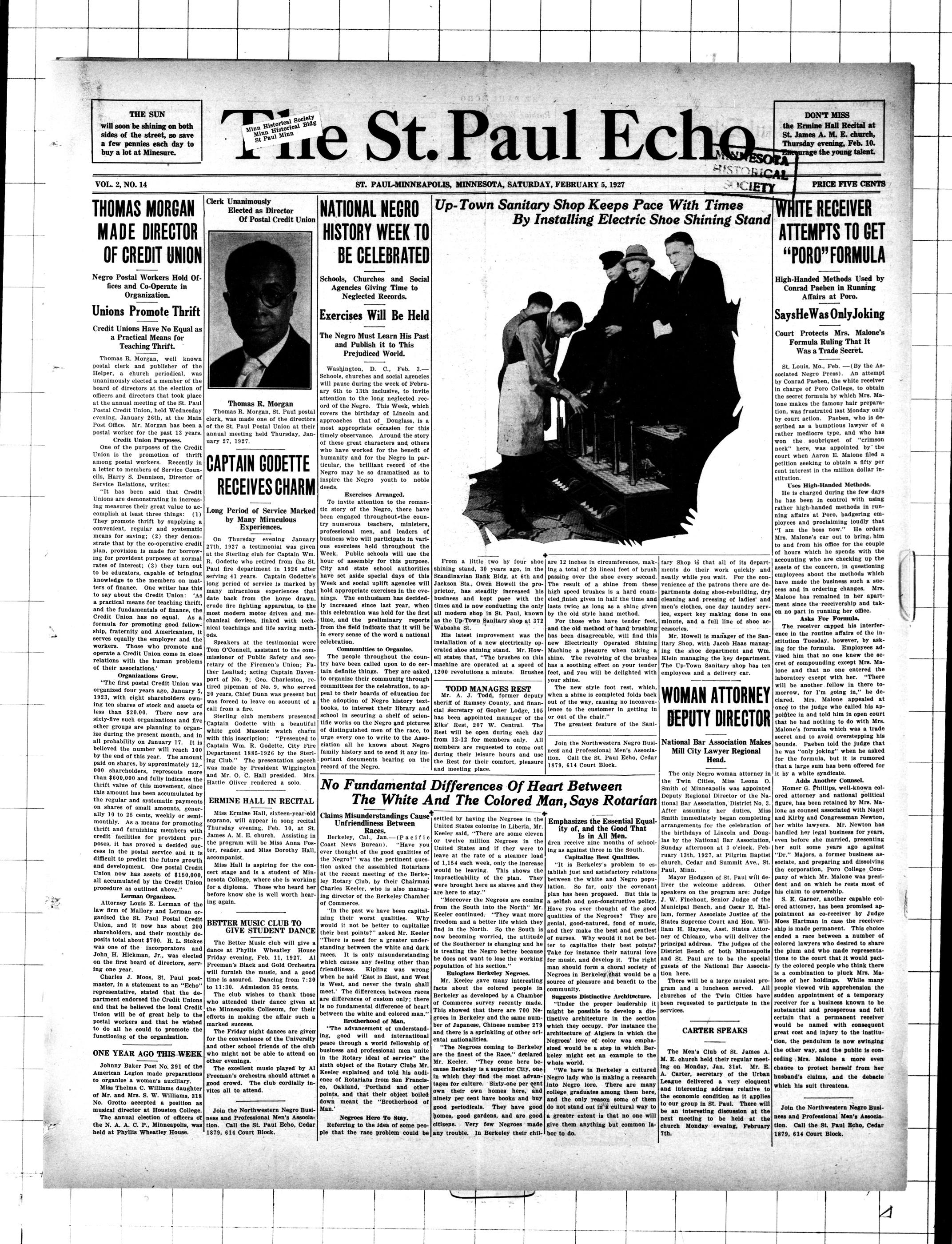
THOMAS MORGAN MADE DIRECTOR OF CREDIT UNION
Negro Postal Workers Hold Offices and Co-Operate in Organization.
Unions Promote Thrift
Credit Unions Have No Equal as a Practical Means for Teaching Thrift.
Thomas R. Morgan, well known postal clerk and publisher of the Helper, a church periodical, was unanimously elected a member of the board of directors at the election of officers and directors that took place at the annual meeting of the St. Paul Postal Credit Union, held Wednesday evening, January 26th, at the Main Post Office. Mr. Morgan has been a postal worker for the past 13 years.
Credit Union Purposes.
One of the purposes of the Credit Union is the promotion of thrift among postal workers. Recently in a letter to members of Service Councils, Harry S. Dennison, Director of Service Relations, writes:
"It has been said that Credit Unions are demonstrating in increasing measures their great value to accomplish at least three things: (1) They promote thrift by supplying a convenient, regular and systematic means for saving; (2) they demonstrate that by the co-operative credit plan, provision is made for borrowing for provident purposes at normal rates of interest; (3) they turn out to be educators, capable of bringing knowledge to the members on matters of finance. One writer has this to say about the Credit Union: 'As a practical means for teaching thrift, and the fundamentals of finance, the Credit Union has no equal. As a formula for promoting good fellowship, fraternity and Americanism, it serves equally the employer and the workers. Those who promote and operate a Credit Union come in close relations with the human problems of their associations.'
Organizations Grow.
"The first postal Credit Union was organized four years ago, January 5, 1923, with eight shareholders owning ten shares of stock and assets of less than $20.00. There now are sixty-five such organizations and five other groups are planning to organize during the present month, and in all probability on January 17. It is believed the number will reach 100 by the end of this year. The amount paid on shares, by approximately 12,000 shareholders, represents more than $600,000 and fully indicates the thrift value of this movement, since this amount has been accumulated by the regular and systematic payments on shares of small amounts, generally 10 to 25 cents, weekly or semi-monthly. As a means for promoting thrift and furnishing members with credit facilities for provident purposes, it has proved a decided success in the postal service and it is difficult to predict the future growth and development. One postal Credit Union now has assets of $150,000, all accumulated by the Credit Union procedure as outlined above."
Lerman Organizes.
Attorney Louis E. Lerman of the law firm of Mallory and Lerman organized the St. Paul Postal Credit Union, and it now has about 200 shareholders, and their monthly deposits total about $700. R. L. Stokes was one of the incorporators and John H. Hickman, Jr., was elected on the first board of directors, serving one year.
Charles J. Moos, St. Paul postmaster, in a statement to an "Echo" representative, stated that the department endorsed the Credit Unions and that he believed the local Credit Union will be of great help to the postal workers and that he wished to do all he could to promote the functioning of the organization.
ONE YEAR AGO THIS WEEK
Johnny Baker Post No. 291 of the American Legion made preparations to organize a woman's auxiliary. Miss Thelma C. Williams daughter of Mr. and Mrs. S. W. Williams, 318 No. Grotto accepted a position as musical director at Houston College. The annual election of officers of the N. A. A. C. P., Minneapolis, was held at Phyllis Whettley House.
Minn Historical Society Minn Historical Bldg St Paul Minn The St. Paul Echo
Clerk Unanimously
Elected as Director
Of Postal Credit Union
A. E.
Thomas R. Morgan
Thomas R. Morgan, St. Paul postal clerk, was made one of the directors of the St. Paul Postal Union at their annual meeting held Thursday, January 27, 1927.
CAPTAIN GODETTE RECEIVES CHARM
CAPTAIN GODETTE RECEIVES CHARM
Long Period of Service Marked by Many Miraculous Experiences.
On Thursday evening January 27th, 1927 a testimonial was given at the Sterling club for Captain Wm. R. Godette who retired from the St. Paul fire department in 1926 after serving 41 years. Captain Godette's long period of service is marked by many miraculous experiences that date back from the horse drawn, crude fire fighting apparatus, to the most modern motor driven and mechanical devices, linked with technical teachings and life saving methods.
Speakers at the testimonial were Tom O'Connell, assistant to the commissioner of Public Safety and secretary of the Firemen's Union; Father Lealatt; acting Captain Davenport of No. 9; Geo. Charleston, retired pipeman of No. 9, who served 20 years, Chief Dunn was present but was forced to leave on account of a call from a fire.
Sterling club members presented Captain Godette with a beautiful white gold Masonic watch charm with this inscription: "Presented to Captain Wm. R. Godette, City Fire Department 1885-1926 by the Sterling Club." The presentation speech was made by President Wiggington and Mr. O. C. Hall presided. Mrs. Hattie Olliver rendered a solo.
ERMINE HALL IN RECITAL
Miss Ermine Hall, sixteen-year-old soprano, will appear in song recital Thursday evening, Feb. 10, at St. James A. M. E. church. Assisting in the program will be Miss Anna Foster, reader, and Miss Dorothy Hall, accompanist.
Miss Hall is aspiring for the concert stage and is a student of Minnesota College, where she is working for a diploma. Those who heard her before know she is well worth hearing again.
BETTER MUSIC CLUB TO
GIVE STUDENT DANCE
The Better Music club will give a dance at Phyllis Wheatley House Friday evening, Feb. 11, 1927. Al Freeman's Black and Gold Orchestra will furnish the music, and a good time is assured. Dancing from 7:30 to 11:30. Admission 35 cents.
The club wishes to thank those who attended their dance given at the Minneapolis Coliseum, for their efforts in making the affair such a marked success.
The Friday night dances are given for the convenience of the University and other school friends of the club who might not be able to attend on other evenings.
The excellent music played by Al Freeman's orchestra should attract a good crowd. The club cordially invites all to attend.
Join the Northwestern Negro Business and Professional Men's Association. Call the St. Paul Echo, Cedar 1879, 614 Court Block.
ST. PAUL-MINNEAPOLIS, MINNESOTA, SATURDAY, FEBRUARY 5, 1927
No Fundamental Differences Of Heart Between The White And The Colored Man, Says Rotarian
NATIONAL NEGRO HISTORY WEEK TO BE CELEBRATED
NATIONAL NEGRO HISTORY WEEK TO BE CELEBRATED
Schools, Churches and Social Agencies Giving Time to Neglected Records.
Exercises Will Be Held
The Negro Must Learn His Past and Publish it to This Prejudiced World.
Washington, D. C., Feb. 3.—Schools, churches and social agencies will pause during the week of February 6th to 13th inclusive, to invite attention to the long neglected record of the Negro. This Week, which covers the birthday of Lincoln and approaches that of Douglass, is a most appropriate occasion for this timely observance. Around the story of these great characters and others who have worked for the benefit of humanity and for the Negro in particular, the brilliant record of the Negro may be so dramatized as to inspire the Negro youth to noble deeds.
Exercises Arranged.
To invite attention to the romantic story of the Negro, there have been engaged throughout the country numerous teachers, ministers, professional men, and leaders of business who will participate in various exercises held throughout the Week. Public schools will use the hour of assembly for this purpose. City and state school authorities have set aside special days of this Week and social uplift agencies will hold appropriate exercises in the evenings. The enthusiasm has decidedly increased since last year, when this celebration was held for the first time, and the preliminary reports from the field indicate that it will be in every sense of the word a national celebration.
Communities to organize.
The people throughout the country have been called upon to do certain definite things. They are asked to organize their community through committees for the celebration, to appeal to their boards of education for the adoption of Negro history textbooks, to interest their library and school in securing a shelf of scientific works on the Negro and pictures of distinguished men of the race, to urge every one to write to the Association all he knows about Negro family history and to send it any important documents bearing on the record of the Negro.
Claims Misunderstandings Cause Unfriendliness Between Races.
Berkeley, Cal., Jan.—(Pacific Coast News Bureau). "Have you ever thought of the good qualities of the Negro?" was the pertinent question asked the assembled Rotarians at the recent meeting of the Berkeley Rotary Club, by their Chairman Charles Keeler, who is also managing director of the Berkeley Chamber of Commerce.
"In the past we have been capitalizing their worst qualities. Why would it not be better to capitalize their best points?" asked Mr. Keeler. "There is need for a greater understanding between the white and dark races. It is only misunderstanding which causes any feeling other than friendliness. Kipling was wrong when he said 'East is East, and West is West, and never the twain shall meet.' The differences between races are differences of custom only; there is no fundamental difference of heart between the white and colored man."
"The advancement of understanding, good will and international peace through a world fellowship of business and professional men unite in the Rotary ideal of service" the sixth object of the Rotary Clubs Mr Keeler explained and told his audience of Rotarians from San Francisco, Oakland, Portland and other points, and that their object boiled down meant the "Brotherhood of Man."
Negroes Here To Stay. Referring to the idea of some people that the race problem could be
THE MACHINE
From a little two by four shoe shining stand, 30 years ago, in the Scandinavian Bank Bldg. at 6th and Jackson Sts. Owen Howell the proprietor, has steadily increased his business and kept pace with the times and is now conducting the only all modern shop in St. Paul, known as the Up-Town Sanitary shop at 372 Wabasha St.
His latest improvement was the installation of a new electrically operated shoe shining stand. Mr. Howell states that, "The brushes on this machine are operated at a speed of 1200 revolutions a minute. Brushes
TODD MANAGES REST
TODD MANAGES REST
Mr. A. J. Todd, former deputy
sheriff of Ramsey County, and finan-
cial secretary of Gopher Lodge, 105
has been appointed manager of the
Elks' Rest, 207 W. Central. The
Rest will be open during each day
from 12-12 for members only. All
members are requested to come out
during their leisure hours and use
the Rest for their comfort, pleasure
and meeting place.
settled by having the Negroes in the United States colonize in Liberia, Mr. Keeler said, "There are some eleven or twelve million Negroes in the United States and if they were to leave at the rate of a steamer load of 1,154 each week, only the increase would be leaving. This shows the impracticability of the plan. They were brought here as slaves and they are here to stay." "Moreover the Negroes are coming from the South into the North" Mr. Keeler continued. "They want more freedom and a better life which they find in the North. So the South is now becoming worried, the attitude of the Southerner is changing and he is treating the Negro better because he does not want to lose the working population of his section."
Mr. Keeler gave many interesting facts about the colored people in Berkeley as developed by a Chamber of Commerce survey recently made. This showed that there are 700 Negroes in Berkeley and the same number of Japanese, Chinese number 279 and there is a sprinkling of other oriental nationalities. "The Negroes coming to Berkeley are the finest of the Race," declared Mr. Keeler. "They come here because Berkeley is a superior City, one in which they find the most advantages for culture. Sixty-one per cent own their own homes here, and ninety per cent have books and buy good periodicals. They have good homes, good gardens, and are good citizens. Very few Negroes made any trouble. In Berkeley their chil-
are 12 inches in circumference, making a total of 20 lineal feet of brush passing over the shoe every second. The result of a shine from these high speed brushes is a hard enameled finish given in half the time and lasts twice as long as a shine given by the old style hand method. For those who have tender feet, and the old method of hand brushing has been disagreeable, will find this new Electrically Operated Shining Machine a pleasure when taking a shine. The revolving of the brushes has a soothing effect on your tender feet, and you will be delighted with your shine. The new style foot rest, which, when a shine is completed folds back out of the way, causing no inconvenience to the customer in getting in or out of the chair." The greatest feature of the Sani-
Join the Northwestern Negro Business and Professional Men's Association. Call the St. Paul Echo, Cedar 1879, 614 Court Block.
Emphasizes the Essential Equality of, and the Good That Is in All Men
Is in All Men. dren receive nine months of schooling as against three in the South. Capitalize Best Qualities. "It is Berkeley's problem to establish just and astisfactory relations between the white and Negro population. So far, only the covenant plan has been proposed. But this is a selfish and non-constructive policy. Have you ever thought of the good qualities of the Negroes? They are genial, good-natured, fond of music, and they make the best and gentlest of nurses. Why would it not be better to capitalize their best points? Take for instance their natural love for music, and develop it. The right man should form a choral society of Negroes in Berkeley that would be a source of pleasure and benefit to the community.
suggests Distinctive Architecture. "Under the proper leadership it might be possible to develop a distinctive architecture in the section which they occupy. For instance the architecture of Algiers in which the Negroes' love of color was emphasized would be a step in which Berkeley might set an example to the whole world. "We have in Berkeley a cultured Negro lady who is making a research into Negro lore. There are many college graduates among them here, and the only reason some of them do not stand out in a cultural way to a greater extent is that no one will give them anything but common labor to do.
HISTORICAL
e With Times
hoe Shining Stand
Times
ning Stand
WHAT
"Higher
Co
Say
Count
St.
sociat
by Co
in ch
the se
lone r
tion,
by co
scribes
rather
won
neck"c
court
petition
cent
stitut
U
He
he ha
rather
ning
ploye
"I am
Mrs.
to an
of ho
tary Shop is that all of its departments do their work quickly and neatly while you wait. For the convenience of the patrons there are departments doing shoe-rebuilding, dry cleaning and pressing of ladies' and men's clothes, one day laundry service, expert key making done in one minute, and a full line of shoe accessories.
Mr. Howell is manager of the Sanitary Shop, with Jacob Haas managing the shoe department and Wm. Klein managing the key department. The Up-Town Sanitary shop has ten employees and a delivery car.
WOMAN ATTORNEY DEPUTY DIRECTOR
National Bar Association Makes Mill City Lawyer Regional Head.
The only Negro woman attorney in the Twin Cities, Miss Leona O. Smith of Minneapolis was appointed Deputy Regional Director of the National Bar Association, District No. 3. After assuming her duties, Miss Smith immediately began completing arrangements for the celebration of the birthdays of Lincoln and Douglas by the National Bar Association, Sunday afternoon at 3 o'clock, February 13th, 1927, at Pilgrim Baptist church, Cedar and Summit Ave., St. Paul, Minn.
Mayor Hodgson of St. Paul will deliver the welcome address. Other speakers on the program are: Judge J. W. Finehout, Senior Judge of the Municipal Bench, and Oscar E. Hallam, former Associate Justice of the States Supreme Court and Hon. William H. Haynes, Asst. States Attorney of Chicago, who will deliver the principal address. The judges of the District Bench of both Minneapolis and St. Paul are to be the special guests of the National Bar Association here.
There will be a large musical program and a luncheon served. All churches of the Twin Cities have been requested to participate in the services.
CARTER SPEAKS
The Men's Club of St. James A. M. E. church held their regular meeting on Monday, Jan. 31st. Mr. E. A. Carter, secretary of the Urban League delivered a very eloquent and interesting address relative to the economic condition as it applies to our group in St. Paul. There will be an interesting discussion at the next meeting to be held at the church Monday evening, February 7th.
---
---
High-Handed Methods Used by Conrad Paeben in Running Affairs at Poro.
SaysHeWasOnlyJoking
Court Protects Mrs. Malone's Formula Ruling That It Was a Trade Secret.
St. Louis, Mo., Feb. — (By the Associated Negro Press). An attempt by Conrad Paeben, the white receiver in charge of Poro College, to obtain the secret formula by which Mrs. Malone makes the famour hair preparation, was frustrated last Monday only by court action. Paeben, who is described as a bumptious lawyer of a rather mediocre type, and who has won the soubriquet of "crimson neck" here, was appointed by the court when Aaron E. Malone filed a petition seeking to obtain a fifty per cent interest in the million dollar institution.
Uses High-Handed Methods.
He is charged during the few days he has been in control with using rather high-handed methods in running affairs at Poro, badgering employees and proclaiming loudly that "I am the boss now." He orders Mrs. Malone's car out to bring, him to and from his office for the couple of hours which he spends with the accounting who are checking up the assets of the concern, in questioning employees about the methods which have made the business such a success and in ordering changes. Mrs. Malone has remained in her apartment since the receivership and taken no part in running her office.
Asks For Formula.
The receiver capped his interference in the routine affairs of the institution Tuesday, however, by asking for the formula. Employees advised him that no one knew the secret of compounding except Mrs. Malone and that no one entered the laboratory except with her. "There will be another fellow in there tomorrow, for I'm going in," he declared. Mrs. Malone appealed at once to the judge who called his appointee in and told him in open court that he had nothing to do with Mrs. Malone's formula which was a trade secret and to avoid overstepping his bounds. Paeben told the judge that he was "only joking" when he asked for the formula, but it is rumored that a large sum has been offered for it by a white syndicate.
Adds Another Counsel.
Add Another Counsel.
Homer G. Phillips, well-known colored attorney and national political figure, has been retained by Mrs. Malone as counsel associated with Nagel and Kirby and Congressman Newton, her white lawyers. Mr. Newton has handled her legal business for years, even before she married, presenting her suit some years ago against "Dr." Majors, a former business associate, and preparing and dissolving the corporation, Poro College Company of which Mr. Malone was president and on which he rests most of his claim to ownership.
S. E. Garner, another capable colored attorney, has been promised appointment as co-receiver by Judge Moes Hartman in case the receivership is made permanent. This choice ended a race between a number of colored lawyers who desired to share the plum and who made representations to the court that it would pacify the colored people who think there is a combination to pluck Mrs. Malone of her holdings. While many people viewed with apprehension the sudden appointment of a temporary receiver for a business known to be substantial and prosperous and felt certain that a permanent receiver would be named with consequent great cost and injury to the institution, the pendulum is now swinging the other way, and the public is conceding Mrs. Malone a more even chance to protect herself from her husband's claims, and the debacle which his suit threatens.
Join the Northwestern Negro Business and Professional Men's Association. Call the St. Paul Echo, Cedar 1879, 614 Court Block.
DON'T MISS the Ermine Hall Recital at St. James A. M. E. church, Thursday evening, Feb. 10. Encourage the young talent.
PRICE FIVE CENTS
WHITE RECEIVER ATTEMPTS TO GET "PORO"FORMULA
Asks For Formula.
V
OUR NATIONAL BANKS
We wish to call the attention of Editor Vann of the Pittsburgh Courier to the fact that the race owns and operates two NATIONAL BANKS. We esteem the Courier very highly among our contemporaries for we have many things to admire the Courier for, one of which is its constant endeavors to give its readers a line on the race's business and to encourage new business and race co-operation, all of which the Echo tries in its way to do.
In the issue of January 15th when it pointed out the great service that the Douglass National Bank of Chicago had performed for the ex-soldiers of the race in making loans to them on their adjusted compensation certificates, Mr. Vann flew wide of the mark when he said that the Douglass National was the only National Bank that the race had. Mr. Vann overlooked the fact that THE FIRST NATIONAL BANK of Boley, Oklahoma, was the FIRST and for a time the ONLY National Bank owned and operated by the race.
If Mr. Vann had taken the trouble to investigate he would have been able to learn from Mr. Geo. S. Schuyler, a writer in the Courier, or from consulting an old copy of the Courier in which Mr. Schuyler wrote about Boley and its business and conditions when he made a visit to the $100\%$ Negro town last year.
We waited patiently for Mr. Vann to make a correction but since two issues of the Courier have come since the error and no conspicuous correction made we deem it to the best interest of the readers of the Echo to speak now.
The First National Bank of Boley, Oklahoma, is owned and controlled by Negroes. Mr. S. J. King, who is a large and prosperous farmer and cotton-gin owner, is the president, and is associated in the institution with other prosperous and influential men of Boley. We take for granted that the Echo readers are familiar with the name of the financial wizard who heads the Douglass National of Chicago and who also heads other large corporations and has directorships, etc.
THE EXPLOITED PULLMAN PORTER
The laws of economics are such that you cannot have what you cannot take. It is the law of might. When a person is satisfied no one opens that individual's pockets and forces something good into them.
The Pullman porters are missing their share in the cutting of a fine melon, because they have not organized and taken their share. According to a Wall Street announcement three financial giants are to re-organize the Pullman Co. When the re-organization is consummated, stock holders will receive two and one-half shares of stock in a new holding company for each share of stock of $100 par value now held in the Pullman Co. This means that 1,350,000 outstanding shares, whose market value has fluctuated between 186 and $188½, will be turned into 3,375,000 shares.
The "Yes-sah-boss" porter is content to let his wife assist in the support of the family, and permit his children to get their education the best they can. If he would organize he would get his fair share of that great melon. But Hon. Thos. Sullivan says you cannot organize a lot of crazy folks.
REPRESENTATIVE AND REPRESENTED
Persons appointed to positions in public service have a poor understanding of conditions if they think they secure their position upon merit, alone, even if they are in civil service. Appointments are made upon merit plus the number, standing and demands of friends or interested persons. And the value of the plus portion must not be ignored.
In St. Paul there is a growing consciousness among appointers, that the appointed shall represent some organized group. And there is a growing consciousness among organized groups that they be represented in appointments. The membership of Engine Co. No. 9, and the Colored citizens of St. Paul function under those rules.
It is common information that Engine Co. No. 9 is suffering from internal strifes. If that disease breaks out in any other company a transfer to another company is effected. That normalizes the health of the organization. The treatment of the ailment in No. 9 is different. The germ carrier is transferred out into the cold, cruel world, and that method has the sanction of the Colored people of St. Paul. Any other method would tend to disband an institution of which we are justly proud.
We are not so much interested in jobs for certain people as we are in perpetuating the existence of the Engine Co. And we intend to show our temper toward any one within, or without, under whatever pretense, who would rob us of this possession which we enjoy. We have the word of Commissioner Clancy that he intends to keep the company intact. If the internal conditions of No. 9 warrant transfers out, we are with the commissioner. We want Engine Co. No. 9 composed of the present members if possible. If they cannot agree there are others who will welcome the pay check. The present members should lay aside their petty differences.
There are said to be 3,424 spoken languages or dialects in the world, distributed as follows: America, 1,624; Asia, 937; Europe, 587; Africa, 276.
A minister in a church in Houston, Texas, was recently arrested and fined $25 for disturbing the peace by his loud and frequent hallelujahs. The neighbors could not sleep.
JAMES N. SMITH.
Fear not the Grim Reaper,
Or the terror that he brings;
Just place your trust in Jesus
That takes away the sting.
He'll come in the morning, in the
evening,
Noon and night;
He'll come when day is dawning,
He'll come in broad daylight.
It doesn't matter where we are
roaming,
Over land or on the sea;
Matters not what we are doing,
Lurking around always, is he.
The most unwelcome visitor,
Never wanted when he calls;
But if we will only trust in Jesus,
Death is harmless, that's all.
JEAN MATTHEWS.
"Hold Monday, Feb. 21, for an
other M. W. C. club serial dance as
the Oxford Ballroom."
Join the Northwestern Negro Business and Professional Men's Association. Call the St. Paul Echo, Cedar 1879, 614 Court Block.
WILLIAMS EXPRESS
Trunks and General Hauling
COAL AND WOOD
Service Any Time
392 Carroll Ave. Tel. Dale 4459
NEED SOME?
ITS a fine thing to know where you can get cash when you need it. Our service is quick and confidential. We have helped your friends for years. Ask them about the
Local Loan Co.
216 Exchange Bank Building
Sixth & Minnesota Sts. Tel. Co 2417
Home Cooked Meals
Salads
Barbecued Ribs
TOASTED SANDWICHES
ALEXANDERS SWEET SHOPPE
Dale and Rondo Streets Phone Dale 7175
FOR WEEKLY NEWS RELEASES DEAD LINE ADVANCED TO WEDNESDAY NOON
For BILIOUSNESS
Use BEECHAM'S PILLS
for the relief of Constipation,
Biliousness, Sick Headache and
for moving the Bowels.
Helps clear the skin.
Contains no Calomel!
Buy from your druggist.
25c and See the box.
BEECHAM'S
PILLS
---
in Giant Whirlpool
Just before the junction of the Madre de Dois and the Inambari river in Peru the latter divides into two arms, with an island some two miles long between. The right arm, which is usually the safer for navigation, is at times impassable, owing to excessive drought that causes the formation of perilous rapids. Travelers must in consequence take the wide left arm, down which the main volume of the river then flows.
An enormous force of water is shown into the Madre de Dios; the Inambarl at its left-arm junction is 300 yards wide, perhaps 30 feet in depth, and flows at six knots an hour. This great mass of water meets the Madre de Dios, itself 400 yards wide here, at a right angle. The current of the Inambarl, being faster than the Madre de Dios, the former river cuts right across to the farther bank. There the Inambarl is thrown back and surges round in a huge circle 200 yards in diameter, to join up again with the water flowing to the bank. The whirlpool thus formed is probably one of the largest in the world. The circles of seething water curl inward and downward, screw-fashion, to their center, which appears as a great hole, at least six feet being below the level of the outer rim.
Birch-Bark Canoe Not
Popular With Indians
Though the birch-bark canoe is the traditional vehicle of the Indians of northern Canada, few are to be seen today among those Indians frequenting trading posts or mining camps in Ontario or Quebec, writes Courtney Ryley Cooper in the Saturday Evening Post. There is an art in making a birch-bark canoe that only the oldtimers truly know. Then there is work to it and "an Indian and unnecessary work are about as well mated as a bulldog and a black jaguar." Far better, if he can trap enough rats or corral enough ermine skins, he owns a chestnut canoe with an outboard motor, with which he can scoot along the streams and lakes in serenity and swiftness, while the wind waves his hair and creates a grin across his face, comparable only to an Oklahoma Cherokee enjoying his oil royalties and a new motor. There's only one thing more exciting, and that is to stand close enough to the track to get the ballast in his eyes as he watches the transcontinental go by.
Finished
A traveling man put up one night in a cheap little hotel, where the thin partitions of a range of bedrooms, like the stalls of a stable, stopped halfway to the ceiling. And in the stily watches of the night he lay awake and listened to the finest demonstration of plain and fancy snoring that it had ever been his fate to hear. It was full of sudden and awful variations. Sometimes strangulation seemed imminent; then, in the middle of a fantasia, the agony stopped suddenly, and there was silence.
From a nearby room he heard a voice exclaim wearily, "Thank goodness! He's dead!"
Landmark on Old Trail
One of the early landmarks was Pawnee rock on the Santa Fe trail, in what is now Barton county, Kan. This giant rock standing on the level plain was a noted spot, for the trail ran near its base. It provided a place of rest and safety for many a traveler. In later years this landmark was disappearing. The Woman's Kansas Day club resolved to save the historic spot and secured a deed for the rock and five acres surrounding it. On Kansas day, 1909, the women presented this deed to the state. This was done with the condition that the state spend $3,000 for improvements.
Lake Affected by Canal
Experts have decided that the waters of the Atlantic and Pacific oceans mingle with the fresh water in Miraflores lake in the Panama canal. The progressive rise of a certain amount of sea water to this lake and in a lesser amount to Gatun lake began with the first ship to pass through the canal and will probably continue indefinitely with the operation of the locks of the canal under traffic. A rise also takes place when the ships are locked downward.
Time-Sense Center
Why is it that most of us beat time whenever a lively time is played? The reason, says the Swiss scientist Hoepil, is that the nerve centers which react to the sensations of hearing music are located in the feet at a point in each foot under the bend between the ankle and the toe bones. Moreover, the nerve spots which react to musical rhythm, he adds, are in the feet, near the big toes. In the feet also are the nerves controlling the ability to dance rhythmically.
Traffic-Blocking Islands
Floating islands are formed by the accumulations of soil and grasses that push their way over the normal shore line of streams and oceans. These floating masses are lifted at high tide and will break away if the pull is strong enough. In less than 40 years one of the traveling islands, or "rattfs," as they are known, grew in size until it was 10 miles long, 600 feet wide and 8 feet thick, blocking the lower area of the Mississippi. Four years of labor were required to remove it.
Old Roman Pageants
The wonderful, long-necked, spotted creature, the giraffe, has an interesting history. Zoologists in declining its actual species place it between the deer and the hollow-horned ruminants. The name "giraffe" seems to be derived from the Arabian "zerapha" which by some is supposed to have been a corruption of "zoraphe" the Egyptian for "long neck."
In the days of imperial Rome giraffes from the Libyan desert were exhibited in the triumphs of various emperors, and were probably shown to the Romans during the dictatorship of Julius Caesar.
From the period of the Roman empire till the close of the Fifteenth century these magnificent animals were unknown in Europe.
In the last years of that century Lorenzo de Medicl became possessed of a specimen, apparently perfectly tame, which was shown in Florence, and as it was led through the streets often halted, and raising its lofty head to some high balcony, received some dalny—fruit or confection—from the dwellers of the house before which it had stayed its progress.
From that date till the reign of George IV no giraffe was seen in Europe until the year 1827, when Mahomed All, viceroy of Egypt, sent one as a present to the king of England.
Grim Death Lurks in
Holy Waters of India
The holiest waters in India are man-
tled with a green and brilliant scum.
Those who would bathe must break it,
as hardy swimmers in our colder
countries break the ice, before they
can reach the spiritually cleansing
liquid. Coming out of the water,
bathers leave behind them jagged
rifts of blackness in the green; riffs
that gradually close, if no more pilgrims come down to bathe, till the green skin of the lake is altogether whole again.
There were but few bathers when we were at Pushkar.
On days of little concourse the bathers do not venture far out into the lake. Death.lurks invisible under the scum, swims noiselessly inshore, snaps, drags down. We saw him basking on a little shrine-crowned island a hundred yards from land, monstrous and scaly, grinning even in his sleep—a crocodile. Pushkar is so holy that no life may be taken within its waters or on its banks, not even the manatees. A dozen pilgrims disappear each year between those enormous jaws. It is considered lucky to be eaten by a crocodile at Pushkar.—From "Jesting Pilate" by Adux Hauxley.
Something to Remember
One thing they have learned in cold Alaska is to make no attempt to clean a silk or woolen garment in gasoline in the winter time.
Writing in Scribner's Magazine, Mary Lee Davis, the wife of an engineer, says that two women of her acquaintance were burned to death in so doing.
"Just the friction," she says, "of lifting the material from the gasoline bath produces such sparks in the electrified air that an explosion almost invariably occurs."
Although there isn't quite so much electricity in the air in this section of the country, there are few indoor sports more dangerous than washing articles in gasoline.
If you must wash things in gasoline, do it outdoors.
Egyptian Spite
The childish trait of "taking it out" on an inanimate object when one has a fit of temper seems to have been a serious business in ancient Egypt. An archeological expedition of the Berlin museum has just returned from Egypt with 290 pieces of pottery, fragments of some 80 clay vessels, all written over with the names of foreign princes and peoples with whom the Egyptians of about 2000 B. C. were at war, together with a number of Egyptian names as well, presumably of rebellious communities. These names, it is believed, were inscribed on the vessels, which were then shattered with suitable ceremonials, in the belief that the foes would thereby be injured.
"Sweat of Your Brow"
This quotation does not appear in the Bible. The nearest thing to it is the following found in the third chapter of Genesis, nineteenth verse: "In the sweat of thy face shalt thou eat bread, till thou return unto the ground; for out of it was thou taken." Yet the great majority of people seem to think that "Ye shall earn thy bread by the sweat of the brow" is a Biblical saying. How the error got started nobody knows. It may have been suggested by Milton's phrase, "Let us go forth and resolutely dare with sweat of brow to toll our little day." At any rate, it has been employed by English writers for 250 years—Exchange.
"Maru's" Proper Meaning
The Japanese embassy says that maru means, first, a sphere or circle, and, secondly, perfection, entitlement, completeness. Expressive of perfection, it was formerly used as a suffix to the names of persons, sword masterpieces, etc, and to ships; but at present the last usage has become the common one. Thus the word maru when used in conjunction with a proper name, may be said to designate a ship, it being the most popular suffix used in that connection.
The great man has usually looked the part. Lowell said of Emerson that there "was a majesty about him beyond all the men I have ever known." Washington impressed those about him as being no ordinary man, and Dr. James Thatcher said "the strength and proportion of his joints and muscles appeared to be commensurate with the pre-eminent powers of his mind." Goethe was likened in youth to an Apollo, and the physician Hufeland declared that never had he "met with a man in whom bodily and mental organization were so perfect." Tennyson was "one of the finest looking men in the world." Wordsworth was, according to the artist Hayden, "of very fine heroic proportions." Southey looked an ideal poet. Byron was as beautiful as his verse and was likened to "the god of the Vatican, the Apollo Belvidere." Leonardo da Vinci had a figure of beautiful proportions and a noble and engaging presence. Walter Scott was eminently handsome, "much above the usual standard" and "cast in the mold of young Hercules," with a "fresh and brilliant complexion and a countenance of great dignity."—Scientific Monthly.
Historians Skip Many
Matters of Interest
An American history written in the old-fashioned way would never mention the rise of the motion picture diversion. The kind of histories to which we have been accustomed don't appear to be in the least interested in the ordinary life of the people, which is as much history as taking a fort or carrying an election, a writer in the St. Louis Globe-Democrat asserts. Between wars there is almost a blank interregnum; and—from the history—you would never know that a book had been written, a picture painted or a machine invented. We once knew a school history of the United States that did not mention the coming of the railroad; but every Indian chieftain from Massasoit to Sitting Bull was personalized.
These strange silences of formal history leave us to the historical novels for our general information of the times—the clothing our ancestors wore, their pastimes, their religious faiths, their literature, their customs and their modes of thought.
Heaven as a Republic
Dr. James Madison, second cousin of the President of the United States of that name, was elected president of William and Mary College when he was only twenty-eight years old. It was necessary, before he could assume office, to suspend a statute requiring that the head of the institution be not less than thirty years old. The young college president, who was ordained in the Episcopal ministry in 1775, was an ardent believer in the republican form of government. It is said that in his sermons he never would speak of heaven as a kingdom. He would always refer to it as the "great republic where there is no distinction of rank, and where all men are free and equal."-Pathfinder Magazine.
Embarrassed
He was enjoying the picture at a downtown theater recently when he was disturbed from his leisure by a coin rolling from his pocket. The coin hit the floor with a clink and continued its course to the orchestra pit. The rather embarrassed man was not sure of the denomination of the lost coin and proceeded to go after it. Being unable to find it, he summoned two ushers, who aided him with flashlights. At last, after quite a search, the coin was found, and when it was picked up, there in the finder's hand lay a shining penny.
Color Highly Important
Man has apparently become careless about one of the most important items in his environment—color. As soon as he realizes fully the inhibitive and repressive influence of drab, uninteresting color surroundings, the vistas about will be immediately transformed. Man has always conquered or changed conditions unfavorable to his best development. There is no reason to believe that he will not rise to the present situation and reinstate into his daily life the color which is so important to his well being—Exchange.
Deadly "Milk Sickness"
Milk sickness, the ailment of which Abraham Lincoln's mother died, is a peculiar malignant disease occurring in part of the western United States. It affects certain kinds of farm stock, especially cows, and persons using the meat and dairy products of infected cattle. In man it causes uncontrollable vomiting and other serious symptoms. Its origin in cattle has been variously ascribed to the presence of certain plants in their food and to polluted water.
Best Known in America
Messrs. Smith, Johnson and Brown are the three best known individuals in the United States, a nation-wide search of city and telephone directories reveals. There are at least 1,300,000 Smiths in America, 1,000,000 Johnson and 730,000 Brown. Then come the Williamses and the Joneses, with 685,000 and 658,000 respectively. The Millers, according to this unofficial census, number 626,000 and the Davies 538,000.
Possessed by Youth
Dear me, with all their superior knowledge, how ignorant the younger generation, one might say the youngest generation, is about some things. A new story came into the house and mother essayed to read it aloud. It was about "gypes." Hardly had she begun when a chorus of small voices asked, "What's a 'gypse'?" And it was hard explaining about a covered wagon, for the next question was, "What's a 'wagon'?" And some didn't even understand what a "pair of horses" was. Never did mother have it brought home to her so keenly that this was an automobile age.
And there is nothing that makes a high-school pupil feel that her mother is more ancient than to have that same mother say, "There were no automobiles in my high-school days; we always went buggy riding." Instantly the high-school mind thinks of her mother, as dated some time before the Civil war, and one high school child had the nerve to question her mother as to her experiences during the Revolutionary war.
Mother came back at daughter a bit, though. She said casually, "There was no such thing as a radio in your life until you reached high-school age, was there?" Daughter tried to prove that radio only happened the other day, as it were, but mother emphasized her point that inventions are coming along faster than people are.—Springfield Union.
Credit for "Want Ad"
Goes to Englishman
In 1672 John Houghton, a fellow of the Royal society, established a weekly paper for the improvement of husbandry and trade, and undertook to educate the merchants of England in the art of advertising, says World's Work.
First he established a bureau for supplying servants to masters and masters to servants, carrying on operations through advertising. From this he went into the advertising of schools, houses and lodgings to let and so forth, laying down the idea of what has grown into our present "want ads." He instructed the public class by class, inducing lawyers, physicians and farmers to use his columns and built up a large miscellaneous patronage for his paper. The clergy in particular found his columns an excellent medium for securing or disposing of second-hand sermons, for there were no Monday morning papers in those days, with ever-present reporters, and a sermon could be preached around in various parishes until it was worn out.
Jewels in Watches
Watches do not have even numbers of jewels. If a watch has 23 jewels, then the going band or center wheel and third wheel, the fourth wheel the escape wheel, the lever and the balance have a whole jewel at each arbor, which make 14. The balance, the lever and the escape wheel have end stones as well, which make 6 more. Then there are 3 jewels in the escapement, which make 23. If the movement has 21 jewels, then the hole jewels of the going barrel have been omitted. If 19, the end stones of the escapement wheel have been omitted also. If the watch has only 7 jewels, they usually consist of the 3 escapement jewels and 2 end stones for the balance arbor.
Legend of Faust
Faustus (D. Johann Faust) was a person born at Kundling, Wurtemberg, or at Roda, near Welmar. He is said to have died in 1538. He was a magician, soothsayer and astrologer, and boasted of having performed the miracles of Christ. It was believed that the magician was carried off by the devil, who had lived with him in the form of a black dog. Legends say that this event occurred on the night between the twenty-third and twenty-fourth of October, 1538. Goethe's tragedy (published in 1808) is based on the Faust legends.
Must Have Pulled Hard
The occupation of dentistry is not usually rated as dangerous. Unless a patient snaps at a dentist while the latter is busy with one of the former's molars, and seldom does a patient act in such a way, there is small hazard to the profession.
Nevertheless at times accidents do occur. A man tortured by a toothache called up a dentist and asked him for help. The office attendant replied that Doctor Soanso regretted to state he would be unable to take patients for some days to come as he had sprained his wrist pulling a tooth.
Beauty in Dislocation
A peculiarity of the Stamases dancing girls is the position of their fingers, which are held at all times turned upward as much as possible. Not turned up to heaven, but turned the way opposite to the normal bend of the knuckles. This is considered very beautiful, and dancing girls spend long hours pressing their fingers against their knees to the point almost of dislocation in order to induce the desired back curve.—Adventure Magazine.
Usage Makes Difference
Some men fall where others are successful. The former regard as obstacles what the latter see as opportunities. This suggests that the real difference between stumbling blocks and stepping stones is in the way one may use them.-Grit.
ST. PAUL NOTES
A Boy Scout Troup is to be formed at Pilgrim Baptist church. All boys 12 years or over who are interested meet Thursday evening, Feb. 10, at 7 p. m. at Little Pilgrim, Grotto and Central. Come out and be charter members of St. Paul's second colored troop of Boy Scouts of America.
Miss Thelma Johnson arrived in the city at Thursday from Chicago and is the guest of Miss Florence Robinson, 447 Charles St.
The Twin City Chorus will meet Thursday evening at the Y. W. C. A., 598 W. Central.
Mrs. Henrietta James will be hostess to the Adelphai club Tuesday evening at the annual evening session.
Mr. Elliot O. Brown has arrived home from Washington, D. C., where he was called because of the serious illness of his nephew. Mr. Brown received a telegram that his nephew passed away Wednesday.
Mrs. W. A. Bryant of Chicago, Ill., came to St. Paul last week to see her brother, Rev. T. J. Carr, who had a nine-day attack of hiccoughing.
Mr. Walker Williams, proprietor of the grocery store, Kent and St. Anthony Ave., fell and sustained a painful injury to his ankle. We hope for his speedy recovery.
Mr. H. Crostwaite, former resident of St. Paul and brother of our Dr. L. T. Crostwaite, was in the city to attend the funeral of his mother-in-law, Mrs. O. D. Howard.
Mrs. L. Garrett, 546 St. Anthony, gave a card party in honor of Mrs. R. White of New York City. A buffet lunch was served at midnight. About 25 guests were present.
The St. Paul Hiking club was entertained at the home of Mrs. Russell, 394 Rondc St., Thursday, Jan. 20. Lunch was served by the hostess. A business meeting was also held at the home of Mrs. McPheeters, 536 St. Anthony, Thursday, Jan. 27. After business was transacted, a delightful lunch was served.
The Industrial Matrons' Art club met with Mrs. L. R. Blair, 711 St. Anthony Ave. Thursday afternoon.
The Kings Daughters Charity Circle met with Mrs. Aloma Ruffner, 403 Western Ave., on Feb. 1 at 3 p. m. in good attendance. Much business of importance was transacted. After the usual procedure of business, a dalynt lunch was served. The circle voted the hostess a charming entertainer.
Twin City Liberal Art club met at the home of Mrs. J. A. Smith.
The Cameo Social club met Jan. 21 at the home of the Misses Martha and Esther Bradley, 934 St. Anthony Ave. The next meeting will be held at the home of Miss Anita Roberts, 978 St. Anthony.
On Thursday, Feb. 3, a delightful birthday party was given at the home of Mrs. Bettie Jones, 747 St. Anthony Ave., in honor of Mrs. Geneva Ayres, Mrs. M. O. Cannon and Mrs. Bettie Jones, whose birthdays occur in the same week. Delicious refreshments were served and a pleasant time was had by all.
MINNEAPOLIS NOTES
Charles Brody of 811 1/2 W. Lake St. has been ordered back to the University hospital to take Radium treatments.
The Minneapolis Sunday Forum invites you to come to the Phyllis Wheatley House Sunday afternoon at 3:30 o'clock and enjoy its splendid program. Miss Armeda Wilkins of St. Paul, one of the Twin Cities' most talented and charming young women, will be the speaker of the afternoon. Mr. Geo. W. Hamilton of St. Paul, WCCO's favorite story teller, will read. Mrs. Katherine Manderville will give one of her always enjoyable vocal numbers and Grayfield and Clendenon, on string instruments, have promised a rare treat. Installation of newly elected officers.
Mrs. Fred Jones of 632 Sixth Ave. No. was called to Atlanta, Ga., to the bedside of her mother.
Mrs. Anna Jordan, who has been visiting her sister, Mrs. B. Fitzgerald, left for her home in Aurora, Ill.
Y. W. C. A. NOTES
Services Sunday will be held jointly with the N. A. A. C. P. Father A. W. Lealtad will speak.
Eleven members of the Branch attended the Annual Meeting at the Main Association Monday night. They were represented on the program by the Girl Reserves in spirituals with two numbers by Irmine Hall.
Our attendance at Vesper Services Sunday afternoon was one of the largest we've had during the year. The meeting was in charge of the Alpha Kappa Alpha Sorority and was presided over by its president, Miss Helen Jackson. Interesting talks were given by Miss Katryn Tandy, Messrs. Ramon Cannon, Earl Kyle and Ferdinand Johnson. Miss Pearl Renfrau rendered a piano selection.
Join the Northwestern Negro Business and Professional Men's Association. Call the St. Paul Echo, Cedar 1879, 614 Court Block.
Argument Ended When
"I beg your pardon," said a crusty old bean to the generous fragment of pork with which it was making a portion of pork of beans, "but your contiguity is insufferable."
"Go wan," retorted the pork. "Go wan back to Bosting!"
"Coarse westerner!" said the bean. "Eastern sissy!" answered the pork. "At least," said the bean with great dignity, "we are not uncivilized. We come from the fount of culture. We have background—"
"Teah!" said the pork. "Your background is a lot of common, ordinary dirt. That's all it is. I come from the great open spaces—"
"Where pligs is pigs."
"I'll say so. And what's more, we're proud of it. We're the backbone of the nation—"
"You're all fat," said the bean
"Can't see your backbone for it."
"Get back in the pot," yelped the pork.
"Boor!" screamed the bean.
"Stockyard boor!"
"Chicago moron!" screamed all the other beans.
At that moment, the argument was settled by a man from Little Rock, Ark.
He ate the contestants.—Kansas City Times.
Woman's Confidence in
Her Protege Justified
"At that time (1798), astonishing as it may seem, the cotton crop of the entire country could have been raised on a field comprising not more than 200 acres. The price of cotton was exceedingly high because of the cost of preparing it for the market. The chief expense was in cleansing it of dirt, leaves and the seeds which clung to the fibers. It appeared unlikely that cotton could ever be raised in large quantities in this country because of the cost of preparing it for the use of the spinner.
"One evening Mrs. Greene was entertaining a distinguished gathering of southern gentry, and the conversation turned to this particular problem.
"Surely Mr. Whitney can supply your needs," said Mrs. Greene, with confidence in her protege. Her guests regarded the remark as a pleasantry, but young Whitney took it in all seriousness. Never having seen a cotton plant, the next day he went into the country and obtained samples of the bolls. Days later he had a model of a cotton-cleaning machine."—From "A Popular History of American Invention," by Walderam Kaempfert.
Perfect Behavior
The boys and girls of a congested neighborhood were invited by their teacher to write their own personal rules of life. The collection included the following:
"You must always be obgent, clean your neck, stand ereck, and swallow good fresh hair."
"Don't get nosey or hit anybody with cross eyes because it gives you bad luck."
"Never try to steal a dog's bone or you'll have no pants."
"Always live fair and never ask your father or uncle for money when they are drunk."
"Don't steal from the Five and Ten and if you hit a girl you are a coward."
"Every week you must have a bath and don't do no murderin."—Collier's.
Defining "Christian"
"The London policeman is the finest example of a Christian I have met; he will answer any foolish question that any fool asks htm," said Doctor Norwood, the bishop. As a definition of a Christian that seems to leave something lacking. The precise duty of the Christian to the fool has never been satisfactorily stated. The author of the Book of Proverbs evaded the question by writing, in two consecutive verses, "Answer a fool according to his folly" and "Answer not a fool according to his folly," but then the author of Proverbs was not, in the strict sense of the word, a Christian. St. Paul congratulated the Corinthians on suffering fools gladly. But then the Corinthians probably had no traffic problems—Pierre Van Paassen, in the Atlanta Constitution.
Early Majolica
The earliest date found on an Italian luster-piece is 1489. The only men acquainted with the use of luster were Pesaro, Gubblo and Deruta, and after a vogue of 80 years it became a lost art about 1570. The craft has been revived with varying success, but the new enamels cannot compare in beauty with the old models. The finest specimens of majolica were made in northeastern Italy, Vases, pitchers, plates, bottles and odd-shaped flasks were the most commonly decorated objects, but tiles were sometimes made for floors and walls.
Comic Tragedies?
A boy came to the desk of one of the branch libraries with a request for "mystery stories" for his mother. On being asked by an assistant what type or author his mother preferred the boy answered confidingly: "Well, I think she might like something more light and cheerful than she has been getting. Those "Sherlock Holmes" stories made her nervous. Haven't you got anything with a pleasant snappy murder in it, that she can read without getting nervous when she is all alone in the house?"—Indianapolis News.
MINNEAPOLIS ADVERTISERS
REMEMBER THE DATE, Minneapolis Friends and St. Paul Friends ON MONDAY EVENING, FEBRUARY 14th AT THE SOUTH SIDE AUDITORIUM Special Features: GRAND CAKE-WALK AND BALL CASH PRIZE AND CAKE GIVEN AWAY ADMISSION 50 CENTS Ruth Walker, Chairman
DEATHS
Simon Jackson
Simon Jackson, aged 43 years, 322 E. 13th St., died at Anker Hospital Monday, Jan. 31st, after a brief illness. He was born and spent all of his life in Saint Paul.
Funeral services were held Thursday, Feb. 3, at 2:30 p. m. from McGavock Mortuary. Rev. P. A. Morrow officiated.
Mr. Jackson is survived by his widow, Corrine; Daughters, Mrs. L. T. Hogan, Mrs. T. J. Howard, Misses Ellen and Harriet; Sister, Mrs. Phoebe Chambers, and Brother, William, and four grandchildren.
Interment was at Oakland cemetery.
Jim Dover
Jim Dover resided at 501 12th Ave. So., about 80 years of age. Died at Parkview Sanatorium, Jan. 22nd. No known relatives. Burial at Crystal Lake cemetery. W. Squire Neal, funeral director.
Edward Wright
Edward Wright resided at 721 Bryant Ave No., died at Glen Lake Sanatorium, Jan. 27th. Husband of Lulu McCoy Wright. Services from Neal Chapel, Jan. 29th, 11 a. m., Rev. Canney officiating. Burial at Crystal Lake cemetery.
Dilcev Bailev
Dilcey Bailey died at Minneapolis General hospital, Jan. 27th. Mother of Elizabeth Hall, 625 7th Ave. So. Body shipped to Cincinnati, Ohio, accompanied by daughter, Jan. 29th.
WELCOME HALL NOTES
Send your Little ones to the Kindergarten at Welcome Hall. This class meets every morning from 10-12.
On Tuesday and Wednesday instructions in dressmaking are given. Come and get some new ideas for your spring sewing. Junior class from 3:30 to 5.
Thursday at 4:15, Professor Morton instructs the "Teen age" in singing. This is a wonderful opportunity for voice training. A large class meets Saturday afternoon for Story Hour and Recreation.
ZION BAPTIST CHURCH
Rev. Brown of Memorial church, St. Paul preached the missionary sermon for the M. C. Sunday afternoon. Text was, Isaiah 66:1.
Mrs. E. M. Golden of St. Paul, State President of Minnesota convention had a wonderful paper, "Opportunity." Mrs. Leland Camp, a returned missionary from Africa, also spoke. Rev. Solomon of Humbolt Heights Mission was also present.
B. Y. P. U. every Sunday evening at 6 o'clock. Debate for Sunday Feb. 14th, "Resolved That a Physician is more beneficial to a community than a Minister." Mission C. Thursday afternoon three o'clock. Rev. C. B. Burton is much improved in health.
RIDE IN COMFORT
COSBY'S DELUXE AUTO & TAXI SERVICE
Seven Passenger Sedans
Low Meter Rates
Dale 1966 - Phones - Dale 7175
587 Rondo St.
SIMPSON
The Reliable
are now located in their bear
Office Phone—Cedar 1024
Residence Phones
Tel. Dale 1914 Tel. Dale 2541
MINNEAPOLIS
REMEMBER THE DATE, Minneapolis
ON MONDAY EVENING
AT THE SOUTH S
Special Features: GRAND
CASH PRIZE AND O
ADMISSION 50 CENTS
Phone—South 7954
W. SQUIR
Jumeral
502 E. 24th Street
Economy Market
902 6th Ave. No., Minneapolis
GROCERIES
Poultry and Meats
Hyland 9746
McDUFF WOODARD, Prop
Few Leave Much Wealth
Eleven people out of a hundred—whose estates are probated with the courts—bequeath to their heirs less than $500; ten leave from $500 to $1,000; twenty from $1,000 to $2,500, and eighteen from $2,500 to $5,000; about fifteen out of a hundred will leave estates valued from $5,000 to $10,000; fifteen will pass on to their reward and leave from $10,000 to $25,000; between five and six will leave estates from $25,000 to $50,000, according to figures gathered by the federal trade commission when it was making a survey of our national wealth. The records of the probate courts of twenty-four "sample" counties throughout the United States were searched to see just what the average individual leaves to his heirs, the records covering a period of twelve years.—Thrift Magazine.
His Opportunity Lost
The small boy had received many presents on his birthday, but the best of all—a real watering can—arrived just as he was going to bed, and despite his tears and protests the owner of this treasure was told that he could not use it till next morning.
Soon after dawn his mother heard howls of anguish from the garden, and, looking out, she discovered that these came from her small son, who stood in a drenching rain clad only in his nightshirt, grasping the cherished can in his hand.
"What on earth is the matter!" demanded the anxious mother.
"Oh, oh, oh!" wailed the disappointed one. "I did so want to water the garden, and now God's been and done it!"
Good Money in Whaling
The Vastold district of Norway, where many of the old Vikings had their homes, is still the recruiting region for one of the most romantic callings of modern times—whale hunting. Leaving their small farms in the care of wives and children, the men set out for south Georgia and the Ross sea in September and return at the beginning of the following summer. The Norwegian whale-hunting fleet numbers about 20 ships and employs 4,000 men. The work is very hard, but is extraordinarily well paid, every man receiving a royalty from the catch. Some men average $6,000 a year, and the ablest, after years of good service, is trusted with the harpooning.
CARD PARTY
The Twin City Hairdressers
Invite You
PHYLLIS WHEATLEY HOUSE
Tuesday, February 8, 1927
Admission 25 Cents
Lunch. Served Free
Keystone Hotel Barber Shop
We Specialize in
LADIES' 35¢ MEN'S 35¢
& Children's Bobbing
Hair Cutting
All Work Guaranteed
Folite Service—Courteous Treatment
A. WYLIE, Prop.
Dale 3601 379 Carroll Ave.
RASKINS
Cut Price Fruit, Grocery and Meat Markets
Store No. 1—931 University
Store No. 2—397 No. Dale St.
Phones—Dale 1014—Dale 2465
& WILLS
Morticians
fruitful new mortuary chapel
17 West Exchange Street
ST. PAUL, MINNESOTA
ADVERTISERS
Colls Friends and St. Paul Friends
G, FEBRUARY 14th
DE AUDITORIUM
CAKE-WALK AND BALL
CAKE GIVEN AWAY
Ruth Walker, Chairman
Established 1905
RE NEAL
Director
Minneapolis, Minn.
MILTON SHANKS
General
Contractor and Builder
Will Finance the Construction
of Your Home on Your Lot
Phone—Locust 2449
S712 4th Ave. So.
MINNEAPOLIS, MINN.
Indian Freak Barnum
Must Have Overlooked
About the year 1860 Mohammed Baua, a celebrated dwarf, and the center of much interest, and for many years later the pet of the districts around Calcutta, because of what were described as his amiable conduct and pleasing manner.
Mohammed was born at Benares in 1889. At birth he gave no indication that he would be a dwarf. His parents and his brothers and sisters were all rather above the medium height, and he himself was not considered a small child. But soon it was discovered that, although his mental qualities were rather above the average he did not increase in size as other children did and never in his life stood more than 37 inches in his socks.
One of his English friends took him to England, where he was the subject of even greater interest than in India. He had "very easy, unembarked manners, was able to discourse in English and was remarkable for his gentlemanly deportment."
Art Copied From Nature
Man's early inclination toward art frequently found expression through examination of various forms of nuts, and his drinking vessels were fashioned in imitation of the halved coconut or some other hard shell protecting the kernel. In India ancient dipers were made of nutshells, and specimens of antiquity are now on exhibition at the Indian museum, South Kensigngton, London. King Henry VI possessed a silver vessel made like a nut in 1428. Chinese carvers still work artistic devices on nutshells. In Tibet Buddhist priests often possess rosaries comprising more than 100 beads, all made from carved nuts.
Rondo Barber Shop
First Class Hair Cutting
Special Attention to Ladies
and Children
Private Entrances and Private
Booths for Ladies
SHAMPOOING & MASSAGING
W. M. CASSIUS—Prop.
DALE AND RONDO STREETS
E. N. Martin L. R. Blair
And You Are Next
All the Time
At Our New Location
Sainttary Tonsorial Barlor
709 RONDO STREET
Manicurist St. Paul, Minn.
DON'T MISS IT
BE THERE
Attend the
Ladies'
Minstrel
Given by
St. Paul Chapter No.1
O. E. S.
Monday Eve.
February 14th
at 8 O'Clock at
UNION HALL
Kent and Aurora
Admission 35 Cents
BROWN'S BEAUTY SHOP
Be Glove and Porn Systems
Experienced Operator
PORO GOODS FOR SALE
509 University Dale 2149
White Front Store
CASH and CARRY Prices With
FREE DELIVERY
Quality Meats and Groceries
Fresh Dressed Poultry at All
Times
Elk 1388 559 St. Anthony Av.
FOR SALARY
LOANS
SEE
ANDREW A.
MURPHY
312 Builders
Exchange Bldg.
Qn 1095
SERIAL DANCE
MUSIC BY JOE PEYER'S 8-PIECE ORCHESTRA
Admission 50c WALTER MINOR, Committee Chairman
Personally, I've found that those who say it with a smile make everyone see how pleasant life can be. And they're the big majority.
Courtesy and cheerful grin will win everytime. The old man has prescribed it for the company.
TWIN CITY LINES
On Drawing a Crowd
A committee of three from a large organization was puzzled as to what would be the most economical way of drawing a crowd to one of their coming events... One suggested passing out hand bills, the second said, "Mail out circulars" while the third simply said, "Newspaper."
To say the least the last suggestion is the most logical. When you realize you get the three suggestions combined which is "Triple Service" for the cost of one. When claims of economy in advertising are set forth remember this, in the first place, the one way among many ways to get advertising at a low cost is to use the newspaper that creates and offers "Triple Service."
Your ideas can be portrayed and conveyed to more than 7,000 readers through
THE RACE'S YOUNGEST GREAT NEWSPAPER
Battle for Country
The history of the Maoris of New Zealand is a most remarkable one. Primitive and even cannibalistic up to sixty years ago, they have in a brief space of years achieved equality with the white man.
It is hundreds of years since six large canoes, each holding about 200 persons, arrived there from the Tahiti archipelago. Maori tradition has preserved the names of these boats, and the New Zealand fleet now employs them. By the time of the British conquest the 1,000 people who had landed, utterly exhausted by their tremendous journey, had become 100,000—a small population for such a large territory.
No tribe ever exhibited such heroiam in the face of European conquest as did the Maoris. In seizing New Zealand, Great Britain lost 15,000 soldiers, though the forces of the Maoris, armed only with old-fashioned wooden weapons, did not exceed 2,000. When peace finally came, the conquerors found they had a deep respect for the conquered. —Arnaldo Cipolla in La Stampa, Turin (Living Age).
SERIAL
The M. W. C. Club Announces Th
at a Serial
MONDAY EVENING
The Place
Beautiful Oxford
Oxford and
MUSIC BY JOE PEYER'S
Admission 50c WALTE
Bill Says:
MOTORMAN
Personally, I've f who say it with everyone see life can be. And majority.
Nearly one hundred members and friends of the Association assembled at dinner in the St. James A. M. E. Church on Jan. 27th for the Third Annual Meeting of the Y Branch. Overhead decorations in the form of a triangle in Y. W. C. A. colars added to the attractiveness of the surroundings, while the dinner hour was made lively by songs from the Girl Reserves. Mrs. Zula Tandy, Chairman of the Committee of Management, presided over the meeting and brought a message from the National Convention. Miss Leona MacGeorge, General Secretary, spoke on "Membership." The Girl Reserves appeared on the program in a ceremonial and in spirituals. Mr. B. H. Miller, as head waiter with a group of efficient young men, gave splendid service. The following members were elected to the Committee of Management for a term of three years: Mesdames Floretta Artis, Odelle Smith, Gladys James and Doris Roper.
L. DANCE
That It Will Entertain Its Friends
Merial Dance
ING, FEBRUARY 21
place Is the
Ford Ball Room
and Grand
R'S 8-PIECE ORCHESTRA
ALTER MINOR, Committee Chairman
Some folks say it with flowers; others use applesauce, and there's a few that "sound off" like a nest of mad hornets.
We found that those with a smile make how pleasant and they're the big
Bill.
1
COMING ATTRACTIONS
The Minnesota Federation of Colored Women's clubs will hold their annual MidWinter Breakfast at Phyllis Wheatley House, Minneapolis, Feb. 10. J. Young, Pres., M. Rhodes, Chairman Publicity.
The Self Culture Club will give their annual dinner at 697 St. Anthony, Feb. 9th.
Dinner will be served from 12 noon to 9 p. m. Chitterlings cooked by Mrs. Wilson and committee.
Episcopal Ladies' Dinner, Feb. 23. Chicken and chitterlings.
Keep off date of May 5. A May Pole to be given by Kings Daughters Circle.
PHYLLIS WHEATLEY NOTES
The Vesper Services presented by the Phyllis Wheatley Auxiliary, under the direction of Mrs. Blanche Mason, were most enjoyable. The Glee Club rendered "O Mother Dear," "In My Heart," "The Lord Is My Shepherd," "Seek Ye the Lord," "Prayer Perfect," and "Now the Day Is Over," Mr. Ira Allen singing the solo part in "Seek Ye the Lord," Mrs. Mae Glenn beautifully sang "Dear Lord." The ladies in their uniforms of white with black ties made a most pleasing picture. The group deserves much praise for the splendid work it is doing. Watch the paper for its next big musical event.
Phyllis Wheatley House had its Annual Dinner Meeting Monday night, January 31, in the gym, which was beautifully decorated with pot plants. The house was packed to its capacity. Over three hundred people were present. Tables were set from the gym almost to the front door. It was the best meeting ever held in the house. A delicious dinner was prepared by Mr. Duncan, chef on the Soo Line, and Mr. Chavis of the Great Northern, assisted by members of the Auxiliary, and was served by young men from the "University," under the leadership of Mr. David Francis.
After the chairman of the board, Mrs. Luther Oakes, commended the group for the fine way in which they had supported the House, the Annual Report was read by Miss Brown, Head Resident. Before reading her report, Miss Brown spoke of the recent gift from the late Mrs. Mary T. Wellcome of $10,000 toward a new gym, and asked all to stand in silent prayer in memory of the giver. She reported that attendance for 1926 was 46,465, an increase of almost 6,000 over 1925. Seventy-one applications were received for work. Twenty-two referred to the Urban League and forty-nine sent to jobs. The majority of these applications were received in the office after 5 p. m. and before 8:30 a. m.
The house owes much to the wonderful Volunteer services from the high schools, university and many other interested friends.
Too much praise cannot be given the Auxiliary,' which has been the real backbone of the House. The members have answered the call at all times, assisting in making the House program most effective.
During 1926 a full time worker in the person of Miss Ethel Ray was added to the staff and has proven most capable. A full time boys' worker added to the staff for the 1927 program for that year will be far better.
The greatest need of Phyllis Wheatley House today is a gym. It is almost impossible for groups to meet in the adjoining room when a basketball game or practice is being conducted. When right in the midst of the meeting two or three players fall against the doors and sometimes come into your meeting uninvited because the doors opened suddenly. Since our substantial gift of $10,000 from Mrs. Mary T. Wellcome and $500 from our Musical last January, we are sure some other interested friends will come to our rescue that we may have our room.
We are most anxious that our gym building include sufficient space to care for the Nursery and School Home Economics, as these are absolutely necessary for our children, who are forced to stay home while parents work, as our neighboring nurseries are filled, and to prepare the young and old to do the ordinary daily duties well. We have included the above in our two-year program and we are praying and working so when Father Time ushers in 1929 our Nursery and School of Home Economics will be a reality. The Masque by fifty men, women and children was much enjoyed. This masque vividly depicted the House program. We take this opportunity to thank all who assisted in making the program a success.
Join the Northwestern Negro Business and Professional Men's Association. Call the St. Paul Echo, Cedar 1879, 164 Court Block.
As soon as you arrive in Auckland, New Zealand, you feel the peculiar character of this most original of dominions: a blissful land where the 1,500,000 British settlers - for the other nationalities form only small and transient groups - are producing and exporting precious raw materials and engaging in sports of every conceivable kind, which they pursue with incredible verve and enthusiasm.
They are also fully convinced of their superiority to the rest of mankind and of the unique privilege they enjoy in living in these islands. They have their reasons down pat.
We must not smile at the questionnaire to be filled before disembarking in New Zealand. In it you must promise before the Almighty to be good, to observe strictly the wise laws of the land, and, finally, to remember that the experience of spending even a brief period of your existence in these islands is something to be proud of for the rest of your life.
On making inquiries I learned that there is a little unemployment—not, to be sure, because there is no work, but because the English Inhabitants prefer to leave hard labor to people of other nationalities. The several hundred Italians here all find good employment in building railroads.—Arnaldo Cipolla in La Stampa, Turin (Living Age).
Men Sought Means of
Flying Centuries Ago
Flying in motor-driven airplanes had its birth December 17, 1908, on the sand hills near Kitty Hawk, N. C., when Wilbur and Orville Wright achieved the first authenticated flight in a heavierthan-air machine, but flying was in the minds of men centuries before that.
The story of man's longing to fly comes down in hundreds of legends, mixed with fact, about individuals who flew and those who tried it and died. Probably the original flying legend is the Greek story about Daedalus, who made a pair of wings with which he flew, and his son, Icarus, who took them out one day and came to grief when he got near the sun that the wax wings melted.
Govanni Baptisti Dantl, late in 1400, is said to have flown across the Plazza of Perugia, Italy, in what seems to have been an authentic glider. It was about this time that Leonardo da Vinci began to study the possibilities of flight from the scientific angle and made a helicopter of paper, wire and springs that really lifted itself. Following this there were numerous experiments with gliders, some of them successful, but not until 1903 did the motor-driven plane conquer the air.—Milwaukee Journal.
Big Feet Caused Downfall
Difficulty in obtaining a pair of boots large enough for his feet led to the downfall of Rocky Whelan, once notorious bushranger of Tasmania. Rocky worked alone and had a nasty habit of shooting wayfarers in the back. He acquired his wardrobe by the simple process of taking whatever articles of clothing he needed from his victims. But he had very large feet and was unable to get a fit in his usual manner. So he went into a bootmaker's shop to buy a pair. A constable who had seen him in another part of the country spotted him as he entered the shop and followed, effecting a capture just as the outlaw was trying on a pair of boots. Whelan was executed a few days later on the gallows.—Sydney Bulletin.
Immortal "Serenade"
Schubert wrote the "Serenade" to suit the words of a poem by Ludwig Bellstab. A number of Bellstab's poems were originally sent by their author to Beethoven, who declined to do anything with them because of the state of his health, but who recommended that they be turned over to Schubert. This was done after Beethoven's death. In 1828 Schubert wrote a number of fine songs, which were brought out after his death under the title of "Swan Songs." "Serenade" is No. 4 of the Swan Songs, which include six others written to Bellstab's words. Schubert was born January 31, 1797, and died November 19, 1828.
Lucky
A woman with a particularly disagreeable expression had been holding forth to the man sitting next to her at the dinner party. "Ah," she said at last, "my husband has always been lucky. As a child he was thrown by a horse, but wasn't injured; as a youth the ice broke beneath him, but he wasn't drowned; and as a young man he was caught in an avalanche, but escaped uninjured." "Yes," put in the man, quietly, "but strangest of all he has now been married to you for 20 years and is still alive." — Pittsburgh Chronicle-Telegraph.
Best Way to Leave
An ambitious young man was being instructed at his own request by a professor of elocution in the art of public speaking. The professor knew that his vanity far exceeded his ability, so he gave him one last piece of advice. "When you have finished your lecture, bow gracefully and leave the platform on tip-toe." "Why on tip-toe?" queried the would-be orator. "So as not to wake the audience," was the quiet reply.
Napoleon Had Planned
Unhilited or Europe But though he dismisses Fouche from his ministerial post and has the watcher watched, Napoleon cannot get on without him and talks to him about the most private matters.
"Since my marriage people fancy that the lion is asleep. They will soon learn whether I am asleep. I need 800,000 men and have them; I shall tow all the Europe in my wake. Europe is nothing more than an old woman and with my 800,000 men I can make her do whatever I please. . . . Did not you yourself say to me, 'You let your genius have its way, because it does not know the word impossible?' How can I help it if a great power drives me on to become dictator of the world? You and the others, who criticize me today and would like me to become a good-natured ruler—have not you all been accessories? I have not yet fulfilled my mission and I mean to end what I have begun. We need a European legal code, a European court of appeal, a unified collage, a common system of weights and measures. The same law must run throughout Europe. I shall fuse all the nations into one."—From "Napoleon, the Man of Destiny," by Emil Ludwig.
Originality Shown in
Ordering of Funerals
Two Englishmen and one English lady, who certainly did not know each other, decided practically at the same time to have fantastic funerals, Pierre Van Paasen writes, in the Atlanta Constitution. Harry Armour, one of them, twenty-four years old, who committed suicide, left a note in which he ordered that he was to be buried in hunting costume, booted and spurred, with ride in his arms and a plentiful supply of cartridges in his coffin. Then there was Colonel Samson of Hastings, who demanded that his corpse be dumped in the middle of the channel. We learn from the Dover Gazette that his funeral had at least the compensation of a "jolly trip on a bright, sunny day." In London, a young lady, Miss Edith Koll, aged twenty, asked that she be laid in her best evening gown, with dancing slippers and a small gramophone in the casket. She personally selected a number of jazz records, which were buried with her. All three expressed themselves believers in the resurrection of the body. The lady is the most original of all. When that last morn comes, and Gabriel blows his trumpet, she wants to organize a two-piece orchestra, no doubt.
Dog's Smart Trick
An old hunter says that on one occasion a small dog belonging to him chased and caught up with a very large raccoon. The dog flew at his enemy and tried to shake him, but the raccoon, being quick, caught the dog by the side of the head.
His teeth were sharp and his hold firm, so that the dog found it impossible to break loose. Suddenly, as if a bright idea had occurred to him, the dog began to drag the raccoon into a neighboring creek.
Once in the water the dog held the raccoon under the surface, adroitly keeping his own nose out, until the raccoon released his grip. Then the dog easily mastered the half-drowned animal.
Not in This World
Men and women do not get along well. The quarrel is mainly about money. A woman never seems to care much because her husband isn't as much of a lover as when they were first engaged. She doesn't expect it; and realizes she has cooled off, too. We have learned that these things are natural, but men are still shocked at the extravagance of women, and women are still shocked at the stinginess of men. Is there any way of coming to a better understanding on this subject of money?—E. W. Howe's Monthly.
Comédienne
Here's another one on Allentown. A visitor recently dropped in a restaurant on the "main drag" and after perusing the menu, ordered the native dish of sauerkraut and spare ribs. There must have been an unusually heavy run on that savory platter, for the Pennsylvania Dutch waitress shook her head and said: "All" Wishing to be funny, the man returned: "All what?" She: "All over." He: "All over what?" She finally: "All over with." -Philadelphia Record.
First Fossil
What is probably the first fossil to have been collected by man is in the possession of Barnum Brown, associate curator of fossil reptiles in the American Museum of Natural History. The priceless relic is an elephant's tooth dating back around 5,000,000 years and was picked up by Mr. Brown in the rulers of the Asklepleton, the medical school of ancient Greece, where Hippocrates, the father of medicine, carried on his studies.
Roman Numerals
The Romans had no symbols to indicate mathematical processes and operations. Originally they expressed every process and operation in words of full length. Their mathematical calculations were never simplified further than to abbreviate cent, 100, into C; mille, 1,000, into M, and so on. The Romans were never reputed specially good mathematicians and they contributed little to the science.
A family moved from the city to the suburbs and were told that they ought to get a watchdog to guard the premises at night. So they bought the largest dog that was for sale in the kennels of a nearby dealer. Shortly afterwards the house was entered by burglar, who made a good haul while the dog slept.
LONG-FI
The WRAPPING
Keeps it
Clean and
Fresh
The householder went to the dealer and told him about it. "Well, what you need now," he said, "is a little dog to wake up the big dog." — Pittsburgh Chronicle Telegraph.
No Means Flattering
No Means Flattering
Have you ever been curious about a letter that some friend has written about you to introduce you to another? Then imagine how trying it would be to have the letter in a language you could not read! In the early days of the Hudson's Bay company they used to give "certificates" of good character to those Indians who seemed to deserve it. These the Indians called "teapots," since that was as near as they could get to the pronunciation. They valued them greatly, carried them around with them, and always presented them when they wished to do some trading with a white man. One old Indian kept one for years, presenting it whenever occasion offered, and never guessed that what it said was: "This old fellow is a regular scamp. Watch him or he will cheat you out of everything. He lies like the mischief."
badlines
long girl, age
e to learn
days.
dffrey came
until SHun-
It's Long Lasting Qualities
Make It Economical
Ads, Items and Headlines
Ad in Exchange—A young girl, age fifteen months, would like to learn dressmaking.
They begin early these days.
Seattle Paper—P. R. Godfrey came home Friday and stay until SHunday.
He should have shunned the homebrew.
Headline in Exchange—Messenger boy is found unconscious by bicycle.
A St. Bernard bike.
Atlanta Ad—Fresh pork sausages.
From pleased pigs that made perfect hogs of themselves.
Southern News Item—Fannie Johnson shot her husband while he was in bed with a Winchester rifle.
A strange bedfellow—Boston Transcript.
WANT ADS
Bring Results
F. D. Williams Coal Co.
63 East 4th Street Cedar 3236
KREGAL & RENCHIN
Cedar 0508—Phones—Dale 2047
NEATLY furnished room, railroad man or quiet couple. Elk. 2865.
NICE BUNGALOW for rent, fully equipped in restricted district. Mpls. Drex. 9819.
NICE LARGE room conveniently located. 569 Iglehart. Dale 5785.
FOR SALE—Home-Made jellies, preserves, pickles and relishes, reasonable, 455 University.
es Your Money Go!
Where Does Your Money Go!
If you are trading with a merchant and do not see his ad in this paper, ask him why he does not advertise in your race newspaper.
Make A News- Paper If you the Echo that will in the col lished, us coupons bills whe literature
If you are willing to co-operate with the Echo and help build up a newspaper that will fight for the interest of its race in the community in which it is published, use the coupons below. Cut these coupons out and paste them on your bills when paying and on the advertising literature of firms seeking your business.
t. Paul Echo
ock Phone Cedar 1879
The St. P
614 Court Block
614 Court Block Phone Cedar 1879
So On, Ad Infinitum
Prized Testimonial by
Classified Advertising Rates:
A Classified Ad Payable in
Advance Three cents each word
minimum charge thirty cents.
MRS. T. H. LYLES
UNDERTAKER
You Can Help
WHY NOT ADVERTISE
IN THE ST. PAUL ECHO?
The Only Negro Weekly in the
Northwest
CEDAR 1879
WHY NOT ADVERTISE
IN THE ST. PAUL ECHO?
The Only Negro Weekly in the
Northwest
CEDAR 1879
LONG-FELLOW BREAD
The WRAPPING
Keeps it
Clean and
Fresh
Zinsmaster
Master of Good Baking
BETHEL A. M. E. CHURCH
Bethel A. M. E. church, Thomas and Marion Sts., held a special meeting last Sunday to elect trustees for the ensuing year namely: Lee Johnson, L. Day and C. Ross.
The regular Quarterly meeting will be held Sunday Feb. 6th at 2:30 p. m. Rev. W. H. Griffin will deliv-
Join the Northwestern Negro Business and Professional Men's Association. Call the St. Paul Echo, Cedar 1879, 614 Court Block.
WILLIAMS
$15750 HARD COAL
OZARK
No Smoke—No Soot—No Rock
No Slate—Little Ash
Denlers in Koppers Coke, Coal and
Wood of All Kinds and Genuine
Petroleum Carbon.
DRUGGISTS
Dale and University Ave.
Formerly EGBERT PHARMACY
REAL CREAM
AT NO EXTRA COST
CreamTop
The new style milk bottle
SUPPLIED EXCLUSIVELY BY
CONSUMERS MILK CO.
PHONE ELK.1759
WHY NOT ADVERTISE
IN THE ST. PAUL ECHO?
The Only Negro Weekly in the
Northwest
CEDAR 1879
WHY NOT ADVERTISE
IN THE ST. PAUL ECHO?
The Only Negro Weekly in the
Northwest
CEDAR 1879
MCGAVOCK FUNERAL SERVICE
AARON J. McGAVOCK, Sole Proprietor
PERSONAL ATTENTION GIVEN EVERY DETAIL
Mortuary and Chapel, 550 Rice Street
CALLS ANSWERED ANY TIME, DAY OR NIGHT
Agency for Minnesota Paints and Kyanize Varnish WE SPECIALIZE IN SPORTING GOODS
ONE WEEK'S SUPPLY
Free Free
BRONZE
BEAUTY
face
powder
STRAIT-TEX CHEMICAL CO.
PITTSBURGH, PA, U.S.
BRONZE BEAUTY Face Powder is made by a new French process, and is not affected by perspiration. Used satisfactorily on dry or oily skin. Makes the complexion soft and velvety and stays on until removed. Three tints which blend with any complexion: High Brown, Bronze Glow and Flesh. Fill out and mail the coupon below and we will send you a whole week's supply free.
STRAIT-TEX CHEMICAL CO., 569 Sixth Avenue, Pittsburgh, Pa.
er a special message. Everybody in
invited. Rev. J. S. Strong, pastor.
CAMPHOR M. E. CHURCH
Last Sunday found Camphor in the midst of a self-denial rally. The services were well attended and the collection showed that the members are really denying themselves. This Sunday will be the closing of the
E L L O W B R E A D
Zinsmaster
Master of Good Baking
Residence Phone Elkhurst 1613
M¢GAVOCK FUNER
AARON J. McGAVOCK, S.
PERSONAL ATTENTION GIVE
Mortuary and Chapel, 55
CALLS ANSWERED ANY TIME
CALL
BLUE &
CALL
OUR RATES HAVE NOT BEEN RAISED AND ARE THE LOWEST IN THE CITY
UNIVERSITY AVE.
PLUMBING & HEATING SIMPSON SERVICE ATTISFU
Phone Dale 2315
GLENWOOD
Hard Coal $15.75
THREE PHONES
Garfield 7501—7502—7503
S. BRAND
Rice and University
Burope
STORAGE, REPAIRING
and RECONDITIONED CARS
Kra
315 Unive
ONE WEEK'S
Free
rally. Dr. W. C. Salnsbury, D. D. will preach at 3 p. m. At 7:30 p. m. Attorney G. W. Hamilton will speak on the progress of the race. Mrs. J. P. Douglass, 655 St. Anthony is chairman of the committee for subscriptions to the Echo, and we are asking that all members and friends of Camphor give her their subscriptions.
Office Phone Garfield 1500
GENERAL SERVICE
STOCK, Sole Proprietor
N GIVEN EVERY DETAIL
Chapel, 550 Rice Street
NY TIME, DAY OR NIGHT
ALL
R WHITE
AB CEdar
4004
VE. ADVERTISERS
HARDWARE PAINTS & CLASS
785-787 University Avenue
Phone: Elkhurst 1156
Capital City Auto Electric Co.
ELECTRIC SUPPLIES
Ignition, Generator, Starter,
Motor and Magneto Repairs
BATTERY CHARGING
Eight Hour Service
697 University Ave., St. Paul
Whippet
OVERLAND
European Type Car. Three New Types
—see at—
Kramer Diethert Co.
315 University Avenue
Phone DAle 8016
Free BRONZE BEAUTY