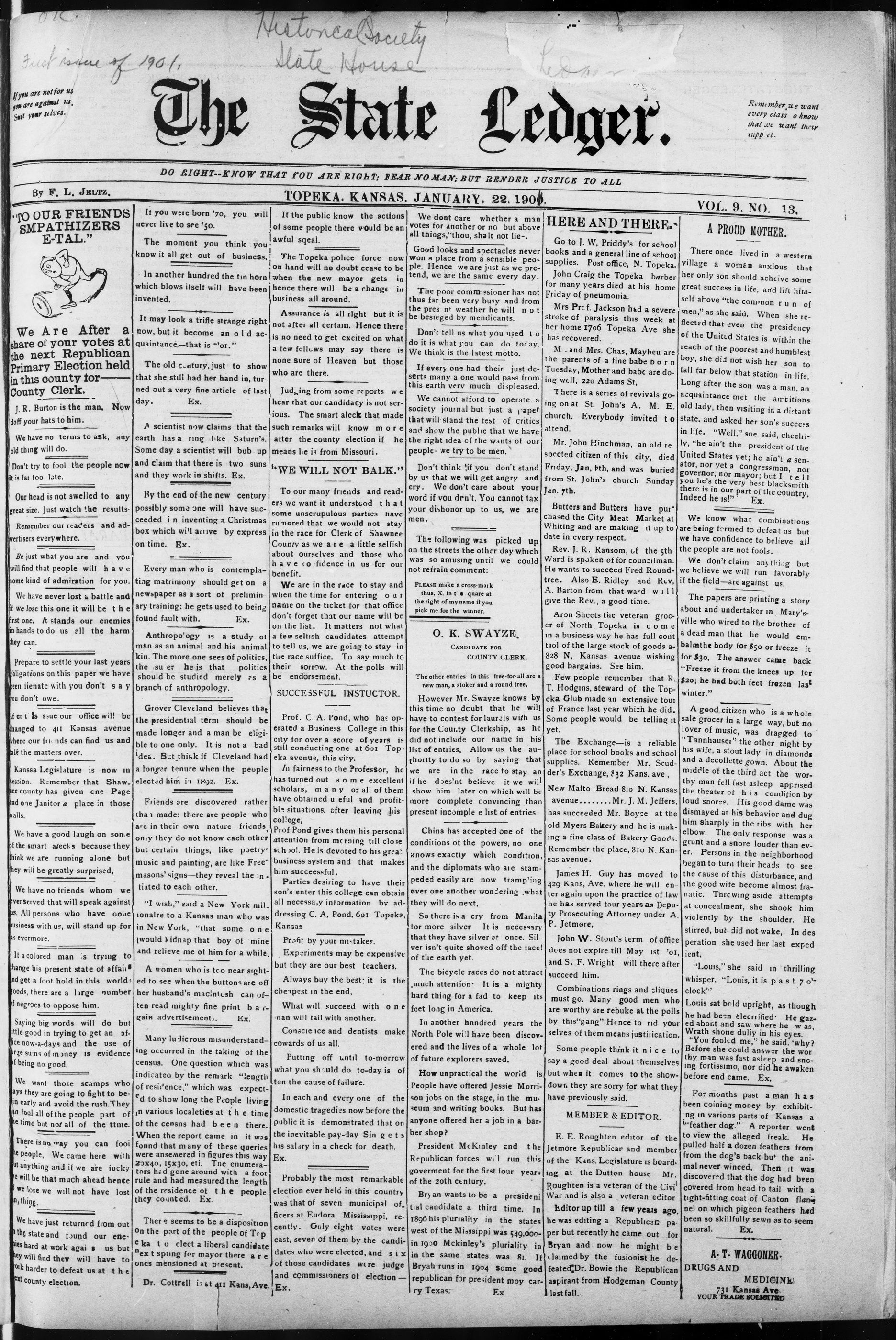
State Ledger
Tuesday, January 22, 1901
Topeka, Kansas
Page text (machine-generated)
If you are not for us you are against us. Suit your selves.
By F. L. JELTZ.
"TO OUR FRIENDS SMPATHIZERS E-TAL."
We Are After a share of your votes at the next Republican Primary Election held in this county for County Clerk.
J. R. Burton is the man. Now doff your hats to him.
We have no terms to ask, any old thing will do.
Don't try to fool the people now it is fat too late.
Our head is not swelled to any great size. Just watch the results.
Remember our readers and advertisers everywhere.
Be just what you are and you will find that people will have some kind of admiration for you.
We have never lost a battle and if we lose this one it will be the first one. It stands our enemies in hands to do us all the harm they can.
Prepare to settle your last years obligations on this paper we have seen lienate with you don't say you don't owe.
After t is sue our office will be changed to 411 Kansas avenue where our friends can find us and talk the matters over.
Kanssa Legislature is now in session. Remember that Shawnee county has given one Page and one Janitor a place in those walls.
We have a good laugh on some of the smart aecks because they think we are running alone but they will be greatly surprised,
We have no friends whom we ever served that will speak against us. All persons who have come business with us, will stand up for us evermore.
It a colored man is trying to change his present state of affair and get a foot hold in this world's goods, there are a large number of negroes to oppose him.
Saying big words will do but little good in trying to get an office now-a-days and the use of large sums of money is evidence of being no good.
We want those scamps who says they are going to fight to be in early and avoid the rush. They an fool all of the people part of the time but not all of the ttme.
There is no way you can fool the people. We came here with but anything and if we are iucky we will be that much ahead hence if we lose we will not have lost in thing.
We have just returned from out in the state and found our enemies hard at work agai us but they will find they will have to work harder to defeat us at the next county election.
The State Ledger.
It may look a trifle strange right now, but it become an old acquaintance—that is "o1."
A scientist now claims that the earth has a ring like Saturn's. Some day a scientist will bob up and claim that there is two suns and they work in shifts. Ex.
By the end of the new century possibly some one will have succeeded in inventing a Christmas box which will arrive by express on time. Ex.
Every man who is contemplating matrimony should get on a newspaper as a sort of preliminary training; he gets used to being found fault with. Ex.
Anthropo'ogy is a study of man as an animal and his animal kin. The more one sees of politics, the suer he is that politics should be studied merely as a branch of anthropology.
Grover Cleveland believes that the presidential term should be made longer and a man be eligible to one only. It is not a bad idea. But think if Cleveland had a longer tenure when the people elected him in 1892. Ex.
Friends are discovered rather than made: there are people who are in their own nature friends, only they do not know each other but certain things, like poetry, music and painting, are like Free masons' signs—they reveal the initiated to each other.
"I wish," said a New York mil- tionalre to a Kansas man who was in New York, "that some one [would kidnap that boy of mine and relieve me of him for a while. A women who is too near sighted to see when the buttons are off her husband's macintosh can often read mighty fine print b a regain advertisement. Ex.
Many ludicrous misunderstanding occurred in the taking of the census. One question which was indicated by the remark "length of residence," which was expected to show long the People living in various localeties at the time of the censns had been there. When the report came in it was found that many of these queries were ansemered in figures this way 20x40, 15x30, eti. The enumerators had gone around with a foot rule and had measured the length of the residence of the people they counted. Ex.
There seems to be a disposition on the part of the people of Teppe ka to elect a liberal candidate next sping for mayor there are ones mensioned at present.
Dr. Cottrell is at 411 Kans.Ave
Historical Society State House
The Topeka police force now on hand will no doubt cease to be when the new mayor gets in hence there will be a change in business all around.
Assurance is all right but it is not after all certain. Hence there is no need to get excited on what a few fellows may say there is none sure of Heaven but those who are there.
Judging from some reports we hear that our candidacy is not serious. The smart aleck that made such remarks will know more after the county election if he means he is from Missouri.
"WE WILL NOT BALK."
To our many friends and readers we want it understood that some unscrupulous parties have ruined that we would not stay in the race for Clerk of Shawnee County as we are a little selfish about ourselves and those who have confidence in us for our benefit.
We are in the race to stay and when the time for entering our name on the ticket for that office don't forget that our name will be on the list. It matters not what a few sellish candidates attempt to tell us, we are going to stay in the race suffice. To say much to their sorrow. At the polls will be endorsement.
Prof. C A. Pond, who has operated a Business College in this city for over a score of years is still conducting one at 601 Topeka avenue, this city.
In fairness to the Professor, he has turned out some excellent scholars, many and all of them have obtained useful and profitable situations, after leaving his college,
Prof Pond gives them his personal attention from morning till close school. He is devoted to his great business system and that makes him successful.
Parties desiring to have their son's enter this college can obtain all necessa,y information by addressing C. A, Pond, 601 Topeke, Kansas
Profit by your mistakes.
Experiments may be expensive but they are our best teachers.
Always buy the best; it is the cheapest in the end.
What will succeed with one man will tail with another.
Conscience and dentists make cowards of us all.
Putting off until to-morrow what you should do to-day is of ten the cause of failure.
In each and every one of the domestic tragedies now before the public it is demonstrated that on the inevitable pay-day Sin gets his salary in a check for death. Ex.
Probably the most remarkable election ever held in this country was that of seven municipal officers at Eudora Mississippi, recently. Only eight votes were cast, seven of them by the candidates who were elected, and six of those candidates were judge and commissioners of election Ex.
Good looks and spectacles never won a place from a sensible people. Hence we are just as we pretend, we are the same every day.
The poor commissioner has not thus far been very busy and from the pres nt weather he will not be besieged by mendicants.
Don't tell us what you used to do it is what you can do today. We think is the latest motto.
If every one had their just deserts many a one would pass from this earth very much displeased.
We cannot afford to operate a society journal but just a paper that will stand the test of critics and show the public that we have the right idea of the wants of our people- we try to be men.
Don't think if you don't stand by us that we will get angry and cry. We don't care about your word if you don't. You cannot tax your dishonor up to us, we are men.
PLEASE make a cross-mark
thus, X. in t o square at
the right of my name if you
pick me for the winner.
O. K. SWAYZE
The other entries in this free-for-all are a new man, a stoker and a round tree.
However Mr. Swayze knows by this time no doubt that he will have to contest for laurels with us for the County Clerkship, as he did not include our name in his list of entries. Allow us the authority to do so by saying that we are in the race to stay an if he doesn't believe it we will show him later on which will be more complete convincing than present incomple list of entries.
China has accepted one of the conditions of the powers, no one knows exactly which condition, and the diplomats who are stampeded easily are now tramping over one another wondering what they will do next.
So there is a cry from Manila for more silver. It is necessary that they have silver at once. Silver isn't quite shoved off the race of the earth yet.
The bicycle races do not attract much attention. It is a mighty hard thing for a fad to keep its feet long in America.
In another hundred years the North Pole will have been discovered and the lives of a whole lot of future explorers saved.
How unpractical the world is People have offered Jessie Morrison jobs on the stage, in the museum and writing books. But has anyone offered her a job in a barber shop?
President McKinley and the Republican forces will run this goverment for the first four years of the 20th century.
Bryan wants to be a presidential candidate a third time. In 1896 his plurality in the states west of the Mississippi was 549,000 in 1900 Mckinley's plurality in the same states was 81. If Bryah runs in 1904 some good republican for president moy carry Texas: Ex
John Craig the Topeka barber for many years died at his home Friday of pneumonia.
Mrs Prcf. Jackson had a severe stroke of paralysis this week at her home 1706 Topeka Ave she has recovered.
M. and Mrs. Chas, Mayheu are the parents of a fine babe born Tuesday, Mother and babe are doing well, 220 Adams St.
There is a series of revivals going on at St. John's A. M. E. church. Everybody invited to attend.
Mr. John Hinchman, an old respected citizen of this city, died Friday, Jan, 9th, and was buried from St. John's church Sunday Jan. 7th.
Butters and Butters have purchased the City Meat Market at Whiting and are making it up to date in every respect.
Rev. J. R. Ransom, of the 5th Ward is spoken of for councilman. He wants to succeed Fred Roundtree. Also E. Ridley and Rev, A. Barton from that ward will give the Rev., a good time.
Aron Sheets the veteran grocer of North Topeka is come in a business way he has full control of the large stock of goods a828 N, Kansas avenue wishing good bargains. See him.
Few people remember that R. T. Hodgins, steward of the Topeka Glub made an extensive tour of France last year which he did. Some people would be telling it yet.
The Exchange—is a reliable place for school books and school supplies. Remember Mr. Scudder's Exchange, 832 Kans. ave. New Malto Bread 810 N. Kansas avenue.....Mr. J. M. Jeffers has succeeded Mr. Boyce at the old Myers Bakery and he is making a fine class of Bakery Goods. Remember the place, 810 N. Kansas avenue.
James H. Guy has moved to 429 Kans, Ave. where he will enter again upon the practice of law he has served four years as Deputy Prosecuting Attorney under A. P. Jetmore.
John W. Stout's term of office does not expire till May 1st '01, and S. F. Wright will there after succeed him.
Combinations rings and cliques must go. Many good men who are worthy are rebuke at the polls by this "gang". Hence to rid your selves of them means justification.
Some people think it nice to say a good deal about themselves but when it comes to the showdown they are sorry for what they have previously said.
MEMBER & EDITOR.
E. E. Roughten editor of the Jetmore Republican and member of the Kans. Legislature is boarding at the Dutton house Mr. Roughten is a veteran of the Civil War and is also a veteran editor Editor up till a few years ago he was editing a Republican paper but recently he came out for Bryan and now he might be claimed by the fusionist he defeated Dr. Bowie the Republican aspirant from Hodgeman County last fall.
Remember we want every class o know that we want their supp et.
VOL. 9, NO. 13.
A PROUD MOTHER.
There once lived in a western village a woman anxious that her only son should achieve some great success in life, and lift himself above "the common run of men," as she said. When she reflected that even the presidency of the United States is within the reach of the poorest and humblest boy, she did not wish her son to fall far below that station in life. Long after the son was a man, an acquaintance met the ambitions old lady, then visiting in a distant state, and asked her son's success in life. "Well," she said, cheerily, "he ain't the president of the United States yet; he ain't a senator, nor yet a congressman, nor governor, nor mayor; but I tell you he's the very best blacksmith there is in our part of the country. Indeed he is!" Ex.
We know what combinations are being formed to defeat us but we have confidence to believe all the people are not fools.
We don't claim anything but we believe we will run favorably if the field—are against us.
The papers are printing a story about and undertaker in Mary'sville who wired to the brother of a dead man that he would embalmthe body for $50 or freeze it for $30. The answer came back "Freeze it from the knees up for $20; he had both feet frozen last winter."
A good citizen who is a whole sale grocer in a large way, but no lover of music, was dragged to "Tannhauser" the other night by his wife, a stout lady in diamonds and a decollette gown. About the middle of the third act the worthy man fell fast asleep apprised the theater of his condition by loud snores. His good dame was dismayed at his behavior and dug him sharply in the ribs with her elbow. The only response was a grunt and a snore louder than ever. Persons in the neighborhood began to turn their heads to see the cause of this disturbance, and the good wife become almost frantic. Throwing aside attempts at concealment, she shook him violently by the shoulder. He stirred, but did not wake, In desperation she used her last expedient.
"Louis," she said in thrilling whisper, "Louis, it is past 7 o'clock"
Louis sat bold upright, as though he had been electrified. He gazed about and saw where he was, Wrath shone duliy in his eyes.
"You fooled me," he said. 'why? Before she could answer the wor thy man was fast asleep and snoring fortissimo, nor did he awaken before end came. Ex.
For months past a man has been coining money by exhibiting in various parts of Kansas a "feather dog." A reporter went to view the alleged freak. He pulled half a dozen feathers from from the dog's back but the animal never winced. Then it was discovered that the dog had been covered from head to tail with a tight-fitting coat of Canton flannel on which pigeon feathers had been so skillfully sewn as to seem natural. Ex.
A. T. WAGGONER
MEDICINE
731 Kansas Ave.
YOUR TRADE SOLICITED
Reports of horses being killed by smutty corn stalks are quite frequent. Newspaper clippings in regard to prominent Kansans are preserved by the state Historical society.
J. L. Taylor, late of Decatur, Illinois, is a new resident of El Dorado. He owns a Butler county ranch of 1,420 acres.
Statements of the three national and one state banks of Lawrence show that the total amount on deposit is $1,215, 646.61.
Jos. Nailer has sold his Kay county, O. T., farm and will locate in Cowley county. He sold the farm of 160 acres for $6,650.
Miss Lillian Forsee, who is now soprano soloist at Oakland Methodist Episcopal church, in Chicago, was born in Salina in 1878.
A girl only eleven years old, of Haskell county, caught a large coyote in a trap, killed and skinned it herself, and received the bounty.
The Kansas State Teachers' association elected W. M. Sinclair, El Dorado, president; Miss M. E. Dolphin, Leavenworth, vice president.
Dr. A. H. Hull, father of Congressman Hull, of Iowa and Milton Hull, editor of the Kiowa, Ks., Review, died at Kiowa on December 29.
Mrs. Daniel Bunnel's large residence in Arkansas City was burned down December 28. It was beyond the water limits. The loss is about $4,000.
Eugene Johnson, of Osawatomie, an engineer in the Missouri Pacific yards at Coffeyville, had his head and a hand cut off by the wheel's of his engine.
The Kansas Agricultural college bought a cow in Lincoln county that yielded $73.75 worth of milk, at creamery prices, during the last 10 months.
The highest percentage of school enrollment to population is in Kansas, where it is 27.87. In New York the percentage is 16.94, while in Pennsylvania it is 18.76.
Miss Sara Thrasher, a graduate of Kansas university in the class of 1898, won the first prize from 1,500 contestants in the amateur photographic contest in St. Louis.
One of the western counties was organized in 1872, but has no trace of its county officers since 1891. A search in the state historical society records shows a full roster of officers back to 1876.
The state oil inspector has turned into the treasury during the past year $19,199.32. Mr. Spencer recommends that in testing oil the gravity as well as the flash test be used to determine the grade of the oil.
Ernest L. Huffman, formerly of company D, Twentieth Kansas, later of troop F, Eleventh cavalry, has returned to Girard from Manila. He numbers among his battles the engagement where General Lawton was killed.
Almeda is a small station on the Missouri Pacific in Kingman county at which one man serves as postmaster railroad agent and merchant. There has been shipped during the season of 1900 62 carloads of hogs from Almeda.
The penitentiary board will ask for telephone and fire alarm protection. They also favor giving discharged prisoners better clothing. The binding twine plant, they say, should be made a separate institution with a superintendent. The Kansas Oil and Gas company propose to increase the plant at Neodesha and will open up new gas fields over that part of the state. Not many years since J. P. Pomeroy was counted the richest man in Kansas, but he is now living in Colorado. Someone has guessed as to who are the ten wealthiest Kansans now and the list is: John R. Mulvane, Joab Mulvane, B. P. Wagemer, David Heflebower, John Seaton, E. N. Morrill, John D. Robertson, Guilford Dudley, Calvin Hood, and J. D. Bowersock.
H. M. Hollowa, proprietor of the Keystone mills at Larned, presented each of his employees with a five dollar gold piece as a Christmas gift.
Bank Commissioner Breidentalal says that from present indications state banks will continue to be the favorites with Kansas people and if changes which experience suggests are necessary, are made in our state law from time to time, there is no reason why Kansas should not build up a system of state banks superior to any yet established.
One Cloud county creamery patron whose milk check for last month amounted to $45 says that it was practically clear profit, as the cows were pastured on a neighbor's wheat field which was making a growth too rapid for its good.
"Doc" Johnson, who has had a large toy and notice store in Cawker City for many years, went to visit his farm in Florida, expecting to return before the holidays. He has not been heard from and there are fears concerning his fate. He is an old man.
Farm land in Graham county is selling 25 to 50 per cent higher than last year.
J. A. Newman, chairman of the Santa Fe telegraphers, has moved to his farm in Oklahoma.
There are now twenty houses under construction or contracted for at Herington.
Frank A. Root and W. E. Connellly, of Topeka, are writing a history of the overland stage line.
There are now 105 traveling libraries from the Kansas state library, in actual use out over the state.
Wm. Bauer has sold his farm of 175 acres in Shiloh township, Neosho county, to Iowa parties for $15,000.
Twenty-six Chanute boys and girls were home during holidays from various colleges which they attended.
W. G. Barnett, formerly chief operator in the Wichita Santa Fe freight office, is going into the grocery trade.
Otis L. Benton shipped from his Sheridan county ranch 3,000 cattle to Central Iowa, where he is feeding them.
The Johnson county teachers' association presented Miss Edith Barnett, the county superintendent, a handsome silver tea set.
Captain J. H. Wing, of Coolidge, is said to have taken eight tons of honey from his bee stands and that the bees consumed two tons.
During Christmas week there were twenty-five applicants for enlistment examined at the recruiting station in Wichita and only two of them were accepted.
Geary county captured the silk flag at the State Teachers' meeting at Topeka for the largest attendance of teachers in proportion to number employed in county.
December 26 was the heaviest in Wichita in point of receipts of hogs at the stockyards this season. About thirty carloads, or in the neighborhood of 2,000 hogs were unloaded and sold.
Wichita teachers won the special prize at the state teachers' association for the largest attendance from a city in proportion to number employed in a city. The prize was $32.25 worth of books.
Mr. S. Cohen writes to the state board of Agriculture from Mayence-on-Rhine, Germany, to learn the address of reliable grain shippers and dealers in Kansas for whom he might serve as agent in his territory. He says that "the excellent quality of Kansas wheat gained our millers quickly."
Four hundred cattle were stamped in the streets of Armourdale. Their roar gave sufficient warning for the people to get out of the way. One steer entered a grocery store, overturned counters, smashed show cases, tore down shelving and made general havoc. When he went out he took the doors off their hinges. It took four hours to corral the herd.
The appellate court has confirmed the decision of the district court of Montgomery county in a case which has been on since 1897. Two joint keepers were than sentenced to fines and imprisonment but took appeals, which have ground along for nearly four years, and now the penalties stand against the criminals with large additions to costs and expenses. Work of building the St. Paul's Cathedral church in Olathe is completed.
The Kansas Historical society library has 23,051 volumes of books, 23,007 volumes of newspapers, 67,418 pamphlets, making a total of 114,376. During the past two years there have been added to the library 2,024 volumes of books, 7,001 unbound volumes and pamphlets, and 3,026 volumes of newspapers in addition to a large number of single copies of newspapers, maps, manuscripts, pictures and relics of different sorts. A. J. Rice, of Graham county has 300 acres in alfalfa and will sow as much more. He has already started several orchards and has a large acreage of wheat out.
W. R. Barnes was elected by the Kansas Horticultural Society to succeed himself as secretary. Mr. Chandler, of Wyandotte, made a good race but was beaten. Other officers elected are: Fred Wellhouse, Topeka, president; J. W. Robinson, El Dorado, vice president; Frank Hoisington, Rosedale; treasurer.
At the golden wedding of Mr. and Mrs. Z. N. Jackson, of Olathe, there were among the guests five couples, four of then living within a block of the Jackson home, who had been married respectively 55, 51, 50, 52 and 57 years.
The M. E. church at Ellsworth paid off its entire debt; the result of the work of the women. A jubilee was had at which the men gave a banquet, doing all the work themselves. They did it in recognition of the labors of the women.
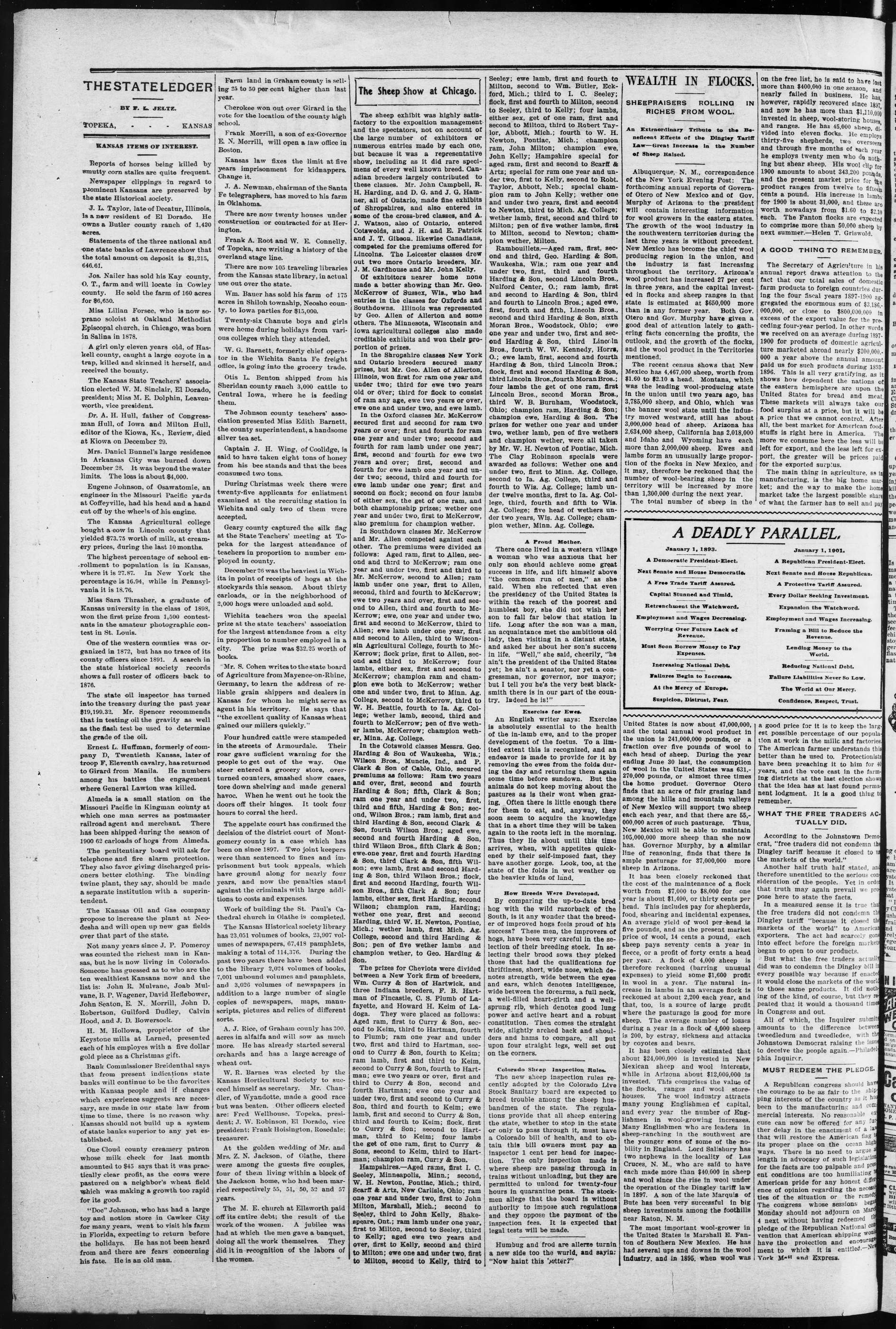
The Sheep Show at Chicago.
The sheep exhibit was highly satisfactory to the exposition management and the spectators, not on account of the large number of exhibitors or numerous entries made by each one, but because it was a representative show, including as it did rare specimens of every well known breed. Canadian breeders largely contributed to these classes. Mr. John Campbell, R. H. Harding, and D. G. and J. G. Hamner, all of Ontario, made fine exhibits of Shropshires, and also entered in some of the cross-bred classes, and A. J. Watson, also of Ontario, entered Cotswolds, and J. H. and E. Patrick and J. T. Gibson, likewise Canadians, competed for the premiums offered for Lincolns. The Leicester classes drew out two more Ontario breeders, Mr. J. M. Gardhouse and Mr. John Kelly.
Of exhibitors nearer home none made a better showing than Mr. Geo. McKerrow of Sussex, Wis., who had entries in the classes for Oxfords and Southdowns. Illinois was represented by Geo. Allen of Allerton and some others. The Minnesota, Wisconsin and Iowa agricultural colleges also made creditable exhibits and won their proportion of prizes.
In the Shropshire classes New York and Ontario breeders secured many prizes, but Mr. Geo. Allerton, Illinois, won first for ram one year and under two; third for ewe two years old or over; third for flock to consist of ew any age, ewe two years or over, ew one and under two, and ewe lamb.
In the Oxford classes Mr. McKerrow secured first and second for ram two years or over; first and fourth for ram one year and under two; second and fourth for ram lamb under one year; first, second and fourth for ewe two years and over; first, second and fourth for ewe lamb one year and under two; second, third and fourth for ewe lamb under one year; first and second on flock; second on four lambs of either sex, the get of one ram, and both championship prizes; wether one year and under two, first to McKerrow, also premium for champion wether.
In Southdown classes Mr. McKerrow and Mr. Allen competed against each other. The premiums were divided as follows: Aged ram, first to Allen, second and third to McKerrow; ram one year and under two, first and third to Mr. McKerrow, second to Allen; ram lamb under one year, first to Allen, second, third and fourth to McKerrow; ewe two years and over, first and second to Allen, third and fourth to McKerrow; ewe, one year and under two, first and second to McKerrow, third to Allen; ewe lamb under one year, first and second to Allen, third to Wisconsin Agricultural College, fourth to McKerrow; flock prize, first to Allen, second and third to McKerrow; four lambs, either sex, first and second to McKerrow; champion ram and champion ewe both to McKerrow; wether one and under two, first to Minn. Ag. College, second to McKerrow, third to W. H. Beattie, fourth to Ia. Ag. College; wether lamb, second, third and fourth to McKerrow; pen of five wether lams, McKerrow; champion wether, Minn. Ag. College.
In the Cotswold classes Messrs. Geo. Harding & Son of Waukesha, Wis.; Wilson Bros., Muncie, Ind., and P. Clark & Son of Cable, Ohio, secured premiums as follows: Ram two years and over, first, second and fourth Harding & Son; fifth, Clark & Son; ram one year and under two, first, third and fifth, Harding & Son; second, Wilson Bros.; ram lamb, first and third Harding & Son, second Clark & Son, fourth Wilson Bros.; aged ewe, second and fourth Harding & Son, third Wilson Bros., fifth Clark & Son; ewe one year, first and fourth Harding & Son, third Clark & Son, fifth Wilson; ewe lamb, first and second Harding & Son, third Wilson Bros.; flock, first and second Harding, fourth Wilson Bros., fifth Clark & Son; four lambs, either sex, first Harding, second Wilson; champion ram, Harding; wether one year, first and second Harding, third W. H. Newton, Pontiac, Mich.; wether lamb, first Mich. Ag. College, second and third Harding & Son; pen of five wether lambs and champion wether, to Geo. Harding & Son
The prizes for Cheviots were divided between a New York firm of breeders, Wm. Curry & Son of Hartwick, and three Indiana breeders, F. B. Hartman of Fincastle, C. S. Plumb of Lafayette, and Howard H. Keim of Ladoga. They were placed as follows: Aged ram, first to Curry & Son, second to Keim, third to Hartman, fourth to Plumb; ram one year and under two, first and third to Hartman, second to Curry & Son, fourth to Keim; ram lamb, first and third to Keim, second to Curry & Son, fourth to Hartman; ewe two years or over, first and third to Curry & Son, second and fourth Hartman; ewe one year and under two, first and second to Curry & Son, third and fourth to Keim; ewe lamb, first and second to Curry & Son, third and fourth to Keim; flock, first to Curry & Son; second to Hartman, third to Keim; four lambs the get of one ram, first to Curry & Sons, second to Keim, third to Hartman; champion ram, Curry & Son.
Hampshires.—Aged raams, first I. C. Seeley, Minneapolis, Minn.; second, W. H. Newton, Pontiac, Mich.; third, Scarff & Artz, New Carlisle, Ohio; ram one year and under two, first to John Milton, Marshall, Mich.; second to Seeley, third to John Kelly, Shakespeare, Ont.; ram lamb under one year, first to Milton, second to Seeley, third to Kelly; aged ewe two years and over, first to Kelly, second and third to Milton; ewe one and under two, first to Milton, second to Kelly, third to
Seeley; ewe lamb, first and fourth to Milton, second to Wm. Butler, Eckford, Mich.; third to I. C. Seeley; flock, first and fourth to Milton, second to Seeley, third to Kelly; four lambs, either sex, get of one ram, first and second to Milton, third to Robert Taylor, Abbott, Mich.; fourth to W. H. Newton, Pontiac, Mich.; champion ram, John Milton; champion ewe, John Kelly; Hampshire special for aged ram, first and second to Scarff & Artz; special for ram one year and under two, first to Kelly, second to Robt. Taylor, Abbott, Neb.; special champion ram to John Kelly; wether one and under two years, first and second to Newton, third to Mich. Ag. College; wether lamb, first, second and third to Milton; pen of five wether lambs, first to Milton, second to Newton; champion wether, Milton.
Rambouillets.—Aged ram, first, second and third, Geo. Harding & Son, Waukesha, Wis.; ram one year and under two, first, third and fourth Harding & Son, second Lincoln Bros. Nulford Center, O.; ram lamb, first and second to Harding & Son, third and fourth to Lincoln Bros.; aged ewe, first, fourth and fifth, Lincoln Bros., second and third Harding & son, sixth Moran Bros. Woodstock, Ohio; ewe one year and under two, first and second Harding & Son, third Lincoln Bros., fourth W. W. Kennedy, Horrs, O.; ewe lamb, first, second and fourth Harding & Son, third Lincoln Bros.; flock, first and second Harding & Son, third Lincoln Bros., fourth Moran Bros.; four lambs the get of one ram, first Lincoln Bros., second Moran Bros., third W. B. Burnham, Woodstock, Ohio; champion ram, Harding & Son; champion ewe, Harding & Son. The prizes for wether one year and under two, wether lamb, pen of five wethers and champion wether, were all taken by Mr. W. H. Newton of Pontiac, Mich. The Clay Robinson specials were awarded as follows: Wether one and under two, first to Minn. Ag. College, second to Ia. Ag. College, third and fourth to Wis. Ag. College; lamb under twelve months, first to Ia. Ag. College, third, fourth and fifth to Wis. Ag. College; five head of wethers under two years, Wis. Ag. College; champion wether, Minn. Ag. College.
A. Prend Mother
There once lived in a western village a woman who was anxious that her only son should achieve some great success in life, and lift himself above "the common run of men," as she said. When she reflected that even the presidency of the United States is within the reach of the poorest and humblest boy, she did not wish her son to fall far below that station in life. Long after the son was a man, an acquaintance met the ambitious old lady, then visiting in a distant state, and asked her about her son's success in life. "Well," she said, cheerily, "he ain't the president of the United States yet; he ain't a senator, nor yet a congressman, nor governor, nor mayor; but I tell you he's the very best blacksmith there is in our part of the country. Indeed he is!"
Exercise for Ewen.
An English writer says: Exercise is absolutely essential to the health of the in-lamb ewe, and to the proper development of the foetus. To a limited extent this is recognized, and an endeavor is made to provide for it by removing the ewes from the folds during the day and returning them again some time before sundown. But the animals do not keep moving about the pastures as is their wont when grazing. Often there is little enough there for them to eat, and, anyway, they soon seem to acquire the knowledge that in a short time they will be taken again to the roots left in the morning. Thus they lie about until this time arrives, when, with appetites quickened by their self-imposed fast, they have another gorge. Look, too, at the state of the folds in wet weather on the heavier kinds of land.
How Breeds Were Developed.
How Brees Ware Developed.
By comparing the up-to-date bred hog with the wild razorback of the South, is it any wonder that the breeder of improved hogs feels proud of his success? These men, the improvers of hogs, have been very careful in the selection of their breeding stock. In selecting their brood sows they picked those that had the qualifications for thriftiness, short, wide nose, which denotes strength, wide between the eyes and ears, which denotes intelligence, wide between the forearms, a full neck, a well-filled heart-girth and a well-sprung rib, which denotes good lung power and active heart and a robust constitution. Then comes the straight wide, slightly arched back and shoulders and hams to compare, all put upon four straight legs, well set out on the corners.
Colorado Sheep Inspection Rules
Colorado Sheep Inspection Rules. The new sheep inspection rules recently adopted by the Colorado Live Stock Sanitary board are expected to breed trouble among the sheep husbandmen of the state. The regulations provide that all sheep entering the state, whether to stop in the state or only to pass through it, must have a Colorado bill of health, and to obtain this bill owners must pay an inspector 1 cent per head for inspection. The only inspection made is where sheep are passing through in trains without unloading, but they are permitted to unload for twenty-four hours in quarantine pens. The stockmen allege that the board is without authority to impose such regulations and they oppose the payment of the inspection fees. It is expected that legal tests will be made.
Humbug and frod are allerze turnin a new side too the wurl, and sayin: "Now haint this 'letter?'
WEALTH IN FLOCKS.
SHEEPRAISERS ROLLING IN
RICHES FROM WOOL.
An Extraordinary Tribute to the
Beneficent Effects of the Dingley Tariff
Law—Great Increase in the Number
of Sheep Raised.
Albuquerque, N. M., correspondence of the New York Evening Post: The forthcoming annual reports of Governor of Otero of New Mexico and of Gov. Murphy of Arizona to the president will contain interesting information for wool growers in the eastern states. The growth of the wool industry in the southwestern territories during the last three years is without precedent. New Mexico has become the chief wool producing region in the union, and the industry is fast increasing throughout the territory. Arizona's wool product has increased 27 per cent in three years, and the capital invested in flocks and sheep ranges in that state is estimated at $650,000 more than in any former year. Both Gov. Otero and Gov. Murphy have given a good deal of attention lately to gathering facts concerning the profits, the outlook, and the growth of the flocks, and the wool product in the Territories mentioned.
The recent census shows that New Mexico has 4,467,000 sheep, worth from $1.60 to $2.10 a head. Montana, which was the leading wool-producing state in the union until two years ago, has 3,785,000 sheep, and Ohio, which was the banner wool state until the industry moved westward, still has about 3,000,000 head of sheep. Arizona has 2,634,000 sheep, California has 2,018,000 and Idaho and Wyoming have each more than 2,000,000 sheep. Ewes and lambs form an unusually large proportion of the flocks in New Mexico, and it may, therefore be reckoned that the number of wool-bearing sheep in the territory will be increased by more than 1,300,000 during the next year.
The total number of sheep in the
A DEADLY
January 1, 1893.
A Democratic President-Elect.
Next Senate and House Democratic.
A Free Trade Tariff Assured.
Capital Stunned and Timid.
Retrenchment the Watchword.
Employment and Wages Decreasing.
Worrying Over Future Lack of Revenue.
Must Soon Borrow Money to Pay Expenses.
Increasing National Debt.
Failures Begin to Increase.
At the Mercy of Europe.
Suspicion, Distrust, Fear.
United States is now about 47,000,000, and the total annual wool product in the union is 241,000,000 pounds, or a fraction over five pounds of wool to each head of sheep. During the year ending June 30 last, the consumption of wool in the United States was 631.-270,000 pounds, or almost three times the home product. Governor Otero finds that an acre of fair grazing land among the hills and mountain valleys of New Mexico will support two sheep each year, and that there are 55.-000,000 acres of such pasture. Thus, New Mexico will be able to maintain 105,000,000 more sheep than she now has. Governor Murphy, by a similar line of reasoning, finds that there is ample pasturage for 37,000,000 more sheep in Arizona.
It has been closely reckoned that the cost of the maintenance of a flock worth from $7,000 to $8,000 for one year is about $1,400, or thirty cents per head. This includes pay for shepherds, food, shearing and incidental expenses. An average yield of wool per head is five pounds, and as the present market price of wool, 14 cents a pound, each sheep pays seventy cents a year in fleece, or a profit of forty cents a head per year. A flock of 4,000 sheep is therefore reckoned (barring unusual expenses) to yield some $1,600 profit in wool in a year. The natural increase in lambs in an average flock is reckoned at about 2,200 each year, and that, too, is a source of large profit where the pasturage is good for more sheep. The average number of losses during a year in a flock of 4,000 sheep is 200, by estray, sickness and attacks by coyotes and bears.
It has been closely estimated that about $24,000,000 is invested in New Mexican sheep and wool interests, while in Arizona about $12,000,000 is invested. This comprises the value of the flocks, ranges and wool storehouses. The wool industry attracts many young Englishmen of capital, and every year the number of Englishmen in wool-growing increases. Many Englishmen who are leaders in sheep-ranching in the southwest are the younger sons of some of the nobility in England. Lord Salisbury has two nephews in the locality of Las Cruces, N. M., who are said to have each made more than $40,000 in sheep and wool since the rise in wool under the operation of the Dingley tariff law in 1897. A son of the late Marquis of Bute has been very successful in big sheep investments among the foothills near Raton, N. M.
The most important wool-grower in the United States is Marshall E. Fanton of Southern New Mexico. He has had several ups and downs in the wool industry, and in 1895, when wool was
on the free list, he is said to have lost more than $400,000 in one season, and nearly failed in business. He has, however, rapidly recovered since 1857, and now he has more than $1,110,000 invested in sheep, wool-storing houses, and ranges. He has 45,000 sheep, divided into eleven flocks. He employs thirty-five shepherds, two overersers and through five months of each year he employs twenty men who do nothing but shear sheep. His wool clip for 1900 amounts to about 343,200 pounds, and the present market price for the product ranges from twelve to fifteen cents a pound. His increase in lambs for 1900 is about 31,000, and these are worth nowadays from $1.60 to $2.10 each. The Fanton flocks are expected to comprise more than 50,000 sheep by next summer.—Helen T. Griswold.
A GOOD THING TO REMEMBER
The Secretary of Agriculture in his annual report draws attention to the fact that our total sales of domestic farm products to foreign countries during the four fiscal years 1897-1900 aggregated the enormous sum of $3,186,000,000, or close to $800,000,000 in excess of the export value for the preceding four-year period. In other words we received on an average during 1897-1900 for products of domestic agriculture marketed abroad nearly $200,000,000 a year above the annual amount paid us for such products during 1893-1896. This is all very gratifying, as it shows how dependent the nations of the eastern hemisphere are upon the United States for bread and meat. These markets will always take our food surplus at a price, but it will be a price that we cannot control. After all, the best market for American food-stuffs is right here in America. The more we consume here the less will be left for export, and the less left for export, the greater will be prices paid for the exported surplus.
The main thing in agriculture, as in manufacturing, is the big home market; and the way to make the home market take the largest possible share of what the farmer has to sell and pay
PARALLEL.
January 1, 1901.
A Republican President-Elect.
Next Senate and House Republican.
A Protective Tariff Assured.
Every Dollar Seeking Investment.
Expansion the Watchword.
Employment and Wages Increasing.
Framing a Hill to Reduce the Revenue.
Lending Money to the World.
Reducing National Debt.
Failure Liabilities Never So Low.
The World at Our Mercy.
Confidence, Respect, Trust.
a good price for it is to keep the largest possible percentage of our population at work in the mill and factories The American farmer understands this better than he used to. Protectionists have been preaching it to him for 40 years, and the vote cast in the farming districts at the last election shows that the idea has at last found permanent lodgment. It is a good thing to remember.
WHAT THE FREE TRADERS AC
TUALLY DID.
According to the Johnstown Democrat, "free traders did not condemn the Dingley tariff because it closed to us the markets of the world."
b e a m a s e r y s
its t o r k
that a t
y C l
f r a n d
r e l e c t
N O B P.
form i n d o n
m a t i n g
b e a s e
W A N T
O M E M
P. P.
c e a r B
C l w a
B l i
2 0 2 0
Be
Another half truth half stated, and therefore unentitled to the serious consideration of the people. Yet in order that truth may again prevail we propose here to state the facts.
In a measured sense it is true that the free traders did not condemn the Dingley tariff "because it closed the markets of the world" to American exporters. The act had scarcely gone into effect before the foreign markets began to open to our products.
But what the free traders actually did was to condemn the Dingley bill in every possible way because if enacted it would close the markets of the world to those same products. It did nothing of the kind, of course, but they repeated that it would a thousand times in Congress and out.
All of which, the Inquirer submit amounts to the difference between tweedledum and tweedledee, with the Johnstown Democrat raising the issue to deceive the people again.—Philadelphia Inquirer.
MUST REDEEM THE PLEDGE.
A Republican congress should have the courage to be as fair to the shipping interests of the country as it has been to the manufacturing and commercial interests. No reasonable excuse can now be offered for any delay in the enactment of a law that will restore the American flag to its proper place on the ocean highways. There is no need to argue a length in advocacy of such legislation for the facts are too palpable and present conditions are too humiliating to American pride for any honest difference of opinion regarding the necessities of the situation or the remedy. The congress whose sessions began Monday should not adjourn on March 4 next without having redeemed the pledge of the Republican National convention that American shipping would have the protection and encouragement to which it is entitled.—New York Mail and Express.
---
Professor D. W. Marks, senior minister of the West London Synagogue of British Jews, has just celebrated his 60th birthday. Professor Marks has been a minister in the congregation since it was founded in 1841.
The Twentieth Century.
We now stand at the threshold of the twentieth century, and the nineteenth is known of the past. It will, however, be known as the century of invention and discovery, and among some of the greatest of the we can truthfully mention Hesteret's Stomach Bitters, the celebrated remedy for all ailments arising from a weak or disordered stomach, such as dyspepsia, indigestion, malnutrition, constipation and billiousness.
A theatrical lawsuit is one kind of a show case.
Some college men have hazy ideas of education.
Garfield Tea has permanently cured countless cases of chronic constipation, and many diseases arising from a clogged system it cleanses the system and purifies the blood.
It is better to take the worst of a deal than to suffer the consequences of a quarrel.
Save money—Buy Red Cross Ball Blue. Large 2-oz. package 5 cents.
The true philosopher smiles at his own misfortunes and tries to relieve misfortunes of others.
Don't Get Footsore! Get FOOT-EASE.
A certain cure for Swollen, Smarting, Burning, Sweating Feet, Corns and Bumions. Ask for Allen's Foot-Ease, a power. Cures Frost-bites and Chickenpox. At all Druggists and Shoe Stores. Inc. Sample sent FREE. Address Allen S. Olmsted, LeRoy, N. Y.
The average married woman thinks that if she were a man she would never marry.
Mortality on the Rail.
Of the 500,000,000 passengers carried upon the railways of the country last year, 221 were killed and 2,945 were injured. Of the employees, 2,237 were killed and 38,749 were injured, and of the others—tramps, trespassers and people who were not in trains—1,650 were killed and 6,176 were injured, making a total of 7,138 persons killed and 47,870 injured.
THE CHANGE OF LIFE
Is the most important period in a woman's existence. Owing to modern methods of living, not one woman in a thousand approaches this perfectly natural change without experiencing a train of very annoying and sometimes painful symptoms. Those dreadful hot flashes, sending the blood surging to the heart until it seems ready to burst, and the faint feeling that follows, sometimes with chills, as if the heart were going to stop for good, are symptoms of a dangerous, nervous trouble. Those hot flashes are just so many calls from nature for help. The nerves are cry-
MRS. JENNIE NOBLE.
g out for assistance. The cry should be heeded in time. Lydia E. Pinkman's Vegetable Compound was prepared to meet the needs of woman's system at this trying period of her life. It builds up the weakened nervous system, and enables a woman to pass grand change triumphantly.
"I was a very sick woman, caused by Change of Life. I suffered with hot rushes, and fainting spells. I was afraid to go on the street, my head tricked trouble me so. I was entirely cured by Lydia E. Pinkham's compound." — Mrs. Jennie NOLLE, 2010 Keysster S, Germantown,
CHRISTMAS
WESTERN
CANADA
FREE
If you take up your
home property and
the land of plenty,
illustrated pamphlets,
giving experiences of
domestic life, you
come wealthy in grow-
ing wheat, reports
delegates, etc., and full
application to the
Department of Interior, Ottawa.
Department of S. Crawford, 214 W. Nith St.
Cary, North Carolina.
Catholic Agents
OUTFIT FREE
WANTED - Men or Women, Town or Country.
New WEB. Write a once. Address
C.P.A.L. CO.
Cactus Bldg., Chicago, IL.
THE MOST LIVE CHICKS
The bulk of eggs. That's what you
want and that's what you get with
Sure Hatch Livestock
Thousands in use. Send for handmade
oil jugs containing 100 poultry raising vials.
Sure Hatch Incubator Co., Clay Center, Neb.
CLAIMANTS FOR PENSION
BRIAN HACHAN
Washington, D.C., they
will receive quick replies. B. Shr. H. Vols.
with Corps. Prosecuting Claims since 1878
PISO'S CURE FOR
CUES WHERE ALL KEEP FAILS.
Best Cough Byp. Tastes Good. Use
in time. Sold by druggists.
CONSUMPTION
Christmas Celebrated for Two Weeks in That Land.
In fiesta-loving Mexico Christmas is celebrated for two weeks, beginning with the 17th of December and not ending until New Year's day. The principal features of the celebration are the "posadas" and "pinatas," both very quaint and pictures we customs, and entirely peculiar to Mexico. "Posada" in Spainish means "abiding place" or "inn," and in Mexico is applied to the nightly semi-religious and entirely jolly performances which, in the houses of all Mexicans, last from the 17th to the 26th of December. At an early hour—on account of the clamoring children—the signal is given for the pinata-breaking, and all the guests flock gaily about the bobbing clown, with the servants and small babies congregated in the back ground. When the assembly is complete, says Modern Culture, all join hands and circle about the big glittering toy, as it swings from its hook in the ceiling, one of the children is blindfolded and placed in the center of the ring, just under the pinata, a long, light pole is handed to her, and she is told to strike carefully and with much force in the direction of the pinata.
Good nature demands that all of the children first have an opportunity to break the pinata; as they naturally are never able to do so, the clown being a tough-fibered individual, the turn of the "grown-ups" next comes. One by one, they are blindfolded, turned about three times and then admonished to "Strike out!" Amid applause from the elders and wild yells from the children the pinata is located and struck at viciously, when—he presto! the poor clown's gay bloomers and red and gold waistcoat are rent from top to bottom; his big sombrero is sent flying across the room and down upon devoted heads comes a deafening rain of oranges, nuts, small candies of all sorts of smal', unbreaks' le presents and all conceivable kind . dulces and good things to eat.
THE MALE FLY.
As Compared with the Female He Is Deficient.
"Whoever thinks the male the superior animal finds no rest for the sole of his foot in the contemplation of what we, in the sublimity of our self-conceit, call 'the lower animals.'" says a writer in Ainslee's Magazine. "In our general ignorance of the housefly we do not know just how foolish and no-account the male is, but we may reasonably infer that he is as markedly deficient as usual, seeing that his eyes are so close together that they touch each other. That's always a bad sign. If you see anybody with eyes close together you are entitled to think little of his intelligence. The fly has two sorts of eyes, the big compound one, 4,000 in a bunch on each side of the head, for knocking about in daylight, and three simple eyes on the top of the head for use in a poor light, sewing and fine print. Before going into ectasies of admiration over the creature that has 4,000 eyes on each side of its head it might be well to remember that they are not of much account. In case of old files kept over winter the compound eyes cave in and get broken, yet the fly seems to get along and find food. One kind gentleman varnished over the simple eyes and plucked off the wings of some flies. He found that he might hold a candle close enough to burn the compound eyes of the fly before it had a suspicion that anything out of the common was going on. In daylight he took a knitting needle and brought it up in front of the fly close enough to touch its antennae before it dodged. If the knitting needle was brought up on one side Mr. Fly picked up his sticking plaster feet quite lively."
Lost His Arm to Save a Cow
Lost His Arm to Save a Cow.
Shamokin (Penn.) Special to New York World: In attempting to remove an apple which had lodged in the throat of a valuable cow, Marcus Fetter, a farmer residing in Mahantonga Valley, had his right arm so fearfully mangled that it had to be amputated.
The cow stood passively as he reached into its mouth to take out the apple, which almost choked the bovine to death, but when he endeavored to take his arm out the cow snapped her jaws and imbedded her teeth in his arm. After a fierce battering of the cow's snout the frightened animal relaxed her jaws, releasing the bleeding and mutilated arm. Fetter tied a rope above the main artery to prevent himself from bleeding to death, after which he hastened to a physician.
Likes to Keep Carriage Wetting:
Likes to Keep Carriage Waiting.
Bishop Brooks of Boston and a friend were one day coming out of a church where John La Farge, the noted artist, was decorating a great window. The friend walked toward a handsome coupe that was standing in the rain and said: "I suppose this is your carriage, bishop?" "Dear me, no," said the bishop. "I always walk. That's a livery carriage waiting for La Farge." "But La Farge," said the friend, "has been working in the church all day, and will continue to work until night." "I know," said the bishop, his whimsical smile drawing the corner of his mouth, "but La Farge can never work very well unless he knows he's keeping a carriage waiting for him somewhere."
Big Bonus for Serum
It is reported that the Mexican government contemplates an award of $100,000 to Dr. Angel Bellinzaghi for his serum against yellow fever, which is said to have been successful in 55 per cent of the cases in Mexican hospitals.
Field Hospital, as It Were. It is quite likely that there will always be a little liquor on tap at the Capitol. Congress could not well get along without a sort of first-aid-to-the-injured station. Washington Post.
Woman as African Explorer
Mme. Jean Pommerol, a French authoress and explorer, is about to start on a new expedition into the heart of Africa. Her object is to study the manners and customs of the natives in the Sahara and embody her experiences in a book.
Origin of a Phrase:
The expression "robbing Peter to pay Paul" had its origin in the rivalry existing between Westminster Abbey, formerly St. Peter's cathedral, and St. Paul's cathedral in London. In 1750 there was a deficiency in the treasury of St. Paul's and an appropriation of money belonging to St. Peter's was made to cover the deficiency. The people who were averse to the action asked the question: "Why rob St. Peter's to pay St. Paul's?"
MR. AYERS NOT DEAD.
Very Much Alive and Out with a Letter
Telling How He Was Saved.
Minneapolis, Minn., Dec. 29.—(Special.)—Few who knew how ill Mr. A. E. Ayers of this city had been with Bright's Disease and Diabetes ever expected he could live. Four doctors gave him but three or four days to live. He recovered through the prompt and continued use of a well-known remedy, and has given the following letter for publication. It is dated at Bath, N. Y., where Mr. Ayers now resides. Soldiers and Sailors' Home.
Dodds Medicine Co., Buffalo, N. Y.: Dear Sirs—I wish to tell you what Dodd's Kidney Pills have done for me. As far as I am concerned they are the best in the world, for they not only saved my life, but they have given me new life and hope. I lived in Minneapolis for forty-nine years, and am well known there by many people. I suffered severely by Bright's Disease and Diabetes. Four well-known physicians gave me up to die. In fact they gave me only three or four days at the longest to live. I had spent nearly everything I had in the effort to save my life, but seeing an advertisement of Dodd's Kidney Pills, I scraped what was nearly my last half dollar, sent to the drug store and bought a box. I had very little hope of anything ever doing me any good, as from what the four doctors had told me, it was now a matter of hours with me. I commenced to take the Pills, and from the very first they helped me. I took in all about forty boxes. I doubtless did not need so many, but I wanted to make sure, and after all, $20 is a small amount of money to remove the sentence of death and save one's life.
I have since recommended Dodd's Kidney Pills to hundreds of people, and I have yet to hear of the first one that did not find them all that you claim for them. I can remember of two people to whom I had recommended Dodd's Kidney Pills, and who afterwards said to me that they received no benefit. I asked to see their Pill boxes, and behold, instead of Dodd's Kidney Pills, it was ——'s Kidney Pills, an imitation of the genuine Dodd's, and not the real thing at all that they had been using. I gave each of them an empty pill box that Dodd's Kidney Pills had been put up in, so that they could make no more mistakes, and they afterwards came to me and told me that they had bought and used the genuine Dodd's Kidney Pills, and were cured.
I still continue to use the Pills off and on, and would not be without them if they were $50 a box. I think that every old gentleman in the world would be healthier and better if he would take one after each meal.
I wish I could think of words strong enough to express to you my gratitude for what your Medicine has done for me. It is not often, I suppose, that a man who is staring death right in the face, is permitted to live and tell of the means which saved him, and as that is my position, my heart is overwhelmed with thankfulness to God for His mercy to me in permitting me to see the advertisement of Dodd's Kidney Pills, when it seemed that I was beyond all earthly power to save, that I cannot express my real feelings.
If anyone doubts the statement I have made, they may write to me, and I will try and prove to them that all I have said in this letter is true, and more than true. There are hundreds of people in Minneapolis who know all about my case and the way Dodd's Kidney Pills pulled me through, when I had been given up by the four doctors of Bright's Disease and Diabetes, and had practically lost all hope. You are at liberty to publish this testimonial which I give you from the bottom of my heart, and I sincerely wish that I could find the right words to express my feelings of gratitude to you and to Dodd's Kidney Pills, for my restoration to life and health.
(Signed)
A. E. AYERS,
Late of Minneapolis, now at Soldiers and Sailors' Home, Bath, N. Y.
Late of Minneapolis, now at Soldiers and Sailors' Home, Bath, N. Y.
Mr. Ayers is only one of thousands of aged gentlemen who say that their lives have been prolonged and their declining years made worth living by the use of Dodd's Kidney Pills.
The average woman can sweep into a room more effectively than she can sweep it out.
Our Pupil Enrollment Compared.
There are about 16,000,000 pupils in the schools of the United States—as many as Germany, France and Italy combined and three times the enrollment of Great Britain and Ireland, and five times as many as Russia, with its population of 100,000,000.
Fairy Millinery.
Gold roses, made of pale gold tissue and grouped in small clusters of themselves, or mingled with other roses of contrasting color, are the latest things of the millinery world and are tremendously popular. The cost of these little trimmings is something quite shocking, but nevertheless they are very generally in evidence.
Telegrams Costing $1.64 a Word.
Now that the telegraph is established between Brazzaville, Loange and Libreville, Stanley Pool is in direct communication with Paris. The line is in good working order and at the end of October a telegram was sent from Brazzaville and a reply received in seventy-two hours. The cost is 8½ francs ($1.64) a word.
Harbor and Preacher
One of the most efficient barbers at present working in Pontiac, Mich., is "Rev." Joshua J. Axtell, who while a preacher at Royal Oak, in that state, knocked out a saloon-keeper in a prize fight. Mr. Axtell occupies his leisure time in preparing a lecture. He also has a novel under way.
Mortality on the Water.
Among 600,000,000 passengers carried, only 206 persons lost their lives on steamboat vessels within the jurisdictions of the United States during the last fiscal year, of whom 44 were passengers and 162 members of the crews. During the same year there were 383 boiler explosions on land, which killed 298 persons and wounded 456 others.
Uncle Sam Takes His Time.
Although it is some ten years since the city of East Saginaw ceased to exist the United States government has persisted in calling the customs station there the "port of East Saginaw," the protests of the people of the united Saginaws notwithstanding. At last, however, an official order has been issued changing the name of the port to correspond with that of the city.
The stamp of a gentleman isn't on sale at the postoffice.
Every time a woman saves a nickel carfare she wastes it in shoe leather.
The memory is a sort of mental reservation.
A vigorous growth and the original color given to the half by PARKER'S HAIR HALSALK.
HINDERCOURNS, the best cure for corns. 15cts.
A woman's happiness may depend on the offers of marriage she refuses.
It's all well enough to be charitable
but you should pay your debts first.
Thirty minutes is all the time required to dye with PUTNAM FADELESS DYES.
The baker sends his bill when he needs the dough.
Worry is a greater enemy to the face than the smallbox.
Read the Advertisements
You will enjoy this publication much better if you will get in the habit of reading the advertisements; they will afford a most interesting study and some excellent bargains. Our advertisers are reliable and send what they advertise.
Remember that if you go visiting you must entertain visitors.
A prisoner at the bar has not always been arrested in a saloon.
**TO CURE A COLD IN ONE DAY.**
Take LAXATIVE BROMO QUINNIE TABLETS. All drugstores refund the money if it fails to cure. E. W. Grove's signature is on the box. So.
Ambition is often the assassin of happiness.
There is no one quite so foolish as an educated fool.
How's This?
We offer One Hundred Dollars reward for any case of Carrath that cannot be cured by Hall's
F. J. CHENEY & CO., Props. Toloedo, O.
Cheney for the last 18 years and believe him
perfectly honorable in all business transactions
and can carry out any obliga-
tions made by their firm.
West & Truxu, Wholesale Druggists, Toledo,
O.; Waldman, Kinnan & Marvin, Wholesale
Hall's Catarchure Cure is taken internally, acting directly upon the blood and mucous surfaces of the testimonial sent free. Price for each bottle. Sold by all druggists. Hall's Family Pills are the best.
Many a man who imagines himself capable of ruling a great nation can't even keep his own children out of mischief.
A HIGH MARK.
The New York Almanac for 1901, issued by Chas. H. Fletcher of New York City, has set a high mark for similar publications during the new century, and is the art of the publisher when we consider that it is intended solely for free distribution. The numerous publications of this character are usually gotten up in the hands of a friend, which the thought of expense has certainly been set aside in the case of the New York Almanac. The artistic colorings of the cover, and the information all go to make it well worthy of perusal and preservation. It has innumerable hints for mothers as to the care of children, unique pages of the book, page in blank, to be filled in with baby's name, date of birth, cut first tooth, etc. The whole is a very credible piece of work and be presented at any drug store or direct on request, free.
When a fool is silent it is often at the wrong time.
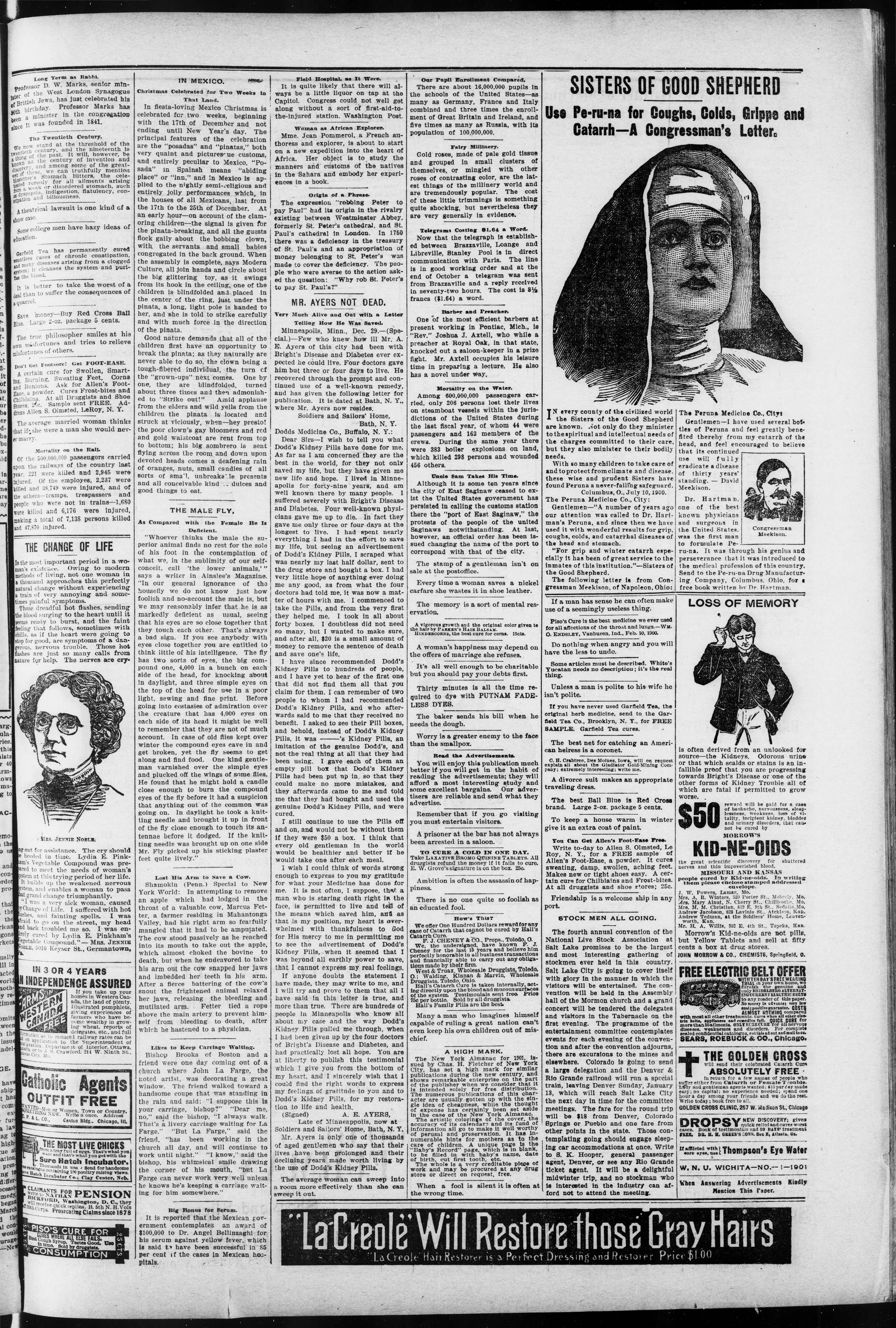
SISTERS OF GOOD SHEPHERD
Saint Margaret of the Cross
N every county of the civilized world | The Peruna Medicine Co. Citys
In every county of the civilized world the Sisters of the Good Shepherd are known. Not only do they minister to the spiritual and intellectual needs of the charges committed to their care, but they also minister to their bodily needs.
With so many children to take care of and to protect from climate and disease, these wise and prudent Sisters have found Peruna a never-failing safeguard. Columbus, O., July 10, 1900.
The Peruna Medicine Co., City:
Gentlemen—"A number of years ago our attention was called to Dr. Hartman's Peruna, and since then we have used it with wonderful results for grip, coughs, colds, and catarral diseases of the head and stomach.
"For grip and winter catarral especially it has been of great service to the inmates of this institution."—Sisters of the Good Shepherd.
The following letter is from Congressman Meekison, of Napoleon, Ohio:
If a man has sense he can often make use of a seemingly useless thing.
Piso's Cure is the best medicine we ever used for all affections of the throat and lungs. -W.M. O. ENDLEY, Vanburen, Ind. Feb. 10, 1900.
Do nothing when angry and you will have the less to undo.
Some articles must be described. White's Yucatan needs no description; it's the real thing.
Unless a man is polite to his wife he isn't polite.
If you have never used Garfield Tea, the original herb medicine, send to the Garfield Tea Co., Brooklyn, N. Y., for FREE SAMFLE. Garfield Tea cures.
The best net for catching an American heiress is a coronet.
G. H. Graubrenn Der Moisse, Iowa will on request explain all about the Gladiator Gold Mining Company; extremely interesting; write me.
A divorce suit makes an appropriate traveling dress.
The best Ball Blue is Red Cross brand. Large 2-oz. package 5 cents.
To keep a house warm in winter give it an extra coat of paint.
You Can Get Allen's Foot-Ease Free.
Write to-day to Allen S. Olmsted, Le Roy, N. Y., for a FREE sample of Allen's Foot-Ease, a powder. It cures sweating, damp, swollen, aching feet. Makes new or tight shoes easy. A certain cure for Chilblains and Frost-bites. At all druggists and shoe rtores; 25c.
Friendship is a welcome ship in any port.
STOCK MEN ALL GOING.
The fourth annual convention of the National Live Stock Association at Salt Lake promises to be the largest and most interesting gathering of stockmen ever held in this country. Salt Lake City is going to cover itself with glory in the manner in which the visitors will be entertained. The convention will be held in the Assembly hall of the Mormon church and a grand concert will be tendered the delegates and visitors in the Tabernacle on the first evening. The programme of the entertainment committee contemplates events for each evening of the convention and after the convention adjourns, there are excursions to the mines and elsewhere. Colorado is going to send a large delegation and the Denver & Rio Grande railroad will run a special train, leaving Denver Sunday, January 18, which will reach Salt Lake City the next day in time for the committee meetings. The fare for the round trip will be $18 from Denver, Colorado Springs or Pueblo and one fare from other points in the state. Those contemplating going should engage sleeping car accommodations at once. Write to S. K. Hooper, general passenger agent, Denver, or see any Rio Grande ticket agent. It will be a delightful mildwinter trip, and no stockman who is interested in the industry can afford not to attend the meeting.
Gentlemen—I have used several bottles of Peruna and feel greatly benefited thereby from my catarrh of the head, and feel encouraged to believe that its continued use will fully eradicate a disease of thirty years' standing. — David Meekison.
A. B.
Dr. Hartman,
one of the best
known physicians
and surgeons in
the United States.
was the first man
to formulate Pe-
the United States,
was the first man
to formulate Pe-
ru-na. It was through his genius and
perseverance that it was introduced to
the medical profession of this country.
Send to the Pe-ru-na Drug Manufacturing
Company, Columbus, Ohio, for a
free book written by Dr. Hartman.
is often derived from an unlooked for source—the Kidneys. Odorous urine or that which scalds or stains is an infallible proof that you are progressing towards Bright's Disease or one of the other forms of Kidney Trouble all of which are fatal if permitted to grow worse.
$50
reward will be paid for a case of backpack injuries, pleoparesis, tetraphthalmia, incipient kidney, bladder injury, that could not be cured by
KID-NE-OIDS
KID-NE-OIDS
the great scientific discovery for shattered nerves and this impoverished blood.
MISSOURI AND KANSAS people complain that in writing them please enclose stamp addressed envelope.
J. W. Powers, Lamar, Moe.
Mrs. A. W. Whitney, O. Carter St., Mobility, Mo.
Mrs. Mary Alain, N. Cherry St., Chillicothe, Mo.
Mrs. M. M. Christian, 819 E. 9 St., Sedalia, Mo.
Andrew Jacobson, 823 Lvallie St., Atchison, Kan.
Andrew Jacobson, at the soldiers' house, Leavenworth, Kan.
Mr. H. A. Willis, 302 E. 4th St., Topeka, Kan.
Morrow's Kid-ne-olds are not pills,
but Yellow Tablets and sell at fifty
cents a box at drug stores.
JOHN MORROW & CO., CHEMISTS, Springfield, O.
FREE ELECTRIC BELT OFFER
WITHTENBAY'S FREE WEARING
Furnish the genuine and
only HEIDELBERG ALTERNATE-
ment to any reader of this paper.
No money in advances was
almost nothing compared
with most all other treatments. Care when all else is
needed. Be careful not to overuse more than 500allments. OYKSEAR CURS for all nervous
diseases, weakness and disorders. For complex
diseases, refer to our OYKSEAR CURS.
SEARS, BOREUCK & OO., Chicago
sugar either from Catartr or Female Trouble.
Lady and gentleman agents wanted: 40 per pay made
needed; needed; needed; spent one hour a day among your friends and we do the rest.
Write today; book free to all.
GOLDEN CROSS CLINIC, 257 W. Madison St., Chicago
DROPSY NEW DISCOVERY; gives
cases. Book of testimonies and 10 DAYS' treatments
FREE. DR. H. N. GREEN'S JONN. Box E, Atlanta, Ga.
If afflicted with
sore eyes, use
Thompson's Eye Water
W. N. U. WICHITA-1-1901
When Answering Advertisements Kindly
Mention This Paper.
State Ledger.
SUBSCRIPTION six months 750
One Year 1,50
ALL SUBSCRIPTIONS CASH IN ADVANCE
Entered at post office Topeka, Kansas, at se-
cundlass-rates.
Published every Saturday at 431 Kan. av.
1,000 in advance
GIBRALTAR DRUG CO.
KANSAS AVENUE.
Topeka, Kansas
HOMEPATHIC REMEDIES. AKT MA
TERIALS.
MANNING & HALL Dealer In Farm Implements, Harness. Stoves. TINWARE, VEHICLES, HARNESS. PUMPS. CLOCKS. Gypsum. Kas
PHYSICIANS.
I. A. SHIELDS M. D.
PHYSICIAN and SURGEON.
Office and Residence 1331 VanBuren St.
all promptly attended.
DR.AGNES McKEE WAL
LACE.
Office 724 Kan. Ave, Phone 250
H. B. HOGBOOM
PHYSICIAN and SURGEON,
330 Kans Ave.
promptly attended. All calls
Tel 14.
DR; C. A. TAYLOR.
PHYSICIAN and SURGEON.
Office Hours, 9 to 11 a. m.
From 2 to 5 p. m.
OFFICE 226½ KAS, AVE.
(Cver Kohl's Drug Store,)
Wm. B, Swan, M. D
725 Kansas Avenue,
Topeka,
Kansas.
office hours, 7:10 to 12 m, 2:00 to 4:30 pm.
Residence 024 Buchanan St.
Bell Telephone, 660
GEORGE DICK, M. D,
Homoeopathist
Residence 626 Filmo St.
Telephone 360.
Office 807 Kansas Avenus.
Wm. E. JACKSON, M. D.
PHYSICIAN and SUKGEON.
OFFICE HOURS; 9 TO II A. M
TO 5, and 7 TO Q P. M
Sunday Hours. 1 to 3 P. M.
OFFICE 404 Kas., Ave. Tele. 635
(Over Wallace Drug Store.)
DR. J. C. ISERMAN,
Office 112 East 6th street
Calls Promptly Attended To.
Special Attention Given. to Disease
Stomach and Lungs and Female Trou
es.
Office Hours: -9 to 12-2 to 5-7 to 9
phone e
DR, R. O, RHODES,
OFFICE
600 Kansas ave. Topeka, Kansas
(Over Hub Clothing C,)
FFICE HOURS:
9 to 11 A, M,
2 to 5 P. M.
Residence, 900 West Sixth street
Phone 656.
S. G. STEWART, M. D.
OFICE 621 KANSAS AVE.
TLEPHONE 541.
Residence 112 East 7th Street.
TLEPHONE 442. a14
Dr, Dutton's Botanic Blood and St0mach
Cures INDIGESTION,
LIVER trouble and R.LEUMATISM.
Sold by W. A. Travis, Shorey, P, O.
C. F. MENNINGER, M, D.
Office 729 Kansas Ave.
Telephone 19.
Office Hours:
11-12 A.M.
2-5 P.M.
Residence 125, Topeka Ave.
Telephone 85.
J. M JAMISON, M. D,
Office 506 East 4th Street.
Office Hours:
From 8 to 10 A.M.
2 M to 3 P.M.
P, M, to 9 P.M.
Special attention cases of woman and private diseases.
FRED BURNISON.
...Dealer In...
Lumber-Lime-Cement-Coal- and Stone.
MARQUETTE, KANS.
JOHN MILLER,
Dealer In
Flour, Feed, Graih, Hay
And all kinds of Coal.
120 East Eighth St..
J, E, PETERSON—or Marquette, runs the best HOTEL and RESTAURANT in the city give him call.
FRED BURNISON.
KAW VALLEY brand of
MINCE
MEAT
CHAS. WOLFF
PACKING CO.
Is made of the very best
and strictly pure and
healthful ingredients
Your Grocer keeps it;
buy some; It will make
the best MINCE PIES
you ever tasted.
M. Hogan.
Undertaker And Reliable in His Dealings--Open day and Night.--314 Kan. Avenue.
Home Bakery,
J. M. JEFFRIES, Prop.
810 N Kas. Ave.
(Successor to Geo. Mayer.)
Wholesale and Retail Bakery goods,
We Solicit Your Trade,
We will Serve You Right.
THE LANDIS HOME
BAKERY,
Many years exprience. French home Bakery 316 E. 4tn St.
Open day and night. Quick service,
Rahrer's Restaurant
615 East Fifth St.
Opposite Santa Fe Depot.
C, A, RAHRER, Prop.
PUBLICATION NOTICE.
In the District Court of Shawn e County Kansas.
Iva Panola King
Plaintiff.
vs. Case No. 20905.
Edward Wilyard King.
Defendant.
State of Kansas to Edward Wilyard King quiing: you are hereby notified that you have been sued in the District Court of Shawnee county in the above entitled cause, and unless you answer the petition of the plaintiff filed therein on or before the 12th day of Meh, 1901, the allegations contained therein will be taken as true and judgement rendered against you granting plaintiff there in a divorce from you and the control and custody of your minor child, Verna Merle King and for such other and further relief as may seem proper to the court.
Iva Panola King.
Attest.
Plaintiff.
A. M. Callaham, Clerk Dist Court.
D'oo
BOOK EXCHANGE
Stationery and all kinds of writ
ing material—832 Kansas avenue
KANE & STUIVE,
FARM MACHINERY.:
WIND MILLS, FUMPS and Also Handle the
JACK OF ALL TRADES ENGINE,
Useful to All Farmers
LINN, KANS.
I. N. GOODWIN
Dealer In
A
Glassware, Crockeryware and general Merchandise.
Ransom, Kans.
J. W KELLEY,
DEALER IN
Staple and Fancy Groceries. Give Him a
Call. 119 N. Main Street. Ottawa, Kas.
HAYS & SNYDER
921 Kas. Ave..
DEALER IN
Feed, Hay and Grain and all kinds
of Coal.
A share of your patronage is de-
sired.
Tele. 349.
HARRIS BROS
DEALERS IN STAPLE
AND FANCY GROCERIES
Smoked Meats, A Specialty
Cigars Tobacco, and confectionery,
Give Them an order
goods delivered.
W. B. WARREN.
The HOTAMALE manufaeturer has opened his parlor at 413 Norris street, North Top eka for the season. He csn serve you with the delicious food while you wait. Give him a call. 413 Laurent St.
C. E. ROGERS
Dealer In Farm Implenents and machinery and the (patent coop) for shipping purpose.
Harper, Kans.,
Kansas Packing House Market
SCHMIDT TRO'S, PROP's.,
706 E. 2ND STREET
Dealers In
FRESH AND CURED MEATS.
Wholesale and Retail. Give Them Your Trade. i16
GO TO
LOUIS VANDORP,
FOR HARDWARE and STOVES
Screen Doors, Ice Cream Freezers, Hammocks and Garden-Tools.
These are the things you need Give hima call. 828 Kansas Ave
JAMES. SMITH, DEALER IN
Mides, Tallow, Furs and Pelts.
108 and 110 East Third Street. Topeka, Kans. Pays highest prices for consignment trade. REFERENCES: Chas. Woff Packing Co., Topeka. Bank of Topeka. R. G. Dun's Com'l Agency Topeka.
W. H. WARD,
HARD-WARE, IMPLEMENTS AND STOVES.
GYPSON CITY, KANS.
FOR YOUR Shoes and Slippers. at low prices. 628 Kansas Avenue
James B. Beavers, Defendant.
To James B. Beavers, the above named defendant you are hereby notified that you have been sued by Minnie Beavers, your wife for divorce. That said plaintiff filed her petition with the Clerk of the district Court of Shawnee County Kansas on the 30th day of November, 1900 and unless you answer the same on or before the 5th day of Feb., 1901 the said petition will be taken as true and judgement rendered against you divorcing said plaintiff from you and giving such and further relief as may to the court seem just and proper.
Minnie Beavers,
Plaintiff.
(Attest) A. M. Callaham,
Clerk of Dist. Court.
By I. S. Curtis, Dep.
D2500
Pure Tea and Spices etc.
TOPEK A. SPICE MILLS.
109 E. Sixth Street.
WOOLEY S BAKEKY,
The place to trade.
The best Bakery goods kept
on hand daily.
915 Kas. Ave.,
W. T. WILEY.
DEALER IN.
Staple and Fancy Groceries.
Fresh and Cured Meats, Fish,
Poultry...and Country Produce.
Give him a call.
931 Kas. Ave. Tele. 291
TURNER BROS.,
Fine Restaurant.
Meals and Short Order.
A: SHIMMOM'S
for anything you want in the linee
of New and Second Hand goods
Mass., Street., Lawrence Kans.
Kansas Packing
SCHMIDT I.
306 E. QN.
Deal
FRESH AND C
Wholesale and Retail.
GO
LOUIS VANDORP
E.H. UPSHAW.
Peoples Feed, 537 Kansas Avenue, North Topeka. Full weights. Goods promptly delivered.
...SEE UNCLE SAM AT 512 KAS. AVE.,
For a new Clock or fine Watch eparing
The best up-to-date and most polite jeweler
in the city. See Uncle Sam, 512 Kas. ave.
The Diamond Drug Store, 6th and Buchanan Streets Give them a call.
Remember that the Davis Mercantil Co.
601 Topeka Avenue the place to patronize
You will get your money's worth by trying the Davis Mercantile Go.
GO TO
E. W. Griggs for pnotos, fine pictures. Car--901Kas. ave.
GO TO
ARMSTRONGSRESTAURANT
When ing Ottawa for anything you want
Shoal Orders and Meals--222 N, Malm St.
THE COITAGE HOTEL
MRS. L. S. HUMPHRIES.
Prop.
Terms $1 per day. Netawaka, Kansas.
Miss Alca Rockafeller, the richest girl in the world, a paragon of refinement and beauty, tells the world in an interview that she is not happy. Money does not make happiness: An Emporia girl who has just landed a four dollar a week tellow is so happy that she can taste it. Ex
A West Virginia man put a stick of dynamite on the stove to thaw. He'll not do it again. He and five of his companions are dead as a result. Thawing dynamite and blowing out the gas are two acts that there will always be fools to try. Ex
UNEEDA
RABBITRY
DOMESTICS OF EIGHT
FINEST STRAINS
prices
the
lowest,
Edinboro, Ione, Score 95 at Stud
Fee $5.00
Write us,
A. L. TYSON, Mgr
DENNISON, KAS.
PINKSTON BROS..
Flour Feed and Grain. Reliable
Dealers. Headquarters for any
thing you want in their line. Call
and see them----517 N. Main St.
Wichita, Kans.
THE RACKET
Mrs. Q. Campbell...Prop.
Finest line of goods ever carried. Come in and examine our stock...always pleased to see you.
Mrs. Q. Campbell, Conway Springs Kansas.
G, ELLINGER & Co.
General Merchandise.
Jobbers of Brooms.
Shippers of Apples.
Solicit orders from Jobbers and Retilers.
Handling Brooms in quantities.
We can save you 25 to 40 per cent.
Send US Your ORDERS.
G. ELLINGER & CO.,
BELGIAN HARES
STOCK FOR SALE SIRED
BY CHAMPION DASH.
BANBURY STAR.
BANBUKY RED, and others
Write for Prices.
A. F. HAYNES.
Pomona, Kansas
DR.WINSLOW
704 Mass., Lawrence, Kansas
Dr. W, H* Winslow, does a general practice. Special attention given the eye and ear, Spectacles fitted, urnishes to patien
at wholesale rates; Office 704 Mass., Street
Tele. 260-5, Residence, 1901 New Ham
shire street, Teen. 191-2.
116 East 6th St.
Short Orders and Lunch. Serve you while
you wa
Queen Bee Cash Market
607 KANSAS AVENUE H. W. THUDIUM. PREP. TELE 323
HOLE IN WALL
When in LAWRENCE stop at WEVER
MULLER'S RESTAURANT-
PORT ORDER. Open D y and N g
720 Mass., Stroct.