State Ledger
Wednesday, February 6, 1901
Topeka, Kansas
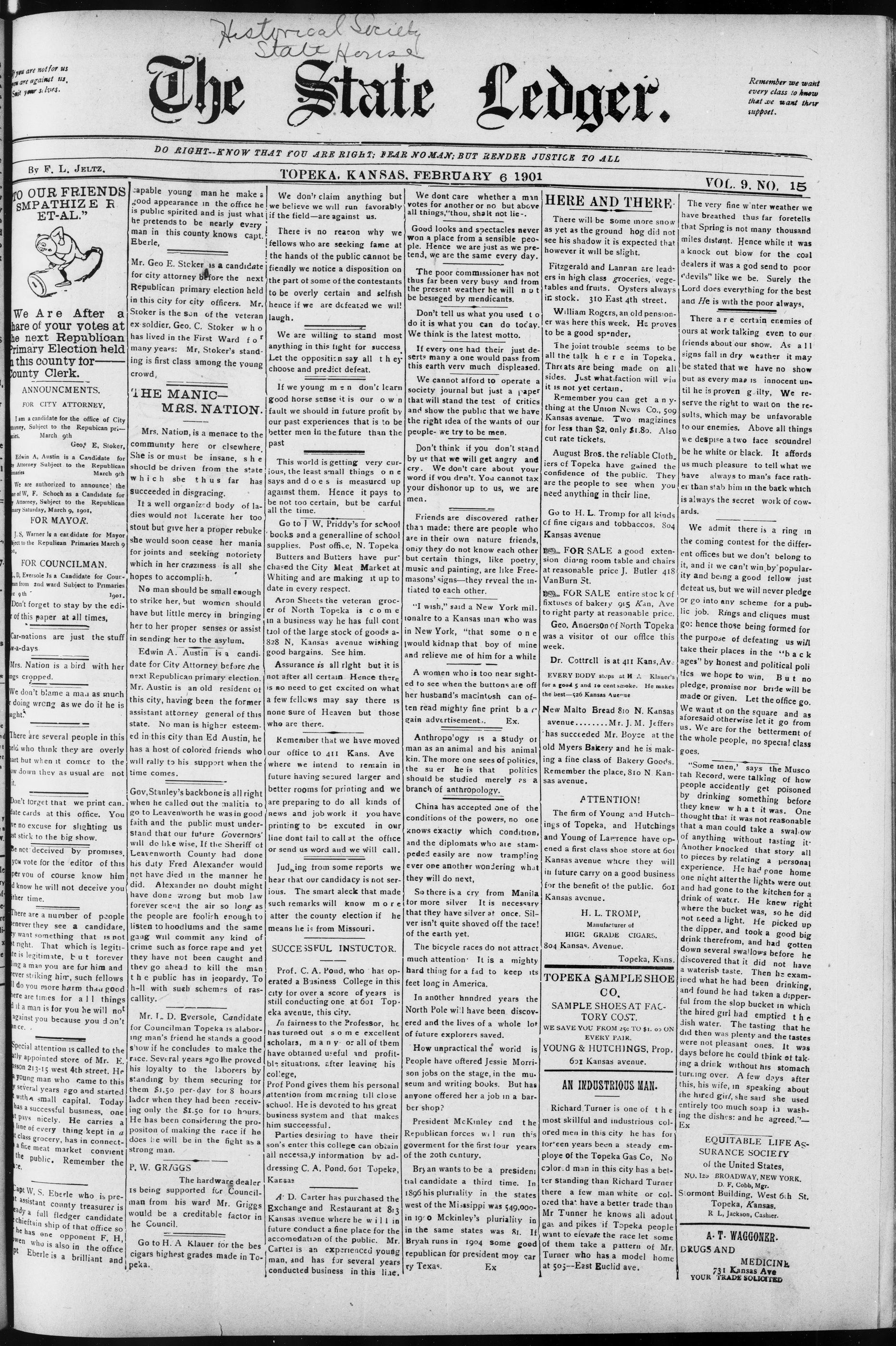
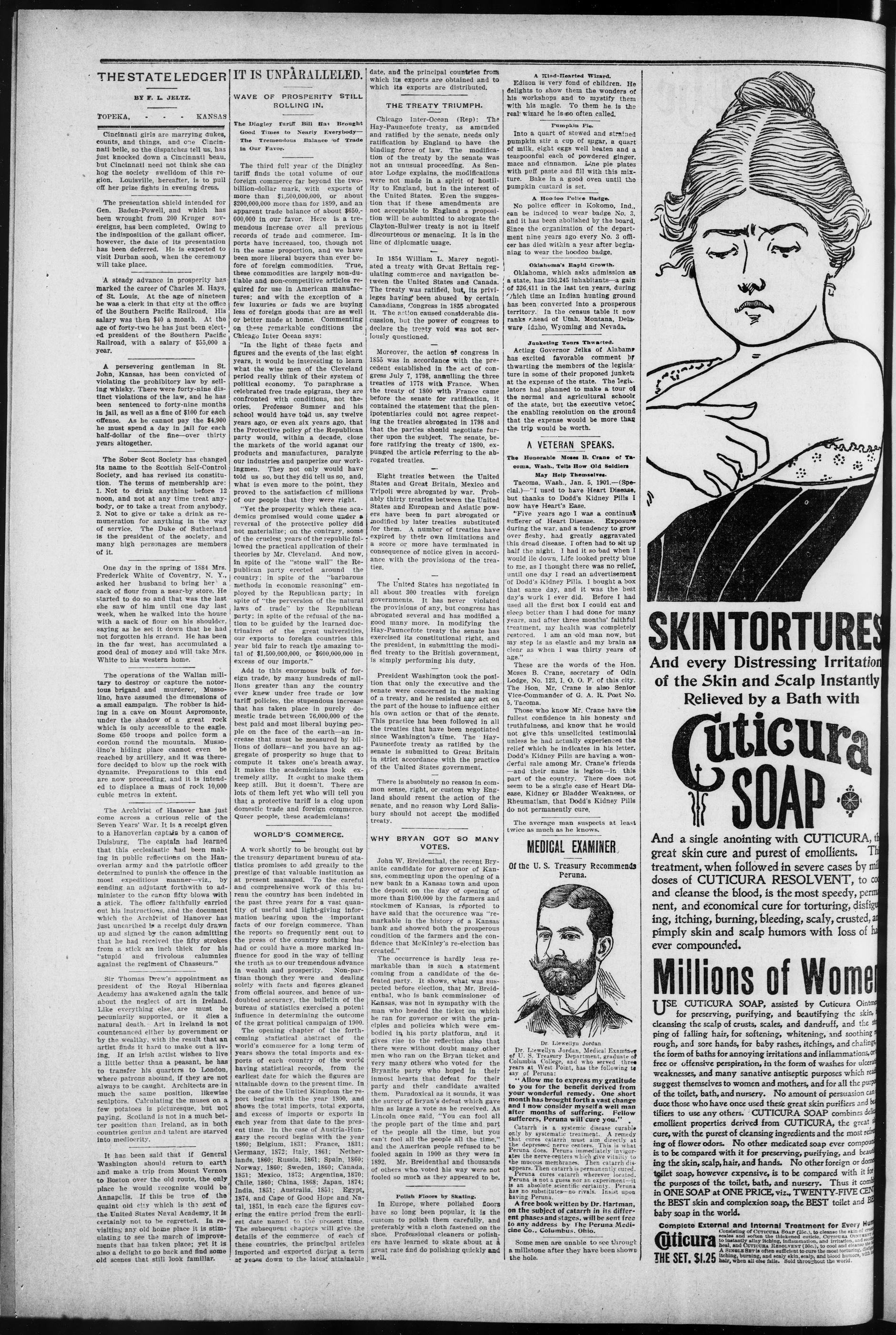
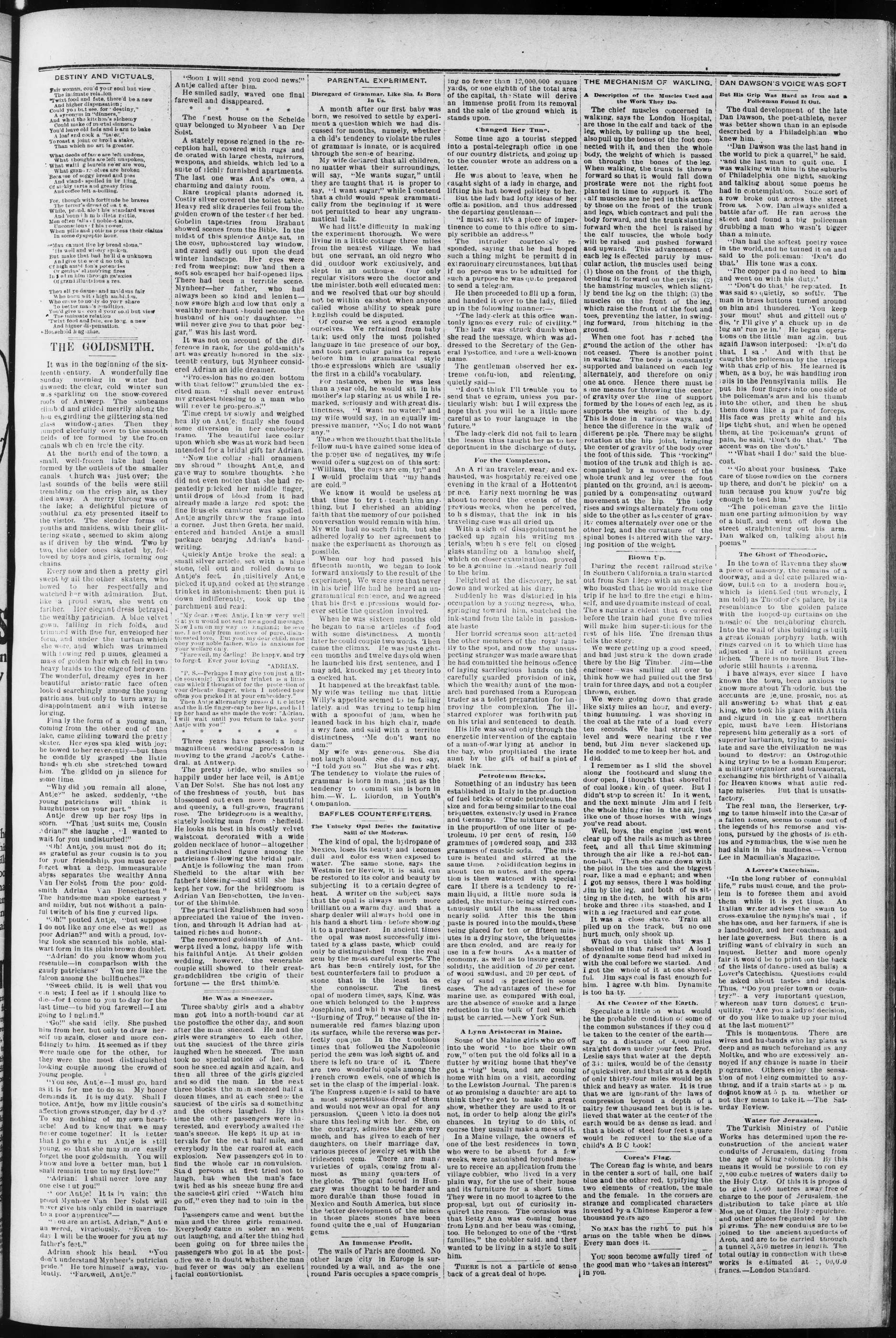
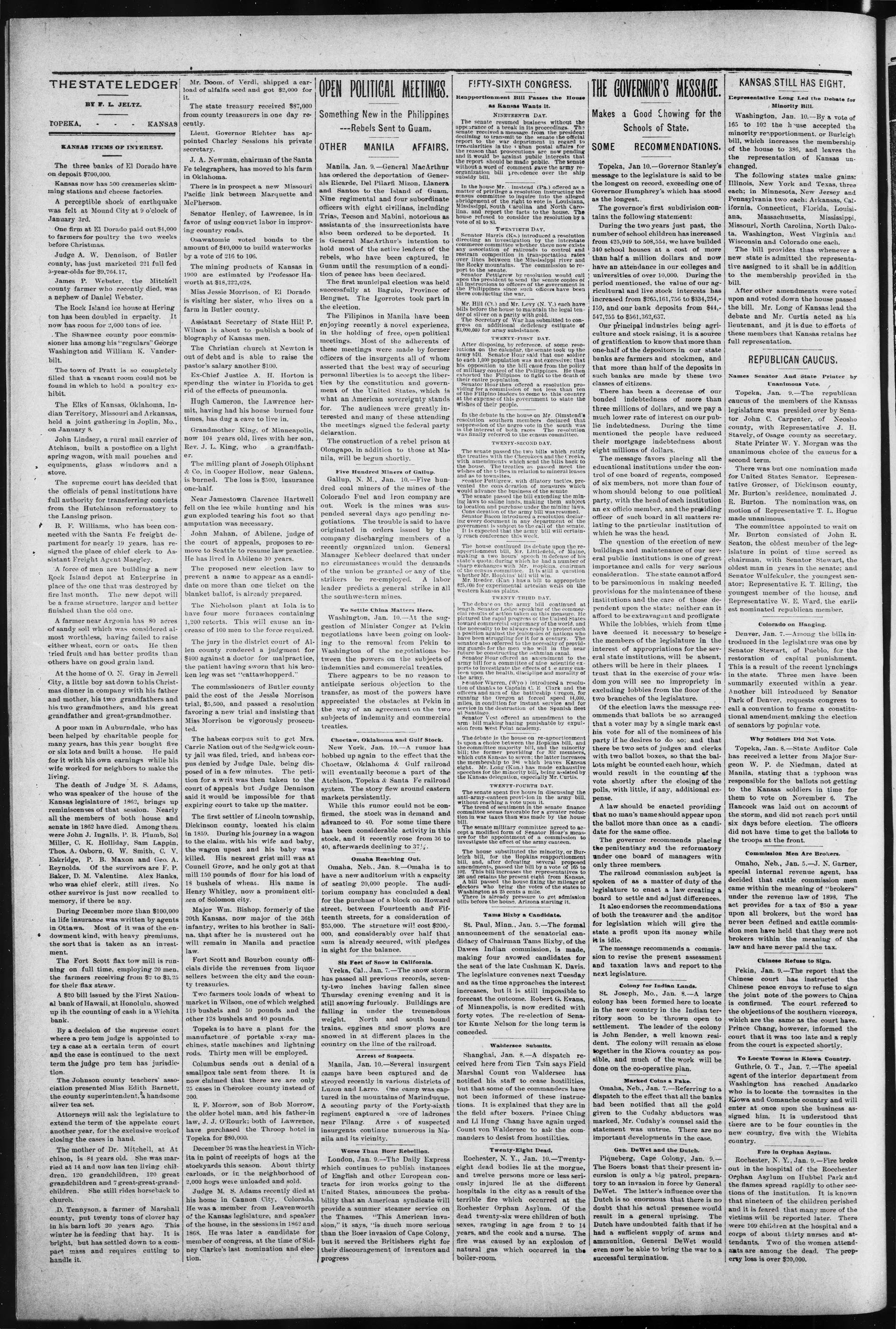
Page text (machine-generated)
BY F. L. JELTZ.
TOPEKA, . . . KANSAS
Cincinnati girls are marrying dukes, counts, and things, and one Cincinnati belle, so the dispatches tell us, has just knocked down a Cincinnati beau, but Cincinnati need not think she can hog the society swelldom of this region. Louisville, hereafter, is to pull off her prize fights in evening dress.
The presentation shield intended for Gen. Baden-Powell, and which has been wrought from 200 Kruger sovereigns, has been completed. Owing to the indisposition of the gallant officer, however, the date of its presentation has been deferred. He is expected to visit Durban sooh, when the ceremony will take place.
A steady advance in prosperity has marked the career of Charles M. Hays, of St. Louis. At the age of nineteen he was a clerk in that city at the office of the Southern Pacific Railroad. His salary was then $40 a month. At the age of forty-two he has just been elected president of the Southern Pacific Railroad, with a salary of $55,000 a year.
A persevering gentleman in St. John, Kansas, has been convicted of violating the prohibitory law by selling whisky. There were forty-nine distinct violations of the law, and he has been sentenced to forty-nine months in jail, as well as a fine of $100 for each offense. As he cannot pay the $4,900 he must spend a day in jail for each half-dollar of the fine—over thirty years altogether.
The Sober Scot Society has changed its name to the Scottish Self-Control Society, and has revised its constitution. The terms of membership are: 1. Not to drink anything before 12 noon, and not at any time treat anybody, or to take a treat from anybody. 2. Not to give or take a drink as remuneration for anything in the way of service. The Duke of Sutherland is the president of the society, and many high personages are members of it.
One day in the spring of 1884 Mrs. Frederick White of Coventry, N. Y., asked her husband to bring her a sack of flour from a near-by store. He started to do so and that was the last she saw of him until one day last week, when he walked into the house with a sack of flour on his shoulder, saying as he set it down that he had not forgotten his errand. He has been in the far west, has accumulated a good deal of money and will take Mrs. White to his western home.
The operations of the Wallan military to destroy or capture the notorious brigand and murderer, Mussolino, have assumed the dimensions of a small campaign. The robber is hiding in a cave on Mount Aspromonte under the shadow of a great rock which is only accessible to the eagle. Some 650 troops and police form a cordon round the mountain. Mussolino's hiding place cannot even be reached by artillery, and it was therefore decided to blow up the rock with dynamite. Preparations to this end are now proceeding, and it is intended to displace a mass of rock 10,000 cubic metres in extent.
The Archvist of Hanover has just come across a curious relic of the Seven Years' War. It is a receipt given to a Hanoverian captain by a canon of Dulshurg. The captain had learned that this ecclesiastic had been making in public reflections on the Hanoverian army and the patriotic officer determined to punish the offence in the most expeditionary manner-viz., by sending an adjutant forthwith to administer to the canon fifty blows with a stick. The officer faithfully carried out his instructions, and the document which the Archvist of Hanover has just unearthed is a receipt duly drawn up and signed by the canon admitting that he had received the fifty strokes from a stick an inch thick for his "stupid and frivolous calumnies against the regiment of Chasseurs."
Sir Thomas Drew's appointment as president of the Royal Hibernian Academy has awakened the talk about the neglect of art in Ireland. Like everything else, are must be peculiarly supported, or it dies a natural death. Art in Ireland is not countenanced either by government or by the wealthy, with the result that an artist finds it hard to make out a living. If an Irish artist wishes to live a little better than a peasant, he has to transfer his quarters to London, where patrons abound, if they are not always to be caught. Architects are in much the same position, likewise sculptors. Calculating the muses on a few potatoes is picturesque, but not paying. Scotland is not in a much better position than Ireland, as in both countries genius and talent are starved into mediocrity.
It has been said that if General Washington should return to earth and make a trip from Mount Vernon to Boston over the old route, the only place he would recognize would be Annapolis. If this be true of the quaint old city which is the seat of the United States Naval Academy, it is certainly not to be regretted. In revisiting any old home place it is stimulating to see the march of improvements that has taken place; yet it is also a delight to go back and find some old scenes that still look familiar.
WAVE OF PROSPERITY STILL
ROLLING IN.
The Dingley Tariff Bill Has Brought
Good Times to Nearly Everybody—
The Tremendous Balance of Trade
in Our Favor.
The third full year of the Dingley tariff finds the total volume of our foreign commerce far beyond the two-billion-dollar mark, with exports of more than $1,500,000,000, or about $200,000,000 more than for 1899, and an apparent trade balance of about $650,000,000 in our favor. Here is a tremendous increase over all previous records of trade and commerce. Imports have increased, too, though not in the same proportion, and we have been more liberal buyers than ever before of foreign commodities. True, these commodities are largely non-dutile and non-competitive articles required for use in American manufactures; and with the exception of a few luxuries or fads we are buying less of foreign goods that are as well or better made at home. Commenting on these remarkable conditions the Chicago Inter Ocean says:
"In the light of these facts and figures and the events of the last eight years, it would be interesting to learn what the wise men of the Cleveland period really think of their system of political economy. To paraphrase a celebrated free trade epigram, they are confronted with conditions, not theories. Professor Sumner and his school would have told us, say twelve years ago, or even six years ago, that the Protective policy of the Republican party would, within a decade, close the markets of the world against our products and manufactures, paralyze our industries and pauperize our workingmen. They not only would have told us so, but they did tell us so, and, what is even more to the point, they proved to the satisfaction of millions of our people that they were right.
"Yet the prosperity which these academies promised would come under a reversal of the protective policy did not materialize; on the contrary, some of the cruelest years of the republic followed the practical application of their theories by Mr. Cleveland. And now, in spite of the "stone wall" the Republican party erected around the country; in spite of the "barbarous methods in economic reasoning" employed by the Republican party; in spite of "the perversion of the natural laws of trade" by the Republican party; in spite of the refusal of the nation to be guided by the learned doctrinaires of the great universities, our exports to foreign countries this year bid fair to reach the amazing total of $1,500,000,000, or $600,000,000 in excess of our imports."
Add to this enormous bulk of foreign trade, by many hundreds of millions greater than any the country ever knew under free trade or low tariff policies, the stupendous increase that has taken place in purely domestic trade between 76,000,000 of the best paid and most liberal buying people on the face of the earth—an increase that must be measured by billions of dollars—and you have an aggregate of prosperity so huge that to compute it takes one's breath away. It makes the academicians look extremely silly. It ought to make them keep still. But it doesn't. There are lots of them left yet who will tell you that a protective tariff is a clog upon domestic trade and foreign commerce. Queer people, these academicians!
WORLD'S COMMERCE.
A work shortly to be brought out by the treasury department bureau of statistics promises to add greatly to the prestige of that valuable institution as at present managed. To the careful and comprehensive work of this bureau the country has been indebted in the past three years for a vast quantity of useful and light-giving information bearing upon the important facts of our foreign commerce. Than the reports so frequently sent out to the press of the country nothing has had or could have a more marked influence for good in the way of telling the truth as to our tremendous advance in wealth and prosperity. Non-partisan though they were and dealing solely with facts and figures gleaned from official sources, and hence of undoubted accuracy, the bulletin of the bureau of statistics exercised a potent influence in determining the outcome of the great political campaign of 1900.
The opening chapter of the forthcoming statistical abstract of the world's commerce for a long term of years shows the total imports and exports of each country of the world having statistical records, from the earliest date for which the figures are attainable down to the present time. In the case of the United Kingdom the report begins with the year 1800, and shows the total imports, total exports, and excess of imports or exports in each year from that date to the present time. In the case of Austria-Hungary the record begins with the year 1860; Belgium, 1831; France, 1831; Germany, 1872; Italy, 1861; Netherlands, 1860; Russia, 1861; Spain, 1860; Norway, 1860; Sweden, 1860; Canada, 1851; Mexico, 1873; Argentina, 1870; Chile, 1860; China, 1868; Japan, 1874; India, 1851; Australia, 1851; Egypt, 1874, and Cape of Good Hope and Natal, 1851, in each case the figures covering the entire period from the earliest date named to the present time. The subsequent chapters will give the details of the commerce of each of these countries, the principal articles imported and exported during a term of years down to the latest attainable
date, and the principal countries from which its exports are obtained and to which its exports are distributed.
THE TREATY TRIUMPH.
Chicago Inter-Ocean (Rep): The Hay-Pauncefote treaty, as amended and ratified by the senate, needs only ratification by England to have the binding force of law. The modification of the treaty by the senate was not an unusual proceeding. As Senator Lodge explains, the modifications were not made in a spirit of hostility to England, but in the interest of the United States. Even the suggestion that if these amendments are not acceptable to England a proposition will be submitted to abrogate the Clayton-Bulwer treaty is not in itself discourteous or menacing. It is in the line of diplomatic usage.
In 1854 William L. Marcy negotiated a treaty with Great Britain regulating commerce and navigation between the United States and Canada. The treaty was ratified, but, its privileges having been abused by certain Canadians, Congress in 1855 abrogated it. The action caused considerable discussion, but the power of congress to declare the treaty void was not seriously questioned.
Moreover, the action of congress in 1855 was in accordance with the precedent established in the act of congress July 7, 1798, annulling the three treaties of 1778 with France. When the treaty of 1800 with France came before the senate for ratification, it contained the statement that the plenipotentiaries could not agree respecting the treaties abrogated in 1798 and that the parties should negotiate further upon the subject. The senate, before ratifying the treaty of 1800, expunged the article referring to the abrogated treaties.
Eight treaties between the United States and Great Britain, Mexico and Tripoli were abrogated by war. Probably thirty treaties between the United States and European and Asiatic powers have been in part abrogated or modified by later treaties substituted for them. A number of treaties have expired by their own limitations and a score or more have terminated in consequence of notice given in accordance with the provisions of the treaties.
The United States has negotiated in all about 300 treaties with foreign governments. It has never violated the provisions of any, but congress has abrogated several and has modified a good many more. In modifying the Hay-Pauceffote treaty the senate has exercised its constitutional right, and the president, in submitting the modified treaty to the British government, is simply performing his duty.
President Washington took the position that only the executive and the senate were concerned in the making of a treaty, and he resisted any act on the part of the house to influence either his own action or that of the senate. This practice has been followed in all the treaties that have been negotiated since Washington's time. The Hay-Pauncefote treaty as ratified by the senate is submitted to Great Britain in strict accordance with the practice of the United States government.
There is absolutely no reason in common sense, right, or custom why England should resent the action of the senate, and no reason why Lord Salisbury should not accept the modified treaty.
WHY BRYAN GOT SO MANY
VOTES.
John W, Breidenthal, the recent Bryanite candidate for governor of Kansas, commenting upon the opening of a new bank in a Kansas town and upon the deposit on the day of opening of more than $100,000 by the farmers and stockmen of Kansas, is reported to have said that the occurrence was "remarkable in the history of a Kansas bank and showed both the prosperous condition of the farmers and the confidence that McKinley's re-election has created."
The occurrence is hardly less remarkable than is such a statement coming from a candidate of the defeated party. It shows, what was suspected before election, that Mr. Breidenthal, who is bank commissioner of Kansas, was not in sympathy with the man who headed the ticket on which he ran for governor or with the principles and policies which were embodied in his party platform, and it gives rise to the reflection also that there were without doubt many other men who ran on the Bryan ticket and very many others who voted for the Bryanite party who hoped in their inmost hearts that defeat for their party and their candidate awaited them. Paradoxical as it sounds, it was the surety of Bryan's defeat which gave him as large a vote as he received. As Lincoln once said, "You can fool all the people of the time and part of the people all the time, but you can't fool all the people all the time," and the American people refused to be fooled again in 1900 as they were in 1892. Mr. Breidenthal and thousands of others who voted his way were not fooled so much as they appeared to be.
Polish Floors by Skating.
In Europe, where polished floors have so long been popular, it is the custom to polish them carefully, and preferably with a cloth fastened on the shoe. Professional cleaners or polishers have learned to skate about at a great rate and do polishing quickly and well.
A Kind-Hearted Wizard.
Edison is very fond of children. He delights to show them the wonders of his workshops and to mystify them with his magic. To them he is the real wizard he is so often called.
Pumpkin Pie.
Into a quart of stewed and strained pumpkin stir a cup of sugar, a quart of milk, eight eggs well beaten and a teaspoonful each of powdered ginger, mace and cinnamon. Line pie plates with puff paste and fill with this mixture. Bake in a good oven until the pumpkin custard is set.
A Hooooo Police Badge.
No police officer in Kokomo, Ind., can be induced to wear badge No. 3, and it has been abolished by the board.
Since the organization of the department nine years ago every No. 3 officer has died in a year after beginning to wear the hoodoo badge.
Oklahoma's Rapid Growth.
Oklahoma, which asks admission as a state, has 398,245 inhabitants—a gain of 336,411 in the last ten years, during which time an Indian hunting ground has been converted into a prosperous territory. In the census table it now ranks 'head of Utah, Montana, Delaware (daho, Wyoming and Nevada.
Junketing Tours Thwarted:
Acting Governor Jelks of Alabama has excited favorable comment by thwarting the members of the legislature in some of their proposed junkets at the expense of the state. The legislators had planned to make a tour of the normal and agricultural schools of the state, but the executive vetoed the enabling resolution on the ground that the expense would be more than the trip would be worth.
A VETERAN SPEAKS.
The Honorable Moses B. Crane of Tacoma, Wash., Tells How Old Soldiers May Help Themselves.
Tacoma, Wash., Jan. 5, 1901. —(Special.) — "I used to have Heart Disease, but thanks to Dodd's Kidney Pills I now have Heart's Ease.
"Five years ago I was a continual sufferer of Heart Disease. Exposure during the war, and a tendency to grow over fleshy, had greatly aggravated this dread disease. I often had to sit up half the night. I had it so bad when I would lie down. Life looked pretty blue to me, as I thought there was no relief, until one day I read an advertisement of Dodd's Kidney Pills. I bought a box that same day, and it was the best day's work I ever did. Before I had used all the first box I could eat and sleep better than I had done for many years, and after three months' faithful treatment, my health was completely restored. I am an old man now, but my step is as elastic and my brain as clear as when I was thirty years of age."
These are the words of the Hon. Moses B. Crane, secretary of Odin Lodge, No. 123, I. O. O. F. of this city. The Hon. Mr. Crane is also Senior Vice-Commander of G. A. R. Post No. 5. Tacoma.
Those who know Mr. Crane has the fullest confidence in his honesty and truthfulness, and know that he would not give this unsolicited testimonial unless he had actually experienced the relief which he indicates in his letter, Dodd's Kidney Pills are having a wonderful sale among Mr. Crane's friends—and their name is legion—in this part of the country. There does not seem to be a single case of Heart Disease, Kidney or Bladder Weakness, or Rheumatism, that Dodd's Kidney Pills do not permanently cure.
The average man suspects at least twice as much as he knows.
MEDICAL EXAMINER
Of the U. S. Treasury Recommends Peruna.
Dr. Liewellyn Jordan, Medical Examiner of U.S. Treasury Department, graduate of Columbia College, and who served three years at West Point, has the following to say of Peruna:
"Allow me to express my gratitude to you for the benefit derived from your help in remedy. One short month has brought forth a vast change and I now consider myself a well man after months of suffering. Follow sufferers, Peruna will cure you."
Catarrh is a systemic disease curable only by systematic treatment. A remedy that has been developed for the depressed nerve centers. This is what Peruna does. Peruna immediately invigorates the nerve-centers which give vitality to the mucous membranes. Then catarrh disappears. Then catarrh is permanently cured. Peruna cures catarrh wherever located. Peruna is an absolute scientific certainty. Peruna has no substitutes—no rivals. Insist upon having Peruna.
A free book written by Dr. Hartman, on the subject of catarrh in its different phases and stages, will be sent free to any address by the Peruna Medicine Co., Columbus, Ohio.
Some men are unable to see through a millstone after they have been shown the hole.
SKINTORTURES And every Distressing Irritation of the Skin and Scalp Instantly Relieved by a Bath with Cuticura SOAP
And a single anointing with CUTICURA, the great skin cure and purest of emollients. The treatment, when followed in severe cases by mild doses of CUTICURA RESOLVENT, to cool and cleanse the blood, is the most speedy, permanent, and economical cure for torturing, disfiguring, itching, burning, bleeding, scaly, crusted, and pimply skin and scalp humors with loss of hair ever compounded.
Millions of Wome
USE CUTICURA SOAP, assisted by Cuticura Ointment for preserving, purifying, and beautifying the skin, cleansing the scalp of crusts, scales, and dandruff, and the sting of falling hair, for softening, whitening, and soothing a rough, and sore hands, for baby rashes, itchings, and chafing the form of baths for annoying irritations and inflammations, or free or offensive perspiration, in the form of washes for ulcerate weaknesses, and many sanative antiseptic purposes which read suggest themselves to women and mothers, and for all the purge of the toilet, bath, and nursery. No amount of persuasion can induce those who have once used these great skin purifiers and beifiers to use any others. CUTICURA SOAP combines delicate emollient properties derived from CUTICURA, the great cure, with the purest of cleansing ingredients and the most refining of flower odors. No other medicated soap ever compound is to be compared with it for preserving, purifying, and beautifying the skin, scalp, hair, and hands. No other foreign or domestic toilet soap, however expensive, is to be compared with it for the purposes of the toilet, bath, and nursery. Thus it comes in ONE SOAP at ONE PRICE, viz., TWENTY-FIVE CENTS the BEST skin and complexion soap, the BEST toilet and BEST baby soap in the world.
nal and Internal Treatment for Every H
Consisting of Cuticura Soap (25c.), to cleanse the skin of cre
scales and soften the thickened cuticle, Cuticura OINTMENT
to instantly allay itching, inflammation, and irritation, and so
heal, and Cuticura RESOLVENT (50c.), to cool and cleanse the
A SINGLE SET is often sufficient to cure the most torturing, dis
itching, burning, and scaly skin, scalp, and blood humors, with a
hair, when all else fails. Sold throughout the world.
DESTINY AND VICTUALS.
For, though with fortitude he braves
The terror's dream of on te.
When he takes the hardwaved waves
And stands in him biblis rattle,
Moon often falls in noble taints,
Unconscious if his power,
When pills and ointress press their claims
In his hands.
"Our cannot live by bread alone."
"His well and wise spoken."
But make that bad he'll d e unknown
And give the word w ood n took
Of high ambition's sonnies
Of doing great things
In $ in him through gaaxies
Of grand illusions s res.
The all ye deme and mid us fair
Who burnt with a high ambition.
Who drive to noily do your share
To better man a sympathy
Yielding your soul so cool but view
The intimate relation
Twist food and love, ever long, a new
Adulting sensation.
Household long glue.
THE GOLDSMITH.
It was in the beginning of the sixteenth century. A wonderfully fine Sunday morning in winter had dawned: the clear, cold winter sun was sparkling on the snow-covered roofs of Antwerp. The sunbeams climbed and glided merely along the hoon es, girdling the glittering stained glass window-panes. Then they jumped gleefully over to the smooth fields of ice formed by the froeen canals wh chen ircle the city.
At the north end of the town, a small, well-frozen lake had been formed by the outlets of the smaller canals. Church was just over; the last sounds of the bells were still trembling on the crisp air, as they died away. A merry throng was on the lake; a delightful picture of youthful gaety presented itself to the visitor. The slender forms of youths and maidens, with their glittering skate, seemed to skim along as if driven by the wind. Two by two, the older ones skated by, followed by boys and girls, forming ong chains.
Every now and then a pretty girl swept by all the other skaters, who bowed to her respectfully and watched her with admiration. But, like a proud swan, she went on farther. Her elegant dress betrayed the wealthy patrician. A blue velvet gown, falling in rich folds, and trimmed with fine fur, enveloped her form, and under the turban which she wore, and which was trimmed with towing red pines, gleamed a mass of golden hair which fell in two heavy braids to the edge of her gown. The wonderful, dreamy eyes in her beautiful aristocratic face often looked searchingly among the young patricans, but only to turn away in disappointment and with intense lorging.
Finally the form of a young man, coming from the other end of the lake, gave gliding toward the pretty skater. Her eyes spa kled with joy; he bowed to her reverently—but then he confide tly grasped the little hands which she stretched toward him. The glided on in silence for some time.
"Why did you remain all alone, Antje?" he asked, suddenly, "the young patricians will think it haughtiness on your part."
Antje drew up her rosy lips in scorn. "That just suits me, Cousin adrian!" she laughed, "I wanted to wait for you undisturbed."
"Oh! Antje, you must not do it; as grateful as your cousin is to you for your friendship, you must never forget what a deep, immeasurable abyss separates the wealthy Anna Van Der Solst from the poor goldsmith Adrian Van Benschotten." The handsome man spoke earnest and mildly, but not without a painful twitch of his fine y curved lips.
"Oh!" pouted Antje, "but suppose I do not like any one else as well as poor Adrian?" and with a proud, loving look she scanned his noble, stalwart form in its plain brown doublet.
"Adrian! do you know whom you resemble—in comparison with the gaudy patricians? You are like the falcon among the bullfinches."
"Sweet child, it is well that you can jest; I feel as if I should like to die—for I come to you to day for the last time—to bid you farewell—I am going to go and."
"Go!" she said jelly. She pushed him from her, but only to draw herself up again, closer and more confidingly to him. It seemed as if they were made one for the other, for they were the most distinguished looking couple among the crowd of young people.
"You see, Antje - I must go, hard as it is for me to do so. My honor demands it. It is my daty. Shall I notice, Antje, how my little cousin's affection grows stronger, day by day? To say nothing of my own heartache! And to know that we may never come together! It is better that I go while my Antje is still young, so that she may more easily forget the poor goldsmith. You will know and love a better man, but I shall remain true to my first love."
"Adrian! I shall never love any one else but you!"
" oor Antjel. It is in vain: the proud Mynhee Van Der Solst will never give his only child in marriage to a poor apprentice" " you are an artist. Adrian," Ant e an wered, vivaciously. "Even today I will be the wooer for you at my father's feet." Adrian shook his head. "You don't understand Mynhee's patrician pride." He hore himself away, violently. "Fartwell, Antle."
"Soon I will send you good news."
Antje called after him.
He smiled sadly, waved one final
farewell and disappeared.
* * * * * *
The fnest house on the Schelde quay belonged to Mynheer Van Der Solst. A stately repose reigned in the reception hall, covered with rugs and decorated with large chests, mirrors, weapons, and shields, which led to a suite of richly furnished apartments. The last one was Ant'e own, a charming and gaint room.
Hare tropical plants adorned it. Costly silver covered the toilet table. Heavy red silk draperies fell from the golden crown of the tester of her bed. Gobellin tapestries from Brabant showed scenes from the Bible. In the midst of this splendor Antje sat, in the cost, uphoistered bay window, and gazed sadly out upon the dead winter landscape. Her eyes were red from weeping; now and then a soft sob escaped her half-opened lips. There had been a terrible scene. Myneher—her father, who had always been so kind and lenient—now swore high and low that only a wealthy merchant should become the husband of his only daughter. "I will never give you to that poor beggar," was his last word. It was not on account of the difference in rank, for the goldsmith's art was greatly honored in the sixteenth century, but Myneher considered Adrian an idle dreamer.
"Procession has no golden bottom with that fellow!" grumbled the excited man. "I shall never entrust my greatest blessing to a man who will never be prosperous."
Time crept by slowly and weighed heaily on Antie, finally she found some diversion in her embroidery frame. The beautiful lace collar upon which she was at work had been intended for a bridal gift tar Adrian. "Now the collar shall ornament my shroud" thought Antie, and gave way to sombre thoughts. She did not even notice that she had repeatedly picked her middle finger, until drops of blood from it had already made a large red spot: the fine Brussels cambure was spoiled. Antie angrily threw the frame into a corner. Just then Greta, her maid, entered and handed Antie a small package bearjng Adrian's hand-writing.
Quickly Antje broke the seal: a small silver article, set with a blue stone, tell out and rolled down to Antje's feet. In polititively Antje picked it up, and ooked at the strange trinket in astonishment; then put it down indifferently, took up the parchment and read:
"My dear, wist Antje. I know very well it at you would not send me a good message. Now I am on my way to England; beave me a kiss, and give me a puff of pumice, tasted love. But you, my niece child, must obey your noble father, who is anxious for your welfare only.
"Farewell, my darling! Be happy, and try to forget. Ever your loving
"ADRIAN.
"P. S.—Perhaps I may give you just a little souvenir! The silver trinket is a little can which I thought of for the protection of your dehicate finger, when I noticed how often you pricked it at your embroidery.
Then Antje alternately pressed to elbow your hand, and then up her hand as she made the vow: "Adrian, I will wait until you return to take your Antje with you!"
Three years have passed; a long magnificent wedding procession is moving to the grand Jacob's Cathedral, at Antwerp.
The pretty bride, who smiles so happily under her lace veil, is Antie Van Der Solst. She has not lost any of the freshness of youth, but has blossomed out even more beautiful and queenly, a full-grown, fragrant rose. The bridegroom is a wealthy, stately looking man from Sheffield. He looks his best in his costly velvet waistcoat, decorated with a wide golden necklace of honor—altogether a distinguished figure among the patricians following the bridal pair.
Antie is following the man from Sheffield to the altar with her father's blessing and still she has kept her vow, for the bridegroom is Adrian Van Benschotten, the inventor of the thimble.
The practical Englishmen had soon appreciated the value of the invention, and through it Adrian had attained riches and honors.
The renowned goldsmith of Antwerp lived a long, happy life with his faithful Antje. At their golden wedding, however, the venerable couple still showed to their great grandchildren the origin of their fortune — the first thimble.
He Was a Sneezer.
Three shabby girls and a shabby man got into a north-bound car at the postoffice the other day, and soon after the man sneezed. He and the girls were strangers to each other, but the sauciest of the three girls laughed when he sneezed. The man took no special notice of her, but soon he sneezed again and again, and then all three of the girls giggled and so did the man. In the next three blocks the man sneezed half a dozen times, and at each sneeze the sauciest of the girls said something and the others laughed. By this time the other passengers were interested, and everybody awaited the man's sneeze. He kept it up at intervals for the next half mile, and everybody in the car roared at each explosion. New passengers got in to find the whole car in convulsion. Staff persons at first tried not to laugh, but when the man's face twited as his sneeze hung fire and the sauciest girl cried "Watch him go off," even they had to join in the fun.
Passengers came and went, but the man and the three girls remained. Everybody came in sober an went out laughing, and after the thing had been going on for three miles the passengers who got in at the post office wee in doubt whether the man had fever or was only an excellent facial contortionist.
Disregard of Grammar. Like Sin. Is Born In Us.
A month after our first baby was born, we resolved to settle by experiment a question which we had discussed for months, namely, whether a child's tendency to violate the rules of grammar is innate, or is acquired through the sen-e of hearing.
My wife declared that all children, no matter what their surroundings, will say, "Me wants sugar," until they are taught that it is proper to say, "I want sugar;" while I contend that a child would speak grammatically from the beginning if it were not permitted to hear any ungrammatical talk.
We had little difficulty in making the experiment thorough. We were living in a little cottage three miles from the nearest village. We had but one servant, an old negro who did outdoor work exclusively, and slept in an outhouse. Our only regular visitors were the doctor and the minister, both well educated men; and we resolved that our boy should not be within earshot when anyone called whose ability to speak pure English could be disputed.
Of course we set a good example ourselves. We refrained from baby talk; used only the most polished language in the presence of our boy, and took particular pains to repeat before him in grammatical style those expressions which are usually the first in a child's vocabulary.
For instance, when he was less than a year old, he would sit in his mother's lap staring at us while I remarked, seriously and with great distinctness, "I want no water;" and my wife would say, in an equally impressive manner, "No; I do not want any."
The one when we thought that the little fellow must have gained some idea of the proper use of negatives, my wife would offer a suggest on of this sort: "William, the curses are em, ty;" and I would proclaim that "my hands are cold."
We know it would be useless at that time to try to teach him anything, but I cherished an abiding faith that the memory of our polished conversation would remain with him. My wife had no such faith, but she adhered loyalty to her agreement to make the experiment as thorough as possible. When our boy had passed his fifteenth month, we began to look forward anxiously to the result of the experiment. We were sure that never in his brief life had he heard an ungrammatical sentence, and we agreed that his first expressions would forever settle the question involved.
When he was sixteen months old he began to name articles of food with some distinctness. A month later he could couple two words. Then came the climax. He was just eighteen months and twelve days old when he launched his first sentence, and I may add, knocked my pet theory into a cocked hat.
It happened at the breakfast table. My wife was telling me that little Willy's appetite seemed to be failing lately, and was trying to temp him with a spoonful of jam, when he leaned back in his high chair, made a wry face, and said with a terrible distinctness, "Me don't want no dam."
My wife was generous. She did not laugh aloud. She did not say, "I told you so." But she was rght. The tendency to violate the rules of grammar is born in man, just as the tendency to commit sin is born in him.—W. L. Kiordon, in Youth's Companion.
BAFFLES COUNTERFEITERS
The Untucky Opal Defies the Imitative Skill of the Moderns.
The kind of opal, the hydropane of Mexico, loses its beauty and becomes dull and colorless when exposed to water. The same stone, says the Westminster ter review, it is said, can be restored to its color and beauty by subjecting it to a certain degree of heat. A writer on the subject says that the opal is always much more brilliant on a warm day, and that a sharp dealer will always hold one in his hand a short time before showing it to a purchaser. In ancient times the opal was most successfully imitated by a glass paste, which could only be distinguished from the real gem by the most careful experts. The art has been entirely lost, for the best counterfeiters fail to produce a stone that in the least ba es the connoisseur. The finest opal of modern times, says, King, was one which belonged to the Empress Josephine, and whih was called the "Burning of Troy," because of the innumerable red flames blazing upon its surface, while the reverse was perfectly opaque. In the troubious times that followed the Napoleonic period the gem was lost sight of, and there is no trace of it. There are two wonderful opals among the French crown ewels, one of which is set in the clasp of the imperial loak. The Empress eugenie is said to have a most superstitious dread of them and would not wear an opal for any persuasion. Queen Victoria does not share this feeling with her. She, on the contrary, admires the gem very much, and has given to each of her daughters, on their marriage day, various pieces of jewelry set with the iridescent gem. There are many varieties of opals, coming from almost as many quarters of the globe. The opal found in Hungary was thought to be harder and more durable than those found in Mexico and South America, but since the better development of the mines in those places stones have been found quite the egal of Hungarian gems.
An Immense Proft.
The walls of Paris are doomed. No other large city in Europe is surrounded by a wall, and as the one round Paris occupies a space compris
ing no fewer than 12,000,000 square yards, or one eighth of the total area of the capital, the State will derive an immense profit from its removal and the sale of the ground which it stands upon.
Changed Her Tune.
Some time ago a tourist stepped into a postal-telegraph office in one of our country districts, and going up to the counter wrote an address on a letter.
He was about to leave, when he caught sight of a lady in charge, and lifting his hat bowed politely to her. But the lady had lofty ideas of her office position, and thus addressed the departing gentleman—
"I must say, it's a piece of impertinence to come to this office to simply scribble an address."
The intruder courteously responded, saying that he had hoped such a thing might be permitt d in extraordinary circumstances, but that if no person was to be admitted for such a purpose he was quite prepared to send a telegram.
He proceeded to fill up a form, and handed it over to the lady, filled up in the following manner:—
"The lady-clerk at this office wantonly ignores every rule of civility." The lady was struck dumb when she read the message, which was addressed to the Secretary of the General Postoffice, and bore a well-known name.
The gentleman observed her extreme confusion, and relenting, quietly said—
"I don't think I'll trouble you to send that teegram, unless you particularly wish: but I will express the hope that you will be a little more careful as to your language in the future."
The lady-clerk did not fail to learn the lesson thus taught her as to her deportment in the discharge of duty.
For the Complexion.
An Arian traveler, wear, and exhausted, was hospitably received one evening in the kraal of a Hottentot prince. Early next morning he was about to record the events of the previous weeks, when he perceived, to h's dismay, that the ink in his traveling case was all dried up. With a sigh of disappointment he packed up again his writing materials, when h's eve felt on closed glass standing on a bamboo shelf, which on closer examination, proved to be a genuine in-stand nearly full to the brim.
Delighted at the discovery, he sat down and worked at his diary.
Suddenly he was disturbed in his occupation by a young negress, who, springing toward him, snatched the ink-stand from the table in passionate haste.
Her horrid screams soon attracted the other members of the royal family to the spot, and now the unsuspecting stranger was made aware that he had committed the heinous offence of laying sacrilegious hands on the carefully guarded provision of ink, which the weathy aunt of the monarch had purchased from a European trader as a toilet preparation for improving the complexion. The ill-starred explorer was forthwith put on his trial and sentenced to death.
His life was saved only through the energetic intervention of the captain of a man-of-war lying at anchor in the bay, who propitiated the irate aunt by the gift of half a pint of black ink.
Petroleum Bricks.
Something of an industry has been established in Italy in the production of fuel bricks of crude petroleum, the size and form being similar to the coal briquettes, extensively used in France and Germany. The mixture is made in the proportion of one liter of petroleum, 10 per cent of resin, 150 grammes of powdered soap, and 333 grammes of caustic soda. The mixture is heated and stirred at the same time. Solidification begins in about ten minutes, and the operation is then watered with special care. If there is a tendency to remain liquid, a little more soda is added, the mixture being stirred continuously until the mass becomes nearly solid. After this the thin paste is poured into the moulds, these being placed for ten or fifteen minutes in a drying stove, the briquettes are then cooled, and are ready for use in a few hours. As a matter of economy, as well as to insure greater solidity, the addition of 20 per cent. of wood sawdust, and 20 per cent. of clay of sand is practiced in some cases. The advantages of these for marine use, as compared with coal, are the absence of smoke and a large reduction in the bulk of fuel which must be carried.—New York Sun.
A Lynn Aristocrat in Maine.
Some of the Maine girls who go off into the world 'to hoe their own row,' often put the old folkaks all in a flutter by writing home that they've got a 'big' beau, and are coming home with him on a visit, according to the Lewiston Journal. The parent is of so promising a daughter are apt to think they've got to make a great show, whether they are used to it or not, in order to help along the girl's chances. In trying to do this of course they usually make a mess of it.
In a Maine village, the owners of one of the best residences in town who were to be absent for a few weeks, were astonished beyond measure to receive an application from the village cobbler, who lived in a very plain way, for the use of their house and its furniture for a short time. They were in no mood to agree to the proposal, but out of curiosity inquired the reason. The occasion was that Betty Ann was coming home from Lynn and her beau was coming, too. He belonged to one of the "first families," the cobbler said, and they wanted to be living in a style to suit him.
THERE is not a particle of sense back of a great deal of hope.
THE MECHANISM OF WAKLING.
A Description of the Muscles Used and the Work They Do.
The chief muscles concerned in walking, says the London Hospital, are those in the calf and back of the leg, which, by pulling up the heel, also pull up the bones of the foot connected with it, and then the whole body, the weight of which is passed on through the bones of the leg. When walking, the trunk is thrown forward so that it would fall down prostrate were not the right foot planted in time to support it. The calf muscles are he ped in this action by those on the front of the trunk and legs, which contract and pull the body forward, and the trunk slanting forward when the heel is raised by the calf muscles, the whole body will be raised and pushed forward and upward. This advancement of each leg is effected partly by muscular action, the muscles used being (1) those on the front of the thigh, bending it forward on the perivis: (2) the hamstring muscles, which slightly bend the leg on the thigh; (3) the muscles on the front of the leg, which raise the front of the foot and toes, preventing the latter, in swinging forward, from hitching in the ground.
When one foot has raced the ground the action of the other has not ceased. There is another point in walking. The body is constantly supported and balanced on each leg alternately, and therefore on only one at once. Hence there must be some means for throwing the center of gravity over the line of support formed by the bones of each leg, as it supports the weight of the body. This is done in various ways, and hence the difference in the walk of different people. There may be slight rotation at the hip joint, bringing the center of gravity of the body over the foot of this side. This "rocking" motion of the trunk and thigh is accompanied by a movement of the whole trunk and leg over the foot planted on the ground, and is accompanied by a compensating outward movement at the hip. The body rises and swings alternately from one side to the other as its center of gravity comes alternately over one or the other leg, and the curvature of the spinal bones is altered with the varying position of the weight.
Biown Up.
During the recent railroad strike in Southern California, a train started out from San Diego with an engineer who boasted that he would make the trip if he had to fire the engl. himself, and use dynamite instead of coal. The s regular a cident that o curred before the train had gone five miles will make him super-titious for the rest of his life. The fireman thus tells the story.
We were getting up a good speed, and had just struck the down grade there by the Big Timber. Jim—the engineer—was smiling all over to think how we had pulled out the first train for three days, and not a coupler thrown, either.
We were going down that grade like sixty miles an hour, and everything humming. I was shoving in the coal at the rate of a load every ten seconds. We had struck the level and were nearing the rver bend, but Jim never slackened up. He nodded to me to keep her hot, and I did.
I remember as I slid the shovel along the footboard and slung the door open, I thought that shovelful of coal looke .kin of queer. But I didn't stop to screen it! In it went, and the next minute Jim and I felt the whole thing rise in the air, just like one of those horses with wings you've read about.
Well, boys, the engine just went clear up off the rails as much as three feet, and all that time skimming through the air like a red-hot cannon-ball. Then she came down with the pilot in the ties and the biggest roar, like a mad e phantom; and when I got my senses, there I was holding Jim by the leg, and both of us sitting in the dutch, he with his arm broke and three ribs smashed, and I with a leg fractured and car gone.
It was a close shave. Train all piled up on the track, but no one hurt much, only shook up.
What do you think that was I shovelled in that raised us? A load of dynamite some fiend had mixed in with the coal before we started. And I got the whole of it at one shovelful. Jim says coal is fast enough for him. I agree with him. Dynamite is too havy.
At the Center of the Earth.
At the Center of the Earth.
Speculate a little on what would be the probable condition of some of the common substances if they could be taken to the center of the earth—say to a distance of 4,000 miles straight down under your feet. Prof. Leslie says that water at the depth of 332 miles, would be of the density of quicksilver, and that air at a depth of only thirty-four miles would be as thick and heavy as water. It is true that we are ignorant of the laws of compression beyond a depth of a paltry few thousand feet but it is believed that water at the center of the earth would be as dense as lead, and that a block of steel four feet square would be reduced to the size of a child's A B C book!
Corea's Flag.
The Corean flag is white, and bears in the center a sort of ball, one half blue and the other red, typifying the two elements of creation, the male and the female. In the corners are strange and complicated characters invented by a Chinese Emperor a few thousand years ago.
NO MAN has the right to put his arms on the table when he dines. Every man does it.
You soon become awfully tired of the good man who "takes an interest" in you.
DAN DAWSON'S VOICE WAS SOFT
But His Grip Was Hard as Iron and a Policeman Found It Out.
The dual development of the late Dan Dawson, the poet-athlete, never was better shown than in an episode described by a Philadelphia who knew him.
"Dan Dawson was the last hand in the world to pick a quarrel," he said, "and the last man to quit one. I was walking with him in the suburbs of Philadelphia one night, smoking and talking about some poems he had in contemplation. Some sort of a row broke out across the street from us. Now, Dan always sniffed a battle afar off. He ran across the street and found a big policeman drubbing a man who wasn't bigger than a minute.
"Dan had the softest poetry voice in the world, and he turned it on and said to the policeman: 'Don't do that.' His tone was a coax.
"The copper pad no heed to him, and went on with his duty."
"Don't do that," he repeated. It was said so quietly, so softly. The man in brass buttons turned around on him and thundered. "You keep your mout' shut and gittell out o' dis, 'r I'll give y' a chuck up in de lag an run ye in.' He began operations on the little man again, but again Dawson interposed: 'Don't do that, I sa.' And with that he caught the policeman by the triceps with that grip of his. He learned it when, as a boy, he was handling iron pails in the Pennsylvania mills. He put his four fingers into one side of the policeman's arm and his thumb into the other, and then he shut them down like a pair of forceps. His face was pretty white and his lips tight shut, and when he opened them, at the policeman's grunt of pain, he said, 'Don't do that.' The accent was on the 'don't.'
"What shall I do?" said the blue-coat.
"Go about your business. Take care of those rowdies on the corners up there, and don't be pickin' on a man because you know you're big enough to best him."
"The policeman gave the little man one parting admonition by way of a bluff, and went off down the street straightening out his arm. Dan walked on, talking about his poems."
The Ghost of Theodoric.
In the town of Ravenna they show a piece of masonry, the remains of a doorway, and a delicate pillared window, built on to a modern house, which is identified (but wrongly, I am told) as Theodor c's palace, by its resemblance to the golden palace with the looped-up curtains on the mosaic of the neighboring church. Into the wall of this building is built a great Roman porphyry bath, with rings carved on it to which time has adjusted a lid of brilliant green lichen. There is no more. But Theodoric still haunts aavenna.
I have always, ever since I have known the town, been anxious to know more about Theodoric, but the accounts are jeune prosaic, not at all answering to what that g eat king, who took his place with Attila and sigurd in the g eat northern epic, must have been. Historians represent him generally as a sort of superior barbarian, trying to assimilate and save the civilization he was bound to destroy: an Ostrogothic king trying to be a human Emperor; a military organizer and bureaucrat, exchanging his birthright of Valthalla for Heaven knows what auic red tape miseries. But that is unsatisfactory.
The real man, the Berserker, trying to tame himself into the Casar of a fallen home, seems to come out of the legends of his remorse and visions, pursued by the ghosts of Bethius and Symmachus, the wise men he had slain in his madness.—Vernon Lee in Macmillan's Magazine.
A Lover's Catechism.
"In the long rubber of communal life," rubs must come, and the problem is to foresee them and avoid them while it is yet time. An Italian writer advises the swan to cross-examine the nymphs' mail, if she has one, and her farmers, if she is a landholder, and her coachman, and her late governess. But there is a trifling want of chivalry in such anquest. Better and more openly fair it would be to print (on the back of the lists of dance-used at balls) a Lover's Catechism. Questions could be asked about tastes and ideals. Thus, "Do you prefer town or country?" a very important question, whereon may turn domestic tranquility. "Are you a lady of decision, or do you like to make up your mind at the last moment?"
This is momentous. There are wives and husbands who lay plans as deep and as much beforehand as any Moltke, and who are excessively annoyed if any change is made in their programme. Others enjoy the sensation of not being committed to anything, and if a train starts at 5 p.m. do not know at 5 p.m. whether or not they mean to take it.—The Saturday Review.
Water for Jerusalem.
The Turkish Ministry of Public Works has determined upon the reconstruction of the ancient water conduits of Jerusalem, dating from the age of King Solomon. By this means it would be possible to coney 2,500 cubic metres of waters daily to the Holy City. Of this it is proposed to give 1,000 metres away free of charge to the poor of Jerusalem, the distribution to take place at the Mos. ue of Omar, the Holy republic, and other places frequented by the pilgrims. The new conduits are to be joined to the ancient aqueducts of Arob, and are to be carried through a tunnel 3,550 metres in length. The total outlay in connection with these works is estimated at 1,000,000 francs.—London Standard.
KANSAS ITEMS OF INTEREST.
The three banks of El Dorado have on deposit $700,000.
Kansas now has 500 creameries skimming stations and cheese factories.
A perceptible shock of earthquake was felt at Mound City at 9 o'clock of January 3rd.
One firm at El Dorado paid out $4,000 to farmers for poultry the two weeks before Christmas.
Judge A. W. Dennison, of Butler county, has just marketed 221 full fed 3-year-olds for $9,764.17.
James P. Webster, the Mitchell county farmer who recently died, was a nephew of Daniel Webster.
The Rock Island ice house at Hering ton has been doubled in capacity. It now has room for 2,000 tons of ice.
The Shawnee county poor commissioner has among his "regulars" George Washington and William K. Vanderbilt.
The town of Pratt is so completely filled that a vacant room could not be found in which to hold a poultry exhibit.
The Elks of Kansas, Oklahoma, Indian Territory, Missouri and Arkansas, held a joint gathering in Joplin, Mo., on January 8.
John Lindsey, a rural mail carrier of Atchison, built a postoffice on a light spring wagon, with mail pouches and equipments, glass windows and a stove.
The supreme court has decided that the officials of penal institutions have full authority for transferring convicts from the Hutchinson reformatory to the Lansing prison.
B. F. Williams, who has been connected with the Santa Fe freight department for nearly 19 years, has resigned the place of chief clerk to Assistant Freight Agent Maegley.
A force of men are building a new Rock Island depot at Enterprise in place of the one that was destroyed by fire last month. The new depot will be a frame structure, larger and better finished than the old one.
A farmer near Argonia has 80 acres of sandy soil which was considered almost worthless, having failed to raise either wheat, corn or oats. He then tried fruit and has better profits than others have on good grain land.
At the home of O. N. Gray in Jewell City, a little boy sat down to his Christmas dinner in company with his father and mother, his two grandfathers and his two grandmothers, and his great grandfather and great-grandmother. A poor man in Auburndale, who has been helped by charitable people for many years, has this year bought five or six lots and built a house. He paid for it with his own earnings while his wife worked for neighbors to make the living.
The death of Judge M. S. Adams, who was speaker of the house of the Kansas legislature of 1862, brings up reminiscences of that session. Nearly all the members of both house and senate in 1862 have died. Among them were John J. Ingalls, P. B. Plumb, Sol Miller, C. K. Holliday, Sam Lappin, Thos. A. Osborn, G. W. Smith, C. V. Eskridge, P. B. Maxon and Geo. A. Reynolds. Of the survivors are F. P. Baker, D. M. Valentine. Alex Banks, who was chief clerk, still lives. No other survivor is just now recalled to memory, if there be any.
During December more than $100,000 in life insurance was written by agents in Ottawa. Most of it was of the endowment kind, with heavy premiums, the sort that is taken as an investment.
The Fort Scott flax tow mill is running on full time, employing 20 men, the farmers receiving from $2 to $3.25 for their flax straw.
A $20 bill issued by the First National bank of Hawaii, at Honolulu, showed up ih the counting of cash in a Wichita bank.
By a decision of the supreme court where a pro tem judge is appointed to try a case at a certain term of court and the case is continued to the next term the judge pro tem has jurisdiction.
The Johnson county teachers' association presented Miss Edith Barnett, the county superintendent, $a handsome silver tea set.
Attorneys will ask the legislature to extend the term of the appelate court another year, for the exclusive work of closing the cases in hand.
The mother of Dr. Mitchell, at At chison, is 84 years old. She was married at 14 and now has ten living children, 120 grandchildren, 120 great grandchildren and 7 great-great-grandchildren. She still rides horseback to church. D. Tennyson, a farmer of Marshall county, put twenty tons of clover hay in his barn loft 20 years ago. This winter he is feeding that hay. It is bright, but has settled down to a compact mass and requires cutting to handle it.
Mr. Doom, of Verdi, shipped a carload of alfalfa seed and got $2,000 for it.
The state treasury received $87,000 from county treasurers in one day recently.
Lieut. Governor Richter has appointed Charley Sessions his private secretary.
J. A. Newman, chairman of the Santa Fe telegraphers, has moved to his farm in Oklahoma.
There is in prospect a new Missouri Pacific link between Marquette and McPherson.
Senator Henley, of Lawrence, is in favor of using convict labor in improving country roads.
Osawatomie voted bonds to the amount of $40,000 to build waterworks by a vote of 216 to 106.
The mining products of Kansas in 1000 are estimated by Professor Haworth at $18,222,028.
Miss Jessie Morrison, of El Dorado is visiting her sister, who lives on a farm in Butler county.
Assistant Secretary of State Hill P. Wilson is about to publish a book of biography of Kansas men.
The Christian church at Newton is out of debt and is able to raise the pastor's salary another $100.
Hugh Cameron, the Lawrence hermit, having had his house burned four times, has dug a cave to live in.
Grandmother King, of Minneapolis, now 104 years old, lives with her son, Rev. J. L. King, who a grandfather.
The milling plant of Joseph Oliphant & Co, in Cooper Hollow, near Galena, is burned. The loss is $500, insurance one-half.
Near Jamestown Clarence Hartwell fell on the ice while hunting and his gun exploded tearing his foot so that amputation was necessary.
John Mahan, of Abilene, judge of the court of appeals, proposes to remove to Seattle to resume law practice. He has lived in Abilene 30 years.
The proposed new election law to prevent a name to appear as a candidate on more than one ticket on the blanket ballot, is already prepared.
The Nicholson plant at Iola is to have four more furnaces containing 1,200 retorts. This will cause an increase of 100 men to the force required.
The jury in the district court of Allen county rendered a judgment for $400 against a doctor for malpractice, the patient having sworn that his broken leg was set "cattawhopperd."
The commissioners of Butler county paid the cost of the Jessie Morrison trial, $5,500, and passed a resolution favoring a new trial and insisting that Miss Morrison be vigorously prosecuted.
The habea corpus suit to get Mrs. Carrie Nation out of the Sedgwick county jail was filed, tried, and habea corpus denied by Judge Dale, being disposed of in a few minutes. The petition for a writ was then taken to the court of appeals but Judge Dennison said it would be impossible for that expiring court to take up the matter.
The first settler of Lincoln township, Dickinson county, located his claim in 1859. During his journey in a wagon to the claim, with his wife and baby, the wagon upset and his baby was killed. His nearest grist mill was at Council Grove, and he only got at that mill 150 pounds of flour for his load of 18 bushels of wheat. His name is Henry Whitley, now a prominent citizen of Solomon city.
Major Wm. Bishop, formerly of the 20th Kansas, now major of the 36th infantry, writes to his brother in Salina, that after he is mustered out he will remain in Manila and practice law.
Fort Scott and Bourbon county officials divide the revenues from liquor sellers between the city and the county treasuries.
Two farmers took loads of wheat to market in Wilson, one of which weighed 119 bushels and 50 pounds and the other 128 bushels and 40 pounds.
Topeka is to have a plant for the manufacture of portable x-ray machines, static machines and lightning rods. Thirty men will be employed.
Columbus sends out a denial of a smallpox tale sent from there. It is now claimed that there are are only 25 cases in Cherokee county instead of 200. R. F. Morrow, son of Bob Morrow, the older hotel man, and his father-in-law, J. J. O'Rourk; both of Lawrence, have purchased the Throop hotel in Topeka for $80,000. December 26 was the heaviest in Wichita in point of receipts of hogs at the stockyards this season. About thirty carloads, or in the neighborhood of 2,000 hogs were unloaded and sold.
Judge M. S. Adams recently died at his home in Cannon City, Colorado. He was a member from Leavenworth of the Kansas legislature, and speaker of the house, in the sessions in 1862 and 1868. He was later a candidate for member of congress, at the time of Sidney Clarke's last nomination and election.
Something New in the Philippines ---Rebels Sent to Guam.
Manila, Jan. 9.—General MacArthur has ordered the deportation of Generals Ricarde, Del Pilarfi Mizon, Lanera and Santos to the Island of Guam. Nine regimental and four subordinate officers with eight civilians, including Trias, Tecson and Mabini, notorious as assistants of the insurrectionists have also been ordered to be deported. It is General MacArthur's intention to hold most of the active leaders of the rebels, who have been captured, in Guam until the resumption of a condition of peace has been declared.
The first municipal election was held successfully at Baguio, Province of Benguet. The Igorrotes took part in the election.
The Filipinos in Manila have been enjoying recently a novel experience, in the holding of free, open political meetings. Most of the adherents of these meetings were made by former officers of the insurgents all of whom asserted that the best way of securing personal liberties is to accept the liberties by the constitution and government of the United States, which is what an American sovereignty stands for. The audiences were greatly interested and many of these attending the meetings signed the federal party declaration.
The construction of a rebel prison at Olongapo, in addition to those at Manila, will be begun shortly.
Five Hundred Miners of Gallup
Gallup, N. M., Jan. 10. Five hundred coal miners of the mines of the Colorado Fuel and Iron company are out. Work is the mines was suspended several days ago pending negotiations. The trouble is said to have originated in orders issued by the company discharging members of a recently organized union. General Manager Kebleer declared that under no circumstances would the demands of the union be granted or any of the strikers be re-employed. A labor leader predicts a general strike in all the southwestern mines.
To Settle China Matters Here
Washington, Jan. 10.—At the suggestion of Minister Conger at Pekin negotiations have been going on looking to the removal from Pekin to Washington of the negotiations between the powers on the subjects of indemnities and commercial treaties. There appears to be no reason to anticipate serious objection to the transfer, as most of the powers have appreciated the obstacles at Pekin in the way of an agreement on the two subjects of indemnity and commercial treaties.
Choctaw, Oklahoma and Gulf Stock
New York, Jan. 10.—A rumor has bobbed up again to the effect that the Choctaw, Oklahoma & Gulf railroad will eventually become a part of the Atchison, Topeka & Santa Fe railroad system. The story flew around eastern markets persistently.
While this rumor could not be confirmed, the stock was in demand and advanced to 40. For some time there has been considerable activity in this stock, and it recently rose from 36 to 40, afterwards declining to 37%.
Omaha Reaching Out.
Omaha, Neb., Jan. 8.—Omaha is to have a new auditorium with a capacity of seating 20,000 people. The auditorium company has concluded a deal for the purchase of a block on Howard street, between Fourteenth and Fifteenth streets, for a consideration of $55,000. The structure will cost $200,000, and considerably over half that sum is already secured, with pledges in sight for the balance.
Six Feet of Snow in California
Yreka, Cal.. Jan. 7.—The snow storm has passed all previous records, seventy-two inches having fallen since Thursday evening evening and it is still snowing furiously. Buildings are falling in under the tremendous weight. North and south bound trains, epgines and snow plows are snowed in at different places in the country on the line of the railroad.
Arrest of Suspects.
Manila, Jan. 10.—Several insurgent camps have been captured and destroyed recently in various districts of Luzon and Larro. One camp was captured in the mountains of Marinduque. A scouting party of the Forty-sixth regiment captured a core of ladrones near Pilang. Arre's of suspected insurgents continue numerous in Manila and its vicinity.
Worse Than Boer Rebellion.
London, Jan. 9.—The Daily Express which continues to publish instances of English and other European contracts for iron works going to the United States, announces the probability that an American syndicate will provide a summer steamer service on the Thames. "This American invasion," it says, "is much more serious than the Boer invasion of Cape Colony, but it served the Britishers right for their discouragement of inventors and progress
F!FTY-SIXTH CONGRESS.
Reapportionment Bill Passes the House
as Kansas Wants it.
NINETEENTH DAY
The senate resumed business without the appearance of a break in its proceedings. The senate received a message from the president regarding the report to the war department in regard to irregularities in the (u)ban postal affairs for the reason that prosecution, are being initiated to bring the senate back to report the report should be made public. The senate without a word of comment gave the army reorganization bill precedence over the ship subsidy bill.
In the house Mr. Mr. instead (Pa.) offered as a means committee to inquire into the alleged abdgrendition of the right to vote in Louisiana, Mississippi, South Carolina and North Carolina, and report the facts to the house. The senate will consider the resolution by a vote of si to S1.
TWENTIETH DAY.
Senator Harris (Ks.) introduced a resolution directing an investigation by the interstate commerce committee whether there now exists a restrain competition in transportation rates over lines between the Mississippi river and the Rocky mountains. The commission to represent the senate. Senator Harris by resolution would call upon the president to send the senate copies of all instructions to officers of the government in the Philippines since such officers have been conducting the war.
Mr. Hill (Ct.) and Mr. Levy (N. Y.) each have bills before the government to maintain the legal tender of silver on a parity with gold.
Senator Harris fitted to congress on additional deficiency estimate of $3,000,000 for army substance.
TWENTY-FIRST DAY.
After disposing, by reference, of some resolutions on the calendar, the senate took up the plea of Senator Hearl said that one solider to each 1,000, the senate was not excessive, that his opposition to the bill came from the policy of military control of the Philippines. He then sent the entire population. Senator Hearl then offered a resolution provoking the senate to fight to the death of their entire population. Senator Hearl then offered a resolution provoking the senate to fight to the death of their entire population. Senator Hearl then offered a resolution provoking the senate to fight to the death of their people.
In the debate in the house on Mr. Olmstead's resolution southern members declared that suppression of the negro vote in the south was a violation of the constitution, and was finally referred to the census committee.
TWENTY-SECOND DAY.
The senate passed the two bills which ratified the treaties with the Cherokee and the Creeks, with amendments which send the bills back to the legislature. The senate also wishes of the tribes in relation to mineral leases, and as to townsites. Senator Pettigrew, with dilatory tactics, prevailed over the senate, which would advance the business of the senate. The senate passed the bill extending the mining laws to saline lands, making them subject to location and purchase under the mining laws.
Senator Bacon introduced a resolution declaring every document in any department of the government is subject to the call of the senate. He also introduced a bill will certainly reach conference this week.
The house continued its debate upon the reapportionment bill, Mr. Littleton, of Maine, making a two hours' speech in defense of his state's quota; during which he had a number of sharp exchanges with Mr. Hopkins, enamourman in his speech, a question whether Mr. Hopkins' bill will win. He used a bill to appropriate $5,000 for experimental artisan weils on the western Kansas plains.
TWENTY-THIRD DAY.
The debate on the army bill continued at length. Senator Lodge speaking of the commercial results of action taken on this measure. He argued that the army bill would toward commercial supremacy of the world, and the necessity to be always ready to protect such a position against the jealousies of nations who have been struggling for it for a century. The senator also argued that the experts guards for the men who will in the near future be constructing the isthmian canal. Senator Hoar offered an amendment to the army bill that would allow the experts to investigate the effects of the army canteen upon the health, discipline and morality of the army. Senator Warren, (Wyro) introduced a resolution of thanks to Captain C. E. Clark and the officers and men of the battleship Oregon, for running the Oregon at forced speed 14,000 miles, in condition for instant service and for the destruction of the Spanish fleet at Santiago. Senator Vest offered an amendment to the arm, bill making having punishable by expulsion from West Point academy.
The debate in the house on re-aportionment is upon a choice between the Hopkins bill, and the former providing for 377 members, which cuts Kansas to seven; the latter increases the membership to 366 which leaves Kansas eight members, which cuts Kansas to five; the former provides for the minority bill, being a substitute for the minority bill, especially Mr. Curtis.
TWENTY-FOURTH DAY.
The senate spent five hours in discussing the army bill, without reaching a vote upon it.
The trend of sentiment in the senate finance committee seems favorable for a greater reduction in war taxes than was made by the house bill. The senate military committee agreed to accept a modified form of Senator Hoar's measure for the appointment of a commission to investigate the effect of the army canteen. The house substituted the minority, or Burleigh bill, for the Hopkins reapportionment bill, and, after defeating several proposed bills, passed the 102.1 bill increases the representatives to 386 and retains the present eight from Kansas. A bill passed the house fixing the mileage of electors who bring the votes of the states to war. There is already pressure to get admission bills before the house. Arizona starting it.
Tams Bixby a Candidate.
St. Paul, Minn., Jan. 5.—The formal announcement of the senatorial candidacy of Chairman Tams Bixby, of the Dawes Indian commission, is made, making four avowed candidates for the seat of the late Cushman K. Davis. The legislature convenes next Tuesday and as the time approaches the interest increases, but it is still impossible to forecast the outcome. Robert G. Evans, of Minneapolis, is now credited with forty votes. The re-election of Senator Knute Nelson for the long term is conceded.
Waldersee Submits.
Shanghai, Jan. 8.—A dispatch received here from Tien Tsin says Field Marshal Count von Waldersee has notified his staff to cease hostilities, but that some of the commanders have not been informed of these instructions. It is explained that they are in the field after boxers. Prince Ching and Li Hung Chang have again urged Count von Waldersee to ask the commanders to desist from hostilities.
Twenty-Eight Dead.
Rochester, N. Y., Jan. 10.—Twenty-eight dead bodies lie at the morgue, and twelve persons more or less seriously injured lie at the different hospitals in the city as a result of the terrible fire which occurred at the Rochester Orphan Asylum. Of the dead twenty-six were children of both sexes, ranging in age from 2 to 14 years, and the cook and a nurse. The fire was caused by an explosion of natural gas which occurred in the boiler-room.
THE GOVERNOR'S MESSAGE
Makes a Good Showing for the Schools of State.
Topeka, Jan 10.—Governor Stanley's message to the legislature is said to be the longest on record, exceeding one of Governor Humphrey's which has stood as the longest.
The governor's first subdivision contains the following statement:
During the two years just past, the number of school children has increased from 425,949 to 508,554, we have builted 340 school houses at a cost of more than half a million dollars and now have an attendance in our colleges and universities of over 10,000. During the period mentioned, the value of our agricultural and live stock interests has increased from $265,161,756 to $334,254,159, and our bank deposits from $44,547,255 to $541,362,637.
Our principal industries being agriculture and stock raising, it is a source of gratification to know that more than one-half of the depositors in our state banks are farmers and stockmen, and that more than half of the deposits in such banks are made by these two classes of citizens.
There has been a decrease of our bonded indebtedness of more than three millions of dollars, and we pay a much lower rate of interest on our public indebtedness. During the time mentioned the people have reduced their mortgage indebtedness about eight millions of dollars.
The message favors placing all the educational institutions under the control of one board of regents, composed of six members, not more than four of whom should belong to one political party, with the head of each institution an ex officio member, and the providing officer of such board in all matters relating to the particular institution of which he was the head.
The question of the erection of new buildings and maintenance of our several public institutions is one of great importance and calls for very serious consideration. The state cannot afford to be parsimonious in making needed provisions for the maintenance of these institutions and the care of those dependent upon the state; neither can it afford to be extravagant and profligate
While the lobbies, which from time have deemed it necessary to beseige the members of the legislature in the interest of appropriations for the several state institutions, will be absent, others will be here in their places. I trust that in the exercise of your wisdom you will see no impropriety in excluding lobbies from the floor of the two branches of the legislature.
Of the election laws the message recommends that ballots be so arranged that a voter may by a single mark cast his vote for all of the nominees of his party if he desires to do so; and that there be two sets of judges and clerks with two ballot boxes, so that the ballots might be counted each hour, which would result in the counting of the vote shortly after the closing of the polls, with little, if any, additional expense.
A law should be enacted providing that no man's name should appear upon the ballot more than once as a candidate for the same office. The governor recommends placing the penitentiary and the reformatory under one board of managers with only three members. The railroad commission subject is spoken of as a matter of duty of the legislature to enact a law creating a board to settle and adjust differences. It also endorses the recommendations of both the treasurer and the auditor for legislation which will give the state a profit upon its money while it is idle. The message recommends a commission to revise the present assessment and taxation laws and report to the next legislature.
Colony for Indian Lands.
St. Joseph, Mo., Jan. 8. A large colony has been formed here to locate in the new country in the Indian territory soon to be thrown open to settlement. The leader of the colony is John Bender, a well known resident. The colony will remain as close together in the Kiowa country as possible, and much of the work will be done on the co-operative plan.
Marked Coins a Fake.
Omaha, Neb. Jan. 7.—Referring to a dispatch to the effect that all the banks had been notified that all the gold given to the Cudahy abductors was marked, Mr. Cudahy's counsel said the statement was untrue. There are no important developments in the case.
Gen. DeWet and the Dutch.
Piqueberg, Cape Colony, Jan. 9.—The Boers boast that their present incursion is only a big patrol, preparatory to an invasion in force by General DeWet. The latter's influence over the Dutch is so enormous that there is no doubt that his actual presence would result in a general uprising. The Dutch have undoubted faith that if he had a sufficient supply of arms and ammunition, General DeWet would even now be able to bring the war to a successful termination.
KANSAS STILL HAS EIGHT
Representative Long Led the Debate for Minority Bill.
Washington, Jan. 10.—By a vote of 165 to 102 the house accepted the minority reapportionment, or Burleigh bill, which increases the membership of the house to 386, and leaves the representation of Kansas unchanged.
The following states make gains: Illinois, New York and Texas, three each; in Minnesota, New Jersey and Pennsylvania two each; Arkansas, California, Connecticut, Florida, Louisiana, Massachusetts, Mississippi, Missouri, North Carolina, North Dakota, Washington, West Virginia and Wisconsin and Colorado one each.
The bill provides thus whenever a new state is admitted the representative assigned to it shall be in addition to the membership provided in the bill.
After other amendments were voted upon and voted down the house passed the bill. Mr. Long of Kansas lead the debate and Mr. Curtis acted as his lieutenant, and it is due to efforts of these members that Kansas retains her full representation.
REPUBLICAN CAUCUS
Names Senator And State Printer by Unanimous Vote.
Topeka, Jan. 9.—The republican caucus of the members of the Kansas legislature was presided over by Senator John C. Carpenter, of Neosho county, with Representative J. H. Stavely, of Osage county as secretary. State Printer W. Y. Morgan was the unanimous choice of the caucus for a second term.
There was but one nomination made for United States Senator. Representative Grosser, of Dickinson county, Mr. Burton's residence, nominated J. R. Burton. The nomination was, on motion of Representative T. L. Hogue made unanimous.
The committee appointed to wait on Mr. Burton consisted of John R. Seaton, the oldest member of the legislature in point of time served as chairman, with Senator Stewart, the oldest man in years in the senate; and Senator Wulfekuler, the youngest senator; Representative E. T. Riling, the youngest member of the house, and Representative W. E. Ward, the earliest nominated republican member.
Colorado on Hanging.
Denver, Jan. 7.—Among the bills introduced in the legislature was one by Senator Stewart, of Pueblo, for the restoration of capital punishment. This is a result of the recent lynchings in the state. Three men have been summarily executed within a year. Another bill introduced by Senator Park of Denver, requests congress to call a convention to frame a constitutional amendment making the election of senators by popular vote.
Why Soldiers Dld Not Vote.
Topeka, Jan. 8.—State Auditor Cole has received a letter from Major Surgeon W. P. de Niedman, dated at Manila, stating that a typhoon was responsible for the ballots not getting to the Kansas soldiers in time for them to vote on November 6. The Hancock was laid out on account of the storm, and did not reach port until six days before election. The officers did not have time to get the ballots to the troops at the front.
Commission Men Are Brokers.
Omaho, Neb., Jan. 5.—J. N. Garner, special internal revenue agent, has decided that cattle commission men came within the meaning of "brokers" under the revenue law of 1898. The act provides for a tax of $50 a year upon all brokers, but the word has never been defined and cattle commission men have held that they were not brokers within the meaning of the law and have never paid the tax.
Chinese Refuse to Sign.
Pekin, Jan. 9.—The report that the Chinese court has instructed the Chinese peace envoys to refuse to sign the joint note of the powers to China is confirmed. The court referred to the objections of the southern viceroy, which are the same as the court have. Prince Chang, however, informed the court that it was too late and a reply from the court is expected shortly.
To Locate Towns in Klowa Country.
Guthrie, O. T., Jan. 7.—The special agent of the interior department from Washington has reached Anadarko who is to locate the townsites in the Kiowa and Comanche country and will enter at once upon the business assigned him. It is understood that there are to be four counties in the new country, five with the Wichita country.
Fire in Orphan Asylum.
Rochester, N. Y., Jan. 9.—Fire broke out in the hospital of the Rocchester Orphan Asylum on Hubbell Park and the flames spread rapidly to other sections of the institution. It is known that nineteen of the children perished and it is feared that many more of the victims will be reported later. There were 109 children at the hospital and a corps of about thirty nurses and attendants. Two of the women attendants are among the dead. The property loss is over $20,000.
"I am so Glad you are well, Dear Sister."
This picture tells its own story of sisterly affection. The older girl, just budding into womanhood, has suffered greatly with those irregularities and menstrual difficulties which sap the life of so many young women. Lydia E. Pinkham's Vegetable Compound can always be relied upon to restore health to women who thus suffer. It is a sovereign cure for the worst forms of female complaints,—that bearing-down feeling, weak back, falling and displacement of the womb, inflammation of the ovaries, and all troubles of the uterus or womb. It dissolves and expels tumors from the uterus in the early stage of development and checks any tendency to cancerous humors. It subdues excitability, nervous prostration, and tones up the entire female system.
Could anything prove more clearly the efficiency of Mrs. Pinkham's Medicine than the following strong statement of Grace Stansbury?
"DEAR MRS. PINKHAM:—I was a sufferer from female weakness for about a year and a half. I have tried doctors and patient medicines, but nothing helped me. I underwent the horrors of local treatment, but received no benefit. My ailment was pronounced ulceration of the womb.
I suffered from intense pains in the womb and ovaries, and the backache was dreadful. I had leucorrhoea in its worst form. Finally, I grew so weak I had to keep my bed. The pains were so hard as to almost cause spasms. When I could endure the pains no longer, I was given morphine. My memory grew short and I gave up all hope of getting well. Thus I dragged along. To please my sister I wrote to Mrs. Pinkham for advice. Her answer came, but meantime I was taken worse and was under the doctor's care for a while.
"After reading Mrs. Pinkham's letter, I concluded to try her medicine. After taking two bottles I felt much better; but after using six bottles I was cured. All of my friends think my cure almost miraculous. I thank you very much for your timely advice and wish you prosperity in your noble work, for surely it is a blessing to I have full and complete faith in the Lydia etable Compound."-GRACE B. STANSBURY,
broken-down women. I have full and complete faith in the Lydia
inkhake "Vegetable Compound."—GRACE B. STANSBURY,
Herlihy
GRACE 8 STANSBURY
broken-down women. I have full
E. Pinkham Vegetable Co
Herington, Kansas.
$5000 REWA
deposited with which will be a
testimonial is writer's special
KID NE OIDS
CURE
BACK-ACHE
AND
WEAK
KIDNEYS
FOR SALE BY DRUGGISTS
DEAFNESS, NOISE IN THE HEAD and DISCHARGES from the EAR, CATARRH OF THE NOSE AND THROAT Permanently Cured by Simple home Treatment. Thousands cured. For Specialists' fees. Diagnosis free. For particulars address, with full description of your aliment. Dr. H. BOYD-SNEE, So. Bend, Ind. Box 208
PISOIS CURE FOR
CURSES WHERE ALL USE FAILS.
Best Cough Syrup. Tastes Good. Use
in time. Sold by drugstores.
CONSUMPTION
Andrew Carnegie is considering the gift of a sum sufficient to endow a school for librarians at Winona, Ind., and it is said he looks on the plan with favor.
To Increase Bill Posters' Licenses. The council of St. Joseph, Mo., is considering the advisability of increasing the cost of bill posters' licenses from $50 to $500. It is thought by that means the practice whereby the walls and fences of the city are covered with unightly posters may be discouraged.
Great Northern Tunnel
The big tunnel on the Great Northern railroad, in the state of Washington, is ready for use a month earlier than had been anticipated. The "bore" is 13,221 feet in length, one of the longest ever made, and it has taken three years to complete it. It has made two towns, Cascade and Arlington, on opposite sides of the mountain.
Worms Feeding on Poison
The foreman of a laboratory of a Detroit firm of manufacturing chemists reports that recently on opening a cask of white powdered arsenic consigned to the firm he found upon it some twenty-five caterpillarlike worms, seemingly very happy feeding upon the deadly poison. He had never, he said, seen the like before.
Compromise Doesn't Blind County.
The referee appointed by Judge E. G. Smith of the Circuit Court at Yankton, S. D., in the case of Yankton county versus the bondsmen of the late A. W. Petterson, county treasurer, to recover the amount of the latter's defalcation, has decided that the county is not bound by any compromise entered into between the county commissioners and Mr. Petterson.
Czar's Three Little Daughters.
While in the crimea the czar and czarina generally spend a great portion of each day with their three little daughters. They are deeply attached to three tiny princesses, of whom the eldest, Grand Duchess Olga, can speak fluently French, Russian, English and German. The imperial nurses are entirely managed by Miss Orchardson, the English woman who brought up the late grand duchess of Hesse's orphan children.
Bilious--Got a Cold?
You're bilious, got a cold, you have a throbbing sensation in your head, a bad taste in your mouth, your eyes burn, your skin is yellow with dark rings under your eyes, your lips are parched and you feel ugly and mean, as if you wanted to kick a lame infant or kill a canary bird. Your system is full of bile not properly passed off, and what you need is a cleaning up inside. Don't continue being a bilious nuisance to yourself and those who love you, but send out at once for a box of CASCARETS and work off the cold while you sleep. Be sure you get CASCARETS! Don't let them sell you a fake substitute.
GUARANTEED TO CURE all bowel troubles, appendicitis, billions, bad breath, bad blood, wind on the stomach, bloated bowels, foul mouth, headache, indigestion, pimples, pains after eating, liver trouble, sallow complexion and dizziness. When your bowels don't move regularly you are getting sick. Constipation kills more people than all other diseases together. It is a starter for the chronic ailments and long years of suffering that come afterwards. No matter what all you start taking CASCA RETS today, for you will never get well and be well all the time until you put your bowels right. Take our advice: start with CASCA RETS today, under an absolute guarantee to cure or money refunded.
Women as Curates.
One of the Liverpool clergy of the established church of England is trying to employ church women as regular supplementary curates, and he suggests that much organizing work of the parish might be better done by women than by clergymen. He declares that he can get three women to work for the price of one curate and to do three times the work.
Song Birds for Northwest.
Sir Henri Joly, the lieutenant governor of British Columbia, with the assistance of the Natural History society of that province, is taking steps to import large quantities of song birds from England and eastern Canada. It is believed that they will be rapidly accelerated and will thrive in British Columbia.
Madame Melba.
Madame Melba prides herself on being a "natural song bird." She did not pass through a protracted period of voice culture prior to her operatic debut. From childhood she has been able to sing with ease the most difficult music, and she mastered the complicated score of "Aida" in a few hours. "I cannot even remember," says the fair Australian, "when I first began to trill a note.
Educational Lobbyists
Governor Stanley of Kansas has administered a hint to president and professors of state colleges and schools that they are not paid for hanging about legislative halls pushing schemes for appropriation bills. There has been for some time considerable bitterness as to the division of money parceled out by state, and not a few leading educators have become lobbyists in the interest of pet measures.
The Mikado of Japan.
The Mikado of Japan is a man of much energy and endurance, in spite of the fact that he is a great cigarette smoker. He is fond of outdoor sports, and has warmly encouraged the introduction of football into Japan. He is a hunter and fisherman of no mean reputation, and is a good shot with a rifle. His devotion to lawn tennis is marked, and he is clever as a wielder of the racket.
Husband.
If you have a weak, nervous, debilitated wife, do not scold or become impatient with her. Give her kind treatment, loving words and Morley's Liver and Kidney Cordial to renovate, regulate and strengthen her system, and our word for it she will soon be your healthy, happy best half. Price $1. Sold by agent in every town
When a man kicks about cold coffee his wife can't be blamed if she makes it hot for him.
$20 Per Week For Men to introduce our Condition Powders. Enclose stamp for particuliers. Mohawk MFT Co. Dept. 318, Parsons, KA.
It is said that time will tell—yet people are constantly asking you what time it is.
GARFIELD TEA IS AN HERB MEDICINE: it is of inestimable value in all cases of stomach, liver, kidney and bowel disorders; it promotes a healthy action of all these organs.
No man is so obstinate as to refuse to give an automobile the right of way.
Red Cross is the best Ball Blue the world knows. Large package 5c.
A miner is never happy until his triumph is ore.
Success comes from not making the same mistake twice.
H. M. SAWYER & SON, Sole Mfrs. East Cambridge, Mass.
KIDDER'S PASTILLES
A Sure relief for Asthma. Sold by all Druggists. TOWEL & CO. Charlestown, Mass.
WINCH FACTORY LOAD
"NewRival,""Lead
Insist upon having them, take no others and ALL DEALER
Got a Co
robbing sensation in your head, a bad t
under your eyes, your lips are parched
or kill a canary bird. Your system is
inside. Don't continue being a billion
or a box of CASCARETS and work off th
Don't let them sell you a fake
"I have used your valuable CAS-CARETS and find them perfect. Couldn't do without them, and I think that be some time for indigestion and biliousness and am now completely cured. Recommend them to every one. Once tried, you will never be without them in the family."
EDW. A. MARX, Albany, N. Y.
A movement is on foot in New York
FOR BOWELS AND LIVER.
Many Points in Common Queen Wilhelmina of Holland and Duke Henry, her husband elect, have many points in common. Neither is the issue of a first marriage, Wilhelmina being the daughter of William III.'s second wife, and the duke the youngest child of a third wife. Both lost their fathers at an early age; both have been reared under the loving care of a widowed mother.
The New Cup Defender
Now being built, is confidently expected to be the fastest sailing vessel ever built. Its construction is being kept secret, but it is whispered to it will easily hold the cup. America is rapidly coming to the front. A good example of this is in that famous household remedy, Hossette's whipseroot, which has defended health for half a century past. It holds the record for the cure of dyspepsia, indigestion, constipation, nervousness, billiousness and la gripe.
The man who is always looking back is very apt to travel as he looks.
FITS Permanently Cured. Notions or nervousness after first day use of Dr. Kline & G cat Nerve Restor. Hospitalized. In the kitchen and treatise. Dr R. H. Kline, Ltd. 331 Arch St. Philadelphia, PA.
Cabbage is an humble vegetable Anyone can get ahead of it.
Millions Use Carter's Ink which is sure proof of its excellent quality. Is made chemically accurate. Therefore the best.
A farmer works a miracle when he turns his horses to grass.
The favorite for restoring life and color to the hair. Handles oars. The best cure for corns. 15cts.
You can't lose worn out gloves if you try.
TO CURE A COLD IN ONE DAY.
Take a bottle of Glycerin and all drugstores refund the money if it fails to cure.
E. W. Grove's signature is on the box. 25c.
PUTNAM FADELESS DYES do not spot, streak or give your goods an unevenly dyed appearance.
Be sure you are right and then go sideways—if you are a crab.
Deafness Cannot Be Cured
by local applications, as they cannot reach the diseased portion of the ear. There is only one water one deafness, and that is by constitutional remedies. Deafness is caused by an inflamed condition of the mucus lining of the Eustachian Tube. When this tube is inflamed you have a rumbling sound or imperfect hearing, and when it is entirely closed deafness is the result, and unless the inflammation can be taken out and this tube restored to its normal condition, hearing will be destroyed forever; nine cases out of ten are caused by catarrh, which is nothing but an inflamed condition of the mucus surfaces.
We will give One Hundred Dollars for any case of Deafness (caused by catarrh) that cannot be cured by Hall's Catarrh Cure. Send for circulars, free.
F. J. CHENEY & CO., Toledo, O.
Sold by Druggists, Inc.
Hall's Family Pills are the best.
The farmer's foot is a corn field that requires neither plowing or sowing.
Almost Blind.
My little four year old girl's eyes were so weak from birth, that she could not stand any light at all. Was treated by several physicians without benefit. My neighbors induced me to buy Morley's Sarsaparilla and Iron from Mr. O. Daugherty, Banock, Ky. Three bottles not only restored her sight, but made her stronger and healthier than she ever was in her life. DAVID KESSING. Sold by agent in every town.
A Union Planing Mill.
Union carpenters in San Francisco have fully demonstrated what can be done by organized labor when acting as a unit. They have a union planing mill in full operation, giving employment to 2,000 union men.
Every bald headed man thinks his bald head is the ugliest in town.
WINCHESTER
FACTORY LOADED SHOTGUN SHELLS
"NewRival," "Leader," and "Repeater"
Insist upon having them, take no others and you will get the best shells that money can buy.
ALL DEALERS KEEP THEM.
GUARANTEED TO CURE: Four years ago the first box of CAS-CARES was sold. Now it is over six million boxes a year, greater than any similar medicine in the world. This is absolute proof of great merit, and our best testimonial. We have faith, and will sell CASCARES absolutely guaranteed to cure or money refunded. Go buy today, two 50c boxes, give them a fair, honest trial, as per simple directions, and if you are not satisfied after using one 50c box, return the unused 50c box and the empty box to us by mail, or the druggist from whom you purchased it, and get your money back for both boxes. Take our advice—no matter what nls you—start today. Health will quickly follow and you will bless the day you first started the use of CANCARES. Book free by mail. Add: STERLING REMEDY CO., New York or Chicago.
A mean man only thinks himself cautions—just as a near-sighted person seems to be looking far away.
Piso's Cure cannot be too highly spoken of as a cough cure.—J. W. O'Brien, 322 Third Ave., N., Minneapolis, Minn., Jan. 6, 1900.
One way to remove dandruff is to insult an Indian.
When cycling, take a bar of White's Yucatan. You can ride further and easier.
Fortunate indeed is he who loses his temper and never finds it again.
We pay $18 a Week
we pay $18 a week
and express our wish to introduce our
POULTRY COMPOUND, JAYELLE MFG. Co,
Dept. D, PARSONS, KANSAS.
Some men acquire that tired feeling
from looking for an easy job.
The beneficial results of Garfield Tea
upon the system are apparent after a few
days. THE SIMPLEXION IS
CLEARED FOR THE BLOOD HAS
BEEN PURIFIED.
Women talk more than men, but the
latter say the most.
A Woman's Weariness
Women's sensitiveness make them subject to more intense weariness than men. The melancholy, depression and exhaustion they suffer is due to sluggish action of their organs, which loads the system with impurities, poisons the blood and shatters their nerves. Morley's Sarsaparilla and Iron will cleanse the system, revitalize the nerves and give strength and energy. Sold by agent in every town.
It is far better to keep out of a quarrel than it is to fight your way out.
Red Cross is the best Ball Blue the world knows. Large package 5c.
A coal miner is always ready to get down to business.
FARMS IN WESTERN CANADA
If you take up your
own farm in New
Canada, the latter of
illustrated pamphlets,
giving experiences of
wheat farming, you
come wealthy in growing
wheat, reports of
wheat farmers.
information as to reduce railway rates can be had on application to the Superintendent of Immigration, Department of Interior, Ottawa, Canada, or to U.S. Crawford, 214 W. Ninth St. Kansas City, Mo.
Sawyer's Pommel Slickers
Warranted Waterproof.
Sawyer's Excelsior Brand Pommel Slickers fit comfortably in hard hats and saddles. Made extra long and wide in leather, insuring a dry seat for rider. Easily converted into a walking coat. Eye garment warranted waterproof. Look for trademark. If your dealer does not have Excelsior Brand, write for catalogue.
Bentwood
See Fac-Simile Wrapper Below.
Very small and as easy to take as sugar.
CARTER'S
LITTLE
IVER
PILLS.
FOR HEADACHE.
FOR DIZZINESS.
FOR BILIOUSNESS.
FOR TORPID LIVER.
FOR CONSTIPATION.
FOR SALLOW SKIN.
FOR THE COMPLEXION
$2.95
20 Cents
Purely Vegetable.
GENUINE HAVE SIGNATURE.
CURE SICK HEADACHE.
"SALZER'S SEEDS
WILL MAKE YOU RICH"
This is a daring statement, but salzement can cut us every time.
Compilation
Greatest corn on earth. Willpositively grow corn.
William Dolphin Press.
Greatest malt on earth. 130s of hay per acre. First crop six weeks after sowing.
What Is It?
Catalogue tails.
FOR NO. TELS.
and this NOTICE we mail.
Gatsby Samples included in catalog.
Spells (60 bu. per A.) Oats.
Wheat (78 bu. per A.) Oats.
Wheat (78 bu. per A.) Oats.
John A. Salzer Seed Co. Le Cross, Wise.
FREE ELECTRIC BELT OFFER
WITH TEN GAY'S FREE WEARING
furnish the genuine and only HEIDERBAR ALTERNAT-
tION to any reader of this paper.
No money in advances. Costs with most all other treatments and remedies fail. QUICK CURE for more than 80 balances. ONLY SURFACE for all nerves in sealed confidential catalogue. cut out this贴 and mail to us.
SEARS, ROEBUCK & CO., Chicago.
PATENTS
WITHOUT FEEL unless successful
SeaCats description
greatest for free use
MILO B. STEVENS & CO., Est. 1848.
Div. 2, 817-1416 Street, WASHINGTON, D.C.
Chicago, Cleveland and Detroit.
DROPSY NEW DISCOVERY; gives quick relief and cures worst cases. Book of testimonials and 10 DAILY treatment FREE. DR. H. H. GREEN'S COS. Bot E, Atlanta, Ga.
W. N. U. WICHITA-NO.-2-1901
When Answering Advertisements Kindly Mention This Paper.
NESTER R
D SHOTGUN SHELLS
State Ledger.
BY
F. L. JELTZ.
SUBSCRIPTION six months 75c
One Year 1.50
ALL SUBSCRIPTIONS CASH IN ADVANCE
entered at post office 10peka, Kansas, at sec
udclass-rates.
Published every Saturday at 431 Kan. ave
1.00 in advance.
GIBRALTAR DRUG CC:
MANNING & HALL Dealer In Farm Implements, Harness. Stoves TINWARE. VEHICLES. HARNESS. PUMPS. CLOCKS Gypsum, Kas
PHYSICIANS.
OFFICE HOURS:
9 TO 12 A, M;
2 TO 5, 7 TO 9 P, M;
SUNDAY:
10 TO 11 A, M;
1 TO 3, 7 TO 8 P, M;
DR. W. J. COTTRELL,
Physician and Surgeon,
OFFICE 411 KANSAS AVE,
RESIDENCE 201 JACKSON ST,
Tele 635, Topeka, Kansas,
I. A. SHIELDS M. D.
PHYSICIAN and SURGEON.
Office and Residence 1331 VanBuren St
all promptly attended.
DR. AGNES McKEE WAL-
LACE.
Office 724 Kan. Ave, Phone 250
H. B. HOGEBOOM
PHYSICIAN and SURGEON,
330 Kans Ave.
promptly attended. All calls
Tel 14.
DR; C. A. TAYLOR.
PHYSICIAN and SURGEON.
Office Hours, 9 to 11 a. m.
From 2 to 5 p. m.
OFFICE 226½ KAS, AVE.
(Over Kohl's Drug Store,)
Wm. B. Swan, M. D
775 Kansas Avenue,
Tropeka,
office hours, 71:00 to 12 m., 2:00 to 4:30 pm
Residence 024 Bachanat St.
Bell Telephone, 660
GEORGE DICK, M. D,
Homeopathist St.
Residence 626 Filmo St.
Telephone 360.
Office 807 Kansas Avenus.
Wm. E. JACKSON, M. D.
PHYSICIAN and SURGEON.
OFFICE HOURS;
9 TO 11 A. M.
TO 5, and 7 TO Q. P. M
Sunday Hours. 1 to 3 P. M.
OFFICE 404 Kas, Ave.
Tele 635.
(Over Wallace Drug Store.)
DR. J. C. ISERMAN.
Office 112 East 6th street
Calls Promptly Attended To.
Special Attention Given. to Disease.
Stomach and Lungs and Female Trout
es. Office Hours: 9 to 12-2 to 5-7 to 9
one
DR, R. O, RHODES,
OFFICE
600 Kansas ave. Topeka, Kansas
(Over Hub Clothing Co.)
OFFICE HOURS:
9 to 11 A.M.
2 to 5 P.M.
Residence, 900 West Sixth street
Phone 656.
S, G. STEWART, M. D.
OFFICE 621 KANSAS AVE.
TELPHONE 541.
Residence 112 East 7th Street.
TELPHONE 442.
C. F. MENNINGER, M, D.
Office 727 Kansas Ave.
Telephone 19.
Office Hours:
11-12 A. M.
2-5 P. M.
Residence 125: Topeka Ave.
Telephone 85.
J. M JAMISON, M. D,
Office 506 East 4th Street.
Office Hours:
From 8 to 10 A. M.
M to 3 P. M.
P, M, to 9 P. Mf
Special attention cases of woman and private diseases.
FRED BURNISON.
...Dealer In...
Lumber-Lime-Cement-Coal- and Stone.
MARQUETTE. KANS.
JOHN MILLER,
Dealer In
Flour, Feed, Grah, Hay
And all kinds of Coal.
120 East Eighth St.,
J, E, PETERSON—o1 Marquette, runs the best HOTEL and RESTAUKANT in the city give him a call.
HOLE IN WALL
When in LAWRENCE stop at WEYER-MULLER'S RESTAURANT—HORT (111) 720 Mass., Stroet.
G, ELLINGER & Co.
General Merchandise.
Jobbers of Brooms.
Shippers of Apples.
Solicit orders from Jobbers and Retilers.
Handling Brooms in quantities.
We can save you 25 to 40 per cent.
Send US Your ORDERS.
G. ELLINGER & CO.,
Corning, Kansas.
THE UNIQUE RESTAURANT
116 East 6th St.
Short Orders and Lunch. Serve yon while you wa
M. Hogan.
Undertaker And Reliable in His Dealings--Open day and Night--314 Kan. Avenue.
Home Bakery
J. M. JEFFRIES, Prop.
810 N Kas. Ave.
(Successor to Geo. Mayer,)
Wholesale and Retail Bakery goods,
We Solicit Your Trade,
We will Serve You Right,
THE LANDIS HOME
Many years experience. French home Bakery 316 E. 49n St.
Open day and night. Quick service,
Rahrer's Restaurant
615 East Fifth St.
Opposite Santa Fe Depot,
C, A, RAHRER, Prop.
PUBLICATION NOTICE.
In the District Court of Shawn e County Kansas.
Iva Panola King
Plaintiff.
vs. Case No. 20905·
Edward Wilyard King.
D.ferdant.
State of Kansas to Edward Wilyard King quiring: you are hereby notified that you have been sued in the District Court o' Shawnee county in the above entitled cause, and unless you answer the petition of the plaintiff filed therein on or before the 12th day of Meh, 1901, the allegations contained therein will be taken as true and judgement rendered against you granting plaintiff there in a divorce from you and the control and custody of your minor child, Verna Merle King and for such other and further relief as may seem proper to the court.
KANE & STUIVE, FARM. MACHINERY.
WIND MILLS, FUMPS and Also Handle the JACK OF ALL TRADES ENGINE.
[Useful to All Farmers:
LINN, KANS
THE RACKET
Finest line of goods ever carried. Come in and examine our stock...always pleased to see you. Mrs. Q.: Campbell, Conway Springs Kansas.
1
Glassware, Crockeryware and general Merchandise.
Ransom, Kans.
J. W KELLEY,
Staple and Fancy Groceries. Give Him a Call. 119 N. Main Street. Ottawa, Kas'
HAYS & SNYDER.
921 Kas, Ave.,
DEALER IN
Feed, Hay and Grain and all kinds
of Coal.
A share of your patronage is desired.
Tele. 349.
W. B. W^RREN.
The HOTAMALE manufacturer has opened his parlor at 413 Norris street, North Topleka for the season. He can serve you with the delicious food while you wait. Give him a call. 413 Morris, St.
C. E. ROGERS
Dealer In Farm Implenents and machinery and the (patent coop) for shipping purpose.
Harper, Kans.
James B. Beavers, Defendant.
To James B. Beavers, the above named defendant you are hereby notified that you have been sued by Minnie Beavers, your wife for divorce. That said plaintiff filed her petition with the Clerk of the district Court of Shawnee County Kansas on the 30th day of November, 1900 and unless you answer the same on or before the 5th day of Feb., 1907 the said petition will be taken as true and judgement rendered against you divorcing said plaintiff from you and giving such and further relief as may to the court seem just and proper.
Minnie Beavers,
Plaintiff
Pure Tea and Spices etc. TOPEKA.SPICE MILLS 109 E.Sixth Street.
WOOLEY S BAKEKY,
The place to trade.
The best Bakery goods kept
on hand daily.
915 Kas. Ave.,
W. T. WILEY.
DEALER IN.
Staple and Fancy Groceries.
Fresh and Cured Meats. Fish,
Poultry. and Country Produce.
Give him a call.
931 Kas. Ave. Tele. 291
TURNER BROS.,
Fine Restaurant.
Meals and Short Order.
BURLINGAME KAS
LAKEKY,
my goods kept.
y.
Ave.,
LEY.
IN.
proceries.
Meats. Fish,
ry Produce.
call.
Tele. 291
ROS.,
grant.
ELLINGAME KAS
A: SHIMMOM'S
for anything you want in the line
of New and Second Hand goods
Mass., Street., Lawrence Kans.
Kansas Packing
SCHMIDT LN
306 E. 2.N.
Deal
FRESH AND CU
in the line
Hand goods
ence Kans.
ansas Packing
SCHMIDT L
306 E. 2N.
Deal
H AND CU
Kansas Packing House Market
SCHMIDT I PRO'S, ProP's.,
706 E. 2ND STREET
Dealers In
FRESH AND CURED MEATS.
Wholesale and Retail. Give Them Your Trade 115
PCR HARDWARE and STOVES
Screen Doors, Ice Cream Freezers, Hammocks and Garden-Tools.
These are the things you need Give hima call. 828 Kansas Ave
JAMES. SMITH. DEALER IN
Mides, Tallow, Furs and Pelts.
108 and 110 East Third Street. Topeka, Ka.
Pays highest prices for consignment trade.
REFERENCES: Chas. Wolff Packing Co., Topeka. Bank of Topeka. R. G. Dun's Com'l Agency Topeka.
W. H. WARD,
HARD-WARE, IMPLEMENTS AND STOVES.
GYPSON CITY, KANS
GOTO FURMAN'S
FOR YOUR Shoes and Slippers. at low prices. 628 Kansas Avenue
W. P. Pfalzgraf,
....Dealer In...
Lumber- Lath- Shingles- Coal and
Grain....Gypsum City, Kans.,
J C. JUSTICE,
220 West 6th Street.
Dealer in staple and fancy groceries, fresh and cured meats, plenty country produce always on hand. Give him a trial.
E. H. PHILLIPS,
JEWELER & OPTICIAN
Tele. 602 Kas. Ave.
All work promptly attended to and Guaranteed. We solicit your Patronage.
THE KANSAS CEMENT PLASTER CO.,
WALL and LAND PLASTER, STUCCO, PLASTER of PARIS
Moulding, Dental Plaster, Etc.
D. Strauss. Mgr Hope Kansas.
E.H. UPSHAW.
Peoples Feed, 537 Kansas Avenue, North Topeka. Full weights. Goods promptly delivered.
...SEE UNCLE SAM AT 512 KAS. AVE.,
For a new Clock or fine Watch eparing
The best up-to-date and most polite jeweler
in the city. See Uncle Sam, 512 Kas. ave.
The Diamond Drug Store, 6th and Buchanan Streets Give them a call.
Remember that the Davis Mercantil Co.
601 Topeka Avenue the place to patronize
You will get your money's worth by trying the Davis Mercantile Go.
GO TO
E. W. Griggs for photos, fine pictures. Car-901Kas. ave.
GO TO
ARMSTRONGSRESTAURANT
When in Ottawa for anything you want
Short Orders and Meals—222 N, Malu S1
THE COITAGE HOTEL
MRS. L, S. HUMPHRIES.
Prop.
Terms $1 per day. Netawaka, Kansas.
House Market
RO'S, PROP's.,
O STREET
Mers In
HRED MEATS.
Give Them Your Trade 115
10
CR HARDWARE and STOVES
FITZGERALD & LANNAN,
GROCERS
Headquarters for Fruits and Vegetables,
Ilay, Flour and Feed,
310 East 4th St. Tele. 304,
E. JANSSON,
Dealer in
STAPLE and FANCY GROCERIES,
MEATS, FLOUR and FEED.
213-215 West Fourth street.
P. W. GRIGGS & CO.
Hardware, Implements,
BUGGIES and HARNESS.
206 and 208 West Sixth Street,
Tele. 346. Topeka, Kansas.
ZERCHER & PGOL,
BOOKS, STATIONERY, OFFICE SUP.
PLIES.
527 Kansas Avenue.
We solicit a share of your patronage
TOPEKA, KANS.
WM. KLINGE,
TAILOR.
Fine Tailoring at reasonable prices.
Fit and Workmanship guaranteed,
Cleaning and Repairing neatly done.
512½ Kansas Avenue. Topeka.
UNEDA
RABBITRY
DOMESTICS OF EIGHT
FINEST STRAINS
lowest,
Edinboro, Ione, Score 95 at Stud
Fee $5.00 Write us,
A. L. TYSON, Mgr
DENNISON, KAS.
PINKSTON BROS..
Flour Feed and Grain. Reliable
Dealers. Headquarters for any-
thing you want in their line. Cal
and see them----517 N. Main St.
Wichita, Kans.
GUST. JOHNSON.
DEALER IN.
OSAGE CITY SHAFT COAL
and all other kinds.
608 East Second St. Tele. 557.
BELGIAN HARES
STOCK FOR SALE SIRED
BY CHAMPION DASH.
BANBURY STAR.
BANBURY RED, and others
Write for Prices.
A. F. HAYNES
DR.WINSLOW 704 Mass., Lawrence, Kansas
Dr, W, H' Winslow, does a general practice. Special attention given the eye and ear. Spectacles fitted, urnishes to patient at wholesale rates; Office 704 Mass., Street Tele. 260-5, Residence, 1901 New Hampshire street. Tele. 191-2.
J. E. RODMAN.
Plants for windows and beding. Society emblemsin flowers a specialty. Green houses 12th and Monroe Sts. Store 105 W. 8th, S.
Queen Bee Cash Market. 707 KANSAS AVENUE H. W. THUDIUM. PROP., TELE 323
```markdown
```