State Ledger
Saturday, June 15, 1901
Topeka, Kansas
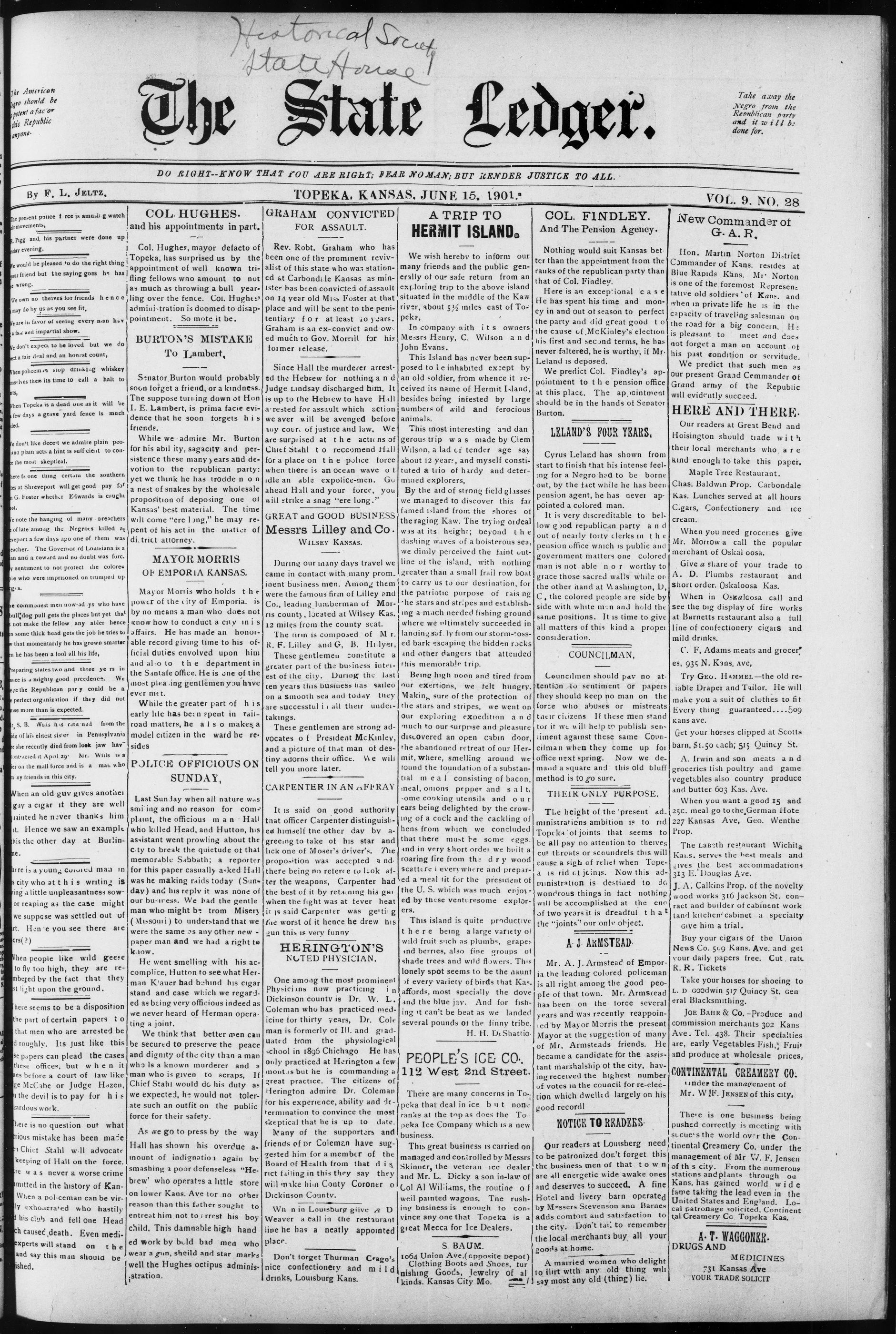
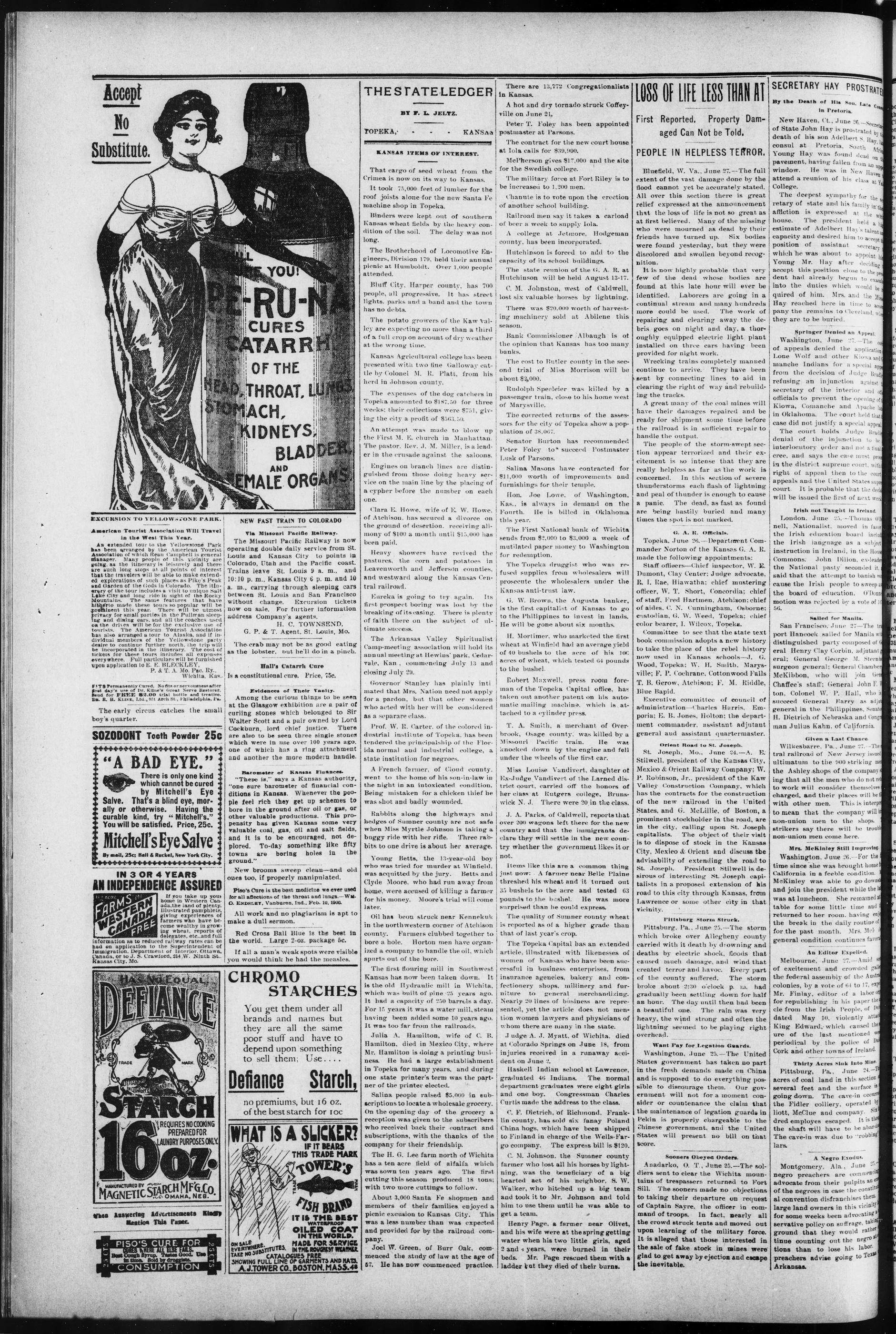
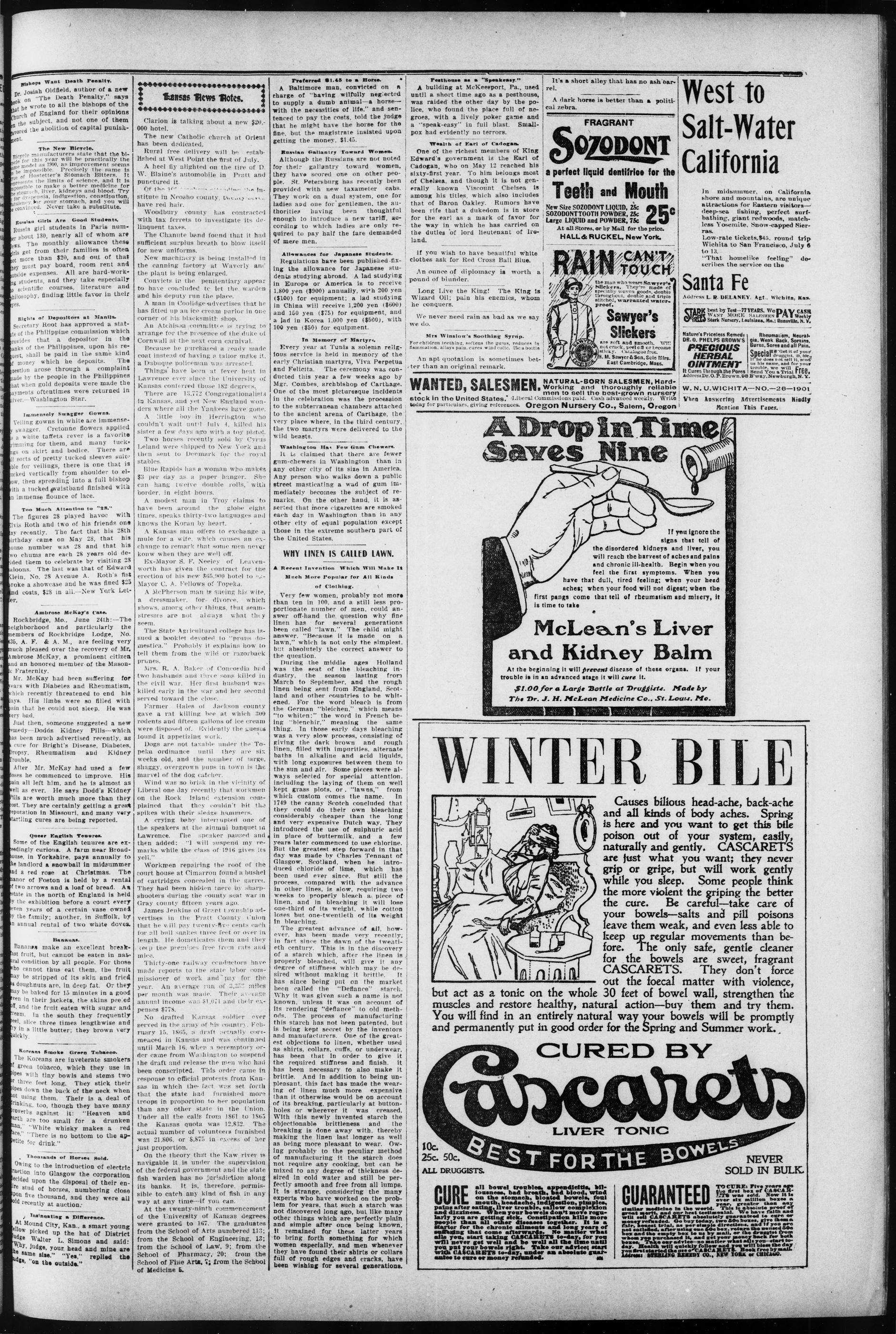
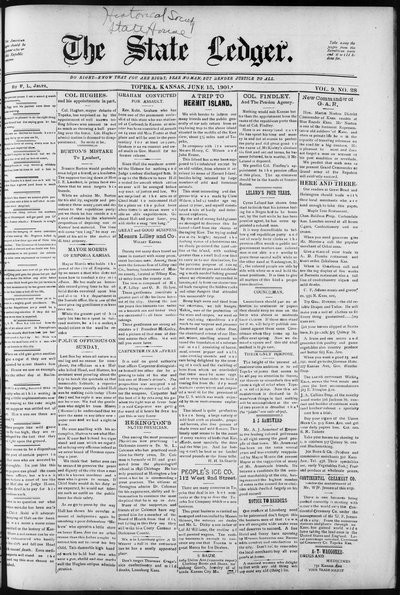
Page text (machine-generated)
The American
Migro should be
to potent a fac'or
this Republic
anyone.
By F. L. JELTZ.
The present pence free is amusing watch their movements,
Mr. Pigg and his partner were done up today evening.
We would be pleased to do the right thing your friend but the saying goes he has been wrong.
We own no theives for friends hence may do by us as you see fit.
We are in favor of seeing every man have a fair deal and an honest count.
We don't expect to be loved but we do not a fair deal and an honest count.
When policeman stop drinking whiskey myself then its time to call a halt to mits.
When Topeka is a dead one as it will be few days a grave yard fence is much died.
We don't like deceit we admire plain peo and plain acts a hint is sufficient to cone the most skeptical.
There is one thing certain the southern sites at Shreveport will get good pay for G. Foster whether Edwards is caught not.
We note the hanging of many preachers of late among the Negroes killed at report a few days ago one of them was teacher. The Governor of Louisiana is a man and a coward and no doubt was forcely sentiment to not protect the colores who were imprisoned on trumped up arrests.
he commonest men now-ad ys who have bulldog pull gets the places but yet that is not make the fellow any abler hence on some thick head gets the job he tries to w that momentarily he has grown smarter en he has been a fool all his life,
preparing states two and three yrs in force is a mighty good precedence. We urge the Republican pary could be a perfect organization if they did not mise more than is expected.
Mr. S. B. Wills has returned from the side of his eldest sister in Pennsylvania she recently died from look jaw hav contracted it April 29. Mr. Wills is a woman on the mail force and is a man who many friends in this city.
When an old guv gives another
guy a cigar if they are well
painted he never thanks him
out. Hence we saw an example
this the other day at Burlin-
me.
there is a young colored man in
city who at this writing is
giving a little unpleasantness sow-
or reaping as the case might
we suppose was settled out of
art. Hence you see there are
cers(?)
When people like wild geese to fly too high, they are remembered by the fact that they sit light upon the ground.
There seems to be a disposition the part of certain papers to that men who are arrested be dreadfully. Its just like this use papers can plead the cases these offices, but when it mes before a court of law like age McCabe or Judge Hazen, in the devil is to pay for his tardous work.
there is no question but what serious mistake has been made in Chief Stahl will advocate keeping of Hall on the force. He was never a worse crime smitted in the history of Kan- When a policeman can be virily exhonerated who hastily this club and fell one Head ch caused death. Even medi-experts will stand on the and say this man should beished.
```markdown
```
The State Ledger.
DO RIGHT--KNOW THAT YOU ARE RIGHT; FEAR NOMAN; BUT RENDER JUSTICE TO ALL.
Col. Hughes, mayor defacto of Topeka, has surprised us by the appointment of well known trifling fellows who amount to not as much as throwing a bull yearling over the fence. Col. Hughes' administration is doomed to disappointment. So mote it be.
BURTON'S MISTAKE
To Lambert.
Senator Burton would probably soon forget a friend, or a kindness. The suppose turning down of Hon I. E. Lambert, is prima facie evidence that he soon forgets his friends.
While we admire Mr. Burton for his ability, sagacity and persistence these many years and devotion to the republican party: yet we think he has trodde n on a nest of snakes by the wholesale proposition of deposing one of Kansas' best material. The time will come "ere long," he may repent of his act in the matter of di.trict attorney.
MAYOR MORRIS OF EMPORIA KANSAS.
Mayor Morris who holds the power of the city of Emporia, is by no means a man who does not know how to conduct a city in its affairs. He has made an honorable record giving time to his official duties envolved upon him and also to the department in the Santafe office. He is one of the most pleasing gentlemen you have ever met.
While the greater part of his early life has been spent in railroad matters, he also makes a model citizen in the ward he resides
POLICE OFFICIOUS ON SUNDAY.
Last Sunday when all nature was smiling and no reason for complaint, the officious man Hall who killed Head, and Hutton, his assistant went prowling about the city to break the quietude of that memorable Sabbath; a reporter for this paper casually asked Hall was he making raids today (Sunday) and his reply it was none of our business. We had the gentle man who might be from Misery (Missouri) to understand that we were the same as any other new paper man and we had a right to know.
He went smelling with his accomplice, Hutton to see what Herman K'auer had behind his cigar stand and case which we regarded as being very officious indeed as we never heard of Herman operating a joint.
We think that better men can be secured to preserve the peace and dignity of the city than a man who is a known murderer and a man who is given to scraps. If Chief Stahi would do his duty as we expected, he would not tolerate such an outfit on the public force for their safety.
As we go to press by the way Hall has shown his overdue amount of indignation again by smashing a poor defenseless "Hebrew' who operates a little store on lower Kans. Ave tor no other reason than this father sought to entreat him not to arrest his boy child. This damnable high handed work by bold bad men who wear a gun, sheild and star marks well the Hughes octipus administration.
TOPEKA, KANSAS, JUNE 15, 1901.
Rev. Robt. Graham who has been one of the prominent revivalist of this state who was stationed at Carbondale Kansas as minister has been convicted of assault on 14 year old Miss Foster at that place and will be sent to the penitentiary for at least 10 years. Graham is an ex-convict and owed much to Gov. Morrill for his former release.
Since Hall the murderer arrested the Hebrew for nothing and Judge Lindsay discharged him. It is up to the Hebrew to have Hall arrested for assault which action we aver will be avenged before any court, of justice and law. We are surprised at the actions of Chief Stahl to reccomend Hall for a place on the police force when there is an ocean wave or idle an able expolice-men. Go ahead Hall and your force, you will strike a snag "ere long."
GREAT and GOOD BUSINESS Messrs Lilley and Co. WILSEY KANSAS.
During our many days travel we came in contact with many prominent business men. Among them were the famous firm of Lilley and Co., leading lumberman of Morris county, located at Wilsey Kas. 12 miles from the county seat. The turn is composed of Mr. R. F. Lilley and G. B. Hulyer. These gentlemen constitute a greater part of the business interest of the city. During the last ten years this business has sailed on a smooth sea and today they are successful in all their undertakings.
These gentlemen are strong advocates of President McKinley, and a picture of that man of destiny adorns their office. We will tell you more later.
CARPENTER IN AN OFFRAY
It is said on good authority that officer Carpenter distinguished himself the other day by agreeing to take of his star and lick one of Moser's driver's. The proposition was accepted and there being no referee to look after the weapons, Carpenter had the best of it by retaining his gun when the fight was at fever heat it is said Carpenter was getting the worst of it hence he drew his gun this is very funny.
HERINGTON'S
NOTED PHYSICIAN.
One among the most prominent Physicians now practicing in Dickinson county is Dr. W. L. Coleman who has practiced medicine for thirty years, Dr. Coleman is formerly of Ill. and graduated from the physiological school in 1896 Chichago He has only practiced at Herington a few months but he is commanding a great practice. The citizens of Herington admire Dr. Coleman for his experience, ability and determination to convince the most skeptical that he is up to date.
Many of the supporters and friends of dr Coleman have suggested him for a member of the Board of Health from that district failing in this they say they will make him Conty Coroner or Dickinson County.
When in Louisburg giive A D Weaver a call in the restaurant line he has a neatly appointed place.
Don't forget Thurman Crago's nice confectionery and mild drinks, Louisburg Kans.
A TRIP TO HERMIT ISLAND.
We wish hereby to inform our many friends and the public generally of our safe return from an exploring trip to the above island situated in the middle of the Kaw river, about $5 \frac{1}{2}$ miles east of Topeka,
In company with its owners Messrs Henry, C. Wilson and John Evans.
This Island has never been supposed to be inhabited except by an old soldier, from whence it received its name of Hermit Island, besides being infested by large numbers of wild and ferocious animals.
This most interesting and dangerous trip was made by Clem Wilson, a lad of tender age say about 12 years, and myself constituted a trio of hardy and determined explorers,
By the aid of strong field glasses we managed to discover this far famed island from the shores of the raging Kaw. The trying ordeal was at its height; beyond the dashing waves of a boisterous sea, we dinsly perceived the faint outline of the island, with nothing greater than a small frail row boat to carry us to our destination, for the patriotic purpose of raising the stars and stripes and establishing a much needed fishing ground where we ultimately succeeded in landing safely from our storm-tossed bark escaping the hidden rocks and other dangers that attended this memorable trip.
Being high noon and tired from our exertions, we felt hungry. Making sure of the protection of the stars and stripes, we went on our exploring expedition and much to our surprise and pleasure discovered an open cabin door, the abandoned retreat of our Hermit, where, smelling around we found the foundation of a substantial meal consisting of bacon, meal, onions pepper and salt, some cooking utensils and our ears being delighted by the crowing of a cock and the cackling of hens from which we concluded that there must be some eggs, and in very short order we built a roaring fire from the dry wood scattered everywhere and prepared a meal fit for the president of the U. S. which was much enjoyed by these venturesome explorers.
This island is quite productive there being a large variety of wild fruit such as plumbs, grapes and berries, also fine groups of shade trees and wild flowers. This lonely spot seems to be the naunt of every variety of birds that Kas affords, most specially the dove and the blue jay. And for fishing it can't be beat as we landed several pounds of the finny tribe.
PEOPLE'S ICE CO.
112 West 2nd Street.
There are many concerns in Topeka that deal in ice but none ranks at the top as does the Topeka Ice Company which is a new business.
This great business is carried on managed and controlled by Messrs Skinner, the veteran ice dealer and Mr. L. Dicky a son in-law of Col Al Williams, the routine of well painted wagons. The rushing business is enough to convince any one that Topeka is a great Mecca for Ice Dealers.
S. BAUM
1064 Union Ave.(opposite depot) Clothing Boots and Shoes, turn nishing Goods, Jewelry of al kinds, Kansas City Mo.
COL. FINDLEY. And The Pension Agency.
Nothing would suit Kansas better than the appointment from the ranks of the republican party than that of Col. Findley.
Here is an exceptional case. He has spent his time and money in and out of season to perfect the party and did great good to the cause of McKinley's election his first and second terms, he has never faltered, he is worthy, if Mr. Leland is deposed.
We predict Col. Findley's appointment to the pension office at this place. The appointment should be in the hands of Senator Burton.
LELAND'S FOUR YEARS.
Cyrus Leland has shown from start to finish that his intense feeling for a Negro had to be borne out, by the fact while he has been pension agent, he has never appointed a colored man.
It is very discreditable to bellow good republican party and out of nearly forty clerks in the pension office which is public and government matters one colored man is not able nor worthy to grace those sacred walls while on the other hand at Washington, D, C, the colored people are side by side with white man and hold the same positions. It is time to give all matters of this kind a proper consideration.
COUNCIL.MAN.
Councilmen should pay no attention to sentiment or papers they should keep no man on the force who abuses or mistreats their citizens. If these men stand for it we will help to publish sentiment against these same Councilman when they come up for office next spring. Now we demand a square and this old bluff method is to go sure.
THEIR ONLY PURPOSE,
The height of the present administrations ambition is to rid Topeka of joints that seems to be all pay no attention to thieves cut throats or scoundrels this will cause a sigh of relief when Topea is rid of joints. Now this administration is destined to do wondrous things in fact nothing will be accomplished at the end of two years it is dreadful that the "joints" our only object.
A. J. AKMSTEAD
Mr. A. J. Armstead of Emporia the leading colored policeman is all right among the good people of that town. Mr. Armstead has been on the force several years and was recently reappointed by Mayor Morris the present Mayor at the suggestion of many of Mr. Armsteads friends. He became a candidate for the assistant marshalship of the city, having received the highest number of votes in the council for re-election which dwelled largely on his good recordl
NOTICE TO READERS
Our readers at Loussberg need to be patronized don't forget this the business men of that to own are all energetic wide awake ones and deserves to succeed. A fine Hotel and livery barn operated by Messers Stevenson and Barnes adds comfort and satisfaction to the city. Don't tail to remember the local merchants buy all your goods at home.
A married women who delight to flirt with any old thing will say most any old (thing) lie.
Take away the Negro from the Republican party and it will be done for.
VOL. 9. NO. 28
New Commander of G.A.R.
Hon. Martin Norton District Commander of Kans. resides at Blue Rapids Kans. Mr. Norton is one of the foremost Representative old soldiers of Kans. and when in private life he is in the capacity of traveling salesman on the road for a big concern. He is pleasant to meet and does not forget a man on account of his past condition or servitude. We predict that such men as our present Grand Commander of Grand army of the Republic will evidently succeed.
HERE AND THERE
Our readers at Great Bend and Hoisington should trade with their local merchants who are kind enough to take this paper.
Maple Tree Restaurant.
Chas. Baldwin Prop. Carbondale Kas. Lunches served at all hours C.gars, Confectionery and ice cream.
When you need groceries give Mr. Morrowa a call the popular merchant of Oskai oosa.
Give a share of your trade to A. D. Plumbs restaurant and short order. Oskaloosa Kas.
When in Oskalcosa call and see the big display of fire works at Burnetts restaurant also a full line of confectionery cigars and mild drinks.
C. F, Adams meats and grocer es, 935 N. Kans. Ave,
Try GEO. HAMMEL—the old reiable Draper and Tailor. He will make you a suit of clothes to fit Every thing guaranteed....509 kans ave.
Get your horses clipped at Scotts barn, $1.50 each; 515 Quincy St.
A. Irwin and son meats a nd groceries fish poultry and game vegetables also country produce and butter 603 Kas. Ave.
When you want a good 15 and 25c. meal go to the German Hote 227 Kansas Ave, Geo. Wenthe Prop.
The Labeth restaurant Wichita Kans. serves the best meals and gives the best accommodations 313 E. Douglas Ave.
J. A. Calkins Prop. of the novelty wood works 316 Jackson St. contract and builder of cabinent work and kitchen cabinet a specialty give him a trial.
Buy your cigars of the Union News Co. 509 Kans. Ave. and get your daily papers free. Cut rate R. R. Tickets
Take your houses for shoeing to L. D goodwin 517 Quincy St. General Blacksmithing.
JOE BAHR & Co.-Produce and commission merchants 302 Kans Ave. Tel. 438. Their specialties are, early Vegetables Fish, Fruit and produce at wholesale prices,
CONTINENTAL CREAMERY CO;
There is one business being pushed correctly is meeting with scouts the world over the Continental Creamery Co. under the management of Mr W. F. Jensen of this city. From the numerous stations and plants through on Kans, has gained world wide fame taking the lead even in the United States and England. Local patronage solicited, Continental Creamery Co. Topeka Kas.
A·T·WAGGONER-
DRUGS AND
MEDICINES
731 Kansas Ave
YOUR TRADE SOLICIT
Accept
No
Substitute.
WILL
GIVE YOU!
PE-RU-NA
CURES
CATARRH.
OF THE
HEAD, THROAT, LUNGE
STOMACH,
KIDNEYS,
BLADDER.
AND
FEMALE ORGANS.
EXCISION TO YELLOWSTONE ARK.
American Tourist Association Will Travel
In the West This Year.
An extended tour to the Yellowstone Park has been arranged by the American Tourist Association of which Reun Campbell is general manager. Many people of this vicinity are going, as the itinerary is also fully and there has been a few minutes to attend that the travelers will be able to make extended explorations of such places as Pike's Peak and Garden of the Gods in Colorado. The itinerary of the tour includes a visit to unique Salt Lake City and lone island of the Rodeo Mountain. The same features that have hitherto made these tours so popular will be prominent this year. There will be utmost privacy for small parties in the Pullman sleep-up area. The tour will be the only way to use on the drives will be for the exclusive use of tourists. The American Tourist Association has also arranged a tour to Alaska, and if individual members of the Yellowstone party desire to continue further north the trip will be incorporated in the itinerary. The cost of tickets for these tours includes all expenses everywhere. Full particulars will be furnished upon application to E. E. BLECKLEY, P.A.T.A. Mo. Pac. R.Y.
Wichita, Kass
FITS Permanently Cured. Nots or nervousness after great day's use of Dr. Kine's Great Serve to restore life. The E. E. BLECKLEY, 2001 Ariz. et Plains, F. F. Dr. B. R. KINE, Ltd., 921 Arch St., Philadelphia, Pa.
The early circus catches the small boy's quarter.
SOZODONT Tooth Powder 25c
"A BAD EYE."
There is only one kind which cannot be cured by Mitchell's Eye Salve. That's a blind eye, morally or otherwise. Having the curable kind, try "Mitchell's." You will be satisfied. Price, 25c.
Mitchell's Eye Salve
By mail, 25c; Hall & Ruckel, New York City.
IN 3 OR 4 YEARS
AN INDEPENDENCE ASSURED
Eye
FARMS
WESTERN
CANADA
FREE
HAS NO EQUAL
DEFIANCE
TRADE
MARK.
DEFIANCE
IN QUANTITY
STARCH
REQUIRES NO COOKING
PREPARED FOR
LAUNDRY PURPOSES ONLY.
16 OZ.
MANUFACTURED BY
MAGNETIC STARCH MFG.CO.
OMAHA, NEB.
When Answering Advertisements Kindly
Mention This Paper.
PISO'S CURE FOR
CORES WHERE ALL ELSE FAILS.
Best Cough Syrup. Tastes Good. Use
in time. Sold by druggists.
CONSUMPTION
NEW FAST TRAIN TO COLORADO
Via Missouri Pacific Railway.
The Missouri Pacific Railway is now operating double daily service from St. Louis and Kansas City to points in Colorado, Utah and the Pacific coast.
Trains leave St. Louis 9 a. m., and 10:10 p. m., Kansas City 6 p. m. and 10 a. m., carrying through sleeping cars between St. Louis and San Francisco without change. Excursion tickets now on sale. For further information address Company's agents.
H. C. TOWNSEND,
G. P. & T. Agent, St. Louis, Mo.
The crab may not be as good eating as the lobster, but he'll do in a pinch.
Hall's Catarrh Cure
Evidences of Their Vanity.
Among the curious things to be seen at the Glasgow exhibition are a pair of curling stones which belonged to Sir Walter Scott and a pair owned by Lord Cockburn, lord chief justice. There are also to be seen three single stones which were in use over 100 years ago. one of which has a ring attachment and another the more modern handle.
Barometer of Kansas Finances.
"There is," says a Kansas authority, "one sure barometer of financial conditions in Kansas. Whenever the people feel rich they get up schemes to bore in the ground after oil or gas, or other valuable productions. This propensity has given Kansas some very valuable coal, gas, oil and salt fields, and it is to be encouraged, not deplored. To-day something like fifty towns are boring holes in the ground."
New brooms sweep clean—and old ones too, if properly manipulated.
Piso's Cure is the best medicine we ever used for all affections of the throat and lungs. Wm. O. ENDSLEY, Vauburen, Ind. Feb. 10, 1900.
All work and no plagiarism is apt to make a dull sermon.
Red Cross Ball Blue is the best in the world. Large 2-oz. package fe.
If all a man's weak spots were visible you would think he had the measles.
CHROMO STARCHES You get them under all brands and names but they are all the same poor stuff and have to depend upon something to sell them; Use...
no premiums, but 16 oz.
of the best starch for 10c
WHAT IS A SLICKER?
IF IT BEARS
THIS TRADE MARK
TOWER'S
TRACE
FISH BRAND
That cargo of seed wheat from the Crimea is now on its way to Kansas.
It took 75,000 feet of lumber for the roof joists alone for the new Santa Fe machine shop in Topeka.
Binders were kept out of southern Kansas wheat fields by the heavy condition of the soil. The delay was not long.
The Brotherhood of Locomotive Engineers, Division 179, held their annual picnic at Humboldt. Over 1,000 people attended.
Bluff City, Harper county, has 700 people, all progressive. It has street lights, parks and a band and the town has no debts.
The potato growers of the Kaw valley are expecting no more than a third of a full crop on account of dry weather at the wrong time.
Kansas Agricultural college has been presented with two fine Galloway cattle by Colonel M. R. Platt, from his herd in Johnson county.
The expenses of the dog catchers in Topela amounted to $187.50 for three weeks: their collections were $751, giving the city a profit of $563.50.
An attempt was made to blow up the First M. E. church in Manhattan. The pastor, Rev. J. M. Miller, is a leader in the crusade against the saloons.
Engines on branch lines are distinguished from those doing heavy service on the main line by the placing of a cypher before the number on each one.
Clara E. Howe, wife of E. W. Howe, of Athelison, has secured a divorce on the ground of desertion. receiving alimony of $100 a month until $15,000 has been paid.
Heavy showers have revived the pastures, the corn and potatoes in Leavenworth and Jefferson counties, and westward along the Kansas Central railroad.
Eureka is going to try again. Its first prospect boring was lost by the breaking of its casing. There is plenty of faith there on the subject of ultimate success.
The Arkansas Valley Spiritualist Camp-meeting association will hold its annual meeting at Hewins' park, Cedarvale, Kan, commencing July 13 and closing July 29.
Governor Stanley has plainly intimated that Mrs. Nation need not apply for a pardon, but that other women who acted with her will be considered as a separare class.
Prof. W. R. Carter, of the colored industrial institute of Topeka, has been tendered the principalship of the Florida normal and industrial college, a state institution for negroes.
A French farmer, of Cloud county, went to the home of his son-in-law in the night in an intoxicated condition. Being mistaken for a chicken thief he was shot and badly wounded.
Rabbits along the highways and hedges of Sumner county are not safe when Miss Myrtle Johnson is taking a buggy ride with her rifle. Three rabbits to one drive is about her average.
Young Betts, the 13-year-old boy who was tried for murder at Winfield, was acquitted by the jury. Betts and Clyde Moore, who had run away from home, were accused of killing a farmer for his money. Moore's trial will come later.
Oil has been struck near Kennekuk in the northwestern corner of Atchison county. Farmers clubbed together to bore a hole. Horton men have organized a company to handle the oil, which sports out of the bore.
The first flouring mill in Southwest Kansas has now been taken down. It is the old Hydraulic mill in Wichita, which was built of pine 25 years ago. It had a capacity of 250 barrels a day. For 15 years it was a water mill, steam having been added some 10 years ago. It was too far from the railroads.
Julia A. Hamilton, wife of C. B. Hamilton, died in Mexico City, where Mr. Hamilton is doing a printing business. He had a large establishment in Topeka for many years, and during one state printer's term was the partner of the printer elected. Salina people raised $5,000 in subscriptions to locate a wholesale grocery. On the opening day of the grocery a reception was given to the subscribers who received back their contract and subscriptions, with the thanks of the company for their friendship.
The H. G. Lee farm north of Wichita has a ten acre field of alfalfa which was sown ten years ago. The first cutting this season produced 18 tons; with two more cuttings to follow.
About 3,000 Santa Fe shopmen and members of their families enjoyed a picnic excursion to Kansas City. This was a less number than was expected and provided for by the railroad company. Joel W. Green, of Burr Oak, commenced the study of law at the age of 57. He has now commenced practice.
There are 13,772 Congregationalists in Kansas.
A hot and dry tornado struck Coffeyville on June 21.
Peter T. Foley has been appointed postmaster at Parsons.
The contract for the new court house at Iola calls for $39,900.
McPherson gives $17,000 and the site for the Swedish college.
The military force at Fort Riley is to be increased to 1,200 men.
Chanute is to vote upon the erection of another school building.
Railroad men say it takes a carload of beer a week to supply Iola.
A college at Jetmore, Hodgeman county, has been incorporated. Hutchinson is forced to add to the capacity of its school buildings. The state reunion of the G.A.R. at Hutchinson will be held August 13-17.
C. M. Johnston, west of Caldwell, lost six valuable horses by lightning. There was $20,000 worth of harvesting machinery sold at Abilene this season. Bank Commissioner Albaugh is of the opinion that Kansas has too many banks. The cost to Butler county in the second trial of Miss Morrison will be about $2,000. Rudolph Specleier was killed by a passenger train, close to his home west of Marysville. The corrected returns of the assessors for the city of Topeka show a population of 38,067. Senator Burton has recommended Peter Foley to* succeed Postmaster Lusk of Parsons.
Salina Masons have contracted for $11,000 worth of improvements and furnishings for their temple.
Hon. Joe Lowe, of Washington, Kas., is always in demand on the Fourth. He is billed in Oklahoma this year.
The First National bank of Wichita sends from $2,000 to $3,000 a week of mutilated paper money to Washington for redemption.
The Topeka druggist who was refused supplies from wholesalers will prosecute the wholesalers under the Kansas anti-trust law.
G. W. Brown, the Augusta banker, is the first capitalist of Kansas to go to the Philippines to invest in lands. He will be gone about six months.
H. Mortimer, who marketed the first wheat at Winfield had an average yield of 40 bushels to the acre of his 100 acres of wheat, which tested 64 pounds to the bushel.
Robert Maxwell, press room foreman of the Topeka Capital office, has taken out another patent on his automatic mailing machine, which is attached to a cylinder press.
T. A. Smith, a merchant of Overbrook, Osage county, was killed by a Missouri Pacific train. He was knocked down by the engine and fell under the wheels of the first car.
Miss Louise Vandivert, daughter of Ex-Judge Vandivert of the Larned district court, carried off the honors of her class at Rutgers college, Brunswick N. J. There were 20 in the class.
J. A. Parks, of Caldwell, reports that over 200 wagons left there for the new country and that the immigrants declare they will settle in the new country whether the government likes it or not.
Items like this are a common thing just now: A farmer near Belle Plaine threshed his wheat and it turned out 35 bushels to the acre and tested 63 pounds to the bushel. He was more surprised than he could express.
The quality of Sumner county wheat is reported as of a higher grade than that of last year's crop.
The Topela Capital has an extended article, illustrated with likenesses of women of Kansas who have been successful in business enterprises, from insurance agencies, bakery and confectionery shops, millinery and furniture to general merchandizing. Nearly 20 lines of business are represented, yet the article does not mention women lawyers and physicians of whom there are many in the state. Judge A. J. Myatt, died at Colorado Springs on June 18, from injuries received in a runaway accident on June 2. Haskell Indian school at Lawrence, graduated 46 Indians. The normal department graduates were eight girls and one boy. Congressman Charles Curtis made the address to the class.
C. F. Dietrich, of Richmond, Franklin county, has sold six fanay Poland China hogs, which have been shipped to Finland in charge of the Wells-Fargo company. The express bill is $120. C. M. Johnson, the Sumner county farmer who lost all his horses by lightning, was the beneficiary of a big hearted act of his neighbor, S. W. Walker, who hitched up a big team and took it to Mr. Johnson and told him to use them until he was able to get a team. Henry Page, a farmer near Olivet, and his wife were at the spring getting water when his two little girls, aged 2 and 4 years, were burned in their beds. Mr. Page rescued them with a ladder but they died of their burns.
LOSS OF LIFE LESS THAN AT
First Reported. Property Damaged Can Not be Told.
PEOPLE IN HELPLESS TERROR.
Bluefield, W. Va., June 27.—The full extent of the vast damage done by the flood cannot yet be accurately stated. All over this section there is great relief expressed at the announcement that the loss of life is not so great as at first believed. Many of the missing who were mourned as dead by their friends have turned up. Six bodies were found yesterday, but they were discolored and swollen beyond recognition.
It is now highly probable that very few of the dead whose bodies are found at this late hour will ever be identified. Laborers are going in a continual stream and many hundreds more could be used. The work of repairing and clearing away the debris goes on night and day, a thoroughly equipped electric light plant installed on three cars having been provided for night work. Wrecking trains completely manned continue to arrive. They have been sent by connecting lines to aid in clearing the right of way and rebuilding the tracks. A great many of the coal mines will have their damages repaired and be ready for shipment some time before the railroad is in sufficient repair to handle the output.
The people of the storm-swept section appear terrorized and their excitement is so intense that they are really helpless as far as the work is concerned. In this section of severe thunderstorms each flash of lightning and peal of thunder is enough to cause a panic. The dead, as fast as found are being hastily buried and many times the spot is not marked.
G. A. R. Officials.
Topeka, June 26.—Department Commander Norton of the Kansas G. A. R. made the following appointments: Staff officers—Chief inspector, W. E. Dumont, Clay Center; Judge advocate, R. I. Iae, Hiawatha; chief mustering officer, W. T. Short, Concordia; chief of staff, Fred Hartmen, Atchison; chief of aides, C. N. Cunningham, Osborne; costodian, G. W. Weed, Topeka; chief color bearer, I. Wilcox, Topeka.
Committee to see that the state text book commission adopts a new history to take the place of the rebel history now used in Kansas schools—J. G. Wood, Topeka; W. H. Smith, Marysville; F. P. Cochrane, Cottonwood Falls T. B. Gerow, Atchison; F. M. Riddle, Blue Band.
Executive committee of council of administration—charles Harris, Emporia; E. B. Jones, Holton; the department commander, assistant adjutant general and assistant quartermaster.
Orient Road to St. Joseph.
St. Joseph, Mo., June 24.—A. E. Stilwell, president of the Kansas City, Mexico & Orient Railway Company; W. P. Robinson, Jr., president of the Kaw Valley Construction Company, which has the contracts for the construction of the new railroad in the United States, and G. McLillie, of Boston, a prominent stockholder in the road, are in the city, calling upon St. Joseph capitalists. The object of their visit is to dispose of stock in the Kansas City, Mexico & Orient and discuss the advisability of extending the road to St. Joseph. President Stilwell is desirous of interesting St. Joseph capitalists in a proposed extension of his road to this city through Kansas, from Lawrence or some other city in that vicinity.
Pittsburg Storm Struck.
Pittsburg, Pa., June 25.—The storm which broke over Allegheny county carried with it death by drowning and deaths by electric shock, floods that caused much damage, and wind that created terror and havoc. Every part of the county suffered. The storm broke about 2:30 o'clock p. m. had gradually been settling down for half an hour. The day until then had been a beautiful one. The rain was very heavy, the wind strong and often the lightning seemed to be playing right overhead.
Want Pay for Legation Guards.
Washington, June 25. -The United States government has taken no part in the fresh demands made on China and is supposed to do everything possible to discourage them. Our government will not for a moment consider or countenance the claim that the maintenance of legation guards in Pekin is properly chargeable to the Chinese government, and the United States will present no bill on that score.
Sooners Overseed Orders
Anadarko, O. T., June 25.—The soldiers sent to clear the Wichita mountains of trespassers returned to Fort Sill. The sooners made no objections to taking their departure on request of Captain Sayre, the officer in command of troops. In fact, nearly all the crowd struck tents and moved out upon learning of the military force. It is alleged that those interested in the sale of fake stock in mines were glad to get away by ejection and escape the inevitable.
By the Death of Hia Son, Late Consul in Pretoria.
New Haven, Ct., June 36.—Secretary of State John Hay is prostrated by the death of his son Adelbert S. Hay, consul at Pretoria, South Africa. Young Hay was found dead on the pavement, having fallen from an upper window. He was in New Haven to attend a reunion of his class at Yale College.
The deepest sympathy for the secretary of state and his family in the affliction is expressed at the white house. The president held a high estimate of Adelbert Hay's talent and capacity and desired him to accept position of assistant secretary which he was about to appoint to Young Mr. Hay after deciding to accept this position close to the president had already begun to examine into the duties which would be required of him. Mrs. and the Miss Hay reached here in time to accompany the remains to Cleveland, when they are to be buried.
Springer Denied an Appeal
Washington, June 27.—The case of appeals denied the application Lone Wolf and other Kiowa and manche Indians for a special appeal from the decision of Judge Brad refusing an injunction against the secretary of the interior and officials to prevent the opening of Kiowa, Comanche and Apache land in Oklahoma. The court held that case did not justify a special appeal. The court holds Judge Brad denial of the injunction to be interlocutory order and not a final cree, and says the case must proceed in the district supreme court, with right of appeal then to the court appeals and the United States supreme court. It is probable that the decision will be issued the first of next week.
Irish not Taught in Ireland.
London, June 25. - Thomas O'Donnell, Nationalist, moved in favor the Irish education board in Ireland the Irish language as a subject instruction in Ireland, in the House Commons. John Dillon, ex-leader the National pasty seconded it, said that the attempt to banish we cause the Irish people to sweep in the board of education. O'Donnion motion was rejected by a vote of 56.
Sailed for Manila.
San Francisco, June 27—The tran port Hancock sailed for Manila who distinguished party composed of general Henry Clay Corbin, adjutant eral; General George M. Sternin surgeon general; General Chamber McKibbon, who will join General Chaffee's staff; General John P.inton, Colonel W. P. Hall, who is succeed General Barry as adjutant general in the Philippines, Senator D. Dietrich of Nebraska and Congo man Julius Kahn, of California.
Given n Last Chance
Wilkesbarre, Pa., June 27. The tral railroad of New Jersey issued ultimatum to the 900 striking me the Ashley shops of the company that all the men who do not reto work will consider themselves charged, and their places will be with other men. This is interps to mean that the company will be non-union men to the shops, strikers say there will be trouble non-union men come here.
Mrs. McKinley Still Improving
Mrs. Marten is now in Washington. June 26. - For the time since she was brought home California in a feeble condition. McKinley was able to go down and join the president while the life was at luncheon. She remained at table for some little time and returned to her room, having enjoyed the break in the daily routine of for the past month. Mrs. McKinley general condition continues favor.
Melbourne, June 27.—Amid so of excitement and crowded gale the federal assembly of the Austra colonies, by a vote of 64 to 17, exe Mr. Finlay, editor of a labor or for republishing in his paper the cle from the Irish People, of Dated May 10, violently attack King Edward, which caused the ure of the last mentioned or periodical by the police of Dul Cork and other towns of Ireland.
Thirty Acres Sink Into Maine
Pittsburgh, Pa., June 24—T
acres of coal land in this section
several feet and the surface is
going down. The cave-in occurs
the Fidler colliery, operated by
liott, McClue and company. Sidr
dred employees escaped. It is tha
the shaft will have to be aboard.
The cave-in was due to 'robbing
lars.
A Negro Exodus.
Montgomery, Ala. June 27 negro preachers are commending advocate from their pulpits an end of the negroes in case the constitutive convention disfranchises them large land owners in this vicinity for some weeks been advocating a servative policy on suffrage, taking ground that they would rather tinue counting out the negroations than to lose his labor. preachers advise going to Texas Arkansas.
Bishops in Ireland.
Dr. Josiah Oldfield, author of a new book on "The Death Penalty," says that he wrote to all the bishops of the Church of England for their opinions on the subject, and not one of them favored the abolition of capital punish-
The New Bicycle.
Bicycle manufacturers state that the bicycle for this year will be practically the model as 1900, as improvement seems to be impossible. Precisely the same is true of a hostess Stomach Hitter. It is impossible to make a better medicine for the stomach, liver, kidneys and blood. Try it for dyspepsia, indigestion, constipation, malnutrition for some stomach, and you will be convinced. Never take a substitute.
**Russian Girls Are Good Students,**
Russia girl students in Paris number about 130, nearly all of whom are news. The monthly allowance these girls get from their families is often not more than $20, and out of that they must pay board, room rent and outside expenses. All are hard-working students, and they take especially to scientific courses, literature and philosophy, finding little favor in their eyes.
Fights of Depositors at Manila.
Rights of Depositors at Manila.
Secretary Root has approved a statute of the Philippine commission which provides that a depositor in the banks of the Philippines, upon his request, shall be paid in the same kind of money which he deposits. The question arose through a complaint made by the people in the Philippines that when gold deposits were made the payments oftentimes were returned in silver—Washington Star.
Immensely Swagger Gowns.
Veling gowns in white are immense-swagger. Cretton flowers applied to a white taffeta trever is a favorite trimming for them, and many tuckings on skirt and bodice. There are all sorts of pretty tucked sleeves suitable for veilings, there is one that is tucked vertically from shoulder to elbow, then spreading into a full bishop with a tucked waistband finished with an immense flounce of lace.
Too Much Attention to "28."
The figures 28 played havoc with Elvis Roth and two of his friends one day recently. The fact that his 28th birthday came on May 28, that his house number was 28 and that his two chums are each 28 years old decided them to celebrate by visiting 28 saloons. The last was that of Edward Klein, No. 28 Avenue A. Roth's first broke a showcase and he was finned $25 and costs, $28 in all.—New York Letter.
Ambrose McKay's Case.
Rockbridge, Mo., June 24th: The neighborhood and particularly the members of Rockbridge Lodge, No. 335, A. F., & A. M., are feeling very much pleased over the recovery of Mr. Ambrose McKay, a prominent citizen and an honored member of the Masonic Fraternity.
Mr. McKay had been suffering for years with Diabetes and Rheumatism, which recently threatened to end his days. His limbs were so filled with pain that he could not sleep. He was very bad.
Just then, someone suggested a new remedy—Dodds Kidney Pills—which has been much advertised recently, as a cure for Bright's Disease, Diabetes, Dropsy, Rheumatism and Kidney Trouble.
After Mr. McKay had used a few doses he commenced to improve. His main all left him, and he is almost as well as ever. He says Dodd's Kidney Pills are worth much more than they cost. They are certainly getting a great reputation in Missouri, and many very startling cures are being reported.
Ouser English Tapes.
Some of the English tenures are exceedingly curious. A farm near Broadhouse, in Yorkshire, pays annually to the landlord a snowball in midsummer and a red rose at Christmas. The manor of Foston is held by a rental of two arrows and a loaf of bread. As estate in the north of England is held by the exhibition before a court every seven years of a certain vase owned by the family; another, in Suffolk, by an annual rental of two white doves.
Bananas.
Bananas make an excellent breakfast fruit, but cannot be eaten in natural condition by all people. For those who cannot thus eat them, the fruit may be stripped of its skin and fried as doughnuts are, in deep fat. Or they may be baked for 15 minutes in a good oven in their jackets, the skins peeled off, and the fruit eaten with sugar and cream. In the south they frequently slice, slice three times lengthwise and try in a little butter; they brown very quickly.
Korean Smoke Green Tobacco
The Koreans are invadeer smokers of green tobacco, which they use in pipes with tiny bowls and stems two or three feet long. They stick their pipes down the back of the neck when not using them. Their is a deal of drinking, too, though they have many proverbs against it: "Heaven and earth are too small for a drunken man." "White whisky makes a red face." "There is no bottom to the appetite for drink."
Thousands of Horses Sold
Uwing to the introduction of electric traction into Glasgow the corporation decided upon the disposal of their entire stud of horses, numbering close upon five thousand, and they were all sold recently at auction:
Insinuating a Difference.
At Mount City, Kan., a smart young yellow pickup the up of the District judge Walter L. Simons and said: Why, judge, your head and mine are the same size." "Yes," replied the judge, "on the outside."
```markdown
```
Clarion is talking about a new $20,000 hotel.
The new Catholic church at Orient has been dedicated.
Rural free delivery will be established at West Point the first of July.
A heel fly alighted on the tire of D.W. Blaine's automobile in Pratt and punctured it.
Of the 160 churches attending the institute in Neosho county, twenty seven have red hair.
Woodbury county has contracted with tax ferrets to investigate its delinquent taxes.
The Chanute band found that it had sufficient surplus breath to blow itself for new uniforms.
New machinery is being installed in the canning factory at Waverly and the plant is being enlarged.
Convicts in the penitentiary appear to have concluded to let the warden and his deputy run the place.
A man in Coolidge advertises that he has fitted up an ice cream parlor in one corner of his blacksmith shop.
An Atchison committee is trying to arrange for the presence of the duke of Cornwall at the next corn carnival.
Because he purchased a ready made coat instead of having a tailor make it, a Dubuque policeman was arrested.
Things have been at fever heat in Lawrence ever since the University of Kansas conferred those 182 degrees.
There are 13,772 Congregationalists in Kansas, and yet New England wonders where all the Yankees have gone.
A little boy in Herrington who couldn't wait until July 4, killed his sister a few days ago with a toy pistol.
Two horses recently sold by Cyrus Leland were shipped to New York and then sent to Denmark for the royal stables.
Blue Rapids has a woman who makes $3 per day as a paper hanger. She can hang twelve double rolls, with border, in eight hours.
A modest man in Troy claims to have been around the globe eight times, speaks thirty-two languages and knows the Koran by heart.
A Kansas man offers to exchange a mule for a wife, which causes an exchange to remark that some men never know when they are well off.
Ex-Mayor S. F. Neeley of Leavenworth has given the contract for the erection of his new $65,000 hotel to Ex-Mayor C. A. Fellows of Topeka.
A McPherson man is suing his wife, a dressmaker, for divorce, which shows, among other things, that seamstresses are not always what they seem.
The State Agricultural college has issued a booklet devoted to "prunus domestica." Probably it explains how to tell them from the wild or razorback prunes.
Mrs. R. A. Baker of Concordia had two husbands and three sons killed in the civil war. Her first husband was killed early in the war and her second served toward the close.
Farmer Hales of Jackson county gave a rat killing bee at which 300 rodents and fifteen gallons of ice cream were disposed of. Evidently the guess found it appetizing work.
Dogs are not taxable under the Topela ordinance until they are six weeks old, and the number of barge, shaggy, overgrown pups in town is the marvel of the dog catcher.
Wind was so brisk in the vicinity of Liberal one day recently that workmen on the Rock Island extension complained that they couldn't hit the suites with their sleige hammers.
A crying baby interrupted one of the speakers at the alumni banquet in Lawrence. The speaker paused and then added: "I will suspend my remarks while the class of 1916 gives its yell."
Workmen repairing the roof of the court house at Cimarron found a bushel of cartridges concealed in the garret. They had been hidden there by sharpshooters during the county seat war in Gray county fifteen years ago.
James Jenkins of Grant township advertises in the Pratt County union that he will pay twenty-five cents each for all bull sankes three feet or over in length. He domesticates them and they keep the premises free from rats and mice.
Thirty-one railway conductors have made reports to the state labor commissioner of work and pay for the year. An average run of 3,353 miles per month was made. Their average annual income was $1,671 and their expenses $778.
No drafted Kansas soldier ever served in the army of his country. February 15, 1865, a draft actually cormeenced in Kansas and was continued until March 16, when a peremptory order came from Washington to suspend the draft and release the men who had been conscripted. This order came in response to official protests from Kansas in which the fact was set forth that the state had furnished more troops in proportion to her population than any other state in the Union. Under all the calls from 1861 to 1865 the Kansas quota was 12,832. The actual number of volunteers furnished was 21,806, or 8,875 in excess of her just proportion.
On the theory that the Kaw river is navigable it is under the supervision of the federal government and the state fish warden has no jurisdiction along its banks. It is, therefore, permissible to catch any kind of fish in any way at any time—if you can.
At the twenty-ninth commencement of the University of Kansas degrees were granted to 157. The graduates from the School of Arts numbered 113; from the School of Engineering, 13; from the School of Law, 9; from the School of Pharmacy, 20; from the School of Fine Arts, 7; from the School of Medicine 6.
A Baltimore man, convicted on a charge of "having wilfully neglected to supply a dumb animal—a horse—with the necessities of life," and sentenced to pay the costs, told the judge that he might have the horse for the fine, but the magistrate insisted upon getting the money, $1.45.
Russian Gallianity Toward Women.
Although the Russians are not noted for their gallantry toward women, they have scored one on other people. St. Petersburg has recently been provided with new taxameter cabs. They work on a dual system, one for ladies and one for gentlemen, the authorities having been thoughtful enough to introduce a new tariff, according to which ladies are only required to pay half the fare demanded of mere men.
Allowances for Japanese Students.
Regulations have been published fixing the allowance for Japanese students studying abroad. A lad studying in Europe or America is to receive 1,800 yen ($900) annually, with 200 yen ($100) for equipment; a lad studying in China will receive 1,200 yen ($600) and 150 yen ($75) for equipment, and a lad in Korea 1,000 yen ($500), with 100 yen ($50) for equipment.
In Memory of Martyr 4
Every year at Tunis a solemn religious service is held in memory of the early Christian martyrs, Viva Perpetua and Felicita. The ceremony was conducted this year a few weeks ago by Mgr. Combes, archbishop of Carthage. One of the most picturesque incidents in the celebration was the procession to the subterranean chambers attached to the ancient arena of Carthage, the very place where, in the third century, the two martyrs were delivered to the wild beasts.
Washington Hat Few Gum Chewers. It is claimed that there are fewer gum-chewers in Washington than in any other city of its size in America. Any person who walks down a public street masticating a wad of gum immediately becomes the subject of remarks. On the other hand, it is asserted that more cigarettes are smoked each day in Washington than in any other city of equal population except those in the extreme southern part of the United States.
WHY LINEN IS CALLED LAWN.
A Recent Invention Which Will Make It Much More Popular for All Kinds
of Clothing.
Very few women, probably not more than ten in 100, and a still less proportionate number of men, could answer offhand the question why fine linen has for several generations been called "lawn." The child might answer, "Because it is made on a lawn," which is not only the simplest, but absolutely the correct answer to the question.
During the middle ages Holland was the seat of the bleaching industry, the season lasting from March to September, and the rough linen being sent from England, Scotland and other countries to be whitened. For the word bleach is from the German "bleichen," which means "to whiten;" the word in French being "blenchir," meaning the same thing. In those early days bleaching was a very slow process, consisting of giving the dark brown and rough linen, filled with impurities, alternate baths in alkaline and acid liquids, with long exposures between them to the sun and air. Some pieces were always selected for special attention, including the laying of them on well kept grass plots, or, "hawns," from which custom comes the name. In 1749 the canny Scotch concluded that they could do their own bleaching considerably cheaper than the long and very expensive Dutch way. They introduced the use of sulphuric acid in place of buttermilk, and a few years later commenced to use chlorine. But the greatest step forward in that day was made by Charles Tennant of Glasgow, Scotland, when he introduced chloride of lime, which has been used ever since. But still the process, compared with the advance in other lines, is slow, requiring two weeks to properly bleach a piece of linen, and in bleaching it will lose one-third of its weight, while cotton loses but one-twentieth of its weight in bleaching.
The greatest advance of all, however, has been made very recently, in fact since the dawn of the twentieth century. This is in the discovery of a starch which, after the linen is properly bleached, will give it any degree of stiffness which may be desired without making it brittle. It has since being put on the market been called the "Defiance" starch. Why it was given such a name is not known, unless it was on account of its rendering "defiance" to old methods. The process of manufacturing this starch has not been patented, but is being kept secret by the inventors and manufacturers. One of the greatest objections to linen, whether used as shirts, collars, cuffs, or underwear, has been that in order to give it the required stiffness and finish, it has been necessary to also make it brittle. And in addition to being unpleasant, this fact has made the wearing of linen much more expensive than it otherwise would be on account of its breaking, particularly at buttonholes or wherever it was creased. With this newly invented starch the objectionable brittleness and the breaking is done away with, thereby making the linen last longer as well as being more pleasant to wear. Owing probably to the peculiar method of manufacturing it the starch does not require any cooking, but can be mixed to any degree of thickness desired in cold water and still be perfectly smooth and free from all lumps. It is strange, considering the many experts who have worked on the problem for years, that such a starch was not discovered long ago, but like many other things which are perfectly plain and simple after once being known, it remained for these latter years to bring forth something for which women especially, and men whenever they have found their shirts or collars full of rough edges and cracks, have been wishing for several generations.
It's a short alley that has no ash barrel.
A dark horse is better than a political zebra.
SOZODONT
a perfect liquid dentifrice for the
Teeth and Mouth
New Size SOZODONT LIQUID, 25c
SOZODONT TOOTH POWDER, 25c
Large LIQUID and POWDER, 75c
25c
At all Stores, or by Mail for the price.
HALL & RUCKEL, New York.
CAN'T TOUCH
the man who wears Sawyer's
Nickel hat. Made of
specifically woven goods, double
throughout, double and triple
dickens, warranted water-proof.
Sawyer's
Slickers
are soft and smooth. Will
not crack, peel or become
slicky. Catalogue free.
H. M. Sawyer & Son, Sole Mrs.
East Cambridge, Mass.
NATURAL-BORN SALESMEN, Hard-
Working and thoroughly reliable
men to sell the best-grown nursery
commissions paid. Cash advanced weekly.
Write egon Nursery Co., Salem, Oregon
A Drop Saves
McLee and Kid
At the beginning it will prevail trouble is in an advanced stage
$1.00 for a Large Book
The Dr. J. H. McLean
WINTE
Drop in Time
lives Nine
If you
signs
the disordered kidneys and
will reach the harvest of ac
and chronic ill-health. Be
feel the first symptoms.
have that dull, tired feeling; whe
aches; when your food will not dige
first pangs come that tell of rheumatism and
is time to take
McLean's Lite
and Kidney Bac
beginning it will prevent disease of these organ
an advanced stage it will cure it.
For a Large Bottle at Druggists. M.
J. H. McLean Medicine Co., St. Loo
TER
ADrop in Time Saves Nine
If you ignore the signs that tell of the disordered kidneys and liver, you will reach the harvest of aches and pains and chronic ill-health. Begin when you feel the first symptoms. When you have that dull, tired feeling; when your head aches; when your food will not digest; when the first pangs come that tell of rheumatism and misery, it is time to take
McLean's Liver and Kidney Balm
At the beginning it will prevent disease of these organs. If your trouble is in an advanced stage it will cure it.
$1.00 for a Large Bottle at Druggists. Made by The Dr. J. H. McLean Medicine Co., St. Louis, Mo.
WINTER BILE
A
but act as a tonic on the whole muscles and restore healthy, nat You will find in an entirely natu and permanently put in good order
in the whole 30 feet of bow healthy, natural action—but entirely natural way your be in good order for the Spring CURED
but act as a tonic on the whole 30 feet of bowel wall, strengthen the muscles and restore healthy, natural action—buy them and try them. You will find in an entirely natural way your bowels will be promptly and permanently put in good order for the Spring and Summer work.
CURED BY
Cascarets
LIVER TONIC
BEST FOR THE BOWELS
10c.
25c. 50c.
ALL DRUGGISTS.
NEVER
SOLD IN BULK.
CURE all bowel troubles, appendicitis, bloisoness, bad breath, bad blood, wind on the stomach, bloated bowels, foul stools, patting after eating, liver trouble, sallow complexion and dizziness. When your bowels don't move regularly you are getting sick. Constipation kills more people than cancer. You need to start for the chronic ailments and long years of suffering that come afterwards. No matter what all you need, start taking CASCAETS to-day, for you will never get well and be well all the time until you have a bowel problem. With CASCAETS to-day, under an absolute guarantee to cure or money refunded.
Pesthouse as a "Speakeyes." A building at McKeesport, Pa., used until a short time ago as a pesthouse, was raided the other day by the police, who found the place full of negroes, with a lively poker game and a "speak-easy" in full blast. Smallpox had evidently no terrors.
Wealth of Earl of Cadogan
One of the richest members of King Edward's government is the Earl of Cadogan, who on May 12 reached his sixty-first year. To him belongs most of Chelsea, and though it is not generally known Viscount Chelsea is among his titles, which also includes that of Baron Oakley. Rumors have been rife that a dukedom is in store for the earl as a mark of favor for the way in which he has carried on the duties of lord heutenant of Ireland.
If you wish to have beautiful white clothes ask for Red Cross Ball Blue.
An ounce of diplomacy is worth a pound of blunder.
Long Live the King! The King is Wizard Oil; pain his enemies, whom he conquers.
We never need rain as bad as we say we do.
Mrs Winslow's Soothing Syrup.
For children teething, softens the gums, reduces in fammation, always pain, cures wind colic. See a bottle.
An apt quotation is sometimes better than an original remark.
WANTED, SALESMEN.
Causes bilious head-ache, back-ache and all kinds of body aches. Spring is here and you want to get this bile poison out of your system, easily, naturally and gently. CASCARETS are just what you want; they never grip or gripe, but will work gently while you sleep. Some people think the more violent the gripping the better the cure. Be careful—take care of your bowels—salts and pill poisons leave them weak, and even less able to keep up regular movements than before. The only safe, gentle cleaner for the bowels are sweet, fragrant CASCARETS. They don't force out the foecal matter with violence.
FRAGRANT
West to Salt-Water California
In midsummer, on California shore and mountains, are unique attractions for Eastern visitors—deep-sea fishing, perfect surf-bathing, giant redwoods, matchless Yosemite, snow-capped Sierra. Low-rate tickets,$45. round trip Wichita to San Francisco, July 6 to 13. "That hometike feeling" describes the service on the
Santa Fe
Address L. R. DELANEY, Agr. Wichita, N. W.
STARK HIRES
best by Test—77 YEARS. We WANT MORE SALESMEN Stark Nursery, Locustine, Mo. Bausville, N. V.
Nature's Priceless Remedy DR. O. PHELPS BROWN'S PRECIOUS HERBAL OINTMENT
It Cures through the Pores Address Dr. O. P. Brown, 80 W. N. U. WICHITA-NO.—26-1901 When Answering Advertisements Mindly Mention This Paper.