State Ledger
Saturday, July 20, 1901
Topeka, Kansas
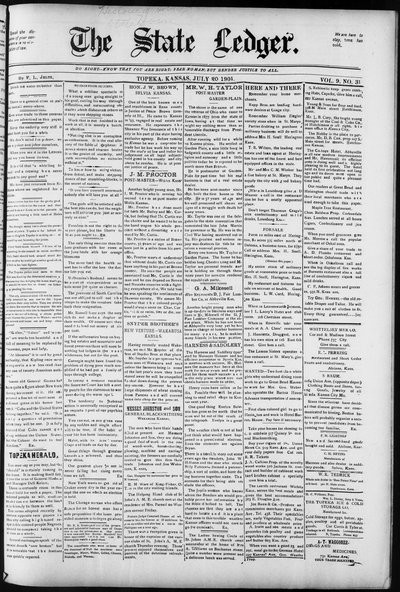
Page text (machine-generated)
Speak the dic-
tates of your con-
science is no vis-
lation of law.
By F. L. JELTZ.
Drink ice water its better than
beer.
There is a general class or jeal-
ous rascals every-where.
Give your trade to those persons who are advertised in this paper.
Keep the underlip very stiff it won't hurt you for a while
We don't mind fin pokers, we are a poker and joker ourselves,
When you see it in the LEDGER just say you know its true.
It is said that "a whistling female and a crowing hen never comes to any good end"
We have just returned from El-
Reno where we registered for a
claim.
Every eunine has his duty: the goody good
people who bellow for the cause and thur-
dor and hummer down as to the pursuits of
modesty are having a little touch of Hades
themselves.
We thought many times about the present
system of joints. Topeka is far behind the
times in English Topeka is making an—
of herself by not licensing the joints.
Chief Stahl made himself fitless of by appealing to the council to retain murderer Hall, Stahl should look around about Auburn maybe he could get another good office, if Hall is his best fighter.
The Topeka police dont seem to think Hall was fired by the determind members o the country this dodging the issure won't go, it should be seen that he draws no father pay pending his trial.
The city administration will not be materially admired by any one for the liquor question their only hobby. They see plainly in these few months that to surpass the sale of intoxicants in this city is impossible then what is the use of holding a circus police court licenses the joints as in Wichita and fire the minors and bums out and keep clean places?
"Mother," "father" and "woman" are words too beautiful and full of meaning to be replaced by "mamma, papa and lady.
"At libraries" it is said by good authority, that Kipling once most in request is now less read than any one of twenty American authors."
Gaunt old General Gomez has been quite a figure about New York during his recent vi it. He expressed a fine bit of sentiment at a dinner given in his honor last week "Cuba and the United States belong together," he said. "It is only a question of gravitation when they will be one. It is fully realized that Cuba cannot get along without the United States, but the Cubans do want to feel freedom." Ex.
TOPEKA HERALD.
You may say as you may, but the "Herald" is certainly coming to the front. It is making itself felt, it has the tone of General Hudson and Manager Dell Keizer. There is certainly room in this broad field for such a paper. The colored people as will, studious reader can see between the lines it is friendly to them as well. The terms adopted recently by certain opposite race papers in this city calling high toned respectable colored people Negroes, should be compared taking the dolls as a whole.
Several exchanges speak of the recent drouth "now broken" but it is noticable that the fracture was quickly repaired.
The State Ledger.
DO RIGHT--KNOW THAT YOU ARE RIGHT; FEAR NOMAN; BUT RENDER JUSTICE TO ALL.
What a sublime spectacle is of a young man going straight to his goal, cutting his way through difficulties, and surmounting obstacles which dishearten others as it they were stepping stones.
Work that is not finished is no work at all, it is merely a botch, an abortion.
"Nothing else is so contagious as enthusiasm. It is the real allegory of the fable of Orpheus: it moves stones and charms brutes it is the genius of sincerity, and truth accomplishes no victories without it."
To know how to wring victory from defeat, and make stepping stones of our stumbling-blocks, is the secret of success.
"It you love yourself overmuch nobody else will love you at all"
"The gods will be satisfied with the best you can do, but the neighbors will criticise you just as severely as ever."
Freedom is not the right to do as you please, but the liberty to do as you ought to...Ex.
The only thing sweeter than the June graduate with her roses is the June bride with her orange blossoms
The more food the health resort has to offer the less the doctor lets you eat.
Wilhemina's husband seems to be a sort of vice-president or to hole some job quite as obscure.
The governor of South Carolina was not obliged to call out the troops to make the senators take back their resignation.
Mr. Russell Sige says the very rich do not make a display of their wealth. Of course not: they need it to lend out money at six per cent.
If the millionaries keep on buying big estates and mountains and forest preserves there will soon be nothing but lodges in the vast wilderness, but not for the poet.
Carnegie might have found the problem of dying poor much simplified if he had put a family of boys through college.
In taking a summer vacation the Supreme Court has left a pretty puzzle for the statesman to wor over during the warm spell.
The tendency to habitual action is universally recognized as an important part of our psychical nature.
You cannot, in any given case by any sudden and single effort will to be true, if the habit of your life has been insincerity.
Habit, with its iron sinews Claps and leads us day by day.
Great things through greatest hazards are achieved, and then they shine.
Our greatest glory is not in never falling but rising every time we fall. Ex
New York wants to get rid of Croker every day in the year except the one on which an election is held.
The Chicaga woman who offers $1,000 for an honest man has a safe proposition if she loses provided museum privileges go along.
Mr. B, A. Rosenquist one of the prominent and substantial business men of Osage city is out for postmaster at that place it was rumored that Banker Marshall had been appointed but it is not true Mr. Rosenquist stands a good show.
The councilmen who were in favor of the dismissal of Hall the murderer were Snattinger, Myers, Weber, Griley, Chaney, Nichols, and Warnes.
TOPEKA, KANSAS, JULY 20 1901
HON. J. W. BROWN,
SYLVIA KANSAS.
MR. W. H. TAYLOR
POST-MASTER
One of the best known men and republicans in Reno county is Justice of Peace Brown formerly of Ill., He came to Kansas in '93, engaged in real estate and insurance. He represents the Shawnee Fire Insurance of this city in his part of the state having exclusive agency. Before coming to Kansas he was a carpenter by trade but he has work his way up by the study of law and today his judgement on all legal subjects hold good in his county and city where he resides. He is at present justice of peace.
Another bright young man, Mr. J. M. Proctor who is serving his second term as post master at Willis Kansas.
Mr. Proctor has done much for both Mr. Bailey and Mr. Curtis, but feeling that Mr. Curtis was the choice and he wanted to be on the band wagon his whole precinct without a disserting vote stood by Mr. Curtis.
Mr. Proctor is a native of Brown county, 35 years of age and was born just in 4 miles from his post office.
Mr, Proctor wants it understood that without doubt Mr, Curtis can have anything in his part of Brown county. He says the people are convinced that Mr, Curtis is the man and he can depend on Brown and Neinaha counties with a fighting everywhere else. We told him he was speaking the sentiments of Shawnee county. We assure Mr. Proctor that the colored people would always unite on Chas, Curtis, "tink or swim, live or die, survive or perish."
SNYDER BROTHER'S NEW VENTURE--WAKARUSA KANSAS,
Having recently visited Wakarusa, we met Mr. Snyder of the firm of Snyder Bros. at that place. Mr. Snyder is a prosperous business man of Wakarusa and says unless the farmers bring in some of the last year's corn they have stored away he will be compelled to shut down during the present dry season. However he has large shipments of wheat coming from Parsons and will convert same into chop for the present.
MESSRS JOHNSTON and SON GENERAL BLACKSMITHING WAKARUSA KANSAS,
The men who have their hands filled at present are Messers Johnston and Son, they are doing a good deal of work in the line of wood-work, horse-shooring, plowing, machine and carriage painting, the farmers are cordially invited to give this firm their trade Johnston and Son Wakarusa, Kansas,
Geo. Hungate the auctioneer has gone to Elinwood.
E. M Ware of King-Fisher, O.
T. is in the city visiting friends.
The Helping Hand club of St John's A. M. E. church met at the residence of Mrs. Parnell on Western avenue Friday.
Probate Judge Campbell Pleases all who come to hia for license at Hutchinson he is an ex soldier and also lost a son in the Phillpine not a year ago.
There was a reception given in honor of the captains of the various clubs of St, John's A, M, E church Thursday evening. Those present enjoyed themselves and parrook of the delicious refreshments,
The above is the name of one the veteran of Ohio who came to Kansas in 1877 from the state of Iowa, having at that time we might say nothing more than an honorable discharge from President Lincoln.
After running wild for a while on Kansas plains. He settled at Garden Plain, a nice little burg in Sedgwick county and a little religion and economy and a little politics today he is reputed to be worth more than $15000.
He is postmaster at Garden Plain for past time but his real business is that of a real estate dealer.
He has been post-master since 1892, built the first house in the city. He is 57 years of age and his well preserved self shows no signs of a struggle with death for many years. Mr. Taylor was one of the delegates to the state convention that nominated the late John Martin for governor in '84. He was in the Civil War having mustered out in '64. His greatest and serious injury was deafness for this he receives a nominal pension,
Every one honors Mr. Taylor at Garden Plaine. The home he has held so long, Chester Long and Mr. Taylor are personal friends and he is holding on through these many years for services rendered the republicah party.
G. A. Mikesell
Another bright young man who is up-to-date in business ways and lines is Mr. Mikesell of the D, J. Fair Lumber Company at the above place. While he has not been at Abbyville very long yet he has been in charge of lumber business for many years, he is making many friends in his new position,
HARNESS & SADDLERY
The Harness and Saddlery operated by Manager Holmes and his efficient proprietor at Sylvia Kas, is meeting with success, Mr. Holmes the manager has been at this work for many years and we predict for them much success as it is the only place where you can obtain harness made to order,
Heavy rains have fallen in India. Possible they will be planning to send relief ships to Kansas next year.
One good thing Evelyn Bal<sup>a</sup>win has gone so far north that he soon will be out of the reach of the telegraph. Evelyn is a great poser.
The weather clerk is not at bad Just think what would have happened in a presidential election. Even the elements are against Bryan.
There is a horrible story out some years ago the Benders, John W Hullunon and the mae who struck Billy Patterson formed a partnership, a sort of union, and have doing business together since. That accounts for their being able to elude the officers,
The Joplin woman who knows where the Benders are would probably prove her information by the Bible if bribed to tell. The chances are that they are not hard to locate and it is a place that even in this terrible weather Kansas officers would not care to go for criminals. Ex,
The Ladies Sewing Circle of St. Johns A.M.E. church meet weeneday at the home of Mrs A. Williams on Bnchanan street. Quite a number were present and a delicious lunch was served.
HERE AND THERE
Remember your home merchants.
Rapp Bros. are leading hardware dealers at Osage city.
Remember William Ziegler' variety store when in St. Marys.
Parties desiring to purchase a millinary business will do well to address Mrs H. Snell Herington Kans.
T. R. Wilson, the leading real estate and loan agent at Herington has one of the finest and best equipped offices in the state.
Mr. and Mrs C. M. Winker has a fine bakery at St. Marys. They supply the city with good bakery goods
When in Louisburg giive A D Weaver a call in the restaurant line he has a neatly appointed place.
Don't forget Thurman Crago's nice confectionery and mild drinks, Louisburg Kau.
FORSALE
Farm 10 miles east of Herington, 80 acres 3½ miles north of Delema, a business town, for 1859 Call or address Mrs. H. Snell. Herington, Kans.
(Mention this paper.)
My entire stock of millinery goods at reasonable price or trade Mrs. H. Snell, Herington, Kans.
My restaurant and fixtures for sale on account of health. Good business. L. W. Curd, Herington on Kans
When in Leavenworth tremem. ber J. L. Lacey's Hotel and club room. 218 Cherokee street.
When in Rossville take your meals at A. A Cless' restaurant J. Henrietta, Druggest, now has his own store at 116 East 6th street. Give him a call.
The Lemon Sisters operates a fine restaurant at St. Mary's, give them a call.
WANTED—Two first class white girls who understand dining room work to go to Great Bend Kansas to work for Mrs. Geo. Weber who operates the Barton House Advance transportation if necessary.
First class colored girl to go to Herington and work in Hotel Barrete House. Pay fare if necessary.
Take your houses for shoeing to L. D goodwin 517 Quincy St. General Blacksmithing.
Buy your cigars of the Union News Co. 509 Kans. Ave. and get your daily papers free Cut rate R. R. Tickets
J. A. Calkins Prop. of the novelty wood works 316 Jackson St. contract and builder of cabinent work tand kitchen cabinet a specialty give him a trial.
The Labeth restaurant Wichita Kans. serves the best meals and gives the best accommodations 313 E. Douglas Ave.
JOE BAHR & Co. -Produce an commission merchants 302 Kans, Ave. Tel. 438. Their specialties are, early Vegetables Fish, Fruit and produce at wholesale price A. Irwin and son meats and groceries fish poultry and game vegetables also country produce and butter 603 Kas. Ave.
When you want a good 15 and 25c. meal go to the German Hotel 227 Kansas! Ave. Geo. Wenthe Prop.
We are here to stay, time has told.
VOL. 9, NO. 31
S, Rabinwitz keep gents clothing Hats, Caps&c, Give him a call,
222 Kansas avenue,
Young & Sons for flour and feed,
328 N Main street Hutchinson,
Kans.
Mr. L, B. Cory, the bright young manager of the Coal & Coke Co. of Hutchinson is all right, his main office is Kansas City.
The Nobby is the place to patronize, Mr, D, B. Cox, prop 107 S. Main street for meats, Hutchinson Kansas.
The Co. toge Hotel, Abbyville is all new modern improvements and Mr, Havercroit its efficient prop is doing well and is highly pleasing to its guest. The hotel held its first celebration not long ago and its doors were open to the public and quite a pleasant time had,
Our readers at Great Bend and Hoisington should trade with their local merchants who are kind enough to take this paper.
Maple Tree Restaurant.
Chas. Baldwin Prop. Carbondale Kas. Lunches served at all hours Cigars, Confectionery and ice cream.
When you need groceries give Mr. Morrowa call the popular merchant of Oskal oosa.
Give a share of your trade to A. D. Plumbs restaurant and short order. Oskaloosa Kas.
When in Oskaloosa call and see the big display of fire works at Burnetts restaurant also a full line of confectionery cigars and mild drinks.
C. F, Adams meats and grocer es, 935 N. Kans Ave,
Try Geo. Hammel—the old reiable Draper and Tailor. He will make you a suit of clothes to fit. Every thing guaranteed...50g kans ave.
WHITTELSEY MER CO,
Cor 2nd & Madison Street
Phone 732 City
Give them a call.
Restaurant and Short Order Fruits and confectioney.
Abilene, Kans.
S BAUM.
1064 Union Ave. (opposite depot) Clothing Boots and Shoes, turing Goods, Jewelry of all ki nds. Kansas City Mo.
Since the scientist have decided that disease germs are communicated by kissing, Boston babies will probably organize a society to prevent candidates from becoming too familiar, Ex.
P. M. LIGHTNER
New and Second-hand goods bought and sold. Abilene, Kan-
Harness and also dealer in saddlery goods. Sylvia, Kans.
W. R. TEDRICK
Whole sale dealer in 'Boss Patent Flour' and m'll feed. 320 N. Main street.
Hutchinson, Kans.
H. F. Williams, Pres.
Wm. L. Dickey, Secy & Treas.
THE TOPEKA ICE & COLD STORAGE CO,
Manufactured Ice.
Cold Storage for eggs, butter, apples, poultry and all perishable goods,
Cor Curtis & Tyler st.
Trackage to all Railroads. Correspondence solicited. N, Topeka. Phone 657
A. T. WAGGONER.
DRUGS AND
MEDICINES.
731 Kansas Ave;
YOUR TRADE SOLICITED
THE STATE LEDGER
BY F. L. JELTZ.
EANSAS ITEMS OF INTEREST.
The assessors found 12,515 pianos in the state.
The funds in the Kansas state treasury on July 18 footed up $276,915.99.
The broom corn crop is short in Illinois and also in Kansas, where a great quantity is usually produced.
Ed Heeny, of Doniphan county, is dead at the age of over 103 years. He had lived in the county since 1870.
A ball game at Fort Scott between a local team and a team from Nevada. Mo., ended with a general fight.
Wm. Archer, of Ellinwood, was one of the many losers by fire in the wheat fields. He lost a threshing outfit.
The Chautauqua assembles in Kansas have not been so successful as usual this summer; probably on account of the heat.
The district court of Lyon county has a suit brought by the Santa Fe to restrain the Orient road from crossing its tracks in its yards.
Misses Blanche Casey and Mary Bellew, of Wichita. left home in the morning, registered at El Reno and reached home the same night.
A tramp crawled into an engine tank at Wichita and when the train took water at Mulvane he was almost drowned when the tank was filled.
The new law became effective this month which increases the salaries of the insurance commissioner and the secretary of agriculture from $2,000 to $2,500 a year each.
Threshing machines burned are reported daily from some place in the state. The latest was a new one which burned near Cawker City, together with 250 bushels of wheat.
Farmers of Jackson county have petitioned the railroads to fix low rates for the bringing in of stock feed and fix rates for the removal of stock from one point to another in the state.
Harriet G. Melvin died at Troy recently, aged 98 years. She was probably the only real "Daughter of the American Revolution" in Kansas. Her father fought with General Stark.
J. G. Mohler has been appointed by Secretary Coburn of the state board of agriculture as assistant secretary at $1,500 a year. This office was created at the last session of the legislature.
A second edition of Secretary Coburn's biennial report is ready for distribution. This edition is of 7,500 volumes; the first edition was of 15,000, and it was exhausted within 30 days. Copies of the new state school laws have been sent from the office of the state superintendent to each of the 30,000 school officers in the state. There was about nine tons of these books sent out. The police of Wichita say that the town has more thieves than ever before. They have centered there to operate their calling upon the heavy travel caused by the opening of the new lands.
A prairie fire north of Larned destroyed 40,000 bushels of wheat in the stack. Frank Junod, while fighting fire, inhaled flames and was reported dying. Several buildings were burned and many tons of prairie hay.
Cattle in Barber county are reported as doing finely, have good pasture and enough water, though there is some complaint about the latter. They have buffalo grass there. Barber county will have plenty of fat cattle to ship.
A drive of 60 miles over the western part of Sedgwick county by James Allison, of Wichita, showed evidence that the condition of the country is badly represented. The pastures are green and there are miles of corn fields in good condition.
Captain Wm. H. Floyd, of Topeka, who was killed in a wreck in Missouri, was a messenger of the Weils-Fargo express company. He entered the service of the company at the close of the civil war in which he served, and had been with the company ever since. The interior department was ordered the boarding school at Great Nemaha reservation in Kansas to be abandoned as the Indians have outgrown the conditions under which the school was necessary. One recent mail brought to the collector of internal revenue at Leavenworth 208 applications for liquor dealers' stamps. Kansas City Grain merchants agree in the statement that the Kansas wheat crop never was so large nor the grain so good.
A county convention has been called in Montgomery county to choose a candidate for sheriff to hold office during the year preceding the biennial election. The governor will be asked to appoint the man the convention selects.
Three graduates of the Kansas normal school go to the Philippines under three year contracts with the government to teach. They are D. C. Fisher, Douglas county; A. B. Powell, Marshall county, and David Carson, Neohe county.
Ice is priced at $30 a ton at Ashland.
On August 8 the old soldiers of Harvey county will picnic at Halstead.
War has been declared on the Russian thistle in the northwestern counties.
Miss Lizzie Bushyward, of Salina, was found in a stairway unconscious from heat.
All the saloons in Fort Scott closed pending the result of injunction proceedings.
On the Wellington market corn and wheat sold at the same price on a recent day.
The Kansas Girl band of Wetmore is to give concerts in the large cities of the east.
A new coal mine is to be opened in the Pittsburg district which will employ 600 miners. Wheat is going to market slowly, receipts being much less than at this time last year. There is complaint in Western Kansas that too many cattle are shipped there for pasturing. Miss Helen Gould has given a $1,000 library and a $300 music box to the Y. M. C. A., of Ellis. Contract has been let for the building of a new $10,000 Presbyterian church in Hiawatha. The Orient grading gang which has been at work in Emporia is now at work in Chase county. On July 20 there were four deaths from heat in Kansas City, Ks., and two on the Missouri side.
S. N. Harper had 16 acres of wheat near Menoken, Shawnee county, which threshed out 608 bushels.
The retail clerks of Horton struck for early closing and the state labor commissioner went there to fix things.
The Santa Fe uses from 5,000 to 5,000 tons of coal a month at Topeka. At Argentine the consumption runs from 5,000 to 9,000 tons.
Will R. Spillman, of Manhattan, has been appointed private secretary to Joe L. Bristow. Spillman has been in Washington since 1807.
Since Governor Stanley has been in office he has made more speeches at more places in the state than any other three former governors.
1 An Independence woman has sued for a divorce, alleging that she cut wood and hauled it to town all last winter while her husband loafed. Wichita boomers are organized for the purpose of getting prompt news of the El Reuo drawing which commences July 29. It is proposed to have a trusted agent on the ground to wire names as fast as they are posted. Oil tanks for locomotives are being made in the Santa Fe's Topeka shops and shipped to Cleburne, Texas, for use on the Gulf road. There are two tanks for each tender, one fills the coal space and another shallow one is on top of that and nearly the width of the tender.
Leavenworth has many slot machines that have been driven out of Missouri. Mrs. Dickens, who has two boys who have been induced to gamble in a certain place in Leavenworth, went to the place and broke up the slot machines and all other gambling appurtenances in the place, doing it all with a hatchet.
Dr. Eliphalet Patee, of Manhattan, has deposited with the state historical society a powder horn carried by his great-grandfather, Edmund Patee, and bearing his name and the date 1774. Edmund Patee, tradition says, was the soldier who executed Major Andre, the British spy who conspired with Benedict Arnold.
Linn and Barber counties will elect county printers this fall, who will do the county work at prices fixed by law.
Current prices of corn, bran, shorts and wheat should be adjusted to a more consistent basis. At some points the price of a pound and a quarter of wheat is required to pay for a pound of corn, when wheat is worth more than corn for any purpose. Again, while wheat brings $16 a ton bran is sold at $22 a ton and the flour from a ton of wheat is worth more than $34 a ton.
The engine room of the Hutchinson feed mill is burned. An elevator and the Missouri Pacific depot were in danger.
The bonded indebtedness of Shawnee county, townships, cities and school districts is $616,000. The assessment of property for taxation in the county is $16,630,425.
Topeka did not get any of that big rain most of the state was blessed with the other night. The rain came within 40 miles east and southwest. Topeka had a dry thunderstorm only. Farmers in the dryest sections of the state are said to be plowing their early cornfields for sowing wheat and alfalfa. Warden Jewett was prostrated by heat for several days so badly at the penitentiary that he could not receive visitors. A passenger train was held at Marion on account of the Peabody wreck, with 150 passengers. The people of Marion got out their carriages and took the passengers to Central park and served them ice cream and lemonade.
THE REVISIONERS.
THE REVISIONERS.
STRONG STAND TAKEN BY
SENATOR GALLINGER.
He Opposes Tariff Tinkering of All
Sorts, Whether by Direct Legislation
or by Special Treaties for the Promotion of Foreign Trade.
Senator Gallinger of New Hampshire, who has during his entire public career been one of the most persistent and able advocates of the tariff policy of the Republican party, was recently asked his opinion as to the present agitation for a repeal of certain tariff duties and the modification of the Dingley tariff through the ratification of the reciprocity treaties negotiated by Mr. Kasson. The senator's reply was as follows:
The Democratic party in its economic blindness and political perversity is consulted the treaties in question and ratification of legislation such as has been unwisely opposed by Representative Babcock. That treaty is due to the doctrine of Free-Trade, and many of the laws that allow low Tariff law has been proclaimed in the books; but how any Republican or Republican newspaper can advocate that policy surpasses my comprehension. It would be the sorrow and suffering incidents upon the tariff law Tariff bill is recent enough to be fresh in the minds of our people, and that all cases would instinctively shrink from a republican government, if they had forgotten those dark days, and even some Republicans have succumbed to the siren voice of Free-Trade. For one reason, the unqualifiedly proposed to any change in the Tariff laws of the United States. Under them the country has had four years of unexamined prosperity, and I do not proclaim that it has been agitating for an abandonment of Production and a return to practical Free-Trade.
The proposed treaty with the Argentine Republic reduces the duties on wool 20 percent, and the ratified will inevitably strike down blood-bleeding and disastrous cases as that which resulted from President Cleveland's advocacy of free wool. The wool-producing states should rise in aligning with age-to-age relations, and give the matter its eternal quietus. The proposed treaty with France deals a heavy blow to certain lines of manufacturing in the United States, and, so the commercial evidence of the treaties agreed to by Mr. Kasson is inimical to American interests and ought to be rejected by the state.
As for the Babcock edition, that is the term "the services discussion." The man who claims that trusts the treated by Tariff legislation has certainly not given serious thought to the proposition, and the legislator who believes that trusts the entire country by the long-due action on certain classes of goods should join a kindergarten class in economics, unless the proposition is to destroy the trust by destroying the industry. Thus closing the service is the same thing that is to the mechanics and laboring men of this country. The man who saw off the limb of the tree on which he sat got rid of the limb, but his bruises and broken�ons remained to be long to the folly. The undertaking
The Republican party came into power because of its advocacy of Protection and when the party abandons that policy it lost ground in the party with remain trust. Just now there are evidences of timidity and retrogression in some quarters, but I feel confident that when the hour of the party will remain trust to its traditional policy, and that the Kasson reciprocity treaties and the Babcock Free-Trade proposition will alike go to the party with remain trust. The duty of the Republican party is plain, and woe be to the man who attempts to strike down Protection in this country.
Senator Gallinger is noted for his plain, outspoken way of stating his views. You always know just where he stands. A little more than a year ago in a public speech he said, regarding the movement to remove the duties from paper and pulp:
You can not select a single industry for the protection of the whole system of Protection. If Protection is withheld from one industry it must be withheld from all.
That warning was heeded. The bill in question was never pressed for passage. Today so influential a news-
SENATOR GALLINGER.
SENATOR GALLIERER paper as the San Francisco "Chronicle" is saying in reference to the Kasson scheme of reciprocity treaties:
These things are worth thinking about. They should engage the serious consideration of revisionaries and reciprocators.
Reciprocity Treaties Again
Reciprocity Treaties Acta.
It would be interesting to know the facts in the case of the alleged reciprocity treaty negotiations between the United States and Germany. We find it difficult to believe that our ambassador at Berlin is seriously encouraging the German government in this regard, at least upon his own motion. If he has kept in touch with the representatives of American thought and purpose, he must know that the so-called reciprocity treaties have been set aside by the senate. If he has carefully examined the organic law of the land he must believe that the senate and the state department cannot enact laws to create a public revenue. In a word, there seems to be absolutely nothing to warrant the faintest hope that any treaty of the kind mentioned will ever acquire the force of law, and yet if we may accept half the statements contained in our foreign press reports, Mr.
White, United States envoy to Germany is gravely confabulating with the authorities at Berlin alternately exalted and depressed by developments within the empire.
The language of the constitution seems to be unmistakable. It provides that laws intended to create a public revenue shall originate in the House of Representatives, and while the Senate is authorized to offer amendments to such laws, the concurrence of the House is indispensable to their validity. If there be in all this a hook upon which to hang tariff laws made by the state department and the senate acting in collusion and without the knowledge and consent of the House, we are too dullwitted to discern it. Nevertheless, Ambassador White is said to be solemnly pushing the reck-procity negotions, and the wires are warm with messages of rapprochement and tender yieldings and all the rest of the affectionate folderol which makes diplomacy so beautiful and bright a thing.—Washington Post.
AREN'T THEY DAISIES?
AREN'T THEY DAISIES?
Dissecting the Babcock Plan.
Discussion of Representative Babcock's idea of removing the tariff from all products of the steel trust has brought out some interesting facts about the steel trade. it has been shown that big as the trust is, it by no means controls the steel trade in this country, there being many establishments some of them employing a large number of men, which have no connection with the trust. It seems to be generally admitted that the removal of the tdriff on steel products would not injure the big trust to any marked extent, but it is claimed that it would necessitate an immediate reduction of the trust. This claim, which is being made by those who ought to know whereof they speak, is causing many who were at first inclined to favor M. Babcock's idea to entertain doubts of its wisdom, and if it be substantiated by unprejudiced investigation which a number of members of the House are quietly making, the bill for the repeal of the tariff on steel products will not be supported by a corporal's guard of Republicans in either branch of Congress at the coming session. Desirable as many consider it to curb the power of the big trusts, the Republican majority in congress are not going to be stamped into the support of anything of the sort without carefully considering it from every point of view, and they will certainly not allow any legislation to get through that will reduce the wages of American workingmen—Crawfordsville (Ind.) Journal.
Protection Gains Foreign Markets. Our increase of exports during the fiscal year 1901 over the preceding year will approach $100,000,000. This, too, has been done without the sacrifice of a single American industry or the loss of a single job. Were our exports to Porto Rico and the Hawaiian Islands included, as formerly, $20,000,000 could be added to the above amount, which is, in itself, very satisfactory, considering the war in China, "European retaliation," etc. Protection gains more foreign markets than free trade, and preserves our grand home market as well.
---
Higher Than Under Free Trade.
The wool sales at Price yesterday averaged over 11 cents. This of course, is not as high as wool raisers have got at some times, and it is below the average for wool under this Republican administration but it is so much higher than the average under the Democratic administration that preceded it that it takes the cheek of a mump sufferer for a Democrat to speak of low prices for wool.—Salt Lake City Tribune.
Expanding Home Market.
Bank clearings throughout the country continue to show about 25 per cent increase over last year. This is outside of New York City, where the increase is over 75 per cent. This means that the Dingley law is expanding our home market to the value of at least $10,000,000,000 a year. And yet the free-trade trust want us to abandon our home market and try for some foreign sales in competition with the pauper labor of the world.
Farmers Getting Rich.
The farmers of the United States are getting wealthy. The banks are bulging with their money. Abandoned farms and farm mortgages are a thing of the past, and instead of paying from 6 to 10 per cent for money, our western farmers, after buying all the necessaries and luxuries they want, have money to lend.
The census returns giving the area of various states show that the one which has the largest amount of land under water is Florida, and the least, in proportion to size Wyoming.
ECONOMY IN THE ARMY
In the Philippines Planned by Generals Corbin and Chaffee. A SAVING OF 60 PER CENT.
Manila, July 24.—The conference between Adjutant General Corbin and General Chaffee, recently held here, will probably result in radical economical and administrative reforms in the army of occupation. It is estimated that the total cost of maintaining the American army in the Philippines can be reduced by 60 per cent in the course of one year. The principal change will be the reduction of the present force to between 20,000 and 30,000 men. The abolishment of the present army districts is contemplated, and three brigades with permanent headquarters at Manila, Dagupan and Iloilo or Cebu, will be instituted in their stead. The troops will be concentrated at three points selected, abandoning all minor posts. These changes will result in an enormous saving in the transportation of supplies and the paying of rental for barracks for the soldiers. At present, in most towns, the troops are quartered in churches, convents and public and private buildings, for the use of which considerable rental should be paid for the soldiers' quarters if their occupancy is continued, since these regions are pacified and their inhabitants have sworn allegiance to the United States.
What Judge Dale Says.
Guthrie, Ok. July 25.—"Any person may relinquish back to the government any tract of land, for which he has made filing, at any time after the land has been filed upon, but not until sixty days after the opening of the lands to settlement. If a person relinquishes prior to the end of the sixty days, no one can file on the land relinquished except those who receive in the drawing the number which entitles them to file." These are Judge Dale's words.
The matter of relinquishing has been discussed generally by prospective settlers and by the newspapers in attempting to give correct statements to their readers. The statement of Judge Dale will be of great interest, as it comes from one thoroughly experienced in all matters of the kind.
Anyone Can Bring Sult
Washington, July 25.—Secretary Hitchcock said, with reference to the effort to prevent the opening of the Oklahoma lands to settlement by injunction proceedings at El Reno, that the preparations of the department for the opening would go on just as if no suit had been begun.
"We shall not let the matter go by default," he said, "but we apprehend no obstacle from that proceeding. Anyone can bring a suit."
The Elevator Matter.
Topeka, July 25.—The railroad board received a direct refusal from the Union Pacific to permit the erection of elevators on their right of way at Delphos and Louray, and a denial of the right of the board to so order. As a result the constitutionality of the new law will probably be brought into the supreme court and the powers of the commissioners defined.
Illegal Fences in Oregon.
Portland, Ore., July 23—Judge Bellinger, in the United States court, has decided that the Jesse D. Carr Land and Livestock company has illegally fenced in 84,000 acres of government land in Southern Oregon and Northern California. The decree of the court directs the United States marshal to tear down the fences. An appeal will probably be taken.
Oiling the Right of Way.
Albuquerque, July 24.—The Santa Fe is not only using oil as fuel on its lines west of Albuquerque, but is also using it to sprinkle the tracks with, thereby keeping the dust down and making the trip through Arizona deserts a pleasant one. The cost of sprinkling the track with oil amounts to about $50 a mile. The Santa Fe has already oiled about 1,500 miles of its roadbed.
Aguiral Schley Case
Washington, July 25.—The Washington Post telegraphed Admiral Schley that in an editorial it insisted that he owed it to himself as well as his friends to begin proceedings against Mr. McClay, the author of the history of the United States navy, to disprove the latter's charge, adding: "Will you do this? Please wire statement."
Admiral Schley replied: "I believe the first step should be investigation of all matter by a court. then a civil action afterward. I am preparing to take this course.
"W. S. SCHLEY."
No Frost in Indiana.
Indianapolis, Ind., July 24.—The hottest day on record in Indianapolis is passed. The official record was 106 at 2 o'clock p. m. At the same hours thermometers on the streets recorded 110 and 112. There were two deaths and three prostrations from heat. At the camp of the Indiana National Guard all drills were suspended. Sixty men were overcome, but all but seven rapidly recovered. Many animals were stricken and livestock are refusing to hire horses.
Said to Have Been Found at Fort Collins Colorado.
Topeka, July 25.—A requisition has been issued from the governor's office on the governor of Colorado for the notorious Bender family. The plaintiff is made by Frank Ayers, ranchman living near Fort Collins, who claims that he was married to a woman whom he now thinks to Kate Bender. He claims that the woman gave him "knock out drops some time last February in the hope killing him. To avoid suspicion was carried in an unconscious condition to a near by railroad track left on the rails to be killed by pass trains. He was found by friends and rescued. He suspected his wife began working up the case against her.
Governor Stanley placed the requir-
ment in the hands of E. L. Barton,
deputy sheriff from Labette county
and he left at once for Colorado.
The supposed Benders have been
identified by several persons who
knew them twenty-eight years ago.
Kansas. Ayres claims that he was
married to the Bender woman and
fourteen months prior to the attem-
to poison him.
Mrs. Ayres, who is supposed to be
Kate Bender, is said to have se-
divored husbands who are all lied
Death of Mrs. Paul Kruger
Pretoria, July 23.—Mrs. Kruger wife of former President Kruger of the South African republic, died of pneumonia, after an illness of three days. She was 67 years old. Mrs. Kruger was the second wife of the Transvaal president. She was a Miss Du Plessis Mrs. Kruger was the mother of children. When the British took Pretoria as the president fled he left Mrs. Kruger in the city, and she was sick when she left for Europe last February. Since her children were then with her Despite some losses in the family last reports, the couple had thirty-sons and grandsons in the field.
Everybody Ready For Business.
Presents His Little Bill
Guthrie. Ok., July 21.—Warden E. R. Jewett, of the Kansas penitentiary came here to make settlement with the territory for the maintenance of Oklahoma prisoners at that institution for the past quarter. The territory has 250 convicts at Lansing, and the bill presented amounts to $12.15. Twenty-four prisoners were discharge during the last quarter, and twelf have been pronounced insane and must be moved to an asylum. The contract with Kansas has expired and it is reported that if it is renewed will be at a much larger price.
Officers Lacked Sense.
West Point, N. Y., July 23.—During the funeral of General Butterfield twenty-five or thirty cadets were over come by the heat and fatigue. The cadets were subjected to a long prince march in the hot sun during the foreonow hours and upon their return to West Point, without food, were ordered to immediately change the dress and fall into line for the funeral.
Recruiting at El Reno.
El Reno, July 25.—The United State government has begun preparation here to care for all single, able-bodied men, who fail to get homesteads, enlisting them in the regular army Captain J. A. Dapray, 23rd United States infantry, will establish a recruiting station as soon as he can quarters for recruits. He is unable rent a building here or to obtain rent at Fort Reno. The recruiting station will be maintained at Oklahoma (until October 31.
Railroads Want Men
Topeka, July 23.—According to T. Gerow, director of the state free employment agencies, there is a heat demand for railroad telegraphers. He says that he is able to secure place for a large number of competent men. There are also constant calls for railroad laborers. The Rock Island want men to work in Marion and Jewel counties, while the Santa Fe railers can give employment to number of men at different points along their lines.
Topeka's Heat Record.
Topeka, July 24.—Three deaths and ten prostrations form the record of day's heat in Topeka. The thermometer has registered 106 as its maximum. It has been three degrees higher during the heated season, but the hum air made it the most oppressive of the year. Most of the active work was stopped for the day. The Kansas river is very low, but the supply of water, the city mains is yet plentiful. It tense heat is reported from numerous Kansas places.
oil in Place of Coal.
Seven of the largest sugar refineries on Bayou Teche in St. Mary parish, near New Orleans, have decided to discontinue the use of coal in the manufacture of sugar and sent to New Orleans an agent to contract for the erec- tion of the necessary oil tanks.
A Baloon Ascensionist Killed.
A balloon ascensionist was recently
ridden while making one of his daring
life. Life is too valuable to trifle with
the footballer, but he must embrace
himself ourselves in peaceful pursuits,
so that we may be secure. Then if we
care of our health, we can live to a
good old age. The best means of promoting
health is Hostess's Stomach Bitters,
which is dyspepsia, indigestion,
constipation, flatulency and insomnia.
Be sure to try it.
A soft answer may turn away wrath
but never a creditor.
**DITS** Permanently Cured. No feels or pernicious after
a use of Dr. Kline's Great Nerve Restorer,
for FREE $2.00 trial bottle and treatise.
R. H. KLINE, LTD, 931 Arch St, Philadelphia, Pa.
A shopping thoroughfare is one of the
buy ways of life.
Do not forget that DEFIANCE
STARCH has no equal either in quality
or quantity; 16 ounces for ten
nuts.
Be what nature intended you to be
and you will be a success.
ALL UP-TO-DATE HOUSEKEEPERS
are Red Cross Ball Blue. It makes clothes
seen and sweet as when new. All grocers.
He who borrows money of his neigh-
or never hears the last of it.
Housekeepers should not forget that
DEFIANCE STARCH is absolutely the
best brand of cold water laundry
starch there is on the market and in-
stead of getting premiums which are
f little or no value with a ten or
welve ounce package which retails
or ten cents, DEFIANCE STARCH
put up in packages of sixteen ounces;
full pound for ten cents; one half
sound package for five cents. If your
rover does not keep it, drop a postal
and to the Magnetic Starch Mfg. Com-
many, Omaha, Neb., and they will see
at you get it.
ST. MARY'S ACADEMY,
Notre Dame, Indiana.
We call the attention of our readers to the advertisement of St. Mary's academy, which appears in another column of this paper. We do not need expatiate upon the scholastic advantages of St. Mary's, for the catalogue of the school shows the scope of work included in its curriculum, which is of the same high standard as that ofassar and Bryn Mawr, and is carried out faithfully in the class rooms. We simply emphasize the spirit of earnest devotion which makes every teacher of St. Mary's loyalty strive to develop each young girl attendant there into the truest, noblest, and most intelligent manhood. Every advantage of equipment in the class rooms, laboratories and study rooms, every care in the matter of food and clothing, and exceptional excellence of climatic conditions—all these features are found at Mary's, in the perfection of development only to be obtained by the concession of devoted lives to educational Christian work in a spot fared by the Lord.
RAIN CAN'T TOUCH
the man who wears Sawyer's
Slippers. They're made of
specially woven goods, double
throughout, double and triple
stitched, warranted water-
proof.
Sawyer's
Slickers
are soft and smooth. Will
not crack, peel or become
fatty. Combined Two
M. M. Sawyer & Son, Sole Mira.
East Cambridge, Mass.
TOP best by Test- 77 YEARS. We
WANT MORE SALESMEN.
Pay CASH
Stark Nursery, Louisiana, Mo.; Dansville, N.Y.
SCALE AUCTION
IDS BY MAIL. YOUR OWN PRICE.
Ms. He Pays the Freight, Binghamton, N.Y.
EDUCATIONAL.
MADRID
Classics, Letters, Economics and History,
Education, Art, Science, Pharmacy, Law,
Financial and Electrical Engineering,
建術
Through Preparatory and Commercial
Ecclesiastical students at special rates,
Ecclesiastical students at moderate rates,
Rooms to Rent, moderate rates,
Rooms to Rent, moderate rates,
Ward's Hall, for boy's under 13.
Douglas Free, open September 10, 1901,
languages Free.
and Year will open September 10th, 1901.
Image: R. MORSESSY, C. S. C., President.
REV. A. MORSESSY
ST. MARY'S ACADEMY
inducted by the Sisters of the Holy
Cross, Chartered 1855. Thorough
english and Classical education. Reg-
gar Collegiate Degrees.
In Preparatory Department students
are well prepared for Collegiate course,
physical and Chemical Laboratories
equipped. Conservatory of Music
and School of Art. Gymnasium under
resection of graduate of Boston Normal
school of Gymnastics. Catalogue free.
The 47th year will open Sept. 5, 1901.
Address DIRECTRESS OF THE ACADEMY,
Mary's Academy.
Notre Dame, Indiana.
PISO'S CURE FOR
CURES WHEN ALL HAIL
Best Cough Syrup. Tastes Good. Use
in these. Sold by druggists.
CONSUMPTION
---
SENSATIONAL COLLAPSE.
A WILD RANGE OF PRICES.
New York, July 25.—A sensational collapse from 3 to 5 cents a bushel took place in corn. September broke from 68% cents to 50 in the first five minutes of trade. The news of rain in the corn belt caused the excited speculators to throw over their holdings in large blocks. Corn was offered down at any price and could find no buyers here until it touched 59% cents. It was well along in the forenoon before a semblance of order was restored and prices rallied a little. Wheat broke 1½@2 cents in sympathy and ruled heavy for hours.
Chicago, IL.—A selling movement in the corn market was launched by nervous longs immediately after the opening. Apparently they were almost in a panic to secure their rpofts, and in consequence there was a wild range of prices, September selling simultaneously from 59 to $41\frac{1}{2} cents, the latter figure being 5 cents under the closing prices of the previous day. September oats, sympathetically with corn at the opening, sold $3 \frac{1}{2} @ 3 \frac{1}{2} cents lower at 35 cent, while September wheat early sold at $70 \frac{1}{2} cents. $1 \frac{1}{2} cents higher than at the close of the day before. At these declines, prices steadied largely under buying for the country account. Regarding the crop situation, there was nothing to change pesesemistic views as to corn and oats, but wheat bulls were reudered uneasy by reports of more favorable weather in the spring wheat states—the Dakotas and Minnesota.
Another Sauta Fe Feeder.
Santa Fe, N. M., July 24.—Pittsburg and New Mexico capitalists have incorporated the Santa Fe Central Railway company, capitalized at $2,250,000, to build a road 120 miles long from Santa Fe to Pinos Wells, to connect with the Denver & Rio Grande and the Rock Island systems and the Albuquerque Eastern railway company, capitalized at $500,000, to build a railroad 45 miles long from Albuquerque to the San Pedro coal fields to connect there with the Santa Fe Central. Both lines have been surveyed. They will cross and connect with the Santa Fe system.
Both Sides Claim Walps.
Wilkesbarre, Pa., July 23. -At the headquarters of the coal operators the statement was made that the strikers have lost considerable ground. The Suesquehanna Coal company's mines at Nanticoke worked with an increased force of men. The Avondale colliery of the Lackawanna company resumed work with a force of 450 men. United Mine Workers. The Stevens Coal company at Pittston, also started with a full quota of men. The strikers claim, however, that the company granted the demands of the men.
Thirty Days and $100.
Topeka, July 24.—Mrs. Carrie Nation was fined $100 and given 30 days' jail sentence by Judge Hazen in the district court for disturbing the peace and dignity of the city by a Sunday joint raid last March. There is no appeal, and the noted woman must serve her sentence in prison.
To Revise Marginal Readings.
Saratoga, N. Y., July 23.—The joint commission of the Protestant Episcopal church in session has completed a revision of marginal readings of the Bible and will present the report to the triennial convention of the church at San Francisco in October.
Indian Territory Manufactures.
Washington, July 25.—A census bulletin shows that there were 789 establishments reported for the Indian territory in 1900, with 1,714 employees, who received $53,899 in wages. The most important manufacturing industries are cotton ginning, with 282 employees and a product valued at $345,751, the manufacture of cotton-seed oil and cake, with 121 employees and a product valued at $451,600, and flour milling, with 199 employees and a product valued at $1,198,472.
The First Accident.
Topeka. July 23.—The Rock Island switch engine at Herington, in making up a train, allowed cars filled with passengers to bump stationary cars and several passengers were injured while bouncing about in the coaches.
The Rock Island railroad figures that it has carried 18,000 persons into Oklahoma since the rush began, and this is the first accident which has occurred. It is a source of special wonder that serious accidents have not been recorded.
Plan Adopted by the Powers.
Washington, July 24.—Commissioner Rockhill wires from Pekin that a plan for the payment of indemnity to the powers by the Chinese government finally had been adopted. The bonds to be issued will begin 1902, and the plan contemplates the entire liquidation of both principal and interest by 1940. It is expected that China will raise 23,000,000 taels annually. This sum is to be used to pay the interest on the bonds and for a sinking fund for the liquidation of the principal.
OFFICERS OF NEW COUNTIES.
Governor Jenkins Names a Majority of Them.
Guthrie, Okla., July 24.—Governor W. M. Jenkins has announced the following appointments of persons to fill the various offices in the new counties:
For Kiowa county: L. M. Keya, county attorney; B. J. Hobbs, sheriff; Otto Elliott, register of deeds; Harris Finley, probate judge.
For Caddo county: H. D. Crosby, attorney; Frank E. Smith, sheriff; W. L. Lacy, register of deeds; W. H. Campbell, treasurer; Dyke Ballinger, clerk; C. A. Cleveland, commissioner; Charles L. Crum, probate judge. All the appointees are Oklahomaans.
There are to be named a clerk for Kiowa county, a probate judge for Kiowa county, a treasurer for Kiowa county and six county commissioners.
Later:
Governor Jenkins has named the following additional appointments: Charles J. Jones, surveyor for Caddo county; Robert M. Carr, clerk of Kiowa county; Samuel Combs, treasurer of Kiowa.
Oklahoma Makes Things
Washington, July 25. The census bureau reports 870 manufacturing establishments reported from Oklahoma in 1900, with 2,054 employees, who received $80,825 in wages. The most important manufacturing industries are flour milling, with 258 employees and a product valued at $3,745. 434: cotton ginning with 106 employees and a product valued at $129,928, and the manufacture of cottonseed oil and cake, with 101 employees and a product valued at $422,699. In each territory a few industries exceed those mentioned in number of employees, but practically the entire production of other industries is for the supply of local needs.
Can Prove up at Once
El Reno, July 25.—Many of Uncle Sam's boys are entitled to have registered. Most of them are shut out from the benefits of the homestead law by the terms of their enlistment. They cannot comply with the provision which requires them to improve and live on the land. Those whose terms expire within six months are allowed to register as are also those who served in the Spanish-American war. The latter, after having their terms of service deducted from the time they would have to live on the land, will be able to prove up at once.
Soldiers Will Drive Out Sooners.
Fort Sill, July 25.—The soldiers have orders to go into the mountains as soon as the registrations close. All sooners will be expelled and kept out until after the opening. Rumors come in here that many have squatted upon mineral claims in the mountains and propose to hold them by force. It is said they have organized into heavily armed parties and the homesteaders who have complied with the law fear trouble. Uncle Sam will keep faith with the people who draw his land.
Collieries in Operation
Shawokin, Pa., July 25.—Notwithstanding the refusal of the Philadelphia and Reading Coal and Iron company to reinstate their striking mining firemen, all of the strikers at the other mines in this region have returned to work. The Reading company's fire rooms are managed by non-union men and all of the company's collieries are in operation.
Garment Workers Strike.
New York, July 23.—Members of the executive board of the United Garment Workers met and ordered a general strike. The strike will involve more than 50,000 men and women. There are six associations included in the order. The leaders, in a statement, say the strike is made to compel the employers to do away with the sweat shop system and furnish sanitary shops for the employees.
Strikers Enjoined.
Pittsburg, Pa., July 25.—The steel workers are paid on a tonnage basis and a bonus on all tonnage over a certain limit, this bonus to be paid at the end of the year. Some of the workers have as high as $300 thus far coming to them, and they realize that in case of a strike they will lose all of this. The effect of this is to hold men to their places. A bill for a preliminary injunction has been granted by Judge Miller, restraining the strikers at the American Steel Casting company works from entering the grounds of the company.
Interesting Census Figures.
Washington, July 24.—The census bureau has given out this: Kansas males, 768,716; females, 701,779; native, 1,343,810; foreign, 126,686; white, 1,416,319; colored, 54,176; including 52,003 negroes, 39 Chinese, four Japanese and 2,130 Indians.
Indian Territory—Males, 208,952; females, 183,108; native, 387,202; white, 302,680; colored, 89,380. Of those classified as colored, 56,853 are negroes, 27 Chinese, 1,107 Indians taxed, and 51,397 Indians not taxed.
Be Strong
Weakness won't win
The battle of life is a
hard one. Prepare for it. If your
constitution is good, preserve it. If it is weak,
build it up. If your Liver and Kidneys are sound, keep
them so. You'll need them in the daily struggle. If they are
weak, watch them every hour of the day.
To succeed in these troublesome times, you must have a sound
Liver and safe Kidneys; otherwise your blood will be poisoned
and your nerves ruined. Diabetes must be unknown. Bright's
Disease must be impossible. Your success would be threatened,
your health shattered, so you need a safeguard against physical de-
cay. You need good rest at night—steady, quiet nerves during the
day. At the first sign of weakness, be warned.
McLean's Liver
and Kidney Balm
will bring speedy relief from pain and decay. And if you have neg-
lected these organs most essential to your success, or if other remedies
have killed it, it will help you, and restart the dormant organs back to safe
and sure action.
It will remove, as if by magic, the dull, heavy ache in your back, that
hurts you when you stand, sit, walk, or lie down. A bottle at $1.00 will
make you a new, well being. Buy it of your druggist. Made by
The Dr. J. H. McLean Medicine Co.
St. Louis, Mo.
Occupations of College-Bred Negroes
Professor Du Bois reports that one-half of the 1,312 college-bred negroes heard from at this year's Atlanta university conference are engaged in teaching; one-sixth are preaching and one-sixth are "professional men," or are still studying. Six per cent are merchants, artisans or farmers. Four per cent are employed by the government.
A Record for Red Tape.
According to a Vienna correspondent, a fire recently broke out at Hermannsreuth, an Austrian village near the Bavarian frontier. A Bavarian fire brigade, which was stationed only three miles away, hastened to the rescue, but the Austrian custom house authorities refused to allow the fire engines to pass the frontier before the usual tax on imported machinery was paid. The Bavarian firemen naturally turned back, and half the village was burnt down before the nearest Austrian fire brigade was on the scene.
St. Dunston and the Horseshoe
The notion that the horseshoe is a protection against evil is as old as the hills. There is a legend that the devil one day asked St. Dunstan, who was noted for his skill in shoeing horses, to shoe his "single hoof." Dunstan, knowing who his customer was, tied him tightly to the wall and proceeded with his job, but purposely put the devil to so much pain that he roared for mercy. The saint at last consented to release him on condition that he never would enter a place where he saw a horseshoe displayed.
Johnson at Work Again:
Racine, Wis., July 22nd.—John Johnson of No. 924 Hamilton street, this city, is a happy man.
For years he has suffered with Kidney and Urinary trouble. He was so broken down that he was forced to quit work. Everything he tried failed, till a friend of his recommended a new remedy—Dodd's Kidney Pills. Mr. Johnson used them, and the result surprised him. He is as well as ever he was, completely cured, and working away every day.
His case is regarded by those who knew how very bad he was, as almost a miracle, and Dodd's Kidney Pills are a much talked of medicine.
A baker may be out of work and still knead nothing.
The dark ages must be the ages of elderly spinners.
RED CROSS BALL BLUE
Should be in every home. Ask your grocer
for it. Large 2 oz. package only 5 cents.
The man who makes a god of money
may also serve time.
If you have not yet tried DEFIANCE
STARCH do so at once and save % of
your money. 16 ounces in one package
as against all other starches having
but ten or twelve ounces, and you will
also secure the very best starch on the market.
There is no filter that will make a
clean conscience.
Mrs Winston's Soothing Syrup.
For children teething, softens the gums, educes in
fummation, always pain, cures wind colic. See bottle.
It is easier to approach luxuries than
it is to back away from them again.
Hall's Catarrh Cure
Men are like wagons—they rattle most when there is nothing in them.
Sure to be arrested! Any ache or pain by Hamlin's famous Wizard Oil. Your druggist sells it.
Fortune smiles on some but to most of us she merely gives the icy ha-ha.
Piso's Cure for Consumption is an infallible medicine for coughs and colds. N. W. SAMUEL, Ocean Grove, N. J., Feb. 17, 1900.
A boy's idea of a hero is another boy who gives back talk to a policeman.
The Magnetic Starch Mfg. Co. manufactures the DEFIANCE STARCH, put up 72 packages in a case, each package containing 16 ounces. ½ more starch than is put up by any other manufacturer. If your wholesale house does not keep it, send your order to us and we will see that they deliver you the goods.
A JUDGE'S WIFE
She Suffered for Years and Felt Her Case Was Hopeless—Cured by Pe-r-u-n-a
Mrs. Judge McAllister writes from 1217 West 33rd st., Minneapolis, Minn., as follows:
"I suffered for years with a pain in the small of my back and right side. It interfered often with my domestic and social duties and I never supposed that I would be cured, as the doctor's medicine did not seem to help me any."
"Fortunately a member of our Order advised me to try Peruna and gave it such high praise that I decided to try it. Although I started in with little faith, I felt so much better in a week that I felt encouraged."
"I took it faithfully for seven weeks and am happy indeed to be able to say that I am entirely cured. Words fail to express my gratitude. Perfect health once more is the best thing I could wish for, and thanks to Peruna enjoy that now."—Minnie E. McAllister.
The great popularity of Peruna as a catarrh remedy has tempted many people to imitate Peruna. A great many so-called catarrh remedies and catarral tonics are to be found in many drug stores. These remedies can be procured by the druggist much cheaper than Peruna. Peruna can only be obtained at a uniform price, and no druggist can get it a cent cheaper. Thus it is that druggists are tempted to substitute the cheap imitations of Peruna for Peruna. It is done every day without a doubt. We would therefore caution all peo-
It very often happens that when a ship arrives late they dock it.
DEFIANCE STARCH will give better satisfaction than any other brand. It contains $ \frac{1}{2} $ more starch for the same money and if not satisfactory your money will be refunded.
It's easier to make a fool of a man
than it is to make a man of a fool.
EXCURSION TO YELLOWSTONE PARK.
American Tourist Association Will Travel
In the West This Year.
An extended tour to the Yellowstone Park has been arranged by the American Tourist Association of which Reau Campbell is general manager. The amusement park is eager to offer the luner is leisurely and there are such long steps at all points of interest that the travelers will be able to extend explorations of such places as Pike's Peak and the amusement park. The adventure of the tour includes a visit to unique Salt Lake City and long ride in the Rocky Mountains. The same features that have been included in the tour are prominent this year. There will be utmost privacy for small parties in the Pullman sleeping and dining cars, and all the coaches used by the tour are the exclusive use of tourists. The American Tourist has also arranged a tour to Alaska and if individual members of the Yellowstone party are not accommodated in the luner, they be incorporated in the luner cost of tickets for these tours includes all expenses everywhere. Full particulars will be furnished upon application to E. E. BLECKLEY.
BUY CORN AND prices. Send for our book, J. K. COMSTOCK
1 3 More Starch
A BETTER STARCH
--that's the whole story
Defiance Starch
16 oz. for 10 Cents
Stron
MRS. JUDGOR MS. ALLISTER
ple against accepting these substitutes. Insist upon having Peruna. There is no other internal remedy for catarrh that will take the place of Peruna. Allow no one to persuade you to the contrary. If you do not derive prompt and satisfactory results from the use of Peruna, write at once to Dr. Hartman, giving a full statement of your case and he will be pleased to give you his valuable advice gratis. Address Dr. Hartman, President of The Hartman Sanitarium, Columbus, O.
Nature's Priceless Remedy
DR. O. PHELPS BROWN'S
PREGIOUS
HERBAL
OINTMENT
Rheumatism, Neuralgia, Weak Back, Sprains, Swollen Sore, Seen and all You Special drugstri, 25, 500
It does not sell, send your name and, if you trouble, we will. Free.
It Cures Through the Process
Address Dr. O. E. Brown, 80 B. Way, Newbury, N. Y.
KEEP YOUR SADDLE DRY!
THE ORIGINAL
TOWER'S
FISH BRAND
POMMEL
SLICKER
DLACK OR YELLOW
PROTECTS BOTH
RIDER AND SADDLE
IN THE
HARDEST STORM
ON SALE EVERYWHERE,
BEWARE OF INJURY TONS.
LOOK FOR ABOVE TRADE MARK.
CATALOGUES FREE
SHOWING FULL LINE OF GARMENTS AND HATS
A.J.TOWER CO..BOSTON.MASS. 39
HAS NO EQUAL
DEFIANCE
TRADE MARK
DEFIANCE IN QUANTITY IN QUANTITY
STARCH
REQUIRES NO COOKING
PREPARED FOR
LAUNDRY PURPOSES ONLY.
MANUFACTURED BY
State Ledger.
F. L. JELTZ.
SUBSCRIPTION six months 750
One Year 1,50
ALL SUBSCRIPTIONS CASH IN ADVANCE
entered at post office at Topeka, Kansas, at secr
adress-rates.
Published every Saturday at 431 Kan. ave
1,00 in advance
PHYSICIANS.
OFFICE HOURS:
9 TO 12 A, M,
2 TO 5, 7 TO 9 P M,
SUNDAY:
10 TO 11 A, M,
1 TO 3, 7 TO 8 P M,
DR. W. J. COITRELL,
Physician and Surgeon
OFFICE 411 KANSAS AVE,
RESIDENCE 201 JACKSON ST
Tele 635. Topeka, Kansas,
I. A. SHIELDS M. D.
PHYSICIAN and SURGEON,
Office and Residence 1331 VanBaren S
all promptly attended.
S A. BOAM M. D.
Physician & Surgeon.
421 Kans. Ave, Tel. 573 Residence 1407 W, Tenth St.
H. B. HOGEBOOM
PHYSICIAN and SURGEON,
833 Kans Ave
All calls
promptly attended
Tel. 14.
Tel. 895.
DR; C. A. TAYLOR.
PHYSICIAN and SURGEON.
Office Hours, 9 to 11 a.m.
From 2 to 5 p. m.
OFFICE 226½ KAS, AVE.
(Cver Kohl's Drug Store.)
Wm. B, Swan, M. D
725 Kansas Avenue,
Topeka,
Kansas.
Office hours, 11:00 to 12 m., 2:00 to 4:30 pm
Residence 024 Buchanai St.
Bell Telephone, 660
GEORGE DICK, M. D
Khomoeopalst
Residence 626 Filimo St.
Telephone 360.
Office 807 Kausas Avenus.
PHYSICIAN and SUNGEON.
OFFICE HOURS; 9 TO 11 A.M.
2 TO 5, and 7 TO Q.P.M.
Sunday Hours. 1 to 3 P.M.
OFFICE 404 Kas, Ave.
(Over Wallace Drug Store.)
DR. J. C. ISERMAN,
Office 112 East 6th street
Calls Promptly Attended To.
Special Attention Given. to Disease
Stomach and Lungs and Female Troubl-
ls Office Hours: 12-40 5-7 to 9
DR. F. H. SCHOLLE
Phy iician and Surgeon
515 Kansas Avenue Topeka Kans.
Tel 592
THE PALACE DRUG STORE
732 Kansas Avenue.
C. M. HINES.
Topeka, Kansas
J. M JAMISON, M. D,
Office 506 East 4th Street.
Office Hours:
From 8 to 10 A. M.
1 P. M. to 3 P. M.
7 P. M. to 9 P. M.
Special attention diseases of women and
private diseases.
C. F. MENNINGER, M, D.
Office 727 Kansas Ave.
Telephone 19.
Office Hours:
11--12 A.M.
2--5 P.M.
Residence 125 Topeka Ave.
Telephone 85.
S. G. STEWART, M. D.
OFFICE 621 KANSAS AVE
WE MAKE CLOTHES
That fit
N. H Wolff Tailor 429 Kans.
Ave.
Uncle Abe, an old eagle belong-
ing to a Westmoreland man died
the other day, after a captivity or
over twelve years.
H. L. TROMP
Manufacturer of
HIGH GRADE CIGARS
804 Kans, Ave. Topeka Kans,
Miller's pharma-
6th & 10PEKA AVE
Drug.s Medicines, Prescripti s Carefully
Compounded. Give Us a Trial.
GIBRALTAR DRUG CO
833 KANSAS AVENUE.
Topeka, Kansa
HOMEPATHIC REMED ART MA-
TERIALS
LEWIS G. FERRRELI.
ATTORNEY AT LAW.
And Real Estate special attention paid to
nonresident claims. Olathe Kans.
GUST.JOHNSON.
DEALER IN,
OSAGE CITY SHAFT COAL
and all other kinds.
608 East Second St. Tel. 557
J. E. RODMAN,
FLORIR/ST,
Plants for windows and beding. Society
emblems in flowers a specialty. Green
houses 12th and Monroe Sts. Store 501 W
8th S.
DR. PAGES PHARMACY,
111 East 5th Street
Full line of Drugs and Toilet articles and Medicines.
Give him a call.
C. F RODIGER'S.
Dye and Cleaning Works
820 Kans, Ave. Topeka Kansas.
(Phone 957)
TOPEKA CREMATORY CO.
J. Z, HOWE Manager.
214 East Fifth Street, Phone 817 reamatory
ALWAYS FRESH and NEW,
IULE'S
He w'o has good things to eat.
Topeka Kans.
Restaurant.
Jule's
J, E, PETERSON—on Marquette, runs the best HOTEL and RESTAURANT in the city give him a call.
HOLE IN WALL
Whet in LAWRENCE stop at WEYER-MULLER'S RESTAURANT—SHORT ORDER. Open Diy and Night
720 Mass., Street.
A share of your patronage is desired.
Tele, 349.
M. Hogan
Undertaken And Reliable in His Dealings--Open day and Night.--314 Kan.
Avenue
GOLD KING BAKING POWDER made by H. H. Parker the best in the market, 1001 Kas. ave
BAKERY,
Many years experience. French home Bakery 316 E. 4th St.
C. W. WILLITS. FRANK CONWELL
WILLITS & CONWEIL.
UNDERTAKERS
..and Licensed Embalmers..
A FULL LINE OF
COFFIN, CASCAFTS AND ROBES AT
REASONABLE PRICES,
1006 N, Kansas Avenue.
S.H.DOWN'S
306 Kansas Avenu
For Garden and flower seeds, and
lawn grass, andHardy roses and
plants.
3 6 Kansas avenue.
WE CAN DO IT. IF YOU WISH AN IDEA WORKED OUT WE CAN DO IT Let us help you build your Machines, Make your patterns, Models, TOPEKA FOUNDRY. SECOND and JACKSON STREET
At tv reasonable prices. Cur small expenses make it possible for us to sell goods, surprisinglycheap. See our windows for bar ainsn foot wear.
Not Cheap Shoes, But Good Shoes Cheap.
BRANDL'S CASH SHOE STORE
128 South Main Street. Ottawa, Kansas.
(Fourth door North First National Bank.)
Rahrer's Restaurant
615 East Fifth St.
Opposite Santa Fe Depot,
C, A, RAHRER, Prop.
PCR HARDWARE and STOVES
Screen Doors, Ice Cream Freezers, Hammocks n Garden-Tools.
These are the thingsyou need Give hima call. 828 Kansas
---
The Union Tailor will make you a suit of Clothes at reasonable prices. Pants from $4 50 and up. When you want something done in his line give him a call. Repairing and cleaning neatly done.
If you are hard up see Unce Sam at 512 Kansas ave. He will fix you out.
Louis Charovas has three fine stores at 508-425-416 Kansas avenue. If you want confectionery and ice cream call on his three fine stores and you will be served right.
Repairing of all kinds at the U. S. Cycle Co, 118 E. 8th St, Give them a call.
Go to H. L. Tiomp for all kinds of fine cigars and tobaccos. 804 Kansas avenue.
Fitzgerald and Lanean are leaders in high class groceries, vegetable and fruits. Oysters always in stock. 310 East 4th street.
W. R. Murphy is the leading photographer in this city 116 W. 5th St Newton Kans.
Andy Unruh has the finest and nearest candy store and bakery in Newton remember his place 212 Main St.
Proudtit and Perkins are among the leading caterers or the city they operate The Magnet a newly remodled concern, they handle nothing but the best line the market affords. Give them a call 417 Kans. Ave Remember Passion's Department he sells every thing you need in housekeeping. 739 Mass St. Lawrence Kas.
615, N Kansas Ave.
Dealer in staple and fancy groceries of all kinds. Fresh bread Butter and Eggs, Cigars and Tobacco. Fine salt and smoked meats. Try us for bargains and you will become a customer.
Berry's Grocery. 615 North Ka Ave
J. A. DAVIS & CO..
WHOLE SALE & RETAIL
FISH & MEAT MARKET.
Always open from 6 a.m. to 8 p.m.
We supply all the city dealers with fresh fish of all kinds.
123 W. 6th St.
..SEE UNCLE SAM AT 512
KAS. AVE.,
For a new Clock or fine Watch repairing
The best up-to-date and most polite jeweler in the city. See Uncle Sam, 512 Kas. ave.
All kinds of repairs for your wheel at
Topeka Cycle Co. 112 W. 8th St.
E.H. UPSHAW.
Peoples Feed, 537 Kansas Avenue, North
Topeka. Full weights. Goods promptly
delivered.
ZERCHER & POOL,
BOOKS, STATIONERY, OFFICE SUP.
PLIES.
527 Kansas Avenue.
We solicit a share of your patronage
TOPEKA, KANS.
WM. KLINGE
Fit and Workmanship guaranteed,
Cleaning and Repairing neatly done.
512½ Kansas Avenue. Topeka.
Flour Feed and Grain. Reliable Dealers. Headquarters for anything you want in their line. Call and see them----517 N. Main St Wichita, Kans.
J.W KELLEY,
Staple and Fancy Groceries. Give Him a Call. 119 N. Main Street Ottawa, Kas
BLUE FRONT GROCERY,
Staple and Fancy Groceries Fresh and Salb Meats Flour Feed and Provisions, Countr
produce taken in Exchange, Highest Market price paid in cash or trade, 1002 Kans
Av, North Topeka, Tel. 283 C, W, Thompson Pep,
COPYRIGHT
HEARICKC
812 KA
BAUHCM
THE LEAD
In the manufacture of the most
market. Business larger than
Churches, Entertainments and
Tele 253
MARICKCARRIAGE CO.
312 KANS, AVENUE
UHCMAN BRID
THE LEADERS AS USUA
fracture of the most DELICIOUS ICE CR
Business larger than ever. Special attenti
intertainments and Social Parties.
e 253
Office 23rd & Lincoln
HEARICKCARRIAGE CO. 812 KANS, AVE.
BAUHCMAN BROS
In the manufacture of the most DELICIOUS ICE CREAM in the market. Business larger than ever. Special attention given to Churches, Entertainments and Social Parties. Tele 253 Office 23rd & Lincoln St.
E. G. KINLEY.
Carriages, Phae
Special Attention Given to Order Work,
424 and 42
Cut Flowers Funeral
MRS, M.
Tel. 176.
J. RAF
Manufacturer
Carriages, Phaeto Business Wagons.
In Given to Order Work, Repairing, Painting, Primming &
424 and 426 Jackson Street
flowers Funeral Designs. Palms and Fe
MRS, M. E HOLLCARR
FLORIST.
119 W. 6th Street,
. RAFFELOC
Manufacturer Carriages, Phaeto Business Wagons. Special Attention Given to Order Work, Repairing, Painting, Framing & Rubber Tires 424 and 426 Jackson Street Cut Flowers Funeral Designs. Palms and Ferns. MRS, M. E HOLLCARFT;
For Clothing, and Gents Furnishing Goods New and Up-To-Date Clothing. Gents' Furnishings, Shoes, Hats, Etc. 130 Kansas Avenue, Topeka, Kansas. (Next door to Symns' Grocery Co.)
TOPEKA
Pure Tea and
109 E. Sixth Street
WE CAN
WE CAN
IF YOU WISH AN IDEA
Let us help you build your Mac
TOPEKA
SECOND and J
JAMES
DEA
Mides. Tallow
108 and 110 East Th
Pays highest price
REFERENCE; Chas. Wolf Jacking Co.
SHOES FOR
FOR STYLE, FOR
At v rv reasonable价
make it possible for u
sycheap. See our wi
wear.
Not Cheap Shoes,
BRANDL'S CASE
128 South Main St
Fourth door North First Nation
LOUIS VANDORP
Screen Doors. Ice Cream Free
These are the things you need
TOPEKA SPICE MILLS
are Tea and Spices
Sixth Street.
WE CAN DO IT
WE CAN DO IT
YOU WISH AN IDEA WORKED OUT WE CAN
you build your Machines, Make your pattern
TOPEKA FOUNDER
SECOND and JACKSON, STREET.
JAMES. SMITH
DEALER IN
Indes. Tallow. Eurs and Pelts.
1110East Third Street Topeka
Pays highest prices for consignment trade
Chas. Wolf Jacking Co. Topeka R. G. Dunn Com'l App.
HOES FOR EVERY BOX
FOR STYLE, FOR WEAR, FOR COMFORT
reasonable prices. Cur small e-
possible for us to sell goods; sure
See our windows for bar and
Not Cheap Shoes, But Good Shoes Cheap.
INDL'S CASH SHOE ST.
South Main Street. Ottawa, K.
North First National Bank.)
GO TO
WANDORP.
FOR HARDWARE and
In Doors, Ice Cream Freezers, Hammocks n' Garden-T
e things you need Give hima call. 828
WE CAN DO IT
JAMES. SMITH, DEALER IN
Mides, Tallow, Burs and Pelts.
108 and 110 East Third Street Topeka Kas.
Pays highest prices for consignment trade.
REFERENCE; Chas. Wolf Lacking Co. Topeka R. G. Dunn. Comit Agency Topeka.
SHOES FOR EVERY BODY
COPE & CO.
FRUIT &
COMMISSION
118-120 Kans Ave.
LILLK
lumber, coa
UIT & PRODUC
MISSION MERCHANT
Kans Ave. Topeka, Ka
LILLEY & CO
Dealers In.
per, coal baled h
doors blinds pe
FRUIT & PRODUCE COMMISSION MERCHANTS. 118-120 Kans Ave. Topeka, Kans. LILLEY & CO. Dealers In. lumber, coal baled hay sash doors blinds, paints oils, lime sand & cement.
Granite and Marble Monuments. Statuary, Coping, Columns and Fancy Carved Column Caps All Fine Cut stone Work done in Neat and Latest Styles. Abilene, Kano
Tel. 176.
TO RIDE IN STYLE and comfort too, you need one of our carriages. They have the perfection of style, the height of luxury and assurance of safety. We are showing the latest styles in pleasure vehicles for Summer driving.
MARRIAGE CO.
MANS, AVE.
MAN BROS.
ERS AS USUAL
at DELICIOUS ICE CREAM in the
an ever. Special attention given to
Social Parties.
Office 23rd & Lincoln St.
manufacturer
Auto Business Wagons.
Repairing, Painting, Trimming & Rubber Tires
166 Jackson Street
1 Designs. Palms and Ferns.
E HOLLCARFT;
COLORIST.
119 W. 6th Street, Topeka
TFELOCH
A SPICE MILLS
and Spices etc.
at.
CAN DO IT
CAN DO IT.
A WORKED OUT WE CAN DO IT
Machines, Make your patterns, Models,
FOUNDRY.
BACKSON, STREET.
S. SMITH,
SAILER IN
W. Eurs and Pelts.
Third Street Topeka Kas.
Prices for consignment trade.
Topeka R G. Dunu Coml Agency Topeka.
EVERY BODY
WE Wear, FOR COMFORT.
Prices. Cur small expenses
to sell goods; surprising-
windows for bar_ainsn fcot
But Good Shoes Cheap.
SH SHOE STORE
Street. Ottawa, Kansas.
National Bank.)
GO TO
FOR HARDWARE and STOVES
fewers, Hammocks nc Garden-Tools.
Give hima call. 828 Kansas A
PRODUCE
IN MERCHANTS.
Topeka, Kans.
EY & CO.
l baled hay
blinds paints
Co.
When in Lawrence try A. T.
Ratliffs meals 20 cents best in the
the city 625 Mass. St.
Olatha merchants want you
trade. Don't go to Kan City where
you can be suited at home.
S. Eliot for groceries he will
serve you right 183 Bridge street
Lawrence Kans.
Go to gallas and Zeeb tor an
thing you want in staple and fac-
cy groceries 213 Locust St. La-
rence Kans.
Give Mr. Protach a cali
Mass. St.
Stop at H A. Klauer's for
good 5 and 10 ct smoke 526 K
Ave
Geo. Davies makes pants suit and fit 921 Mass. St Lawrence Kans.
See that our Lawrence reads assist our advertisers.
All our Lawrence readers of course trade with our advertisers.
Get your horses clipped at Snoe barn, $1.50 each, 515 Quincy S.
JOSEPH ARTLEY
80ct and shoe manufacturer of all kinds of repairing at reasonable prices. Men's half soles ladies 40ct, children's 30 cents.
Stand 400 Manu
KEITH & HAZEN.
DRUGCOISTS & DEALERS in all
of Drugs and Patent medicines, Pain-
t and Varnishes, Toilet articles and Pert-
ery. 422 Kans. Ave. Your trade is
solicited.
MRS. E. MOSTETLER
Gives meals for 10 and 15 ceasers p.
Douglas St. Wichita Kans. Also con-
tall line of cigars, tobbacco and tem-
er drinks.
MISS MARY E. KIETH
Hair dressing and all kind
hair work done in the best st
and grades. Your trade soli-
147 Main St. Wichita, Kans.
JAMES WERTS
Groceries and Country Prod
Qeensware Fruits, Cigars, Tol
cos, Flour and Feed. 535 Tol
ka Avenue.
STANDARD D.ESS CUTTING A
EMY.
Mrs. L. F. Filloon Manager,
Standard Square Inch Tayler System,
up to date in every style and fashion
dies taught to cut and fit their own
Good positions to right parties, Call
or write the only system in the world
without change or al eration, N. E.
6th and Polk St. Topka Kansas.
H. A. KLAUER
Carries ALL the LATEST b
of cigars and also a FULL LIN
Tobacco and smoking art
His cigars are made in Top
526 Kans ave.
GO TO
JACOB HOUSE
For Clothing.
And Gents Furnishings
and Caps.
927 Mass St., Lawrence K
Dodd Bros
DEALERS IN.... All of the leading GRANITES and BLE MONUMENTS. Our Designs modern and up-to-date. Cleaning monuments and cutting inscriptions city. 112 South Lawrence St. Wichita, Kansas
THE.... NEW IDEA
BAKERY & CANDY FAC
310 South Main Street, Out 46
W-21 WORK. Mgr. Phone
GILLETTE & NICHOL
Lumber COAL Lath
A
I WILL GO
TO
824
Kansas
Ave.
to get this Um
brella Recovered and re
J. A. BILLINGS, Pho