State Ledger
Saturday, December 21, 1901
Topeka, Kansas
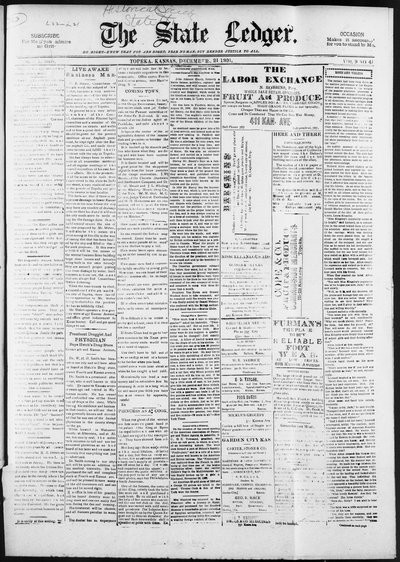
Page text (machine-generated)
SUBSCRIBE
For Me if you admire
my Grit
There are few men who are not
races of their wives.
Fred brought said the only liberty
was that a man fought for.
Itops don't like to make
wives of it, and she around it.
An emotion ever gave the uncle
a piece of pre who cries and
feets, but it will be a cold day in
summer if a boy's eggs hatched if
she did not torn them. Can you
read between the lines (?)
We never expect any thing at the hands of any party so long as we stay on earth, for if we had something at the their hands we would never go into a scheme to do up any person and if we knew it we would expose it the rascals. Hence you see that will militate against us for a job.
Nearly every one who chance to get married now-a-days always want some one of fame or big name and generally before six months they are standing before his "Honore" for a separation then its better to marry in poor circumstances and live in contentment than marry rich and serve such fate.
The hans, City Kans police are more humane with their prisoners they feed them on fine grub and give them cigars and make trusses of them that they can go up own once in a while and get an occasional drink.
We frequently receive letters from cranks and curious ladies as king for a copy of our paper. Some send stamps some money orders and offers a lock of their hair and strange to say--all this comes from people living several states away from Kansas. "Aint it remarkable(?
Bum compositors are thick at this time of the year. They go into a news "shack" now-a-days and tell some big untruth and so soon as they get a pretty full stomach they hie away to more congenial climes. Surely the path of the hum printer is not strewn with flowers.
There are some people who think because we don't think like them that we are not the right kind of Republican but that is a mistake any man should have an opinion of his own and he would be foolish to acree to everything some big mouth politician would tell him. This is nonsense.
If a man wants to be cursed now a days just say that his congressman or his excellency has acted in bad faith and he can get all he needs. The "job" "hunters" does this for a stand in but when he fails to "land" then he joins the cursing committee himself Ain't it funny. [?]
Sheriff Edwards of Oswego, was elected four years by all classes. He is assisted by W. A. Deisch as Under-sheriff and his son L. A. Edwards as deputy. He lives in the county where the famous Bend is held sway many years ago, and also in the county where the asylum will be erected to the honor of the state. He came to Kas from Kentucky, at which time, 1892 he was a republican, but since then he has casted his lot with the Fusionist. He has given general satisfaction however to all classes.
It is chilly at this writing.
---
```markdown
```
THIS PROJECT
```markdown
```
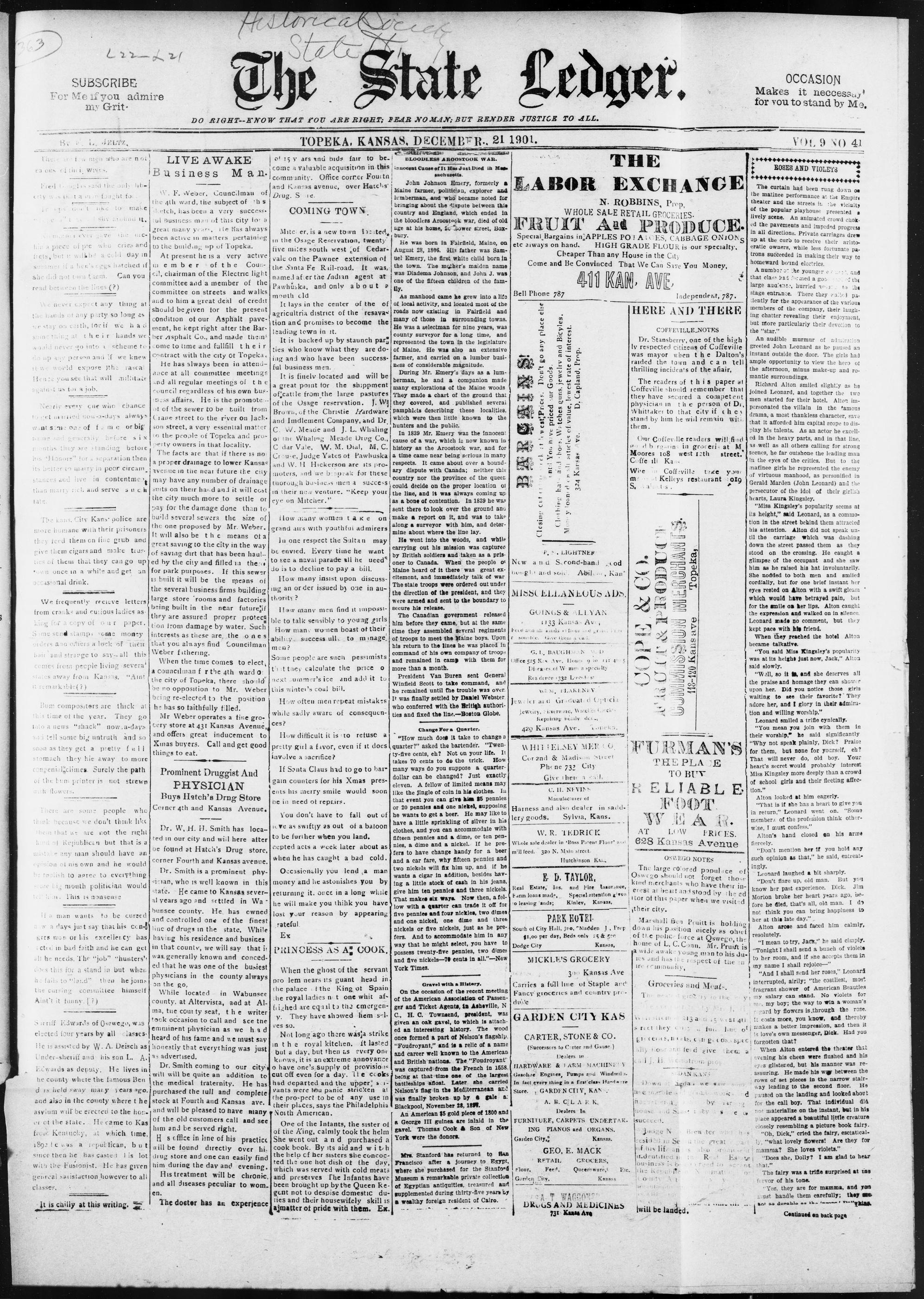
LIVE AWAKE Business Man.
W. F. Weber, Councilman of the 4th ward, the subject of this sketch, has been a very successful business man of this city for a great many years. He has always been active in matters pertaining to the building up of Topeka. At present he is a very active member of the Council, chairman of the Electric light committee and a member of the committee on streets and walks and to him a great deal of credit should be given for the present condition of our Asphalt pavement, he kept right after the Barber Asphalt Co., and made them come to time and fullfill their contract with the city of Topeka.
He has always been in attendance at all committee meetings and all regular meetings of the council regardless of his own business affairs. He is the promoter of the sewer to be built from Crape street to the river on Jackson street, a very essential matter to the people of Topeka and property owners in that locality.
The facts are that if there is not a proper drainage to lower Kansas avenue in the near future the city may have any number of drainage suits on their hand and it will cost the city much more to settle or pay for the damage done than to build several sewers the size of the one proposed by Mr. Weber. It will also be the means of a great saving to the city in the way of saving dirt that has been hauled by the city and filled in the for park purposes. If this sewer is built it will be the means of the several business firms building large store rooms and factories being built in the near future if they are assured proper protection from damage by water. Such interests as these are, the ones that you always find Councilman Weber fathing.
When the time comes to elect, a councilman f r the 4th ward o the city of Topeka, there should be no opposition to Mr. Weber being re-elected to the position he has so faithfully filled. Mr Weber operates a fine grocery store at 431 Kansas Avenue, and offers great inducement to Xmas buyers. Call and get good things to eat.
Prominent Druggist And PHYSICIAN
Buys Hatch's Drng Store Corner 4th and Kansas Avenue.
Dr. W, H. H. Smith has located in our city and will here after be found at Hatch's Drug store, corner Fourth and Kansas avenue.
Dr. Smith is a prominent physician, who is well known in this state. He came to Kansas several years ago and settled in Wabunsee county. He has owned and controlled one of the finest line of drugs in the state. While having his residence and business in that county, we will say that it was generally known and conceded that he was one of the busiest physicians in the county always on the go.
While located in Wabunsee county, at Altervista, and at Alma, the county seat, the writer took occasion to call and see the eminent physician as we had heard of his fame and we must save honestly that everything was just as advertised.
Dr. Smith coming to our city will will be quite an addition to the medical traternity. He has purchased the tull and complete stock at Fourth and Kansas ave. and will be pleased to have many of the old customers call and see him and be served right.
Hs office in line of his practice will be found directly over his drug store and one can easily find him during the day and evening. His treatment will be chronic, and all diseases peculiar to women. The doctor has an experience
The State Ledger.
DO RIGHT--KNOW THAT YOU ARE RIGHT; FEAR NOMAN; BUT RENDER JUSTICE TO ALL.
TOPEKA, KANSAS, DECEMBER. 21 1901.
WE AWAKE
ness Man.
Weber, Councilman of
of 15 years and bids fair to be
come a valuable acquisition in this
community. Office corner Fourth
and Kansas avenue, over Hutchs
Drug. Sue.
BLOODLESS AROOSTOOK WAR.
Innocent Cause of It Has Just Died in M
sachusetts.
John Johnson Emery, formerly
Maine farmer, politician, explorer and
lumberman, and who became noted for
LABOR
COMING TOWN
Mitterer, is a new town located in the Osage Reservation, twenty five miles south west of Cedarvale on the Pawnee extension of the Santa Fe Rail-road. It was named after the Indian agent at Pawhuska, and only about a month old. It lays in the center of the agricultria district of the reservation and promises to become the leading town in it. It is backed up by staunch parties who know what they are doing and who have been successful business men.
It is finely located and will be a great point for the shipment of cattle from the large pastures of the Osage reservation. J. W. Brown, of the Christie Hardware and Imdlement Company, and Dr. C. W. Meade and J. L. Whaling of the Whaling Meade Drug Co. C. dar Vale, W. M. Dial, M. C. Crouse, Judge Yates of Pawhuska and W. H. Hickerson are its promoters, and we speak for these thorough business men a success in their new venture. "Keep your eye on Mitcher."
How many women take on grand aids with youthful admirers In one respect the Sultan may be envied. Every time he want to see a naval parade all he need do is to decline to pay a bill. How many insist upon discussing an order issued by one in authority? How many men find it impossible to talk sensibly to young girls How many women boast of their ability, success ull, to manage men? Some people are such pessimists that they calculate the price o next summer's ice and add it to this winter's coal bill.
How often men repeat mistakes while sadly aware of consequences?
How difficult it is to refuse a pretty girl a favor, even if it does involve a sacrifice?
If Santa Claus had to go to bargain counters for his Xmas presents his merry smile would soon be in need of repairs.
You don't have to fall out of love as swiftly as out of a bailoon to be further when you land.
cepted acts a week later about as when he has caught a bad cold.
Occasionally you lend a man money and he astonishes you by returning it. once in a long while he will make you thikk you have lost your reason by appearing grateful.
Ex
PRINCESS AS A COOK.
When the ghost of the servant pro lem its guant head in the palace of the King of Spain the royal ladies not one whit affighed are equal to the emergency. They have showed them lives so.
Not long ago there was a strike in the royal kitchen. It lasted but a day, but then as every one knows, it is an extreme annoyance to have one's supply of provision cut off for a day. The cooks had departed and the upper servants were too panic stricken at the prospect to be of any use in their places, says the Philadelphia North American.
One of the Intants, the sister of of the King, calmly took the helm She went out and purchased a cook book. By its aid and with the help of her sisters she concocted the one hot dish of the day, which was served with cold meats and preserves The Infantas have been brought up by the Queen Kegent not to despise domestic duties and their housewifely skill is a matter of pride with them. Ex.
BLOODLESS AROOSTOOK WAR.
incognito Cause of It Has Just Died in Massachusetts.
John Johnson Emery, formerly Maine farmer, politician, explorer and lumberman, and who became noted for bringing about the dispute between this country and England, which ended in the bloodless Aroostook war, died of old age at his home, 20 lower street, Boxbury.
He was born in Fairfield, Maine, on August 28, 1806. His father was Samuel Emery, the first white child born in the town. The mother's maiden name was Diadema Johnson, and John J. was one of the fifteen children of the family.
As manhood came he grew into a life of local activity, and located most of the roads now existing in Fairfield and many of those in surrounding towns. He was a selectman for nine years, was county surveyor for a long time, and represented the town in the legislature of Maine. He was also an extensive farmer, and carried on a lumber business of considerable magnitude.
During Mr. Emery's days as a lumberman, he and a companion made many explorations of the Maine woods. They made a chart of the ground that they covered, and published several pamphlets describing these localities, which were then little known to the hunters and the public.
In 1839 Mr. Emery was the innocent cause of a war, which is now known in history as the Aroostook war, and for a time came near being serious in many respects. It came about over a boundary dispute with Canada; neither this country nor the province of the queen could decide on the proper location of the line, and it was always coming up as a bone of contention. In 1839 he was sent there to look over the ground and make a report on it, and was to take along a surveyor with him, and determine about where the line lay.
He went into the woods, and while carrying out his mission was captured by British soldiers and taken as a prisoner to Canada. When the people of Maine heard of it there was great excitement, and immediately talk of war. The state troops were ordered out under the direction of the president, and they were armed and sent to the boundary to secure his release.
The Canadian government released him before they came, but at the same time they assembled several regiments of troops to meet the Maine boys. Upon his return to the lines he was placed in command of his own company of troops and remained in camp with them for more than a month.
President Van Buren sent General Winfield Scott to take command, and he remained until the trouble was over. It was finally settled by Daniel Webster who conferred with the British authorities and fixed the line—Boston Globe.
Change For a Quarter.
"How much does it take to change a quarter?" asked the bartender. "Twenty-five cents, eh? Not on your life. It takes 70 cents to do the trick. How many ways do you suppose a quarter-dollar can be changed? Just exactly eleven. A fellow of limited means may like the jingle of coin in his clothes. In that event you can give him 85 pennies or 20 pennies and one nickel, supposing he wants to get a beer. He may like to have a little sprinkling of silver in his clothes, and you can accommodate with fifteen pennies and a dime, or ten pennies, a dime and a nickel. If he prefers to have change handy for a beer and a car fare, why fifteen pennies and two nickels will fix him up, and if he wants a cigar in addition, besides having a little stock of cash in his jeans, give him ten pennies and three nickels. That makes six ways. Now then, a fellow with a quarter can trade it off for five pennies and four nickels, two dimes and one nickel, one dime and three nickels or five nickels, just as he prefers. And to accommodate him in any way that he might select, you have to possess twenty-five pennies, two dimes and five nickels—70 cents in all."—New York Times.
Gravel with a History.
On the occasion of the recent meeting of the American Association of Passenger and Ticket Agents, in Ashville, N.C., H. C. Townsend, president, was given an oak gavel, to which is attached an interesting history. The wood once formed a part of Nelson's flagship, "Foudroyant," and is a relic of a name and career well known to the American and British nations. The "Foudroyant" was captured from the French in 1558, being at that time one of the largest battleships afloat. Later she carried Nelson's flag in the Mediterranean and was finally broken up by a gale at Blackpool, November 28, 1897.
An American $5 gold piece of 1800 and a George III gulpea are inlaid in the gavel. Thomas Cook & Son of New York were the donors.
Mrs. Stanford has returned to San Francisco after a journey to Egypt, where she purchased for the Stanford Museum a remarkable private collection of Egyptian antiquities, treasured and supplemented during thirty-five years by a wealthy foreign resident of Cairo.
LABOR EXCHANGE
Special,Bargains in APPLES POI AUCHES, CABBAGE ONIONS
etc always on hand.
HIGH GRADE FLOUR is our specialty.
Cheaper Than any House in the City
P. N. LIGHTNER
New and Second-hand good
bought and sold. Abilene, Kan.
MISSCELLANEOUS ADS
GOINGS & ALLYAN
1033 Kansas Ave.
Feed and all kinds of flour and grate flour
or something. Give them a call.
G. L. BAUGHMAN M.D.
Office 525 Kes Ave. Hours 9 to 11:45
Directions of Woman's specialty
Residence 1332 Lost St.
W.M. FLAKENEY.
Jeweler and Graduate Optician
Jewelry, Silverware, Watches, Corks
Repeting neatly done.
429 Kansas Ave. Tonkea.
WHITE LELSEY MER CO.
Corznd & Madison Street
Phone 732 City
Give them a call.
C. H. NEVINS
Manufacturer of
Harness and also dealer in saddlery goods. Sylvia, Kans.
W. R. TEDRICK
Whole sale dealer in 'Boss Patent Flour' and mill feed. 320 N. Main street.
Hutchinson Ks.
E. D. TAYLOR.
Real Estate, Ins. and Fire Insurance.
Farm loans made; Special attention given to leasing 'ands'; Kinlev, Kansas.
PARK HOTEL.
South of City Hall, Jro. "Madden J., Prop $1,00 per day, Beds only 25 & 60
Dodge City Kansas,
390 Kansas Ave Carries a full line of Staple and Fancy groceries and country produce
GARDEN CITY KAS
CARTER, STONE & CO.
(Successors to Carter and Gause.)
Dealers in
HARDWARE & DARM MACHINERY
Gesohle Engnts, Pumps and Windmills
In fact every thing in a first class Hardware
Store. GARDEN CITY, KAN.
A. B. C. L. A. K.
Dealers In
FURNITURE, CARPETS UNDERTAK-
ING PIANOS and ORGANS.
Garden City. Kansas.
GEO. E. MACK
RETAIL GEOCERS,
Flour, Feed, Queensware, Eld
Garden City. Kansas.
A T WAGGONER
DRUGS AND MEDICINES
731 Kansas Ave
Bell Phone 787
BARBINS
Closing current such at lowest Prices. Don't go any place else until You have priced our Goods.
Clothing has and shoes. Watches guns, jewelry and Bicycles.
Money loaned on all attaches of value, lowest rate of interest.
324 Karsae Ave. D, Caplaud, Prop.
THE
EXC
ROBBINS
LE RETAIL G
AND P
ES POT ACE
HIGH GRADE F
any House in th
d That We Ca
KAN, AW
HERE AND THERE
Dr. Stansberry, one of the highly respected citizens of Coffeville was mayor when the Dalton's raided the town and can tell thrilling incidents of the affair.
The readers of this paper at Coffeville should remember that they have secured a competent physician in the person of Dr. Whittaker to that city if they stand by him he will remain with them.
Our Coffeville readers will find good bargains in grocery at M. Moores 108 west 12th street. Coffe ill Kans.
Wise in Coffeville take your mind at Kelleys restaurant 109 S. Salem.
---
COPE & CO.
FRUIT & PRODUC
COMMISSION MERCHANTS.
113-420 Kansas Ave
Topeka,
FURMAN'S
THE PLACE
TO BUY
RELIABLE
FOOT
WEAR.
AT LOW PRICES.
628 Kansas Avenue
COPE &
FU
T
RE
W
AT
628 I
The large colored populace of Oswego should not forget those kind merchants who have their interest at heart and stood by the editor of this paper when we visited their city.
Marshall Ben Proutt is holding down his position nicely as ouster of the police force at Oswego, the home of L. C. Conn. Mr. Proutt is a wide awake young man to his duties and has the respect of the entire community.
Groceries and Meat
Groceries and Meats.
The nearest grocery to the city is the one owned by Mr. J. J. W. W. strom at 13 and west 47th street they own a fun. J. J. of groceries, notices, congratulations, flour and feed give them a call. If W. W. strom prop.
DAN KANS.
Down at Seda we saw some nice decorations and works and presented by our young house and Sense they are so succeed.
Judge N. Brewter which is resident in Sequoia the great part of his life and also organized studentized in the Real Estate business is beware to accept the Republic N nomination or county At
will be landed.
```markdown
```
Independent, 787.
COFFEVILLE_NOTES
OSWEGO NOTES
OCCASION Makes it neccessay for you to stand by Me.
VOL 9 NO 41
The curtain had been ring down on the matinee performance at the Empire theater and the streets in the vicinity of the popular playhouse presented a lively scene. An animated crowd choked the pavements and impeded progress in all directions. Private carriages drew up at the curb to receive their aristocratic owners, while less fortunate patrons succeeded in making their way to homeward bound electrics. A number of the younger crowd and that class had formed a good part of the large audience, hurried around to the stage entrance. There they called patiently for the appearance of the various members of the company, their laughing chatter revealing their enjoyment, but more particularly their devotion to the "star."
An audible murmur of admiration greeted John Leonard as he paused an instant outside the door. The girls had ample opportunity to view the hero of the afternoon, minus make-up and romantic surroundings.
Richard Alton smiled slightly as he joined Leonard, and together the two men started for their hotel. Alton impersonated the villain in the 'famous drama, a most thankless character, save that it afforded him capital scope to display his talents. As an actor he excelled in the heavy parts, and in that line, as well as all others calling for strong scenes, he far outshone the leading man in the eyes of the critics. But to the mafine girls he represented the enemy of virtuous manhood, as personified in Gerald Marden (John Leonard) and the persecutor of the idol of their girlish hearts, Laura Kingsley.
"Miss Kingsley's popularity seems at its height," said Leonard, as a commotion in the street behind them attracted his attention. Alton did not speak until the carriage which was dashing down the street passed them as they stood on the crossing. He caught a glimpse of the occupant and she saw him as he raised his hat involuntarily. She nodded to both men and smiled cordially, but for one brief instant her eyes rested on Alton with a swift gleam which would have betrayed pain, but for the smile on her lips. Alton caught the expression and walked on in silence. Leonard made no comment, but they kept pace with his friend.
When they reached the hotel Alton became talkative.
"You said Miss Kingsley's popularity was at its height just now, Jack," Alton said slowly.
"Well, so it is, and she deserves all the praise and homage they can show upon her. Did you notice those girls waiting to see their favorite? They adore her, and I glory in their admiration and willing worship."
Leonard smiled a trifle cynically.
"You mean you join with them in their worship," he said significantly.
"Why not speak plainly, Dick? Praise for them, but none for yourself, eh? That will never do, old boy. Your heart's secret would probably interest Miss Kingsley more deeply than a crowd of school girls and their fleeting affection."
Alton looked at him eagerly.
"That is if she has a heart to give you in return," Leonard went on. "Some members of the profession think otherwise. I must confess."
Alton's hand closed on his arms fiercely.
"Don't mention her if you hold any such opinion as that," he said, entreatingly.
Leonard laughed a bit sharply.
"Don't flare up, old man. But you know her past experience. Dick. Jim Morton broke her heart years ago, before he died, that's all, old man. I do not think you can bring happiness to her at this late day." Alton arose and faced him calmly, resolutely. "I mean to try, Jack," he said calmly. "Tonight I shall send a bunch of violets to her room, and if she accepts them in my name I shall rejoices—" "And I shall send her roses," Leonard interrupted, airily; "the costliest, most fragrant shower of American Beauties my salary can stand. No violets for me my boy; the way to win a woman's guard by flowers is through the rose. It costs more, you know, and thereby makes a better impression, and then it is love one's messenger, Dick. Had you forgotten that?
When Alton entered the theater that evening his chees were flushed and his eyes glistened, but his manner was reassuring. He made his way between the rows of set pieces in the narrow stairway leading to the second floor. He paused on the landing and looked about for the call boy. That individual did not materialize on the instant, but in his place appeared a beautiful little creature closely resembling a picture book fairy, "Oh Dick," cried the fairy, ecstatical.
"Oh, Dick," cried the fairy, ecstatically,
"what lovely flowers! Are they for
mamma? She loves violets."
"Does she, Dolly? I am glad to hear
that."
The fairy was a trifle surprised at the
fervor of his tone.
"Yes, they are for mamma, and you
must handle them carefully; they must
not as durable as the mamma." "Dolly!"
Continued on back page
STATE LEDGER
KANSAS
TOPEKA.
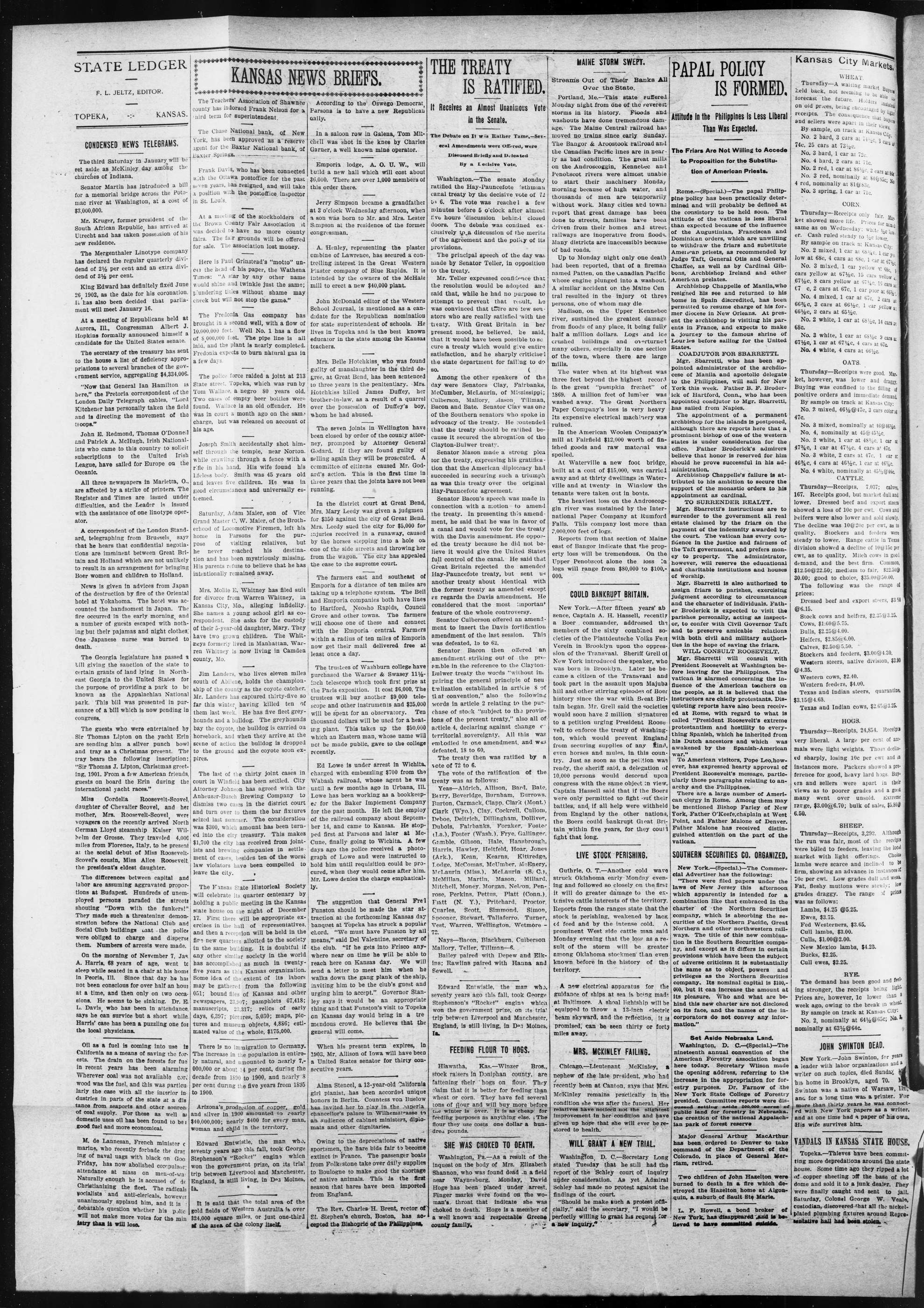
CONDENSED NEWS TELEGRAMS
The third Saturday in January will be set aside as McKinley day among the churches of Indiana.
Senator Martin has introduced a bill for a memorial bridge across the Potomac river at Washington, at a cost of $3,000,000.
Mr. Kruger, former president of the South African Republic, has arrived at Utrecht and has taken possession of his new residence.
The Mergenthaler Linotype company has declared the regular quarterly dividend of $2\frac{1}{2} per cent and an extra dividend of $3\frac{1}{2} per cent.
King Edward has definitely fixed June 26, 1902, as the date for his coronation. It has also been decided that parliament will meet January 16.
At a meeting of Republicans held at Aurora, Ill., Congressman Albert J. Hopkins formally announced himself a candidate for the United States senate.
The secretary of the treasury has sent to the house a list of deficiency appropriations to several branches of the government service, aggregating $4,334,006.
"Now that General Ian Hamilton is here," the Pretoria correspondent of the London Daily Telegraph cables, "Lord Kitchener has personally taken the field and is directing the movement of the troops."
John E. Redmond, Thomas O'Donnell and Patrick A. McHugh, Irish Nationalists who came to this country to solicit subscriptions to the United Irish League, have sailed for Europe on the Oceanic.
All three newspapers in Marietta, O. are affected by a strike of printers. The Register and Times are issued under difficulties, and the Leader is issued with the assistance of one linotype operator.
A correspondent of the London Standard, telegraphing from Brussels, says that he hears that confidential negotiations are imminent between Great Britain and Holland which are not unlikely to result in an arrangement for bringing Boer women and children to Holland.
News is given in advices from Japan of the destruction by fire of the Oriental hotel at Yokohama. The hotel was accounted the handsomest in Japan. The fire occurred in the early morning, and a number of guests escaped with nothing but their pajamas and night clothes. One Japanese nurse was burned to death.
The Georgia legislature has passed a bill giving the sanction of the state to certain grants of land lying in Northeast Georgia to the United States for the purpose of providing a park to be known as the Appalachian National park. This bill was presented in pursuance of a bill which is now pending in congress.
The guests who were entertained by Sir Thomas Lipton on the yacht Erin are sending him a silver punch bowl and tray as a Christmas present. The tray bears the following inscription; "Sir Thomas J. Lipton, Christmas greeting, 1901. From a few American friends, guests on board the Erin during the international yacht races."
Miss Cordella Roosevelt-Scovel, daughter of Chevalier Scovel, and her mother, Mrs. Roosevelt-Scovel, were voyagers on the recently arrived North German Lloyd steamship Kaiser Wilhelm der Grosse. They traveled 4,000 miles from Florence, Italy, to be present at the social debut of Miss Roosevelt-Scovel's cousin, Miss Alice Roosevelt the president's eldest daughter.
The differences between capital and labor are assuming aggravated proportions at Budapest. Hundreds of unemployed persons paraded the street shouting "Down with the funkers!" They made such a threatening demonstration before the National Club and Social Club buildings that the police were obliged to charge and disperse them. Numbers of arrests were made.
On the morning of November 7, Jas A. Harris, 68 years of age, went to sleep while seated in a chair at his home in Peoria, Ill. Since that day he has not been conscious for over half an hour at a time, and then only on two occasions. He seems to be sinking. Dr. E. L. Davls, who has been in attendance, says he can survive but a short while Harris' case has been a puzzling one for the local physicians.
Oll as a fuel is coming into use in California as a means of saving the forests. The drain on the forests for fuel in recent years has been alarming. Wherever coal was not available cord wood was the fuel, and this was particularly the case with all the interior industries in parts of the state at a distance from seaports and other sources of coal supply. For these as well as domestic uses oil has been found to be good fuel and more economical.
M. de Lannesan, French minister of marine, who recently forbade the draining of naval uags with black on Good Friday, has now abolished compulsory attendance at mass on men-of-war. Naturally enough he is accused of de Christianizing the fleet. The radicals poetalists and anti-clericals, however unanimously applaud him, and it is debatable question whether his police will not make more votes for the ministry than it will lose.
KANSAS NEWS BRIEFS.
The Teachers' Association of Shawnee county has indorsed Frank Nelson for a third term for superintendent.
The Chase National bank, of New York, has been approved as a reserve agent for the Baxter National bank, of Baxter Springs.
Frank Davis, who has been connected with the Ottawa postoffice for the past seven years, has resigned, and will take a position with the postoffice inspector in St. Louis.
At a meeting of the stockholders of the Brown County Fair Association it was decided to have no more county fairs. The fair grounds will be offered for sale. The association lost money.
Here is Paul Grinstead's "motto" uncei t the head of his paper, the Wathena Tunes: "A star by any other name would shine and twinkle just the same; pundering titles without shame may creek but will not stop the game."
The Fredonia Gas company has brought in a second well, with a flow of 10,000,000 feet. Well No. 1 has a flow of 8,000,000 test. The pipe line is all laid, and the plant is nearly completed. Fredonia expects to burn natural gas in a few days.
The police force raided a joint at 213 State street, Topeka, which was run by Tom Wallace, a negro 80 years old. Two cases of empty beer bottles were found. Wallace is an old offender. He was in court a month ago on the same charge, but was released on account of his age.
Joseph Smith accidentally shot himself through the temple, near Norton, while crawling through a fence with a rifle in his hand. His wife found his lifeless body. Smith was 45 years old and leaves five children. He was in good circumstances and universally esteemed.
Saturday, Adam Maler, son of Vice Grand Master C. W. Maler, of the Brotherhood of Locomotive Firemen, left his home in Parsons for the purpose of visiting relatives, but he never reached his destination and has been mystriously missing. His parents refused to believe that he has intentionally remained away.
1
Mrs. Mollie E. Whitney has filed suit for divorce from Warren Whitney, in Kansas City, Mo., alleging infidelity. She names a young school girl as correspondent. She asks for the custody of their 5-year-old daughter, Mary. They have two grown children. The Whitneys formerly lived in Manhattan. Warren Whitney is now living in Camden county, Mo.
Jim Landers, who lives eleven miles south of Abilene, holds the championship of the county as the coyote catcher. Mr. Landers has captured thirty-five so far this winter, having killed ten of them last week. He has five fleet greyhounds and a bulldog. The greyhounds bay the coyote, the bulldog is carried on horseback, and when they arrive at the scene of action the bulldog is dropped to the ground and the coyote soon expires.
The last of the thirty joint cases in court in Winfield has been settled. City Attorney Johnson has agreed with the Anheuser-Busch Brewing Company to dismiss two cases in the district court and turn over to them the bar fixtures seized last summer. The consideration was $200, which amount has been turned into the city treasury. This makes $1,700 the city has received from jointists and brewing companies in settlement of cases, besides ten of the worst law violators have been compelled to leave the city.
The Kansas State Historical Society will celebrate its quarter centenary by holding a public meeting in the Kansas state house on the night of December 17. First there will be appropriate exercises in the hall of representatives, and then a reception will be held in the fire new quarters allotted to the society in the same building. It is doubtful if any other similar society in the world has accomplished as much in twenty-five years as this Kansas organization. Some idea of the extent of its labors may be gathered from the following 051; bound files of Kansas and other newspapers, 23,907; pamphlets 77,418; manuscripts, 23,317; relics of early days, 6,397; pictures, 5,030; maps, pictures and museum objects, 4,886; estimated value of the whole, $175,000.
There is no immigration to Germany. The increase in the population is entirely natural, and amounted to nearly 7,000,000 or about 14 per cent, during the decade from 1890 to 1900, and nearly 8 per cent during the five years from 1895 to 1900.
Arizona's production of copper, gold and silver in 1900 amounted to nearly $40,000,000; nearly $400 for every man, woman and child in the territory.
Edward Entwistle, the man who seventy years ago this fall, took George Stephenson's "Rocket" engine which won the government prize, on its trial trip between Liverpool and Manchester, England, is still living, in Dee Molines, Ia.
It is said that the total area of the gold fields of Western Australia is over $24,000 square miles, or just one-third of the area of the colony itself.
According to the Oswego Democrat, Parsons is to have a new Republican daily.
In a saloon row in Galena, Tom Mitchell was shot in the knee by Charles Garner, a well known mine operator.
Emporia lodge, A. O. U. W., will build a new hall which will cost about $6,000. There are over 1,000 members of this order there.
Jerry Simpson became a grandfather at 3 o'clock Wednesday afternoon, when a son was born to Mr. and Mrs. Lester Simpson at the residence of the former congressman.
A. Henley, representing the plaster
combine of Lawrence, has secured a
controlling interest in the Great Western
Plaster company of Blue Rapids. It is
intended by the owners of the McHale
mill to erect a new $40,000 plant.
John McDonald editor of the Western
School Journal, is mentioned as a
candidate for the Republican nomination
for state superintendent of schools. He
lives in Topeka and is the best known
educator in the state among the Kansas
teachers.
一
Mrs. Belle Hotchkiss, who was found guilty of manslaughter in the third degree, at Great Bend, has been sentenced to three years in the penitentiary. Mrs. Hotchkiss killed James Duffey, her brother-in-law, as a result of a quarrel over the possession of Duffey's boy, whom he had abused.
The seven joints in Wellington have been closed by order of the county attorney, prompted by Attorney General Godard. If they are found guilty of selling again they will be prosecuted. A committee of citizens caused Mr. Godard's action. This is the first time in three years that the joints have not been running.
In the district court at Great Bend, Mrs. Mary Leedy was given a judgmen for $350 against the city of Great Bend. Mrs. Leedy sued the city for $5,000 for injuries received in a runaway, caused by the horses stopping into a hole on one of the side streets and throwing her from the wagon. The city has appealed the case to the supreme court.
The farmers east and southeast of Emporia for a distance of ten miles are taking up a telephone system. The Bell and Emporia companies both have lines to Hartford, Neosho Rapids, Council Grove and other towns. The farmers will choose one of these and connect with the Emporia central. Farmers within a radius of ten miles of Emporia now get their mail delivered free at least once a day.
The trustees of Washburn college have purchased the Warner & Swascy 11½-inch telescope which took first prize at the Paris exposition. It cost $6,000. The trustees will buy another $9,000 telescope and other instruments and $25,000 will be spent for an observatory. Ten thousand dollars will be used for a heating plant. This takes up the $50,000 which an Eastern man, whose name will not be made public, gave to the college recently.
Ed Lowe is under arrest in Wichita, charged with embezzling $700 from the Wabash railroad, whose agent he was until a few months ago in Urbana, Ill. Lowe has been working as a bookkeeper for the Baker Implement Company for the past month. He left the employ of the railroad company about September 14, and came to Kansas. He stopped first at Parsons and later at McCune, finally going to Wichita. A few days ago the police received a photograph of Lowe and were instructed to hold him until requisition could be procured, when they would come after him. Mr. Lowe denies the charge emphatically.
The suggestion that General Freel Funston should be made the star attraction at the forthcoming Kansas day banquet at Topeka has struck a popular clorid. "We must have Funston by all means," said Del Valentine, secretary of the club. "If he gets into Frisco anywhere near on time he will be able to reach on Kansas day. We will send a letter to meet him when he walks down the gang plank of the ship, inviting him to be the club's guest and urging him to accept." Governor Stanley says it would be an appropriate thing and that Funston's visit to Topeka on Kansas day would bring in a tremendous crowd. He believes that the general will come.
When his present term expires, in 1903, Mr. Allison of Iowa will have been a United States senator for thirty consecutive years.
Alma Stencl, a 12-year-old California girl pianist, has been accorded unique honors in Berlin. Counted von Buelow has invited her to play in the opera chancellor's palace in Wilhelmstrasse an audience of cabinet ministers, diplomats and other dignitaries.
Owing to the depreciations of native sportsmen, the hare bids fair to become extinct in France. The passenger boats from Folkestone take over daily supplies to Boulogne to make good the shortage of native animals. This is the first season that hares have been imported from England.
The Rev. Charles H. Brent, rector of St. Stephen's church, Boston, has accepted the Bishopric of the Philippines.
THE TREATY IS RATIFIED.
It Receives an Almost Unanimous Vote in the Senate.
The Debate on It was Rather Tame.—Sey-
Washington.—The senate Monday ratified the Hay-Pauncefote 'sthman canal treaty by the decisive vote of 72 to 6. The vote was reached a few minutes before 5 o'clock after almost five hours 'discussion behind closed doors. The debate was conflated exclusively to a discussion of the merits of the agreement and the policy of its provisions.
The principal speech of the day was made by Senator Teller, in opposition to the treaty.
Mr. Teller expressed confidence that the resolution would be adopted and said that, while he had no purpose to attempt to prevent that result, he was convinced that there are few senators who are really satisfied with the treaty. With Great Britain in her present mood, he believed, he said, that it would have been possible to secure a treaty which would give entire satisfaction, and he sharply criticised the state department for failing to do so.
Among the other speakers of the day were Senators Clay, Fairbanks, McCumber, McLaurin, of Mississippi; Culberson, Mallory, Jason Tillman, Bacon and Bate. Senator Clav was one of the Southern senators who spoke in advocacy of the treaty. He contended that the treaty should be ratified because it secured the abrogation of the Clayton-Bulwer treaty.
Senator Mason made a strong plea for the treaty, expressing his gratification that the American diplomacy had succeeded in securing such a triumph as was this treaty over the original Hay-Pauncefote agreement.
Senator Bacon's speech was made in connection with a motion to amend the treaty. In presenting this amendment, he said that he was in favor of a canal and would vote for the treaty with the Davis amendment. He opposed the treaty because he did not believe it would give the United States full control of the canal. He said that Great Britain rejected the amended Hay-Pauncefote treaty, but sent us another treaty about identical with the former treaty as amended except as regards the Davis amendment. He considered that the most important feature of the whole controversy.
Senator Culberson offered an amendment to insert the Davis fortification amendment of the last session. This was defeated, 18 to 62.
Senator Bacon then offered an amendment striking out of the preamble in the reference to the Clayton-Bulwer treaty the words "without impairing the general principle of neutralization established in article 8 of that convention," also the following words in article 2 relating to the purchase of stock "subject to the provisions of the present treaty," also all of article 4, declaring against change territorial sovereignty. All this was embodied in one amendment, and was defeated, 18 to 60.
The treaty then was ratified by a vote of 72 to 6.
The vote of the ratification of the treaty was as follows:
Yeas—Aldrich, Allison, Bard, Bate, Berry, Beveridge, Burnham, Burrows, Burton, Carmack, Clapp, Clark (Mont.) Clark (Wyo.) Clay, Cockrell, Cullom, Deboe, Deltrich, Dillingham, Doliver, Dubols, Fafbanks, Foraker, Foster (La.), Foster (Wash.) Frye, Gallinger, Gumble, Gibson, Hale, Hansbrough, Harris, Hawley, Heltfeld, Hoar, Jones (Ark.) Kean, Kearns, Kittreda, Lodge, McComas, McUmber, McEnry, McLaurin (Miss.) McLaurin (S. C.) McMillan, Martin, Mason, Millard, Mitchell, Money, Morgan, Nelson, Penrose, Perkins, Pettus, Platt (Conn.) Flatt (N. Y.) Pritchard, Proctor, Quarles, Scott, Simmond, Simon, Spooner, Stewart, Tallferro, Turner, Vest, Warren, Wellington, Wetmore - 72. Nays—Bacon, Blackburn, Caliberson Mallory, Teller, Tillman-6.
Bailey paired with Depew and Elkins; Rawlins paired with Hauna and Sewell.
Edward Entwistle, the man who seventy years ago this fall, took George Stephenson's "Rocket" engine which won the government prize, on its trial trip between Liverpool and Manchester, England, is still living, in Den Moines,
FEEDING FLOUR TO HOGS.
Hiawatha, Kas—Winzer Bros., stock raisers in Doniphan county, are fattening their hogs on flour. They claim that it is better for feeding than wheat or corn. They have fed several tons of flour and will buy more before the winter is over. It is as cheap for feeding purposes as anything else. The flour they use costs one dollar a hundred pounds.
SHE WAS CHOKED TO DEATH.
Washington, Pa.—As a result of the inquest on the body of Mrs. Elizabeth Shannon, who was found dead n a field near Waynesburg, Monday, David Hoge has been placed under arrest. Finger marks were found on the woman's throat that indicate she was choked to death. Hoge is a member of a well known and respectable Greene county family.
MAINE STORM SWEPT.
Streams Out of Their Banks All Over the State.
Portland, Me.-This state suffered Monday night from one of the severest storms in its history. Floods and washouts have done tremendous damage. The Maine Central railroad has moved no trains since early Sunday. The Bangor & Aroostook railroad and the Canadian Pacific lines are in nearly as bad condition. The great mills on the Androscoggin, Kennebec and Penobscot rivers were almost unable to start their machinery Monday morning because of high water, and thousands of men are temporarily without work. Many cities and towns report that great damage has been done to streets, families have been driven from their homes and street railways are inoperative from floods. Many districts are inaccessible because of bad roads.
Up to Monday night only one death had been reported, that of a fireman named Patten, on the Canadian Pacific whose engine plunged into a washout. A similar accident on the Maine Central resulted in the injury of three persons, one of whom may die. Madison, on the Upper Kennebunk river, sustained the greatest damage from floods of any place, it being fully half a million dollars. Logs and ice crushed buildings and overturned many others, especially in one section of the town, where there are large mills.
The water when at its highest was three feet beyond the highest record in the great "pumpkin frechet" of 1869. A million feet of lumber was washed away. The Great Northern Paper Company's loss is very heavy. Its expensive electrical machinery was ruined.
In the American Woolen Company's mill at Fairfield $12,000 worth of finished goods and raw material was spoiled.
At Waterville a new foot bridge, built at a cost of $15,000, was carried away and at thirty dwellings in Waterville and at twenty in Winslow the tenants were taken out in boats.
The heaviest loss on the Androscoggin river was sustained by the International Paper Company at Rumford Falls. This company lost more than 2,000,000 feet of logs.
Reports from that section of Maine east of Bangor indicate that the property loss will be tremendous. On the Upper Penobscot alone the loss in logs will range from $80,000 to $100,000.
COULD BANKRUPT BRITAIN.
New York.—After fifteen years' absence, Captain A. H. Hassell, recently a Boer commander, addressed the members of the sixty combined societies of the Plattdesutsche Volks Fest Verein in Brooklyn upon the oppression of the Transvaal. Sheriff Grell of New York introduced the speaker, who was born in Brooklyn. Later he became a citizen of the Transvaal and took part in the assault upon Majuba hill and other stirring episodes of Boer history since the war with Great Britain began. Mr. Grell said the societies would soon have 2 million signatures to a petition urging President Roosevelt to enforce the treaty of Washington, which would prevent England from securing supplies of any kind, even horses and mules, in this country. Just as soon as the petition was ready, the sheriff said, a delegation of 10,000 persons would descend upon congress with the same object in view. Captain Hassell said that if the Boers were only permitted to fight out their battles, and if all help were withheld from England by the other nations the Boers could bankrupt Great Britain within five years, for they could fight that long.
LIVE STOCK PERISHING.
Guthrie, O. T.—Another cold wave struck Oklahoma early Monday evening and followed so closely on the first it will do greater damage to the extensive cattle interests of the territory. Reports from the ranges state that the stock is perishing, weakened by lack of feed and by the intense cold. A prominent West side cattle man said Monday evening that the loss as a result of the storm will be greater among Oklahoma stockmen than even known before in the history of the territory.
A new electrical apparatus for the guidance of ships at sea is being made at Baltimore. A shoal lightship will be equipped to throw a 13-inch electric beam skyward, and the reflection, it is promised, can be seen thirty or forty miles away.
MRS. MCKINLEY FAILING.
Chicago.—Lieutenant McKinley, a nephew of the late president, who had recently been at Canton, says that Mrs. McKinley remains practically in the condition she was after the funeral. Her relatives have noticed not the slightest improvement in her condition and have given up hope that she will ever be restored to health.
WILL GRANT A NEW TRIAL.
Washington, D. C.—Secretary Long stated Tuesday that he still had the report of the Schley court of inquiry under consideration. As yet Admiral Schley had made no protest against the findings of the court.
"Should he make such a protest officially," said the secretary. "I would be perfectly willing to grant his request for a new inquiry."
PAPAL POLICY IS FORMED.
Attitude in the Philippines Is Less Liberal Than Was Expected.
Rome.—(Special.)—The papal Philippine policy has been practically determined and will probably be defined at the consistory to be held soon. The attitude of the vatican is less liberal than expected because of the influence of the Augustinian, Franciscan and Dominican orders, which are unwilling to withdraw the friars and substitute American priests, as recommended by Judge Taft, General Otis and General Chaffee, as well as by Cardinal Gibbons, Archbishop Ireland and other American prelates.
Archbishop Chappelle of Manila, who resigned his see and returned to his home in Spain discredited, has been permitted to resume charge of his former diocese in New Orleans. At present the archbishop is visiting his parents in France, and expects to make a journey to the famous shrine of Lourdes before sailing for the United States.
COADJUTOR FOR SBARRETTI.
Mgr. Sbarretti, who has been appointed administrator of the archiochese of Manila and apostolic delegate to the Philippines, will sail for New York this week. Father B. F. Broderick of Hartford, Conn., who has been appointed coadjutor to Mgr. Sbarretti, has sailed from Naples.
The appointment of a permanent archbishop for the islands is postponed, although there are reports here that a prominent bishop of one of the western states is under consideration for the office. Father Broderick's admirers believe that honor is reserved for him should he prove successful in his administration.
Archbishop Chappelle's failure is attributed to his ambition to secure the support of the monastic orders to his appointment as cardinal.
TO SURRENDER REALTY.
Mgr. Sbarretti's instructions are to surrender to the government all real estate claimed by the friars on the payment of the indemnity awarded by the court. The vatican has every confidence in the justice and fairness of the Taft government, and prefers money to property. The administrator, however, will reserve the educational and charitable institutions and houses of worship.
Mgr. Sbarretti is also authorized to assign friars to parishes, exercising judgment according to circumstances and the character of individuals. Father Broderick is expected to visit the parishes personally, acting as inspector, to confer with Civil Governor Taft and to preserve amicable relations with both civil and military authorities in the hope of saving the friars.
WILL CONSULT ROOSEVELT.
Mgr. Sbarretti will consult with President Roosevelt at Washington before leaving for the Philippines. The vatican is alarmed concerning the influence of the American teachers on the people, as it is believed that the instructors are chiefly protestants. Disquieting reports have also been received at Rome, with regard to what is called "President Roosevelt's extreme protestantism and hostility to everything Spanish, which he inherited from his Dutch ancestors and which was awakened by the Spanish-American war."
To American visitors, Pope Leo,however, has expressed hearty approval of President Roosevelt's message, particularly those paragraphs relating to anarchy and the Philippines.
There are a large number of American clergy in Rome. Among them may be mentioned Bishop Farley of New York, Father O'Keefe, chaplain at West Point, and Father Malone of Denver. Father Malone has received distinguished attention on the part of the vatican.
SOUTHERN SECURITIES CO. ORGANIZED.
New York.—(Special.)—The Commercial Advertiser has the following: "There were filed papers under the laws of New Jersey this afternoon which apparently is intended for a combination like that embraced in the charter of the Northern Securities company, which is absorbing the securities of the Northern Pacific, Great Northern and other northwestern railways. The title of this new combination is the Southern Securities company, and except as it differs in certain provisions which have been the subject of adverse criticism it is substantially the same as to object, powers and privileges as the Northern Securities company. Its nominal capital is $100,000, but it can increase the amount at its pleasure. Who and what are behind this new charter are not disclosed on its face, and the names of the incorporators do not convey any information."
Set Aside Nebraska Land.
Washington, D. C.—(Special)—The nineteenth annual convention of the American Forestry association began here today. Secretary Wilson made the opening address, referring to the increase in the appropriation for forestry purposes. Dr. Farnow of the New York State College of Forestry presided. Committee reports were disbanded. Public land for forestry in Nebraska, the creation of the national Appalachian park of forest reserve
Major General Arthur MacArthur has been ordered to Denver to take command of the Department of the Colorado, in place of General Merriam, retired.
Two children of John Hazelton were burned to death in a fire which destroyed the Hazelton home at Algonquin, a suburb of Sault Ste. Marie.
L. P. Howell, a bond broker of New York, has disappeared and is believed to have committed suicide.
WHEAT.
Thursday—A waiting market Buyers
held back, not seeming to be able to
torecast the future. Holders insisted
on old prices, being encouraged by high
receipts. The consequence that buyers
and sellers were apart in their views.
By sample, on track at Kansas City.
No. 2 hard, 3 cars at 71¢, 3 cars at
74¢, 25 cars at 73¢.
No. 3 hard, 1 car at 72¢.
No. 4 hard, 2 cars at 71¢.
No. 2 red, 1 car at 86¢, 2 cars at 86¢.
No. 3 red, nominally at 84¢/56¢; No.
4 red, nominally at 81¢/83¢.
No. 3 spring, 1 car at 71¢.
CORN.
CORN
Thursday—Receipts only fair. Market showed more life. Price for same as on Wednesday; white life for er. Cash ruled steady to be lower. By sample on track at Kansas City. No. 2 mixed, 1 car at 86.4, 1 car up at 86.8, 4 cars at 86.1.
No. 4 mixed, 1 car at 67c, 2 cars at
66%c, 3 cars at 66%c, 1 car yellow at
66%c, 2 cars at 65%c.
No. 2 white, 1 car at 68%c, 14 cars at
68c.
No. 3 white, 1 car at 68%c 9 cars at
67%c, 1 car at 67%c, 4 cars at 67c.
No. 4 white, 4 cars at 66%c
OATS.
Thursday—Receipts, 7.037; calves
167. Receipts good, but market dull and
lower. Dressed beef and export steers
showed a loss of 10$ per cwt. Cows and
beefers were also lower and sold slowly.
The decline was 10$@20 per cwt, as to
quality. Stockers and feeders were
steady to lower. Range cattle in Texas
division showed a decline of 10$@15 per
cwt, as to quality. Mitch cows in good
demand, and the best firm. Common.
$12.50@22.50; medium to fair, $22.50
@30.00; good to choice, $35.00@50.00.
The following was the range of
prices:
Dressed beef and export steers, $3.50
@6.15.
Stock cows and heifers, $2.35@3.25.
Cows, $1.00@5.75.
Calves, $2.50@5.50.
Stockers and feeders, $3.00@4.30.
Stockers and feeders, $2.00@4.35.
Western steers, native division, $2.90
@4.35.
Western cows, $2.40.
Western feeders, $4.00.
Texas and Indian steers, quarantine,
$3.15@4.63.
Texas and Indian cows, $2.65@3.25.
HOGS.
Thursday—Receipts, 24.854. Receipts very liberal. A large per cent of animals were light weights. Those desired sharply, losing 10c per cwt and in instances more. Packers showed a preference for good, heavy lard bags. Burfers and sellers were apart in their views as to poorer grades and a good many went over unsold. Extreme range, $3.00@6.70; bulk of sales, $3.00@6.50.
SHEEP.
Thursday—Receipts, 3.229. Although the run was fair, most of the receipts were billed to feeders, leaving the local market with light offerings. Choice lambs were scarce and inclined to be firm, showing an advance in instances of 100 per cwt. Low grades dull and weak. Fat, fleshy muttons were steady; low grades draggy. The range of price was as follows: Lambs, $4.25 @ 5.25.
Lambs, $3.25 @ 2.25.
Ewes, $3.75.
Fed Westerners, $3.65.
Cull lambs, $3.00.
Culls, $1.00@2.00.
New Mexico lambs, $4.25.
Bucks, $2.25.
Cull ewes, $2.25.
RYE.
The demand has been good and feeling stronger, the receipts being light.
Prices are, however, 1c lower than a week ago, owing to the break in wheat.
By sample on track at Kansas City:
No. 2, nominally at 64½@65c; No. 4.
JOHN SWINTON DEAD
New York—John Swinton, for years a leader with labor organizations and a writer on such topics, died Sunday at his home in Brooklyn, aged 70. Mr. Swinton was a native of Warsaw, Ilm, and for a long time was a printer. For more than thirty years he was connected with New York papers as a writer and at one time had a paper of his own His wife survives him.
VANDALS IN KANSAS STATE HOUSE.
Topeka.—Thieves have been committing more depredations around the state house. Some time ago they ripped a lot of copper sheeting off the base of the dome and sold it to a junk dealer. They were finally caught and sent to jail. Saturday, Colonel George W. Veale, custodian, discovered that all the nickel-plated plumbing fixtures around Representative hall had been stolen.
RUPTURE
IN ORDER TO IN REASE OUR CLINIC we want every man, woman and child in the S ate to have their mouths axed by the professors of this clinic. ALL WE DO AS WE ADVIRTISE. TEETH EXTRACTED FREE
COUNTRY PUBLISHERS CO., KANSAS CITY, VOL. II. NO. 30.
---
I Present Them to You in the Letters of My Former Patients.
You Do Not Pay Me One Cent Until You Are Curred.
I present to the readers of this paper a few testimonial letters and names of former patients whom I have cured of rupture, believing that the afflicted would rather correspond with some one who has been cured than read what I might say about myself. You can more easily understand my opinion, more likely as to the merits of my treatment. You might doubt any statements I might make, but you cannot help but believe the statements of those I have cured. I will ask you to write to any or all of them. If you are satisfied with the statements of these patients and methods of treatment, write to me or call and see me. Remember that in all cases I guarantee a cure and do not accept one cent of money until you are well. Consultation by mail or in person is entirely free. I will be pleased to correspond with you regarding your
DR. ERNEST·HENDERSON.
A Very Bad Case of Rupture Cured in three Weeks.
McPherson, Kans. June 8, 1892.
I had a very bad case of rupture for years, and
saw him great in three weeps. I can not say too
much for him. I know he can do just what he
says he can do. He is very patient. I also
cost of pay for him. The patient is well. This is
the best guarantee he can possible give to any person
afflicted as a war. I will answer anyone who
would be about to murder me. Very truly yo-
A. R. OLSON.
Write For My Treaties on the Cure of
Rupture Nextive.
Another Bad Case Furniture Fured in
a Short Time.-Grateful for Same.
My Dear Doctor: I desire to add my testimonial to those you have cured of rupture. My case was a bad one an' you made a permanent
in a short time, without pain, and I would
would make you too much for your care, and would not be back in the con-
dition I wish a r shou- and dollars. I thank you
for your care. I am thankful for you.
One. I see if you wish I am truly; thank-
full yours. FRED HARPER; 2011 Indiana Ave.
Suffered for Years.-Pronounced Incar-
able by other Doctors.
Dear Doctor: I wish to state that I can most heavily recommend your rupture treatment. I have been in the hospital with a right sore rupture that was pronounced by doctors to be incurable except possibly by a yawl. Since I am not in the hospital treatment, I determined to try the same and am glad I did so for after taking your treatment for my rupture. Your treatment is all that you claim for it. Your respectfully. Kami Kas.
TEETH
MOUTH PLATE
Cost of Material.
Silver Fillings.....FREE
Brown Fillings.....Cost of
Rubber Fillings.....$1.00 and up
Gold Crowns.....$1.00 and up
White Crowns.....$1.00 and up
Bridge Work, tooth, $1.00 and up
VARIOCOCELE A safe, pathless, per-
mianurecorganan-
rural experience. No money accepted until
patient is well. Consultation and book Free, by
mail or write. To DOCTOR G. M. VOK
2%on checking deposits.
MISSOURI
SAVINGS
ASSOCIATION
BANK
3% on savings deposits.
4% on time deposits.
Watt Webb, President, W. S. Webb, Cashier.
7th & Delaware Streets,
Kansas City Mo
A boon to sufferers. Acts like magic.
I reach of everybody. A home treatment
in the most humble home. Why
suffer so long when you can find out
how to be cured at home by address-
London, Kansas City Mo.
London, Kansas City Mo.
CANCER and Tumors treated. $5 at home
office; pain relief. Do not MAUGHTUILN, JINCEN Blug. Kansas City
1 CENT A GRAIN FOR Stephen's
Mannah Campo go d years. Rg Corp dry years. Manned 50 hue cells with the area of high grain with three cultive ones this year, and adjusting 8 and 25 cents for 25 grains—enough for a stint and examination.
Stephen's Prolific Corn. 3743 Eucild Ave., Kansas City, Mo.
United States Commissioner Bradford, at Ardmore, tried F. A. Nelmes, R. B. Parsons and A. R. Duer, prominent Denison, Tex., officers, arrested on a charge of killing George Puryear, a resident of Denison. Last November Puryear shot Policeman John Crane, of Denison, and escaped to the territory. Texas officers pursued and killed Purear in a running fight. Commissioner Bradford discharged all the defendants.
spread until about 700 men are out. All fishing smacks have been dismantled and towed across the bay and anchored in a cove. The fishermen of Mobile, who are organized as Knights of Labor, had gone out in sympathy with the striking fishermen. Several fishing companies have been compelled to cancel outside contracts.
You Pay When Cured.
Lutheran Minister Tell* of His Cure
After Suffering Six Years.
I suffered for six years with a very bad rupture
and during all of the time I were dfferent kinds
of trusses day and ni ht, with the hope of epef
care, utt ytter all failed—they held the
cure.
Upon the advié of Rev. P. F. Peifer, of Sedalia, Mo., we are pleased to present a special institute W. Nin. h Street, Kansas City, Mo., who car d me in a new weeks without subjecting me to a concession and painful operation. We are pleased to proceed with my truss s. with ut inconvenience. We apply to me, personally or by order. I am,
**Kansas City, Mo., June 3, 1900.**
My Dear Doctor, the rapture was so bad I could scarcely retain it with the aid of a truss. Consequently, I had pain and pain so severe I stand by it longer. My blood was so bruised. After seeing your advertisement I concluded to try your treatment: "i my surprise you cured me." I was so relieved after such a long time of suffering I am old age and sound well. I am in your fee with pessure and still feel that i owe you a debt of gratitude for treatment by inducing others to go to you for treatment.
I will gladly write to anyone about my case. I considered your offer of receiving no pay until cure was effected as the best, guarantee you could give. It gave me confidence in your treatment.
The Following Have Been Cured of Rupture and are Selected a) Random from Many I Have Cured. In Writing them Please Enclose a Stamp for Answer.
Mike Gaynor, 400 Ewing St. Kansas City, Mo,
Hosier J Brock, county attorney, Mashantah,
Kansas
M. E. Kent 401 Orchard d. Chicago, Ill.
Ucra Dillon, 401 campbell St. Kansas City,
Kansas
H. M. McDonald, Dennison, Kan.
H. B. Fowler, 1900 N 11th. Kansas City, Kana.
A. Younik, 4149 Wind or Ave. Kansas City, Mo.
Thos. Bao, Kansas City, Mo.
W. W. Peek, grocer. 21 Central Ave. Ave.
City, Kansas. 600-625-6000. Millington Mill. Co.
William W. Weiman, 410 Landis Court, Kansas City, Mo.
R. J. Peffer, Sedalia, Mo.
R. J. Champion, Armour Station, Kansas City, Kans.
J. J. T. Wood, merchant, Greenwood, Mo.
Chis. T. Summer, 42, Edmond St. St. Joe, Mo.
Chris. T. Summer, 42, Edmond St. St. Louis, Mo.
Fred Phies, Kansas City, Mo.
E. R. Demorest, Kansas City, Mo.
R. B. Griffith, Temple Bldg, Kansas City, Mo.
R. McMade, 40, n 7th St. St. Louis, Mo.
R. McMade, 40, n 7th St. St. Louis, Mo.
St. residence 02 Locat St, Kansas City, Mo.
child 13 months old.
G. F. Shaw, assistant county surveyor, Indecence Mo., Kansas.
Washington I. saker, Lake's Summit, Kans.
William Higg n. 117 Car Ave., Armourdale, Kans.
W. L. Gray, Stanley, Mo.
W. T. ingate, Amity, Mo.
Earl Maxwell, Valley Falls, Kansas.
C. K. Kansae, Kansas City, Kans.
James MCM, cis836 Tilma, Court, Kansas City, Mo.
Frank Craig, 15th and Topping Ave., Kansas City, Mo.
ADDRESS
DR. ERNEST HENDERSON,
103 west Ninth St.
KANSAS CITY,
MISSOURI.
Full Set of Teeth $1.00.
ORDER TO IN REASSE OUR CLINIC we want a
and child in the S. acre to have their mouths ex
the professors of this college. All your work will be
small charges for material. WE DO AS WE
BE.
TEETH EXTRACTED FREE.
active Guarantee of Ten Years With All Work.
New York Dental College
OF PAINLESS DENISTRY.
1029 Main St. Second Floor. Enrance on Main.
Open Daily. Nights till 9. Sunday to 10.
CANCER A Cure Guaranteed and No money accepted and ill. Money accepted and ill. well. 100 page book sent free. Address. Dr. E. O. SMITH, 10th & Main St. Kansas City, Mo. KANSAS CITY, VOL. II. NO. 30. A DISTINGUISHED SPECIALIST.
His splendid formula has proven a boon to be suffering humanity. It will cure S re-Eye Granulated Lids, Palm in the Eyes and Head in a short time. It removes Ulcers. This is the remedy that created such an excitement in Topeka Kas, curling "Blind Joe," who was blind for 10 years; also M.S. Sales, of the Chicago Lumber Co., Topeka, Kas who, also, was blind. Hundreds have been in de to see with this Twentieth Century Rem dy. It will positively cure Cataracts. It removed one for R. C. Vive on 78 years old, of Lawson. Mo. It removed one for Mrs. Moore, who is 80 years old, and who is the mother of Ex-Sheriff Moore, of Lawrence, Kas. It removed two cataracts for H. E. Spence, 78 as old, Valley Falls. K. It also removed two cataracts from the daughter of James Donoho. Argentine. Kas. formerly of Topeka. Will send to any address above some less for 50 cents a bottle; for blindness and cataracts, $1.00 a bottle. One bottle may cure you. PROF. H. SAMUELS, 27½ E. 11th St. Kansas City, Mo.
PATENTS Send for our PRE BOOK of Variable information
FISHER & THORPE,
Junction Bldg., Kansas City, Mo.
It is announced that the successor of Dr. Harris at the University of Maine will be Dr. F. W. Lewis, a fellow in the department of history in the University of Pennsylvania in 1897-98. Dr Lewis is only 30 years old, and will be one of the youngest university presidents in the country.
Captain J. W. Ellis, at South McAleser, chief of the Indian police, confiscated 432 quail which were in charge of the Wells-Fargo Express company, to Marlin Howe & Co., Chicago. This is the largest shipment of quail ever confised in the Indian Territory, it being against the law to ship game out of the Indian Territory. The quail have been over to the United State marshal for disposition.
Prof. W. B. Patty, a liquid air lecture from Chicago, met with an accident at Citawa while making demonstrations in the Rohrbaugh opera house. The lecturer was attempting to show the explosive power obtained from liquid air. He had a mainature cannon and was trying to explode it by means of cotton. The gun exploded while he was loading it. The professor's hands and clothes were burned and his hair singed.
PISO'S CURE FOR
CURSES WHERE ALL ELSE FAIRS.
Beetles that eat the flesh Use
in time. Sold by druggists.
CONSUMPTION
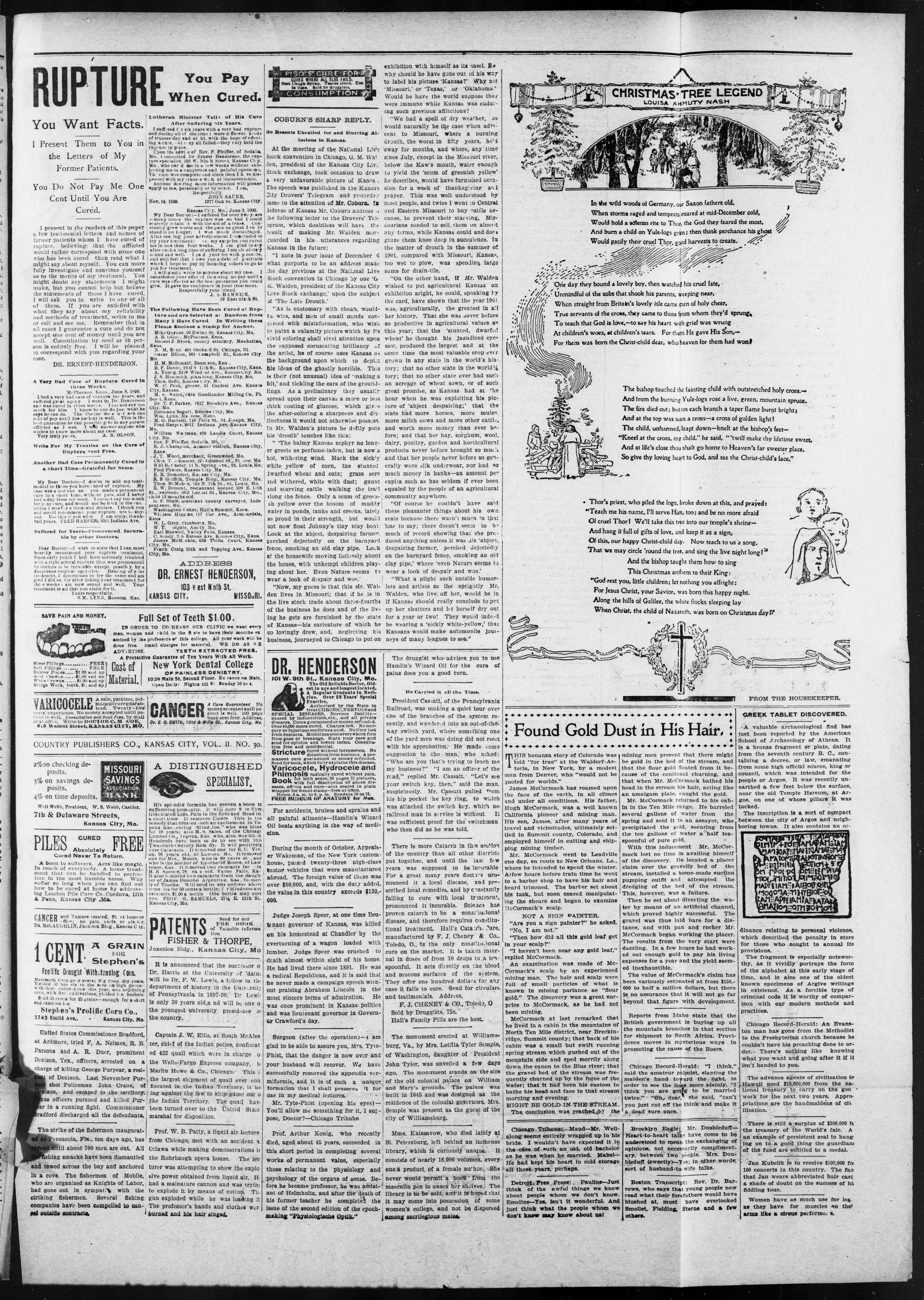
COBURN'S SHARP REPLY.
life Resents Uncalled for and Stirring Allusions to Kansas.
At the meeting of the National Live Stock convention in Chicago, G. M. Walden, president of the Kansas City Live Stock exchange, took occasion to draw a very unfavorable picture of Kansas. The speech was published in the Kansas City Drovers' Telegram and yesterday came to the attention of Mr. Coburn. In defense of Kansas Mr. Coburn address the following letter to the Drovers' Telegram, which doubtless will have the result of making Mr. Walden more guarded in his utterances regarding Kansas in the future:
"I note in your issue of December 6 what purports to be an address made the day previous at the National Live Stock convention in Chicago by one G. M. Walden, president of the Kansas City Live Stock exchange," upon the subject of "The Late Drouth."
"As is customary with cheap, woulde wits, and men of small minds corposed with misinformation, who wish to paint a calamity picture which by its vivid coloring shall rivet attention upon the supposed coruscating brilliancy of the artist, he of course uses Kansas as the background upon which to depict his ideas of the ghastly horrible. This is their (not unusual) idea of 'making a bit,' and tickling the ears of the groundlings. As a preliminary they usually spread upon their canvas a more or less thick coating of glucose, which gives the after-coloring a sharpness and distinctness it would not otherwise possess. In Mr. Walden's picture he d-fly puts his 'drouth' touches like this:
" The balmy Kansas zephyr no longer greets us perfume-laden, but is now a hot, withering wind. Mark the sickly white yellow of corn, the stunted twarfed wheat and oats; grass sere and withered, white with dust; gaudt and starving cattle walking the trail along the fence. Only a scum of greensh yellow over the bosom of muddy water in ponds, tanks and creeks, lately to proud in their strength, but would not now float Johnny's tiny play boat. Look at the object, despairing farmer, perched dejectedly on the barnyard fence, smoking an old clay pipe. Look at the housewife moving listlessly about the house, with unkempt children playing about her. Even Nature seems to wear a look of despair and woe."
"Now, my guess is that this Mr. Walden lives in Missouri; that if he is in the live stock trade about three-fourths of the business he does and of the living he gets are furnished by the state of Kansas—his caricature of which he so lovingly drew, and, neglecting his business, journeyed to Chicago to put on
DR. HENDERSON
101 W. 9th St. Kansas City, Mo.
In age and location largest
Regular Graduate in Needle
Chair, Our Lady of the
Authorized by the State to
Authorized by the State to handle both NURSING and SPECIAL DISABLEMENT. Norbert Lowe caused by Indications, etc., and all private diseases. Cures guaranteed or money refinanced. Over 400 cases cured. Charges not required. Not limited from business. Medicines everywhere free from gase or breakage. State your case and consult free and confidential.
Stricture card without instruments. No manent cure, distention from business. A per manent book, which fully explains this disease. Varicocelle, Hydrocele and Phimis book. Send for book, which fully explains this disease. Book for both sexes, 96 pages 21 pictures, with full description of above diseases, offices and cure—send signed in plain wrapper for men, m. to. m. to. m. on holidays. Hours a.m. to. m. p. Sundays to. 10. tues. FREE MUSEUM OF ANATOMY for Men.
For accidents, bruises and sprains and all painful ailments—Hamlin's Wizard Oil beats anything in the way of medicine.
During the month of October, Arpaisler Wakeman, of the New York custom house, passed twenty-three high-class motor vehicles that were manufactured abroad. The foreign value of these was over $80,000, and, with the duty added, the value in this country exceeds $120,000.
Judge Joseph Speer, at one time lieutenant governor of Kansas, was killed on his homestead at Chandler by the overturning of a wagon loaded with lumber. Judge Speer was crushed to death almost within sight of his home. He had lived there since 1891. He was a radical Republican, and it is said that he never made a campaign speech without praising Abraham Lincoln in the most sincere terms of admiration. He was once prominent in Kansas politics and was lieutenant governor in Governor Crawford's day.
Surgeon (after the operation)—I am glad to be able to assure you, Mrs. Tyte-Phist, that the danger is now over and your husband will recover. We have successfully removed the appendix vermiformis, and it is of such a unique formation that I shall preserve it for use in my medical lectures.
Mr. Tyte-Phist (opening his eyes)—You'll allow me something for it, I suppose, Doctor—Chicago Tribune
Prof. Arthur Konig, who recently died, aged about 45 years, succeeded in this short period in completing several works of permanent value, especially those relating to the physiology and psychology of the organs of sense. Before he became professor, he was assistant of Helmholtz, and after the death of his former teacher he completed the issue of the second edition of the epoch-making "Physiologie Optik."
exhibition with himself as its asSEL. Be why should he have gone out of his way to label his picture 'Kansas?' Why not 'Missouri,' or 'Texas,' or 'Oklaboma?' Would he have the world suppose they were immune while Kansas was enduring such previous afflictions?
"We had a spell of dry weather, as would naturally be the case when adjacent to Missouri, where a burning grouth, the worst in fifty years, he'd sway for mouths, and where, any time since July, except in the Missouri river, below the Kaw's mouth, water enough to yield the 'sum of greenish yellow' he describes, would have furnished occasion for a week of thanksgiving and prayer. This was well understood by most people, and twice I went to Central and Eastern Missouri to buy cattle because, to prevent their starving, Missourians needed to sell them on almost any terms, while Kansas could and graze them knee deep in succulence. In the matter of drought in the summer of 1901, compared with Missouri, Kansas, too wet to plow, was spending large sums for drain-tile.
"On the other hand, if Mr. Walden wished to put agricultural Kansas on exhibition aright, he could, speaking by the card, have shown that the year 1901 was, agriculturally, the greatest in all her history. That she was never before so productive in agricultural values as this year; that the 'stunted, dwarf wheat' he thought his jaunied eyes saw, produced the largest and at the same time the most valuable crop ever grown in any state in the world's history; that no other state in the world's history; that no other state ever had such an acreage of wheat sown, or of such great promise, as Kansas had at the hour when he was exploiting his picture of 'object despairing'; that the state had more horses, more mules, more milch cows and more other cattle, and worth more money than ever before; and that her hay, sorghum, wool, dairy, poultry, garden and horticultural products never before brought so much and that her people never before so generally wore silk underwear, nor had so much money in banks—an amount per capita such as has seldom if ever been equaled by the people of an agricultural community anywhere.
"Of course he couldn't have said these pleasant things about his own state because there wasn't much in that line to say; there doesn't seem to be much of record showing that she produced anything unless it was his abject, despairing farmer, perched dejectedly on the barnyard fence, smoking an old clay pipe,' where 'even Nature seems to wear a look of despair and woe."
"What a plight such outside humorists and artists as the sprightly Mr. Walden, who live, off her, would be in if Kansas should really conclude to put up her shutters and let herself dry out for a year or two. They would indeed be wearing a 'sickly white-yellow,' that Kansans would make automobile journeys of many leagues to see."
The drummist who advises you to use Hamlin's Wizard Oil for the cure of pains does you a good turn.
President Cassatt, of the Pennsylvania Railroad, was making a quiet tour over one of the branches of the system recently, and wandered into an out-of-the-way switch yard, where something one of the yard men was doing did not meet with his approbation. He made some suggestion to the man, who asked: "Who are you that's trying to teach me my business?" "I am an officer of the road," replied Mr. Cassatt. "Let's see your switch key, then," said the man, suspiciously. Mr. Cassatt pulled "on his hip pocket the key ring, to which was attached the switch key, which no railroad man in service is without. It was sufficient proof for the switchman who then did as he was told.
There is more Catarrh in this section of the country than all other districts put together, and until the last few years was supposed to be incurable. For a great many years doctors unnounced it a local disease, and prescribed local remedies, and by constantly failing to cure with local treatment, pronounced it incurable. Science has proven catarrh to be a constitutional disease, and therefore requires constitutional treatment. Hall's Catarrh Jure, manufactured by F. J. Cheney & Co., Toledo, O., is the only constitutional cure on the market. It is taken internal in doses of from 10 drops to a teaspoonful. It acts directly on the blood and mucous surfaces of the system. They offer one hundred dollars for any case it fails to cure. Send for circulars and testimonials. Address,
F. J. CHENEY & CO., Toledo, O
Sold by Druggists, 75c.
Hall's Family Pills are the best.
The monument erected at Williamsburg, Va., by Mrs. Letitia Tyler Semple, of Washington, daughter of President John Tyler, was unveiled a few days ago. The monument stands on the site of the old colonial palace on William and Mary's grounds. The palace was built in 1645 and was designed as the residence of the colonial governors. Mrs. Semple was present as the guest of the city of Williamsburg.
Mme. Kaissavow, who died lately at St. Petersburg, left behind an immense library, which is curiously unique. It consists of nearly 18,000 volumes, every one a product of a female author. She never would permit a book from the masculin pen to unsex her shelves. The library is to be sold; and it is hoped that it may come into possession of some women's college, and not be dispersed among sacrilegious males.
CHRISTMAS·TREE LEGEND
LOUISA AHMUTY NASH
In the wild woods of Germany, our Saxon fathers old.
When storms raged and tempests roared at mid-December cold,
Would hold a solemn rite to Thor, the God they feared the most,
And burn a child on Yule-logs grim; then think perchance his ghost
Would sacrifice the soul.
One day they bound a lovely boy, then watched his cruel fate,
Unmindful of the sobs that shook his parents, weeping near.
When straight from Britain's lovely isle came men of holy cheer,
True servants of the cross, they came to those from whom they'd sprung.
To teach that God is love,—to say his heart with grief was wrung
At children's woes, at children's tears. For them He gave His Son,—
For them was born the Christ's child dear, who heaven for them had won
- Thor's priest, who piled the logs, broke down at this, and prayed:
"Teach me his name, I'll serve Him, too; and be no more afraid
Ol cruel Thor! We'll take this tree into our temple's shrine—
And hang it full of gifts of love, and keep it as a sign,
Ol this, our happy Christ-child day. Now teach to us a song.
That we may circle 'round the tree, and sing the live night long!'"
And the bishop taught them how to sing
This Christmas anthem to their King:
"God rest you, little children; let nothing you affright;
For Jesus Christ, your Savior, was born this happy night.
Along the hills of Galilee, the white flocks sleeping lay
When Christ, the child of Nazareth, was born on Christmas day!"
FROM THE HOUSEKEEPER.
Found Gold Dust in His Hair,
```markdown
```
TATATATAS
• Thor's priest
"Teach me his
Of cruel Thor
And hang it here
Of this, our H
That we may
"God rest you
For Jesus C
Along the H
When Chr
Found Gold Du
THIS bonanza story of Colorado was told "for true" at the Waldorf-Astoria, in New York, by a modest man from Denver, who "would not be quoted for worlds."
James McCormack has roamed upon the face of the earth, in all climes and under all conditions. His father, Hugh McCormack, was a well known California pioneer and mining man. His son, James, after many years of travel and vicissitudes, ultimately settled in Summit county, Colorado, and employed himself in cutting and shipping mining timber.
Mr. McCormack used to leadleville one day, en route to New Orleans, La., where he intended to spend the winter. Affew hours before train time he went to a barber shop to have his hair and beard trimmed. The barber set about his task, but soon ceased manipulating the shears and began to examine McCormack's scalp.
NOT A SIGN PAINTER.
"Are you a sign painter?" he asked.
"No, I am not."
"Then how did all this gold leaf get in your scalp?"
"I haven't been near any gold leaf," replied McCormack.
An examination was made of McCormack's scalp by an experienced mining man. The hair and scalp were full of small particles of what is known in mining parlance as "flour gold." The discovery was a great surprise to McCormack, as he had not been mining.
McCormack at last remarked that he lived in a cabin in the mountains of North Ten Mile district, near Breckinridge, Summit county; that back of his cabin was a small but swift running spring stream which gushed out of the mountain side and sped merrily along down the canon to the Blue river; that the gravel bed of the stream was frequently churned up by the force of the water; that it had been his custom to bathe his head and face in that stream morning and evening.
MIGHT BE GOLD IN THE STREAM.
The conclusion was reached by the
Chicago Tribune: Maud—Mr. Well-
along seems entirely wrapped up in his
bride. I wouldn't have expected it in
the case of such an old, old bachelor
as he was when he married. Mabel—
He had kept his heart in cold storage
all those years, perhaps.
Detroit Free Press: Pauline—Just
think of the awful things we know
about people whom we don't know.
Emeline—Yes, isn't it wonderful. And
just think what the people whom we
don't know may know about us!
---
The bishop touched the fainting child with outstretched holy cross.—And from the burning Yule-logs rose a live, green, mountain spruce.
The fire died out; but on each branch a taper flame burnt bright;
And at the top was seen a cross—a cross of golden light!
The child, unharmed, leapt down—knelt at the bishop's feet—"Kneel at the cross, my child," he said, "‘twill make my lifetime sweet
And at life's close thou shalt go to Heaven's far sweeter place.
So give thy loving heart to God, and see the Christ-child's face."
mining men present that there might be gold in the bed of the stream, and that the flour gold floated from it because of the continual churning, and that when Mr. McCormack bathed his head in the stream his hair, acting like an amalgam plate, caught the gold. Mr. McCormack returned to his cabin in the Ten Mile range. He barreled several gallons of water from the spring and sent it to an assayer, who precipitated the gold, securing from the ten gallons of water a half teaspoonful of pure gold. With this inducement Mr. McCormack lost no time in availing himself of the discovery. He located a placer claim over the gravelly bed of the stream, installed a home-made suction pumping outfit and attempted the dredging of the bed of the stream. This, however, was a failure.
Then he set about diverting the water by means of an artificial channel, which proved highly successful. The gravel was thus laid bare for a distance, and with pan and rocker Mr. McCormack began working the placer. The results from the very start were dazzling. In a few hours he had worked out enough gold to pay his living expenses for a year and the yield seemed inexhaustible. The value of McCormack's claim has been variously estimated at from $150,000 to half a million dollars, but there is no assurance that it will not go far beyond that figure with development.
Reports from Idaho state that the British government is buying up all the mountain bronches in that section for shipment to South Africa. Providence moves in mysterious ways in promoting the cause of the Boers.
Chicago Record-Herald: "I think," said the amateur palist, slanting the maiden's hand toward the light, in order to see the lines more plainly. "I think you are going to be married twice." "Oh, dear, she said, "can't you just cut off the think and make it a dead sure once.
Brooklyn Eagle: Mr. Doubleduff—Heart-to-heart talks have come to be understood to mean the exchanging of opinions, not necessarily complimentary, between two people. Mrs. Doubleduff (sweetly)—Yes; in other words, sort of husband-to-wife talks.
Boston Transcript: Rev. Dr. Barrows, who says that young people now read what their forefathers would have blushed at, must have overlooked Smollet, Fielding Sterne and a few others.
Mary
night.
day
Christmas day!*
FROM THE HOUSEKEEPER.
GREEK TABLET DISCOVERED.
A valuable archaeological find has just been reported by the American School of Archaeology of Athens. It is a bronze fragment or plate, dating from the seventh century B. C., containing a decree, or law, emanating from some high official source, king or council, which was intended for the people or Argos. It was recently unearthed a few feet below the surface, near the old Temple Hereum, at Argos, on one of whose pillars it was tacked.
The inscription is a sort of compact between the city of Argos and neighboring towns. It also contains an or-
distance relating to personal violence, which described the penalty in store for those who sought to annual its provisions.
The fragment is especially noteworthy, as it vividly portrays the form of the alphabet at this early stage of time, and is also one of the oldest known specimens of Argive writings in existence. As a forcible type of criminal code it is worthy of comparison with our modern methods and practices.
Chicago Record-Herald: An Evanton man has gone from the Methodist to the Presbyterian church because he couldn't have his preaching done to order. There's nothing like knowing what you want and going after it if it isn't handed to you.
The advance agents of civilization in Hawaii need $100,000,000 from the national treasury to carry on the goo work for the next two years. Appropriations are the handmaldens of civilization.
There is still a surplus of $300,000 in the treasury of the World's fair. A an example of persistent zeal in hanging on to a good thing the guardian of the fund are entitled to a medal.
Jan Kubelik is to receive $100,000 for 100 concerts in this country. The fact that Jan wears abbreviated hair cast a shade of doubt on the success of his fiddling tour.
Women have as much use for log as they have for muscles on the arms like a circus performe. 8.
State Ledger.
SUBSCRIPTION six months 750
One Year 1.50
ALL SUBSCRIPTIONS CASH IN AD
FANCE
ered at post office at Topeka, Kansas, at sec
udance-rates.
Published every Saturday at 431 Kan. ave
1.00 in advance
LOCAL And PERSONAL
Remembr the Red Letter Day at St, John's A. M. E. S. S. Dec 22nd.
Parties desiring to secure board for horses and cows this winter will do well to see Mr. Sinclair the pror. of the West End Barn, Cedervale Kami.
Go to H. L. Trump for all kinds
of fine cigars and tobaccos. 804
Kansas avenue.
Proudit and Perkins are among
the leading caterers or the city
they operate The Magnet a rowly
modified concern, they handle
nothing but the best line the mark-
ket affords. Give them a call 412
Kans. Ave
GOLD KING BAKING POWDER
made by H. H. Parker the
best in the market, 1001 Kass. ave
Topeka Drug Co.
PREScription DRUGGIST.
732 Kansas Avenue.
J. W KELLEY,
Staple and Fancy Groceries. Give Him a
Call. 119 N. Main Street Ottawa, K.
When in Lawrence try A. T.
Rathiffs meals 20 cents best in the
the city 625 Mass, St.
JAMES WERTS.
Dealer in
Groceries and Country Produce
Qewsensure. Fruits, Cigars, Tobacco,
Flour and Feed. 535 Topeka Avenue.
STATE LEDDER
Seven Column Paper filled with news from every
where.
$1.50 PER ANNUUM
THOSE WHO OWE
SHOULD HURRY TO
411 KANSAS AV.
RIDGE, M. D.
PHYSICIAN & SURGEON
R.
Magnetic College and Institute,
SES A SPECIALTY.
This Disease, Rheumatism, Neuralgia, Tub
is both Physical and Drugs.
J. A. DAVIS & CO
WHOLE SALE & RETAIL
FISH & MEAT MARKET
Alway, open from 6 a.m. to 8 p.m.
We supply all the city deal
r with fresh fish of all kinds.
123 W. 6th St.
NEW IDEA
BAKERY & CANDY FACTORY
310 Sout Main Street, Ottawa, Kan
W. D. WORK Mgr. Phone 33
LANDISHOME BAKERY
Many years experience. French home B
kery 316 E. 400 St.
TOPEKA CREMATORY CO.
J. Z. HOWE Manage.
214 East Fifth Street, Phone 817 Creamatory
Topeka Kans.
MRS. E. MOSTETLER,
Gives meals for 10 and 15 cents 720 P.
Douglas St. Wichita Kars. Also carries a
full line of cigars, tobacco and temperance
drinks.
H. L. TROMP
Manufacturer of
HIGH GRADE CIGARS
804 Kans. Ave. Topeka Kans.
H. A. KLAUER
Carries All the LATEST Brands
of cigars and also a FULL LINE
Tobacco and smoking articles
His cigars are made in Topeka
526 Kans. ave.
Plant for windows and bedding. Socie
embliches in flowers a speciality. Green
houses 12th and Monroe Sts. Store 501
8th S.
ZERCHER & PGOL,
POOKS, STATIONERY, OFFICE SUP
PLIES.
527 Kansas Avenue.
We solicit a share of your patrimage
TOPEKA. KANS.
Topeka Tent & Awn-
TENTS & AWNINGS.
Flags, Tarpaulins: Wagon covers, Horse
covers: Ets
304 Kansas Ave. Phone 612.
JOSEPH ARTLEY
Foot and shoe manufacturer does
all kinds of repairing at reason
able prices. Men's half soles 50
ladies 40t, children's 30 cents
Stand 400 Kans.
1 Dodd Bros.
...DEALERS IN...;
All of our leading GRANITES and MARBLE MOVEMENTS. Our Designs are all modern and up-to-date. Cleaning up old monuments and uncutting inscriptions a speciality.
S. BAU M
1064 Union Ave. (opposite depot)
Clothing Boots and Shoes, tur-
ing Goods, Jewelry of all
kinds, Kansas C
H. F. Williams, Pres.
Wm. L. Dick, Scey & Tressa
THE TOPEKA ICE & COLD
STORAGE CO
Manufactured Ice.
Cold Storage for eggs, butter, apples, poultry and all perishable goods,
Cor Curtis & Tyler st
Trackage to all Railroads. Correspondence
Sited. N. Topeka. Phone 657
...THE .... TOPEKA BUSINESS COLLEGE, 523 Quincy Street, thus far, the member ship in this Institution increases every ys. If you want a good business education sell or address L, H, Strickle Topeks, Ka. W. H, Shrack and Son, Dealers, n all kinds offancy-notions and general department store they will serve you right give them a
E
Continued from front page
And, mind you, don't lose the note—that's far more precious than the flowers."
He detached several of the modest flowers from the pretty bunch and put them in the child's other hand as she reached for the bouquet. She danced away from him in delight, kissing her hand to him as she skipped down the stairs. On the lower floor she confronted the leading man in the act of ascending. Her eyes widened as she saw the huge cluster of roses Leonard endeavored to conceal from her.
"Give me a rose, Mr. Leonard?" she begged saucily, placing the violets behind her.
"I guess not," Leonard answered shortly. "These flowers came too high, young lady, to waste their fragrance in a child's careless hand."
Little Miss Dolly looked after his retreating form with angry resentment blazing in her big, brown eyes.
"I'll just tell mamma," she confided to the violets. "I don't think she likes Mr Leonard anyway. Dick isn't stingy," she added, a smile dispelling the frown with the swiftness of magic. "And—I think mamma likes Dick."
At the close of the rehearsal the following afternoon Leonard accosted Alton. "I congratulate you, Dick," he said, extending his hand with forced cordiality. "I misjudged the lady's choice, it seems. I bow before the violet's supremacy and hall that particular flower as love's accepted messenger in this important instance."
Miss Kingsley had approached the two men unseen. Now she stepped forward and laid her hand lightly on Alton's arm. Then she turned to Leonard, smiling.
"The violets told me one story," she said, with bewitching naivete. "A very sweet and welcome one, I admit, but the little maiden who brought them to me told another. She was only a child, but she loved violets, as did her mother. She held them tenderly and was rewarded with a cluster all her own. The generous giver marred the beauty of the florist's creation to please a child and the child appreciated the act. So did the child's mother. She realized the difference between the man who offered the modest violet, enriched by the wealth of his heart's best love, and one who imagined the more expensive the flower the more impressive his suit." Leonard bowed and walked away without a word.
Dick bent his handsome head and kissed Miss Kingsley. "My darling," he whispered, softly. "My beautiful wife that is to be." And she realized that for her life had just revealed its brightest colors, and the man before her brought treasures beyond price and withertho unknown—love and happiness. —Indianapolis Sun.
FROM RAM'S HORN.
Earthly athletics will not suffice for the heavenly race.
Christian consecration is simply concentration on Christ.
God robs us of our strength that we may rely on His might.
The purity of our motives determines our motive power in the world.
Some methods of raising money are most successful in lowerling manhood.
He who can not rule his own appetite is unfitted to run his neighbor's affairs.
Our disappointments may be intended to direct us to the Divine appointments.
Wine may give wings to the imigination, but it gives no wit to guide them.
The lives of others will be none the sweeter for your attempt to absorb all the sourness in the universe.
The trouble with many preachers is that they are thinking more of their own self-flourishment than of their flock's soul nourishment.
Mr. A. squith's Little Joke.
Mr. Asquith rarely makes a joke—at any rate, in public. You may search his speeches in parliament or on the platform, but you will find nothing that savors of the comic. Only once in the law courts has the ex-home secretary been known to make a joke, and that was in a betting case, when the question arose as to what constituted a "place." The judge put a poser, as he thought, to Mr. Asquith.
"That, my lord," Mr. Asquith immediately retorted, "would be merely a matter of degree."
The court was convulsed with laughter.-London Answers.
The Journeymen Barbers' International Union has decided to admit women to membership.
BLUE FRONT GROCERY,
Staple and Fancy Groceries Fresh and Sal Meats Food and Provisions, Country Products taken in Exchange, highest Market paid in cash or trade, 1002 Kans 479, North Topkis, Tel. 283
```markdown
```
Restaurant and Short Order, 119
Kans. Ave, open day and night
Everything first class convenient
to trains.
C FRODLIE?
Dye and Cleaning Works.
820 Kans. Ave, Topeka, K nsas.
(Phone 957)
If you are hard up see Uncle
Sain at 512 Kansas ave. H will
fix you out.
WE MAKE CLOTHES
That fit
N. H Wolff Tatior 429 Kansas
Ave
114 East 4th Street.
The Union Tailor will make you a suit of Clothes at reasonable prices. Pants from $4 50 and up. When you want something done in his line give him a call. Repairing, and cleaning neatly done.
WM. KLINGE
TAILOR.
Fine Tailoring at reasonable prices.
Fit and Workmanship guaranteed,
Cleaning and Repairing neatly done.
512½ Kansas Avenue. Topeka.
MISS MARY E. KIETH,
Hair dressing and all kinds of hair work done in the best styles and grades. Your trade subjectee
147 Main St. Wichita, Kansas
GO TO
JACOB HOUSE'S
For Clothing.
And Gents Formishings Hats
and Caps
927 Mars St., Lawrence Kans.,
LEWIS G. FERRRELL,
ATTORNEY AT LAW.
And Real Estate special attention paid to
nonresident claims. Ouine Kans.
E. H. UPSHAW
Peoples Feed, 537 Kansas Avenue, North
Popeka. Full weights. Goods prompt
delivered.
GILLETTE & NICHOLSON,
Lumber
Luth
Sash
COAL
Blinds
Mould
100 Kans Ave.
S. H. DOWN'S
306 Kans Avenue
For Garden and flower seeds, and
lawn grass, and Hardy cases and,
plans.
306 Kansas avenue.
PINKSTON BROS.
GO TO
Flour, Feed and Grain. Reliable Dealers. Headquarters for anything you want in their line. Call and see them----517 N. Main St
GUS JOHNSON.
DEALERIN
OSAGE CITY SHAFT COAL
and all other kinds
608 East Second St. Tel. 557
Rahrer's Restaurant
615 East Fifth St.
Opposite Santa Fe Depot.
C, A, RAHRER Prop.
All kinds of repairs for your wheel at
Topeka Cycle Co. 112 W. 8th St.
HORE IN WALL
Wher in LAWRENCE stop at WEVER-
MULLER'S RESTAURANT
SHORTCORDER. Open Day and Night
720 Mass., Street
Its jule's that feeds the best.
Watch jule's.
Comic adds
In this space
It has jule, the thing.
He gives to eat.
ALWAYS FRESH and NEW.
JULE'S
rie w o has good things to eat.
Restaurant
J, E, PETERSON—or Marquet, e Kansas the best HOTEL and RESTA RANT in the city give him a call.
JONE'S RESTAURANT
529 Kans ave n., North Topeka
SERVES MEALS
and short order. Everything thing the market affords. Give him a call.
E, L. PERRING
Restaurant and Short Order
Fruts and confessiones
OFFICE 2250 KANS. AVE
Over Kohl's Drug Store
H. B. MOGBOOM
PHYSICIAN and SURGEON,
833 Kans Ave
All calls
pmply attended Tel 141
Tel. 893.
I. A. SHIELDS M. D.
S.G. STEWART, M.D.
OFFICE 621 KANSAS AVE
Telephone 544
Residence 112 East 7th Street
DR J.C. ISERMAN
W m. B. Swan, M. D
725 Kansas Avenue,
Kapoks,
Kansas.
Office hours, 1:00 to 12 m., 2:00 to 4:30 pm
Residence 024 Buchanan st.
Bell Telephone, 666.
Wm. E. JACKSON, M. D.
PHYSICIAN and SURGEON.
OFFICE HOURS; 9 TO 11 A.M.
2 TO 5, and 7 TO 9 P.M.
Sunday Hours: 1 to 3 P.M.
OFFICE 404 Kas, Ave
(Over Wallace Drug Store.)
At very reasonable prices. Our small expense make it possible for us to sell goods surprising ly cheap. See our windows for bar ainsin for wear.
LILLEY & CO. Dealer In. lumber, coal baled hay sash doors, blinds, paint oils, lime sand & cement WILSEY. KANS.
UNDERTAKERS
...and Licensed Embalmers...
A FULL LINE OF
COFFIN, CASKETS AND ROES AT
REASONABLE PRICES,
106 C N, Kansas Avenue,
Tel. 850. North Touke
THE BOOK EXCHANGE
832 Kas. Avenue.
```markdown
```
DR. W. H. H. SMITH,
Special Attention given to Chronic Disease
and All Diseases peculiar to Woman.
15 years experience.
Corner 4th and Knappe Avenue.
Office, Over Hatch's Drug Store.
DR. F. H. SCHOLLE
DR. D. A. FAYLOR,
412 CLAIN AND SUEKO
Rec Hours, 9 to 11 a.m.
From 2 to 5 p.m.
PHYSICIAN and SURGEON.
Office and Residence 1331 VanBuren St.
cells promptly attended.
S. A. BOAM M. D.
Physician & Surgeon.
421 Kans. Ave. Tel. 573 Residence 1407 W. Tenth St.
Office 112 East 6th street
Cols Pally Attended To.
Special Attention Given to Dear
Stomach and Lungs and Female Pupils
Of Office Hours: 12 - 2 - 10 5 - 7 - 10
GEORGE DICK, M. D.
Homocopabist
Residence 625 Wilmington 81.
Telephone 360.
Office 807 Kansas Avenue.
C. F. MENNINGER, M, D.
Office 727 Kansas Ave.
Telephone 19.
J. M JAMISON, M. D.
Office 506 East 4th Street.
Office Hours:
specialization diseases of women and private diseases.
KEITH & HAZEN
DRUGSINTS & DEALERS in all kind of Drugs and Patent medicines, Palms, Oils and Varnishes, Toilet articles and Pertamery. 422 Kans. Ave. Yourtrade is kindly solicited
GIBRALTAR DRUG CO.
833 KANSAS AVENUE,
Toppera, Kansas
HOMEPATHIC REMED
ART MA*
TERIALS.
DR. PAGE S PHARMACY
111 East 6th Street
111 East 91st Street
Full line of Drugs and Toilet articles and Medicines.
Give him a cal.
Miller's pharma
6th & TOPEKA AVE
Drugs, Medicines, Pr script* s Carefully
compounded. Give Us a Trial.
C. W. WILLJTS. FRANK CONWELL
F. W. WILLIES
WILLIES & CONWELL
WILLIAMS & CONWELL.
There will be a rush for school books soon at the book exchange. Don't forget the place. You will be waited on by a courteous assistants
Give Mr. Protach a call 717 Mass. St.
EBELING & LAVERNTZ
SEVERANCE KANS
E. G. KANLEY
Manila paper
Carriages, Phactans, Hessian Ware
Special Attention Given to Order Work, Quarring, Pint Fuel, Canning
424 and 425 Jackson Street
Cut Flowers Funeral Designs Palms and
MRS. M. E HOLLCAR
FLORIST.
11. 176. (19 W 6th Street)
TOPEKA SPICE MILLS
Pure Tea and 'Spice
Manual purer
Carriages, Phaestigs, Hospitals, Watson
in Given to Order, Works, Sourcing, Plant Co-
mmercial
424 and 426 Jackson Street
Firers
Furnal Designs, Palms and
MRS. M. E HOLLCAR
FLORIST.
119 W. 6th Street.
TOPEK A SPICE MILLS
Tea and Spice
Maintenance
Carriages, Phantoms, Business Ware
Special Attention Given to Order Work, Coaching, Phantoms
424 and 426 Jackson Store
109 E. Sixth Street.
J. RAFFELOCH
For Clothing, and Gents Farnishing Goods
New and Up-To-Date Clothing.
Gents' Farnishings, Shoes, Hats, Etc.
3 o Kansas Avenue, Topeka, Kansas
(Desk down to Symons Grocery Co.)
carralent
HEA RICKCA
812 KA
JAMES
DEA
Kiddes, Tallow
108 and 110 East T
Pays highest prt
REFERENCE; Chas. Wolf Jackin; Co.
A RICKCARRIAGE O
812 KANS, AVENUE
JAMES. SMITH
DEALER IN
(Iddes, Tallow, Burs and Pew
and 110 East Third Street, To
Pays highest prices for consignment tra-
; Chas, Wolf Jacking, Co, Topeka R. G. Dunn, Compl
HEA RICKCARRIAGE CO.
812 KANS, AVE.
JAMES. SMITH,
DEALER IN
Kiddes, Tallow, Burs and Pens.
108 and 110 East Third Street Topeka
Pays highest prices for consignment trade.
REFERENCE; Chas. Wolf Packing Co. Topeka R. G. Duncan Comh. Agency
ARE
YOU
DEAF?
ANY
HEA
NOISE
ALL C
DEAFNESS OR
ARE NOW
by our new invention. On
HEAD NOISES CE
F. A. WERMAN, C
Gentlemen : - Being entirelyured of deaf
full history of mankind
About five years ago my right ear began
ALL CASES OF
NESS OR HARD HE
ARE NOW CURABLE
our new invention. Only those born deaf are inc
D NOISES CEASE IMMEDIAT
F. A. WERMAN, OF BALTIMORE, SAYS:
BALTIMORE, Md.
Being entirelyured of deafness, thanks to your treatment,
reeds ago my right ear can be sing, and this kept on getting
Gentlemen : — Being entirely cured of deafness, thanks to your treatment, I will now give a full history of my case, to be used at your discretion.
About five years ago my right ear began to sing, and this kept on getting worse, until I am
My hearing in this car entirely.
I underwent a treatment for catarrh, for three months, without any success, consulted me, but of physicians, among others, the most eminent car specialist of this city, who told me only an operation could help me, and even that only temporarily, that the head may not, then cease, but the hearing in the affected car would be lost forever.
Then, saw your advertisement successfully, a New York paper, and order of journalment. After I had used it only a few days according to your directions, the notes were, on the 10th of the day, the new year.
heartily and beg to remain Very truly yours,
F. A. WERMAN, 790 S. Broadway, Baltimore, Md.
Our treatment does not interfere with your usual occupation.
Examination and advice free. YOU CAN CURE YOURSELF AT HOME. INTERNATIONAL AURAL CLINIC, 596 LA SALLE AVE., CHICAGO, IL. SHOES FOR EVERY BODY
BRANDL'S CASH SHOF STORE
128 South Main Street. Ottawa, Kansas.
(Fourth door North First National Bank.)
Granite and Marble Monument
Statuary Coping, Columns and Fancy Carved Column Caps
Fine Cut stone Work done in Neat and Latest Styles
Abilene, Kane
el. 176.
Designs. Palms and Farms
E HOLLCAFT
ORIST.
119 W 6th Street. Lupka
A SPICE MILLS
and 'Spices etc
FELOCH
TO RIDE IN STYLE and comfort to you need one of Our carriages They have the perfection of style and the height of beauty and assurance of safety. We are showing in latest styles.
MARRIAGE CO.
MANS, AVE.
S. SMITH,
WALER IN
W. Burs and Pelts.
Third Street Topeka K
aces for consignment trade.
Topeka R. G. Dunn. Compl. Agency Topeka
CASES OF
HARD HEARING
N CURABLE
ly those born deaf are incurable.
LEASE IMMEDIATELY.
OF BALTIMORE, SAYS:
BALTIMORE, Md., March 30, not
fires, thanks to your treatment, I will now give
discretion.
to sing, and this kept on getting worse, until it be
ANY HEAD NOISE