State Ledger
Saturday, April 26, 1902
Topeka, Kansas
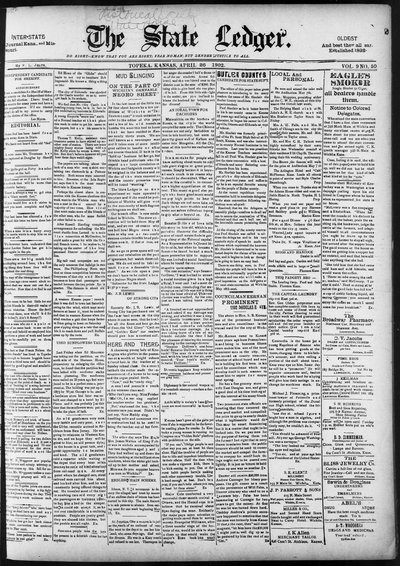
Page text (machine-generated)
INTER-STATE
Journal Kans., and Miss
souri.
By F. L. JELTZ.
INDEPENDENT CANDIDATE
FOR SHERIFF.
ANNOUNCEMENT
I am a candidate for Sheiff of Shaw
see county on the Independent ticket
or the fall election. I have lived in
this county for many years and have a
side acquaintance. If I am elected
should all in my power to carry
at the duties of the office.
EDITORIAL
The State Ledger.
DO RIGHT--KNOW THAT YOU ARE RIGHT; FEAR NOMAN; BUT RENDER JUSTICE TO ALL.
The papers are talking about the luck of a man who sent a shirt containing two diamonds to a Parsons laundry. Both stones were returned to him. Brewster, of the Iola Register, says that it is the most remark shirt-tale in Kansas history.
Perhaps the closest shave in connection with the Kansas elections this week went to the Wichita man who won a seat in the ci council by a majority of two votes. How tired that must make some of the friends of the other man, who for some foolish or other failed to vote.
After Russell Harding completes arrangements for extending the Missouri Pacific from Larned to a main line connection at McCracken, he could make a great hit with the Central Branch towns, i he wishes to, by taking up the matter of the long promised Denver extension of that line.
Big rail-road companies are not the only concerns that indulge in rate wars. The Phillipsburg News says that at times competition between the liveryman of that city and Marvin becomes so keen that passengers are hauled between the two points for a quarter. The distance is about six miles. Ex.
A western Kansas paper, remark that it was dull in town last Saturday owing to the wind, which kept many farmers at hame it, must be understood that in western Kansas when the wind reaches a gait that keeps farmers from going to town on Saturday goes zipping along at a rate that enable it to reach down and pull Buffalo grass up by the roots. Ex.
USED SUNFLOWERS TALKS
Last Friday when Ed Moorman was taking out the partition, on the north side of the Sherman House, preparatory to enlarging the office room, he found that the partition had been lathed with sunflower stalks before plastering. The sunflowers were nailed on 25 years ago but were found to be in a perfect state of preservation. The building was put up in 1873 by Wyat George to be used a hardware store but later was rebuilt and changed to a hotel by Ed Pierce and it was probably at this time that the sunflowers were put on to take the place of lath. Ex.
An old gentlemen very sick, very feeble and very poor, s a v the Globe, recently arrived in Atchison from New Jersey. He was going to relatives in Western Kas to die, and we hope they will be good to him; an old person dying in the house is a great task, and a great opportunity to be patient and kind. The old gentlemen told a reporter while waiting at the depot that every hour of his journey he reeled kind attention from rail-road men. At every point where he changed cars, stout railroad men carried him about, and looked after him, and he was constantly being offered things to eat. He traveled most of the time in smoking cars and every nig t the passengers or trainmen offer to buy him a bed in the sleeper, but he could not accept it, as he not rest comfortable in a reclining position. People are pretty good: they are abused like theives, but the people are all right. Ex.
Strenuous people miss the joys the present in a feverish chase for the anything.
In the last issue of the little two by four sheet known by a few politicians of Wichita as "THE SEARCH-LIGHT" it took occasion to refer to the editor of this paper and a few of his old friends as bumbs. We want this fool to know that we have resided in Kansas nearly thirty years. We are well known as a newspaper man and it takes men of more intelligent calibre to handle or effect our course than him. If he is in the "hold up' business let her go, but thimble head politicians who disregard our large circulation in Wichita and Sedgwick county will be weighed in the balance and on the day of the state convention and the county primaries they will be found "wanting."
The State Ledger is no new experiment we have operated it ten years and if the would be politicians of Wichita will give vent to the non-senity of such flagrant nothingness we shall see.
Our branch office is now established in Wichita. The state convention will be held there May 28 next., and we see no reason why one bull head Negro owns the town or why one or two overly anxious certain thimble head politicians own it, if that is true, we shall see.
As we go to press space will not permit our retaliation on the part of ignorance, but watch these columns. We do not need to take an insult from a damnable "dirty sheet." As we ride upon a pass we don't have to be called a burn by a jealous Negro sheet. "Subscribe for the State Ledger $1.50 per year.
Mr. J.B.LEWIS
Recently Mr. J, B, Lewis of Strong City has purchased one of the finest feed stores in the city where it can be seen, that he handles all the finest and best grades of flour, the "Old Glory" "Cyclone and," "Golden Gate" our readers should give him a constant call.
HERE AND THERE
A charming young lady of Kensington who gleries in the possession of a wealth of bright auburn colored hair, is the teacher of a Sunday school class. On a recent Sabbath the rector made the announcement of a hymn to be sung and the organ pealed forth.
A small and precocious youth in the womans class said:
"Why don't you sing, Miss Frisbee
'Me! Oh, I never sing replied the teacher smilin her prettiest.
But,' explained the boy, 'the minister says you must Didn't he just say, 'Now Reddy sing.
Smelling salts and numerous otter restoratives had to be used to bring the teacher out of her faint.
The other day says The Eagle Mrs. James Walton of King Fisher was in wichita accompanied by her two daughters aged 3 and 5 They had walked up and down the streets looking at the brilliant show windows, when the older girl looked up to her mother and asked, Mamma do you suppose heavens as nice as Wichita?" Ex.
Ithaca, N. Y. A movement to destroy the alleged beef trust by means of an endless chain of letters has been started in this city. The main feature is to ask persons to abstain from eating meat for one week beginning May 15, Ex.
At Junction City a woman is in jail as the result of an outburst of rage She went to the depot to see her hus' land, who some days ago, filed suit for divorce. He was in a Katy coach and refused to see her. Thereupon in
het anger she smashed half a dozen on so of the car windows. Arrest followed, and she was bound over to the district cout in the sum of $200. Not being able to give bond she was placed in jail. From this little side-light on the matter, are you inclined to blame the husband for bringing suit for divorce? Ex.
AN IDEAL TOWN FOR
RACHLORS
Maiwatchin, on the borders of Russia, is the city in the world peopleled by men only. The Chinese woman are not only forbidden to live in this territory, but even to pass the great wall of Kalkan and enter into Mongolia. All the Chinese of this border are exclusively traders. Ex
It is a mistake for people who know nothing about music to ridisculte great singers or great preformers. Simply because it is beyond one's reach is no reason why it should be discredited. What we want in this country is to encourage a higher appreciation of the best. This music is good else people who know good music would not pay high prices to hear it Such things are not mere fake. we ought to be more sensible and not make our selves ridiculous trying to guy what is beyond us. Ex.
Senator Dolliv r of Iowa tells this story on himself, which is expected to illustrate the difficulty a man of small means finds in getting along at the National capital. As a Representative he found little trouble, but when he became a Senator he found he had a much more pretention title to support. He was invited to social functions where he found the requirement of etauette quite severe.
"On one occasion," says Senaror Doliver, "I was invited to attend a social function given by a high official, I went and had a most deightful time, concluding that washington social life was not a thing to be the least afraid of. This conclusion was reached, by the way, just as I was taking leave of the hosst.
'A liveried servant approached me and asked if my carriage was writing, and whether it was a single or double 'conveyance. Out of conideration for a lean pocket book I had ordered a cab rather than a two-hour carriage. As I was taking leave of a tew of my friende outside the door I had the pleasure of hearing the servant shouting to the carriage drivers:
"Senator Dolliver's one-hour hack! Senator Dolliver's one-hour hack! "The man thn came to me and, with his head in the air, announced; 'Your hack's waitin'," Senator Dolliver.'" Ex.
Domestic happiness is keep wrinkles away, prevents baldness and premature gray hair.
Diplomacy is the natural weapon of the twentieth century--warfare a dernie resort.
Artificiality is society's lane. Decivers are most successful in deceiving.
Kansas hasn't gone all the gaits yet even if she is supposed to be the favorite nestling place for cranks. In Kentucky a young woman is running for Congress on a "Golden Rule" platform with prohibition on the side.
"If you can't. Oblige people in any other way you can at least let them alone. Half the troubles of people are due to idle and impudent interference in their affairs. Half the time when you make a vigorous kick, there is no kick coming to you. One of the worst habit people have is making each other unnecessary trouble. Life is hard enough at best. Don't be a pest; if you can't help others you can at least let them alone." Ex
Major Cole conducted a very successful three month revival a Ottawa, and the Herajd says it is believe that he received about $500 during the time. Evidently the major pays more attention to getting souls saved than to saving money. Evangelist Williams, after a three months' siege of the fortress of sin, would be able to show a clean up that would make the major's $500 look like small change.
BUTLER COUNTY'S CANDIDATE FOR STATE SUPPT
The editor of this paper takes great pleasure in introducing to its many readers the name of Mr. Sinclair the Butler County candidate for state superintendent. Prof. Sinclair as he is better known in his hme county came to Kansas 16 years ago and being a natural born educator, he began his career in Coffeyville, Ottawa and Eldorado as, supt of schoos.
Mr. Sinclair was formerly principal of the Ft. Scott High School at Ft. Scott, Kansas, and was also instructor in county Normal Institutes in ten counties. Last year he was president of the Kansas Teachers association; fall in all Prof. Wm. Sinclair goes before the state convention with a host of friends and many flattering compliments from his home.
Mr. Sinclair has been superintendent of the dity schools of Eldorado or the past four years and suffice to ay he is an especial favorite among the people of Butler county.
Resolved; that we the delegates in assembly pledge ourselves to do all we can to secure the nomination of Wm. Sinclair and that each hall use all the honorable means pertaining thereto.
At the closing of the county convention Prof. Sinclair was called to address the delegates and in his very masterly style of speech he made an address which captivated the heavens. Mr. Sinclair is determined to be nominated despite the claims of his opponents, and it begins to look as though he is going to have an easy lead.
There is one thing sure, in Prof Sinclair the people will have in him a man who is universally popular as an educator and one who will make a good impression on the delegates at our next state convention at Wichita May 28th next.
COUNCILMANKERNAN
PRCMINENT
1102 DOUGLAS E. AVE.
The above is Hon. S. B. Kernan one of the prominent business men and also councilman in the second ward for the city of Wichita.
Mr. Kernan came to Kansas many years ago from Pennsylvania and being in business fifteen years makes him one of the most prominent men in the city. He has served as county treasurer, member of school board and now he is holding his first term in his ward for councilman which may develop itself in such manner to cause him to aspire for mayor next spring.
He has a fine grocery store at 1102 East Douglas ave. and gives a good deal of his time looking after the interest of his many friends
Two prominent state officials are boasting that they cornered the cane seed market and compelled the price to go up to nearly double what it legitimately would do. This may be smart financiering but it is a matter that ought to be locked into. Do we pay men for the purpose of having them rob the farmer? Is it right that money drawn in salaries from the public treasure should be used to corner the market and compel the farmer to overpay for seed? Such things ought not to be passed over lightly. It is just as honest to hold a man up one way as another. Ex
Denver will receive $20,000 from Andrew Cannegie for library purposes. The gift comes as a result of the persistence of Will Palm, a Denver attorney who used to be a Lawrence boy. Palm has been hammering at Carnegie for two years to get the money. At first he was he was turned down hard. Ondday Andrew's private secretary happened to mention that that the man was formerly from Kansas. If that's the case, then" said steel magnate, "let him have the $20,000 I might just as well dig up as to be pestered by him the rest of my "life." Ex
LOCAL And PERSONAL
Be sure and attend the cake walk at the Auditorium May 7th.
Rev. Moppins, presiding elder of the C. M. E. church of this city wason the circuit last week,
The Helping Hand club of St. John's A. M. E. church met with Mrs. Brasher on Taylor Street las Friday.
Mrs. A. W. Falls, and Mrs. M. Smith of Chicago are in the city the guest of their parents, Mr. and Mrs. Grandpre on Taylor street.
Mr. and Mrs C. H. Talbott were highly entertained by their many friends last Wednesday evenin at their residence 824 Clay St. The event being their 6th wedding anniversary. Doc Brown the famous will walk for the prize at Auditorium May 7 th
The Arlington Hotel and "Cafe" McPherson Kans. Leads all others in point of service and Style Charles Baumbough. Prop.
When you come to Topeka stop at the Adams House oldest and most reliable Hotel in North Topeka. H L Hering. Prop
When you read our paper and want a good place to buy Harness and Saddery goods go to William Remmers. Marion Kans
For a good Dianer y 16 East 6th st. at Mrs. Seibers the best meals in the city 15 cents.
Wanted, Lady agent inpuire at 418 Kans. Ave, upstairs.
Take Dr, Kemps Vitallizer at 41 Kans. Ave
RIGGS AND HANCOCK Dealer in mill feed hay and grain. Garden and field seeds. alfalfa seed in large or small Quantities. Florence Kans
THE PADGETT BRO — The Leading livry. Feed and Sale Stable. Florence Kans.
THE CAPITAL LAUNDRY
109-111 East 3rd st.
Rev. Geo Olden proprietor now has complete control this launry turns out some of finest work in the city. Parties desiring to send in their work will find guaranteed satisfaction the order wagon will call and del ver your laundry on short notice. Give t em t trial Capital laundry 109-111 East 3rd st.
Concordia is the home of a young Napoleon of finance who has been getting goods at the tores,charging them to his father's account, and then selling a portion of the stuff about town. Keep your eye on him. Some day he will be a a "promoter." He will organize companies and, toolish people who work hard for a lying will give him their savings in exchange for worthless stock. Ex
Michael J. Flemming, a prominent lawyer of Pottsville and formerly principal of the Donal son High school, related the following anecdate.
"one day at school I gave a bright boy a sum in algebra, and although the problem was comparatively easy, he couldn't do it. "I remkedar:
"You should be ashamed of your self. At your age George Washington was a surveyor."
"The boy looked me straight in the eyes and replied:
"Yes sir, and at your age hen was President of the United States Ex.
S. E. KLENTZ
MILLINERY
Human Hair Goods, Etc.,
153 N Main St. Wichita, Kansas.
J. P. PARROTT & SONS
215 N. Main Street
Wall paper, window shades, Glass, paints and oils, Wichita, Kansas.
MILLER & CO.,
New and Second Hand Store. Goods bought sold and exchanged Next to Carey Hotel. Wichita, Kansas,
J, K Allen
MERCHANT TAILOR
420 Com'l St. Atchison, Kansas.
OLDEST And best thev all say. Estalished 1892.
VOL. 9 NO. 50
EAGLE'S SMOKER
Single Binder 5c Cigar,
all dealers handle
them.
Notice to Colored Delegates.
Who attend the state convention that I have a first class restaurant at 346 North Main st Wichita and many excellent rooms at 905 N. Main street for your accommodation call and see me when you come to attend the state convention and be served right. C. K. Smith manager 346 N. Main st. Wichita Kans.
Chas, Luling it is said, the editor of this paper came to hold him up, well we did not but he shall see later on for that kind of talk what kind of ice he "cuts."
Senator-elect McCreaty ef Kentucky was in Washington a few days ago calling upon his old friend in Congress whom he knew when he represented his stete in the house.
"McCleary was a fine csmpaiger said a Kentuckian. "When he went the rounds of his district he kissed all the babies, prais the cooking of the housewives, judge the cattle of the farmers, and adapted himself to all circumstances. One night he drove up to the house of a farmer to stop all night, but arrived after the supper hours. The good women of the house insisted on getting him a supper but he resisted, and said that he would take anythings that she had.
"She told him that she had some cold ham and cold biscuits, and would warm the coffee.
'Never midwarming the coffee, madam,' said McCreary. 'I prefer it cold.' Next morning at breakfast the good lady handled him' a cup of sickly looking liquid, aid saying 'Governer' you seemed to enjoy the coffee so much I saved some for your breakfast.' Ex.
The Broadway Pharmacy,
Northeast Cor. Broadway and
Shawnee Ave.
Leavenworth, Kansas.
C. V. Jacobs
BAGGER and CONFECTIONERI
Ice Cream and Cake, Meal's and Lunch.
Tel No 320 CoN
Atchison, Kansas.
PINE BROS
Dealers In
Staple and Fancy Groceries
187 Bridge St,
Tel No 29
LAWRENCE, KANS.
J KEILMAN
Upholstering and furniture repairing mattresses renovated or made to order good work reasonable prices. Central Hotel TEL 284
Lawrence Kansas.
S M. RCHRING
Boot and Shoe Repairing,
525 1-2 Kansas Avenue,
Shoe Shining Parlor
Shise Or Palish 5 Cents.
Parlor will be open until Sunday
1 p.m. Rubber heels put on while
you wait.
B. D. ZIMMERMAN,
Direct Importer and Jobber of
China, Glass and Queensware,
Lamps and Burners.
614 Com'l St Atchison, Kansas.
THE
BLISS JEWELRY Co.
Carries a full line of cut glass,
Fine Jewelry—Call and see them.
504 Com'l Street Atchison, Kansas
Sawin & Douglass
UNDERTAKERS
WE HAVE HUNDREDS OF LETTERS AS STRONG AS THIS.
After 10 Days Return to
JOHN LUND.
Kinsley, Kansas.
KINSLEY
APRIL
1902
KANS
The German-American Doctors,
912 Walnut Street,
Kansas City, Mo.
Kinsley, Kas. April 7,'02
My wife and I want you to know how grateful we are for the cure of her case, as we believe you have saved her life. She suffered from a complication of diseases of the heart and liver, with the worst dropsy ever saw, and I had her treated by some of the best doctors to be found anywhere in the West and they said she could not be cured and would not live very long, but you have cured her. She commenced getting better immediately after beginning your treatment, July 13, 1901, and has been entirely well for a long time. She looks better, feels better and weighs more than she ever did in her life. We have not the language to express our appreciation. We simply know that all the other doctors gave her up; there seemed to be no hope at all, but you have cured her. I will gladly answer any letters of inquiry that may be sent to me. I am
John Lund
The German American Doctors, a reliable staff of Specialists. Care under guarantee all chronic, deep seated eyes, ears, nerves, bones, joints, rupture, women's diseases. ALL PRIVATE DISEASES QUICKLY CURED. Weak Manhood, Loss of Power, Impotency, Losses, Varicocele, and all the long list of its resulting from Youthful Abuse and Excesses. Spermatorrhythm, terminal Losses, Debtility. Blood Poison of very kind thor highly eradicated, leaving the system pure and beautiful. Write us. We can treat you faithfully and successfully at home.
Wonderful Private Books Mailed Free. GERMAN-AMERICAN DOCTORS, 922 Walnut St., opposite old postoffice, KANSAS CITY, MO.
The New Bank Notes are Ready.
The comptroller of the currency has received from the bureau of engraving and printing and has issued the first delivery of the new national bank notes, known as the series of 1902. These notes will be issued only to new banks organized since January 1, 1902, and those extending or re-extending their charters. Only the denominations of $10 and $20 are ready for issue. Later fives, fifties and hundreds will be issued. These notes are a radical departure in design from bank notes herefore issued, and are considered a great improvement. The backs have only one plate printing, which is an artistic vignette printed in green. The faces all bear portraits of prominent deceased officials of the government—President Harrison for the $5 note, President McKinley for the $10, Secretary McCulloch for the $20, Senator Sherman for the $50 and Comptroller John J. Knox for the $100.
To facilitate the assorting of currency in the redemption agency of the treasury department, the charter numbers, with a system of letters in broad faced type designating the geographical division in which the bank is located, will be placed hereafter on both ends of the face of all notes printed, including the new series, as follows: Letter "N," New England states; "E," Eastern states; "M,5 Middle states; "S," Southern states; "W" Western States, and "P," Pacific states. These are the geographical divisions heretofore used in the department under which statistical matter has been reported. The comproller desires to save banks, as well as the office, unnecessary correspondence by announcing that it will be impossible to change designs for banks which have already had their notes prepared, as this would disarrange the system of records kept in the division of issue.—New York Tribune.
Shopper—But aren't these those rather loud?"
Clerk—Yes, sir. They are intended only for persons whose feet are in the habit of going to sleep.—Exchange.
Living Skeleton—The "bearded woman" won't be here today.
Managar—Why not?
Living Skeleton—His wife died this morning.
Janitor—So I did, but he says dis is $10 bill ter bar a advertising poem. Ruyters Kramp—Tell him I've just been resuscitated.
"I must say your appetite is greatly improved of late."
"Yes," answered the hypochondriac. My doctor said he would have to buy my tobacco. He said I might moke a cigar after each meal. I am now eating six meals a day."—Washington Star.
Jerry Simpson is now a resident of New Mexico and is ready to come into the union and another office as soon as the doors are opened.—Kansas City Journal.
Very Respectfully,
John
Doctors, a reliable staff of Specialists. Cure under
conditions, chapteau diseases, Numerous bowels, liver
injuries, rupture, women a disease.
ALL PRIVATE DISEASES
Losses, debility. Blood Poison of every kind th.
Write as. We can treat you faithfully and success.
GERMAN-AMERICAN DOCTORS,
922 Walnut
office Hours, 8 a. m. to 10 a. m. Sundays, 10 a. m. to
The "Weber Junior" O all complete, ready to tech kip, pump. Equal 30 cm pump. Can also be used for other purges. 216 H.P. 216 H.P. made, heat towers, all made, heat towers, all made, gun seals, other gun seals. Weber Gas & Gasolon kansas City, Mo.
DR. HENDERSON
101 W.9th st. Kansai City, Mo.
The Old Dutchbible Doctor
Old Dutchbible
A Regular Graduate in the
Regular Graduate in the
Practice.
Be the Stage to
Authorized by the State to
RECHRONIC, NEROUG and
SPECIAL DISCHARGE
caused by Indiscretions, etc. and all private
diseases. Cures guaranteed or money refunded.
Over 4000 cases cured. Changes in
disease. Not furnished from
businesses. Medicines everywhere free from gaze or breakage. State your case and send for opinion. Consulta-
tions and confidential.
Stricture curd without Instruments. No detention from business. A permanent denture from business. A permanent for hook, which fully explains this disease. Varicose ceile, Hydroceile and Book for both axes, 96 pages 27 pictures, Book for both axes, 96 pages 27 pictures, with full description of above disease, etherapy, wrapper for 6-stamp-free at office. 12 FREE MUSEUM OF ANATOMY for Men.
Craberry Pie.
Cranberry Pie. — Prepare enough plain or puff paste to line a pie dish and form a cross-bar or tart top. For the filling allow one quart of cranberries, one pound of sugar and one pint of water. Wash the cranberries thoroughly and pick them over carefully and let them boil in the pint of water for ten minutes, then add the sugar, and let the whole simmer over mederate fire for about fifteen minutes. Do not strain the mixture. Fill the pie with the sauce and as soon as it cools, cut strips of the paste and lay them on the top of the pie crossways; bake for half an hour.
"Please, sir," began the beggar, "would you give a poor man a dime? I can't work at my trade, and—"
"Why," stormed the prosperous looking pedestrian. "I just gave you a dime at the other corner! What is your trade, anyhow?" "I know you gave me that dime, sir," said the beggar, "but you see I am a retoucher by profession."—Baltimore American.
She—He told me he could live on bread and cheese and kisses.
Friend—What then?
"Doctor, a friend of mine has assured me that sucking lemons will prevent sickness. Is that true?"
"O! yes, provided you sit in the shade of a tall tree while you do it"—Philadelphia Press.
The Republican primaries held at Leavenworth, Kas., resulted in a complete victory for W. J. Bailey, candidate for governor. He will have an instructed delegation from Leavenworth county.
Timmid—Do you really think this government is going to give the Philippines honest government?
Uewitt—Certainly. Why?
Timmid—What a temptation that would be for Philadelphiaans to embrace there!—Philadelphia Record.
What Mr. Cleveland Said.
When I met Lord Rosebery first he was prime minister. He was unwell and suffering much from sleeplessness. I think he frankly attributed his insomnia to the responsibilities of office, and, speaking of my own sleeplessness, he said:
"If you have one sleepless night you can lie aside next day, but I must go to the office and there the worry and the anxiety come on top of the exhaustion, and as a consequence I have a sleepless night again."
Some time afterwards I visited President Cleveland at his country home on Cape Cod; and when he spoke of Lord Rosebery I referred to the intense sense of responsibility in our prime minister, and quoted what he had said.
"Well," said Mr. Cleveland, as near as I can remember his words, "I don't myself feel like that. When I am getting up in the morning I say to myself: 'Grover, you are googal down to the office today, and you'll see a great many people, and some of them will tell you a great many lies; but you've just got to do what is right,' and when I come home and I'm going to bed, I say to myself: 'Grover, you've been to the office today, and you've been a great many people, and some of them have told you a great many lies, but I think you've tried to do what was right.' And then I go right off to sleep."
I trust it does no wrong to one of the strongest of the ex-presidents of the United States to recount this; in like manner I trust it does no wrong to our new Ulysses to say that Grover Cleveland's temperament, as illustrated by this incident, reveals a statesman in some respects better fitted to lead and to rule—Household World.
"Rimer's having some success with his poems now, I believe."
"Nonsense! What makes you think that?"
"He told me he was holding his own."
"Just so. He's just realizing that he might as well hold them as send them out anywhere."—Philadelphia Press.
"Well, how are you feeling now?" asked the doctor.
"I've had a stitch in my side all day" replied the purplist.
"That's all right. It shows that the bones are knitting." —Chicago Tribune
Daughter—Pa, dear, what is the dif ference, between accident, and fate?
Pa—That buttons fly off a man's clothes is accident. That a man's wife never sews them on is fate.—New York Press.
"Oh," remarked Amy, with a sigh "the men are not what they used to be."
"Indeed!" said Douglas. "And why not?
"Well, they used to be boys, you know."
And then he left.—Tid-Bits.
When a girl has successfully resisted a man's attempt to kiss her, somehow she doesn't have as good an opinion of the man as if he had succeeded.—Atchison Globe.
ONCE FAMOUS DUELING GROUND; HOW LINCOLN WISHED TO FIGHT.
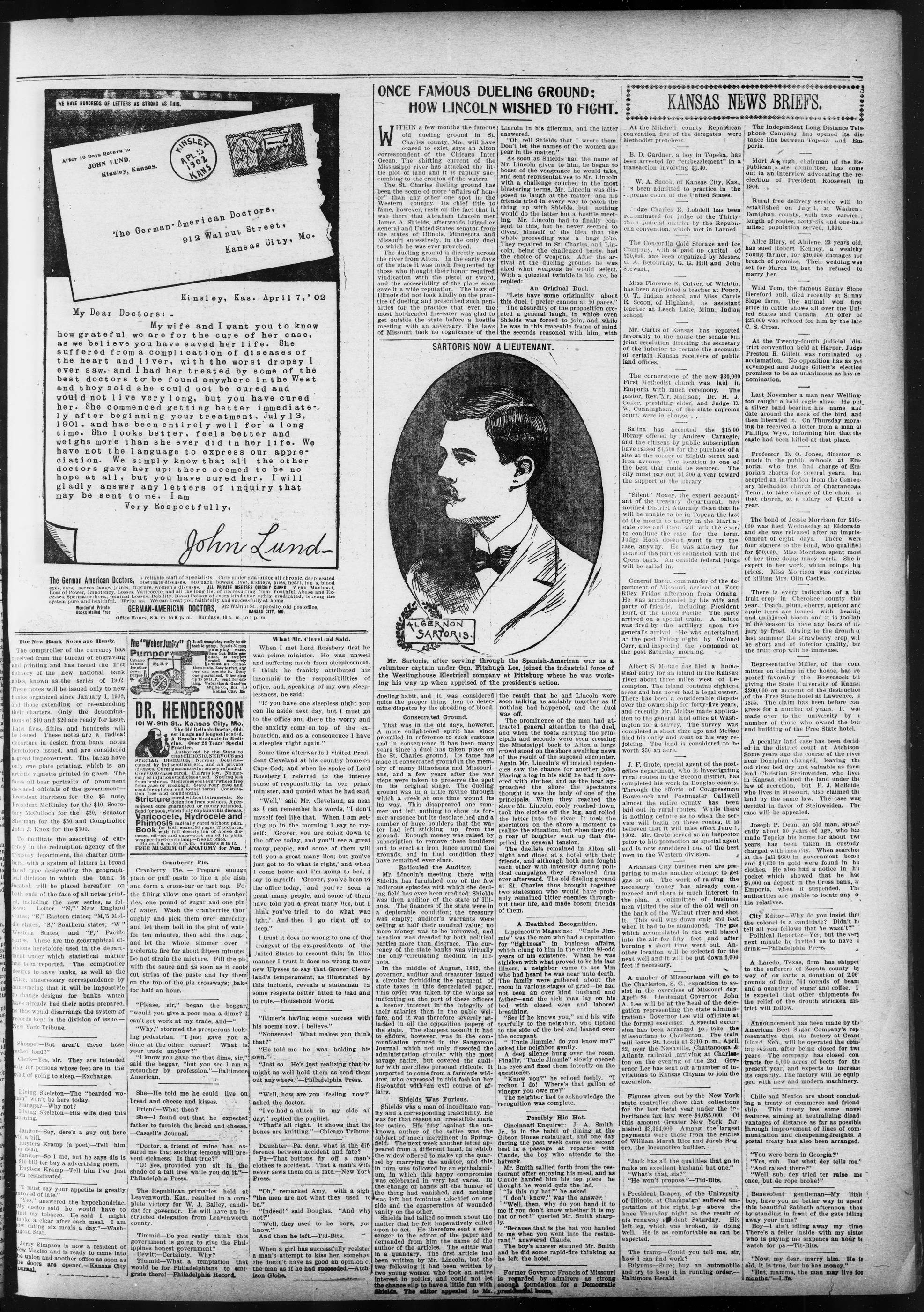
SARTORIS NOW A LIEUTENANT.
ALGERNON
SARTORIS.
Mr. Sartoris, after serving through the Spanish-American war as a volunteer captain under Gen. Fitzhugh Lee, joined the industrial force of the Westinghouse Electrical company at Pittsburgh where he was working his way up when apprised of the president's action.
WITHIN a few months the famous old dueling ground in St. Charles county, Mo. will have
ceased to exist, says an Alton correspondent of the Chicago Inter Ocean. The shifting current of the Mississippi river has attacked the little plot of land and it is rapidly succumbing to the erosion of the waters. The St. Charles dueling ground has been the scene of more "affairs of honor" than any other one spot in the Western country. Its chief title to the land now lies in that that it was there that Abraham Lincoln James A. Shields, afterwards brigadier general and United States senator from the states of Illinois, Minnesota and Missouri successively, in the only duel to which he was ever provoked.
The dueling ground is directly across the river from Alton. In the early days of the state it was much frequented by those who thought their honor required vindication with the pistol or sword, and the accessibility of the place soon gave it a wide reputation. The laws of Illinois did not look kindly on the practice of dueling and prescribed such penalties for the practice that even the most hot-headed fire-eater was glad to get outside the state before a hostile meeting with an adversary. The laws of Missouri took no cognizance of the
SARTORIS NOW
ALGERNON
SARTORIS.
Mr. Sartoris, after serving through volunteer captain under Gen. Fitzhuh the Westinghouse Electrical company, his way up when apprised of th
dueling habit, and it was considered
military duty to keep the district
military disputes by the shedding of bolt
Consecrated Ground.
That was in the old days, however. A more enlightened spirit has since prevailed in reference to such customs and in consequence it has been many years since a duel has taken place on the St. Charles ground. Its fame has made it consecrated ground in the memory of many Illinoisans and Missourians, and a few years after the war steps were taken to preserve the spot in its original shape. The dueling ground was in a little ravine through which a creek at one time wound its its way across the land, and left nothing to show its former presence but its desolate bed and a number of huge boulders that the water had left sticking up from the ground. Enough money was raised by subscription to remove these boulders and to erect an iron fence around the grounds, and in that condition they have remained ever since.
Rudiculed the Auditor
Mr. Lincoln's meeting there with Shields has furnished one of the few ludicrous episodes with which the deuling field has ever been credited. Shields was then auditor of the state of Illinois. The finances of the state were in a deplorable condition; the treasury was empty; auditor's warrants were selling at half their nominal value; no more money was to be borrowed, and taxation was dreaded by both political parties more than disgrace. The currency of the state banks was virtually the only circulating medium in Illinois. In the month of August, 1842, the governor, auditor and treasurer issued a circular forbidding the payment of state taxes in this depreciated paper. This order was taken by the Whigs as indicating on the part of these officers
a keener interest in the integrity of their salaries than in the public welfare, and it was therefore severely attacked in all the opposition papers of the state. The sharpest assault it had to endure, however, was in the communication printed in the Sangamon county, which not only disdose the administration circular with the most savage satire, but covered the auditor with merciless personal ridicule. It purported to come from a farmer's widow, who expressed in this fashion her discontent with*an evil course of affairs.
Shields Was Furious.
Shields was a man of inordinate vanity and a corresponding irresistible ability. He was for that reason an irresistible mark for satire. His fury against the unknown author of the satire was the subject of much merriment in Springfield, where he appeared from a different hand, in which the widow offered to make up the quarrel by marrying the auditor, and this in turn was followed by an epithalamium, in which this happy compromise was celebrated in very bad varse. In the change of hands all the humor of the thing had vanished, and nothing was left but feminine mischief on one hand and the generation of wounded vanity on the other.
Shields had talked so much about the matter that he felt imperatively called upon to act. He therefore sent a messenger to the editor of the paper and demanded from him the name of the author of the articles. The editor was in a quandary, and he was asked by Mr. Lincoln, but the two following it had been written by two young women who took an active interest in politics, and could not let the chance slip to have a little fun with Sifela. The editor appealed to Mr.
Lincoln in his dilemma, and the latter answered.
"Oh, tell Shields that I wrote them. Don't let the names of the women appear in the matter."
As soon as Shields had the name of Mr. Lincoln given to him, he began to be told of the vengeance he would take, and he was given a challenge couched in the most blustering terms. Mr. Lincoln was disposed to laugh at the matter, and his friends tried in every way to patch the thing up with Shields, but nothing would do the latter but a hostile meeting. Mr. Lincoln had to finally consent to this, but he never seemed to divest himself of the idea that the whole proceeding was a huge joke. They repaired to St. Charles, and Lincoln, being the chief party, had the choice of weapons. After the arrival of the grunt he wasaked what weapons he would select. With a quizical twinkle in his eye, he replied:
An Original Duel
"Lets have some originality about this duel. I prefer cannon at 50 paces." The absurdity of the proposition creates a general laugh, in which even Shields could laugh. But he was in this traceable frame of mind the seconds reasoned with him, with
A LIEUTENANT.
through the Spanish-American war as a high Lee, joined the industrial force of any at Pittsburg where he was work- the president's action.
the result that he and Lincoln were soon talking as amably together as if nothing had happened, and the duel was off.
The prominence of the men had attracted general attention to the duel, and when the boats carrying the principals and seconds were seen crossing the Mississippi back to Alton a large crowd stood on the shore awaiting news of the result of the supposed encounter. Again Mr. Lincoln's whimsical tendencies saw the chance for another Joke. Placing a log in his skiff he had it covered with clothes, and as the boat approached it he jumped up and it was the body of one of the principals. When they reached the shore Mr. Lincoln, coolly reached down, took the clothes off the log, and rolled the latter into the river. It took the spectators on the shore a moment to realize the situation, but when they did a roar of laughter went up that dispelled the general tension.
The duellists remained in Alton all night and dined at a hotel with their friends, and although both men fought each other with intensity during political campaigns, they remained firm ever after. The old duelship brought Charles thus together two statesmen who would have probably remained bitter enemies throughout their life, and made bosom friends of them.
A Deathbed Recognition.
Lippincott's Magazine: "Ucle Jimmie" was the man who had a reputation for "tightness" in business affairs, which clung to him in the entire 80-odd years of his existence. When he was stricken with what he believed he had learnt, he came to see him who had heard he was near unto death. The family were gathered about the room in various stages of grief—he had not been an over kind husband and father—and the sick man lay on his bed with closed eyes and labored breathing. "He knows you," said his wife tearfully to the neighbor, who tipped to the side of the bed and leaned over the occupant.
"Uncle Jimmie, do you know me?" asked the neighbor gently. A deep silence hung over the room. Finally, "Uncle Jimmie" slowly opened his eyes and fixed them intently on the questioner. "Who you?" he echoed feebly. "reckon I do! Where's that gallon of vinegar you owe me?" The neighbor had to acknowledge the recognition was complete.
Possibly His Hat.
Cincinnati Enquirer: J. A. Smith, Jr., is in the habit of dining at the Gibson House restaurant, and one day during the past week came out second best in a passage at repatriate with the boy who attends to the hatrack. Mr. Smith sallied forth from the restaurant after enjoying his meal, and as Claude handed him his top piece he thought he would quiz the lad.
"Is this my hat?" he asked.
"I don't know." was the answer.
"I don't know," was the answer.
"Well, then, why do you hand it to me if you don't know who whether it is my hat or not?" answered Mr. Smith sharply.
"Because that is the hat you handed to me when you went into the restaurant." answered Claude.
The boy's answer stunned Mr. Smith and he did some rapid-fire thinking as he left the hotel.
Former Governor Francis of Missouri is regarded by admirers as strong enough foundation for a Democratic presidential candidate.
KANSAS NEWS BRIEFS.
At the Mitchell county Republican convention five of the delegates were Methodist preachers.
B. D. Gardner, a boy in Topeka, has been arrested for "embezzlement" in a transaction involving $1,40.
W. A. Snook, of Kansas City, Kas., has been admitted to practice in the supreme court of the United States.
Judge Charles E. Lobdell has been recommitted for judge of the Thirty-third judicial district by the Republican convention, which met in Larned.
The Concordia Gold Storage and Ice Company, with a paid up capital of $20,000, has been organized by Messrs. C. A. Betournay, G. G. Hill and John Stewart.
The Independent Long Distance Telephone Company has opened its distance line between Topeka and Emporia.
Mort A. Rough, chairman of the Republican state committee, has come out in an interview advocating the reelection of President Roosevelt in 1904.
Rural free delivery service will be established on July 1, at Waindon county, with two carrier, length of routes, forty-six and one-half miles; population served, 1,300.
Alice Biery, of Abilene, 23 years old, has sued Robert Kenney, a wealthy young farmer, for $1,000 damages for breach of promise. Their wedding was set for March 19, but he refused to
Miss Florence E. Culver, of Wichita, has been appointed a teacher at Ponce, O. T., Indian school, and Miss Carrie E. Scoon, of Highland, as assistant teacher at Leech Lake, Minn., Indian school.
Mr. Curtis of Kansas has reported favorably to the house the senate bill joint resolution directing the secretary of the interior to restate the accounts of certain Kansas receivers of public land offices.
The cornerstone of the new $30,900 First Methodist church was laid in Emporia with much ceremony. The pastor, Rev. Mr. Madison; Dr. H. J. Coker, presiding elder, and Judge E. W. Cunningham, of the state supreme court, were in charge, ,
Salina has accepted the $15,00 library offered by Andrew Carnegie, and the citizens by public subscription have raised $1,500 for the purchase of a site at the corner of Eighth street and iron avenue. The location is one of the best that could be secured. The city must pay out $1,500 a year toward the support of the library.
"Silent" Moxey, the expert accountant of the treasury department, has notified District Attorney Dean that he will be unable to be in Topeka the last of the month to testify in the Martin-cale case and Dean will ask the court to continue the case for the term. Judge Hook doesn't want to try the case, anyway. He was attorney for some of the parties connected with the Cross bank. An outside federal judge will be called in.
General Bates, commander of the department of Missouri, arrived at Fort Riley Friday afternoon from Omaha. He was accompanied by his wife and party of friends, including President Burt, of the Union Pacific. The party arrived on a special train. A salute was fired by the artillery upon the general's arrival. He was entertained at the post Friday night by Colonel Carr, and inspected the command at the post Saturday morning.
Albert S. Mettae has filed a home-steed entry for an island in the Kansas river about three miles west of Lecompton. The island contains eighteen acres and has never had a legal owner. There has been a considerable dispute over the ownership for forty-five years, and recently Mr. McKae made application to the general land office at Washington for a survey. The survey was completed a short time ago and McKae filed his entry and went on his way rejoicing. The land is considered to be worth $50 an acre.
J. F. Grote, special agent of the postoffice department, who is investigating rural routes in the Second district, has completed his work in Douglas county. Through the efforts of Congressman Bowetsock and Postmaster Caldwell the entire county has been lald out in rural routes. While there is nothing definite as to when the service will begin on these routes, it is believed that it will take effect June 1, 1902. Mr. Grote served as an inspector; prior to his promotion as special agent and is now considered one of the best men in the Western division.
Arkansas City business men are preparing to make another attempt to get gas or oil. The work of raising the necessary money has already commenced and there is much interest in the plan. A committee of business men visited the site of the old well on the bank of the Wa'uh river and shot it. This well was down only 650 feet when it had to be abandoned. The gas which accumulated in the well blazed into the air for fifty feet and after burning a short time went out. Another location will be selected for the next well and it will be put down 2,000 feet if necessary.
A number of Missourians will go to the Charleston, S. C. exposition to assist in the exercises of Missouri day, April 24. Lieutenant Governor John A. Lee will be at the head of the delegation representing the state administration. Governor Lee will officiate at the formal exercises. A special excursion has been arranged to take the Missourians to Charleston. The train will leave St. Louis at 3:10 p.m. April 22, over the Nashville, Chattanooga & Atlanta railroad, arriving at Charleston on the evening of the 23d. Governor Lee has sent out a number of invitations to Kansas Cityans to join the excursion.
Figures given out by the New York state controller show that collections for the last fiscal year under the inheritance tax law were $4,085,000. Of this amount Greater New York furnished $3,394,000. Among the largest payments were those from the estates of William Marsh Rice and Jacob Rogers, the locomotive builder.
"Jack has all the qualities that go to make an excellent husband but one."
"What's that, sis?"
"He won't propose."—Tid-Bits.
President Draper, of the University of Illinois, at Champaign suffered amputation of his right leg above the knee Thursday night as the result of his runaway accident Saturday. His left leg, which was broken, is doing well. He is as comfortable as can be expected.
The tramp—Could you tell me, sir, how I can find work?
Bilyums—Sure; buy an automobile and try to keep it in running order.—Baltimore Herald
The Independent Long Distance Telephone Company has opened its distance line between Topeka and Emporia.
Mort A. rough, chairman of the Republican state committee, has come out in an interview advocating the re-election of President Roosevelt in 1904.
Rural free delivery service will be established on July 1, at Wadhen, Doniphan county, with two carrier, length of routes, forty-six and one-half miles; population served, 1,300.
Alice Biery, of Abilene, 23 years old, has sued Robert Kenney, a wealthy young farmer, for $10,000 damages for breach of promise. Their wedding was set for March 19, but he refused to marry her.
Wild Tom, the famous Sunny Slope Hereford bull, died recently at Sunny Slope farm. The animal won first prize in cattle shows all over the United States and Canada. An offer of $25,000 was refused for him by the late C. S. Cross.
At the Twenty-fourth judicial district convention held at Harper, Judge Preston B. Gillett was nominated by acclamation. No opposition has as yet developed and Judge Gillett's election promises to be as unanimous as his nomination.
Last November a man near Wellington caught a bald eagle alive. He put a silver band bearing his name and date around the neck of the bird and then liberated it. On Thursday morning he received a letter from a man at Phillips, Wyo., informing him that the eagle had been killed at that place.
Professor D. O. Jones, director of music in the public schools at Emporia, who has had charge of Emporia's chorus for several years, has accepted an invitation from the Centenary Methodist church of Chattanooga Tenn., to take charge of the choir or that church, at a salary of $1,200 a year.
The bond of Jessie Morrison for $10,000 was filed Wednesday at Eldorado and she was released after an imprisonment of eight days. There were four signers to the bond, who qualified for $50,000. Miss Morrison spent most of her time doing tancy work. She is expert in her work, which brings big prices. Miss Morrison was convicted of killing Mrs. Olin Castle.
There is every indication of a big fruit crop in Cherokee county this year. Peach, plum, cherry, apricot and apple trees are loaded with health and uninjured bloom and it is too late if the season to have any fears of injury by frost. Owing to the drought and last summer the strawberry crop will be short and of inferior quality, but the fruit crop will be immense.
Representative Miller, of the committee on claims in the house, has reported favorably the Bowersock bib giving the State University of Kansas $200,000 on account of the destruction of the Free State hotel at Lawrence, in 1855. The claim has been before congress for a number of years. It was made over to the university by a number of those who owned the lot and building of the Free State hotel.
A peculiar land case has been decided in the district court at Atchison. Some years ago the course of the river near Doniphan changed, leaving the old river bed dry and valuable as farm land Christian Steinweiden, who lives in Kansas, claimed the land under the law of accession, but F. J. McBride, who lives in Missouri, also claimed the land by the same law. The case was decided in favor of Steinweiden. The case will be appealed.
Joseph P. Dean, an old man, apparently about 80 years of age, who had made Topica his home for about two years, has been taken in custody charged with insanity. When searched at the jail $600 in government bonds and $1,300 in gold were found in his clothes. He also had a notice in his pocket which showed that he had $6,000 on deposit in the Cross bank, a Emporia, when it suspended. The authorities are unable to locate any of his relatives.
City Editor—Why do you insist that the colonel is a candidate? Didn't he tell all you fellows that he wasn't?" Political Reporter—Yes, but the very next minute he invited us to have a drink.—Philadelphia Press.
A Laredo, Texas, firm has shipped to the sufferers of Zapata county by way of ox carts a donation of 2,060 pounds of flour, 764 pounds of beam and a quantity of sugar and coffee. I is expected that other shipments for the relief of the drouth stricken district will follow.
Announcement has been made by the American Beet Sugar Company's representative that its factory at Grand Island, Neb., will be operated the coming season, after being closed for two years. The company has closed contracts for 5,000 acres of beets for the present year, and expects to increase its capacity. The factory will be equipped with new and modern machinery.
Chile and Mexico are about concluding a treaty of commerce and friendship. This treaty has some novel features, aiming at neutralizing disadvantages of distance as far as possible through improvement of lines of communication and cheapening freights. A postal treaty has also been arranged.
"You were born in Georgia?"
"Yes, suh. Dat what dey tells me."
"And raised there?"
"Well, suh, dyed tried raise me once, but de rope broke!"
Benevolent gentleman—My little boy, have you no better way to spend this beautiful Sabbath afternoon than by standing in front of the gate idling away your time?
Boy—I ain't idling away my time. There's a feller inside with my sister who is paying me sixpence an hour to watch for pa.—Tit-Bits.
"Now, my dear, marry him. He is
old, it is true, but he has money."
"But, mamma, the man may live for
months."-Life.
ate Ledger.
SUBSCRIPTION six months 750
One Year 1,50
ALL SUBSCRIPTIONS CASH IN AD-
ANCE
Entire post office at Topper Kansas, as se-
cured rates.
Published every Saturday a 411 Kane V
1.00 in advance
A J. KANE & CO
The Family Drug Store
Your Trade Solicited!
832 Kansas Avenue North T P
TopekaDrug Co.
PRSCRIPTION DRUGGIST
732 Kansas Avenue,
MRS. L. T. WOODY, Prop
831Vermont Street,
Lawrence, Kansas
Meals 15c, Lodging 25c, Newly
fixed np in every particular, 16
fine rooms,
GARDEN CITY KAS
CARTER, STONE & CO.
(Successors to Carter and Gause.)
Dealers in
HARDWARE & FARM MACHINERY,
Gasolae Engines, Pumps and Windmills.
In fast every thing in a first class Hardware
Store. GARDEN CITY, KANS.
J. R. CL A R K
Dealers In
E. D. TAYLOR.
Real Estate, Ins. and Fire Insurance
Farm loans made, Special attention given
o leasing lands, Kinley, Kansas.
GEO. E. MAC.
RETAIL GROCERS,
Flour, Feed, Queensware, Etc.
Garden City Kansas
PARK HOTEL
South of City Hall, jno., Madden F.27
$1,00 per day, Beds only 25 & 500
Dodge City
FURNITURE, CARPETS, UNDERTAK-
CITY. PIANOS and ORGANS.
Garden City.' Kansas.
Fit and Workmanship guaranteed,
Cleaning and Repairing neatly don
512½ Kansas Avenue. Topeka
MICKLE'S GROCERY
300 Kansas Ave
Carries a full line of Staple and
Fancy groceries and country pro-
due
906 E. 4th St
Dealer in Fresh and Salt Meatl Fish Game
Oaltry.
ZERCHER & PGOL.
BOOKS, STATIONERY, OFFICE SUP
PLIES.
527 Kansas Avenue.
We solicit a share of your patronage
TOPEKA, KANS.
THE TOPEKA ICE & COLD
STORAGECO
Manufactured a co.
Cold Storage for eggs, butter, apples, poultry and all perishable goods.
Cor Curtis & Tyler st
Trackage to all Railroads. Correspondence alised
N. Topeka. Phone 677
G. L. BAUGHMAN M. I.
Office 625 Kase, Ave. Hours o to 11:40
Office 525 Kas. Ave. Hours 9 to 11:4 to 5 Diseases of Women a specialty. Residence 1332 Lincoln st H. F. Williams, Pres.
PINKSTON PROS.
Flour Feed and Grain Reliable Dealers. Headquarters tor any hing you want n their line Call and see them----517 N Main
MISS MARY E. KIETH,
Hair dressing and a all kinds of hair work done in the best styles and grades. Your trade solicited 47 Main St. Wichita, Kans
ATTORNEY AT LAW.
And Real Estate special attention paid to nonresident claims. Olathe Kans.
WILMAN,
Jeweler—717 Mass St.
Good work Guaranteed with per.
lect satisfaction. Lawrence Ks
Scott & Hughes,
Dearers in
Staple and Fancy Groceries, Flour
Feed, also Coal and Wood.
153 Bridge St, Nort Lawrence Ks
II. L., TROMP
Manufacturer of
HIGH GRADE CIGARS
804 Kans. Ave. Topeka Kans.
J. E. RODMAN.
FLORIR/S1.
Plants for windows and beding. Society
emblems in flowers a specialty. Green
houses 12th and Monroe Sts. Store 5 W
8th S.
See that our Lawrence reader
assist our advertisers.
When you want a general line of school supplies call on Mr. T. M. James,ir., Post-office, North Topeka, book store.
Grocries and Meats.
The neatest grocery in the city is the one operated by Mr. J, H Wernstrom at 213 and 15 west 4th street they carry a full line of groceries, meats, can goods especially flour and feed give them a call J. H. Wernstrom prop.
MISSCELLANEOUS ADS
GOINGS & ALLYAN
1133 Kansas Ave,
Feed and all kinds of flour and grain. Price reasonable. Give them a call.
BUSINESS COLLEGE.
Prot M A Pond has changed his
Business College to 521 Kaisa
avenue. Parties desiring to take a
business course should call or ad
dress him there.
NEW IDEA
BAKERY & CANDY FACTORY
310 South Main Street, Ottawa, Kan
W-H. WORK Mgr, Phone 33
P. M. LIGHTNER
New and Second-hand goods
bought and sold. Abilene, Kan
Opeka
Jumber, Lime.
Easter, Cement.
Brick, Coal and Builder's Ware.
Let us figure your bill
A. O. BEACH, Mgr.
710 E. 4th street.
C F RODIGER
Dye and Cleaning Works
820 Kans, Ave. Topeka Kansas.
(Phone 957)
WE MAKE CLOTHES
That I
N. H Wo'ff Tailor 429 Kansa
Ave
S. H. DOW N'S
306 Kans Avenue
For Garden and flower seeds, and
awn grass, and Hardy roses and
plants.
306 Kansas avenue.
MRS. E. MOSTEL K.
Gives meals for 10 and 15 cents 720 K
Douglas St. Wichita Kans. Also carries
ull line of cigars, tolacco and temperance
ricks.
W M. BLAKENEK,
Jeweler and Graduated Optician
Jewelerv. Silverware, Watches Clock,
keeping neatly done.
429 Kansas Ave. Topeka
...117 E...
TOPEKA BUSINESS
523 Quincy Street
plus far the member ship inn
this institution increases every y
If you want a good outfit, education
caller address
H. Strickler Topeka Kans
JOSEPH ARTLE'S
boot and shoe manufacturer does
all kinds of repairing at reasonable prices. Men's half soles 50e
ladies 40e, children's 30 cents
Stand 400 Kans.
Rahrer's Restaurant
515 East Fifth St,
Opposite Santa Fe Depot,
C, A, RAHRER, Prop.
All kinds of repairs for your wheel at
Topeka Cycle Co. 515 W8thS.
FALK&CO,
A windmill stands tall in a rural landscape, with a tractor and a barn nearby.
PUMPS
WIND-MILLS
And PLUMBING GOODS
General Supplies.
Only sanitr'y Place in the
McPherson,
P.L. RUSH
COAL, GROCERIES, FLOUR, FEED and HAY.
1405 Kansas Avenue.
Financial Agents to Local and Eastern Investors
REAL ESTATE FIRE INS EONNOMORTAGES
Crawford Building.
Telephone 414. 501 Jackson St. Topeca, Kunz
JAMES. SMITH DEALER IN
Mides, Tallow, Furs and Pelts.
108 and 110 East Third Street, Topeka Kas
and 124 S. 2nd street St. Joseph, Mo.
www.wolf lacking Co. Topeka, Nell Book of St. Jas, Book of Topeka
HERE And THERE
J. W. WILSON
Dealer in Candies, Fruits, Ice
Cream, Cold drinks and all kinds
of refreshments, Cigars and To-
caccos. 102 East 6th Street
Buy your machine bread Perfectly Fine at H. Vespers 113 East 6th St,
Get your prescriptions at the Henritta Drug Co. A complete stock of new goods on hand. 116 East 6th St Don't forget to take the best said the "Fary-Dream". hence stop in at Proudfit and Perkins and get just what the Fairy meant. A wholesome meal 417 Kans. Ave.
Office: 119 W. 61th Street.
Phone 64, Green House W. roth
BLUE
FRONT
The Creamery is the place best in town to take your meals Open all night. Mr. C. L, Scott, prop. 726 Kansas Avenue.
C. W. THOMPSON Prop.
, 1002 N. Kausar Ave.
Phone 283.
Full line of overthing kept in a
first class Grocery. Cash paid for
butter, eggs and poultry.
We pay the the highest price in
the city.
When you want shoes see Mr. C. P. Theis, 422% Counl Street Emporia Kansas. The Reliable Dealer. Proudfit and Perkins, the Caterers are serving one among the best people of Topeka. They have the neatest and nicest place in the city. Give them a call, 417 Ks. Avg.
Genuine Mexicaa Cheile...Hou Tomates, Cakes, Pies. Lunch, Ciga, and Tobacco.
high grade Cigars
AND All KINDS of SMOKING
AR TICLES
117 KANS. AVE.
W. W. TEDRICK
Whole sale dealer in 'Boss Patent Flour' and
m'll feed. 320 N. Main street,
Hutchinson K&L
H.A. KLAUER
Carries All the LATEST brands of cigars and also a FULL LINE of Tobacco and smoking articles. His cigars are made in Topeka. 226 Kans ave LANDIS HOME BAKKRY Many years experience. French home Bakery 316 E. 4tn St.
Dead Bros.
....DEALERIN...
All of the leading GRANITES and MARBLE MONUMENTS. Our Designs are a modern and up-to-date. Cleaning up old monuments acutting inscriptions a speciality.
A SevenColum Paper filled with news from every where.
BAU
1064 Union Ave. (opposite depot
Clothing Boots and Shoes, tur-
ing Goods, Jewelry of al-
kinds. Kansas C
$1.50 PER ANNU
THOSE WHO OWE
SHOULD HURRY TO
411 KANSAS AV.
H. C. BOWMAN,
Fire Insurance and Real Easte
Room 42
H. GENTHE
Baker and Confectioner
113 East Fourth Street.
DR. W. H. H. SMITH,
special Attention given to Chronic Disease
and all Diseases peculiar to Women.
15 years experience.
Corner 4th and Kansas Avenue.
Office, Over Hatch's Drug Store.
DR F. H. SCHOLLE
Physician and Surgeon
515 Kansas Avenue Topeka Kans
Tel 592
DR, O, A, TAYLOR,
PHYSICIAN and SURGEON
Office Hours, 9 to 11 a.m.
From 2 to 5 p.m.
OFFICE 226% KAS, AVF.
Over Kohl's Drug Store.)
H. B. HOGEBOOM
PHYSICIAN and SURGEON,
833 Kans Ave
All calls
promptly attended. Tel 14
Tel. 895.
I. A. SHIELDS M. D
PHYSICIAN and SURGEON,
Office and Residence 1331 VanBuren St
calls promptly attended.
S. A. BOAM M. D.
Physician & Surgeon.
421 Kane Ave. Tel. 573 Resi
dence 1407 W. Tenth St.
S. G. STEWART, M. D.
OFICE 621KANSAS AVE.
Telephone 544.
Residence 112 East 7th Street
Special Attention Given to Disease
Stomach and Lungs and Female Troub
125 Office Hours - 12.20 5-7 10 9
GEORGE DICK, M. D
Homoeopathic
Residence 626 Biltue 81.
Telephone 366.
Office 807 Kansas Avenue.
W m. B. Swan, M. D.
725 Kansas Avenue,
Pokka.
Kansas.
Office hours, 7:10 to 12 m, 2:00 to 10:40 pm
Residence 024 Buchanan Sr.
Bell Telephone, 66c
C. F. MENNINGER, M, D
Office 727 Kansas Ave
Telephone 1.
11-12 A. S.
2 - 4 P.M.
Residence 125 Topeka Ave
Telephone 85.
J. M JAMISON, M. D.,
Office 506 East 4th Street
Office 'Jours:
From 8 to 10 A. M.
.P. M. to 3 P. M.
.P. M. to 9 P. M.
special attention diseases of women and
private diseases.
Wm. E. JACKSON, M. D.
PHYSICIAN and SUKGEON.
OF P. CE HOURS;
9 TO II A. M.
2 TO 5, and 7 TO Q P. M
Sunday Hours. 1 to 3 P. M.
OFFICE 404 Kas Ave.
(Over Wallace Dag Store.)
KEITH & HAZEN.
DRUGCISTS & DEALERS in all kind of Drugs and Patent medicines, Paints, Oils and Varnishes, Toilet articles' and Perfumery. 422 Kans. Ave. Yourtrade is kindly solicited.
GIBRALTAR DRUG CO.
833 KANSAS AVENUE
Topes, Kans.
HOMEPATIIC REMED
TERIALS
DR. PAGE S PHARMACY.
111 East 5th Street.
Full line of Drugs and Toilet articles and Medicines.
Give him a call.
Miller's pharma-
11.
6th & 10P. KA AVK
Drugs, Medicines, Pr scripts & Carefully
Compounded. Give Us a Trial.
C. W. WILITS. FRANK CONWEIL
WILLITS & CONWEIL,
UNDERTAKERS
...and Licensed Embalmers...
A FULL LINE OF
COFFIN, CASKETS AND ROBES AT
REASONABLE PRICES,
1006 N. Kansas Avenue
Cor 2nd & Madison Street
Phone 733 City
Give then, a call
$2.00 FOR $1.00
This means that at our store you get $2 worth of goods for only $1. Our prices prove it: as you will see by reading this...
Rogers Bros. 1847 Kuives and Forks ..... $3.25
" Tea Spoon set ..... $1.10
Toilet sets 6 pieces handsome decorations ..... $2.40
12 " ..... $2.40
ALL OUR PRICES ARE IN PROPORTION AS QUOTED ABOV
The cheapest place earth to buy dishes
Home and See Our Handsome New store.
JOHN C. HUMS CO.
COUGHLIN-MARTIN HARDWARE
PENINSULAR
PENINSULAR
ST OVEN CO.
PENINSULAR
LABOR EXCHANGE
HEADQUARTERS For All KINDS of GROCERIES. FRUIT & VEGTABLES 2000 Bbl Apples in Storage, Price ranging from 10c to 40c per FAMOUS PEARL FLOUR a specialty, Guaranteed any F made, $1.05 per Sk. Big "C" Hight Patent 95c per Sk. 411 KAN, AVE,
J. E.
RESTAURANT
Cigars, Tobbacco and mild I
Call and see me and I will serve
John Pears, Prop.,
TOPE
Pure Tea a
109 E. Sixth Street
THE
IMPERIAL
Hall and
O A. ANDERSON, Prop. G
Cigars, Tobbaccos and mild Drinks. Lunches and Lodging Call and see me and I will serve you right. John Pears, Prop., 210 North Kansas Ave. TOPEKA SPICE MILLS Pure Tea and Spices etc. 109 E. Sixth Street.
IMPERIAL BILLARD Hall and Pool-room O A. ANDERSON, Prep. Give him a call.
FRIEDBURG & CO:
своейки
Bell Phone 737
222 Kans Ave
buggies and
Pumps and
windmills
Plumbing-Farm Machinery.
Johnston Combine and Bucker
Lavatories fall lines of this
McPherson, Kansas