State Ledger
Saturday, May 24, 1902
Topeka, Kansas
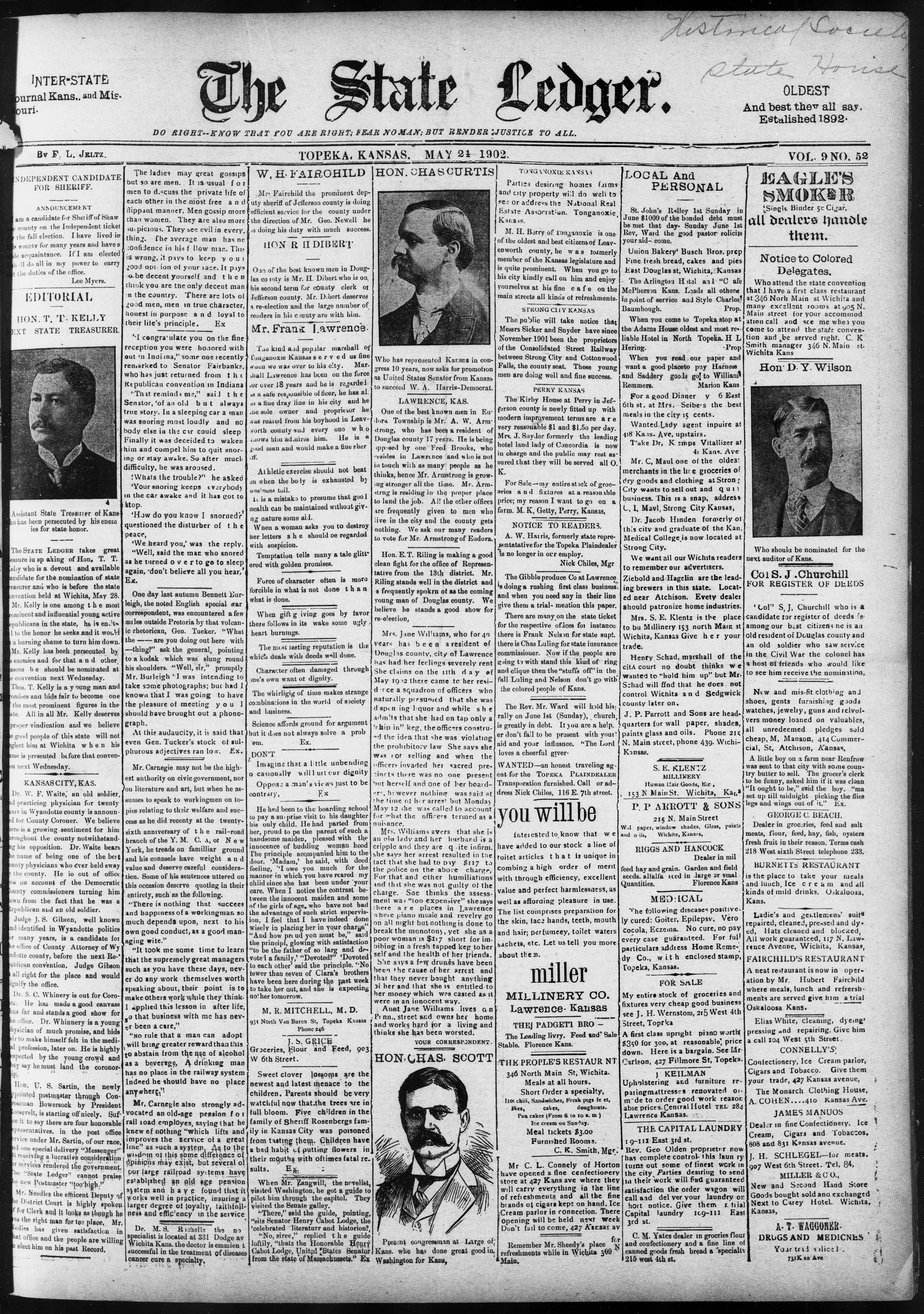
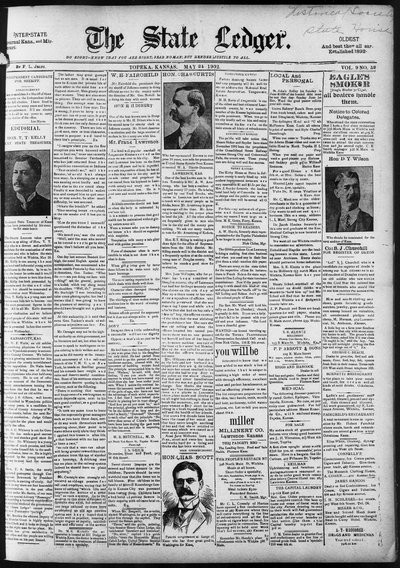
Page text (machine-generated)
INTER-STATE Journal Kans.. and Missouri.
Bv F. L. JELTZ.
NDEPENDENT CANDIDATE
FOR SHERIFF.
ANNOUNCEMENT
am a candidate for Sheriff of Shaw
county on the Independent ticket
the fall election. I have lived in
county for many years and have a
acquaintance. If I am elected
will do all in my power to carry
the duties of the office.
Lee Myers.
EDITORIAL
HON. T. T. KELLY
EXT STATE TREASURER
A. H.
Assistant State Tressuer of Kans ho has been persecuted by his enemies for state honor.
---
The STATE LEDGER takes great measure in spaking of Hon. T. T. Kelly who is a devout and available candidate for the nomination of state resurer and who is before the state convention held at Wichita, May 28. Mr. Kelly is one among the most prominent and influential young active publicans in the state, he is entitled to the honor he seeks and it would be a burning shame to turn him down. Mr. Kelly has been persecuted by enemies and for that and otherasons he should be nominated at a convention next Wednesday.
Thos. T. Kelly is a young man and promises and bids fair to become one of the most prominent figures in the state. All in all Mr. Kelly deserves proper vindication and we believe we good people of this state will not neglect him at Wichita when his name is presented before that convention next Wednesday.
KANSASCITY, KAS.
Dr. W. F. Waite, an old soldier, and practicing physician for twenty years in Wyandotte county is announced for County Coroner. We believe here is a growing sentiment for him throughout the county notwithstanding his opposition. Dr. Waite bears the name of being one of the best county physicians who ever held away in the county. He is out of office now on account of the Democratic county commissioners turning him down from the fact that he was a Republican and an old soldier.
Judge J. S. Gibson, well known and identified in Wyandotte politics or many years, is a candidate for the office of County Attorney of Wyandotte county, before the next Republican convention. Judge Gibson is all right for the place and would signify the office.
Dr. S. C. Whinery is out for Coronel. He has made a good canvass as far and stands a good show for the office. Dr. Whinnery is a young physician of much promise, and bids air to make himself felt in the medical profession, later on. He is highly expected by the young crowd and they say he must land the coronorship.
Hon. U. S. Sartin, the newly appointed postmaster through Converseman Bowersock by President Oosevelt, is starting off nicely. Suffice it to say there are four honorable representatives, in the post office service under Mr. Sartin, of our race, and one special delivery "Messenger" which receiving a lucrative consideration or services rendered the government. The "State Ledger" cannot praise the new Postmaster "too high." Mr. Needles the efficient Deputy of the District Court is highly spoken off for Clerk and it looks as though he is the right man for tea place, Mr. Needles has given satisfaction in that office and the people are willing to elect him on his past Record.
The State Ledger.
DO RIGHT--KNOW THAT YOU ARE RIGHT; FEAR NOMAN; BUT RENDER JUSTICE TO ALL.
The ladies may great gossips but so are men. It is usual for men to discuss the private life of each other in the most free and flippant manner. Men gossip more than women. They are also more suspicious. They see evil in every thing. The average man has no confidence in his fellow man. This is wrong, it pays to keep your good opinion of your race. It pays to be decent yourself and then think you are the only decent man in the country. There are lots of good men, men in true character, honest in purpose and loyal to their life's principle. Ex
"I congratulate you on the fine reception you were honored with out in Indiana," some one recently remarked to Senator Fairbanks, who has just returned from the Republican convention in Indiana "That reminds me," said the Senator, 'of an old but always true story. In a sleeping car a man was snoring most loudly and no body else in the car could sleep. Finally it was deceived to waken him and compel him to quit snoring or stay awake. So after much difficulty, he was aroused.
!What's the trouble?" he asked
"Your snoring keeps everybody in the car awake and it has got to stop.
'How do you know I snornedr'
questioned the disturber of the
peace,
'We heard you,' was the reply.
"Well, said the man who snored
as he turned over to go to sleep
again, 'don't believe all you hear,'
Ex.
One day last autumn Bennett Burleigh, the noted English special war correspondent, was encountered a few miles outside Pretoria by that volcanic rhetorican, Gen. Tucker. "What the — are you doing out here with —thing?" ask the general, pointing to a kodak which was slung round his shoulders. "Well, sir," promptly Mr. Burleigh 'I was intending to take some photographs; but had I known that I was going to have the pleasure of meeting you I should have brought out a phonograph.
At this audacity, it is said that even Gen. Tucker's stock of sulphurous adjectives ran low. Ex.
Mr. Carnegie may not be the highest authority on civic government, nor on literature and art, but when he assumes to speak to workingmen on topics relating to their welfare and success as he did recently at the twenty-sixth anniversary of the rail-road branch of the Y. M. C. A, or New York, he treads on familiar ground and his counsels have weight and value and deserve careful consideration. Some of his sentences uttered on this occasion deserve quoting in their entirety, such as the following.
"There is nothing that succeeds and happiness of a workingman so much depends upon, next to his own good conduct, as a good managing wite."
"It took me some time to learn that the supremely great managers such as you have these days, never do any work themselves worth speaking about, their point is to make others work while they think. I applied this lesson in after life, so that business with me has never been a care."
"No rule that a man can adopt will bring greater reward than this to abstain from the use of alcohol as a beverage. A drinking man has no place in the railway system Indeed he should have no place anywhere."
Mr. Carnegie also strongly advocated an old-age pension for railroad employees, saying that he knew of nothing "which lifts and improves the service of a great line" as such a system. As to the wisdom of this some difference of opinions may exist, but several of our large railroad systems have established an old age pension system and have found that it works well in practice, insuring a larger degree of loyalty, faithfulness and efficiency in the service
Dr. M. S. Richelle the no specialist is located at 331 Dodge av Wichita Kans. the doctor is eminent t successful in the treatment of diseases cancer cure a specialty.
W. H. FAIRCHILD
Mr. Fairchild the prominent deputy sheriff of Jefferson county is doing efficient service for the county under the direction of Mr. Geo. Newell he is doing his duty with much success.
HON R II DIBERT
One of the best known man in Douglas county is Mr. H. Dibert who is on his second term for county clerk or Jefferson county. Mr. Dibert deserves a re-election and the large number of readers in his county are with him.
The kind and popular marshall of Congonaxie Kansas served us fine when we was over to his city. Marshall Lawrence has been on the force over 18 years and he is regarded as a safe responsible of fice, he has al. so a fine dray line in his city and he the sole owner and proprietor he was retailed from his boyhood in Leavworth county and every one who knows him admires him. He is a good man and would make a fine her off.
Athletic exercise should not beat an when the body is exhausted by business toil.
It is a mistake to presume that good health can be maintained without giving nature some aid.
When a woman asks you to destroy
her letters she should be regarded
with suspicion.
Temptation tells many a tale glitter
ered with golden promises.
Force of character often is more
forcible in what is not done than
what is done.
When gift giving goes by favor
there follows in its wake some ugly
heart burnings.
The most lasting reputation is that
which deals with deeds well done.
Character often damaged through
one's own want of dignity.
The whirligig of time makes strange combinations in the world of society and business.
Science affords ground for argument but it does not always solve a problem. Ex.
DON'T
Imagine that a little unbending o casionally will hurt our dignity.
Oppose: a man's views just to be contrary. Ex.
He had been to the boarding school to pay a suprise visit to his daughter his only child. He had parted from her, proud to be the parent of such a handsome maiden, pleased with the innocence of budding woman hood The principle accompanied him to the door. 'Madam,' he said, with deed feeling, 'I owe you much for the manner in which you have reared my child since she has been under your care. When I notice the contrast between the innocent maiden and some of the girls of age, who have not had the advantage of such strict supervision, I feel that I have indeed done wisely in placing her in your charge" "And how prud you must be," said the princip, glowing with satisfaction "to be the father of so large and devoted a family," "Devoted?" "Dvoted to each other" said the principle. "No tewer than seven of Clara's brothers have been here during the past week to take her out, and she is expecting no her tomorrow.
M. R. MITCHELL. M. D.
931 North Van Buren St, Topeka Kansas
Groceries, Flour and Feed, 903 W 6th Street.
Sweet clover lossoms are the newest and latest menace to the children. Parents should be very watchful now that the trees are in full bloom. Five children in the family of Sheriff Rosenbergs family in Kansas City was poisoned from tasting them. Children have a bad habit of putting flowers in their mouths with oftimes fatal results. E.
When Mr. Zangwill, the novelist, visited Washington, he got a guide to pilot him through the captol. They visited the Senate galley.
"There," said the guide, pointing, "sits Senator Henry Cabot Lodge, the 'celebrated literature and history'; No, siree," replied the guide loftily, "that's the Honorable Henry Cabot Lodge, United States Senator from the state of Massachusetts." Ex
PETER H. BURKE
Who has represented Kansas in congress 10 years, now asks for promotion as United States Senator from Kansas to succeed W. A. Harris-Democrat.
LAWRENCE, KAS.
One of the best known men in Eudora Township is Mr. A. W. Armstrong, who has has been a resident of Douglas county 17 years. He is being opposed by one Fred Brooks, who resides in Lawrence and who is not in touch with as many people as he thinks, hence Mr. Armstrong is growing stronger all the time. Mr. Armstrong is residing in the proper place to land the job. All the other offices are frequently given to men who live in the city and the county gets nothing. We ask our many readers to vote for Mr. Armstrong of Eudora.
Hon. E.T. Riling is making a good clean fight for the office of Representative from the 13th district. Mr. Riling stands well in the district and a frequently spoken of as the coming young man of Douglas county. We believe he stands a good show for re-election,
Mrs. Jane Williams, who for 40 years has been a resident of Douglas county, city of Lawrence has had her feelings severely rent She claims on the 19th day of May 1992 there came to her residence a squadron of officers who naturally presumed that she was dispensing liquor and while she admits that she had on tap only a "chip in" keg, the officers construed the idea that she was violating the prohibitory law. She says she was not selling and when the officers invaded her sacred premises there was no one present but herself and one of her boarders, however nothing was said at the time of her arrest but Monday May 12 she was called to account for what the officers termed as a nuisance.
Mrs. Williams avers that she is an old lady and her husband is a cripple and they are quite infirm, she says her arrest resulted in the tact that she had to pay $117 to the police on the above charge. For that and other humiliations and that she was not guilty of the charge. She thinks the assessment was "too expensive" she says there are places in Lawrence where piano music and revelry go on all night but nothing is done to break the monoton, yet she as a poor woman is $117 short for imbibing in a fresh tapped key to her self and the health of her friends. She says a few drums have been the cause of her arrest and that they never bought anything of her and that she is entitled to her money which was casted as it were in an innocent way.
Aunt Jane Williams lives on
Penn, street and owns her home
and works hard for a living and
thinks she has been worsted.
YOUR CORRESPONDENT.
HON, CHAS, SCOTT
BROOKLYN
Present congressman at Large of Kans. who has done great good in Washington for Kans.
Present congressman at Large of Kans. who has done great good in Washington for Kans.
TONGANOXIE KANSAS
Parties desiring homes farms and city property will do well to see or address the National Real Estate Association. Tonganoxie Kansas.
M. H. Barry of Tonganoxie is one of the oldest and best citizens of Leavenworth county, he was tomerly member of the Kansas legislature and is quite prominent. When you go to his city kindly call on him and enjoy yourselves at his fine cafe on the main streets all kinds of refreshments.
STRONG CITY KANSAS
The public will take notice that Messrs Sicker and Snyder have since November 1901 been the proprietors of the Consolidated Street Railway between Strong City and Cottonwood Falls, the county seat. These young men are doing well and fine success.
PERRY KANSAS
The Kirby House at Perry in Jefferson county is newly fitted up with modern improvement terms are a very reasonable $1 and $1.50 per day. Mrs. J. Suyler formerly the leading hotel land lady of Concordia is now in charge and the public may rest assured that they will be served all O. K.
For Sale—my entire stock of grocaries and fixtures at a reasonable price; my reason I want to go on a farm. M K, Getty, Perry, Kansas.
NOTICE TO READER3.
A. W. Harris, formerly state representative for the Topeka Plaindealer is no longer in our employ.
Nick Chiles, Mgr
The Gibble produce Co at Lawrence is doing a rushing first class business and when you need any in their line give them a trial-meation this paper.
There are many on the state ticket for the respective offices for instance there is Frank Nelson for state supt. there is Chas Luling for state insurance commissioner. Now if the people are going to with stand this kind of ring and clique then the "staffs off" in the fall Luling and Nelson don't go with the colored people of Kans.
The Rev. Mr. Ward will hold his rally on June 1st (Sunday), church is greatly in debt. If you are a help, er don't fail to be present with your aid and your influence. "The Lord loves a cheerful giver.
WANTED—an honest traveling agent for the TOPEKA PLAINDEALER Transportation furnished. Call or address Nick Chiles. Call E. 7th street.
you will be
Interested to know that we have added to our stock a line of toitet articles that is unique in combing a high order of merit with through efficiency, excellent value and perfect harmlessness, as well as affording pleasure in use. The list comprises preparation for the skin, face hands, teeth, mouth and hair; perfumeey, toilet waters sachets, etc. Let us tell you more about them.
miller
THEJ PADGETI BRO -
The Leading livry. Feed and' Sale
Stable. Florence Kans.
THE PEOPLE'S RESTAUR NT
346 North Main St. Wichita.
Meals at all hours.
Short Order a specialty,
Hot chili, Sandwiches, Fresh pigs fe et,
Bies, cakes, doughnuts.
Mr C. L. Connelly of Horton have opened a fine confectionery store at 427 Kanss ave where they will carry everything in the line of refreshments and all the fine brands of cigars kept on hand, Ice Cream parlor in connection. There opening will be held next week Don't fail to come, 427 Karsas av Remember Mr. Sheedy's place for refreshments while in Wichita 309 Main.
LOCAL And PERSONAL
St. John's' Ralley 1st Sunday in June $1000 of the bonded debt must be met that day. Sunday June 1st Rev, Ward the good pastor solicits your aid—come.
Union Bakery' Busch Bros. prep Fine fresh bread, cakes and pies East Douglas st, Wichita, Kausas The Arlington Hotel and "C afe McPhorson Kans. Loads all others in point of service and Style Charles' Baumbough. Prop.
When you come to Topeka stop at the Adams House oldest and most reliable Hotel in North Topeka. H L Hering. Prop
When you read our paper and want a good placeto pay Harness and Saddery goods go to William Remmers. Marion Kans
For a good Dinner y 6 East 6th st. at Mrs. Seibers the best meals in the city 15 cents.
Wanted.Lady agent inpuire at 418 Kans. Ave. upstairs.
Take Dr. Kamps Vitallizer at 41 Kans. Ave.
Mr.C, Maul one of the oldest merchants in the lire groceries of dry goods and clothing at Strong City wants to sell out and quill business. This is a snap, address C, I, Mavl. Strong City Kansas,
Dr. Jacob Hinden formerly of this city and graduate of the Kann Medical College is now located at Strong City.
We want all our Wichita readers to remember our advertisers. Ziebold and Hagelin are the leading brewers in this state. Located near Atchison. Evety dealer should patronize home industries.
Mrs. S. E. Klentz is the place to bu Millinery 153 north Main st Wichita, Kansas Give her your trade.
Henry Schad, marshall of the cita court no doubt thinks we wanted to "hold him up" but Mr. Schad will fnd that he does not control Wichita and Sedgwick county later on. J. P. Parrott and Sons are headquarters for wall paper, shades, paints glass and oils. Phone 215 N. Main street, phone 439. Wichi-Kansas.
215 N. Main Street
Wal paper, window shades, Glass, paint,
and o ils, Wichta, Kansas,
feed hay and grain. Garden and field seeds, alfalfa seed in large or small Quantities. Florence Kans
MEDICAL
The following diseases positively cured: Goiter, Epilepsy, Vero-cocola, Eczema. No cure, no pay every case guaranteed. For full particulars address Home Remedy Co., with enclosed stamp, Topeka, Kansas.
FOR SALE
My entire stock of groceries and fixtures very cheap good business see J. H. Wernstom, 215 West 4th Street, Toprka
A first class upright piano worth $350 for 300, at reasonable, price down. Here is a bargain. See Mr Carlson, 427 Fillmore St, Topeka
I. KEILMAN
Upholstering and furniture reparingmattresses renovated or made to order good work reason able prices. Central Hotel TEL 284 Lawrence Kansas.
THE CAPITAL LAUNDRY
19-111 East 3rd st.
Rev. Geo Olden proprietor now has complete control this laundry turns out some of finest work in the city. Parties desiring to send in their work will find guaranteed satisfaction the order wagon will call and del ver your laundry on short notice. Give them a tital Capital laundry 109-111 East 3rd st.
C. M. Yates dealer in groceries flour and confectionery and a fine line of canned goods fresh bread a 'specialty 215 west 4th st.
OLDEST And best thev all say. Established 1892.
VOL. 9 NO. 52
EAGLE'S
SMOKER
Single Binder 5c Cigar,
all dealers handle
them.
Notice to Colored Delegates.
Who attend the state convention that I have a first class restaurant at 346 North Main st Wichita and many excellent rooms at 905 N. Main street for your accommodation call and see me when you come to attend the state convention and be served right. C. K Smith manager 346 N. Main st. Wichita Kans
Hon. D. Y. Wilson
Who should be nominated for the next auditor of Kans.
C01 S. J. Churchill FOR REGISTER OF DEEDS
'Col' S, J, Churchill who is a candidate for register of deeds among our best citizens he is an old resident of Douglas county and an old soldier who saw service in the Civil War the colonel has a host of friends who would like to see him receive the nomination.
New and mis-fit clothing and shoes, gents furnishing goods watches, jewelry, guns and relovers money loaned on valuables, all unredeemed pledges sold cheap, M, Manson, 414 Commercial, St, Atchison, Kansas.
A little boy on a farm near Renfrow was sent to that city with some country butter to sell. The grocer's clerk to be funny, asked him if it was clean "It ought to be," swid the boy. "ma set up midnight picking the flies legs and wings out of it." Ex.
GEORGE C. BEACH.
Dealer in groceries, feed and salt meats, flour, feed, hay, oysters fresh fruit in their season. Terms cash 218 West sixth Street telephone 233.
BURNETTS RESTAURANT is the place to take your meals and lunch, Ice cream and all kinds of mild drinks. Oskaloosa, Kans.
Ladie's and gentlemen's suits repaired, cleaned, pressed and dyed, Hats cleaned and blocked, All work guaranteed, 117 N, Lawrence Avenue, Wichita, Kansas, FAIRCHILD'S RESTAURANT A neat restaurant is now in operation by Mr. Hubert Fairchild where meals, lunch and refresherments are served give him a trial Oskaloosa Kans.
Elias White, cleaning, dyeing pressing and repairing. Give him a call 104 West 5th Street.
CONNELLY'S'
Confectionery, Ice Cream parlor, Cigars and Tobacco. Give them your trade, 427 Kansas avenue,
The Monarch Clothing House,
A. COHEN.....410 Kansas Ave.
JAMES MANUOS
Dealer in fine Confectionery. Ice
Cream, Cigars and Tobaccos,
808 and 831 Kansas avenue.
J. H. SCHLEGEL—for meats,
907 West 6th Street. Tel. 84,
MILLER & CO.
New and Second Hand Store
Goods bought sold and exchanged
Next to Carey Hotel. Wichita,
Kansas.
Your trad solicited
731K an Ave
STATE LEDGER
CONDENSED NEWS TELEGRAMS.
The steamer Mount Temple cleared Monday from New Orleans, for Capa Town, with 1,062 horses.
A slight shock of earthquake was felt in Northern California at 10:30 o'clock Monday morning.
Cornellus N. Bliss, national treasurer for the West Indies volcano relief fund, has received a total of $34,000.
The appointment of Herbert G. Squires to be minister to Cuba has been confirmed by the senate.
A Union Pacific bulletin says twenty agent on that road have been suspended for five days for failing to send in crop reports to headquarters.
Hon. Judge W. Tippet, aged 60 years, editor of the Point Pleasant (W. Va.) Register for a quarter of a century, is dead. He had held many positions of trust in the state.
At a sale just held in New York of historical letters written during the civil war, a letter written by President Lincoln to General Grant on April 30, 1884, brought $1,050.
In the United States court at Salina, Kaa, J. W. Starr was acquitted by a jury of the charge of sending obscene matter through the mail. He drew a valentine and sent it to a friend. The town of Aberdeen, about seventy-five miles south of Middleburg, Cape Colony, was attacked last Sunday by 120 Boers, who were repulsed. Commandant Van Herden was killed. A movement to disrupt the American Federation of Labor by the Chicago Federation has not been countenanced by some of the leaders of the local body, and a compromise has been effected. A court of inquiry has been organized on board the United States cruiser Chicago to investigate the arrest of officers of that vessel at Venice, April 25, last. Captain James H. Dayton was appointed president of the court.
An ordinance for the acceptance from Andrew Carnegie of $150,000 for a free public library has been rejected by the city council of Albany, N. Y. All the members of the council were present and the vote stood 10 in the affirmative and 9 in the negative.
The Minnesota state board of control has advanced the salaries of all state employees 10 per cent because of the increased cost of living. There was no demand on the part of the employees for this increase. The additional cost to the state will exceed $40,000 per annum.
A bloody fight between Sheriff Broadwater, of Scott county, Va., and the Wright gang of outlaws took place in the mountains of Hancock county, Tenn. Two outlaws—John Vansant and John Templeton—were killed. Sheriff Broadwater says the outlaws cannot escape.
Daniel Costello, the veteran showman, at one time a partner of P. T. Barnum, is dying at the county hospital at Chicago. He has been ill for two weeks with pneumonia. At one time Mr. Costello's fortune was estimated at more than 1 million dollars, but he lost it all in mining ventures.
George Kirby, an extensive cattle grower near Billings, Mont., recently lost about one thousand head of cattle. The cattle had just arrived from Texas and were thin and weak from the long trip. They perished as the result of the cold rain. Kirby has several train loads of Texas cattle now on the trail on their way to a Northern range.
As it will be impossible for the pipe personally to undertake the strain of the work in connection with the Philippine mission, he will appoint a committee of three cardinals to counter American delegates, and it is thought likely that Cardinals Martinell, Satellio and Vives Tuto, the last named a Spaniard, will constitute this committee.
E. E. Murrell called at the office of Sheriff Dickman of St. Louis and gave him a check for $5,092, representing the amount of the bond forfeited, by his brother, John K. Murrell. E. E. Murrell is a member of the present house of delegates. John K. Murrell was a member of the preceding house and was indicted for bribery in connection with the suburban railway franchise legislation.
John Furlong, 65 years of age, for two years a flagman of the Pennsylvania road, gave up his life for another in Chicago. While trying to save a boy crossing the tracks at his post at Wood street he was struck by a fast express train entering the city. Furlong, when placed in the police ambulance, asked anxiously: "Is the boy safe?" He then relapsed into unconsciousness and died before the county hospital was reached.
Advices to the department of agriculture say that the product of beet sugar in Hungary has increased within the last decade by nearly 169 per cent, the output of the factories in 1899-1900 having been 552,147,800 pounds. This increase has occurred in connection with a comparatively small increase in the number of factories and is due mainly to an increase in the size and an improvement in the equipment on these establishments.
White India silk will make up charm
ingly for sultry days.
Miss Anna Clark of the Julia Marlowe company, formerly a member of the Boston Museum Stock company died in Chicago of pneumonia at the home of Mrs. Stewart, 300 Michigan avenue. Miss Clark had been a member of the Boston Museum company since the outbreak of the civil war. She had played with Edwin Booth, Lawrence Barrett, John McCullough, John Owen and Lester Wallack. She played Polly in the first production of "Uncle Tom's Cabin" in Boston.
Coarse wool canvas will be much in evidence on the afternoon promenades
Convinced that weeks and possibly months may elapse before the miners strike is settled, retail coal dealers in New York have advanced the price of anthracite coal to a maximum of $8.50 a ton, and, at the same time marked bituminous to $4.50 when purchased in small quantities. A small quantity of soft coal a rate of $3.85 was quoted. Once on sale these have prices far exceeded. That was in 1878 when the price of anthracite reached a maximum of $11 a ton.
OKLAHOMA BRIEFS.
OKLAHOMA BRIEFS.
A recent census gave Shawnee population of 9,272.
Wheat is heading out, and harvest in Oklahoma will commence the first week in June.
Miss Mary A. Church, of El Reno has been appointed a clerkk in land office at Lawton.
The comptroller of the currency has authorized the City National bank of Hobart to begin business with a capital of $25,000.
The city authorities of Blackwell have decided to call a special election to vote on the proposition to issue $40,000 in bonds for the purpose of constructing a waterworks system.
Scott Foster, a saloonkeeper, is dead and his barkeeper, Charles Smith, is dying, as a result of a tragedy at Ralston. Smith was boarding at Foster's home. Foster came home and attacked him with a hatchet, splitting his head open, and then went to the barn and blew his own brains out. No relabel information has been received as to the cause of the killings or what happened at the house before the killing took place.
The Grand Army post of Blackwell has split up over the alleged effort of certain leaders to make it partisan. The partisan element will hold memorial services Sunday at the Methodist church and the non-partisan element at the Presbyterian church. An effort is being made by the non-partisan follows to organize a new post, and they seem to have by far the stronger following. Bird McGuire, a Republican aspirant for congress, will deliver the Decoration day address for the partisan element, and the non-partisan element has yet to select its speaker.
William Lillibridge was arrested at Guthrie and made a full confession regarding his burning the Santa Fe bridges over the Climaron river at Perkins, in order that he might demand money from the company to ward off other damage to the road from him. He stated he was engaged to marry a young lady of Bartlesville, I. T., but she postponed the wedding until he had sufficient money for housekeeping purposes. He became desperate, being out of employment, and determined to hold up the railroad company for money. He made the confession at the urgent request of his aged grandmother. He is 22 years of age, and a resident of Oswego, Kaa.
A special session of the supreme court of the territory was held in Oklahoma City, Wednesday afternoon, and the three new judges were sworn in. One of the new judges, J. L. Panconet of Perry, was designated to relieve Chief Justice Burford, who is holding a term of district court at Stillwater, Payne county, and he will preside there while the chief justice returns to Guthrie and prepares for the term of the supreme court that begins June 2. Judge J. K. Beauchamp, of El Reno, was sent to the Fifth district, where ex-Judge John L. McAtee, resigned, formerly presided, to hold court until the meeting of the supreme court, when the territory will be redistricted, and the judges given permanent assignments.
INDIAN TERRITORY BRIEFS
Regular passenger service will be established on the Choctaw, between Ardmore and Tishomingo, on June 1.
The Creek Indians are now receiving the deeds to their allotments. Over ,000 deeds have been already prepared.
The Vinita Chieftain is authority for the statement that the Frisco and Kary railroads have agreed to build a union depot in that city.
The appointment of United States district attorney for the new district created in the Indian Territory by the Indian appropriation bill is to lie between athlete and Huckleberry.
A. D. Furry, of St. Louis, one of the men injured in the Choctaw wreck, is dead, making five killed. A. M. Oliphant, a well known attorney of Tishomingo, who was severely injured, will recover. The injured men were removed in a special train to South McAlerter to the company's hospital.
Colonel A. J. Blackwell president of the Chorocoek Land and Coal Company, of Chelsea, has just M.1 cars of coal to Wichita parties. This the first big order filled by the company, but it soon expects to be selling coal all over the West. Deeds are now pounding for large shipments to Kansas City. The coal is of pure quality and there is an inexhaustible supply.
At Stillwell 'st week, Mr. Reuter enrolled 508 all bloods and sixty durings. During the time of enrollment the full bloods, Colonel Robert Taylor, representing the United States Indian agent, distributed relief funds to the destitute full bloods. There were found 200 institute families near Stillwell and the amount disbursed in this apportionment was $2,700. The Cherokee call 'relief money" "bread money" and all Colonel Showoff, United State Indian agent, "Os-te-Sha-yr-ah." "The Good Big Man."—Muskego Phoenix.
The comptroller of the currency has approved reserve agents as follows: National Bank of Commerce at Kansas City, for the First National bank at Ralston, O. T., and First National bank, of St. Louis, for the Mechanics National bank, of Kirksville, Mo.; the Hanover National bank, of New York, for the First National bank, of Mound, I. T.
"How much will we have to pay for wireless telegraphy?"
"Why, space rates, of course."—New York Sun.
Embroidered white batistes are among the prettiest wash fabrics of the year.
Dainty moussellines and French mulls come flowered, and will need little trimming.
Senator Dietrich, of Nebraska, has introduced a bill authorizing the secretary of war to furnish one condemned cannon for a monument to be erected to the memory of the late Hon. James Laird, member of congress from the state of Nebraska, to be delivered to the mayor of Hastings.
KANSAS NEWS BRIEFS.
Garrison at Fort Riley: Forty-nine officers, 1,107 enlisted men.
Dan Ruggles, a well-known Kansas traveling man, is reported as being dangerously ill in a hospital at Denver, suffering with paralysis of the brain.
Corporals Cohen and Bremner, ordnance corps, and a civilian clerk representing one of the firms interested in the coming field gun tests have arrived at Fort Riley.
Representative Curtis has recommended the appointment of L. H. Williams to succeed M. M. Beck as postmaster at Holton, Kas. There has been something of a contest over the postoffice at that point.
Alice M. Battle, of Nadeau, has been appointed assistant matron at Fort Totten Indian school, N. D.
The library board at Salina has engaged C. F. Gunn, the Kansas City architect, to draw plans and specifications for the new Carnegie library there.
Representative Calderhead has been notified that Inspector Webb, of the rural free delivery service, has been sent into the Fifth Kansas district to establish a number of routes.
Lieutenant Colonel S. C. Mills, inspector general of the department of Missouri, at Fort Riley, inspected 150 cavalry horses which are unsuited to
The committee on claims in the house has reported favorably Representative Miller's bill appropriating $1,000 for the benefit of David H. Lewis, a postal clerk, who was crippled for life in a railroad accident at Elmdale.
Cards are out for the wedding of Miss Clara Case, only daughter of Mr. and Mrs. J. B. Case, of Abilene, and Mr. Alfred Roberts, of Emporia. It will take place at the Case residence, June 4. Many guests from out of the city will be present, owing to the wide acquaintance of the families.
Miss Ethlyn Rice, daughter of W. M. Rice, of the treasury department, and Lieutenant E. E. Haskell, of the Twenty-ninth infantry, U. S. A., were married at the bride's home in Fort Scott. Lieutenant Haskell has served in Cuba and the Philippines and will leave for the latter place shortly to joint his regiment.
George W. Dull, of Rawlins county, has applied to the supreme court for release from the county jail on writ of haeas corpus. He is charged with murdering Dr. J. W. Rowland on the afternoon of April 28. Rowland entered Dulls office and almost immediately two shots were fired. A crowd soon reached the office and found Dr. Rowland shot to death and Dull sitting at his desk. He asks for release because of the lack of evidence against him.
For the first time in eight years Dr. F. H. Snow, ex-chancellor of the University of Kansas, will go out this summer in an expedition to collect entomological specimens. With Dr. Snow will be his son, Frank, E. S. Tucker, assistant in the department of natural history; William Bailey and R. L. Moody. A month's tour of Southwestern Kansas will be made and as this section has not been thoroughly searched, it is expected that a number of good specimens will be found.
While returning from the Western university, where he had delivered an address to the graduating class Wednesday, Governor W. E. Stanley became interested in the sights of Kansas City, Kas. "Just look at those green hills there and that beautiful piece of woods," said he to a companion as he looked out of the car window. "This is certainly an ideal residence place. You should have a beautiful inhabitant. Here in a city hasn't a distinct individual, but has to have the 'Kansas' tacked on to distinguish it from Kansas City, Mo. Why don't you give it another name?"
The statement is given out that Major Cainin Hood has disposed of the major part of his stock in the Emporia National bank to Colonel Snell, of Clinton, Ill., and will retire from the management at the convenience of the incoming parties. Mr. DeLand, Colonel Snell's son-in-law, will have the management. It is also stated that the present Captain L. J. Heritage, the present cashier, has resigned and attended to his stock fund. It is understood Major Hood contemplates removing to Topanga, where he may become interested in a bank.
The funeral of C. W. Goodlander, who died of apoplexy at Fort Scott, Thursday morning, was neid at 10 o'clock Friday morning. It was the largest funeral in the history of the town. Mr. Goodlander went to Fort Scott in 1858 without a dollar and built up a fortune estimated at $350,000. He was a most public spirited and benevolent man. He was the founder of the Goodlander home, an institution that cares for homeless children. He also the architect of the city of Fort Scott, which attracted considerable attention. Mr. Goodlander's business interests extended over many states and he owned lumber yards in half a dozen Kansas and Missouri towns. Besides this he was interested in several banks and in the Central Coal and Coke Company.
The first practical trial of a new system of the single-rail railroad is to be made at the Crystal Palace, London. The line, which is to be one and one-half miles in length, will be worked by electricity. The difference between this system and the prevalent type of monorail is that the line is on the ground and large wheels projecting from the middle of the carriage run on it, while on each side of the carriage there are safety rollers upon his guide rails. In the monorail the line is elevated, with the carriages overhanging on each side.
It has been announced that Moulton, Lathrop & Co, bankers and brokers and members of the Chicago stock exchange, have suspended business. All their deals have been closed on the exchange. Difficulty in meeting notes was the cause assigned.
It is stated at the war department that the supplies and stores shipped to Martineau and St. Vincent on the cruiser Dixie from New York and on the collier Sterling from San Juan undoubtedly will be sufficient to meet the urgent needs of the suffering people for fully a month to come.
Linen, duck and linen canvail will make many coat and skirt suits.
In the China sea the British oil tank steamer Peluse struck and killed a sixty-foot whale. The steamer was badly damaged and was compelled to return to Hong Kong to repair a great hole in her hull. When she struck the whale her captain thought she had hit a rock until a British customs officer informed him that native fishermen had observed the impact with the leviathan, which soon after died. It was towed ashore. It weighed 100
Alice M. Battle, of Nadeau, has been appointed assistant matron at Fort Totten Indian school, N. D.
The library board at Salina has engaged C. F. Gunn, the Kansas City architect, to draw plans and specifications for the new Carnegie library there.
Representative Calderhead has been notified that Inspector Webb of the rural free delivery service, has been sent into the Fifth Kansas district to establish a number of routes.
Lieutenant Colonel S. C. Mills, inspector general of the department of Missouri, at Fort Riley, inspected 150 cavalry horses which are unsuited to the service. Nearly all were conleamed.
The union carpenters of Atchison went on a strike Wednesday morning and all building in the city has been stopped. The local union consists of fifty members. The main object of the strike is to prevent the use of non-union material of any kind in construction.
Jacob Hendricks, senior member of the wholesale paint and wall paper house of Powers and Hendricks, died at Salina at the age of 71 years. He was a cousin of the late Thomas A. Hendricks, of Indiana. He spent his boyhood days in Pike county, Ill. He came to Kansas in 1887, locating in Rooks county.
Frank Simmons, of Pratt, was found guilty by a jury in the United States district court at Salina of sending obscene matter through the mails and was sentenced to pay a fine of $500. The case seems to have resulted from an ill feeling between Simmons and certain other parties at Pratt. With this case the May term of court was adjourned.
The district court at Fort Scott set aside a verdict for $2,279, rendered for the plaintiff by a jury last week in the case of Martha Blasp vs. the Modern Woodmen of America lodge. The court held that the evidence was insufficient to sustain the verdict and granted a new trial. The question of the validity of an insurance policy where the insured commits suicide was involved in the case.
The abstract of the national banks of Kansas, exclusive of Kansas I/City, Kas, at the close of business on April 30, as reported to the controller of the currency, shows the average reserve to have 34.10 per cent, against 37.81 per cent on February 25. Loans and discounts increased from $28,060,019 to $29,143,248; gold coin from $1,148,759 to $1,229,860; total specie from $1,812,366 to $1,998,252; lawful money reserve from $2,807,651 to $2,991,417; individual deposits decreased from $34,928,460 to $34,080,863.
Allen Reed, a farmer and the founder of Reedsville, died at his home Wednesday from uraemic poisoning. He had been a sufferer from kidney trouble for years, but Wednesday morning his condition suddenly grew worse and he lapsed into a comatose condition, from which he did not rally. He settled in Marshall county in 1870. He was for ten years engaged in mining and freelighting in the mountains and at one time in an extensive mercantile business in Montreal, Canada. He was elected to the legislature in 1872 and was a member during the Pomeroy exposure. He had traveled for pleasure three times around the world.
In the case of E. F. Sprague vs. the Santa Fe railway the jury was discharged Thursday because they could not agree after deliberating from Tuesday noon. They stood ten to two for the railroad company from first to last. Last summer, in a fire which burned more than $7,000 worth of Emporia property, E. F. Sprague's planting mills and coal yards were destroyed. They were situated next to the Santa Fe tracks and Sprague caimed the fire which started in his building, was caused by a spark from a switch engine. Had he won, other similar cases would have been brought. This is the second time the case has been tried. There were over 150 witnesses this time and the costs for both trials amount to about $2,500. Sprague's attorneys say the case will be tried again.
Mrs. Mary E. Lease, politician and author, arrived in Wichita, Thursday, en route to Galveston from New fork. Mrs. Lease is in Wichita to secure a divorce from her husband, who is in the drug business. The divorce proceedings were filed last fall, but at that time she was unable to attend on account of illness in the Lease family in New York. Mrs. Lease charges in her divorce incompatibility of temper. The Leases have not lived together since she entered politics about six years ago. He forbade her taking up politics and when she became a leader in the Populist party he wanted to take her back, but she refused. Mrs. Lease then split up her relationship with the Populists and went to New York, where she entered the political field. She refused to talk about the divorce proceedings, but admitted she was going to secure the divorce while in Wichita.
It is officially announced that the premier, M. Waldeck-Rousseau, will restign before June 1, leaving President Loubet to form a new cabinet simultaneously with the meeting of the new chamber. M. Waldeck-Rousseau notemm M. Loubet and his colleagues just before the president's departure for Russia that he considered he had accomplished the work of unity, which was the object of taking office, and that, therefore, he desired to retire from the present cabinet, but would stay in office until a new cabinet was formed from representatives of the majority of the newly elected deputies.
Through the state department the navy department has been requested by the government of Germany to look after the safety and welfare of German subjects on the Isthmus of Panama. The request has been promptly granted, and cabled instructions have gone forward to Commander Mcrea, of the Machias, on the Gulf side, and to Captain Reislinger, on the Philadelphia, on the Pacific coast of the Isthmus, to extend the same degree of protection to Germans and Americans in case they are threatened to be disturbed by the revolutionary movements in that part of Colombia.
PISON FURE FOR
GURRS WORK ALL ELSE FAILS.
Bests Court Sgn. Tries good. Use
within the duplexes.
CONSUMPTION
Cold Morning Baths
A cold bath in the morning is very invigorating. It is quite difficult to acquire the habit of taking, however. It requires some courage to begin the practice. But as soon as the cold bath is made a habit it becomes a luxury instead of an ordeal. To those who have never acquired it, habit of taking a cold bath in the morning, the following advice will be found useful:
In the first place it is better to begin the practice of morning bathing in the summer time. Then, as the weather becomes gradually colder, the system has time to adjust itself to the shock of continuing the cold bath in cold weather. The first morning it would be well to take off all the clothing in a cold room and give the body a vigorous rubbing with a coarse towel without the use of any water. This rubbing should not occupy more than two or three minutes. Work hard. Breathe through the nose while taking the rubbing. If you work as hard as you ought, it will cause quite aborted breathing, which may be excellent thing to beginne day with. Draw long, deep inspiration through the nose. This should be done, remember, in a cold room.
Perhaps the practice of taking the dry rub should be continued a week or two before any water is used. When beginning to use water it should be done very cautiously. Putting the hands into a dish of cold water and slapping the neck and chest over quickly, rubbing the wet hands over all portions of the body is sufficient. Then use the dry towel as when taking the dry rub. Rub briskly. Make the skin glow with the red capillary circulation. Every morning a little water may be used by dipping the hand into cold water and splashing the body with it. In a short time you will become accustomed to it so that you can dip a towel into the cold water, rubbing the whole body first with the wet towel, afterward with the dry towel.
The whole bath should not occupy more than five minutes. Work hard. Work fast. Let it be a regular gymnastic exercise.
This bath ought to have three salinary effects. First, the nose breathing, will constitute the very best sort of deep breathing exercise. Second, the skin rubbing will produce a fine capillary circulation of the skin, the shoe and the water splashed on the upper portions of the body will fortify the nervous system against catching cold and produce a thoroughly healthy reaction.—Medical Talk.
In Nebraska there had been at least one tragedy in town-making before the formal opening of the territory. The Mormons, exiled from Illinois, crossed the Missouri a few miles above the site of Omaha and established themselves, fifteen thousand strong, in a town of their own that was called "Winter Jquarters," which was to be a permanent rendezvous. But disaster followed fast and followed faster." Death waited upon them in various forms. In the winter of 1847-48 they buried more than seven hundred of their number. Then, upon complaint of the Indians, who owned the land, they were driven away, their houses were razed, and nothing remained in token of their venture but a group of wooden slants that bore the names of their dead. Soon afterward a prairie fire swept the graveyard clean. When a street was graced over the hill, a few years ago, the grading machine was so near to choking itself with Mormon skulls and bones. Of Winter Quarters there is now not enough left to furnish a square meal for a cockroach.
Arthur—Yes, I think Minnie loves me very much. She's a dear girl; she has a large heart.
Harry—A heart like a London omnibus; always room for one more J.Boston Transcript.
A monument to the late Empress Elizabeth, of Austria, who was assassinated at Geneva, September 10, 1898, was unveiled in that city Thursday in the presence of the Austrian and Bavarian ministers and representatives of the Swiss authorities. The orators at the unveiling all dwelt upon the fact that the memorial was intended to mark for all time Switzerland's detestation of anarchy.
State of Ohio, City of Toledo, Lucas County, as:
Frank J. Cheney makes oath that he is senior partner of the firm of F. J. Cheney & Co., doing business in the City of Toledo, County and State of aforesaid, and that said firm will pay the sum of ONE HUNDRED DOLLARS for each and every case of Catar that cannot be incurred by the firm's Catar. FRANK J. CHENEY. Sworn to before me and subscribed in my presence, this 61st day of December, A. D., 1886. A W. GLEASON. (seal.) Notary Public. Halls Catar Cure is taken internally, and acts directly on the blood and mucous surfaces of the system. Send for testimonials, free. F. J. CHENEY & CO., Toledo, O. A bill has been introduced by Senator Lodge providing for the removal of the battlefield Maine from the harbor at Havana and the recovery of the bodies of the American soldiers who sank with the vessel. The bill appropriates $1,000,000 for the purpose.
Startling statistics on criminology were submitted at the annual convention of the New York County W. C. T. U. One of the delegates read a statement to the effect that a woman of criminal tendencies, whose name was not made public for obvious reasons, died in 1827. "Her descendants have been traced," continued the speaker. "They number 800. Seven hundred were criminals, having been convicted at least once. Thirty-seven were murders and were put to death for their crimes. This family has cost the nation 3 million dollars for trials and hangings."
Little Boy—Isn't fathers queer?
Auntie—In what way?
Little Boy—When a boy does anything for his pa he doesn't get anything, but if another man's boy does it he gets a penny?
"The Jethmian canal is a long time coming," said Mr. Pitt.
"True," added Mr. Penn. "So far there are more deadlocks to it than sanal locks."—Exchange.
General Lloyd Wheaton left Manila for the United States, Thursday, on board the transport Sherman.
RUPTURE You Pay when Cured
COUNTRY PUBLISHERS CO., KANSAS CITY, VOL. 2. NO. 50
You Do Not Pay Me One Cent Until You Are
I present to the readers of this paper a few testimonial letters and names of former patients whom I have cured of rupture, believing that the afflicted would rather correspond with some one who has been wired, than read what I might say about myself. You can more fully investigate and convince yourself as to the means of my treatment. You might doubt any statements I might make, but you cannot help but believe the statements of those I have cured. I will ask you to write to any or all of them. If you are satisfied with what they say about my reliability and methods of treatment, write to me or call and see me. Remember that in all cases I guarantee a cure and do not accept one cent of money until you are well. Consultation by my nurse is entirely free. I will be pleased to correspond with you regarding your case.
DR. ERNEST HENDERSON.
McPherson, Kane, June 8, 1899.
I had a very bad case of rupture for years, and I was cured in three weeks. I cannot say too much for him. I know he can do just what he can, but I ask him to send of say until the patient is well. This is the best assurance he can possibly give to any person he knows of, and anyone who wishes to know more about my case.
Very trusty years.
A. R. OLSON.
Wrote For My Treaties on the Cure of Rupture Sent Free.
Another Bud Case Permanently Cured in a short Time-Grateful for Same.
My Dear Doctor: I desire to add my testimonial to these you have cured of rapture. My case was a bad one and you made a permanent care in a short time, without pain, and I never had any problems. I will be for your cure, and would not be back in the condition I was a traction and dollars. I thank you and would recommend your rapture cure to any person you wish to cure full yours. FRED HARERER 2011 Indiana Ave.
Suffered for Years—Pronounced Incurable by other Doctors.
Dear Doctor: I wish to state that I can most easily treat a child with a serious infection treatment. Since early youth I had been careful with a right acutile sturcure that was pronounced by the doctor. I am able to possibly, by a dangerous surgeon, treat a child with an acutile sturcure treatment. I determined to try the same and am now making your treatment for three weeks I am now doing your. Your treatment is all that you claim for it. You respectfully. You are keenly. Karen
DR. HENDERSON
101 W. 9th St, Kansas City, Mo.
The Old Reliable Doctor, Mo.
Old area acquiescent localized
A Reliable Doctor,
Over 28 Years' Special
Authorized by the State to
treat CHRONIC, NEKYOUAND
STRESS AID.
Earned credibility. Debt
caused by indiscretion, etc.
diseases. Cures guaranteed or money refunded.
Charges low. Non-memory or injurious medicine charges low. Medicines sent everywhere free from gate or on your case and installation free and confidential.
Stricture is a firm firmment from business. A permanent cure guaranteed or money refunded. A book, which fully explains this disease.
Phimosis radically cured without pain. Book for both soxes, 66 pages 27 pictures, full description of above diseases, effects of treatment, plain wrapper for 6-cent stamp—free at office.
8 to m. p. 10, Sundays to 10.
"Back again," said you the warden.
"Well, we'll put you in the new cellhouse this time. How do your quarters suit you?"
Manila. General Chaffee returned here Sunday from Lake Lanano, in the interior of the island of Mindanao. He said he saw several more dattos wh.'s there and had most satisfactory interviews with them. Nearly all the dattos, and especially the surviving sultans, claim to entertain friendly feelings toward the United States.
In view of a cablegram which General Chaffee received from General Davis, who is in command of the American forces on Mindanao, and in which it appears that Datto Ruty has apparently refused to return the animals he captured from the American army, General Chaffee is not prepared to say that there will be no more fighting in Mindanao.
General Davis reports that Datto Ruty says he is ready to fight, but General Chaffee believes tha, although it may be necessary to bring this datto to terms, his resistance of the American forces must necessarily be slight.
Datto Ruty's forts are situated on a high hill. They could be surrounded by a line of American skirmishers, who would prevent the datto from obtaining water and who could thus force a practically bloodless victory in a few days.
Admiral Schley has been initiated into the order of the Mystic Shrine at Washington. About 800 members were present and witnessed his induction into the festive order.
The American Smelting and Refining company has purchased the Sunnyside mine, in the San Juan district, Colorado. The deal was consummated for the company by Simon Guggenheimer and the consideration named is 1 million dollars.
The eyeball is white because its blood vessels are too small to admit of the red corpuscles of the blood passing through them.
Iown leads the states in total value of domestic animals, while Texas ranks second.
A statement prepared by the insular division of the war department shows the total value of merchandise imported by the island of Cuba during the nine months ended March 31, 1902, was $49,675,748, against $48,836,193 for the corresponding period of 1901. The exports amounted to $33,847,749, against $40,366,995 for 1901.
"I understand Miss Searan Yellough, in a fit of anger yesterday, smashed a $100 mirror in her room."
"Don't blame her, considering the character of reflection it has been casting on her." - Baltimore News.
Lutheran Minister Teaches His Care
After Suffering 16 Years.
I suff red for six years with a very bad rupture and turing all of the time I wore different kinds of trusses dry and n.hi, with the hope of effecting a cup, out of my all failed—they only held the rug in to peace.
Upon the advice of Rev. F. Pfeifer, of Sedaha Mo., I consulted Dr Ernest Henderson, the rupture specialist 107 W. Nhch Street, Kansas City Mo., who cut a new in a few weeks without subjecting me to a dangerous and painful operation. The cure was complete and since then I have dispensed with my crus a wn ut inconvenience. Anyone des ring more information will please apply to me, personally or by letter. I am
My Dear Locator, City, Mo, June 3, 1900
many times the rupture was in
searately retain it with the aid of a truss,
and the pain great I could stand
it no longer.
After resting your advertisement in I can
try your treatment?
To my anny you can trust me
after such a long time of suffering. I am able
to sound and web. I pad your face with pain
and still feel that I owe you a debt of gratitude
by inducing others to go for you treatment.
I will gladly write to anyone about my case, I considered your offer of receiving no pay until care was elected as the best guarantee you could give. It gave me confidence in your treatment.
The Following Have Been Cured of Rape
ture and are Selected at Random from
Many I Have Cured. In Writing them
for Answer, I have Cured 29 Ewling St. City, Mo.
Mike Deyon, 29 Ewling St. City, Mo.
A. K. Olson, McPherson, Kans.
Robert J. Brock, county attorney, Mahaska
Robert J. Brock, county attorney, Manhattan
Kans.
N. M. K-nt, 401 Orchard St. Chicago, Ill.
Oscar Dillon, 401 Campbell St. Kansas City
W. G. Peach, grocer, 21 Central Ave. Ranus
W. C. Hale, grocer, 21 Central Ave. Ranus
W. S. Welch, cared Goodland Milling Co. Fl.
Scot. Rans.
W. F. Parker, 1517 Brooklyn Ave., Kansas
City, Mo.
Mo.
William Weltman, 410 Landis Court, Kansas City, Mo.
Rev. F. Priefer, Sedalia, Mo.
R. J. Champion, Armour Station, Kansas City, Kansas
J. T. Wood, merchant, Greenwood, Mo.
Ch. T. Wood, merchant, Greenwood, Mo.
Will B. caster, 11 N. Spring Ave. St. Louis, Mo.
Fred Phares, Kansas City, Mo.
R. B. Griffin, Temple Hldg, Kansas City, Mo.
Thos. McMahon, 74 N. Tb 78, St. Louis, Mo.
E. W. Dement, restaurant keeper, 100 E. W. Dement, locst. St, Kansas City, Mo.
Child 18 months of age.
G. F. Shaw, assistant county surveyor, Inden pencement, Mo.
ADDRESS
DR. ERNEST HENDERSON.
103 West Ninth St.
KANSAS CITY,
MISSOURI.
KANSAS CITY, VOL. 2. NO. 50
The "Weber Junior" Pumper
In all complete, ready to ab-
ach to gramp. By noon 30 am
can also be operated.
25g H.P.
All compa-
sions are covered, all com-
pacions can operate it. Every
power can operate it. Other com-
pacions can be operated it.
Weber Junior & Sharp.
Road Construction Co.
Kansas City,
W. T. Woopp, Lemax, Neb. says, "Your extractor enables us to make $4 lb. more butter from the sap amount of milk." I. R. Ramn, Minn., says: "We get 5c. more a pound since using your extractor." Money Relinued after two week trial. If Extractor is not represensted. GOOD SARARY CARE. Price Reasonable. O. F. CHAMBER & Co. Reference: Nat'l Bank of 450 West Sixth Street, Commerce and Express Co.'s. KANSAS City, Mo.
A shoe firm in Toledo, Ohio, has traced to the depreciations of mite losses in greenbacks and other paper money which have amounted to $20,000 in four years.
The United States cruiser Topeka arrived at Port au Prince, Haiti Thursday, from Port Royal, S. C. to protect American interests. The presence of the war ship in these waters had an excellent effect. The situation of affairs there is improving. The Northern army, commanded by General Firmin, has halted at Aromahe, two days march from Port au Prince. General Firmin is said to have formally declared that he does not intend to enter Port au Prince at the head of his troops.
The children of James G. Fair are at last in possession of his estate. The final transfer has been made to their representatives by the executors under the decree of distribution, which was signed by Judge Troutt. The property handed over was valued at about $700,000. Tho whole estate was worth about $18,000,000. The larger part of it was given to the children when the supreme court decided that the executors could not hold the reality under the trust clause in Fair's will. By the final decree the property remaining in the hands of the executors was given to Charles L. Fair, Mrs. Theresa A. Oelrichs and Mrs. Virginia Vanderbilt.
The lakes on the Mangishlabe Peninsula, in the Caspain Sea, are sweet smelling, owing to the presence of violet-scented seaweed.
"These quarters are all right," said the habitual offender, "but the terms are not satisfactory." — Baltimore American.
The Roman stylus was often made heavy, that it might be used as a weapon. It was with such a stylus as this that Caesar defended himself when attacked by the conspirators.
Because of his unwelcome persistence in courting Mrs. Elizabeth Kirkpatrick, Bru Ornellus, head of the jewelry department of Marshall Field & Co. Chicago, was put under peace bonds.
The commencement exercises of the Yale Divinity school were held Thursday in Battel chal. The Fog pensions, of $100 each, were given to R. G. Clapp, Northampton, Mass., and J. B. Gregg, Colorado Springs, of the senior class, and to G. D. Castor, Kansas City, and Harold Hunting, Berea, Ky., of the junior class.
"He told his wife she ought to take cookery lessons."
"Did she?"
"Well, yes. She sent for her mother to come and give her a three-month's course."—Cassell's Journal.
---
WE HAVE HUNDREDS OF LETTERS AS STRONG AS THIS.
After 10 Days Return to
JOHN LUND,
Kinsley, Kansas.
KINSLEY
APRIL
1901
KANS
The German-American Doctors,
912 Walnut Street,
Kansas City, Mo.
Kinsley, Kas. April 7,'02
My wife and I want you to know how grateful we are for the cure of her case, as we believe you have saved her life. She suffered from a complication of diseases of the heart and liver, with the worst dropsy ever saw, and I had her treated by some of the best doctors to be found anywhere in the West and they said she could not be cured and would not live very long, but you have cured her. She commenced getting better immediately after beginning your treatment, July 13, 1901, and has been entirely well for a long time. She looks better, feels better and weighs more than she ever did in her life. We have not the language to express our appreciation. We simply know that all the other doctors gave her up; there seemed to be no hope at all, but you have cured her. I will gladly answer any letters of inquiry that may be sent to me. I am
John Lund
The German American Doctors, a reliable staff of Specialists. Care under guarantee all chronic deep seated eyes, ears, nerves, bones, joints, rupture, women's diseases. Stomach, bowels, liver, kidney, piles, heart, limb, blood Loss of Power, Impotence, Losses, Carcinoma, at the risk of further suffering from Youthful Abuse and Excesses Spermatorrhosis, enlist Losses, Debility, Blood Poison of every kind is indicated, leaving the system pure and healthy. Write us. We can treat you faithfully and successfully at home.
Wonderful Private GERMAN-AMERICAN DOCTORS. 912 Walnut St., opposite old postoffice,
The WEBER M.H.P.
Garland Engine
for crumbling
grinders, shredders,
threaders, etc.
all since 1900.
Glennwood Bldg. Bldg.
Kansas City, Mo.
CANCER
A Cure Guaranteed. No
money担保 until pa-
tition is well. 100 page
book sort free. Address.
Dr. E. O. BSMITH, 10th & Main St., Kansas City, Mo.
Judge Razille has held that the Minne-
sota inheritance tax law is void. The law
in 1892 provided that near relatives
inherited from an estate should pay
half of 1 per cent of inheritances above
10,000, and that more distant relatives
shall pay a tax of 10 per cent above
10,000.
What the Drummer Said
A capital story is associated with the name of Dr. Lueger, the notorious anti-Semitic burgomaster of Vienna. Three soldiers once waited upon him as a deputation, and before dismissing them he said to one: "What would you do if the emperor ordered you to shoot the burgomaster of Vienna?" "I would shoot the burgomaster," was the stolid reply.
"Oh!" said Dr. Lueger, 'and what is your religion?"
"I am a Protestant."
"In that case I am only slightly surprised at you," said the burgomaster.
Turning to another soldier he repeated the question.
"If the emperor bade me shoot the burgomaster I would obey," replied the man.
"And what is your religion?"
"I am a Roman Catholic."
"In that case I am exceedingly surprised at you."
The third soldier, when addressed, replied:
"I would not shoot the burgomaster."
"Ah!" said the burgomaster, highly pleased; "and why not, my friend? What is your religion?"
"I am a Jew."
"What!" shrieked Lueger. "Do you know that I am the greatest anti-Semitic in all Austria and Hungary, and you would not shoot me?"
"I haven't a rifle," replied the man, "I am a drummer." Tableau.—Chamber's Journal.
The manager of a Chataqua bureau recently offered Senator Hanna "10,000 for a series of eighteen lectures in the South and Middle West. He was sorely disappointed when the Ohio boss resigned to consider his offer.
The so-called "blue law" which prohibited the sale of ice cream, soda water and confectionery on Sunday by druggists and common victualers in Massachusetts, was wiped off the book Thursday afternoon by a repealing measure which Governor Frank signed as soon as it was sent to him by the senate.
Charles Butler Whittier, associate professor of law at Leland Stanford university, will reinjush his work at the close of the semester to take full professorship in the new law school of the University Chicago. He is a graduate of Stanford and of the Harvard law school.
A cablegram received at the state department from Minister Powell at Port Prince, announces the arrival there, S. Topeka. The ship will match the town during the progress of the revolution and protect the foreign demand.
Very Respectfully,
John a
Factors, a reliable staff of Specialists. Cure under guard,
obstinate diseases. Stomach bowels in kids,
uprises, varicose, women's diseases. ALL PRIVATE RESULTS OU
ma Losses, Jabbity, Blood Poison of every order.
Wrote us. We can treat you faithfully and successfully.
German-American Factors. 912 Walnut St.
Office Hours. 8 a. m. to 8 p. m. Sundays. 10 a. m. to 1 p.
New ideas as to the care of the hands and the care of the complexion will always find some persons waiting to receive them. Those who try everything from milk baths on are now advocating parsley water as a complexion improver. A large bunch of parsley is put to soak in one-half pint of rainwater ever night. In the morning the face is well rubbed with a dry cloth and the parsley water is then applied with a squeeze to further process of drying taking place. To give the parsley water a real trial, it must be thus applied three times dally. To the dainty woman, there is something still left to be desired on the point of cleanliness in all this.—New York Evening Sun.
Mothers will find Mrs. Winslow's Soothing Syrup the best remedy to use for their children during the teething period.
A new giant geyser of Rotomahana, N. Z., is attracting attention. A mass of boiling water half an acre in extent rises in a great dome, from which a column of water and stones rises to 300 feet, while immense columns of steam ascend as far as can be seen.
Rev. John Graves, the oldest Methodist minister in the United States cast of the Mississippi, died in Saratoga, N. Y., on Tuesday. Had he lived until May 27 he would have been 55 years old, having been born in Orange county in 1807.
A scene recalling the old days of smuggling and wrecking was enacted near St. Catharine's light on the Isle near Wright recently. A French brig went to please off the rocks and fifty casks of wine and spirits drifted ashore. In a short time the whole neighborhood was fighting drunk, and the Coast Guard men had a hard time in getting away from them what liquor had not been consumed.
Mrs. Harry Robinson, of Minneapolis, daughter of the multimillionaire street car magnate, Thomas Lowry, has startled fashionable circles of Minneapolis by giving up her position in society to become a professional nurse. Mrs. Robinson is the wife of Harry Robinson, of Chicago, proprietor of the Railway Age. Mrs. Lowry, her mother, has long been the leader of Minneapolis' best society.
A dispatch from St. Petersburg announces that the accouchement of the carina is expected in September.
American kid leatherers are growing in favor abroad, especially in Australia. Recently one of the most innovative manufacturers in Lyon, Mass., made a shipment to that country of 3,500 dozen skins, which shipment is said to be the largest ever made from there to foreign parts. It is not very long ago when the best kid shoes were made from skins imported from France. France is buying large quantities of kid from this country.
Representative Bartholdt of Missouri has introduced a bill for the erection of an equestrian statue to Baron Steuben, and appropriating $50,000 therefor. The statue is to be erected in Washington.
A company has just been formed in France to relieve parliamentary candidates of all the worries of a general election. Posters, agents, orators, audiences—all are found. Voters, however, are not supplied, but if the candidate is not elected the company guarantees to return one-third of whatever he may have paid to secure his return.
The annual congress of the Salvation Army is in session in New York. Commander Booth-Tucker announced Thursday that the commander-in-chief, General William Booth, would visit this country in October next. Nearly 500 delegates from all parts of the United States are attending the congress.
A bottle of Hamlin's Wizard Oil is a medicine chest in itself; it cures pain in every form. 50 cents at druggists.
It is reckoned that the United States government owns enough arid land west of the Rocky Mountains, if irrigated, to provide homes for the total present population of the country.
Hamlin's Wizard Oil will cure a larger number of painful ailments than anything which you can find.
The story is told that Andrew Carnegie once listened to a colorful preacher's sermon in a little village church in Georgia, and was so much affected by the appeal for funds that he drope" a $50 greenback in the collection box. Standing in the pulpit the preacher counted up the offerings; then, clearing his throat, he said: "Bredder, we have been greatly blessed by dish yer contebution. We has hear 'f' dollahs and 'fo' tcy cents; an' if (he looked suspiciously at the donor of libraries), "an if 'de fity-dollah bill put in by de gree goodman with de gray whiskahs tu'n out to be a goodone, we is blessed a whole lot moa."
Dr. Therodee Kohn, the Prince Bishop of Oimutz, Austria, offers his golden chariot and eight horses for sale, to use the money for the benefit of the poor. The carriage has been in possession of the bishopric for several hundred years.
Professor I. Garland Penn, of the Methodist Episcopal church, is projecting a negro young people's Christian and educational congress, which will be held in Atlanta, Ga., August 6 to 11, says the Indianapolis Sentinel.
One of the "Peculiar People" in Holland recently broke his arm. He declined to call in a doctor, and wrapped a leaf out of a Bible round the small to of his left foot. He declares that this gave him instant relief. He still walks about with a broken arm.
Alta Jackson and Stella Fisher, living near Findlay, O., have constructed a telephone line between their homes for the distant miles. They built the line themselves, climbing trees to string the wires.
Phillip James Bailey, who for over sixty years has been known as the author of "Festus," is still alive and 88 years old. He was 23 years of age when he published "Festus."
General Charles Dick was renominated for congressman by the Nineteenth district Republicans.
White grass cloths suggest the daintest of thin toillets.
The department of justice has sent to congress an estimate of deficiencies of $1,000 for the United States penten-tary at Leavenworth, Kas, made necessary by the $2,500 additional expense incident to the mutiny last fall; also of $1,900 for additional salaries for the chief justice and associate justices in Oklahoma for the fiscal year 1902, and $13,000 for the same purpose for the fiscal year 1903, made necessary by the increase of salary and of the number of associate justices.
WHY BEEF IS DEAR
NOT ALL DUE TO SQEEZZE BY SO
CALLED TRUST.
A Condition Similar to That Which Is Being Created by the Destruction of Our Forests.
Chicago letter: The matter of fact way in which the beef trust has gone to work in advancing prices has strongly enhanced the feeling against so-called business amalgamations. The feeling may or may not be right. It must be borne in mind, however, that whatever grievance persons individually may have against such organizations very cheap beef, like cheap lumber, is becoming daily more and more an impossibility.
The causes are identical. the result of a ruthless use and selfish exploitation, which sooner or later in a country even of almost boundless extent must become exhausted.
Some of our best authorities admit that the great prairies of the West and Southwest are very nearly exhausted as natural pasturages, and upon these the country mainly depends for its meat supply, as also does Great Britain to a more less extent and other European countries.
The question accentuated by our present beef famine is an important one.
It leads us to the point of considering that there may be a limit to our natural resources, and pins us down to that fact.
It appears, according to the reports of the department of agriculture, that the succulent grasses which formerly abounded in Texas, Colorado. New Mexico and Arizona have been exterminated over large districts. From these records we find that several large grasses in Arkansas have in the past supported large herds have disappeared and also the grasses upon which they fed. It is a peculiar fact that the grasses cannot be depended upon to reappear spontaneously when herds are taken away from them. When the herds become extinct it appears that the over-
ROMAN TOMBSTONE
Several interesting relics of old Rome were recently unearthed at Cologne, in Germany, and among them was a fine piece of sculpture. It was found beside the grave of a Roman knight and is certainly a fitting memorial of his career. His have is represented as driving the warrior's favorite horse, and the warrior himself is represented as taking his ease, as doubtless he often did after a long day's fight. On the horse
CHAUNCEY AND THE TRAMP.
1. 2. 3. 4. 5. 6. 7. 8. 9. 10. 11. 12. 13. 14. 15. 16. 17. 18. 19. 20. 21. 22. 23. 24. 25. 26. 27. 28. 29. 30. 31. 32. 33. 34. 35. 36. 37. 38. 39. 40. 41. 42. 43. 44. 45. 46. 47. 48. 49. 50. 51. 52. 53. 54. 55. 56. 57. 58. 59. 60. 61. 62. 63. 64. 65. 66. 67. 68. 69. 70. 71. 72. 73. 74. 75. 76. 77. 78. 79. 80. 81. 82. 83. 84. 85. 86. 87. 88. 89. 90. 91. 92. 93. 94. 95. 96. 97. 98. 99. 100.
The Senator's Exchange of Information With "Wewry Willie."
Mitchell Chapple in the National: I cannot resist here telling a story concerning Chaucey Depew. It is too good to be original, but the senator must be in it, just as Lincoln was in all the stories of a past period. A tramp met the senator and asked him, in that easy, tugged-wong way: "Would you kindly assist a —" etc. Chaucey of Depew is an easy mark, and as he fanned himself after extracting the quarter, the tramp inquired: "And may I say was so kind-hearted?"
"Oh, never mind. That's all right."
"But in after years, when I recall those whose tender hearts —"
"Never mind, my good fellow!"
"Then I cannot accept it, sir. I must let my friends know —"
"Well, tell 'em it was Grover Cleveland, and let it go at that."
"aue trump put the quarter back in his pocket lurelessly and shook his head."
"Now, my good fellow," said the senator, "may I ask your name?"
"A gentleman in distress is loath to confess."
"Yes, but if I have your name I may be able to help you."
"No, my pride will not permit."
"But allow me to know whom I have had the pleasure of meeting in this happy way."
"Oh, well tell 'em it was Chauncey Depew, and let it go at that."
Chauncey fanned himself and let it go.
Quizzical Dr. Talmage
After the last of Rev. Dr. Talmage's Brooklyn churches had been destroyed by fire he started to preach in the old Fourteenth Street Academy of Music. in that city, and there became well acquainted with "Ed" Gilmore, the manager. Mr. Gilmore's reverence is not his strongest characteristic, so it was quite like him to say: "Look here, Talmage, tell me why it is that the Almighty permits your churches to hold little little while, hold the flames get to a lot of dives and rum shops?" "I'll answer that question after I get up there," replied Dr. Talmage, pointing solemnly heavenward.
"Oh," snapped Mr. Glimore. "Well, it is not a 100-to-1 shot that you are going to get there."
Dr. Talmage made no reply, but meeting Mr. Glimore the next Sunday, he smiled and asked:
"Say, Ed, have the odds changed yet?"—New York Times.
An Impossibility.
"I'd like to see Miss Passay," said the man at the door.
"You can't," replied the maid; "she's got the toothache."
"Impossible, for I'm from her dentist and I've got her teeth here in this package."—Philadelphia Press.
Formalities.
"So you have proposed to the American heiress."
"I have," answered Lord Tinselton.
"Have you ben accepted?"
"Not finally. I am to call tomorrow with a list of my creditors."—Washington Star.
An Impossibility.
Formalities.
pasturage of the country has resulted so disastrously that there is an actual change in the nature of the country itself. With the disappearance of the grass covering the savanna there has come a washing away of the soil. Where the ground was once comparatively even there has occurred a surface disturbance that appears to have permanently erased all natural growth. Deep arroyos and coulees are seen where once the ground was an even and fruitful slope. It appears that the river beds cut more and more deeply into the soil, which by means of their deeper drainage deprive the upper soil of its natural water. The consequence is that the foothills, once masses of green, have become deeply punctured beds of barren gravel. This has been, as far as records can be gathered, the inevitable result of prodigal waste of natural resources. It threatens to become a question of as much importance as the forestry one and therefore to form a vital issue in the future of this country.
Perhaps the question forced upon us by the advance in rates by the beef trust will lead to a serious consideration of the question of taking care of the bountiful grazing lands, with which nature has provided us, for unless there is a vast source for growth of cattle, prices must advance, even if there is no trust or temporary corner to consider. That the case can be remedied is obvious from the fact that where a system of agricultural economy has been practiced good results have been obtained. Where grazing has been conducted on enclosed ranches upon well understood lines the disastrous results of the free ranch system have been eliminated. The pastures have generally been restored by proper treatment. The natural fertility of the soil where the pastures have been hausted is shown in the railroad holdings which have never been tampered with and where the ground is still rich in nutritious grasses.
The sooner that steps are taken by the owners of pastures land to remedy this abuse of natural resources the more sure we will be of a supply of cheap beef—presuming that the trust, so-called, allows us to take advantages that would not be any one in the ordinary course of trade. HAMILTON CLARKE
are beautiful and costly trappings, but his master has laid aside all his ornaments and armor. Some surprise has been expressed that a knight should be sculptured in this fashion, but it is a fact that for some reason or other sculptors never represented Romans of the time. The Roman role of office except when they were riding or standing. Probably they wanted to be true to nature, and knew well that a man does not usually lie down with his armor or toga on him.
FALLING IN LOVE A FINE ART.
How, When and Where to Become a Devotee of Cupid.
The Figaro, which is an authority on such matters, enumerates some of the very latest ideas of Parisian society for this summer. When to go out of town is the first question raised. The answer is to leave Paris immediately after the Grand Prix is a most unfashionable thing to do nowadays. People "in the know" only went off just in time to escape the national fete. This announcement, by the way, has been a cruel blow to those who thought they were doing the right thing by leaving town in June. Where to go is the second question.
Finally, what is the proper way to fall in love this summer? We learn that, during the hot weather, at all events, burning passions are tabooed. Love unto death is bad form. The same favorite poets or novelists may be read over together, long walks may be taken, preferably, however, in the company of a party of friends, so as to remove any suspicion of romance, and motor vehicles, not only but encouraged, as it is not considered that there can be any taint of tender emotion about such excisions.
HOW GEYSERS WORK.
By means of a model geyser an inventor alms to show in a simple manner the exact way in which a real geyser works.
The instrument is quite simple. A small aspirator, with a bent glass tube exit, acts as an intermittent siphon, and the water is discharged into a half-inch iron pipe, the long horizontal limb of which measures about 13 centimeters. The glass siphon tube slips through a
subber ring at the top of the pipe, though a rubber cork would doubless serve the same purpose, and the lower closed end of the tube is heated by the equivalent of about four burners and should be placed as shown, as, if placed under the exit, steam would, be generated too fast and the water might be blown back into the aspirator.
Water drips into the aspirator at such a rate that in a few minutes a jet of steam about six feet high, and water about one inch appears with many appropriate gurgling.
Of the splender
Of summer skies and summer dawns
And they tell us to sing.
They'd tell us the splender
Of summer skies and summer dawns
And they tell us to sing.
They'd tell of all the lips that thrill with love's enthralling bliss;
they'd tell of the glowing eyes, and all the blind god's kisses;
They'd tell of dreams by happy streams, where bends the blue sky over.
And they'd tell of drone of bees among the fragrant flowers.
These sweet, sweet songs Id like to sing, they'd tell, tell, childhood's story.
Along the pathway from the school just for a moment tarry.
Those sweet, sweet songs I'd like to sing, the'd she'd of heart's o'flowering. With love that makes a palace warm and glowing.
They'd tell of good deeds and the words of kindness to another,
They'd tell of strong and willing hands
outstretched to help a brother.
They'd tell of Hope, robed angel-like,
the queen of Land Tomorrow.
They'd tell of the hordes of
pain, deepak and sorrow.
Those sweet, sweet songs I'd like to sing,
they'd tell of light and laughter.
And happiness, contentment and a home.
THE SIXPENCE.
REV. EVERARD JACK APPLETON.
(Copyright, 1901, by Authors' Syndicate.)
LEIUTENANT ENSON sat at the bridal table, at the head of which beamed Leiutenant Hackett, with the pretty girl who, an hour before, had become Mrs. Hackett. Leiutenant Enson was fond of his friend and companion, Leiutenant Hackett, yet he was not happy even on this auspicious occasion. In fact, he was distinctly unhappy, although the vivacious young woman who sat beside him chatted and laughed with entertaining grace. To all of her remarks he made cheerful answers forcefully.
The trouble with Lieutenant Enson was that the scene before him, in which the bride and groom formed the center of the picture, with gayly decorated dale, cut flowers and naval emblems dale, put flowers and brightly adorned candles for the background, brought more poignantly to his mind the fact that the girl whom he had once hoped to make Mrs. Enson was not there. Worse still, Lieutenant Enson did not know where she was. Such affairs of affairs would disconcert the average man and Lieutenant Enson considered himself not above the average individual.
A week before the warship on which he and Hackett served had touched at a home port, after a three years' cruise in foreign waters. Leutenant Enson had hastened to the little city of Maybrook, only to find that Mrs. Lyle and her daughter Lyseth had moved away a year before. A feverish search for them resulted in failure. The quiet, noisy room and the dainty daughter whose name I now know carried in his heart for years, had disappeared as if earthquakes were common in America. Hazy beliefs that Mrs. Lyle had lost all her fortune were held by the few whom Leutenant Enson felt at liberty to question; but where or how, these well-meaning, but unsatisfactory informers could not say. So it was with a heavy heart indeed that a week later he responded to Hackett's telegram, and kept his promise to act as best man in this distant city of the sea. "My son, Jason!" exclaimed the girl beside him, in a laughingly provoked tone, "are you ever going to answer my question?"
"I beg your pardon. Miss Perry," said Enson, contritely, coming to himself with a start, "I did not hear you. My apology shall be as asbject as I can make it. You were saying—""
"That the best man was either fighting some of his glorious sea battles over again, or that his nearest neighbor at court was the one who will repeat and I assure you that neither is the case," declared Enson. "I do plead guilty to missing your last remark, but the precedings one I will repeat verbatim for you, if you will allow me!" "Most assuredly not—I should blush with mortification to hear my words of wisdom repeated by so lax a listener. The girl across the table is undoubtedly the cause of your abstraction. She's fascinating just to look at, I know. But what is Mr. Hackett going to do? I hope it said a speech; he is only handling his sword to the bride to cut the cake. It is a time-honored customed." explained Enson.
As he spoke, the bride, with girlish pride and many blushes, added by many suggestions from those near her, cut the great bridal cake into many slices, and the silent serving-man passed it around the table.
A burst of joyous laughter rose above the general hum of talk as one of the wedding-party discovered the thimble in her silice of cake, while the earnest young man beside her whispred: "I hope you are not going to let that influence your answer to me, are you Ellen?" Before she could reply another bridesmaid had found the ring, and the cake was being offered to Epson. He took a portion and broke it mechanically.
"Oh, you have the sixpense," cried Miss Perry. "See, Mr. Enson, wealth is to be yours."
"When it comes, I trust you will all assist me to spend part of it," said the lieutenant, smiling, as he dropped the coin into his pocket. "Ah, here comes the toast to the bride!" and the glasses clinked.
It was not until the last handful of rice had been thrown, and the house had begun to be less compactly filled with guests, that Enson thought of the sixpence again. Then he took it out of his pocket and looked at it idly for a moment, for as he turned it over in his hand, he saw the sixpence, the old English coin, a mark with which he was strangely familiar. Across the coat-of-arms had been scratched deeply the figures "1888." That was all, and yet for the time being Enson's heart seemed to stand still. "As I livo," he said to himself, "it is her sixpence—the one I gave her! If it not, how came that mark just where I put it? And if the sixpence is here—" But he did not finish the sentence. He went on, and the waiters stood near the dining-room door, he asked, abruptly, and in a tone of voice which his men aboardship were not in the habit of questioning. "Who serves the supper tonight?" "Hammond, sir," replied the man, promptly and respectfully. "Hammond," repeated the lieutenant.
"I hammond," repeated the lieutenant. "Does he bake his own cakes?" I think he does, sir, but if you will wait a moment I'll find out from the man in charge." So with you," said Enson, and in a moment the two were in the kitchen. Five minutes later the best man was
seated in a cab, dashing along the street as if life depended upon his orand. Drawing up at the modest establishment of the caterer, Lieutenant Enson hastened into the office and surprised the proprietor at his account books.
"I wish to know where you had that wedding-cake for the Hackett-Knoles wedding made—if it was made out of your barkery?" the visitor, after explaining briefly who he was, asked. "I was interested in his books again. "We were especially crowded this week," said he, "and I think—yes, here it is. There is a lady in reduced circumstances who does some work for me, and she made it. The name is Miss Porter, 114 Fayette street."
the officer's heart sank again.
"Thank you," he said, and turned to go.
"If there is any especial order, I can take it now. sir," said Hammond, bringing the young man to his senses.
"I—ch, I will let you know tomorrow.
Thank you again for the information."
Dismissing the cab, he turned modi-
ply up the street, resolved to walk off his excitement and disappointment.
"Lysseth, Lysseth," he whispered to himself, "what blind wall is this that Fate keeps building between us. Is it that you have forgotten me, or that I am becoming a worthless rubber on land" He lifted his head as he spoke and glanced at the street sign on the lamp post at the corner. It read Pay Fay, and turned slightly on. Son turned into the quiet little avenue and walked slowly down it, glancing, he knew not why, at the numbers on the louses. Half way down the square he saw "114" in worn gold figures over the transom of a modest little cottage. "Of course it isn't possible that she is here—she lost the sixpence, that is all—but perhaps this Miss Porter knows something about her. There's a light in the front room, anyhow; I'll stop and ask." As he gave the old-fashioned bell a call, the old dress tucked out 11. "Slightly late for a fashionable call," remarked the officer to him-etiquette. The door opened, and a white-haired old lady stood in the dimly lighted hall.
"Can I see Miss Porter?" asked Enson. "I beg your pardon for coming so late, but it is very important to me to have a few moments' talk with her." The old lady smiled gently. "It is late," she said, "but we are up. Come in," and she led the way into a tiny but tastefully furnished sitting room. "I will tell her—ah, here she is. My dear, this gentleman wishes to speak with you," and the kindly old lady passed into a back room as the door opened. Enson caught the words: "I suppose I will be here." He was warm and then he turned to greet Miss Porter. "Franklin!" cried a beloved and familiar voice. "Lysbeth!" he answered, hoarse with mingled surprise and unutterable joy, holding out his arms to her. And with a little sob she ran to them, lifting her face for the ungiven kisses of three lost years.
With Lysbeth's strong, white little hands in his, Enson learned all that he had longed to know; how Mrs. Lyle had lost her little fortune, then her health, and finally passed away; of how Lysbeth had been forced to seek her own living, and how Mrs. Porter had played the good Samaritan on her limited means; of how Lysbeth had taken her name, in gratitude and in order to stop all ungracious comment; and how she had found that cake and bread-baking had paid better than embroidering or bookkeeping.
But there were tears in the pretty blue eyes when she said: "When the order came from Hammond's three days ago for that wedding-cake, dear, I could not find a sixpence anywhere, and they insisted on having one. It nearly broke my heart to part with mine—ours—but I had made up my mind to learn who I was, and I think that you should have been that one, and that it should have brought you back to me after all my letters failed to find you!"
Emson's eyes glitated suspiciously,
too, as he turned the lucky coin over
in his hand again, and looked down
at it.
Yes, I owe much to the little six-
pence—much more than I can realize
now. Please God that I prove worthy
of the great joy He has seen it to send
me, through it!"
Perfumes in old Days
Our forefathers were great people for scents and perfumes, fragrant herbs, and spices, and the astonishing amount of seasoning they put with the simplest dishes prepared one for almost any combination. When to make a cherry tart they found it necessary to make a strup of cinnamon, ginger, and "sawdren," and to add rosewater to the leaping, one can imagine how they set to work to cook a cormorant. Perhaps if we remind our readers that many chambers were provided with "draughts" which occasionally required cleaning, and that rushes took the place of carpets, we will realize one of the reasons for the occasionally sprinkled under the rushes in great houses, or for revels, or on the mattresses and bedding—London Good Words.
Old Parliamentary Table
The old table of the house of commons was rescued from the great fire which destroyed in 1834 the chapel of St. Stephen's. It has been for the last 70 years reverentially preserved, and is now located in the members' tearoom of the house of commons. It has lately been converted every afternoon into a tea table, and is decked with a white tablecloth on which are placed a hot water urn and a trap of different saline which Pitt and Fox thundered, and on which Burke placed his notes when he placed for conciliation with America and denounced the excesses of the French revolution, surely might have been spared such degradation—London News.
Would Go Only Half-Way.
He—So you won't kiss and make up?
She—Well, I won't make up—Life.
The statement of M. Hughes Le Roux in Chicago that M. Zola had a paper signed by ex-Captain Dreyfus in which the latter admitted all the charges made against him and that M. Zola and Dreyfus are no longer friends, is denied on the highest authority. M. Zola, it is said, has never seen a document signed by Dreyfus in which he admits his guilt. The relations between the novelist and the ex-captain have never been strained; on the contrary they remain the warmest friends. Captain Dreyfus is ill of a severe throat trouble and has almost lost his voice.
Even in India, where one is accustomed to suppose wild animals a consequence of danger, there is a demand for legislation to preserve wild animals from extermination.
Sir George T. Goldie says it is his ambition to establish at Kano, in the center of Housaland, a college for native boys similar to that founded by Lord Kitchener in Khartoum.
State hedger
F. L. JELTZ.
A; W. HARRIS Associate
TEEMS $2oo per year,
6 mo's $1oo
3 mo's 50
Mr. Robt M. Cracken one of the Veteran Nursery man of Wichita is located on North Main st he has had a good season with his Sedgwick nursery and hope to continue in future.
THE
BLISS JEWELRY Co
Carries a full line of cut glass,
Fine Jewelry—Call [and see them.
504 Com's Street
Atchison, Kansas
Sawin & Douglass
UNDERTAKERS
And
EMBALMERS
30 & Cem's streets
Atchison, Ks
ABEL'S
DRUG STORE'
Have the best cough medicine
made. Try it!
Cor 32d and Cherokee Sts. Leavenworth Ks
OLD RELIABLE RESTAURANT
400½ Kansas Avenue
Mrs. Geo Miller p rp p
Best service and meals for 15c in
the city, good clean beds from 25c
up Call and you will call again
G. V. Jacobs
BARLEK and CONFECTIONER!
Ice Cream and Cake, Meal's and Lunch.
Tel 438 320 Com
Atchison, Kansas.
PINE BROS
Dealers In
Staple and Fancy Grocer es
187 Bridge St,
LAWRENCE, KANS.
J. KANE & CO
The Family Drug Store
Your Trade Solicited!
Topeka Drug Co.
PRESCRIPTION DRUGGIST
732 Kansas Avenue.
KING HOTEL
MRS. L.T. WOODY, Prop
831 Vermont Street,
Lawrence, Kansas
Means 15c, Lodging 25c. Newly
fixed up in every particu. r, 16
fine rooms.
WM. KINCE
TAILOR.
Tailoring admissible prices.
& Workmanship guaranteed,
Cleaning and Repairing neatly done
512½ Kansas Avenue. Top-kag
PEAK LOUD
906 E. 4th St
Dealer in Fresh and Salt Meat Fish Game
utility.
ZEICHER & POOL
BOOKS, STATIONERY, OFFICE SUPP
PLIER.
527 Kansas Avenue
Web solicit a share of your patronage
TOPEKA, KANS. J.
THE TOPEKA ICE & COLD
STORAGE CO.
Manufactured 1.
Cold Storage for eggs, butter, r
plies, poultry and all perishable
goods.
Cor Curtis & Tyler st
Trackage to all, Railroads, Correspondence
alicited
M. Topeka. Phone 657
G. L. BAUGHMAN
Office 523 Kas Ave, Hours 9 to 11: 410 5
Diseases of Women a specialty.
Residence 1332 Lincoln st
II. F. Williams, Prec.
Wm. L. Dick, Secy & Treas
PINKSTON PROS.
Flour Feed and Grain Reliable
Dealers. Headquarters tor any
hing you want n their line Call
111 Crescent 517 N Main
MISS MARY F. KIETH.
Hair dressing and all kinds of
hair work done in the best styles
and grades. Your trade solicitec
47 Main St. Wichita, Kan
LEWIS G. FERRRELI.
ATTORNEY AT LAW.
And Real Estate special attention paid to nonresident claims, Olathe Kans.
WILMAN
teweler-717 Mass St.
Good work Guaranteed with per-
fect satisfaction. Lawrence K.
Scott & Hughes,
Dealers in
Staple and Fancy Greceries, Flour
Feed, also Coal and Wood.
153 Bridge St, Nort Lawrence Ks
H. L. TROMP
Manufacturer of
HIGH GRADE CIGARS
804 Kars, Ave. Topeka Kans.
J. E. KODMAN
LORIRS?
Plants for windows and bedding. Society
embromis in flowers a speciality. Green
houses tash and Monroe Dots. Store 5 W
Koh 5.
See that our Lawrence reade
assist our advertiser.
When you want a general lin-
of school supplies call on Mr. Mr.
T. James,jr., Post-office, North
Topeka, book store.
Grocries and Meats.
The nearest grocery in the city is the one operated by Mr. J, H. Wernstrom at 213 and 15 west 4th street they carry a full line of groceries, meats, can goods especially flour and feed give them a call J. H. Wernstrom prop.
GOINGS & ALLYAN
1133 Kansas Ave.
Feed and all kinds of flour and grin. Price reasonable. Give them a call.
BUSINESS COLLEGE.
Prot M A Pond has changed his Business College to 521 Kansas avenue. Parties desiring to take a business course should call or ad address him there.
NEW IDEA
BAKERY & CANDY FACTORY
310 South Mina Street Ottawa, Kan.
W. H. WORK MFG. Phone 33
P. M. LIGHTING
New and Second-hard goods
bought and sold. Abilene, Kan.
Topeka
Humber Co.
Dealers In
Jumber, Lime
Easter, Cement.
Brick' Coal and Builder's Ware.
Let us figure your Hill
A. O. BEACH, Mgr.
710 E 4th street.
C F RODIGER
Dye and Cleaning Works.
820 Kans, Ave. Topeka Kansas.
1Phone,957
WE MAKE CLOTHES
Tailor
N. H Wolff Tailor 4291 Kansas.
Ave
S. H. DOW N'S
306 Kans Avenue
For Garden and flower seeds, and
awn grass, and Hardy roses and
plant.
206 Kansas avenue.
MRS. E. MOSTEIK
Gives meals for 10 and 15 cents 720
Douglas St. Wichita Kans. Also carries
all line of cigars, tobacco and temperance
ricks.
W M. BLAKENE,
Jeweler and Graduated Optician
Jewelry, Silverware, Watches Clock,
Kepairing neatly deck.
429 Kansas Ave. 'Uopeka'
...T.I. H...
POPEKA BUSINES:
COLLEGE
523 Quincy Street
phas far the the member ship inn
this Institution 'increases every y
If you want a good postse education
col尔 address
H. Strickler Topeka Kans
JOSEPH ARTLEY
JOSEPH ARTLEY
Boot and shoe manufacturer does
all kinds of repairing at reas-
onable prices. Men's half-coles 500
ladies 40ct, children's 30 cents
Stand 400 Kans.
Rahrer's Restaurant
515 East Fifth St,
Opposite Santa Fe Depot,
C. A., RAHRER, Prop.
All kinds of repairs for your wheel at
Topeka Cycle Co. 443 W 8th E.
FALK & CO,
PUMPS
WIND-MILLS
And PLUMBING GOODS
General Supplies.
Onlysanitry
Place in the
city.
McPherson, Kansas
RUSH
FREED and MAY.
Revenue.
BLE & CO.
Land Eastern Investors
EONOMORTAGE
Phone 414 501 Jackson St. Topeka, Ks
Signs, Palms and Ferns.
HOLLLCRAFT,
EST.
817 Kansas A. e Topeka
SMITH
ER IN
Eurs and Pelts,
HardStreet Topeka Kas'
Seet St. Joseph, Mo
No. 1 Net Bank of St. Joe, Bank of Topeka
HERE And THERE;
Buy your machine bread Perfectly Fine at H. Vespers 113
East 6th St.
P. L. RUSH
COAL, GROCERIES, FLOUR, FEED and SALE
1405 Kansas Avenue
CEO. M. NOBLE &
Financial Agents for Local and Eastern
REAL ESTATE FIRE INS EONNON
Telephone 414 591 JACK
Cut Flowers Funeral Designs Palms
MRS. M. E. HOLLCO
FLORIST.
Tel 176. 817 Kansas
JAMES. SMIT
DEALER IN
KIDES, TALLOW, FURS and
108 and 110 East Third Street
and 124 S. 2nd street St. JOHN
REFERENCE; Thas. Wolf Packing Co. Topkka, Nt'l Bank of
J. W. WILSON
Dealer in Candies, Fruits, Ice
Cream, Cold drinks and all kinds
of refreshments, Cigars and To
accos. 102 East 6th Street
FRANK SACHS & SON.
FLORISTS.
Flora: designs and cut flowers
a specialty.
Office: 119 W. 6th Street.
Phone 64, Green House W. 10th
HERI
Buy your
tectly Fin
East 6th S
Get your
pritta Drug C
new goods or
Don't forg
the "Fary-
at Proudfit
what the F
meal 417 K
Financial Agents to Local and Eastern Investors
REAL ESTATE FIRE INS EJNV MORTAGE
wid Building.
Telephone 414 517 JACKSON ST. TOWNS, KING
108 and 110 East Third Street Topeka Kas and 124 S. 2nd street St. Joseph Mo. Co. Topeka, Nt. Bank of St. John, Bank of Topeka
Get your prescriptions at the Henri-
rita Drug Co. A complete stock of
new goods on hand. 116 East 6th st
Don't forget to take the best said
the "Fary-Dream". hence stop in at
Proudfit and Perkins and get just
what the Fairy meant. A whole-one
meal 417 Kans. Ave.
The Creamery is the place best
in town to take your meals Open
all night. Mr. C. L. Scott, prep.
726 Kansas Avenue.
Nure Hill
C. W. THOMPSON Prop.
1002 N. Kansa Ave. Phone 283.
Fult line of everything kept in a
first class Grocery. Cash paid for
town to all night.
726 Kansa
When y
When you want shoes see Mr
C. P. Theis, 422% Connell Street
Emporia Kansas, The Reliable
Dealer.
THE MEXICAN Cheile & Short Order House.
Proudfit and Feinkens, the Caterers are sent one among the best people of Topeka. They have the neatest and nicest place in the city. Give them a call, 417 Ks. Av.
414 Kansas Ave,
TRUJILLO & COMACHO props
W. K. TEDRICK
Whole sale sale in loss Patent Flour' and
mill teed. 320 N. Main street
Hutchings in Kansas
WILLIAN REED
REFRESHMENTS
Finest reception in the city. At Santa Fe
hotel. 401 Maidson st.
TOPEKA, CREMATORY CO.
L. Z. HOWE Manager
214 East Fifth Street, Phone 817 Creamatory
Topeka Kans.
JONE'S RESTAURANT
529 Kans avenue. North Topeka
SERVES
and short order. Everything thing the ma-
t afords. Give him a call.
Carries All the LATEST brands of cigars and also a FULL LINE of Tobacco and smoking articles. His cigars are made in Topeka. c26 Kans ave
STATE
LEDUER
A Seven Column
Paper filled with
news from every
where.
S BAU
1064 Union Ave. (or opposite depot
Clothing Boots and Shoes, fur-
ing Goods, Jewelry of al
kinds. Kansas C
H. C. BOWMAN,
Fire Insurance and Real Estate
Room 42
1
---
A WIND MILL
FRONT
butter, eggs and poultry. We pay the the highest price in the city.
Genuine Mexican, Cheile..Hou Tomates, Cakes, Pies. Lunch, Cicac and Tobacco.
Dood Bros,
All of the leading GRANITES and MARBLE MONUMENTS. Our Designs are a modern and up-to-date. Cleaning up ol. monuments ancutting inscriptions a specia.
S BAU
H. GENTH
Baker and Confectioner
113 East Fourth Street
MANUFACTURER OF
high grade Cigars AND ALL KINDS of SMOKING AR TICLES
117 KANS. AVE.
H.A. KLAUER
LANDIS HOME BAKERY
Many years experience. French home Bakery 316 E. 4th St.
SUBSCRIBE
FOR THE
$1.50 PER ANNUUM
THOSE WHO OWE
SHOULD HURRY TO
411 KANSAS AV.
PHYSICANS
DR. W. H. H. SMITH.
Special Attention given to Carnegie Disease
and all Diseases peculiar to Women.
15 years experience.
Corner gth and Kansas Avenue.
Office, Over Hatch's Drug Store.
DR F. H. SCHOLLE.
Physician and Surgeon
515 Kansas Avenue Topeka Kansas
Tel 502.
DR, O, A, TAYLOR.
PHYSICIAN AND SURGLOF.
Office Hours, 9 to 11 a.m.
From 2:10 p. m.
OFFICE 225% KAS, AVE.
Over Kohl's Drug Store.
H. B. HOGEBOOM
PHYSICIAN AND SURGEON,
833 Kans Ave
promptly attended. 1e. 141
Tel. 893
I. A. SHELDS M. D.
PHYSICIAN and SURGEON
Office and Residence 1331 Van Buren St
calls promptly attend. 8
S. A. BOAM M. D.
Physician & Surgeon.
421 Kane Ave. Tel. 573 Residence 1407 W. Tenth St.
S. G. STEWART. M. D.
CFICE 621 KANSAS AVF.
Telephone 541.
Residence 112 East 7th Street
DR. J. C. ISERMAN
Office 112 East 6th street
Cells Promptly Attended To.
Special Attention Given to Disease
Stomach and Lungs and Female Troub
es Office Hours: 11 a.m. to 6 p.m.
GEORGE DICK, M. D
Homocopi15;
Braidcase 626 Filme St.
Telephone 306.
Office 807 Kansas Avenue.
W m. B. Swan, M. D.
725 Kansas Ave.,
Topeka, Kansas.
Job hours, 11:00 12 m., 2:00 04:30 pm
Residence 024 Buchanan St.
Bell telephone, 60c
C. F. MENNINGER, M, D.
Office 727 Kansas Ave.
Telephone 1.
Office Hours:
11:12 L. W.
2 - P. K.
Residence 115 Topeka Ave.
Telephone 85.
J. M JAMISON, M. D.,
Office 506 East 4th Street
Office Hours:
From 8 to 10 to A. M.
P. M. to 10 P. M.
P. M. to 9 P. M.
Special attention diseases of women and
private diseases.
Wm. E. JACKSON, M.D
PHYSICIAN and SURGEON.
OFFICE HOURS:
9 TO 11 A.M.
2 TO 5, and 7 TO 9 P.M.
Sunday Hours, 1 to 3 P.M.
OFFICE 404 Kas Ave.
(Over Wallace Drug Store.)
KEITH & HAZER
RUGCISTS & DFALEKS in all kind of Drugs and Patent medicines, Paints, Oils and Varnishes, 'Toilet articles', and Perfumery. 422 Kans. Ave. Your trade is kindly solicited.
GIBRALTAR DRUG CO.
933 KANSAS AVENUE
Topeka, Kansas
HOMEPATHIC KEME
TERIALS
DR. PAGE'S PHARMACY
111 East 5th Street
Full line of Drugs and Toilet aricles and Medicines.
Give him a call...
Miller's pharma.
11.
6th & TOPEKA AVK
Drugs, Medicines, Pr scripts & Carefully
Compounded. Give Us a Trial.
M. W. WILLITS, FRANK CONWEIL
WILLITS & CONWEIL.
UNDERTAKERS
...and Licensed Embalmers...
A FULL LINE OF
COFFIN, CANNELS AND ROBES AT
REASONABLE PRICES,
1006 N. KORGAN/YEAR.
Cor 2nd & Madison Street
Phone 732 City
Give then. a call.
over 75 Different styles Of new and Handsome Vehicles
Cheap carriages are expensive at any price. Not now cheap, but now good, we could sell you for little money, was the object we in view when we made our selections.
Just Arrived
and two seated arriages of a more expensive
mer than we have dared to carry before. R
of fits and quick sales" is applied to these good
the following makes first class in every particular
COCK, Watertow, N. Y.
CARRIAGE CO., Chicago, Ill.
ON CARRIAGE CO., Waterton, N. Y.
VEHICLE CO., Columbus, Ohio.
OS, CARRIAGE CO., St. Louis, Mo.
CARRIAGE CO., La Port, Ind.
VICAR CARRIAGE CO., Macon Mo.
LEY, Amesbury, Mass.
Your carriage look well to quality as we
carick Carriage
Our great success of last year has encouraged us to offer such out of reach and in the two Car-loads of Stylish Vehicles just received.
have some surries and two seated arriages of a more expensive elaborate character than we have dared to carry before. But rule of "small profits and quick sales" is applied to these goods. You will find the following makes first class in every particular:
H. H. BABCOCK, Watertow, N. Y.
STAVER CARRIAGE CO., Chicago, Ill.
WATERTON CARRIAGE CO., Wacerton, N. Y.
PARSONS VEHICLE CO., Columbus, Ohio.
MOON BROS., CARRIAGE CO., St. Louis, Mo.
LA PORT CARRIAGE CO., La Port, Ind.
BLESS-M'VICAR CARRIAGE CO., Macon Mo.
S. R. BAILEY, Amesbury, Mass.
PENINSULAR
702 Kansas a
THE
BOR EXCHN
N R BBINS, Prop
QUARTERS For All KINDS of GROCER
IT & VEGTAB
Apples in Storage, Price ranging from 10c to
PEARL FLOUR a specialty, Guaranteed
$1.05 per Sk. Big "C" Hight Patent 95c p
COUCHLIN-MARTIN HARDWARE
PENINSULAR
LABOR
HEADQUARTER
FRUIT &
2000 Bbl Apples in St
FAMOUS PEARL F
made, $1.05 per S
41
HEADQUARTERS For All KINDS of GROCERIES
FRUIT & VEGTABLE
2000 Bbl Apples in Storage, Price ranging from 100 to 400 per
FAMOUS PEARL FLOUR a speciality, Guaranteed any
made, $1.05 per Sk. Big "C" Hight Patent 950 per Sk.
411 KAN, AVE
TOPEK A SPICE MILLS
The Tea and Spices
Sixth Street.
THE
PERIAL BILL
Hall and Pool-room
SON 11c. Givelm 2 call.
222Kans
Pure Te
109 E. Sixth St
IMPERIAL
Hall
O A. ANDERSON
TOPEK A SPICE MILLS
Pure Tea and Spices etc
109 E. Sixth Street.
THE
IMPERIAL BILLAR
Hall and Pool-room
O A. ANDERSON 11c. Givelm a call.
222 Kans. Ave.
J. E. PEARS
RESTAUR
Cigars. Tobbaccos and
Call and see me and J
John Icars.
RESTAURANT and CONFECTION FRE
baccos and mild Drinks.
I will give you right;
John Lears, Prep.
RESTAURANT and CONFECTION KY
Cigars. Tobbaccos and mild Drinks. IUDIO. IUDIO.
Call and see me and I will give you right.
John Icars, Prep. ato North Kansas
Bell Phone 737
812 Kansas avenue.