Tulsa Star
Wednesday, August 19, 1914
Tulsa, Oklahoma
Page text (machine-generated)
A FEARLESS EXPONENT OF RIGHT AND JUSTICE
THE TULSA STAR
OUR SUBSCRIPTION LIST MAKES A VALUABLE MEDIUM FOR ADVERTISING
Welcome to The National Negro Business Men's League
World's Greatest Negro Organization Comes to Oklahoma This Week
Historica
A SPECIAL TRAIN BEARING BOOKER T. WASHINGTON AND DELEGATES WILL JOURNEY ACROSS STATE TO VISIT BOLEY, THE GREATEST NEGRO ME TROPOLIS, AFTER MEETING IN GRETER MUSKOGEE THREE DAYS
Vol. 2, No 42.
Welcome to
World's
MusKogee The
Great At
A SPECIAL TRAIN BEARING
AND DELEGATES WILL J
TO VISIT BOLEY, THE
TROPOLIS, AFTER M
MUSKOGEE
The State of Oklahoma has thrown open her doors to welcome the National Negro Business Men's League, which meets at Muskogee, Wednesday, Thursday and Friday of this week, and the eyes of the United States are focused on Oklahoma.
Great things are expected of us, because in the past we have met this national organization of business men and painted in gay colors the wonderful possibilities of our state.
Such persistent boosters we have been that two years ago, when this great body met at Chicago, Muskogee was named as the place of meeting for the League in 1914. Thus our hand has been called, and we must "show 'em," as we promised to do when we met them at Chicago and asked them to hold their annual meeting with us.
While there is no doubt that the League will be well entertained by the local and state Leagues, there is a general feeling of regret that we did not have the opportunity to bring this great organization to Oklahoma a few years ago, when we could have better received and entertained them. The country has undergone many unfavorable changes in the last two years and as a result we are now unable to give a very favorable impression of our state to the thousands of visitors who will come for the sole purpose of being convinced about Oklahoma. It would have been better had this convention been postponed until in the fall, but since it was not Oklahoma will nevertheless carry out the program as arranged, and acquit herself with credit. This Oklahoma will do. Tulsa will join hands with Muskogee in receiving and welcoming the National Negro Business Men's League.
A special train will leave Muskogee for Boly Saturday August 22nd, bearing Pres. Washington and delegates to the Business Men's League.
Boley is the largest Negro City in the United States, surround d with some of the richest land in the world, underlaid with inexhaustible mines of valuable coal, and adapted to all classes of agricultural products.
The Leading Race Paper in The State of Oklahoma SPECIAL EDITION
TULSA, OKLAHOMA, WEDNESDAY, AUGUST 19, 1914.
Tulsa As The Leadiug City
Tulsa As The Leadiug City
SPLENDID OPPORTUNITIES IN THIS CITY FOR GOOD SAFE INVESTMENTS
Tulsa has a Negro population of about 5,000. This population represents people from nearly every state in the union. The relation between the races in Tulsa is universally pleasant and the colored people boast of two policemen and one deputy sheriff, selected from the ranks of the race. The conduct of these officers is such as to command the very highest consideration from the better white people and the utmost respect from those of their own race.
Socially the lower element of the race, so prominent in cities, is at a minimum in Tulsa. The spirit of progress is prominent in the number of nice homes owned by them, and the fact that everybody is employed in Tulsa and those who have not paid their homes out of debt are fast doing so. The fair estimate would be that fifty per cent of Tulsa Negroes own or nearly own their own homes.
Among commercial lines the Negro is making a pleasant showing. Among the men of trades can be seen contractors and superintendents of construction, working men of their own race as bricklayers, carpenters, etc., at current wages. A large automobile garage, and one smaller one keep a force of ten men busy every day repairing machines for the wealthy people of the city.
Among the business people are many women, as well as men, of the race who have been successful along particular lines. One woman began business in a small way and with small capital, five years ago. By constant application to business, she has mainly through her own efforts built a
(Continued on page eight
Okla. Honored With Presence of World's Greatest Living Negro
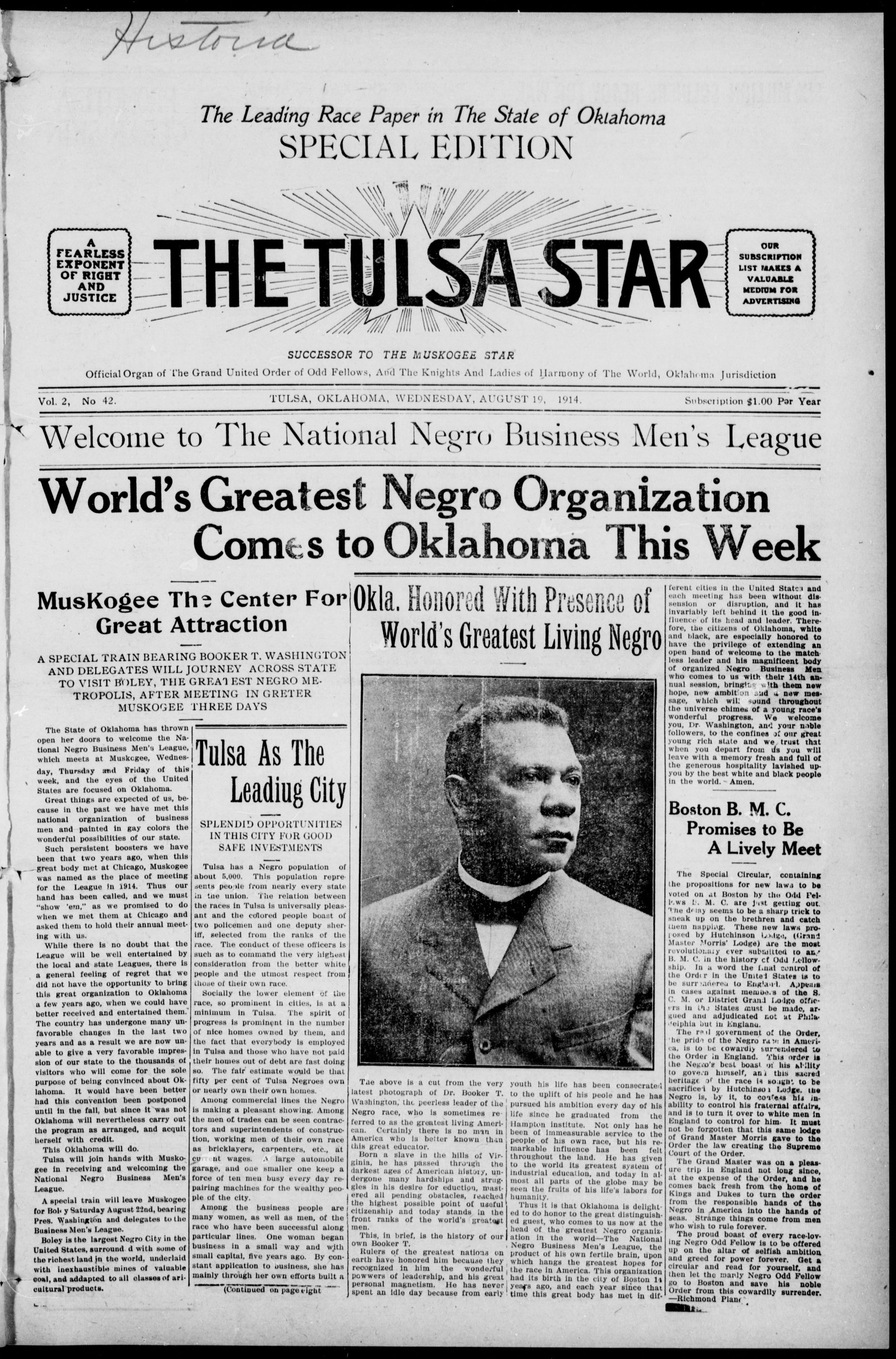
The above is a cut from the very latest photograph of Dr. Booker T. Washington, the peerless leader of the Negro race, who is sometimes referred to as the greatest living American. Certainly there is no man in America who is better known than this great educator. Born a slave in the hills of Virginia, he has passed through the darkest ages of American history, undergone many hardships and struggles in his desire for eduction, mastered all pending obstacles, reached the highest possible point of useful citizenship and today stands in the front ranks of the world's greatest men. This, in brief, is the history of our own Booker T. Rulers of the greatest nations on earth have honored him because they recognized in him the wonderful powers of leadership, and his great personal magnetism. He has never spent an idle day because from early
youth his life has been consecrated to the uplift of his peole and he has pursued his ambition every day of his life since he graduated from the Hampton institute. Not only has he been of immeasurable service to the people of his own race, but his remarkable influence has been felt throughout the land. He has given to the world its greatest system of industrial education, and today in almost all parts of the globe may be seen the fruits of his life's labors for humanity.
Thus it is that Oklahoma is delighted to do honor to the great distinguished guest, who comes to us now at the head of the greatest Negro organization in the world—The National Negro Business Men's League, the product of his own fertile brain, upon which hangs the greatest hopes for the race in America. This organization had its birth in the city of Boston 14 years ago, and each year since that time this great body has met in dif-
en's League
ization is Week
ferent cities in the United States and each meeting has been without dissension or disruption, and it has invariably left behind it the good influence of its head and leader. Therefore, the citizens of Oklahoma, white and black, are especially honored to have the privilege of extending an open hand of welcome to the matchless leader and his magnificent body of organized Negro Business Men who comes to us with their 14th annual session, bringing with them new hope, new ambition and a new message, which will sound throughout the universe chimes of a young race's wonderful progress. We welcome you, Dr. Washington, and your noble followers, to the confines of our great young rich state and we trust that when you depart from us you will leave with a memory fresh and full of the generous hospitality lavished up by the best white and black people in the world. Amen.
Boston B. M. C. Promises to Be A Lively Meet
Boston B. M. C. Promises to Be A Lively Meet
The Special Circular, containing the propositions for new laws to be voted on at Boston by the Odd Fellows B. M. C. are just getting out. The delay seems to be a sharp trick to sneak up on the brethren and catch them mapping. These new laws proposed by Hutchinson Lodge, (Grand Master Morris' Lodge) are the most revolutionary ever submitted to any B. M. C. in the history of Odd Fellowship. In a word the final control of the Order in the United States is to be surrendered to England. Appears in cases against members of the S. C. M. or District Grand Lodge officers in the States must be made, argued and adjudicated not at Philadelphia but in England.
The real government of the Order, the pride of the Negro race in America, is to be cowardly surrendered to the Order in England. This order is the Negro's best boast of his ability to govern himself, and this sacred heritage of the race is sought to be sacrificed by Hutchinson Lodge. the Negro is, by it, to confess his inability to control his fraternal affairs, and is to turn it over to white men in England to control for him. It must not be forgotten that this same lodge of Grand Master Morris gave to the Order the law creating the Supreme Court of the Order.
The Grand Master was on a pleasure trip in England not long since, at the expense of the Order, and he comes back fresh from the home of Kings and Dukes to turn the order from the responsible hands of the Negro in America into the hands of seas. Strange things come from men who wish to rule forever.
The proud boast of every race-loving Negro Odd Fellow is to be offered up on the altar of selfish ambition and greed for power forever. Get a circular and read for yourself, and then let the marly Negro Odd Fellow go to Boston and save his noble Order from this cowardlly surrender.
—Richmond Plane
M.
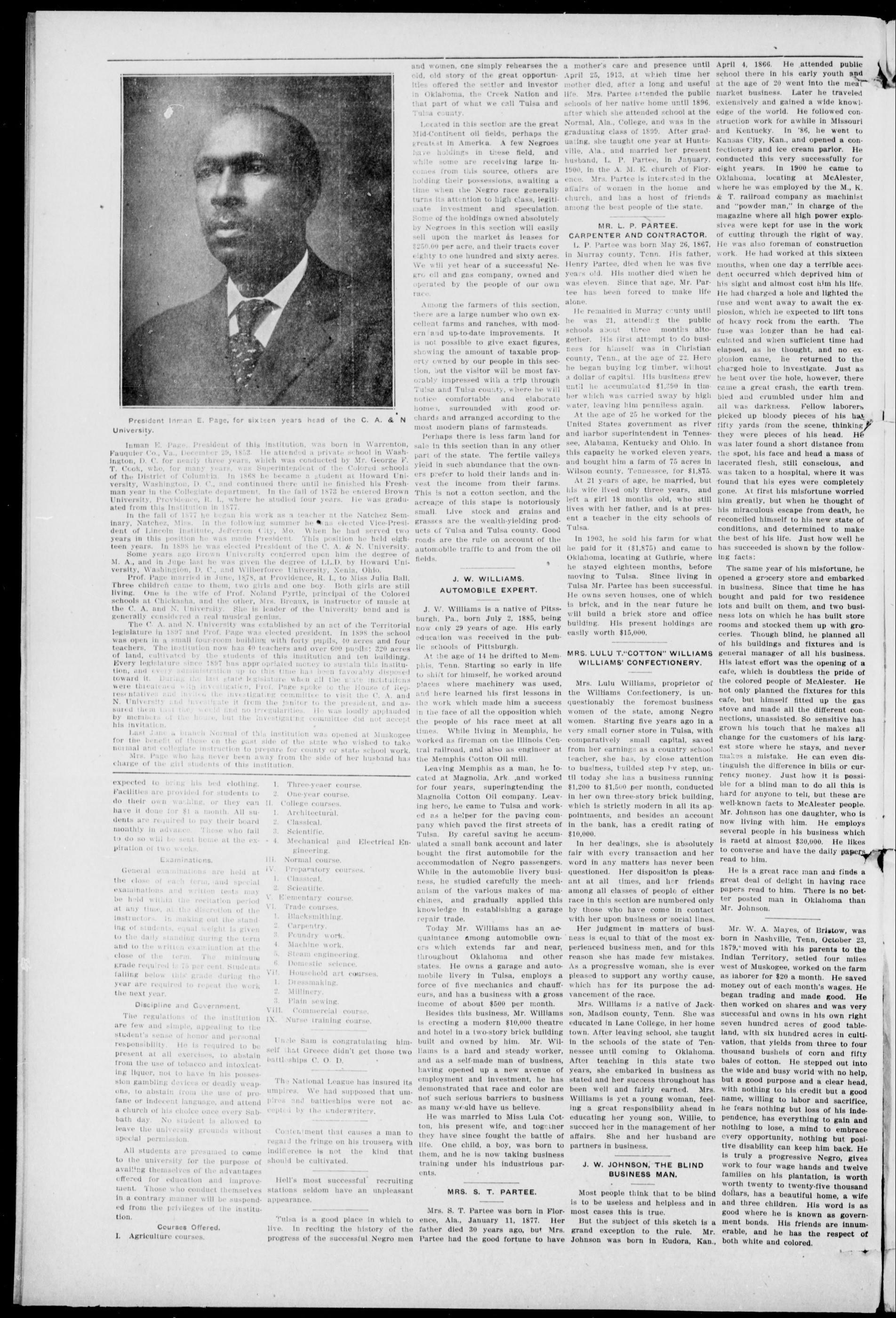
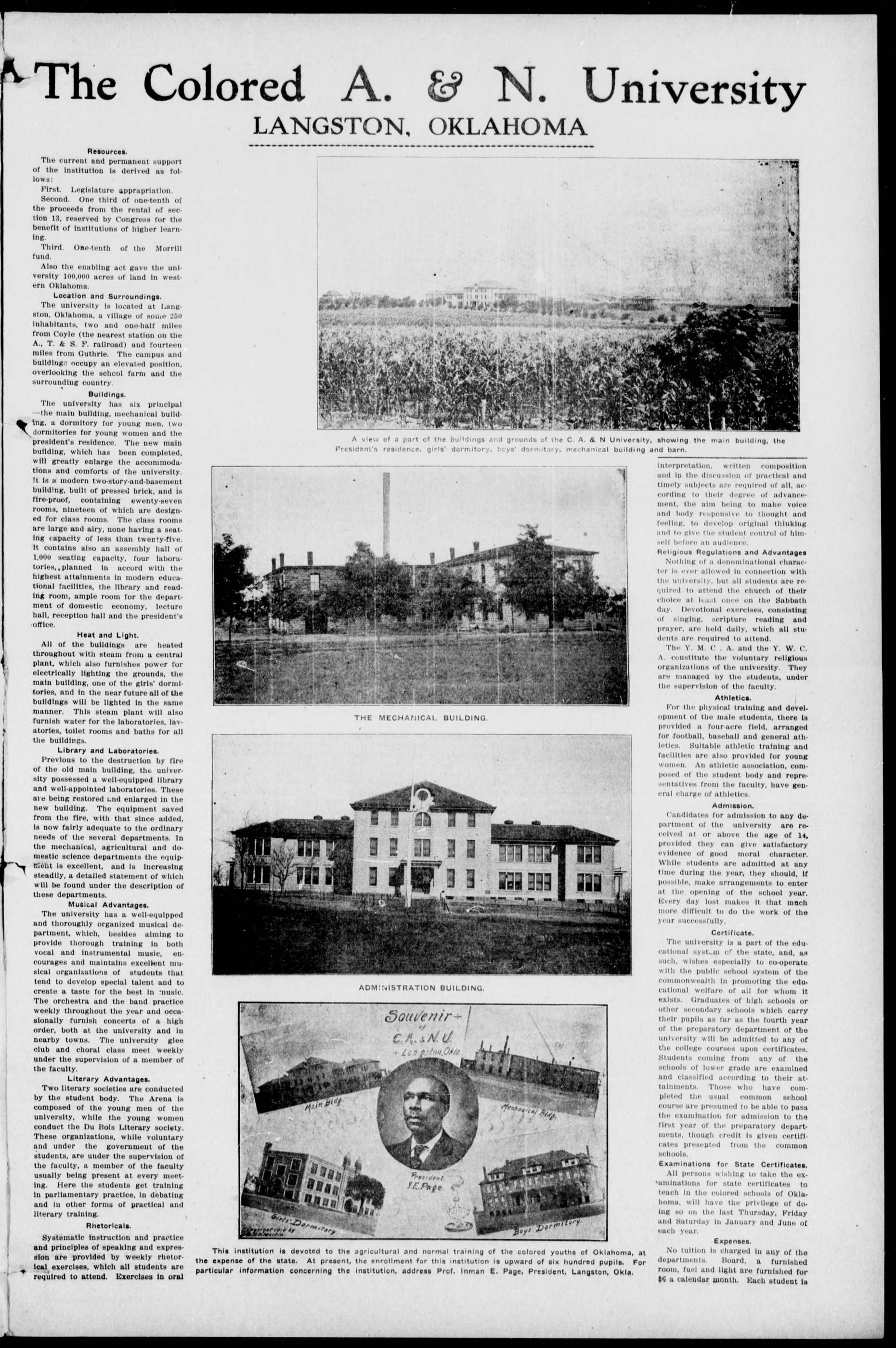
President Inman E. Page, for sixteen years head of the C. A. & N University.
Inman E. Page, President of this institution, was born in Warrenton, Fauquier Co., Va., December 29, 1853. He attended a private school in Washington, D. C. for nearly three years, which was conducted by Mr. George F. T. Cook, who, for many years, was Superintendent of the Colored schools of the District of Columbia. In 1868 he became a student at Howard University, Washington, D. C., and continued there until he finished his Freshman year in the Collegiate department. In the fall of 1873 he entered Brown University, Providence, R. L., where he studied four years. He was graduated from this Institution in 1877.
In the fall of 1877 he began his work as a teacher at the Natchez Seminary, Natchez, Miss. In the following summer he was elected Vice-President of Lincoln Institute, Jefferson City, Mo. When he had served two years in this position he was made President. This position he held eighteen years. In 1898 he was elected President of the C. A. & N. University.
Some years ago Brown University conferred upon him the degree of M. A., and in Jupe last he was given the degree of LL.D. by Howard University, Washington, D. C., and Wilberforce University, Xenia, Ohio.
Prof. Page married in June, 1878, at Providence, R. I., to Miss Julia Ball. Three children came to them, two girls and one boy. Both girls are still living. One is the wife of Prof. Noland Pyrtle, principal of the Colored schools at Chickasha, and the other, Mrs. Breaux, is instructor of music at the C. A. and N. University. She is leader of the University band and is generally considered a real musical genius.
The C. A. and N. University was established by an act of the Territorial legislature in 1897 and Prof. Page was elected president. In 1898 the school was open in a small four-room building with forty pupils, 40 acres and four teachers. The institution now has 40 teachers and over 600 pupils; 220 acres of land, cultivated by the students of this institution and ten buildings. Every legislature since 1897 has appropriated money to sustain this institution, and every administration up to this time has been favorably disposed toward it. During the last state legislature when all the state institutions were threatened with investigation, Prof. Page spoke to the House of Representatives and invited the investigating committee to visit the C. A. and N. University and investigate it from the junior to the president, and assured them that they would find no irregularities. He was loudly applauded by members of the house, but the investigating committee did not accept his invitation.
Last June a branch Normal of this institution was opened at Muskogee for the benefit of those on the past side of the state who wished to take normal and collegiate instruction to prepare for county or state school work. Mrs. Page who has never been away from the side of her husband has charge of the girl students of this institution.
expected to bring his bed clothing. 1. Three-yeaer course.
Facilities are provided for students to 2. One-year course.
do their own washing, or they can 11. College courses.
have it done for $1 a month. All students are required to pay their board 2. Classical.
monthly in advance. Those who fail 3. Scientific.
to do so will be sent home at the exp 4. Mechanical and Electrical En-
piration of two weeks.
Examinations.
General examinations are held at the close of each term, and special examinations and written tests may be held within the recitation period at any time, at the discretion of the instructors. In making out the standing of students, equal weight is given to the daily standing during the term and to the written examination at the close of the term. The minimum grade required is 75 per cent. Students falling below this grade during the year are required to repeat the work the next year.
Discipline and Government.
The regulations of the institutions are few and simple, appealing to the student's sense of honor and personal responsibility. He is required to be present at all exercises, to abstain from the use of tobacco and intoxicating liquor, not to have in his possession gambling devices or deadly weapons, to abstain from the use of profane or indecent language, and attend a church of his choice once every Subbath day. No student is allowed to leave the university grounds without special permission.
All students are presumed to come to the university for the purpose of availing themselves of the advantages offered for education and improvement. Those who conduct themselves in a contrary manner will be suspended from the privileges of the institution.
1. Three-yeaer course.
2. One-year course.
III. College courses.
1. Architectural.
2. Classical.
3. Scientific.
4. Mechanical and Electrical Engineering.
III. Normal course.
IV. Preparatory courses.
1. Classical.
2. Scientific.
V. Elementary course.
VI. Trade courses.
1. Blacksmithing.
2. Carpentry.
3. Foundry work.
4. Machine work.
5. Steam engineering.
6. Domestic science.
VII. Household art courses.
1. Dressmaking.
2. Millinery.
3. Plain sewing.
VIII. Commercial course.
IX. Nurse training course.
Uncle Sam is congratulating himself that Greece didn't get those two battleships C. O. D.
The National League has insured its umpires. We had supposed that umpires and battleships were not accepted by the underwriters.
Concentration that causes a man to regard the fringe on his trousers with indifference is not the kind that should be cultivated.
Hell's most successful recruiting stations seldom have an unpleasant appearance.
Tulsa is a good place in which to live. In reciting the history of the progress of the successful Negro men
and women, one simply rehearses the old, old story of the great opportunities offered the settler and investor in Oklahoma, the Creek Nation and that part of what we call Tulsa and Tulsa county.
Located in this section are the great Mid-Continent oil fields, perhaps the greatest in America. A few Negroes have holdings in these field, and while some are receiving large incomes from this source, others are holding their possessions, awaiting a time when the Negro race generally turns its attention to high class, legitimate investment and speculation. Some of the holdings owned absolutely by Negroes in this section will easily sell upon the market as leases for $250.00 per acre, and their tracts cover eighty to one hundred and sixty acres. We will yet hear of a successful Negro oil and gas company, owned and operated by the people of our own race.
Among the farmers of this section, there are a large number who own excellent farms and ranches, with modern and up-to-date improvements. It is not possible to give exact figures, showing the amount of taxable property owned by our people in this section, but the visitor will be most favorably impressed with a trip through Tulsa and Tulsa county, where he will notice comfortable and elaborate homes, surrounded with good or chards and arranged according to the most modern plans of farmsteads.
Perhaps there is less farm land for sale in this section than in any other part of the state. The fertile valleys yield in such abundance that the owners prefer to hold their lands and invest the income from their farms. This is not a cotton section, and the acreage of this stape is notoriously small. Live stock and grains and grasses are the wealth-yielding products of Tulsa and Tulsa county. Good roads are the rule on account of the automobile traffic to and from the oil fields.
J. W. WILLIAMS.
AUTOMOBILE EXPERT.
J. W. Williams is a native of Pitsburgh, Pa., born July 2, 1885, being now only 29 years of age. His early education was received in the public schools of Pittsburgh. At the age of 14 he drifted to Memphis, Tenn. Starting so early in life to shift for himself, he worked around places where machinery was used, and here learned his first lessons in the work which made him a success in the face of all the opposition which the people of his race meet at all times. While living in Memphis, he worked as fireman on the Illinois Central railroad, and also as engineer at the Memphis Cotton Oil mill.
Leaving Memphis as a man, he located at Magnolia, Ark. and worked for four years, supering tending the Magnolia Cotton Oil company. Leaving here, he came to Tulsa and worked as a helper for the paving company which paved the first streets of Tulsa. By careful saving he accumulated a small bank account and later bought the first automobile for the accommodation of Negro passengers. While in the automobile livery business, he studied carefully the mechanism of the various makes of machines, and gradually applied this knowledge in establishing a garage repair trade.
Today Mr. Williams has an acquaintance among automobile owners which extends far and near, throughout Oklahoma and other states. He owns a garage and automobile livery in Tulsa, employs a force of five mechanics and chauffeurs, and has a business with a gross income of about $500 per month. Besides this business, Mr. Williams is erecting a modern $10,000 theatre and hotel in a two-story brick building built and owned by him. Mr. Williams is a hard and steady worker, and as a self-made man of business, having opened up a new avenue of employment and investment, he has demonstrated that race and color are not such serious barriers to business as many would have us believe.
He was married to Miss Lula Cotton, his present wife, and together they have since fought the battle of life. One child, a boy, was born to them, and he is now taking business training under his industrious parents.
MRS. S. T. PARTEE.
Mrs. S. T. Partee was born in Florence, Ala., January 11, 1877. Her father died 30 years ago, but Mrs. Partee had the good fortune to have
a mother's care and presence until April 25, 1913, at which time her mother died, after a long and useful life. Mrs. Partee attended the public schools of her native home until 1896, after which she attended school at the Normal, Ala., College, and was in the graduating class of 1899. After graduating, she taught one year at Huntsville, Ala., and married her present husband, L. P. Partee, in January, 1900, in the A. M. E. church of Florence. Mrs. Partee is interested in the affairs of women in the home and church, and has a host of friends among the best people of the state.
MR. L. P. PARTEE.
CARPENTER AND CONTRACTOR.
L. P. Partee was born May 26, 1867,
in Murray county, Tenn. His father,
Henry Partee, died when he was five
years old. His mother died when he
was eleven. Since that age, Mr. Partee
has been forced to make life
alone.
He remained in Murray county until
he was 21, attending the public
schools about three months altogether. His first attempt to do business for himself was in Christian county, Tenn., at the age of 22. Hero he began buying log timber, without a dollar of capital. His business grew until he accumulated $1,390 in timber which was carried away by high water, leaving him penniless again.
At the age of 25 he worked for the United States government as river and harbor superintendent in Tennessee, Alabama, Kentucky and Ohio. In this capacity he worked eleven years, and bought him a farm of 75 acres in Wilson county, Tennessee, for $1,875. At 21 years of age, he married, but his wife lived only three years, and left a girl 18 months old, who still lives with her father, and is at present a teacher in the city schools of Tulsa.
In 1903, he sold his farm for what he paid for it ($1,875) and came to Oklahoma, locating at Guthrie, where he stayed eighteen months, before moving to Tulsa. Since living in Tulsa Mr. Parte has been successful. He owns seven houses, one of which is brick, and in the near future he will build a brick store and office building. His present holdings are easily worth $15,000.
MRS. LULU T. "COTTON" WILLIAMS
WILLIAMS' CONFECTIONERY.
Mrs. Lulu Williams, proprietor of the Williams Confectionery, is unquestionably the foremost business women of the state, among Negro women. Starting five years ago in a very small corner store in Tulsa, with comparatively small capital, saved from her earnings as a country school teacher, she has, by close attention to business, built step by step, until today she has a business running $1,200 to $1,500 per month, conducted in her own three-story brick building, which is strictly modern in all its appointments, and besides an account in the bank, has a credit rating of $10,000.
In her dealings, she is absolutely fair with every transaction and her word in any matters has never been questioned. Her disposition is pleasant at all times, and her friends among all classes of people of either race in this section are numbered only by those who have come in contact with her upon business or social lines. Her judgment in matters of business is equal to that of the most experienced business men, and for this reason she has made few mistakes. As a progressive woman, she is ever pleased to support any worthy cause, which has for its purpose the advancement of the race.
Mrs. Williams is a native of Jackson, Madison county, Tenn. She was educated in Lane College, in her home town. After leaving school, she taught in the schools of the state of Tennessee until coming to Oklahoma. After teaching in this state two years, she embarked in business as stated and her success throughout has been well and fairly earned. Mrs. Williams is yet a young woman, feeling a great responsibility ahead in educating her young son, Willie, to succeed her in the management of her affairs. She and her husband are partners in business.
J. W. JOHNSON, THE BLIND BUSINESS MAN.
Most people think that to be blind is to be useless and helpless and in most cases this is true. But the subject of this sketch is a grand exception to the rule. Mr. Johnson was born in Eudora. Kan.
April 4, 1866. He attended public school there in his early youth and at the age of 20 went into the meat market business. Later he traveled extensively and gained a wide knowledge of the world. He followed construction work for awhile in Missouri and Kentucky. In '86, he went to Kansas City, Kan., and opened a confectionery and ice cream parlor. He conducted this very successfully for eight years. In 1900 he came to Oklahoma, locating at McAlester, where he was employed by the M., K. & T. railroad company as machinist and "powder man," in charge of the magazine where all high power explosives were kept for use in the work of cutting through the right of way. He was also foreman of construction work. He had worked at this sixteen months, when one day a terrible accident occurred which deprived him of his sight and almost cost him his life. He had charged a hole and lighted the fuse and went away to await the explosion, which he expected to lift tons of heavy rock from the earth. The fuse was longer than he had calculated and when sufficient time had elapsed, as he thought, and no explosion came, he returned to the charged hole to investigate. Just as he bent over the hole, however, there came a great crash, the earth trembled and crumbled under him and all was darkness. Fellow laborers picked up bloody pieces of his hat fifty yards from the scene, thinking they were pieces of his head. He was later found a short distance from the spot, his face and head a mass of lacerated flesh, still conscious, and was taken to a hospital, where it was found that his eyes were completely gone. At first his misfortune worried him greatly, but when he thought of his miraculous escape from death, he reconciled himself to his new state of conditions, and determined to make the best of his life. Just how well he has succeeded is shown by the following facts:
The same year of his misfortune, he opened a grocery store and embarked in business. Since that time he has bought and paid for two residence lots and built on them, and two business lots on which he has built store rooms and stocked them up with groceries. Though blind, he planned all of his buildings and fixtures and is general manager of all his business. His latest effort was the opening of a cafe, which is doubtless the pride of the colored people of McAlester. He not only planned the fixtures for this cafe, but himself fitted up the gas stove and made all the different connections, unassisted. So sensitive has grown his touch that he makes all change for the customers of his largest store where he stays, and never makes a mistake. He can even distinguish the difference in bills or currency money. Just how it is possible for a blind man to do all this is hard for anyone to tell, but these are well-known facts to McAlester people. Mr. Johnson has one daughter, who is now living with him. He employs several people in his business which is raetd at almost $30,000. He likes to converse and have the daily papers read to him.
He is a great race man and finds a great deal of delight in having race papers read to him. There is no better posted man in Oklahoma than Mr. Johnson.
Mr. W. A. Mayes, of Bristow, was born in Nashville, Tenn, October 23, 1879, moved with his parents to the Indian Territory, setled four miles west of Muskogee, worked on the farm as laborer for $20 a month. He saved money out of each month's wages. He began trading and made good. He then worked on shares and was very successful and owns in his own right seven hundred acres of good tableland, with six hundred acres in cultivation, that yields from three to four thousand bushels of corn and fifty bales of cotton. He stepped out into the wide and busy world with no help, but a good purpose and a clear head, with nothing to his credit but a good name, willing to labor and sacrifice, he fears nothing but loss of his independence, has everything to gain and nothing to lose, a mind to embrace every opportunity, nothing but positive disability can keep him back. He is truly a progressive Negro, gives work to four wage hands and twelve families on his plantation, is worth worth twenty to twenty-five thousand dollars, has a beautiful home, a wife and three children. His word is as good where he is known as government bonds. His friends are innumerable, and he has the respect of both white and colored.
1
2
3
4
5
6
7
8
9
10
11
12
13
14
15
16
17
18
19
20
21
22
23
24
25
26
27
28
29
30
31
32
33
34
35
36
37
38
39
40
41
42
43
44
45
46
47
48
49
50
51
52
53
54
55
56
57
58
59
60
61
62
63
64
65
66
67
68
69
70
71
72
73
74
75
76
77
78
79
80
81
82
83
84
85
86
87
88
89
90
91
92
93
94
95
96
97
98
99
100
THE BLAKE
The subject of this sketch is Prof. J. T. West, principal of the colored schools at Claremore, Okla.
Prof. West was born in Waynesboro, Tenn, April 11, 1886. He attended public school there until 1901, and then entered the Walden University in Nashville, from which institution he graduated in the class of 1910. The same year he went to Grand Chain, Ill., and was elected principal of the city schools there. After one year he came to Oklahoma, locating at Chelsea, and was engaged in school work there one year. In 1912, he went to Claremore, where he was elected principal of the colored schools, which position he still holds.
Yet a young man, a little more than
[Name]
REUBEN MORRISON.
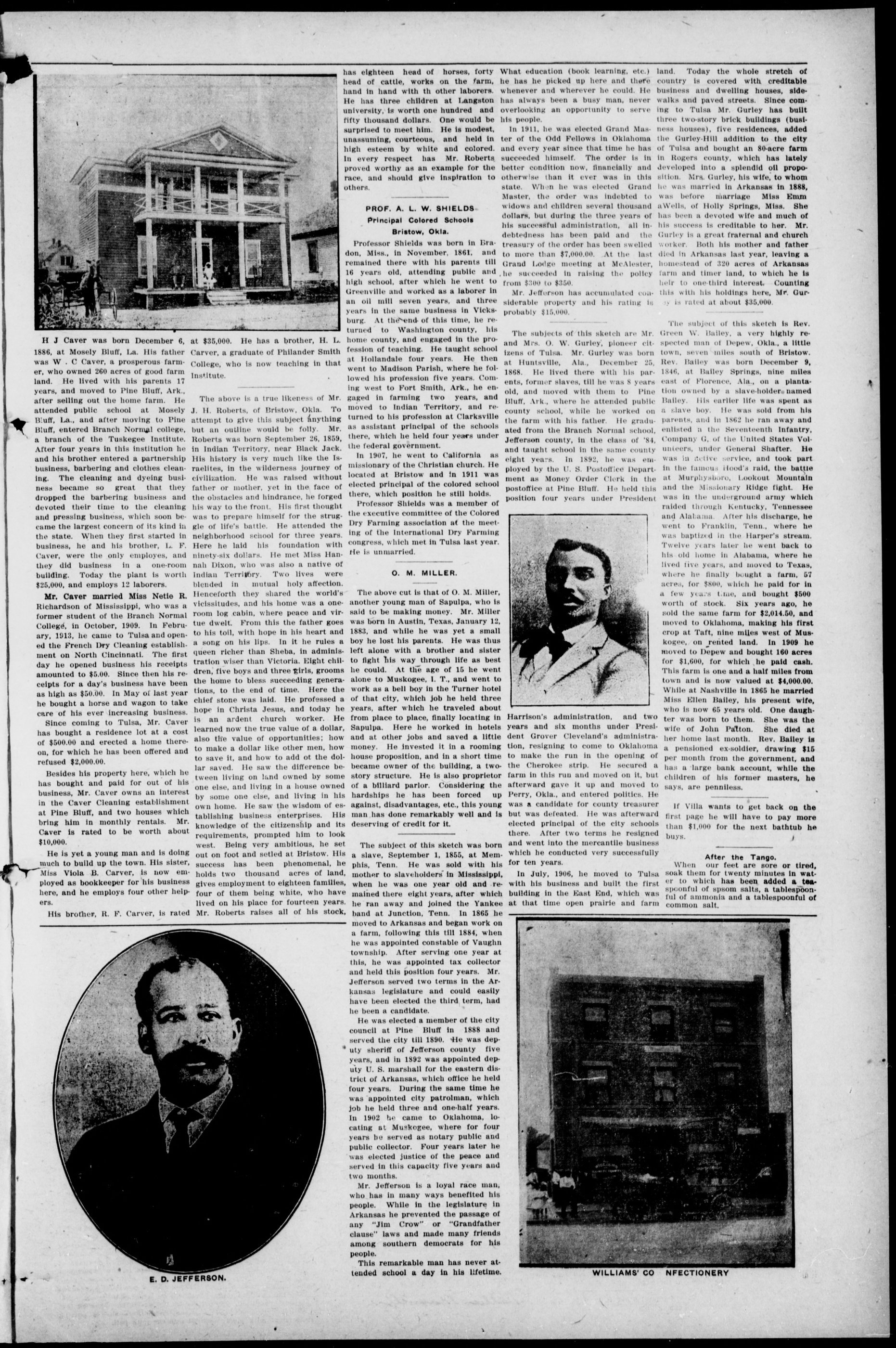
Reuben Morrison of Bristow, Okla., was born July 4, 1863, at Humboldt, Kan. In 1865, his parents moved with him to the Indian Territory, where he has lived ever since. Their first location was at Taft, nine miles west of Muskogee, where they lived until 1898, when they moved to Creek county, settling at Bristow, their present home. In 1894, Mr. Morrison was married to Miss Julia McIntosh. As a result of this union, 11 children, seven boys and four girls (each of whom, but one, own 160 acres) were born. They now have 1,000 acres in their own right, valued at $30,000 Mrs. Morrison died October 19, last Mr. Morrison is a successful farmer
---
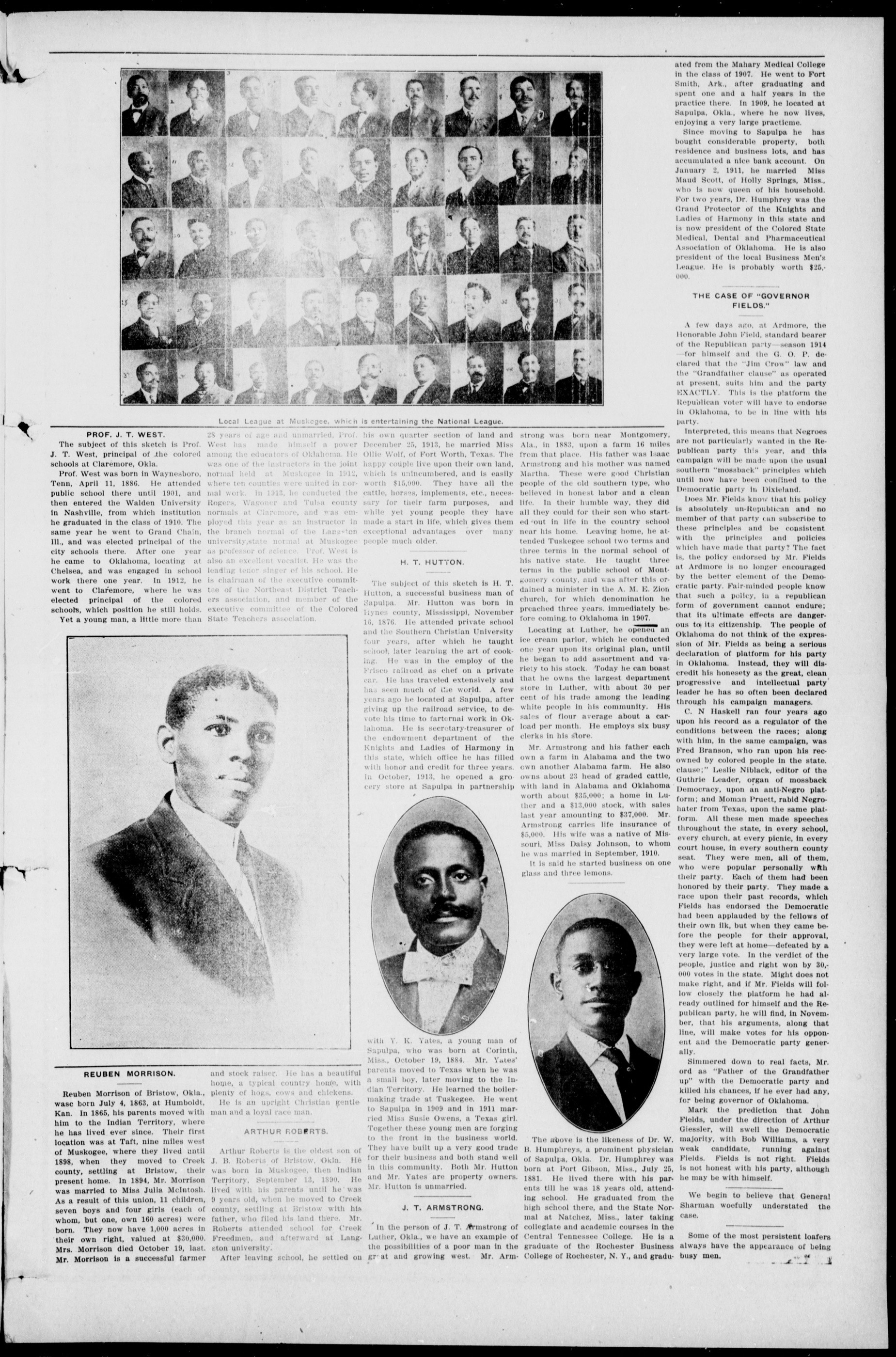
Local League at Muskegee, which is entertaining the National League.
28 years of age and unmarried, Prof. West has made himself a power among the educators of Oklahoma. He was one of the instructors in the joint normal held at Muskogee in 1912, where ten counties were united in normal work. In 1913, he conducted the Rogers, Wagoner and Tulsa county normals at Claremore, and was employed this year as an instructor in the branch normal of the Langston university,state normal at Muskogee as professor of science. Prof. West is also an excellent vocalist. He was the leading tenor singer of his school. He is chairman of the executive committee of the Northeast District Teachers association, and member of the executive committee of the Colored State Teachers association.
THE BLAIRS
and stock raiser. He has a beautiful home, a typical country home, with plenty of hogs, cows and chickens. He is an upright Christian gentleman and a loyal race man.
ARTHUR ROBB RTS.
Arthur Roberts is the oldest son of J. B. Roberts of Bristow, Okla. He was born in Muskogee, then Indian Territory, September 13, 1890. He lived with his parents until he was 9 years old, when he moved to Creek county, settling at Bristow with his father, who filed his land there. Mr. Roberts attended school for Creek Freedmen, and afterward at Langston university. After leaving school, he settled on
---
his own quarter section of land and December 25, 1913, he married Miss Ollie Wolf, of Fort Worth, Texas. The happy couple live upon their own land, which is unincumbered, and is easily worth $15,000. They have all the cattle, horses, implements, etc., necessary for their farm purposes, and while yet young people they have made a start in life, which gives them exceptional advantages over many people much older.
H. T. HUTTON.
The subject of this sketch is H. T. Hutton, a successful business man of Sapulpa. Mr. Hutton was born in Hynes county, Mississippi, November 16, 1876. He attended private school and the Southern Christian University four years, after which he taught school, later learning the art of cooking. He was in the employ of the Frisco railroad as chef on a private car. He has traveled extensively and has seen much of the world. A few years ago he located at Sapulpa, after giving up the railroad service, to devote his time to farternal work in Oklahoma. He is secretary-treasurer of the endowment department of the Knights and Ladies of Harmony in this state, which office he has filled with honor and credit for three years. In October, 1913, he opened a grocery store at Sapulpa in partnership
[Name]
with Y. K. Yates, a young man of Sapulpa, who was born at Corinth, Miss., October 19, 1884. Mr. Yates' parents moved to Texas when he was a small boy, later moving to the Indian Territory. He learned the boilermaking trade at Tuskegee. He went to Sapulpa in 1909 and in 1911 married Miss Susie Owens, a Texas girl. Together these young men are forging to the front in the business world. They have built up a very good trade for their business and both stand well in this community. Both Mr. Hutton and Mr. Yates are property owners. Mr. Hutton is unmarried.
J. T. ARMSTRONG
In the person of J. T. Armstrong of Luther, Okla., we have an example of the possibilities of a poor man in the great and growing west. Mr. Arm-
strong was born near Montgomery, Ala., in 1883, upon a farm 16 miles from that place. His father was Isaac Armstrong and his mother was named Martha. These were good Christian people of the old southern type, who believed in honest labor and a clean life. In their humble way, they did all they could for their son who started out in life in the country school near his home. Leaving home, he attended Tuskegee school two terms and three terms in the normal school of his native state. He taught three terms in the public school of Montgomery county, and was after this ordained a minister in the A. M. E. Zion church, for which denomination he preached three years, immediately before coming to Oklahoma in 1907.
Locating at Luther, he opened an ice cream parlor, which he conducted one year upon its original plan, until he began to add assortment and variety to his stock. Today he can boast that he owns the largest department store in Luther, with about 30 per cent of his trade among the leading white people in his community. His sales of flour average about a carload per month. He employs six busy clerks in his store.
Mr. Armstrong and his father each own a farm in Alabama and the two own another Alabama farm. He also owns about 23 head of graded cattle, with land in Alabama and Oklahoma worth about $35,000; a home in Luther and a $13,000 stock, with sales last year amounting to $37,000. Mr. Armstrong carries life insurance of $5,000. His wife was a native of Missouri, Miss Daisy Johnson, to whom he was married in September, 1910. It is said he started business on one glass and three lemons.
A. E.
The above is the likeness of Dr. W. B. Humphreys, a prominent physician of Sapulpa, Okla. Dr. Humphreys was born at Port Gibson, Miss., July 25, 1881. He lived there with his parents till he was 18 years old, attending school. He graduated from the high school there, and the State Normal at Natchez, Miss., later taking collegiate and academic courses in the Central Tennessee College. He is a graduate of the Rochester Business College of Rochester, N. Y., and gradu-
ated from the Mahary Medical College in the class of 1907. He went to Fort Smith, Ark., after graduating and spent one and a half years in the practice there. In 1909, he located at Sapulpa, Okla., where he now lives, enjoying a very large practicme.
Since moving to Sapulpa he has bought considerable property, both residence and business lots, and has accumulated a nice bank account. On January 2, 1911, he married Miss Maud Scott, of Holly Springs, Miss., who is now queen of his household. For two years, Dr. Humphrey was the Grand Protector of the Knights and Ladies of Harmony in this state and is now president of the Colored State Medical, Dental and Pharmaceutical Association of Oklahoma. He is also president of the local Business Men's League. He is probably worth $25,000.
THE CASE OF "GOVERNOR FIELDS."
A few days ago, at Ardmore, the Honorable John Field, standard bearer of the Republican party—season 1914—for himself and the G. O. P. declared that the "Jim Crow" law and the "Grandfather clause" as operated at present, suits him and the party EXACTLY. This is the platform the Republican voter will have to endorse in Oklahoma, to be in line with his party.
Interpreted, this means that Negroes are not particularly wanted in the Republican party this year, and this campaign will be made upon the usual southern "mossback" principles which until now have been confined to the Democratic party in Dixieland.
Does Mr. Fields know that his policy is absolutely un-Republican and no member of that party can subscribe to these principles and be consistent with the principles and policies which have made that party? The fact is, the policy endorsed by Mr. Fields at Ardmore is no longer encouraged by the better element of the Democratic party. Fair-minded people know that such a policy, in a republican form of government cannot endure; that its ultimate effects are dangerous to its citizenship. The people of Oklahoma do not think of the expression of Mr. Fields as being a serious declaration of platform for his party in Oklahoma. Instead, they will discredit his honesty as the great, clean progressive and intellectual party leader he has so often been declared through his campaign managers.
C. N Haskell ran four years ago upon his record as a regulator of the conditions between the races; along with him, in the same campaign, was Fred Branson, who ran upon his recowned by colored people in the state. clause;" Leslie Niblack, editor of the Guthrie Leader, organ of mossback Democracy, upon an anti-Negro platform; and Moman Pruett, rabid Negro-hater from Texas, upon the same platform. All these men made speeches throughout the state, in every school, every church, at every picnic, in every court house, in every southern county seat. They were men, all of them who were popular personally with their party. Each of them had been honored by their party. They made a race upon their past records, which Fields has endorsed the Democratic had been applauded by the fellows of their own ilk, but when they came before the people for their approval, they were left at home—defeated by a very large vote. In the verdict of the people, justice and right won by 30,000 votes in the state. Might does not make right, and if Mr. Fields will follow closely the platform he had all ready outlined for himself and the Republican party, he will find, in November, that his arguments, along that line, will make votes for his opponent and the Democratic party generally.
Simmered down to real facts, Mr. ord as "Father of the Grandfather up" with the Democratic party and killed his chances, if he ever had any, for being governor of Oklahoma.
Mark the prediction that John Fields, under the direction of Arthur Giessler, will swell the Democratic majority, with Bob Williams, a very weak candidate, running against Fields. Fields is not right. Fields is not honest with his party, although he may be with himself.
We begin to believe that General Sharman woefully understated the case.
Some of the most persistent loafers always have the appearance of being busy men.
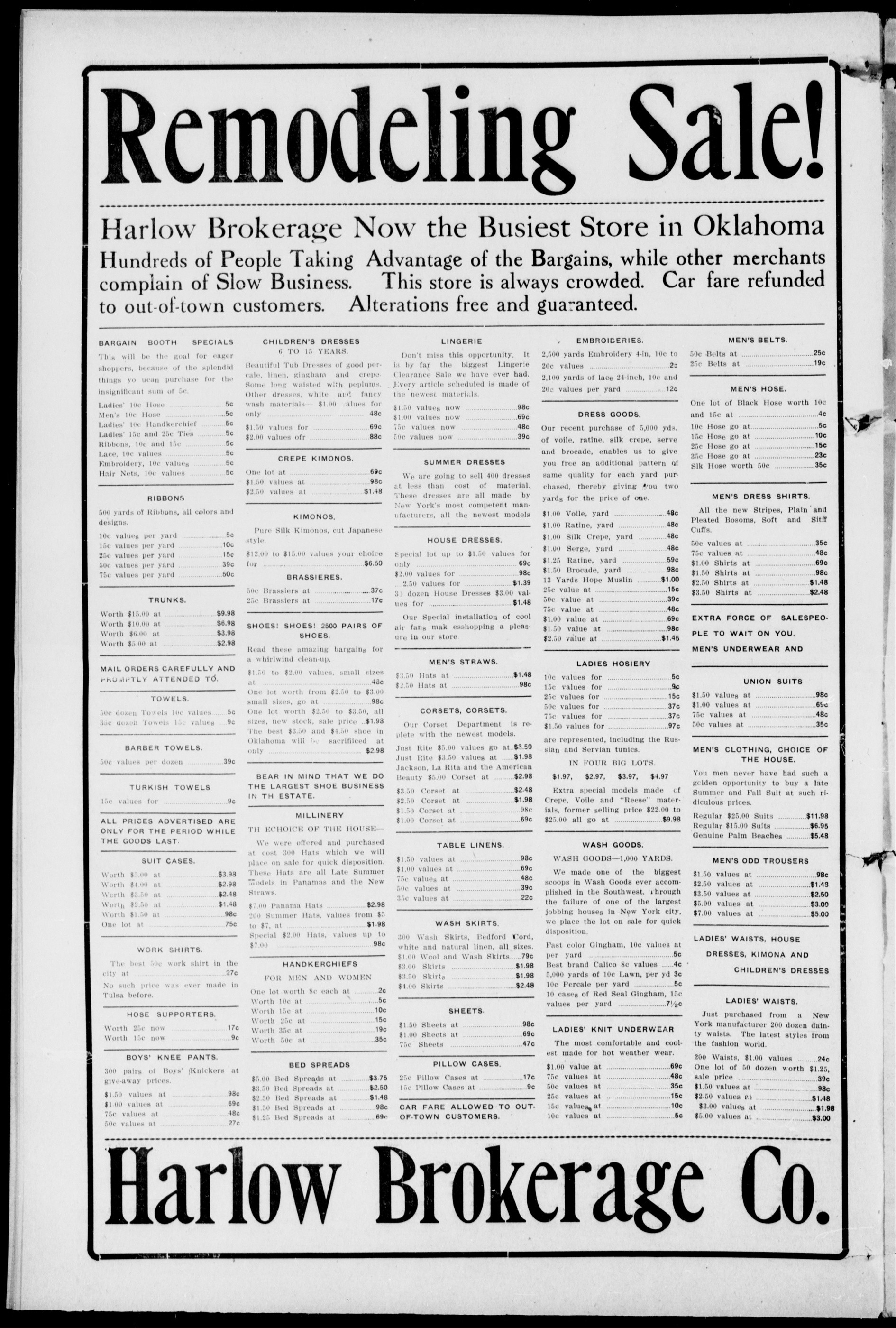
Remodeling Sale!
Harlow Brokerage Now the Busiest Store in Oklahoma Hundreds of People Taking Advantage of the Bargains, while other merchants complain of Slow Business. This store is always crowded. Car fare refunded to out-of-town customers. Alterations free and guaranteed.
Harlow Brokerage Co.
SUIT CASES.
Worth $5.00 at ..... $3.98
Worth $4.00 at ..... $2.98
Worth $3.50 at ..... $2.48
Worth $2.50 at ..... $1.48
Worth $1.50 at ..... 98c
One lot at ..... 75c
BEAR IN MIND THAT WE DO
THE LARGEST SHOE BUSINESS
IN TH ESTATE.
MILLINERY
TH ECHOICE OF THE HOUSE
We were offered and purchased
at cost 300 Hats which we will
place on sale for quick disposition.
These Hats are all Late Summer
Models in Panamas and the New
Straws.
$7.00 Panama Hats ..... $2.98
200 Summer Hats, values from $5
to $7, at ..... $1.98
Special $2.00 Hats, values up to
$7.00 ..... 98c
HANDKERCHIEFS
FOR MEN AND WOMEN
One lot worth 8c each at .....2c
Worth 10c at .....5c
Worth 15c at .....10c
Worth 25c at .....15c
Worth 35c at .....19c
Worth 50c at .....35c
BED SPREADS
$5.00 Bed Spreads at .....$3.75
$3.50 Bed Spreads at .....$2.50
$2.50 Bed Spreads at .....$1.48
$1.50 Bed Spreads at .....98c
$1.25 Bed Spreads at .....69c
owl
Don't miss this opportunity. It is by far the biggest Lingerie Clearance Sale we have ever had. Every article scheduled is made of the newest materials.
$1.50 values now .....98c
$1.00 values now .....69c
75c values now .....48c
50c values now .....39c
SUMMER DRESSES
We are going to sell 400 dresses at less than cost of material. These dresses are all made by New York's most competent manufacturers, all the newest models
HOUSE DRESSES.
Special lot up to $1.50 values for only ..... 69c
$2.00 values for ..... 98c
... 2.50 values for ..... $1.39
3) dozen House Dresses $3.00 values for ..... $1.48
Our Special installation of cool air fans mak esshopping a pleasure in our store.
MEN'S STRAWS.
$3.50 Hats at .....$1.48
$2.50 Hats at .....98c
CORSETS, CORSETS.
Our Corset Department is replete with the newest models.
Just Rite $5.00 values go at $3.50
Just Rite $3.50 values at .....$1.98
Jackson, La Rita and the American Beauty $5.00 Corset at .....$2.98
$3.50 Corset at .....$2.48
$2.50 Corset at .....$1.98
$1.50 Corset at .....98c
$1.00 Corset at .....69c
TABLE LINENS.
$1.50 values at .....98c
$1.00 values at .....69c
75c values at .....48c
50c values at .....39c
35c values at .....22c
WASH SKIRTS.
300 Wash Skirts, Bedford Cord,
white and natural linen, all sizes.
$1.00 Wool and Wash Skirts.....79c
$3.00 Skirts .....$1.98
$3.50 Skirts .....$1.98
$4.00 Skirts .....$2.48
SHEETS.
$1.50 Sheets at .....98c
$1.00 Sheets at .....69c
75c Sheets .....47c
PILLOW CASES.
25c Pillow Cases at .....17c
15c Pillow Cases at .....9c
CAR FARE ALLOWED TO OUT-OF-TOWN CUSTOMERS.
DRESS GOODS.
Our recent purchase of 5,000 yds. of voile, ratline, silk crepe, serve and brocade, enables us to give you free an additional pattern of same quality for each yard purchased, thereby giving you two yards for the price of one.
$1.00 Voile, yard ..... 48c
$1.00 Ratine, yard ..... 48c
$1.00 Silk Crepe, yard ..... 48c
$1.00 Serge, yard ..... 48c
$1.25 Ratine, yard ..... 59c
$1.50 Brocade, yard ..... 98c
13 Yards Hope Muslin ..... $1.00
25c value at ..... 15c
50c value at ..... 39c
75c value at ..... 48c
$1.00 value at ..... 69c
$1.50 value at ..... 98c
$2.50 value at ..... $1.45
LADIES HOSIERY
10c values for .....5c
15c values for .....9c
25c values for .....15c
50c values for .....37c
75c values for .....37c
$1.50 values for .....97c
are represented, including the Russian and Servian tunics.
$1.97 $2.97 $3.97 $4.97
Extra special models made of
Crepe, Voile and "Reese" materials,
former selling price $22.00 to
$25.00 all go at $9.98
WASH GOODS.
WASH GOODS—1,000 YARDS.
We made one of the biggest scoops in Wash Goods ever accomplished in the Southwest. through the failure of one of the largest jobbing houses in New York city, we place the lot on sale for quick disposition.
Fast color Gingham, 10c values at per yard .....5c
Best brand Calico 8c values .....4c
5,000 yards of 10c Lawn, per yd 3c
10c Percale per yard .....5c
10 cases of Red Seal Gingham, 15c
values per yard .....7½c
LADIES' KNIT UNDERWEAR
The most comfortable and coolest made for hot weather wear.
$1.00 value at .....69c
75c values at .....48c
50c values at .....35c
25c values at .....15c
15c values at .....10c
10c values at .....5c
MEN'S BELTS.
50c Belts at ..... 25c
25c Belts at ..... 19c
MEN'S HOSE.
One lot of Black Hose worth 10c
and 15c at ..... 4c
10c Hose go at ..... 5c
15c Hose go at ..... 10c
25c Hose go at ..... 15c
35c Hose go at ..... 23c
Slk Hose worth 50c ..... 35c
MEN'S DRESS SHIRTS.
All the new Stripes, Plain and
Pleated Bosoms, Soft and Sittf
Cuffs.
50c values at ..... 35c
75c values at ..... 48c
$1.00 Shirts at ..... 69c
$1.50 Shirts at ..... 98c
$2.50 Shirts at ..... $1.48
$3.50 Shirts at ..... $2.48
EXTRA FORCE OF SALESPEOPLE TO WAIT ON YOU.
MEN'S UNDERWEAR AND
UNION SUITS
$1.50 values at .....98c
$1.00 values at .....65c
75c values at .....48c
50c values at .....35c
MEN'S CLOTHING, CHOICE OF THE HOUSE.
You men never have had such a golden opportunity to buy a late Summer and Fall Suit at such ridiculous prices.
Regular $25.00 Suits .....$11.98
Regular $15.00 Suits .....$6.95
Genuine Palm Beaches .....$5.48
MEN'S ODD TROUSERS
$1.50 values at .....98c
$2.50 values at .....$1.43
$3.50 values at .....$2.50
$5.00 values at .....$3.00
$7.00 values at .....$5.00
LADIES' WAISTS, HOUSE
DRESSES, KIMONA AND
CHILDREN'S DRESSES
Just purchased from a New
York manufacturer 200 dozen dainty
waists. The latest styles from
the fashion world.
200 Waists, $1.00 values .....24c
One lot of 50 dozen worth $1.25,
sale price .....39c
$1.50 values at .....98c
$2.50 values 24 .....$1.48
$3.00 values at .....$1.98
$5.00 values at .....$3.00
e Co.
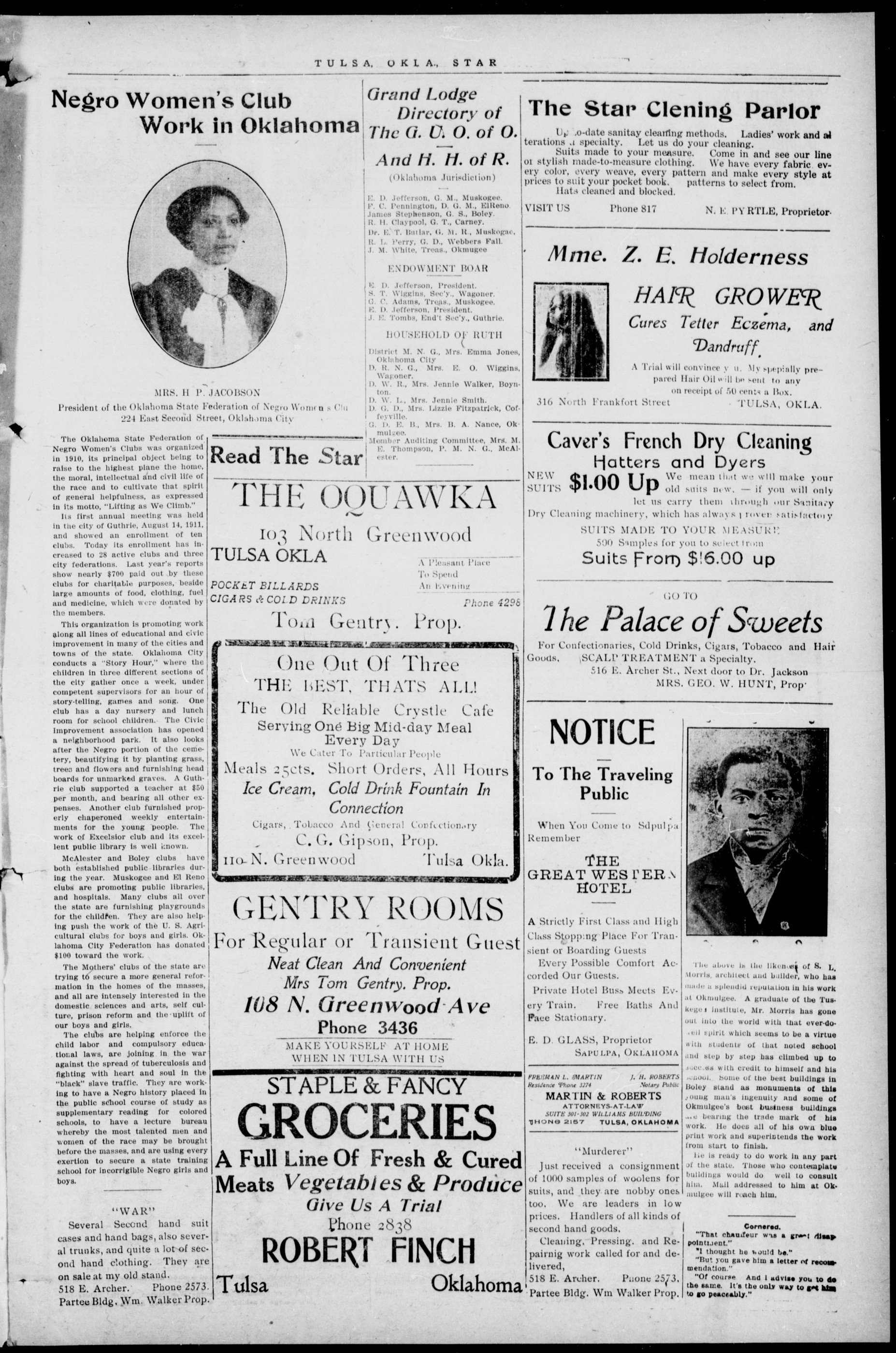
Negro Women's Club Work in Oklahoma
[Picture of a woman with a headband and a white dress with a bow. She is looking slightly to the right.]
President of the Oklahoma State Federation of Negro Women's Clubs 224 East Second Street, Oklahoma City
The Oklahoma State Federation of Negro Women's Clubs was organized in 1910, its principal object being to raise to the highest plane the home, the moral, intellectual and civil life of the race and to cultivate that spirit of general helpfulness, as expressed in its motto, "Lifting as We Climb."
Its first annual meeting was held in the city of Guthrie, August 14, 1911, and showed an enrollment of ten clubs. Today its enrollment has increased to 28 active clubs and three city federations. Last year's reports show nearly $700 paid out by these clubs for charitable purposes, beside large amounts of food, clothing, fuel and medicine, which were donated by the members.
This organization is promoting work along all lines of educational and civic improvement in many of the cities and towns of the state. Oklahoma City conducts a "Story Hour," where the children in three different sections of the city gather once a week, under competent supervisors for an hour of story-telling, games and song. One club has a day nursery and lunch room for school children. The Civic Improvement association has opened a neighborhood park. It also looks after the Negro portion of the cemetery, beautifying it by planting grass, trees and flowers and furnishing head boards for unmarked graves. A Guthrie club supported a teacher at $50 per month, and bearing all other expenses. Another club furnished properly chaperoned weekly entertainments for the young people. The work of Excelsior club and its excellent public library is well known.
McAlester and Boley clubs have both established public libraries during the year. Muskogee and El Reno clubs are promoting public libraries, and hospitals. Many clubs all over the state are furnishing playgrounds for the children. They are also helping push the work of the U. S. Agricultural clubs for boys and girls. Oklahoma City Federation has donated $100 toward the work. The Mothers' clubs of the state are trying to secure a more general reformation in the homes of the masses, and all are intensely interested in the domestic sciences and arts, self culture, prison reform and the uplift of our boys and girls.
The clubs are helping enforce the child labor and compulsory educational laws, are joining in the war against the spread of tuberculosis and fighting with heart and soul in the "black" slave traffic. They are working to have a Negro history placed in the public school course of study as supplementary reading for colored schools, to have a lecture bureau whereby the most talented men and women of the race may be brought before the masses, and are using every exertion to secure a state training school for incorrigible Negro girls and boys.
Several Second hand suit cases and hand bags, also several trunks, and quite a lot of second hand clothing. They are on sale at my old stand. 518 E. Archer. Phone 2573. Partee Bldg, Wm. Walker Prop.
"WAR"
ub Oklahoma Grand Lodge Directory of The G. U. O. of O. And H. H. of R.
HE OQUAWKA 03 North Greenwood
THE OQUAWKA
POCKET BILLARDS An Evening
CIGARS & COLD DRINKS
Tom Gentry. Prop.
One Out Of Three
HE BEST, THATS ALL!
Old Reliable Crystle Cafe
serving One Big Mid-day Meal
Every Day
We Cater To Particular People
25cts. Short Orders, All Hours
Cream, Cold Drink Fountain In
Connection
ars, Tobacco And General Confectionary
C. G. Gipson, Prop.
Greenwood Tulsa Okla.
ENTRY ROOMS
regular or Transient Guest
Neat Clean And Convenient
Mrs Tom Gentry. Prop.
8 N. Greenwood Ave
Phone 3436
One Out Of Three
THE BEST, THATS ALL!
The Old Reliable Crystle Cafe
Serving One Big Mid-day Meal
Every Day
We Cater To Particular People
Meals 25cts. Short Orders, All Hours
Ice Cream, Cold Drink Fountain In
Connection
Cigars, Tobacco And General Confectionery
C. G. Gipson, Prop.
110 N. Greenwood Tulsa Okla.
GENTRY ROOMS
For Regular or Transient Guest
Neat Clean And Convenient
Mrs Tom Gentry. Prop.
108 N. Greenwood Ave
Phone 3436
MAKE YOURSELF AT HOME
WHEN IN TULSA WITH US
STAPLE & FANCY
ROCERIES
All Line Of Fresh & Cured
Vegetables & Produce
Give Us A Trial
Phone 2838
ROBERT FINCH
---
Tulsa
TULSA. OKLA.. STAR
(Oklahoma Jurisdiction)
E. D. Jefferson, G. M., Muskogee.
F. C. Pennington, D. G. M., ElReno.
James Stephenson, G. S., Boley.
R. H. Claypool, G. T., Carney.
Dr. E. T. Butlar, G. M. R., Muskogae.
R. L. Perry, G. D., Webbers Fall.
J. M. White, Treas., Okmugee
ENDOWMENT BOAR
E. D. Jefferson, President.
S. T. Wiggins, Sec'y., Wagoner.
G. C. Adams, Treas., Muskogee.
E. D. Jefferson, President.
J. E. Tombs, End't Sec'y., Guthrie.
District M. N. G., Mrs. Emma Jones,
Oklahoma City
D. R. N. G., Mrs. E. O. Wiggins,
Wagoner.
D. W. R., Mrs. Jennie Walker, Boynton.
D. W. L., Mrs. Jennie Smith.
D. G. D., Mrs. Lizzie Fitzpatrick, Coffeyville.
G. D. E. B., Mrs. B. A. Nance, Okmulgee.
Member Auditing Committee, Mrs. M.
E. Thompson, P. M. N. G., McAlester.
A Pleasant Place
To Spend
An Evening
Phone 4298
Oklahoma
The Star Clening Parlor
U. to-date sanitay cleaning methods. Ladies' work and alterations a specialty. Let us do your cleaning. Suits made to your measure. Come in and see our line or stylish made-to-measure clothing. We have every fabric every color, every weave, every pattern and make every style at prices to suit your pocket book. patterns to select from. Hats cleaned and blocked
Mme. Z. E.
Z. E. Holderness HAIR GROWER Cures Tetter Eczema, and Dandruff.
Mme. Z. E. Holderness
A Trial will convince y u. My specially prepared Hair Oil will be sent to any on receipt of 50 cents a Box. Port Street TULSA, OKLA.
316 North Frankfort Street
Caver's French
Hatters and
NEW SUITS $1.00 Up We old
let us car
Dry Cleaning machinery, which
SUITS MADE TO
500 Samples for
Suits From
The Palace
For Confectionaries, Cold Drink
Goods. SCALP TREATME
516 E. Archer St.,
MRS
French Dry Cleaning
Filters and Dyers
Up We mean that we will make your
old suits new. — if you will only
let us carry them through our Sanitary
ery, which has always proven satisfactory
MADE TO YOUR MEASURE
Samples for you to select from
From $!6.00 up
GO TO
Palace of Sweets
s, Cold Drinks, Cigars, Tobacco and Hair
TREATMENT a Specialty.
Archer St., Next door to Dr. Jackson
MRS. GEO. W. HUNT, Prop.
Caver's French Dry Cleaning Hatters and Dyers
NEW $1.00 Up We mean that we will make your SUITS old suits new. - if you will only let us carry them through our Sanitary Dry Cleaning machinery, which has always proven satisfactory SUITS MADE TO YOUR MEASURE 500 Samples for you to select from Suits From $!6.00 up
The Palace of Sweets
For Confectionaries, Cold Drinks, Cigars, Tobacco and Hair Goods. SCALP TREATMENT a Specialty. 516 E. Archer St., Next door to Dr. Jackson MRS. GEO. W. HUNT. Prop.
NOTICE To The Traveling Public
When You Come to Sdpulpa Remember
THE
GREAT WESTERN
HOTEL
A Strictly First Class and High Class Stopping Place For Transient or Boarding Guests Every Possible Comfort Recorded Our Guests. Private Hotel Buss Meets Every Train. Free Baths And Face Stationary. E. D. GLASS, Proprietor SAPULPA, OKLAHOMA
FREEMAN L. SMARTIN J. H. ROBERTS
Residence Phone 3274 Notary Public
MARTIN & ROBERTS
ATTORNEYS-AT-LAW
SUITE 301-302 WILLIAMS BUILDING
THONE 2157 TULSA, OKLAHOMA
Just received a consignment of 1000 samples of woolens for suits, and they are nobby ones too. We are leaders in low prices. Handlers of all kinds of second hand goods.
Cleaning, Pressing, and Repairnig work called for and delivered,
518 E. Archer. Phone 2573.
Partee Bldg. Wm Walker Prop.
---
VISIT US Phone 817
A
"Murderer"
N. E. PYRTLE, Proprietor
[Name]
The above is the likeness of S. L. Morris, architect and builder, who has made a splendid reputation in his work at Okmulgee. A graduate of the Tuskegee institute, Mr. Morris has gone out into the world with that ever-doeil spirit which seems to be a virtue with students of that noted school and step by step has climbed up to success with credit to himself and his school. Some of the best buildings in Boley stand as monuments of this young man's ingenuity and some of Okmulgee's best business buildings are bearing the trade mark of his work. He does all of his own blue print work and superintends the work from start to finish.
He is ready to do work in any part of the state. Those who contemplate buildings would do well to consult him. Mail addressed to him at Okmulgee will reach him.
"That chaufeur was a great disap pointient."
"I thought he would be."
"But you gave him a letter of recommendation."
"Of course. And I advise you to do the same. It's the only way to get him to go peaceably."
Republic Proves a Mystery
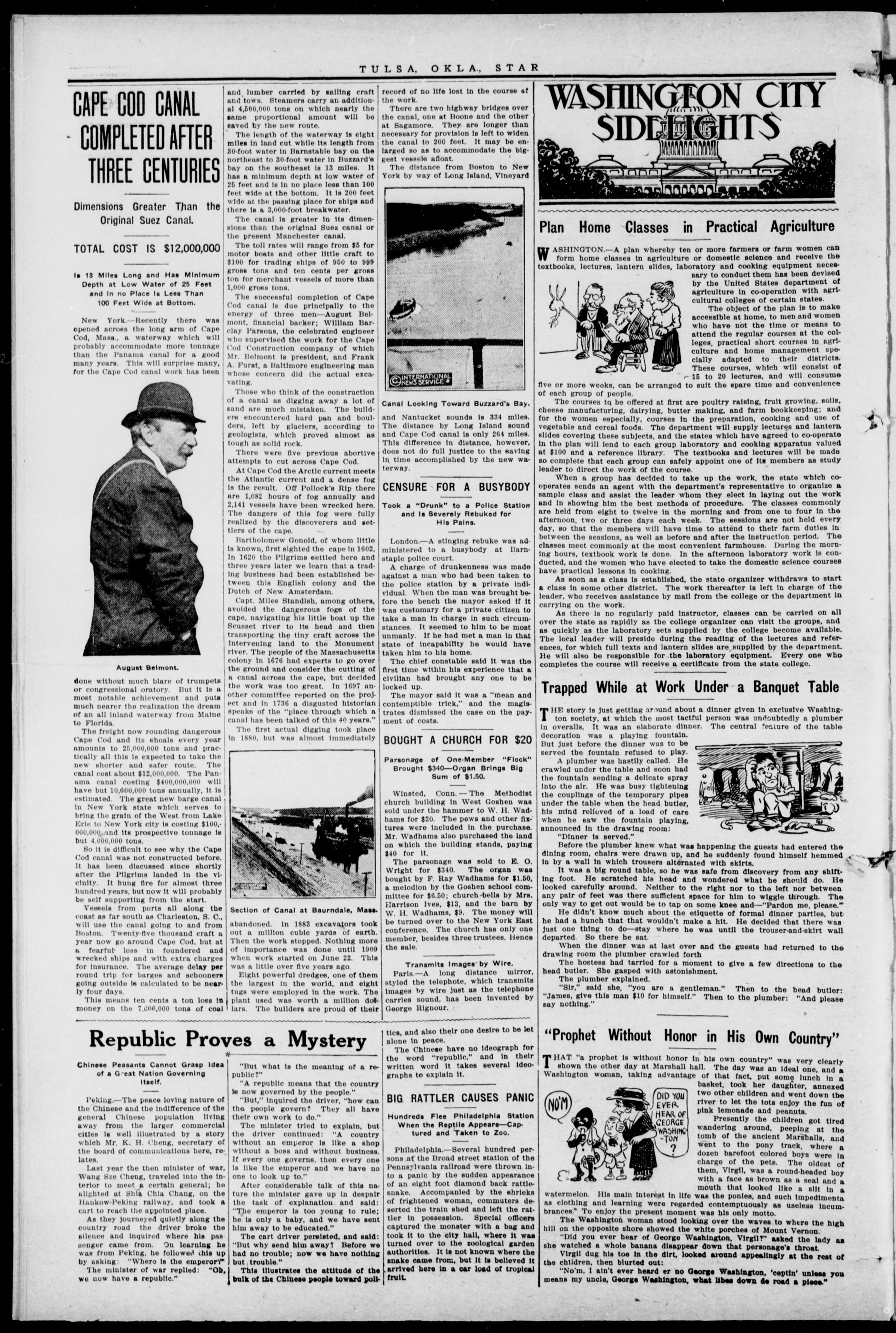
CAPE COD CANAL COMPLETED AFTER THREE CENTURIES
Dimensions Greater Than the Original Suez Canal.
TOTAL COST IS $12,000,000
Is 13 Miles Long and Has Minimum Depth at Low Water of 25 Feet and in no Place Is Less Than 100 Feet Wide at Bottom.
New York.—Recently there was opened across the long arm of Cape Cod, Mass., a waterway which will probably accommodate more tonnage than the Panama canal for a good many years. This will surprise many, for the Cape Cod canal work has been
1
August Belmont.
done without much blare of trumpets or congressional oratory. But it is a most notable achievement and puts much nearer the realization the dream of an all inland waterway from Maine to Florida.
The freight now rounding dangerous Cape Cod and its shoals every year amounts to 25,000,000 tons and practically all this is expected to take the new shorter and safer route. The canal cost about $12,000,000. The Panama canal costing $400,000,000 will have but 10,600,000 tons annually, it is estimated. The great new barge canal in New York state which serves to bring the grain of the West from Lake Erie to New York city is costing $100,000,000 and its prospective tonnage is but 4,000,000 tons.
So it is difficult to see why the Cape Cod canal was not constructed before. It has been discussed since shortly after the Pilgrims landed in the vicinity. It hung fire for almost three hundred years, but now it will probably be self supporting from the start.
Vesseels from ports all along the coast as far south as Charleston, S. C., will use the canal going to and from Boston. Twenty-five thousand craft a year now go around Cape Cod, but at a fearful loss in foundered and wrecked ships and with extra charges for insurance. The average delay per round trip for barges and schooners going outside is calculated to be nearly four days.
This means ten cents a ton loss in money on the 7,000,000 tons of coal
Chinese Peasants Cannot Grasp Idea of a Great Nation Governing Itself.
Peking.—The peace loving nature of the Chinese and the indifference of the general Chinese population living away from the larger commercial cities is well illustrated by a story which Mr. K. H. Cheng, secretary of the board of communications here, relates.
Last year the then minister of war, Wang Sze Cheng, traveled into the interior to meet a certain general; he alighted at Shifa Chia Chang, on the Hankow-Peking railway, and took a cart to reach the appointed place.
As they journeyed quietly along the country road the driver broke the silence and inquired where his passenger came from. On learning he was from Peking, he followed this up by asking: "Where is the emperor?" The minister of war replied: "Oh, we now have a republic."
and lumber carried by sailing craft and tows. Steamers carry an additional 4,560,000 tons on which nearly the same proportional amount will be saved by the new route.
The length of the waterway is eight miles in land cut while its length from 30-foot water in Barnstable bay on the northeast to 30-foot water in Buzzard's bay on the southeast is 13 miles. It has a minimum depth at low water of 25 feet and is in no place less than 100 feet wide at the bottom. It is 200 feet wide at the passing place for ships and there is a 3,000-foot breakwater.
The canal is greater in its dimensions than the original Suez canal or the present Manchester canal.
The toll rates will range from $5 for motor boats and other little craft to $100 for trading ships of 950 to 999 gross tons and ten cents per gross ton for merchant vessels of more than 1,000 gross tons.
The successful completion of Cape Cod canal is due principally to the energy of three men—August Belmont, financial backer; William Barclay Parsons, the celebrated engineer who supervised the work for the Cape Cod Construction company of which Mr. Belmont is president, and Frank A. Furst, a Baltimore engineering man whose concern did the actual excavating.
Those who think of the construction of a canal as digging away a lot of sand are much mistaken. The builders encountered hard pan and boulders, left by glaciers, according to geologists, which proved almost as tough as solid rock.
There were five previous abortive attempts to cut across Cape Cod.
At Cape Cod the Arctic current meets the Atlantic current and a dense fog is the result. Off Pollock's Rip there are 1,082 hours of fog annually and 2,141 vessels have been wrecked here. The dangers of this fog were fully realized by the discoverers and settlers of the cape.
Bartholomew Gonold, of whom little is known, first sighted the cape in 1602. In 1620 the Pilgrims settled here and three years later we learn that a trading business had been established between this English colony and the Dutch of New Amsterdam.
Capt. Miles Standish, among others, avoided the dangerous fogs of the cape, navigating his little boat up the Scusset river to its head and then transporting the tiny craft across the intervening land to the Monument river. The people of the Massachusetts colony in 1676 had experts to go over the ground and consider the cutting of a canal across the cape, but decided the work was too great. In 1697 another committee reported on the project and in 1736 a disgusted historian speaks of the "place through which a canal has been talked of this 40 years."
The first actual digging took place in 1880, but was almost immediately
Section of Canal at Baurndale, Mass.
abandoned. In 1883 excavators took out a million cubic yards of earth. Then the work stopped. Nothing more of importance was done until 1909 when work started on June 22. This was a little over five years ago. Eight powerful dredges, one of them the largest in the world, and eight tugs were employed in the work. The plant used was worth a million dollars. The builders are proud of their
"But what is the meaning of a republic?"
"A republic means that the country is now governed by the people."
"But," inquired the driver, "how can the people govern? They all have their own work to do."
The minister tried to explain, but the driver continued: "A country without an emperor is like a shop without a boss and without business. If every one governs, then every one is like the emperor and we have no one to look up to."
After considerable talk of this nature the minister gave up in despair the task of explanation and said: "The emperor is too young to rule; he is only a baby, and we have sent him away to be educated."
The cart driver persisted, and said: "But why send him away? Before we had no trouble; now we have nothing but trouble."
This illustrates the attitude of the bulk of the Chinese people toward poli-
record of no life lost in the course of the work.
There are two highway bridges over the canal, one at Boone and the other at Sagamore. They are longer than necessary for provision is left to widen the canal to 200 feet. It may be enlarged so as to accommodate the biggest vessels afloat.
The distance from Boston to New York by way of Long Island, Vineyard
INTERNATIONAL
NEWS SERVICE
Canal Looking Toward Buzzard's Bay. and Nantucket sounds is 334 miles. The distance by Long Island sound and Cape Cod canal is only 264 miles. This difference in distance, however, does not do full justice to the saving in time accomplished by the new waterway.
CENSURE FOR A BUSYBODY
Took a "Drunk" to a Police Station and Is Severely Rebuked for His Pains.
London.—A stinging rebuke was administered to a busybody at Barn-staple police court.
A charge of drunkenness was made against a man who had been taken to the police station by a private individual. When the man was brought before the bench the mayor asked if it was customary for a private citizen to take a man in charge in such circumstances. It seemed to him to be most unmanly. If he had met a man in that state of incapability he would have taken him to his home.
The chief constable said it was the first time within his experience that a civilian had brought any one to be locked up.
The mayor said it was a "mean and contemptible trick," and the magistrates dismissed the case on the payment of costs.
BOUGHT A CHURCH FOR $20
Parsonage of One-Member "Flock"
Brought $340—Organ Brings Big
Sum of $1.50.
Winsted, Conn. — The Methodist
church building in West Goshen was
sold under the hammer to W. H. Wadhams for $20. The pews and other fixtures were included in the purchase.
Mr. Wadhams also purchased the land on which the building stands, paying $40 for it.
The parsonage was sold to E. O. Wright for $340. The organ was bought by F. Ray Wadhams for $1.50, a melodion by the Goshen school committee for $6.50; church-bells by Mrs. Harrison Ives, $13, and the barn by W. H. Wadhams, $9. The money will be turned over to the New York East conference. The church has only one member, besides three trustees. Hence the sale.
Transmits Images by Wire. Paris.—A long distance mirror, styled the telephote, which transmits images by wire just as the telephone carries sound, has been invented by George Rignour.
tics, and also their one desire to be let alone in peace. The Chinese have no ideograph for the word "republic," and in their written word it takes several ideographs to explain it.
BIG RATTLER CAUSES PANIC
Hundreds Flee Philadelphia Station When the Reptile Appears—Captured and Taken to Zoo.
Philadelphia.—Several hundred persons at the Broad street station of the Pennsylvania railroad were thrown into a panic by the sudden appearance of an eight foot diamond back rattlesnake. Accompanied by the shrieks of frightened woman, commuters deserted the train shed and left the rattler in possession. Special officers captured the monster with a bag and took it to the city hall, where it was turned over to the zoological garden authorities. It is not known where the snake came from, but it is believed it arrived here in a car load of tropical fruit.
WASHINGTON CITY
SIDELIGHTS
Plan Home Classes in Practical Agriculture
WASHINGTON.—A plan whereby ten or more farmers or farm women can form home classes in agriculture or domestic science and receive the textbooks, lectures, lantern slides, laboratory and cooking equipment neces-
five or more weeks, can be arranged to suit the spare time and convenience of each group of people. The courses to be offered at first are poultry raising, fruit growing, soils, cheese manufacturing, dairying, butter making, and farm bookkeeping; and for the women especially, courses in the preparation, cooking and use of vegetable and cereal foods. The department will supply lectures and lantern slides covering these subjects, and the states which have agreed to co-operate in the plan will lend to each group laboratory and cooking apparatus valued at $100 and a reference library. The textbooks and lectures will be made so complete that each group can safely appoint one of its members as study leader to direct the work of the course.
When a group has decided to take up the work, the state which cooperates sends an agent with the department's representative to organize a sample class and assist the leader whom they elect in laying out the work and in showing him the best methods of procedure. The classes commonly are held from eight to twelve in the morning and from one to four in the afternoon, two or three days each week. The sessions are not held every day, so that the members will have time to attend to their farm duties in between the sessions, as well as before and after the instruction period. The classes meet commonly at the most convenient farmhouse. During the morning hours, textbook work is done. In the afternoon laboratory work is conducted, and the women who have elected to take the domestic science courses have practical lessons in cooking.
As soon as a class is established, the state organizer withdraws to start a class in some other district. The work thereafter is left in charge of the leader, who receives assistance by mail from the college or the department in carrying on the work.
As there is no regularly paid instructor, classes can be carried on all over the state as rapidly as the college organizer can visit the groups, and as quickly as the laboratory sets supplied by the college become available. The local leader will preside during the reading of the lectures and references, for which full texts and lantern slides are supplied by the department. He will also be responsible for the laboratory equipment. Every one who completes the course will receive a certificate from the state college.
Trapped While at Work Under a Banquet Table
Trapped While at Work Under a Banquet Table
THE story is just getting around about a dinner given in exclusive Washington society, at which the most tactful person was undoubtedly a plumber in overalls. It was an elaborate dinner. The central feature of the table
Before the plumber knew what was happening the guests had entered the dining room, chairs were drawn up, and he suddenly found himself hemmed in by a wall in which trousers alternated with skirts.
It was a big round table, so he was safe from discovery from any shifting foot. He scratched his head and wondered what he should do. He looked carefully around. Neither to the right nor to the left nor between any pair of feet was there sufficient space for him to wiggle through. The only way to get out would be to tap on some knee and—"Pardon me, please."
He didn't know much about the etiquette of formal dinner parties, but he had a hunch that that wouldn't make a hit. He decided that there was just one thing to do—stay where he was until the trouser-and-skirt wall departed. So there he sat.
When the dinner was at last over and the guests had returned to the drawing room the plumber crawled forth.
The hostess had tarried for a moment to give a few directions to the head butler. She gasped with astonishment.
The plumber explained.
"Sir," said she, "you are a gentleman." Then to the head butler: "James, give this man $10 for himself." Then to the plumber: "And please say nothing."
"Prophet Without Honor in His Own Country"
THAT "a prophet is without honor in his own country" was very clearly shown the other day at Marshall hall. The day was an ideal one, and a Washington woman, taking advantage of that fact, put some lunch in.
watermelon. His main interest in life was the ponies, and such impediments as clothing and learning were regarded contemptuously as useless incumbrances. To enjoy the present moment was his only motto.
The Washington woman stood looking over the waves to where the high hill on the opposite shore showed the white porches of Mount Vernon.
"Did you ever hear of George Washington, Virgil?" asked the lady as she watched a whole banana disappear down that personage's throat.
she watched a "whole banana disappear down that personage's throat.
Virgil dug his toe in the dirt, looked around appealingly at the rest of the children, then blurred out:
"No'm, I ain't ever heard er no George Washington, 'ceptin' unless you means my uncle, George Washington, what libes down de road a piece."
A teacher points to a rabbit drawing on a whiteboard while two students look on.
five or more weeks, can be arranged to of each group of people.
The courses tq be offered at first a cheese manufacturing, dairying, butter for the women especially, courses in vegetable and cereal foods. The depar slides covering these subjects, and the in the plan will lend to each group lab at $100 and a reference library. The so complete that each group can safel leader to direct the work of the course.
When a group has decided to tq operates sends an agent with the dep sample class and assist the leader who and in showing him the best methods are held from eight to twelve in the afternoon, two or three days each we day, so that the members will have t between the sessions, as well as before classes meet commonly at the most coding hours, textbook work is done. Inducted, and the women who have elect have practical lessons in cooking.
As soon as a class is established, a class in some other district. The w leader, who receives assistance by mail carrying on the work.
As there is no regularly paid ins over the state as rapidly as the collec as quickly as the laboratory sets sup The local leader will preside during ences, for which full texts and lantern He will also be responsible for the l completes the course will receive a ce
Trapped While at Work
THE story is just getting around abo ton society, at which the most tac in overalls. It was an elaborate din decoration was a playing fountain. But just before the dinner was to be served the fountain refused to play.
A plumber was hastily called. He crawled under the table and soon had the fountain sending a delicate spray into the air. He was busy tightening the couplings of the temporary pipes under the table when the head butler, his mind relieved of a load of care when he saw the fountain playing, announced in the drawing room:
"Dinner is served."
Before the plumber knew what was dining room, chairs were drawn up, and in by a wall in which trousers alternated. It was a big round table, so he wing foot. He scratched his head and looked carefully around. Neither to any pair of feet was there sufficient only way to get out would be to tap on. He didn't know much about the he had a hunch that that wouldn't m just one thing to do—stay where he departed. So there he sat.
When the dinner was at last over drawing room the plumber crawled for The hostess had tarried for a m head butler. She gasped with astonishment The plumber explained.
"Sir," said she, "you are a g "James, give this man $10 for himself say nothing."
"Prophet Without Honor
THAT "a prophet is without honor shown the other day at Marshall Washington woman, taking advantage
NO'M
DID YOU EVER HEAR OF GEORGE WASHING-TON?
watermelon. His main interest in life as clothing and learning were regular brances. To enjoy the present moment The Washington woman stood low hill on the opposite shore showed the "Did you ever hear of George W she watched a whole banana disappe Virgil dug his toe in the dirt, lo the children, then blurred out: "No'm. I ain't ever heard er no means my uncle, George Washington,
sary to conduct them has been devised by the United States department of agriculture in co-operation with agricultural colleges of certain states. The object of the plan is to make accessible at home, to men and women who have not the time or means to attend the regular courses at the colleges, practical short courses in agriculture and home management specially adapted to their districts. These courses, which will consist of 15 to 20 lectures, and will consume
to suit the spare time and convenience
share poultry raising, fruit growing, soils,
for making, and farm bookkeeping; and
the preparation, cooking and use of
department will supply lectures and lantern
states which have agreed to co-operate
laboratory and cooking apparatus valued
the textbooks and lectures will be made
any appoint one of its members as study
teacher.
take up the work, the state which
department's representative to organize a
nom they elect in laying out the work
of procedure. The classes commonly
morning and from one to four in the
week. The sessions are not held every
time to attend to their farm duties in
and after the instruction period.
the convenient farmhouse. During the morn-
the afternoon laboratory work is con-
ced to take the domestic science courses
the state organizer withdraws to start
work thereafter is left in charge of the
fall from the college or the department in
instructor, classes can be carried on all
age organizer can visit the groups, and
applied by the college become available.
The reading of the lectures and refer-
slides are supplied by the department.
laboratory equipment. Every one who
certificate from the state college.
Under a Banquet Table
Out a dinner given in exclusive Washing-
tiful person was undoubtedly a plumber
inner. The central feature of the table
A man is scared.
was happening the guests had entered the land and he suddenly found himself hemmedinated with skirts.
was safe from discovery from any shift- and wondered what he should do. He the right nor to the left nor between the space for him to wiggle through. The on some knee and—"Pardon me, please." etiquette of formal dinner parties, but make a hit. He decided that there was one was until the trouser-and-skirt wall
over and the guests had returned to the north moment to give a few directions to theishment.
gentleman." Then to the head butler: "f." Then to the plumber: "And please
for in His Own Country"
in his own country" was very clearly hall. The day was an ideal one, and a age of that fact, put some lunch in a
basket, took her daughter, annexed two other children and went down the river to let the tots enjoy the fun of pink lemonade and peanuts. Presently the children got tired wandering around, peeping at the tomb of the ancient Marshalls, and went to the pony track, where a dozen barefoot colored boys were in charge of the pets. The oldest of them, Virgil, was a round-headed boy with a face as brown as a seal and a mouth that looked like a slit in a
he was the ponies, and such impedimenta-
rd contemptuously as useless incum-
ment was his only motto.
Looking over the waves to where the high
e white porches of Mount Vernon.
Washington, Virgil?" asked the lady as
sear down that personage's throat.
looked around appealingly at the rest of
George Washington. 'ceptin' unless you
what libes down de road a piece."
THE HISTORY OF THE HOME
The above residence is that of H. T. Wilson, a prosperous citizen of Tulsa, who is now engaged in the hotel and restaurant business. Mr. Wilson was born in southern Missouri in 1854. His parents moved to Mississippi when he was six years old. At the time of emancipation he was in Wharton county, Texas, where he worked on the farm and studied his books by lamp light till 18 years old, when he went to Caldwell county and worked as janitor and coachman for seven years. He then married Miss Sylvia Callahan, his present wife. Seven children have been born to them, two boys and five girls. Mr. Wilson lived in Austin, Texas, with his family 27 years, during which time he bought and paid for three homes which he still owns. He came to Tulsa on the 8th day of August, 1906, with no money. Since he came to Oklahoma he has bought four lots in Tulsa, on one of which stands the home shown above, five lots in Winona, and two lots in Cushing. He rents his home out here and he and his wife are conducting a very successful hotel and restaurant business at 120 East Archer. Both he and his wife are race loving people, and always willing to improve the town in which they live. These people are well known and respected by all who know them. Total worth of property $5,000.00.
THE HOME OF THE MOTHER OF THE FAMILY
The above home is that of Mr. Benj. Lofton, one of the pioneer citizens of Tulsa, having moved here twenty years ago, when Tulsa was little more than a flag station. He was born near Jackson, Miss., in 1851, and spent his earliest life as a slave boy working on the farm. He lived with his parents till he was 18 years old when he married his first wife who died in Mississippi 21 years ago. Three boys and three girls were born to him by his first wife. Twenty years ago Mr. Lofton landed in Tulsa without a penny. Fifty cents was given him with which to have his trunk hauled to his room, but instead of paying it to a baggage men he put the trunk with its heavy luggage on his shoulders and carried it three blocks to his room, thus making his first money in Tulsa, and this was absolutely all he had at that time. He secured work as janitor at a Drug store, and while doing this work looked for other jobs. He succeeded in getting two or three offices to clean every morning and at the same time done chores around homes. In this way he soon accumulated a little money which he invested in a 50 ft. lot on the corner of Cheyenne and Archer, which was at that time nothing more than an open field with a big hog ranch within a few paces of his lot which he bought at a cost of $375.00. He has bought and paid for this lot and erected this house on it out of the money he made at janitor work. His home now is within two blocks of Main street, or the Brady Hotel and he has recently refused $6,000.00 for the property. A few months ago he purchased a very beautiful home on the corner of Elgin and Davenport, a two-story house on a lot 100x140 ft. at a cost of $2,300.00, half of which was paid in cash and his notes given for the balance. He married his second wife, Miss Emma Hooper, in this city ten years ago, and they have lived very happily together. Mr. Lofton has done remarkably well in life in view of the fact that he has never gone to school a day in his life, and don't know one letter from another. Though born a slave and denied the benefits of education, he has made good, and now his life may be held up as an example of many of the younger generation who have both freedom and education. Mr. Lofton is highly respected by his neighbors who are mostly white people, and everyone has implicit confidence in his word.
One of the most successful citizens of Tulsa is James Cherry who lives with his family just outside the city limits on North Greenwood. Mr. Cherry was born in Jefferson county, Texas, August 16, 1864. His father owns a Texas farm on which he worked till he was 12 years old. His mother became a widow at an early age, and he was compelled to work to support his mother, so that he was denied the advantages of school. At the age of 12 his mother hired him out at a salary of $8 per month. He worked one year and made a treaty with his mother whereby he was to work anywhere he wanted to, provided he gave $8 per month. Obtaining his mother's consent, he went to work as water boy on a railroad, and each month sent his mother $8 as he had agreed. He followed railroad work continually for 12 years, during which time he worked his way up to section foreman. He then engaged in contract work, which e followed two years. His next work was hotel employee, which he followed until he married Miss Lizzie Jasper of Sulphur Springs, Texas, in 1880. He then bought a farm of 107 acres, and went back to the farm. On this farm he employed 15 people, and worked five teams. He built a nice home and lived at ease on his farm amout 15 years, after which he moved to Atoka Indian Territory, where he lived 18 months, while his family was yet in
In August, 1906, he came to Tulsa with $300, and invested $200 in a home on the corner of Frankfort and Cameron, and returned to Atoka for his family.
After moving his family to Tulsa, he had very little money, but he went to work mowing lawns and other odd jobs, and in one year's time made enough money to pay off a $900 note on his home, and clear above all other expenses $900. He then engaged in the plumbing business, and afterward opened a billiard parlor in partnership with his brother, William Cherry. In eight years time he has built ten houses on as many different lots, two two-story brick buildings, on Greenwood—one a store room and lodge room, and the other a small brick used for a barber shop down stairs and offices upstairs. Mr. Cherry has sold his billiard hall and is now engaged in plumbing and the grocery business. He has two boys, Jasper, aged 21, and Emanuel, age 17, who keep up the plumbing work, while he and his wife and daughter look after the store. He is easily worth $20,000
F. R. Williams, the subject of this sketch, was born in Talladega, Ala., November 11, 1867. While yet a small boy, his parents moved to Victoria, Texas, where he lived all of his life until ten years ago. He attended public school at Victoria until he was
16 years old, and went to work on a stock ranch for T. D. Woods, for whom he worked continuously for five years, at St. Mary's Texas. In the meantime, at the age of 16 he married his first wife, Miss Bettie Piper, to whom ten children were born, five girls and five boys, all of whom are still living. After leaving the ranch, he went back to Victoria and engaged in the commission hide business, at which he proved a success. Later he worked for a wholesale grocery company three years. He then entered politics and served four years as republican state committeeman, after which he left and went to Los Angeles, Cal., to open business. He did not like the prospects there, however, and continued his journey to St. Louis, where the world's fain was then in progress. He stayed there three weeks and then went to Muskogee and opened a shooting gallery. After three months he sold this
1949
THE HOUSE
THE HOUSE
F. R WILLIAMS AP ARTMENT HOUSE.
THE WELCOME HOME
Tahiti
THE HOME OF THE HERITAGE CLUB
The above is the home of Deputy Sheriff Barney S. Cleaver, 508 North Greenwood. Mr. Cleaver was born at Newbern, Va.. January 2, 1865, where he lived until he was 14 years old, at-
sa
me
m-
nis
sa,
ent
dd
de
ote
ner
in
ard
hip
In
ten
wo
en-
idge
ick
irs
nas
```markdown
```
THE HOME OF THE HERITAGE CLUB
The above is the residence of Mr. and Mrs. N. E. Pyrtle on North Frankfort, recently built at a cost of about $200. Mr. Pyrtle was born in Red River county, Texas, March 17, 1886. While he was yet a boy, his parents moved to the Indian Territory, locating at Ardmore, where they lived until 1900, when they moved to Guthrie, Okla., and later to Langston, where his parents now live.
Mr. Pyrtle attended school at the C. A. & N. university at Langston. Several years ago he left home to make his way in life alone. After traveling
```markdown
```
---
out and went into the pool hall business. In 1895 he sold out and went into the grocery business, which he conducted 24 months and moved to Vinita, where he conducted a grocery store 18 months. In 1908 he came to Tulsa and opened a grocery store on Archer street in the Partee building. He is now conducting the same business in his own building, owns two apartment houses, besides other valuable real estate. Besides his property in Tulsa, he owns a fine home in Texas, and several lots and a 20-acre farm. He was married the second time to Miss Myrtle Clemons, while he lived in Vinita. In 1911, he was appointed city patrolman of Tulsa, which position he held until July, 1914. Mr. Williams started business in Tulsa on a $100.00 stock, which has increased to $1,800.
He is worth approximately $35,000,
with an outstanding indebtedness of
about $500.
to ap in di la Sh in lo V be al o b t p h M C a t o
THE CHURCH OF THE NATIONAL SCHOOL
tending public school. At the age of 15, he went to Charleston, W. Va., and secured employment on a steamer running from Charleston to Cincinnati. For several years, he followed
THE HOME OF THE HUNTERS
over a considerable part of Kansas and western Oklahoma, he came to Tulsa in 1906, and went to work in a local hotel. He followed this kind of work for two years, and having a desire to go into business for himself formed a partnership and opened the first colored tailor shop in Tulsa. After a successful business of four years he bought his partner out and has since conducted the business himself with hired help. He was married in this city in 1907 to Miss Paralee Martin of Minden, La., and they have lived together since that time very
---
this kind of work and gained a wide experience of the world in this way. He finally gave up this work to enter the coal mines, which work he followed for a number of years. He has been everything in the coal mines from a trapper boy to manager. He has even superintended the sinking of many mines. He was at one time employed by the Oklahoma & Gulf Coal Co., as immigrant agent, and in this-capacity brought more than four thousand people from West Virginia to Oklahoma. He is the man who opened the Grayson Coal & Mineral company, of which company he was for awhile general manager. Several years ago, while at Coalgate, he was appointed special deputy U. S. marshal under Captain Grady. He had already been in the secret service for a number of years and had the reputation of being a very shrewd officer, absolutely fearless in the performance of his duty. Seven years ago, he came to Tulsa and shortly thereafter was appointed city patrolman and served in this capacity four years under four different administrations. He was later appointed deputy sheriff under Sheriff McCullough, and is still holding that office under Sheriff McCullough. In June 1910, he married Miss Vernon Wren, of Florence, Ala., and bought the lot on which he built the above home. Mr. Cleaver also owns one-half interest in the Cleaver-Cherry building, a two-story brick, just across the street from his home. The above picture shows Mr. and Mrs. Cleaver his niece, Mrs. Amie Morrison, and Mrs. Cleaver's little niece, Vernor Cole. The insurance on his home and the Cleaver-Cherry building shows the property to be worth about $26,000.
MRS. E. A. JOHNSON
Bristow, Okla.
The above cut shows the picture of Mrs. Johnson, standing in front of her hotel at Bristow.
This thrifty woman was born in Lake Providence, La., December 17, 1864. At the age of twelve months her parents moved to Marlin, Texas, where she lived thirty years. Thirty-four years ago she was married to Synney Johnson, a Texas man who was at that time a truck gardener. Nine children were born to them, six boys and three girls. Of this number five died and the others are living, and they have always lived with or near their mother.
Twenty-one years ago her husband died, leaving her a widow with the care of her little children devolving upon her. She was then a comparatively young woman and could easily have married again, but she preferred to make her own way through life, believing that the best man in the world died when her husband breathed his last. Since that time she has made a remarkable success in life. She has educated her children and accumulated considerable property.
She came to Tulsa in 1906, and opened a rooming house. She was assisted by two sons and her daughter. Out of her earnings she has purchased one block in Lincoln Heights addition to Bristow, and two business lots on Main street, just two blocks from the Frisco depot, on which she will build a two-story brick building this fall. She is rated at about $10,000.
```markdown
```
happily. The Prytle home is probably the most attractive home in that community. It is modern in every respect. Yet a young man, he has made a splendid start in life and his future prospects are very bright. Besides his tailoring business he is proprietor of Tulsa's only Colored Messenger Service(The Star Messenger Service.) He has recently purchased a motorcycle to facilitate the latter business in which he is also making good. The value of his establishment is placed at $1,000.00, but it is doubtful if that sum would buy it.
---
SOLDIERS OF THE SERVIAN ARMY
```markdown
```
TRACES WAR TO A CLASH OF TONGUES
Professor Dorsey of Chicago Field Museum Finds Austria's Attitude a Sequel to Pan-German Versus Pan-Slav-Contest, He Says, Not Economic but Psychologic.
Nations Are Now, as Ever in the Past, Divided by Language Source of Trouble Is That Political Boundaries Are Not Coterminous With Linguistic Groups.
(George A. Dorsey, Curator of Ethnology, Field Museum, in the Chicago Herald.) An orphan mongrel cur having for the first time in 500 years got enough spunk up to take his tail from between his legs, begins to wag it and feel growing pans. Along comes a great big dog and says:
"Put that tail down—and glimme that bone."
We see this sort of thing nearly every day.
Once upon a time little old Servia was an empire and very nearly overcame the Byzantine empire, which probably would have changed the whole of European history. There might have been no Turkey in Europe.
That was in the fourteenth century,
That was in the fourteenth century, under the mighty Dushan.
Explaine Austria's Action.
Servia is now a poor, wretched little peasant kingdom—not half as big as Illinois in size, with less people than the city of New York.
And now the house of Hapsburg would wipe little Servia off the map! Even though the process involve more lives and money than any war of any time!
That is the life. You or I in the house of Hapsburg's shoes would do the same thing. It is the law of existence. Nature works today as in the stone age or when saber-toothed tiger fought with mastodon.
Why does Austria-Hungary, the Dual Monarchy, want poor peasant Servia? Hasn't the Dual Monarchy, with its internal babel of confusion, enough trouble already?
Why Others Are Interested.
Suppose the Dual Monarchy does want Servia, what is it to Russia?
Suppose Russia does object, what is it to Germany? Suppose Germany object's to Russia's objecting, what business is it of France—or of England?
Supremacy.
Balance of power.
Human nature.
Life.
I propose to analyze this whole situation. And right here let us clearly recognize the fact—two facts:
The contest is not economic but psychological in its fundamental nature; psychological laws are not economic laws.
To put it another way, the desires which lead to action in eastern Europe are not based on Christian ethics or rational procedure, but on certain thoughts.
Things are what we think they are; and thinking depends on the point of view.
Illustrating the Point.
Pan-Germanism vs. Pan-Slavism. If we understand this, we have traveled far. First, let me give an illuminating illustration:
In Prague, an important city of Austria, I was warned that I would get along much better in shops and otherwise if I employed English first. Of course English is not generally understood in that city, but German is. We naturally think of German as the language of Austria, and proud as the ancient capital of Bohemia was once, to all intents and purposes a German city, she now tries to forget, and won't talk German if she can possibly help it.
Pan means united, all; the term pan-Germanism stands for a movement which seeks the common welfare of the Germanic peoples of Europe at the expense of pan-Slavism or common weal of Slavs.
Becomes Question of Tongues.
Before we can understand the significance of these two movements we must consider the question of the "Nationals," or the "Races," as it is sometimes called.
In fact, this is not a question either of nations or of races, but of tongues. The classification of mankind by tongues is ancient and fundamental.
Before flags and religions men knew friend from foe by the language test. More than half of all the wars of Europe have been fought by parties mutually unintelligible. Broadly speaking, all European languages belong to the Aryan group. The most important exception is the Magyar, a dialect of the same language spoken by Turks and Finns.
How Divided by Language.
Of the Aryan tongues there are three great general divisions in Europe—Romance, Teutonic, Slavic. We are interested only in the latter two. And of the Teutonic German is spoken by 80,000,000, of which 10,000,000 are in Austria and 2,000,000 in Hungary.
There are 140,000,000 Slavs in Europe.
From this it appears that the present political boundaries are not coterminous with linguistic groups.
Right here in this fact we have the seeds of present and future trouble and a clue to the causes of most of the wars in eastern Europe through 2,000 years.
Slav Situation in Europe.
To get before us the full significance of the fact suggested by the map let us consider the linguistic complexion of these countries.
Russia is a veritable hodgepodge of tongues, but of her Slav population alone we have at least two distinct elements today bitterly opposed to each other with the possibility, if not the probability, of a third, which will seek recognition.
As against Russians proper there are over 10,000,000 Poles, and of the remaining Slavs there are 8,000,000 Ruthenians, or Little or White Russians, as they are sometimes called. Of the general Polish situation I shall speak later.
In Germany there are over 3,000,000 Slavs, chiefly Polish.
Of Austria's 30,000,000 population only about a third is German, the remainder being Slav, of which there are over 6,000,000 Czechs or Bohemians, 5,000,000 Poles, 3,500,000 Ruthenians, and a million and a quarter Slovenes.
Many Tongues in Hungary.
Hungary is even more diversified in tongue. The Magyar element (10,000,000) is equaled by the non-Magyar made up roughly of 2,000,000 Germans, 2,000,000 Slovaks, one-half a Million Ruthenes, 3,000,000 Serbo-Croates, all of the Slavonic tongue, and about 3,000,000 Rounanians who do not speak Slav at all, but a Romance language.
We need not here consider the linguistic affinities of the Balkan states. It is enough to say that Servia is purely Servian and Slav, Bulgaria is Bulgar and Slav (though the basis of blood of Bulgars is, like that of the Magyar, Aslatic).
The population of Montenegro, about half a million, are Slavs of the Servian branch. Roumanians are of mixed origin, but the Roumanian tongue is spoken by 12,000,000 people, of which five and a half million are in Roumania (92 per cent of its total population), the remaining millions are found in the Dual Monarchy, Servia, Bulgaria and Russia.
People Develop Languages.
Millions of people today speak Polish whose ancestors a few generations ago weren't conscious of the fact that they spoke any language at all. Today there is a Slavonic literature; 50 years ago no one even thought of such a thing. The millions of Bohemians had become almost entirely Germans, and never before have they been so thoroughly Slavonic as today. Bohemian hostility to Germany has been called a passion. It was not so very long ago that the language of the Hungarian parliament was Latin; Magyar was held fit only for peasant talk. Today the bitterness between
TULSA. OKLA.. STAR
ARMY
Magyar and Slav is as strong as between German and Pole. A few years ago there was no consciousness in Galicia of linguistic distinction between Poles and Ruthenians; Ruthenian peasants were content to remain serfs of Polish nobility. There was no Ruthenian literature; Ruthenian was not a polite language. Today there are distinguished scholars who seek to found a Ruthenian university.
Rouses National Spirit.
And this brings us to a strange and interesting phenomenon that has swept across Europe, now even around the world, in the last half century; the rise of a linguistic consciousness, which in so many instances has sought expression in statehood. Primitive man knew his enemy as one of strange tongue, and language was the basis of social organization. That was the condition in Europe till Greece, and later Rome, began the game of conquest. The holy Roman empire gathered these diverse savage hordes under a single government, but never into a homogeneous state.
The modern empires of Germany, Russia, Austria have continued the old game. And the tendency to centralize and build up even larger empires grows apace on the one hand, with the other tendency equally strong for the diverse elements of these modern states to resolve themselves into ancient tribal elements, based on linguistic lines.
Trouble in Barring Language.
And the whole trouble is due to the fact that European statesmen were not far-sighted enough to know that often the easiest way to get something is by pretending you don't want it.
The Polish tongue was never so dear to the Poles of the kingdom as when Russia forbade its use in public places and for public purposes.
The sympathies of the Roumanians of Hungary are not so much with the flag of their country, or their loyalty so much for the emperor of the Dual Monarchy as for the flag and the king of Roumania.
The case of Poland is probably familiar to all. It is enough here to recall that by a process of dismemberment, which took place about 100 years ago, the ancient and honorable kingdom of Poland, which had had a long and illustrious career, ceased to exist.
Lion's Share to Russia.
The greater part of the kingdom fell to the lot of Russia, with the ancient Polish city of Warsaw as its center.
A smaller portion fell into the hands of Austria, and today forms the province of Galicia, with its two important cities, Lemburg and Cracow.
A still smaller portion, with Posen as its center, passed into German hands.
Russian Poland was permitted to have a constitution of its own from 1815 to 1813, and its own government till 1864, at which time it quite lost its administrative independence. Four years later its government was absolutely incorporated with that of Russia, and the Polish language was denied a legal existence.
Coercion Causes Discontent.
Possibly Russia governs Poland better than the Poles could have governed it themselves. It is conceivable that in the substitution of the Russian for the Polish language (and the two are closely allied) the Poles would have little, if anything to lose.
It is quite within the bounds of imagination to believe that Poland as a part of Russia could participate in a much larger world than could have been possible to her had she remained Poland.
But it is contrary to human nature to be coerced; it is contrary to human nature to be compelled to give up that to which we have become habituated.
The Poles of Russia naturally have been discontented. They have not been satisfied with their representation in the Russian duma; they are dissatisfied with Russia's treatment of the Jewish question in the kingdom. Russia's efforts at repression not only double but redouble Polish effort to gain recognition, to win freedom. There are millions of Poles who dream of and hope for a reunited, free, and independent kingdom of Poland.
GRAND OPERA SOLOISTS WITH THAVIU'S BAND AT STATE FAIR
Soloists of international fame will accompany Thaviu's Great Russian Band to the eight annual Oklahoma State Fair and Exposition, Oklahoma City, Sept. 22 to Oct. 3, 1914. They are singers in the prime of their fame and ability, among them being Ernesto Geaccone, a celebrated tenor soloist, who was one of the leading singers with the San Carlos Opera Company, appearing at one time with Nordica and Constantino. He has since been singing at the Boston Grand Opera House, under the direction of Henry Russell. His voice is one of rare beauty and power, and he is an excellent actor.
Signora Emilia Leovalli would need no introduction in the big music centers. She is possessed of a pleasing lyric soprano voice and great delicacy and fire of dramatic interpretation. She was one of the leading sopranos with the Lambardi Opera Company on the Pacific Coast in 1912. For popular, up-to-date ragtime and ballads, Thaviu has with him one of the best popular Cabaret Trios in the country. There is also a tango team that will amuse and entertain the people at Oklahoma's big State Fair and Exposition this fall.
As a program maker, Thaviu is without a peer or a rival. He seems instinctively to know what the people want and he can vary his programs to suit any gathering, from the frivolous crowds at summer parks who seek nothing but the gayer and lighter mel-
VACATION PLANS
By CECELIA HAMBURG.
The members of the Commuters' Crochet club were seated in their facing seats on the 7:55 and the lure of the luncheon dolly was strong upon them. Mabel had started out with the intention of making only one which should serve as an isolated table-mat for a distant cousin, but so great was the fascination of the work that she had kept on, and was now putting the picot edge on the fifth. Sadie alone was not engrossed in work, but sat very still in her corner by the window, absorbed in a bright colored circular. Other circulars like it were strewn over her lap and peeped from her handbag.
"What's that you're reading?" asked Mary, looking up from her work.
"It's a pamphlet on Bermuda," said Sadie.
"Are they all about Bermuda?" asked Anne.
"Oh, no," said Sadie. "There's one on Newfoundland and one on Nova Scotia and one on the Thousand Islands and one on the Adirondacks and another on a trip through the Canadian Rockies and a tour through Yellowstone Park and—"
"My, what a lot of places to choose from," said Mabel. "I think it takes a great deal of energy to get a trip like one of those all planned out and know just when your trains leave or your boat starts and get all your connections worked out and know what clothes you are going to take."
Sadies began to trace with a hot little finger an intricate route on an orange map. It evidently led over hill and dale and included a gilpme at most of the wonders of the earth.
"Leaving New York at 4:33 on Friday, I would reach Hillsburg at 7:43 on Saturday morning; making a quick connection, I would get to Plainsville Junction at 1:18, and from there—"
"Mercy, how complicated," said Mabel.
Rare Book Changes Owners.
A copy of a very rare book the "Speculum Christiani," printed by William de Machlinia in 1483, was sold at Messrs. Hodgson's rooms in Chancery lane for $690, a few days ago. Machlinia and Lettou, his partner, were the first printers in London, and the former had his press in Holborn.
Means of Approach.
Though I am not a smoker, I like to carry matches in my pocket. One is always liable to to be accosted on the street by some one in need of a light. To be able to give a match is a great luxury. It forms the basis for a momentary friendship.—S. M. Crothers, in the Atlantic.
Really Is No Waste Matter.
Scientists and business men are both beginning to understand that in reality there is no such thing as waste matter. The existence of what we call waste or refuse is due merely to our failure to find a proper method of turning it into dollars and cents.
odies, to the more sedate and serious gatherings at chautauquas and fairs who demand music of a higher grade and style. In fact Thaviu will furnish music for all classes at the State Fair.
THE DANCE OF THE WEEK
EMILIA LEOVALLI
Lyric Soprano with Thaviu's Band at the Oklahoma State Fair and Exposition, Sept. 22 to Oct. 3, 1914.
Versatility is really one of the great features of this organization of forty musicians.
"Yes, that would be," assented Sadie. "I think perhaps I would preer the sea trip to Bermuda. They say that you can have a wonderful time there if you go to one of the houses in the country where they take visitors and then hire a bicycle and see the island for yourself.
"However, I've always wanted to see Nova Scotia, and that gives you a fine voyage, too. If I do go by sea, would you take just a suit case, or would you take a steamer trunk along? I think one dark suit and a big coat and two dark waists and one dressy waist and—"
"How long is your vacation?" asked Mabel, in her practical way.
"Two weeks," said Sadie.
"How much money are you going to spend on your trip?"
"Not more than twenty-five dollars, anyway," said Sadie.
"Well, I don't believe you can go to Bermuda or Nova Scotia or Newfoundland or—"
"Of course, I can't," said Sadie. "I am only planning my vacation. I always plan it every year, and then I go spend two weeks with my grandmother who lives on a farm in Millis, Mass. But at least I have the fun of making believe I'm going somewhere else."
With this vacation confession, the train stopped, and the girls rolled up their work and left the train. Sadie marched on ahead and, as the ferryboat swung out of its dock, she looked longingly down the harbor and pretended she had decided on Nova Scotia.
Freak of Minnesota Storm.
After a Minnesota storm a man appeared on the highway attired in a chicken coop. The coop had been blown over his head in such a way that his arms were pinned to his sides and he was unable to remove his "bonnet."
College Heads Variously Named.
Heads of colleges in British universities are variously known as wardens, masters, principals, rectors, provosts, presidents, deans and censors.
Something Wrong.
Fro mthe office window of the Evening Holler, in the gay and brilliant metropolis, the staff funny man scowled with vexation. "Oh, dear, what can the matter be?" he sighed. "I had my grist set up in 17 different styles and sizes of type today, and still it isn't humorous."
Old Silver Coins Found.
Old silver coins belonging to the reigns of Elizabeth, James I. and Charles I. have been found buried in the garden of Manor Farm, Itchen Abbas, Hampshire. It is thought that they were placed there by a Royalist who fought for Charles I. at Cheriton (1644) and was killed in the rout.
Pray and You Will Receive.
As the family was about to leave the dinner table little Elsie was observed with her head bowed and her hands slasped. "Why, Elsie," said her mother, "don't you know that dinner is over?" "Don't interrupt me, please," replied Elsie. "I'm praying for another dish of that puddin'."—Chicago News.
THE HOME OF THE MAYOR
H J Caver was born December 6, 1886, at Mosely Bluff, La. His father was W. C Caver, a prosperous farmer, who owned 260 acres of good farm land. He lived with his parents 17 years, and moved to Pine Bluff, Ark., after selling out the home farm. He attended public school at Mosely Bluff, La., and after moving to Pine Bluff, entered Branch Normal college, a branch of the Tuskegee Institute. After four years in this institution he and his brother entered a partnership business, barbering and clothes cleaning. The cleaning and dyeing business became so great that they dropped the barbering business and devoted their time to the cleaning and pressing business, which soon became the largest concern of its kind in the state. When they first started in business, he and his brother, L. F Caver, were the only employees, and they did business in a one-room building. Today the plant is worth $25,000, and employs 12 laborers.
Mr. Caver married Miss Netie R. Richardson of Mississippi, who was a former student of the Branch Normal College, in October, 1909. In February, 1913, he came to Tulsa and opened the French Dry Cleaning establishment on North Cincinnati. The first day he opened business his receipts amounted to $5.00. Since then his receipts for a day's business have been as high as $50.00. In May of last year he bought a horse and wagon to take care of his ever increasing business. Since coming to Tulsa, Mr. Caver has bought a residence lot at a cost of $500.00 and erected a home thereon, for which he has been offered and refused $2,000.00.
Besides his property here, which he has bought and paid for out of his business, Mr. Caver owns an interest in the Caver Cleaning establishment at Pine Bluff, and two houses which bring him in monthly rentals. Mr. Caver is rated to be worth about $10,000.
He is yet a young man and is doing much to build up the town. His sister, Miss Viola B. Carver, is now employed as bookkeeper for his business here, and he employs four other helpers.
His brother, R. F. Carver, is rated
E. D. JEFFERSON.
E. D. JEFFERSON.
at $35,000. He has a brother, H. L. Carver, a graduate of Philander Smith College, who is now teaching in that Institute.
The above is a true likeness of Mr. J. H. Roberts, of Bristow, Okla. To attempt to give this subject anything but an outline would be folly. Mr. Roberts was born September 26, 1859, in Indian Territory, near Black Jack. His history is very much like the Israelites, in the wilderness journey of civilization. He was raised without father or mother, yet in the face of the obstacles and hindrance, he forged his way to the front. His first thought was to prepare himself for the struggle of life's battle. He attended the neighborhood school for three years. Here he laid his foundation with ninety-six dollars. He met Miss Hannah Dixon, who was also a native of Indian Territory. Two lives were blended in mutual holy affection. Henceforth they shared the world's vicissitudes, and his home was a one-room log cabin, where peace and virtue dwelt. From this the father goes to his toil, with hope in his heart and a song on his lips. In it he rules a queen richer than Sheba, in administration wiser than Victoria. Eight children, five boys and three girls, groom the home to bless succeeding generations, to the end of time. Here the chief stone was laid. He professed a hope in Christa Jesus, and today he is an ardent church worker. He learned now the true value of a dollar; also the value of opportunities; how to make a dollar like other men, how to save it, and how to add to the dollar saved. He saw the difference between living on land owned by some one else, and living in a house owned by some one else, and living in his own home. He saw the wisdom of establishing business enterprises. His knowledge of the citizenship and its requirements, prompted him to look west. Being very ambitious, he set out on foot and setled at Bristow. His success has been phenomenal, he holds two thousand acres of land, gives employment to eighteen families four of them being white, who have lived on his place for fourteen years. Mr. Roberts raises all of his stock
has eighteen head of horses, forty head of cattle, works on the farm, hand in hand with th other laborers. He has three children at Langston university, is worth one hundred and fifty thousand dollars. One would be surprised to meet him. He is modest, unassuming, courteous, and held in high esteem by white and colored. In every respect has Mr. Roberts proved worthy as an example for the race, and should give inspiration to others.
PROF. A. L. W. SHIELDS
Principal Colored Schools
Bristow, Okla.
Professor Shields was born in Bradon, Miss., in November, 1861, and remained there with his parents till 16 years old, attending public and high school, after which he went to Greenville and worked as a laborer in an oil mill seven years, and three years in the same business in Vicksburg. At the end of this time, he returned to Washington county, his home county, and engaged in the profession of teaching. He taught school at Hollandale four years. He then went to Madison Parish, where he followed his profession five years. Coming west to Fort Smith, Ark., he engaged in farming two years, and moved to Indian Territory, and returned to his profession at Clarksville as assistant principal of the schools there, which he held four years under the federal government.
In 1907, he went to California as missionary of the Christian church. He located at Bristow and in 1911 was elected principal of the colored school there, which position he still holds. Professor Shields was a member of the executive committee of the Colored Dry Farming association at the meeting of the International Dry Farming congress, which met in Tulsa last year. He is unmarried.
O. M. MILLER.
The above cut is that of O. M. Miller, another young man of Sapulpa, who is said to be making money. Mr. Miller was born in Austin, Texas, January 12, 1883, and while he was yet a small boy he lost his parents. He was thus left alone with a brother and sister to fight his way through life as best he could. At the age of 15 he went alone to Muskogee, I. T., and went to work as a bell boy in the Turner hotel of that city, which job he held three years, after which he traveled about from place to place, finally locating in Sapulpa. Here he worked in hotels and at other jobs and saved a little money. He invested it in a rooming house proposition, and in a short time became owner of the building, a two-story structure. He is also proprietor of a billiard parlor. Considering the hardships he has been forced up against, disadvantages, etc., this young man has done remarkably well and is deserving of credit for it.
The subject of this sketch was born a slave, September 1, 1855, at Memphis, Tenn. He was sold with his mother to slaveholders in Mississippi when he was one year old and remained there eight years, after which he ran away and joined the Yankee band at Junction, Tenn. In 1865 he moved to Arkansas and began work on a farm, following this till 1884, when he was appointed constable of Vaughn township. After serving one year at this, he was appointed tax collector and held this position four years. Mr. Jefferson served two terms in the Arkansas legislature and could easily have been elected the third term, had he been a candidate.
He was elected a member of the city council at Pine Bluff in 1888 and served the city till 1890. He was deputy sheriff of Jefferson county five years, and in 1892 was appointed deputy U. S. marshall for the eastern district of Arkansas, which office he held four years. During the same time he was appointed city patrolman, which job he held three and one-half years. In 1902 he came to Oklahoma, locating at Muskogee, where for four years he served as notary public and public collector. Four years later he was elected justice of the peace and served in this capacity five years and two months.
Mr. Jefferson is a loyal race man, who has in many ways benefited his people. While in the legislature in Arkansas he prevented the passage of any "Jim Crow" or "Grandfather clause" laws and made many friends among southern democrats for his people. This remarkable man has never attended school a day in his lifetime.
What education (book learning, etc.) he has he picked up here and there whenever and wherever he could. He has always been a busy man, never overlooking an opportunity to serve his people.
In 1911, he was elected Grand Master of the Odd Fellows in Oklahoma and every year since that time he has succeeded himself. The order is in better condition now, financially and otherwise than it ever was in this state. When he was elected Grand Master, the order was indebted to widows and children several thousand dollars, but during the three years of his successful administration, all indebtedness has been paid and the treasury of the order has been swelled to more than $7,000.00. At the last Grand Lodge meeting at McAlester, he succeeded in raising the policy from $300 to $350. Mr. Jefferson has accumulated considerable property and his rating is probably $15,000.
The subjects of this sketch are Mr. and Mrs. O. W. Gurley, pioneer citizens of Tulsa. Mr. Gurley was born at Huntsville, Ala., December 25, 1868. He lived there with his parents, former slaves, till he was 8 years old, and moved with them to Pine Bluff, Ark., where he attended public county school, while he worked on the farm with his father. He graduated from the Branch Normal school, Jefferson county, in the class of '84 and taught school in the same county eight years. In 1892, he was employed by the U. S. Postoffice Department as Money Order Clerk in the postoffice at Pine Bluff. He held this position four years under President
JOHN H.
Harrison's administration, and two years and six months under President Grover Cleveland's administration, resigning to come to Oklahoma to make the run in the opening of the Cherokee strip. He secured a farm in this run and moved on it, but afterward gave it up and moved to Perry, Okla., and entered politics. He was a candidate for county treasurer but was defeated. He was afterward elected principal of the city schools there. After two terms he resigned and went into the mercantile business which he conducted very successfully for ten years.
In July, 1906, he moved to Tulsa with his business and built the first building in the East End, which was at that time open prairie and farm
e
n
n
n
t
r
. v
d
v
d
e
d
e
n
. r
d
e
d
d
s
n
f
r
s
s
THE BROADWAY
WILLIAMS' CO NFECTIONERY
---
land. Today the whole stretch of country is covered with creditable business and dwelling houses, sidewalks and paved streets. Since coming to Tulsa Mr. Gurley has built three two-story brick buildings (business houses), five residences, added the Gurley-Hill addition to the city of Tulsa and bought an 80-acre farm in Rogers county, which has lately developed into a splendid oil proposition. Mrs. Gurley, his wife, to whom he was married in Arkansas in 1888, was before marriage Miss Emm aWells, of Holly Springs, Miss. She has been a devoted wife and much of his success is creditable to her. Mr. Gurley is a great fraternal and church worker. Both his mother and father died in Arkansas last year, leaving a homestead of 320 acres of Arkansas farm and timer land, to which he is heir to one-third interest. Counting this with his holdings here, Mr. Gurley is rated at about $35,000.
The subject of this sketch is Rev. Green W. Bailey, a very highly respected man of Depew, Okla., a little town, seven miles south of Bristow. Rev. Bailey was born December 9, 1846, at Bailey Springs, nine miles east of Florence, Ala., on a plantation owned by a slave-holder named Bailey. His earlier life was spent as a slave boy. He was sold from his parents, and in 1862 he ran away and enlisted a the Seventeenth Infantry, Company G, of the United States Volunteers, under General Shafter. He was in active service, and took part in the famous Hood's raid, the battle at Murphysboro, Lookout Mountain and the Missionary Ridge fight. He was in the underground army which raided through Kentucky, Tennessee and Alabama. After his discharge, he went to Franklin, Tenn., where he was baptized in the Harper's stream. Twelve years later he went back to his old home in Alabama, where he lived five years, and moved to Texas, where he finally bought a farm, 57 acres, for $800, which he paid for in a few years time, and bought $500 worth of stock. Six years ago, he sold the same farm for $2,014.50, and moved to Oklahoma, making his first crop at Taft, nine miles west of Muskogee, on rented land. In 1909 he moved to Depew and bought 160 acres for $1,600, for which he paid cash. This farm is one and a half miles from town and is now valued at $4,000.00. While at Nashville in 1865 he married Miss Ellen Bailey, his present wife, who is now 65 years old. One daughter was born to them. She was the wife of John Palton. She died at her home last month. Rev. Bailey is a pensioned s-soldier, drawing $15 per month from the government, and has a large bank account, while the children of his former masters, he says, are penniless.
If Villa wants to get back on the first page he will have to pay more than $1,000 for the next bathtub he buys.
When our feet are sore or tired, soak them for twenty minutes in water to which has been added a teaspoonful of sposm salts, a tablespoonful of ammonia and a tablespoonful of common salt.
100
1.
After the Tango.
NOVELTY FOR SUMMER
Easy to Give Proper “Color” to Such
an Entertainment — Decorations
Probably Most Effective in
the Evening.
In planning @ lawn party for these
midsummer days, the hostess turns
naturally to the Land of the Flow.
ering Almond for suggestions. If she
aims at novelty the whole affair is
given a Japanese aspect throughout,
even to the costumes of those pres-
ent. What could be more appropri-
ate for hot weather wear than the
comfy” flowering kimonos of silk or
crepe that the little yellow people
wear so effectively? Of course, the
meu might raise something of a fuss,
for there is nothing the masculine
hates more fervently than “dressing
up,” but perhaps even mere man
would prove amenable to persuasion
if the party were held under the pro-
tecting shades of evening.
For the Japanese lawn party the
plazza generally provides a basis for
the decorative scheme. Japanese mat-
ting covers the floor and an arrange
ment of Japanese umbrellas com-
bined with American and Japanese
flags, in paper, ornaments the ceiling.
For the rest the whole porch may
be turned {nto a grove of cherry blos-
soms and wisteria,
If the porch be too small to ad-
mit of much decoration, the flower
sprays may be hung from the trees
and shrubs in the garden, or a tem-
porary arbor may be erected and the
scheme carried out in that.
Butterflies and moths of all sizes
and descriptions, which can be manu-
factured at home out of colored pa-
per, wire and cotton batting may be
suspended on silken threads from the
trees or poised lightly by means of
fine wire on the floral sprays. These
winged creatures give a very pretty
effect as they sway to and fro in the
breeze.
Then, to add brilliancy to the scene,
Japanese lanterns, large and smail,
must be hung wherever there is a
hanging space. The newest of these
to American eyes are the grotesque
fish lanterns, made to represent the
Japanese fish god., The lanterns, of
course, are lighted only in the eve-
ning, but they present a striking ef-
fect even under daylight, especially
when Interspersed with big peonies
made of white or crimson crepe paper.
It is a pretty custom to present each
guest on arriving with aJapanese fan
—or at an afternoon party with both
fan and umbrella. Also there are num-
berless curios costing anywhere from
five to fifty cents apiece, which may
be given away as souvenirs or as
prizes if games are played. Dwart
Japanese plants, growing in little jar-
dinleres of glazed ware, are also very
desirable for either purpose.
Refreshments should be served from
Japanese trays, with Japanese paper
doilies and napkins, The correct
viands are wafers and sweetmeats of
various Bina, with Japan tea, either
hot or leed, And sake, a Japanese drink
made from rice.
Waistcoat and Girdle.
Vs y
LEHR Al
ROA
ASE
YO) YY?
uy
@\ )
SN =
Sea
a AW
\\
The waistcoat shown at the top of
the accompanying sketch ts also a gir
dle and is only one of many of these
little accessories which fill the shops.
These are made of silk, ratine, leather
and, in fact, almost any material
which fancy dictates. They are ex.
tremely mannish in finish, some even
showing the vest buckle and strap at
the back. The lower girdle is of the
popular enameled leather. This same
design is shown also in moire effect.
Serviceable Coat,
A very smart and serviceable dust
coat 1s of exceptionally heavy ribbed
tussore, the sleeves and shoulders cut
Kimono fashion, Wrapping over to the
left {t fastens with large white pearl
buttons. Another attractive coat 4s
‘of very light weight gray sulting faint:
ly striped with brown, having ame
thyst facings, belt and buttons, and
side pockets, The combination of cok
core is delightful,
Stunning Parisian Gown.
oe:
mB ye
cates SN f
ae. |e
' ae
i a
\ ¥ :
St ; ‘
o rt.
\ iy Gay
Wo BY}
Model of tulle trimmed with satin
ribbon.
| ARARARARARRARARAR RRA AARADIAE
LITTLE ONES AT THE TABLE
‘Never Too Early to Teach Them
Proper Manners—Some Bibs That
Will Please Them.
Old-fashioned bibs are coming in
again—bibs that please baby as well
4s baby's mother. Sometimes they
are in outline and sometimes in cross-
‘stitch; rarely are they in a stitch more
‘elaborate. They aré worked in differ-
ent colors, sometimes two colors be-
ing on one bib. Old damask towels
‘make the nicest kind of bibs. There
4s always a good place in a worn out
‘towel, and a bib can be made of it in
no time; and a little design in the
form of a dog, horse, ete., or a nur-
sery-rhyme scene can be embroidered
on {t almost before you can count ten.
‘These bibs are just as much fun for
baby as a picture book, if they are
made properly.
Bibs are excellent and perfectly
Proper things for young children; but
do not make the mistake of forcing a
‘child to wear a bib when it is old
‘enough to learn the use of a napkin.
For a time the napkin may be fast-
ened about the neck of the child, but
4s soon as possible he should be
taught that cultured people never fas-
ten their napkins to their collars or
dresses, but allow them to He across
the knees,
Teach the children, too, never to
crumple their napkins, A napkia, aft-
er being used, should be almost av tm-
maculate as before it is unfolded, with
the exception that the folds are loose
while and after using. It 1s never too
young to learn table manners.
DECORATION FOR PIN BOX
Little Trifle May Be Made a Real Or-
nament for the Boudoir of
Dainty Woman.
One of the fetching little trifles that
the amateur artist may speedily deco-
rate is the duplicate pin box. This
is simply a 3x4%-4nch box, fitted
across one side with two tiny drawers
that are pulled out by means of nar-
row ribbons, bow-knotted and affixed
where a knob ordinarily would be. The
drawers and all of the box excepting
its bottom are covered smoothly with
white or pale-toned satin and deco-
rated with a fine vine in hand painting.
To the top surface, set in the midst of
& painted garland, ts stuck a circular
pincushion with shirred sides that puff
‘out from the flat top and bottom. ‘This
‘cushion, which 1s fully two inches
‘deep, {8 for hatpins, while the tiny
drawers are intended to accommodate
black aod white tollet pins
f Nosetip Veils.
The nosetip veils are being revived,
In fact, all kinds of veils are coming
into fashion again, The nosetip vell
1s so named because when arranged
around the hat {t covers the eyes and
reaches only the tip of the nose. It is
contended this is the correct veil to
wear for afternoon,
Rose Parasol,
One of the prettiest of the summer's
parasols {8 made in an ordinary um-
brella shape, but at the tip of each rib
the silk 1s gathered a little. These
parasols are made of shaded silk, very
pale rose in the center and deep rose
at the edge.
Patent leather is used to trim felt
outing hats,
TULSA, OKLA, STAR
_—$————
| 7NAREZaare
H Ve Asi Dw
| SH, Bae SHEED
CEA q RI NI] | P|
tikivan ie
A alficulty is never an obstacle un-
less you make It so. All difficulties are
soluble tn braing, courage and stick
to-itivenens
WAYS OF COOKING POULTRY.
A young spring chicken will cook
In an hour; it needs slow cooking after
cS _ it 1s browned ff td
_SS S__ be served tried, 4
£ = good way is to fin-
=> _s»— > Ish the long ee
>=, Ing in the oven|
ye io, where it will not
oO. as need such close
eee? ratening
Stewed Chicken. |
is
~Have a young chicken cut up for
serving. Melt three tablespoonfuls of
butter, add one small onfon and car-
Tot cut in slices, add the chicken and
fry until delicately browned, Add one
and a half cupfuls of white stock a
fourth of a bay leaf, add three cupfuls
of diced and parbolled potatoes, sea-
son, add to the meat and simmer for
fifteen minutes, then cook slowly on
the back of the stove for two hours.
A few mushrooms cooked in a little
butter and added at the last will great-
ly improve the flavor. If no chicken
stock is at hand use equal parts of
milk and ater instead. \
Sour Ragout of Goose or Duck.—Cut
the left over pleces of duck into inch
long pieces. Put the bones and bits
of meat with a carrot, a sour apple, a
tomato, a turnip, a stalk of celery, all
cut in small dice. Pour two cupfuls
of boiling water over all and cook
slowly two hours,
Chicken With Rice.—Clean, wash
and cut in pieces a fat year old hen.
Rub all the pieces well with salt, pep-
per and soft butter. Pick over and
wash a cupful and a fourth of rice,
mix with a teaspoonful of salt, halt
@ teaspoonful each of pepper and
curry powder, Lay the pieces of fowl
into a kettle, add a tablespoonful of
butter, two cupfuls of broth in which
the giblets have been cooked an hour
& cupful of sweet milk, the rice, cook
ten minutes then place in the fireless
cooker and cook six hours,
Chicken Jelly.—Cut up a large
chicken into small pieces. Take each
plece and pound on a board until the
flesh and bone {s well mashed. Put
the chicken into a kettle and add a
teaspoonful of salt and a quart of cold
water. Simmer closely covered
twenty minutes then put into a fire
less cooker for eight hours, Strain
and when cold serve on lettuce with
French dressing.
Peaches tn the dumplings, peaches tn
the pie,
Feochoa (chk market, who can pass
them by?
Peaches served for breakfast, sliced in
yellow cream:
Peach frappe at dinner, pleasant as a
dream. —Kate Post.
A CHAPTER ON CAKES.
A nice cake is a culinary triumph
and it takes real skill to mix and bake
a fine textured and well
flavored cake.
For_a simple inexpen-
sive cake that ts quickly
XS) made let this one be put
Spt in your card index cook
LEN, box.
—y Chocolate Cake—Take
T° » enehit af henwe enese.
ee
a fourth of a cupful of butter, a fourth
of a cupful of sour milk, a teaspoonful
of soda, dissolved in a half cupful of
boiling water, with two squares of
chocolate grated and added, the last
thing, one egg well beaten, and one
and a fourth cupfuls of flour, Bake in
layers and put together with bolled
frosting
Spanish Bun.—Soften two-thirds of a
cupful of butter and add two cupfuls
of sugar, one cupful of sour milk and
four well beaten eggs, two teaspoon-
fuls of baking powder, cupful of
chopped raisins, a teaspoonful of
cloves and two of elnnamon. Bake in
a large flat tin and ice while warm.
Do not be afrald to use the baking
powder with the sour milk, the flavor
{s delightful,
Roll Jelly Cake—This {s a very sim:
ple cake to have good, but many find
them dificult to roll, Be careful of
the baking and {f there 1s any brown
on the edges trim them so they will
not crack when rolled. Take two eggs,
beat well; add a half cupful of sugar,
half a cupful of flour, a teaspoonful
of baking powder and a tablespoonful
of water the last thing.
Krimmel Torta.—Put a half pound
each of dates and walnuts, a quarter
of a pound of figs through the meat
chopper, three tablespoonfuls of bread
crumbs and six eggs well beaten
folded in at the last. Bake very slow-
ly in layers or loaf, cover with
whipped ‘cream and serve,
When carefully kept this may be
served as a pudding adding the fresh
whipped cream when serving it. i
SELLING VEGETABLES BY WEIGHT IS BEST
A £ Basar
» J on a i 4
Dt ak fs & Gite
| ome, eT es
4 7h eee. oe en ee mn
Nae . 7, a Be :
: os ae ba
} ee hy . 7
mera > th 9 eal - "
Neh Maa eens
“SEP, Veusae “fl 722 ke
Ba Be percha age
ees an we Fie ae
ae, ee wr a
i eat a wt
It Is Just as Easy to Sell Vegetables by the Pound as It Is to Sell Grain.
EXCELLENT HINTS FOR SUCCESS IN DAIRY
(By W. MILTON KELLY.)
It has always been more or less of
an unsettled point as to how much
constituted a bushel, or how much we
shall give or take for a bushel of
Vegetables. The consumer can sel-
dom estimate how long a bushel or
barrel of any kind of produag will last,
even though he uses aboutus bene
quantity daily.
The size of the bushel {s usually
regulated by the price of the article
bought, as with potatoes, if they are
cheap, the producer and middleman
give liberal measure, but when they
ere high and they know that they are
masters of the situation, they give
the consumer very small measure.
They philosophically arrive at the con-
clusion that they should be well pald
for their produce and the expense of
handling it.
At such times the measure 1s not
carefully filled or rounded up and
the buyer has to take what is given
him. On the other hand, if the pota-
toes are cheap, the grower and tho
middleman have lost the vantage
ground they held and are willing to
fill up the measures rounding.
The same by-play goes on between
the dealer and the man who buys the
article for his home use, only of
course, it is more skilfully played
than in the former case in order that
the dealer may make an honest living.
Who has not bought vegetables for
family use at different times and been
surprised at the difference in the num-
ber of pecks that constituted a bushel
or barrel of potatoes?
How mucn more simple it would be
to place one or a dozen heads of cab-
bage on a scale and sell it for so much,
‘than it {s to lump them off for so
“much a head, whici {s a tedious task
to both the buyer and the seller.
As a general thing, cabbages are not
all of one size or weight; very large
heads are often very tight, and unless
the buyer is an expert in the business
he 1s frequently deceived by the ap-
pearance of the lot. The whole sys:
tem of selling vegetables by measure
inetead of by weight, constitutes a
cheating game and places honesty at
@ discount.
When beets, carrots and parsnips
| are sold uy small mea-are, it is im-
possible to get down to accuracy and
| the exact amount paid for. By thelr
| peculiar shape, these vegetables foran
Udder troubles are frequently the
result of bad feeding.
‘The man who grows the foods which
supply the country, needs no apology
for his occupation. :
Sunlight and pleasant surroundings
are great factors in stimulating large
milk ylelds.
‘The cow should be fed so that she will
produce a full flow of milk, and main-
tain practically the same flesh condi-
ton,
The high producing dairy cow is ‘an
animal that follows in the wake of
civilization. She never goes ahead.
Dairy work is no longer guess work,
but science, Simple !t ts true, but all
the same scence.
The working ration does not mean
crowding the cow beyond her normal
capacity, making her short-lived, and
the cost of production extremely high;
but rather a ration that will maintain
her in good physical condition, pro-
duce a strong, well developed calf, and
give us an economical milk yield.
a temptation for dealers to cheat the
customers.
Barrels of potatoes vary in size from
one to three pecks and as there {s no
inducement to pack in large barrels,
small ones are used and sell for the
same price to the trade. Every deal-
er should buy by the hundred pounds
and be willing to sell by the same
weights; but as it {s now, the dealers
want big weight of the growers and
to deal out the produce to the trade
by the measure.
It 18 Just as easy to sell vegetables
by the pound as {t {8 to sell grain or
sugar and other commodities, . and
there is no reason why the dealer
should not sell on the same basis of
measure as he buys.
We have seen growers sell potatoes
on the city markets when every bushel
would make five pecks of the grocery-
man's size well rounded up. It is a
fact that these measures were further
reduced before they got into the
homes of the consumers.
Makine Qaeda: Gites.
Sorghum and corn in about equal
parts make good ensilage. The corn
requires from one hundred and ten
to one hundred and forty days after
planting to ripen for silage, while the
sorghum requires from seventy-five to
ninety days. This should be taken
into consideration when the two crops
are intended for mixed silage.
Growth of Cattle Business.
Speaking at a convention of the Pan-
handle and Southwestern Stockyen
recently President W. B. Slaughter
predicted the greatest growth the
country has ever known in the cattle
business. He did not belleve that the
shipment of beef from other countries
would affect the cattle business here.
Plant Corn for Silage.
Corn for silage should be planted
and cultivated in the same way as
when !t is to be harvested for the
grain only. Thicker planting gives
more tonnage, but less per cent grain.
Cultivating Corn,
In cultivating corn let your cultt-
vations be such that you will conserve
what moisture there 1s in the ground.
Clean Out Drain Ditch.
Open up and clean out every drain
ditch on the place. ~
High priced feed and low prices for
milk or its products, is a very unde
sirable combination, but it ts some
times economy to submit to a present
loss, rather than allow a milk flow to
go by default. ,
The cow should have a capacity to
produce more milk than she {s called
upon to produce in ordinary dairy
work. -
People who are troubled with their
cream and butter are generally those
who have made no study of the prin-
ciples that absolutely govern the sour-
ing of cream and the process of butter
making.
There 18 no excuse for any farmer's
wife being ignorant of the methods of
good butter making in these days of
scientific teachers in the experiment
Stations in every state in the Union.
Do not keep @ cow simply because
she gives a large quantity of milk.
Know by the use of the babcock test
and scales whether she is putting
profit into the milk pail.
Death Lurks In A Weak Heart
WORTHY HIGH PLACE
ARTICONOKE AN IMPORTANT ITEM
ON THE MENU.
Large Number of Dishes That Are Easy to Prepare, and Delicious Should Be No Problem to the Home Cook.
But the ways of cooking the artichoke are legion. Some of these are genuine "creations" of celebrated chefs and are too elaborate for the practical housewife. Others are simple enough to be within the reach of any home cook, and the dishes that can be made from artichokes are varied and delicious that we are glad to give some of the simpler of these recipes. Try them and see if you have not gained a delightful addition to your bill of fare.
Artichokes, hollandaise—Holl artichokes in salted water. Drain; serve on platter garnished with parsley and lemon. Serve hollandaise sauce separately.
Artichokes in Combination Salads—An infinity of combination salads may be made with the artichoke as the principal ingredient; artichoke hearts, with lettuce, chicory or escarole and a few asparagus points, or with a little canniflower, string beans, carrots and two or three anchovies; or chopped chicken and celery and peas or stunned olives and sardines boned, skinned, edn.; all are palatable if good dressing is used and everything well chilled.
Artichokes With Mayonnaise.—Both the artichokes 20 minutes in well sautéed water. Serve hot, or thoroughly chilled, with mayonnaise. If it is desired that the artichoke should be of a bright green color when cooked, add one-half cup of vinegar to the boiling water when the artichokes are placed in it.
Artichokes Scrambled With Eggs.—Cut in very small pieces the artichokes from which have been removed the stem, points and hard outer leaves. Cook slowly in olive oil or butter. Season to taste; when cooked, break in eggs; mix all together. Cook and serve.
Articintokes (Popular Style)—Remove one-half an inch from the sharp points of the leaves. Cut the stalks close. Wash in vinegar and cold water to draw out any insects that may be there. Drain and lay artichokes in a pot of boiling salted water; boil gently until you can draw a leaf easily, but do not cook too much. Drain upside down till dry. Serve hot with sauce hollandaise or cold with plain French dressing, tartar sauce or mayonnaise. The time for boiling will take from 25 minutes to one hour, according to the size and age of the artichoke.
Artichoke Hearts With Cream Sauce
—Remove the hard outer leaves and the pointed ends of the artichokes leaving only the tender parts, parboil these; cut each in four pieces; put them in a casserole with butter, pepper, salt, a little flour, cream or milk and boil all together until the sance is perfectly blended and reduced to the quantity needed to serve properly.—The Deliheater.
Banliee Cine
The very choice preserve known as bar-ile-tinc is made from the large cherry currants. Remove the seeds using for this purpose a gull or darning needle, taking them out from the stem end. To three pounds of these prepared currants allow four pounds and one-half of sugar and one cupful of water. Make a stirrup of the sugar and water, stirring until the sugar is dissolved and the stirrup makes a soft ball when dropped into cold water. Add the currants, bring to the boiling point, take from the fire, turn into hot, sterilized glasses and seal like jelly.
Russian Cities
The Russians have a delicious dish of stewed chicken which calls for a far chicken, mushrooms, onion, canniflower and one cupful of fresh or French canned peas. The chicken should be cut up as for fricaseeing, then stewed in boiling water, to which the raw vegetables have been added, the onions being added whole. Cook slowly till cender. Drain off the gravy and thicken with flour and cream, place the chicken on a platter surrounded with the cooked vegetables and covered with the gravy.
To Keng Marghimallisara
To keep marshmallows fresh for an indefinite length of time place them in a glass jar used for canning. Put in a slice of bread about one inch thick and seal tightly. When bread is very dry put in a fresh piece.
To Prevent Cake From Palling.
A little of the measure of flour worked into the creamed sugar and butter before the milk is added will often prevent the slight fall when cake needs five minutes more of oven heat.
Drink
Coca-Cola
The thirsty one's
one best beverage.
Delicious,
Refreshing
Demand the gemini
by full name—
Nikoumes encourage
substitution.
THE COCA-COLA CO. ATLANTA, CALIF.
your complexion troubles with your powder puff — no need of either when you use pure, harmless Zona Face Pomade "The ALL DAY BEAUTY POWDER" At all dealers or by mail so. Zona Co., Wichita, Kansas.
is constantly growing in favor because it
Does Not Stick to the Iron
and it will not injure the finest fabric. For
laundry purpose sit has no equal. 16 oz.
package 10c. 1-3 more starch for same money.
DEFIANCE STARCH CO., Omaha, Nebraska
University of Notre Dame
NOTRE DAME, INDIANA
Thorough Education, Moral Training.
Twenty-one courses leading to degrees in
Classics, Modern Languages, Journalism, Political
Economy, Comp Sci, Chemistry, Biology,
Pharmacy, Engineering, Architecture, Law,
Preparatory School, vocational courses.
For Catalogue address
BOX H. NOTRE DAME, INDIANA.
FREE Life scholarship for child or 5 each scholar-
ship. Register Business College, Rochester, Ohio.
"Fatigue" of Metals.
Recent experiments confirm the earlier observations, following the discoveries of Hertz, on the "fatigue" induced in metals by the continued action of the ultra-violet rays of light. This fatigue affects the capacity of metals for photo-electric effects. The observations of Stanley Allen of the fatigue of zinc indicate that the application of the longer light-waves brings about a certain amount of recovery of photo-electric activity. These results, although primarily of technical interest only, possess considerable practical importance. - Popular Electricity.
And He Did.
An enthusiastic citizen, on the verge of a trip to Europe, was rejoicing over the fact and descanting on the pleasures to come.
"How delightful it will be," said he to his wife, "to tread the bounding blow and inhale the invigorating oxygen of the sea! The sea! The boundless sea! I long to see it! To breathe in great draughts of lifegiving air, I shall want to stand every moment of the voyage on the prow of the steamer with my mouth open—"
"You probably will, dear," interrupted his wife encouragingly; "that's what all ocean travelers do."
When a wise chap sees an opportunity he seizes it.
Makes the laundress happy—that's Red Cross Ball Blue. Makes beautiful, clear white clothes. All good grocers. Adv.
After a man has turned down two or three opportunities they begin to dodge him.
Curse Old Soras, Other Remedies Won't Cure.
The worst cases, no matter how long standing, are curred by the wonderful old reliable Dr. Porter's Antiseptic Healing Oil. It relieves Pain and Heals at the same time. $50, $30, $15.
And many a married man is known as a "good fellow" by all his acquaintances except his wife.
How To Give Quinine To Children
PERRILINI is the trademark name given to an improved Quinine. It is a Tasteful Scent. Please not to take and does not disturb the stomach. Children take it and never know it is Quinine. Also especially adopted to adults who cannot take ordinary Quinine. Does not nauseate nor causes nervousness nor ringing in the heart. If the next time you need it, please ask for pouches original package. The name PERRILINI is placed in bottle as cesta.
Some are born rich, some acquire riches and some get into politics and favorite riches upon themselves.
Death If Yours is fluttering or
TULSA. OKLA. STAR
Drink
Coca-Cola
The thirsty one's
one best beverage.
Delicious,
Refreshing
Coca-Cola
COLA CO., ATLANTA, GA.
HARD BUT NECESSARY RULES
Stringent Regulations for Consumptives Laid Down by the New Jersey Board of Health.
Acting under a law of 1912, the New Jersey state board of health has issued the following rules, which are to be followed by all consumptives in that state:
1. All persons suffering from pulmonary tuberculosis (consumption) shall effectively destroy their spatum (spit).
2. All persons suffering from running sores due to any form of tuberculosis shall burn all soiled dressings immediately after removal.
3. The room occupied by a tuberculosis patient shall have at least one outside window.
4. No person suffering from pulmonary or other communicable form of tuberculosis shall handle food designed for the use of others except when necessary in the performance of household duties, unless the food be wrapped in such a way as to protect it from contamination or unless some necessary subsequent process of preparation such as cooking will sterilize it and prevent its carrying infection to the consumer.
5. The manufacturing of any kind of goods for commercial purposes or the performance of any work known as "shop work" in the home of any person suffering from pulmonary or other communicable form of tuberculosis is prohibited, unless the product is such as can be sterilized, and unless sterilization is done in strict accordance with the requirements of the local board of health.
Saving His Feelings.
When you begin to comment on the physical characteristics of a man's children, and yet desire to say something particularly effective, you sometimes have to resort to figures of speech. This is particularly true when you intend to express an idea that may hurt your friend's feelings.
For example—a friend dropped in to see a western farmer who was famous for seven reasons. One was the horrible, garish red of his hair. The other six consisted of the hideous, garish red of the hair of his six children.
"Sam," said the visitor, "you'll never have to worry about your children going hungry. Set 'em up on a fence any day, and a woodpecker will feed them." Popular Magazine
Fun Ahead: for Husbiy
"Have you any smokeless powder here?" she inquired as she made her blushing way to the cigar counter in the drug store.
"No," replied the polite cigar clerk. "we don't keep smokeless powder here."
"Oh, dear! That's too bad. Do you know where I could get some?"
"At a gun store, perhaps, but would you mind telling me what you want it for?"
"I want to mix it with my husband's tobacco so he won't smoke up the house with that old pipe of his," she replied, with the air of one who had solved a great problem—Springfield Union.
Convinced:
"Do you believe in second marriage?"
"Absolutely and emphatically, no."
"Would you mind giving me your reasons?"
"I've been married twice."
How He Figured It:
"Poozler plays gold religiously."
"Does he?"
"Yes. He plays it only on Sundays."
When a widower begins to tell his troubles to a widow, she knows.
Convinced.
900 DROPS
CASTORIA
ALCOHOL - 5 PER CENT
Vegetable Preparation for Assimilating the Food and Regaining the Stomachs and Bowels of
INFANTS, CHILDREN
Promotes Digestion. Carefulness and Rest. Contains neither Ogum, Morphine nor Mineral
NOT NARCOTIC.
Brief of 004 DECANVELITTER
Pumpkin Seed
Alcumine
Bromide Cells
Sweet Lime
Peppermint
Magnesium Bits
Mineral Salt
Clarified Sugar
Walnutmilk Flavor
A perfect Remedy For Constipation, Sour Stomach, Diarrhoea, Worms, Convulsions, Feverishness and Loss of SLEEP
Fac Simile. Signature of
L. H. Fletcher
THE CERTAIN COMPANY,
NEW YORK.
46 months old
35 DROPS - 35 CENTS
Guaranteed under the Foodam
Exact Copy of Wrapper.
CASTORIA
For Infants and Children.
The Kind You Have
Always Bought
Bears the
Signature
of
Chat K. Fletcher
In
Use
For Over
Thirty Years
CASTORIA
GETTING THE WATTER RIGHT
Little Story of Colonel Goettsain That Way Explain How it is He Gets Things Done.
The repeal of the much-argued about Panama canal tells brings to mind an excellent story of Colonel Goettsain, the moving spirit in the construction of the great canal.
One morning a rather fidgety subordinate came in to the colonel's office.
"I got your letter, colonel," he began, "and I came in—"
He got an further, for the colonel, with unified eyebrows, cut in:
"Letter? Letter?" There must be some mistake. I have written you no letter!"
"Oh, yes, colonel," replied the man. "I've got it here. It's about the word down at Mirradores. Now, you see—"
Again the colonel cut in.
"Oh, I see! But you missed me. You spoke of my letter. You meant, of course, my orders."
The colonel's blue eyes stared calmly at the argumentative man, who suddenly feeling that the conversation was at an end, "hated away."—Landon Answers.
Hyper View Services
He stayed two late and accepted our hints.
"Then the lovely young girl resorted to a new device.
"Taking any interest in the Mexican language?" she asked as she dettly into a yawn.
"No," he replied.
"Buenos noches," she said. "I learned it today."
"What is it?"
"What is it?"
"Why, that good-night." Adriana.
"What's that?"
"Good-bye. It's very simple. Must you go? Gratitude. Bueno. Conmertigo gusto. Adriana."
And he went down the stairs without telling her he had lived two years in Mexico. City.—Terezaan. Plaza Dealer.
When Your Eyes Need Care
Murine Eye Medicine, NoSmashage-Free
Place—Austin, Texas. Try to see the Eye. Week
days. Air and Organizational Benefits. Murine Eye
Company. Compete with the best. Murine Eye
Medicine—unlimited in successful Physicians'
Practice for many years. Now dedicated to
the Public and used by Dengues at the per
year. Free to the Public. See the Eye and
See No. Free to Book of the Eye See.
Murine Eye Health Company, Chicago. Adv.
The Ideal
"Would you forgive me if I classed you?"
"How can I tell beforehand?"—Judge.
Husla has become the largest purchaser of American agricultural machinery.
Occasionally a man loses his job because he doesn't know enough—or else because he knows too much.
400 DROPS
Katcker—What sort of a man is Jones?
Sucker—Well, he could eat his words on the cob and do it gracefully.
You Cannot Arbitrate
the question of a Sick Stomach, Loss of Appetite, Heartburn, Headache, Indigestion, or Constipation. It is a far better plan to help Nature restore these organs to a healthy condition with the aid of
HOSTETTER'S
STOMACH BITTERS
TRY A BOTTLE TODAY
REFUSE SUBSTITUTES
```markdown
```
Why Suffer From Headaches,
Neuralgia, Rheumatism
Hunt's Lightning Oil quickly relieves the pain. The Having and Weiling story almost instantly. A very wonderful remedy for those who suffer. His astonishing brow the paint tides away the moment Hunt's Lightning Oil comes in contact with it. So many people are graining it that you can no longer doubt. For Cats, Harris, Hirses and Squirrels it is simply fine. All dealers sell Hunt's Lightning Oil in 25 and 50 cent bottles or by mail from
A. H. Richard Medicine Co.
Sherman
Texas
PARKER'S
HAIR BALSAM
A trademark of Richard
Hirses and Squirrels
For Homemade Color and
Beauty to Grace Faded Hairs
and Easily Removed
W. N. U., Oklahoma City, Nov. 23-1974
CASTORIA
For Infants and Children.
SIX MILLION SOLDIERS READY FOR WAR
Should Conflict Involve All Europe That Number of Soldiers Would Be Put Into the Field by the Various Nations Involved.
Estimate of the Cost of the Struggle Is More Than $54,000,000 for Each Day of Fighting—Comparison of the Armies and Navies Concerned.
Estimated Cost of General European War Would Be More Than $54,000,000 a Day
Provisioning of troops ..... $12,500,000
Feeding of horses ..... 1,000,000
Pay ..... 4,250,000
Wages, arsenals and harbors ..... 1,000,000
Mobilization ..... 2,000,000
Transport of foodstuffs, weapons, etc. ..... 4,000,000
Ammunition—
Total ..... $54,125,000
If such a war lasted only as long as exceed $5,000,000,000, irrespective of the brief Franco-Prussian conflict of war indemnities. 1870 the outlay on this basis would
Countries.
Personnel of
fathers and
men
Submarines ...
Torpedo boats.
Destroyers ...
Gunboats ...
Third-class
cruisers ...
Second-class
cruisers ...
First-class
cruisers ...
Older battle-
ships ...
Cruiser battle-
ships ...
Modern battle-
ships ...
Great Britain ... 29 10 38 42 37 33 10 227 58 85 137,500
Germany ... 19 7 20 9 6 39 7 141 47 30 66,783
France ... 17 .. 15 18 4 9 6 87 173 90 60,621
Russia ... 9 4 8 6 6 3 8 105 23 48 52,468
Italy ... 8 .. 8 7 3 10 5 35 73 20 33,095
Austria-Hungary ... 4 .. 9 3 2 7 3 18 53 15 17,581
Six million soldiers are available for war duty in the event the crisis between Servia and Austria-Hungary should involve all Europe.
Austria, large as she is in territory and population, does not outnumber Servia in available trained men so heavily as might be expected. But the seriousness of the situation lies in the fact that, once hostilities between the two principals begin, a general war might be inevitable.
Should Russia make good her threat to aid Servia, it is believed Germany and Italy would join their ally—Austria. In such circumstances it is believed that Great Britain and France, the two remaining powers in the triple entente, would not permit their ally, Russia, to fight such a serious battle alone. This might mean the arraying of Russia, France and Britain—and possibly Rumania—on the side of Servia, and Germany and Italy on the side of Austria, with the possibility than the other Balkan nations and Turkey may be dragged into the quarrel.
Austria Has 415,000.
Austria's army is credited with a peace strength of 415,000 men and 1,180 guns, which the first line re-
Estimated Cost of General Europe Would B
If war between Austria and Servia actually comes, and if Germany, England, France, Russia, Italy and Rumania are drawn in, what will be the cost? Dr. Charles Richet, statistician of the University of Paris, has published detailed and elaborate estimates. From them he concludes that the daily expense of the actual cam-
Provisioning of troops
Feeding of horses
Pay
Wages, arsenals and harbors
Mobilization
Transport of foodstuffs, weapons, etc.
Ammunition—
Infantry
Artillery
Ship artillery
Fitting out of army.
Ambulance service
Movement of ships.
Deficit in taxes.
Support for population without means.
Requisitions, damage to towns, bridges.
Total
If such a war lasted only as long as the brief Franco-Prussian conflict of 1870 the outlay on this basis would
Armies and Navies of Various Nations as Show
ARMIES COUNTries.
Peace strength.
Austria 390,000
Germany 870,000
Italy 250,000
Russia 1,290,000
France 720,000
Servia 32,000
Great Britain 254,000
NAVIES COUNTries.
Great Britain 29 10 38
Germany 19 7 20
France 17 15
Russia 9 4 8
Italy 8 8
Austria-Hungary 4 9
MILITARY RULE NOW
ORDER IN AUSTRIA;
SOLDIERS IN CHARGE.
Vienna.—An official communication points out that the foreign situation has assumed a development which makes regard for military necessities the supreme law. It proclaims a series of ordinances applicable to the whole empire, including Hungary. These ordinances include the transfer of the civil administration of Bosnia, Herzagovina and Dalmatia to the commander-in-chief; the suspension throughout the empire of the constitutional laws or liberty of assembly,
serves would increase in a few days to 800,000 men. Servia can mobilize all of her male population able to bear arms to the number of 324,000, although she maintains only 36,000 men. As Austria must guard the Russian frontier and leave some troops in the great slav territory, any army she might attempt to throw across the Danube into Servia would not be of overwhelming strength. Germany's field army in time of war numbers 1,220,000 men. Behind this field army stands an active reserve of 600,000 men of the Landwehr, and behind them still 1,500,000 men who have had military training.
Russia's Resources Vast.
On a peace footing the Russian army numbers 1,384,000 men. Many of these men would not be available, but military experts concede that Russia could burl 1,500,000 men across the German and Austrian frontiers. Behind them are several million trained and partly trained men. The French army is thought to number about 600,000 men, and war would mean an increase to 1,300,000. On a peace basis the Italian army consists of slightly more than 300,000 men, and in time of war 500,000.
ean War
e More Than $54,000,000 a Day
palign would be something like $54,-
000,000.
Dr. Richet bases his estimates on the assumption that, roughly, 20,000,000 men would be called to arms, of whom at least half would be sent to the front. On this basis he works out the daily expenditures for the seven powers as follows—the figures being here rendered into dollars:
$12,500,000
1,000,000
4,250,000
1,000,000
2,000,000
4,000,000
4,000,000
1,250,000
375,000
4,000,000
500,000
500,000
10,000,000
6,750,000
2,000,000
$54,125,000
exceed $5,000,000,000, irrespective of war indemnities.
Nations Owned by Latest Published Statistics
COMPARED.
Reserves.
1,610,000
4,430,000
950,000
8,300,000
3,280,000
208,000
276,500
Total war strength.
2,000,000
5,260,000
1,200,000
5,500,000
4,000,000
240,000
730,000
Additional men available for duty, but unorganized.
3,000,000
1,000,000
1,200,000
5,200,000
1,000,000
60,000
2,000,000
COMPARED.
Personnel of officers and men
42 37 33 10 227 58 85 137,500
9 6 39 7 141 47 30 66,783
18 4 9 6 87 173 90 60,621
6 6 3 8 105 23 48 52,468
7 3 10 5 35 73 20 38,095
3 2 7 3 18 53 15 17,581
of private correspondence, of the press; the suppression of juries, the restriction of the issue of passports, the submission of civilians accused of reprehensible acts against the army to military jurisdiction; the partial prohibition of the export and import of products; the enforcement of military jurisdiction generally and the closing of the provincial diets and the reichsrath.
The communication trusts that all Austro-Hungarian subjects will appreciate the grave necessity which compels the government in the exercise of a heavy responsibility to take exceptional measures.
Copyright Underwood & Underwood
Royal abode of the king of Servia, center of the trouble that plunged Europe into war.
TULSA. OKLA., STAR
PALACE OF THE KING
Copyright. Underwood & Underwood
Royal abode of the king of Servia, ce
Europe into war.
SHOW THE TRUE AMERICAN SPIRIT AND FORTITUDE
United States Citizens Marooned at Various Points in Europe Remain Cheerful.
DIVIDE UP PROVISIONS
All Dangers and Discomforts in the European War Zone Met Bravely by Those Unfortunate Enough to Be Caught in the Maelstrom.
London.—Arriving on what probably will be the last boat for some time from the Hook of Holland, W. T. Metzrath of New Brunswick, N. J., reported that the harbor at the Hook was being mined and that countless Americans were stranded in the Netherlands. He said:
"At Hanover, Prussia, where I stopped while on my way to Berlin, I saw a woman and her two children with $2,500 in checks, but without any cash.
"Americans, however, are showing a splendid spirit and are dividing their last crust. We traveled for twenty-four hours without food, locked in the cars all night in cramped positions. There was great suffering, but the children and the women remained game.
Germane Anxious for War.
"The Germans," Mr. Metzrath continued, "are enthusiastic for war, the men and women joining patriotic demonstrations. A rumor that Russia had decided on peace was received with regret."
Wellesley Harrrington of Albany, N. Y., saw a German who was said to be trying to escape service dragged from a railroad car by soldiers. Later it was reported that the man had been shot.
On leaving Berlin Mr. Harrington was on the train for thirty hours without food. He had hard work proving his citizenship. One American, he said, was arrested because he had kodak, and he was detained until the films developed to show if he was a epy.
Many Get Funds.
Herbert C. Hoover, a Californian, opened an office today in the American consulate and advanced amounts of $25 and upward to persons unable to get money by other means. Altogether Mr. Hoover gave assistance to 300 Americans who were absolutely without cash and announced that he would continue to aid them as long as his currency lasted."
Hunger Menaces Paris.
Paris.—The scarcity of provisions in Paris and the withholding of money by the French banks increased the seriousness of the situation in so far as it affected Americans.
Henry W. Diedrich, the American consul general in Paris, sent a cablegram to Washington asking the state department to send a ship to relieve the distress of American citizens.
Elbert H. Gary and H. H. Harjes, chairman and secretary, respectively,
of the committee formed to aid Americans in Paris, have issued a circular to their countrymen.
See No Cause for Alarm.
The committee asks that the Americans be "patient and calm, the committee having the assurance of the American ambassador, Mr. Herrick, that he will do everything reasonable in his power to promote and protect the interests of all Americans in Paris, which attitude we have reason to think is approved by the government at Washington. We believe there is no cause for alarm."
The French Line steamer, Chicago, sailed from Havre. Colonel Calvin Brown devised a plan to take passengers down the Seine to Havre in pleasure steamers.
Mrs. Herrick, wife of the American ambassador, planned to join the French Red Cross, but later changed her intentions at the suggestion of her husband, and will organize an American hospital here. Mr. Herrick is of the belief his wife can be of more service in attending the wounded this way than by going into the field as a nurse. Ambassador Herrick has arranged with Premier Vlvani that Americans leaving France will not be required to show passports or otherwise identify themselves, the simple declaration that they are from the United States being taken sufficient to pass them.
Take Mrs. Palmer's Auto.
Mrs. Herrick also is trying to arrange for Americans to leave for southern France with their automobiles, which are now being requisitioned by the military administration for war purposes. Mrs. Potter Palmer's machine was among those requisitioned, and Judge E. H. Gary was notified that his car was likely to be taken shortly. Nearly two thousand Americans sailed for the United States on board the French liner France, whose officers have consented to give up their cabins in order to provide accommodation for passengers.
ALARM IN MARINE CIRCLES
Many Ships, Mostly German, Have Not Reported and Their Whereabouts Is Unknown.
New York.—With war formally declared between England and Germany, there was keen interest in marine circles regarding the movement of transatlantic steamships, particularly the German liners, which are scurrying to port to avoid possible capture by warships of hostile nations.
The arrival of the treasure laden Kronprinzessin Cecilie at Bar Harbor, Me., led to the belief here that another North German Lloyd liner which has been missing, the Kaiser Wilhelm II, may turn up unexpectedly in some other American port.
"Lost" Since Leaving Cherbourg.
The Kaiser Wilhelm II has not been heard from since touching at Cherbourg on July 29.
If it has not been captured, the agents suggested that it may not have defined its position by wireless for fear it would be taken, as the Cecilite's captain reported the proximity of French warships.
The German steamship agents here are taking every precaution to prevent any hostile movement being carried out against their vessels in this port.
Three British, two German, and two French cruisers are supposed to be near this port and a naval battle near here is regarded as not impossible.
PROMOTE A
CLEAR SKIN
With
CUTICURA
SOAP
And Cuticura Ointment. They afford complete satisfaction to all who rely upon them for a clear skin, clean scalp, good hair, and soft, white hands.
Samples Free by Mail
Cuticura Soap and Ointment sold throughout the world. Liberal sample of each mailed free, with 32-p. book. Address "Cuticura," Dept. 12B, Boston.
Unless a man has faith in himself there isn't much hope for him.
DICKEY'S OLD RELIABLE EYE WATER refreshes a tired or sore eye. Adv.
Almost any young man will do anything a pretty sister asks—that is, if she happens to be some other fellow's sister.
Where Two Weeks Is a Trifle.
"These long arctic nights are delightful," said the Eskimo beau, "but I guess I'm staying a trifle late."
"No hurry," declared the Eskimo belle. "That clock is two weeks fast."
He Was Celebrating.
"You ought to be ashamed of yourself," observed the Sunday school teacher, severely, to the small girl who had but too obviously omitted to wash her face that morning. "Look at your little brother; see how nice and clean he is."
The small girl sniffed. "Well," she replied. "it's is birthday."
Needful.
The shades of night were falling fast when through an Alpine village passed a youth who bore mid snow and ice a banner with this strange device:
"Safety first!"
The malden didn't ask him to stay. Instead of that she laughed sardonically.
"You've sure got 'em all backed off the boards!" she exclaimed, with palpable irony.
Moral—A certain amount of rushing in where angels fear to tread seems to be needful, if business is to keep brisk.—Puck.
We Do the Cooking
You avoid fussing over a hot stove—
Save time and energy—
Have a dish that will please the home folks!
A package of
Post Toasties
and some cream or good milk — sometimes with berries or fruit—
A breakfast, lunch or supper
Fit for a King!
Toasties are sweet, crisp bits of Indian corn perfectly cooked and toasted—
Ready to eat from the package—
Sold by Grocers.
For High Class |
Wood Work’
SUCH AS CARVING DESIGNS ILLUSTRATIONS ETC
DONT FAIL TO SEE
H.G. B. TAYLOR
PHONE 2309 321 N. GREENWOOD
Can Carve Any Kind Of Picture Or Photo
LANDSCAPES AND ANIMALS A SPECIALTY
Sée Me, Prices Reasonabie ;
‘ oO a Rb
Mrs Georgia Gipson
1202 South Walnut Street
Coffeyville, Kansas
The Best Meals In Coffeyville
me eS ; “ ae a
For Furniture Go To The
4 4
Cash or Credit GEM tog East First)
Sg You will save Movey and your clothes
By having a First Class cleaner and Presser call for them
Pressing H. WATSON, Cleaning
Phone 4400 308 North Frankford Strect
Have your suits cleaued and pressed and made like new for .75
HOME UNDERTAKING CO.
Furneral Directors and Embalmers‘
We cary our own outfit and a full, complete
stock of high class furneral goods
WM. RAGSDALE & SONS
Proprivrors
Day Phone 746 Night Phone 291
323 N. Second Street MuskoGEE, OKLAHOMA
CLO. WInrerrIncer NURSE REGISTER Guy W. MeGunio®
MOWBRAY UNDERTAKING CO.
125 Second St. PHONE 329 - g6- 911, TULSA, OKLA
CASH Always Gets the BES'f
GROCERIES and MEATS
AT THE RIGHT PRICE AT J % I ). SI MM Pa 1S,
106 S. Ciacianati Street, Phone 4565, TULSA, OLAHOMA,
nego fighters have had white mana,
Jack Johnson In Mee nr ne ne
French Army? ] ried is it ak tis
Jack Johnson has joined the French
army, so the newspapers say, He has
also given all his automobiles to the
army of France. Great boy, that Jack
Johnson.
The American papers havo ll
many bad things to say of our Jvc!
unce he has decided to pay § °,W"
and give up his citizenship here.
Good kid, that Jack Johnson,
Jack is accused of “throwing” the
Moran fight and from the way the
papers put out the dope one would
think that Jach had done something
along that line that a white fighter
would not do, Smooth boy, that Jack
Johuson,
The suggestion Is offered by ony
white friends in (he sporumg fratern:
ity that we give Jack Jonason his belt
and call him Negro Cnamplon and
then get up a new chatupionsbip for
white folks only, Peaches for Jack, of
course.
Now the daily papers print Jack
Johnson as a big, Surly. ugley and
coarse fellow, which the caraera can
easily be made to do. He 15 the {lack
Beast of the prize ring since he har
gone to France. Wise boy, that Jack
Johnson.
As a matter of fact tw great prize
fighters of this ana oth tines do aot
come out of the New York 400.”
‘Taken from a social examination and
none of them count for much. They
are all coarse and rough ane ever
bearing and Jack Johnson is the most
gentlemanly of the laterday hear).
weights. Jack Is considerstly above
the fifty-year axerage of Coampions in
Aeportment and incel'igeace and
mot necessary to use the X-ray to
nye the assertion. Jack has played
sporting game wisely. In the past
nego fighters have had white managers
who have wound up with all the coin
earned by their stars, Jack has beat
them scheming. If Jack has been
crooked it was only in self-defense,
In the ethies of robbery the victim
must submit to the terms of the rob-
sr and in the game the papers make
© much noise over, victim Johnson
nade terms to sult a bunch of
sporting men, who were in the game
for just what Jack was Mm it for.
We are with the black rascal. He
8 absolutely right—fair and square
ind those who really know Jack Joln-
son—the new Jack Johson—know him
4s the bighearted, jolly, foxy and “dead
same" sport. ‘That's ‘all Jack John-
son claims for himself, avd he is all
that.
Taking Carl Morris and his Tulsa
fight as a text we feel safe in saying
for Jack Johnson that if he had been
a white man, keeping up all the
anties and capers which have marked
his career since he has been champion,
he would be the “flower of the white
race.” John L, Sullivan did worse
and white people all over the worlld
called his foolish tricks smart ones.
Jod Bless Jack Johnson, “The Black
Raseal."—Sporting Editor,
THE PEOPLES DRUG Co.
Dealers in High Class Drugs,
Poilet articles and Sundries.
Invites you to visit their Store,
Cold Drink Fountian in Con-
nectlon,
‘Tue Peopies Druc Co,
Dr. D, S. Bryant, Mar,
101 N. Greenwood.
Tulsa, Okla.
t.4
<LDY | TTT RA A MMe EUREKA REG. PAT D AUG A III
VPARP Ay FUTaTuiiUniUuni uuu TS IUUU MoT Wa
by “ i
fe ie
Q is ; ; ;
A bs Particular attention may be given to the following subject, since there aie
YQ vAP, QO hundreds of thousands using the Eureka Comp threughout the United States
A © anp Isles. They. give the best satisfaction as to our recommend, streightening
the hair beautirully with one stroke, and as assistance in causing a rapidgrowth
Evidences coming to us from every source, of which is pleasing, that the
oe ee COMB performs precisely as advertised. No belter comb on the market for purpo-
|ses qs have been advised that other combs are toys, when it comes to beuefits and effectual in u-
Jences when tised as to directions, for which every comb placed goes with instructions, how to use
und for what purposes. Wherever introduced ‘the Eureka preferable. Merchants and agents
Jare successful when they are placed conveniently in qnantities for the public.
| They are usually sold for $1.50 [one dollar and fifty cents] cach complete. ‘The only thing
Jis to be Careful in the purchase as there is no other comb that will answer the purposes so well as
theEureka. We wholesale the kureka Comb, being the manufactu ers and promoters, and are
‘theonly wholesalers of this special device; if there are others we would be pleased to be inform.
Jed. “Phe devices ave patented and registered, For prices and further information write
| EUREKA COMB COMPANY, Chattanooga, Tenn,
aetna
,
; prveeneer Ht
LAN P CHAANAVTINHHIT Ha
| \ A UAIAONONRUU)
| Particular atten
CAP, hundreds of thoursan
| anp Isles. They-~gi
the hair beautirully
Evidences coming
jv EKA COMB performs precisel
ses qs have been advised that other
\ enods when used as to directions, for
land for what purposes. Wherever i
are successful when they are placed ©
‘They are usually sold for $1.50
is to be Careful in the purchase as the’
theEureka. We wholesale the bure
theonly wholesalers of this special d
Jed. "Phe devices aie patented and re
|
| -
A TRUE TRIED
RAGE MAN
he ~>.
amt ; a)
J Ss oA
Oars
CAPTAIN T, D. JACKSON
GeO hl a
The above cut is that of Captiaa
T.D. Jackson, a respected. citizser
of Tulsa Capt. Jackson was born
in Tolbert County Ga, in 1854, as
aslave and fought in the rebel armey
along side of his master. Secured
his discharge after the battle of Mt
Lookout at Chattanooga, and went
to Memph’s a short while thereafter,
through correspondence he found his
mother at Trenton ‘Venn, to which
place she hed immigrated after the
war,
He secured work in the Gayoso
Hotel us wai er and while here learn
ed his first lesson in seading and
waiting from another colored boy.
He went to night school for sever-
al months in each year and in afew
years time bad mastered a fairly
good education which continued to
improve. He lived in memphis. till
ISSY During this time he became to
be a very pc pulae man with unway-
ering enfluence with both white and
Colored people. He organized the
first Colored militia in’ ‘Tennessee
known as the McClellan Guards
named for General McClellan of the
Union Armey After organizing this
ccmpeny of Militia he stubornly
fought court proceeding for one year
before they were finaly recognized
and equiped by the governor It
was then through the influence of
General Luke 2. Wright of the rebel
armey that he was recognized
During the yellow fevor epedemia
at Memphis in 1878-9 the three eom-
panesof white Militia and all the
police department deserted the City
leaving thewhole Municipality des-
titute of police protection The
Governor then commanded Captian
Jackson to take charge of the Gity
with his men and patrol it till futher
orders. ‘They patroled Memphis
several months until all danger was
overand the City police force re-
turned, The City Counsel then
selected 14 men from the Com pany,
Capt, Jackson, himself among them
to serve as regular patrolmen on the
Tae RB) What ABOUT THAT
Lifepoliey you wore going to take?
Isjt protecting your family
. ZN Better do it to-day, then it’s done.
d 3 National Life Insurance Co,
i ol the United States of America,
4 CHICAGO
W ~ ESTABLISHED 1868
wheel JW. Foster Agent
POLICY Okmulgee, Okla
On All Articles
Of Value
BARGAINS IN DIAMONDS
WATCHES, GOLD, JEWEL-
RY, TRUNKS, GRIPS,GUNS
MUSICAL GOODS
Main Near Ist St. Phone 2244
Memphis police force. They held
these jobs ten years and weie replac-
ed by Irishmen. [t was then that
Capt. Jackson left and came to the
opening of «ld Oklahoma in 1889
He was the first jailer at Guthrie
where he was also elected Justice «f
the Peace, which office he fled with
much credit He was later appoint.
ed to serve on the police force there,
but resigned a little more than two
years ago when the Mayor of Gutl «
rie, a southern nian, wanted him to
confine nis work to colered people
only Capt. Jackson was 100 much of
amon to assent to the Mayo.’s
wishes so he resigned and moved to
Tulsa where he has rapidly grown in
favor amoung both White and
Colired people, Capt. Jackson has
the distinction of being the urganiz-
er of the only Colored Company. of
Militia ever organized in Oklahoma,
It was organized at Guthrie and
was in service more than two.years
Capt Jackson has a very brilliant
record as 9 fearless race man and
during his life timehos braved the
wrath of infuriated mobs .o protect
the lives of falsely accused Negices
He is a big hearted true race man
worthy of many honors froin his
people. He is 9 considerate father,
and untillast winter when he lest
his wife, was a very tender dutiful
and affectionate husband,
Capt. Jackson is worth about $20,0
00 00
EVERYTHING A MAN NEEDS
$1 Complete Shaving Outfit $1
10 ARTICLES 10
To advertise our Universal Shaving
Outfit and Universal Products we will
for a limited time only, send htis well
worth $2.00 Shaving Outfit for $1.00,
We sell our products to the corsumer
direct and therefore you save all
agents’ profits which as you know are
very large.
2 Lu
S TRAIGHTEN:
l D> I lAIR
oT
G8 :
Mee
A= AN
LP NR
4 / N\
“DY GY
NG NS
BEroRe N ca
"Pp TO"
DI lO)
STRAIGHTENS
‘THE MOST OBSTINATE, STUBBORN,
KINKY HAIR.
“PRESTO” removes Dandrull, Teter, and other
‘Skin Diseases of the SCALP; “PRESTO” makes
the HAIR GROW; “PRESTO” is Harmless, Clean,
and Lasting. “PRESTO” ts the Greatest Discovery
Known to Mankind in this Line, oe .
‘Throw away your old pinching and pulling hot.
trons and the so-called electric combs, and stop burning.
your hair out, and get a package of “PRESTO”
‘THE KING OF ALL HAIR PREPARATIONS
“PRESTO” will straighten your Hair the first appli.
cation or we will refund your money. The hair
‘remains straight for months. Think nothing in
the world like 4PRESTO.” ‘aaron
‘or three times a year, that’s all.
1A PACKAGE OF PRESTO" SENT POST PAD WITH FULL
DIRECTIONS OW MECLIPY OF FIFTY CENTS. (30 Cent)
SATISFACTION GUARANTEED ©
WAITE FOR INFORMATION
THE ere MF G.CO
La FAY EDENTON,N..
AGENTS HERE |S THE MONEY MAKER!
MENTION PAPER YOU SAW AD. IN =
’
CARR’S CAFE
When in Tulsa go to Carr's cafe
for good things to eat, meals
like those that mother cooks at
home. Good service always,
REMEMBER THE PLACE
114 North Greenwood St.
A, Carr, Prop,
>
JED HAWKINS' LUCK
By GEORGE ELMER COBB.
Boom-boom-boom-boom-boom!
Stridently there hammered out upon the air the measured beat of a big bass drum. Stalwart, free-armed, Jed Hawkins stood at his task as resolutely as a maestro at the baton stand.
Before him, propped in a low tree crotch, was a home-made sheet of music, its sparse notes big as eggs. This was his "score."
Over the neighboring fence old Seth Brown protruded his broad tanned face, set all in a capacious grin.
"What ye think yer doin', Jed?" he propounded.
"Practising," was the terse, serious reply.
"You call that music!" derided Brown.
"Twill be, when it mixes in with the rest of the band."
"What band?"
"The village band—I've joined it. There's just as much system to a drum as there is to a flute. Nature's music isn't all bird song—there's frog croakings, too."
Seth Brown went on his way, chuckling. The lonesome boomings of the big drum were dismal. Besides, he had a poor opinion of Jed Hawkins. In the first place, his pretty daughter, Nellie, liked Jed. In the next place, she had her pick of several richer swains.
"I'll admit Jed is stiddy," ruminated the practical old man, "but he's slow and poky. Well, it will take him so long to save enough to get married on, that Nellie will get tired waiting and marry some one else."
"Slow but sure," was the way Nellie put it to herself. "Dear fellow! He loves me and that's enough, and I'll wait fifty years for him, if I have to."
"A little extra money—everything counts," reflected patient, honest Jed. "The band gets four dollars a head an evening for playing at dances. Next winter it will be three times a week—" boom-boom-boom-boom-boom! and Jed proceeded industriously to beat out the notes of his score.
"Well, dear," challenged him, and he turned to face his loyal sweetheart,
Stood at His Task Resolutely.
bright-faced and cheery as usual—"how are you getting on?"
"I can play the whacks where they're marked to come in," explained Jed. "I reckon I can fill the bill."
Nellie had been to the post office. She carried the weekly town newspaper in her hand. This she opened and held it before the face of her lover, her dainty forefinger indicating a great black type advertisement.
"Look, dear," she directed and Jed read it in his slow accurate way.
"A thousand dollars reward," he said, "I'd find the child for nothing, if I could. Poor little tot! No clue, eh?"
"No," replied Nellie, "the paper says that Ida Strong has been kidnapped and probably carried to a distance. Her parents are frantic. They only hope that, once they get safely in hiding, those who stole her will offer her for ransom."
"They're rich enough to pay a big one," remarked Jed. "How well I recall the little one. Only a week ago I gave her a pretty red apple and rode her on my shoulder down the square."
"When is your first band playing?" asked Nellie, changing the subject.
"Saturday night. It isn't a very select dance, or I'd ask you to go. It's over at Jung's Corners. They're a rough lot around there, you know. Their shindigs generally break up in a row."
"Take care of yourself, dear, won't you?" said Nellie softly.
"And the four dollars—yes, indeed! The first nest egg for a home. Give me a kiss on it. Nellie."
She gave him a dozen, and was proud of the artless but earnest young fellow who fairly worshiped the ground she trod on.
A great clumsy carry-all coneyed the rural band over to Jung's Corners on Saturday evening. Jed had not exaggerated the conditions prevalent with that community of lawless roysterers and rude river men. There were ten members of the band. They placed their instruments in a small room back of the dance hall and sat around until the crowd arrived.
Then when the last number was played off the program, they again stored their instruments and accepted the invitation to supper from the proprietor of the place.
Jed noticed half a dozen fights in progress as he was the first of the party to go after his instrument. When he got into the poorly lighted store room he rolled his bulky drum near to the door. It was quite heavy and he usually asked some one to help him when it had to be carried. Just then he paused and bent his ear sharply. A thin piping wall proceeded from beyond a door in one corner of the room. It was bolted. Jed unslipped the bolt.
"Gracious me!" he ejaculated, and well he might. In a wretched adjoining apartment a little child lay sobbing on a pallet.
"Ida Strong!" gasped Jed and then he advanced towards the child. The light from the dancing hall permeated the room. "Don't you know me, Ida?"
"Oh yes, sure I do!" palpitated the little one, putting up her thin wavering hands. "Oh, Mr. Hawkine! Please take me away from here. I've been locked up for a week and I heard them say they were going to take me further from home tomorrow."
"Do just as I tell you," whispered Jed, an exciting thought coming into his mind.
Then there were some strange and rapid movements in the room and then, as the cornet player appeared and took up his instrument, Jed sang out.
"Help me get this clumsy old baggage of mine to the wagon, will you?"
"Say! it's pretty heavy, isn't it?" propounded the man as he took hold of one side of the drum.
"Rather bulky, yes," nodded Jed. "Go easy—that's it," and he gave a great breath of relief as the big drum was holested aboard the carry-all.
He sat well back in the wagon near to his precious drum, when they got started on their homeward route. Jed was nervous, for he bent his ear many a time anxiously as if seeking for signs of pursuit.
There were none and as the horses reached the top of the last hill overlooking the home town, he pulled the drum towards him. He unstrung its great moon-faced top.
"All right, little one!" he hailed, and the child he had secreted in the big, roomy drum put out her arms and climbed into his lap.
His companions in the carry-all stared at child and man in open-mouthed wonder. Their eyes goggled as he told of his unique plan to rescue her.
"You see, some of that lawless gang down at the Corners had her hidden away in Jung's place," explained Jed.
"And you get a thousand dollars,' shouted the leader of the band.
"Yes, the reward is yours," chorused half a dozen voices.
"Not so slow and poky, after all," commented Farmer Brown, when he came to know that Jed Hawkins had fairly won the price of a home for his pretty daughter, Nellie.
(Copyright, 1914, bv W. G. Chapman.)
Where the Fablans First Met.
Clifford's Inn, by Temple Bar, which was recently sold at auction in London, has already undergone a good deal of reconstruction, though this has not so far materially damaged the last of the cloister retreats behind the frontage of Fleet street. When the old buildings disappear, as seems inevitable, there will go a good many sets of chambers associated with famous men—among them the rooms occupied for many years, while his books were slowly making way among the discerning, by that pure eccentric Samuel Butler of "Crewwhon." It was, by the way, in the little old hall of Clifford's Inn that the weekly meetings of the Fabian society were held for at least a decade and a half. It was there, indeed, that the old gang—Sidney Webb, Bernard Shaw, Hubert Bland, Graham Wallas, Sydney Olivier and the rest—finished and practised the debating game which in the nineties made them so powerful a band of controversialists.—Manchester Guardian.
After the Honeymoon.
Nuwedd—I was worried for nearly three years for fear I wouldn't get you.
Mrs. Nuwedd—What are you thinking of now, dear?
Nuwedd—Thinking how foolish I was to worry.
The common blue-bottle fly possesses between four thousand and five thousand little eyes.
DO ONE THING AT A TIME
Too Many Housekeepers Lack System and as a Result Work Hard With Little Results.
There is a good old saying which is familiar in its excellent advice to "let the head save the heels." But the nervous, energetic modern woman, whose head, full of a score of things to be done immediately, is usually far in advance of her heels, finds the ancient and honorable axiom, "one thing at a time," far better suited to her case.
The woman who, passing through her bedroom to get her pocketbook out of a bureau drawer to pay the milkman, notices that the bed valance is awry, stoops to adjust it and observes dust on the table leg near by, pauses to seize the duster from its bag, remarks that the duster should go into the wash, steps into the bathroom to drop it in the laundry bag, remembers that the laundry bag should be mended this week, carries it to her sewing table, notes that she will need more white spool cotton before the dressmaker comes, catches up a pencil to jot down the memorandum and thereupon discovers on her memo pad half a dozen things which must positively be attended to before lunch time, is very likely to have a nervous breakdown before her vacation time comes around, and her husband probably wonders what on earth she has had to make her so nervous.
Every good housekeeper knows that enough small matters can be carried in the head in one morning to keep the heels of three maids, a hired man and all the children running most of the afternoon; and in these days when bridge, charitable interests and club affairs occupy one part of the feminine mind and household business the other, the woman who refuses to allow herself to be harassed and distracted by too many thoughts at once, but who attends to one thing at a time with her whole mind, is she who keeps serene and avoids the great American breakdown at fifty.
BETTER THAN HOT VEGETABLE
Salads, Easily Made and Inexpensive, Should Have Place on Table in Summer.
It is not necessary to have expensive asparagus tips or pimentos to make the most delicious salad. The humble string bean, carrot, turnip, beet and lima bean offer most delightful possibilities. Finely shredded cabbage with lima beans and grated carrot is most attractive. Beets and string beans combine well, and to those who like to make salads, even the smallest scraps of left-over can be utilized to advantage.
So then, in your summer cookery, substitute the salad for the hot, steaming vegetable. It will save time and bother because then you can boll it in the early coolness of the day, lay in the icebox, and have all prepared for night without needing to bother just at supper-time. Wash and clean the lettuce early in the day, wrap in a bag of paper towelling or square of clean cheesecloth and put it in the icebox, and your salad is practically done.
A summer supper in some form of aspic, meat loaf, or even a hot meat dish, together with a vegetable salad dressed with plenty of olive oil, fruit and bread and butter is ideal.
Grapefruit Cocktails.
Cut the grapefruit in halves, cut out the pulp in large pieces, set aside, then remove seeds and core, taking care not to injure the shell; take an equal quantity of fresh pineapple, scooped from the pine after peeling, fill shells with this and grapefruit pulp, sweeten to taste, flavor with green maraschino and dilute just before serving with charged water and or three maraschino cherries on top.
Dripless Tea Strainer.
Tea strainers that will not drip or stain a tablecloth are now being manufactured. The perforated mesh for straining the tea is on top of one end of a deep bowl-shaped spoon which forms the bottom when strainer is resting on the table. When in use the strainer is held sidewise over a cup so that the tea flows into the bowl and then back through the perforations. Any liquid that is left in the perforations drips back into the bowl when the strainer is laid down.—Popular Mechanics.
To Clean Birdseye Maple
Birdseye maple furniture which has become soiled and finger-marked can be cleaned very satisfactorily in the following manner: Wash the furniture with a soft rag and lukewarm water to which a little kerosene has been added. Rub dry quickly and polish with a soft cloth.
Broiling Chicken.
A chicken for broiling should be wrapped in a buttered paper bag. This will keep the meat moist and retain flavor.
GEORGE M. YOUNG'S SHORT TERM
headed for Moorhead, Minn., and threw the state line just one hour, and meant dent pro tempore of our state senate, sponsibilities of the governorship fell
headed for Moorhead, Minn., and threw on the high speed. Lewis was over the state line just one hour, and meantime, by virtue of my position as president pro tempore of our state senate, the honors, duties, privileges and responsibilities of the governorship fell upon me."
JUST LIKE THE BRUTE
Representative W. J. Cary of Wisconsin was born, at the close of the Civil war, in the city of Milwaukee, and he represents his birthplace now. Left an orphan at the age of thirteen, with five younger children on his hands, his life had a gloomy vista, but he did not despair.
The children were placed temporarily in a home conducted by charitable people, while Joseph went to work as a messenger boy. At eighteen he was a telegraph operator and within a year he had gotten a home, placed his brothers and sisters in it and begun to assume the responsibilities of a father.
Cary was once sheriff of his county, and while going about the farms, soliciting the support of the men, was caught one afternoon in a violent storm. So he drove hastily up to the home of an acquaintance, asking shelter for the night.
The farmer's wife—imagine her
name was Mrs. Brown—insisted that Cary come in and use one of the guest chambers. Mr. Brown was not at home, having been caught in town by the same storm.
name was Mrs. Brown—insisted that G chambers. Mr. Brown was not at home same storm.
But Cary was a modest man and sence of a masculine host.
"Just give me a blanket and I can. The wife insisted that he use a m refused, so she gave him the blanket a. At dawn he was awakened by hese down through the rafters, he saw the "Get out of here, you brute!" she whack on his ribs. "You haven't got a are just as hard to move!"
AFTER HEIRESSES
But Cary was a modest man and refused to enter the house in the absence of a masculine host.
"Just give me a blanket and I can sleep up in the loft," he explained.
The wife insisted that he use a room in the house, but he as ardently refused, so she gave him the blanket and he literally "hit the hay" for a bed.
The wife insisted that he use a room in the house, but he as ardently refused, so she gave him the blanket and he literally "hit the hay" for a bed. At dawn he was awakened by hearing a great noise below, and, peeping down through the rafters, he saw the wife belaboring a bull with a spade. "Get out of here, you brute!" she exclaimed, as she hit the animal a whack on his ribs. "You haven't got any more sense than Joe Cary, for you are just as hard to move!"
AFTER HEIRESSES WHO WED ABROAD
feudal estates whose owners live thou
stitutes a distinct peril to the republic
SCORNS PAY FO
SCORNS PAY FOR ABSENT DAYS
Diogenes in his search for an honest man would have stopped short at the door of Representative Witherspoon of Mississippi. It has been discovered that Mr. Witherspoon is the only man now on the rolls of congress who has ever refused to take his salary for days in which he was engaged in business not connected with the congress of the United States.
The discovery was an accidental one and is in no way traceable to Mr. Witherspoon.
The fact is that Mr. Witherspoon was absent from Washington four days on private business and when it came time to draw his salary check for the month he had the sergeant-at-arms, who pays the members, deduct the exact amount to cover the four days. The sum turned back amounted to $82.20.
The discovery is of interest at this time because there has been so much heavy bombarding back and forth in the house by members accuse for low mileage or no mileage and the
forth in the house by members accusing each other of bad faith in pleading for low mileage or no mileage and then accepting all the mileage they could get.
forth in the house by members accusing each other of bad faith in pleading for low mileage or no mileage and then accepting all the mileage they could get.
Public men have often boasted their long terms of office in some high position; it remains for Representative George M. Young, at present representative from North Dakota, to bear the unique honor of having been governor of a sovereign state of the Union for the shortest space of time than any other man ever held that exalted position—one hour, by the clock!
"The great event happened in the summer of 1912," said Mr. Young. "Our regular governor, John Burke, was away building fences and stringing wires in a convention hall down in St. Louis. The next in succession was Lieut. Gov. R. S. Lewis, a banker of Fargo.
"One slithering hot day a touring car full of friends chugged up to the bank. They reminded Lewis that it was hot, that North Dakota was prohibition, that Minnesota wasn't. So they stuffed him in among them, w on the high speed. Lewis was over time, by virtue of my position as presi- the honors, duties, privileges and re- upon me."
M.
Cary come in and use one of the guest
time, having been caught in town by the
I refused to enter the house in the ab-
n sleep up in the loft," he explained.
Room in the house, but he as ardently
and he literally "hit the hay" for a bed.
haring a great noise below, and, peeping
he wife belaboring a bull with a spade.
he exclaimed, as she hit the animal a
any more sense than Joe Cary, for you
WHO WED ABROAD
Furnishing a list of 22 American
helicresses who have married titled for
eigners, Representative Bowdle of
Ohio issued a statement the other
day in support of his bill to tax the
incomes of all American girls who
marry men of title abroad.
Representative Bowdle refers to
the opposition aroused when it was
first proposed to tax inheritances, but
says the practice now prevails in
most of the states. He concluded:
"But here we have hundreds of millions of dollars removed permanently from America by a lot of shiftless lords and dukes who enjoy it while they live and then hand it on to their progeny who have nothing but contempt for democratic institutions, and they get this from American toll without a penny of tax.
"Under ancient feudalism the overlord at least lived in the center of his estates, but America will shortly be an assemblage of industrialousands of miles away. This thing con-
OR ABSENT DAYS
sing each other of bad faith in pleading
then accepting all the mileage they could
nd is Se Bee Re m a
a \ seer
_ ek ; 4 ere
ie Bosh
| Loi :
eee 7 fghon ae .
es , : a 1 ed as
eee per i eee
rae / Ps: * LY a ae
fe f Ale te hen naa
a! Yaa Ease 1. a ;
iy orem ee ie ee
4) i a tees ; . ae
RRR Bers S
fh SES SESE 2
) anna gas? ts
H i ates Pa
REV. S. S. JONES. J ast
Pastor ¢ Antioch Bapt Ha: ii president ot
church at Muskogee I i & Bottling Work
the Btate Baptist convention, Re
a aE - -
| # & ig a
4 7 - a a : P . te $
eo rs ee ie
i . Se ieee
"\ oR =). 4 + 4 es
} a oe UY g
eee va) IN ‘g
Per ce OO NS Ce
| a ee ss < t pe
| SF”. , ——- .* a = ae
> 39 « PY”
4 SRL septa
ie ae NY so. fo ?
rR : B 4
A mae > “ =
i - av : fe
Parente: 205 3 ORS A MN Ces
Bea bie Ae pn ae
; Bs Se agrees 2 OER
ye ee
ber in 5 eas ae aoe
hits Ma Be Pere
SENOS
aye op ae ;
Bg) ee aR. en
ae ae a
+a sae on
ee a ae oe
Ae, Bes ee
Perce: ae oo wag
Sey. eee ae
ae te SOG te
“S = Sled ea? Mot pat
| Me fr Say Fg Sa
es? hae sit a
ee, ack is
o GP ORE.
ee . patrcnk Ret Re 5
Rohe RR Pc tte)
CM I ah See
pie Sh igome ay ese
er fale Se eke oe Rees,
Ree NS ie es ee ke eg
The above shows the likeness of ed by the school boards. He was elect-
Prof. J. W. Hughes, principal of the ed préBident of the N. EB. District
TWO PROMINENT
OKLAHOMA CHARACTERS
The above cut shows Hons. W. H.
Twine and W. A. Rentie, two lawyers,
both widely known throughout Okla-
homa. Mr. Twine published the Mus-
kogee Scimeter for a number of years
and is known as a fearless writer. He
Prof, J. W. Hughes, principal of the
Dunbar school of this city, and his
young wife, bride of three months
Prof. Hughes was born in Rutherford
county, Tennessee, April 20, 1866, His
father was president of a college at
Greenville, Ala, He attended the pub:
Me schools of Rutherford county, and
graduated from the Fisk university in
the class of ‘84. He returned to his
home and taught school till 1898, and
went to Roberson county to accept the
principalship of a city school, which
position he held until he came to
Tulsa in 1908. Here’ he formed a
partnership with O. W. Gurley, and
went into the grocery business. After
two years in this he went to Newby,
Oklahoma, to accept a school, which
he taught one year, and returned to
Tulsa to accept the principalship of
the colored schools here, which posi-
tion he has held since, this year mak-
ing the fourth time he has been elect
was born in Ohio and spent his early
manhood in Texas as a school teach-
er. He came to Oklahoma in 1889,
and has lived in the state since,
Mr. Rentie is a very wealthy native
born in Muskogee and educated in
Roger Williams College. Mr. Rentie
is not only a good lawyer, but is a
genius as a poet and inventor.
| es oo ae
. eae aamn
ant Wee es
RSS Sten .
las eS he
| Eats eine
jSoe oat en
Bet ahs 3 4
. eee Ae
| ros s oes
i watiat
Beste ahs
1 Se 3
| he kee
end Horas:
z % es, a
Png ae ees
: ce. Ne bape aes
: MRS. J .W. HUGHES.
,
| i '
es Be § 5
— Si. Ee ~
to ee <a ba
ye ae :
SO) |... i — ee dt)
lg Hi iil: She E ear ty
F | | é a) fs .
wy at So 4 , a] ra 5 a
ip. NOOR Lees a! s ie 1
ha Sia PES Ss gee ra eae
is fees Ba bE Soke ae a ayy
BS We ota . pe ot ee eae
Cn a eatin eae
‘Teachers association this year, and a
short time thereafter, May 30, mar-
ried Miss N. A. Ledsinger, former
teachers in the colored schools of that
city for seven years prior to the time
ofher election to the schools of this
city, Just before her marriage. Mrs.
Hughes was born in Dyers county,
‘Venneseve, February 12, 1884. She
finished th® Brace High School in
1902 and entered the Fisk university
from which she graduated in 1905, She
taught her first school at Beaufort,
N. C., where she taught one year, and
returned to her home, where she
taught two years, afterward coming
to Oklahoma and accepted a position
in the efty school at Okmulgee. Mrs.
Highes took a post graduate course
in the State Normal at Ypsilanti,
Mich. She is now assistant secretary
of the State Teachers association of
Oklahoma.
‘The above picture shows the home
of Mr. and Mrs. French ©, Smith, 611
Kast Archer street, with Mr. and Mrs,
Smith standing in the foreground.
The lot on which this house stands
was the first piece of property bought
'y a colored man in the East End,
Mr. Smith was born near Franklin,
Tenn., about 1861, Where he lived with
his parents fifteen years, attending
public school. He later attended the
Tennessee College at Nashville, but
was forced to give up his studies on
account of his eyes. He took up the
wood turner’s trade and worked at
this four years. In 1880 he moved to
Emporia, Kan., and engaged in con-
tract work, following the death of his
first wife, formerly Miss Emma Tisdal,
of Kentucky, who died in 1879, leay:
ing her husband and two children,
who were reared by Mr. Smith's
mother, who died in Tulsa in 1910,
He lived in Emporia three years, dur-
ing which time he bought and paid
for two houses and lots, and in 1885
moved to Kansas City. Two years
later, he engaged in hotel work as
walter, which he followed for a num-
ber of years, He was following this
work when he came to Tulsi and
secured a position as head-water in
the Brady hotel, being the first col
ore’ man to be head waiter in Tulsa
In 1901, while at Kansas City, he was
married to Mrs. Minnie Byrd, a widow
of Independence, Mo, Ther marrie¢
life has been very congenial, and bot
_ are very much devoted to each other
, Mr. Smith worked for the Commercia
Club (while) of this city five years
He is also janitor for the Oklahom:
Abstract company, which job he ha:
held six years, and the Merchants 4
Planters Bank. Besides the property
shown above, Mr, Smith bought anc
paid for a home for his mother an¢
sister. Some time this fall, Mr. ang
Mrs, Smith expect to open busines:
for themselves. Mrs, Smith was bor
in Clay county, Mo, afterwards mov
ing to Kansas City, where her mother
died when she was a little girl of sis
years. She later worked for the Coats
family in Kansas City as cook, and a!
odd times learned the dressmakers
trade under Mrs, Coates. At a tender
age, she was married to her first hus
band, James Byrd, who afterwards
died in Colorado. Four children were
born of this union, but all died, Mrs.
Smith is now allabsorbed in her sec:
ond husband, and is a real helpmeet
for him,
* hes i
eerted Be ONS
a
hee Bsc ae ad
6) SS ee ae ay
a Se Sse Pa oa
eo ae mS aia cae
or F = pe a
ie) Se ROSS aie a a a
st [Pes es 4} a
co Poe hh cag
ake eat : a
il ‘ Bo aa
ce ne, ee oe :
Skea ee Fimo Pe
Eerie. a
J. H. HAMILTON.
The subject of this sketch was born
in Columbia, Miss, May 6, 1868, and
lived there with his parents until 1878
and then moved to the Indian Terri-
tory, the Cherokee Nation. He lived
in the Cherokee Nation five years,
two years of which time he taught
school. In 1892 he moved to Musko-
gee. where he lived till 1897, In 1896
he married Miss Minnie Murphy, a
Creek native. He moved with his
family to Bristow in 1897, where he
has since lived a useful life, Mr. Ham-
ilton was at one time a prominent
figure in the Dawes Commission, and
has probably filed more people on land
in this country than any other one
man, Six children have been born to
Mr. and Mrs, Hamilton, which means
there is 960 acres of land in the fam-
ily, aside from his wife's land. The
Hamilton home at Bristow is one mile
frow town, high and picturesque and
very inviting. Terhe years ago the
Bristow Record published a very cred-
itable Booster Edition, in which a
short sketch of Mr. Hamilton's life
and work appeared. We reproduce
the article below:
J. H. Hamilton, whose sketch ap-
pears herewith, is one of the pioneer
citizens of Oklahoma, having resided
in the Creek Nation for twenty odd
years. He came here from Mississippi
and having been educated in his na-
tive state, he was interested in the
educational possibilities in the Nation
and early started a school, to which
whites, Indians and Negroes attended.
He was one of the first natoryetaoc
He was one of the first notaries pub-
lic in the Creek Nation, having been
commissioned by President Cleveland.
He built a school house and there he
taught the young people of his own
The above home is that of Washing-
ton Sanders, a successful farmer of
Bristow, Mr. Sanders was born in
Yazoo City, Miss., about 50 years
ago. At the age of 9 years, his par-
ents moved to Nashville, Tenn, and
later to St. Louis. Thirty years ago
he caine to Oklahoma and bought a
farm near Chandler, which he after-
wards sold, and moved to Bristow. In
1909, he married Miss Alice Miller, a
fullblood Indian girl whose parents
are now living in Bristow. Five chil-
“dren have come into their home out
of this union, each bringing 160 acres,
With his wife's allotment, Mr. San-
ders controls 960 acres of very good
farm land. He owns six head of
mules and horses, nine head of cattle,
cotinine. a See
race, and of the other two races their
first lessons in the white man’s lan:
guage.
This man was a factor in introduc.
ing churches into the country, and his
work in behalf of the Creek Baptist
association has beeen general and
generous, for he has been busy ail
these years, helping organize and
equip the man fine church buildings
owned by the colored people. He was
one of the founders of the Baptist col.
lege located on Lincoln Heights, ad-
Joining the Bristow townsite, and is
now a members of the financial boaord
of the association and helps main-
tain the college through the gener.
ous donations he is able to procure
from his many white friends through.
out the state.
He is a representative of the Shaw
nee Mutual Life Insurance company,
and does collecting all over the east
ern part of the state.
W. D. Woods was born in Anderson
county, Texas, August 7, 1875, and
lived there with his parents till he
was 12 years old. His father was R
Woods. He attended the public school
at Oakwood until he was 16, then en-
tered Hearne Academy at Hearne,
Texas, where he graduated in the
class of 1895. He went to Freestone
county, ‘Texas, where he engaged in
teaching_school, which he followed
two years. He then left and went to
Corsicana, Texas, and engaged as ‘@
mechanic at an oil mill, worked there/
seven years, and went to Fort Worth,
where he was employed as a me-
chanic in the Swift Packing House,
where he remained till 1908, when he
came to Tulsa and went to work as a
grower in floral garden, which posi-
“on he still holds. He married Miss
Mary Horn in November, 1896, at
Oakwood, Texas, where they had been
playmates together.
Since coming here he has bought
two business lots on which he has
built brick buildings, one a two-story,
and three residence lots on which he
has built houses. His home ts a very
attractive two-siory structure. He ts
now erecting a Green House, which
he hopes to open for business this fall,
thus making Tulsa the only town or
city in the state with a Negro Green
House. Besides his holdings here,
Mr. Woods owns an interest in their
homestead in Texas. Mr. Woods 1s
rated to be worth about $12,000.00.
Mr. D. A. Nihols of Bristow, Okla.,
was born in Chambers county, Ala-
bama, came west and setled in the
Indian\Territory 18 years ago, at
Jones. After six years of hardships,
he moved to Bristow, Okla, He con-
tributed money, his mite to education,
to the church, to charity, to the home,
to taxation, to business, to co-opera-
tion, He has great faith in his race,
never learned to hate, the sun has.
never gone down upon his wrath, he
loves his neighbor, loves his country,
and his God. He has the patience of
Job. He says that if Job was not a
Negro, many a negro has been a Job.
His hope is to make this a heaven
here on earth. The character of this
sketch {8 a worthy one.
thirteen hogs, 6 dozen chickens and
sixtyturkeys. The above home was
put there temporarily after fire had
destroyed a very magnificent home,
which stood on the same spot. This
home place contains etghty acres,
which Hes just outside the city limits,
Jess than a mile from the heari of the
city, The new Bristow ofl boom has
caused property to advance in this
community, and many splendid offers
have been made Mr, Sanders, all of
which he has steadfastly rejected.
Main street in Bristow runs through
his property, and there is no doubt
that he will some day be able to get
his own price or still be owner of
Some of the best business or resident
property in that town,
TOTAL TONNAGE OF
NAVIES
INVOLVED
ENGLAND
2,308,115
TONS
AUSTRIA
HUNGARY
218,063 TONS
ITALY
385,221
TONS
RUSSIA
561,457
TONS
FRANCE
718,636
TONS
GERMANY
1,135,715
TONS
SERVIANS FIGHT IN DESIRE FOR NATIONAL UNITY
Diplomats of World Have Long Foreseen That Struggle Was Bound to Come.
STANDS IN WAY OF AUSTRIA
Dream of Statesmen of Dual Monarchy Has Been to Acquire Salonika and the Land Between That Port and Frontier of Bosnia.
While the immediate cause of Austria-Hungary's attack on Servia is the demand for reparation for the murder of the Archduke Francis Ferdinand and his wife, the duchess of Hohenberg, the ultimate causes are the movement of the Hapsburg empire toward the south and the desperate efforts of the entire Serb race to regain complete national existence.
Ever since the repulse of the Turkish army from Vienna in 1683 the Austrians have steadily fought their way southward, expecting ultimately to make their way to the Aegean over the ruins of the Turkish empire. Austria, like Russia, was not unwilling to see small buffer states set up to occupy the middle ground during the intervals of rest in her forward movement, and so most of the Balkan states of today came into being.
Of the Servian race, which in the thirteenth and fourteenth centuries ruled a vast empire, extending over the western half of the Balkan peninsula and the eastern coast of the Adriatic, practically all had come under Turkish domination in the sixteenth century. The Serbs of the hinterland of Istria and Dalmatia were soon taken from Turkey by Austria, and Montenegro won its independence. This left the Serbs of Bosnia, the Herzegovina and Servia proper, as well as of the Sanjak of Novi Bazar and Northern Macedonia, still under Turkish rule.
The Serbs of the present kingdom became autonomous in 1830, but re-
TOTAL TONNAGE
NAVIES
INVOLVED
RUSSIA
561,457
TONS
AUSTRIA-
HUNGARY
218,063 TONS
ITALY
385,221
TONS
volted in 1876-78, aiming at complete freedom. With them joined their kinsmen of Bosnia and Herzegovina. The Russo-Turkish war, which followed, made great changes in the Balkans. Servia proper obtained complete independence, but Bosnia and Herzegovina were left nominal Turkish dependencies, but really to be occupied by Austrian troops.
Austria's Selzure of Bosnia.
The consequence of this was a four-year insurrection against the Austrians, the effects of which have never disappeared. The Austrians have spent large amounts of money on the country, but never allowed it autonomy; and in 1908-9, using as an excuse the constitutional revolution in Turkey, which would require delegates to the Turkish parliament to come from these two states, which were actually in Austrian hands, the Hapsburg monarchy formally annexed Bosnia and Herzegovina. Germany backed up her ally, and the protests of the Slav powers did not go to the extent of war. Meanwhile the Slavs of Dalmatia are under Hungarian rule; and here, as in Bosnia and Herzegovina, promises of local self-government have never come to anything more than words. Thus the northern half of the Servian race is still under the Austrian empire.
Meanwhile the southern half was finally united by the victories over Turkey in the war of 1912. Not only did this reconquest by the Servians of the core of their old empire in western Macedonia give a tremendous impulse to the longing for complete national unity; it showed the Servian nation that its military organization could be relied on for hard work. In the fall of 1912 the Servians mobilized 260,000 men in the first three weeks, and later added 145,000 more to the number; and while their losses in this war and in the struggle with Bulgaria in the summer of 1913 were heavy, the Servian troops fought brilliantly and proved themselves efficient and enduring.
Robbed of Fruits of Victory. But the fruits of this war were in part taken from them by Austria, whose diplomatic activity was respon-
sible for the ruling of the powers which compelled the Servians to give up part of their conquests in Albania. Thus Servia lost her chance to get a seaport and remains a landlocked power, her only outlet being through the friendly Greek ports on the Aegean sea. But the Servian victories in Macedonia, and the Greek capture of Salonika put an unexpected obstacle in the way of Austria's march to the south. No more could the dual monarchy hope to inherit Salonika and the land between that port and the frontier of Bosnia on the final downfall of Turkey; Servia was now squarely across her path.
So the Balkan wars left the Servians confident of their military ability, elated by victory, determined on complete national unity, and angered by Austria's continued hold on the northern part of the nation and by her action in depriving the nation of an outlet to the sea. These wars left Austria Hungary with increased difficulties in dealing with the Slav tribes, particularly the Servians, now in her dominions, and convinced that the march to the southward must be given up altogether unless Servia could be put out of the way.
To this were added minor irritations, such as the railroad question in Macedonia. The Servians wanted to add the railroads in the tertiary conquered from Turkey to the state system, but the stockholders, most of whom were Austrians or Hungarians, objected. Moreover, there was constant friction in Bosnia, and the party in Servia which regretted the break-up of the Balkan league was inclined to attribute the discord between Bulgaria and her former allies to the operations of Austrian diplomacy.
Thirty years ago Servia was a catspaw for Austria in Balkan schemes, with Russia backing Bulgaria, but now the Servians can count on Russian sympathy, for their cause is indirectly the cause of the entire Slavic race in its double struggle to be free from German rule and to fight with the Germans for the heritage of Constantinople.
Peter Made King by Tragedy.
King Peter, under whose rule Servia has advanced to a strong position in southeastern Europe, came to the throne as the result of a crime that shocked the world. Eleven years ago King Alexander of Servia and Queen Draga were assassinated in their palace at Belgrade. Half an hour after midnight on June
10, 1903, forty army officers entered the palace, burst into the apartments of the king and queen and killed them. Details of the tragedy vary, but the best authenticated is that the couple died in each other's arms. The same night several ministers were slain by the plotters. The total number of victims of the conspiracy is said to have been fifty-four.
At the time of the tragedy King Peter was in Geneva, living a secluded life, and, apparently, taking little interest in the politics of his native land. Ever since the terrible night of the assassinations he has denied that he had any foreknowledge of them. Nevertheless, suspicion has continued, justly or unjustly, to rest upon him, and it was some years after his accession to the throne before Great Britain and other powers recognized him formally as king of Servia.
King Peter as a young man led an adventurous life. He studied in Switzerland and then went to the French Military academy at St. Cyr. He took part in the Franco-German war as an officer of the Foreign legion.
For many years he is said to have engaged in conspiracies against King Milan of Servia, but for forty-five years he never set foot on Servian soil until he was elected king by the Servian parliament.
New Capital Easier to Defend
New Capital Easier to Defend. Kraguyevatz, to which King Peter has moved his court from Belgrade, is about fifty miles due south of Semendria, on the Danube, and about sixty-five miles south-southeast of Belgrade. It lies on a branch spur of railroad about fifteen miles from the main line to Salonika and Constantinople, and is well adapted to defense. It is the third town in size in the old kingdom of Servia, with about 20,000 people. Its only superiors are Belgrade and Nisch.
The town was the first capital of the principality of Servia, after its partial liberation from the Turks, serving as the seat of the Obrenovitch princes from 1815 to 1842. After that the family of Karageorgevitch occupied the throne from 1842 to 1858, the Obrenovitches again from 1858 to 1908, and the Karageorgevitches since
SHIP'S WILD RUN TO ESCAPE CAPTURE
Captain Polack Brings the Kronprinzessin Cecilie in Safely to Car Harbor, Maine, After a Sensational Dash Through Thick Fog With All Lights Out.
Her Officers Warned in Midocean of the Danger of Capture From Cruisers Who Were on the Lookout for the Richest Prize That Ever Sailed the Ocean.
TULSA, OKLA., STAR
---
Bar Harbor, Me.—The people of this city felt that they had a touch of the European war when the North German Lloyd steamer Kronprinzessin Cacile entered the harbor after a sensational run to escape capture by French war vessels. The story of her trip to within a comparatively short distance of the English coast, the picking up of wireless signals between French battleships that were lying in wait to effect her capture, the run through the fog with all lights out, reads more like Jules Verne fiction than hard facts.
Speculation as to Trip.
Sewell Haggard, associate editor of the Cosmopolitan Magazine, gives the following account of the voyage: The Kronprinzessin Cecelle, with 1,454 passengers and a cargo of $11,500,000 in gold and silver, sailed out of New York harbor at ten o'clock on the morning of July 28. Her first port of call was to be Plymouth and then Cherbourg and then Bremen. The war scare was on, and naturally the majority of her first-cabin passengers being English and German, there was some speculation as to what would happen to the ship should war be declared while she was on the high seas. Persons familiar with Spanish-American war precedents recalled that ships leaving port after that war was declared were in each instance released by prize courts.
A Gay Voyage, but—
So speculation died down and the voyage became the usual uneventful trip across the Atlantic. There was a dance each night; English, French and German passengers fraternized in the smoking-room and expressed the hope to one another that a way out of the difficulty would yet be found. The weather was good. We made 535 knots the first day, 534 the second, 549 the third, and we had made 233 on the fourth, when—
There was a dance in progress on deck, and there was the usual assembly in the smoking room. At a few minutes past ten some of the passengers were startled by signs that the ship was being turned around. They announced this discovery to others, only to be laughed at.
At 10:20 Captain Polack entered the smoking room. He carried his huge bulk a little more erect; his face appeared to be a little more serious than usual.
"Gentlemen," he said, "I want your attention. I have an announcement to make. War has broken out between England, France, Russia and Germany, and we are going back to America. We have plenty of coal and I think we will get back safely. I want the gentlemen to assist me in allaying the fears of the women."
News a Shock.
No one uttered a sound for what seemed to be a very long time. I was seated at a table with an Englishman, a Bavarian and a Greek. The Bavarian, a kindly faced gentleman of perhaps fifty, was the first to break the silence. He arose; we all arose; he grasped each by the hand, the Englishman last, and as he grasped the Englishman's hand he said, very intensely, "I am sorry, very sorry."
Afterward it was learned that he was Major General Kristof Kiefeber, retired, of the German army. The Englishman makes his living selling war materials. After the captain left the smoking room an American approached him and asked him if it were not possible to buy the ship, here and now, and sail her under the American flag. The captain did not think this was possible.
That the situation might become serious began slowly to dawn upon the passengers. Did ever a greater prize sail the seas in time of war than the Kronprinzessin Cecilie, with her $11,500,000 of gold and silver consigned to France and England? Were there any British and French warships near? Was it usual for British and French warships to sail up and down the American coast? If so, what were the chances of slipping by? And so it went.
No one could answer, but the questions were asked over and over again. But what of the bridge? What was going on there?
The ship was 850 miles out of Plymouth when she turned back.
She would have reached that port Sunday night or Monday morning. The problem confronting Captain Polack is to get his load of gold and human souls back to America without being overhauled by a French or English warship. There was no an-
swer from England, it is true, but he did not know it.
Couldn't Use Wireless.
He could not afford to send wireless messages because he would betray himself, but he could intercept. Every message coming out of the air from Sayville admonished him to be careful; they told him that French and English vessels were already talking about that great prize, the Kronprinzin Cecillie, with her gold on board.
Friday night he considered himself reasonably safe. He steered far to the north, out of the beaten path but took no further precautions. Saturday the usual Marconi newspaper was omitted and at the lunch table each passenger found a printed notice that the electric lights would be turned out that night in order to conceal our identity from passing vessels, and that we must be content with oil lamps. There were no deck lights. To make matters worse from the standpoint of the passengers, Saturday brought with it a dense fog. But the fog was to the liking of the captain. He sent the boat along at the best speed she could make through thick weather and with the foghorn silent. There was small chance of his being seen through this black curtain.
Many passengers remained on deck all night and others retired fully clothed. They remembered the Titanic and they wanted to be prepared for emergencies.
Again Sunday night there was a fog. The nerves of the passengers were on edge. A delegation ascended to the bridge and asked the captain to please blow the fog whistle and to carry the usual side and stay lights.
Crew Showed Strain.
The crew were showing the strain. The dining room stewards were abstracted and not as attentive as they were during the first days of the voyage. It was difficult to get a cabin steward, as they had other things to think about. It was not uncommon to see stewardesses in tears. They have brothers, sons, fathers, husbands and sweethearts who may be sacrificed in the war. In the smoking room there were no more cigars and cigarettes to be had, and yet the voyage was only one day longer than the usual voyage across the Atlantic. The men just seemed to smoke more. After the famine began those who had tobacco divided with the less fortunate.
A protest was written out and an attempt made to get the signatures of citizens of the United States, but this was unsuccessful, the captain stating that the passengers were his first consideration, that he would give up the ship rather than sacrifice them.
Passengers in Dark.
Monday night came, and with it more fog. By this time the passengers were speculating as to which port we were headed for. The same question was being debated on the bridge. The wireless indicated to the captain that it would be unwise to attempt to make New York or Boston. He had to make up his mind on such fragments of information as he could grab from the air. Portland first came to his mind, but then he favored a less known port. He had heard of Bar Harbor, of course, but he was not certain of the water thereabouts. And here enters C. Ledyard Blair of Blair Brothers, bankers, New York. Mr. Blair's father, D. C. Blair, has a summer home at Bar Harbor and the sons had sailed their yacht in these waters so often that he knows his way around there as well as he does in Wall street. Figuratively speakh, Mr. Ledyard Blair took the helm.
Heads for Bar Harbor.
We were headed for Bar Harbor, but the information was confined to the bridge. We folk below were not even told to pack our luggage. Those who stayed awake could tell that something was in the wind. We were taking soundings every little while. Evidently we were running into some place that we were not quite sure of. The fog was thick, and the fog horn was crying out every minute. Then daylight, and the fog lifted.
Mrs. Howard Hinkle of Cincinnati and her daughter were awakened by the unusual doings. She got up and peered out of a porthole. She could see land.
"I do wish we would land at Bar Harbor," she said to her daughter. Mrs. Hinkle has a cottage at Bar Harbor.
She took another look. The land around about seemed familiar. "Why, it is Bar Harbor," she exclaimed.
WOMAN WEAK AND NERVOUS
Finds Health in Lydia E. Pinkham's Vegetable Compound.
Creston, Iowa. "I suffered with female troubles from the time I came into womanhood until I had taken Lydia E. Pinkham's Vegetable Compound. I would have paina if I overworked or lifted anything heavy, and I would be so weak and nervous and in so much misery that I would be prostrated. A friend told me what
had taken Lydia E. Pinkham's Vegetable Compound. I would have pains if I overworked or lifted anything heavy, and I would be so weak and nervous and in so much misery that I would be prostrated. A friend told me what your medicine had done for her and I tried it. It made me strong and healthy and our home is now happy with a baby boy. I am very glad that I took Lydia E. Pinkham's Vegetable Compound and do all I can to recommend it."—Mrs.A. B. BOSCAMP, 504 E. Howard Street, Creston, Iowa.
Tons of Roots and Herbs
are used annually in the manufacture of Lydia E. Pinkham's Vegetable Compound, which is known from ocean to ocean as the standard remedy for female ills.
For forty years this famous root and herb medicine has been pre-eminently successful in controlling the diseases of women. Merit alone could have stood this test of time.
If you have the slightest doubt that Lydia E. Pinkham's Vegetable Compound will help you, write to Lydia E. Pinkham MedicineCo. (confidential) Lynn, Mass., for advice. Your letter will be opened, read and answered by a woman, and held in strict confidence.
Make the Liver Do its Duty
Make the Liver Do its Duty
Nine times in ten when the liver is right the stomach and bowels are right.
CARTER'S LITTLE LIVER PILLS gently but firmly compel a lazy liver to do its duty.
Cures Constipation, Indigestion, Sick Headache, and Distress After Eating.
SMALL PILL, SMALL DOSE, SMALL PRICE.
Genuine must bear Signature
Aren't Good
Mother Knows What To Use
To Give Quick Relief
HANFORD'S
Balsam of Myrrh
For Cuts, Burns,
Bruises, Sprains,
Strains, Stiff Neck,
Chilblains, Lame Back,
Old Sorea, Open Wounds,
and all External Injuries.
Made Since 1846. Ask Anybody
About it.
Price 25c, 50c and $1.00
All Dealers OR WRITE
G.C.Hanford Mfg. Co.
SYRACUSE, N.Y.
Unless a man is willing to admit
his ignorance, he will never be in a
position to learn.
Don't be misled. Ask for Red Cross Ball Blue. Makes beautiful white clothes. At all good grocers. Adv.
The Kind.
"I understand this sharpshooter is on his mettle."
"Yes, on his gunmetal."
Piles Cured in 6 to 14 Days
Your druist will refund money if PAZO OINTMNT fails to cure any case of Itching, Blind, Bleeding or Protruding Pins in 6 to 14 days. The first application gives Ease and Rest. 90c.
Equivocal.
"Has your friend down in Mexico been doing any of the fighting?" "Oh, I was in the fighting."
Whenever You Need a General Tonic Take Grove's
The Old Standard Grove's Tasteless chill Tonic is equally valuable as a General Tonic because it contains the well known tonic properties of QUININE and IRON. It acts on the Liver, Drives out Malaria, Enriches the Blood and Builds up the Whole System. 50 cents.
re ee ne ee cee eee a
e
The Gem Furniture Co.
109 Bast First Street
; We carry t2 lacg:3: and most complete line of
New aad Second-Hind Furniture in: Tulsa, and
can furnish your home from cellar to garret. Let
us figure on your bill, no matter what you want.
You are always welcome.
spe ae i A ee ea
i
The Gem Furniture Co.
We Buy, Sell or Trade
ee ts a a a a i
NEGRO EDITORS AND
REPORTERS HOLD SESSION
IN MUSKOGEE
National Press Association Will In
Augurate Code Service for Tele-
graph Report.
Muskogee, Okla, Aug. 17, 1914
(Special.)—With a good attendance
and welltaid plans for a successful
session, representatives of the Negro
press throughout the United States,
comprising the National Negro Press
association, are in the city today. ‘They
are here for the annual association of
newspaper men, ‘The session will con-
sume Monday and Tuesday of this
week, An Executive Committee meet
ing was held this morning; President
John H. Murphy, Editor of the Atro-
‘American Ledger, Baltimore, Md., pre-
sided by courtesy of Mr. N. B. Dod-
son, chairman of the Executive Con
mittee, and Editor of the Afro-Amer-
fean Page of Brooklyn, N. Y., while
Henry A. Boyd, corresponding secre.
tary, assumed the duties of Recording
Secretary of the Executive Committee
meeting. Among the things taken up
in the Executive Committee meeting
and approved with recommendations
to the association proper, was the pro-
gram for the present session and the
recommendations that were brought
over from the midwinter session,
It was stated today that the largest
attendance in the history of the asso:
ciation would be present at this meet
reported a membership for the present
year of one hundred and twenty-tight,
an increase of twenty-six over last
year, The changes recommended to
the Executive Committee by the mid:
winter session, which was held at
Nashville, Tenn, will be the increase
of the annual membership fee, so that
it will cover the operating expense of
the association; the making of two
classes of members so as to differen
tiate between publishers, editors, man:
agers, correspondents and owners.
Other matters of fmportance that
will be taken up will be laid before
the Association by the Committee on
Code Service, composed of Joseph L
Jones, Editor of the Fraternal Monitor
and one of the Vice Presidents of the
Association, and Henry A. Boyd, the
Corheetaoinemfw em fem emfwyptac
Corresponding Secretary, ‘This com
mittee is at work, preparing a ciple:
code book, which will be placed in th
hands of every member of the Asso-
ciation, enabling them to send import-
ant news items through cipher mes-
siges that ean be interpreted only by
members of the association,
Another committee to report will be
the committee on advertising and
plate service. This committee consists
of W, E. King, Editor of the Dallas
Express, Dallas, Texas; B. J. Davis,
Hditor of the Louisiana- Baptist, Alex-
andria, La, and R. H. Boyd, Secretary
of the Natighal Baptist Publishing
Board, and Business Manager of the
National Baptist Union-Review, Nash-
ville, ‘Tenn, It was understood that
an elaborate type-written report, set-
ting forth plans for the feasibility of
operating an up-to-date plate service,
and for putting the Advertising busi-
ness on a paying and higher basis for
all Negro publications, was submitted
io and recommended for passage by
the Executive Committee. A commit
tee on boosting the organization, com-
posed of Melville J. Chisum, Editor of
the ‘Tribune, Baltimore, Md.; A. N.
Johnson, Editor of the Mobile Press,
Mobile, Ala, and Joseph A, Booker,
Wditor of the Vanguard, Little Rock,
Ark., is also to report,
The Corresponding Secretary's re:
port was also submitted to the Execu
tive Committee, The report shows
that he has written and sent out five
thousand letters and circulars to the
newspaper publishers ,and business
men since the last annual meeting;
that reciprocal news service had not
only been established on a feasible
plan, but properly inaugurated; that
4 leather-bound book as a guide te
operating the service had been pre
»ared and sent out to members of the
Association, and that the proceedings
of the annual session, with a copy o'
the onstitution and By-Laws had beer
printed and sent out, together with
minutes of the midwinter session;
that the association had obtained ree
ognition from the leading telegrapt
companies of the world; that special
press cards, known as collection cards
have been issued to members of. the
Association, through the influence
brought to bear by the Corresponding
Secretary, that will assist in maintain
ing telegraphic service, so that import
ant news happenings may be trans
mitted between the several paper:
when it ts too late for them to be
reached with a regular news letter;
and that a metal badge that is to b
recognized by the city, county and
state officials, has been made and pre-
sented to each member of the organ-
ization,
it is uota known today whether
there are any changes to be made in
ihe officials of the organization, but
the working plans of the construe-
liveness of the entire organization
seem paramount among the newspaper
men who have thus far arrived, Near-
ly every state {8 represented on the
program just adopted by the commit-
tee, which is being passed around in
printed form.
The Local Committee, under the
chairmanship of Mr. H. A. Clark, Ed-
itor of the Wagoner American, Wag-
oner, Okla,, assisted by the newspaper
men in the state and the citizens in
general, have made arrangements for
the entertainment of the “quill-push
ers” in the present session. It was
stated this morning that the western
newspaper men were a unit in their
endorsement of the work thus far ac-
complished,
A feature of this year’s session that
has not heretofore been in evidence
will be the Exhibit Department. Cop-
ies of. every journal published for, by
or in the interest of the race are on
exhibition and will remain throughout
the session, A deep interest is mani-
tested in this display, as many of the
publishers and editors have not seen
some of these publications.
J. L. LOCKARD.
The object of this sketch is J. L.
Lockard, hotel and cafe proprietor of
Tulsa.
Mr. Lockard was born at Lockard,
‘Texas, January 10, 1888. He lived
there with his parents until he was
7 years old, moving then to Austin,
Texas, where he attended the public
school till he was 15 years old. After
a few months in Houston, Texas, he
moved with his parents to Muskogee,
1, T., where he was engaged in cook-
ing, at which he received $125 per
month, He followed this till 1905,
He married Miss Rinie Hawkins, a
Creek native, in August, 1905, and
went to the farm, which life he fol-
lowed 7 years, Three boys were born
to this couple, all of them now living
Last year Mr, Lockard rented his
farm out and moved to Tulsa, where
he opened a hotel and cafe, This
business is within one block of the
Economy Drug Store
108 N. Greenwood
If it’s the Best You Want
We Have it.
Drugs, Toilet Articles
and Cold Drinks
We have a Prescription clerk
For Good Things to Eat
Remember
The Boston Cafe
20 NORTH BOSTON STREET. ¥
ROY BALDRIGE, Prop.
Frisco depot, and in easy access to the
transient public. Mr, and Mrs. Lock-
ard are conducting their business in
a very successful manner. Mr, Lock-
ard is rated at $10,000,
The cable companies are looking
forward to a prosperous year, partic:
ularly if any of the big battles are
fought in Russia, where every name
costs five dollars to send.
caer ee | Tae
Ce BL
=O ES. pa tmpiman
‘There's hope for a better agriculture on The Plains when teachers gen-
erally become interested in such practical subjects as the selection and improve-
ment of the seed of the kafirs. President Black of the Panhandle Agricul:
tural Institute has been giving instruction in this subject and in the use of
the Babcock tester at the teachers’ normal schools in Beaver and ‘Texas
counties:
PROF. POTTS sHows HOw GREAT-
ER PERCENT OF PROFIT
MAY BE MADE
CO-OPERATION FIRST ESSENTIAL
A Carefully Planned Organization of
all Producers in a District Must
Be Made if Success is to
Be Expected
Throughout Oklahoma and in many
States of the Middle West there exists
4 desire for a more stable and perma-
nent market for cream, . This state-
ment is prompted by several hundred
inquiries made by cream producers
concerning the present cream mar-
kets and cream marketing conditions.
In the state of Oklahoma a few
centralizing creameries located in
Kansas, Missouri, Oklahoma, and Tex-
4s control the cream markets because
approximately 85 percent of the cream
produced, which is marketed as cream,
is sold to them, These creameries
offer two systems of marketing with
them, the direct shippers’ plan, where
the producer ships his own cream
direct to them, anc the cream agent
or cream station plan, where the.
cream is delivered to a cream station
operator and by him shipped to the
creamery,
A third system of cream marketing,
known as the local or farmers’ co-
operative creamery, handles approxi-
mately 15 percent of the cream pro-
duced. This system, being in done
competition with the other two sys-
tems, has been forced to pay about,
the same prices. The creameries re-
ceiving cream by the direct shippers’
plan have usually paid higher prices |
than those that have the additional
costs of operating cream stations,
A fourth system of cream market-
ing, which has been found to work
Successfully in a number of commun:
ities, is a co-operative plan whereby
the cream producers grganize a local
cream marketing association, pool |
their cream, operate their own recetv-
ing station and sell their cream to the
highest bidder.
The advantages of such a system
are:
The testing and selling of the
cream js done under the supérvision |
of the officers of the local cream mar-
keting association.
Competition in the bidding for the.
cream obtains a higher market price
for cream or a larger commission to |
the station operator. |
The quality of the cream can be.
regulated by the local association by)
the establishment of grades and clas- |
sification of cream whereby a higher:
price is paid for the higher grade or.
better quality of cream,
The conditions nécessary for the es-|
tablishment of a co-operative cream
marketing system may be enumerated
as follows:
A willingness and desire on the part |
of a majority of the cream producers
in a community to co-operate in or |
ganizing a cream marketing associa-
tion. a
The perfecting of a local market:
ing association by the adoption of
articles of organization and by-laws,
and the election of officers and a busi-|
ness manager. |
‘The equipment of a cream receiv
ing station with Babcock tester, scales, |
wash sink, ete. |
The contracting for the sale of all)
cream received by the association on |
the basis of some butter market quo-
tation.
CATCH CROPS SONETIMES PAY
ALFALFA COUNTY FARMER HAS
REMARKABLE SUCCESS
Gets Good Crops or Feterita, Milo
maize and Corn After Cutting
His Wheat, in Dry 1913.
While catch crops planted on stub-
ble do not always pay, here is an illus
tration from the Aline Chronoscope |
(Alfalfa Co.) showing how one man.
made it pay |
“J. W. Hertaler raised ‘milomaize,
feterita, and June corn after harvest-
‘ing his wheat, He listed twenty acres |
to June corn, twenty-five to dwart
milomaize, and twenty-five to feterita,
finishing on July 3d, There was no
rain for two months but there was
Moisture enough to bring it up and
the September rains made these
crops.”
With more than three-fourths of
‘the total cultivated area of many Ok-
lahoma counties in wheat, and the |
soil Well filled with moisture nN,
every farm should have at least a
Ag ee
Aes ee Te
Wy ike ee Ss
eho Gas AN
MOR 2. a
ANAS Ze Sania
Ay i’
+ a ee eee
small acreage of sure feed crops
‘planted on stubble. By disking the
stubble immediately after the binder,
the moisture will be saved. Then the
wheat should be stacked as soon as
possible and the crops listed in,
atm the absence of chingh bugs tutto
‘maize and feterita are almost certain
to mature good crops of grain it
planted before July 1st, not too thick-
ly, and well cultivated, Kafircorn
will make excellent forage and, if the
frost holds off until November, it may
make a heavy crop of grain, One
pound of good seed to the secre is
enough to plant.
' If chinch bugs are thick, cowpeas
are about the only safe crop to plant.
A peck of seed to the acre, listed in
and cultivated, is enough, These catch
crops become more certain as normal
rainfall increases, They are more
likely to pay on sandy lands than on
hard land. Getting them in early and
cultivating to save all moisture pos:
sible are important points.
PREPARE FOR THE FOLLOW CROP
Know In Advance the Next Step in
Your Rotation Scheme.
As kafir grows late into the season
and uses large quantities of water,
the follow crop had best be one which
can be put in late, the better to en-
able the farmer to prepare the soil.
When kafir is grown for green feed,
the shaded soil. the repeated cultiva-
tions and crop residues, combine to
produce a high state of tilth, and
ideal conditions are produced for fol-
low crops of cereals.
If the crop is to produce a large
yield of seed or green fodder, a boun-
tful supply of plant food ready for
use must be on hand in the surface
soll, This means that the crop pre-
ceding kafir must not be one which
improverishes the soil,
TULSA, OKLA, STAR
—_—$$
' ]
) PAY BUILDING WIRE FENCE|'
. HAS | ——. P
| EXCELLENT SUBSTITUTE FOUND
-Mile:| FOR RAILS AND BOARDS.
nm | loads %
|
| Not Expensive When One Considers | |
n stub-/ Lasting Qualities of Good Heavy
Bree Galvanized Wire and Inde- b
re structible Cement Posts. A
‘By P. K. EDWARDS, Copyright, 1914)
Pigs and the board fence were the
the bane of'our existence as boys, for
no matter how securely we fastened
the old boards the pigs would get out
just when we were starting for the
swimming hole or going berrying.
Now concrete posts and wire fencing
have become substitutes for the
boards and rails and once set up are
fortunately there to stay.
“But wire fencing is so expensive!”
the reader will say. ‘The reply to that
1s, “If you do not consider the lasting
qualities of good heavy galvanized
wire and the indestructibility of ce-
ment posts.” The writer remembers
putting a fifty-five inch woven wire
fence around his garden some nine-
teen years ago, using chestnut posts
set twenty feet apart. ‘This fence is
still standing and is to all appearances
in excellent condition. Regarding the
spacing of the posts around this gar-
den, which bordered the highway and
required 400 feet of fencing, if we,
had used a board fence with elght-
foot post spactug thirty more posts
would have been required, and as
these cost even in those days 15 cents
each, a saving of $4.50 was effected.
In this particular case the posts be-
ing of chestnut (eight feet long) the
butts were painted with a creosote
Preparation and set three feet in the
ground.
In using cement posts, which are
easily made at home, be sure to have
the butts of the corner and end posts
extra heavy and then no anchors are
needed; also provide for two bolt
holes in each post, one near the top,
the other near the bottom, to be used
for the bolts which hold the wooden
strip to which the wire is stapled.
In setting some 800 feet of poultry
fencing this past year the writer used
modern heavy woven wire, with six
foot cement posts set three feet in
the ground, To these short posts
were bolted five-foot wooden strips
three by four inches, to which the
pee B
i |
| i seer ROW, ot he
pA
WSECRET RACE ||
Brace for Corner Post.
wire was stapled. Many of the ce-
ment posts in this case had to have
extra large butts on account of the
hollows in the ground, which had a
tendency to pull up the posts,
During this time of the year, when
the ground Is very dry it is sometimes
very troublesome while building wire
fence to keep the post from ‘turning
@t the corners. Anchor the corner
post about four feet, then dig a trench
the same depth toward the second
post, nail a two by four scantling to
the corner post at the bottom, have
the scantling about four or five feet in
length, now attach a two by four three
feet in length to the scantling, tamp
the dirt over this securely and the
post will never slip or turn if properly
braced at the top. To properly brace
the post at the top the brace should
be fitted In the post two and one-half
feet from the bottom and top, this
brace should be of good material with
a cross brace of wire as shown in the
Mlustration.
Care of Currant Bushes.
For currant bushes that have been
neglected and are very thick with
dead branches, cut away all the old
wood in the early spring, and do not
be afraid of it. Be very careful to
burn every bit. If bothered with
worms or green lice, spray the bushes
two or three times with bordeaux mix-
ture. Cultivate well. Do the cutting
As early as you like in the spring or
even in the late fall, if you prefer.
To Sow Seeds,
Remember in sowing seeds, to cov.
er them their own depth. Fine, dust-
like seed should be scattered along
the line and pressed into the soil.
Sprinkle sand over the surface and
again press the soll. Place a thin
piece of muslin over the soil and wa-
ter carefully, The muslin prevents
the seed being disturbed. When the
seed breaks the soil, remove the mus-
Mn.
Variety for Sheep.
Sheep are partial to a change of diet,
consequently the greater the variety
of teed the better the results. j
USEFUL TOOL AROUND DAIRY
Plug or Stopper Removed From Milk
Cans Without Tugging or Ham-
mering as Done Hitherto.
A very handy tool to have around
where there are milk cans to be opened
is shown by the accompanying illus:
tration, says Popular Electricity.
This consists of a steel ring A, anda
bar B, which ts drawn to an edge like
A chisel, these two pieces being held
together by a pin C.
To remove the plug te ring is
placed over the top of the can with
© :
<= ee
eT
eS
CS ccccieeiaea aes
a
Handy Dalry Tool,
the edge of the bar against the plug and
the top of the can as shown, when by
pressing down in the direction of the
arrow the plug {s pried out of the can.
‘This is much superior to the method
often applied of knocking the plug with
& hammer or tugging at it, for the plug
is removed with very little effort.
VALUE OF THE GARDEN CROP
By Careful Cultivation Farmer Can
Make Acre Pay More Money Than
Anything Else on Farm.
No longer do the farmers of the bet-
ter class content themselves with rais-
ing a few rows of potatoes, calling
that their garden. It 1s not necessary
longer for the busy farmer's wife to
look after these neglected corn and
potato spots for the farmer has come
to understand that there 1s good
money in them,
Time was when the farmer~con-
tented himself with raising grain
crops, considering it beneath his dig-
nity to spend time on the garden. If
there was a garden on the place it
was usually left to his wife and chil-
dren to pull the weeds and to do any
other work that was actually required,
Now, the farmer himself, with a
work horse and modern garden ma-
chinery, can do more work in an hour
than his wife could do in a week, and
do it better. By careful cultivation he
can make his half acre of garden
pay more cash money than any other
acre on the farm.
The high cost of living has also
roused the inhabitants of the smail
towns and those who live in the sub-
urbs of the cities make use of every
foot of ground possible to produce
vegetables to plece out the table sup-
plies and as first aid to their pocket-
books.
Experience Essential.
No farmer who has not tried it
‘should engage in the cattle-feeding
business on a large scale at the start.
‘He will find, and generally at pretty
‘high cost, that experience and good
Judgment are needed as much as corn
to lay the fat on a bunch of steers at
ls profit.
Success With Poultry.
| Success with poultry ts in the man,
‘and in the hen and in the feed, and in
a lot of other things too tedious to
mention, but not too tedious to the
right man who will master it if he will.
Increases Milk Flow.
Spraying the cows with a fly repel-
jent is a bit of trouble and a not too
pleasant job, but it makes the cows
comfortable and adds to the milk flow.
Time for Thinning Apples.
When thinning apples thinning
should be done when the little apples
are about one inch in diameter. Do
not leave any apples nearer together
than four inches.
ue Bibbs tie Gacn,
The Pennsylvania experiment sta-
tion has found that rye meal as a part
of properly balanced ration for dairy
cows 18 equivalent in milk and butter
production to an equal weight of corn
meal.
Keeping Colts In the Barn,
Remember the spring colts are bet-
ter off in the barn than following the
mother around over the fields these
days, They get into the way and ex-
pend ll of their energy in worrying
and annoying the mother, To allow
this means loss of energy to mother
and colt. Keep them in the barn away
trom the flies,
NECESSITY OF FALLOW
QUESTION voltane DEBATA
BLE IN GRAIN SECTIONS.
When Properly Prepared and Cared
for It Enables Settler to Store in
Soil Large Amount of Moisture
—Keep Weeds Down.
In eastern Colorado, Wyoming, Utah,
Idaho, Oregon and Washington and
parts of Montana, districts of very low
rainfall, usually less than fifteem
inches annually, 75 per cent of which)
falls during late autumn, winter and
early spring months, and a large pew
cent of which is snow, the importance
of the summer fallow {a no longer de
batable, says Denver Field and Farm
It is known to be an absolute see
sity to profitable grain farming, an
undoubtedly will continue to be sq
long as wheat growing remains th
basic dry farm crop, or until drought4
resistant and early-maturing strains of
inter-tilled crops, such as corn, alfalfa,
Canada peas, Mexican beans, potatoes,
sorghums, etc., can be discovered om
developed to take the place of the faly
low. The great concern of every farm,
er operating in this region is moisture,
In years of abundance of rainfall like
the present one crops are usually good,
no matter what system has been foly
lowed
Profitable crops are produced i
such years even when wheat has beer
stubbled in after wheat, but in dry
years such praetise results in fallur@
and the country is condemned because
it 18 too dry to produce crops, when {ny
reality the fault is not with the coun.
try but with the man. It has bear]
thoroughly demonstrated that th
summer fallow when properly prey
pared and cared for enables the set
Uer to store in the soll a large amount
of the moisture of two years’ precipitay
tion for the production of one crop an
through its use profitable crops cai
usually be grown, even in years of tha
most extreme drought. Although the,
summer fallow enables one to produca
Digger ylelds during favorable years
than {8 possible by any other systems
of farming {ts real merits are only
brought out in dry years,
Summer fallow or summer tillaga
consists in plowing the land thorough.
ly to a good depth, seven inches on
even deeper, either in the fall or in ey
spring as the weather, soll motstu
conditions and the disposition of tha
farmer's time will permit, and leaving
it He over during the summer in cultiy
vated condition free from vegetation
of any kind until seeding time in the
fall. The deep plowing facilitates the
storing of summer rains and the sur+
face cultivation checks {ts evaporation
from the soil until It can be utilized
by the growing crop. Weeds, volun;
teer grain or any form of vegetation
must not be allowed to grow on tha
fallow, because they drink from th
land &s much moisture as a crop of
wheat
In @ very large measure the settlen
can control these by proper methods of
farming and the summer fallow bey
longs in this category because it 1s tha
best known way of utilizing the scanty,
supply of precipitation. There 1s ong
possible way in which farmers Lf nea
ing under a low annual precipitati
can produce profitable crops of wheat
every other year without the use of
the fallow, and that is by the substitu,
tion of inter-tilled crops for the fallow,
By the growing of such crops as corn,
sorghums, potatoes, Canada peas, Mex:
ican beans, ete. the land can often ba
made to produce profitable tilled crops
and at the same time put the soil in
fair condition for wheat.
The main drawback to such a sy#
tem at this time Hes in the fact that
most of the inter-tilled crops now avail:
able are not very drought-resistant and
are late maturing—too late for the
short growing season common to the
semi-arid lands.
SOIL TEXTURE AND MOISTURE
All Productive Solls Are, as a Rule;
Composed of Combination of
Sand, Slit and Clay.
(JAMES D. MARSHALL, Coloradd
College.)
The term texture when applied ta
the soll refers to the size of the sot}
particles. Generally speaking there
are three main classes of soll based om
texture, sand, silt and clay, and all
productive soils are, as a rule, com+
posed of combinations of the abovg
classes.
The amount of movement and the
rate of movement of soll molsture are
governed to quite an extent by tex+
ture. In sand we find that the action
is rapid but lasts but a short time. On
the other hand, the movement in clay
is very slow, but the water travely
through @ much greater distance. In
soils of medium texture the action is
intermediate throughout: In the avery
age soll, movement of water 1s con,
fined to a few feet, but in some of the
fine textured solls it may travel a cony
siderable distance.
THE TULSA STAR
Printingand Publshing CO.
Published Every Saturday at 501 North Greenwood Street.
a a
Havorod as sscoibolass muttor April IL, 1913, at the Post Office at Tulsa
Oklahoma, ander the Act of March 3, 1879.
i i
A. J. SMITHERMAN EDITOR AND PUBLISHER
H,R, GRAHAM Associate Editor
Mrs, O. B. Smitherman Society Editor
A. P, BLAKEMORC Traveling Representative
SS cdi csiimdicataiinisssiesins
z SUBSCRIPTION RATES
Ons vear : . ‘ : A $1.00
Six Month : : : : 60
Three Month i. . : : Be
In spite of knockers, and the anties of some of the state League officers who in
common justice to themselves should heave encouraged our efforts, we have suc
coeded the Booster Edition as advertised, excopt it is not as large as we had hop
ed it would be, However, we are here for comparison, Size us up.
The European war, which is drawing upon the foreign element in the
United States for soldiers, should make openings for Negro labor. For many
years past a certain class of work in this country has been done by foreign
ers, many of whom are answering the call of their mother countries for
field service in their armies.
Crop conditions in Oklahoma are not so favorable as they were early in
the summer, Hot winds have damaged the prespects for a good cotton
crop. The present estimate is about 64 per cent Recent reports state
that in certain sections of Lincoln county large cotton growers are about
ready to bring in their first bale.
A large number of Negroes registered and voted at the Democratic
primaries held in this state recently. Many of them had local interests and
registered so as to be able to vote at the primaries. Oklahoma City, Tulsa,
Muskogee and Bartlesville cast the largest Negro vote for the Democrats
and none of them seem to regret their change.
The Death of Mrs. Wilson
We regret to announce the death of Mrs. Woodrow Wilson, wife of the
President of the United States, the first lady of the land, mistress of the
White House, After a happy installation into the social duties of the White
House and the marriage of two daughters from the parlors of the Presiden:
tial home, the mother and the wife was so suddenly called away. In giving
expression for our peoples—the American Negro—we, the humblest of the
American people, feel the deepest sorrow that “our” president in the midst
of @ trying ordeal, in the time of great effort for the good of our country
should have taken from him the companion of his life the mother of his
household. The whole nation mourns with him.
The meeting of the National Negro Business Men's League at Muskogee,
promises to be a monster meeting. From all sections of the country re-
port come in that preparations are being made for large representation of
professional and business men. It is the duty of every man and woman in
the state to attend this great meeting of the representative men and woman
of the race who will i. in “uskogee to discuss measures and devise plans
for the general advancement of the race, along all lines. To meet them
now ig an opportunity which inay not come again soon,
We must impress our visitors with the great opportunity we have in
the growing new state, to make homes, where and ,while land is cheap and
within their reach. We must meet these visitors and make their stay
pleasant and have them go back to their homes with good impressions and
reports of the good people they met in Oklahoma. We must make an effort
to have them see as much of Oklahoma as possible, during their short
stay, We must make the Muskogee meeting a success —a grand success—a
howling success, It will require so little upon the part of each of us to do
this if we do our part.
During te week a murder was committed at Sapulpa in which-a Negro
woman and two Negro men are accused of committing the crime, The ¢ir-
cumstances surrounding the affair are such that we can only regret that
the criminals are Negroes and will have to suffer the punishment for a
crime which might have been avoided, if the officers of the law of Sapulps
had been careful of their duty. It is to be hoped that this will be a lesson
and that a repetition of this affair will not oceur again,
‘The unfortunate man, who lost his life in this affair seems to have mad¢
a habit of associating with lewd Negro women and Negro men of the “round
ert” type. He bought whiskey for them and loved to be with them, Thi
real trth of his murder may never be known, but the fact sindieate that hi
Negro comrades robbed him and in order to accomplish their purpose tool
his life,
Lynching of the Negroes was averted only because the better people o
Sapulpa postitvely refused to encourage anything less than a trial for th
reason that he kept company with them and thereby lost the protection o
his own people.
rT & Negro, furnishes entertainment fo
J ulsa As the the young people of Tulsa, and is ¢
convenient headquarters for visitor
ae $ to the city.
Lead Ing CG it Y| Ample hotel! accommodations an
i Canveuee iis Rhie cee furnished visitors, also, living flats foi
business which brings a gross income
of $1,200 or more per month. Besides
this, she has in her own name a busi-
hess block—three stories high—worth
$10,000 and has a commercial rating
for $10,000. To her credit can be said
that no man in this section more care-
fully guards her credit’ than this
woman,
Another woman has established a
garment factory, assisted by her hus.
band, which does a large business in
making and selling the finest lines of
women's wearing apparel. This woman
has some valuable property and 4
neat bank account.
Tulsa boasts of the finest Negre
amusement house in the state, an¢
west of the Mississippi river. Few
Negro play houses in the country are
80 large or so well equipped as this
one. Two theatres cater to the lover:
of amusement in Tulsa, One large
brick public hall, two stories high, i
owned by @ colored company of two
is conveniently located for large gath
erings and also furnishes accommoda
tons for lodge meetings, ete.
An elegant club room, recently
built, a two-story brick, owned also by
a Negro, furnishes entertainment for
the young people of Tulsa, and is a
convenient headquarters for visitors
to the city
Ample hotel accommodations are
furnished visitors, also living flats for
small families, In fact, there are many
things about Tulsa which appeal to
the visitor, Tulsa is a fine place in
whieh to live
Among the professions, Tulsa has
three Negro law firms, six doctors and
one dentist, all of whom are doing
a good business, have good property
and money in the bank and are
pleased to report business growing.
Tulsa has good schools and thirteen
teachers, all of whom are females ex-
cept two men principals, Good sal-
aries are paid and the term of the
school is nine months. Under a com-
mission form of government, the col:
ored people ha¥e no representation in
the council of Tulsa, nor upon the
‘school board, but those in authority
have always been willing to accede to
bee reasonable demand for the com
fort or convenience of the children of
the colored schools,
Seven miles from Tulsa is Sand
Springs, a small manufacturing town,
with many factories, in witich Negroes
are employed in various capacities,
and the Sand Springs trolley line fur
nishes convenient and reliable trans
portation for those who live in that
beautiful suburban town.
News Around the City
TULSA, OKLA, STAR
J. 8. ALRBY, City Circulator
RestpENCcE,--215 E.Cameron
The Peoples Drug have it.~apv.
Mr. J. B. Reberts of Bristow was
a visitor at the Star office this week
Lawyer H..T. Hutchins, is build-
ing a new brick home at a cost of
about $000 00, =
Mis M. E.’Peytle, was called to
Minden, La., This week to the death
of her mother. .
Mr J. B. Stratford returned last
Saturday from In dependenceKas.
where he spent several days visiting
bis brother
Dr, JF. Kersh will preach Sun
day for the First Baptist church at
Sand Spring, of which Dr J. H
Holt is pastor, Setvice opens at
3 oclock P.M.
Prof. and Mrs. J. W Hughes, of
this city, left last Thursday for Clare’
more, where they w Il remain until
August 18th, when they depart for
Muskogee to attend the National
Negro Business Men’s League.
Mrs, A. M. Gist will serve
special chicken dion. :s Sunday's
from 1 A. M, to 6 P.M,
| Fersons who do not care to
cook their dinner at home can
get the best service in the city
at Mrs. Gist’s,
A square meal for 25 cents,
Up stairs in Gist Building.
121 North Greenwood Ave.
Mrs RR. Swinger of \. Green-
wood street, returned today from
Kansas City. v here she spent a week
visiting friends.
Prof J.'W -Hughes and wife, of
this city, are visiting friends st the
great health resort of Oklahoma- --
Claremore.
Try The Peoples Drug Store for it.
Adv.
| If you are not represented in the
Booster Edition, remember, it’s cer-
‘tainly your own falt.
ThePopular Deug
Store
Patent Medicines,
Toilet Articles,
And Special Sundries
Ice Cream And Cold
Drinks
Particular Things For Particular
People
J. 1. Stausberry Prop.
127 East Grand
McAlester Ok'ahoma.
THE KELLY
HAND
LAUNDRY
410N. Greenwood
Is InNeed Of Help.
$1.00 a Day Salary
Call At Once
S.M. Kelly, Prop. .
‘NOTICE
To All The Residents
North Of Frisco R. R.
East Of N. Boston,
West Of Okalhoma
Iron Works and South
Of Easton
Itis the orders of the Superin-
tendent of health that all toilets
be cleaned and put in sanitary
‘condition by August 22 1914,
All weeds fo be cut,
trash, tin-cans and other refuse
removed from lots by above
date, otherwise legal steps will
be taken by Superintendent of
Health to enforce the order at
once.
Healt Dept.
J. E. Webb, Supt.
Ady
Kansas Editor
Visits fulsa
‘3
9
Nick Chiles, Editor and Publisher
of the Topeka Plaindealer, was a
visitor in ths city this week. He
will be ia Oklahoma Several days
ufter the meeting of the Business
League next week. Mr, Chiles, is
one of the forenest Editors of the
race and is well known throughout
the United States.
Democratic State
Ticket of Okla.
For Governor~ Robert L. Williams.
For Lieutenant Governor —-M. — K,
‘Trapp.
For Seerotary of State JL. Lyon.
For State Auditor--E. b, Howard,
For Attorney Genoral—-S, P, freeling
For State Treasurer W. L. Alex.
ander.
For State Superintendent— RH, Wil
son.
For Eximiner and Inspector. Fred
Parkinson,
For Chief Mine Inspcetor--Ka Boyle
For Labor Commissionea--W.G, Ash
ton,
For Commissioner Charities and Cor
reetion—W, D. Matthews,
For Insurance Commissioner—A, |,
Welch,
For President Board of Agriculture
~ Frank M. Ganlt,
For Corporation Commissioner A, P
Watson,
For Olerk Supreme Court Willian
M. Franklin,
For United States Senator—Thomat
Pryor Gore,
Kepresentive in Congress
ag ge a) ee ee
First District—James A. Davenport,
Second Distriet—W, W. Hastings.
Third District-- Charles D. Carter.
Fourth Distriet—William H, Murray?
Fifth Digrriet—Joo B. Thompson,
Sixth Distriet—-Seote Forris.
Seventh Distriet—J. V. MeClintic.
Eighth Dsstrict--Heury §, Jobnston,
WIFE WANTED
WANTED-—-To correspond with a
young woman, of refinement and
means. By a young man age 35
who manufactures human hair and
hair dies. Also manufactures
Straightening Combs. patent United
States Patent office, Washington,
D ©, serial Number 798,947 and
Hair Dressing school in connection.
Who would interest and help me in
my profession. Christian Lady pre-
fered. 1 want some ore who wil
help and appreciate a good husband
Matrimony, if mutually sited. In
business at the preseot address for
three sears. Fotmoriy business in
New York, N. Y. Will exchange
photographs. J. E. Laing Mfg
1715 KE. 18th, St.
KansagCity, Mo,
A Progressive
A.M. E. Minister
at :
ki
tt Faen
aed
a 3
7h
a 84 a {
aN cas
Bact
ate e b
ice: cL |
SEES OS See
REV JAS. A. JOHNSON
Rev. James A, Johnson was born in
Cameron, Texas, August 22,1863, His
father was Boston Johnson, who died
thirty-five years ago. His mother,
Mrs. Hannah Johnson, who ts still tiv.
ing, will be 71 years old August 22,
1914. He lived in Cameron, Texas with
his parents till he was 21, attended
public school there, graduated from
Paul Quinn College, Waco, Texas, in
1894, finished scientific and théolog-
ical courses, was appointed to the min-
istry at Cameron, Texas, thirty years
ago, und was assigned to a commun.
ity known as Devil’s Ben one year;
Le Willa mission, two years; four
years, Ripple Point cireuit; four
years Georgetown Station; four years,
Hillsboro Station; five years Bethel
Dallas; was transferred to Oklahoma
City in 1903 and remained there five
years; was transferred to Chickasha
two years, He is now serving his
fourth year in Tulsa. He owns a four-
room house at Chickasha (sold home
at Oklahoma City) and owns a five-
room house here,
He married Miss F, G. Bowser of
Nashville, Tenn., June 5, 1907, a gred-
wate of Roger Williams university,
He paid off mortgage, bought and
paid for parsonage here, built church
at Oklahoma City at a cost of $25,
000.00, installing the only pipe organ
‘in the state,
| ‘The value of his real estate is $8,000
to $10,000,
W. R. Robinson
Deoler in
Staple And Fancy
Groceries
Meat Market In Con-
nection
Prompt Delivery to All Parts of City
Phone 598 S<7 I. Grand Ave.
McAlester Oklahowa,
Susmensenmeionsinedapezae a
‘WANTED “Ramm
| ‘Farm or Business
[ Gisttie: Met optenier sposttocation,
EL gi Wabtae oats
*SDANBYSMiRa Bas’ Boe © Rochester, N. Ye”