Tulsa Star
Saturday, September 30, 1916
Tulsa, Oklahoma
Page text (machine-generated)
The Republican City Administration has Failed to Make Good; See?
A FEARLESS EXPONENT OF RIGHT AND JUSTICE THE TULSA STAR OUR SUBSCRIPTION LIST MAKES A VALUABLE MEDIUM FOR ADVERTISING
Official Organ of The Grand United Order of Odd Fellows, And The Knights And Ladies of Harmony of The World, Oklahoma Jurisdiction
Colored People Are Dissatisfied With Schools!
GENERAL WAVE OF DISSATISFACTION GROWS AMONG COLORED POPLE OF STATE AGAINST SEPARATE SCHOOL LAW.
There is an apparent wave of dissatisfaction spreadong among Many Hardships Worked on Colored Schols Because of the Law. the colored people of Oklahoma because of the separate school law of this state and in all probability a fight against this law will be waged in the near future. The colored schols of the state, as a rule, are below the standard and according to the opinion of those familiar with the Oklahoma school laws, colored people in the larger cities are taxed for the support of schols from which their children receive no benefit because the law puts all colored schols in charge of the County Commissioners and the County Superintendent, the salaries of the teachers and the maintenance of the schools for colored children coming from this source. Often in the cities bonds are voted for school improvement and the colored people are taxed for such improvement when in fact the yderive no benefit therefrom. In many places in the state the term of the colored schols are cut short some times as much as six months and the County Commissioners give as their reason that there is not enough funds for the colored schools. But in these counties the white schools always run the full nine months. Recently in McIntosh colony at Eufaula, the colored schols were ordered to run two months and close, but the nolored people here appealed to the County Judge and he ordered the Commissioners to allow the school to run at least three months. The white shols in McIntosh will all run the full nine months.
These conditions have become unbearable to the colored patrons and they are planning to start a vigorous fight against it. Eiforts will be made to have the law repealed at the next session of the legislature and another law enacted which will guarantee equity in the school facilities and accommodations.
NOTED CONCERT SINGERS COMING OCTOBER 19TH.
TULSA WILL HEAR NOTED MUSICIANS AND CONCERT PERFORMERS NEXT MONTH.
The music loving people of Tulsa will have the opportunity on the 19th of October to see and hear the great Chas. P. Williams Incincible Concert Company, of Chicago, said to be the best of its kind the race has produced in this country.
It i snoytedticeshrdlushrdlu hm shhrdlu m sh hrdlu hsldruhl
It is not yet decided where the concert will be staged, but it will be in the opera house, Williams Theatre or one of the churches. This will be announced in the next few days. Those who have heard the famous Williams Jubilee Singers know what class of entertainment to expect from the Williams Invincible Concert Co.
This company is assigned by J. W. Cooper, the noted Ventriloquist, and is recognized by the press and public to be the greatest Ventriloquist of his race. His part of the entertainment is the acme of refinement.
James Johnson and Edward Mackey, the blind members of this company, are renowned musicians, assisted by Mrs. Johnson nad her daughter, Miss Johnson.
Mr. Johnson was educated at the School for the Blind, at Kansas City, Kans., while Mr. Mackey was educated at the School for the Blind at St. Louis, Mo.
The members of the company perform upon various instruments, including Saxaphone, Violin, Cornet, Mandolin, Guitar and the Piano, and they are noted for their singing.
Mrs. Johnson being a Soprano singer, while Miss Johnson sings Alto. Edw. L. Mackey is a sweet voiced tenor and J. W. Coper, the Baritone. Mr. James Johnson is a Basso.
General Wave o dissatisfaction grows among colored people of the state against separate school law.
VOL.4.
Colored
GENERAL WAVE OF DISSATIRE
COLORED P OPLE
SEPARATE
There is an apparent wave of
Many Hardships Worked on Co-
the colored people of Oklahoma a
of this state and in all probability
waged in the near future. The co-
are below the standard and accord
with the Oklahoma school laws,
are taxed for the support of school
no benefit because the law puts
County Commissioners and the Co-
the teachers and the maintenance
coming from this source. Often,
school improvement and the color
provement when in fact the yerdi-
places in the state the term of the
times as much as six months and
their reason that there is not eno-
But in these counties the white-
months. Recently in McIntosh
schools were ordered to run two a
people here appealed to the Coun-
missioners to allow the school to
white srhols in McIntosh will all
These conditions have become
and they are planning to start a
will be made to have the law repre-
lature and another law enaced w
school facilities and accommodation
NOTED CONCER
COMING O
TULSA WILL HEAR NOTED
PERFORMERS
The music loving people of T
the 19th of October to see and hear
cincible Concert Company, of Chi-
the race has produced in this count
It is not yet decided where ther
be in the opera house, Williams T
will be announced in the next f
the famous Williams Jubilee Sing-
ment to expect from the Williams
This company is assigned by the
quist, and is recognized by the p
Ventriloquist of his race. His par
of refinement.
James Johnson and Edward
company, are renowned musicians
daughter, Miss Johnson.
Mr. Johnson was educated at
sas City, Kans., while Mr. Macke
the Blind at St. Louis, Mo.
The members of the compa-
ments, including Saxaphone, Viola
the Piano, and they are noted for
Mrs. Johnson being a Soprane
Alto. Edw. L. Mackey is a sweet
Baritone. Mr. James Johnson is
General Wave o dissatisfaction
the state against separate school
Two Prisoners Killed in Pen
ACCIDENTALLY FIRES SHOT-
GUN IN PENITENTIARY
MESS HALL
Investigation Will Be Started Immediately Say the Officials.
LITTLE ROCK, Ark, Sept. 20th.--A Negro trusty standing guard over Negro convicts who were eating supper at the state farm at Cummins, shifted his shot
TULSA. OKLA.. SATURDAY SEPT. 30. 1916.
gun, the weapon was discharged and two of the convicts fell dead, while a third was so badly wounded that he will not recover. The accident occurred Monday, but the gaws was suppressed by officials of the penitentiary commission. When it became known here today members of the commission admitted that it was true and said they had started an investigation.
'BEATEN GOOD AND PLENTY'
Champ Clark Seas No Rainbows in Maine Result.
"We got whipped, and I guess that is all I will say about the Maine election," said Speaker Champ Clark. "We got beaten good and plenty."
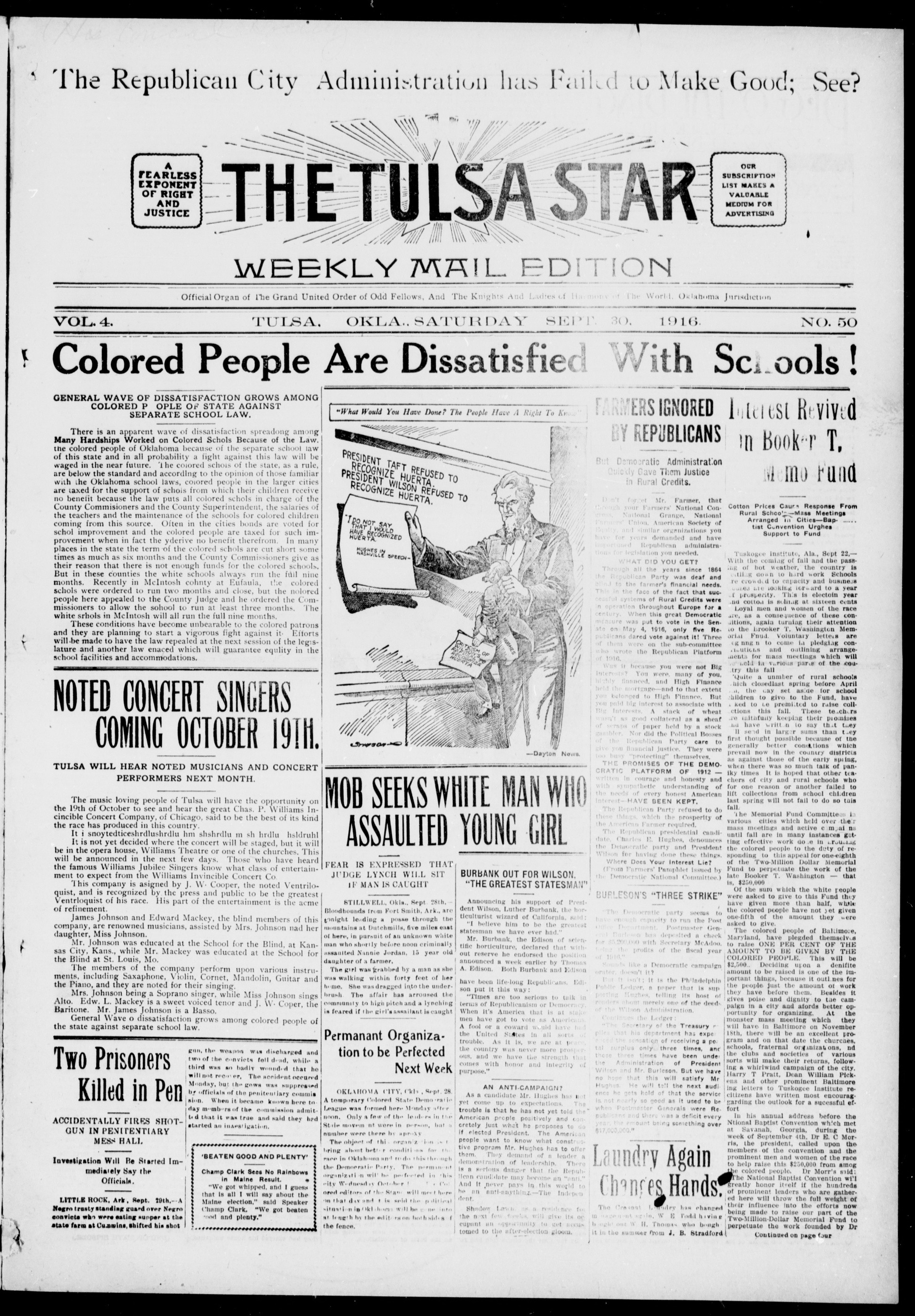
"What Would You Have Done? The People Have A Right To Know"
PRESIDENT TAFT REFUSED TO
RECOGNIZE HUERTA.
PRESIDENT WILSON REFUSED TO
RECOGNIZE HUERTA.
"I DO NOT SAY
THAT I WOULD
HAVE RECOGNIZED
HUERTA.
HUGHES IN
NASHVILLE SPEECH—
CRITICISM OF
RECOGNIZING
HUERTA
—Dayton News.
MOB SEEKS WHITE MAN WHO ASSAULTED YOUNG GIRL
FEAR IS EXPRESSED THAT JUDGE LYNCH WILL SIT 1F MAN IS CAUGHT
STILLWELL, Okla., Sept. 28th.—Bloodhounds from Fort Smith, Ark., are tonight leading a posse through the mountains at Dutchmills, five miles east of here, in pursuit of an unknown white man who shortly before noon criminally assaulted Nannie Jordan, 15 year old daughter of a farmer.
The girl was grabbed by a man as she was walking within forty feet of her home. She was dragged into the underbrush. The affair has arroused the community to high pitch and a lynching is feared if the girl's assailant is caught
Permanant Organization to be Perfected Next Week
Permanant Organization to be Perfected Next Week
OKLAHOMA CITY, Ckla, Sept. 28.
A temporary Colored State Democratic League was formed here Monday afternoon. Only a few of the leaders in the State movement were in person, but a number were there by aprexy.
The object of this organization is to bring about better conditions for the race in Oklahoma and to do this through the Democratic Party. The permanent organization will be prefected in this city Wednesday October 11. Colored editors of the State will meet here on that day and it will be said the political situation in Oklahoma will be come into at length by the editors on both sides of the fence.
BURBANK OUT FOR WILSON.
"THE GREATEST STATESMAN"
Announcing his support of President Wilson, Luther Burbank, the horticulturist wizard of California, said: "I believe him to be the greatest statesman we have ever had."
Mr. Burbank, the Edison of scientific horticulture, declared that without reserve he endorsed the position announced a week earlier by Thomas A. Edison. Both Burbank and Edison have been life-long Republicans. Edison put it this way:
"Times are too serious to talk in terms of Republicanism or Democracy. When it's America that is at stake men have got to vote as Americans. A fool or a coward would have had the United States in all sorts of trouble. As it is, we are at peace, the country was never more prosperous, and we have the strength that comes with honor and integrity of purpose."
AN ANTI-CAMPAIGN?
As a candidate Mr. Hughes has not yet come up to expectations. The trouble is that he has not yet told the American people positively and concretely just what he proposes to do if elected President. The American people want to know what constructive program Mr. Hughes has to offer them. They demand of a leader a demonstration of leadership. There is a serious danger that the Republican candidate may become an "anti." And it never pays in this world to be an anti-anything.—The Independent.
Shadow Lawn is a residence for the next few weeks, will give its or ocupant an opportunity to get accustomed to the after-election gloom.
FARMERS IGNORED BY REPUBLICANS
But Democratic Administration Quickly Gave Them Justice in Rural Credits.
Don't forget Mr. Farmer, that through your Farmers' National Congress, National Grange, National Farmers' Union, American Society of Equity, and similar organizations you have for years demanded and have imported Republican administrations for legislation you needed.
WHAT DID YOU GET?
Through all the years since 1864 the Republican Party was deaf and blind to the farmer's financial needs. This in the face of the fact that successful systems of Rural Credits were in operation throughout Europe for a century. When this great Democratic measure was put to vote in the Senate on May 4, 1916, only five Republicans dared vote against it! Three of them were on the sub-committee who wrote the Republican Platform of 1916.
Was it because you were not Big Interests? You were, many of you, highly financed, and High Finance held the mortgage—and to that extent you belagged to High Finance. But you paid big interest to associate with Big Interests. A stack of wheat wasn't as good collateral as a sheaf of scraps of paper held by a stock gambler. Nor did the Political Bosses of the Republican Party care to give you financial justice. They were too busy "protecting" themselves.
THE PROMISES OF THE DEMOCRATIC PLATFORM OF 1912 — written in courage and honesty and with sympathetic understanding of the needs of every honest American interest—HAVE BEEN KEPT.
The Republican Party refused to do these things, which the prosperity of the American Farmer required.
The Republican presidential candidate, Charles E. Hughes, denounces the Democratic party and President Wilson for having done these things.
Where Does Your Interest Lie?
(From Farmers' Panphlet Issued by the Democratic National Committee.)
BURLESON'S "THREE STRIKE"
"The Democratic party seems to have enough capacity to run the Post Office Department. Postmaster General Burleson has deposited a check for $320,000 with Secretary McAdoo holding the profits of the fiscal year of 1813."
Sounds like a Democratic campaign orater, doesn't it?
But it isn't; it is the Phladelphia Public Ledger, a paper that is supporting Hughes, telling its host of readers about merely one of the deeds of the Wilson Administration.
Continues the Ledger;
"The Secretary of the Treasury piles that his department has experienced the sensation of receiving a political surplus only three times, and these three times have been under the Administration of President Wilton and Mr. Burleson. But we have no hope that this will satisfy Mr. Hughes. He will tell the next audience he gets hold of that the service is not nearly so good as it used to be when Postmaster Generals were Republicans and there was a deficit every year, the amount being something over $17,000,000."
Laundry Again Changes Hards.
The Creamstail Laundry has changed in management again. W E Fodd having bought out W H. Thomas who bought it in the summer from J. B. Stradford
NO.50
Interest Revived in Booker T. Memo Fund
Cotton Prices Cause Response From Rural School's Mass Meetings Arranged in Cities—Bap. tist Convention Urghes Support to Fund
Tuskogee Institute, Ala., Sept 22,—With the coming of fall and the passing of hot weather, the country is outlining down to hard work Schools are crowded to capacity and business offices are looking forward to a year of prosperity. This is election year and cotton is being at sixteen cents. Loyal men and women of the race are, as a consequence of these conditions, again turning their attention to the brooker T. Washington Memorial Fnud. Voluntary letters are beginning n to come in pledging contributions and outlining arrangements for mass meetings which will hold in various parts of the country this fall
Quite a number of rural schools which closed last spring before April in, the day set aside for school children to give to the Fund, have asked to be premitted to raise collections this fall. These teachers in infinitely keeping their promises and have written to say that they will send in larger sums than they first thought possible because of the generally better conditions which prevail now in the country districts as against those of the early spring, when there was so much talk of panky times. It is hoped that other teachers of city and rural schools who for one reason or another failed to lift collections from school children last spring will not fail to do so tails fall.
The Memorial Fund Committees in various cities which held over their mass meetings and active civil as until fall are in many instances getting effective work done in bringing the colored people to the duty of responding to this appeal for one-eighth of the Two-Million Dollar Memorial Fund to perpetuate the work of the late Booker T. Washington — that is, $250,000.
Of the sum which the white people were asked to give to this Fund they have given more than half, while the colored people have not yet given one-fifth of the amount they were asked to give.
The colored people of Baltimore, Maryland, have pledged themselves to raise ONE PER CENT OF THE AMOUNT TO BE GIVEN BY THE COLORED PEOPLE. This will be $2,500. Deciding upon a denifite amount to be raised is one of the important things, because it outlines for the people just the amount or work they have before them. Besides it gives poise and dignity to the campaign in a city and affords better opportunity for organizing. At the monster mass meeting which they will have in Baltimore on November 18th, there will be an excellent program and on that date the churches, schools, fraternal organizations, nd the clubs and societies of various sorts will make their returns, following a whirlwind campaign of the city. Harry T Pratt, Dean William Pickens and other prominent Baltimore letters to Tuskogee Institute recitizens have written most encouragarding the outlook for a successful effort
In his annual address before the National Baptist Convention which met at Savannah, Georgia, during the week of September 4th, Dr E. C. Morris, the president, called upon the members of the convention and the prominent men and women of the race to help raise this $250,000 from among the colored people. Dr Morr's said: The National Baptist Convention will greatly honor itself if the hundreds of prominent leaders who are gathered here will throw the full weight of their influence into the efforts now being made to raise our part of the Two-Million-Dollar Memorial Fund to perpetuate the work founded by Dr
Continued on page four
PEG O'THE RING
BY WALTER K. HILL
and JO BRANDT
Novelized from the Motion Picture Play of the Same Name by the Universal Film Manufacturing Co. Copyright 1918 by the Author
La Belle La Steur, animal queen, fatally injured by tigers, dies after giving birth to a baby. Doctor Lund, owner of the Lund's millions, refuses to recognise the child. La Belle intrusts baby to Flip, a clown. Flip rears Peg as a cirqs rider. Later, Doctor Lund's sister, Lund's millions, and sends Hindu servant to dispose of her. Doctor Lund sends things to get from Flip letter that proves she is a circqs rider. She shows determined to marry Peg. After being at the mercy of lions on three occasions, Peg, while in her dressing tent is taken to the circqs rider's house, who has stolen the letter from Flip. Peg is carried to the den of a band of counterfeiters of which Mrs Lund is the head. It is carelessly left unlocked, but before she can escape from the house she drops through an opening in the floor, created by the circqs rider's elevator is trapped from under her feet. She manages to grasp with her hands the edge of the opening in the floor and hangs there. Young Peg is trapped in the corner of a袋 of Peg, is overpowered by the Hindu and the counterfeiters carry him bodily from the house.
Peg dangled in the air for a few seconds, her frail hold upon the floor surrounding the opening through which the trap had just descended giving her a perilous grip on temporary safety. But the girl's strength in forearm and hands was not sufficient to sustain her weight for very long. She felt her hold slipping and despite every effort she was finally compelled to drop, precipitately, down to the room below. She landed with her feet on a chair upon which she had been sitting when the trap fell. Before she could recover her bewildered poussie she was grabbed from behind by strong arms that rendered her helpless.
In a twinkling she was thrown to the floor of the trap, the chair was sent spinning by a kick from the foot of her new captor, and with a sudden jolt the trap again started downward with Peg pinioned by strong hands to its fast-descending floor. Her cries fell upon deaf ears. She was at the mercy of Chockro's burly henchman. The elevator trap quickly descended to a subcellar, dark and musty. Before Peg could realize what was happening, the floor of the elevator was mechanically tilted, and the girl rolled helplessly on to the damp, soggy ground. She knew that her descent had finally ended—and as the elevator was drawn up, she realized that she was alone and defenseless. The damp subcellar was still as death. When she cried out her voice gave forth a strange sound.
Not a sound of the struggles and commotion in other parts of "The House of Mystery" reached the girl's ears. She was utterly alone, prisoner in unknown confines and helpless—utterly helpless.
Meanwhile young Doctor Lund was fighting bravely to free himself from the grasp of his opponents, the thugs Chockroh had set upon him in the room through which Lund had first entered the counterfeiters' den. Chockroh had
福
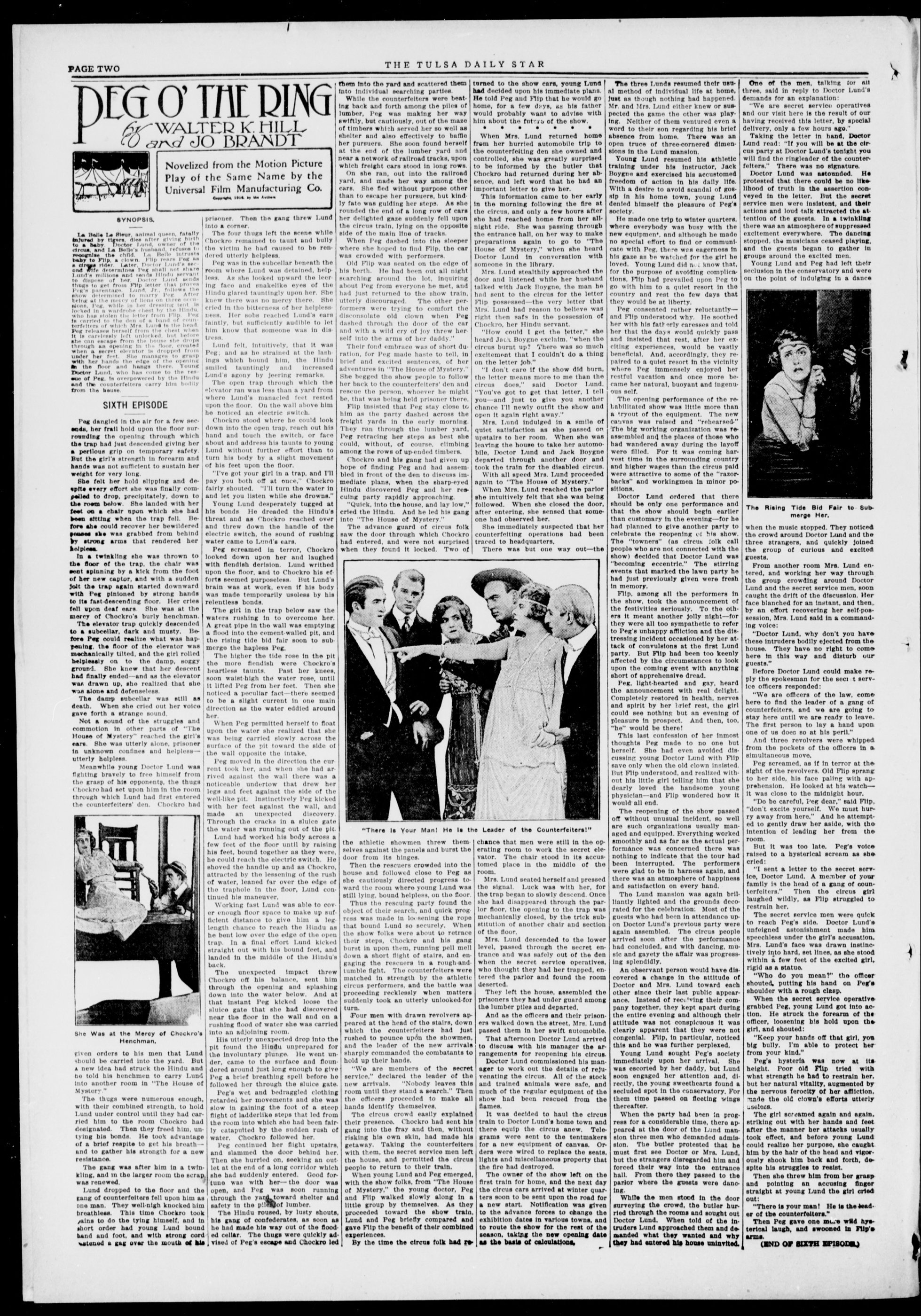
She Was at the Mercy of Chockro's Henchman.
given orders to his men that Lund should be carried into the yard. But a new idea had struck the Hindu and he told his henchmen to carry Lund into another room in "The House of Mystery."
The thugs were numerous enough, with their combined strength, to hold Lund under control until they had carried him to the room Chockro had designated. Then they freed him, untying his bonds. He took advantage of a brief respite to get his breath—and to gather his strength for a new resistance.
The gang was after him in a twinkling, and in the larger room the scrap was renewed.
Lund dropped to the floor and the gang of counterfeiters fell upon him as one man. They well-nigh knocked him breathless. This time Chckro tookains to do the tying himself, and in short order had young Lund boundhand and foot, and with strong cordlistened a gag over the mouth of his
PAGE TWO
```markdown
```
SIXTH EPISODE
prisoner. Then the gang threw Lund into a corner.
The four thugs left the scene while Chockro remained to taunt and bully the victim he had caused to be rendered utterly helpless.
Peg was in the subcellar beneath the room where Lund was detained, helpless. As she looked upward the leering face and snakelike eyes of the Hindu glared tauntingly upon her. She knew there was no mercy there. She cried in the bitterness of her helplessness. Her sobs reached Lund's ears faintly, but sufficiently audible to let him know that someone was in distress.
Lund felt, intuitively, that it was Peg; and as he strained at the lashings which bound him, the Hindu smiled tauntingly and increased Lund's agony by leering remarks.
The open trap through which the elevator ran was less than a yard from where Lund's manacled feet rested upon the floor. On the wall above him he noticed an electric switch.
Chockro stood where he could look down into the open trap, reach out his hand and touch the switch, or face about and address his taunts to young Lund without further effort than to turn his body by a slight movement of his feet upon the floor.
"I've got your girl in a trap, and I'll pay you both off at once," Chockro fairly shouted. "I'll turn the water in and let you listen while she drowns."
Young Lund desperately tugged at his bonds. He dreaded the Hindu's threat and as Chockro reached over and threw down the handle of the electric switch, the sound of rushing water came to Lund's ears.
Peg screamed in terror, Chockro looked down upon her and laughed with flendish derision. Lund writhed upon the floor, and to Chockro his efforts seemed purposeless. But Lund's brain was at work, even if his body was made temporarily useless by his relentless bonds.
The girl in the trap below saw the waters rushing in to overcome her. A great pipe in the wall was emptying a flood into the cement-walled pit, and the rising tide bid fair soon to submerge the hapless Peg.
The higher the tide rose in the pit the more flendish were Chockro's heartless taunts. Past her knees, soon waist-high the water rose, until it lifted Peg from her feet. Then she noticed a peculiar fact—there seemed to be a slight current in one main direction as the water eddied around her.
When Peg permitted herself to float upon the water she realized that she was being carried slowly across the surface of the pit toward the side of the wall opposite the intake.
Peg moved in the direction the current took her, and when she had arrived against the wall there was a noticeable undertow that drew her legs and feet against the side of the well-like pit. Instinctively Peg kicked with her feet against the wall, and made an unexpected discovery. Through the cracks in a sluice gate the water was running out of the pit. Lund had worked his body across a few feet of the floor until by raising his feet, bound together as they were, he could reach the electric switch. He shoved the handle up and as Chockro, attracted by the lessening of the rush of water, leaned far over the edge of the traphole in the floor, Lund continued his maneuver.
Working fast Land was able to cover enough floor space to make up sufficient distance to give him a leg-length chance to reach the Hindu as he bent low over the edge of the open trap. In a final effort Land kicked straight out with his bound feet, and landed in the middle of the Hindu's back.
The unexpected impact threw Chockro off his balance, sent him through the opening and splashing down into the water below. And at that instant Peg kicked loose the sluice gate that she had discovered near the floor in the wall and on a rushing flood of water she was carried into an adjoining room.
His utterly unexpected drop into the pit found the Hindu unprepared for the involuntary plunge. He went under, came to the surface and floundered around just long enough to give Peg a brief breathing spell before he followed her through the sluice gate.
Peg's wet and bedraggled clothing retarded her movements and she was slow in gaining the foot of a steep flight of ladderlike steps that led from the room into which she had been fairly catapulted by the sudden rush of water. Chockro followed her.
Peg continued her flight upstairs, and slammed the door behind her. Then she hurried on, seeking an outlet at the end of a long corridor which she had suddenly entered. Good fortune was with her—the door was open, and Peg was soon running through the yard toward shelter and safety in the pillar of lumber.
The Hindu roused, by lusty shouts, his gang of confederates, as soon as he had made his way out of the flooded cellar. The thugs were quickly advised of Peg's escape and Chockro led
them into the yard and scattered them into individual searching parties. While the counterfeiters were beating back and forth among the piles of lumber, Peg was making her way swiftly, but cautiously, out of the maze of timbers which served her so well as shelter and also effectively to baffle her pursuers. She soon found herself at the end of the lumber yard and near a network of railroad tracks, upon which freight cars stood in long rows. On she ran, out into the railroad yard, and made her way among the cars. She fled without purpose other than to escape her pursuers, but kindly fate was guilding her steps. As she rounded the end of a long row of cars her delighted gaze suddenly fell upon the circus train, lying on the opposite side of the main line of tracks.
turned to the show of had decided upon his. He told Peg and Flip home, for a few day would probably want him about the futures.
When Mrs. Lund from her hurried out the counterfeiters decontrolled, she was to be informed by Chockroh had returned sence, and left word important letter to g. This information in the morning folls the circus, and only she had reached hot night ride. She was the entrance hall on
When Peg dashed into the sleeper where she hoped to find Flip, the car was crowded with performers.
Old Flip was seated on the edge of his berth. He had been out all night searching around the lot, inquiring about Peg from everyone he met, and had just returned to the show train, utterly discouraged. The other performers were trying to comfort the disconsolate old clown when Peg dashed through the door of the car and with a wild cry of joy threw herself into the arms of her daddy."
Their fond embrace was of short duration, for Peg made haste to tell, in brief and excited sentences, of her adventures in "The House of Mystery."
She begged the show people to follow her back to the counterfeiters' den and rescue the person, whoever he might be, that was being held prisoner there.
Flip insisted that Peg stay close to him as the party dashed across the freight yards in the early morning. They ran through the lumber yard, Peg retracing her steps as best she could, without, of course, climbing among the rows of up-ended timbers. Chockro and his gang had given up hope of finding Peg and had assembled in front of the den to discuss immediate plans, when the sharp-eyed Hindu discovered Peg and her rescuing party rapidly approaching. "Quick, into the house, and lay low," cried the Hindu. And he led his gang into "The House of Mystery." The advance guard of circus folk saw the door through which Chockro had entered, and were not surprised when they found it locked. Two of
"There Is Your Man! He Is th
THE FILM "THE MASTER OF THE MASTER" BY JOHN M. HARRIS, WITH ALEXANDRA M. HARRIS, JOHN M. HARRIS, JOHN M. HARRIS, AND JOHN M. HARRIS.
"There Is Your Man! He Is the Leader of the Counterfeiters!"
the athletic showmen threw themselves against the panels and burst the door from its hinges.
Then the rescuers crowded into the house and followed close to Peg as she cautiously directed progress toward the room where young Lund was still lying, bound helpless, on the floor. Thus the rescue party found the object of their search, and quick progress was made in loosening the rope that bound Lund so securely. When the show folks were about to retrace their steps, Chockro and his gang burst in upon them, running pell mell down a short flight of stairs, and engaging the rescuers in a rough-and-tumble fight. The counterfeiters were matched in strength by the athletic circus performers, and the battle was proceeding recklessly when matters suddenly took an utterly unlooked-for turn.
chance that men were still in the erating room to work the secret vator. The chair stood in its ac-tomed place in the middle of room.
Mrs. Lund seated herself and pres the signal. Luck was with her, the trap began to slowly descend. C she had disappeared through the lor floor, the opening to the trap mechanically closed, by the trick stitution of another chair and sec of the floor.
Mrs. Lund descended to the lo level, passed through the secret trance and was safely out of the when the secret service operat-tered the parlor and found the r deserted.
They left the house, assembled prisoners they had under guard and the lumber piles and departed.
Four men with drawn revolvers appeared at the head of the stairs, down which the counterfeiters had just rushed to pounce upon the showmen, and the leader of the new arrivals sharply commanded the combatants to hold up their hands.
"We are members of the secret service," declared the leader of the new arrivals. "Nobody leaves this room until they stand a search." Then the officers proceeded to make all hands identify themselves.
The circus crowd easily explained their presence. Chockro had sent his gang into the fray and then, without risking his own skin, had made his getaway. Taking the counterfeiters with them, the secret service men left the house, and permitted the circus people to return to their train.
When young Lund and Peg emerged, with the show folks, from "The House of Mystery," the young doctor, Peg and Flip walked slowly along in a little group by themselves. As they proceeded toward the show train, Lund and Peg briefly compared and gave Flip the benefit of their combined experiences.
By the time the circus folk had re
turned to the show cars, young Lund had decided upon his immediate plans. He told Peg and Flip that he would go home, for a few days, as his father would probably want to advise with him about the futures of the show.
When Mrs. Lund returned home from her hurried automobile trip to the counterfeiting den she owned and controlled, she was greatly surprised to be informed by the butler that Chockro had returned during her absence, and left word that he had an important letter to give her.
This information came to her early in the morning following the fire at the circus, and only a few hours after she had reached home from her all-night ride. She was passing through the entrance hall, on her way to make preparations again to go to "The House of Mystery," when she heard Doctor Lund in conversation with someone in the library.
Mrs. Lund stealthily approached the door and listened while her husband talked with Jack Boygne, the man he had sent to the circus for the letter Flip possessed—the very letter that Mrs. Lund had reason to believe was right then safs in the possession of Chockro, her Hindu servant.
"How could I get the letter," she heard Jack Boygne exclaim, "when the circus burn up? There was so much excitement that I couldn't do a thing on the letter job."
"I don't care if the show did burn, the letter means more to me than the circus does," said Doctor Lund.
"You've got to get that letter, I tell you—and just to give you another chance I'll newly outfit the show and open it again right away."
Mrs. Lund indulged in a smile of quiet satisfaction as she passed on upstairs to her room. When she was leaving the house to take her automobile, Doctor Lund and Jack Boygne departed through another door and took the train for the disabled circus. With all speed Mrs. Lund proceeded again to "The House of Mystery." When Mrs. Lund reached the parlor she intuitively felt that she was being followed. When she closed the door, after entering, she sensed that someone had observed her. She immediately suspected that her counterfeit operations had been traced to headquarters. There was but one way out—the
the Leader of the Counterfeiters!"
chance that men were still in the operating room to work the secret elevator. The chair stood in its accustomed place in the middle of the room.
Mrs. Lund seated herself and pressed the signal. Luck was with her, for the trap began to slowly descend. Once she had disappeared through the parlor floor, the opening to the trap was mechanically closed, by the trick substitution of another chair and section of the floor.
Mrs. Lund descended to the lower level, passed through the secret entrance and was safely out of the den when the secret service operatives, who thought they had her trapped, entered the parlor and found the room deserted.
They left the house, assembled the prisoners they had under guard among the lumber piles and departed.
And as the officers and their prisoners walked down the street, Mrs. Lund passed them in her swift automobile. That afternoon Doctor Lund arrived to discuss with his manager the arrangements for reopening his circus. Doctor Lund commissioned his manager to work out the details of rejuvenating the circus. All of the stock and trained animals were safe, and much of the regular equipment of the show had been rescued from the flames.
It was decided to haul the circus train to Doctor Lund's home town and there equip the circus anew. Telegrams were sent to the tentmakers for a new equipment of canvas. Orders were wired to replace the seats, lights and miscellaneous property that the fire had destroyed.
The owner of the show left on the first train for home, and the next day the circus cars arrived at winter quarters soon to be sent upon the road for a new start. Notification was given to the advance forces to change the exhibition dates in various towns, and to route the show for the rest of the season, taking the new opening date as the basis of calculations.
The three Lunds resumed their usual method of individual life at home, just as though nothing had happened. Mr. and Mrs. Lund either knew or suspected the game the other was playing. Neither of them ventured even a word to their son regarding his brief absence from home. There was an open truce of three-cornered dimensions in the Lund mansion.
Young Lund resumed his athletic training under his instructor, Jack Boygne and exercised his accustomed freedom of action in his daily life. With a desire to avoid scandal of gossip in his home town, young Lund denied himself the pleasure of Peg's society.
He made one trip to winter quarters, where everybody was busy with the new equipment<sup>a</sup>, and although he made no special effort to find or communicate with Peg, there was eagerness in his gaze as he watched for the girl he loved. Young Lund did not know that, for the purpose of avoiding complications, Flip had prevailed upon Peg to go with him to a quiet resort in the country and rest the few days that they would be at liberty.
Peg consented rather reluctantly—and Flip understood why. He soothed her with his fatherly caresses and told her that the days would quickly pass and insisted that rest, after her exciting experiences, would be vastly beneficial. And, accordingly, they repaired to a quiet resort in the vicinity where Peg immensely enjoyed her restful vacation and once more became her natural, buoyant and ingenuous self.
The opening performance of the rehabilitated show was little more than a tryout of the equipment. The new canvas was raised and "rehearsed." The big working organization was reassembled and the places of those who had wandered away during the layoff were filled. For it was coming harvest time in the surrounding country and higher wages than the circus paid were attractive to some of the "razorbacks" and workingmen in minor positions.
Doctor Lund ordered that there should be only one performance and that the show should begin earlier than customary in the evening—for he had planned to give another party to celebrate the reopening of his show. The "towners" (as circus folk call people who are not connected with the show) decided that Doctor Lund was "becoming eccentric." The stirring events that marked the lawn party he had just previously given were fresh in memory.
Flip, among all the performers in the show, took the announcement of the festivities seriously. To the others it meant another jolly night—for they were all too sympathetic to refer to Peg's unhappy affliction and the distressing incident occasioned by her attack of convulsions at the first Lund party. But Flip had been too keenly affected by the circumstances to look upon the coming event with anything short of apprehensive dread.
Peg, light-hearted and gay, heard the announcement with real delight. Completely restored in health, nerves and spirit by her brief rest, the girl could see nothing but an evening of pleasure in prospect. And then, too, "he" would be there!
This last confession of her inmost thoughts Peg made to no one but herself. She had even avoided discussing young Doctor Lund with Flip save only when the old clown insisted. But Flip understood, and realized without his little girl telling him that she dearly loved the handsome young physician—and Flip wondered how it would all end.
The reopening of the show passed off without unusual incident, so well are such organizations usually managed and equipped. Everything worked smoothly and as far as the actual performance was concerned there was nothing to indicate that the tour had been interrupted. The performers were glad to be in harness again, and there was an atmosphere of happiness and satisfaction on every hand. The Lund mansion was again brilliantly lighted and the grounds decorated for the celebration: Most of the guests who had been in attendance upon Doctor Lund's previous party were again assembled. The circus people arrived soon after the performance had concluded, and with dancing, music and gayey the affair was progressing splendidly.
An observant person would have discovered a change in the attitude of Doctor and Mrs. Lund toward each other since their last public appearance. Instead of receiving their company together, they kept apart during the entire evening and although their attitude was not conspicuous it was clearly apparent that they were not congenial. Flip, in particular, noticed this and he was further perplexed. Young Lund sought Peg's society immediately upon her arrival. She was escorted by her daddy, but Lund soon engaged her attention and, directly, the young sweethearts found a secluded spot in the conservatory. For them time passed on fleeting wings thereafter.
When the party had been in progress for a considerable time, there appeared at the door of the Lund mansion three men who demanded admission. The butler protested that he must first see Doctor or Mrs. Lund, but the strangers disregarded him and forced their way into the entrance hall. From there they passed to the parlor where the guests were dancing.
While the men stood in the door surveying the crowd, the butler hurried through the rooms and sought out Doctor Lund. When told of the intruders Lund approached them and demanded what they wanted and why they had entered his house uninvited.
One of the men, talking for all three, said in reply to Doctor Lund's demands for an explanation: "We are secret service operatives and our visit here is the result of our having received this letter, by special delivery, only a few hours ago." Taking the letter in hand, Doctor Lund read: "If you will be at the circus party at Doctor Lund's tonight you will find the ringleader of the counterfeiters." There was no signature. Doctor Lund was astounded. He protested that there could be no likelihood of truth in the assertion conveyed in the letter. But the secret service men were insistent, and their actions and loud talk attracted the attention of the guests. In a twinkling there was an atmosphere of suppressed excitement everywhere. The dancing stopped, the musicians ceased playing, and the guests began to gather in groups around the excited men.
Young Lund and Peg had left their seclusion in the conservatory and were on the point of indulging in a dance
THE FILM "THE FILM" BY JOHN BURTON.
The Rising Tide Bid Fair to Submerge Her.
when the music stopped. They noticed the crowd around Doctor Lund and the three strangers, and quickly joined the group of curious and excited guests.
From another room Mrs. Lund entered, and working her way through the group crowding around Doctor Lund and the secret service men, soon caught the drift of the discussion. Her face blanched for an instant, and then, by an effort recovering her self-passion, Mrs. Lund said in a commanding voice:
"Doctor Lund, why don't you have these intruders bodily ejected from the house. They have no right to come here in this way and disturb our guests."
Before Doctor Lund could make reply the spokesman for the secret service officers responded:
"We are officers of the law, come here to find the leader of a gang of counterfeiters, and we are going to stay here until we are ready to leave. The first person to lay a hand upon one of us does so at his peril."
And three revolvers were whipped from the pockets of the officers in a simultaneous move.
Peg screamed, as if in terror at the sight of the revolvers. Old Flip sprang to her side, his face palling with apprehension. He looked at his watch—it was close to the midnight hour.
"Do be careful, Peg dear," said Flip, "don't excite yourself. We must hurry away from here." And he attempted to gently draw her aside, with the intention of leading her from the room.
But it was too late. Peg's voice raised to a hysterical scream as she cried:
"I sent a letter to the secret service, Doctor Lund. A member of your family is the head of a gang of counterfeiters." Then the circus girl laughed wildly, as Flip struggled to restrain her.
The secret service men were quick to reach Peg's side. Doctor Lund's unfeigned astonishment made him speechless under the girl's accusation. Mrs. Lund's face was drawn instinctively into hard, set lines, as she stood within a few feet of the excited girl, rigid as a statue.
"Who do you mean?" the officer shouted, putting his hand on Peg's shoulder with a rough clasp.
When the secret service operative grabbed Peg, young Lund got into action. He struck the forearm of the officer, loosening his hold upon the girl, and shouted:
"Keep your hands off that girl, you big bully. I'm able to protect her from your kind."
Peg's hysteria was now at its height. Poor old Flip tried with what strength he had to restrain her, but her natural vitality, augmented by the nervous ferocity of her affliction, made the old clown's efforts utterly useless.
The girl screamed again and again, striking out with her hands and feet after the manner her attacks usually took effect, and before young Lund could realize her purpose, she caught him by the hair of the head and vigorously shook him back and forth, despite his struggles to resist.
Then she threw him from her grasp and pointing an accusing finger straight at young Lund the girl cried out:
"There is your man! He is the leader of the counterfeiters."
Then Peg gave one more wild hysterical laugh, and swooned in Flip's arms.
(BEND OF SIXTH EPISODE)
Labor Warfare Destroys Industry Which Gives Life to Employers and Workers
By ETHELBERT STEWART
Chief Statistician, U. S. Bureau of Labor Statistics
can be no industrial peace until both sides to the industrial peace, and when both sides really want settlement is bound to come. There must be a willingness on both sides to abide by a settlement, in America it seems that there is a large confined either to the laboring or to the cap fighting, for its own sake, to industrial peace means.
In 1886 the Stove Foundrymen and the Iron Makers with the manufacturers in the stove industry. Each strike in St. Louis, and soon involved theaught until both sides were utterly exhausted by a breath left. Finally both sides used that to forget it." They saw that if they did not stop the stove industry would go to pieces, and for the to which they all owed life they came together appointed committees of arbitration from both machinery for the settlement of all disputes that the future. Each year since that time they adjusted amicably all the differences in the state, that is the only industry in the United States for thirty years; the only industry which a warfare is destructive, not so much to the in it, as it is destructive to the very industry once firmly grasped by all strikers and by all disturbances will depreciate astoundingly.
Work of Clubs Is Chiefly Responsive to Awakening Among Women of Col
There can be no industrial peace until both sides to a labor argument want industrial peace, and when both sides really want peace, and not a fight, a settlement is bound to come. There must be concession on both sides and a willingness on both sides to abide by a settlement. But, unfortunately, in America it seems that there is a large class of men, by no means confined either to the laboring or to the capitalistic class, who prefer fighting, for its own sake, to industrial peace and all that such peace means.
Back in 1886 the Stove Foundrymen and the Iron Molders' union locked horns with the manufacturers in the stove industry. It began with the Bridge Beach strike in St. Louis, and soon involved the entire country. They fought until both sides were utterly exhausted and each had barely a single breath left. Finally both sides used that last breath to say, "Let us forget it." They saw that if they did not stop then and stop forever, the stove industry would go to pieces, and for the salvation of the industry to which they all owed life they came together, settled their differences, appointed committees of arbitration from both sides, and established machinery for the settlement of all disputes that might possibly arise in the future. Each year since that time these committees have met and adjusted amicably all the differences in the stove industry.
1
However, that is the only industry in the United States which has been at peace for thirty years; the only industry which apparently has learned that warfare is destructive, not so much to the individuals who participate in it, as it is destructive to the very industry itself. When that fact is once firmly grasped by all strikers and by all lockers-out, the labor disturbances will depreciate astoundingly.
Work of Clubs Is Chiefly Responsible for Awakening Among Women of Country
Work of Clubs Is Chiefly Responsible for Awakening Among Women of Country
By MPS. GRACE JULIAN CLARKE of Indianapolis
are largely responsible for the wonderful awakening over the land. Through clubs women have come themselves and of other women, also of the cone. They see many ways in which they could do some changes but for the "sex distinction," whose suffrage will go far toward wiping out. The time there will be no longer any need of women in cease to exist. But I very much doubt if the men must go forward at their own gait—not just men, prescribe. They have many things to learn to teach them, and it seems to me they must wipe themselves, in clubs and federations. Their beset with every conceivable difficulty and deed their wits and made them peculiarly apt in so they will take their places alongside of men in all or some time to come there will be plenty of wives. equal suffrage is an accomplished fact all over, will be ample opportunity for usefulness on the men. In clubs women learn the value of art, mutual community life; they study about conservation, problems, all that relates to children, and the criminal. It is very important that the men have such training schools as clubs afford for questions that women must help to solve.
Great Growth of Foreign Trade Building Up U. S. Merchant Man
Clubs are largely responsible for the wonderful awakening among women all over the land. Through clubs women have come to a realization of themselves and of other women, also of the conditions of life around them. They see many ways in which they could help to bring about wholesome changes but for the "sex distinction," which the granting of equal suffrage will go far toward wiping out. The time will doubtless come when there will be no longer any need of women's clubs, and they will then cease to exist. But I very much doubt if the millennium is near.
Women must go forward at their own gait—not just as men, or any set of men, prescribe. They have many things to learn, things that men cannot teach them, and it seems to me they must work out some problems by themselves, in clubs and federations. Their long journey along a road beset with every conceivable difficulty and discouragement has sharpened their wits and made them peculiarly apt in some directions. Gradually they will take their places alongside of men in all departments of life, but for some time to come there will be plenty of work for clubs of women.
9
When equal suffrage is an accomplished fact all over the country there will still be ample opportunity for usefulness on the part of clubs and federations. In clubs women learn the value of art, music and literature in community life; they study about conservation, civil service reform, city problems, all that relates to children, and the care of the sick, insane and criminal. It is very important that the citizen-mothers of the future have such training schools as clubs afford for the consideration of all questions that women must help to solve.
Great Growth of Foreign Trade Is Building Up U. S. Merchant Marine
By DR. EDWARD EWING PRATT
Chief of Federal Bureau of Foreign and Domestic Commerce
nothing wrong with our foreign trade. We have sign markets and getting our share of the trade used from the class of nations which are dispensed from the class of manufacturing nations. Before us an exporter of commodities. Today we have any other nation in the world. Merchant marine has increased more during the 50 years previous. Our shipyards are turning out an astounding number of had a small merchant marine has handicapped that during the war, but we are gaining and that we can build up a great shipping industry the present bulk of American foreign trade direct agencies. The most important of the houses, export merchants and manufacturers' no mystery. It is similar to domestic trade. And organized policy or establishment of permit to adapt the products to the needs of the cu
Scription a Noble Word if It Made Synonymous With Citizen
There is nothing wrong with our foreign trade. We have been going into the foreign markets and getting our share of the trade of the world. We have passed from the class of nations which are dispensers of raw materials to the class of manufacturing nations. Before the war we stood third as an exporter of commodities. Today we have three times the trade of any other nation in the world.
Our merchant marine has increased more during the last two years than it had during the 50 years previous. Our shipyards are working to their capacity and are turning out an astounding number of vessels. The fact that we had a small merchant marine has handicapped our foreign trade somewhat during the war, but we are gaining and our laws are becoming such that we can build up a great shipping industry.
Up to the present the bulk of American foreign trade has been sold abroad by indirect agencies. The most important of these are export commission houses, export merchants and manufacturers' agents. Foreign trade is no mystery. It is similar to domestic trade. It requires a well-planned and organized policy or establishment of permanent prices, and an attempt to adapt the products to the needs of the customer.
Conscription a Noble Word if It Can Be Made Synonymous With Citizenship
thing that everybody might be conscripted to give state, under a plan of national constructive preparation, luxury and waste and indulgence be command and science and art and industry be called to and a general mobilization for the common disempelled by our vision of an America that has specialized supremacy. make "conscript" a noble word by making it in a republic with a mission and an ideal view that time comes, may every American man student has done, conscript himself, and each one best that he has to give. And may American ambriage has done, not await government more
I am wishing that everybody might be conscripted to give some service to the state, under a plan of national constructive preparedness; that every selfish luxury and waste and indulgence be commandeered, every useful skill and science and art and industry be called to the colors periodically, and a general mobilization for the common defense of our ideals be compelled by our vision of an America that has a mission beyond commercialized supremacy.
I would make "conscript" a noble word by making it synonymous with "citizen" in a republic with a mission and an ideal worth fighting for. Till that time comes, may every American man do what every Cambridge student has done, conscript himself, and each one offer to his country the best that he has to give. And may American institutions do what Cambridge has done, not await government mobilization but mobilize themselves.
THE TULSA DAILY STAR
NEGLECT IN PRE
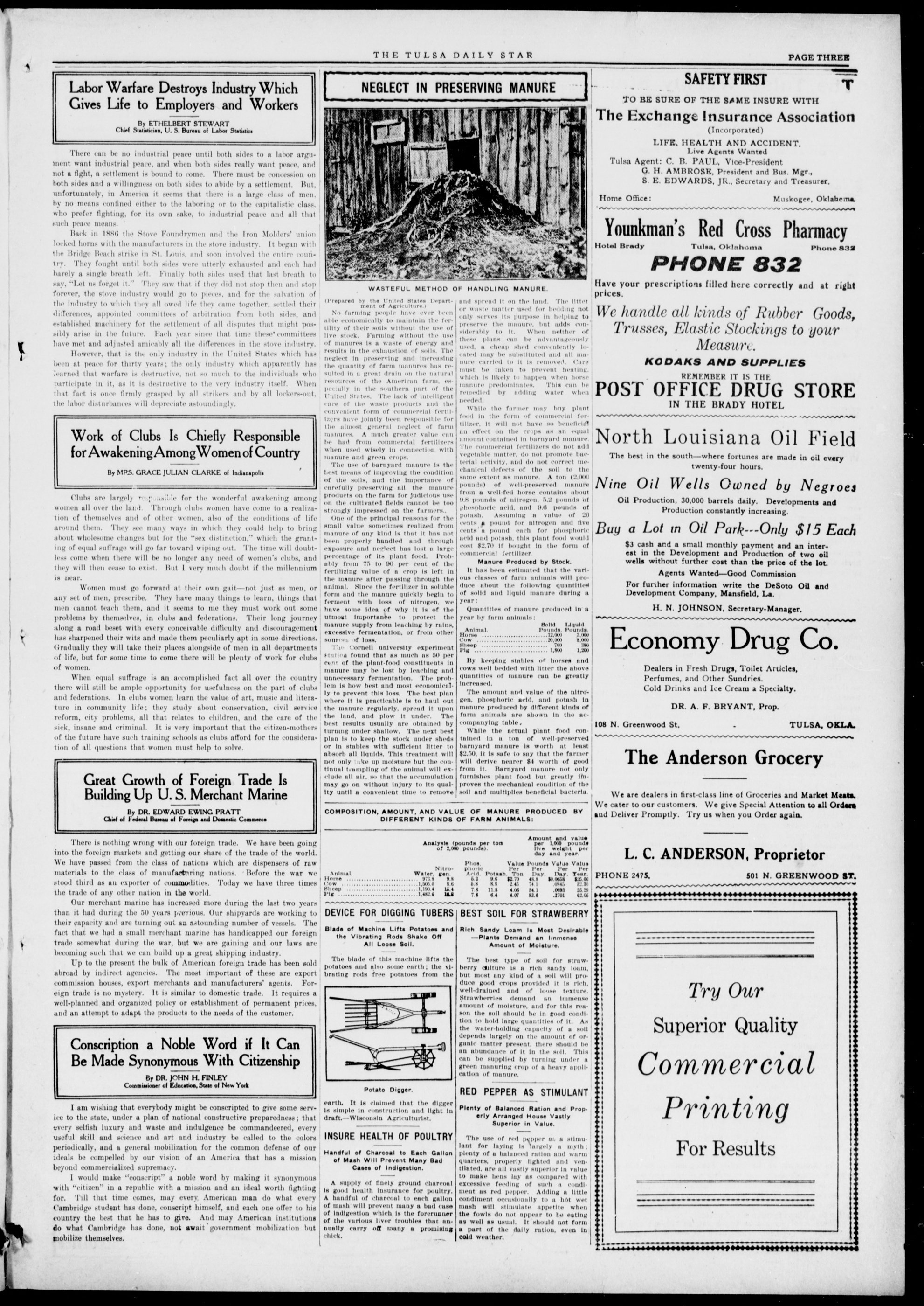
WASTEFUL METHOD OF HANDLING MANURE.
(Prepared by the United States Department of Agriculture)
ment or Agriculture)
No farming people have ever been able economically to maintain the fertility of their soils without the use of live stock. Farming without the use of manures is a waste of energy and results in the exhaustion of soils. The neglect in preserving and increasing the quantity of farm manures has resulted in a great drain on the natural resources of the American farm, especially in the southern part of the United States. The lack of intelligent care of the waste products and the convenient form of commercial fertilizers have jointly been responsible for the almost general neglect of farm manures. A much greater value can be had from commercial fertilizers when used wisely in connection with manure and green crops.
The use of barnyard manure is the best means of improving the condition of the soils, and the importance of carefully preserving all the manure products on the farm for judicious use on the cultivated fields cannot be too strongly impressed on the farmers.
One of the principal reasons for the small value sometimes realized from manure of any kind is that it has not been properly handled and through exposure and neglect has lost a large percentage of its plant food. Probably from 75 to 90 per cent of the fertilizing value of a crop is left in the manure after passing through the animal. Since the fertilizer in soluble form and the manure quickly begin to ferment with loss of nitrogen, we have some idea of why it is of the utmost importance to protect the manure supply from leaching by rains, excessive fermentation, or from other sources of loss.
The Cornell university experiment station found that as much as 50 percent of the plant-food constituents in manure may be lost by leaching and unnecessary fermentation. The problem is how best and most economically to prevent this loss. The best plan where it is practicable is to haul out the manure regularly, spread it upon the land, and plow it under. The best results usually are obtained by turning under shallow. The next best plan is to keep the stock under sheds or in stables with sufficient litter to absorb all liquids. This treatment will not only take up moisture but the continual trampling of the animal will exclude all air, so that the accumulation may go on without injury to its quality until a convenient time to remove
COMPOSITION, AMOUNT, AND VALUE
DIFFERENT KINDS
Analysis of 2,000
Animal. Water. gen.
Horse. 972.8 8.8
Cow. 1,506.0 8.8
Sheep. 1,190.4 15.4
Pig. 1,482.6 15.8
DEVICE FOR DIGGING TUBERS
COMPOSITION, AMOUNT, AND VALUE OF MANURE PRODUCED BY DIFFERENT KINDS OF FARM ANIMALS:
Analysis (pounds per ton of 2,000 pounds).
Nitro-
Water, gen.
Phos.
phoric
Acid.
Potash.
Value
Per
Ton
Pounds
Per
Day.
Value
Per
Year.
Animal. 973.8 9.8 6.2 9.6 $2.70 48.8 $0.0658 $25.00
Horse 1,505.0 8.6 5.8 2.45 74.1 0.845 22.30
Cow 1,505.0 8.6 5.8 2.45 74.1 0.845 22.30
Sheep 1,190.4 15.4 7.8 11.8 4.06 34.1 .0893 25.28
Pig 1,482.6 16.8 7.8 6.4 4.06 83.6 .1701 62.06
Blade of Machine Lifts Potatoes and the Vibrating Rods Shake Off All Loose Soil.
The blade of this machine lifts the potatoes and also some earth; the vibrating rods free potatoes from the
earth. It is claimed that the digger is simple in construction and light in draft.-Wisconsin Agriculturist.
INSURE HEALTH OF POULTRY
Handful of Charcoal to Each Gallon of Mash Will Prevent Many Bad Cases of Indigestion.
A supply of finely ground charcoal is good health insurance for poultry. A handful of charcoal to each gallon of mash will prevent many a bad case of indigestion which is the forerunner of the various liver troubles that annually carry off many a promising chick.
SERVING MANURE
and spread it on the land. The litter or waste matter used for bedding not only serves its purpose in helping to preserve the manure, but adds considerably to it. When neither of these plans can be advantageously used, a cheap shed conveniently located may be substituted and all manure carried to it is removed. Care must be taken to prevent heating, which is likely to happen when horse manure predominates. This can be remedied by adding water when needed.
While the farmer may buy plant food in the form of commercial fertilizer, it will not have so beneficial an effect on the crops as an equal amount contained in barnyard manure. The commercial fertilizers do not add vegetable matter, do not promote bacterial activity, and do not correct mechanical defects of the soil to the same extent as manure. A ton (2,000 pounds) of well-preserved manure from a well-fed horse contains about 9.8 pounds of nitrogen, 5.2 pounds of phosphoric acid, and 9.6 pounds of potash. Assuming a value of 20 cents a pound for nitrogen and five cents a pound each for phosphoric acid and potash, this plant food would cost $2.70 if bought in the form of commercial fertilizer.
It has been estimated that the various classes of farm animals will produce about the following quantities of solid and liquid manure during a year:
Quantities of manure produced in a year by farm animals:
Animal | Solid Pounds | Liquid Pounds
Horse | 12,000 | 3,000
Cow | 20,000 | 8,000
Sheep | 780 | 380
Pig | 1,800 | 1,200
By keeping stables of horses and cows well bedded with litter the above quantities of manure can be greatly increased.
The amount and value of the nitrogen, phosphoric acid, and potash in manure produced by different kinds of farm animals are shown in the accompanying table.
While the actual plant food contained in a ton of well-preserved barnyard manure is worth at least $2.50, it is safe to say that the farmer will derive nearer $4 worth of good from it. Barnyard manure not only furnishes plant food but greatly improves the mechanical condition of the soil and multiplies beneficial bacteria.
QUE OF MANURE PRODUCED BY
OF FARM ANIMALS:
pounds per ton
(0 pounds).
Phos.
phoric
Acid.
Potash.
Ton
Per
Per
Pounds
Value
Value
Per
Per
1,000 pounds
live weight per
day and year.
9.6
9.6
$2.70
74.8
Day.
Day.
Year.
5.8
8.8
2.45
74.1
$0.0658
$25.00
7.8
11.8
4.06
34.1
.0093
25.20
7.8
6.4
4.07
83.6
.1701
62.06
BEST SOIL FOR STRAWBERRY
Rich Sandy Loam Is Most Desirable
—Plants Demand an Inmense
Amount of Moisture.
The best type of soil for strawberry culture is a rich sandy loam, but most any kind of a soil will produce good crops provided it is rich, well-drained and of loose texture. Strawberries demand an immense amount of moisture, and for this reason the soil should be in good condition to hold large quantities of it. As the water-holding capacity of a soil depends largely on the amount of organic matter present, there should be an abundance of it in the soil. This can be supplied by turning under a green manuring crop of a heavy application of manure.
RED PEPPER AS STIMULANT
Plenty of Balanced Ration and Properly Arranged House Vastly Superior in Value.
The use of red pepper as a stimulant for laying is largely a myth; plenty of a balanced ration and warm quarters, properly lighted and ventilated, are all vastly superior in value to make hens lay as compared with excessive feeding of such a condiment as red pepper. Adding a little condiment occasionally to a hot wet mash will stimulate appetite when the fowls do not appear to be eating as well as usual. It should not form a part of the daily ration, even in cold weather.
---
TO BE SURE OF THE SAME INSURE WITH
Exchange Insurance Association
(Incorporated)
LIFE, HEALTH AND ACCIDENT.
Live Agents Wanted
Lisa Agent: C. B. PAUL, Vice-President
G. H. AMBROSE, President and Bus. Mgr.,
S. E. EDWARDS, JK., Secretary and Treasurer
Office: Muskogee, OL
Bunkman's Red Cross Pharm
Brady Tulsa, Oklahoma Pho
The Exchange Insurance Association
LIFE, HEALTH AND ACCIDENT.
Live Agents Wanted
Tulsa Agent: C. B. PAUL, Vice-President
G. H. AMBROSE, President and Bus. Mgr.
S. E. EDWARDS, JR., Secretary and Treasurer.
Home Office: Muskogee, Oklahoma
PHONE 832
Have your prescrip-
tions prices.
We handle all
Trusses, B
KODA
POST OF
IN
North Le
The best in the so
Nine Oil W
Oil Production,
Prod
Buy a Lot in
$3 cash and a
est in the De
wells without
Agent
For further in
Development
your prescriptions filled here correctly and are
handle all kinds of Rubber Gear
Crusses, Elastic Stockings to your
Measure.
KODAKS AND SUPPLIES
REMEMBER IT IS THE
BEST OFFICE DRUG STO
IN THE BRADY HOTEL
North Louisiana Oil Field
the best in the south—where fortunes are made in oil or
twenty-four hours.
The Oil Wells Owned by Negro
Oil Production, 30,000 barrels daily. Developments and
Production constantly increasing.
a Lot in Oil Park---Only $15
$3 cash and a small monthly payment and an interest
in the Development and Production of two oil
wells without further cost than the price of the lot
Agents Wanted—Good Commission
For further information write the DeSoto Oil and
Development Company, Mansfield, La.
Have your prescriptions filled here correctly and at right prices. We handle all kinds of Rubber Goods, Trusses, Elastic Stockings to your
KODAKS AND SUPPLIES REMEMBER IT IS THE POST OFFICE DRUG STORE IN THE BRADY HOTEL
North Louisiana Oil Field The best in the south—where fortunes are made in oil every twenty-four hours.
Oil Production, 30,000 barrels daily. Developments and Production constantly increasing.
Buy a Lot in Oil Park---Only $15 Each
$3 cash and a small monthly payment and an interest in the Development and Production of two oil wells without further cost than the price of the lot.
Agents Wanted—Good Commission
For further information write the DeSoto Oil and Development Company, Mansfield, La.
H. N. JOHNSON, Secretary-Manager.
Econo
Economy Drug Co
Economy Drug Co.
Dealers in Fresh Drugs, Toilet Articles, Perfumes, and Other Sundries. Cold Drinks and Ice Cream a Specialty.
108 N. Greenwood St.
The Anderson Grocery
We are dealers in We cater to our custor and Deliver Promptly.
are dealers in first-class line of Groceries and Market order to our customers. We give Special Attention to all deliver Promptly. Try us when you Order again.
We are dealers in first-class line of Groceries and Market Meats. We cater to our customers. We give Special Attention to all Orders and Deliver Promptly. Try us when you Order again.
L. C. ANDERSON, Proprietor
E 2475. 501 N. GREENWO
---
Try Our
Superior Quality
Commercial
Printing
For Results
PHONE 2475.
SAFETY FIRST
DR. A. F. BRYANT, Prop.
PAGE THREE
T
E WITH
Association
MENT.
M. Mgr.,
Treasurer.
Skokogee, Oklahoma
Pharmacy
Phone 832
2
ly and at right
per Goods,
to your
MES
STORE
Fil Field
made in oil every
Negroes
Equipments and
$15 Each
and an inter-
of two oil
of the lot.
on
to Oil and
inger.
Co.
les,
city.
TULSA, OKLA
and Market Meats.
tion to all Orders
gain.
REENWOOD ST.
The Tulsa Weekly Star
The Tulsa Weekly Star
Published by
THE TULSA STAR PRINTING AND PUBLISHING COMPANY
A. J. SMITHERMAN, Editor and Publisher
115 North Greenwood.
Entered at the Tulsa Postoffice as Second Class Matter.
SUBSCRIPTION MATES:
(By Mail)
One year ..... $4.00
Six months ..... 2.50
Three months ..... 1.50
MEMBER
NATIONAL NEGRO PRESS
ASSOCIATION
THERE ANY GOOD REPRESENTE for this paper?
THE SEGREGATION ACT should be stubbornly relied on rights!
HAT HAS THE REPUBLIC for the East End? A
HEN THE TIME COMES County will show the rule.
HAT ABOUT the assistant leader of the Colored for
No colored man whether he'd to put the interest of a We should remember we is or democrats.
THERE ARE ONLY TWO nation ordinances have been a City and Tulsa, the two are presided over by repu
HOW GOOD REASON why you
paper?
A TION ACT is a rank insu-
subbornly resisted. Be men
THE REPUBLICAN city ad-
vent End? Answer: Nothing
THE COMES the Colored
will show their righteous dis-
tain the assistant city attorney
the Colored forces of the G. O.
can whether democrat or re-
interest of any political party
remember we were negroes be
ONLY TWO CITIES in O
have been passed. These t
isa, the two largest cities in
over by republican administra
IS THERE ANY GOOD REASON why you should not subscribe for this paper?
THE SEGREGATION ACT is a rank insult to the race, and should be stubbornly resisted. Be men and stand up for your rights!
WHAT HAS THE REPUBLICAN city administration done for the East End? Answer: Nothing!
WHEN THE TIME COMES the Colored voters of Tulsa County will show their righteous disgust for Republican rule.
WHAT ABOUT the assistant city attorneyship promised the leader of the Colored forces of the G. O. P. last spring!
No colored man whether democrat or republican, can well afford to put the interest of any political party above that of his rare. We should remember we were negroes before we were republicans or democrats.
THERE ARE ONLY TWO CITIES in Oklahoma where segregation ordinances have been passed. These two cities are Oklahoma City and Tulsa, the two largest cities in the state and both cities are presided over by republican administrations.
THE WRONG RELIGION
If there is any one character among all the peculiar traits of the church (which, by the order who is familiar with theselves) with one lone use. The lodge room for all see the race and like the church and there. Next to the chieflician party which the ave of the black man's religion is fifty years bondage to the
one characteristic, more oure peculiar traits of the negro which, by the way is somewhilier with the negroes penche lone exception.
in for all secret orders have in the church is doing some reext to the church and the lodge which the average white man in man's religion, basing such condage to the republican party
If there is any one characteristic, more outstanding than any other among all the peculiar traits of the negro people it is their love of the church (which, by the way is somewhat puzzling to the outsider who is familiar with the negroes penchant to fight among themselves) with one lone exception.
The lodge room for all secret orders have an everlasting grip on the race and like the church is doing some real good for the race here and there. Next to the church and the lodge rooms comes the republican party which the average white man regards as a natural part of the black man's religion, basing such conclusions on the negroes fifty years bondage to the republican party.
THE EXCEPTION
The one exception mentioned
he man, sornds funny, doesn't
The average negro has more
od. He wil curse and abus-
ment of the race, out of he
e race, but in the presence
thesame—anything but ab
ion mentioned is the negroes sunny, doesn't it? but it's as trogro has more faith in the white use and abuse the white man is, out of hearing of the white the presence of the white man thing but absusive or hostile.
The one exception mentioned is the negroes implicit faith in the white man, sornds funny, doesn't it? but it's as true as nature itself.
The average negro has more faith in the white man than he has in God. He wil curse and abuse the white man generally for his ill treatment of the race, out of hearing of the white man and to others of the race, but in the presence of the white man his attitude is usually thesame—anything but absusive or hostile.
He wild declare allegiance to his own enterprises over night, only to rise with the sun the next morning "beating it back" to the white man to the dertiment of his own enterprises. He may be treated courteously by the white man, he may be treated deciddly the reverse, but Mr. Negro, true to this peculiar tradition, simply smiles frowns, complains or chuckles and goes back for more.
With reluctance we beg here to refer to one of the leading churches of our city to exemplify our claims.
The church had been virtually wrecked by internal strife growing out of an upheaval among the members, of which the pastor was the bone of contention. They, the members of the church, prominent race men on both sides of the controversy, were at dagger points with each other and resulting directly from this cause a battle royal fist fight was staged on the grounds of the church where a Sunday school convention was in progress, and later a shooting affair which near reulted in murder.
The would-be assassin was jailed, tried and acquitted. All of this following an injunction suit against the pastor of the church to keep him out. All of thi required legal talent, and one would suppose not knowing, that these leading church workers and race men, all colored, would have preferred having their legal entanglement unravelled in the court over which a colored man presided, but true to their irresistable tradition, they went into the white man's court. One would also suppose that though in the white man's court these race leaders would have employed their own lawyers, but they did not.
Considerable money was spent, both sides having lawyers, but not one penny of it went to negro lawyers.
This is the style of the average negroes religion and it's the WRONG RELIGION.
This is the one line exception and since exceptions mainly prove the rule we submit that the white man, with all his faults, is dearer to the average negro than God himself.
The Railroads of the United States employ 350,000 section hands who walk their beat in storm and rain and whose brawn and brain make possible our great transportation systems. Their compensation is not sufficient to feed and clothe their families and their bright-faced children are sentenced by American civilization to a life of ignorance and poverty.
These employees are as important, as efficient and as loyal as many of the higher waged employees and their rights should also be reviewed by congress.
SURE RESULTS FOR HOME AND
FOREIGN ADVERTISERS.
SON why you should not sub-
sid a rank insult to the race, and
sted. Be men and stand up for
ICAN city administration done
wer: Nothing!
S the Colored voters of Tulsa
righteous disgust for Republi-
city attorneyship promised the
ses of the G. O. P. last spring!
democrat or republican, can well
political party above that of his
ere negroes before we were republi-
CITIES in Oklahoma where seg-
sessed. These two cities are Okla-
largest cities in the state and both
can administrations.
istic, more outstanding than any of the negro people it is their way is somewhat puzzling to the
THE TULSA DAILY STAR
Going Some---and Still After Him.
WHAT WOULD YOU HAVE DONE?
HUGHES DODGES ISSUE ON EIGHT HOUR LAW
Attacks Wilson's Plan but Won't Tell Public What He Would Have Done.
ONLY WAY TO AVERT STRIKE
Republican Nominee Is Asked to Declare If He Would Have Vetoed the Bill With Certain Assurance of Industrial Disaster.
So busy has been Charles E. Hughes criticising the deeds of the Wilson Administration that he has had little time, or has purposely evaded, telling the public what he would have done had he been President under similar circumstances.
Lately Mr. Hughes has turned his attacks upon President Wilson's successful settlement of the crisis in the railroad world by causing to be passed by Congress the Adamson eight-hour bill. Mr. Hughes has characterized this action as a "surrender to force"; he is "opposed to being dictated to by any power on earth before the facts are known"; and he would not act until he had had a "fair investigation and candid treatment."
Taking issue with the Republican candidate's attitude the New York Times, in an editorial, asks:
"WHAT WOULD MR. HUGHES HAVE DONE?"
"Well, what way would Mr. Hughes have taken?" continues the Times. "What would he have done? Here was Mr. Wilson's position: The brotherhood refused arbitration, the railroad presidents did not accept the settlement Mr. Wilson proposed, granting the eight-hour standard day with provision for an impartial inquiry into its working. There was no law on the statute books to enforce arbitration.
"The President knew, knew with certainty and beyond question, that he could not get such a law from the Congress now in session. The sure and inevitable alternative to his acceptance of the eight-hour standard day measure was a strike, the suspension of railway service, freight and passenger, all over the country, beginning on the morning of Sept. 4th. WOULD HUGHES HAVE DONE IT?
"Mr. Hughes 'would not surrender to anybody in the country.' Then he would have surrendered the country to the disturbance, immeasurable loss, and peril of a strike. Would he, in fact, have done that? Had he been President, confronted by that situation, would Mr. Hughes have brought on a strike by refusing to sign the bill granting a wage increase? There was the strike in plain sight, a few hours away, sure to come. Would Mr. Hughes have vetoed the bill? On the contrary, would he not have done just what Mr. Wilson did, sign it?
"The Republican candidate stands for two things: 'First, for the principle of fair, impartial, thorough, candid, arbitration; and second, for legislation on facts according to the necessities of the case.' Mr. Wilson stands for those two things and, much more, has pledged himself to use all his influence to secure them.
"What more could Mr. Hughes do? Would it be too much to ask the Republican candidate to put a little common fairness into his speeches? Is he afraid to tell his audiences what the President actually did urge upon Congress?
"As a true champion of arbitration, President Wilson recommended that arbitration judgments be made records of a court of law, in order that their interpretation and enforcement may not lie with the parties to the dispute, but 'with an impartial and authoritative tribunal.' It was his purpose in this recommendation to provide against future emergencies, to prevent the recurrence of such dangers as then confronted him and the country.
ADVICE TO RAILROADS.
"The people of the United States are not going to be put off with the misinformation as to what the President did to avert a strike and to prevent the threat of future strikes. We have reason believe that the full revelation of what he did, what he
tried to do and what he nearly succeeded in doing in the White House conferences would put such a face upon the matter that Republican efforts to make an issue of it would fall entirely flat.
"But the people do know, for it was before them in the President's address to Congress, that he proposed, not a single emergency act, but a broad program of legislation to meet a public need and permanently remove a public danger. It was a program which we are convinced the railroads would be very wise to accept in its entirety.
"Certainly it seems to us that they are ill advised to pray for the election of Mr. Hughes, who, if we take him at his word, would have brought on the strike, with all its irreparable injuries to the country's business and peril for the country's peace."
"WATCHFUL WAITING" HAS SAVED A NATION'S LIFE
Mexican Envoy's Tribute to President Wilson's Policy.
Convincing testimony to the wisdom and Justice of President Wilson's Mexican policy is brought from Mexico itself by Luis Cabrera, one of Mexico's commissioners at the joint Mexican-American Conference now in session at New London, Conn.
"I do not care to discuss politic
LUIS CABRESA
MEXICAN PEACE ADMINISTRATOR
UNDERWOOD & UNDERWOOD
or international questions of any kind," said Senor Cabrera in a recent interview, "but I will say that in official circles of Mexico President Wilson is looked upon as one of the greatest men the United States ever has had as a leader. He is calm and considerate, and his much abused 'watchful waiting' policy has probably saved the life of my nation and prevented your country from entering into a needless struggle."
DEMOCRATIC PROMISES TO FARMERS FULFILLED
Benefits Under Wilson Set Forth in Official Pamphlet.
The Democratic platform of 1972 made this promise to the farmers of America:
"Of equal importance with the question of currency reform is the question of rural credits or agricultural finance. Therefore we recommend that an investigation of agricultural credit societies in foreign countries be made, so that it may be ascertained whether a system of rural credits may be devised suitable to conditions in the United States; and we also favor legislation permitting national banks to loan a reasonable proportion of their funds on real estate security.
"We recognize the value of vocational education, and urge Federal appropriations for such training and extension teaching in agriculture in co-operation with the several states."
These pledges, with many other services to the farmer, have been completely fulfilled in the legislation of the present Administration. The record of Democratic Performance is offered in comparison with the Republican record of broken promises to the farmer, in an attractive pamphlet issued by the Democratic National Committee. Copies have been furnished to every Democratic State Committee for free distribution.
New Interest in B. T. Fund
Continued from page one
Booker T. Washington, the greatest man of his time."
With such support from the Baptist denomination, of which Dr Washington was a member, and with the support of the Memorial Fund Committees in cities and teachers in rural communities, we shall hope to raise, by Thanksgiving Day, a very large part of our share of this Fund. WE HOULD RAISE $100,000 B Y THANKSGIVING DAY
SUFFRAGISTS CERTAIN OF DEMOCRATS' HELP
Loaders Resent Efforts to Turn the Cause Into an Adjunct of Republican Party.
WON OVER BY PRESIDENT
"I Have Come Here to Fight WITH You," He Tells Them—"Wilson Voted for Suffrage; Has Hughes?" Asked One.
Western women who have had the ballot equally with the men for several years resent the interference of one of the factions of suffragists and the attempt to turn the suffrage cause into an adjunct of the Republican party. They believe they know how to vote without being told by women who never had the vote; and they refuse to turn against the Democrats who have done so much for their cause in their respective states.
This attitude is brought out clearly in an interview by Nixola Greeley-Smith, nationally prominent as a writer on the staff of the New York World, with Mrs. Alexander Thompson, Democratic National Committee man from Oregon, and Mrs. Theresa M. Graham of Coeur d'Alene, Idaho.
"One would think" observed Mrs. Thompson to Miss Greeley-Smith, "that if any instruction in suffrage matters had to be given it would come from the women who have won the vote and do vote rather than from Suffragists in the East who are still disfranchised. I am a young woman, but I have been through three campaigns for the vote in Oregon. In the final campaign we won through the co-operation and help and belief in us of the men of Oregon.
"We have been voting only five years and we are still grateful to our men. So, when the Congressional Union sent speakers to Oregon to tell us to vote against all Democrats we laughed at them. Why, at the last election they campaigned against George E. Chamberlain, who introduced the first Suffrage bill in Oregon and who had been the friend of the women all through their fifteen years fight.
"I agree with every word that Mrs Thompson has spoken," declared Ars Graham. "The conditions in my State are the same as in Oregon, except that we have had the vote for twenty years and it was given to us without our having to fight for it. The Congressional Union has speakers in Idaho now urging us to slaughter the Democrats and free our sisters in the East. How silly that is! Are women in the East so foolish as to be led away by the mere declaration of a candidate, unsupported by his party, that he's personally in favor of a Federal amendment? Woodrow Wilson voted for Suffrage. Has Charles E. Hughes ever voted for Suffrage? Wilson has done everything consistent with a belief in State rights, one of the fundamental principles of Democracy. Suffrage can never win as a partisan issue. Alienate the Democrats en masse and you have killed every chance Suffrage has."
It is admitted by practically all suffragists that their cause has been helped greatly by the speech President Wilson made before the convention of the National Woman's Suffrage Association at Atlantic City recently, on Sept. 8. When the President told them he had "come here to fight with you" the 4000 suffragists gathered in Nixon's Theatre arose and cheered him enthusiastically.
This pledge by the President led Mrs. Carte Chapman Catt, president of the association, to say:
"You touched our hearts and won our fealty when you said you had come here to fight with us."
"The astonishing thing about this movement," said President Wilson, "is not that it has grown so slowly, but that it has grown so rapidly. . . . I get a little impatient sometimes about the discussion of the channels and methods by which it is to prevail. It is going to prevail, and that is a very superficial and ignorant view of it which attributes it to mere social unrest. It is not merely because the women are discontented, it is because the women have seen visions of duty, and that is something which we not only cannot resist, but, if we be true Americans, we do not wish to resist. . . ."
"I have felt as I sat here tonight the wholesome contagion of the occasion. Almost every other time that I ever visited Atlantic City I came to fight somebody. I hardly know how to conduct myself when I have not come to fight somebody, but with somebody.
We Buy, Sell and Exchange
Furniture
16 South Main Tulsa, Okla.
For real "PORO" Hair Dressing from St. Louis "PORO" college see.
MRS. ANNIE L. WARREN
30 North Exter St.
Tulsa, Oklahoma
You are hereby requested to return all books to the library, 118 North Greenwood, which ave been out more than two weeks. A penalty of 8e a day will be charged for all books held longer than two weeks, and an additional 25c if we have to send to your home after them. Please return the books and save money.—librarian.
DIRECTORY.
Grand Lodge Officers
E. D. Jefferson, G. M., Muskgoose.
T. C. Pennington, D. G. M., El Rene.
H. T. Hutton, G. S., Sapulpa.
R. H. Claypool, G. T., Carney.
Dr. E. T. Butlar, G. M. D., Muskgoose.
C. J. Lane, G. D., McAlester.
Burial Department
E. D. Jefferson, president.
S. T. Wigins, secretary.
E. N. Guillory, treasurer.
J. E. Jefferson, president, Muskogee.
E. E. Tooms, secretary, Guthris.
Dr. J. M. White, treasurer, Okmulgee.
G. W. P. Brown, G. Atty, Muskogee.
T. LA RUE, THE EXPERT
With the Economy Drug Co. is making a record here which cannot be obliterated. Call and see him. 108 NORTH GREENWOOD STREET
E. Cobb, Proprietor, Manager
No. 1, 2, 3, Claremore, Okla.
Rates, $6.80 per week, including
board, room and one bath a day. Ex-
perienced attendants. The radium
water of Claremore is producing the
greatest healing wonders of the age.
CALL 931
When you have news, job work or when you have a ROOM TO RENT
ARE YOU GUILTY?
A FARMER carrying an express package from a big mail-order house was accosted by a local dealer.
"Why didn't you buy that bill of goods from me? I could have saved you the express, and besides you would have been patronizing a home store, which helps pay the taxes and builds up this locality."
The farmer looked at the merchant a moment and then said:
"Why don't you patronize your home paper and advertise? I need it and didn't know that you had the stuff I have here."
MORAL—ADVERTISE
CRYSTAL CAFE
110 North Greenwood Ave.
When you are thirsty the Crystal Soda Fountain happens to have all kinds of cold drinks to quench your thirst. When you are hungry, we can serve you with all kinds of sandwiches and regular meals.
Dinties and Fruits a Specialty.
C. G. GIBSON, Prop.
Want Something?
Advertise for it in these columns Legal Blanks for Sale at This Office
Rev. J. C. Mitchell, of Muskogee, who preached at the First Baptist church Sunday, called at the Star office Monday.
Miss Beatrice Caman, of Eufula, Okla.. but late of Dermott, Ark., where she is employed in the office of her uncle, T. J. Walker, who is G. K. of R. S. of K. P. jurisdiction of Arkansas, is visiting her cousin, Wm. Walker, of 322 N. Frankfort.
Mr. and Mrs. George W. Edwards, Tulsa, Okla.. have accepted invitations to be in Battle Creek, Mich., October 3-4-5 as guests of honor at the Golden Jubilee Celebration at the Battle Creek Sanitarium.
Mrs. Macho Alexander, of Claremore, is in the city visiting her husband, Gilbert Alexander.
Read the advertisements in this Paper
IF THE G. O. P. ELEPHANT COULD SPEAK THE TRUTH
VOTERS of the U. S. A.—
We, the Republican party, being at our wits' end and desperate, put it up to you:
For nearly four years now a Democratic Administration has been in power. Contrary to every law of reason, every principle of progress, the country is at peace and alive, nay, humming with prosperity. Business is rushing. Wages are high. The only discontent is the discontent of those who are reaching for bigger chunks of plenty.
We are flabbergasted. All this has happened during a period when the rest of the world has been agog, when international crises were impending on all sides, when we would have sworn only Republican statesmanship could pull the nation through.
No war has engulfed us. No panic has paralyzed us. No nation has with impunity continued to infringe upon our rights.
We can't deny what has been done. All we can do is take our oath we could have done it better. How, we do not know. If only we said it loud and long enough we hoped the country would believe us.
But the country is busy and our voices grow hoarse. We are having a hard time.
Woodrow Wilson has nothing to show but what he has accomplished. He has none of the glamour of the what-might-be. We, on the contrary, have our old promises and policies, mellowed by age, but still bearing the stamp of the nation's solid interests. Protection, privilege, government by influence—surely the country has not given them their last trivial.
Wall street is with us. Big business is with us. But O. Voters, we confess it, we need you. Don't keep looking at the peace and prosperity around you. Try to get our point of view. Whatever Wilson has done, the man is a Democrat, and neither Federal Government nor Federal offices were meant to be forever in such hands.
Let's forget issues and talk as friends. Turn him out and give us a chance!
PRAISES WILSON'S STAND IN BEHALF OF SUFFRAGE
The action of the National Suffrage Association at Atlantic City, N. J., in rejecting by an overwhelming vote the proposal to make the suffrage movement a partisan annex of the Republican campaign, was further emphasized by Dr. Anna Howard Shaw, "the sage of suffrage," in an interview published in the Philadelphia Press, a staunch Republican organ.
1
"The President, in his speech to the convention, promised all he could carry out," said Dr. Shaw. "If he had promised more we would have known that he could not carry it out.
"Not the Republicans alone, nor the Democrats alone, can bring suffrage. If it could be done that way I would favor it. But it can't. We must get enough Democrats and Republicans together to do it."
Local News
Rev. C A. Roker, of Muskogee
was visitor in the city Thursday
Subscribe for the Stri
There is nothing that will give any more pleasure for so long a time for so little money as the four monthly magazines we send our subscribers. Are you getting these magazines? If not, write or telephone us.
Mr. and Mrs. John Carter entertained a number of friends with a four course dinner last Wednesday night at their new home in Fairview Addition.
COVERDALE'S
This Store Is O INTERES
Because it is all new—and of one o a legitimate profit and you of a sub in their entirety—note the authent for the True Evonomist.
This Store Is Crowded With Merchandise of INTEREST TO THE TRUE ECONOMIST
Because it is all new—and of one quality only "the best to be purchased," priced on basis that permits us of a legitimate profit and you of a substantial saving. "The Popular Priced Store" invites you to view fall stocks in their entirety—note the authenticity of styles and the low prices. Convince yourself that this is the store for the True Economist.
CHILDREN'S SUITS, 3 T
Nobby suits in brown and blue
elegantly trimmed. Specially w
and Saturday
MEN'S TROUSER
In Scotch mixtures and fancy w
at
Dress trousers in striped worste
at $2.99
Ask to See the Specials in Domestics
5,000 Pairs of Men's and Ladies' Fall Footwear
5,000 Pairs of Men's and Ladies' Fall Footwear
They all are of well known "Queen Quality"
for ladies and "King Quality" for men.
Ladies' two-tone boots, in paten kid, gun metal
and vici kid. $8 quality, for Friday and Saturday
at.....$5.95
Ladies' Queen Quality Boots in patents and
kid, nice or button styles. Regular $6 grade,
Buckles and Saturday.....$4.95
$3.45 Kangaroo Shoes, regular $7.50
$2.95 value at $5.95
Men's King Quality Shoes in
gun metal and vice, lace or
button, all the latest lasts. Friday
and Saturday from $3.95 to $5.45
One lot of Men's Shoes specially priced
for Friday and Saturday
at $1.95 to $3.45
Boys' and Girls' School Shoes, the kind that give service and look stylish. Friday and Saturday at $1.45, $1.95, $2.45 Nobby Infant Shoes, in soft kid and patient, all colors, specially priced for Friday and Saturday at 79c, $95c and $1.45
Star Cleaners
24 BOSTON PHOTO
CLEANING, PRESSING & AIR
PALM BEACH SUIT CLEAR
AND PRESSED
100--One Hundred New Faster Ends will soon be displayed inspection.
A STRONG BANK IN A GROWING
THE AMERICAN NATION
Manners AND Dyers
PHONE 815
MISSING & ALTERATIONS
BACH SUIT CLEANED
USED . . . . 75c
Used New Fall and Win-
ton be display for your
BANK IN A GROWING CITY
AN NATIONAL BANK
Star Cleaners AND Dyers 24 BOSTON PHONE 815
100--On 3 Hundred New Fall and Winter Ends will soon be display for your inspection.
THE AMERICAN NATIONAL BANK
TULSA, OKLAHOMA.
Your Business, Large or Small
gee, who preached at the First
the Star office Monday.
Ola, Okla.. but late of Dermott,
office of her uncle, T. J. Walker,
section of Arkansas, is visiting her
nkfort.
Spend
with you
They h
keep up
roads, a
munity
will fin
Large or Small, Invited.
Your Business, Large or Small, Invited.
Spend Your Money
Come in
---
The Popular Priced Store
203 SOUTH MAIN
DRESS GOODS AND SILKS
500 yards of plain dress goods in all
wool serges. Bought before the advance. Worth 756 yard. Friday and Saturday at..... 49°C
One line of fancy plaid dress goods,
Roman stripes and plain French
serge. 42 to 50 inches wide. Worth
yard $1.50. Friday and Saturday
day..... 95°C
150 yards of 36-inch black chiffon
taffet silk. Worth $1.50 yard, goes
Friday and Saturday at..... 98°C
1,000 yards of 26-inch Silk Poplin,
over 21 different shades. Friday
and Saturday at, yard..... 44°C
One lot of fancy plaid and striped
novelty silks, specially priced Friday
and Saturday at..... $1.89
98c. $1.39 and
A visit to our millinery department will reveal a veritable revelation of wonderful creations. Priced at a saving of 25 to 50 per cent.
Domestics
The same in $5 grade at --$3.45
The same in $4 grade at --$2.95
The same in $2 and $3.50
grade at ------------------ $2.15
Men's King Quality genuine
Low
Prices
One
for F at
Boys
that day
Noble
ent,
THE TULSA DAILY STAR
Quick Moving Prices on Men's and Boys' Clothing
It is our aim to make the clothing department of this store much talked about and seldom passed by when the question of true economy exists. The styles are unsurpassed while the qualities are unequaled.
CHILDREN'S SUITS, 3 TO 8 YEARS.
Nobly suits in brown and blues, well made and elegantly trimmed. Specially priced for Friday and Saturday ..... $2.95, $3.95, $4.95
MEN'S TROUSERS
In Scotch mixtures and fancy woolens,
at ..... $1.45 and $2.45
Dress trousers in striped worsteds
at ..... $2.95, $3.45 and $4.95
One lot of men's blue
serge suits, all wool, fast
colors, made on the latest
style lines. Regular $25
values. Friday and Saturday
at ..... $17.45
One line of men's fancy
checked all-wool suit,
perfect fitting, $17.50
value, for Friday and Saturday
at ..... $12.45
One lot of men's blue
serge and fancy fabrics,
'leonda le' 5 suits, go
Friday and Saturday
at ..... $10.45
Men's suits in fancy grays
and browns, an extra
value at $12.50. For Friday
and Saturday at $8.95
High Quality
with your home merchants. They help pay the taxes, keep up the schools, build roads, and make this a community worth while. You will find the advertising of the best ones in this paper.
and pay that overdue subscription account. Don't wait until the paper stops.
Merchandise of
ECONOMIST
used," priced on basis that permits us of
priced Store" invites you to view fall stocks
Convince yourself that this is the store
Men's and Boys' Clothing
suits
years.
regular
Friday
$3.45
Each Day Marks New Arrivals In Ladies' Fall Apparel
Beautiful Creations in Ladies' SUITS, SILK AND SATIN DRESSES,
PLAID AND STRIPED SILK SKIRTS AND WONDER-
FUL FALL COATS
Plaid and striped silk skirts. The $8 quality, Friday and Sat-
urday at.....$5.85
One lot of chiffon taffeta Silk Dresses with Georgette crepe
collars. Worth $15. Go Friday and Saturday at.....$10.85
SAVE AT LEAST 25 PER CENT ON LADIES' SUITS
Specially priced for Friday and Saturday.....$39.85
$14.85, $19.75, $24.75, $29.75
The materials include velours, galardines, brocade cloths, serges and fancy
mixtures. Trimmings are of fur, braid and buttons. Every fall shade
is represented including the famous burgeundy red.
COVERDALE'S
203 SOUTH MAIN STREET.
Jackson's Clorothoe School
For Chronic Diseases of Women and Men
ed Makes Good wing at State Fair
Colored Makes Good showing at State Fair
Colored Schols and Boys and Girls Clubs Put on Exhibition at State Fair, Oklahoma City, September 28.
The exhibit from Douglas H. S. of Oklahoma City, has created a great deal of coment from white as well as colored visitors and citizens at the state fair. Prof. F. W. Bruner, of the manual training department, has an exhibit that will compare favorably with any exhibit at the fair. Mrs. Patterson has some work in music that reflects credit upon any school. Miss Julia Henderson, the drawing teacher, who is far above the average in her line, has a beautiful showing in drawing and painting from all her grades. The sewing with Mrs. C. Rosenberg Foster, as teacher, has some art but mostly practical sewing, her work is bringing forth a great deal of favorable commnet for its neatness, variety and practicabileness.
Prof. Wiesnes penmanship is an exhibit to be proud of. The professor has prizes he has won in his work and is turning out some good writers from Oklahoma public schools.
Mrs. Mary Carr Edwards had her children prepare some lovely calendars from her 4th grads. They are adding much to the fair exhibit.
Perhaps the most attractive exhibit from the colored school is that of Mrs. Nicine Wisner which is a geographic map.
The colored Boys' Club under the directions of B. F. Brown demonstrator for the U. S. Agriculture department, and the Girls Club, under the direction of Mrs. Annie Peters, of this department, are attracting much attention with their exhibits.
Men's blue and black
tibet suits, regular $10
values, Special for Friday
and Saturday at ..... $7.45
One lot of men's suits in
the new wei's. Regular
$8.50 values, for Friday
and Saturday at ..... $8.45
Boys' Scotch blue and
gray mixture suits, specially
priced for Friday and
Saturday at ..... $5.95 and $7.45
One lot of boys' suits in
Scotch plaids, blue, brown
and gray, regular $6.50
for Friday and Saturday at ..... $4.95
Another lot of boys' suits
in ages 6 to 18 years,
Scotch mixtures, regular
$5 value, special Friday
and Saturday at ..... $3.45
TO 8 YEARS.
ses, well made and
priced for Friday
$2.95, $3.95, $4.95
ERS
woolens,
$1.45 and $2.45
eds
$95, $3.45 and $4.95
Each Day Mar
Beautiful Creations in
PLAID AND S
Plaid and striped silk s
urday at
One lot of chiffon taffe
collars. Worth $15. G
SAVE AT LEA
Specially priced for Fri
$14.85, $19.75, $24.75.
The materials include e
mixtures. Trimmings
is represented including
COW
203
Jackson
For C
Wright's Building. Colored show
The Popular Priced
Store
203 SOUTH MAIN
COMMISSIONER
BOYS' KNEE PANTS
One lot of boys' knee pants, bought way under the present market prices. Regular 25c and 35c grades. Special for Friday and Saturday at 19c 250 pair of boys' knee pants, ages 6 to 18 years, worth 75c and $1, go Friday and Saturday at 19c Other knee trousers in better grades of serge and mixtures. Specially priced for Friday and Saturday 95c, $1.45 and $1.95
Radium Baths
DR. A. C JACKSON, Specialist
Claremore, Okla
Political Announcements
I hereby announce my candidacy on Democratic ticket for office of County Superintendent of Schools; seven years teacher in rural and graded schools; six years assistant county superintendent of Tulsa County.
MINNETTE HEDGES.
I hereby announce my candidacy on Sheriff of Tulsa County on the Democratic ticket. I believe in the "square deal" policy and a strict fulfillment of my duties.
JAMES WOOLLEY.
I desire to announce that I am the Democratic nominee for Treasurer of Tulsa County and expect to be re-elected to this office this fall. Efficiency is my hobby. My motto: "Always on the job."
ED. DALTON.
I hereby announce my candidacy on the Democratic ticket for the office of County Clerk and Register of Deeds. I have served you faithfully and will continue to do so.
LEWIS CLINE,
County Clerk and Register of Deeds.
I desire to announce that I am the Democratic nominee for County Attorney of Tulsa County and I am expecting to be elected this fall. If elected everybody will get a square deal from me as your County Attorney. GEO. E. REEVES.
PRINTING
Good Printing
Is the Dress
of Business.
That Is the
Kind We Do.
Let Us Show You
Bulletin Board
Attractions that will visit the Grand Opera House,
Coming to the Grand:
"Ramona" opens season, September 23.
Boston English grand opera.
"Watch Your Step."
"Only Girl."
"Fair and Warmer."
"Rebecca of Sunnybrook Farm."
Chicago Opera company.
"Hit the Trail Holiday."
"Very Good Eddie."
"Twin Beds."
"Birth of a Nation."
"Princess Nat."
"Blue Paradise."
"Peck's Bad Boy."
"Smart Set."
Neil O'Brien's minstrels.
Maud Allens.
"It Pays to Advertise."
"Common Clay."
"Pom-Pom."
"Katinka."
Al G. Fields.
"Intolerance."
"Eyes of the World."
"Man's Man."
"Where Are My Children?"
Louis Mann.
David Warfield.
"Civilization."
Complete list with dates will appear in the columns of this paper early in October.
G. W. Wilson
DEALER IN REAL ESTATE, LOANA
AND CLEARING LAND TITLES
Phone 1747 619 E. Archer
TULSA, OKLAHOMA
Hurry! Hurry!
And get first Selection on good
Second Hand Heaters.
AT
OLLAHOMA AUCTION
FURNITURE CO.
207 E 2d St Phone 236
A. D. Hawkins, Prop.
Great Fiction Becomes
Great Fact
PAGE SIX
Did you ever read Twenty Thousand Leagues Under the Sea, the story about a submarine, which Jules Verne wrote forty odd years ago? The vessel he described, "Nautilus," is almost a counterpart of the German merchant submarine, "Deutschland," which came to this country several weeks ago
F
OR weeks the German undersea boat Deutschland occupied the first page of every newspaper in the land, to the exclusion of the Mexican problem and a considerable part of the European war news. Her journey across the ocean from Bremen, her avoidance of the English and French war vessels and her theatrical disclosure of her identity at Cape Charles constituted the sensation of a century.
Mr. Charles P. Tower of the New York Tribune has written an article comparing the Deutschland with the Nautilus, the submarine boat of imagination which Jules Verne, the great French novelist, described in "Twenty Thousand Leagues Under the Sea," published about 45 years ago. No doubt many of you have read the story. It is a great boy's book, like "Tom Sawyer" or Fenimore Cooper's "Leather Stocking Tales."
Mr. Tower assumes that the Nautilus was never destroyed, and that the Deutschland is the old boat of fiction rebuilt. He says:
“But the sensation will be the greater when it becomes generally known that the boat is not of German design or build; that she is really the original submarine boat Nautilus, designed by that wonderfully skillful naval architect, engineer and scientist at large, Jules Verne, built and navigated over and under many seas by Captain Nemo, and for many years supposed to have been engulfed in the whirlpool between the islands of Faroe and Lofoten, off the coast of Norway, in June, 1868; the same vessel, rebuilt in some degree and refitted in a German ship yard, but the Nautilus, as truly as she was the Nautilus when she was launched, in 1865 or 1866.”
“It has been only a supposition that the boat was lost in the whirlpool, based on the fact that no survivors of her crew, excepting Mr. Aronax, who wrote the log on board the vessel on her sensational and somewhat erratic voyage of Twenty Thousand Leagues Under the Sea, and his two personal associates, Coeseli and Ned Land, never appeared in public or ever told anything to the contrary. But it will be remembered that Mr. Aronax declared in his edition of the log, which was published in 1873, that he did not positively know whether the boat was lost or not. ‘What has become of the Nautilus?’ he asks. ‘Did it resist the pressure of the maelstrom?’ Does Captain Nemo still live?
“Don't believe it? Why, it is so thoroughly true as to be axiomatic. Read such a description of the boat that arrived at Baltimore on a Sunday evening; then read Mr. Aronax's logbook; make careful comparison of the description of the Nautilus which is contained therein with that of the so-called Deutschland—and dare to say that they are not one and the same vessel. The power plant is new in part, and in part renewed. Mr. Verne designed the Nautilus to be driven by electric power generated by primary batteries, something that would be out of the question today, but possible in the case of the Nautilus, because her owner was a man of enormous wealth and because he had discovered an inexhaustible source of supply of the materials required to renew his batteries.”
“The primary battery was the only available means of providing power for underwater propulsion, as the Diesel motor, now in use on all submarine vessels as a power plant for use on the surface and for generating electricity for power to be used under water, had not been developed. In fact, neither the Germans nor anyone else made any considerable use of the Diesel principle of motor construction until the Diesel patents had expired. Besides, Mr. Verne had no dynamics with which to translate the power produced by motors into electricity, although he had the essential principle in the electric motors with which he turned his propeller.”
Mr. Charles P. Tower of the New York Tribune has written an article comparing the Deutschland with the Nautilus, the submarine boat of imagination which Jules Verne, the great French novelist, described in "Twenty Thousand Leagues Under the Sea," published about 45 years ago. No doubt many of you have read the story. It is a great boy's book, like "Tom Sawyer" or Fenimore Cooper's "Leather Stocking Tales."
Mr. Tower assumes that the Nautilus was never destroyed, and that the Deutschland is the old boat of fiction rebuilt. He says:
"But the sensation will be the greater when it becomes generally known that the boat is not of German design or build; that she is really the original submarine boat Nautilus, designed by that wonderfully skilful naval architect, engineer and scientist at-large, Jules Verne, built and navigated over and under many seas by Captain Nemo, and for many years supposed to have been engulfed in the whirlpool between the islands of Faroe and Lofoten, off the coast of Norway, in June, 1868; the same vessel, rebuilt in some degree and re fitted in a German ship yard, but the Nautilus, as truly as she was the Nautilus when she was launched, in 1865 or 1866.
"It has been only a supposition that the boat was lost in the whirlpool, based on the fact that no survivors of her crew, excepting Mr. Aronnax, who wrote the log on board the vessel on her sensational and somewhat erratic voyage of 'Twenty Thousand Leagues Under the Sea,' and his two personal associates, Counsel and Ned Land, never appeared in public or ever told anything to the contrary. But it will be remembered that Mr. Aronnax declared in his edition of the log, which was published in 1873, that he did not positively know whether the boat was lost or not. 'What has become of the Nautilus?' he asks, 'Did it resist the pressure of the maelstrom? Does Captain Nemo still live?'
"Don't believe it? Why, it is so thoroughly true as to be axiomatic. Read such a description of the boat that arrived at Baltimore on a Sunday evening; then read Mr. Aronnax's logbook; make careful comparison of the description of the Nautilus which is contained therein with that of the so-called Deutschland—and dare to say that they are not one and the same vessel. The power plant is new in part, and in part renewed. Mr. Verne designed the Nautilus to be driven by electric power generated by primary batteries, something that would be out of the question today, but possible in the case of the Nautilus, because her owner was a man of enormous wealth and because he had discovered an inexhaustible source of supply of the materials required to renew his batteries.
"The primary battery was the only available means of providing power for underwater propulsion, as the Diesel motor, now in use on all submarine vessels as a power plant for use on the surface and for generating electricity for power to be used under water, had not been developed. In fact, neither the Germans nor anyone else made any considerable use of the Diesel principle of motor construction until the Diesel patients had expired. Besides, Mr. Verne had no dynamics with which to translate the power produced by motors into electricity, although he had the essential principle in the electric motors with which he turned his propeller.
"And the vessel is now fitted with periscopes.
---
O
DEUTSCHLAND
BEN MEN
CAPTAIN PAUL KOENIG
which the Nautilus in her early days did not have. If she had been equipped with periscopes in 1866 and 1867, it is probable that she would not have been in collision with the Columbus, the Shannon, the Helvetia and other ocean steamships during those years, much to the annoyance of their owners and the mystification of the public. Also, the Nautilus in her reincarnation has wireless telegraph equipment, something which she did not in her early days, because Marconi had not then been born. For the rest of it, the Nautilus is the Nautilus still.
"A very full description of the Nautilus is contained in the log as written up by Mr. Aronnax from the dictation of Captain Nemo. He mentions that the captain showed him the plans, sections and elevation of the vessel; doubtless the original drawings made by Mr. Verne, or perhaps tracings of the originals. If they had been blue prints, Mr. Aronnax would doubtless have spoken of them as such; but, of course, they were not, as blue prints were not in use in those days. The captain went on:
"Here, M. Aronnax, are the several dimensions of the boat. It is an elongated cylinder with conical ends. It is very like a cigar in shape, a shape already adopted in London in several constructions of the same sort. The length of this cylinder, from stem to stern, is exactly 232 feet and its maximum breadth is 26 feet. It is not built quite like your long-voyage steamers, but its lines are sufficiently long and its curves prolonged enough to allow the water to slide off easily and oppose no obstacle to its passage.
"When the Nautilus is afloat one-tenth is out of the water. Now, if I have made reservoirs of a size equal to this tenth, and if I fill them with water, the boat, weighing then 1,507 tons, will be completely immersed. These reservoirs are in the lower part of the Nautilus. I turn on taps and they fill, and the vessel sinks.
"Also, when I have a mind to visit the depths of the ocean, I make use of slower but not less infallible means. To steer this boat, following a horizontal plan, I use an ordinary rudder fixed on the back of the sternpost, and with one wheel and some tackle to steer by. But I can also make the Nautilus rise and sink, and sink and rise, by a vertical movement by means of two inclined planes fastened to its sides, opposite the center of flotation, planes that move by powerful levers from the interior. If the planes are kept parallel with boat it moves horizontally. If slanted, the Nautilus, according to this inclination and under the influence of the screw, either sinks diagonally or rises diagonally as it suits me."
"Set aside the obvious errors in the log or in the translation, and the description of the Nautilus might as readily pass for that of the so-called Deutschland as any that have been printed. Look it over in detail. The Nautilus was 232 feet long; the length of the undersea boat at Baltimore was "guessed" at anything from 200 and some odd feet to 300 feet. Of course, as she has been rebuilt, the boat may have been lengthened, to suit modern ideas.
"But the Nautilus had a conning tower, in place of the present superstructure. The beam
THE TULSA DAILY STAR
comes
FOR GERMANY
UNDERWOOD M
UNDERWOOD
HELAND
WON
THE DEUTSCHLAND'S CREW
of the Nautilus was 26 feet. That of the land is "guessed" at something less than The Nautilus was cylindrical in shape, set that has created the sensation of weeks is not quite cylindrical, in that sides are carried up for a space near and then tumble home with an easy cupleast, it is so indicated by such photos have come to light. The change was made in the rebuilding, in order to in carrying capacity; for it is to be re that the Nautilus was not built to co and had no great excess of buoyancy. The power of the Nautilus was electricity the vessel from Germany is electric submerged, while for use above water engines supply the power. That is a portance as bearing on the identity of it. It is a common thing in rebuilding to make some changes in the propelling of "There is still more to come. Both rather, the same boat in the two per career—were—was—is fitted up in so of luxury. Listen to what Mr. Aronx about a room into which Captain ducted him:
"It was a library. High pieces of supported upon their wide shelves a great of books. The electric light flooded It was shed from four unpolished g sunk in the ceiling.' And again, in the saloon, filled with treasures of the price, Mr. Aronnx mentions the organ he says later in the chronicle: 'At the I heard the distant strains of the or harmony to an indefinable chant, the soul longing to break these earthly birds."
of the Nautilus was 26 feet. That of the Deutschland is "guessed" at something less than 30 feet. The Nautilus was cylindrical in shape; the vessel that has created the sensation during past weeks is not quite cylindrical, in that her top sides are carried up for a space nearly vertical, and then tumble home with an easy curve; or, at least, it is so indicated by such photographs as have come to light. The change was undoubtedly made in the rebuilding, in order to increase the carrying capacity; for it is to be remembered that the Nautilus was not built to carry cargo, and had no great excess of buoyancy. The motive power of the Nautilus was electricity. That of the vessel from Germany is electricity when submerged, while for use above water the Diesel engines supply the power. That is of no importance as bearing on the identity of the vessel. It is a common thing in rebuilding a ship to make some changes in the propelling mechanism. "There is still more to come. Both boats—or, rather, the same boat in the two periods of her career—were—was—is—fitted up in some degree of luxury. Listen to what Mr. Aronnax says about a room into which Captain Nemo conducted him:
"It was a library. High pieces of furniture supported upon their wide shelves a large number of books. The electric light flooded everything. It was shed from four unpolished globes, half sunk in the ceiling.' And again, in speaking of the saloon, filled with treasures of art beyond price, Mr. Aronnax mentions the organ, of which he says later in the chronicle: 'At that moment I heard the distant strains of the organ, a sad harmony to an indefinable chant, the wall of a soul longing to break these earthly bonds."
The Organ on the Nautilus.
"One may not approve of Captain Nemo's taste in music; some of us may prefer the 'run of mill' music which one may have with a phonograph and a selection of records made haphazard; but he was musical, at all events, and had provided himself with means with which to gratify his taste. But the organ has given way to a phonograph, with which the crew of the boat entertained themselves on the way across or under the Atlantic. And when they were 'full up' on music there was the library, with fewer books than that of old, but with Shakespeare as a foundation of literary satisfaction.
is conti-
nued men-
tle plans,
mountless
mountless
mountless
course,
a use in
dimen-
ceylinder
gar in
in sev-
length
"One may not approve of Captain N.
in music; some of us may prefer the
music which one may have with a v
and a selection of records made hapl-
he was musical, at all events, and ha-
himself with means with which to o-
taste. But the organ has given way to
graph, with which the crew of the
tained themselves on the way across o
Atlantic. And when they were 'full u
there was the library, with fewer book
of old, but with Shakespeare as a for-
literary satisfaction.
"Still skeptical? How was the food
of the Nautilus cooked? By electricity
"Still skeptical? How was the food of the crew of the Nautilus cooked? By electricity. Says Mr. Aronnax: Then a door opened into a kitchen nine feet long, situated between the large storerooms. There electricity, better than gas itself, did all the cooking. The streams under the furnaces gave out to the sponges of platina a heat which was regularly kept up and distributed. They also heated a distilling apparatus, which by evaporation furnished excellent drinkable water. How was the 'grub' of the crew of the so-called Deutschland cooked? By electricity, said Captain Koenig, although he did not give a description of the cooking apparatus in anything like as full a detail as does Mr. Aronnax of that of the Nautilus. The boat that Captain Koenig commanded was furnished with all the comforts of home, according to the one man who was aboard of her in any other than an official capacity, and who does not consider himself held to secrecy.
"It's a clear case. In every essential the Deutschland is the Nautilus. In size and form, excepting as any vessel may be modified in process of overhauling and refitting, in power plant, excepting as the Diesel engines take the place of electric motors for surface propulsion, for economy's sake; in the intricate electrical equipment for lighting, cooking and in the control and movement of all parts of the ship; in the means provided for going below the surface of the water at will, and in returning to the surface at pleasure; even in the provision for the comfort and entertainment of the crew, the Deutschland and the Nautilus are one and the same. Only in the use made of the craft is there a difference. The Nautilus was built and operated to satisfy the whim—let's call it a whim and forget the tragedy of it all—of a man wealthy enough to afford it; while as to the Deutschland, she crossed the ocean to bring a few pounds of dyestuffs of which we are in need. It is the case of a thoroughbred harnessed to an express wagon in his old age."
Novel Makeshift Water Tank Improvised to Serve Railroad Engines Employed during Construction of a Canadian Electric Line.
KEEP GOING AHEAD
BUILDERS CONTINUE MAKING
IMPROVEMENTS IN ENGINES.
Huge Mallet Locomotives Now Have Twenty-Four Drive Wheels and Weigh Four Hundred and Twenty-Six Tons.
If the Boston & Albany could announce an exhibition, say on the track beside Boylston street, of some of its new Mallet engines in contrast with two or three "hogs" or "Moguls" from the back of the Allston yard, the response from the public would repay the bother, remarks the Boston Herald. Few men outgrow the boy's liking for locomotives; but few keep up with the new points in design.
Of all machines that serve us, not excepting dynamo and motor car, it would be hard to find one that has equaled the locomotive in working out, endlessly, change after change for the better. In seeking speed the designers have felt their way, step by step; yet our swiftest engines today—the "camel backs"—are already a type as good as doomed. In seeking power, invention has pushed invention till in these tandem-built Mallets, you see the frame not only long, but jointed, for ease on curves; you see steam not only made with utmost saving of fuel, but also baked above its natural heat. This superheated steam you see applied in huge cylinders, twice, first on high pressure, then on low. You see not only a fireman, but machinery to push coal toward him or even to feed it into the firebox. You see an engineer, but in these ponderous locomotives he, too, has machinery at hand, compressed air and what not, to take the place of muscle in controlling his main machine.
Twenty-five years ago the "American" passenger engine—of the familiar "choo choo" type, with four small wheels—usually weighed about 35 tons on its drivers; a freight locomotive weighing 50 tons on drivers, the hostlers in the roundhouse called a giant. But beside the Mallet engines of today with two or three tandem sets of cylinders and drivers, these older engines look like Nantasket boats beside the ocean grayhounds. Fifteen Mallets just received by the Baltimore & Ohio for its hard Cumberland division have each 16 driving wheels. The Santa Fe likes a model with 20 drivers. The Erie, for two years, has been using a Mallet with 24 drivers, bearing on 71 feet of track at once; this engine has an after-breakfast weight of 426 tons, and a willingness to move along with 250 loaded cars.
STUDENTS IN PULLMAN JOBS
Company Goes to College Conductors for Help During the Vacation Season.
Many persons going to the White mountains this summer, or to Atlantic City, or points in New England, had their tickets inspected and punched by young men who, after September 15, will be found in Yale, Harvard, Princeton and the University of Pennsylvania. About 75 students from these institutions were employed to act as Pullman conductors on the great eastern lines, where the annual travel from the cities in the hot season is especially heavy.
This is the first time in 16 years that the company has gone to colleges for help. The move, it is explained, is not due to a scarcity of applicants, but to the fact that undergraduates are peculiarly fitted for summer employment and can return to their books when the rush is over. A representative of the company visited Princeton to engage students. The other universities have their own employment agencies through which applications were received. The 75 began work the first of June and will receive $77 a month.
"There is always a demand for extra conductors during June, July, August and up to the middle of September," an official explained, according to the New York Tribune. "Many conductors who work in the South in the winter are brought North each season, but there are not enough of them to meet the demand. By eagling students who want to earn money during the vacation season the company will escape having a large number of men on its hands after the summer travel is over. Most of the students who have been engaged reported at New York city, Philadelphia and Boston, which are known as the summer offices. There is very little travel in the summer, comparatively speaking, in the middle West, and there was no need to employ students there. Students from colleges and universities were employed as conductors 16 years ago, but this was the first time since that the experiment has been renewed."
NOVEL USE OF TANK CAR
Stationed on Incline to Supply Water
to Engines Employed in Line
Construction Work.
During the construction of an electric-transportation line between Montreal and Granby, Que., a rather ingenious water tank was improvised to serve the steam locomotives which were temporarily in use. A spur was made by laying track to the top of a short incline, erected with trestle timbers, at one side of the main line. A tank car was run onto this and its wheels blocked. An old steam shovel, which lacked its crane and dipper, was also pushed onto the spur and connected by pipes with both the tank and a pump that was installed at a nearby brook. In this way water was pumped to the container as needed. A large pipe provided with a manual valve served to convey water from the reservoir. Engines needing water were driven alongside the tank and filled.—Popular Mechanics Magazine.
LINE CROSSES "HOLY RUSSIA"
Railroad That Traverses Continent Required Eleven Years for Its Construction.
It was Alexander III who first realized the possibility of making a railroad across the whole length of the continent, and in the year 1892 his son, Czar Nicholas II of today, laid the first stone at Vladivostok. This was done in order to guard the newly acquired territories of the valleys of the Amur and Ussuri from the inroads of other nations; the railways would thus facilitate the transport of troops if necessary. It covers a distance of 6,000 miles from Moscow to Vladivostok. The Russian government voted $200,000,000 for its construction, and it was completed in 11 years.
It takes three days to reach Zlatoust in the Ural mountains. There is to be seen the famous "Stone of Parting." Could it speak, what a number of heart-rending tales it could tell. When criminals and political prisoners were sent to Siberia, that "Great Lone Land" of the East, their friends usually bade them good-by in the presence of the cold stone.
From Zlatoust the main line proceeds to Omsk, whence it reaches the shores of Lake Balkal, one of the largest fresh-water lakes in the world. Sometimes the Russians term it "The Holy Sea," because an island in the lake was believed to be the abode of an evil spirit, who continually had to be appeased with sacrifices. Seals and beautiful sponges abound in the lake.
Previous to 1905 the whole train was transferred by means of a wonderful movable platform, where it rested on rails, on the steamer on Lake Balkal. This steamer was built at Newcastle, England, and was fitted with powerful screws, which could be driven through ice four feet thick. Now the railway is continued round the south of Lake Balkal.
PREVENTS FURTHER MOVE
Device That Stops Trains Automatically is a System of Trip Levers on the Track.
A combined signaling and stopping device for locomotive engines enables the engineer to receive all signals directly from a lamp in the cab, and in the event of danger ahead throws into operation a lever which au
the engineer to receive all signals directly from a lamp in the cab, and in the event of danger ahead throws into operation a lever which automatically closes the throttle valve, stopping the engine. A system of trip levers on the railroad track comes in contact with a lever mounted between the trucks of the locomotive, closing an electric circuit and operating the entire mechanism.—Popular Science Monthly.
New Rairoads for Mexico.
Eight corps of civil engineers are now in the field in Mexico preparing for the extension and building of railroads by the government, according to an announcement made by department of communication. Work is now being actively pushed on an extension line from Lo De Mena, Durango, to Conception Del Oro, connecting with the line running south from Saltillo, to open rich mining country. The engineers are now surveying for a five-mile tunnel through the mountains in the Mazapil district.
A new line is being built southeast from Saltillo to Ortega, which will tap rich agricultural districts. About 14 miles of this line has been completed.
Soak Railroad Ties in Brine.
Russian railroads protect ties and telegraph poles against decay by soaking them for several months before use in strong brine.
Always the Thorns!
BU GENEVIEVE ULMAR
(Copyright, 1916, by W. G. Chapman.)
"The last rose," announced Edna Brock and there was a shadow of regret in her tone.
"Oh, what a beauty!" enthused Blanche Reed and added the final trophy of the denuded bush to the great bouquet Edna had patiently picked for her. "Why, you have hurt yourself."
Edna had, indeed. She winced and paled slightly. The hand that had disengaged the last rose had been torn across the fingers with a long deep scratch. The blood flowed freely, but she wrapped the disfigured member in her handkerchief and said lightly:
"Oh, that is nothing—I am used to the thorns, dear."
There was a deeper meaning to the words than shallow heedless Blanche Reed knew—no bitterness, but a certain spirit of resignation that for the moment sent a grave expression to the comely face of the speaker.
"You see, the Aid society is very active since that handsome young Doctor Trevor came to Leeville. They say he is a rising man in his profession in the city," rattled on Blanche.
"and we all have our caps set for him. He's rich, too. Thanks for the flowers, dear. Doctor Trevor gave me the name of one of his poor patients, so I am anxious to get her the flowers." Ddna sat nursing her injured hand after the departure of her chattering
1913
Studiously Regarded a Bouquet of Flowers Lying on the Ground. companion. She was thinking of this young Dr. Willis Trevor who had come to Leeville to spend the summer, and recuperate from the strain of an extensive practice. Edna had been casually introduced to him. She was interested in his broad humanitarian ideas. Doctor Trevor seemed to be one of those restless mortals who was happy only when occupied. He gave his services free to the poor and had co-operated with local societies in advancing sanitary and philanthropical work. The vain, selfish motives of Blanche jarred on Edna. Then she sighed and bound up the wounded hand with a little quiver about the lips. "Always the thorns!" she murmured.
So life had seemed to her. She appeared ever to be "the lamb of sacrifice" for others. She had given up an advanced education for the sake of a sister. Once wealthy and the family high in local social circles, her father and she herself had well-nigh beggured themselves to start a son and brother in business. The latter had lost the entire investment, and those who had helped him were forced to proceed thereafter on an economical basis.
4
Edna tried not to miss the old social life. She had never loved yet. She felt her girlhood was going by with something missing out of it.
It was an hour later when Edna, going down the street on an errand to a village store, paused and studiously regarded a bouquet of flowers lying on the ground at the edge of a field filled with boys playing ball. They were in the full blaze of the sun.
"My flowers!" uttered Edna, fairly indignant, as if some cruel heedless person had deserted her dearest friends at the wayside.
As she lifted them lovingly from the ground, however, a little fellow, a member of the ball-playing coterie, ran up to her. She recognized him as a brother of Miss Reed.
"Oh, please! those are my flowers," he advised Edna—"that is, my sister asked me to take them to a sick girl. Yes, here is the card with the name on." Edna read the address and readily comprehended the situation. The flighty, unreliable Blanche had tired of
her set task and had left its commission to a heedless juniqr.
"I will deliver the flowers," promised Edna and went her way with that design in view.
Within the hour Edna Brock forgot Blanche, the doctor and the thorns of life. All of its sweetness had come to her in full measure. She had delivered the flowers at a miserable hovel to find a little child of poverty struggling against insanitary conditions and a burning fever. It was to her a privilege to serve, a joy to lift humanity from the dregs to the higher levels of hope and faith and comfort.
It seems as though the sweet influence of Edna had changed a prison into a palace. Twice that day she visited the little invalid. The one following she gathered up from her own little store and the donations of kindly neighbors various articles of utility and comfort in which the humble home was lacking. The third day as she entered the tenement room she came face to face with Doctor Trevor, just leaving.
He greeted her with a brightening eye. In his quiet but earnest way he commanded her for the marvelous transformation she had made in the environment of the poor home and in the invalid. His heart warmed towards her and Edna felt a responding thrill.
Once again she met the doctor. It was the day when the little child, singing happily, was able to sit up in bed, past all danger.
All the time Edna had been compelled to keep the thorn-injured hand bandaged. It had pained her at times and looked red and swollen. Now that the strain of her nursing was over she noticed it more closely and realized that it was a poison or infection injury. She applied a soothing lotion. Blanche had invited her to an evening lawn party. Her hand pained her so greatly, however, that she phoned her friend that she would not be able to go.
What was Edna's surprise about six o'clock when Doctor Trevor drove up in his automobile.
"What is this I hear," he observed in his clever, pleasing way, "about an injured hand and no complaint to me, who must be your physician since you have been my friendly nurse? Dear, dear! you have neglected this, Miss Brock," he added, as Edna shyly showed him her hand.
Doctor Trevor dressed the wounded member and told Edna he had been advised just in time. "You also need rest and diversion after your engrossing care of my little patient," he said.
And then he suggested that, as she was not going to the lawn party, and as he did not care for the function, a moonlight run around the lake would delight him, and so it came about.
Blanche Reed quizzed Edna industriously after learning of three of these auto trips that had taken place in one week. She upbraided her for monopolizing this particular star of the village social life. But Edna was noncommittal, and only innocent, happy and contented.
There came the day that called Doctor Trevor back to his duties in the city. Quite an ovation was given him that evening by Miss Reed and her coterie of special friends. Edua was not present at the function. She sat in the garden of the little home, feeling sure that the last good-by of Doctor Trevor would be for herself.
He came swinging along in the mellow moonlight, cheery and hopeful. He took her hand, after he had spoken a few words.
"Dear little hand!" he said, and kissed it reverentially—"bearing the thorns, that others may have the roses. Let it guide me in silent paths of duty that have made your life so sweet and true!"
GOT TOO DEEP FOR MOLLY
Seemed Easy at First to Answer Census Man's Question, But Difficulty Came Later.
The front door bell rang, but Mrs, Murphy was scrubbing her kitchen floor and had no intention of letting that disturb her.
"Molly! Molly!" she called, "answer that."
Molly carefully placed the "image" she was dusting on the shelf, then opened the door to face the census man.
"Mother in?" he asked.
"No," lied Molly, judging from his general appearance that he must have something to sell.
"Well, perhaps you'll do. How many children are there?"
Molly calculated mentally. "Thirteen," she said, finally. "The oldest—name, age, and date of birth?"
This was difficult, but Molly had lied and must see the thing through. "Mary, twenty-two years old January first," she guessed.
"Yes; now the next."
"Patsy, twenty, February 2," she guessed again. Then suddenly she saw her way clear. It was easy. "I'll give them all to you." she said. "Joseph, eighteen, March 3; Kathleen, sixteen, April 4; Susie, fourteen, May 5." And so she joyfully pursued her course, dropping two years and adding one month and one day to the date at each name, until she reached "Tom, age two, November 11." She bit her lips. There were two children left, without ages!
"And?" the census man questioned, with a smile, as he counted the eleven names.
"Oh," said Molly, "I forgot; two of us are dead."
When the census man called the next day, Mrs. Murphy herself answered the ring.
THE TULSA DAILY STAR
In Trans
ONE OF THE GATES OF THE ANG
In Transylvania
ONE OF THE GATES OF THE ANCIENT WALLED CITY OF BRASSO
ALL NATIONS of the world have their eyes fixed on the colossal struggle which is shaking civilization to its very foundations, but by none is it watched with more breathless eagerness than by that province on the western side of the Carpathians which is cut off from its kindred and bound by fetters of iron into a sheaf of alien races, Magyar, Slav, Bosnian, Crontian, Teuton—with his fellow-subjects of Kaiser Franz Josef the Latin inhabitant of Transylvania has absolutely no sympathy. On the contrary, he detests them, one and all, though he reserves his deadliest hatred for his hard taskmaster, the Hungarian. But with the Roumanian on the farther side of the Transylvanian Alps he has all things in common, blood, language, descent, Roumania, the Roman's land; Transylvania, that part of the Roman's land which lies beyond the forests. And that part which lies beyond the forests looks with unspeakable longing for the deliverance which the Hapsburg's overthrow will bring, for that victory which will reunite her to her kin, writes J. M. Dodingtop in Country Life.
It is an interesting land, that which lies beyond the forests, and there is, perhaps, no quainter town in Europe than its ancient capital, Kolozsvar, Embosmed in trees, its ancient houses straggle over several hills, its two rippling rivers are crossed by picturesque covered wooden bridges which rival those of Lucerne and Florence. Its narrow, unpaved streets are lighted by electricity, but sanitation, in each and all of its branches, is totally ignored, and in its main thoroughfares, beside the lines of the electric tramway, run open sewers. These discharge themselves into the two rivers. I may add that the visitor has a not altogether agreeable sensation when he observes the brown-skinned washerwomen pounding his linen on the banks of the said streams and subsequently rinsing it in their turbid waters!
In these narrow, unpaved streets there are many lofty and spacious mansions, tenanted by the haute aristocratic of the country. Like the palazzi of Florence and of Rome, the ground floors of these are entirely occupied by shops. On the first floor, the piano nobile, lives the owner (if sufficiently well off to afford such lodgment). The upper floors are let to tenants of many degrees, whose station varies in inverse proportion to their altitude. If the owner of the mansion is a poor man, he himself "goes up higher."
Standing solitary on a hill outside the town is a whitewashed fortress from which one has a superb view over hill and dale, over forest and river, away and away to the far blue line of the Carpathians. Kolozsvar also possesses a fine public park, under whose fragrant lime trees a magnificent Tzigany band discourses wildest music.
Market Day in Kolozsvar.
But the greatest charm of the little town (it has a population of but a bare 20,000 souls) is its market day. Then, under the largest and most gorgeously colored umbrellas in Europe (I should imagine) do groups of the most picturesquely attired countrywomen assemble, surrounded by piles of the most delightful fruit and vegetables, downy peaches, crimson plums, luscious grapes—purple, yellow and white—rosy apples, blue-black figs, blood red pomi d'oro, gigantic melons and cucumbers, huge red peppers, produce of garden and orchard of every color and form, and all framed in garlands of roses of every imaginable hue. Present everywhere, roaming and rooting among the stalls, are flocks of long-necked geese and herds of the peculiarly hideous swine of the country whose happiest hunting grounds are the Transylvanian forests.
Most beautiful forests they are which clothe the foothills, magnificent oaks and beeches, with here and there a clump of silver birches or an avenue of stately pines. At rare intervals comes a clearing in which nestles a little cluster of mud huts backed by a miniature village church. The small fields which surround the tiny hamlets are carpeted with wild flowers. Campions and puffles of immense size and most brilliant coloring, orchids of many varieties, cornflowers—blue, purple and amethyst—wild roses of a vivid pink and with thornless stems, yellow snapdragons, delicate harebells and fragrant pinks—there is no end to the variety of blossom.
sylvania
SILENT WALLED CITY OF BRASSO
The air is exhilarating as champagne; though the heat in summertime is very great during the noontide hours, at sundown a refreshingly cool breeze invariably springs up and a heavy dew begins to fall. It is a most delightful experience to roam then through the beautiful forest, listening to the tinkle of the bells as the herds of sheep, cattle, pigs, buffaloes wander down the magnificent aisles, to the flute of the shepherd and the horn of the guardian of the swine. Equally pleasing it is, during the heat of the day, to spend long hours of dolce far niente on a springy bed of wild thyme by the side of a brawling streammiet—I may add that for the inveterate angler it is an even more enjoyable experience to extract from its dark pools and alluring stickles many a lusty trout. For almost all of these forest "burns" abound in fish—not very large, it is true, but vigorous fighters, giving excellent sport.
Big Landowners the Rule.
Big Landowners The Rule.
There are very few tenant farmers in the country; immensely big landowners are the rule, and these, with the aid of a host of balloons, manage their own estates. They devote each farm to some special object; one, for instance, is the ox farm, another the sheep farm, a third is set aside for horses, a fourth for donkeys, another for poultry, another for pigs, and yet another is the dairy farm.
It is, by the way, rather a curious fact that cows' milk is despised by all, rich man and pensive alike. It is looked upon as only fit for pigs and calves, or to be mixed with other milk in the making of cheese. Only buffalo milk is considered fit for human consumption; this is, however, to an English palate, far too rich, both in quality and flavor.
Outside almost every village in Transylvania is the gypsy quarter. Outside it, not in it, for the desplsed Tzigany is never allowed to dwell among the villagers or to mix with them on equal terms. He is the basket-maker, occasionally the brickmaker, of the neighborhood—but always and everywhere he is the music-maker. The gypsies are the orchestra of every town and village, at every festival they play untiringly, hour after hour, while the peasants dance. Men and women alike are dowered with the gift of music, and the wild Czardas crashed out by a Tzigany band makes even the cool blood of a Northerner tingle in his veins.
But fiddling is not the gypsy's only accomplishment; he is also a most expert thief. In fact, a legend of the country says that when a Tzigany baby makes its entrance into this vale of tears it is laid on its back upon the ground, while a purse is placed on its right side and a fiddle on its left. According to the direction in which it first extends a tiny fist its profession in life is determined!
A fair, fair land that "beyond the forests"—a more than interesting people, varying infinitely in rank, in character, in customs, even in beliefs, but united in one overpowering longing: to free their necks from the Magyar yoke, and to be reunited with their kindred on the farther side of the Transylvanian Alps.
American Hardware the Best:
American Hardware the Beat.
American-made hammers lead the world not only in quality and workmanship but in price, the adz eye feature being typical of hammers made in this country and adding much to their practicability. American hardware manufacturers can compete with all their lines in most foreign markets, but can only hope to obtain control of them by sending into those fields capable and experienced representatives, whose duty it should be to demonstrate to both dealer and the workman the superiority of their tools. A shortage of hardware supplies exists all over the world. Wherever people sow and reap, mine, lumber, construct or build, there are markets for American hardware and this is especially true at present in Latin America, China, Russia, Australia and South Africa. Cooperation in selling to foreign markets is especially necessary in this line. owing to the expense of opening territory. —Leslie's.
Helress—I like you very much, Mr. Ardup, but I cannot marry you.
Ardup (picking up his hat)—I will be equally frank with you, Miss Bullion. I don't like you at all, but I would marry you in a minute. I am more self-sacrificing than you are Good evening.
Plain Talk.
VOGUES
AND
VANITIES
by
JULIA BOTTOMLEY
New Sports Suits for Autumn.
Before the summer sports or pastime suits have vanished from our midst their successor has entered and made its bow. It is destined to bloom with the goldenrod and asters and it is naturally of heavier materials than the suits for summer weather. Serge, velveten, and corduroy contribute to its durability and to its style as well. It is likely that these new sports suits for autumn will be innocent of stripes. Those shown so far are of plain materials or of plaids and plain fabrics made up together, and they are undeniably smart. Young or old, women wear about the same styles in them, and they subtract years from the matron's appearance in a way to make her rise up and call them blessed, besides cheerfully parting with her good money for them. Among the most enticing suits, those made of white serge combined with the same materials in handsome colored plaids are triumphing. Some
1
A
Elegant Hats for Those in Mourning.
Two very elegant hats, made for those in mourning, are shown. They will satisfy the most discriminating taste, for they fulfill all the requirements for correct millinery of this particular kind. They are made in conservative and becomin' shapes, of English crape or of a specially woven silk and crape, and the workmanship in them is above reproach.
An all-crape hat is shown at the left, and all the world over its import is understood. It is the material used for the first period of mourning. The shape is a drooping brimmed sailor of moderate size, and it is covered smoothly with crape. The facing is of the same exquisite material. Crape is of a texture that lends itself to the making of flower forms, and the trimming of this hat is made of crape. There are four large roses, each made of three sizes of crape petals set about a cabochon of crape at the center of the flower. The hat is lined with a soft silk.
The second hat is of silk with a wing made of folds of the silk and crape. It extends across the front of the hat and terminates in a large cabochon at the right side.
Either of these hats is of a con-
---
UES
D
TIES
TOMLEY
times the skirt is white and the coat of the plaid with white collar and cuffs. Or a white skirt is banded with plaid, and a white coat has plaid cuffs and collar, belt and pockets.
When the story is not told in plaids it veers to colored velvetteens or corduroys. In the picture a white serge skirt is worn with a taupe gray coat of velvetteen with girdle of soft satin. Buttons and tassels make the quiet finish. The blouse is of crepe de chine made plain.
It will be noticed that the skirt extends only a little below the shoe tops and it is not likely that the sports skirt will lose character by growing longer. One may wear a suit of this kind with assurance. It is good to look at and full of its own style. Although the color combination is as quiet as possible the fabrics and the cut of the garment give the suit plenty of "snap." There is nothing tame or commonplace about it.
1
venient size to be worn with a veil. Vells of silk net, bordered with crape, take the place of all-crape veils in new millinery. Or mesh veils bordered with bands of narrow grosgrain ribbon may be used after the period of first mourning is passed. There is much latitude in the choice of styles and the wearing of mourning in this country. But those who elect to wear it must not break certain rules. No extremes of styles are in keeping with the reserve that marks mourning apparel. Fabrics must be good and workmanship of the best. Crape remains the unquestioned indication of mourning.
Net Wraps Five Layers Deep.
Before the beautiful brocaded clonks, which are already in New York ready for the opera season, are allowed to see the light there is being shown and worn joyously a new sort of evening coat, called the outdoor dinner cape. These are made of five layers of silk net colored often like a flame opal. They furnish just enough protection against the night air and do not "limp" with the damp, for there is no dressing in the net.
PAGE SEVEN
$7.75 FOUR MONTHLY MAGAZINES $9 75
| "_=— And Our Paper—All One Year ee
a ay |HOME,LIFE) [p=
TBH |p gg | [in
Rie aM Phi? *\)/
ee. | P| ane)
PAG? \Wowess Won | | patie te
« pee oeeee |) | oo we i |
Get The Most For Your Money
Send your subscription to our paper at once, and we will & a yeor
subscription to these splendid magazines for onl cents additional. The extra
quarter brings you $1.35 worth of standard map
This offer is open to old and new subser If you are ali a sub
seriber (o any of these maBatines, your subs n will be extended one year
from date of expiration,
This offer also includes a FREE dress patte When you receive rat
copy of Today's, select any dress pattern you desire, send y der to Today
Semin
Never before has any newspaper been able t fer magazin f such his,
aeatarey tis pees, Weare. proe tH otc and wee webs you Wee
$14.75 Send Your Order Before You Forget it gq
1:25 ‘The Magazines Will Stop Promptly When Time Is Up $41.75
‘THE ACCEPTANCE SPEECH—
AN EDITORIAL APPRAISAL
President Wilson's speech of
‘acceptance was = compreheusive,
frank and direct.
| Tt was the utterance of a man
jand a political party conscious of
‘the honesty of past endeavors and
confident of ability to cope with
whatever problems the future might
have in store,
No President has ever been
called upon to face more serious
conditions than has Mr. Wilson, He
haa met them with patience and de-
votion that have won the respect and
admiration of the world.
With domestic legislation to di-
rect, giving the relief from eco
nomic abuses that the country’s wel-
fare demanded, with a long list of
premio to fulfill, the great war that
upon the world threatened to
check him in his efforts and to in-
volve the nation in the disasters that
are afflicting almost every nation of
the old world.
How he has brought the country
through it all, with honor and with
astounding prosperity, the accept-
ance speech succinctly and modestly
tells.
In three and a half years the coun-
try han been set aright, every cluss
Protected in its liberties and its op-
portunities, the whole commercial
system set in order, with prosperity
abounding. And reason has neve
abandoned its throne in all of the
country’s perplerities.
‘The speech was a message to the
people of all the world; it was «
notice to the world that this country
fe big enough to maintain its honor
and te keep out of war, and at the
same time big enough to regulate it
domestic conditions.
‘The speech was no apology, n
defense, no complaint. It was 1
epeech that all men and womer
should read to learn what th
country has really been doing
Local H ings
“Jack's Place” is the name of a
cory little barber shop on Bast
Archer which is conspicously clean
and modern throughout, The shop is
owned by Jack Douxlas.
Mrs, J. B, Stradford, who has been
visiting her sister, Mrs. William Har:
rison, of Oklahoma City, has re-
turned to her husband in this city
A number of Tulsans are in Okla-
homa City attending the State Bap-
tist Sunday School convention. Among
them are: Rev. R. A. Whitaker, Rev.
Kersh, Mrs. Helen Williams, Mrs.
Birdie Vaughn, Dr. W. D. Bryant and
A. E, Anderson,
Mrs. A. F. Bryant left last Friday
for Omaha and returned ‘Tuesday
morning.
STATEMENT OF THE OWNER
SHIP
Managemont ote, required by the Act of
Angust 21th, 1912, of tie Tulsa Star,
Vabliehod weekly at Tulsa, Okla, for
October 1918.
Publisher A.J, Smitherman, Tulsa
Raitor A, J.8mitherman, Tulsa
Mge. Kultor O. B. Smitherman, ‘Tulsa
Bas, Manager M. 2. Chisum, Okla, City
~wner A. 3. Smitherman, Tulsa
\wn Bondholders, Mortgages and
arity holders, None,
J. Smitherman, Publisher
= FOR
\ ;
4 as \ WILSON
f é \ and
\ em /MARSTALL
‘ yo
rd. CY
re Wy .
PEACE OR
PREPAREDNESS
and Roy y
prospenrTy ;
AF
PARTY SUFFRAGE RECORDS
Grip. Combaraile Cotveeaeaen’ Apasa)
Re ce
Congressman C. ©. Dill, of Wash-
ington, cites the records of the com-
mittee hearings on suffrage in Con-
gress to prove that “the only Congress
men who have gone before the Judl
clary Committee of Congress this year
to ask that @ suffrage amendment be
voted upon have been Democratic
members.” He adds that “no others
have appeared to ask for considera
tion of the measure. That Is, I think,
suficient answer to any claim that
the Democratic Party opposed Woman
Suffrage.”
‘This record peed only be supple
mented with the personal voting his-
tory of the rival Presidentin! candl-
dates to show who Is the real friend
of suffrage, President Wilson made
twe trips from Washington to New
Jersey to register and vote for Woman
Suffrage wheo It was submitted in his
State. Candidate Hughes did not take
the trouble to register or to vote the
game year—1915—when the suffrage
amendment was submitted to his
tate.
“There 1s no means of judging the
future except by assessing the past.
Constructive action must be weighed
against destructive comment and reac
tion.” — From Presideot Wilson's
| Byeech of Acceptance,
The
Advertised
°
Article
is one in which the mer-
chant himself has implicit
faith—else he will not ad-
vertise it. You are safe in
patronizing the mer-
chants whose ads appear
in this paper because their
goods are up to date and
not shop worn, : : 3
It Will Pay You
to become a regu-
lar advertiser in
=This Paper =
THE TULSA VAILY STAR.
OUR MEXIGAN POLICY
BASED ON HUMANITY
How the President Has Upheld
a Small Nation's Rght to
Control Its Affairs.
RESISTED WAR Pa=SSURE
“President Wilson's faith in demo-
eracy, und the unselfishness of the
United States in international deal-
fngs, have been strikingly expressed
in his Mexican policy.
“The President's demand for Mexico
te—Justice.”
‘The lurger phases of the relations
of the United Stutes with Mexico
during President Wilson's Adininis
tration as well a# un Interesting and
complete narrative of events ure pre:
sented authoritatively In the Mexican
chupter of the Democratic Nationa!
‘Text Book, from which these quota-
tlons are made:
“Two considerations have animated
the President in the formulation of
his Mexican policy and have compelted
his adherence to It throughout ils Ad:
ministration, namely t
“The firm conviction that all na-
tions, both the weak and the power:
ful, have the inviolable right to contro!
their internal affairs.
“The belief, established upon the
history of the world, that Mexico will
never become a peaceful and law-abid
Ing neighbor of the United States un
til she has been permitted to achieve
/& permanent and basic settlement of
her troubles without outside Interfer-
ence...
| “The Mextean problem tn its pres
ent form has existed for the Amerienn
Government ever since our frontier
| wns extended to the io Grande. When
the people maintained the peace tt was
because they were forced to do so, nil
not because Justice relgned {nthe
land. Thus ft was that the history
of Mexico, like the history of every
aspiring people, pressed upon Prest
dent Wilson's consideration (he truth
that no permunent good relations
could exist between this great North
Fern Republic and the one Immediate
|'y South of us until she had heen lett
free to put her house In order, how
Fever painful that process mizht he
and whatever the demands It micht
make upon the forbearance of the
United States.”
“There was a powerful pressure for
war—a terrible war—by a welf-armed
powerful nation against an unarmed,
bankrupt people exhausted by five
years of clvil strife, hut who still re
tained enough of patriotte feeling to
-untfy them against an invader. It
was the old, olf question whether the
United States should Impose a pence
Jon Mexien; whether, for the sake of
the Interests of a few of Its eltizen
[ie whould permanentty suppress Mex!
} co's upreaching toward freedom and
| self-government.”
FOR SERVICES RENDERED
NOT PROMISES BROKEN
“1 do not doubt that the people
of the United States will wish
the Democratic party to con
tinue In rontrol of the govern:
ment. They are not in the habit
of rejecting those who have ac
tually served them for those who
are making doubtful and conjec
tural promises of service. Least
of all are they likely to substi
tute those who promised to
render them particular services
and proved false to that promise
for those who have actually ren
dered those very services.”—
From President Wilson's Speech
"of Acceptance.
VICE-PRESIDENT MARSHALL
FROM LATEST PHOTOGRAPH
EEE Een
(a
j eM
\i se Whe
ge
; )
‘ jab Re je * i
a ED)
4 4 a
Le |
Sao:
ie
Ray tl
~e) = y
MEAL.
Phone 4710 Lady in Attendanc
The Jackson-Brown
Undertaking Company
OPEN DAY AND NIGHT.
} \ Why Pay More?
Terms Reasonable.
107 Archer Street TULSA, OKLA.
FS a Ma ee ae *
CPrcn! BO Catalogue of the
FREE! FREE! FREE! miesgi'e
AGENTS WANTED! FINE ORZOLE HAIR
a gies
eee OF ttataste
pte he Sey, eo et
BES, ae Reoite By. i
A east Pret CO eevee
Mae henge ao
5 SARIS ass) an
“5 > ey aaa + Se tas
she? YR 5 peor ae
fe oe athe li
rt (cai ae Nea Aas ea e
TSS Sal 1 a _———
lesan ate ct We are the largeet dealers is
ity Co ea ee Oreole Kuir Gouts, haw Hair by
ra Re the pound, Hieetrie Combs, ste.,
a i ESB in wu conntry. We sito show &
1 eZ largec variety of styles and sell
Hands tS more Fine Orscls Wigs than aay
s4 oo ont other mapufrevarer im the United
dae MS Bhawea. | Write for Cavalque ste
ts PEER.
uw sm HIP Pn
§ f A AIR GOODS CD, soinch Orecte Switches abe
HREVEPORT, La. Bach; 24inch 50c Bach
RIC STRAIGHTENING OOMBS 26c AKD UP,
WE HAVE THE
; LAND
AND THE TERMS
THAT WILL MAKE YOU THE BOSS.
100,000 hs = is Eb, Independence
Roresot PRE RM cig: fe) Awaits you
Land to eg eee ee With
OOS” EEL NRE 18 a
From, be wi p j Arms.
Lele
Comfort all the while and ease In a few years
RICH SOIL, NO FERTILIZERS USED.
Land near live towne on good roads
First Claes schools and churehee for all
Injvoved and uriipreved farma a lowest prices and eanleat terme
FD. McCRACKEN LAND CO.
Suite 410 Court Bik., St, Paul, Minn.
Ce ee eT eS ede ee ee ee Te oe
Tue EAST INDIA HATR GROWER }
CT, Will promote a Full Growth of
ing luir, Will also Restore the
f. a a Strength, Vitality and the |
f eI cs) Benuty of the Hair, If your
pay Lot ag Hair is Dey and Wiry Try
‘aS Be +. ‘
i i ‘ Hast Indian Hair Grower |
jo gee ‘
Pee a If you are bothered with Falb |
om y ie Hair, Dandruff, Itching |
‘ Wan Scalp, or any Hair Trouble, |
ay is we want, you to try a jarjof EAST INDIA
a HAIR GROWER, The“remedy contains §
OH © A medical properties that go to the roots of |
‘. SALW the Hear, stimulate the skin, helping nature |
oy SY is ts Work,. Leaves the hair soft and silky. §
eh Pofume! with « balm of a thousand flow. |
> a, The best known remedy for Heavy and Beautiful
SS pve Braws, aleo restores Gray Hair to its Natural |
po ‘ Can be used with Hot Lron for Straightening, :
Price Sent by Mail 50. i
x 6D. LYONS, Gen. Ayt, 314 East Second St,
F 0c Extra for Postage Oklahoma City, Okla,
a 5 nbeeee$obedneeensenses
So the People
May Know
that you are in busi-
ness, come in and let us
show what we can do
for you in the way of
attractive cards and
letter heads. Good print-
ing of ali kinds is our
specialty and ifwe can-
not satisfy you we don't
want your business,
‘ . .
That's Fair
9,
Isn't It?
Patronize Our
ara
They are all
boosters and
deserve your
business.
Has Your ©2me in and
Subscription ,7e" 4 nex
Expired? nue
Classified Adv.
Star Want Ada get the reaulte,
—Want Ad Rates—
All want ad advertising, 1 cent par
word; no ad taken less than 16 conte,
When phoning, be sure to repeat.
MONEY TO LOAN—We have money
to loan on short time and -essom-
ble interest. See us before you go law
where, J.B. Stradford & Son., Veods
Bidg., Greenwood and Archer, Phene
4238.
HEMSTITCHING anl Picot Edging
on your nicest garments at reason-
‘able prices, Phone 676, Singer Sew-
- Machine Co,, 111 East First St.
TULSA FEED STORB
Flour, Feed, Coal and Stoneware
411 East Firat St. Phone 940
FOR SALE-—1 Crispette Pop Cora
machine, Farmer Fur, Co.
WANTED: Colored Women for
general house work. Phoue 1394
WANTED — Agents for the Tulse
Star in every town and city. Write
today for particulars, Address The
Tulsa Star, Tulsa, Okla,
JACOBS Furniture Co. is not
in the high rent district. Ca!
and save money on your pur-
chases. Everything for the home
on easy payments if you desire
922 E. First st. Phone 190,
WE BUY, sell, exchange and
repair cash registers, talking
machines, bicycles, motorcycles,
guns and scales; in fact, we buy
or repair anything. Jacobs Nov-
elty Co., 226 E, First. Phone 726.
JACOBS Furniture Co, will
pay you the highest cash prices
for your furniture and stoves.
Phone 190 for buyer. 222 East
First St.
Please Take Note!
NOTICE TO THE PUBLIC—Here-
after al! agents or representatives
of The Tulsa Star must have « letter
signed by the editor-in-chief on the
oftice stationery, and you are heresy
requested and warned to demand such
credentials from all agents |efore vey.
ing money to them. A. J. Smither-
man, Editor,
THE EAST END FEED
STORE
A. C. CLAY, PROP,
For your Fed, Flour, Fat Poultry,
Fresh Eggs. Full weight. Prompt
delivery. Ship us your Poultry and
eggs.
Phone 4463-J.
ee
s
vertis-
:
ing a Sale!
Wr Gon't leave
your rig In the
middle ef the
road and go tea fenee-
pest to read a sale bill
de you? Then doen't
expect the other fel-
low te do it.
Pet ce of in this paper, then.
eens cite Sees
Grones while sates st bio
Arecids.
Sor core msec
04, and it's s poor 06 thet
‘weet pull thet buren
An ed thls peper reeahes
the people sou are fan.
‘Bille may be s mosesstty, but
the od te the thing thet dees
the Dusiness
res, tt ek tres
edvertising epace in thie
fom
OneExtraBuyer
at a cals often the
catire expense a » “a
Get That Buyer