Twin City Star
Thursday, June 30, 1910
Minneapolis, Minnesota
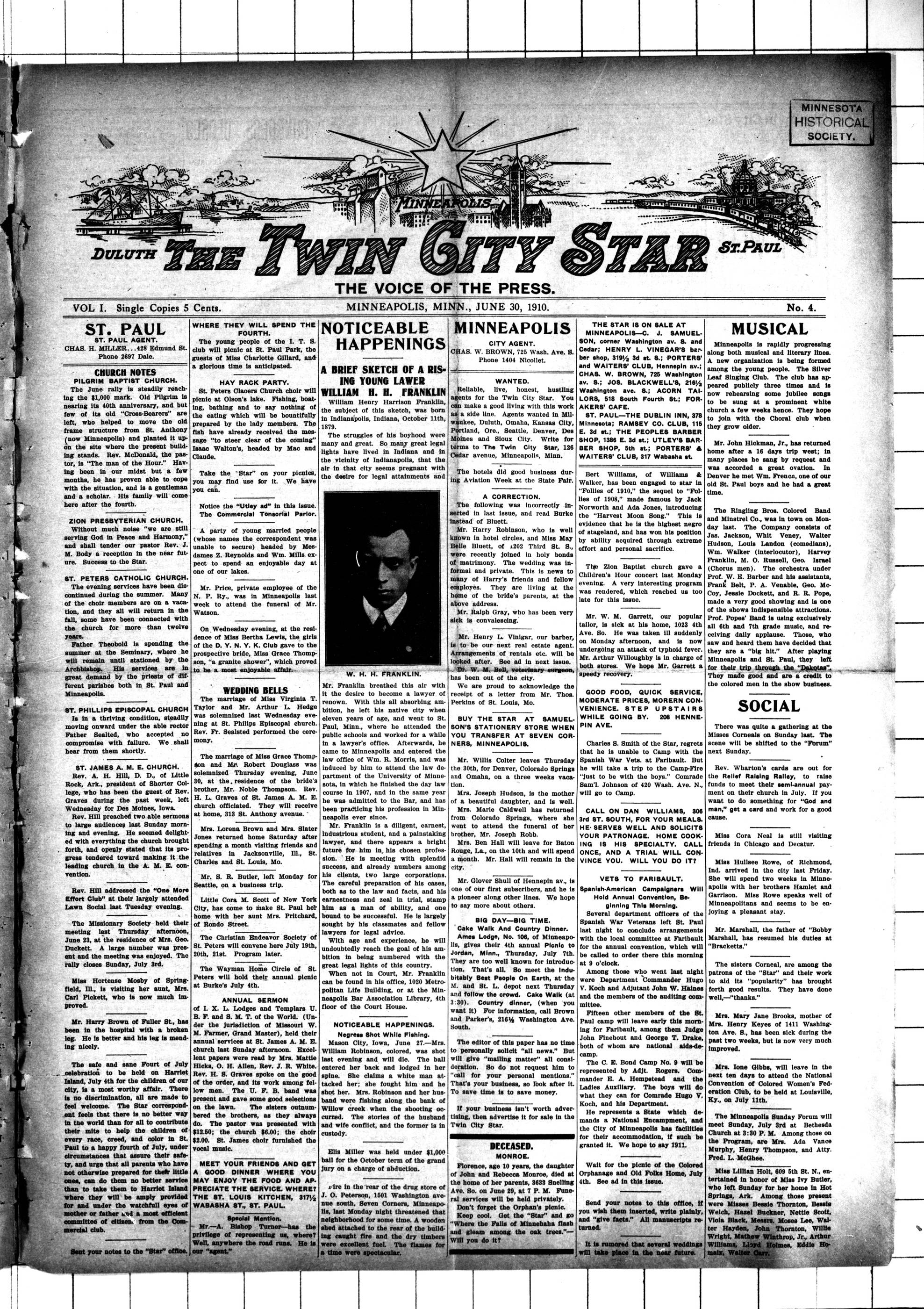
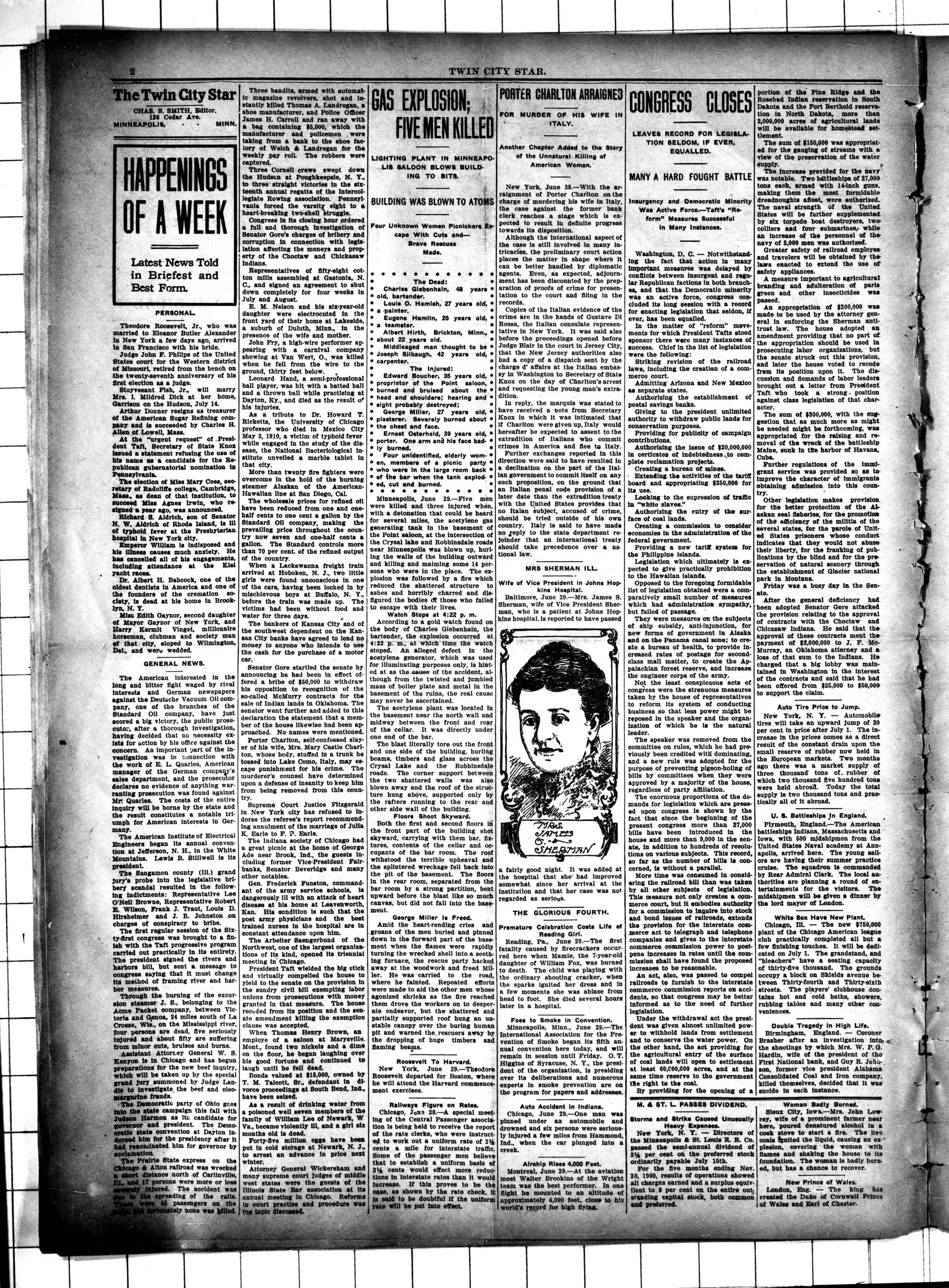
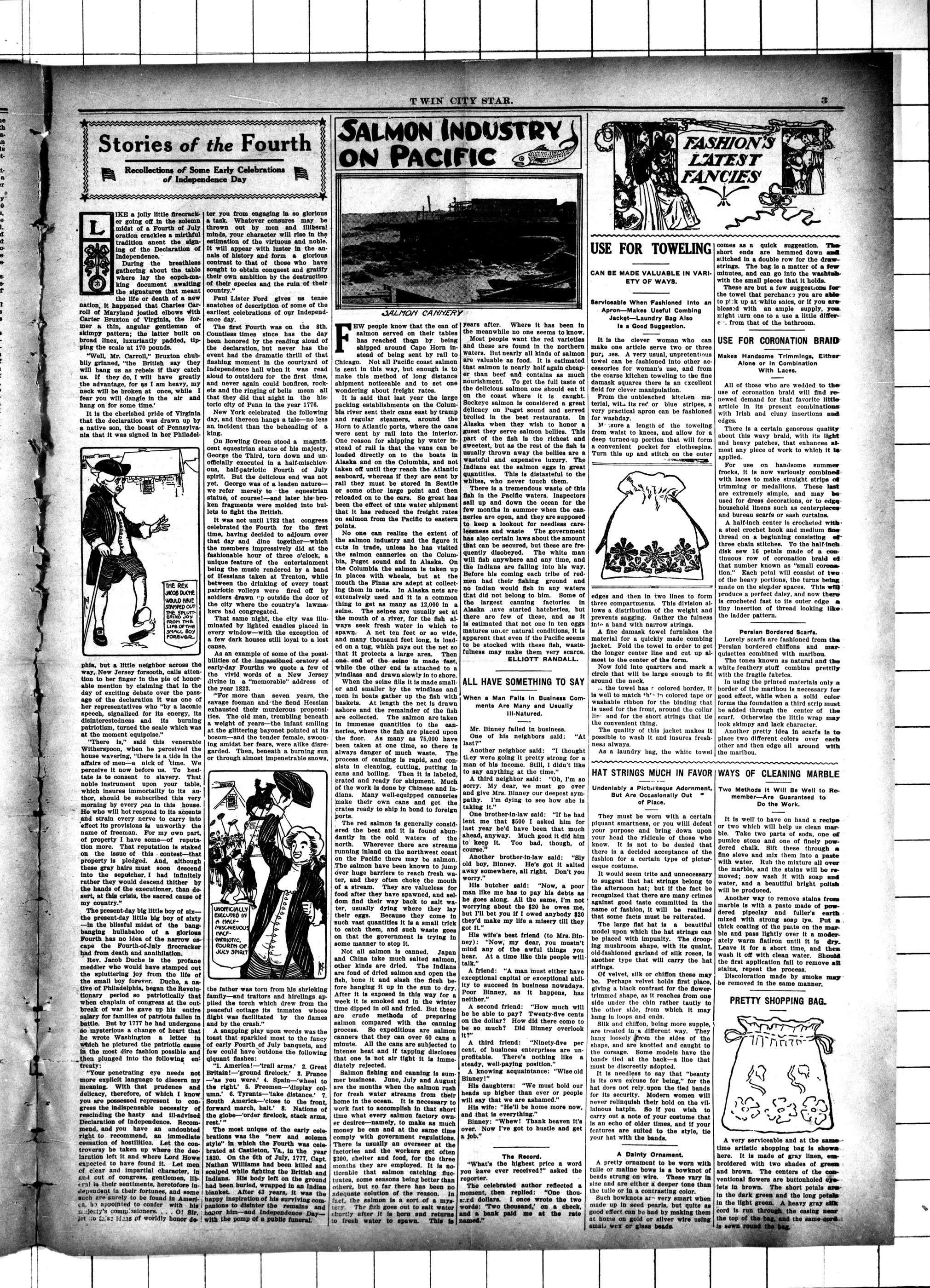
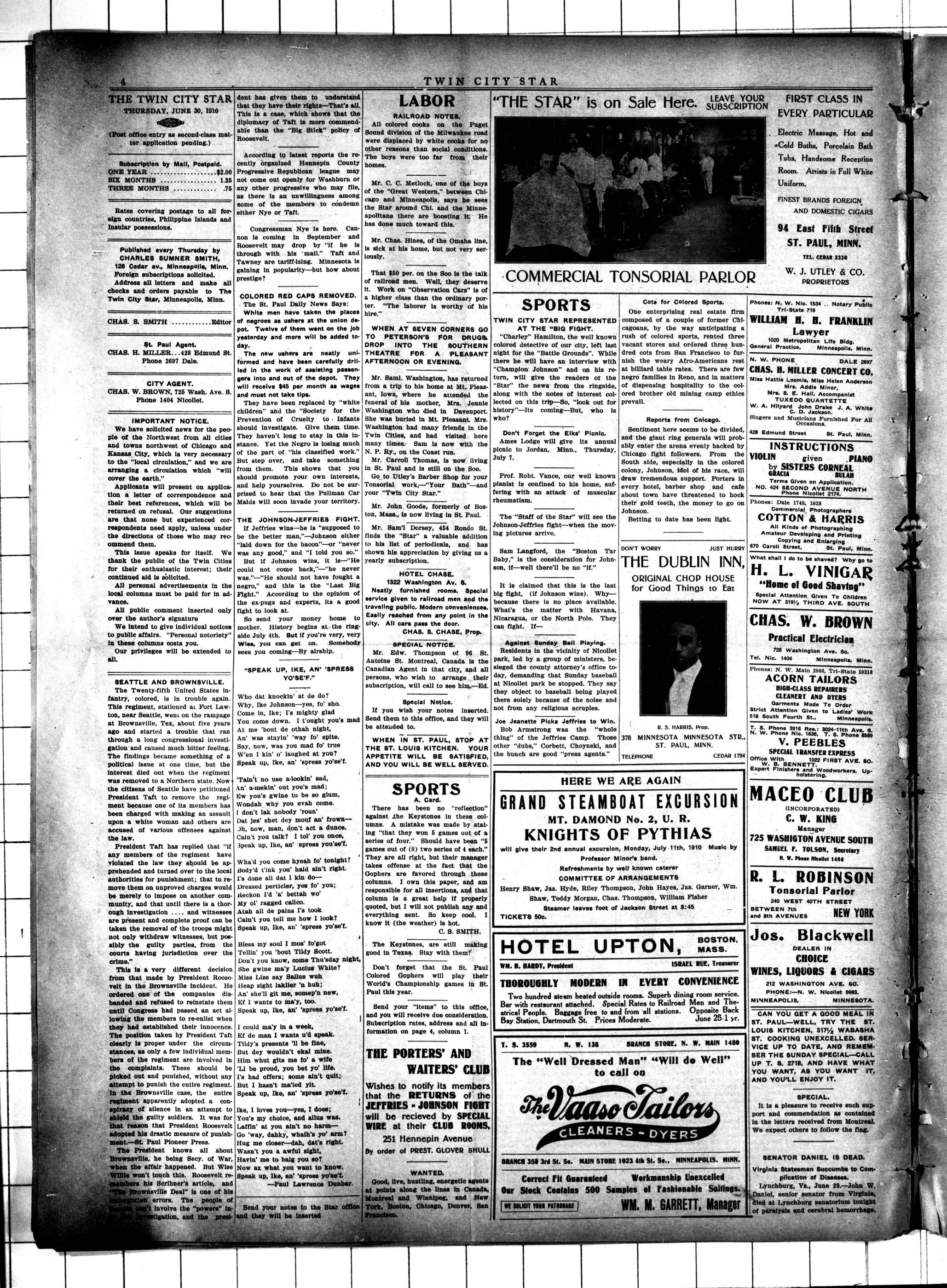
Page text (machine-generated)
VOL I. Single Copies 5 Cents.
CHAS. H. MILLER...428 Edmund St.
Phone 2697 Dale.
CHURCH NOTES
PILGRIM BAPTIST CHURCH.
The June rally is steadily reaching the $1,000 mark. Old Pilgrim is nearing its 40th anniversary, and but few of its old "Cross-Bearers" are left, who helped to move the old frame structure from St. Anthony (now Minneapolis) and planted it upon the site where the present building stands. Rev. McDonald, the pastor, is "The man of the Hour." Having been in our midst but a few months, he has proven able to cope with the situation, and is a gentleman and a scholar. His family will come here after the fourth.
ZION PRESBYTERIAN CHURCH.
Without much noise "we are still serving God in Peace and Harmony," and shall tender our pastor Rev. J. M. Body a reception in the near future. Success to the Star.
ST. PETERS CATHOLIC CHURCH.
ST. PETERS CATHOLIC CHURCH
The evening services have been dis-
continued during the summer. Many
of the choir members are on a vaca-
tion, and they all will return in the
fall, some have been connected with
the church for more than twelve
years.
Father Theobold is spending the
summer at the Seminary, where he
will remain until stationed by the
Archbishop. His services are in
great demand by the priests of dif-
ferent parishes both in St. Paul and
Minneapolis.
ST. PHILLIPS EPISCOPAL CHURCH
Is in a thriving condition, steadily
moving onward under the able rector
Father Sealted, who accepted no
compromise with failure. We shall
hear from them shortly.
ST. JAMES A. M. E. CHURCH.
Rev. A. H. Hill, D. D., of Little
Rock, Ark., president of Shorter Col-
lege, who has been the guest of Rev.
Graves during the week, left
Wednesday for Des Moines, Iowa.
Rev. Hill preached two able sermons to large audiences last Sunday morning and evening. He seemed delightful with everything the church brought forth, and openly stated that its progress tendered toward making it the leading church in the A. M. E. convention.
Rev. Hill addressed the "One More Effort Club" at their largely attended Lawn Social last Tuesday evening.
The Missionary Society held their meeting last Thursday afternoon, June 23, at the residence of Mrs. Geo. Duckett. A large number was present and the meeting was enjoyed. The rally closes Sunday, July 3rd.
Miss Hortense Mosby of Springfield, Ill., is visiting her aunt, Mrs. Carl Pickett, who is now much improved.
Mr. Harry Brown of Fuller St., has been in the hospital with a broken leg. He is better and his leg is mending nicely.
The safe and sane Fourt of July celebration to be held on Harriet Island, July 4th for the children of our city, is a most worthy affair. There is no discrimination, all are made to feel welcome. The Star correspondent feels that there is no better way in the world than for all to contribute their mite to help the children of every race, creed, and color in St. Paul to a happy fourth of July, under circumstances that assure their safety, and urge that all parents who have not otherwise prepared for their little ones, can do them no better service than to take them to Harriet Island where they will be amply provided for and under the watchfull eyes of mother or father and a most efficient committee of citizen, from the Commercial club.
WHERE THEY WILL SPEND THE FOURTH.
The young people of the I. T. S. club will picnic at St. Paul Park, the guests of Miss Charlotte Gillard, and a glorious time is anticipated.
HAY BACK PARTY.
St. Peters Claoers Church choir will picnic at Olson's lake. Fishing, boating, bathing and to say nothing of the eating which will be bountifully prepared by the lady members. The fish have already received the message "to steer clear of the coming" Isaac Walton's, headed by Mac and Claude.
Take the "Star" on your picnics, you may find use for it. We have you can.
Notice the "Utley ad" in this issue. The Commercial Tonsorial Parlor.
A party of young married people (whose names the correspondent was unable to secure) headed by Mesdames Z. Reynolds and Wm. Mills expect to spend an enjoyable day at one of our lakes.
Mr. Price, private employee of the N. P. Ry., was in Minneapolis last week to attend the funeral of Mr. Watson.
On Wednesday evening, at the residence of Miss Bertha Lewis, the girls of the D. Y. N. Y. K. Club gave to the prospective bride, Miss Grace Thompson, "a granite shower", which proved to be a most enjoyable affair.
WEDDING BELLS
The marriage of Miss Virginia T. Taylor and Mr. Arthur L. Hedge was solemnized last Wednesday evening at St. Philips Episcopal church. Rev. Fr. Sealsted performed the ceremony.
The marriage of Miss Grace Thompson and Mr. Robert Douglass was solemnized Thursday evening, June 30, at the residence of the bride's brother, Mr. Noble Thompson. Rev. H. L. Graves of St. James A. M. E. church officiated. They will receive at home, 313 St. Anthony avenue.
Mrs. Lorena Brown and Mrs. Slater Jones returned home Saturday after spending a month visiting friends and relatives in Jacksonville, Ill., St. Charles and St. Louis, Mo.
Mr. S. R. Butler, left Monday for Seattle, on a business trip.
Little Cora M. Scott of New York City, has come to make St. Paul her home with her aunt Mrs. Pritchard, of Rondo Street.
The Christian Endeavor Society of St. Peters will convene here July 19th, 20th, 21st. Program later.
The Wayman Home Circle of St. Peters will hold their annual picnic at Burke's July 4th.
ANNUAL SERMON
of I. X. L. Lodges and Templars U. B. F. and S. M. T. of the World. (Under the jurisdiction of Missouri W. M. Farmer, Grand Master), held their annual services at St. James A. M. E. church last Sunday afternoon. Excellent papers were read by Mrs. Mattle Hicks, O. H. Allen, Rev. J. R. White. Rev. H. S. Graves spoke on the good of the order, and its work among fellow men. The U. F. B. band was present and gave some good selections on the lawn. The sisters outnumbered the brothers, as they always do. The pastor was presented with $12.50; the church $6.00; the choir $2.00. St. James choir furnished the vocal music.
MEET YOUR FRIENDS AND GET A GOOD DINNER WHERE YOU MAY ENJOY THE FOOD AND APPRECIATE THE SERVICE WHERE? THE ST. LOUIS KITCHEN, 317½ WABASHA ST, ST. PAUL.
Special Mention.
Mr.—A. Bishop Turner—has the privilege of representing us, where? Well, anywhere the road runs. He is our "agent."
THE VOICE OF THE PRESS MINNEAPOLIS, MINN., JUNE 30, 1910.
NOTICEABLE HAPPENINGS
A BRIEF SKETCH OF A RISING YOUNG LAWER
WILLIAM H. H. FRANKLIN
William Henry Harrison Franklin, the subject of this sketch, was born in Indianapolis, Indiana, October 11th, 1879.
The struggles of his boyhood were many and great. So many great legal lights have lived in Indiana and in the vicinity of Indianapolis, that the air in that city seems pregnant with the desire for legal attainments and
W. H. H. FRANKLIN.
Mr. Franklin breathed this air with it the desire to become a lawyer of renown. With this all absorbing ambition, he left his native city when eleven years of age, and went to St. Paul, Minn., where he attended the public schools and worked for a while in a lawyer's office. Afterwards, he came to Minneapolis and entered the law office of Wm. R. Morris, and was induced by him to attend the law department of the University of Minnesota, in which he finished the day law course in 1907, and in the same year he was admitted to the Bar, and has been practicing his profession in Minneapolis ever since.
Mr. Franklin is a diligent, earnest, industrious student, and a painstaking lawyer, and there appears a bright future for him in his chosen profession. He is meeting with splendid success, and already numbers among his clients, two large corporations. The careful preparation of his cases, both as to the law and facts, and his earnestness and zeal in trial, stamp him as a man of ability, and one bound to be successful. He is largely sought by his classmates and fellow lawyers for legal advice.
With age and experience, he will undoubtedly reach the goal of his ambition in being numbered with the great legal lights of this country. When not in Court, Mr. Franklin can be found in his office, 1020 Metropolitan Life Building, or at the Minneapolis Bar Association Library, 4th floor of the Court House.
Mason City, Iowa, June 27.—Mrs. William Robinson, colored, was shot last evening and will die. The ball entered her back and lodged in her spine. She claims a white man attacked her; she fought him and he shot her. Mrs. Robinson and her husband were fishing along the bank of Willow creek when the shooting occurred. The stories of the husband and wife conflict, and the former is in custody.
Elis Miller was held under $1,000 ball for the October term of the grand jury on a charge of abduction.
Fire in the rear of the drug store of J. O. Peterson, 1501 Washington avenue south, Seven Corners, Minneapolis, last Monday night threatened that neighborhood for some time. A wooden shed attached to the rear of the building caught fire and the dry timbers were excellent fuel. The flames for a time were spectacular.
MINNEAPOLIS
CITY AGENT.
CHAS. W. BROWN, 725 Wash. Ave. S
Phone 1404 Nicollet.
WANTED.
Reliable, live, honest, hustling agents for the Twin City Star. You can make a good living with this work as a side line. Agents wanted in Milwaukee, Duluth, Omaha, Kansas City, Portland, Ore., Seattle, Denver, Des Moines and Sloux City. Write for terms to The Twin City Star, 126 Cedar avenue, Minneapolis, Minn.
The hotels did good business during Aviation Week at the State Fair.
A CORRECTION.
The following was incorrectly inserted in last issue, and read Burke instead of Bluet.
Mr. Harry Robinson, who is well known in hotel circles, and Miss May Belle Bluet, of 1202 Third St. S., were recently joined in holy bonds of matrimony. The wedding was informal and private. This is news to many of Harry's friends and fellow employees. They are living at the home of the bride's parents, at the above address.
Mr. Ralph Gray, who has been very sick is convalescing.
Mr. Henry L. Vinigar, our barber, is to be our next real estate agent. Arrangements of rentals etc. will be looked after. See ad in next issue.
Dr. W. M. Bell, veterinary surgeon, has been out of the city.
We are proud to acknowledge the receipt of a letter from Mr. Thos. Perkins of St. Louis, Mo.
BUY THE STAR AT SAMUELSON'S STATIONERY STORE WHEN YOU TRANSFER AT SEVEN CORNERS, MINNEAPOLIS.
Mr. Willis Colter leaves Thursday the 30th, for Denver, Colorado Springs and Omaha, on a three weeks vacation.
Mrs. Joseph Hudson, is the mother of a beautiful daughter, and is well.
Mrs. Marie Caldwell has returned from Colorado Springs, where she went to attend the funeral of her brother, Mr. Joseph Robb.
Mrs. Ben Hall will leave for Baton Rouge, La., on the 10th and will spend a month. Mr. Hall will remain in the city.
Mr. Glover Shull of Hennepin av., is one of our first subscribers, and he is a pioneer along other lines. We hope to say more about others.
BIG DAY—BIG TIME.
Cake Walk And Country Dinner. Ames Lodge, No. 106, of Minneapolis, gives their 4th annual Picnic to Jordan, Minn., Thursday, July 7th. They are too well known for introduction. That's all. So meet the Indubitably Best People On Earth, at the M. and St. L. depot next Thursday and follow the crowd. Cake Walk (at 3:30). Country dinner, (when you want it) For information, call Brown and Parker's, 216½ Washington Ave. South.
The editor of this paper has no time to personally solicit "all news." But will give "mailing matter" all consideration. So do not request him to "call for your personal mentions." That's your business, so look after it. To save time is to save money.
If your business isn't worth advertising, then advertise it for sale in the Twin City Star.
DFCFASFD.
Florence, age 10 years, the daughter of John and Rebecca Monroe, died at the home of her parents, 3633 Snelling Ave. So. on June 29, at 7 P. M. Funeral services will be held privately. Don't forget the Orphan's picnic. Keep cool. Get the "Star" and go "Where the Falls of Minnehaha flash and gleam among the oak trees."—Will you do it?
THE STAR IS ON SALE AT MINNEAPOLIS—C. J. SAMUELSON, corner Washington av. S. and Cedar; HENRY L. VINEGAR'S barber shop, 319½ 3d st. S.; PORTERS' and WAITERS' CLUB, Hennepin av.; CHAS. W. BROWN, 725 Washington av. S.; JOS. BLACKWELL'S, 216½ Washington ave. S.; ACORN TAILORS, 518 South Fourth St.; FORAKERS' CAFE.
ST. PAUL—THE DUBLIN INN, 378 Minnesota; RAMSEY CO. CLUB, 115 E. 3d st.; THE PEOPLES BARBER SHOP, 1386 E. 3d st.; UTLEY'S BARBER SHOP, 5th st.; PORTERS' and WAITERS' CLUB, 317 Wabasha st.
Bert Williams, of Williams & Walker, has been engaged to star in "Follies of 1910," the sequel to "Follies of 1908," made famous by Jack Norworth and Ada Jones, introducing the "Harvest Moon Song." This is evidence that he is the highest negro of stageland, and has won his position by ability acquired through extreme effort and personal sacrifice.
The Zion Baptist church gave a Children's Hour concert last Monday evening. A very interesting program was rendered, which reached us too late for this issue.
Mr. W. M. Garrett, our popular tailor, is sick at his home, 1023 4th Ave. So. He was taken ill suddenly on Monday afternoon, and is now undergoing an attack of typhoid fever. Mr. Arthur Willoughby is in charge of both stores. We hope Mr. Garrett a speedy recovery.
GOOD FOOD, QUICK SERVICE, MODERATE PRICES, MORERN CONVENIENCE. STEP UPSTAIRS WHILE GOING BY. 208 HENNEPIN AVE.
Charles S. Smith of the Star, regrets that he is unable to Camp with the Spanish War Vets. At Farbault. But he will take a trip to the Camp-Fire "just to be with the boys." Comrade Sam'l. Johnson of 420 Wash. Ave. N., will go to Camp.
CALL ON DAN WILLIAMS, 306
3rd ST. SOUTH, FOR YOUR MEALS.
HE SERVES WELL AND SOLICITS
YOUR PATRONAGE. HOME COOKING IS HIS SPECIALTY. CALL ONCE, AND A TRIAL WILL CONVINCE YOU. WILL YOU DO IT?
VETS TO FARIBAULT.
Spanish-American Campaigners Will Hold Annual Convention, Beginning This Morning.
Several department officers of the Spanish War Veterans left St. Paul last night to conclude arrangements with the local committee at Faribault for the annual convention, which will be called to order there this morning at 9 o'clock.
Among those who went last night were Department Commander Hugo V. Koch and Adjutant John W. Haines and the members of the auditing committee.
Fifteen other members of the St. Paul camp will leave early this morning for Faribault, among them Judge John Finehout and George T. Drake, both of whom are national aids-decamp.
The C. E. Bond Camp No. 9 will be represented by Adjt. Rogers. Commander E. A. Hempstead and the Ladies Auxiliary. The boys will do what they can for Comrade Hugo V. Koch, and his Department.
He represents a State which demands a National Encampment, and the City of Minneapolis has facilities for their accommodation, if such be granted it. We hope to say 1911.
Wait for the picnic of the Colored Orphanage and Old Folks Home, July 4th. See ad in this issue.
Send your notes to this office, if you wish them inserted, write plainly, and "give facts." All manuscripts returned.
It is rumored that several weddings will take place in the near future.
MINNESOTA
HISTORICAL
SOCIETY.
ST.PAUL
No. 4.
No. 4.
MUSICAL
Minneapolis is rapidly progressing along both musical and literary lines. A new organization is being formed among the young people. The Silver Leaf Singing Club. The club has appeared publicly three times and is now rehearsing some jubilee songs to be sung at a prominent white church a few weeks hence. They hope to join with the Choral club when they grow older.
Mr. John Hickman, Jr., has returned home after a 16 days trip west; in many places he sang by request and was accorded a great ovation. In Denver he met Wm. French, one of our old St. Paul boys and he had a great time.
The Ringling Bros. Colored Band and Minstrel Co., was in town on Monday last. The Company consists of Jas. Jackson, Whit Veney, Walter Hudson, Louis Landon (comedians), Wm. Walker (interlocutor), Harvey Franklin, M. O. Russell, Geo. Israel (Chorus men). The orchestra under Prof. W. E. Barber and his assistants, Frank Belt, P. A. Venable, Geo. McCoy, Jessie Dockett, and R. R. Pope, made a very good showing and is one of the shows indispensible attractions. Prof. Popes' Band is using exclusively all 6th and 7th grade music, and receiving daily applause. Those, who saw and heard them have decided that they are a "big hit." After playing Minneapolis and St. Paul, they left for their trip through the "Dakotas." They made good and are a credit to the colored men in the show business.
SOCIAL
There was quite a gathering at the Misses Corneals on Sunday last. The scene will be shifted to the "Forum" next Sunday.
Rev. Wharton's cards are out for the Relief Raising Ralley, to raise funds to meet their semi-annual payment on their church in July. If you want to do something for "God and man," get a card and work for a good cause.
Miss Cora Neal is still visiting friends in Chicago and Decatur.
Miss Hullsee Rowe, of Richmond, Ind. arrived in the city last Friday. She will spend two weeks in Minneapolis with her brothers Hamlet and Garrison. Miss Rowe speaks well of Minneapolisians and seems to be enjoying a pleasant stay.
Mr. Marshall, the father of "Bobby Marshall, has resumed his duties at "Bracketts."
The sisters Corneal, are among the patrons of the "Star" and their work to aid its "popularity" has brought forth good results. They have done well,—"thanks."
Mrs. Mary Jane Brooks, mother of Mrs. Henry Keyes of 1411 Washington Ave. S., has been sick during the past two weeks, but is now very much improved.
Mrs. Ione Gibbs, will leave in the next ten days to attend the National Convention of Colored Women's Federation Club, to be held at Louisville, Ky., on July 11th.
The Minneapolis Sunday Forum will meet Sunday, July 3rd at Bethesda Church at 3:30 P. M. Among those on the Program, are Mrs. Ada Vance Murphy, Henry Thompson, and Atty. Fred. L. McGhee.
Miss Lillian Holt, 609 5th St. N., entertained in honor of Miss Ivy Butler, who left Sunday for her home in Hot Springs, Ark. Among those present were Misses Bessie Thornton, Bessie Welch, Hazel Buckner, Nettie Scott, Viola Black, Messrs. Moses Lee, Walter Hayden, John Thornton, Willie Wright, Mathew Winthrop, Jr., Arthur Williams, Lloyd Holmes, Eddie Homay, Walter Clark.
---
CHAS. S. SMITH, Editor,
126 Cedar Ave.
MINNEAPOLIS. MINN.
HAPPENINGS OF A WEEK
Latest News Told in Briefest and Best Form.
PERSONAL.
Theodore Roosevelt, Jr., who was married to Eleanor Butler Alexander in New York a few days ago, arrived in San Francisco with his bride. Judge John F. Phillips of the United States court for the Western district of Missouri, retired from the bench on the twenty-seventh anniversary of his first election as a judge. Stuyvesant Fish, Jr., will marry Mrs. I. Mildred Dick at her home, Garrison on the Hudson, July 14. Arthur Donner resigns as treasurer of the American Sugar Refining company and is succeeded by Charles H. Allen of Lowell, Mass. At the "urgent request" of President Taft, Secretary of State Knox issued a statement refusing the use of his name as a candidate for the Republican gubernatorial nomination in Pennsylvania.
The election of Miss Mary Coes, secretary of Radcliffe college, Cambridge, Mass., as dean of that institution, to succeed Miss Agnes Irwin, who resigned a year ago, was announced. Richard S. Aldrich, son of Senator N. W. Aldrich of Rhode Island, is ill of typhoid fever at the Presbyterian hospital in New York city. Emperor William is indisposed and his illness causes much anxiety. He has cancelled all of his engagements, including attendance at the Kiel yacht races. Dr. Albert H. Babcock, one of the oldest dentists in America and one of the founders of the cremation society, is dead at his home in Brooklyn, N. Y. Miss Edith Gaynor, second daughter of Mayor Gaynor of New York, and Harry Kermit Vinget, millionaire horseman, clubman and society man of that city, eloped to Wilmington, Del., and were wedded.
GENERAL NEWS.
The American interested in the long and bitter fight waged by rival interests and German newspapers against the Deutsche Vacuum Oil company, one of the branches of the Standard Oil company, have just scored a big victory, the public prosecutor, after a thorough investigation, having decided that no necessity exists for action by his office against the concern. An important part of the investigation was in connection with the work of E. L. Quarles, American manager of the German company's sales department, and the prosecutor declares no evidence of anything warranting prosecution was found against Mr. Quarles. The costs of the entire inquiry will be borne by the state and the result constitutes a notable triumph for American interests in Germany.
The American Institute of Electrical Engineers began its annual convention at Jefferson, N. H., in the White Mountains. Lewis B. Stillwell is its president.
The Sangamon county (Ill.) grand jury's probe into the legislative bribery scandal resulted in the following indictments: Representative Lee O'Neil Browne, Representative Robert E. Wilson, Frank J. Traut, Louis D. Hirshelmer and J. B. Johnston on charges of conspiracy to bribe.
The first regular session of the Sixty-first congress was brought to a finish with the Taft progressive program carried out practically in its entirety. The president signed the rivers and harbors bill, but sent a message to congress saying that it must change its method of framing river and harbor measures.
Through the burning of the excursion steamer J. S., belonging to the Acme Packet company, between Victoria and Genoa, 24 miles south of La Crosse, Wis., on the Mississippi river, four persons are dead, five seriously injured and about fifty are suffering from minor cuts, bruises and burns.
Assistant Attorter General W. S. Kenyon is in Chicago and has begun preparations for the new beef inquiry, which will be taken up by the special grand jury summoned by Judge Landis to investigate the beef and oleomargarine frauds.
The Democratic party of Ohio goes into the state campaign this fall with Judson Harmon as its candidate for governor and president. The Democratic state convention at Dayton indorsed him for the presidency after it had renominated him for governor by acclamation.
The Prairie State express on the Chicago & Alton railroad was wrecked a short distance north of Carlinville, IL, and 17 persons were more or less severely injured. The accident was due to the spreading of the rails. There were 45 passengers on the train, fortunately none was killed.
Three bandits, armed with automatic magazine revolvers, shot and instantly killed Thomas A. Landregan, a shoe manufacturer, and Police Officer James H. Carroll and ran away with a bag containing $5,000, which the manufacturer and policemen were taking from a bank to the shoe factory of Welch & Landregan for the weekly pay roll. The robbers were captured.
Three Cornell crews swept down the Hudson at Poughkeepsie, N. Y., to three straight victories in the sixteenth annual regatta of the Intercollegiate Rowing association. Pennsylvania forced the varsity eight to a heart-breaking two-shell struggle.
Congress in its closing hour ordered a full and thorough investigation of Senator Gore's charges of bribery and corruption in connection with legislation affecting the moneys and property of the Choctaw and Chickasaw Indians.
Representatives of fifty-eight cotton mills assembled at Gastonia, N.C., and signed an agreement to shut down completely for four weeks in July and August.
E. M. Nelson and his six-year-old daughter were electrocuted in the front yard of their home at Lakeside, a suburb of Duluth, Minn., in the presence of the wife and mother.
John Fry, a high-wire performer appearing with a carnival company showing at Van Wert, O., was killed when he fell from the wire to the ground, thirty feet below.
Leonard Hand, a semi-professional ball player, was hit with a batted ball and a thrown ball while practising at Dayton, Ky., and died as the result of his injuries.
As a tribute to Dr. Howard T. Rickett, the University of Chicago professor who died in Mexico City May 3, 1910, a victim of typhoid fever while engaged in the study of the disease, the National Bacteriological Institute unveiled a marble tablet in that city.
More than twenty fire fighters were overcome in the hold of the burning steamer Alaskan of the American Hawaiian line at San Diego, Cal.
The wholesale prices for refined oil have been reduced from one and one-half cents to one cent a gallon by the Standard Oil company, making the prevailing price throughout the country now seven and one-half cents a gallon. The Standard controls more than 70 per cent. of the refined output of the country.
When a Lackawanna freight train arrived at Hoboken, N. J., two little girls were found unconscious in one of the cars, having been locked in by mischievous boys at Buffalo, N. Y., before the train was made up. The victims had been without food and water for three days.
The bankers of Kansas City and of the southwest dependent on the Kansas City banks have agreed to lend no money to anyone who intends to use the cash for the purchase of a motor car.
Senator Gore startled the senate by announcing he had been in effect offered a bribe of $50,000 to withdraw his opposition to recognition of the so-called McMurry contracts for the sale of Indian lands in Oklahoma. The senator went further and added to this declaration the statement that a member of the house likewise had been approached. No names were mentioned.
Porter Charlton, self-confessed slayer of his wife, Mrs. Mary Castle Charlton, whose body, stuffed in a trunk he tossed into Lake Como, Italy, may escape punishment for his crime. The murderer's counsel have determined upon a defense of insanity to keep him from being removed from this country. Supreme Court Justice Fitzgerald in New York city has refused to indorse the referee's report recommending annulment of the marriage of Julia K. Earle to F. P. Earle. The Indiana society of Chicago had a great picnic at the home of George Ade near Brook, Ind., the guests including former Vice-President Fairbanks, Senator Beveridge and many other notables.
Gen. Frederick Funston, commandant of the army service schools, is dangerously ill with an attack of heart disease at his home at Leavenworth, Kan. His condition is such that the post army physicians and the best trained nurses in the hospital are in constant attendance upon him. The Arbeiter Saengerbund of the Northwest, one of the largest organizations of its kind, opened its triennial meeting in Chicago. President Taft wielded the big stick and virtually compelled the house to yield to the senate on the provision in the sundry civil bill exempting labor unions from prosecutions with money granted in that measure. The house receded from its position and the senate amendment killing the exemption clause was accepted.
When Thomas Henry Brown, an employee of a saloon at Marysville. Mont, found two nickels and a dime on the floor, he began laughing over his good fortune and continued to laugh until he fell dead.
Bonds valued at $15,000, owned by T. M. Talcott, Sr., defendant in divorce proceedings at South Bend, Ind., have been seized.
As a result of drinking water from a poisoned well seven members of the family of William Lee of Newark, W. Va., became violently ill, and a girl six months old is dead.
Forty-five million eggs have been put in cold storage at Newark, N. J., to arrest an advance in price next winter.
Attorney General Wickersham and many supreme court judges of middle west states were the guests of the Illinois State Bar association at its annual meeting in Chicago. Reforms in court practise and procedure was the topic discussed.
TWIN CITY STAR.
GAS EXPLOSION; FIVE MEN KILLED
LIGHTING PLANT IN MINNEAPO
LIS SALOON BLOWS BUILD-
ING TO BITS.
* Louis O. Hamish, 27 years old,
* a painter.
* Eugene Hamlin, 25 years old,
* a teamster.
* Albert Hirth, Brickton, Minn,
* about 22 years old.
* Middleaged man thought to be
* Joseph Silbaugh, 42 years old,
* carpenter.
* The Injured:
* Edward Boucher, 35 years old,
* proprietor of the Point saloon,
* burned and bruised about the
* head and shoulders; hearing and
* sight probably destroyed;
* George Miller, 27 years old,
* plasterer. Severely burned about
* the chest and face.
* Ernest Osterheld, 39 years old,
* porter. One arm and his face bad-
*ly burned.
* Four unidentified, elderly wom-
* en, members of a picnic party
* who were in the large room back
* of the bar when the tank explod-
* ed, cut and burned.
Minneapolis, June 29.—Five men were killed and three injured when, with a detonation that could be heard for several miles, the acetylene gas generating tank in the basement of the Point saloon, at the intersection of the Crystal lake and Robbinsdale roads near Minneapolis was blown up, hurling the walls of the building outward and killing and maiming some 14 persons who were in the place. The explosion was followed by a fire which reduced the shattered structure to ashes and horribly charred and disfigured the bodies $\sigma$ those who failed to escape with their lives.
Watch Stops at 4:22 p. m.
Watch Stops at 4:22 p. m.
According to a gold watch found on the body of Charles Glebenhain, the bartender, the explosion occurred at 4:22 p. m., at which time the watch stoped. An alleged defect in the acetylene generator, which was used for illuminating purposes only, is hindered at as the cause of the accident, although from the twisted and jumbled mass of boiler plate and metal in the basement of the ruins, the real cause may never be ascertained.
The acetylene plant was located in the basement near the north wall and midway between the front and rear of the cellar. It was directly under one end of the bar.
The blast literally tore out the front and one side of the building, hurling beams, timbers and glass across the Crystal Lake and the Robbinsdale roads. The corner support between the two shattered walls was also blown away and the roof of the structure hung above, supported only by the rafters running to the rear and other side wall of the building.
Floors Shoot Skyward.
Both the first and second floors in the front part of the building shot skyward, carrying with them bar, fixtures, contents of the cellar and occupants of the bar room. The roof withstood the terrible upheaval and the splintered wreckage fell back into the pit of the basement. The floors in the rear room, separated from the bar room by a strong partition, bent upward before the blast like so much canvas, but did not fall into the basement.
George Miller Is Freed.
Amid the heart-rending cries and groans of the men buried and pinned down in the forward part of the basement when the flames were rapidly turning the wrecked shell into a seething furnace, the rescue party hacked away at the woodwork and freed Miller. He was carried to the road, where he fainted. Repeated efforts were made to aid the other men whose agonized shrieks as the fire reached them drove the workers on to desperate endeavor, but the shattered and partially supported roof hung an unstable canopy over the boring human pit and warned the rescuers away by the dropping of huge timbers and flaming beams.
Roosevelt To Harvard.
New York, June 29.—Theodore Roosevelt departed for Boston, where he will attend the Harvard commencement exercises.
Railways Figure on Rates
Chicago, June 28.—A special meeting of the Central Passenger association is being held to receive the report of the rate clerks, who were instructed to work out a uniform rate of $2\frac{1}{2}$ cents a mile for interstate traffic. Some of the passenger men believe that to establish a uniform basis of $2\frac{1}{2}$ cents would effect more reductions in interstate rates than it would increase. If this proves to be the case, as shown by the rate check, it is said to be doubtful if the uniform rate will be put into effect.
The Injured:
PORTER CHARLTON ARRAIGNED
FOR MURDER OF HIS WIFE IN ITALY.
Another Chapter Added to the Story of the Unnatural Killing of American Woman.
New York, June 28.—With the arraignment of Porter Charlton on the charge of murdering his wife in Italy, the case against the former bank clerk reaches a stage which is expected to result in definite progress towards its disposition.
Although the international aspect of the case is still involved in many intricacies, the preliminary court action places the matter in shape where it can be better handled by diplomatic agents. Even, as expected, adjournment has been discounted by the preparation of proofs of crime for presentation to the court and filing in the records.
Copies of the Italian evidence of the crime are in the hands of Gustave DI Rossa, the Italian consulate representative in New York. It was said also before the proceedings opened before Judge Blair in the court in Jersey City, that the New Jersey authorities also had a copy of a dispatch sent by the charge d' affairs at the Italian embassy in Washington to Secretary of State Knox on the day of Chariton's arrest and requesting the young man's extradition.
In reply, the marquis was stated to have received a note from Secretary Knox in which it was intimated that if Charlton were given up, Italy would hereafter be expected to assent to the extradition of Italians who commit crimes in America and flee to Italy. Further exchanges reported in this direction were said to have resulted in a declination on the part of the Italian government to commit itself on any such proposition, on the ground that an Italian penal code provision of a later date than the extradition treaty with the United States provides that no Italian subject, accused of crime, should be tried outside of his own country. Italy is said to have made no reply to the state department rejoinder that an international treaty should take precedence over a national law.
MRS SHERMAN ILL.
Wife of Vice President in Johns Hopkins Hospital.
Baltimore, June 29—Mrs. James S. Sherman, wife of Vice President Sherman, who is a patient at Johns Hopkins hospital, is reported to have passed
MRS. JAMES
S. SHERMAN
a fairly good night. It was added at the hospital that she had improved somewhat since her arrival at the institution and that her case was not regarded as serious.
THE GLORIOUS FOURTH.
Premature Celebration Costs Life of Reading Girl.
Reading, Pa., June 29.—The first fatality caused by firecrackers occurred here when Mamie, the 7-year-old daughter of William Fox, was burned to death. The child was playing with the ordinary shooting cracker, when the sparks ignited her dress and in a few moments she was ablaze from head to foot. She died several hours later in a hospital.
Foes to Smoke in Convention.
Minneapolis, Min., June 29.—The International Association for the Prevention of Smoke began its fifth annual convention here today, and will remain in session until Friday. O. T. Higgins of Syracuse, N. Y., the president of the organization, is presiding over its deliberations and numerous experts in smoke prevention are on the program for papers and addresses.
Auto Accident in Indiana.
Chicago, June 29.—One man was pinned under an automobile and drowned and six persons were seriously injured a few miles from Hammond, Ind., when the car plunged into a creek.
Airship Rises 4,000 Feet
Montreal, June 29.—At the aviation meet Walter Brookins of the Wright team was the best performer. In one flight he mounted to an altitude of approximately 4,000 feet, close to his world's record for high flying.
CONGRESS CLOSES
CONGRESS CLOSES
LEAVES RECORD FOR LEGISLA TION SELDOM, IF EVER, EQUALLED.
MANY A HARD FOUGHT BATTLE
Insurgency and Democratic Minority Was Active Force—Tatt's "Reform" Measures Successful In Many Instances.
Washington, D. C. — Notwithstanding the fact that action in many important measures was delayed by conflicts between insurgent and regular Republican factions in both branches, and that the Democratic minority was an active force, congress concluded its long session with a record for enacting legislation that seldon, if ever, has been equalled.
In the matter of "reform" movements for which President Tafts stood sponsor there were many instances of success. Chief in the list of legislation were the following:
Striking revision of the railroad laws, including the creation of a commerce court.
Admitting Arizona and New Mexico as separate states.
Authorizing the establishment of postal savings banks.
Giving to the president unlimited authority to withdraw public lands for conservation purposes.
Providing for publicity of campaign contributions.
Authorizing the issue of $20,000,000 in certificates of indebtedness to complete reclamation projects.
Creating a bureau of mines.
Extending the activities of the tariff board and appropriating $250,000 for its use.
Looking to the supression of traffic in "white slaves."
Authorizing the entry of the surface of coal lands.
Creating a commission to consider economies in the administration of the federal government.
Providing a new tariff system for the Philippine islands.
Legislation which ultimately is expected to give practically prohibition to the Hawaiian islands.
Opposed to the foregoing formidable list of legislation obtained were a comparatively small number of measures which had administration sympathy, but failed of passage.
They were measures on the subjects of ship subsidy, anti-injunction, for new forms of government in Alaska and on the Panama canal zone; to create a bureau of health, to provide increased rates of postage for second-class mail matter, to create the Appalachian forest reserve, and increase the engineer corps of the army.
Not the least conspicuous acts of congress were the strenuous measures taken by the house of representatives to reform its system of conducting business so that less power might be reposed in the speaker and the organization of which he is the natural leader.
The speaker was removed from the committee on rules, which he had previously been credited with dominating, and a new rule was adopted for the purpose of preventing pigeon-hoiling of bills by committees when they were approved by a majority of the house, regardless of party affiliation.
The enormous proportions of the demands for legislation which are pressed upon congress is shown by the fact that since the beginning of the present congress more than 27,000 bills have been introduced in the house and more than 9,000 in the senate, in addition to hundreds of resolutions on various subjects. This record, so far as the number of bills is concerned, is without a parallel.
More time was consumed in considering the railroad bill than was taken by all other subjects of legislation. This measure not only creates a commerce court, but it embodies authority for a commission to inquire into stock and bond issues of railroads, extends the provision for the interstate commerce act to telegraph and telephone companies and gives to the interstate commerce commission power to postpone increases in rates until the commission shall have found the proposed increases to be reasonable.
An act, also, was passed to compel railroads to furnish to the interstate commerce commission reports on accidents, so that congress may be better informed as to the need of further legislation.
Under the withdrawal act the president was given almost unlimited power to withhold lands from settlement and to conserve the water power. On the other hand, the act providing for the agricultural entry of the surface of coal lands will open to settlement at least 60,000,000 acres, and at the same time reserve to the government the right to the coal.
By providing for the opening of a
M. & ST. L. PASSES DIVIDEND.
Storms and Strike Caused Unusually Heavy Expenses.
New York, N. Y. — Directors of the Minneapolis and St. Louis R. R. Co. passed the semi-annual dividend of $2\frac{1}{2}$ per cent on the preferred stock ordinarily payable July 15th. For the five months ending Nov. 30, 1909, results of operations showed all charges earned and a surplus equivalent to 8 per cent on the entire outstanding capital stock, both common and preferred.
portion of the Pine Ridge and the Rosebud Indian reservation in South Dakota and the Fort Berthold reservation in North Dakota, more than 2,000,000 acres of agricultural lands will be available for homestead settlement.
The sum of $150,000 was appropriated for the gauging of streams with a view of the preservation of the water supply.
The increase provided for the navy was notable. Two battleships of 27,000 tons each, armed with 14-inch guns, making them the most formidable dreadnoughts afloat, were authorized.
The naval strength of the United States will be further supplemented by six torpedo boat destroyers, two collers and four submarines, while an increase of the personnel of the navy of 3,000 men was authorized.
Greater safety of railroad employees and travelers will be obtained by the laws enacted to extend the use of safety appliances.
A measure important to agricultural branding and adulteration of paris green and other insecticides was passed.
An appropriation of $200,000 was made to be used by the attorney general in enforcing the Sherman antitrust law. The house adopted an amendment providing that no part of the appropriation should be used in prosecuting labor organizations, but the senate struck out this provision, and later the house voted to recode from its position upon it. The discussion and demands of labor leaders brought out a letter from President Taft who took a strong position against class legislation of that character.
The sum of $300,000, with the suggestion that as much more as might be needed might be forthcoming, was appropriated for the raising and removal of the wreck of the battleship Maine, sunk in the harbor of Havana, Cuba.
Further regulations of the immigrant service was provided as to improve the character of immigrants obtaining admission into this country.
Other legislation makes provision for the better protection of the Alaskan seal fisheries, for the promotion of the efficiency of the militia of the several states, for the parole of United States prisoners whose conduct indicates that they would not abuse their liberty, for the franking of publications by the blind and for the preservation of natural scenery through the establishment of Glacier national park in Montana.
Friday was a busy day in the Senate.
After the general deficiency had been adopted Senator Gere attacked the provision relating to the approval of contracts with the Choctaw and Chicasaw Indians. He said that the approval of these contracts ment the payment of $3,000,000 to J. F. McMurray, an Oklahoma attorney and a loss of that sum to the Indians. He charged that a big lobby was maintained in Washington in the interest of the contracts and said that he had been offered from $25,000 to $50,000 to support the claim.
Auto Tire Price to Jump.
New York, N. Y. — Automobile tires will take an upward jump of 20 per cent in price after July 1. The increase in the prices comes as a direct result of the constant drain upon the small reserve of rubber now held in the European markets. Two months ago there was a market supply of three thousand tons of rubber of which two thousand five hundred tons were held abroad. Today the total supply is two thousand tons and practically all of it abroad.
U. 8. Battleships In England.
Plymouth, England.—The American battleships Indiana, Massachusetts and Iowa, with 500 midshipmen from the United States Naval academy at Annapolis, arrived here. The young sailors are having their summer practice cruise. The squadron is commanded by Rear Admiral Clark. The local authorities are planning a round of entertainments for the visitors. The midshipmen will be given a dinner by the lord mayor of London.
White Sex Have New Plant.
Chicago, Ill. — The new $750,000 plant of the Chicago American league club practically completed all but a few finishing touches. It will be dedicated on July 1. The grandstand, and "bleachers" have a seating capacity of thirty-five thousand. The grounds occupy a block on Shields avenue between Thirty-fourth and Thirty-sixth streets. The players' clubhouse contains hot and cold baths, showers, rubbing tables and many other conveniences.
Double Tragedy In High Life.
Birmingham, England. — Coroner Brasher after an investigation into the shootings by which Mrs. W. P.G. Hardin, wife of the president of the First National bank, and Guy R. Johnson, former vice president Alabama Consolidated Coal and Iron company, killed themselves, decided that it was suicide in each instance.
Woman Badly Burned.
Woman Bady Burne.
Sloux City, lown—Mrs. John Lowrey, wife of a prominent farmer near here, poured denatured alcohol in a cook stove to start a fire. The live coals limited the liquid, causing an explosion, covering the woman with flames and shaking the house to its foundation. The woman is badly burned, but has a chance to recover.
New Prince of Wales.
London, Eng. — The king has created the Duke of Cornwall Prince of Wales and Earl of Chester.
Stories of the Fourth
Recollections of Some Early Celebrations of Independence Day
IKE a jolly little firecracker going off in the solemn midst of a Fourth of July oration crackles a mirthful tradition anent the signing of the Declaration of Independence.
ter you from engaging in so glorious a task. Whatever censures may be thrown out by men and illiberal minds, your character will rise in the estimation of the virtuous and noble. It will appear with luster in the anals of history and form a glorious
L
During the breathless gathering about the table where lay the oech-making document awaiting the signatures that meant the life or death of a new nation, it happened that Charles Carroll of Maryland josted elbows with Carter Bruxton of Virginia, the former a thin, angular gentleman of skimpy pattern; the latter built on broad lines, luxuriantly padded, tipping the scale at 170 pounds.
"Well, Mr. Carroll." Bruxton chubbily grinned, the British say they will hang us as rebelts if they catch us. If they do, I will have greatly the advantage, for as I am heavy, my neck will be broken at once, while I fear you will dangle in the air and hang on for some time."
It is the cherished pride of Virginia that the declaration was drawn up by a native son, the boast of Pennsylvania that it was signed in her Philadel-
THE REV. JACOB DUCHE WOULD HAVE STAMPED OUT THE SPLITTERING JOY FROM THE LIFE OF THE SMALL BOY FOREVER.
phia, but a little neighbor across the way, New Jersey forsooth, calls attention to her finger in the ple of honorable mention by claiming that in the day of exciting debate over the passage of the declaration it was one of her representatives who "by a lactic speech, signalized for its energy, its disinterestedness and its burning patriotism, turned the scale which was at the moment equilune."
"There is," said this venerable Witerspoon, when he perceived the house wavering, "there is a tide in the affairs of men—a nick of time. We perceive it now before us. To hesitate is to consent to slavery. That noble instrument upon your table, which insures immortality to its author, should be subscribed this very morning by every pen in this house. He who will hot respond to its accents and strain every nerve to carry into effect its provisions is unworthy the name of freeman. For my own part, of property I have some—of reputation more. That reputation is staked on the issue of this contest—that property is pledged. And, although these gray hairs must soon descend into the sepulchre, I had infinitely rather they would descend thither by the hands of the executioner, than desert, at this crisis, the sacred cause of my country."
The present-day big little boy of six—the present-day little big boy of sixty—in the blissful midst of the bang-banging hullaboo of a glorious Fourth has no idea of the narrow escape the Fourth-of-July firecracker had from death and annihilation.
Rev. Jacob Duche is the profane meddler who would have stamped out the spluttering joy from the life of the small boy forever. Duche, a native of Philadelphia, began the Revolutionary period so patroltotically that when chaplain of congress at the outbreak of war he gave up his entire salary for families of patriots fallen in battle. But by 1777 he had undergone so mysterious a change of heart that he wrote Washington a letter in which he pictured the patriotic cause in the most dire fashion possible and then plunged into the following entreaty:
"Your penetrating eye needs not more explicit language to discern my meaning. With that prudence and delicacy, therefore, of which I know you are possessed represent to congress the indispensable necessity of rescinding the hasty and ill-advised Declaration of Independence. Recommend, and you have an undoubted right to recommend, an immediate cessation of hostilities. Let the controversy be taken up where the declaration left it and where Lord Howe expected to have found it. Let men of clear and impartial character, in and out of congress, gentlemen, liberal in their sentiments, heretofore independent in their fortunes, and some such are surely to be found in America, be appointed to confer with his majesty's commissioners. . . . O! Sir, let no fiasco ideas of worldly honor de-
ter you from engaging in so glorious a task. Whatever censures may be thrown out by men and illiberal minds, your character will rise in the estimation of the virtuous and noble. It will appear with luster in the annals of history and form a glorious contrast to that of those who have sought to obtain conquest and gratify their own ambition by the destruction of their species and the ruin of their country."
Paul Lister Ford gives us tense snatches of description of some of the earliest celebrations of our Independence day.
The first Fourth was on the 8th. Countless times since has the day been honored by the reading aloud of the declaration, but never has the event had the dramatic thrill of that flashing moment in the courtyard of Independence hall when it was read aloud to outsiders for the first time, and never again could bonfires, rockets and the ringing of bells mean all that they did that night in the historic city of Penn in the year 1776. New York celebrated the following day, and thereon hangs a tale—no less an incident than the beheading of a king.
On Bowling Green stood a magnificent equestrian statue of his majesty, George the Third, torn down and unofficially executed in a half-mischievous, half-patriotic Fourth of July spirit. But the delicious end was not yet. George was of a leaden nature—we refer merely to the equestrian statue, of course!—and later his broken fragments were molded into bullets to fight the British.
It was not until 1782 that congress celebrated the Fourth for the first time, having decided to adjourn over that day and dine together—which the members impressively did at the fashionable hour of three o'clock, a unique feature of the entertainment being the music rendered by a band of Hessians taken at Trenton, while between the drinking of every east patriotic volleys were fired off by soldiers drawn outside the door of the city where the country's lawmakers had congregated.
That same night, the city was illuminated by lighted candles placed in every window—with the exception of a few dark houses still loyal to a lost cause.
As an example of some of the possibilities of the impassioned oratory of early-day Fourths we quote a few of the vivid words of a New Jersey divine in a "memorable" address of the year 1823.
"For more than seven years, the savage foeman and the fiend Hessian exhausted their murderous propensities. The old man, trembling beneath a weight of years—the infant smiling at the glittering bayonet pointed at its bosom—and the tender female, swooning amidst her fears, were alike disregarded. Then, beneath a burning sun or through almost impenetrable snows.
UNOFFICIALLY
EXECUTED IN
A HACE-
MISCHEUOUS
HACE-
ARBITRIC,
EQUARTER OF
JULY SPIRIT
the father was torn from his shrieking family—and traitors and hirelings applied the torch which drew from the peaceful cottage its inmates whose flight was facilitated by the flames and by the crash."
A snapping play upon words was the toast that sparkled most to the fancy of early Fourth of July banquets, and few could have outdone the following qlquant flashes:
"1. America!—'trail arms.' 2. Great Britain!—'ground firelock.' 3. France—'as you were.' 4. Spain—'wheel to the right.' 5. Freemen—'display column.' 6. Tyrants—'take distance.' 7. South America—'close to the front, forward march, halt.' 8. Nations of the globe—'order firelock, stack arms, rest.'"
The most unique of the early celebrations was the "new and solemn style" in which the Fourth was celebrated at Castleton, Va., in the year 1820. On the 6th of July, 1777, Capt. Nathan Williams had been killed and scaled while fighting the British and Indians. His body left on the ground had been buried, wrapped in an Indian blanket. After 43 years, it was the happy inspiration of his surviving companions to disinter the remains and honor him—and Independence Day—with the pomp of a public funeral.
TWIN CITY STAR.
SALMON INDUST
ON PACIFIC
INDUSTRY
FIC
SALMON INDUSTRY ON PACIFIC
THE FISHING MARKET
years after. Where it has been in the meanwhile no one seems to know. Most people want the red varieties and these are found in the northern waters. But nearly all kinds of salmon are valuable as food. It is estimated that salmon is nearly half again cheaper than beef and contains as much nourishment. To get the full taste of the delicious salmon one should eat it on the coast where it is caught. Sockeye salmon is considered a great delicacy on Puget sound and served broiled in the best restaurants. In Alaska when they wish to honor a guest they serve salmon bellies. This part of the fish is the richest and sweetest, but as the rest of the fish is usually thrown away the bellies are a wasteful and expensive luxury. The Indians eat the salmon eggs in great quantities. This is distasteful to the whites, who never touch them.
There is a tremendous waste of this fish in the Pacific waters. Inspectors sail up and down the ocean for the few months in summer when the canneries are open, and they are supposed to keep a lookout for needless carelessness and waste. The government has also certain laws about the amount that can be secured, but these are frequently disobeyed. The white man will fish anywhere and any time, and the Indians are falling into his way. Before his coming each tribe of redmen had their fishing ground and no Indian would fish in any waters that did not belong to him. Some of the largest canning factories in Alaska have started hatcheries, but there are few of these, and as it is estimated that not one in ten eggs matures under natural conditions, it is apparent that even if the Pacific seems to be stocked with these fish, wastefulness may make them very scarce.
ELLIOTT RANDALL
ALL HAVE SOMETHING TO SAY
When a Man Falls in Business Comments Are Many and Usually Ill-Natured.
Mr. Binney failed in business.
Mr. Binney failed in business. One of his neighbors said: "At last?"
Another neighbor said: "I thought they were going it pretty strong for a man of his income. Still, I didn't like to say anything at the time."
A third neighbor said: "Oh, I'm so sorry. My dear, we must go over and give Mrs. Binney our deepest sympathy. I'm dying to see how she is taking it."
One brother-in-law said: "If he had lent me that $500 I asked him for last year he'd have been that much ahead, anyway. Much good it did him to keep it. Too bad, though, of course."
Another brother-in-law said: "Sly old boy, Binney. He's got it salted away somewhere, all right. Don't you worry."
His butcher said: "Now, a poor man like me has to pay his debts as he goes along. All the same, I'm not worrying about the $20 he owes me, but I'll bet you if I owed anybody $20 they'd make my life a misery till they got it."
His wife's best friend (to Mrs. Binney): "Now, my dear, you mustn't mind any of the awful things you hear. At a time like this people will talk."
A friend: "A man must either have exceptional capital or exceptional ability to succeed in business nowadays. Poor Binney, as it happens, has neither."
A second friend: "How much will he be able to pay? Twenty-five cents on the dollar? How did there come to be so much? Did Binney overlook it?"
A third friend: "Ninety-five per
percent, of business enterprises are
unprofitable. There's nothing like a
steady, well-paying position."
A knowing acquaintance: "Wise old
Binney!"
His daughters: "We must hold our
heads up higher than ever or people
will say that we are ashamed."
His wife: "He'll be home more now,
and that is everything."
Binney: "Whew! Thank heaven it's
over. Now I've got to hustle and get a
job."
"What's the highest price a word you have ever received?" asked the reporter.
The celebrated author reflected a moment, then replied: "One thousand dollars. I once wrote the two words: 'Two thousand,' on a check, and a bank paid me at the rate named."
```markdown
```
SALMON CANNERY
Few people know that the can of salmon served on their tables has reached them by being shipped around Cape Horn instead of being sent by rail to Chicago. Not all Pacific coast salmon is sent in this way, but enough is to make this method of long distance shipment noticeable and to set one wondering about freight rates.
It is said that last year the large packing establishments on the Columbia river sent their cans east by tramp and regular steamers, around the Horn to Atlantic ports, where the cans were sent by rail into the interior. One reason for shipping by water instead of rail is that the vans can be loaded directly on to the boats in Alaska and on the Columbia, and not taken off until they reach the Atlantic seaboard, whereas if they are sent by rail they must be stored in Seattle or some other large point and then reloaded on to the cars. So great has been the effect of this water shipment that it has reduced the freight rates on salmon from the Pacific to eastern points.
No one can realize the extent of the salmon industry and the figure it cuts in trade, unless he has visited the salmon canneries on the Columbia, Puget sound and in Alaska. On the Columbia the salmon is taken up in places with wheels, but at the mouth the Finns are adept at collecting them in nets. In Alaska nets are extensively used and it is a common thing to get as many as 12,000 in a seine. The seines are usually set at the mouth of a river, for the fish always seek fresh water in which to spawn. A net ten feet or so wide, and many thousand feet long, is loaded on a tug, which pays out the net so that it protects a large area. Then one end of the seine is made fast, while the other end is attached to a windlass and drawn slowly in to shore.
When the seine fills it is made smaller and smaller by the windlass and men in boats gather up the fish with baskets. At length the net is drawn ashore and the remainder of the fish are collected. The salmon are taken in immense quantities to the canneries, where the fish are placed upon the floor. As many as 75,000 have been taken at one time, so there is always danger of much waste. The process of canning is rapid, and consists in cleaning, cutting, putting in cans and boiling. Then it is labeled, crated and ready for shipment. Much of the work is done by Chinese and Indians. Many well-equipped canneries make their own cans and get the crates ready to ship in bond to foreign ports.
The red salmon is generally considered the best and it is found abundantly in the cold waters of the north. Wherever there are streams running inland on the northwest coast on the Pacific there may be salmon. The salmon have been known to jump over huge barriers to reach fresh water, and they often choke the mouth of a stream. They are valueless for food after they have spawned, and seldom find their way back to salt water, usually dying where they lay their eggs. Because they come in such vast quantities it is a small trick to catch them, and such waste goes on that the government is trying in some manner to stop it.
Not all salmon is canned. Japan and China take much salted salmon, other kinds are dried. The Indians are fond of dried salmon and open the fish, bone it and slash the flesh before hanging it up in the sun to dry. After it is exposed in this way for a week it is smoked and in the winter time dipped in oil and fried. But these are crude methods of preparing salmon compared with the canning process. So expeditious are salmon canners that they can over 60 cans a minute. All the cans are subjected to intense heat and if tapping discloses that one is not air tight it is immediately relected.
Salmon fishing and canning is summer business. June, July and August are the months when the salmon rush for fresh water streams from their home in the ocean. It is necessary to work fast to accomplish in that short time what every salmon factory owner desires—namely, to make as much money he can and at the same time comply with government regulations. There is usually an overseer at the factories and the workers get often $300, shelter and food, for the three months they are employed. It is noticeable that salmon catching fluctuates, some seasons being better than others, but so far there has been no adequate solution of the reason. In fact, the salmon is a sort of a mystery. The fish goes out to salt water shortly after it is born and returns to fresh water to spawn. This is
The Record.
FASHION'S
LATEST
FANCIES
USE FOR TOWELING
CAN BE MADE VALUABLE IN VARI
ETY OF WAYS.
Serviceable When Fashioned Into an Apron—Makes Useful Combing Jacket—Laundry Bag Also Is a Good Suggestion.
It is the clever woman who can make one article serve two or three purposes. A very usual, unpretentious towel can be fashioned into other accessories for woman's use, and from the coarse kitchen toweling to the fine damask squares there is an excellent field for clever manipulation.
From the unbleached kitchen material, with its red or blue stripes, a very practical apron can be fashioned for washday.
Measure a length of the towelling from waist to knees, and allow for a deep turned-up portion that will form a convenient pocket for clothespins. Turn this up and stitch on the outer
edges and then in two lines to form three compartments. This division allows a distribution of the weight and prevents sagging. Gather the fulness into a band with narrow strings.
A fine damask towel furnishes the material for a quickly made combing jacket. Fold the towel in order to get the longer center line and cut up almost to the center of the form.
Now fold into quarters and mark a circle that will be large enough to fit around the neck.
At the towel has r colored border, it is well to match hh- hh- colored tape or washable ribbon for the binding that is used for the front, around the collar line and for the short strings that tie the convenient thing.
The quality of this jacket makes it possible to wash it and insures freshness always.
As a laundry bag, the white towel
Undeniably a Picturesque Adornment,
But Are Occasionally Out
of Place.
They must be worn with a certain
pliant smartness, or you will defeat
your purpose and bring down upon
your head the ridicule of those who
know. It is not to be denied that
there is a decided acceptance of the
fashion for a certain type of picturesque costume.
It would seem trite and unnecessary
to suggest that hat strings belong to
the afternoon hat; but if the fact be
recognized that there are many crimes
against good taste committed in the
name of fashion, it will be realized
that some facts must be reiterated.
The large flat hat is a beautiful model upon which the hat strings can be placed with impunity. The drooping mushroom shape, with its quality, old-fashioned garland of silk roses, is another type that will carry the hat strings.
Of velvet, silk or chiffon these may be. Perhaps velvet holds first place, giving a black contrast for the flower-trimmed shape, as it reaches from one side under the chin rather tautly to the other side, from which it may hang in loops and ends.
Silk and chiffon, being more supple, are treated in a different way. They hang loosely from the sides of the shape, and are knotted and caught to the corsage. Some models have the bands tied at the back—a line that must be discreetly adopted.
It is needless to say that "beauty is its own excuse for being," for the hat does not rely upon the tied bands for its security. Modern women will never relinquish their hold on the villainous hatpin. So if you wish to carry out a note of your costume that is an echo of older times, and if your features are suited to the style, tie your hat with the bands.
A Dainty Ornament.
A pretty ornament to be worn with tulle or maline bows is a bowknot of beads strung on wire. These vary in size and are either a deeper tone than the tulle or in a contrasting color. Such bowknots are very smart when made up in seed pearls, but quite as good effect can be had by making them at home on gold or silver wire using small wex or glass beads.
comes as a quick suggestion. The short ends are hemmed down and stitched in a double row for the drawstrings. The bag is a matter of a few minutes, and can go into the washtub with the small pieces that it holds. These are but a few suggestions for the towel that perchance you are able to pick up at white sales, or if you are blessed with an ample supply, you might turn one to a use a little difference from that of the bathroom.
USE FOR CORONATION BRAID
Makes Handsome Trimmings, Either Alone or In Combination With Laces.
All of those who are wedded to the use of coronation braid will find renewed demand for that favorite little article in its present combinations with Irish and cluny insertions and edges.
There is a certain generous quality about this wavy braid, with its light and heavy patches, that enhances almost any piece of work to which it is applied.
For use on handsome summer frocks, it is now variously combined with laces to make straight strips of trimming or medallions. These last are extremely simple, and may be used for dress decorations, or to edge household linens such as centerpieces and bureau scarfs or sash curtains.
A half-inch center is crocheted with a steel crochet hook and medium fine thread on a beginning consisting of three chain sitches. To the half-inch disk sew 16 petals made of a continuous row of coronation braid of that number known as "small coronation." Each petal will consist of two of the heavy portions, the turns being made on the slender spaces. This will produce a perfect daisy, and now there is crocheted fast to its outer edge a tiny insertion of thread looking like the ladder pattern.
Persian Bordered Scarfs.
Lovely scarfs are fashioned from the Persian bordered chiffons and marquisettes combined with maribou. The tones known as natural and the white feathery stuff combine prettily with the fragile fabrics. In using the printed materials only a border of the maribou is necessary for good effect, while when a solid color forms the foundation a third strip must be added through the center of the scarf. Otherwise the little wrap may look skimpy and lack character. Another pretty idea in scarfs is to place two different colors over each other and then edge all around with the maribou.
Two Methods It Will Be Well to Remember—Are Guaranteed to Do the Work.
It is well to have on hand a recipe or two which will help us clean marble. Take two parts of soda, one of pumice stone and one of finely powdered chalk. Sift these through a fine sieve and mix them into a paste with water. Rub the mixture all over the marble, and the stains will be removed; now wash it with soap and water, and a beautiful bright polish will be produced.
Another way to remove stains from marble is with a paste made of powdered pipeclay and fuller's earth mixed with strong soap lye. Put a thick coating of the paste on the marble and pass lightly over it a moderately warm fatron until it is dry. Leave it for a short time, and then wash it off with clean water. Should the first application fail to remove all stains, repeat the process. Discoloration made by smoke may be removed in the same manner.
PRETTY SHOPPING BAG.
A very servicable and at the same time artistic shopping bag is shown here. It is made of gray linen, embroidered with two shades of green and brown. The centers of the conventional flowers are buttonholeed eyelens in brown. The short petals are in the dark green and the long petals in the light green. A heavy gray silk cord is run through the casing near the top of the bag, and the same cord is sewn round the bag.
(Post office entry as second-class matter application pending.)
Subscription by Mail, Postpaid.
ONE YEAR ..... $2.00
SIX MONTHS ..... 1.25
THREE MONTHS ..... 7.5
Rates covering postage to all foreign countries, Philippine Islands and Insular possessions.
Published every Thursday by CHARLES SUMNER SMITH,
128 Cedar av., Minneapolis, Minn.
Foreign subscriptions solicited.
Address all letters and make all checks and orders payable to The Twin City Star, Minneapolis, Minn.
CHAS. S. SMITH ..... Editor
St. Paul Agent.
CHAS. H. MILLER...428 Edmund St
Phone 2697 Dale.
CITY AGENT.
CHAS. W. BROWN, 725 Wash. Ave. S
Phone 1404 Nicollet.
IMPORTANT NOTICE.
We have solicited news for the people of the Northwest from all cities and towns northwest of Chicago and Kansas City, which is very necessary to the "local circulation," and we are arranging a circulation which "will cover the earth."
Applicants will present on application a letter of correspondence and their best references, which will be returned on refusal. Our suggestions are that none but experienced correspondents need apply, unless under the directions of those who may recommend them.
This issue speaks for itself. We thank the public of the Twin Cities for their enthusiastic interest; their continued aid is solicited.
All personal advertisements in the local columns must be paid for in advance.
All public comment inserted only over the author's signature
We intend to give individual notices to public affairs. "Personal notoriety" in these columns costs you.
Our privileges will be extended to all.
SEATTLE AND BROWNSVILLE.
The Twenty-fifth United States infantry, colored, is in trouble again.
This regiment, stationed at Fort Lawton, near Seattle, went on the rampage at Brownsville, Tex., about five years ago and started a trouble that ran through a long congressional investigation and caused much bitter feeling.
The findings became something of a political issue at one time, but the interest died out when the regiment was removed to a Northern state. Now the citizens of Seattle have petitioned President Taft to remove the regiment because one of its members has been charged with making an assault upon a white woman and others are accused of various offenses against the law.
President Taft has replied that "if any members of the regiment have violated the law they should be apprehended and turned over to the local authorities for punishment; that to remove them on unproved charges would be merely to impose on another community, and that until there is a thorough investigation ... and witnesses are present and complete proof can be taken the removal of the troops might not only withdraw witnesses, but possibly the guilty parties, from the courts having jurisdiction over the crime."
This is a very different decision from that made by President Roosevelt in the Brownsville incident. He ordered one of the companies disbanded and refused to reinstate them until Congress had passed an act allowing the members to re-enlist when they had established their innocence. The position taken by President Taft clearly is proper under the circumstances, as only a few individual members of the regiment are involved in the complaints. These should be picked out and punished, without any attempt to punish the entire regiment. In the Brownsville case, the entire regiment apparently adopted a conspiracy of silence in an attempt to shield the guilty soldiers. It was for that reason that President Roosevelt adopted his drastic measure of punishment—St. Paul Pioneer Press.
The President knows all about Brownsville, he being Secy. of War, when the affair happened. But Wise Willie won't touch this. Roosevelt remembers his Scribner's article, and "The Brownsville Deal" is one of his misgiven errors. The people of Browns can't involve the "powers" in investigation, and the prei-
dent has given them to understand that they have their rights—That's all. This is a case, which shows that the diplomacy of Taft is more commendable than the "Big Stick" policy of Roosevelt.
According to latest reports the recently organized Hennepin County Progressive Republican league may not come out openly for Washburn or any other progressive who may file, as there is an unwillingness among some of the members to condemn either Nye or Taft.
Congressman Nye is here. Cannon is coming in September and Roosevelt may drop by "if he is through with his mail." Taft and Tawney are tariff-izing. Minnesota is gaining in popularity—but how about prestige?
COLORED RED CAPS REMOVED.
The St. Paul Daily News Says:
White men have taken the places of negroes as ushers at the union depot. Twelve of them went on the job yesterday and more will be added today.
The new ushers are neatly uniformed and have been carefully drilled in the work of assisting passengers into and out of the depot. They will receive $45 per month as wages and must not take tips.
They have been replaced by "white children" and the "Society for the Prevention of Cruelty to Infants should investigate. Give them time. They haven't long to stay in this instance. Yet the Negro is losing much of the part of "his classified work." But step over, and take something from them. This shows that you should promote your own interests, and help yourselves. Do not be surprised to hear that the Pullman Car Malds will soon invade your territory.
THE JOHNSON-JEFFRIES FIGHT.
If Jeffries wins—he is "supposed to be the better man,"—Johnson either "lald down for the bacon"—or "never was any good," and "I told you so." But if Johnson wins, it is—"He could not come back,"—"he never was."—"He should not have fought a negro," and this is the "Last Big Fight." According to the opinion of the ex-pugs and experts, its a good fight to look at.
So send your money home to mother. History begins at the ring-side July 4th. But if you're very, very Wise, you can get on. Somebody sees you coming—By airship.
"SPEAK UP, IKE, AN' 'SPRESS YO'SEF."
Who dat knockin' at de do?
Why, Ike Johnson—yes, fo' sho.
Come in, Ike; I's mighty glad
You come down. I tought you's mad
At me 'bout de othah night,
An' was stayin' 'way fo' spite.
Say, now, was you mad fo' true
W'en I kin' o' laughed at you?
Speak up, Ike, an' 'spress yo'se' f.
'Tain't no use a-looking' sad,
An' a-mekin' out you're mad;
Ew you's gwine to be so glum,
Wondah why you evah come.
I don't lak nobody 'roun'
Dat jes' shet dey mouf an' frown—
Oh, now, man, don't act a dunce.
Cain't you talk? I tol' you once,
Speak up, Ike, an' 'spress you'se' f.
Wha'd you come yehay fo' tonlight?
Body'd t'ink you' haid ain't right.
I's done all dat I kin do—
Dressed perticler, yes fo' you;
Reckon I'd 'a' bettah wo'
My ol' ragged calico.
Atah all de pains I's took
Cain't you tell me how I look?
Speak up, Ike, an' 'spress yo'se'f.
Bless my soul I mos' fo'got
Tellin' you 'bout Tildy Scott.
Don't you know, come Thu'sday night
She gwine ma'y Lucius White?
Miss Lize say Sallus wuh
Heap slick laker 'n huh;
An' she'll git me, somep'n new,
Ef I wants to ma'y, too.
Speak up, Ike, an' 'spress yo'se'f.
I could ma'y in a week,
Ef de man I wants u'd speak.
Tildy's presents 'll be fine,
But dey wouldn't ekal mine.
Him whut gits me fo' a wife
'Ll be proud, you bet yo' life.
I's had offers; some ain't quit;
But I hasn't ma'led yit.
Speak up, Ike, an 'spress yo'se'f.
Ike, I loves you—yes, I does;
You's my choice, and allus was.
Laffin' at you ain't no harm—
Go 'way, dahky, whaih's yo' arm?
Hug me closer—dah, dat's right.
Wasn't you a awful sight,
Havin' me to baig you so?
Now ax what you want to know.
Speak up, Ike, an 'spress yo'se'f.
—Paul Lawrence Dunbar.
Send your notes to the Star office and they will be inserted
TWIN CITY STAR
"THE STAR" is on
COMMERCIAL T
S
COMMERCIAL TONSORIAL PARLOR
TWIN CITY STAR REPRESENTED AT THE "BIG FIGHT.
"Charley" Hamilton, the well known colored detective of our city, left last night for the "Battle Grounds". While there he will have an interview with "Champion Johnson" and on his return, will give the readers of the "Star" the news from the ringside, along with the notes of interest collected on this trip—So, "look out for history"—Its coming—But, who is who?
Don't Forget the Elks' Picnic. Ames Lodge will give its annual picnic to Jordan, Minn., Thursday, July 7.
Prof. Robt. Vance, our well known pianist is confined to his home, suffering with an attack of muscular rheumatism.
The "Staff of the Star" will see the Johnson-Jeffries fight—when the moving pictures arrive.
Sam Langford, the "Boston Tar Baby," is the consideration for Johnson, if—well there'll be no "if."
It is claimed that this is the last big fight, (if Johnson wins). Why—because there is no place available. What's the matter with Havana, Nicaragua, or the North Pole. They can fight. If—
Against Sunday Ball Playing.
Residents in the vicinity of Nicollet park, led by a group of ministers, besieged the county attorney's office today, demanding that Sunday baseball at Nicollet park be stopped. They say they object to baseball being played there solely because of the noise and not from any religious scruples.
Joe Jeanette Picks Jeffries to Win.
Bob Armstrong was the "whole thing" of the Jeffries Camp. Those other "dubs," Corbett, Choynskl, and the bunch are good "press agents."
GRAND STEAMBLE
MT. DAMOND
KNIGHTS OF
will give their 2nd annual excursion
Professor M
Refreshments by
COMMITTEE OF
Henry Shaw, Jas. Hyde, Riley Thom
Shaw, Teddy Morgan, Chas
Steamer leaves foot of
TICKETS 50c.
HOTEL UP
GRAND STEAMBOAT EXCURSION MT. DAMOND No. 2, U. R. KNIGHTS OF PYTHIAS
will give their 2nd annual excursion, Monday, July 11th, 1910 Music by Professor Minor's band.
Refreshments by well known caterer
COMMITTEE OF ARRANGEMENTS
Henry Shaw, Jas. Hyde, Riley Thompson, John Hayes, Jas. Garner, Wm.
Shaw, Teddy Morgan, Chas. Thompson, William Fisher
Steamer leaves foot of Jackson Street at 8:45
TICKETS 50c.
WM. H. HARDY, President
THOROUGHLY MODERN
Two hundred steam heated outside Bar with restaurant attached. Spec atrical People. Baggage free to any Bay Station, Dartmouth St. Prices
T. S. 3559 N. W. 138
The "Well Dressed to ca
Two hundred steam heated outside rooms. Superb dining room service. Bar with restaurant attached. Special Rates to Railroad Men and Theatrical People. Baggage free to and from all stations. Opposite Back Bay Station. Dartmouth St. Prices Moderate. June 25 1-4.
The "Well Dressed Man" "Will do Well" to call on The Vaaso Tailors CLEANERS - DYERS
Correct Fit Guaranteed Workmanship Unexcelled Our Stock Contains 500 Samples of Fashionable Suitings. WE SOLICIT YOUR PATRONAGE WM. M. GARRETT, Manager
LABOR
RAILROAD NOTES.
All colored cooks on the Puget Sound division of the Milwaukee road were displaced by white cooks for no other reasons than social conditions. The boys were too far from their homes.
Mr. C. C. Metlock, one of the boys of the "Great Western," between Chicago and Minneapolis, says he sees the Star around Chl. and the Minneapolitans there are boosting it. He has done much toward this.
Mr. Chas. Hines, of the Omaha line, is sick at his home, but not very seriously.
That $50 per. on the Soo is the talk of railroad men. Well, they deserve it. Work on "Observation Cars" is of a higher class than the ordinary porter. "The laborer is worthy of his hire."
WHEN AT SEVEN CORNERS GO TO PETERSON'S FOR DRUGS DROP INTO THE SOUTHERN THEATRE FOR A PLEASANT AFTERNOON OR EVENING.
Mr. Saml. Washington, has returned from a trip to his home at Mt. Pleasant, Iowa, where he attended the funeral of his mother, Mrs. Jennie Washington who died in Davenport. She was buried in Mt. Pleasant. Mrs. Washington had many friends in the Twin Cities, and had visited here many times. Sam is now with the N. P. Ry., on the Coast run.
Mr. Carroll Thomas, is now living in St. Paul and is still on the Soo. Go to Utley's Barber Shop for your Tonsorial work,—"Your Bath"—and your "Twin City Star."
Mr. John Goode, formerly of Boston, Mass., is now living in St. Paul.
Mr. Saml' Dorsey, 454 Rondo St. finds the "Star" a valuable addition to his list of periodicals, and has shown his appreciation by giving us a yearly subscription.
Neatly furnished rooms. Special service given to railroad men and the traveling public. Modern conveniences. Easily reached from any point in the city. All cars pass the door. CHAS. S. CHASE, Prop.
SPECIAL NOTICE
Mr. Edw. Thompson of 96 St. Antoine St. Montreal, Canada is the Canadian Agent in that city, and all persons, who wish to arrange, their subscription, will call to see him.-Ed
Special Notice.
If you wish your notes inserted. Send them to this office, and they will be attended to.
WHEN IN ST. PAUL, STOP AT THE ST. LOUIS KITCHEN. YOUR APPETITE WILL BE SATISFIED, AND YOU WILL BE WELL SERVED.
There has been no "reflection" against the Keystones in these columns. A mistake was made by stating "that they won 5 games out of a series of four." Should have been "5 games out of (8) two series of 4 each." They are all right, but their manager takes offense at the fact that the Gophers are favored through these columns. I own this paper, and am responsible for all insertions, and that column is a great help if properly quoted, but I will not publish any and everything sent. So keep cool. I know it (the weather) is hot.
C. S. SMITH.
The Keystones, are still making good in Texas. Stay with them!
Don't forget that the St. Paul Colored Gophers will play their World's Championship games in St. Paul this year.
Send your "items" to this office, and you will receive due consideration. Subscription rates, address and all information on page 4, column 1.
THE PORTERS' AND
Wishes to notify its members that the RETURNS of the JEFFRIES - JOHNSON FIGHT will be recieved by SPECIAL WIRE at their CLUB ROOMS,
251 Hennepin Avenue
By order of PREST. GLOVER SHULL
WANTED.
Good, live, hustling, energetic agents at points along the lines in Canada, Montreal and Winnipeg, and New York, Boston, Chicago, Denver, San
SPORTS
HERE WE ARE AGAIN
Cots for Colored Sports.
One enterprising real estate firm composed of a couple of former Chicagoans, by the way anticipating a rush of colored sports, rented three vacant stores and ordered three hundred cots from San Francisco to furnish the weary Afro-Americans rest at billiard table rates. There are few negro families in Reno, and in matters of dispensing hospitality to the colored brother old mining camp ethics prevail.
Reports from Chicago.
Sentiment here seems to be divided, and the giant ring generals will probably enter the arena evenly backed by Chicago fight followers. From the South side, especially in the colored colony, Johnson, idol of his race, will draw tremendous support. Porters in every hotel, barber shop and cafe about town have threatened to hock their gold teeth, the money to go on Johnson. Betting to date has been light.
DON'T WORRY
THE DUBLIN INN,
ORIGINAL CHOP HOUSE
for Good Things to Eat
R. S. HARRIS, Prop.
378 MINNESOTA MINNESOTA STR.
ST. PAUL, MINN.
TELEPHONE CEDAR 1794
BOAT EXCURSION
No. 2, U. R.
OF PYTHIAS
Monday, July 11th, 1910 Music by
minor's band.
well known caterer
ARRANGEMENTS
Jpson, John Hayes, Jas. Garner, Wm.
Thompson, William Fisher
Jackson Street at 8:45
PTON, BOSTON, MASS.
IN EVERY CONVENIENCE
the rooms. Superb dining room service.
Special Rates to Railroad Men and The-
d from all stations. Opposite Back
Moderate. June 25-1 yr.
BRANCH STORE, N. W. MAIN 1480
Man" "Will do Well"
JUST HURRY
ISRAEL RUE, Treasurer
FIRST CLASS IN
EVERY PARTICULAR
Electric Massage, Hot and
Cold Baths, Porcelain Bath
Tubs, Handsome Reception
Room. Artists in Full White
Uniform.
FINEST BRANDS FOREIGN
AND DOMESTIC CIGARS
94 East Fifth Street
ST. PAUL, MINN.
TEL. CEBAR 3330
W. J. UTLEY & CO.
PROPRIETORS
Phones: N. W. Nic. 1534 ... Notary Public
Tri-State 719
WILLIAM H. H. FRANKLIN
Lawyer
1020 Metropolitan Life Bldg.
General Practice, Minneapolis, Minn.
N. W. PHONE DALE 2697
CHAS. H. MILLER CONCERT CO.
Miss Hattie Loomis, Miss Helen Anderson
Mrs. Addle Minor,
Mrs. S. E. Hall, Accompanist
TUXEDO QUARTETTE
W. A. Hilyard John Drake J. A. White
C. D. Jackson.
Singers and Musicians Furnished For All
Occasions.
428 Edmund Street St. Paul, Minn.
INSTRUCTIONS
VIOLIN given PIANO
by SISTERS CORNEAL
GRACIA BULAN
Terms Given on Application.
NO. 424 SECOND AVENUE NORTH
Phone Nicollet 2174.
Phones: Dale 1748, 1028
Commercial Photographers
COTTON & HARRIS
All Kinds of Photographing
Amateur Developing and Printing
Copying and Enlarging
670 Caroll Street,
St. Paul, Minn.
What shall I do to be shaved? Why go to
H. L. VINIGAR
"Home of Good Shaving"
Special Attention Given To Children
NOW AT 319H 31TH AVE. SOUTH
CHAS. W. BROWN
725 Washington Ave. So.
Tel. Nic. 1404 Minneapolis, Minn.
Phones: N. W. Main 2066, Tri-State 10218
ACORN TAILORS
HIGH-CLASS REPAIRERS
CLEANERT AND DYERS
Garments Made To Order
Strict Attention Given to Ladies' Work
518 South Fourth St., Minneapolis.
T. S. Phone 3916 Res.: 3024-11th Ave. S.
N. W. Phone Nic. 1636, T. S. Phone 8589
V. PEEBLES
SPECIAL TRANSFER EXPRESS
Office With
1022 FIRST AVE. So.
W. E. BENNETH
Expert Finishers and Woodworkers. Upholstering.
MACEO CLUB
(INCORPORATED)
C. W. KING
Manager
725 WASHIGTON AVENUE SOUTH
SAMUEL F. TOLSON, Secretary
N. W. Phone Nicollet 1404
R. L. ROBINSON
Tonsorial Parlor
240 WEST 40TH STREET
BETWEEN 7th
and 8th AVENUES
NEW YORK
Jos. Blackwell
DEALER IN
CHOICE
WINES, LIQUORS & CIGARS
212 WASHINGTON AVE. SO.
PHONE:—N. W. Nicollet 9983.
MINNEAPOLIS, MINNEOTA.
CAN YOU GET A GOOD MEAL IN
ST. PAUL—WELL, TRY THE ST.
LOUIS KITCHEN, 317½ WABASHA
ST. COOKING UNEXCELLED. SERVICE UP TO DATE, AND REMEMBER THE SUNDAY SPECIAL—CALL UP T. S. 2718, AND HAVE WHAT YOU WANT, AS YOU WANT IT,
AND YOU'LL ENJOY IT.
SPECIAL.
It is a pleasure to receive such support and commendation as contained in the letters received from Montreal. We expect others to follow the flag.
SENATOR DANIEL IS DEAD.
Virginia Statesman Succumbs to Complication of Diseases.
plication of Diseases.
Lynchburg, Va., June 29.—John W.
Daniel, senior senator from Virginia,
died at Lynchburg sanatorium tonight
of paralysis and cerebral hemorrhage.