Twin City Star
Thursday, July 7, 1910
Minneapolis, Minnesota
Page text (machine-generated)
ST. PAUL AGENT.
CHAS. H. MILLER...428 Edmund St.
Phone 2697 Dale.
The people of our city are highly elated over the recent victory of Jack Johnson, while the better element do not wish to encourage brutalism, prize fighting etc. The press, and white race in general have chided and nagged not only the one man concerned. But the race in general and indeed made it a race fight; ridiculed the Southern colored people for praying for nothing more or less than justice, and the prayer of the righteous prevailed much. God moved in a mysterious way, yea Ethiopia shall stretch forth her hand, and the first shall be last and last first, and our enemies shall hang their heads in shame.
The Handicraft Art Club of St. Paul has disbanded for the summer.
Mr. and Mrs. O. C. Hall, of Fauquier St. entertained in honor of Misses Helen and Birdie White, and little Miss Margurite Nave. An enjoyable evening was spent. Those present were Misses Helen Anderson, Francis Elliott, Elizabeth Johnson of Duluth, Messrs. McMurray, A. V. Hall, M. A. Bolding, F. D. McCracken, S. R. Ranson.
The D. Y. N. Y. K. Club gave a kitchen shower for Miss Eugenia Davis, Tuesday evening.
Mrs. O. C. Hall of our city, matron of the State Institution for unfortunate colored children, arrived home Sunday evening, from Taft, Olk. With her came Miss Margurite Nave of Muskogee, Okla., 9 years old, who is known as the "Oil Queen." She owns seven oil wells of great value in her own right. Mrs. Hall will return to her position in a month. She has had great success, and is considered a race woman of culture and destination.
Do not forget that your subscription must be paid, or your paper will not continue. If you wish to be kept on the list, you must pay. This is a newspaper, and to print news costs something. Do it now.
The Dublin Inn, the restaurant of Mr. Sid. Harris, was damaged by fire during last week. The loss was not so great, but caused him to close for a few days undergoing repairs. He is now able to accommodate his guests, and has made some improvements.
The Saintly city showed a great display of patriotism on Independence Day. Flags and bunting floated everywhere.
Rev. J. R. White, Exalted Ruler, Gopher Lodge No. 106, has been elected as delegate to the national convention of Elks, to be held at Washington, D. C., July 26, 1910.
St. Paul people who will visit out of town this summer.
Mrs. Alex Payne of Iglehart street, will visit her sister, Mrs. La Rue, leaving Thursday evening, July 6th, on her way she will stop over at Louisville to attend the convention of the colored Women's Federation of Clubs, which meets in that city.
Mrs. Tom Williams and Mrs. Val Do Turner, leave Friday morning for Louisville, to attend the colored Women's Federation of Clubs.
Mrs. Birdie High leaves Friday morning for Chicago.
Mrs. W. D. Carter will visit friends in Chicago, leaving St. Paul Thursday night.
Mrs. Ida Mills will spend a month in Portland. She will start Saturday, July 10th.
Little Miss Muriel, daughter of our esteemed reporter, Mrs. Geo. Lucas of Rondo street, left Saturday morning to spend the summer with relatives at Chicago, Ill.
MEET YOUR FRIENDS AND GET A GOOD DINNER WHERE YOU MAY ENJOY THE FOOD AND APPECIATE THE SERVICE. WHERE? THE ST. LOUIS KITCHEN, 317½ WABASHA ST., ST. PAUL.
Send your subscription to this office, along with your notes. We are "delivering the goods." You do your part. If the people of the Twin Cities want a newspaper, they should try and make one.
Miss Blanch Barrette of Huston, Texas, a niece of Mr. Robert Minor of Central avenue, will spend the summer in our city.
Mr. J. E. Johnson of Duluth, was in the city on the Fourth, to visit his family.
Mrs. J. A. Smith of Kaslo, B. C. is visiting Mrs. J. B. Johnson of Marion street.
Mr. Harry Brown of Fuller St., has been in the hospital with a broken leg. He is better and his leg is mending nicely.
WEDDING BELLS
At high noon Friday, July 1st, Mrs. Kittie Manning and Mr. Wm. Harrison were joined in the holy bonds of matrimony by Rev. H. S. Graves of St. James, A. M. E. church.
Miss Eugenia Davis and Mr. William E. Webber were married Wednesday evening, July 6th, at 8:30. Many friends were present and bade God speed to the happy couple. Rev. McDonald performed the ceremony.
CHURCH NOTES
ST. JAMES A. M. E. CHURCH.
Rev. H. S. Graves will attend the quarterly meeting, Sunday, July 10, at St. James Church, Minneapolis, where he will preach.
There will be no meeting of the Missionary Alliance this month.
Owing to the warm weather, St. James, Sunday school will convene at 10 A. M. every Sunday, until further notice, also church service at 11 A. M. and 8 P. M. These services will begin on time and will close exactly one hour from above time given.
The Christian Endeavor Society of St. Peters will convene here July 19th, 20th, 21st. Program later.
Mrs. Geo. Lucas is another of St. Paul's wide awake talented lights. The St. Paul manager congratulates himself upon securing the services of this well known lady, who will report all St. Paul happenings, solicit your subscription and ads. Address. C. H. Miller, manager, 428 Edmund St.; Mrs. Geo. Lucas, reporter, 597 Rondo St.
Chas. H. Miller.
ARE YOU LOYAL TO YOUR INSTITUTIONS?
If you are, you will not fail to be present at our
BOAT EXCURSION JULY 19, 1910.
Given for the Direct Benefit of our
I. X. L. BRASS BAND, whose progress and advancement has been marvelous.
With your help it is destined to take a high place in the musical world.
D. L. Jones; President; Clarence Mills, Leader; H. D. Harris, Agent;
Lee Coleman, Secretary; J. R. White, Manager.
U. B. F. WARING FACTIONS.
Another step in the factional fight between the two parties of the United Brothers of Friendship and the Sisters of Mysterious Ten was made in Judge Bunn's Court, July 2nd, when he refused the so called State Grand Lodge, represented by F. D. Parker, an injunction against J. R. White, O. H. Allen, John Jenkins, Rebecca Moore, Florence Duckett, Addie Bellesen, Alice Franklin, Mary Anderson, Cassie Melker, Hattle Turpin, Ida Perkins and Mary Doe, representing the I. X. L. Lodge, White Rose Temple, Franklin Temple, Elizabeth Temple, and Royal House. These people recognize Walter M. Farmer, as the National Grand Master, the present decision was a victory for Rev. J. R. White, giving him the perfect right for his Lodges and Temples to meet in peace. This present controversy was the outcome of an annual sermon, advertised to be held in St. James church, June 26. A spasmodic effort was made by F. D. Parker, who believed he had the right to prevent this meeting, by appealing to the courts, which was denied.
Send your notes to the Star office and they will be inserted
It is rumored that several weddings will take place in the near future.
MINNEAPOLIS, MINN., JULY 7, 1910.
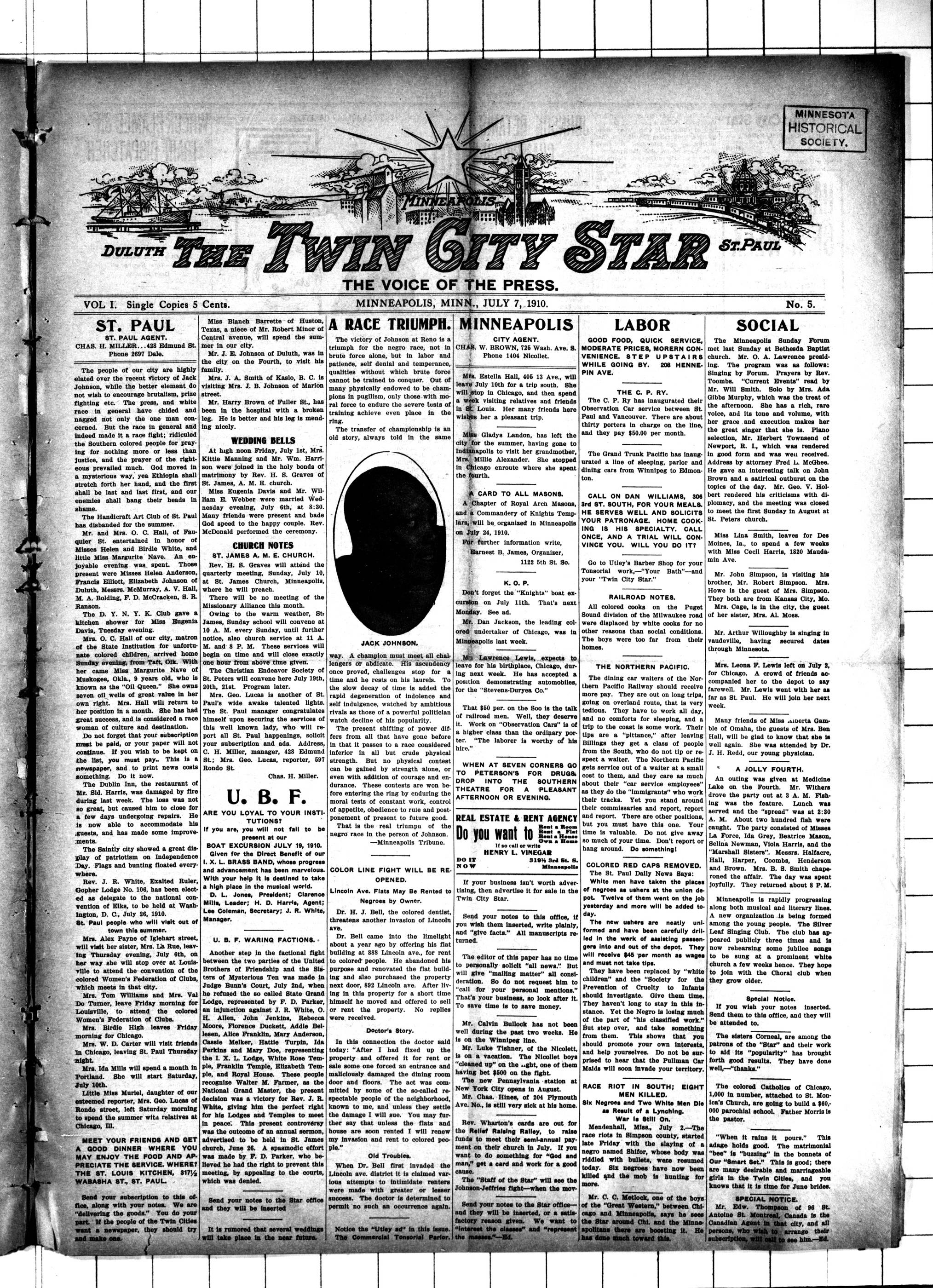
A RACE TRIUMPH.
The victory of Johnson at Reno is a triumph for the negro race, not in brute force alone, but in labor and patience, self denial and temperance, qualities without which brute force cannot be trained to conquer. Out of many physically endowed to be champions in pugilism, only those with moral force to endure the severe tests of training achieve even place in the ring. The transfer of championship is an old story, always told in the same
JACK JOHN8ON. way. A champion must meet all challengers or abdicate. His ascendency once proved, challenges stop for a time and he rests on his laurels. To the slow decay of time is added the rapid degeneration of indolence and self indulgence, watched by ambitious rivals as those of a powerful politician watch decline of his popularity.
The present shifting of power differs from all that have gone before in that it passes to a race considered inferior in all but crude physical strength. But no physical contest can be gained by strength alone, or even with addition of courage and endurance. These contests are won before entering the ring by enduring the moral tests of constant work, control of appetite, obedience to rule and postponement of present to future good.
That is the real triumph of the negro race in the person of Johnson.
COLOR LINE FIGHT WILL BE RE
OPENED.
Lincoln Ave. Flats May Be Rented to Negroes by Owner.
Dr. H. J. Bell, the colored dentist, threatens another invasion of Lincoln ave.
Dr. Bell came into the limelight about a year ago by offering his flat building at 888 Lincoln ave., for rent to colored people. He abandoned his purpose and renovated the flat building and also purchased the property next door, 892 Lincoln ave. After living in this property for a short time himself he moved and offered to sell or rent the property. No replies were received.
Doctor's Story.
In this connection the doctor said today: "After I had fixed up the property and offered it for rent or sale some one forced an entrance and maliciously damaged the dining room door and floors. The act was committed by some of the so-called respectable people of the neighborhood, known to me, and unless they settle the damage I will sue. You may further say that unless the flats and house are soon rented I will renew my invasion and rent to colored people."
Old Troubles.
When Dr. Bell first invaded the Lincoln ave. district it is claimed various attempts to intimidate renters were made with greater or lesser success. The doctor is determined to permit no such an occurrence again.
Notice the "Utley ad" in this issue.
The Commercial Tonsorial Parlor.
MINNEAPOLIS
CITY AGENT.
CHAS. W. BROWN, 725 Wash. Ave. S.
Phone 1404 Nicollet.
Mrs. Estella Hall, 405 13 Ave., will leave July 10th for a trip south. She will stop in Chicago, and then spend a week visiting relatives and friends in St. Louis. Her many friends here wishes her a pleasant trip.
Miss Gladys Landon, has left the city for the summer, having gone to Indianapolis to visit her grandmother, Mrs. Millie Alexander. She stopped in Chicago enroute where she spent the fourth.
A CARD TO ALL MASONS.
A Chapter of Royal Arch Masons,
and a Commandery of Knights Templars,
will be organized in Minneapolis
on July 24, 1910.
For further information write,
Earnest B. James, Organizer,
1122 5th St. So.
K. O. P.
Don't forget the "Knights" boat excursion on July 11th. That's next Monday. See ad.
Mr. Dan Jackson, the leading colored undertaker of Chicago, was in Minneapolis last week.
Mr. Lawrence Lewis, expects to leave for his birthplace, Chicago, during next week. He has accepted a position demonstrating automobiles, for the "Stevens-Duryea Co."
That $50 per. on the Soo is the talk of railroad men. Well, they deserve it. Work on "Observation Cars" is of a higher class than the ordinary porter. "The laborer is worthy of his hire."
WHEN AT SEVEN CORNERS GO TO PETERSON'S FOR DRUGS, DROP INTO THE SOUTHERN THEATRE FOR A PLEASANT AFTERNOON OR EVENING.
REAL ESTATE & RENT AGENCY
Do you want to
Rent a Room
Rent a Flat
Rent a House
Uwn a Home
If so call or write
HENRY L. VINEGAR
DO IT
319½ 3rd St. S.
NOW
Minneapolis
If your business isn't worth advertising, then advertise it for sale in the Twin City Star.
Send your notes to this office, if you wish them inserted, write plainly, and "give facts." All manuscripts returned.
The editor of this paper has no time to personally solicit "all news." But will give "mailing matter" all consideration. So do not request him to "call for your personal mentions." That's your business, so look after it. To save time is to save money.
Mr. Calvin Bullock has not been well during the past two weeks. He is on the Winnipeg line.
Mr. Luke Tishner, of the Nicolett, is on a vacation. The Nicollet boys "cleaned up" on the .ight, one of them having bet $500 on the fight.
The new Pennsylvania station at New York City opens in August.
Mr. Chas. Hines, of 204 Plymouth Ave. No., is still very sick at his home.
Rev. Wharton's cards are out for the Relief Raising Railey, to raise funds to meet their semi-annual payment on their church in July. If you want to do something for "God and man," get a card and work for a good cause.
The "Staff of the Star" will see the Johnson-Jeffries fight—when the mov-
Send your notes to the Star office—and they will be inserted, or a satisfactory reason given. We want to "interest the classes" and "represent the masses."—Ed.
LABOR
GOOD FOOD, QUICK SERVICE,
MODERATE PRICES, MORERN CONVENIENCE. STEP UPSTAIRS
WHILE GOING BY. 208 HENNEPIN AVE.
THE C. P. RY.
The C. P. Ry has inaugurated their Observation Car service between St. Paul and Vancouver. There are about thirty porters in charge on the line, and they pay $50.00 per month.
The Grand Trunk Pacific has inaugurated a line of sleeping, parlor and dining cars from Winnipeg to Edmonton.
CALL ON DAN WILLIAMS, 306 3rd ST. SOUTH, FOR YOUR MEALS. HE SERVES WELL AND SOLICITS YOUR PATRONAGE. HOME COOKING IS HIS SPECIALTY. CALL ONCE, AND A TRIAL WILL CONVINCE YOU. WILL YOU DO IT?
Go to Utley's Barber Shop for your Tonsorial work,—"Your Bath"—and your "Twin City Star."
RAILROAD NOTES:
All colored cooks on the Puget Sound division of the Milwaukee road were displaced by white cooks for no other reasons than social conditions. The boys were too far from their homes.
THE NORTHERN PACIFIC.
The dining car waiters of the Northern Pacific Railway should receive more pay. They are out on long trips, going on overland route, that is very tedious. They have to work all day, and no comforts for sleeping, and a trip to the coast is some work. Their tips are a "pittance," after leaving Billings they get a class of people from the South, who do not tip or respect a waiter. The Northern Pacific gets service out of a waiter at a small cost to them, and they care as much about their "car service employees" as they do the "immigrants" who work their tracks. Yet you stand around their commissaries and report, report and report. There are other positions, but you must have this one. Your time is valuable. Do not give away so much of your time. Don't report or hang around. Do something!
COLORED RED CAPS REMOVED.
The St. Paul Daily News Says:
White men have taken the places of negroes as ushers at the union depot. Twelve of them went on the job yesterday and more will be added to day.
The new ushers are neatly uniformed and have been carefully drilled in the work of assisting passengers into and out of the depot. They will receive $45 per month as wages and must not take tips.
They have been replaced by "white children" and the "Society for the Prevention of Cruelty to Infants should investigate. Give them time. They haven't long to stay in this instance. Yet the Negro is losing much of the part of "his classified work." But step over, and take something from them. This shows that you should promote your own interests, and help yourselves. Do not be surprised to hear that the Pullman Car Maids will soon invade your territory.
RACE RIOT IN SOUTH; EIGHT MEN KILLED.
Six Negroes and Two White Men Die as Result of a Lynching.
War is Still On.
Mendenhall, Miss., July 2.—The race riots in Simpson county, started late Friday with the slaying of a negro named Shifor, whose body was riddled with bullets, were resumed today. Six negroes have now been killed and the mob is hunting for more.
Mr. C. C. Metlock, one of the boys of the "Great Western," between Chicago and Minneapolis, says he sees the Star around Chi. and the Minneapolitans there are boosting it. He has done much toward this.
MINNESOTA
HISTORICAL
SOCIETY.
ST.PAUL
No. 5.
No. 5.
SOCIAL
The Minneapolis Sunday Forum met last Sunday at Bethesda Baptist church. Mr. O. A. Lawrence presiding. The program was as follows: Singing by Forum. Prayers by Rev. Toombs. "Current Events" read by Mr. Will Smith. Solo by Mrs. Ada Gibbs Murphy, which was the treat of the afternoon. She has a rich, rare voice, and its tone and volume, with her grace and execution makes her the great singer that she is. Piano selection, Mr. Herbert Townsend of Newport, R. I., which was rendered in good form and was well received. Address by attorney Fred L. McGhee. He gave an interesting talk on John Brown and a satirical outburst on the topics of the day. Mr. Geo. V. Holbert rendered his criticisms with diplomacy, and the meeting was closed to meet the first Sunday in August at St. Peters church.
Miss Lina Smith, leaves for Des Moines, Ia., to spend a few weeks with Miss Cecil Harris, 1820 Maudamin Ave.
Mr. John Simpson, is visiting his brother, Mr. Robert Simpson. Mrs. Howe is the guest of Mrs. Simpson. They both are from Kansas City, Mo. Mrs. Cage, is in the city, the guest of her sister, Mrs. Al. Moss.
Mr. Arthur Willoughby is singing in vaudeville, having secured dates through Minnesota.
Mrs. Leona F. Lewis left on July 2, for Chicago. A crowd of friends accompanied her to the depot to say farewell. Mr. Lewis went with her as far as St. Paul. He will join her next week.
Many friends of Miss Alberta Gamble of Omaha, the guests of Mrs. Ben Hall, will be glad to know that she is well again. She was attended by Dr. J. H. Redd, our young physician.
A JOLLY FOURTH.
An outing was given at Medicine Lake on the Fourth. Mr. Withers drove the party out at 3 A. M. Fishing was the feature. Lunch was served and the "spread" was at 2:30 A. M. About two hundred fish were caught. The party consisted of Misses La Force, Ida Grey, Beatrice Mason, Selina Newman, Viola Harris, and the "Marshall Sisters". Messrs. Halfacre, Hall, Harper, Coombs, Henderson and Brown. Mrs. B. S. Smith chaperoned the affair. The day was spent joyfully. They returned about 8 P.M.
Minneapolis is rapidly progressing along both musical and literary lines. A new organization is being formed among the young people. The Silver Leaf Singing Club. The club has appeared publicly three times and is now rehearsing some jubilee songs to be sung at a prominent white church a few weeks hence. They hope to join with the Choral club when they grow older.
Special Notice.
If you wish your notes inserted. Send them to this office, and they will be attended to.
The sisters Corneal, are among the patrons of the "Star" and their work to aid its "popularity" has brought forth good results. They have done well,—"thanks."
The colored Catholics of Chicago, 1,000 in number, attached to St. Monica's Church, are going to build a $60,000 parochial school. Father Morris is the pastor.
"When it rains it pours." This adage holds good. The matrimonial "bee" is "buzzing" in the bonnets of Our "Smart Set." This is good; there are many desirable and marriageable girls in the Twin Cities, and you knows that it is time for June brides.
SPECIAL NOTICE.
Mr. Edw. Thompson of 96 St. Antone St. Montreal, Canada is the Canadian Agent in that city, and all persons, who wish to arrange their subscription, will call to see him—Ed.
---
CHAS. S. SMITH, Editor,
126 Cedar Ave.
MINNEAPOLIS, . . MINN.
HAPPENINGS OF A WEEK
Latest News Told in Briefest and Best Form.
PERSONAL
President Taft designated George Otis Smith, director of the geological survey, as acting chief of the new bureau of mines recently authorized by congress.
W. J. Bryan returned to Lincoln, Neb. from his six weeks' trip to Europe. He will remain ten days in Nebraska, devoting his time to state politics. Just what form his political activity will take Mr. Bryan is not prepared to say.
Mrs. "Jack" Haverly, widow of the minstrel "king," died in a private sanitarium. She had been ill more than a year. Since her husband died, in 1901, Mrs. Haverly has had a hard struggle for existence.
Congressman W. P. Brownlow of the First congressional district of Tennessee is reported dying at his home in Johnson City.
Policeman John F. Rotchford, who has been on duty at the White House at Washington nearly eight years, is dead, following an illness of nearly two months.
Mr. Ove Gude, the envoy extraordinary and minister plenipotentiary of Norway, died suddenly of apoplexy in his summer residence at White Sulphur Spring, W. Va.
John W. Daniel, senior senator from Virginia, died at the Lynchburg (VA.) sanitarium, his death being due to a recurrence of paralysis. The immediate cause of his death was cerebral hemorrhage. This was Senator Daniel's third paralytic stroke. He was sixty-seven years of age.
Gifford Pinchot is being boomed for governor of Pennsylvania as an independent candidate.
John B. Stanchfield is said to have received the record fee of $800,000 from F. A. Heinze as his counsel in the recent New York trial of the copper man...
William Nielson McVickar, Protestant Episcopal bishop of Rhode Island, is dead at his summer home at Beaver Cove, Mass., after a lingering illness. He had been bishop of Rhode Island since 1903.
GENERAL NEWS.
The annual convention of the International Hahnemannian association opened in Kansas City, delegates being present from several foreign lands.
Jack Johnson is heavyweight champion of the world. He earned his title by defeating the previously undefeated champion, James J. Jeffries. The latter was knocked out at Reno, Nev., in the fifteenth round by the negro. A private cablegram received at New Orleans from Bluefields, Nicaragua, states that General Matuty has been executed, following a trial by court-martial. It was charged that he betrayed the Estrada cause.
The "Big Four" Twentieth Century limited, east bound, with 200 passengers, was wrecked in a head-on collision with a Cincinnati, Hamilton and Dayton freight train one-half mile south of Middletown, O., 19 people being killed outright and more than a score injured. The two trains met and the locomotive of the freight plowed its way through four coaches of the fast passenger train.
At least eleven killed and scores of others wounded in race clashes in various parts of the United States marked one result of the Jeffries-Johnson fight. There were battles in the streets of practically every large city in the country. Negroes formed the greater number of those who were victims of the outbreaks. They were set upon by whites and killed or wounded because of cheers for Johnson's victory.
The body of Frank S. Goldthrite, formerly superintendent of the printing bureau of the Canadian government and accused of embezzlement of $200,000 was found floating in the river off Grosse Point isle. The hearing of testimony in the bleached flour case in Kansas City was completed after a trial lasting over a month. Arguments will begin Tuesday. State's Attorney John E. W. Wayman of Chicago was made defendant in a suit for $50,000 filed in the supreme court by Attorney Max M. Goodman, representing Charles Spare, one of the jurors who stood for acquittal in the Lee O'Nell Browne brilbury trial. The suit charges slander.
A surplus of $9,402,000 in the ordinary receipts and expenditures, against a deficit last year of $85,784,000 was announced by the treasury department. The total deficit over all which includes Panama canal expenditures and the public debt, is $25,848,000 against $128,795,000 last year.
John C. Wurst, former treasurer of the Debolt Building and Loan association of Cinchnati, who was found guilty of embezzling $20,000 from that institution, was sentenced to serve nine years in the Ohio penitentiary. Everett Carleton Crear of Albany, N.Y., a cadet at West Point, denied that he was chewing gum when asked by the officer of the guard. Crear was tried and found guilty of making a false statement and was dismissed. Chief Justice Melville Weston Fuller, for nearly twenty-two years the presiding officer of the United States Supreme court, died suddenly July 4 at his summer home in Sorrento, Me. His death, which was wholly unexpected, was caused by heart failure.
All the rooms of the White House will be accessible to the public during the coming summer for the first time in many years. Before leaving Washington President Taft gave instructions that the buildings should be thrown wide open.
Members of the Order of Red Men from northern Indiana and Ohio went to Roanoke, Ind., to celebrate the one hundredth birthday of Mrs. Anthony Revarie, an Indian princess whose native name is Kill-so-quah.
Five thousand regulars took part in Chicago's "sane Fourth" parade and opened a big military tournament to last ten days.
The Catholic Educational association began its annual meeting in Detroit, among the notable persons present being Mgr. Falconio, the apostolic delegate.
Angelo Hamilton, convicted of murdering Mrs. Sallie B. Hix at Lynchburg, Va., last June, was electrocuted at Richmond, Va.
Many of the cotton mills of the United States were shut down until July 11 to curtail production. One hundred thousand operatives are affected.
Freight rates on lemons from southern California to eastern destinations were reduced from $1.15 to $1 by the interstate commerce commission, to take effect September 1.
Engineer E. B. Jolley and Fireman H. Mitchell of west-bound passenger train No. 5 of the Atchison, Topeka & Santa Fe railroad, were killed at Cedar Point, Kan., in a wreck caused by an open switch.
John William Hallahan III., a prominent junior member of the Philadelphia bar, husband of a daughter of the late Daniel O'Day, Standard Oil millionaire, was killed by being caught between the floor and an elevator in a hotel at Cape May, N. J.
Two negro men who robbed and killed a white man were taken from the county jail at Charleston, Mo., and lynched by a crowd of 350 whites, most of them being farmers.
The failure of the First National bank and the First Trust and Savings bank at Billings, Mont., which closed their doors, came as a great surprise to commercial and industrial circles of the state. It is believed they will pay every dollar.
Meat prices will remain high till the fall at least. The best authority in the country made that statement—the man who has more to do with fixing prices the packers send out than any other in the country—J. Ogden Armour, when he returned after eight weeks in Europe. Pleading for a united party and urging the elimination of rancor and strife, many county conventions in Iowa adopted resolutions calling upon President Taft to remove from his cabinet those who have attempted to read out of the party the Insurgents. W. J. Bryan returned to Lincoln, Neb., from his six weeks' trip to Europe. He will remain three days in Nebraska, devoting his time to state politics. Just what form his political activity will take Mr. Bryan is not prepared to say.
The convention of the National Education association in Boston began with sessions of the National Council of Education.
A masked bandit held up the mail and express stage which runs between Placerville and Norwood in San Miguel county, Colorado. Several passengers were lined up along the road and compelled to surrender their valuables.
Prof. William F. Bade of the University of California will soon undertake an expedition into the Hamath region of Asia Minor to excavate cities of the ancient tribes of Hitties, which flourished several thousand years before the Christian era.
Collector Loeb's figures for the fiscal year just ended show he collected in duties and fines at the port of New York $234,250,000.01.
Reports from London say that Mrs. Anthony J. Drexel, Jr., who before her marriage a few weeks ago was Miss Marjorie Gould, is suffering from an abscess in the ear, which may make a dangerous operation necessary. Philip Schanz, secretary and cashier of the Aldo Sommers Drug company at Quincy, Ill., has disappeared and expert examination of his books is alleged to show a shortage of more than $15,000. Prince Henry of Prussia and a party of scientists sailed for the Arctic ocean to prepare for Count Zeppelin's proposed dirigible balloon expedition to the pole in 1912. When the parachute in which he was attempting to come to earth after a balloon ascension at Albany, Ind., failed to open Ray Bradley, twenty-five years old, dropped 1,500 feet and met instant death.
Three persons were killed, twenty or more were injured nd a number of buildings were destroyed by a powder explosion in the store of the Graves Mercantile company at Boulder, Mont. The annual convention of the Federation of American Zionists opened in Fitzburg, Pa., with about 300 delegates present.
TWIN CITY STAR.
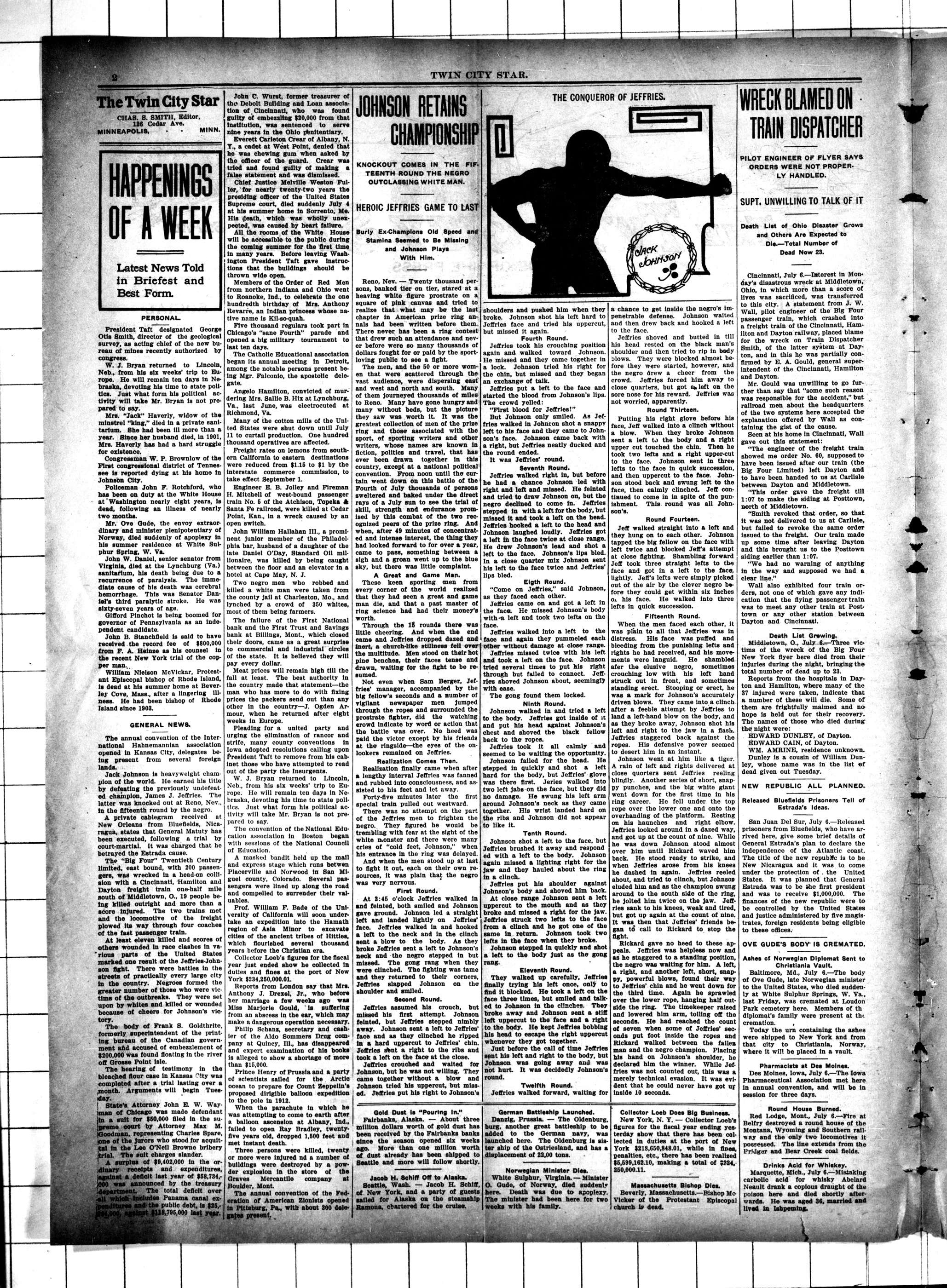
JOHNSON RETAINS CHAMPIONSHIP
KNOCKOUT COMES IN THE FIF
TEENTH ROUND THE NEGRO
OUTCLASSING WHITE MAN.
Burly Ex-Champions Old Speed and Stamina Seemed to Be Missing and Johnson Plays With His
Reno, Nev. — Twenty thousand persons, banked tier on tier, stared at a heaving white figure prostrate on a square of plink canvas and tried to realize that what may be the last chapter in American prize ring animals had been written before them. There never has been a ring contest that drew such an attendance and never before were so many thousands of dollars fought for or paid by the sport-loving public to see a fight.
The men, and the 50 or more women that were scattered through the vast audience, wore dispersing east and west and north and south. Many of them journeyed thousands of miles to Reno. Many have gone hungry and many without beds, but the picture they saw was worth it. It was the greatest collection of men of the prize ring and those associated with the sport, of sporting writers and other writers, whose names are known in fiction, politics and travel, that has ever been drawn together in this country, except at a national political convention. From noon until the curtain went down on this battle of the Fourth of July thousands of persons swetered and baked under the direct rays of a July sun to see the trial of skill, strength and endurance promised by this combat of the two recognized peers of the prize ring. And when, after 49 minutes of concentrated and intense interest, the thing they had looked forward to for over a year, came to pass, something between a sigh and a groan went up to the blue sky, but there was little complaint.
A Great and Game Man.
These keen sporting men from every corner of the world realized that they had seen a great and game man die, and that a past master of ring science had had their money's worth.
Through the 15 rounds there was little cheering. And when the end came and Jeffries dropped dazed and inert, a church-like stillness fell over the multitude. Men stood on their hot pine benches, their faces tense and drawn, waiting for the fight to be resumed.
Not even when Sam Berger, Jeffries' manager, accompanied by the big fellow's seconds and a number of vigilant newspaper men jumped through the ropes and surrounded the prostrate fighter, did the watching crowd indicate by word or action that the battle was over. No heed was paid the victor except by his friends at the ringside the eyes of the onlookers remained on Jeffries.
Realization finally came when after a lengthy interval Jeffries was fanned and rubbed into consciousness, and assisted to his feet and let away. Forty-five minutes later the first special train pulled out westward. There was no attempt on the part of the Jeffries men to frighten the negro. They figured he would be trembling with fear at the sight of the white monster and there were many cries of "cold feet, Johnson," when his entrance in the ring was delayed. And when the men stood up at last to fight it out, each on their own resources, it was plain that the negro was very nervous.
At 2:45 o'clock Jeffries walked in and feinted, both smiled and Johnson gave ground. Johnson led a straight left and landed lightly on Jeffries' face. Jeffries walked in and hooked a left to the neck and in the clinch sent a blow to the body. As they broke Jeffries sent a left to Johnson's neck and the negro stepped in but missed. The gong rang when they were clinched. The fighting was tame and they returned to their corners, Jeffries slapped Johnson on the shoulder and smiled.
Second Round.
Jeffries assumed his crouch, but missed his first attempt. Johnson feinted, but Jeffries stepped nimbly away. Johnson sent a left to Jeffries' face and as they clinched he ripped in a hard uppercut to Jeffries' chin. Jeffries sent a right to the ribs and took a left on the face at the close.
Jeffries crouched and waited for Johnson, but he was not willing. They came together without a blow and Johnson tried his uppercut, but missed. Jeffries put his right to Johnson's
Gold Dust Is "Pouring In."
Falbanks, Alaska. — About three million dollars worth of gold dust has been received by the Falbanks banks since the season opened six weeks ago. More than one million worth of dust already has been shipped to Seattle and more will follow shortly.
Jacob H. Schiff Off to Alaska.
Seattle, Wash. — Jacob H. Schiff, of New York, and a party of guests sailed for Alaska on the steamship Ramona, chartered for the cruise.
First Round.
Second Round.
THE CONQUERO
THE CONQUEROR OF JEFFRIES.
JACK
JOHNSON
shoulders and pushed him when they broke. Johnson shot his left hard to Jeffries face and tried his uppercut, but missed it again.
Fourth Round.
Jeffries took his crouching position again and walked toward Johnson. He missed and they came together in a lock. Johnson tried his right for the chin, but missed and they began an exchange of talk.
Jeffries put a left to the face and started the blood from Johnson's lips. The crowd yelled:
"First blood for Jeffries!"
But Johnson only smiled. As Jefries walked in Johnson shot a snappy left to his face and they came to Johnson's face. Johnson came back with a right, but Jeffries neatly ducked and the round ended.
Jeffries walked right in, but before he had a chance Johnson led with right and left and missed. He feinted and tried to draw Johnson on, but the negro declined to come in. Jeffries stepped in with a left for the body, but missed it and took a left on the head. Jeffries hooked a left to the head and Johnson laughed loudly. Jeffries got a left in the face twice at close range. He drew Johnson's lead and shot a left to the face. Johnson's lips bled. In a close quarter mix Johnson sent his left to the face twice and Jeffries' lips bled.
Eigth Round.
"Come on Jeffries," said Johnson, as they faced each other.
Jeffries came on and got a left in the face. He missed Johnson's body with a left and took two lefts on the face.
Jeffries walked into a left to the face and again they pummeled each other without damage at close range.
Jeffries missed twice with his left and took a left on the face. Johnson tried several times to put his right through but failed to connect. Jeffries shoved Johnson about, seemingly with ease.
The gong found them locked.
Ninth Round.
Johnson walked in and tried a left to the body. Jeffries got inside of it and put his head against Johnson's chest and shoved the black fellow back to the ropes.
Jeffries took it all calmly and seemed to be waiting the opportunity.
seemed to be waiting the opportunity. Johnson failed for the head. He stepped in quickly and shot a left hard for the body, but Jeffries' glove was there first. Jeries walked into two left jabs on the face, but they did no damage. He swung his left arm around Johnson's neck as they came together. His wrist landed hard on the ribs and Johnson did not appear to like it.
Tenth Round.
Johnson shot a left to the face, but Jeffries brushed it away and respond ed with a left to the body. Johnson again missed a lighting right for the jaw and they hauled about the ring in a clinch.
Jeffries put his shoulder against Johnson's body and shoved him back. At close range Johnson sent a left uppercut to the mouth and as they broke and missed a right for the jaw. Jeffries struck two leftofs to the face from a clinch and he got one of the same in return. Johnson took two lefts in the face when they broke. Johnson stepped in quickly and shot a left to the body just as the gong rang.
Eleventh Round.
They walked up carefully, Jeffries finally trying his left once, only to find it blocked. He took a left on the face three times, but smiled and talked to Johnson in the clinches. They broke away and Johnson sent a stiff left uppercut to the face and a right to the body. He kept Jeffries bobbing his head to escape the right uppercut whenever they got together.
Just before the call of time Jeffries sent his left and right to the body, but Johnson was going away and was not hurt. It was decidedly Johnson's round.
Twelfth Round.
Jeffries walked forward, waiting for
Dansig, Prussia. — The Oldenburg, burg, another great battleship to be added to the German navy, was launched here. The Oldenburg is sister ship of the Ostriesland, and has a displacement of 22,00 tons.
Norwegian Minister Dies.
White Sulphur, Virginia. — Minister O. Gude, of Norway, died suddenly here. Death was due to apoplexy. The minister had been here for two weeks with his family.
Fourth Round.
Seventh Round.
Elgth Round.
Tenth Round.
Eleventh Round.
a chance to get inside the negro's impenetrable defense. Johnson waited and then drew back and hooked a left to the face.
Jeffries shoved and butted in till his head rested on the black man's shoulder and then tried to rip in body blows. They were blocked almost before they were started, however, and the negro drew a cheer from the crowd. Jeffries forced him away to close quarters, but got a left on the sore nose for his reward. Jeffries was not worried, apparently.
Round Thirteen.
Putting his right glove before his face, Jeff walked into a clinch without a blow. When they broke Johnson sent a left to the body and a right upper cut touched the chin. Then he took two lefts and a right upper-cut to the face. Johnson sent in three lefts to the face in quick succession, and then uppercut to the face. Johnson stood back and swung left to the face, then calmly clinched. Jeff continued to come in in spite of the punishment. This round was all Johnson's.
Round Fourteen.
Jeff walked straight into a left and they hung on to each other. Johnson tapped the big fellow on the face with left twice and blocked Jeff's attempt at close fighting. Shambling forward Jeff took three straight lefts to the face and got in a left to the face, lightly. Jeff's lefts were simply picked out of the air by the clever negro before they could get within six inches on his face. He walked into three lefts in quick succession.
Fifteenth Round.
When the men faced each other, it was plain to all that Jeffries was in distress. His face was puffed and bleeding from the punishing lefts and rights he had received, and his movements were languid. He shambled after the elusive negro, sometimes crouching low with his left hand struck out in front, and sometimes standing erect. Stooping or erect, he was a mark for Johnson's accurately driven blows. They came into a clinch after a feeble attempt by Jeffries to land a left-hand blow on the body, and as they broke away, Johnson shot his left and right to the jaw in a flash. Jeffries staggered back against the ropes. His defensive power seemed to desert him in an instant.
Johnson went at him like a tiger. A rain of left and rights delivered at close quarters sent Jeffries reeling blindly. Another series of short, snappy punches, and the big white giant went down for the first time in his ring career. He fell under the top rope over the lower one and onto the overhanding of the platform. Resting on his haunches and right elbow, Jeffries looked around in a dazed way, and got up at the count of nine. While he was down Johnson stood almost over him until Rickard waved him back. He stood ready to strike, and when Jeffries arose from his knees he dashed in again. Jeffries reeled about, and tried to clinch, but Johnson eluded him and as the champion swung around to the south side of the ring, he jolted him twice on the jaw. Jeffries sank to his knees, weak and tired, but got up again at the count of nine. It was then that Jeffries' friends began to call to Rickard to stop the fight.
Rickard gave no heed to these appeals. Jeffries was helpless now and as he staggered to a standing position, the negro was waiting for him. A left, a right, and another left, short, snappy, powerful blows, found their way to Jeffries' chin and he went down for the third time. Again he sprawled over the lower rope, hanging half outside the ring. The timekeeper raised and lowered him arm, tolling off the seconds. He had reached the count of seven when some of Jeffries' seconds put foot inside the ropes and Rickard walked between the fallen man and the negro champion. Placing his hand on Johnson's shoulder, he declared him the winner. While Jeffries was not counted out, this was a merely technical evasion. It was evident that he could never have got up inside 10 seconds.
Collector Loeb Does Big Business.
New York, N. Y. — Collector Loeb's figures for the fiscal year ending yesterday show that there has been collected in duties at the port of New York $218,650,848.01, while in fines, penalties, etc., there has been realized $5,599,162.10, making a total of $224,250,000.11.
Massachusetts Bishop Dies.
Beverly, Massachusetts — Bishop McVicker of the Protestant Episcopal church is dead.
WRECK BLAMED ON TRAIN DISPATCHER
PILOT ENGINEER OF FLYER SAYS ORDERS WERE NOT PROPERLY HANDLED.
SUPT. UNWILLING TO TALK OF IT
Death List of Ohio Disaster Grows and Others Are Expected to Die.—Total Number of Dead Now 23.
Cincinnati, July 6. -Interest in Monday's disastrous train at Middletown, Ohio, in which more than a score of lives was sacrificed, was transferred to this city. A statement from J. W. Wall, pilot engineer of the Big Four passenger train, which crashed into a freight train of the Cincinnati, Hamilton and Dayton railway, placed blame for the wreck on Train Dispatcher Smith, of the latter system at Dayton, and in this he was partially confirmed by E. A. Gould, general superintendent of the Cincinnati, Hamilton and Dayton.
Mr. Gould was unwilling to go further than say that "some such reason was responsible for the accident," but railroad men about the headquarters of the two systems here accepted the explanation offered by Wall as containing the gist of the cause.
Seen at his home in Cincinnati, Wall gave out this statement:
"The engineer of the freight train showed me order No. 60, supposed to have been issued after our train (the Big Four Limited) left Dayton and to have been handed to us at Carlisle between Dayton and Middletown.
"This order gave the freight till 1:07 to make the siding at Posttown, north of Middletown.
"Smith revoked that order, so that it was not delivered to us at Carlisle, but failed to revoke the same order issued to the freight. Our train made up some time after leaving Dayton and this brought us to the Posttown siding earlier than 1:07.
"We had no warning of anything in the way and supposed we had a clear line."
Wall also exhibited four train orders, not one of which gave any indication that the flying passenger train was to meet any other train at Posttown or any other station between Dayton and Cincinnati.
Death List Grewing.
Middletown, O., July 6.—Three victims of the wreck of the Big Four New York flyer here died from their injuries during the night, bringing the total number of dead up to 23.
Reports from the hospitals in Dayton and Hamilton, where many of the 37 injured were taken, indicate that a number of these will die. Some of them are frightfully maimed and no hope is held out for their recovery. The names of those who died during the night were:
EDWARD DUNLEY, of Dayton.
EDWARD CAIN, of Dayton.
WM. AMRINE, residence unknown.
Dunley is a cousin of William Dunley, whose name was in the list of dead given out Tuesday.
NEW REPUBLIC ALL PLANNED.
Released Bluefields Prisoners Tell of Estrada's Ideas.
San Juan Del Sur, July 6—Released prisoners from Bluefields, who have arrived here, give some brief details of General Estrada's plan to declare the independence of the Atlantic coast. The title of the new republic is to be New Nicaragua and it was to come under the protection of the United States. It was planned that General Estrada was to be the first president and was to receive $1,000,000. The finances of the new republic were to be controlled by the United States and justice administered by five magistrates, foreign residents being eligible to these offices.
OVE GUDE'S BODY IS CREMATED.
Ashes of Norwegian Diplomat Sent to Christiania Vault.
Baltimore, Md., July 6.—The body of Ove Gude, late Norwegian minister to the United States, died suddenly at White Sulphur Springs, W. Va., last Friday, was cremated at Loudon Park cemetery here. Members of the diplomat's family were present at the cremation.
Today the urn containing the ashes were shipped to New York and from that city to Christiania, Norway, where it will be placed in a vault.
Pharmacists at Des Molines.
Des Molines, Iowa, July 6.—The Iowa Pharmaceutical Association met here in annual convention, and will be in session for three days.
Red Lodge, Mont., July 6.—Fire at Belfry destroyed a round house of the Montana, Wyoming and Southern railway and the only two locomotives it possessed. The line extends from the Pridger and Bear Creek coal fields.
Drinks Acid for Whiskey.
Marquette, Mich., July 6.—Missaking carbolic acid for whisky Abelard Neault drank a copious draught of the poison here and died shortly afterwards. He was aged 36, married and lived in Ishpeming.
Deaf and Dumb—and Blind
(Copyright, 1910, by Associated Literary Press.)
When the tide is out at Palm Beach hundreds of hotel guests walk up and down the hard, wet sands. Others speed up and down in their autos. Others, still, sit on hired chairs and gaze out seaward and imagine they can hear the songs of mermaids.
He advanced and raised he inspected the tire. "I hope you were no the flying pieces," said her most ingratiating No reply. "Will we have to wash hotel?"
On a certain day in the present twentieth century Philip Gillett was among those who walked. He was a young man at the beach with his mother and sister, and his occupation when at home in New York was preparing himself for architecture. He did that mostly by looking at one or two skyscrapers a day from the outside and spending $500 per week allowed by his father. It was his father who had insisted that the young man take up architecture. There never had been an architect in the Gillett family, and he wanted one. He had a manor house, and he wanted a hennery built, and he wanted to point to it after it was finished and say: "A Gillett did that!"
On this particular day Philip Gillett had toothache and he set out to walk it off. His sister had told him to hold a wad of cotton saturated with peppermint essence in his mouth, and to keep his mouth shut. He thought a good deal of his sister, and he was obeying her.
Toothache affects a person peculiarly—particularly a man. It gives him what is known as a grouch. He wants to stand on the beach and see a dentist drown in the sea. He isn't to blame, but everybody else is. And what made young Mr. Gillett crosser still was the fact that he had to chew cotton and keep his mouth shut. It was not dignified. It was taking undue advantage of a fellow.
Among those who motored that day were Miss Edna Blair and Miss Kitty Waldron, girl chums. They were in
A man in a suit sits on a bench, holding a book, with a rainy sky and trees in the background.
Resorted to More Peppermint.
Miss Kitty's auto, and she was running it herself. After getting out of the crowd, and heading up the shore, they saw a young man half a mile ahead of them. He was scuffing along on the hard track and was in their path. The honk! honk! was sounded, but he paid no attention. He wanted to be run over and have that aching tooth smashed out.
The autmobile passed him within two feet and in spite of himself he gave a jump and swallowed the peppermint-soaked wad of cotton. He then had to produce more cotton and more peppermint for his aching tooth.
Mr. Gillett's walk had extended two miles when he sat down on a hummock and resorted to more peppermint. His sister was right; it began to have a soothing effect! He began to feel glad that he was alive and away from the snow heaps of New York city. Just then he caught sight of the auto returning. As it drew near, he saw that Miss Edna Blair was passably good looking and that Miss Kitty Waldron was more so. The auto was aiming to pass him within a few feet, but that was all right. He reasoned that the girls desired a nearer view of the young man, whom they had so frightened, and he was right about it. They didn't seem to see him, of course, but that was false pretense.
And after that fate stepped in. The auto was exactly opposite Philip to an inch, and exactly six feet and one inch and half away, when a front tire exploded with a bang. Two young ladies screamed. The auto ran wild until half buried in the sand. The young man was blown over on his back by the concussion and swallowed his wad of cotton for the second time in an hour.
He would have been less than human if he hadn't arisen with a face as red as paint and cross all the way through. He grabbed for his hat and might have gone running over the sand dunes had not a sweet and plaintive voice reached his ears:
"Oh, sir, please do help us! We have hurried a tire!"
Yes, he would help. As a gentleman he must do so; but he made up his mind to do no more. That is, he wouldn't speak a word to those girls. They had fed him on cotton, so to speak, and he would have his revenge.
He advanced and raised his hat. Then he inspected the tire.
"I hope you were not hit by one of the flying pieces," said Miss Kitty in her most ingratiating manner.
No reply.
"Will we have to walk back to the hotel?"
No answer.
"You see we have a spare tire here."
No answer.
Mr. Gillett owned an auto himself.
In fact, his mother and sister were down the beach in it at that very moment. He knew all about tires.
He took the jack from its place, and without motioning the girls to descend he went at it and had the tire replaced inside of 12 minutes. He might have done it in ten except for overhearing such observations as:
"Say, Edna, he must be deaf."
"Yes, deaf as an old tin pan."
"And he hasn't spoken a word. Do you think he's also dumb?"
"He looks it."
"Poor young man! It's just awful! He's got considerable style about him."
"Oh, I don't know. Wasn't it funny to see him go over on his back. If his hat hadn't blown off he'd have swallowed it!"
"Hush, you bad girl! I'll tell you what he is. He's a professor in some deaf and dumb school. And he owns an auto, too. See how handy he is. I wish we hadn't frightened him so." "If we had scared him worse, he might have got his voice and hearing back. Think what it would be to marry a deaf and dumb man! Are you going to thank him?" "Not in words, but I'll just look my thanks."
As Mr. Gillett finished and stood back and raised his hat the thanks were duly looked and the auto whizzed along. He followed at a slow pace. The toothache was all gone, but he had been humiliated. He had been made to jump aside like a kangaroo; he had been blown flat on his back; he had been made to swallow wads of cotton; he had almost been called names to his very face. No wonder he wouldn't speak to his sister for an hour after getting back to the hotel, and that his mother laid her maternal hand on his locks and said:
"Philip, I hope you won't go into a decline, as your grandfather did at this very place."
There is fate and there is revenge. Fate had come—revenge had to wait a day or two. Then the sister came running to Philip.
"Oh, Phill!" she exclaimed; "I've met just the nicest girl you ever saw! She's stopping at the Royal. I've invited her to take a spin in the auto, and you are to be chauffeur. I want you to meet her."
As the aching tooth had gone out of business and the world looked rosy again, Philip consented, though entirely to please the sister. They differed on the girl question.
It was only when they had rolled around to the hotel and picked up their passenger that Mr. Philip Gillett would have swallowed a whole roll of cotton batting had it been handy. She was the girl of the other auto—the girl who had looked her thanks—Miss Kitty Waldron!
Mr. Gillett tried to say things, and Miss Waldron did likewise, and the sister sat there and wondered if both of them had toothache. And when they got back at last and Mr. Gillett assisted Miss Waldron up the steps of the veranda, she turned to him to say:
"Sir, have you any explanations to make?"
"I have, and will call this evening to make them."
The explanations must have proven satisfactory, as an auto ride became a thing of daily occurrence thereafter, and the season had not yet closed when Miss Gillett put her arms around her brother's neck and murmured:
"Oh, Phil, I'm so glad—so glad! I just hoped you two would take each other, and now you have!"
A. Spanking Chair
Although the whipping post is a thing of the past, the principle in revised and modern form and judiciously applied is expected to work wonders in enforcing good behavior upon some of the worst offenders brought before the juvenile court.
A "spanking chair" has been set up in the basement of the juvenile home at Columbus, O., and Elisha Searls was the first to occupy it. He promised to be good for all time when he had been given a good "dressing," and he was instructed to relate his experience to other lads who have an inclination to be very, very naughty.
The juvenile court paddle consists of a long leather strap, wide and heavy, and it is bound with felt so that the edges will not cut or bruise the flesh. The paddle "stings right," but leaves no marks, and is much more humane than a switch or a slipper—and more effective.
But Lawyers Must Live.
It is impossible to see the long scrolls in which every contract is included, with all their appendages of seals and attestations, without wondering at the deprivacy of those beings of promise by such formal and public evidences—Johnson.
TWIN CITY STAR.
MELVILLE WE
CHIEF JUSTICE
Aged Jurist Passed
at Sorrent
MELVILLE WESTON FULLER
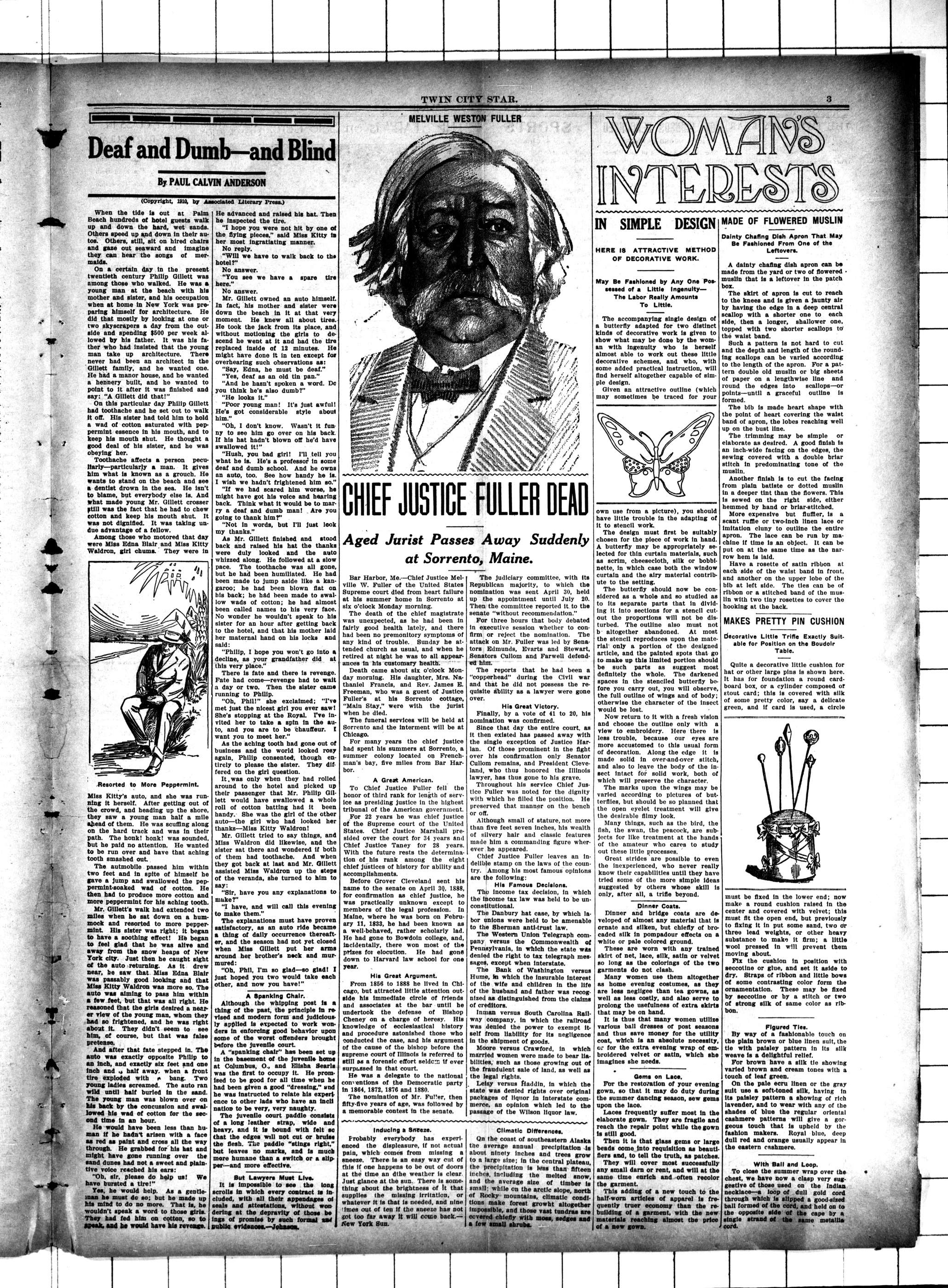
CHIEF JUSTICE FULLER DEAD
Aged Jurist Passes Away Suddenly at Sorrento, Maine.
Bar Harbor, Me.—Chief Justice Melville W. Fuller of the United States Supreme court died from heart failure at his summer home in Sorrento at six o'clock Monday morning.
The death of the chief magistrate was unexpected, as he had been in fairly good health lately, and there had been no premonitory symptoms of any kind of trouble. Sunday he attended church as usual, and when he retired at night he was to all appearances in his customary health.
Death came about six o'clock Monday morning. His daughter, Mrs. Nathaniel Francis, and Rev. James E. Freeman, who was a guest of Justice Fuller's at his Sorrento cottage, "Main Stay," were with the jurist when he died.
The funeral services will be held at Sorrento and the interment will be at Chicago.
For many years the chief justice had spent his summers at Sorrento, a summer colony located on Frenchman's bay, five miles from Bar Harbor.
For 22 years he was chief justice of the Supreme court of the United States. Chief Justice Marshall presided over the court for 34 years and Chief Justice Taney for 28 years. With the future rests the determination of his rank among the eight chief justices of history for ability and accomplishments. Before Grover Cleveland sent his name to the senate on April 30, 1888, for confirmation as chief justice, he was practically unknown except to members of the legal profession. In Maine, where he was born on February 11, 1833, he had been known as a well-behaved, rather scholarly lad. He had gone to Bowdoin college, and, incidentally, there won most of the prizes for elocution. He had gone down to Harvard law school for one year.
From 1856 to 1888 he lived in Chicago, but attracted little attention outside his immediate circle of friends and associates at the bar until he undertook the defense of Bishop Cheney on a charge of heresy. His knowledge of ecclesiastical history and procedure astonished those who conducted the case, and his argument of the cause of the bishop before the supreme court of Illinois is referred to still as a forensic effort seized if ever surpassed in that court.
He was a delegate to the national conventions of the Democratic party in 1864, 1872, 1876 and 1880.
The nomination of Mr. Fuller, then fifty-five years of age, was followed by a memorable contest in the senate.
Probably everybody has experienced the displeasure, if not actual pain, which comes from missing a sneeze. There is an easy way cut of this if one happens to be out of doors at the time an dthe weather is clear. Just glance at the sun. There is something about the brightness of it that supplies the missing irritation, or whatever it is that is needed, and nine times out of ten if the sneeze has not got too far away it will come back.—New York Sun.
A. Great American.
His Great Argument.
Inducing a Snakeze.
STON FULLER
FULLER DEAD
s Away Suddenly
to, Maine.
The judiciary committee, with its Republican majority, to which the nomination was sent April 30, held up the appointment until July 20. Then the committee reported it to the senate "without recommendation."
For three hours that body debated in executive session whether to confirm or reject the nomination. The attack on Mr. Fuller was led by Senators Edmunds, Evarts and Stewart, Senators Cullom and Farwell defended him.
The reports that he had been a "copperhead" during the Civil war and that he did not possess the requisite ability as a lawyer were gone over.
His Great Victory.
Finally, by a vote of 41 to 20, his nomination was confirmed.
Since that day the entire court, as it then existed has passed away with the single exception of Justice Harlan. Of those prominent in the fight over his confirmation only Senator Cullom remains, and President Cleveland, who thus honored the Illinois lawyer, has thus gone to his grave.
Throughout his service Chief Justice Fuller was noted for the dignity with which he filled the position. He preserved that manner on the bench or off.
Although small of stature, not more than five feet seven inches, his wealth of silvery hair and classic features made him a commanding figure wherever he appeared.
Chief Justice Fuller leaves an indelible stamp on the laws of the country. Among his most famous opinions are the following:
His Famous Decisions.
The income tax decision, in which the income tax law was held to be unconstitutional.
The Danbury hat case, by which labor unions were held to be amenable to the Sherman anti-trust law.
The Western Union Telegraph company versus the Commonwealth of Pennsylvania, in which the state was denied the right to tax telegraph messages, except when interstate.
The Bank of Washington versus Hume, in which the insurable interest of the wife and children in the life of the husband and father was recognized as distinguished from the claims of creditors.
Inman versus South Carolina Railway company, in which the railroad was denied the power to exempt itself from liability for its negligence in the shipment of goods.
Moore versus Crawford, in which married women were made to bear liabilities, such as those growing out of the fraudulent sale of land, as well as the legal rights. Lefsy versus Haddin, in which the state was denied rights over original packages of liquor in interstate commerce, an opinion which led to the passage of the Wilson liquor law.
Climatic Differences
On the coast of southeastern Alaska the average annual precipitation is about ninety inches and trees grow to a large size; in the central plateau, the precipitation is less than fifteen inches, including the melted snow, and the average size of timber is small; while on the arctic slope, north of Rocky mountains, climatic conditions make forest growht altogether impossible, and those vast tundras are covered chiefly with moss, sedges and a few small shrubs.
His Great Victory.
WOMAN'S INTERESTS
HERE IS ATTRACTIVE METHOD
OF DECORATIVE WORK.
May Be Fashioned by Any One Possessed of a Little Ingenuity—The Labor Really Amounts To Little.
The accompanying single design of a butterfly adapted for two distinct kinds of decorative work is given to show what may be done by the woman with ingenuity who is herself almost able to work out these little decorative schemes, and who, with some added practical instruction, will find herself altogether capable of simple design.
Given an attractive outline (which may sometimes be traced for your
own use from a picture), you should have little trouble in the adapting of it to stencil work.
The design must first be suitably chosen for the piece of work in hand. A butterfly may be appropriately selected for thin curtain materials, such as scrim, cheesecloth, silk or bobbinette, in which case both the window curtain and the airy material contribute to the setting.
The butterfly should now be considered as a whole and so studied as to its separate parts that in dividing it into sections for a stencil cutout the proportions will not be disturbed. The outline also must not b altogether abandoned. At most the stencil reproduces upon the material only a portion of the designed article, and the painted spots that go to make up this limited portion should be such parts as suggest most definitely the whole. The darkened spaces in the stenciled butterfly before you carry out, you will observe, the full outline of wings and of body; otherwise the character of the insect would be lost.
Now return to it with a fresh vision and choose the outline only with a view to embroidery. Here there is less trouble, because our eyes are more accustomed to this usual form of decoration. Along the edge it is made solid in over-and-over stitch, and also to leave the body of the insect intact for solid work, both of which will preserve the character. The marks upon the wings may be varied according to pictures of butterflies, but should be so planned that the open eyelet treatment will give the desirable filmy look. Many things, such as the bird, the fish, the swan, the peacock, are subjects for like treatment at the hands of the amateur who cares to study out these little processes.
Great strides are possible to even the inexperienced, who never really know their capabilities until they have tried some of the more simple ideas suggested by others whose skill is only, after all, a trifle beyond.
Dinner Coats.
Dinner and bridge coats are developed of almost any material that is ornate and silken, but chiefly of brocaded silk in pompadour effects on a white or pale colored ground.
These are worn with any trained skirt of net, lace, silk, satin or velvet so long as the colorings of the two garments do not clash.
Many women use them altogether as home evening costumes, as they are less negligee than tea gowns, as well as less costly, and also serve to prolong the usefulness of extra skirts that may be on hand.
It is thus that many women utilize various ball dresses of post seasons and thus save money for the utility coat, which is an absolute necessity, or for the extra evening wrap of embroidered velvet or satin, which she imagines she needs.
Gems on Lace.
For the restoration of your evening gown, so that it may do duty during the summer dancing season, sew gems upon the lace. Laces frequently suffer most in the elaborate gown. They are fragile and reach the repair point while the gown is still good. Then it is that glass gems or large beads come into requisition as beautifiers and, to tell the truth, as patches. They will cover most successfully any small darn or rent, and will at the same time enrich and often recolor the garment. This adding of a new touch to the half-worn articles of apparel is frequently truer economy than the rebuilding of a garment, with the new materials reaching almost the price of a new gown.
Dainty Chafing Dish Apron That May Be Fashioned From One of the Lefttovers.
A dainty chafing dish apron can be made from the yard or two of flowered muslin that is a lofter in the patch box.
The skirt of apron is cut to reach to the knees and is given a jaunty air by having the edge in a deep central scallop with a shorter one to each side, then a longer, shallower one, topped with two shorter scallops to the waist band.
Such a pattern is not hard to cut and the depth and length of the rounding scallops can be varied according to the length of the apron. For a pattern double old muslin or big sheets of paper on a lengthwise line and round the edges into scallops—or points—until a graceful outline is formed.
The bib is made heart shape with the point of heart covering the waist band of apron, the lobes reaching well up on the bust line.
The trimming may be simple or elaborate as desired. A good finish is an inch-wide facing on the edges, the sewing covered with a double briar stitch in predominating tone of the muslin.
Another finish is to cut the facing from plain batiste or dotted muslin in a deeper tint than the flowers. This is sewed on the right side, either hemmed by hand or briar-stitched.
More expensive but fluffier, is a scant ruffle or two-inch linen lace or imitation cluny to outline the entire apron. The lace can be run by machine if time is an object. It can be put on at the same time as the narrow hem is laid.
Have a rosette of satin ribbon at each side of the waist band in front, and another on the upper lobe of the blib at left side. The ties can be of ribbon or a stitched band of the muslin with two tiny rosettes to cover the hooking at the back.
MAKES PRETTY PIN CUSHION
Decorative Little Trifle Exactly Suitable for Position on the Boudoir Table.
Quite a decorative little cushion for hat or other large pins is shown here. It has for foundation a round cardboard box, or a cylinder composed of stout card; this is covered with silk of some pretty color, say a delicate green, and if card is used, a circle
```markdown
```
must be fixed in the lower end; now make a round cushion raised in the center and covered with velvet; this must fit the open end, but previously to fixing it in put some sand, two or three lead weights, or other heavy substance to make it firm; a little wool pressed in will prevent them moving about.
Fix the cushion in position with seccotine or glue, and set it aside to dry. Straps of ribbon and little bows of some contrasting color form the ornamentation. These may be fixed by seccotine or by a stitch or two of strong silk of same color as ribbon.
Flaured Ties.
By way of a fashionable touch on the plain brown or blue linen suit, the tie with paisley pattern in its silk weave is a delightful relief.
For brown have a silk tie showing varied brown and cream tones with a touch of leaf green.
On the pale ecru linen or the gray suit use a soft-toned silk, having in its paisley pattern a showing of rich lavender, and to wear with any of the shades of blue the regular oriental cashmere patterns will give a gorgeous touch that is upheld by the fashion makers. Royal blue, deep dull red and orange usually appear in the eastern cashmere.
With Ball and Loop.
To close the summer wrap over the chest, we have now a clasp very suggestive of those on used on the Indian necklace—a loop of dull gold cord through which is slipped a good-sized ball formed of the cord, and held on to the opposite side of the cape by a single strand of the same metallic cord.
THE TWIN CITY STAR
THURSDAY, JULY 7, 1910
(Post office entry as second-class matter application pending.)
Subscription by Mall, Postpaid.
ONE YEAR ..... $2.00
SIX MONTHS ..... 1.25
THREE MONTHS ..... .75
Rates covering postage to all foreign countries, Philippine Islands and Insular possessions.
Published every Thursday by CHARLES SUMNER SMITH,
128 Cedar av., Minneapolis, Minn.
Foreign subscriptions solicited.
Address all letters and make all checks and orders payable to The
Twin City Star, Minneapolis, Minn.
CHAS. S. SMITH .....Editor
St. Paul Agent.
CHAS. H. MILLER...428 Edmund St
Phone 2697 Dale.
CITY AGENT.
CHAS. W. BROWN, 725 Wash. Ave. S.
Phone 1404 Nicolet.
IMPORTANT NOTICE.
We have solicited news for the people of the Northwest from all cities and towns northwest of Chicago and Kansas City, which is very necessary to the "local circulation," and we are arranging a circulation which "will cover the earth."
Applicants will present on application a letter of correspondence and their best references, which will be returned on refusal. Our suggestions are that none but experienced correspondents need apply, unless under the directions of those who may recommend them.
This issue speaks for itself. We thank the public of the Twin Cities for their enthusiastic interest; their continued aid is solicited.
All personal advertisements in the local columns must be paid for in advance.
All public comment inserted only over the author's signature Our privileges will be extended to all.
CRISPUS ATTUCKS.
"Where shall we look for hero,
Or, where shall we find a story."
The above lines are from the poem entitled, "Crispus Attucks," the first to die for American Independence. He was a negro of Revolutionary days and was killed in State St., Boston, with Maverick Caldwell Carr and Gray (supposed to be Irish-American patriots). He struck the first blow for American Independence, and while leading his faithful few followers on that memorial day, Marcn 5, 1770, was killed by the British soldiers. In Boston an inscription marks the spot where he fell, and a monument on Boston Common immortalizes his dying effort. Yet today he is unknown to that "class of legislators" who seek to take away the Negro's rights,—to that set of savages of the Southland, who celebrate the 4th of July, without regard for law or order, by lynching negroes—to that element of lawless immigrants, who think that a negro has no right in this country, and should not enjoy its privileges.
He struck a blow, and died for this country's freedom. His death was avenged by Peter Salem, who shot Maj. Pitcairn at Bunker Hill. Should you visit the historic battle fields of the Revolution, Lexington, Concord and Bunker Hill, you will find that the "Ride of Paul Revere", "The Old South Church", the "Cradle of Liberty" and Bunker Hill Monument are hallowed as memorials to the patriots of the Revolution, and that Attuck's name is more honored than all. He was the cause of the firing of the shot that was heard around the world."
Sent your notes to the "Star" office.
MOB LYNCHES TWO NEGROES.
Blacka, Accused of Murder, Taken
From Jail by Citizens.
Charleston, Mo., July 4.—Two negroes were lynched here yesterday for the murder of William Fox, a planner of Mississippi county.
One negro was hanged immediately in the jail yard after he had confessed his guilt and begged for his life.
The other negro was hurried into an auto and taken to the spot where he had hid the revolver with which Fox was shot.
JACK JOHNSON DENOUNGED
The regular meeting of the Minneapolis Sunday Forum, was held July 3rd, at Bethesda Baptist church. The principal speaker was attorney Fred L. McGhee, a colored lawyer of St. Paul, who addressed a small, but appreciative audience.
He began his egistic remarks by a description of his travelogues to Harper's Ferry and the scenes of that famous raid, paid a glowing tribute to John Brown and his followers, and expounded the "Riddle of the Sphinx," in a very able manner; denounced Drs. Washington and Crum; the Sunday School Congress at Washington, D.C.; the Wilberforce College, praised the Democratic party along certain lines, and ended his discourse or derogatory remarks, by referring to champion Jack Johnson, as a negro, "who does not represent the race," "does not represent him" (l. e. McGhee), "gets drunk, and arrested," "constantly in trouble," a disgrace to his race" and one "whom he would not introduce to his wife," or "invite to his table."
Space is more valuable than comment, but such agitators as Fred L. McGhee will do no credit to any person or theory. Dr. Dubols is the representative of "Universal Peace" and is misrepresented by a set of adherents who by their fusionsmess and insolence seek to defame through effrontery and prudery anything, that is identified with Booker T. Washington. And Dr. Washington has said things complimentary to Johnson, and has spoken of him as a representative of his race." Now, unis Fred L. McGhee must say that he is not. Well, Jack Johnson has proven (since you gave utterance to those "immortal words, i. e. so far as you are concerned), that he is a representative of the NEGRO RACE, and has given to us a WORLD'S CHAMPION, without the shadow of a doubt, and you will find that he is of higher morals than you least imagine, not a drunkard( or a reformed one). He has been maliciously maligned by such negroes, as his former trainers, Pindar of New York notoriety and a great criminal colored lawyer of St. Paul and the Northwest. Jack Johnson has his faults, and he does not hide them under the "cloak of the church." He has done something for humanity. He brought his mother from the Southland, and placed her in comfort, which was a greater accomplishment than winning his last battle. And she could "pray in peace" in Chicago. But had he won, and she lived in the south, we may imagine the consequences Yet he does not represent you. Did you represent your race or your party when you interviewed Tillman at Kansas City? Did you expound to "Pitchfork Ben" the "Riddle of the Sphinx?"
Are you seeking notority? or has the loss of practice forced you to advertise? You are too well known.
But all great men make mistakes, and you have made a great mistake. Had you made those remarks in defence of a client, they would have gone unnoticed. But you claim to have been sitting at the feet of Dr. Dubols, when he wrote the last line of the last chapter of his book. Well, Paul sat at the feet of Gamallah, and he gave us the 15th chapter of Romans, and you said in your remarks that you had read the Bible and all its editions. Did you understand this chapter? You have taken the "House of God" under the guise of religion, with the enfortery of the devil, as the place to defame, and method to denounce your fellowman. Hypocrisy personified! The members of the "Forum" stood for this. The Twin City Star does not.-Ed.
WORK FOR THE SOUTH.
One of the most encouraging utterances from the south that we have heard in a long time is that of Judge John L. Hopkins, of George, who, the Atlanta Constitution says, stands at the head of the bar of Georgia. He has been a dweller in three epochs—that before the war, the reconstruction period, and the present rise out of destitution and disorder. He was chosen by the state legislature and by the combined legal talent of the state to recodify the laws of the state. The Constitution speaks of him in superlatives. He has written a communication to that paper, the keynote of which is in the following extract:
"I am an old man sitting to one side at the end of a long road and watching the procession troop by — — And I tell you, calmly and with deliberation, weighing my words with the care of one who has learned to be economical with emphasis, that the greatest problem of our day—your day, more accurately speaking—is the making of citizens instead of criminals out of the masses of the negroes that everywhere in the south eddy and swirl into the body politic of the Anglo-Saxon.
TWIN CITY STAR
SPORTS
Don't forget that the St. Paul Colored Gophers will play their World's Championship games in St. Paul this year.
Johnson May Meet Langford.
Cheyenne, Wyo., July 6.—"If Sam Langford, the Boston fighter, will put up a side bet of $20,000, Heavyweight Champion Jack Johnson will fight in Cheyenne during the great Frontier celebration during the latter part of August or a month later.
Johnson made this statement when his train pulled in from Reno enroute to Cincago.
Negroes in Shoot Fest.
Omaha, Neb., July 6—In a quarrel over the merits of the Jeffries-Johnson fight at Reno one negro, Rufe Coleman, was shot and killed, and Lulu Newman was shot twice today by Eugene Jackson, also colored.
RETURNS BY WIRE.
Pres. Glover Shull, of the Porters and Waiters club, 25 Hennepin Ave. entertained the members and their friends on July 4th. The reports of the Jeffries-Johnson fight were received by special wire, and the afternoon was enjoyed by all present. Mr. Geo. Holbert was announcer, and did so in his usual good form. The club rooms were crowded, and many of the better class of our race were present. The president deserves credit.
Eddie Boyd and the "Jos. Blackwell Special Party made a trip to St. Paul last week in a big touring car. Eddie likes to go Big.
Sam'l Tolson returned to Chicago from Cincinnati, last week. He is having a big time in Chi. (at the Pekin).
Joe Young of Chicago, is spending a while in the Flour City.
Black Prince bested John LaRue in a private bout last week.
Smith and Hicks left with Dickerson's Minstrels for dates in Wisconsin.
Geo. Holt, and his bunch of 35 sports including Dick Kent and Tom Turpin, Ollie Jackson and others, was through Minneapolis, en route the fight.
Everybody must have money. You can't say you bet on Jeff—Well, what's the excuse.
Wolgast Bets on Jeff.
Milwaukee, July 4.—There have been many bets placed in Milwaukee on the Jeffries-Johnson fight, and one is sold to be a wager of $,000 placed by Ad Wolgast on Jeffries against "Long John" Slaughter, a famous Milwaukee negro gambler and horse racer.
John L. gave out the Real Dope at last. Well, his silence along this line meant much. He spoke the right thing, at the right time, and he is from Boston—that's all.
Phil Reid of St. Paul received a special wire from his friend Jack Johnson on Sunday. Jack nad promised Phil to wive him by their "code." It came—and he immediately began manipulating the, "Johnson stock." Well, you know Phil and he won't say how far he went. But he got a "cup of tea."
James Dover, the old sport, held his own along Washington Ave. on the Fourth. He was celebrating the victory of Jack Johnson and everybody knows how he did it.
TWIN CITY STAR REPRESENTED AT THE "BIG FIGHT."
"Charley" Hamilton, the well known colored detective of our city, left last night for the "Battle Grounds". While there he will have an interview with "Champion Johnson" and on his return, will give the readers of the "Star" the news from the ringside, along with the notes of interest collected on this trip—So, "look out for history"—Its coming.
Special Mention
Mr.-A. Bishop Turner—has the privilege of representing us, where? Well, anywhere the road runs. He is our "agent."
Against Sunday Ball Playing.
Residents in the vicinity of Nicollet park, led by a group of ministers, besieged the county attorney's office today, demanding that Sunday baseball at Nicollet park be stopped. They say they object to baseball being played there solely because of the noise and not from any religious scruples.
Bob Armstrong was the "whole thing" of the Jeffries Camp. Those other "dubs," Corbett, Choynski, and the bunch are good "press agents."
WHEN IN ST. PAUL, STOP AT THE ST. LOUIS KITCHEN. YOUR APPETITE WILL BE SATISFIED, AND YOU WILL BE WELL SERVED.
"THE STAR" is on
COMMERCIAL T
THE STAR IS
MINNE
C. J. SAMUELSON
BROWN & PARKER'S
HENRY L. VINEGAR'S barber shop
PORTER'S AND WAITER'S CLUB
CHAS. W. BROWN
JOS. BLACKWELL'S
ACORN TAILORS
FORAKERS' CAFE.
ST.
THE DUBLIN INN
RAMSEY CO. CLUB
THE PEOPLES BARBERS SHOP
UTLEY'S BARBER SHOP
PORTERS' AND WAITERS' CLUB.
THE BARBER'S CHAIR
COMMERCIAL TONSORIAL PARLOR
THE STAR IS ON SALE AT
C. J. SAMUELSON ..... Corner Washington and Cedar Aves. S.
BROWN & PARKER'S ..... 216½ So. Wash. Ave.
HENRY-L. VINEGAR'S barber shop ..... 319½ 3d St. So.
PORTER'S AND WAITER'S CLUB ..... 251 Hennepin Ave.
CHAS. W. BROWN ..... 725 Washington Ave. So.
JOS. BLACKWELL'S ..... 212 Washington Ave. So.
ACORN TAILORS ..... 518 South Fourth St.
FORAKERS' CAFE.
ST. PAUL.
THE DUBLIN INN ..... 378 Minnesota
RAMSEY CO. CLUB ..... 115 E. 3d St.
THE PEOPLE'S BARBERS SHOP ..... 138 E. 3d St.
UTLEY'S BARBER SHOP ..... 94 E. 5th St.
PORTERS' AND WAITERS' CLUB ..... 319 Wabasha St.
the funeral of Al. Meredith was held at Morris undertaking rooms, on Wednesday, July 5th. Mr. Meredith was well known in Minneapolis. He had been sick in the hospital for a long while.
Walter C. Smith, brother of Chas. S. Smith of the "Star" died at the home of his parents in Petersburg, Va. He had been sick for a while in Philadelphia and was at home a few days when he died. He has been in the printing business all of his life. Having worked on some of the best colored journals. He died June 29th, aged 30 years.
It is a pleasure to receive such support and commendation as contained in the letters received from Montreal. We expect others to follow the flag.
Send your "items" to this office, and you will receive due consideration. Subscription rates, address and all information on page 4, column 1.
Good, live, hustling, energetic agents at points along the lines in Canada, Montreal and Winnipeg, and New York, Boston, Chicago, Denver, San Francisco.
GRAND STEAMBLE
MT. DAMOND
KNIGHTS O
will give their 2nd annual excursior
Professor M
Refreshments by y
COMMITTEE OF
Henry Shaw, Jas. Hyde, Riley Thom
Shaw, Teddy Morgan, Chas
Steamer leaves foot of
TICKETS 50c.
HOTEL UP
GRAND STEAMBOAT EXCURSION MT. DAMOND No. 2, U. R. KNIGHTS OF PYTHIAS
will give their 2nd annual excursion, Monday, July 11th, 1910 Music by Professor Minor's band.
WM. H. HARDY, President
THOROUGHLY MODERN
Two hundred steam heated outside Bar with restaurant attached. Spec atrical People. Baggage free to an Bay Station, Dartmouth St. Prices
T. S. 3559 N. W. 138
The "Well Dressed to ca
Two hundred steam heated outside rooms. Superb dining room service. Bar with restaurant attached. Special Rates to Railroad Men and Theatrical People. Baggage free to and from all stations. Opposite Back Bay Station, Dartmouth St. Prices Moderate. June 25-1 yr.
The "Well Dressed Man" "Will do Well" to call on The Vaaso Tailors CLEANERS - DYERS
Correct Fit Guaranteed Workmanship Unexcelled Our Stock Contains 500 Samples of Fashionable Suitings. WE SOLICIT YOUR PATRONAGE WM. M. GARRETT, Manager
HERE WE ARE AGAIN
DECEASED.
SPECIAL
WANTED.
MINNEAPOLIS
HOTEL CHASE.
Neatly furnished rooms. Special service given to railroad men and the traveling public. Modern conveniences. Easily reached from any point in the city. All cars pass the door.
BUY THE STAR AT SAMUELSON'S STATIONERY STORE WHEN YOU TRANSFER AT SEVEN CORNERS, MINNEAPOLIS.
DON'T WORRY JUST HURRY
THE DUBLIN INN,
ORIGINAL CHOP HOUSE
for Good Things to Eat
R. S. HARRIS. Prop.
378 MINNESOTA MINNESOTA STR.
ST. PAUL, MINN.
TELEPHONE
BOAT EXCURSION
No. 2, U. R.
OF PYTHIAS
On Monday, July 11th, 1910 Music by
minor's band.
well known caterer
ARRANGEMENTS
Jenson, John Hayes, Jas. Garner, Wm.
Thompson, William Fisher
Jackson Street at 8:45
PTON, BOSTON,
MASS.
IN EVERY CONVENIENCE
rooms. Superb dining room service.
Real Rates to Railroad Men and The-
from all stations. Opposite Back
Moderate. June 25-1 yr.
BRANCH STORE, N. W. MAIN 1480
CHAS. S. CHASE, Prop.
CEDAR 1794
ISRAEL RUE, Treasurer
EVERY PARTICULAR
Electric Massage, Hot and Cold Baths, Porcelain Bath Tubs, Handsome Reception Room. Artists in Full White Uniform.
FINEST BRANDS FOREIGN AND DOMESTIC CIGARS
94 East Fifth Street
ST. PAUL, MINN.
TEL. CEDAR 3330
W. J. UTLEY & CO.
PROPRIETORS
Phones: N. W. Nic. 1534 ... Notary Public
Tri-State 719
WILLIAM H. H. FRANKLIN
Lawyer
1020 Metropolitan Life Bldg.
General Practice, Minneapolis, Minn.
N. W. PHONE DALE 2697
CHAS. H. MILLER CONCERT CO.
Miss Hattie Loomis, Miss Helen Anderson
Mrs. Addie Minor,
Mrs. S. E. Hall, Accompanist
TUXEDO QUARTETTE
W. A. Hilyard John Drake J. A. White
C. D. Jackson,
Singers and Musicians Furnished For All
Occasions.
428 Edmund Street St. Paul, Minn.
INSTRUCTIONS
VIOLIN given PIANO
by SISTERS CORNEAL
GRACIA BULAH
Terms Given on Application.
NO. 424 SECOND AVENUE NORTH
Phone Nicollet 2174.
Phones: Dale 1748, 1028
Commercial Photographers
COTTON & HARRIS
All Kinds of Photographing
Amateur Developing and Printing
Copying and Enlarging
670 Caroll Street,
St. Paul, Minn.
CAN YOU GET A GOOD MEAL IN
ST. PAUL—WELL, TRY THE ST.
LOUIS KITCHEN, 317½ WABASHA
ST. COOKING UNEXCELLED. SERVICE UP TO DATE, AND REMEMBER THE SUNDAY SPECIAL—CALL
UP T. S. 2718, AND HAVE WHAT
YOU WANT, AS YOU WANT IT,
AND YOU'LL ENJOY IT.
"Home of Good Shaving"
Special Attention Given To Children
NOW AT 319½ THIRD AVE. SOUTH
CHAS. W. BROWN
Practical Electrician
725 Washington Ave. So.
Tel. Nic. 1404 Minneapolis, Minn.
Phones: N. W. Main 3066, Tri-State 10218
ACORN TAILORS
HIGH-CLASS REPAIRERS
CLEANERS AND DYERS
Garments Made To Order
Strict Attention Given to Ladies' Work
518 South Fourth St., Minneapolis.
T. S. Phone 3916 Res.: 3024+11th Ave. S.
N. W. Phone Nic. 1636, T. S. Phone 8569
V. PEEBLES
SPECIAL TRANSFER EXPRESS
Office With
002 FIRST AVE. So.
W. B. BENNETT
Expert Finishers and Woodworkers. Upholstering.
MACEO CLUB
(INCORPORATED)
C. W. KING
Manager
725 WASHIGTON AVENUE SOUTH
SAMUEL F. TOLSON, Secretary
N. W. Phone Nicollet 1404
Tonsorial Parlor
240 WEST 40TH STREET
BETWEEN 7th
and 8th AVENUES
NEW YORK
Jos. Blackwell
DEALER IN
CHOICE
WINES, LIQUORS & CIGARS
212 WASHINGTON AVE. SO.
PHONE:—N. W. Nicollet 9888.
MINNEAPOLIS, MINNESOTA.
WANTED.
Rellable, live, honest, hustling agents for the Twin City Star. You can make a good living with this work as a side line. Agents wanted in Milwaukee, Duluth, Omaha, Kansas City, Portland, Ore., Seattle, Denver, Des Moines and Sioux City. Write for terms to The Twin City Star, 126 Cedar avenue, Minneapolis, Minn.
We are proud to acknowledge the receipt of a letter from Mr. Thon. Perkins of St. Louis, Mo.