Twin City Star
Saturday, January 7, 1911
Minneapolis, Minnesota
Page text (machine-generated)
VOL. I Single Copies 5 Cents.
MINNEAPOLIS
Rev. Carter of Bethesdia Baptist Church was able to conduct his services on Sunday last.
Mrs. Mary Jane Brooks, aged 75, the mother of Mrs. Henry Keys, died at the latters residence 1411 Washington avenue So., on Jany 3, having contracted a cold which developed into pneumonia. The services were held at Bethesda Baptist Church, January 5th. Mr. and Mrs. Keys left for Cincinnati with the remains.
A Dramatic Playlet in Four Acts.
The Wither's Dramatic Co., will present on January 9th at Dania Hall, 5th St. and Cedar Ave., a playlet, entitled A Woman's Honor. This is the best array of talent ever presented to a Minneapolis audience. The cast includes Miss Georgia Kennedy—Omaha, Neb.; Miss May Curry, Hastings, Minn.; Miss Maria Singleton, New Orleans, La. Messrs. Howard and Gill Curry of Hastings, Minn.; Mr. Arthur Crawford, Wheeling, W. Va.; Mr. J. H. Preston, Philadelphia, Pa.; Mr. Robt. L. Robinson, Minneapolis; Mr. Ludlow Johnson, Minneapolis
The debate at Zion's Church, Resolved that the Negro of the South has made greater progress than those of the North, was won by the Affirmatives.
We admire the nerve of those who took the Negative side. Rev. Toombs really believes that the Negroes of the Southland are far behind. We allow his belief—assuming that he does not know whereof he speaketh.
The New Year's Matinee Dance on Jan. 2nd at Dearborn Hall, was a Brilliant, Social Success. This dance was conducted by the Ladies' Sewing Club of St. Thomas Mission, and they are followed by the exclusive set of the Young Social Set of Minneapolis. The Hall was crowded and Dearborn Hall was transformed into a veritable Fairy Land. Music by McCullough's Orchestra. Success to the Ladies' Sewing Club and their guests; who welcomed the New Year 1910 with mirth and music and may they prosper.
Begin the New Year by Subscribing for the Twin City Star—Everybody's paper.
The Royal Lobsters gave their annual New Year's Dance at Lyndale Hall on Jany. 4th. Mr. Will Moulton, Master of Ceremonies. The souvenir programs were unique, having a group photo of the Lobsters on each. The favors given were Candy Lobsters. Bobby Marshall, served the refreshments. Dancing from 8:30 till 12. Those present were, Mr. and Mrs. Wm. Neal, Mr. and Mrs. A. G. Plummer, Mr. and Mrs. Will Moulton, Mr. and Mrs. Lewis of Indianapolis, Misses Alice Mason, Gertrude Howard, Mildred Plummer, Cora Neal, Ethel Howard, Lottie English, Alice and Sade Marshall, Ruth McGhee and Eunice Glass of St. Paul, Miss Lina Smith, Grace Smith, Stacy Smith, Miss Ida Gray, Selina Newman, Beatrice Mason. Messrs. Willice Colter, Dr. Redd, J. Combs, Louis and Bobby Marshall, H. Rhodes Hate, Peter Henderson, H. Harper, Chas. Neal.
Miss Helen Washington, daughter of Mrs. Stella Washington is visiting her father in Kansas City, where she expects to remain all winter. Mrs. Washington now resides at 1110 4th Ave. No.
Miss Beulah Corneal is still sick at her home.
Mr. and Mrs. C. H. Williams spent an afternoon during the holidays at the residence of Mrs. R. A. Anderson, 2524 Pleasant Ave.
See Mrs. Burch's adv. for Theartical People—Best Conveniences. Tell your friends.
Mrs. S. J. Whittaker left Thursday night for Vancouver, B. C., where she will remain until May.
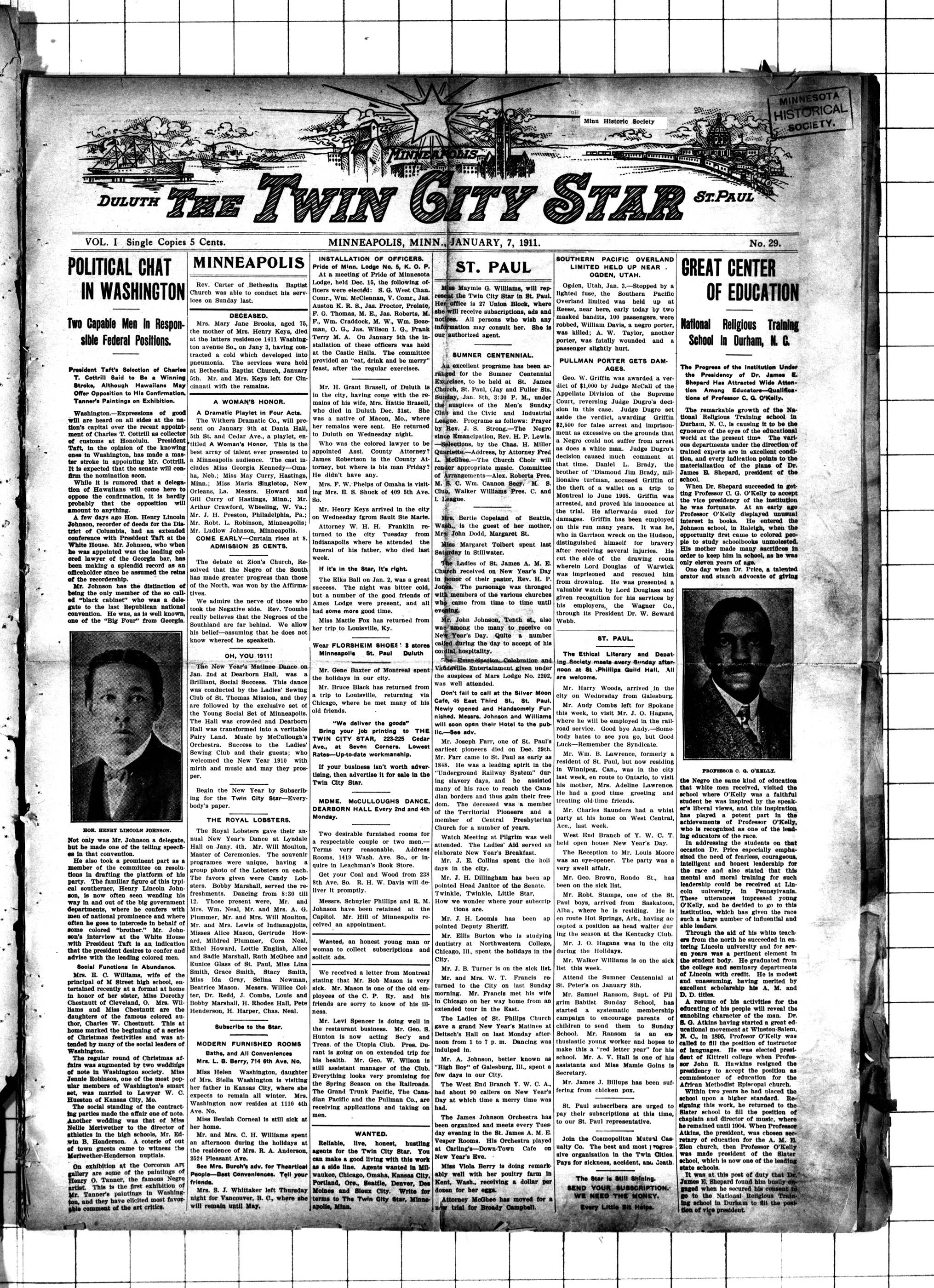
POLITICAL CHAT IN WASHINGTON
Two Capable Men In Responsible Federal Positions.
President Taft's Selection of Charles T. Cottrill Said to Be a Winning Stroke, Although Hawaiians May Offer Opposition to His Confirmation, Tanner's Paintings on Exhibition.
Washington.—Expressions of good will are heard on all sides at the nation's capital over the recent appointment of Charles T. Cottrill as collector of customs at Honolulu. President Taft, in the opinion of the knowing ones in Washington, has made a master stroke in appointing Mr. Cottrill. It is expected that the senate will confirm the nomination soon.
While it is rumored that a delegation of Hawaiians will come here to oppose the confirmation, it is hardly probably that the opposition will amount to anything.
A few days ago Hon. Henry Lincoln Johnson, recorder of deeds for the District of Columbia, had an extended conference with President Taft at the White House. Mr. Johnson, when he was appointed was the leading colored lawyer of the Georgia bar, has been making a splendid record as an officeholder since he assumed the reins of the recordship.
Mr. Johnson has the distinction of being the only member of the so called "black cabinet" who was a delegate to the last Republic national convention. He was, as is well known, one of the "Big Four" from Georgia.
HON. HENRY LINCOLN JOHNSON.
Not only was Mr. Johnson a delegate, but he made one of the telling speeches in that convention.
He also took a prominent part as a member of the committee on resolutions in drafting the platform of his party. The familiar figure of this typical southerner, Henry Lincoln Johnson, is now often seen wending his way in and out of the big government departments, where he confers with men of national prominence and where often he goes to intercede in behalf of some colored "brother." Mr. Johnson's interview at the White House with President Taft is an indication that the president desires to confer and advise with the leading colored men.
Social Functions In Abundance.
Mrs. E. C. Williams, wife of the principal of M Street high school, entertained recently at a formal at home in honor of her sister, Miss Dorothy Chestnut of Cleveland, O. Mrs. Williams and Miss Chestnut are the daughters of the famous colored author, Charles W. Chestnut. This at home marked the beginning of a series of Christmas festivities and was attended by many of the social leaders of Washington.
The regular round of Christmas affairs was augmented by two weddings of note in Washington society. Miss Jennie Robinson, one of the most popular members of Washington's smart set, was married to Lawyer W. C. Hueston of Kansas City, Mo.
The social standing of the contracting parties made the affair one of note. Another wedding was that of Miss Nellie Meriwether to the director of athletics in the high schools, Mr. Edwin B. Henderson. A coterie of out of town guests came to witness the Meriwether-Henderson nuptials.
On exhibition at the Corcoran Art gallery are some of the paintings of Henry O. Tanner, the famous Negro artist. This is the first exhibition of Mr. Tanner's paintings in Washington, and they have elicited most favorable comment of the art critics.
DECEASED.
A WOMAN'S HONOR.
OH, YOU 19111
THE ROYAL LOBSTERS.
Subscribe to the Star.
MODERN FURNISHED ROOMS
Baths, and All Conveniences Mrs. L. B. Berry, 714 6th Ave. No.
INSTALLATION OF OFFICERS.
Pride of Minn. Lodge No, 5, K. O. P.
At a meeting of Pride of Pride Lodge, held Dec. 15, the following officers were elected: S. G. West Chan. Comr., Wm. McClennan, V. Comr., Jas. Auston K. R. S., Jas. Proctor, Prelate, F. G. Thomas, M. E., Jas. Roberts, M. F., Wm. Craddock, M. W., Wm. Bozeman, O. G., Jas. Wilson I. G., Frank Terry M. A. On January 5th the installation of these officers was held at the Castle Halls. The committee provided an "eat, drink and be merry" feast, after the regular exercises.
Mr. H. Grant Brasell, of Duluth is in the city, having come with the remains of his wife, Mrs. Hattie Brasell, who died in Duluth Dec. 31st. She was a native of Macon, Mo., where her remains were sent. He returned to Duluth on Wednesday night.
Who was the colored lawyer to be appointed Asst. County Attorney? James Robertson is the County Attorney, but where is his man Friday? He didn't have any.
Mrs. F. W. Phelps of Omaha is visiting Mrs. E. S. Shuck of 409 5th Ave. So.
Mr. Henry Keys arrived in the city on Wednesday from Sault Ste Marte.
Attorney W. H. H. Franklin returned to the city Tuesday from Indianapolis where he attended the funeral of his father, who died last week.
If it's in the Star, It's right.
The Elks Ball on Jan. 2, was a great success. The night was bitter cold, but a number of the good friends of Ames Lodge were present, and all had some more good time.
Miss Mattie Fox has returned from her trip to Louisville, Ky.
Wear FLORSHEIM SHOES! 3 stores Minneapolis St. Paul Duluth
Mr. Gene Baxter of Montreal spent the holidays in our city.
Mr. Bruce Black has returned from a trip to Louisville, returning via Chicago, where he met many of his old friends.
"We deliver the goods"
Bring your job printing to THE TWIN CITY STAR, 223-225 Cedar Ave., at Seven Corners. Lowest Rates—Up-to-date workmanship.
If your business isn't worth advertising, then advertise it for sale in the Twin City Star.
MDME. McCULLOUGHS DANCE,
DEARBORN HALL Every 2nd and 4th
Monday.
Two desirable furnished rooms for
a respectable couple or two men.—
Terms very reasonable. Address
Rooms, 1419 Wash. Ave. So., or inquire in Leachman's Book Store.
Get your Coal and Wood from 238
8th Ave. So. R. H. W. Davis will deliver it promptly.
Messrs. Schuyler Phillips and R. M.
Johnson have been retained at the Capitol. Mr. Hill of Minneapolis received an appointment.
Wanted, an honest young man or woman to collect subscriptions and solicit ads.
We received a letter from Montreal stating that Mr. Bob Mason is very sick. Mr. Mason is one of the old employees of the C. P. Ry. and his friends are sorry to know of his illness.
Mr. Levi Spencer is doing well in the restaurant business. Mr. Geo. S. Hunton is now acting Secy and Treas. of the Utopia Club. Pres. Durant is going on on extended trip for his health. Mr. Geo. W. Wilson is still assistant manager of the Club. Everything looks very promising for the Spring Season on the Railroads. The Grand Trunk Pacific, The Canadian Pacific and the Pullman Co., are receiving applications and taking on men.
WANTED.
Reliable, live, honest, hustling agents for the Twin City Star. You can make a good living with this work as a side line. Agents wanted in Milwaukee, Chicago, Omaha, Kansas City, Portland, Ore., Seattle, Denver, Des Moines and Sioux City. Write for terms to The Twin City Star, Minneapolis, Minn.
Mas Maymie G. Williams, will represent the Twin City Star in St. Paul Her office is 27 Union Block, where she will receive subscriptions, ads and notices. All persons who wish any information may consult her. She is our authorized agent.
SUMNER CENTENNIAL.
Au excellent programme has been arranged for the Sumner Centennial Exercises, to be held at St. James Church, St. Paul, (Jay and Fuller Sts., Sunday, Jan. 8th, 3:30 P. M., under the auspices of the Men's Sunday Club and the Civic and Industrial League. Programme as follows: Prayer by Rev. J. S. Strong—The Negro since Emancipation, Rev. H. P. Lewis—Selections, by the Chas. H. Miller Quartette—Address, by Attorney Fred L. McGhee—The Church Choir will render appropriate music. Committee of Arrangements—Alex. Roberts Pres. M. S. C. Wm. Cannon Secy. M. S. Club, Walker Williams Pres. C. and I. League.
Mrs. Bertie Copeland of Seattle, Wash., is the guest of her mother, Mrs. John Dodd, Margaret St.
Miss Margaret Tolbert spent last Saturday in Stillwater.
The Ladies of St. James A. M. E. Church received on New Year's Day in honor of their pastor, Rev. H. P. Jones. The parsonage was wrought with members of the various churches who came from time to time until evening.
Mr. John Johnson, Tenth st., also was among the many to receive on New Year's Day. Quite a number called during the day to accept of his coral hospitality.
The Emancipation. Celebration and Vaddeville Entertainment given under the auspices of Mars Lodge No. 2202, was well attended.
Don't fail to call at the Silver Moon Cafe, 45 East Third St., St. Paul. Newly opened and Handsomely Furnished. Messrs. Johnson and Williams will soon open their Hotel to the public—See adv.
Mr. Joseph Farr, one of St. Paul's earliest pioneers died on Dec. 29th. Mr. Farr came to St. Paul as early as 1848. He was a leading spirit in the "Underground Railway System" during slavery days, and he assisted many of his race to reach the Canadian borders and thus gain their freedom. The deceased was a member of the Territorial Pioneers and a member of Central Presbyterian Church for a number of years.
Watch Meeting at Pilgrim was well attended. The Ladies' Aid served an elaborate New Year's Breakfast.
Mr. J. E. Collins spent the holl days in the city.
Mr. J. H. Dillingham has been ap pointed Head Janitor of the Senate. Twinkle, Twinkle, Little Star,
How we wonder where your subscriptions are.
Mr. J. H. Loomis has been appointed Deputy Sheriff.
Mr. Ellis Burton who is studying dentistry at Northwestern College, Chicago, Ill., spent the holidays in the City.
Mr. J. B. Turner is on the sick list.
Mr. and Mrs. W. T. Francis returned to the City on last Sunday morning. Mr. Francis met his wife in Chicago on her way home from an extended tour in the East.
The Ladies of St. Phillips Church gave a grand New Year's Matinee at Deitsch's Hall on last Monday afternoon from 1 to 7 p.m. Dancing was indulged in.
Mr. A. Johnson, better known as "High Boy" of Galesburg, Ill., spent a few days in our City.
The West End Branch Y. W. C. A., had about 90 callers on New Year's Day at which time a merry time was had.
The James Johnson Orchestra has been organized and meets every Tuesday evening in the St. James A. M. E. Vesper Rooms. His Orchestra played at Carling's—Down-Town Cafe on New Year's Eve.
Miss Vloa Berry is doing remarkably well with her poultry farm in Kent, Wash., receiving a dollar per dozen for her eggs. Attorney McGhee has moved for a new trial for Broady Campbell.
SOUTHERN PACIFIC OVERLAND LIMITED HELD UP NEAR . OGDEN, UTAH.
Ogden, Utah, Jan. 3.—Stopped by a lighted fuse, the Southern Pacific Overland limited was held up at Reese, near here, early today by two masked bandits, 100 passengers. were robbed, William Davis, a negro porter, was killed; A. W. Taylor, another porter, was fatally wounded and a passenger slightly hurt.
PULLMAN PORTER GETS DAM- AGES.
Geo. W. Griffin was awarded a verdict of $1,000 by Judge McCall of the Appellate Division of the Supreme Court, reversing Judge Dugro's decision in this case. Judge Dugro set aside the verdict, awarding Griffin $2,500 for false arrest and imprisonment as excessive on the grounds that a Negro could not suffer from arrest as does a white man. Judge Dugro's decision caused much comment at that time, Daniel L. Brady, the brother of "Diamond Jim Brady, millionaire turfman, accused Griffin of the theft of a wallet on a trip to Montreal to June 1908. Griffin was arrested, and proved his innocence at the trial. He afterwards sued for damages. Griffin has been employed on this run many years. It was he, who in Garrison wreck on the Hudson, distinguished him for bravery after receiving several injuries. He cut the side of the drawing room wherein Lord Douglas of Warwick was imprisoned and rescued him from drowning. He was presented a valuable watch by Lord Douglass and given recognition for his services by his employers, the Wagner Co., through its President Dr. W. Seward Webb.
ST. PAUL.
The Ethical Literary and Deating Society meets every Sunday afternoon at St. Phillips Guild Hall. All are welcome.
Mr. Harry Woods, arrived in the city on Wednesday from Galesburg.
Mr. Andy Combs left for Spokane this week, to visit Mr. J. O. Hagans, where he will be employed in the railroad service. Good bye Andy.—Somebody hates to see you go, but Good Luck—Remember the Syndicate.
Mr. Wm. B. Lawrence, formerly a resident of St. Paul, but now residing in Winnipeg, Can., was in the city last week, en route to Ontario, to visit his mother, Mrs. Adeline Lawrence. He had a good time greeting and treating old-time friends.
Mr. Charles Saunders had a whist party at his home on West Central, Ace., last week.
West End Branch of Y. W. C. T. held open house New Year's Day.
The Reception to Mr. Louis Moore was an eye-opener. The party was a very swell affair.
Mr. Geo. Brown, Rondo St., has been on the sick list.
Mr. Robt. Stamps, one of the St. Paul boys, arrived from Saskatoon, Alba., where he is residing. He is en route Hot Springs, Ark., having accepted a position as head waiter during the season at the Kentucky Club.
Mr. J. O. Hagans was in the city during the Holidays.
Mr. Walker Williams is on the sick list this week.
Attend the Sumner Centennial at St. Peter's on January 8th.
Mr. Samuel Ransom, Supt. of Pilgrim Babtist Sunday School, has started a systematic membership campaign to encourage parents of children to send them to Sunday School. Mr. Ransom is an enthusiastic young worker and hopes to make this a "red letter year" for his school. Mr. A. V. Hall is one of his assistants and Miss Mamie Golns is Secretary.
Mr. James J. Billups has been suffering from chicken pox.
St. Paul subscribers are urged to pay their subscriptions at this time, to our St. Paul representative.
Join the Cosmopolitan Mutual Casualty Co. The best and most progressive organization in the Twin Cities. Pays for sickness, accident, and death.
The Star is Still Shining.
SEND YOUR SUBSCRIPTION.
WE NEED THE MONEY.
Every Little Bit Helps.
GREAT CENTER OF EDUCATION
National Religious Training School in Durham, N. C.
The Progress of the Institution Under the Presidency of Dr. James E. Shepard Has Attracted Wide Attention Among Educators-Qualifications of Professor C. G. O'Kelly.
The remarkable growth of the National Religious Training school in Durham, N. C., is causing it to be the cynosure of the eyes of the educational world at the present time. The various departments under the direction of trained experts are in excellent condition, and every indication points to the materialization of the plans of Dr. James E. Shepard, president of the school.
When Dr. Shepard succeeded in getting Professor C. G. O'Kelly to accept the vice presidency of the institution he was fortunate. At an early age Professor O'Kelly displayed unusual interest in books. He entered the Johnson school, in Raleigh, when the opportunity first came to colored people to study schoolbooks unmolested. His mother made many sacrifices in order to keep him in school, as he was only eleven years of age.
One day when Dr. Price, a talented orator and stanch advocate of giving
PROFESSOR C. G. O'KELLY.
the Negro the same kind of education that white men received, visited the school where O'Kelly was a faithful student he was inspired by the speaker's liberal views, and this inspiration has played a potent part in the achievements of Professor O'Kelly, who is recognized as one of the leading educators of the race.
In addressing the students on that occasion Dr. Price especially emphasized the need of fearless, courageous, intelligent and honest leadership for the race and also stated that this mental and moral training for such leadership could be received at Lincoln university, in Pennsylvania. These utterances impressed young O'Kelly, and he decided to go to this institution, which has given the race such a large number of influential and able leaders. Through the aid of his white teachers from the north he succeeded in entering Lincoln university and for seven years was a pertinent element in the student body. He graduated from the college and seminary departments of Lincoln with credit. He is modest and unassuming, having merited by excellent scholarship his A. M. and D. D. titles.
A resume of his activities for the educating of his people will reveal the enobling character of the man. Dr. S. G. Atkins having started a great educational movement at Winston-Salem, M. C., in 1895, Professor O'Kelly was called to fill the position of instructor of languages. He was elected president of Kittrell college when Professor John R. Hawkins resigned the presidency to accept the position as commissioner of education for the African Methodist Episcopal church.
Within two years he had placed the school upon a higher standard. Resigning this work, he returned to the Slater school to fill the position of chaplain and director of music, where he remained until 1904. When Professor Atkins, the president, was chosen secretary of education for the A. M. E. Zlon church, then Professor O'Kelly was president of the Slater school, which is now one of the leading state schools.
It was at this post of duty that Dr James E. Shepard found him busily engaged when he secured his consent to go to the National Religious Training school in Durham to fill the position of vice president.
CHAS. S. SMITH, Editor,
126 Cedar Ave.
MINNEAPOLIS. MINN.
BRIEF NEWS NOTES FOR THE BUSY MAN
MOST IMPORTANT EVENTS OF THE PAST WEEK, TOLD IN CONDENSED FORM.
Complete Review of Happenings of Greatest Interest From All Parts of the Globe—Latest Home and Foreign Items.
PERSONAL.
Senator Stephen B. Elkins of West Virginia, son-in-law of Henry Gassaway Davis, Democratic candidate for vice-president in 1904, and himself a Republican leader of the senate, died at his Washington home after an illness of nearly a year. Doctor Sowers, who attended the senator, announced the cause of his death as septicemia. William Ellis Corey, for seven years president of the United States Steel corporation, has resigned that office, the resignation to take effect at the pleasure of the board of directors. It is probable that for the present there will be no successor elected to succeed Mr. Corey. President Taft sent his congratulations to President Estrada, the new president of Nicaragua, extending the hope for a peaceful and happy term of life for the new republic. This is the end of a long and expensive interest of the United States in the affairs of Nicaragua.
For the first time since he became speaker of the house, Mr. Cannon did not hold a New Year reception at Washington. Miss Helen Cannon, his daughter, who always receives with him on these occasions, is ill of a bad cold in their Danville home and was not able to reach Washington.
E. W. Howe, who founded the Atchison (Kan.) Globe thirty-three years ago, has retired from it. A one-half interest in the paper has been given to Eugene Howe, the editor's son. The rest of the stock is divided between a number of Atchison men. Monsignor J. J. Keogh, for 34 years at St. John's cathedral, Milwaukee, as a priest, died after a long illness.
Gen. John Corson Smith, known the world over because of his prominence In Masonic circles, and one of the G. A. R. leaders, is dead at Chicago. He was state treasurer of Illinois in 1872 and again in 1882. Two years later he was elected lieutenant governor.
GENERAL NEWS.
It is feared that heavy loss of life was caused by the violent earthquake which devastated towns throughout Russian Turkistan. Many populous towns are in ruins and great fissures opened in the earth, in some instances houses being engulfed. The cold is intense and great suffering is certain to follow.
Two masked bandits entered the mail car on the Northern Pacific railroad just as the train was leaving the King street depot, Seattle. As soon as the first robber got in the door he shot Mail Clerk Harry O. Clark in the mouth.
Peru has agreed to submit its boundary dispute with Ecuador to the arbitration of The Hague tribunal. This is in compliance with the suggestion of the United States, Brazil and Argentina.
Burglaries entered the Sherman state bank at Sherman, S. D., and escaped with $2,000 after breaking open the safe.
An experimental postal savings bank was opened by the government in one city in each state and territory.
The National Ice Association of America, with principal office in New York, has been incorporated in Albany to promote the interests of harvesters and dealers in natural ice.
Representative Charles Adkins was elected speaker of the Forty-seventh general assembly.
John A. Dix was inaugurated governor of New York state amid the booming of guns and the jubilant cheers of those present at the ceremony. In his inaugural speech the new governor advocated economy and pledged himself to try and stave off direct taxation.
Felipe Salvador, the Luzon bandit chief, who was captured last July, was given the death sentence at Manila. Salvador has a record of 50 murders. John B. Molesant, one of the world's most daring and successful aviators, was killed at New Orleans by being thrown out of a Blerlot monoplane.
After returning 60 more indictments for election bribery, the Adams county (O.) grand jury took a recess to give the officials an opportunity to catch up with the work. To date more than 1,500 have been indicted for boodling and 948 have been sentenced and disfranchised.
Revised returns on the local option vote in Ontario show that 26 municipalities have been added to the "dry" column.
Toronto and Fulton, Ark., have gone "dry." Not a drink can be brought between Little Rock, Ark., and Toronto, a distance of 385 miles.
Expulsion of Senator D. W. Holtlaw, self confessed bribe taker, from the senate of Illinois, was the feature of the convening of that body. This action is expected to go far in the precluding of an extended investigation by the senate of the Lorimer scandal, in which Senator Holtlaw confessed he received $2,500 for his vote. Twelve years at hard labor in the prison, "and thence until the cost of prosecution is paid," was the sentence pronounced on James J. Gallagher, who shot Mayor Gaynor, in the court of oyer and terminer in Jersey City. The federal government brought suit in the United States circuit court at New York under the Sherman antitrust law against 43 of the principal transatlantic steamer lines, which are estimated to control 90 per cent. of the steerage traffic, to them $55,000,000 a year. Twelve officers of the defendant companies, all residents in America, are named as co-defendants.
Secretary of the Interior Ballinger has been advised that an approximate addition of $500 a day has been made to the government's revenue from the lease of Indian oil lands in Oklahoma and Kansas, through the advance, in the price of crude oil.
Deputy sheriffs arrested Chill Rossi in Seattle just as he reached for a decoy money package placed under the Spokane avenue bridge in answer to letters demanding $2,000 from Fred Marino, a prosperous Georgetown Italian.
The first human remains from the old battleship Maine were brought to the surface in Havana harbor by a dredge. They consisted of two ribs and some small bones, apparently bones of the hand.
After a nine-hour battle with armed police and two detachments of the Scots Guards, supported by rapid-fire guns, two men, "Peter the Painter" and "Dutch Fritz," members of a band of alien desperadoes which killed three policemen and wounded five some weeks ago when the members were caught attempting to rob the safe of a jeweler in Houndsditch, perished by fire after being riddled with bullets in London, Eng.
Southern Pacific train No. 1, the Overland limited, west-bound, was held up by two masked bandits at Reese, nine miles west of Ogden, Utah, William Davis, a negro porter, was shot and instantly killed, and A. W. Taylor, another porter, was slightly wounded. One hundred passengers on the train were relieved of their valuables.
Fire and panic which occurred while a New Year's religious celebration was in progress in a church near San Luis Potosí, Mex., caused the death of 17 persons and seriously injured more than eighty, mostly women and children.
With the administration of oaths of office as members of the Supreme court to Associate Justices Willis Van Devanter and Joseph R. Lamar, the tribunal at last has its ranks complete for the first time in 19 months.
According to a dispatch from Puerto Barrios, Honduras, the gunboat Hornet has captured Truxillo, Honduras. When the land forces reached Ruatan they were joined by the troops of the government garrison and the revolutionists accomplished their purpose without firing a shot.
That the planet Venus is inhabited is the message given the world-with the advent of the new year. And, furthermore, it is said that the habitats probably are intelligent beings. This information comes from Thomas Jefferson Jackson See, astronomer in charge of the United States navy observatory at Mare Island, Cal.
Arch Hoxsey, the aviator, was killed in an attempt to break his own world's altitude record of 11,474 feet. Hoxsey was descending from a flight made in the face of a gale. The aeroplane seemed to have been caught in a vortex of contrary air currents in a treacherous atmosphere and was whirled over and over as it came tumbling toward the earth. Hoxsey was dead when taken out of the wreckage of his machine.
Mrs. Augusta E. Stetson, the excommunicated former leader of the First Church of Christ, Scientist, in New York, proclaims her belief in the imminent resurrection in the semblance of human form of Mary Baker Eddy, the discoverer of Christian Science, who, "the world believes," died on December 3.
Eight men were killed and two injured in the Lick Ford mine of the Red Jacket Coal company near Thacker, W. Va., when a mine car ran away, knocking props down and allowing thousands of tons of coal to fall on the victims.
A monarchist plot to overthrow the Republic of Portugal has been discovered at Lisbon; scores have been arrested and the ringleader has already been executed. This news was received by the Portuguese minister, Viscount De Alte, at Washington. His brief official message also stated that the plot had been suppressed.
Production of coal in the United States during 1910 was between 475,000,700 and 485,000,000 short tons, against 459,715,704 short tons in 1909, and approximately within one percent of the maximum record of 480,383,424 tons, produced in 1907.
Following the discovery of an alleged shortage of nearly $60,000 in the funds of the Westfield (Mass.) Savings bank, the treasurer of the institution, Velenus W. Crowson, was placed under arrest. According to a statement issued by the state bank commissioner, Crowson has confessed to the misappropriation of funds of the bank.
Wreckage picked up in the Bay of Biscay leaves no doubt of the fate of the British steamer Axiom, which left London December 9 for West African ports, with a crew of 30 British and German sailors and four passengers.
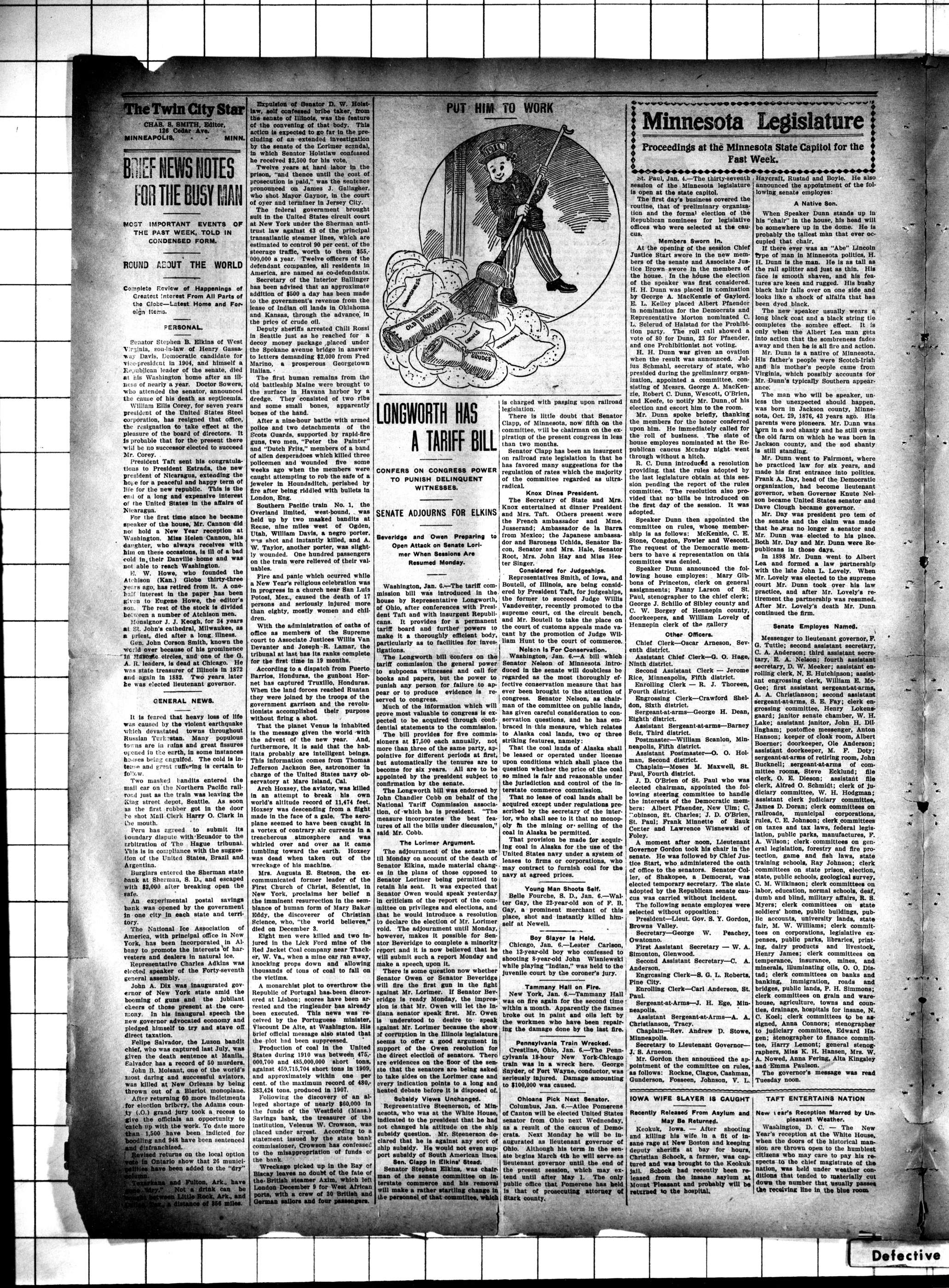
PUT HIM TO WORK
COMMUNITY
OLD
GROUCH
CRIMALS
VEGETARIAN
GRUDGE
LONGWORTH HAS A TARIFF BILL
CONFERS ON CONGRESS POWER
TO PUNISH DELINQUENT
WITNESSES.
Beveridge and Owen Preparing to Open Attack on Senate Lorimer When Sessions Are Resumed Monday.
Washington, Jan. 6. - The tariff commission bill was introduced in the house by Representative Longworth, of Ohio, after conferences with President Taft and with insurgent Republicans. It provides for a permanent tariff board and further powers to make it a thoroughly efficient body, particularly as to facilities for investigations.
The Longworth bill confers on the tariff commission the general power to subpoena witnesses and call for books and papers, but the power to punish any person for failure to appear or to produce evidence is reserved to congress.
Much of the information which will prove most valuable to congress is expected to be acquired through confidential statements to the commission. The bill provides for five commissioners at $7,500 each annually, not more than three of the same party, appointive for different periods at first, but automatically the tenures are to become for six years. All are to be appointed by the president subject to confirmation by the senate. The Longworth bill was endorsed by John Chandler Cobb on behalf of the National Tariff Commission association, of which he is president. "The measure incorporates the best features of all the bills under discussion," said Mr. Cobb.
The Lorimer Argument.
The adjournment of the senate until Monday on account of the death of Senator Elkins, made material changes in the plans of those opposed to Senator Lorlmer being permitted to retain his seat. It was expected that Senator Owen would speak yesterday in criticism of the report of the committee on privileges and elections, and that he would introduce a resolution to declare the election of Mr. Lorlmer void. The adjournment until Monday, however, makes it possible for Senator Beveridge to complete a minority report and it is now believed that he will submit such a report Monday and make a speech upon it.
There is some question now whether Senator Owen or Senator Beveridge will fire the first gun in the fight against Mr. Lorimer. If Senator Beveridge is ready Monday, the impression is that Mr. Owen will let the Indiana senator speak first. Mr. Owen is understood to desire to speak against Mr. Lorimer because the show of corruption in the Illinois legislature seems to offer a good argument in support of the Owen resolution for the direct election of senators. There are evidences on the floor of the senate that the senators are being asked to take sides on the Lorimer case and every indication points to a long and heated debate before it is disposed of.
Subsidy Views Unchanged.
Representative Steenerson, of Minnesota, who was at the White House, indicated to the president that he had not changed his attitude on the ship subsidy question. Mr. Steenerson declared that he is against any sort of ship subsidy. He would not even support subsidy of South American lines.
See Cases in Elliott Street.
Sen. Clapp in Elkins' Stead.
Senator Stephen Elkins, was chairman of the senate committee on interstate commerce and his removal will make a rather startling change in the personnel of that committee, which
is charged with passing upon railroad legislation.
There is little doubt that Senator Clapp, of Minnesota, now fifth on the committee, will be chairman on the expiration of the present congress in less than two months.
Senator Clapp has been an insurgent on railroad rate legislation in that he has favored many suggestions for the regulation of rates which the majority of the committee regarded as ultraradical.
Knox Dines President.
The Secretary of State and Mrs. Knox entertained at dinner President and Mrs. Taft. Others present were the French ambassador and Mme. Jusserand; Ambassador de la Barra from Mexico; the Japanese ambassador and Baroness Uchida, Senator Bacon, Senator and Mrs. Hale, Senator Root, Mrs. John Hay and Miss Hester Singer.
Considered for Judgeships.
Representatives Smith, of Iowa, and Boutell, of Illinois, are being considered by President Taft, for judgeships, the former to succeed Judge Willis Vandeventer, recently promoted to the supreme court, on the circuit bench, and Mr. Boutell to take the place on the court of customs appeals made vacant by the promotion of Judge William Hunt to the court of commerce.
Nelson is For Conservation.
Washington, Jan. 6.—A bill which Senator Nelson of Minnesota introduced in the senate will doubtless be regarded as the most thoroughly effective conservation measure that has ever been brought to the attention of congress. Senator Nelson, as chairman of the committee on public lands, has given careful consideration to conservation questions, and he has embraced in this measure, which relates to Alaska coal lands, two or three striking features, namely:
That the coal lands of Alaska shall be leased or operated under license upon conditions which shall place the question whether the price of the coal so mined is fair and reasonable under the jurisdiction and control of the interstate commerce commission. That no lease of coal lands shall be acquired except under regulations prescribed by the secretary of the interior, who shall see to it that no monopoly in the mining or selling of the coal in Alaska be permitted. That provision be made for acquiring coal in Alaska for the use of the United States navy under a system of leases to firms or corporations, who may contract to furnish coal for the navy at agreed prices.
Young Man Shoots Self.
Belle Fourche, S. D., Jan. 6.—Walter Gay, the 22-year-old son of F. B. Gay, a prominent merchant of this place, shot and instantly killed himself at Newell.
Boy Slayer Is Held.
Chicago, Jan. 6.—Lester Carlson, the 13-year-old boy who confessed to shooting 8-year-old John Wisniewski while playing "Indian," was held to the juvenile court by the coroner's jury.
Tammany Hall on Fire.
Tammany Hall on Fire.
New York, Jan. 6.—Tammany Hall was on fire again for the second time within a month. Apparently the flames broke out in paint and oils left by the workmen who have been repairing the damage done by the last fire.
Pennsylvania Train Wrecked.
Crestline, Ohio, Jan. 6.—The Pennsylvania 18-hour New York-Chicago train was in a wreck here. George Snyder, of Fort Wayne, conductor, was seriously injured. Damage amounting to $100,000 was caused.
Ohioans Pick Next Senator-
Ohioans Pick Next Senator.
Columbus, Jan. 6.—Atlee Pomerene of Canton will be elected United States senator from Ohio next Wednesday, as a result of the caucus of Democrats. Next Monday he will be inaugurated as lieutenant governor of Ohio. Although his term in the senate begins March 4th he will serve as lieutenant governor until the end of the present session, which may extend until after May 1. The only public office that Pomerene has held is that of prosecuting attorney of Stark county.
Minnesota Legislature
Proceedings at the Minnesota State Capitol for the Past Week.
St. Paul, Jan. 4.—The thirty-seventh session of the Minnesota legislature is open at the state capitol.
The first day's business covered the routine, that of preliminary organization and the formal election of the Republican nominees for legislative offices who were selected at the caucus.
Haycraft, Rustad and Boyle. He announced the appointment of the lowing senate employees:
A Native Son.
When Speaker Dunn stands up his "chair" in the house, his head be somewhere up in the dome. He probably the tallest man that ever
Members Sworn In.
At the opening of the session Chief Justice Start swore in the new members of the senate and Associate Justice Brown swore in the members of the house. In the house the election of the speaker was first considered. H. H. Dunn was placed in nomination by George A. MacKenzie of Gaylord. E. L. Kelley placed Albert Pfaunder in nomination for the Democrats and Representative Morton nominated C. L. Selerud of Halstad for the Prohibition party. The roll call showed a vote of 80 for Dunn, 23 for Pfauender, and one Prohibitionist not voting. H. H. Dunn was given an ovation when the result was announced. Julius Schmahl, secretary of state, who presided during the preliminary organization, appointed a committee, consisting of Messrs. George A. MacKenzie, Robert C. Dunn, Wescott, O'Brien, and Keefe, to notify Mr. Dunn, of his election and escort him to the room.
Mr. Dunn spoke briefly, thanking the members for the honor conferred upon him. He immediately called for the roll of business. The slate of house employees nominated at the Republican caucus Mcnday night went through without a hitch. R. C. Dunn introduced a resolution providing that the rules adopted by the last legislature obtain at this session pending the report of the rules committee. The resolution also provided that no bills be introduced on the first day of the session. It was adopted. Speaker Dunn then appointed the committee on rules, whose membership is as follows: McKenzie, C. E. Stone, Congdon, Fowler and Wescott. The request of the Democratic members to have a representation on this committee was denied.
Speaker Dunn announced the following house employees: Mary Gibbons of Princeton, clerk on general assignments; Fanny Larson of St. Paul, stenographer to the chief clerk; George J. Schillo of Sibley county and C. W. Borgey of Hennepin county, doorkeepers, and William Lovely of Hennepin clerk of the gallery
Other Officers.
Chief Clerk—Oscar Arneson, Seventh district.
Assistant Chief Clerk—G. O. Hage, Ninth district.
Second Assistant Clerk — Jerome Rice, Minneapolis, Fifth district.
Enrolling Clerk — R. J. Thoreen, Fourth district.
Engrossing Clerk—Crawford Sheldon, Sixth district.
Sergeant-at-arms—George H. Dean, Eighth district.
Assistant Sergeant-at-arms—Barney Seiz, Third district.
Postmaster—William Scanlon, Minneapolis, Fifth district.
Assistant Postmaster—O. O. Holman, Second district.
Chaplain—Moses M. Maxwell, St. Paul, Fourth district.
J. D. O'Brien of St. Paul who was elected chairman, appointed the following steering committee to handle the interests of the Democratic members: Albert Pfaender, New Ulm; C. Robinson, St. Charles; J. D. O'Brien, St. Paul; Frank Minette of Sauk Center and Lawrence Wisnowski of Foley.
A moment after noon, Lieutenant Governor Gordon took his chair in the senate. He was followed by Chief Justice Start, who administered the oath of office to the senators. Senator Coller, of Shakopee, a Democrat, was elected temporary secretary. The slate adopted by the Republican senate caucus was carried without incident.
The following senate employees were selected without opposition:
President—Lleut. Gov. S. Y. Gordon, Brown's Valley.
Secretary—George W. Peachey, Owatonna.
First Assistant Secretary — W. A. Simonton, Glenwood.
Second Assistant Secretary—C. A. Anderson.
Engrossing Clerk—S. G. L. Roberts, Pine City.
Enrolling Clerk—Carl Anderson, St. Paul.
Sergeant-at-Arms—J. H. Ege, Minneapolis.
Assistant Sergeant-at-Arms—A. A. Christianson, Tracy.
Chaplain—Rev. Andrew D. Stowe, Minneapolis.
Secretary to Lieutenant Governor—J. S. Arneson.
Mr. Gordon then announced the appointment of the committee on rules, as follows: Rockne, Clague, Cashman, Gunderson, Fosseen, Johnson, V. L.
Recently Released From Asylum and May Be Returned.
Keokuk, Iowa. — After shooting and killing his wife in a fit of insane rage at New Boston and keeping deputy sheriffs at bay for hours, Christian Schock, a farmer, was captured and was brought to the Keokuk jail. Schock had recently been released from the insane asylum at Mount Pleasant and probably will be returned to the hospital.
Haycraft, Rustad and Boyle. He also announced the appointment of the following senate employees:
A Native Son.
When Speaker Dunn stands up in his "chair" in the house, his head will be somewhere up in the dome. He is probably the tallest man that ever occupied that chair.
If there ever was an "Abe" Lincoln type of man in Minnesota politics, H. H. Dunn is the man. He is as tall as the rail splitter and just as thin. His face is smooth shaven, and his features are keen and rugged. His bushy black hair falls over on one side and looks like a shock of alfalfa that has been dyed black.
The new speaker usually wears a long black coat and a black string tie completes the sombre effect. It is only when the Albert Lea man gets into action that the sombreness fades away and then he is all fire and action.
Mr. Dunn is a native of Minnesota. His father's people were Scotch-Irish and his mother's people came from Virginia, which possibly accounts for Mr. Dunn's typically Southern appearance.
The man who will be speaker, unless the unexpected should happen, was born in Jackson county, Minnesota, Oct. 29, 1876, 43 years ago. His parents were pioneers. Mr. Dunn was born in a sod shanty and he still owns the old farm on which he was born in Jackson county, and the sod shanty is still standing.
Mr. Dunn went to Fairmont, where he practiced law for six years, and made his first entrance into politics. Frank A. Day, head of the Democratic organization, had become lieutenant governor, when Governer Knute Nelson became United States senator and Dave Clough became governor.
Mr. Day was president pro tem of the senate and the claim was made that he was no longer a senator and Mr. Dunn was elected to his place. Both Mr. Day and Mr. Dunn were Republicans in those days.
In 1898 Mr. Dunn went to Albert Lea and formed a law partnership with the late John L. Lovely. When Mr. Lovely was elected to the supreme court Mr. Dunn took over his law practice, and after Mr. Lovely's retirement the partnership was resumed. After Mr. Lovely's death Mr. Dunn continued the firm.
Senate Employes Named.
The governor's message was read Tuesday noon.
New Year's Reception Marred by Unpleasant Weather.
Washington, D. C. — The New Year's reception at the White House, when the doors of the historical mansion are thrown open to the humblest citizens who may care to pay his respects to the chief magistrate of the nation, was held under weather conditions that tended to materially cut down the number that usually passes the receiving line in the blue room.
Defective
MESSAGE OF THE GOVERNOR
EXHAUSTIVE TREATISE ON STATE AFFAIRS BY THE MINNESOSA EXECUTIVE.
URGES A NUMBER OF REFORMS IN THE SYSTEM, TENDING TO GREATER EFFICIENCY AND LESS EXPENSE.
St. Paul A. O. Eberhart was read to the legislature. In brief he said: 'The people of Minnesota in the election of Gov. A. O. Eberhart control all branches and departments of the government, the hands of the Republican party, the hands of the Reparty with a double, responsibility, contract and commitment upon the legislative and executive powers upon the legislative and government, not only the opportunity, but the duty and mandate of helpful and responsive people and their highest public interest and response to their problems, prompt and hearty response in wise and proactive manner as well as vigorous and efficient administration, earnest and effective co-operation within government, and to you I look with the most confidence and expectation for support in most real and effective reforms which the needs of our community require, and the thought of our time demand at our hands.
I believe that the time has arrived in the history of this state, when the public good, or, to use the language of the constitution, when the security, benefit and protection of the people demand a radical modification and reform in certain phases of our state administration.
We have just completed the first half century of our development as a state. We are no longer dependent upon pioneer experiments and ancient makeshifts. We are prepared to establish our system of state government on the most scientific and progressive principles of civics and economics. Before the installation of any reform, however, we wish to assure ourselves that it can stand the test of experience as practical and business like, that it conduces to public economy and efficiency, and that it represents the true interests, welfare and prosperity of the people as a whole.
Importance of efficient Administration
The state law requires the officer of the state, and is tightly held responsibility for the administration of the laws and the efficient administration of the state. Under our present laws the Governor is appointed an active member of sixteen boards, during the year running into the millions, and he may act intelligently for the best interstate examples I would mention the drainage board of Minnesota or Minnesota large range of money, drainage, and I have every reason to believe drainage board of this state has brought drainage board of this state has brought board I cannot of my own knowledge assure the people of the state that the best results Under the present system of organization in a large number of large range of the affairs of state there is no way of securing co-operation with the administration. The boards are uniformly too large of the state, and even if they could be as large as the difficulty to agree on any single proposition and to assure uniform support in
Perhaps the only remnant of the theory that purely political considerations are sufficient for reward at public expense in the present fee office. There is no possible de-
stings of the existence of this office today. Fees collected do not belong to office off-
the other to the state, and the state owes, the officer a sufficient compensation for his work,
including necessary expenses, and no more. No state officer should be dependent for
disruption on the investment could be collected. Perhaps the offices in this state
illustrate this more forcibly than those connected with the oil and biler inspection, and
surveying of logs and lunber. The inspection of illuminating oils could be turned
on the main foot department, and the other of the other
particularly no additional expenses which would result in saving the state in fees dis-
bursed for the inspection of oil approximately $40,000.00 annually, the total amount of
fees collected during the fiscal year ending June 15, 1950. The cost of bolder inspection for the year 1910
as nearly as can be ascertained from the incomplete returns filed, was about $22,500,
an amount greatly out of proportion to the service actually rendered. But conceding for
that the service has been in all cases rendered, the system
In the case of oil inspection, this department work performed by the dairy and food department. In the case of water inspection, this work should be performed by inspectors in the labor department, who inspectors in the warehouse and who should travel throughout the state and all their time thereto. The fees collected should be based on boiler capacity and paid by the state. In the case of the inspection of lumber and lumber, this could be commissioned and so it was collected thereferent turned over to the state as in other cases.
Bureau of Puellic Domain.
An examination of government land office records from date of turnover of the first home-land estate on day 4, 1999 that something over one-third of our total state domain, is approximated to 100,000 acres, the several homestead acts. Timber culture and the several homestead acts. Timber culture aggregate approximately 2,100,000 acres, and timber and stents, under the act of 1876, account for 1,275,000 acres addition-
The amount of unappropriated lands belonging to the several government open to at least 1,000,000 of the state, as shown in the report, is $1,490,955 acres, of which 137,000 are unsurveyed.
Under the various acts of Congress granting lands to the several states, Minnesota is entitled to 9,600,118.47 acres, as follows:
School lands
A. 2,977,822.39
Agricultural college lands
5,244,429.28
School lands
5,852,926.00
Public building lands
6,839,132.10
Public law laws
6,480,000.00
University lands
92,160.00
Up to July 31, 1916, patents had been received from the general government for the several classes of state lands, as follows:
School lands
2,950,069.77
Agricultural college lands
4,433,452.51
Internal improvement land
4,492,941.48
Public building lands
5,895,125.25
Public law laws
46,530.68
University lands
91,082.96
This leaves 1, balance of 1,419,015.72 acres, according to the record of the state, yet to be approved and patents are not subject to any change of the school, university, agricultural college, internal improvement swamp and salt spring lands for the various educational and other permanent trust funds, which on July 3, 1910, are reported by the Auditor, as follows:
The School of Education
1,902,571.27
Permanent university fund
1,448,798.51
Internal improvement land fund
2,944,597.87
Swamp land fund
The Auditor, as ex-officio state land commissioner, reports on hand unsold in the possession of the state and its institutions at this time 2,456,405 acres, as follows:
acres
School land ..... 940,570.54
University land ..... 22,170.95
Internal improvement land ..... 7,757.71
Swamp land ..... 1,515,906.14
In addition to the above holdings, the auditor estimates that there is still due from the general government 606,000 acres of selected swamp and indemnity school lands, bringing the total up to approximately 3,400,000 acres, as the total public domain to be administered in the interest of our public schools and other state lawلیوں. as well as the general public.
The Department of State Lands. The department presents laws and methods of handling state lands, public lands, and separate land department, is now generally admitted. If the State of Minnesota buys the same, in my opinion the law should be made every day in the year by the respective county auditors, and upon terms that will make every day in the year by the respective county auditors, and upon terms that will also be in the nature of inducement tender, and a separate land department organized. Before reform in our land laws can be applied, we appear wise and apparently legally necessary in the form of a constitutional amendment, in the form of a constitutional amendment, sold to best advantage it is very desirable that sales be made at all times on public lands, but this involves a legal question and it is not necessary that the policy of public sale, as required by our constitution, public lands have been properly appraised, public lands have been properly appraised, make sales to bona sida settlers at all times and still continue to make smaller public lands, or sixty days, when in his judgment interests can best be subserved thereby.
Neighboring states, owning only a small fraction of our land, have separate land departments, while in Minnesota the land commissioner for each state, and in Wisconsin no direct and systematic daily check upon his land, timber, and mineral transactions in other departments and business, except the one or two examinations by the public examiner in the phase of our land business. One纵列 the public wisdom and necessity of amendments to the state's days, more keenly than the state auditor himself, as shown by his report.
Department of Forestry.
The original state of Minnesota is estimated at over one-half of the total land, the state, of approximately 25,000,000 acres, be estimated as covering less than one-fourth of the state, or approximately 13,000,000 acres.
Of our total wooded area 1,204,480 acres are set aside as a national forest reserve and nearly 2,000,000 acres more represent unsurveyed government forest lands largely in the Indian reservations, making a total of over 3,000,000 acres of national government holdings in Minnesota. The state forest reserves aggregate about 40,000 acres. The total standing timber in twenty-one counties now partly covered by forests is estimated by the forest commissioner at about twenty billion feet, nearly one-half of which is supposed to be pine. At the present average lumber cut of a billion feet a year, it would take about twenty years, without the help of forest fires, to complete the denudation of a state which once had one of the greatest and most varied forest areas.
It would seem as though the necessity of agriculture and business like administration were plain to the general public and to the members of this legislature, that argument should be strengthened by a more enforced another chapter of horrors in demonstration, which should be sufficient to demonize the industry, and to prevent administration. But the Hinklecky, Chisholm and Beadetta fires, with their losses aggravated and many human lives, tell only a part of the sad story. To this we must add losses by the lack of growing forests as well as loss of opportunities for the development of that the aggregate forest resource Minnesota are worth $100,000,000, which is the same as the average square measures of protection development and administration. But as has a large area of cut-over lands that are valuable chiefly for reforestation, and the same applies to a coniferous forest, we read the reports of European state forests from forest lands, we begin to appreciate that timber is one of the most valuable crops and soil may produce and that land of little or no value is generous revenue producer by scientific for-
Our educational institutions, notably the public schools, university and agricultural schools, are in line with the plans and are being made up of the following: come from these mines. It has long been apparent that mineral resources which promise our schools and university a future in use of the much higher cost of require the total, export administration. Our state geological survey, created from the proceeds of the government salt spring land grant, was discontinued over ten years ago, at the right of the geology business, and before it had completed its work.
From the standpoint of good business management there can be only one thing to do: the public school is available for survey and department of mines, and, following the example of Wisconsin, Michigan and Missouri, make such appropriations from years to the time of the department of geology and mines worthy of our great mineral industry and resources.
The expense of such administration will be returned to the state the many folklins of the royaltyed and least the year earned for our state institutions over $225,000, and in twenty years the state treasury has realized the costs of $1,550,000, not including the cost of the tax. This is $18,000, which is over thirteen times the state tax from iron ore in 1900. In the past four years, since the organization of the Mineralism Association, the state has realized $2,450,000 from iron mine exatien, not to mention the still larger revenue contributed by the mines to the support of town, county, states, and city government and public, bridges, and schools in the iron-producing counties.
Departament of Game and Fish.
Department of Minnesota with game and fish. It is one of the largest departments of Minnesota with game and fish. It is one of which the stage has been most fortunate. The total disbursements of the department for 1910 amount to $85,452. Of 564 prosecutions, there have been copies for the year 1910 amounts to $85,452. One of its most improvement of the high hatcheries as or to increase the supply of fish. In 1909 and 1910 amounts to 190,888,687, which is an increase of $100,688,687 over the year 1909.
Department of Waterways.
Give the most extensive coasts of lakes and streams. Our water area approximates 4,000,000 acres. It is estimated that there are more than 100,000 safe falls and rapids in Minnesota is about 100 miles longer than one-half is now utilized for industrial purposes. In other words, the available surveyed, is equivalent to over 5,000,000 tons per annum, developed into industrial power.
Besides the resources of our water power, the Mississippi River as a water power developed in cilling town. The Mississippi as a waterway created St. Paul, St. Cloud, Red Wing. But the greatest waterway asset of the Great Lakes system is wholly responsible wealth and for the larger share of our logistical and jobbing business. As compared with the average rail charge of $7.35 per ton for the Lakes route transports a ton of iron ore and a ton of coal for $3 cents. This is the miracle of transportation, which has been developed. It is our great transportation for all business purposes as near as Chicago to the Atlantic seaboard, while situated five miles from the Pacific and the great trade empire which between Lake Superior and Puget Sound.
Clomolv associated with our waterways problem is that of drainage and reservoirs. The problems of waterpowers and waterways and drainage are alike a subject for the hydraulic engineer. The waterway is the trunk of the drainage system; the drainage ditches which reclaim millions of acres of wet lands are the small veins and capillaries which articulate with the main art. System of which the principal trunk is the great navigable waterway. The total public ditches dug by the state and counties of Minnesota approximate $5,000 miles in length and have reclaimed about $5,000,000 acres at a cost of $10,000,000. The average cost of drainage per acre is therefore about $2, whereas the average benefit is from $5 to $10 per acre.
It goes without saying, that a department in charge of at least one commissioner, devise the on conservation and development of our water resources will earn its cost many fold.
Department of Agriculture and Immigration. Natural resources of any state in the Union, and the centrally organized department of agricultural lands, less than 69 per cent are cultivated, while 80 per cent are under proper methods of administration from the cent great returns than are now realized.
As showing what other states are doing in organised departments of agriculture, in organised departments of agriculture, in organised department works in harmony with the agricultural schools and colleges, the livestock, swine, growers and breeders, sheep management, engineers and home-makers conference, to be modernised somewhat after the generalisation of agriculture, and such special bureaus, science, agricultural chemistry, and special science and industry. Before the organisation be a steady decrease in the value of the state farm production for over twenty years, the value of the state farm production less than that of 1870. The wonderful realisation in the census returns of 1909 when the value in the census returns of 1909 when the value in over 1880 of the agriculture, Minnesota in 1998 turned out an agricultur-
Minnesota in 1989 turned out an agricultural
$427,000, or about $215,000 per capita.
Minnesota is the first state in the Union to have 94,000,000 bushels; but the 1999 average of 16.8 bushels per acre, though above the average of 20.0 bushels per acre, that of the best wheat sections of Europe or even that of Minnesota in the earlier days, scientific agriculture; what we now need is to develop a well-directed central organization the many lines of agricultural activity now in progress in the country. The greatest agricultural colleges and farm schools in the country, with three fairly large state institutions, commissions, departments in its own line, have performed a vast service development; but the greatest efficiency and economy have not been realized because of the large state institutions. That greater organization in agricultural development is well known and generally admitted. An appalling annual loss of soil fertility from the state has been demonstrated to a mathematical certainty. The late federal census returns show an actual increase in the older counties, amounting to as high as eight-twenty-five Minnesota counties, located not only in the older southern districts, but in the northern counties, showing less population in 1910, than in 1900.
As a business investment, the census of 1,259,000 farm owners, not including farm machinery, amounts to $1,259,510,000, perhaps swell our total farm investment to approximately $1,500,000,000. The state government and manager, and has duties as such in the land improvement drainage, forestry, and improvement drainage. Not only in the interest of our educational institutions, but also in giving settler whose claims are surrounded by public lands exempt from taxation, we can benefit from our immigration. It is the function of the department of immigration to bring to our land the populations, and our immigration commissariat. The $70,999 expended by the commissioners to bring in settlers to our sota have produced several hundred thousand inquiries from intending settlers, increased investment in farm tenants, raised brought investors and farm tenants, raised investment in state development. The appraisal of the sota has enabled through the states south of us by the generous co-operation of one of our railway companies, and the farmers only, is an example of the enterprise with which the state is now being ad-
In order to secure the best results, there must be administrative methods, so that there will be effective co-operation between the immigration department, the land and the agricultural department on the other. We have made a public Highways, We have made a mage begesting in the department and are moving slowly in the right directions in four years, under the 1-20 of a mille loye, been available as state aid and distributed by the state as against $2,000 by the county, and nearly all the counties have availed with the regulations of the State Highway Commission. Under the so of a mille loye, Amendment, on the condition of the State Highway Commission, on the condition of this legislation, it is possible for this legislature, on the present state valuation, to provide the state government of $90,000. This provision will place Minnesota in good road-legal legislation.
Doublessly there will be laid before you how to prove and strengthen state highway act. One of its purposes is to serve as an enabling amendment. Another provision will authorize the county board of each county to appoint a superintendent of highways, who shall act under the supervision of the state highway act. The county board must carefully adapted by some of the Atlantic state highway commission and its engineers to name district engineers for the various states, York, Massachusetts and Connecticut plan. Certainly, the proposed act should give our engineers the necessary maneuvers with his responsible expert duties. According to the report of the state board of engineers, the act should prevent deaths from preventable disease during the year 1988, and 8,425 deaths during the year 1998.
The great problem to be solved is one of prevention rather than cure, and consists largely in the enforcement of sanitation laws in our cities, schools, and homes. That the present board of health has been efficient and rendered the state ineximable service there can be no doubt, but the possibility of the future cannot be measured by the achievements of the past. In this department, perhaps more than in any other, it is absolutely essential that there should be co-operation with other departments. Scarcely a question of any importance in the departments of education and labor comes up for consideration that does not also involve any question of public health. Under the present system of organization, this co-operation is very difficult. The state should encourage closer relations between its educational institutions and the administrative service, thereby not only insuring better service to the public but strengthening the institutions. In the
national inspection of cities, schools and universities, the water and sewers systems, and in the areas where drinking water should furnish the large amounts of ex-cess water, the amount results from such co-e-operation with the universities of a great university is not merely means of development in every phase of the university, but means of development in every phase of the university.
The state health department should be responsible for the state health department and control of hotels in the state and for the present statutes, hotel inspection has been very unpleasant, and the state has already elsewhere, should be on a salary basic and the fees collected for the state treasury, should be paid to the state when handcapped by such lack of support the department warrants that the importance of the department warrants that the no member of the legislature can justify him in the absence of funds for protecting the health and life of his constituents. I therefore earnestly recommend the careful consideration the needs of this department to the state and food Department. One of the most important activities in the state service today is the dairy and food industry, and this is unquestionably its strongest element of success. This success interests, but has stimulated to a considerable degree-many food industries within the state, and has stimulated in the interests of public health and co-operation to secure hearty co-operation in its efforts.
It has become a recognized principle by employees and employers alike, that the greatest degree of mutual success can be secured only when the responsibility of protecting labor and those dependent thereon is made a charge upon industry itself. The best interests of both require that industry shall contribute in the first place to the safeguarding of labor so as to prevent the occurring of an accident and in the second place, in case such accident occurs. It shall contribute a reasonable compensation to the injured, and in case of death, to those dependent upon him. For this purpose, the last legislature authorized the appointment of a commission to report to this legislature a workmen's compensation act. This commission has labored diligently and will unquestionably make a thorough and comprehensive report. In accordance therewith, I recommend the enactment of such a law, believing it to be for the best interests of both employees and employers as well as the state at large.
Forty per cent of the volume of revenue collected and disbursed in Minnesota during the past year for state, county, city, village, and township government, approximately 56,000,000—was expended for public education. The rate of tax is approximately $100,000 for education were 52,000,000, being two-thirds of the net cost of state government. Almost exactly 22 per cent of our population, or about 10 per cent of the total, was enrolled in our high and graded, semi-graded, and high-grade schools. The top 10 per cent of New England, and 18 per cent for New York. As showing the per capita investment for education in the year 2000, the supering-dependent public instruction finds that the per capita year of 18,79, per capita for 222,000 pupils in semi-graded and rural schools, $34.72 per capita for 218,000 pupils in high and graded schools, and $6,000 of the total in north schools, and $177.39 per capita for $1,869 of the state university and agricultural schools and college. The investment in our 2,800 school houses exceeds $28,500,000, and is not as much as the project is expected during the past two years. Our permanent school fund of $4,200,000. Our permanent school fund is expected $21,000,000, an increase of $1,293,000 from proceeds of timber, mineral and agri-related activities during the past two years. The teachers number over 1,000,000, and the school libraries contain 1,200,000 volumes.
No state department has more important functions to perform than that of education, and yet there is perhaps not a department that has such functions, but such, complicated, executive machinery.
The advantages of the consolidated school system are so well known as to make any argument untenable against the argument untenable against the argument. The experience of eighteen hundred completely consolidated schools in thirty-two states of the union, has completely demonstrated that of the best district school, and when the district school is consolidated, and the study of a consolidated school, and the study of a consolidated school, as well as the greater efficiency, are taken into consideration of State Institutions. During the past biennial period there has been no occasion to criticize the management of control of control is entitled to great credit for its
The hospitals and asylums are crowded beyond capacity, and the legislature should process the process of processing and shape the greatest neglect on the part of the state is in failing to provide a reformatory board of women. The suggestion made by the board of the board, the committee provided with two separate departments, one as a reformatory and the other as prison for women, was adopted as is essential in the proper treatment and reformation of these inmates.
Another question of considerable importance is the existence of a law authorizing the court, except in case of murder, to impose an indeterminate sentence. It is firmly a law that would be the most common of the first degree if either capital punishment were abolished, or imposed only in the form and then only to the other of the court or the unanimous recommendation of the jury.
For the purpose of paroling prisoners confiscating the property of the court, the board should be established a state board of parole consisting of the chairman of the board of control of state institutions, a citizen of the state of the country, a citizen of the court of the warden of the prison or the superintendent of the reformatory, as the case may be constituting the third member.
Mr. W. J. M. M. was recognized as a model institution of its kind, and the construction of new buildings is progressing well. In the manufacture of fast-making, the state has been on an advanced step and the output of 1/31 movers and 70 binders during the past season will undoubtedly demonstrate the importance of the work.
Some conflict has arisen with reference to the investigation of complaints made by inmates of state institutions. The taking of testimony by the board of control and the state board of visitors separately is a duplication of time and expense, and the legislature should establish some co-operation between the two boards that would make duplication of work unnecessary.
The population of Soldiers' Home is 27 greater than a year ago and 112 greater than two years ago. Nevertheless, the total expenditure for maintenance for the fiscal year of 1909 was $101,805.17 while the cost for $1910 was only $29,957.68, a reduction of $2,847.49.
Recent appropriations have not been sufficient to keep the institution in the best of course and nothing should be left undone which would add to the comfort and happiness of those who have never met.
The nation and the cost of government.
Cost of government in Minnesota for the last fiscal year, ending July 31, 1910, as estimated by the state tax Commission is as follows:
Year ending
Total
Per cent
State government
17,527,000
$3.36
County and township
19,299,000
7.29
City and village
12,299,000
7.29
10 years old. He will approximate average per capita
income as as the government sets, last year
only $2,996,000, or about $600 per capita.
He is a company and is born by the state
company and is in business by the state
company.
The state collected more than four times as much, or $14,900,000 for all sources distributed as follows: $2,250,000 for general and special savings and other taxes on corporate savings and inheritants, $2,500,000 for earnings of departments and institutions; and $3,410,000 for receipts from lands, royalties, stumpage, investments, interest, and miscellaneous. Accordingly, in the year 1950, $250,000 for general and special savings and other taxes on the state government reimbursed this amount and collects $11,550,000 additional from other sources. In disbursing these collections, the state government contributes to general taxpayers $5,400,000 for institutions of correction and charity, while the three main divisions of state government, legislative, judicial and executive, require for support only about $1,200,000, or about $1,200,000. In the case of the aggregate collections.
The total assessed valuation of Minnesota, as equalized by the tax commission for 1910, is $1,222,400,000, an increase of $130,780,000, and 100 percent, over $1,000,000. Of this value, an increase of nearly $17,000,000 over personal in-process of nearly $17,000,000 over 1909. Real property is assessed for 1910 at $1,012,400,000, an increase of $112,500,000. Increases in real property over 1908 were $44,400,000 on mineral properties over $100,000 on city property, and only $124,400,000 over private property.
Iron ore valuation for 1970 was $242,600,000, for 1980 it was $264,000,000, for 1990 over 1980. In 1990, before the organization of the tax commission, iron ore valuation and iron ore valuations have been increased by 40,000,000 over 1980, for each commission over $800,000,000, larger revenues which iron mines turn into county schools, larger treasuries, than into the state treasury, the latter alone now receives from the state's share of the 1910 tax, over the total assessed valuation amounting to an increase of $483,000, or 240 per cent, in four years. Farmers and other land owners of the total assessed valuation amounting to village lots, $242,600,000, or not out of 40 percent, represents mineral land values. All laws and administration appears to be making an appearance in the direction of scientific and just education.
Your honorable body will receive from the tax commission an exhaustive report on state taxation, one of the ablest and most comprehensive ever submitted on that subject and contains a number of excellent recommendations.
Telephone taxes for the two years ending July 31, 1910, were $284,000, compared with $195,000 for the two years ending July 31, 1903, an increase of $89,000, or 45 per cent. Examination by the public examiner's department, pursuant to the supreme court decision of the House of Lords of 1903, the authority of the 1900 gross earnings act, the joint administration of the tax commission and public examiner's department, relative to telephone accounts and taxes, resulted in adding to the tax list for the year ending July 31, 1910, as compared with 1909, a total of $195,000 for the year ended July 31, 1907, and $147,000 for the year ended July 31, 1908. Further legislation is now desired giving statutory form to the executive rules and decisions construing and applying the gross earnings act, especially with reference to cooperative, mutual and rural telephone line and telephone accounting, in order that the business can serve as may be dealt with tuastly and in accord with their respective business conditions.
State Finances.
At no time in the history of the state were the finances in better condition. The money dollars that it was a year ago. I fully agree that the state should board that $850,000 should be appropriated for the purpose of retiring state capital certification of the state and place this amount in the school fund where it can be loaned to students for the promotion of provements. A large number of loans are appropriated for lack of funds, and since it is unquestionably poor business policy to sell bonds market. I would respectfully recommend the retiring of capital certification in the amount suggested, so that the pending state loan can be granted to that extent.
Hailroad and Warehouse Commission. By our railroad and warehouse commission we have been the valuation of state railroad properties in the fair and the commission is now investigating express companies for the same purpose.
The Minnesota rate cases, the master is chancery seriously questions the authority of the commission and determination of what shall constitute any doubt as to the authority given to the commission by the statute. I should at once ask the commission.
The primary reason for lawsuits is justly keeping with the modern idea of popular government conventions if applicable. Applicants should make satisfactory, easy-to-follow requests that make the government exist. To permit the voters of a minority party to determine the need to be unjust and require no further conventions, the party government, the fundamental principle that each party should be permitted to make its own laws, must also solve this problem is difficult. That new solution of this problem is difficult, legislature to give the matter most careful attention, and the party government to succeed in a successful solution in order that the law may operate more justly.
Reference should be made at this time to the effects of the forest fire disaster in need of relief for the settlers who lost their homes and personal effects in that disaster. The response of the people of the country to the need for meeting the temporary needs of this situation, but I am afraid something in the way of further aid must be extended to these people. I would therefore provide an early date and extend such relief as shall be concluded.
Conclusion
It is not difficult to conclude that there will be considerable opposition to many of the reforms herein advocated, to the members of the legislature that my only ground for urgency is the formation of state affairs and to enable the people of the state to be better resources. I would particularly urge upon the settlers of any new offices, that special fitness and training and the science and principles be applied as in private business to our great public resources and the management of our institutions in the town, which no patriotic citizen in these progressive times can
All the recommendations herein are made to more careful and earnest efforts to any policy that may be right and that may be popular or not is immaterial. I shall leave them any interference on the part of the executive department, and any interference thereto shall be just and for the best interest of the people of Minnesota, the rightest and most progressive commonwealth of our nation, the greatest development of such material, industrial, and intellectual growth, to all our people. That we shall be successful in our forces. We shall already passed through our nation, which becomes at once the best test of citizenship and stability in our ruts and are opening new highways along every continent, and action, political, economic and social. We have become one of right, of fairness, of honour.
At no time in our history have the rank of a judge been a higher and nrmer moral determination; with a truer instinct and more intelligent acumen and nrmer moral determination; with a stronger grip on what makes for the enforcement of law and good governance; with a stronger moral and material uplift of the masses; with a moral and material uplift in social worth in public life with a stronger effort to uphold the purity of the home, the church or the church against the domination of evil; and with a more earnest desire to abolish evil. Such conditions should enable us to recognize the highest ideals of civic righteousness in public and private life, and to secure an end to the highest ideals of civic righteousness in every branch of our government.
HERZAN HEARING CN JAN. 11.
Glencoe. —The case against Joseph Herzan, the alleged murderer of Mrs. Joseph Fiman, of Silver Lake, who made a complete confession after being in the sweatbox 24 hours, was continued until Jan. 11. Herzan wrote and signed a full confession. It was in Bohemian. The salient features of the confession are as follows: Herzan says he borrowed his brother's revolver the day of the crime with the intention of going to the Fiman home to secure the money which he knew was kept in the house. He told of entering the Fiman home after having spent the afternoon away from his own home, and of demanding it from Mt. and Mrs. Fiman.
The aged couple gave him same money, but he wanted more. The old gentleman, he said, declared he would go upstairs to find it, but instead of doing so broke a window and jumped out. As he did so, according to Herzan's story, Mrs. Fiman held a lantern up to the robber's face and said she knew who he was. Herzan then fired the fatal shot, which entered the aged woman's head and resulted in her death.
Herzan then fled from the scene, and, after wandering about some time to contour the officers who might try to follow his footprints, went home.
Detectives were employed by the county and worked for weeks on the case. Several clues were run down and suspects were placed under surveillance, but in every instance were able to prove an alibi. Herzan was among the men watched, and by bit a strong case was made, him in hand, exactly the foot points made by the murderer. He borrowed his brother's revolver the day of the crime and was not at home all the afternoon and evening. He was traced to a farm home near the Finnan home, where he had supper, and left there shortly before the crime was committed.
Entered in the Post office at Minneapolis, June 23, as second class matter.
Subscription by Mall, Postpaid.
ONE YEAR ..... $2.06
SIX MONTHS ..... 1.25
Rates covering postage to all foreign countries, Philippine Islands and Insular possessions.
Foreign subscriptions solicited.
Published Every Saturday by
CHARLES SUMNER SMITH,
225 Cedar av., Minneapolis, Minn.
CHAS. S. SMITH .....Editor
All personal advertisements in the local columns must be paid for in advance.
All public comment inserted only over the author's signature
Our privileges will be extended to all.
We insert communications verbatim, and return no manuscripts. Therefore when you write, be sure you're right.
"Smile! and the world smiles with you,
Knock; and you go alone;
For the cheerful Grin will let you in
Where the Kicker is never known."
RECORD OF THE REPUBLICAN PARTY.
Colored Americans having been permitted to be disfranchised in the Southern States under Republican rule.
The appointment of ex-Confederates and Southern Democrats upon the Supreme Court of the United States.
The appointment of ex-Confederates and Southern Democrats in the Cabinet by President Taft.
The declaration of President Taft that he would appoint no colored man to office who may be objectionable to the white people.
Race discrimination permitted upon the railroads South, and the enactment of "Jim Crow" car laws.
The removal of Southern colored office holders in the South from office and the appointment of Democrats and ex-Confederates in their stead.
With such a record for the Republican party to go to the country on in 1912 to capture the colored vote will be bound to be effective. The colored voters throughout the country have opened their eyes, and between now and 1912 they will keep them open.—The Bee, Wash. D. C.
The Pullman Co., should add a "Brace of Colts" and an Army Krag to their Overland Porter's equipment. They instruct them to "Keep Awake" and "Guard their Cars." No man in the employ of the railroad needs protection more than the porter.
The Governor's message contained 25,000 words. Nearly as long as the petition presented for State Grain Weigher by a Minneapolis aspirant.
The time has come for the colored man and woman to do something for himself or herself.
When we can have our own department stores, we can then employ many of our boys and girls who graduate from our high and normal schools. Conditions are such, at this time, that make the colored people purchasers, renters and builders by suffrage. The white man says that he will not sell colored people goods, or manufacture them for colored people. What becomes of our boasted independence? What can you do about it? The colored man doesn't exercise his independence with his ballot, which he controls. What can we do to those who control our commodities?
Let us reflect for a few moments.
—The Washington Bee.
The Democrats of St. Paul have secured two appointments under the new administration, Mr O. C. Hall, a clerkship in the County Auditor's office and Mr. Jas. H. Loomis, a Deputy Sheriff. Both appointments have met the approval of the colored voters of both parties. Such men as Haynes, Howell, McGhee, Reld and others have on foot the organization of a Democratic Club, which will be a great political factor in City and State elections.
Mr. Jno. H. Dillingham, has been appointed asst. janitor of the Senate. Mr. Dillingham is classed as a stand-patter, but really we think he was on the fence—in the last campaign. Well, they may have placed him to hold him to the party. But he is a good fellow, and some say that the job was forced on him.
Some politicians seek jobs and never find them, others can't get out of the way of them—Lucky J. H.
We received One Dollar from a member of the National Association for the Advancement of Colored People—with an order to discontinue. There are 200 like him, and yet they stand for advancement. This "Big Factor" has received the Star since first issue, and was to pay per Single Copy. We reached the 28th issue—and as he had not refused the paper, we presented the account—Hence we stop, 40 cents out. Of course, The Star can't continue without his support. He has always questioned our rights to publish. There are many who cannot afford to pay subscriptions at this time, but are doing us a lot of good, and they are worthy of our columns. We have been fortunate enough to proceed this far along fair lines, and will continue. We force no subscriptions. Cut off at first notice. We are independent, and will say what is right. Our outside circulation is increasing and we have given to the people of the Twin Cities the Only Negro newspaper with a special Colored Christmas number, and it is the peoples paper of the Northwest. We are paying our bills and slowly gaining ground, confident of the cooperation of the best element of our race—and have received fair support from many of the white race. The Owner and Editor of the paper has done his best to publish a clean, newsy, and up-to-date paper. We have succeeded. It is for the people to say whether we continue.
All we ask is that you pay for this paper if you receive it.
The new member of the House from the 41st Dist., who was elected by the Negro vote of the 5th and 6th Ward. Rep. Nash has the confidence of his constituents, and will stand for our interest. This does not apply to any personal appointment, but for the benefit of the entire voters. No man can afford to disregard the black vote of the 41st District, and the eyes of
JOHN E.
the watchdogs are on some, who do not realize the power of the Negro vote. We have no doubt that John P. Nash will make good. Legislation has been proposed which would affect the Negro greatly in this State, and we need friends at all times. Last week a certain hotel refused a Negro a drink and there are places in St. Paul which have treated our women disgracefully during the summer season—refusing them service at soda fountains. No one appointment will change conditions.—Give us justice.
We are proud to acknowledge the receipt of a handsomely bound edition containing the Oration of Hon. James H. Wolff, Past Dept. Commander of the G. A. A. R. State of Massachusetts, delivered before the City Government and Citizens of Boston in Faneuil Hall, on the 134th Anniversary of the Declaration of the U. S. July 4th, 1910—Subject: The Building of the Republic. This edition contains the Bibliography of Boston Fourth of July orations from 1783 to 1910. Every Negro should read this Oration. It ranks well with those of his predecessors, and we quote his solution of the Negro Problem:
"Americans of every class are entitled to impartial treatment in the execution of the laws of the land. When the question is asked, "What shall we do with the negro?" the simple answer is, "Give him a fair chance in the race of life." "Race hatred and prejudice once existed against the Celtic race, but it lost its force in the great onward march of Americanism. The same fate will overtake the prejudice against the negro in this country; the efforts he is putting forth in the industrial and business world will destroy it."
Hon. J. H. Wolff was selected by Mayor Fitzgerald after President Taft declined on account of previous engagements. First time ever done in the history of Boston. Done by Irish-American and Democrat.—(Boston Traveler, May 31, 1910.
The items from the classes, make the news of the masses. Read the Twin City Star.
TWIN CITY STAR
Lack of Interest and Intimidation Main Causes, Says Baker.
In his discussion of the question of the Negro voter in the United States Ray Stannard Baker says in the Atlantic Monthly:
First, we shall find many Negroes, and, indeed, hundreds of thousands of white men as well, who might vote, but who, through ignorance or inability or unwillingness to pay the poll taxes or from mere lack of interest, disfranchise themselves.
The second difficulty is peculiar to the Negro. It consists in open or concealed intimidation on the part of the white men who control the election machinery. In many places in the south today no Negro, no matter how well qualified, would dare to present himself for registration.
When he does he is rejected for some trivial or illegal reason.
Thus we have to meet a vast amount of apathy and ignorance and poverty on the one hand and the threat of intimidation on the other.
CHIEF JUSTICE WHITE
His Appointment Causes Much Comment in Political Circles.
The recent appointment by President Taft of Associate Justice White of Louisiana to chief justice of the United States, the highest judicial position in the government, has created no small degree of comment in political circles, says the Savannah (Ga.) Tribune. This appointment, were it not for the fact the gentleman who has been honored by it is a Democrat, and that, too, one of the old school, would not have occasioned any unnecessary talk, but, coming as it does at a time when the Republican ranks are all distorted and shattered, it seems to carry with it a little more than a display of broad mindedness on the part of the chief executive.
PRESIDENT BACKS DOWN ON LEWIS' APPOINTMENT.
Members of Cabinet Object to His Policy, He Says.
President Taft's policy announced before the elections which contemplated the appointment of Negroes to high public offices has apparently suffered a severe change since the elections, says the New York American.
The intention to make William H. Lewis, now assistant district attorney at Boston, an assistant attorney general of the United States is not to be carried out. Attorney General Wickersham has announced that he has no need of Lewis in his department, and the president has made it known that the appointment will not be made.
Naturally there is some indignation among prominent Negroes, who charge that President Taft felt one way about the matter when the votes of Negroes were wanted for the Republican ticket in Ohio and elsewhere and that he has shown decided indifference since those votes were delivered.
Several prominent Negro leaders have seen the president recently, and he has assured them that he has not changed his attitude in the slightest degree, but that the members of his cabinet objected to the policy he had hoped to inaugurate.
The president had held that the appointment of colored men to office in the southern states caused friction between the races in those states and therefore it would be better to accord recognition to the colored Republicans by appointing a few of the most prominent to high offices in Washington.
He has carried out one part of this policy by making no such appointments to offices in the south, but he has not appointed any of them to high offices at Washington. The colored men therefore find themselves almost without recognition by this administration. They do not like it, and some of them declare it will greatly accelerate the movement now in progress to make the colored man an independent and progressive voter instead of a mere supporter of the Republican organization.
To Ald Work Among Colored Catholics Because of the special interest which the pope has recently manifested in the work of the board for mission work among colored Catholics in the United States the board is now making an earnest effort to raise $50,000 which is needed to carry on the work during the year. The board is composed of Cardinal Gibbons, Archbishops Farley, Moeller and Blenk and Bishops Allen and Kelley. The headquarters of the board are in the Metropolitan building in New York.
Central State Fair Organization.
For the benefit of a closer union and a better mutual understanding a conference of the presidents and stockholders of the various state fairs held by the colored people of the south will be held in the chapel of Claflin university, Orangeburg, S. C., on Tuesday, Jan. 23. A feature of the meeting will be the organization of a "southern circuit" which will be the central organization for state fair promoters.
Debt Slavery as it Exists in the South.
The peonage system of laws now in existence in the south and by which a convict (usually an Afro-American) can be kept in debt slavery is a relic of the most barbarous ages and a reflection of discredit on the south land, says the Portland (Ore.) Advocate.
There is no degree of difference between pro-bellum slavery and the debt slavery as it is carried on under this peonage system.
FURNISHED ROOMS. Special Rates to Theatrical People. All modern improvements, up-to-date appointments—cars pass the door.
Call or write Mrs. Chas. Burch, 2433
4th Ave. So., Minneapolis.
MACEO CLUB
(NOOK SMITH)
725 WASHINGTON AVENUE SO.
N. W. Phone Nicollet 1404
MINNEAPOLIS, MINN.
Southern Theatre
SevenCorners
15th and Washington Avenues So.
Refined Vaudeville
Moving Picture Shows
Continues Performance
Admission 10 Cents
Where Fashion Reigns
Pearces
403-405-407 NICOLLET
DON'T THROW AWAY
YOUR OLD HATS
Now is The Time to Have Them
RE-BLOCKED and RENOVATED
In Up-To-Date Style
J. A. HUSSEY
243 HENNEPIN AVE. Second Floor
Peterson, The Druggist 1501 Washington Ave. So.
TOILET ARTICLES, DRUGS, PRESCRIPTIONS.
He Sollicits Your Paironage.
They say that the Editor of the Twin City Star didn't get anything out of the election. Quite right. But we continued to issue "after the campaign"—obligated to no man or party—but interested in the welfare of the race. The Editor wears the little Bronze Button, and came all the way from Virginia via New York and Massachusetts, and burnt no bridges behind him. He gave to the people of the Twin Cities a Newspaper, which is recognized and supported by the best of our race at home—and we are proud.
Mr. P. F. Hale was turned down by his friends for his former position as Senate Messenger—and the place given to a white applicant—knowing that this means his elimination from State Politics, we may hear of Hale being in right at Washington. Congressman Nye has done nothing for our race in the 5th Dist. Where is his good friend McCracken?
BOUTELL
Will sell you
GOOD FURNITURE
Carpets
Rugs
Draperies
China
Refrigerators
or Stoves
FOR CASH OR ON EASY TERMS OF PAYMENT
BOUTELL BROS.
First Avenue So. and Fifth Street
PILGRIM COMMANDERY No. 22, K. T.
ST. PAUL PATRIARCHY 114, Co. F. 12 REG.
SPLENDID LIST OF CELEBRATED SPEAKERS
HIAWATHA TEMPLE, ST. PAUL FEB. 13th
SIXTH AND WABASHA STS.
TICKETS - ONE DOLLAR
THOROUGHLY MODERN IN EVERY CONVENIENCE
Special Rates to Railroad Men on Theatrical People
Opposite Back Bay Station, Dartmouth St.
Superb dining room service. Baggage free to and from all stations.
Headquarters for Railroad Men
Dan Williams' Restaurant
306 Third Street South
Special Sunday Dinner 25c Business Men's Lunch 15c
From 11:30 to 3 p.m.
From 11 to 2 p.m.
Home Cooking is my Specialty
represent perfection in fine shoemaking Get acquainted with COMFORT and become one of our SATISFIED CUSTOMERS. STANLEY SHOE COMPANY 422 NICOLLET AVENUE
TEL. NORTH WEST MAIN 537 M. C. RUTLEDGE, PROP.
"Senator Foraker's Political Life is an Open book"
THE FORAKER CAFE
ELECTRIC LIGHTED (ESTABLISHED 1908) BEST SERVICE
214 THIRD STREET SOUTH
Special Sunday Dinner 25c Business Men's Lunch 15c
FROM 12 TO 3 P. M. FROM 11 TO 2 P. M.
T. W. GALBREATH
Proprietor
FOR BEST ROOMS
PHONE:
H. W. Mlc. 2176
SEE
IT IS JUST LIKE HOME TOM'S PLACE AND CLOSE TO WORK.
122 HENNEPIN AVENUE—Same Old Place.
Annex: 1304 WASH. AVE. SO. Special Accommodations far Ladies and Gentlemen.
N. W. TEL. 9918 T.S. CENTER 2704
Peoples Minnesota Fuel Co.
R. W. H. DAVIS, Prop.
Wood and Coal
IN LARGE AND SMALL QUANTITIES
All Goods Promptly Delivered
238 8th Ave. So., Minneapolis, Minn.
WHEN IN ST. PAUL
T. S. WILLIAMS &
LEE JOHNSON
Would like to see you at the
SILVER MOON CAFE
45 E. Third St., St. Paul, Minn.
ORIGINAL CHOP HOUSE
TABLE d'HOTE and A LA CARTE.
for Good Things to Eat
THE GOPHER GRILL
MRS. NORA YOUNG, PROP.
Mr. Wm. M. Gibbs, Manager.
69½ THIRD ST. ST. PAUL
Railroad men will find it convenient to visit the Porters' and Walters' Hotel, 319 Wabasha St., St. Paul.
Its appointments are first class and the management has proven that they are "up to date."
Pool and Billiard Room, Reading Room.—Café in Connection.
Carl D. Pickett and Sylvester Oliver
Managers.
---
FIRST-CLASS WORK
MODERATE PRICES
BRING YOUR JOB WORK TO
THE
TWIN CITY STAR
223-225 Cedar Ave.
MINNEPOLIS, MINNEASOTA
Phone: T. S. Center 2520
White & Mac Naught
The Popular Priced
JEWELERS and OPTICANS
Watch Repairing and Manufacturing
506 NICOLLET AVE. MINNEAPOLIS
H. Larson Photo Studio
1501 Washington Ave. Se.
My Work for the Colored People has
Always Given Satisfaction.
Phone: T. S. Center 4085 Minneapolis, Minn.
Subscribe to the Star.
Defective