Twin City Star
Saturday, July 13, 1912
Minneapolis, Minnesota
Page text (machine-generated)
MINNEAPOLIS
DULUTH THE TWIN GITY STAR ST.PAUL NORWESTA HISTORICAL SOCIETY,
Defective Page
```markdown
```
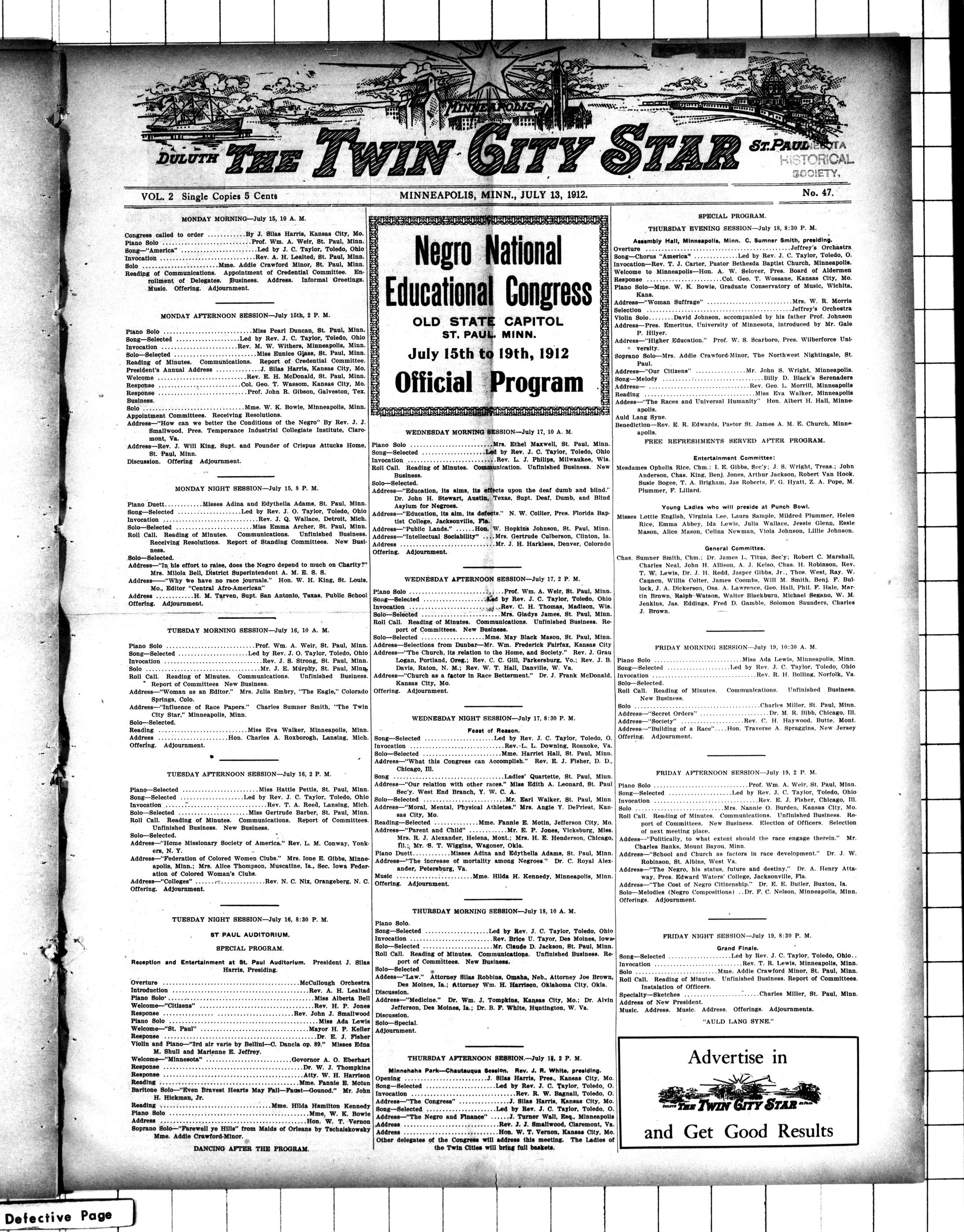
Negro National
Educational Congress
OLD STATE CAPITOL
ST. PAUL. MINN.
July 15th to 19th, 1912
Official Program
```markdown
```
Piano Solo .....Mrs. Ethel Maxwell, St. Paul, Minn.
Song—Selected .....Led by Rev. J. C. Taylor, Toledo, Ohio
Invocation .....Rev. L. J. Phillips, Milwaukee, Wis.
Roll Call. Reading of Minutes. Communication. Unfinished Business. New Business.
Solo—Selected.
Address—"Education, its aims, its effects upon the deaf dumb and blind."
Dr. John H. Stewart, Austin, Texas, Supt. Deaf, Dumb, and Blind
Asylum for Negroes.
Address—"Education, its aim, its defects." N. W. Collier, Pres. Florida Baptist College, Jacksonville, Fla.
list College, Jacksonville, Fla.
Address—"Public Lands." ..... Hon. W. Hopkins Johnson, St. Paul, Minn.
Address—"Intellectual Sociability" ..... Mrs. Gertrude Culberson, Clinton, Ia.
Address ..... Mr. J. H. Harkless, Denver, Colorado
Offering. Adjournment.
Piano Solo ..... Prof. Wm. A. Weir, St. Paul, Minn.
Song—Selected ..... Led by Rev. J. C. Taylor, Toledo, Ohio
Invocation ..... Rev. C. H. Thomas, Madison, Wis.
Solo—Selected ..... Mrs. Gladys James, St. Paul, Minn.
Roll Call. Reading of Minutes. Communications. Unfinished Business. Re-
port of Committees. New Business
port of Committees. New Business.
Solo—Selected ..... Mme. May Black Mason, St. Paul, Minn.
Address—Selections from Dunbar—Mr. Wm. Frederick Fairfax, Kansas City.
Address—"The Church, its relation to the Home, and Society." Rev. J. Grau
Logan, Portland, Oreg.; Rev. C. C. Gill, Parkersburg, Vo.; Rev. J. B.
Davis, Raton, N. M.; Rev. W. T. Hall, Danville, W. Va.
Address—"Church as a factor in Race Betterment." Dr. J. Frank McDonald,
Kansas City, Mo.
Kansas City, Mo.
Offering. Adjournment.
Song—Selected ..... Led by Rev. J. C. Taylor, Toledo, O.
Invocation ..... Rev. L. L. Downing, Roanoke, Va.
Solo—Selected ..... Mme. Harriet Hall, St. Paul, Minn.
Address—“What this Congress can Accomplish.” Rev. E. J. Fisher, D. D., Chicago, Ill.
Song ..... Ladies’ Quartette, St. Paul, Minn.
Address—“Our relation with other races.” Miss Edith A. Leonard, St. Paul, Minn.
Sec’y, West End Branch, Y. W. C. A.
Sec y. West End Branch, Y. W. C. A.
Solo—Selected ..... Mr. Earl Walker, St. Paul, Minn
Address—"Moral, Mental, Physical Athletes." Mrs. Angle Y. DePriest, Kansas City, Mo.
Reading—Selected .....Mme. Fannie E. Motin, Jefferson City, Mo
Address—"Parent and Child" .....Mr. E. P. Jones, Vicksburg, Miss
Mrs. R. J. Alexander, Helena, Mont.; Mrs. H. E. Henderson, Chicago
Jl.; Mr. S. T. Wiggins, Wagoner, Okla.
Solo—Selected.
Address—"Home Missionary Society of America." Rev. L. M. Conway, Yonkers, N. Y.
Address—"Federation of Colored Women Clubs." Mrs. Ione E. Gibbs, Minneapolis, Minn.; Mrs. Alice Thompson, Muscatine, Ia., Sec. Iowa Federation of Colored Woman's Clubs.
Address—"Colleges" ... Rev. N. C. Nix, Orangeberg, N. C.
Offering. Adjournment.
Piano Duett.....Misses Adina and Edythella Adams, St. Paul, Minn Address—"The increase of mortality among Negroes." Dr. C. Royal Alex ander, Petersburg, Va.
Music ..... Mme. Hilda H. Kennedy, Minneapolis, Minn
Offering. Adjournment.
Song—Selected ..... Led by Rev. J. C. Taylor, Toledo, Ohio
Invocation ..... Rev. Brice U. Taylor, Des Moines, Iowa
Solo—Selected ..... Mr. Claude D. Jackson, St. Paul, Minn.
Roll Call. Reading of Minutes. Communications. Unfinished Business. Report of Committees. New Business.
Solo—Selected
Address—“Law.” Attorney Sllas Robbins, Omaha, Neb., Attorney Joe Brown, Des Moines, Ia.; Attorney Wm. H. Harrison, Oklahoma City, Oklahoma.
Discussion.
Address—“Medicine.” Dr. Wm. J. Tompkins, Kansas City, Mo.; Dr. Alvin Jefferson, Des Moines, Ia.; Dr. B. F. White, Huntington, W. Va.
Discussion.
Solo—Special.
Adjournment.
Violin and Piano—3rd air varie by Belini—C. Dancia op. 89. Misses Edna M. Shull and Marienne E. Jeffrey.
Welcome—"Minnesota" Govornor A. O. Eberhart
Response Dr. W. J. Thompkins
Response Atty. W. H. Harrison
Reading Mme. Fannie E. Moten
Baritone Solo—"Even Bravest Hearts May Fall—Faust—Gounod." Mr. John H. Hickman, Jr.
Reading Mme. Hilda Hamilton Kennedy
Plano Solo Mme. W. K. Bowle
Address Hon. W. T. Vernon
Soprano Solo—"Farewell ye Hills" from Maids of Orleans by Tschaiskowsky Mme. Addie Crawford-Minor.
THURSDAY
Minnehaha Park—C
Opening
Song—Selected
Invocation
Address—"The Congress
Song—Selected
Address—"The Negro a
Address
Address
Other delegates of the
Minnehaha Park—Chautauqua Session. Rev. J. R. White, presiding.
Opening ... J. Silas Harris, Pres., Kansas City, Mo.
Song—Selected ... Led by Rev. J. C. Taylor, Toledo, O.
Invocation ... Rev. R. W. Bagnall, Toledo, O.
Address—"The Congress" ... J. Silas Harris, Kansas City, Mo.
Song—Selected ... Led by Rev. J. C. Taylor, Toledo, O.
Address—"The Negro and Finance" ... J. Turner Wall, Esq., Minneapolis
Address ... Rev. J. J. Smallwood, Claremont, Va.
Address ... Hon. W. T. Vernon, Kansas City, Mo.
Other delegates of the Congress will address this meeting. The Ladies of
the Twin Cities will bring full baskets.
---
VOL. 2 Single Copies 5 Cents
MONDAY MORNING—July 15, 10 A. M.
Congress called to order .....By J. Silas Harris, Kansas City, Mo.
Piano Solo .....Prof. Wm. A. Weir, St. Paul, Minn.
Song—"America" .....Led by J. C. Taylor, Toledo, Ohio
Invocation .....Rev. A. H. Lealted, St. Paul, Minn.
Solo .....Mme. Addie Crawford Minor, St. Paul, Minn.
Reading of Communications. Appointment of Credential Committee. Enrollment of Delegates. Business. Address. Informal Greetings.
Music. Offering. Adjournment.
MONDAY AFTERNOON SESSION—July 15th, 2 P. M.
Piano Solo ..... Miss Pearl Duncan, St. Paul, Minn.
Song—Selected ..... Led by Rev. J. C. Taylor, Toledo, Ohio
Invocation ..... Rev. M. W. Withers, Minneapolis, Minn.
Solo—Selected ..... Miss Eunice Glass, St. Paul, Minn.
Reading of Minutes. Communications. Report of Credential Committee.
President's Annual Address ..... J. Silas Harris, Kansas City, Mo.
Welcome ..... Rev. E. H. McDonald, St. Paul, Minn.
Response ..... Col. Geo. T. Wassom, Kansas City, Mo.
Response ..... Prof. John R. Gibson, Galveston, Tex.
Business.
Address—"How can we better the Conditions of the Negro" By Rev. J. J. Smallwood, Pres. Temperance Industrial Collegiate Institute, Clare mont, Va.
Address—Rev. J. Will King, Supt. and Founder of Crispus Attucks Home St. Paul, Minn.
MONDAY NIGHT SESSION—July 15, 8 P. M.
Piano Duett.....Misses Adina and Edythella Adams, St. Paul, Minn.
Song—Selected.....Led by Rev. J. O. Taylor, Toledo, Ohio
Invocation.....Rev. J. Q. Wallace, Detroit, Mich.
Solo—Selected.....Miss Emma Archer, St. Paul, Minn.
Roll Call. Reading of Minutes. Communications. Unfinished Business
Receiving Resolutions. Report of Standing Committees. New Busi
Address——"Why we have no race journals." Hon. W. H. King, St. Louis, Mo., Editor "Central Afro-American"
Address ..... H. M. Tarven, Supt. San Antonio, Texas, Public School Offering. Adjournment.
TUESDAY MORNING SESSION—July 16, 10 A. M.
Piano Solo ..... Prof. Wm. A. Weir, St. Paul, Minn.
Song—Selected ..... Led by Rev. J. O. Taylor, Toledo, Ohio
Invocation ..... Rev. J. S. Strong, St. Paul, Minn.
Solo ..... Mr. J. E. Murphy, St. Paul, Minn.
Roll Call. Reading of Minutes. Communications. Unfinished Business.
* Report of Committees. New Business
Report of Committees New Business.
Address—"Woman as an Editor." Mrs. Julla Embry, "The Eagle," Colorado Springs, Colo.
Address—"Influence of Race Papers." Charles Sumner Smith, "The Twint City Star," Minneapolis, Minn.
Solo—Selected.
Reading ..... Miss Eva Walker, Minneapolis, Minn.
Address ..... Hon. Charles A. Roxborogh, Lansing, Mich.
Offering. Adjournment.
TUESDAY AFTERNOON SESSION—July 16. 2 P. M.
Piano—Selected ..... Miss Hattie Pettis, St. Paul, Minn.
Song—Selected ..... Led by Rev. J. C. Taylor, Toledo, Ohio
Invocation ..... Rev. T. A. Reed, Lansing, Mich.
Solo—Selected ..... Miss Gertrude Barber, St. Paul, Minn.
Roll Call. Reading of Minutes. Communications. Report of Committees.
Unfinished Business. New Business.
TUESDAY NIGHT SESSION—July 16, 8:30 P. M.
Reception and Entertainment at St. Paul Auditorium. President J. Silas Harris, Presiding.
Overture ..... McCullough Orchestra
Introduction ..... Rev. A. H. Lealtad
Piano Solo* ..... Miss Alberta Bell
Welcome—"Citizens" ..... Rev. H. P. Jones
Response ..... Rev. John J. Smallwood
Piano Solo ..... Miss Ada Lewis
Welcome—"St. Paul" ..... Mayor H. P. Keller
Response ..... Dr. E. J. Fisher
DANCING AFTER THE PROGRAM.
MINNEAPOLIS, MINN., JULY 13, 1912.
WEDNESDAY MORNING SESSION—July 17, 10 A. M.
WEDNESDAY AFTERNOON SESSION—July 17, 2 P. M.
WEDNESDAY NIGHT SESSION—July 17, 8:30 P. M.
Feast of Reason.
THURSDAY MORNING SESSION—July 18. 10 A. M.
THURSDAY AFTERNOON SESSION.—July 18, 2 P. M.
No. 47.
SPECIAL PROGRAM.
THURSDAY EVENING SESSION—July 18, 8:30 P. M.
Assembly Hall, Minneapolis, Minn. C. Sumner Smith, presiding.
Overture ..... Jeffrey's Orchastra
Song—Chorus "America™ ..... Led by Rev. J. C. Taylor, Toledo, O.
Invocation—Rev. T. J. Carter, Pastor Bethesda Baptist Church, Minneapolis.
Welcome to Minneapolis—Hon. A. W. Slover, Pres. Board of Aldermen
Response ..... Col. Geo. T. Wossane, Kansas City, Mo.
Piano Solo—Mme. W. K. Bowie, Graduate Conservatory of Music, Wichita,
Kans.
Address—"Woman Suffrage" ..... Mrs. W. R. Morris
Selection ..... Jeffrey's Orchestra
Violin Solo ..... David Johnson, accompanied by his father Prof. Johnson
Address—Pres. Emeritus, University of Minnesota, introduced by Mr. Gale
P. Hilver
Address—"Higher Education." Prof. W. S. Scarboro, Pres. Wilberforce University.
Soprano Solo—Mrs. Addie Crawford-Minor, The Northwest Nightingale, St. Paul.
Address—"Our Citizens" Mr. John S. Wright, Minneapolis.
Song—Melody Billy D. Black's Serenaders
Address—Rev. Geo. L. Morrill, Minneapolis
Reading Miss Eva Walker, Minneapolis
Address—"The Races and Universal Humanity" Hon. Albert H. Hall, Minneapolis.
Auld Lang Syne.
Benediction—Rev. E. R. Edwards, Pastor St. James A. M. E. Church, Minneapolis.
FREE REFRESHMENTS SERVED AFTER PROGRAM.
Entertainment Committee:
Mesdames Ophelia Rice, Chm.; I. E. Gibbs, Sec'y; J. S. Wright, Treas.; John Anderson, Chas. King, Benj. Jones, Arthur Jackson, Robert Van Hook Susie Bogee, T. A. Brigham, Jas Roberts, F. G. Hyatt, Z. A. Pope, M. Plummer, F. Lillard.
Misses Lottie English, Virginia Lee, Laura Sample, Mildred Plummer, Helen Rice, Emma Abbey, Ida Lewis, Julia Wallace, Jessie Glenn, Essie Mason, Alice Mason, Celina Newman, Viola Johnson, Lillie Johnson.
General Committee.
Chas. Sumner Smith, Chm.; Dr. James L. Titus, Sec'y; Robert C. Marshall, Charles Neal, John H. Allison, A. J. Kelso, Chas. H. Robinson, Rev. T. W. Lewis, Dr. J. H. Redd, Jasper Glbbs, Jr., Thos. West, Ray. W. Cannon, Willis Colter, James Coombs, Will M. Smith, Benj. F. Bullock, J. A. Dickerson, Osa. A. Lawrence, Geo. Hall, Phil. F. Hale, Martin Brown, Ralph-Watson, Walter Blackburn, Michael Segano, W. M. Jenkins, Jas. Eddings, Fred D. Gamble, Solomon Saunders, Charles J. Brown.
FRIDAY MORNING SESSION—July 19, 10:30 A. M
Piano Solo .....Miss Ada Lewis, Minneapolis, Minn.
Song—Selected .....Led by Rev. J. C. Taylor, Toledo, Ohio
Invocation .....Rev. R. H. Bolling, Norfolk, Va.
Solo—Selected.
Roll Call. Reading of Minutes. Communications. Unfinished Business.
New Business.
Solo .....Charles Miller, St. Paul, Minn.
Address—"Secret Orders" .....Dr. M. R. Ribb, Chicago, Ill.
Address—"Society" .....Rev. C. H. Haywood, Butte, Mont.
Address—"Building of a Race" ...Hon. Traverse A. Spraggins, New Jersey
Offering. Adjournment.
FRIDAY AFTERNOON SESSION—July 19, 2 P. M.
Plano Solo ..... Prof. Wm. A. Weir, St. Paul, Minn.
Song—Selected ..... Led by Rev. J. C. Taylor, Toledo, Ohio
Invocation ..... Rev. E. J. Fisher, Chicago, Ill.
Solo ..... Mrs. Nannie O. Burden, Kansas City, Mo.
Roll Call. Reading of Minutes. Communications. Unfinished Business. Re-
Address—"Politically, to what extent should the race engage therein." Mr. Charles Banks, Mount Bayou, Minn.
Address—"School and Church as factors in race development." Dr. J. W. Robinson, St. Albins, West Va.
Address—"The Negro, his status, future and destiny." Dr. A. Henry Attaway, Pres. Edward Waters' College, Jacksonville, Fla.
Address—"The Cost of Negro Citizenship." Dr. E. E. Butler, Buxton, Ia.
Solo—Melodies (Negro Compositions) ...Dr. F. C. Nelson, Minneapolis, Minn. Offerings. Adjournment.
FRIDAY NIGHT SESSION—July 19, 8:30 P. M.
Grand Finale.
Song—Selected ..... Led by Rev. J. C. Taylor, Toledo, Ohio.
Invocation ..... Rev. T. R. Lewis, Minneapolis, Minn.
Solo ..... Mme. Addie Crawford Minor, St. Paul, Minn.
Roll Call. Reading of Minutes. Unfinished Business. Report of Committees.
Installation of Officers.
Specialty—Sketches ..... Charles Miller, St. Paul, Minn.
Address of New President.
Music. Address. Music. Address. Offerings. Adjournments.
Advertise in
THE TWIN CITY STAR
and Get Good Results
We BEG that those who send notes will Write Facts Plainly—on One Side of the Paper—Leave a Space between each item, and Use Common Sense. This is very Important.
BETHESDA BAPTIST CHURCH.
1120 8th St. So.
Rev. T. J. Carter, Pastor.
11 A. M. "Receiving the Word."
8 P. M. Short Services.
The People's Christian Mission,
1312, 3rd St. So.
Services every evening at 7:30 p. m. Special services all day Sunday. Preaching at 11 oclock a. m. Sunday School 1:30 p. m. Praise Meeting 3 p. m. Rev. G. W. Hopkins from London England will preach at 7:30 p. m. All are welcome. Rev. G. W. Mitchell, Pastor.
THE SUNDAY FORUM.
THE SUNDAY FORUM.
The following officers of the Forum were elected for the ensuing term ending Dec. 31: Benj. F. Bullock, Pres.; W. M. Smith, V. Pres.; Clarence Hughes, Secy.; Miss Eva Walker, Asst. Secy.; Geo. Hall Treas.; Miss Ada Lewis Organist; Jas. Coombs, Chorister; John S. Wright, Critic; Chas. Sumner Smith, Journalist; Rev. T. J. Carter and T. R. Lewis, Chaplains; Willis Colter, Martin Brown, Chas. Neal, Ushers. Pres. Bullock was re-elected and the members of the Forum have honored by re-election their youngest president, whose administration was especially eventful and successful. Mrs. I. S. Bogle read the report of committee on Nominations, W. M. Smith presided, i. e. ran the steam roller. A. J. Kelso still guards the Treasury, and "appropriations don't go" just because they are asked for. Arrangements were made to honor visiting delegates. Address by one of the W. C. T. U. Workers. Next meeting at Bethesda, July 21, when officers will be installed
A CARD OF THANKS.
Mr. Franklin P. Preston and family wish to extend their thanks to friends for the kindness shown them during their recent bereavement. They also wish to express their appreciation for the many beautiful floral gifts.
Mrs. Fred Hyatt and Mrs. John Sellars left July 11th to spend two weeks in Marshalltown, Ia. Mrs. Sellars will visit her mother.
The Twin City Star will not appear next week.
NEXT ISSUE JULY 22.
MR. PEOPLES MAKES CHANGES.
Owing to the increasing demand for building and constructing, repairing and remodeling, Mr. F. Peoples has turned his entire time to that particular business and in the future the Real Estate will be handled by J. Turner Wall, who comes to us direct from New York City, fully capable of
OUTING AT MT. TYLER.
Employees at Minnetonka Enjoy a Day's Outing.
Mr. Geo. Washington Tyler and the waiters of Keewayden Hitel entertained a party of ladies from the city and other employees at the Cottages at Cottagewood, Lake Minnetonka last week. The afternoon was pleasantly spent on a hill, hereafter to be called Mt. Tyler in honor of its discoverer, the host. Boating, fishing, swinging fireworks and refreshments were enjoyed.
Mr. and Mrs. Hart of Omaha, Messrs. M. L. Fisher, Harry Stansberry and Earl Stewart are at the Keewaydin Hotel, Lake Minnetonka.
Mr. and Mrs. Wesley Butler entertained Mrs. Nicholas Wright of Minneapolis, Mrs. J. M. Fite at dinner, at their beautiful home on 30th Ave. No. The hostess presented her honor guest with a beautiful leather volume.
A NEW REAL ESTATE BROKER.
PEARCES' REMOVAL SALE.
Exceptional Values in Ladies Goods. You can make money by taking advantage of the opportunities offered at Pearces' down-town store, where they are cutting prices on account of going out of business at that location. Not one article will be moved into the up-town store, and for this reason they are daily offering their entire stock at greatly reduced prices. If you want a safe investment, attend their removal sale which is to run until the entire stock is sold.
Dickerson has announced that he has put on his "Special Spring Service." Cholest American and Chinese Dishes.
HANDO.
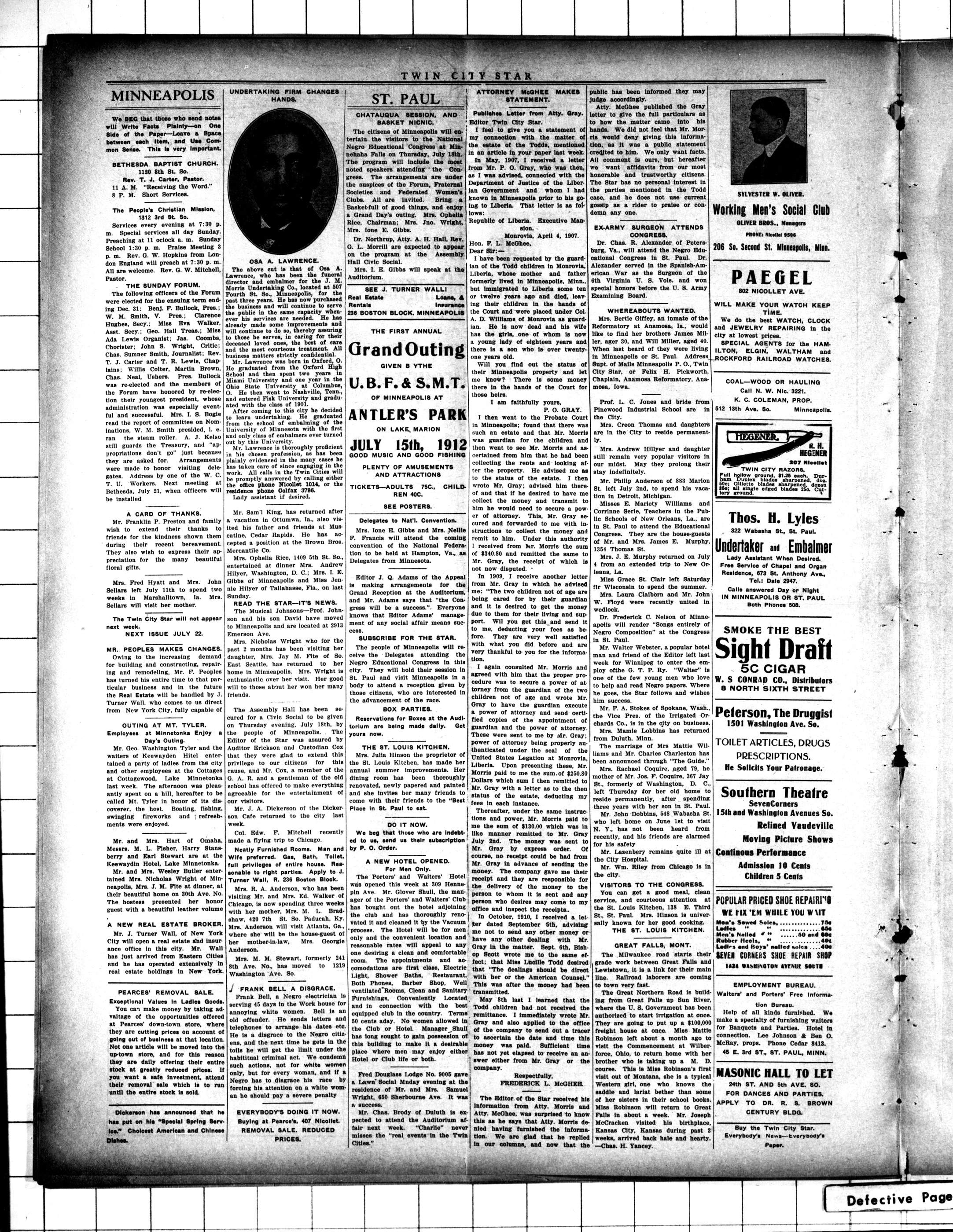
OSA A. LAWRENCE.
The above cut is that of Osa A. Lawrence, who has been the funeral director and embalmer for the J. M. Morris Undertaking Co., located at 507 Fourth St. So., Minneapolis, for the past three years. He has now purchased the business and will continue to serve the public in the same capacity whenever his services are needed. He has already made some improvements and will continue to do so, thereby assuring to those he serves, in caring for their deceased loved ones, the best of care and the most courteous treatment. All business matters strictly confidential. Mr. Lawrence was born in Oxford, O. He graduated from the Oxford High School and then spent two years in Miami University and one year in the Ohio State University at Columbus, O. He then went to Nashville, Tenn., and entered Fisk University and graduated with the class of 1901.
After coming to this city he decided to learn undertaking. He graduated from the school of embalming of the University of Minnesota with the first and only class of embalmers ever turned out by this University.
Mr. Lawrence is thoroughly proficient in his chosen profession, as has been plainly evidenced in the many cases he has taken care of since engaging in the work. All calls in the Twin Cities will be promptly answered by calling either the office phone Nicollet 1014, or the residence phone Colfax 3786.
Lady assistant if desired.
Mr. Sam'l King, has returned after a vacation in Ottumwa, Ia., also visited his father and friends at Muscatine, Cedar Rapids. He has accepted a position at the Brown Bros. Mercantile Co.
Mrs. Ophelia Rice, 1409 5th St. So., entertained at dinner Mrs. Andrew Hilyer, Washington, D. C.; Mrs. I. E. Gibbs of Minneapolis and Miss Jennie Hilyer of Tallahasse, Fla., on last Sunday.
READ THE STAR—IT'S NEWS.
The Musical Johnsonss—Prof. Johnson and his son David have moved to Minneapolis and are located at 2913 Emerson Ave.
Mrs. Nicholas Wright who for the past 2 months has been visiting her daughter, Mrs. Jay M. Fite of So. East Seattle, has returned to her home in Minneapolis. Mrs. Wright is enthusiastic over her visit. Her good will to those about her won her many friends.
The Assembly Hall has been secured for a Civic Social to be given on Thursday evening, July 18th, by the people of Minneapolis. The Editor of the Star was assured by Auditor Erickson and Custodian Cox that they were glad to extend this privilege to our citizens for this cause, and Mr. Cox, a member of the G. A. R. and a gentleman of the old school has offered to make everything agreeable for the entertainment of our visitors.
Mr. J. A. Dickerson of the Dickerson Cafe returned to the city last week.
Col. Edw. F. Mitchell recently made a flying trip to Chicago.
Nearly Furnished Rooms. Man and Wife preferred. Gas, Bath, Toilet, full privileges of entire house. Reasonable to right parties. Apply to J. Turner Wall, R. 236 Boston Block.
Mrs. R. A. Anderson, who has been visiting Mr. and Mrs. Ed. Walker of Chicago, is now spending three weeks with her mother, Mrs. M. L. Bradshaw, 420 7th St. So. Paducah, Ky. Mrs. Anderson will visit Atlanta, Ga., where she will be the house-guest of her mother-in-law, Mrs. Georgie Anderson.
Mrs. M. M. Stewart, formerly 241 8th Ave. No., has moved to 1219 Washington Ave. So.
FRANK BELL A DISGRACE.
Frank Bell, a Negro electrician is serving 45 days in the Work house for annoying white women. Bell is an old offender. He sends letters and telephones to arrange his dates etc. He is a disgrace to the Negro citizens, and the next time he gets in the tolls he will get the limit under the habitual criminal act. We condemn such actions, not for white women only, but for every woman, and if a Negro has to disgrace his race by forcing his attention on a white woman he should pay a severe penalty
EVERYBODY'S DOING IT NOW. Buying at Pearce's, 407 Nicollet. REMOVAL SALE. REDUCED PRICES.
TWIN CITY STAR
CHATAUQUA SESSION, AND
BASKET NICIC.
The citizens of Minneapolis will entertain the visitors to the National Negro Educational Congress at Minneaha Falls on Thursday, July 18th. The program will include the most noted speakers attending the Congress. The arrangements are under the auspices of the Forum, Fraternal Societies and Federated Women's Clubs. All are invited. Bring a basket-full of good things, and enjoy a Grand Day's outing. Mrs. Ophelia Rice, Chairman; Mrs. Jno. Wright, Mrs. Ione E. Gibbs.
Dr. Northrup, Atty. A. H. Hall, Rev. G. L. Morrill are expected to appear on the program at the Assembly Hall Civic Social.
SEE J. TURNER WALLI
Real Estate Loans, &
Rentals Insurance
236 BOSTON BLOCK. MINNEAPOLIS
THE FIRST ANNUAL
Grand Outing
GIVEN BY THE
U.B.F. & S.M.T.
OF MINNEAPOLIS AT
ANTLER'S PARK
ON LAKE, MARION
JULY 15th, 1912
GOOD MUSIC AND GOOD FISHING
PLENTY OF AMUSEMENTS
AND ATTRACTIONS
TICKETS—ADULTS 75C., CHILD
REN 40C.
Mrs. Ione E. Gibbs and Mrs. Nellie F. Francis will attend the coming convention of the National Federation to be held at Hampton, Va., as Delegates from Minnesota.
Editor J. Q. Adams of the Appeal is making arrangements for the Grand Reception at the Auditorium, and Mr. Adams says that "the Congress will be a success." Everyone knows that Editor Adams' management of any social affair means success.
SUBSCRIBE FOR THE STAR.
The people of Minneapolis will receive the Delegates attending the Negro Educational Congress in this city. They will hold their session in St. Paul and visit Minneapolis in a body to attend a reception given by those citizens, who are interested in the advancement of the race.
BOX PARTIES.
Reservations for Boxes at the Auditorium are being made daily. Get yours now.
THE ST. LOUIS KITCHEN.
Mrs. Julia Hinson the proprietor of the St. Louis Kitchen, has made her annual summer improvements. Her dining room has been thoroughly renovated, newly papered and painted and she invites her many friends to come with their friends to the "Best Place in St. Paul to eat.
DO IT NOW.
We beg that those who are indebted to us, send us their subscription by P. O. Order.
The Porters' and Walters' Hotel was opened this week at 309 Hennepin Ave. Mr. Glover Shull, the manager of the Porters' and Walters' Club has bought out the hotel adjoining the club and has thoroughly renovated it and cleaned it by the Vacuum process. The Hotel will be for men only and the convenient location and reasonable rates will appeal to any one desiring a clean and comfortable room. The appointments and accommodations are first class, Electric Light, Shower Baths, Restaurant, Both Phones, Barber Shop, Well ventilated Rooms, Clean and Sanitary Furnishings, Conveniently Located and in connection with the best equipped club in the country. Terms 50 cents aday. No women allowed in the Club or Hotel. Manager_Shull has long sought to gain possession of this building to make it a desirable place where men may enjoy either Hotel or Club life or both.
Fred Douglass Lodge No. 9005 gave a Lawn' Social Munday evening at the residence of Mr. and Mrs. Samuel Wright, 650 Sherbourne Ave. It was a success.
Mr. Chas. Brody of Duluth is expected to attend the Auditorium afair next week. "Charlie" never misses the "real events in the Twin Cities."
ATTORNEY McGHEE MAKES STATEMENT.
Publishes Letter from Atty. Gray. Editor Twin City Star.
I feel to give you a statement of my connection with the matter of the estate of the Todd, mentioned in an article in your paper last week. In May, 1907, I received a letter from Mr. P. O. Gray, who was then, as I was advised, connected with the Department of Justice of the Liberian Government and whom I had known in Minneapolis prior to his going to Liberia. That letter is as follows:
Republic of Liberia. Executive Mansion.
Monrovia, April 4, 1907.
Hon. F. L. McGhee,
Dear Sir:—
I have been requested by the guardian of the Todd children in Monrovia, Liberia, whose mother and father formerly lived in Minneapolis, Minn., but immigrated to Liberia some ten or twelve years ago and died, leaving their children in the hands of the Court and were placed under Col. A. D. Williams of Monrovia as guardian. He is now dead and his wife has the girls, one of whom is now a young lady of eighteen years and there is a son who is over twenty-one years old.
Will you find out the status of their Minneapolis property and let me know? There is some money there in the hands of the Court for those heirs.
I then went to the Probate Court in Minneapolis; found that there was such an estate and that Mr. Morris was guardian for the children and then went to see Mr. Morris and ascertained from him that he had been collecting the rents and looking after the property. He advised me as to the status of the estate. I then wrote Mr. Gray; advised him thereof and that if he desired to have me collect the money and transmit to him he would need to secure a power of attorney. This, Mr. Gray secured and forwarded to me with instructions to collect the money and remit to him. Under this authority I received from Mr. Morris the sum of $340.80 and remitted the same to Mr. Gray, the receipt of which is not now disputed.
In 1909, I receive another letter from Mr. Gray in which he advised me: "The two children not of age are being cared for by their guardian and it is desired to get the money due to them for their living and support. Will you get this and send it to me, deducting your fees as before. They are very well satisfied with what you did before and are very thankful to you for the information.
I again consulted Mr. Morris and agreed with him that the proper procedure was to secure a power of attorney from the guardian of the two children not of age and wrote Mr. Gray to have the guardian execute a power of attorney and send certified copies of the appointment of guardian and the power of attorney. These were sent to me by Mr. Gray; power of attorney being properly authenticated under the seal of the United States Legation at Monrovia, Liberia. Upon presenting these, Mr. Morris paid to me the sum of $250.80 Dollars which sum I then remitted to Mr. Gray with a letter as to the then status of the estate, deducting my fees in each instance.
Thereafter, under the same instructions and power, Mr. Morris paid to me the sum of $130.00 which was in like manner remitted to Mr. Gray July 2nd. The money was sent to Mr. Gray by express order. Of course, no receipt could be had from Mr. Gray in advance of sending the money. The company gave me their receipt and they are responsible for the delivery of the money to the person to whom it is sent and any person who desires may come to my office and inspect the receipts.
In October, 1910, I received a letter dated September 5th, advising me not to send any other money or have any other dealing with Mr. Gray in the matter. Sept. 6th, Bishop Scott wrote me to the same effect; that Miss Lucille Todd desired that "The dealings should be direct with her or the American Counsel." This was after the money had been transmitted.
May 8th last I learned that the Todd children had not received the remittance. I immediately wrote Mr. Gray and also applied to the office of the company to send out a tracer to ascertain the date and time this money was paid. Sufficient time has not yet elapsed to receive an answer either from Mr. Gray or the company.
The Editor of the Star received his information from Atty. Morris and Atty. McGhee, was surprised to know this as he says that Atty. Morris denied having furnished the information. We are glad that he replied in our columns, and now that the
public has been informed they may judge accordingly.
Atty. McGhee published the Gray letter to give the full particulars as to how the matter came into his hands. We did not feel that Mr. Morris would deny giving this information, as it was a public statement credited to him. We only want facts. All comment is ours, but hereafter we want affidavits from our most honorable and trustworthy citizens. The Star has no personal interest in the parties mentioned in the Todd case, and he does not use current gossip as a rider to praise or condemn any one.
EX-ARMY SURGEON ATTENDS
CONGRESS
Dr. Chas. R. Alexander of Petersburg, Va., will attend the Negro Educational Congress in St. Paul. Dr. Alexander served in the Spanish-American War as the Surgeon of the 6th Virginia U. S. Vols. and won special honors before the U. S. Army Examining Board.
WHEREABOUTS WANTED.
Mrs. Bertie Giffey, an inmate of the Reformatory at Anamosa, Ia., would like to find her brothers James Miller, ager 30, and Will Miller, aged 40. When last heard of they were living in Minneapolis or St. Paul. Address, Supt. of Mails Minneapolis P. O., Twin City Star, or Felix H. Pickworth, Chaplain, Anamosa Reformatory, Anamosa, Iowa.
Prof. L. C. Jones and bride from Pinewood Industrial School are in the City.
Mrs. Creon Thomas and daughters are in the City to reside permanently.
Mrs. Andrew Hillyer and daughter still remain very popular visitors in our midst. May they prolong their stay indefinitely.
Mr. Philip Anderson of 883 Marlon St. left July 2nd, to spend his vacation in Detroit, Michigan.
Misses E. Mariety Williams and Corrine Serle, Teachers in the Public Schools of New Orleans, La., are in St. Paul to attend the Educational Congress. They are the house-guests of Mr. and Mrs. James E. Murphy, 1354 Thomas St.
Mrs. J. E. Murphy returned on July 4 from an extended trip to New Orleans, La.
Miss Grace St. Clair left Saturday fir Wisconsin to spend the summer.
Mrs. Laura Claiborn and Mr. John W. Floyd were recently united in wedlock.
Dr. Frederick C. Nelson of Minneapolis will render "Songs entirely of Negro Composition" at the Congress in St. Paul.
Mr. Walter Webster, a popular hotel man and friend of the Editor left last week for Winnipeg to enter the employ of the G. T. P. Ry. "Walter" is one of the few young men who love to help and read Negro papers. Where he goes, the Star follows and wishes him success.
Mr. F. A. Stokes of Spokane, Wash., the Vice Pres. of the Irrigated Orchards Co., is in the city on business.
Mrs. Mamie Lobbins has returned from Duluth, Minn.
The marriage of Mrs Mattle Williams and Mr. Charles Charleston has been announced through "The Guide."
Mrs. Rachael Coquire, aged 79, he mother of Mr. Jos. F. Coquire, 367 Jay St., formerly of Washington, D. C.
left Thursday for her old home to reside permanently, after spending three years with her son in St. Paul.
Mr. John Dobbins, 548 Wabasha St. who left home on June 1st to visit N. Y., has not been heard from recently, and his friends are alarmed for his safety
Mr. Lazenbery remains quite ill at the City Hospital.
Mr. Wm. Riley from Chicago is in the city.
VISITORS TO THE CONGRESS.
You can get a good meal, clean service, and courteous attention at the St. Louis Kitchen, 138 E. Third St. St. Paul. Mrs. Hinson is universally known for her good cooking.
THE ST. LOUIS KITCHEN
GREAT FALLS. MONT.
The Milwaukee road starts their grade work between Great Falls and Lewistown, it is a link for their main line. Railroad laborers are coming to town very fast.
The Great Northern Road is building from Great Falls up Sun River, where the U. S. Government has been authorized to start irrigation at once. They are going to put up a $100,000 freight house at once. Miss Mattle Robinson left about a month ago to visit the Commencement at Wilberforce, Ohio, to return home with her brother who is taking up a M. D. course. This is Miss Robinson's first visit out of Montana, she is a typical Western girl, one who knows the saddle and lariat better than some of her sisters in their school books. Miss Robinson will return to Great Falls in about a week. Mr. Joseph McCracken visited his birthplace, Kansas City, Kansas during past 3 weeks, arrived back hale and hearty.—Chas. H. Yancey.
M.
SYLVESTER W. OLIVER.
Working Men's Social Club
OLIVER BROS., Managers
PRONE: Nicolel 9506
206 So. Second St. Minneapolis, Minn.
PAEGEL
802 NICOLLET AVE.
WILL MAKE YOUR WATCH KEEP
TIME.
We do the best WATCH, CLOCK
and JEWELRY REPAIRING in the
city at lowest prices.
SPECIAL AGENTS for the HAMILTON, ELGIN, WALTHAM and ROCKFORD RAILROAD WATCHES.
COAL—WOOD OR HAULING
Call N. W. Nic. 3221.
K. C. COLEMAN, PROP.
512 13th Ave. So. Minneapolis.
HEGENER
R. H. HEGENER
207 Nicollet
TWIN CITY RAZORS.
Full hollow ground. $1.25 each. Dur-
ham. Duplex blades sharpened. Do-
50c; Gillette blades sharpened, dosen
25c; all single edged blades 25c. Cut-
lery ground.
Thos. H. Lyles
322 Wabasha St., St. Paul.
Undertaker and Embalmer
Lady Assistant When Desired.
Free Service of Chapel and Organ
Residence, 673 St. Anthony Ave.,
Tel.: Dale 2947.
Calls answered Day or Night
IN MINNEAPOLIS OR ST. PAUL
Both Phones 508.
SMOKE THE BEST
Sight Draft
5C CIGAR
W. S CONRAD CO., Distributors
8 NORTH SIXTH STREET
Peterson, The Druggist
1501 Washington Ave. So.
TOILET ARTICLES, DRUGS
PRESCRIPTIONS.
He Solicits Your Patronage.
Southern Theatre
SevenCorners
15th and Washington Avenues So.
Refined Vaudeville
Moving Picture Shows
Continous Performance
Admission 10 Cents
Children 5 Cents
POPULAR PRICED SHOE REPAIR'10
Men's Wavers Soils, ..... 75c
Ladies " " ..... 65c
Men's Nailed " " ..... 50 and 60c
Rubber Heels, ..... 40c
Ladies and Boys' malled soils ..... 40c
SEVEN CORNERS SHOE REPAIR SHOP
1624 WASHINGTON AVENUE SOUTH
EMPLOYMENT BUREAU.
Waiters' and Porters' Free Information Bureau.
Help of all kinds furnished. We make a specialty of furnishing waiters for Banquets and Parties. Hotel in connection. Lee Johnson & Ben O. McRay, props. Phone Cedar 8413.
45 E. 3rd ST., ST. PAUL, MINN.
MASONIC HALL TO LET
24th ST. AND 5th AVE. 80.
FOR DANCES AND PARTIES.
APPLY TO DR. R. S. BROWN
CENTURY BLDG.
Buy the Twin City Star.
Everybody's News—Everybody's
Paper.
Defective Page
Defective Page
THE ST. LOUIS KITCHEN
UP STAIRS 138 EAST THIRD ST. T. S. 2718
THE OLDEST AND BEST DINING ROOM IN ST. PAUL
MRS. JULIA HINSON, PROP.
LOWE'S ART AND PICTURE FRAME CO.
Picture specials; those who like decorative surroundings in their homes will welcome this special offering I am making for this week. We have the goods to gladden and beautify the home. The prices are right, too.
PHONE CEDAR 1696.
CORNER WABASHA AND EAST EIGHTH. ST. PAUL
SHAMPOOING—HAIR DRESSING—MANICURING
N. W. Phone, Nicollet 1872
J. M. MORRIS
Real Estate, Loans and Collections
508 Boston Block, Minneapolis, Minn.
Phone T. S. Center 4085.
H. Larson Photo Studio
313 Washington Ave. Se.
My Work for the Colored People has
Always Given Satisfaction.
BEN. MARIENHOFF FASHIONABLE
TAILOR
Phone N. W. 4398 318 HENNEPIN AVE.
Makes Good Clothes at Moderate Prices
SPECIAL DESIGNS for SPRING and SUMMER
I BUILD NEW HOMES ON SMALL PAYMENTS DOWN,
BALANCE LIKE RENT.
REAL ESTATE
WE HAVE BARGAINS IN BEAUTIFUL HOMES. SMALL PAYMENTS LOW AS $100 DOWN, BALANCE SAME AS RENT. WE WILL BUY YOU PROPERTY, ANYWHERE, ANY TIME. SEE US FOR GOOD BUILDING LOTS IN ANY LOCATION. DON'T MOVE UNTIL YOU CONSULT OUR RENTAL DEPARTMENT. GIVE US A CHANCE, IF WE FAIL, THEN TRY THE OTHER FELLOW. MONEY TO LOAN ON FURNITURE AND PIANOS.
J. Turner Wall
236 Boston Block, Minneapolis
PHONE N. W. NIC. 2188.
GOLDEN
GRAIN BELT
BEERS
PURE PRODUCT OF YOUR BARLEY FIELDS
EXPRESSLY FOR FAMILY USE "Many People never liked Beer until they tried GRAIN BELT" THE TASTE IS THE REASON COST MOST TO MAKE BUT COST YOU NO MORE GET A TRIAL CASE NOW
Is it money you want? ~???
AYMENTS DOWN
T.
c. 2188
POLIS, MINN.
THEN YOU MUST BUY
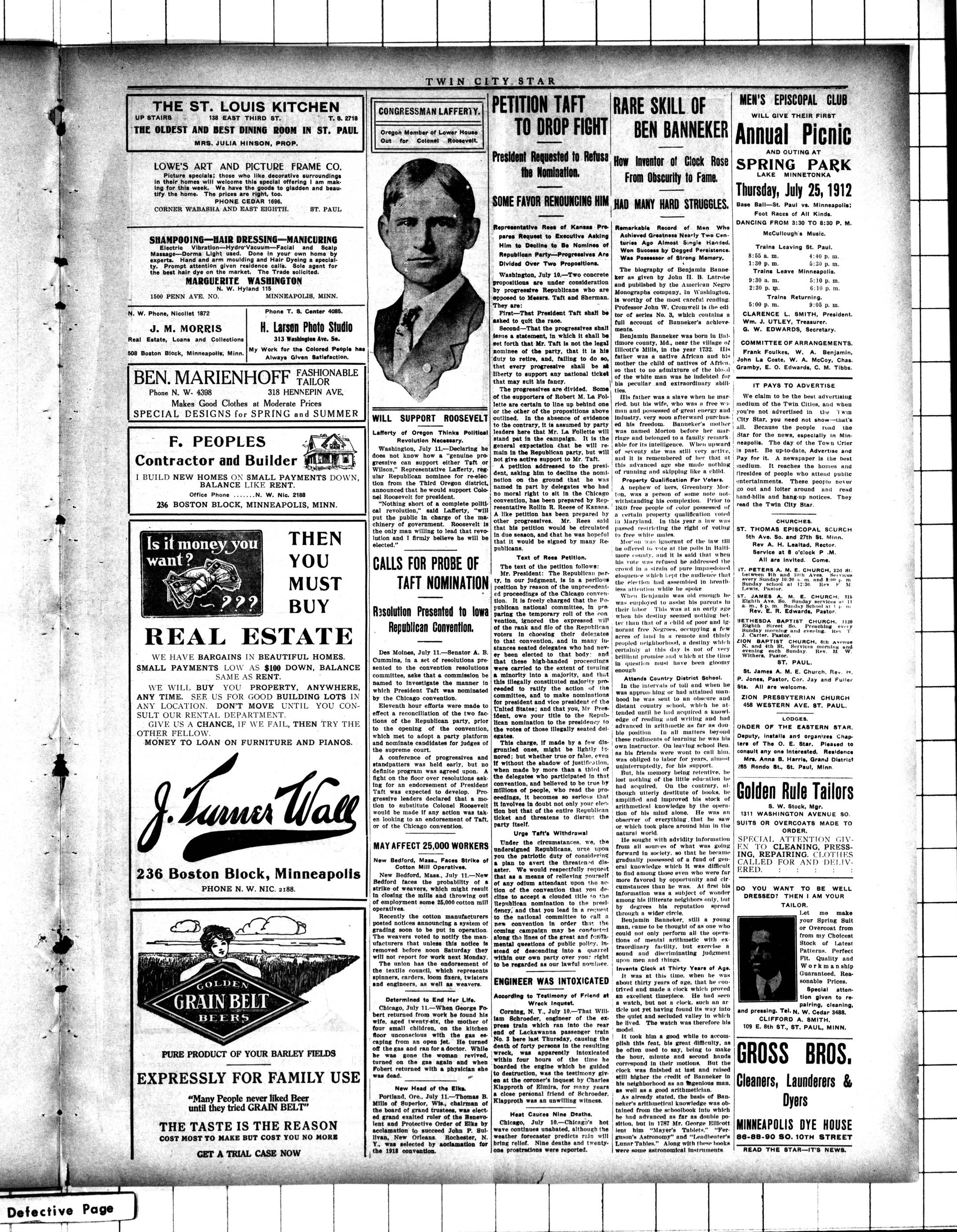
CONGRESSMAN LAFFERTY.
Oregon Member of Lower House
Out for Colonel Roosevelt.
M.
WILL SUPPORT ROOSEVELT
Lafferty of Oregon Thinks Political Revolution Necessary.
Washington, July 11.—Declaring he does not know how a "genuine progressive can support either Taft or Wilson," Representative Lafferty, regular Republican nominee for re-election from the Third Oregon district, announced that he would support Colonel Roosevelt for president.
"Nothing short of a complete political revolution," said Lafferty, "will put the public in charge of the machinery of government. Roosevelt is the only man willing to lead that revolution and I firmly believe he will be elected."
CALLS FOR PROBE OF TAFT NOMINATION
Resolution Presented to Iowa Republican Convention.
Des Moines, July 11.—Senator A. B. Cummins, in a set of resolutions presented to the convention resolutions committee, asks that a commission be named to investigate the manner in which President Taft was nominated by the Chicago convention.
Eleventh hour efforts were made to effect a reconciliation of the two factions of the Republican party, prior to the opening of the convention, which met to adopt a party platform and nominate candidates for judges of the supreme court.
A conference of progressives and standpatters was held early, but no definite program was agreed upon. A fight on the floor over resolutions asking for an endorsement of President Taft was expected to develop. Progressive leaders declared that a motion to substitute Colonel Roosevelt would be made if any action was taken looking to an endorsement of Taft, or of the Chicago convention.
MAY AFFECT 25,000 WORKERS
New Bedford, Mass., Faces Strike of Cotton Mill Operatives.
New Bedford, Mass., July 11.—New Bedford faces the probability of a strike of weavers, which might result in closing the mills and throwing out of employment some 25,000 cotton mill operatives.
Recently the cotton manufacturers posted notices announcing a system of grading soon to be put in operation. The weavers voted to notify the manufacturers that unless this notice is removed before noon Saturday they will not report for work next Monday.
The union has the endorsement of the textile council, which represents spinners, carders, loom fixers, twisters and engineers, as well as weavers.
Determined to End Her Life.
Chicago, July 11.—When George Fobert returned from work he found his wife, aged twenty-six, the mother of four small children, on the kitchen floor unconscious with the gas escaping from an open jet. He turned off the gas and ran for a doctor. While he was gone the woman revived, turned on the gas again and when Fobert returned with a physician she was dead.
New Head of the Elka.
Portland, Ore., July 11.—Thomas B. Mills of Superior, Wis., chairman of the board of grand trustees, was elected grand exalted ruler of the Benevolent and Protective Order of Elks by acclamation to succeed John P. Sullivan, New Orleans. Rochester, N. Y., was selected by acclamation for the 1918 convention.
---
President Requested to Refusa the Nomination.
SOME FAVOR RENOUNCING HIM
Representative Rees of Kansas Prepares Request to Executive Asking Him to Decline to Be Nominee of Republican Party—Progressives Are Divided Over Two Propositions.
Washington, July 10.—Two concrete propositions are under consideration by progressive Republicans who are opposed to Messrs. Taft and Sherman. They are:
First—That President Taft shall be asked to quit the race.
Second—That the progressives shall issue a statement, in which it shall be set forth that Mr. Taft is not the legal nominee of the party, that it is his duty to retire, and, falling to do so, that every progressive shall be all liberty to support any national ticket that may suit his fancy.
The progressives are divided. Some of the supporters of Robert M. La Follette are certain to line up behind one or the other of the propositions above outlined. In the absence of evidence to the contrary, it is assumed by party leaders here that Mr. La Follette will stand pat in the campaign. It is the general expectation that he will remain in the Republican party, but will not give active support to Mr. Taft. A petition addressed to the president, asking him to decline the nomination on the ground that he was named in part by delegates who had no moral right to sit in the Chicago convention, has been prepared by Representative Rollin R. Reese of Kansas. A like petition has been prepared by other progressives. Mr. Rees said that his petition would be circulated in due season, and that he was hopeful that it would be signed by many Republicans.
Text of Reea Petition.
Mr. President: The Republican party, in our judgment, is in a perilous position by reason of the unprecedented proceedings of the Chicago convention. It is freely charged that the Republican national committee, in preparing the temporary roll of the convention, ignored the expressed will of the rank and file of the Republican voters in choosing their delegates to that convention, and in many instances seated delegates who had never been elected to that body; and that these high-handed proceedings were carried to the extent of turning a minority into a majority, and that this illegally constituted majority proceeded to ratify the action of the committee, and to make nominations for president and vice president of the United States; and that you, Mr. President, owe your title to the Republican nomination to the presidency to the votes of those illegally seated delegates.
This charge, if made by a few disgruntled ones, might be lightly ignored; but whether true or false, even if without the shadow of justification, when made by more than a third of the delegates who participated in that convention, and believed to be true by millions of people, who read the proceedings, it becomes so serious that it involves in doubt not only your election but that of the entire Republican ticket and threats to disrupt the party itself.
Urge Taft's Withdrawal
Under the circumstances, we, the undersigned Republicans, urge upon you the patriotic duty of considering a plan to avert the threatened disaster. We would respectfully request that as a means of relieving yourself of any odium attendant upon the action of the convention that you decline to accept a clouded title to the Republican nomination to the presidency, and that you lead in a request to the national committee to call a new convention in order that the coming campaign may be conducted along the lines of the great and fundamental questions of public policy, instead of descending into a quarrel within our own party over your right to be regarded as our lawful nominee.
ENGINEER WAS INTOXICATED
According to Testimony of Friend at Wreck Inquest.
Corning, N. Y., July 10.—That William Schroeder, engineer of the express train which ran into the rear end of Lackawanna passenger train No. 3 here last Thursday, causing the death of forty persons in the resulting wreck, was apparently intoxicated within four hours of the time he boarded the engine which he guided to destruction, was the testimony given at the coroner's inquest by Charles Klaproth of Elmira, for many years a close personal friend of Schroeder. Klaproth was an unwilling witness.
Heat Cauces Nine Deaths.
Chicago, July 10.—Chicago's hot wave continues unabated, although the weather forecaster predicts rain will bring relief. Nine deaths and twenty-one prostrations were reported.
RARE SKILL OF BEN BANNEKER
How Inventor of Clock Rose From Obscurity to Fame.
Remarkable Record of Man Who Achieved Greatness Nearly Two Centuries Ago Almost Single Handed. Won Success by Dogged Persistence. Was Possessor of Strong Memory.
The biography of Benjamin Banneker as given by John H. B. Latrobe and published by the American Negro Monographs company, in Washington, is worthy of the most careful reading. Professor John W. Cromwell is the editor of series No. 3, which contains a full account of Banneker's achievements.
Benjamin Banneker was born in Baltimore county, Md., near the village of Illicott's Mills, in the year 1732. His father was a native African and his mother the child of natives of Africa, so that to no admixture of the blood of the white man was he indebted for his peculiar and extraordinary abilities.
His father was a slave when he married, but his wife, who was a free woman and possessed of great energy and industry, very soon afterward purchased his freedom. Banneker's mother was named Morton before her marriage and belonged to a family remarkable for its intelligence. When upward of seventy she was still very active, and it is remembered of her that at this advanced age she made nothing of running and skipping like a child.
Property Qualification For Voters.
A nephew of hers, Greenbury Morton, was a person of some note notwithstanding his complexion. Prior to 1809 free people of color possessed of a certain property qualification voted in Maryland. In this year a law was passed restricting the right of voting to free white males.
Moron was ignorant of the law till he offered to vote at the polls in Baltimore county, and it is said that when his vote was refused he addressed the crowd in a strain of pure impassioned eloquence which kept the audience that the election had assembled in breathless attention while he spoke.
When Benjamin was old enough he was employed to assist his parents in their labor. This was at an early age when his destiny seemed nothing better than that of a child of poor and ignorant free Negroes, occupying a few acres of land in a remote and thinly peopled neighborhood, a destiny which certainly at this day is not of very brilliant promise and which at the time in question must have been gloomy enough.
Attends Country District School.
In the intervals of toil and when he was approaching or had attained manhood he was sent to an obscure and distant country school, which he attended until he had acquired a knowledge of reading and writing and had advanced in arithmetic as far as double position. In all matters beyond these rudiments of learning he was his own instructor. On leaving school Ben. as his friends were wont to call him, was obliged to labor for years, almost uninterrupted, for his support.
But, his memory being retentive, he lost nothing of the little education he had acquired. On the contrary, although utterly destitute of books, he amplified and improved his stock of arithmetical knowledge by the operation of his mind alone. He was an observer of everything, that he saw or which took place around him in the natural world.
He sought with advailty information from all sources of what was going forward in society, so that he became gradually possessed of a fund of general knowledge which it was difficult to find among those even who were far more favored by opportunity and circumstances than he was. At first his information was a subject of wonder among his illiterate neighbors only, but by degrees his reputation spread through a wider circle.
Benjamin Banneker, still a young man, came to be thought of as one who could not only perform all the operations of mental arithmetic with extraordinary facility, but exercise a sound and discriminating judgment upon men and things.
Invents Clock at Thirty years of Age.
It was at this time, when he was about thirty years of age, that he contrived and made a clock which proved an excellent timepiece. He had seen a watch, but not a clock, such an article not yet having found its way into the quiet and secluded valley in which he lived. The watch was therefore his model.
It took him a good while to accomplish this feat, his great difficulty, as he often used to say, being to make the hour, minute and second hands correspond in their motions. But the clock was finished at last and raised still higher the credit of Banneker in his neighborhood as an ingenious man, as well as a good arithmetician.
As already stated, the basis of Banneker's arithmetical knowledge was obtained from the schoolbook into which he had advanced as far as double position, but in 1787 Mr. George Elliott lent him "Mayer's Tablets." "Ferguson's Astronomy" and "Leadheater's Lunar Tables." Along with these books were some astronomical instruments.
Base Ball—St. Paul vs. Minneapolis;
Foot Races of All Kinds.
DANCING FROM 3:30 TO 8:30 P. M.
McCullough's Music.
Trains Leaving St. Paul.
8:55 a. m. 4:40 p. m.
1:30 p. m. 5:30 p. m.
Trains Leave Minneapolis.
9:30 a. m. 5:10 p. m.
2:30 p. m. 6:10 p. m.
Trains Returning.
5:00 p. m. 9:05 p. m.
CLARENCE L. SMITH, President.
Wm. J. UTLEY, Treasurer.
G. W. EDWARDS, Secretary.
COMMITTEE OF ARRANGEMENTS
COMMITTEE OF ARRANGEMENTS.
Frank Foulkes, W. A. Benjamin,
John La Coste, W. A. McCoy, Chas
Gramby, E. O. Edwards, C. M. Tibbs.
IT PAYS TO ADVERTISE
We claim to be the best advertising medium of the Twin Cities, and when you're not advertised in the Twin City Star, you need not show—that's all. Because the people read the Star for the news, especially in Minneapolis. The day of the Town Crier is past. Be up-to-date, Advertise and Pay for it. A newspaper is the best medium. It reaches the homes and firesides of people who attend public entertainments. These people never go out and loiter around and read hand-bills and hang-up notices. They read the Twin City Star.
ST. THOMAS EPISCOPAL SCURCH
5th Ave. So. and 27th St. Minn.
Rev A. H. Lealtad, Rector.
Service at 8 o'clock P. M.
All are invited. Come.
ST. PETERS A. M. E. CHURCH, 220 St.
between 9th and 10th Ave. services
every Sunday 10:30 a.m. and 8:00 p.m.
Sunday school at 12:30. Rev F. M.
Lewis, Pastor.
ST. JAMES A. M. E. CHURCH, 315
Eighth Ave. So. Sunday services at 11
a.m. 8:00 p.m. Sunday School a.m.
rev E. R. Edwards, Pastor.
BETHESDA BAPTIST CHURCH, 1120
Eighth Street St. Peaching every
Sunday morning and evening. Rev
T. J. Carter, Pastor.
ZION BAPTIST CHURCH, 6th Avenue
N. and 4th St. Services morning and
evening on Sunday. Rev M. W.
Withers, Pastor.
ST. PAUL.
St. James A. M. E. Church, Rev H.
P. Jones, Pastor, Cor. Jay and Fuller
Sts. All are welcome.
ZION PRESBYTERIAN CHURCH
458 WESTERN AVE. 8T. PAUL.
LODGES.
ORDER OF THE EASTERN STAR.
Deputy, installs and organizes Chapters of The O. E. Star. Please to consult any one Interested. Residence Mrs. Anna B. Harris, Grand District 285 Rondo St., St. Paul, Minn.
Golden Rule Tailors
S. W. Stock, Mgr.
1311 WASHINGTON AVENUE SO.
SUITS OR OVERCOATS MADE TO
ORDER.
SPECIAL ATTENTION GIVEN
TO CLEANING, PRESSING,
REPAIRING. CLOTHES
CALLED FOR AND DELIVERED.
DO YOU WANT TO BE WELL
DRESSED? THEN I AM YOUR
TAILOR.
Let me make your Spring Suit or Overcoat from my Chocestel Stock of Latest Patterns. Perfect Fit. Quality and Work m a n s h i p Guaranteed. Reasonable Prices. Special attention given to repairing, cleaning.
Let me make your Spring Suit or Overcoat from from my Choices Stock of Lates Patterns. Perfect Fit. Quality and Workmanship Guaranteed. Reasonable Prices. Special attention given to re pairing, cleaning and pressing. Tel. N. W. Cedar 3488. CLIFFORD A. SMITH. 109 E. 8th ST., ST. PAUL, MINN.
GROSS BROS.
Cleaners, Launderers & Dyers
MINNEAPOLIS DYE HOUSE
86-88-90 SO. 10TH STREET
READ THE STAR-IT'S NEWS.
THE TWIN CITY STAR
Independent Republican.
No. 47 Saturday, JULY 13, 1912
Entered in the Post office at Minneapolis, June 23, as second class matter.
Published Every Saturday by
CHARLES SUMNER SMITH,
1419 Washington Ave. So., Minneapolis, Minn.
Subscription by Mail, Postpaid.
ONE YEAR ..... $2.00
SIX MONTHS ..... 1.25
$ MONTHS ..... $ .75
CANADIAN SUBSCRIPTION $2.50.
Advertising rate per inch 50c.
Special rates furnished on application
Subscribers are earnestly requested to report to the office any irregularities in the delivery of their paper; also any change of address.
Subscribers wishing tbq "Twin City Star" discontinued at the expiration of their subscriptions should notify us to that effect; otherwise we shall consider it their wish to have it continued. Order for discontinuance must be accompanied by payment of all arrears.
All personal advertisements in the local columns must be paid for in advance.
All public comment inserted only over the author's signature
Foreign subscriptions solicited.
Unsigned notices will not be inserted in these columns.
All matter must reach us by Wednesday for insertion.
PAID UP SUBSCRIBERS are our best
"Boosters" Are you one?
"Wherever any race or group of people learn to do a common thing in an uncommon way, by putting brain, skill and conscience into labor, that race or group of people is likely to solve all the problems that surround them."—Dr. Washington.
BEST WAY TO ELEVATE.
The third annual meeting of the Negro National Educational Congress which will be held at St. Paul, July 15-19, bids fair to be more successful than either of the former two The earnest effort of the leaders in the movement to get away from "professional negroism" and to elevate the race as a whole by raising intellectual and moral standards is meeting with an increasing degree of sympathy on the part of all real friends of the race and of human progresses in the abstract. Entirely too much is heard of the negro as a race and too little of him as a citizen who is an integral part of our social and economic system, who cannot be kept in ignorance without detriment to the whole people, who cannot become immoral without creating social plague spots and who cannot above all things, be the victim of injustice and injury without corresponding and reflected harm on American institutions.
Especially during exciting political campaigns a great deal is heard of the negro as a voter, and a great many foolish blacks lay entirely too much stress on the Jack Johnsons of their race. The farther the race can get away from the negro politicians, and particularly from the negro prize-fighters, and the nearer it can get to the best representatives of the negro as a citizen, the better it will be for all concerned.
The objects of the Negro National Educational Congress are closely nected with these principles and for that reason the movement has received the support of the governors of most of the Northern states and of country. Education is the very keynote of citizenship, and citizenship is the key to the solution of most of the vexing problems of our national life. The young man or young woman, no matter of what race or color, who is honestly ambitious to get an education is on the upward road and can rise superior to most of the obstacles to advancement. Doors may be barred to some that are opened to others, but in the long run the world respects and sympathizes with those who make an honest and earnest effort to better their condition.—The Kansas City Journal, July 8, 1912.
NEGRO LABORERS. vs. VAGRANCY.
NEGRO LABORERS. vs. VAGRANCY.
Many Negro laborers are employed on the new Post Office Building, and it is probable that more could obtain employment, if they would apply. There is no excuse for vagrancy in Minneapolis among our people. There are contractors who prefer Negro labor on asphalt pavements, buildings, etc., and it is up to the Police Dept., to see that all Negroes are employed. Vags must "get busy."
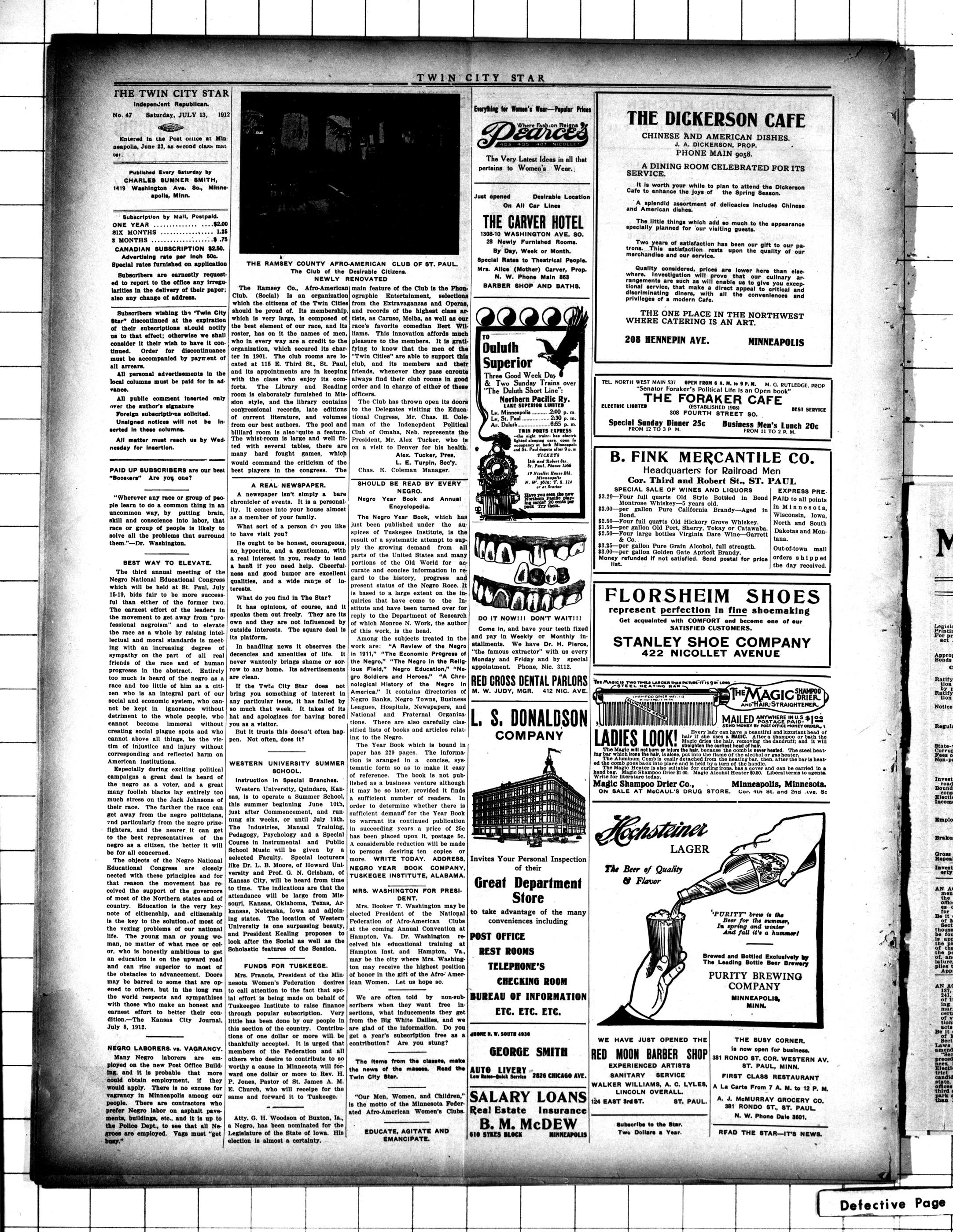
The image provided is too blurry to accurately recognize any text. It appears to be a grayscale photograph of an interior space with a large window. The room is dimly lit, and there are no discernible objects or people present.
The Ramsey Co., Afro-American Club. (Social) Is an organization which the citizens of the Twin Cities should be proud of. Its membership which is very large, is composed of the best element of our race, and its roster, has on it the names of men, who in every way are a credit to the organization, which secured its charter in 1901. The club rooms are located at 115 E. Third St., St. Paul, and its appointments are in keeping with the class who enjoy its comforts. The Library and Reading room is elaborately furnished in Mission style, and the library contains congressional records, late editions of current literature, and volumes from our best authors. The pool and billiard room is also quite a feature. The whist-room is large and well fitted with several tables, there are many hard fought games, which would command the criticism of the best players in the congress. The
A REAL NEWSPAPER.
A newspaper isn't simply a bare chronicler of events. It is a personality. It comes into your house almost as a member of your family.
What sort of a person do you like to have visit you?
He ought to be honest, courageous, no hypocrite, and a gentleman, with a real interest in you, ready to lend a hand if you need help. Cheerfulness and good humor are excellent qualities, and a wide range of interests.
What do you find in The Star?
It has opinions, of course, and it speaks them out freely. They are its own and they are not influenced by outside interests. The square deal is its platform.
In handling news it observes the decencies and amenities of life. It never wantonly brings shame or sorrow to any home. Its advertisements are clean.
If the Twila City Star does not bring you something of interest in any particular issue, it has failed by so much that week. It takes of its hat and apologizes for having bored you as a visitor.
But it trusts this doesn't often happen. Not often, does it?
WESTERN UNIVERSITY SUMMER SCHOOL.
Western University, Quindaro, Kansas, is to operate a Summer School, this summer beginning June 10th, just after Commencement, and running six weeks, or until July 19th. The Industries, Manual Training, Pedagogy, Psychology and a Special Course in Instrumental and Public School Music will be given by a selected Faculty. Special lecturers like Dr. L. B. Moore, of Howard University and Prof. G. N. Grisham, of Kansas City, will be heard from time to time. The indications are that the attendance will be large from Missouri, Kansas, Oklahoma, Texas, Arkansas, Nebraska, Iowa and adjoining states. The location of Western University is one surpassing beauty, and President Kealing proposes to look after the Social as well as the Scholastic features of the Session.
FUNDS FOR TUSKEEGE.
Mrs. Francis, President of the Minnesota Women's Federation desires to call attention to the fact that special effort is being made on behalf of Tuskegee Institute to raise finance through popular subscription. Very little has been done by our people in this section of the country. Contributions of one dollar or more will be thankfully accepted. It is urged that members of the Federation and all others who desire to contribute to so worthy a cause in Minnesota will forward one dollar or more to Rev. H. P. Jones, Pastor of St. James A. M. E. Church, who will recipe for the same and forward it to Tuskegee.
Atty. G. H. Woodson of Buxton, Ia., a Negro, has been nominated for the Legislature of the State of Iowa. His election is almost a certainty.
TWIN CITY STAR
AMERICAN CLUB OF ST. PAUL.
Desirable Citizens.
RENOVATED
main feature of the Club is the Phonographic Entertainment, selections from the Extravaganzas and Operas, and records of the highest class artists, as Caruso, Melba, as well as our race's favorite comedian Bert Williams. This innovation affords much pleasure to the members. It is gratifying to know that the men of the "Twin Cities" are able to support this club, and its members and their friends, whenever they pass enroute always find their club rooms in good order and in charge of either of these officers. The Club has thrown open its doors to the Delegates visiting the Educational Cngress, Mr. Chas. E. Coleman of the Indenepent Club of Omaha, Neb. represents the President, Mr. Alex Tucker, who is on a visit to Denver for his health.
L. E. Turpin, Soe'y.
Chas. E. Coleman Manager.
SHOULD BE READ BY EVERY
NEGRO
Negro Year Book and Annual Encyclopedia.
The Negro Year Book, which has just been published under the auspices of Tuskegee Institute, is the result of a systematic attempt to supply the growing demand from all parts of the United States and many portions of the Old World for accurate and concise information in regard to the history, progress and present status of the Negro Roce. It is based on a large extent on the inquiries that have come to the Institute and have been turned over for reply to the Department of Research of which Monroe N. Work, the author of this work, is the head.
Among the subjects treated in the work are: "A Review of the Negro in 1911," "The Economic Progress of the Negro," "The Negro in the Religious Field," Negro Education," "Negro Soldiers and Heroes," "A Chronological History of the Negro in America." It contains directories of Negro Banks, Negro Towns, Business Leagues, Hospitals, Newspapers, and National and Fraternal Organizations. There are also carefully classified lists of books and articles relating to the Negro.
The Year Book which is bound in paper has 229 pages. The information is arranged in a concise, systematic form so as to make it easy of reference. The book is not published as a business venture although it may be so later, provided it finds a sufficient number of readers. In order to determine whether there is sufficient demand for the Year Book to warrant its continued publication in succeeding years a price of 25c has been placed upon it, postage 5c. A considerable reduction will be made to persons desiring ten copies or more. WRITE TODAY. ADDRESS, NEGRO YEAR BOOK COMPANY, TUSKEGEE INSTITUTE, ALABAMA.
MRS. WASHINGTON FOR PRESIDENT.
Mrs. Booker T. Washington may be elected President of the National Federation of Afro-American Clubs at the coming Annual Convention at Hampton. Va. Dr. Washington received his educational training at Hampton Inst. and Hampton, Va.. may be the city where Mrs. Washington may receive the highest position of honor in the gift of the Afro-American Women. Let us hope so.
We are often told by non-subscribers when they want free insertions, what inducements they get from the Big White Dailies, and we are glad of the information. Do you get a year's subscription free as a contribution? Are you stung?
The items from the classes, make the news of the masses. Read the Twin City Star.
"Our Men, Women, and Children," is the motto of the Minnesota Federated Afro-American Women's Clubs.
EDUCATE, AGITATE AND EMANCIPATE.
Everything for Women's Wear—Popular Prices Where Fashion Reigns Pearces 403 405 407 NICOLLEY The Very Latest Ideas in all that pertains to Women's Wear.
Just opened Desirable Location
On All Car Lines
THE CARVER HOTEL
1308-10 WASHINGTON AVE. SO.
28 Newly Furnished Rooms.
By Day, Week or Month.
Special Rates to Theatrical People.
Mrs. Alice (Mother) Carver, Prop.
N. W. Phone Main 863
BARBER SHOP AND BATHS.
TO
Duluth
Superior
Three Good Week Day
& Two Sunday Trains over
"The Duluth Short Line":
Northern Pacific Ry.
LAKE SUPERIOR LIMITED
Lv. Minneapolis ..... 2:00 p.m.
Lv. St. Paul ..... 2:30 p.m.
Ar. Duluth ..... 6:55 p.m.
TWIN PORTS EXPRESS
-the night train-- has electric
lighting, electric cars, in
occupancy at both Minneapolis
and St. Paul depots after 9 p.m.
TICKETS
Sib and Robert Sts.
St. Paul, Phones 1266
19 Niellet House Bk.
Minneapolis
N. W. 3610; T. S. 114
or at Station
Have you seen the new
Northern Pacific Day
line? You can get 20 coins per
pack Try them.
DO IT NOW!!! DON'T WAIT!!!
Come in, and have your teeth fixed and pay in Weekly or Monthly installments. We have Dr. H. Plerce, "the famous extractor" with us every Monday and Friday and by special appointment. Phone, Nic. 3112.
RED CROSS DENTAL PARLORS M. W. JUDY, MGR. 412 NIC. AVE.
L. S. DONALDSON COMPANY
Invites Your Personal Inspection of their
Great Department Store
to take advantage of the many
conveniences including
POST OFFICE
REST ROOMS
TELEPHONE'S
CHECKING ROOM
BUREAU OF INFORMATION
ETC. ETC. ETC.
DHOME N. W. SOUTH 4930
GEORGE SMITH
AUTO LIVERY
Low Rates--Quick Service 2826 CHICAGO AVE.
SALARY LOANS
Real Estate Insurance
B. M. McDEW
610 SYKES BLOCK MINNEAPOLIS
THE DICKERSON CAFE
CHINESE AND AMERICAN DISHES.
J. A. DICKERSON, PROP.
PHONE MAIN 9058.
A DINING ROOM CELEBRATED FOR ITS SERVICE.
It is worth your while to plan to attend the Dickerson Cafe to enhance the joys of the Spring Season.
A splendid assortment of delicacies Includes Chinese and American dishes.
The little things which add so much to the appearance specially planned for our visiting guests.
Two years of satisfaction has been our gift to our patrons. This satisfaction rests upon the quality of our merchandise and our service.
Quality considered, prices are lower here than elsewhere. Investigation will prove that our culinary arrangements are such as will enable us to give you exceptional service, that make a direct appeal to critical and discriminating diners, with all the conveniences and privileges of a modern Cafe.
THE ONE PLACE IN THE NORTHWEST WHERE CATERING IS AN ART.
TEL. NORTH WEST MAIN 537 OPEN FROM 6 A. M. to 9 P. M. M. G. RUTLEDGE, PROP
"Senator Foraker's Political Life is an Open book"
THE FORAKER CAFE
ELECTRIC LIGHTED (ESTABLISHED 1908)
308 FOURTH STREET SO.
Special Sunday Dinner 25c Business Men's Lunch 20c
FROM 12 TO 3 P. M. FROM 11 TO 2 P. M.
represent perfection in fine shoemaking Get acquainted with COMFORT and become one of our SATISFIED CUSTOMERS. STANLEY SHOE COMPANY 422 NICOLLET AVENUE
The Beer of Quality & Flavor
WE HAVE JUST OPENED
OLD MOON BARBER
EXPERIENCED ARTIST
SANITARY SERVICE
WILKER WILLIAMS, A. C.
LINCOLN OVERALL.
EAST 3rd ST. ST.
Subscribe to the Star. Two Dollars a Year.
E. MINNEAPOLIS
FROM 6 A. M. TO 9 P. M. M. G. RUTLEDGE, PROP
Political Life is an Open book"
RAKER CAFE
ABLISHED 1908) BEST SERVICE
TH STREET SO.
c Business Men's Lunch 20c
FROM 11 TO 2 P. M.
RCANTILE CO.
for Railroad Men
Robert St., ST. PAUL
EIM SHOES
on in fine shoemaking
SORT and become one of our
D CUSTOMERS.
HOE COMPANY
MILLET AVENUE
IT IS 9 IN LONDON
THE MAGIC SHAMPOO DRIER
AND HAIR-STRAIGHTENER.
MAILED ANYWHERE IN U.S. $1.00
SEND MONEY BY POST OFFICE MONEY ORDER.
Every lady can have a beautiful and luxurious head of
she uses a MAGIC. After a shampoo or bath the
cries the hair, removing the dandruff; and it will
be the curliest head of hair.
because the comb is never heated. The steel heat-
the flame of the alcohol or gas heater.
from the heating bar, then, after the bar is heat-
ed by a turn of the handle.
suling fresh, has a cover and can be carried in a
MAGIC Alcohol Heater $0.50. Liberal terms to agenta.
Minneapolis, Minnesota.
STORE. Cor. 4th St. and 2nd Ave. So
"PURITY" brew is the
Beer for the summer,
In spring and winter
And fall it's a hummer!
Brewed and Bottled Exclusively by
The Leading Bottle Beer Brewery
PURITY BREWING
COMPANY
MINNEAPOLIS,
MINN.
THE BUSY CORNER.
is now open for business.
381 RONDO ST. COR. WESTERN AV
ST. PAUL, MINN.
FIRST CLASS RESTAURANT
A La Carte From 7 A. M. to 12 P. M.
A. J. McMURRAY GROCERY CO.
381 RONDO ST., ST. PAUL.
EXPRESS PRE-
PAID to all points
in Minnesota,
Wisconsin, Iowa,
North and South
Dakotas and Montana.
Out-of-town mall
orders shipped
the day received.
Defective Page
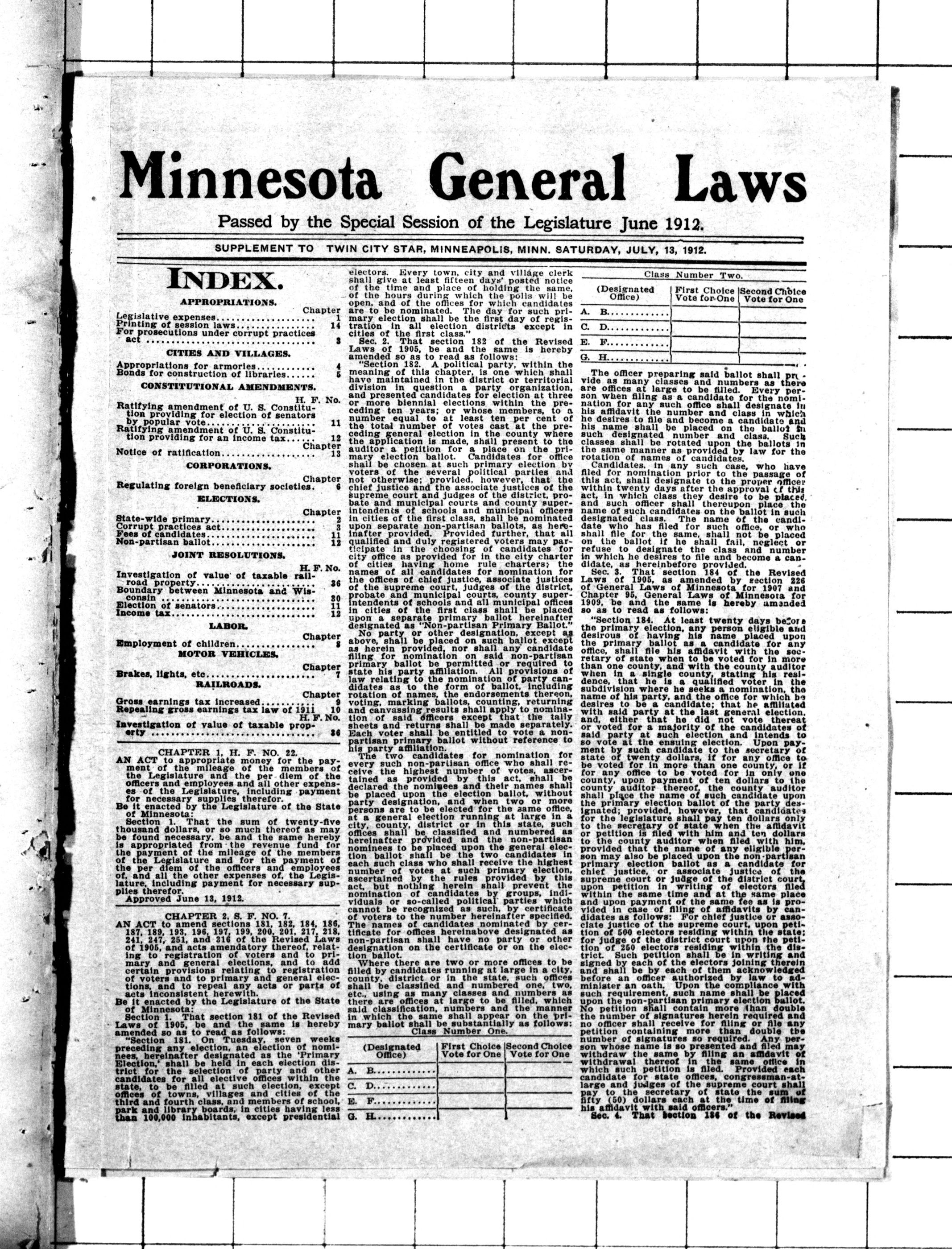
Minnesota General Laws
Passed by the Special Session of the Legislature June 1912. SUPPLEMENT TO TWIN CITY STAR, MINNEAPOLIS, MINN. SATURDAY, JULY, 13, 1912.
INDEX.
Chapter
Legislative expenses..... 1
Printing of session laws..... 14
For prosecutions under corrupt practices
act..... 3
CITIES AND VILLAGES.
Appropriations for armories..... 4
Bonds for construction of libraries..... 5
CONSTITUTIONAL AMENDMENTS.
H. F. No.
Ratifying amendment of U. S. Constitution providing for election of senators by popular vote..... 11
Ratifying amendment of U. S. Constitution providing for an income tax..... 12
Chapter
Notice of ratification..... 13
Chapter
Regulating foreign beneficiary societies. 6
ELECTIONS.
Chapter
State-wide primary. 2
Corrupt practices act. 3
Fees of candidates. 11
Non-partisan ballot. 12
JOINT RESOLUTIONS.
H. F. No.
Investigation of value of taxable rail-
road property..... 36
Boundary between Minnesota and Wis-
consin..... 30
Election of senators..... 11
Income tax..... 12
LABOR.
Chapter
Employment of children..... 8
MOTOR VEHICLES.
Chapter
Brakes, lights, etc..... 7
RAILROADS.
Chapter
Gross earnings tax increased.....9
Repealing gross earnings tax law of 1911 10
H. F. No.
Investigation of value of taxable property .....86
CHAPTER 1. H. F. NO. 22.
AN ACT to appropriate money for the payment of the mileage of the members of the Legislature and the per diem of the officers and employees and all other expenses of the Legislature, including payment for necessary supplies therefor.
Be it enacted by the Legislature of the State of Minnesota:
Section 1. That the sum of twenty-five thousand dollars, or so much thereof as may be found necessary, be and the same hereby is appropriated from the revenue fund for the payment of the mileage of the members of the Legislature and for the payment of the per diem of the officers and employees of, and all the other expenses of, the Legislature, including payment for necessary supplies therefor.
CHAPTER 2. S. F. NO. 7.
AN ACT to amend sections 181, 182, 184, 186, 187, 189, 193, 196, 197, 199, 200, 201, 217, 218, 241, 247, 251, and 316 of the Revised Laws of 1905, and acts amendatory thereof, relating to registration of voters and to primary and general elections, and to add certain provisions relating to registration of voters and to primary and general elections, and to repeal any acts or parts of acts inconsistent herewith.
Be it enacted by the Legislature of the State of Minnesota:
Section 1. That section 181 of the Revised Laws of 1905, be and the same is hereby amended so as to read as follows:
"Section 181. On Tuesday, seven weeks preceding any election, an election of nominees, hereinafter designated as the 'Primary Election,' shall be held in each election district for the selection of party and other candidates for all elective offices within the state, to be filled at such election, except offices of towns, villages and cities of the third and fourth class, and members of school, park and library boards, in cities having less than 100,000 inhabitants, except presidential
---
electors. Every town, city and village clerk shall give at least fifteen days' posted notice of the time and place of holding the same, of the hours during which the polls will be open, and of the offices for which candidates are to be nominated. The day for such primary election shall be the first day of registration in all election districts except in cities of the first class." Sec. 2. That section 182 of the Revised Laws of 1905, be and the same is hereby amended so as to read as follows:
"Section 182. A political party, within the meaning of this chapter, is one which shall have maintained in the district or territorial division in question a party organization, and presented candidates for election at three or more biennial elections within the preceding ten years; or whose members, to a number equal to at least ten per cent of the total number of votes cast at the preceding general election in the county where the application is made, shall present to the auditor a petition for a place on the primary election ballot. Candidates for office shall be chosen at such primary election by voters of the several political parties and not otherwise; provided, however, that the chief justice and the associate justices of the supreme court and judges of the district, probate and municipal courts and county superintendents of schools and municipal officers in cities of the first class, shall be nominated upon separate non-partisan ballots, as hereinafter provided. Provided further, that all qualified and duly registered voters may participate in the choosing of candidates for city office as provided for in the city charter of cities having home rule charters; the names of all candidates for nomination for the offices of chief justice, associate justices of the supreme court, judges of the district, probate and municipal courts, county superintendents of schools and all municipal offices in cities of the first class shall be placed upon a separate primary ballot hereinafter designated as "Non-partisan Primary Ballot."
No party or other designation, except as above, shall be placed on such ballot except as herein provided, nor shall any candidate filling for nomination on said non-partisan primary ballot be permitted or required to state his party affiliation. All provisions of law relating to the nomination of party candidates as to the form of ballot, including rotation of names, the endorsements thereon, voting, marking ballots, counting, returning and canvassing results shall apply to nomination of said officers except that the tally sheets and returns shall be made separately. Each voter shall be entitled to vote a non-partisan primary ballot without reference to his party affiliation.
The two candidates for nomination for every such non-partisan office who shall receive the highest number of votes, ascertained as provided by this act, shall be declared the nominees and their names shall be placed upon the election ballot, without party designation, and when two or more persons are to be elected for the same office, at a general election running at large in a city, county, district or in this state, such offices shall be classified and numbered as hereinafter provided and the non-partisan nominees to be placed upon the general election ballot shall be the two candidates in each such class who shall receive the highest number of votes at such primary election, ascertained by the rules provided by this act, but nothing herein shall prevent the nomination of candidates by groups, individuals or so-called political parties which cannot be recognized as such, by certificate of voters to the number hereinafter specified. The names of candidates nominated by certificate for offices hereinabove designated as non-partisan shall have no party or other designation on the certificate or on the election ballot.
Where there are two or more offices to be filled by candidates running at large in a city, county, district or in the state, such offices shall be classified and numbered one, two, etc., using as many classes and numbers as there are offices at large to be filled, which said classification, numbers and the manner in which the same shall appear on the primary ballot shall be substantially as follows: Class Number One.
(Designated Office) First Choice Vote for One Second Choice Vote for One
A. B.....
C. D.....
E. F.....
G. H....
Class Number Two.
(Designated Office) First Choice Vote for One Second Choice Vote for One
A. B.....
C. D.....
E. F.....
G. H....
The officer preparing said ballot shall provide as many classes and numbers as there are offices at large to be filled. Every person when filing as a candidate for the nomination for any such office shall designate in his affidavit the number and class in which he desires to file and become a candidate and his name shall be placed on the ballot in such designated number and class. Such classes shall be rotated upon the ballots in the same manner as provided by law for the rotation of names of candidates.
Candidates, in any such case, who have filed for nomination prior to the passage of this act, shall designate to the proper officer within twenty days after the approval of this act, in which class they desire to be placed, and such officer shall thereupon place the name of such candidates on the ballot in such designated class. The name of the candidate who has filed for such office, or who shall file for the same, shall not be placed on the ballot if he shall fail, neglect or refuse to designate the class and number in which he desires to file and become a candidate, as hereinbefore provided.
Sec. 3. That section 184 of the Revised Laws of 1905, as amended by section 226 of General Laws of Minnesota for 1907 and Chapter 95, General Laws of Minnesota for 1909, be and the same is hereby amended so as to read as follows:
"Section 184. At least twenty days before the primary election, any person eligible and desirous of having his name placed upon the primary ballot as a candidate for any office, shall file his affidavit with the secretary of state when to be voted for in more than one county, and with the county auditor when in a single county, stating his residence, that he is a qualified voter in the subdivision where he seeks a nomination, the name of his party, and the office for which he desires to be a candidate; that he affiliated with said party at the last general election, and, either that he did not vote thereat or voted for a majority of the candidates of said party at such election and intends to so vote at the ensuing election. Upon payment by such candidate to the secretary of state of twenty dollars, if for any office to be voted for in more than one county, or if for any office to be voted for in only one county, upon payment of ten dollars to the county auditor thereof, the county auditor shall place the name of such candidate upon the primary election ballot of the party designated; provided, however, that candidates for the legislature shall pay ten dollars only to the secretary of state when the affidavit or petition is filed with him and ten dollars to the county auditor when filed with him, provided that the name of any eligible person may also be placed upon the non-partisan primary election ballot as a candidate for chief justice, or associate justice of the supreme court or judge of the district court, upon petition in writing of electors filed within the same time and at the same place upon the same fee as is provided in case of filing of affidavits by candidates as follows: For chief justice or associate justice of the supreme court, upon petition of 500 electors residing within the state; for judge of the district court upon the petition of 250 electors residing within the district. Such petition shall be in writing and signed by each of the electors joining therein and shall be by each of them acknowledged before an officer authorized by law to administer an oath. Upon the compliance with such requirement, such name shall be placed upon the non-partisan primary election ballot. No petition shall contain more than double the number of signatures herein required and no officer shall receive for filing or file any petition containing more than double the number of signatures so required. Any person whose name is so presented and filed may withdraw the same by filing an affidavit of withdrawal thereof in the same office in which such petition is filed. Provided each candidate for state offices, congressman-at-large and judges of the supreme court shall pay to the secretary of state the sum of fifty (50) dollars each at the time of filing his affidavit with said officers."
Sec. 4. That section 186 of the Revised
Laws of 1905, be and the same is hereby amended so as to read as follows:
"Section 186. All voting at a primary election shall be by ballot. On the 19th day before a primary election, the secretary of state shall certify to the auditors of the several counties the names of all nominees to be voted for within such counties whose certificates have been properly filed with him, and on the fourteenth day before such primary, each auditor shall group all the non-partisan candidates and the candidates of each political party by themselves, and prepare for public inspection a non-partisan ballot and a separate sample ballot for each political party. The names shall be arranged alphabetically according to the surnames, and each county auditor shall post the sample ballot in a conspicuous place in his office, and give one week's published notice thereof in the official newspaper of his county. One sample ballot only of non-partisan candidates and of each political party, shall be printed for any county, and thereon shall be placed the names of all candidates to be voted for in such county. Each ballot shall be headed by the party name, the words "Primary Election Ballot," the names of the county and state, and facsimile of the official signature of the auditor preparing it, and a column for first choice votes and a column for second choice votes. The non-partisan primary ballot shall be headed as provided in Section 2 of this act and shall not contain a column for second choice votes. Otherwise, the ballots shall be arranged in the same general manner as the ballot used at general elections, with suitable divisions and explanatory notes. Only one form of sample ballot for each political party need be printed for any city, and thereon shall be placed the names of all the candidates to be voted for in the entire city, those to be voted for in any single ward being indicated by the words and figures "1st ward," and so on. At the foot of the ballot shall be placed the heading "Ballot for Women," under which shall be placed the names of candidates to be voted for by women.
Sald ballots shall be subsantially as follows:
OFFICIAL PRIMARY BALLOT.
Designation of Party.
To vote for a person whose name is printed on the ballot, make a cross (X) after his name in the proper column, as follows:
A voter may vote for one first choice and one second choice for each office to be filled.
Mark your First Choice with a cross (X) in the First Choice column:
Mark your Second Choice with a cross (X) in the Second Choice column.
VOTE FOR ONE FIRST CHOICE.
AND ONE SECOND CHOICE.
Governor First Choice Vote for One Second Choice Vote for One
A. B.....
C. D.....
E. F.....
G. H....
The officer preparing the ballots shall provide necessary space for the officers to be nominated pursuant to law; provided that in city primary elections in cities having home rule charters sample primary election ballots shall be prepared carrying out the intent of said charters of said cities, placing all names of candidates for city office on one ballot in each city without any party designation whatever, if the charter so provide. In such cities, except for the omitting of all party designation, the provisions of this Section shall be followed as fully as practicable.
Sec. 5. That section 187 of the Revised Laws of 1905, be and the same is hereby amended so as to read as follows:
"Section 187. The auditor of each county in which said primary election is held shall have printed a sufficient number of separate primary election ballots, varied as may be necessary for the several districts and wards. The names of candidates under headings properly designating each official position, shall be rotated upon the ballot in the printing so that the names of all candidates for each office shall be so alternated on the ballots used in each election district that they shall appear thereon substantially an equal number of times at the top, at the bottom, and in each intermediate place, if any, of the list or group in which they belong. All officers charged with the preparation and distribution of such ballots shall cause the printer's forms to be so transposed and the blocks of the ballots to be so made up as to carry out the intent hereof. There shall be no printing on the back of the ballots, or any mark to distinguish them, except the initials of the judge or clerk; provided that in all city primary elections in cities having home rule charters, the officers designated in said charters shall prepare primary ballots for such city elections as provided in said charters, and this section shall apply therein only in so far as it does not conflict with the provisions of said charters."
Sec. 6. That section 189 of the Revised
Laws of 1905, be and the same is hereby amended so as to read as follows: "Section 189. The blanks provided for registration of voters for general elections shall have an additional column headed "Voted, Primary Election," and be used at both primary and general elections. No names of voters shall be placed upon said registers prior to the day of such primary election, except in cities of the first class, nor shall any be placed thereon upon said day, except the names of those who appear in person before boards of registration for that purpose." Sec. 7. That Section 193 of the Revised Laws of 1905, be and the same hereby is amended so as to read as follows: "Section 193. (a) Each elector shall be entitled to designate on his political party ballot, in the manner herein provided, the name of his first choice and also the name of his second choice as nominee for each office.
(b) The voter shall mark his ballot in the following manner to indicate his first and second choice:
(1) He shall place a cross (X) in the first column after the name of his first choice candidate, and a cross (X) in the second column after the name of his second choice candidate.
(2) He shall place but one mark in any one designated space.
(3) If a voter votes either in the first or in the second choice column, for two persons, such vote shall be counted as a first choice vote for the person voted for whose name appears first in such column, and as a second choice for the person voted for whose name appears lower in such column. Provided, if the voter votes for more than two persons for any one office, or if for any reason it be impossible to determine his choice for any office, his ballot shall not be counted for such office; but the rest of his ballot, if properly marked, shall be counted. No ballot shall be rejected for any technical error which does not render it impossible to determine the voters choice, even though such ballot be somewhat soiled or defaced.
(4) A vote for one person only shall be counted as a first choice vote, whether the voter places his cross in the first or in the second choice column.
(5) A first and second choice vote cast for the same person shall be counted as a first choice vote only for such person.
(c) A voter shall designate his choice on the non-partisan primary ballot by marking a cross (X) in the small square opposite the name of each candidate for whom he wishes to vote.
(d) The rules of law governing the determination of the intention of the voter in all other elections shall apply to this act, except as herein-otherwise provided."
Sec. 8. That Section 196 of the Revised Laws of 1905, be an the same hereby is amended so as to read as follows:
"Section 196. Canvass of votes on primary ballots shall be made in the same manner and by the same officers as is provided by Chapter 6 of the Revised Laws of 1905, except as herein otherwise provided. The ballots shall be counted in the following manner: The election officers shall take the ballots from the boxes count those cast by each political party and for non-partisan candidates, place them in separate piles and fasten together. As the first and second choice votes are called off from the political party primary ballots by the primary officers, they shall be entered by such officers on the tally sheets, a form for which shall be substantially as follows:
OFFICIAL TALLY SHEET. For Governor.
Such officers' tally sheets on which the count has been so entered shall be included in the returns of such election. The officers of election shall on blanks to be provided for that purpose make full and accurate returns of the votes cast for each candidate, giving both first and second choice votes as herein provided. The returns shall set forth opposite the name of each candidate the number of first choice votes cast for such candidate, followed horizontally by a statement of the number of second choice votes cast by his supporters for each of the other candidates. Such tabular statement shall be substantially in the following form:
Precinct Party
FOR GOVERNOR.
First Choice Candidates Second Choice A. B. C. D. E. F. G. H.
A. B.....(50) ... 30 15 5
C. D.....(40) 25 ... 10 5
E. F.....(25) 15 7 ... 3
G. H.....(5) 3 3 1 ... .
(120) ... ... ... ... ...
The officers shall seal the returns and return the same to the auditor in the manner and as provided by law."
Sec. 9. That section 197 of the Revised Laws of 1905, be and the same hereby is amended so as to read as follows:
"Section 197. The auditor shall furnish to each district, with the ballots, two sets of tally sheets or tally books for each political
party having candidates and for non-partisan candidates to be voted for. Each tally sheet or the first sheet of each tally book shall be headed 'TALLY SHEET for.....(name of political party).....(Name of city or village).....(county).....(ward or town).....
Election district, for a primary election held.....(date). The names of candidates shall APPEAR on the tally sheets, or tally books in the order in which they appear on the official sample ballots, and in each case shall have the proper designation at the head thereof; provided, that in primary elections for city officers in cities having home rule charters, but two books or tally sheets shall be provided for each district, and party designations shall be omitted in headings and returns, if so provided in said charter."
Sec. 10. That section 199 of the Revised Laws of 1905, be and the same hereby is amended so as to read as follows:
"Section 199. The canvassing board shall prepare, sign and file with the county auditor the following report:
1. A separate statement of each political party of the names of all candidates, thereof voted for at the primary election, the number and total of first choice and second choice votes received by each and for what office, showing for whom such second choice votes were cast and from the supporters of which candidate said second choice votes were received, in form as indicated in Section 8 hereof.
2. A separate statement of the names of the candidates of each political party who are nominated.
3. A statement of the whole number of votes registered and the number of ballots cast at such primary election, men and women separately.
4. A separate statement of the votes received by each of the non-partisan candidates and the names of the non-partisan candidates nominated.
Whenever two or more candidates of the same political party receives an equal number of votes for the same nomination, the board shall determine the tie by lot. Upon completion of the canvass and can or before ten o'clock A. M. of the fourth day succeeding the canvass, the auditor shall certify to the secretary of state the vote, as shown by such report, for all candidates to be voted for in more than one county, and shall mail or deliver to each nominee to be voted for in his county alone, a notice of his nomination, and that his name will be placed upon the official ballot; provided, that in primary elections for city officers in cities having home rule charters said canvassing board shall file such statement as will show the persons nominated for each office under the provisions of said charter, with as complete details as are provided for in this section, omitting all party designation, if so provided in said charters."
Sec. 11. That Section 200 of the Revised Laws of 1905, be and the same hereby is amended so as to read as follows:
"Section 200. The state canvassing board, as constituted for canvassing the returns of general elections, shall open and canvass the returns of a primary election made to the Secretary of State, at the usual place and hour of meeting, on the 7th day after such primary election. It shall determine ties between candidates as in the case of general elections. Upon the completion of the canvass, the Secretary of State shall certify to the several auditors the names of the persons found to be nominated, and mail to each nominee a notice of his nomination.
1. The state, county and city boards of canvassers shall be guided by the following rules except as herein otherwise provided.
(a) If any candidate for an office received a majority of the first choice votes he shall be declared nominated for such office.
(b) If no candidate is thus nominated, drop the name of the one having the least number of first choice votes and add the second choice votes cast by his supporters to the first choice votes of the remaining candidates for whom they were cast, and
(c) If no candidate then has a majority, drop from the remaining candidates the one having the least number of first choice votes combined with the second choice votes received through such elimination, and add the second choice votes cast by his supporters to the votes of the remaining candidates for whom they were cast.
(d) Repeat this operation until some candidate has a majority or until only two candidates remain. Then the one having the greatest number of votes to his credit shall be declared nominated.
(e) No second choice vote shall be counted when it is cast for a candidate whose name shall have been dropped as herein provided.
(f) Any tie shall be decided by lot by the canvassers.
(g) The person receiving the highest vote at such primary election, determined under the rules herein provided, as the candidate of any political party for an office shall be the nominee of that party for such office. Candidates on non-partisan ballots receiving the highest and next highest votes determined under the rules herein provided, shall be the nominees for the office for which they are candidates; provided, however, that if the
number of votes cast for any candidate or candidates of any party for any office at such primary election shall aggregate the number of votes equal to ten per cent or more of the average vote cast for state officers of that party at the last general election in the territory within which such candidates are to be voted for, then all candidates of that party within that territory shall be deemed to be the party nominees of such party; otherwise no candidates of that party within that territory shall be deemed nominated and in such case, such party candidates of such party may be nominated by petition as provided for in Sec. 213 to 216 inclusive. Revised Law's 1905, and the candidates of any such party failing to receive such ten per cent of such vote shall be eligible for nomination under the terms of this provision. The term "State officers" as used in this act for the purpose of computing the average vote to determine the ten per cent vote as above provided shall be and is hereby defined to be the following officers: Governor, Lieutenant Governor, Secretary of State, State Treasurer and Attorney General.
Provided further, that if less than three persons file for a non-partisan office such lesser number shall be the nominee or nominees, as the case may be, for such office." Sec. 12. That Section 201 of the Revised Laws of 1905, be and the same is hereby amended so as to read as follows:
"Section 201. The persons certified by such canvassing boards to be nominated, shall constitute the nominees of the several political parties of the nominees under the terms of a home rule charter, or the non-partisan nominees as the case may be, to be voted for at the next ensuing general election, and their names shall be printed upon the official ballots prepared for the ensuing election."
Sec. 13. That Section 217 of the Revised Laws of 1905, be and the same is hereby amended so as to read as follows:
"Section 217. If a vacancy occurs after nominations have been made or by reason of the failure of any party to receive ten per cent of the vote as provided in subdivision (g) of Section 11 of this act it may be filled at any time before the general election by filing with the proper officer a nomination certificate in form and substance as hereinbefore provided, executed by the chairman and secretary of the proper committees of the party whose voters make the original nomination, under the direction of such committee, and the chairman and secretary when so filing such certificate must attach thereto an affidavit to the effect that such candidate has been duly selected by said committee and that the persons signing said certificate and making such affidavit as such, are the duly authorized chairman and secretary of said committee. If there is no proper committee to fill such vacancy, as above provided, then in that event the person receiving the next highest number of votes for such office at such primary election shall be the candidate for such office, and if there is no other candidate for such office and a vacancy exists by reason of this fact, the vacancy may be filled by the proper officer placing upon the ballot the name or names of such candidates as are nominated by petition in a manner provided in Sections 213, 214, 215 and 216. Revised Laws 1905, provided that every registered voter of such party who was qualified and participated in the primary election is eligible to sign a petition choosing a nominee to fill said vacancy."
Sec. 14. That Section 218 of the Revised Laws of 1905, be and the same is hereby amended to read as follows:
"Section 218. If the ballots have been printed, the officer whose duty it may be to have such ballots prepared and printed, shall; if such ballots be still in his hands, attach to said ballots over the name of the candidate who causes said vacancy, adhesive stickers, containing the name only of the candidate selected under the next previous section of this act. Should such ballots have been distributed before such vacancy occurs, then and in that event, said officer shall cause to be printed and distributed to the election judges to whom the ballots have been distributed, a sufficient number of adhesive stickers to correct the ballots as provided herein, and said election judges shall correct said ballots as herein provided."
Sec. 15. That Section 241 of the Revised Laws of 1905, be and the same is hereby amended so as to read as follows:
"Section 241. In cities of the first, second and third classes the judges shall constitute boards of registration in their respective districts. In cities of the first class on Tuesday nine weeks preceding any general state or city election and in cities of the second and third classes seven weeks preceding any general state or city election and fourteen days before any special election the judges shall meet at six o'clock a. m. at the place where the last election was held or in such other place as may be lawfully designated as the polling place for the district and there remain in session until nine o'clock p. m. and register all persons entitled to vote in such districts at the ensuing election. Such registration shall be known as the register of voters and made in duplicate. The board shall have the same right to preserve order at its meetings as judges on election and
vacancies shall be filled in the same manner as upon election day. Nothing in this section shall be construed as amending chapter 148 of the Laws of 1907."
Sec. 16. That section 247 of the Revised Laws of 1905, be and the same is hereby amended so as to read as follows:
"Section 247. In cities of the first class on Tuesday eight weeks preceding any general state or city election and on Tuesday seven weeks preceding any general or city election and in cities of the second and third classes on Tuesday two weeks preceding any general election and on the thirteenth day preceding any special election, such board shall meet at the same place as before and remain in public session from six o'clock a. m. until nine o'clock p. m. for the purpose of registering qualified voters. It shall obtain from the clerk and use the same registers as on the first day, and observe the same forms.
Sec. 17. That section 251 of the Revised Laws of 1905, be and the same is hereby amended so as to read as follows:
"Section 251. Only the votes of qualified registered voters shall be received by the judges at any general election in a city of the first, second or third classes, except the vote of a person whose name was erased as provided for in section 250, who takes the oath and proves his identity by the oath of another as hereinafter prescribed: Provided, that in cities of the first class, only the votes of qualified voters who have registered on either of the first two registration days in said city shall be received by the judges at the primary election, but any person who has not registered but who is a qualified voter in the district wherein he resides, shall be entitled to vote at such primary election if he registers on said primary election day and complies with the following provisions, and not otherwise, namely: He shall at the time he offers his ballot deliver to the judges his affidavit in which he shall state that he is a resident of the election district in which he offers to vote, naming the same and that he is entitled to vote therein; that he has resided in said election district thirty days next preceding said election and shall give street and number of his residence; that he is a citizen of the United States; that he is twenty-one years of age; that he has resided in the state six months immediately preceding said primary election, which said affidavit shall be substantiated by the affidavit of two freeholders, electors in such district, corroborating all the material statements therein. No compensation shall be received for taking or certifying such affidavit. No one freeholder shall be competent to make corroborating affidavits for more than five voters. All such affidavits shall be sworn to before some officer authorized by the laws of this state to administer oaths.
Sec. 18. Each political party shall provide a state central committee, a congressional committee for each congressional district, a county committee for each county, and a committee for each city in the manner following:
(a) The nominees for state offices, state legislature, senators and representatives in congress and United States senators and state senators whose term of office extend beyond the first Monday in January next ensuing, of each political party, shall meet on the second Thursday after said primary election at the state capitol at twelve o'clock noon, at which time they shall elect a state central committee, herein provided for, of such size as they shall at said time determine and shall also elect a congressional committee for each congressional district, of such size as they shall at said time determine, the members of each congressional committee to be chosen from among the electors of the several congressional districts respectively.
(b) The nominees for state legislature and the several county officers and such senators and county officers whose terms of office extend beyond the first Monday in January next ensuing of each political party, shall meet on the first Tuesday after said primary election at the court house in their respective counties, at twelve o'clock noon, at which time they shall elect a county committee of such size as they shall, at said time determine, and shall provide for the selection of such precinct and other committees within their respective counties as they shall determine to be necessary.
(c) The nominees for city offices of each political party in each city shall meet at the city hall in their respective cities, on the first Monday after said primary election at twelve o'clock noon at which time they shall elect a city committee of such size as they shall, at said time, determine and such precinct committees for the respective cities as they shall determine to be necessary.
(d) Each committee and its officers shall have the powers which have been customarily used by such committees and by the officers thereof, in so far as is consistent with this act. The various committees and their officers now in existence, shall exercise the powers and duties herein prescribed until their successors are chosen in accordance with this act. Sec. 19. That section 316 of the Revised Laws of 1905, as amended by chapter 214 of the Laws of 1905, be amended by adding thereto the following provisions:
In counties having a population of 200,000
or more, and in all cities having a population of 50,000 or more, whether operating under home rule charters or otherwise, the ballots in each precinct shall, as soon as practicable after the canvass is completed, and in the presence of all the judges, be strung and fastened together into a single package by passing a substantial twine string through and around all the ballots cast in such precinct, tying the ends of the twine and sealing the same with wax over the knots, with a seal provided by the county auditor or the city clerk, as the case may be. After the ballots have been so strung, fastened and sealed, they shall be replaced in the ballot boxes in the presence of all the judges, and each ballot box shall be locked and shall then be sealed by pasting a firm paper across the lid and body thereof, in such manner that the box cannot be opened without breaking the seal and each judge shall write his name upon said paper, so that such signature shall cross the opening between the lid and the body of the box. Such sealing shall be done before the board separates or adjourns, but not until by a canvass of the ballots in all the boxes, it has been ascertained that all of the ballots to be sealed in a box have been placed therein.
In counties having a population of 200,000 or more, and in all cities having a population of 50,000 or more, whether operating under home rule charters or otherwise, the ballot boxes, after the ballots have been properly sealed, shall be returned to the office of the county auditor or city clerk, as the case may be, by at least two of the election judges in person, and shall thereafter be stored in such manner as to admit at all times of actual, visual inspection of the exterior of the said boxes. Any candidate for office at such election, upon demand made upon the custodian of the ballots shall be entitled, either by himself, or his duly authorized agent, or agents, not exceeding two at any one time, to maintain continuous, visual watch over said boxes at all hours of the day and night until the expiration of the time for instituting contests; and in case of the instituting of contest or contests, either party to such contest, upon demand upon the custodian of the said ballots and upon notice to the opposing party to such contest, shall be entitled by himself, or his duly authorized agent or agents, not exceeding two at any one time, to maintain an actual, visual watch over such ballot boxes at all hours of the day and night. In event of such demand, either by candidate or party to a contest, the custodian of such ballots shall be authorized to appoint some suitable person as watchman over such ballot boxes during such hours as he shall deem necessary, in order to prevent leaving the same in the sole custody of such candidate or contestant or his agent or agents.
Sec. 20. Where voting machines shall be provided in the manner permitted by law, such voting machines may be used at all primary and general elections insofar as the use of the same is applicable, and not inconsistent with this act. If the mechanism of such machines will not permit the voter to record his vote in the manner provided in this act, sald machines may be used in the manner now provided by law so far as is applicable, and as to offices to which such voting machines will not apply separate paper ballots conforming with the law shall be used. All votes on voting machines shall be recorded and counted and the results thereof ascertained, canvassed and returned as provided by this act.
Sec. 21. That all acts or parts of acts inconsistent with the provisions of this act, be and the same are hereby repealed, except so much of chapter 267 of the General Laws of 1905 and the acts amendatory thereof as applies to the purchase of voting machines and the use of the same at general elections, except chapter 388 of the General Laws for the year 1911, providing for the nomination of candidates and the selection of a candidate for senator in Congress from this state by direct vote of the people, which said act shall remain in full force and effect except that the provisions in this act for the preparation of the ballot providing for first and second choice votes and the provisions in this act for the casting, counting and canvassing of said first and second choice votes and for determining nominees, shall apply to the persons and candidates mentioned in said chapter 388 of the General Laws for the year 1911. Sec. 22. This act shall take effect and be in full force from and after its passage.
AN ACT relating to corrupt practices at primaries and elections, and candidates to be voted for therein and providing for punishments for violations thereof.
Be it enacted by the Legislature of the State of Minnesota:
Section 1. No candidate for the nomination or election to any elective office in this state coming within the provisions of this act shall directly or indirectly pay, expend or contribute any money or other valuable thing, or promise to do so, except for the following purposes, which are hereby declared to be legal expenses.
(1) For the candidates' necessary personal
traveling expenses; for postage, telegraph, telephone, or other public messenger service. (2) For rent and necessary furnishing of hall or room during such candidacy, for the delivery of speeches, relative to principles or candidates. (3) For payment of speakers and musicians at public meetings, and their necessary traveling expenses. (4) Printing and distribution of list of candidates, sample ballots, pamphlets, newspapers, circulars, cards, hand bills, posters and announcements relative to candidates, or public issue or principles. (5) For copying and classifying poll lists, for making canvasses of voters and for challengers at the polls. (6) For filing fees to the proper public officer, and if nominated at any primary for contributions to the party committee. (7) For campaign advertising in newspapers, periodicals, or magazines pursuant to the provisions of section two.
Sec. 2. No publisher of a newspaper, periodical or magazine shall insert either in the advertising columns of such newspaper, magazine or periodical, or elsewhere therein any matter paid or to be paid for which is intended or tends to influence directly or indirectly any voting at any primary or general election unless at the head of said matter is printed in pica capital letters the words "Paid Advertisement," and unless there is also a statement at the head of said matter of the amount paid or to be paid therefor, the name and address of the candidate in whose behalf the matter is inserted and of any other person, if any, authorizing the publication and the name of the author thereof. No publisher of any newspaper, periodical or magazine published within this state shall insert therein either in the advertising column of such newspaper, magazine, periodical, or elsewhere therein, any matter whatsover of a political nature, or any political editorial relative to a candidate for any public office, unless the publisher thereof shall file in the office of the secretary of state of this state within six months before the holding of any primary or general election, or within ten days after the calling of and before the holding of any special election, a sworn statement which shall contain the names of the owners of such paper, and if such paper be a corporation, the names and addresses of the owners of the shares of stock of such corporation.
Sec. 3. Every candidate and every member of any personal campaign or party committee, who shall either in his own name or in the name of any other person, own any financial interest in any newspaper or periodical, circulating in part or in whole in Minnesota, shall, before such newspaper or periodical shall print any matter otherwise than as is provided in section 2, which is intended or tends to influence, directly or indirectly, any voting at any election or primary in this state, file in the office of the auditor of the county in which he resides a verified declaration, stating definitely the newspaper or periodical in which or over which he has such financial interest or control, and the exact nature and extent of such interest or control. The editor, manager or other person controlling the publication of any such newspaper or article, who shall print or cause to be printed any such matter contrary to the provisions of this act, prior to the filing of such verified declaration from any person required by this section to file such declaration, shall be deemed guilty of a violation hereof.
Sec. 4. No owner, publisher, editor, reporter, agent or employee of any newspaper or other periodical, shall, directly or indirectly solicit, receive or accept any payment, promise or compensation, nor shall any person pay or promise to pay, in any manner compensate any such owner, publisher, editor, reporter, agent or employee, directly or indirectly, for influencing or attempting to influence through any printing matter in such newspaper any voting at any election or primary through any means whatsoever, except through the matter inserted in such newspaper or periodical as "paid advertisement," and so designated as provided by this act.
Sec. 5. No disbursement shall be made and no obligation, express or implied, to make such disbursement, shall be incurred by or on behalf of any candidate for any office under the constitution or laws of this state, or under the ordinance of any town or municipality of this state in his campaign for nomination and election, which shall be in the aggregate in excess of the amounts herein specified, namely:
For any county, city, village or town officer, for any judge or for any officer not hereinbefore mentioned, who, if nominated and elected, would receive a salary, a sum not exceeding one-third of the salary to which such person would, if elected, be entitled dur-
ing the first year of his incumbency of such office. If such person when nominated and elected, would not receive a salary, a sum not exceeding one-third of the compensation which his predecessor received during the first year of such predecessor's incumbency. If such officer, when nominated and elected, would not receive a salary and if such officer had no predecessor, and in all cases not specifically provided for, one hundred dollars, and no more.
Sec. 6. No person shall demand, solicit, ask or invite any payment or contribution of any religious, charitable or other causes or organization, supposedly to be primarily for the public good, from any candidate for nomination or election, or to subscribe for the support of any club, or organization, or to buy tickets to any entertainment or ball or to pay for space in any book, program, periodical or publication, nor shall such demand or solicitation be made upon any committee. Provided, however, this shall not apply to the solicitation of any business advertisement in periodicals in which the candidate was a regular contributor, prior to his candidacy, nor to ordinary business advertisements, nor to regular payments of any organization, religious, charitable or otherwise, of which he was a member, or to which he was a contributor for more than six months before his candidacy, nor to any ordinary contributions at church services.
Sec. 7. Any person or committee who shall publish, issue or circulate, or cause to be published, issued or circulated, otherwise than in a newspaper, as provided in section 2 of this act, any literature or any publication tending to influence voting at any primary or election which fails to bear on the face thereof the name and address of the author, the name and address of the candidate in whose behalf the same is published, issued or circulated, and the name and address of any other person or committee causing the same to be published, issued or circulated, and any person, firm, corporation or committee who shall knowingly make or publish or cause to be published, any false statement in relation to any candidate or proposition to be voted upon, which statement is intended to or tends to affect any voting at any primary or election, shall be guilty of a misdemeanor; provided, nothing herein contained shall be construed as modifying or repealing any of the provisions of section 370, Revised Laws of 1905.
Sec. 8. (1) No person shall solicit, receive or accept any money, property or other thing of value, or any promise or pledge thereof, constituting a disbursement prohibited by this act.
(2) No person, firm or co-partnership shall disburse, expend or contribute in any manner whatsoever for political purposes during any primary or election, a sum of money in excess of fifty dollars, except through a political committee.
Sec. 9. No person shall pay, or promise to reward another in any manner or form for the purpose of inducing him to be or refrain from or cease being a candidate, and no person shall solicit any payment, promise or reward from another for such purpose.
Sec. 10. No person or candidate shall, either by himself or by any other person, while such person or candidate is seeking a nomination or election, directly or indirectly, give or provide, or pay, wholly or in part, the expenses of giving or providing any meat or drink or other entertainment or provision, clothing, liquors, cigars or tobacco, to or for any person for the purpose of or with intent or hope to influence that person or any other person to give or refrain from giving his vote at such primary or election to or for any candidate or political party ticket, or measure before the people or on account of such person or other person having voted or refrained from voting for any candidate or the candidates of any political party or organization or measure before the people, or being about to vote, or refrain from voting, at such election. No elector shall accept or take any such meat, drink, entertainment, provision., clothing, liquor, cigars, or tobacco and such acceptance shall be a ground of challenge to his vote and of rejecting his vote on a contest.
Sec. 11. No person shall directly or indirectly by himself or any other person in his behalf, make use of or threaten to make use of any force, coercion, violence, restraint, or undue influence, or inflict or threaten to inflict, by himself or any other person, any temporal or spiritual injury, damage, harm or loss upon or against any person in order to induce or compel such person to vote or refrain from voting for any candidate or the ticket of any political party, or any measure before the people, nor shall by abduction, duress, or any fraudulent contrivance, impede or prevent the free exercise of the franchise of any voter at any primary or election, or compel, induce or prevail upon any elector to give or to refrain from giving his vote at any primary or election.
Sec. 12. Any candidate who, before or during any primary or election campaign, makes any bet or wager of anything of pecuniary value, or in any manner becomes a party to any such bet or wager on the result of the primary or election in his electoral district, in any part thereof, or on any event or contingency relating to any pending primary
or election, or who provides money or other valuable thing to be used by any person in betting or wagering upon the results of any impending primary or election, shall be guilty of a violation of this act. Any person, who for the purpose of influencing the result of any primary or election, makes any bet or wager of anything of pecuniary value on the result of such primary or election, in his electoral district or any part thereof, or of any pending primary or election, or on any event or contingency relating thereto, shall be guilty of a violation of this act, and in addition thereto, any such act shall be a ground of challenge against his right to vote.
Sec. 13. It shall be unlawful for any person to pay another for any loss or damage due to attendance at the polls, or in registering. No person shall pay for personal service to be performed on the day of a caucus, primary, convention, or any election, for any purpose, connected therewith, tending in any way, directly or indirectly, to affect the result thereof, except for the hiring of persons whose sole duty it is to act as challenger and watch the count of official ballots. No person shall buy, sell, give or provide any political badges, buttons or other insignia to be worn at or about the polls on the day of any primary or election and no such political badge, button or other insignias shall be worn at or about the polls on any primary or election day. No person or committee, or organization shall convey or furnish any vehicle for conveying or bear any portion of any expense of conveying any voter to or from the polls, but this provision shall not apply to persons of the same household, nor shall it prohibit two or more voters from providing joint transportation for themselves by mutual agreement at their own expense.
Sec. 14. (1) It shall be unlawful for any person within one hundred feet of the building in which any polling place is situated on the day of any primary or election to ask, solicit or in any manner try to induce or persuade any voter on such primary or election day to vote for or refrain from voting for any candidate or the candidates or ticket of any political party or organization, or any measure submitted to the people, and upon conviction thereof he shall be punished by a fine of not less than five dollars nor more than one hundred dollars for the first offense, and for the second and each subsequent offense occurring on the same or different election days, he shall be punished by a fine as aforesaid, or by imprisonment in the county jail for not less than five nor more than thirty days or by both such fine and imprisonment.
(2) Any person who shall at any place on the day of any primary or election circulate or distribute, or cause to be circulated or distributed, any campaign cards, candidates' cards, placard or campaign literature of any kind whatsoever, shall be guilty of a misdemeanor. Provided, nothing herein contained shall be construed as modifying or repealing the provisions of section 364, Revised Laws 1905.
Sec. 15. No candidate shall make any disbursement for political purposes except under his personal direction which for any purpose shall be considered his act, through a party committee, or through a personal campaign committee, whose authority to act shall be filed, as provided for in this act.
Sec. 17. No personal campaign or party committee shall make any disbursement except:
(1) For maintenance of headquarters and for hall rentals incident to the holding of public meetings.
(2) For necessary stationery, postage, telegraph, telephone, messenger and clerical assistance to be employed at a candidate's headquarters or at the headquarters of the committee, incident to the writing, addressing
and mailing of letters and campaign literature. (3) For necessary expenses, incident to the furnishing and printing of badges, banners and other insignia, to the printing and posting of handbills, posters, lithographs and other campaign literature, and the distribution thereof through the mails or otherwise. (4) For campaign advertising in newspapers, periodicals or magazines, as provided in this act. (5) For wages, and actual necessary personal expenses of public speakers, organizers and musicians.
(6) For traveling expenses of members of the committee.
(7) For preparing poll lists and for challengers at the polls.
Sec. 18. Every person who shall have any bill, charge or claim upon or against any personal campaign or party committee or any candidate, for any disbursement made, services rendered, or thing of value furnished, for political purposes, or incurred in any manner in relation to any primary or election, shall render in writing to such committee or candidate such bill, charge or claim within ten days after the day of the primary or election in connection with which such bill, charge or claim was incurred. No candidate and no personal campaign or party committee shall pay any bill, charge or claim so incurred prior to any primary or election, which is not so presented within ten days after such primary or election.
Sec. 19. (1) Every candidate, and the secretary of every personal campaign and party committee shall, on the second Saturday occurring after such candidate or committee has first made a disbursement or first incurred any obligation, expressed or implied, to make a disbursement for political purposes, and thereafter, on the second Saturday of each calendar month, until all disbursements shall have been accounted for and also on the Saturday preceding any election or primary, file a financial statement verified upon the oath of such candidate or upon the oath of the secretary of such committee, as the case may be, which statement shall cover all transactions not accounted for and reported upon in statements theretofore filed. Each statement after the first shall contain a summary of all preceding statements, and summarize all items theretofore reported, under the provisions of this act.
(2) The statement of any candidate and the statement of his personal campaign committee shall be filed with the filing officer of such candidate. The statement of every state committee, and of every congressional committee shall be filed with the secretary of state. The statement of every party committee for a state senatorial district, or for state representative district, shall be filed with the filing officer of the candidate for state senator or state representative in such district. The statement of every other party committee shall be filed in the office of the county auditor of the county within which, or for a subdivision within which such disbursements were made.
(3) Each statement shall give in full detail:
(a) Every sum of money and all property, and every other thing of value, received by such candidate or committee during such period from any source whatsoever which he or it uses or has used, or is at liberty to use for political purposes, together with the name of every person or source from which each was received, and the date when each was received, together with the total amount received from all sources in any amount or manner whatsoever.
(b) Every promise or pledge of money, property or other thing of value, received by such candidate or committee during such period, the proceeds of which he uses or has used, or is at liberty to use for political purposes, together with the names of the persons by whom each was promised or pledged, the special purposes for which each was promised or pledged and the date when each was so promised or pledged, together with the total amount promised or pledged from all sources in any amounts or manner whatsoever.
(c) Every disbursement by such candidate or committee for political purposes during such period together with the name of every person to whom the disbursement is made, the specific purpose for which each was made, and the date when each was made, together with the total amount of disbursements made in any amounts or manner whatsoever.
(d) Every obligation, expressed or implied, to make any disbursement incurred by such candidate or committee for political purposes during such period, together with the names of the person or persons to or with whom each such obligation has been incurred, the specific purposes for which each was made, and the date when each was incurred, together with the total amount of such obligations made in any amounts or manner whatsoever.
(c) Statements shall also be made by any other political committee showing the total amount of receipts and disbursements, and for what purpose such disbursements were made. Such statement shall be filed with the auditor of the county in which such committee has its headquarters within thirty days after any primary or election.
Sec. 20. Blanks for all statements required by this act shall be prepared by the
secretary of state and copies thereof, together with a copy of this act, shall be furnished through the county auditor or otherwise, as the secretary of state may deem expedient, to the secretary of every committee, and to every candidate upon the filing of nomination papers, and to all other persons required by law to file such statements who may apply therefor.
Sec. 21. The name of a candidate chosen at a primary election or otherwise shall not be printed on the official ballot for the ensuing election, unless there has been filed by or on behalf of said candidate and by his personal campaign committee, if any, the statements of accounts and expenses relating to nominations required by this act.
Sec. 22. No person shall, in order to aid or promote his nomination or election, directly or indirectly, himself, or through any other person, appoint or promise to appoint any person, or secure or promise to secure or aid in securing the appointment, nomination or election of any person to any public or private position or employment, or to any position of honor, trust or emolument. Nothing herein contained, however, shall prevent a candidate from stating publicly his preference for or support of any other candidate for any office to be voted for at the same primary or election; nor prevent a candidate, for any office in which the person elected will be charged with the duty of participating in the election or the nomination of any person as a candidate for any office, from publicly stating or pledging his preference for or support of any person for such office or nomination.
Sec. 23. No person being an employer or acting for or in behalf of any employer shall give, distribute or cause to be given or distributed to any of his employees, any printed or written matter containing any threat, notice or information, or make any threat, verbal or otherwise, that in case any particular ticket or a political party or organization or candidate shall be elected or any measure referred to a vote of the people shall be adopted, work in his place or establishment will cease, in whole or in part, or his place of establishment will be closed up, or the salaries or wages of the workmen or employees be reduced or other threats, expressed or implied, intended or calculated to influence the political opinion or actions of his workmen or employees.
Sec. 24. Any candidate may delegate to his personal campaign committee or to any party committee of his party in writing duly subscribed by him, the expenditure of any portion of the total disbursements which are authorized to be incurred by him or on his behalf, by the provisions of this act but the total of all disbursements by himself and by his personal campaign committee in his behalf shall not exceed in the aggregate the amounts in this act specified, except as provided herein.
Sec. 25. (1) No disbursement shall be made and no obligation, expressed or implied, to make such disbursements, shall be incurred by or on behalf of any personal campaign committee, exceeding in the aggregate the total amounts theretofore delegated to such committee in writing, duly subscribed as provided herein.
(2) The state central committee of any political party entitled by law to have the names of its candidates placed upon the official ballot in a general election may, however, in addition to the disbursements and obligations to make disbursements provided for in sub-section one hereof, make further disbursements in connection with any general election, not exceeding in the aggregate the sum of ten thousand dollars.
(3) Nothing contained in this act shall be construed to authorize the state central committee of any political party, to make disbursements in connection with any election, in excess in the aggregate of ten thousand dollars and every disbursement by any such committee in excess of such amount is forbidden.
Sec. 26. No corporation doing business in this state shall pay or contribute, or offer, consent, or agree to pay or contribute, directly or indirectly, any money, property, free service of its officers or employees or thing of value to any political party, organization, committee or individual for any political purpose whatsoever, or to promote or defeat the candidacy of any person for nomination, election or appointment to any political office. If any corporation shall be convicted of violating any of the provisions of this act, it shall be subject to a penalty in the amount of not exceeding ten thousand (10,000) dollars to be collected as other claims or demands for money are collected; and if a domestic corporation, in addition to said penalty, it may be dissolved; and if a foreign or nonresident corporation, in addition to said penalty, its right to do business in this state may be declared forfeited.
Sec. 27. Any officer, employee, agent or attorney or other representative of any corporation, acting for or in behalf of such corporation who shall violate this act, shall be punished upon conviction by a fine of not less than one hundred nor more than five thousand dollars, or by imprisonment in the state prison for a period of not less than one nor more than five years, or by both such fine and imprisonment in the discretion
of the court or judge before whom such conviction is had. Sec. 28. The violation of this act by any officer, of such corporation, shall be prima facie evidence of said violation by such corporation. All fines or forfeitures recovered under the provisions of this act shall wherellected be paid into the treasury of the county for the use of the road and bridge fund, and it is hereby made the duty of the county attorney of each county to conduct prosecutions under this act on proper complaint. Sec. 29. Any person or persons who shall aid, abet, or advise a violation of this act, shall be guilty of a gross misdemeanor and upon conviction thereof shall be punished as provided in this act. Sec. 30. Violations of this act may be prosecuted in the county where such payment or contribution is made or services rendered or in any county wherein such money has been paid or distributed.
Sec. 31. The officer with whom the expense account of any candidate for public office or committee is required to be filed by this act, shall notify such candidate or committee of the failure to comply with such law, immediately upon the expiration of the time fixed by any law of this state for the filing of the same, and shall notify the county attorney of the county where such candidate resides or in which the headquarters of the committee is located, of the fact of the failure to file such expense account and said county attorney shall thereupon notify such candidate or the secretary of said committee of such delinquency and if the provisions of this act shall not be compiled with within ten days after the mailing of such notice, the county attorney shall thereupon prosecute such candidate or the officer of the committee required by law to file such statement.
Sec. 32. If the county attorney of the county shall be notified by any officer or other person of any violation of any of the provisions of this act, it shall be his duty forthwith to diligently inquire into the facts of such violation, and if there is reasonable ground for instituting a prosecution, it shall be the duty of such county attorney to present the said charge, with all the evidence which he can procure, to the grand jury of such county. If any county attorney shall fail or refuse to faithfully perform any duty imposed upon him by this act, he shall be deemed guilty of a misdemeanor, and on conviction thereof shall forfeit his office. It shall be the duty of the county attorney, under the penalty of forfeiture of his office, to prosecute any and all persons guilty of any violation of the provisions of this act, the penalty of which is fine or imprisonment, or both, or removal from office. Any citizen may employ an attorney to assist the county attorney to perform his duties under this act, and such attorney shall be recognized by the county attorney and the court as associate counsel in the proceeding; and no prosecution, action or proceeding shall be dismissed without notice to, or against the objection of, such associate counsel until the reasons of the county attorney for such dismissal, together with the objections thereto of said associate counsel, shall have been filed in writing, argued by counsel, and fully considered by the court, with such limitation as to the time of filing such reasons and objections as the court may impose.
Sec. 33. Any twenty-five voters of the state, or of any political division thereof, may contest the right of any person to nomination, position or office for which said voters had the right to vote, on the ground of deliberate, serious and material violation of the provisions of this act or of any other provisions of law relating to nominations and elections. Any defeated candidate for said nomination, position or office may make said contest. Said procedure shall be commenced by petition filed in the district court of the county in which the candidate whose election is contested resides, and the contest shall be carried on according to law.
In case of contests over nominations, the court shall pronounce whether the incumbent or contestant was duly nominated, and the person so declared nominated shall have his name printed on the official ballots.
Sec. 34. When upon the trial of any action or proceedings under this act it shall appear from the evidence that the offense complained of was not committed by the candidate, or with his knowledge or consent, or was committed without his sanction or connivance, and that all reasonable means were taken by such candidate at such election, or were taken by or on behalf of the candidate, or that the offenses complained of were trivial, unimportant or limited in character, and that in all respects his candidacy and election were free from all offensive or illegal acts, or that any act or omission of any candidate complained of arose from accidental miscalculation or from some other reasonable cause of like nature, and in any case did not arise from any want of good faith, and under the circumstances it seems to the court to be unjust that the candidate shall forfeit his nomination, position or office, then the nomination or election of such candidate shall not by reason of such offense complained of to be void, nor shall the candidate be removed from nor deprived of his nomination, position or office.
Sec. 35. Any proceeding under this act contesting any nomination or election must
be commenced within ten days after the day of the primary, or thirty days after a general election, unless the ground of action is discovered from the statements filed under this act, in which event the action must be commenced within ten and thirty days after such discovery, respectively. Any proceeding to annul any nomination or election of any person for office mentioned in this act, must be filed in the district court of the county in which the person resides whose right to the nomination, position or office is contested.
Sec. 36. A candidate elected to an office, and whose election thereto has been annulled and set aside for any offense mentioned in this act, shall not, during the period fixed by law as the term of such office, be appointed to fill any vacancy which may occur in such office. A candidate or other person who is removed from or deprived of his office for any offense mentioned in this act, shall not, during the period remaining as the unexpired term of such office, or during the period fixed by law as the next ensuing term of such office, be appointed to fill any vacancy which may occur in such office. Any appointment to an office made in violation of or contrary to the provisions of this section shall be void.
Sec. 37. In event that any provision or paragraph or part of this act shall be questioned in any court and shall be held to be invalid, the remainder of the act shall not be invalidated, but shall remain in full force and effect.
Sec. 38. (1) If any person shall in a criminal action be judged to have been guilty of any violation of this act while a candidate for any office under the constitution or laws of the state, or under any ordinance of any town or municipality therein, other than the office of state senator or member of the house of representatives, the court shall, after entering the adjudication of guilty, enter a supplemental judgment, declaring such person to have forfeited the office in the conduct of the campaign for the nomination or election to which he was guilty of such violation, and shall transmit to the filing officer of such candidate a transcript of such supplemental judgment, and thereupon such office shall be deemed vacant and shall be filled as provided by law.
(2) If any person shall, in a criminal action, be adjudicated guilty of any violation of this act, committed while he was a candidate for the office of state senator, member of the house of representatives, United States senator, or representative in congress, or while he was a member of the personal campaign committee of any such candidate, the court, after entering such adjudication, shall forthwith transmit to the presiding officer of the legislative body as a member of which such officer was a candidate when such violation occurred, a certificate setting forth such adjudication of guilty.
Sec. 39. Nothing contained in this act shall prevent any candidate from employing counsel to represent him in any action or proceeding, affecting his rights as a candidate, nor from paying all costs and disbursements necessary incidental thereto. No sum so paid or incurred shall be deemed a part of the campaign expenses of any such candidate.
Sec. 40. The following words and phrases as used in this act shall be construed as follows:
(1) Any act shall be deemed to have been for "political purposes" when the act is of a nature, is done with the intent, or is done in such a way, as to influence or tend to influence, directly or indirectly, voting at any primary or election or on account of any person having voted, or refrained from voting, or being about to vote or refrain from voting at any election or primary.
(2) The term "candidate" shall mean and include every person for whom it is contemplated or desired that votes may be cast at any election or primary, and who either tacitly or expressly consents to be so considered, except candidates for president and vice-president of the United States.
(3) The term "disbursement" shall mean and include every act by or through which any money, property, office or position or other thing of value passes or is directly or indirectly conveyed, given, promised, paid, expended, pledged, contributed or lent, and also any money, property, office or position or other thing of value so given, provided, paid, expended, promised, pledged, contributed or lent.
(4) The term "filing office," when used with reference to any candidate, shall be construed to mean the officer who is authorized by law to a certificate of nomination or election to such candidate if he be successful. If there be no officer authorized to issue such certificate of nomination or election, then such term shall be construed to mean the clerk of the town, city or village in which such candidate reside.
(5) The term "primary" shall mean and include any primary election law held under the general election laws of this state.
(6) The term "election" shall mean and include all general, special or other elections, provided for under the general election laws of the state, or under the election laws governing any election in any district, county, town, city, village or other municipality therein.
(7) The term "personal campaign committee" shall mean any committee appointed by a candidate at any primary election.
(8) The term "party committee" shall mean any committee appointed or elected to represent any political party with a party organization in this state.
(9) Every two or more persons elected or appointed by any political party or association for the purpose, wholly or partly, of raising, collecting, or disbursing money, or directing the raising, collecting or disbursing thereof, for nomination or election purposes, and every two or more persons who shall co-operate in the raising, collecting, or disbursing of money used, or to be used for or against the election to public office of any person or any class or number of persons, or for or against the adoption of any law, ordinance, or constitutional amendment, shall be deemed a "political committee" within the meaning of this chapter.
(10) The term "committee" shall mean any personal campaign committee, party committee, or political committee unless the intent is clearly shown to be otherwise.
Sec. 41. Any person violating any provisions of this act except as otherwise provided herein, shall upon conviction thereof be punished by imprisonment in the county jail for a period of not less than one month nor more than one year, or by imprisonment in the state prison for a period of not less than one year nor more than three years, or by a fine of not less than twenty-five dollars nor more than one thousand dollars, or by both such fine and imprisonment; and no person so convicted shall be permitted to take or hold office to which he was elected, if any, or receive the emoluments thereof.
Sec. 42. That the sum of $10,000.00 or as much of the same as may be necessary, is hereby appropriated out of any moneys in the State Treasury not otherwise appropriated, for the fiscal year ending July 31, 1913, and biennially thereafter, the same to be placed at the disposal of the attorney general for the purpose of enforcing the provisions of this act.
Sec. 43. Sections 348 to 358 Revised Laws of Minnesota for 1905 and all other acts or parts of acts inconsistent with the provisions of this act, except as herein provided, are hereby repealed.
Approved June 20, 1912.
CHAPTER 4—H. F. NO. 25.
AN ACT to authorize villages and cities of the third and fourth class to aid in the purchase of sites for and the construction and erection of armories.
Be it enacted by the Legislature of the State of Minnesota:
Section 1. That all villages, also cities of the third and fourth class, when so authorized by a vote of their respective municipalities, are hereby authorized to appropriate a sum of money, not exceeding one per cent of their respective last assessed real estate valuations, to aid in the purchase of sites for and the construction and erection of armories therein, as provided by chapter 302, General Laws 1911.
Sec. 2. This act shall take effect and be in force from and after its passage.
Approved June 17, 1912.
CHAPTER 5—H. F. NO. 27. AN ACT to authorize cities in the state of Minnesota now or hereafter having a population of over fifty thousand inhabitants to issue bonds for the purpose of acquiring necessary real estate and constructing, furnishing and equipping buildings for public libraries.
Be it enacted by the Legislature of the State of Minnesota:
Section 1. Any city in the State of Minnesota now or hereafter having-a population of over fifty thousand inhabitants, is hereby authorized and empowered, acting by and through the common council or city council of such city, to issue the bonds of such city from time to time in such sums as may be deemed necessary, not, however, exceeding in the aggregate, six hundred thousand dollars ($600,000.00) par value; the proceeds thereof to be used for the purchase of necessary real estate and the construction, furnishing and equipment of a building or buildings for the public libraries in such city.
Sec. 2. The bonds authorized by section 1 of this act or any portion thereof, may be issued and sold by any such city notwithstanding any limitation contained in the charter of such city or in the law of this state, prescribing or fixing any limit upon the bonded indebtedness of such city; but the full faith and credit of any such city shall at all times be pledged for payment of any bonds issued under this act, and for the current interest thereof, and the common council or city council of such city shall each year include in the tax levy for such city a sufficient amount to provide for the payment of such interest and for the accumulation of a suitable sinking fund for the redemption of such bonds at their maturity.
Sec. 3. No bonds hereunder shall be issued by any such city for the purposes herein authorized, to run for a longer period than thirty years, or bearing a higher rate of interest than four and one-half (4½) per cent per annum, but the place of payment of the principal and interest thereon and the denomination in which the same shall be issued, shall be such as may be prescribed by the common council or city council, and may be in the form of coupon bonds or registered certificates, so-called. All such bonds shall be signed by the mayor, attested
by the city clerk, and countersigned by the comptroller, and shall be sealed with the seal of such city; provided, that the signatures to the coupons attached to such bonds, if any, may be lithographed thereon, and none of said bonds shall be sold at less than their par value and accrued interest, and then only to the highest responsible bidder therefor.
Sec. 4. This act shall also apply to cities existing under a charter framed pursuant to section 36 of article 4 of the Constitution.
Sec. 5. This act shall be in force and effect from and after its passage.
CHAPTER 6—H. F. NO. 21. AN ACT regulating certain foreign fraternal beneficiary societies doing business in this state and providing for cancellation of license to do business in this state of any society failing to comply with the provisions of this act.
Be it enacted by the Legislature of the State of Minnesota:
Section 1. If the now existing laws of the state in which any foreign fraternal beneficiary society licensed to do business in this state is incorporated, contain provisions under which the officers of such society may submit to the members for their approval or repeal by-laws providing for the fe-adjustment of assessment rates or rates of periodical contribution to the benefit fund, such officers shall submit to a referendum of the membership such question of new rates within the time within which the same may be done under the laws of such foreign state, and pending and during the time when such question is before the members of the order for their approval or repeal, the columns of the official organ shall be open to the membership of this state for expression of views for and against such new rates.
Sec. 2. Any such fraternal beneficiary society doing business in this state shall file in the office of the insurance commissioner for use of parties interested, a roster giving the names and addresses of the officers corresponding to presiding officer and secretary of all subordinate lodges in the entire jurisdiction of such society within thirty days after demand made on the chief executive officers corresponding to secretary, by a subordinate lodge in this state.
Sec. 3. Provided that if the officers of any such fraternal beneficiary society shall fall and neglect to comply with the provisions of this act, the license of said society to do new business in this state shall be cancelled by the insurance commissioner on proof of such failure or neglect.
CHAPTER 7—H. F. NO. 20.
AN ACT to amend subdivision one (1) of section thirteen (13) of chapter 365 of the General Laws of Minnesota for 1911, relating to motor vehicles, to the registration thereof and to the lights thereon.
Be it enacted by the Legislature of the State of Minnesota:
Section 1. That subdivision one (1) of section thirteen (13) of chapter 365 of the General Laws of Minnesota for 1911 be and the same hereby is amended so as to read as follows:
"Sec. 13. (1) Every motor-vehicle operated upon the public highway of this state shall be provided with adequate brakes sufficient to control the vehicle at all times, and a suitable adequate bell, horn, or other device for signalling, and shall, during the period from one hour after sunset to one hour before sunrise, display at least two lighted lamps, visible from the front, and one on the rear of such vehicle, which shall also display a red light, visible from the rear. The white rays of such rear lamp shall shine upon the number plate carried on the rear of such vehicle. The light of the front lamp shall be visible at least two hundred feet in the direction in which the motor is proceeding. No such motor-vehicle shall be permitted to remain standing upon any public street, highway, or other public way unattended in this state, at any time with the motor running.
Every such motor-vehicle using gasoline as motive power shall use a "muffler," so-called, and the same shall not be cut out or disconnected within the limits of any city or village, within the state, or at the time of passing any horse or animal being led ridden or driven.
AN ACT to amend chapter 299, General Laws of 1907, entitled an act to regulate the employment of children and providing penalties for its violation.
Section 1. That chapter 299, General Lawn of 1907, be and the same is hereby amended, so as to read as follows:
Sec. 1. Children under 14 years not to be employed.—No child, under 14 years of age, shall be employed, permitted or suffered to work at any time, in, or in connection with, any factory, mill or work shop, or in any mine; or in the construction of any building; or about any engineering work; it shall be unlawful for any person, firm or corporation, to employ any child under 14 years of age in any business or service whatever during any part of the term during
which the public schools of the district in which the child resides are in session.
Sec. 2. Children 14 to 16 years.—How employed.—It shall be unlawful for any person, firm or corporation to employ any child over 14 years of age, and under 16 years of age in any business or service whatever, during which the public schools of the district in which the child resides are in session, unless the employer procures and keeps accessible to the truant officer of the town or city and to the commissioner of labor, assistant commissioner of labor, factory inspectors and assistants, an employment certificate as herein prescribed and a list of all such children employed. On termination of the employment of a child, such certificate shall be forthwith surrendered by the employer to the official who issued the same.
Sec. 3. Employment Certificate Issued by School Superintendent.—An employment certificate shall be issued only by the superintendent of schools, or by someone authorized by him so to do, or, where there is no superintendent of schools, by the chairman of the school board or the chairman of the board of education, or by a person authorized by such chairman; provided, that no superintendent of schools, member of the school board or board of education or other person authorized, as aforesaid, shall have authority to issue such certificates for any child then in or about to enter his own employment or the employment of a firm or corporation of which he is a member, officer or employe.
Sec. 4. Certificate.—When Issued.—Evidence Necessary.—The person authorized to issue an employment certificate shall not issue such certificate until he has received, examined, approved and retained in his possession for the inspection of the public, the following papers duly executed: (1) The school record of such child, properly filled out and signed by the principal of the school which the child last attended, and if there is no principal, then by the teacher of such child in said school which shall be furnished on demand to a child entitled thereto. (2) A duly attested transcript of the births which shall be conclusive evidence of the birth of such child. (3) The affidavit of the parent or guardian or custodian of the child, showing the place and date of birth of such child, but such affidavit shall not be required unless the last mentioned transcript of the certificate of birth can not be produced; which affidavit must be taken before the officer issuing the employment certificate, who is hereby authorized and required to administer such oath and shall not demand or receive a fee therefor. Such employment certificate shall not be issued until such child has personally appeared before and been examined by the officer issuing the same and until such officer shall, after making an examination, make and retain for inspection by the public, a statement, that, in his opinion, the child is 14 years of age or upwards, and until such officer shall have received a certificate from a reputable practicing physician duly designated for such purpose by the school board affirming that the child has reached the normal development of a child of its age, and is in sound health and is physically able to perform the work which it intends to do. Every such employment certificate shall be signed in the presence of the officer issuing the same, by the child in whose name it is issued, and shall only be issued to children who have completed the studies taught in the common schools of the district in which they reside or, a parochial or private school in which the curriculum is equal to the common schools of the district; provided, however, that no child shall be granted such certificate who is not able to read and write simple sentences in the English language.
Sec. 5. Certificate—Child's Signature Required.—Such employment certificate shall state the date and place of birth and child, and describe the color of the hair and eyes and height and weight and any distinguishing facial marks of such child, and that the papers required by the preceding section have been duly examined, approved and retained for inspection by the public and that the child named in such certificate has appeared before the officer signing the certificate and been examined.
Sec. 6. Monthly Report to Commissioner of Labor.—The superintendent of schools and chairmen of school boards and of the boards of education, shall transmit between the first and tenth day of each month to the office of the commission of labor of the state a list of the names of the children to whom certificates have been issued. The report shall give the date of issuing the certificate and the date of expiration; the age and sex of the child; the name of the employers and the nature of the occupation the child is permitted to engage in, and anyone failing to transmit the list herein provided for, shall be guilty of a misdemeanor.
Sec. 7. Hours of Labor—Posting of Notice by Employer.—No person under the age of 16 years shall be employed, or suffered or permitted to work at any gainful occupation more than 48 hours in any one week, nor more than 8 hours in any one day; or before the hour of 7 o'clock in the morning or after the hour of 7 o'clock in the evening. Every employer shall post in a conspicuous place in every room where such minors are employed, a printed notice stating the hours required of them each day of the week, the hours of
commencing and stopping work, and the hours when the time or times allowed for dinner or for other meals begin and end. The printed form of such notice shall be furnished by the commissioner of labor of the state, and the employment of any minor for longer time in any day so stated, or between the hours of seven o'clock in the evening and seven o'clock in the morning, shall be deemed a violation of this section.
Sec. 8. Penalty for Violations.—Whoever employs a child under sixteen years of age, and whoever, having under his control a child under such age, permits such child to be employed in violation of section 1. 2, or 7 of this act, shall, for such offense, be fined not less than $25.00 nor more than $50.00; and whoever continues to employ any child in violation of any of said sections of this act after being notified by truant officer of commissioner of labor of the state, shall for every day thereafter, that such employment continues, be fined not less than $5.00 nor more than $20.00 additional for each day that such employment continues. A failure to produce to a truant officer or any official of the labor department, any employment certificate or list required by this act shall be prima facie evidence of the illegal employment of any person whose employment certificate is not produced, or whose name is not so listed. Any corporation or employer retaining employment certificates in violation of section 2 of this act shall be fined $10.00. Every person authorized to sign the certificate prescribed by section 5 of this act, who knowingly certifies any false statement therein shall be fined not more than $50.00.
Sec. 9. Right of Visitation.—Officials of the labor department and the truant officers may visit all factories, mills, workshops, mines, mercantile establishments and all other places where labor is employed and ascertain whether any minors are employed contrary to the provisions of this act, and they shall report any case of such illegal employment to the school superintendent or to the chairman of the school board or board of education and to the commissioner of labor of the state. Officials of the labor department and truant officers may require that the employment certificates and lists provided for in this act of minors employed, shall be produced for their inspection. Complaints for offenses under this act may be brought by any official of the state labor department, and any one who shall refuse to allow visitation in this section provided for, shall be guilty of a misdemeanor.
Sec. 10. Occupations Prohibited to Minors.—No children, under the age of 16 years, shall be employed at sewing belts, in any capacity whatever; nor shall any children adjust any belt to any machinery; they shall not oil, or assist in olling, wiping or cleaning machinery; they shall not operate or assist in operating circular or band saws, wood-shapers, wood-jointers, planers, and paper or wood-polishing machinery, emery or polishing wheels used for polishing metal, wood-turning or boring machinery, stamping machines in sheet metal and tin ware manufacturing, stamping machines in washer and nut factories, operating corrugating rolls, such as are used in roofing factories, nor shall they be employed in operating any steam boiler, steam machinery or other steam generating apparatus, or as pin boys in any bowling alleys; they shall not operate or assist in operating dough grates or cracker machinery of any description; wire or iron straightening machines; nor shall they operate or assist in operating rolling mill machines, punches or shears, washing, grinding or mixing mill or calendar rolls in rubber manufacturing; nor shall they operate or assist in operating laundry machinery; nor shall they be employed in any capacity in preparing any composition in which dangerous or poisonous acids are used, and they shall not be employed in any capacity in the manufacture of paints, colors or white lead; nor shall they be employed in any capacity whatever in operating or assisting to operate any passenger or freight elevator; nor shall they be employed in any capacity whatever in the manufacture of goods for immoral purposes, or any other employment dangerous to their lives or limbs or their health or morals; nor in any theater, concert hall, saloon or place of amusement; provided, that this section shall not apply to the employment of any child as a singer or musician in a church, school or academy, or in teaching or learning the science or practice of music, or as a musician in any concert, or in a theatrical exhibition with the written consent of the mayor of the city or the president of the council of the village where such concert or exhibition takes place. Such consent shall not be given unless forty-eight hours previous notice of the application therefor shall have been served in writing upon the commissioner of labor of the State of Minnesota and upon the secretary of the Minnesota Child Labor Committee, and a hearing had thereon if requested, and shall be revocable at the will of the authority giving it. Such consent shall specify the name of the child, its age, the names and residents of its parents or guardians, the nature, kind, duration and number of performances permitted, together with the place and character of the exhibition. But no such consent shall be construed to authorize any violation of paragraphs one, three or four of Section 4939,
Revised Laws of 1905; nor shall females under 16 years of age be employed in any capacity were such employment compels them to remain standing constantly. Provided, that in any action brought against an employer of any child under 16 years of age, on account of injuries sustained by the child while so employed, if the employer shall have obtained, and kept on file in like manner as herein provided for employment certificates an affidavit of the parent or guardian, stating in substance, that the child is not less than 16 years of age, such employment shall not be deemed a violation of this act. Any person employing any child in violation of the provisions of this section shall be guilty of a gross misdemeanor.
Sec. 11. No boy under the age of 18 years shall be employed or permitted to work as a messenger for a telegraph or messenger company in the distribution, transmission or delivery of goods or messages before 5 o'clock in the morning or after 9 o'clock in the evening of any day; and no girl under the age of 21 years shall be thus employed at any time. Any person employing any child in violation of the provisions of this section shall be guilty of a misdemeanor.
Sec. 12. Physician's Certificate.—In case any child appears to be unable to perform the labor at which he or she is employed, the officials of the labor department or truant officers, shall require the employer of such child to procure a certificate from a reputable practicing physician duly designated for such purpose by the school board, affirming the physical fitness of the child for such work, and a child as to whom such certificate can not be obtained shall not be employed. Any person refusing to produce the certificate herein required upon demand, or who shall employ a child when a certificate has been procured stating that such child is physically unable to work, shall be guilty of a misdemeanor. Sec. 13. All other acts and parts of acts inconsistent herewith are hereby repealed. Sec. 14. This act shall take effect and be in force from and after its passage.
AN ACT providing for the taxation of railroad properties, the collection and times of payment of such tax and repealing acts inconsistent therewith.
Be it enacted by the Legislature of the State of Minnesota: Section 1. Every railroad company owning or operating any line of railroad situated within, or partly within this state, shall, during the year 1913, and annually thereafter, pay into the treasury of this state, in lieu of all taxes and assessments, upon all property within this state, owned or operated for railway purposes, by such company, including equipment, appurtenances, appendages and franchises thereof, a sum of money equal to five per cent of the gross earnings derived from the operation of such line of railway within this state.
On or before August 15, 1913, and annually thereafter, each such railroad company shall make, according to law, a true and just return of all such gross earnings for the six months ending June 30th next preceding, and the said tax of five per centum thereon shall become due and be payable to the State of Minnesota in manner provided by law, on September 1st, next thereafter.
On or before February 15, 1914, and annually thereafter, each such railroad company shall make, according to law, a true and just return of all such gross earnings for the six months ending December 31st next preceding, and said tax of five per centum thereon shall become due and payable to the State of Minnesota in manner provided by law, on March 1st next thereafter; and the payment of such sums at the times hereinbefore set forth shall be in full and in lieu of all other taxes and assessments upon the property and franchises so taxed; provided nothing in this act shall be construed as modifying any agreement entered into between any municipality within the state and any railroad company relating to the payment of local taxes or assessments. The lands acquired by public grant shall be and remain exempt from taxation until sold or contracted to be sold or conveyed as provided in the respective acts whereby such grants were made or recognized.
Sec. 2. The term "the gross earnings derived from the operation of such line of railway within this state," as used in section 1 of this act is hereby declared and shall be construed to mean, all earnings on business beginning and ending within the state, and a proportion, based upon the proportion of the mileage within the state to the entire mileage over which such business is done, of earnings on all interstate business passing through, into or out of the state.
Sec. 3. All acts and parts of acts not inconsistent herewith, regulating the payment, collection, time of payment, enforcement or reports involving the amount of taxes upon the gross earnings of railroad companies within this state or providing penalties for the nonpayment of such taxes, are hereby made applicable to this act so far as may be, and all acts and parts of acts inconsistent with the provisions of this act are hereby repealed.
Sec. 4. Upon failure to pay the amount of such taxes legally due, upon the respective
dates hereinbefore set forth, collection thereof may be enforced in addition to existing remedies in a civil action brought in the name of the State of Minnesota in the district court of any county. Sec. 5. Before any railroad company shall be heard to contest or continue to contest the validity of this act or any part thereof, such railroad company shall as a condition precedent thereto, pay into the treasury of the State of Minnesota the amount of taxes due or payable from such railroad company under the existing tax laws of this state. Sec. 6. This act shall be submitted to the people of this state for their approval or rejection at the next general election for the year 1912. The secretary of state shall cause to be printed in bold type upon the ballot used in voting for state officers or upon a separate ballot, if so provided by law at the said election, in manner conformable with the requirements of the general election law, the words, "For increasing the gross earnings tax of railroad companies from four to five per cent, and providing for the payment of the gross earnings tax semi-annually."
And each voter voting at such election shall designate his vote by a cross mark made opposite one or the other of the words "Yes" or "No" and the said election shall in all respects, conform, as far as may be, to the requirements of the general election law, and the returns of said election shall be made, canvassed and certified, and the results thereof declared in the manner provided by law for returning, certifying and canvassing votes cast for state officers.
Sec. 7. This act shall take effect and be in force from and after its passage.
Approved June 15, 1912
CHAPTER 10—H. F. NO. 35.
AN ACT repealing Chapter 389, General Laws of Minnesota for 1911, entitled "An act providing for the taxation of railroad properties, the collection and times of payment of such tax, and repealing acts inconsistent therewith."
Be it enacted by the Legislature of the State of Minnesota:
Section 1. That Chapter 389, General Laws of Minnesota for 1911, entitled "An act providing for the taxation of railroad properties, the collection and times of payment of such tax, and repealing acts inconsistent therewith," and which said act was to be submitted to a vote of the people of this state by the provisions thereof at the next general election, that the said Act and all parts thereof be and are hereby repealed.
Approved June 15, 1912.
Be it enacted by the Legislature of the State of Minnesota;
Section 1. That in all cases where any person has filed his affidavit for nomination for any public office in this State for the next ensuing primary election prior to the passage of the Primary Elections Law, passed at the present session of the Legislature, known as Senate File No. 7, and has paid his fee therefor, such person may within the time provided by law, again file as a candidate for the same office under and pursuant to the provisions of law without the payment of any filing fee for such second filing for such nomination.
Sec. 2. This act shall take effect and be in force from and after its passage. Approved June 19, 1912.
CHAPTER 12—S. F. NO. 14.
AN ACT relating to the ballot at general elections and providing what designations shall be placed after the names of candidates nominated at primary elections on the non-partisan ballot and candidates nominated by petition.
Be it enacted by the Legislature of the State of Minnesota;
Section I. After the name of each candidate on the general election ballot nominated on the non-partisan ballot at the primary election shall be placed the words "nominated at primary election non-partisan." After the name of each candidate nominated by petition shall be placed the words "nominated by petition," and such other designation as may be now permitted by law except that the words "non-partisan" shall not be placed after or to designate any candidate not duly nominated at a primary election on the non-partisan ballot.
Sec. 2. This act shall take effect and be in force from and after its passage. Approved June 19, 1912.
AN ACT providing for official notice of the ratification by the Legislature of the State of Minnesota of amendments to the Constitution of the United States.
Be it enacted by the Legislature of the State of Minnesota: Section 1. That whenever the Legislature of the State of Minnesota shall ratify any amendment to the Constitution of the United States which shall be proposed by Congress, as provided by the Constitution of the United
Sec. 2. This act shall take effect and be in force from and after its passage. Approved June 19. 1912.
AN ACT to appropriate the sum of Fourteen Thousand Dollars to pay for the printing of the Session Laws of the State of Minnesota for the year 1912; for the necessary amendments and additions to the election laws and corrupt practices law of said state, and for the defraying of the expenses of the Printing Commission in printing required by the 1912 extra session of the Minnesota Legislation for the printing and distribution of the laws of the extra session of 1912 in all the newspapers of Minnesota.
Be it enacted by the Legislature of the State of Minnesota:
Section 1. That the sum of Fourteen Thousand Dollars ($14,000) or as much thereof as may be necessary, be and the same hereby is appropriated out of any funds in the state treasury not otherwise appropriated for the following purposes, viz., for the printing and distribution, in book form, as required by law, of twenty-five thousand copies of the General Laws of the State of Minnesota for the year 1912; for the printing of the necessary amendments and additions to the election and corrupt practice laws of said state for insertion in the election law pamphlets to be distributed to the election officers as provided by law and for defraying the other expenses of the printing commission in printing required by the extra 1912 session of the Minnesota Legislature; for the printing and distribution of the laws of the extra session of 1912 in all the newspapers of Minnesota.
Sec. 2. Such moneys shall be expended and paid out in the manner now provided by law for expenditures by the printing commission.
Approved June 19, 1912.
HOUSE FILE NO. 11.
When vacancies happen in the representation of any state in the senate, the executive authority of such state shall issue writs of election to fill such vacancies: Provided, That the Legislature of any state may empower the executive thereof to make temporary appointments until the people fill the vacancies: Provided, That the Legislature may direct.
Now Therefore, be it resolved by the Legislature of the State of Minnesota: That the said amendment so proposed by the Congress of the United States be and the same is hereby ratified.
HOUSE FILE NO. 12.
A joint resolution ratifying a proposed amendment to the Constitution of the United States to be known as article xvi thereof.
as an amendment to the Constitution of the United States, which, when ratified by the Legislatures of three-fourths of the several states, shall be valid to all intents and purposes as a part of the Constitution: "Article XVI. The Congress shall have power to lay and collect taxes on incomes, from whatever source derived, without apportionment among the several states, and without regard to any census or enumeration."
Now Therefore, be it resolved by the Legislature of the State of Minnesota:
That the said amendment be and the same is hereby ratified. Approved June 12. 1912.
HOUSE FILE NO. 36.
CONCURRENT RESOLUTION NO. 3. A concurrent resolution relative to the taxation of railroad property.
Resolved by the House of Representatives of the State of Minnesota, the Senate concurring, that the Minnesota Tax Commission be and is hereby directed to investigate the amount and value of real and personal property owned by railroad companies of this state, which is subject to taxation on the ad valorum basis, and to report the facts with reference thereto at the session of the Legislature for the year 1913.
Be it Further Resolved, That said Minnesota Tax Commission is hereby directed to cause all real and personal property owned by railroad companies in this state, taxable on the ad valorum basis, to be assessed for taxation by the assessor of the respective districts in which such property is taxable, and
Be it Further Resolved, That if said Minnesota Tax Commission shall find that any such property has escaped taxation in the past, they shall cause the same to be properly assessed and taxed for back taxes, as provided by law for the taxation of omitted property.
Approved June 15, 1912
HOUSE FILE NO. 30.
JOINT RESOLUTION further extending the period of service of the joint committee heretofore appointed by the speaker of the House of Representatives and president of the Senate, pursuant to the joint resolution of the House of Representatives and Senate, entitled:
"JOINT RESOLUTION appointing a committee to confer with committees from Legislature of Wisconsin relative to settlement of boundary dispute between the state of Minnesota and the state of Wisconsin; and matters incident thereto, and to submit recommendations in regard thereto and appropriate money therefor."
Whereas, heretofore, the House of Representatives and the Senate of the State of Minnesota adopted a Joint Resolutoin entitled:
"Joint Resolution appointing a committee to confer with committee from Legislature of Wisconsin relative to settlement of boundary dispute between the state of Minnesota and the state of Wisconsin; and matters incident thereto, and to submit recommendations in regard thereto and appropriating money therefor."
Which Joint Resolution was approved February 6, 1911, and;
Whereas, thereafter, the said House of Representatives and Senate adopted a Joint Resolution entitled:
"Joint Resolution extending the period of service of the joint committee heretofore appointed by the speaker of the House of Representatives and president of the Senate pursuant to the Joint Resolution of the House of Representatives and Senate, entitled:
"Joint Resolution appointing a committee to confer with committee from Legislature of Wisconsin relative to settlement of boundary dispute between the state of Minnesota and the state of Wisconsin; and matters incident thereto, and to submit recommendations in regard thereto and appropriating money therefor."
Which said last mentioned Joint Resolution was approved April 19, 1911, and;
Whereas, the committee appointed pursuant to the terms and provisions of said Joint Resolution have entered upon but have not completed their duties thereunder;
Now, Therefore, be it resolved by the House of Representatives, the Senate concurring, that the period of service of said committee of the Legislature of the state of Minnesota so appointed, be and it is hereby further extended until the regular session of the Legislature of the state of Minnesota, next ensuing after the present session thereof, and that during said period of extended service said committee be and it is hereby vested with all the powers, duties and privileges originally conferred upon it by said resolution approved February 6, 1911, and that it make its report and recommendations to such next ensuing session of the Legislature.
The expenses incurred by the committee provided for in said Joint Resolution shall be paid out of the money appropriated for the expenses of the extra legislative session in 1912.
Approved June 17, 1912.
STATE OF MINNESOTA, DEPARTMENT OF STATE.
I, Julius A. Schmahl, Secretary of State of the State of Minnesota, do hereby certify that the foregoing acts, submissions, ratifications of proposed amendments to the Constitution of the United States, concurrent and joint resolutions passed by the Legislature of 1912, in extra session commencing June 4th and ending June 18th, 1912, have been compared with the enrolled acts, submissions, ratifications, concurrent and joint resolutions, deposited in the office of the Secretary of State and that they are true and correct copies of the enrollments.
In testimony whereof, I have hereunto set my hand and the Great Seal of the State at the Capitol, in St. Paul, this 24th day of June, A. D. 1912. (Seal.) JULIUS A. SCHMAHL.