Twin City Star
Saturday, February 8, 1913
Minneapolis, Minnesota
Page text (machine-generated)
MINNEAPOLIS
MINN HISTORICAL SOCIETY
DULUTH THE TWIN CITY STAR
ST.PAUL
MINNESOTA
HISTORICAL
Defective Page
VOL. 3 Single Copies 5 Cents
FROM SLAVE BOY TO STATESMAN
Some will deny him the title, saying that he was not a product of the schools; that he kept no school and could not in any sense be called an educator. If by an educator is meant one whose activities are confined to the narrow regimen of the schoolroom Douglass was not an educator, but if we mean by the term one who carries within himself the princely virtues of the great teachers of mankind, who has an inspiration to all men by his words and work, who had knowledge and sympathy, interest, enthusiasm and aptitude for vicariousness, then Fredrick Douglass was in every way an educator.
He believed in the potentiality of every child born into the world, whether white or black. He believed that God had not bestowed his best endowments upon any single race or nation, and so he wrought for himself and his race to make actual what was potential. Mr. Douglass, like a true educator, was a man of large vision. Where there is no vision the people perish. Brutalized himself by American slavery, he sought to aid in the overthrow of the Inquisitous system.
When, therefore, the opportunity presented itself he threw himself with enthusiasm into the anti-slavery struggle and lost no opportunity to teach men its horrors and to rouse them to its hatred by his burning words. In England and America he pleaded his own and the cause of his people with weeping words and eloquent tears and became perhaps the mightiest single force in teaching the inquilines of slavery because he had been a part of it. Douglas believed in his selfhood and in his own possibilities, and out of the horrors of slavery he tried to rehabilitate the divine image stamped upon him. He made his good instincts self conscious. He taught lofty notions of personal, social and political life. He was discontented with whatever was on a low plane. He reached the mountain heights because he soared like an eagle that bathes its wings in the noon day sun. No one could see Frederick Douglas, with his head rising "like a snow capped peak" above those about him, without feeling the influence of his presence.
Frederick Douglass was never ashamed of his color. He believed in his black mother, his dark bued wife and attributed much of his success to his contact with them. He believed that he was part of a great race whose development had been retarded by untoward conditions, but who when their chains were once broken and their complete emancipation insured would rise up and demonstrate the divinity with which they were clothed. Douglass, like every true educator, was an honest patriot. He loved his country. When the civil war broke out he offered his two sons to his country's cause, while he himself served it with
Scholarship Student at Cornell Makes Fine Record.
WON FIRST HONORS AT HOME
Story of a Brooklyn High School Graduate's Achievements in College. Member of Alpha Phi Alpha Fraternity—Tower of Strength in Debate and Fond of Athletic Sports.
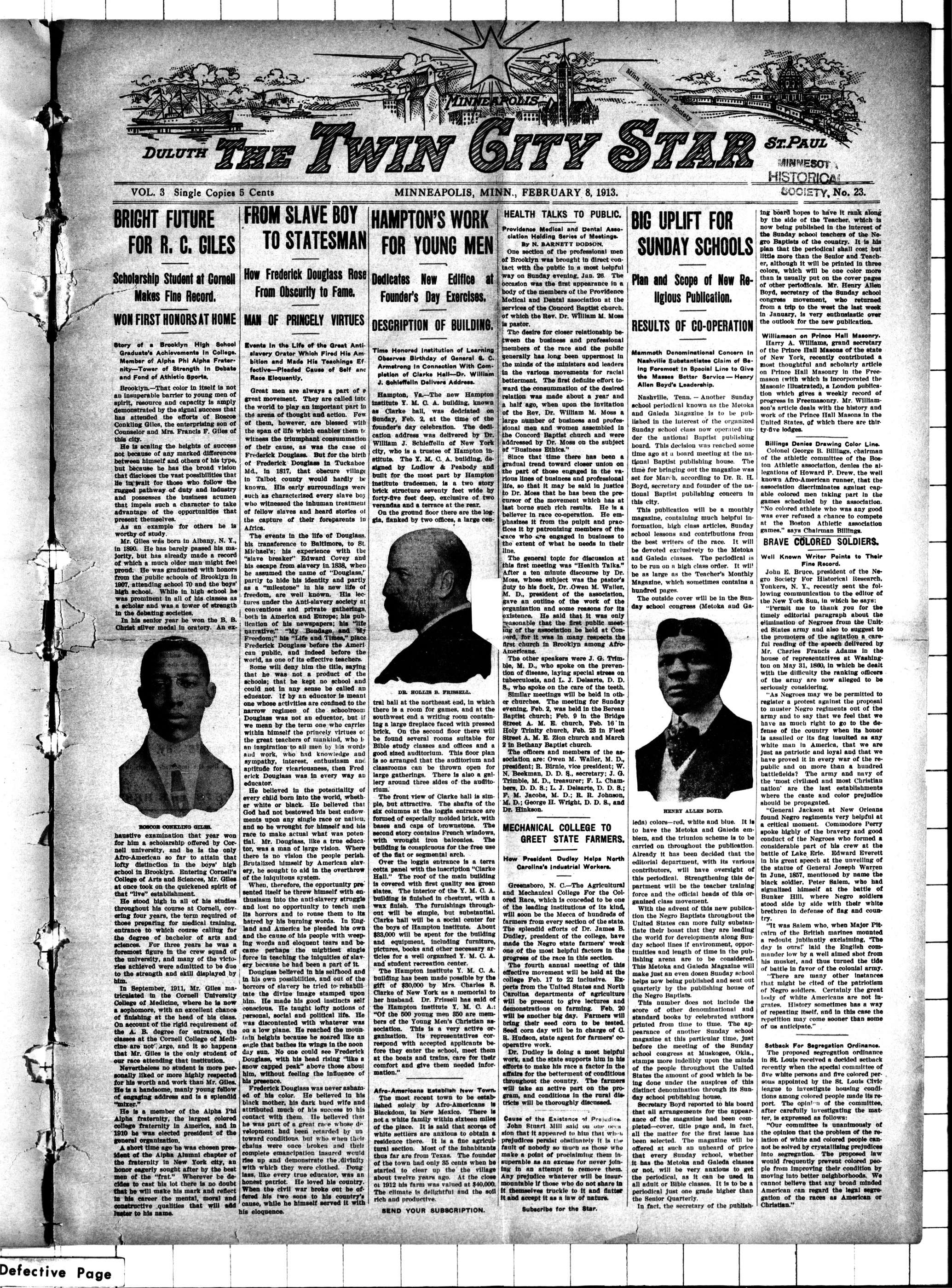
Brooklyn.—That color in itself is not an insuperable barrier to young men of spirit, resource and capacity is amply demonstrated by the signal success that has attended the efforts of Roscoe Conkling Giles, the enterprising son of Counselor and Mrs. Francis F. Giles of this city.
He is scaling the heights of success not because of any marked differences between himself and others of his type, but because he has the broad vision that discloses the vast possibilities that lie intuit for those who follow the rugged pathway of duty and industry and possesses the business acumen that impels such a character to take advantage of the opportunities that present themselves.
As an example for others he is worthy of study.
Mr. Glies was born in Albany, N. Y., in 1890. He has barely passed his majority, but has already made a record of which a much older man might feel proud. He was graduated with honors from the public schools of Brooklyn in 1807, attending school 70 and the boys' high school. While in high school he was prominent in all of his classes as a scholar and was a tower of strength in the debating societies.
In his senior year he won the B. B. Christ silver medal in oratory. An ex-
haustive examination that year won for him a scholarship offered by Cornell university, and he is the only Afro-American so far to attain that lofty distinction in the boys' high school in Brooklyn. Entering Cornell's College of Arts and Sciences, Mr. Giles at once took on the quickened spirit of that "live" establishment.
He stood high in all of his studies throughout his course at Cornell, covering four years, the term required of those preparing for medical training, entrance to which course calling for the degree of bachelor of arts and sciences. For three years he was a foremost figure in the crew squad of the university, and many of the victories achieved were admitted to be due to the strength and skill displayed by him.
In September, 1911, Mr. Giles matriculated in the Cornell University College of Medicine, where he is now a sophomore, with an excellent chance of finishing at the head of his class. On account of the rigid requirement of the A. B. degree for entrance, the classes at the Cornell College of Medicine are not arge, and it so happens that Mr. Giles is the only student of our race attending that institution. Nevertheless no student is more personally liked or more highly respected for his worth and work than Mr. Giles. He is a handsome, manly young fellow of engaging address and is a splendid "mixer."
He is a member of the Alpha Phi Alpha fraternity, the largest colored college fraternity in America, and in 1910 he was elected president of the general organization.
A short time ago he was chosen president of the Alpha Alumni chapter of the fraternity in New York city, an honor eagerly sought after by the best men of the "frat." Wherever he decides to cast his lot there is no doubt that he will make his mark and reflect in his career the mental, moral and constructive qualities that will add luster to his name.
How Frederick Douglass Rose From Obscurity to Fame.
MAN OF PRINCELY VIRTUES
Events In the Life of the Great Anti-slavery Orator Which Fired His Ambition and Made His Teachings Effective—Ploaded Cause of Self and Race Eloquently.
Great men are always a part of a great movement. They are called into the world to play an important part in the arena of thought and action. Few of them, however, are blessed with the span of life which enables them to witness the triumphant consummation of their cause, as was the case of Frederick Douglass. But for the birth of Frederick Douglass in Tuckahoe Md., in 1817, that obscure village in Talbot county would hardly be known. His early surroundings were such as characterized every slave boy who witnessed the inhuman treatment of fellow slaves and heard stories of the capture of their foreparents in Africa.
The events in the life of Douglass, his transference to Baltimore, to St. Michael's; his experience with the "slave breaker" Edward Covey and his escape from slavery in 1838, when he assumed the name of "Douglass", partly to hide his identity and partly as a "milestone" in his new life of freedom, are well known. His lectures under the Anti-slavery society at conventions and private gatherings both in America and Europe; his publication of his newspapers; his "life narrative"; "My Bondage, and My Freedom"; his "Life and Times", place Frederick Douglass before the American public, and indeed before the world, as one of its effective teachers.
MINNEAPOLIS, MINN., FEBRUARY 8, 1913.
HAMPTON'S WORK FOR YOUNG MEN
Dedicates New Edifice at Founder's Day Exercises.
DESCRIPTION OF BUILDING.
Time Honored institution of Learning Observes Birthday of General S. C. Armstrong in Connection With Completion of Clarke Hall—Dr. William J. Schleffelin Delivers Address.
Hampton, Va—The New Hampton institute Y. M. C. A. building, known as Clarke hall, was dedicated on Sunday, Feb. 2, at the time of the founder's day celebration. The dedication address was delivered by Dr. William J. Schleffelin of New York city, who is a trustee of Hampton institute. The Y. M. C. A. building, designed by Ludlow and Peabody and built for the most part by Hampton institute tradesmen, is a two story brick structure seventy feet wide by forty-five feet deep, exclusive of two verandas and a terrace at the rear.
On the ground floor there are the loggia, flanked by two offices, a large cen-
DR. HOLLIS B. FRISSELL.
tral hall at the northeast end, in which there is a room for games, and at the southwest end a writing room containing a large fireplace faced with pressed brick. On the second floor there will be found several rooms suitable for Bible study classes and offices and a good sized auditorium. This floor plan is so arranged that the auditorium and classrooms can be thrown open for large gatherings. There is also a gallery around three sides of the auditorium.
The front view of Clarke hall is simple, but attractive. The shafts of the six columns at the loggia entrance are formed of especially molded brick, with bases and caps of brownstone. The second story contains French windows, with wrought iron balconies. The building is conspicuous for the free use of the flat or segmental arch. Over the loggia entrance is a terra cotta panel with the inscription "Clarke Hall." The roof of the main building is covered with first quality sea green slates. The interior of the Y. M. C. A. building is finished in chestnut, with a wax finish. The furnishings throughout will be simple, but substantial. Clarke hall will be a social center for the boys of Hampton institute. About $83,000 will be spent for the building and equipment, including furniture, pictures, books and other necessary articles for a well organized Y. M. C. A. and student recreation center.
The Hampton institute Y. M. C. A. building has been made possible by the gift of $80,000 by Mrs. Charles S. Clarke of New York as a memorial to her husband. Dr. Frissell has said of the Hampton institute Y. M. C. A.: "Of the 500 young men 350 are members of the Young Men's Christian association. This is a very active organization. Its representatives correspond with accepted applicants before they enter the school, meet them at the boats and trains, care for their comfort and give them needed information."
Afro-Americans Establish New Town. The most recent town to be established solely by Afro-Americans is Blackdom, in New Mexico. There is not a white family within sixteen miles of the place. It is said that scores of white settlers are anxious to obtain a residence there. It is a fine agricultural section. Most of the inhabitants thus far are from Texas. The founder of the town had only 35 cents when he started to clear up the village about twelve years ago. At the close of 1912 his farm was valued at $40,000. The climate is delightful and the soil rich and productive.
SEND YOUR SUBSCRIPTION.
HEALTH TALKS TO PUBLIC.
Providence Medical and Dental Association Holding Series of Meetings.
By N. BARNETT DODSON.
By N. BARNETT DODSON.
One section of the professional men of Brooklyn was brought in direct contact with the public in a most helpful way on Sunday evening, Jan. 28. The occasion was the first appearance in a body of the members of the Providence Medical and Dental association at the services of the Concord Baptist church, of which the Rev. Dr. William M. Moss is pastor.
The desire for closer relationship between the business and professional members of the race and the public generally has long been uppermost in the minds of the ministers and leaders in the various movements for racial betterment. The first definite effort toward the consummation of the desired relation was made about a year and a half ago, when upon the invitation of the Rev. Dr. William M. Moss a large number of business and professional men and women assembled in the Concord Baptist church and were addressed by Dr. Moss on the subject of "Business Ethics."
Since that time there has been a gradual trend toward closer union on the part of those engaged in the various lines of business and professional life, so that it may be said in justice to Dr. Moss that he has been the precursor of the movement which has at last borne such rich results. He is a believer in race co-operation. He emphasizes it from the pulpit and practices it by patronizing members of the race who are engaged in business to the extent of what he needs in their line.
The general topic for discussion at this first meeting was "Health Talks." After a ten minute discourse by Dr. Moss, whose subject was the pastor's duty to his flock, Dr. Owen M. Waller, M. D., president of the association, gave an outline of the work of the organization and some reasons for its existence. He said that it was only reasonable that the first public meeting of the association be held at Concord, for it was in many respects the first church in Brooklyn among Afro-Americans.
The other speakers were J. G. Trimble, M. D., who spoke on the prevention of disease, laying special stress on tuberculosis, and L. J. Delsarte, D. D. S., who spoke on the care of the teeth.
Similar meetings will be held in other churches. The meeting for Sunday evening, Feb. 2, was held in the Berean Baptist church; Feb. 9 in the Bridge Street A. M. E. church, Feb. 16 in Holy Trinity church, Feb. 23 in Fleet Street A. M. E. Zlon church and March 2 in Bethany Baptist church.
The officers and members of the association are: Owen M. Waller, M. D., president; R. Birnle, vice president; W. N. Beekman, D. D. S., secretary; J. G. Trimble, M. D., treasurer; F. L. Chambers, D. D. S.; L. J. Delsarte, D. D. S.; F. M. Jacobs, M. D.; R. R. Johnson, M. D.; George H. Wright, D. D. S., and Dr. Hinkson.
MECHANICAL COLLEGE TO GREET STATE FARMERS.
How President Dudley Helps North Carolina's Industrial Workers.
Greensboro, N. C.—The Agricultural and Mechanical College For the Colored Race, which is conceded to be one of the leading institutions of its kind, will soon be the Mecca of hundreds of farmers from every section of the state. The splendid efforts of Dr. James B. Dudley, president of the college, have made the Negro state farmers' week one of the most helpful factors in the progress of the race in this section.
The fourth annual meeting of this effective movement will be held at the college Feb. 17 to 22 inclusive. Experts from the United States and North Carolina departments of agriculture will be present to give lectures and demonstrations on farming. Feb. 20 will be another big day. Farmers will bring their seed corn to be tested. Seed corn day will be in charge of C. R. Hudson, state agent for farmers' cooperative work.
Dr. Dudley is doing a most helpful work, and the state supports him in his efforts to make his race a factor in the affairs for the betterment of conditions throughout the country. The farmers will take an active part on the program, and conditions in the rural districts will be thoroughly discussed.
Cause of the Existence of Prejudice
John Stuart Mill said on one occasion that it appeared to him that when prejudices persist obstinately it is the fault of nobody so much as those who make a point of proclaiming them insuperable as an excuse for never joining in an attempt to remove them. Any prejudice whatever will be insurmountable if those who do not share in it themselves truckle to it and fatters it and accept it as a law of nature.
Subscribe for the Star.
BIG UPLIFT FOR SUNDAY SCHOOLS
RESULTS OF CO-OPERATION
Mammoth Denominational Concern in Nashville Substantiates Claim of Being Foremost in Special Line to Give the Masses Better Service—Henry Allen Boyd's Leadership.
Nashville, Tenn. — Another Sunday school periodical known as the Metoka and Galeda Magazine is to be published in the interest of the organized Sunday school class now operated under the national Baptist publishing board. This decision was reached some time ago at a board meeting at the national Baptist publishing house. The time for bringing out the magazine was set for March, according to Dr. R. H. Boyd, secretary and founder of the national Baptist publishing concern in this city.
This publication will be a monthly magazine, containing much helpful information, high class articles, Sunday school lessons and contributions from the best writers of the race. It will be devoted exclusively to the Metoka and Galeda classes. The periodical is to be run on a high class order. It will be as large as the Teacher's Monthly Magazine, which sometimes contains a hundred pages.
The outside cover will be in the Sunday school congress (Metoka and Ga-
HENRY ALLEN BOYD.
leda) colors—red, white and blue. It is to have the Metoka and Galeda emblem, and the triumon scheme is to be carried on throughout the publication. Already it has been decided that the editorial department, with its various contributors, will have oversight of this periodical. Strengthening this department will be the teacher training force and the official heads of this organized class movement. With the advent of this new publication the Negro Baptists throughout the United States can more fully substantiate their boast that they are leading the world for developments along Sunday school lines if environment, opportunities and length of time in the publishing arena are to be considered. This Metoka and Galeda Magazine will make just an even dozen Sunday school helps now being published and sent out quarterly by the publishing house of the Negro Baptists.
This number does not include the score of other denominational and standard books by celebrated authors printed from time to time. The appearance of another Sunday school magazine at this particular time, just before the meeting of the Sunday school congress at Muskogee, Okla., stamps more indelibly upon the minds of the people throughout the United States the amount of good which is being done under the auspices of this distinct denomination through its Sunday school publishing house.
Secretary Boyd reported to his board that all arrangements for the appearance of the magazine had been completed—cover, title page and, in fact, all the matter for the first issue has been selected. The magazine will be offered at such an unheard of price that every Sunday school, whether it has the Metoka and Galeda classes or not, will be very anxious to get the periodical, as it can be used in all adult or Bible classes. It is to be a periodical just one grade higher than the Senior Quarterly.
In fact, the secretary of the publish-
ing board hopes to have it rank along by the side of the Teacher, which is now being published in the interest of the Sunday school teachers of the Negro Baptists of the country. It is his plan that the periodical shall cost but little more than the Senior and Teacher, although it will be printed in three colors, which will be one color more than is usually put on the cover pages of other periodicals. Mr. Henry Allen Boyd, secretary of the Sunday school congress movement, who returned from a trip to the west the last week in January, is very enthusiastic over the outlook for the new publication.
Williamson on Prince Hall Masonry. Harry A. Williams, grand secretary of the Prince Hall Masons of the state of New York, recently contributed a most thoughtful and scholarly article on Prince Hall Masonry in the Freemason (with which is incorporated the Masonic illustrated), a London publication which gives a weekly record of progress in Freemasonry. Mr. Williamson's article deals with the history and work of the Prince Hall Masons in the United States, of which there are thirty-five lodges.
Billings Denies Drawing Color Line.
Colonel George B. Billings, chairman of the athletic committee of the Boston Athletic association, denies the allegations of Howard P. Drew, the well known Afro-American runner, that the association discriminates against capable colored men taking part in the games scheduled by the association.
"No colored athlete who was any good was ever refused a chance to compete at the Boston Athletic association games," says Chairman Billings.
BRAVE COLORED SOLDIERS.
Well Known Writer Points to Their Fine Record.
John E. Bruce, president of the Negro Society For Historical Research, Yonkers, N. Y., recently sent the following communication to the editor of the New York Sun, in which he says:
"Permit me to thank you for the timely editorial paragraph about the elimination of Negroes from the United States army and also to suggest to the promoters of the agitation a careful reading of the speech delivered by Mr. Charles Francis Adams in the house of representatives at Washington on May 31, 1860, in which he dealt with the difficulty the ranking officers of the army are now alleged to be seriously considering.
"As Negroes may we be permitted to register a protest against the proposal to muster Negro regiments out of the army and to say that we feel that we have as much right to go to the defense of the country when its honor is assailed or its flag insulted as any white man in America, that we are just as patriotic and loyal and that we have proved it in every war of the republic and on more than a hundred battlefields? The army and navy of the 'most civilized and most Christian nation' are the last establishments where the caste and color prejudice should be propagated.
"General Jackson at New Orleans found Negro regiments very helpful at a critical moment. Commodore Perry spoke highly of the bravery and good conduct of the Negroes who formed a considerable part of his crew at the battle of Lake Erie. Edward Everett in his great speech at the unveiling of the statue of General Joseph Warren in June, 1857, mentioned by name the black soldier, Peter Salem, who had signaled himself at the battle of Bunker Hill, where Negro soldiers stood side by side with their white brethren in defense of flag and country.
"It was Salem who, when Major Pitcairn of the British marines mounted a redoubt jubilantly exclaiming, "The day is ours!" laid the English commander low by a well aimed shot from his musket, and thus turned the tide of battle in favor of the colonial army.
"There are many other instances that might be cited of the patriotism of Negro soldiers. Certainly the great body of white Americans are not ingrates. History sometimes has a way of repeating itself, and in this case the repetition may come sooner than some of us anticipate."
Satback For Segregation Ordinance.
The proposed segregation ordinance in St. Louis received a decided setback recently when the special committee of five white persons and five colored persons appointed by the St. Louis Civic league to investigate housing conditions among colored people made its report. The opinion of the committee, after carefully investigating the matter, is expressed as follows:
"Our committee is unanimously of the opinion that the problem of the relation of white and colored people cannot be solved by crystallizing prejudices into segregation. The proposed law would frequently prevent colored people from improving their condition by moving into better neighborhoods. We cannot believe that any broad minded American can regard the legal segregation of the races as American or Christian."
Pop fg
———
But God commendeth His Love to-
ward us in that while we were yet
sinners Christ died for us—Romans
5:8.
For the wages of sin is death, but
‘the gift of God is eternal life through
Jesus Christ our Lord—Romans ¢:
28.—Selected by E. W. Gilles.
‘We beg that the public will not
send notes over the phone. We must
‘have your copy to avoid mistakes. If
your matter is not worth writing, it is
‘not worth insertion.
Rev. B. W. Gilles conducted a Bible
and MissionaryTraining school at the
home of Mr. and Mrs. Joseph John-
gon 626 7th Ave. No., each Friday at
8 P.M. All are welcome.
LINCOLN.DOUGLAS CELEBRATION.
It is hoped that our churches will
celebrate the anniversary of Abraham
Lincoln, the great emancipator, and
Frederick Douglass, the greatest aboli-
tionist.
Our enemies advertise us,
Our friends support us,
Kverybody helps us.
SUNDAY FORUM.
‘The Forum meets the first Sunday
tm the month at Bt. Peter's A. M. B.
chureh and on the third Sunday at
Bethesda Baptist church.
MATINER—BAEAAR
‘The Ladies of the City Federation
will give their first’ Annual Matinee-
Bazaar on Thursday, Mar. 6th. after-
noon and evening, at the Masonic Hall,
24th St. and 5th Ave. 8.
‘The proceeds of the Matinee-Bassar
will be distributed among the several
Clubs for relief of the worthy poor.
Come and help a good cause and have
8 good time,
Committee of Arrangements.
ity Federation’: Mrs. I. E, Gibbs,
pres., Mrs. MacGlenn, sec. ‘‘The Ione
Gibbs Club’: Mrs. Ida Sellars, pres.,
Mrs. Helen Jackson, sec. ‘The M. I.
©. Art Club’: Mrs, Sadie Sample, pres.,
‘Mra, Sara Robinson, sec. ‘The Dorcas
Soclety’?: Mrs. O. Rice, pres., Mrs. Min-
nie Wright, sec. ‘The Mother’s Effort
Club’: Mrs, Lulu Cratie, pres. Mrs.
Mamie Sexton, sec., Mrs. Mae Glenn,
honorary pres., are in charge of this en-
tentainment, and will spare no pains to
make it a grand success. Remember
March 6th.
Bverybody is cordially invited.
Why is it that many of the best class
do not pay for the Twin City Star! We
have cut off hundreds of names for non-
payment, yet we publish the notes of
Socials, Women’s Clubs and Church af-
fairs. The Star is supported by the mid-
dle and lowest classes. The Big Negro
gives little aid to a Negro newspaper,
but always burdens it’s publishers with
‘a preponderance of publicity upon which
these Parasites live.
Mrs. Nettie Cunningham 723 17th Ave.
So., entertained at dinner Feb. 2. Misses
Carrie and Rebecen Lowe of St. Paul.
They enjoyed a most delightful time,
choice music was rendered. Miss Esther
Cunningham was also present and as-
sisted the hostess.
Sergt. J, W. Harper, 1015 4th Ave.
So., is gradually recovering from the re-
cent illness, and is able to receive his
friends who wish to call.
FOR RENT.
Front Room. On car line, Neatly
Furnished and Comfortable, up stairs.
Couple preferred. Mrs. Wheeler 717
@th Ave. No.—Advertisement.
‘We have discontinued the combina-
tion offer “The Star and The Orisis.’?
Many neglected to take advantage of
this great opportunity to secure a local
publication and the best Negro maga-
xine.
‘Mrs. J. R. Charleston, 636 University
Ave, met with a painful accident last
‘Tuesday caused by falling down stairs.
She was confined to her bed several
days.
‘Mrs, 0. ©. Hall arrived home last
‘week from Muskogee, Okla., where she
accompanied Mrs. Nave; who was visit-
ing her. Mrs. Nave is much improved.
_ Mr, Claude Goodman has been con-
fined home sick with a cold.
THE DOUGLASS’ WEDDING
ANNIVERSARY.
‘Mr. and Mrs. L. V. Douglass enter-
tained a few friends at their beautiful
rosidence 2638 Stevens Ave; on January
27th in honor of their second wedding
anniversary. The evening was spent
playing whist. The prize winers were:
first, Mrs, H. Robinson, second Mrs. J.
Walker, third, Mr. Ferguson. Delicious
refreshments were served. Those present
were: Mr. and Mrs. Robinson of Duluth;
Mr, ‘and Mre. Ferguson, Chicago; Mr.
‘nd Mrs. Cabell, Mr. and Mrs. Jas.
H. Burdes, Mesdames: Boll, Sample, Bur-
Teli, Walker, Jeffrey, Messrs: Wenn and
Bes —
“ - Subseribe for the Star.
THE AUTUMN LEAF DANCING
Lass.
| The Masquerade Dance of the Autumn
Leaf Dancing Class was a brilliant s0-
cial affair, ‘The costumes were many
and very well selected. The prize win-
ners were: Ist prize, Picture, Mrs. Ei-
Teen Martin, representing Salome; 2nd
prize, Candelabra, Mrs, Melvin Parker,
‘as ‘‘Topsy;’? Ist prize, Shaving Mug,
Mr. Chas, Mason, as ‘The Dude;’? 2nd
Prize, Smoking Set, Mr. Peyton as
‘Tramp."? ‘There were many other
maskers of worthy mention, among
them Mrs, James as Cowgirl, Mrs. Lil-
lian Lewis as ‘‘A Boy,’’ Mrs, Hattie
Salters, Mrs. Sadie Sample, Mies Selina
Newman, Mr. Geo. Gamble. The judges
were Mrs. Geo. Lucas, Miss Myrtle
Clarkman, Messrs. Ralph Watson and C.
8. Smith. This affair closed the season
until the Easter Entertainment, which
will be held at the Auditorium. Mrs.
‘McCullough wishes to announce that
‘there will be no classes during the
Lenten season,
Hon. Jas. A. Ross was a visitor in the
‘Twin Cities during this week,
| The picture of ‘‘Dora Dean,’’ a stage
favorite, appeared on the back cover
page of the February Crisis. Miss
Dean is the wife of Mr. Chas. Johnson
of Minneapolis, They are universally
known as ‘Johnson and Dean’? and are
classed among the highest in the Negro
theatrical profession.
Mr. Arthur Merchant, now of Chicago,
is visiting his aunt Mrs. J. H. Johnson,
2704 27% St. So. Mrs, Johnson has
been very ill, but is rapidly recovering.
Mr. and Mrs, W. 8. Wright, 537 7th
Ave, No. are the proud parents of a
baby girl, born a few weeks ago. They
have planned a christening at their
residence on Feb, 16th. Mrs. Wright
is the daughter of Mr. and Mrs. J. W.
‘Thornton of this city, and one of our
young matrons.
‘Mr. Martin Brown, one of the younger
social set resides at 2423 Park Ave.
| Mr. Claude Wilson of Calgary, Alta,
‘is spending a while in the city, a guest
at the Hotel Chase.
Mr. and Mrs. Jas. Eddings were the
dinner guests of Mr. and Mrs. John W.
Scott, 5109 France Ave. So, on last
‘Sunday.
Mr. Arthur Merchant has been enter-
tained during past week by Mrs. Irene
Salters. Mr, Merchant is visiting from
Chicago.
Chairman A. H. Underdown of the
Sub Committee on Public Comfort has
appointed Chas. Sumner Smith as an
auxilliary chairman for the reception
of visitors attending the Inauguration.
Chairman Smith has named as his local
committee, Dr. R. 8, Brown, Atty. B. 8.
Smith, Rev. E.R. Edwards, Harry
Davis, Ralph Watson, Frank Peoples,
Dr. M. W. Judy, John A. Dickerson,
Glover Shull, Atty. W. RB. Morris, Atty.
W. H. H. Franklin, Dr. J. H, Redd.
All persons desiring to go to Wash-
ington during the Inaugural Period, may
get information as to places to stop,
rates, ote., by writing to the Sub-com-
mittee on Public Comfort, 1816 12th
Street, N. W. Washington, D. C.
Mrs, Jas. H. Burkes, 2720 2nd Ave.
80., is recovering from a severe cold,
‘and is able to be out.
| Mrs. Laura Johnson, the mother of
Mr. Joseph Johnson is recovering from
bronehitis, but is confined to her home.
| Mr. Frank Peoples returned Wednes-
‘day from Terlton, Okla., where he at-
tended the funeral of his mother. He
stopped on his return at Cleveland,
Okla, and Omaha, Neb., where he owns
real estate.
| Mr. Chas, H. Pollard at Chicago is
running here on the Burlington Dining
Car.
Tho testimony of Mrs. Mary Mitchell
as witness in the Partee murder trial
was amusing. The shooting occurred
at a Chitterling Party, and it was very
laughable to hear her tell ‘‘what was
a Chitterling Party,’” however, she told
it, and she can talk some and some more.
‘Miss Annie J. Austin died at 160 W.
3rd St. on Jan. 30. Her remains were
taken to her home in Hot Springs by
her sister Mrs. Emma J. Ingram who
came after them. Undertaker Lyles ar-
ranged the burial. :
Species
BARBIES WANTED,
Ohildren’s Nursery. Mrs. Joseph John-
son, 526 7th Ave. No., will care for your
children. Special attention given to
Babies. Phone Nic. 2793.—Advertise-
ment,
Many recelved the Star, and make
no effort to pay for it—and often
LIE to evade payment. Newspapers
are worth paying for—and it is better
to refuse to accept one than to rob its
publisher.
Do IT Now.
We beg that those who are Indebt-
ed to us, send us thelr subscription
by P. 0, Order.
COPY MUST REACH US BY
WEDNESDAY.
TWIN CITY STAR
———————————— NEGRO PRIEST
ST. PAUL Baltimore, Jan, 30.
: Rov, John J. Plantay
—————— || Ave Nogro priests of
WEST END BRANOH, ¥. W. 0, A [)\1, tan eoesiag'vi F
688 W. Central Ave, St. Peal | catholic Church, of
— sistant pastor.
<<Gratitade’? was the subject chosen|" He was a uative o
by Rev. H. P, Jones, for the address 4¢-| was edueated at Epi
livered at the Vesper Service of the| College and St. Joseph
Branch last Sunday afternoon. The| city, and was ordained
rooms were crowded, thus giving much| When you have a
encouragement to the Finance Com-| gathering worthy of
mittee under whose auspices the serviee| some member as pres
was held. Mrs, Hattie Hall was pleas-|the names, especially
ing in a solo, and Miss Dolly Waterford, | persons present, and f
niece of Prot. Ware, rendered a violin| newspaper. De not w
solo, accompanied by the. Professor.| your time or memory.
Mrs, Grace Booker presided and the|that wo get the full
President, Mrs, John Hickman, re-| present to give due «
sponded with tinfély remarks. On next ered
Sunday afternoon, Feb. Oth at 4 0’elock| —_tiquette For the
Miss Elizabeth Yardley, will speak on| Almost every wom
Missionary work in China and Japan.| longs to some sort o!
‘A good musical programme has been| fa only a little circle
A. meet once or twice a
Mrs. Geo. Thornton of Chicago, IIL,
is the guest of Mrs. Henry High of Bt.
Anthony Ave. this week. She will leave
for her home on Sunday morning.
Mrs. A. 0. Lowe has moved to 308
W. Central Ave.
Mr. Louis Liverpool Marion 8t. is en-
joying the very best of health and do-
ing nicely with his laundry and express.
Mr. Liverpool will take a trip down to
Virginia, where his people live, during
this year, to visit friends and to see the
progress of his people.
‘The Social and Literary of Pilgrim
Baptist church mect at the home of
Mrs. Evelyn Johnson, in Cathedral
Place.
Quite an enjoyable time was had. The
next meeting on Monday Feb. 10th will
be held at the Y. W. C. A. Rooms. Din-
ner will be served at 6:30. Miss Bdith
Leonard will appear on the programme.
The first chapter of Booker 'T. Wath-
ington’s “Up From Slavery’ will be
presented by Mrs. E. H. MeDonald.
READ THE STAR—IT’S NEWS,
‘The Social and Literary will also
give a Prize Masquerade and quilt con-
‘test on Friday Eve, Feb. 14th, at Pil-
grim Baptist Church. Admission 10c.
Prizes will be given for the best and
most comical costume, Mrs, W. F. T.
Chandler and Mrs. Maurice Hickman are
contestants for the quilt. Mr. A. V.
Hall has charge of the Musical and Lit-
erary Programme. Come out and com-
pete for the prize.
‘The Ladies of the Household of Mars
Lodge of Odd Fellows will visit Minne-
apolis on Feb. 10th with their Tags for
the Building Fund. Prepare to meet
them.
Mrs. J. E. Johnson, 526 St. Anthony
Ave. gave an entertainment for thé Odd
Fellows.
‘The Near New Household of Fred
Douglas Lodge gave a Social Thursday,
Feb. 6th at 450 St. Anthony Ave.
NEIGHBORS GAVE HIM CASH.
St. Paul Park Residents Raise Fund for
Weare Piva VWiehin
Negro Fire Victim.
Residents of St. Paul Park recently
took up a cash subscription of $135 for
F. F. Lewis, a Negro who lost his
granddaughter, his house and all his pos.
sessions in a fire last Saturday after.
noon,
For two years Lewis has struggled
along on some rented lots at St. Paul
Park, building his house by degrees
and making a living for himself and
family. x
The Lewis family is now living at 131
East Eighth street.
Grand Midwinter Entertainment
Mars Lodge of Odd Fellows No. 2203,
‘Thursday, March 6th, 1913,
Hiawatha Temple, 6th and Wabasha St,
‘McOullough’s Orchestra, =
Admission 36¢
Atty. W. T. Francis of St. Paul has
been selected by Chm. A. H. Under.
down as an auxiliary chairman of the
Sub Committee on Public Comfort for
the Entertainment and accomodation of
Negro visitors to the Inauguration. He
has named as his local committee Messrs,
R. B. Chapman, J. H. Dillingham, Fred
Douglas Parker, Orvie C. Hall, Geo. W.
James, Dr. Valdo Furner, Geo, W. Wills,
J. B. Johnson, Rev. H. P, Jones, J. 0.
Adams,
The Board. of Directors of Attucks
Home met at the residence of J. H.
Charleston Sunday afternoon and clect-
ed Atty. W. T. Francis as Counsellor,
Atty. W. R. Morris having resigned.
Jack D.iver and Mrs, Birdella Harris
who were recently married in Minnenpo-
lis are at home to friends at 788 St, An-
thony Ave. St. Paul,
Reliable, live, honert, hustling
agents for the Twin City Star, You
cam make a good living with this work
as 8 side line, Agents wanted in Mit
Waukee, Chicago, Omaha, Kansas City,
Portland, Ore. Seattle, Denver, Des
Moines and Sioux City. Write tor
terms to The Twin City Star, Minne
apolis, Minn
WANTED.
NEGRO PRIEST Is DEAD.
Baltimore, Jan, 80.—The funeral of
Rev. John J. Plantavigne, one of the
five Negro priests of this country, was
held this morning at St. Francis Xavier
Catholic Church, of which he was as-
sistant pastor.
He was a native of Louisiana, He
was edueated at Epiphany Apostolic
College and St. Joseph’s Seminary, this
city, and was ordained a priest in 1906,
‘When you have a social, or any
gathering worthy of mention, select
some member as press agent, and get
the names, especially the initials of
persons present, and forward it to your
newspaper. Do not wait to depend on
your time or memory. It is necessary
that we get the full names of those
present to give due credit and avoid
Etiquette For the Clubwoman,
Almost every woman nowadays be
Jongs to some sort of club, even if I
fa only a little circle of friends who
meet once or twice a month for bridge
or afternoon tea and mild gossip, says
Mrs. B. B. Clark. From such simple
and informal gatherings the club idea
runs all the way to the large and lux-
urlous clubs of rich soclety women,
with their magnificent buildings, where
every want {s catered to and the fit
tings are often handsomer than at the
most exclusive men's club.
In order to join any kind of club it
is usually necessary to have a friend
who is a member. Consult this friend
about the requisites for membership,
and if the lists are not already full she
will usually volunteer to propose the
name of the aspirants and will also, if
necessary, secure sponsors to second
the applicant's name, or if the list of
members is complete she will, if her
friend desires, see that her name is
placed on the waiting list so that it
may be voted upon in case vacancies
occur.
‘As goon as she 1s notified of her ad:
mission to a club the newly made mem-
ber must at once send to the treasurer
‘a check for her initiation fee and also
the yearly dues, and it is only courte-
onus also to write cordial notes of
thanks to the ladies who allowed their
names to be used as sponsors and also
to the friend who engineered the whole
proceeding. The new member should
also read carefully the bylaws of the
club, together with the rules and regu-
lations, so that she may not unwitting.
ly infringe any of them.
‘The club member who wants to be
come popular, and very few women
are averse to this, would do well to
cultivate what men sometimes call “a
clubbable manner”—that is, she must
accept courtesies and kindnesses in the
spirit in which they are offered, have
@ pleasant word for any member with
whom she comes in contact and, above
‘all, avold poblicly criticising the club
officers and the members of the execu:
tive committees.
If she has any suggestion she wants
to make or real or fancied grievance to
air there are always business meetings
where such things are in order and, if
properly presented, can be voted upon.
‘And just here a word of warning for
the too energetic clubwoman, especial-
ly Af she aspires in time to a place on
‘one of the committees or even a posi-
tion as an officer. It 1s not well, par-
tleularly in the first year of her mem-
bership, to offer too many suggestions
‘as to the running of the club or to
complain of the management, for by
overdoing this she may gain an unen-
viable reputation as a grumbler or
what some people call a chronic kick-
er, and this certainly does not add to
‘any one’s popularity.
Good Manners.
Have you never heard the telephone
ring impatiently, insistently, and hur-
ried to it only to hear: “Is this Mrs.
Brown's? No? Wrong number,” and
the connection is abruptly broken—no
apology, not the slightest inflection of
‘voice or turn of speech to indicate the
‘speaker's polite regret at the incon-
venience she has caused. She feels
that we do not know who she is, and
0 graciousness is unimportant.
‘This style of conduct is common in-
deed. Many people going into a for-
eign land or strange town behave rude-
ly, obtrusively, objectionably—as they
would never dream of doing in any
place where they might be recognized.
Evidently their point of view is that
politeness and consideration are de-
sirable, not because they make the
world pleasanter, but because they re-
fect credit upon themselves. For
them the decencies and niceties of life
‘are based not upon self respect, but
upon social expediency, and the mo-
ment such expediency seems unneces-
sary they revert to their innate boor-
ishness.
‘The man who puts his dusty feet
‘on the plush seat in a railway coach
because no one who knows him hap-
pens to be there to condemn him and
Because he does not care who comes
after him is typical of that attitude
which makes the wheels of social and
etvie progress move so slowly.
If some of us would give a little
more of time in self improvement
along educational and literary lines,
instead of frittering so much time
away in selfish pleasure, it certainly
would be @ great blessing to the race
and make us much more respected by
the opposite race—The Weekly Vis-
itor.
THE ST. LOUIS KITCHEN.
You can get © good meal, clean
service, and courteous attention at
the St. Louls Kitchen, 188 E. Third
St, St. Paul. Mrs. Hinson is univer.
sally known for her good, cooking.
READ THE STAR—IT'S NEWS
“Everything for Women’s Wear—Popular Prices
Pnrst: Cynaa
The Very Latest Ideas in all that pertains to Women's Wear.”
DICKERSON CAFE
‘We want tp prove to you by actual personal test how
much better than you'd ever belleve If you didn’t try the
features which distinguish thie cafe from all others. The
difference between “good enough” and the “Best” Is the \
diffrence between ordinary service and ours. on
new Chinese chef It attracting a good deal of attention as
well as favorable mention.
208 Hennepin Avenue MINNEAPOLIS, MINN
THIRTY-FIVE NEWLY FURNISHED ROOMS Gus
an
THE NEW Beste
Lighted
ALBERT HOTEL Vacuum
Cleaned
We NicoLter 2176 TOM'S PLACE Rooms
75,
621.23 THIRD STREET S. and Gas Kitchen Service $2.00
727 WASHINGTON AVE. S. for Man and Wile | $2.50
$3.00
T. W. Galbreath, Prop. MINNEAPOLIS, MINN.} per week,
BUILD YOUR HOUSE Now!
WHY? Becouse Material is Cheaper and you can save $200 on your
Bullding during next 60 daye—See, PEOPLES, 236 Boston Block,
Minneapolis, .
BE UP-TO-DATE
cpa'i BROTHERS
fa Vase
AK nese” Years ago, New York butter and
= aia Ws Ohio, Wisconsin and Missouri Beer,
Ei ota oN i were known to be the best, and swell
:\ 4 PS fas: always had them on thelr
: a" No one wants New York butter
ka | now, because Minnesota is the best,
Ss se but some people stick to the old Idea
; P ‘on beer.
Foreign Beer Experts Say
that Golden Grain Belt Is the nearest like the Imported, of any in
‘America, Be wise.
SERVE YOUR GUESTS THE BEST
Advertise in
wx TWIN GIT STAR“
and Get Good Results
Marjorie is going to be married.
What is she to wear? Does fashion con-
trol her cholce? Not in the arbitrary
way it was wont to exercise, that is
certain. But, all the same, there is a
Vogue, and Marjorie is too womanly to
sregard it.
‘The Italian renaissance dress is the
‘one that s the most fashionable now.
It makes a bride look a great Indy of
mediaeval times right richly appareled,
yet with a simple dignity that befits
her youth.
‘The sumptuous brocade, patterned in
silver upon a white background, ot
vice versa, is magnificent and yet m-
bued with simplicity, for it is folded
Mike a sheath about the supple body
and falls in straight lines to the floor
without an inch of trimming.
Marjorie ts dark of hair and has a
good color. She is wise, therefore, in
her choice of gold brocade instead of
silver and will not be the first bride to
iscover the special happiness of her
decision. One reason apart from the
coloring of her complexion and hair
fs that she is te he married on a win-
ter’s day tn a ehurch lighted by elec-
trletty.
‘The tems frem the classes, make
the news ef the masses, Read the
Twin Clty Star,
N. W. Nie. 1584, T. 8 Center 719,
WILLIAM H, H. FRANKLIN.
Attorney and Counsellor at Law.
1020 Metropolitan Life Bldg.
Notary Public. Minneapolis, Minn.
PORIRUA cE St cee a
THE SPIRELLA CorseT.
Cora E. Anderson, Corsetier.
4 W. Dale 1345—365 Aurora Ave.
8t. Paul.
eects,
| THE HOTEL CHASE.
|, 1822 WASHINGTON AVE. 80.
Conveniently Located. Sanitary, Mod-
ern. Chas. 8 Chase, Prop.
Telephone Nic. 9854,
pea eerie en
‘The most perfect and economical
‘method of operating things is of
course with Electrical Energy, the
person is unwise who continues to put
oft having Hlectrical Apparatus or
devices installed.
T can save you money on Bell work,
Installations, Fixtures, Instruments,
ete. Chas. W. Brown, lectrician,
125 So, Washington Ave. Nic, 1404.—
Ady.
Defective Pq
Defective Page
M.
Working Men's Social Club
OLIVER BROS., Managers
PHONE: Nicollet 9506
The Cosmopolitan
Buffet and Grill
Wines, Liquors and Cigars
PALM ROOM.
VOCAL ENTERTAINERS.
40 East 3rd St. St. Paul
Phones, N. W. Cedar 9128, Night Call
Cedar 9126.
PAEGEL
We do the best WATCH, CLOCK and JEWELRY REPAIRING in the city at lowest prices. SPECIAL AGENTS for the HAMILTON, ELGIN, WALTHAM and ROCKFORD RAILROAD WATCHES.
R. H.
HEGENER
207 Nicolet
TWIN CITY RAZOR.
Full hollow ground. 0.15 cash. Depr
ment. 0.15 cash. 0.15 cash.
Gillette blades sharpened. dogsh
30s. all single, edged blades 25s. Cut-
tery ground.
J. M. MORRIS
Real Estate, Loans and Collections.
508 Boston Block, Minneapolis, Minn.
Thos. H. Lyles
322 Wabasha St., St. Paul.
Undertaker and Embalmer
Lady Assistant When Desired.
Free Service of Chapel and Organ
Residence, 673 St. Anthony Ave.,
Tel.: Dale 2947.
Calls answered Day or Night
IN MINNEAPOLIS OR ST. PAUL
Both Phones 508.
SMOKE THE BEST
Sight Draft
5C CIGAR
W. S CONRAD CO., Distributors
8 NORTH SIXTH STREET
Southern Theatre
SevenCorners
15th and Washington Avenues So.
Refined Vaudeville
Moving Picture Shows
Continous Performance
Admission 10 Cents
Children 5 Cents
Peterson, The Druggist
1501 Washington Ave. So.
TOILET ARTICLES, DRUGS
PRESCRIPTIONS.
He Sollicits Your Patronage.
OVER 65 YEARS' EXPERIENCE
PATENTS
TRADE MARKS
DESIGNS
COPYRIGHTS & C.
Any person sending a statement in writing whether
quickly ascertain our opinion free whether an in-
vention is probably patentable. Communica-
tionized residence permit. Mobilization in Patents sent free. Obtent agency for securing patents. Patents taken through Munn & Co. receive
special notice, without charge, in the
Scientific American.
A handsomely illustrated weekly. Largest cir-
cumference of any scientific journal. Terms, $3 a
year, four months. $20 a year. Newswire
MUNN. 9. Co. 2015th Street, New York
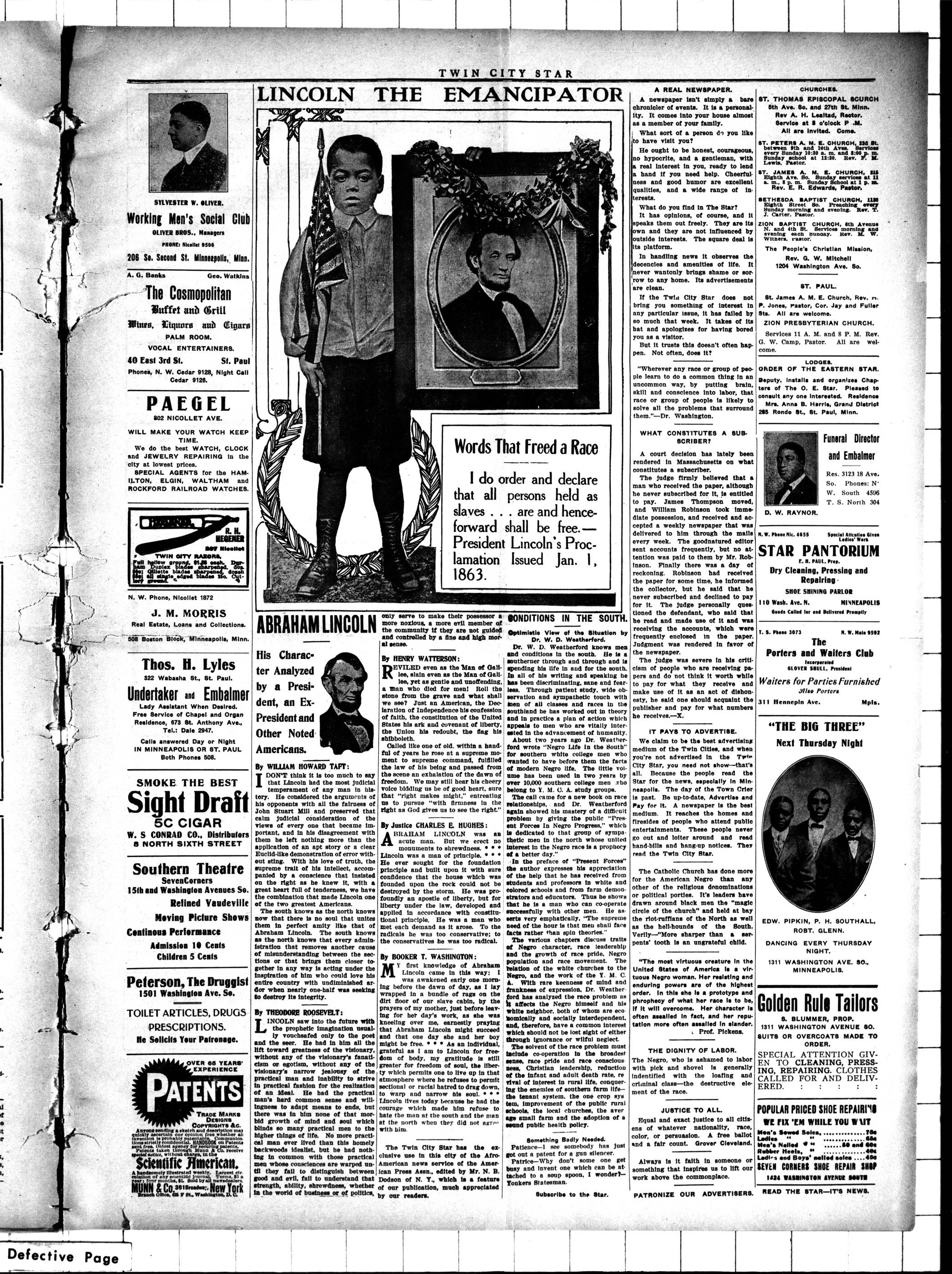
LINCOLN THE EMANCIPATOR
Words That Freed a Race
I do order and declare that all persons held as slaves . . . are and hence-forward shall be free. — President Lincoln's Proclamation Issued Jan. 1, 1863.
ABRAHAM LINCOLN
His Character Analyzed by a President, an ExPresident and Other Noted Americans.
His Character Analyzed by a President, an Ex-President and Other Noted Americans. By WILLIAM HOWARD TAFT:
DON'T think it is too much to say that Lincoln had the most judicial temperament of any man in history. He considered the arguments of his opponents with all the fairness of John Stuart Mill and preserved that calm judicial consideration of the views of every one that became important, and in his disagreement with them he left nothing more than the application of an apt story or a clear Euclid-like demonstration of error without sting. With his love of truth, the supreme trait of his intellect, accompanied by a conscience that insisted on the right as he knew it, with a great heart full of tenderness, we have the combination that made Lincoln one of the two greatest Americans.
The south knows as the north knows now that there is no soul that unites them in perfect amity like that of Abraham Lincoln. The south knows as the north knows that every administration that removes another cause of misunderstanding between the sections or that brings them closer together in any way is acting under the inspiration of him who could love his entire country with undiminished ardor when nearly one-half was seeking to destroy its integrity.
By THEODORE ROOSEVELT:
INOOLN saw into the future with the prophetic imagination usual-
The prophetic imagination usually vouchsafed only to the poet and the seer. He had in him all the lift toward greatness of the visionary, without any of the visionary's fanaticism or egotism, without any of the visionary's narrow jealousy of the practical man and inability to strive in practical fashion for the realization of an ideal. He had the practical man's hard common sense and willingness to adapt means to ends, but there was in him none of that morbid growth of mind and soul which blinds so many practical men to the higher things of life. No more practical man ever lived than this homely backwoods idealist, but he had nothing in common with those practical men whose consciences are warped until they fail to distinguish between good and evil, fail to understand that strength, ability, shrewdness, whether in the world of business or of politics,
TWIN CITY STAR
THE EMA
Words T
I do o
that all
slaves . . .
forward
President
lamation
1863.
only serve to make their possessor a more noxious, a more evil member of the community if they are not guided and controlled by a fine and high moral sense.
REVILED even as the Man of Gall-
lee, slain even as the Man of Gall-
lee, sainn even as the man of Ganlee, yet as gentle and unoffending, a man who died for men! Roll the stone from the grave and what shall we see? Just an American, the Declaration of Independence his confession of faith, the constitution of the United States his ark and covenant of liberty, the Union his redoubt, the flag his shibbooleh.
Called like one of old, within a handful of years he rose at a supreme moment to supreme command, fulfilled the law of his being and passed from the scene an exhalation of the dawn of freedom. We may still hear his cheery voice bidding us be of good heart, sure that "right makes might," entreating us to pursue "with firmness in the right as God gives us to see the right."
By Justice CHARLES E. HUGHES:
BRAHAM LINCOLN was an acute man. But we erect no
A acute mind. But we erect no monuments to shrewdness. . . . . . . Lincoln was a man of principle. . . . . . . He ever sought for the foundation principle and built upon it with sure confidence that the house which was founded upon the rock could not be destroyed by the storm. He was profoundly an apostle of liberty, but for liberty under the law, developed and applied in accordance with constitutional principle. He was a man who met each demand as it arose. To the radicals he was too conservative; to the conservatives he was too radical.
By BOOKER T. WASHINGTON:
Y first knowledge of Abraham Lincoln came in this way: I
Lincoln came in this way: I was awakened early one morning before the dawn of day, as I lay wrapped in a bundle of rags on the dirt floor of our slave cabin, by the prayers of my mother, just before leaving for her day's work, as she was kneeling over me, earnestly praying that Abraham Lincoln might succeed and that one day she and her boy might be free. * * * As an individual, grateful as I am to Lincoln for freedom of body, my gratitude is still greater for freedom of soul, the liberty which permits one to live up in that atmosphere where he refuses to permit sectional or racial hatred to drag down, to warp and narrow his soul. * * * Lincoln lives today because he had the courage which made him refuse to hate the man at the south and the man at the north when they did not agree with him.
The Twin City Star has the exclusive use in this city of the Afro-American news service of the American Press Assn., edited by Mr. N. B. Dodson of N. Y., which is a feature of our publication, much appreciated by our readers.
By HENRY WATTERSON:
INCIPATOR
hat Freed a Race
order and declare
persons held as
are and hence-
shall be free. —
at Lincoln's Proc-
issued Jan. 1,
CONDITIONS IN THE SOUTH.
Optimistic View of the Situation by Dr. W. D. Weatherford.
Dr. W. D. Weatherford knows men and conditions in the south. He is a southerner through and through and is spending his life in and for the south. In all of his writing and speaking he has been discriminating, sane and fearless. Through patient study, wide observation and sympathetic touch with men of all classes and races in the southland he has worked out in theory and in practice a plan of action which appeals to men who are vitally interested in the advancement of humanity. About two years ago Dr. Weatherford wrote "Negro Life In the South" for southern white college men who wanted to have before them the facts of modern Negro life. The little volume has been used in two years by over 10,000 southern college men who belong to Y. M. C. A. study groups.
The call came for a new book on race relationships, and Dr. Weatherford again showed his mastery of a difficult problem by giving the public "Present Forces In Negro Progress," which is dedicated to that group of sympathetic men in the north whose united interest in the Negro race is a prophecy of a better day." In the preface of "Present Forces" the author expresses his appreciation of the help that he has received from students and professors in white and colored schools and from farm demonstrators and educators. Thus he shows that he is a man who can co-operate successfully with other men. He asserts very emphatically, "The supreme need of the hour is that men shall face facts rather than spin theories."
The various chapters discuss traits of Negro character, race leadership and the growth of race pride, Negro population and race movement. The relation of the white churches to the Negro, and the work of the Y. M. C. A. With rare keenness of mind and frankness of expression, Dr. Weatherford has analyzed the race problem as it affects the Negro himself and his white neighbor, both of whom are economically and socially interdependent, and, therefore, have a common interest which should not be lost sight of either through ignorance or wilful neglect.
The solvent of the race problem must include co-operation in the broadest sense, race pride and race consciousness, Christian leadership, reduction of the infant and adult death rate, revival of interest in rural life, conquer of the enemies of southern farm life—the tenant system, the one crop system, improvement of the public rural schools, the local churches, the average small farm and the adoption of a sound public health policy.
Something Badly Needed.
Patience—I see somebody has just got out a patent for a gun silencer. Patrice—Why don't some one get busy and invent one which can be attached to a soup spoon, I wonder?—Yonkers Statesman.
Subscribe to the Star.
A REAL NEWSPAPER.
A newspaper isn't simply a bare chronicler of events. It is a personality. It comes into your house almost as a member of your family.
What sort of a person do you like to have visit you?
He ought to be honest, courageous, no hypocrite, and a gentleman, with a real interest in you, ready to lend a hand if you need help. Cheerfulness and good humor are excellent qualities, and a wide range of interests.
What do you find in The Star?
It has opinions, of course, and it speaks them out freely. They are its own and they are not influenced by outside interests. The square deal is its platform.
In handling news it observes the decencies and amenities of life. It never wantonly brings shame or sorrow to any home. Its advertisements are clean.
If the Twil City Star does not bring you something of interest in any particular issue, it has failed by so much that week. It takes of its hat and apologizes for having bored you as a visitor.
But it trusts this doesn't often happen. Not often, does it?
"Wherever any race or group of people learn to do a common thing in an uncommon way, by putting brain, skill and conscience into labor, that race or group of people is likely to solve all the problems that surround them."—Dr. Washington.
WHAT CONSTITUTES A SUB-
SCRIBER?
A court decision has lately been rendered in Massachusetts on what constitutes a subscriber.
The judge firmly believed that a man who received the paper, although he never subscribed for it, is entitled to pay. James Thompson moved, and William Robinson took immediate possession, and received and accepted a weekly newspaper that was delivered to him through the mails every week. The goodnatured editor sent accounts frequently, but no attention was paid to them by Mr. Robinson. Finally there was a day of reckoning. Robinson had received the paper for some time, he informed the collector, but he said that he never subscribed and declined to pay for it. The judge personally questioned the defendant, who said that he read and made use of it and was receiving the accounts, which were frequently enclosed in the paper. Judgment was rendered in favor of the newspaper.
The judge was severe in his criticism of people who are receiving papers and do not think it worth while to pay for what they receive and make use of it as an act of dishonesty, he said one should acquaint the publisher and pay for what numbers he receives.—X.
IT PAYS TO ADVERTISE.
We claim to be the best advertising medium of the Twin Cities, and when you're not advertised in the Twin City Star, you need not show—that's all. Because the people read the Star for the news, especially in Minneapolis. The day of the Town Crier is past. Be up-to-date, Advertise and Pay for it. A newspaper is the best medium. It reaches the homes and firesides of people who attend public entertainments. These people never go out and loiter around and read hand-bills and hang-up notices. They read the Twin City Star.
The Catholic Church has done more for the American Negro than any other of the religious denominations or political porties. It's leaders have drawn around black men the "magic circle of the church" and held at bay the riot-ruffians of the North as well as the hell-hounds of the South. Verily—"More sharper than a serpents' tooth is an ungrateful child.
"The most virtuous creature in the United States of America is a virtuous Negro woman. Her resisting and enduring powers are of the highest order. In this she is a prototype and phrophecy of what her race is to be, if it will overcome. Her character is often assailed in fact, and her reputation more often assailed in slander.
Prof. Pickens.
THE DIGNITY OF LABOR.
The Negro, who is ashamed to labor with pick and shovel is generally indentified with the loafing and criminal class—the destructive element of the race.
JUSTICE TO ALL.
Equal and exact justice to all citizens of whatever nationality, race, color, or persuasion. A free ballot and a fair count. Grover Cleveland.
Always is it faith in someone or something that inspires us to lift our work above the commonplace.
PATRONIZE OUR ADVERTISERS.
ST. THOMAS EPISCOPAL SCURCH
5th Ave. So. and 27th St. Minn.
Rev A. H. Leatland, Rector.
Service at 8 o'clock P. M.
All are invited. Come.
ST. PETERS A. M. E. CHURCH, 236 St.
between 9th and 10th Aves. Services
every Sunday 10:30 a.m. m. and 8:00 p.m.
Sunday school at 12:30. Rev. F. M.
Lewis, Pastor.
ST. JAMES A. M. E. CHURCH, 215
Eighth Ave. So. Sunday services at 11
a.m. 8 p.m. Sunday School at 1 p.m.
Rev. E. R. Edwards, Pastor.
BETHESDA BAPISTI CHURCH, 1200
Eighth Street So. Preaching every
Sunday morning and evening. Rev. T.
J. Carter, Pastor.
ZION BAPISTI CHURCH, 6th Avenue
N. and 4th St. Services morning and
evening each Sunday. Rev. M. W.
Witners, pastor.
The People's Christian Mission,
Rev. G. W. Mitchell
1204 Washington Ave. So.
ST. PAUL.
St. James A. M. E. Church, Rev. r. P. Jones, Pastor, Cor. Jay and Fuller Sts. All are welcome.
ZION PRESBYTERIAN CHURCH.
Services 11 A. M. and 8 P. M. Rev.
G. W. Camp, Pastor. All are welcome.
LODGES.
ORDER OF THE EASTERN STAR.
Deputy, installs and organizes Chapters of The O. E. Star. Pleased to consult one interested. Residence Mrs. Anna B. Harris, Grand District 285 Rondo St., St. Paul, Minn.
M. B. HARRIS
Funeral Director
Res. 3123 18 Ave.
So. Phones: N-
W. South 4596
T. S. North 304
D. W. RAYNOR.
N. W. Phone Nic. 4655 Special Affiliation Given Ladies' Work
STAR PANTORIUM
E. H. PAUL, Prop.
Dry Cleaning, Pressing and Repairing
SHOE SHINING PARLOR
110 Wash. Ave. N. MINNEAPOLIS
Goods Called for and Delivered Promptly
T. S. Phone 3073 N. W. Main 0592
The
Porters and Waiters Club
Incorporated
GLOVER SHULL, President
Waiters for Parties Furnished
Also Porters
311 Hennepin Ave. Mpls.
"THE BIG THREE" Next Thursday Night
EDW. PIPKIN, P. H. SOUTHALL,
ROBT. GLENN.
DANCING EVERY THURSDAY
NIGHT.
1311 WASHINGTON AVE. 80.,
MINNEAPOLIS.
Golden Rule Tailors
8. BLUMMER, PROP.
1311 WASHINGTON AVENUE 80.
SUITS OR OVERCOATS MADE TO ORDER.
SPECIAL ATTENTION GIVEN TO CLEANING, PRESSING, REPAIRING. CLOTHES CALLED FOR AND DELIVERED. : : : : :
Men's Sewed Soles, ..... 75a
Ladies " " ..... 65a
Men's Nailed ♥ ..... 50 and 60a
Rubber Heels, " ..... 40a
Ladies and Boys' nailed soles ..... 45a
SEVEN CORNERS SHOE REPAIR SHOP
1424 WASHINGTON AVENUE SOUTH
READ THE STAR—IT'S NEWS.
THE TWIN CITY STAR
NEGRO PROGRESSIVE.
Vol. 3 Saturday, Feb. 8, 1913 No. 23
Entered in the Post office at Minneapolis, June 23, as second class matter.
Published Every Saturday by
CHARLES SUMNER SMITH,
1419 Washington Ave. So., Minneapolis, Minn.
Phone: N. W. Nic. 2824
Geo. B. Kelley Duluth, Minn.
"Head of the Lakes" Representative.
Subscription by Mail, Postpaid.
ONE YEAR . . . $2.00
SIX MONTHS . . . 1.25
$ MONTHS . . . $ .75
CANADIAN SUBSCRIPTION $2.50.
Special rates furnished on application
Subscribers are earnestly request-
ed to report to the office any irregularities in the delivery of their paper;
also any change of address.
Subscribers wishing the "Twin City Star" discontinued at the expiration of their subscriptions should notify us to that effect; otherwise we shall consider it their wish to have it continued. Order for discontinuance must be accompanied by payment of all arrears.
All personal advertisements in the local columns must be paid for in advance.
All public comment inserted only over the author's signature
Foreign subscriptions solicited.
Unsigned notices will not be inserted in these columns.
All matter must reach us by Wednesday for insertion.
We are not responsible for the views of our contributors, and all signed articles of any length are paid for by the writer.
We are glad that Maj. W. D. Hale, our postmaster is rapidly recovering from a recent attack of ptomaine poisoning. Maj. Hale is among the last of that distinguished list of Grand Army Veterans, who have always befriended the Negro. He has our best wishes for his ultimate recovery and many more years of health and prosperity.
NEGROS OPPOSE CLASS LEGISLA TION.
A committee of Negro citizens appeared before the Committee on Judiciary at the Capitol on Jan. 31 to protest against a clause in the Southwick Bill and the Nimmock Bill, which prohibits the intermarriage of Negroes and Caucasians. Rev. H. P. Jones presented the civil rights of the Negroes in a logical and convincing manner. He spoke on the Southwick Bill before the Judiciary Committee and also before the Committee on Crimes and Punishments where the Nimmocks Bill was referred. Mr. Nimmocks (republican) had expressed a hurried desire to get his bill out of the committee before the delegation arrived, but Chairman Pfaender, a Democrat, was anxious to hear the protest against the bill, as he had promised to do, and it was with much difficulty that the delegation was notified. Atty. W. T. Francis acted as chairman of the delegation, and Atty. William R. Morris was asked his opinion of the bill as many were let to believe that Atty. Morris favored its passage. Atty. Morris told them that he never favored this bill and gave good reasons why he opposed it. Dr. J. H. Redd was asked to testify as to the physical conditions of children of mixed parentage, which was done intelligently and highly satisfactory. The greatest disappointment came when Atty. Francis asked that Mr. Nimmocks give his reason for the passage of such a bill, but he "sulked in his tent," and refused to state his reasons, if he had such. The impression made by the delegation was very good. Among those present were Dr. M. W. Judy, Atty. B. S. Smith, Geo. L. Hoage Dr. V. D. Turner, Dr. D. P. Reed, Dr. O. D. Howard, Geo. W. Brown, J. O. Adams, Thomas H. Lyles. It is possible that these bills will be placed on general orders, and if so, it is expected that Rev. Jones will protest against their passage upon the floor. Should this happen the Negro citizens will fill the galleries, and record the vote. While it is doubtful that these bills will pass both houses, there, is almost a certainty that His Excellency Gov. Eberhardt would sign them.
The Negro is a factor in the Battle of life and in this grand march of progress must carry his own burdens and fight his own battles, and the day is near when he will win the great victory of world wide recognition and human happiness. This should be the quest of the rising generation.
RACIAL PURITY
There is no racial purity in America, and the white race is responsible for every source of amalgamation, which is the problem of the prejudiced American, and not of the
READ THE STAR—IT'S NEWS.
THE OLD SOUTH SELLING THE NEW NEGRO THOUSANDS OF ACRES OF VALUABLE LAND
"Southern Journalist" in Boston Transcript.
It means little to the average man to be told that negroes own more than $22,000,000 worth of land in North Carolina. No lasting impression is made by the statement that in this southern state there are so many hundred of them that they are used and unreclaimed land, some of it excellent without drainage, and all of it of a superior quality if drained. The significance of negro ownership does not lie in the fact that he is reaching out to develop waste country, but in the fact that he is not using some of the choicest acres in the section, land originally selected by the planters of generations ago as the best land. There can be no very great national importance even in this, unless it is due to economic causes that point to as least a partial elimination of the Negro factor in cotton production, due to his inability to compete with the negro.
The negro is obtaining land from three chief sources: First, from heirs to large plantations which were deserted by their owners shortly after the war, to which plantations these heirs have no sentimental attachment; second, from owners of small plantations which have old plantation system and do none of their own work; third, from timber companies which are glad to dispose of cut-over lands and find no market for them among the whites.
The south has always been, and still is, an agricultural section. Agriculture from the beginning was carried on under the plantation system. In the Gulf states and the interior, plantations generally comprised from 1,000 to 10,000 acres. In the Atlantic coast region they were smaller, those on coast more than 10,000 acres, and often not more than 100 acres. Plantations steadily became smaller as they were cut up and divided among heirs each generation. The owners hired overseers to see that the slaves worked. Slaves were productive to wealth in two ways: by the production crop and by the revenue the slaves gave. This raising of slaves was the most lucrative business of many plantations.
It was not until the period immediately preceding the civil war that extravagance crept into plantation life. Previously living had been bounteous but simple. The younger generation that went into the war was made up of thousands of men who had been to college, home or abroad, but had not received their professional educations. They did not know how to plant. They depended on the overseer to bring them an income on which they could live before their professions began to pay. So, after the war, without either profession or home, they had to undertake a situation. They not only did not know how to plow, but they did not know how to tell if a hired man was plowing right. Emancipation made the plantation system obsolete. The poor white, never of much importance economically or politically in the south was as well. He was soon to see that emancipation meant more to him, possibly than to the slave.
"I went back to my fields, as thousands of my comrades did, after Appomattox," said a rich cotton broker recently, explaining the sale of his old cotton mill. "I said, 'I want to plant seasons I think I learned how to plant. I also learned that the city was the place for me. For sentimental reasons I held the place for almost half a century. But my children care nothing for it. They have visited it once and that is why we sold it to the children of our old slaves. They ought to have it and they ought to have it on easy terms." That man's experience was the experience of thousands of others. They moved into interspecific interbreeding towns of Alabama, Louisiana and Texas. Many, like Patrick Calhoun, went to the Pacific coast. Others migrated to New York and the great cities of the north. They had native ability and gift, and most of them were plantation to negroes. There were few actual sales then; there have been many lately.
A man owns, say, a plantation of 300 acres. It may be worth on the open market $20 the acre, if good cotton land. It can be rented, perhaps, for three or four hundred dollars the year, or for a share of the proceeds. In either case it is a poor investment. On the other hand, the owner can divide $20 into three shares. He can find negroes eager to buy these plots at from $40 to $60 the acre, if the terms are easy. A negro, say, has managed to accumulate $200, sometimes more and sometimes less. For a thirty-acre tract he will pay this $20 in cash and give a mortgage for not less than $200 bearing interest a 8 per cent. The white tenant has now received $2,000 in cash for his plantation and he owns a mortgage on it for $12,000, yielding an annual interest of $960. Add to this the interest on $2,000 at 6 per cent, $120, and his gross annual income from the plantation is $1,080. The sale has resulted in a net gain to him of $1,080. He sold a $6,000 plantation for $14,000. There is the further chance that many negroes may not be able to meet the interest charges if the season is bad, in which event the original payment of $200 is confiscated and the property is sold again. When negroes are willing to buy under such onerous conditions, they buy, and their ultimate ownership of much of the best land in the south is certain.
There are men who make a business of buying old plantations from absent owners, dividing and selling them to negroes. Some drain the land before selling and assist the negroes with advances for the first year or two. Their returns are eventually the greater therefor.
The negro is getting very little land from large planters. Cotton is a very profitable crop if planted on a large basis. It is profitable also to those who do their own work on small plots. There are hundreds of small planters, using the word in its technical sen- A planter is not a farmer. He is a man who hires labor and endeavors to live as his ancestors did in slavery days. He plants perhaps fifty acres of cotton. He spends at least $10 the year for or against a plot of land by it for note. He employs a couple of plowmen by the month, he has some hands who work for him two days each week in return for a house and a plot of ground anywhere from five to ten acres in extent. He pays from 1/2 to 1/4 of the rent picked. He pays 50 cent the day for the hands he hires by the day. A good hand can often do in half a day what is accepted by custom as a day's work. The most exact estimate of the cost of production of one pound of cotton by such a planter is 9 cents.
Take the case of a negro who owns ten acres of land. He raises sweet potatoes on to which live and buys only
TWIN CITY STAR
hominy and sate most. This wire into his children help him to cultivate the fields. He uses what compost he can get for fertilizer, buying little of the commercial product but little of the organic fertilizing ginned. If he makes only three hales of cotton, he has fifteen hundred pounds of lint and something over two tons of cotton seed. He can get for this seed a least $85, which is a low estimate. Even if he has used some commercial fertilizer, his crop has not cost him in money more than $60 at the market. It approximates very closely the average cost of production by nergros on their own lands in the south.
When the negro makes cotton at four cents the pound and the white man who hires labor makes it at nine cents the pound, there can be no question as which must ultimately be sold to the man sooner or later either labors in his own fields or gives up the fight. He goes to the city and his lands go to the people who were economically able to make a living out of them. Even the white farmers, who do their own work, find competition with the negro increasingly difficult, and this in spite of the fact that the cotton is scientific or a careful farmer. If statistics could truly tell the story they would show that a greater and greater proportion of the cotton crop each year is being made by the negro for himself, and more and more of it on land to which he holds title. Even thirty years ago the amount of cotton produced in Carolina by negroes for themselves was insignificant, yet it is estimated today that at least half of the sea island cotton of South Carolina, the finest cotton in the world, is grown by negroes, partly on rented land and partly on land of their own. The negro owner of a small farm is in position economically better than eight cents the pound would spell ruin to his white neighbor, it means a real profit to him. Lands therefore have more value for him than for anybody else, and that is why he is getting possession of them.
With the cutting of the pine forests throughout the south, much land hitherto waste is being opened for agricultural purposes. It sells for about ten dollars the acre. Much of it is being taken by the negroes, though it has been cultivated for years and has been tested. Most of the cut-over land has to be thoroughly drained before it can be profitably used and few negroes have enough money to undertake this drainage. The acquisition, therefore, of waste land by the negro is not now of evident importance to warrant diagnosis.
This evolution in land ownership is necessarily somewhat slow. It would be much more apparent than it is were it not that the negro pays, on the average, double what he ought to pay for every acre of land that he gets. This is due to his lack of capital and his longing for ownership, a longing so intense that it paralyzes his judgment. The infux of the negro has had been beaten too, the real progress that is being made by the substantial members of the race, whose contempt for the vicious ones of their own color is very great. The negro farmer is preyed on also by the factors, who advance to him at ruinous rates. They often rob him additionally by a system of undergrading, and the white farmer suffers in this way also. Most communities drive these fellows out when they discover them, but the graft is one very hard to prove, because both the negro and the practically forces negroes in his vicinity to sell to him, and he persistently underweighs their offerings. If they object he is very likely to do them personal harm. There used to be more white men of this type than there are now. Southern sentiment does not support them.
It is beginning to dawn even on the politicians, usually the densest of all persons in their economic views, that the south can never have any real prosperity until the negroes have prosperity. That is so evident a truth that it needs no emphasis. This prosperity the negroes cannot afford, and the record farther and farther treatment in business every year. There are negroes in agricultural communities today more respected by their white neighbors than many of the whites. "That fellow Thorne lent me $150 without security when every one of my white friends had refused to help me, emarked an old aristocrat, who was one of the leaders of the party at Fort Sumter during the war. "I did not ask him. He heard I was in trouble and he offered it in such a way that I could not refuse to take it. He is prosperous and he ought to be. I have known few finer men, white or black." A half-century after freedom there are thousands of Thornes. They are not worrying about election races, which they have not yet expected will be landowners. There is no qualification for the ballot that they will not have.
The high mortality among the negroes is not among those who are substantial and own land. It is the vicious negro whom disease is attacking. Diversified farming by the whites, planting on a large scale by agricultural corporations, white immigration and the amelioration of living conditions in rural districts serve to hold back the negro land-owners' movement because the amelioration is this: The negro is rapidly acquiring choice land in small plots, thereby solving largely his own destiny and making of himself a desirable citizen. He has already become directly an important factor in setton production.
No Fear About Interracial Marriage.
No one need be unduly alarmed over Congressman Roddenbery's scheme to put a stop to intermarriage between white and colored persons. The white people of the United States know well enough that there were no mulattoes in the cargo of African Negroes which landed at Jamestown, Va., in 1619. They also know that the colored people in this country would be pure bloods to this day if there had been no outside racial interference. However, the Bible is our highest authority on the question of marriage. It says marriage is honorable among all men. This is a generic term which we interpret to mean mankind or the human family.
OLD THINGS.
I love everything that's old—
old friends, old times, old man-
ers, old books, old wine.—Gold-
smith.
THE MARKETING CENTER
Invites Your Personal Inspection of their
to take advantage of the many conveniences including
THE CARVER HOTEL
On All Car Lines
1308-10 WASHINGTON AVE. SO.
28 Newly Furnished Rooms.
By Day, Week or Month.
Special Rates to Theatrical People.
Mrs. Alice (Mother) Carver, Prop.
N. W. Phone Main 863
BARBER SHOP AND BATHS.
DO YOU WANT TO BE WELL
DRESSED? THEN I AM YOUR
TAILOR.
Let me make your Fall Suit or Overcoat from from my Cholecest Stock of Latest Patterns. Perfect Fit. Quality and Work man ship Guaranteed. Reasonable Prices. Special attention given to repairing, cleaning.
Let me make your Fall Suit or Overcoat from from my Choices Stock of Latest Patterns. Perfect Fit. Quality and Workmanship Guaranteed. Reasonable Prices. Special attention given to re-pairing, cleaning and pressing. Tel. N. W. Codar 3488. CLIFFORD A. SMITH. 109 E. 8th ST., ST. PAUL, MINN.
PHONE: N. W. NIC. 2724
HOTEL JONES
204-11th Ave, So.
Madame Emma Taylor Jones
PROPRIETOR
Come in, and have your teeth fixed and pay in Weekly or Monthly installments. We have Dr. H. Pierce, "the famous extractor" with us every Monday and Friday and by special appointment. Phone, Nic. 3112.
MISS EVA HALL.
MANICURIST.
First class work.
No. 3 Boston Block.
CUT RATES GEO. W. NELSON'S DRUG STORE MY GOODS ARE RIGHT T. S. Center 3638 MY PRICE'S ARE'RIGHT N. W. Nic. 9566 I WANT YOUR BUSINESS Prescriptions carefully compounded - Toilet Articles. 121 S. 6 ST.
B. FINK MERCANTILE CO.
Headquarters for Railroad Men
Cor. Third and Robert St., ST. PAUL
SPECIAL SALE OF WINES AND LIQUORS
$3.20—Four full quarts Old Style Bottled in Bond
Montrose Whiskey—5 years old.
$3.00—per gallon Pure California Brandy—Aged in Bond.
$2.50—Four full quarts Old Hickory Grove Whiskey.
$1.50—per gallon Old Port, Sherry, Tokay or Catawaha.
$2.50—Four large bottles Virginia Dare Wine—Garrett
& Co.
$3.25—per gallon Pure Grain Alcohol, full strength.
$3.00—per gallon Golden Gate Apricot Brandy.
Money refunded if not satisfied. Send postal for price
list.
EXPRESS PRE-PAID to all points in Minnesota,
Wisconsin, Iowa,
North and South
Dakotas and Montana.
Out-of-town mail
orders shipped
the day received.
represent perfection in fine shoemaking Get acquainted with COMFORT and become one of our SATISFIED CUSTOMERS.
CLARENCE W. BELL (Successors to H. D. Parker) BENJ. JONES
Barber Shop and Pool Room
244 THIRD AVENUE SOUTH
(Near Milwaukee Depot) N. W. Nlc. 9834
Baths, Shoe Shining and Billiards
ARTISTS'- JACOB REDMOND, J. WRIGHT, H. M. KENNEDY*
Hochsteiner
LAGER
The Beer of Quality
& Flavor
"PURITY" brew is the
Beer for the summer,
In spring and winter
And fall it's a summer!
Brewed and Bottled Exclusively by
The Leading Bottle Beer Brewery
PURITY BREWING
COMPANY
MINNEAPOLIS,
MINN.
BEN. MARIENHOFF FASHIONABLE TAILOR Phone N. W. 4398 318 HENNEPIN AVE. Makes Good Clothes at Moderate Prices SPFCIAL DESIGNS or SPRING and SUMMER
F. PEOPLES
REPAIRING A SPECIALTY
Contractor and Builder
236 BOSTON BLOCK, MINNEAPOLIS, MINN.
Office Phones .....N. W. Nlc. 2188
You don't need money; if you own your lot.
I BUILD HOMES ON MONTHLY PAYMENTS.
ITS JUST LIKE PAYING RENT. PLANS FREE.
Open from 6 a. m. to 12 p. m. MRS. J. M. MASK, PROP.
THE FORAKER CAFE
Chinese and American Dishes
308 FOURTH STREET S.
ELECTRIC LIGHTED
TEL. NORTH WEST MAIN 537
BEST SERVICE
Special Sunday Dinner 25c
FROM 12 TO 5:30 P. M.
Business Men's Lunch 20c
FROM 11 TO 5:30 P. M.
Defective Pac