Twin City Star
Friday, April 25, 1913
Minneapolis, Minnesota
Page text (machine-generated)
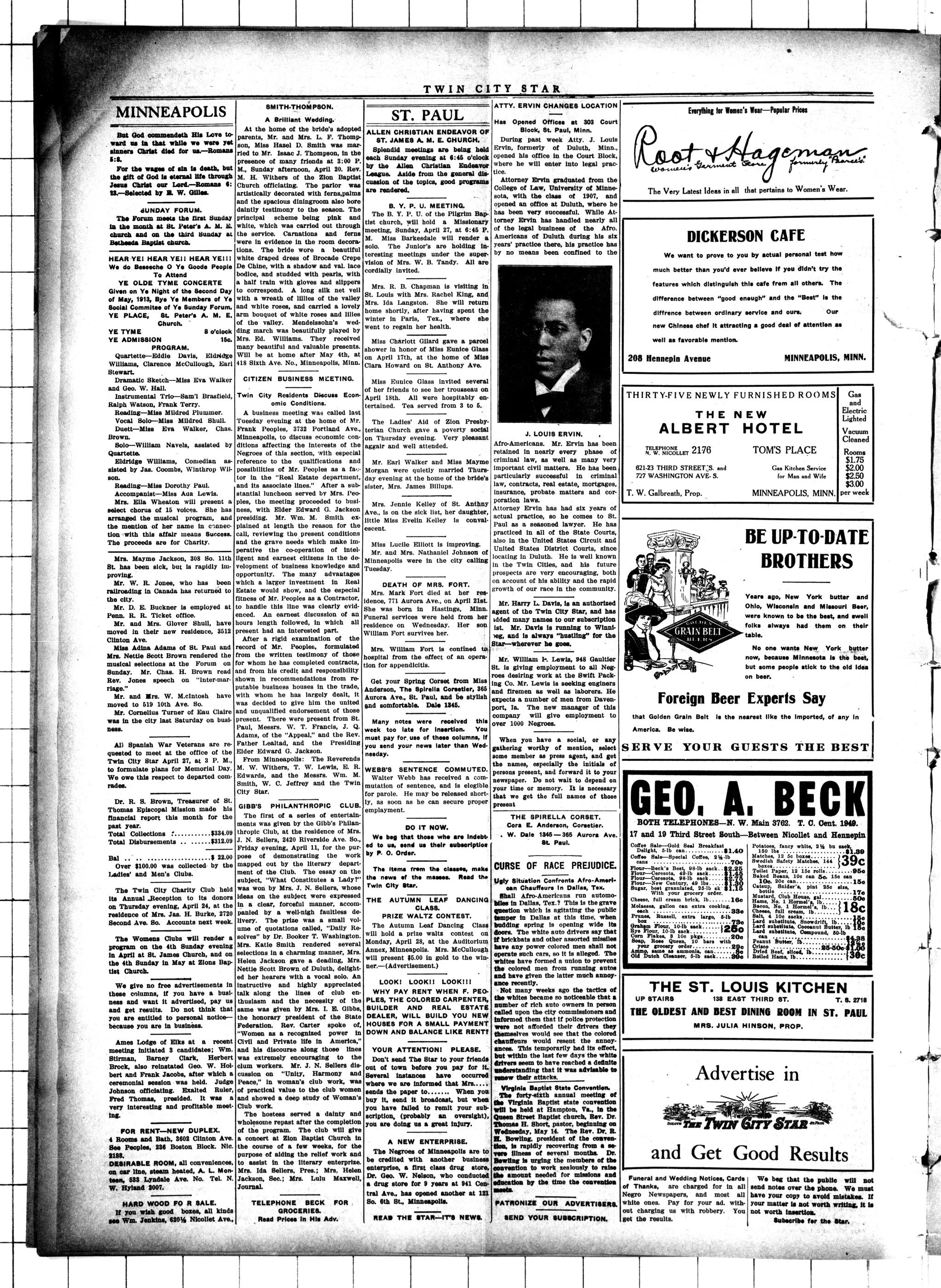
MINNEAPOLIS
DULUTH THE TWIN CITY STAR ST.PAUL
VOL. 3 Single Copies 5 Cents
MINNEAPOLIS, MINN., APRIL 25, 1913.
No. 34
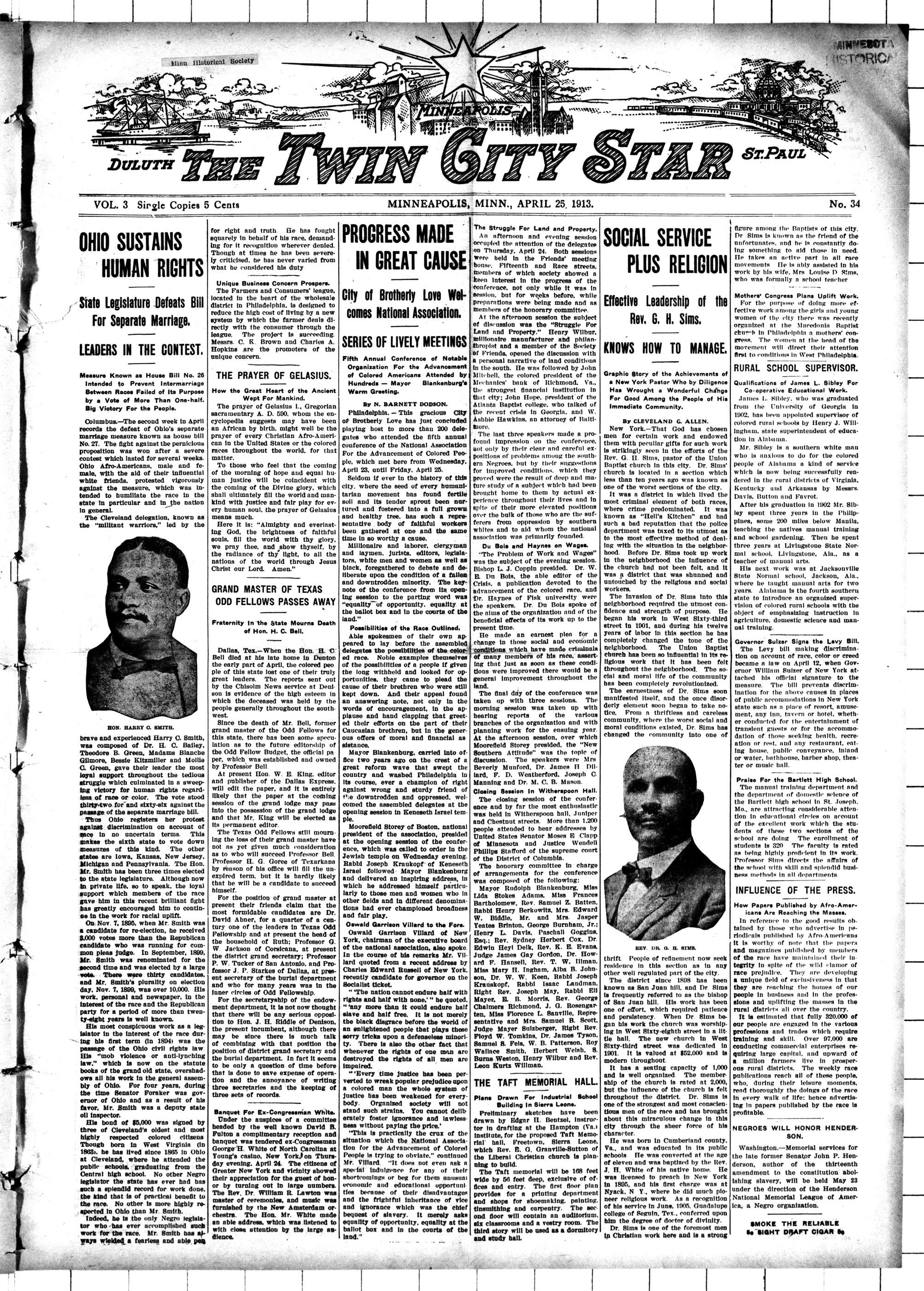
OHIO SUSTAINS HUMAN RIGHTS
State Legislature Defeats Bill For Separate Marriage.
Measure Known as House Bill No. 26 Intended to Prevent Intermarriage Between Races Failed of its Purpose by a Vote of More Than One-half. Big Victory For the People. Columbus.-The second week in April records the defeat of Ohio's separate marriage measure known as house bill No.27. The fight against the pernicious proposition was won after a severe contest which lasted for several weeks. Ohio Afro-Americans, male and female, with the aid of their influential white friends, protested vigorously against the measure, which was intended to humiliate the race in the state in particular and in the nation in general. The Cleveland delegation, known as the "militant warriors," led by the
HON. HARRY C. SMITH.
brave and experienced Harry C. Smith, was composed of Dr. H. C. Bailey, Theodore B. Green, Madams Blanche Gillmore, Bessie Kitzmiller and Mollie C. Green, gave their leader the most loyal support throughout the tedious struggle which culminated in a sweeping victory for human rights regardless of race or color. The vote stood thirty-two for and sixty-six against the passage of the separate marriage bill. Thus Ohio registers her protest against discrimination on account of race in no uncertain terms. This makes the sixth state to vote down measures of this kind. The other states are Iowa, Kansas, New Jersey, Michigan and Pennsylvania. The Hon. Mr. Smith has been three times elected to the state legislature. Although now in private life, so to speak, the loyal support which members of the race gave him in this recent brilliant fight has greatly encouraged him to continue in the work for racial uplift.
On Nov. 7, 1895, when Mr. Smith was a candidate for re-election, he received 3,000 votes more than the Republican candidate who was running for common pleas judge. In September, 1899, Mr. Smith was renominated for the second time and was elected by a large vote. There were thirty candidates, and Mr. Smith's plurality on election day, Nov. 7, 1899, was over 10,000. His work, personal and newspaper, in the interest of the race and the Republican party for a period of more than twenty-eight years is well known.
His most conspicuous work as a legislator in the interest of the race during his first term (in 1894) was the passage of the Ohio civil rights law. His "mob violence or anti-lynching law," which is now on the statute books of the grand old state, overshadows all his work in the general assembly of Ohio. For four years, during the time Senator Foraker was governor of Ohio and as a result of his favor, Mr. Smith was a deputy state oil inspector.
His bond of $5,000 was signed by three of Cleveland's oldest and most highly respected colored citizens. Though born in West Virginia (in 1863), he has lived since 1865 in Ohio at Cleveland, where he attended the public schools, graduating from the Central high school. No other Negro legislator the state has ever had has such a splendid record for work done, the kind that is of practical benefit to the race. No other is more highly respected in Ohio than Mr. Smith. Indeed, he is the only Negro legislator who has ever accomplished such work for the race. Mr. Smith has always wielded a fearless and able pen
for right and truth. He has fought squarely in behalf of his race, demanding for it recognition wherever denied. Though at times he has been severely criticised, he has never varied from what he considered his duty
Unique Business Concern Prospers.
The Farmers and Consumers' league, located in the heart of the wholesale district in Philadelphia, is designed to reduce the high cost of living by a new system by which the farmer deals directly with the consumer through the league. The project is succeeding. Messrs. C. K. Brown and Charles A. Hopkins are the promoters of the unique concern.
THE PRAYER OF GELASIUS.
How the Great Heart of the Ancient Wept For Mankind.
The prayer of Gelasius I., Gregorian sacramentary A. D. 590, whom the encyclopedia suggests may have been an African by birth, might well be the prayer of every Christian Afro-American in the United States or the colored races throughout the world, for that matter.
To those who feel that the coming of the morning of hope and equal human justice will be coincident with the coming of the Divine glory, which shall ultimately fill the world and mankind with justice and fair play for every human soul, the prayer of Gelasius means much.
Here it is: "Almighty and everlasting God, the brightness of faithful souls, fill the world with thy glory, we pray thee, and show thyself, by the radiance of thy light, to all the nations of the world through Jesus Christ our Lord. Amen."
GRAND MASTER OF TEXAS
ODD FELLOWS PASSES AWAY
Fraternity In the State Mourns Death of Hon. H. C. Bell.
Dallas, Tex.-When the Hon. H. C. Bell died at his late home in Denton the early part of April, the colored people of this state lost one of their truly great leaders. The reports sent out by the Chisolm News service at Denison is evidence of the high esteem in which the deceased was held by the people generally throughout the southwest.
Since the death of Mr. Bell, former grand master of the Odd Fellows for this state, there has been some speculation as to the future editorship of the Odd Fellow Budget, the official paper, which was established and owned by Professor Bell.
At present Hon. W. E. King, editor and publisher of the Dallas Express, will edit the paper, and it is entirely likely that the paper at the coming session of the grand lodge may pass into the possession of the grand lodge and that Mr. King will be elected as its permanent editor.
The Texas Odd Fellows still mourning the loss of their grand master have not as yet given much consideration as to who will succeed Professor Bell. Professor H. G. Goree of Texarkana by reason of his office will fill the unexpired term, but it is hardly likely that he will be a candidate to succeed himself.
For the position of grand master at present their friends claim that the most formidable candidates are Dr. David Abner, for a quarter of a century one of the leaders in Texas Odd Fellowship and at present the head of the household of Ruth; Professor G. W. Jackson of Corsicana, at present the district grand secretary; Professor P. W. Tucker of San Antonio, and Professor J. P. Starkes of Dallas, at present secretary of the burial department and who for many years was in the inner circles of Odd Fellowship.
For the secretaryship of the endowment department, it is not now thought that there will be any serious opposition to Hon. J. H. Riddle of Denison, the present incumbent, although there may be since there is much talk of combining with that position the position of district grand secretary and the burial department. In fact it seems to be only a question of time before that is done to save expense of operation and the annoyance of writing three secretaries and the keeping of three sets of records.
Banquet For Ex-Congressman White.
Under the auspices of a committee headed by the well known David B. Fulton a complimentary reception and banquet was tendered ex-Congressman George H. White of North Carolina at Young's casino, New York on Thursday evening, April 24. The citizens of Greater New York and vicinity showed their appreciation for the guest of honor by turning out in large numbers. The Rev. Dr. William R. Lawton was master of ceremonies, and music was furnished by the New Amsterdam orchestra. The Hon. Mr. White made an able address, which was listened to with close attention by the large audience.
MINNEAPOLIS, MINN., APRIL 25 1913.
PROGRESS MADE IN GREAT CAUSE
SERIES OF LIVELY MEETINGS
Fifth Annual Conference of Notable Organization For the Advancement of Colored Americans Attended by Hundreds — Mayor Blankenburg's Warm Greeting.
By N. BARNETT DODSON.
Philadelphia. - This gracious City of Brotherly Love has just concluded playing host to more than 200 delegates who attended the fifth annual conference of the National Association For the Advancement of Colored People, which met here from Wednesday, April 23, until Friday, April 25.
Seldom if ever in the history of this city, where the seed of every humanitarian movement has found fertile soil and its tender sprout been nurtured and fostered into a full grown and healthy tree, has such a representative body of faithful workers been gathered at one and the same time in so worthy a cause.
Millionaire and laborer, clergyman and laymen, jurists, editors, legislators, white men and women as well as black, foregathered to debate and deliberate upon the condition of a fallen and downtrodden minority. The keynote of the conference from its opening session to the parting word was "equality of opportunity, equality at the ballot box and in the courts of the land."
Possibilities of the Race Outlined.
Able spokesmen of their own appeared to lay before the assembled delegates the possibilities of the colored race. Noble examples themselves of the possibilities of a people if given the long withheld and looked for opportunities, they came to plead the cause of their brethren who were still kept down. And their appeal found an answering note, not only in the words of encouragement, in the aplause and hand clapping that greeted their efforts on the part of their Caucasian brethren, but in the generous offers of moral and financial asistance.
Mayor Blankenburg, carried into office two years ago on the crest of a great reform wave that swept the country and washed Philadelphia in its course, ever a champion of right against wrong and sturdy friend of the downrodden and oppressed, welcomed the assembled delegates at the opening session in Kenseth Israel temple.
Moorefield Storey of Boston, national president of the association, presided at the opening session of the conference, which was called to order in the Jewish temple on Wednesday evening. Rabbi Joseph Kraukopf of Keneesh Israel followed Mayor Blankenburg and delivered an inspiring address, in which he addressed himself particularly to those men and women who in other fields and in different denominations had ever championed broadness and fair play.
Oswald Garrison Villard to the Fore.
Oswald Garrison Villard of New York, chairman of the executive board of the national association, also spoke. In the course of his remarks Mr. Villard quoted from a recent address by Charles Edward Russell of New York, recently candidate for governor on the Socialist ticket.
"The nation cannot endure half with rights and half with none," he quoted, "any more than it could endure half slave and half free. It is not merely the black disgrace before the world of an enlightened people that plays these sorry tricks upon a defenseless minority. There is also the other fact that whenever the rights of one man are destroyed the rights of all men are impaired.
"Every time justice has been perverted to wreak popular prejudice upon a colored man the whole system of justice has been weakened for everybody. Organized society will not stand such strains. You cannot deliberately foster ignorance and lawlessness without paying the price."
"This is practically the crux of the situation which the National Association for the Advancement of Colored People is trying to obviate." continued Mr. Villard. "It does not even ask a special indulgence for any of their shortcomings or beg for them unusual economic and educational opportunities because of their disadvantages and the frightful inheritance of vice and ignorance which was the chief bequest of slavery. It merely asks equality of opportunity, equality at the ballot box and in the courts of the land."
The Struggle For Land and Property.
An afternoon and evening session occupied the attention of the delegates on Thursday, April 24. Both sessions were held in the Friends' meeting house. Fifteenth and Race streets, members of which society showed a keen interest in the progress of the conference, not only while it was in session, but for weeks before, while preparations were being made and as members of the honorary committee.
At the afternoon session the subject of discussion was the "Struggle For Land and Property." Henry Wilbur, millionaire manufacturer and philanthropist and a member of the Society of Friends, opened the discussion with a personal narrative of land conditions in the south. He was followed by John Mitchell, the colored president of the Mechanics' bank of Richmond, Va., the strongest financial institution in that city; John Hope, president of the Atlanta Baptist college, who talked of the recent crisis in Georgia, and W. Ashbie Hawkins, an attorney of Baltimore.
The last three speakers made a profound impression on the conference, not only by their clear and careful positions of problems among the southern Negroes, but by their suggestions for improved conditions, which they proved were the result of deep and mature study of a subject which had been brought home to them by actual experience throughout their lives and in spite of their more elevated positions over the bulk of those who are the sufferers from oppression by southern whites and to aid whom the national association was primarily founded.
Du Bois and Haynes on Wages.
"The Problem of Work and Wages" was the subject of the evening session. Bishop L. J. Coppin presided. Dr. W. E. Du Bois, the able editor of the Crisis, a publication devoted to the advancement of the colored race, and Dr. Haynes of Fisk university were the speakers. Dr. Du Bois spoke of the aims of the organization and of the beneficial effects of its work up to the present time.
He made an earnest plea for a change in those social and economic conditions which have made criminals of many members of his race, asserting that just as soon as these conditions were improved there would be a general improvement throughout the land.
The final day of the conference was taken up with three sessions. The morning session was taken up with hearing reports of the various branches of the organization and with planning work for the ensuing year. At the afternoon session, over which Moorefield Storey presided, the "New Southern Attitude" was the topic of discussion. The speakers were Mrs Beverly Munford, Dr. James H Dillard, F. D. Weatherford, Joseph C Manning and Dr. M. C. B. Mason. Closing Session in Witherspoon Hall. The closing session of the conference and by far the most enthusiastic was held in Witherspoon hall, Juniper and Chestnut streets. More than 1,200 people attended to hear addresses by United States Senator Moses E Clapp of Minnesota and Justice Wendell Phillips Stafford of the supreme court of the District of Columbia. The honorary committee in charge of arrangements for the conference was composed of the following:
Mayor Rudolph Blankenburg, Miss Lida Stokes Adams, Miss Frances Bartholomew, Rev. Samuel Z. Batten, Rabbl Henry Berkowitz, Mrs. Edward W. Biddle, Mr. and Mrs. Jasper Yeates Brinton, George Burnham, Jr. Henry L. Davis, Paschall Goggins, Esq.; Rev. Sydney Herbert Cox, Dr. Edwin Ehl Delk, Rev. K. E. Evans, Judge James Gay Gordon, Dr. Howard F. Hansell, Rev. T. W. Illman, Miss Mary H. Ingham, Alba B. Johnson, Dr. W. W. Keen, Rabbl Joseph Krauskopf, Rabbl Isaac Landman, Right Rev. Joseph May, Rabbl Ell Mayer, E. B. Morris May, Rev. George Chalmers Richmond, J. G. Rosengarten, Miss Florence L. Sanville, Representative and Mrs. Samuel B. Scott, Judge Mayer Sulzberger, Right Rev. Floyd W. Tomkins, Dr. James Tyson, Samuel S. Fels, W. B. Patterson, Roy Wallace Smith, Herbert Welsh, S. Burns Weston, Henry Wilbur and Rev. Leon Kurtz Willman.
THE TAFT MEMORIAL HALL.
Plane Drawn For Industrial School Building in Sierra Leone.
Preliminary sketches have been drawn by Edgar H. Bentzel, instructor in drafting at the Hampton (Va.) institute, for the proposed Taft Memorial hall, Freetown, Sierra Leone, which Rev. E. G. Granville-Sutton of the Liberal Christian church is planning to build.
The Taft memorial will be 168 feet wide by 56 feet deep, exclusive of offices and entry. The first floor plan provides for a printing department and shops for shoemaking, painting, tinsmithing and carpentry. The second floor will contain an auditorium, six classrooms and a vestry room. The third story will be used as a dormitory and study hall.
SOCIAL SERVICE PLUS RELIGION
Graphic Story of the Achievements of a New York Pastor Who by Diligence Has Wrought a Wonderful Change For Good Among the People of His Immediate Community.
By CLEVELAND G. ALLEN.
New York.—That God has chosen men for certain work and endowed them with peculiar gifts for such work is strikingly seen in the efforts of the Rev. G. H. I. Sims, pastor of the Union Baptist church in this city. Dr. Sims' church is located in a section which less than ten years ago was known as one of the worst sections of the city.
It was a district in which lived the most criminal element of both races, where crime predominated. It was known as "Hell's Kitchen" and had such a bad reputation that the police department was taxed to its utmost as to the most effective method of dealing with the situation in the neighborhood. Before Dr. Sims took up work in the neighborhood the influence of the church had not been felt, and it was a district that was shunned and untouched by the religious and social workers.
The invasion of Dr. Sims into this neighborhood required the utmost confidence and strength of purpose. He began his work in West Sixty-third street in 1901, and during his twelve years of labor in this section he has completely changed the tone of the neighborhood. The Union Baptist church has been so influential in its religious work that it has been felt throughout the neighborhood. The social and moral life of the community has been completely revolutionized. The earnestness of Dr. Sims soon manifested itself, and the once disorderly element soon began to take notice. From a thriftless and careless community, where the worst social and moral conditions existed, Dr. Sims has changed the community into one of
REV. DR. G. H. SIMS. thrift. People of refinement now seek residence in this section as in any other well regulated part of the city.
The district since 1808 has been known as San Juan hill, and Dr Sims is frequently referred to as the bishop of San Juan hill. His work has been one of effort, which required patience and persistency. When Dr. Sims began his work the church was worshiping in West Sixty-eighth street in a little hall. The new church in West Sixty-third street was dedicated in 1901. It is valued at $52,000 and is modern throughout.
It has a seating capacity of 1,000 and is well organized. The membership of the church is rated at 2,000, but the influence of the church is felt throughout the district. Dr. Sims is one of the strongest and most conscientious men of the race and has brought about this miraculous change in this city through the sheer force of his character.
He was born in Cumberland county, Va., and was educated in its public schools. He was converted at the age of eleven and was baptized by the Rev. J. H. White of his native home. He was licensed to preach in New York in 1805, and his first charge was at Nyack, N. Y., where he did much pioneer religious work. As a recognition of his service in June, 1905, Gundalau college of Segeln, Tex., conferred upon him the degree of doctor of divinity.
Dr. Sims is one of the foremost men in Christian work here and is a strong
No.34
figure among the Baptists of this city. Dr Sims is known as the friend of the unfortunates, and he is constantly doing something to aid those in need. He takes an active part in all race movements. He is ably assisted in his work by his wife, Mrs Louise D Sims, who was formally a school teacher
Mothers' Congress Plans Uplift Work. For the purpose of doing more effective work among the girls and young women of the city there was recently organized at the Macedonia Baptist church in Philadelphia a mothers' congress. The women at the head of the movement will direct their attention first to conditions in West Philadelphia.
RURAL SCHOOL SUPERVISOR.
Qualifications of James L. Sibley For
Cooperative Educational Work.
Cooperative Educational Work.
James L. Sibley, who was graduated from the University of Georgia in 1902, has been appointed supervisor of colored rural schools by Henry J. Willingham, state superintendent of education in Alabama.
Mr. Sibley is a southern white man who is anxious to do for the colored people of Alabama a kind of service which is now being successfully rendered in the rural districts of Virginia, Kentucky and Arkansas by Messrs. Davis, Button and Favrot.
After his graduation in 1902 Mr. Sibley spent three years in the Philippines, some 200 miles below Manila, teaching the natives manual training and school gardening. Then he spent three years at Livingstone State Normal school, Livingstone, Ala., as a teacher of manual arts.
His next work was at Jacksonville State Normal school, Jackson, Ala., where he taught manual arts for two years. Alabama is the fourth southern state to introduce an organized supervision of colored rural schools with the object of emphasizing instruction in agriculture, domestic science and manual training.
Governor Sulzer Signs the Levy Bill
The Levy bill making discrimination on account of race, color or creed became a law on April 12, when Governor William Sulzer of New York attached his official signature to the measure. The bill prevents discrimination for the above causes in places of public accommodations in New York state such as a place of resort, amusement, any inn, tavern or hotel, whether conducted for the entertainment of transient guests or for the accommodation of those seeking health, recreation or rest, and any restaurant, eating house, public conveyance, inland or water, bathhouse, barber shop, theater or music hall.
Praise For the Bartlett High School.
The manual training department and the department of domestic science of the Bartlett high school in St. Joseph. Mo., are attracting considerable attention in educational circles on account of the excellent work which the students of these two sections of the school are doing. The enrollment of students is 320. The faculty is rated as being highly proficient in its work. Professor Sims directs the affairs of the school with skill and splendid business methods in all departments.
INFLUENCE OF THE PRESS.
How Papers Published by Afro-Americans Are Reaching the Masses
In reference to the good results obtained by those who advertise in periodicals published by Afro-Americans it is worthy of note that the papers and magazines published by members of the race have maintained their integrity in spite of the wild clamor of race prejudice. They are developing a unique field of exclusiveness in that they are reaching the homes of our people in business and in the professions and uplifting the masses in the rural districts all over the country. It is estimated that fully 320,000 of our people are engaged in the various professions and trades which require training and skill. Over 97,000 are conducting commercial enterprises requiring large capital, and upward of a million farmers live in prosperous rural districts. The weekly race publications reach all of these people, who, during their leisure moments, read thoroughly the doings of the race in every walk of life; hence advertising in papers published by the race is profitable.
NEGROES WILL HONOR HENDERSON.
Washington.—Memorial services for the late former Senator John P. Henderson, author of the thirteenth amendment to the constitution abolishing slavery, will be held May 23 under the direction of the Henderson National Memorial League of America, a Negro organization.
SMOKE THE RELIABLE
6e SIGHT DRAFT CIGAR 6e
SYLVESTER W. OLIVER
Working Men's Social Club
OLIVER BROS., Managers
PHONE: Nicollet 9506
244 Third Ave. So. Minneapolis, Minn.
A. G. Banks Geo. Watkins
The Cosmopolitan
Buffet and Grill
Wines, Liquors and Cigars
PALM ROOM.
VOCAL ENTERTAINERS.
40 East 3rd St. St. Paul
Phones, N. W. Cedar 9128, Night Call
Cedar 9128.
PAEGEL
802 NICOLLET AVE.
WILL MAKE YOUR WATCH KEEP TIME.
We do the best WATCH, CLOCK and JEWELRY REPAIRING in the city at lowest prices.
SPECIAL AGENTS for the HAMILTON, ELGIN, WALTHAM and ROCKFORD RAILROAD WATCHES.
N. W PHONE NICOLLET 1873.
J. M. MORRIS
Real Estate, Loans and Collections.
508 Boston Block, Minneapolis, Minn
Thos. H. Lyles
322 Wabasha St., St. Paul.
Undertaker and Embalmer
Lady Assistant When Desired.
Free Service of Chapel and Organ
Residence, 673 St. Anthony Ave.,
Tel.: Dale 2947.
Calls answered Day or Night
IN MINNEAPOLIS OR ST. PAUL
Both Phones 508.
SMOKE THE BEST Sight Draft
5C CIGAR
W. S CONRAD CO., Distributors
8 NORTH SIXTH STREET
Southern Theatre
SevenCorners
15th and Washington Avenues So.
Refined Vaudeville
Moving Picture Shows
Continuous Performance
Admission 10 Cents
Children 5 Cents
Peterson, The Druggist 1501 Washington Ave. So.
TOILET ARTICLES, DRUGS PRESCRIPTIONS.
He Solicits Your Patronage.
N. W. Phone Nic. 2455.
W. M. LISBON
TRANSFER AND FUEL
ALL KINDS OF HAULING
MOVING VANS... ...EXPRESSING
1316 4th St. 8o., Minneapolis.
POPULAR PRICED SHOE REPAIRING
WE FIX 'EM WHILE YOU WUT
Men's Sewed Soles, ... 78s
Ladies " " ... 65s
Men's Nailled " " ... 50 and 60s
Men's Heels, ... 40s
Ladies and Boys' nailed soles ... 40s
SEVEN CORNERS SHOE REPAIR SHOP
1424 WASHINGTON AVENUE SOUTH
Glasses for Beginners.
Mrs. R. C. McCullough, 1813 5th
Ave. So., teaches classes from 7 to
10:30 A. M., and from 3 to 8:30 P. M.
For information call South 4021.
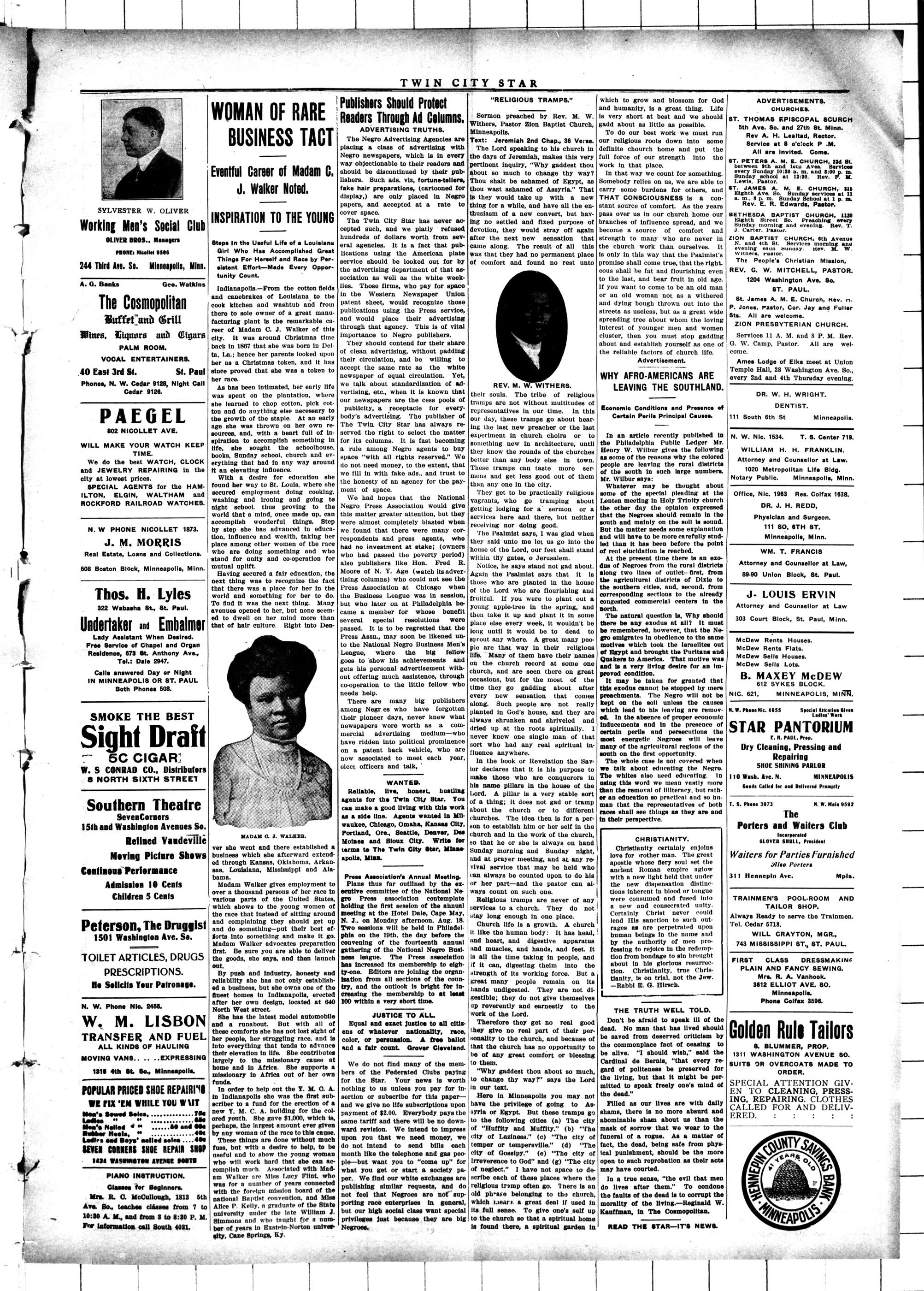
WOMAN OF RARE BUSINESS TACT
Eventful Career of Madam C. J. Walker Noted.
INSPIRATION TO THE YOUNG
Step In the Useful Life of a Louisiana Girl Who Has Accomplished Great Things For Herself and Race by Persistent Effort—Made Every Opportunity Count.
Indianapolis.—From the cotton fields and canebrakes of Louisiana to the cook kitchen and washtub and from there to sole owner of a great manufacturing plant is the remarkable career of Madam C. J. Walker of this city. It was around Christmas time back in 1867 that she was born in Delta, La.; hence her parents looked upon her as a Christmas token, and it has since proved that she was a token to her race.
As has been intimated, her early life was spent on the plantation, where she learned to chop cotton, pick cotton and do anything else necessary to the growth of the staple. At an early age she was thrown on her own resources, and, with a heart full of inspiration to accomplish something in life, she sought the schoolhouse, books, Sunday school, church and everything that had in any way around it an elevating influence.
With a desire for education she found her way to St. Louis, where she secured employment doing cooking, washing and ironing and going to night school, thus proving to the world that a mind, once made up, can accomplish wonderful things. Step by step she has advanced in education, influence and wealth, taking her place among other women of the race who are doing something and who stand for unity and co-operation for mutual uplift.
Having secured a fair education, the next thing was to recognize the fact that there was a place for her in the world and something for her to do. To find it was the next thing. Many avenues opened to her, but none seemed to dwell on her mind more than that of hair culture. Right into Den-
MADAM C. J. WALKER.
ver she went and there established a business which she afterward extended through Kansas, Oklahoma, Arkansas, Louisiana, Mississippi and Alabama.
Madam Walker gives employment to over a thousand persons of her race in various parts of the United States, which shows to the young women of the race that instead of sitting around and complaining they should get up and do something—put their best efforts into something and make it go. Madam Walker advocates preparation first. Be sure you are able to deliver the goods, she says, and then launch out.
By push and industry, honesty and reliability she has not only established a business, but she owns one of the finest homes in Indianapolis, erected after her own design, located at 640 North West street.
She has the latest model automobile and a runabout. But with all of these comforts she has not lost sight of her people, her struggling race, and is into everything that tonds to advance their elevation in life. She contributes largely to the missionary cause at home and in Africa. She supports a missionary in Africa out of her own funds.
In order to help out the Y. M. O. A. in Indianapolis she was the first subscriber to a fund for the erection of a new Y. M. C. A. building for the colored youth. She gave $1,000, which is, perhaps, the largest amount ever given by any woman of the race to this cause.
These things are done without much fuss, but with a desire to help, to be useful and to show the young woman who will work hard that she can accomplish much. Associated with Madam Walker are Miss Lucy Flint, who was for a number of years connected with the foreign mission board of the national Baptist convention, and Miss Alice P. Kelly, a graduate of the State university under the late William J. Simmons and who taught for a number of years in Exstein-Norton university. Cane Springs, Ky.
TWIN CITY STAR
Publishers Should Protect Readers Through Ad Columns.
The Negro Advertising Agencies are placing a class of advertising with Negro newspapers, which is in every way objectionable to their readers and should be discontinued by their publishers. Such ads. viz, fortune-tellers, fake hair preparations, (cartooned for display,) are only placed in Negro papers, and accepted at a rate to cover space.
The Twin City Star has never accepted such, and we platy refused hundreds of dollars worth from several agencies. It is a fact that publications using the American plate service should be looked out for by the advertising department of that association as well as the white weeklies. Those firms, who pay for space in the Western Newspaper Union patent sheet, would recognize those publications using the Press service, and would place their advertising through that agency. This is of vital importance to Negro publishers.
They should contend for their share of clean advertising, without padding their circulation, and be willing to accept the same rate as the white newspaper of equal circulation. Yet, we talk about standardization of advertising, etc., when it is known that our newspapers are the cess pools of publicity, a receptacle for everybody's advertising. The publisher of The Twin City Star has always reserved the right to select the matter for its columns. It is fast becoming a rule among Negro agents to buy space "with all rights reserved." We do not need money, to the extent, that we fill in with fake ads., and trust to the honesty of an agency for the payment of space.
We had hopes that the National Negro Press Association would give this matter greater attention, but they were almost completely blasted when we found that there were many correspondents and press agents, who had no investment at stake; (owners who had passed the poverty period) also publishers like Hon. Fred R. Moore of N. Y. Age (watch its advertising columns) who could not see the Press Association at Chicago when the Business League was in session, but who later on at Philadelphia became a member for whose benefit several special resolutions were passed. It is to be regretted that the Press Assn., may soon be likened unto the National Negro Business Men's League, where the big fellow goes to show his achievements and gets his personal advertisement without offering much assistance, through co-operation to the little fellow who needs help.
There are many big publishers among Negres who have forgotten their pioneer days, never knew what newspapers were worth as a commercial advertising medium—who have ridden into political prominence on a patent back vehicle, who are now associated to meet each year, elect officers and talk,
Reliable, live, honest, hustling agents for the Twin City Star. You can make a good living with this work as a side line. Agents wanted in Milwaukee, Chicago, Omaha, Kansas City, Portland, Ore., Seattle, Denver, Des Moines and Sioux City. Write for terms to The Twin City Star, Minneapolis, Minn.
Press Association's Annual Meeting. Plans thus far outlined by the executive committee of the National Negro Press association contemplate holding the first session of the annual meeting at the Hotel Dale, Cape May, N. J., on Monday afternoon, Aug. 18. Two sessions will be held in Philadelphia on the 19th, the day before the convening of the fourteenth annual gathering of the National Negro Business league. The Press association has increased its membership to eighty-one. Editors are joining the organization from all sections of the country, and the outlook is bright for increasing the membership to at least 100 within a very short time.
JUSTICE TO ALL
Equal and exact justice to all citizens of whatever nationality, race, color, or persuasion. A free ballot and a fair count. Grover Cleveland.
We do not find many of the members of the Federated Clubs paying for the Star. Your news is worth nothing to us unless you pay for insertion or subscribe for this paper—and we give no life subscriptions upon payment of $2.00. Everybody pays the same tariff and there will be no downward revision. We intend to impress upon you that we need money, we do not intend to send bills each month like the telephone and gas people—but want you to "come up" for what you get or start a society paper. We find our white exchanges are publishing similar requests, and do not feel that Negroes are not supporting race enterprises in general, but our high social class want special privileges just because they are big Negroes.
WANTED.
"RELIGIOUS TRAMPS."
Sermon preached by Rev. M. W. Withers, Pastor Zion Baptist Church, Minneapolis.
Text: Jeremiah 2nd Chap., 36 Verse.
The Lord speaking to his church in the days of Jeremiah, makes this very pertinent inquiry, "Why gaddest thou about so much to change thy way? Thou shalt be ashamed of Egypt, as thou wast ashamed of Assyria." That is they would take up with a new thing for a while, and have all the enthusiasm of a new convert, but having no settled and fixed purpose of devotion, they would stray off again after the next new sensation that came along. The result of all this was that they had no permanent place of comfort and found no rest unto
REV. M. W. WITHERS. their souls. The tribe of religious tramps are not without multitudes of representatives in our time. In this our day, these tramps go about hearing the last new preacher or the last experiment in church choirs or to something new in architecture, until they know the rounds of the churches better than any body else in town. These tramps can taste more sermons and get less good out of them than any one in the city. They get to be practically religious vagrants, who go tramping about getting lodging for a sermon or a services here and there, but neither receiving nor doing good.
The Psalmist says, I was glad when they said unto me let us go into the house of the Lord, our feet shall stand within thy gates, o Jerusalem.
Notice, he says stand not gad about. Again the Psalmist says that it is those who are planted in the house of the Lord who are flourishing and fruitful. If you were to plant out a young apple-tree in the spring, and then take it up and plant it in some place else every week, it wouldn't be long until it would be to dead to sprout any where. A great many people are that way in their religious life. Many of them have their names on the church record at some one church, and are seen there on great occasions, but for the most of the time they go gadding about after every new sensation that comes along. Such people are not really planted in God's house, and they are always shrunken and shriveled and dried up at the roots spiritually. I never knew one single man of that sort who had any real spiritual influence anywhere.
In the book or Revelation the Savior declares that it is his purpose to make those who are conquerors in his name pillars in the house of the Lord. A pillar is a very stable sort of a thing; it does not gad or tramp about the church or to different churches. The idea then is for a person to establish him or her self in the church and in the work of the church, so that he or she is always on hand Sunday morning and Sunday night, and at prayer meeting, and at any revival service that may be held who can always be counted upon to do his or her part—and the pastor can always count on such one.
Religious tramps are never of any services to a church. They do not stay long enough in one place.
Church life is a growth. A church it like the human body: It has head, and heart, and digestive apparatus and muscles, and hands, and feet. It is all the time taking in people, and if it can, digesting them into the strength of its working force. But a great many people remain on its hands undigested. They are not digestible; they do not give themselves up reverently and earnestly to the work of the Lord.
Therefore they get no real good they give no real part of their personality to the church, and because of that the church has no opportunity to be of any great comfort or blessing to them.
"Why gaddest thou about so much, to change thy way?" says the Lord in our text.
Here in Minneapolis you may not have the privilege of going to Assyria or Egypt. But these tramps go to the following cities (a) The city of "Huffity and Muffity." (b) "The city of Laziness." (c) "The city of temper or tempersville." (d) "The city of Gossip." (e) "The city of Irreverence to God" and (g) "The city of neglect." I have not space to describe each of these places where the religious tramp often go. There is an old phrase belonging to the church, which means a great deal if used in its full sense. To give one's self up to the church so that a spiritual home is found there, a spiritual garden in
which to grow and blossom for God and humanity, is a great thing. Life is very short at best and we should gadd about as little as possible. To do our best work we must run our religious roots down into some definite church home and put the full force of our strength into the work in that place. In that way we count for something. Somebody relies on us, we are able to carry some burdens for others, and THAT CONSCIOUSNESS is a constant source of comfort. As the years pass over us in our church home our branches of influence spread, and we become a source of comfort and strength to many who are never in the church work than ourselves. It is only in this way that the Psalmist's promise shall come true, that the right eous shall be fat and flourishing even to the last, and bear fruit in old age. If you want to come to be an old man or an old woman not as a withered and dying bough thrown out into the streets as useless, but as a great wide spreading tree about whom the loving interest of younger men and women cluster, then you must stop gadding about and establish yourself as one of the reliable factors of church life.
WHY AFRO-AMERICANS ARE LEAVING THE SOUTHLAND.
Economic Conditions and Presence of Certain Perils Principal Causes.
In an article recently published in the Philadelphia Public Ledger Mr. Henry W. Wilbur gives the following as some of the reasons why the colored people are leaving the rural districts of the south in such large numbers. Mr. Wilbur says:
Whatever may be thought about some of the special pleading at the Lenten meeting in Holy Trinity church the other day the opinion expressed that the Negroes should remain in the south and mainly on the soil is sound. But the matter needs some explanation and will have to be more carefully studied than it has been before the point of real elucidation is reached.
At the present time there is an exodus of Negroes from the rural districts along two lines of outlet—first, from the agricultural districts of Dixie to the southern cities, and, second, from corresponding sections to the already congested commercial centers in the north.
The natural question is, Why should there be any exodus at all? It must be remembered, however, that the Negro emigrates in obedience to the same motives which took the Israelites out of Egypt and brought the Puritans and Quakers to America. That motive was and is a very living desire for an improved condition.
It may be taken for granted that this exodus cannot be stopped by mere preachments. The Negro will not be kept on the soil unless the causes which lead to his leaving are removed. In the absence of proper economic inducements and in the presence of certain perils and persecutions the most energetic Negroes will leave many of the agricultural regions of the south on the first opportunity.
The whole case is not covered when we talk about educating the Negro. The whites also need educating. In using this word we mean vastly more than the removal of illiteracy, but rather an education so practical and so human that the representatives of both races shall see things as they are and in their perspective.
CHRISTIANITY.
Christianity certainly enjoins love for rother man. The great apostle whose fiery soul set the ancient Roman empire aglow with a new light held that under the new dispensation distinctions inherent in blood or tongue were consumed and fused into a new and consecrated unity. Certainly Christ never could lend His sanction to such outrages as are perpetrated upon human beings in the name and by the authority of men professing to rejoice in the redemption from bondage to sin brought about in his glorious resurrection. Christianity, true Christianity, is on trial, not the Jew.—Rabbl E. G. Hirsch.
THE TRUTH WELL TOLD.
Don't be afraid to speak ill of the dead. No man that has lived should be saved from deserved criticism by the commonplace fact of ceasing to be alive. "I should wish," said the Cardinal de Bernis, "that every regard of politeness be preserved for the living, but that it might be permitted to speak freely one's mind of the dead."
Filled as our lives are with daily shams, there is no more absurd and abominable sham about us than the mask of sorrow that we wear to the funeral of a rogue. As a matter of fact, the dead, being safe from physical punishment, should be the more open to such reprobation as their acts may have courted.
In a true sense, "the evil that men do lives after them." To condone the faults of the dead is to corrupt the morality of the living.—Reginald W. Kauffman, in The Cosmopolitan.
ADVERTISEMENTS. CHURCHES.
ST. THOMAS EPISCOPAL SCURCH
5th Ave. So. and 27th St. Minn.
Rev A. H. Leatland, Rector.
Service at 8 o'clock P .M.
All are invited. Come.
ST. PETERS A. M. E. CHURCH, 22d St.
between 9th and 10th Aves. Services
every Sunday at 4:30 a.m. and 8:00 p.m.
Sunday school at 12:30. Rev. F. M.
Lewis, Pastor.
ST. JAMES A. M. E. CHURCH, 215
Eighth Ave. So. Sunday services at 11
a. m. 8 p. m. Sunday school at 1 p. m.
Rev. E. R. Edwards, Pastor.
BETHESDA BAPTIST CHURCH, 1120
Eighth Street So. Preaching every
Sunday morning and evening. Rev. T.
J. Carter, Pastor.
ZION BAPTIST CHURCH, 6th Avenue
N. and 4th St. Services morning and
evening each Sunday. Rev. M. W.
Witners, pastor.
The People's Christian Mission,
REV. G. W. MITCHELL, PASTOR.
1204 Washington Ave. So.
ST. PAUL.
St. James A. M. E. Church, Rev. m.
P. Jones, Pastor, Cor. Jay and Fuller
Sts. All are welcome.
ZION PRESBYTERIAN CHURCH.
Services 11 A. M. and 8 P. M. Rev.
G. W. Camp, Pastor. All are welcome.
Ames Lodge of Elks meet at Union
Temple Hall, 28 Washington Ave. So.
every 2nd and 4th Thursday evening.
DR. W. H. WRIGHT.
DENTIST.
111 South 6th St Minneapolis.
N. W. Nic. 1534. T. S. Center 719.
WILLIAM H. H. FRANKLIN.
Attorney and Counsellor at Law.
1020 Metropolitan Life Bldg.
Notary Public. Minneapolis, Minn.
Office, Nic. 1963 Res. Colfax 1638.
DR. J. H. REDD,
Physician and Surgeon.
111 SO. 6TH ST.
Minneapolis, Minn.
WM. T. FRANCIS
Attorney and Counsellor at Law,
89-90 Union Block, St. Paul.
J- LOUIS ERVIN
Attorney and Counsellor at Law
303 Court Block, St. Paul, Minn.
McDew Rents Houses.
McDew Rents Flats.
McDew Sells Houses.
McDew Sells Lots.
B. MAXEY McDEW
612 SYKES BLOCK.
NIC. 621, MINNEAPOLIS, MINN.
STAR PANTORIUM
E. H. PAUL, Prop.
Dry Cleaning, Pressing and
Repairing
SHOE SHINING PARLOR
T. S. Phone 3073 N. W. Main 9592
The
Porters and Waiters Club
Incorporated
GLOVER SHULL, President
Waiters for Parties Furnished
Also Porters
311 Hennepin Ave. Mols.
TRAINMEN'S POOL-ROOM AND
TAILOR SHOP.
Always Ready to serve the Trainmen.
Tel. Cedar 5718.
WILL CRAYTON, MGR.
743 MISSISSIPPI ST., ST. PAUL.
FIRST CLASS DRESSMAKING
PLAIN AND FANCY SEWING.
Mrs. R. A. Vanhook.
3612 ELLIOT AVE. 80.
Minneapolis.
Phone Colfax 3596.
Golden Rule Tailors
8. BLUMMER, PROP.
1311 WASHINGTON AVENUE 80.
SUITS OR OVERCOATS MADE TO ORDER.
SPECIAL ATTENTION GIVEN TO CLEANING, PRESSING, REPAIRING. CLOTHES CALLED FOR AND DELIVERED.
HENNEPIN COUNTY SAVINGS BANK
41 YEARS OLD
MINNEAPOLIS