Twin City Star
Friday, January 23, 1914
Minneapolis, Minnesota
Page text (machine-generated)
MINNEAPOLIS
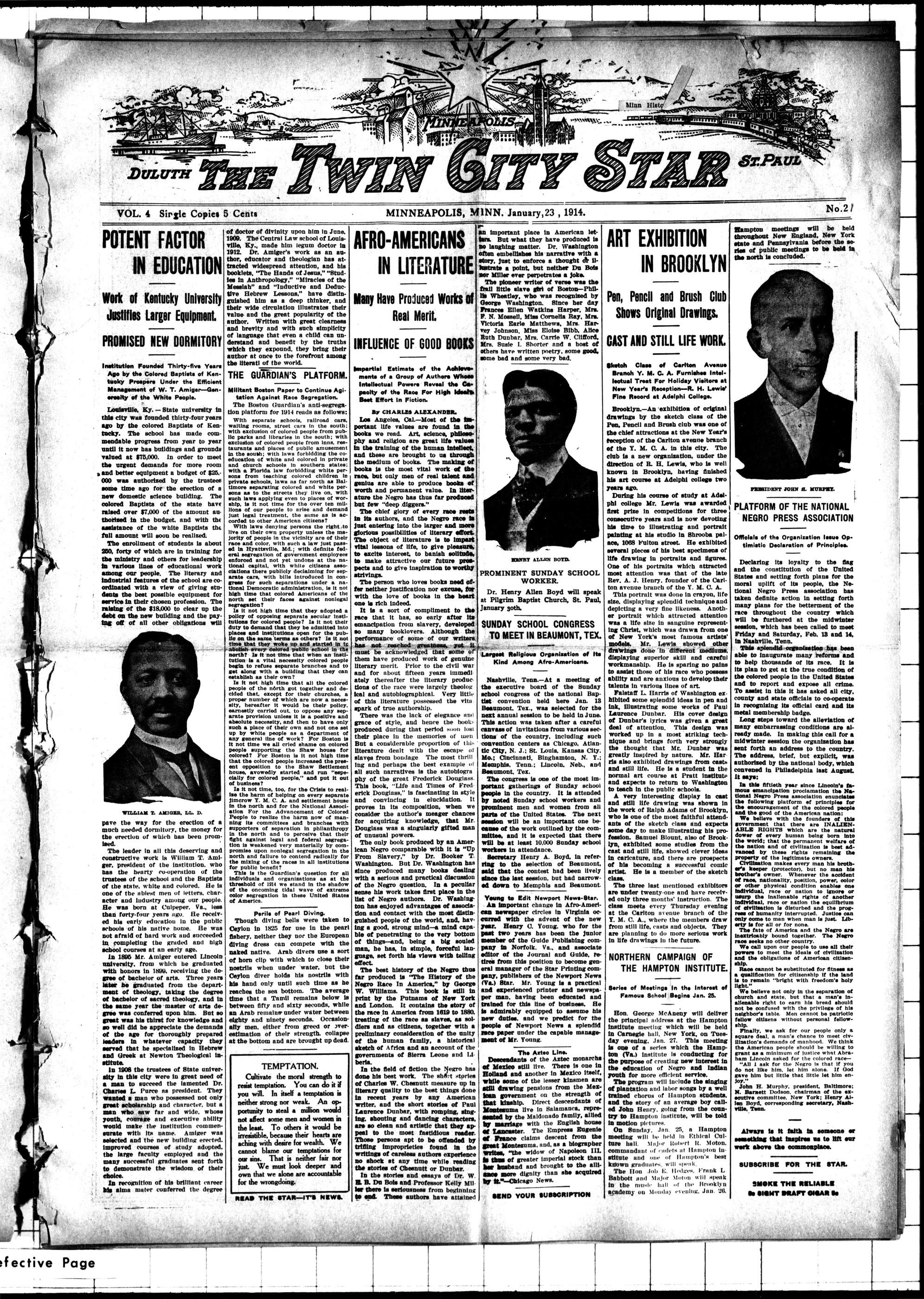
DULUTH THE TWIN CITY STAR ST.PAUL
effective Page
VOL. 4 Single Copies 5 Cents
POTENT FACTOR IN EDUCATION
Work of Kentucky University Justifies Larger Equipment.
PROMISED NEW DORMITORY
of doctor of 1009. The ville, Ky., 1012. Dr. thor, educat tracted wi booklets, "les in Antl Messlah" vive Hebr guished hi their wide value and author. W and brevity of language derstand which they author at
of doctor of divinity upon him in June, 1909. The Central Law school of Louisville, Ky., made him legum doctor in 1912. Dr. Amiger's work as an author, educator and theologian has attracted widespread attention, and his booklets, "The Hands of Jesus," "Studies in Anthropology," "Miracles of the Messiah" and "Inductive and Deductive Hebrew Lessons," have distinguished him as a deep thinker, and their wide circulation illustrates their value and the great popularity of the author. Written with great clearness and brevity and with such simplicity of language that even a child can understand and benefit by the truths which they expound, they bring their author at once to the forefront among the literati of the world.
THE GUARDIAN'S PLATFORM
Militant Boston Paper to Continue Agitation Against Race Segregation.
The Boston Guardian's anti-segregation platform for 1914 reads as follows
our platform for 1914 reads as follows:
With separate schools, railroad cars, waiting rooms, street cars in the south; with exclusion of colored people from public parks and libraries in the south; with exclusion of colored people from the restaurants and places of public amusement in the south; with laws forbidding the coeducation of white and colored in private and church schools in southern states; with a Florida law forbidding white persons from teaching colored children in private schools, laws as far north as Baltimore separating colored and white persons as to the streets they live on, with white persons as to the streets they live on, with ship, is it not time for the over ten millions of our people to arise and demand just legal treatment, the same as is accorded to other American citizens?
Though diving bells were taken to Ceylon in 1825 for use in the pearl fishery, neither they nor the European diving dress can compete with the naked native. Arab divers use a sort of horn clip with which to close their nostrils when under water, but the Ceylon diver holds his nostrils with his hand only until such time as he reaches the sea bottom. The average time that a Tamil remains below is between fifty and sixty seconds, while an Arab remains under water between eighty and ninety seconds. Occasionally men, either from greed or overestimation of their strength, collapse at the bottom and are brought up dead.
READ
Institution Founded Thirty-five Years Age by the Colored Baptists of Kentucky Prosperers Under the Efficient Management of W. T. Amiger-Generosity of the White People.
Louisville, Ky. — State university in this city was founded thirty-four years ago by the colored Baptists of Kentucky. The school has made commendable progress from year to year until it now has buildings and grounds valued at $75,000. In order to meet the urgent demands for more room and better equipment a budget of $25,000 was authorized by the trustees some time ago for the erection of a new domestic science building. The colored Baptists of the state have raised over $7,000 of the amount authorized in the budget, and with the assistance of the white Baptists the full amount will soon be realized.
The enrollment of students is about 250, forty of which are in training for the ministry and others for leadership in various lines of educational work among our people. The literary and industrial features of the school are coordinated with a view of giving students the best possible equipment for service in their chosen profession. The raising of the $18,000 to clear up the debt on the new building and the paying off of all other obligations will
WILLIAM T. AMIGER, LL. D.
pave the way for the erection of a much needed dormitory, the money for the erection of which has been promised.
The leader in all this deserving and constructive work is William T. Amiger, president of the institution, who has the hearty co-operation of the trustees of the school and the Baptists of the state, white and colored. He is one of the ablest men of letters, character and industry among our people. He was born at Culpeper, Va., less than forty-four years ago. He received his early education in the public schools of his native home. He was not afraid of hard work and succeeded in completing the graded and high school courses at an early age. In 1896 Mr. Amiger entered Lincoln university, from which he graduated with honors in 1899, receiving the degree of bachelor of arts. Three years later he graduated from the department of theology, taking the degree of bachelor of sacred theology, and in the same year the master of arts degree was conferred upon him. But so great was his thirst for knowledge and so well did he appreciate the demands of the age for thoroughly prepared leaders in whatever capacity they served that he specialized in Hebrew and Greek at Newton Theological institute.
In 1906 the trustees of State university in this city were in great need of a man to succeed the lamented Dr. Charles L. Purce as president. They wanted a man who possessed not only great scholarship and character, but a man who saw far and wide, whose youth, courage and executive ability would make the institution commensurate with its name. Amiger was selected and the new building erected, improved courses of study adopted, the large faculty employed and the many successful graduates sent forth to demonstrate the wisdom of their choice.
In recognition of his brilliant career
his alma mater conferred the degree
Is it not time, too, for the Crisis to realize the harm of helping on every separate jimcrow Y. M. C. A. and settlement house in the north and for the National Association for Advancement of Colored People to realize its commitment to individually its institutes and branches with supporters of separation in philanthropy in the north and to perceive that their fight against legal and federal segregation is weakened very materially by compromise upon nonlegal segregation in the north and to perceive that the mixing of the races in all institutions for public benefit? This is the Guardian's question for all individuals and organizations as at the threshold of 1914 we stand in the shadow of the oncoming tidal wave of extreme colonization in these United States of America.
Perile of Pearl Diving.
TEMPTATION
Cultivate the moral strength to resist temptation. You can do it if you will. In itself a temptation is neither strong nor weak. An opportunity to steal a million would not affect some men and women in the least. To others it would be irresistible, because their hearts are aching with desire for wealth. We cannot blame our temptations for our sins. That is neither fair nor just. We must look deeper and own that we alone are accountable for the wrongdoing.
MINNEAPOLIS, MINN. January, 23, 1914.
INFLUENCE OF GOOD BOOKS
Impartial Estimate of the Achievements of a Group of Authors Whose Intellectual Powers Reveal the Capacity of the Race For High Ideals Best Effort In Fiction.
By CHARLES ALEXANDER.
Los Angeles, Cal.—Most of the important life values are found in the books we read. Art, science, philosophy and religion are great life values in the training of the human intellect, and these are brought to us through the medium of books. The making of books is the most vital work of the race, but only men of real talent and genius are able to produce books of worth and permanent value. In literature the Negro has thus far produced but few "deep diggers."
The chief glory of every race rests in its authors, and the Negro race is just entering into the larger and more glorious possibilities of literary effort. The object of literature is to impart vital lessons of life, to give pleasure, to excite interest, to banish solitude, to make attractive our future prospects and to give inspiration to worthy strivings.
The person who loves books need offer neither justification nor excuse, for with the love of books in the heart one is rich indeed.
It is a sort of compliment to the race that it has, so early after its emancipation from slavery, developed so many booklovers. Although the performance of some of our writers has not reached greatness, yet it must be acknowledged that some of them have produced work of genuine literary merit. Prior to the civil war and for about fifteen years immediately thereafter the literary productions of the race were largely theological and autobiographical. Very little of this literature possessed the vita-spark of true authorship.
There was the lack of elegance and grace of style, and hence the books produced during that period soon lost their place in the memories of men. But a considerable proportion of this literature dealt with the escape of slaves from bondage. The most thrilling and perhaps the best example of all such narratives is the autobiography of the great Frederick Douglass. This book, "Life and Times of Frederick Douglass," is fascinating in style and convincing in elucidation. It proves in its composition, when we consider the author's meager chances for acquiring knowledge, that Mr Douglass was a singularly gifted man of unusual powers.
The only book produced by an American Negro comparable with it is "Up From Slavery," by Dr. Booker T. Washington. But Dr. Washington has since produced many books dealing with a serious and practical discussion of the Negro question. In a peculiar sense his work takes first place in the list of Negro authors. Dr. Washington has enjoyed advantages of association and contact with the most distinguished people of the world, and, having a good, strong mind—a mind capable of penetrating to the very bottom of things—and, being a big souled man, he has, in simple, forceful language, set forth his views with telling effect.
The best history of the Negro thus far produced is "The History of the Negro Race In America," by George W. Williams. This book is still in print by the Putnams of New York and London. It contains the story of the race in America from 1619 to 1880, treating of the race as slaves, as soldiers and as citizens, together with a preliminary consideration of the unity of the human family, a historical sketch of Africa and an account of the governments of Sierra Leone and La berla.
In the field of fiction the Negro has done his best work. The short stories of Charles W. Chesnutt measure up in literary quality to the best things done in recent years by any American writer, and the short stories of Paul Laurence Dunbar, with romping, singing, shouting and dancing characters, are so clean and artistic that they appeal to the most fastidious reader. Those persons apt to be offended by trifling improprieties found in the writings of careless authors experience no shock at any time while reading the stories of Chesnutt or Dunbar. In the stories and essays of Dr. W. B. Du Bois and Professor Kelly Miller there is seriousness from beginning to end. These authors have attained
an important place in American letters. But what they have produced is no laughing matter. Dr. Washington often embellishes his narrative with a story, just to enforce a thought of illustrate a point, but neither Du Bois nor Miller ever percepts a joke. The pioneer writer of verse was the frail little slave girl of Boston—Phillis Whettley, who was recognised by George Washington. Since her day Frances Ellen Watkins Harper, Mrs. F. N. Mossell, Miss Cornelia Ray, Mrs. Victoria Earle Matthews, Mrs. Harvey Johnson, Miss Eloise Bibb, Alice Ruth Dunbar, Mrs. Carrie W. Clifford, Mrs. Susie I. Shorter and a host of others have written poetry, some good, some bad and some very bad.
HENRY ALLEN BOYD.
PROMINENT SUNDAY SCHOOL WORKER.
Dr. Henry Allen Boyd will speak at Pilgrim Baptist Church, St. Paul, January 30th.
SUNDAY SCHOOL CONGRESS TO MEET IN BEAUMONT, TEX.
Largest Religious Organization of Its Kind Among Afro-Americans.
Nashville, Tenn.-At a meeting of the executive board of the Sunday school congress of the national Baptist convention held here Jan. 18 Beaumont, Tex., was selected for the next annual session to be held in June. This action was taken after a careful canvass of invitations from various sections of the country, including such convention centers as Chicago, Atlantic City, N. J.; St. Louis, Kansas City, Mo.; Cincinnati, Binghamton, N. Y.; Memphis, Tenn.; Lincoln, Neb., and Beaumont, Tex.
The congress is one of the most important gatherings of Sunday school people in the country. It is attended by noted Sunday school workers and prominent men and women from all parts of the United States. The next session will be an important one because of the work outlined by the committee, and it is expected that there will be at least 10,000 Sunday school workers in attendance.
Secretary Henry A. Boyd, in referring to the selection of Beaumont, said that the contest had been lively since the last session, but had narrowed down to Memphis and Beaumont.
Young to Edit Newport News-Star.
An important change in Afro-American newspaper circles in Virginia occurred with the advent of the new year. Henry C. Young, who for the past two years has been the junior member of the Guide Publishing company in Norfolk, Va., and associate editor of the Journal and Guide, retires from this position to become general manager of the Star Printing company, publishers of the Newport News (Va.) Star. Mr. Young is a practical and experienced printer and newspaper man, having been educated and trained for this line of business. He is admirably equipped to assume his new duties, and we predict for the people of Newport News a splendid race paper under the capable management of Mr. Young.
The Aztec Line.
Descendants of the Aztec monarchs of Mexico still live. There is one in Holland and another in Mexico itself, while some of the lesser kinsmen are still drawing pensions from the Mexican government on the strength of that kinship. Direct descendants of Montesquia live in Salamanca, represented by the Maldonado family, allied by marriage with the English house of Lancaster. The Empress Engenie of France claims descent from the great Montesquia, and, as a biographer writes, "the widow of Napoleon III is thus of greater imperial stock than her husband and brought to the alliance more dignity than she acquired by it."—Chicago News.
SEND YOUR SUBSCRIPTION
ART EXHIBITION IN BROOKLYN Pen, Pencil and Brush Club Shows Original Drawings.
CAST AND STILL LIFE WORK.
Sketch Class of Carlton Avenue
Bramoh Y. M. C. A. Furnishes Intellectual Treat for Holiday Visitors at New Year's Reception—R. H. Lewis' Fine Record at Adelphi College.
Brooklyn—An exhibition of original drawings by the sketch class of the Pen, Pencil and Brush club was one of the chief attractions at the New Year's reception of the Carlton avenue branch of the Y. M. C. A. in this city. The club is a new organization, under the direction of R. H. Lewis, who is well known in Brooklyn, having finished his art course at Adelphi college two years ago.
During his course of study at Adelphi college Mr. Lewis was awarded first prize in competitions for three consecutive years and is now devoting his time to illustrating and portrait painting at his studio in Shrooba palace, 1008 Kulton street. He exhibited several pieces of his best specimens of life drawing in portraits and figures. One of his portraits which attracted most attention was that of the late Rev. A. J. Henry, founder of the Carlton avenue branch of the Y. M. C. A.
This portrait was done in crayon, life size, displaying splendid technique and depicting a very fine likeness. Another portrait which attracted attention was a life size in sanguine representing Christ, which was drawn from one of New York's most famous artists' models. Mr. Lewis showed other drawings done in different mediums, displaying superior skill and careful workmanship. He is sparing no paints to assist those of his race who possess ability and are anxious to develop their talents in various lines of art.
Falstaff L. Harris of Washington exhibited some splendid ideas in pen and ink, illustrating some works of Paul Laurence Dunbar. His cover design of Dunbar's lyrics was given a great deal of attention. This design was worked up in a most striking technique and brings forth very strongly the thought that Mr. Dunbar was greatly inspired by nature. Mr. Harris also exhibited drawings from casts and still life. He is a student in the normal art course at Pratt institute and expects to return to Washington to teach in the public schools.
A very interesting display in cast and still life drawing was shown in the work of Ralph Adams of Brooklyn, who is one of the most faithful attendants of the sketch class and expects some day to make illustrating his profession. Samuel Blount, also of Brooklyn, exhibited some studies from the cast and still life, showed clever ideas in caricature, and there are prospects of his becoming a successful comic artist. He is a member of the sketch class.
The three last mentioned exhibitors are under twenty-one and have received only three months' instruction. The class meets every Thursday evening at the Carlton avenue branch of the Y. M. C. A., where the members draw from still life, casts and objects. They are planning to do more serious work in life drawings in the future.
NORTHERN CAMPAIGN OF THE HAMPTON INSTITUTE.
Series of Meetings In the Interest of Famous School Begins Jan. 25.
Hon. George McAneny will deliver the principal address at the Hampton institute meeting which will be held in Carnegie hall, New York, on Tuesday evening, Jan. 27. This meeting is one of a series which the Hampton (Va.) institute is conducting for the purpose of creating new interest in the education of Negro and Indian youth for more efficient service.
The program will include the singing of plantation and labor songs by a well trained chorus of Hampton students, and the story of an average boy called John Henry, going from the country to Hampton institute, will be told in motion pictures.
On Sunday, Jan. 25, a Hampton meeting will be held in Ethical Culture hall. Major Robert R. Moton, commandant of cadets at Hampton institute and one of Hampton's best known graduates, will speak.
The Hon Job E. Helges, Frank L Babbett and Major Moton will speak in the music hall of the Brooklyn academy on Monday evening, Jan. 26.
Hampton meetings will be held throughout New England, New York state and Pennsylvania before the series of public meetings to be held in the north is concluded.
PLATFORM OF THE NATIONAL NEGRO PRESS ASSOCIATION
Officials of the Organization issue Optimistic Declaration of Principles.
Declaring its loyalty to the flag and the constitution of the United States and setting forth plans for the moral uplift of its people, the National Negro Press association has taken definite action in setting forth many plans for the betterment of the race throughout the country which will be furthered at the midwinter session, which has been called to meet Friday and Saturday, Feb. 13 and 14, in Nashville, Tenn.
This splendid organization has been able to inaugurate many reforms and to help thousands of its race. It is its plan to get at the true condition of the colored people in the United States and to report and expose all crime. To assist in this it has asked all city, county and state officials to co-operate in recognizing its official card and its metal membership badge.
Long steps toward the alleviation of many embarrassing conditions are already made. In making this call for a midwinter session the organization has sent forth an address to the country. The address, brief, but explicit, was authorized by the national body, which convened in Philadelphia last August. It says:
In this fiftieth year since Lincoln's famous emancipation proclamation the National Negro Press association enunciates the following platform of principles for the encouragement of the colored people and the nation. We believe with the foundation of this government that there are INALIENABLE RIGHTS which are the natural dower of every human being born into the world; that the permanent welfare of the nation and of civilization is best aided by these rights remaining the property of the legitimate. Civilization makes every man his brother's keeper (protector), but no man his brother's owner. Whenever the accident of race, nationality, position, power, color or other physical condition enables one individual, race or nation to ignore or obey the law, the individual, race or nation the equilibrium of civilization is disturbed and the progress of humanity interrupted. Justice can only come to man when man is just. Liberty is for all or for none. The fate of America and the Negro are in immediate danger. The Negro race seeks no other country. We call upon our people to use all their powers to meet the ideals of civilization and the obligations of American citizenship. Race cannot be substituted for fitness as a qualification for citizenship if the land is to remain "bright with freedom's holy light." We believe not only in the separation of church and state, but that a man's inalienable right to earn his bread should not be confused with the privilege of his neighbor's table. Men cannot be patriotic citizens without personal fellowship.
Finally, we ask for our people only a square deal, a man's chance to meet civilization's demands of manhood. We think that Lincoln asked for a grant as a minimum of justice what Abraham Lincoln asked for the colored race—"All I ask for the Negro is that if you do not like him, let him alone. If God gives him but little that little let him enjoy." John H. Murphy, president, Baltimore; M. Barnett Dodson, chairman of the executive committee. New York; Henry A. Lincoln, corresponding secretary, Nashville, Tenn.
Always is it faith in someone or something that inspires us to lift our work above the commonplace.
SMOKE THE RELIABLE
So SIGHT DRAFT CIGAR So
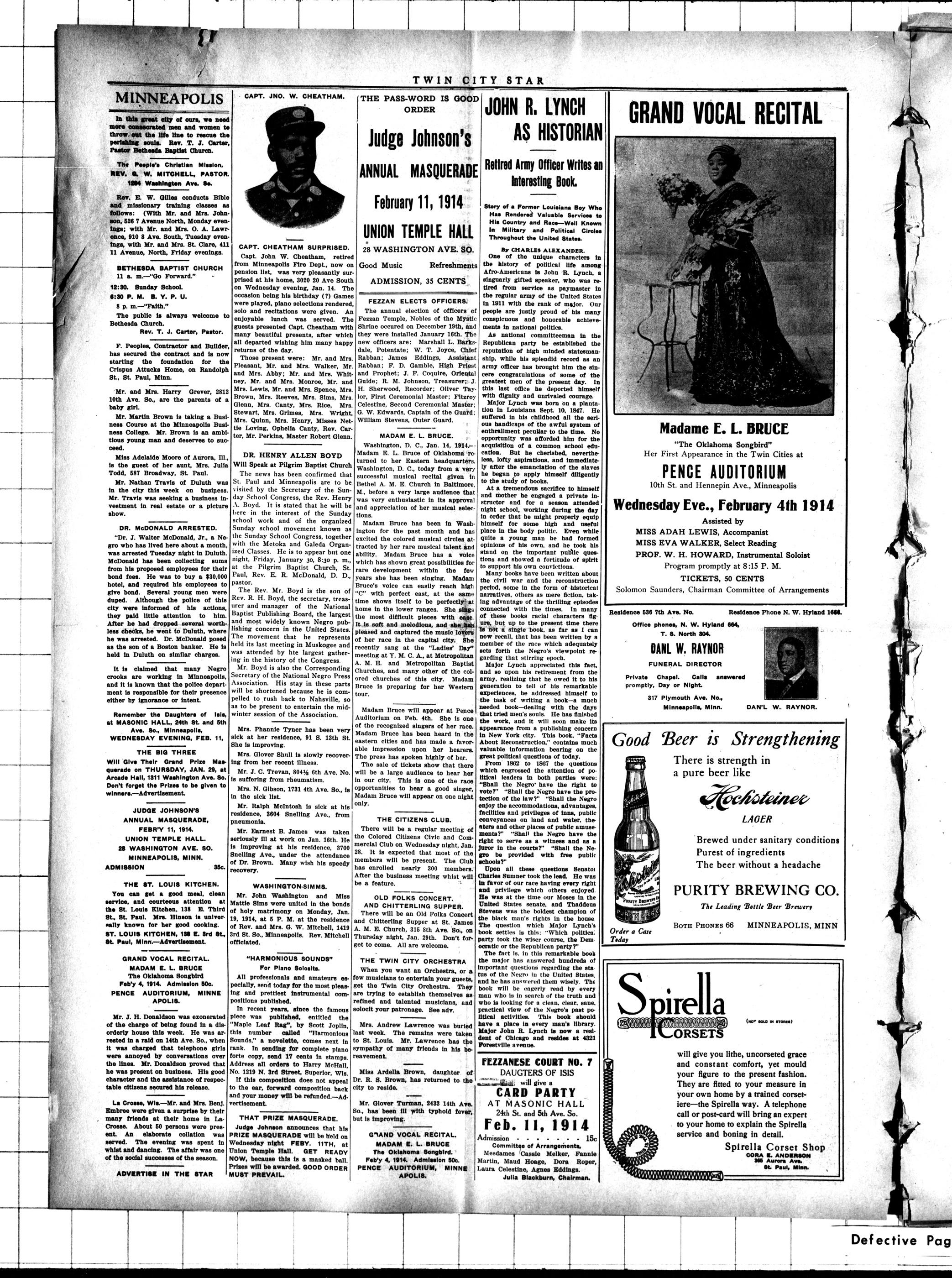
MINNEAPOLIS
In this great city of ours, we need more consecrated men and women to throw out the life line to rescue the perishing souls. Rev. T. J. Carter, Pastor Bethesda Baptist Church.
The People's Christian Mission, REV. G. W. MITCHELL, PASTOR. 1834 Washington Ave. 8e.
Rev. E. W. Gilles conducts Bible and missionary training classes as follows: (With Mr. and Mrs. Johnson, 526 7 Avenue North, Monday evenings; with Mr. and Mrs. O. A. Lawrence, 910 8 Ave. South, Tuesday evenings, with Mr. and Mrs. St. Clare, 411 11 Avenue, North, Friday evenings.
BETHESDA BAPTIST CHURCH
11 a. m.—"Go Forward."
12:30. Sunday School.
The public is always welcome to Bethesda Church.
F. Peoples, Contractor and Builder, has secured the contract and is now starting the foundation for the Crispus Attucks Home, on Randolph St., St. Paul, Minn.
Mr. and Mrs. Harry Grever, 2812 10th Ave. So., are the parents of a baby girl.
Mr. Martin Brown is taking a Business Course at the Minneapolis Business College. Mr. Brown is an ambitious young man and deserves to succeed.
Miss Adelaide Moore of Aurora, Ill., is the guest of her aunt, Mrs. Julia Todd, 587 Broadway, St. Paul.
Mr. Nathan Travis of Duluth was in the city this week on business. Mr. Travis was seeking a business investment in real estate or a picture show.
DR. McDONALD ARRESTED.
"Dr. J. Walter McDonald, Jr., a Negro who has lived here about a month, was arrested Tuesday night in Duluth. McDonald has been collecting sums from his proposed employees for their bond fees. He was to buy a $30,000 hotel, and required his employees to give bond. Several young men were duped. Although the police of this city were informed of his actions, they paid little attention to him. After he dropped several worthless checks, he went to Duluth, where he was arrested. Dr. McDonald posed as the son of a Boston banker. He is held in Duluth on similar charges.
It is claimed that many Negro crooks are working in Minneapolis, and it is known that the police department is responsible for their presence either by ignorance or intent.
Remember the Daughters of Isla,
at MASONIC HALL, 24th St. and 5th
Ave. So., Minneapolis,
AVE. 301, MINNEAPOLIS,
WEDNESDAY EVENING, FEB. 11,
THE BIG THREE
Will Give Their Grand Prize Masquerade on THURSDAY, JAN. 29, at Arcade Hall, 1311 Washington Ave. So. Don't forget the Prizes to be given to winners.—Advertisement.
JUDGE JOHNSON'S
ANNUAL MASQUERADE,
FEBRY 11, 1914.
UNION TEMPLE HALL.
28 WASHINGTON AVE. SO.
MINNEAPOLIS, MINN.
ADMISSION 35c.
THE ST. LOUIS KITCHEN.
You can get a good meal, clean service, and courteous attention at the St. Louis Kitchen, 138 E. Third St. St. Paul. Mrs. Hinson is universally known for her good cooking.
ST. LOUIS KITCHEN, 138 E. 3rd St. St. Paul, Minn.—Advertisement.
GRAND VOCAL RECITAL.
MADAM E. L. BRUCE
The Oklahoma Songbird
Feb'y 4, 1914. Admission 50c.
PENCE AUDITORIUM, MINNE
APOLIS.
Mr. J. H. Donaldson was exonerated of the charge of being found in a disorderly house this week. He was arrested in a raid on 14th Ave. So., when it was charged that telephone girls were annoyed by conversations over the lines. Mr. Donaldson proved that he was present on business. His good character and the assistance of respectable citizens secured his release.
La Crosse, Wls.-Mr. and Mrs. Benj. Embree were given a surprise by their many friends at their home in LaCrosse. About 50 persons were present. An elaborate collation was served. The evening was spent in whist and dancing. The affair was one of the social successes of the season.
ADVERTISE IN THE STAR
CAPT. CHEATHAM SURPRISED.
Capt. John W. Cheatham, retired from Minneapolis Fire Dept., now on pension list, was very pleasantly surprised at his home, 3020 20 Ave South on Wednesday evening, Jan. 14. The occasion being his birthday (?) Games were played, plano selections rendered, solo and recitations were given. An enjoyable lunch was served. The guests presented Capt. Cheatham with many beautiful presents, after which all departed wishing him many happy returns of the day.
Those present were: Mr. and Mrs. Pleasant, Mr. and Mrs. Walker, Mr. and Mrs. Abby; Mr. and Mrs. Whitney, Mr. and Mrs. Monroe, Mr. and Mrs. Lewis, Mr. and Mrs. Spence, Mrs. Brown, Mrs. Reeves, Mrs. Sims, Mrs. Glenn, Mrs. Canty, Mrs. Rice, Mrs. Stewart, Mrs. Grimes, Mrs. Wright, Mrs. Quinn, Mrs. Henry, Misses Nettle Loving, Ophelia Canty, Rev. Carter, Mr. Perkins, Master Robert Glenn.
DR. HENRY ALLEN BOYD
Will Speak at Pilgrim Baptist Church
The news has been confirmed that St. Paul and Minneapolis are to be visited by the Secretary of the Sunday School Congress, the Rev. Henry A. Boyd. It is stated that he will be here in the interest of the Sunday school work and of the organized Sunday school movement known as the Sunday School Congress, together with the Metoka and Galedai Organized Classes. He is to appear but one night, Friday, January 30, 8:30 p.m., at the Pilgrim Baptist Church, St. Paul, Rev. E. R. McDonald, D. D., pastor.
The Rev. Mr. Boyd is the son of Rev. R. H. Boyd, the secretary, treasurer and manager of the National Baptist Publishing Board, the largest and most widely known Negro publishing concern in the United States. The movement that he represents held its last meeting in Muskogee and was attended by he largest gathering in the history of the Congress. Mr. Boyd is also the Corresponding Secretary of the National Negro Press Association. His stay in these parts will be shortened because he is compelled to rush back to Nahsville, so as to be present to entertain the midwinter session of the Association.
Mrs. Phannle Tyner has been very sick at her residence, 91 S. 13th St. She is improving.
Mrs. Glover Shull is slowly recovering from her recent illness.
Mr. J. C. Trevan, 804½ 6th Ave. No. is suffering from rheumatism.
Mrs. N. Gibson, 1731 4th Ave. So., is in the sick list.
Mr. Ralph McIntosh is sick at his residence, 3604 Snelling Ave., from pneumonia.
Mr. Earnest B. James was taken seriously ill at work on Jan. 16th. He is improving at his residence, 3700 Snelling Ave., under the attendance of Dr. Brown. Many wish his speedy recovery.
WASHINGTON-SIMMS.
Mr. John Washington and Miss Mattie Sims were united in the bonds of holy matrimony on Monday, Jan. 19, 1914, at 5 P. M. at the residence of Rev. and Mrs. G. W. Mitchell, 1419 3rd St. So., Minneapolis. Rev. Mitchell officiated.
All professionals and amateurs especially, send today for the most pleasing and prettiest instrumental compositions published.
In recent years, since the famous piece was published, entitled the "Maple Leaf Rag", by Scott Joplin, this number called "Harmonious Sounds," a novellette, comes next in rank. In sending for complete piano forte copy, send 17 cents in stamps. Address all orders to Harry McHall, No. 1219 N. 3rd Street, Superior, Wis.
If this composition does not appeal to the ear, forward composition back and your money will be refunded.—Advertisement.
THAT PRIZE MASQUERADE
Judge Johnson announces that his PRIZE MASQUERADE will be held on Wednesday night FEB. 11th, at Union Temple Hall. GET READY NOW, because this is a masked ball. Prizes will be awarded. GOOD ORDER MUST PREVAIL.
TWIN CITY STAR THE PASS-WORD IS GOOD ORDER JOHN R.
Judge Johnson's
ANNUAL MASQUERADE
February 11, 1914
UNION TEMPLE HALL
28 WASHINGTON AVE. SO.
Good Music Refreshments
ADMISSION, 35 CENTS
FEZZAN ELECTS OFFICERS
The annual election of officers of Fezzan Temple, Nobles of the Mystic Shrine occurred on December 19th, and they were installed January 16th. The new officers are: Marshall L. Barksdale, Potentate; W. T. Joyce, Chief Rabban; James Eddings, Assistant Rabban; F. D. Gamble, High Priest and Prophet; J. F. Coquire, Oriental Guide; R. M. Johnson, Treasurer; J. H. Sherwood, Recorder; Oliver Taylor, First Ceremonial Master; Fitzroy Celestine, Second Ceremonial Master; G. W. Edwards, Captain of the Guard; William Stevens, Outer Guard.
MADAM E. L. BRUCE.
Washington, D. C., Jan. 14, 1914.-Madam E. L. Bruce of Oklahoma returned to her Eastern headquarters. Washington, D. C., today from a very successful musical recital given in Bethel A. M. E. Church in Baltimore. M., before a very large audience that was very enthusiastic in its approval and appreciation of her musical selections.
Madam Bruce has been in Washington for the past month and has excited the colored musical circles attracted by her rare musical talent and ability. Madam Bruce has a voice which has shown great possibilities for rare development within the few years she has been singing. Madam Bruce's voice can easily reach high "C" with perfect east, at the same time shows itself to be perfectly at home in the lower ranges. She sings the most difficult pieces with ease. It is soft and melodious, and she has pleased and captured the music lovers of her race in the capital city. She recently sang at the "Ladies' Day" meeting at Y. M. C. A., at Metropolitan A. M. E. and Metropolitan Baptist Churches, and many other of the colored churches of this city. Madam Bruce is preparing for her Western tour.
Madam Bruce will appear at Pence Auditorium on Feb. 4th. She is one of the recognized singers of her race. Madam Bruce has been heard in the eastern cities and has made a favorable impression upon her hearers. The press has spoken highly of her. The sale of tickets show that there will be a large audience to hear her in our city. This is one of the race opportunities to hear a good singer, Madam Bruce will appear on one night only.
THE CITIZENS CLUB.
There will be a regular meeting of the Colored Citizens Civic and Commercial Club on Wednesday night, Jan. 28. It is expected that most of the members will be present. The Club has enrolled nearly 300 members. After the business meeting whist will be a feature.
OLD FOLKS CONCERT.
AND CHITTERLING SUPPER.
There will be an Old Folks Concert and Chitterling Supper at St. James A. M. E. Church, 315 8th Ave. So., on Thursday night, Jan. 29th. Don't forget to come. All are welcome.
THE TWIN CITY ORCHESTRA
When you want an Orchestra, or a few musicians to entertain your guests, get the Twin City Orchestra. They are trying to establish themselves as refined and talented musicians, and solocit your patronage. See adv.
Mrs. Andrew Lawrence was buried last week. The remains were taken to St. Louis. Mr. Lawrence has the sympathy of many friends in his bereavement.
Miss Ardella Brown, daughter of Dr. R. S. Brown, has returned to the city to reside.
Mr. Glover Turman, 2433 14th Ave. So., has been ill with typhoid fever, but is improving.
The Oklahoma Songbird.
Feb'y 4, 1914. Admission 50c.
PENCE AUDITORIUM, MINNE
APOLIS.
JOHN R. LYNCH AS HISTORIAN
Retired Army Officer Writes an Interesting Book.
Story of a Former Louisiana Boy Who Has Rendered Valuable Services to His Country and Race—Well Known In Military and Political Circles Throughout the United States.
By CHARLES ALEXANDER.
One of the unique characters in the history of political life among Afro-Americans is John R. Lynch, a singuarly gifted speaker, who was retired from service as paymaster in the regular army of the United States in 1911 with the rank of major. Our people are justly proud of his many conspicuous and honorable achievements in national politics.
As national committeeman in the Republican party he established the reputation of high minded statesmanship, while his splendid record as an army officer has brought him the sincere congratulations of some of the greatest men of the present day. In this last office he deported himself with dignity and unrivaled courage.
Major Lynch was born on a plantation in Louisiana Sept. 10, 1847. He suffered in his childhood all the serious handicaps of the awful system of enthrallment peculiar to the time. No opportunity was afforded him for the acquisition of a common school education. But he cherished, nevertheless, lofty aspirations, and immediately after the emancipation of the slaves he began to apply himself diligently to the study of books.
At a tremendous sacrifice to himself and mother he engaged a private instructor and for a season attended night school, working during the day in order that he might properly equil himself for some high and useful place in the body politic. Even while quite a young man he had formed opinions of his own, and he took his stand on the important public questions and showed a fortitude of spirit to support his own convictions.
Many books have been written about the civil war and the reconstruction period, some in the form of historical narratives, others as mere fiction, taking advantage of the thrilling episodes connected with the times. In many of these books racial characters figure, but up to the present time there is not a single book, as far as I can now recall, that has been written by a member of the race which adequately sets forth the Negro's viewpoint regarding that stirring epoch.
Major Lynch appreciated this fact, and so upon his retirement from the army, realizing that he owed it to his generation to tell of his remarkable experiences, he addressed himself to the task of writing a book—a much needed book—dealing with the days that tried men's souls. He has finished the work, and it will soon make its appearance from a publishing concern in New York city. This book, "Facts About Reconstruction," contains much valuable information bearing on the great political questions of today.
From 1862 to 1867 the questions which engrossed the attention of political leaders in both parties were: "Shall the Negro have the right to vote?" "Shall the Negro have the protection of the law?" "Shall the Negro enjoy the accommodations, advantages, facilities and privileges of inns, public conveyances on land and water, theaters and other places of public amusements?" "Shall the Negro have the right to serve as a witness and as a juror in the courts?" "Shall the Negro be provided with free public schools?"
Upon all these questions Senator Charles Sumner took the lead. He was in favor of our race having every right and privilege which others enjoyed. He was at the time our Moses in the United States senate, and Thaddeus Stevens was the boldest champion of the black man's rights in the house. The question which Major Lynch's book settles is this: "Which political party took the wiser course, the Democratic or the Republican party?"
The fact is, in this remarkable book the major has answered hundreds of important questions regarding the status of the Negro in the United States, and he has answered them wisely. The book will be eagerly read by every man who is in search of the truth and who is looking for a clean, clear,ane, practical view of the Negro's past political activities. This book should have a place in every man's library. Major John R. Lynch is now a resident of Chicago and residens at 4321 Forestville avenue.
FEZZANESE COURT NO. 7
DAUGTERS OF ISIS
will give a
CARD PARTY
AT MASONIC HALL
24th St. and 5th Ave. So.
Feb. 11, 1914
Admission 15c
Committee of Arrangements,
Mesdames Cassie Melker, Fannie
Martin, Maud Hoage, Dora Roper,
Laura Celestine, Agnes Eddings.
Julia Blackburn, Chairman.
THE WOMAN WHO WAS THE LADY OF THE WORLD
"The Oklahoma Songbird"
Her First Appearance in the Twin Cities at
Office phones, N. W. Hyland 664,
T. S. North 304.
M.
DANL W. RAYNOR
FUNERAL DIRECTOR
317 Plymouth Ave. No. Minneapolis, Minn. DAN'L W. RAYNOR. Good Beer is Strengthening
Kohlstein
THE PIONEER
PURITY BREWING CO.
BREWING & BOTTLE
PURITY BREWING CO.
There is strength in a pure beer like Hochsteiner
Brewed under sanitary conditions
Purest of ingredients
The beer without a headache
PURITY BREWING CO.
The Leading Bottle Beer Brewery
Order a Case Today
Both Phones 66 MINNEAPOLIS, MINN
BOTH PHONES 66 MINNEAPOLIS, MINN
Order a Case Today
Spirella CORSETS
will give you lithe, uncorseted grace and constant comfort, yet mould your figure to the present fashion. They are fitted to your measure in your own home by a trained corsetiere—the Spirella way. A telephone call or post-card will bring an expert to your home to explain the Spirella service and boning in detail.
Spirella Corset Shop
CORA E. ANDERSON
365 Aurora Ave.
St. Paul, Minn.
---
Defective Pag
fective Page
THE BIG THREE
[Picture of two men in formal attire, one wearing a bow tie and the other wearing a suit with a bow tie. The background is plain black.]]
EDW. PIPKIN, P. H. SOUTHALL
ROBT. GLENN.
NEXT THURSDAY NIGHT
PRIZE MASQUERADE
Jany, 29, 1914.
1811 WASHINGTON AVE. SO.
MINNEAPOLIS.
THE CARVER HOTEL
On All Car Lines
1308-10 WASHINGTON AVE. 80.
28 Newly Furnished. Rooms.
By Day, Week or Month.
Special Rates to Theatrical People.
Mrs. Alice (Mother) Carver, Prop.
N. W. Phone Main 863
BARBER SHOP AND BATHS
BARBER SHOP AND BATHS.
PAEGEL
802 NICOLLET AVE.
WILL MAKE YOUR WATCH KEEP TIME.
We do the best WATCH, CLOCK and JEWELRY REPAIRING in the city at lowest prices.
SPECIAL AGENTS for the HAMILTON, ELGIN, WALTHAM and ROCKFORD RAILROAD WATCHES.
Res. 1210 6 Ave. N. Phone Hy. 3770
TWIN CITY ORCHESTRA.
Write or Call For Rates.
Music Furnished For All Occasions
We carry a large library of the latest and most Popular Standard Music.
J. F. STEVENS T. E. CASON
Leader Manager
DO IT NOW!!! DON'T WAIT!!!
Come in, and have your teeth fixed and pay in Weekly or Monthly installments. We have Dr. H. Pierce, "the famous extractor" with us every Monday and Friday and by special appointment. N. W. Colfax 1846.
RED CROSS DENTAL PARLORS
DR. M. W. JUDY, Mgr.
3838 4th Ave. Ste. Minneapolis.
W. S CONRAD CO., Distributors
NO. 1. WESTERN AVE. MINN.
NO. 140. E. 6th ST., ST. PAUL.
Southern Theatre
SevenCorners
15th and Washington Avenues So.
Refined Vaudeville
Moving Picture Shows
Continuous Performance
Admission 10 Cents
Children 5 Cents
Peterson, The Druggist
1501 Washington Ave. So.
TOILET ARTICLES, DRUGS
PRESCRIPTIONS.
No Solicits You' Pairnage.
POPULAR PRICED SHOE REPAIRI'YO
WE FIX 'EM WHILE YOU W LIT
Moon's Sewed Sole, ... 75e
Ladies ... 46e
Moon's Nailed '... 60 and 60e
Rubber Hoops, ... 40e
Ladies ... and Boys' nailed soles ... 40e
SEVEN CORNERS SHOE REPAIR SHOP
1434 WASHINGTON AVERUE SOUTH
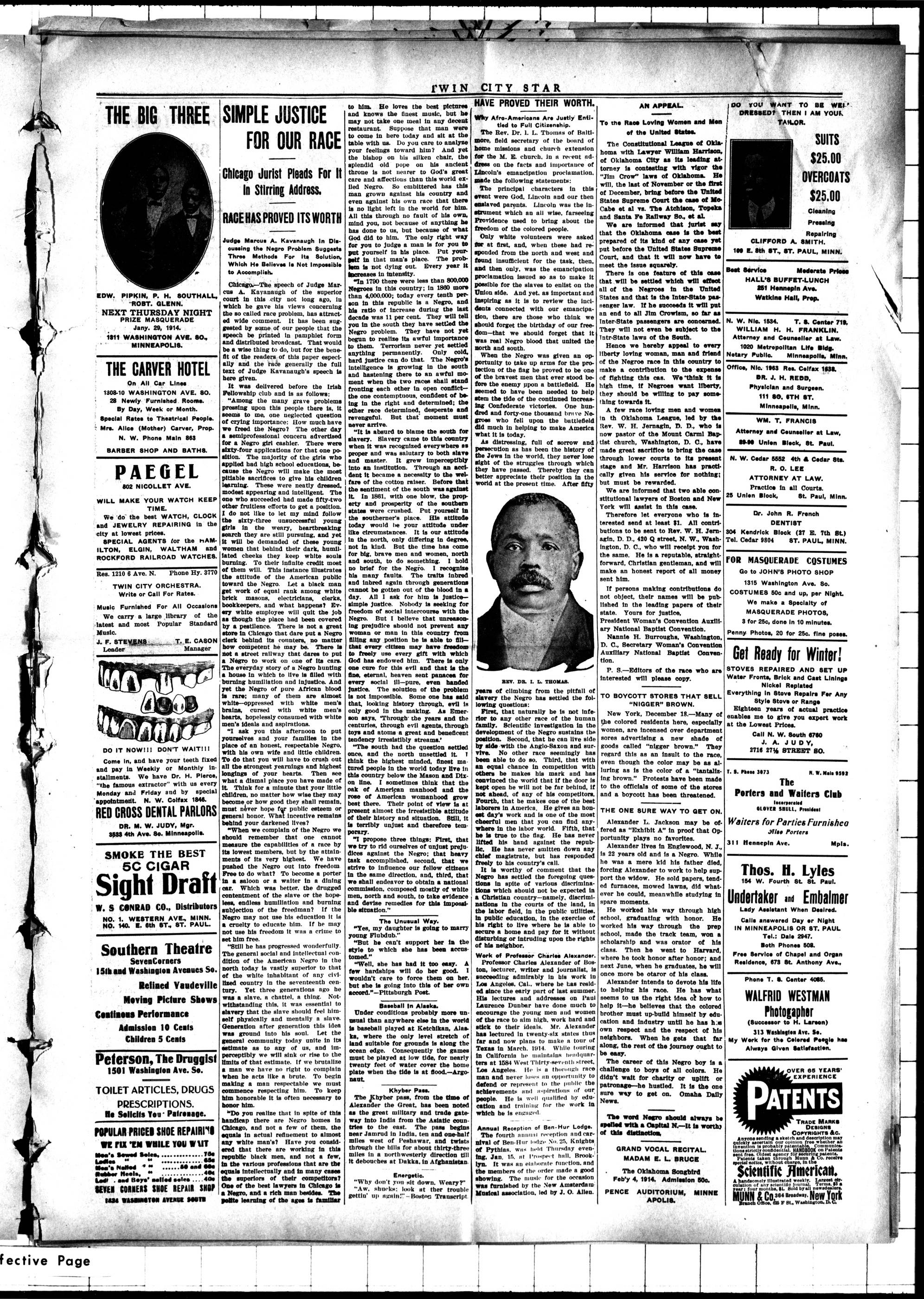
SIMPLE JUSTICE FOR OUR RACE
Chicago Jurist Pleads For It In Stirring Address.
RAGE HAS PROVED ITS WORTH
Judge Marous A. Kavanaugh In Discussing the Negro Problem Suggests Three Methods For Its Solution, Which He Believes Is Not Impossible to Accomplish.
Chicago—The speech of Judge Marcus A. Kavanaugh of the superior court in this city not long ago, in which he gave his views concerning the so called race problem, has attracted wide comment. It has been suggested by some of our people that the speech be printed in pamphlet form and distributed broadcast. That would be a wise thing to do, but for the benefit of the readers of this paper especially and the race generally the full text of Judge Kavanaugh's speech is here given.
It was delivered before the Irish Fellowship club and is as follows:
"Among the many grave problems pressing upon this people there is, it seems to me, one neglected question of crying importance: How much have we freed the Negro? The other day a semiprofessional concern advertised for a Negro girl cashier. There were sixty-four applications for that one position. The majority of the girls who applied had high school education, because the Negro will make the most pitiable sacrifices to give his children learning. These were neatly dressed, modest appearing and intelligent. The one who succeeded had made fifty-two other fruitless efforts to get a position. I do not like to let my mind follow the sixty-three unsuccessful young girls in the weary, heartbreaking search they are still pursuing, and yet it will be demanded of these young women that behind their dark, humiliated cheeks they keep white souls burning. To their infinite credit most of them will. This instance illustrates the attitude of the American public toward the Negro. Let a black man get work of equal rank among white brick masons, electricians, clerks, bookkeepers, and what happens? Every white employee will quit the job as though the place had been covered by a pestilence. There is not a great store in Chicago that dare put a Negro clerk behind its counters, no matter how competent he may be. There is not a street railway that dares to put a Negro to work on one of its cars. The everyday story of a Negro hunting a house in which to live is filled with burning humiliation and injustice. And yet the Negro of pure African blood is rare; many of them are almost white—oppressed with white men's brains, cursed with white men's hearts, hopelessly consumed with white men's ideals and aspirations.
"I ask you this afternoon to put yourselves and your families in the place of an honest, respectable Negro, with his own wife and little children. To do that you will have to crush out all the strongest yearnings and highest longings of your hearts. Then see what a dismal place you have made of it. Think for a minute that your little children, no matter how wise they may become or how good they shall remain, must never hope for public esteem or general honor. What incentive remains behind your darkened lives?
"When we complain of the Negro we should remember that one cannot measure the capabilities of a race by its lowest members, but by the attainments of its very highest. We have pushed the Negro out into freedom Free to do what? To become a porter in a saloon or a waiter in a dining car. Which was better, the drugged contentment of the slave or the hopeless, endless humiliation and burning subjection of the freedman? If the Negro may not use his education it is a cruelty to educate him. If he may not use his freedom it was a crime to set him free.
"Still he has progressed wonderfully. The general social and intellectual condition of the American Negro in the north today is vastly superior to that of the white inhabitant of any civilized country in the seventeenth century. Yet three generations ago he was a slave, a chattel, a thing. Notwithstanding this, it was essential to slavery that the slave should feel himself physically and mentally a slave. Generation after generation this idea was ground into his soul. Let the general community today unite in its estimate as to any of us, and impereceptibly we will sink or rise to the limits of that estimate. If we brutalize a man we have no right to complain when he acts like a brute. To begin making a man respectable we must commence respecting him. To keep him honorable it is often necessary to honor him.
"Do you realize that in spite of this handicap there are Negro homes in Chicago, and not a few of them, the equals in actual refinement to almost any white man's? Have you considered that there are working in this republic black men, and not a few, in the various professions that are the equals intellectually and in many cases the superiors of their competitors? One of the best lawyers in Chicago is a Negro, and a rich man besides. The polite learning of the ages is familiar
TWIN CITY STAR
to him. He loves the best pictures and knows the finest music, but he may not take one meal in any decent restaurant. Suppose that man were to come in here today and sit at the table with us. Do you care to analyze your feelings toward him? And yet the bishop on his silken chair, the splendid old pope on his ancient throne is not nearer to God's great care and affections than this world exiled Negro. So embittered has this man grown against his country and even against his own race that there is no light left in the world for him. All this through no fault of his own, mind you, not because of anything he has done to us, but because of what God did to him. The only right way for you to judge a man is for you to put yourself in his place. Put yourself in that man's place. The problem is not dying out. Every year it increases in intensity.
"In 1700 there were less than 800,000 Negroes in this country; in 1860 more than 4,000,000; today every tenth person in this republic is a Negro, and his ratio of increase during the last decade was 11 per cent. They will tell you in the south they have settled the Negro problem. They have not yet begun to realize its awful importance to them. Terrorism never yet settled anything permanently. Only cold, hard justice can do that. The Negro's intelligence is growing in the south and hastening there to an awful moment when the two races shall stand fronting each other in open conflict—the one contemptuous, confident of being in the right and determined; the other race determined, desperate and revengeful. But that moment must never arrive.
"It is absurd to blame the south for slavery. Slavery came to this country when it was recognized everywhere as proper and was salutary to both slave and master. It grew imperceptibly into an institution. Through an accident it became a necessity to the welfare of the cotton raiser. Before that the sentiment of the south was against it. In 1861, with one blow, the property and prosperity of the southern states were crushed. Put yourself in the southerner's place. His attitude today would be your attitude under like circumstances. It is our attitude in the north, only differing in degree, not in kind. But the time has come for big, brave men and women, north and south, to do something. I hold no brief for the Negro. I recognize his many faults. The traits inbred and inbred again through generations cannot be gotten out of the blood in a day. All I ask for him is justice—simple justice. Nobody is seeking for freedom of social intercourse with the Negro. But I believe that unreasoning prejudice should not prevent any woman or man in this country from filling any position he is able to fill—that every citizen may have freedom to freely use every gift with which God has endowed him. There is only one cure for this evil and that is the fine, eternal, heaven sent panacas for every social ill—pure, even handed justice. The solution of the problem is not impossible. Some one has said that, looking history through, evil is only good in the making. As Emerson says, "Through the years and the centuries, through evil agents, through toys and atoms a great and beneficent tendency irresistibly streams."
"The south had the question settled once, and the north unsettled it. I think the highest minded, finest matured people in the world today live in this country below the Mason and Dixon line. I sometimes think that the oak of American manhood and the rose of American womanhood grow best there. Their point of view is at present almost the irresistible attitude of their history and situation. Still, it is terribly unjust and therefore temporary.
"I propose three things: First, that we try to rid ourselves of unjust prejudices against the Negro; that heavy task accomplished, second, that we strive to influence our fellow citizens in the same direction, and, third, that we shall endeavor to obtain a national commission, composed mostly of white men, north and south, to take evidence and devise remedies for this impossible situation."
"Yes, my daughter is going to marry young Flubdub."
"But he can't support her in the style to which she has been accustomed."
"Well, she has had it too easy. A few hardships will do her good. I wouldn't care to force them on her, but she is going into this of her own accord."—Pittsburgh Post.
Baseball in Alaska.
Under conditions probably more unusual than anywhere else in the world is baseball played at Ketchikan, Alaska, where the only level stretch of land suitable for grounds is along the ocean edge. Consequently the games must be played at low tide, for nearly twenty feet of water cover the home plate when the tide is at flood.—Argonaut
The Khyber pass, from the time of Alexander the Great, has been noted as the great military and trade gateway into India from the Asiatic countries to the east. The pass begins near Jarnud in India, ten and one-half miles from Peshawar, and twists through the hills for about thirty-three miles in a northwesterly direction till it debouches at Dakka, in Afghanistan.
Energetic.
"Why don't you sit down, Weary?"
"Aw, shucks: look at her trouble gettin' up again." - Boston Transcript
The Unusual Way.
Baseball In Alaska.
Khyber Pass.
Energetic.
HAVE PROVED THEIR WORTH.
Why Afro-Americans Are Justly Entitled to Full Citizenship.
The Rev. Dr. L. I. Thomas of Baltimore, field secretary of the board of home missions and church extension for the M. E. church, in a recent address on the facts and importance of Lincoln's emancipation proclamation, made the following statements:
The principal characters in this event were God, Lincoln and our then enslaved parents. Lincoln was the instrument which an all wise, fearing Providence used to bring about the freedom of the colored people.
Only white volunteers were asked for at first, and, when these had responded from the north and west and found insufficient for the task, then, and then only, was the emancipation proclamation issued so as to make it possible for the slaves to enlist on the Union side. And yet, as important and inspiring as it is to review the incidents connected with our emancipation, there are those who think we should forget the birthday of our freedom—that we should forget that it was real Negro blood that united the north and south.
When the Negro was given an opportunity to take up arms for the protection of the flag he proved to be one of the bravest men that ever stood before the enemy upon a battlefield. He seemed to have been needed to help stem the tide of the continued increasing Confederate victories. One hundred and forty-one thousand brave Negroes who fell upon the battlefield did much in helping to make America what it is today.
As distressing, full of sorrow and persecution as has been the history of the Jews in the world, they never lose sight of the struggles through which they have passed. Thereby they can better appreciate their position in the world at the present time. After fifty
[Name]
REV. DR. L. L. THOMAS.
years of climbing from the pitfall of
slavery the Negro has settled the
following questions:
First, that naturally he is not inferior to any other race of the human family. Scientific investigation in the development of the Negro sustains the position. Second, that he can live side by side with the Anglo-Saxon and survive. No other race seemingly has been able to do so. Third, that with an equal chance in competition with others he makes his mark and has convinced the world that if the door is kept open he will not be far behind, if not ahead, of any of his competitors. Fourth, that he makes one of the best laborers in America. He gives an honest day's work and is one of the most cheerful men that you can find anywhere in the labor world. Fifth, that he is true to the flag. He has never lifted his hand against the republic. He has never smitten down any chief magistrate, but has responded freely to his country's call.
It is worthy of comment that the Negro has settled the foregoing questions in spite of various discriminations which should not be expected in a Christian country—namely, discriminations in the courts of the land, in the labor field, in the public utilities, in public education, in the exercise of his right to live where he is able to secure a home and pay for it without disturbing or intruding upon the rights of his neighbor.
Work of Professor Charles Alexander
Professor Charles Alexander of Boston, lecturer, writer and journalist, is succeeding admirably in his work in Los Angeles, Cal., where he has resided since the early part of last summer.
His lectures and addresses on Paul Laurence Dunbar have done much to encourage the young men and women of the race to aim high, work hard and stick to their ideals. Mr. Alexander has lectured in twenty-six states thus far and now plans to make a tour of Texas in March, 1914. While touring in California he maintains headquarters at 1584 West Thirty-seventh street, Los Angeles. He is a thorough race man and never loses an opportunity to defend or represent to the public the achievements and aspirations of our people. He is well qualified by education and training for the work in which he is engaged.
Annual Reception of Ben-Hur Lodge.
The fourth annual reception and carnival of Ben-Hur lodge No. 25, Knights of Pythias, was held Thursday evening, Jan. 15, at Prospect hall, Brooklyn. It was an elaborate function, and the members of the order made a good showing. The music for the occasion was furnished by the New Amsterdam Musical association, led by J. O. Allen.
AN APPEAL.
To the Race Loving Women and Men of the United States.
The Constitutional League of Oklahoma with Lawyer William Harrison, of Oklahoma City as its leading attorney is contesting with vigor the "Jim Crow" laws of Oklahoma. He will, the last of November or the first of December, bring before the United States Supreme Court the case of McCabe et al vs. The Atchison, Topeka and Santa Fe Railway So., et al. We are informed that jurist say that the Oklahoma case is the best prepared of its kind of any case yet put before the United States Supreme Court, and that it will now have to meet the issue squarely.
There is one feature of this case that will be settled which will effect all of the Negroes in the United States and that is the Inter-State passenger law. If he succeeds it will put an end to all Jim Crowism, so far as Inter-State passengers are concerned. They will not even be subject to the Intr-State laws of the South.
Hence we hereby appeal to every liberty loving woman, man and friend of the Negroe race in this country to make a contribution to the expense of fighting this cas. We think it is high time, if Negroes want liberty, they should be willing to pay something towards it.
A few race loving men and women in the Oklahoma League, led by the Rev. W. H. Jernagin, D. D., who is now pastor of the Mount Carmil Baptist church, Washington, D. C., have made great sacrifice to bring the case through lower courts to its present stage and Mr. Harrison has practically given his service for nothing; but must be rewarded.
We are informed that two able constitutional lawyers of Boston and New York will assist in this case.
Therefore let everyone who is interested send at least $1. All contributions to be sent to Rev. W. H. Jernagin, D. D., 420 Q street, N. W., Washington, D. C., who will receipt you for the same. He is a reputable, straight forward, Christian gentleman, and will make an honest report of all money sent him.
If persons making contributions do not object, their names will be published in the leading papers of their state. Yours for justice, President Woman's Convention Auxiliary National Baptist Convention. Nannie H. Burroughs, Washington, D. C., Secretary Woman's Convention Auxiliary National Baptist Convention. P. S.-Editors of the race who are interested will please copy.
TO BOYCOTT STORES THAT SELL "NIGGER" BROWN.
New York, December 18.—Many of the colored residents here, especially women, are incensed over department sores advertising a new shade of goods called "nigger brown." They regard this as an insult to the race, even though the color may be as alluring as is the color of a "tantalizing brown." Protests have been made to the officials of some of the stores and a boycott has been threatened.
THE ONE SURE WAY TO GET ON.
Alexander L. Jackson may be offered as "Exhibit A" in proof that Opportunity plays no favorites.
Alexander lives in Englewood, N. J., is 22 years old and is a Negro. While he was a mere kid his father died, forcing Alexander to work to help support the widow. He sold papers, tended furnaces, mowed lawns, did whatever he could, meanwhile studying in spare moments.
He worked his way through high school, graduating with honor. He worked his way through the prep school, made the track team, won a scholarship and was orator of his class. Then he went to Harvard, where he took honor after honor; and next June, when he graduates, he will once more be orator of his class.
Alexander intends to devote his life to helping his race. He has what seems to us the right idea of how to help it—he believes that the colored brother must up-build himself by education and industry until he has his own respect and the respect of his neighbors. When he gets that far along, the rest of the journey ought to be easy.
The career of this Negro boy is a challenge to boys of all colors. He didn't wait for charity or uplift or patronage—he hustled. It is the one sure way to get on. Omaha Daily News.
The word Negro should always be spelled with a Capital N.—it is worth of this distinction.
GRAND VOCAL RECITAL
MADAM E. L. BRUCE
PENCE AUDITORIUM, MINNE
APOLIS.
DO YOU WANT TO BE WELL
DRESSED? THEN I AM YOUR
TAILOR.
SUITS
$25.00
OVERCOATS
$25.00
Cleaning
Pressing
SUITS
$25.00
OVERCOATS
$25.00
Cleaning
Pressing
Repairing
CLIFFORD A. SMITH.
109 E. 8th ST., ST. PAUL, MINN.
Best Service Moderate Prices
HALL'S BUFFET-LUNCH
281 Hennepin Ave.
Watkins Hall, Prop.
N. W. Nic. 1534. T. S. Center 719,
WILLIAM H. H. FRANKLIN.
Attorney and Counselor at Law.
1020 Metropolitan Life Bldg.
Notary Public. Minneapolis, Minn.
Office, Nic. 1963 Res. Celfax 1638.
DR. J. H. REDD,
Physician and Surgeen.
111 SO. 6TH ST.
Minneapolis, Minn.
WM. T. FRANCIS
Attorney and Counselor at Law,
89-99 Union Block, St. Paul.
N. W. Cedar 5552 4th & Cedar Sts.
R. O. LEE
ATTORNEY AT LAW.
Practice in all Courts.
25 Union Block, St. Paul, Minn.
Dr. John R. French
DENTIST
304 Kendrick Block (27 E. 7th St.)
Tel. Cedar 9804 ST. PAUL, MINN.
FOR MASQUERADE COSTUMES
Go to JOHN'S PHOTO SHOP
1315 Washington Ave. So.
COSTUMES 50c and up, per Night.
We make a Specialty of
MASQUERADE PHOTOS,
3 for 25c, done in 10 minutes.
Penny Photos, 20 for 25c, fine poses.
Get Ready for Winter!
STOVES REPAIRED AND SET UP
Water Fronte, Brick and Cast Linings
Nickel Replated
Everything in Stove Repairs Fer Any
Style Stove or Range
Eighteen years of actual practice
enables me to give you expert work
at the Lowest Prices.
Call N. W. South 6760
J. A. J U D Y,
2716 27% STREET SO.
T. S. Phone 3073 N. W. Main 9592
The
Porters and Waiters Club
Incorporated
GLOVER SHULL, President
Waiters for Parties Furnished
Also Porters
311 Hennepin Ave. Mpls.
Lady Assistant When Desired.
Calls answered Day or Night
IN MINNEAPOLIS OR ST. PAUL
Tel.: Dale 2947.
Both Phones 508.
Free Service of Chapel and Organ
Residence, 673 St. Anthony Ave.,
Phone T. S. Center 4085.
WALFRID WESTMAN
Photographer
(Successor to H. Lareon)
313 Washington Ave. Se.
My Work for the Colored People has
Always Given Satisfaction.
OVER 65 YEARS'
EXPERIENCE
PATENTS
TRADE MARKS
DESIGNS
COPYRIGHT A.C.
Anyone sending a sketch and description may
quickly ascertain our opinion free whether an
inventor open all rights to comment.
tissues strictly confidential. HANDBOOK on Patents
sent free. Oldest agency for securing patents.
Patent taken through Mamu Co. receive
special notice, without charge, in the
Scientific American.
A handsomely illustrated weekly. Largest collection
of art from our four months. St. Sold by all new
newspapers.
MUNN & Co. 384 Broadway. New York
Bronx Office. 5 F. St. Washington, D.C.
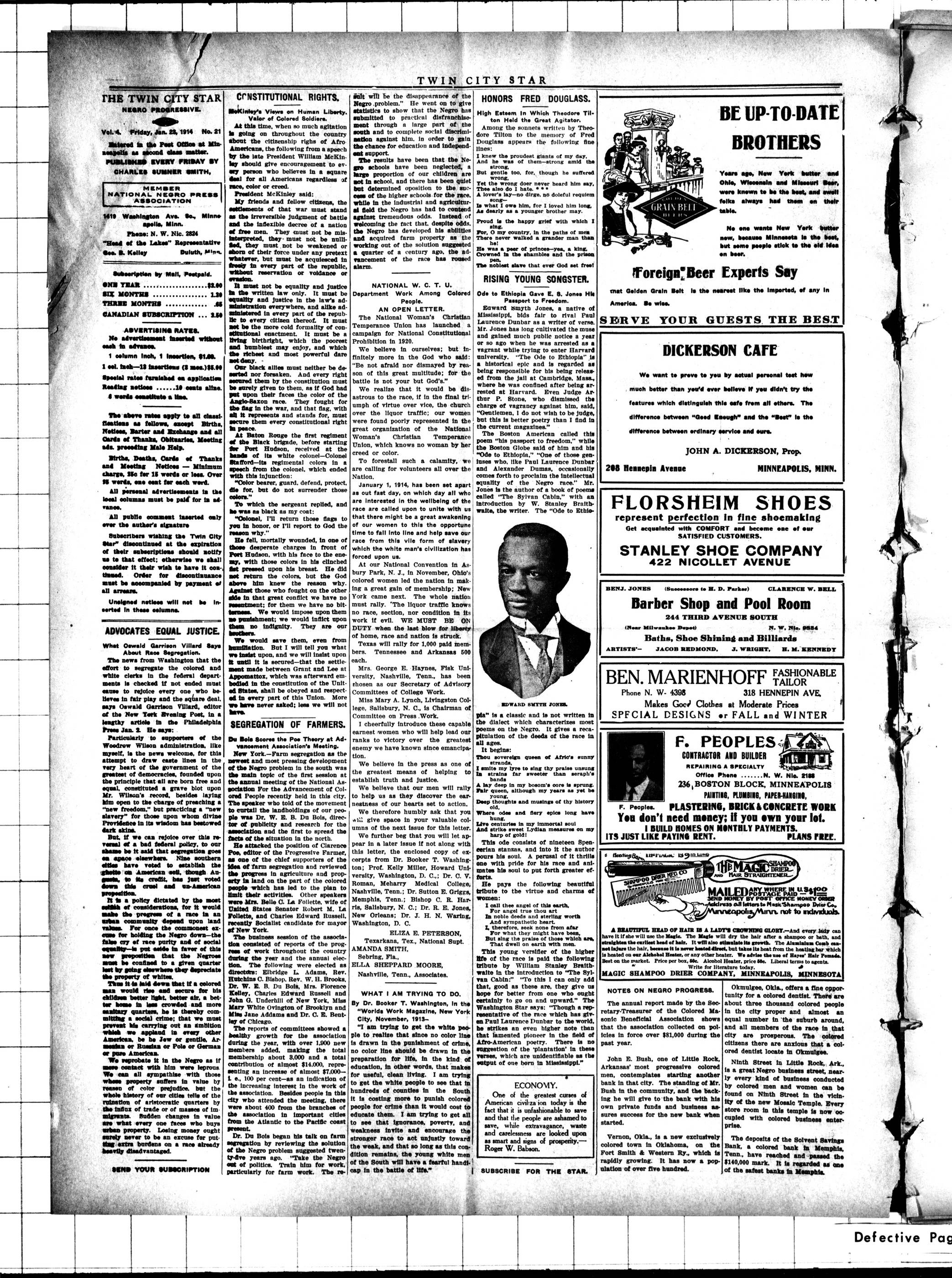
Vol. 4, Friday, Jan. 23, 1914 No. 21
Entered in the Post Office at Minneapolis as second class matter.
PUBLISHED EVERY FRIDAY BY CHARLES SUMNER SMITH,
MEMBER
NATIONAL NEGRO PRESS
ASSOCIATION
1419 Washington Ave. So., Minneapolis, Minn.
Phone: N. W. Nic. 2824
"Head of the Lakes" Representative
Geo. B. Kelley
Duluth, Minn.
Subscription by Mall, Postpaid.
ONE YEAR ..... $2.00
SIX MONTHS ..... 1.20
THREE MONTHS ..... .65
CANADIAN SUBSCRIPTION ..... 2.50
ADVERTISING RATES.
No advertisement inserted without cash in advance.
1 column inch, 1 insertion, $1.00.
1 col. inch—13 insertions (5 men.) $5.00
Special rates furnished on application
Reading notices ..... 10 cents aline.
6 words constitute a line.
The above rates apply to all classifications as follows, except Births, Notices, Barter and Exchange and all Cards of Thanks, Obstacles, Meeting ads, preceding Male Help.
Births, Deaths, Cards of Thanks and Meeting Netics — Minimum charge, $50 for 15 words or less. Over 95 words, one cent for each word.
All personal advertisements in the local columns must be paid for in advance.
All public comment inserted only over the author's signature
Subscribers wishing the Twin City Star" discontinued at the expiration of their subscriptions should notify us to that effect; otherwise we shall consider it their wish to have it continued. Order for discontinuance must be accompanied by payment of all arrears.
Unsigned netics will not be inserted in these columns.
ADVOCATES EQUAL JUSTICE.
What Oswald Garrison Villard Says About Race Segregation.
The news from Washington that the effort to segregate the colored and white clerks in the federal departments is checked if not ended must cause to rejoice every one who believes in fair play and the square deal. says Oswald Garrison Villard, editor of the New York Evening Post, in a lengthy article in the Philadelphia Press Jan. 2. He says:
Particularly to supporters of the Woodrow Wilson administration, like myself, is the news welcome, for this attempt to draw caste lines in the very heart of the government of the greatest of democracies, founded upon the principle that all are born free and equal, constituted a grave blot upon Mr. Wilson's record, besides laying him open to the charge of preaching a "new freedom," but practicing a "new slavery" for those upon whom divine Providence in its wisdom has bestowed dark skins.
But, if we can rejoice over this reversal of a bad federal policy, to our shame be it said that segregation goes on space elsewhere. Nine southern cities have voted to establish the ghetto on American soil, though Augusta, to its credit, has just voted down this cruel and un-American uprising.
It is a policy dictated by the most seismic of considerations, for it would make the progress of a race in an urban community depend upon land value. For once the commonest excuse for holding the Negro down—the false cry of race purity and of social equality—is put aside in favor of this new proposition that the Negroes must be confined to a given quarter last by going elsewhere they depreciate the property of whites.
Thus it is laid down that if a colored man would rise and secure for his children better light, better air, a better home in less crowded and more sanitary quarters, he is thereby committing a social crime; that we must prevent his carrying out an ambition which we applaud in every other American, be he Jew or gentle, American or Russian or Pole or German or pure American.
We reprobate it in the Negro as if more contact with him were lepros. We can all sympathize with those whose property suffers in value by reason of color prejudice, but the whole history of our cities tells of the ration of aristocratic quarters by the infux of trade or of masses of immigrants. Sudden changes in value are what every one faces who buys urban property. Losing money ought surely never to be an excuse for putting extra burdens on a race already heavily disadvantaged.
SEND YOUR SUBSCRIPTION
CONSTITUTIONAL RIGHTS.
McKinley's Views on Human Liberty
Valor of Colored Soldiers.
Valor of Colored Soldiers.
At this time, when so much agitation is going on throughout the country about the citizenship righs of Afro-Americans, the following from a speech by the late President William McKinley should give encouragement to every person who believes in a square deal for all Americans regardless of race, color or creed.
President McKinley said:
My friends and fellow citizens, the settlements of that war must stand as the irreversible judgment of battle and the inflexible decree of a nation of free men. They must not be misinterpreted, they must not be nullified, they must not be weakened or shorn of their force under any pretext whatever, but must be acquiesced in freely in every part of the republic, without reservation or voidance. It must not be equality and justice in the written law only. It must be equality and justice in the laws administration everywhere, and alike administered in every part of the republic to every citizen thereof. It must not be the more cold formality of constitutional enactment. It must be a living birthright, which the poorest and humblest may enjoy, and which the richest and most powerful dare not deny.
Our black allies must neither be deserted nor forsaken. And every right secured them by the constitution must be surely given to them, as if God had put upon their faces the color of the Anglo-Saxon race. They fought for the flag in the war, and that flag, with all it represents and stands for, must secure them every constitutional right in peace.
At Baton Rouge the first regiment of the Black brigade, before starting for Port Hudson, received at the hands of its white colonel—Colonel Stafford—its regimental colors in a speech from the colonel, which ended with this injunction:
"Color bearer, guard, defend, protect, die for, but do not surrender those colors."
To which the sergeant replied, and he was as black as my coat:
"Colonel, I'll return those flags to you in honor, or I'll report to God the reason why."
He fell, mortally wounded, in one of those desperate charges in front of Port Hudson, with his face to the enemy, with those colors in his clinched fist pressed upon his breast. He did not return the colors, but the God above him knew the reason why. Against those who fought on the other side in that great conflict we have no assentment; for them we have no bitterness. We would impose upon them no punishment; we would inflict upon them no indignity. They are our brothers. We would save them, even from humiliation. But I will tell you what we insist upon, and we will insist upon it until it is secured—that the settlement made between Grant and Lee at Appomattox, which was afterward embodied in the constitution of the United States, shall be obeyed and respected in every part of this Union. More we have never asked; less we will not have.
SEGREGATION OF FARMERS.
Du Bois Scores the Poe Theory at Advancement Association's Meeting. New York.—Farm segregation as the newest and most pressing development of the Negro problem in the south was the main topic of the first session at the annual meeting of the National Association For the Advancement of Colored People recently held in this city. The speaker who told of the movement to curtail the landholdings of our people was Dr. W. E. B. Du Bols, director of publicity and research for the association and the first to spread the facts of the situation in the north.
He attacked the position of Clarence Poe, editor of the Progressive Farmer, as one of the chief supporters of the idea of farm segregation and reviewed the progress in agriculture and property in land on the part of the colored people which has led to the plan to limit their activities. Other speakers were Mrs. Belle C. La Follette, wife of United States Senator Robert M. La Follette, and Charles Edward Russell, recently Socialist candidate for mayor of New York.
The business session of the association consisted of reports of the progress of work throughout the country during the year and the annual election. The following were elected as directors: Elbridge L. Adams, Rev Hutchins C. Bishop, Rev. W. H. Brooks, Dr. W. E. B. Du Bois, Mrs. Florence Kelley, Charles Edward Russell and John G. Underhill of New York, Miss Mary White Ovington of Brooklyn and Miss Jane Addams and Dr. C. E. Bentley of Chicago.
The reports of committees showed a healthy growth for the association during the year, with over 1,900 new members added, making the total membership about 3,000 and a total contribution of almost $14,000, representing an increase of almost $7,000-1 e., 100 per cent-as an indication of the increasing interest in the work of the association. Besides people in this city who attended the meeting, there were about 400 from the branches of the association in important cities from the Atlantic to the Pacific coast present. Dr. Du Bols began his talk on farm segregation by reviewing the solution of the Negro problem suggested twenty-five years ago. "Take the Negro out of politics. Train him for work, particularly for farm work. The re-
TWIN CITY STAR
sult will be the disappearance of the Negro problem." He went on to give statistics to show that the Negro has submitted to practical distranchise through a large part of the south and to complete social discrimination against him, in order to gain the chance for education and independent support.
The results have been that the Negro schools have been neglected, a large proportion of our children are not in school, and there has been quiet but determined opposition to the success of the higher schools for the race, while in the industrial and agricultural field the Negro has had to contend against tremendous odds. Instead of welcoming the fact that, despite odds, the Negro has developed his abilities and acquired farm property as the working out of the solution suggested a quarter of a century ago, the advancement of the race has roused alarm.
NATIONAL W. C. T. U.
The National Woman's Christian Temperance Union has launched a campaign for National Constitutional Prohibition in 1920.
We believe in ourselves; but infinitely more in the God who said: "Be not afraid nor dismayed by reason of this great multitude; for the battle is not your but God's."
We realize that it would be disastrous to the race, if in the final triumph of virtue over vice, the church over the liquor traffic; our women were found poorly represented in the great organization of the National Woman's Christian Temperance Union, which knows no woman by her creed or color.
To forestall such a calamity, we are calling for volunteers all over the Nation.
January 1, 1914, has been set apart as out fast day, on which day all who are interested in the wellbeling of the race are called upon to unite with us that there might be a great awakening of our women to this the opportune time to fall into line and help save our race from this vile form of slavery which the white man's civilization has forced upon us.
At our National Convention in Asbury Park, N. J., in November, Ohio's colored women led the nation in making a great gain of membership; New York came next. The whole nation must rally. "The liquor traffic knows no race, section, nor condition in its work if evil. WE MUST BE ON DUTY when the last blow for liberty of home, race and nation is struck.
Texas will rally for 1,000 paid members. Tennessee and Arkansas 500 each.
Mrs. George E. Haynes, Fisk University, Nashville, Tenn., has been chosen as our Secretary of Advisory Committees of College Work.
Miss Mary A. Lynch, Livingston College, Salisbury, N. C., is Chairman of Committee on Press Work.
I cheerfully introduce these capable earnest women who will help lead our ranks to victory over the greatest enemy we have known since emancipation.
We believe in the press as one of the greatest means of helping to establish truth and justice.
We believe that our men will rally to help us as they discover the earnestness of our hearts set to action.
We therefore humbly ask that you will give space in your valuable columns of the next issue for this letter.
We further beg that you will let appear in a later issue if not along with this letter, the enclosed copy of excerpts from Dr. Booker T. Washington; Prof. Kelly Miller, Howard University, Washington, D. C.; Dr. C. V. Roman, Harmey Medical College, Nashville, Tenn.; Dr. Sutton E. Griggs, Memphis, Tenn.; Bishop C. R. Harls, Sallisbury, N. C.; Dr. R. E. Jones, New Orleans; Dr. J. H. N. Waring, Washington, D. C.
By Dr. Booker T. Washington, in the "Worlds Work Magazine, New York City, November, 1913— "I am trying to get the white people to realize that since no color line is drawn in the punishment of crime, no color line should be drawn in the preparation for life, in the kind of education, in other words, that makes for useful, clean living. I am trying to get the white people to see that in hundreds of counties in the South it is costing more to punish colored people for crime than it would cost to educate them. I am trying to get all to see that ignorance, poverty, and weakness invite and encourage the stronger race to act unjustly toward the weak, and that so long as this condition remains, the young white men of the South will have a fearful handicap in the battle of life."
High Extemer In Which Theodore Tillon Held the Great Aviator.
ton Held the Great Agitator.
Among the sonnets written by Theodore Tilton to the memory of Fred Douglass appears the following fine lines:
I knew the proudest giants of my day.
And he was of them—strong amid the strong.
But gentle too, for, though he suffered wrong.
Yet a good doer never heard him say.
Thee also do I hate. ***
A lover's lay—no dirge, no doleful requiem song—
Is what I owe him, for I loved him long.
As dearly as a younger brother may.
Proud is the happy grief with which I sing.
For, O my country, in the paths of men
There never walked a grander man than he!
He was a peer of princes—yea, a king.
Crowned in the shambles and the prison pen.
The noblest slave that ever God set free!
RISING YOUNG SONGSTER.
Ode to Ethiopia Gave E. S. Jones His Passport to Freedom.
Edward Smyth Jones, a native of Mississippi, bids fair to rival Paul Laurence Dunbar as a writer of verse. Mr. Jones has long cultivated the muse and gained much public notice a year or so ago when he was arrested as a vagrant while trying to enter Harvard university. "The Ode to Ethiopia" is a historical epic and is regarded as being responsible for his being released from the jail at Cambridge. Mass., where he was confined after being arrested at Harvard. Even Judge Arthur P. Stone, who dismissed the charge of vagrancy against him, said, "Gentlemen, I do not wish to be judge, but this is better poetry than I find in the current magazines."
The Boston American called this poem "his passport to freedom," while the Boston Globe said of him and his "Ode to Ethiopia," "One of those geniuses who, like Paul Laurence Dunbar and Alexander Dumas, occasionally comes forth to proclaim the intellectual equality of the Negro race." Mr. Jones is the author of a book of poems called "The Sylvan Cabin," with an introduction by W. Stanley Brathwaite, the writer. The "Ode to Ethio-
A. B.
EDWARD SMITH JONES.
pla" is a classic and is not written in the dialect which characterizes most poems on the Negro. It gives a recapitulation of the deeds of the race in all ages.
It begins:
Thou sovereign queen of Afric's sunny strands.
I smite my lyre to sing thy praise unsung
In strains far sweeter than seraph's bands
A lay deep in my bosom's core is sprung.
Fair queen, although my years as yet be young.
Deep thoughts and musings of the history old.
Where odes and fery epics long have hung.
Live centuries in my immortal soul
And strike sweet Lydian measures on my harp of gold!
This ode consists of nineteen Spencerian stanzas, and into it the author pours his soul. A perusal of it thrills one with pride for his race and animates his soul to put forth greater efforts.
He pays the following beautiful tribute to the virtue and charms of women:
I call the angel of this earth.
For angel true thou art
In noble deeds and sterling worth
And sympathetic heart.
I therefore, seek none from afar
For what they might have worn,
Bringing the praise of those which are,
That dwell on earth with men.
This young versifier of the higher life of the race is paid the following tribute by William Stanley Braithwaite in the introduction to "The Sylvan Cabin." "To this I can only add that, good as these are, they give us hope for better from one who ought certainly to go on and upward." The Washington Star says: "Though a representative of the race which has given Paul Laurence Dunbar to the world, he strikes an even higher note than that lamented pioneer in the field of Afro-American poetry. There is no suggestion of the 'plantation' in these verses, which are unidentifiable as the output of one born in Mississippi."
ECONOMY.
One of the greatest curues of American civilizaion today is the fact that it is unfashionable to save and that the people are ashamed to save, while extravagance, waste and carelessness are looked upon as smart and signs of prosperity.—Roger W. Babson.
SUBSCRIBE FOR THE STAR.
COLLEGE
GRAIN BELT
BREWS
Foreign Beer that Golden Grain Belt is the new America. Be wise. SERVE YOUR GU
Sign Beer Experts Say
In Belt is the nearest like the Imported, of any In
ise.
YOUR GUESTS THE BEST
Foreign Beer Experts Say
that Golden Grain Belt is the nearest like the Imported, of any in America. Be wise.
SERVE YOUR GUESTS THE BEST.
DICKERSON CAFE
We want to prove to you much better than you'd ever features which distinguish the difference between "Good Ec difference between ordinary
JOHN A
ant to prove to you by actual personal test how
mere than you'd ever believe If you didn't try the
which distinguishe this cafe from all others. The
between "Good Enough" and the "Best" is the
between ordinary service and cura.
We want to prove to you by actual personal test how much better than you'd ever believe if you didn't try the features which distinguish this cafe from all others. The difference between "Good Enough" and the "Best" is the difference between ordinary service and cura.
JOHN A. DICKERSON, Prop.
FLORSHEE
represent perfection
Get acquainted with COMFO
SATISFIED C
STANLEY SHOP
422 NICOLL
BENJ. JONES (Successors to H. I.
Barber Shop a
244 THIRD AV
(Near Milwaukee Depot)
Baths, Shoe Shin
ARTISTS'— JACOB REDMOND.
BEN. MARIEN
Phone N. W- 4398
Makes Good Clothes
SPFCIAL DESIGNS
ARSHEIM SHOES
Just perfection in fine shoemaking
Printed with COMFORT and become one of our
SATISFIED CUSTOMERS.
BLEY SHOE COMPANY
222 NICOLLET AVENUE
(Successors to H. D. Parker) CLARENCE W. BELL
Enter Shop and Pool Room
244 THIRD AVENUE SOUTH
Unknee Depot) N. W. Nio. 9884
Hs, Shoe Shining and Billiards
ACOB REDMOND, J. WRIGHT, H. M. KENNEDY
MARIENHOFF FASHIONABLE
TAILOR
W. 4398 318 HENNEPIN AVE.
Les Good Clothes at Moderate Prices
DESIGNS or FALL and WINTER
FLORSHEIM SHOES
represent perfection in fine shoemaking
Get acquainted with COMFORT and become one of our
SATISFIED CUSTOMERS.
STANLEY SHOE COMPANY
422 NICOLLET AVENUE
BENJ. JONES (Successors to H. D. Parker) CLARENCE W. BELL
Barber Shop and Pool Room
244 THIRD AVENUE SOUTH
(Near Milwaukee Depot) N. W. Nle. 9884
Baths, Shoe Shining and Billiards
ARTISTS'- JACOB REDMOND, J. WRIGHT, H. M. KENNEDY
BEN. MARIENHOFF FASHIONABLE TAILOR
Phone N. W. 4398 318 HENNEPIN AVE.
Makes Good Clothes at Moderate Prices
SPFCIAL DESIGNS or FALL and WINTER
Office Phone ..... N. W. Nlc. 2188
236, BOSTON BLOCK, MINNEAPOLIS
PAINTING, PLUMBING, PAPER-HANGING,
PLASTERING, BRICK & CONCRETE WORK
if need money; if you own your lot.
WILD HOMES ON MONTHLY PAYMENTS.
PAYING RENT. PLANS FREE.
MAILED ANY WHERE IN U.S.$100
POSTAGE PAID
SEND MONEY BY POST OFFICE MONEY ORDER
Address all letters to Mask Shampoo Drier Co.
Minneapolis, Minn. not to individuals.
HEAD OF HAIR IS A LADY'S CROWNING GLORY.—And every lady can
be the Magic. The Magic will dry the hair after a shampoo or bath, and
need of hair. It will also stimulate its growth. The Aluminum Comb can
use it is never heated direct, but takes its heat from the heating bar which
Heater, or any other heater. We advise the use of Hayes' Hair Pomade.
Price per box. $6c. Alcohol Heater, price $8c. Liberal terms to agents.
Write for literature today.
DRIER COMPANY, MINNEAPOLIS, MINNESOTA
F. People's. PLASTERING
You don't need money
I BUILD HOMES ON
ITS JUST LIKE PAYING RENT.
SHAMPOO DRIER MEG CO
A BEAUTIFUL HEAD OF HAIR IS A LAKE
have it if she will use the Magic. The Magic w
straighten the earliest head of hair. It will also
not injure the hair, because it is never heated dri
is heated on our Alcohol Heater, or any other he
Best on the market. Price per box, $6e. Alcohol
Write for litl
MAGIC SHAMPOO DRIER COMPAN
THE MAGIC SHAMPOO DRIER AND HAIR STRAIGHTENER
MAILED ANY WHERE IN U.S. $100 POSTAGE PAID — SEND MONEY BY POST OFFICE MONEY ORDER
Address all letters to Mask Shampoo Drier Co.
Minneapolis, Minn. not to individuals.
A BEAUTIFUL HEAD OF HAIR IS A LADY'S CROWNING GLORY.—And every lady can have it if she will use the Magic. The Magic will dry the hair after a shampoo or bath, and straighten the earliest head of hair. It will also condition the hair. The Aluminum Comb cannot injure the hair, because it is never heated direct, but takes its heat when it is heating bar which is heated on our Alcohol Heater, or any other heater. We advise the use of the "Hair Pomade. Best on the market. Price per box. $5c. Alcohol Heater, price $5c. Liberal terms to agents.
Write for literature to agents.
MAGIC SHAMPOO DRIER COMPANY, MINNEAPOLIS, MINNESOTA
NOTES ON NEGRO PROGRESS.
The annual report made by the Secretary-Treasurer of the Colored Masonic Beneficial Association shows that the association collected on policies in force over $81,000 during the past year.
John E. Bush, one of Little Rock, Arkansas' most progressive colored men, contemplates starting another bank in that city. The standing of Mr. Bush in the community, and the backing he will give to the bank with his own private funds and business assures success for the new bank when started.
Vernon, Okla., is a new exclusively colored town in Oklahoma, on the Fort Smith & Western Ry., which is rapidly growing. It has now a population of over five hundred.
---
---
208 Hennepin Avenue
PETER
Years ago, New York butter and Ohio, Wisconsin and Missouri Beer, were known to be the best, and swell folks always had them on their table.
No one wants New York butter now, because Minnesota is the best, but some people stick to the old idea on beer.
MINNEAPOLIS, MINN.
HOLLYWOOD
Okmulgse, Okla., offers a fine opportunity for a colored dentist. There are about three thousand colored people in the city proper and almost an equal number in the suburb around, and all members of the race in that city are prosperous. The colored citizens there are anxious that a colored dentist locate in Okmulgse.
Ninth Street in Little Rock, Ark., is a great Negro business street, nearly every kind of business conducted by colored men and women can be found on Ninth Street in the vicinity of the new Mosaic Temple. Every store room in this temple is now occupied with colored business enterprise.
The deposits of the Solvent Savings Bank, a colored bank in Memphis, Tenn., have reached and passed the $140,000 mark. It is regarded as one of the safest banks in Memphis.
Defective Pag