Twin City Star
Friday, January 30, 1914
Minneapolis, Minnesota
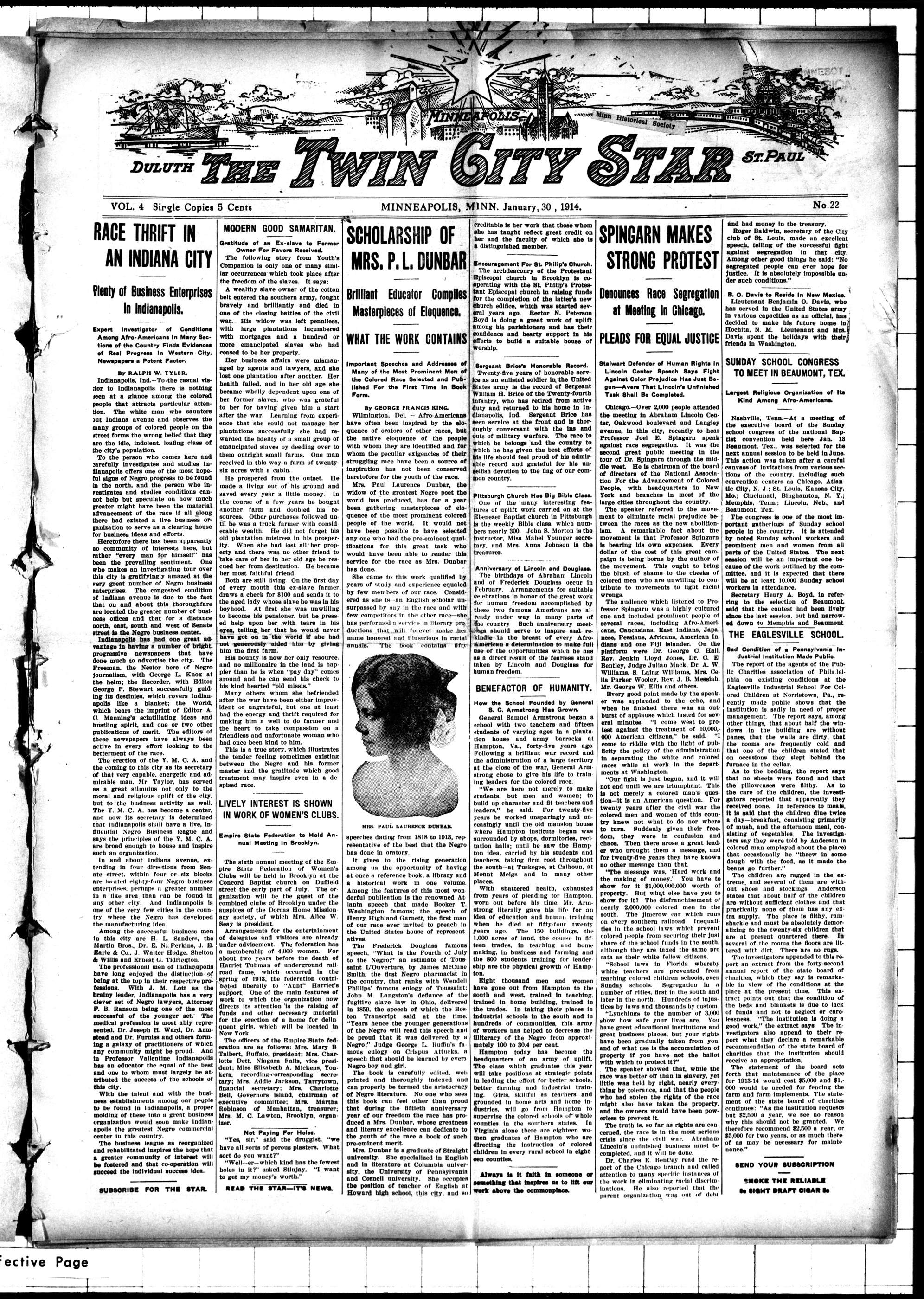
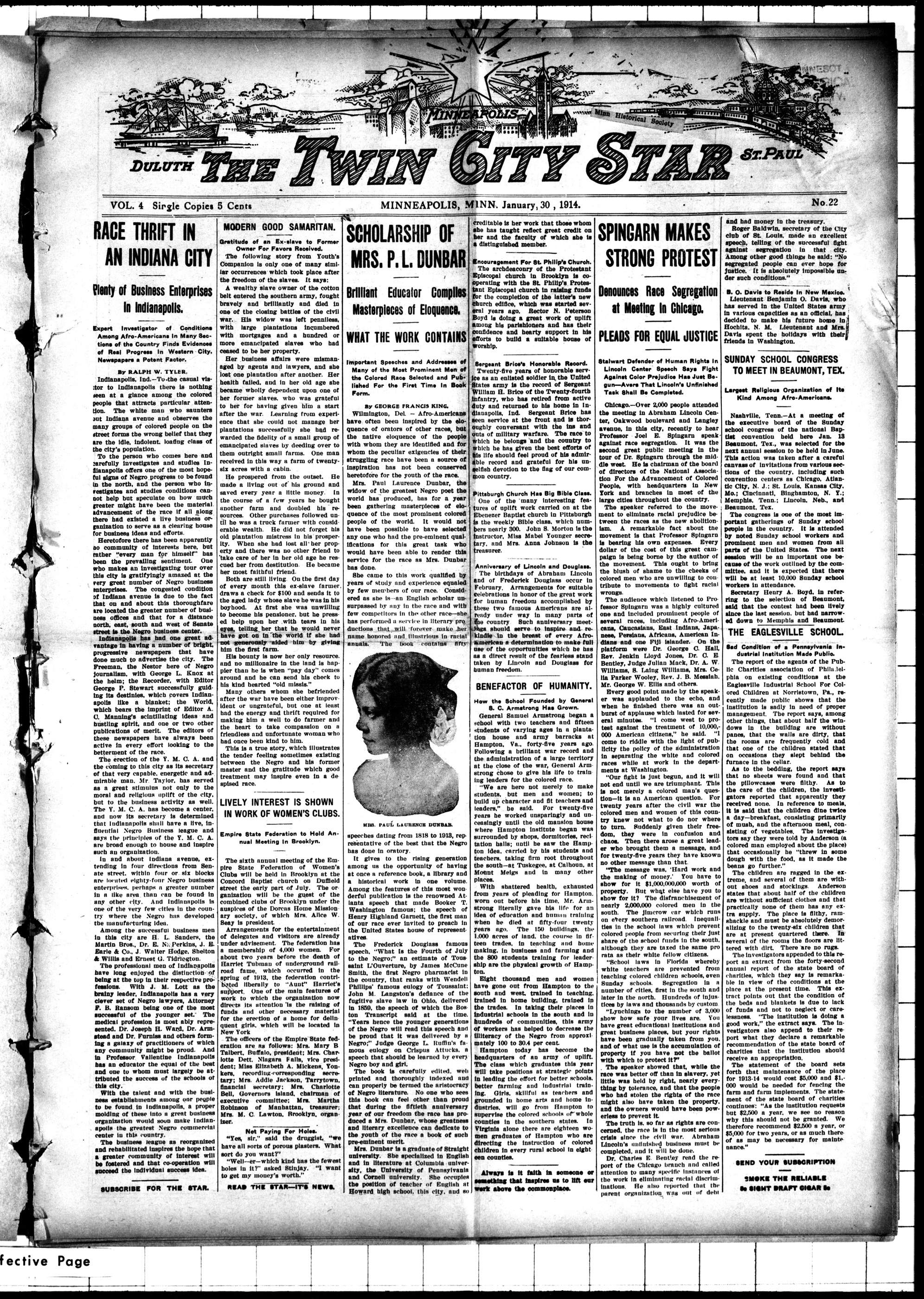
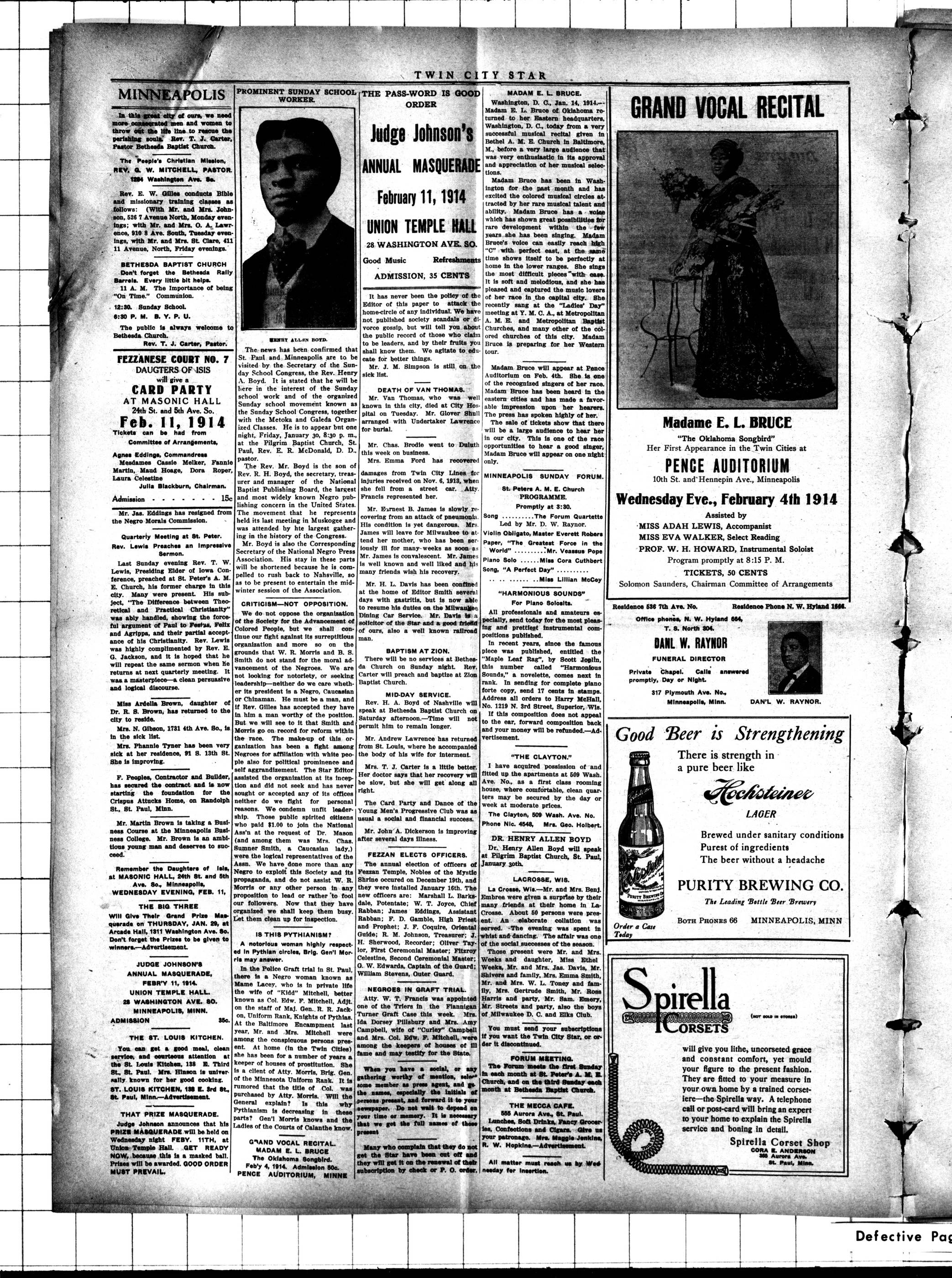
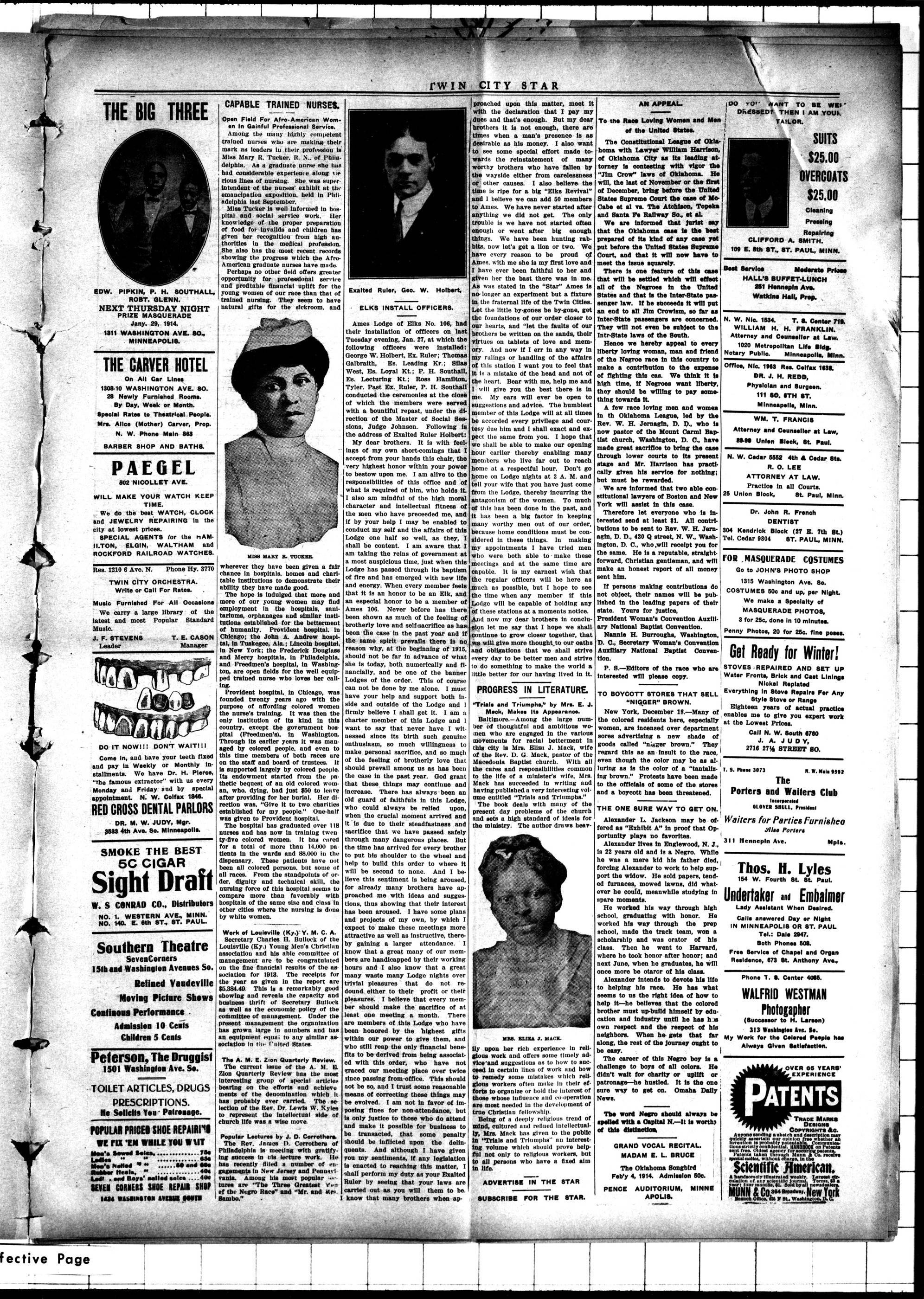
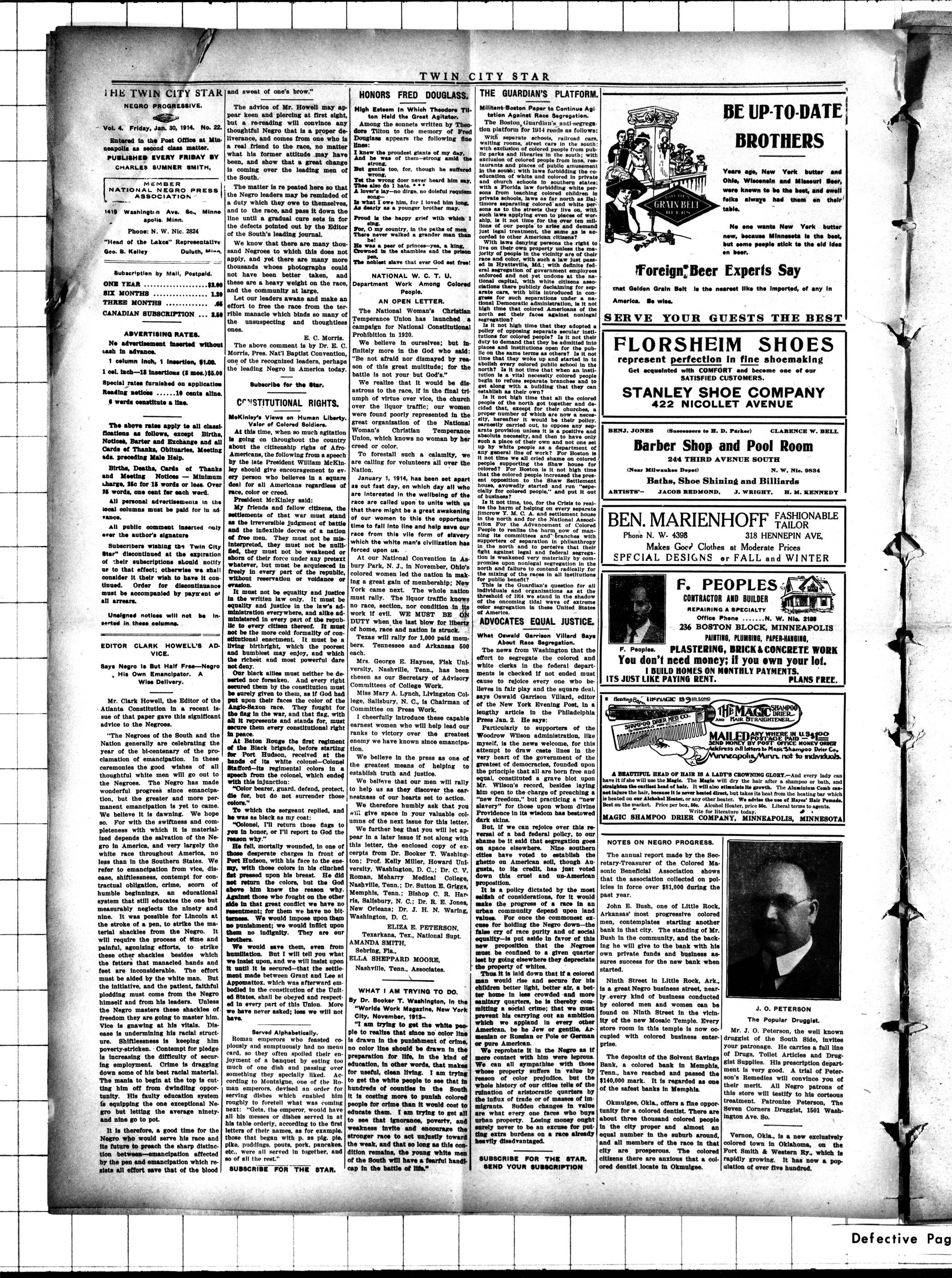
Page text (machine-generated)
MINNEAPOLIS
Minn Historical Society
DULUTH THE TWIN CITY STAR ST.PAUL
ective Page
VOL. 4 Single Copies 5 Cents
Gratitude of an Ex-slave to Former Owners for Excess Received
Owner For Favors Received.
The following story from Youth's Companion is only one of many similar occurrences which took place after the freedom of the slaves. It says:
A wealthy slave owner of the cotton belt entered the southern army, fought bravely and brilliantly and died in one of the closing battles of the civil war. His widow was left penniless, with large plantations incumbered with mortgages and a hundred or more emancipated slaves who had ceased to be her property.
Her business affairs were mismanaged by agents and lawyers, and she lost one plantation after another. Her health failed, and in her old age she became wholly dependent upon one of her former slaves, who was grateful to her for having given him a start after the war. Learning from experience that she could not manage her plantations successfully she had rewarded the fidelity of a small group of emancipated slaves by deeding over to them outright small farms. One man received in this way a farm of twenty-six acres with a cabin.
He prospered from the outset. He made a living out of his ground and saved every year a little money. In the course of a few years he bought another farm and doubled his resources. Other purchases followed until he was a truck farmer with considerable wealth. He did not forget his old plantation mistress in his prosperity. When she had lost all her property and there was no other friend to take care of her in her old age he rescued her from destitution. He became her most faithful friend. Both are still living. On the first day of every month this ex-slave farmer draws a check for $100 and sends it to the aged lady whose slave he was in his boyhood. At first she was unwilling to become his pensioner, but he pressed help upon her with tears in his eyes, telling her that he would never have got on in the world if she had not generously aided him by giving him the first farm. His bounty is now her only resource, and no millionaire in the land is happier than he is when "pay day" comes around and he can send his check to his kind hearted "old missis."
Many others whom she befriended after the war have been either improvident or ungrateful, but one at least had the energy and thrift required for making him a well to do farmer and the heart to take compassion on a friendless and unfortunate woman who had once been kind to him.
This is a true story, which illustrates the tender feeling sometimes existing between the Negro and his former master and the gratitude which good treatment may inspire even in a deprised race.
LIVELY INTEREST IS SHOWN IN WORK OF WOMEN'S CLUBS.
Empire State Federation to Hold Annual Meeting in Brooklyn.
The sixth annual meeting of the Empire State Federation of Women's Clubs will be held in Brooklyn at the Concord Baptist church on Duffield street the early part of July. The organization will be the guest of the combined clubs of Brooklyn under the auspices of the Dorcas Home Missionary society, of which Mrs. Alice W. Seay is president.
Arrangements for the entertainment of delegates and visitors are already under advisement. The federation has a membership of 4,000 women. For about two years before the death of Harriet Tubman of underground railroad fame, which occurred in the spring of 1913, the federation contributed liberally to "Aunt" Harriet's support. One of the main features of work to which the organization now directs its attention is the raising of funds and other necessary material for the erection of a home for delinquent girls, which will be located in New York
The officers of the Empire State federation are as follows: Mrs. Mary B Talbert, Buffalo, president; Mrs. Charlotte Dett, Nigara Falls, vice president; Miss Elizabeth A. Mickens, Yonkers, recording corresponding secretary; Mrs. Addie Jackson, Tarrytown, financial secretary; Mrs. Charlotte Bell, Governors island, chairman of executive committee; Mrs. Martha Robinson of Manhattan, treasurer; Mrs. M. C. Lawton, Brooklyn, organizer.
Not Paying For Holes.
"Yes, sir," said the druggist, "we have all sorts of porous plasters. What sort do you want?
"Well-er—which kind has the fewest holes in it?" asked Stinjay. "I want to get my money's worth."
RACE THRIFT IN AN INDIANA CITY
Expert Investigator of Conditions Among Afro-Americans In Many Sections of the Country Finds Evidences of Real Progress In Western City. Newspapers a Potent Factor.
By RALPH W. TYLER.
Indianapolis, Ind.-To the casual visitor to Indianapolis there is nothing seen at a glance among the colored people that attracts particular attention. The white man who saunters out Indiana avenue and observes the many groups of colored people on the street forms the wrong belief that they are the idle, indolent, loafing class of the city's population.
To the person who comes here and carefully investigates and studies Indianapolis offers one of the most hopeful signs of Negro progress to be found in the north, and the person who investigates and studies conditions cannot help but speculate on how much greater might have been the material advancement of the race if all along there had existed a live business organization to serve as a clearing house for business ideas and efforts.
Heretofore there has been apparently no community of interests here, but rather "every man for himself" has been the prevailing sentiment. One who makes an investigating tour over this city is gratifyingly amazed at the very great number of Negro business enterprises. The congested condition of Indian avenue is due to the fact that on and about this thoroughfare are located the greater number of business offices and that for a distance north, east, south and west of Senate street is the Negro business center.
Indianapolis has had one great advantage in having a number of bright, progressive newspapers that have done much to advertise the city. The Freeman, the Nestor here of Negro journalism, with George L. Knox at the helm; the Recorder, with Editor George P. Stewart successfully guiding its destinies, which covers Indianapolis like a blanket; the World, which bears the imprint of Editor A. C. Manning's scintillating ideas and hustling spirit, and one or two other publications of merit. The editors of these newspapers have always been active in every effort looking to the betterment of the race.
The erection of the Y. M. C. A. and the coming to this city as its secretary of that very capable, energetic and admirable man. Mr. Taylor, has served as a great stimulus not only to the moral and religious uplift of the city, but to the business activity as well.
The Y. M. C. A. has become a center, and now its secretary is determined that Indianapolis shall have a live, influential Negro Business league and says the principles of the Y. M. C. A. are broad enough to house and inspire such an organization.
In and about Indiana avenue, extending in four directions from Senate street, within four or six blocks are located eighty-four Negro business enterprises, perhaps a greater number in a like area than can be found in any other city. And Indianapolis is one of the very few cities in the country where the Negro has developed the manufacturing idea.
Among the successful business men in this city are H. L. Sanders, the Martin Bros., Dr. E. N. Perkins, J. E. Earle & Co., J. Walter Hodge, Shelton & Willis and Ernest G. Tidricington.
The professional men of Indianapolis have long enjoyed the distinction of being at the top in their respective professions. With J. M. Lott as the brainy leader, Indianapolis has a very clever set of Negro lawyers, Attorney F. B. Ransom being one of the most successful of the younger set. The medical profession is most ably represented. Dr. Joseph H. Ward, Dr. Armstead and Dr. Furniss and others forming a galaxy of practitioners of which any community might be proud. And in Professor Valentine Indianapolis has an educator the equal of the best and one to whom must largely be attributed the success of the schools of this city.
With the talent and with the business establishments among our people to be found in Indianapolis, a proper molding of these into a great business organization would soon make Indianapolis the greatest Negro commercial center in this country. The business league as reorganized and rehabilitated inspires the hope that a greater community of interest will be fostered and that co-operation will succeed the individual success idea.
SUBSCRIBE FOR THE STAR.
READ THE STAR-IT'S NEWS.
SCHOLARSHIP OF MRS. P. L. DUNBAR Brilliant Educator Compiles Masterpieces of Eloquence. WHAT THE WORK CONTAINS
Important Speeches and Addresses of Many of the Most Prominent Men of the Colored Race Selected and Published For the First Time In Book Form.
By GEORGE FRANCIS KING.
Wilmington, Del. - Afro-Americans have often been inspired by the eloquence of orators of other races, but the native eloquence of the people with whom they are identified and for whom the peculiar exigencies of their struggling race have been a source of inspiration has not been conserved heretofore for the youth of the race.
Mrs. Paul Laurence Dunbar, the widow of the greatest Negro poet the world has produced, has for a year been gathering masterpieces of eloquence of the most prominent colored people of the world. It would not have been possible to have selected any one who had the pre-eminent qualifications for this great task who would have been able to render this service for the race as Mrs. Dunbar has done.
She came to this work qualified by years of study and experience equaled by few members of our race. Considered as she is—an English scholar unsurpassed by any in the race and with few competitors in the other race—she has performed a service in literary productions that will forever make her name honored and illustrious in racial annals. The book contains fifty
MRS. PAUL LAURENCE DUNBAR.
speeches dating from 1818 to 1913, representative of the best that the Negro has done in oratory.
It gives to the rising generation among us the opportunity of having at once a reference book, a library and a historical work in one volume. Among the features of this most wonderful publication is the renowned Atlanta speech that made Booker T. Washington famous; the speech of Henry Highland Garnett, the first man of our race ever invited to preach in the United States house of representatives.
The Frederick Douglass famous speech, "What Is the Fourth of July to the Negro;" an estimate of Toussaint L'Ouverture, by James McCune Smith, the first Negro pharmacist in the country, that ranks with Wendell Phillips' famous eulogy of Toussaint; John M. Langston's defiance of the fugitive law law in Ohio, delivered in 1859, the speech of which the Boston Transcript said at the time, "Years hence the younger generations of the Negro will read this speech and be proud that it was delivered by a Negro," Judge George L. Ruffin's famous eulogy on Crispus Attucks, a speech that should be learned by every Negro boy and girl.
The book is carefully edited, well printed and thoroughly indexed and can properly be termed the aristocracy of Negro literature. No one who sees this book can feel other than proud that during the fifthtier anniversary year of our freedom the race has produced a Mrs. Dunbar, whose greatness and literary excellence can dedicate to the youth of the race a book of such pre-eminent merit.
Mrs. Dunbar is a graduate of Straight university. She specialized in English and in literature at Columbia university, the University of Pennsylvania and Cornell university. She occupies the position of teacher of English at Howard high school, this city, and so
creditable is her work that those whom she has taught reflect great credit on her and the faculty of which she is a distinguished member.
Encouragement For St. Philip's Church. The archdeaconry of the Protestant Episcopal church in Brooklyn is cooperating with the St. Philip's Protestant Episcopal church in raising funds for the completion of the latter's new church edifice, which was started several years ago. Rector N. Peterson Boyd is doing a great work of uplift among his parishioners and has their confidence and hearty support in his efforts to build a suitable house of worship.
Sergeant Brice's Honorable Record. Twenty-five years of honorable service as an enlisted soldier in the United States army is the record of Sergeant William H. Brice of the Twenty-fourth infantry, who has retired from active duty and returned to his home in Indianapolis, Ind. Sergeant Brice has seen service at the front and is thoroughly conversant with the ins and outs of military warfare. The race to which he belongs and the country to which he has given the best efforts of his life should feel proud of his admirable record and grateful for his unselfish devotion to the flag of our common country.
Pittsburgh Church Has Big Bible Class.
One of the many interesting features of uplift work carried on at the Ebenezer Baptist church in Pittsburgh is the weekly Bible class, which numbers nearly 300. John S. Morton is the instructor, Miss Mabel Younger secretary, and Mrs. Anna Johnson is the treasurer.
Anniversary of Lincoln and Douglass.
The birthdays of Abraham Lincoln and of Frederick Douglass occur in February. Arrangements for suitable celebrations in honor of the great work for human freedom accomplished by these two famous Americans are already under way in many parts of the country. Such anniversary meetings should serve to inspire and rekindle in the breast of every Afro-american a determination to make full use of the opportunities which he has as a direct result of the fearless stand taken by Lincoln and Douglass for human freedom.
BENEFACTOR OF HUMANITY.
How the School Founded by General
S. C. Armstrong Has Grown.
General Samuel Armstrong began a school with two teachers and fifteen students of varying ages in a plantation house and barracks at Hampton, Va., forty-five years ago. Following a brilliant war record and the administration of a large territory at the close of the war, General Armstrong chose to give his life to training leaders for the colored race.
"We are here not merely to make students, but men and women; to build up character and fit teachers and leaders," he said. For twenty-five years he worked unparsingly and unceasingly until the old mansion house where Hampton institute began was surrounded by shops, dormitories, rection halls; until he saw the Hampton idea, carried by his students and teachers, taking firm root throughout the south—at Tuskegee, at Calhoun, at Mount Melgs and in many other places.
With shattered health, exhausted from years of pleading for Hampton, worn out before his time, Mr. Armstrong literally gave his life for an idea of education and human training when he died at fifty-four twenty years ago. The 150 buildings, the 1,000 acres of land, the course in fifteen trades, in teaching and farming and the 800 students training for leadership are the physical growth of Hampton.
Eight thousand men and women have gone out from Hampton to the south and west, trained in teaching, trained in home building, trained in the trades. In taking their places in industrial schools in the south and in hundreds of communities, this army of workers has helped to decrease the illiteracy of the Negro from approximately 100 to 30.4 per cent.
Hampton today has become the headquarters of an army of uplift. The class which graduates this year will take positions at strategic points in leading the effort for better schools, better farming and industrial training. Girls, skillful as teachers and grounded in home arts and home industries, will go from Hampton to supervise the colored schools of whole counties in the southern states. In Virginia alone there are eighteen women graduates of Hampton who are directing the instruction of colored children in every rural school in eight een counties.
Always is it faith in someone or something that inspires us to lift our work above the commonplace.
SPINGARN MAKES STRONG PROTEST
Stalwart Defender of Human Rights in Lincoln Center Speech Says Fight Against Color Prejudice Has Just Begun—Avers That Lincoln's Unfinished Task Shall Be Completed.
Chicago.—Over 2,000 people attended the meeting in Abraham Lincoln Center, Oakwood boulevard and Langley avenue, in this city, recently to hear Professor Joel E. Spingarn speak against race segregation. It was the second great public meeting in the tour of Dr. Spingarn through the middle west. He is chairman of the board of directors of the National Association For the Advancement of Colored People, with headquarters in New York and branches in most of the large cities throughout the country.
The speaker referred to the movement to eliminate racial prejudice between the races as the new abolitionism. A remarkable fact about the movement is that Professor Spingarn is bearing his own expenses. Every dollar of the cost of this great campaign is being borne by the author of the movement. This ought to bring the blush of shame to the cheeks of colored men who are unwilling to contribute to movements to fight racial wrongs.
The audience which listened to Professor Slingarn was a highly cultured one and included prominent people of several races, including Afro-Americans, Caucasians, East Indians, Japanese, Persians, Africans, American Indians and one Fiji islander. On the platform were Dr. George C. Hall, Rev. Jenkin Lloyd Jones, Dr. C. E Bentley, Judge Julian Mack, Dr. A. W Williams, S. Laing Williams, Mrs. Celia Parker Wooley, Rev. J. B. Messiah, Mr. George W. Ellis and others.
Every good point made by the speaker was applauded to the echo, and when he finished there was an outburst of applause which lasted for several minutes. "I come west to protest against the treatment of 10,000,000 American citizens," he said. "I come to riddle with the light of publicity the policy of the administration in separating the white and colored races while at work in the departments at Washington.
"Our fight is just begun, and it will not end until we are triumphant. This is not merely a colored man's question—it is an American question. For twenty years after the civil war the colored men and women of this country knew not what to do nor where to turn. Suddenly given their freedom, they were in confusion and chaos. Then there arose a great leader who brought them a message, and for twenty-five years they have known no other message than that.
"The message was, 'Hard work and the making of money.' You have to show for it $1,000,000,000 worth of property. But what else have you to show for it? The disfranchisement of nearly 2,000,000 colored men in the south. The Jimcar car which runs on every southern railroad. Inequalities in the school laws which prevent colored people from securing their just share of the school funds in the south, although they are taxed the same pro rata as their well fellow citizens. "School laws in Florida whereby white teachers are prevented from teaching colored children schools, even Sunday schools. Segregation in a number of cities, first in the south and later in the north. Hundreds of injustices by laws and thousands by custom "Lynchings to the number of 3,000 show how safe your lives are. You have great educational institutions and great business places, but your rights have been gradually taken from you, and of what use is the accumulation of property if you have not the ballot with which to protect it?" The speaker showed that, while the race was better off than in slavery, yet little was held by right, nearly everything by tolerance, and that the people who had stolen the rights of the race might also have taken the property, and the owners would have been powerless to prevent it.
The truth is, so far as rights are concerned, the race is in the most serious crisis since the civil war. Abraham Lincoln's unfinished business must be completed, and it will be done.
Dr. Charles E. Bentley read the report of the Chicago branch and called attention to many specific instances of the work in eliminating racial discriminations. He also reported that the parent organization was out of debt
No.22 and had money in the treasury.
Roger Baldwin, secretary of the City club of St. Louis, made an excellent speech, telling of the successful fight against segregation in that city. Among other good things he said: "No segregated people can ever hope for justice. It is absolutely impossible under such conditions."
B. O. Davis to Reside in New Mexico.
Lieutenant Benjamin O. Davis, who has served in the United States army in various capacities as an official, has decided to make his future home in Hochita. N. M. Lieutenant and Mrs. Davis spent the holidays with their friends in Washington.
SUNDAY SCHOOL CONGRESS TO MEET IN BEAUMONT, TEX.
Largest Religious Organization of its Kind Among Afro-Americans.
Nashville, Tenn.—At a meeting of the executive board of the Sunday school congress of the national Baptist convention held here Jan. 13 Beaumont, Tex., was selected for the next annual session to be held in June. This action was taken after a careful canvass of invitations from various sections of the country, including such convention centers as Chicago, Atlantic City, N. J.; St. Louis, Kansas City, Mo.; Cincinnati, Binghamton, N. Y.; Memphis, Tenn.; Lincoln, Neb., and Beaumont, Tex.
The congress is one of the most important gatherings of Sunday school people in the country. It is attended by noted Sunday school workers and prominent men and women from all parts of the United States. The next session will be an important one because of the work outlined by the committee, and it is expected that there will be at least 10,000 Sunday school workers in attendance.
Secretary Henry A. Boyd, in referring to the selection of Beaumont, said that the contest had been lively since the last session, but had narrowed down to Memphis and Beaumont.
THE EAGLESVILLE SCHOOL.
Sad Condition of a Pennsylvania Industrial Institution Made Public.
The report of the agents of the Public Charities association of Philadelphia on existing conditions at the Eaglesville Industrial School For Colored Children at Norristown, Pa., recently made public shows that the institution is sadly in need of proper management. The report says, among other things, that about half the windows in the building are without panes, that the walls are dirty, that the rooms are frequently cold and that one of the children stated that on occasions they slept behind the furnace in the cellar.
As to the bedding, the report says that no sheets were found and that the pillowcases were filth. As to the care of the children, the investigators reported that apparently they received none. In reference to meals, it is said that the children dine twice a day—breakfast, consisting primarily of mush, and the afternoon meal, consisting of vegetables. The investigators say they were told by Anderson (a colored man employed by the place that occasionally he "threw in some dough with the food, as it made the beans go further."
The children are ragged in the extreme, and several of them are with out shoes and stockings. Anderson states that about half of the children are without sufficient clothes and that practically none of them has any extra supply. The place is flithy, ramshackle and must be absolutely demoralizing to the twenty-six children that are at present quartered there. In several of the rooms the floors are littered with dirt. There are no rugs. The investigators appended to this report an extract from the forty-second annual report of the state board of charities, which they say is remarkable in view of the conditions at the place at the present time. This extract points out that the condition of the beds and blankets is due to lack of funds and not to neglect or carelessness. "The institution is doing a good work," the extract says. The investigators also append to their report what they declare a remarkable recommendation of the state board of charities that the institution should receive an appropriation.
The statement of the board sets forth that maintenance of the place for 1913-14 would cost $5,000 and $1,000 would be needed for fencing the farm and farm implements. The statement of the state board of charities continues: "As the institution requests but $2,500 a year, we see no reason why this should not be granted. We therefore recommend $2,500 a year, or $5,000 for two years, or as much there of as may be necessary for maintenance."
SMOKE THE RELIABLE
So SIGHT DRAFT CIGAR So
DULUTH THE TWIN CITY STAR ST.PAUL
fective Page
VOL. 4 Single Copies 5 Cents
Gratitude of an Ex-slave to Former
Quotes for Fourteen Received
Owner For Favors Received.
The following story from Youth's Companion is only one of many similar occurrences which took place after the freedom of the slaves. It says:
A wealthy slave owner of the cotton belt entered the southern army, fought bravely and brilliantly and died in one of the closing battles of the civil war. His widow was left penniless, with large plantations incumbered with mortgages and a hundred or more emancipated slaves who had ceased to be her property.
Her business affairs were mismanaged by agents and lawyers, and she lost one plantation after another. Her health failed, and in her old age she became wholly dependent upon one of her former slaves, who was grateful to her for having given him a start after the war. Learning from experience that she could not manage her plantations successfully she had rewarded the identity of a small group of emancipated slaves by deeding over to them outright small farms. One man received in this way a farm of twenty-six acres with a cabin.
He prospered from the outset. He made a living out of his ground and saved every year a little money. In the course of a few years he bought another farm and doubled his resources. Other purchases followed until he was a truck farmer with considerable wealth. He did not forget his old plantation mistress in his prosperity. When she had lost all her property and there was no other friend to take care of her in her old age he rescued her from destitution. He became her most faithful friend. Both are still living. On the first day of every month this ex-slave farmer draws a check for $100 and sends it to the aged lady whose slave he was in his boyhood. At first she was unwilling to become his pensloner, but he pressed help upon her. with tears in his eyes, telling her that he would never have got on in the world if she had not generously aided him by giving him the first farm.
His bounty is now her only resource, and no millionaire in the land is happer than he is when "pay day" comes around and he can send his check to his kind hearted "old missia."
Many others whom she befriended after the war have been either improvident or ungrateful, but one at least had the energy and thrift required for making him a well to do farmer and the heart to take compassion on a friendless and unfortunate woman who had once been kind to him.
This is a true story, which illustrates the tender feeling sometimes existing between the Negro and his former master and the gratitude which good treatment may inspire even in a deprised race.
LIVELY INTEREST IS SHOWN IN WORK OF WOMEN'S CLUBS.
Empire State Federation to Hold Annual Meeting in Brooklyn.
The sixth annual meeting of the Empire State Federation of Women's Clubs will be held in Brooklyn at the Concord Baptist church in Duffield street the early part of July. The organization will be the guest of the combined clubs of Brooklyn under the auspices of the Dorcas Home Missionary society, of which Mrs. Alice W. Seav is president.
Arrangements for the entertainment of delegates and visitors are already under advisement. The federation has a membership of 4,000 women. For about two years before the death of Harriet Tubman of underground railroad fame, which occurred in the spring of 1913, the federation contributed liberally to "Aunt" Harriet's support. One of the main features of work to which the organization now directs its attention is the raising of funds and other necessary material for the erection of a home for delinquent girls, which will be located in New York
The officers of the Empire State federation are as follows: Mrs. Mary B Talbert, Buffalo, president; Mrs. Charlotte Dett, Nagara Falls, vice president; Miss Elizabeth A. Mickens, Yonkers, recording corresponding secretary; Mrs. Adle Jackson, Tarrytown, financial secretary; Mrs. Charlotte Bell, Governors island, chairman of executive committee; Mrs. Martha Robinson of Manhattan, treasurer; Mrs. M. C. Lawton, Brooklyn, organizer.
Not Paying For Holes.
"Yes, sir," said the druggist, "we have all sorts of porous plasters. What sort do you want?
"Well-er—which kind has the fewest holes in it?" asked Stinjay. "I want to get my money's worth."
RACE THRIFT IN AN INDIANA CITY
Plenty of Business Enterprises in Indianapolis.
Expert Investigator of Conditions Among Afro-Americans In Many Sections of the Country Finds Evidences of Real Progress in Western City, Newspapers a Potent Factor.
BY RALPH W. TYLER.
Indianapolis, Ind.—To-the casual visitor to Indianapolis there is nothing seen at a glance among the colored people that attracts particular attention. The white man who saunters out Indiana avenue and observes the many groups of colored people on the street forms the wrong belief that they are the idle, indolent, loafing class of the city's population.
To the person who comes here and carefully investigates and studies Indianapolis offers one of the most hopeful signs of Negro progress to be found in the north, and the person who investigates and studies conditions cannot help but speculate on how much greater might have been the material advancement of the race if all along there had existed a live business organization to serve as a clearing house for business ideas and efforts.
Heretofore there has been apparently no community of interests here, but rather "every man for himself" has been the prevailing sentiment. One who makes an investigating tour over this city is gratifyingly amazed at the very great number of Negro business enterprises. The congested condition of Indiana avenue is due to the fact that on and about this thoroughfare are located the greater number of business offices and that for a distance north, east, south and west of Senate street is the Negro business center.
Indianapolis has had one great advantage in having a number of bright, progressive newspapers that have done much to advertise the city. The Freeman, the Nestor here of Negro journalism, with George L. Knox at the helm; the Recorder, with Editor George P. Stewart successfully guiding its destinies, which covers Indianapolis like a blanket; the World, which bears the imprint of Editor A. C. Manning's scintillating ideas and hustling spirit, and one or two other publications of merit. The editors of these newspapers have always been active in every effort looking to the betterment of the race.
The erection of the Y. M. C. A. and the coming to this city as its secretary of that very capable, energetic and admirable man. Mr Taylor, has served as a great stimulus not only to the moral and religious uplift of the city, but to the business activity as well. The Y. M. C. A. has become a center, and now its secretary is determined that Indianapolis shall have a live, influential Negro Business league and says the principles of the Y. M. C. A. are broad enough to house and inspire such an organization. In and about Indiana avenue, extending in four directions from Senate street, within four or six blocks are located eighty-four Negro business enterprises, perhaps a greater number in a like area than can be found in any other city. And Indianapolis is one of the very few cities in the country where the Negro has developed the manufacturing idea.
Among the successful business men in this city are H. L. Sanders, the Martin Bros., Dr. E. N. Perkins, J. E. Earle & Co., J. Walter Hodge, Shelton & Willis and Ernest G. Tidriogton. The professional men of Indianapolis have long enjoyed the distinction of being at the top in their respective professions. With J. M. Lott as the brainy leader, Indianapolis has a very clever set of Negro lawyers, Attorney F. B. Ransom being one of the most successful of the younger set. The medical profession is most ably represented. Dr. Joseph H. Ward, Dr. Armstead and Dr. Furniss and others forming a galaxy of practitioners of which any community might be proud. And in Professor Valentine Indianapolis has an educator the equal of the best and one to whom must largely be attributed the success of the schools of this city.
With the talent and with the business establishments among our people to be found in Indianapolis, a proper molding of these into a great business organization would soon make Indianapolis the greatest Negro commercial center in this country. The business league as reorganized and rehabilitated inspires the hope that a greater community of interest will be fostered and that co-operation will succeed the individual success idea.
SUBSCRIBE FOR THE STAR.
MODERN GOOD SAMARITAN.
READ THE STAR-IT'S NEWS.
MINNEAPOLIS, MINN. January, 30, 1914.
SCHOLARSHIP OF MRS. P. L. DUNBAR
Brilliant Educator Complies
Masterpieces of Eloquence.
WHAT THE WORK CONTAINS
Important Speeches and Addresses of Many of the Most Prominent Men of the Colored Race Selected and Published For the First Time In Book Form.
By GEORGE FRANCIS KING.
Wilmington, Del. - Afro-Americans have often been inspired by the eloquence of orators of other races, but the native eloquence of the people with whom they are identified and for whom the peculiar exigencies of their struggling race have been a source of inspiration has not been conserved heretofore for the youth of the race.
Mrs. Paul Laurence Dunbar, the widow of the greatest Negro poet the world has produced, has for a year been gathering masterpieces of eloquence of the most prominent colored people of the world. It would not have been possible to have selected any one who had the pre-eminent qualifications for this great task who would have been able to render this service for the race as Mrs. Dunbar has done.
She came to this work qualified by years of study and experience equaled by few members of our race. Considered as she is—an English scholar unsurpassed by any in the race and with few competitors in the other race—she has performed a service in literary productions that will forever make her name honored and illustrious in racial annuals. The book contains fifty
MRS. PAUL LAURENCE DUNBAR.
speeches dating from 1818 to 1913, representative of the best that the Negro has done in oratory. It gives to the rising generation among us the opportunity of having at once a reference book, a library and a historical work in one volume. Among the features of this most wonderful publication is the renowned Atlanta speech that made Booker T. Washington famous; the speech of Henry Highland Garnett, the first man of our race ever invited to preach in the United States house of representatives.
The Frederick Douglass famous speech, "What is the Fourth of July to the Negro;" an estimate of Toussaint L'Ouverture, by James McCune Smith, the first Negro pharmacist in the country, that ranks with Wendell Phillips' famous eulogy of Toussaint: John M. Langston's defiance of the fugitive slave law in Ohio, delivered in 1889, the speech of which the Boston Transcript said at the time, "Years hence the younger generations of the Negro will read this speech and be proud that it was delivered by a Negro;" Judge George L. Ruffin's famous eulogy on Crispus Attucks, a speech that should be learned by every boy and girl.
The book is carefully edited, web printed and thoroughly indexed and can properly be termed the aristocracy of Negro literature. No one who sees this book can feel other than proud that during the fifthth anniversary year of our freedom the race has produced a Mrs. Dunbar, whose greatness and literary excellence can dedicate to the youth of the race a book of such pre-eminent merit.
Mrs. Dunbar is a graduate of Straight university. She specialized in English and in literature at Columbia university, the University of Pennsylvania and Cornell university. She occupies the position of teacher of English at Howard high school, this city, and so
creditable is her work that those whom she has taught reflect great credit on her and the faculty of which she is a distinguished member.
Encouragement For St. Philip's Church.
The archdeaconry of the Protestant Episcopal church in Brooklyn is cooperating with the St. Philip's Protestant Episcopal church in raising funds for the completion of the latter's new church edifice, which was started several years ago. Rector N. Peterson Boyd is doing a great work of uplift among his parishioners and has their confidence and hearty support in his efforts to build a suitable house of worship.
Sergeant Brice's Honorable Record. Twenty-five years of honorable service as an enlisted soldier in the United States army is the record of Sergeant William H. Brice of the Twenty-fourth infantry, who has retired from active duty and returned to his home in Indianapolis, Ind. Sergeant Brice has seen service at the front and is thoroughly conversant with the ins and outs of military warfare. The race to which he belongs and the country to which he has given the best efforts of his life should feel proud of his admirable record and grateful for his unselfish devotion to the flag of our common country.
Pittsburgh Church Has Big Bible Class.
One of the many interesting features of uplift work carried on at the Ebenezer Baptist church in Pittsburgh is the weekly Bible class, which numbers nearly 300. John S. Morton is the instructor, Miss Mabel Younger secretary, and Mrs. Anna Johnson is the treasurer.
Anniversary of Lincoln and Douglass.
The birthdays of Abraham Lincoln and of Frederick Douglass occur in February. Arrangements for suitable celebrations in honor of the great work for human freedom accomplished by these two famous Americans are already under way in many parts of the country. Such anniversary meetings should serve to inspire and rekindle in the breast of every Afro-american a determination to make full use of the opportunities which he has as a direct result of the fearless stand taken by Lincoln and Douglass for human freedom.
BENEFACTOR OF HUMANITY.
How the School Founded by General S. C. Armstrong Has Grown.
General Samuel Armstrong began a school with two teachers and fifteen students of varying ages in a plantation house and army barracks at Hampton, Va., forty-five years ago. Following a brilliant war record and the administration of a large territory at the close of the war, General Armstrong chose to give his life to training leaders for the colored race.
"We are here not merely to make students, but men and women; to build up character and fit teachers and leaders," he said. For twenty-five years he worked unsparingly and uneasily until the old mansion house where Hampton institute began was surrounded by shops, dormitories, relictation halls; until he saw the Hampton idea, carried by his students and teachers, taking firm root throughout the south—at Tuskegee, at Calhoun, at Mount Meigs and in many other places.
With shattered health, exhausted from years of pleading for Hampton, worn out before his time. Mr. Armstrong literally gave his life for an idea of education and human training when he died at fifty-four twenty years ago. The 150 buildings, the 1,000 acres of land, the course in fifteen trades, in teaching and home making, in business and farming and the 800 students training for leadership are the physical growth of Hampton.
Eight thousand men and women have gone out from Hampton to the south and west, trained in teaching, trained in home building, trained in the trades. In taking their places in industrial schools in the south and in hundreds of communities, this army of workers has helped to decrease the illiteracy of the Negro from approximately 100 to 30.4 per cent.
Hampton today has become the headquarters of an army of uplift. The class which graduates this year will take positions at strategic points in leading the effort for better schools, better farming and industrial training. Girls, skillful as teachers and grounded in home arts and home industries, will go from Hampton to supervise the colored schools of whole counties in the southern states. In Virginia alone there are eighteen women graduates of Hampton who are directing the instruction of colored children in every rural school in eight cen counties.
Always is it faith in someone or something that inspires us to lift our work above the commonplace.
SPINGARN MAKES STRONG PROTEST Denounces Race Segregation at Meeting In Chicago. PLEADS FOR EQUAL JUSTICE
Stalwart Defender of Human Rights in Lincoln Center Speech Says Fight Against Color Prejudice Has Just Begun—Avers That Lincoln Unfinished Task Shall Be Completed.
Chicago.—Over 2,000 people attended the meeting in Abraham Lincoln Center, Oakwood boulevard and Langley avenue, in this city, recently to hear Professor Joel E. Spingarn speak against race segregation. It was the second great public meeting in the tour of Dr. Spingarn through the middle west. He is chairman of the board of directors of the National Association For the Advancement of Colored People, with headquarters in New York and branches in most of the large cities throughout the country.
The speaker referred to the movement to eliminate racial prejudice between the races as the new abolitionism. A remarkable fact about the movement is that Professor Spingarn is bearing his own expenses. Every dollar of the cost of this great campaign is being borne by the author of the movement. This ought to bring the blush of shame to the cheeks of colored men who are unwilling to contribute to movements to fight racial wrongs.
The audience which listened to Professor Spingarn was a highly cultured one and included prominent people of several races, including Afro-Americans, Caucasians, East Indians, Japanese, Persians, Africans, American Indians and one Fiji islander. On the platform were Dr. George C. Hall, Jenkin Lloyd Jones, Dr. C. E. Bentley, Judge Julian Mack, Dr. A. W. Williams, S. Laitong Williams, Mrs. Gella Parker Wooley, Rev. J. B. Messiah, Mr. George W. Ellis and others.
Every good point made by the speaker was applauded to the echo, and when he finished there was an outburst of applause which lasted for several minutes. "I come west to protest against the treatment of 10,000,000 American citizens," he said. "I come to riddle with the light of publicity the policy of the administration in separating the white and colored races while at work in the departments at Washington.
"Our fight is just begun, and it will not end until we are triumphant. This is not merely a colored man's question—it is an American question. For twenty years after the civil war the colored men and women of this country knew not what to do nor where to turn. Suddenly given their freedom, they were in confusion and chaos. Then there arose a great leader who brought them a message, and for twenty-five years they have known no other message than that.
"The message was, 'Hard work and the making of money.' You have to show for it $1,000,000,000 worth of property. But what else have you to show for it? The disfranchisement of nearly 2,000,000 colored men in the south. The jimcar car which runs on every southern railroad. Iqualities in the school laws which prevent colored people from securing their just share of the school funds in the south, although they are taxed the same pro rata as their white fellow citizens. 'School laws in Florida whereby white teachers are prevented from teaching colored children schools, even Sunday schools. Segregation in a number of cities, first in the south and later in the north. Hundreds of injustices by laws and thousands by custom."
"Lynchings to the number of 3,000 show how safe your lives are. You have great educational institutions and great business places, but your rights have been gradually taken from you, and of what use is the accumulation of property if you have not the ballot with which to protect it?" The speaker showed that, while the race was better off than in slavery, yet little was held by right, nearly everything by tolerance, and that the people who had stolen the rights of the race might also have taken the property, and the owners would have been powerless to prevent it. The truth is, so far as rights are concerned, the race is in the most serious crisis since the civil war. Abraham Lincoln's unfinished business must be completed, and it will be done.
Dr. Charles E. Bentley read the report of the Chicago branch and called attention to many specific instances of the work in eliminating racial discriminations. He also reported that the parent organization was out of debt
and had money in the treasury.
and money in the treasury.
Roger Baldwin, secretary of the City club of St. Louis, made an excellent speech, telling of the successful fight against segregation in that city. Among other good things he said: "No segregated people can ever hope for justice. It is absolutely impossible under such conditions."
B. O. Davis to Reside in New Mexico. Lieutenant Benjamin O. Davis, who has served in the United States army in various capacities as an official, has decided to make his future home in Hochita. N. M. Lieutenant and Mrs. Davis spent the holidays with their friends in Washington.
SUNDAY SCHOOL CONGRESS TO MEET IN BEAUMONT, TEX.
Largest Religious Organization of Its Kind Among Afro-Americans.
Nashville, Tenn.-At a meeting of the executive board of the Sunday school congress of the national Baptist convention held here Jan. 13 Beaumont, Tex., was selected for the next annual session to be held in June. This action was taken after a careful canvass of invitations from various sections of the country, including such convention centers as Chicago, Atlantic City, N. J.; St. Louis, Kansas City, Mo.; Cincinnati, Binghamton, N. Y.; Memphis, Tenn.; Lincoln, Neb., and Beaumont, Tex.
The congress is one of the most important gatherings of Sunday school people in the country. It is attended by noted Sunday school workers and prominent men and women from all parts of the United States. The next session will be an important one because of the work outlined by the committee, and it is expected that there will be at least 10,000 Sunday school workers in attendance.
Secretary Henry A. Boyd, in referring to the selection of Beaumont, said that the contest had been lively since the last session, but had narrowed down to Memphis and Beaumont
THE EAGLESVILLE SCHOOL.
Sad Condition of a Pennsylvania Industrial Institution Made Public.
The report of the agents of the Public Charities association of Philadelphia on existing conditions at the Eaglesville Industrial School For Colored Children at Norristown, Pa., recently made public shows that the institution is sadly in need of proper management. The report says, among other things, that about half the windows in the building are without pane, that the walls are dirty, that the rooms are frequently cold and that one of the children stated that on occasions they sleep behind the furnace in the cellar.
As to the bedding, the report says that no sheets were found and that the pillowcases were flithy. As to the care of the children, the investigators reported that apparently they received none. In reference to meals, it is said that the children dine twice a day—breakfast, consisting primarily of mush, and the afternoon meal, consisting of vegetables. The investigators say they were told by Anderson (a colored man employed by the place) that occasionally he "threw in some dough with the food, as it made the beans go further."
The children are ragged in the extreme, and several of them are without shoes and stockings. Anderson states that about half of the children are without sufficient clothes and that practically none of them has any extra supply. The place is flithy, ramshackle and must be absolutely demoralizing to the twenty-six children that are at present quartered there. In several of the rooms the floors are littered with dirt. There are no rugs.
The investigators appended to this report an extract from the forty-second annual report of the state board of charities, which they say is remarkable in view of the conditions at the place at the present time. This extract points out that the condition of the beds and blankets is due to lack of funds and not to neglect or carelessness. "The institution is doing a good work," the extract says. The investigators also append to their report what they declare a remarkable recommendation of the state board of charities that the institution should receive an appropriation.
The statement of the board sets forth that maintenance of the place for 1913-14 would cost $5,000 and $1,000 would be needed for fencing the farm and farm implements. The statement of the state board of charities continues: "As the institution requests but $2,500 a year, we see no reason why this should not be granted. We therefore recommend $2,500 a year, or $5,000 for two years, or as much thereof as may be necessary for maintenance."
SEND YOUR SUBSCRIPTION
SMOKE THE RELIABLE
So SIGHT DRAFT CIGAR So
In this great city of ours, we need more consecrated men and women to throw out the life line to rescue the perishing souls. Rev. T. J. Carter, Pastor Bethea Baptist Church.
The People's Christian Mission, REV. G. W. MITCHELL, PASTOR. 1824 Washington Ave. So.
Rev. E. W. Gilles conducts Bible and missionary training classes as follows: (With Mr. and Mrs. Johnson, 526 7 Avenue North, Monday evenings, 526 7 Avenue North, Monday evenings, 910 8 Ave. South, Tuesday evenings, with Mr. and Mrs. St. Clare, 411 11 Avenue, North, Friday evenings.
BETHESA D BAPTIST CHURCH
Don't forget the Bethesda Rally
Barrels. Every little bit helps.
11 A. M. The Importance of being
"On Time." Communion.
The public is always welcome to Bethesda Church.
Rev. T. J. Carter, Pastor.
FEZZANESE COURT NO. 7
DAUGTERS OF ISIS
will give a
CARD PARTY
AT MASONIC HALL
24th St. and 5th Ave. So.
Feb. 11, 1914
Tickets can be had from
Committee of Arrangements,
Agnes Eddings, Commandress
Mesdames Cassie Melker, Fannie
Martin, Maud Hoage, Dora Roper,
Laura Celestine
Julla Blackburn, Chairman.
Mr. Jas. Eddings has resigned from the Negro Morals Commission.
Quarterly Meeting at St. Peter.
Rev. Lewis Presaches an Impressive Sermon.
Last Sunday evening Rev. T. W. Lewis, Presiding Elder of Iowa Conference, preached at St. Peter's A. M. E. Church, his former charge in this city. Many were present. His subject, "The Difference between Theoretical and Practical Christianity" was ably handled, showing the forceful argument of Paul to Fest's, Felix and Agrippa, and their partial acceptance of his Christianity. Rev. Lewis was highly complimented by Rev. E. G. Jackson, and it is hoped that he will repeat the same sermon when he returns at next quarterly meeting. It was a masterpiece - a clean persuasive and logical discourse.
Miss Ardella Brown, daughter of Dr. R. S. Brown, has returned to the city to reside.
Mrs. N. Gibson, 1731 4th Ave. So., is in the sick list.
Mrs. Phannie Tyner has been very sick at her residence, 91 S. 13th St. She is improving.
F. Peoples, Contractor and Builder, has secured the contract and is now starting the foundation for the Crispus Attucks Home, on Randolph St., St. Paul, Minn.
Mr. Martin Brown is taking a Business Course at the Minneapolis Business College. Mr. Brown is an ambitious young man and deserves to succeed.
Remember the Daughters of Isla
at MASONIC HALL, 24th St. and 5th
Ave. So., Minneapolis,
WEDNESDAY EVENING, FEB. 11,
THE BIG THREE
Will Give Their Grand Prize Masquerade on THURSDAY, JAN. 29, at Arcade Hall, 1311 Washington Ave. So. Don't forget the Prizes to be given to winners.—Advertisement.
JUDGE JOHNSON'S
ANNUAL MASQUERADE,
FEBRY 11, 1914.
UNION TEMPLE HALL.
28 WASHINGTON AVE. SO.
MINNEAPOLIS, MINN.
ADMISSION 35c
THE ST. LOUIS KITCHEN.
You can get a good meal, clean service, and courteous attention at the St. Louis Kitchen, 138 E. Third St., St. Paul. Mrs. Hinson is universally known for her good cooking. ST. LOUIS KITCHEN, 138 E. 3rd St., St. Paul, Minn.—Advertisement.
THAT PRIZE MASQUERADE.
Judge Johnson announces that his PRIZE MASQUERADE will be held on Wednesday night FEBV. 11TH, at Union Temple Hall. GET READY NOW, because this is a masked ball. Prizes will be awarded. GOOD ORDER MUST PREVAIL.
PROMINENT SUNDAY SCHOOL THE PASS-WORD IS GOOD WORKER.
JACKSON
HENRY ALLEN BOYD.
The news has been confirmed that St. Paul and Minneapolis are to be visited by the Secretary of the Sunday School Congress, the Rev. Henry A. Boyd. It is stated that he will be here in the interest of the Sunday school work and of the organized Sunday school movement known as the Sunday School Congress, together with the Metoka and Galeda Organized Classes. He is to appear but one night, Friday, January 30, 8:30 p. m., at the Pilgrim Baptist Church, St. Paul, Rev. E. R. McDonald, D. D., pastor.
The Rev. Mr. Boyd is the son of Rev. R. H. Boyd, the secretary, treasurer and manager of the National Baptist Publishing Board, the largest and most widely known Negro publishing concern in the United States. The movement that he represents held its last meeting in Muskogee and was attended by he largest gathering in the history of the Congress. Mr. Boyd is also the Corresponding Secretary of the National Negro Press Association. His stay in these parts will be shortened because he is compelled to rush back to Nahsville, so as to be present to entertain the mid-winter session of the Association.
CRITICISM—NOT OPPOSITION.
CRITICISM—NOT OPPOSITION.
We do not oppose the organization of the Society for the Advancement of Colored People, but we shall continue our fight against its surreptitious organization and more so on the grounds that W. R. Morris and B. S. Smith do not stand for the moral advancement of the Negroes. We are not looking for notoriously, or seeking leadership—neither do we care whether its president is a Negro, Caucasian or Chinaman. He must be a man, and if Rev. Gilles has accepted they have in him a man worthy of the position. But we will see to it that Smith and Morris go on record for reform within the race. The make-up of this organization has been a fight among Negroes for affiliation with white people also for political prominence and self aggrandizement. The Star Editor assisted the organization at its inception and did not seek and has never sought or accepted any of its offices neither do we fight for personal reasons. We condemn unfit leadership. Those public spirited citizens who paid $1.00 to join the National Ass'n at the request of Dr. Mason (and among them was Mrs. Chas. Sumner Smith, a Caucasian lady.) were the logical representatives of the Asan. We have done more than any Negro to exploit this Society and its propaganda, and do not assist W. R. Morris or any other person in any proposition to lead or rather 'to fool our followers. Now that they have organized we shall keep them busy. Let them clean up for inspection.
IS THIS PYTHIANISM?
A notorious woman highly respected in Pythian circles, Brig. Gen'l Morris may answer.
In the Police Graft trial in St. Paul, there is a Negro woman known as Mame Lacey, who is in private life the wife of "Kidd" Mitchell, better known as Col. Edw. F. Mitchell. Adit. on the staff of Maj. Gen. R. R. Jackson, Uniform Rank, Knights of Pythias. At the Baltimore Encampment last year, Mr. and Mrs. Mitchell were among the conspicuous persons present. At home (in the Twin Cities) she has been for a number of years a keeper of houses of prostitution. She is a client of Atty. Morris, Brig. Gen. of the Minnesota Uniform Rank. It is rumored that the title of Col. was purchased by Atty. Morris. Will the General explain? Is this why Pythianism is decreasing in these parts? Gen'l Morris knows and the Lades of the Courts of Calanthe know.
GAND VOCAL RECITAL.
MADAM E. L. BRUCE
The Oklahoma Songbird.
Feb'y 4, 1914. Admission 50c.
PENCE AUDITORIUM. MINNE
TWIN CITY STAR
Judge Johnson's
ANNUAL MASQUERADE
February 11, 1914
UNION TEMPLE HALL
28 WASHINGTON AVE. SO.
Good Music Refreshments
ADMISSION 35 CENTS
ADMISSION, 35 CENTS
It has never been the policy of the Editor of this paper to attack the home-circle of any individual. We have not published society scandals or divorce gossip, but will tell you about the public record of those who claim to be leaders, and by their fruits you shall know them. We agitate to educate for better things.
Mr. J. M. Simpson is still on the sick list.
DEATH OF VAN THOMAS.
Mr. Van Thomas, who was well known in this city, died at City Hospital on Tuesday. Mr. Glover Shull arranged with Undertaker Lawrence for burial.
Mr. Chas. Brodle went to Duluth this week on business.
Mrs. Emma Ford has recovered damages from Twin City Lines for injuries received on Nov. 6, 1913, when she fell from a street car. Atty Francis represented her.
Mr. Earnest B. James is slowly recovering from an attack of pneumonia. His condition is yet dangerous. Mrs. James will leave for Milwaukee to attend her mother, who has been seriously ill for many-weeks as soon as Mr. James is convalescent. Mr. James is well known and well liked and his many friends wish his recovery.
Mr. H. L. Davis has been confirmed at the home of Editor Smith several days with gastritis, but is now able to resume his duties on the Milwaukee Dining Car Service. Mr. Davis is a solicitor of the Star and a good friend of ours, also a well known railroad man.
BAPTISM AT ZION.
There will be no services at Bethesda Church on Sunday night. Rev. Carter will preach and baptize at Zion Baptist Church.
MID-DAY SERVICE
Rev. H. A. Boyd of Nashville will speak at Bethesda Baptist Church on Saturday afternoon.—Time will not permit him to remain longer.
Mr. Andrew Lawrence has returned from St. Louis, where he accompanied the body of his wife for interment.
Mrs. T. J. Carter is a little better. Her doctor says that her recovery will be slow, but she will get along all right.
The Card Party and Dance of the Young Men's Progressive Club was as usual a social and financial success.
Mr. John A. Dickerson is improving after several days illness.
FEZZAN ELECTS OFFICERS.
The annual election of officers of Fezzan Temple, Nobles of the Mystic Shrine occurred on December 19th, and they were installed January 16th. The new officers are: Marshall L. Barksdale, Potentate; W. T. Joyce, Chief Rabban; James Eddings, Assistant Rabban; F. D. Gamble, High Priest and Prophet; J. F. Coquire, Oriental Guide; R. M. Johnson, Treasurer; J. H. Sherwood, Recorder; Oliver Taylor, First Ceremonial Master; Fitzroy Celestine, Second Ceremonial Master; G. W. Edwards, Captain of the Guard; William Stevens, Outer Guard.
NEGROES IN GRAFT TRIAL
NEIGHBORS IN GRAFT TRIAL.
Atty. W. T. Francis was appointed one of the Triers in the Flannigan Turner Graft Case this week. Mrs. Ida Dorsey Pillsbury and Mrs. Amy Campbell, wife of "Curley" Campbell and Mrs. Col. Edw. F. Mitchell, were among the keepers of houses of ill fame and may testify for the State.
When you have a social, or any gathering worthy of mention, select some member as press agent, and get the names, especially the initials of persons present, and forward it to your newspaper. Do not wait to depend on your time or memory. It is necessary that we get the full names of those present
Many who complain that they do not get the Star have been cut off and they will get it on the renewal of their subscription by check or P. O. order.
MADAM E. L. BRUCE.
Washington, D. C., Jan. 14, 1914.—Madam E. L. Bruce of Oklahoma returned to her Eastern headquarters, Washington, D. C., today from a very successful musical recital given in Bethel A. M. E. Church in Baltimore, M., before a very large audience that was very enthusiastic in its approval and appreciation of her musical selections.
Madam Bruce has been in Washington for the past month and has excited the colored musical circles attracted by her rare musical talent and ability. Madam Bruce has a voice which has shown great possibilities for rare development within the few years she has been singing. Madam Bruce's voice can easily reach high "C" with perfect east, at the same time shows itself to be perfectly at home in the lower ranges. She sings the most difficult pieces with ease. It is soft and melodious, and she has pleased and captured the music lovers of her race in the capital city. She recently sang at the "Ladies Day" meeting at Y. M. C. A., at Metropolitan A. M. E. and Metropolitan Baptist Churches, and many other of the colored churches of this city. Madam Bruce is preparing for her Western tour.
Madam Bruce will appear at Pence Auditorium on Feb. 4th. She is one of the recognized singers of her race. Madam Bruce has been heard in the eastern cities and has made a favorable impression upon her hearers. The press has spoken highly of her. The sale of tickets show that there will be a large audience to hear her in our city. This is one of the race opportunities to hear a good singer, Madam Bruce will appear on one night only.
MINNEAPOLIS SUNDAY FORUM.
St. Peters A. M. E. Church
PROGRAMME.
Promptly at 3:30.
Song .....The Forum Quartette
Led by Mr. D. W. Raynor.
Violin Obligato, Master Everett Robers
Paper, "The Greatest Force in the
World" .....Mr. Veassus Pope
Piano Solo .....Miss Cora Cuthbert
Song, "A Perfect Day" ......
.....Miss Lillian McCoy
"HARMONIOUS SOUNDS"
For Piano Solosits.
All professionals and amateurs especially, send today for the most pleasing and prettiest instrumental compositions published.
In recent years, since the famous piece was published, entitled the "Maple Leaf Rag", by Scott Joplin, this number called "Harmonious Sounds," a novelette, comes next in rank. In sending for complete piano forte copy, send 17 cents in stamps. Address all orders to Harry McHall, No. 1219 N. 3rd Street, Superior, Wis.
If this composition does not appeal to the ear, forward composition back and your money will be refunded.—Advertisement.
"THE CLAYTON."
I have acquired possession of and fitted up the apartments at 509 Wash. Ave. No., as a first class rooming house, where comfortable, clean quarters may be secured by the day or week at moderate prices.
The Clayton, 509 Wash. Ave. No. Phone Nlc. 4548. Mrs. Geo. Holbert.
DR. HENRY ALLEN BOYD
Dr. Henry Allen Boyd will speak at Pilgrim Baptist Church, St. Paul, January 30th.
LACROSSE, WIS.
La Crosse, Wis.—Mr. and Mrs. Benj. Embree were given a surprise by their many friends at their home in La Crosse. About 50 persons were present. An elaborate collation was served. The evening was spent in whist and dancing. The affair was one of the social successes of the season. Those present were Mr. and Mrs. Weeks and daughter, Miss Ethel Weeks, Mr. and Mrs. Jas. Davis, Mr. Shivers and family, Mrs. Emma Smith, Mr. and Mrs. W. L. Toney and family, Mrs. Gertrude Smith, Mr. Ross Harris and party, Mr. Sam. Emery, Mr. Streets and party, also the boys of Milwaukee D. C. and Elks Club.
You must send your subscriptions if you want the Twin City Star, or order it discontinued.
FORUM MEETING
The Forum meets the first Sunday in each month at St. Peter's A. M. B. Church, and on the third Sunday each month at Bethesda Baptist Church.
THE MECCA CAFE.
THE MECCA CAFE.
555 Aurora Ave., St. Paul.
Lunches, Soft Drinks, Fancy Groceries, Confections and Cigars. Give us your patronage. Mrs. Maggie Jenkins, R. W. Hopkina.—Advertisement.
All matter must reach us by Wed needay for Insertion.
GRAND VOCAL RECITAL
INNOCENT
"The Oklahoma Songbird"
Her First Appearance in the Twin Cities at
Assisted by
MISS ADAH LEWIS, Accompanist
MISS EVA WALKER, Select Reading
PROF. W. H. HOWARD, Instrumental Soloist
Program promptly at 8:15 P. M.
TICKETS, 50 CENTS
Solomon Saunders, Chairman Committee of Arrangements
DANL W. RAYNOR
Private Chapel. Calle answered promptly, Day or Night.
317 Plymouth Ave. No.,
Minneapolis, Minn.
Beer is Strengthening
Good Beer is Strengthening
There is strength in a pure beer like Hochsteiner
Brewed under sanitary conditions Purest of ingredients The beer without a headache
PURITY BREWING CO.
The Leading Bottle Beer Brewery
BOTH PHONES 66 MINNEAPOLIS, MINN
urella
(NOT GOLD IN STORES)
PURITY BREWING CO.
Order a Case Today
Spirella CORSETS
(NOT SOLD IN STORES)
will give you lithe, uncorseted grace and constant comfort, yet mould your figure to the present fashion. They are fitted to your measure in your own home by a trained corsetiere—the Spirella way. A telephone call or post-card will bring an expert to your home to explain the Spirella service and boning in detail.
Spirella Corset S.
CORA E. ANDERSON
355 Aurora Ave.
St. Paul, Minn.
Spirella Corset Shop
CORA E. ANDERSON
365 Aurora Ave.
St. Paul, Minn.
Residence 536 7th Ave. No.
Keston
The power of Lager
PUNTY BREWING CO.
PUNTY BREWING CO.
Order a Case Today
M. B. H.
Defective Pag
fective Page
THE BIG THREE
THE FAMILY OF THE
MISSING MEN
EDW. PIPKIN, P. H. SOUTHALL,
ROBT. GLENN.
NEXT THURSDAY NIGHT
PRIZE MASQUERAD
Jany. 29, 1914.
1311 WASHINGTON AVE. SO.,
MINNEAPOLIS.
THE CARVER HOTEL
On All Car Lines
1308-10 WASHINGTON AVE. SO.
28 Newly Furnished Rooms.
By Day, Week or Month.
Special Rates to Theatrical People.
Mrs. Alice (Mother) Carver, Prop.
N. W. Phone Main 863
802 NICOLLET AVE.
WILL MAKE YOUR WATCH KEEP TIME.
We do the best WATCH, CLOCK and JEWELRY REPAIRING in the city at lowest prices.
SPECIAL AGENTS (or the HAMILTON, ELGIN, WALTHAM and ROCKFORD RAILROAD WATCHES.
TWIN CITY ORCHESTRA.
Write or Call For Rates.
Music Furnished For All Occasions
We carry a large library of the latest and most Popular Standard Music.
J. F. STEVENS
Leader
T. E. CASON
Manager
DO IT NOW!!! DON'T WAIT!!!
Come in, and have your teeth fixed and pay in Weekly or Monthly installments. We have Dr. H. Plerce,
"the famous extractor" with us every Monday and Friday and by special appointment. N. W. Colfax 1846.
RED CROSS DENTAL PARLORS
DR. M. W. JUDY, Mgr.
3533 4th Ave. So. Minneapolis.
SMOKE THE BEST
5C CIGAR
Sight Draft
W. S CONRAD CO., Distributors
NO. 1. WESTERN AVE., MINN.
NO. 140. E. 6th ST., ST. PAUL.
Southern Theatre
SevenCorners
15th and Washington Avenues So.
Refined Vaudeville
Moving Picture Shows
Continuous Performance
Admission 10 Cents
Children 5 Cents
Peterson, The Druggist
1501 Washington Ave. So.
TOILET ARTICLES, DRUGS
PRESCRIPTIONS.
He Sollicits You Patronage.
POPULAR PRIGED SHOE REPAIRING
WE FIX 'EM WHILE YOU WAIT
Men's Sewed Soles, ..... 75a
Ladies " " ..... 65a
Men's Nailed " " ..... 50 and 60a
Rubber Heels, " " ..... 40a
Ladies, and Boys' nailed soles ..... 40a
SEVEN CORNERS SHOE REPAIR SHOP
1424 WASHINGTON AVENUE SOUTH
CAPABLE TRAINED NURSE$.
Open Field For Afro-American Women in Gainful Professional Service. Among the many highly competent trained nurses who are making their mark as leaders in their profession is Miss Mary R. Tucker, R. N., of Philadelphia. As a graduate nurse she has had considerable experience along various lines of nursing. She was superintendent of the nurses' exposition at the emancipation exposition, held in Philadelphia last September.
Miss Tucker is well informed in hospital and social service work. Her knowledge of the proper preparation of food for invalids and children has given her recognition from high authorities in the medical profession. She also has the most recent records showing the progress which the Afro-American graduate nurses have made. Perhaps no other field offers greater opportunity for professional service and profitable financial uplift for the young women of our race than that of trained nursing. They seem to have natural gifts for the sickroom and
M.
MISS MARY R. TUCKER
wherever they have been given a fair chance in hospitals, homes and charitable institutions to demonstrate their ability they have made good.
The hope is indulged that more and more of our young women may find employment in the hospitals, sanitariums, orphanages and similar institutions established for the betterment of humanity. Provident hospital, in Chicago; the John A. Andrew hospital, in Tuskegee, Ala.; Lincoln hospital, in New York; the Frederick Douglass and Mercy hospitals, in Philadelphia, and Freedmen's hospital, in Washington, are open fields for the well equipped trained nurse who loves her calling.
Provident hospital, in Chicago, was founded twenty years ago with the purpose of affording colored women the nurse's training. It was then the only institution of its kind in this country, except the government hospital (Freedmen's), in Washington. Through its earlier years it was managed by colored people, and even to this time members of both races are on the staff and board of trustees. It is supported largely by colored people. Its endowment started from the pathetic bequest of an old colored woman, who, dying, had just $50 to leave after providing for her burial. Her direction was, "Give it to two charities established for my people." One-half was given to Provident hospital.
The hospital has graduated over 118 nurses and has now in training twenty-five colored women. It has cured for a total of more than 14,000 patients in the wards and 88,000 in the dispensary. These patients have not been all colored persons, but some of all races. From the standpoints of order, dignity and technical skill, the nursing force of this hospital seems to compare more than favorably with hospitals of the same size and class in other cities where the nursing is done by white women.
Work of Louisville (Ky.) Y. M. C. A.
Secretary Charles H. Bullock of the Louisville (Ky.) Young Men's Christian association and his able committee of management are to be congratulated on the fine financial results of the association for 1913. The receipts for the year as given in the report are 55,384.49. This is a remarkably good showing and reveals the capacity and business thrift of Secretary Bullock as well as the economic policy of the committee of management. Under the present management the organization has grown large in numbers and has an equipment equal to any similar association in the United States.
The A. M. E. Zion Quarterly Review. The current issue of the A. M. E. Zion Quarterly Review has the most interesting group of special articles bearing on the efforts and achievements of the denomination which it has probably ever carried. The selection of the Rev. Dr. Lewis D. Kyles to represent the intellectual side of church life was a wise move.
Popular Lectures by J. D. Corrothers. The Rev. James D. Corrothers of Philadelphia is meeting with gratifying success in his lecture work. He has recently filled a number of engagements in New Jersey and Pennsylvania. Among his most popular pictures are "The Three Greatest Men of the Negro Race" and "Mr. and Mrs. Sambo."
TWIN CITY STAR
M. B.
Exalted Ruler, Geo. W. Holbert,
ELKS INSTALL OFFICERS.
proached upon this matter, meet it with the declaration that I pay my dues and that's enough. But my dear brothers it is not enough, there are times when a man's presence is as desirable as his money. I also want to see some special effort made towards the reinstatement of many worthy brothers who have fallen by the wayside either from carelessness or other causes. I also believe the time is ripe for a big "Elks Revival" and I believe we can add 50 members to Ames. We have never started after anything we did not get. The only trouble is we have not started often enough or went after big enough things. We have been hunting rabbits, now let's get a lion or two. We have every reason to be proud of Ames, with me she is my first love and I have ever been faithful to her and given her the best there was in me. As was stated in the "Star" Ames is no longer an experiment but a fixture in the fraternal life of the Twin Cities. Let the little by-gones be by-gone, get the foundations of our order closer to our hearts, and "let the faults of our brothers be written on the sands, their virtues on tablets of love and memory. And now if I err in any way in my rulings or handling of the affairs of this station I want you to feel that it is a mistake of the head and not of the heart. Bear with me, help me and I will give you the best there is in me. My ears will ever be open to suggestions and advice. The humblest member of this Lodge will at all times be accorded every privilege and courtesy due him and I shall exact and expect the same from you. I hope that we shall be able to make our opening hour earlier thereby enabling many members who live far out to reach home at a respectful hour. Don't go home on Lodge nights at 2 A. M. and tell your wife that you have just come from the Lodge, thereby incurring the antagonism of the women. To much of this has been done in the past, and it has been a big factor in keeping many worthy men out of our order, because home conditions must be considered in these things. In making my appointments I have tried men who were both able to make these meetings and at the same time are capable. It is my earnest wish that the regular officers will be here as much as possible, but I hope to see the time when any member if this Lodge will be capable of holding any of these stations at a moments notice. And now my dear brothers in conclusion let me say that I hope we shall continue to grow closer together, that we will give more thought to our oaths and obligations that we shall strive every day to be better men and strive to do something to make the world a little better for our having lived in it.
PROGRESS IN LITERATURE.
"Trials and Triumphs," by Mrs. E. J. Mack, Makes its Appearance. Baltimore--Among the large number of thoughtful and ambitious women who are engaged in the various movements for racial betterment in this city is Mrs. Eliza J. Mack, wife of the Rev. D. G. Mack, pastor of the Macedonia Baptist church. With all the cares and responsibilities common to the life of a minister's wife, Mrs. Mack has succeeded in writing and having published a very interesting volume entitled "Trials and Triumphs." The book deals with many of the present day problems of the church and sets a high standard of ideals for the ministry. The author draws heav-
M. E. H.
ily upon her rich experience in religious work and offers some timely advice and suggestions as to how to succeed in certain lines of work and how to remedy some mistakes which religious workers often make in their efforts to organize or hold the interest of those whose influence and co-operation are most needed in the development of true Christian fellowship.
Being of a deeply religious trend of mind, cultured and refined intellectually, Mrs. Mack has given to the public in "Trials and Triumphs" an interesting volume which should prove helpful not only to religious workers, but to all persons who have a fixed aim in life.
ADVERTISE IN THE STAR
SUBSCRIBE FOR THE STAR.
To the Race Loving Women and Men of the United States.
The Constitutional League of Oklahoma with Lawyer William Harrison, of Oklahoma City as its leading attorney is contesting with vigor the "Jim Crow" laws of Oklahoma. He will, the last of November or the first of December, bring before the United States Supreme Court the case of McCabe et al vs. The Atchison, Topeka and Santa Fe Railway So., et al.
We are informed that jurist say that the Oklahoma case is the best prepared of its kind of any case yet put before the United States Supreme Court, and that it will now have to meet the issue squarely.
There is one feature of this case that will be settled which will effect all of the Negroes in the United States and that is the Inter-State passenger law. If he succeeds it will put an end to all Jim Crowism, so far as Inter-State passengers are concerned. They will not even be subject to the Intr-State laws of the South.
Hence we hereby appeal to every liberty loving woman, man and friend of the Negroe race in this country to make a contribution to the expense of fighting this cas. We think it is high time, if Negroes want liberty, they should be willing to pay something towards it.
A few race loving men and women in the Oklahoma League, led by the Rev. W. H. Jernagin, D. D., who is now pastor of the Mount Carmil Baptist church, Washington, D. C., have made great sacrifice to bring the case through lower courts to its present stage and Mr. Harrison has practically given his service for nothing; but must be rewarded.
We are informed that two able constitutional lawyers of Boston and New York will assist in this case.
Therefore let everyone who is interested send at least $1. All contributions to be sent to Rev. W. H. Jernagin, D. D., 420 Q street, N. W., Washington, D. C., who, will receipt you for the same. He is a reputable, straight-forward, Christian gentleman, and will make an honest report of all money sent him.
If persons making contributions do not object, their names will be published in the leading papers of their state. Yours for justice, President Woman's Convention Auxiliary National Baptist Convention. Nannie H. Burroughs, Washington, D. C., Secretary Woman's Convention Auxiliary National Baptist Convention. P. S.—Editors of the race who are interested will please copy.
TO BOYCOTT STORES THAT SELL "NIIGGER" BROWN.
New York, December 18.—Many of the colored residents here, especially women, are incensed over department sores advertising a new shade of goods called "nigger brown." They regard this as an insult to the race, even though the color may be as alluring as is the color of a "tantalizing brown." Protests have been made to the officials of some of the stores and a boycott has been threatened.
Alexander L. Jackson may be offered as "Exhibit A" in proof that Opportunity plays no favorites.
Alexander lives in Englewood, N. J., is 22 years old and is a Negro. While he was a mere kid his father died, forcing Alexander to work to help support the widow. He sold papers, tended furnaces, mowed lawns, did whatever he could, meanwhile studying in spare moments.
He worked his way through high school, graduating with honor. He worked his way through the prep school, made the track team, won a scholarship and was orator of his class. Then he went to Harvard, where he took honor after honor; and next June, when he graduates, he will once more be orator of his class.
Alexander intends to devote his life to helping his race. He has what seems to us the right idea of how to help it—he believes that the colored brother must up-build himself by education and industry until he has his own respect and the respect of his neighbors. When he gets that far along, the rest of the journey ought to be easy.
The career of this Negro boy is a challenge to boys of all colors. He didn't wait for charity or uplift or patronage—he hustled. It is the one sure way to get on. Omaha Daily News.
The word Negro should always be spelled with a Capital N.—it is worthy of this distinction.
The Oklahoma Songbdrd
Feb'y 4, 1914. Admission 50c.
PENCE AUDITORIUM, MINNE
APOLIS.
DO YOU WANT TO BE WET?
DRESSED? THEN I AM YOUR
TAILOR.
SUITS
$25.00
OVERCOATS
$25.00
Cleaning
Pressing
Repairing
CLIFFORD A. SMITH.
109 E. 8th ST., ST. PAUL, MINN.
Best Service Moderate Prices
HALL'S BUFFET-LUNCH
281 Hennepin Ave.
Watkins Hall, Prop.
N. W. Nic. 1534. T. S. Center 719.
WILLIAM H. H. FRANKLIN.
Attorney and Counselor at Law.
1020 Metropolitan Life Bldg.
Notary Public. Minneapolis, Minn.
Office, Nic. 1963 Res. Celfax 1638.
DR. J. H. REDD,
Physician and Surgeon.
111 SO. 6TH ST.
Minneapolis, Minn.
WM. T. FRANCIS
Attorney and Counselor at Law,
89-90 Union Bleeck, St. Paul.
N. W. Cedar 5552 4th & Cedar Sts.
R. O. LEE
ATTORNEY AT LAW.
Practice in all Courts.
25 Union Block, St. Paul, Minn.
Dr. John R. French
DENTIST
304 Kendrick Block (27 E. 7th St.)
Tel. Cedar 9804 ST. PAUL, MINN.
FOR MASQUERADE COSTUMES
Go to JOHN'S PHOTO SHOP
1315 Washington Ave. So.
COSTUMES 50c and up, per Night.
We make a Specialty of
MASQUERADE PHOTOS,
3 for 25c, done in 10 minutes.
Get Ready for Winter!
STOVES - REPAIRED AND SET UP
Water Fronts, Brick and Cast Linings
Nickel Replated
Everything in Stove Repairs For Any
Style Stove or Range
Eighteen years of actual practice
enables me to give you expert work
at the Lowest Prices.
Call N. W. South 6760
J. A. J U D Y,
2716 27% STREET SO.
T. S. Phone 3073 N. W. Main 9592
The
Porters and Waiters Club
Incorporated
GLOVER SHULL, President
Waiters for Parties Furnished
Also Porters
311 Hennepin Ave. Mpls.
Thos. H. Lyles
154 W. Fourth St. St. Paul.
Undertaker and Embalmer
Lady Assistant When Desired.
Calls answered Day or Night
IN MINNEAPOLIS OR ST. PAUL
Tel.: Dale 2947.
Both Phones 508.
Free Service of Chapel and Organ
Residence, 673 St. Anthony Ave.,
Phone T. S. Center 4085.
Photogopher
(Successor to H. Larson)
313 Washington Ave. So.
My Work for the Colored People has
Always Given Satisfaction.
OVER 65 YEARS' EXPERIENCE
PATENTS
TRADE MARKS
DESIGNS
COPYRIGHTS & C.
Anyone writing a article and describing any quickly ascertain our opinion free whether an invitation is probably patentable. Communications strictly confidential. MUNN on Patents sent free. Oldest agency for securing patents. Patents taken through Munn & Co. receive special notice, without charge, in the
Scientific American.
A handsomely illustrated weekly. Largest circulation of any scientific journal. Terms $ a year, free periodic. Ed. by Bylin and Coulson.
MUNN & Co. 264 Broadway, New York
Branch Office, G. F St., Washington, D. C.
Vol. 4. Friday, Jan. 30, 1914. No. 22.
Entered in the Post Office at Minneapolis as second class matter.
PUBLISHED EVERY FRIDAY BY
CHARLES SUMNER SMITH,
MEMBER
NATIONAL NEGRO PRESS
ASSOCIATION
1419 Washington Ave. So., Minneapolis, Minn.
Phone: N. W. Nic. 2824
"Head of the Lakes" Representative
Geo. B. Kelley
Duluth, Minn.
Subscription by Mall, Postpaid.
ONE YEAR ..... $2.00
SIX MONTHS ..... 1.20
THREE MONTHS ..... .65
CANADIAN SUBSCRIPTION ..... 2.50
No advertisement inserted without cash in advance.
1 column inch, 1 insertion, $1.00.
1 col. inch—13 insertions (3 mes.)$5.00
Special rates furnished on application
Reading notices .....10 cents alline.
$ words constitute a line.
The above rates apply to all classifications as follows, except Births, Notices, Barter and Exchange and all Cards of Thanks, Obituaries, Meeting ads, preceding Male Help.
Births, Deaths, Cards of Thanks and Meeting Notices — Minimum charge, 250 for 15 words or less. Over 25 words, one cent for each word.
All personal advertisements in the local columns must be paid for in advance.
All public comment inserted only ever the author's signature
Subscribers wishing the Twin City Star" discontinued at the expiration of their subscriptions should notify us to that effect; otherwise we shall consider it their wish to have it continued. Order for discontinuance must be accompanied by payment of all arrears.
Unsigned notices will not be inserted in these columns.
EDITOR CLARK HOWELL'S ADVICE.
Saya Negro is But Half Free—Negro His Own Emancipator. A Wise Delivery.
Mr. Clark Howell, the Editor of the Atlanta Constitution in a recent issue of that paper gave this significant advice to the Negroes.
"The Negroes of the South and the Nation generally are celebrating the year of the bl-centenary of the proclamation of emancipation. In these ceremonies the good wishes of all thoughtful white men will go out to the Negroes. The Negro has made wonderful progress since emancipation, but the greater and more permanent emancipation is yet to came. We believe it is dawning. We hope so. For with the swiftness and completeness with which it is materialized depends the salvation of the Negro in America, and very largely the white race throughout America, no less than in the Southern States. We refer to emancipation from vice, disease, shiftlessness, contempt for contractual obligation, crime, scorn of humble beginnings, an educational system that still educates the one but measurably neglects the ninety and nine. It was possible for Lincoln at the stroke of a pen, to strike the material shackles from the Negro. It will require the process of time and painful, agonizing efforts, to strike these other shackles besides which the fetters that manacled hands and feet are inconsiderable. The effort must be aided by the white man. But the initiative, and the patient, faithful plodding must come from the Negro himself and from his leaders. Unless the Negro masters these shackles of freedom they are going to master him. Vice is gnawing at his vitals. Disease is undermining his racial structure. Shiftlessness is keeping him poverty-stricken. Contempt for pledge is increasing the difficulty of securing employment. Crime is dragging down some of his best racial material. The mania to begin at the top is cutting him off from dwindling opportunity. His faulty education system is equipping the one exceptional Negro but letting the average ninety and nine go to pot.
It is therefore, a good time for the Negro who would serve his race and its future to preach the sharp distinction between—emancipation affected by the pen and emancipation which resists all effort save that of the blood
The advice of Mr. Howell may appear keen and piercing at first sight, but a re-reading will convince any thoughtful Negro that is a proper deliverance, and comes from one who is a real friend to the race, no matter what his former attitude may have been, and show that a great change is coming over the leading men of the South.
The matter is re peated here so that the Negro leaders may be reminded of a duty which they owe to themselves, and to the race, and pass it down the line until a gradual cure sets in for the defects pointed out by the Editor of the South's leading journal.
We know that there are many thousand Negroes to which this does not apply, and yet there are many more thousands whoes photographs could not have been better taken, and these are a heavy weight on the race, and the community at large.
Let our leaders awake and make an effort to free the race from the terrible manacle which binds so many of the unsuspecting and thoughtless ones.
E. C. Morris.
The above comment is by Dr. E. C. Morris, Pres. Natl' Baptist Convention, one of the recognized leaders, perhaps the leading Negro in America today.
Subscribe for the Star.
CONSTITUTIONAL RIGHTS.
McKinley's Views on Human Liberty
Valor of Colored Soldiers.
At this time, when so much agitation is going on throughout the country about the citizenship rights of Afro-Americans, the following from a speech by the late President William McKinley should give encouragement to every person who believes in a square deal for all Americans regardless of race, color or creed.
President McKinley said:
My friends and fellow citizens, the settlements of that war must stand as the irreversible judgment of battle and the inflexible decree of a nation of free men. They must not be misinterpreted, they must not be nullified, they must not be weakened or shorn of their force under any pretext whatever, but must be acquiesced in freely in every part of the republic, without reservation or voidance or evasion. It must not be equality and justice in the written law only. It must be equality and justice in the law's administration everywhere, and alike administered in every part of the republic to every citizen thereof. It must not be the more cold formality of constitutional enactment. It must be a living birthright, which the poorest and humblest may enjoy, and which the richest and most powerful dare not deny.
Our black allies must neither be deserted nor forsaken. And every right secured them by the constitution must be surely given to them, as if God had put upon their faces the color of the Anglo-Saxon race. They fought for the war in the flag, and that flag, with all it represents and stands for, must secure them every constitutional right in peace.
At Baton Rouge the first regiment of the Black brigade, before starting for Port Hudson, received at the hands of its white colonel—Colonel Stafford—its regimental colors in a speech from the colonel, which ended with this injunction:
"Color bearer, guard, defend, protect, die for, but do not surrender those colorn."
To which the sergeant replied, and he was as black as my coat:
"Colonel, I'll return those flags to you in honor, or I'll report to God the reason why."
He fell, mortally wounded, in one of those desperate charges in front of Port Hudson, with his face to the enemy, with those colors in his clinched fist pressed upon his breast. He did not return the colors, but the God above him knew the reason why. Against those who fought on the other side in that great conflict we have no resentment; for them we have no bitterness. We would impose upon them no punishment; we would inflict upon them no indignity. They are our brothers.
We would save them, even from humiliation. But I will tell you what we insist upon, and we will insist upon it until it is secured—that the settlement made between Grant and Lee at Appomattox, which was afterward embodied in the constitution of the United States, shall be obeyed and respected in every part of this Union. More we have never asked; less we will not have.
Served Alphabetically
Roman emperors who feasted copiously and sumptuously had no menu card, so they often spoiled their enjoyment of a banquet by eating too much of one dish and passing over something they specially liked. According to Montaigne, one of the Roman emperors, devised an order for serving dishes which enabled him roughly to foretell what was coming next: "Geta, the emperor, would have all his messes or dishes served in at his table orderly, according to the first letters of their names, as for example, those that began with p. as plg. ple, pike, puddings, pouts, pork, pancakes, etc., were all served in together, and so of all the rest."
SUBSCRIBE FOR THE STAR.
TWIN CITY STAR
High Esteem In Which Theodore Tilton Held the Great Agitator.
Among the sonnets written by Theodore Tilton to the memory of Fred Douglass appears the following fine lines:
I knew the proudest giants of my day,
And he was of them—strong amid the strong.
But gentle too, for, though he suffered wrong.
Tetra long doer never heard him say.
Thee also do I hate. * * *
A a lover's hay—no dirge, no doleful requiem song—
In what I owe him, for I loved him long.
As dearly as a younger brother may.
Proud is the happy grief with which I sing.
For, O my country, in the paths of men
There never walked a grander man than he!
He was a peer of princes-yea, a king,
Crowned in the shambles and the prison
pen,
The noblest slave that ever God set free!
NATIONAL W. C. T. U.
Department Work Among Colored
People.
AN OPEN LETTER.
The National Woman's Christian Temperance Union has launched a campaign for National Constitutional Prohibition in 1920. We believe in ourselves; but infinitely more in the God who said: "Be not afraid nor dismayed by reason of this great multitude; for the battle is not your but God's." We realize that it would be disastrous to the race, if in the final triumph of virtue over vice, the church over the liquor traffic; our women were found poorly represented in the great organization of the National Woman's Christian Temperance Union, which knows no woman by her creed or color. To forestall such a calamity, we are calling for volunteers all over the Nation.
January 1, 1914, has been set apart as out fast day, on which day all who are interested in the wellbeling of the race are called upon to unite with us that there might be a great awakening of our women to this the opportune time to fall into line and help save our race from this vile form of slavery which the white man's civilization has forced upon us.
At our National Convention in Asbury Park, N. J., in November, Ohio's colored women led the nation in making a great gain of membership; New York came next. The whole nation must rally. The liquor traffic knows no race, section, nor condition in its work if evil. WE MUST BE ON DUTY when the last blow for liberty of home, race and nation is struck.
Texas will rally for 1,000 paid members. Tennessee and Arkansas 500 each.
Mrs. George E. Haynes, Fisk University, Nashville, Tenn., has been chosen as our Secretary of Advisory Committees of College Work.
Miss Mary A. Lynch, Livingston College, Salisbury, N. C., is Chairman of Committee on Press Work.
I cheerfully introduce these capable earnest women who will help lead our ranks to victory over the greatest enemy we have known since emancipation.
We believe in the press as one of the greatest means of helping to establish truth and justice.
We believe that our men will rally to help us as they discover the earnestness of our hearts set to action.
We therefore humbly ask that you will give space in your valuable columns of the next issue for this letter
We further beg that you will let appear in a later issue if not along with this letter, the enclosed copy of excerpts from Dr. Booker T. Washington; Prof. Kelly Miller, Howard University, Washington, D. C.; Dr. C. V. Roman, Meharry Medical College, Nashville, Tenn.; Dr. Sutton E. Griggs, Memphis, Tenn.; Bishop C. R. Harris, Sallisbury, N. C.; Dr. R. E. Jones, New Orleans; Dr. J. H. N. Waring, Washington, D. C.
ELIZA E. PETERSON,
Texarkana, Tex., National Supt.
AMANDA SMITH,
Sebring, Fla.,
ELLA SHEPPARD MOORE,
Nashville, Tenn., Associates.
WHAT I AM TRYING TO DO.
By Dr. Booker T. Washington, in the "Worlds Work Magazine, New York City, November, 1913—
"I am trying to get the white people to realize that since no color line is drawn in the punishment of crime, no color line should be drawn in the preparation for life, in the kind of education, in other words, that makes for useful, clean living. I am trying to get the white people to see that in hundreds of counties in the South it is costing more to punish colored people for crime than it would cost to educate them. I am trying to get all to see that ignorance, poverty, and weakness invite and encourage the stronger race to act unjustly toward the weak, and that so long as this condition remains, the young white men of the South will have a fearful handicap in the battle of life."
---
Militant-Boston Paper to Continue Agitation Against Race Segregation.
The Boston, guardian's anti-segregation platform for 1914 reads as follows:
With separate schools, railroad cars, waiting rooms, street cars in the south; with exclusion of colored people from public parks and libraries in the south; with exclusion of colored people from inns, residence of colored people of public amusement in the south; with exclusion of colored people of education of white and colored in private and church schools in southern states; with a Florida law forbidding white persons from teaching colored children in the south; with more separating colored and white persons as to the streets they live on, with such laws applying even to places of worship, is it not time for the over ten millions of our people to arise and demand segregation is accorded to other American citizens?
With laws denying persons the right to live on their own property unless the majority of people in the vicinity are of their race and color, with such a law just passed in Hyattsville, Md.; with definite federal enforcement and no year of service national capital, with white citizens associations there publicly declaiming for separate cars, with bills introduced in congress for such separations under a national democratic administration, is it not high time they colored Americans of the north set their faces against nonlegal segregation? Is it not high time that they adopted a policy of opposing separate secular institutions for colored people? Is it not their place, that they be admitted into places and institutions on the same terms as others? Is it not time that they woke up and started in to abolish every colored public school in the north? Is it not time that when an institution is a vital necessity colored people get along with a building that they can establish as their own?
In it not high time that all the colored people of the north got together and decided that, except for their churches, a school of which are now a necessity, hereafter, it earnestly carried out, to oppose any separate provision unless it is a positive and absolute necessity, and then to have only such a place of their own and not one set up by white people as a department of the Shaw Settlement. For Boston is it not time we all cried shame on all people supporting the Shaw house for colored? For Boston is it not high time that the colored people increased the present opposition to the Shaw Settlement carefully started and run "especially for colored people," and put it out of business.
Is it not time, too, for the Crisis to realize the harm of helping on every separate jimcrow Y. M. C. A. and settlement house in the north to for the National Association For the Academy of Behavioral People to realize the harm now of manning its committees and branches with supporters of separation in philanthropy in the north and to perceive that their right to federal segregation is weakened very materially promise upon nonlegal segregation in the north and failure to contend radically for the mixing of the races in all institutions for public benefit? This is the guardian's question for all individuals and organizations as at the threshold of 1914 we stand in the shadow of the oncoming tidal wave of extreme color segregation in these United States of America.
ADVOCATES EQUAL JUSTICE.
What Oswald Garrison Villard Says About Race Segregation.
The news from Washington that the effort to segregate the colored and white clerks in the federal departments is checked if not ended must cause to rejoice every one who believes in fair play and the square deal. says Oswald Garrison Villard, editor of the New York Evening Post, in a lengthy article in the Philadelphia Press Jan. 2. He says:
Particularly to supporters of the Woodrow Wilson administration, like myself, is the news welcome, for this attempt to draw caste lines in the very heart of the government of the greatest of democracies, founded upon the principle that all are born free and equal, constituted a grave blot upon Mr. Wilson's record, besides laying him open to the charge of preaching a "new freedom," but practicing a "new slavery" for those upon whom divine Providence in its wisdom has bestowed dark skins.
But, if we can rejoice over this reversal of a bad federal policy, to our shame be it said that segregation goes on atpace elsewhere. Nine southern cities have voted to establish the ghetto on American soil, though Augusta, to its credit, has just voted down this cruel and un-American proposition.
It is a policy dictated by the most selfish of considerations, for it would make the progress of a race in an urban community depend upon land values. For once the commonest excuse for holding the Negro down—the false cry of race purity and of social equality—is put aside in favor of this new proposition that the Negroes must be confined to a given quarter lest by going elsewhere they depreciate the property of whites.
Thus it is laid down that if a colored man would rise and secure for his children better light, better air, a better home in less crowded and more sanitary quarters, he is thereby committing a social crime; that we must prevent his carrying out an ambition which we applaud in every other American, be he Jew or gentle, Armenian or Russian or Pole or German or pure American.
We reprobate it in the Negro as if mere contact with him were leprous. We can all sympathize with those whose property suffers in value by reason of color prejudice, but the whole history of our cities tells of the rination of aristocratic quarters by the influx of trade or of masses of immigrants. Sudden changes in value are what every one faces who buys urban property. Losing money ought surely never to be an excuse for putting extra burdens on a race already heavy disadvagted.
SUBSCRIBE FOR THE STAR.
SEND YOUR SUBSCRIPTION
Foreign Beer Experts Say
that Golden Grain Belt is the nearest like the Imported, of any in America. Be wise.
SERVE YOUR GUESTS THE BEST
represent perfection in fine shoemaking Get acquainted with COMFORT and become one of our SATISFIED CUSTOMERS. STANLEY SHOE COMPANY 422 NICOLLET AVENUE
BEN. MARIENHOFF FASHIONABLE TAILOR
Phone N. W. 4398 318 HENNEPIN AVE.
Makes Good Clothes at Moderate Prices
SPFCIAL DESIGNS or FALL and WINTER
Heating Box. THE MAGIC IS 9 IN LONG
THE MAGIC SHAMPOO DRIER
AND HAIR STRAIGHTENER
MAILED ANY WHERE IN U.S.$100
SEND MONEY BY POST OFFICE MONEY ORDER
Address all letters to Mask Shampoo Drier Co.
Minneapolis, Minn. not to individuals.
A BEAUTIFUL HEAD OF HAIR IS A LADY'S CROWNING GLORY.—And every lady can have it if she will use the Magic. The Magic will dry the hair after a shampoo or bath, and straighten the curliest head of hair. It will also stimulate its growth. The Aluminum Comb cannot injure the hair, because it is never heated direct, but takes its heat from the heating bar which is heated on our Alcohol Heater, or any other heater. We advise the use of Hayes' Hair Pomade. Best on the market. Price per box, $50. Alcohol Heater, price $50. Liberal terms to agents.
Write for literature today.
MAGIC SHAMPOO DRIER COMPANY, MINNEAPOLIS, MINNESOTA
GOLDEN
GRAIN BELT
BELTS
Foreign Beer
that Golden Grain Belt is the new
America. Be wise.
SERVE YOUR GUEST
FLORSHEE
represent perfection
Get acquainted with COMFO
SATISFIED C
STANLEY SH
422 NICOLL
BENJ. JONES (Successors to H.
Barber Shop &
244 THIRD A
(Near Milwaukee Depot)
Batha, Shoe Shi
ARTISTS'— JACOB REDMOND.
BEN. MARIEN
Phone N. W. 4398
Makes Good Clothe
SPFCIAL DESIGNS
A. S. S.
F. Peoplea. PLASTERING
You don't need money
I BUILD HOMES ON M
ITS JUST LIKE PAYING RENT.
Heating Bar
THE MAGIC IS 9 IN LONG
SHAMPOO DRIER MED CO.
A BEAUTIFUL HEAD OF HAIR IS A LA
have it if she will use the Magic. The Magic w
strainen the curliest head of hair. It will also
not injure the hair because it is never heated di
is heated on our Alcohol Heater, or any other he
Best on the market. Price per box, $0e. Alcohol
Write for lit
MAGIC SHAMPOO DRIER COMPAN
NOTES ON NEGRO PROGRESS.
The annual report made by the Secretary-Treasurer of the Colored Masonic Beneficial Association shows that the association collected on policies in force over $81,000 during the past year.
John E. Bush, one of Little Rock, Arkansas' most progressive colored men, contemplates starting another bank in that city. The standing of Mr. Bush in the community, and the backing he will give to the bank with his own private funds and business assures success for the new bank when started.
Ninth Street in Little Rock, Ark., is a great Negro business street, nearly every kind of business conducted by colored men and women can be found on Ninth Street in the vicinity of the new Mosaic Temple. Every store room in this temple is now occupied with colored business enterprise.
The deposits of the Solvent Savings Bank, a colored bank in Memphis, Tenn., have reached and passed the $140,000 mark. It is regarded as one of the safest banks in Memphis.
Okmulgee, Okla., offers a fine opportunity for a colored dentist. There are about three thousand colored people in the city proper and almost an equal number in the suburb around, and all members of the race in that city are prosperous. The colored citizens there are anxious that a colored dentist locate in Okmulgee.
Years age, New York butter and Ohio, Wisconsin and Missouri Beer, were known to be the best, and swell folks always had them on their table.
No one wants New York butter now, because Minnesota is the best, but some people stick to the old idea en beer.
Experts Say
nearest like the imported, of any in
QUESTS THE BEST
IM SHOES
in fine shoemaking
ORT and become one of our
CUSTOMERS.
BOE COMPANY
BETT AVENUE
D. Parker) CLARENCE W. BELL
and Pool Room
AVENUE SOUTH
N. W. Nic. 9834
ning and Billiards
J. WRIGHT, H. M. KENNEDY
HOFF FASHIONABLE
TAILOR
318 HENNEPIN AVE,
at Moderate Prices
for FALL and WINTER
HOLLYWOOD
Phone ..... N. W. Nia. 2198
TON BLOCK, MINNEAPOLIS
ING, PLUMBING, PAPER-HANGING,
IS, BRICK & CONCRETE WORK
by; if you own your lot.
MONTHLY PAYMENTS.
PLANS FREE.
THE MAGIC SHAMPOO
AND HAIR STRAIGHTENER
AILED ANY WHERE IN U.S.$100
AND MONEY BY POST OFFICE MONEY ORDER
press all letters to Magic-Shampoo Drier Co.
minneapolis, Mn. not to individuals.
BOY'S CROWNING GLORY.—And every lady can
will dry the hair after a shampoo or bath, and
estimate its growth. The Aluminium Comb can-
nect, but takes its heat from the heating bar which
heater. We advise the use of Hayes' Hair Pomade.
Heater, price 50e. Liberal terms to agents.
ature today.
ANY, MINNEAPOLIS, MINNESOTA
PETER H. BURKE
Mr. J. O. Peterson, the well known druggist of the South Side, invites your patronage. He carries a full line of Drugs, Toilet Articles and Drugist Supplies. His prescription department is very good. A trial of Peterson's Remedies will convince you of their merit. All Negro patrons of this store will testify to his cortical treatment. Patronize Peterson, The Seven Corners Druggist, 1501 Washington Ave. So.
Vernon, Okla., is a new exclusively colored town in Oklahoma, on the Fort Smith & Western Ry., which is rapidly growing. It has now a population of over five hundred.
---
Defective Pag