Twin City Star
Friday, February 13, 1914
Minneapolis, Minnesota
Page text (machine-generated)
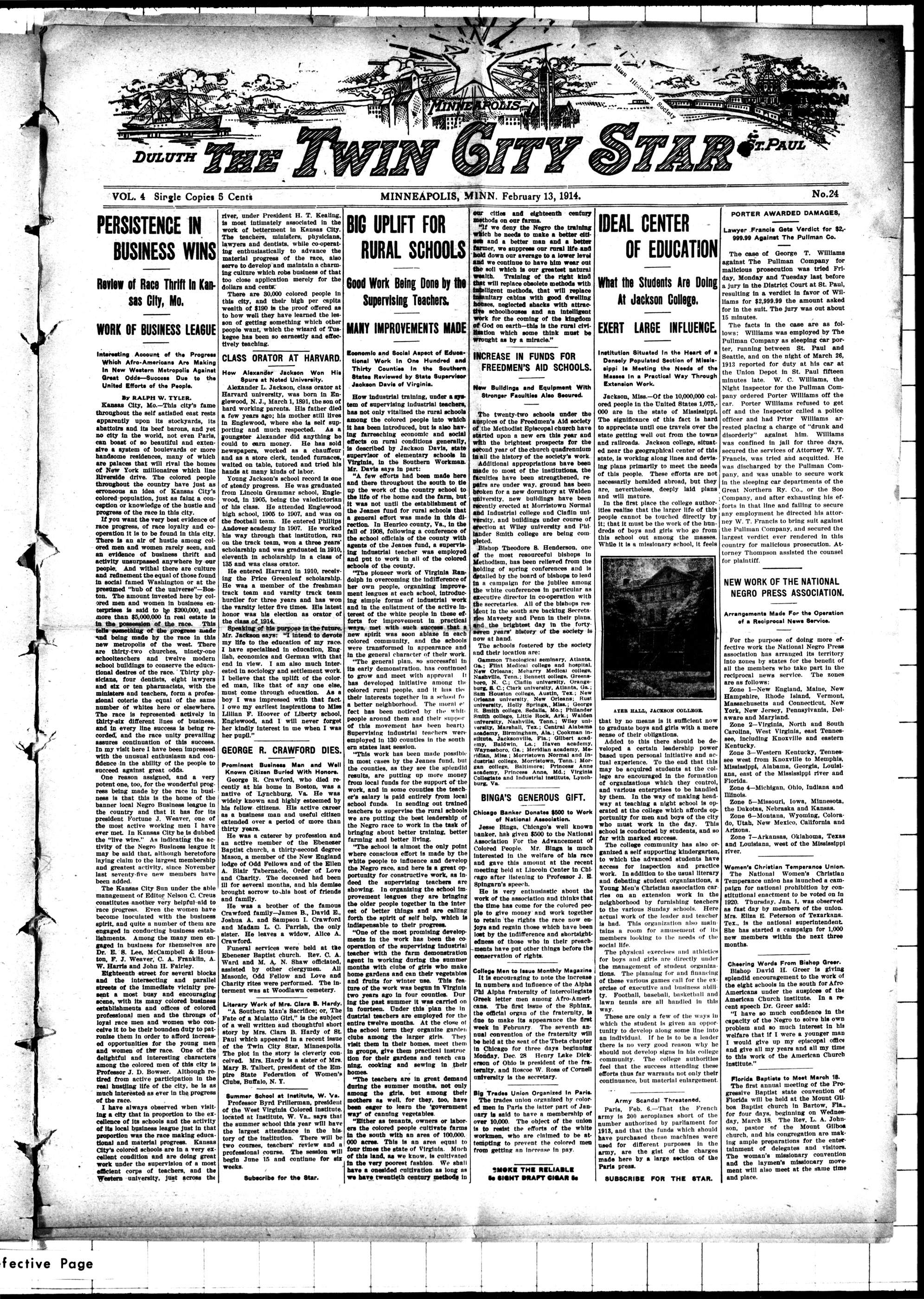
DULUTH THE TWIN CITY STAR ST. PAUL
fective Page
VOL. 4 Single Copies 5 Cents
river, under President H. T. Kealing, is most intimately associated in the work of betterment in Kansas City. The teachers, ministers, physicians, lawyers and dentists, while co-operating enthusiastically to advance the material progress of the race, also serve to develop and maintain a charming culture which robs business of that too close application merely for the dollars and cents.
There are 30,000 colored people in this city, and their high per capita wealth of $100 is the proof offered as to how well they have learned the lesson of getting something which other people want, which the wizard of Tuskegee has been so earnestly and effectively teaching.
CLASS ORATOR AT HARVARD
How Alexander Jackson Won Hia
Boura at Noted University.
Alexander L. Jackson, class orator at Harvard university, was born in Englewood, N.J., March 1, 1891, the son of hard working parents. His father died a few years ago; his mother still lives in Englewood, where she is self supporting and much respected. As a goungster Alexander did anything he could to earn money. He has sold newspapers, worked as a chauffeur and as a store clerk, tended furnaces, waited on table, tutored and tried his hands at many kinds of labor.
Young Jackson's school record is one of steady progress. He was graduated from Lincoln Grammar school, Englewood, in 1905, being the valedictorian of his class. He attended Englewood high school, 1905 to 1907, and was on the football team. He entered Phillips Andover academy in 1907. He worked his way through that institution, ran on the track team, won a three years' scholarship and was graduated in 1910, eleventh in scholarship in a class of 135 and was class orator.
He entered Harvard in 1910, receiving the Price Greenleaf scholarship. He was a member of the freshman track team and varsity track team hurdler for three years and has won the varsity letter five times. His latest honor was his election as orator of the class of 1914.
Speaking of his purpose in the future, Mr. Jackson says: "I intend to devote my life to the education of my race. I have specialized in education, English, economics and German with that end in view. I am also much interested in sociology and settlement work. I believe that the uplift of the colored man, like that of any one else, must come through education. As a boy I was impressed with that fact. I owe my earliest inspirations to Miss Lillian F. Hoover of Liberty school, Englewood, and I will never forget her kindly interest in me when I was her pupil."
GEORGE R. CRAWFORD DIES
Prominent Business Man and Well Known Citizen Buried With Honors.
George R. Crawford, who died recently at his home in Boston, was a native of Lynchburg, Va. He was widely known and highly esteemed by his fellow citizens. His active career as a business man and useful citizen extended over a period of more than thirty years.
He was a caterer by profession and an active member of the Ebenezer Baptist church, a thirty-second degree Mason, a member of the New England lodge of Odd Fellows and of the Bilen A. Blair Tabernacle, Order of Love and Charity. The deceased had been ill for several months, and his demise brought sorrow to-his host of friends and family.
He was a brother of the famous Crawford family—James B. David E. Joshua A. and Sampson I. Crawford and Madam L. C. Parrish, the only sister. He leaves a widow, Alice A. Crawford.
Funeral services were held at the Ebenezer Baptist church. Rev. C. A. Ward and M. A. N. Shaw officiated, assisted by other clergymen. All Masonic, Odd Fellow and Love and Charity rites were performed. The interment was at Woodland cemetery.
Literary Work of Mrs. Clara B. Hardy,
"A Southern Man's Sacrifice; or, The
Fate of a Mulatto Girl," is the subject
of a well written and thoughtful short
story by Mrs. Clara B. Hardy of St.
Paul which appeared in a recent issue
of the Twin City Star, Minneapolis.
The plot in the story is cleverly conceived. Mrs. Hardy is a sister of Mrs.
Mary B. Talbert, president of the Empe
state State Federation of Women's
Clubs, Buffalo, N. Y.
Summer School at Institute, W. Va.
Professor Byrd Drillerman, president
of the West Virginia Colored institute
located at Institute, W. Va., says that
the summer school this year will have
the largest attendance in the histo
ry of the institution. There will be
two courses, teachers' review and a
professional course. The session will
begin June 15 and continue for six
weeks.
PERSISTENCE IN BUSINESS WINS
Review of Race Thrift In Kansas City, Mo.
WORK OF BUSINESS LEAGUE
Interesting Account of the Progress Which Afro-Americans Are Making In New Western Metropolis Against Great Odds—Success Due to the United Efforts of the People.
By RALPH W. TYLER.
Kansas City, Mo.-This city's fame throughout the self satisfied east rests apparently upon its stockyards, its abattails and its beef barons, and yet no city in the world, not even Paris, can boast of so beautiful and extensive a system of boulevards or more handsome residences, many of which are palaces that will rival the homes of New York millionaires which line Riverside drive. The colored people throughout the country have just as erroneous an idea of Kansas City's colored-population, just as a hint a conception or knowledge of the hustle and progress of the race in this city.
If you want the very best evidence of race progress, of race loyalty and cooperation it is to be found in this city. There is an air of hustle among colored men and women rarely seen, and an evidence of business thrift and activity unsurpassed anywhere by our people. And withal there are culture and refinement the equal of those found in social famed Washington or at the presumed "hub of the universe"—Boston. The amount invested here by colored men and women in business enterprises is said to be $200,000, and more than $5,000,000 in real estate is in the possession of the race. This tells something of the progress made and being made by the race in this new metropolis of the west. There are thirty-two churches, ninety-one schoolteachers and twelve modern school buildings to conserve the educational desires of the race. Thirty physicians, four dentists, eight lawyers and six or ten pharmacists, with the ministers and teachers, form a professional coterie the equal of the same number of whites here or elsewhere. The race is represented actively in thirty-six different lines of business, and in every line success is being recorded, and the race unity prevailing assures continuation of this success. In my visit here I have been impressed with the unusual enthusiasm and confidence in the ability of the people to succeed against great odds.
One reason assigned, and a very potent one, too, for the wonderful progress being made by the race in business is that this is the home of the banner local Negro Business league in the country and that it has for its president Fortune J. Weaver, one of the most active working men I have ever met. In Kansas City he is dubbed the "live wire." As indicating the activity of the Negro Business league it may be said that, although heretofore laying claim to the largest membership and greatest activity, since November last seventy-five new members have been added.
The Kansas City Sun under the able management of Editor Nelson C. Creus constitutes another very helpful aid to race progress. Even the women have become inoculated with the business spirit, and quite a number of them are engaged in conducting business establishments. Among the many men engaged in business for themselves are Dr. E. S. Lee, McCampbell & Houston, F. J. Weaver, C. A. Franklin, A. W. Harris and John H. Fairley.
Eighteenth street for several blocks and the intersecting and parallel streets of the immediate vicinity present a most busy and encouraging scene, with its many colored business establishments and offices of colored professional men and the throngs of loyal race men and women who conceive it to be their bounden duty to patronize them in order to afford increased opportunities for the young men and women of the race. One of the delightful and interesting characters among the colored men of this city is Professor J. D. Bowser. Although retired from active participation in the real hustling life of the city, he is as much interested as ever in the progress of the race.
I have always observed when visiting a city that in proportion to the excellence of its schools and the activity of its local business league just in that proportion was the race making educational and material progress. Kansas City's colored schools are in a very excellent condition and are doing great work under the supervision of a most efficient corps of teachers, and the Western university, just across the
Subscribe for the Star.
MINNEAPOLIS, MINN. February 13, 1914.
BIG UPLIFT FOR RURAL SCHOOLS
MANY IMPROVEMENTS MADE
Economic and Social Aspect of Educational Work In One Hundred and Thirty Counties In the Southern States Reviewed by State Supervisor Jackson Davis of Virginia.
How industrial training, under a system of supervising industrial teachers, has not only vitalized the rural schools among the colored people into which it has been introduced, but is also having farreaching economic and social effects on rural conditions generally, is described by Jackson Davis, state supervisor of elementary schools in Virginia, in the Southern Workman. Mr. Davis says in part:
"A few efforts had been made here and there throughout the south to tie up the work of the country school to the life of the home and the farm, but it was not until the establishment of the Jeanes fund for rural schools that a general effort was made in this direction. In Henrico county, Va., in the fall of 1908, following a conference of the school officials of the county with agents of the Jeanes fund, a supervising industrial teacher was employed and put to work in all of the colored schools of the county.
"The pioneer work of Virginia Randolph in overcoming the indifference of her own people, organizing improvement leagues at each school, introducing simple forms of industrial work and in the enlistment of the active interest of the white people in these efforts for improvement in practical ways, met with such success that a new spirit was soon ablaze in each colored community, and the schools were transformed in appearance and in the general character of their work.
"The general plan, so successful in its early demonstration, has continued to grow and meet with approval. It has developed initiative among the colored rural people, and it has their interests together in a school to a better neighborhood. The moral effect has been noticed by the white people around them and their support of this movement has been hearty. Supervising industrial teachers were employed in 130 counties in the southern states last session.
"This work has been made possible in most cases by the Jeanes fund, but the counties, as they see the splendid results, are putting up more money from local funds for the support of the work, and in some counties the teacher's salary is paid entirely from local school funds. In sending out trained teachers to supervise the rural schools we are putting the best leadership of the Negro race to work in the task of bringing about better training, better farming and better living.
"The school is almost the only point where conscious effort is made by the white people to influence and develop the Negro race, and here is a great opportunity for constructive work, as indeed the supervising teachers are showing. In organizing the school improvement leagues they are bringing the older people together in the interest of better things and are calling forth the spirit of self help, which is indispensable to their progress.
"One of the most promising developments in the work has been the cooperation of the supervising industrial teacher with the farm demonstration agent in working during the summer months with clubs of girls who make home gardens and can their vegetables and fruits for winter use. This feature of the work was begun in Virginia two years ago in four counties. During the past summer it was carried on in fourteen. Under this plan the industrial teachers are employed for the entire twelve months. At the close of the school term they organize garden clubs among the larger girls. They visit them in their homes, meet them in groups, give them practical instruction for their gardens and teach canning, cooking and sewing in their homes.
"The teachers are in great demand during the summer months, not only among the girls, but among their mothers as well, for they, too, have been eager to learn the 'government way' of canning vegetables."
"Either as tenants, owners or laborers the colored people cultivate farms in the south with an area of 100,000. 000 acres. This is an area equal to four times the state of Virginia. Much of this land, as we know, is cultivated in the very poorest fashion. We shall have a onesided cultivation as long as we have twentieth century methods in
our cities and eighteenth century methods on our farms.
methods on our farms.
"If we deny the Negro the training which he needs to make a better citizen and a better man and a better farmer, we suppress our rural life and hold down our average to a lower level and we continue to have him wear out the soil which is our greatest natural wealth. Training of the right kind that will replace obsolete methods with intelligent methods, that will replace innantary cabins with good dwelling houses, neglected shacks with attractive schoolhouses and an intelligent work for the coming of the kingdom of God on earth--this is the rural civilization which some think must be wrought as by a miracle."
INCREASE IN FUNDS FOR FREEDMEN'S AID SCHOOLS.
New Buildings and Equipment With Stronger Faculties Also Secured.
The twenty-two schools under the auspices of the Freedman's Aid society of the Methodist Episcopal church have started upon a new era this year and with the brightest prospects for the second year of the church quadrendum in all the history of the society's work. Additional appropriations have been made to most of the institutions, the faculties have been strengthened, repairs are under way, ground has been broken for a new dormitory at Walden university, new buildings have been recently erected at Morristown Normal and Industrial college and Claflin university, and buildings under course of erection at Wiley university and Phiander Smith college are being completed.
Bishop Theodore S. Henderson, one of the most resourceful bishops in Methodism, has been relieved from the holding of spring conferences and is detailed by the board of bishops to lead in a campaign for the jubilee among the white conferences in particular as executive director in co-operation with the secretaries. All of the bishops resident in the south are backing Secretaries Mavety and Penn in their plans, and the brightest day in the forty-seven years' history of the society is now at hand.
The schools fostered by the society and their location are:
Gammon Theological seminary, Atlanta. Ga.; Flint Medical college and hospital, New Orleans; Mehary Medical college, Nashville, Tenn.; Bennett college, Greenboro, N. C.; Clifton university, Orangeburg, N. C.; Clark university, Houston, Houston; Boston, Austin, Tex.; New Orleans university, New Orleans; Rust university, Holly Springs, Miss.; George R. Smith college, Sedalia, Mo.; Philander Smith college, Little Rock, Ark.; Walden university, Nashville, Tenn.; Wiley university, Marshall, Tex.; Central University, Jacksonville, Fla.; Cookman institute, Jacksonville, Fla.; Gilbert academy, Baldwin, La.; Haven academy, Waynesboro, Ga.; Meridian academy, Meridian, Miss.; Morristown Normal and industrial college, Morristown, Tenn.; Morgan college, Baltimore; Princess Anne, Morgan college, Princess Anne, MD.; Virginia College and Industrial institute, Lynchburg, Va.
BINGA'S GENEROUS GIFT.
Chicago Banker Donates $500 to Work of National Association.
Jesse Binga, Chicago's well known banker, has given $500 to the National Association For the Advancement of Colored People. Mr. Binga is much interested in the welfare of his race and gave this amount at the recent meeting held at Lincoln Center in Chicago after listening to Professor J. E. Spingarn's speech.
He is very enthusiastic about the work of the association and thinks that the time has come for the colored people to give money and work together to retain the rights the race now enjoys and regain those which have been lost by the indifference and shortsightness of those who in their preachments have put other things before the conservation of rights.
College Men to Issue Monthly Magazine
It is encouraging to note the increase in numbers and influence of the Alpha Phi Alpha fraternity of intercollegiate Greek letter men among Afro-Americans. The first issue of the Sphinx, the official organ of the fraternity, is due to make its appearance the first week in February. The seventh annual convention of the fraternity will be held at the seat of the Theta chapter in Chicago for three days beginning Monday. Dec. 28 Henry Lake Dickerson of Ohio is president of the fraternity, and Roscoe W. Ross of Cornell university is the secretary.
Big Trades Union Organized in Paris
The trades union organized by colored men in Paris the latter part of January is said to have a membership of over 10,000. The object of the union is to resist the efforts of the white workmen, who are claimed to be attempting to prevent the colored men from getting an increase in pay.
SMOKE THE RELIABLE
So SIGHT DRAFT CIGAR So
Institution Situated In the Heart of a Densely Populated Section of Mississippi is Meeting the Needs of the Masses in a Practical Way Through Extension Work.
Jackson, Miss.-Of the 10,000,000 colored people in the United States 1,075,000 are in the state of Mississippi. The significance of this fact is hard to appreciate until one travels over the state getting well out from the towns and railroads. Jackson college, situated near the geographical center of this state, is working along lines and devising plans primarily to meet the needs of this people. These efforts are not necessarily heralded abroad, but they are, nevertheless, deeply laid plans and will mature.
In the first place the college authorities realize that the larger life of this cannot be directly by it; that it must be the work of the hundreds of boys and girls who go from this school out among the masses. While it is a missionary school, it feels
AYER HALL, JACKSON COLLEGE.
that by no means is it sufficient now to graduate boys and girls with a mere sense of their obligations.
Added to this there should be developed a certain leadership power based upon personal initiative and actual experience. To the end that this may be acquired students at the college are encouraged in the formation of organisations which they control, and various enterprises to be handled by them. In the way of making headway at teaching a night school is operated at the college which affords opportunity for men and boys of the city who must work in the day. This school is conducted by students, and so far with marked success.
The college community has also organized a self supporting kindergarten, to which the advanced students have access for inspection and practice work. In addition to the usual literary and debating student organizations, a Young Men's Christian association carries on an extension work in the neighborhood by furnishing teachers to the various Sunday schools. Here actual work of the leader and teacher is had. This organization also maintains a room for amusement of its members looking to the needs of the social life.
The physical exercises and athletics for boys and girls are directly under the management of student organizations. The planning for and financing of these various games call for the exercise of executive and business ability. Football, baseball, basketball and lawn tennis are all handled in this way.
These are only a few of the ways in which the student is given an opportunity to develop along some line into an individual. If he is to be a leader there is no very good reason why he should not develop signs in his college community. The college authorities feel that the success attending these efforts thus far warrants not only their continuance, but material enlargement.
Army Scandal Threatened.
Paris, Feb. 6.—That the French army is 200 aeroplanes short of the number authorized by parliament for 1913, and that the funds which should have purchased these machines were used for different purposes in the army, are the gist of the charges made here by a large section of the Paris press.
SUBSCRIBE FOR THE STAR.
PORTER AWARDED DAMAGES,
Lawyer Francis Gets Verdict for $2,
999.99 Against The Pullman Co.
The case of George T. Williams against The Pullman Company for malicious prosecution was tried Friday, Monday and Tuesday last before a jury in the District Court at St. Paul, resulting in a verdict in favor of Williams for $2,999.99 the amount asked for in the suit. The jury was out about 15 minutes.
The facts in the case are as follows: Williams was employed by The Pullman Company as sleeping car porter, running between St. Paul and Seattle, and on the night of March 26, 1913 reported for duty at his car at the Union Depot in St. Paul fifteen minutes late. W. C. Williams, the Night Inspector for the Pullman Company ordered Porter Williams off the car. Porter Williams refused to get off and the Inspector called a police officer and had Prter Williams arrested placing a charge of "drunk and disorderly" against him. Williams was confined in jail for three days, secured the services of Attorney W. T. Francis, was tried and acquitted. He was discharged by the Pullman Company, and was unable to secure work in the sleeping car departments of the Great Northern Ry. Co., or the Soo Company, and after exhausting his efforts in that line and falling to secure any employment he directed his attorney W. T. Francis to bring suit against the Pullman Company, and secured the largest verdict ever rendered in this country for malicious prosecution. Attorney Thompson assisted the counsel for plaintiff.
NEW WORK OF THE NATIONAL NEGRO PRESS ASSOCIATION.
Arrangements Made For the Operation of a Reciprocal News Service.
For the purpose of doing more effective work the National Negro Press association has arranged its territory into zones by states for the benefit of all the members who take part in the reciprocal news service. The zones are as follows:
Zone 1—New England, Maine, New Hampshire, Rhode Island, Vermont, Massachusetts and Connecticut, New York, New Jersey, Pennsylvania, Delaware and Maryland.
Zone 2—Virginia, North and South Carolina, West Virginia, east Tennessee, including Knoxville and eastern Kentucky.
Zone 3—Western Kentucky, Tennessee west from Knoxville to Memphis, Mississippi, Alabama, Georgia, Louisiana, east of the Mississippi river and Florida.
Zone 4—Michigan, Ohio, Indiana and Illinois.
Zone 5—Missouri, Iowa, Minnesota, the Dakotas, Nebraska and Kansas.
Zone 6- Montana, Wyoming, Colorado, Utah, New Mexico, California and Arizona.
Zone 7- Arkansas, Oklahoma, Texas and Louisiana, west of the Mississippi river.
Women's Christian Temperance Union. The National Women's Christian Temperance union has launched a campaign for national prohibition by constitutional enactment to be voted on in 1920. Thursday, Jan. 1, was observed as fast day by members of the union. Mrs. Eliza E. Peterson of Texarkana. Tex. is the national superintendent. She has started a campaign for 1,000 new members within the next three months.
Cheering Words From Bishop Greer. Bishop David H. Greer is giving splendid encouragement to the work of the eight schools in the south for Afro-Americans under the auspices of the American Church institute. In a recent speech Dr. Greer said:
"I have so much confidence in the capacity of the Negro to solve his own problem and so much interest in his welfare that if I were a younger man I would give up my episcopal office and give all my years and all my time to this work of the American Church institute."
Florida Baptists to Meet March 18. The first annual meeting of the Progressive Baptist state convention of Florida will be held at the Mount Gibbo Baptist church in Bartow, Fla., for four days, beginning on Wednesday, March 18. The Rev. L. A. Johnson, pastor of the Mount Gibbo church, and his congregation are making ample preparations for the entertainment of delegates and visitors. The woman's missionary convention and the laymen's missionary movement will also meet at the same time and place.
= RAEI RT REPAY SUTRA] OTE SRE ae oho ee . sare soled
i ae PY ae i Sw SCT ENN RN ESPEN SIRT ED 2 ain
tein
WOINEIBRPOLIS
In this great = ‘ot ours, we need
more consecrated men and wgmen to
throw out the life Iine to resse the
Derishing souls. Rev. T. J. 4
Pastor Bethesda Baptist oul
‘The People’s Christian Mission,
REV. @. W. MITCHELL, PASTOR.
1204 Washington Ave. Se.
Rev. E. W. Gilles conducts Bible
and missionary training classes as
follows: (With Mr. and Mrs. John-
‘son, 526 7 Avenue North, Monday even-
figs; with Mr. and Mrs. 0. A. Lawr.
‘ence, 910 8 Ave. South, Tuesday even-
ngs, with Mr. and Mrs. St. Clare, 411
‘21 Avenue, North, Friday evenings.
BETHESDA BAPTIST CHURCH
Don’t forget the Bethesda Rally
‘Barrels. Every little bit helps.
~ 11A.M. “Equally Rewarded.”
12:80, Sunday School.
6:30 P.M. B. Y. PU.
8 P.M. Sub. “The Lord’s Side.”
‘The serivces will be evangelistic
and Mrs. E. L. Bruce of Washington,
D. C,, will assist by singing her soul-
stirring hymns, that will put joy in the
hearts of Christians, and bring convic-
tion to the unsaved. Don’t fail to hear
Mrs. Bruce Sunday evening.
‘The public 1s always welcome to
Bethesda Church.
Rev. T. J. Carter, Pastor.
‘The entertainment by the Daughters
of Isis was a social success. Prizes
at whist were won by Mrs. B. 8. Smith
Ist, Glass Fern Vase. Mrs. A. Spence
2nd, a Stein. Mr. W. Martin of St.
Paul won the bodby. On account of
severe weather the attendance was
not very large.
DORCAS LADIES’ COLONIAL TEA.
‘The Ladies of The Dorcas Society
of Bethesda Baptist Church will give
‘a Colonial Tea at the Church in honor
of Washington's Birthday, on Feb. 23,
Monday Eve. Come! Bring your
friends. Mrs. Ophelia Rice, Pres.
Mrs. A. A. Ford, Chm.
FREE! FREE! FREE!
‘A $5.00 OFFER.
Any person or organization sending
new subscriptions to the Twin City
Star amounting to $20.00 will receive
$5.00 in gold. This Special Offer shall
include twenty (20) six month sub-
scriptions at $1.00 each or ten (10)
yearly subscriptions at $2 each. Cash
In advance. A good chance to earn
$5 for yourself, church or any organ-
ization. Good for this month only.
‘Miss Helen Brown died of diphtheria
on Wednesday, was buried Thursday
by Undertaker Raynor.
Mr. Geo. Barnett, of the C. P. Ry.,
has been transferred to Winnipeg.
Mr. Andrew Jackson of St. Paul
will spend a while visiting Mr. and
Mrs, Thos. 8. Williams in Winnipeg.
Mrs. J. H. Sherwood has been sick
during past two weeks but is improv-
ing.
Mr. John Jordan has returned from
Duluth.
The funeral of Mrs. Rosa Russell, a
sister of Mrs. Chas. S. Chase was held
‘Tuesday. Mrs. Chase brought the re-
mains from Milwaukee. Undertaker
Lawrence officiated.
Mr. J. Wright, the barber was called
to Chatham on news of his fathers
death,
The Elks will give a Harmony Ban-
quet at an early date.
‘We received some calendars from
the N. P. Ry. Co. sent us by Mr. W.
A. Hilyard, who is a clerk in the gen-
eral office. We appreciate his kind-
ness and return thanks.
JUDGE JOHNSON'S
AMMUAL MASGUERANE.
‘There was a grand time at Judge
Johnsons Prize Masquerade on: Feb-
Tuary 11. The hall was crowded. Five
prizes were awarded. There were
many maskers present. The winners
were: First prize, Mrs. Pearl, hand.
Painted pitcher; second, Miss Grace
East, flower vase; third, Miss Maud
Price, a statue; fourth, a stein; fifth,
loving cup. Everybody had a good
time.
JONES & BELL’S BARBER SHOP.
‘Messrs. Benj. Jones and Clarence W.
Bell have painted and made several
changes in their Barber Shop at 244
3rd Ave. So. They are keeping things
up-to-date for the convenience of their
patrons. A new gas heater has been
installed for their Bath Service, which
1s their Special Feature. A Pana.
torfum has been installed in the rear
by Mr. Jas. H. Lane, also a competent
Doot-biack is always on hand. The
tonsorial staff consists of artists too
well known for comment—Messrs,
Jacob Redman, Jno. Wright and H. W.
Kennedy. Mr. Jones, who is always on
hand, is one of the most gentlemanly
‘business men known anywhere, Mr.
Bell ts also very agreeable to his
patrons. They make a good combine
‘and run a first class barber shop.
a (Advertisement)
“Daddy” Reids Estate in Probate.
The estate of late Phil. H. Reld,
knawn as “Daddy” came up for final
settlement on Thursday before Judge
dazille. ‘The several claimants are
represented by thelr attorneys. Atty.
‘W. R. Morris represents Miss Florence
Jacobs of St. Paul and Mrs. Sallie Wil
son of Louisville, Ky. Claimants tn
Paducah, Ky. were represented by Atty
Ewing. Atty. J. H. Wilson of Evans-
ville, Ind. and Atty. Schriber of St.
Paul appears for Mrs. James Greene,
a daughter, Atty. O’Mally of St. Paul
appears for Eddie Reld, who is known
here as Phil's son. Atty. W. T.
Francis represented the Capital
‘Trust Co., the administrators of the
estate, valued at $15,000.
At the close ofthe testimony the
Court took the case under advisement.
From observations of the Star we are
of the opinion that the findings of the
Probate Court will be that Josephine
Reed Green, of Evansville, Ind., and
Charles Clark Reed, now in the
Philippines, (who are sister and broth-
er) are children of Phil. Reid by his
first wife, as a result of a marriage at
Center Furnace, Kentucky, shortly
after the war, and they are entitled to
inherit the estate as such children.
And also taht the Court will hold that
the boy known as Eddie Reid is an
illegitimate child and if further evi-
dence is offered to establish the fact
that the husband of his mother was
dead before the boy's birth, that he
too will share in the estate.
If the Court should render an opin-
fon as outlined above the other claim-
ants would be barred, but they would
have the right to take an appeal to the
District Court and compel all parties
to prove their claims in that Court.
Last Pre-Lenten Concert.
The D. Y. W. Y. K. Club will present
a Drama “The Old Maids’ Club” on
Feb. 17, at Teshida’s Hall, St. Paul.
Tickets, 25.
Mr. Othello W. Collins of Chicago,
Il, is visiting his sister, Mrs. O. C.
Uptegrove of 2318 10th Ave South, Mr.
Collins is an Analytical Chemist and
Assayer, also Cement Expert. He has
been connected with the Robert W.
Hunt & Co., Bureau of Inspection for
24 years and is probably the only Ne-
gro technical man in this country hold-
Ing such a position. Mr. Collins will
remain in Minneapolis two weeks.
‘The Star is on sale at—
Jones & Bell, 244 3rd Ave. So.
Franks, 1427 Wash. Ave. So.
Nygren's, 1402 Washington Ave. So.
“When you have a social, or any,
gathering worthy of mention, sole
some member as press agent, and g\
the names, especially the initials of
persons present, and forward it to your
sewspaper. Do not wait to depend on
your time or memory. It is necessary
that we get the full names of those
eeeneas
PRINTING THAT SATISFIES.
Bring your printing to THE TWIN
CITY STAR PRINT, 1402 Washington
Ave. 80. The work will suit you.
Estimates cheerfully given. T. 8. 2520,
F. Peoples, Contractor and Builder,
has secured the contract and is now
starting the foundation for the
Crispus Attucks Home, on Randolph
St, St. Paul, Minn,
A RACE PROBLEM.
Why 1s it that many persons, who
Tepresent themselves as race workers,
never subscribe to and pay for race
papers? How many do you know?
Who are they?
Furnished Room for Rent to re-
sponsible party, use of whole house,
owners seldom home. Call Nic. 5514
or So. 1407.
Sergeant Brice’s Honorable Record.
‘Twenty-tive years of honorable serv-
{ce as an enlisted soldier in the United
States army Is the record of Sergeant
William H. Brice of the Twenty-fourth
tnfantry, who has retired from active
duty and returned to bis bome in In.
dianapolls, Ind. Sergeant Brice bas
seen service ut the front and is thor-
oughly conversant with the ins and
outs of military warfare. The race to
which be belongy and the country to
which he bas given the best efforts of
bis Ife should fee! proud of his admir-
able record und grateful for bis un
selfish devotion to the fing of our com:
mon country.
Pittsburgh Church Has Big Bible Class,
One of the many Interesting fea-
tures of nplift work carried on at the
Ebenezer Baptist church In Pittsburgh
is the weekly ible class, which num-
bers nearly 300. John S. Morton ts the
instructor, Miss Mabel Younger secre-
tary, and Mrs, Anna Jobnson is the
treasurer.
FORUM MEETING.
‘The Forum meets the first Sunday
in each month at St. Peter's A. M. B.
Church, and on the third Sunday each
‘month at Bethesda Baptist Church.
All matter must reach us by Wed
needay for Insertion.
Subscribe for the Star.
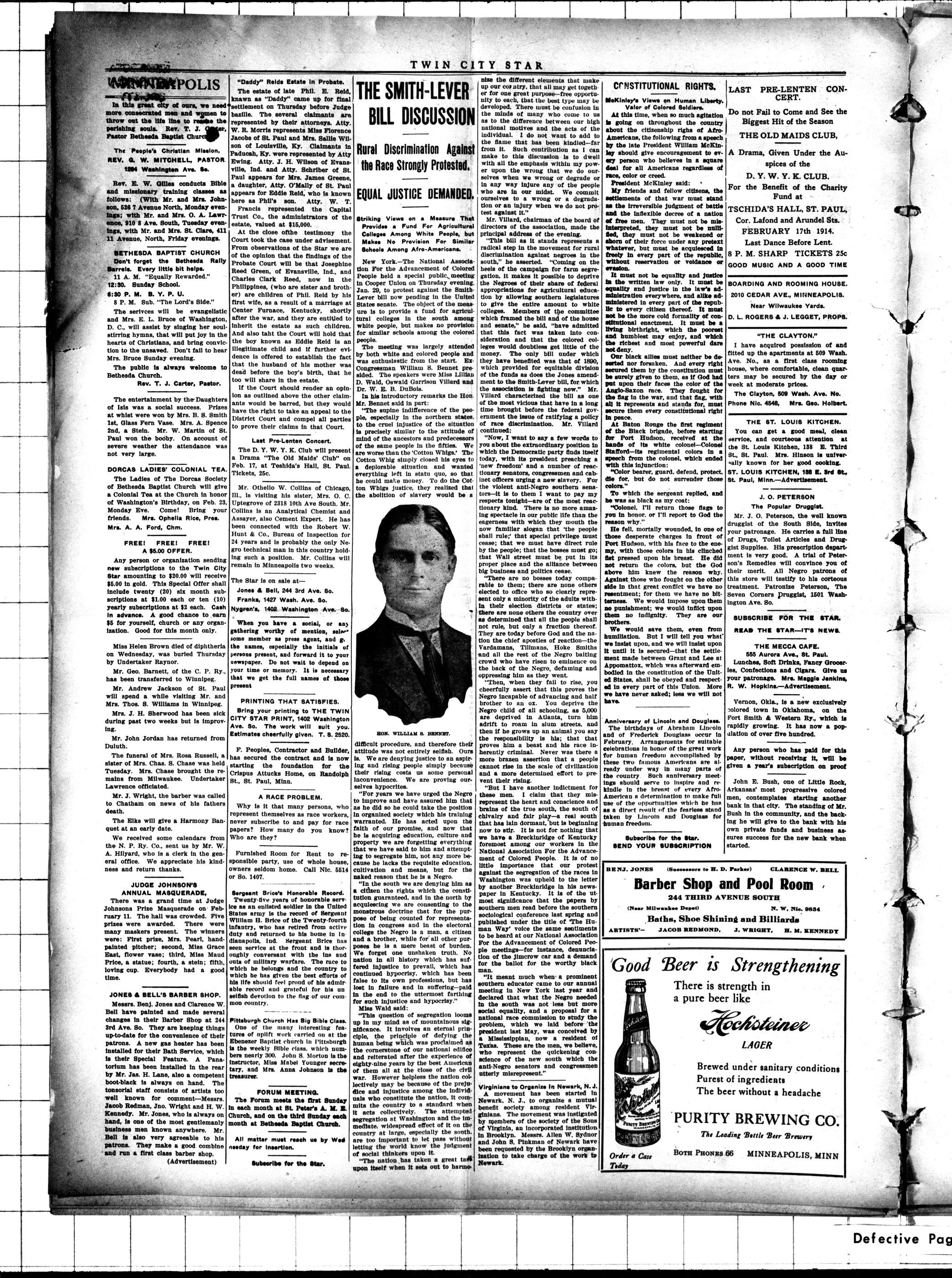
TWIN CITY STAR
nize the different ele:
THE SMITH-LEVER 23:
nity to each, that the
developed. There wus
BILL DISCUSSION |s".rss.c
national motives and
sapecl the ‘dame’ tha haa
Rural Discrimination Against] t= 1.” sucn cout
the Race Strongly Protested, | x" 2 the empness
——_ selves when we wro.
in any way injure a
EQUAL JUSTICE DEMANDED, | "%c.ers, '3, co" ms
Colleges Among White People, but
Makes No Provision For Similar
Schools Among Afro-Americans,
New York—The National Associa-
tion For the Advancement of Colored
People held a special public. meeting
in Cooper Union on Thursday evening,
Jan. 29, to protest against the Smith-
Lever bill now pending in the United
Btates senate. The object of the meas-
ure 1s to provide a fund for agricul-
tural colleges in the south among
white people, but makes no provision
for similar schools among the colored
people.
‘The meeting was largely attended
by both white and colored people and
was enthusiestic from the start. Ex
Congressman William 8. Bennet pre
sided. ‘The speakers were Miss Lillian
D. Wald, Oswald Garrison Villard and
Dr. W. B. B. DuBois.
In his introductory remarks the Hon.
Mr. Bennet said in part:
“The supine indifference of the peo-
ple, especially in the northern states,
to the cruel injustice of the situation
is precisely similar to the attitude of
mind of the ancestors and predecessors
of the same people in the fifties. We
are worse than the ‘Cotton Whigs.’ The
Cotton Whig simply closed his eyes to
a deplorable situation and wanted
everything left in statu quo, so that
he could male money. To do the Cot
ton Whigs justice, they realized that
the abolition of slavery would be a
difficult procedure, and therefore thelt
attitude was not entirely selfish. Ours
1, We are denying justice to an aspir-
ing and rising people simply because
thelr rising costs us some personal
tnconventence. We are proving our-
selves hypocrites.
“For years we have urged the Negro
to improve and have assured him that
as he did so he could take the position
In organized soclety which his training
warranted. He has acted upon the
faith of our promise, and now that
he is acquiring education, culture and
property we are forgetting everything
‘that we havo sald to him and attempt:
ing to segregate him, not any more be-
cause he lacks the requisite education,
‘cultivation and means, but for the
‘naked reason that he is a Negro.
“In the south we are denying him as
@ citizen the rights which the constl-
tution guaranteed, and in the north by
acquiescing we are consenting to the
monstrous doctrine that for the pur-
pose of being counted for representa-
tion in congress and in the electoral
college the Negro is a man, a citizen
and a brother, while for all other pur-
poses he Is a mere beast of burden,
‘We forget one unsbaken truth. No
nation in all history which has suf-
fered injustice to prevail, which has
continued hypocrisy. which has been
false to its own professions, but has
lost in failure and in suffering—pald
in the end to the uttermost farthing
for such injustice and hypocrisy.”
Miss Wald said:
“This question of segregation looms
up in my mind as of mountainous sig-
nificance. It involves an eternal prin-
ciple, the principle of defying the
human being which was proclaimed as
the comerstone of our national edifice
and relterated after the experience of
eighty-nine years by the best American
of them all at the close of the civil
war. However helpless the nation cok
lectively may be because of the preju-
@ice and injustice among the individ:
uals who constitute the nation, it com-
mits the country to a standard when
tt acts collectively. The attempted
segregation at Washington and the im-
mediate. widespread effect of it on the
country at large, especially the south.
are too important to let pass without
letting the world know the judgment
of social thinkers upon It.
“The nation has taken a great tad
‘upon itself when it sets out to harmo
‘Up our cor atry, that all may get togeth-
er for one great purpose—free opportu-
nity to each, that the best type may be
developed. There must be confusion in
the minds of many who come to us
as to the difference between our high
national motives and the acts of the
Individual. I do not want to add to
the flame that bas been kindled—far
from it. Such contribution as 1 can
make to this discussion is to dwell
with all the emphasis within my pow-
er upon the wrong that we do our-
selves when we wrong or degrade or
in any way injure any of the people
who are in our midst. We commit
ourselves to a wrong or a degrads-
tion or an injury when we do not pro-
test against it.”
Mr. Villard, chatrman of the board of
directors of the association, made the
principal address of the evening.
“This bill as it stands represents a
radical step in the movement for rural
discrimination against negroes in the
south,” he asserted. “Coming on the
heels of the campaign for farm segre-
gation, it makes it possible to deprive
the Negroes of thelr share of federal
appropriations for agricultural educa-
ton by allowing southern legislatures
to give the entire amount to white
colleges. Members of the committee
which framed the bill and of the house
and senate,” he said, “have admitted
that this fact was taken into con-
sideration and that the colored col-
leges would doubtless get little of the
money. The only bill under which
they have benefited was that of 1890,
which provided for equitable division
of the funds as does the Jones amend-
ment to the Smith-Lever bill, for which
the association is fighting now.” Mr.
Villard characterized the bill as one
of the most vicious that have in a long
time brought before the federal gov-
ernment the issue of ratifying a policy
of race discrimination. Mr. Villard
continued:
“Now, I want to say a few words to
you about the extraordinary position in
which the Democratic party finds itself
today, with ite president preaching a
‘new freedom’ and a number of reac-
tionary senators, congressmen and cab-
inet officers urging a new slavery. For
the violent anti-Negro southern sena-
tors—it is to them I want to pay my
respects tonight—are of the most reac-
tlonary kind. There is no more amaz-
ing spectacle in our public Iife than the
eagerness with which they mouth the
now familiar slogan that ‘the people
shall rule;’ that special privilege must
cease; that we must have direct rule
by the people; that the bosses must go;
that Wall street must be put in Its
proper place and the alliance between
big business and politics cease.
“There are n0 bosses today compa-
rable to them; there are none others
elected to office who so clearly repre-
sent only a minority of the adults with-
in thelr election districts or states;
there are none others the country over
as determined that all the people shall
not rule, but only a fraction thereof.
They are today before God and the na-
tion the chief apostles of reaction—the
Vardamans, Tillmans, Hoke Smiths
and all the rest of the Negro baiting
crowd who have risen to eminence on
the back of the Negro, defaming and
oppressing him as they went.
“Then, when they fail to rise, you
cheerfully assert that this proves the
Negro incapable of advancing and half
brother to an ox. You deprive the
Negro child of all schooling, as 5,000
are deprived in Atlanta, turn bim
adrift to roam in slum streets, and
then if he grows up an animal you say
the responsibility is his; that that
proves him a beast and his race In-
herently criminal. Never was there a
more brazen assertion that a people
‘cannot rise in the scale of civilization
and a more determined effort to pre
vent thelr rising.
“But I have another indictment for
these men. I claim that they mis-
represent the heart and conscience and
Drains of the true south, the south of
chivalry and fair play—a real south
that has lain dormant, but is beginning
now to stir. It 1s not for nothing that
we have a Breckinridge of Kentucky
foremost among our workers in the
National Association For the Advance-
ment of Colored People. It is of no
Uttle importance that our protest
against the segregation of the races in
Washington was upheld to the letter
by another Breckinridge in his news-
paper in Kentucky. It is of the ut-
most significance that the papers by
southern men read before the southern
sociological conference last spring and
published under the title of “The Hu-
man Way’ voice the same sentiments
to be heard at our National Association
For the Advancement of Colored Peo-
ple meetings—for instance, denuncia-
tion of the jimcrow car and a demand
for the bailot for the worthy black
man.
“It meant much when’ a prominent
southern educator came to our annual
meeting in New York last year and
declared that what the Negro needed
in the south was not less but more
social equality, and a proposal for a
national race commission to study the
problem, which we laid before ‘the
president last May, was conceived by
Virginians to Organize In Newark, N. J.
A movement bas been started In
Newark, N. J., to organize a mutual
benefit society among resident Vir-
ginians. The movement was instigated
by members of the society of the Sons
of Virginia, an Incorporated institution
in Brooklyn. Messrs. Allen W. Sydnor
and John 8, Pinkman of Newark have
been requested by the Brooklyn organ-
ization to take charge of the work to
Newark.
BENJ. JONES — (Sneceasors to H.D. Parker) | CLARENCE W. BELL,
Barber Shop and Pool Room .
244 THIRD AVENUE SOUTH
(teas Mitwantee Deset) . W, Mia, so
Baths, Shoe Shining and Billiards
Anriste- 3ACOMEEDMOND, 3, WRIGHT, _&. M. KENNEDY
Good Beer is Strengthening
ee There is strength in
fy a pure beer like
BR Kihei
ft ‘ , LAGER
‘ Me Brewed under sanitary conditions
bien Purest of ingredients
. o The beer without a headache
v so
aes ‘PURITY BREWING CO.
er S The Leading Bottle Beer Brewery
Order @ Ca --«-BOTH Puonzs 66 MINNEAPOLIS, MINN
Seles sn ss
CCNSTITUTIONAL RIGHTS,
MoKinley’s Views on Human Liberty.
Valor of Colored Soldiers.
‘At this time, when so much agitation
fs going on throughout the country
about the citizenship righs of Afro
Americans, the following from a speech
by the late President William McKin-
lay should give encouragement to ev-
‘fy person who believes in a square
deal for all Americans regardless of
‘Face, color or creed.
President McKinley said: +
My friends and fellow citizens, the
settlements of that war must stand
as the irreversible judgment of battle
‘and the inflexible decree of a nation
ef free men. They must not be mis-
interpreted, they must not be null
fled, they must not be weakened ot
shorn of their force under any pretext
‘whatever, but must be acquiesced in
freely in every part of the republic,
without reservation of voldance of
evasion.
It must not be equality and justice
im the written law only. It must be
equality and justice in the law's ad-
ministration everywhere, and alike ad-
ministered in every part of the repub-
We to every citizen thereof. It must
Bot be the more cold formality of con-
stitutional enactment. It must be a
living birthright, which the poorest
and humblest may enjoy, and which
the richest and most powerful dare
not deny.
Our black allies must neither be de-
sorted nor forsaken. And every right
secured them by the constitution must
be surely given to them, as if God had
Dut upon their faces the color of the
Anglo-Saxon race. They fought for
the flag in the war, and that fag, with
all it represents and stands for, must
secure them every constitutional right
im peace.
At Baton Ronge the first regiment
of the Black brigade, before starting
for Port Hudson, received at the
hands of its white colonel—Colonel
Stafford—its regimental colors in a
speech from the colonel, which ended
with this injunction:
“Color bearer, guard, defend, protect,
@e for, but do not surrender those
colors.”
‘To which the sergeant replied, and
be was as black as my coat:
“Colonel, I'll return those flags to
you in honor. or I'll report to God the
Teason why.”
He fell, mortally wounded, in one of
those desperate charges in front of
Port Hudson, with his face to the ene-
my, with those colors in bis clinched
fist pressed upon his breast. He did
not return the colors, but the God
above him knew the reason why.
Against those who fought on the other
side in that great confilct we have no
Fesentment; for them we have no bit-
terness. We would impose upon them
‘no punishment; we would inflict upon
them no indignity. They are our
brothers.
‘We would save them, even from
humiliation. But I will tell you what
‘we insist upon, and we will insist upon
ft until it 1s secured—that the settle-
ment made between Grant and Lee at
Appomattox, which was afterward em-
bodied in the constitution of the Unit-
ed Btates, shall be obeyed and respect-
ed in every part of this Union. More
we have never asked; less we will not
ee
Anniversary of Lincoln and Douglass,
The birthdays of Abrabam Lincoln
and of Frederick Douglass occur in
February, Arrangements for suitable
celebrations in honur of the great work
for buman freedom accomplished by
these two famous Americans are al-
ready under way In many parts of
the country. Such anniversary meet-
ings should serve to inspire and re
Kindle in the brenst of every Afro-
American a determination to make full
use of the opportunities which be has
as a direct result of the fearless stand
taken by Lincoln and Douglass for
‘human freedom.
Subscribe for the Star.
®END YOUR 8UBSCRIPTION
:
LAST PRE-LENTEN CON-
| CERT.
Do not Fail to Come and See the
Biggest Hit of the Season
THE OLD MAIDS CLUB,
A Drama, Given Under the Au-
spices of the
D.Y. W. ¥.K. CLUB.
For the Benefit of the Charity
Fund at
TSCHIDA’S HALL, ST. PAUL,
Cor. Lafond and Arundel Sts.
FEBRUARY 17th 1914.
Last Dance Before Lent.
8 P.M. SHARP TICKETS 25c
GOOD MUSIC AND A GOOD TIME
BOARDING AND ROOMING HOUSE.
2010 CEDAR AVE., MINNEAPOLIS.
Near Wilwaukee Yards.
D. L. ROGERS & J, LEGGET, PROPS.
“THE CLAYTON.”
I have acquired possission of and
fitted up the apartments at 509 Wash.
Ave. No, a8 a first class rooming
house, where comfortable, clean quar-
ters may be secured by the day or
week at moderate prices.
The Clayton, 609 Wash. Ave. No.
Phone Nic. 4548, Mrs. Geo. Holbert.
THE ST, LOUIS KITCHEN.
You can get a good moul, clean
service, and courteous attention at
the St. Louis Kitchen, 188 E. Third
St, St. Paul. Mrs. Hinson fs univer:
sally known for her xood cooking.
ST. LOUIS KITCHEN, 188 E. 3rd 8t,
St. Paul, Minn.—Advertisement.
J. 0. PETERSON
The Popular Druggist.
Mr. J. 0. Peterson, the well known
druggist of the South Side, invites
your patronage. He carries a full line
of Drugs, Toilet Articles and Drug-
gist Supplies. His prescription depart-
ment {s very good. A trial of Peter-
son’s Remedies will convince you of
their merit, All Negro patrons of
this store will testify to his corteous
treatment. Patronize Peterson, ‘The
Seven Corners Prugglst, 1501 Wash-
ington Ave. So.
| SUBSCRIBE FOR THE STAR.
READ THE STAR—ITS NEWS,
‘THE MECCA CAFE.
885 Aurora Ave. 8t. Paul.
Lunches, Soft Drinks, Fancy Grocer.
tes, Confections and Cigars. Give us
your patronage. Mra, Maggle Jenkins,
R. W. Hopkin —Advertisement.
Vernon, Okla, i a new exclustvely
colored town tn Oklahoma, on the
Fort Smith & Western Ry., which is
rapidly growing. It has now a pop-
ulation of over five hundred,
Any person who has paid for this
paper, without receiving it, will be
siven & year's subscription on proot
John E. Bush, one of Little Rock,
Arkansas’ most progressive colored
men, contemplates starting another
bank in that clty. ‘The standing of Mr.
Bush in the community, and the back-
ing he will give to the bank with his
own private funds and business as-
sures success for the new bank when
started.
ce — Me ek Cee Tap See ee tor ie - - er Bs gel eateries Foe nasa merce mcm | |
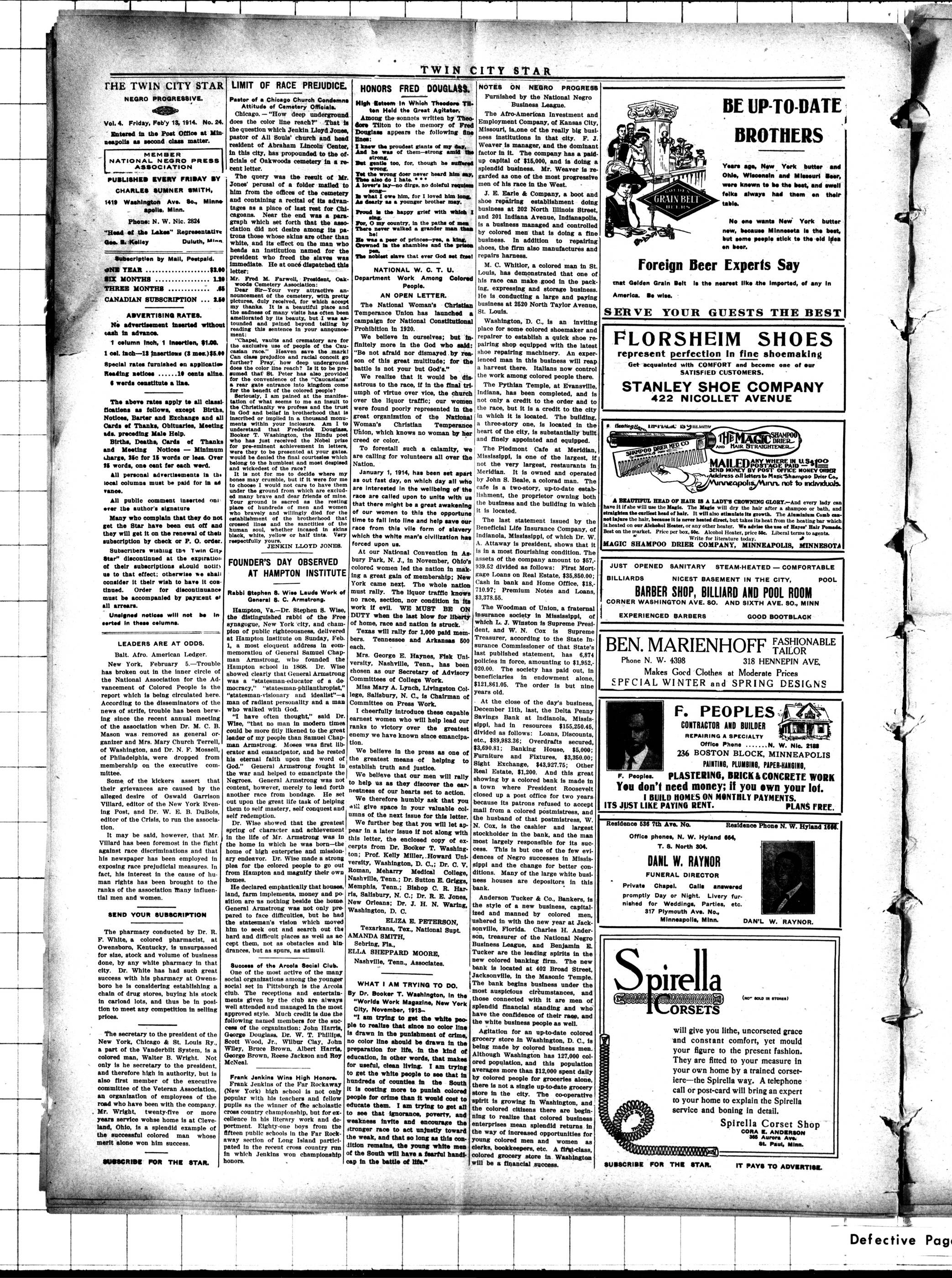
THE TWIN CITY STAR
NEGRO PROGRESSIVE.
Vol. 4. Friday, Feb’y 18, 1914. No. 24.
Entered in the Post Office at Min-
neapolis as second class matter.
MEMBER
NATIONAL NEGRO PRESS
ASSOCIATION
PUBLISHED EVERY FRIBAY BY
CHARLES SUMNER SMITH,
1419 Washington Ave. 80, Minne
apolie, Minn.
Phone: N. W. Nic. 2824
“Head of the Lakes” Representative
Gee. Bi:Kelley Duluth, Minn
‘@ubscription by Mall, Postpaid. —
QIK MONTHS ooo 8
PHREE MONTHB .........005 66
CANADIAN SUBSCRIPTION ... 2.56
ADVERTISING RATES.
Ne advertisement inserted without
cash tn advance.
1 column Inch, 1 Insertion, $1.00.
1 cel, tuch—18 insertions (3 mos.)$5.00
Special rates furnished en applicatior
Reading notices ......10 cents aline.
6 words constitute « line.
‘The above rates apply te all classi.
fications as follows, except Births,
Notices, Barter and Exchange and all
Cards of Thanks, Obituaries, Meeting
Ads, preceding Male Help.
Births, Deaths, Cards of Thanks
and Meeting Notices — Minimum
charge, 36¢ for 15 words or less. Over
25 words, one cent fer each werd.
All personal advertisements in the
focal columns must be paid for in a@
vance.
All public comment inserted on!
ever the author's signature
‘Many who complain that they do not
get the Star have been cut off and
they will get {t on the renewal of thet:
subscription by check or P. O. order.
Subscribers wishing tho Twin City
Star” discontinued at the expiration
of thelr subscriptions sLould notity
‘us to that effect; otherwise we shal!
consider it their wish to have it com-
tinued. Order for discontinuance
must be accompanied by payment ef
all arrears.
Unsigned notices will not be In
eorted in these columns.
LEADERS ARE AT ODDS.
Balt. Afro. American Ledger.
New York, February 5.—Trouble
has broken out in the inner circle of
the National Association for the Ad
vancement of Colored People is the
report which is being circulated here
According to the disseminators of the
news of strife, trouble has been berw:
ing since the recent annual meeting
of the association when Dr. M. C. B
Mason was. removed as general or.
ganizer and Mrs. Mary Church Terrell,
of Washington, and Dr. N. F. Mossel
of Philadelphia, were dropped from
membership on the executive com:
mittee.
Some of the kickers assert that
their grievances are caused by the
alleged desire of Oswald Garrison
Villard, editor of the New York Even:
ing Post, and Dr. W. E. B. DuBols,
editor of the Crisis, to run the associa-
tion.
It may be said, however, that Mr.
Villard has been foremost in the fight
against race discriminations and that
his newspaper has been employed in
exposing race prejudicial measures. In
fact, his interest in the cause of hu-
man rights has been brought to the
ranks of the association Many influen-
tial men and women.
SEND YOUR SUBSCRIPTION
‘The pharmacy conducted by Dr. R.
F, White, a colored pharmacist, at
Owensboro, Kentucky, is unsurpassed
for size, stock and volume of business
done, by any white pharmacy in that
city. Dr. White has had such great
success with his pharmacy at Owens-
boro he ts considering establishing a
chain of drug stores, buying his stock
in carload lots, and thus be in post-
tion to meet any competition in selling
prices.
‘The secretary to the president of the
New York, Chicago & St. Louls Ry.,
@ part of the Vanderbilt System, is a
colored man, Walter B. Wright. Not
only is he secretary to the president,
and therefore high in authority, but is
also first member of the executive
committee of the Veteran Association,
an organization of employees of the
Toad who have been with the company.
Mr. Wright, twenty-five or more
years service wohse home is at Cleve-
land, Ohio, is a splendid example of
the successful colored man whose
merit alone won him success.
@USSCRIBE FOR THE STAR.
LIMIT OF RACE PREJUDICE.
Pastor of a Chicage Church Condemns
Attitude of Cemetery Officials.
Chicago. —“How deep ‘underground
does the color line reach?” . That is
the question which Jenkin Lloyd Jones,
pastor of All Souls’ church and head
resident of Abraham Lincoln Center,
in this city, has propounded to the of-
fictals of Oakwoods cemetery in a re-
cent letter.
The query was the result of Mr.
Jones’ perusal of a folder mailed to
him from the offices of the cemetery
and containing a recital of its advan-
tages as a place of last rest for Chi-
cagoans. Near the end was @ para-
graph which set forth that the asso-
elation did not desire among its pa-
trons those whose skins are other than
white, and its effect on the man who
heads an institution named for the
president who freed the slaves was
immediate. He at oncé dispatched this
letter:
Mr. Fred M. Farwell, President, Oak-
‘woods Cemetery Association:
Dear Sir—Your very attractive an-
nouncement of the cometery, with pretty
pictures, duly recelved, for which accept
my thanks Tt is a beautiful place and
the sadness of many visits has often been
‘ameliorated by Its beauty, but I was as-
‘tounded and pained beyond telling by
eading this sentence tn your anngunoe
“Chapel, vaults and crematory are for
‘the exclusive use of people of the Cau-
casian rice.” Haven save the -marki
Can clase prejudice and Facial concelt 60
further? Pray, how deep underground
does the color line reach?” Ta it to be pre-
sumed that Bt. Peter has also provided
for the convenience of the “Caucasians”
a Fear gate entrance into kingdom come
for the benefit of the colored people?
Seriously, T am pained at the manifes-
tation of ‘what seems to me an insult to
the Christianity we profess and the trust
im God and bellet in brotherhood that 1s
inscribed or implied in a thousand monu-
ments within your Inclosure, Am I to
understand ‘that Frederick Dougiaes,
Booker ‘T. Washington, the Hindu post
who has fust received the Nobel. prize
for’ pre-eminent achiovement in letters,
Were they to be presented at your gates,
would be donted the final courtesies which
Delong to the humblest and most despised
and wickedest of the race?
Tt ts not for me to decide where my
bones may crumble, but if it were for me
to choose I would not care to have them
under the ground from which are exclad-
ed many brave and dear friends of mine.
Your ground is sacred as the resting
place of hundreds of men and women
who bravely and willingly dled for the
eetablishment of the brotherhood that
ferosed lines and tho sanctitles of the
human soul, whether Incased In akins
black, white, yellow or half tints. Very
respectfully yours,
‘JENKIN LLOYD JONES.
FOUNDER’S DAY OBSERVED
AT HAMPTON INSTITUTE
NN ee oe eee
General 8. C. Armstrong.
Hampton, Va.—Dr. Stephen 8. Wise,
the distinguished rabbi of the Free
synagogue, New York city, and cham-
pion of public righteousness, delivered
at Hampton Institute on Sunday, Feb.
1, @ most eloquent address in eom-
memoration of General Samuel Chap-
man Armstrong, who founded the
Hampton school in 1868. Dr. Wise
showed clearly that General Armstrong
was a “statesman-educator of a de
mocracy,” “‘statesman-philanthropist,”
“statesman-visionary and idealist”—a
man of radiant personality and a man
who walked with God.
“1 have often thought” sald Dr.
Wise, “that no man in modern times
could be more fitly likened to the great
leader of my people than Samuel Chap-
man Armstrong. Moses was first lib-
erator and emancipator, and he rested
his eternal faith upon the word of
God.” General Armstrong fought in
the war and helped to emancipate the
Negroes. General Armstrong was not
content, however, merely to lead forth
another race from bondage. He set
out upon the great life task of helping
them to self mastery, self conquest and
self redemption.
Dr. Wise showed that the greatest
spring of character and achievement
in the life of Mr. Armstrong was in
the home in which he was born—the
home of high enterprise and mission-
ary endeavor. Dr. Wise made a strong
plea for the colored people to go out
from Hampton and magnify their own
homes. :
He declared emphatically that houses,
land, farm implements, money and po-
sition are as nothing beside the home
General Armstrong was not only pre
pared to face difficulties, but he had
the statesman’s vision which moved)
him to seek out and search out the
hard and difficult places as well as ac
cept them, not as obstacles and bin
drances, but as spurs, as stimuli.
Success of the Arcola Social Club.
‘One of the most uctive of the many
social organizations among the younger
social set in Pittsburgh 1s the Arcola
club. The receptions and entertain-
ments given by the club are always
well attended and managed in the most
approved style. Much credit {s due the
following named members for the suc-
cess of the organization: John Harris,
George Douglass, Dr. W. 'T. Phillips,
Scott Wood, Jr, Wilbur Clay, John
Wiley, Bruce Brown, Albert Harris,
George Brown, Reese Jackson and Roy
McNeal.
Frank Jenkine Wine High Honore.
Frank Jenkins of the Far Rockaway
(New York) high school is not only
popular with his teachers and fellow
pupils as the winner of the scholastic
cross country championship, but for ex-
cellence In his literary work and de-
portment. Eighty-one boys from the
fifteen public schools in the Far Rock-
away section of Long Island partict-
pated in the recent cross country run
in which Jenkins won championship
honors, -
TWIN CITY STAR
HONORS FRED DOUGLASS,
High feteom in Which Theodore Ti
ton Held the Great Agitator,
Among the:sonnets written by ‘Theo-
@ore Tilton to the memory of Fred
Dougiaes appears the following fine
Mnes:
knew the proudest siants of my day,
And be was of them—strong amid’ the
strong,
Bet gentle too, for, though he suffered
wrong,
‘Yet the wrong doer never heard him eay,
hee also do I hate. =="
A lover's tay—no dirge, no doleful requiem
eons
Be what I owe him, for I loved him long,
‘As Gearty an 0 youngor brother may.
Proud te the happy grief with which 1
or, O my country, in the paths of men
‘Phare never walked a grander man thea
Be was a peer of princes—yee, a king,
Growned tm the shambles and’ the prison
The Robiest slave that ever God set tree!
NATIONAL W. ©. T. U.
Department Work Among Colored
People.
AN OPEN LETTER.
‘The National Woman’s Christian
‘Temperance Union has launched a
campaign for National Constitutional
Prohibition in 1920.
‘We believe in ourselves; but in-
finitely more in the God who said:
“Be not afraid nor dismayed .by rea-
son of this great multitude; for the
battle is not your but God's.”
‘We realize that it would be dis-
‘astrous to the race, if in the final tri-
umph of virtue over vice, the church
over the liquor traffic; our women
were found poorly represented in the
great organization of the National
‘Woman's Christian Temperance
Uhton, which knows no woman by her
creed or color.
To forestall such a calamity, we
are calling for volunteers all over the
Nation.
January 1, 1914, has been set apart
as out fast day, on which day all who
are interested in the wellbeing of the
race are called upon to unite with us
that there might be a great awakening
of our women to this the opportune
time to fall into line and help save our
race from this vile form of slavery
which the white man’s civilization has
forced upon us.
At our National Convention in As-
bury Park, N. J., in November, Ohio's
colorec women led the nation in mak-
ing a great gain of membership; New
York came next. The whole nation
must rally. The liquor traffic knows
no race, section, nor condition in its
work if evil. WE MUST BE ON
DUTY when the last blow for liberty
of home, race and nation is struck.
Texas will rally for 1,000 patd mem-
bers. Tennessee and Arkansas 500
each.
Mrs. George E. Haynes, Fisk Unt-
versity, Nashville, Tenn, has been
thosen as our Secretary of Advisory
Committees of College Work.
‘Miss Mary A. Lynch, Livingston Col-
lege, Salisbury, N. C., 1s Chairman of
Committee on Press Work.
I cheerfully introduce these capable
earnest women who will help lead our
ranks to victory over the greatest
enemy we have known since emancipa-
Hon.
We believe in the press as one of
he greatest means of helping to
establish truth and justice.
We believe that our men will rally
0 help us as they discover the ear-
1estness of our hearts set to action.
We therefore humbly ask that you
wil give space in your valuable col-
imns of the next issue for this letter.
We further beg that you will let ap-
ear in a later {ssue if not along with
his letter, the enclosed copy of ex-
erpts from Dr. Booker T. ‘Washing-
on; Prof. Kelly Miller, Howard Unt-|
ersity, Washington, D. C.,; Dr. 0. V.
toman, Meharry Medical College, |
Nashville, Tenn.; Dr. Sutton B. Griggs, |
femphis, Tenn.; Bishop C. R. Har.
1s, Salisbury, N. C.; Dr. R. B. Jones,
Yew Orleans; Dr. J. H. N. Waring, |
Washington, D. ©. i
ELIZA B. PETERSON, |)
‘Texarkana, Tex., National Supt. ||
\MANDA SMITH,
Sebring, Fla,
ILLA SHEPPARD MOORE,
Nashville, Tenn., Associates, q
WHAT | AM TRYING TO Do,
By Dr. Booker T. Washington, in the
“Worlds Work Magazine, New York
City, November, 1913~
“I am trying to get the white peo-
ple to realize that since no color line
{s drawn in the punishment of crime,
no color line should be drawn in the
Preparation for life, in the kind of
education, in other words, that makes
for useful, clean living. I am trying
to get the white people to see that in
hundreds of counties in the South
It 1s costing more to punish colored
people for crime than tt would cost to
educate them. I am trying to get all
to see that ignorance, poverty, and
weakness invite and encourage the
stronger race to act unjustly toward
the weak, and that so long as this con-
dition remains, the young white men
of the South will have a fearful handi-
cap in the battle of life.”
NOTES ON NEGRO PROGRESS
Furnished by the National Negro
Business League.
hdr’ sea sat ciate pale hh crate acc
Employment Company, of Kansas City,
Missourl, is.one of the really big bust.
ness institutions in that city. F. J.
Weaver is manager, and the dominant
factor in it. The company has a paid
up capital of $16,000, and is doing a
splendid business. Mr. Weaver is re-
garded as one of the most progressive
men of his race in the West. -
J. E. Earle & Company, a boot and
shoe repairing establishment doing
business at 202 North Illinois Street,
and 201 Indiana Avenue, Indianapolis,
Is business managed and controlled
by colored mem that is doing a fine
business. In addition to repairing
shoes, the firm also manufactures and
repairs harness.
M. C. Whitlor, a colored man in St.
Louls, has demonstrated that one of
his race can make good in the pack-
ing, expressing and storage business.
He is conducting a large and paying
business at 2520 North Taylor Avenue,
St. Louts.
Washington, D. C., is an inviting
place for some colored shoemaker and
repairer to establish a quick shoe re-
pairing shop equipped with the latest
shoe repairing machinery. An exper-
fenced man in this business will reap
a harvest there. Italians now control
the work among colored people there.
The Pythian Temple, at Evansville,
Indiana, has been completed, and {s
not only a credit to the order and to
the race, but it 1s a credit to the city
in which it is located. The building,
B three-story one, 1s located in the
heart of the city, is substantially butlt
and finely appointed and equipped.
The Piedmont Cafe at Meridian,
Mississippi, 1s one of the largest, if
not the very largest, restaurants in
Meridian. It is owned and operated
by John 8. Beale, a colorad man. The
cafe is a two-story, up-to-date estab-
lishment, the proprietor owning both
the business and the building in which
it fs located.
‘The last statement issued by the
Beneficial Lite Insurance Company, of
Indianola, Mississippi, of which Dr. W.
A. Attaway Is president, shows that it.
is in a most flourishing condition. The
assets of the company amount to $57,-
939.62 divided as follows: First Mort-
gage Loans on Real Estate, $35,860.00;
Cash in bank and Home Office, $18,-
710.97; Premium Notes and Loans,
$3,378.55.
‘The Woodman of Union, a fraternal
insurance society in Mississippi, of
which L. J. Winston 1s Supreme Presi-
dent, and W. N. Cox is Supreme
Treasurer, according to the State In-
surance Commissioner of that State's
last published statement, has 6,874
policies in force, amounting to $1,952,-
020.00. The society has paid out, in
beneficiaries. in endowment alone,
$121,861.05. The order is but nine
years old.
At the close of the day’s business,
December 11th, last, the Delta Penny
Savings Bank at Indianola, Missts-
sippi, had in resources $155,260.45,
livided as follows: Loans, Discounts,
ste, $89,983.36; Overdrafts secured,
53,690.81; Banking House, 35,000;
Furniture and Fixtures, $3,360.00;
Sight Exchange, $43,927.75; Other
Real Estate, $1,200. And this great
showing by a colored bank is made in
. town where President Roosevelt
losed up a post office for two years.
pecause its patrons refused to accept
nail from a colored postmistress, and
he husband of that postmistress, W. |
N. Cox, is the cashier and largest
tockholder in the bank, and the man
nost largely responsible for its suc-
ess. This is but one of the few evi-
lences of Negro successes in Missis-
Mppi and the change for better con-
itions. Many of the large white bus!-
1e88 houses are depositors in this
ank. '
Anderson Tucker & Co., Bankers, ts
he style of a new business, capital-
zed and manned by colored men,
shered in with the new year at Jack-
onville, Florida. Charles H. Ander-
on, treasurer of the National Negro
jusiness League, and Benjamin E.
‘ucker are the leading spirits in the
ew colored banking firm. The new
ank is located at 402 Broad Street,
acksonville, in the Masonic Temple.
the bank begins business under the
nost auspicious cirtumstances, and
hose connected with it are men of
plendid financial standing and who
ave the confidence of their rage, and
he white business people as well.
Agitation for an up-todate colored
rocery store in Washington, D. C., is
eing made by colored business men.
though Washington has 127,000 col-
red population, and this population
S
.
p irella
| CODON) mr erm
| ORSETS
will give you lithe, uncorseted grace
¥) ‘and constant comfort, yet mould
= your figure to the present fashion.
= They are fitted to your measure in
== your own home by a trained corset-
== iere—the Spirella way. A telephone
= call or post-card will bring an expert
= nop to your home to explain the Spirella
3 eae service and boning in detail.
of’ = Spirella Corset Shop
7S CORA &. ANDERSON
pons) ‘905 Aurora Ave.
Ci, ‘St. Paul, Minn.
TLE) _———————
SUBSCRIBE FOR THE STAR. IT PAYS TO ADVERTICE.
BE UP-TO-DATE
SEA \¢,_, BROTHERS
WS) "S32 ne
et
e- ro é were knewn te be the best, and swell
A SQ "enone
Ea i i o No ene wants New York butter
Sst bet ‘seme poople tek to theca igot
on beer,
Foreign Beer Experts Say
mat Gelden Grain Belt Is the nearest like the imported, of any In
America. Be wise.
SERVE YOUR GUESTS THE BEST
represent perfection in fine shoemaking
Get acquainted with COMFORT and become one of our
SATISFIED CUSTOMERS,
STANLEY SHOE COMPANY
422 NICOLLET AVENUE
yy
(a a TGR SEAMED
eC
ALO wan enssrmrere sree
at SRO TORE CO POT SetOe wont Salen
Wes ciciress oll letters to Masic‘Shampoo Drier Coy
2% apolis Munn. not fo dividuals.
A BEAUTIFUL HEAD OF HAIR IS A LADY'S CROWNING GLORY.—And every lady can!
have it if she will use the Magic. The Magie will dry the hair after a shampoo or bath, and|
straighten the carlet bead of hal It wills atimulatelts growth. The Alsmiaiun Comb cor
ot inure the hair because ite never heated direct, but takes ts heat fom the heating far whieh
Iahcated on our Aichobel Heater, or any other heater. We advan thesoe of Haver Hale Fomede
Best onthe market. Price per box, e- Alcohol Heater pice Se. Lieral terme to agentes
> Write for literature today. 2
MAGIC SHAMPOO DRIER COMPANY, MINNEAPOLIS, MINNESOTA
JUST OPENED SANITARY STEAM-HEATED — COMFORTABLE
BILLIARDS: NICEST BASEMENT IN THE CITY, POOL
BARBER SHOP, BILLIARD AND POOL ROOM
CORNER WASHINGTON AVE. SO. AND SIXTH AVE. SO., MINN
| EXPERIENCED BARBERS GOOD BOOTBLACK |
ns
—$—$—$——$—$_
BEN. MARIENHOFF fAaitto'Acte
3 TAILOR
Phone N. W- 4398 318 HENNEPIN AVE,
Makes Gocd Clothes at Moderate Prices
SPFCIAL WINTER and SPRING DESIGNS
a | F. PEOPLES .{ 44>
CONTRACTOR AND BUILDER
| REPAIRING A SPECIALTY ty
Office Phone .......N. W. Nic. 2188
i , 236 BOSTON BLOCK, MINNEAPOLIS
ms Sa PAINTING, PLUMBING, PAPER-KANGING,
F. Peoples. PLASTERING, BRICK & CONCRETE WORK
You don’t need money; if you own your lot.
1 BUILD HOMES ON MONTHLY PAYMENTS.
ITS JUST LIKE PAYING RENT. PLANS FREE.
Residence 536 7th Ave. No. ——=—=SsResidence Phone N. W. Hyland 10
Office phones, N. W. Hyland 664, —
T. 8. North 204.
DANL W. RAYNOR |
FUNERAL DIRECTOR
“Private Chapel. Calle answered | f
Promptly Day or Night. Livery fur- | A
ished for Weddings, Parties, etc. jimmy
317 Plymouth Ave. No. u i
Minneapolis, Minn. DAN'L W. RAYNOR.
Defective Pag