Twin City Star
Friday, March 6, 1914
Minneapolis, Minnesota
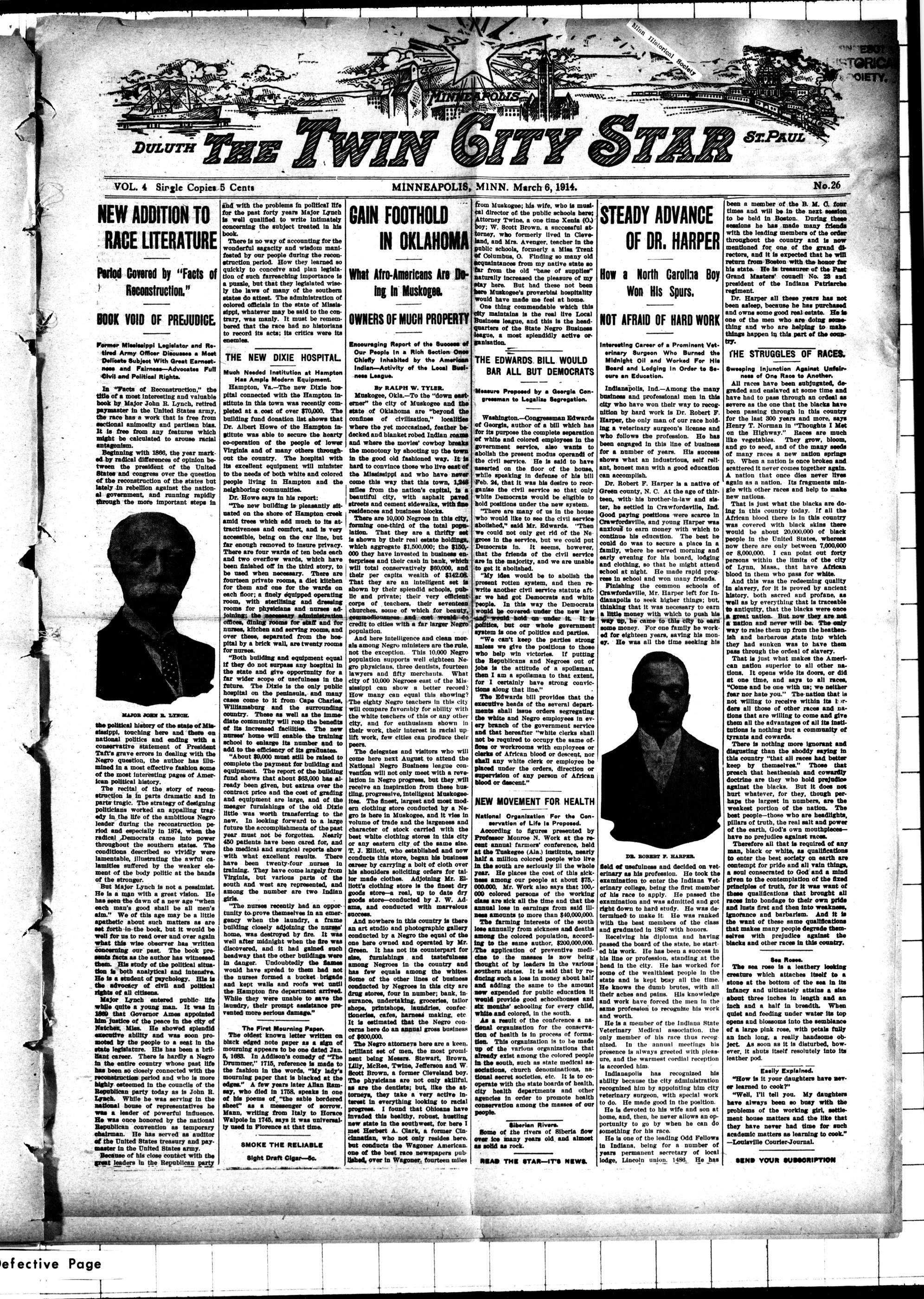
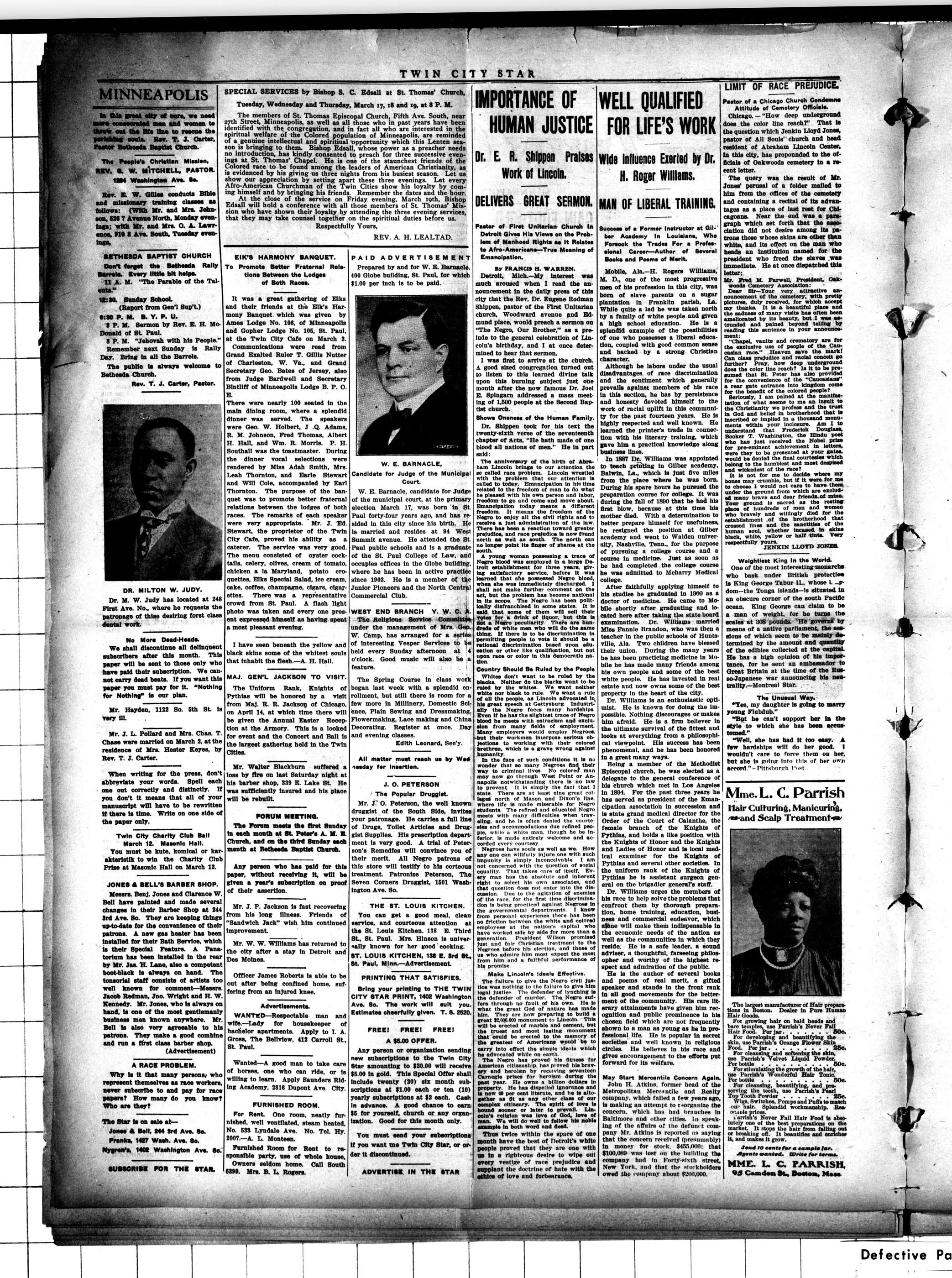
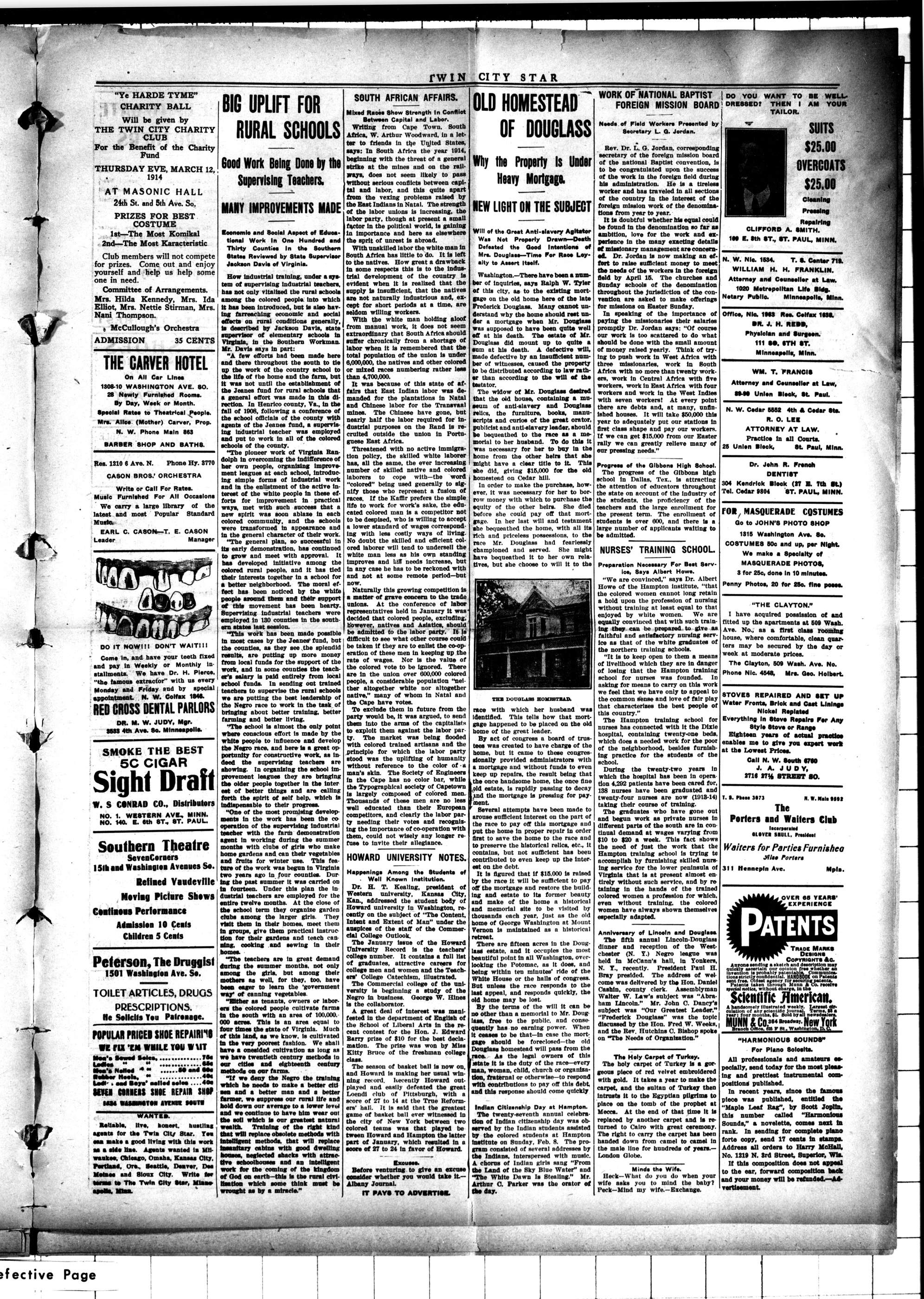
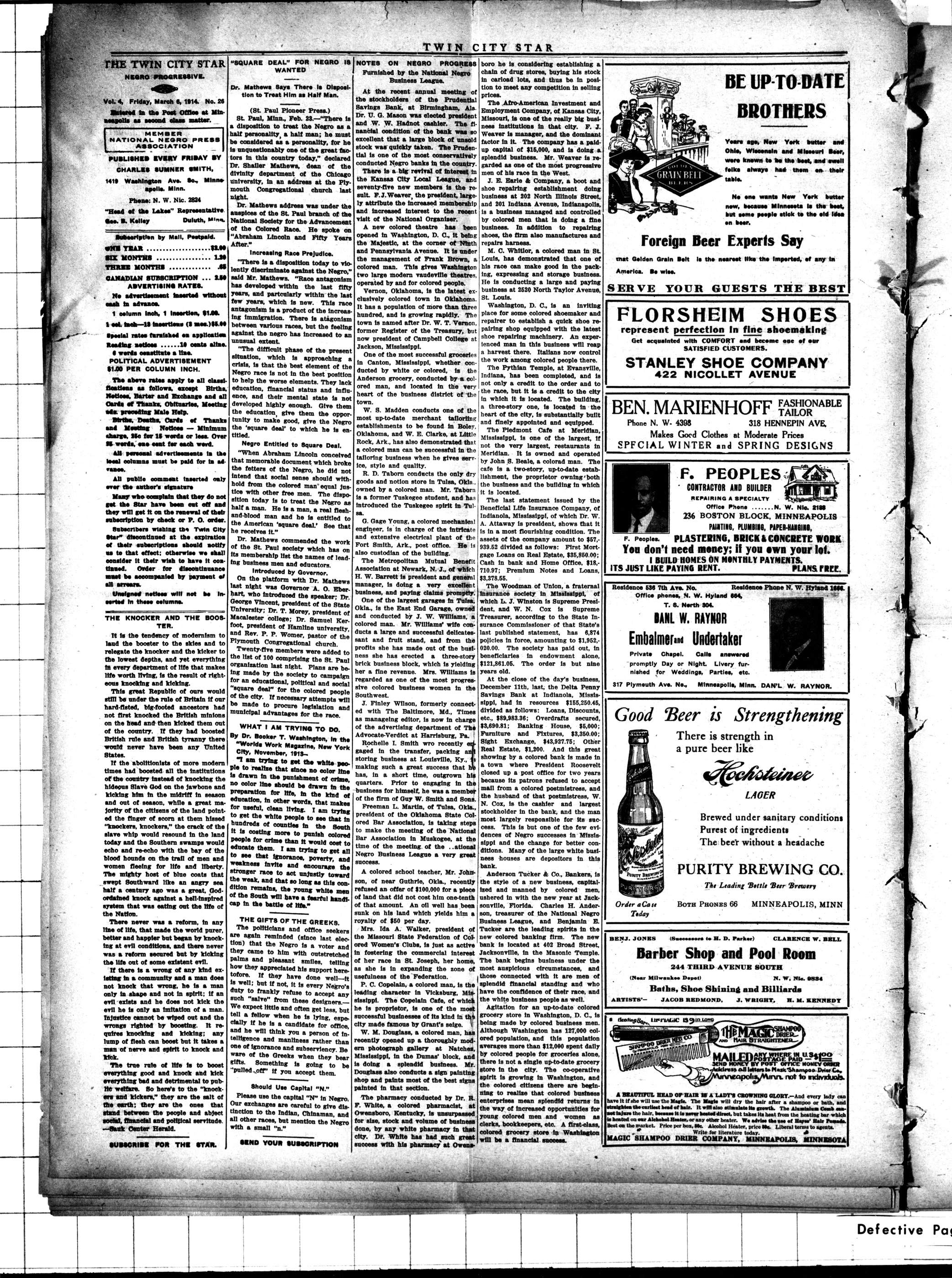
Page text (machine-generated)
DULUTH THE TWIN CITY STAR ST.PAUL
effective Page
VOL. 4 Single Copies 5 Cents
and with the problems in political life for the past forty years Major Lynch is well qualified to write intimately concerning the subject treated in his book.
There is no way of accounting for the wonderful sagacity and wisdom manifested by our people during the reconstruction period. How they learned so quickly to conceive and plan legislation of such farreaching importance is a puzzle, but that they legislated wisely the laws of many of the southern states do attest. The administration of colored officials in the state of Mississippi, whatever may be said to the contrary, was manly. It must be remembered that the race had no historians to record its acts; its critics were its enemies.
Muhu Needed Institution at Hampton
Has Ample Modern Equipment
Has Ample Modern Equipment.
Hampton, Va.-The new Dixie hospital connected with the Hampton institute in this town was recently completed at a cost of over $70,000. The building fund donation list shows that Dr. Albert Howe of the Hampton institute was able to secure the hearty co-operation of the people of lower Virginia and of many others throughout the country. The hospital with its excellent equipment will minister to the needs of both white and colored people living in Hampton and the neighboring communities.
Dr. Howe says in his report:
"The new building is pleasantly situated on the shore of Hampton creek amid trees which add much to its attractiveness and comfort, and is very accessible, being on the car line, but far enough removed to insure privacy. There are four wards of ten beds each and two overflow wards, which have been finished off in the third story, to be used when necessary. There are fourteen private rooms, a diet kitchen for them and one for the wards on each floor; a finely equipped operating room, with sterilizing and dressing rooms for physicians and nurses adjoining; the necessary administration offices, dining rooms for staff and for nurses, kitchen and serving rooms, and over these, separated from the hospital by a brick wall, are twenty rooms for nurses.
"Both building and equipment equal if they do not surpass any hospital in the state and give opportunity for a far wider scope of usefulness in the future. The Dixie is the only public hospital on the peninsula, and many cases come to it from Cape Charles, Williamsburg and the surrounding country. These as well as the immediate community will reap the benefits of its increased facilities. The new nurses' home will enable the training school to enlarge its number and to add to the efficiency of its graduates.
"About $0,000 must still be raised to complete the payment for building and equipment. The report of the building fund shows that about $63,000 has already been given, but extras over the contract price and the cost of grading and equipment are large, and of the meager furnishings of the old Dixie little was worth transferring to the new. In looking forward to a large future the accomplishments of the past year must not be forgotten. Nearly 450 patients have been cared for, and the medical and surgical reports show with what excellent results. There have been twenty-four nurses in training. They have come largely from Virginia, but various parts of the south and west are represented, and among the number are two Indian girls.
"The nurses recently had an opportunity to prove themselves in an emergency when the laundry, a frame building closely adjoining the nurses' home, was destroyed by fire. It was well after midnight when the fire was discovered, and it had gained such headway that the other buildings were in danger. Undoubtedly the fames would have spread to them had not the nurses formed a bucket brigade and kept walls and roofs wet until the Hampton fire department arrived. While they were unable to save the laundry, their prompt assistance prevented more serious damage."
The oldest known letter written on black edged note paper as a sign of mourning appears to be one dated Jan. 5, 1683. In Addison's comedy of "The Drummer," 1715, reference is made to the fashion in the words, "My lady's mourning paper that is blacked at the edges." A few years later Allan Ramsay, who died in 1758, speaks in one of his poems of "the sable bordered sheet" as a messenger of sorrow. Mann, writing from Italy to Horace Walpole in 1745, says it was universally used in Florence at that time.
NEW ADDITION TO RACE LITERATURE
BOOK VOID OF PREJUDICE
Former Mississippi Legislator and Retired Army Officer Discusses a Most Delicate Subject with Great Earnestness and Fairness—Advocates Full Civil and Political Rights.
In "Facts of Reconstruction," the title of a most interesting and valuable book by Major John R. Lynch, retired paymaster in the United States army, the race has a work that is free from sectional animosity and partisan bias. It is free from any features which might be calculated to arouse racial antagonism.
Beginning with 1866, the year marked by radical differences of opinion between the president of the United States and congress over the question of the reconstruction of the states but lately in rebellion against the national government, and running rapidly through the more important steps in
MAJOR JOHN R. LYNCH.
the political history of the state of Mississippi, touching here and there on national politics and ending with a conservative statement of President Taft's grave errors in dealing with the Negro question, the author has illuminated in a most effective fashion some of the most interesting pages of American political history.
The recital of the story of reconstruction in parts dramatic and in parts tragic. The strategy of designing politicians worked an appalling tragedy in the life of the ambitious Negro leader during the reconstruction period and especially in 1874, when the radical Democrats came into power throughout the southern states. The conditions described so vividly were lamentable, illustrating the awful calamities suffered by the weaker element of the body politic at the hands of the stronger. But Major Lynch is not a pessimist. He is a man with a great vision. He has seen the dawn of a new age "when each man's good shall be all men's aim." We of this age may be a little apathetic about such matters as are set forth in the book, but it would be well for us to read over and over again what this wise observer has written concerning our past. The book presents facts as the author has witnessed them. His study of the political situation is both analytical and intensive. He is a student of psychology. His is the advocacy of civil and political rights of all citizens.
Major Lynch entered public life while quite a young man. It was in 1800 that Governor Ames appointed him justice of the peace in the city of Natchick, Miss. He showed splendid executive ability and was soon promoted by the people to a seat in the state legislature. His has been a brilliant career. There is hardly a Negro in the entire country whose past life has been so closely connected with the reconstruction period and who is more highly esteemed in the councils of the Republican party today as is John R. Lynch. While he was serving in the national house of representatives he was a leader of powerful influence. He was once honored by the national Republican convention as temporary chairman. He has served as auditor of the United States treasury and paymaster in the United States army.
Because of his close contact with the great leaders in the Republican party
THE NEW DIXIE HOSPITAL
Dr. Howe says in his report:
The First Mourning Paper.
SMOKE THE RELIABLE Sight Draft Cigar—5c.
MINNEAPOLIS, MINN. March 6, 1914.
Encouraging Report of the Success of Our People In a Rich Section Once Chiefly Inhabited by the American Indian—Activity of the Local Business League.
By RALPH W. TYLER.
Muskogee, Okla.-To the "down easterner" the city of Muskogee and the state of Oklahoma are "beyond the confines of civilization," localities where the yet moccasin, feather be decked and blanket robed Indian roams and where the movies' cowboy breaks the monotony by shooting up the town in the good old fashioned way. It is hard to convince those who live east of the Mississippi and who have never come this way that this town, 1,249 miles from the nation's capital, is a beautiful city, with asphalt paved streets and cement sidewalks, with fine residences and business blocks. There are 10,000 Negroes in this city, forming one-third of the total population. That they are a thrifty set is shown by their real estate holdings, which aggregate $1,500,000; the $150,000 they have invested in business enterprises and their cash in bank, which will total conservatively $80,000, and their per capita wealth of $142.08. That they are an intelligent set is shown by their spiendid schools, public and private; their very efficient corps of teachers, their seventen churches, some of which for beauty, commodoousness and cost would do credit to cities with a far larger Negro population.
And here intelligence and clean morals among Negro ministers are the rule, not the exception. This 10,000 Negro population supports well eighteen Negro physicians, three dentists, fourteen lawyers and fifty merchants. What city of 10,000 Negroes east of the Mississippi can show a better record? How many can equal this showing? The eighty Negro teachers in this city will compare favorably for ability with the white teachers of this or any other city, and for enthusiasm shown in their work, their interest in racial uplift work, few cities can produce their peers.
The delegates and visitors who will come here next August to attend the National Negro Business league convention will not only meet with a revelation in Negro progress, but they will receive an inspiration from these hustling, progressive, intelligent Muskogeeites. The finest, largest and most modern clothing store conducted by a Negro is here in Muskogee, and it vies in volume of trade and the largeness and character of stock carried with the best white clothing stores in this city or any eastern city of the same size. T. J. Elliott, who established and now conducts this store, began his business career by carrying a bolt of cloth over his shoulders soliciting orders for tailor made clothes. Adjoining Mr. Elliott's clothing store is the finest dry goods store—a real, up to date dry goods store—conducted by J. W. Adams, and conducted with marvelous success.
And nowhere in this country is there an art studio and photographic gallery conducted by a Negro the equal of the one here owned and operated by Mr. Green. It has not its counterpart for size, furnishings, and tastefulness among Negroes in the country and has few equals among the whites. Some of the other lines of business conducted by Negroes in this city are drug stores, four in number; bank, insurance, undertaking, groceries, tailor shops, printshops, laundries, confectionaries, cafes, harness making, etc. It is estimated that the Negro concerns here do an annual gross business of $600,000.
The Negro attorneys here are a keen, brilliant set of men, the most prominent being Messrs. Stewart, Brown, Lilly, McRea, Twine, Jefferson and W. Scott Brown, a former Cleveland boy. The physicians are not only skilful, as are the dentists; but, like the attorneys, they take a very active interest in everything looking to racial progress. I found that Ohioans have invaded this healthy, robust, hustling new state in the southwest, for here I met Herbert A. Clark, a former Cincinnatiian, who not only resides here, but conducts the Wagner American one of the best race newspapers published, over in Wagner, fourteen miles
from Muskogee; his wife, who is musical director of the public schools here; Attorney Twine, a one time Kenia (O.1) boy; W. Scott Brown, a successful attorney, who formerly lived in Cleveland, and Mrs. Avenger, teacher in the public schools, formerly a Miss Trent of Columbus, O. Finding so many old acquaintances from my native state so far from the old "base of supplies" naturally increased the pleasure of my stay here. But had these not been here Muskogee's proverbial hospitality would have made me feel at home.
One thing commendable which this city maintains is the real live Local Business league, and this is the headquarters of the State Negro Business league, a most splendidly active organisation.
THE EDWARDS. BILL. WOULD BAR ALL BUT DEMOCRATS
Measure Proposed by a Georgia Congressman to Legalize Segregation.
Washington.—Congressman Edwards of Georgia, author of a bill which has for its purpose the complete separation of white and colored employees in the government service, also wants to abolish the present modus operandi of the civil service. He is said to have asserted on the floor of the house, while speaking in defense of his bill Feb. 24, that it was his desire to reorganize the civil service so that only white Democrats would be eligible to hold positions under the new system.
"There are many of us in the house who would like to see the civil service abolished," said Mr. Edwards. "Then we could not only get rid of the Negroes in the service, but we could put Democrats in. It seems, however, that the friends of the civil service are in the majority, and we are unable to get it abolished.
"My idea would be to abolish the present rotten system, and then rewrite another civil service statute after we had got Democrats and white people. In this way the Democrats would be covered under the new law and would hold on under it. It is politics, but our whole government system is one of politics and parties."
"We can't keep the parties strong unless we give the positions to those who help win victories. If putting the Republicans and Negroes out of jobs is the attitude of a spollsman, then I am a spollsman to that extent, for I certainly have strong convictions along that line."
The Edwards bill provides that the executive heads of the several departments shall issue orders segregating the white and Negro employees in every branch of the government service and that hereafter "white clerks shall not be required to occupy the same offices or workrooms with employees or clerks of African blood or descent, nor shall any white clerk or employee be placed under the orders, direction or supervision of any person of African blood or descent."
NEW MOVEMENT FOR HEALTH
National Organization For the Conservation of Life is Proposed.
According to figures presented by Professor Monroe N. Work at the recent annual farmers' conference, held at the Tuskegee (Ala.) institute, nearly half a million colored people who live in the south are seriously ill the whole year. He places the cost of this sickness among our people at about $75,000,000. Mr. Work also says that 100,000 colored persons of the working class are sick all the time and that the annual loss in earnings from said illness amounts to more than $40,000,000. The farming interests of the south lose annually from sickness and deaths among the colored population, according to the same author, $200,000,000. The application of preventive medicine to the masses is now being thought of by leaders in the various southern states. It is said that by reducing such a loss in money about half and adding the same to the amount new expended for public education it would provide good schoolhouses and six months' schooling for every child, white and colored, in the south.
As a result of the conference a national organization for the conservation of health is in process of formation. This organization is to be made up of the various organizations that already exist among the colored people in the south, such as state medical associations, church denominations, national secret societies, etc. It is to cooperate with the state boards of health, city health departments and other agencies in order to promote health conservation among the masses of our people.
Siberian Rivers.
Some of the rivers of Siberia flow over ice many years old and almost as solid as rock.
READ THE STAR—IT'S NEWS.
STEADY ADVANCE OF DR. HARPER
NOT AFRAID OF HARD WORK
Interesting Career of a Prominent Veterinary Surgeon Who Burned the Midnight Oil and Worked For His Board and Lodging In Order to Secure an Education.
Indianapolis, Ind.—Among the many business and professional men in this city who have won their way to recognition by hard work is Dr. Robert F. Harper, the only man of our race holding a veterinary surgeon's license and who follows the profession. He has been engaged in this line of business for a number of years. His success shows what an industrious, self reliant, honest man with a good education can accomplish.
Dr. Robert F. Harper is a native of Green county, N.C. At the age of thirteen, with his brother-in-law and sister, he settled in Crawfordsville, Ind. Good paying positions were scarce in Crawfordsville, and young Harper was anxious to earn money with which to continue his education. The best he could do was to secure a place in a family, where he served morning and early evening for his board, lodging and clothing, so that he might attend school at night. He made rapid progress in school and won many friends.
Finishing the common schools of Crawfordsville, Mr. Harper left for Indianapolis to seek higher things; but, thinking that it was necessary to earn a little money with which to push his way up, he came to this city to earn some money. For one family he worked for eighteen years, saving his money. He was all the time seeking his
DR. ROBERT F. HARPER.
field of usefulness and decided on veterinary as his profession. He took the examination to enter the Indiana Veterinary college, being the first member of his race to apply. He passed the examination and was admitted and got right down to hard study. He was determined to make it. He was ranked with the best members of the class and graduated in 1897 with honors.
Receiving his diploma and having passed the board of the state, he started his work. He has been a success in his line or profession, standing at the head in the city. He has worked for some of the wealthiest people in the state and is kept busy all the time. He knows the dumb brutes, with all their aches and pains. His knowledge and work have forced the men in the same profession to recognize his work and worth.
He is a member of the Indiana State Veterinary Medical association, the only member of his race thus recognized. In the annual meetings his presence is always greeted with pleasure, and the warmest cordial reception is accorded him.
Indianapolis has recognized his ability because the city administration recognized him by appointing him city veterinary surgeon, with special work to do. He made good in the position. He is devoted to his wife and son at home, and, then, he never allows an opportunity to go by when he can do something for his race.
He is one of the leading Odd Fellows in Indiana, being for a number of years permanent secretary of local lodge, Lincoln union. 1480. He has
No.26
been a member of the B. M. C. four times and will be in the next session to be held in Boston. During these sessions he has made many friends with the leading members of the order throughout the country and is now mentioned for one of the grand directors, and it is expected that he will return from Boston with the honor for his state. He is treasurer of the Past Grand Masters' council No. 23 and president of the Indiana Patriarchic regiment.
Dr. Harper all these years has not been asleep, because he has purchased and owns some good real estate. He is one of the men who are doing something and who are helping to make things happen in this part of the country.
THE STRUGGLES OF RACES.
Sweeping Injunction Against Unfairness of One Race to Another
All races have been subjugated, degraded and enslaved at some time and have had to pass through an ordeal as severe as the one that the blacks have been passing through in this country for the last 300 years and more, says Henry T. Norman in "Thoughts I Met on the Highway." Races are much like vegetables. They grow, bloom, and go to seed, and of the many seeds of many races a new nation springs up. When a nation is once broken and scattered it never comes together again. A nation that once dies never lives again as a nation. Its fragments mingle with other races and help to make new nations. That is just what the blacks are doing in this country today. If all the African blood there is in this country was covered with black skins there would be about 20,000,000 of black people in the United States, whereas now there are only between 7,000,000 or 8,000,000. I can point out forty persons within the limits of the city of Lynn, Mass., that have African blood in them who pass for white. And this was the redeeming quality in slavery, for it is proved by ancient history, both sacred and profane, as well as by everything that is traceable to antiquity, that the blacks were once a great nation. But now they are not a nation and never will be. The only way to raise them up from the heatenhill and barbarous state into which they had sunken was to have them pass through the ordeal of slavery.
That is just what makes the American nation superior to all other nations. It opens wide its doors, or did at one time, and says to all races, "Come and be one with us; we neither fear nor hate you." The nation that is not willing to receive within its borders all those of other races and nations that are willing to come and give them all the advantages of all its institutions is nothing but a community of tyrants and cowards.
There is nothing more ignorant and disgusting than the shoddy saying in this country "that all races had better keep by themselves." Those that preach that heathenish and cowardly doctrine are they who hold prejudice against the blacks. But it does not hurt whatever, for they, though perhaps the largest in numbers, are the weakest portion of the nation. The best people—those who are headlights, pillars of truth, the real salt and power of the earth, God's own mouthpieces—have no prejudice against races.
Therefore all that is required of any man, black or white, as qualifications to enter the best society on earth are contempt for pride and all vain things, a soul consecrated to God and a mind given to the contemplation of the fixed principles of truth, for it was want of these qualifications that brought all races into bondage to their own pride and lusts first and then into weakness, ignorance and barbarism. And it is the want of these same qualifications that makes many people degrade themselves with prejudice against the blacks and other races in this country.
Sea Roses.
The sea rose is a leathery looking creature which attaches itself to a stone at the bottom of the sea in its infancy and ultimately attains a size about three inches in length and an inch and a half in breadth. When quiet and feeding under water its top opens and blossoms into the semblance of a large pink rose, with petals fully an inch long, a really handsome object. As soon as it is disturbed, however, it shuts itself resolutely into its leather pod.
Easily Explained.
"How is it your daughters have never learned to cook?" "Well, I'll tell you. My daughters have always been so busy with the problems of the working girl, settlement house matters and the like that they have never had time for such academic matters as learning to cook."—Louisville Courier-Journal.
SEND YOUR SUBSCRIPTION
In this great city of ours, we need more consecrated men and women to throw out the life line to rescue the perishing souls. Rev. T. J. Carter, Pastor Betheeda Baptist Church.
The People's Christian Mission, REV. G. W. MITCHELL, PASTOR. 1204 Washington Ave. 8e.
Rev. E. W. Gilles conducts Bible and missionary training classes as follows: (With Mr. and Mrs. Johnson, $38 7 Avenue North, Monday evenings; with Mr. and Mrs. O. A. Lawrence, 518 8 Ave. South, Tuesday evenings,
BETHESDA BAPTIST CHURCH
Don't forget the Bethesda Rally
Barrels. Every little bit helps.
11 A. M. "The Parable of the Tal-
enta."
12:30. Sunday School.
(Report from Gen'l Sup't.)
6:30 P. M. B. Y. P. U.
3 P. M. Sermon by Rev. E. H. Mc-
Donald of St. Paul.
8 P. M. "Jehovah with his People."
Remember next Sunday is Rally
Day. Bring in all the Barrels.
The public is always welcome to
Bethesda Church.
Rev. T. J. Carter, Pastor.
PETER H.
DR. MILTON W. JUDY.
Dr. M. W. Judy has located at 248 First Ave. No., where he requests the patronage of this desiring forst class dental work.
No More Dead-Heads.
We shall discontinue all delinquent subscribers after this month. This paper will be sent to those only who have paid their subscription. We cannot carry dead beats. If you want this paper you must pay for it. "Nothing for Nothing" is our plan.
Mr. Hayden, 1122 So. 5th St. is very ill.
Mr. J. L. Pollard and Mrs. Chas. T. Chase were married on March 2, at the residence of Mrs. Hester Keyes, by Rev. T. J. Carter.
When writing for the press, don't abbreviate your words. Spell each one out correctly and distinctly. If you don't it means that all of your manuscript will have to be rewritten if there is time. Write on one side of the paper only.
March 12. Masonic Hall.
You must be kute, komical or kari
akteristik to win the Charity Club
Prize at Masonic Hall on March 12.
JONES & BELL'S BARBER SHOP.
Messrs. Benj. Jones and Clarence W. Bell have painted and made several changes in their Barber Shop at 244 3rd Ave. So. They are keeping things up-to-date for the convenience of their patrons. A new gas heater has been installed for their Bath Service, which is their Special Feature. A Panatorium has been installed in the rear by Mr. Jas. H. Lane, also a competent boot-black is always on hand. The tonsorial staff consists of artists too well known for comment—Messrs. Jacob Redman, Jno. Wright and H. W. Kennedy. Mr. Jones, who is always on hand, is one of the most gentlemanly business men known anywhere. Mr. Bell is also very agreeable to his patrons. They make a good combine and run a first class barber shop.
A RACE PROBLEM
Why is it that many persons, who represent themselves as race workers, never subscribe to and pay for race papers? How many do you know? Who are they?
The Star is on sale at—
Jones & Bell, 244 3rd Ave. So.
Franka, 1427 Wash. Ave. So.
Mygren's, 1402 Washington Ave. So.
SUBSCRIBE FOR THE STAR.
The members of St. Thomas Episcopal Church, Fifth Ave. South, near 27th Street, Minneapolis, as well as all those who in past years have been identified with the congregation, and in fact all who are interested in the spiritual welfare of the Colored population of Minneapolis, are reminded of a genuine intellectual and spiritual opportunity which this Lenten season is bringing to them. Bishop Edsall, whose power as a preacher needs no introduction, has kindly consented to preach for three successive evenings at the Chapel. He is one of the stauchest friends of the Colored race to be found among the congregation, as is evidenced by his giving us three nights from his best season. Let show our appreciation by setting apart these three evenings. Let every Afro-American Churchman of the Twin Cities show his loyalty by coming himself and by bringing his friends. Remember the dates and the hour
At the close of the service on Friday evening, March 19th, Bishop Edsall will hold a conference with all those members of St. Thomas' Mission who have shown their loyalty by attending the three evening services, that they may take counsel together on the spiritual duties before us.
EIK'S HARMONY BANQUET.
To Promote Better Fraternal Rela
It was a great gathering of Elks and their friends at the Elk's Harmony Banquet, which was given by Ames Lodge No. 106, of Minneapolis and Gopher Lodge No. 105, St. Paul, at the Twin City Cafe on March 3. Communications were read from Grand Exalted Ruler T. Gillis Nutter of Charleston, W. Va., and Grand Secretary Geo. Bates of Jersey, also from Judge Bardwell and Secretary Blintliff of Minneapolis Lodge B. P. O. E.
There were nearly 100 seated in the main dining room, where a splendid dinner was served. The speakers were Geo. W. Holbert, J. Q. Adams, R. M. Johnson, Fred Thomas, Albert H. Hall, and Wm. R. Morris. P. H. Southall was the toastmaster. During the dinner vocal selections were rendered by Miss Adah Smith, Mrs. Leah Thornton, and Earle Stewart and Will Cole, accompanied by Earl Thornton. The purpose of the banquet was to promote better fraternal relations between the lodges of both races. The remarks of each speaker were very appropriate. Mr. J. Ed. Stewart, the proprietor of the Twin City Cafe, proved his ability as a caterer. The service was very good. The menu consisted of oyster cocktails, celery, olives, cream of tomato, chicken a la Maryland, potato croquettes, Elks Special Salad, ice cream, cake, coffee, champagne, cigars, cigarettes. There was a representative crowd from St. Paul. A flash light photo was taken and every one present expressed himself as having spent a most pleasant evening.
I have seen beneath the yellow and black skins some of the whitest souls that inhabit the flesh.—A. H. Hall.
MAJ. GEN'L JACKSON TO VISIT.
The Uniform Rank, Knights of Pythias will be honored by a visit from Maj. R. R. Jackson of Chicago, on April 14, at which time there will be given the Annual Easter Reception at the Armory. This is a looked for event and the Concert and Ball is the largest gathering held in the Twin Cities.
Mr. Walter Blackburn suffered a loss by fire on last Saturday night at his barber shop, 339 E. Lake St. He was sufficiently insured and his place will be rebuilt.
FORUM MEETING.
The Forum meets the first Sunday in each month at St. Peter's A. M. E. Church, and on the third Sunday each month at Betheada Baptist Church.
Any person who has paid for this paper, without receiving it, will be given a year's subscription on proof of their assertion.
Mr. J. P. Jackson is fast recovering from his long illness. Friends of "Sandwich Jack" wish him continued improvement.
Mr. W. W. Williams has returned to the city after a stay in Detroit and Des Moines.
Officer James Roberts is able to be out after being confined home, suffering from an injured knee.
Advertisements
WANTED—Respectable man and wife—Lady for housekeeper of bachelor apartments. Apply to I. A. Gross, The Bellview, 412 Carroll St., St. Paul.
Wanted—A good man to take care of horses, one who can ride, or is willing to learn. Apply Saunders Riding Academy, 2816 Dupont Ave. City.
FURNISHED ROOM
For Rent. One room, neatly furnished, well ventilated, steam heated, No. 533 Lyndale Ave. No. Tel. Hy. 2007.—A. L. Monteen.
Furnished Room for Rent to responsible party, use of whole house, Owners seldom home. Call South 6389. Mrs. B. L. Rogers.
TWIN CITY STATE
C. Edsall at St. Thomas' Church,
17, March 17, 18 and 19, at 8 P. M.
Episcopal Church, Fifth Ave. South, near
those who in past years have been
in fact all who are interested in the
location of Minneapolis, are reminded
opportunity which this Lenten sea-
all, whose power as a preacher needs
to preach for three successive even-
one of the stauchest friends of the
leaders of American Christianity, as
rights from his busiest season. Let us
art these three evenings. Let every
Cities show his loyalty by com-
Remember the dates and the hour.
Friday evening, March 19th, Bishop
those members of St. Thomas' Mis-
attending the three evening services,
on the spiritual duties before us.
Only Yours,
REV. A. H. LEALTAD.
IMPORTANT
HUMAN
Dr. E. R. Sh.
Work of
DELIVERS GR
Pastor of First U.
Detroit Gives His
PAID ADVERTISEMENT
Prepared by and for W. E. Barnacle
400 Globe building, St. Paul, for which
$1.00 per inch is to be paid.
W. E. BARNACLE.
Candidate for Judge of the Municipal Court.
W. E. Barnacle, candidate for Judge of the municipal court, at the primary election March 17, was born in St. Paul forty-four years ago, and has resided in this city since his birth. He is married and resides at 94 West Summit avenue. He attended the St. Paul public schools and is a graduate of the St. Paul College of Law, and occupies offices in the Globe buildings, where he has been in active practice since 1903. He is a member of the Junior Ploneers and the North Central Commercial Club.
WEST END BRANCH Y. W. C. A.
The Religious Service Committee under the management of Mrs. Geo.
W. Camp, has arranged for a series of interesting Vesper Services to be held every Sunday afternoon at 4 o'clock. Good music will also be a feature.
The Spring Course in class work began last week with a splendid enrollment, but still there is room for a few more in Millinery, Domestic Science, Plain Sewing and Dressmaking, Flowermaking, Lace making and China Decorating. Register at once. Day and evening classes.
Edith Leonard, See'y.
All matter must reach us by Wed
nesday for insertion.
J. O. PETERSON
/ The Popular Druggist.
Mr. J. O. Peterson, the well known druggist of the South Side, invites your patronage. He carries a full line of Drugs, Toilet Articles and Druggist Supplies. His prescription department is very good. A trial of Peterson's Remedies will convince you of their merit. All Negro patrons of this store will testify to his corteous treatment. Patronize Peterson, The Seven Corners Druggist, 1501 Washington Ave. So.
You can get a good meal, clean service, and courteous attention at the St. Louis Kitchen. 138 E. Third St., St. Paul. Mrs. Hinson is universally known for her good cooking. ST. LOUIS KITCHEN, 138 E. 3rd St., St. Paul, Minn.—Advertisement.
PRINTING THAT SATISFIES
Bring your printing to THE TWIN CITY STAR PRINT, 1402 Washington Ave. So. The work will suit you. Estimates cheerfully given. T. S. 2520.
FREE! FREE! FREE!
A $5.00 OFFER.
Any person or organization sending new subscriptions to the Twin City Star amounting to $20.00 will receive $5.00 in gold. This Special Offer shall include twenty (20) six month subscriptions at $1.00 each or ten (10) yearly subscriptions at $2 each. Cash in advance. A good chance to earn $5 for yourself, church or any organization. Good for this month only.
You must send your subscriptions if you want me Twin City Star, or order it discontinued.
ADVERTISE IN THE STAR
---
IMPORTANCE OF HUMAN JUSTICE
Pastor of First Unitarian Church In Detroit Gives His Views on the Problem of Manhood Rights as it Relates to Afro-Americans—True Meaning of Emancipation.
By FRANCIS H. WARREN.
Detroit, Mich.—My interest was much aroused when I read the announcement in the daily press of this city that the Rev. Dr. Eugene Rodman Shippen, pastor of the First Unitarian church, Woodward avenue and Edmund place, would preach a sermon on "The Negro, Our Brother," as a prelude to the general celebration of Lincoln's birthday, and I at once determined to hear that sermon.
I was first to arrive at the church. A good sized congregation turned out to listen to this learned divine talk upon this burning subject just one month after the now famous Dr. Joel E. Spingarn addressed a mass meeting of 1,500 people at the Second Baptist church. Shows Oneness of the Human Family. Dr. Shippen took for his text the twenty-sixth verse of the seventeenth chapter of Acts, "He hath made of one blood all nations of men." He in part said:
The anniversary of the birth of Abraham Lincoln brings to our attention the so called race problem. Lincoln wrestled with the problem that our attention is often focused on the race related to the freedom of man to do what he pleased with his own person and labor, freedom to go and come and move about. Emmanation today means a different kind of freedom. The Negro to enjoy all the civil rights and to receive a just administration of the law. There has been a reaction toward greater prejudice, and race prejudice is now found north as well as south. The north can be the point its finger of shame at the south.
A young woman possessing a trace of Negro blood was employed in a large Detroit establishment for three years, giving satisfactory service, before it was learned that she possessed Negro blood, when she was immediately discharged. I was told that she had felt in comment the act, but the problem has become national in its scope. The Negro has been politically disfranchised in some states. It is said that some of them will sell their votes for a drink of liquor, but this is not a Negro peculiarity. There are hundreds of white men who will do the same thing. If there is to be discrimination in education or other national discrimination based upon education or other like qualification, but not upon race or color in this democratic nation.
Country Should Be Rulled by the People
Whites don't want to be ruled by the blacks. Neither do the blacks want to be ruled by the whites. We want neither white nor black to rule. We want a rule of all the people, as Lincoln advocated in 1865, to be legally the Negro faces many hardships. Even if he has the slightest trace of Negro blood he meets with oestracism and exclusion from many fields of employment. Many employers would employ Negroes, but their workmen interpose serious objections to working with their colored bodies, which is a grave wrong against humanity. In the face of such conditions it is no wonder that so many Negroes find their way to criminal lives. No colored man may now go through West Point or Annapolis notwithstanding there is no law to preempt them. There are at least nine great colleges north of Mason and Dixon's line, where life is made miserable for Negro students. The refined and educated Negro meets with many difficulties when traveling, and he is often denied the courtesies and accommodations due refined people, while a white man, though he be in the country, will welcome and accord every courtesy.
Negroes have souls as well as we. How any one can wilfully injure one with such impunity is simply inconceivable. I am not concerned with the question of social equality. That takes care of itself. Every man has the absolute and inherent right to select his own associates, and that question does not enter into dispute of the race, for the first time discrimination is being practiced against Negroes in the governmental departments. I know from personal experience there has been no friction between the white and colored employees at the nation's capital who have worked side by side for more than a generation. President Obama promised just and fair airfare to his troops to the before his election, and those of us who admire him most expect the most from him and a faithful performance of his promise.
Make Lincoln's ideals Effective.
MARK LINCOLN'S IDEAS EFFECTIVE
The failure to give the Negro civil justice must be overcome. The Negro has legal justice. The defender of lynching is the defender of murder. The Negro suffers through no fault of his own. He is what the great God of nature has made him. They are now preparing to build a great $2,000,000 monument to Lincoln. This monument is to be erected in the town where the murder and most lasting monument that could be erected to the memory of the greatest of Americans would be to carry into effect the simple ideals which he advocated while on earth. The Negro has proved his fitness for American citizenship has proved his bravery and heroism by recounting the events of the revolution during the past year. He owns a billion dollars in property. He has dispelled ignorance and is now 60 per cent literate, and he is altogether as fit as any other class of our complex citizenry. The spirit of love is in his heart. He is the real religion was of God, love of man. We will do well to follow his noble example in both word and deed.
Thus twice within the space of one month have the best of Detroit's white people proved that they are one with us in a righteous desire to wipe out every vestige of race prejudice and supplant the doctrine of hate with the ethics of love and forbearance.
WELL QUALIFIED FOR LIFE'S WORK
Wide Influence Exerted by Dr. H. Roger Williams.
MAN OF LIBERAL TRAINING.
Success of a Former Instructor at Gilber Academy in Louisiana, Who Forcook the Trades For a Professional Career—Author of Several Books and Poems of Merit.
Mobile, Ala.—H. Rogers Williams, M. D., one of the most progressive men of his profession in this city, was born of slave parents on a sugar plantation in Franklin parish, La. While quite a lad he was taken north by a family of white people and given a high school education. He is a splendid example of the possibilities of one who possesses a liberal education, coupled with good common sense and backed by a strong Christian character.
Although he labors under the usual disadvantages of race discrimination and the sentiment which generally prevails against members of his race in this section, he has by persistence and honesty devoted himself to the work of racial uplift in this community for the past fourteen years. He is highly respected and well known. He learned the printer's trade in connection with his literary training, which gave him a practical knowledge along business lines.
In 1887 Dr. Williams was appointed to teach printing in Gilber academy, Balwin, La., which is just five miles from the place where he was born. During his spare hours he pursued the preparation course for college. It was during the fall of 1800 that he had his first blow, because at this time his mother died. With a determination to better prepare himself for usefulness, he resigned the position at Gilber academy and went to Walden university, Nashville, Tenn., for the purpose of pursuing a college course and a course in medicine. Just as soon as he had completed the college course he was admitted to Meharry Medical college.
After faithfully applying himself to his studies he graduated in 1900 as a doctor of medicine. He came to Mobile shortly after graduating and located here after taking the state board examination. Dr. Williams married Miss Fannie Brandon, who was then a teacher in the public schools of Huntsville, Ala. Two children have blessed their union. During the many years he has been practicing medicine in Mobile he has made many friends among his own people and some of the best white people. He has invested in real estate and now owns some of the best property in the heart of the city. Dr. Williams is an enthusiastic optimist. He is known for doing the impossible. Nothing discourages or makes him afraid. He is a firm believer in the ultimate survival of the fittest and looks at everything from a philosophical viewpoint. His success has been phenomenal, and he has been honored in a great many ways.
Being a member of the Methodist Episcopal church, he was elected as a delegate to the general conference of his church which met in Los Angeles in 1894. For the past three years he has served as president of the Emancipation association in succession and is state grand medical director for the Order of the Court of Calanthe, the female branch of the Knights of Pythias, and holds a like position with the Knights of Honor and the Knights and Ladies of Honor and is local medical examiner for the Knights of Pythias and several other societies. In the uniform rank of the Knights of Pythias he is assistant surgeon general on the brigadier general's staff.
Dr. Williams urges the members of his race to help solve the problems that confront them by thorough preparation, home training, education, business and commercial endeavor, which alone will make them indispensable in the economic needs of the nation as well as the communities in which they reside. He is a safe leader, a sound adviser, a thoughtful, farsearing philosopher and worthy of the highest respect and admiration of the public.
He is the author of several books and poems of real merit, a gifted speaker and stands in the front rank in all good movements for the betterment of the community. His rare literary attainments have given him recognition and public prominence in his chosen field which are not frequently shown to a man as young as he in professional life. He is popular in secret societies and well known in religious circles. He believes in his race and gives encouragement to the efforts put forward for its welfare.
May Start Mercantile Concern Again.
John H. Atkins, former head of the
Metropolitan Mercantile and Realty
company, which failed a few years ago,
is making an attempt to r-organize the
concern, which has had branches in
Baltimore and other cities. In speaking
of the affairs of the defunct company
Mr. Atkins is reported as saying
that the concern received (presumably)
in money for stock, $455,000; that $100,089 was lost on the building the
company had in Forty-sixth street,
New York, and that the stockholders
owed the company about $200,000.
Pastor of a Chicago Church Condemna
Attitude of Gemetery Officials
Attitude of Cemetery Omelets.
Chicago. — "How deep underground does the color line reach?" That is the question which Jenkin Lloyd Jones, pastor of All Souls' church and head resident of Abraham Lincoln Center, in this city, has propounded to the officials of Oakwood cemetery in a recent letter.
The query was the result of Mr. Jones' perusal of a folder mailed to him from the offices of the cemetery and containing a recital of its advantages as a place of last rest for Chicagoans. Near the end was a paragraph which set forth that the association did not desire among its patrons those whose skins are other than white, and its effect on the man who heads an institution named for the president who freed the slaves was immediate. He at once dispatched this letter;
Mr. Fred M. Farwell, President, Oak-wood Cemetery Association:
Dear Sir-Your very attractive announcement of the cemetery, with pretty pictures, duly received, for which accept my thanks. It is a beautiful place and the sadness of the cemetery by its beauty, but I was astounded and pained beyond telling by reading this sentence in your announcement:
"Chapel, vaults and crematorium are for the exclusive use of people of the Caucasian race." Heaven save the mark! Can class prejudice and racism be overcome underground does the color line reach? Is it to be presumed that St. Peter has also provided for the convenience of the "Caucasians" a rear gate entrance into kingdom come for the benefit of the colorless people of the manifestation of what seems to me an insult to the Christianity we profess and the trust in God and belief in brotherhood that is inscribed or implied in the three monuments within your room. Frederick Douglass, Booker T. Washington, the Hindu poet who has just received the Nobel prize for pre-eminent achievement in letters, were they to be presented at your gates, would be denied the prize because of the most despised and wickedest of the race?
It is not for me to decide where my bones may crumble, but if it were for me to choose I would not care to have them under the ground from which are excluded many brave and dear friends of mine. Your ground is sacred as the resting place of hundreds of men and women who bravely and willingly died for the establishment of our brotherhood that crossed lines, and the manacles of the human mind, whether incased in skins pink, white, yellow or half tints. Very perfectly yours.
JENKIN LLOYD JONES.
Weightiest King In the World.
Weightiest King In the World. One of the most interesting monarchs who bask under British protection is King George Tabur IL, whose L. dom—the Tonga islands—is situated in an obscure corner of the south Pacific ocean. King George can claim to be a man of weight, for he turns the scales at 308 pounds. He governs by means of a native parliament, the sessions of which seem to be mainly determined by the amount and quantity of the edibles collected at the capital. He has a high opinion of his importance, for he sent an ambassador to Great Britain at the time of the Russo-Japanese war announcing his neutrality.—Montreal Star.
The Unusual Way:
"Yes, my daughter is going to marry young Flububd."
"But he can't support her in the style to which she has been accustomed."
"Well, she has had it too easy. A few hardships will do her good. I wouldn't care to force them on her, but she is going into this of her own accord." Pittsburgh Post.
W. E. H.
The largest manufacturer of Hair prepara-
tion. Dealer in Pure Human
Hair Goods.
Boston. Dealer in Pure Human Hair Goods. For growing hair on bald heads and bare temples, use Parrish's Never Fail Hair Food. Per jar. 50c. For developing and beautifying the skin, use Parrish's Orange Flower Skin Powder. 25c. For cleansing and softening the skin, use Parrish's Velvet Liquid Powder. Per bottle. 50c. For stimulating the growth of the hair, use Parrish's Wonderful Hair Tonic Powder. Per jar. 50c. For cleansing, beautifying, and preserving the teeth, use Parrish's Pearl Top Tooth Powder. 25c. Wigs, Switches, Pomps and功料 to match on hair. Splendid workmanship. Resembles Parrish's Never Fail Hair Food is absolutely one of the best preparations on the market. It stops the hair from falling out or breaking off. It beautifies and enriches it, and makes it grow.
Send 10 cents for a sample jar.
Agents wanted. Write for terms.
MME. L. C. PARRISH.
95 Camden St. Boston, Mass.
Defective
Pa
efective Page
Will be given by
THE TWIN CITY CHARITY
CLUB
For the Benefit of the Charity
Fund
THURSDAY EVE, MARCH 12,
1914
AT MASONIC HALL
24th St. and 5th Ave. So.
PRIZES FOR BEST
COSTUME
1st—The Most Komikal
2nd—The Most Karacteristic
Club members will not compete
for prizes. Come out and enjoy
yourself and help us help some
one in need.
Committee of Arrangements.
Mrs. Hilda Kennedy, Mrs. Ida
Elliot, Mrs. Nettie Stirman, Mrs.
Nani Thompson.
McCullough's Orchestra
ADMISSION 35 CENTS
THE CARVER HOTEL
On All Car Lines
1303-18 WASHINGTON AVE. 80.
28 Newly Furnished Rooms.
By Day, Week or Month.
Special Rates to Theatrical People.
Mrs. Alice (Mother) Carver, Prop.
N. W. Phone Main 863
BARBER SHOP AND BATHS.
Res. 1210 6 Ave. N. Phone Hy. 3770
CASON BROS.' ORCHESTRA
Write or Call For Rates.
Music Furnished For All Occasions
We carry a large library of the latest and most Popular Standard Music.
EARL C. CASON—T. E. CASON
Leader Manager
DO IT NOW!!! DON'T WAIT!!!
Come in, and have your teeth fixed and pay in Weekly or Monthly installments. We have Dr. H. Pierce, "the famous extractor" with us every Monday and Friday and by special appointment. N. W. Colfax 1846.
RED CROSS DENTAL PARLORS
DR. M. W. JUDY, Mgr.
3533 4th Ave. Sc. Minneapolis.
SMOKE THE BEST
5C CIGAR
Sight Draft
W. S CONRAD CO., Distributors
NO. 1. WESTERN AVE., MINN.
NO. 140. E. 6th ST., ST. PAUL.
Southern Theatre
SevenCorners
15th and Washington Avenues So.
Refined Vaudeville
Moving Picture Shows
Continuous Performance
Admission 10 Cents
Children 5 Cents
Peterson, The Druggist
1501 Washington Ave. So.
TOILET ARTICLES, DRUGS
PRESCRIPTIONS.
He Sollicits You Patronage.
POPULAR PRICEB SHOE REPAIR'N
WE FIX 'EM WHILE YOU WAIT
Men's Sewed Soils.....75s
Ladies.....84s
Men's Nailled.....50 and 60s
Rubber Heels.....40s
Ladies' and Boys' nailled soils.....40s
SEVEN CORNERS SHOE REPAIR SHOP
1634 WASHINGTON AVENUE SOUTH
Reliable, live, honest, hustling agents for the Twin City Star. You can make a good living with this work as a side line. Agents wanted in Milwaukee, Chicago, Omaha, Kansas City, Portland, Ore., Seattle, Denver, Des Moines and Sioux City. Write for terms to The Twin City Star, Minneapolis, Minn.
BIG UPLIFT FOR RURAL SCHOOLS
MANY IMPROVEMENTS MADE
Economic and Social Aspect of Educational Work In One Hundred and Thirty Counties In the Southern States Reviewed by State Supervisor Jackson Davis of Virginia.
How industrial training, under a system of supervising industrial teachers, has not only vitalized the rural schools among the colored people into which it has been introduced, but is also having farreaching economic and social effects on rural conditions generally, is described by Jackson Davis, state supervisor of elementary schools in Virginia, in the Southern Workman. Mr. Davis says in part:
"A few efforts had been made here and there throughout the south to tie up the work of the country school to the life of the home and the farm, but it was not until the establishment of the Jeanes fund for rural schools that a general effort was made in this direction. In Henrico county, Va., in the fall of 1908, following a conference of the school officials of the county with agents of the Jeanes fund, a supervising industrial teacher was employed and put to work in all of the colored schools of the county.
"The pioneer work of Virginia Randolph in overcoming the indifference of her own people, organizing improvement leagues at each school, introducing simple forms of industrial work and in the enlistment of the active interest of the white people in these efforts for improvement in practical ways, met with such success that a new spirit was soon ablaze in each colored community, and the schools were transformed in appearance and in the general character of their work. "The general plan, so successful in its early demonstration, has continued to grow and meet with approval. It has developed initiative among the colored rural people, and it has tied their interests together in a school for a better neighborhood. The moral effect has been noticed by the white people around them and their support of this movement has been hearty. Supervising industrial teachers were employed in 130 counties in the southern states last session.
"This work has been made possible in most cases by the Jeanes fund, but the counties, as they see the splendid results, are putting up more money from local funds for the support of the work, and in some counties the teacher's salary is paid entirely from local school funds. In sending out trained teachers to supervise the rural schools we are putting the best leadership of the Negro race to work in the task of bringing about better training, better farming and better living.
"The school is almost the only point where conscious effort is made by the white people to influence and develop the Negro race, and here is a great opportunity for constructive work, as indeed the supervising teachers are showing. In organizing the school improvement leagues they are bringing the older people together in the interest of better things and are calling forth the spirit of self help, which is indispensable to their progress.
"One of the most promising developments in the work has been the cooperation of the supervising industrial teacher with the farm demonstration agent in working during the summer months with clubs of girls who make home gardens and can their vegetables and fruits for winter use. This feature of the work was begun in Virginia two years ago in four counties. During the past summer it was carried on in fourteen. Under this plan the industrial teachers are employed for the entire twelve months. At the close of the school term they organize garden clubs among the larger girls. They visit them in their homes, meet them in groups, give them practical instruction for their gardens and teach canning, cooking and sewing in their homes.
"The teachers are in great demand during the summer months, not only among the girls, but among their mothers as well, for they, too, have been eager to learn the 'government way' of canning vegetables.
"Either as tenants, owners or laborers the colored people cultivate farms in the south with an area of 100,000.000 acres. This is an area equal to four times the state of Virginia. Much of this land, as we know, is cultivated in the very poorest fashion. We shall have a oneided cultivation as long as we have twentieth century methods in our cities and eighteenth century methods on our farms.
"If we deny the Negro the training which he needs to make a better citizen and a better man and a better farmer, we suppress our rural life and hold down our average to a lower level and we continue to have him wear out the soil which is our greatest natural wealth. Training of the right kind that will replace obsolete methods with intelligent methods, that will replace insatiable cabins with good dwelling houses, neglected shacks with attractive schoolhouses and an intelligent work for the coming of the kingdom of God on earth--this is the rural civilization which some think must be wrought by a miracle."
TWIN CITY STAR
SOUTH AFRICAN AFFAIRS.
Mixed Races Show Strength In Conflict
Between Capital and Iphos
Between Capital and Labor.
Writing from Cape Town, South Africa, W. Arthur Woodward, in a letter to friends in the United States, says: In South Africa the year 1914, beginning with the threat of a general strike at the mines and on the railways, does not seem likely to pass without serious conflicts between capital and labor, and this quite apart from the vexing problems raised by the East Indians in Natal. The strength of the labor unions is increasing, the labor party, though at present a small factor in the political world, is gaining in importance and here as elsewhere the spirit of unrest is abroad.
With unskilled labor the white man in South Africa has little to do. It is left to the natives. How great a drawback in some respects this is to the industrial development of the country is evident when it is realized that the supply is insufficient, that the natives are not naturally industrious and, except for short periods at a time, are seldom willing workers. With the white man holding aloof from manual work, it does not seem extraordinary that South Africa should suffer chronically from a shortage of labor when it is remembered that the total population of the union is under 6,000,000, the natives and other colored or mixed races numbering rather less than 4,700,000.
It was because of this state of affairs that East Indian labor was demanded for the plantations in Natal and Chinese labor for the Transvaal mines. The Chinese have gone, but nearly half the labor required for industrial purposes on the Rand is recruited outside the union in Portuguese East Africa.
Threatened with no active immigration policy, the skilled white laborer has, all the same, the ever increasing number of skilled native and colored laborers to cope with—the word "colored" being used generally to signify those who represent a fusion of races. If the Kaffir prefers the simple life to work for work's sake, the educated colored man is a competitor not to be desplied, who is willing to accept a lower standard of wages corresponding with less costly ways of living. No doubt the skilled and efficient colored laborer will tend to undersell the white man less as his own standing improves and his needs increase, but in any case he has to be reckoned with and not at some remote period—but now.
Naturally this growing competition is a matter of grave concern to the trade unions. At the conference of labor representatives held in January it was decided that colored people, including, however, natives and Asiatics, should be admitted to the labor party. It is difficult to see what other course could be taken if they are to enlist the co-operation of these men in keeping up the rate of wages. Nor is the value of the colored vote to be ignored. There are in the union over 600,000 colored people, a considerable population "nether altogether white nor altogether native" many of whom in Natal and the Cape have votes.
To exclude them in future from the party would be, it was argued, to send them into the arms of the capitalists to exploit them against the labor party. The market was being flooded with colored trained artisans and the principle for which the labor party stood was the uplifting of humanity without reference to the color of a man's skin. The Society of Engineers in the Cape has no color bar, while the Typographical society of Capetown is largely composed of colored men. Thousands of these men are no less well educated than their European competitors, and clearly the labor party needing their votes and recognizing the importance of co-operation with them, could not wisely any longer refuse to invite their allegiance.
HOWARD UNIVERSITY NOTES.
Happenings Among the Students of
Well Known Institution.
Dr. H. T. Kealing, president of
Western university, Kansas City,
Kan., addressed the student body of
Howard university in Washington, re-
cently on the subject of "The Content,
Intent and Extent of Man" under the
auspices of the staff of the Commercial
College Outlook.
The January issue of the Howard
University Record is the teachers'
college number. It contains a full list
of graduates, attractive careers for
college men and women and the Teachers'
College Catechism, illustrated.
The Commercial college of the uni-
versity is beginning a study of the
Negro in business. George W. Hines
is the collaborator.
A great deal of interest was manifested in the department of English of the School of Liberal Arts in the recent contest for the Hon. J. Edward Barry prize of $10 for the best declaration. The prize was won by Miss Kitty Bruce of the freshman college class.
The season of basket ball is now on, and Howard is making her usual winning record. Recently Howard outplayed and easily defeated the great Loendi club of Pittsburgh, with a score of 27 to 14 at the True Reformers' hall. It is said that the greatest game of basket ball ever witnessed in the city of New York between two colored teams was that played by tween Howard and Hampton the latter part of January, which resulted in a score of 27 to 24 in favor of Howard.
Exuses.
Before venturing to give an excuse consider whether you would take it—Albany Journal.
IT PAYS TO ADVERTISE
OLD HOMESTEAD OF DOUGLASS
Why the Property Is Under Heavy Mortgage.
NEW LIGHT ON THE SUBJECT
Will of the Great Anti-slavery Agitator Was Not Properly Drawn—Death Defeated the Good Intentions of Mrs. Douglass—Time For Race Loyalty to Assert Itself.
Washington.—There have been a number of inquiries, says Ralph W. Tyler of this city, as to the existing mortgage on the old home here of the late Frederick Douglass. Many cannot understand why the home should rest under a mortgage when Mr. Douglass was supposed to have been quite well off at his death. The estate of Mr. Douglass did mount up to quite a sum at his death. A defective will, made defective by an insufficient number of witnesses, caused the property to be distributed according to law rather than according to the will of the testator.
The widow of Mr. Douglas destined that the old house, containing a museum of anti-slavery and Douglass relics, the furniture, books, manuscripts and curios of the great orator, publicist and anti-slavery leader, should be bequeathed to the race as a memorial to her husband. To do this it was necessary for her to buy in the home from the other heirs that she might have a clear title to it. This she did, giving $15,000 for the old homestead on Cedar hill. In order to make the purchase, however, it was necessary for her to borrow money with which to purchase the equity of the other heirs. She died before she could pay off that mortgage. In her last will and testament she bequeathed the home, with all its rich and priceless possessions, to the race Mr. Douglass had fearlessly championed and served. She might have bequeathed it to her own relatives, but she choose to will it to the
THE DOUGLASS HOMESTEAD. race with which her husband was identified. This tells how that mortgage happened to be placed on the old home of the great leader.
By act of congress a board of trustees was created to have charge of the home, but it came to these congressionally provided administrators with a mortgage and without funds to even keep up repairs, the result being that the once handsome home, the once fine old estate, is rapidly passing to decay and the mortgage is pressing for payment.
Several attempts have been made to arouse sufficient interest on the part of the race to pay off this mortgage and put the home in proper repair in order first to save the home to the race and to preserve the historical relics, etc., it contains, but not sufficient has been contributed to even keep up the interest on the debt.
It is figured that if $15,000 is raised by the race it will be sufficient to pay off the mortgage and restore the building and estate to its former beauty and make of the home a historical and memorial site to be visited by thousands each year, just as the old home of George Washington at Mount Vernon is maintained as a historical retreat.
There are fifteen acres in the Douglass estate, and it occupies the most beautiful point in all Washington, overlooking the Potomac, as it does, and being within ten minutes' ride of the White House or the halls of congress.
But unless the race responds to the last appeal, and responds quickly, the old home may be lost.
By the terms of the will it can be no other than a memorial to Mr. Douglass, free to the public, and consequently has no earning power. When it ceases to be that—in case the mortgage should be foreclosed—the old Douglass homestead will pass from the race. As the legal owners of this state it is the duty of the race—every man, woman, child, church or organization, fraternal or otherwise—to respond with contributions to pay off this debt, and this response should come quickly
Indian Citizenship Day at Hampton. The twenty-seventh annual celebration of Indian citizenship day was observed by the Indian students assisted by the colored students at Hampton institute on Sunday, Feb. 8. The program consisted of several addresses by the Indians, interspersed with music. A chorus of Indian girls sang "From the Land of the Sky Blue Water" and "The White Dawn is Stealing." Mr. Arthur C. Parker was the orator of the day.
---
Needs of Field Workers Presented by Secretary L. G. Jordan.
Rev. Dr. L. G. Jordan, corresponding secretary of the foreign mission board of the national Baptist convention, is to be congratulated upon the success of the work in the foreign field during his administration. He is a tireless worker and has traveled in all sections of the country in the interest of the foreign mission work of the denominations from year to year.
It is doubtful whether his equal could be found in the denomination so far as ambition, love for the work and experience in the many exacting details of missionary management are concerned. Dr. Jordan is now making an effort to raise sufficient money to meet the needs of the workers in the foreign field by April 15. The churches and Sunday schools of the denomination throughout the jurisdiction of the convention are asked to make offerings for missions on Easter Sunday.
In speaking of the importance of paying the missionaries their salaries promptly Dr. Jordan says: "Of course our work is too scattered to do what should be done with the small amount of money raised yearly. Think of trying to push work in West Africa with three missionaries, work in South Africa with no more than twenty workers, work in Central Africa with five workers, work in East Africa with four workers and work in the West Indies with seven workers! At every point there are debts and, at many, unfinished houses. It will take $50,000 this year to adequately put our stations in first class shape and pay our workers. If we can get $15,000 from our Easter rally we can greatly relieve many of our pressing needs."
Progress of the Gibbons High School.
The progress of the Gibbons high school in Dallas, Tex. is attracting the attention of educators throughout the state on account of the industry of the students, the proficiency of the teachers and the large enrollment for the present term. The enrollment of students is over 600, and there is a large number of applicants waiting to be admitted.
NURSES' TRAINING SCHOOL.
Preparation Necessary For Best Service, Says Albert Howe.
"We are convinced," says Dr. Albert Howe of the Hampton institute, "that the colored women cannot long retain a hold upon the profession of nursing without training at least equal to that enjoyed by white women. We are equally convinced that with such training they can be prepared to give a faithful and satisfactory nursing service as that of the white graduates of the northern training schools.
"It is to keep open to them a means of livelihood which they are in danger of losing that the Hampton training school for nurses was founded. In asking for means to carry on this work we feel that we have only to appeal to the common sense and love of fair play that characterizes the best people of this country."
The Hampton training school for nurses has connected with it the Dixie hospital, containing twenty-one beds, which does a needed work for the poor of the neighborhood, besides furnishing practice for the students of the school.
During the twenty-two years in which the hospital has been in operation 4,292 patients have been cared for, 138 nurses have been graduated and twenty-four nurses are now (1913-14) taking their course of training.
The graduates who have gone out and begun work as private nurses in different parts of the south are in continual demand at wages varying from $10 to $20 a week. This fact shows the need of just the work that the Hampton training school is trying to accomplish by furnishing skilled nursing service for the lower peninsula of Virginia that is at present almost entirely without such service, and by retaining in the hands of the trained colored women a profession for which, even without training, the colored women have always shown themselves especially adapted.
Anniversary of Lincoln and Douglass
The fifth annual Lincoln-Douglass dinner and reception of the Westchester (N. Y.). Negro league was held in McCann's hall, in Yonkers, N. Y., recently. President Paul H. Bray presided. The address of welcome was delivered by the Hon. Daniel Cashin, county clerk. Assemblyman Walter W. Law's subject was "Abram Lincoln." Mr. John C. Dancy's subject was "Our Greatest Leader."
"Frederick Douglass" was the topic discussed by the Hon. Fred W. Weeks, and the Rev. Hutchins C. Bishop spoke on "The Needs of Organization."
The Holy Carpet of Turkey.
The holy carpet of Turkey is a gorgeous piece of red velvet embroidered with gold. It takes a year to make the carpet, and the sultan of Turkey then intrusts it to the Egyptian pilgrims to place on the tomb of the prophet at Mecca. At the end of that time it is replaced by another carpet and is returned to Cairo with great ceremony. The right to carry the carpet has been handed down from camel to camel in the male line for hundreds of years.—London Globe.
Minda the Wife.
Heck-What do you do when you wife asks you to mind the baby? Peck-Mind my wife-Exchange.
SUITS
$25.00
OVERCOATS
$25.00
Cleaning
Pressing
Repairing
CLIFFORD A. SMITH.
100 E. 8th ST., ST. PAUL, MINN.
N. W. Nic. 1534. T. S. Center 718.
WILLIAM H. H. FRANKLIN.
Attorney and Counselor at Law.
1020 Metropolitan Life Bldg.
Netary Public. Minneapolis, Minn.
Office, Nic. 1963 Res. Colfax 1638.
DR. J. H. REDD,
Physician and Surgeon.
111 SQ. 6TH ST.
Minneapolis, Minn.
WM. T. FRANCIS
Attorney and Counselor at Law,
88-88 Union Block, St. Paul.
N. W. Cedar 5552 4th & Cedar Sts.
R. O. LEE
ATTORNEY AT LAW.
Practice in all Courts.
25 Union Block, St. Paul, Minn.
Dr. John R. French
DENTIST
304 Kendrick Block (27 E. 7th St.)
Tel. Cedar 9804 ST. PAUL, MINN.
FOR MASQUERADE COSTUMES
FOR, MASQUERADE CUSTOMES
Go to JOHN'S PHOTO SHOP
1815 Washington Ave. So.
COSTUMES 50c and up, per Night.
We make a Speciality of
MASQUERADE PHOTOS,
3 for 25c, done in 10 minutes.
Penny Photos, 20 for 25c, fine poss.
"THE CLAYTON."
I have acquired possession of and fitted up the apartments at 509 Wash. Ave. No., as a first class rooming house, where comfortable, clean quarters may be secured by the day or week at moderate prices.
The Clayton, 509 Wash. Ave. No. Phone Nic. 4548. Mire. Gee. Holbert
STOVES REPAIRED AND SET UP
Water Fronts, Brick and Cast Linings
Nickel Replated
Everything in Stove Repairs For Any
Style Stove or Range
Eighteen years of actual practice
enables me to give you expert work
at the Lowest Prices.
Call N. W. South 6760
J. A. J U D Y,
2716 27½ STREET SO.
T. S. Phone 3073 N. W. Main 9592
The
Porters and Waiters Club
Incorporated
GLOVER SHULL, President
Waiters for Parties Furnisheo
Also Porters
311 Hennepin Ave. Mpls.
OVER 65 YEARS' EXPERIENCE
PATENTS
TRADE MARKS
DESIGNS
COPYRIGHTS & C.
Anyone sending a sketch and description may quickly be received on the patent office invention is probably patentable. Communications strictly confidential. HANDBOOK on Patents free. Oldest agency on patented items. Patents taken through Munn & Co. receive special notice, without charge, in the
Scientific American.
A handsome illustrated weekly. Includes
a monthly scientific journal. Terms, $8 a
year; four months, $10. Sold by new
newspapers.
MUNN & Co. 364 Broadway. New York
Branch Office, 65 F. St. Washington, D.C.
All professionals and amateurs especially, send today for the most pleasing and prettiest instrumental compositions published.
In recent years, since the famous piece was published, entitled the "Maple Leaf Rag", by Scott Joplin, this number called "Harmonious Sounds," a novelette, comes next in rank. In sending for complete piano forte copy, send 17 cents in stamps. Address all orders to Harry McHall, No. 1219 N. 3rd Street, Superior, WIs.
If this composition does not appeal to the ear, forward composition back and your money will be refunded.—Advertisement.
THE TWIN CITY STAR
NEGRO PROGRESSIVE.
Vol. 4, Friday, March 6, 1914. No. 26
Entered in the Post Office at Minneapolis as second class matter.
MEMBER
NATIONAL NEGRO PRESS
ASSOCIATION
1419 Washington Ave. So., Minneapolis, Minn.
Phone: N. W. Nic. 2824
"Head of the Lakes" Representative.
Gee. B. Kelley
Duluth, Minn.
ONE YEAR ..... $2.00
SIX MONTHS ..... 1.30
THREE MONTHS ..... .65
CANADIAN SUBSCRIPTION ..... 2.50
ADVERTISING RATES.
No advertisement inserted without cash in advance.
POLITICAL ADVERTISEMENT
$1.00 PER COLUMN INCH.
The above rates apply to all classifications as follows, except Births, Notices, Barter and Exchange and all Cards of Thanks, Obituaries, Meeting ads, preceding Male Help.
Births, Deaths, Cards of Thanks and Meeting Notices — Minimum charge, 25c for 15 words or less. Over 35 words, one cent for each word.
All personal advertisements in the local columns must be paid for in advance.
All public comment inserted only over the author's signature.
Many who complain that they do not get the Star have been cut off and they will get it on the renewal of their subscription by check or P. O. order.
Subscribers wishing the Twin City Star* discontinued at the expiration of their subscriptions should notify us to that effect; otherwise we shall consider it their wish to have it continued. Order for discontinuance must be accompanied by payment of all arrears.
Unsigned notices will not be inserted in these columns.
It is the tendency of modernism to laud the booster to the skies and to relegate the knocker and the kicker to the lowest depths, and yet everything in every department of life that makes life worth living, is the result of righteous knocking and kicking.
This great Republic of ours would still be under the rule of Britain if our hard-fisted, big-footed ancestors had not first knocked the British minions on the head and then kicked them out of the country. If they had boosted British rule and British tyranny there would never have been any United States.
If the abolitionists of more modern times had boosted all the institutions of the country instead of knocking the hideous Slave God on the jawbone and kicking him in the midriff in season and out of season, while a great majority of the citizens of the land pointed the finger of scorn at them hissed "knockers, knockers," the crack of the slave whip would resound in the land today and the Southern swamps would echo and re-echo with the bay of the blood hounds on the trail of men and women fleeing for life and liberty. The mighty host of blue coats that swept Southward like an angry sea half a century ago was a great, God-odained knock against a hell-inspired system that was eating out the life of the Nation.
There never was a reform, in any line of life, that made the world purer, better and happier but began by knocking at evil conditions, and there never was a reform secured but by kicking the life out of some existent evil.
If there is a wrong of any kind existing in a community and a man does not knock that wrong, he is a man only in shape and not in spirit; if an evil exists and he does not kick the evil he is only an imitation of a man. Injustice cannot be wiped out and the wrongs righted by boosting. It requires knocking and kicking; any lump of flesh can boost but it takes a man of nerve and spirit to knock and kick.
The true rule of life is to boost everything good and knock and kick everything bad and detrimental to public welfare. So here's to the "knockers and kickers," they are the salt of the earth; they are the ones that stand between the people and abject social, financial and political servitude. —Sauk Center Herald.
SUBSCRIBE FOR THE STAR.
St. Paul, Minn., Feb. 23.—"There is a disposition to treat the Negro as a half personality, a half man; he must be considered as a personality, for he is unquestionably one of the great factors in this country today," declared Dr. Shaller Mathews, dean of the divinity department of the Chicago university, in an address at the Plymouth Congregational church last night.
Dr. Mathews address was under the auspices of the St. Paul branch of the National Society for the Advancement of the Colored Race. He spoke on "Abraham Lincoln and Fifty Years After."
Increasing Race Prejudice.
"There is a disposition today to violently discriminate against the Negro," said Mr. Mathews. "Race antagonism has developed within the last fifty years, and particularly within the last few years, which is new. This race antagonism is a product of the increasing immigration. There is atagonism between various races, but the feeling against the negro has increased to an unusual extent.
"The difficult phase of the present situation, which is approaching a crisis, is that the best element of the Negro race is not in the best position to help the worse elements. They lack education, financial status and influence, and their mental state is not developed highly enough. Give them the education, give them the opportunity to make good, give the Negro the 'square deal' to which he is entitled.
Negro Entitled to Square Deal.
"When Abraham Lincoln conceived that memorable document which broke the fetters of the Negro, he did not intend that social sense should withhold from the colored man equal justice with other free men. The disposition today is to treat the Negro as half a man. He is a man, a real flesh-and-blood man and he is entitled to the American 'square deal.' See that he receives it."
Dr. Mattews commended the work of the St. Paul society which has on its membership list the names of leading business men and educators.
Introduced by Governor.
On the platform with Dr. Mathews last night was Governor A. O. Eberhart, who introduced the speaker; Dr. George Vincent, president of the State University; Dr. T. Morey, president of Macalester college; Dr. Samuel Kerfoot, president of Hamline university, and Rev. P. P. Womer, pastor of the Plymouth Congregational church.
Twenty-five members were added to the list of 100 comprising the St. Paul organization last night. Plans are being made by the society to campaign for an educational, political and social "square deal" for the colored people of the city. If necessary attempts will be made to procure legislation and municipal advantages for the race.
By Dr. Booker T. Washington, in the "Worlds Work Magazine, New York City, November, 1913— "I am trying to get the white people to realize that since no color line is drawn in the punishment of crime, no color line should be drawn in the preparation for life, in the kind of education, in other words, that makes for useful, clean living. I am trying to get the white people to see that in hundreds of counties in the South it is costing more to punish colored people for crime than it would cost to educate them. I am trying to get all to see that ignorance, poverty, and weakness invite and encourage the stronger race to act unjustly toward the weak, and that so long as this condition remains, the young white men of the South will have a fearful handicap in the battle of life."
THE GIFTS OF THE GREEKS
The politicians and office seekers are again reminded (since last election) that the Negro is a voter and they came to him with outstretched palms and pleasant smiles, telling how they appreciated his support heretofore. If they have done well—it is well; but if not, it is every Negro's duty to frankly refuse to accept any such "salve" from these designers.—We expect little and often get less, but tell a fellow when he is lying, especially if he is a candidate for office, and he will think you a person of intelligence and manliness rather than one of ignorance and subserviciety. Be ware of the Greeks when they bear gifts. Something is going to be "pulled off" if you accept them.
Should Use Capital "N."
Please use the capital "N" in Negro. Our exchanges are careful to give distinction to the Indian, Chinaman, and all other races, but mention the Negro with a small "n."
SEND YOUR SUBSCRIPTION
TWIN CITY STAR
NOTES ON NEGRO PROGRESS
Furnished by the National Negro
Business League.
At the recent annual meeting of
the stockholders of the Prudential
Savings Bank, at Birmingham, Ala.
Dr. U. G. Mason was elected president
and W. W. Hadnot cashier. The fini
nancial condition of the bank was so
excellent that a large block of unsold
stock was quickly taken. The Prudential
is one of the most conservatively
conducted Negro banks in the country.
There is a big revival of interest in
the Kansas City Local League, and
seventy-five new members is the resu
t. F. J. Weaver, the president, large
ly attribute the increased membership
and increased interest to the recent
visit of the National Organizer.
A new colored theatre has been opened in Washington, D. C., it being the Majestic, at the corner of Ninth and Pennsylvania Avenue. It is under the management of Frank Brown, a colored man. This gives Washington two large modern vauderville theatres, operated by and for colored people. Vernon, Oklahoma, is the latest exclusively colored town in Oklahoma. It has a population of more than three hundred, and is growing rapidly. The town is named after Dr. W. T. Vernon, former Register of the Treasury, but now president of Campbell College at Jackson, Mississippi.
One of the most successful groceries in Canton, Mississippi, whether conducted by white or colored, is the Anderson grocery, conducted by a colored man, and located in the very heart of the business district of the town.
W. S. Madden conducts one of the most up-to-date merchant tailoring establishments to be found in Boley, Oklahoma, and W. E. Clarke, at Little Rock, Ark., has also demonstrated that a colored man can be successful in the tailoring business when he gives service, style and quality.
R. D. Taborn conducts the only dry goods and notion store in Tulsa, Okla., owned by a colored man. Mr. Taborn is a former Tuskegee student, and has introduced the Tuskegee spirit in Tulsa.
G. Gage Young, a colored mechanical engineer, is in charge of the intricate and extensive electrical plant of the Fort Smith, Ark., post office. He is also custodian of the building. The Metropolitan Mutual Benefit Association at Newark, N. J., of which H. W. Barrett is president and general manager, is doing a very excellent business, and paying claims promptly. One of the largest garages in Tulsa, Okla., is the East End Garage, owned and conducted by J. W. Williams, a colored man. Mr. Williams' wife conducts a large and successful delicatessant and fruit stand, and from the profits she has made out of the business she has erected a three-story brick business block, which is yielding her a fine revenue. Mrs. Williams is regarded as one of the most progressive colored business women in the Southwest.
J. Finley Wilson, formerly connected with The Baltimore, Md., Times as managing editor, is now in charge of the advertising department of The Advocate-Verdict at Harrisburg, Pa. Rochelle I. Smith wro recently engaged in the transfer, packing and storing business at Louisville, Ky., making such a great success that he has, in a short time, outgrown his quarters. Prior to engaging in the business for himself, he was a member of the firm of Guy W. Smith and Sons. Freeman L. Martin, of Tulsa, Okla., president of the Oklahoma State Colored Bar Association, is taking steps to make the meeting of the National Bar Association in Muskogee, at the time of the meeting of the ...ational Negro Business League a very great success.
A colored school teacher, Mr. Johnson, of near Guthrie, Okla., recently refused an offer of $100,000 for a piece of land that did not cost him one-tenth of that amount. An oil well has been sunk on his land which yields him a royalty of $50 per day.
Mrs. Ida A. Walker, president of the Missouri State Federation of Colored Women's Clubs, is just as active in fostering the commercial interest of her race in St. Joseph, her home, as she is in expanding the zone of usefulness of the Federation.
P. C. Copelain, a colored man, is the leading character in Vicksburg, Mississippi. The Copelain Cafe, of which he is proprietor, is one of the most successful businesses of its kind in the city made famous by Grant's seige.
W. M. Douglass, a colored man, has recently opened up a thoroughly modern photograph gallery at Natchez, Mississippi, in the Dumas' block, and is doing a splendid business. Mr. Douglass also conducts a sign painting shop and paints most of the best signs painted in that section.
The pharmacy conducted by Dr. R. F. White, a colored pharmacist, at Owensboro, Kentucky, is unsurpassed for size, stock and volume of business done, by any white pharmacy in that city. Dr. White has had such great success with his pharmacy at Owensb
boro he is considering establishing a chain of drug stores, buying his stock in carload lots, and thus be in position to meet any competition in selling prices. The Afro-American Investment and Employment Company, of Kansas City, Missouri, is one of the really big business institutions in that city. F. J. Weaver is manager, and the dominant factor in it. The company has a paid-up capital of $15,000, and is doing a splendid business. Mr. Weaver is regarded as one of the most progressive men of his race in the West.
J. E. Earle & Company, a boot and shoe repairing establishment doing business at 202 North Illinois Street, and 201 Indiana Avenue, Indianapolis, is a business managed and controlled by colored men that is doing a fine business. In addition to repairing shoes, the firm also manufactures and repairs harness. M. C. Whitlor, a colored man in St. Louis, has demonstrated that one of his race can make good in the packing, expressing and storage business. He is conducting a large and paying business at 2520 North Taylor Avenue, St. Louis.
Washington, D. C., is an inviting place for some colored shoemaker and repairer to establish a quick shoe repairing shop equipped with the latest shoe repairing machinery. An experienced man in this business will reap a harvest there. Italians now control the work among colored people there. The Pythian Temple, at Evansville, Indiana, has been completed, and is not only a credit to the order and to the race, but it is a credit to the city in which it is located. The building, a three-story one, is located in the heart of the city, is substantially built and finely appointed and equipped.
The Pledmont Cafe at Meridian, Mississippi, is one of the largest, if not the very largest, restaurants in Meridian. It is owned and operated by John S. Beale, a colorad man. The cafe is a two-story, up-to-date establishment, the proprietor owning both the business and the building in which it is located.
The last statement issued by the Beneficial Life Insurance Company, of Indianan, Mississippi, of which Dr. W. A. Attaway is president, shows that it is in a most flourishing condition. The assets of the company amount to $57,939.52 divided as follows: First Mortgage Loans on Real Estate, $35,850.00; Cash in bank and Home Office, $18,710.97; Premium Notes and Loans, $3,378.55.
The Woodman of Union, a fraternal insurance society in Mississippi, of which L. J. Winston is Supreme President, and W. N. Cox is Supreme Treasurer, according to the State Insurance Commissioner of that State's last published statement, has 6,874 policies in force, amounting to $1,952,020.00. The society has paid out, in beneficaries in endowment alone, $121,861.05. The order is but nine years old.
At the close of the day's business, December 11th, last, the Delta Penny Savings Bank at Indianola, Mississippi, had in resources $155,250.45, divided as follows: Loans, Discounts, etc., $39,983.36; Overdrafts secured, $3,690.81; Banking House, $5,000; Furniture and Fixtures, $3,350.00; Sight Exchange, $43,927.75; Other Real Estate, $1,200. And this great showing by a colored bank is made in a town where President Roosevelt closed up a post office for two years because its patrons refused to accept mall from a colored postmistress, and the husband of that postmistress, W. N. Cox, is the cashier and largest stockholder in the bank, and the man most largely responsible for its success. This is but one of the few evidences of Negro successes in Mississippi and the change for better conditions. Many of the large white business houses are depositors in this bank.
Anderson Tucker & Co., Bankers, is the style of a new business, capitalized and manned by colored men, ushered in with the new year at Jacksonville, Florida. Charles H. Anderson, treasurer of the National Negro Business League, and Benjamin E. Tucker are the leading spirits in the new colored banking firm. The new bank is located at 402 Broad Street, Jacksonville, in the Masonic Temple. The bank begins business under the most auspicious circumstances, and those connected with it are men of splendid financial standing and who have the confidence of their race, and the white business people as well.
Agitation for an up-to-date colored grocery store in Washington, D. C., is being made by colored business men. Although Washington has 127,000 colored population, and this population averages more than $12,000 spent daily by colored people for groceries alone, there is not a single up-to-date grocery store in the city. The co-operative spirit is growing in Washington, and the colored citizens there are beginning to realize that colored business enterprises mean splendid returns in the way of increased opportunities for young colored men and women as clerks, bookkeepers, etc. A first-class, colored grocery store in Washington will be a financial success.
GOLDEN
GRAIN BELL
BELLS
Foreign Beer Exp
that Golden Grain Belt is the nearest IH
America. Be wise.
SERVE YOUR GUES
FLORSHEIM
represent perfection in fil
Get acquainted with COMFORT and
SATISFIED CUSTOM
STANLEY SHOE
422 NICOLLET A
BEN. MARIENHO
Phone N. W- 4398
Makes Good Clothes at M
SPFCIAL WINTER and SP
Sign Beer Experts Say
Bolt is the nearest like the Imported, of any in
OUR GUESTS THE BEST
SHEIM SHOES
Perfection in fine shoemaking
Used with COMFORT and become one of our
SATISFIED CUSTOMERS.
LEY SHOE COMPANY
22 NICOLLET AVENUE
ARIENHOFF FASHIONABLE
TAILOR
4398 318 HENNEPIN AVE.
Good Clothes at Moderate Prices
WINTER and SPRING DESIGNS
F. PEOPLES
CONTRACTOR AND BUILDER
REPAIRING A SPECIALTY
Office Phone ...N. W. Nle. 2188
236 BOSTON BLOCK, MINNEAPOLIS
PAINTING, PLUMBING, PAPER-HANGING,
PLASTERING, BRICK & CONCRETE WORK
need money; if you own your lot.
HOMES ON MONTHLY PAYMENTS.
PLAYING RENT. PLANS FREE.
Foreign Beer Experts Say
that Golden Grain Belt is the nearest like the Imported, of any in America. Be wise.
SERVE YOUR GUESTS THE BEST
represent perfection in fine shoemaking
Get acquainted with COMFORT and become one of our
SATISFIED CUSTOMERS.
STANLEY SHOE COMPANY
422 NICOLLET AVENUE
BEN. MARIENHOFF FASHIONABLE TAILOR Phone N. W. 4398 318 HENNEPIN AVE. Makes Good Clothes at Moderate Prices SPFCIAL WINTER and SPRING DESIGNS
F. Peoplea. PLASTERING, BRICK & CONCRETE WORK You don't need money; if you own your lot. I BUILD HOMES ON MONTHLY PAYMENTS. ITS JUST LIKE PAYING RENT. PLANS FREE.
F. Peoples. PLASTERING, BRIG
You don't need money; if you
I BUILD HOMES ON MONTH
ITS JUST LIKE PAYING RENT.
Residence 536 7th Ave. No. Reside
Office phones, N. W. Hyland 664,
T. S. North 304.
DANL W. RAYNOR
Embalmer and Undertaker
Private Chapel. Calls answered
promptly Day or Night. Livery furnished for Weddings, Parties, etc.
317 Plymouth Ave. No., Minneapolis, Min Good Beer is St
No., Minneapolis, Minn. DAN'L W. RAYNOR. Beer is Strengthening
317 Plymouth Ave. Ne., Minneapolis, Minn. DAN'L W. RAYNOR.
There is strength in a pure beer like Hochsteiner
Brewed under sanitary conditions
Purest of ingredients
The beer without a headache
PURITY BREWING CO.
The Leading Bottle Beer Brewery
BOTH PHONES 66 MINNEAPOLIS, MINN
Successors (to H. D. Parker) CLARENCE W. BELL
Shop and Pool Room
244 THIRD AVENUE SOUTH
Dept) N. W. Nlc. 9884
Shoe Shining and Billiards
OB REDMOND, J. WRIGHT, H. M. KENNEDY
C 13 9 IN LONG
THE MAGIC SHAMPOO
AND HAIR STRAIGHTENER
BOTH PHONES 66 MINNEAPOLIS, MINN
Order a Case
Today
BENJ. JONES (Successors to H. D. Parker
Barber Shop and
244 THIRD AVENUE
(Near Milwaukee Depot)
Baths, Shoe Shining and
ARTISTS'- JACOB REDMOND, J. W.
BENJ. JONES (Successors to H. D. Parker) CLARENCE W. BELL
Barber Shop and Pool Room
244 THIRD AVENUE SOUTH
(Near Milwaukee Depot) N. W. Nlc. 9884
Baths, Shoe Shining and Billiards
ARTISTS'- JACOB REDMOND, J. WRIGHT, H. M. KENNEDY
MAILED ANY WHERE IN U.S. 3400
POSTAGE PAID
SEND MONEY BY POST OFFICE MONEY ORDER
Address all letters to Mask Shampoo Drier Co.
Minneapolis, Minn. not to individuals.
OF HAIR IS A LADY'S CROWNING GLORY.—And every lady can
magic. The Magic will dry the hair after a shampoo or bath, and
of hair. It will also stimulate its growth. The Aluminium Comb can
it is never heated direct, but takes its heat from the heating bar which
heater, or any other heater. We advise the use of Hayes' Hair Fomula
per box. $6e. Alcohol Heater, price $6e. Liberal terms to agents.
Write for literature today.
DRIER COMPANY, MINNEAPOLIS, MINNESOTA
A BEAUTIFUL HEAD OF HAIR IS A LADY'S CROWNING GLORY.—And every lady can have it if she will use the Magic. The Magic will dry the hair after a shampoo or bath, and straighten the earliest head of hair. It will also stimulate its growth. The Aluminum Comb cannot injure the hair, because it is never heated direct, but takes its heat from the heating bar which is heated on our Alcohol Heater, or any other heater. We advise the use of Hairy Fringe. Best on the market. Price per box, $6. Alcohol Heater, price $9. Liberal terms to agents. Write for literature today.
MAGIC SHAMPOO DRIER COMPANY, MINNEAPOLIS, MINNESOTA
PETER M.
Cocktails
THE POTTERY BREWING CO.
PURITY BREWING CO.
WINNIPEG, MN
PURITY BREWING
Years ago, New York butter and Ohio, Wisconsin and Missouri Beer, were known to be the best, and swell folks always had them on their table.
No one wants New York butter now, because Minnesota is the best, but some people stick to the old idea on beer.
```markdown
```
Defective Pag