Twin City Star
Friday, March 13, 1914
Minneapolis, Minnesota
Page text (machine-generated)
DULUTH THE TWIN CITY STAR ST.PAUL
efective Page
VOL. 4 Single Copies 5 Cents
dressed a meeting in Washington in interest of Wilberforce university.
While President Scarborough was working here for funds Miss Hallie Q. Brown was working in Europe, and when she returned home she came with a promise of $18,000 for the building from Miss Emery. The Emery hall was appropriately dedicated by Bishops C. T. Shaffer, B. F. Lee and Josuna A. Jones. Miss Brown made a strong address, and then followed the reading of a poem which had been prepared for the occasion by Mrs. B. F. Lee, wife of Bishop Lee.
There was a lively time in the financial rally of the classes. A large amount of money was raised to assist in the general work of the university.
RICHARD B. THORNE WINS SUIT AGAINST EMPLOYERS.
Awarded $25,000 For Injuries Received in an Elevator Accident.
New York—The suit of Richard B. Thorne against Johnson, Adam & Greason, a real estate firm at 684 Broadway, this city, for injuries received in an elevator accident while in the employ of the said firm last December was settled by a jury in the supreme court before Justice Philbin on Saturday, Feb. 28, by awarding the injured man the sum of $25,000. Thorne's back was broken, and he has been lying in St. Vincent's hospital in a helpless condition since the 8th of December, 1913.
The evidence showed that Thorne was sent to the pit of an elevator shaft to replace the cables on the drum. While he was at work the elevator was brought down, crushing Thorne against the machinery and elevator pit. Thorne was taken to the hospital at once, and Mr. Almy and Henry C. Meyer, attorneys, were Instructed to use for damages.
The suit was brought under the new employers' liability law. It was the contention of the attorneys for Thorne that the engineer of the building, who under the law was Thorne's superintendent temporarily, was negligent in permitting the elevator to be operated below the first floor after he had assured Thorne that he would see that the car was not run to the basement.
Because of Thorne's helpless condition it was impossible to produce him in court. Dr. Jesse D. Hand and Dr. Robert J. McGure, both house surgeons at St. Vincent's, testified that Thorne would be paralyzed from the waist down for life. It therefore became necessary to take the testimony of the injured man at the hospital.
The attorneys went to the hospital and Thorne's testimony was taken. This testimony was read to the jury. Robert H. McCormick of 45 William street, New York, counsel for the defendants, endeavored to show that had not Thorne been careless he would not have been injured.
Thorne's own statement and other evidence convinced the jury that Thorne's employers were liable under the employers' liability act.
When the $25,000 verdict was announced Mr. McCormick made a motion to set it aside and then asked for a new trial. Both these moves were denied by Justice Philbin.
Rev. J. H. Travis of Orange, N. J. Dies.
The Rev. John H. Travis, who died in the Orange Memorial hospital, Orange, N. J., Sunday, March 1, was one of the most prominent Baptist ministers in New Jersey. At the time of his death he had been pastor of the Calvary Baptist church in East Orange for the past twenty-seven years. Death was due to appendicitis, an operation for that disease having been performed on Friday, Feb. 27.
Globe to be Issued Daily For Ten Days.
The Nashville (Tenn.) Globe will be issued daily during the campaign for funds for the erection of a $100,000 Young Men's Christian association building. The campaign begins March 20. International Secretary Jesse E. Moorland will be in charge.
A Dean Who Knew.
"Young ladies," said the dean of a certain woman's college to the senior class on its first Sunday gathering, "all of you who do not care to go to church may step out into the corridor."
About sixty of the eighty odd girls made a prompt exodus.
"Now, ladies," said the dean to the plious twenty-five who liked religion, "you may all do as you like. The other sixty will be marched to chapel. They need it."—Woman's Home Companion.
Wife (studying vocalism) - I wish, dear, you'd have double windows put on. I'm afraid my practicing will disturb the neighbors. Hub-Well, if it does it's up to them to put on double windows-Boston Transcript.
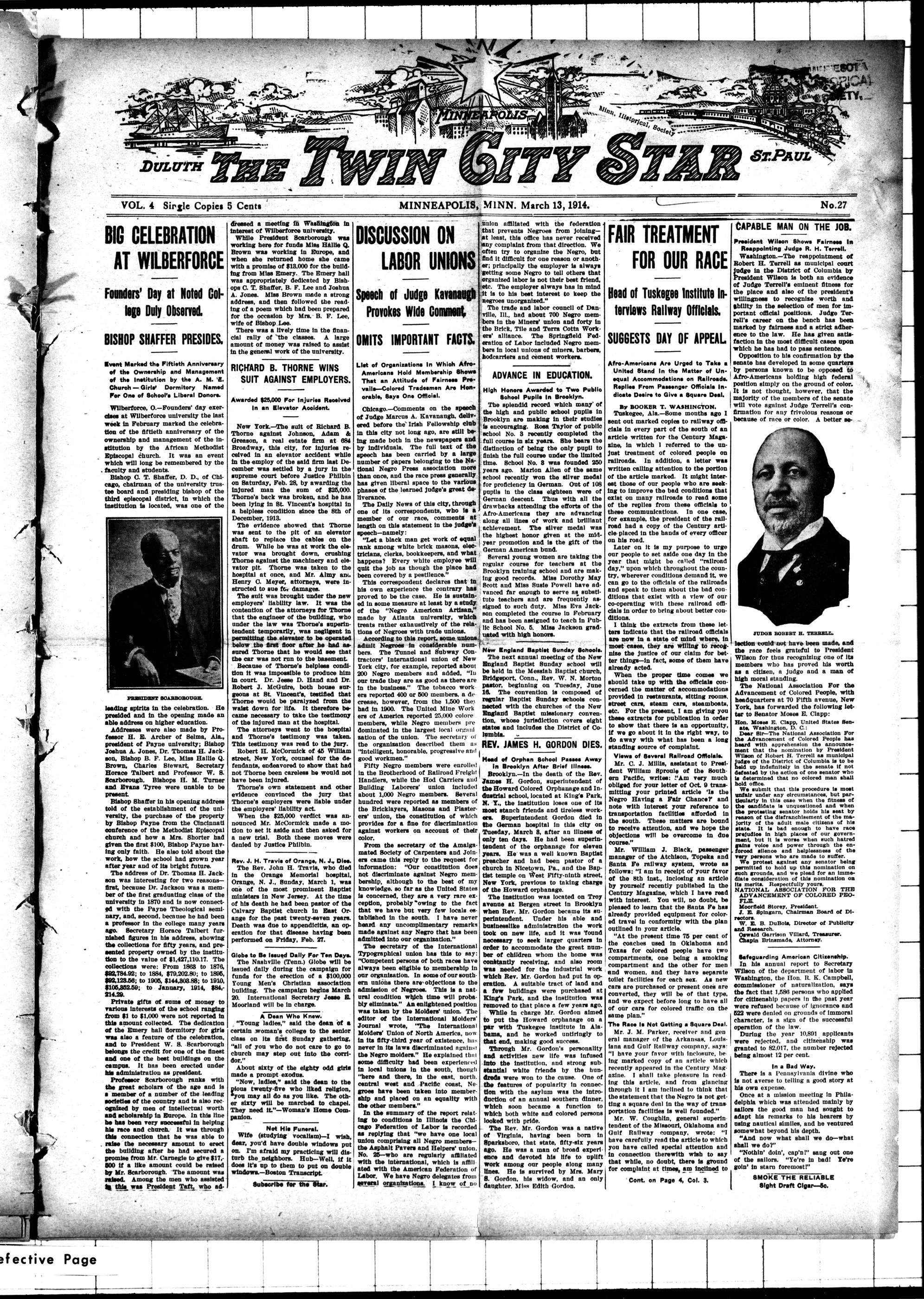
BIG CELEBRATION AT WILBERFORCE
Founders' Day at Noted College Duly Observed.
BISHOP SHAFFER PRESIDES.
Event Marked the Fifthtth Anniversary of the Ownership and Management of the Institution by the A. M. 'E. Church—Girl's Dormitory Named For One of School's Liberal Donors.
Wilberforce, O.—Founders' day exercises at Wilberforce university the last week in February marked the celebration of the fifthtth anniversary of the ownership and management of the institution by the African Methodist Episcopal church. It was an event which will long be remembered by the faculty and students.
Bishop C. T. Shaffer, D. D., of Chicago, chairman of the university trustee board and presiding bishop of the third episcopal district, in which the institution is located, was one of the
PRESIDENT SCARBOROUGH. leading spirits in the celebration. He presided and in the opening made an able address on higher education.
Addresses were also made by Professor H. E. Archer of Selma, Ala., president of Payne university; Bishop Joshua A. Jones, Dr. Thomas H. Jackson, Bishop B. F. Lee, Miss Hallie Q. Brown, Charles Stewart, Secretary Horace Talbert and Professor W. S. Scarborough. Bishops H. M. Turner and Evans Tyre were unable to be present.
Bishop Shaffer in his opening address told of the establishment of the university, the purchase of the property by Bishop Payne from the Cincinnati conference of the Methodist Episcopal church and how a Mrs. Shorter had given the first $100, Bishop Payne having only faith. He also told about the work, how the school had grown year after year and of its bright future.
The address of Dr. Thomas H. Jackson was interesting for two reasons—first, because Dr. Jackson was a member of the first graduating class of the university in 1870 and is now connected with the Payne Theological seminary, and, second, because he had been a professor in the college many years ago. Secretary Horace Talbert furnished figures in his address, showing the collections for fifty years, and presented property owned by the institution to the value of $1,427,110.17.
The collections were: From 1883 to 1876, $272,942.8; to 1884, $79,202.80; to 1885, $22,126.56; to 1905, $144,308.88; to 1910, $105,852.59; to January, 1914, $84,214.29.
Private gifts of sums of money to various interests of the school ranging from $1 to $1,000 were not reported in this amount collected. The dedication of the Emery hall dormitory for girls was also a feature of the celebration, and to President W. S. Scarborough belongs the credit for one of the finest and one of the best buildings on the campus. It has been erected under his administration as president.
Professor Scarborough ranks with the great scholars of the age and is a member of a number of the leading societies of the country and is also recognized by men of intellectual worth and scholarship in Europe. In this line he has been very successful in helping his race and church. It was through this connection that he was able to raise the necessary amount to erect the building after he had secured a promise from Mr. Carnegie to give $17,500 if a like amount could be raised by Mr. Scarborough. The amount was raised. Among the men who assisted in this was President Taft, who ad-
一
Dean Who Know
Not His Funeral.
Subscribe for the Star.
DISCUSSION ON LABOR UNIONS
Speech of Judge Kavanaugh Provokes Wide Comment.
OMITS IMPORTANT FACTS.
List of Organizations In Which Afro-Americans Hold Membership Shows That an Attitude of Fairness Prevails—Colored Tradesmen Are Honorable, Says One Official.
Chicago.—Comments on the speech of Judge Marcus A. Kavanagh, delivered before the Irish Fellowship club in this city not long ago, are still being made both in the newspapers and by individuals. The full text of the speech has been carried by a large number of papers belonging to the National Negro Press association more than once, and the race press generally has given liberal space to the various phases of the learned judge's great deliverance.
The Daily News of this city, through one of its correspondents, who is a member of our race, comments at length on this statement in the judge's speech—namely:
"Let a black man get work of equal rank among white brick masons, electricians, clerks, bookkeepers, and what happens? Every white employee will quit the job as though the place had been covered by a pestilence."
This correspondent declares that in his own experience the contrary has proved to be the case. He is sustained in some measure at least by a study of the "Negro American Artisan," made by Atlanta university, which treats rather exhaustively of the relations of Negroes with trade unions.
According to this report, some unions admit Negroes in considerable numbers. The Tunnel and Subway Contractors' International union of New York city, for example, reported about 200 Negro members and added, "In our trade they are as good as there are in the business." The tobacco workers reported 400 or 500 members, a decrease, however, from the 1,500 they had in 1900. The United Mine Workers of America reported 25,000 color members, while Negro members pre dominated in the largest local organization of the union. The secretary of the organization described them as "intelligent, honorable, progressive and good workmen." Fifty Negro members were enrolled in the Brotherhood of Railroad Freight Handlers, while the Hod Carriers and Building Laborers' union included about 1,000 Negro members. Several hundred were reported as members of the Bricklayers, Masons and Plasterers' union, the constitution of which provides for a fine for discrimination against workers on account of their color.
From the secretary of the Amalgamated Society of Carpenters and Joiners came this reply to the request for information: "Our constitution does not discriminate against Negro membership, although to the best of my knowledge, so far as the United States is concerned, they are a very rare exception, probably "owing to the fact that we have but very few locals established in the south. I have never heard any uncomplimentary remarks made against any Negro that has been admitted into our organization." The secretary of the International Typographical union has this to say: "Competent persons of both races have always been eligible to membership in our organization. In some of our southern unions there are objections to the admission of Negroes. This is a natural condition which time will probably eliminate." An enlightened position was taken by the Molders' union. The editor of the International Molders' Journal wrote, "The International Molders' Union of North America, now in its fifty-third year of existence, has never in its laws discriminated against the Negro molders." He explained that some difficulty had been experienced in local unions in the south, though "here and there, in the east, north, central west and Pacific coast, Negroes have been taken into membership and placed on an equality with the other members."
In the summary of the report relating to conditions in Illinois the Chicago Federation of Labor is recorded as replying that "we have one local union comprising all Negro members—the Asphalt Pavers and Helpers' union. No. 25—who are regularly affiliated with the international, which is affiliated with the American Federation of Labor. We have Negro delegates from several organizations. I know of no
union affiliated with the federation that prevents Negroes from joining—at least, this office has never received any complaint from that direction. We often try to organize the Negro, but find it difficult for one reason or another; principally the employer is always getting some Negro to tell others that organized labor is not their best friend, etc. The employer always has in mind it is to his best interest to keep the negroes unorganized."
The trade and labor council of Danville, Ill., had about 700 Negro members in the Miners' union and forty in the Brick, Tile and Terra Cotta Workers' alliance. The Springfield Federation of Labor included Negro members in local unions of miners, barbers, hodcarriers and cement workers.
ADVANCE IN EDUCATION.
High Honors Awarded to Two Public School Pupils in Brooklyn.
The splendid record which many of the high and public school pupils in Brooklyn are making in their studies is encouraging. Rosa Taylor of public school No. 3 recently completed the full course in six years. She bears the distinction of being the only pupil to finish the full course under the limited time. School No. 3 was founded 250 years ago. Marion Allen of the same school recently won the silver medal for proficiency in German. Out of 108 pupils in the class eighteen were of German descent. Thus with all the drawbacks attending the efforts of the Afro-Americans they are advancing along all lines of work and brilliant achievement. The silver medal was the highest honor given at the mid-year promotion and is the gift of the German American bund.
Several young women are taking the regular course for teachers at the Brooklyn training school and are making good records. Miss Dorothy May Scott and Miss Susie Powell have advanced far enough to serve as substitute teachers and are frequently assigned to such duty. Miss Eva Jackson completed the course in February and has been assigned to teach in Public School No. 5. Miss Jackson graduated with high honors.
New England Baptist Sunday Schools. The next annual meeting of the New England Baptist Sunday school will be held in the Messiah Baptist church, Bridgeport, Conn., Rev. W. N. Morton pastor, beginning on Tuesday, June 18. The convention is composed of regular Baptist Sunday schools connected with the churches of the New England Baptist missionary convention, whose jurisdiction covers eight states and includes the District of Columbia.
REV. JAMES H. GORDON DIES.
Head of Orphan School Passes Away
in Brooklyn After Brief Illness
BROOKLYN. After the death of the Rev. James H. Gordon, superintendent of the Howard Colored Orphanage and Industrial school, located at King's Park, N. Y., the institution loses one of its most stance friends and tireless workers. Superintendent Gordon died in the German hospital in this city on Tuesday, March 8, after an illness of only ten days. He had been superintendent of the orphanage for eleven years. He was a well known Baptist preacher and had been pastor of a church in Nicetown, Pa., and the Baptist temple on West Fifty-ninth street, New York, previous to taking charge of the Howard orphanage.
The institution was located on Troy avenue at Bergen street in Brooklyn when Rev. Mr. Gordon became its superintendent. Under his able and businesslike administration the work took on new life, and it was found necessary to seek larger quarters in order to accommodate the great number of children whom the home was constantly receiving, and also room was needed for the industrial work which Rev. Mr. Gordon had put in operation. A suitable tract of land and a few buildings were purchased at King's Park, and the institution was removed to that place a few years ago. While in charge Mr. Gordon aimed to put the Howard orphanage on a par with Tuskegee institute in Alabama, and he worked untrifibly to that end, making good success.
Through Mr. Gordon's personality and activities new life was infused into the institution, and strong substantial white friends by the hundreds were won to the cause. One of the features of popularity in connection with the asylum was the introduction of an annual southern dinner, which soon became a function to which both white and colored persons looked with pride.
The Rev. Mr. Gordon was a native of Virginia, having been born in Sparksboro, that state, fifty-six years ago. He was a man of broad experience and devoted his life to uplift work among our people along many lines. He is survived by Mrs. Mary S. Gordon, his widow, and an only daughter. Miss Edith Gordon.
FAIR TREATMENT FOR OUR RACE
Head of Tuskegee Institute Interviews Railway Officials.
SUGGESTS DAY OF APPEAL.
Afro-Americans Are Urged to Take a United Stand In the Matter of Unqualified Accommodations on Railroads. Replies From Passenger Officials Indicate Desire to Give a Square Deal.
By BOOKER T. WASHINGTON.
Tuskegee, Ala.-Some months ago I sent out marked copies to railway officials in every part of the south of an article written for the Century Magazine, in which I referred to the unjust treatment of colored people on railroads. In addition, a letter was written calling attention to the portion of the article marked. It might interest those of our people who are seeking to improve the bad conditions that exist on many railroads to read some of the replies from these officials to these communications. In one case, for example, the president of the railroad had a copy of the Century article placed in the hands of every officer on his road.
Later on it is my purpose to urge our people to set aside one day in the year that might be called "railroad day," upon which throughout the country, wherever conditions demand it, we can go to the officials of the railroads and speak to them about the bad conditions that exist with a view of our co-operating with these railroad officials in order to bring about better conditions.
I think the extracts from these letters indicate that the railroad officials are now in a state of mind where, in most cases, they are willing to recognize the justice of our claim for better things—in fact, some of them have already acted.
When the proper time comes we should take up with the officials concerned the matter of accommodations provided in restaurants, sitting rooms, street cars, steam cars, steamboats, etc. For the present, I am giving you these extracts for publication in order to show that there is an opportunity, if we go about it in the right way, to do away with what has been a long standing source of complaint.
Views of Several Railroad Offices.
Mr. C. J. Mills, assistant to President William Sproule of the Southern Pacific, writes: "Am very much obliged for your letter of Oct. 9 transmitting your printed article 'Is the Negro Having a Fair Chance' and note with interest your reference to transportation facilities afforded in the south. These matters are bound to receive attention, and we hope the objections will be overcome in due course."
Mr. William J. Black, passenger manager of the Atchison, Topeka and Santa Fe railway system, wrote as follows: "I am in receipt of your favor of the 8th inst., inclosing an article by yourself recently published in the Century Magazine, which I have read with interest. You will, no doubt, be pleased to learn that the Santa Fe has already provided equipment for colored travel in conformity with the plan outlined in your article.
"At the present time 75 per cent of the coaches used in Oklahoma and Texas for colored people have two compartments, one being a smoking compartment and the other for men and women, and they have separate toilet facilities for each sex. As new cars are purchased or present ones are converted, they will be of that type, and we expect before long to have all of our cars for colored traffic on the same plan."
The Race Is Not Getting a Square Deal. Mr. J. M. Parker, receiver and general manager of the Arkansas, Louisiana and Gulf Railway company, says: "I have your favor with inclusion, being marked copy of an article which recently appeared in the Century Magazine. I shall take pleasure in reading this article, and from glancing through it I am inclined to think that the statement that the Negro is not getting a square deal in the way of transportation facilities is well founded." Mr. W. Coughlin, general superintendent of the Missouri, Oklahoma and Gulf Railway company, wrote: "I have carefully read the article to which you have called special attention and in connection therewith wish to say that while, no doubt, there is ground for complaint at times, are inclined to
Cont. on Page 4, Col. 3.
No.27
CAPABLE MAN ON THE JOB.
President Wilson Shows Fairness in Reappointing Judge R. H. Terrell. Washington—The reappointment of Robert H. Terrell as municipal court judge in the District of Columbia by President Wilson is both an evidence of Judge Terrell's eminent fitness for the place and also of the president's willingness to recognize worth and ability in the selection of men for important official positions. Judge Terrell's career on the bench has been marked by fairness and a strict adherence to the law. He has given satisfaction in the most difficult cases upon which he has had to pass sentence. Opposition to his confirmation by the senate has developed in some quarters by persons known to be opposed to Afro-Americans holding high federal position simply on the ground of color. It is not thought, however, that the majority of the members of the senate will vote against Judge Terrell's confirmation for any frivolous reasons or because of race or color. A better se-
JUDGE BOBERT H. TERRELL. lection could not have been made, and the race feels grateful to President Wilson for thus recognizing one of its members who has proved his worth as a citizen, a judge and a man of high moral standing.
The National Association For the Advancement of Colored People, with headquarters at 70 Fifth avenue, New York, has forwarded the following letter to Senator Moses E. Clapp:
Hon. Moses E. Clapp, United States Senate, Washington, D.C. Dear Sir--The National Association For the Advancement of Colored People has heard with apprehension the announcement that the nomination by President Wilson of Robert H. Terrell as municipal judge of the District of Columbia is to be held up indefinitely in the senate if not defeated by the action of one senator who is determined that no colored man shall hold the office.
We submit that this procedure is most unfair under any circumstances, but particularly in this case when the fitness of the candidate is unquestioned and when the protesting senator holds his seat by reason of the diffranchissement of the majority of the adult members of the Senate. It should enough to have race prejudice in high places of our government, but it is worse when such hatred gains power and power through the enforced silence and helplessness of the very persons who are made to suffer.
We protest against any senator being on such grounds, and we plead for an immediate consideration of this nomination on its merits. Respectfully yours.
NATIONAL ASSOCIATION FOR THE
ANCHANGE OF COLORED PEO-
FILE
Moorfield Storey. President.
J. E. Spingarn, Chairman Board of Directors.
W. E. B. DuBois, Director of Publicity and Research.
Oswald Garrison Villard, Treasurer.
Chaplin Brinsmade, Attorney.
Safeguarding American Citizenship.
In his annual report to Secretary Wilson of the department of labor in Washington, the Hon. R. K. Campbell, commissioner of naturalization, says the fact that 1,586 persons who applied for citizenship papers in the past year were refused because of ignorance and 522 were denied on grounds of immoral character, is a sign of the successful operation of the law.
During the year 10,891 applicants were rejected, and citizenship was granted to 82,017, the number rejected being almost 12 per cent.
In a Bad Way.
There is a Pennsylvania divine who is not averse to telling a good story at his own expense.
Once at a mission meeting in Philadelphia which was attended mainly by sailors the good man had sought to adapt his remarks to his hearers by using nautical similes, and he ventured somewhat beyond his depth.
"And now what shall we do—what shall we do?"
"Nothin' doin', cap'n!" sang out one of the sailors. "You're in bad. Ye're goin' in starn foremost!"
SMOKE THE RELIABLE
Sight Draft Cigar—50.
fective Page
THE CARVER HOTEL
On All Car Lines
1308-10 WASHINGTON AVE. SO.
28 Newly Furnished Rooms.
By Day, Week or Month.
Special Rates to Theatrical People.
Mrs. Alice (Mother) Carver, Prop.
N. W. Phone Main 863
Res. 1210 6 Ave. N. Phone Hy. 3770
CASON BROS.' ORCHESTRA
Write or Call For Rates.
Music Furnished For All Occasions
We carry a large library of the latest and most Popular Standard Music.
EARL C. CASON—T. E. CASON
Leader Manager
DO IT NOW!!! DON'T WAIT!!!
Come in, and have your teeth fixed and pay in Weekly or Monthly installments. We have Dr. H. Plerce, "the famous extractor" with us every Monday and Friday and by special appointment. N. W. Colfax 1846.
RED CROSS DENTAL PARLORS
DR. M. W. JUDY, Mgr.
248 First Ave. No.,
Minneapolis, Minn.
SMOKE THE BEST
5C CIGAR
Sight Draft
W. S CONRAD CO., Distributors
NO. 1. WESTERN AVE., MINN.
NO. 140. E. 6th ST., ST. PAUL.
Southern Theatre
SevenCorners
15th and Washington Avenues So.
Refined Vaudeville
Moving Picture Shows
Continous Performance
Admission 10 Cents
Children 5 Cents
Peterson, The Druggist 1501 Washington Ave. So.
TOILET ARTICLES, DRUGS
PRESCRIPTIONS.
He Solicis You Patronage.
WE FIX 'EM WHILE YOU WIT
Moon's Sewed Soles.....75d
Ladies **.....65d
Moon's Nailed **.....50 and 60s
Rubber Hoops.....40d
Ladies and Boys' nailed soles.....40d
SEVEN CORNERS SHOE REPAIR SHOP
1434 WASHINGTON AVENUE SOUTH
WANTED.
Reliable, live, honest, hustling agents for the Twin City Star. You can make a good living with this work as a side line. Agents wanted in Milwaukee, Chicago, Omaha, Kansas City, Portland, Ore., Seattle, Denver, Des Meines and Sioux City. Write for terms to The Twin City Star, Minneapolis, Minn.
WHAT I AM TRYING TO DO.
By Dr. Booker T. Washington, in the "Worlds Work Magazine, New York City, November, 1913-
"I am trying to get the white people to realize that since no color line is drawn in the punishment of crime, no color line should be drawn in the preparation for life, in the kind of education, in other words, that makes for useful, clean living. I am trying to get the white people to see that in hundreds of counties in the South it is costing more to punish colored people for crime than it would cost to educate them. I am trying to get all to see that ignorance, poverty, and weakness invite and encourage the stronger race to act unjustly toward the weak, and that so long as this condition remains, the young white men of the South will have a fearful handicap in the battle of life."
I have seen beneath the yellow and black skins some of the whitest souls that inhabit the flesh.—A. H. Hall.
READ THE STAR—IT'S NEWS.
Why the Property Is Under Heavy Mortgage.
NEW LIGHT ON THE SUBJECT
Will of the Great Anti-slavery Agitator Was Not Properly Drawn—Death Defeated the Good Intentions of Mrs. Douglas—Time For Race Loyalty to Assert itself.
Washington.—There have been a number of inquiries, says Ralph W. Tyler of this city, as to the existing mortgage on the old home here of the late Frederick Douglass. Many cannot understand why the home should rest under a mortgage when Mr. Douglass was supposed to have been quite well off at his death. The estate of Mr. Douglass did mount up to quite a sum at his death. A defective will, made defective by an insufficient number of witnesses, caused the property to be distributed according to law rather than according to the will of the testator.
The widow of Mr. Douglas desired that the old house, containing a museum of anti-slavery and Douglas relics, the furniture, books, manuscripts and curios of the great orator, publicist and anti-slavery leader, should be bequeathed to the race as a memorial to her husband. To do this it was necessary for her to buy in the home from the other heirs that she might have a clear title to it. This she did, giving $15,000 for the old homestead on Cedar hill.
In order to make the purchase, however, it was necessary for her to borrow money with which to purchase the equity of the other heirs. She died before she could pay off that mortgage. In her last will and testament she bequeathed the home, with all its rich and priceless possessions, to the race Mr. Douglas had fearlessly championed and served. She might have bequeathed it to her own relatives, but she choose to will it to the
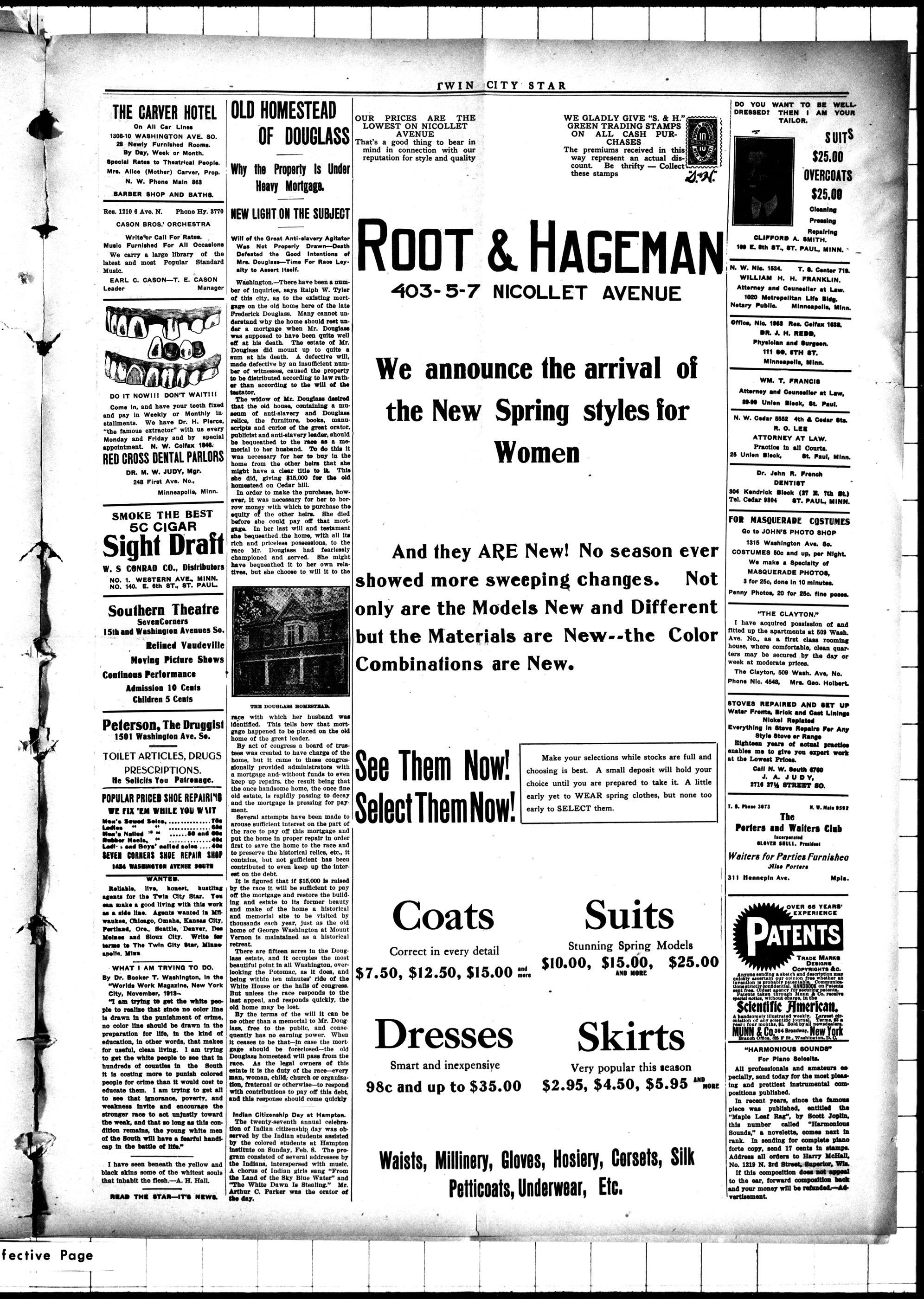
THE DOUGLASS HOMESTEAD.
race with which her husband was identified. This tells how that mortgage happened to be placed on the old home of the great leader.
By act of congress a board of trustees was created to have charge of the home, but it came to these congressually provided administrators with a mortgage and without funds to even keep up repairs, the result being that the once handsome home, the once fine old estate, is rapidly passing to decay and the mortgage is pressing for payment.
Several attempts have been made to arouse sufficient interest on the part of the race to pay off this mortgage and put the home in proper repair in order first to save the home to the race and to preserve the historical relics, etc., it contains, but not sufficient has been contributed to even keep up the interest on the debt.
It is figured that if $15,000 is raised by the race it will be sufficient to pay off the mortgage and restore the building and estate to its former beauty and make of the home a historical and memorial site to be visited by thousands each year, just as the old home of George Washington at Mount Vernon is maintained as a historical retreat.
There are fifteen acres in the Douglass estate, and it occupies the most beautiful point in all Washington, overlooking the Potomac, as it does, and being within ten minutes' ride of the White House or the halls of congress.
But unless the race responds to the last appeal, and responds quickly, the old home may be lost.
By the terms of the will it can be no other than a memorial to Mr. Douglass, free to the public, and consequently has no earning power. When it ceases to be that—in case the mortgage should be foreclosed—the old Douglass homestead will pass from the race. As the legal owners of this estate it is the duty of the race—every man, woman, child, church or organization, fraternal or otherwise—to respond with contributions to pay off this debt and this response should come quickly
Indian Citizenship Day at Hampton.
The twenty-seventh annual celebration of Indian citizenship day was observed by the Indian students assisted by the colored students at Hampton institute on Sunday, Feb. 8. The program consisted of several addresses by the Indians, interspersed with music. A chorus of Indian girls sang "From the Land of the Sky Blue Water" and "The White Dawn Is Stealing." Mr. Arthur C. Parker was the orator of the day.
TWIN CITY STAR
OUR PRICES ARE THE LOWEST ON NICOLLET AVENUE
That's a good thing to bear in mind in connection with our reputation for style and quality
ROOT &
403-5-7 NIC
We announc
the New Sp
W
And they ARE
showed more sw
only are the Mode
but the Materials
Combinations are
See Them Now!
Select ThemNow!
announce the
New Spring
Women
they ARE New!
more sweeping
the Models New
Materials are
nations are New
m Now!
nemNow!
Make your
choosing is
choice until
early yet t
early to SE
ROOT & HAGEMAN
403-5-7 NICOLLET AVENUE
We announce the arrival of the New Spring styles for Women
And they ARE New! No season ever showed more sweeping changes. Not only are the Models New and Different but the Materials are New--the Color Combinations are New.
Coats Correct in every detail $7.50, $12.50, $15.00
in every detail
.50, $15.00 and more $10.
Correct in every detail $7.50, $12.50, $15.00 and more
Dresses
Smart and inexpensive
98c and up to $35.00
Waists, Millinery, Gl
Petticoats.
d inexpensive
up to $35.00 $2.99
Millinery, Gloves, Ho
Petticoats. Underwe
Smart and inexpensiye 98c and up to $35.00
Waists, Millinery, Gloves, Hosiery, Corsets, Silk Petticoats, Underwear, Etc.
Make your selections while stocks are full and choosing is best. A small deposit will hold your choice until you are prepared to take it. A little early yet to WEAR spring clothes, but none too early to SELECT them.
Stunning Spring Models $10.00, $15.00, $25.00 AND MORE
Very popular this season
$2.95, $4.50, $5.95 AND MORE
WE GLADLY GIVE "S. & H." GREEN TRADING STAMPS ON ALL CASH PURCHASES The premiums received in this way represent an actual discount. Be thrifty — Collect these stamps
LIBERTY & GOD
BANK OF THE
UNITED STATES
10
DOLLAR STAMP
100 YEARS
OF
POLITICAL
EXPLOITATION
AGEMAN
ET AVENUE
The arrival of
ing styles for
en
! No season ever
g changes. Not
ew and Different
New--the Color
w.
your selections while stocks are full and
is best. A small deposit will hold your
til you are prepared to take it. A little
to WEAR spring clothes, but none too
SELECT them.
Suits
Stunning Spring Models
$0.00, $15.00, $25.00
AND MORE
Skirts
Very popular this season
.95, $4.50, $5.95 AND MORE
osiery, Corsets, Silk
ear. Etc.
DO YOU WANT TO BE WELL-
DRESSED? THEN I AM YOUR
TAILOR.
SUITS
$25.00
OVERCOATS
$25.00
Cleaning
Pressing
Repairing
SUIT
$25.00
OVERCOATS
$25.00
Cleaning
Pressing
Repairing
CLIFFORD A. SMITH.
100 E. 8th ST., ST. PAUL, MINN.
N. W. Nle. 1534. T. S. Center 718.
WILLIAM H. H. FRANKLIN.
Attorney and Counselor at Law.
1020 Metropolitan Life Bldg.
Notary Public. Minneapolis, Minn.
Office, Nic. 1963 Res. Celfax 1638.
DR. J. H. REDD,
Physiolan and Surgeon.
111 SG. 5TH ST.
Minneapolis, Minn.
WM. T. FRANCIS
Attorney and Counsellor at Law,
88-90 Union Block, St. Paul.
N. W. Cedar 5552 4th & Cedar Sts.
R. O. LEE
ATTORNEY AT LAW.
Practice in all Courts.
25 Union Block, St. Paul, Minn.
Dr. John R. French
DENTIST
304 Kendrick Block (ST R. 7th St.)
Tel. Cedar 9804 ST. PAUL, MINN.
FOR MASQUERADE COSTUMES
Go to JOHN'S PHOTO SHOP
1315 Washington Ave. So.
COSTUMES 50c and up, per Night.
We make a Speciality of
MASQUERADE PHOTOS,
3 for 25c, done in 10 minutes.
Penny Photos, 20 for 25c, fine poses.
I have acquired possession of and fitted up the apartments at 509 Wash. Ave. No., as a first class rooming house, where comfortable, clean quarters may be secured by the day or week at moderate prices.
The Clayton, 509 Wash. Ave. No.
Phone Nic. 4548, Mrs. Geo. Holbert.
STOVES REPAIRED AND SET UP Water Fronte, Brick and Cast Linings
Nickel Replated
Everything in Steve Repairs For Any Style Stove or Range
Eighteen years of actual practice enables me to give you expert work at the Lowest Prices.
Call N. W. South 6760
J. A. J U D Y,
2716 27½ STREET SO.
T. S. Phone 3073 N. W. Main 0502
The Porters and Waiters Club
Incorporated
GLOVER SULL, President
Waiters for Parties Furnished
Also Porters
311 Hennepin Ave. Mpla.
OVER 65 YEARS' EXPERIENCE
PATENTS
TRADE MARKS DESIGNS
COPYRIGHTS & C.
Anyone sending a sketch and description may quickly ascertain our opinion free whether an invention or patent is patented. HANDBOOK on Patents is a confidential system and patent. Patents taken through Munn & Co. receive special notice, without charge, in the
Scientific American.
And some illuminated seals. Laws formulate any scientific journal. Terms, $5 a year; four months, $L. Sold by all neweller.
MUNN & Co. 364 Broadway. New York
Branch Office, 65 F. St. Washington, D.C.
All professionals and amateurs especially, send today for the most pleasing and prettiest instrumental compositions published.
In recent years, since the famous piece was published, entitled the "Maple Leaf Rag", by Scott Joplin, this number called "Harmonious Sounds," a novelette, comes next in rank. In sending for complete piano forte copy, send 17 cents in stamps. Address all orders to Harry McHall, No. 1219 N. 3rd Street, Superior, WI.
If this composition does not appeal to the ear, forward composition back and your money will be refunded.—Advertisement.
THE TWIN CITY STAR NEGRO PROGRESSIVE.
Vol. 4 Friday, Mar. 13, 1914. No. 27.
Entered in the Post Office at Minneapolis as second class matter.
MEMBER
NATIONAL NEGRO PRESS
ASSOCIATION
PUBLISHED EVERY FRIDAY BY
CHARLES SUMNER SMITH.
Phone: N. W. Nic. 2824
Head of the Lakes" Representative
Gee. B. Kelley Duluth, Minn.
Subscription by Mall. Postpaid.
ONE YEAR ..... $2.00
SIX MONTHS ..... 1.20
THREE MONTHS ..... .65
CANADIAN SUBSCRIPTION ... 2.50
ADVERTISING RATES.
No advertisement inserted without
cash in advance.
1 column inch, 1 insertion, $1.00.
1 col. inch—13 insertions (3 mes.) $5.00
social rates furnished on application
Reading notices ..... 10 cents aline.
6 words constitute a line.
POLITICAL ADVERTISEMENT
$1.00 PER COLUMN INCH.
The above rates apply to all classifications as follows, except Births, Notices, Barter and Exchange and all cards of Thanks, Obituaries, Meeting is preceding Male Help.
Births, Deaths, Cards of Thanks and Meeting Notices — Minimum charge. 25c for 15 words or less. Over 25 words, one cent for each word.
Designed notices will not be included in these columns.
THE STRUGGLES OF RACES.
Sweeping Injunction Against Unfairness of One Race to Another.
Bess of One Race to Another.
All races have been subjugated, degraded and enslaved at some time and have had to pass through an ordeal as severe as the one that the blacks have been passing through in this country for the last 300 years and more, says Henry T. Norman in "Thoughts I Met on the Highway." Races are much like vegetables. They grow, bloom, and go to seed, and of the many seeds of many races a new nation springs up. When a nation is once broken and scattered it never comes together again. A nation that once dies never lives again as a nation. Its fragments mingle with other races and help to make new nations.
That is just what the blacks are doing in this country today. If all the African blood there is in this country was covered with black skins there would be about 20,000,000 of black people in the United States, whereas now there are only between 7,000,000 or 8,000,000. I can point out forty persons within the limits of the city of Lynn, Mass., that have African blood in them who pass for white. And this was the redeeming quality in slavery, for it is proved by ancient history, both sacred and profane, as well as by everything that is traceable to antiquity, that the blacks were once a great nation. But now they are not a nation and never will be. The only way to raise them up from the heathenish and barbarous state into which they had sunken was to have them pass through the ordeal of slavery.
That is just what makes the American nation superior to all other nations. It opens wide its doors, or did at one time, and says to all races, "Come and be one with us; we neither fear nor hate you." The nation that is not willing to receive within its borders all those of other races and nations that are willing to come and give them all the advantages of all its institutions is nothing but a community of tyrants and cowards.
There is nothing more ignorant and disgusting than the shoddy saying in this country "that all races had better keep by themselves." Those that preach that heathenish and cowardly doctrine are they who hold prejudice against the blacks. But it does not hurt whatever, for they, though perhaps the largest in numbers, are the weakest portion of the nation. The best people—those who are headlights, pillars of truth, the real salt and power of the earth, God's own mouthpieces—have no prejudice against races.
Therefore all that is required of any man, black or white, as qualifications to enter the best society on earth are contempt for pride and all vain things, a soul consecrated to God and a mind given to the contemplation of the fixed principles of truth, for it was want of these qualifications that brought all races into bondage to their own pride and lusts first and then into weakness, ignorance and barbarism. And it is the want of these same qualifications that makes many people degrade themselves with prejudice against the blacks and other races in this country.
Please use the capital "N" in Negro. Our exchanges are careful to give distinction to the Indian, Chinaman, and all other races, but mention the Negro with a small "n."
SUBSCRIBE FOR THE STAR.
"THE CRISIS."
We have before us the March number of The Crisis, a publication edited by Prof. W. E. Du Bois, and supported by the National Association for Advancement of Colored People. What this society stands for or what good it is doing or its method of carrying out the purpose its name indicates is yet to be discovered.
There appears in the March number an article entitled, "Booming the Crisis," in which the editor throws bouquets at himself in an effort to convince the public that the Crisis is the only newspaper that stands up, advocates and fights for the manhood rights of the Negro.
Mr. Du Bois is a former citizen of our town. We know the man, know his worth and what he stood for in the community life when he lived here. He never took time to register or vote and to put into practice what he advocated until 1908, and he lived among us quite fifteen years. In 1908 he was found in Ohio and other places advocating burbon democracy, which stood and still stands for jim-crow cars and distranchissement.
The very first time he qualified to vote in the place he lived for quite fifteen years he was found in democratic harness, helping to forever rivet around his own angles and those of his race the manacles of disfranchement, jim-crowism and race proscription. Yet this erstwhile refugee from the thickest of the fight boosts himself and little paper as the only read Negro journal standing for manhood rights of the race and the only paper capable of using the Kings English in discussing public questions. The Independent would not pay any attention to Mr. Du Bols' criticism if it was not that we believe it our duty to expose all hypocrites, shams and frauds.
Mr. Du Bois says that the Afro-American Ledger, Cleveland Gazette newspapers in the country that stand for principle. The Negroes of this country would like to know whether Mr. Du Bois stood for principle or dollars when he stumped the State of Ohio in company with Tom Blodgett for the democratic party in 1908. The Negroes of this country would like to know whether he voted for the party of disfranchisement against the party of enfranchisement in 1908 and 1912 for money or principle. The Negroes would like to know who paid his expenses in the campaign in 1908 in Ohio and would like to have him explain how he expects to cure disfranchisement, Jim-crowism and race proscription by voting for the democratic party that inflicts all these afflictions upon Du Bois' race.
We care absolutely nothing about what he says about the King English and whether the Age, the Bee, the Freeman or other Negro publications self-supporting stand for principle or not, the press of this country regards Mr. Du Bols as a mercinary, as a coward that runs away from every fight, as a hurtful agitator, as an enemy to his race, ignorant and basicly so, of how he can best preserve friendly and co-operative relations between the races in this country. He ran away from Atlanta during the riot when the souls of brave men were tried and when the democratic party pitched their greatest battle against human rights and against free institutions, he deserted the flag and enlisted against us for democracy against our cause.
Du Bols' idea of truth and principle is to clip and publish from the Associate Press all the outrages against the Negroes by the whites of the South. Every Negro that is lynched, mobbed or murdered by a white man, every Negro sent to the penitentiary for an infamous crime or every time a Negro is punished for any crime, Du Bols publishes the information in his paper; and is not intelligent enough to know that he is libelling his race. He thinks he is standing for principle. He thinks to parade our short-comings and our vices to the world, when they involve society or a white man, it is standing up for principle.
It is very seldom that Du Bols says anythink about the advancement of the race, success and achievements unless such success and achievement is accomplished by Du Bols or some one of his exclusive bunch. But the Negroes of this country have long ago taken Du Bols' measure and know what he stands for. They know he can't make a living unless put on a salary somewhere. He is a failure, simply an agitator. The little paper he edits and for which he is paid by a few white cranks would not be issued another week if Du Bols had to raise the money to pay his salary.
The Bee is correct when is surmises that the money being begged for this society is being used for the benefit of the Crisis. Du Bols admits it in his answer when he says that the society furnishes the Crisis an editor. Any newspaper man who reads the Crisis knows that it does not carry enough business to pay the printer; and Brother Chase is correct and is to be congratulated for the exposure of this self-constituted leader of the
TWIN CITY STAR
race, who has been busily solving the race problem with a forty foot pole since he left Harvard.-The Atlanta (Ga.,) Independent, March 7, 1914.
FAIR TREATMENT FOR OUR RACE
the opinion that, as a whole, the situation alluded to is improving. In fact, accommodations for white and colored passengers on our motor trains are identical.
"On other trains there is not much difference except in emergency cases, where it becomes necessary to use temporary equipment that was not intended for passenger trains, but such cars as are used for the handling of both white and colored passengers as well as employees on freight trains. I assure you that our company appreciates the patronage of the colored people and that it is our desire to do what we can consistently for their comfort while traveling on our road."
Will Confer With Other Officials.
Mr. W. B. Biddle, receiver and chief traffic officer of the St. Louis and San Francisco railroad, writes: "I have read yours of Oct. 10 and the pamphlet inclosed with a great deal of interest.
I am quite sure that there is a disposition on the part of the carriers to do anything that they properly can to improve the conditions of the colored race. The conditions under which the carriers are operating at this time are in many respects so burdensome as to leave very little opportunity for the adoption of any philanthropic movements. I shall be very glad, however, to discuss this subject with the executive officers of other lines as opportunity offers."
Mr. B. F. Bush, president of the Missouri Pacific Railway company, states: "The conditions cited in the article are not applicable to the Missouri Pacific. It is a fact that separate cars are maintained on the St. Louis, Iron Mountain and Southern for the Negroes, but my information is that they are cleanly kept and adequate to meet all demands. However, I thank you for bringing the matter to my attention."
Mr. N. M. Leach, traffic manager of the Texas and Pacific Railway company, writes: "In recent times the Texas and Pacific railway has made some improvement in the service afforded our colored patrons, and we are making an effort to further improve this service. We have received a number of expressions of appreciation from our colored patrons in Louisiana and Texas. I have read all of your article with a great deal of interest."
Statement of Sunset-Central Lines. W. G. Van Vleck, writing for the president, W. B. Scott, of the Sunset-Central lines, says: "The matter referred to in your letter of Oct. 10 have been given very careful consideration by these lines. A few month ago we installed in our Sunset express all steel equipment, and precisely the same character of car is used for colored as well as white passengers. Later on we did the same thing with Nos. 7 and 8 and still later Nos. 11 and 12. These cars are all steel and all of the same kind. On the Central lines north of Houston trains 15, 16, 17 and 18 and on H. E. and W. T. trains 1 and 2 are similarly equipped. Local trains will be taken care of as fast as more equipment of this kind is available."
George H. Taylor, vice president of the International and Great Northern Railway company, writes as follows: "I have your letter of the 11th inst. addressed to Frank J. Gould, inclosing copy of your article recently printed in the Century Magazine entitled 'The Greatest Source of Dissatisfaction to the Negro In the South'-namely, railway travel conditions. I have forwarded your letter and its inclusions to Mr. Gould in France." J. E. Franklin, president of the San Antonio, Uvalde and Gulf railroad, replies as follows: "I think you are entirely right in what you say in the pamphlet you inclose me. So far as this railroad is concerned, we are in a section of Texas where there is not much Negro travel, but we are giving the Negroes just as good accommodations as we are giving to the whites."
Appreciate Patronage of Our Service
J. C. Halle, general passenger agent
of the Central of Georgia Railway
company, writes: "Yours of recent
date, with marked copy of an article
which recently appeared in the Cen-
tury Magazine, has been duly received.
The same will be given consideration.
and I hope to write you further later.
The management of this company ap
preciates the colored travel, and we
desire to handle it satisfactorily."
A. A. Matthews, superintendent of the Missouri, Kansas and Texas Railway system, says: "I have read with interest your article entitled 'Is the Negro Having a Fair Chance' which you inclose with your letter of Oct. 9. The subject of better accommodation for Negro passengers is one that is receiving much thought by the railroads of the south, and I think, as our lines are improved and better coaches are used, that the Negro will share in the benefit. As for the Texas Central, except for a short distance, we very seldom handle Negro passengers, but when we do their compartment in our coaches is upholstered the same and receives the same care as the part provided for white passengers."
C. B. Rhodes, general passenger agent of the Georgia Southern and Florida Railway company, replies as follows: "I wish to acknowledge receipt of your letter of the 13th inst., inclosing marked copy of an article of yours which was recently printed in the Century Magazine, for which please accept my thanks."
SCHOLARSHIP OF MRS. P. L. DUNBAR
Important Speeches and Addresses of Many of the Most Prominent Men of the Colored Race Selected and Published For the First Time In Book Form.
BY GEORGE FRANCIS KING.
Wilmington, Del. - Afro-Americans have often been inspired by the eloquence of orators of other races, but the native eloquence of the people with whom they are identified and for whom the peculiar exigencies of their struggling race have been a source of inspiration has not been conserved heretofore for the youth of the race.
Mrs. Paul Laurence Dunbar, the widow of the greatest Negro poet the world has produced, has for a year been gathering masterpieces of enchance of the most prominent colored people of the world. It would not have been possible to have selected any one who had the pre-eminent qualifications for this great task who would have been able to render this service for the race as Mrs. Dunbar has done.
She came to this work qualified by years of study and experience equaled by few members of our race. Considered as she is—an English scholar unsurpassed by any in the race and with few competitors in the other race—she has performed a service in literary productions that will forever make her name honored and illustrious in racial annals. The book contains fifty
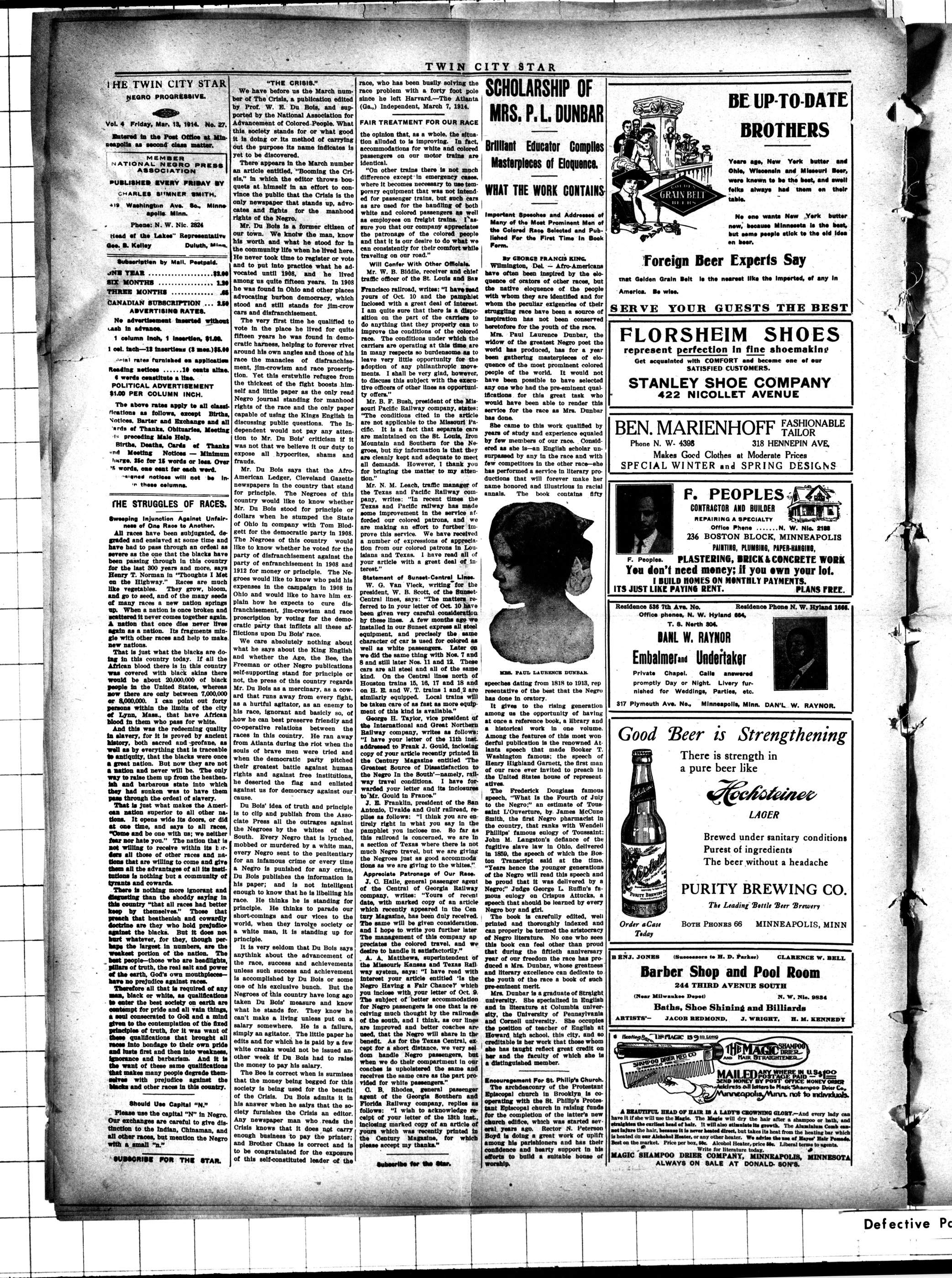
MRS. PAUL LAURENCE DUNBAR.
speeches dating from 1818 to 1913, representative of the best that the Negro has done in oratory. It gives to the rising generation among us the opportunity of having at once a reference book, a library and a historical work in one volume. Among the features of this most wonderful publication is the renowned Atlanta speech that made Booker T. Washington famous; the speech of Henry Highland Garnett, the first man of our race ever invited to preach in the United States house of representatives.
The Frederick Douglass famous speech, "What Is the Fourth of July to the Negro;" an estimate of Toussaint L'Ouverture, by. James McCune Smith, the first Negro pharmacist in the country, that ranks with Wendell Phillips' famous eulogy of Toussaint: John M. Langston's defiance of the fugitive slave law in Ohio, delivered in 1859, the speech of which the Boston Transcript said at the time, "Years hence the younger generations of the Negro will read this speech and be proud that it was delivered by a Negro," Judge George L. Ruffin's famous eulogy on Crispus Attucks, a speech that should be learned by every boy and girl.
The book is carefully edited, well printed and thoroughly indexed and can properly be termed the aristocracy of Negro literature. No one who sees this book can feel other than proud that during the fifteenth anniversary year of our freedom the race has produced a Mrs. Dunbar, whose greatness and literary excellence can dedicate to the youth of the race a book of such pre-eminent merit.
Mrs. Dunbar is a graduate of Straight university. She specialized in English and in literature at Columbia university, the University of Pennsylvania and Cornell university. She occupies the position of teacher of English at Howard high school, this city, and so creditable is her work that those whom she has taught reflect great credit on her and the faculty of which she is a distinguished member.
Encouragement For St. Philip's Church.
The archdeaconry of the Protestant Episcopal church in Brooklyn is cooperating with the St. Philip's Protestant Episcopal church in raising funds for the completion of the latter's new church edifice, which was started several years ago. Rector N. Peterson Boyd is doing a great work of uplift among his parishioners and has their confidence and hearty support in his efforts to build a suitable house of worship.
GOLDEN
GRAIN BELT
BEERS
Years age, New York butter and Ohio, Wisconsin and Missouri Beer, were known to be the best, and swell felks always had them on their table.
No one wants New York butter now, because Minnesota is the best, but some people stick to the old idea en beer.
Foreign Beer Experts Say
that Golden Grain Belt is the nearest like the Imported, of any in America. Be wise.
SERVE YOUR GUESTS THE BEST
FLORSHEIM SHOES
represent perfection in fine shoemaking
Get acquainted with COMFORT and become one of our SATISFIED CUSTOMERS.
STANLEY SHOE COMPANY
422 NICOLLET AVENUE
BEN. MARIENHOFF FASHIONABLE TAILOR
Phone N. W. 4398 318 HENNEPIN AVE.
Makes Good Clothes at Moderate Prices
SPECIAL WINTER and SPRING DESIGNS
F. PEOPLES
CONTRACTOR AND BUILDER
REPAIRING A SPECIALTY
Office Phene ...N. W. Nle. 2188
236 BOSTON BLOCK, MINNEAPOLIS
PAINTING, PLUMBING, PAPER-HANGING,
F. Peoples.
PLASTERING, BRICK & CONCRETE WORK
You don’t need money; if you own your lot.
I BUILD HOMES ON MONTHLY PAYMENTS.
ITS JUST LIKE PAYING RENT. PLANS FREE.
Residence 536 7th Ave. No.
Residence Phone N. W. Hyland 1866.
Office phones, N. W. Hyland 664,
T. S. North 304.
DANL W. RAYNOR
Embalmer and Undertaker
Foreign Beer Experts Say
that Golden Grain Belt is the nearest like the Imported, of any in America. Be wise.
SERVE YOUR GUESTS THE BEST
STANLEY SHOE COMPANY
422 NICOLLET AVENUE
BEN. MARIENHOFF FASHIONABLE TAILOR
Phone N. W- 4398 318 HENNEPIN AVE.
Makes Good Clothes at Moderate Prices
SPFCIAL WINTER and SPRING DESIGNS
F. PEOPLES
CONTRACTOR AND BUILDER
REPAIRING A SPECIALTY
Office Phene .....N. W. Nic. 2188
236 BOSTON BLOCK, MINNEAPOLIS
PAINTING, PLUMBING, PAPER-HANGING,
Office Phene ..... N. W. Nlc. 2188
236 BOSTON BLOCK, MINNEAPOLIS
PAINTING, PLUMBING, PAPER-HANGING,
F. Peoples.
PLASTERING, BRICK & CONCRETE WORK
You don't need money; if you own your lot.
I BUILD HOMES ON MONTHLY PAYMENTS.
ITS JUST LIKE PAYING RENT.
PLANS FREE.
PETER H.
Private Chapel. Calls answered promptly Day or Night. Livery furnished for Weddings, Parties, etc.
317 Plymouth Ave. No., Minneapolis, Minn. DAN'L W. RAYNOR.
Good Beer is Strengthening
317 Plymouth Ave. No., Minneapolis, Minn. DAN'L W. RAYNOR.
Good Beer is Strengthening
Kelpstein
PURITY BREWING CO.
WEST CALIFORNIA
PURITY BREWING CO.
There is strength in a pure beer like Hochsteiner
Brewed under sanitary conditions
Purest of ingredients
The beer without a headache
PURITY BREWING CO.
The Leading Bottle Beer Brewery
Order a Case
Today
BOTH PHONES 66 MINNEAPOLIS, MINN
BENJ. JONES (Successors to H. D. Parker) CLARENCE W. BELL
Barber Shop and Pool Room
BOTH PHONES 66 MINNEAPOLIS, MINN
BENJ. JONES
(Successors to H. D. Parker)
CLARENCE W. BELL
Barber Shop and Pool Room
244 THIRD AVENUE SOUTH
(Near Milwaukee Depot)
N. W. Nic. 9834
Baths, Shoe Shining and Billiards
ARTISTS'— JACOB REDMOND, J. WRIGHT, H. M. KENNEDY
Heating Bar
THE MAGIC 139 IN LONG
SHAMPOO DRIER NEW CO
SHAMPOO DRIER NEW CO
THE MAGIC SHAMPOO
DRIER
AND HAIR STRAIGHTENER
MAILED ANY WHERE IN U.S.$100
POSTAGE PAID —
SEND MONEY BY POST OFFICE MONEY ORDER
Address all letters to Mask Shampoo Drier Co.
Minneapolis, Minn. not to individuals.
A BEAUTIFUL HEAD OF HAIR IS A LADY'S CROWNING GLOBE.—And every lady can have it if she will use the Magic. The Magic will dry the hair after a shampoo or bath, and straightens the earliest head of hair. It will also estimate its growth. The Aluminium Comb can be heated in our Alcohol Heater, or any other heat, but takes its heat from the heating bar which is heated on our Alcohol Heater, or any other heat. The use of Mayer Hair Funnels. Best on the market. Price per box, $5e. Alcohol Heater, price $5e. Liberal terms to agents. Write for literature today.
MAGIC SHAMPOO DRIER COMPANY, MINNEAPOLIS, MINNESOTA
ALWAYS ON SALE AT DONALD-SON'S.
Pc
Defective