Twin City Star
Friday, May 29, 1914
Minneapolis, Minnesota
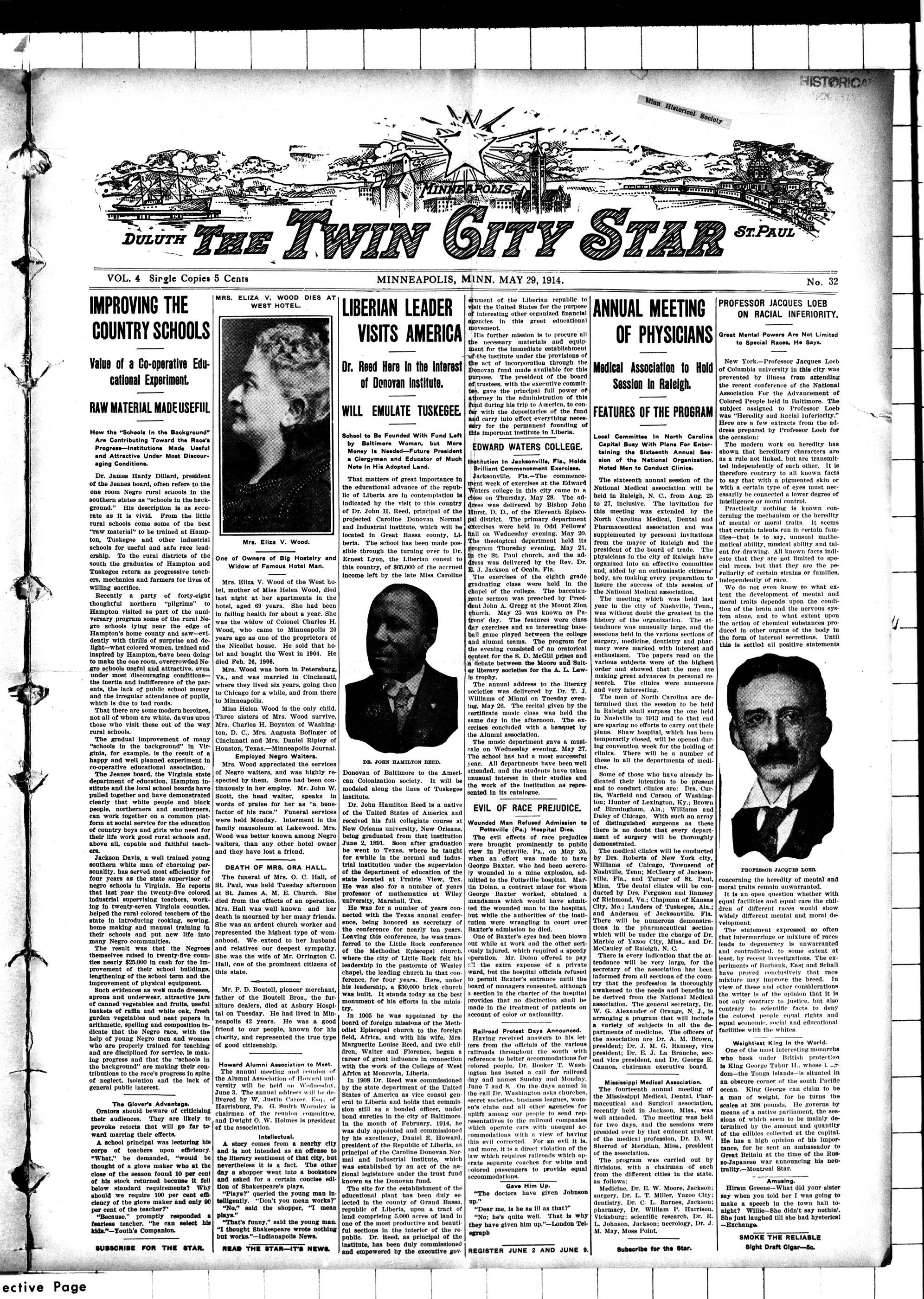
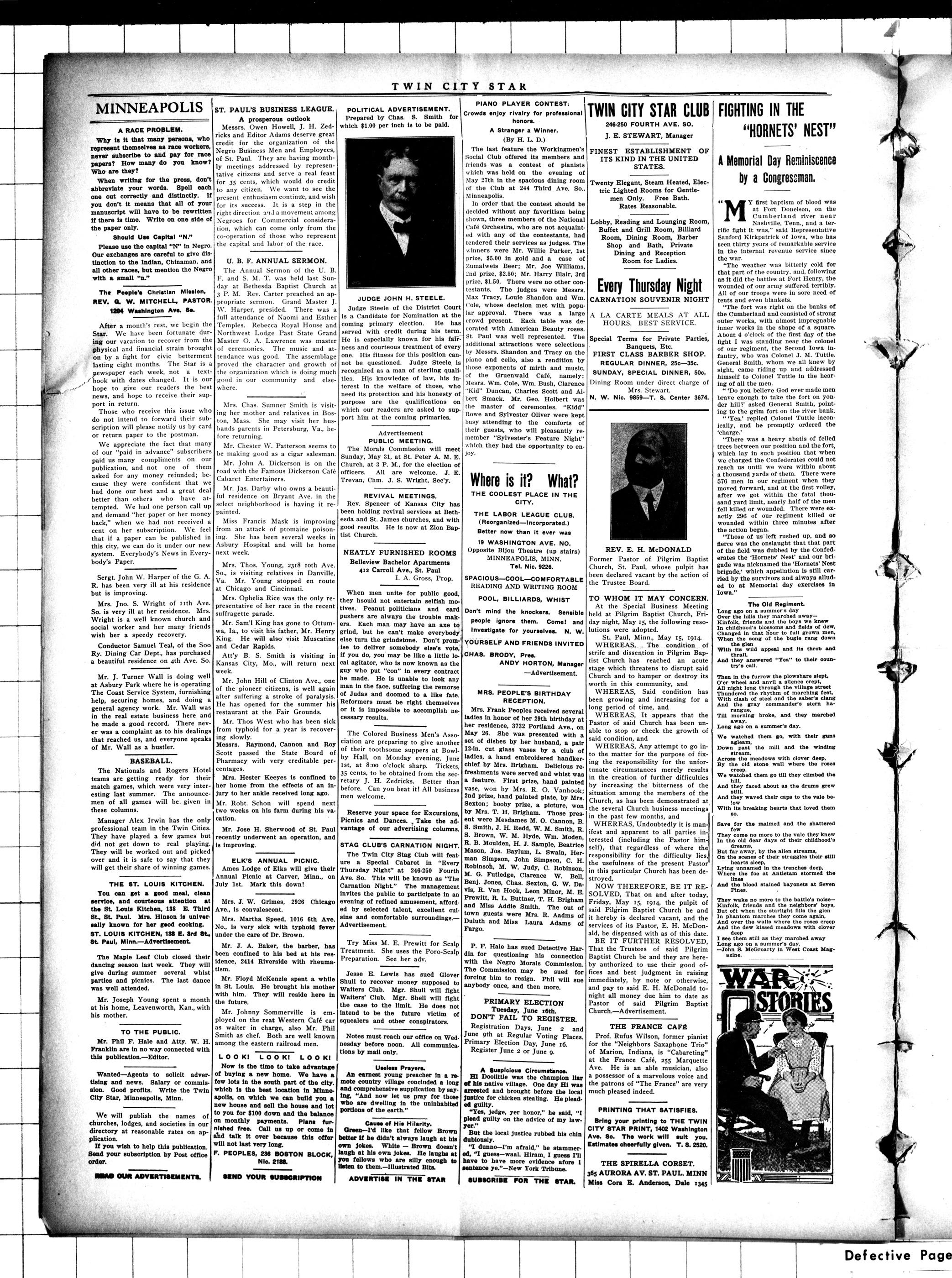
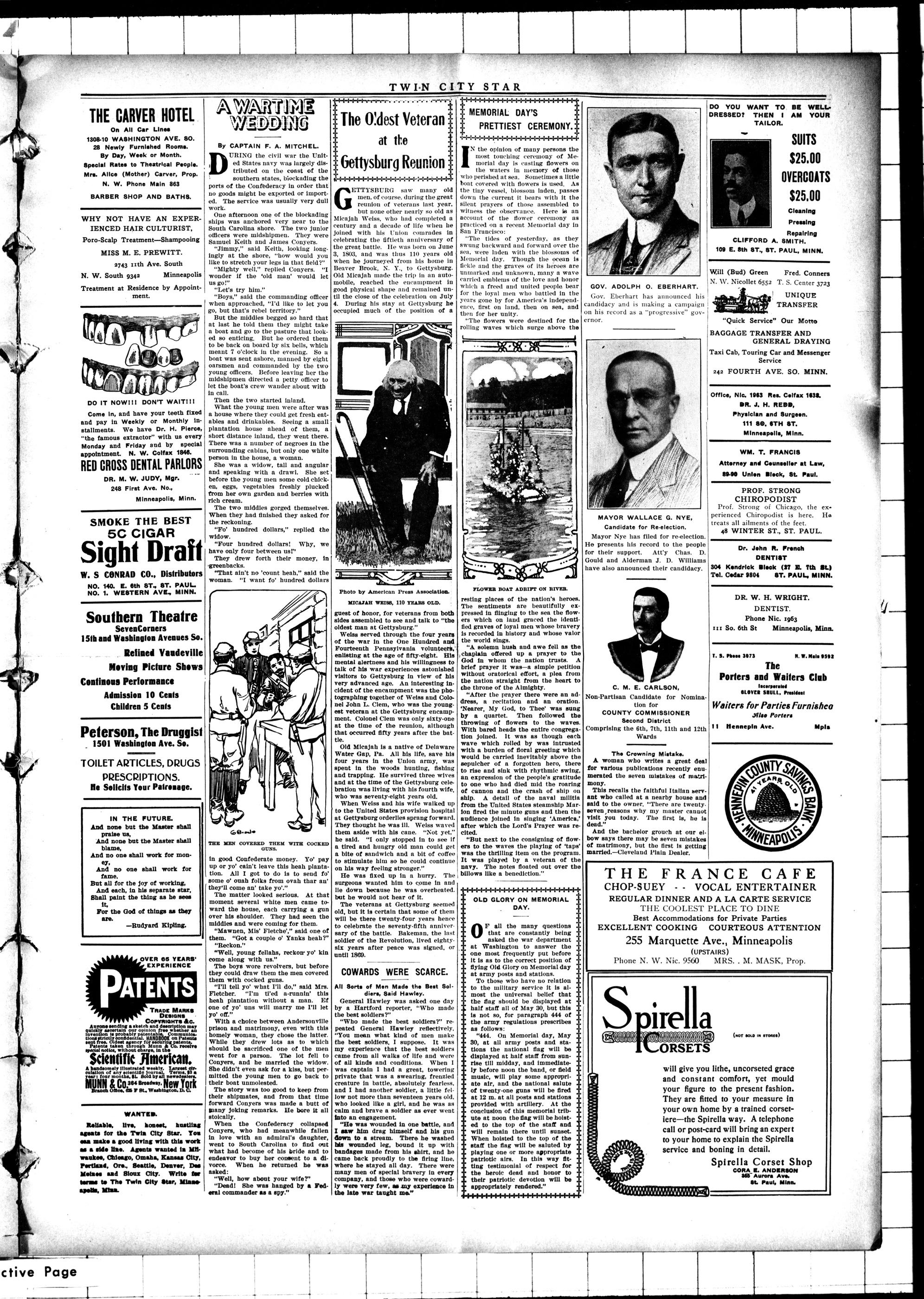
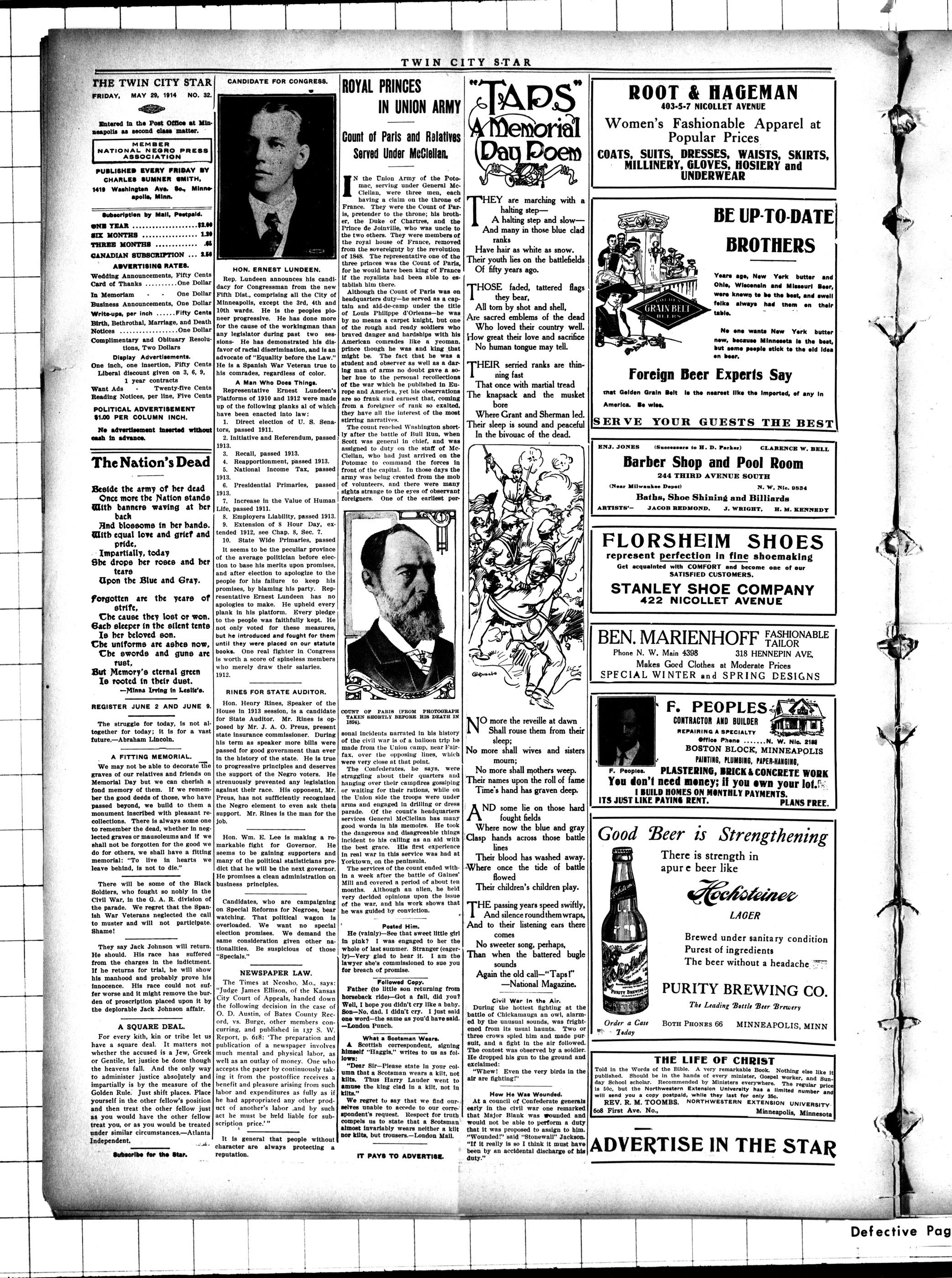
Page text (machine-generated)
MINNEAPOLIS
DULUTH THE TWIN CITY STAR ST.PAUL
ective Page
VOL. 4 Single Copies 5 Cents
MRS. ELIZA V. WOOD DIES AT
WEST HOTEL.
One of Owners of Big Hostelry and Widow of Famous Hotel Man.
Mrs. Elliza V. W. Wood of the West hotel, mother of Miss Helen Wood, died last night at her apartments in the hotel, aged 69 years. She had been in failing health for about a year. She was the widow of Colonel Charles H. Wood, who came to Minneapolis 20 years ago as one of the proprietors of the Nicollet house. He sold that hotel and bought the West in 1904. He died Feb. 26, 1906.
Mrs. Wood was born in Petersburg, Va., and was married in Cincinnati, where they lived six years, going then to Chicago for a while, and from there to Minneapolis.
Mrs. Helen Wood is the only child. Three sisters of Mrs. Wood survive, D. C., Mrs. Augusta Bofinger of Cincinnati and Mrs. Daniel Ripley of Houston, Texas—Minneapolis Journal.
Mrs. Wood appreciated the services of Negro waiters, and was highly respected by them. Some had been continuously in her employ. Mr. John W. Scott, the head waiter, speaks in words of praise for her as "a benefactor of his race." Funeral services were held Monday. Interment in the family mausoleum at Lakewood. Mrs. Wood was better known among Negro waiters, than any other hotel owner and they have lost a friend.
The funeral of Mrs. O. C. Hall, of St. Paul, was held Tuesday afternoon at St. James A. M. E. Church. She died from the effects of an operation. Mrs. Hall was well known and her death is mourned by her many friends. She was an ardent church worker and represented the highest type of womanhood. We extend to her husband and relatives our deepest sympathy. She was the wife of Mr. Orrington C. Hall, one of the prominent citizens of this state.
Mr. P. D. Boutell, ploneer merchant, father of the Boutell Bros., the furniture dealers, died at Asbury Hospital on Tuesday. He had lived in Minneapolis 42 years. He was a good friend to our people, known for his charity, and represented the true type of good citizenship.
Howard Alumni Association to Meet.
The annual meeting and reunion of the Alumni Association of Howard university will be held on Wednesday, June 3. The annual address will be delivered by W. Justin Catter, Esq. of Harrisburg, Pa. G. Smith Wormley is chairman of the reunion committee, and Dwight O. W. Holmes is president of the association.
A story comes from a nearby city and is not intended as an offense to the literary sentiment of that city, but nevertheless it is a fact. The other day a shopper went into a bookstore and asked for a certain concise edition of Shakespeare's plays.
"Plays?" queried the young man intelligently. "Don't you mean works?" "No," said the shopper, "I mean plays."
"That's funny," said the young man. "I thought Shakespeare wrote nothing but works."—Indianapolis News.
IMPROVING THE COUNTRY SCHOOLS
RAW MATERIAL MADE USEFUL
How the "Schools In the Background"
Are Contributing Toward the Race's
Progress—Institutions Made Useful
and Attractive Under Most Discouraging Conditions.
Dr. James Hardy Dillard, president of the Jeanes board, often refers to the one room Negro rural schools in the southern states as "schools in the background." His description is as accurate as it is vivid. From the little rural schools come some of the best "raw material" to be trained at Hampton, Tuskegee and other industrial schools for useful and safe race leadership. To the rural districts of the south the graduates of Hampton and Tuskegee return as progressive teachers, mechanics and farmers for lives of willing sacrifice.
Recently a party of forty-eight thoughtful northern "pilgrims" to Hampton visited as part of the anniversary program some of the rural Negro schools lying near the edge of Hampton's home county and saw—evidently with thrills of surprise and delight—what colored women, trained and inspired by Hampton, have been doing to make the one room, overcrowded Negro schools useful and attractive, even under most discouraging conditions—the inertia and indifference of the parents, the lack of public school money and the irregular attendance of pupils, which is due to bad roads.
That there are some modern heroes, not all of whom are white, dawns upon those who visit these out of the way rural schools.
The gradual improvement of many "schools in the background" in Virginia, for example, is the result of a happy and well planned experiment in co-operative educational association.
The Jeanes board, the Virginia state department of education, Hampton institute and the local school boards have pulled together and have demonstrated clearly that white people and black people, northerners and southerners, can work together on a common platform at social service for the education of country boys and girls who need for their life work good rural schools and, above all, capable and faithful teachers.
Jackson Davis, a well trained young southern white man of charming personality, has served most efficiently for four years as the state supervisor of negro schools in Virginia. He reports that last year the twenty-five colored industrial supervising teachers, working in twenty-seven Virginia counties, helped the rural colored teachers of the state in introducing cooking, sewing, home homeaking and manual training in their schools and put new life into many Negro communities.
The result was that the Negroes themselves raised in twenty-five counties nearly $25,000 in cash for the improvement of their school buildings, lengthening of the school term and the improvement of physical equipment. Such evidences as well made dresses, aprons and underwear, attractive jars of canned vegetables and fruits, useful baskets of raffia and white oak, fresh garden vegetables and neat papers in arithmetic, spelling and composition indicate that the Negro race, with the help of young Negro men and women who are properly trained for teaching and are disciplined for service, is making progress and that the "schools in the background" are making their contributions to the race's progress in spite of neglect, isolation and the lack of general public interest.
The Glover's Advantage
Orators should beware of criticising their audiences. They are likely to provoke retorts that will go far toward marring their effects.
A school principal was lecturing his corps of teachers upon efficiency. "What," he demanded, "would be thought of a glove maker who at the close of the season found 10 per cent of his stock returned because it fell below standard requirements? Why should we require 100 per cent efficiency of the glove maker and only 90 per cent of the teacher?"
"Because," promptly responded a fearless teacher, "he can select his kids."—Youth's Companion.
SUBSCRIBE FOR THE STAR.
Mrs. Eliza V. Wood.
DEATH OF MRS. ORA HALL.
Intellectual.
READ THE STAR-IT'S NEWS.
MINNEAPOLIS, MINN. MAY 29, 1914.
LIBERIAN LEADER VISITS AMERICA
WILL EMULATE TUSKEGEE.
School to Be Founded With Fund Left by Baltimore Woman, but More Money Is Needed—Future President a Clergyman and Educator of Much Note In His Adopted Land.
That matters of great importance in the educational advance of the republic of Liberia are in contemplation is indicated by the visit to this country of Dr. John H. Reed, principal of the projected Caroline Donovan Normal and Industrial institute, which will be located in Great Bassa county, Liberia. The school has been made possible through the turning over to Dr. Ernest Lyon, the Liberian consul to this country, of $65,000 of the accrued income left by the late Miss Caroline
DR. JOHN HAMILTON REED.
Donovan of Baltimore to the American Colonization society. It will be modeled along the lines of Tuskegee Institute.
Dr. John Hamilton Reed is a native of the United States of America and received his full collegiate course at New Orleans university, New Orleans, being graduated from that institution June 2, 1891. Soon after graduation he went to Texas, where he taught for awhile in the normal and industrial institution under the supervision of the department of education of the state located at Prairie View, Tex. He was also for a number of years professor of mathematics at Wiley university, Marshall, Tex. He was for a number of years connected with the Texas annual conference, being honored as secretary of the conference for nearly ten years. Leaving this conference, he was transferred to the Little Rock conference of the Methodist Episcopal church where the city of Little Rock felt his leadership in the pastorate of Wesley chapel, the leading church in that conference, for four years. Here, under his leadership, a $30,000 brick church was built. It stands today as the best monument of his efforts in the ministry.
In 1905 he was appointed by the board of foreign missions of the Methodist Episcopal church to the foreign field, Africa, and with his wife, Mrs. Marguerite Louise Reed, and two children, Walter and Florence, began a career of great influence in connection with the work of the College of West Africa at Monrovia, Liberia.
In 1908 Dr. Reed was commissioned by the state department of the United States of America as vice consul general to Liberia and holds that commission still as a bonded officer, under bond sureties in the city of Baltimore. In the month of February, 1914, he was duly appointed and commissioned by his excellency, Daniel E. Howard, president of the Republic of Liberia, as principal of the Caroline Donovan Normal and Industrial institute, which was established by an act of the national legislature under the trust fund known as the Donovan fund. The site for the establishment of the educational plant has been duly selected in the county of Grand Bassara, republic of Liberia, upon a tract of land comprising 5.000 acres of land in one of the most productive and beautiful sections in the interior of the republic. Dr. Reed, as principal of the institute, has been duly commissioned and empowered by the executive gov-
ernment of the Liberian republic to visit the United States for the purpose of interesting other organized financial agencies in this great educational movement.
His further mission is to procure all the necessary materials and equipment for the immediate establishment of the institute under the provisions of the act of incorporation through the Donovan fund made available for this purpose. The president of the board of trustees, with the executive committee, gave the principal full power of attorney in the administration of this fund during his trip to America, to confer with the depositories of the fund and carry into effect everything necessary for the permanent founding of this important institute in Liberia.
EDWARD WATERS COLLEGE.
Institution In Jacksonville, Fla., Holds Brilliant Commencement Exercises.
Jacksonville, Fla.—The commencement week of exercises at the Edward Waters college in this city came to a close on Thursday, May 28. The address was delivered by Bishop John Hurst, D. D., of the Eleventh Episcopal district. The primary department exercises were held in Odd Fellows' hall on Wednesday evening, May 20. The theological department held its program Thursday evening. May 21, in the St. Paul church, and the address was delivered by the Rev. Dr. E. J. Jackson of Ocala, Fla.
The exercises of the eighth grade graduating class were held in the chapel of the college. The baccalaureate sermon was preached by President John A. Gregg at the Mount Zion church. May 25 was known as Patrons' day. The features were class day exercises and an interesting baseball game played between the college and alumni teams. The program for the evening consisted of an oratorical contest for the S. D. McGill prizes and a debate between the Moore and Satter literary societies for the A. L. Lewis trophy.
The annual address to the literary societies was delivered by Dr. T. J. Williams of Miami on Tuesday evening, May 26. The recital given by the certificate music class was held the same day in the afternoon. The exercises concluded with a banquet by the Alumni association.
The music department gave a musical on Wednesday evening, May 27. The school has had a most successful year. All departments have been well attended, and the students have taken unusual interest in their studies and the work of the institution as represented in its catalogue.
EVIL OF RACE PREJUDICE.
Wounded Man Refused Admission to Potteville (Pa.) Hospital Dies.
The evil effects of race prejudice were brought prominently to public view in Pottsville, Pa., on May 20, when an effort was made to have George Baxter, who had been severely wounded in a mine explosion, admitted to the Pottsville hospital. Martin Dolan, a contract miner for whom George Baxter worked, obtained a mandamus which would have admitted the wounded man to the hospital, but while the authorities of the institution were wringling in court over Baxter's admission he died.
One of Baxter's eyes had been blown out while at work and the other seriously injured, which required a speedy operation. Mr. Dolan offered to pay all the extra expense of a private ward, but the hospital officials refused to permit Baxter's entrance until the board of managers consented, although a section in the charter of the hospital provides that no distinction shall be made in the treatment of patients on account of color or nationality.
Railroad Protest Days Announced.
Having received answers to his letters from the officials of the various railroads throughout the south with reference to better accommodations for colored people, Dr. Booker T. Washington has issued a call for railroad day and names Sunday and Monday, June 7 and 8. On the days named in the call Dr. Washington asks churches, secret societies, business leagues, women's clubs and all other agencies for uplift among our people to send representatives to the railroad companies which operate cars with unequal accommodations with a view of having this evil corrected. For an evil it is, and more, it is a direct violation of the law which requires railroads which operate separate coaches for white and colored passengers to provide equal accommodations.
Gave Him Up.
"The doctors have given Johnson up."
"Dear me, is he as ill as that?"
"No; he's quite well. That is why they have given him up."—London Telegraph
REGISTER JUNE 2 AND JUNE 9.
ANNUAL MEETING OF PHYSICIANS
FEATURES OF THE PROGRAM
Local Committee In North Carolina Capital Busy With Plans For Entertaining the Sixteenth Annual Session of the National Organization. Noted Men to Conduct Clinics.
The sixteenth annual session of the National Medical association will be held in Raleigh, N. C., from Aug. 25 to 27, inclusive. The invitation for this meeting was extended by the North Carolina Medical, Dental and Pharmaceutical association and was supplemented by personal invitations from the mayor of Raleigh and the president of the board of trade. The physicians in the city of Raleigh have organized into an effective committee and, aided by an enthusiastic citizens' body, are making every preparation to insure the success of this session of the National Medical association.
The meeting which was held last year in the city of Nashville, Tenn., was without doubt the greatest in the history of the organization. The attendance was unusually large, and the sessions held in the various sections of surgery, medicine, dentistry and pharmacy were marked with interest and enthusiasm. The papers read on the various subjects were of the highest order and showed that the men are making great advances in personal research. The clinics were numerous and very interesting.
The men of North Carolina are determined that the session to be held in Raleigh shall surpass the one held in Nashville in 1913 and to that end are sparing no efforts to carry out their plans. Shaw hospital, which has been temporarily closed, will be opened during convention week for the holding of clinics. There will be a number of these in all the departments of medicine.
Some of those who have already indicated their intention to be present and to conduct clinics are: Drs. Curtis, Warfield and Carson of Washington; Hunter of Lexington, Ky.; Brown of Birmingham, Ala.; Williams and Daley of Chicago. With such an array of distinguished surgeons as these there is no doubt that every department of surgery will be thoroughly demonstrated.
The medical clinics will be conducted by Drs. Roberts of New York city, Williams of Chicago, Townsend of Nashville, Teenn; McCleary of Jacksonville, Fla., and Turner of St. Paul, Minn. The dental clinics will be conducted by Drs. Ferguson and Ramsey of Richmond, Va.; Chapman of Kansas City, Mo.; Landers of Tuskegee, Ala.; and Anderson of Jacksonville, Fla. There will be numerous demonstrations in the pharmaceutical section which will be under the charge of Dr. Marble of Yazoo City, Miss., and Dr. McCauley of Raleigh, N. C. There is every indication that the attendance will be very large, for the secretary of the association has been informed from all sections of the country that the profession is thoroughly awakened to the needs and benefits to be derived from the National Medical association. The general secretary, Dr. W. G. Alexander of Orange, N. J., is arranging a program that will include a variety of subjects in all the departments of medicine. The officers of the association are Dr. A. M. Brown, president; Dr. J. M. G. Ramsey, vice president; Dr. E. J. La Branche, second vice president, and Dr. George E. Cannon, chairman executive board.
Mississippi Medical Association.
Mississippi Medical Association.
The fourteenth annual meeting of the Mississippi Medical, Dental, Pharmaceutical and Surgical association, recently held in Jackson, Miss., was well attended. The meeting was held for two days, and the sessions were presided over by that eminent student of the medical profession, Dr. D. W. Sherrod of Meridian, Miss., president of the association.
The program was carried out by divisions, with a chairman of each from the different cities in the state, as follows:
Medicine, Dr. E. W. Moore, Jackson;
surgery, Dr. L. T. Miller, Yazoo City;
dentistry, Dr. C. L. Barnes, Jackson;
pharmacy, Dr. William P. Harrison;
Vicksburg; scientific research, Dr. R. L. Johnson; ncology, Dr. J. M. May, Moss Point.
Subscribe for the Star.
No. 32
PROFESSOR JACQUES LOEB ON RACIAL INFERIORITY.
Great Mental Powers Are Not Limited to Special Races, He Says.
New York.—Professor Jacques Loeb of Columbia university in this city was prevented by illness from attending the recent conference of the National Association For the Advancement of Colored People held in Baltimore. The subject assigned to Professor Loeb was "Heredity and Racial Inferiority." Here are a few extracts from the address prepared by Professor Loeb for the occasion:
The modern work on heredity has shown that hereditary characters are as a rule not linked, but are transmitted independently of each other. It is therefore contrary to all known facts to say that with a pigmented skin or with a certain type of eyes must necessarily be connected a lower degree of intelligence or moral control.
Practically nothing is known concerning the mechanism or the heredity of mental or moral traits. It seems that certain talents run in certain families—that is to say, unusual mathematical ability, musical ability and talent for drawing. All known facts indicate that they are not limited to special races, but that they are the peculiarity of certain strains or families, independently of race.
We do not even know to what extent the development of mental and moral traits depends upon the condition of the brain and the nervous system alone, and to what extent upon the action of chemical substances produced in other organs of the body in the form of internal secretions. Until this is settled all positive statements
PROFESSOR JACQUES LOEB. concerning the heredity of mental and moral traits remain unwarranted. It is an open question whether with equal facilities and equal care the children of different races would show widely different mental and moral development.
The statement expressed so often that intermarriage or mixture of races leads to degeneracy is unwarranted and contradicted, to some extent at least, by recent investigations. The experiments of Burbank, East and Schall have proved conclusively that race mixture may improve the breed. In view of these and other considerations the writer is of the opinion that it is not only contrary to justice, but also contrary to scientific facts to deny the colored people equal rights and equal economic, social and educational facilities with the whites.
Weightiest King In the World.
One of the most interesting monarchs who bask under British protection is King George Tabor II. whose kingdom—the Tonga islands—is situated in an obscure corner of the south Pacific ocean. King George can claim to be a man of weight, for he turns the scales at 308 pounds. He governs by means of a native parliament, the sessions of which seem to be mainly determined by the amount and quantity of the edibles collected at the capital. He has a high opinion of his importance, for he sent an ambassador to Great Britain at the time of the Russo-Japanese war announcing his neutrality.—Montreal Star.
Amusing.
Hiram Greene—What did your sister say when you told her I was going to make a speech in the town hall tonight? Willie—She didn't say nothing. She just laughed till she had hysterics!—Exchange.
SMOKE THE RELIABLE
Sight Draft Cigar—5c.
MINNEAPOLIS
A RACE PROBLEM.
Why is it that many persons, who represent themselves as race workers, never subscribe to and pay for race papers? How many do you know? Who are they?
When writing for the press, don't abbreviate your words. Spell each one out correctly and distinctly. If you don't it means that all of your manuscript will have to be rewritten if there is time. Write on one side of the paper only.
Should Use Capital "N."
Please use the capital "N" in Negro. Our exchanges are careful to give distinction to the Indian, Chinaman, and all other races, but mention the Negro with a small "n."
The People's Christian Mission,
REV. G. W. MITCHELL, PASTOR
1294 Washington Ave. Se.
After a month's rest, we begin the Star. We have been fortunate during our vacation to recover from the physical and financial strain brought on by a fight for civic betterment lasting eight months. The Star is a newspaper each week, not a textbook with dates changed. It is our hope to give our readers the best news, and hope to receive their support in return. Those who receive this issue who do not intend to forward their subscription will please notify us by card or return paper to the postman.
We appreciate the fact that many of our "paid in advance" subscribers paid us many compliments on our publication, and not one of them asked for any money refunded; because they were confident that we had done our best and a great deal better than others who have attempted. We had one person call up and demand "her paper or her money back," when we had not received a cent on her subscription. We feel that if a paper can be published in this city, we can do it under our new system. Everybody's News in Everybody's Paper.
Sergt. John W. Harper of the G. A. R. has been very ill at his residence but is improving.
Mrs. Jno. S. Wright of 11th Ave. So. is very ill at her residence. Mrs. Wright is a well known church and social worker and her many friends wish her a speedy recovery.
Conductor Samuel Teal, of the Soo Ry. Dining Car Dept., has purchased a beautiful residence on 4th Ave. So.
Mr. J. Turner Wall is doing well at Asbury Park where he is operating The Coast Service System, furnishing help, securing homes, and doing a general agency work. Mr. Wall was in the real estate business here and he made a good record. There never was a complaint as to his dealings that reached us, and everyone speaks of Mr. Wall as a hustler.
BASEBALL.
The Nationals and Rogers Hotel teams are getting ready for their match games, which were very interesting last summer. The announcement of all games will be given in these columns.
Manager Alex Irwin has the only professional team in the Twin Cities. They have played a few games but did not get down to real playing. They will be worked out and picked over and it is safe to say that they will get their share of winning games.
THE ST. LOUIS KITCHEN.
You can get a good meal, clean service, and courteous attention at the St. Louis Kitchen, 138 E. Third St. St. Paul. Mrs. Hinson is universally known for her good cooking. ST. LOUIS KITCHEN, 138 E. 3rd St. St. Paul, Minn.—Advertisement.
The Maple Leaf Club closed their dancing season last week. They will give during summer several whist parties and picnics. The last dance was well attended.
Mr. Joseph Young spent a month at his home, Leavenworth, Kan., with his mother.
TO THE PUBLIC.
Mr. Phil F. Hale and Atty. W. H. Franklin are in no way connected with this publication.—Editor.
Wanted—Agents to solicit advertising and news. Salary or commission. Good profits. Write the Twin City Star, Minneapolis, Minn.
We will publish the names of churches, lodges, and societies in our directory at reasonable rates on application.
If you wish to help this publication. Send your subscription by Post office order.
READ OUR ADVERTISEMENTS.
ST. PAUL'S BUSINESS LEAGUE
A prosperous outlook Messrs. Owen Howell, J. H. Zedricks and Editor Adams deserve great credit for the organization of the Negro Business Men and Employees, of St. Paul. They are having monthly meetings addressed by representative citizens and serve a real feast for 35 cents, which would do credit to any citizen. We want to see the present enthusiasm continue, and wish for its success. It is a step in the right direction and a movement among Negroes for Commercial consideration, which can come only from the co-operation of those who represent the capital and labor of the race.
U. B. F. ANNUAL SERMON
The Annual Sermon of the U. B. F. and S. M. T. was held last Sunday at Bethesda Baptist Church at 3 P. M. Rev. Carter preached an appropriate sermon. Grand Master J. W. Harper, presided. There was a full attendance of Naomi and Esther Temples. Rebecca Royal House and Northwest Lodge Past State Grand Master O. A. Lawrence was master of ceremonies. The music and attendance was good. The assemblage proved the character and growth of the organization which is doing much good in our community and elsewhere.
Mrs. Chas. Sumner Smith is visiting her mother and relatives in Boston, Mass. She may visit her husbands parents in Petersburg, Va., before returning.
Mr. Chester W. Patterson seems to be making good as a cigar salesman. Mr. John A. Dickerson is on the road with the Famous Dickerson Café Cabaret Entertainers. Mr. Jas. Darby who owns a beautiful residence on Bryant Ave. in the select neighborhood is having it repainted. Miss Francis Mask is improving from an attack of ptomaine poisoning. She has been several weeks in Asbury Hospital and will be home next week. Mrs. Thos. Young, 2318 10th Ave. So., is visiting relatives in Danville, Va. Mr. Young stopped en route at Chicago and Cincinnati. Mrs. Ophelia Rice was the only representative of her race in the recent suffragette parade.
Mr. Sam'l King has gone to Ottumwa, Ia., to visit his father, Mr. Henry King. He will also visit Muscatine and Cedar Rapids.
Att'y B. S. Smith is visiting in Kansas City, Mo., will return next week.
Mr. John Hill of Clinton Ave., one of the pioneer citizens, is well again after suffering a stroke of paralysis. He has opened for the summer his restaurant at the Fair Grounds.
Mr. Thos West who has been sick from typhoid for a year is recovering slowly.
Messrs. Raymond, Cannon and Roy Scott passed the State Board of Pharmacy with very creditable percentages.
Mrs. Hester Keeyes is confined to her home from the effects of an injury to her ankle received long ago.
Mr. Robt. Schon will spend next two weeks on his farm during his vacation.
Mr. Jose H. Sherwood of St. Paul recently underwent an operation, and is improving.
ELK'S ANNUAL PICNIC.
Ames Lodge of Elks will give their Annual Picnic at Carver, Minn., on July 1st. Mark this down!
Mrs. J. W. Grimes, 2926 Chicago Ave., is convalescent.
Mrs. Martha Speed, 1016 6th Ave.
No., is very sick with typhoid fever under the care of Dr. Brown.
Mr. J. A. Baker, the barber, has been confined to his bed at his residence, 2414 Riverside with rheumatism.
Mr. Floyd McKenzie spent a while in St. Louis. He brought his mother with him. They will reside here in the future.
Mr. Johnny Sommerville is employed on the reat Western Café car as waiter in charge, also Mr. Phil Smith as chef. Both are well known among the eastern railroad men.
LOOK! LOOK! LOOK!
Now is the time to take advantage of buying a new home. We have a few lots in the south part of the city, which is the best location in Minneapolis, on which we can build you a new house and sell the house and lot to you for $100 down and the balance on monthly payments. Plans furnished free. Call us up or come in and talk it over because this offer will not last very long.
F. PEOPLES, 236 BOSTON BLOCK,
Nic. 2188.
SEND YOUR SUBSCRIPTION
TWIN CITY STAR
POLITICAL ADVERTISEMENT.
Prepared by Chas. S. Smith for which $1.00 per inch is to be paid.
JUDGE JOHN H. STEELE.
Judge Steele of the District Court is a Candidate for Nomination at the coming primary election. He has served with credit during his term. He is especially known for his fairness and courteous treatment of every one. His fitness for this position cannot be questioned. Judge Steele is recognized as a man of sterling qualities. His knowledge of law, his interest in the welfare of those, who need its protection and his honesty of purpose are the qualifications on which our readers are asked to support him at the coming primaries.
The Morals Commission will meet Sunday, May 31, at St. Peter A. M. E. Church, at 3 P. M., for the election of officers. All are welcome. J. E Trevan, Chm. J. S. Wright, Sec'y.
REVIVAL MEETINGS
Rev. Spencer of Kansas City has been holding revival services at Bethesda and St. James churches, and with good results. He is now at Zlon Baptist Church.
NEATLY FURNISHED ROOMS
Belleview Bachelor Apartments
412 Carroll Ave., St. Paul
I. A. Gross, Prop.
When men unite for public good, they hsould not entertain selfish motives. Peanut politicians and card pushers are always the trouble makers. Each man may have an axe to grind, but he can't make everybody else turn the grindstone. Don't promise to deliver somebody else's vote, if you do, you may be like a little local agitator, who is now known as the guy who put "con" in every contract he made. He is unable to look any man in the face, suffering the remorse of Judas and doomed to a like fate. Reformers must be right themselves or it is impossible to accomplish necessary results.
The Colored Business Men's Association are preparing to give another of their toothsome suppers at Bowlby Hall, on Monday evening, June 1st, at 8:00 o'clock sharp. Tickets, 35 cents, to be obtained from the secretary J. H. Zedricks. Better than before. Can you beat it! All business men welcome.
Reserve your space for Excursions, Picnics and Dances. Take the advantage of our advertising columns.
STAG CLUB'S CARNATION NIGHT.
The Twin City Stag Club will feature a Special Cabaret in "Every Thursday Night" at 246-250 Fourth Ave. So. This will be known as "The Carnation Night." The management invites the public to participate in an evening of refined amusement, afforded by selected talent, excellent cuisine and comfortable surroundings. Advertisement.
Try Miss M. E. Prewitt for Scalp Treatment. She uses the Poro-Scalp Preparation. See her adv.
Jesse E. Lewis has sued Glover Shull to recover money supposed to Walters Club. Mgr. Shull will fight Walters' Club. Mgr. Shell will fight the case to the limit. He does not intend to be the future victim of squealers and other conspirators.
Notes must reach our office on Wednesday before noon. All communications by mail only.
Useless Prayera.
An earnest young preacher in a remote country village concluded a long and comprehensive supplication by saying, "And now let us pray for those who are dwelling in the uninhabited portions of the earth."
Cause of His Hilarity
Green—I'd like that fellow Brown better if he didn't always laugh at his own jokes. White — Brown doesn't laugh at his own jokes. He laughs at you fellows who are silly enough to listen to them.—Illustrated Bits.
ADVERTISE IN THE STAR
PIANO PLAYER CONTEST:
Crowds enjoy rivalry for professional
honors.
A Stranger a Winner.
(By H. L. D.)
The last feature the Workingmen's Social Club offered its members and friends was a contest of planists which was held on the evening of May 27th in the spacious dining room of the Club at 244 Third Ave. So., Minneapolis.
In order that the contest should be decided without any favoritism being shown, three members of the National Café Orchestra, who are not acquainted with any of the contestants, had tendered their services as judges. The winners were Mr. Willie Parker, 1st prize, $5.00 in gold and a case of Zumalweis Beer; Mr. Joe Williams, 2nd prize, $2.50; Mr. Harry Blair, 3rd prize, $1.50. There were no other contestants. The judges were Messrs. Max Tracy, Loule Shandon and Wm. Cole, whose decision met with popular approval. There was a large crowd present. Each table was decorated with American Beauty roses. St. Paul was well represented. The additional attractions were selections by Messrs. Shandon and Tracy on the piano and cello, also a rendition by those exponents of mirth and music, of the Gruenwald Café, namely: Messrs. Wm. Cole, Wm. Bush, Clarence "Kid" Duncan, Charles Scott and Albert Smack. Mr. Geo. Holbert was the master of ceremonies. "Kid" Rowe and Sylvester Oliver were kept attending to the comforts of their guests, who will pleasantly remember "Sylvester's Feature Night" which they had the opportunity to enjoy.
Where is it? What?
THE COOLEST PLACE IN THE CITY.
THE LABOR LEAGUE CLUB.
(Reorganized-Incorporated.)
Better now than it ever was
19 WASHINGTON AVE. NO.
Opposite Bijou Theatre (up stairs)
MINNEAPOLIS, MINN.
Tel. Nic. 9226.
SPACIOUS—COOL—COMFORTABLE
READING AND WRITING ROOM
POOL, BILLIARDS, WHIST
Don't mind the knockers. Sensible people ignore them. Come! and investigate for yourselves. N. W. YOURSELF AND FRIENDS INVITED CHAS. BRODY, Pres.
ANDY HORTON, Manager
—Advertisement.
MRS, PEOPLE'S BIRTHDAY RECEPTION
Mrs. Frank Peoples received several ladies in honor of her 29th birthday at her residence, 3732 Portland Ave., on May 26. She was presented with a set of dishes by her husband, a pair 12-in. cut glass vases by a club of ladies, a hand embroidered handkerchief by Mrs. Brigham. Delicious refreshments were served and whist was a feature. First prize, hand painted vase, won by Mrs. R. O. Vanhook; 2nd prize, hand painted plate, by Mrs. Sexton; booby prize, a picture, won by Mrs. T. H. Brigham. Those present were Mesdames M. O. Cannon, B. S. Smith, J. H. Redd, W. M. Smith, R. S. Brown, W. M. Hyde, Wm. Moden, R. B. Moulden, H. J. Sample, Beatrice Mason, Jos. Baylum, L. Swain, Herman Simpson, John Simpson, C. H. Robinsoh, M. W. Judy, C. Robinson, M. G. Futledge, Clarence W. Bell, Benj. Jones, Chas. Sexton, G. W. Davis, R. Van Leon, Leon Minor, M. E. Prewitt, R. L. Buttner, T. H. Brigham and Miss Addie Smith. The out of town guests were Mrs. R. Aadms of Duluth and Miss Laura Adams of Fargo.
P. F. Hale has sued Detective Hardin for questioning his connection with the Negro Morals Commission. The Commission may be sued for forcing him to resign. Phil will sue anybody once, and then more.
PRIMARY ELECTION
Tuesday, June 16th.
DON'T EAIL TO REGIST
Registration Days, June 2 and June 9th at Regular Voting Places. Primary Election Day, June 16. Register June 2 or June
A Suspicious Circumeter
A suspicious circumstance. Hi Doolittle was the champion liar of his native village. One day Hi was arrested and brought before the local justice for chicken stealing. He pleaded guilty. "Yes, jedge, yer honor," he said, "I plead guilty on the advice of my lawyer."
"I dunno—I'm afraid," he stammered,
"I guess—waal, Hiram, I guess I'll have to have more evidence afore I sentence ye." -New York Tribune.
SUBSCRIBE FOR THE STAR.
TWIN CITY STAR CLUB
246-250 FOURTH AVE. SO.
J. E. STEWART, Manager
FINEST ESTABLISHMENT OF
ITS KIND IN THE UNITED
STATES.
Twenty Elegant, Steam Heated, Elec-
tric Lighted Rooms for Gentle-
men Only. Free Bath.
Rates Reasonable.
Lobby, Reading and Lounging Room,
Buffet and Grill Room, Billiard
Room, Dining Room, Barber
Shop and Bath, Private
Dining and Reception
Room for Ladies.
CARNATION SOUVENIR NIGHT
A LA CARTE MEALS AT ALL
HOURS. BEST SERVICE.
Special Terms for Private Parties,
Banquets, Etc.
FIRST CLASS BARBER SHOP.
REGULAR DINNER, 25c—35c.
SUNDAY, SPECIAL DINNER, 50c.
Dining Room under direct charge of
Mrs. Stewart.
N. W. Nic. 9859—T. S. Center 3674.
REV. E. H. McDONALD
Former Pastor of Pilgrim Baptist
Church, St. Paul, whose pulpit has
been declared vacant by the action of
the Trustee Board.
TO WHOM IT MAY CONCERN.
At the Special Business Meeting held at Pilgrim Baptist Church, Friday night, May 15, the following resolutions were adopted.
St. Paul, Minn., May 15, 1914.
WHEREAS. The condition of strife and dissention in Pilgrim Baptist Church has reached an acute stage which threatens to disrupt said Church and to hamper or destroy its worth in this community, and
WHEREAS, Said condition has been growing and increasing for a long period of time, and
WHEREAS, It appears that the Pastor of said Church has been unable to stop or check the growth of said condition, and
WHEREAS, Any attempt to go into the matter for the purpose of fixing the responsibility for the unfortunate circumstances merely results in the creation of further difficulties by increasing the bitterness of the situation among the members of the Church, as has been demonstrated at the several Church business meetings in the past few months, and WHEREAS, Undoubtedly it is manifest and apparent to all parties interested (including the Pastor himself), that regardless of where the responsibility for the difficulty lies, the usefulness of the present Pastor in this particular Church has been destroyed.
NOW THEREFORE, BE IT RESOLVED, That on and after today, Friday, May 15, 1914, the pulpit of said Pilgrim Baptist Church be and it hereby is declared vacant, and the services of its Pastor, E. H. McDonald, be dispensed with as of this date. BE IT FURTHER RESOLVED, That the Trustees of said Pilgrim Baptist Church be and they are hereby authorized to use their good offices and best judgment in raising immediately, by note or otherwise, and pay to said E. H. McDonald tonight all money due him to date as Pastor of said Pilgrim Baptist Church.—Advertisement.
THE FRANCE CAFE
Prof. Rufus Wilson, former pianist for the "Neighbors Saxaphone Trio" of Marion, Indiana, is "Cabaretting" at the France Café, 255 Marquette Ave. He is an able musician, also a possessor of a marvelous voice and the patrons of "The France" are very much pleased indeed.
PRINTING THAT SATISFIES
Bring your printing to THE TWIN CITY STAR PRINT, 1402 Washington Ave. So. The work will give you. Estimates cheerfully will. T. S. 2520.
THE SPIRELLA CORSET.
365 AURORA AV. ST. PAUL. MINN Miss Cora E. Anderson, Dale 1345
FIGHTING IN THE "HORNETS' NEST"
A Memorial Day Reminiscenc by a Congressman.
"M Y first baptism of blood was at Fort Donelson, on the Cumberland river near Nashville, Tenn., and a terrific fight it was," said Representative Sanford Kirkpatrick of Iowa, who has seen thirty years of remarkable service in the internal revenue service since the war.
"The weather was bitterly cold for that part of the country, and, following as it did the battles at Fort Henry, the wounded of our army suffered terribly. All of our troops were in sore need of tents and even blankets.
"The fort was right on the banks of the Cumberland and consisted of strong outer works, with almost impregnable inner works in the shape of a square. About 4 o'clock of the first day of the fight I was standing near the colonel of our regiment, the Second Iowa infantry, who was Colonel J. M. Tuttle. General Smith, whom we all knew by sight, came riding up and addressed himself to Colonel Tuttle in the hearing of all the men.
"Do you believe God ever made men brave enough to take the fort on onyder hill?" asked General Smith, pointing to the grim fort on the river bank.
"Yes," replied Colonel Tuttle laconically, and he promptly ordered the 'charge'
"There was a heavy abatis of felled trees between our position and the fort, which lay in such position that when we charged the Confederates could not reach us until we were within about a thousand yards of them. There were 576 men in our regiment when they moved forward, and at the first volley, after we got within the fatal thousand yard limit, nearly half of the men fell killed or wounded. There were exactly 296 of our regiment killed or wounded within three minutes after the action began.
"Those of us left rushed up, and so fierce was the onslaught that that part of the field was dubbed by the Confederates the 'Hornets' Nest' and our brigade was nicknamed the 'Hornets' Nest brigade,' which appellation is still carried by the survivors and always alluded to at Memorial day exercises in Iowa."
The Old Regiment.
Long ago on a summer's day
over the hills they marched away—
Kinfolk, friends and the boys we knew
in childhood, and fields and fields of dew,
Change of that hour to full grown dew,
When the song of the bugle rang down
the glen.
With its wild appeal and its throb and thrall,
And they answered "Yea" to their country's call.
Then in the furrow the plowshare slept, O'er wheel and anvil a silence crept, All night long through the village street Thundered the rhythm of marching feet, With clash of steel and the saber's clang And the gray commander's stern harangue, Till morning broke, and they marched away,
Long ago on a summer's day.
We watched them go, with their guns agleam,
Down past the mill and the winding stream,
Across the meadows with clover deep,
By the old stone wall where the roses
We watched them go till they climbed the hill,
And they faced about as the drums grew still,
And they waved their caps to the vale below
With its breaking hearts that loved them so.
Save for the maimed and the shattered few
They come no more to the vale they knew
In the old dear days of their childhood's dreams
But far away, by the alien streams,
On the scenes of their struggles their still hearts sleep.
And the blood stained bayonets at Seven Pines.
They wake no more to the battle's noise—Kinfolk, friends and the neighbors' boys, But oft when the starlight fills the glen In phantom marches they come again, And over the walls where the roses creep And the dew kissed meadows with clover
I see them still as they marched away
Long ago on a summer's day.
—John S. McGroarty in West Coast Mag-
azine.
WAR
STORIES
---
Defective Page
Defective Page
active Page
THE CARVER HOTEL
On All Car Lines
1308-10 WASHINGTON AVE. SO.
28 Newly Furnished Rooms.
By Day, Week or Month.
Special Rates to Theatrical People.
Mrs. Alice (Mother) Carver, Prop.
N. W. Phone Main 863
BARBER SHOP AND BATHS
WHY NOT HAVE AN EXPERIENCED HAIR CULTURIST,
Poro-Scalp Treatment—Shampooing
MISS M. E. PREWITT.
2743 11th Ave. South
N. W. South 9342 Minneapolis
Treatment at Residence by Appointment.
DO IT NOW!!! DON'T WAIT!!!
Come in, and have your teeth fixed and pay in Weekly or Monthly installments. We have Dr. H. Pierce, "the famous extractor" with us every Monday and Friday and by special appointment. N. W. Colfax 1846.
RED CROSS DENTAL PARLORS
DR. M. W. JUDY, Mgr.
248 First Ave. No.,
Minneapolis, Minn.
SMOKE THE BEST
5C CIGAR
Sight Draft
W. S CONRAD CO., Distributors
NO. 140. E. 6th ST., 8T. PAUL.
NO. 1. WESTERN AVE., MINN.
Southern Theatre
SevenCorners
15th and Washington Avenues So.
Refined Vaudeville
Moving Picture Shows
Continous Performance
Admission 10 Cents
Children 5 Cents
Peterson, The Druggist
1501 Washington Ave. So.
TOILET ARTICLES, DRUGS
PRESCRIPTIONS.
He Solicits Your Patronage.
IN THE FUTURE.
And none but the Master shall praise us,
And none but the Master shall blame,
And no one shall work for money,
And no one shall work for fame.
But all for the joy of working,
And each, in his separate star,
Shall paint the thing as he sees it,
For the God of things as they are.
—Rudyard Kipling.
OVER 65 YEARS'
EXPERIENCE
PATENTS
TRADE MARKS
DESIGNS
COPYRIGHTS & C.
Anyone sending a sketch and description may
certainly discern our opinion free from an
injunction in problem Patentable. We commu-
nions strictly confidential. HANDBOOK on Patents
in laws of confidential. HANDBOOK on Patents.
Patents taken through Munn & Co. receive
special notice, without charge, in the
Scientific American.
A handsomely illustrated weekly. Involvement
of any scientific journal. Terms, $3 a
year; four months, $L. Sold by all new dealers.
MUNN & Co. 384 Broadway. New York
Branch Office. 65 F St., Washington, D.C.
WANTED.
Reliable, live, honest, hustling agents for the Twin City Star. You can make a good living with this work as a side line. Agents wanted in Milwaukee, Chicago, Omaha, Kansas City, Portland, Ore., Seattle, Denver, Des Meines and Sioux City. Write for terms to The Twin City Star, Minneapolis, Minn.
A WARTIME WEDDING
A WARTIME WEDDING
By CAPTAIN F. A. MITCHEL.
DURING the civil war the United States navy was largely distributed on the coast of the southern states, blockading the ports of the Confederacy in order that no goods might be exported or imported. The service was usually very dull work.
One afternoon one of the blockading ships was anchored very near to the South Carolina shore. The two junior officers were midshipmen. They were Samuel Keith and James Conyers.
"Jimmy," said Keith, looking longingly at the shore, "how would you like to stretch your legs in that field?"
"Let's try him."
"Boys," said the commanding officer when approached, "I'd like to let you go, but that's rebel territory."
But the middles begged so hard that at last he told them they might take a boat and go to the pasture that looked so enticing. But he ordered them to be back on board by six bells, which meant 7 o'clock in the evening. So a boat was sent ashore, manned by eight oarsmen and commanded by the two young officers. Before leaving her the midshipmen directed a petty officer to let the boat's crew wander about with in call.
Then the two started inland.
What the young men were after was a house where they could get fresh eatables and drinkables. Seeing a small plantation house ahead of them, a short distance inland, they went there. There was a number of negroes in the surrounding cabins, but only one white person in the house, a woman.
She was a widow, tall and angular and speaking with a drawl. She set before the young men some cold chicken, eggs, vegetables freshly plucked from her own garden and berries with rich cream.
The two middles gorged themselves. When they had finished they asked for the reckoning.
"Fo' hundred dollars," replied the widow.
"Four hundred dollars! Why, we have only four between us!"
They drew forth their money, in greenbacks.
"That ain't no 'count heah,'" said the woman.
"I want fo' hundred dollars
G. BURLE
THE MEN COVERED THEM WITH COCKED GUNS.
in good Confederate money. Yo' pay up or yo' cain't take this heah plantation. All I got to do is to send fo' some o' oahh folks from ovah thar an' they'll come 'an take yo'.
The matter looked serious. At that moment several white men came toward the house, each carrying a gun over his shoulder. They had seen the middles and were coming for them.
"Mawnen, Mis' Fletche," said one of them. "Got a couple o' Yanks heah?"
"Reckon."
"Well, young fellahs, reckon yo' kin come along with us."
The boys wore revolvers, but before they could draw them the men covered them with cocked guns.
"I'll tell yo' what I'll do," said Mrs. Fletcher. "I'm ti'd a-runnin' this heah plantation without a man. Ef one of yo' uns will marry me I'll let yo' off."
With a choice between Andersonville prison and matrimony, even with this homely woman, they chose the latter. While they drew lots as to which should be sacrificed one of the men went for a parson. The lot fell to Conyers, and he married the widow. She didn't even ask for a kiss, but permitted the young men to go back to their boat unmolested. The story was too good to keep from their shipmates, and from that time forward Conyers was made a butt of many joking remarks. He bore it all stolically. When the Confederacy collapsed Conyers, who had meanwhile fallen in love with an admiral's daughter, went to South Carolina to find out what had become of his bride and to endeavor to buy her consent to a divorce. When he returned he was asked:
"Well, how about your wife?"
"Dead! She was hanged by a Federal commander as a spy."
TWI·N CITY STAR
GETTYSBURG saw many old men, of course, during the great reunion of veterans last year, but none other nearly so old as Micajah Welss, who had completed a century and a decade of life when he joined with his Union comrades in celebrating the fiftieth anniversary of the great battle. He was born on June 3, 1803, and was thus 110 years old when he journeyed from his home in Beaver Brook, N. Y., to Gettysburg. Old Micajah made the trip in an automobile, reached the encampment in good physical shape and remained until the close of the celebration on July 4. During his stay at Gettysburg he occupied much of the position of a
THE MONKEY MAN
Photo by American Press Association.
MICAJAH WEISS, 110 YEARS OLD.
guest of honor, for veterans from both sides assembled to see and talk to "the oldest man at Gettysburg."
Weiss served through the four years of the war in the One Hundred and Fourteenth Pennsylvania volunteers, enlisting at the age of fifty-eight. His mental alertness and his willingness to talk of his war experiences astonished visitors to Gettysburg in view of his very advanced age. An interesting incident of the encampment was the photographing together of Weiss and Colonel John L. Clem, who was the youngest veteran at the Gettysburg encampment. Colonel Clem was only sixty-one at the time of the reunion, although that occurred fifty years after the battle.
Old MacJacah is a native of Delaware Water GaP, Pa. All his life, save his four years in the Union army, was spent in the woods hunting, fishing and trapping. He survived three wives and at the time of the Gettysburg celebration was living with his fourth wife, who was seventy-eight years old.
When Welss and his wife walked up to the United States provision hospital at Gettysburg orderlies sprang forward. They thought he was ill. Welss waved them aside with his cane. "Not yet," he said. "I only stopped in to see if a tired and hungry old man could get a bite of sandwich and a bit of coffee to stimulate him so he could continue on his way feeling stronger."
He was fixed up in a hurry. The surgeons wanted him to come in and lie down because he was overheated, but he would not hear of it.
The veterans at Gettysburg seemed old, but it is certain that some of them will be there twenty-four years hence to celebrate the seventy-fifth anniversary of the battle. Bakeman, the last soldier of the Revolution, lived eighty-six years after peace was signed, or until 1860.
COWARDS WERE SCARCE.
All Sorts of Men Made the Best Soldiers, Said Hawley.
General Hawley was asked one day by a Hartford reporter, "Who made the best soldiers?"
"Who made the best soldiers?" repeated General Hawley reflectively. "You mean what kind of men make the best soldiers, I suppose. It was my experience that the best soldiers came from all walks of life and were of all kinds and conditions. When I was captain I had a great, towering private that was a swearing, frenzied creature in battle, absolutely fearless, and I had another soldier, a little fellow not more than seventeen years old, who looked like a girl, and he was as calm and brave a soldier as ever went into an engagement.
"He was wounded in one battle, and I saw him drag himself and his gun down to a stream. There he washed his wounded leg, bound it up with bandages made from his shirt, and he came back proudly to the firing line, where he stayed all day. There were many men of special bravery in every company, and those who were cowardly were very few, as my experience in the late war taught me."
N the opinion of many persons the most touching ceremony of Memorial day is casting flowers on
the waters in memory of those who perished at sea. Sometimes a little boat covered with flowers is used. As the tiny vessel, blossom laden, passes down the current it bears with it the silent prayers of those assembled to witness the observance. Here is an account of the flower ceremony as practiced on a recent Memorial day in San Francisco:
"The tides of yesterday, as they swung backward and forward over the sea, were laden with the blossoms of Memorial day. Though the ocean is fickle and the graves of its heroes are unmarked and unknown, many a wave carried emblems of the love and honor which a freed and united people bear for the loyal men who battled in the years gone by for America's independence, first on land, then on sea, and then for her unity.
"The flowers were destined for the rolling waves which surge above the
```markdown
```
FLOWER BOAT ADRIFT ON RIVER.
resting places of the nation's heroes.
The sentiments are beautifully expressed in flinging to the sea the flowers which on land graced the identified graves of loyal men whose bravery is recorded in history and whose valor the world sings.
"A solemn hush and awe fell as the chaplain offered up a prayer to the God in whom the nation trusts. A brief prayer it was—a simple petition without oratorical effort, a plea from the nation straight from the heart to the throne of the Almighty.
"After the prayer there were an address, a recitation and an oration. 'Nearer, My God, to Thee' was sung by a quartet. Then followed the throwing of flowers to the waves. With bared heads the entire congregation joined. It was as though each wave which rolled by was intrusted with a burden of floral greeting which would be carried inevitably above the sepulcher of a forgotten hero, there to rise and sink with rhythmic swing, an expression of the people's gratitude to one who had died mid the roaring of cannon and the crash of ship on ship. A detail of the naval militia from the United States steamship Marion fired the minute guns and then the audience joined in singing 'America', after which the Lord's Prayer was recited.
"But next to the consigning of flowers to the waves the playing of 'taps' was the thrilling item on the program. It was played by a veteran of the navy. The notes floated out over the billows like a benediction."
OLD GLORY ON MEMORIAL DAY.
OF all the many questions that are constantly being asked the war department at Washington to answer the one most frequently put before it is as to the correct position of flying Old Glory on Memorial day at army posts and stations. To those who have no relation to the military service it is almost the universal belief that the flag should be displayed at half staff all of May 30, but this is not so, for paragraph 444 of the army regulations prescribes as follows:
"444. On Memorial day, May 30, at all army posts and stations the national flag will be displayed at half staff from sunrise till midday, and immediately before noon the band, or field music, will play some appropriate air, and the national salute of twenty-one guns will be fired at 12 m. at all posts and stations provided with artillery. At the conclusion of this memorial tribute at noon the flag will be hoisted to the top of the staff and will remain there until sunset. When hoisted to the top of the staff the flag will be saluted by playing one or more appropriate patriotic airs. In this way fitting testimonial of respect for the heroic dead and honor to their patriotic devotion will be appropriately rendered."
29
GOV. ADOLPH O. EBERHART.
Gov. Eberhart has announced his candidacy and is making a campaign on his record as a "progressive" governor.
PETER H. BURKE
Mayor Nye has filed for re-election. He presents his record to the people for their support. Att'y Chas. D. Gould and Alderman J. D. Williams have also announced their candidacy.
C. M. E. CARLSON,
Non-Partisan Candidate for Nomination for
COUNTY COMMISSIONER
Second District
Comprising the 6th, 7th, 11th and 12th
Wards
The Crowning Mistake.
A woman who writes a great deal for various publications recently enumerated the seven mistakes of matrimony.
This recalls the faithful Italian servant who called at a nearby house and said to the owner, "There are twenty-seven reasons why my master cannot visit you today. The first is, he is dead."
And the bachelor grouch at our elbow says there may be seven mistakes of matrimony, but the first is getting married.—Cleveland Plain Dealer.
FRANCE CAFE
Y... VOCAL ENTERTAINER
DINNER AND A LA CARTE SERVICE
COOLEST PLACE TO DINE
accommodations for Private Parties
COOKING COURTEOUS ATTENTION
Marquette Ave., Minneapolis
(UPSTAIRS)
N. Nic. 9560 MRS. . M. MASK, Prop.
THE FRANK
CHOP-SUEY -- VOC
REGULAR DINNER AND
THE COOLEST P
Best Accommodations
EXCELLENT COOKING
255 Marquette Ave
(UPSTA
Phone N. W. Nic. 9560
THE FRANCE CAFE
CHOP-SUEY -- VOCAL ENTERTAINER
REGULAR DINNER AND A LA CARTE SERVICE
THE COOLEST PLACE TO DINE
Best Accommodations for Private Parties
EXCELLENT COOKING COURTEOUS ATTENTION
255 Marquette Ave., Minneapolis
(UPSTAIRS)
Phone N. W. Nic. 9560 MRS. . M. MASK. Prop.
Spirella CORSETS
will give you lithe, uncorseted grace and constant comfort, yet mould your figure to the present fashion. They are fitted to your measure in your own home by a trained corsetiere—the Spirella way. A telephone call or post-card will bring an expert to your home to explain the Spirella service and boning in detail.
---
---
PETER H. BURGESS
MAY 25 2014
THE BLOOM
DO YOU WANT TO
DRESSED? THEN I
TAILOR.
Cleaning
Pressing
Repairing
CLIFFORD A. SMITH.
109 E. 8th ST., ST. PAUL, MINN.
Will (Bud) Green
N. W. Nicollet 6552
Fred. Conners
T. S. Center 3723
UNIQUE
TRANSFER
UNIQUE
TRANSFER
"Quick Service" Our Motto
BAGGAGE TRANSFER AND
GENERAL DRAYING
Taxi Cab, Touring Car and Messenger
Service
242 FOURTH AVE. SO. MINN.
Office, Nic. 1983 Res. Calfax 1638.
DR. J. H. REDD,
Physician and Surgeon.
111 SO, 6TH ST.
Minneapolis, Minn.
WM. T. FRANCIS
Attorney and Counsellor at Law,
89-90 Unlen Bleck, St. Paul.
PROF. STRONG
CHIROPODIST
Prof. Strong of Chicago, the experienced Chiropodist is here. He treats all ailments of the feet.
48 WINTER ST., ST. PAUL.
Dr. John R. French
DENTIST
304 Kendrick Block (27 E. 7th St.)
Tel. Cedar 9804 ST. PAUL, MINN.
DR. W. H. WRIGHT.
DENTIST.
Phone Nic. 1963
111 So. 6th St Minneapolis, Minn.
T. S. Phone 3073 N. W. Main 0592
The
Porters and Waiters Club
Incorporated
GLOVER SHULL, President
Waiters for Parties Furnished
Also Porters
HENNEPIN COUNTY SAVINGS BANK
41 YEAR OLD
MINNEAPOLIS
(NOT SOLD IN STORES)
Spirella Corset Shop
CORA E. ANDERSON
365 Aurora Ave.
St. Paul, Minn.
THE TWIN CITY STAR
FRIDAY, MAY 29, 1914 NO. 32.
Entered in the Post Office at Minneapolis as second class matter.
MEMBER
NATIONAL NEGRO PRESS
ASSOCIATION
PUBLISHED EVERY FRIDAY BY
CHARLES SUMNER SMITH,
1419 Washington Ave. So., Minneapolis, Minn.
Subscription by Mall, Postpaid.
ONE YEAR ..... $2.00
SIX MONTHS ..... 1.20
THREE MONTHS ..... .68
GANADIAN SUBSCRIPTION ..... 2.50
ADVERTISING RATES.
Wedding Announcements, Fifty Cents
Card of Thanks ..... One Dollar
In Memoriam ..... One Dollar
Business Announcements, One Dollar
Write-ups, per inch ..... Fifty Cents
Birth, Bethrothal, Marriage, and Death
Notices ..... One Dollar
Complimentary and Obituary Resolutions
Two Dollars
1 year contracts
Want Ads - Twenty-five Cents
Reading Notices, per line, Five Cents
POLITICAL ADVERTISEMENT
$1.00 PER COLUMN INCH.
Ne advertisement inserted without
cash in advance.
The Nation's Dead
Beside the army of her dead
Once more the Nation stands
With banners waving at her back
And blossoms in her hands.
With equal love and grief and pride.
Impartially, today
She drops her roses and her tears
Upon the Blue and Gray.
Forgotten are the years of strife,
The cause they lost or won.
Each sleeper in the silent tents
Is her beloved son.
The uniforms are ashes now,
The swords and guns are rust.
But Memory's eternal green
Is rooted in their dust.
—Minna Irving in Leslie's.
REGISTER JUNE 2 AND JUNE 9.
The struggle for today, is not altogether for today; it is for a vast future.—Abraham Lincoln.
A FITTING MEMORIAL.
We may not be able to decorate the graves of our relatives and friends on Memorial Day but we can cherish a fond memory of them. If we remember the good deeds of those, who have passed beyond, we build to them a monument inscribed with pleasant recollections. There is always one one to remember the dead, whether in neglected graves or mausoleums and if we shall not be forgotten for the good we do for others, we shall have a fitting memorial: "To live in hearts we leave behind, is not to die."
There will be some of the Black Soldiers, who fought so nobly in the Civil War, in the G. A. R. division of the parade. We regret that the Spanish War Veterans neglected the call to muster and will not participate. Shame!
They say Jack Johnson will return. He should. His race has suffered from the charges in the indictment. If he returns for trial, he will show his manhood and probably prove his innocence. His race could not suffer worse and it might remove the burden of proscription placed upon it by the deplorable Jack Johnson affair.
A SQUARE DEAL
For every kith, kin or tribe let us have a square deal. It matters not whether the accused is a Jew, Greek or Gentile, let justice be done though the heavens fall. And the only way to administer justice absolutely and impartially is by the measure of the Golden Rule. Just shift places. Place yourself in the other fellow's position and then treat the other fellow just as you would have the other fellow treat you, or as you would be treated under similar circumstances.—Atlanta Independent.
---
C. H.
HON. ERNEST LUNDEEN
Rep. Lundeen announces his candidacy for Congressman from the new Fifth Dist., comprising all the City of Minneapolis, except the 3rd, 4th and 10th wards. He is the peoples pioneer progressive. He has done more for the cause of the workingman than any legislator during past two sessions. He has demonstrated his disfavor of racial discrimination, and is an advocate of "Equality before the Law." He is a Spanish War Veteran true to his comrades, regardless of color.
A Man Who Does Things.
Representative Ernest Lundeen's Platforms of 1910 and 1912 were made up of the following planks al of which have been enacted into law:
1. Direct election of U. S. Senators, passed 1911.
2. Initiative and Referendum, passed 1913.
3. Recall, passed 1913.
4. Reaportionment, passed 1913.
5. National Income Tax, passed 1913.
6. Presidential Primaries, passed 1913.
7. Increase in the Value of Human Life, passed 1911.
8. Employers Liability, passed 1913.
9. Extension of 8 Hour Day, extended 1912, see Chap. 8, Sec. 7.
10. State Wide Primaries, passed It seems to be the peculiar province of the average politician before election to base his merits upon promises, and after election to apologize to the people for his failure to keep his promises, by blaming his party. Representative Ernest Lundeen has no apologies to make. He upheld every plank in his platform. Every pledge to the people was faithfully kept. He not only voted for these measures, but he introduced and fought for them until they were placed on our statute books. One real fighter in Congress is worth a score of spineless members who merely draw their salaries. 1912.
RINES FOR STATE AUDITOR.
Hon. Henry Rines, Speaker of the House in 1913 session, is a candidate for State Auditor. Mr. Rines is opposed by Mr. J. A. O. Preus, present state insurance commissioner. During his term as speaker more bills were passed for good government than ever in the history of the state. He is true to progressive principles and deserves the support of the Negro voters. He strenuously prevented any legislation against their race. His opponent, Mr. Preus, has not sufficiently recognized the Negro element to even ask their support. Mr. Rines is the man for the job.
Hon. Wm. E. Lee is making a remarkable fight for Governor. He seems to be gaining supporters and many of the political statisticians predict that he will be the next governor. He promises a clean administration on business principles.
Candidates, who are campaigning on Special Reforms for Negroes, bear watching. That political wagon is overloaded. We want no special election promises. We demand the same consideration given other nationalities. Be suspicious of those "Specials."
NEWSPAPER LAW
The Times at Neosho, Mo., says: "Judge James Ellison, of the Kansas City Court of Appeals, handed down the following decision in the case of O. D. Austin, of Bates County Record, vs. Burge, other members concurring, and published in 137 S. W. Report, p. 618: 'The preparation and publication of a newspaper involves much mental and physical labor, as well as an outlay of money. One who accepts the paper by continuously taking it from the postoffice receives a benefit and pleasure arising from such labor and expenditures as fully as if he had appropriated any other product of another's labor, and by such act he must be held liable for subscription price.'"
It is general that people without character are always protecting a reputation.
TWIN CITY S.TAR
Count of Paris and Relatives Served Under McClellan
IN the Union Army of the Potomac, serving under General McClellan, were three men, each having a claim on the throne of France. They were the Count of Paris, pretender to the throne; his brother, the Duke of Chartres, and the Prince de Joville, who was uncle to the two others. They were members of the royal house of France, removed from the sovereignty by the revolution of 1848. The representative one of the three princes was the Count of Paris, for he would have been king of France if the royalists had been able to establish him there.
Although the Count of Paris was on headquarters duty—he served as a captain and aid-de-camp under the title of Louis Philippe d'Orleans—he was by no means a carpet knight, but one of the rough and ready soldiers who braved danger and hardships with his American comrades like a yeoman, prince though he was and king that might be. The fact that he was a student and observer as well as a daring man of arms no doubt gave a sober hue to the personal recollections of the war which he published in Europe and America, yet his observations are so frank and earnest that, coming from a foreigner of rank so exalted, they have all the interest of the most stirring narratives.
The count reached Washington shortly after the battle of Bull Run, when Scott was general in chief, and was assigned to duty on the staff of McClellan, who had just arrived on the Potomac to command the forces in front of the capital. In those days the army was being created from the mob of volunteers, and there were many sights strange to the eyes of observant foreigners. One of the earliest per-
1
COUNT OF PARIS (FROM PHOTOGRAPH TAKEN SHORTLY BEFORE HIS DEATH IN 1894).
sonal incidents narrated in his history of the civil war is of a balloon trip he made from the Union camp, near Fairfax, over the opposing lines, which were very close at that point.
The Confederates, he says, were straggling about their quarters and hanging over their campfires gossiping or waiting for their rations, while on the Union side the troops were under arms and engaged in drilling or dress parade. Of the count's headquarters services General McClellan has many good words in his memoirs. He took the dangerous and disagreeable things incident to his calling as an aid with the best grace. His first experience in real war in this service was had at Yorktown, on the peninsula.
The services of the count ended within a week after the battle of Gaines' Mill and covered a period of about ten months. Although an alien, he held very decided opinions upon the issue of the war, and his work shows that he was guided by conviction.
He (vainly)—See that sweet little girl in pink? I was engaged to her the whole of last summer. Stranger (eagerly)—Very glad to hear it. I am the lawyer she's commissioned to sue you for breach of promise.
Followed Copy.
Father (to little son returning from horseback ride)—Got a fall, did you? Well, I hope you didn't cry like a baby. Son—No, dad. I didn't cry. I just said one word—the same as you have said. —London Punch.
What a Scotsman Wears.
A Scottish correspondent, signing himself "Haggis," writes to us as follows:
"Dear Sir—Please state in your column that a Scotsman wears a kilt, not in kilts. Thus Harry Lauder went to amuse the king clad in a kilt, not in kilts."
We regret to say that we find ourselves unable to accede to our correspondent's request. Respect for truth compels us to state that a Scotsman almost invariably wears neither a kilt nor kilts, but trousers.—London Mall.
IT PAYS TO ADVERTISE.
Posted Him.
"TAPS"
A Memorial
Day Poem
THEY are marching with a halting step
A halting step and slow
And many in those blue clad ranks
Have hair as white as snow.
Their youth lies on the battlefields
Of fifty years ago.
THOSE faded, tattered flags they bear,
All torn by shot and shell,
Are sacred emblems of the dead
Who loved their country well.
How great their love and sacrifice
No human tongue may tell.
THEIR serried ranks are thinning fast
That once with martial tread
The knapsack and the musket bore
Where Grant and Sherman led.
Their sleep is sound and peaceful
In the bivouac of the dead.
G. P. R. W.
NO more the reveille at dawn Shall rouse them from their sleep;
No more shall wives and sisters mourn;
No more shall mothers weep.
Their names upon the roll of fame
Time's hand has graven deep.
AND some lie on those hard fought fields
Where now the blue and gray Clasp hands across those battle lines
Their blood has washed away.
Where once the tide of battle flowed
THE passing years speed swiftly,
And silence round them wraps,
And to their listening ears there comes
No sweeter song, perhaps,
Than when the battered bugle sounds
Again the old call-"Taps!"
—National Magazine.
Civil War In the Air.
During the hottest fighting at the battle of Chickamauga an owl, alarmed by the unusual sounds, was frightened from its usual haunts. Two or three crows spied him and made pursuit, and a fight in the air followed. The contest was observed by a soldier. He dropped his gun to the ground and exclaimed: "Whee! Even the very birds in the air are fighting!"
How He Was Wounded.
At a council of Confederate generals early in the civil war one remarked that Major Blank was wounded and would not be able to perform a duty that it was proposed to assign to him. "Wounded!" said "Stonewall" Jackson. "If it really is so I think it must have been by an accidental discharge of his duty."
Women's Fashionable Apparel at Popular Prices COATS, SUITS, DRESSES, WAISTS, SKIRTS MILLINERY, GLOVES, HOSIERY and UNDERWEAR
GOLDEN
GRAIN BELT
BELTS
Foreign Beer
that Golden Grain Belt is the
America. Be wise.
SERVE YOUR GARDEN
ENJ. JONES (Successors to H.
Barber Shop
244 THIRD A
(Near Milwaukee Depot)
Baths, Shoe Shine
ARTISTS'— JACOB REDMOND
FLORSHEE
represent perfection
Get acquainted with COMF
SATISFIED
STANLEY SH
422 NICOLLE
BEN. MARIEN
Phone N. W. Main 4398
Makes Good Cloth
SPECIAL WINTER
REIGN Beer Experts Say
Main Belt is the nearest like the Imported, of any in
rise.
YOUR GUESTS THE BEST
(Successors to H. D. Parker) CLARENCE W. BELL
Beer Shop and Pool Room
244 THIRD AVENUE SOUTH
Office Depot) N. W. Nic. 9834
Hhs, Shoe Shining and Billiards
JACOB REDMOND, J. WRIGHT, H. M. KENNEDY
ARSHEIM SHOES
at perfection in fine shoemaking
printed with COMFORT and become one of our
SATISFIED CUSTOMERS.
ALEY SHOE COMPANY
122 NICOLLET AVENUE
MARIENHOFF FASHIONABLE TAILOR
W. Main 4398 318 HENNEPIN AVE.
Les Good Clothes at Moderate Prices
WINTER and SPRING DESIGNS
F. PEOPLES
CONTRACTOR AND BUILDER
REPAIRING A SPECIALTY
Office Phone ...N. W. Nic. 2188
BOSTON BLOCK, MINNEAPOLIS
PAINTING, PLUMBING, PAPER-HANGING,
PLASTERING, BRICK & CONCRETE WORK
I need money; if you own your lot.
OLD HOMES ON MONTHLY PAYMENTS.
PAYING RENT. PLANS FREE.
Beer is Strengthening
Foreign Beer Experts Say
that Golden Grain Belt is the nearest like the Imported, of any in America. Be wise.
SERVE YOUR GUESTS THE BEST
ENJ. JONES (Successors to H. D. Parker) CLARENCE W. BELL
Barber Shop and Pool Room
244 THIRD AVENUE SOUTH
(Near Milwaukee Depot) N. W, Nic. 9834
Baths, Shoe Shining and Billiards
ARTISTS'— JACOB REDMOND, J. WRIGHT, H. M. KENNEDY
FLORSHEIM SHOES
represent perfection in fine shoemaking Get acquainted with COMFORT and become one of our SATISFIED CUSTOMERS. STANLEY SHOE COMPANY 422 NICOLLET AVENUE
BEN. MARIENHOFF FASHIONABLE TAILOR
F. Peoples. PLASTERING You don't need money I BUILD HOMES ON ITS JUST LIKE PAYING RENT Good Beer is
F. Peoples. PLASTERING, BRICK & CONCRETE WORK You don't need money; if you own your lot. I BUILD HOMES ON MONTHLY PAYMENTS. ITS JUST LIKE PAYING RENT. PLANS FREE
Good Beer is Strengthening
There is strength in apure beer like
Brewed under sanitary condition Purest of ingredients The beer without a headache
PURITY BREWING CO.
BOTH PHONES 66 MINNEAPOLIS, MINN
BOTH PHONES 66 MINNEAPOLIS, MINN
THE LIFE OF CHRIST
Told in the Words of the Bible. A very remarkable Book. Nothing else like it published. Should be in the hands of every minister, Gospel worker, and Sunday School scholar. Recommended by Ministers everywhere. The regular price is 50c, but the Northwestern Extension University has a limited number and will send you a copy postpaid, while they last for only 35c.
REV. R. M. TOOMBS. NORTHWESTERN EXTENSION UNIVERSITY
608 First Ave. No., Minneapolis, Minnesota
Told in the Words of the Bible. A v
published. Should be in the hands o
day School scholar. Recommended by
is 50c, but the Northwestern Extens
will send you a copy postpaid, while
REV. R. M. TOOMBS. NORTH
608 First Ave. No.,
ADVERTISE
of the Bible. A very remarkable Book. Nothing else like it
be in the hands of every minister, Gospel worker, and Sun-
Recommended by Ministers everywhere. The regular price
northwestern Extension University has a limited number and
very postpaid, while they last for only 35c.
DOMBS. NORTHWESTERN EXTENSION UNIVERSITY
Minneapolis, Minnesota
PRISTISE IN THE STAR
ADVERTISE IN THE STAR
PETER HARRIS
Kebstien
The Pomegranate
PURITY BREWING CO.
PURITY BREWING CO.
Order a Case Today
BROTHERS
Years age, New York butter and Ohio, Wisconsin and Missouri Beer, were known to be the best, and swell felks always had them on their table.
No one wants New York butter new, because Minnesota is the best, but some people stick to the old idea on beer.
Hochsteiner
LAGER
The Leading Bottle Beer Brewery
Defective Pag