Twin City Star
Friday, July 24, 1914
Minneapolis, Minnesota
Page text (machine-generated)
MINNEAPOLIS
DULUTH THE TWIN CITY STAR ST. PAUL
MINN HISTORICAL SOCIETY
Defective Page
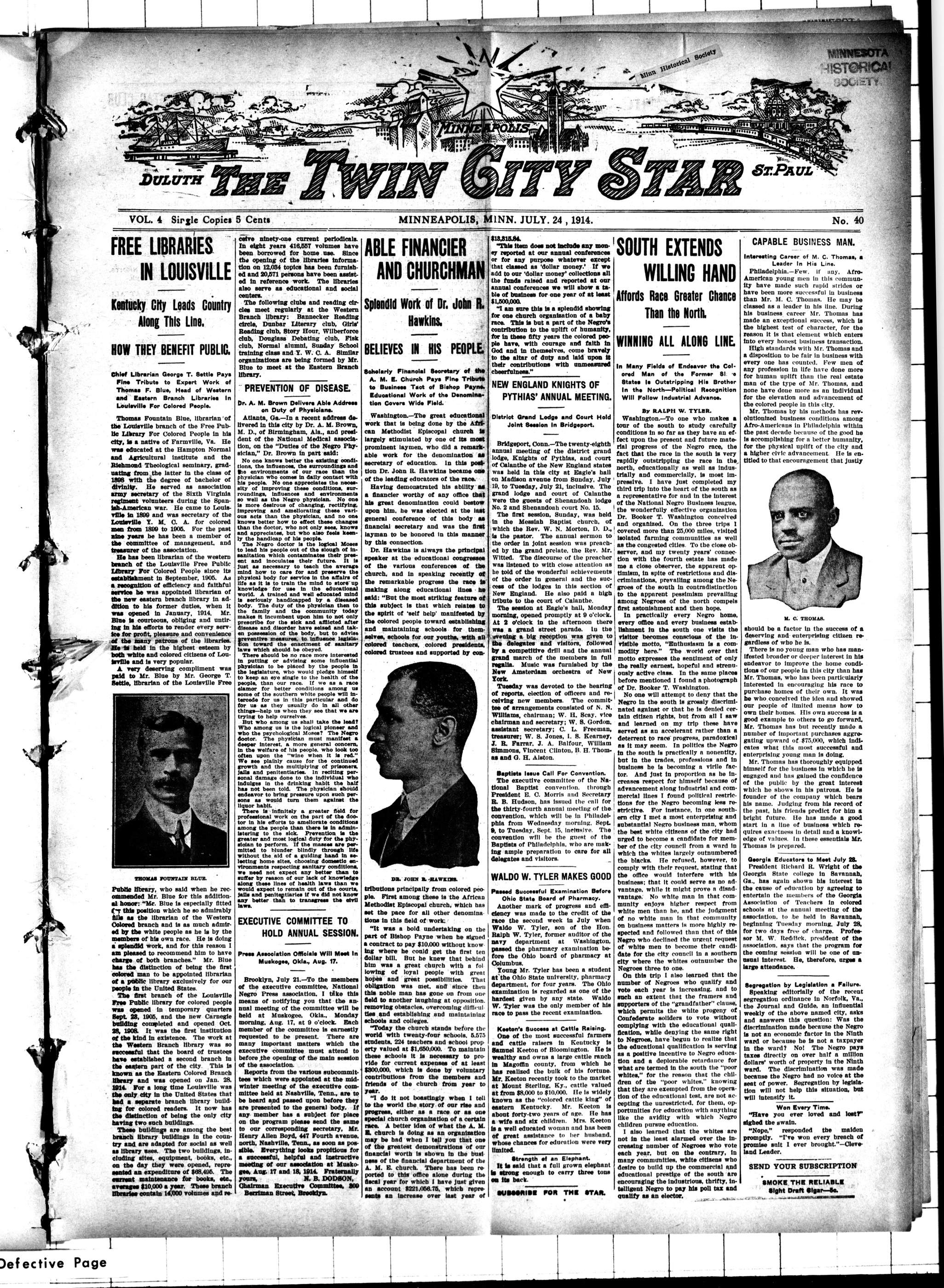
FREE LIBRARIES IN LOUISVILLE
Chief Librarian George T. Settle Pays Fine Tribute to Expert Work of Thomas F. Blue, Head of Western and Eastern Branch Libraries in Louisville For Colored People.
Thomas Fountain Blue, librarian of the Louisville branch of the Free Public Library For Colored People in his city, is a native of Farmville, Va. He was educated at the Hampton Normal and Agricultural institute and the Richmond Theological seminary, graduating from the latter in the class of 1896 with the degree of bachelor of divinity. He served as association army secretary of the Sixth Virginia regiment volunteers during the Spanish-American war. He came to Louisville in 1898 and was secretary of the Louisville Y. M. C. A. for colored men from 1899 to 1905. For the past nine years he has been a member of the committee of management, and treasurer of the association.
He has been librarian of the western branch of the Louisville Free Public Library For Colored People since its establishment in September, 1905. As a recognition of efficiency and faithful service he was appointed librarian of the new eastern branch library in addition to his former duties, when it was opened in January, 1914. Mr. Blue is courteous, obliging and untiring in his efforts to render every service for profit, pleasure and convenience of the many patrons of the libraries. He is held in the highest esteem by both white and colored citizens of Louisville and is very popular.
A very deserving compliment was paid to Mr. Blue by Mr. George T. Settle, librarian of the Louisville Free
THOMAS FOUNTAIN BLUE.
Public library, who said when he recommended Mr. Blue for this additional honor: "Mr. Blue is especially fitted (this position which he so admirably fills as the librarian of the Western Colored branch and is as much admired by the white people as he is by the members of his own race. He is doing a splendid work, and for this reason I am pleased to recommend him to have charge of both branches." Mr. Blue has the distinction of being the first colored man to be appointed librarian of a public library exclusively for our people in the United States.
The first branch of the Louisville Free Public library for colored people was opened in temporary quarters Sept. 28, 1905, and the new Carnegie building completed and opened Oct. 28, 1908. It was the first institution of the kind in existence. The work at the Western Branch library was so successful that the board of trustees have established a second branch in the eastern part of the city. This is known as the Eastern Colored Branch library and was opened on Jan. 28, 1914. For a long time Louisville was the only city in the United States that had a separate branch library building for colored readers. It now has the distinction of being the only city having two such buildings.
These buildings are among the best branch library buildings in the country and are adapted for social as well as library uses. The two buildings, including sites, equipment, books, etc. on the day they were opened, represented an expenditure of $68,405. The current maintenance for books, etc., averages $10,000 a year. These branch libraries contain 14,000 volumes and re-
ceive ninety-one current periodicals.
In eight years 416,557 volumes have been borrowed for home use. Since the opening of the libraries information on 12,034 topics has been furnished and 20,571 persons have been assisted in reference work. The libraries also serve as educational and social centers.
The following clubs and reading circles meet regularly at the Western Branch library: Bannecker Reading circle, Dunbar Literary club, Girl's Reading club, Story Hour, Wilberforce club, Douglass Debating club, Fisk club, Normal alumni, Sunday School training class and Y. W. C. A. Similar organizations are being formed by Mr. Blue to meet at the Eastern Branch library.
PREVENTION OF DISEASE
Dr. A. M. Brown Deliveres Able Address on Duty of Physiologists.
Atlanta, Ga.—In a recent address delivered in this city by Dr. A. M. Brown, M. D., of Birmingham, Ala., and president of the National Medical association, on the "Duties of the Negro Physician," Dr. Brown in part said:
No one knows better the existing conditions, the influences, the surroundings and the environments of our race than the physician who comes in daily contact with his people. No one appreciates the necessity of improving these conditions, surroundings, influences and environments in the medical profession is more desirous of changing, rectifying, improving and ameliorating these various acts than the physician, and no one knows better how to effect these changes than the doctor, who not only sees, knows and appreciates, but who also feels keenly the handicap of his people.
The Negro doctor the logical Moses to teach how to slacken the slough of sanitation which contaminates their present and inoculates their future. It is just as necessary to teach the average mind how to care for and preserve the physical body for service in the affairs of life as it is to train the mind to store up knowledge for use in the educational curriculum. The physician is seriously handicapped by a diseased body. The duty of the physician then to the family and the community today makes it incumbent upon him to not only prescribe for the sick and afflicted after disease and disorder have seized and taken possession of the body, but to advise the physician toward the enactment of sanitary laws which should be observed.
There should be no race more interested in putting or advising some influential physician to be placed by the people in the legislature, who would pledge himself to the people than our race. If we as a race clamor for better conditions among us some of the southern white people will intercede for us in this particular and do for us as they usually do in all other things—help us when they see that we are free. But who among us shall take the lead? Who among us is the logical pioneer and who the psychological Moses? The Negro doctor. The physician must manifest a deeper interest, a more general concern, in the welfare of his people, who look too closely at the people. We see plainly cause for the continued growth and the multiplying of prisoners, jails and penitentiaries. In reciting personal damage done to the individual who indulges in the drinking habit the half has not been told. The physician should increase pressure upon the persons as would turn them against the liquor habit.
There is infinitely a greater field for professional work on the part of the doctor in his efforts to ameliorate conditions among the people than there is in administering to the sick. Prevention is the best way to avoid and cure the sickidan to perform. If the masses are permitted to blunder blindly through life without the aid of a guiding hand in selecting home sites, choosing domestic environments respecting sanitary conditions, we need not expect any better than to suffer by reason of our lack of knowledge along these lines that we have been taught than to remain out of the curse jails and penitentiaries if we did not know any better than to transgress the civil laws.
EXECUTIVE COMMITTEE TO HOLD ANNUAL SESSION.
Press Association Officials Will Meet In Muskogee, Okla., Aug. 17.
Brooklyn, July 21.—To the members of the executive committee, National Negro Press association. I take this means of notifying you that the annual meeting of the committee will be held at Muskogee, Okla., Monday morning, Aug. 17, at 9 o'clock. Each member of the committee is earnest requested to be present. There are many important matters which the executive committee must attend to before the opening of the main session of the association.
Reports from the various subcommittees which were appointed at the mid-winter meeting of the executive committee held at Nashville, Tenn., are to be heard and passed upon before they are presented to the general body. If any member has a subject for place on the program please send the same to our corresponding secretary, Mr. Henry Allen Boyd, 447 Fourth avenue, north, Nashville, Tenn., as soon as possible. Everything looks propitious for a successful, helpful and instructive meeting of our association at Muskogee, Aug. 17 and 18, 1914. Fraternally yours.
N. B. DODSON, Chairman Executive Committee, 200 Berriman Street, Brooklyn.
$18.815.84.
"This item does not include any money reported at our annual conferences or for any purpose whatever except that classed as 'dollar money'. If we add to our 'dollar money' collections all the funds raised and reported at our annual conferences we will show a table of business for one year of at least $1,500,000.
"I am sure this is a splendid showing for one church organization of a baby race. This is but a part of the Negro's contribution to the uplift of humanity, for in these fifty years the colored people have, with courage and faith in God and in themselves, come bravely to the altar of duty and laid upon it their contributions with unmeasured cheerfulness."
Bridgeport, Conn.—The twenty-eighth annual meeting of the district grand lodge, Knights of Pythias, and court of Calanthe of the New England states was held in this city at Eagle's hall on Madison avenue from Sunday, July 19, to Tuesday, July 21, inclusive. The grand lodge and court of Calanthe were the guests of Shenandoah lodge No. 2 and Shenandoah court No. 15.
The first session, Sunday, was held in the Messiah Baptist church, of which the Rev. W. N. Morton, D. D., is the pastor. The annual sermon to the order in joint session was preached by the grand prelate, the Rev. Mr. Witted. The discourse of the preacher was listened to with close attention as he told of the wonderful achievements of the order in general and the success of the lodges in this section of New England. He also paid a high tribute to the court of Calanthe.
The session at Eagle's hall, Monday morning, opened promptly at 9 o'clock. At 2 o'clock in the afternoon there was a grand street parade. In the evening a big reception was given to the delegates and visitors, followed by a competitive drill and the annual grand march of the members in full regalia. Music was furnished by the New Amsterdam orchestra of New York.
Tuesday was devoted to the hearing of reports, election of officers and receiving new members. The committee of arrangements consisted of N. N. Williams, chairman; W. H. Scay, vice chairman and secretary; W. L. Gordon, assistant secretary; C. L. Freeman, treasurer; W. S. Jones, I. S. Kearney, J. R. Farrar, A. B. Aalfour, William Simmons, Vincent Clinton, B. H. Thomas and G. H. Alston.
Baptists issue Call For Convention.
The executive committee of the National Baptist convention, through President E. C. Morris and Secretary R. B. Hudson, has issued the call for the thirty-fourth annual meeting of the convention, which will be in Philadelphia from Wednesday morning, Sept. 9, to Tuesday, Sept. 15, inclusive. The convention will be the guest of the Baptists of Philadelphia, who are making ample preparation to care for all delegates and visitors.
Passed Successful Examination Before Ohio State Board of Pharmacy.
Another mark of progress and efficiency was made to the credit of the race the second week in July when Waldo W. Tyler, son of the Hon. Ralph W. Tyler, former auditor of the navy department at Washington, passed the pharmacy examination before the Ohio board of pharmacy at Columbus.
Young Mr. Tyler has been a student at the Ohio State university, pharmacy department, for four years. The Ohio examination is regarded as one of the hardest given by any state. Waldo W. Tyler was the only member of his race to pass the recent examination.
Keeton's Success at Cattle Raising.
One of the most successful farmers and cattle raisers in Kentucky is Samuel Keeton of Bloomington. He is wealthy and owns a large cattle ranch in Magoffin county, from which he has realized the bulk of his fortune. Mr. Keeton recently took to the market at Mount Sterling, Ky., cattle valued at from $8,000 to $10,000. He is widely known as the "colored cattle king" of eastern Kentucky. Mr. Keeton is about forty-two years of age. He has a wife and six children. Mrs. Keeton is a well educated woman and has been of great assistance to her husband, whose chances for education were very limited.
Strength of an Elephant.
It is said that a full grown elephant is strong enough to carry three tons on its back.
ABLE FINANCIER AND CHURCHMAN
Scholarly Financial Secretary of the A. M. E. Church Pays Fine Tribute to Business Tact of Bishop Payne, Educational Work of the Denomination Covers Wide Field.
Washington.—The great educational work that is being done by the African Methodist Episcopal church is largely stimulated by one of its most prominent laymen, who did a remarkable work for the denomination as secretary of education. In this position Dr. John R. Hawkins became one of the leading educators of the race.
Having demonstrated his ability as a financier worthy of any office that his great denomination could bestow upon him, he was elected at the last general conference of this body as financial secretary and was the first layman to be honored in this manner by this connection.
Dr. Hawkins is always the principal speaker at the educational congresses of the various conferences of the church, and in speaking recently of the remarkable progress the race is making along educational lines he said: "But the most striking feature of this subject is that which relates to the spirit of 'self help' manifested by the colored people toward establishing and maintaining schools for themselves, schools for our youths, with all colored teachers, colored presidents, colored trustees and supported by con-
DR. JOHN B. HAWKINS.
tributions principally from colored people. First among these is the African Methodist Episcopal church, which has set the pace for all other denominations in this field of work.
"It was a bold undertaking on the part of Bishop Payne when he signed a contract to pay $10,000 without knowing where he could get the first ten dollar bill. But he knew that behind him was a great church with a following of loyal people with great hopes and great possibilities. That obligation was met, and since then this noble man has gone on from one field to another laughing at opposition, removing obstacles, overcoming difficulties and establishing and maintaining schools and colleges.
"Today the church stands before the world with twenty-four schools, 5,575 students, 224 teachers and school property valued at $1,650,000. To maintain these schools it is necessary to provide for current expenses of at least $800,000, which is done by voluntary contributions from the members and friends of the church from year to year.
"I do it not boastingly when I tell to the world the story of our rise and progress, either as a race or as one special church organization of a certain race. A better idea of what the A. M. M. church is doing as an organization may be had when I tell you that one of the greatest demonstrations of our financial worth is shown in the business of the financial department of the A. M. E. church. There has been reported to this office alone during the fiscal year for which I have just given an account $221,066.75, which represents an increase over last year of
NEW ENGLAND KNIGHTS OF PYTHIAS' ANNUAL MEETING.
District Grand Lodge and Court Hold Joint Session In Bridgeport.
WALDO W. TYLER MAKES GOOD
SUBSCRIBE FOR THE STAR.
SOUTH EXTENDS WILLING HAND Affords Race Greater Chance Than the North.
WINNING ALL ALONG LINE
In Many Fields of Endeavor the Colored Man of the Former Slave States Is Outstripping His Brother In the North—Political Recognition Will Follow Industrial Advance.
By RALPH W. TYLER.
Washington.—To one who makes a tour of the south to study carefully conditions in so far as they have an effect upon the present and future material progress of the Negro race, the fact that the race in the south is very rapidly outstripping the race in the north, educationally as well as industrially and commercially, is most impressive. I have just completed my third trip into the heart of the south as a representative for and in the interest of the National Negro Business league, the wonderfully effective organization Dr. Booker T. Washington conceived and organized. On the three trips I covered more than 25,000 miles, visited isolated farming communities as well as the congested cities. To the close observer, and my twenty years' connection with the fourth estate has made me a close observer, the apparent optimism, in spite of restrictions and discriminations, prevailing among the Negroes of the south in contradistinction to the apparent pessimism prevailing among Negroes of the north compels first astonishment and then hope.
In practically every Negro home, every office and every business establishment in the south one visits the visitor becomes conscious of the invisible motto, "Enthusiasm is a commodity here." The world over that motto expresses the sentiment of only the really earnest, hopeful and strentuously active class. In the same places before mentioned I found a photograph of Dr. Booker T. Washington.
No one will attempt to deny that the Negro in the south is grossly discriminated against or that he is denied certain citizen rights, but from all I saw and learned on my trip these have served as an accelerator rather than a deterrent to race progress, paradoxical as it may seem. In politics the Negro in the south is practically a nonentity, but in the trades, professions and in business he is becoming a virile factor. And just in proportion as he increases respect for himself because of advancement along industrial and commercial lines I found political restrictions for the Negro becoming less restrictive. For instance, in one southern city I met a most enterprising and substantial Negro business man, whom the best white citizens of the city had urged to become a candidate for member of the city council from a ward in which the whites largely outnumbered the blacks. He refused, however, to comply with their request, stating that the office would interfere with his business; that it could serve as no advantage, while it might prove a disadvantage. No white man in that community enjoys higher respect from white men than he, and the judgment of no white man in that community on business matters is more highly respected and followed than that of this Negro who declined the urgent request of white men to become their candidate for the city council in a southern city where the whites outnumber the Negroes three to one.
On this trip I also learned that the number of Negroes who qualify and vote each year is increasing, and to such an extent that the framers and supporters of the "grandfather" clause, which permits the white progeny of Confederate soldiers to vote without complying with the educational qualification, while denying the same right to Negroes, have begun to realize that the educational qualification is serving as a positive incentive to Negro education and a deplorable retardance for what are termed in the south the "poor whites," for the reason that the children of the "poor whites," knowing that they are exempted from the operation of the educational test, are not accepting the unrestricted, for them, opportunities for education with anything like the avidity with which Negro children pursue education.
I also learned that the whites are not in the least alarmed over the increasing number of Negroes who vote each year, but on the contrary, in many communities, white citizens who desire to build up the commercial and educational prestige of the south are encouraging the industrious, thrifty, intelligent Negro to pay his poll tax and qualify as an elector.
No. 40
CAPABLE BUSINESS MAN.
Interesting Career of M. C. Thomas, a Leader In His Line.
Philadelphia.—Few. if any. Afro-American young men in this community have made such rapid strides or have been more successful in business than Mr. M. C. Thomas. He may be classed as a leader in his line. During his business career Mr. Thomas has made an exceptional success, which is the highest test of character, for the reason it is that element which enters into every honest business transaction. High standards with Mr. Thomas and a disposition to be fair in business with every one has counted. Few men of any profession in life have done more for human uplift than the real estate man of the type of Mr. Thomas, and none have done more as an individual for the elevation and advancement of the colored people in this city.
Mr. Thomas by his methods has revolutionized business conditions among Afro-Americans in Philadelphia within the past decade because of the good he is accomplishing for a better humanity, for the physical uplift of the city and a higher civic advancement. He is entitled to that encouragement that justly
M. C. THOMAS.
should be a factor in the success of a deserving and enterprising citizen regardless of who he is.
There is no young man who has manifested broader or deeper interest in his endeavor to improve the home conditions of our people in this city than has Mr. Thomas, who has been particularly interested in encouraging his race to purchase homes of their own. It was he who conceived the idea and showed our people of limited means how to own their homes. His own success is a good example to others to go forward, Mr. Thomas has but recently made a number of important purchases aggregating upward of $75,000, which indicates what this most successful and enterprising young man is doing. Mr. Thomas has thoroughly equipped himself for the business in which he is engaged and has gained the confidence of the public by the great interest which he shows in his patrons. He is founder of the company which bears his name. Judging from his record of the past, his friends predict for him a bright future. He has made a good start in a line of business which requires exactness in detail and a knowledge of values. In these essentials Mr. Thomas is prepared.
Georgia Educators to Meet July 28.
President Richard R. Wright of the Georgia State college in Savannah, Ga., has again shown his interest in the cause of education by agreeing to entertain the members of the Georgia Association of Teachers in colored schools at the annual meeting of the association, to be held in Savannah, beginning Tuesday morning, July 28, for two days free of charge. Professor M. W. Reddick, president of the association, says that the program for the coming session will be one of unusual interest. He, therefore, urges a large attendance.
Segregation by Legislation a Failure.
Speaking editorially of the recent segregation ordinance in Norfolk, Va., the Journal and Guide, an influential weekly of the above named city, asks and answers this question: Was the discrimination made because the Negro is not an economic factor in the Ninth ward or because he is not a taxpayer in the ward? No! The Negro pays taxes directly on over half a million dollars' worth of property in the Ninth ward. The discrimination was made because the Negro had no voice at the seat of power. Segregation by legislation will not help this situation, but will intensify it.
Won Every Time.
"Have you ever loved and lost?" sighed the swain.
"Nope," responded the malden promptly. "I've won every breach of promise suit I ever brought."—Cleveland Leader.
SMOKE THE RELIABLE
Sight Draft Sigar—5s.
ODD FELLOWS PICNIC PARKER'S LAKE, JULY 28th
Adults 40c . . . Children 20c
St. Anthony Lodge No. 2877, G. U. O. of O. F. will hold their Twenty-third
ANNUAL PICNIC at PARKER'S LAKE on the Luce Electric
Short Lime, TUESDAY, JULY 28, 1914
Good fishing, Boating, Dancing. Trains leave terminal station at 7th
St. and 2nd Ave. No. Minneapolis, at 6:15, 8:15, 10:15 a. m., and 1:15, 4:15,
5:20, 6:20 and 7:45 p. m. Returning leaves Parker's Lake at 8:05, and 9:55
a. m. and 1:06, 4:05, 5:40, 7:03, 9:23 and 10:53 P. M.
YOU ARE INVITED!
You Will be Lonesome if You Don't Go
Come go with us to Parker's Lake,
Don't miss this treat, for goodness sake!
And if you ask us, What's the reason?
Twill be THE PICNIC of the season.
Take one day off from city life,
Bring all the children and your wife;
Take all your guests to Aquat;
Come well prepared to enjoy the day.
JULY THE 8TH is the date.
You can go out early or come out late.
We never drink so on the ground
No wines nor liquors will be found—
Now, if you are rough, be good that day!
We don't go out to fight, but play.
Did you say fun? There'll be no end—
So come on out and meet your Friends.
THE ODDEELOWS
REMEMBER THE DATE!
You Will be Lonesome
Come go with us to
Don't miss this treat,
And if you ask us, We
Twill be THE PICNIC
Take one day off from
Bring all the children
Take all your games,
Come well prepared to
JULY THE 8TH is
You can go out early
We never drink so on
No wines nor liquors
Now, if you are rouge
We don't go out to
Did you say fun? The
So come on out and n
O.
MINNEAPOLIS NEWS
Leave your Subscriptions and Printing at TWIN CITY STAR PRINTERS, 1402 Washington Ave. So. Choice workmanship, Regular Prices.
A RAGE PROBLEM.
Why is it that many persons, who represent themselves as race workers, never subscribe to and pay for race papers? How many do you know? Who are they?
When writing for the press, don't abbreviate your words. Spell each one out correctly and distinctly. If you don't it means that all of your manuscript will have to be rewritten if there is time. Write on one side of the paper only.
The People's Christian Mission,
REV. G. W. MITCHELL, PASTOR.
1904 Washington Ave. Sa.
The Sunday School Union Picnic at Minnehaha Falls was as usual a big success.
ARE YOU IN DEBT?
Having decided to take a trip to the Southland next month, we ask our subscribers-in-arrears, to pay what they can on their indebtedness to the Twin City Star. We have not forced our publication on any one, and feel that you have been benefited by our services rendered. We do not beg dollar-money, or solicit donations. Just pay what you can on what you owe. There are no free-doings for newspaper men now-a-days. Everybody pays, and on our annual vacation, we buy the comforts of travel and enjoy meeting our brother editors, who are associated for the highest development of Negro Journalism and interested in the advancement of the race.—Editor.
The funeral of Mrs. Josie Galbreath
sister of Miss Grazia Corneal was held
last week at the residence of her
mother, Mrs. Phannie Tyner. Mrs.
Galbreath died from tuberculosis.
Miss Grazia Corneal came from
Seattle to visit her.
Mr. James A. Roberts of the police
force will spend his vacation at his
native home in Chillicothe, O.
Mrs. Henry Roberts of Indianapolis
is visiting Mr. and Mrs. James A.
Roberts, 2834 5th Ave. So.
Miss Alice Matthews, of Indian-
apolis, is visiting with Mr. and Mrs.
Zach Johnson, 2604 4th Ave. So. She
will spend a few days with Mrs.
Firston White of St. Paul.
Mr. Geo. Lillart met with a painful accident last week. He was struck by a motorcycle and suffered painful injuries on his leg. He was able to continue work after receiving medical aid.
Mr. Wm. Neal lost a finger in an accident at the auto-factory where he was employed. He is improving rapidly.
Mr. Wm. Jenkins, 609 Dupont Ave., one of our prominent church workers is home again after a long illness at the City hospital. Mr. Jenkins has a host of friends who are glad to hear of his recovery.
Geo. W. Holbert, Exalted Ruler of Ames Lodge of Elks of Minneapolis
THE ODPEELLOWS,
O. A. Lawrence, Chairman of Committee.
THE EPISCOPAL CLUBS
THIRD ANNUAL PICNIC at
ANTLER'S PARK
on DAN PATCH LINE
Thursday, August 6, 1914
Good Fishing, Boating and Plenty
Amusements for the Children
A SPLENDID ORCHESTRA
IN ATTENDANCE
Trains Leave Minneapolis at 54th St. and Nicollet Ave., 8:30 and 11 a.m., 2:00 and 5:00 p.m. Take 54th St. and Columbia Heights Car on Marquette Ave. and at Nicollet and Lake St. to Dan Patch Station.
Committee of. Arrangements
Dr. R. S. Brown, Chm., Wm. Doston, Frank Terry, Alton C. Boone, Walter L. Smith, Irving Smith, Calvin Lewis, Thos. Henderson, Ephraim Bludsoe.
FARE FOR ROUND TRIP
Adults, 75c; Children, 35c.
NO PICNICS AT CARVER
On account of the sad accident at the Elks' Picnic at Carver on July 4, when a little boy was killed by an automobile, which it is alleged to have been driven by Mr. Than Travis of St. Paul, the authorities have decided to cancel all permits for picnics. This does not apply especially to Negroes. The Knights of Pythias will give an entertainment at Dreamland on Aug. 18. They were to hold their annal picnic at Carver on Aug. 4, which was cancelled.
During the summer dinner will be served from 5 to 8 p. m. at the Twin City Stag Café. (Advertisement.)
DR. BROWN TO LECTURE.
Dr. R. S. Brown will speak on Sunday eve, July 26 at 8 P. M., at St. Phillips Church, St. Paul, on "Sex Hygiene." He will address the young men and parents. Rev. Lealtad hopes to have a large crowd present.
NEW TAILOR-SHOP OPENED.
Mr. Fernando Anderson has opened a tailor-shop at 248 1st Ave. No., next to Dr. Judy's office. He is an experienced tailor. Mr. Anderson was a teacher of tailoring at Claflin Univ. and has worked with leading tailors in the Twin Cities. See his ad.
Mrs. Julia Hinson has renovated the St. Louis Kitchen and continues to serve the best home cooked meals at popular prices. She gives clean pure food, prepared like mother served.
EDITOR SMITH'S SOUTHERN TRIP.
Editor Smith of the Twin City Star expects to leave for Muskogee, Okla., on Aug. 14th, to attend the Annual meeting of the National Negro Press Assn., where he will speak on "Operating a Newspaper in the West." He will also attend the sessions of the Negro Business Leagues which meet in Muskogee. During the trip he will visit several Southern cities, where he has many friends.
Wanted—Agents to solicit advertising and news. Salary or commission. Good profits. Write the Twin City Star, Minneapolis, Minn.
If you wish to help this publication. Send your subscription by Post office order.
TWIN CITY STAR
HOWARD PHILLIPS IS DEAD.
Mr. Howard Phillips, one of the best known men of this city and the Northwest died Thursday morning at the Swedish Hospital where he suffered with diabetes. He was a brother of Mr. Schuyler C. Phillips "Howard" had been ill during past year. He was the steward of the Porters and Waiters' Club and had been connected with several leading white restaurants during his life. He was recognized as a chef and steward of extraordinary ability, and was admired for his honesty and genial disposition.
Mr. Phillips was unmarried. He had been confined over six weeks at the hospital when he died. Everything was done to relieve his suffering, and during his illness he was constantly visited by a host of friends. Funeral services will be held at Lawrence's Chapel, 910 8 Ave. So. on Saturday afternoon at 2:30 P. M. Friends are invited to attend.
Atty's W. R. Morris and W. T. Francis returned home after a pleasant and healthful trip to Philadelphia to attend the Supreme Court of Odd Fellows. They visited Atlantic City New York and Washington.
DEATH OF MRS. CHARLESTON
Mrs. Blanche Charleston, matron of the Attucks Home for Negroes, died Monday with black diphtheria. She was buried Monday. No one was allowed to see her remains. There were no funeral services. A memorial service will be held later. Three children from the Home are in the hospital with diphtheria. Mrs. Charleston's death was a shock to the community. She was a good Christian woman and enjoyed a host of friends.
PIONEER'S DAY.
Small Gathering at Minnehaha Park Held Services.
A few of the Negro Pioneer citizens met last Sunday at Minneapolis Park to hold exercises, which were conducted under the auspices of the Minneapolis Sunday Forum. Mr. P. F. Hale, master of ceremonies read the list of old residents. Prof. B. F. Bullock, a Negro graduate of the School of Agriculture of the University was the principal speaker. He preached the doctrine of "back to the Southland." His remarks were inopportune and subject to much criticism, though apparently well received by some of the white persons present Prof. Bullock believed the Negro could accomplish more in the South than in the North. Editor Smith was asked to respond on behalf of the committee. He spoke briefly, protesting against any backward movement, assuring his hearers that the Negro pioneer in Minesota had established a citizen as a citizen, and that this was a state of grand opportunities, which had no legislation on its statues, that branded Negroes as inferior to other races. He knew that they could better serve their brothers in the Southland by being good citizens and making good as individuals, than by any migratory movement. He proved that there was no Negro problem, but there was a problem of the races living together. If the Negroes of the North, would use their privileges, as well as those of the South, they could do much to aid the conditions of the Southern Negro. At the close of the exercises a group photo was taken.
Mrs. M. B. McGhee and her daughter Miss Ruth, have returned to live at the McGhee residence at 665 University Ave.
Reserve your space for Excursions, Picnics and Dances. Take the advantage of our advertising columns
HOUSE FOR RENT.
8 rooms, all modern, toilet, bath, gas. Good location, on car line. Apply Noah Morse, 404 E. 25th St Phone N. W. South 248.
HOUSE FOR SALE.
New Modern Duplex. 6 rooms and bath, oak finished in each flat. Full cemented cellar and laundry. Lot 6x4 139, east front, large lawn, exceptionally large well arranged rooms, easy terms. See Kronengold, 511 Aldrich Ave. No. Tel. Hy. 2303. (Advertisement).
STAG CLUB'S CARNATION NIGHT.
The Twin City Stag Club will feature a "Select Cabaret," on Every Other Thursday Night" at 246-389 Fourth Ave. So. This will be known as "The Carnation Night." The management invites the public to participate in an evening of refined amusement, afforded by selected talent, excellent cuisine and comfortable surroundings—SUNDAY, SPECIAL DINNER, 59c.
We do not publish personals, unless paid for, about those who owe us. If you are mean enough to beat a newspaper publisher, you should not get the benefit of his columns.
Subscribe for the Star.
MINNESOTA WELL HEPRE
SENTED.
Atlantic City, N. J., July 18. Special—Hon. William T. Francis of St Paul was one of the principal speakers at the annual banquet of the Atlantic County Republican League of Atlantic City, N. J., on July 16, which had just moved into their new headquarters at 1603 Arctic Ave. Mr. W. H. Hursey, president, was master of ceremonies. Among the speakers were Grand Master Ingram of Macon, Ga., Vice President Bowie, Commissioner Batharce, Editor Ben. J. Davis of Atlanta, Ga., Col R. Lineohr Johnson, ex recorder of deeds, Hon. Robt. Fitzgerald and Atty. Nutter of Atlantic City. The Atlantic Review says: "Aside from the large membership and several prominent local guests, there were present some of the race's most prominent and wealthy men."
During his stay at Atlantic City, he was the guest of Atty. Isaac H. Nutter and the Atlantic County League, stopping at the Hotel Ridley. On Friday evening, July 17, Deputy Grand Master, H. L. Johnson and Atty. Francis attended the Anniversary Banquet of Pacific Lodge G. U. O. of O. P., where they delivered appropriate addresses.
draw well at Unique
Many local admirers of "Dora Dean" attended the performances at the Unique this week to witness her act, which is one of the features of the bill. They presented a brilliant sexette, with a rare production of song, dance and comedy. The Journal says: "The popularity of colored singing and dancing acts in Europe dates back to about twelve years ago, when Dora Dean, who appears with her Fancy Phantoms at the Unique this week, and Charley Johnson introduced the cake-walk abroad. Since then Miss Dean has organized troops of colored performers to appear in Russia, Germany, France and England. The two girls and three boys with her at the Unique were engaged for a tour of the continent this fall, when Marcus Loew's agents saw the act and engaged it for thirty-five weeks straight over the circuit, which includes the Sullivan & Considine theaters, of which he assumes control next week. Miss Dean was born in Indianapolis, but has always considered Minneapolis her home because she married Charley Johnson here. He used to work in the Nicollet house barber shop, and when pickaninny singing and dancing came into favor about the time of the birth of "In Old Kentucky," became more than locally famous for his soft-shoe dancing, and went away with a show. He was featured in the leading troupes of colored entertainers that followed and became known internationally as a colored comedian and dancer. He is in New York, having just returned from Europe."
Mr. Johnson is the owner of much desirable property in this city. The company including Misses Burnadine Small, Lillian Goode, Florence Hill, Messrs. Wm. Kelly, Wm. Cole, Eddie Stafford are stopping at the Twin City Stag Hotel, where they have been well entertained.
A dance was given in honor of Miss Dora Dean and Co., at the Twin City Stag Hotel. Vocal and instrumental selections were rendered by the members of the Company. Dancing was enjoyed until quite an early hour.
Mr. and Mrs. H. S. Brown of Chicago were guests at the Twin City Hotel this week.
A COSTLY GIFT.
Many were interested when Judge Gary of Gary, Ind., invited them to a lecture, where he would GIVE THEM SOMETHING. He had enough money; only wanted to put on a Carnegie stunt. The proposed lecture turned out to be a real estate proposition, pulled off in two Methodist churches, whose Pastors are his agents. We have Negro real-estate agents here, good opportunities for investment, but this deal was kept mum until the killing. If you want to get a lot in Gary, Ind., Jerusalem or Hell, just go to a church pastored by such preachers. What did the Judge give away? Who received the gifts?
Memory.
Memory is the friend of wit, but the treacherous ally of invention; there are many books that owe their success to two things—the good memory of those who write them and the bad memory of those who read them—Colton.
We are often asked "How can I send my subscription." We get all Post Office Orders sent us my mail.
Chicago, July 17.—Isaac Bond, a Negro, was found guilty today for the murder of Miss Ida G. Leegon, art student and sculptress, who was found slain and robbed last October near Argo, Ill., where she had been lured through an advertisement for a nurse.
The jury which returned the verdict of guilty fixed Bond's punishment at imprisonment for life.
Mrs. J. Jackson of Chicago is visiting her mother, Mrs. F. R. Jackson and sister Mrs. Clyde Edwards at their residence, 4601 Zenith Ave. She will remain till Aug. 1st.
Mrs. Ollie Montgomery left Friday night for a three weeks' visit with friends at Seattle and Tacoma.
Mrs. Geo. Lucas and her sister Muriel left for Helena, Montana to reside. Her mother, Mrs. C. Mills, will go to Council Bluffs to reside with her son, Mr. John S. Mills.
Mr. F. G. Snelson, former editor of the Columbus Independent of Columbus, O., and his wife are in St. Paul to reside. They are the guests of Mrs. W. R. Hardy, 518 St. Anthony Ave.
"Hustling Tom" Morgan of the P. O. Dept., is suffering with a bad hand. He received a cut while handling mail sacks and blood poisoning set in.
Miss Joyce Dorsey, a graduate of the Western Univ. at Quindaro, Kan., is visiting her uncle, Mr. E. B. Waldin. She is attending the Northwestern Musical Conservatory. While in the city she will reside with Mrs. W. H. Walker, 3129 Findley Pl.
Mr. Geo. Sellars, who was ill in Buffalo, N. Y., is improving.
Mrs. Jennie Watson has been appointed as Matron at Wilberforce College.
JOHN DANIELS AS AUTHOR.
Boston Man Teils of Our Early Achievements "in Freedom's Birthplace." "In Freedom's Birthplace" is the title of an interesting book by John Daniels of Boston. The author says, among other things, that in no part of the United States is the local history of the Negro race more interesting and instructive than in Massachusetts and particularly in the city of Boston and its immediate environs. The colony of Massachusetts bay was one of the first in America to practice Negro slavery in 1638. Massachusetts was also the first to abolish slavery in the decade between 1780 and 1790.
In Boston a Negro was the first martyr in the cause of American independence. Despite Washington's order against it, free Negroes were enrolled and served in the continental army at Cambridge, and excellent services were rendered in the Revolutionary war by a Negro regiment from Rhode Island and a Negro company from Massachusetts. It was a Negro soldier who shot Pitcairn at Bunker Hill, and he and some of his colored comrades are conspicuous in Trumbull's painting of that battle.
With these antecedents it was natural that the abolition movement should have its origin in Boston. At that time, it must be confessed, the Negro was looked upon there and throughout New England with a certain degree of disfavor. The attitude of Miss Ophella in "Uncle Tom's Cabin" was typical, and it was against this condition of the nominal opponents of actual slavery that the movement for enfranchisement had to contend as much as against positive proslavery resistance.
In these circumstances Boston was the scene of some of the most celebrated fugitive slave cases, such as that of Latimer, which literally convulsed the whole commonwealth and made tremendously toward the development of the anti-slavery sentiment which in time possessed the state. The history of the Fifty-fourth Massachusetts regiment and its chivalrous commander, Robert Gould Shaw, forms a brilliant chapter in the story of the civil war, and the burial of Shaw by the side of his Negro comrade beneath the blood drenched sands of Wagner formed a fitting sequel to the burial of Attucks in the same grave with his white fellow victims of the Boston massacre.
The follies and excesses of the reconstruction era at the south reacted upon the north and caused a widespread revulsion of feeling against the sympathetic enthusiasm which had been aroused before and during the war, and the Negro race generally throughout the country suffered underserved discredit. Thereafter the Negro was forced back upon his own resources and was compelled to videate himself and to establish his own place in the nation. How he is doing this, particularly in Boston, is described in interesting and instructive detail.
You've Met Him.
"How do you like your new neighbor?"
"Oh, he's the kind of man that leaves his longest story to tell while we are holding the front door open for him to go."
249450 FOURTH AVENUE 50.
E. E. STEWART, Manager
FINEST ESTABLISHMENT OF ITS KIND IN THE UNITED STATES.
Twenty Elegant, Steam Heated, Electric Lighted Rooms for Gentlemen Only. Free Bath.
FIRST CLASS BARBER SHOP.
Lobby, Reading and Lounging Room, Buffet and Grill Room, Billiard Room, Dining Room, Barber Shop and Bath, Private Dining and Reception Room for Ladies.
CARNATION SOUVENIR NIGHTS.
JULY 30th—AUG. 13th.
A LA CARTE MEALS AT ALL
HOURS. BEST SERVICE.
REGULAR DINNER. 280-380.
SPECIAL SUNDAY DINNER, 50c.
MENU
Cream Tomato Soup
Planked White Fish
Roast Young Duckling, Apple Sauce
or Roast Beef au Jus. Mashed
Potatoes, Green Peas.
Pineapple Sherbert
Tomato Salad. French Dressing
Rice Custard Pudding. Wine Sauce
Iced Tea, Milk, Fresh Butter, Milk,
Coffee.
Dining Room under direct charge of
Mrs. Stewart.
Special Terms for Private Parties,
Banquets, Etc.
DINING ROOM, N. W. Main 2831
GRILL ROOM, T. S. Center 3674
HOTEL, N. W. Main 2860
WHY NOT HAVE AN EXPERI- IENCED HAIR CULTURIST,
Poro-Scalp Treatment—Shampooing
MISS M. E. PREWITT.
2743 11th Ave. South
N. W. South 9342 Minneapolis
Treatment at Residence by Appoint- ment.
MODERN HOUSES FOR RENT.
Modern 8 room house, $20.00 per month. Or will sell for $2,900.00 on easy terms. Heat, bath, gas, grate, parquet floors. 753 Ashland Ave.
Fine neighborhood. W. T. Francis, 88 and 89 Union Block, St. Paul.
For Respectable Railroadmen.
Modern House. 6 rooms, hot water,
bath, steam heat, $25 in summer $30
in winter. Located 313 14th Ace. So.
Must have character references. Apply
Jensen Printing Co., 14th Ave. and
3rd St. So., Minneapolis.
Electric Player Planos Regulated
HENRY R. MORGAN.
Piano Tuning
244 13th AVE. So. MINNEAPOLIS
PHONE NIC. 1354.
THE ST. LOUIS KITCHEN.
You can get a good meal, clean
service, and courteous attention
at the St. Louis Kitchen, 138 E. Third
St., St. Paul. Mrs. Hinson is universally
known for her good cooking.
ST. LOUIS KITCHEN, 138 E. St. St.
St. Paul, Minn.—Advertisement.
WANTED.
Reliable, live, honest, bustling agents for the Twin City Star. You can make a good living with this work as a side line. Agents wanted in Milwaukee, Chicago, Omaha, Kansas City, Portland, Ore., Seattle, Denver, Des Moines and Sloux City. Write letters to The Twin City Star, Minneapolis, Minn.
ADVERTISE IN THE STAR
THE FRANCE CAFE
Prof. Rufus Wilson, former pianist for the "Neighbors Saxaphone Trio" of Marion, Indiana, is "Cabareting" at the France Café, 255 Marquette Ave. He is an able musician, also a possessor of a marvelous voice and the patrons of "The France" are very much pleased indeed.
LARGE HOUSE TO LET
Suitable for Hotel.
A large modern, three-story building, suitable for Rooming house or Hotel. 20 rooms, baths, electricity, steam-heat, near car line. Located at 204 11th Ave. So. Minneapolis. Apply to Wm. Cohen, 305 Nicollet Ave. Phone Nic. 1911.
—Advertisement.
SIGN PAINTING
I'm Not Superstitious, but—
I believe in SIGNS
GOLD, SILVER,
CLOTH and CARD
F. P. SANFORD, Nic. 9206
GEND YOUR SUBSCRIPTION
---
11:37:52
Defective Page
effective Page
DO YOU WANT TO BE WELL-
DRESSED? THEN I AM YOUR
TAILOR.
SUITS
$25.00
OVERCOATS
$25.00
Cleaning
Pressing
Repairing
CLIFFORD A. SMITH.
100 E. 8th ST., ST. PAUL, MINN.
THE CARVER HOTEL
On All Car Lines
1368-10 WASHINGTON AVE. SO.
28 Newly Furnished Rooms.
By Day, Week or Month.
Special Rates to Theatrical People.
Mrs. Alice (Mother) Carver, Prop.
N. W. Phone Main 863
BARBER SHOP AND BATHS.
T. B. Phone 3073 N. W. Main 9592
The Porters and Waiters Club
Incorporated
GLOVER SHULL, President
Waiters for Parties Furnished
Also Porters
311 Hennepin Ave. Mpls
SMOKE THE BEST 5C CIGAR Sight Draft
W. S CONRAD CO., Distributors
NO. 140. E. 6th ST., ST. PAUL.
NO. 1. WESTERN AVE., MINN.
Southern Theatre
Southern Theatre
SevenCorners
15th and Washington Avenues So.
Refined Vaudeville
Moving Picture Shows
Continous Performance
Admission 10 Cents
Children 5 Cents
Peterson, The Druggist 1501 Washington Ave. So.
TOILET ARTICLES, DRUGS PRESCRIPTIONS. He Sollicits You: Patronage.
Office, Nic. 1983 Res. Colfax 1638.
DR. J. H. REDD,
Physiologist and Surgeon.
111 SQ. 6TH ST.
Minneapolis, Minn.
WM. T. FRANCIS
Attorney and Counsellor at Law,
88-88 Union Block, St. Paul.
Dr. John R. French
DENTIST
804 Kendrick Block (37 E. 7th St.)
Tel. Godar 804
ST. PAUL, MINN.
DR. W. H. WRIGHT.
DENTIST.
Phone Nic. 1963
111 So. 6th St Minneapolis, Minn.
OVER 65 YEARS' EXPERIENCE
PATENTS
TRADE MARKS
DESIGNS
COPYRIGHTS & DESIGN
Anyone sending a sketch and description may
quickly ascertain our opinion free whether an
invention is probably patented or not. Common
patents are HANDBOOK, COMMON PATENTS,
sent free. Oldest agency for securing patents,
Patents taken by the Co. receive
patents without charge, in the
Scientific American.
A handmade illustrated weekly. Largest
circulation of any scientific journal. Turns, 81
a quarter mile from the office. Call by all
MUNN & Co. 364 Broadway, New York
Brown Office, St. P. St., Washington, D.C.
PRINTING THAT SATISFIES.
Bring your printing to THE TWIN
CITY STAR PRINT, 1402 Washington
Ave. So. The work will suit you.
Estimates cheerfully given. T. S. 2520.
Subscribe for the Star.
BIG MEETING OF AFRO-CHRISTIANS
WORK COVERS WIDE FIELD.
International Organization of Zebulous Clergymen, Missionaries and Laymen Makes Encouraging Reports of Success at Home and on Foreign Territory - Influence of President Howell.
The biennial session of the Afro-Christian convention was held for five days recently in Durham, N. C. The sessions were held in the beautiful edifice known as the "White Rock" Christian church. Many visitors and delegates were in attendance. The convention was composed of the following conferences: Western North Carolina, eastern Virginia, eastern Atlantic, Lincoln, N. C.; Georgia and Alabama, New York, New Jersey, Pennsylvania, South America and the West Indies.
Representatives from the various state Sunday school conventions and the woman's home and foreign missionary convention were present in large numbers. Franklinton Christian college was represented by Rev. John Blood (white), treasurer of the board
REV. DR. S. A. HOWELL.
of control; Rev. S. A. Howell, D. D., secretary of the board; Professor H. E. Long, Ph. D., president of the college; Professors J. A. Alexander, B. A., and J. A. Henderson, tutors. President Rev. A. J. Holloway of Henderson, N. C., presided. The introductory sermon was preached by the Rev. J. J. Faulk of Norfolk, Va. His theme was "Be Like God." The Afro-Christian Publishing association was represented by Rev. A. J. Holloway, the manager. Dr. Rev. S. A. Howell Elected President.
Following the devotional exercises and the enrollment of delegates the second day the convention proceeded to elect the general officers. The Rev. S. A. Howell, M. A., D. D., of Newport News, Va., pastor of the Wesley Grove Christian church, and Corinth Chapel Christian church, president of the Penny, Nickel and Dime Savings bank of Newport News, was unanimously elected president. Dr. Howell is a born leader and a diplomat. He wields the gavel with a master's hand, and has the confidence and respect of his church, white and colored. Rev. F. L. Taylor, D. D., Newbern, N.C., vice president; Rev. A. A. Bright of Raleigh, N.C., secretary; Rev. J. W. Patton, B. A., of Holland, Va., assistant secretary; Rev. J. E. Samuel, M. A., B. D., of British Gulana, South America, general field secretary; W. Raney, Newport News, secretary of missions, and J. T. Reed of Suffolk, Va., treasurer, were the others elected.
The officers were installed by the Rev. Father J. Mann, the senior elder of the Afro-Christian church. The newly elected president, Dr. Howell, delivered his inaugural address, which carried the house. It was lofty in tone and thought. He excelled himself when he eloquently said in the persecution that his motto is to "acknowledge God alone as my boss, and him alone will I serve as God. I am for the right that needs assistance, for the wrong that needs resistance, and the future in the distance, and the good that I can do. I shall continue," he said, "to stand for the true Bible doctrine of entire sanctification and holiness and will require such from the entire brotherhood."
Durham Clergymen Visit Convention. The following distinguished divinces of Durham graced the convention with their presence: Dr. W. H. Bailley of the A. M. E. church, Revs. W. Harris of the C. M. E. church, E. Carver of the A. M. E. z. church, Dr. H. Woodard of the Baptist church, R. Brown of the East Durham Christian church, H. L. Fisher and G. Craig of the Pentecostal Holiness church, J. Johnson of the Presbyterian church, and Dr. A. M. Moore, M. D., one of Durham's leading physicians. The educational sermon was delivered by the Rev. G. A. Harris of Berkley, Va. The sermon was well received and ingratiated the preacher in the hearts of his hearers. The third day's session was devoted to the hearing of reports from the following standing committees: Education, publication, Sunday school, Christian Endeavor, temperance and home and foreign missions. The reports were discussed fully by the following
TWIN CITY STAR
persons: Revs. J. Blood, J. S. Sumner, A. A. Bright, J. E. Samuel, J. W. Patton, J. A. Alexander, C. A. Harris, J. J. Faulk, J. Mann, Professor H. E-Long, Mrs. M. L. Holland, F. Fulcher, L. A. Stephens and others. At the evening session former President Rev. A. J. Holloway delivered his biennial address, which was well received by the body. He was presented with a beautiful walking cane as a token of appreciation of his uniring services to the denomination. The other retiring officers were also the recipients of gifts from the convention.
Foreign Delegates Make Good Reports.
The fourth day was devoted to missions. The president introduced the foreign representative, Rev. J. E. Samuel, a young man of deep consecration and high culture, from British Guiana, S. A., to make the report on the mission work of the church in South America and the West Indies. This work was founded by Dr. Howell in 1904 and was fostered individually and by his congregation at Newport News, Va., for some time. In 1909 Dr. Howell visited the foreign field and permanently organized the mission work of the church. This is what the British Guiana agent has to say of the work: "The Revs. S. A. Howell and N. E. Higgs have come to our colony and have turned it upside down with the gospel. No such gospel work has ever been done before in this colony. God bless them."
There are over 1,000 members of the denomination in South America and the West Indies, church property representing over $2,000 and two schools with five ordained ministers, seven licentiates and preachers and also publishing and benevolent enterprises. The report was discussed at some length by the members of the convention, who strongly eloquized Dr. Howell for the yeoman service he has rendered to the cause of missions and the foreign extension of the church. They were unanimous in conferring upon him the honored title of "Father of Our Missions."
The Rev. Mr. Samuelus was also highly complimented for the presentation of so magnificent a report and for the creditable work which he has done and the sufferings he endured in maintaining the principles and prestige of the church in the distant land, in token of which the convention has elevated him to the important position he now holds as general field secretary. The Rev. Mr. Samuelus preached the missionary sermon, in which he made some strong remarks concerning the good work done by Dr. Howell and how he impressed the people of British Guiana. His theme was, "Work For Missions;" text, Nehemiah 4-6, "So built we the wall, * * * for the people had a mind to work." The sermon was a masterpiece in its exegetical and homilietal structure.
The fifth day, after the devotional exercises were concluded, Dr. Howell presented some strong reformative and constructive methods which bespeak great things for the future of the denomination. They were most gratefully received and adopted by the body. He also announced the various departments of the church with headquarters at Newport News, Va., as follows: The executive board, mission board, general field secretary department. Sunday school board, Christian Endeavor board, woman's national home and foreign mission board, financial board and trustee board.
Features of the Closing Session.
Features of the Creation Session
The following named ministers were appointed to preach at the various city churches on Sunday after the adjournment of the convention: Rev. J. W. Patton, B. A., St. Joseph A. M. E. church; Rev. J. B. Samuels, B. D., the C. M. E. church; Rev. C. A. Harris, St. Mark's A. M. E. Z. church; Rev. A. A. Bright, Mount Vernon Baptist church; Rev. B. E. Geines, Second Christian church; Rev. B. C. Harrod, Bast Durham Christian church; Rev. J. J. Faulk, Pentecostal Holiness church; Dr. Howell delivered a stirring address to the Sunday school of the St. Joseph A. M. E. church, and also preached at the Pentecostal Holiness church and at the Manly Street Christian church in Raleigh, C. M. Rea. J. E. Samuels and J. J. Faulk conducted the services at the White Rock Christian church, morning and evening respectively.
The Rev. J. E. Samuel was appointed editor of the Light of the Race and Missionary Herald, the official missionary organ of the church. At the conclusion of the convention a vote of thanks was accorded the people of Durham, including the ministers and other professional men, for the cordial reception given the convention and the excellent care taken of the delegates. A most pleasing feature of the convention that will long be remembered was the general pleasing deportment of the visitors and delegates, also the decorum and propriety that were maintained in their deliberations. The convention adjourned sine die. leaving a good impression in Durham which the "iron teeth" of time can never erase. With such noble principles, high ideals and a galaxy of master minds, the Afro-Christian church is destined to be one of the leading churches of the age.
Biennial Meeting of Women's Clubs. The next biennial meeting of the National Association of Colored Women's Clubs will be held at Wilberforce university. Ohio, beginning on Tuesday, Aug. 4. Mrs. Booker T. Washington, president of the organization, is urging all clubs belonging to the national body to elect their quota of delegates early and have their reports for the year ready in advance of the meeting. If this is done it will greatly aid the various committees in their work during the sessions of the convention.
The "Boost Boston" fund created by Mayor Curley was given a boost by the receipt at the Mayor's office of a contribution of $200 which comes from a large group of colored men of Boston. The names of Edgar P. Benjamin and William M. Trotter are signed to the letters.—Boston Post.
The cornerstone of St. Monica's Church for Colored Catholics at Lebanon, Ky., was laid on the 19th instant. It will be one of the handsomest churches in that section of the state.
The Honor of Life.
The honor of our life derives from this: to have a certain aim before us always, which our will must seek amid the peril of uncertain ways. Then, though we miss the goal, our search is crowned with courage, and along the path we find a rich reward of unexpected things.—Henry van Dyke.
Our Life Purpose.
The formation of purposes in life is a serious thing. We ought to form purposes now that will satisfy us throughout all eternity. Purposes that reach no farther than the little span of our own life are insignificant and dwarf the soul. But purposes that extend beyond the fleeting period appointed to us in this life and that open out into a glorious unending existence will enable and entrance the soul—Selected.
A SQUARE DEAL.
For every kith, kin or tribe let us have a square deal. It matters not whether the accused is a Jew, Greek or Gentile, let justice be done though the heavens fall. And the only way to administer justice absolutely and impartially is by the measure of the Golden Rule. Just shift places. Place yourself in the other fellow's position and then treat the other fellow just as you would have the other fellow treat you, or as you would be treated under similar circumstances.—Atlanta Independent.
NEWSPAPER LAW.
The Times at Neosho, Mo., says: "Judge James Ellison, of the Kansas City Court of Appeals, handed down the following decision in the case of O. D. Austin, of Bates County Record, vs. Burge, other members. concurring, and published in 137 S. W. Report, p. 618: The preparation and publication of a newspaper involves much mental and physical labor, as well as an outlay of money. One who accepts the paper by continuously taking it from the postoffice receives a benefit and pleasure arising from such labor and expenditures as fully as if he had appropriated any other product of another's labor, and by such act he must be held liable for subscription price."
BRAVERY.
Then to side with Truth is noble when we share her wretched crust.
Eve her cause bring fame and profit and 'tis prosperous to be just;
Then 't is the brave man chooses, while the coward stands aside.
Doubting in his abject spirit till his Lord is crucified.
—James Russell Lowell.
Bad Eneugh.
"I've written a song." "Then be satisfied with that. Don't insist on singing it also."—Detroit Free Press.
Mr. Scott Aikins, pianist, and Miss Ada Smith assisted by Mr. Earle Stewart are entertaining at Twin City Stag Club.
SEND YOUR SUBSCRIPTION
Lake
Ideal
HOW TO GO TO
FROM MINNEAPOLIS—T
Tonka Bay. Fare—Each apolis Local Line.
Lake Minnetonka Ideal Summer Day Outings
FROM MINNEAPOLIS—Take an Electric Train at Sixth Street Station for Excelsior or Tonka Bay. Fare—Each Way, 25 cents, or 20 cents with transfer from any Minneapolis Local Line.
FROM ST. PAUL—Take a Selby-Lake Car and transfer to Train for Lake Minnetonka at Hennepin Avenue, Minneapolis. Or take a Como-Harriet, Como-Hopkins, Minneapolis-St. Paul or Snelling-Minnehaha Car and transfer to Train for Lake Minnetonka at Sixth Street, Minneapolis. Fare—Each Way, 30 cents, or 25 cents with transfer from any St. Paul Local Line.
The quick, inexpensive way to enjoy beautiful Lake Minnetonka is to get aboard an Express Boat at Excelsior or Wildhurst.
The route of these Boats extends from Zumbra Heights, down Upper Lake and The Narrows, into Lower Lake, and thence from Excelsior along the South Shore to Wayzata, a distance of 22 miles.
There is no pleasanter way to spend a morning or an afternoon than by cruising on these Boats. With a system of cheap rates (5 Tickets for 50 Cents) passengers are enabled to make the round trip of the Lake on a safe, fast,comfortable through Boat, 44 miles in 5½ hours, at a cost of 50 cents. Every visitor to the Twin Cities should make this trip!
A. W. Warnock, General Passenger Agent, Twin City Lines. Telephones—Main 4580—Center 3134
HOW TO GO TO LAKE MINNETONKA FROM THE TWIN CITIES
HOW TO SEE AND ENJOY LAKE MINNETONKA
BRAVERY.
Bad Enough.
NOW is the best time for you to start your home, to pick out GOOD MERCHANDISE AT ABSOLUTELY FAIR PRICES WE OFFER SPECIAL INDUCEMENTS TO YOUNG FOLKS GOING HOUSEKEEPING and TAKE SPECIAL PAINS TO PLEASE THEM
and REFRIGERATORS, GOOD CROCKERY and GLASSWARE and GOOD COOKING UTENSILS, and when we START you out we build the foundation RIGHT. NOW is the best time for you test your home to pick out
JOW is the best time for you tostart your home, to pick out your goods—For we have never shown such a magnificent Selection to choose from.
THE FRANCE CAFE
CHOP-SUEY -- VOCAL ENTERTAINER
REGULAR DINNER AND A LA CARTE SERVICE
THE COOLEST PLACE TO DINE
Best Accommodations for Private Parties
EXCELLENT COOKING COURTEOUS ATTENTION
255 Marquette Ave.. Minneapolis
(UPSTAIRS)
MR8. J. M. MA8K, PROP.
Phone N. W. Nic. 9560
FERNANDO ANDERSON, Merchant Tailor
CALL AND SEE MY ADVANCED STYLES FOR FALL AND WINTER. WORK DESIGNED FOR LADIES AND GENTLEMEN. CUT AND MADE IN MY WORKSHOP.
248 1st Ave. No., Next to Dr. Judy's Office
FIFTH ST. and FOURTH AVE. SO., Opp. Court House BY THE MINNEAPOLIS
Tuesday Evening, August 18th, 1914
This is the First Time Negroes Have Secured this Famous Dance Resort
McCULLOUGH'S BIG ORCHESTRA
```markdown
```
NOW is the best time for you to s GOOD MERCHANDISE AT ABS WE OFFER SPECIAL INDUCE YOUNG FOLKS GOING H TAKE SPECIAL P
FORTY YEARS of making COZY HOMES for the people of Minneapolis and the Northwest is the REASON why we ask you to let us START you out RIGHT. This HOME-MAKING is no EXPERIMENT with us. We take as much INTEREST in doing it RIGHT, as you do in wanting it done. We sell nothing but GOOD FURNITURE, GOOD CARPETS, GOOD CURTAINS, and DRAPERIES, GOOD STOVES, RANGES
and REFRIGERATORS, GOOD WARE and GOOD COOKING START you out we build the found NOW is the best time for you to your goods-For we have never
A woman in a dress and hat is arranging dishes on a wooden shelf. The shelf is filled with various kitchen items, including jars, bowls, and pots. In the foreground, there is a wooden cabinet with drawers and shelves. The cabinet is open, revealing a white interior with a sink and a countertop.
Entered in the Post Office at Minneapolis as second class matter.
MEMBER
NATIONAL NEGRO PRESS
ASSOCIATION
MINNESOTA EDITORIAL ASSN.
PUBLISHED EVERY FRIDAY BY
CHARLES SUMNER SMITH,
1419 Washington Ave. So., Minneapolis, Minn.
Subscription by Mall, Postpaid.
ONE YEAR ..... $2.00
SIX MONTHS ..... 1.20
THREE MONTHS ..... 65
CANADIAN SUBSCRIPTIONS .. $2.50
ADVERTISING RATES.
Wedding Announcements, Fifty Cents
Card of Thanks ..... One Dollar
In Memoriam ..... One Dollar
Business Announcements, One Dollar
Birth, Bethrothal, Marriage, and Death
Notices ..... One Dollar
Complimentary and Obituary Resolutions, Two Dollars
One inch, one insertion, Fifty Cents
Liberal discount given on 3, 6, 9,
1 year contracts
Want Ads ..... Twenty-five Cents
Reading Notices, per line, Five Cents
Adress all mail to Twin City Star
1419 Washington Ave. So., Minneapolis, Minn.
1402 WASHINGTON AVE. SO.
ST. PAUL OFFICE, 89 UNOIN BLK.
No advertisement inserted without cash in advance.
The struggle for today, is not all together for today; it is for a vast future.—Abraham Lincoln.
CONTRIBUTORY NEGLIGENCE. We sincerely regret the death of Mrs. Blanche Charleston of the Attucks Home, and it may be that other deaths may follow. We believe it a lesson to those among us, who foster race institutions without the proper safeguards of health. This, in itself is contributory negligence. A home supported by petty charities, cannot afford proper sanitation. Neglect of fumigation and isolation is important, as there may be an epidemic at any time. Inmates are brought from everywhere, old clothing is one of the greatest germ-carriers and lives of inmates and visitors are endangered. The death of Mrs. Charleston is a sad lesson. If there is to be a home, (and we protest against such self-segregated institutions), it must be under proper inspection by the health authorities, and not a menace to the health of the public. It is well at times to swell with false race pride and "have a place for our color," especially where "our color" is denied the privileges of others, but there is no need of any Jim Crow institution in Minnesota, where our laws permit no discrimination and such a place should not be tolerated or encouraged, unless it afforded equal accommodations as our public institutions. The Crispus Attucks Home was founded by a grafter and has been a disgrace to the Negroes of this state. The destitute of our race would enjoy the privileges of the charitable institutions were it not for this Home (?). The people of Minnesota have given enough money to build a comfortable building, since the project began. Under the management of its founder, Rev. J. Will King, who was convicted of stealing, it was a pest-house. We are informed that the present manager, Mr. John Charleston is improving conditions. Mrs. Charleston had worked hard to interest the people in the home and had accomplished much. She could not have taken a greater risk, had she cast her lot with a leper colony. Is the "place for our color" worth its cost? Is it a fact that those who have maintained this menace are responsible for the death of this estimable woman?
Should Use Capital "N."
Please use the capital "N" in Negro. Our exchanges are careful to give distinction to the Indian, Chinaman, and all other races, but mention the Negro with a small "n."
Afro-American Right
We prefer the use of the words "Afro-American" or "Colored" when references are made to the race. Correspondents are at liberty to use the word "Negro" with or without the capital "N." But if they have no conscientious scruples we prefer the other two adjectives or nouns. — News, Louisville, Ky.
Why except the words, "Coon"—"Smoke," "Dinge" "Shine," "Darkey," "Nigger," Ethiopian or Negro. We, of the National Negro Press are trying to standardize the word "Negro," in its highest term, and leave the lilly-painting to those journalistic artists, who are few in numbers.
---
MINNESOTAN SAYS RECENT
FIGHT IN PARIS WAS PUNK.
Says Negro Looked Better Than Ever
Against Pittsburger.
By Frank E. Force, Sporting Editor
of the Minneapolis Tribune.
An echo of the fight across the pond came to the writer today in the form of a letter from Cushman Rice of Willmar, Minn., former captain in the United States army and a globe trotter of rare degree. "Cap" was one of the boys who made a great record for himself in the early days in the Philippines and who has been fortunate enough to be able to go where he pleases and how, ever since. Few events of world interest escape him and as the fighting game is one of his hobbies it was natural that he should be a ringside spectator of the Johnson-Moran, Welsh-Ritchie and Smith-Carpenter fights. He has seen many boxing bouts and knows boxers, thus his ideas on the first two bouts in question are of interest at this time. The letter, was written just before the Smith-Carpenter affair from London.
Savs It Was "Punk."
Captain Rice says in the first place that the Johnson-Moran bout was very "punk." Johnson, in the pink of condition, was not extended at any time and simply toyed with Moran from first to last. Whether there was any kind of an agreement or not the captain says he does not know, but he does believe that Johnson could have won, had he desired, at any spot or place, after the first few rounds had gone by. Of the Welsh-Ritchie bout he has little to say except that Welsh undoubtedly won on points. The Englishman outboxed Ritchie all the way, although the American did land the few hard blows that were struck during the fight. Listen to the captain in his own words:
"Anybody that tells you that Johnson is all in is either telling an apparent untruth or is a fool. I have seen Jack Johnson in action several times and he looked better than ever against Moran. To the man who had never seen him before the Texan might have appeared to be really fighting, but to me he looked as if he had a cinch and was just jogging along for the money. Moran is a big fellow, fine in appearance, but very shy on fighting ability, and Johnson could have put him away any time after the first three or four rounds had he really tried. From the spectator's standpoint the fight was punk and was full of stalling from start to finish.
Looked Great.
"Johnson, you know, is 35 or 36 years old and should begin to feel his age, but he gave no evidence of slowing up that night. He was simply a boxing master, boss of the contest at all stages and Moran was a dub in his hands. There was nothing to the fight but the black fellow all the way and I consider him the best of all the heavyweights in the world. Anytime they tell you he is through, give the wise boys the horse laugh, for Johnson at 36 can beat all of the young white hopes in the game on the same night. He is not through, but is in splendid condition and ready to fight for the title at any time.
"I have heard charges of fake, but do not know anything of these at all. Johnson may have had it framed to let Moran stay 20 rounds and if he didn't he let Moran stay anyway. Fake or no fake. Johnson could have won as he pleased and he will carry my money any time he starts.
ON TO MUSKOGEE
City, Mo.
Minneapolis, St. Paul, Des Moines, Omaha, Topeka, St. Joe, Atchison, Leavenworth and all adjacent cities, towns and villages of the Southwest seize this grand opportunity to take a memorable trip, make a great outing for social elevation, a great movement for recreation and a Nationwide business gathering for great business inspiration.
Any one of the above causes should appeal to all Negro business people and others to take this treat as a choice selection for rich benefits.
For the round trip, we have been given a fare of $10.0. For other inside information as accommodations and reservations, address Mr. F. J. Weaver, President of the Negro Business League of greater Kansas City, 911 McGee Street, who will cheerfully comply with the wishes of all inquiring delegates and friends desiring to go.
Special train will make several stops on the way to Muskogee. Write your wishes for tickets and so forth today.
Yours for Negro enterprise,
E. A. Robinson, Secretary,
Negro Business League,
Greater Kansas City.
SUBSCRIBE FOR THE STAR.
TWIN CITY STAR
As usual, the French birth rate is lower.
Never try to take passengers on your hobby.
The American navy is in for a long dry spell.
He that speaks sows, but he that hears reaps.
Hold faithfulness and sincerity as first principles.
We all, when we are well, give good advice to the sick.
If you cannot live where you like, you must like where you live.
The persistent bore can make a mighty big hole in a busy day.
Some folks are like rocking chairs—full of motion without progress.
You never can tell. A sunny smile may merely conceal a hot temper.
It is better to have a boil than a grouch. You can usually cure the boil.
Whether or not poverty is a disgrace depends upon the efforts of the subject.
If you live slowly you will be apt to live long. It will seem longer, anyhow.
Stimulate your luck, but let not your stimulation depend on luck without intelligence.
Good health, an active mind and a clear conscience are the first requisites of beauty.
The trouble with a good many near neighbors is that they are only near neighbors.
The man who says the right thing at the right time is he who says nothing when in doubt.
The amateur golfer addresses his ball, swings four times and then addresses it again more forcefully.
There are two kinds of talkers—those who don't stop to think and those who don't think to stop.
Some people tell their troubles with such ease that it does seem as if they get pleasure out of the telling.
Landmann, the German aviator, who remained aloft for nearly twenty-four hours, certainly belied his name.
About the easiest thing to exaggerate in this world is the good time a man says he had on his vacation trip.
Whoever discovers a way to keep men from feeling old and women from looking old has a fortune in hand.
And the average girl will fall for an impossible story much quicker than she will for the plain, unvarnished truth.
The reason a man can play a violin all night is that he can't saw wood ten minutes without becoming exhausted.
Be not deceived by appearances. The teeth of the yellow cur are as sharp as those of the thoroughbred of the bench show.
The report that ice cream contains germs has died out. The young men tried to keep it going, but they just couldn't.
The man who starts out bravely to save for a rainy day is sometimes disappointed that it does not rain the next pay day.
There is one thing to be said in favor of the volcano—it doesn't come into the office and put its feet on one's desk when it smokes.
No fault is too small to be worth curing, so don't fancy that even the tiniest of your failings isn't worth fighting against.
By carefully following long established precedent the Washington couple wedded in silence may be able to make up for it afterward.
A Long Island beauty is raising young rabbits on a bottle. We hope it's not the sort of one that will make 'em spit in a bulldog's face.
Another mosquito that is now suspected of being able to convey malarial infection is the myzomiya rosel. It will be difficult for her to prove an alibi.
A speaker at a medical convention declares that poverty is a disease and that its victims should go to a doctor. Possibly he would recommend the gold cure.
A Philadelphia court rules that a chauffeur has no right to run over a pedestrian at a street corner. Chauffeurs must find their game between blocks hereafter.
The statement by the head of a New York asylum that a little dentistry makes boys enthusiastic about brushing their teeth taxes the credulity of one who knows boys.
Burglars stole 60,000 false teeth from a Strassburg dental establishment.
The Prussians won't permit the Alsatians to talk and now these cruel criminals seek to prevent them from eating.
A. K. de Guiscard has been employed by one New York bank for the past fifty years
Samuel Gompers is sixty-four years old and has been president of the American Federation of Labor for half that period, or for thirty-two years.
Dr. S. F. Pearson, who built the electric light plant which supplies the City of Mexico with light and power, is an American, a native of Massachusetts.
Representative Stanley E. Bowdle of Ohio, the successor to Nicholas Longworth in congress, spins gyroscopic tops for a pastime in his hours of recreation. When he gets tired spinning tops he designs and invents still more tops.
Professor Albrecht Penck, on whom the American Geographical society has conferred a medal for geographical research and his important contributions to science, is the originator of the international world map on a uniform scale of one to a million. The presentation was made in Berlin, the home of the scientist.
Short Stories.
Budapest, Hungary, is to have a suicide prevention bureau.
It is said that about 1,400 earth tremors were felt in Japan last year. More than 4,800 persons have applied to join the latest British polar expedition.
The annual capacity of the forest nurseries of the government is about 25,000,000 trees.
Sugar consumption in the United States is now about a pound and a half a week for each person.
Elopements are prevented in New Guinea by compelling eligible girls to sleep in the trees. The ladders are removed after they retire.
Industrial Items.
There are about 1,500 factories in Sweden manufacturing machinery, and these give employment to about 60,000 workmen.
A recent government report shows that wages of farm laborers have increased more than those of city workmen in the last twenty years.
The average wages earned by ready made clothing operators in England are as follows, depending on age and skill: Girls, 5 to 12 shillings ($1.20 to $2.90) a week; boys, 6 to 12 shillings ($1.46 to $2.90); women, 18 to 20 shillings ($4.38 to $4.86), and men, 21 to 26 shillings ($5.10 to $6.32).
Laundry Lines.
To insure bluing being evenly distributed add a little salt to the water. If you wish laundered lace to look nice, iron it while quite damp, with cheesecloth over it.
To set colors in laundering pink, green, aniline reds, lavender and purple, use water containing dissolved alum, two ounces to a tub.
To restore dingy towels to whiteness put them in a boiler of cold water, add white soap shavings and lemon juice and let them come to a boil. Rinse in tepid water, then blue water. Hang in the sun to dry.
Train and Track.
The Canadian Northern will this year build 100 miles of railway between Oliver and St. Paul de Motis, Canadian Northwest.
Operating expenses of American railroads in 1918 amounted to $2,184,851,000; gross revenue, $8,118,929,000; net, $825,027,000.
Railroad ties made of re-enforced concrete into which asbestos fibers have been introduced, tried out on a Bavarian railway, can be drilled and hammered like wood, which they far outlast.
Current Comment.
What a terribly dangerous place our oceans would be without the wireless! —Boston Herald.
The haste in announcing cures by radium has developed some danger of putting it along with turtle serum in the popular estimation. —Washington Star.
France had 5,112 fewer babies born last year than in 1912. It looks as though the language of diplomacy would soon become a monologue.—New York Sun.
A Few Questions.
An Oregon newspaper tells us that "women will run things yet." Why not say still?—Philadelphia Ledger.
Jews in America, according to a New York rabbi, neglect their religion. But why confine this criticism to the Jews?—Manchester Union.
"It costs more to raise a dog than a sheep," says the agricultural department. Then why the price of lamb chops?—Detroit Free Press.
Flower and Tree.
The magnolia has a more powerful perfume than any other flower.
A fig tree in Spain, if in good, healthy condition, produces 150 to 200 pounds of fruit annually.
An orange tree will sometimes produce 20,000 oranges, while a lemon tree seldom yields more than 2,000 lemons.
In India there is a "burning tree," which imparts the same sensation as a burn when it comes in contact with the flesh.
ROOT & HAGEMAN
403-5-7 NICOLLET AVENUE
Women's Fashionable Apparel at
Popular Prices
COATS, SUITS, DRESSES, WAISTS, SKIRTS,
MILLINERY, GLOVES, HOSIERY and
UNDERWEAR
What's the good word?
"ZUMALWEISS"
ENJ. JONES (Successors to H. D. Parker) CLARENCE W. BELL
Barber Shop and Pool Room
244 THIRD AVENUE SOUTH
(Near Milwaukee Depot) N. W. Nic. 9854
Baths, Shoe Shining and Billiards
ARTISTS'— JACOB REDMOND, J. WRIGHT, H. M. KENNEDY
FLORSHEIM SHOES
represent perfection in fine shoemaking Get acquainted with COMFORT and become one of our SATISFIED CUSTOMERS. STANLEY SHOE COMPANY 422 NICOLLET AVENUE
BEN. MARIENHOFF FASHIONABLE TAILOR
Phone N. W. Main 4398 318 HENNEPIN AVE.
Makes Good Clothes at Moderate Prices
SPFCIAL WINTER and SFRING DESIGNS
Sam'l Brassfield T. S. CENTER 2559 N. W. MAIN 5040 Geo. W. Hall BRASSFIELD AND HALL
Good Beer is Strengthening
Hunting Co.
THE MAGIC IS 9 IN LONG
THE MAGIC SHAMPOO
AND MAIL STRAIGHTENER
SHAMPOO DRIER NEE CO.
MAILED ANY WHERE IN U.S.$100
POSTAGE PAID
Agents Wanted. Write for Literature.
Magic Shampoo Drier Co.
Minneapolis, Minn.
```markdown
```
F. Peoples.
You don't
I BUILD
ITS JUST LIKE
Sam'I Brassfield
WE SPECIAL
SCAPE GARDEN
PAINTING A
M
111 80. 0
Good To
Kelkotin
PURITY BREWING CO.
PURITY BREWING CO.
Order a Case
Today
Floating Box
PEOPLES
TRUCTOR AND BUILDER
EPAIRING A SPECIALTY
Office Phone ..... N. W. Nio. 2168
BOSTON BLOCK, MINNEAPOLIS
PAINTING, PLUMBING, PAPER-HANGING.
PLASTERING, BRICK & CONCRETE WORK
paid money; if you own your lot.
AND HOMES ON MONTHLY PAYMENTS.
PAYING RENT. PLANS FREE.
T. S. CENTER 2559 N. W. MAIN 5040 Geo. W. Hal
BRASSFIELD AND HALL
COLLIZE IN CLEANING WALLPAPER, LAND
OPENING, HARDWOOD FLOOR WORK,
AND GENERAL JOB WORK.
MINNEAPOLIS SERVICE CO.
TH ST. MINNEAPOLIS, MINN.
Beer is Strengthening
CONCRETE WORK
in your lot.
MENTS.
PLANS FREE
040 Geo. W. H.
LAPPAER, LAND
DOOR WORK,
D.
COLIS, MINN.
Hochsteiner
Brewed under sanitary condition
Purest of ingredients
The beer without a headache
PURITY BREWING CO.
The Leading Bottle Beer Brewery
WING CO
r Brewery
PURITY BREWING CO.
F. PEOPLES
There is strength in a pure beer like
```markdown
```
Defective Page