Twin City Star
Friday, July 31, 1914
Minneapolis, Minnesota
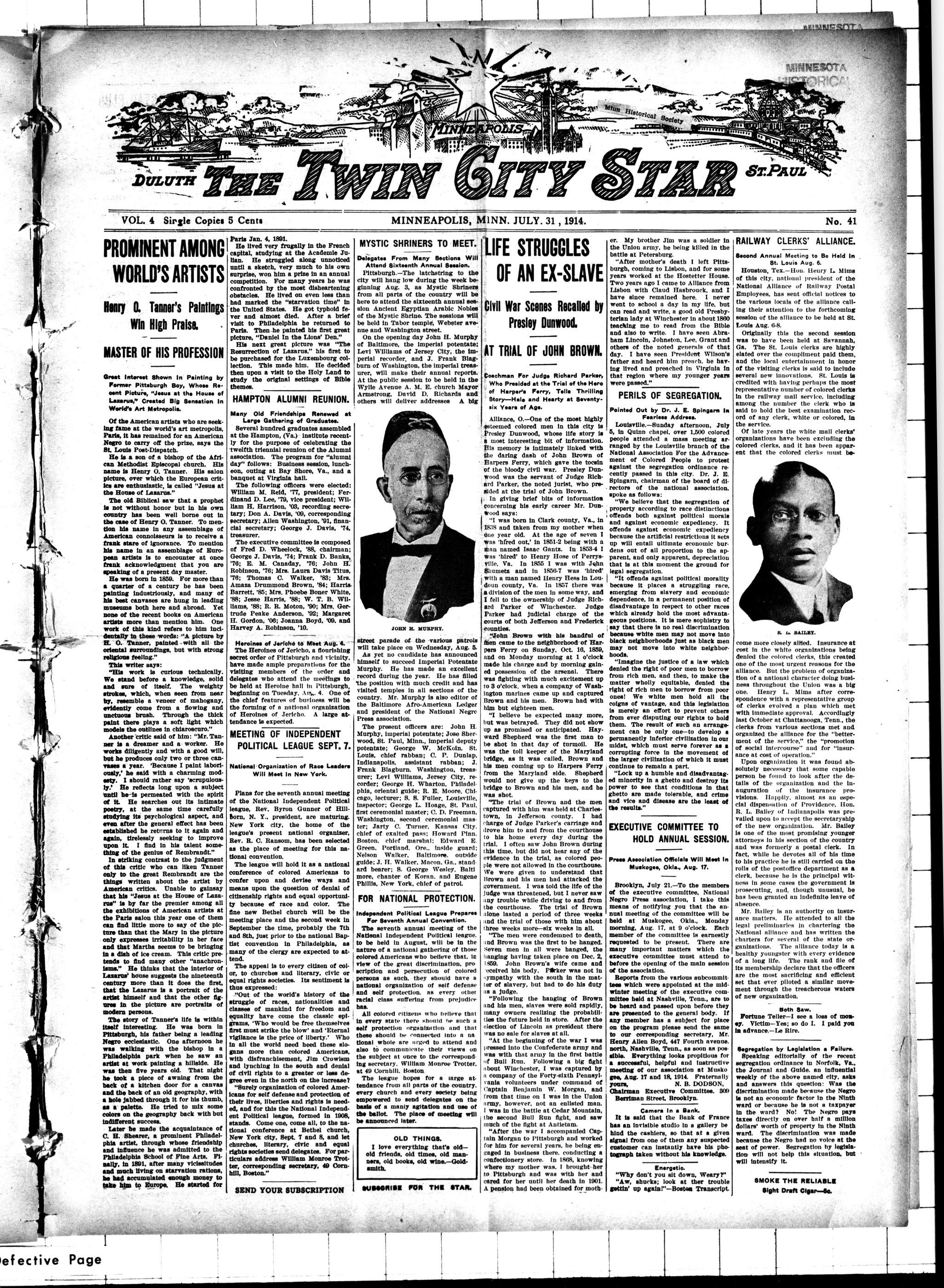
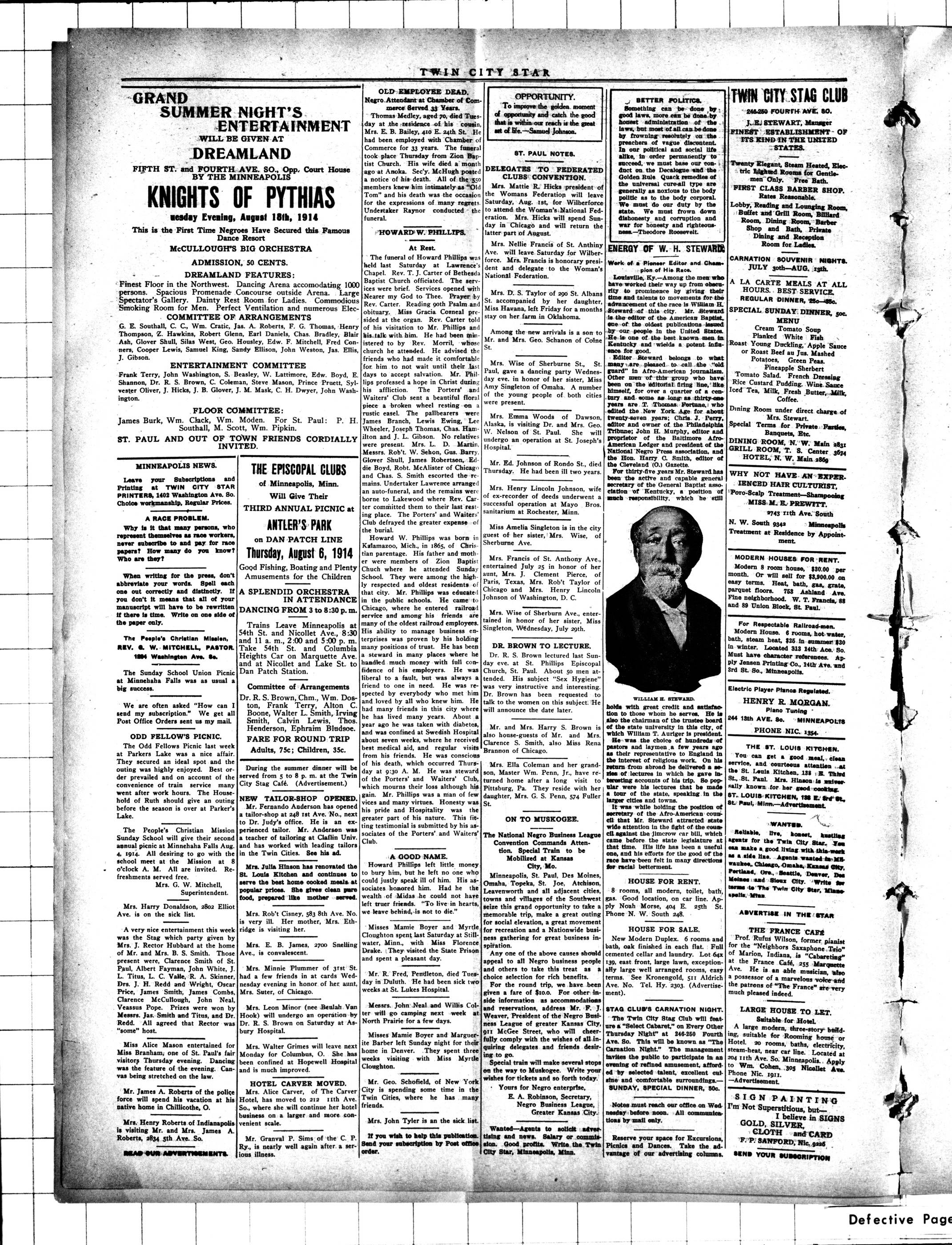
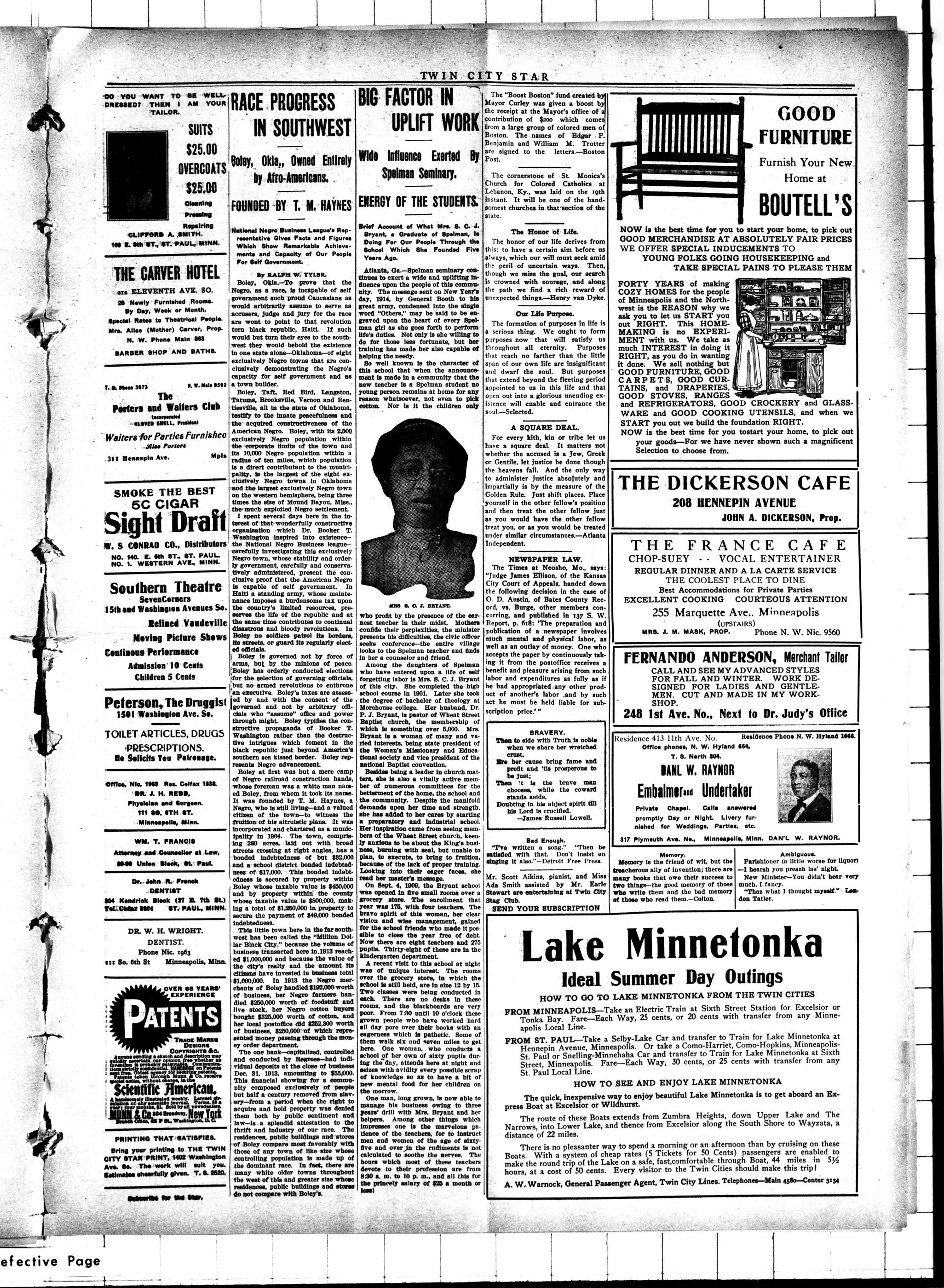
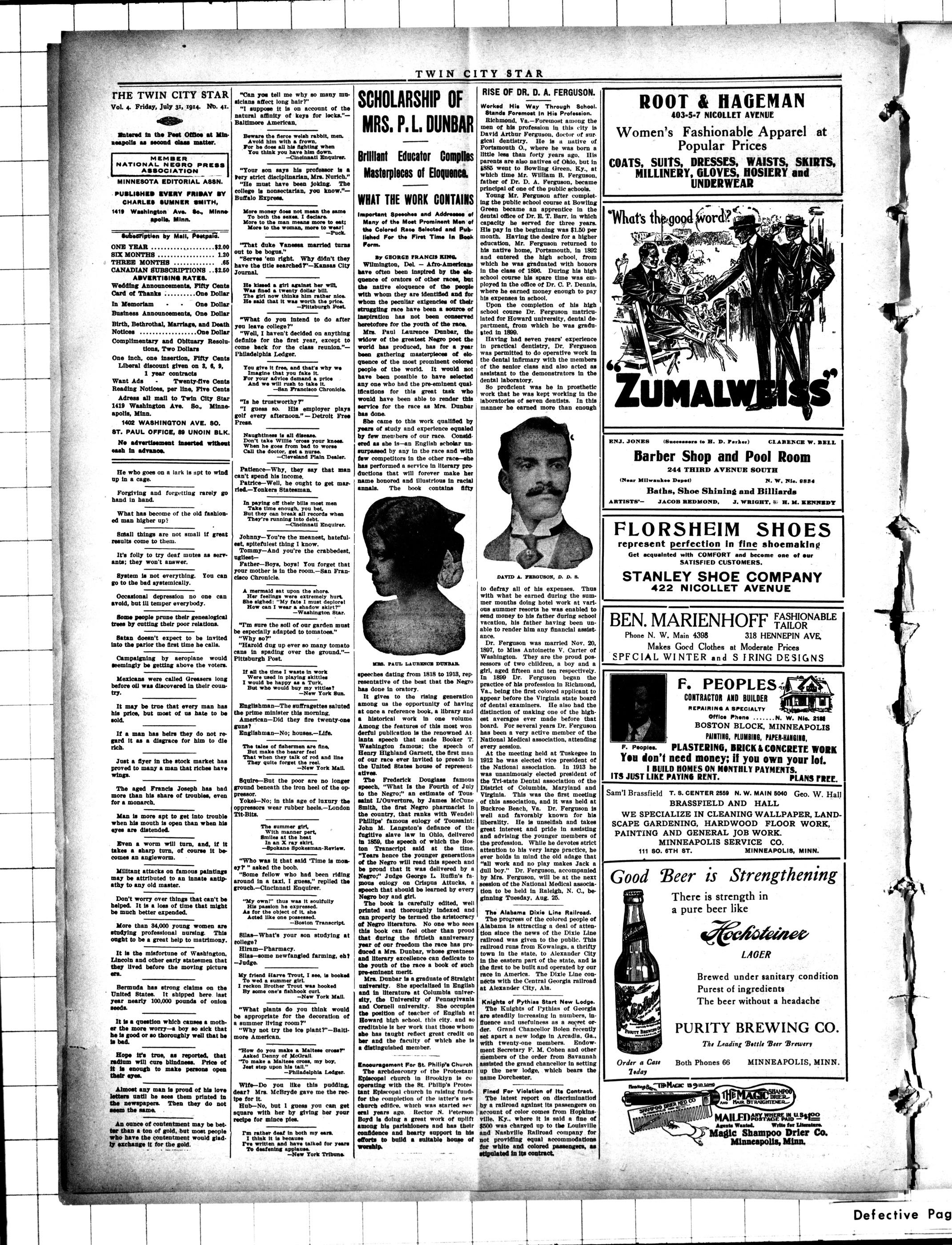
Page text (machine-generated)
DULUTH THE TWIN CITY STAR ST.PAUL
```markdown
```
effective Page
VOL. 4 Single Copies 5 Cents
PARTS JAN. 4. 1891.
He lived very frugally in the French capital, studying at the Academie Julian. He struggled along unnoticed until a sketch, very much to his own surprise, won him a prize in an annual competition. For many years he was confronted by the most disheartening obstacles. He lived on even less than had marked the "starvation time" in the United States. He got typhoid fever and almost died. After a brief visit to Philadelphia he returned to Paris. Then he painted his first great picture, "Daniel In the Lions' Den."
His next great picture was "The Resurrection of Lazarus," his first to be purchased for the Luxembourg collection. This made him. He decided then upon a visit to the Holy Land to study the original settings of Bible themes.
HAMPTON ALUMNI REUNION.
Many Old Friendships Renewed at Large Gathering of Graduates.
Several hundred graduates assembled at the Hampton, (Va.) institute recently for the purpose of celebrating the twelfth triennial reunion of the Alumni association. The program for "alumni day" follows: Business session, luncheon, outing at Bay Shore, Va., and a banquet at Virginia hall.
The following officers were elected: William M. Reid, '77, president; Ferdinand D. Lee, '79, vice president; William H. Harrison, '03, recording secretary; Don A. Davis, '09, corresponding secretary; Allen Washington, '91, financial secretary; George J. Davis, '74, treasurer.
The executive committee is composed of Fred D. Wheelock, '88, chairman; George J. Davis, '74; Frank D. Banks, '6; E. M. Canaday, '76; John H. Robinson, '76; Mrs. Laura Davis Titus, '76; Thomas C. Walker, '83; Mrs. Amaza Drummond Brown, '84; Harris Barrett, '85; Mrs. Phoebe Boner White, '88; Jesse Harris, '88; W. T. B. Williams, '88; R. R. Moton, '90; Mrs. Gertrude Peake Anderson, '92; Margaret H. Gordon, '06; Joanna Boyd, '09, and Harvey A. Robinson, '10.
Heroines of Jericho to Meet Aug. 4. The Heroines of Jericho, a flourishing secret order of Pittsburgh and vicinity, have made ample preparations for the visiting members of the order and delegates who attend the meetings to be held at Heroline hall in Pittsburgh, beginning on Tuesday. Aug. 4. One of the chief features of business will be the forming of a national organization of Heroines of Jericho. A large attendance is expected.
MEETING OF INDEPENDENT POLITICAL LEAGUE SEPT. 7.
National Organization of Race Leaders Will Meet In New York.
Plans for the seventh annual meeting of the National Independent Political league, Rev. Byron Gunner of Hillborn, N. Y., president, are maturing. New York city, the home of the league's present national organizer, Rev. R. C. Ransom, has been selected as the place of meeting for this national convention.
The league will hold it as a national conference of colored Americans to confer upon and devise ways and means upon the question of denial of citizenship rights and equal opportunity because of race and color. The fine new Bethel church will be the meeting place and the second week in September the time, probably the 7th and 8th, just prior to the national Baptist convention in Philadelphia, as many of the clergy are expected to attend.
The appeal is to every citizen of color, to churches and literary, civic or equal rights societies. Its sentiment is thus expressed:
"Out of the world's history of the struggle of races, nationalities and classes of mankind for freedom and equality have come the classic epigrams, 'Who would be free themselves first must strike the blow' and 'Eternal vigilance is the price of liberty.' Who in all the world need heed these slogans more than colored Americans, with disfranchisement, Jim Crowism and lynching in the south and denial of civil rights to a greater or less degree even in the north on the increase? "Surely organization of colored Americans for self defense and protection of their lives, liberties and rights is needed, and for this the National Independent Political league, formed in 1908, stands. Come one, come all, to the national conference at Bethel church, New York city, Sept. 7 and 8, and let churches, literary, civic and equal rights societies send delegates. For particulars address William Monroe Trotter, corresponding secretary, 49 Cornhill, Boston."
PROMINENT AMONG WORLD'S ARTISTS
MASTER OF HIS PROFESSION
Great Interest Shown In Painting by Former Pittsburgh Boy, Whose Recent Picture, "Jesus at the House of Lazarus," Created Big Sensation in World's Art Metropolis.
Of the American artists who are seeking fame at the world's art metropolis, Paris, it has remained for an American Negro to carry off the prize, says the St. Louis Post-Dispatch.
He is a son of a bishop of the African Methodist Episcopal church. His name is Henry O. Tanner. His salon picture, over which the European critics are enthusiastic, is called "Jesus at the House of Lazarus."
The old Biblical saw that a prophet is not without honor but in his own country has been well borne out in the case of Henry O. Tanner. To mention his name in any assemblage of American connolseurs is to receive a frank stare of ignorance. To mention his name in an assemblage of European artists is to encounter at once frank acknowledgment that you are speaking of a present day master.
He was born in 1859. For more than a quarter of a century he has been painting industriously, and many of his best canvases are hung in leading museums both here and abroad. Yet none of the recent books on American artists more than mention him. One work of this kind refers to him incidentally in these words: "A picture by H. O. Tanner, painted with all the oriental surroundings, but with strong religious feeling."
This writer says:
"His work is curious technically. We stand before a knowledge, solid and sure of itself. The weighty strokes, which, when seen from near by, resemble a veneer of mahogany, evidently come from a flowing and unctuous brush. Through the thick paint there plays a soft light which models the outlines in chiaroscuro." Another critic said of him: "Mr. Tanner is a dreamer and a worker. He works diligently and with a good will, but he produces only two or three canvases a year. 'Because I paint laboriously,' he said with a charming modesty. I should rather say 'scrupulously.' He reflects long upon a subject until he is permeated with the spirit of it. He searches out its intimate poetry, at the same time carefully studying its psychological aspect, and even after the general effect has been established he returns to it again and again, tirelessly seeking to improve upon it. I find in his talent something of the genius of Rembrandt."
In striking contrast to the judgment of this critic who can liken Tanner only to the great Rembrandt are the things written about the artist by American critics. Unable to gainay that his "Jesus at the House of Lazarus" is by far the premier among all the exhibitions of American artists at the Paris salon this year one of them can find little more to say of the picture than that the Mary in the picture only expresses irritability in her face and that Martha seems to be bringing in a dish of ice cream. This critic pretends to find many other "anachronisms." He thinks that the interior of Lazarus' house suggests the nineteenth century more than it does the first, that the Lazarus is a portrait of the artist himself and that the other figures in the picture are portraits of modern persons.
The story of Tanner's life is within itself interesting. He was born in Pittsburgh, his father being a leading Negro ecclesiastic. One afternoon he was walking with the bishop in a Philadelphia park when he saw an artist at work painting a hillside. He was then five years old. That night he took a piece of awning from the back of a kitchen door for a canvas and the back of an old geography, with a hole jabbed through it for his thumb, as a palette. He tried to mix some colors on the geography back with but indifferent success.
Later he made the acquaintance of C. H. Shearer, a prominent Philadelphia artist, through whose friendship and influence he was admitted to the Philadelphia School of Fine Arts. Finally, in 1891, after many viciousitudes and much living on starvation rations, he had accumulated enough money to take him to Europe. He started for
SEND YOUR SUBSCRIPTION
MYSTIC SHRINERS TO MEET.
Delegates From Many Sections Will Attend Sixteenth Annual Session.
Pittsburgh.-The latchstring to the city will hang low during the week beginning Aug. 3, as Mystic Shriners from all parts of the country will be here to attend the sixteenth annual session Ancient Egyptian Arabic Nobles of the Mystic Shrine. The sessions will be held in Tabor temple, Webster avenue and Washington street.
On the opening day John H. Murphy of Baltimore, the imperial potentate; Levi Williams of Jersey City, the imperial recorder, and J. Frank Blagburn of Washington, the imperial treasurer, will make their annual reports. At the public session to be held in the Wylie Avenue A. M. E. church Mayor Armstrong, David D. Richards and others will deliver addresses A big
JOHN H. MURPHY.
street parade of the various patrols will take place on Wednesday, Aug. 5. As yet no candidate has announced himself to succeed Imperial Potentate Murphy. He has made an excellent record during the year. He has filled the position with much credit and has visited temples in all sections of the country. Mr. Murphy is also editor of the Baltimore Afro-American Ledger and president of the National Negro Press association.
The present officers are: John H. Murphy, imperial potentate; Jose Sherwood, St. Paul, Minn., imperial deputy potentate; George W. McKolin, St. Louis, chief rabban; C. P. Dunlap, Indianapolis, assistant rabban; J. Frank Blagburn, Washington, treasurer; Levi Williams, Jersey City, recorder; George H. Wharton, Philadelphia, oriental guide; R. E. Moore, Chicago, lecturer; S. S. Fuller, Louisville, inspector; George L. Honge, St. Paul, first ceremonial master; C. D. Freeman, Washington, second ceremonial master; Jarty C. Turner, Kansas City, chief of exalted pass; Howard Pinn, Boston, chief marshal; Edward E. Green, Portland, Ore., inside guard; Nelson Walker, Baltimore, outside guide; J. H. Walker, Macon, Ga., standard bearer; S. George Wesley, Baltimore, chanter of Koran, and Eugene Philips, New York, chief of patrol.
FOR NATIONAL PROTECTION.
Independent Political League Prepares For Seventh Annual Convention.
The seventh annual meeting of the National Independent Political league, to be held in August, will be in the nature of a national gathering of those colored Americans who believe that, in view of the great discrimination, prescription and persecution of colored persons as such, they should have a national organization of self defense and self protection, as every other racial class suffering from prejudice has.
All colored citizens who believe that in every state there should be such a self protection organization and that these should be connected into a national whole are urged to attend and also to communicate their views on the subject at once to the corresponding secretary, William Monroe Trotter, at 49 Cornhill, Boston.
The league hopes for a large attendance from all parts of the country, every church and every society being empowered to send delegates on the basis of a manly agitation and use of the ballot. The place of meeting will be announced later.
OLD THINGS.
I love everything that's old—old friends, old times, old manners, old books, old wine.—Goldsmith.
SUBSCRIBE FOR THE STAR
LIFE STRUGGLES OF AN EX-SLAVE
Coachman For Judge Richard Parker, Who Presided at the Trial of the Hero of Harper's Ferry, Tells Thrilling Story—Hale and Hearty at Seventy-six Years of Age.
Alliance, O.—One of the most highly esteemed colored men in this city is Presley Dunwood, whose life story is a most interesting bit of information. His memory is intimately linked with the daring dash of John Brown of Harpers Ferry, which gave the tocsin of the bloody civil war. Presley Dunwood was the servant of Judge Richard Parker, the noted jurist, who presided at the trial of John Brown.
In giving brief bits of information concerning his early career Mr. Dunwood says:
"I was born in Clark county, Va., in 1838 and taken from my mother when one year old. At the age of seven I was 'hired out,' in 1851-2 being with a man named Isaac Gantz. In 1853-4 I was 'hired' to Henry Hose of Perrysville, Va. In 1855 I was with John Shumetz and in 1856-7 was 'hired' with a man named Henry Hess in Loudoun county, Va. In 1857 there was a division of the men in some way, and I fell to the ownership of Judge Richard Parker of Winchester. Judge Parker had judicial charge of the courts of both Jefferson and Frederick counties.
"John Brown with his handful of men came to the neighborhood of Harpers Ferry on Sunday, Oct. 16, 1859, and on Monday morning at 1 o'clock made his charge and by morning gained possession of the arsenal. There was fighting with much excitement up to 3 o'clock, when a company of Washington marines came up and captured Brown and his men. Brown had with him but eighteen men.
"I believe he expected many more, but was betrayed. They did not show up as promised or anticipated. Hayward Shepherd was the first man to be shot in that day of turmoll. He was the toll keeper of the Maryland bridge, as it was called. Brown and his men coming up to Harpers Ferry from the Maryland side. Shepherd would not give up the keys to the bridge to Brown and his men, and he was shot.
"The trial of Brown and the men captured with him was held at Charlestown, in Jefferson county. I had charge of Judge Parker's carriage and drove him to and from the courthouse to his home every day during the trial. I often saw John Brown during this time, but did not hear any of the evidence in the trial, as colored people were not allowed in the courthouse. We were given to understand that Brown and his men had attacked the government. I was told the life of the judge was threatened, but I never saw any trouble while driving to and from the courthouse. The trial of Brown alone lasted a period of three weeks and the trial of those with him about three weeks more—six weeks in all.
"The men were condemned to death, and Brown was the first to be hanged. Seven men in all were hanged, the hanging having taken place on Dec. 2, 1850. John Brown's wife came and received his body. Parker was not in sympathy with the south in the matter of slavery, but had to do his duty as a judge.
"Following the hanging of Brown and his men, slaves were sold rapidly, many owners realizing the probabilities the future held in store. After the election of Lincoln as president there was no sale for slaves at all.
"At the beginning of the war I was pressed into the Confederate army and was with that army in the first battle of Bull Run. Following a big fight about Winchester, I was captured by a company of the Forty-sixth Pennsylvania volunteers under command of Captain Benjamin W. Morgan, and from that time on I was in the Union army, however, not an enlisted man. I was in the battle at Cedar Mountain, the second Bull Run fight, and saw much of the fight at Antietam.
"After the war I accompanied Captain Morgan to Pittsburgh and worked for him for several years, he being engaged in business there, conducting a confectionery store. In 1868, knowing where my mother was, I brought her to Pittsburgh and was with her and cared for her until her death in 1901. A pension had been obtained for moth-
er. My brother Jim was a soldier in the Union army, he being killed in the battle at Petersburg.
"After mother's death I left Pittsburgh, coming to Lisbon, and for some years worked at the Hostetter House. Two years ago I came to Alliance from Lisbon with Claud Hasbrouck, and I have since remained here. I never went to school a day in my life, but can read and write, a good old Presbyterian lady at Winchester in about 1800 teaching me to read from the Bible and also to write. I have seen Abraham Lincoln, Johnston, Lee, Grant and others of the noted generals of that day. I have seen President Wilson's father and heard him preach, he having lived and preached in Virginia in that region where my younger years were passed."
PERILS OF SEGREGATION.
Pointed Out by Dr. J. E. Spingarm in Fearless Address.
Louisville.—Sunday afternoon, July 5, in Quinn chapel, over 1,500 colored people attended a mass meeting arranged by the Louisville branch of the National Association For the Advancement of Colored People to protest against the segregation ordinance recently passed in this city. Dr. J. E. Spingarn, chairman of the board of directors of the national association, spoke as follows:
"We believe that the segregation of property according to race distinctions offends both against political morals and against economic expediency. It offends against economic expediency because the artificial restrictions it sets up will entail ultimate economic burdens out of all proportion to the apparent, and only apparent, depreciation that is at this moment the ground for legal segregation.
"It offends against political morality because it places a struggling race, emerging from slavery and economic dependence, in a permanent position of disadvantage in respect to other races which already hold the most advantageous positions. It is more sophistry to say that there is no real discrimination because white men may not move into black neighborhoods just as black men may not move into white neighborhoods.
"Iimagine the justice of a law which denied the right of poor men to borrow from rich men, and then, to make the matter wholly equitable, denied the right of rich men to borrow from poor ones! We white men hold all the coigns of vantage, and this legislation is merely an effort to prevent others from ever disputing our rights to hold them. The result of such an arrangement can be only one—to develop a permanently inferior civilization in our midst, which must serve forever as a corrupting force in the movement of the larger civilization of which it must continue to remain a part.
"Lock up a humble and disadvantaged minority in a ghetto and destroy its power to see that conditions in that ghetto are made tolerable, and crime and vice and disease are the least of the results."
EXECUTIVE COMMITTEE TO HOLD ANNUAL SESSION.
Press Association Officials Will Meet In Muskogee, Okla., Aug. 17.
Brooklyn, July 21.—To the members of the executive committee, National Negro Press association, I take this means of notifying you that the annual meeting of the committee will be held at Muskogee, Okla., Monday morning, Aug. 17, at 9 o'clock. Each member of the committee is earnestly requested to be present. There are many important matters which the executive committee must attend to before the opening of the main session of the association.
Reports from the various subcommittees which were appointed at the midwinter meeting of the executive committee held at Nashville, Tenn., are to be heard and passed upon before they are presented to the general body. If any member has a subject for place on the program please send the same to our corresponding secretary, Mr. Henry Allen Boyd, 447 Fourth avenue. north, Nashville, Tenn., as soon as possible. Everything looks propitious for a successful, helpful and instructive meeting of our association at Muskogee, Aug. 17 and 18, 1914. Fraternally yours, N. B. DODSON, Executive Committee 300
Chairman Executive Committee. 300
Berriman Street, Brooklyn.
Camera In a Bank.
It is said that the Bank of France has an invisible studio in a gallery be hind the cashiers, so that at a given signal from one of them any suspected customer can instantly have his photograph taken without his knowledge.
Energetic.
"Why don't you sit down, Weary?"
"Aw, shucks; look at their trouble gettin' up again?" - Boston Transcript
No. 41
RAILWAY CLERKS' ALLIANCE.
Second Annual Meeting to Be Held In St. Louis Aug. 6.
Houston, Tex.-Hon. Henry L. Mims of this city, national president of the National Alliance of Railway Postal Employees, has sent official notices to the various locals of the alliance calling their attention to the forthcoming session of the alliance to be held at St. Louis Aug. 6-8.
Originally this the second session was to have been held at Savannah, Ga. The St. Louis clerks are highly elated over the compliment paid them, and the local entertainment in honor of the visiting clerks is said to include several new innovations. St. Louis is credited with having perhaps the most representative number of colored clerks in the railway mail service, including among the number the clerk who is said to hold the best examination record of any clerk, white or colored, in the service.
Of late years the white mail clerks' organizations have been excluding the colored clerks, and it has been apparent that the colored clerks must be
R. L. BAILEY.
come more closely allied. Insurance at cost in the white organizations being denied the colored clerks, this created one of the most urgent reasons for the alliance. But the problem of organization of a national character doing business throughout the Union was a big one. Henry L. Mims after correspondence with a representative group of clerks evolved a plan which met with immediate approval. Accordingly last October at Chattanooga, Tenn., the clerks from various sections met and organized the alliance for the "betterment of the service," the "promotion of social intercourse" and for "insurance at cost of operation."
Upon organization it was found absolutely necessary that some capable person be found to look after the details of the organization and the inauguration of the insurance provisions. Happily, almost as an especial dispensation of Providence, Hon. R. L. Balley of Indianapolis was prevailed upon to accept the secretaryship of the new organization. Mr. Balley is one of the most promising younger attorneys in his section of the country and was formerly a postal clerk. In fact, while he devotes all of his time to his practice he is still carried on the rolls of the postoffice department as a clerk, because he is the principal witness in some cases the government is prosecuting, and, though unusual, he has been granted an indefinite leave of absence.
Mr. Bailey is an authority on insurance matters. He attended to all the legal preliminaries in chartering the National alliance and has written the charters for several of the state organizations. The alliance today is a healthy youngster with every evidence of a long life. The rank and file of its membership declare that the officers are the most sacrificing and efficient set that ever piloted a similar movement through the treacherous waters of new organization.
Both Saw.
Fortune Teller—I see a loss of money. Victim—Yes; so do I. I paid you in advance.—Le Rire.
Segregation by Legislation a Failure.
Speaking editorially of the recent segregation ordinance in Norfolk, Va., the Journal and Guide, an influential weekly of the above named city, asks and answers this question: Was the discrimination made because the Negro is not an economic factor in the Ninth ward or because he is not a taxpayer in the ward? No! The Negro pays taxes directly on over half a million dollars' worth of property in the Ninth ward. The discrimination was made because the Negro had no voice at the seat of power. Segregation by legislation will not help this situation, but will intensify it.
SMOKE THE RELIABLE Sight Draft Cigar—So.
FIFTH ST. and FOURTH AVE. SO., Opp. Court House BY THE MINNEAPOLIS
This is the First Time Negroes Have Secured this Famous Dance Resort
McCULLOUGH'S BIG ORCHESTRA
ADMISSION, 50 CENTS.
DREAMLAND FEATURES:
Finest Floor in the Northwest. Dancing Arena accommodating 10 persons. Spacious Promenade Concourse outside Arena. Larger Spectator's Gallery. Dainty Rest Room for Ladies. Commodious Smoking Room for Men. Perfect Ventilation and numerous Elec
COMMITTEE OF ARRANGEMENTS
G. E. Southall, C. C., Wm. Cratic, Jas. A. Roberts, F. G. Thomas, Heri Thompson, Z. Hawkins, Robert Glenn, Earl Daniels, Chas. Bradley, Blk Ash, Glover Shull, Silas West, Geo. Housley, Edw. F. Mitchell, Fred Corners, Cooper Lewis, Samuel King, Sandy Ellison, John Weston, Jas. Ell J. Gibson.
Finest Floor in the Northwest. Dancing Arena accommodating 1000 persons. Spacious Promenade Concourse outside Arena. Large Spectator's Gallery. Dainty Rest Room for Ladies. Commodious Smoking Room for Men. Perfect Ventilation and numerous Elec- COMMITTEE OF ARRANGEMENTS G. E. Southall, C. C., Wm. Cratic, Jas. A. Roberts, F. G. Thomas, Henry Thompson, Z. Hawkins, Robert Glenn, Earl Daniels, Chas. Bradley, Blair Ash, Glover Shull, Silas West, Geo. Housley, Edw. F. Mitchell, Fred Conners, Cooper Lewis, Samuel King, Sandy Ellison, John Weston, Jas. Ellis, J. Gibson.
ENTERTAINMENT COMMITTEE
Frank Terry, John Washington, S. B
Shannon, Dr. R. S. Brown, C. Colen
vester Oliver, J. Hicks, J. B. Glover,
ington.
FLOOR CO
James Burk, Wm. Clack, Wm.
Southall, M. Sc
ST. PAUL AND OUT OF THE
INV
Frank Terry, John Washington, S. Beasley, W. Lattimore, Edw. Boyd, E. Shannon, Dr. R. S. Brown, C. Coleman, Steve Mason, Prince Pruett, Sylvester Oliver, J. Hicks, J. B. Glover, J. M. Mask, C. H. Dwyer, John Washington.
FLOOR COMMITTEE:
James Burk, Wm. Clack, Wm. Moden. For St. Paul: P. H. Southall, M. Scott, Wm. Pipkin.
ST. PAUL AND OUT OF TOWN FRIENDS CORDIALLY INVITED.
MINNEAPOLIS NEWS.
Leave your Subscriptions and Printing at TWIN CITY STAR PRINTERS, 1402 Washington Ave. So. Choice workmanship, Regular Prices.
A RACE PROBLEM.
Why is it that many persons, who represent themselves as race workers, never subscribe to and pay for race papers? How many do you know? Who are they?
When writing for the press, don't abbreviate your words. Spell each one out correctly and distinctly. If you don't it means that all of your manuscript will have to be rewritten if there is time. Write on one side of the paper only.
The People's Christian Mission,
REV. G. W. MITCHELL, PASTOR.
1804 Washington Ave. So.
The Sunday School Union Picnic at Minnehaha Falls was as usual a big success.
We are often asked "How can I send my subscription." We get all Post Office Orders sent us my mail.
ODD FELLOW'S PICNIC.
The Odd Fellows Picnic last week at Parkers Lake was a nice affair. They secured an ideal spot and the outing was highly enjoyed. Best order prevailed and on account of the convenience of train service many went after work hours. The Household of Ruth should give an outing before the season is over at Parker's Lake.
The People's Christian Mission Sunday School will give their second annual picnic at Minnehaha Falls Aug. 4, 1914. All desiring to go with the school meet at the Mission at 8 o'clock A. M. All are invited. Refreshments served free.
Mrs. G. W. Mitchell,
Superintendent.
Mrs. Harry Donaldson, 2802 Elliot Ave. is on the sick list.
A very nice entertainment this week was the Stag which party given by Mrs. J. Rector Hubbard at the home of Mr. and Mrs. B. S. Smith. Those present were, Clarence Smith of St. Paul, Albert Fayman, John White, J. L. Titus, L. C. Valle, R. A. Skinner, Drs. J. H. Redd and Wright, Oscar Price, James Smith, James Combs, Clarence McCullough, John Neal, Veassus Pope. Prizes were won by Messrs. Jas. Smith and Titus, and Dr. Redd. All agreed that Rector was "some" host.
Miss Alice Mason entertained for Miss Branham, one of St. Paul's fair visitors Thursday evening. Dancing was the feature of the evening. Canvas being stretched on the law.
Mr. James A. Roberts of the police force will spend his vacation at his native home in Chillicothe, O.
Mrs. Henry Roberts of Indianapolis is visiting Mr. and Mrs. James A. Roberts, 2834 5th Ave. So.
READ OUR ADVERTISEMENTS.
ED FEATURES:
Dancing Arena accommodating 1000
Concourse outside Arena. Large
T Room for Ladies. Commodious
T Ventilation and numerous Elec-
t ARRANGEMENTS
Jas. A. Roberts, F. G. Thomas, Henry
Hann, Earl Daniels, Chas. Bradley, Blain
Housley, Edw. F. Mitchell, Fred Con-
andy Ellison, John Weston, Jas. Ellis
Beasley, W. Lattimore, Edw. Boyd, E.
Bian, Steve Mason, Prince Pruett, Syl-
J. M. Mask, C. H. Dwyer, John Wash-
OMMITTEE:
Moden. For St. Paul: P. H.
Bott, Wm. Pipkin.
OWN FRIENDS CORDIALLY
LITED.
THE EPISCOPAL CLUBS
of Minneapolis, Minn.
Will Give Their
THIRD ANNUAL PICNIC at
ANTLER'S PARK
on DAN PATCH LINE
Thursday, August 6, 1914
Good Fishing, Boating and Plenty
Amusements for the Children
A SPLENDID ORCHESTRA
IN ATTENDANCE
DANCING FROM 3 to 8:30 p. m.
Trains Leave Minneapolis at 54th St. and Nicollet Ave., 8:30 and 11 a. m., 2:00 and 5:00 p. m. Take 54th St. and Columbia Heights Car on Marquette Ave. and at Nicollet and Lake St. to Dan Patch Station.
Committee of Arrangements
Dr. R. S. Brown, Chm., Wm. Doston, Frank Terry, Alton C. Boone, Walter L. Smith, Irving Smith, Calvin Lewis, Thos. Henderson, Ephraim Bludsoe.
FARE FOR ROUND TRIP
Adults, 75c; Children, 35c.
During the summer dinner will be served from 5 to 8 p.m. at the Twin City Stag Café. (Advertisement.)
NEW TAILOR-SHOP OPENED.
Mr. Fernando Anderson has opened a tailor-shop at 248 st. Ave. No., next to Dr. Judy's office. He is an experienced tailor. Mr. Anderson was a teacher of tailoring at Claflin Univ. and has worked with leading tailors in the Twin Cities. See his ad.
Mrs. Julia Hinson has renovated the St. Louis Kitchen and continues to serve the best home cooked meals at popular prices. She gives clean pure food, prepared like mother served.
Mrs. Rob't Cisney, 583 8th Ave. No. is very ill. Her mother, Mrs. Ethridge is visiting her.
Mrs. E. B. James, 2700 Snelling Ave., is convalescent.
Mrs. Minnie Plummer of 31st St. had a few friends in at cards Wednesday evening in honor of her aunt, Mrs. Suter, of Chicago.
Mrs. Leon Minor (nee Beulah Van Hook) will undergo an operation by Dr. R. S. Brown on Saturday at Asbury Hospital.
Mrs. Walter Grimes will leave next Monday for Columbus, O. She has been confined at Hopewell Hospital and is much improved.
HOTEL CARVER MOVED.
Mrs. Alice Carver, of The Carver Hotel, has moved to 212 11th Ave. So., where she will continue her hotel business on a larger and more convenient scale.
Mr. Granval P. Sims of the C. P. Ry., is nearly well again after a serious illness.
---
TWIN CITY STAR
OLD EMPLOYEE DEAD
Negro. Attendant at Chamber of Commerce Served 33 Years.
Thomas Medley, aged 70, died Tuesday at the residence of his cousin, Mrs. E. B. Bailey, 410 E. 24th St. He had been employed with Chamber of Commerce for 33 years. The funeral took place Thursday from Zion Baptist Church. His wife died a month ago at Anoka. See'y. McHugh posted a notice of his death. All of the 550 members knew him intimately as "Old Tom" and his death was the occasion for the expressions of many regrets. Understaker Raynor conducted the funeral.
OPPORTION
To improve the of opportunity and that is within our rest of life.—Samuel
ST. PAUL
DELEGATES TO CLUBS CONV
Mrs. Mattie R. H. the Womans Federation Saturday, Aug. 1st, to attend the Woman eration. Mrs. Hicks
HOWARD W. PHILLIPS.
The funeral of Howard Phillips was held last Saturday at Lawrence' Chapel. Rev. T. J. Carter of Bethesda Baptist Church officiated. The services were brief. Services opened with Nearer my God to Thee. Prayer by Rev. Carter. Reading 90th Psalm and obituary. Miss Gracia Corneal presided at the organ. Rev. Carter told of his visitation to Mr. Phillips and his talk with him. He had been ministered to by Rev. Morril, whose church he attended. He advised the friends who had made it comfortable for him to not wait until their last days to accept salvation. Mr. Phillips professed a hope in Christ during his affliction. The Porters' and Waiters' Club sent a beautiful floral piece a broken wheel resting on a rustic easel. The pall bearers were James Branch, Lewis Ewing, Lee Wheeler, Joseph Thomas, Chas. Hamilton and J. L. Gibson. No relatives were present. Mrs. L. D. Martin Messrs. Robt' W. Sehon, Gus. Barry Glover Shull, James Robertson, Eddie Boyd, Robt. McAlister of Chicago and Chas. S. Smith escorted the remains. Undertaker Lawrence arranged an auto-funeral, and the remains were borne to Lakewood where Rev. Carter committed them to their last resting place. The Porters' and Waiters' Club defrayed the greater expense of the burial.
Howard W. Phillips was born in Kalamazoo, Mich., in 1865, of Christian parentage. His father and mother were members of Zion Baptist Chuch where he attended Sunday School. They were among the highly respected and oldest residents of that city. Mr. Phillips was educated in the public schools. He came to Chicago, where he entered railroad service and among his friends are many of the oldest railroad employees. His ability to manage business enterprises was proven by his holding many positions of trust. He has been a steward in many places where he handled much money with full confidence of his employers. He was liberal to a fault, but was always a friend to one in need. He was respected by everybody who met him and loved by all who knew him. He had many friends in this city where he has lived many years. About a year ago he was taken with diabetes, and was confined at Swedish Hospital about seven weeks, where he received best medical aid, and regular visits from his friends. He was conscious of his death, which occurred Thursday at 9:30 A. M. He was steward of the Porters' and Waiters' Club, which mourns their loss although his gain. Mr. Phillips was a man of few vices and many virtues. Honesty was his pride and Hospitality was the greater part of his nature. This fitting testimonial is submitted by his associates of the Porters' and Waiters' Club.
A GOOD NAME
Howard Phillips left little money to bury him, but he left no one who could justly speak ill of him. His associates honored him. Had he the wealth of Midas he could not have left truer friends. "To live in hearts, we leave behind, is not to die."
Misses Mamie Boyer and Myrtle Cloughton spent last Saturday at Stillwater, Minn., with Miss Florence Drake. They visited the State Prison and spent a pleasant day.
Mr. R. Fred, Pendleton, died Tuesday in Duluth. He had been sick two weeks at St. Lukes Hospital.
Messrs. John Neal and Willis Colter will go camping next week at North Prairie for a few days.
Misses Mamie Boyer and Marguerite Barber left Sunday night for their home in Denver. They spent three weeks visiting with Miss Myrtle Cloughton.
At Rest.
OPPORTUNITY.
To improve the golden moment of opportunity and catch the good that is within our reach is the great act of life. - Samuel Johnson.
ST. PAUL NOTES.
DELEGATES TO FEDERATED CLUBS CONVENTION.
Mrs. Mattie R. Hicks president of the Womans Federation will leave Saturday, Aug. 1st, for Wilberforce to attend the Woman's National Federation. Mrs. Hicks will spend Sunday in Chicago and will return the latter part of August.
Mrs. Nellie Francis of St. Anthiny Ave. will leave Saturday for Wilberforce. Mrs. Francis is honorary president and delegate to the Woman's National Federation.
Mrs. D. S. Taylor of 290 St. Albans St. accompanied by her daughter, Miss Havana, left Friday for a months stay on her farm in Oklahoma.
Among the new arrivals is a son to Mr. and Mrs. Geo. Schanon of Colne St.
Mrs. Wise of Sherburne St., St. Paul, gave a dancing party Wednesday day eve. in honor of her sister, Miss Amy Singleton of Omaha. A number of the young people of both cities were present.
Mrs. Emma Woods of Dawson, Alaska, is visiting Dr. and Mrs. Geo. W. Nelson of St. Paul. She will undergo an operation at St. Joseph's Hospital.
Mr. Ed. Johnson of Rondo St., died Thursday. He had been ill two years.
Mrs. Henry Lincoln Johnson, wife of ex-recorder of deeds underwent a successful operation at Mayo Bros. sanitarium at Rochester, Minn.
Miss Amelia Singleton is in the city guest of her sister, Mrs. Wise, of Sherburne Ave.
Mrs. Francis of St. Anthony Ave., entertained July 25 in honor of her aunt, Mrs. J. Clement Pierce, of Paris, Texas, Mrs. Rob't Taylor of Chicago and Mrs. Henry Lincoln Johnson of Washington, D. C.
Mrs. Wise of Sherburn Ave., entertained in honor of her sister, Miss Singleton, Wednesday, July 29th.
DR. BROWN TO LECTURE.
Dr. R. S. Brown lectured last Sunday eve. at St. Phillips Episcopal Church, St. Paul. About 50 men attended. His subject "Sex Hygiene" was very instructive and interesting. Dr. Brown has been requested to talk to the women on this subject. He will announce the date later.
Mr. and Mrs. Harry S. Brown is also house-guests of Mr. and Mrs. Clarence S. Smith, also Miss Rena Brannon of Chicago.
Mrs. Ella Coleman and her grandson, Master Wm. Penn, Jr., have returned home after a long visit to Pittsburg, Pa. They reside with her daughter, Mrs. G. S. Penn, 574 Fuller St.
ON TO MUSKOGEE.
The National Negro Business League Convention Commands Attention. Special Train to be Mobilized at Kansas City, Mo.
Minneapolis, St. Paul, Des Moines, Omaha, Topeka, St. Joe, Atchison, Leavenworth and all adjacent cities, towns and villages of the Southwest seize this grand opportunity to take a memorable trip, make a great outing for social elevation, a great movement for recreation and a Nationwide business gathering for great business inspiration.
Any one of the above causes should appeal to all Negro business people and others to take this treat as a choice selection for rich benefits.
For the round trip, we have been given a fare of $10.0. For other inside information as accommodations and reservations, address Mr. F. J. Weaver, President of the Negro Business League of greater Kansas City, 911 McGee Street, who will cheerfully comply with the wishes of all inquiring delegates and friends desiring to go.
Special train will make several stops on the way to Muskogee. Write your wishes for tickets and so forth today.
Yours for Negro enterprise,
E. A. Robinson, Secretary,
Negro Business League,
Greater Kansas City.
Wanted—Agents to solicit advertising and news. Salary or commission. Good profits. Write the Twin City Star, Minneapolis, Minn.
City, Mo.
BETTER POLITICS.
Something can be done, by good laws, more can be done, by honest administration of the laws, but most of all can be done by frowning resolutely on the preachers of vague discontent. In our political and social life alike, in order permanently to succeed, we must base our conduct on the Decalogue and the Golden Rule. Quack remedies of the universal cure-all type are generally as noxious to the body politic as to the body corporal. We must do our duty by the state. We must frown down dishonesty and corruption and war for honesty and righteousness.—Theodore Roosevelt.
ENERGY OF W. H. STEWARD
Work of a Pioneer Editor and Champion of His Race.
Louisville, Ky.--Among the men who have worked their way up from obscurity to prominence by giving their time and talents to movements for the advancement of the race is William H. Steward of this city. Mr. Steward is the editor of the American Baptist, one of the oldest publications issued by our people in the United States. He is one of the best known men in Kentucky and wields a potent influence for good.
Editor Steward belongs to what many are pleased to call the "old guard" in Afro-American journalism. Other men of this group who have been on the editorial firing line, like himself, for over a quarter of a century and some as long as thirty-one years are T. Thomas. Fortune, who edited the New York Age for about twenty-seven years; Chris J. Perry, editor and owner of the Philadelphia Tribune; John H. Murphy, editor and proprietor of the Baltimore Afro-American Ledger and president of the Hon. Harry C. Smith, editor of the Cleveland (O.) Gazette. For thirty-five years Mr. Steward has been the active and capable general secretary of the General Baptist association of Kentucky, a position of much responsibility, which he still
[Name]
WILLIAM H. STEWARD.
holds with great credit and satisfaction to those whom he serves. He is also the chairman of the trustee board of the state university in this city, of which William T. Auriger is president. He was the choice of hundreds of pastors and laymen a few years ago as their representative to England in the interest of religious work. On his return from abroad he delivered a series of lectures in which he gave interesting accounts of his trip. So popular were his lectures that he made a tour of the state, speaking in the larger cities and towns.
It was while holding the position of secretary of the Afro-American council that Mr. Steward attracted state wide attention in the fight of the council against the jimcrow car bill, which came before the state legislature at that time. His life has been a useful one, and his efforts for the good of the race have been felt in many directions for racial betterment.
HOUSE FOR RENT.
8 rooms, all modern, toilet, bath gas. Good location, on car line. Apply Noah Morse, 404 E. 25th St Phone N. W. South 248.
HOUSE FOR SALE.
New Modern Duplex. 6 rooms and bath, bath finished in each flat. Full cemented cellar and laundry. Lot 64x 139, east front, large lawn, exceptionally large well arranged rooms, easy terms. See Kronengold, 511 Aldrich Ave. No. Tel. Hy. 2303. (Advertisement).
STAG CLUB'S CARNATION NIGHT.
The Twin City Stag Club will feature a "Select Cabaret," on Every Other Thursday Night" at 246-250 Fourth Ave. So. This will be known as "The Carnation Night." The management invites the public to participate in an evening of refined amusement, afforded by selected talent, excellent cuisine and comfortable surroundings.—SUNDAY, SPECIAL DINNER, 50c.
Notes must reach our office on Wednesday before noon. All communications by mail only.
Reserve your space for Excursions, Picnics and Dances. Take the advantage of our advertising columns.
TWIN CITY STAG CLUB
246-250 FOURTH AVE. 80.
J. E. STEWART, Manager
FINEST ESTABLISHMENT OF
ITS KIND IN THE UNITED
STATES.
Twenty Elegant, Steam Heated, Electric Lighted Rooms for Gentlemen Only. Free Bath.
FIRST CLASS BARBER SHOP.
Rates Reasonable.
Lobby, Reading and Lounging Room,
Buffet and Grill Room, Billiard Room, Dining Room, Barber Shop and Bath, Private Dining and Reception Room for Ladies.
CARNATION SOUVENIR NIGHTS.
JULY 30th—AUG. 19th.
A LA CARTE MEALS AT ALL
HOURS. BEST SERVICE.
REGULAR DINNER. 280-180.
SPECIAL SUNDAY. DINNER, 50c.
MENU
Cream Tomato Soup
Planked White Fish
Roast Young Duckling, Apple Sauce
or Roast Beef au Jus. Mashed
Potatoes, Green Peas.
Pineapple Sherbert
Tomato Salad, French Dressing
Rice Custard Pudding, Wine Sauce
Iced Tea, Milk, Fresh Butter, Milk,
Coffee.
Dining Room under direct charge of
Mrs. Stewart.
Special Terms for Private Parties,
Banquets, Etc.
DINING ROOM, N. W. Main 2831
GRILL ROOM, T. S. Center, 3674
HOTEL, N. W. Main 2869
WHY NOT HAVE AN EXPERI-
ENCIED HAIR CULTURIST,
Poro-Scalp Treatment—Shampooing
MISS M. E. PREWITT.
2743 11th Ave. South
N. W. South 9342 Minneapolis
Treatment at Residence by Appoint-
ment.
MODERN HOUSES FOR RENT.
Modern 8 room house, $30.00 per
month. Or will sell for $3,900.00 on
easy terms. Heat, bath, gas, grate,
parquet floors. 753 Ashland Ave.
Fine neighborhood. W. T. Francis, 88
and 89 Union Block, St. Paul.
For Respectable Railroad-men.
Modern House. 6 rooms, hot water,
bath, steam heat, $25 in summer $30
in winter. Located 313 14th Ace. So.
Must have character references.
Apply Jensen Printing Co., 14th Ave. and
3rd St. So., Minneapolis.
Electric Player Planoa Regulated
244 13th AVE. So. MINNEAPOLIS
PHONE NIC. 1354.
THE ST. LOUIS KITCHEN.
You can get a good meal, clean
service, and courteous attention
at the St. Louis Kitchen, 138 E. Third
St., St. Paul. Mrs. Hinson is univer-
sally known for her good cooking.
ST. LOUIS KITCHEN, 138 E. Third St,
St. Paul, Minn.-Advertisement
WANTED.
Reliable, live, honest, hustling agents for the Twin City Star. You can make a good living with this work as a side line. Agents wanted in MN-waukee, Chicago, Omaha, Kansas City, Portland, Ore., Seattle, Denver, Des Moines and Sioux City. Write for terms to The Twin City Star, Minneapolis, Minn.
ADVERTISE IN THE STAR
THE FRANCE CAFE
Prof. Rufus Wilson, former pianist for the "Neighbors Saxaphone Trio" of Marion, Indiana, is "Cabaret" at the France Café, 255 Marquette Ave. He is an able musician, also a possessor of a marvelous voice and the patrons of "The France" are very much pleased indeed.
LARGE HOUSE TO LET
A large modern, three-story building, suitable for Roaming house or Hotel. 20 rooms, baths, electricity, steam-heat, near car line. Located at 204 11th Ave. So. Minneapolis. Apply to Wm. Cohen. 305 Nicollet Ave. Phone Nic. 1911.
—Advertisement.
SIGN PAINTING
I'm Not Superstitious, but—
I believe in SIGNS
GOLD, SILVER,
CLOTH and CARD
F. P. SANFORD, Nic. 9226
SEND YOUR SUBSCRIPTION
Defective Page
effective Page
DO YOU WANT TO BE WELL-
DRESSED? THEN I AM YOUR
TAILOR.
SUITS
$25.00
OVERCOATS
$25.00
Cleaning
Pressing
Repairing
CLIFFORD A. SMITH.
100 E. 8th ST., ST. PAUL, MINN.
THE CARVER HOTEL
212 ELEVENTH AVE. SO.
28 Newly Furnished Rooms.
By Day, Week or Month.
Special Rates to Theatrical People.
Mrs. Alice (Mother) Carver, Prop.
N. W. Phone Main 863
BARBER SHOP AND BATHS.
T. R. Phone 3073 N. W. Main 0592
The
Porters and Waiters Club
Incorporated
GLOVER SHULL, President
Waiters for Parties Furnished
Also Porters
311 Hennepin Ave. Mpla
SMOKE THE BEST 5C CIGAR Sight Draft
W. S CONRAD CO., Distributors
NO. 140. E. 6th ST., ST. PAUL.
NO. 1. WESTERN AVE., MINN.
Southern Theatre
SevenCorners
15th and Washington Avenues So.
Refined Vaudeville
Moving Picture Shows
Continuous Performance
Admission 10 Cents
Children 5 Cents
Peterson, The Druggist 1501 Washington Ave. So.
TOILET ARTICLES, DRUGS
PRESCRIPTIONS.
He Sollicits You Patronage.
Office, Nlc. 1683 Res. Celfax 1638.
DR. J. H. REDD,
Physician and Surgeon.
111 SO. 6TH ST.
Minneapolis, Minn.
WM. T. FRANCIS
Attorney and Counselor at Law,
80-80 Union Block, St. Paul.
Dr. John R. French
DENTIST
304 Kendrick Block (37 W. 7th St.)
Tol. Cedar 804
ST. PAUL, MINN.
DR. W. H. WRIGHT.
DENTIST.
Phone Nic. 1963
111 So. 6th St Minneapolis, Minn.
OVER 68 YEARS'
EXPERIENCE
PATENTS
TRADE MARKS
DESIGNERS
Corporate & C.
Anyone sending a sketch and description may quickly ascertain our opinion free whether an invention is patented or confidential. HANDBOOK on Patents sent free. Oldest agency for securing patents.
Fax to: 212-765-2222. Co. receive secret notes, without charge, in the
Scientific American.
A handsome illustrated weekly. Largest circulation of any advertise journal. Terms, $3 a year, four months. $1. Sold by all national MUNN & Co. 304 Broadway, New York
Branch Office, & P St. Washington, D.C.
PRINTING THAT SATISFIES.
Bring your printing to THE TWIN
CITY STAR PRINT, 1402 Washington
Ave. So. The work will suit you.
Estimates sheerfully given. T. S. 2520.
Subscribe for the Star.
Boley, Okla., Owned Entirely by Afro-Americans.
FOUNDED BY T. M. HAYNES
National Negro Business League's Representative Gives Facts and Figures Which Show Remarkable Achievements and Capacity of Our People For Self Government.
By RALPH W. TYLBR.
Boley, Okla.—To prove that the Negro, as a race, is incapable of self government such proud Caucasians as would arbitrarily assume to serve as accusers, judge and jury for the race are wont to point to that revolution torn black republic, Haiti. If such would but turn their eyes to the southwest they would behold the existence in one state alone—Oklahoma—of eight exclusively Negro towns that are conclusively demonstrating the Negro's capacity for self government and as a town builder.
Boley, Taft, Red Bird, Langston, Tatums, Brooksville, Vernon and Rentiesville, all in the state of Oklahoma, testify to the innate peacefulness and the acquired constructiveness of the American Negro. Boley, with its 2,500 exclusively Negro population within the corporate limits of the town and its 10,000 Negro population within a radius of ten miles, which population is a direct contributant to the municipality, is the largest of the eight exclusively Negro towns in Oklahoma and the largest exclusively Negro town on the western hemisphere, being three times the size of Mound Bayou, Miss., the much exploited Negro settlement.
I spent several days here in the interest of that wonderfully constructive organization -which Dr. Booker T. Washington inspired into existence-the National Negro Business league-carefully investigating this exclusively Negro town, whose stability and orderly government, carefully and conservatively administered, present the conclusive proof that the American Negro is capable of self government. In Haiti a standing army, whose maintenance imposes a burdensome tax upon the country's limited resources, preserves the life of the republic and at the same time contributes to continual disastrous and bloody revolutions. In Boley no soldiers patrol its borders, its streets, or guard its regularly elected officials.
Boley is governed not by force of arms, but by the minions of peace. Boley has orderly conducted elections for the selection of governing officials, but no armed revolutions to enthrone an executive. Boley's taxes are assessed by and with the consent of the governed and not by arbitrary officials who "assume" office and power through might. Boley typifies the constructive propaganda of Booker T. Washington rather than the destructive intrigues which foment in the black republic just beyond America's southern sea kissed border. Boley represents Negro advancement.
Boley at first was but a mere camp of Negro railroad construction hands, whose foreman was a white man named Boley, from whom it took its name. It was founded by T. M. Haynes, a Negro, who is still living—and a valued citizen of the town—to witness the fruition of his altruistic plans. It was incorporated and chartered as a municipality in 1904. The town, comprising 260 acres, laid out with broad streets crossing at right angles, has a bonded indebtedness of but $32,000 and a school district bonded indebtedness of $17,000. This bonded indebtedness is secured by property within Boley whose taxable value is $450,000 and by property within the county whose taxable value is $800,000, making a total of $1,250,000 in property to secure the payment of $49,000 bonded indebtedness.
This little town here in the far southwest has been called the "Million Dollar Black City," because the volume of business transacted here in 1913 reached $1,000,000 and because the value of the city's realty and the amount its citizens have invested in business total $1,000,000. In 1913 the Negro merchants of Boley handled $192,000 worth of business, her Negro farmers handled $250,000 worth of foodstuff and live stock, her Negro cotton buyers bought $325,000 worth of cotton, and her local postoffice did $252,300 worth of business, $250,000 of which represented money passing through the money order department.
The one bank—capitalized, controlled and conducted by Negroes—had individual deposits at the close of business Dec. 31, 1913, amounting to $55,000. This financial showing for a community composed exclusively of people but half a century removed from slavery—from a period when the right to acquire and hold property was denied them both by public sentiment and law—is a splendid attestation to the thrift and industry of our race. The residences, public buildings and stores of Boley compare most favorably with those of any town of like size whose controlling population is made up of the dominant race. In fact, there are many white older towns throughout the west of this and greater size whose residences, public buildings and stores do not compare with Boley's.
TWIN CITY STAR
BIG FACTOR IN UPLIFT WORK
Wide Influence Exerted By
Spelman Seminary.
ENERGY OF THE STUDENTS.
Brief Account of What Mrs. S. C. J.
Bryant, a Graduate of Spelman, Is
Doing For Our People Through the
School Which She Founded Five
Years Ago.
Atlanta, Ga.—Spelman seminary continues to exert a wide and uplifting influence upon the people of this community. The message sent on New Year's day, 1914, by General Booth to his great army, condensed into the single word "Others," may be said to be engraved upon the heart of every Spelman girl as she goes forth to perform life's duties. Not only is she willing to do for those less fortunate, but her training has made her also capable of helping the needy.
So well known is the character of this school that when the announcement is made in a community that the new teacher is a Spelman student no young person remains at home for any reason whatsoever, not even to pick cotton. Nor is it the children only
A.
MRS B. C. J. BRYANT.
who profit by the presence of the earnest teacher in their midst. Mothers confide their perplexities, the minister presents his difficulties, the civic officer seeks conference—the entire village looks to the Spelman teacher and finds in her a counselor and friend.
Among the daughters of Spelman who have entered upon a life of selfforgetting labor is Mrs. S. C. J. Bryant of this city. She completed the high school course in 1901. Later she took the degree of bachelor of theology at Morehouse college. Her husband, Dr. P. J. Bryant, is pastor of Wheat Street Baptist church, the membership of which is something over 5,000. Mrs. Bryant is a woman of many and varied interests, being state president of the Woman's Missionary and Educational society and vice president of the national Baptist convention.
Besides being a leader in church matters, she is also a vitally active member of numerous committees for the betterment of the home, the school and the community. Despite the manifold demands upon her time and strength, she has added to her cares by starting a preparatory and industrial school. Her inspiration came from seeing members of the Wheat Street church, keenly anxious to be about the King's business, burning with zeal, but unable to plan, to execute, to bring to fruition, because of the lack of proper training. Looking into their eager faces, she read her master's message.
On Sept. 4, 1909, the Bryant school was opened in five small rooms over a grocery store. The enrollment that year was 175, with four teachers. The brave spirit of this woman, her clear vision and wise management, gained for the school friends who made it possible to close the year free of debt. Now there are eight teachers and 275 pupils. Thirty-eight of these are in the kindergarten department.
A recent visit to this school at night was of unique interest. The rooms over the grocery store, in which the school is still held, are in size 12 by 15. Two classes were being conducted in each. There are no desks in these rooms, and the blackboards are very poor. From 7:30 until 10 o'clock these grown people who have worked hard all day pore over their books with an eagerness which is pathetic. Some of them walk six and seven miles to get here. One woman, who conducts a school of her own of sixty pupils during the day, attends here at night and seizes with avidity every possible scrap of knowledge so as to have a bit of new mental food for her children on the morrow.
One man, long grown, is now able to manage his business owing to three years' drill with Mrs. Bryant and her helpers. Among other things which impresses one is the marvelous patience of the teachers, for to instruct men and women of the age of sixty-five and over in the rudiments is not calculated to soothe the nerves. The hours which most of these teachers devote to their profession are from 8:30 a. m. to 10 p. m., and all this for the princely salary of $25 a month or less.
The "Boost Boston" fund created by Mayor Curley was given a boost by the receipt at the Mayor's office of a contribution of $200 which comes from a large group of colored men of Boston. The names of Edgar P. Benjamin and William M. Trotter are signed to the letters.—Boston Post.
The cornerstone of St. Monica's Church for Colored Catholics at Lebanon, Ky., was laid on the 19th instant. It will be one of the handsomest churches in that section of the state.
The Honor of Life.
The honor of our life derives from this: to have a certain aim before us always, which our will must seek amid the peril of uncertain ways. Then, though we miss the goal, our search is crowned with courage, and along the path we find a rich reward of unexpected things.—Henry van Dyke.
Our Life Purpose.
The formation of purposes in life is a serious thing. We ought to form purposes now that will satisfy us throughout all eternity. Purposes that reach no farther than the little span of our own life are insignificant and dwarf the soul. But purposes that extend beyond the fleeting period appointed to us in this life and that open out into a glorious unending existence will enable and entrance the soul—Selected.
A SQUARE DEAL.
For every kith, kin or tribe let us have a square deal. It matters not whether the accused is a Jew, Greek or Gentile, let justice be done though the heavens fall. And the only way to administer justice absolutely and impartially is by the measure of the Golden Rule. Just shift places. Place yourself in the other fellow's position and then treat the other fellow just as you would have the other fellow treat you, or as you would be treated under similar circumstances.—Atlanta Independent.
NEWSPAPER LAW.
The Times at Neosho, Mo., says: "Judge James Ellison, of the Kansas City Court of Appeals, handed down the following decision in the case of O. D. Austin, of Bates County Record, vs. Burge, other members concurring, and published in 137 S. W. Report, p. 618: 'The preparation and publication of a newspaper involves much mental and physical labor, as well as an outlay of money. One who accepts the paper by continuously taking it from the postoffice receives a benefit and pleasure arising from such labor and expenditures as fully as if he had appropriated any other product of another's labor, and by such act he must be held liable for subscription price.'"
BRAVERY.
Then to side with Truth is noble when we share her wretched crust.
Ere her cause bring fame and profit and 'tis prosperous to be just;
Then 'it is the brave man chooses, while the coward stands aside.
Doubting in his abject spirit till his Lord is crucified.
—James Russell Lowell.
"Ive written a song." "Then be satisfied with that. Don't insist on singing it also."—Detroit Free Press.
Mr. Scott Aikins, pianist, and Miss Ada Smith assisted by Mr. Earle Stewart are entertaining at Twin City Stag Club.
SEND YOUR SUBSCRIPTION
Lake Minnetonka Ideal Summer Day Outings
FROM MINNEAPOLIS—Take an Electric Train at Sixth Street Station for Excelsior or Tonka Bay. Fare—Each Way, 25 cents, or 20 cents with transfer from any Minneapolis Local Line.
FROM ST. PAUL—Take a Selby-Lake Car and transfer to Train for Lake Minnetonka at Hennepin Avenue, Minneapolis. Or take a Como-Harriet, Como-Hopkins, Minneapolis-St. Paul or Snelling-Minnehaha Car and transfer to Train for Lake Minnetonka at Sixth Street, Minneapolis. Fare—Each Way, 30 cents, or 25 cents with transfer from any St. Paul Local Line.
The quick, inexpensive way to enjoy beautiful Lake Minnetonka is to get aboard an Express Boat at Excelsior or Wildhurst.
The route of these Boats extends from Zumbra Heights, down Upper Lake and The Narrows, into Lower Lake, and thence from Excelsior along the South Shore to Wayzata, a distance of 22 miles.
There is no pleasanter way to spend a morning or an afternoon than by cruising on these Boats. With a system of cheap rates (5 Tickets for 50 Cents) passengers are enabled to make the round trip of the Lake on a safe, fast,comfortable through Boat, 44 miles in $5\frac{1}{2}$ hours, at a cost of 50 cents. Every visitor to the Twin Cities should make this trip!
A. W. Warnock, General Passenger Agent, Twin City Lines. Telephones—Main 4580—Center 3134
HOW TO GO TO LAKE MINNETONKA FROM THE TWIN CITIES
HOW TO SEE AND ENJOY LAKE MINNETONKA
BRAVERY
Bad Enough.
```markdown
```
BOUTELL'S you to start your home, to pick out AT ABSOLUTELY FAIR PRICES INDUCEMENTS TO DING HOUSEKEEPING and SPECIAL PAINS TO PLEASE THEM
NOW is the best time for you to start GOOD MERCHANDISE AT ABSO WE OFFER SPECIAL INDUCEME YOUNG FOLKS GOING HOW TAKE SPECIAL PAID
NOW is the best time for you to start your home, to pick out GOOD MERCHANDISE AT ABSOLUTELY FAIR PRICES WE OFFER SPECIAL INDUCEMENTS TO YOUNG FOLKS GOING HOUSEKEEPING and TAKE SPECIAL PAINS TO PLEASE THEM
GOOD STOVERS, RANGES
and REFRIGERATORS, GOOD C
WARE and GOOD COOKING U
START you out we build the founda
NOW is the best time for you tota
your goods—For we have never
Selection to choose from.
THE DICKERS
208 HENNEPIN A
JOHN A.
THE FRANCE
CHOP-SUEY -- VOCAL
REGULAR DINNER AND A LA
THE COOLEST PLACE
Best Accommodations for
EXCELLENT COOKING COUR
255 Marquette Ave.
(UPSTAIRS)
MR8. J. M. MASK, PROP.
FERNANDO ANDERSON
CALL AND SEE MY ADVANT
FOR FALL AND WINTER
SIGNED FOR LADIES A
MEN. CUT AND MADE
SHOP.
248 1st Ave. No., Next to
GOOD CROCKERY and GLASS- KING UTENSILS, and when we the foundation RIGHT. you tostart your home, to pick out ave never shown such a magnificent m.
ERSON CAFE
NEPIN AVENUE
and REFRIGERATORS, GOOD CROCKERY and GLASSWARE and GOOD COOKING UTENSILS, and when we START you out we build the foundation RIGHT.
OW is the best time for you tostart your home, to pick out your goods—For we have never shown such a magnificent Selection to choose from.
JOHN A. DICKERSON, Prop.
ANCE CAFE
VOCAL ENTERTAINER
AND A LA CARTE SERVICE
ST PLACE TO DINE
ations for Private Parties
COURTEOUS ATTENTION
e Ave.. Minneapolis
(UPSTAIRS)
OP. Phone N. W. Nic. 9560
EDERSON, Merchant Tailor
MY ADVANCED STYLES
WINTER. WORK DE-
LADIES AND GENTLE-
D MADE IN MY WORK-
Next to Dr. Judy's Office
Residence Phone N. W. Hyland 1666.
THE FRANCE CAFE
CHOP-SUEY -- VOCAL ENTERTAINER
REGULAR DINNER AND A LA CARTE SERVICE
THE COOLEST PLACE TO DINE
Best Accommodations for Private Parties
EXCELLENT COOKING COURTEOUS ATTENTION
255 Marquette Ave.. Minneapolis
(UPSTAIRS)
MRS. L. M. MASK PROP
Phone N. W. Nia. 0560
MRS. J. M. MASK, PROP. Phone N. W. Nic. 9560
FERNANDO ANDERSON, Merchant Tailor
CALL AND SEE MY ADVANCED STYLES FOR FALL AND WINTER. WORK DESIGNED FOR LADIES AND GENTLEMEN. CUT AND MADE IN MY WORKSHOP.
248 1st Ave. No., Next to Dr. Judy's Office
Residence 413 11th Ave. No. Residence Phone N. W. Hyland
Office phones, N. W. Hyland 664,
T. B. North 304.
DANL W. RAYNOR
Embalmer and Undertaker
Private Chapel. Calls answered
promptly Day or Night. Livery furnished for Weddings, Parties, etc.
317 Plymouth Ave. Ne., Minneapolis, Minn. DAN'L W. RAYNOR.
Minneton
Summer Day Outi
LAKE MINNETONKA FROM THE
lake an Electric Train at Sixth Street St
Way, 25 cents, or 20 cents with tran
etonka
Outings
OM THE TWIN CITIES
Street Station for Excelsior or
FORTY YEARS of making COZY HOMES for the people of Minneapolis and the Northwest is the REASON why we ask you to let us START you out RIGHT. This HOME-MAKING is no EXPERIMENT with us. We take as much INTEREST in doing it RIGHT, as you do in wanting it done. We sell nothing but GOOD FURNITURE, GOOD CARPETS, GOOD CURTAINS, and DRAPERIES, GOOD STONES, RANGES
Memory is the friend of wit, but the treacherous ally of invention; there are many books that owe their success to two things—the good memory of those who write them and the bad memory of those who read them—Colton.
Furnish Your New Home at
A woman in a dress stands in front of a large wooden cabinet filled with various kitchen items, including jars, bottles, and dishes. The cabinet has wooden shelves and a bottom drawer.
THE BOSTON MUSEUM
Parishloner (a little worse for liquor)
—I hearsh you preazh las' night.
New Minister—You didn't hear very much, I fancy.
"Thaz what I thought myself." London Tatler.
fof tt
|| Poof EE
THE TWIN CITY STAR
Vol. 4. Friday, July 31, 1914. No. 4r.
Watered n the Pest Office at Min.
neapolis as second class matter.
MEMBER |
NATIONAL NEGRO PRESS
ASSOCIATION a
MINNESOTA EDITORIAL ASSN.
PUBLISHED EVERY FRIDAY BY
CHARLES SUMNER SMITH,
1419 Washington Ave. 80. Minne
apolle, Minn.
‘Cubsstiption by Mall, Postpaid.
OND YEAR o...... cee geseee es $200
SIX MONTHS .............0006+ 1.20
THREE MONTHS ............. 65
CANADIAN SUBSCRIPTIONS ..$2.50
ABVERTISING RATES.
Wedding Announcements, Fifty Cents
Card of Thanks :.........One Dollar
In Memoriam - - One Dollar
Business Announcements, One Dollar
Birth, Bethrothal, Marriage, and Death
Notices ...........+..+.+.One Dollar
Complimentary and Obituary Resolu
tions, Two Dollars
One inch, one insertion, Fifty Cents
Liberal discount given on 8, 6, 9,
1 year contracts
Want Ads - ‘Twenty-five Cents
Reading Notices, per line, Five Cents
Adress all mail to Twin City Star
1419 Washington Ave. So, Minne
apolis, Minn.
1402 WASHINGTON AVE. 80.
ST. PAUL OFFICE, 89 UNOIN BLK
Ne advertisement inserted withou
cash tn advance,
He who goes on a lark 1s upt to wind
up in a cage.
Forgiving and forgetting rarely go
hand in hand.
‘What has become of the old fashion-
ed man higher up?
Small things are not small if great
results come to them.
It’s folly to try deaf mutes as serv-
ants; they won't answer.
System is not everything. You can
0 to the bad systemically.
Occasional depression no one can
avold, but ill temper everybody.
Some people prune thelr genealogical
trees by cutting thelr poor relations.
Satan doesn't expect to be invited
into the parlor the first time he calls.
Campaigning by aeroplane would
seemingly be getting above the voters.
‘Mexicans were called Greasers long
before oll was discovered in thelr coun-
try.
It may be true that every man has
his price, but most of us hate to be
sold.
If a man has heirs they do not re-
gard {t as a disgrace for him to die
rich.
‘Just a fiyer in the stock market bas
proved to many a man that riches have
wings.
‘The aged Francis Joseph has bad
more than his share of troubles, even
for a monarch,
‘Man is more apt to get into trouble
when his mouth 1s open than when his
‘eyes are distended.
Even a worm will turn, and, if it
takes a sharp turn, of course it be-
comes an angleworm.
Militant attacks on famous paintings
may be attributed to an innate antip-
athy to any old master.
Don't worry over things that can’t be
helped. It is a loss of time that might
be much better expended.
More than 84,000 young women are
studying professional nursing. This
ought to be a great help to matrimony.
It ts the misfortune of Washington,
Lincoln and other early statesmen that
they lived before the moving picture
pa
Bermuda has strong claims on the
United States. It shipped here last
year nearly 100,000 pounds of onion
seeds.
It ts a question which canses « moth-
er the more worry—a boy so sick that
he is good or so thoroughly well that he
ts bad.
Hope it's true, as reported, that
radium will cure blindness. Price of
it ts enough to make persons open
their eyes.
Almost any man is proud of his love
Jetters until be sees them printed in
the newspapers. Then they do not
seem the same.
An ounce of contentment may be bet-
ter than « ton of gold, but most people
‘who have the contentment would giad-
Iy exchange it for the gold.
“Can you tell me why so many mu-
sicians affect long hair?”
“1 suppose it 1s on account of the
natural affinity of keys for locks.”—
Baltimore American,
Beware the fierce welsh rabbit, men.
Avold him with a frown,
For he does all bis fighting when
‘You think you have him down.
‘—Cineinaati Enquirer.
“Your son says his professor is a
Dery strict disciplinarian, Mrs. Nurich.”
“He must have been joking. The
college is nonsectarian, you know.”—
Buffalo Express,
‘More money does not mean the same
‘To both the sexes, I declare.
‘More to the man means more to eat;
‘More to the woman, more to weer!
—Puck.
“That duke Vanessa married turns
out to be bogus.”
“Serves ‘em right. Why didn't they
have the title searched ?"—Kansas City
Journal
‘He kissed a girl against her will,
‘Was fined a twenty dollar bill.
|The girl now thinks him rather nice.
‘He said that it was worth the price,
"Pittsburgh Post.
“What do you intend to do after
you leave college?”
“Well, I haven’t decided on anything
definite for the first year, except to
come back for the class reunton.”—
Philadelphia Ledger.
You give it free, and that's why we
Imagine that you fake it.
Yor your advice demand a price
‘And wo will rush to take It.
“San Francisco Chronicle
“Is he trustworthy?
“I guess so. His employer plays
golf every afternoon.” — Detroit Free
‘Press.
Naughtiness {s all disease.
Don't take Willie ‘cross your knees.
‘When he goes from bad to worse
Call the doctor, get a nurse.
Cleveland Piain Dealer.
| Patience—Why, they say that man
‘can’t spend his income.
Patrice—Well, he ought to get mar-
led.—Yonkers Statesman.
In paying off thelr bills most men
"Take time enough, you bet,
But they can break all records when
‘They're running into debt.
‘“Cincinnat! Enquirer.
| Johnny—You're the meanest, hateful-
est, spitefulest thing I know.
‘Tommy—And you're the crabbedest,
ugliest—
Father—Boys, boys! You forget that
your mother is in the room.—San Fran-
eine Chronicle.
A mermaid sat upon the shore.
Her feelings were extremely hurt,
Ghe sighed: “My fate I must deplore!
How can I wear a shadow skirt?”
Washington Star.
“I'm sure the soil of our garden must
be especially adapted to tomatoes.”
“Why 80?”
“Harold dug up ever so many tomato
cans in spading over the ground.”—
Pittsburgh Post.
If all the time I waste in work
‘Were used in playing skittles
I would be happy as a Turk,
But who would buy my vittles?
—New York Sun.
‘Englishman—The suffragettes saluted
the prime minister this morning.
American—Did they fire twenty-one
guns?
Englishman—No; houses.—Life,
‘The tales of Ashermen are fine,
But make the hearer feel
‘That when they talk of rod and line
‘They quite forget the reel.
New York Mail.
Squire—But the poor are no longer
ground beneath the tron heel of the op-
Pressor.
‘Yokel—No; in this age of luxury the
oppressors wear rubber heels.—London
‘Tit-Bits,
‘The summer gtrt,
‘With manner pert,
‘Smiles at the heat
In an X ray skirt,
Spokane Spokesman-Review.
“Who was it that said ‘Time is mom
ey?" asked the boob.
“Some fellow who had been riding
around in a taxi, I guess,” replied the
grouch.—Cincinnat! Enquirer.
‘My own!” thus was it soulfully
His passion he expressed.
As for the object of It, she
‘Acted like one possessed.
Boston ‘Transcript.
Silas—What's your son studying at
tollege?
‘Hiram—Pharmacy.
Silas—some newfangled farming, eh?
—Judge.
My friend Harve Trout, T see, ls booked
wed a summer girl,
I reckon Brother Trout was hooked
By some one’s fiahhook curl.
New York Mall.
“What plants do you think would
be appropriate for the decoration of
a summer Hiving room?”
“Why not try the ice plant?”—Baitl-
more American.
“How do you make a Maltese cross?
‘Asked Denny of McGrail.
“To make a Maltese cross, my boy,
Jest step upon his tall.”
—Philadelphia Ledger.
Wife—Do you like this pudding,
dear? Mrs. McBryde gave me the rec-
tpe for tt.
Hub—No, but 1 guess you can get
square with her by giving ber your
recipe for mince pies.
Tm rather deaf in both my ears,
T think ft is because
T've written and have talked for years
‘To deafening applause.
"—New York Tribune
TWIN CITY STAR
SCHOLARSHIP OF RISE OF DR. D. A
Worked His Way T
Stands Foremost In |
Richmond, Va.—Fore
stoke men of his profession
David Arthur Ferguso.
aaa gleal dentistry. He
Portsmouth O., where
Uttle I than forty ;
Brilliant Educator Complies hits feve thas forty
4885 went to Bowling
Masterpleces of Eloquenca, | wntcn'time str. wit
father of Dr. D. A. Fe
principal of one of the |
Young Mr. Fergusor
WHAT THE WORK CONTAINS | xs the peptic schoo! c
Green became an ap
Important Specches and Addressee of | gontal office of Dr. E. 1
Many of the Moet Prominent Men of | capacity he served f
the Colored Race Selected and Pub- | His pay in the beginnit
lished For the Firet Time in Book | month. Having the de
Form. education, Mr. Fergus
his native home, Port:
By GEORGE FRANCIS KING aul entered the ‘hie’
ave often been inspired by the elo
quence of orators of other races, but
the native eloquence of the people
with whom they are identified and for
whom the peculiar exigencies of thelr
struggling race have been # source of
tuspiration has not been conserved
heretofore for the youth of the race,
Mrs. Paul Laurence Dunbar, the
widow of the greatest Negro post the
world has produced, has for a year
been gathering masterpieces of elo
quence of the most prominent colored
people of the world. It would not
have been possible to have selected
any one who had the pre-eminent qual-
ffications for this great task who
would have been able to render this
service for the race as Mrs. Dunbar
bas done.
Bhe came to this work qualified by
years of study and expertence equaled
by few members of our race. Consid.
ered as she ts—an English scholar un.
surpassed by any in the race and with
few competitors in the other race—she
has performed a service In literary pro
uctions that will forever make her
name honored and illustrious in racial
annals. The book contains fifty
: ES
ee re
speeches dating from 1818 to 1913, rep-
resentative of the best that the Negro
hhas done in oratory.
Tt gives to the rising generation
among us the opportunity of having
at once a reference book, a library and
a historical work in one volume.
Among the features of this most won
derful publication is the renowned At.
lanta speech that made Booker T.
Washington famous; the speech of
Henry Highland Garnett, the first man
of our race ever invited to preach in
the United States house of represent
atives.
The Frederick Douglass famous
speech, “What Is the Fourth of July
to the Negro;” an estimate of Tous
saint L/Ouverture, by James McCune
Smith, the frst Negro pharmacist ir
the country, that ranks with Wendel
Phillips’ famous eulogy of Toussaint
John M. Langston’s defiance of th
fugitive slave law in Ohio, delivere<
tm 1859, the speech of which the Bos
ton ‘Transcript sald at the time
“Years hence the younger generation:
of the Negro will read this speech anc
be proud that it was delivered by «
Nogto;" Judge George L. Ruffin's fa
mous eulogy on Crispus Attucks, ¢
speech that should be learned by every
Negro boy and girl.
‘The book ts carefully edited, wel
printed and thoroughly indexed anc
ean properly be termed the aristocracy
of Negro literature. No one who see:
this book can feel other than prouc
that during the fiftieth anniversary
"year of our freedom the race has pro
‘Guced a Mrs. Dunbar, whose greatnes:
“and literary excellence can dedicate ti
‘the youth of the race a book of suct
pre-eminent merit.
| Mrs, Dunbar ts a graduate of Straigh’
university. She specialized in Bnglis
and in literature at Columbia univer
sity, the University of Pennsylvants
and’ Cornell university. She occuple
the position of teacher of English a
Howard high school. this city. and «
creditable is her work that those whom
she has taught reflect great credit or
her and the faculty of which she I
a distinguished member.
Encouragement For St. Philip’s Church
‘The archdeaconry of the Protestant
Eplscopal chureh In Brooklyn is co
operating with the St. Philip's Protes
tant Episcopal church tn raising fund:
for the completion of the latter's new
church edifice, which was started sev
eral years ugo. Rector N. Peterson
Boyd ts doing a great work of uplif
among his parishioners and has thelr
confidence and hearty support in bis
efforts to build a suitable house of
worship.
RISE OF DR. D. A. FERGUSON.
Worked His Way Through School.
‘Stands Foremost In His Profession.
Richmond, Va.—Foremost among the
men of bis profession in this city Is
David Arthur Ferguson, doctor of sur.
gical dentistry. He is a uative of
Portsmouth O., where he was born a
Uttle less than forty years ago. His
parents are also natives of Ohio, but in
4885 went to Bowling Green, Ky., at
which time Mr. William B. Ferguson,
father of Dr. D. A. Ferguson, became
principal of one of the public schools.
Young Mr. Ferguson after complet.
ing the public schoo! course at Bowling
Green became an apprentice in the
dental office of Dr. H. T. Barr. in which
capacity he served for three years.
His pay in the beginning was $1.50 per
month, Having the desire for a higher
education, Mr. Ferguson returned to
his native home, Portsmouth, in 1892
and entered the high school, from
which he was graduated with honors
in the class of 1896. During his high
school course his spare time was em-
ployed in the office of Dr. C. P. Dennis,
where he earned money enough to pay
his expenses in school.
Upon the completion of his high
school course Dr. Ferguson matricu-
lated for Howard university, dental de-
partment, from which he was gradu-
‘sted in 1899,
Having had seven years’ experience
in practical dentistry, Dr. Ferguson
‘was permitted to do operative work in
the dental infrmary with the members
of the sentor class and also acted as
assistant to the demonstrators in the
dental laboratory.
So proficent was he in prosthetic
work that he was kept working in the
laboratories of seven dentists. In this
manner he earned more than enough
: <
Ss
it
Po en ee
to defray all of his expenses. Thus
with what he earned during the sum-
mer months doing hotel work at vart-
ous summer resorts he was enabled to
‘send money to bis father during schoo!
vacation, his father having been un-
able to render him any financial assist-
ance,
Dr. Ferguson was married Nov. 20,
1807, to Miss Antoinette V. Carter of
Washington. They are the proud pos-
sessors of two children, a boy and a
girl, aged fifteen and ten respectively.
Tn 1890 Dr. Ferguson began the
practice of his profession in Richmond,
Va., being the first colored applicant to
appear before the Virginia state board
of dental examiners. He also had the
istinction of making one of the high-
est averages ever made before that
board. For several years Dr. Ferguson
has been a very active member of the
National Medical association, attending
every session.
‘At the meeting held at Tuskegee in
1912 he was elected vice president of
the National association. In 1913 he
was unanimously elected president of
the Tristate Dental association of the
District of Columbia, Maryland and
Virginia. This was the first meeting
of this association, and it was held at
Buckroe Beach, Va. Dr. Ferguson is
well and favorably known for his
JUberality. He is unselfish and takes
great interest and pride in assisting
and advising the younger members of
the profession. While he devotes atrict
attention to his very large practice, he
ever holds in mind the old adage that
“all work and no play makes Jack a
dull boy." Dr. Ferguson, accompanied
by Mrs. Ferguson, will be at the next
session of the National Medical associa-
tion to be held in Raleigh, N. O,, be-
| ginning Tuesday, Aug. 25.
‘The Alahama Dixie Line Railroad.
The progress of the colored people of
Alabama {s attracting a deal of atten-
tion since the news of the Dixie Line
railroad was given to the public. This
railroad runs from Kowalaga, a thrifty
town in the state, to Alexander City
in the eastern part of the state, and is
the first to be built and operated by our
race in America. The Dixie Line con-
nects with the Central Georgia railroad
at Alexander City, Ala.
Knights of Pythias Start New Lodge.
‘The Knights of Pythias of Georgia
‘are steadily increasing In numbers, in-
fluence and usefulness as a secret or-
der. Grand Chancellor Bolen recently
set apart a new lodge in Arcadia, Ga.
with twenty-one members. Endow-
ment Secretary F. M. Cohen and other
members of the order from Savannah
assisted the grand chancellor in setting
up the new lodge, which bears the
name Dorchester,
Fined For Violation of Its Contract.
‘The latest report on discriminatiod
by a railroad against its passengers on
account of color comes from Hopkins-
ville, Ky., where ft 1s said a fine of
$500 was charged up to the Louisville
and Nashville Railroad company. for
not providing equal accommodations
for white and colored passengers, as
stipulated in its contract,
|
|
4
ROOT & HAGEMAN
403-5-7 NICOLLET AVENUE
Women’s Fashionable Apparel at
Popular Prices
COATS, SUITS, DRESSES, WAISTS, SKIRTS,
MILLINERY, GLOVES, HOSIERY and
UNDERWEAR
Whats pgood ford? me di OF
ees nk hs \
ig rae oe fi . ORK
27 RR eS
NES Ca Gn
fan PRA A Nea
Ae
ENJ. JONES (Successors to H. D. Ferker) CLARENCE W. BELL
Barber Shop and Pool Room
244 THIRD AVENUE SOUTH
(Near Milwaukee Depet) N. W, Nie. 0834 |
Baths, Shoe Shining and Billiards
ARTISTS'- JACOB REDMOND, —_J. WRIGHT, 8) H. M. KENNEDY
$$$
represent perfection in fine shoemaking
Get acquainted with COMFORT and become one of our
SATISFIED CUSTOMERS.
STANLEY SHOE COMPANY
422 NICOLLET AVENUE
$$ $$
BEN. MARIENHOFF faitor “8
le TAILOR
Phone N. W. Main 4398 318 HENNEPIN AVE,
Makes Gocd Clothes at Moderate Prices
SPFCIAL WINTER and S FRING DESIGNS
aa 9 Sa
| F. PEOPLES «{ 4as\
| Ta
| CONTRACTOR AND BUILDER rai
| gh
REPAIRING A SPECIALTY Se
Office Phene .......N. W. Nic. 28
1 Nd | BOSTON BLOCK, MINNEAPOLIS
mt: Ae PAINTING, PLUMBING, PAPER-HANGING,
F. Peopes. PLASTERING, BRICK & CONCRETE WORK
You don’t need money; if you own your lot.
1 BUILD HOMES ON MONTHLY PAYMENTS.
ITS JUST LIKE PAYING RENT. PLANS FREE.
——— a _PLANS FREE
Sam’l Brassfield T. 8. CENTER 2659 N.W. MAIN 5040 Geo. W. Hall
BRASSFIELD AND HALL
WE SPECIALIZE IN CLEANING WALLPAPER, LAND-
SCAPE GARDENING, HARDWOOD FLOOR WORK,
PAINTING AND GENERAL JOB WORK.
MINNEAPOLIS SERVICE CO.
111 80. 6TH ST. MINNEAPOLIS, MINN.
Good Beer is Strengthening
oe There is strength in
Ih l a pure beer like
nt LAGER
i } Brewed under sanitary condition
ow 2 Purest of ingredients
; Ae . ‘4 The beer without a headache
M.ctsea PURITY BREWING CO.
xk \ i The Leading Bottle Beer Brewery
Order a Case Both Phones 66 MINNEAPOLIS, MINN.
Teday
(Resting Bay TP Macc 1s Qiniene ny
ae op tEMACC ma
a BPE oleae nm orenornes
aS
ant MAILED S86 ici it" 89122
WRT <m, Agents Wanted. ‘Write for Literstare.
SF Mudie’ Shampoo Drier Co.
Minneapolis, Minn,