Twin City Star
Friday, November 13, 1914
Minneapolis, Minnesota
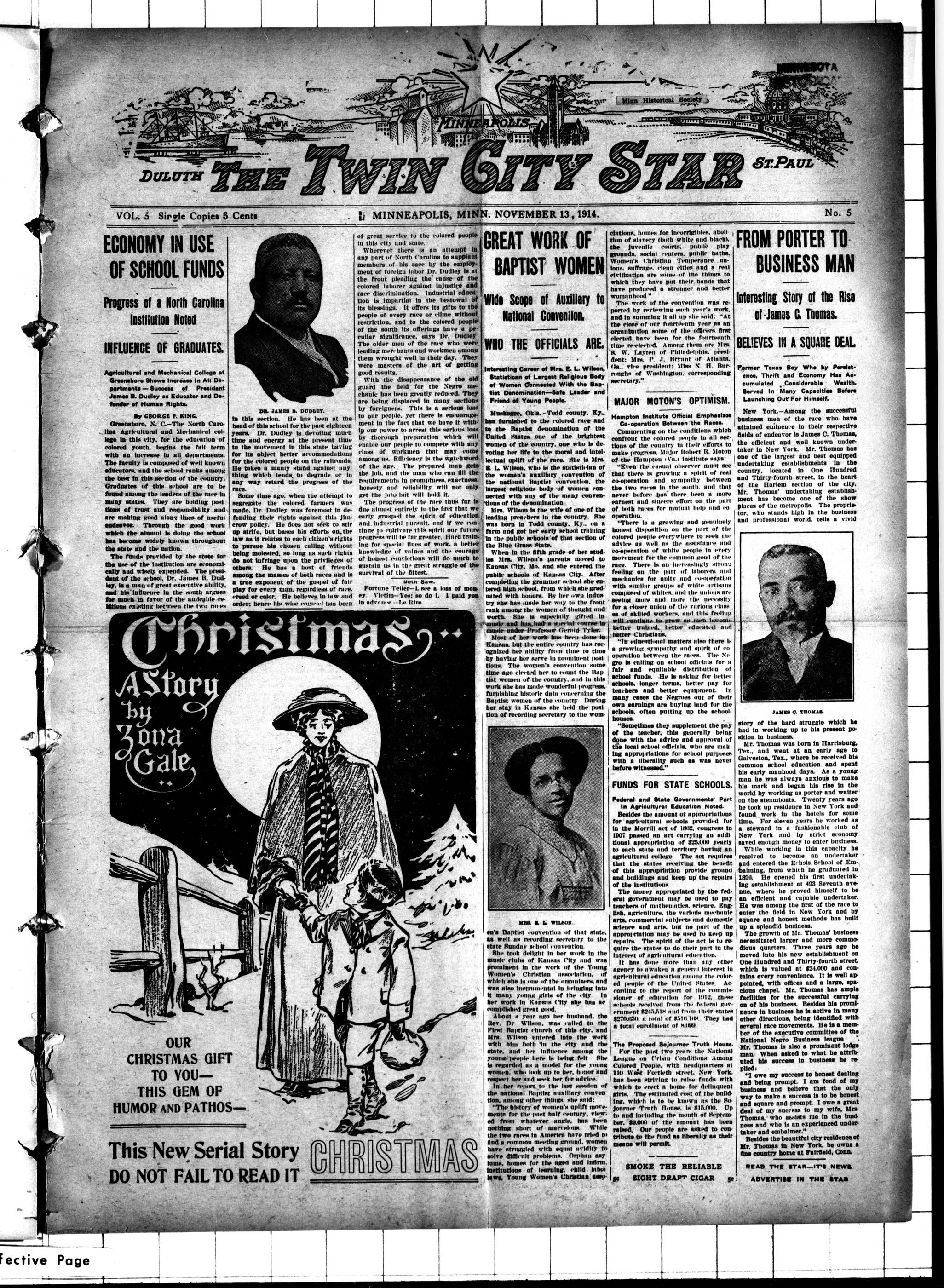
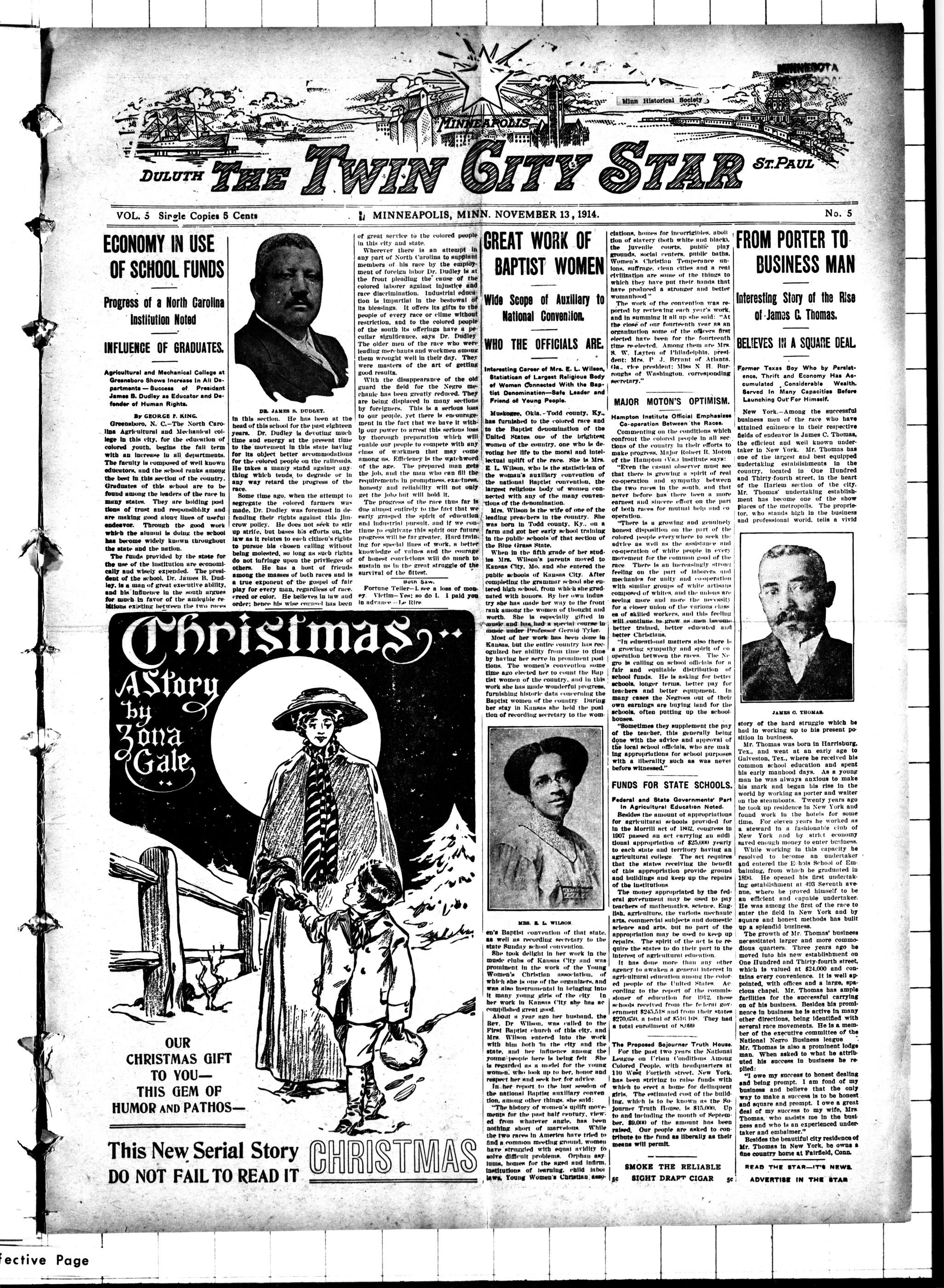
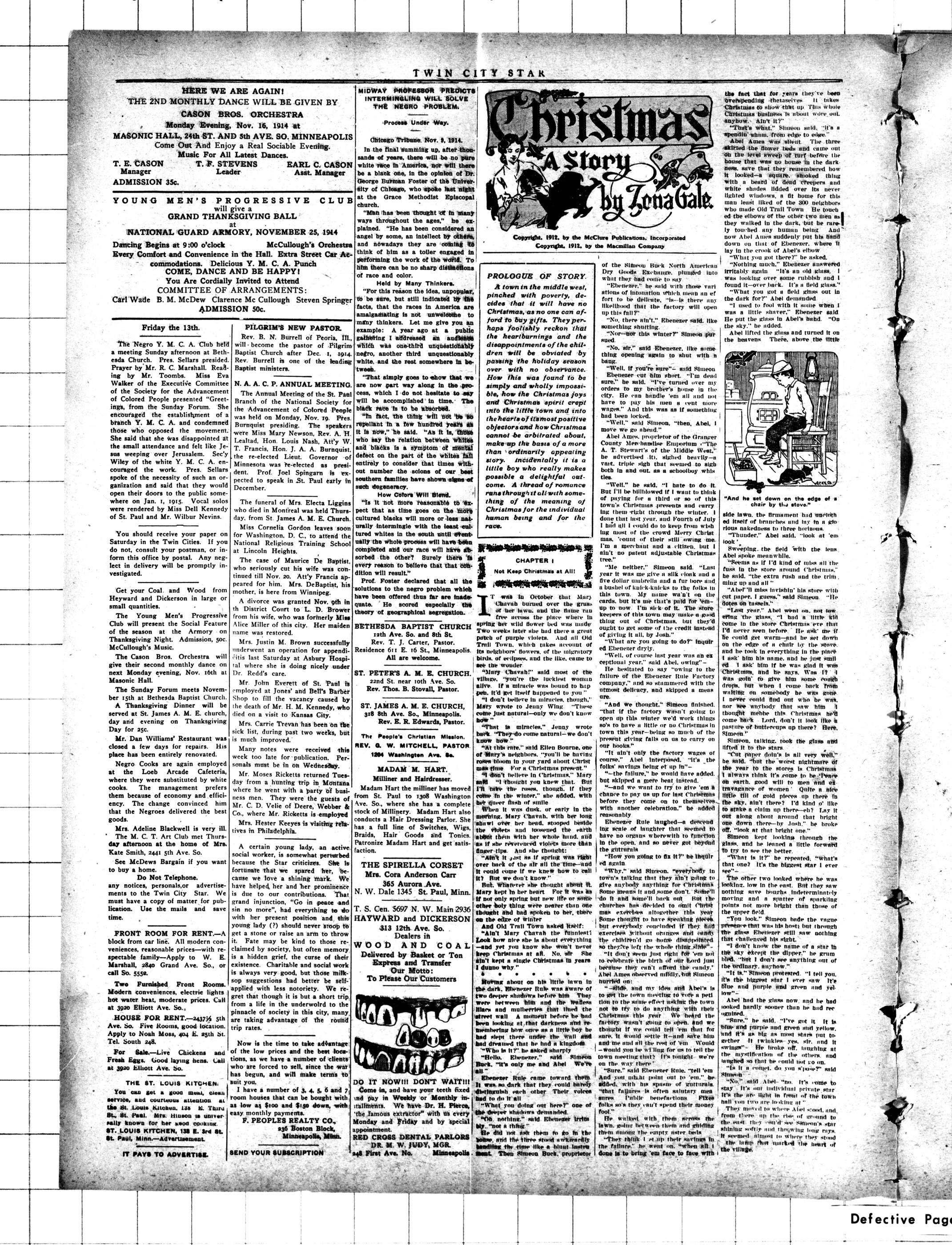
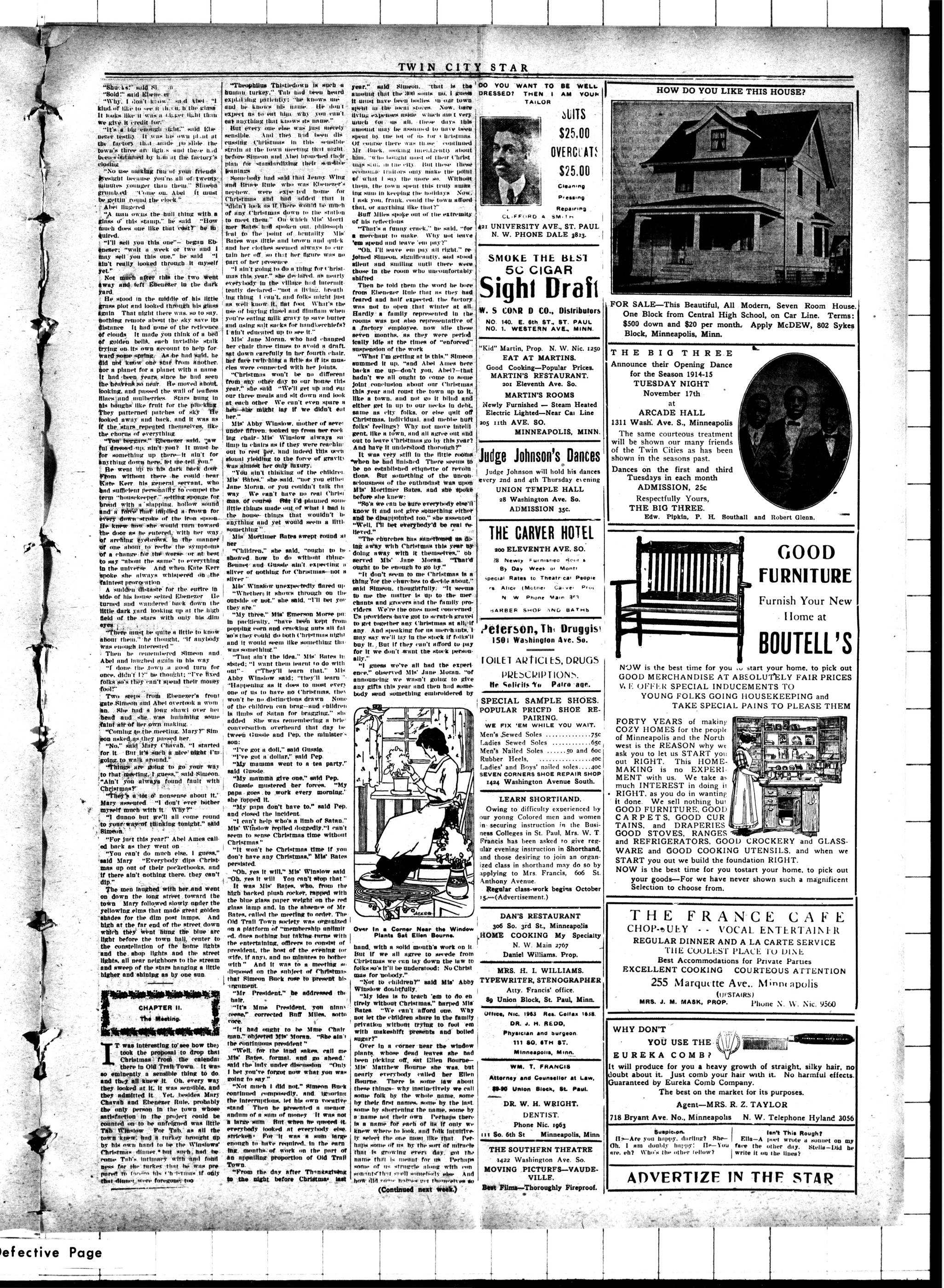
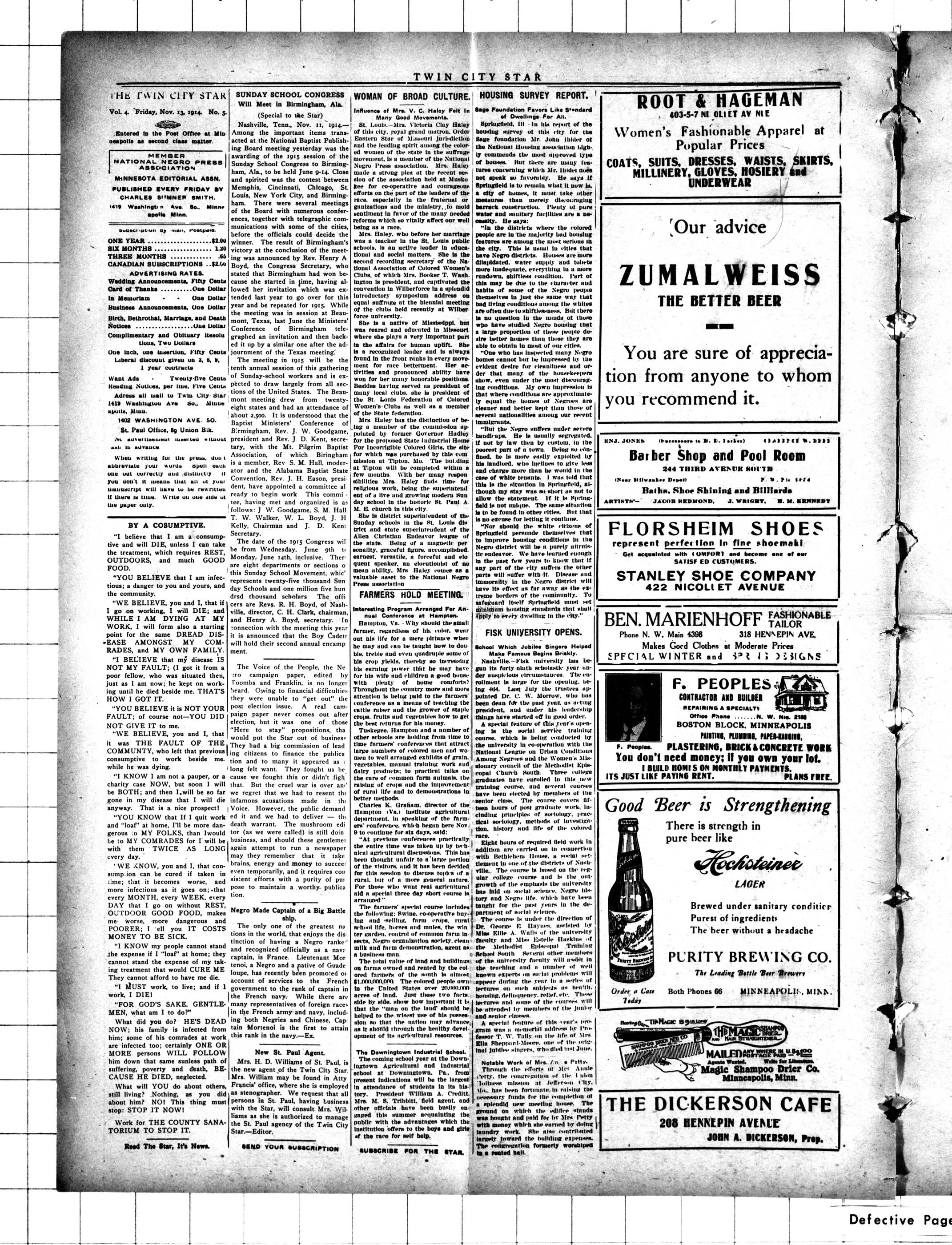
Page text (machine-generated)
DULUTH THE TWIN CITY STAR ST.PAUL
fective Page
Christmas
A Story
by
Zona
Gale
OUR
CHRISTMAS GIFT
TO YOU—
THIS GEM OF
HUMOR AND PATHOS—
This New Serial Story
DO NOT FAIL TO READ IT
CHRISTMAS
ECONOMY IN USE OF SCHOOL FUNDS
Progress of a North Carolina Institution Noted
INFLUENCE OF GRADUATES.
Agricultural and Mechanical College at Greensboro Shows Increase in All Departments—Success of President James B. Dudley as Educator and Defender of Human Rights.
By GEORGE P. KING.
Greensboro, N. C.—The North Carolina Agricultural and Mechanical college in this city, for the education of colored youth, begins the fall term with an increase in all departments. The faculty is composed of well known educators, and the school ranks among the best in this section of the country. Graduates of this school are to be found among the leaders of the race in many states. They are holding positions of trust and responsibility and are making good along lines of useful endeavor. Through the good work which the alumni is doing the school has become widely known throughout the state and the nation.
The funds provided by the state for the use of the institution are economically and wisely expended. The president of the school, Dr. James B, Dudley, is a man of great executive ability, and his influence in the south argues for much in favor of the ample relations existing between the two races
DR. JAMES B. DUDLEY.
in this section. He has been at the head of this school for the past eighteen years. Dr. Dudley is devoting much time and energy at the present time to the movement in this state having for its object better accommodations for the colored people on the railroads. He takes a many stand against anything which tends to degrade or in any way retard the progress of the race.
Some time ago, when the attempt to segregate the colored farmers was made. Dr. Dudley was foremost in defending their rights against this Jim crow policy. He does not seek to stir up strife, but bases his efforts on the up law as it relates to each citizen's rights to pursue his chosen calling without being molested, so long as such rights do not infringe upon the privileges of others. He has a host of friends among the masses of both races and is a true exponent of the gospel of fair play for every man, regardless of race, creed or color. He believed in law and order; hence his wise counsel has been
of great service to the colored people in this city and state.
Wherever there is an attempt in any part of North Carolina to supplant members of his race by the employment of foreign labor Dr. Dudley is at the front pleading the cause of the colored laborer against injustice and race discrimination. Industrial education is impartial in the bestowal of its blessings. It offers its gifts to the people of every race or clime without restriction, and to the colored people of the south its offerings have a peculiar significance, says Dr. Dudley. The older men of the race who were leading merchants and workmen among them wrought well in their day. They were masters of the art of getting good results.
With the disappearance of the old guard the field for the Negro mechanic has been greatly reduced. They are being displaced in many sections by foreigners. This is a serious loss to our people, yet there is encouragement in the fact that we have it with our power to arrest this serious loss by thorough preparation which will enable our people to compete with any class of workmen that may come among us. Efficiency is the watchword of the age. The prepared man gets the job, and the man who can fill the requirements in promptness, exactness, honesty and reliability will not only get the job but will hold it.
The progress of the race thus far is due almost entirely to the fact that we early grasped the spirit of education and industrial pursuit, and if we continue to cultivate this spirit our future progress will be far greater. Hard training for special lines of work, a better knowledge of values and the courage of honest convictions will do much to sustain us in the great struggle of the survival of the fittest.
Both Saw.
Fortune Teller—I see a loss of money. Victim—Yes; so do I. I paid you in advance—Le Rire.
GREAT WORK OF BAPTIST WOMEN
Interesting Career of Mrs. E. L. Wilson, Statistician of Largest Religious Body of Women Connected With the Baptist Denomination—Safe Leader and Friend of Young People.
Muskogee, Okla.—Todd county, Ky., has furnished to the colored race and to the Baptist denomination of the United States one of the brightest women of the country, one who is devoting her life to the moral and intellectual uplift of the race. She is Mrs. E. L. Wilson, who is the statistician of the woman's auxiliary convention of the national Baptist convention, the largest religious body of women connected with any of the many conventions of the denomination.
Mrs. Wilson is the wife of one of the leading preachers in the country. She was born in Todd county, Ky., on a farm and got her early school training in the public schools of that section of the Blue Grass State.
When in the fifth grade of her studies Mrs. Wilson's parents moved to Kansas City, Mo., and she entered the public schools of Kansas City. After completing the grammar school she entered high school, from which she graduated with honors. By her own industry she has made her way to the front rank among the women of thought and worth. She is especially gifted in music and has had a special course in music under Professor Gerald Tyler.
Most of her work has been done in Kansas, but the entire country has recognized her ability from time to time by having her serve in prominent positions. The women's convention some time ago elected her to count the Baptist women of the country, and in this work she has made wonderful progress, furnishing historic data concerning the Baptist women of the country. During her stay in Kansas she held the position of recording secretary to the wom-
MRS. E. L. WILSON.
en's Baptist convention of that state,
as well as recording secretary to the
state Sunday school convention.
She took delight in her work in the muscle clubs of Kansas City and was prominent in the work of the Young Women's Christian association, of which she is one of the organizers, and was also instrumental in bringing into it many young girls of the city. In her work in Kansas City she has accomplished great good.
About a year ago her husband, the Rev. Dr. Wilson, was called to the First Baptist church of this city, and Mrs. Wilson entered into the work with him both in the city and the state, and her influence among the young people here is being felt. She is regarded as a model for the young women, who look up to her, honor and respect her and seek her, for advice.
In her report to the last session of the national Baptist auxiliary convention, among other things, she said:
"The history of women's uplift movements for the past half century, viewed from whatever angle, has been nothing short of marvelous. While the two races in America have tried to find a common meeting ground, women have strunged with equal avidity to solve difficult problems. Orphan asylums, homes for the aged and infirm, institutions of learning, child labor laws, Young Women's Christian asso-
clations, homes for incorrigities, abolition of slavery (both white and black), the juvenile courts, public play grounds, social centers, public baths, Women's Christian Temperance unions, suffrage, clean cities and a real civilization are some of the things to which they have put their hands that have produced a stronger and better womanhood." The work of the convention was reported by reviewing each year's work, and in summing it all up she said: "At the close of our fourteenth year as an organization some of the officers first elected have been for the fourteenth time re-elected. Among them are Mrs. S. W. Layten of Philadelphia, president; Mrs. P. J. Bryant of Atlanta, ga.; vice president; Miss N. H. Burroughs of Washington, corresponding secretary."
MAJOR MOTON'S OPTIMISM.
Hampton Institute Official Emphasizes Co-operation Between the Races.
Commenting on the conditions which confront the colored people in all sections of the country in their efforts to make progress, Major Robert R. Moton of the Hampton Va. institute says:
"Even the casual observer must see that there is growing a spirit of real co-operation and sympathy between the two races in the south, and that never before has there been a more earnest and sincere effort on the part of both races for mutual help and co-operation.
"There is a growing and genuinely honest disposition on the part of the colored people everywhere to seek the advice as well as the assistance and co-operation of white people in every movement for the common good of the race. There is an increasingly strong feeling on the part of laborers and mechanics for unity and co-operation with similar groups of white artisans composed of whites, and the unions are seeing more and more the necessity for a closer union of the various classes of skilled workers, and this feeling will continue to grow as men become better trained, better educated and better Christians.
"In educational matters also there is a growing sympathy and spirit of cooperation between the races. The Negro is calling on school officials for a fair and equitable distribution of school funds. He is asking for better schools, longer terms, better pay for teachers and better equipment. In many cases the Negroes out of their own earnings are buying land for the schools, often putting up the school-houses. "Sometimes they supplement the pay of the teacher, this generally being done with the advice and approval of the local school officials, who are making appropriations for school purposes with a liberality such as was never before witnessed."
FUNDS FOR STATE SCHOOLS
Federal and State Government* Part in Agricultural Education Noted.
Besides the amount of appropriations for agricultural schools provided for in the Morrill act of 1812, congress in 1907 passed an act carrying an additional appropriation of $25,000 yearly to each state and territory having an agricultural college. The act requires that the states receiving the benefit of this appropriation provide ground and buildings and keep up the repairs of the institutions.
The money appropriated by the federal government may be used to pay teachers of mathematics, science, English, agriculture, the various mechanic arts, commercial subjects and domestic science and arts, but no part of the appropriation may be used to keep up repairs. The spirit of the act is to require the states to do their part in the interest of agricultural education.
It has done more than any other agency to awaken a general interest in agricultural education among the colored people of the United States. According to the report of the commissioner of education for 1912, these schools received from the federal government $245,518 and from their states $270,650, a total of $516,118. They had a total enrollment of 8,000.
The Proposed Sojourner Truth House. For the past two years the National League on Urban Conditions Among Colored People, with headquarters at 110 West Fortlittle street. New York, has been striving to raise funds with which to erect a home for delinquent girls. The estimated cost of the building, which is to be known as the Sojourner Truth House, is $15,000. Up to and including the month of September, $0,000 of the amount has been raised. Our people are asked to contribute to the fund as liberally as their means will permit.
SMOKE THE RELIABLE
gc SIGHT DRAFT CIGAR
No. 5
FROM PORTER TO BUSINESS MAN
Farmer Texas Boy Who by Peralence, Thrift and Economy Has Accumulated . Considerable Wealth. Served In Many Capacities Before Launching Out' For Himself.
New York.—Among the successful business men of the race who have attained eminence in their respective fields of endeavor is James C. Thomas, the efficient and well known undertaker in New York. Mr. Thomas has one of the largest and best equipped undertaking establishments in the country, located in One Hundred and Thirty-fourth street, in the heart of the Harlem section of the city. Mr. Thomas' undertaking establishment has become one of the show places of the metropolis. The proprietor, who stands high in the business and professional world, tells a vivid
JAMES G. THOMAS.
story of the hard struggle which he had in working up to his present position in business.
Mr. Thomas was born in Harrisburg, Tex., and went at an early age to Galveston, Tex., where he received his common school education and spent his early manhood days. As a young man he was always anxious to make his mark and began his rise in the world by working as porter and waiter on the steamboats. Twenty years ago he took up residence in New York and found work in the hotels for some time. For eleven years he worked as a steward in a fashionable club of New York and by strict economy saved enough money to enter business. While working in this capacity he resolved to become an undertaker and entered the Echo's School of Embalming, from which he graduated in 1806. He opened his first undertaking establishment at 403 Seventh avenue, where he proved himself to be an efficient and capable undertaker. He was among the first of the race to enter the field in New York and by square and honest methods has built up a splendid business.
The growth of Mr. Thomson's business necessitated larger and more commodious quarters. Three years ago he moved into his new establishment on One Hundred and Thirty-fourth street, which is valued at $24,000 and contains every convenience. It is well appointed, with offices and a large, spacious chapel. Mr. Thomas has ample facilities for the successful carrying on of his business. Besides his prominence in business he is active in many other directions, being identified with several race movements. He is a member of the executive committee of the National Negro Business league. Mr. Thomas is also a prominent lodge man. When asked to what he attributed his success in business he replied:
"I owe my success to honest dealing and be prompt. I am fond of my business and believe that the only way to make a success is to be honest and square and prompt. I owe a great deal of my success to my wife, Mrs Thomas, who assists me in the business and who is an experienced undertaker and embalmer." Besides the beautiful city residence of Mr. Thomas in New York, he owns a one country home at Fairfield, Conn.
READ THE STAR—IT'S NEWS.
ADVERTISE IN THE STAR
DULUTH THE TWIN CITY STAR ST. PAUL
ective Page
VOL. 5 Single Copies 5 Cents
ECONOMY IN USE
OF SCHOOL FUNDS
Progress of a North Carolina
Institution Noted
INFLUENCE OF GRADUATES.
Thri
Christmas...
A Story
by
Zona
Gale
OUR
CHRISTMAS GIFT
TO YOU—
THIS GEM OF
HUMOR AND PATHOS—
This New Serial Story
DO NOT FAIL TO READ IT
CHRISTMAS
Agricultural and Mechanical College at Greensboro Shows Increase In All Departments — Success of President James B. Dudley as Educator and Defender of Human Rights.
By GEORGE F. KING.
Greensboro, N. C.-The North Carolina Agricultural and Mechanical college in this city, for the education of colored youth, begins the fall term with an increase in all departments. The faculty is composed of well known educators, and the school ranks among the best in this section of the country. Graduates of this school are to be found among the leaders of the race in many states. They are holding positions of trust and responsibility and are making good along lines of useful endeavor. Through the good work which the alumni is doing the school has become widely known throughout the state and the nation.
The funds provided by the state for the use of the institution are economically and wisely expended. The president of the school, Dr. James B. Dudley, is a man of great executive ability, and his influence in the south argues for much in favor of the amenable relations existing between the two races.
DR. JAMES B. DUDLEY.
in this section. He has been at the head of this school for the past eighteen years. Dr. Dudley is devoting much time and energy at the present time to the movement in this state having for its object better accommodations for the colored people on the railroads. He takes a manly stand against anything which tends to degrade or in any way retard the progress of the race.
Some time ago, when the attempt to segregate the colored farmers was made, Dr. Dudley was foremost in defending their rights against this Jim crow policy. He does not seek to stir up strife, but bases his efforts on the law as it relates to each citizen's rights to pursue his chosen calling without being molested, so long as such rights do not infringe upon the privileges of others. He has a host of friends among the masses of both races and is a true exponent of the gospel of fair play for every man, regardless of race creed or color. He believes in law and order; hence his wise counsel has been
of great service to the colored people in this city and state.
Wherever there is an attempt in any part of North Carolina to supplant members of his race by the employment of foreign labor Dr. Dudley is at the front pleading the cause of the colored laborer against injustice and race discrimination. Industrial education is impartial in the bestowal of its blessings. It offers its gifts to the people of every race or clime without restriction, and to the colored people of the south its offerings have a peculiar significance, says Dr. Dudley. The older men of the race who were leading merchants and workmen among them wrought well in their day. They were masters of the art of getting good results.
With the disappearance of the old guard the field for the Negro mechanic has been greatly reduced. They are being displaced in many sections by foreigners. This is a serious loss to our people, yet there is encouragement in the fact that we have it with our power to arrest this serious loss by thorough preparation which will enable our people to compete with any class of workmen that may come among us. Efficiency is the watchword of the age. The prepared man gets the job, and the man who can fill the requirements in promptness, exactness, honesty and reliability will not only get the job, but will hold it.
The progress of the race thus far is
almost entirely to the fact that we
early grasped the spirit of education
and industrial pursuit, and if we
continue to cultivate this spirit our future
progress will be far greater. Hard tru-
ning for special lines of work, a better
knowledge of values and the courage
of honest convictions will do much to
sustain us in the great struggle of the
survival of the fittest.
Bob Saw.
Fortune Teller—I see a loss of money.
Victim—Yes; so do I. I paid you in
advance—Yes; so I reit.
GREAT WORK OF BAPTIST WOMEN
Interesting Career of Mrs. E. L. Wilson, Statistician of Largest Religious Body of Women Connected With the Baptist Denomination—Safe Leader and Friend of Young People.
Muskogee, Okla.—Todd county, Ky., has furnished to the colored race and to the Baptist denomination of the United States one of the brightest women of the country, one who is devoting her life to the moral and intellectual uplift of the race. She is Mrs. E. L. Wilson, who is the statistician of the woman's auxiliary convention of the national Baptist convention, the largest religious body of women connected with any of the many conventions of the denomination.
Mrs. Wilson is the wife of one of the leading preachers in the country. She was born in Todd county, Ky., on a farm and got her early school training in the public schools of that section of the Blue Grass State.
When in the fifth grade of her studies Mrs. Wilson's parents moved to Kansas City, Mo. and she entered the public schools of Kansas City. After completing the grammar school she entered high school, from which she graduated with honors. By her own industry she has made her way to the front rank among the women of thought and worth. She is especially gifted in music and has had a special course in music under Professor Gerald Tyler. Most of her work has been done in Kansas, but the entire country has recognized her ability from time to time by having her serve in prominent positions. The women's convention some time ago elected her to count the Baptist women of the country, and in this work she has made wonderful progress, furnishing historic data concerning the Baptist women of the country. During her stay in Kansas she held the position of recording secretary to the wom-
MARY E.
MRS. R. L. WILSON.
en's Baptist convention of that state, as well as recording secretary to the state Sunday school convention.
She took delight in her work in the music clubs of Kansas City and was prominent in the work of the Young Women's Christian association, of which she is one of the organizers, and was also instrumental in bringing into it many young girls of the city. In her work in Kansas City she has accomplished great good.
About a year ago her husband, the Rev. Dr. Wilson, was called to the First Baptist church of this city, and Mrs. Wilson entered into the work with him both in the city and the state, and her influence among the young people here is being felt. She is regarded as a model for the young women, who look up to her, honor and respect her and seek her for advice.
In her report to the last session of the national Baptist auxiliary convention, among other things, she said: "The history of women's uplift movements for the past half century, viewed from whatever angle, has been nothing short of marvelous. While the two races in America have tried to find a common meeting ground, women have struggled with equal acidity to solve difficult problems. Orphan asylums, homes for the aged and infirm, institutions of learning, child labor laws, Young Women's Christian asso-
clations, homes for incorrigible, abolition of slavery (both white and black), the juvenile courts, public play grounds, social centers, public baths, Women's Christian Temperance unions, suffrage, clean cities and a real civilization are some of the things to which they have put their hands that have produced a stronger and better womanhood." The work of the convention was reported by reviewing each year's work, and in summing it all up she said: "At the close of our fourteenth year as an organization some of the officers first elected have been for the fourteenth time re-elected. Among them are Mrs. S. W. Layton of Philadelphia, president; Mrs. P. J. Bryant of Atlanta, Ga., vice president; Miss N. H. Burroughs of Washington, corresponding secretary."
MAJOR MOTON'S OPTIMISM.
Hampton Institute Official Emphasizes Co-operation Between the Races. Commenting on the conditions which confront the colored people in all sections of the country in their efforts to make progress, Major Robert R. Motton of the Hampton (Va.) Institute says: "Even the casual observer must see that there is growing a spirit of real co-operation and sympathy between the two races in the south, and that never before has there been a more earnest and sincere effort on the part of both races for mutual help and co-operation.
"There is a growing and genuinely honest disposition on the part of the colored people everywhere to seek the advice as well as the assistance and co-operation of white people in every movement for the common good of the race. There is an increasingly strong feeling on the part of laborers and mechanics for unity and cooperation with similar groups of white artisans composed of whites, and the unions are seeing more and more the necessity for a closer union of the various classes of skilled workers, and this feeling will continue to grow as men become better trained, better educated and better Christians.
"In educational matters also there is a growing sympathy and spirit of cooperation between the races. The Negro is calling on school officials for a fair and equitable distribution of school funds. He is asking for better schools, longer terms, better pay for teachers and better equipment. In many cases the Negroes out of their own earnings are buying land for the schools, often putting up the school-houses. "Sometimes they supplement the pay of the teacher, this generally being done with the advice and approval of the local school officials, who are making appropriations for school purposes with a liberality such as was never before witnessed."
FUNDS FOR STATE SCHOOLS
Federal and State Governments' Part In Agricultural Education Noted.
Besides the amount of appropriations for agricultural schools provided for in the Morrill act of 1882, congress in 1007 passed an act carrying an additional appropriation of $25,000 yearly to each state and territory having an agricultural college. The act requires that the states receiving the benefit of this appropriation provide ground and buildings and keep up the repairs of the institutions.
The money appropriated by the federal government may be used to pay teachers of mathematics, science, English, agriculture, the various mechanic arts, commercial subjects and domestic science and arts, but no part of the appropriation may be used to keep up repairs. The spirit of the act is to require the states to do their part in the interest of agricultural education.
It has done more than any other agency to awaken a general interest in agricultural education among the colored people of the United States. According to the report of the commissioner of education for 1912, these schools received from the federal government $245,518 and from their states $270,450, a total of $516,168. They had a total enrollment of 80,889.
The Proposed Sojourner Truth House. For the past two years the National League on Urban Conditions Among Colored People, with headquarters at 110 West Fortieth street, New York, has been striving to raise funds with which to erect a home for delinquent girls. The estimated cost of the building, which is to be known as the Sojourner Truth House, is $15,000. Up to and including the month of September, $0,000 of the amount has been raised. Our people are asked to contribute to the fund as liberally as their means will permit.
No. 5
BELIEVES IN A SQUARE DEAL
Former Texas Boy Who by Persistence, Thrift and Economy Has Accumulated Considerable Wealth Served In Many Capacities Before Launching Out For Himself.
New York--Among the successful business men of the race who have attained eninence in their respective fields of endeavor is James C. Thomas, the efficient and well known undertaker in New York. Mr. Thomas has one of the largest and best equipped undertaking establishments in the country, located in One Hundred and Thirty-fourth street, in the heart of the Harlem section of the city. Mr. Thomas' undertaking establishment has become one of the show places of the metropolis. The proprietor, who stands high in the business and professional world, tells a vivid
JAMES C. THOMAS.
story of the hard struggle which he had in working up to his present position in business.
Mr. Thomas was born in Harrisburg, Tex., and went at an early age to Galveston, Tex., where he received his common school education and spent his early manhood days. As a young man he was always anxious to make his mark and began his rise in the world by working as porter and waiter on the stewmboats. Twenty years ago he took up residence in New York and found work in the hotels for some time. For eleven years he worked as a steward in a fashionable club of New York and by strict economy saved enough money to enter business.
While working in this capacity he resolved to become an undertaker and entered the Ehols School of Embalming, from which he graduated in 1806. He opened his first undertaking establishment at 493 Seventh avenue, where he proved himself to be an efficient and capable undertaker. He was among the first of the race to enter the field in New York and by square and honest methods has built up a solendid business.
The growth of Mr. Thomas' business necessitated larger and more commodious quarters. Three years ago he moved into his new establishment on One Hundred and Thirty-fourth street, which is valued at $24,000 and contains every convenience. It is well appointed, with offices and a large, spacious chapel. Mr. Thomas has ample facilities for the successful carrying on of his business. Besides his prominence in business he is active in many other directions, being identified with several race movements. He is a member of the executive committee of the National Negro Business league. Mr. Thomas is also a prominent lodge man. When asked to what he attributed his success in business he replied:
"I owe my success to honest dealing and be prompt. I am fond of my business and believe that the only way to make a success is to be honest and square and prompt. I owe a great deal of my success to my wife, Mrs. Thomas, who assists me in the business and who is an experienced undertaker and embalmer." Besides the beautiful city residence of Mr. Thomas in New York, he owns a one country home at Fairfield, Conn.
READ THE STAR—IT'S NEWS.
ADVERTISE IN THE STAR
MASONIC HALL, 24th ST. AND 5th AVE. SO. MINNEAPOLIS
Come Out And Enjoy a Real Sociable Evening.
Music For All Latest Dances.
T. E. CASON
Manager
T. F. STEVENS
Leader
EARL C. CASON
Asst. Manager
ADMISSION 35c.
YOUNG MEN'S PROGRESSIVE CLUB
will give a
GRAND THANKSGIVING BALL
Carl Wade B. M. McDew Clarence Mc Cullough Steven Springer ADMISSION 50c.
Friday the 13th.
The Negro Y. M. C. A. Club held a meeting Sunday afternoon at Bethesda Church. Pres. Sellars presided. Prayer by Mr. R. C. Marshall. Reading by Mr. Toombs. Miss Eva Walker of the Executive Committee of the Society for the Advancement of Colored People presented "Greetings, from the Sunday Forum. She encouraged the establishment of a branch Y. M. C. A. and condemned those who opposed the movement. She said that she was disappointed at the small attendance and felt like Jesus weeping over Jerusalem. Sec'y Wiley of the white Y. M. C. A. encouraged the work. Pres. Sellars spoke of the necessity of such an organization and said that they would open their doors to the public somewhere on Jan. 1, 1915. Vocal solos were rendered by Miss Dell Kennedy of St. Paul and Mr. Wilbur Nevins.
You should receive your paper on Saturday in the Twin Cities. If you do not, consult your postman, or inform this office by postal. Any neglect in delivery will be promptly investigated.
Get your Coal. and Wood from Heyward and Dickerson in large or small quantities.
The Young Men's Progressive Club will present the Social Feature of the season at the Armory on Thanksgiving Night. Admission, 50c. McCullough's Music.
The Cason Bros. Orchestra will give their second monthly dance on next Monday evening, Nov. 16th at Masonic Hall.
The Sunday Forum meets November 15th at Bethesda Baptist Church. A Thanksgiving Dinner will be served at St. James A. M. E. church, day and evening on Thanksgiving Day for 25c. Mr. Dan Williams' Restaurant was closed a few days for repairs. His place has been entirely renovated. Negro Cooks are again employed at the Loeb Arcade Cafeteria, where they were substituted by white cooks. The management prefers them because of economy and efficiency. The change convinced him that the Negroes delivered the best goods. Mrs. Adeline Blackwell is very ill. The M. C. T. Art Club met Thursday afternoon at the home of Mrs. Kate Smith, 2441 5th Ave. So.
See McDews Bargain if you want to buy a home.
Do Not Telephone.
any notices, persons,or advertisements to the Twin City Star. We must have a copy of matter for publication. Use the mails and save time.
FRONT ROOM FOR RENT.—A block from car line. All modern conveniences, reasonable prices—with respectable family—Apply to W. E. Marshall, 2840 Grand Ave. So., or call So. 5552.
Two Furnished Front Rooms.
Modern conveniences, electric lights hot water heat, moderate prices. Call at 3020 Elliott Ave. So.
HOUSE FOR RENT.—2437½ 5th Ave. So. Five Rooms, good location. Apply to Noah Moss, 404 E. 25th St. Tel. South 248.
For Sale.-Live Chickens and Fresh Eggs. Good laying hens. Call at 3920 Elhott Ave. So.
THE ST. LOUIS KITCHEN.
You can get a good meal, clean service, and courteous attention at the St. Louis Kitchen, 138 E. Third St. St. Paul. Mrs. Hinson is universally known for her good cooking.
ST. LOUIS KITCHEN, 138 E. 3rd St. St. Paul, Minn.—Advertisement.
IT PAYS TO ADVERTISE.
PILGRIM'S NEW PASTOR.
Rev. B. N. Burrell of Peoria, Ill., will become the pastor of Pilgrim Baptist Church after Dec. 1, 1914.
Rev. Burrell is one of the leading Baptist ministers.
N. A. A. C. P. ANNUAL MEETING.
The Annual Meeting of the St. Paul Branch of the National Society for the Advancement of Colored People was held on Monday, Nov. 19. Pres. Burnquist presiding. The speakers were Miss Mary Newson, Rev. A. H. Lealtad, Hon. Louis Nash, Att'y W. T. Francis, Hon. J. A. A. Burnquist, the re-elected Lieut. Governor of Minnesota was re-elected as president. Prof. Joel Spingarn is expected to speak in St. Paul early in December.
The funeral of Mrs. Electa Liggins who died in Montreal was held Thursday, from St James A. M. E. Church. Miss Cornelia Gordon leaves soon for Washington, D. C., to attend the National Religious Training School at Lincoln Heights. The case of Maurice De Baptist, who seriously cut his wife was continued till Nov. 20. Att'y Francis appeared for him. Mrs. DeBaptist, his mother, is here from Winnipeig. A divorce was granted Nov. 9th in th District Court to L. D. Brower from his wife, who was formerly Miss Alice Miller of this city. Her maiden name was restored.
Mrs. Justin M. Brown successfully underwent an operation for appendicitis last Saturday at Asbury Hospital where she is doing nicely under Dr. Redd's care.
Mr. John Everett of St. Paul is employed at Jones' and Bell's Barber Shop to fill the vacancy caused by the death of Mr. H. M. Kennedy, who died on a visit to Kansas City.
Mrs. Carrie Trevan has been on the sick list, during past two weeks, but is much improved.
Many notes were received this week too late for publication. Personals must be in on Wednesday.
Mr. Moses Ricketts returned Tuesday from a hunting trip in Montana where he went with a party of business men. They were the guests of Mr. C. D. Velie of Deere, Webber & Co., where Mr. Ricketts is employed Mrs. Hester Keeeys is visiting relatives in Philadelphia.
A certain young lady, an active social worker, is somewhat perturbed because the Star criticizes. She is fortunate that we spared her, because we love a shining mark. We have helped her and her prominence is due to our contributions. That grand injunction, "Go in peace and sin no more", had everything to do with her present position and this young lady (?) should never stoop to get a stone or raise an arm to throw it. Fate may be kind to those reclaimed by society, but often memory is a hidden grief, the curse of their existence. Charitable and social work is always very good, but those milk-sop suggestions had better be self-applied with less notoriety. We regret that though it is but a short trip from a life in the underwolrd to the pinnacle of society in this city, many are taking advantage of the round trip rates.
Now is the time to take advantage of the low prices and the best locations, as we have a number of clients who are forced to sell, since the war has begun, and will make terms to suit you.
I have a number of 3, 4, 5, 6 and 7 room houses that can be bought with as low as $100 and $150 down, with easy monthly payments.
F. PEOPLES REALTY CO.,
236 Boston Block,
Minneapolis, Minn.
SEND YOUR SUBSCRIPTION
TWIN CITY STAR MIDWAY PROFESSOR PREDICTS INTERMINGLING WILL SOLVE THE NEGRO PROBLEM.
In the final summing up, after thousands of years, there will be no pure white race in America, nor will there be a black one, in the opinion of Dr. George Burman Foster of the University of Chicago, who spoke last night at the Grace Methodist Episcopal church.
"Man has been thought of in many ways throughout the ages," he explained. "He has been considered an angel by some, an intellect by others, and nowadays they are coming to think of him as a toler engaged in performing the work of the world. To him there can be no sharp distinctions of race and color.
Held by Many Thinkers.
"For this reason the idea, unpopular, to be sure, but still indicated by the facts, that the races in America are amalgamating is not unwelcome to many thinkers. Let me give you an example: A year ago at a public gathering I addressed an audience which was one-third unquestionably negro, another third unquestionably white, and the rest somewhere in between.
"That simply goes to show that we are now part way along in the process, which I do not hesitate to say will be accomplished in time. The black race is to be absorbed.
"In fact, the thing will not be so repellant in a few hundred years as it is now," he said. "As it is, those who say the relation between whites and blacks is a symptom of mental defect on the part of the whites fall entirely to consider that times without number the solons of our best southern families have shown signs of such degeneracy.
How Cofors Will Blend.
"Is it not more reasonable to expect that as time goes on the more cultured blacks will more or less naturally intermingle with the least cultured whites in the south until eventually the whole process will have been completed and our race will have absorbed the other? Surely there is every reason to believe that that condition will result."
Prof. Foster declared that all the solutions to the negro problem which have been offered thus far are inadequate. He scored especially the theory of geographical segregation.
BETHESDA BAPTIST CHURCH
12th Ave. So. and 8th St.
ST. PETER'S A. M. E. CHURCH
22nd St. near 10th Ave. So.
Rev. Thos. B. Stovall, Pastor.
ST. JAMES A. M. E. CHURCH,
318 8th Ave. So., Minneapolis.
Rev. E. R. Edwards, Pastor.
The People's Christian Mission.
REV. G. W. MITCHELL, PASTOR
1204 Washington Ave. So.
Madam Hart the milliner has moved from St. Paul to 1308 Washington Ave. So., where she has a complete stock of Millinery. Madam Hart also conducts a Hair Dressing Parlor. She has a full line of Switches, Wigs, Braids, Hair Goods and Tonics. Patronize Madam Hart and get satisfaction.
THE SPIRELLA CORSET
Mrs. Cora Anderson Carr
365 Aurora Ave.
N. W. Dale 1345 St. Paul, Minn.
T. S. Cen. 5697 N. W. Main 2936 HAYWARD and DICKERSON
313 12th Ave. So. Dealers in
WOOD AND COAL
Delivered by Basket or Ton
Express and Transfer
Our Motto:
To Please Our Customers
DO IT NOW!!! DON'T WAIT!!!
Come in, and have your teeth fixed and pay in Weekly or Monthly installments. We have Dr. H. Pierce, "the famous extractor" with us every Monday and Friday and by special appointment.
RED CROSS DENTAL PARLORS
DR. M. W. JUDY, MGR.
248 First Ave. No. Minneapolis
Chris
A St
Copyright, 1912, by the Mo
Copyright, 1912, by
Christmas
A Story
by Zona Gale.
Copyright, 1912, by the McClure Publications, Incorporated
Copyright, 1912, by the Macmillan Company
PROLOGUE OF STORY.
A town in the middle west, pinched with poverty, decides that it will have no Christmas, as no one can afford to buy gifts. They perhaps foolishly reckon that the heartburnings and the disappointments of the children will be obviated by passing the holiday season over with no observance. How this was found to be simply and wholly impossible, how the Christmas joys and Christmas spirit crept into the little town and into the hearts of its most positive objectors and how Christmas cannot be arbitrated about, make up the basis of a more than ordinarily appealing story. Incidentally it is a little boy who really makes possible a delightful outcome. A thread of romance runs through it all with something of the meaning of Christmas for the individual human being and for the race.
CHAPTER I
Not Keep Christmas at All!
It was in October that Mary
Chavah burned over the grass
of her lawn, and the fire ran
free across the place where in spring her wild flower bed was under. Two weeks later she had there a great patch of purple violets. And all Old Trail Town, which takes account of its neighbors' flowers, of the migratory birds, of eclipses, and the like, came to see the wonder.
"Mary Chavah!" said most of the village, "you're the luckiest woman alive. If a miracle was bound to happen, it'd get itself happened to you."
"I don't believe in miracles, though," Mary wrote to Jenny Wing. "These come just natural—only we don't know how."
"That is miracles," Jenny wrote back. "They do come natural—we don't know how."
"At this rate," said Ellen Bourne, one of Mary's neighbors, "you'll be having roses bloom in your yard about Christmas time. For a Christmas present."
"I don't believe in 'Christmas,' Mary said. "I thought you knew that. But I'll take the roses, though, if they come in the winter," she added, with her queer flush of smile. When it was dusk, or early in the morning, Mary Chavah, with her long shawl over her head, stooped beside the violets and loosened the earth about them with her whole hand, and as if she reverenced violets more than finger-tips. And she thought:
"Ain't it just as if spring was right over back of the air all the time—and it could come if we knew how to call it? But we don't know."
But, whatever she thought about it, Mary kept in her heart. For it was as if not only spring but new life or some other holy thing were nearer than one thought and had spoken to her, there on the edge of winter
And Old Trail Town asked itself:
"Ain't Mary Chavah the funniest! Look how nice she is about everything—and yet you know she won't never keep Christmas at all. No, sir. She isn't kept a single Christmas in years I dunno why."
Moving about on his little lawn in the dark, Ebenezer Rule was aware of two deeper shadows before him. They were between him and the ineffable flame and mulberries that tiled the street wall. A moment before he had been looking at, that darkness and remembering how once as a little boy he had slept there under the wall and had dreamed that he had a kingdom
"Who is it?" he asked sharply
"Hello, Ebenezer." said Simeon Buck. "It's only me and Abel. We're all."
Ebenezer Rule came toward them. It was so dark that they could barely ditching each other Their voices had to do it all
"What you doing out here?" one of the deeper shadows demanded.
"Oh nothing," said Ebenezer Irrita blyr. "not a thing."
He did not ask them to go in the house, and the three stood awkwardly handling the time like a blunt instrument. Then Simeon Buck, proprietor
of the Simeon Buck North American Dry Goods Exchange, plunged into what they had come to say.
"Ebenezer," he said with those variations of intonation which mean an effort to be delicate, "is—is there any likelihood that the factory will open up this fall?"
"No, there ain't." Ebenezer said, like something shutting.
"Nor—nor this winter?" Simeon pursued.
"No, sr." said Ebenezer, like something opening again to shut with a bang.
"Well, if you're sure"—said Simeon Ebenezer cut him short. "I'm dead sure," he said. "I've turned over my orders to my brother's house in the city. He can handle 'em all and not have to pay his men a cent more wages." And this was as if something had been locked.
"Well," said Simeon, "then, Abel, I move we go ahead."
Abel Amos, propetor of the Granger County Merchandise Emporium "The A. T. Stewart's of the Middle West," he advertised it, sighted heavily—a vast, triple sigh that seemed to sigh both in and out, as a schoolboy whites.
"Well," he said, "I hate to do it. But I'll be billowled if I want to think of paying for a third or so of this town's Christmas presents and carry them right through the winter. I done that last year, and Fourth of July I had all I could do to keep from wishing most of the crowd Merry Christmas, 'count of their still owing me. I'm a merchant and a citizen, but I ain't no patent adjustable Christmas tree."
"Me neither," Simeon said. "Last year it was me give a silk cloak and a five dollar umbrella and a fur bore and a bushel of knick-knicks to the folks in this town. My mime won't on the cards, but it's me that's paid for 'emup to now I'm sick of it. The store keepers of this town may make a good thing out of Christmas, but they'd ought to get some of the credit instead of giving it all, by Josh."
"What are you going to do?" inquired Ebenezer dryly.
"Well, of course last year was an exceptional year," said Abel, owing"—
He hesitated to say "owing to the failure of the Ebenezer Rule Factory company," and so stammered with the utmost delicacy, and skipped a measure.
"And we thought," Simeon finished,
"that if the factory wasn't going to open up this winter we'd work things so's to have a little or no Christmas in town this year—being so much of the present giving falls on us to carry on our books."
"It ain't only the factory wages of course." Abel interjosed. "it's the folks' savings being et up in"—
"—the failure," he would have added, but skipped a mere beat instead.
"—and we want to try to give 'em a chance to pay us up for last Christmas before they come on to themselves with another celebration," he added reasonably.
Eheneze Rule laughed—a descending scale of laughter that seemed to have no organs wherewith to function in the open, and so never got beyond the gutturalrs.
"How you going to fix it?" be inquired again.
"Why," said Simeon. "everybody in town's talking that they aren't going to give anybody anything for Christmas. Some means it and some don't. Some'll do it and some'll back out. But the churches has decided to omit 'Christmas exercises altogether this year. Some thought to have speaking pieces, but everybody concluded if they had exercises without oranges and candy the children'd go home disappointed so they left the whole thing slide." "It don't seem just right for 'em not to celebrate the birth of our Lord just because they can't afford the candy." Abel Ames observed mildly, but Simeon hurried on:
"-slide, and my idea and Abel's is to get the town meeting to vote a petition to the same effect asking the town not to try to do anything with their Christmas this year. We heard the factory wasn't going to open, and we thought if we could tell 'em that for sure. It would settle it—and save him and me and all the rest of 'em. Would – would you be willing for us to tell the town meeting that? It's tonight—we're on the way there'
"Sure," said Ebenezer Rule. "tell 'em And you might not out to 'em, he added, with his spasm of gurturals. "that failures is often salutary men aures Public benefactions Fixes folks so they can't spend their money fool."
He walked with them across the lawn, going between them and guiding them among the empty aster beds. "They think I set up their savings in the failures," he went on. "when all I done is to bring 'em face to face with
the fact that for years they've been overexpending themselves. It takes Christmas to show that up. This whole Christmas business is about wore out anyhow. Ahh it?"
"That's what." Simeon said. "It's a spendin' sham, from edge to edge."
Abel Ames was silent. The three skirted the flower beds and came out on the level sweep of turf before the house that was no house in the darkness, save that they remembered how it looked—a square, shoked thing with a beard of dead creepers and white shades lidded over its never lighted windows, a fit home for this man least liked of the 300 neighbors who made Old Trail Town. He touched the elbows of the other two men as they walked in the dark, but he rarely touched any human being. And now Abel Ames suddenly put his hand down on that of Ebenezer, where it lay in the crook of Abel's elbow
"What you got there?" he asked.
"Nothing much." Ebenezer answered
irritably again. "It's an old glass, I
was looking over some rubbish and I
found it—over back. It's a field glass."
"What you got a field glass out in the dark for?" Abel demanded. "I used to fool with it some when I was a little shaver," Ebenezer said. He put the glass in Abel's hand. "On the sky," he added. Abel lifted the glass and turned it on the heavens. There, above the little
"And he set down on the edge of a chair by the stove."
side lawn. the firmament had unclef
ed itself of branches and lay in a glo
rious nakedness to three horizons.
"Thunder." Abel said. "look at 'em
"Thunder." Abel said, "look at 'em look,"
Sweeping, the field with the lens. Abel spoke meanwhile.
"Seems as if I'd kind of miss all the fuss in the store around 'christmas,' he said, "the extra rush and the trim, ming up and all."
"Abel I'll miss invisbin' his store with cut paper, I guess," said Simeon. "He dotes on tassels."
"Last year." Abel went on, not wering the glass, "I had a little kid come in the store Christmas eve that I'd never seen before. He ask' me if he could get warm—and he set down on the edge of a chair by the stove, and he took in everything in the place I ask' him his name, and he just smiled I ask' him if he was glad it was Christmas, and he says. Was I? I was goln' to give him some cough drops, but when I come back from waiting on somebody he was gone I never could find out who he was, nor see anybody that saw him I thought mebe this Christmas he'd come back Lord, don't it look like a pasture of buttercups up there? Here, Simeon."
Simeon, talking, took the glass and lifted it to the stars.
"Cut paper doin's is all very well" he said. "but the worst nightmare of the year to the stores is Christmas I always think it's come to me. 'Peace on earth, good will to men and ex-travagance of women.' Quite a nice little till of gold pieces up there in the sky, ain't there? 'I'd kind o'like to strike a claim up there—eh? Lay it out about around that bright one down there—by Josh," he broke off. "look at that bright one."
Simeon kept looking through the glass, and he leaned a little forward to try to see the better.
"What is it?" he repeated, "what's that one? It's the biggest star I ever see"
The other two looked where he was looking, low in the east. But they saw nothing save boughs indeterminately moving and a spatter of sparkling points not more bright than those of the upper field.
"You look." Simeon bade the vague presence that was his host; but through the glass Ebenizer still saw nothing that challenged his sight.
"I don't know the name of a star in the sky except the dipper," he grumbling. "but I don't see anything out of the ordinary, anyhow."
"It is." Simeon protested. "I tell you, it's the biggest star I ever saw. It's blue and purple and green and yellow"—
Abel had the glass now, and he had looked hardly sooner than he had recognized.
"Sure," he said. "I've got it. It is blue and purple and green and yellow, and it's as big as most stars put together. It twinkles yes, sir, and it swings." He broke off, laughing at the mystification of the others, and laughed so that he could not go on.
"Is it a comet, do you spose?" said Simeon.
"No," said Abel. "no. It's come to stay. It's our individual private star. It's the are light in front of the town hall you two are looking at." They moved to where Abel stood, and from there up the rise of ground to the east they could see Simeon's star shining softly and threwing long rays. It seemed almost to where they stood the lamp that marked the heart of the village.
Defective Page
Defective Page
"Shu:k-ss" said St. _____
"Sold" said Klewne-er
"Why, I don't know," said Abel. "I kind of like to see it through the glass. It looks like it was a bigger light than we give it credit for."
"It's a big enough light," said Ebenezer testify. It was his own plant at the factory that made possible the town's three are lights, and these had been contained by him at the factory's closing.
"No use making fun of your friends by sight because you're all of twenty minutes younger than them." Sharon grumbed. "Come on, Abel! It must be gotten round the clock."
Abel fingered.
"A man owns the hull thing with a glass of this stamp," he said. "How much does one like that cost?" he inquired.
"I'll sell you this one"—began Ebenezer; "wait a week or two and I may sell you this one," he said. "I can't really looked through it myself yet."
Not much after this the two went away and left Ebenezer in the dark yard.
He stood in the middle of his little grass plot and looked through his glass again. That night there was, so to say, nothing remote about the sky save its distance. It had none of the refrence of clouds. It made you think of a bed of golden bells, each invisible stalk trying on its own account to help for ward some spring. As he had said, he did not know one star from another, nor a planet for a planet with a name. It had been years since he had seen the heavens so near. He moved about, looking, and passed the wall of leafless flasks and mulberries. Stars hung in his boughs like fruit for the plucking. They patterned patches of sky. He looked away and back, and it was as if the stars repeated themselves, like the chorus of everything.
"You begger," Ebenezer said, "awful dress-up, ain't you? It must be for something up there—it ain't for anything down here, let me tell you."
He went up to his dark back door. From without there he could hear Kate Kerr his general servant, who had sufficient personality to compel the term "housekeeper" setting sponge for bread with a shapping, hollow surface and a force that impelled a frown for every down stroke of the iron spoon. He knew how she would turn toward the door as he entered, with her way of arching eyelids, in the manner of one about to recite the symptoms of a chance for the works or at best to say "about the same" to everything in the universe. And when Kate Kerr spoke she always whispered on the faintest provocation
A sudden dizziness for the entire inside of his house seized Elenezer. He turned and wandered back down the little dark yard looking up at the high field of the stars with only his dim eyes.
"There must be quite a little to know about them," he thought, "if anybody was enough interested."
Then he remembered Simeon and Abel and hugged again in his way.
"I done the town a good turn for once, didn't I?" he thought; "I've fixed folks so they can't spend their money fool."
"Two steps from Ebenezer's front gate Simeon and Abel overtook a woman. She had a long shawl over her head and she was humming some faint air of her own making.
"Coming to the meeting, Mary?" Simeon naked as they passed her.
"No," said Mary Chiavah. "I started for it. But it's such a nice night I'm going to walk around."
"Things are going to go your way to that meeting, I guess," said Simeon. "Ain't you always found fault with Christmas."
"They's a lot of nonsense about it." Mary assented. "I don't ever bother myself much with it. Why?"
"I dunno but we'll all come round to your way of thinking tonight," said Simeon.
"For just this year!" Abel Ames called back as they went on
"You can't do much else. I guess."
said Mary "Everybody dips Christmas up out of their pocketbooks, and if there ain't nothing there, they can't dip."
The men laughed with her and went on down the long street toward the town Mary followed slowly under the yellowing elms that made great golden shades for the dim post lamps. And high at the far end of the street down which they went hung the blue are light before the town hall, center to the constellation of the home lights and the shop lights and the street lights, all near neighbors to the stream and sweep of the stars hanging a little higher and shining as by one sun.
CHAPTER II.
The Meeting.
IT was interesting to see how they took the proposal to drop that Christmas from the calendar there in Old Trail Town. It was so eminently a sensible thing to do, and they all knew it. Oh, every way they looked at it, it was sensible, and they admitted it. Yet, besides Mary Chavah and Eheneze Rule, probably the only person in the town whose satisfaction in the project could be counted on to be unfounded was little Tab Winslow. For Tab, as all the town knew, and a turkey brought up by his own hand to be the Winslow's Christmas dinner *but such, had he come Tab's intimacy with and fondness for the turkey that he was prepared to force his *thirties if only that dinner were foregone too
"Theophilus Thistledown is such a human turkey." Tah had been heard explaining patiently; "he knows me and he knows his name. He don't expect us to eat him why you can't eat anything that knows its name."
But every one else was just merely sensible. And they had been discussing Christmas in this solemn strain at the town meeting that night, before Simon and Ahel breasted their plan for standardizing their sensible feelings.
Somethad had said that Jenny Wing and Bruce Rule who was Eleanor nephow, were expected home for Christmas and had added that it "didn't look as if there would be much of any Christmas down to the station to meet them." On which Mis Mortier Bates had spoken out, philosophical to the point of brutality. Mis Bates was little and brown and quick and her clothes seemed always to curtain her off, so that her figure was no part of her presence.
"I don't going to do a thing for Christmas this year," she declared, as nearly everybody in the village had intermittently declared—not a living, breathing thing I can't, and folks might just as well know it, but foot. What's the use of buying tinsel and flimflam when you're eating milk gravy to save butter and using salt sacks for handkerchiefs? I don't educated up to see it.
Mis' Jane Moran, who had changed her chair three times to avoid a draft, sat down carefully in her fourth chair, her face twitching a little as if its muscles were connected with her joints.
"Christmas won't be no different from any other day to our house this year," she said "We'll get up and eat our three meals and sit down and look at each other. We can't even spare a hew she might las if we didn't eat her."
Mis' Abby Winslow, mother of seven under fifteen, took up from her rocking chair—Mis' Winslow always slump in chairs as if they were reaching out to rest her, and indeed this occasional yielding to the force of gravity was almost her only luxury.
"You ain't thinking of the children. Mis' Bates," she said, "nor you either Jane Moran, or you couldn't talk this way. We can't have no real Christmas, of course. But I'd planned some little things made out of what I had in the house things that wouldn't be anything and yet would seem a little something."
Mis' Mortimer Rates swept round at her
"Children," she said, "ought to be showed how to do without things. Beenier and Gussie ain't expecting a silver of nothing for Christmas—not a silver."
Mis' Winslow unexpectedly fared up "Whether it shows through on the outside or not," she said. "I'll bet you they are."
"My three," Mis' Emerson Morse put in politically, "have been kept from popping corn and cracking nuts all fall so they could do both 'christmas night' and it would seem like something that was something."
"That ain't the idea." Mis' Bates insisted: "I want them learnt to do with out." "They'll learn that." Mis' Abby Winslow said: "They'll learn "Happening as it does to most every one of us to have no 'christmas,' they won't be no distinctions drawn. None of the children can bring—and children is limbs of Satan for bragging," she added. She was remembering a brief conversation overheard that day between Gussie and Pep, the minister son:
"I've got a doll," said Gussie.
"My mamma went to a tea party," said Gussie.
"My mamma give one," said Pep. Gussie mustered her forces. "My papa goes to work every morning," she topped it.
"My papa don't have to," said Pep, and closed the incident.
"I can't help who's a limb of Satan." Miss Winslow replied doggedly. "I can't seem to sense Christmas time without Christmas."
"It won't be Christmas time if you don't have any Christmas," Miss Rates persisted.
"Oh, yes it will." Miss Winslow said. "Oh, yes it will." You can't stop that."
It was Mist Bates, who, from the high backed plush rocker, rapped with the blue glass paper weight on the red glass lamp and, in the absence of Mr. Bates, called the meeting to order. The Old Trail Town society was organized on a platform of "membership unlimited, does nothing but taking turns with the entertaining, officers to consist of president, the host of the evening (or wife, if any), and no minutes to bother with." And it was to a meeting so disposed on the subject of Christmas that Simeon Buck rose to present his argument.
"Mr President," he addressed the chair.
"It's Mime President, you ninnies reese," corrected Buff Miles, sotto voce.
"It had ought to be Mime Chairman," objected Mist Storm. "She ain't the continuous president."
"Well, for the land sake, call me Mrs Bates, formal, and go ahead. said the lady under discussion "Only I bet you've forgot now what you was going to say"
"Not much I did not." Simeon Buck continued composedly, and ignoring the interruptions, let his own vocative stand. Then he presented a memoir andum of a sum of money. It was not a large sum. But when he quoted it everybody looked at everybody else, stricken. For it was a sum large enough to have required. in the earning months of work on the part of an appalling proportion of Old Trail Town.
"From the day after Thanksgiving to the night before Christmas last
TWIN CITY STAR
year," said Simeon, "that is the amount that the 200 sons put, I guess it must have been bodies in our town spent in the local stores. Now, bare living expenses inside which aren't very much for us all, these days this amount may be assumed to have been spent by the lot of us for a Christmas. Of course there was those, continued Mr. Buck, looking intelligently about him, who bought most of their Christmas gifts in the city. But these economic traitors only make the point of what I say the more so. Without them, the town spent this truly amazing sum in keeping the holidays. Now, I ask you, frank, could the town afford that, or anything like that?
Buff Miles spoke out of the extremity of his reflections
"That's a funny crack," he said, "for a merchant to make. Why not leave 'em spend and leave 'em pay?"
"Oh. I'll leave em pay all right." rejoined Simeon, significantly, and stood silent and smiling until there were those in the room who uncomfortably shifted. Then he told them the word he bore from Ebenzer Itule that as they had feared and half expected, the factory was not to open that winter at all. Hardly a family represented in the rooms was not also representative of a factory employee, now idle these seven months, as they were periodically idle at the times of "enforced" suspension of the work.
"What I'm getting at is this." Slimone summed it up, "and Abel Ames here backs me up—don't you, Abel?—that hadn't we all ought to come to some joint conclusion about our Christmas this year and rost the town up to it, like a town, and not go it blind and either get in up to our necks in debt, same as city folks, or else quit off Christmas, individual, and mobie hurt folks' feelings? Why not move intelligent, like a town, and all agree out and out to leave Christmas go by this year? And have it understood through?"
It was very still in the little rooms when he had finished. There seems to be no established etiquette of revolutions. But something of the unconsciousness of the enthusiasm was upon Mis' Mortimer Bates, and she spoke before she knew:
"So's we can sure everybody else'll know it and not give something either and be disappointed too." she assented
"Well, I'll bet everybody'd be real relieved."
"The churches has sanctioned in doing away with Christmas this year by doing away with it themselves," observed Ms' Jane Moran. "That'd ought to be enough to go by."
"It don't seem to me Christmas is a thing for the churches to decide about," said Simeon, thoughtfully. "It seems to me the matter is up to the merchants and grocers and the family providers. We're the ones most concerned. Us providers get to scratch gravel to get together any Christmas at all; if any. And speaking for our merchants, I may say we'll lay in the stock if folks'll buy it. But if they can't afford to pay for it we don't want the stock personally."
"I guess we've all had the experience," observed Ms' Jane Moran. "of announcing we wasn't going to give any gifts this year and then had somebody send something embroidered by
ACKS
Ovar In a Corner Near the Window
Plants Sat Ellen Bourne.
Over In a Corner Near the Window Plants Sat Ellen Bourne.
hand, with a solid month's work on it. But if we all agree to secede from Christmas we can lay down the law to folks so it's all understood: No Christ mas for nobody.
"Not to children?" said Mis' Abby Window doubtfully.
"My idea is to teach 'em to do entirely without Christmas," harped Mis' Bates. "We can't afford one. Why not let the children share in the family privation without trying to fool em with makeshift presents and boiled sugar?"
Over in a corner near the window plants, whose dend leaves she had been picking off, sat Ellen Bourne—Mis Matthew Bourne she was, but nearly everybody called her Ellen Bourne. There is some law about these things—why instinctively we call some folk by the whole name, some by their first names, some by the last some by shortening the name, some by a name not their own. Perhaps there is a name for each of us if only we knew where to look, and folk intuitively select the one most like that. Perhaps some of us by the sort of miracle that is growing every day, got the name that is meant for us. Perhaps some of us struggle along with companions that still somebody else. And how did some names get themselves so
(Continued next week.)
DO YOU WANT TO BE WELL
DRESSED? THEN I AM YOUR
TAILOR
SUITS
$25.00
OVERCUATS
$25.00
Cleaning
Pressing
Repairing
CLIFFORD A. SMITH
421 UNIVERSITY AVE., ST. PAUL
N. W. PHONE DALE 3823.
SMOKE THE BEST 5C CIGAR Sight Draft
NO. 140. E. 6th ST., ST. PAUL
NO. 1. WESTERN AVE., MINN.
"Kid" Martin, Prop. N. W. Nic. 1250
EAT AT MARTINS.
Good Cooking—Popular Prices.
MARTIN'S RESTAURANT.
201 Eleventh Ave. So.
MARTIN'S ROOMS
Newly Furnished — Steam Heated
Electric Lighted—Near Cai Line
205 11th AVE. SO.
MINNEAPOLIS, MINN.
Judge Johnson's Dances
Judge Johnson will hold his dances every 2nd and 4th Thursday evening UNION TFMPLE HALL 28 Washington Ave. So. ADMISSION 35c.
THE CARVER HOTEL
200 ELEVENTH AVE. SO.
28 Newly Furnished Rooms
By Day Week or Month
Special Rates to Theatrical People
ers Alice (Mother Carver Prod
N W Phone Main 363
HARPER SHOP AND BATHS
Peterson, The Druggist
1501 Washington Ave. So.
LEARN SHORTHAND
Owing to difficulty experienced by our young Colored men and women in securing instruction in the Business Colleges in St. Paul, Mrs. W. T. Francis has been asked to give regular evening instruction in Shorthand, and those desiring to join an organized class in shorthand may do so by applying to Mrs. Francis, 606 St. Anthony Avenue.
Regular class-work begins October 15.—(Advertisement.)
DAN'S RESTAURANT
306 So. 3rd St., Minneapolis
HOME COOKING My Specialty
N. W. Main 2767
Daniel Williams. Prop.
MRS. H. I. WILLIAMS.
TYPEWRITER, STENOGRAPHER
Atty. Francis' office.
89 Union Block, St. Paul, Minn.
Office, Nic. 1963 Res. Colfax 1638.
DR. J. H. REDD,
Physician and Surgeon.
111 SO. 6TH ST.
Minneapolis, Minn.
WM. T. FRANCIS8
Attorney and Counselor at Law,
$9.90 Union Block, St. Paul.
DR. W. H. WRIGHT.
DENTIST.
Phone Nic. 1963
111 So. 6th St
Minneapolis, Minn
THE SOUTHFRN THEATRE
1422 Washington Ave. So.
MOVING PICTURFS—VAUDE-
VILLE.
Best Films—Thoroughly Fireproof.
THE HOME OF THE MOTHER OF THE FAMILY
FOR SALE—This Beautiful, All Modern, Seven Room House One Block from Central High School, on Car Line. Terms: $500 down and $20 per month. Apply McDEW, 802 Sykes Block, Minneapolis, Minn.
Edw. Pipkin, P. H. Southall and Robert Glenn.
NOW is the best time for you to start your home, to pick out GOOD MERCHANDISE AT ABSOLUTELY FAIR PRICES WE OFFER SPECIAL INDUCEMENTS TO YOUNG FOLKS GOING HOUSEKEEPING and TAKE SPECIAL PAINS TO PLEASE THEM
and REFRIGERATORS. GOOD CROCKERY and GLASS- WARE and GOOD COOKING UTENSILS, and when we START you out we build the foundation RIGHT.
OW is the best time for you tostart your home, to pick out your goods—For we have never shown such a magnificent Selection to choose from.
THE FRANCE CAFE
CHOP-QUEY -- VOCAL ENTERTAINER
REGULAR DINNER AND A LA CARTE SERVICE
THE COOLEST PLACE TO DINE
Best Accommodations for Private Parties
EXCELLENT COOKING COURTEOUS ATTENTION
255 Marquette Ave.. Minneapolis
(UPSTAIRS)
MRS. J. M. MASK, PROP. Phone N. W. Nic. 9500
It will produce for you a heavy growth of straight, silky hair, no doubt about it. Just comb your hair with it. No harmful effects. Guaranteed by Eureka Comb Company.
718 Bryant Ave. No., Minneapolis N. W. Telephone Hyland 3056
Suspicion.
He—Are you happy, darling? She—Oh, I am doubly happy! He—You are, eh? Who's the other fellow?
Isn't This Rough?
Ella—A poet wrote a sonnet on my face the other day. Stella—Did he write it on the lines?
ADVERTIZE IN THE STAR
THE BIG THREE
Announce their Opening Dance
for the Season 1914-15
TUESDAY NIGHT
November 17th
at
1311 Wash. Ave. S., Minneapolis
The same courteous treatment will be shown our many friends of the Twin Cities as has been shown in the seasons past.
Dances on the first and third
Tuesdays in each month
ADMISSION, 25c
Respectfully Yours,
THE BIG THREE.
```markdown
```
NOW is the best time for you to GOOD MERCHANDISE AT ABS WE OFFER SPECIAL INDUCE YOUNG FOLKS GOING H TAKE SPECIAL P
FORTY YEARS of making COZY HOMES for the people of Minneapolis and the North west is the REASON why we ask you to let us START you out RIGHT. This HOME-MAKING is no EXPERIMENT with us. We take as much INTEREST in doing it RIGHT, as you do in wanting it done. We sell nothing but GOOD FURNITURE, GOOD CAR PETS, GOOD CURTAINS, and DRAPERIES GOOD STORES, RANGES
GOOD STOVES, RANGES and REFRIGERATORS. GOOD WARE and GOOD COOKING U START you out we build the founda NOW is the best time for you tost your goods-For we have never Selection to choose from.
[Picture of three men in formal attire, two wearing bow ties and one wearing a suit with a bow tie. The men are standing side by side, facing the camera.]
GOOD
FURNITURE
Furnish Your New
Home at
BOUTELL'S to start your home, to pick out ABSOLUTELY FAIR PRICES BUCEMENTS TO BUILD HOUSEKEEPING and AL PAINS TO PLEASE THEM
```markdown
```
GOD CROCKERY and GLASSING UTENSILS, and when we foundation RIGHT. to tostart your home, to pick out never shown such a magnificent
Entered in the Post Office at Minneapolis as second class matter.
MEMBER
NATIONAL NEGRO PRESS
ASSOCIATION
MINNESOTA EDITORIAL ASSN.
PUBLISHED EVERY FRIDAY BY
CHARLES SUMNER SMITH.
1419 Washington Ave. So., Minneapolis Minn.
ADVERTISING RATES.
Wedding Announcements, Fifty Cents
Card of Thanks .....One Dollar
in Memoriam .....One Dollar
Business Announcements, One Dollar
Birth, Bethrothal, Marriage, and Death
Notices .....One Dollar
Compilimentary and Obituary Itesol
tions, Two Dollars
One inch, one insertion, Fifty Cents
Liberal discount given on 3, 6, 9,
1 year contracts
Want Ads ..... Twenty-five Cents
Reading Notices, per line, Five Cents
Adress all mail to Twin City Star
1419 Washington Ave So., Minne
apolis, Minn.
Nt advertisement inserted without ash in advance
When writing for the press, don't abbreviate your words. Spell each one out correctly and distinctly. If you don't it means that all of your manuscript will have to be rewritten if there is time. Write on one side of the paper only.
BY A COSUMPTIVE.
"I believe that I am a consumptive and will DIE, unless I can take the treatment, which requires REST, OUTDOORS, and much GOOD FOOD.
"YOU BELIEVE that I am infectious; a danger to you and yours, and the community.
"WE BELIEVE, you and I, that if I go on working, I will DIE; and WHILE I AM DYING AT MY WORK, I will form also a starting point for the same DREAD DISEASE AMONGST MY COMRADES, and MY OWN FAMILY.
"I BELIEVE that my disease IS NOT MY FAULT; (I got it from a poor fellow, who was situated then, just as I am now; he kept on working until he died beside me. THAT'S HOW I GOT IT.
"YOU BELIEVE it is NOT YOUR FAULT; of course not—YOU DID NOT GIVE IT to me.
"WE BELIEVE, you and I, that it was THE FAULT OF THE COMMUNITY, who left that previous consumptive to work beside me. while he was dying.
"I KNOW I am not a pauper, or a charity case NOW, but soon I will be BOTH; and then I will be so far gone in my disease that I will die anyway. That is a nice prospect!
"YOU KNOW that If I quit work and "loaf" at home, I'll be more dangerous to MY FOLKS, than Iwould be to MY COMRADES for I will be with them TWICE AS LONG every day.
"WE KNOW, you and I, that consumption can be cured if taken in time; that it becomes worse, and more infectious as it goes on;-that every MONTH, every WEEK, every DAY that I go on without REST, OUTDOOR GOOD FOOD, makes me worse, more dangerous and POORER; I tell you IT COSTS MONEY TO BE SICK.
"I KNOW my people cannot stand the expense if I "loaf" at home; they cannot stand the expense of my taking treatment that would CURE ME They cannot afford to have me die.
"I MUST work, to live; and if I work, I DIE!
"FOR GOD'S SAKE, GENTLEMEN, what am I to do?"
What did you do? HE'S DEAD NOW; his family is infected from him; some of his comrades at work are infected too; certainly ONE OR MORE persons WILL FOLLOW him down that same sunless path of suffering, poverty and death, BECAUSE HE DIED, neglected.
What will YOU do about others, still living? Nothing, as you did about him? NO! This thing must stop: STOP IT NOW!
Work for THE COUNTY SANATORIUM TO STOP IT.
Read The Star, It's News.
SUNDAY SCHOOL CONGRESS Will Meet in Birmingham, Ala. (Special to the Star)
Nashville, Tenn., Nov. 11, 1914. Among the important items transacted at the National Baptist Publishing Board meeting yesterday was the awarding of the 1915 session of the Sunday School Congress to Birmingham, Ala., to be held June 9-14. Close and spirited was the contest between Memphis, Cincinnati, Chicago, St. Louis, New York City, and Birmingham. There were several meetings of the Board with numerous conferences, together with telegraphic communications with some of the cities, before the officials could decide the winner. The result of Birmingham's victory at the conclusion of the meeting was announced by Rev. Henry A Boyd, the Congress Secretary, who stated that Birmingham had won because she started in time, having allowed her invitation which was extended last year to go over for this year and be repeated for 1915. While the meeting was in session at Beaumont, Texas, last June the Minister's Conference of Birmingham telegraphed an invitation and then backed it up by a similar one after the adjournment of the Texas meeting.
The meeting in 1915 will be the tenth annual session of this gathering of Sunday-school workers and is expected to draw largely from all sections of the United States. The Beaumont meeting drew from twenty-eight states and had an attendance of about 2,500. It is understood that the Baptist Ministers' Conference of Birmingham, Rev. J. W. Goodgame, president and Rev. J. D. Kent, secretary, with the Mt. Pilgrim Baptist Association, of which Biringham is a member, Rev S. M. Hall, moderator and the Alabama Baptist State Convention, Rev J. H. Eason, president, have appointed a committee al ready to begin work This committee, having met and organized is as follows: J W. Goodgame, S. M. Hall T. W. Walker, W. L. Boyd, J. H Kelly, Chairman and J. D. Kent Secretary.
The date of the 1915 Congress will be from Wednesday, June 9th to Monday, June 14th, inclusive. There are eight departments or sections of this Sunday School Movement, which represents twenty-five thousand Sunday Schools and one million five hundred thousand scholars. The officers are Revs. R. H. Boyd, of Nashville, director, C. H. Clark, chairman and Henry A. Boyd, secretary. In connection with the meeting this year it is announced that the Boy Cadets will hold their second annual encampment.
The Voice of the People, the Neo campaign paper, edited by Toombs and Franklin, is no longer heard. Owing to financial difficulties they were unable to "get out" the post election issue. A real campaign paper never comes out after election, but it was one of those "Here to stay" propositions, that would put the Star out of business. They had a big commission of leading citizens to finance the publication and to many it appeared as a long felt want. They fought us because we fought this or didn't fight that. But the cruel war is over and we regret that we had to resent the infamous acusations made in the Voice. However, the public demanded it and we had to deliver — the death warrant. The mushroom editor (as we were called) is still doing business, and should these gentlemen again attempt to run a newspaper may they remember that it take brains, energy and money to succeed even temporarily, and it requires consistent efforts with a purity of purpose to maintain a worthy publication.
The only one of the greatest nations in the world, that enjoys the distinction of having a Negro rank and recognized officially as a navy captain, is France. Lieutenant Mortenoi, a Negro and a native of Guadeloupe, has recently been promoted on account of services to the French government to the rank of captain in the French navy. While there are many representatives of foreign races in the French army and navy, including both Negries and Chinese, Captain Mortenoi is the first to attain this rank in the navy.—Ex.
New St. Paul Agent.
Mrs. H. D. Williams of St. Paul, is the new agent of the Twin City Star. Mrs. William may be found in Atty Francis' office, where she is employed as stenographer. We request that all persons in St. Paul, having business with the Star, will consult Mrs. Williams as she is authorized to manage the St. Paul agency of the Twin City Star.—Editor.
SEND YOUR SUBSCRIPTION
TWIN CITY STAR
Influence of Mrs. V. C. Haley Felt in Many Good Movements.
St. Louis.-Mrs. Victoria Clay Haley of this city, royal grand matron, Order Eastern Star of Missouri jurisdiction and the leading spirit among the colored women of the state in the suffrage movement, is a member of the National Negro Press association. Mrs. Haley made a strong plea at the recent session of the association held at Muskgoe for co-operative and courageous efforts on the part of the leaders of the race, especially in the fraternal or ganizations and the ministry, to mold sentiment in favor of the many needed reforms which so vitally affect our well being as a race.
Mrs. Haley, who before her marriage was a teacher in the St. Louis public schools, is an active leader in educational and social matters. She is the second recording secretary of the National Association of Colored Women's Clubs, of which Mrs. Booker T. Washington is president, and captivated the convention in Wilberforce in a splendid introductory symposium address on equal suffrage at the biennial meeting of the clubs held recently at Wilberforce university.
She is a native of Mississippi, but was reared and educated in Missouri, where she plays a very important part in the affairs for human upift. She is a recognized leader and is always found in the front ranks in every movement for race betterment. Her activities and pronounced ability have won for her many honorable positions. Besides having served as president of many local clubs, she is president of the St. Louis Federation of Colored Women's Clubs as well as a member of the State federation.
Mrs Haley has the distinction of being a member of the commission appointed by former Governor Hadley for the proposed State Industrial Home For Incorrigible Colored Girls, the site for which was purchased by this commission at Tipton, Mo. The building at Tipton will be completed within a few months. With her many responsibilities Mrs. Haley finds time for religious work, being the superintendent of a live and growing modern Sun day school in the historic St. Paul A. M. E. church in this city. She is district superintendent of the Sunday schools in the St. Louis district and state superintendent of the Allen Christian Endeavor league of the state. Being of a magnetic personality, graceful figure, accomplished, earnest, versatile, a forceful and eloquent speaker, an elocutionist of no mean ability, Mrs. Haley comes as a valuable asset to the National Negro Press association
FARMERS HOLD MEETING.
nual Conference at Hampton.
Hampton, Va. Why should the small farmer, regardless of his color, wear out his life for a mere pittance when he may and can be taught how to double, treble and even quadruple some of his crop yields, thereby so increasing his earning power that he may have for his wife and children a good house with plenty of home comforts? Throughout the country more and more attention is being paid to the farmers' conference as a means of teaching the cattle raiser and the grower of staple crops, fruits and vegetables how to get the best returns for his money.
Tuskegee, Hampton and a number of other schools are holding from time to time farmers' conferences that attract large numbers of colored men and women to well arranged exhibits of grain, vegetables, manual training work and dairy products; to practical talks on the care of common farm animals, the raising of crops and the improvement of rural life and to demonstrations in better methods.
Charles K. Graham, director of the Hampton (Va.) institute agricultural department, in speaking of the farmers' conference, which began here Nov. 9 to continue for six days, said:
"At previous conferences practically the entire time was taken up by technical agricultural discussions. This has been thought unfair to a large portion of the visitors, and it has been decided for this session to discuss topics of a rural, but of a more general nature. For those who want real agricultural aid a special three day short course is arranged."
The farmers' special course includes the following: Swine, co-operative buying and selling, farm crops, rural school life, horses and mules, the winter garden, control of common farm insects, Negro organization society, clean milk and farm demonstration, agent as a business man.
The total value of land and buildings on farms owned and rented by the colored farmers of the south is almost $1,000,000,000. The colored people own in the United States over 20,000,000 acres of land. Just these two facts, side by side, show how important it is that the "man on the land" should be helped to the wisest use of his possession so that the nation may advance, as it should through the healthy development of its agricultural resources.
The Downingtown Industrial School.
The coming school year at the Downingtown Agricultural and Industrial school at Downingtown. Pa., from present indications will be the largest in attendance of students in its history.
President William A. Creditt.
Mrs. M. S. Tribbitt, field agent, and other officials have been busily engaged this summer acquaint ing the public with the advantages which the institution offers to the boys and girls of the race for self help.
SUBSCRIBE FOR THE STAR.
HOUSING SURVEY REPORT.
Sage Foundation Favors Like Standard
of Dwelling. For All.
Springfield, Ill. - In his report of the housing survey of this city for the Sage foundation Mr. John thinder of the National Housing association highly commends the most approved type of houses. But there are many features concerning which Mr. thinder does not speak so favorably. He says If Springfield is to remain what it now is, a city of homes, it must take other measures than merely discouraging barrack construction. Plenty of pure water and sanitary facilities are a necessity. He says:
"In the districts where the colored people are in the majority bad housing features are among the most serious in the city. This is usual in cities that have Negro districts. Houses are more displaced, water supply and toilets more inadequate, everything in a more rundown, shiftless condition. Part of this may be due to the character and habits of some of the Negro people themselves in just the same way that bad living conditions among the whites are often due to shiftlessness. But there is no question in the minds of those who have studied Negro housing that a large proportion of these people desire better homes than those they are able to obtain in most of our cities.
"One who has inspected many Negro homes cannot but be impressed by the evident desire for cleanliness and order that many of the housekeepers show, even under the most discouraging conditions. My own impression is that where conditions are approximately equal the homes of Negroes are cleaner and better kept than those of several nationalities among our recent immigrants.
"But the Negro suffers under severe handicaps. He is usually segregated, if not by law then by custom, in the poorest part of a town. Being so confined, he is more easily exploited by his landlord, who inlines to give less and charge more than he would in the case of white tenants. I was told that this is the situation in Springfield, although my stay was so short as not to allow the statement. If it is Springfield is not unique. The same situation is to be found in other cities. But that is no excuse for letting it continue.
"Nor should the white citizens of Springfield persuade themselves that to improve housing conditions in the Negro district will be a purely altruistic endeavor. We have learned enough in the past few years to know that if any part of the city suffers the other parts will suffer with it. Disease and immorality in the Negro district will have its effect as far away as the extreme borders of the community. To safeguard itself Springfield must set minimum housing standards that shall apply to every dwelling in the city."
FISK UNIVERSITY OPENS.
School Which Jubilee Singers Helped
Make Famous Begins Briskly.
Nashville — Fisk university has begun its forty ninth scholastic year under auspicious circumstances. The enrollment is large for the opening, being 464. Last July the trustees appointed Dr. C. W. Morrow, who has been dean for the past year, as acting president, and under his leadership things have started off in good order.
A special feature of this year's opening is the social service training course, which is being conducted by the university in co-operation with the National League on Urban Conditions Among Negroes and the Women's Missionary council of the Methodist Episcopal Church South. Three college graduates have enrolled in this new training course, and several courses have been elected by members of the senior class. The course covers fifteen hours of post graduate work, including principles of sociology, practical sociology, methods of investigation, history and life of the colored race.
Eight hours of required field work in addition are carried on in connection with Bethlehem House, a social settlement in one of the districts of Nashville. The course is based on the regular college course and is the outgrowth of the emphasis the university has held on social science. Negro history and Negro life, which have been taught for the past years in the department of social science.
The course is under the direction of Dr. George E. Haynes, assisted by Miss Ellie A. Walls of the university faculty and Miss Estelle Haskins of the Methodist Episcopal Training School South. Several other members of the university faculty will assist in the teaching and a number of well known experts on social problems will appear during the year in a series of lectures on such subjects as health, housing, delinquency, relief, etc. These lectures and some of the courses will be attended by members of the junior and senior classes.
A special feature of this year's program was a memorial address by Professor T. W. Tally on the life of Mrs Ella Shepard-Moore, one of the original jubilee singers, who died last June.
Notable Work of Mrs. Anne Petty.
Through the efforts of Mrs. Annie Petty, the congregation of the Union Tolliess mission at Jefferson City, Mo., has been fortunate in raising the necessary funds for the completion of a splendid new meeting house. The ground on which the edifice stands was bought and paid for by Mrs. Petty with money which she earned by doing laundry work. She also contributed largely toward the building expenses. The congregation formerly worshiped in a rented hall.
ROOT & HAGEMAN
403-5-7 NL OLLET AV NLE
Women's Fashionable Apparel at
Popular Prices
COATS, SUITS, DRESSES, WAISTS, SKIRTS,
MILLINERY, GLOVES, HOSIERY and
UNDERWEAR
ZUMALWEISS THE BETTER BEER
You are sure of appreciation from anyone to whom you recommend it.
ENJ. JONES (Successors to B. D. Parker) (1422) W. E. 1111
Barber Shop and Pool Room
244 THIRD AVENUE SOUTH
(Near Millwaukee Depot) F. W. Pl. 1474
Baths, Shoe Shining and Billiards
ARTISTS'— JACOB REDMOND, J. WRIGHT, B. M. KENNEDY
represent perfection in fine shoemaki Get acquainted with COMFORT and become one of our SATISF ED CUSTOMERS. STANLEY SHOE COMPANY 422 NICOLLET AVENUE
BEN. MARIENHOFF FASHIONABLE TAILOR
Phone N. W. Main 4398 318 HENNEPIN AVE.
Makes Good Clothes at Moderate Prices
SPFCIAL WINTER and SPR 13 DESIGNS
Hunting Co.
THE MAGIC IS IN LONDON
THE MAGIC SHAMPOO DRIER AND HAIR STRAIGHTENER.
SHAMPOO DRIER NEW CO.
ANY WHERE IN U.S.$100
MAILED POSTAGE PAID
Agents Wanted. Write for Literature.
Magic Shampoo Drier Co.
Minneapolis, Minn.
THE DICKERSON CAFE
208 HENNEPIN AVENUE
JOHN A. DICKERSON, Prop.
F. Peoples.
You don't
I BUILD
ITS JUST LIKE
Good I
Cobotts
PUNITY BREWING CO.
PUNITY BREWING CO.
Order a Case
Today
Heating Co.
Our advice
MALWEISS
THE BETTER BEER
are sure of appreciation anyone to whom recommend it.
For Shop and Pool Room
444 THIRD AVENUE SOUTH
Depot)
F. W. Pt. 1974
S. Shoe Shining and Billiards
OB REDMOND, J. WRIGHT, H. M. KENNEDY
SHEIM SHOES
perfection in fine shoemaking
with (UMFORT and become one of our
SATISFED CUSTOMERS.
KEY SHOE COMPANY
NICOLLIET AVENUE
ARIENHOFF FASHIONABLE TAILOR
Main 4388
318 HENNEPIN AVE,
Good Clothes at Moderate Prices
INTER and SPIRIT DESIGNS
F. PEOPLES
CONTRACTOR AND BUILDER
REPAIRING A SPECIALTY
Office Phone ... N. W. Nis. 2108
BOSTON BLOCK, MINNEAPOLIS
PAINTING, PLUMBING, PAPER-HANGING,
PLASTERING, BRICK & CONCRETE WORK
need money; if you own your lot.
HO MOMES ON MONTHLY PAYMENTS.
PLAYING RENT.
PLANS FREE.
Beer is Strengthening
There is strength in pure beer like
Hochsteiner
Brewed under sanitary condition
Purest of ingredients
The beer without a headache
PURITY BREWING CO.
The Leading Bottle Beer Brewery
Both Phones 66 MINNEAPOLIS, MINN.
MAGIC IS IN LONG
THE MAGIC SHAMPOO
DIRER
AND HAIR STRAIGHTENER
Defective Page